
RGL e-Book Cover
Based on an image created with Microsoft Bing software
Roy Glashan's Library
Non sibi sed omnibus
Go to Home Page
This work is out of copyright in countries with a copyright
period of 70 years or less, after the year of the author's death.
If it is under copyright in your country of residence,
do not download or redistribute this file.
Original content added by RGL (e.g., introductions, notes,
RGL covers) is proprietary and protected by copyright.
RGL e-Book Cover
Based on an image created with Microsoft Bing software

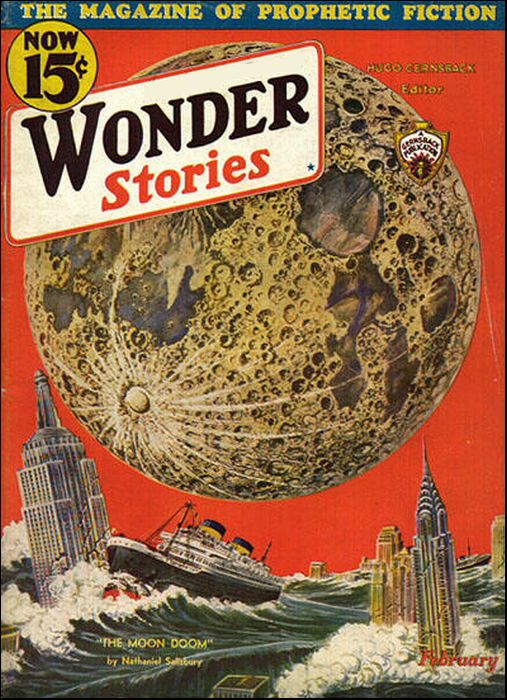
Wonder Stories, February 1933, with "The Eternal Dictator"

In his absorbing play, "Back to Methusaleh," Bernard Shaw shows what a terrific waste of human energy arises from the shortness of our lives. It is only when we begin to acquire mature wisdom, Shaw points out, that the three score and ten years have passed, the human being dies and his marvelous brain is no more. If men could live for two hundred years they might really learn a few things, especially how to solve some of the terrific problems of society.
Mr. Schachner has taken that idea as his theme for this thrilling story. He poses the problem—what would happen were one man granted, by fate, accident, or design, a stretch of life far beyond that of other men? Would he come eventually, by his far superior wisdom, to rule the earth? And if so what would be the conflicts that would come between him and his "childish" subjects? A fascinating idea, carried out in this stirring tale.
CAPTAIN DENNY KELS, of the Rocket Patrol, 3rd Flight Squadron, stared thoughtfully through the hull-port at the upward rushing field.
"Two bursts on the retarding rockets," he said mechanically to his second in command.
"Very good, sir."
Nick Davenant ran skilful fingers over the gleaming control board. Thin jets of flame spurted out of the bow tubes, spread fanwise until the great rocket cruiser was completely enveloped in burning gases. The ship decelerated swiftly, dropped into the cushioned cradle of the landing field with the tiniest of jars.
"Take over, Nick," Kels snapped. "I'm reporting to His Eternal Majesty."
Already the ground mechanics were swarming over the hull, fastening the cruiser down to its cradle with great cables, polishing and repairing the atmosphere-pitted surface.
"Very good, sir," Davenant replied formally. Then he relaxed, curiosity peeping out of his naive blue eyes, shining on his somewhat rotund face.
"I'd give a good deal to know what the Old One wants with you, Denny," he remarked.
"I've been thinking about it ever since the visiphone pulled us off the Sahara patrol," Kels acknowledged frankly. "It has me worried. Melius doesn't see any one except members of his Council."
Davenant puckered up the smooth skin on his forehead.
"If history doesn't lie," he began, "the last time—"
"Was seventy odd years ago when he ordered the leaders of the rebellion brought before him in person."
"They never came out again," Nick said meaningly. "Say, Denny," he burst out, "you didn't run foul of his spies by any chance?"
Kels laughed shortly. "I give them a clear berth. Haven't even thought a treasonable thought, and don't intend to. After all, the world has been a pretty good place to live in since the Old One took over, in spite of his iron hand. For the past two hundred and fifty years every one has had enough to eat and drink, comfortable shelter, plenty of entertainment, the right to do as one pleased, provided—"
"Provided it fitted in with the rigid planning of His Eternal Majesty." There was bitterness in Davenant's ordinarily soft-spoken voice.
Kels looked at his second in command in amazement.
"What's the matter with you, Nick? Aren't you satisfied?"
"Satisfied? No! I wanted to be a poet and the physiopsych graph showed me up as a rocket flier."[*]
[*] The physiopsych graph was a strange mechanical device into which the youth of sixteen was placed, every reaction mechanically recorded and synthesized by intricate automatic calculations into the special life-aptitude of the subject. A cold blooded method of choosing one's vocation, but scientific and efficient.
Kels stared at the gloom on his friend's rotund countenance and burst out laughing.
"Thereby showing the wisdom of the Old One," he chuckled, slapping his subordinate cordially on the shoulder. "Look! You're the best rocket patrolman in the Service, barring none; and you'd have been the world's rottenest poet."
"I had genius," Nick said seriously.
Denny laughed lightly. "I'm satisfied. This is just the career I'd have chosen if it were left to me. But I'd better hustle. If I keep the Old One waiting, there'll be a new captain. Good by."
He swished the slide-port open, swung himself out into the gathering twilight of the great landing field.
Kels threaded his way over the busy field, making for the Great Palace that gleamed with soft mellow glow to the farther side. It was quite dark now. The field was pricked out with lights where rocket ships lay in their cushion cradles. Kels glanced upward. In the southeast heavens, overlaying the ecliptic like a great shining Damascene sword, flamed a comet; Kyle's comet! Its huge misty brilliance paled the very moon that hung, crescent-shaped, near its nucleus. And even as Kels stared, a thin silvered streak etched its way across the pale blue of the sky, was swallowed up momentarily in the glare of the comet and reappeared to continue on its ordered revolution around the earth.
Kels nodded to himself. Many times had he hurtled a supply ship over the intervening distance to contact that eternally rushing Station in Space; to replenish food, air, supplies, for the immured scientists who scanned the black heavens to the greater glory of science.
Three hundred years before, in 2232, the Station in Space, a huge cylinder of shining aluminum, the third of its kind, had been carefully rocketed to an altitude of five hundred miles, there to attain a level velocity of five miles per second, and encircle the earth eternally like a minor satellite, completing its orbital revolution in 1 ½ hours. With clock-like regularity it sped on its appointed course, advancing immeasurably man's knowledge of the sun, the planets and the stars, cosmic rays, and meteorological conditions on the earth beneath.
The third of its kind! Kels stopped short, forgetful of his appointment with the dread Dictator. The first, a crude experiment launched in 2224, had crashed back in meteor-like destruction. But the second, two years later, had been successful! He swore softly under his breath. Kyle's comet! He had almost forgotten.
Gordon Kyle had lived in the twenty-third century. History cited him as a great physiological chemist who had gone up in that second successful Station in Space to perfect some secret experiments. The comet had flamed then as now, a strange visitant from interstellar space diverted from its original parabolic orbit by the huge mass of Jupiter.
The great comet swept close to earth, barely missing the moon, enswathing earth and satellite in its wide-curving tail. Its solid nucleus, rare in these celestial visitants, caused violent perturbations, fortunately not of a serious disruptive nature.
But the Station in Space, enclosing Kyle and his associates, had somehow been torn, in spite of its corrective rockets, out of its orbit around the earth, sent hurtling into the uncharted regions of outer space, where no rocket ship had penetrated before or since. Horrified beholders, eyes glued to powerful telescopes, had seen the doomed space-sphere drawn irresistibly into the nucleus of the comet, there to disappear.
Three hundred years had elapsed. Twice the comet returned in its new orbit, each time at a respectably safe distance from earth. This was its third visitation. According to calculations, it would once more pass near the earth and the moon.
But these facts were common knowledge. What had brought Kels up sharply were certain scattered hints from his own childhood. He remembered them now; for the first time they clicked into coherent form.
Gordon Kyle was his many times removed great grandfather! For some reason Kyle's wife and child had fled secretly after the tragedy, changing their name to Kels. In new surroundings, no one knew of their relationship to the distinguished scientist. But the secret had been handed down from generation to generation in a singularly close-mouthed family.
Furthermore, he remembered, Vincent Melius, His Eternal Majesty, by whichever name you wished to call him, had been a close friend of Gordon Kyle! A distinguished physiological chemist in his own right, he had been a participant in the secret experiments of his friend!
He had been in his sixties at the time of the disaster, yet somehow the man kept on living. Mortality, the inevitable heritage of the human race, did not seem to touch him. It was gradually bruited about that he had discovered the secret of immortality; but he maintained a discreet silence—and kept on living.
It was inevitable that Vincent Melius, the seeming immortal, should gain greater and greater influence in a world of flux and change.
In the year 2304 came the last great war. Whole peoples perished in the universal disaster, civilization staggered under repeated blows. It was inevitable again, in the drear days of salvage and reconstruction, that Melius, changeless, vigorous and hale in spite of his years and accumulated knowledge, should have been turned to as a haven of peace and safety.
Melius became dictator of the world. Under his strong, ruthless administration, mankind pulled itself out of the slough, became the ordered, planned world of today. Three hundred years, and Melius was still alive, still Dictator, more ruthless, more strong, than ever.
Frowning thoughtfully, Kels resumed his swinging stride toward the round-domed luminescent Palace. A guard stopped him with sharp challenge. Kels gave his identity number, and the nature of his mission. The guard switched the radiophone from his light steel helmet to his mouth, spoke low-voiced into it. Silence then, while the message was relayed through the Palace.
A green light gleamed suddenly on the front of the great smooth portal. A guard flashed a hand ray on the glowing circle; the clashing colors blended and faded. A smooth section slid silently open.
"There you are, sir," he remarked with a side-glance of curiosity.
"How do I find my way?" Kels inquired.
"Just follow the moving illuminated arrow on the left wall and you'll be all right. Don't attempt to try any other passage."
Kels smiled grimly. "No fear. My orders are to see His Eternal Majesty, and I know how to obey orders."
Kels was in a narrow, smooth-walled passageway, illuminated with cold light. A luminous arrow gleamed white against the brown-red of the wall, quiescent. As Kels stepped over the threshold, the arrow commenced a slow gliding movement along the wall.
Kels followed. He had no difficulty in keeping even pace with the moving pointer. Through twisting corridor after corridor he followed the gleaming arrow, meeting no sign of life in the lonely echoing halls. Then the arrow came to a quivering rest, pointing steadily toward a cul-de-sac. No further progress seemed possible. Kels stopped short and waited.
A voice filled the passageway with startling sound, booming, mechanical.
"Your identity number."
"K 44381," Kels said slowly.
"Have you weapons upon your person?"
"Yes."
"Remove them, and lay them on the table to your left." Obediently Kels slid out of their holsters his long-barreled dynol pistol and short-range spray-gun, deposited them on a low steel section that had glided transversely out of the wall. The section moved back into its recess, and vanished with its lethal freight.
The blind curved wall in front of him glowed suddenly, and Kels was bathed in a pale green light. Looking down he was astonished to find himself a pale transparent wraith, in which the bony skeleton showed dark articulations, and roundish blobs gave evidence to metallic substances embodied in his clothes.
Kels smiled to himself. The invisible Dictator was taking no chances!
The glow died away gradually, and the curving wall seemingly faded into nothingness.
"Enter." the booming voice commanded.
Kels walked steadily into a small, completely enclosed chamber. Smooth, blank walls confronted him in every direction, even the section through which he had entered had closed. There was no furniture, no equipment of any kind in the bare room except for a tall-backed, deep-seated leaden chair standing four-square on a raised dais in the center of the chamber.
A man was seated in the confines of the peculiar chair of lead, his head back-tilted, his face and body bathed in streams of bluish radiance that emanated from a glassite oblong inset in the metallic ceiling overhead. The impact of the rays on the man and on the dull lead of the chair set up little dancing sparkles that dazzled like a million fireflies in rapid shifting flight. At the same time Kels was aware of a low continuous droning sound and the peculiar tart smell of ozone came to his nostrils.
The man slowly down-ended his coruscating, light-invaded face and Kels felt suddenly uncomfortable. An iron-gray upthrust shock of hair and close trimmed grayish beard contrasted oddly with the smooth, wrinkleless fresh-colored skin of cheeks and forehead. It seemed as if a child were wearing a wig and false whiskers to frighten his comrades, or a slippered grandfather had sportively encased himself behind a youthful mask.
But the deep-set, burning eyes that seared into Kels' very vitals belied either interpretation. Age-old knowledge clashed harshly with regal arrogance, with indomitable will, with the veiled bitterness of one who has seen comfortable death pass by these wearied tenements. Kels felt instinctively that Melius the First was not at peace with himself, that constant warfare raged within those strangely youthful fleshments.
Then the Dictator spoke, his voice passionlessly cold.
"Captain Kels, you have contacted on several occasions the Station in Space."
"Yes, Your Eternal Majesty, many times."
Those strange eyes bored into Kels.
"Your record in the service as a fighter has been a good one."
Kels kept modest silence, wondering uneasily what it was all about.
Melius stared thoughtfully up at the glowing source of the radiance, his face aflame with dancing sparklets. Kels shifted his weight from one foot to another.
The Dictator lowered his head abruptly.
"You will contact the Station in Space at dawn with your rocket cruiser. Transfer provisions and supplies for a month's needs." He leaned forward a trifle, and Kels was astonished to notice the white grip of the knuckles on the leaden arms. "You will also dismount the cruiser's guns, transship them to the Station, and remount them in the telescope-ports. Keep only four electelescopes in action, so as to command a continuous sweep of the heavens.
"Transfer your crew to the Station, and return the present Station contingent to earth in the cruiser. You will be in sole command and strictly responsible for unquestioning obedience to my orders. Secrecy is essential!"
Gone was the passionless coldness; every word vibrated with the intensity of repressed passion.
"You will maintain unceasing watch of the heavens. Any strange body approaching the earth, be it meteor, fragment of planet, space-sphere, or rocket-cruiser, is to be destroyed on sighting. Do not wait for identification, do you understand?"
"Yes, Your Eternal Majesty," Kels said bewildered, "but—"
"There are no 'huts'," Melius interrupted harshly, "those are my orders and they must be obeyed."
Kels clicked his heels together and saluted.
"Very well, sir," he said formally.
Something of relief flitted over the child-like mask; the eyes relaxed their savage expression. Melius condescended to explain.
"I have received information, Captain Kels, that our earth is about to be invaded by strange denizens from outer space; their mission—to destroy the earth. Their weapons, their vehicle, are unknown. It is essential, therefore, that you do not wait to identify any strange body approaching the earth; blast it out of existence before you yourself are annihilated. You need have no fear of making a mistake. Earth traffic, except for the Station and contacting cruisers, does not pass above the fifty-mile level. As an added precaution, warnings are being broadcast to keep all vessels within the ten-mile level until further notice. That is all."
Kels bowed and walked steadily out of that strange bare room with its humming, drumming sound, ozone odors, and the strange radiance-bathed figure of Melius the First.
The door slid into blank smoothness behind him; the illuminated arrow awaited him with quivering restlessness in the corridor, its direction reversed. His weapons lay on the outthrust steel stand. As he buckled them on, his mind was a chaos of questions and emotions.
Had the strange beating flame on Melius something to do with his immortal youth, impregnating him with a phoenix-like emergence from the ordinarily inevitable decays of time? And why this strange, secret interview—the breaking of a centuries-old rule? The orders could have been transmitted by visiphone just as readily. And these enemy invaders from space! Where were they coming from; how had Melius received his information? These and a thousand other questions clamored for answer. As the arrow started its even backward trek, Kels shrugged and gave it up. He was a Patrolman, and a Patrolman's first duty was to obey orders unquestioningly.
NICK DAVENANT met him with eager relief on his honest countenance.
"Thank God, Denny!" he burst out. "I had given you up for lost. What did the Old One want with you?"
"We're contacting the Station in Space at dawn," Kels disregarded the question. "Lay on a month's supplies, examine our long range guns, make sure they are in perfect working condition, and break out ammunition."
Surprise flitted over Nick's countenance, then he saluted his superior smartly.
"Very good, sir."
An hour before dawn the cruiser was roaring perpendicularly skyward, supplies neatly stored on board, every gun ship-shape, ammunition brimming in the automatic feeders, every member of the crew spruce and alert. Nick Davenant moved about sullenly, barking unwontedly harsh commands at inoffensive subordinates. He was hurt at Kels' reticence, and showed it.
But his superior was not paying any attention to his sulky attitude. His eyes were glued to the visiscreen, scanning the heavens for the first sign of the Station in Space. It was due over the western horizon in half a minute. To the southeast blazed Kyle's comet, hugely curved, its planetoid nucleus surrounded with concentric radiances.
A tiny silver cylinder arched over the left edge of the visiscreen, crept slowly across the luminous surface. Kels waited until it crossed a coordinate hair line, snapped levers on his space-dimensional calculator. The answer gleamed redly back.
"Three bursts on the port rockets at ten second intervals," he commanded, "Accelerate two gravities on the stern rockets."
Davenant complied, still brooding over his fancied wrongs.
The cruiser swerved and leaped in a swift tangential arc, rushing through space to its appointed rendezvous. The Station in Space was flashing now across the velvet backdrop of the sky glittering in the unobstructed sun.
Kels jockeyed his cruiser until it was immediately alongside the cylinder, flying parallel with it, and at an equal rate of speed. To observers in the ships, it seemed a? if they both were motionless, adrift in space.
"Magnetize contacting plates."
A surge of induced current, and the cruiser swung gently closer, until with barely a vibration the two vessels contacted and continued on their swift orbit, firmly bound together.
"Prepare Airlock No. 1, open exit-port."
"Now, Nick," Kels turned to his still sulky second in command, "dismount four spray guns and six projectile rifles ready for transference to the Station. Also full complement of munitions, supplies and oxygen tanks."
Enjoying Davenant's open-mouthed amazement, he stepped quickly into the air-lock, passed through the exit-port into the similarly opened port of the Station.
Captain Emmett, grown gray in the Service, now assigned to the soft berth of the Station, shook his hand warmly.
"This is a surprise, Kels," he greeted. "I hadn't expected supplies for another week. And since when has a rocket-cruiser of the Patrol been impressed into Supply Service?"
"I'm taking over," Kels said briefly. "You are to take my ship back to the landing field with a skeleton crew, and all of your scientific complement."
Emmett stared at the younger man from under bushy brows.
"What kind of a jest is this?" he demanded angrily.
"Orders from His Eternal Majesty," Kels retorted coolly.
"I didn't—" He broke off at the high whine of the visiphone.
Still purplish, he adjusted the private phones to his head, switched on the screen. The luminous surface remained blank, but Kels could hear the blurred buzzing in the receiver.
Captain Emmett's jaw dropped as he listened.
"Yes, sir," he intoned respectfully, and snapped off the current.
"That was the Chief," he said unwillingly. "I just got my orders. Sorry."
"That's all right," Kels said cordially. "We start shifting at once."
Emmett scratched his head.
"What's the big idea?" he asked curiously.
"Orders from His Eternal Majesty," Kels repeated laconically.
"Oh!"
That was all. Emmett knew that no further questioning was permitted.
It did not take long to effect the shifting of personnel and cargoes. Kels shook hands cordially with Captain Emmett, locked the exit-port, shut off the magnetic current, and saw the cruiser he had commanded sheer off under infinitesimal discharges. A last waved good-bye through the viewport, and in a flashing acceleration of gleaming steel and flaming surges of gas, the cruiser darted downward to the earth.
Kels stared after it, wondering if he ever would contact with the good old earth again. There was something he did not like about this mysterious adventure he had been ordered on; a good many things that did not quite ring true.
A bitter voice broke in on his meditations.
"What are the Captain's orders?"
Kels wheeled and slapped his aggrieved subordinate genially on the shoulder.
"Lots of them, Nick," he grinned. "First you're to dismount all telescopes except those at bow and stern, and one to port and one to starboard. Mount our transshipped guns in their places, spray and projectile alternately; see that ammunition is supplied for each, and pipe the crew to battle stations, in four-hour watches."
"The hell you say!" burst involuntarily from Davenant, forgetful of his aggrieved dignity.
"Exactly," Kels agreed. "Sorry I had to keep you in the dark but those were orders. Now that we're irrevocably cut off from earth; forever, I'm afraid; there's no further need for secrecy." And he related in detail his strange interview with Melius the First.
Davenant heard him through with a mounting whistle of astonishment.
"The Old One's sure got something up his sleeve that he didn't want you or anyone else to know about," Nick commented at the end of the narrative.
"Certainly; but what? That's what's bothering me. We're the goats for some particularly smelly affair."
Nick looked at him queerly.
"You don't believe that story about invaders from space."
"No, I don't," Denny responded frankly. "Melius would have impressed every Patrol ship into service. In speed, armament and maneuverability they have it all over this tub on a practically immovable course. And there are hundreds of cruisers."
"They can't maintain this height for long."
"Granted. But what difference would it make if they patrolled the fifty-mile level?"
Davenant fell silent.
"Another thing," he said finally, "why the insistence that you fire at everything without waiting for identification?"
"To protect our own lives," Kels countered sarcastically. "The Dictator has gone soft after all these years."
Nick made a grimace, stared out of the glassite port at he slashing scimitar of the comet.
"I wonder—" he said softly.
"What?"
"Oh, nothing," Nick returned elaborately.
"Then get busy on your duties, you lazy hound," Kels pretended anger.
"At once, Captain. And another thing—I'm examining the earthward corrective rockets to make sure they're in working order."
"What the devil—" but Nick had fled, and in the press of swift duties, Kels forgot Nick's enigmatic conduct.
The crew, trained fighters every one, worked with disciplined precision. The electelescopes slid out of their long-barreled ports; long, sleek snouts bristled out of the Station in defiance of the universe. The projectile guns shot armor-piercing shells filled with dynol, the most powerful explosive known to man. The spray guns, angling outward like inverted cones, sprayed over a wide area thousands of tiny silicious pellets, each filled with liquid arnon, a combustible fluid that burnt inextinguishably through every element, compound, alloy or combination of metals except the silica in which it was encased.
Munitions were fed into the automatic hoppers, and the first watch took their battle stations, ready for the unknown enemy that was to descend upon them from the fathomless reaches of space.
"We'll each take charge in four-hour watches," said Kels. "You can catch up on some sleep now if you wish, Nick."
"Not me. I'm wide awake. I'll watch this first one with you."
The remaining telescopes threw their field of vision on the visiscreen, under button controls. Kels solved the problem of perpetually pressing buttons by attaching a circuit breaker, so that each field flashed on automatically for five seconds, and then yielded to the next. Thus he was able to view the entire span of the heavens from the comfortable recesses of his chair without moving a finger.
They were circling swiftly around the earth, maintaining an even pace of five miles per second, distance of five hundred miles, accurate as a fine chronometer.
Below, the green and white earth, hugely spherical, turned in slow majesty. Continents and oceans showed clear-etched on its convex surface. Kels noted with fascination the birth of clouds, from tiny specks no bigger than a hand, to great, sullen-bellied masses that obliterated vast sections of the whirling orb. No wonder meteorology had become an exact science with the advent of the Station in Space.
But Kels' interest lay in the outer heavens. That was where the invading peril was to come from. The moon gleamed queenly white, the sun was a molten hole in the pitchy black of space, the stars were white radiances. But Kyle's comet overshadowed everything else with its magnificence. The vast sweep of its glowing tail overlaid at least twenty degrees of arc; its solid nucleus was over 100 miles across. A sizeable planetoid in its own right!
The comet was curving toward the earth at cosmic speed. In two more days it would approach its closest, about 150,000 miles distant. Then it would curve away, rushing around the sun and flinging out again on its orbit past Jupiter.
In two days, slight corrective rocket discharges would have to be employed, to counterbalance the outward tug of the comet's nucleus. Kels paused abruptly in his lucubrations. Now what the devil had Nick meant by his last remark about the rockets? He glanced over at his subordinate, but that worthy was placidly chewing on a sandwich.
The day passed without incident. Nothing alien drifted into the field of the telescopes, not even a stray meteor. Watch followed watch with yawning regularity.
The next day however, Kels was dozing on his off trick when Davenant yelled. Instantly he was on his feet, wide awake, the crew sprang to their stations, alert, eager for anything to break the monotony of their peaceful existence.
"What is it?" Kels cried.
Nick grinned sheepishly.
"Only a blasted meteor," he apologized. "It looked at first like something interesting." He pointed to the visiscreen, on which a tiny rounded object was speeding away from the comet in their general direction.
"Meteor or not," Kels responded briskly, "you know what our orders are."
He raised his voice. "Man the starboard projectiles." He squinted at the tiny moving blob, watched it cross a hair-line. Then he entered its coordinates on the space-dimensional calculator, threw in allowances for distance, velocities of meteor and of dynol projectiles, shifted and obtained the answer.
"Sight plus 22 deg. 11' 35" Plane Alpha; plus 2 deg. 4' Plane Beta; minus 6 deg. 13' 5" Plane Gamma."
The great projectile guns moved smoothly in their revolving slots until the cross-lines bisected the muzzle dots. Kels watched the chronometer cylinder.
"Fire!"
There was a deafening roar; the space cylinder recoiled violently under the impact of the broadside.
"One burst on Rocket No. 6."
A flaming spew of gases to port, and the Station righted itself on its normal path.
But Kels and Davenant were absorbed in the spectacle of the speeding dynol projectiles. The huge shells fled parallel through space, following a calculated arc. The meteor grew slowly on the visiscreen, its path angling toward that of the missiles of destruction.
It would take fifteen minutes for the paths to intersect, or show a definite miss. Even the disciplined crew cast excited glances in the direction of the screen. As for Kels, he was positively breathless. Never before had he been called upon, or anyone else, for that matter, to attempt bombardment at such vast distances. The meteor, if such it was, was all of 35,000 miles away! A speck in infinity, and other specks playing tag with it! It was an impossible shot!
The minutes passed, breathless, tense. The dots on the visiscreen crept onward, closer. Then, a great cheer burst involuntarily from the men. Three of the four projectile dots impinged on the larger sphere; the fourth passed an infinitesimal distance away, to plunge on into uncharted space!
At the impact of the dynol pellets, the meteor seemed to lift and shatter soundlessly into a rain of tangentially flying fragments. Such was the power of dynol!
Kels and Davenant shook hands solemnly.
"I never believed it possible," Nick's round face held awe. "The best we've ever done before was not over a hundred miles."
"But that was in the stratosphere," Kels objected. "Air resistance is a tremendous factor. Besides, we never needed greater ranges."
The visiphone burred. Kels adjusted his headgear, tuned in. The Chief's voice sounded.
"Flashes seen from Station in Space. What happened?"
"Pursuant to orders we—"
The wave scrambled into a medley of roars. Then suddenly the ether cleared and a new voice came hurtling on a tight wave. It was the Dictator himself.
"You are to report only to me hereafter, Captain Kels," the passionless voice said coldly. "You may tell your story now."
"Pursuant to your orders, Your Eternal Majesty," Kels began, "we fired at an object seemingly coming from the direction of Kyle's comet."
A perceptible pause.
"With what result?"
Kels could not keep the exultation out of his voice. "Three out of four dynol projectiles scored direct hits and blew it to smithereens."
"Did you identify the object?"
"Yes, sir, it was a meteor."
There was menace in the cold even tones.
"You have disobeyed orders, Captain Kels. You were told to fire immediately on sighting. If you had done so, you could not possibly have identified the object. Let it not happen again."
"Y-yes, sir," Kels stammered. A vast resentment surged within him.
"Tomorrow," the inexorable voice droned on, "the invaders are expected. Destroy every object on sighting. Allow nothing to slip by, no matter what it seems to be. Your life depends on your prompt obedience to instructions. Do you understand?"
"Yes, sir," Kels answered as coldly.
The visiphone abruptly clicked off.
Kels turned in seething rage to face a grinning subordinate.
"You don't seem any too pleased with the acceptance of your report."
Kels almost exploded. "The Old Tyrant!"
"Sssh," Nick warned him with a significant side glance at the crew. "There may be one of his spies planted. Be careful what you say."
Kels calmed down immediately. "You're right. But it's getting more and more mysterious. I get hell for saying I recognized the meteor as a meteor, and then I'm told the invasion is all set for tomorrow."
Davenant whistled tunelessly. "That's when Kyle's comet approaches closest to the earth."
Kels stared at his friend. "What about it?"
"Nothing." Nick moved off. "Pm taking another look at the corrective rockets." And he was gone.
Kels frowned thoughtfully. He was beginning to piece things together.
THE following day, the Station in Space seethed with excitement. Every sense in the swift rushing cylinder was strained and alert. The crew snapped to their stations like unleashed hounds. There was no question of watches now. The full complement was on battle duty. Enemy invaders from space were on their way to destroy the Earth. That news had finally disseminated to the personnel. Kels and Davenant sat constantly before the visiscreen, scanning every inch of that illuminated surface for he first sign of alien objects out in space.
Kyle's comet was easily the most spectacular object in the heavens. Its nuclear planetoid glowed with an orange flame, the tremendous arced tail already held both moon and earth in its tenuous embrace. Kels knew the space cylinder was likewise enswathed, yet so near vacuum are comet's tails that it interposed not the slightest opposition to the Station's rush.
Fortunately, at the point of nearest approach, the nucleus was on the opposite side from the moon, otherwise there might have been a disastrous collision. In half an hour the great comet would be closest, then it would veer away.
The Station felt the gravitational tug, but slight bursts on the corrective rockets kept it on an even keel.
Round the earth the fascinated watchers sped, then back again to see the nucleus rising swiftly from beyond the earth's curving rim, swinging aloft and over them.
Davenant watched the chronometer with strained attention. The split seconds registered on the moving electrical cylinder. Nick shifted his gaze suddenly. It was the second of closest approach. The planetoid showed round and orange-glowing on the upper right of the visiscreen.
Kels followed his gaze. There was breathless silence. Then Davenant sucked his breath in sharply. A tiny dot, so tiny that it was only a moving pinpoint of silvered light, disengaged itself from the outer rim of the planetoid, glowed faintly in the orange coma, then seemed to move slowly, yet actually with tremendous velocity, out into the blackness of space.
Kels galvanized into life. His fingers pushed lever after lever on the calculator.
"It's an impossible shot, but orders are orders."
The answer showed split seconds of arc on the planes of sight.
Kels groaned.
"We'll try it anyway." Nick smiled queerly and held his peace. The guns sighted as well as they could, and roared full broadside. Then they settled down to watch the hurtling projectiles.
Half an hour later it was obvious there would be no contact. The fast-moving object was still too far away to determine what it was, but there was no doubt it was heading squarely for the earth.
The Station in Space was moving around the earth's rim when Kels let loose another furious broadside. Then the bulk of the spinning world obscured further observation. It would take three quarters of an hour for them to speed around the farther side, and come into sight of the comet again.
"I don't believe I hit it," Kels said quietly.
"I'm positive you didn't." Nick assented.
Kels looked at him strangely.
"Any idea what it was?"
"Not an idea."
"Neither have I."
And each knew the other was lying.
Never did prisoner wait more anxiously for a last minute reprieve than did the crew of the Station in Space wait for the rising of the comet over the earth's convex horizon.
At last the nucleus came up like a wan edition of a tiny sun. Every eye raked the screen for evidence of the strange body.
Then someone in the crew, forgetful of all discipline, groaned aloud.
"Missed, by the nine moons of Jupiter!"
There was no mistaking the shining vessel now. It was a space ship. It was now some twenty thousand miles away, and traveling fast toward the earth. The dynol shells had vanished, lost in the vastness of space.
Kels' face set grim and hard. He performed rapid calculations.
"For God's sake, Denny," Nick cried out in alarm, "what are you going to do?"
"Do? Obey orders!"
Davenant caught hold of his hand. He was literally trembling with excitement.
"Don't do it!" he implored. "Let it go. Fire if you must, but make sure you miss. That space ship must not be harmed."
Kels shook off his friend's restraining hand.
"You must be mad," he said coldly. "My orders are explicit and admit of no argument. You as a Rocket Patrolman should know better."
"Denny, that ship out there is—" Nick glanced around wildly, saw the crew listening avidly at this quarrel between their officers. He stopped short, controlled his voice with a violent effort, spoke low.
"Miss it, Denny, for God's sake, miss it. The future of the world depends on your missing. Don't you see, it's a space cylinder!"
"I realized that some time ago," Kels said surprisingly. Underneath the surface he too was fighting a battle, a battle of all the finer instincts of his nature against the trained Patrolman.
"I'm sorry, Nick," he burst out, "but I must shoot, and shoot for the mark."
Davenant wrestled suddenly with him. "Then I must stop you." The round face was white with strained determination.
Kels was taken by surprise. "Mutiny," he gasped, staggered under the impact, then recovered himself and exerted all his superior strength. He disdained to call for help from the startled crew.
It did not take him long to overcome the slighter man. Arms pinioned helplessly behind him, Nick lay panting and glaring.
"Put Lieutenant Davenant in irons to await my disposition," Kels called. "And remember, none of you have seen anything; understand?"
"Aye, aye, sir," his men chorused. They knew the penalty for such conduct as Davenant's. Nick was pushed gently into the little cubby hole infrequently used for mutineers.
The space cylinder was distinctly visible on the visiscreen now. It was only 20,000 miles away.
Kels reperformed his calculations. He was surprised to note how his hand trembled.
The crew were stationed at their guns. He gave the necessary sighting directions.
"Fire!" he commanded in a steady voice.
Out leaped the projectiles like live things; the Station rocked and roared with the vibration. In ten minutes the paths would intersect.
Kels found himself in a welter of emotion. The shots had gone true, he knew, yet he found himself tensely wishing that they would miss. What manner of beings were in that far off shining cylinder?
Minutes passed. There was no doubt in his mind that there would be direct hits, and his flesh crawled at the thought.
The strange behavior of Melius, the even stranger excitement of Nick Davenant, the invading vessel and its point of origin, all made a confusion in his mind. He dared not pursue his thoughts to their logical conclusion.
Then, on the visiscreen, the alien space cylinder suddenly changed its course. It had seen the death-dealing missiles. Kels jumped up.
Hardly knowing what he did, carried along solely by professional instinct, he gave swift orders.
The broadside of all guns, dynol and spray, belched their hail of death in continuous bursts. The enemy ship was only five thousand miles away, within range of the far-spreading arnon pellets. Space was filled with a cloud of rushing missiles. It was impossible for the doomed cylinder to avoid them all.
Almost as he gave the orders, Kels repented. A cold wind cleared all the cobwebs from his tradition-saturated mind. He saw everything in blinding clarity. He was but a pawn in the colossal, ruthless game of the Dictator. And he had permitted himself to be used. Davenant had seen, and he—
Another glance at the screen. The gleaming cylinder was swerving violently, but it would do no good. All space was filled with the wide-darting pellets that burned inextinguishably. He, and he alone, would be responsible for the destruction of the cylinder.
He buried his face in his hands, unwilling to see the doom he had executed.
Cries of astonishment aroused him. The crew had deserted their stations, were staring openmouthed at the visiscreen.
Kels jerked upward, swore violently. The strange space cylinder, now only 800 miles away, shimmered bluely. Coruscating sparks played over its metallic surface in a network of flame. And the arnon pellets, the heavier dynol projectiles, were dividing into slanting streams, passing over and beneath and around the vessel, to plunge harmlessly into the emptiness of interplanetary space.
Kels gasped. The stranger was possessed of defensive weapons superior to those known on earth. He had surrounded himself with a magnetic field of such enormous strength as to deflect missiles plunging directly at him with speeds of the order of 25 miles per second. Kels' mind dizzied at thought of the power required.
Then another thought burst upon him. If such were their defensive strength, what new weapons of offense were about to be turned upon him? The Station in Space could not duck and swerve with the celerity of a cruiser. Its corrective rockets were puny things, fit only to keep the cylinder on its appointed orbit.
But the stranger passed them by with what seemed a derisive gesture. Down, down, it kept on its steady plunge toward the spinning world.
Kels felt an unreasonable mortification. The alien vessel had disregarded him as an unworthy antagonist, too insignificant to waste powder on. The fighter in him stirred to quick, heavy wrath. Forgotten were his almost crystallized suspicions, forgotten even was his bound mutinous comrade, forgotten everything but that last insolent flirt of the stranger's tail.
He set his teeth hard.
"Continuous bursts on the port rocket. Use emergency fuel supplies!"
There was astonishment on the faces of the crew, but one look at their commander was sufficient.
The port rockets started their soft roaring. The Station commenced a slanting, long-distance glide toward the earth.
Kels watched the stranger through the starboard telescope. He was slackening his tremendous drop, preparatory to landing. Then his heart bounded. Rocket cruisers were rising hastily from their cradles to meet the presumptuous invader; tiny black dots coming swiftly from the far horizon were converging on the Great Palace.
The forces of the Rocket Patrol were being mobilized.
The menace had been discovered! Exultation one moment—his comrades of the Patrol would smash the alien; bitterness the next—he would not be in on the kill. Then the scene turned swiftly from under him.
He issued reckless commands; he drove his crew fiercely. Double charges in the already straining tubes. The forward end of the Station tipped more steeply. He'd land at the Rocket Field on the first revolution about the earth if it meant smashing the Station to twisted fragments. The smell of battle was in his nostrils.
Never did an hour and three-quarters seem so interminably long. Kels glared at the nearing, ceaselessly spinning earth with gnawing impatience. What had happened? Had the vast mobilized armament wiped out the alien without his being present?
The bosom of the Pacific, the steppes of Central Asia, flipped by. The Station was growing uncomfortably hot; they had struck the upper limits of the stratosphere. Europe! It was considerably hotter. The air broke into little globules of perspiration. They were slanting fast. The turbulent Atlantic, not fifty miles below. Steam formed; men staggered in a fog of scalding droplets. The outer shell of the Station glowed from the friction of its swift passage through resistant atmosphere.
The rocket beacon in mid-Atlantic, a vast heaving raft red with luminescence.
Then and then only did Kels return to sanity. They were burning through the air at a mad three miles per second, and only 30 miles up. The port rockets ceased their continuous roaring, the single bow rocket took up the refrain. Flaming gases hurtled past their already superheated sides, exerting slow braking action. The American coastline swam darkly in the distance. Only fifteen miles up now and speed still tremendous at half mile a second!
A petty officer came hurrying over to where Kels stood before the translucent chart on which their position showed as a moving dot.
He saluted. "Lieutenant Davenant wishes to speak to the Captain, sir."
Kels turned. "Eh, what's that?" He had completely forgotten about his comrade. Remorse smote him, dim remembrance of former uneasy suspicions. "Oh, to be sure. Unbind the Lieutenant and bring him in."
Nick Davenant stood unsteadily before him, limbs chafed from restraining manacles, ordinarily fresh-colored face pale. Yet his voice was steady.
"If the Captain is joining battle, I beg leave to participate actively. After, if alive, I shall return to the brig for the Captain's disposition."
Kels covered his own inward confusion with outward cordiality.
"Of course, Nick. Let's forget what happened. You suffered from temporary madness and I was hasty. You're released, old boy, do you understand?"
"The Captain is very good," Davenant said formally in a queer, toneless voice, and withdrew.
Kels stared after him, trying to organize his usual cool reasoning faculties, but the lust of battle still flamed strongly.
Great New York rushed threateningly to meet him; then the Rocket Field. The bow rocket roared with redoubled fervor, the nose of the Station pointed downward at an insane angle.
A confused sight of swarming, diving ships, of the earth tilting alarmingly, a last despairing blast of hot gases, and then a splintering crash.
Kels awoke to find himself wedged into the remains of the calculator. All about him was steam and fog, through which he hazily saw twisted, smoking wreckage. Dim figures staggered crazily upright, groaned and held on to curving walls for support.
Kels tried to extricate himself, but could not budge. Something stabbed sharply in his left shoulder.
"May I be permitted to help the Captain?" some one was asking formally.
Kels stared up through the haze at Davenant's pale, set features.
"Stop the nonsense, Nick," he shouted angrily. "I apologized, didn't I? Here, give me a hand."
Several members of the crew limped through the wreckage, carrying crowbars. It took minutes of careful levering to loosen their commander from the confines of the calculator.
Kels felt his shoulder gingerly. The pain was intense; a fracture probably, but he had no time for such minor considerations. By this time the smoke had cleared. He surveyed the damage swiftly. The Station was a wreck of course, some of the men were hurt, all were bruised and shaken, but no one seriously. The great guns were smashed, but light arms carried by the men seemed intact.
By some miracle, the mechanism of the exit-port had not been harmed. Kels tried it more as a gesture than with any expectation of its working. To his surprise, it did open creakily.
The clean, sweet air of the outdoors rushed in, swept away in great gusts the lingering steamy atmosphere, the rapidly accumulating foulness.
"Men," said Kels sharply, "we're up against a dangerous foe. He is somewhere outside. We know his defensive weapons; we do not know the caliber of his offense. You are men of the Rocket Patrol. That means we attack at once."
A CHEER rang out. No one held back; eagerness showed on every face. They massed before the exit-port, spray guns in hand, dynol pistols in reserve.
"Let me go out first," Davenant requested quietly.
"I am Captain," Kels answered brusquely. "That is my privilege. You follow me."
With that he stepped out, spray gun at the ready, Nick at his heels and the crew in tumbling precision immediately behind.
Kels stopped suddenly short; only instinctive routine caused his men to form ranks like animated automatons.
For the space in front of him was strangely still and lifeless. The alien cylinder, born of the comet, lay quietly on the ground, not a hundred yards away. Its surface was a shimmering network of blue sparkles.
The rocket field, ordinarily a roaring hive of activity, was deserted. Not a man, not a rocket cruiser, on its vast surface. Kels glanced swiftly aloft. The sky was a dense mass of plunging, maneuvering cruisers. Every unit of the Patrol, from the far corners of the earth, had been summoned to the defense.
But, strangely, the great cruisers flashed to within five hundred yards, swerved violently, almost as if twisted by a gigantic invisible hand, and went careening, stern rockets aflame, tangentially off on a new course. Arnon pellets, great half-ton dynol projectiles, belched from hundreds of guns, flattened against the invisible sphere of force, rebounded like so many pebbles off into space again. Some of the arnon pellets, split by the impact, burnt inextinguishably, so that high in the air, at a radius of five hundred yards, concave curtains of flame obscured the heavens.
The Great Palace loomed with its myriad domes in the distance, softly glowing. Squadrons of men poured out of its portals on the double quick, dragging strange complex machines after them. The Pretorian guard of the Dictator, constantly on guard in the Palace, never on duty elsewhere. Great, grim, silent men, sworn to protect His Eternal Majesty with their lives, armed with strange weapons, hitherto undisclosed to the outer world.
And still the space cylinder remained unstirring; no guns peeped out of its smooth surface. Except for the crackling blue flames dancing on the steel, it might have been deserted.
The guard set up their monstrous weapons outside the field of force. Faint barked commands filtered through.
Solid cylinders of white hot radiance projected with unbelievable speed out of the mouths of the monsters, impacted against the invisible protective sphere of force. The hurtling roar of the impact made all other noises sound like the faint pipings of insects. A blast of flame lit up in a visible wall, sizzling and screaming its rage.
For long moments the fascinated watchers saw a battle of giants.
Then, like a thousand Niagaras, the heat cylinders burnt through, swept across the intervening air with diminished velocity until they hit the space cylinder. The surface glowed redly. If the energy of the heat paths had not been taken up almost wholly by the resistant sphere of force, the space vessel would have melted into a glowing bubble.
Kels raised his weapon. Nick beat his uplifted arm down again.
"You fool," he yelled above the tumult. "Are you blind; don't you see? The invader is the second Station in Space on which Professor Kyle was lost!"
Kels spoke uncertainly. "There is no doubt about it, but—I figured Kyle and his men must have been long dead."
"How about his descendants?"
In spite of the screaming war around—cruisers diving for the breach in the wall to force their way in; the Pretorians preparing another blast—Kels grinned.
"There were no women on board," he pointed out.
"True," Nick acknowledged, temporarily staggered. "But I believe—"
What he believed remained for the moment unknown, for the alien cylinder went into action.
From the end facing the Palace, a bolt crashed out; a long blue zig-zagging streak of lightning. Hundreds of thousands of volts were concentrated in that hurtling sear of electricity. It caught the Dictator's yawning machines on the verge of spewing forth new destruction, wrapped them around with titanic currents.
There was a tremendous explosion, the squat weapons disintegrated into flying molten fragments, the Pretorians vanished into unnoticed hurtling blobs of flesh; a rash rocket cruiser, swooping toward the torn-down area of force, was caught in the crashing blue flare, dropped suddenly to earth, a flaming wreck.
Kels blazed into action at the sight of his comrades' death. No matter who these invaders from the comet were, they had committed the unforgivable crime. They had slain men of the Rocket Patrol!
With lightning speed he fired his spray gun. He knew that somehow they had fallen within the sphere of force. The arnon pellets spattered against the hull. Instantly the shining steel burst into a score of small burning fires.
Kels grunted satisfaction. No power on earth could quench those terrible fires once they had started. They would eat like voracious wolves through metal and flesh, spreading in wider and wider circles, until the space cylinder was completely devoured.
The only safety of the doomed occupants lay in quick flight into the open. And he and his men were ready. He felt overwhelming curiosity. What strange monstrosities spawned on the far-wandering comet were about to burst on his sight. For his short colloquy with Nick had convinced him of the ridiculousness of his former groping thoughts—even Nick was silent, seemingly at a loss.
The fires spread, the blue sparkle waned in power.
Soon it would be quenched, the sphere of force would collapse, the myriad Patrolmen, dogs of war burning to avenge their former futility, would attack in overwhelming mass.
The burning cylinder quivered. Kels' crew stood watchfully, weapons ready. A black hole yawned suddenly in the side of the hull. Kels trained his dynol pistol.
A figure stepped out into the confusion of sunlight and thick smoke. Kels' finger tightened, relaxed suddenly.
It was a human being who was standing there, calm and unconcerned as if he were peacefully surveying a wooded glade. He was tall, taller even than Kels, hair and beard of shining white; massive, kindly features clothed in almost god-like majesty. Blake's conception of a beneficent Jehovah come to life out of one of his ancient etchings!
Some one screamed in back of Kels, a dynol bullet went crashing. It missed. Kels whirled. "I'll shoot the next man who does not wait for my command."
The majestic stranger from the comet was unperturbed. His hand was raised in token of peace. Behind him, there filed from the blazing cylinder a round dozen of men, all white-haired and even white-bearded, their countenances stamped with majesty and wisdom.
"Who are you?" Kels shouted, taut with chaotic emotions.
The leader disregarded his question.
"Men of earth, we came in peace, homesick wanderers joyful at the thought of returning to our beloved world. Why were we met with violence and murderous assaults?"
"I knew it; I knew it!" Davenant's voice cracked with excitement. "He's Professor Kyle!"
The old man looked at him curiously.
"Aye, I am Gordon Kyle. Is my name still remembered on earth?"
The floodgates burst for Denny Kels. Unbelievable, yet true. His ancestor stood before him, alive after three hundred years! He took quick steps forward, forgetful of raging war, of the massing attack outside.
"I am your descendant, Denny Kels. Your family changed their names after your supposed death."
Gordon Kyle glanced at him sharply.
"Why did they do that?"
"I do not know."
Kyle's eyes were unfathomable pools.
"Know you one Vincent Melius, a contemporary of mine?"
Kels gasped. Of course! There was the hidden spring. Both men had achieved seeming immortality.
"Why, Melius is still alive. He is Dictator of the earth. It was his orders that your vessel be destroyed."
No slightest change flitted over the massive features, nor over those of his comrades. They had learnt philosophy in their long, strange exile.
"That had ever been my thought," Kyle said softly.
It was Davenant, fascinated listener though he was, who cried the warning.
"Look out! They're breaking through."
Denny jerked around. The burning hulk was collapsing, and with it the shell of force. The sky was a cloud of rocket ships, diving for them like vultures.
All Kels' training, all his inborn soldierly instincts of loyalty, went completely by the board. His ancestor, cruelly wronged in ancient days, miraculously still alive, was about to be butchered at the orders of the very man who had consummated that ancient wrong.
"Into the Station, all of you," he spoke rapidly to the age-old men. "Its walls will afford some protection."
"Nick, men who have fought and patrolled with me, it is certain death to defy the Dictator. What do you say?" In one great cry came the response.
"We stick with you. Down with the Dictator."
A quiet smile flitted over Kyle's wisdom-worn countenance.
"Noble souls exist in every age. Your sacrifice, however, is unnecessary. We are not unprepared. Nevins!"
A grave, slightly stooped senior stepped forward, deposited an oblong black box he had been carrying. It was smooth and shiny, only one knob disturbed its surface. He twisted the knob once. The diving rockets were not over a thousand yards above; bursts of flame at the mouths of protruding guns proclaimed missiles of destruction already on their way.
The box clothed itself in scintillating blue sparkles. Kels felt waves flow past him. Smashing projectiles rebounded suddenly, careening cruisers were torn out of their downward plunge.
Kyle nodded in satisfaction. "We are safe now. The sphere of force is in operation."
"But how—?"
"Simple enough." A sad smile flitted over his face. "We had plenty of time on the comet to perfect and invent. All our people were great scientists even in what we now call their youth. We found a way of concentrating the magnetic waves that flow constantly from the sun and re-emitting them. Nothing can penetrate their field."
"Those new flame cylinders which I never knew existed, seem to have broken through," Kels pointed out.
"That is true," Kyle admitted: "But that was because we did not use sufficient power. But now—" his voice grew stern and rigid, "I have something to say to Vincent Melius, the false friend of my youth. Where is he hiding?" Davenant pointed. "Over in the Great Palace."
Kyle took out of his metallic-threaded tunic a tiny instrument, for all the world like a small edition of a loud speaker, placed it to his lips. He faced the Great Palace, seemingly oblivious of the army of soldiers massed before it, shooting at the charmed sphere with every weapon that earth's ingenuity had contrived; oblivious too of the daring Patrol ships, hurling themselves again and again in a vain attempt to break through.
"Vincent Melius, Vincent Melius," the words trickled faintly to Kels, but he surmised that they resounded in the Great Palace, resounded in their intended auditor's ears. "Take heed. Gordon Kyle has returned to earth to hold you to account for your treachery."
Silence, or what seemed like silence to the straining men, in spite of the bedlam outside the sphere.
Then a voice dropped in their midst, cold, sneering, yet with something of repressed fear about it.
"So you have come back, my friend. What a pity you did not crash to destruction as I anticipated. Immortal too! And generous as always, you shared the secret with those others. But it had been better for you to have remained on your comet—for now I shall destroy you—forever this time, and rid myself of the haunting doubts of centuries."
"You haven't succeeded thus far," Kyle mocked.
"No, but reserves of the flame cylinders are being brought up."
Kels and Davenant looked at each other. They had witnessed their power once. But Kyle did not seem alarmed.
"I give you this last chance. Disperse your forces, come here alone to meet me."
Melius' laugh grated harshly. "The mouse offering the cat terms!"
"On your own head be it."
Kyle removed his voice-diffuser, nodded to another of the elders. That worthy produced a short tube, swelling at one end into a globe of shining metal.
Kyle contacted the globe with the oblong black box, pointed the free end of the tube at the distant Palace. Then he twisted the tube once.
A long blue stream leaped out of the nozzle, widened into a zigzag bolt of lightning. It roared across the intervening distance, seared its way through the massed soldiery in its path, contacted the nearer corner of the Palace. The metal melted in a shower of blazing sparks. Kyle moved the nozzle slightly. Another section of the doomed building disintegrated. With wild cries of terror, the soldiers abandoned their weapons, fled for their lives in streaming disorder.
Remorselessly Kyle moved the nozzle again. Half the Palace was a blazing pyre.
The voice of Melius dropped in their midst, still cold, still passionless.
"Enough, Gordon Kyle. You have conquered. My army is scattered. I shall come to you as you wish."
"Let it be without treachery," the professor warned him through the voice-diffuser.
"I am at the end of my resources." Melius sounded a little weary.
The little group waited in silence, each man busy with his own thoughts. The great army had melted away, leaving guns and dead men behind; the Patrol, obedient to an unheard signal, reluctantly withdrew. Kels could envisage the gritty vows of vengeance among his comrades.
Out of the wreckage of the Palace a figure emerged, walked steadily, even springily across the shambles of the battlefield with never a glance to the right or to the left.
Davenant leaned over and whispered admiringly in Kels' ear. "The Old One is defeated, but he has spunk."
As Melius approached the invisible confines of the sphere of force, Kyle shut off his instrument, turned it on again as soon as the erstwhile Dictator had entered.
Melius came to them with calm, unblemished countenance, his smooth features contrasting with the time-mellowed faces of his ancient contemporaries.
He stopped directly in front of Kyle, his head high, eyes a trifle tired, though.
For a minute these ancient friends, now enemies through the treachery of one, gazed at each other, glances clashing.
The scientists of the old Station, innocent victims of the design of Melius, watched immovably. As for the earth-men of the day, Kels, Davenant, their crew, mere babes in comparison to these elders, the drama of it all held them tense, fascinated.
Kyle was the first to break the silence. There was sorrow rather than anger in his voice.
"You, Vincent Melius, the friend of my youth! The man I trusted with the secret I had discovered, with whom I was willing to share immortality itself, a traitor! You tampered purposely with the rockets of the Station in Space; you schemed to destroy me. Why? What harm had I done you? What had I done except load you with benefits?"
"Harm!" Melius flung back with a trace of passion. "No harm except the greatest harm of all. You committed the unforgivable error of imparting your secret. The consequences were inexorable. I grasped at once the full meaning of the immortality you foolishly bestowed on me. Inevitably it must lead to power, vast power, over an earth of ephemerids. I envisioned the two of us finally clashing over the Dictatorship. There would not be room for both. I simply forestalled fate, removed an obstacle that might prove too much for me later on."
Kyle surveyed him pityingly.
"It never occurred to you that immortality might prove a burdensome thing; that no power, but accumulation of wisdom and benefiting one's fellow men was its only justification. I've discovered that in the long, bitter years on the comet. Fortunately or unfortunately, the tiny planetoid that is its nucleus possessed the elements of a breathable atmosphere, some plant and animal forms for the maintenance of life. Our existence, mostly in great caverns, was a constant battle with inimical forces. All our ingenuity was called into play. But bitterest of all was twice to be hurled around the sun, too far away for any possibility of a successful take-off to earth. The Station had not smashed, owing to the slight gravity. The third time we took the chance."
Kels interposed daringly.
"What is the basis of immortality, Professor?"
Kyle turned calm, amused eyes on him.
"Young descendant of mine, seek not after false gods. Immortality is a snare. Now that my mission is accomplished, I shall, renounce it gladly; so shall all my friends."
The venerable ancients nodded acquiescence.
"But," Kyle continued, "I shall explain the scientific principle to you, knowing full well you could not duplicate the process. Life is a matter of metabolism. Each cell in your body is constantly destroyed (the process is called katabolism) and as constantly renewed (the name of that process is anabolism).
"But," he warmed up to his subject, "as man grows older, katabolism inevitably increases over the regenerative process. The cells grow tired, lose their ability to rebuild what has been destroyed. That is old age, and finally death.
"Now if each cell could be activated, its vigor refreshed, the balance could once more be restored. In one-celled animals like the amoeba that is done by cell division, which somehow acts as the vitalizing influence.
"I accomplished the same effect with cosmic rays, heavily concentrated. These extremely short, powerful rays impacting on the cells, stir them up, make them vigorous. Constant baths in their influence is the secret."
Kels remembered the strange radiance beating down on Melius during their interview in the Palace.
"I was not satisfied," Kyle pursued his topic. "My calculations proved the method I employed would keep the balance not much over three hundred years," Melius started violently, "and accordingly I went up into the Station in Space for a closer study of the rays. I had discovered the final secret of indefinite immortality, when the catastrophe came."
Melius had lost his calm. The youthful skin was suddenly old and waxy.
"You mean," he cried, "I am nearing dissolution; that you—you have achieved true immortality?"
"That is true," Kyle admitted.
"The secret, the secret," Melius choked.
"It is not for you, or any one else," the professor told him with a touch of disdain.
Melius threw his arms out wildly. "I felt it—I knew it all these years. That was the canker at the base of my existence. The torture of not knowing when I would suddenly collapse in death. Give me the secret," he implored. "I want life—eternal life! I do not want to die!"
His hot panting eyes searched from Kyle to the others. Kels felt quick pity; the Dictator, the awful Eternal Monarch, transformed into this groveling wretch.
"I shall give you all," Melius said cunningly. "Power, the Dictatorship of the earth, shall be yours. For myself, only true immortality. I shall even take a rocket cruiser, go out into space, try for the comet, for Mars, anywhere; you need not fear."
Kyle shook his head gently.
"I do not fear you; I pity you. But my eyes have been opened. Immortality is a curse, not a blessing. I am destroying the secret, even if it destroys ourselves."
Melius' next movement was so sudden that it caught Kels off guard. In the absorbing drama of the moment every weapon had been lowered. Melius plucked a squat spray gun out of a sleeve, held them covered.
"The secret, Kyle, or you die and your friends with you."
"You shall never have it," Kyle spoke calmly.
Kels and Davenant acted simultaneously, even as the spray gun belched its deadly pellets. Sideways and downward they flung themselves, dynol pistols barking.
Melius jerked under the double impact, then his body ripped apart into a thousand tiny fragments.
Kels sprang to his feet exultantly.
"The Dictator is dead; long live the—"
The words died on pallid lips.
Gordon Kyle and all his comrades of the comet were writhing on the ground, flaming with the deadly arnon fluid.
Professor Kyle caught his horror-struck eye and smiled. "I never wished for immortality. I am glad to go." Then he died.
There was nothing more to be done for the victims. Those of the crew who were still alive ranged themselves in disciplined order at the command.
Davenant turned to Kels with speculation in his eye.
"The machine that Melius used is still in the Palace."
"Too late. Look!"
Some one of the retreating soldiery, a looter possibly, had fired the great pile. It was a flaming ruin.
Nick sighed. "Oh well, old Gordon Kyle was right. Look at Melius; what it did to him."
But Kels was not listening. He was looking down at the charred body, still aflame with little fires.
"Old ancestor," he whispered softly. "You were a man; may your great-great-great grandson prove himself one."
"Attention, men!" His voice boomed suddenly, harshly.
The survivors of the crew sprang to rigid alertness.
"A salute to the greatest man who ever lived—Gordon Kyle!"
The salute crashed and boomed with more than royal honors, while a world of ephemerids was already groping back to a lost democracy.
Roy Glashan's Library
Non sibi sed omnibus
Go to Home Page
This work is out of copyright in countries with a copyright
period of 70 years or less, after the year of the author's death.
If it is under copyright in your country of residence,
do not download or redistribute this file.
Original content added by RGL (e.g., introductions, notes,
RGL covers) is proprietary and protected by copyright.