
RGL e-Book Cover
Based on an image created with Microsoft Bing software
Roy Glashan's Library
Non sibi sed omnibus
Go to Home Page
This work is out of copyright in countries with a copyright
period of 70 years or less, after the year of the author's death.
If it is under copyright in your country of residence,
do not download or redistribute this file.
Original content added by RGL (e.g., introductions, notes,
RGL covers) is proprietary and protected by copyright.
RGL e-Book Cover
Based on an image created with Microsoft Bing software


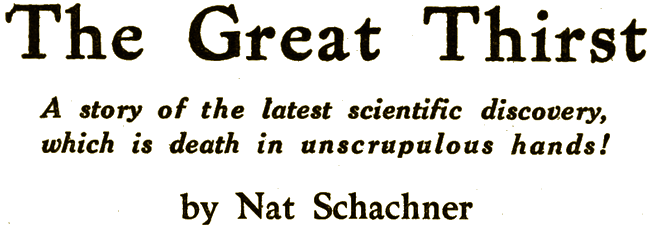
Astounding Stories, Nov 1934, with "The Great Thirst"
ALLAN FILLMORE sent his streamlined roadster roaring up the road that went meandering over upland pastures, and braked to a stop before a huge, rambling, barn-like structure on the brow of the hill.
Outside, the sign said neatly: "Sanford Dale, Scientific Consultant." Inside, the converted stables, that had once housed blooded horses in a hundred separate stalls, now hummed with a clutter of strange machines and ordered activity.
Allan's semi-tutored eye took it all in with a quick approving glance. At the farther end were whirring motor-generators and sparking dynamos, huge, flaring vacuum tubes and a tangle of overhead wires. Great magnets swung from cranes; a De Graaff atom-smasher reared its twin aluminum spheres. Allan recognized the mass spectrograph, the fluorescent screens, the cloud chambers, and all the other impedimenta of a completely equipped physical laboratory.
Segregated to one side was a chemical laboratory, equally detailed, with porcelain sinks, reaction baths, distillation apparatus, spectroscope, thermostat ovens, small electric furnace, and tier on tier of glass-stoppered bottles.
Another corner of the vast chamber was devoted to the biologic sciences, with a row of microscopes that ranged from oil-immersion tubes of normal magnification to the very latest superelectronic television-type that delved into molecular constitution itself; agar plates, more ovens, stained sections, innumerable specimens in alcohol, aquaria with fresh-water life and aquaria with saline inhabitants; cages with squealing guinea pigs, white mice, pink-eyed rabbits, and a few drowsy, bemused monkeys.
Allan was astonished. He had not expected anything like this. For there was also a section devoted to mineralogy, with rock crushers of the most approved type, macerators, rolling mills, jigs, slime tables, and gravity stamps. And everything was orderly, shiny, neat, precise. A half dozen men, youngsters mostly, with keen sharp looks, were busy at various tasks.
Fillmore had barely time to complete the most superficial of surveys when a door banged violently open, and a little man hurried into the whirring complex of the laboratory with all the breathlessness of a northeaster.
"Allan!" he cried with glad intonation, hand extended. "But it's good to see you again!"
"And you, too, Sandy."
The tall young man grinned affectionately down at the wizened little man with the sparse sandy hair, watery, blinking blue eyes, clothes baggy and sizes too large for him, and the manners of a tornado. Strangers were always hard to convince that this unimpressive individual was Sanford Dale, internationally known scientist, and almost the only man of modern times who could truthfully say with Sir Francis Bacon, had he been given to boasting, that he had taken all knowledge to be his province.
Yet, famous as he was, the irresistible combination of his first name, the peculiar sandiness of the few hairs he still possessed, and the general Scotch appearance of his spare form had inevitably fixed on him the name of "Sandy."
By that affectionate diminutive he was known to all and sundry, from the most dignified colleague to the pertest office boy. There is a well-founded story to the effect that the King of England, while presenting him with a medal for certain brilliant researches, so far forgot his wonted reserve as to end his speech, "And so, Sandy, I present you with——" to the sudden convulsions of his learned audience and his own most manifest confusion.
"I didn't expect to find such a complete layout." Young Fillmore waved his hand around the laboratory.
"Nothing much, nothing much," said Sandy. "Just a beginning; my money gave out. But come into my office; there we can talk."
SANDY swept accumulated litter off a chair with a quick movement of his hand.
"Sit down, Allan, sit down," he said.
He whisked a brown bottle out of his desk, produced two small glasses, poured. They drank. He wiped off his close-clipped mustache, sandy also in color, and leaned back.
"Now, tell me——"
Allan looked embarrassed. "Well," he started slowly, "Fillmore Power Co., that is—the old man—that is, I—hang it, Sandy, we want you back with us again."
The watery blue eyes took on sharpness, then filmed again. Sandy shook his head regretfully. "Sorry, Allan, but we've gone over that long ago."
The young man—he had a square determined jaw and the broad shoulders of a fighter—said vehemently: "You've got to, Sandy! Fillmore Power needs you. I don't have to tell you that we're the biggest utility outfit in the world; that research and improvements in our equipment, our service, affect more people than live in half the countries of Europe. Since you resigned, six months ago, we've just marked time.
"To be sure," he continued hastily, "Struthers is competent enough, but he's just a plodder, a laboratory man. He hasn't your—er—imaginative daring, your boldness of speculation, that used to cost us oodles of money, but produced results. You know, Sandy, there's no one can take your place."
The little man smiled. "Plenty, my boy, plenty! For instance, you could call back my erstwhile assistant. He has undeniable talents."
Fillmore made a disgusted face. "Orson Munn!! Any man whom Fillmore Power fires, stays fired. He was gunning for your job; carried tales to us behind your back. You know how the old man feels about those things. Now if it's a question of salary, I am authorized——"
Sandy Dale fixed him with reproachful eyes. "Stop right there!" he said. He leaned forward, waggled his finger under the tall young man's nose. "You know the old man, your father, don't you?"
"I've made his acquaintance," Allan murmured.
Sandy glared. "Joe Fillmore's the finest old pirate that ever scuttled a ship. Privately, the best friend I ever had; he'd share his last shirt with the man he likes; he's good to his family, even if it includes such an impossible scalawag as yourself, and he's kind to dumb animals—but as a business man, as Fillmore Power Co., what is he?"
"You tell me." Joe's son grinned.
Sandy took a breath. "A ruthless, cutthroat high-binder, a corrupter of governments, a sweater of labor, a squeezer of the last penny of profit from a suffering public, an—an antisocial being."
"In short, a business man," Allan assented cheerfully.
"Exactly! And that's why I quit and set up on my own. I'm tired of having my inventions and my research utilized, not for the purpose of making life easier and more comfortable for the mass of the people, but to extract still more pennies and nickels and dimes from their pockets into the maw of Fillmore Power.
"Now, for the first time in my life, I'm on my own, free to do the work I want. I am a consultant, but a new kind. I shall conduct experiments and research only for those projects which have a definite social trend, which will directly affect the welfare of people and not add to already swollen fortunes, such as yours."
"I know I'm a malefactor of great wealth." Allan grinned. "Now tell me, Sandy, since you've started, how many commissions have you taken? Paying ones, I mean."
The little scientist looked up mournfully. "None," he said.
"And I'll bet your last cent went into this venture."
"I have enough to pay this week's salaries."
"Exactly! The world isn't interested in hiring research for abstruse social benefits. Only us hard-boiled, penny-pinching business men are willing to pay for results. Come back, and——"
Dale shook his head vigorously.
Allan said impulsively: "Listen, Sandy. Forget the old man and Fillmore Power. You know I have more money than I know what to do with. Let me back you. No strings attached."
The scientist's eyes softened. "You're a decent sort, but I have to refuse. When I do get started, it is quite likely that some of my problems will bear adversely on the interests of Fillmore Power, and I prefer to be a free agent."
Allan unfolded his tall frame and stood up. "Sorry! Any time you need help, just yell."
They shook hands. Young Fillmore turned to go, when the door opened, and a startled secretary peered in.
"There's a man out here, Mr. Dale, that——"
"And I'm the man!" a thick gulping voice cried behind the girl.
The next instant she was pushed aside, and a stocky man, roughly dressed, staggered into the office. One hand clutched a quart jar of colorless liquid against his blue jeans; the other was at his throat. His eyes protruded, and his thick lips were dry and cracked.
"Water! For the love of Heaven, a drink of water!" he gasped.
DALE darted to the cooler, drew a glassful, hurried it to the swaying man. It was tossed down in one furious gulp. The blue lips quivered.
"More!"
Allan watched, fascinated, while the man, manifestly a farmer, swallowed four tumblersful without pausing for breath. At the fourth, he wiped his lips, took a deep breath, and the color came back to his weather-beaten cheeks, and his eyes receded normally into their sockets.
"I—I'd most forgotten," he said. "The ride was longer'n I thought. I'd taken no jug along."
Dale's nose quivered like a bird dog's. "I've seen thirsts in my day, but—what can I do for you?"
Fillmore made a move to go.
"Wait, please," Dale said.
The young man sank back into his chair.
"You Mr. Dale, the scientist?" There was disappointment in the farmer's voice.
"I am. I repeat, what can I do——"
"My name's Silas Brent. I got a farm, t'other side o' Armonk, an' there's a pond, spring-fed, from which we gets all our drinkin' water. I got some of it here." He thrust out the capped jar. "I want you to find out what's in it; that is, if it ain't more'n five dollars or so. Times ain't been extra good for us farmers."
"Why didn't you take your sample to the local board of health? They'd be glad to examine it for you for nothing."
"I did," Brent replied, "an' they could find nothing wrong. They sent it to the State department, an' they report the same. But there is somethin' queer about the water, 'cause——" His lips started to work queerly again. "Water!" he mouthed thickly.
Dale had been watching him like a hawk. He moved fast.
The man swallowed the brimming glass, wiped his mouth, and went on: "I heard of you in the village, Mr. Dale, so I thought mebbe——"
Sandy said: "What's the matter with your drinking supply?"
"I dunno, excepting that it makes us all-fired thirsty. The more we drank the worse we was. Like dogs with our tongues hangin' out on a hot summer day. We stopped drinkin' it; been living on bottled spring water ever since. It's all-fired expensive, an' we need lots of it. The thirst's been hangin' over, like."
"How long has your pond water acted on you like that?"
"Nigh on two weeks. Afore that it was the best damn drinkin' water in the county."
Allan leaned forward. He was interested now. "Some form of algae," he suggested, "or perhaps the springs have tapped a saline bed."
Dale looked puzzled, and his nose twitched more than ever. "They have pretty good analysts in the State laboratories. Have you the reports with you?"
"That I have." The farmer fumbled in the pocket of his jeans, produced two very dirty folded sheets.
Sandy glanced through them rapidly, tossed them over to Allan. "Both agree. No free ammonia, no organic contamination; minerals in solution—only traces. Reaction neutral. An excellent potable water, remarks the analyst."
He picked up the jar, stared speculatively at the clear liquid within. "Hello!" he exclaimed. "This jar is heavier than it looks."
Brent drank another glass of water, from the cooler, wiped his lips.
"No; it ain't. Regular fruit jar. That 'minds me o' somethin', now you mention it. I did notice it felt almighty hefty in the buckets, an' last week a water-soaked log, what's been in the pond bottom for years, suddenly-like bobbed right up an' floated."
Dale's pale-blue eyes glistened. He almost shouted: "I wonder——"
He was out of the little office like a West Indian hurricane. From outside there came a quick confusion of rasping orders, stoppage of processes, racing feet, and clatter of new movements.
The farmer stared with slack jaw. Had he wandered by chance into a lunatic asylum?
"Hey, Mr. Dale!" he shouted through the open door. "Ain't you gonna——"
Allan grinned and started out. "Come on, Brent. You're just seeing the world's greatest scientist in one of his quieter moments. He's on the trail."
THEY found Sandy measuring out ten cubic centimeters of the water into a beaker on a balance. He took the weight reading, figured rapidly on a sheet of paper. His assistants were setting up apparatus, tightening joints.
The little scientist glared at his figures and grunted.
"Kin you tell me, Mr. Dale?" Brent started anxiously.
Without moving his head, Sandy snapped: "Shut up!"
Allan had known better than to ask questions in the middle of an investigation.
The farmer moved back, half abashed, half angry.
Sandy raised his voice. "Jenks!" A laboratory man hurried over. "Yes, sir."
"Forget the distillation apparatus. Take this specimen, put it in an electrolysis bath. Collect the generated hydrogen at the cathode, and get me the weight of a liter at standard pressure and temperature. And, Jenks!"
"Yes, sir."
"I want a report in twenty minutes." The young man repeated his imperturbable "Yes, sir," scooped up the jar with a deft movement, and went away rapidly.
Sandy glanced up, saw Allan watching him quizzically, Brent with slow anger on his face.
Allan said: "Even I know the weight of hydrogen. It's .09 grams per liter." Dale said heartily: "Quite right. Now let's get back to the office. I want to talk to Mr. Brent, and I think I'll need your help, Allan."
Inside the office, he shut the door carefully behind them.
"Now, Mr. Brent," he said to the sullen farmer. "I've a proposition to make to you. In twenty minutes I'll have a report; until then I'm gambling. Your pond is valueless for drinking purposes; in fact, if what I surmise proves true, its continued use will prove highly poisonous. I am offering to purchase it for ten thousand dollars." The farmer gulped, started to say something, and only succeeded in sputtering.
Dale misunderstood him. "Not a penny more," he said firmly. "If it were my own money, it would be another matter; but I couldn't think of asking Mr. Fillmore to pay more than that."
Allan jumped. "Hold on, what's this? I didn't say I was in the market for a pond or——"
Sandy twisted his features into a funny little grin. "I'm just taking advantage of your kind proffer of a few minutes ago. It's a grant, a subsidy, if you like, but not for myself. I'll dedicate the damn thing to the public use."
Young Fillmore shrugged. "I'm still completely in the dark, but if you say so——" He took out a pocket check book, unclipped his fountain pen, poised it. "What did you say your first name was, Mr.—er—Brent?"
The farmer stared suspiciously from one to the other. His slow wits fumbled, but greed, cunning, showed in his little red eyes. "I ain't saying," he replied. "And I ain't saying I'm sellin', either. There's somethin' funny about this. You two's all-fired anxious to buy. Why? Must be because that there pond's got somethin' in it's wuth a hull sight more'n ten thousand. Oil, belike, or—or——" Imaginative utterance failed him.
Sandy exploded all over him. "You fool!" he said furiously. "There's no oil or radium or anything like that. It may be just worthless water, and then Mr. Fillmore's stuck. That property isn't worth a thousand ordinarily. At most it would have a scientific value; no commercial value at all. It's for the benefit of science that I'm asking him to gamble; not for his private profit, or mine, or yours."
"Well, I ain't sellin'," Brent declared stubbornly, "until I know just what's in it."
Jenks appeared at the door. He held a slip of paper in his hand. His manner was as imperturbable as ever. "Here is the result, sir."
Dale took the slip, and Jenks vanished.
Dale held it unopened. "Last chance, Mr. Brent," he said, "before I read it. The offer holds good until then."
THE farmer took a step forward; his arm made a greedy half-conscious gesture toward the check book. Then he stopped, and little beads of perspiration started on his seamed forehead. "No, by gorry! I'm just as much of a gambler as you are," he burst out. "I ain't sellin'."
Dale shrugged and opened the paper. Allan watched him breathlessly. The little man's face, usually expressively volcanic, was now a mask. He tossed it to the heir to Fillmore Power.
Allan stared blankly at the figures. "Weight one liter of cathode emanation—.18 grams." How cautious these analysts were! Cathode emanation, indeed!
"Well?" Dale asked after a decent interval.
"I thought," Fillmore returned, puzzled, "that hydrogen weighs .09 grams per liter."
"It does."
"Then this pond isn't—water?"
"But it is."
"How can it be, when there's no hydrogen in it?"
Dale smiled. "It's water, and there's hydrogen. Noticed anything strange about the weights?"
Allan stared at it again. ".18 grams," he read aloud. "That's just double the weight of hydrogen."
"Of normal hydrogen," Dale corrected. "We are face to face with the heavy isotope of hydrogen. Deuterium, it's been called, and it has only recently been discovered."
Allan gaped again. "Why, then," he cried, "that means the pond is a natural supply of heavy water. I read somewhere it cost over——"
The little scientist grinned. "I'll complete your sentence for you." He swung on his first client. "What Mr. Fillmore intended saying, Brent, was that heavy water costs over seventy-five hundred dollars a pound to produce."
That was something the farmer could understand. His jaw dropped wide. "Gorry! Seventy-five hundred a pound!" One could see unaccustomed arithmetical calculations rustily at work in his mind. "An' that's a mighty big pond, too! Why, why——"
He turned on Sandy in sudden fury. "So ye was tryin' to cheat me out uv millions, was ye? Why, you little runt, I've a notion to——"
Allan said warningly: "Don't try anything."
Dale chuckled. "You forget, Brent, I said it cost that much to produce. Given a large natural supply, the price drops pretty heavily. Furthermore, as I said before, it has no present value in commerce. Its importance for science, however, is immense. Outside of minute quantities taken from Searles Lake in California, it was not known to exist naturally before."
He swung on Brent. "You're taking us over to the pond. Just a minute while I pack some sterile bottles for samples."
BRENT'S POND proved to be a small affair of several acres, cupped in rolling hills. At the southern end, little bubbling movements showed the presence of the feeder springs; a purling brook took care of the overflow.
"I got a four-inch pipe leading down to the house and barns," said Brent. "It was always good, sweet water."
Dale surveyed the crystal expanse. Several dead fish floated on the surface, and the water-soaked log, covered with slimy fungi, rode three quarters out of the water. Otherwise it seemed quite an ordinary pond.
"No doubt about it," Dale said at last. "Checks all around. Fatal to life on prolonged submersion, provokes intense thirst, molecular weight—heavy water, in enormous quantities. It wasn't here two weeks ago, and now there's a pond full of it. How did it happen?"
"Perhaps some chemical reaction has been taking place underground," suggested Allan.
Sandy shook his head. "No chemical reaction that we know of will produce deuterium. The present method is to separate the minute existent quantities by fractional distillation of liquefied hydrogen. There's something queer about this; more than meets the eye."
He took samples, and they crowded into the roadster again.
"We'll drop you at your house, Mr. Brent," said Allan.
The road swung in a great circle around a hill to reach the farmhouse. Several other farms had first to be passed. The car hummed steadily over the rutted lane.
"Our offer still holds," Dale shouted in the farmer's ear.
He held onto his hat in the rushing wind and yelled back: "Nuthin' doin'! She's wuth more. I'm gonna advertise."
Allan grinned as he swerved the car deftly past a motionless cow, planted solidly in the middle of the lane. "Just another business man."
They roared around a curve at high speed.
"Look out!"
The brakes were good; otherwise there would have been a terrific smash-up. As it was, the roadster skidded and slid in a cloud of dust right up to the bumper of a huge blocking truck. It was parked in the center of the narrow road, filling it from brim to brim.
Allan hopped out with fire in his eye. The driver was standing on the front porch of the weather-beaten farmhouse, back turned to them, talking to a tall thin man in overalls and hip boots.
"That would be old man Pickens," remarked Brent. "Hyare, Jim!" he shouted.
The old man shaded his eyes, and waved greetings. Then, suddenly, he reached behind him into the darkened kitchen, pulled a glass into the open, and drank.
Allan yelled up the path. "Hey, truck driver! What do you mean by hogging the road like that? Pull that scow of yours over to one side."
The driver turned—he was squat and powerful—and made an unmistakable gesture of derision.
Allan purpled and started for the house.
"Just a moment," said Sandy. "I'm coming with you."
His restless peering eyes had taken in the cases of bottled water perched in solid rows on the truck, the name in faded black letters on the side: "Geyser Spring Water Co."
Allan was bursting into furious words when Dale reached him.
He laid a mild restraining arm on his hot-headed young friend. His nose was twitching and snuffing characteristically.
"You should thank the gentleman for compelling us to stop," he said, "instead of bawling him out."
The truck driver stared at him suspiciously. "What you trying to do, runt? Give me the horselaugh?"
"Not at all. Mr. Pickens is a customer of yours for bottled water, I take it?"
"What if he is?"
"Just an interesting fact. Been delivering it long?"
The truck driver exploded. "See here, fellah, I ain't answering questions, and that's that, see?" He swerved on the wrinkled old man. "That's three bucks an' twenty cents, mister. An' we deliver every Monday."
"I'll pay ye next week," Pickens quavered.
The driver shook his head stubbornly. "Sorry, mister, we ain't allowed. Orders from the firm. This is a cash business."
Brent pushed forward. "If ye ain't got it on you, neighbor, I'll lay it out. This fellow is hard-boiled; he delivers to me, too."
He took out his wallet and laid three dollar bills and two dimes in the man's hand.
The driver grinned. "I didn't recognize you at first," he said. "Water tastes good, huh?"
Brent's lips worked. "You're a bunch o' thieves charging honest men such fancy prices for plain water." He snatched up the glass from the inside kitchen table, tilted the gallon bottle, and drank thirstily.
The driver grunted. "You don't have to drink our water, if you don't want to. So long; be seeing you Monday."
He waved airily, stamped off the porch, climbed his truck, kicked the motor into roaring life, and backed warily down the road to a side path, turned in, and went clattering away in a cloud of dust.
"NOW this," remarked Sandy, "is getting most interesting. Mr. Pickens, what seems to be the matter with your own water supply? Dried up?"
The old man peered at him nearsightedly. His voice was high-pitched, almost a squeak. "No, sir; it ain't. It's just—I dunno—but since yesterday it ain't fitten to drink. Makes a man thirst like—gosh—like eatin' a barrel o' salt pork and salt codfish mixed."
"Where do you get your water from?"
"From a pool on the side o' the hill there; it's spring-fed."
Brent twisted uneasily, opened his mouth, gulped, opened it again, and blurted out: "I been thinkin', Mr. Dale. Mebbe I was a mite hasty; mebbe if you can't pay more, I shouldn't be the one to be squeezin' ye. Yes, sir; I'm plumb decided; I'll take that ten thousand an' give ye a deed right away."
Sandy chuckled. "I'm not in the market any more."
Cold sweat beaded the weatherbeaten forehead. "But, Mr. Dale, you promised—listen, I'll give it to you for nine thousand—listen, I'll be a sport, I'll make it eight——"
"Don't cut your own throat, Brent," Allan advised cheerfully. "You'd better advertise—why, man, there's millions in it!"
Sandy said to Pickens: "Did you call for the Geyser people to come?" The old man waggled his chin. "Noah, sir. They just pull in here right now, an' ask me if I needed any."
The little scientist whirled on Brent. "And did you send for them?"
Brent answered sullenly, his mind still clouded with regrets for the sale he had lost: "No; I didn't. They just came, next morning, like they done with Jim."
Allan's gaze wandered down the twisting lane. It was well off the main highway, and only a few farmhouses nestled between the hills.
"Now what would a spring-water concern be sending a truck to canvass for orders in this out-of-the-way spot?" Sandy's pale-blue eyes were sharp and bright. "So that strikes you as curious, too? Mind showing me that pool, Mr. Pickens?"
"Not at all."
The old man hobbled down the porch and led the way up a narrow footworn path toward the crest of the low hill. Last year's leaves had molded into a soft, damp mulch underfoot, and the men made little sound in their upward progress. The trees opened suddenly into a little clearing.
"There she be," Pickens mumbled over toothless gums. "Well, an' what be ye doin' on my property?"
A gushing spring sprang out from under an overhang of rock, filled a natural cistern, and overflowed in a tumbling rivulet that cascaded down the hillside.
Standing on the edge of the pool, motionless, staring down into its quiet depths as though fascinated, was a man. His back was to the newcomers, and evidently he had not heard their approach. He was a big man; tall, heavy-set, every inch as broad-shouldered as Allan himself.
At Pickens' querulous shout, he started, cast a glance over his shoulder, and went plunging into the close-growing trees on the other side of the clearing. In seconds the sound of his thrashing progress was lost.
"Naow I wonder!" the old man gaped. "What did he scare like that fer?"
Allan said grimly: "Didn't seem like a type that would scare easily. Just stood there and looked into the water. Any one get a good look at his face?"
Brent shook his head. "Just gave a perk over his shoulder and ran. Had his cap down over his eyes. By gorry, if he's been putting pizen in our water, I'll be pulling down the old shotgun."
"He wasn't doing anything—now," said Sandy. The little man was evidently excited. "Come on, Allan, there are busy days ahead for me. Let's get back to the laboratory."
They dropped the bewildered farmers at their respective homes and went through Armonk at a sixty-mile clip.
"That fellow up there," yelled Sandy in the teeth of the wind, "he looked familiar to me. Something in the set of his shoulders. Can't place him, though."
Fillmore turned a surprised face and narrowly missed a very indignant woman. She stood out in the road and screeched unintelligible language after their fast-disappearing rear lights. "That's funny," he said, "because I've been puzzling over the same thing. I've seen that bird before, somewhere. If only I had a good look at his face!"
At the entrance to the laboratory, where the neat sign still hung—Sanford Dale, Scientific Consultant—the consultant himself jumped nimbly out of the roadster.
"Thanks, Allan, for your trouble, and for your offer. You see now why I couldn't take it."
Allan stared. "See what?" he demanded. "A five-dollar fee for a water analysis which your client cannily forgot to pay! You'll be starving within a week."
The little man blinked. "Fees? Oh, that! I wasn't even thinking of that. There's a problem here to be solved—a most interesting one—and you're involved; or rather Joe Fillmore, the redoubtable father, is."
Allan stared even more blankly. "Now what the devil do you mean by that?"
It was Dale's turn to show surprise. "Geyser Spring Water Co. is a subsidiary of Fillmore Power, isn't it?"
"Geyser?" Allan echoed. "Let me see. We sold it some three months ago and were glad to get rid of it. Calls for spring water were getting scarcer and scarcer. But what has Geyser got to do with it?"
"That's what I aim to find out."
Fillmore whistled. "A rather crazy layout, but—something tells me there's trouble ahead, so I'll finance your laboratory for the duration, and we'll share any and all profits realized, equally."
Sandy chuckled. "I do need money," he admitted. "So you have me on the hip, you young Shylock. Following in your father's ruthless footsteps. It's a bargain, though. Now get busy. Find out who purchased the Geyser outfit from you, and any other information you can dig up. I'll be spending a busy week in the laboratory."
THE next day, when Allan walked into the externally ramshackle structure, he hardly recognized the place. The great laboratories were whirlwinds of motion. And riding the whirlwind ecstatically, himself a minor tornado, was Sandy. His small spare frame wriggled from one end to the other in a sort of gyrating dance; stopping here to blink rapidly into a beaker; there to snap out an order; and farther on to twirl a dial. The little man was in his element.
The dynamos moaned, and the generators growled. Blue lightning sheeted through giant vacuum tubes; sparks leaped the wide gaps between upthrust antennae.
"What's all the shooting for?" Allan shouted across the din. "Don't you know it's my money you're using now?"
Sandy hurried up, blinking. "Your own fault for getting hooked in a business deal. Did you get the information?"
"Yes; but I'm afraid it's not much good. We sold Geyser through an agent to a man named Miller—August Miller—for a round hundred thousand cash. Never even saw the man. I went to the agent, and he doesn't know him, either. The inquiry came through the mail, and all negotiations went that way also."
"Hmm!" Dale grunted. "The name is obviously a disguise, and the real owner is keeping out of the limelight."
"But I found out other things. Geyser in our hands was a local company. Its water came from a cluster of springs near Pawling, with a total output of about ten thousand gallons a day. Within the past two months the company has been very quietly buying or getting options on all the other bottled-water companies and the springs they control throughout the Eastern seaboard. Furthermore, on the way up, I passed at least ten trucks loaded to the hilt with bottles, delivering all around here."
The little scientist's nose quivered. "The pattern is beginning to piece out. Look at this, will you?"
He dragged Fillmore over to a small galvanometer. The needle was jumping crazily over the dial.
"Well?"
"This neighborhood is saturated with emanations."
"Plenty of radio signals in the vicinity," Allan pointed out. "Also your own apparatus."
Sandy glared. "Don't be a fool! I'm not a child in this sort of thing. I've shielded off every conceivable form of radiation. This is something else—particles, positrons, positive electrons, in enormous quantities. Come over here."
He dragged Allan this time to one of the huge pendent magnets. A long vacuum tube lay parallel to the wire-coiled bar. At the farther end of the tube, inside, was a screen, with dulled surface. Attached to the nearer end was a leaden, funnel-shaped machine. Sandy thrust down a lever.
The machine whirred, but the tube remained dark. The dull screen, however, burst into a thin perpendicular line of glowing, sparkling pin points.
"The machine is a wave filter," Dale explained. "It cuts out all wave lengths, allows only projectile-like particles to get through—my own invention. They might be electrons, positrons, or neutrons. They're hitting the fluorescent screen, see, and activating it into light. Now I'll turn on the magnet." He thrust another switch. "Look at that!"
The thin line of glittering pin points moved inexorably to the right, almost to the very edge of the screen.
"Positrons, my boy," he snapped. "That's what they are. Electrons would have moved to the left, toward the positive pole of the magnet, and neutrons, having no electrical charge, would have remained where they were."
Allan shrugged. "So that proves there are positrons around. What, if anything, has that do with heavy water?"
Sandy shook his head pityingly. "That's what a university education does for a man. Positrons of a certain voltage will smash hydrogen atoms. Four million volts is more than sufficient. The positron slams its way into the nucleus, and, being equal and opposite in charge to the electron, they both whiff out of existence in a burst of energy. The stripped proton combines with the nearest atom that still holds its excess electron, and, behold, you have a double proton, or deuton, and heavy hydrogen is born."
"But," Allan protested, "wouldn't the same thing happen to any other element?"
"Not unless the voltages were tremendously increased. Helium for instance, next in line to hydrogen, takes twenty-seven million volts, and oxygen a staggering one hundred and fifteen million volts."
Allan said slowly: "I'm beginning to see. Some one, a scientist, has discovered this way of turning drinking water into poisonous heavy water by radiation from a distance. He bought out the Geyser and is on the way to building up a monopoly. The people will have to come to him. Why, there's millions in it, if——"
"Exactly!" Dale nodded. "And there you are. A scientist turned business man, thinking only of his own profit."
"It's not the same," Allan responded heatedly. "We don't try to poison people. They don't have to purchase power from us."
Sandy replied scornfully: "Just the words the Geyser truckman used. People don't have to buy spring water, either. But if their own supplies are polluted, they either do so or thirst. If a man lives in the woods and cuts his own wood for fuel, puts in his own plant, he doesn't have to pay the prices you ask for power, either."
Allan grinned. "I see the point." Then his face hardened. "Nevertheless, what are we going to do about this business-like scientist?"
"Get him," Sandy said softly. There was a most deceptive mildness to him.
THAT was easier said than done. By the end of the week calamity crashed all along the Eastern seaboard. The unknown scientist had evidently been making tentative experiments, testing out his theories on the obscure farms of Brent and Pickens. Satisfied with the results, he sprayed his emanations over an ambitiously widening area. Boston to the north, Pittsburgh to the west, and Washington to the south, represented the new field of operations.
Uncounted trillions of positrons, charged with four million volts, went hurtling day and night through the ethereal lanes. They smashed their way with resistless force into the hydrogen nuclei of every drop of water within the proscribed area, created deutons, and changed normal life-sustaining liquid into heavy, poisonous, thirst-inducing water.
Tiny villages, comfortable towns, and teeming cities went to sleep after a normal working day with its accustomed groove of labor, domesticity, life, love, laughter, and tragedy, and awoke to find everything seemingly unchanged.
The ponds and the lakes and the reservoirs glistened in the morning sunshine as always, though a small coterie of before-dawn trout fishermen noticed two things: first, that hitherto rushing, leaping, spraying mountain streams now dropped from cascade to cascade in smooth, heavy thudding sheets; second, that some disastrous influence had killed all the fish. High out of the water they rode, their white bellies already a sickly gray, their mouths wide in ineradicable thirst.
Peter Smith, machinist, rose from his nocturnal couch, yawned, looked out the window at the early-morning mist, yawned again, looked down at the still-reposing partner of his joys and woes, saw her parted lips, heard the accustomed little noises that issued therefrom; grimaced, thought of the routine day's work ahead of him, felt a little shiver of rebellion at life in general, and padded to the kitchen to take his accustomed morning drink of good cold water. That brings a man to himself, all right; takes the dark brown taste out of his mouth, makes life once more bearable.
Peter Smith turned on the faucet, let the water run. He filled a glass, tilted back his head, and drank deeply. The first, sensation was of heavy weights dropping into his stomach, pounding with thudding blows against delicate linings. Then came thirst, raging, unquenchable thirst, gnawing wolfishly at his vitals.
With little panting cries he ran more water into his glass and drank, seeking to allay this sudden, devouring sensation. Then another, and another, as the great thirst mounted until it became a fiery film that enveloped him and carried him off on beating waves of delirium.
His slattern wife, still sodden with sleep, waddled into the kitchen.
"What's the matter, Pete?" she grumbled.
Her husband clutched his throat with his hands, and his tongue hung thickly.
"Damn water's poisoned!" he forced through thick lips, and dashed down the stairs, barefooted, nightgown whipping around brawny shanks, out into the early-morning street, shouting for a doctor, a policeman, an ambulance, anything that would rid him of his terrible pain.
A great truck lumbered through the cobblestoned street. Painted in faded black letters on the side was: "Geyser Spring Water Co." Perched tier on tier within the open rack were bottles, filled with crystal-clear, tempting fluid.
The driver pulled to the curb at the apparition of Peter Smith, machinist, barefooted, and en déshabille, clamoring down the untenanted street, making the morning hideous with his yells. He was not unduly surprised. This was the fifth similarly attired pedestrian he had already met.
"Want some nice drinking water, buddy?" he asked.
Peter Smith skidded to a halt and whispered through rapidly swelling lips: "I'm thirsty; I'm poisoned. Gimme——"
The truckman whisked out a tiny tumbler, half filled it from an open bottle. His instructions had been detailed and precise.
"Try this, buddy," he urged.
Peter gulped down the chary drops, felt a blessed trickle of relief. "More!" he yammered, his mouth gaping like a fish's.
"Five dollars a bottle," grunted the driver.
This was exorbitant, of course; fifty cents to a dollar was the normal market price, but Peter Smith was in no mood to argue fine points about supply and demand. He was dying of thirst; the city water supply had gone haywire, and here was blessed slaking, life itself. The deal was quickly consummated.
As more and more people arose to proceed about their daily tasks, more and more wild-eyed, throat-holding men and women dashed like poisoned rats into the streets of the city, and business overwhelmed the fleets of trucks that had been unleashed on villages, towns, and cities. Within the first half hour, the carefully prepared and hoarded supplies of precious liquid had vanished like the summer snows. There was no more.
TRAGEDY now stalked with terrible stride over the Eastern seaboard. At farmhouses, in the backwoods, off the highroads, no trucks appeared with temporary salvation, and thirst bloomed like an evil flower. Frantic country folk ran from house to well, from well to brook, from brook to pond, from pond to river, urged on by hideous inner fires, drinking, gulping, heaving, thinking in their suffering to find somewhere water that would quench the mounting flames.
Finally, they died on dusty roads and fields, with open mouths and thick-cracked lips, with bloated stomachs and torn intestines; or drowned in ponds and rivers into which they had plunged like maddened animals, in a vain attempt to lap up huge quantities of water for relief.
Even in the cities, the supply of spring water was unequal to the demand. The last bottles on each truck went for fabulous prices. Bankers with upthrust sheaves of bills, tongues lolling out of their mouths, bid hoarsely against each other for the life-saving water, reverted to the beast. Then there was no more.
The streets became shambles. Everywhere men, women, and children ran in foaming circles, spurred on by unutterable torments, finally to drop in distorted little heaps. The bodies lay where they fell.
Jake Crippen swayed through the streets, laughing drunkenly. Every time he came to a sprawled body, he bowed on unsteady feet, pulled the flat brown bottle out of his pocket, uncorked it, tilted it to his lips, swallowed, and blew out noisily.
"Alwaysh knew water drinkin' no good. Look at 'm; look at 'm all! Commsh fr'm not lishenin' t'me. Me, never drink water; thash stuff f'r rivers; not f'r human bein's."
Shouting and singing, he meandered through the ghastly, growing piles, bowing right and left with drunken gravity, and draining innumerable toasts.
By the time warnings had been broadcast from every governmental body, calling on the people to avoid all water until the cause of the strange plague had been discovered, over fifty thousand had died torturing deaths, and hundreds of thousands more were suffering all the horrors of the Ancient Mariner and his wretched companions.
SANDY DALE had been caught in the midst of feverish, seemingly vain activities. For the entire week his laboratory had been a whirlwind of tests, experiments, sleuthing. Allan had quit Fillmore Power with only a cryptic explanation to his father, and moved bag and baggage—and check book—into the modest living quarters behind the great laboratory.
Sandy tore his few remaining wisps of hair, gnawed at his mustache, littered his untidy desk with formulae and calculations, threw them away in disgust as soon as he finished; crackled out orders for new experiments, new settings up of apparatus, harried his assistants to the verge of insanity, snapped demands for more and more money, and drove himself harder than any one else.
"We've got to find the answer!" he cried to Allan after another test had proved fruitless. "Or else——"
But the answer seemingly was not to be found.
Sandy rumpled his hair and frowned. "I can't understand it. Granted that my experiments haven't shown results in stopping these infernal streams of positrons; granted that I haven't been able to discover a method of resmashing the deutons and breaking them down into normal protons. That might take years of research, failing a lucky fluke. But not to be able to trace the positrons to their source of emanation—that is infuriating, worse, it is humiliating!"
"We've tried everything," Allan muttered.
He was red-eyed and worn out with fatigue. Even his iron frame felt, the nights and days of ceaseless work. Neither had removed his clothes for an instant; hardly had they taken time to snatch a wink of sleep. Yet Sanford Dale, small and mild and spare, seemed as fresh as a daisy on a particularly dewy morning, and charged with energy as one of his own dynamos.
They made directional tests; took portable apparatus on flying trips to obtain directional angles. The positrons seemed to be spraying indifferently from every point of the compass.
"We are up against a scientist of inhuman attainments." Dale frowned. "Unless," he rumpled his hair again, "it's some unknown natural force."
They made the journey to the springs of the Geyser Co. and found unwonted activity. Trucks rumbled in and out; the operating force had been tripled.
More, barbed wire stretched, around the buildings, and armed guards ordered callers away. But there was nothing to be seen on which to base any action.
"If only," moaned Allan, "I could place that fellow whom we found staring into Pickens' pond."
Try as they might, however, the vaguely familiar image was singularly barren of identification.
With Allan grimly at the wheel, and Dale crouched to avoid the whipping wind, they roared down the concrete highways to New York.
The terror mounted as they came nearer the metropolis. Poor, thirst-maddened creatures fell almost under their wheels; dogs, rabbits, deer, mice, dashed vainly over the fields, red tongues lolling, age-old enmities forgotten in the common devouring drought; dead bodies lying openly in the suburbs; roaring, shouting, maddened mobs in the streets of the city, smashing into liquor stores, rioting in drunken fury, gutting milk stations for drops of the white liquid; pouring in resistless flood through warehouses of tinned fruit, sucking, mouthing, seeking for anything to quench the intolerable fires within them.
Yet milk and fruits alike were infected with the strange heavy water; only dilution with alcohol seemed to have stopped its insidious inroads. New York was a seething, flaming fury. The last of the spring-water truckloads had been overturned by the mob; half its precious contents spilled from broken bottles into the gutter.
They pulled up at the City Hall. It was barricaded and guarded by police. Discipline alone kept the thirst-ridden men in the ranks. The powerful name of Fillmore made an immediate path for them to the mayor.
They found him in panicky consultation with hastily mobilized scientists, the health commissioner, the chiefs of the water supply. He was short and stocky, with black, snapping eyes, and a quick slurring tongue. His lips were cracked, and he licked them incessantly.
He threw up his head nervously at the interruption, and saw young Fillmore. He knew him. But Biggs, health commissioner, had eyes only for Sandy, and his worried face lighted up.
"Sanford Dale! Perhaps you can tell——"
"Of course I can," the little man said brusquely.
Within minutes he sketched rapidly what he had discovered; the transmutation of all water into heavy water; his suspicions as to the Geyser concern.
The mayor sprang to his feet, pounded on the table. "By Heaven!" he shouted. "We'll arrest every mother's son of them; we'll——"
"Pawling's out of our jurisdiction," the police commissioner interrupted moodily.
"I'll call the governor!" The mayor's hand darted for the telephone.
A MAN pushed his way into the crowded room. He was the mayor's secretary. "A messenger has just delivered this sealed letter to me," he said. "It is addressed to you, Mr. Mayor."
The stocky chief executive waved it aside. "I'm busy now," he snapped. "Let it——"
But Allan had seen the superscription. "Wait!" he shouted. "Before you telephone, better open it. It's from the Geyser Spring Water Co."
The mayor dashed down the receiver, grabbed the missive and slit it open with a quick gesture. His dark round face suffused with red as he ran down the typewritten page.
"By Heaven!" he swore. "The insolence, the colossal nerve of them!"
"Mind letting me read it?" Sandy asked quietly, and took the letter from the mayor's fingers even before permission had been granted. He read:
The Geyser Spring Water Co. is deeply grieved to hear of the unparalleled disaster which has befallen the water supplies of the Atlantic seaboard. For some time our company has felt that the usual sources of drinking water are polluted and a potential menace to the health of the nation, but municipalities and those officials whose duty it should have been to guard the lives of their citizens permitted our warnings to fall on deaf ears.
Now, only too tragically, our prophecies have been justified. Surface water, subject to infection and pollution from every wandering wind, cannot compete with the clear, pure, crystal waters that gush in never-faltering volume from the underground springs controlled by our company. Our water is now, as it has always been, uncontaminated and potable.
We are ready, as patriotic citizens, to assist the people of the nation in this great calamity to the best of our power. We wish no man, woman, or child to go athirst.
You no doubt realize that our water is now more precious than gold, more vital than food. We could, if we wished, demand a price commensurate with its importance, but we have no wish to take advantage of your need. In a spirit of humanity, and at a sacrifice of well-established business principles, we are offering you substantial supplies at a very reasonable price, to wit, five dollars per bottle in quantities of a thousand or more.
We must insist, however, on cash payment in advance, and police protection for our shipments.
Respectfully yours,
GEYSER SPRING WATER CO.,
AUGUST MILLER.
The mayor fumed. "The rascals, the butchers! Five times the regular price!
I'll be damned if——"
The health commissioner licked his lips furtively. "We've got to, otherwise there won't be a person alive in New York within two days. We can rush through an emergency appropriation to buy a million gallons at once."
The mayor stared into space. His cheeks were wet with perspiration. "I'm afraid you're right, Biggs. They have us by the throat."
And so, by nightfall, with checks for millions of dollars flowing in a great river from beleaguered villages, towns, and cities, a counterflow of bottled water, potable, thirst-quenching, went by truck and automobile and commandeered trains to a dying populace.
Even as the first appropriation was being voted in New York by a hastily convened board of estimate, Allan started violently and leaned over to Sandy. He whispered a name.
"What a fool I am!" the little man yelled, thereby disturbing the feverish tension of the meeting. "Of course it was he! Come on, Allan!"
Unmindful of the inquiring, startled glances of the embattled officials, they raced out of the room, flung themselves into the roadster, and broke all laws getting back to the laboratory.
THERE is an isolated mountain not far from the point where three States meet—New York, Connecticut, and Massachusetts. It is not high as mountains go, but it is higher than the surrounding peaks, and it is in a remote part of the Tristate Park where there are no habitations and few people.
Outwardly there was nothing remarkable about the mountain; but high on its wooded slope, underneath a precipitous overhang, an inconspicuous opening led by devious channels into a great cavern.
The cavern was filled with strange machines, humming and whirring and sending off blue crackling sparks. The largest of the machines thrust two aluminum bulbs into the air, and a huge cable, like an ancient serpent, twisted from it into the living rock itself. Men, like gnomes, silent, catfooted, tended the monsters.
Near the entrance two men sat facing each other. One was tall and heavy and sullen-browed. Twisted scorn, repressed anger, glowered on his features. The other was dapper and sharp-faced, and a gardenia perched jauntily in the lapel of his expensive sack coat. But he did not seem particularly jaunty now. In fact, his hand, thin and predatory, trembled nervously.
"Now listen here, Munn," he protested. "I'm willing enough to make money out of this proposition, but I didn't expect it to go so far." He ran his thin hand over a perspiring forehead. "According to latest reports, there are over fifty thousand dead. I—don't like it."
The taller man glowered contemptuously. "You came to me with the proposition, didn't you?"
"Yes, but——"
"You were willing enough to grab my ideas, weren't you?"
"Yes; but I didn't expect——"
"Of course not. You, a big executive, bah!" Orson Munn, scientist and former assistant to Sanford Dale, spat out the words. "You're a weakling, like Fillmore, like all the rest. You like money; you'll kill and burn and torture for it; but it must be by indirection. It must not appear too baldly on the surface; especially, there must be no direct path to yourself. It's the law, the consequences, you're afraid of, Corliss, not the fact itself."
"Oh, come now," John Corliss, alias August Miller, protested. "You can't do——"
"I can't, can't I?" Munn glowered, rising and towering over the shrinking executive. "Now you listen to me. When that idiot Fillmore fired me because of Dale, I set up my own laboratory. You had money, plenty of it, with an itch to make it grow lots more little dollars for you. You came to me for ways and means. Maybe I had invented something you could steal away, like the good business man you are.
"I took your measure at once. But it fitted in with my own plans to have your money at my command. I showed you the model of my machine for broadcasting positrons at high voltage. I explained the theory of heavy water; what its properties were; how you, as a business man, could utilize it. You followed my advice; you bought up the spring-water companies, you watched me install the lead shields that kept them immune from the flying positrons; you could hardly wait for action.
"Now you're afraid. It's become too big for you. Well, you can step out right now. I'll pay you back your investment; the profits will belong to me, and your tender little conscience won't ache you any more."
Corliss started up furiously. "You can't freeze me out. It was my money and half of everything belongs to me. That's the agreement."
Munn sneered. "How about your humanitarian principles?"
Corliss fell weakly into his chair. He mopped his head with a silk handkerchief. "We-ell, nobody has to die of thirst any more. They can buy our water."
"Spoken like a business man," Munn approved.
AT first tankers of water had been rushed to the infected areas from points beyond the range of the positron streams, but several hours exposure caused the fresh supplies to change to the poisonous isotope.
By the time Dale found out that the gallon jugs that Geyser used were made of heavily leaded glass, which stopped the hurtling positrons in their tracks, it was too late to benefit from the discovery. The plague had spread almost over the entire country, and only the fringes were enabled to obtain some measure of relief from outside sources.
Orson Munn's name was placarded in every village and town as wanted for investigation, but he had vanished. The earth seemed to have swallowed him up. Nor could August Miller, the putative head of Geyser's far-flung monopoly, be found, either. Subordinates disclaimed all knowledge of his whereabouts.
THE President of the United States declared martial law. It was subversive of the very foundations of the nation, he said, for any private individual or corporation to take advantage of the dire necessities of the people. He issued flat warning to the Geyser Spring Water Co.—charge a fair and reasonable price for your water during the emergency, or the government would forcibly seize and operate the springs.
The company countered by an open letter. It would invoke its constitutional rights. It obtained an injunction from an acquiescent judge. The President removed both judge and injunction. He set twenty-four hours as the time limit for absolute compliance.
The people were becoming dangerous. All their earnings, all the civic moneys that should have gone for education, hospitals, fire and police protection, poured in unending streams into the coffers of the company for the life-giving fluid. Schools and clinics closed for lack of funds; and mobs began to form again. It was only the President's assurance of definite action that kept them from immediate onslaught on the springs controlled by the company.
There was another unexpected byproduct of the change that added enormously to the misery of the nation.
There was no rain.
And that was simply explained, once the phenomenon was noted. For the molecules of water in the lakes and streams and rivers and the ocean itself within the circumscribed area were much heavier than they had been, the evaporation processes of course proceeded at a much slower rate. The result was that the atmosphere lacked moisture, no clouds formed, and the sun shone with full burning darts on parched and thirsty fields. Crops withered and dried; and famine loomed in addition to all other calamities.
Then, too, the dead fish that floated everywhere on the surface of the streams decayed and stank. The dread shadow of plague stalked over the land.
Just before the ultimatum expired, the company answered defiantly. If the springs were seized, it would be found that their value had been destroyed. Only the company knew how to keep them from turning into the universal heavy water.
The President grimly ordered the troops to move. There was no resistance. The operating staffs, the guards, had fled during the night. But then it was discovered that the threat had been made good. The springs gushed slowly; they had been transformed overnight into heavy water. The protective lead shields had been secretly removed.
A DELEGATION of officials found Dale and Fillmore exhausted with fatigue, but jubilant, in their laboratory. The week since Allan had whispered the name of Orson Munn into Sandy's ear had been hectic.
For Dale had remembered also. Munn had boasted once that, given sufficient funds, he could send any type emanation, whether wave or particle, on curved paths. Immediately thereafter he had been discharged.
Night and day Sandy scribbled mathematical formulae, trying to work out the theory. The De Graaff atom-smasher was pressed into service, and positrons catapulted over measured distances. He used every known method to reproduce deflection—magnets, electrical currents. But always, when the deflecting force was removed, the paths straightened out.
This morning, however, he had an idea. He measured very exactly the electrical charge on the flying positrons. To his astonishment it was slightly greater than the charge on those he himself had manufactured in the laboratory.
The little man whooped as he swung on his partner. "By George, I've got it, Allan."
"What?" asked that weary young man with skeptical intonation.
"How Munn has been curving his streams of positrons so that we can't check back by directional angles to their source. He's superimposed an additional positive charge. The earth is an enormous magnet. The south pole is its negative pole. As a result of the extra charge the streams of positrons, no matter which way they start out originally, feel the pull of the south pole and swerve slightly, but continuously, in that direction. Given the amount of surplus charge, the pull of the earth, the voltage and speed of the electrons, I believe I'll be able to plot their paths back to the point of origin."
In minutes the laboratory was, if that was possible, in an even greater upheaval of activity. Simultaneous tests went on in every part of the great room, with Sandy enthroned before a desk in the center. Men dashed up to him with slips of paper that gave particular results and dashed off again to start a new experiment.
As each set of figures came to him, they underwent lightning transformations under his flying fingers. Mathematical analysis was being pushed to its uttermost limits.
It was into this bedlam of hum and whir and blue flames and formulae that the delegation entered. The mayor of New York was its spokesman.
"Mr. Dale," he blurted out, "we are at our wit's ends. You've got to do something."
Sandy blinked owlishly. His mind was still teeming with vectors and differentials. "What—what——" he stammered.
"The troops have seized the springs, and they, too, are heavy water."
Sandy made a gesture of dismissal. "That's easy. Order lead screens of at least a foot in thickness to inclose them. That's what Munn used. Now go 'way and don't bother me; I'm busy."
"But——" the mayor started to splutter.
Sandy rose. "By to-morrow morning, if I'm left alone, you won't need the screens. I'll have traced the machine responsible for the emanations to its hiding place. Have a company of soldiers ready to entrain. Orson Munn has reached the end of his rope."
The mayor's dark face showed incredulity. "Are you certain?" he gasped.
Little murmurs rose from the delegation.
"As certain as I can be," Sandy said positively. "Now, gentlemen, please get out. I'm busy."
Without more ado, he plunged into the welter of figures before him.
Allan grinned at the discomfiture of the officials as they hastily backed out of the room, and went back to his own work.
JOHN CORLISS strode agitatedly up and down the length of the cavern. The huge cave swarmed with armed men; they were the guards who had been withdrawn from the springs. Munn watched his erratic movements with a dark sneer.
Corliss stopped in front of him. The gardenia in his lapel drooped and hung askew—a sure sign that he was not himself. "What are we going to do now?" he cried. "The springs have been taken from us."
Munn scowled scornfully. "The springs are no good to them. My machine is still working. By to-morrow they'll be begging us to take them back."
"Why not call it off altogether?" Corliss asked timidly. "I've just figured up. There is left for each of us, after all expenses have been met, over ten million apiece. I'm satisfied."
"You may be," Munn pointed out coldly. "Money is all you think of, and your name is not involved. But I am an outlaw. That damned Dale and young Fillmore recognized me when they caught me testing that pool. Besides, there's more to it. Money means nothing to me. I want power, power!" His thick hands clenched. "By the time I'm through, the whole world will be at my feet."
Corliss stared at him uneasily. "See here, I'll have nothing to do with your plans. I'm quitting."
Munn said grimly: "Oh, no; you're not. You're staying. You're in this as far as I am."
The dapper business man quailed. "But they'll trace us here, sooner or later."
"Not even Dale himself could find us. My curved emanations will throw every one off the track."
Almost at the very moment that Orson Munn boasted so confidently of their security, a regiment of soldiers entrained secretly at the Grand Central Station in New York. Their destination was unknown and their departure hidden from public view. They were fully accoutered for battle. Trench helmets sat jauntily on carefree heads, rifles were spick-and-span, light mountain guns rested under concealing tarpaulins on flat cars, and each man had a full complement of hand grenades and gas bombs.
In the forward car were the officers—hard-bitten, skeptical West Pointers—and Sandy Dale and Allan Fillmore, together with some bulky covered equipment. Though the army men chafed in secret, their orders had come direct from Washington, and they perforce expressed themselves as entirely at the disposition of the little scientist.
He spread, out a map of New York State as the train flew through the tunnels and emerged with rocketing speed into the green Westchester fields.
"If my calculations are correct, gentlemen," he said, "the focus of the emanations is somewhere within this area." He pointed to a red circle of some five-mile diameter, drawn in the very center of Tristate Park.
"That is very pretty," the colonel murmured politely, fingering his gray mustache. He studied the map. "It will be quite a hunt."
Allan grinned. "Give Sandy—I mean Mr. Dale—credit, colonel. If Munn's infernal machine is inside that area, he'll spot it within half an hour."
At Copake a fleet of huge inclosed moving vans were waiting. The troops piled in, the backs went up, and the trucks lumbered on State highways to the edge of the forest, then turned into rough roads that climbed steadily higher and higher.
Sandy peeped out, consulted his map. "Halt!"
The truck came to a stop. The long line of following vans shoved on brakes.
"We'll start our tests here," he told the colonel.
A half dozen soldiers helped to unload one of the mysterious pieces of apparatus. It was a directional finder.
Sandy took a reading, scribbled notes. "Now proceed," he ordered. "I want two more readings from different angles."
The rough road became a path, the path a trail, and the van could go no farther. There they took a second reading and carried the instrument stumbling and sweating, deep into virgin forest, for the third.
Then for half an hour, while the soldiers unloaded and set up their artillery, Sandy figured and figured. The pencil stopped racing.
He said quietly: "Gentlemen, the angles, after making allowance for induced curvature, converge on a point a half mile due northwest from here and showing an upward angle of thirty-five degrees."
Allan's eyes wandered up the steep, birch-covered mountain in front of them. He saw the precipitous overhang.
"It must be directly under that cliff, then.——" He pointed. "Why, there's nothing there."
Sandy smiled. "That's because Munn, for all his warped social sense, is a clever man as well as a scientist. The machines are hidden in a cave."
The colonel shrugged. He placed small stock in this hocus-pocus, but orders were orders. So being an efficient officer, he disposed of his troops in a long encircling skirmish line. The battery of artillery pointed wicked snouts upward.
"Well give them a chance to surrender," he said, "if they are really where you say."
A SOLDIER bearing a white flag, climbed steadily up the slope. His form, at first concealed in the thick-clumped birches, emerged, diminished in perspective, on the rubble-strewn gap just below the overhang. His comrades waited grimly below, half hoping his mission would be fruitless, itching for a fight.
Dale and Fillmore did not even glance upward. They were busy unloading the other mysterious bits of apparatus they had taken along.
Suddenly the messenger stopped and waved his flag. They could hear his faint shout. The next instant the horrified onlookers saw his knees buckle.
the violated emblem of peace fall from his hand, and his body pitch headlong to the steep slope, whirl over and over in downward flight, crash into a blockading tree, shudder once, and lie still.
A snarl of rage went up and down the far-flung line. The colonel's face purpled; he snatched out his pocket phone, from which the wires went trailing, snapped out quick-breathed commands. Sandy shouted a restraining protest, but it was too late.
A great cheer rang from the woods, and an olive-drab line surged forward. The ground shook from a salvo of artillery.
Allan's muscles tingled. He stopped work and stared wistfully. "Let me go with them, Sandy," he pleaded. "By the time we get started, they'll have mopped up, and I'll have missed the fun."
"You stay right here," the little man grunted, not pausing an instant. "The colonel is a fool. I told him to wait until I was ready. Munn is too clever to be caught unprepared."
Cries of astonishment burst from the gunners. At a distance of one hundred yards from the concealed entrance to the cave, the hurtling shells exploded in a great smear of flame.
"What did I tell you?" the little man murmured tranquilly.
Allan stared, astounded for a moment, and hurried to help the scientist.
Another salvo detonated, and again the shells exploded against an invisible barrier. The colonel gaped and almost had a stroke. But the first wave of troops had burst into the clearing, and were clambering up the mountain. The sun caught the extended bayonets and tipped them with fire. Up and up they went. A second wave shot out of the woods. It was a race. Nothing showed above; nothing of the strange barrier that had stopped shells at express speeds.
Then it happened.
The first line suddenly halted, staggered, bounced back as if hurled by a gigantic force. Over and over they tumbled, smacking into the second line, bringing half of them down in inextricable confusion. But the survivors, without breaking stride, cheered heartily and went upward at quickened pace.
"Magnificent!" cried Allan, his eyes shining, his heart beating.
"Magnificent, yes!" growled the little man, his fingers still tightening connections. "But not war!"
Straight for the dead line they plunged, shoulders hunched, bayonets extended. Then they, too, went down, rolling and tumbling.
Sandy twisted the last screw, straightened up. "The army has failed; it's up to us now."
WITHIN the cavern, Munn held his hand steady on a switch embedded in the wall. His eye was glued to the eyepiece of a long angling tube that went through solid rock and earth until its inconspicuous lens emerged from the side of the cliff. It was a periscope.
He knifed the switch and turned with a triumphant glower to Corliss, who was trembling as if with ague. "Now take a look, and see what happens."
The no-longer dapper man looked into the periscope. He started violently, looked again.
Then he muttered exclamations in low, awe-struck tones. He tore away, faced Munn with fascinated stare. "Munn," he breathed, "you're a wizard! I didn't believe it was possible. From now on, we are partners in—everything."
Munn snorted. "That's nothing. I have more tricks than that in my bag. This was a simple matter. I increased the positive charge on the positrons heavily and forced them to take a circular orbit around the cave by means of powerful magnets. When the shells hit the wall of electricity, naturally they detonated; when the soldiers went smashing into it, naturally they got the shock of their lives."
Then his face darkened, even in this moment of triumph.
"But I won't rest easy until I get Dale. Only he could have solved my curving emanations and traced them back here. When he is dead, we shall have nothing more to worry about. The rest of the scientist world are nincompoops, not fit to blacken my shoes."
AT that moment Sandy Dale went into action. The snout of his queer-looking machine pointed straight for the cavern opening. It was simple in construction. Two upright tubes of heavy quartz filled with helium, a highly compact electrostatic machine for generating continuous streams of electrons from the helium gas; and an impulse-breaker for emitting them in surges.
The helium glowed into incandescence; the hum of the machine grew to a piercing shriek. The air along the path of the streaming particles glittered with fine pin points of flame. The hurtling electrons crashed with inconceivable velocity into the circling positrons. Positive and negative coalesced and vanished into the substratum of the cosmos. A blinding flare of radiation marked the disappearance.
The great concave arch of the protective curtain took form and visibility as a huge bending sheet of flame, A gasp of astonishment went up from the bewildered troops. The colonel's mouth was agape. Sandy grinned and set the machine up a notch. The whine became almost unbearable. The curtain of fire pushed in as though it were an elastic ball, but still it did not break.
Within the cavern Munn swore furiously. "It's Dale!" he cried, for the first time showing fear.
Corliss cowered, helpless, wilting. The guards, all men with a price on their heads, muttered uneasily. The heat was becoming unbearable.
Munn stepped his own current up to the maximum. More and more positrons went hurtling into the fray.
It was a battle of giants.
The sheeted flame rebounded to its smooth racing curve. Allan groaned. Even outside, the fierce beating power of the released radiations burned like the blast of a steel furnace. The troops had thrown themselves upon the ground, shielding their eyes from the molten vision. Sandy and Allan wore heavily tinted glasses.
Sandy said: "He has plenty of power, but——"
The high piercing note of the machine changed to an unbelievable shriek and then died suddenly.
"Something broke!" Allan cried out in alarm.
"No. The vibrations have simply passed beyond the uppermost limit of audibility. Look up there."
The fiery coalescence of positron and electron had reached white-hot incandescence.
Allan yelled exultantly.
Slowly but surely the victorious electrons were eating up their rivals faster than fresh streams came into the fray, and the visible manifestation of the battle pushed inward in an ever-narrowing arc.
It touched an outcrop of rock, and the rock flashed out of being in a gush of radiant energy.
"They'll die like rats in a trap!" Allan exclaimed. "Give them another chance to surrender."
Sandy switched off the current. At once the positron screen flared back into position and became invisible. The next instant something dropped with a thud into the crouching troops and exploded. Arms, legs, and shreds of flesh spattered high into the air.
Allan turned white. "I'm a fool," he said. "Give it to them, Sandy."
The little man nodded and turned the current on full blast. Once more the curtain flared up; once more it was beaten back, slowly but surely. Back, back against the mountainside! Trees and grass disappeared, then a razor section of soil and gravel whiffed out, showing red-hot rock beneath.
More and more the mountain was shaved away, but still the stream of electrified particles issued from the depths to join the contending forces.
Sandy shook his head in almost admiration. "Fighting to the end," he murmured. "A pity that Munn had a twisted brain."
Then, suddenly, it was over. The impacting flame had either reached the interior source of current, or crisped the operator. The fiery wave surged deep into the ground. The opposition had collapsed.
One last intense flare that almost burned the skin off the watchers, and then it was out. Only an unending stream of victorious electrons was hurtling harmlessly through space, invisible to the eye.
Sandy said "That's that!" and snapped off the current.
The soldiers rose with half-blinded eyes. The colonel stared at the little insignificant-looking man with more than respect; that look held something of awe. Then he turned to the mountain.
A great smoking gash where the cavern had been; the entrails of the giant hill open for their horrified inspection. A seething, still-quivering wound of fire-torn rock.
It was hours before it had cooled sufficiently to permit close inspection.
SOMETHING of sadness was in Sandy's pale-blue eyes. There was no sign in the gaping hole of men or equipment or of the machine that had changed the nation's water to its heavy isotope—just smooth glassy rock.
"Now I'll never know what means he employed to produce such a tremendous outpouring of positrons," Sandy said regretfully.
Allan stared thoughtfully at the ruins. "You still have the worst problem of all to solve."
"What is that?"
"How to change the heavy water back to normal potable liquid."
"That requires a zero expenditure of energy. The hydrogen deuton is not very stable. It holds an excess positive charge, because an electron has been torn out of the orbit. When it meets up with a free wandering electron—and there are uncounted numbers always loose—the excess proton grabs it. The two protons and their attendant electrons thereupon part company, and, behold, you have normal hydrogen again. Within a day or two, now that the disturbing flow of positrons is cut off, water will be what it once was."
Allan took a deep breath. "A good many men went to a fiery death in here," he said. "And Orson Munn went with them."
"We're not positive of that," Sandy answered. "We don't know who was in there."
Roy Glashan's Library
Non sibi sed omnibus
Go to Home Page
This work is out of copyright in countries with a copyright
period of 70 years or less, after the year of the author's death.
If it is under copyright in your country of residence,
do not download or redistribute this file.
Original content added by RGL (e.g., introductions, notes,
RGL covers) is proprietary and protected by copyright.