
RGL e-Book Cover
Based on an image created with Microsoft Bing software
Roy Glashan's Library
Non sibi sed omnibus
Go to Home Page
This work is out of copyright in countries with a copyright
period of 70 years or less, after the year of the author's death.
If it is under copyright in your country of residence,
do not download or redistribute this file.
Original content added by RGL (e.g., introductions, notes,
RGL covers) is proprietary and protected by copyright.
RGL e-Book Cover
Based on an image created with Microsoft Bing software
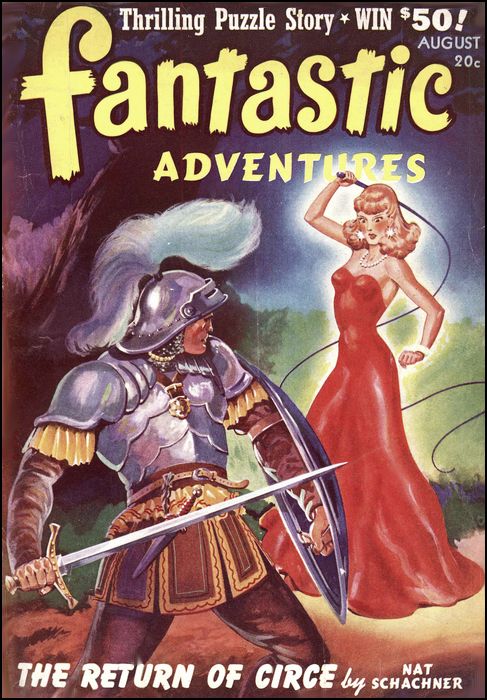
Fantastic Adventures, August 1941, with "The Return Of Circe"

Once again the loveliest enchantress of all time casts
her spell over men; and terror engulfs modern New York.
GORDON KEIL, so Mrs. Jenkins, his housekeeper, testified later, seemed strangely drunk on his return home the night that he vanished.
"Drunk?" echoed Detective Strang, cocking his head to one side in surprise. "That's funny. I've been scouting around among his friends. There ain't but one thing they all agreed on; and that was that Keil never touched a drop in his life. Wouldn't even taste cider, for fear it might of somehow fermented.' Now you go and say—"
Mrs. Jenkins pursed her thin lips in a hard, straight line.
"I know all that better'n you, mister. Once he caught me takin' a bit of a snifter in my own room—it's my stomick needs it; I gets queer spells like—anyhow, he almost fired me.
"But this here last night I'm telling you about, Mr. Keil acted drunk if I ever saw one. He just got out of the car an' walked right by me like he never saw me before, when I opens the door. His face was all flushed and there was a glitter in his eyes.
"I says to him nice and friendly: 'Did yer have a nice week-end out at Miss Kirke's?' But he sails by me like I was dirt under his feet. Me, what's babied him and put up with his nonsense this past ten years."
"Hmmm!" grunted Strang. He knew these hatchet-faced women. Give them a chance and they'd overwhelm you with words. "What'd he do next?"
"Went up to his room. Took the stairs three at a time, like-he was a boy, threw his hat sailing over the banister, and locked himself in." The housekeeper sniffed. "An' him with rheumatic twinges an' ulcers in his stomick an' hair that woulda be gray as a doormat if'n he didn't dye it once a month."
Strang disregarded the clinical details. Gordon Keil was the fifth man that had disappeared into thin air within the past month or so, and the Commish was pounding his neck for results.
"So that was the last you saw of him, eh?"
"Yes, sir."
"Wasn't it possible he went out again, and you didn't notice?"
She shook her withered head vigorously.
"He couldn't of. My room is downstairs next to the door. It was pretty hot, so I had the door open. I'd of seen him."
Strang scratched his nose.
"But damn it, there's no other way out. The upstair windows are all barred with steel gratings. You say you went up to his room about an hour later?"
"Yes, sir. I always do afore goin' to bed. Sometimes he takes a glass o' buttermilk for his stomick afore he goes to sleep."
"And the door was open, that he had shut when he went in?"
"Not only that, but he was gone. I searched everywhere—bathroom, the guest chambers, everywhere. Nary hide or hair of him."
Styang got up and paced up and down in exasperation. He was getting nowhere very fast; same as with the other cases. He whirled suddenly on the old woman.
"You sure there wasn't a sign of him around?"
"Well," she admitted reluctantly.
"Now that you mention it, I did find his wallet on the floor, and some loose change; like as if they had dropped from his pocket and scattered all over."
The detective snorted. Now maybe he was getting somewhere.
"Why didn't you tell me that before?"
"I didn't think is was important," she mumbled.
She thought she'd get away with the dough, thought Strang. Aloud he insisted.
"Anything else? Think hard!"
The woman looked suddenly uneasy. Her defiant, self-righteous look fell. She twisted her gnarled hands. Aha! thought Strang. She done him in herself. She's breaking; she'll confess!
"Come on, spill it!" he snarled. "I ain't got all day."
Mrs. Jenkins' glance was piteous.
"I swear I didn't touch a drop, even though my stomach was all misery. But I sneezed!"
Strang stared.
"Sneezed!" he repeated in bewilderment. "What the hell!"
"I'm this here now allergic," she explained. "Get a dog within a block o' me and I sneeze something terrible. There had been a dog in that there room not many minutes afore." She seemed to shrink into herself. "An'—an'—Mr. Keil ain't kept a dog for ten years. He knowed I couldn't abide them."
"Well, I'll be damned!" ejaculated Detective Strang.
BUT Gordon Keil had not been drunk that night. At least not on mundane liquors compounded of alcohol and other earthy ingredients. He was intoxicated—yes—but with a divine afflatus, with the ichor of the ancient gods.
He sailed by Mrs. Jenkins as he would have ignored at that moment the ruling monarchs of earth. Walking swiftly on clouds as he did, how could he be expected to note the inconspicuous passage of ordinary mortals beneath? His own exaltation lifted him up the stairs, not his feet.
An aging man, was he? Rheumatic twinges, eh? Dyed hair and stomach that was full of holes, hey? Nonsense! He was youth personified, virile beyond all other men; a Hercules for strength and a Mercury for speed.
As he shut the door and paced up and down his room the events of the weekend whirled with a sort of divine dizziness in his brain. Dea Kirke had smiled on him; Dea Kirke had invited him to her palatial Westchester estate; Dea Kirke had loved him!
He savored each little link in the chain of circumstances with a greedy running of his tongue over quivering lips. It was Wednesday last that the incredible had happened. He had sat morosely at an inconspicuous table at the Club Tabarin, fingering the glass of warmed milk and nibbling with distaste the dry thin Melba toast that represented his diet. He was solitary, alone, fed up with life. Then Dea Kirke entered.
Her entrances were always dramatic. She came in like a goddess—a darkhaired, full-blown beauty that caught the breath of the beholder. It was impossible to judge her age; she might have been twenty or she might have been two thousand. Like Cleopatra, the serpent of old Nile, she was timeless in her surpassing loveliness.
The satin smoothness of her ripe olive skin showed no trace of the passage of years, her deep-pooled eyes could ship from limpid liquidity to the flashing coruscations of embered fires with lightning-like rapidity. Her raven tresses were gathered in a simple, Grecian fillet at the nape of her neck, curiously old-fashioned, yet curiously effective. Her lips were ripely voluptuous and her bare arms firmly, yet softly molded.
For six months now Dea Kirke had been the sensation of New York. She had come like a visitation out of nowhere and took the town by storm. Mysteriously and fascinatingly foreign, her antecedents wholly unknown, she purchased out of seemingly inexhaustible funds a lovely estate near Armonk, in the Westchester hills. There she began to breed dogs.
But the word dog was too pale and innocuous a term for the magnificent animals that soon swarmed her kennels. Nothing like them had ever been seen before. They swept the Westchester Kennel Show clean of every prize. The judges raved. The other contestants likewise raved, though in different fashion. And every man within sight promptly fell in love with the compelling Dea Kirke.
NOW she came down the broad central aisle of the Club Tabarin, escorted by a strikingly unusual looking man. He was of medium height, barely as tall as the woman whose arm he held with such obviously passionate adoration. His powerful frame was faultlessly clad in black, silken-braided trousers and well-cut tails, but his face, framed in a broad, gray beard, was tanned and weatherworn with the passage of many suns and of many winters. A curious knowledge lurked in the finedrawn corners of his eyes and his nose was squat like that of Socrates. A French ambassador, one might have decided offhand, or a Balkan diplomat. But no one was deciding anything about him just then. All eyes devoured the lady on his arm. The headwaiter literally bowed himself into a knot as he greeted them; all conversation stopped at chattering tables. Men forgot the gilded partners they had brought with them; women bridled and suffered ineradicable pangs of envy. The dance floor shivered to a stop, and the orchestra seemed ludicrously frozen into an eternal soundless note. Admiration, desire, passion enveloped her as she moved in the wake of the flustered headwaiter to a table next that where Gordon Keil sat and sipped his arid drink.
If she were aware of the aura of desire with which the night club was suddenly impregnated, she showed no signs of it. She sank gracefully into the chair which the waiter solicitously pulled back for her; her companion dropped heavily into the other. They examined menus and ordered.
Gradually the stricken place stirred back into life. Men reluctantly averted their eyes to the accompaniment of low-pitched, but bitter complaints from their womenfolk. The orchestra resumed its ministrations, a sultry torch-singer came out into the spotlight and sang a sultrier song. The dancing couples took up their swinging and well-bred knives grated politely against food-filled dishes. Dea Kirke had made another of her inimitable entrances.
But Gordon Keil just sat and stared, the silly glass of milk forgotten in his hand. Her eyes lifted and met with his. A warm, frightening shock tingled down into his veins, brought back reckless youth and surging madness to the worn-out man. So that it did not even seem strange that she beckoned to him.
He rose spryly, almost ran to her table. Her depthless eyes were overpowering magnets, blessed pools in which to drown.
"Why, it is Gordon Keil," she said, and her voice held siren songs of melody. "I thought I recognized you, my poor boy, sitting there so forlorn. You remember, we met at that stupid party of the Van Wycks a month ago?"
Keil did not remember. In fact, he did not know the Van Wycks. In fact, had he ever met the lovely Miss Kirke before, it would have left etched memories in his brain. Therefore he only stammered and look vacuous.
SHE dazzled him with a smile. Her ripe, molded lips opened and showed white, dazzling teeth; tiny, yet sharply pointed. "Of course, Gordon," she said dulcetly. "You were interested in Doberman-Pinschers."
He stammered again. His knowledge of dogs was confined to poodles and wire-haired terriers. He wasn't even quite sure just what a Doberman-Pinscher was. Mrs. Jenkins couldn't abide dogs; so he never bothered much with the so-called friend of man.
The dazzling smile became a sunburst; it bathed him in a glory that befuddled while it stirred his senses.
"I was just thinking of you, Gordon." She turned to her companion. "Wasn't I, Ulysses?"
The man's face was black with suppressed anger. Yet he said smoothly.
"I believe you made some mention of Mr. Keil."
"Oh, by the way," she smiled, seemingly not noticing her companion's sulkiness, "this is Ulysses."
"Ulysses S. Grant?" Keil giggled.
"No; just Ulysses. An old friend of mine."
"A very old friend," the bearded man added grimly, with a strange side look at Dea Kirke.
"Don't mind him," said the girl calmly. "He's merely devoured with jealousy every time I talk to a personable man."
Keil bridled and straightened his tie. The last addled bits of his brain scrambled into mush. He no longer even wondered how the magnificent Miss Kirke had come to know his name, Ulysses glowered and shrugged his shoulders resignedly.
"I was saying," she went on, "that I have just obtained some perfectly exquisite Doberman-Pinschers. Knowing your interest in this particular breed, I wondered if you would be willing to spend the weekend at my estate—my kennels are on the grounds, you know—and let me have the benefit of your expert advice."
Her eyes seemed to enlarge, to swallow him whole in their seductive depths. In a daze he heard his voice replying thickly:
"I'd be delighted, Dea."
There! He had daringly called her by her first name. But she did not take it amiss. Rather, she positively beamed on him.
"Good!" she applauded. "Ulysses will call for you at seven sharp on Friday evening."
The bearded man growled; then looked alarmed.
"Fine," he corrected. "Not before."
Dea's full-throated chuckle was a rippling melody.
"But of course, my friend. I forgot for the moment." A long look passed between the pair; a look that Keil was to remember when it was too late.
PACING up and down his room now he tried to recapture that eventful weekend. It seemed almost frightening. The lovely lady, the glamorous Dea Kirke, had been strangely complacent. She had murmured passionate words of love to him during the sun-dappled days, but with shades drawn and doors securely locked, while outside a furious pack of baying dogs patrolled the spacious lawns and split the air with their clamor.
Sometimes he emerged from his swooning delight to listen with a curious unease. They sounded as if they wanted nothing so much as to tear him to pieces. In particular, one huge brute of a mastiff. There was also a curious giant of a man...
But her soft, clinging arms pulled him back, and all else was forgotten.
As night fell, however, the clamor ceased. Sinister quiet enfolded the place. Ulysses, absent all day, appeared as if by magic, his age-old eyes smoldering with strange fires. Abruptly Dea left Keil, doors and windows unlocked to the fragrant night, and vague alarms coursed through the lover she had left to his own devices.
The recollections brought the weary blood pumping once more through his veins. This evening, before a sullen and silent Ulysses drove him back to town, he had sworn eternal devotion to Dea. She listened to him with a faint smile.
"I'll remember that," she promised.
"But when will I see you again, darling?" he demanded passionately.
"Sooner than you think," she told him cryptically.
I can't live now without her, he thought to himself. Back and forth, around and around, he padded, a strange restlessness spurring him on. Padded! Why had that word sprung abruptly into his mind? He tried to stop himself. He couldn't.
Around and around the room he went, long-striding, almost at a lope. He blinked his eyes. By Heavens! he hadn't turned on the light! The room was in pitch darkness, yet he hadn't noticed. He, who always managed to bump clumsily into furniture even in full daylight, was now avoiding with instinctive ease unseen corners and sharp angles of cluttered bed, dressers, lounge and chairs. His eyes were wide and piercing; the darkness held no secrets from them.
Curious too, how he had suddenly become aware of certain subtle odors. His nose twitched and snuffed greedily. Each item in the room exuded a distinctive effluvia that he at once, without knowing exactly how, tabulated and catalogued.
A long, drifting smell lay across the room like a pall. That, he knew, and wondered how he knew, was Mrs. Jenkins, who cleaned his quarters every morning at nine. He could even tell what objects she had picked up or brushed against in the course of her ministering peregrinations.
WHEN he heard sharp sounds—the spatter of coins and metal keys upon the floor. Instinctively his hand fumbled for his pocket. They must have fallen out. But his hand was curiously clumsy. His fingers seemed stuck together; they could not enter the narrow folds. Then, even as he fumbled, the fold disappeared, melted away into a uniform rough fuzz.
Little alarm bells jangled in his brain. Again he tried to stop himself, to bring his padding lope to a halt. But he couldn't. His body drove forward, restlessly, bending over and over as if under an unbearable weight. His hind legs were becoming more and more unsteady. Hind legs! Why had he thought of that? And his ears! They were pricking up, twitching, sensitive to every vagrant wisp of air.
Suddenly he fell forward. His arms dropped to the floor with a sense of utter relief. He bounded ahead, swishing his tail. It was this last appalling fact that brought home the truth to him. His human brain froze with terror; then submerged under a welter of primeval instincts.
He was a dog! Lithe, long, blackly muscular, with sensitive snout and alert ears—a Doberman-Pinscher!
The dog ran snuffing around the room. A long, drifting smell called to him. It quivered in his nostrils; it beckoned with maddening desire. It led through the door, down the stairs, along the night-silent streets, over country roads to a certain magnificent kennel in the Armonk hills. His lean litheness wriggled with an ecstasy to be off, to follow that superb scent.
The door was ajar. In his earlier shape, without knowing why he did it, the man Gordon Keil had twisted the knob and resumed his half-pad, half-pacings.
The Doberman-Pinscher clawed open the wood with its paw. Down the stairs it bounded; a silent, bullet-like shape. Crouched low, a flitting shadow, it eased through the outer door, fortunately open because Mrs. Jenkins couldn't abide the heat. He saw her, rocking and fanning herself in her room; she did not see the low-slung, noiseless animal.
Out on the hard pavement the dog leaped northward with a whine of anticipatory delight, following that delectable scent all the way to its lair.
THE Garden was packed to capacity.
Home of fights and hockey games, of basketball and exhibitions, it now housed the premier blue-ribbon event in all dogdom. Nothing could be more doggy than the Universal Kennels show; nothing more aristocratic or exclusive. Every breeder, every exhibitor in the world pointed their best animals for the great event. A prize winner passed by the vigilant eyes of the judges had to be a world-beater, and its proud owner walked haughtily and superciliously among common mortals for years to come.
The huge arena was alive with color and movement. Tanbark covered the exhibition rings and the runways so that delicate pads might find the going soft and comfortable. Assorted aristocrats of dogdom, brushed and curried and sleeked to within an inch of their lives, sat each on his separate dais, awaiting the fateful approach of the judges. Huge mastiffs, bored English bulls, slim, fleet borzois, long-haired spaniels, impudent terriers, snarling chows and friendly airedales—grouped by classes and age.
The place was a weird conglomeration of yips and bayings and shrill barkings. Alternately proud and worried owners moved hastily among their pets, soothing the excitable, stirring up the phlegmatic, giving a last surreptitious primp to stray hairs and ruffled ears.
Chet Bailey patted a huge, tawny mastiff on the head.
"Buck up, old boy," he reproved him affectionately. "I know it's hard luck for you to run smack into that Ulysses brute in your first competition, but I'm rooting for you."
The great dog looked up into the gray eyes of his master as though he understood and whined. There was a certain similarity between master and dog, though the mastiff was built on gargantuan lines and his owner was lean and lithe like a fleet greyhound. But both had magnificent, rippling muscles that played under corded skin, and both had fighting faces, grim and stubborn with the determination never to acknowledge defeat.
Jessica Ware rested her gloved hand lightly on the dog's muzzle and evoked a low, deep growl of pleasure.
"Aren't you giving up too easily, Chet?" she demanded. "Every breeder who's seen this big, lovable old plug-ugly of yours thinks he's a champion."
The young man's gray eyes smiled at her, but there was no mirth in them.
"Sure he is; but Miss Kirke's Ulysses is in a class by himself. He's walked away with every show he's entered. Look at him over there."
There was no question but that the mastiff called Ulysses dominated the show. He was a magnificent beast—huge, calm, wise with a wisdom beyond that of the mere mortals who gaped and pointed and examined his fettles, his slim, steel-sprung haunches, his broad, mighty chest, the firm, smooth forepaws.
The girl stared at him with troubled eyes. The dog stared back calmly. Its eyes seemed to probe her, to weigh the human before him.
Jessica turned away with a little shiver.
"I got a strange feeling just then," she told Chet. "As though he were a bit contemptuous of us all. As though he considered us—humans and dogs alike—beneath him."
Chet forced a grin.
"Any dog breeder would agree with him. He'd tell you that a thoroughbred is the one perfect thing in this transitory, incomplete world." He stroked his own dog's head again. "Poor Warrior; I'm afraid you're going to be licked."
THIS time Warrior disregarded his master's hand. His great head swung in the direction of his rival. His powerful legs crouched under him as if for a spring, the short, wiry hairs became wire-bristles all over his body, and his red-flecked eyes retreated deep into their muscle folds. A deep growl, fierce with hate, rumbled in his chest; his fangs retracted in a long snarl.
"Hold him!" the girl cried suddenly. "He's all set to jump."
Chet's whipcord hand shifted to a firm grip on the collar.
"So he is," he said, surprised. "Down, Warrior! You'll get nowhere starting a fight. Take it easy, old boy."
The huge dog whimpered, but obeyed. Yet the hair continued to bristle and his wrinkled muzzle to quiver.
"He's never done that before," frowned Chet. "Usually he regards other dogs with a superb indifference." He bent down and snapped a chain from its rooted peg to the collar. "Safety insurance," he explained.
Jessica shuddered.
"He had the same feeling about that other dog that I had. Something sinister almost."
"Don't let your imagination run away with you," Chet advised. "He's uncannily perfect; but he's still a dog. Come on, darling. Let's take a last look at Pinafore before the judges start. Thank heavens Miss Kirke hasn't entered a Doberman-Pinscher. That means I have a good chance." He looked long at the girl. "If Pinafore wins, we get married tomorrow."
Jessica flushed. She was enough to stir any man's pulse even in repose; but when soft, pink color flooded her cheeks, the blood made a millrace in Chet's veins. Her body was slim, compact and vibrant with life. Her piquantly tilted nose contrasted charmingly with the serious intelligence that informed her wide gray eyes. Her short, golden-tinted locks always gave the impression of ruffling, sportive winds. Her chin was femininely rounded, yet strong and decisive nonetheless.
"I don't know why our happiness must wait upon a blue ribbon in a dog show," she said at length. "Even if Warrior or Pinafore doesn't win—"
"Please don't let's go over that again, darling," Chet retorted wearily. "I may be a failure, a has-been; but I'll never marry you to live on your money." His jaw went grim. "I've staked everything on this last chance. I know dogs pretty well; I've loved them all my life. Let me get a blue ribbon in this show, and dog fanciers all over the world will swamp me with orders. But if I don't—" He shrugged, and the lift of his shoulders was more eloquent than words.
Jessica shook his arm in exasperation.
"You a failure!" she cried. "Who saved the South Pole Expedition from disaster? Who threw a bridge across the San Pedro Canyon when every other engineer declared it was impossible? Who—"
Chet stopped her with a wry grimace.
"All past history, my love. Predepression, so to speak. The world is not interested in what you once did. It's what you're doing now that counts. And I'm raising dogs."
"For that awful Miss Kirke to beat," she stormed. "I hate her."
"That's not sportsmanlike," he reproved. "She has a knack—an uncanny knack. And—she's beautiful," he finished with a grin. "But come on; let's put the bankroll on Pinafore. At least he has a chance."
THE Doberman-Pinscher was beautiful. Black as midnight, long as an arrow, clean and sound in every limb. He wriggled joyously at the sight of them.
Chet took a deep breath.
"Thank heavens the ubiquitous Miss Kirke has no Pinscher—" he repeated.
Jessica's manicured nails dug suddenly into his arm.
"Hasn't she?" she wailed. "Look, Chet, look!"
The young man whirled; a sinking sensation at the pit of his stomach.
Already that breathless murmur, that swaying sound as of trees in a wind, warned him what to expect.
Dea Kirke was making another of her splendidly timed, spectacular entrances.
But Chet had no eyes for the siren face of the woman. He stared aghast at the dog who trotted submissively at her side, held in place by a slender leash. It was a Doberman-Pinscher, but such a specimen of the breed as he had never seen before.
Its coat was a burnished flame; its ears were sharply pointed and quivering with life. Its jowls, its deep chest and slender throat, the proud lift of its delicately poised legs, convinced him at once. Poor Pinafore, greatly bred as he was, didn't hold a candle to this phenomenal animal.
In a daze he heard Jessica's anguished cry:
"Oh, Chet; is that dog entered?"
"I don't know," he countered grimly. "He's not on the printed list. But I'm going to find out."
He went swiftly over to the group that had gathered as if by magic around the woman and the dog. The chief judge was among them.
"It's a bit irregular, Miss Kirke," he heard Kurt Halliday say doubtfully. "But if there is no objection'—"
"I'm sure there won't be any," Dea murmured, giving the white-headed old judge the full benefit of her smile. "Ah, here comes Mister Bailey. Ask him."
Chet disregarded the subtle intonation in her voice, pushed his way through the throng.
"What is the meaning of this, Mr. Halliday?" he demanded.
The judge stroked his thin white hair with distracted fingers.
"Why—uh—Miss Kirke wishes to enter her dog, this—uh—Doberman-Pinscher, in Class A competition, Division 3." He seemed flustered. "I know—uh—it's against the rules, but Miss Kirke has explained. The dog was shipped from the Island of Melos, and she didn't think it would reach here in time. That was why it wasn't entered. But as long as it came—" He made weak, washing movements with his hands.
"The rules are definite, Mr. Halliday," Chet said coldly. "All entries must be registered at least two weeks before the show, and the entry fee paid."
"You needn't worry about the fee, Mr. Bailey," retorted Miss Kirke. "As for that silly rule about entries, surely you wouldn't take advantage of a technicality like that. All the other contestants have agreed to waive the rule. Haven't you, gentlemen?"
HER beauty turned on dazzling full, like a million-candle-power searchlight. The men blinked in adoration. Freddie Gross, owner of Laddie II, said vacuously.
"None at all, Miss Kirke. It's a pleasure to waive every rule in the place for such a lovely woman as you."
"Thank you very much, Mr. Gross," she beamed.
"And that goes for me, too," George Lesser, owner of Jerry III, chimed in eagerly.
"And for me—and me—and me—" chorused the other contestants.
The judge lifted his arms.
"There you are, Mr. Bailey," he stammered. "Of course, you still have the right—"
Jessica thrust her way through to Chet.
"Don't do it," she whispered fiercely. "You know it isn't fair. Those men wouldn't do it for you, or for anyone else in the world but that—that woman."
Chet felt suddenly icy calm. He saw how it was. He knew what the papers would headline tomorrow. He knew that he'd be accused of bad sportsmanship, of taking advantage of a technicality. The victory would be ashes in his mouth. In a steady voice he said: "All right, I'll waive the rule, if the others do."
Halliday heaved an audible sigh of relief.
"Good, then that's settled. Come along, Miss Kirke; I'll place your dog. By the way, what's his name?"
Dea hesitated. An enigmatic smile flitted over her lovely countenance.
"Call him 'Chinese Gordon'," she said at last. Then to Chet: "Thank you! You are a gentleman—and a very personable young man."
But Chet had already turned on his heel; was stalking away, with Jessica holding bitterly to his arm.
"You let that—that hussy blind you with her charms; the same as she has done with everyone else. Oh, Chet!" she wailed. "You refuse to marry me until you have made money of your own; and now you've thrown away your last chance. You don't love me; you—" She stumbled as they went up the narrow corridor to the boxes. He caught her fiercely, almost shook her.
"You don't understand, Jessica. Every breeder, every dog fancier, would have me labeled as a bum sport. I'd be ostracized. The blue ribbon that Pinafore might have won wouldn't have meant a thing." His brows knit. "That story about the dog being en route from Greece doesn't go down with me. She could have entered him just the same, and withdrawn the name if he didn't arrive in time." He was speaking now to himself more than to Jessica. "I wonder where she really picked up such a worldbeater at the last moment. I thought I knew every pedigreed Doberman-Pinscher in America."
MATTERS went just about as Chet had expected. Dea Kirke's entries in all classes took the honors. There was not even the semblance of any competition. The judges lingered long and lovingly over her dogs, gave hasty, cursory examinations to the others, and announced the results. It was true that they lingered a moment over the mastiff, Warrior; but Ulysses won by a comfortable lead. As for poor Pinafore, he was literally swamped by the newcomer, Chinese Gordon.
Chet expected it, but he couldn't help the sensation of sickness that overwhelmed him at the final results. He had banked so hard on this Show. Jessica, next to him, was clenching her hands. He wasn't quite sure, but she sounded as though she was saying most unlady-like things under her breath.
Ulysses, the giant mastiff, was now being led out into the center of the arena. Dea Kirke, smiling that enigmatic, alluring smile of hers, had him on leash. Kurt Halliday raised his thin, veined hand for silence.
"The judges," he announced, "have unanimously decided to award the grand ribbon of honor for the best dog in all classes to the mastiff, Ulysses, owned by Miss Kirke. And may I add, that in all our years of breeding and judging, we have never had the privlege of examining such a perfect—superlatively perfect, I might say—specimen."
He turned to the girl, beaming.
"Miss Kirke, it gives me great pleasure—"
"The old fool!" Jessica flared with feminine illogic. "He's old enough to know better."
Chet tried to be fair.
"There is no question about it. Ulysses is—"
A deep-throated growl interrupted him. A huge, tawny shape shot like a bullet across the ring, straight for the calmly massive, unconcerned winner of the Grand Award.
"Warrior!" Chet shouted and left his seat like another bullet.
Instantly the great Garden was in an uproar. Shouts, screams, cries of alarm, a stampede by the timid and the frightened for the exits. A hundred dogs, infuriated by the clamor, lent their shrill voices to the din, strained at leashes to be in at the unexpected roughhouse that was impending.
Attendants came running across the tanbark, holding short, thick clubs in their hands. Dea Kirke turned, her eyes wide with a curious gleam. She did not seem in the slightest frightened at the apparition of hurtling death. Ulysses, the mastiff, swiveled on his haunches, bared his fangs with a snarl of defiance. There was an almost human quality to the sound. Kurt Halliday took one look at the oncoming dog and fled, his pipe-stem legs wobbling ludicrously as he ran.
WARRIOR meant business. Head low, powerful jaws agape, he bounded forward. Chet raced across the churning ring from the opposite direction. Once those two giant dogs locked in conflict...
"Down, Warrior!" he yelled. "Down, I say."
He might as well have saved his breath. The infuriated mastiff, ordinarily gentle and obedient, paid no attention to his master's commands. His deepset eyes were fixed in furious hate on the enemy.
Just as he sprang, Ulysses jerked loose from his leash, hurled forward to meet him. Dea Kirke, cheeks flushed, eyes glowing, clapped her hands.
"Why, its like old times," she cried.
Excited laughter was in her voice. "Go it, Ulysses, go for the Trojan Warrior."
Warrior lunged, his great jaws snapping. But they snapped on impalpable air. The mastiff, Ulysses, just at the moment of impact, had sidestepped nimbly, pivoting on stiff, straight legs. As the bewildered Warrior slid past him, he whirled, raked long teeth across sliding haunches and flashed back.
The outraged Warrior growled terrifyingly, clawed around to meet this strange, lightning-like attack. He charged again. Once more Ulysses leaped to one side. This time, however, he was not quite fast enough. A fang ripped across his jowl, leaving a long, red trail from mouth to ear.
A great roar burst from the injured dog. He leaped after the still-sprawling foe, all tactics forgotten. His teeth sank deep into Warrior's haunch. The great mastiff swung around, howling, seeking a hold with snapping jaws.
Then human beings were upon them both. Chet grabbed Warrior's collar, yanked with steel-strong muscles. The attendants laid heavy clubs methodically upon both animals, rapping smartly upon tender snouts. Ulysses broke away at once, whirled out of range. Warrior, doglike, struggled furiously to get once more at his enemy. His left hind leg was badly mangled. But Chet held him in a tight, firm grip.
"Down, Warrior!" he said sharply. "What's gotten into you?"
"It was your dog's fault, Mr. Bailey," panted one of the men. "We saw it all. He broke his chain and came out like a bat out of hell."
"I know," Chet acknowledged. "I'm taking all the blame. If there was any damage to Miss Kirke's dog, I'll make good."
To himself he was wondering how he could possibly pay. The dog, Ulysses, was worth a fabulous price. Any disfiguring scar would throw him out of future competitions. And he didn't have a cent. His last few dollars had gone into paying the entry fees. As for poor Warrior, he could never be exhibited again.
Dea Kirke's cheeks were flushed. Her dark eyes sparkled with strange, shifting lights. If Ulysses were superlative among dogs, her beauty outshone that of all womankind. She laughed suddenly.
Chet whirled in surprise. Across the arena he heard the anxious call of Jessica, hurrying to the center of disturbance; but all his nerves were suddenly tingling to the electrifying ardors in Dea's eyes.
"You needn't worry about Ulysses, Mr. Bailey," she said softly. "I wouldn't have missed that splendid charge of your Warrior for anything. You know—I like him—and you!"
HER glance was suddenly demure.
Her long lashes lowered to veil the sparkle in her eyes.
Chet's heart began to turn flipflops. Jessica seemed queerly faroff.
"Why—why, thanks a lot," he stammered. "You're taking it in a very sporting fashion."
She made a little gesture. Her lips quirked maddeningly.
"There are other dogs. To tell you the truth, I was beginning to weary of old Ulysses. He's been rather a bore for some time. Look!" she added as if on the impulse of the moment. "He's ruined your dog, Warrior. I'd be glad to show you just how I breed such marvelous animals. Would you care to be my guest for a week? We could put you up tonight. At the end of that time you'd know the technique perfectly."
Chet was astounded. Other breeders had clamored for a chance to see Dea Kirke's kennels, and had been turned down flat. True, she had entertained weekend male guests before; but none of them had been dog-fanciers. There had been Sam Wahl, for instance. Chet knew him slightly. Poor Sam had disappeared when he came back to New York. The papers mentioned something about the possibility of a defalcation in his books at the bank, but the police hadn't uncovered it as yet.
"Why—certainly—I'd be glad—" he heard himself saying.
Then Jessica burst in upon them. Her warm brown hair was tousled and her lovely face was compact in a tight, hard knot. Warrior tugged at Chet's restraining hand and growled furiously. Strangely, his eyes were fixed no longer on the Watchful Ulysses, but on Dea Kirke herself. His short hairs bristled, the muscles crawled and bunched under his bloody pelt, and there was hate and fear equally mingled in his gaze.
"I don't think, Chet," Jessica fought to hold her voice steady, "that you ought to accept Miss Kirke's invitation. She's done enough damage to you already."
Chet stared.
"Why, how can you say that!" he gasped. "If anything, I'm the one to blame. Warrior—"
"Warrior knew what he was about," the girl blazed. "You can trust his instinct. Look at him now. He senses that there's something wrong about that—that woman and her precious Ulysses." Her tone grew imploringly. "Please, Chet, don't go. I—I'm afraid."
"I think your friend is a trifle overwrought, Mr. Bailey," Dea said with a sympathetic air. "Of course, if you don't wish to come—"
Chet pivoted angrily on Jessica. "You're most unfair. I'm surprised at the way you're acting. Here Miss Kirke is acting like a sportswoman, and you choose this time to defame her." He swung back to Dea. "I shall be very pleased to accept your kind invitation," he said warmly. "I'll meet you after the Show."
"Chet, darling!" But he did not stop to listen to Jessica's anguished cry; he stalked stiff-leggedly away, holding the huge, unwilling mastiff firmly by the collar.
THE sun was beginning to gild the long, wavering line of the Palisades as the sleek limousine purred over the hilly stretches of the Old Country Road.
Dea Kirke seemed curiously uneasy as she glanced with calculating eye at the faint streamers of twilight. In the front seat, next to the chauffeur, Ulysses whined anxiously. To Chet, along with other strange incidents of this queer trip, it seemed that the whine held a peculiarly human note of urgency.
The woman leaned forward toward the open glass slide between front and rear compartments.
"You'd better hurry, Phemus," she said. "It's getting late."
The chauffeur twisted in his seat.
"I'm doing seventy now, Miss Kirke. But don't worry. We'll get back before the dark comes fully."
Chet noted that he pronounced her name as though it had two syllables—Kirk-ee. That struck him as strange; but certainly not as strange as the appearance of the chauffeur himself.
Phemus was huge—a veritable giant. His massive head grazed the roof of the unusually high-ceiled car. He must, thought Chet, be at least seven feet in height, and built proportionately. His eyes were frighteningly round as a saucer and baleful in their unwinking glare. Chet wondered how he had even managed to get a driver's license; wondered in fact if he had any license at all. But he seemed skilful enough at the wheel.
Chet was beginning to feel a trifle uneasy himself, in spite of the subtle, tingling warmth that pervaded him at this close proximity to the voluptuous woman at his side.
The car picked up speed. It was doing eighty now over the deserted road, swaying smoothly from side to side. He felt the woman flung against him, and her flesh was infinitely soft and all-pervading. In the delicious sensation he forgot to ask why, if they were in such a hurry, they had chosen this longer, lonely route rather than the straight, well-traveled Bronx River Parkway.
Armonk nestles in the fold of a hill. They swung off on a winding, dirt road that had the appearance of being but seldom used. The speed of the car became more urgent, the hurrying tension within more evident. The dog, Ulysses, no longer whined. He seemed to be moaning. In the gathering dimness Chet suddenly blinked. The great mastiff head was blurring on the seat in front—or was it some queer trick of the fading light?
Dea said encouragingly.
"We're almost there, Ulysses."
The dog whined in answer. It sounded as though a human being were having difficulty over the word:
"Hurry!"
The dirt road came to a dead end. A high stone wall, surmounted by barbed wire, stretched to invisibility through the tangled woods on either side. An arched portal, barred by a massive grilled gate, was directly in front. As the car hurtled forward without slackening its speed, Chet tensed his muscles for a crash. Was the chauffeur Phemus, mad?
BUT the gate swung open as they roared down upon it, and they went through in a spatter of gravel. A man stood at the gate, watching. Chet's nerves were jumpy. Again his eyes must be playing tricks on him. For the guardian of the gate towered in the gloom up and up and up. All that he could see in the half-light were a pair of giant legs—calves like the columns that upheld the great temple of Karnak; thighs that disappeared into the darkling sky.
It must have been his nerves, of course—or the light. For even as the car ripped through, the truncated mass shrank suddenly and formed a shriveled old man, bald as an egg and clad in a flowing black robe spangled with silver stars and crescent moons.
The limousine skidded with a squeal of brakes. The front, right door flung violently open while the car was still in motion and the dog, by now a blurry mass, bounded out and melted into the close-pressing trees. Even as it did, darkness came with a rush. The last sunset glow in the west faded and the stars pricked out.
The little old man came forward.
"You shaved it pretty close that time, Dea Kirke," he reproved. "The next time you will come too late, and then Ulysses—"
His voice was rusty and creaking like the hinges of an unoiled gate. His sharp-pointed face was hollowed with the ravages of innumerable years. He too pronounced the woman's name as though it were di-syllabic.
"It wouldn't matter much," she responded indifferently. "I am getting rathered bored with him, Atlas. Besides—"
The old man peered inside. His sunken eyes glowed in the darkness.
"Hello!" he said. "You've brought another visitor with you. Aren't you ever glutted?"
Her laugh was like the tinkling of ice in a glass.
"Never, Atlas. This is Mr. Chetworth Bailey, a breeder of dogs and a famous adventurer to boot. I intend to call him Chet."
Chet murmured some deprecating words. He was a bit dazed, and alarmed. It was bad when one's eyes began to play disconcerting tricks. First it had been the dog, Ulysses; then it was this little, weazened chap called Atlas. He'd have to go to an oculist when he got back to town. Perhaps he needed glasses!
Curious, too, the names of these people; these retainers and dogs with whom Dea surrounded herself. Greek—out of the old mythologies. The dog, Ulysses. The chauffeur, Phemus. Obviously a shortening of Polyphemus. Atlas. He grinned to himself. No connection there. Atlas had been a fabled giant who upheld the world on his brawny shoulders; and this—
He stopped right there, remembering that strange vision of columnar legs whose body was above the clouds. But that was nonsense, of course. Dea was a Greek by origin; she had acknowledge as much in connection with the Doberman-Pinscher, Chinese Gordon. And her marvelously classic beauty bore it out. Naturally she would cling by preference to the ancient Greek names.
THERE were no lights on the grounds. Only the dim stars showed the path on which they walked. They were alone—he and the woman. Phemus had driven away, and Atlas was gone. So was the mastiff, Ulysses. Deep silence enveloped them. A heady aroma breathed in his nostrils. With an effort he drew a trifle away from Dea.
"Where are your kennels?" he asked inanely.
"I don't need any," she replied. "That's part of my system. The dogs roam loose over the estate."
"But, good God!" he gasped. "You can't allow thoroughbreds to—"
The night seemed suddenly to close in on him. From all sides, as if by magic, they appeared. They rimmed them in a compact circle. Their tongues lolled redly in the starshine, their eyes gleamed like burning torches. From the smallest to the largest they moved stealthily forward, haunches close to the ground, ears pricked up, slowly but relentlessly narrowing the gap.
Tiny, vicious Pekes next to monstrous Irish wolfhounds, hairless Mexicans beneath the huge paws of Newfoundlands; chows, terriers, flopeared bloodhounds, bassets, skyes, pointers, Dalmatians, English bulls, shepherds—all the dogs that breeders had ever managed to rear and some that Chet had never seen before. Magnificent animals—every one of them—yet terrifying now in the way they stalked the humans who had ventured into their midst.
Hate and fear mingled strangely in their slow, bristling approach; overpowering lust to kill and rend alternating with a groveling dread—not of Chet, the man; but of Dea Kirke, the lovely woman!
Instinctively Chet sprang in front of Dea, trying to shield her. Instinctively his hand went to his pocket; came away empty. He had no gun with him.
"They're on the kill," he said low, but sharp. His eyes darted around for a path to safety. But the circle was close, impenetrable, and it was narrowing every moment of hesitation. There was a tree, however, close to where they had stopped. In another moment or so that too would be submerged under the approaching pack.
"Quick!" he whispered. "Get to the tree; but don't run. We'll have to climb it, or they'll tear us to pieces. Something's happened; I've never seen animals act like that before."
Her laugh rose startlingly on the night air, and the sound brought a terrifying response from the dogs. A chorus of sharp, explosive sounds, wholly unlike the barking of normal animals or the growl of stalking hunters. Rather it was the pentup fury of condemned men whose vocal cords had snapped under the commingled terror and helpless fury that held them in bondage.
"I do not run, or walk, from my dogs," she said calmly. Without haste her hand moved to her gown. It was a clinging, form-fitting—and form-revealing—dress of Nile green, yet Chet had not noticed the narrow, almost invisible pleat that ran from her hip down to the hem. She opened a tiny flap and pulled out a small, slender whip.
She cracked it sharply. It made a whistling, high-pitch sound that seemed to puncture Chet's eardrums.
"Down, you scum, you vermin of all times! Back, slaves, before I make you feel the bite of my lash! Away, before I sink you into the limbo of forgotten things! What, you seek to spring upon your mistress? Have you forgotten—?"
THE dogs slowed to a halt, stifflegged, bristling. Their jaws slavered with eagerness, yet a gathering dread glowed in their reddish eyes. She lifted the whip threateningly.
At the second sight of it they broke and fled. No sound issued from their throats, but terror winged their pads. As eerily as they had appeared, so now they vanished. Chet took a deep breath. It hurt his lungs. He had not realized that he had not breathed for long seconds, that every nerve and muscle had been tensed against the long, ripping springs he had expected.
"Whew-w!" He mopped his brow, wet with something that was not the dew of night. "I thought sure we were goners then." He whirled on Dea.
"For God's sake, what manner of dogs do you raise? They hate you worse than they hate death itself."
She favored him with a strange look.
"Now how did you happen to know that?" Then she smiled. "You're right. It's not death they fear, but rather this whip. They know exactly what it means when I use it." She thrust it deftly back into its sheath. "Some day they hope to catch me without it." Her smile held a new quality in it. "They've waited a very long time—most of them. But let's waste no more time on those brutes. We're almost at the house."
The night was warm, yet Chet shivered a bit as he went with her toward the turreted and battlemented castle that loomed before them in a park-like opening among the trees. It looked strangely incongruous in its Westchester setting—like a misplaced bit of medieval Europe. As indeed it was.
Chet remembered now. Some extravagant millionaire who, to please his romantic bride, had transported stone by stone, and lintel by lintel, a hand-hewn chieftain's hold from its Macedonian pinnacle to the peaceful hills of his Westchester estate. Hardly had it been laboriously reconstructed, however, when the young bride died; and the bereaved husband sickened at its sight had placed it on the market for sale. Dea Kirke had purchased it.
The great inner hall was truly baronial. Its arched stone vaulting sprang upward to the dimness of the roof, and innumerable recessed crypts melted into the shadows. No modern electric lights illuminated the interior; instead, huge torches of polished metal jutted from the buttresses and shot forth streamers of dazzling flame.
In the center of the floor's vastness a Small table was laid with gleaming napery and sparkling glassware. Huge, faceted bowls groaned under heaped fruits of exotic hue—pomegranates, wine-purple clusters of grapes, ripe, black olives, golden-skinned apples, figs with tender, bursting skins. A roasted boar elongated fiercely on a bronze platter with tiny yellow plums for eyes and tusks dripping a golden nectar. Haunches of venison, baby lambs spitted whole, plump partridges and other birds whose stripped identities Chet did not know, flanked the crisply browned boar. Wine of royal hue gleamed in tall goblets, and over all a peacock spread its magnificent, iridescent feathers, like a guardian spirit at the feast.
Two chairs were drawn up to all this splendor.
In one of these sat a man. His face was broad and squat, and a gray beard rimmed it in. Experience and the wisdom of much adventuring lurked in the tanned wrinkles that seamed his countenance and in the gray depths of his eyes. He rose impatiently at the sight of them.
"By Zeus!" he ejaculated, "I thought you'd never come."
DEA'S face was an inscrutable mask.
"The dogs thought to catch me unawares again," she said.
He moved toward her anxiously.
"You take too many chances, Dea. Some day they'll be successful; and then—"
She flung herself into one of the chairs.
"They weary me! I think I'll get rid of them all; ship them into the oblivion that they dread. It would serve them right."
The man nodded.
"I've begged you to do that these many centuries. I wish—"
He stopped; indicated Chet, who stood speechless and wondering, with a jerk of his head.
"Let him have his wine," he said bitterly, "and tumble him into bed. At least the nights, are mine, according to our compact. Zeus knows I have endured much for their sake." His voice trembled with thick longing. "Come, oh Kirk-ee!"
He flung out his arms in a pathetic gesture, turning his face to the left as he did so. A jagged rip from mouth to ear, recently wounded, glowed redly across his cheek.
Chet jerked forward angrily. Bewilderment and growing unease gave way to irritation. His fists were tight balls of muscular distaste.
"Now look here," he exploded. "I don't know who you are, and I don't give a damn! But I am no child to be disposed of as summarily as you seem to think. Miss Dea invited me here, and by God—"
The woman's voice was lazy, unhurried; but it cut across their smoldering passions like a sword blade.
"Stop it, my Chet! Stop it, Ulysses, you fool! You have been given credit for greater wisdom than to pout like a half-grown boy. Remember that I am mistress; now as always."
"Ulysses!" echoed Chet, and anger fell suddenly from him. His hackles rose and his blood prickled. He stared at the long, red mark with quickening horror. "Ulysses!" he repeated.
"An old friend," purred Dea. "You're thinking of the mastiff, are you not, my Chet?"
He forced himself into sanity, though the palms of his hands were wet.
"I was," he acknowledged. "Of course—"
"Of course!" she laughed, and her laughter was the music of many bells. "A mere coincidence. The dog Ulysses ran to join his fellows."
"A mere coincidence," Chet repeated obediently. But the hackles of his skin would not down. That new-made wound across the cheek—!
A shadow deepened the man's eyes. An age-old sorrow that swept through them and disappeared.
"Remember also our compact, Dea," he warned.
She rose with sinuous grace.
"I am weary of your remindings. Take care you do not overdo them. This night I yield to Chet Bailey."
HER smile enveloped the young man in folds of lapping languor. He forgot his fear; he forgot everything but the awareness of her beauty, her siren splendor. The memory of Jessica Ware receded into a faint, blurred wraith of far-off days.
"Sit with me, and partake of this simple repast, my Chet."
As one in a dream, suffocating with the throb of his veins, Chet sat down. The girl sat opposite, her eyes fixed on his, engulfing him in their liquid depths.
Ulysses trembled; anger flamed in his face. Then smoothly, as though a curtained drop had slid into position, it cleared. A crafty smile played over his lips, lurked in his much-enduring eyes.
"You are right—as usual, oh Kirk-ee," he said. "Permit me to drink the bond of fellowship with your latest guest."
There were three goblets of wine on the table. One held a golden-red liquor that flashed and coruscated in the flame of the torches. The second was a pale amber, beaded and winking at the rim. The third was a dark, rich purple, bloodied with the juice of sun-dappled grapes. He picked up the golden-red goblet, poured into a crystal glass.
He offered it with a courtly gesture to Chet.
"Here, my young friend; to your health and speedy metamorphosis." He stared at the glass. "How reminiscent is the color! I once saw an Irish setter with just such a golden sheen. But he was not magnificent enough for our Kirk-ee's kennels." He thrust it into Chet's hand. "Drink!"
With a mighty wrench Chet broke loose from his thrall. His brain cleared. Warning signals jangled in his temples. He jerked the lifting glass away from his lips.
"What sort of balderdash is this?" he cried. "Do you think—?"
Dea came at him with the silent speed of a serpent. She plucked the glass from his rigid fingers, dashed its contents onto the stony floor. Anger made terrible lights in her eyes.
"Beware, Ulysses!" she said furiously. "You are trying my patience beyond all reckoning."
The man fell back.
"I did but the usual thing," he mumbled.
"Begone! I am deathly weary of you. I am tired of your ageless jealousies. Tomorrow you shall drink the golden wine."
For a long moment their eyes clashed with lightning fierceness. Chet jerked forward protectively. But Ulysses suddenly smiled, bowed, and walked with dignified strides out of the hall. He did not look backward.
The flaming wrath wiped clean from Dea's lovely countenance.
"Pay no attention to him," she advised softly. "He is jealous, that is all. He shall annoy us no further. That drink he proffered you is inferior stuff. Its color is lovely, but its taste is sour and slightly rancid. I use it only as a decorative affair."
She picked up the amber-colored goblet, poured into another glass.
"Drink this, my Chet. I can vouch for this Melian wine. It is made of straw-colored honey gathered by the bees of Hymettus and of ambrosia such as the ancient gods themselves took greedily from the cupbearer, Hebe. It will fill your veins with intoxicating dreams beyond mere mortal delights."
HE knew that he should not drink it.
He knew that the whole setup was wrong; that this maddeningly beautiful woman and her pack of dogs had no right to be alive and breathing in the year 1941 A.D., in the United States of America. He knew now why the man, Ulysses, had that gash across his face. He knew—or rather, in the confused mists that dulled his ordinarily sharp and keen-edged perceptions—he knew that he ought to know.
Therefore he hesitated, fingering the seductive glass with its beaded amber liquid. She seemed to read his thoughts. She met his gaze with candid innocence. She poured another glassful from the same goblet while Chet watched suspiciously, seeking some trick of legerdemain.
She lifted it to her rosy lips, drank it down with a sigh of pleasure.
"Now do you see, my Chet?" she queried. "You need not fear."
It was true. There was nothing to fear. She had drunk the same liquor that she had proffered to him. He suddenly felt ashamed of himself. Ulysses, mad with jealousy, had tried to drug him with a dangerous drink. But Dea had saved him. Yet he had been suspicious. All these things could be explained—everything! Tomorrow, when he had rested and his mind was clear again, she would explain. Bah! Such things as had crept darkling into his brain would vanish with the risen sun. They would laugh and make merry over his eerie fantasies.
He lifted his glass, clinked it gallantly against her empty one, toasted: "To a lovely woman; to the loveliest I know—except one!" Then he drained it down.
The heady wine ran like liquid gold through his veins. It was marvelous stuff! Nectar and ambrosia indeed! Distillant of the gods!
Dea's face darkened at his toast; then broke into a faint smile.
"You refer, my gallant Chet, to the girl, Jessica Ware?"
"Yes."
"A very gallant lover," she said enigmatically. "Now let us eat."
They ate.
Her chair pushed close to his. Her hand touched his fingers casually as she carved the roast. Her thigh brushed against his body and made his heated blood to race. As she bent forward, her bosom betrayed its whiteness to his gaze.
The wine had been a potent drink; it flushed his cheeks and slurred his speech. It ran insidiously through the nooks and crannies of his being, and lifted with responding surge to the lady's overpowering charms. Her lips were temptingly curved; they parted with breathless invitation. He was slipping, falling into a chasm of beckoning delights. Her soft, warm arms moved toward him; her head bent slightly back and her eyes glowed. He swayed forward.
HE did not see the look of triumph that invaded her lovely eyes, the tiny, sharp teeth that hid behind her ripe, red lips. The image of Jessica receded wraithlike, despairing, thinning into misty smoke. Every fiber of his heated being yearned toward the delectable woman whose body slipped toward him with frankly open invitation; every guardian sense was clouded with wine and excitation. His hand went out fiercely, possessively... paused at the very moment of possession.
His blurred eyes went wide while little warning signals jangled in his brain. Was he seeing things? Had the potent drink so befuddled his senses? Dea's face was changing!
Her slim, straight nose, classically beautiful, subtly broadened and flared at the nostrils even as he stared. Her creamy olive skin, smooth as old velvet, crinkled into folds and pockets and turned yellow as discolored parchment. Little black bristles began to sprout from her upper lip. The tiny white teeth grew long and yellow and curved out over a quickly pendulous lip. Her eyes, those pools of unfathomable jet, narrowed and retreated into layers of fattening flesh. Little dartles of red streaked them as they blinked upward at his startled face. Her body grew compact and barrel round; her outstretched arms shortened swiftly and the seeking fingers coalesced.
He shook his head sharply, trying to clear away the fumes that gave him this nightmare. But the vision refused to change; became momentarily more dreadfully distinct.
She peered up at him in surprise out of those little red eyes.
"Chet!" she said. "What is the matter? Why do you shrink suddenly from me? Am I not lovely and desirable beyond all other women? Am I not—?"
At least that was what she thought she was saying. But to Chet it began with a series of explosive grunts and ended in a shrill, quavering squeal. There was no doubt about it—Dea Kirke, the magnificent woman who had taken New York by storm, was turning into a pig!
She fell forward from her chair, her sharp-pointed fore-hooves making a clumsy clatter on the floor. Her curled little tail quivered. Her sow-belly dragged pendulous dugs. She lurched toward him with a horrible travesty of sensuous longing.
Chet fell away from her in a revulsion of mingled fear and loathing. He was cold sober now. Good God! This lumbering sow, in whose piggish countenance he could still trace the fading remnants of a travestied Dea Kirke—he had almost taken her into his arms; had almost—
From outside he heard a man's sudden laughter. He whirled. Ulysses stood etched a moment in the oblong frame of the door, his broad, powerful frame glowing in the reflected flare of the torches, the night darkly sinister behind him.
"What does all this mean?" Chet cried out. "What hellish brew have you two concocted between yourselves? Let me out, I say."
Ulysses made no move. His voice was vibrant with scorn and self-contempt.
"Look at her! Look at the foul thing you thought to love—that I have loved her nigh three thousand years—because I cannot help it. She was bored with me, was she? She wished to install you in my stead, and cast me aside as she had cast every other mortal aside except me these many centuries? She knew me as a much-enduring man; but she forgot I am also a man of many wiles. I tricked her this time; I—"
FROM behind there came a great squeal; a furious, yet agonized snouting that trumpeted past Ulysses and hurled its mingled anger and anguish far into the night.
Hardly had it died before a new sound took its place. A sound as of monstrous feet thumping, shaking the earth with measured tread.
Fear sprang suddenly into Ulysses' eyes. The triumph was clean-washed from his cynical, self-flagellating face, leaving it a sallow-gray.
"Now Pallas come to my aid!" he mouthed. "He comes—the Father—to wreak vengeance for what I have done!"
He turned and fled incontinently through the door, speeding like a startled hare along the battlemented wall until the trees swallowed him up.
The thumps became huger and more earth-shaking. Great oaks bent outward as though they were slight reeds pushed aside by a careless-walking lad. The solid ground flattened and heaved with thunderous groans. The squeals of the bellied sow became more urgent.
Chet rubbed his eyes. Out there, in the scudding moonlight, two legs stalked toward him. They were as much around as the monster sequoias he had seen in California. The great feet, shod in yard-long sandals, crushed the smaller trees like splintering matches in their wake. Up and up Chet's gaze traveled—up to mighty thighs and giant torso that lifted to the darkling clouds which swirled around the moon. He saw no more. The clouds hid the rest. He wished to see no more.
Chet Bailey had never been afraid in his life. Not when a lion sprang out at him unawares from a bush cluster in the African veldt; not when he lost his dogs and sled with food and tent equipment down a deep crevasse on a solitary mush across Antarctic wastes; not even when his plane dropped a wing as it roared over the sawtooth mountains of Alaska.
But now he was afraid. Afraid with a hammering terror that pounded his flesh into pulp.
He turned and almost collided with the yammering sow. He skated to one side, darted madly across the polished floor, straight for the steeply curving stairs that went up into the reaches of the transplanted castle.
Below he heard voices. One was creaking, like the hinges of an unoiled gate, yet strangely gentle and soothing.
"There, there, daughter Kirk-ee, do not fear! Shortly you will return to your proper form. Though sometimes I wonder which it is—this, or that other. Your mother..."
The voice—it seemed to Chet like that of the little old man at the gate—paused and sighed.
"But never mind! How did this happen?"
The answer came in mingled grunts and squeals that gradually shaped into forming words and shifted into human tongue.
"It was Ulysses, father Atlas!" cried Dea Kirke. "He tricked me, even as he tricked me on the Isle of Aeaea. He added the drug to the drink, knowing exactly which I'd take. Father, rid me of him once and for all."
Chet's breathless speed took him out of earshot. He had to get away! What a fool he had been! Dea Kirke! Dea meant goddess! Kirke—di-syllabled—was the Greek pronunciation of Circe!
AN open chamber invited at the end of the hall. He flung himself inside, closed the door behind him, and hurled toward the slitted window. The outer stones were rough, he remembered. With gripping toes and fingers he should be able to clamber down and thread his way stealthily through the clustering wood toward the wall. Another climb and he would be out—out into the normal world of use and wont, solidly planted in 1941, anno Domini!
He leaned out over the deepset embrasure and fell back with a shudder.
The dogs sat outside in a tight, circumscribing ring. Back on their haunches, forelegs stiff, tongues lolling wickedly in the ragged moonlight, phosphorescent eyes glowing eagerly upward. A little growl of anticipation rippled around the beasts at the sight of him. They licked their chops.
There was no escape that way. Or any other! Suddenly calm, Chet surveyed the room. It was a bedchamber, magnificently furnished. A huge medieval bed with overarching silken canopy was soft and inviting with deep-tumbled featherbeds and gayly decorated cushions. Rosy little Cupids pursued amorous Psyches on the tapestried walls; and a wild boar bared its slavering tusks at bay before the lifted spear of a youthful Adonis.
But Chet could see no more. His eyelids weighted down. A drugged drowsiness fogged his senses. He tried to rouse himself. Fast-dimming consciousness warned him that it was dangerous to sleep. But his limbs sagged and his head drooped. He barely had strength enough to drag himself to the bed and fling himself into its cushioned comfort. Hardly had his limbs sunk nerveless before he was asleep.
His sleep was a long, shifting nightmare. All the creatures of unclean imagination paraded before him—chimaeras, griffons, gorgons with snaky locks, blind worms that crushed worlds in their writhing folds, harpies that chewed with dripping jaws on human flesh, assorted fire-breathing dragons and wild-eyed sphinxes. They glowered at him and came on in serried rows, jaws champing in horrid anticipation.
He tried to escape them; but every way he turned they sprang into being in his path. Their fetid breaths were in his nostrils, their fangs gaped wide. A clear, despairing voice sheared through their close-knit ranks, calling his name. A shudder rippled through them at the sound. They misted and disappeared as though the rising sun had pierced a fog.
The voice called him again. He knew the voice! With a glad cry he flung toward it.
"Jessica! Thank God you have come! Forgive me for—"
THE morning sun was dusting through the slitted embrasure as he leaped from the bed. There was the voice again of his dreams. Jessica's voice, bitter with that smoothly veiled contempt that only one lovely woman can bestow upon another, yet urgent with a fierce undercurrent of dread.
"I demand to see Mr. Bailey," she was saying. "We were to be married today. Don't hide him from me."
Dea Kirke's voice was equally smooth, yet cutting like a whiplash.
"It is a pity, my dear Miss Ware," she answered with irony, "that you have to search like this for the eager groom on your wedding morn. But I assure you Mr. Bailey is no longer here. Early this morning he remembered an appointment he had in town for noon. My chauffeur took him to the station."
"That's a lie!" Jessica cried. "It's just a week since he came up with you to this closely guarded estate of yours. No one has seen him since; he's vanished—just as half a dozen men have already vanished."
"By Atlas and Poseidon!" Dea's edged tones were like sharp little knives. "Do you realize what an accusation you are making? Those men to whom you doubtless refer all returned to their own homes. They were seen by their friends, their relations. If they chose to disappear afterward—"
"I know exactly what I'm accusing you of," retorted Jessica. "I'm accusing you—"
A masculine voice interposed hurriedly.
"Now, now, Miss Ware," soothed Detective Strang, "we mustn't say things we can't prove. I've checked those other cases with Miss Kirke, and everything was explained satisfactorily."
"To you, perhaps; but not to me. I know Chet. If I haven't heard from him, it's because—" Her voice choked off into sobs.
"Look, Miss Kirke!" Strang said with placating gesture. "Just to satisfy Miss Ware, would you mind if I searched your place a bit? Of course, I've got no search warrant, and you've got a right to refuse; but—"
Dea's laugh was merry and frank.
"Not at all, my dear Mr. Strang. My place is at your disposal. Go right ahead."
Chet was still drowsy and befuddled with his nightmares. The voices drifted up to him, making no sense at first. What did Jessica mean? A week since he had come here! What sort of nonsense was that? He had come only last night. And why did Dea deny his presence? Surely she knew he was up here. The window was open. In a second, if he wished, he could make his presence known to those below. In fact, that was what he was going to do!
"Jessica!" he shouted, and bounded toward the narrow casement. "This is a silly stunt! Why have you come—?"
But no voice issued from his throat. Instead, a dog barked furiously somewhere close by. He whirled. There had been no dog in the room with him. There still was none. Evidently the dream was thick upon him.
He shouted again. Again no words came forth, and that damned dog barked louder in his ears. He swung around, stiff-legged, glaring. If this was some sort of a jest—
His nose twitched suddenly, and his eyes raked down. He leaped high in the air, stunned, bristling; came down spraddling on four hairy, padded paws. Something swelled the corded muscles of his throat; issued in a fearful whine.
The realization froze him in his tracks, carved him into a marbled statue. He was a dog! A glossy-coated Irish setter, with reddish-golden mat, slim, long legs, long, sensitive muzzle and great, floppy ears.
DOWN below he heard human voices.
"There's one of your dogs howling, Miss Kirke. Wants to get out, I suppose."
"They always do," she agreed with easy calm. "Sometimes I shut one of them up in a room for training purposes."
For a moment that seemed eternity Chet was glued to the floor. His muscles were taut like drawn bowstrings. His breath came in snuffling little whines. His heart pounded madly within a shaggy breast. His ears perked up to cup the slightest whisper of sound. His brain seethed with stifling anticipations.
He was a dog—an Irish setter! Another in the string of magnificent animals with which Kirke—or Circe—had surrounded herself! The drugged drink which Ulysses had cannily switched on him had done this. For a week he had slept unknowing, while his human body shifted gradually to canine form. No wonder Dea was willing to let Jessica and Strang search for him. They'd never—
Like hell they wouldn't! With a grim bark he leaped forward, straight for the door. The long, lean setter took the stairs downward five at a time, a smoothly functioning, magnificent animal.
He whipped through the great entrance hall just as the outer portal opened and two women and a man entered. One was Dea Kirke—lovelier than ever. She was clad in a long, sleekly clinging morning gown of green silk, and her perfectly molded face was innocently smooth as that of a newborn child. Yet Chet saw, or thought he saw, the lurking semblance of that drop-bellied sow with broad, pink snout in her sinuous curves, in the droop of her ripe-red lips and curling lashes.
The man with them—Detective Strang—was rather stout for a detective; with grizzled hair and little eyes that peered everywhere at once. He held his black bowler embarrassedly in his twisting hands. There was an apologetic air about him at this unwarranted intrusion.
But Chet's eyes fastened hungrily on the other girl. Jessica's cheeks were pale with anxiety and fear. Her slim, taut body quivered as in a strong wind. Her gray eyes were hollow with nights of weeping.
"I want every cranny searched, Mr. Strang," she said huskily. "I'm sure he—he—"
"Of course," soothed the detective. "But I don't believe—He broke off at the sight of the hurtling dog. Involuntarily his hand reached for his gun. "There's one of your dogs loose, Miss Iprke!" he said sharply. "Is—is he vicious?"
Chet slid to a halt before Jessica. His silken paw clawed at her dress. His large, liquid eyes tried desperately to speak to her. He forced speech from his unaccustomed throat.
"Jessica, darling, you were right! Your intuition was perfect. I am Chet, who loves you more than anything else in this world. Help me, darling! Make Strang understand. She is Circe, the enchantress. Her dogs are men, changed by foul drink to what we all are. Help! Help!"
JESSICA reached down and patted his desperate head with gentle fingers.
"Why, he's not vicious!" she said. "He's a lovely setter; the most beautiful animal I've ever seen. Look at those great, speaking eyes. Listen to him bark and whine, as though he were trying to tell me something. There's something almost human about such a splendid animal as this."
Strang made a grimace.
"I don't care much for dogs. Not since one brute of a Chow took a hunk out of my leg when I put the cuffs on his master."
Dea smiled angelically on the detective.
"Perhaps," she murmured, "my pets would do the same for me if you—ah—tried to take me prisoner."
Chet redoubled his efforts. He wriggled his body; he whined frantically; he poked his muzzle into Jessica's hand. God! Couldn't she see? Couldn't she understand? Couldn't their mutual love break through the barriers and bring the imprint of understanding on her brain?
Alas! The barrier was insurmountable. He was a dog—nothing else to her. Her mind was clouded with anxiety, with eagerness to find her lover, unknowing that he was under her hand, desperate with effort to tell her who he was.
She patted him mechanically.
"He's taken a liking to me," she said. "But we'd better get on."
"Right," said Strang. "We haven't all day."
He moved quickly toward the walls, sniffed expertly around, shifted furniture, tapped every hollow-seeming spot, sought hidden traps.
"Nothing here," he said finally with a sigh. "We'll try upstairs now."
Dea watched him work with an enigmatic smile.
"My house is open," she invited. "You'll not find Mr. Bailey. Poor fellow! I'm really sorry for him."
Chet turned suddenly. A deep growl stirred in his throat. His hackles reared. Why hadn't he thought of that before? Here, before him, defenseless to his fangs, was the author of his transformation. If she were dead—
He sprang like a suddenly released spring. Straight for the throat of the lovely Dea Kirke. The growl became a roar. His lips retracted from snarling fangs. A red eagerness for that smooth white expanse, for the thin, blue vein that pulsed enticingly in a ravishing hollow...
Jessica screamed. Strang cursed and reached for his gun. But Dea only smiled. Her white hand did not seem to move, yet like a flash the slender whip lifted in her fingers.
"Back, slave!" she said. "Back or you writhe in eternal torture."
The whip whistled once. In midflight Chet felt an unbearable pain piercing his eardrums, his hate-filled eyelids. Molten fire ran like quicksilver through tortured veins. He fell to the ground, writhing, agonized.
She lifted it a second time. "Begone!" she said. "That was but a fore-taste. This time there will be no surcease, no escaping."
Chet groveled weakly on the floor. The terrible fire that burned him was subsiding, but he knew without further telling that the second time that terrible whip would crack, he was doomed to all eternity. He knew now why the pack of hating dogs had vanished at the sight of it. He knew now why they were her slaves, wretched in their animal forms, yet unable to revolt.
Jessica cried:
"The poor thing! He was friendly and gentle with me. You are his mistress; yet—"
Strang held his gun watchfully.
"You'd better shoot him, Miss, and be done with it," he advised. "I've seen 'em like that before. He hates your guts; an' he'll get his opportunity some day when you ain't looking."
Dea smiled her ravishing smile.
"He's not broken in yet. But he will learn."
Chet darted to his feet and raced howling through the open door, out into the park-like grounds. Ungovernable terror sped his pistoning legs. Circe was right. Another session with that magic whip, and his spirit—that dauntless spirit which had carried Chet Bailey, the man, through every physical danger—would be broken forever.
AT the edge of the wood he met the giant, Phemus. The man whistled to him. He swerved fearfully. The man whistled again. It had a friendly sound. The great eyes, that had seemed so frightening that night he had driven them up, glittered with sympathy.
"Come here, old fellow," roared the giant. "You're the last one she's taken in, ain't you?"
Chet stopped, barked tentatively. He was hungry for human sympathy, for the sound of a human voice. It was true that Phemus was not exactly human. Those great saucer eyes of his, his shaggy locks and uncomplicated mind. Not very intelligent, perhaps; stupid enough, in all conscience; but good-natured.
Chet came closer. The giant bent down, and patted his head with a huge ham of a hand.
"Yes, sir," he roared. "You ain't the first, an' you won't be the last. She collects men, she does, that she-devil.
She's been a-doin' it fer Zeus knows how many centuries of time. She gets a kick out it. Useta make pigs out of um. But pigs ain't fashionable no more. Tried wolves fer a while. They wa'n't so satisfactory. Now it's dogs." He shook his massive head. "Zeus knows what she'll be tryin' next—monkeys, belike."
He slapped his great thighs and roared with laughter.
"That 'ud be funny all right. I seen them little shavers scampering around in Ethiop. They sure were cute."
Chet growled.
"Sure, I understand," boomed the giant, "Yu'd ruther be a dog than them there other animals. Well, can't say's I blame yuh. It's a shame, though, old boy. Me—she took me frum my island where I was gettin' along swell with my sheep. Ulysses—he bashed out my brother's eye with a burning stick. Not that I hold it agin him," he added judicially. "Brother Poly liked the taste of men's flesh. I never could abide it. Course, I'm immortal, like Kirkee herself; otherwise, she'd a made a lapdog outa me."
His ham of a hand gentled the quivering dog.
"Some day she'll get her comeuppance. An' then you'll all be free; and me—I'll get me back to my Cyclop island." He sighed. "It ain't that this here America ain't a nice place to visit; but it's too big a place fer a home. I like an island—it's cozier."
The giant sighed again. His sigh was like the swish of a great windmill.
"I better get back tuh work. She'll be arter me ef'n I don't prune these trees." He pulled a tremendous pair of shears from his hip pocket and strode along the row of poplars, clipping great branches as he went.
Chet slid on all four paws into the sheltering woods. He wanted to think this thing out. So near to Jessica, and yet so far. With her woman's intuition she knew that Dea Kirke had something to do with his vanishment; that her menage and dogs were not all that they seemed. But it had not been enough to recognize the man she loved within his furry shape. Even now she—and Strang with her—were searching the transplanted castle from cellar to turrets. They would find nothing; would go away baffled and discomfited.
Chet gritted his teeth, and a ferocious growl broke from him. Circe had won again; as she always had, as she always would throughout time.
HIS nostrils twitched. He lifted his muzzle and snuffed the air. His ears went up. His body tautened. The odor of strange animals was sharp on the breeze.
They filtered through the trees like shadowy wraiths—dozens of dogs—St. Bernards, whippets, fox terriers, beagles. They slunk low to the ground, twitching their tails, widening their nostrils to absorb his scent, stalking him as though he were a fox they had run to his lair.
Chet backed up warily, bristling. He bared his fangs. He vented a low growl as a warning. The dogs stopped short, sat on their haunches around him in a circle. Chet turned round and round. Were they but waiting the signal to spring and tear him to bits? He growled.
The St. Bernard got up, padded toward him. The others cocked their heads to one side—eyes alert, bright.
"So she got you too?" the St. Bernard nodded his big, wise head. "I hate to do this," he growled, "but misery loves company, they say. We're all in the same boat. Welcome!"
"Sure thing," went up a low chorus of yips. "We're all slaves of Circe. Welcome!"
Chet shook his head in bewilderment and barked back. He understood them easily—growls, barks, yelps.
"How long have you fellows been—uh—?"
He hesitated to say it, for fear of offense. The St. Bernard grinned.
"Dogs?" he completed. "It depends. Take myself. I'm Ennius, a centurion in Caesar's Second Legion. We were chasing pirates in the Aegean. My trireme hit a rock and sank with all on board. I managed to swim to shore. A beautiful woman took me to her palace. She fed me and made love to me." The great dog shook himself violently. "The next morning I was—this."
A Dalmatian barked.
"I was a Basque fisherman going to the Crusades. We captured the citadel at Acre. There was a lovely Saracen maiden—I spared her life. In return, she loved me—and made me—this."
A deep bass growl came from a Great Dane.
"I met the cursed enchantress in King Arthur's Court. She pretended to be a damsel in distress, and I, Sir Sagramore, went out with her on the quest. She exercised her charms, I yielded, and behold—"
The Doberman-Pinscher lifted his head defiantly.
"I'm not complaining," he said. "It was worth it. Two days with Dea Kirke such as I had, and she can keep me like this the rest of my life, for all I care."
Chet glared at him.
"You're the baby who's responsible for my being here. If you hadn't beaten Pinafore for the ribbon, I'd never have accepted her invitation." Then his muzzle opened in a doggish grin. "Sorry! It's not your fault, of course. I'm Chet Bailey. What's your name?"
"Gordon Keil."
"I remember now. Your name was in all the papers. Fifth man to vanish mysteriously in as many weeks." He grimaced. "I suppose I'm making the headlines now."
"King Arthur knighted another knight, and forgot about me," grunted Sir Sagramore.
"Centurions were cheap to Caesar," rumbled the St. Bernard.
The Irish setter lifted its head angrily. His low bark was edged with contempt.
"You're all sorry for yourselves, aren't you? You've sat on your haunches for centuries and bemoaned your fate? You hate this Circe who's done this to you?"
A snarling wrath raced around the circle. Eyes gleamed in the shadows.
"Of course!"
All, that is, except the Doberman-Pinscher, who drooped his head.
"Then what have you done about it?" Chet demanded.
The St. Bernard shook his shaggy head.
"We've tried. We've tried to catch her offguard, to tear her to little bits. But the cursed witch has her whip handy all the time. It holds great magic."
CHET shivered. He remembered only too well the potency of that whip.
"I know," he acknowledged. "But you've gone about it the wrong way. You've acted just as the dogs, into whose shapes you have been cast, would act. You're men, human beings! Use your brains."
"How?" demanded Pedro, the Basque, with some show of reason.
"I don't know—yet," Chet admitted. "But there must be ways."
"Bah! I thought you knew." The Dalmatian moved away, disgusted.
Chet was stung to his mettle.
"The first thing to do," he retorted, "is to get away from her. Escape."
"Yah!" sneered Sir Sagramore. "Suppose we do. Suppose even she doesn't find us. Then we remain dogs—in a world of dogcatchers."
Assent circled them at that.
"And besides," asserted Ennius, the centurion. "We forget Father Atlas." Fear crept into their eyes at the mention of that name. Even Chet felt his paws grow weak. That little, baldish man in the spangled robe, who nevertheless could, when he willed, tower up into the clouds...
"We've got to chance it," Chet said with determination. "Once away from the power of her whip, we'll find a way." He tried to sound confident.
The St. Bernard regarded him for a while with wise old eyes. Then he said suddenly:
"Our new friend, the Irish setter, is right. And even if we lose—well, I, for one, am tired of being a dog. I'd rather hasten to that limbo with which she threatens us all the time. It can't be worse than this."
The Great Dane stepped forward, lifted his paw.
"Let it never be said that Sir Sagramore feared a quest, no matter how hopeless."
"I'll go with you," snapped Pedro, the Crusader.
"And I."
"And I."
It swept the crowding dogs like wildfire. Muzzles up, they voiced growling agreement. Only Gordon Keil held aloof.
Chet saw him.
"How about you?"
The Doberman-Pinscher shook his head in the negative.
"I'll stay. You see," he added simply. "I love Dea Kirke."
They surged toward him angrily. "Traitor!" howled Sir Sagramore.
"You would betray us."
"Never! Go your ways in peace. I wish you luck. But she has given me such joy as I had never known before. I am willing to pay the price for it."
"Leave him alone," cried Chet. "I understand his feelings. He won't betray us."
"Thank you!" answered Keil gratefully.
"The question is now—how to get out."
"That's the trouble!" groaned Pedro. "The walls are higher than we can possibly jump. And they're surmounted by barbed wire and broken glass."
"How about the gate?"
"Atlas himself is the guardian."
"All the time?"
"During the day, at any rate. At night it's bolted and chained." The Crusader twisted his muzzle. "We have only paws with which to work."
Chet pondered. "It's a chance just the same—at night. What are we supposed to do during the day?"
"Eat and drink and roam the park," grunted Ennius. "Thus our muscles keep in trim, our coats get sleeker, and we win more prizes for our mistress. There's food all over the place. In little troughs. Phemus tends to that."
A thought struggled in Chet's reddish head.
"Hmm! I wonder if the food doesn't contain drugs that renew the potency of the transformation. However—in the meantime, we'd better scatter. Each for himself until dark. No use getting Circe suspicious—or the others. When the first star breaks out, let's meet at—"
"I know just the place," declared Ennius. "There's a thick cluster of pines hard by the gate. Even when the sun is overhead, the shadows are heavy within."
"Okay, then, boys! Until then...
THE day was long in passing. Chet flitted stealthily from tree to shadowed tree, keeping warily out of sight. Occasionally he met one of the other dogs and pretended not to know him. Just in case anyone was spying. Twice he saw Atlas sunning himself at the gate. He peered at him out of shelter, wondering. This little old man, bald and wrinkled with innumerable years—could he actually be the same as that monstrous being who had stalked with earthquake tread over the ground the night before?
Then he saw Jessica and Strang leaving in Jessica's cream-colored roadster. Strang looked more perplexed than ever. Jessica was biting her lip with a certain fierceness. It was obvious that she was keeping back her tears with the utmost difficulty. Chet's heart yearned toward her; yet he dared not emerge from his hiding.
Atlas opened the gate and they whirled through. For a moment Chet thought to leap after them, scurry through before the gate could close again. But his dog-sharpened senses showed him something that human sight could not envisage. A shimmer of impalpable form that radiated from the little old man, and extended on all sides to block all openings. A radiation through which human beings and inanimate metal could pass as through a fog; yet impenetrable to Circe's transformed slaves. Then the gate closed; and Jessica was gone!
Twice he passed little troughs of food and drink. He was hungry and thirsty, and the odor that came to his snuffing nostrils was insupportably tempting. Twice he passed them by, fearing the potent drug; then hunger and thirst could bear no more—and he ate greedily.
No condemned prisoner ever watched more tensely for the dawn than did Chet for that first pale, twinkling star. As sun dropped down over the hills and twilight strode over the earth, he lay on his belly, paws outstretched, secure in his covert, and sought its apparition. Even as the light dimmed, a strange transformation overtook Atlas. The old man in his robe of stars and crescents began to gather around him the shimmer of vibrations that had enclosed him. They coalesced and expanded at the same time. Up and up and up shot his legs and thighs and widening trunk. Chet whined softly to himself and shivered as though it were bitter cold. Strongly he was tempted to jerk to his legs and run howling. It was only by tremendous effort that he held himself to watch.
Atlas got up, and at once his head vanished high into the night. He seemed a vast, amorphous, headless being stalking the earth with thunderclaps. Somewhere to the right of him, Chet heard a little whimper. Ennius, the St. Bernard, lying in wait, was equally affected.
Then a huge mastiff bounded suddenly into the clearing next the gate. Chet started. That was Ulysses. He had not seen him all the day in the course of his peregrinations. Chet's hackles rose. He growled low. An answering growl of hate came from Ennius. They wished nothing better than to rush the favored one and tear him to pieces. But Atlas was there.
And even as they tensed, the mastiff blurred and flowed. Then the dog was gone and Ulysses, the man, stood in his place.
HE cupped his hand, called softly but urgently up into the gloom.
"Father Atlas! Father Atlas!"
From out of space itself seemed to come the rumble.
"What is it, Ulysses?"
"It's about Kirk-ee. Since that damned new toy of hers—Chetworth Bailey—struck her fancy, she will have nothing more to do with me. In spite of the compact we made and which you witnessed."
"You changed her into a pig," Atlas pointed out. "That's the unforgivable sin as far as any woman is concerned."
"She brought it upon herself. She wanted to put that Bailey chap in my place. I haven't been around her all these years for nothing. I know just where she keeps her drugs."
The great voice floated down meditatively.
"She wants me to crush you into oblivion, Ulysses."
"You won't do that, will you?" said the man in some alarm.
A chuckle permeated earth and sky. "No. You are an amusing fellow. The most amusing I have met since Herakles himself once tricked me." The chuckle deepened. "That didn't matter, because I tricked him first. But Kirk-ee wants your life. She's like her mother in that respect. Vindictive." His sigh sounded like the north-wind. "These women. Old as I am, wise with the wisdom of many worlds, I still find it difficult to fathom them."
Ulysses shook his head despondently. "Isn't it the truth? Look at me; I was supposed to be the wisest of the Greeks. I outwitted your Kirk-ee the first time I met her. Then I sailed on home to Penelope. Poor Penelope. She was the only woman I've ever known to be faithful for ten absent years. Yet she bored me. I thought always of Kirk-ee. I grew restless. At last the restlessness seized me by the hair and wouldn't let me be. I took some of my old retainers and set sail again. I was willing to pay the price. So now I'm dog by day and man by night." He shook his head. "It isn't pleasant by any manner of means; yet—" he added hastily, "I love that darn witch you call your daughter so much I've stuck it out for centuries."
"My boy," said Atlas kindly, "I understand just how you feel. If Kirk-ee weren't my daughter, I'd—" The great voice trailed off in a spatter of wind. "I'll see what I can do for you, Ulysses. If she insists, I'll have to kill you. But I'll talk to her. 'Bye."
The great legs lifted, came down with measured tread. The earth vibrated. The Fordham seismological needle jumped several notches. Georgetown recorded the tremor. Scientists spoke learnedly the next morning of unsuspected faults that underlay the Westchester hills. The legs moved on, up the slope toward the castle, and disappeared.
Even as they did, the first pale star winked into being.
At the signal, the night became a thing of rustles and stealthy movements. Ulysses, leaning against the gate, lost in contemplation, did not hear them until the pack was almost upon him. Sir Sagramore leaped. A rumble of hate stirred in his throat.
ULYSSES swiveled sharply; cried out. He was defenceless, alone, against an army of assorted dogs who once had been men.
Chet barked once.
"Stop it, Sir Sagramore!"
The Great Dane skidded reluctantly to a halt. His long teeth clashed.
"What's the matter, Bailey? Getting soft?"
"No. It's just that an idea struck me. We could never open that gate with our unaided paws. But Ulysses, with human hands—"
The old Greek stared at the Irish setter, let his eyes wander slowly around the circle of animals that panted for his life.
"Bailey has brains," he nodded with a touch of admiration. "More than the rest of you put together."
The weaving pack snarled.
"He is quite right," Ulysses went on imperturbably. "You could tear me to pieces, without doubt. But what good would it do you? The gate would still be closed, and my death cries would attract Kirk-ee and Atlas. You know what that would mean to you."
"Never mind the speeches," interrupted Chet. "Open the gate, or your death cries will be extremely short." Ulysses sighed.
"No wonder the witch with whom I have the misfortune to be infatuated, has taken a liking to you. Under other circumstances I would be glad to have you for a friend. Just now, however, you are a rival. So I'll be glad to comply with your desires, my good fellow. Once you are escaped—and the rest with you—perhaps she'll be willing to return to my arms."
He went slowly to the gate, slipped open the complicated series of bolts and bars, tumbled the massive locks. The huge barrier swung out.
"Goodbye," he mocked them, "and good luck in the world of men. There is a Society, I believe, that takes up all strays and kills them in the name of mercy and all that."
Pedro, the Dalmatian, had shot through ecstatically. Now he turned, his tail stiff with fury.
"For that last crack we ought to tear you to pieces anyway."
But Chet, his muzzle close to the gibing man, said:
"Let him alone. Ulysses always was noted for his jests. If his life depended on it, he couldn't resist the last word."
"How well you know me!" laughed the Greek.
"One more thing, though. How can we change back to human beings?"
Ulysses looked grave. A twitch of pain passed over his weather-beaten face.
"I do not know," he confessed. "For two thousand years I've labored to obtain the secret. Do you think," he demanded passionately, "that I wouldn't have employed it for myself? Do you think I like to be a mastiff by day?" He pulled himself together. "Not even Kirk-ee knows. It's a one-way transformation as far as she is concerned. Perhaps Atlas knows. And he has never yet yielded the secret."
Chet thought of that age-old giant and shivered. It would be like plucking a secret out of the heart of the molten stars. However, for the present it was necessary to be free. They must hurry. At any moment Atlas might return and their escape be discovered.
"I'll get it somehow," he told the Greek confidently. Then he turned to the waiting pack. "All right, boys, let's get moving."
They poured through the gate in a torrential flood—scores of assorted dogs—snuffing the freedom that lay ahead. Chet took the lead—no one disputed it with him. At his side trotted Ennius, the St. Bernard.
"Where away?" grunted Ennius.
"To New York. I live in a private house on Sixty-Fifth—relic of palmier days. We'll use that as a hideout until we determine what to do."
ALL through the night the motley horde poured on its way. At first they kept to the main highways, but the hard concrete was too much for their travel-weary paws, and passing automobiles were a menace. Brakes squealed and men shouted at first in anger and then in fear and astonishment as they hurriedly shifted back into gear. A hundred loping animals—from the largest to the smallest—headed by a gorgeous Irish setter, a giant St. Bernard, a spotted Dalmatian and a savage-looking Great Dane, were not lightly to be trifled with.
"I wish they'd give us a ride," a water spaniel said wistfully. "My dogs are awful tired." The spaniel had been a mail carrier on a rural free delivery route just after the War.
"Dogs?" queried Sir Sagramore, puzzled. "We're all dogs."
"Skip it," Chet advised. "Poor Miller was just trying out a modern pun. There'll be no rides for any of us, except back—" he added grimly. "We'd better cut across fields wherever possible. That way we won't attract as much attention, and the ground will be easier."
But Chet had never had a dog's-eye view of the suburbs of New York before. Grounds were fenced in, or barred with barbed wire. Picnickers smashed pickle jars, milk bottles, strewed around jaggedly open tin cans and went gaily on their way. Grass was sharp stubble and defunct automobile bodies littered the open spaces.
Back to the roads they were forced. The smaller dogs began to limp. The larger ones sagged wearily. Paws were cut and bleeding.
"How much further?" gasped Pedro.
Chet lifted his head and sniffed. The garbage dumps were increasing in odor.
"About ten or twelve more miles to my home," he said cheerily.
Groans and whines met him.
"Can't make it," yipped Miller, the spaniel. "I'd rather stay here and let Dea Kirke catch us. At least we ate and slept and enjoyed ourselves up there."
There were agreeing growls.
"Well," commenced Chet, and was interrupted. Sirens screamed through the night. The sound traveled fast, rising in crescendoing pitch. Headlights widened swiftly to boring tunnels of flame. Men were shouting.
"By Jupiter and the Vestal Virgins!" quavered Ennius. "What is that?"
"Duck!" screamed Chet. "Take to the fields and scatter. Don't stop running until you're under cover. They're State troopers. An alarm's been sent out for us."
A long, white car hurtled toward them like a ghost. Others converged down the pale concrete.
"There they are!" yelled a gray-uniformed man perched on a running board. A gun was in his hand. "No wonder the complaints were pouring in. There must be a hundred of them. Wild dogs, hunting in a pack. Okay, Bill. Start shooting!"
The escaped animals were milling inconclusively on the edge of the road. But at his words, at the warning cry that Chet raised again in loud, staccato barks, they scattered.
Guns blazed, the night was filled with punctuated bursts of sound. The spaniel, Miller, yelped in pain and dragged a bleeding leg into the field. A dachshund, once a chef in Bismarck's kitchen, jumped convulsively and rolled over, twitching and jerking.
MAD with terror, the pack catapulted like a bursting dam for cover. Chet and Ennius raced together, the breath whistling in their shaggy breasts.
"Make for that clump of trees and that barn," puffed Chet.
The troopers jumped from their cars, and plunged after the fleeing dogs. The night was filled with explosions.
"Got another one!" yelled a cop. "Boy! I useta gun coyotes like this."
The St. Bernard threw himself behind the shelter of the silent barn just as a vagrant bullet clipped his ear. Chet flung beside him.
"We'd better lie low," Chet advised. "They're crisscrossing the fields with their car headlights."
Muzzles close to the ground, they waited. Impotent wrath and anguish mingled in their pumping hearts. The level field was a scurry of motion, of yelping, maddened animals. White beams pricked them out as they fled, and gun roar promptly followed. A waddling bulldog—Heatherington-Smythe-Fortescue of Wupping on the Cam—fell heavily. His short, bowed legs beat a feeble tattoo, then stiffened to the skies.
"Damn them!" raged Chet. "I'll never hunt another living thing as long as I live. They're killing us off one by one."
"Most of them got away," growled Ennius. "I used to hunt the tusked boar in the Hyrcanian forests, but I'll never do it again either. That is," he amended, "if we ever get clear of this mess."
Far up the road two small points of light pricked out; then expanded into whizzing grooves of sheeted flame. A high-ceiled limousine, powerful with sixteen cylinders, roared down upon the cluster of police cars like a bat out of hell.
Brakes squealed in sudden torment; the great car rocked to a halt, and a woman flung out from the rear. The chauffeur, vague and formless in the front seat, was cloaked in darkness. No light gleamed on the dashboard.
Chet whistled, and it emerged as a soft whine.
"It's Dea Kirke—Circe herself!"
Ennius stiffened, reared on his paws.
"We'd better run for it, then," he said in fright. "That hellcat'll spot us sure as the Fates."
"Sssh!" Chet whispered. "Get down again. Listen to her!"
The troopers had stopped shooting.
A grizzled sergeant jerked toward her.
"Hey, there, you! Where did you think you were going? You were doing ninety or I'm a Dutch uncle. I've a good mind tuh—"
She descended on them like an embodiment of all the Furies. Her lovely face blazed with terrible wrath; her dark eyes flamed like Etna in eruption.
"You fools! You unutterable fools! Don't you know who I am? I'm Dea Kirke. Those are my dogs you're slaughtering—thoroughbreds, world prize-winners, every one. A hundred thousand of your silly dollars couldn't replace them."
THEY fell back from her rage at first. Then the sergeant took himself in hand.
"Sure, I recognize you, Miss Kirke," he mumbled. "I seen your picture lotsa times in the paper. But you shouldn't a let 'em out."
"Let them out?" she flared. "They escaped. The gate had somehow been left open. I'm holding you strictly responsible for any damage you've done."
The sergeant clothed himself in official dignity. After all, orders were orders and the law was the law.
"You ain't got no call to talk like that, Miss Kirke," he said with aggrieved dignity. "Them dogs've been scarin' people outa their wits. They's been 'bout a hundred complaints poured in afore we was sent out. They're a menace—that's what they are—a menace. An' the law—Section 24, Subdivision a, of the—"
"I don't care what your silly old laws say," she interrupted furiously. "You leave my dogs alone."
The sergeant took out his little book.
"Okay, lady, you asked for it. I'm gonna give ya a summons fer interferin' wid officers in the pursuit of their duty; an' I'm gonna give that big ape of a chauffeur a ticket fer speedin', reckless driving—"
"Phemus!"
"Coming, Kirk-ee."
The giant unfolded himself and lumbered out of the car. His single eye glared hopefully.
"Do you want me maybe to take these insects apart, limb by limb?" The sergeant fell back. The book of tickets thudded to the concrete. His gun came out again, but the sweat beaded down from the brim of his gray Stetson.
"You keep away from me, Big Boy, or I'll blast yuh."
"Jeez!" husked a trooper, his gun-hand shaking. "I heard uh that bozo. Must be seven feet, if he's an inch. An' lookit those eyes. He oughta be in a circus. Onct, when I was a kid, I saw a guy—"
His companion was pale, but he wrinkled his brow nevertheless with unaccustomed thought.
"Gwan, yuh never saw nothing like that before. But onct, when I had the mumps, my mother read me from a book. Somethin' about a feller named Odd—Oddy—well, anyway, he met up with a guy just like this here one, an' he put out his eyes wid a burning stick."
"Me, I'd rather use a gat," retorted his fellow.
Phemus was spreading his great hams of hands and looking joyfully around the backing cops.
"Shall I, Kirk-ee?" he rumbled.
"I'm warnin' yuh again," yelled the sergeant fearfully. "We got yuh covered."
Dea Kirke made an impatient gesture.
"Never mind, Phemus. Go back to your seat. I'll handle this."
"Yeah?" The sergeant gained confidence. "Well, now let me tell you somethin'. I'm runnin' yuh both in. I don't care if you're God Almighty; yuh can't get away with this. Okay, Peters, put the cuffs on 'em."
Peters moved forward unwillingly, shiny metal dangling in his fingers. Dea shrank back.
"Don't you dare touch me!" she screamed. Phemus let out a bellow.
But the circle narrowed on them relentlessly. Guns watched for the slightest untoward move.
"It's no good, lady," grunted the sergeant. "Yuh'd better come quietly."
"Father Atlas!" she lifted her voice.
"It's no use. Atlas or whoever he is can't do nothing. He ain't got no influence in this here country. Only Atlas I ever heard of is the Atlas Insurance Company of Hartford, and they don't insure cases like this. Ha! ha!"
He doubled up at his own jest; then stopped on a hiccoughing spasm.
"What the hell's that?"
THE ground shook and rocked underfoot. It heaved and sideswayed like a sea swelling toward a rocky shore. The trees bent and the branches swished like whips; the barn behind which Chet and Ennius lay hid did a stately sarabande.
Thump! Thump! Thump!
Great feet slogging up and down in measured, thundering tread, approaching through the night, relentless, inexorable. Huge steps pounding out an earthquake rhythm, stepping hills as though they were pebbles, striding along with seven-league boots. The sound of houses crashing underfoot, of toppling trees and squashed-out filling stations, grew louder and louder. A wind sprang up, whirling and twisting with cyclonic strength.
The police shrank against their swaying prowl-cars, white of face, mouths unslacked.
"Jeez!" husked the sergeant. "What the hell—"
"Look, sarge!" screamed Peters. "Lookit that comin' toward us!"
Surmounting the encompassing slopes of the Saw Mill River Valley were two giant legs. Round and thick they were as the Trylon at its base. Up into the darkling sky they reared, supporting a torso that bulked as huge as the Empire State Building. Black, storm-streaked clouds hid the rest, boiling in a cauldron of crackling lightnings and pitchy swirls.
"I come, daughter Kirke!"
The great voice was like a clap of thunder, smashing down from outer space.
Ennius cowered against Chet for protection. His shaggy pelt was stiff with fear.
"It's Father Atlas! By all the Lares and Penates, we're cooked!"
With a quavering howl the St. Bernard started up and fled across the staggering field, straight toward the swaying woods that rimmed it in.
"Don't!" Chet yelled after him. But Ennius had already disappeared; as had all their company except those pitiful few who lay stiff and cold on the ground, their dark, red blood fertilizing next year's crop of weeds.
Chet's fangs were chattering, but he kept his head. It was safer here than in panic-stricken flight. If Atlas would only—
The police broke with hoarse yells. They tumbled pellmell into their cars, slewed them around on the shuddering road. Starters whanged, gears clashed raucously. Five white cars, like bucking broncos, leaped forward, whining and tumbling in crazy flight toward New York. Behind them rang out the silvery, musical laughter of Dea Kirke and the bellowing guffaws of Phemus.
"Ho! ho!" he doubled over, while the tears gushed in a fountain from his saucer eye. "I ain't had so much fun since my brother Poly hopped around blind mad when we asked him who put out his blinker. 'Noman!' he kept on howling, an' got madder 'n madder cause we said: 'Then what's eatin' you if no man hurt yuh' ?"
A fence splintered into smithereens close by. The giant legs came to a halt. The wind died down. Giant as Phemus was, he seemed gnome-like against sky-piercing Atlas. A huge voice boomed down; a little weary, a little anxious.
"My daughter called. What manner of trouble had she gotten into now?"
CIRCE stamped her foot in a rage.
"It's these modern boors of humans! They no longer fear the gods, or respect our immortal superiority."
"You mean," said Atlas, "that the goddess Kirk-ee has been crossed again in one of her whims. I told you a thousand years ago that changing humans into pigs and dogs and whatnot is passe. Try something new to sate your eternal boredom."
The woman flung back a defiant head. She was breathtaking in her passionate loveliness.
"Please, Father Atlas. None of your moral lessons. I had enough of them from Zeus. He'd sneak away from that old frump of a wife, Hera, and loll in my arms, and talk high and mighty about duty and respect for his position and all that."
"That's why you came back to your Titan father," Atlas chuckled. "You played the winning side with Zeus until Hera found out about you, and you needed my protection again." The clouds bellied with his sigh. "I'm an old man and foolish to put up with your pranks, Kirke; but I suppose it's too late to change. First it was your mother; now it's you. I'll never get any peace. What do you want now?"
"Get my dogs back again. Especially I want the Irish setter, Chet Bailey."
"All right! all right!" he grumbled. "If it will make you happy. But you've got to do something about Ulysses. The poor fellow's in a dither."
"Kill him. He changed me into a pig."
"But you always were, my dear. Greedy, lecherous, wallowing in—"
"Father!"
"Okay!" he said hastily. "I was only joking. But I won't kill Ulysses. After all, a contract is a contract. Us Titans have a sense of honor."
"Sure," Dea told him nastily. "That's why you let Zeus and his Olympians finagle you out of your kingdom. They didn't worry about contracts."
"They didn't," Atlas admitted. "But if I'm too old to put a stop to your tantrums, I'm too old to change my ideas on honor. Ulysses lives."
She knew when she was licked. "Very well, father. I don't care if he lives to a hundred thousand. But I want Chet Bailey."
"I'll find him," he promised. "Now you let Phemus drive you home, and leave everything to me."
CHET thought it was time to be going. He didn't like Dea's single-track insistence upon him. He would have preferred less of her interest and more of anonymity, such as Ennius, or Pedro, or Sir Sagramore possessed. She was lovely enough, God knew, but she did not tempt him. Not if she were a million times lovelier. More and more he yearned for the normal humanity of Jessica, for the candid clearness of her eyes. He'd never have to worry, when he took her in his arms, that he might possibly be holding a squealing, snouting sow.
He sneaked along, belly low to the ground, as the big limousine went roaring back the way it had come. The others were all safe by now, and he figured he'd wriggle quietly to the little cluster of beeches and get the wind up on Ennius. He had taken a liking to the honest old centurion. Together with the Roman, he'd be able to...
A gigantic shadow fell athwart his path, blotted out the moon and all the stars. The shadow had five curved fingers, each a dozen feet in length.
Abandoning all concealment, he started to run. His four legs jackknifed under him, and his lean, glossy body hurtled forward like a streamlined bullet. But fast as he was, the shadow was faster.
It swooped down out of the sky; a hand plucked him up, wriggling and kicking with his hind legs, as easily as if he were a fly scooped up by an eagle in flight.
Up, up he zoomed, the breath knocked flat out of him. He lay in the palm of a hand as huge almost as the Yale Bowl. The earth fell away from him and the clouds seemed to descend to meet him. Up, up, up! In the distance New York shimmered, a toy city spangled with chains of light. The Hudson was a ribbon far beneath to the right, with dwarf Palisades making a tiny edging. On the left the Sound was a mere sinuous trickle.
Up, up, up! It became biting cold. Even his matted fur could not shield him from the piercing wind. The clouds parted, and closed again beneath him.
"Up, up, up! The stars were white radiances in a jetblack sky. His lungs labored and panted in the thin air. He ceased his strugglings. If he fell now...
The dizzy zooming ceased. All motion stopped. Sucking in as much of the cold, clear atmosphere as he could, he staggered cautiously to his feet. He looked upward.
For a moment he closed his eyes; then he opened them again. Atlas looked down upon the shivering setter he held in the palm of his hand. His great face was like the moon. Its wrinkles would have been good-sized hills down there on Earth. His eyes were twin lakes of jet, nestling in mountain troughs. His nose was a bold promontory, a headland that raised the wind with its steady breathing. When his mouth opened, a red pit yawned in which white teeth made a saw-tooth range. Chet, in that first shuddering gulp, noted that dark chasms ran across the white. Atlas needed a superjob of dentistry, he thought incongruously.
"Well, my friend," roared Atlas. "You thought I did not know you were hiding behind that barn all the time. What have you to say for yourself?"
CHET stiffened his muscles against the shuddering that was half cold, half fear.
"It's you who have to do the saying," he declared boldly. "I've harmed no one. I minded my own human business until that daughter of yours took it into her head to change me into a dog. That sort of thing went out centuries ago. You're both anachronisms today with such silly tricks. You ought to stop it."
Bracing himself firmly on the ridged palm, Chet waited for the explosion of wrath that would send him catapulting into a squashed mess of blood and intestines back to Earth.
But the explosion didn't come. The bald giant—now that Chet looked closer, he noted the resemblance to the little old man in the spangled gown—stared down at the dog meditatively. His brow puckered into Appalachian folds.
"You've got spirit," he said finally. "I'll give you credit for that. And I don't know but what you are right. I've been telling practically the same thing to Kirk-ee for a long time. But she's a headstrong girl. She pays no more attention to me than did her mother." His eyes twinkled and he heaved a false sigh. "Her mother left me for good-looking Hermes after the time us Titans got licked."
Chet took heart. Atlas looked like a mild old giant, in spite of his fearsome size.
"Now look here, Atlas," he said earnestly. "Sooner or later, you're going to get into trouble on account of Circe. This isn't Greece any more, you know, or even Rome. Civilization has gone ahead. You can't go around forever changing people into animals. You'll be found out some day; and then the men of Earth will turn their weapons loose on you. Airplanes, bombers, guns that shoot twenty miles, battleships, explosive bullets. And then where will you be?"
"Hmmm!" pondered Atlas. "Civilization has advanced some, hasn't it? Why, even the Olympians had only trumpery thunderbolts to mow us down. You fellows could kill hundreds of thousands where Zeus could smack down only a single Titan. That sure is progress!"
Chet did not like the tone of irony in which this was said. He arched his back, showed his teeth, and growled defensively.
"You don't have to get sarcastic like that, Atlas. We've done other things—like—like science, for instance."
The giant stroked his chin with his free hand.
"Science! Sure! So you can make bigger and better weapons to kill more and more people!"
Chet decided there was no profit in arguing against such silly logic. Besides, it was pretty chilly in those rarefied heights, and it was hard to breathe.
"Well, what are you going to do to me?" he demanded suddenly.
"Eh, what's that?" Atlas blinked his eyes. His thoughts had been far away. "Why, yes, of course. Take you back to Kirk-ee, naturally. You're the latest of her series of toys."
"But I don't want to go back," Chet declared anxiously. "I don't want to stay a dog all my life."
"I don't know why not. It's not a bad life, come to think of it. Some one takes care of your food and drink. You have time to stretch in the sun and laze. No responsibilities! No headaches! Besides, you'll be a man during the day; dog at night; and immortal to boot.
"Now, that's an idea. Why didn't I think of it before? You won't even interfere with Ulysses. He'll take the night shift and you'll make love to my daughter by day. She'd like that, I'll be bound. Her mother, for instance... Well, never mind that. Come on, everything's settled; and even that contract I was idiot enough to let Ulysses hornswoggle me into is taken care of. There's nothing in the lines against a day shift."
He took a giant stride and the wind of his movement almost sent Chet parachuting out into space.
"Hey! Wait a minute!" he yelped. "You don't understand. It's not only that it would be a dog's life, but I don't love your daughter."
ATLAS stopped and blinked in surprise.
"Eh, what's that? You don't love Kirk-ee." He scratched his head, puzzled. "But that has never happened yet. Every mortal being she ever wanted to take up with, and lots that she didn't give a hoot for, were just crazy about her. Look at Ulysses—"
"I'm tired of looking at him," Chet declared angrily. "Sure," he added with a placating gesture, "Circe is a swell girl, and all that. I'm not saying anything against her looks or her methods—but—well, you see—I'm already in love. In fact, Jessica and I were supposed to get married as soon as I made some money."
Atlas stared at him.
"You mean that pale-faced snip that came a-hunting for you with that fat little detective?"
Chet showed his teeth in a snarling growl.
"Look here, I won't have anyone talking like that about Jessica. She's the grandest kid—"
"No harm meant," Atlas soothed. "It's just that—oh, Hades! I suppose every man has the right to love the girl he wants. After all I did have a hankering for Kirke's mother before I married her."
"Will you let me go, then?" Chet demanded eagerly.
"I'll get the dickens from Kirke."
"Tell her you couldn't find me."
"She won't believe me." Atlas winked a cavernous eye. "So she won't! It's about time she was denied something. The trouble is, I've spoiled her."
Chet's heart bounded incredulously. He had never expected to find the giant so reasonable. Already the gigantic hand was lowering. Cloud masses beaded his fur with milky moisture.
"Hey, wait a minute!" Atlas ejaculated, and paused. "You must remember you're a dog. The drink Ulysses switched on you both had the property of making all mortals dogs and immortals into that animal they most closely resembled." He chuckled. "No wonder poor Kirke got so furious. Anyhow, it would take another drug to make you into half a man—a part-time man, so to speak."
"I'm not interested in that," Chet retorted. "I want to become all man again."
There was a moment's silence above him. Then Atlas said sadly, "I'm afraid that's beyond any of us."
"W-what!" Chet stammered, feeling suddenly cold within. "You mean we can never change back to human form again?"
"I'm afraid that's so."
"But Ulysses compelled Circe to get his men back from pigs—Homer definitely says so."
"Homer was a poet—and therefore something of a liar. It's true that Hermes gave him an herb that had the property of re-transformation. But the herb doesn't exist any more. It grew only on Olympus, and when the gods emigrated, they took it with them." He pulled on his chin reflectively. "Let me see, what was its name? Oh, yes—moly."
Chet's heart sank.
"Then we'll have to find Hermes."
"No, sir, you can't," retorted Atlas hastily. "In the first place, they emigrated to a different world where the people still believe in them. In the second place my wife went along, and I don't want her to get ideas. The last couple of millenia have been pretty calm and restful, and if she decided to come back—" The giant was sweating. Down below, on Earth, it began to rain, much to the Weather Bureau's surprise. Their charts didn't show any reason for it.
"Then how—?"
"It's just too bad, son," Atlas said sympathetically. "But you have your choice. Man by day and dog by night—and Kirke; or else, just plain dog all the time."
Chet twitched his muzzle; breathed deeply.
"Okay, then; I'll take the dog's life." He gritted his teeth. "I'll find that moly if I have to go to Hell for it."
"That won't be far enough," Atlas remarked. "However, it's your funeral."
The great hand went swiftly down. "I'll drop you off in Central Park, if you want."
"Thanks!"
A loitering policeman, a sleepy watchman and two mooning lovers afterward reported that New York had been attacked by a strange Zeppelin that had swooped perilously close to them, had changed its mind and zoomed back into space.
They did not note in their excitement the Irish setter that shook itself a moment or two on the sward to get its land legs again, and then trotted off in the direction of Fifth Avenue.
JESSICA WARE had passed a sleepless night. At the first sign of dawn she got up, washed her face, stared at herself in the mirror. Her eyes were tear-reddened and her face was pale with worry. Chet had vanished! The police were busy combing New York, were making inquiries. Nothing would come of them; as nothing had come of the uproar raised by the disappearance of half a dozen men before.
"I'm still certain it's that awful Kirke woman," she had insisted to Detective Strang the evening before. "Everyone of them had been visiting her before—before—"
Strang twiddled his derby unhappily. "Maybe!" he sighed. "But we can't prove a thing. The other bozos all came back to their homes."
"But Chet didn't."
"We don't know. He lived by himself. No maid; nothin'." He scratched his head. "We searched Miss Kirke's place like we was a dose of salts. No corpus delicti; no hide nor hair."
Jessica started to cry afresh now; then, with the woman's instinct even in the midst of tragedy, she began to powder her nose. Then she stopped.
There seemed to be some commotion down in the street. A dog barking furiously, raising the dawn with its din.
"I wish the neighbors wouldn't let out their pets so early," she thought resentfully. "It's barely six o'clock. Suppose I had been asleep." And she lifted her compact to apply a little rouge to her cheeks. A tearful night did things to one's complexion.
The dog kept on barking.
She went to the window, flung out an exasperated "Scat!"; returned to her dressing.
But the barking grew louder, more insistent. Something began to scratch at the door.
Windows were being flung open; sleepy, embittered voices demanded to know why the hell she didn't let her dog back in to the house instead of waking up respectable, God-fearing citizens. What was the neighborhood coming to anyway?
Jessica made an explosive little sound, thrust a wrap around her bare shoulders, went to the window again.
"It's not my dog!" she cried out generally. "Call the police—"
Then her eyes dropped to the stoop.
THE East Sixtieths were still a refuge of aristocracy; an oasis of quietly ancient families in a city of roaring vulgarity. A chastely grille-enclosed stoop led up to a fan light doorway of Colonial design. Bounding up against the immaculate white paint, its long red-glinting paws scratching furiously for admittance, its muzzle lifted in urgent, raucous barks, was a dog.
"Scat!" said Jessica. "Go away, or I'll—"
The dog lifted its head. Its long, sleek, reddish body writhed with redoubled, crescendoing howls. From a neighboring house a man shouted angrily:
"By God, I'm getting my gun!"
A shock of recognition flowed over Jessica.
"Heavens!" she gasped. "It's the Irish setter; the one that was so friendly to me yesterday; the one that wanted to kill its mistress. What's it doing—"
She gathered up her wrap, fled hastily down the stairs, her dainty mules clack-clacking on the steps. She reached the door almost simultaneously with Amanda her coal-black maid. Amanda said with sleepy irritableness:
"Sho', Miss Jess'ca, a body kaint sleep wif all that tarnation racket. Lemme git a broom—"
"Go away, Amanda!" Jessica said quickly. "I'll take care of the poor animal."
Trembling fingers undid the latch, twisted the knob. The Irish setter flung inside with a joyous clamor, muzzled her hand with soft, wet nose.
"Fer de lan' sakes!" mouthed Amanda, retreating hastily. "What you all doin', chile, lettin' strange animals in de house?"
"Hush!" said Jessica, and banged the door shut. She wanted to think; to have privacy. What did this apparition of one of Dea Kirke's dogs in front of her house mean? How did it get there? Why did she feel a queer little tingle trembling up and down her spine every time the setter pressed close to her? And its eyes—great, lustrous, speaking eyes? What message were they trying to deliver?
Meanwhile Amanda had retrieved the morning paper. Her eyes widened on the bold, black headlines.
"Dogs! Mo' dogs! Whut's de world comin' to?"
Jessica snatched the paper from her hands. There, in screaming type, was the story. Million Dollar Kennel Escapes! Terrorize Countryside!
The girl sniffed. Just like the papers, to exaggerate. A million, indeed! Chet knew values—he estimated the Kirke woman's kennels at about a hundred thousand. The thought of Chet sent cold little ripples over her body. She read on.
It had been a night of terror, it seemed. First the dogs had broken out of carefully guarded precincts; just how, no one knew. Miss Kirke, noted beauty and world-famous breeder, had hinted of envious rivals. Then they had run in a wild pack over Westchester. Motorists had been attacked, homes raided, farmers barricaded in terror of their lives. The reporter was eloquent.
"Silent, slinking demons patrolled the roads; magnificent thoroughbreds reverted to the wolf and stalked their prey with all the finesse of their ancestors. A trail of slaughtered cows, sheep and barnyard fowl showed the bloody path they had taken. Fears are entertained for the safety of Lola Bell, aged six, of Armonk, and Frederick Samisch, of White Plains, aged five, both of whom are still missing.
"State troopers caught up with the ravenous horde during the night, and accounted for three of the animals, but the rest managed to escape and are still at large.
"To cap the climax of a night of terror, there were violent, but short-lived earthquake shocks recorded. Seismologists are at a loss. Their instruments have recorded a series of disturbances during the last few months in the metropolitan area. All previous theories as to the foundations of New York must be revised. Los Angeles paper please copy!"
The article ended with a succinct sentence.
"The leader of the escaped pack seems to be an Irish setter. Miss Kirke declared it was the latest and finest member of her kennel. She offers a reward of ten thousand dollars for its return, no questions asked."
JESSICA stared down at the dog with a startled cry. The setter whined softly. It was trying to tell her something; or so it appeared to the girl. Then it reached up, twitched the paper suddenly from her hand, and while she watched in astonishment, it straightened the folded page flat on the floor with its paw, and began to nose over the sheet with its muzzle.
"Why, it looks as if he's trying to read it!" Jessica gasped.
Amanda's eyes rolled. She backed away; then fled into the safety of her kitchen, mumbling strange things under her breath.
When the dog came to that last fatal sentence, it raised its head and shook it decisively, from side to side, in the negative.
"Of course I won't turn you in, old fellow," Jessica declared impulsively. "Even if the reward were a hundred thousand! You hated your mistress, didn't you?"
The dog's head jerked in the affirmative. Jessica put her hand up to her mouth. She had spoken without thinking. Yet the dog had understood. Or so she thought. Was she going mad? Animals didn't understand; not that way at any rate.
Cautiously she opened her mouth to try again, when an authoritive pounding on the door interrupted her. The dog whirled around, stiff-legged, and growled.
She patted his trembling muzzle, went to the door, opened it.
Two prowl-car cops shouldered their way in.
"We've gotten complaints, ma'am. About a dog. You've got to keep him quiet, or else—"
The big, red-faced policeman cut off short. His eyes widened on the setter. Too late Chet realized his danger; he dived swiftly under a sofa.
"Holy cats!" gasped the red-faced one to his partner. "That there's the dog the reward's out for. Ten thousand bucks! Say-y-y!"
Too late Jessica also realized the danger. She confronted the cops with flashing eyes.
"You're entirely wrong, officer. There's more than one Irish setter in New York. That's my doy—uh—its name is Paddy. I've had him for over three years. Here, Paddy! Paddy!" Desperately she hoped the name was close enough to his real name for the dog to respond.
And sure enough the setter came slowly from beneath the couch, its eyes wary on the men in uniform. Jessica patted his head thankfully.
"There—you see?"
"I don't see," said the cop who had hitherto not opened his mouth. "If it's your dog, you've got a license. All yuh gotta do is produce the license. Lemme have it."
Jessica felt sick.
"Why—uh—" she stammered, "to tell you the truth, I haven't taken out a license yet. I had Paddy stopping in Connecticut."
"Oh, yeah!" sneered the perspicacious one. "Then we gotta take him in according to Section 66 of the Sanitary Code relating tuh licenses." His big, beefy hand made a grab for the dog. "Come on, Fido. We're going places."
But Chet delivered himself of an ear-splitting yelp. His long, lean body twisted. His teeth sank into the outstretched hand.
"Ouch, yuh red devil!" screamed the afflicted one. "I'll—"
Chet let go, thunderbolted for the other cop who barred his way. The cop flung up his hand to protect his face. Chet dived for his spraddled legs and the man sat down suddenly and violently on the floor. The injured one was reaching for his gun.
But Chet was already through the open door. His tail tucked between his legs, his head was low and his four paws were churning pistons. By the time the wrathy cops had reached the door, he was already rounding a corner at express speed and showing a clean pair of heels to a sporting automobile that tried to pace him.
Jessica leaned weakly against a mantel, trying to stifle her laughter at the sight of the discomfited cops. Then she went rigid. There had been something funny about that dog; something that reminded her strangely of Chet. Her round, softly-molded chin firmed and a glint of determination came into her eyes. She'd find that dog again if she had to comb all New York!
CHET padded cautiously through the streets of New York, heading northward all the time. He was a hunted creature, and every man's hand would be turned against him to collect that reward. The memory of Jessica still had him jumpy. He had tried so hard to tell her, and had failed. Yet there had been moments when he saw in her eyes a startled awareness, a struggling response. Damn those cops, anyway! If it hadn't been for them he would eventually have succeeded. Then, with Jessica's car to carry him in safety all over the country—to Europe, if necessary—he might eventually have come across the mythical moly.
Moly! Moly! The name of the herb that could restore him to humankind haunted him. It ran in strange rhythms across his brain. There was somewhere else he had come across the name, and it wasn't in Homer, either. Some place else! If only he could remember...
A lean, dried-out sort of man with a tooth brush mustache was supporting a wall while he read the newspaper. His eye happened to flick over the sagging edge and came to rest on Chet. His Adam's apple bobbed up so fast he almost choked. With a strangled ejaculation he darted for the bemused, half-trotting dog.
"Jeez!" he croaked. "C'mere, doggy."
Chet dodged just in time and fled. The disappointed man ran after him, the paper still clutched in his hand. He lost ground.
"Stop 'em!" he yelled. "Stop, thief!"
The cry was taken up by an early morning city. Passersby turned and joined the chase without quite knowing what it was all about. Police whistles shrilled. Taxi drivers forgot their fares and tooted their horns. Traffic jammed. Small boys let out gleeful yelps and followed.
The setter darted up Madison Avenue. The uproar raced after him. Some one shouted:
"Mad dog!"
A bullet caromed off the sidewalk close to his tail.
He ducked into a side street. Push cart peddlers were setting up their wares; fat, gesticulating women argued with them over prices. A bearded man made a grab for him, missed. He went under a cart and out the other side. The cart lifted and turned over with a crash. Vegetables cascaded to the street. A too ripe watermelon burst open and showered a sturdy fishwife with decaying red juice. She screamed and promptly punched the bearded man in the eye. He retaliated in kind. Chet rounded Park Avenue and went scooting and panting to the north. Behind him the hue and cry widened and deepened.
A truck lumbered by, an empty moving van. Its rear board was down. Chet swerved into the street, gathered his powerful legs and jumped. His front paws scrabbled at the boards, found purchase, and pulled his writhing body into the cool and dark interior.
There he crouched, catching his breath. No one had seen him jump; the driver on the high front seat sang a bawdy song to himself as he rattled along. Around One Hundred and Eighteenth the crowd pelted, chasing a vanished dog. The truck headed over the bridge and into the Bronx.
Chet sighed and relaxed. New York was too hot for him now. Dea Kirke had known what she was doing when she had offered that tremendous reward. Every man, woman and child was turned into a potential enemy. He'd have to get back to the fields and woods of Westchester. He'd have to track down his comrades—the men of all ages who were in the same boat as he. Together they'd live off the land, raid henneries and pull down a cow occasionally—and keep out of the way of all humans.
Eventually they'd be caught, of course. But before that happened, he hoped to have worked out some plan. What it would be, he hadn't the slightest idea at the moment.
The van was going to a job, evidently. It bounced along Southern Boulevard, turned west at Fordham, proceeded north again on Webster. Near Woodlawn it came to a halt in front of a dingy apartment house. Chet could hear the driver getting off. It was time for him to get off too, he decided.
He jumped lithely to the ground and shot into the cemetery just as the driver rounded the rear wheels. The man blinked.
"Well, I'm a green-swiggled toad!" he said. "Whoever heard of a dog stealing a ride?" Then he blinked again. "Hey!" he shouted.
But Chet was gone, and the man stood there, cursing his lousy luck. Ten thousand bucks had just slipped through his fingers.
NIGHTFALL found Chet footsore and weary near Bronxville. The day had been one of chases and alarms. He had lapped away his thirst in the Bronx River; but hunger mounted. And he had not run across any of his fellow-victims.
When it was quite dark he crept from the bushes in which he had crouched away the twilight hours. His craving for food was imperiously urgent now. He sniffed. His sensitive nostrils brought to him the odor of warm, palpitating meat. Chickens, in fact!
He crawled almost on his belly through the high grass toward the source of the appetizing smell. He forgot he was man, to whom the thought of killing and tearing to pieces raw flesh would have brought nausea. He was starved—and doggish instincts stirred in him.
The henhouse loomed ahead. It was clean and whitewashed, and perhaps a hundred hens clucked comfortably inside over the eggs that helped feed New York's millions. They were asleep now, with only an occasional cackle as they stirred and dreamed of the handsome rooster in the neighboring yard.
Chet's hunger deepened as he padded warily toward the door. There would be a latch, of course, with a peg of wood to hold it in place. Enough to keep ordinary animals out; but not dogs who knew human ways. By standing upright, and manipulating the peg with one's paw...
The setter suddenly stiffened and crouched lower in the grass. Something was there ahead of him; something huge in the darkness and terrifying. Dog scent came to him. The shape reared up softly against the door, brought a tremendous paw to working on the latch. For the moment Chet's brain did not function adequately. Another dog pulling the same stunt he had intended?
Then the scent hit familiar synapses and awareness clicked. With a smothered, joyful growl he raced forward. The great dog whirled at his approach, jaws snapping.
"Ennius! You old son!" cried Chet.
The St. Bernard quivered; peered at the leaping setter.
"Chet Bailey!" he yelped. The two dogs pummeled each other joyously. "Praise to Apollo!" Ennius husked. "I thought it was all over with you. Where have you been?"
"It's a long story. But how about yourself?"
Ennius wrinkled his muzzle.
"I've been dodging all night and all day. I ran into that Crusader Dalmatian once, but we decided it was best to be each for himself. Less chance of getting caught. Just now," he ended sadly, "I could eat a dozen fat pullets."
"Sssh!" Chet whispered. "We'll be waking up the humans. I came here for the same purpose. Let's go."
Chet, as the lither and lighter of the two, had no difficulty in working out the peg. Ennius's paw widened the door softly. Inside, a chicken raised sleepy head and clucked in alarm. The others roused on their nests and flapped frantic wings.
Two great dark shapes bounded in. Two sets of eager jaws caught at plump, outstretched necks, and twisted. Frantic, clumsy bodies beat futile wings against them, filling the coop with feathers, lancing the night with cackling cries.
At the neighboring house lights sprang up. A man said sharply:
"By God, it must be those damn dogs! Where's the shotgun?"
CHET and Ennius did not wait.
Holding their limp prey firmly in their jaws, they bounded out into the open and raced for the neighboring bushes. Gun roar followed them, and the whistle of small pellets.
They did not stop until they had reached thick woods. Then they lay down, panting.
"You hurt?" called Chet anxiously.
The St. Bernard plucked feathers busily with his teeth; then crunched into steamy flesh with a growl of satisfaction.
"Something clipped my hair," he answered, mouth full, "but no damage done."
Chet felt better when only clean-picked bones bleached the ground. A stream washed down their thirst. They lay down on their paws and slept.
It was a little after midnight when they awoke.
"What now?" demanded Ennius. "We've eaten and we've drunk. We feel fine. But how long can this last? This is settled country. Sooner or later they'll close in on us—men with guns and other dogs to track us. We can't get away."
"Would you prefer to go back to Circe?" asked Chet.
The St. Bernard snarled.
"Never! Rather a single day of freedom—and then death; them immortality with that witch!"
"I feel the same way." Lying there in the silent darkness, with the wind rustling eerily in the trees and the stars glinting overhead through shifting patches of leaves, Chet told Ennius of his own adventures. "Now if we could only locate the herb—moly!" he concluded mournfully.
The Roman centurion scratched his side with reflective hind paw.
"Never heard of it," he growled. "But then, I never read Homer either. I wasn't much on Greek learning, anyway. The old Roman stories my mother used to tell me were good enough. But I could carve a Teuton in two with my short sword as well as the best of them." Chet rubbed his muzzle in the cool dirt.
"Somewhere, somehow, I came across that word before Atlas used it. And it wasn't in Homer either."
"What good would it do to remember?"
The Irish setter got up and stretched. "I don't know. But I have a queer, insistent feeling that it's important."
"In the meantime it doesn't solve our present problem," the practical St. Bernard pointed out. "How do we manage to keep from getting caught?"
"We could stow away on some truck that's heading for Maine or the Adirondacks. In those woods we'd find food and safety."
"Swell! Let's go then."
Chet shook his head.
"I don't intend remaining a dog forever. I've got to find that herb."
"Some chance!" grumbled the centurion. "According to what you say only Hermes knows about it; and he's shifted to some more congenial world. Do you expect to follow him?"
"Can't. Maybe the old gods of Olympus found out the secret of rocket ships, but we haven't caught up to them in that. No; that's not the answer."
The St. Bernard reared himself suddenly.
"How about Ulysses? He used it once to free his men."
"I asked him. I believe he's telling the truth. He doesn't know. According to Atlas all he got was a single sprig. That withered and died centuries ago."
"We might as well go to this here Maine business, then."
BUT Chet did not answer. He furrowed the loose folds on his forehead. His floppy ears twitched with frowning thought. He whined as if to himself.
"Moly! Moly! Damn! It runs in a rhythm all the time. As though I had learnt it when a kid in some passage; in some poem. If only I could remember!"
"You never will," Ennius told him sagely. "The harder you try, the more it will run from you. I once was given a countersign, just before we went to battle Ariovistus. In the darkness before dawn it was to be used to distinguish friend from foe. Well, would you believe it? I clean forgot the cursed word; and just when..."
Chet sprang to his feet.
"I got it! I got it!" he cried.
"Got what?" demanded Ennius sulkily. "The itch? Or fleas? I was just telling about—"
"Sorry!" apologized Chet. "But I just thought of a way to find that quotation that's been bothering me."
"Bah!" snuffled the St. Bernard. "I thought maybe you found the magic herb among the chicken feathers."
"Come on! We've got to find a library."
Ennius stared in amazement.
"Have the gods of lunacy gotten you finally? What in Hades do you want with a library?"
"To check over books of poetry. Once I'll see the name of the poet who wrote what I'm after, I'll remember the poem. Then I'll locate the line and—"
"Yah! Two dogs march into a library, ask for books, put on spectacles, read them wisely—and that's that."
But Chet was already moving swiftly through the trees. The St. Bernard, clumsier of build, crashed after him, grumbling to himself, yet sticking loyally to his comrade.
On the outskirts of Mt. Vernon they found a small public library. It was housed in a stone building with the inevitable inscription about the riches to be found in books carved upon its front. A street lamp illuminated the more important tablet on the barred and silent door. Hours daily—g A.M. to 5 P.M.
It was about four in the morning now, and the eastern sky was beginning to pale.
"We can't break in there," sniffed Ennius. "Leastwise, not as dogs. What are we supposed to do now?"
"Wait until nine o'clock," crisped Chet. "I've got a plan. Look! There's an open cellar. We can hide in there until then."
It was damp and dark and musty with mice. The dawn swept over the earth and cars began to roll over the street. The milkman came with a clashing of bottles and a "Whoa, Dobbin!" Men issued from suburban homes, with paper bundles under their arms, and still blinking from interrupted sleep. Housewives in sleasy aprons and dustcaps on their unkempt heads issued to shake out mops and bedclothes. Children with sulky, scrubbed faces trotted off to school. The traffic grew heavier. Trucks rumbled. The face of the clock on the corner pointed to nine.
A small man with a bent, scholarly back and nearsighted eyes peering from behind thick lenses got off a bus at the corner and strolled leisurely to the library. As he walked he fished in his pocket and brought out a bunch of keys.
CHET, his bright, brown eyes alert from the depths of the cellar, said:
"There's our man! As soon as he opens the door, you know what we have to do."
"I still think it's screwy," grumbled the Roman, "but it's your funeral, Chet."
The man whistled tunelessly to himself as he fiddled with the locks. Under his left arm he carried three thick books that were always slipping and had to be adjusted.
At last the door swung cavernously inward. He stepped over the threshold.
"Okay!" rasped Chet.
Two huge dogs hurled out of the darkened cellar, raced across the street. A car narrowly missed them. The driver cursed, jiggled his wheel, and kept on going. They slammed into the open door just as the librarian turned to close it behind him.
The solid weight of Ennius bore him backward with a muffled cry. A great paw rested on his chest; another pressed upon the windpipe, almost strangling the poor devil. Chet whipped inside, thrust his shoulder against the door, slammed it shut.
The librarian, flat on his back, looked up at his assailant with terrified eyes and made choking sounds in his throat.
"Ease up on him," snapped Chet. "But if he yells, choke him off again."
The great paw lifted and the man promptly yelled. The paw descended, and only a burbling sound came through. The next time it was lifted he got the idea. He lay limp and fear-struck under the grim, overpowering bulk of the St. Bernard, saying nothing and afraid of his life to move.
Chet wasted no time. The morning sun streamed through an overhead window and made the dust motes dance. He raced toward the stack marked Poetry. Feverishly he padded along the line, his muzzle lifted, his eyes shifting from title to title.
The librarian seemed to have forgot his predicament. He shifted his head on the floor to follow the strange, yet curiously purposeful peregrinations of the magnificent Irish setter.
First came the ancient classics. Homer, Hesiod, Aristophanes, Virgil, Horace, Ovid, Lucan. None of them clicked in Chet's memory. With a snort of disappointment he raced to the next shelves. These were French, German, Italian: Moliere, Racine, Rimbaud, Lamartine; Goethe, Schiller, Lessing, Wieland; Dante, Petrarch, Angelo.
Still nothing!
With a snarl Chet flung at the English shelves. Chaucer, Shakespeare, Spenser, Shelley, Pope, Wordsworth, Keats, Byron, Browning, Yeats. Whining, nose tilted, he jerked along. Was the whole thing just a kink in his imagination? Was he nuts, as Ennius had seemed to indicate?
Then his eyes fell on a red-backed book. Tennyson's Complete Poems—Cambridge Edition!
A LITTLE shock of recognition came to him then. He had just such a volume, in identical edition and binding, in his own library. As a boy he had loved Tennyson. He had thought him the greatest poet of all time. He still had a soft spot for him; though maturity and better judgment had shifted Tennyson down the scale a bit as a poet. He had memorized, however, in those halcyon days whole passages; like...
He barked joyfully, and the St. Bernard turned quickly, and barked back.
"Got your hunch?" The man on the floor was momentarily unguarded, but he took no advantage of it. He was too busy watching this amazing spectacle.
Chet leaped. The book was on the upper shelf. His first leap was short. His second cascaded a Shelley and a Dryden to the floor.
"Hey, don't do that!" yelled the librarian. Ennius swerved on him with a threatening growl and he subsided.
The third jump brought down Milton and the precious Tennyson. Chet sprang upon the book, dumped it over with his paw, turned pages feverishly.
Idylls of the King? No. In Memoriam? No. Maud? No. Locksley Hall? No. Ah! Ulysses, without doubt. Paw holding down the page, his eye raced on. Well-loved lines!
Push off, and sitting well in order smite
The sounding furrows; for my purpose holds
To sail beyond the sunset, and the baths
Of all the western stars, until I die.
Damn! That wasn't it. A low growl of despair burst from his lips. It was no use; it was all a wild-goose chase. His paw mechanically scraped up the pages, turned them. Tithonous, Oenone, The Lotos-Eaters.
The name struck sounding bells in his brain. He fell upon the page, snuffing and whining. He read like a thing possessed. Of the Lotos Eaters who forgot home and country, wives and children, who lolled forever in soft shade and ate the forgetful lotos leaves.
Dear is the memory of our wedded lives,
And dear the last embraces of our wives
And their warm tears; but all hath suffer'd change.
Then, further on, the long lost line:
But, propt on beds of amaranth and moly...
He flung away from the fallen book with a great, joyous bark.
"I've got it! I've got it!" he shouted.
"Got what?" grumbled Ennius, still keeping a watchful eye on the prone man.
"The name of a flower that should do the trick as well as the moly."
"And what may it be?"
"Amaranth! It's in Tennyson. He couples them together."
"Zeus take it! How would a poet know?"
Chet nodded his slim, red-brown muzzle vigorously.
"I don't know; but poets have a flair for such things. Maybe it's visions; maybe it's some sixth sense other mortals don't possess; but they write in a sort of divine intoxication."
Ennius was doubtful, but game.
"Okay. So where do we get amaranth?"
"I know just the place. Come on!"
"Whoa up! First we gotta get that door open. It's a spring lock."
He stirred the prone man with his paw and growled ominously. The librarian staggered hastily to his feet. He seemed to know what was expected. He opened the door with trembling fingers, and watched the two dogs go out into the street like charging tanks. He closed the door again and fell weakly against it. There was amazement; more, a touch of madness in his eyes.
He wiped his forehead feebly; then went over to the fallen book. He stared down at the poem at which it was opened—The Lotus-Eaters; read in it, striving for comprehension.
Then, lovingly, he lifted the sprawled volumes, smoothed out rumpled pages, dusted the backs and returned them to their proper places on the shelves. He was mumbling to himself.
"I daren't mention this to a soul! If the trustees should ever hear—" He shook his head dolefully and stumbled to his desk.
BRONX PARK was a place of pit-falls. In the first place, no dogs are permitted; in the second place there are gray-coated guardians with stout sticks to patrol its grounds. Nevertheless the two big dogs managed to worm their way through bowers of budding rhododendron and pine groves toward the Botanical Gardens.
"You're sure this amaranth grows here?" husked Ennius.
"Positive! I've seen it many times. There are several species, but the one I've seen along the outside borders is the globe-amaranth. They make quite a display of it."
They breasted a grassy hill and crept down to the gardens. The setter's bright eyes literally blazed over the floral display. It was beautiful— masses of eyed forget-me-nots, orange calendulas, giant petunias and flames of marigolds. But these were not what he sought. Then he saw them. A cluster of swinging stalks, surmounted by little pale-blue globes of flowers, almost lost in all that garish magnificence.
With an eager whine he leaped out of covert, everything forgotten at the sight of the herb that possibly meant life and future happiness to him. He did not hear the St. Bernard's sharp, warning bark; nor did he suspect anything until the shadow fell across his path. A gray-uniformed man stood there, stick uplifted.
"Get outa here, you mut!" he yelled. Then his eyes widened. "Cripes! I wonder if that's the setter they're after."
Chet tried to dodge around him, to reach that beckoning bed of flowers. The man brought the bludgeon down upon his nose. With a howl of pain Chet went for him. A murderous roar shook the ground as Ennius charged to the aid of his friend. The man fell back, swinging his club viciously.
"Help! Help!" he shouted.
Other men came running. Ennius hurled himself forward.
"I'll take care of them," he shouted. "Get the amaranth!"
"They're members of that bloody pack," panted the first guard to his fellows. "There's big rewards out. Kill 'em!"
The St. Bernard sprang. Clubs lashed out and caught him vicious whacks on the head and legs. He fell back, snarling. The men came forward, warily. Two of them were between Chet and the precious flowers. He leaped and was driven back. They closed in.
"We can't get 'em," Chet gritted. "Maybe later when—"
A cream-colored roadster purled up the parallel road. A girl was at the wheel, her face pale with long anxiety. She heard the uproar, lifted her head. A group of guards, armed with clubs, were battling two dogs. The dogs were slowly giving ground, and blood streamed down their matted fur.
"Paddy!" she screamed, and ground viciously at the brake. A car behind her swore at all woman drivers and twisted past with baleful glances. But she was already out of her seat, running up the path.
"Stop it! Stop it, you brutes!" she cried.
THE sweating men wavered and held their clubs uplifted. She came among them like a whirlwind.
"What do you mean, hitting those poor dogs?" she flashed at them. "They're mine, and they're worth fortunes. If you've hurt them—"
"Look, lady!" said a gray-haired man heavily. "If them's your dogs you ain't got no right to leave them loose in the Park. And secondly—"
Another car pulled up, attracted by the disturbance. It was a high-ceiled limousine, driven by a huge chauffeur who had large glaring eyes. On the back seat rested a ravishingly beautiful woman, with her gloved hand daintily on the head of a great mastiff.
"Why have you stopped, Phemus?" asked the woman.
"I dunno," said the giant, " 'cept I alius liked to watch a dog fight."
Her eyes traveled lazily to the center of commotion. Then all laziness left them. She ripped open the door.
"Quick, Ulysses, come with me," she whispered swiftly, and darted out. The mastiff bounded after, his powerful muscles rippling in the sun.
"Those are my dogs," she smiled sweetly on the men. "Thank you very much for finding them. There will be a reward, you know. I'm Miss Kirke." The gray-haired man began to tremble.
"Miss Kirke! Then—then that's the setter; an'—an' you offered ten thousand bucks."
"Exactly, my good man," she said graciously. "Now if you'll just help me get them both into my car—" Jessica had been momentarily stunned. Now she darted forward.
"No, you don't," she said bitterly. "Those dogs hate you. There's something terribly wrong about this whole business of yours, and I'm going to find out exactly what it is before you dare touch them."
Dea Kirke smiled contemptuously.
"They are my dogs, are they not?"
"If you mean that you had them in your kennels, yes; but—"
"There you are, men," Dea turned to the Park employees in triumph. "She admits it."
The gray-haired man scratched his head.
"There don't seem to be no question about it. An' ten thousan' bucks—gee, lady, I'd give ya every dog in town fer that. C'mon, fellers."
Chet had been quietly edging toward the precious bed of amaranth. Ennius growled low.
"Now's your chance, Chet. I'll keep 'em busy."
As the men swung back to them, he sprang. It was beautifully timed. His weight caught the gray-haired man off-balance. He went over with a startled cry. The great dog jumped past him, hit the next man on the shoulder. His knees buckled; he pitched backward with a dull, crunching thud on the cinders. The St. Bernard was a raging maniac; his snapping jaws mowed down the guards before they could even raise their clubs.
Chet leaped the low iron fence, his long, lean jaws wide and panting. Two bounds brought him into the bed of amaranth clusters. A vicious tug, and a plant yanked whole from the soil, roots and all. Chet was taking no chances. He didn't know in what part of the fabled herb its virtue resided—whether in stalk or flower or root. He started to crunch.
Dea's eyes blazed with lightnings.
"It's amaranth," she snarled like a dog. "The magic herb! Who told him—?"
Voice and hand synchronized, while Jessica stood stunned and unknowing.
"Quick, Ulysses, get that brute, Ennius! Phemus, help, hurry!" The whip slid out of its sheath in a blur of speed. "I'll take care of Bailey."
The great mastiff cocked his head, hesitated.
"Get him, Ulysses, I tell you!" she screamed, "and I'll love you forever."
THE mastiff's eyes lit up with an almost human light. He hesitated no longer. With fangs retracted from his lips, he sprang at the St. Bernard. Three men were groaning on the path; the fourth was in full flight.
The two huge dogs met head on. The St. Bernard's muzzle was bloody; a dozen wounds streaked his fur with trickling rivulets; but he roared defiance.
"Come on, you traitor to the human race!" he barked. "I've ached for this opportunity this thousand years and more."
Ulysses winced, said nothing. His jaws lashed out, ripped the other across the shoulder. With a savage snarl the St. Bernard's teeth sank into his forehead. The mastiff twisted and was free; but at the cost of a deep slicing wound. He darted in again.
Head to head they battled, neither giving ground, taking and receiving Homeric wounds that would have felled lesser dogs.
"Help Ulysses, Phemus!" Dea shrieked to the silent, unmoving chauffeur as she rushed toward the munching, chewing setter.
The giant did not stir.
"It ain't my fight," he answered with a grin that somehow made pleasant his monstrous countenance. "They're even matched. I alius said—"
Dea's face distorted as she lifted her whip on Chet. The loveliness was gone; the broad, deep-etched lines of an aged sow clouded the human face.
"You fool!" she screamed at the dog, "I gave you a chance at an immortality of life and love. You've rejected them both for that palefaced creature who'll grow old and haggard in your arms. But I'll not let you get her. I'll send you into the tortured limbo of forgotten things, there to writhe in torment for all eternity." She raised her whip, and it make a shrieking, whistling sound.
Chet tried to duck. His jaws were plastered with leaf and stem and flower. He ground the plant between his teeth with furious haste, gulped it down with great gulps. The amaranth had a bitter taste; aromatic and tart. If only it held the properties it should; if only it acted in time! The first whistling of the whip had streaked his quivering frame with torment; the second, he knew, would cast him into eternal helplessness from which there was no return.
He tried to duck, but already the slim thong descended. It would not miss!
A slender, girlish shape catapulted forward. The whip hand jerked violently back and the snaky leather whistled harmlessly through a patch of gladiolas. The flower-spiked stems cut cleanly through as with a knife. Even as they fell, they blackened and withered as though a burst of flame had seared them.
"Witch!" cried Jessica, wrenching violently. "I know you now. I know what you have done. But witch or not, you'll never live to try it again." The strength of ten men possessed her steel-taut form. The whip dropped to the ground with a thud; the next instant, the two women were fighting furiously, hair disheveled, lips grim and tight, eyes fierce. Back and forth they struggled, swaying, seeking a crucial hold.
Close by, the great dogs parried and slashed and met in earth-jarring head-on collision. Phemus leaned philosophically from the car window, and watched.
"I alius said," he remarked to no one in particular, "that Kirk-ee would some day get her comeuppance. But I sorta thought it'ud take another thousand years or so."
CHET was pouncing on a second plant. He gulped it down; and a third. It took every ounce of willpower he possessed not to spring to the aid of Jessica and Ennius. But every second now was more precious than eternity. Either the amaranth had the magic powers Tennyson had guessed through a feat of poetic imagination; or else...
Something was happening! His front paws were hurting. His back was sagging. His eyes twitched downward. The fur had disappeared from his paws; they blurred and elongated even as he stared. Fingers formed—lithe, brown familiar fingers. A joyous bark burst from him and shifted in mid-passage to a human exclamation. Fire raced through his veins, quickening, burgeoning.
He was a man!
His rear legs firmed on the ground. He jackknifed upward as the metamorphosis swiftly completed. Fists clenched, he hurled toward the struggling women. Dea, mouth snouting, strangely piggish, twisted free, stopped with sudden gesture for the whip.
Chet snatched it up, out of her very grasp, brandished it. The air crackled with whistling sound. Dea fell back, gasping, wild alarm in every lineament.
"Don't! Don't!" she groveled. "Don't crack it again. Even I, immortal as I am, can't stand that whistling sound."
Jessica cried:
"Let her have it! Let her suffer the way she made others suffer for uncounted centuries. Don't permit her to talk you out of it. She'll trick you somehow."
Chet laughed harshly.
"Her tricks are over," He raised the whip. "Call off Ulysses, or you go to that limbo with which you threatened every one else."
But Ulysses had already pulled away. One ear hung in shreds, his tawny body was streaked with a hundred gashes.
"Don't touch Kirke!" he cried piteously. "Kill me if you wish; but harm her not."
But Chet heard only moaning whines. Now that he was wholly human, the language of dogs was sealed to his ears.
The St. Bernard staggered toward the trampled amaranth bed. It too was badly cut up. Its bloody jaws champed feebly on the magical plants; it swallowed painfully and with difficulty.
A transformation took place. The dog reared up; its rear legs lengthened and its body tightened. A burly Roman warrior stared around in amazement. He was clad in tarnished armor—breastplate and greaves and a close-fitting helmet on his shaggy locks. His brawny, muscular arms and legs were bare.
"Hail, Chet Bailey!" he husked. His English was slow and labored, as of one who had heard it spoken often but had never yet spoken it himself. "And praise to Jupiter and all the Pantheon! I am Ennius again, just as I was in great Caesar's time. It is a strange feeling."
Chet gripped his hand, watching Dea carefully all the time.
"Welcome, comrade. Somehow, I pictured you like this. Of all dogs, a St. Bernard became you best. Now what shall we do with Circe, the enchantress?"
"Kill her!" Ennius said promptly.
"You can't," Jessica was a trifle pale. Now that the man she loved was human again, all the tigress fighter had ebbed from her and left her feminine. "But she must be placed where she can't do any more harm."
PHEMUS got slowly out of the car.
"He towered over them all. His saucer-eyes blinking rapidly.
"She's a bad 'un," he warned. "She'll promise anything, and break her promise in a minute. Me, I wanta go back to my little rocky island where I was born, and tend tuh my sheep. Poor little lambs; they must be wore out waitin' all these years."
Circe clasped her lovely hands. Once more she seemed beautiful, ravishing beyond all human grace. Her eyes were piteous.
"Please let me go," she begged; while the dog, Ulysses, stalked stiffly before her in attitude of defense. "I promise you I'll return to the Aegean and never bother mortal again."
Chet shook his head.
"We can't trust you. We'll have to devise a method of keeping you in custody, and harmless."
She recoiled, and her pleading eyes became fiercely triumphant.
"Fools!" she mocked. "I did but make you wait until Father Atlas could come. He heard my call. Hear him, poor mortals, and cower! He'll crush you as though you were wingless insects."
Jessica fled to Chet, clung to him. Ennius staggered back. Even Phemus looked alarmed.
The earth shook and heaved and rolled. Clouds raced up swiftly like thunderheads. Lightnings flashed. A greenhouse toppled with a shiver of crashing glass. Trees rocked and uprooted as though an axe had been laid to their roots. The wind howled.
"Great Heavens!" gasped Jessica. "What's happening?"
Chet was pale, but steady. He grasped the whip firmly in his hand.
"It's Atlas, her father, all right. She called him, and he came."
He came over the woods with earthcrushing tread. His stride leaped apartment houses and splintered intervening trees. His torso was wreathed in smoking, boiling clouds. His face was invisible.
A great foot planted down upon the main conservatory. There was a huge smashing of glass. Another foot planted beside them. Up, up, like a mountain in movement, towered Atlas.
Circe flung her arms upward with a triumphant gesture.
"Slay me these presumptuous mortals," she said fiercely, "and Phemus too. They sought to send me to that limbo beyond the stars with my own magic whip."
Chet gripped the trembling girl tighter to him. Ennius tugged at the sword that hung from his side. He was scared, but dauntless.
The monolithic figure shrank swiftly, coalesced into a little old man with baldish head and clad in a black robe liberally sprinkled with stars and crescent moons. The wisdom of uncounted ages lurked in his wrinkled face.
"Did they now, daughter?" he asked quietly.
"They did," she replied with terrible eagerness. "Crush them into the earth from which they sprang."
Chet thrust Jessica behind him, raised his whip threateningly. Ennius sprang to his side, his short broadsword flashing. Phemus slunk hastily away.
The old man turned to look at them. He seemed but a feeble, helpless thing; yet Chet knew with despair in his heart that no magic whip, no sword, no weapon fashioned by man or gods could touch the ancient Titan.
Atlas walked slowly toward him. His arm lifted and whip and sword sprang of their own volition from their nerveless fingers.
"Now Jupiter save us!" whispered Ennius.
Chet's head lifted proudly and he held Jessica tightly to him, awaiting the expected impact.
THE little old man's wrinkled hand dropped on his shoulder, patted it kindly.
"You have done very well, my boy. For thousands of years I've waited patiently for someone to humble my daughter properly." His smile was astonishingly impish. "You see," he added in a confidential tone, "I couldn't do it myself. She had too much of her mother in her."
"Father!" screamed Circe. "What is all this nonsense?" She stamped her foot in a rage. "I demand that you kill them for me immediately."
Atlas shook his head.
"No, daughter," he said softly, but with an unmistakable finality about it. "They are free to go, to live out their short mortal lives as they see fit. I admire them for what they have done. You've lorded it entirely too long, Kirke. It was time you were stopped. I was too soft-headed a father to do it; I'm glad they did it for me."
"But—"
"But me no buts," he declared firmly "You've had your fun, and it must stop. You're coming with me, daughter, back to our own land and our own time. The young man, Bailey, was right. We are anachronisms in this age. We have no place in it. We belong where people will worship us and bring us hecatombs of savory sacrifices." He shook his head again, and a bit of resignation crept into his voice. "We'll follow the Olympians to that other world they found, where people still believe in them." He sighed. "Even if your mother should decide she had enough of Hermes and wants to come back to me. Come, daughter."
"I won't go," she declared furiously. "I won't, I tell you."
He laid his hand gently on her arm.
"You must, my dear."
Ulysses growled, and his hackles raised.
"Hello!" Atlas declared in some surprise, "I almost forgot about our old Greek friend. Why don't you also eat of the amaranth and become mortal again?"
The mastiff shook himself and raised his head. In his tawny muzzle something flamed.
"I—love—Circe," he said simply. "I've long forgotten the hunger to be all a man. I am content in my present state, so long as I am near her; so long as she will suffer me."
"You hear that, daughter?" queried Atlas.
Circe bowed her head. Slowly she moved over to the dog, put her hand gently on him.
"He shames me with his devotion." She raised her head again. "I shall go with you, father, wherever you wish—and Ulysses shall go with me."
The old man's eyes twinkled.
"How about you, Phemus?"
"Me?" roared the giant hastily. "I'm goin' back to my sheep. I kinda missed 'em all these years."
Even as Chet and the others stared, Atlas misted. So did Circe and Ulysses. A fog wrapped them round, swirled. When it cleared again, they were gone; and Phemus had driven off furiously in the car.
"Wheww!" whistled Ennius. "For a time there I thought we were goners." Chet held Jessica very tight. "Everything's okay now. We're men again, and we're going to stay that way."
"I liked Atlas," said Jessica. "Too bad he's quitting earth. Mankind needs his kindly wisdom and power."
"Mankind must stand on its own feet now, no matter how rough the road," Chet declared. "The age of the gods is past, and Atlas knew it. But we've got a job ahead of us."
"What is that?"
"You forget all the other poor slaves still under Circe's spell. We've got to release them. Come on, everybody. Pick all the amaranth you can carry, and we'll go searching for them." Ennius began to grin.
"We're sure goin' to look a funny crowd," he observed. "Me from Caesar's legion, Pedro who was in the Crusades, Sir Sagramore from King Arthur's Court; other guys like that greyhound who marched with Tamurlane, and one big wolfish fellow who claimed he was a Cro-Magnon."
"Human beings haven't changed much in the last ten thousand years," said Chet. "Dressed in trousers and coats, with neckties and socks—and a silk hat—no one will be able to tell the difference between you and Grover Whalen himself. Okay, Jessica, we've got enough amaranth now to change every dog in the city into a man. Let's go."
They got in the cream-colored roadster. Jessica, eyes shining, kicked the starter with a shapely foot and the car leaped forward on its novel quest.
Roy Glashan's Library
Non sibi sed omnibus
Go to Home Page
This work is out of copyright in countries with a copyright
period of 70 years or less, after the year of the author's death.
If it is under copyright in your country of residence,
do not download or redistribute this file.
Original content added by RGL (e.g., introductions, notes,
RGL covers) is proprietary and protected by copyright.