
RGL e-Book Cover
Based on an image created with Microsoft Bing software
Roy Glashan's Library
Non sibi sed omnibus
Go to Home Page
This work is out of copyright in countries with a copyright
period of 70 years or less, after the year of the author's death.
If it is under copyright in your country of residence,
do not download or redistribute this file.
Original content added by RGL (e.g., introductions, notes,
RGL covers) is proprietary and protected by copyright.
RGL e-Book Cover
Based on an image created with Microsoft Bing software
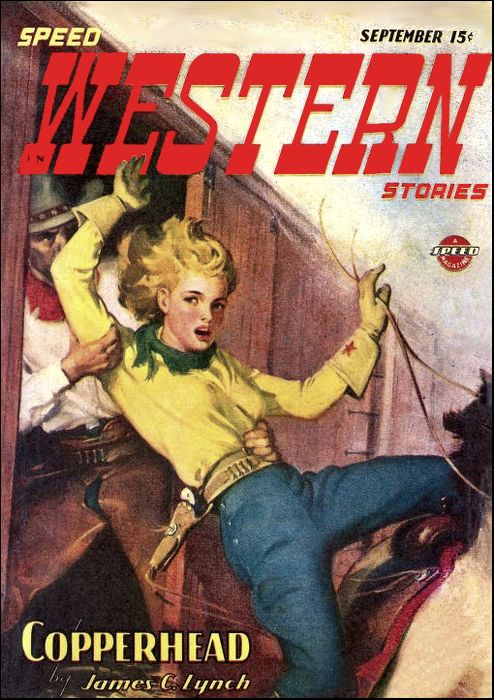
Speed Western Stories, September 1946, with "Frontier Sam"

The true story of one of the West's great heroes, a quiet little gent by name of Sam Schlesinger. Some loud-mouthed braggarts of the Ninth. U.S. Cavalry had little confidence in Sam's ability as a fighting man—but when it came up bloody battle against the savage braves of Roman Nose, then Sam became a hurricane!...
"STEP right up here, you ornery, no-good, hulkin' galoots," shouted the leathery sergeant in a voice that boomed against the wooden stockade of Fort Hays. "Ain't ye ashamed tuh wear out the seat of yo'r pants 'round this yere post when 'o'r Uncle Sam offers ye a chanct tuh git in saddle and fight th' Indians? The Ninth United States Cavalry needs fifty men t' enlist! Step right up. Fust come, fust served!"
But the lounging group of frontiersmen who had gathered to hear the loud-voiced sergeant showed no disposition to avail themselves of the invitation. They merely spat tobacco juice into the dust, kicked a few Indian dogs yelping from beneath their feet and stared reflectively at the Kansas sky.
"Well, I'll be a horned toad!" ejaculated the sergeant in disgust. "Ef'n you dumb—"
"Just a moment, sergeant!" interrupted tall, grizzled Col. Forsyth, who had been listening with some amusement to his subordinate's curious methods of recruiting. "Let me explain the situation to these gentlemen."
"Gentlemen!" muttered the sergeant scornfully.
But the colonel turned to the indifferent circle. "It's this way, men. The Cheyennes, the Comanches, and the Arapahoes have gone on the warpath. They don't like the railroad we're running through their hunting grounds, and they're massacring every settler between Bison Basin and Harbinger Lake. We've got to stop 'em. But we haven't got the soldiers. I'm a colonel without a regiment."
A lanky man with the red gash of an old bullet wound across his forehead stirred uneasily. "What ye say is mebbe so, colonel," he said. "But I had my bellyful o' sodjerin' wi' Grant an' Sherman. I don't aim tuh 'list fer anawther three-year stretch in no man's army."
"Me, nuther!" declared another. "I fit you bloody Yanks long enough in Virginny."
Col. Forsyth looked surprised. "What's this talk about a three-year enlistment?" he exclaimed. "You've misunderstood the sergeant. We're not asking for regular enlistments. All we want is to hire you men—fifty all told—for the duration of this one campaign. The United States will pay you thirty-five dollars a month and forty-five cents a day for the use of your horse and equipment. All arms, ammunition and rations to be supplied by the government. That's a mighty fair offer, men."
Leathery faces seamed into broad grins.
"Shucks, now yo're talkin', colonel!" shouted the former Union soldier. "Thu'ty-five silver dollars a month an' trimmings? Why didn't ye say so in th' fust place? I'm yo'r man—ridin' and fightin'!"
"And me, suh!" cried the Virginian.
WITHIN half an hour forty-eight men had thronged up and signed articles. "Doing pretty good, sir," said the sergeant. "But we need two more afore we kin start."
Col. Forsyth looked around. Seated comfortably against the logs of the trading post was a fair-haired giant. His brawny hands were clasped behind his head and he was whistling. "You, there," called the colonel, "don't you want to hire up to fight the Indians?"
The giant rose slowly and without haste. A mutter of admiration burst from the sergeant. He had never seen such a fine specimen of man before. Blond, immense, wide-shouldered, powerful!
The man strolled over, "If you mean me, colonel," he said with a touch of bragging, "I was jest waiting till t' others signed up. Me, you don't have to worry about. I'm an Injun fighter from way back. I've fit 'em—an' licked 'em—from Texas tuh Wyoming."
"We sure kin use yuh," broke in the sergeant delightedly. "What's yo'r name?"
"Smith. Charlie Smith."
"Here's yer paper, Smith. You'll git an issue o' Spencer carbine, revolver, a hundred an' twenty rounds o' ammunition, an' seven days' rations at the commissary."
The sergeant wrote furiously, then looked up at Col. Forsyth. "All we need is one more—'n we kin start."
"Yes, but where will we get him? We've combed the fort."
That was true. The sergeant scouted around, but couldn't find a single additional man in the stockade. Gloomily he reported: "Nary a one, sir. Mebbe we kin kinda forgit them orders—"
"General Sheridan's orders were specific, sergeant."
The sergeant scratched his head. "I dunno then what we kin do?" he started. "There ain't a—"
The starved Indian dogs set up a howling and flung themselves furiously at the open entrance to the stockade. A man was riding through. Both horse and rider were covered with dust and drooped with weariness, as though they had come a long way. The man was slight of frame, narrow-shouldered and thin. His cheeks were sunken and his nose sharp. He sat his horse uneasily, as though he were not accustomed to riding. No rifle was slung across his saddle, and no holster slapped at his breeches. He was unarmed.
The newcomer turned his nag's head toward the two military men. He reined in before Col. Forsyth and straightened his sagging shoulders. "Are you in command here, sir?" he asked. His voice was thin, like the man himself.
The colonel nodded. "Another complaint," he thought wearily. There wasn't anything he could do until he got his allotted force.
THE little man's eyes—dark, mournful—lifted to the officer's face. "I heard over at Fort Wallace you were recruiting men for service against the Indians. I'd like to enlist."
A loud guffaw burst from the sergeant. "We're recruiting men, brother; not—" The colonel's icy glance broke him short in some confusion. But what he had intended was only too obvious. The little man flushed darkly—and said nothing.
Forsyth turned to him. "You say you came from Fort Wallace?"
"Yes, sir."
"Why, that's hundreds of miles west. You must have ridden through hostile Indian country!"
The little man shrugged. "I didn't notice any, sir."
"But, good heavens, man—without a gun, without knowing how to—er"—The colonel caught himself. "Indian fighting is no picnic, you know."
"I know it, sir." His expression was sad, serious.
"But can you ride? Er—I mean, ride hell-for-leather?"
"I can learn."
"How about using firearms? I—uh—don't notice you possessing any."
"I can learn."
"It's no use," said the colonel kindly. "You've been lucky to get here alive. It would be plain suicide for you to join our troop. We've bloody work ahead."
But the sergeant's face suddenly lit up with unaccustomed thought. "Lookee, sir," he whispered to the colonel. "He's your fiftieth man. Why kain't we sign 'im up, so we kin start out all regular an' according tuh orders? We gits ten miles 'r so out, an' you kin ship him back—a sorta messenger."
"Hmm! I believe you have an idea there, sergeant. Put him on the muster roll and outfit the men. We start at dawn."
"Hey, you!" shouted the sergeant to the new recruit. "What's yo'r name?"
"Sam Schlesinger."
"Schlesinger? You mean you're a—?" The little man raised his dark eyes.
Something flashed in their depths. "An American, sergeant," he said distinctly. "An American of the Jewish faith."
His tired nag turned and ambled toward the barracks. The sergeant watched them go—saw the rider bounce ungainly in the saddle. A look of puzzled astonishment spread over his face. "Well, I'll be a horned toad!" he exclaimed.
THE little troop had been on the trail for a week. Under the vast immensity of the prairie sky they sought the marauding Indians. There was plenty of evidence of their recent passage—the stark, blackened rafters of some poor devil's cabin, the burned-out field of corn, the horror of bloody bodies with spongy skulls from which the living hair had been torn.
Col. Forsyth rode in front. With him was Lt. Beecher, who had lost a leg in the Civil War, but who had refused to be retired from active service. A little behind came Sgt. Ward, shepherding his band of "hired" recruits.
They had been out a week, but Sam Schlesinger, the thin, scrawny, "last-chance" addition, was still with them.
Not that Col. Forsyth, with the kindliest intentions in the world, hadn't tried to send him back. But Sam, his face drawn with the agony of long hours in the saddle, had refused to be disposed of this easily. "You hired me for the duration of the campaign," he said in his thin, quiet voice. "It's a contract between me and the United States Government. I'm gonna live up to it; let the United States do the same."
The officer shrugged and the sergeant swore, but Sam clung to his saddle and managed somehow to keep up with the hardened frontiersmen.
He became a joke with the others. They made bets as to the exact hour when he'd fall out of his saddle, when he'd yell he'd had enough, when he'd go back. The odds were long against him at first; but as the hours passed, and the days, the odds grew shorter and shorter until the constant losers grumpily refused to bet against him any more.
Each night, at bivouac, he dismounted stiffly from his saddle and groaned when he tried to sit or lie upon the ground. But each morning, with teeth set, and the quick sweat upon his brow, he climbed clumsily back for another hard-riding day of torture.
A few of the kindlier men began to pity the citified little man. They wheeled their horses alongside and gave him pointers how to sit his horse easily, how to make a cinch, how and when to give his nag the rein or spur.
At night, stiff and sore as he was, he did his share of the necessary chores; then quietly asked Sergeant Ward for lessons in handling his unaccustomed weapons—the carbine and the revolver. The tough old regular at first swore at him and refused. But Sam persisted until the sergeant yelled he'd never come across such a darned little cuss—and gave in!
Sam learned fast. By the end of the tenth day he rode with the best of these men who had spent their whole lives in the saddle. He loaded and unloaded his carbine with the precision of an old-timer, and his draw on the heavy Colt was almost as fast as that of Ward himself. No real shooting was permitted, for fear of warning the Indians.
"Why, the darned little cuss!" exploded the sergeant finally. But this time the expletive was admiring. "If'n I had time, blow me if'n I wouldn't make a soldier outa him yet."
SLOWLY Sam Schlesinger became popular. His grit, his willingness, gradually caught the fancy of the company. "Frontier Sam!" they had first called him in jeering accents; the name remained as a term of affection.
Only one man refused to follow the swing in sentiment. That was Charlie Smith, the blond giant. From the very first he had determined to ride the little fellow, who weighed exactly half of his enormous tonnage.
"What in blazes is the U.S. cavalry comin' to when they take half-pint little rabbits like that?" he complained with a jerk of his huge thumb toward Sam. "Why, he ain't even a jack rabbit. Them fellers 't least kin run."
Though Smith's voice was loud and meant to carry, Sam Schlesinger said nothing. His dark, thin face showed no trace of hearing; his eyes stared straight over the long swells of the prairie.
"Now, take me, for instance," pursued Smith. "I'm a rip-roaring sorta fellow myself. I killed so many galoots who thought they was gunfighters I ain't got no more room fer notches on my gun. That's the kinda men yuh need fer fillin' Injuns wi' lead pisening. Not runts what ud fall flat on their faces fust time they hears a Injun whoop!"
Sam rode steadily along without a word. Some of the others muttered, but, as one of them put it, 'twas no skin off'n their teeth. No sense in tangling with a fellow like Charlie Smith on account of Sam.
The trail of the marauding Indians grew fresher and fresher. It led to the headquarters of Beaver Creek and up to the Arickaree fork of the Republican River. Col. Forsyth's face grew grave as he studied the signs.
"There's at least five hundred of them," he told Lt. Beecher confidentially. "Maybe more. And they're led by Roman Nose and Black Kettle, the fiercest and most cunning of the tribal chiefs. We've got our work cut out for us."
On September 14, 1867, the trail became so fresh and obvious that Forsyth called a halt. "We're in for it, I'm afraid," he said to Beecher. "It's beginning to look like a trap. Those Indians have been too careless with their trail. They've been lurking us on. I'm going to camp here before it gets too dark. In the morning we'll decide what to do."
Bivouac was established on the bank of the Arickaree. It was the dry season and barely a few inches of muddy water trickled over the clay bed. The surrounding country was undulating plain with few clumps of trees to give any cover. A mile or so away low hills and ridges rose to blot out the horizon.
Like a good plainsman Col. Forsyth posted mounted scouts, ordered the horses carefully picketed, and had his men, after a quick bite of the scanty remaining rations, lie down by their horses.
The men forewent their usual rough jokes and horseplay as they bedded down. Not a man among them but knew that they would shortly be in the heaviest action of their lives. Sam Schlesinger performed his necessary duties with his wonted silence. Some of the men watched him curiously. Would the little man be able to undergo his first baptism of fire? But his thin, dark face covered his thoughts. Only Charlie Smith kept up a running fire of talk. He couldn't wait until morning, he cried. Let them Injuns come! He'd show 'em some plain and fancy shooting. And let that runt, Sam, stay out of his way. He couldn't be annoyed by a little so-and-so getting in his hair when there was fighting to be done.
"Quiet back there, men!" called Forsyth. "You need all the sleep you can get." And Smith subsided, not without some grumbling at these fancy West Point officers who gave themselves airs.
IT was not yet daylight. It was that short half hour when the darkness begins to shade a little, when objects begin to take dim shape and form. Suddenly the half-light was shattered by a challenge and a shot.
"Injuns!" shouted a scout.
The next moment the plain was filled with rushing figures, waving buffalo robes and yelling hideously. Instantly each man of the company was on his feet, left hand reaching for his horse's bridle, right hand grasping for his gun.
The horses snorted with fear and plunged wildly at their restraining ropes. This was always the first move in an Indian assault—to stampede the horses. But it failed. Steadily, firing from the hip, holding on to halters, the little company finally forced the advance wave to retreat.
The sun was up strong now, and showed the distant ridge swarming with Indians, arranged by tribes. A full army of them. "We'd better take up a position on that sand island in the river," decided Forsyth. "Not that it's much shelter, with only a threat of water to cross, but it's the best we can do."
A few skirmishers kept up a steady fire to cover the retreat to the island. It was a mere sandpit, about two hundred feet long and forty wide. A few scrub willows permitted the horses to be tied.
"Lie flat, men," extorted the colonel, "and dig yourself in as far as you can."
"What with?" grunted the Virginian.
"Knives and fingers," snapped the sergeant. "An' yuh ain't got all day, neither."
About nine in the morning the grand assault commenced. Hundreds of dismounted Indians, armed with Sharps, deadliest of rifles, crawled through the long prairie grass to get within easy range of the island. Farther out on the plain, well out of gunshot, lined up the main body of mounted warriors—the "dog soldiers"—painted hideously and stripped to the skin. On the distant ridge the women and children of the tribes danced and yelled threats that carried on the wind.
"Jumping lizards!" husked a weathered plainsman, his face blanching. "Man an' boy I been aroamin' these yere prairies, but I ain't never seen so many painted varmints in one place afore. We's plumb sunk!"
Sam lay next to him. He raised his head, peered across the inch-deep stream. "At Thermopylae," he remarked, "three hundred Spartans stood off three hundred thousand Persians. The odds are not so great against us."
The plainsman stared. "Holy cats! Never heard o' them galoots. Must of been afore my time."
A thin smile etched Sam's face. "Just a little, Jim."
But Charlie Smith didn't open his mouth. Usually he never permitted Frontier Sam to say a word, no matter how trifling, without promptly making him the butt of his heavy jeers. Just now, however, he was busy, frantically busy. Bowie knife was not enough for him, or fingernails. With the barrel of his carbine he dug and dug. The sweat beaded his brow, his giant figure seemed to burrow like a mole into the ground.
"Hey, there, Smith!" shouted the sergeant. "Yo'r gittin' sand in th' barrel o' your gun."
Out of the depths came a curiously muffled voice. "You lemme alone. I knows what I'm doin'."
"Yeah," muttered the plainsman loud enough to be heard. "He's agoin' clear down tuh China." He glanced curiously at Sam. "You ain't afeared?"
"Why?" asked Sam quietly. "Isn't God with us here as well as elsewhere?"
"Mebbe so. All I knows is He better be showing up mighty quick. Lookit! Here they come!"
A TERRIFIC fire came from the Indians hidden in the grass. A covering fire. For, as it swept across the little island and clipped the willows with a hail of bullets, the mounted "dog soldiers" set in motion. On they came at full speed across the plain, a solid, thundering mass, sloped down over their horses' manes, firing their rifles, reloading and firing again without slackening, charging straight for the devoted little band. In front, on a magnificent stallion, galloped Chief Roman Nose, resplendent in a crimson sash.
"Hold your fire, men," ordered Forsyth above the tumult. "We can't afford to waste a single bullet."
On and on they came, until the endless prairie seemed in solid motion. On and on, whooping and yelling, until they hit the bank of the Arickaree. On and on, through the inch-deep water as though no barrier existed.
A single shot rang out. Flaming with anger, the colonel flung around. "Who disobeyed orders?" he spoke in an awful voice. Deep down in the sand, so deep that no part of him was visible, lay Charlie Smith. His carbine was wavering in the air, its barrel pointed toward the sky. A thin wisp of smoke curled upward.
Halfway across, the water deepened a trifle. The horses splashed to their fetlocks, became unsteady.
"Let 'em have it, men," shouted Forsyth. Forty-nine carbines glinted, forty-nine carbines spoke as one. A hail of death swept across the shallow stream. Down went horses and whooping riders, turned the muddy water to a sodden red. With a great cheer the men reloaded, sent a second murdering scythe across the plunging ranks. And a third. Aiming, firing and reloading as fast as he could, Jim turned toward Sam.
"How ye doin', lad?"
"Not bad!" Frontier Sam's voice was as steady and calm as though he were discussing the weather. His thin fingers trembled not a hairsbreadth; he took quiet, sure aim, fired. Before Jim's wondering eyes a big, hideously striped buck in the forefront of the charge threw up his hands and fell crashing into the water.
"Jumping lizard!" husked Jim. "Not bad!" he says "Why, that's as purty a shot as ever I seen!"
AS the lead brave fell, his comrades wavered. Another volley cured their hesitation. Horses turned and fled pellmell back to the farther bank, in spite of Roman Nose's angry screeching.
"Good work!" said the colonel approvingly. "But they'll be back again. They're only starting." He came over to Sam Schlesinger, put his hand on a narrow shoulder. "You've done nobly, Sam. I'm mighty glad I wasn't able to send you back when I wanted to."
"Th-thank you, sir." Sam was stammering, and his thin face flushed embarrassedly.
Then Forsyth strode over to the deepest pit. He looked down into the hole, and his lips curled. "I thought you were a man, Smith," he grated. "You funked all through the fight."
Slowly Smith's head came up. His former high color was gone. His lips chattered and his eyes glared. "You... you got me wrong, colonel!" he said thickly. "I... I been taking a bead on them varmints all th' time."
Forsyth spat. "That was the longest bead I ever did see," he said coldly. "The only shot you fired hit the sky."
ABOUT two o'clock the shattered Indians had re-formed. Again they swept on confidently, irresistible as a thunderbolt. This time they surged upon the sandy island, slashed in upon the prone men. With carbines that became too hot to handle, the little company fought back. When those failed, they drew revolvers and fired as fast as the barrels could spin. Then bowie knives went into action, and bare fists. The island became a plunging, twisted maelstrom.
A painted warrior leaned over his horse and fired pointblank at Jim. The plainsman gave a little groan, pitched headlong. With a whispered cry Sam lifted his Colt, pulled the trigger. There was a hollow click. The chamber was empty. Flinging down the useless weapon, the little man pulled out his knife and sprang upon the triumphant brave. The blade plunged deep into his heart. The whoop of victory turned to a bubbling shriek.
Sam went down on his knees before Jim, "My friend! My friend!" he cried. "Tell me you're all right!"
Jim opened darkening eyes. A froth of blood dyed his lips. A pallid grin moved across his countenance. "All right? Sure—I'm—all right—you leetle cuss!"
A shudder came over him. He sagged. His eyes closed.
"Jim! Jim!" But the plainsman had fought his last fight; had seen the last of the prairie he loved.
For the first and last time in his life, Sam Schlesinger uttered a curse. He sprang to his feet, eyes slitted, face like a prairie fire. What happened next remains still a saga of the Ninth U. S. Cavalry.
The little man was everywhere. Carbines, revolvers, bowies seemed to grow and multiply around him. Where the fight was hottest, there in the very thick of it was Sam. He screeched like a prairie wolf; the bravest of the "dog soldiers" trembled and fell away as he dashed upon them. He was here, there, everywhere!
All the horses of the troop had been shot. Lt. Beecher was drilled through the side, and lay in mortal agony. Col. Forsyth sat against a willow, with a shattered leg before him, and a furrowed scalp. Half the men were dead, or wounded.
But Frontier Sam was an army in himself. Since the death of Jim, who had spoken decently to him, he had gone berserk. Ward, himself wounded, stared at him in helpless wonder. His hair stood on end, and his voice was the screech of an owl.
He had fought his way once through the tangled, pushing tribes, had whirled to plunge back in again, when he heard a man's cry of unutterable fear. He swung around. There, writhing upon the ground, lay Charlie Smith, the giant. A heavily painted warrior towered over the shrinking man, scalping knife lifted. Though a Colt lay close to Smith, his palsied fingers made no attempt to grasp it.
With a bound Sam was upon the Indian, knife in hand. The brave twisted and slashed at him. The blade ripped through Sam's arm, but the bowie went true to its mark. With a surprised grunt the Indian tottered, dropped like a pole-axed buffalo.
"Hope he didn't hurt you?" Sam asked the cowering giant. There was actually sympathy in his tones. But Smith just moaned and scrambled away into some neighboring bushes.
Sam wasted no time. He dashed past the wounded colonel. Forsyth breathed heavily. "We're finished, Sam," he spoke with an effort. "Unless—"
Bloody, left arm dangling, Sam managed a salute. "Not yet, sir," he declared cheerily. "I have an idea." Then he was off.
Forsyth closed his eyes. What could this strange recruit's idea be?
He had not long to wait. Sam disdained the shouting braves who filled his path. As though he were sure of a charmed life he raced through them, wriggled under plunging horses' bellies. There was only one bullet to his Colt. His carbine long ago had been rendered useless. But all he needed was one shot!
He found his man at the farther end of the island. A magnificent figure, girdled by a red sash, sitting his cavorting horse like a statute. Roman Nose, chief of all the tribes!
His little band of death companions saw the oncoming little figure. With whoops of rage they lifted rifles. But Sam was quicker on the trigger. The Colt spat once. Roman Nose coughed, clapped clutching fingers at his heart, and slid like a lumbered tree from his saddle.
A CRY of dismay went up from the Indians at the fall of their mighty leader. This little man must be an avenging spirit, a ghost whom they hadn't properly laid. With one accord they swung their mounts around, and jostled each other in their mad rush to be away, to be anywhere but where that evil spirit was.
They didn't stop on hitting the farther bank. Their yelling dread carried them across the waving plain, up the distant ridge and into vanishment on the farther side.
The battle of Arickaree had been won—chiefly by a half-pint little man who never before had fired a gun or seen a charge of Indian warriors in full flight. Wherever the Ninth Cavalry foregathered thereafter—wherever the lonely bivouac fire brought out tales of distant days and deeds of daring, there someone was sure to bring up the fabulous saga of Sam Schlesinger.
A tough old general, himself a famous Indian fighter, wrote a poem about Sam; and a snooty army journal published it. It isn't very good poetry, but the sentiment is okay. It goes like this:
When the foe charged on the breastworks,
With the madness of despair,
And the bravest souls were tested,
The little Jew was there.
When the weary dozed on duty,
Or the wounded needed care,
When another shot was called for,
The little Jew was there.
With the festering dead around them,
Shedding poison in the air,
When the crippled chieftain ordered,
The little Jew was there!
Roy Glashan's Library
Non sibi sed omnibus
Go to Home Page
This work is out of copyright in countries with a copyright
period of 70 years or less, after the year of the author's death.
If it is under copyright in your country of residence,
do not download or redistribute this file.
Original content added by RGL (e.g., introductions, notes,
RGL covers) is proprietary and protected by copyright.