RGL Edition, 2026
Based on an image created with Microsoft Bing software
Roy Glashan's Library
Non sibi sed omnibus
Go to Home Page
This work is out of copyright in countries with a copyright
period of 70 years or less, after the year of the author's death.
If it is under copyright in your country of residence,
do not download or redistribute this file.
Original content added by RGL (e.g., introductions, notes,
RGL covers) is proprietary and protected by copyright.
RGL Edition, 2026
Based on an image created with Microsoft Bing software

"Dave Fearless on a Floating Island,"
George Sully & Co., New York, 1906
"Dave Fearless on a Floating Island,"
George Sully & Co., New York, 1906
This novel continues the adventures of Dave Fearless, a young but highly skilled diver, and his father Amos Fearless, master diver of Long Island Sound. After recovering a massive gold treasure from the sunken ship "Happy Hour"—a fortune rightfully theirs but coveted by the villainous Hankers family—Dave and his allies attempt to return home aboard the government vessel "Swallow." Their enemies, aboard the rival wrecking steamer "Raven," pursue them across the Pacific...
Frontispiece
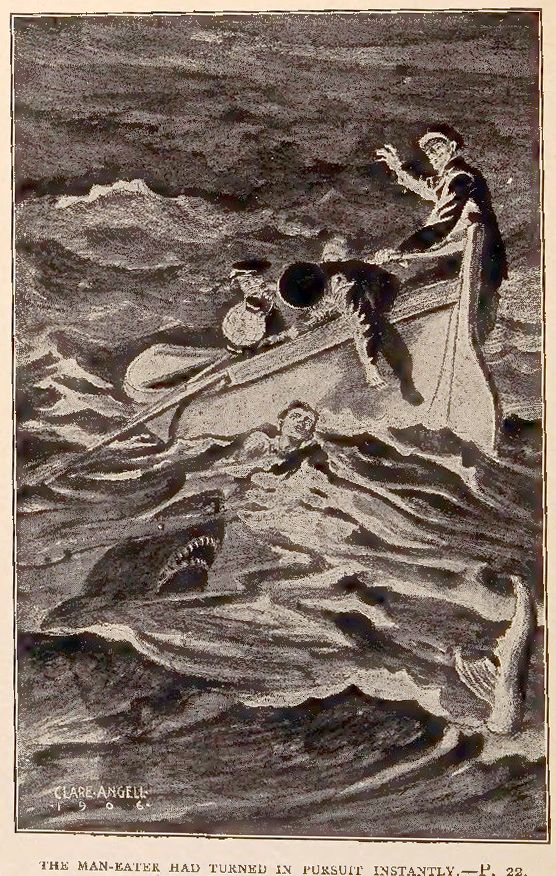
The man-eater had turned in pursuit immediately.
"IT looks as if that ship was following us."
"Can you make her out, Dave?"
"A steamer, I think."
"Perhaps it is the Raven."
"If so she may mean mischief, father."
"Yes, the Hankers don't intend to let that treasure get away from them," said Amos Fearless.
"But it is ours. We worked for it," said Dave Fearless, looking resolute and earnest. "We went into all kinds of peril to get it. We will fight to keep it!"
"And we will help you, lad!" heartily pronounced Paul Broadbeam.
He was the captain of the Swallow, and he strode up to the spot where the first two speakers, father and son, stood discussing a dim black speck far in their wake.
The scene was the bosom of the broad Pacific, and out of sight of all land.
The lookout of the Swallow had just sung down "Sail-ho!"
Amos Fearless shaded his eyes with one hand. His son Dave swung a telescope into service. Both tried to make out the character of the distant craft they had just espied.
A remarkable series of happenings and motives had brought the expert diver and this handsome, well-built youth of seventeen by his side to the present moment.
Their home was thousands of miles away, at Quanatack, along the coast of Long Island Sound.
Amos Fearless had been a master diver there for nearly a quarter of a century. Dave, born to a knowledge of the sea, had put in two years' service as a lighthouse assistant.
As already told in another volume, entitled "The Rival Ocean Divers," father and son one day decided to act upon certain information they had gained.
This was to the effect that they were direct heirs of the Washington family, who, twenty years previous, had accumulated a large fortune in China.
This fortune, valued at nearly a million of dollars in gold coin, the Washingtons had shipped to San Francisco. But during a storm in the middle of the Pacific, the Happy Hour, the vessel containing this large treasure, had sunk in two miles of water.
This fact was also known to Lemuel Hankers, and his son Bart. They lived near the Fearless family, and father and son were distant relatives of the Washingtons and Fearlesses.
Amos Fearless alone owned the chart giving the exact location of the sunken treasure. Old Lem Hankers was a miserly trickster, his son Bart was not much better. By sneaking tactics the latter learned of .the plans and hopes of the Fearlesses.
His father had immediately acted on this information. He proceeded to San Francisco with his son, to be later joined by a rascally partner, one Pete Rackley.
There, the elder Hankers chartered from a wrecking company the Raven, Captain Nesik in command. They engaged the services of a professional diver named Cal Vixen, and started forth on the quest of the sunken treasure.
When Amos Fearless learned of this, he knew that there was no time to lose. It was not a question of legal ownership as to the sunken treasure. "Whoever found it first, had a right to claim it.
The Fearlesses knew that the Hankers had vilely stolen their secret. They were determined that the rascals should not also steal their rightful inheritance.
It chanced that a warm seafaring friend of theirs named Captain Paul Broadbeam was just at that time at Washington.
In command of the Swallow, then lying at San Francisco, he was deputized to undertake a voyage in the service of the government.
With an eminent scientific man, Doctor Barrel!, on board, the Swallow was to proceed to mid-ocean. There they were to make deep-sea soundings. Also, they were instructed to secure specimens of rare marine monsters.
When Mr. Fearless told Captain Broadbeam about the treasure, the latter secured his engagement and that of Dave as official divers for the expedition. The captain also consented to take the Swallow to the vicinity of the sunken treasure ship.
Our preceding volume, "The Rival Ocean Divers," has told in detail how Dave and a chum, Bob Vilett, the young engineer of the Swallow, almost fell into the hands of their enemies while visiting the island of San Murio. There, too, they came near losing their lives among the savages.
They escaped, however, with Pat Stoodles, a whimsical Irishman, who had been forced to-become "king" of the natives.
When the sunken ship, the Happy Hour, was at length located, both the Raven and the Swallow were on the scene of action.
The rival ocean divers had some thrilling experiences. There were terrific battles with unusual marine monsters. All the expertness of the master diver, Amos Fearless, was brought into play. Dave had a score of hairbreadth escapes from strange perils on the ocean bed, two miles under the surface.
Magnificently equipped for the enterprise, the Fearlesses finally discovered the sunken hull of the Happy Hour. This was after the Hankers and their diver, Vixen, had disappointedly abandoned the quest.
Dave and his father filled the superb Cos-tell diving-bell with bag after bag of the gold coin recovered from the wreck. Next day they set the course for home, via San Francisco.
Pete Rackley had managed to get aboard the Swallow in disguise some days before this. He had tried to dislodge various parts of the engine-room machinery in order to cripple and delay the Swallow.
Detected in this, and recognized by Dave Fearless, he had been locked u,p. But after the finding of the treasure he was missing.
It was supposed that he had escaped by slipping overboard and swimming to the Raven.
The latter craft was in a bad state of repair, and the crew of the Swallow generously offered assistance.
In this they were sullenly repulsed. The Hankers threatened, however, that they would yet get "their share" of the treasure.
So, with its golden freight safely stowed away, and feeling fully rewarded for all the dangers they had mot with, the contented crew of the Swallow had steamed away from their disgruntled enemies.
Doctor Barrell was the happiest man on board. He was taking to Washington, preserved in alcohol in mighty tanks and other receptacles, many valuable new and fine specimens of deep-sea monsters. These had been captured by the Fearlesses after hazardous and sanguinary contests in many instances.
It was towards the evening of the second day after the parting of the two ships that Dave and his father discovered the dim black speck on the horizon.
Its presence, as has been seen, suggested the Haven. It at once revived all their wariness in regard to a persistent and unscrupulous enemy.
CAPTAIN BROADBEAM took the glass from. Dave's hand and looked long and fixedly at the distant craft.
"Do you make her out, captain!" inquired Amos Fearless, anxiously.
"Humph!" muttered the old mariner, "we'll see."
"That is the captain's way, father," observed Dave, "and we will have to want before we do 'see.'"
They watched Captain Broadbeam walk to the man at the wheel. Then he went below into the engine-room. Soon they became aware that the course of the Swallow was slightly changed.
Its speed, too, was lessened. There was no doubting the tactics of the captain. He was bent on letting the distant steamer draw nearer, in order that they might learn if it was really the Raven.
Dave was naturally excited over the episode. He and his father had suffered many a mean trick at the hands of the Hankers and their hired helpers.
They were not exactly desperadoes, but Lemuel Hankers was a vicious, disappointed man. He would do anything to get money. Dave was sure that he would not hesitate to use violence to secure the treasure on board of the Swallow.
The sun was setting among some angry-looking clouds. The wind had come up, and the sea was getting choppy.
The gathering mists prevented them from making out the distant steamer any clearer than at first, although the Swallow had dropped back a full half-mile.
Dave, strolling around to the stern, hurried Ms steps as he discovered his friend, Bob Vilett, in an out-of-the-way corner near the rail.
The young engineer was off duty until six o'clock, but he seemed to be very busy just now.
Dave observed that he had a long slim bamboo pole by his side. It had a saucepan tied to one end. As it lay along the rail, Dave noticed that it was wet and dripping, as if it had been recently in use.
"Whatever are you up to, Bob?" inquired Dave, curiously.
Bob held aloft something he had been scrutinizing closely as his chum came up. , "Why, this is queer!" said Dave.
"Isn't it, now?" retorted Bob, with a peculiar expression of face.
Dave turned over and over in his hand a strange object. It resembled such a toy boat as an urchin might make with his jack-knife.
A piece of shingle had been pointed at one end. A mock mast was inserted in its center. This was slitted at the top, and into this notch was fitted a small piece of red flannel. This cloth was cut into an outline of definite shape.
"Where did you get this, Bob?"
"There," answered Bob, promptly, pointing down at the water.
"Fish it up?"
"Of course."
"Oh, I see—with the pan?"
"Sure. Tell you, Dave," went on Bob, quite seriously, "it's a funny thing."
"What is, Bob?"
"That toy boat'—and half a dozen others."
"Where are the others, then?" inquired Dave.
Bob made an expressive sweep with his band down to the water and then out towards the horizon.
"You mean you have seen others like this?" asked Dave, getting interested.
"Five, just like it."
"When?"
"Oh, for the past hour or two. First I thought they were some kind of fish. They appeared so regularly, though, and right in our wake, that I looked closer and got curious. When we slipped back on our course, I knew we had a chance to pass them again. I rigged up the pole here. Just ran into this one."
"That is queer," said Dave, musingly.
"I guess so! Queer in more ways than one. Do you notice the shape of that piece of red cloth?"
"Why, yes—it resembles a bird."
"A bird, exactly—a swallow, eh, Dave?"
Dave gave a slight start. Bob was about to say something more, when the engine-room bell summoned him sharply. The wind was coming up sharply,
Dave was left alone. He sat for a few minutes studying the toy ship. Then he changed his gaze to the sea.
He scanned its surface, hoping to discover another of the strange toy boats.
Dave kept a sharp lookout for some twenty minutes, the pole outfit ready at hand.
Once he discovered a speck of red, but flabby and half sunken, for the waves had tipped it and the Swallow had ground it under her keel.
It was fast getting dark when Dave heard the captain give some quick, definite orders.
Dave stood straining his eyes in an endeavor to make out the steamer they suspected was the Raven. Just then the storm that had been gathering for some time came down on them in full fury.
The Swallow was soon in the grasp of the tempest. Dave remained on deck, but took shelter under an awning.
An hour later the wind dropped. The sea was white with foam, but one star, then another, came out, and the storm was nearly over.
All signs of the suspicious steamer had been lost in the storm.
"Still on the lookout, lad!" hailed Captain Broadbeam's cheery voice, as he came around the stern cabin of the ship.
"I guess that steamer is drifted or driven out of our course," said Dave.
Both swept the outlook to three cardinal points of the compass.
"I reckon you are right," said the bluff old navigator—"I cannot see any light anywhere."
"Yes," exclaimed Dave, jumping excitedly to his feet—"yes, there is one, Captain Broadbeam—see?"
"I declare!" echoed the captain. "A signal. Where is my night-glass?"
He ran towards the wheelhouse for the desired article. Dave went to the rail and fixed his view to the windward.
There, several hundred yards distant, was a strange glow.
It emanated from the water, as it was low down and swayed in the swell.
The glare was fierce, far-spreading, and of a deep red color.
It burned for over a minute and a half. Just as it died out, Captain Broadbeam returned with his night-glass.
He attempted a sight, with the lenses set at full focus. He stood silent and motionless for some time. Then he lowered the glass, shaking his head disappointedly.
"That puzzles me," he confessed. "It's no ship. Too low down for that."
"It was a signal, though, wasn't it, captain?"
"Signal? sure," nodded Captain Broadbeam. "But who made it? Too high for a ship."
"Perhaps it was a yawl," suggested Dave.
"The glass shows nothing."
"Or a raft, captain?"
"H'm! Here, your eyes are younger than mine. Keep the lookout while I see about this."
Captain Broadbeam hurried to the engine-room, and soon the steamer slowed again and swung half around.
Then the prow cut a course directly towards the spot where the glow had appeared.
Dave shifted his position and kept the point of interest well in mind and sight.
Captain Broadbeam came back to his side.
"We've passed the spot where that red light burned," he said. "Did you see anything, lad?"
"No, sir."
"Is it tricks, then!" muttered the captain, his bronzed brow ruffling.
"Who would play us tricks, captain?" asked Dave.
"Dunno," grumbled Captain Broadbeam. "If that steamer we noticed before dark was the Raven, and she's got our lay, they would do almost anything mean to hamper or scare us. Great Scott! there's another!"
The captain ran back to the stern and Dave followed him.
A quarter of a mile back, on the very course they had changed to, was a second glaring red light.
"It's no steamer, it's no raft—they couldn't make such a change of position in so short a time!" excitedly declared the captain.
Dave was baffled too. He followed the captain, who ran to the wheelhouse. Dave heard him shout hurried orders down the engine-room tube.
The steamer swung dear around sharply, nose set directly for the new glow.
"We'll know now," said the captain.
Dave kept by his side, intensely watchful and curious. They momentarily drew nearer and nearer to the strange glare.
Just as suddenly as before, as they got within about two hundred yards of it, the red glow was blotted out.
Captain Broadbeam roared some quick orders to the man at the wheel. The steamer let down speed, but continued on its course without the variation of an inch.
Dave watched the sea on one side, the captain on the other.
"H'm!" growled the latter at last, glaring up where he had been glaring down. "Now, I'll figure this out If I stay here all night!"
They had certainly passed over the very-spot where the last red light had burned and had noticed a single object on the water.
"If it was a signal of distress," said Dave, "they would hail us."
"So it must be danger, eh? Well, it's a mystery anyhow, and I'm the man to solve it!" spoke Captain Broadbeam, doughtily.
He gave some more orders, and then hailed two of the crow. The steamer was now motionless excepting for the swell of the waves.
"Get ready, lad," said the captain, as the yawl was swung out from the davits.
"You are going to send out a small boat!" said Dave.
"With a reflector lantern. Take the bow, lad, and search and solve this riddle."
"I will, if it can be solved," said Dave. Four men to the oars and Dave with the big lantern at the bow, the yawl was lowered from the davits.
The storm had entirely cleared away. The sky was cloudless, but a dense fog had begun to settle over the waters.
"You won't find much in this thick muck," growled an old salt at an oar.
Dave directed a circuit around the ship. Then this was widened.
He constantly focused and shifted the reflector, so they might not miss anything.
Nothing was discovered, however. In making the fourth circular sweep around the steamer, Dave knew that they had certainly more than once traversed the spot where the red signal had appeared and disappeared.
The sea was quite rough and the fog baffling and growing denser every minute.
"Is this exercise—or amusement!" sarcastically muttered one of the oarsmen.
Dave had long since given up any hope of discovering the source of the danger signal, if such it was.
Finally they heard the return whistle sound from the steamer.
The sailors bent to their oars with alacrity at the welcome signal.
Dave rested the lantern on a bow-brace, but still kept a keen lookout.
"Hold on!" he cried, suddenly. "There's something!"
DAVE FEARLESS sprang up as he cried out and the lantern jangled to the bottom of the yawl.
"Steady!" roared the forward oarsman.
"Back her," ordered Dave, breathlessly.'
He did not wait a second for the maneuver, however. Dave realized that going at the fast clip they were, to stop the yawl, let alone back her, could not readily be accomplished.
"Hi, lad!"
"He's overboard!"
Dave had acted with lightning-like rapidity.
"Show the light," was all they caught, as he seemed swallowed up by sea and fog.
Dave had seen something, just as he had announced.
As the yawl was shooting ahead, a glint from the reflector lantern lit across an object perhaps sis feet away.
This was a heavy square piece of wood. In its center, sticking up like a mast, was a black object about as thick as a human finger.
This object was almost as queer and striking as the toy boat captured two hours previous by the young engineer of the Swallow, Bob Vilett.
To Dave it told a great deal. It had everything to do with the red glare, to his way of thinking.
The impulse that directed him to secure it drove Dave to immediate action.
He had simply jumped to his feet, shouted his orders, and the next instant had sprung, or rather dove, overboard.
The water was Dave's common element, and diving his profession.
He did not mind the wetting a bit. His whole anxiety was in calculating to reach and capture the object he had seen.
As he blew the water away from his face, he strained his eyes and swept both arms out gropingly.
By this time the yawl had slowed down. One of the oarsmen had picked up the lantern.
Its rays came across the waves, easting a shadowy illumination towards Dave.
"I see it!" breathed Dave, eagerly, and made a stroke and a lunge forward.
"Show the light! show the light!" he kept shouting, to direct the men in the yawl.
The glare was feeble and uncertain, however, on account of the fog. Dave breasted a big wave. The object he was after, dimly seen, was almost in reach.
"Two more strokes," he calculated.
Dave took only one. Then he dropped under the water like a shot.
Dave Fearless was familiar with all the perils of the deep. He had suddenly discovered an imminent one.
A peculiar gliding swish had warned him. Something whiter than the spume of the sea showed momentarily. Like an arrow a big shark shot directly between Dave and the object he was after. A swing of its tail shattered the latter to splinters.
As Dave came up, his left hand and arm ran along a saw-like something that cut the flesh to the quick and ripped a sleeve to tatters.
He had grazed a fin of the shark! The sea monster dropped in the swell just, as Dave, by sheer chance and natural buoyancy, went to the crest of a wave.
"A man-eater!" came in a curdling yell from the yawl.
The reflector was now fully focused on the shark. Dave saw his peril, also his only chance.
"With the drop of the wave crest he landed squarely across the back of the man-eater.
So quickly that he had not even time to tilt or slip, he arose half-upright.
Then Dave threw himself violently forward from his spongy, springy foothold towards the advancing yawl.
"Whew! that was a close shave," gasped the gruff-voiced sailor who grabbed him just as his outstretched hands struck, but missed, the edge of the yawl.
The man-eater had turned in pursuit instantly.
A second sailor lifted an oar and struck out at the gaping jaws of the shark.
Dave fell collapsing to the bottom of the yawl. He was pretty weak and out of breath.
He saw the shark snap at the oar that struck its snout a stinging blow, and then crunch it to atoms.
"Did you get what you was after?" asked his rescuer.
"No/' panted Dave.
"That shark pretty nigh got you though."
The men rowed for the steamer, and reaching it were swung aboard.
"Did you find anything?" inquired Captain Broadbeam.
"No, but the lad came near being a Jonah," retorted Dave's rescuer.
The captain was summoned to the wheel-house. Dave, wet and weakened, did not try any explanation just then.
He went below. Mr. Fearless had gone to their stateroom when the storm came up, and Dave found him quietly reading in his bunk.
"Why, Dave," spoke his father, surprisedly surveying his dripping son, "what has happened?"
"Nothing serious. I'll get on some dry clothes and tell you all about it."
Dave felt better when he had changed his attire. He sat on a stool and rested for a bit.
His father was quite curious, he knew from Dave's restrained manner and disturbed face that something unusual was on his mind.
Dave finally related the incidents of the evening. Mr. Fearless listened with interest.
"Singular about those toy boats," he said thoughtfully—-"and that piece of board, too."
"Yes, father," spoke Dave, "for I am sure that the same hand fashioned both. I think I have figured, it out. That board had a marine red light with a time fuse set up in its center."
"But why set afloat?"
Dave was silent.
"And by whom?"
"That I don't know—yet," answered Dave. "But, I am going to find out. Perhaps there is a traitor aboard the Swallow
AMOS FEARLESS was disturbed at his son's serious statement.
"A traitor aboard the Swallow?"he repeated.
"Yes, father."
"How can that be? What is his object?"
"To hamper and delay us," replied Dave. '1 We certainly have an enemy among us. I'll tell you why, father. Those toy boats and those floating signals were set adrift from the Swallow."
"It looks possible," said Amos Fearless, musingly.
"Whoever handled them is in league with the Hankers. I am sure now that the Raven is following us. The toy boats were floated and the red-fire signals were set off to guide the Raven on our trail."
Mr. Fearless arose with an uneasy face.
"Are you going on deck?" inquired Dave.
"Yes, I think I had better have a talk with Captain Broadbeam about this."
"I think so, too, father. Something' against us and our interests is certainly stirring. We can't be too watchful."
"Won't you come, too?"
"Later, maybe. I want to rest a bit and attend to a few little matters."
"Ail right, Dave."
A little while after his father was gone, Dave also left the stateroom.
Doctor Barrell, the government scientist on board the Swallow, had a double stateroom of his own, and Dave went to it.
The door stood open. Dave saw that the compartment was empty. He reflected for a moment or two. '
"I am decidedly uneasy," he said at length, "and I guess I'll take a look at things on my own hook."
Doctor Barrell and the Fearlesses had many common privileges along with their good-hearted host and friend, Captain Broadbeam.
One of these was the possession of a duplicate set of keys to certain compartments at the stern.
Dave went to the head of a bunk, groped along its edge, and brought to light a bunch of keys.
Then from a little cupboard nailed to the wall ho got a dark lantern, lit it, and left the cabin.
He took his way along a narrow passage. It led into a storeroom. Beyond this were other compartments and passages. Pursuing one with which he was familiar, Dave finally came into quite a large space.
It was a queer place, and filled with gigantic glass jars, zinc kettles, copper vats, and hogsheads.
As Dave flashed the light about, he viewed many a trophy of his own and his father's submarine skill.
This was Doctor Barrell's storeroom. In the largest of the copper receptacles, which were filled with alcohol, reposed the famous Eurypharynx Pelicanoides. Perhaps this was the finest specimen of the Sea Devil of the Ocean's Bottom ever captured.
Dave and his father had nearly lost their lives in fighting this fierce marine monster, that had eyes like electric-light globes.
Next to it was a Devil's Needle, as perfect as in life. In a big zinc vat beside it was the sanguinary Sea Devil, a fish sustaining a resistance pressure of one hundred pounds to the square inch.
There were other marvelous specimens here, such as the Fire Fish, which in action splutters sparks from its tail like an inexhaustible Roman candle.
Dave put down his lantern finally beside a square zinc box. He lifted its cover and peered In.
The zinc box was filled with water, and sunk in it was a smaller sheet-iron chest.
This latter was surrounded by a brass hoop secured by an enormous padlock. The padlock was covered with a great piece of sealing-wax.
"The treasure from the Happy Hour is in there just as safe as when we put it there," spoke Dave. "No one has tried to disturb it. It isn't because I love money," he went on, "that I am anxious about that treasure. But we earned it through hard work and peril. It belongs to us rightfully, and if I know anything about it father will do a whole lot of good in the world with it."
The sight of the treasure chest intact acted as a relief to Dave's anxieties. Now his next thought was bow he could locate the traitor aboard the Swallow.
One half of the stem space was occupied by some of the crew. The other comprised the class of compartments and passages that Dave was now in.
As he left the specimen room, Dave planned that he would go on deck and among the crew. He must try and single out the person who was signaling the Raven.
Dave was passing a compartment that let into an extreme corner of the stern bold. This, as he knew, comprised a room where extra mattresses, blankets, stores of liquors, medicines, and clothing were kept under lock and key.
It was guarded by a stout sheet-iron door. The upper part of this, for ventilating purposes, had an open grating, the bars of which were about five inches apart.
Just as Dave was opposite this, he was suddenly and violently nearly pulled off his balance.
A hand shot out through the grating. His wrist was seized and his arm pulled past the bars clear to the elbow, the dark lantern along with it.
"Hold on!" cried Dave, fairly stupefied by the sudden attack. "Shut up!" hissed a fierce thick voice,
"and you hold on to those keys, Dave Fearless."
Dave's arm was retained in a vise-like grip. His face was pulled up almost against the grating. He had dropped the lantern inside the nest room as his arm was pulled through into it.
"Who are you? What do you want?" demanded the amazed young diver, trying to tear himself free.
"Never mind that now. I've got you, and you listen to me, Dave Fearless, if you don't want your arm wrenched loose and your wind shut off."
Dave found himself in a painful predicament. His captor had reached his other hand through the grating. Fingers like iron closed about his throat.
"You reach towards that keyhole, fit the right key to the lock, and unlock the door. Will you do it?" demanded his captor.
"I'll have to, I suppose," said Dave, as the clutch on his throat was loosened enough for him to speak intelligently.
"Then get at it."
Dave tried one key and then another. He fitted the right one and then turned it. He was confused and hurt by the violent attack.
Resistance was impossible. The door was pushed open, bearing hint with it. The man inside reached around its edge, grasped his free hand, let go the other one, and gave Dave a fearful jerk.
The nest instant Dave landed sprawling inside of the room. He fell face forward on a heap of mattresses that littered the place, and sank to the waist head down between two of them.
His feet were then grabbed up. His captor was prepared for prompt action, it seemed. A rope was whipped about Dave's ankles and tightened.
Next he was tipped clear over, his hands were twisted back of him and also tied.
"Now then," spoke his captor in a satisfied tone, "we'll have some light on the subject."
The speaker righted the dark lantern, which had fallen on its face.
Dave curiously and then in some dismay stared at the man its rays illumined.
"Pete Rackley!" he gasped.
PETE RACKLEY seemed to enjoy Dave's discomfiture. He sat down on the edge of a box and gloated over his prisoner.
Dave glanced about the place. He could only reason out Rackley's presence there.
Everybody on the Swallow had supposed that Pete Rackley had escaped to the Raven some days previously.
It appeared now that he had indeed escaped from the lamp-room where they had at first locked him in, but only to harbor himself in another part of the steamer.
Dave guessed that in his wanderings about the hold Rackley had discovered the present compartment and slunk into it. Then, whoever had left the door open temporarily had returned, and the refugee found himself locked up again.
Dave observed from a casual glance about the compartment that Pete Rackley had not suffered much in his solitude, nor had he been idle.
Many empty cans of meat and bottles of liquor showed that he had eaten and drunk to his heart's content.
His face was red and bloated, his eyes bloodshot and vicious. Rackley was in a bold, desperate mood, that was sure.
There was a litter of- shavings on the floor, and pieces of shingles and boards. Near them lay an open package of red-fire candles.
An open bull's-eye near the stern showed how easy it had been for Rackley to put Into action his plan for floating signals day and night for the benefit of Ms friends aboard the Raven.
"Well, what do you think of it?" demanded Pete Rackley, with a coarse laugh.
"I don't see what you got me in here for," answered Dave.
"Don't you? Well, I brought you in here because I wanted to get out. Ail I needed was those keys and a lantern. Now then, Dave Fearless, you don't have to be shown that, to know that I mean business," and Rackley flourished a wicked-looking knife.
"What kind of business?" inquired Dave, calmly.
"You'll see, if you keep quiet. If you make a noise, you won't. You fellows have outrageously robbed us of our share of that treasure, and I won't hesitate at anything to help my friends get their rights."
This was a new way of putting it, but Dave decided it would be best not to open any argument.
Rackley closed the bull's-eye, and besides stuffed a roll of canvas against the glass.
"If you yell, or any of that nonsense, you won't be heard with the thumping of the engine and through all these thick timbers," continued Rackley. "But you may make me mad. Don't try it, that's all."
Pete Rackley took up the lantern, stepped through the doorway, locked the door after him, and went off with the keys.
"What he had said was true. Dave realized that his shrillest cries would not be likely to reach any other part of the steamer.
He was not very much alarmed, though. He would soon be missed and a search made.
The keys might be missed, too, and this discovery would at once direct investigation to the hold.
"What principally worried Dave was the possible mischief Rackley might do, fired with strong drink and having free access to everything under deck.
Dave heard Rackley blunder about the corridors and unlock several doors. Then no further indication of his movements reached the prisoner.
A quarter of an hour went by. Dave grew restless and began straining at his bonds.
Rackley was not much of a sailor and he had tied some rather poor knots. Dave was delighted when, without much effort, he got one wrist free, then the other, and then his feet,
How soon would Rackley return? Did he intend to return at all? It might be his intention to get to the deck, watch his chance, steal the yawl, and get away.
Dave went to the bull's-eye, and after pulling its canvas covering away opened it.
All he could view was the sea, covered with a fog as thick as a snow-storm.
He could reach an arm, or even both of them, through the vent in the timbers, but he could not stick his head through, he realized that there was not much use to try shouting.
A sudden thought struck Dave as he stood still thinking. "I'll do it," he decided.
Dave groped in his pocket. He fortunately found half a dozen matches.
Flaring one cautiously, he located the broken bundle of red lights.
Bunching these together. Dave approached the open bull's-eye. He ignited their ends with another match. Then he thrust them out through the hole far as his arm would reach.
They made a great glare, he knew. His heart beat faster as his eyes were dazzled by the brilliancy. Dave anxiously listened for the possible return of Pete Rackley.
The red lights burned out. Dave dropped the blackened ends and went back to the iron door.
He could only wait now for the result of his experiment.
All was silent in the hold. The minutes seemed hours—no Rackley, no intimation that the red lights had attracted any attention on deck.
Suddenly, however, a commotion near at hand reached Dave's ears.
A door was slammed open, and a flood of light filled the corridor into which Dave peered through the iron grating.
A human form shot headlong across the floor. It was Pete Rackley Who came into view.
Following him, bearing a lantern, was Captain Broadbeam.
The honest old mariner's face was red with anger and indignation.
He was bristling all over. He had kicked Pete Rackley through the doorway.
Now he kicked him again as Rackley tried to get up, sending him groaning and prostrate farther down the passage.
"Out with it, ye miserable scum!" roared Captain Broadbeam in tones of thunder. "What's this game? Own up, or I'll hang you from the yard-arm!"
DAVE FEARLESS had never before seen the stalwart old sea captain in such a fit of rage.
He was duly amazed. He saw his father following after the captain, and drew nearer to the door.
Mr. Fearless had a bunch of keys in his hand—apparently those which Rackley had taken from Dave.
Pete Rackley must have dropped them when discovered by the irate captain.
The scurvy fellow now lay shivering and groaning where he had fallen. He seemed half stunned.
"Are you going to speak?" roared Captain Broadbeam.
Rackley only whined. Just then Dave pressed up close to the grating.
"Let me out, father," he called.
"Hello!" ejaculated Captain Broadbeam, staring hard at his young friend.
"You here, Dave?" murmured Amos Fearless, in astonishment. "And locked in!"
"Who locked you in?" demanded the captain.
"Pete Rackley. Unlock the door, captain," continued Dave. "Maybe I can clear up matters a little."
Dave came out and told his story. The captain's brow grew darker and darker.
"We saw the red flare," he said, "and came below to investigate. We ran across that rascal yonder, in the ammunition room."
This sounded ominous to Dave.
"What was he doing there, captain?" he asked.
"Doing? What has he done, you mean!" cried Captain Broadbeam, grinding his teeth.
He started up as if he would again make an onslaught upon his fallen foe. Mr. Fearless held him back.
"He has broken the lock on every rifle in the place. He has thrown all the small arms and cartridges through a port-hole to the bottom of the ocean," continued the captain.
"Why," said Dave, "then there is a plot, a well-laid one, too, if I'm not mistaken. Captain, this man has not disarmed us and made us helpless without a motive. It looks as if he has hopes of his friends making an attack on us, and—"
"Right you are!" shouted Pete Rackley, suddenly, in a vengeful tone—"and there they come!"
He sprang to his feet as he spoke, and started to holt down a passageway.
Captain Broadbeam had a broken pistol in his hand. He threw it as a missile.
It caught the bold fugitive behind the ear with a resounding crack, just as Rackley was skipping around a corner.
Next, Captain Broadbeam pounced on the fellow and grasped Rackley by the coat-collar. The latter, dizzied and half stunned, sank to his knees.
"Hark!" said Amos Fearless.
All three stood still and listened, intensely puzzled and alarmed.
Overhead there was a trampling, shuffling sound as of numerous feet crossing the deck.
Yells rang out, there were several shots fired. Of a sudden there was a jerk that made the steamer quiver.
The engine had stopped with a shock. Captain Broadbeam's eyes dilated and his breath came quick.
"That means trouble!" he cried. "And mischief, too! Come on quick!"
The stalwart mariner led the way, half pulling and dragging Rackley along with him.
As they passed through the tank-room the sounds of some kind of a conflict on deck were more distinctly heard.
"It's an attack, sure enough," said the captain. "The villains!"
As the master of the Swallow burst open the door of the rear cabin, he flung Rackley to the floor In a heap.
Then rushing to a cupboard on the wall, he pulled open its door and took out a big navy revolver.
"Arm yourselves with something," he directed, quickly, to Dave and his father. "Nobody but those Raven ruffians are in this, and you know what they are after!"
Before any of the three could cross the apartment there was a tremendous racket in the outer cabin.
Its door was thrust, open violently, and two men fairly tumbled into the room.
"Captain, those scoundrels from the Raven!" gasped Doctor Barrell, staggering into view, his coat half torn from his back.
"Bad cess to the vilyuns!" panted Pat Stoodles.
The doughty Irishman had an ugly welt on his cheek. He bore in one hand a club shattered at the center.
Whang! whack! thud! echoed disturbing sounds directly on the heels of the first two arrivals.
Yells of pain and rage followed these noises. Just as Captain Broadbeam made for the door that had slammed shut, it came open again. Bob Vilett, entering with terrific force, sprawled across the floor headlong.
They could all see through the aperture revealed for a moment strange forms crowding in the outer cabin.
Through these ranks the intrepid young engineer, armed with the iron bar he still had in his grasp, had forced and beaten his way.
One man was holding his head and reeling. Two others lay senseless on the floor.
Captain Broadbeam lunged forward like an angry lion, his eyes aglare.
"Don't let him!" panted Bob. "Shut the door, lock it, bar it. That's our only chance."
Dave sprang to execute the order.
"Stand aside!" roared Captain Broadbeam. "Piracy on the nigh seas, oh? "Why, I'll annihilate them!"
"Captain, they'll kill you!" gasped Bob, in a frenzy of real terror.
He clung to the captain's arm to hold him back. Dave had closed and locked the door.
He let fall into its grooves the broad oak bar that guarded it, just as heavy human bodies made it quake by a rush from the other side,
"Back, you carrion!" shouted Captain Broadbeam. "Try that again, and I'll bore you with seven forty-eights!"
He drew up the big heavy revolver as he spoke.
"Unbar that door," he ordered to Dave.
"Oh, captain, don't do it!" pleaded Bob, "I know something you don't."
"What! desert my crew?" cried Broadbeam, indignantly.
"There's no crew to desert," declared Bob Vilett. "They are penned in at the forecastle guarded by six men armed with rifles. It's the Hankers and that Nesik, and the whole Raven crew, captain. They've captured the Swallow, and we are at their mercy!"
CAPTAIN BROADBEAM cooled down a trifle as Bob Vilett began to tell his story.
The young engineer narrated bow two boatloads of men had boarded the steamer suddenly, while the captain was below with Amos Fearless.
The steamer was going very slow at the time, and the dense fog had hidden the movements of the marauders until they were actually on the deck of the Swallow.
"Nesik was in one yawl, Cal Vixen the diver in the other," explained Bob.
"Nesik will never command another craft!" said Broadbeam between his teeth.
"They seemed to have planned everything out," went on Bob Vilett. "It all went like clockwork. One party cleared the deck and drove the men into the forecastle. The other split up, and part of them rushed down to the engine-room."
"Who stopped the engine?"
"They did, and knocked the engineer senseless. They made for me. I grabbed an iron bar and squeezed out through a window."
"Were the Hankers with them, Bob?" inquired Dave.
"Both of them. That,old skinflint, Lem Hankers, stood on deck taking no hand in the commotion. But that precious son of his, Bart—"
Bob paused, with flashing eyes. He spat on his palm and grasped the iron bar significantly.
"Oh, he tackled you, did he?" asked Dave.
"No, he got in my way and got hurt. That's when I was running for the cabin, Bart, with a ridiculous sword strapped to his waist, drew it and began waving it at me, about as graceful as a shinny stick."
"What did you do, Bob?"
"I gave the sword one lick, and it went whirling into a hundred fathoms of water. Then I landed up against the young villain. I gave him one thump, just one, in the left eye. It will last him for a time. Then I made for the cabin here. Captain, they are all armed, they are four to one, and we're in a fix."
"Ahoy, in there!" sounded a loud voice from beyond the barred door.
The speaker had tapped on the .panels, apparently with the butt-end of a pistol.
"What vermin are you, that hails an honest man?" roared Captain Broadbeam.
"I'm Captain Nesik, the Raven was the bombastic retort. "I'm a man of peace, and I want a parley."
"You want a rope's-end!" flared out the commander of the Swallow. "You'll get it yet, mark me!"
"I'll wait two minutes," announced Nesik. "Just two. Then, if you don't surrender unconditionally, we'll batter down the door and make you."
"Oh, you will?" shouted Captain Broadbeam. "You'll hang for piracy on the high seas, you mean!"
"Captain, let me suggest a word, if you please," interrupted mild-mannered Doctor Barrel!. "My man," he hailed through the barred door, "do you understand that you are trespassing on a craft in the direct service of the United States government?"
"I don't," answered Nesik. "This steamer may have been chartered for official service at the start. I hold, though, that you canceled all that by diverting its use to furthering a private enterprise."
"He means the search for the Washington treasure," murmured Amos Fearless.
"I do," answered the captain of the Raven, overhearing the words. "According to the rules of flotsam and jetsam, we had as much a right to that treasure as you."
"Not when we got it first," said Captain Broadbeam.
"Then we'll make it who gets it last," announced Nesik. "Come, no nonsense. We've practically got it, for you are helpless. Give up peaceably and turn over that treasure, and you can proceed on your voyage with what you came after—your specimens."
"A fine specimen you are!" roared Captain Broadbeam. "You've had your say. Then one! two! three! You bloody reptiles, there's my answer!"
There were three sharp reports. Captain Broadbeam had fired through the panels of the door. No one seemed hit beyond it, but there were sounds of scurry and apprehension.
"It's no use, captain," said Doctor Barrel]. "You are wasting shots that may be needed."
"What would you do, then?" stormed Captain Broadbeam, pacing the floor like a caged lion.
"I'd—consider," rather helplessly answered the man of science.
"Do it quick, then. Give in to them? Not till the last ditch! Ha!" exclaimed the captain, bending his ear to catch new sounds from the outer cabin.
The next instant the communicating door shook and strained on its hinges.
It was evident to all that the enemy had secured and were using some log or post to batter down the door.
Captain's Broadbeam's eyes blazed. He looked desperately down into the barrels of the navy revolver.
Dave knew that he never minced matters when he came to a crisis. He realized seriously that the first man who ventured to cross the threshold of the room the}' were in was doomed.
They stood, all of them, grim-faced and resolute. Bob Vilett retained the iron bar, Pat Stoodles got a new grip on his broken club. Dave had found a long knife in the cupboard. Amos Fearless armed himself with an iron window-hook.
Even Doctor Barrell arose to the occasion. From his scientific case he had secured a long, exquisitely bladed plant-knife.
For a moment Captain Broadbeam put down Ms weapon on a stand.
He rolled up his sleeves and cast a satisfied look at his silent but determined allies.
"I'm proud of you," he said, with genuine feeling. "I never spilled human blood yet-There is no need of it in this enlightened age. But, when reckless curs like that gang out there ride down law, and right, and decency, no honest man should hesitate to oppose them, even at the cost of his life. My friends, there's one only way out of this—to fight to the death."
Dave's head whirled—not with fear, for he was no coward, but with sheer excitement,
"Yes," he said, "it's not the fortune we're fighting for. It is the principle of the thing. Captain, stop him!"
A second bump had come at the barred door, cracking a panel its length.
Simultaneously three shots had rung out from Captain Broadbeam's navy revolver.
Quite an amazing and unexpected thing had occurred. It was Pete Rackley who had fired the shots.
'Until the present moment he had lain groaning and apparently half insensible where Captain Broadbeam had flung him, on the floor of the inner cabin.
Nobody was particularly noticing Rackley. When the captain had laid down the weapon for an instant to roll up his sleeves, the wily miscreant had sprung up. He had grabbed the weapon and quickly fired all the remaining chambers.
Now he stood with a malignant, triumphant face, yelling loudly.
"Smash in the door, Nesik! that's their last shot. Every other gun or pistol they had aboard is at the bottom of the sea or useless."
For an instant an expression of profound consternation hovered on the old mariner's face.
Then his massive lips set strangely, a grim look came into his eyes.
"Well, well, well," he pronounced slowly, directing a glance at Rackley that made him shiver. "That's your final serpent-hiss, is it? Vilett and Dave, seize that man."
Dave and Bob sprang upon Rackley, each seizing an arm.
"Bring him here," continued Captain Broadbeam, pulling a stand out from the wall.
Rackley struggled. However, his recent hard usage had put him in poor shape for resistance.
"Throw him across that table," ordered the captain, "and hold him there." This was done.
"Give me that knife.," continued Captain Broadbeam, drawing from Dave's pocket the weapon with which the young diver had recently armed himself.
Pete Rackley turned white. Something in the slow, measured manner of the captain appalled him.
Captain Broadbeam fixed a grim, steady look on the quivering miscreant.
With a deft sweep of the knife he ripped open one sleeve of the captive clear to the elbow.
Bang! came a third battering crash at the cabin door.
"Pete Rackley," spoke Captain Broadbeam in a tone like hard iron, "call that gang off."
Rackley writhed and uttered some unintelligible words. "On a ship of war," proceeded the captain in a firm, unrelenting tone, "they would hang you without a trial for what you have done. In the merchant service it's double mutiny; and if we killed you like a dog the marine law would sustain us. Call off that gang."
As the captain spoke he drove the point of the knife blade into Pete Rackley's arm.
The captive uttered a frightful yell of pain.
"Captain Nesik!" he bawled.
"Louder!" ordered Captain Broadbeam, repeating the operation, "Do you want to die by inches?"
"Nesik! Nesik!" screamed the tortured Rackley. "I'm here, in their power. They'll butcher me if you break down that door."
There was silence in the outer cabin after that.
THERE were seven all told in the lower cabin of the Swallow. These, except for Pete Rackley, resolved themselves into a committee of ways and means.
No further attempts were made to batter down the door. Judging from sounds and signs, Captain Nesik of the Raven had accepted the situation, and had gone off to some other part of the vessel to hold a council of war.
He had left two of his men on guard in the fore cabin. The prisoners could hear them talking and moving about.
Captain Broadbeam cooled down from his first anger and excitement after awhile.
Amos Fearless was a sensible, level-headed man. His advice carried weight with the old sea veteran.
"You see," said Dave's father, "those scoundrels have the upper hand by a long average."
"Yes, I see it, and it galls me!" growled Broadbeam.
"They seem to have cowed or bribed our crew. At any rate, they have our men in their power. They have control of the machinery of this ship. In fact, they have everything in sight except ourselves and the treasure."
"Which they will find!" groaned the captain.
"Perhaps, but we can gain nothing by a rush and being worsted. By holding out, something favorable to us may turn up. We are barricaded here, and have a safe hostage in Pete Rackley,"
"So, as I advised heretofore," observed Doctor Barrell in his usual labored way, "let us consider."
They did consider. All interested had a voice in the discussion that followed.
They resolved to hold the fort as long as possible.
The cabin was not very comfortable. Where its roof, high up, came above the level of the deck a few inches, there were two rows of very narrow clouded glass windows.
Over these their enemies had thrown tarpaulins. The refugees of the Swallow were, therefore, as much isolated as if shut into some underground pit.
Captain Broadbeam did a great deal of pacing about and fuming and fretting.
Dave made a tour of the cabin. From a wardrobe he unearthed a small revolver.
The captain discovered a pair of handcuffs. "With these he ornamented Mr. Pete Rackley, despite the violent protest of that individual.
"Oh, we'll stick to you, you skunk!" declared Captain Broadbeam. "You're our safe conduct, you know."
"You'll have to give in," muttered Rackley, wrathfully. "You can't stop here forever. You haven't any food or water. They'll starve you out."
"I have been thinking of that, captain," said Dave to the master of the ship in a low tone. "I want to tell you something."
Dave led the captain to a little alcove off the rear cabin. Here they could converse privately.
"I've been looking over the prospect, Captain Broadbeam," said Dave.
"What do you make out, lad?"
"Just what father says: We are best off as we are. I do not think that we should take any risks until we can make a move that will count for something."
"Forge ahead, lad."
"The door yonder, the only one leading out of the cabin this way, has a strong lock and a bar, so we can hold them off at both ends."
"Allowing all that—what are you getting at?"
"This, captain," explained Dave: "we haven't had our supper yet, there is not a morsel of food in reach, or a drop of water."
"Zounds!" roared the captain; "you don't suppose those scoundrels would be inhuman enough to shut us in to starve?"
"Yes," said Dave, "I think those are their tactics, force or persuasion failing. I have heard some voices in various parts of the hold, and I think they are looking for the treasure."
"It's likely, lad, drat them!"
"They don't know the hold as I do. It is full of all kinds of crooks and corners. We must have food and water. We ought to know the condition of our crew."
"I only wish I was with the brave fellows," murmured Captain Broadbeam.
"Communication with them might mean our salvation."
"But that's impossible," sighed Captain Broadbeam.
"Perhaps not. At any rate, I have a suggestion to make. Give me the bunch of keys father had, and let me out through the rear door. I'll shift for myself."
"Suppose you are discovered?" asked the captain.
"I'll try hard not to be."
"You propose going alone?"
"No, I would like to have Bob Vilett with me."
"Have you spoken to Bob about it!"
"Yes," said Dave, "we have been talking this scheme over for the last few minutes."
Captain Broadbeam indulged in a spell of thinking. He had a fine idea of Dave's inborn bravery and intelligence. But he had come to love him like an own son.
"I can't decide, lad," he said finally, with a sigh. "Ask your father."
Amos Fearless looked troubled and anxious when Dave stated his proposition. Yet he had confidence in his son.
"I believe you will fetch something out of it, Dave," he said.
"Shall I go ahead, then?"
"Yes."
Captain Broadbeam unbarred and unlocked the rear door of the cabin.
He listened intently before he swung it open.
"I reckon the coast is clear, just hereabouts," he reported.
Dave had a dark lantern under his coat. Bob still retained the iron bar with winch he had fought his way from the engine-room.
They were in a narrow passageway. At its end was a smooth plank door.
"That leads to the specimen room," said Bob. "Hark!"
Both stopped and listened. The echoes of a crash reached their ears. It sounded hollow.
"That's below deck," said Dave.
"Sounded as if it came from the direction of the engine-room," added Bob.
"It probably did," assented Dave. "It is some of the Raven gang trying to scout out the hold. The treasure is what they are looking for, of course. They don't know where to begin. They are smashing their way from forward. It will be some time before they reach the stern compartments. There's time —lots of time."
"What to do?" inquired Bob, who as usual allowed Dave to take the lead.
"Come with me, and see."
They finally stood in the specimen room. Dave went straight to the zinc tank holding the iron treasure chest.
"It seems a pity to think of all that money going into the bands of those miserable robbers, doesn't it?" asked Dave.
"Say!" exclaimed Bob, his eyes protruding, "you are not thinking of saving or moving that?"
"Oh, dear, no—as to moving it, we wouldn't be able," answered Dave. "As to saving it —maybe."
"I don't see how."
Dave was busy shifting the dark lantern across the shelves containing Doctor Barren's chemical outfit.
"The very thing!" he said at last, taking down a labeled frame-jacketed glass jar.
DAVE had seen Doctor Barrell experiment with many of his chemicals, and he knew just what the contents of the glass jar would do, and how to use it.
Dave carried the jar to the treasure tank. The water in it covered the sunken iron chest four inches over its top.
When he decanted some of the liquid into the tank the clear water grew muddy. Then it turned to a dense purplish black.
Dave got another jar and emptied some grease-like mixture into the tank also.
The treasure chest was now completely hidden from view.
"They may think it to be a tank of oil, or a specimen receptacle like the others," said Dave.
"I don't know," murmured Bob, dubiously, "I believe they'll rip the hold to flinders, until they find the gold they have come after."
"Well, this all means delay, anyhow," said Dave. "The longer they are about it, the better for us. Now, Bob, to business, and quick and wary, you know."
"What's your programme, Dave?"
"Food and water, the first thing. There's a lot of canned goods in the far stern room. Water isn't so easy. I don't believe we. can get any without venturing on deck."
"That would be risky."
"It has got to be done, though," said Dave, resolutely.
"You're the boss, Dave. I'll venture where you lead."
They came to the room where Dave had been captured by Pete Rackley. Dave selected from the stores a dozen cans of meats and some tinned biscuits. He also picked out half a dozen bottles of mineral water.
"That is our best, for the present," he said. "Let us get these goods to the captain."
They did this, retracing their steps. A knock at the barred door brought Captain Broadbeam to its other side with a low-toned challenge.
Dave answered. The welcome stores were handed in.
"We will report back soon," said Dave.
"Better leave well-enough alone, lad," suggested Captain Broadbeam.
"I want to learn the condition of our crew."
The two explorers pursued their way. Twice in passing along the gangways they were startled by crashes. These, caused by the forcing of doors, were much nearer than the one which had first announced the presence of their enemies in the hold.
"We want to hustle," said Bob. "They'll soon be in this part of the ship."
Bob directed, but Dave kept in advance. The young engineer said there was one passageway leading to a deck-cubby.
He had never been there but once. That was when he first took service with the Swallow. He blundered a good deal in his calculations, and they made several blind turns and once got wholly mixed up.
Finally they came to where an oblong door rested in a casing.
It had a lock, and It took a big key to fit it. On the under side was an iron handle.
"It has got spring hinges," said Bob; '1 see? You can unlock it only on this side. I suppose it's for light and ventilation when they clean up below deck. You hold the lock turned, I'll pull."
Dave turned the key, and Bob tugged at the handle. The door came open very slowly.
"Squeeze through and take a look," directed Bob. "Easy now—I see the ship lights."
Dave did as directed. .He slipped the bunch of keys in his pocket and, creeping forward, landed on a flooring littered with ropes, cordage, and hammocks.
"It seems to be a catch-all under the lee of the wheelhouse, Bob," he whispered back to his companion.
"Open in front?"
"Yes, it's only a few feet long."
'i Shall I come through f"
"Won't the door close to!"
"Not if I brace it. There, that's all right. Oh, bother!"
Bob had taken his iron bar and set it 'obliquely from the easing to the uplifted timber.
It had slipped and fallen back near him. In an instant, with quite a slam the door shut tight.
Dave heard the lock click. His heart sank a trifle. His recent comrade was shut in, and he was shut out.
The spring hinges and the spring lock did their double duty. Bob did not have the keys to reopen the door, and on Dave's side—the outside—there was no keyhole.
Dave was dismayed for a moment. He was under a roof about two feet high. Beyond the litter choking up the space he could see the deck and persons moving about.
He could catch the sound of Bob's fingers clawing at the door vainly. He could also hear vaguely the young engineer's mutterings of disappointment and disgust.
Dave tapped on the barrier that separated them. He pressed his lips close to the under edge of the door.
"Bob! Bob!" he whispered, as loudly as he dared. "Can you hear me?"
There was a vague, unintelligible sound of reply. Dave whispered harder. Bob's tones were a mere mumble. Through that thick wood it was evident no ordinary sound could penetrate.
Dave wanted to order his comrade back to the cabin. As to himself, he was forced to go forward.
He tapped once again on the door. Then he directed a glance beyond his shelter.
No one seemed particularly near. Towards the forecastle three or four ribald voices rang out in a song.
"Bob!" he ventured to fairly shout now-just once—' go back. I 'H pull through, some way."
Whether Bob heard or not the signaler did not know.
Instantly, as ho ceased to call out, Dave's-entire attention was centered away from that door, and before him.
At the edge of the open roof of his shelter there appeared a pair of shinning feet.
Their owner stooped down.
He struck the barrel of a rifle under the slanting roof of the cubby.
"Out of that!" he ordered in a gruff, threatening tone. "Who are you?"
DAVE FEARLESS lay perfectly still, but he quivered with apprehension.
Against the reflection showing from some deck light, he could discern the outlines of a human form.
The rifle-barrel poked a half-circle around. Its focus was almost directly towards the spot where Dave lay.
"Hear me?" shouted the man who held it. "I heard you. Out with you, or I'll fire."
Dave was about to reveal himself. He did not court death like a rat in a trap.
Just then, however, another voice sounded, and another pair of feet joined those first observed by Dave.
"What's the row, mate?" asked the newcomer.
"Someone is hiding under there."
"Eh, how do you know?"
"Heard him."
"Sure of that?"
"I'm on guard to hear and see, ain't II"
"Yes, but this is an occasion for 'seeing' things," jeered the other voice. "Nesik is grogging all hands. Hold on. If you've got anything real in there, we'll soon have it out"
The last speaker disappeared, and the sentinel arose erect.
Dave made up his mind that he would soon be in the hands of the enemy.
There was no possible chance of retreat. However, there was a big mass of tangled rope and cordage at one side of the cubby.
The young diver snuggled down behind this, and watched and waited.
He looked out, like a person through a network of grass and vines. A glare shot into the cubby from a lantern held by the last comer on the scene.
"Why, hello!" exclaimed this individual, "there is someone here."
"Didn't I tell you so?" demanded the sentinel.
"But—it's one of our own men."
"Hey!"
"Yes, Dobbs. See?"
"So 'tis," muttered the sentinel. "He must have been talking in his sleep."
"Sleep?" chuckled the other. ': Yes, good and sound t He was the first that imp from the engine-room, kit with the iron bar. He's got a big gash where that bandage is pulled over his face."
"Hurt much?"
"You can't hurt Dobbs, he's east iron. Must have crawled in here to sleep it off."
"Shall I let him he, then?"
""What else? It's a waiting game for the night, the captain tells me. Dobbs will wake up in time for the fighting, if there is any."
Both men now walked away from the spot.
Dave Fearless had been as much surprised as the sentinel, when the companion of the latter made his discovery.
They had not seen or even looked for any other occupant of the cubby except their injured and sleeping mate.
The man Dobbs lay near the front of the cubby. His body and the mass of cordage had shielded Dave.
"That was lucky!" murmured the young diver, with a great sigh of relief.
Dave had no further manifestations of Bob's presence on the other side of the door.
He did, however, after a minute or two catch the echo of heavy hammering under deck.
From this Dave theorized that the searchers from the Raven were continuing their quest for the treasure in the stern part of the steamer.
Probably Bob, warned by their closer approach, had gone back to Captain Broadbeam and the others to report the disaster to his comrade.
Dave lay still, thinking and planning, for a long time.
At length he ventured to creep further out to tie edge of the cubby.
Now he had a fairly clear view of the fore part of the steamer.
The vessel was drifting. Whoever was in charge of the engines seemingly had orders to lie-to as much as possible.
At a short distance, to the port, were ship's lights. Dave doubted not that these belonged to the Raven.
Then Dave took a critical glance about the deck of the Swallow.
Three or four men seemed posted at special spots as sentinels. Near by them, or in their hands, were rifles.
They had, however, all of them relaxed any semblance of vigilance. Two were asleep on piles of rope, their rifles between their knees. One lounged in a hammock, smoking. Another was outstretched bodily on the deck.
Some of the men he noticed, he had never seen aboard the Raven, when that steamer joined them at the spot where the sunken treasure had been recovered.
Dave therefore surmised that Nesik had in some way got additions to his original crew.
The strange members of the Raven crew were a swarthy, reckless-looking lot. Each wore a red fez and a big blouse, like the man designated as Dobbs.
This individual, breathing heavily, lay so near to him now that Dave could touch him with his hand.
In the momentary flare of the lantern, Dave had noticed that Dobbs had rolled up his blouse to make a pillow for his head.
Dave beard noisy, riotous sounds from the forecastle. The crew of the Swallow were penned in there.
He felt that he must learn the conditions existing among them. After some serious thought Dave decided to take a risk and try-to find out what had happened to them. Dave crawled close up to the unconscious
Dobbs. It was no trick at all to lift, off his red fez without disturbing him.
As Dave gently pulled at the folded-up blouse, however, the slumberer moved and mumbled.
After a minute's waiting Dave gave the blouse another tug.
It was finally in his possession, and its owner slept on profoundly.
Dave now set to work to disguise himself. He pulled the fez well down over his face. He smeared his cheeks and nose with some soot adhering to the cobwebs under the roof of his shelter, blown and lodged there from the engine funnels.
Dave put on the blouse. He found two handkerchiefs in his own coat. These he ruffled and smudged, and tied them about his face in a broad, enveloping bandage-Watching his chance when no one was strolling near, Dave crept very quietly out on deck.
The light was so set that it left one side of the steamer in a deep shadow.
Dave skulked along the rail in the direction of the forecastle.
He assumed a staggering, irregular gait, like a man ill or dizzy-headed.
The sentinel in the hammock and the one lying on the deck were chatting.
They were the breadth of the deck away from Dave. The latter had only about ten feet to cover, when the intervening cabin would shut him out from view.
Dave believed the men engrossed in their chatter, with wits nowise alert. He ventured along in the shadow, hugging the rail closely.
Suddenly there came a sharp hail, a warning click, and the man in the hammock sat up with the peremptory call:
"Hey, there, matey, give an account of yourself!"
THE man who had hailed Dave stirred in the hammock. He lifted his feet to the deck as if preparing to come over to the skulker.
Dave knew that discovery was sure if the sentinel should come up close to him.
"I'll play the game out far as it will go," thought the young diver.
Dave lunged forward nearly flat. He picked himself up and clung to the rail.
He leaned over the rail and pretended to he generally unsteady, miserable, and sick.
His actions disarmed the sentinel. Still, the latter moved lazily, as if bent on coming over to see who he was.
"Who are you, anyway!" asked the man.
Dave mumbled out some hoarse mutterings. He picked up an empty bottle and threw it clumsily towards his challenger. Then he stumbled flat. The two men laughed.
"Oh, let him find his bed," spoke one of them
Dave rolled and tumbled out of their range of vision. They paid no further attention to him.
As Dave got near the forecastle he looked in through a window.
Here, it seemed, the crew of the Raven, when they first boarded the ship, had driven Captain Broadbeam's men.
Dave felt quite disheartened as he viewed the interior of the place.
It was filled with over half a dozen of Nesik's hirelings. There were eight men in the active crew of the Swallow. These, too, were in the forecastle.
Two of them, quite old men, lay in a corner, tied hand and foot.
Dave decided that these had put up a fight. Their faces and clothing bore traces of rough usage.
They had probably declined to treat with the marauders in any manner, and had therefore been deprived of their freedom.
A sight of six other members of the crew of the Swallow made Dave's heart sink rather hopelessly.
At a glance, he realized that no dependence whatever could be placed on their cooperation in an attempt to recover possession of tire ' steamer.
There was a long table in the forecastle. It was surrounded by eaters and drinkers. The first thing done by the marauders had been to pillage the cook's galley.
The table was loaded with food and bottles of strong liquors.
It looked as if the crew of the Swallow had first been cowed. Then they had been induced to make the best of it. Seeing themselves helpless, sailor-like they had not disdained the free fare set before them, but accepted things with the best grace possible.
It looked probable also that some of them had been promised a share in the treasure, and had joined the crowd now holding the upper hand.
Dave reckoned, therefore, that the actual resisting force of the Swallow did not exceed six persons.
The fighting strength of the Raven on board was perhaps double that number.
All of the latter were armed. Besides, they undoubtedly could call an equal reserve force from the Raven, now lying-to in the near offing.
Four of the crew of the Swallow lay snoring under the table. Dave guessed that they might have been drugged.
"There is nothing to look for in there," said Dave, disappointedly. "Captain Broadbeam will feel pretty blue over the crew outlook."
Dave did not remain around that quarter long. Men were passing to and fro from the cook's galley and the engine-room.
Some ran directly across him. Dave kept in the shadow, and the red fez and the blouse passed as a badge of fellowship.
Dave nest ventured to the weather house near the wheel.
Only two persons were there. One was dozing in a chair. This was Lemuel Hankers.
Puffing at a cigarette, and stretched full length on a cot chair, was his son, Bart Hankers.
Dave's blood boiled as he recognized these persons. They were the cause of all his father's troubles and his own.
The money of the elder Hankers had fitted out the Raven expedition. The bad counsel of the thoroughly bad Bart had probably assisted in the recent attack on the Swallow.
"I wonder how they can ever face honest men if they rob us of that fortune," thought
Dave Fearless. "I wonder what has become of Captain Nesik and Cal Vixen?"
Dave cautiously explored several parts of the steamer. Finally he drew near to the main cabin.
This proved his most difficult point to reconnoiter. Some men armed with rifles sat on stools just at the side of the entrance steps.
Dave managed to get around on the side opposite to them. The cabin was lighted up, and he had a clear view of the interior through an open sash.
There was only one person in the cabin. It was the commander of the Raven.
CAPTAIN NESIK sat at a table. He had an open chart before him.
The worthless commander of the Raven looked flashed and muddled, though not so much so as those of his crew whom Dave had recently seen.
Nesik was a trifle unsteady in his manner, but he studied and marked the chart as if he knew his business.
Dave guessed that he was planning a course for the two steamers he now had in charge.
Suddenly Dave's attention was directed to an outside circumstance.
He got down behind some folded camp-stools and glanced towards the engine-room. A great commotion had arisen there.
As many as seven men trooped up the steps to the deck.
They were coatless and perspiring. Some had hatchets. Others had crowbars and heavy cudgels.
They were all talking at once, their confusing voices making a great babel, in which at first Dave could catch nothing.
He soon made out, however, that this crowd comprised the party who had been scouring the hold of the Swallow in a search for the treasure.
That they had not succeeded in their quest, their disappointed manner and words soon convinced Dave.
"It's aboard, isn't it?" growled a big, swaggering fellow. "And the captain and those with him shut in yonder know it, don't they?"
"I reckon they do," answered Cal Vixen, who led the party. He now piloted them towards the forecastle.
"Then," said the first speaker, "have them out and make them tell."
"Yes, starve them till they do!" shouted another voice.
"The captain will attend to ail that," answered Vixen. "You obey his orders, and wait his time. He knows to an inch just how far we dare go. Here, lads, rest and refresh yourselves a bit. I'll go and report to Captain Nesik, and have a confab with him over matters."
All hands trooped into the forecastle. Dave grew weary, watching and waiting.
For over an hour there proceeded from the forecastle continually increasing sounds of rioting.
Finally, Cal Vixen came out. The temptation to drink had been too much for him. He was almost unable to reach the cabin without falling down.
As he went down the steps, Dave drew near again to the open window.
Captain Nesik must have been dozing over the chart. He looked up, startled and confused, as Vixen dropped into a vacant chair at the table.
"Oh, it's you, Vixen?" spoke the captain of the Raven.
"Me it is," mumbled the diver.
"Well, what have you found below?"
Vixen tried to assume an important, injured air. His eyelids were heavy, and his tones thick and muffled.
"Nothing," he answered.
"You did not locate the treasure?" demanded Nesik.
"Treasure? Is there any treasure?" retorted Vixen with a scornful laugh. "You say there is. I never saw it. Who did?"
"That is nonsense!" cried Nesik, sharply. "Those Fearlesses brought up a whole diving-bell full of bags of gold coin."
"How do you know what was in the bags?" challenged Vixen. "Maybe it was sand. Maybe they only tried to fool and tantalize us. Say, Captain Nesik, if there's any treasure aboard the Swallow, it's hid good and tight. And if you expect to find it, the Fearlesses will have to show you."
Vixen pronounced these last words sleepily. His eyes blinked, and he sat further back in his chair.
Captain Nesik arose to his feet. He seemed to be quite stirred up, if not actually alarmed, at the disheartening report of his underling.
"Did you search closely?" he demanded, hoarsely.
A snore answered him. Vixen's head hung over the chair.
"Do you hear?" shouted Nesik, angrily.
Vixen mumbled some unintelligible words. His hands slid along the arms of the chair. His body followed a downward momentum. He rolled under the table in a heap.
Captain Nesik muttered some angry words. His back was to the watching Dave, but the latter could see that he was in a mental quandary, and anxious and irritated.
"It's now or never!" said the young diver to himself in a quick breath.
Dave had felt his helplessness as to doing anything to assist his imprisoned friends up to the present time.
There had now, however, flashed into his mind a bold, hazardous project.
Dave realized that unless he soon took some decisive action, it would fare ill with Captain Broadbeam and his friends.
Captain Nesik, he knew, was no halfway man, once started on a plan. His assistants, too, were persons of little conscience or mercy.
His subordinates, fired up with drink, with no thought in their minds but gold, would prove dangerous, perhaps bloodthirsty, if they got it into their heads that some of their prisoners could tell where the treasure was hidden.
Dave roused himself to carry out a very daring exploit, This was nothing less than to drop into the cabin, confront Captain Nesik, and make him a prisoner.
If he could corner and scare Nesik for as much as two minutes, he felt sure that with the quick cooperation of his friends in the inner cabin he could make Nesik a captive along with Pete Rackley.
Then they would indeed hold the upper hand, and could dictate their own terms to the motley crew who now had possession of the steamer.
Dave moved silently up to the window. He awaited the right moment.
The young diver was spry, athletic, and sure-footed. He thrust his feet forward and landed noiselessly on the floor of the cabin.
There was a sound under the table. It was a half-groan. Dave stepped aside quickly as he was conscious that he had landed on Cal Vixen's outstretched hand.
But he did not stop to consider that helpless, muddled foe. As Captain Nesik faced around as if bent on going on deck and giving some orders, Dave reached out a band.
He pushed the man forcibly back against the side of the cabin, until he was not two feet from the door on the other side of which were Dave's faithful friends.
In amazement Captain Nesik stared at the person confronting him.
His lips moved to speak, but utterance was checked as his eye fell upon a weapon in Dave's hand.
It was the pocket pistol the young diver had come across in ransacking the inner cabin.
It was not loaded, but Dave had brought it into play to strengthen his position. It answered all present purposes.
"Captain Nesik," said Dave, looking his captive threateningly in the eye, "you have driven us to a desperate corner. Don't stir, don't speak. I will take no chances, now I've got you."
Nesik was completely cowed. He gasped and turned pale. Dave saw victory in sight. He turned to face the inner door to apprise his friends of the situation.
In another moment they might have had the dumbfounded Nesik a safe prisoner along with Pete Rackley, had not something unlooked for transpired.
Dave's ankles were suddenly clutched. He was pulled from his footing and fell flat on the floor of the cabin.
CAL VIXEN had been aroused more than Dave had thought when the latter stepped on his hand.
It was the diver from the Raven who had clutched Dave's feet and pulled him prostrate.
Captain Nesik dropped upon Dave like a vulture on its prey. He snatched the harmless weapon from Dave's hand, and shouted loudly.
The frightened commander of the Raven made a terrific racket. Not only his direct guards from outside, but those in the forecastle came trooping to the spot.
Soon the cabin was crowded with an eager, excited mob.
Dave was instantly seized by two of the guards. Cal Vixen staggered to his feet.
"So it's you, is it?" he muttered, peering in Dave's face.
"Hello!" piped a new voice, and Bart Hankers stared wonderingly over the shoulders of the crowd.
"Where did you come from?" demanded Captain Nesik, recovering somewhat his official dignity.
Dave saw the uselessness of words, and did not reply.
"Make him speak, captain," said Vixen. "He knows all about the treasure."
' 'Yes, he must know," chimed in Bart Hankers, "seeing that it's his."
1' Thank you," spoke Dave now, directly at Bart. "You told the truth for once."
Bart Hankers flushed with embarrassment. Then he grew angry.
"See here, Captain Nesik," he said, "we hired you to do something."
"Yes, and this isn't business," put in old Lemuel Hankers. "There's no head nor tail to anything. A word with you, captain."
The twain went over to a retired corner of the cabin.
While they were discussing their affairs in private, their hirelings made bold to express their views on the matter.
They had made the present attack under the promise that they should receive plenty of ready gold as a reward for their services.
Dave quietly watched and listened. As Captain Nesik finally left the side of Lem Hankers, Dave saw that the precious pair had agreed on some definite plan of action.
Nesik advanced to the barred door at the rear of the cabin. He tapped on it loudly.
"Hi there, Broadbeam!" he hailed, insolently.
"Say your say, you villain!" responded bluff tones.
"We want to give you a warning and a last chance. We can't hold our crew down, and there's going to be trouble."
"That's your lookout," retorted Broadbeam, spicily.
"And your friend's out here—Dave Fearless."
"What! what!" cried Captain Broadbeam.
"We've got hum Unlock that door, surrender unconditionally."
"Yes, we'll throw him overboard if you don't!" put in Cal Vixen.
"Bring him on deck!" shouted one of the crew of the Raven.
"Take him along," directed Nesik to the guards. "I'll see if I can't beat some reason into the head of that stubborn old water rat, Broadbeam."
Dave was led to the deck. The two guards let him sit down on a stool near the wheel-house, but they watched him closely.
Dave did not believe that any of the crew really meditated such a cruel proceeding as that threatened, of throwing him overboard.
He could fancy the anxiety of his father and staunch old Captain Broadbeam.
Half of the Raven following had come on deck. Soon Bart Hankers made his appearance. His face wore a sneering look as he came up to where Dave sat.
"You haven't done much, with all your smartness!" he jeered. "Your precious friends have given in."
Dave did not reply.
"And we'll swing your old man up by the heels but we'll get track of that treasure."
The insulting manner and words of the conscienceless young villain drove loyal Dave to the limit. He made a sudden spring.
"You cur!" he said, and struck out.
With a shriek Bart Hankers went stumbling backwards. With a slide his body struck the slant towards the movable rail gate. This had been left open after the arrival of the two yawl-loads from the Raven. With a splash Bart Hankers went overboard.
Dave had not meditated such a tragic attach. There was a rush to the side and yells from the water below.
A rope was cast over the side. Dave was not sorry when his enemy was pulled on deck, dripping like a half-drowned rat-There was a movement from the direction of the cabin. A single glance made Dave's heart sink with doubt and defeat.
Whatever terms Captain Broadbeam had agreed to, he had surrendered.
Guarded by a double file of Nesik's rabble crew, the old mariner walked across the deck.
Amos Fearless, Doctor Barrell, Bob Vilett, and Pat Stoodles filed dejectedly after him.
Pete Rackley had been relieved from his handcuffs. He reminded Dave of some venomous snake, as he hovered about the skirts of the crowd.
Captain Nesik signaled for a halt. He faced his fallen foe. but at a safe distance.
"Broadbeam," he said with insolent familiarity, "we offer you back your ship on certain terms."
"You scoundrel," roared Captain Broadbeam, "I'll make no terms with such as you."
"Turn up the treasure," Nesik continued to Amos Fearless, "and we'll divide with you."
"No," said the old diver, simply but firmly.
"Then we'll take all of it—it's ours anyway," sounded Lem Hankers' voice from the crowd.
"Mates," said Nesik to the rough crew about him, "you hear these stubborn gentlemen. We've got the upper hand. Do we keep it?"
"Yes! yes!"
"That treasure is somewhere aboard this ship. We're bound to find it. In for a penny, in for a pound. They won't be reasonable. What do you want done with them?"
"Put them off on an island," said Pete Rackley.
"IS this the last of our treasure and our ship?"
Captain Broadbeam looked downcast as he gazed seawards.
"It looks that way, captain," said Amos Fearless.
The threats of the crew of the Raven had been carried out. The loyal defenders of the Swallow had been put off on a tropical island which had been sighted .just at dawn, about two hours after Captain Broadbeam and his friends had been driven into the shelter house aboard their own ship.
Eight armed men had guarded them there. They had attempted no resistance, for this would have invited a contest in which the Swallow's men would get the worst of it.
The valiant old sea captain had positively declined to treat with their captors in any way whatever.
"I'll not break the record," he observed meaningly to Nesik. "This is a hanging matter, as it stands."
"If you want the treasure, find it," spoke Amos Fearless, quite as decidedly. "It's highway robbery, and you'll all be brought up short somewhere along the line."
Bart Hankers nursed a swollen, discolored eye. He kept pretty well away from the prisoners.
Lemuel Hankers hovered around, decidedly uneasy. Dave, watching him, saw him more than once engage Nesik in confidential confab.
Evidently he was urging the captain to try and make some kind of terms with the Swallow people.
Cal Vixen, however, usually managed to break into these little conferences. His gestures showed that he dissented to all that the elders Hankers proposed.
Then Pete Rackley would put in a word of the same general tenor. He would slip in among the crew. A deputation of desperate-looking fellows would then surround Nesik and the elder Hankers.
"Lena Hankers sees the bad fix he is getting into by seizing the treasure and marooning us," Dave observed to Captain Broadbeam.
"They'll carry out the plan, lad, all the same," prophesied the captain; "see if they don't."
Sure enough, after sighting land a quick run was made to the westward.
The two yawls from the Raven were gotten ready. The Swallow party was divided. Broadbeam, Doctor Barrel], and Amos Fearless were put in one boat, Dave, Bob Vilett, and Pat Stoodles in the other, and they were rowed towards land.
Captain Nesik looked uneasy as he tried to make a last compromise with Captain Broadbeam.
The latter cut him short with the words: "Pay us for the delay you have caused us, get off our ship bag and baggage, sign a true statement of all the facts in the case, and I'll go as light on you as I can when I report this act of piracy to the authorities at San Francisco."
At this the listening crew of the Raven set up ugly and derisive shouts. But Lemuel Hankers shook with apprehension, and Nesik did not look very happy.
They threw a bag of biscuits into one of the yawls. Doctor Barrell made an appeal to Nesik to prevent the destruction of his treasured specimens.
He also asked to be allowed to have his analyzing case, which was given him.
It was half an hour after they had been put ashore on a strange barren neck of land that Captain Broadbeam made the dispiriting remark that heads this chapter.
Dave stood by the side of his father, watching the sea.
The Raven had kept in line with the Swallow since land had been sighted.
Now both steamers struck a course due south. They skirted the coast of the island. Finally a land projection shut them completely out of view.
Captain Broadbeam stood closing and unclosing his sinewy fingers. He was wrestling with powerful thoughts.
Amos Fearless looked quite depressed. He was getting old and he had planned a very pleasant future with the Washington fortune so rudely wrested from them,
"Of course they will find the treasure," he sighed. "They will probably burn the Swallow, make for some foreign port, divide the gold, and disband."
"It's a bad fix they've left us in, certainly," said the captain.
Pat Stoodles had strolled away from the main party along the beach.
Dave noticed that he once in a while picked up shells and examined them curiously.
He paid attention also to the trees and shrubs. Once he imitated the call of some gay-plumaged birds at a distance, and they responded-
Doctor Barrell had his scientific ease open on the sand at his side. He was polishing the tools and magnifying-glass it contained. Nothing could daunt the old savant. He was in the midst of wild nature and thinking only of exploring its wonders.
Bob Vilett had gone to a distance. He was emptying out his pockets on a flat stone. He seemed to have quite a mass of stuff before him.
Dave Fearless took a critical survey of their surroundings. The last line of smoke from the two steamers had faded away. The young diver turned his back on the sea as if closing an old chapter in his life and beginning a new one.
Then he walked over to where Bob Vilett stood, and conversed with him a bit. When he came back to the others he found Captain Broadbeam cleaning out the barrels of the big navy revolver.
"Did they let you keep that, captain?" said Dave, in some surprise.
Captain Broadbeam shrugged his shoulders.
"Seeing it was empty, yes," he said. "Precious little else they've left us, though. I've got just two cartridges in my pocket."
"You are mistaken, captain," said Dave, hopefully. "I have been sort of taking an inventory of things. We are not so awfully bad off as you think. There's the bag of biscuits, plenty of shellfish around, and a little fresh-water creek over yonder. That settles the provender question, captain, doesn't it, now?"
The shock of the sudden transportation from the deck of his staunch steamer to the wilderness, however, still depressed the captain.
"Ship gone, crew gone, bested by that measly crowd—I can't get over it all in a minute, lad," he said.
"Well, we must think of the present now, and provide for what may be facing us," said Dave. "See, captain," and Dave held up a box. "It's full of cartridges, and they fit your revolver."
"Why, is that so!" exclaimed Broadbeam, with interest.
"Yes, I am sure of it."
"Where did you get them?"
"From Bob Vilett. He seems to have filled his pockets with everything he could find lying around loose in the rear cabin while you were shut up there. He has got two knives, a lot of matches, an old pistol, powder, bullets, caps, and some fishhooks. Doctor Barrell has his scientific case, and that makes him happy. We have, therefore, fire, food, and the means of defending ourselves from wild beasts and savages. I don't think that is the worst outlook in the world, do you, father?"
"No, I don't, Dave," answered Amos Fearless, promptly. "What is better, we are in the right. I have great faith in things turning out as they should. Come, captain, don't be blue. We are a crowd that sticks together, and we'll make the best of things and trust in Providence."
They all felt more hopeful after a full meal of biscuits, oysters, and some wild berries, very sweet and luscious, brought in from his ramblings by Stoodles.
They freely discussed their situation. Dave suggested that they should start after breakfast and explore their immediate surroundings.
"The land rises quite high to the south," he said. "With a.better view, we may be able to find out how big an island we are on."
"If we had any idea of our exact location, we might do a little calculating," observed Captain Broadbeam. "We were pretty well out of the regular course of ships yesterday. Since then I have lost all idea of our bearings."
"I wonder what island this is, anyway?" spoke Bob Vilett.
"Begorra!" said Pat Stoodles. He said it in a kind of a groan. All eyes were fixed curiously upon him,
"What's the matter, Stoodles?" challenged Captain Broadbeam.
"Acushla!" muttered Stoodles in a hollow tone, and shook his head dismally.
"Avast, there! no larks," cried the captain. "What are you getting at?"
"Bob wants to know what island we're on?" said Stoodles.
"That's it—do you know?"
"Faith I do—too well."
"Speak out, then."
"It's my island," announced Stoodles.
"Your island!"
"Yes, your honor. According to the shells, and the posies, and the burruds, it's the same murtherin' spot that I was king of before Dave here rescued me from the savages."
THE announcement made by Pat Stoodles was an alarming one.
If his statement was correct, Dave Fearless at once decided that they had little to hope for and much to fear.
He remembered very vividly his previous experience here, when, with Bob Vilett, he had left the Swallow on a tour of exploration and both had got lost.
As already related in "The Rival Ocean Divers," the two boys had met with some stirring adventures.
They had several encounters with the natives. Finally they had escaped back to the Swallow.
In this they were joined by Pat Stoodles. He had been wrecked on the island some six years before. The natives had made him their king.
Stoodles, however, did not have much power nor comfort. His subjects were watchful and afraid of Mm. He was simply a kind of royal captive and ho was tired of it.
His life among the savages had in a measure affected his mind and general health. He was quite ill on hoard the Swallow, but had later been getting back slowly into normal condition.
"My!" said Bob Vilett, his eyes snapping, "have we got to tackle that bloodthirsty crowd again?"
"Are you sure this is the same island, Stoodles?" asked Dave.
"Begorra, I am," answered Pat. "There's the same marks of nature. Didn't I pipe a call to the burruds? And, saucy as you like, they gave me back as good as I sent. It was just as natural as an old friend saying, 'How do you do yourself?'"
"What part of the island are we on, Stoodles?" inquired Captain Broadbeam.
"Faith, that I cannot tell," answered Pat, "seeing I don't remember ever being at this exact spot before. Is that east, your honor?"
"That is east, Pat," responded the captain. "Then it's west we had better be getting."
"And why?"
"As I remember it, the natives live mostly on the east side of the island. All the time I was their king, never a ship was sighted that way. But twice they brought bits of wreckage and a yawl around from the west. So, I be thinking if there is any chance of seeing a ship, it is not on this side of the island."
"Seeing a ship once more is the great idea in my mind," said Captain Broadbeam. "We have twice come to this island—why not others? There would be some hope in life if we could make a camp on the right spot, and set up signals and stave off danger and attack until relief came."
"Then why not explore a little?" suggested Amos Fearless,
They finally decided upon this course. The sun had got pretty hot by this time. Stoodles said that they would find it more pleasant and safer to travel before ten in the morning and after four in the afternoon.
They therefore fixed upon a little shady grove as a temporary camp.
None of them had got any sleep the night previous. All were glad to lie down and recuperate for a few hours.
Dave enjoyed about five hours of undisturbed slumber. When he woke up he found all the others asleep except Doctor Barrell,
The old scientist had some gaudily colored bugs under a glass on a flat stone.
He was diligently studying them with his magnifying lenses. Dave did not care to break in on his delightful occupation. He selected one of Bob Vilett's hunting-knives and cut himself a stout cudgel. Then, sticking the knife in his belt, he started away from the camp.
Dave had wished to ascend the high point of land to the south ever since they had been put ashore.
The promontory was a wooded height, and not far from the camp.
Dave skirted the neck of land, and entering a wooded stretch began the ascent. It was quite a climb, and took nearly an hour.
At length he stood on the highest point in the landscape.
Dave was absorbed in the magnificent view presented. His glance swept leagues and leagues of sea in three directions. Nowhere, however, was there the slightest sign of any craft on that trackless waste of waters.
Far as the eye could reach to the south, there was hill after hill and forest after forest.
Looking west, Dave fancied that the great stretch of verdure ending in a sort of blur had a brief whitish line nearest the earth.
"That is the sea again," he said to himself.
Dave now studied the prospect in a northerly direction. There was a sameness to the landscape here, except that in the far distance it flattened out into low trees and brush. These finally seemed to slant right down to and under the water.
No smoke, no movement, no sign of human habitation were anywhere visible.
Dave rested awhile. He could see the temporary camp from where he was. It was about two miles distant. He could vaguely observe forms moving around.
"They have woke up and are stirring about," said Dave. "I had better get back to them."
Dave now began his descent and return to the camp. It was shut out from view as soon as he got in among the groves.
He calculated he had descended about two-thirds of the way to the lower level, when he tripped and fell in among a lot of brambly bushes.
In extracting the tormenting thorns from his hands and retying the loose shoestring that had caused the fall, Dave sat down on a fallen tree.
He was ready to resume his journey at last, and picked up his cudgel and arose to his feet.
He wheeled straight around at a suspicious crackling sound in among some densely flowered hushes ten feet away,
"It Is an animal, a wild animal," murmured Dave. "A puma!" he exclaimed, loudly.
A furry feline head burst through the bushes, and this was foil owed by sinewy fore-shoulders. .
The eyes of the animal were fixed directly on Dave. It gave a sort of purring snarl, hunched up, and came sailing through the air like an arrow.
"Mercy!" gasped Dave, "there's no fooling here!"
Dave naturally struck out with the only weapon he had in his hand, the cudgel.
It hit the head of the animal, and caused it to land and drop back slightly.
But its powerful jaws closed on the cudgel. Dave held on tightly to keep the animal off him till he could draw his knife.
With a wrench the puma snapped the cudgel apart, leaving about four inches of jagged end in Dave's hand.
Then it sprang at him afresh, Dave struck out again. His fist went straight in between the open foaming jaws of the puma.
The hot, slimy froth made his flesh tingle. Then as the fragment of hard wood seemed to come to a tight wedge Dave let go.
The puma uttered a frightful cry. Its jaws half closed. Then blood ran from its mouth in a stream,
Dave saw what had happened. The fragment of wood had become lodged between the roof and the bottom of its mouth.
It could not eject it, and its fangs were momentarily powerless.
The puma flung itself flat on the ground. Continuing Its piercing cries of pain, the animal dug frantically at its tortured jaws with both clawed feet.
It was at least a momentary respite for Dave Fearless. Drawing his hunting-knife now, he began to edge backwards from the spot.
"I MUST get away from here as quickly as I can," thought Dave.
The puma was now paying no attention to Dave. The animal was writhing on the ground in agony, tearing at its own mouth and attempting to dislodge the wedge that locked its jaws.
Dave realized that if it succeeded, it might attack him with a new savage fury that would be irresistible.
He kept his face to the puma, as he retreated. The space immediately about him was quite level, though covered with thick verdure.
Dave held the knife ready in his right hand for use. He kept his eyes fixed on the convulsing animal.
He had retreated perhaps thirty feet, when he shifted his glance for a moment to look down.
Dave had become aware that he was no longer treading on solid ground.
A glance at his footing made him take a quick, short breath. Dave had backed on to a piece of tree nearly three feet wide. At a little distance was the major part of this great Titan of the forest. It had probably been blown down in some great storm, and this rotted piece had separated from the main tree.
To Dave's concern this piece bridged a pitlike cavity nearly twenty feet across. Die had unconsciously backed nearly eight feet from the edge, and was therefore almost over the center of the hole.
Big and thick as the log was, it did not seem to be very strong. It swayed and quivered under Dave's weight.
The depth of the pit seemed great, for Dave could see no bottom, he made up his mind to get to solid land as quickly as his feet would carry him.
Dave started forward. Then he halted. The puma had suddenly sprung to its four feet. It was now advancing. Its eyes rolled frightfully. They were, glaring and vengeful, and Dave knew that he must prepare for another attack.
The way the puma lolled its tongue and worked its jaws, Dave saw that it had in some way crunched or dislodged the wedge that had briefly held it helpless.
The young diver dared not advance another step, for the animal had reached the beginning of the log.
Dave could only retreat backwards. This he began to do, but slowly and with caution. The yawning depths at either side somewhat unnerved him.
The puma stepped out upon the log. Dave thrilled as the frail bridge trembled.
The animal warily advanced. Dave kept on retreating. Suddenly the log gave out a grinding, tearing sound. Dave felt himself sinking.
As he saw the puma, acting on keen instinct, leap sideways to safety, Dave gave himself up for lost. He could not himself clear the space in any direction.
The log parted just where the puma had stood. Dave dropped flat, grasped at a stem protuberance, and clung there.
The next two minutes of his existence he could never afterwards recall. He was forced to take the only desperate chance in sight, and It seemed a poor one.
The log shot downwards, the lower end striking the side wall of the cavity. The other end dropped level. Then it went down. Again the log righted. It was wedged motionless for a few seconds. It tore free again. Dirt and rocks that its course dislodged rained over Dave. He seemed sinking to fathomless depths. Darkness gave place to light.
There was a final whirl. This was swifter than all the preceding descent. Dave was not even bruised so far, but his head was dizzy, his breath came quick, his heart beat violently.
Splash!
The career of the log came to a sudden end. It struck water of some kind and was half submerged. Then, righting itself, It floated with a gentle, rocking movement,
Dave lay flat, hugging the log. Part of his body was drenched.. He carefully got to a sitting position.
There seemed no occasion for extraordinary caution, however. The log was perfectly steady now. Its surface was broad, and Dave felt himself on a safe and reliable float.
What troubled him most was his dubious situation. Where was he? What was the distance to the surface of the earth?
Dave was enveloped in darkness. He looked up. Fully fifty feet aloft was a blur of dim light—the top of the pit.
He groped in a pocket where he carried his match-safe. This he used in his diving operations with his father. It was watertight, and fortunately he had filled it full from Bob Vilett's store of matches that morning.
Have flared a match and looked about him. He made out that he was in a perfectly circular compartment.
It had not the remotest suggestion of an outlet below. It was to all appearances a solid rocky pit, as tight and impregnable as a well or cistern of firm masonry.
Lighting a second match, Dave lifted it over his head.
The base cavity rounded up to the shaft down which he had fallen, the end of which was fully thirty feet above him.
Dave Fearless considered that he was in an extremely desperate and helpless situation.
There was only one possible avenue of egress from the pit of water.
That was fifty feet overhead, and he could never hope in any way to reach it.
"Unless the captain and the others come hunting for me," thought Dave, "I shall never get out of this place."
DAVE spent a very anxious and thoughtful hour trying to make out his exact situation.
He flared a good many matches, but these threw only their light on the subject. He was a prisoner at the bottom of a great natural bottle, the mouth of which was fifty feet overhead. As to its bottom, that might be fathomless.
He managed to paddle the log on which he sat close up to the rounding walls. These were of solid rock, and showed no break anywhere along their surface.
The air of the pit was close and fetid, and it made Dave feel dull and spiritless.
Finally he groped in his pocket. He tied together some looses pieces of string and a fish-line that he found there.
To the end he attached his pocket-knife. Dave dropped this plummet as far as the cord would allow.
"Thirty feet and no bottom," he mused. "It won't do to fall overboard!"
One fact kept him guessing: the log maintained a constant rocking motion. The water continually swayed as a mass, and this puzzled him.
"I don't see that I can do anything but wait for something to turn up," said Dave. ""Which doesn't seem a very encouraging prospect, by any means," he added, rather gloomily.
Dave finally stretched himself out on the log. The gaseous air acted like a narcotic. The dead stillness and the rock-a-bye motion of the log lulled him to sleep.
He had some frightful dreams. In his active nightmare a lot of bloodthirsty savages were pouring red-hot coals down upon him, when Dave roused up with a start and a shout.
He had no idea of time. In fact Dave had slumbered heavily for sis hours. He struggled to a sitting position on the log.
"Ugh!" he shivered, rubbing his eyes. "What horrible dreams! Dreams? Oh!" he shouted, staring hard, "I am not yet awake. Nonsense! Absurd! Or am I delirious?"
Dave's voice came shrill and broken from sheer excitement.
Preposterous as it seemed, yet he was near the surface of the earth. Above him was a full heaven-full of shining stars. Around him showed pastures, woods, and hills. The log lay quiescent on the water, which, it seemed,had risen up almost to the level of the top of the pit. In fact, after six hours Dave Fearless, after a tremendous headlong descent into the bowels of the earth, was back at the very spot where he had last been attacked by the puma.
Dave was trembling with doubt, suspense, even a kind of superstitious dread. He arose to his feet on the log. He cautiously stepped as far to one extreme end as he dared.
As the log tilted slightly, Dave gave a spring. He cleared a six-foot space and landed flat on the ground. It seemed all so unreal, yet so gladsome, that he clutched and held to the grass and bushes as if afraid that some new extraordinary happening would sweep him again from terra firma.
Dave sat up finally, viewing the pit with wondering eyes. He could not understand his miraculous deliverance.
A thought of the puma made him get up.
A second thought of his friends at the camp started him from the spot on a dead run.
He had a general idea of direction. It proved a safe guide. As Dave came to the bottom of the hill and out upon the beach, the bright glare of a camp-fire met his sight.
It burned upon the tongue of land where the marooners had been landed from the Swallow that morning.
Dave had only to circle a little inlet to reach the campfire. He landed with a glad shout among his friends.
His father, Captain Broadbeam, and Doctor Barrell surrounded him. Their warm welcome told Dave how much they thought of him.
After a few minutes Captain Broadbeam got the big navy revolver and fired off three chambers.
"That's a signal to Bob Vilett and Pat Stoodles, lad," he explained. "They have been out searching for you since four o'clock."
Dave was nearly famished. He greatly enjoyed the meal of biscuits, fried fish, and wild berries which his father quickly prepared for him.
"While he ate, the others listened with interest to his recital of his recent adventures.
"It shows that Providence is on our side," said Amos Fearless, gratefully, as Dave finished his story.
"Went to sleep at the bottom of a fifty-foot pit? H'm!" remarked the captain. "Woke up with the water at the surface? H'm! h'm! Lad, if anybody but you brought in that strange yarn, I would order them to tell it to the marines!"
"It's true, all the same, Captain Broadbeam, every word of it," asserted Dave, "although it all puzzles me."
"Certainly it is true," put in Doctor Barrel! "Nothing remarkable, either."
"Probably not, to your rare old scientific noddle," said the captain. "Can you explain it, Doctor Barrell?"
"Easily—that pit is simply a tide-hole."
"And what is a tide-hole?" demanded the curious captain.
"A vent in the sea-bottom, reaching inland. Our young friend here fell down the land end of it when the tide was at ebb, and therefore the water had sunk to sea-level. While he slept the flow tide came in, and naturally lifted the log -with it to the high-water mark. In. a few more hours it would have dropped again."
"Then it's a good thing that I woke up when I did," said Dave, thankfully.
The captain's signals soon brought Bob and Stoodles into camp. There was a second jubilee of welcome.
Dave's long absence had hindered the original plans of the party, who had contemplated an exploring expedition late that afternoon.
At earliest daylight next morning, however, all hands roused up. They packed their few belongings and set out due west, Pat Stoodles acting as guide.
The ex-king of the natives had never been in this part of the island before. However, he knew how to pick the easiest course.
They traveled until about ten o'clock. Then the sun got so hot that they were forced to seek shade and rest.
At four o'clock they resumed the tramp. It was well toward twilight when they caught sight of water, the sea, half a mile ahead of them.
There was a wooded rocky stretch to cover before they could reach the ocean. They had made the hardest part of the climb when Stoodles halted abruptly.
"Begorra!" ho exclaimed.
"How now, mate?" inquired Captain Broadbeam.
"Bad cess to the luck!" continued Pat.
The captain passed close to the side of Stoodles and gazed beyond.
Dave slipped past the others. As he glanced towards the beach he saw a dozen dusky savages.
"The Island Windjammers, as Stoodles calls them!" spoke Dave. "Captain, we have certainly run upon the enemy."
"Yes, they are the same that we met before," asserted Bob Vilett, looking also.
"Acushla! you're right," nodded Stoodles. "There's me old friend Bighead, and the grand councilor" Fatty. And the rest of the nobs of the tribe—the prominent members of the cabinet, so to speak. I wish I was back aboard of the Swallow, I do!"
A shout sounded from below. The party there began waving their long spears and other weapons.
"They see us!" shouted Dave Fearless.
THE natives on the beach broke into a fresh chorus of startling yells as they ran pell-mell in the direction of the whites.
"Hide me!" said Stoodles.
"What!" cried the captain, sharply— "showing the white feather so soon!"
"I'm not," declared Stoodles. "I show no feather but the green! It's a Saint Patrick's Day all around with me when it comes to fighting. But, as the boys here will tell you, I'm strongest with those murtherin' gorillas when I'm king. Isn't that so, Dave Fearless?"
"Yes," answered Dave. "Your royal standing was what helped get us out of their clutches when we were on the island here before."
"And, captain dear," continued Pat Stoodles, dolefully, "do I look much like a king at the prisint time?"
"Well, as a fact, you don't, Pat," answered
Broadbeam, with a slight smile, "The coat the doctor had to loan you is too short for you. You must have slept on that old plug hat you will insist on wearing."
"I must keep up my royal dignity if you expect me to he of any use to you," went on Stoodles, with a whimsical wink. "Professor," this to Doctor Barrell, "can't you fix me up?"
"Why, Mr. Stoodles," replied Doctor Barrell, after a moment of thought, "I believe I can."
"There is a kind of a cave yonder," said Dave to Captain Broadbeam.
"The very thing, lad. We couldn't expect much show in a running fight with those nimble natives. Entrenched in that cave, though, they can't get at us so easily."
They all hurried to the spot that Dave had indicated. It was a great hole in the hillside. As they got inside they found it to be a very fair natural entrenchment. Some big rocks stretched across the front, and it had a good depth.
Captain Broadbeam got ready his big navy revolver and Bob Vilett loaded up the pocket pistol. Dave gathered up some egg-like rocks and set his hunting-knife handy.
Doctor Barrell, taking with him his specimen ease, retired with Pat Stoodles to an obscure corner of the cave.
"What's the programme going to be, lad?" asked Captain Broadbeam of Dave.
"I really can't tell you, captain," said Dave.
"You and Bob had some skirmishes with these natives when you were lost on the island, that time when we stopped here on our way to the sunken treasure ship."
"Yes, I know," answered Dave, "but these natives seem a curious lot—you can never put your finger on them right. One time they are meek as lambs. At another time they get perfectly furious."
"What about Stoodles?"
"All the power he ever had over them was gained by playing on their superstitious fears."
"Then he must try it again."
"I think he is planning some surprise for them right now," said Dave. "Here they come, captain! Don't let them get too near."
"Don't worry, I shan't," answered Broadbeam, doughtily..
He planted himself between two big rocks, facing the outside from the middle of the cave.
The savages had come into clear view now. It was growing dusk, but Dave could count ten of them.
Their leader wore a necklace of big red-dyed leopard's teeth. He was very tall, and had a great nose and ears. This was the fellow whom Stoodles had dubbed "Bighead."
Directly behind him came a squat, dwarfish savage, broad and waddling. He carried no weapon, but instead had a heavy wooden mace ornamented with shells.
The other eight men were armed with spears, long knives, and bows and arrows. "When about forty feet from the cave their leader halted. He stepped aside. "Patty," as Stoodles had termed the grand councilor, came to the front.
He looked at the cave and began whirling the mace round and round. While he did this he commenced chanting a "wurra-wurra" sing-song.
The faster the mace whirled the more rapid the chanting grew, until the mace was a blur and the song had risen to a series of shrill yells.
Of a sudden the mace-bearer stopped and dropped flat to the ground.
"Look out, captain!" shouted Dave, warningly.
Just in time Captain Broadbeam dodged, and Dave and Bob ducked their heads down.
A shower of arrows pierced the gloom of the cave. The fusillade had come so unexpectedly that the besieged party were not prepared for it.
"The treacherous scoundrels!" shouted the captain, grabbing up the navy revolver.
As he cautiously glanced over the breastwork of protecting rocks, Broadbeam saw that every one of the besiegers had disappeared.
As if by magic they had dodged out of view into ruts and behind trees and boulders.
The grand councilor, however, had planted his mace in the ground. The gaudily decorated insignia of authority had been set up as a defiance and a token of their greatness.
"Look out, captain!" again warned Dave, who kept his eyes everywhere.
This time a fusillade of sharp-pointed stones entered the cave opening.
"Tare an' 'ouns!" yelled Stoodles from the darkness, apparently struck by one of the missiles. "Hould them off just a minute longer, captain dear, and I'll give them a quieting dose."
Captain Broadbeam took aim with the navy revolver. He was a fine shot. There was a sharp report. The bullet struck the mace at its broadest part, directly in the center.
The shells ornamenting its face were dislodged. They scattered in all directions. The mace fell flat.
A fearful howl went up, as if sacrilege had been done. The fat grand councilor came crawling out from behind a rock.
He picked up the mace, and placing it in his lap sat rocking to and fro, making the air ring with the most dolorous lamentations.
"Stand aside—I'm the boy that will bring them to toime!" sounded Stoodles' voice.
"Fer mercy's sake!" shouted Bob Vilett, staring hard.
They all turned. Coming from a dark corner of the cave was a fiery apparition.
DAVE was a little startled at first. There came looming down upon them from the rear of the cave a face of fire. It shone and glowed in an uncanny way. As it drew nearer, however, they recognized Stoodles,
"This will fix them," said Pat. "What d'ye think, your honor?"
Captain Broadbeam laughed and Dave joined in. Stoodles looked very comical. Doctor Barrel! had made up some kind of a phosphorus compound from his stock of chemicals. This he had applied to Stoodles' face. The fiery features, the tall battered hat, and the ill-fitting garments under it gave the ex-king a very grotesque appearance. "Wurra-wurra," shouted Stoodles, and jumped over the rocks blocking the cave entrance.
The grand councilor looked up. Immediately, too, the heads of his allies were stuck out from behind rocks and trees.
Great goggling eyes surveyed the fiery apparition. Stoodles stood like a statue.
Suddenly a great babel went up, and shouts in which "Banyah!" prevailed pierced the air.
"They know me," reported Stoodles back to his friends. "They recognize me."
He broke forth into a long impressive strain of gibberish. He was addressing his former subjects in their native tongue.
The grand councilor, groaning, writhed himself up to Stoodles. He placed the mace at the Irishman's feet.
Bighead groveled, too. When he had crept up close to Stoodles in an awestruck way, he lowered his own face down deep in the mud and groaned and whined.
Another native crept, up, and lifting- one of Stoodles' feet set it on his neck.
"Whisht!" spoke Stoodles to his staring friends—"how's that for a lad from Tipperary and the king of the cannibal islands?"
Dave knew that the original reason that Stoodles had been made king was because he had a white face, probably the first the savages had ever seen.
This fact had caused the natives to regard him as a superior being.
After awhile they had tired of him. Now, reappearing with a "gold-face," a "fire-face," the impression had doubly strengthened Stoodles' hold on the savages, and they were again willing to own his superiority.
Stoodles appeared to enjoy the situation. His sense of self-importance was tickled to have all this attention and obeisance bestowed on him in the presence of his friends.
He continued his gibberish to the two leaders of the native party. Finally he induced them to arise to their feet. There was a mutual talk, and as Stoodles waved his hand the whole band, singing and dancing as if with great satisfaction, darted north from the spot on a quick run.
As they disappeared Stoodles sat down on a rock outside of the cave. There was a wide grin on his face.
"Your majesty," said Bob Vilett, with a smile, "what's the programmed"
"Quite right, me boy," nodded Stoodles, with mock dignity. "You can address me as a conspicuous bit of a person. Ah, these witless gossoons! They've got a new king, it seems, since I left them, but the minute I come along with my wonderful face of fire, it's all up with his new kingship."
"They are disposed to be friendly, then?" inquired Amos Fearless.
"Friendly, is it? Haven't they gone full speed for the royal palanquin'" Won't they come back with their horns and high priests, and all the flummery and fol-de-rol of the court?"
"You mean, to take you back to their camp, Mr. Stoodles?" inquired Doctor Barrell.
"Faith, I do."
"Will you go?"
"To the throne of me departed grandeur! Begorra, I will! And ye all with me."
"Heave to a bit, there, Pat Stoodles!" put in Captain Broadbeam.
"Belay it is, your honor!"
"I don't know about getting too familiar with those fellows."
"No, we had better—ah—consider," advised the doctor.
"Captain dear," said Stoodles, "you just trust your old friend, Pat Stoodles. Sure, it's not me that will be leading ye into any trouble."
Captain Broadbeam looked dubious.
"It's all very well while those savages are in a friendly mood. It may be good policy to pay them a visit. But supposing they insist on keeping us with them after they get us?"
"Why, captain, when we get ready we'll leave them, of course, just as we did before," answered Stoodles. "Now, just listen to me: I know the crowd, seeing how I lived with them for sis years. They'll do anything for me and my friends as long as the doctor's trick chemicals hold out. You see, the Swallow wasn't in the best shape in the world, and the Raven was on the sick list. Those murtherin' pirates won't work for a day or two. They will probably anchor near this very island somewhere, to finish their spree and divide the gold, if they find it. When I get back on my throne I'll make me loyal subjects hunt everywhere for a trace of the villains. So, you see, your honor, we may yet trip them up and get back our ship and the treasure."
"That sounds sensible," admitted Captain Broadbeam. "All right, Pat, carry out your programme."
"Then, sure, all of you must put little daubs of the fire paint on your noses."
"What for, Pat?"
"To show you're royal descindents of the gold god, like myself. Of course, I am the king, the mayor, but I'll insist on you being princes, or aldermen."
It seemed a foolish thing to follow this direction, but they did it. The little coterie enjoyed a hearty laugh as they joked one and the other about their blazing noses.
In about, two hours they were startled by a deafening uproar, it was caused by the blowing of horns, the beating of tom-toms, and the crashing of cymbals.
The moon had come up, and in its light they finally saw a strange procession wending its way to the spot.
A litter made of tree-branches and covered with woven reeds was carried by four stalwart natives. Fully a hundred savages followed. All were led by Bighead and the chief councilor.
"They are the royal cabinet," whispered Stoodles to his friends. "Now, be on your dignity!"
It was quite interesting to Dave and Bob to watch the performances of the next hour.
The natives seemed to trace a miracle in the strange reappearance of their former king. Then, too, his "fire-face" enforced their impression of his being a superior being.
The crowd regarded Stoodles with awe. They groveled before him and chanted weird songs of welcome. They lifted him to the litter, and showed him all kinds of attention.
Captain Broadbeam, Amos Fearless, Doctor Barrell, Dave, and Bob followed as an honored body-guard.
Then the horns and other rude instruments resumed their wild babel, and the procession started for the native village.
"BOB, are you asleep?"
"Not a wink, Dave."
"Creep a little closer, then,"
"Something up?"
"I am afraid so. Get as near as you can without disturbing the others."
A night and a day had elapsed since "King Stoodles" and his friends had made a triumphant entry into the village of the savage natives.
Stoodles had not miscalculated his influence over his former subjects. He had been carried on the Utter straight into the palace of the tribe, and with great ceremony placed on the royal throne.
The palace was a wretched habitation of bark and reed matting. The throne was a rudely hewed-out mahogany log, ornamented with bright shells and colored leopard's teeth.
AH the same, as Pat jubilantly told his comrades, the act made him "king of the roost and boss of the island,"
It was wonderful to observe the effect of a little phosphorus paint on the superstitious natives. As crowd after crowd visited the palace and recognized their former ruler, and gazed in awe at his marvelous "fire-face," they seemed overcome with fear and veneration.
The grand councilor and Bighead were masters of the ceremonies. Without ceremony, however, they at once proceeded to depose the reigning monarch, who was named Aysha. When they had first brought Stoodles in they gave Aysha and his courtiers a long talk, and then turned them out of the palace.
Dave, who made it a rule to closely observe everything, noticed that the deposed monarch gave Stoodles a fierce, revengeful look that boded no future good to the Irishman.
The next day, too, Dave saw Aysha constantly flitting about the village in a hurried, excited way. He met little groups and conversed with them cautiously. His followers also were mysteriously busy among the natives. Dave- believed that trouble was brewing.
All that day, however, with the great mass of the people the popularity of King Stoodles seemed to increase. They brought him all kinds of gifts. Captain Broadbeam, Amos Fearless, and Doctor Barrell were housed with him as honored guests. Dave and Bob were quartered in another hut, with Bighead and the grand councilor.
Their painted noses comprised a mark of high dignity with the natives, and all bands were royally feasted on every dainty the island afforded.
Stoodles had carried out the project to have some of his subjects bunt for a trace of the two steamers. If seemed that the present village was a new temporary camp of the tribe, and there were two other settlements on the island.
Early in the morning, swift selected runners were started out by Stoodles. They were to circle the entire island. On the course they were to visit the settlements, and learn if the Swallow or the Raven had been sighted anywhere during the past two days.
"Everything is working like a charrum," declared Stoodles, to his friends, and all excepting Dave believed this.
The young ocean diver had been uneasy all the afternoon. From his former experience with the natives, Dave knew that they were a very unreliable set.
Judging from many things he had observed, Dave felt sure that Aysha was up to some mischief. Just at nightfall Dave made some important discoveries along this line.
He had gone to the palace to impart his suspicions to Stoodles. No one, however, was admitted there after dark. The guards used pantomimic gestures to convey to him that he must wait until the sun arose.
Dave was pretty restless and thoughtful all the evening. Until about ten o'clock his chain. Bob Vilett, was engrossed in winning the good graces of Bighead. Bob had whittled out and marked a set of dominoes that day. He spent four hours teaching the game to the delighted Bighead.
Then they all lay down to sleep. It was only when Dave heard their native hosts snoring profoundly, that he ventured to cautiously whisper to Bob.
"Now then, what is it, Dave?" asked the young engineer in a low tone, as he crept close to the side of his companion.
"First and foremost, we must get out of here as quickly as we can."
"This will be hard. There are guards outside. They watch us as if we were some precious treasure."
"We must slip by them in some way," insisted Dave. "You know, I mentioned to you to-day that I didn't exactly like the looks of things?"
"I know you did, Dave—several times. Is it that fellow Aysha you feel worried about?"
"That's it."
"Oh, he may feel a little sore at being thrown overboard, but he is very small potatoes at the present time."
"Maybe not, now."
"Oh, yes, he is. Stoodles knows he is snooking around, grumbling and trying to get together a rival party. Stoodles says he can't muster a corporal's guard. No, we're solid with the tribe—for a time anyway, Dave."
"Let me tell you something, Bob, and perhaps you will change your views. I have spent pretty nearly ail the afternoon watching Aysha and his friends."
"Did you get results?"
"I think so."
"How!"
"Well, they were gliding around mysteriously among certain huts. About dusk I noticed first one native and then another leave the camp. I stole after them. They all made for one point."
"Where?"
"A shut-in valley near that bridge across the morass to the north. I hid in among the brush. When about twenty men had arrived, Aysha got up on a rock and began telling them something."
"Which, of course, you did not understand?"
"No, but their antics and gestures told considerable. The fellows got greatly excited while Aysha was talking. When he got through, they went wild with delight. They grunted, and chuckled, and laughed. They danced up and down. They embraced one another. They drew out their weapons and brandished them. Finally, Aysha pointed to the moon. Then he moved his spear slowly along its nightly course. He halted the spear at about forty-five degrees, west declension. Can you guess what he was getting at?"
"Yes—naming an hour."
"Exactly;—midnight, and I feel very sure, Bob, that at midnight those fellows have something on the programme that means trouble for us."
Bob was impressed by his chum's story. "Maybe you're right, Dave," he murmured. "What do you mean to do!"
"We must get out of here, and in some way into the palace where Stoodles is. We must tell him what I have just told you."
"All right, Dave, I reckon we can make it."
"We must try, at all events."
Dave was satisfied that both Bighead and the grand councilor were fast asleep. He crept off his couch of skins, and got up close to the west side of the hut. Here he poked and pulled aside a section of the staked-down reed matting.
A little fire burned in front of the hut. Around this were six or eight men, the guards. They were not asleep, but all were squatted on the ground, and they looked lazy and dull.
"We must get out of here at the rear," Dave told Bob.
He began to creep cautiously in that direction. It was dark inside the hut, and they had to pass directly by Bighead and climb bodily over the grand councilor. Fortunately they disturbed neither.
Dave with his hunting-knife slitted up the wall of matting about two feet. He pushed free the section thus cut and took a look outside.
The village was all quiet. There was a bright moon, but every few minutes the swiftest clouds Dave had ever seen drifted across it.
Bob was by his side, and peered also. "It's about forty feet to the palace," he said.
"Yes," Dave whispered back, "we have got to cross that open space at the nest big cloud. Keep out of range of the bonfire in front of Stoodles' quarters, reach the rear of the palace, and we can cut our way in there just as we cut our way out of here."
As he spoke Dave noted the position of the moon. He calculated that it lacked about an hour of midnight.
They waited until a long black cloud shut out the bright light of the luminary. Then both crept through the rent in the matting. They wriggled along snake-like on the ground. There was quite some grass to hide them from sight at a distance. Both were panting but triumphant when, just as the scudding cloud passed the moon, they landed directly in shelter at the rear of the palace.
Here they crouched close until they had rested a bit and recovered their breath, Dave put his ear to the wall of the big hut and listened.
"All quiet in there," he reported finally, in a whisper to Bob. "They must be sleeping. How queer the air feels!" he added.
Dave set at work and made an incision in the matting with his hunting-knife. He peered through the aperture.
The front of the palace was covered with a loose curtain, formed of closely woven, gaudily colored reeds. Beyond it, in front of the palace, burned a bright bonfire, and its flare radiated through the curtain and made the interior of the place quit© light.
Dave made out Stoodles, asleep on a pile of skins. Near him on similar couches rested the young diver's father, Captain Broadbeam, and Doctor Barrell.
"How is it, Dave?" asked Bob, as his companion drew back from his survey.
"All right, Bob. Nobody there but our friends. We must wake them cautiously, though, for the royal guards arc in front, around the fire not twenty feet away, and the least sound would alarm them."
Dave slitted a section of the rear matting. They crept through into the hut, Dave, on hands and knees, approached the recumbent Stoodles. He saw that the Irishman was sound asleep, and gently pulled at an arm. Placing his lips close to his ear, he whispered repeatedly, but very softly:
"Wake up, Stoodles!"
"Tare an' 'ouns!" gasped Pat, rousing up.
"S-sh!" warned Dave, placing his hand over Stoodles' mouth. "Don't cry out. Only listen. There is treachery, trouble—"
"What's that?" broke in Captain Broadbeam, suddenly sitting up. "Fearless," he continued, nudging the form by his side, "here's the lad, and something's wrong!"
Dave continued to urge them to silence. They woke up Doctor Barrell also. Soon five heads were close together. In cautious tones Dave told his story.
"So, me royal prerogative is assailed, is it?" spoke Stoodles. "And that gossoon, Aysha, is on the rampage? I'll call me minions and have the thraitor seized."
"Wait a bit, Mr. Stoodles," suggested Doctor Barrell, "and let us—ah—consider.
These subjects of yours appear to me to be very capricious individuals. Some of them stole my case of chemicals this afternoon, and I very much doubt their general fealty."
"And my knife is missing," reported Amos Fearless.
"What do you propose, Pat?" asked Captain Broadbeam, getting out and looking over his big navy revolver.
"Whisht, now," replied Stoodles, after a moment's thinking. "Cover yourselves up in the bedding, and I'll go outside and summon me grand cabinet and hold a council of war."
"Hark!" said Bob Vilett, sharply.
There was a commotion outside—hurried rustling, subdued but excited tones, the first tokens of a midnight alarm.
The next moment, directly beyond the curtain covering the front of the hut, there arose the most frightful clamor that had ever assailed the ears of the startled Dave Fearless.
A hideous chorus of drums, trumpets, and cymbals rang out on the midnight wind, which was increasing.
Suddenly the sounds ceased. Then in fierce, blaring tones a loud human voice shouted out some words In the native tongue.
"What's that! what's that!" cried Pat Stoodles, springing to his feet.
"Yes, what, Pat?" asked Captain Broadbeam.
"Wirra!" said Stoodles, "that's Aysha's bould liftinant, and he's making a proclamation."
"About what?"
"He is calling the tribe, and is telling them to hurry to see the rale fire-face king."
"Dave, you were right!" said Bob Vilett, quickly, coming close to his friend's side.
"Yes, we are certainly in for trouble of some kind," answered Dave.
Great shouts now arose. The curtain in front swayed. The royal guards seemed pressed back against it by some mighty on-swaying crowd.
The next minute it tore free from its fastenings and came down in a mass.
A vivid panorama was disclosed to the view of the startled whites.
FULLY two hundred savages were massed in front of the palace.
In their lead were the men Dave had seen at the secret conclave in the valley early in the evening.
All of these held aloft a litter. In its center was an object showing the outlines of a human form, but closely enveloped in a great mantle or blanket.
Standing near the Utter on a pile of firewood was a stalwart savage whom Stoodles had designated as Aysha's lieutenant.
From the distance In all directions, alarmed by the rude midnight clamor, other natives came pouring out from their huts to hasten to the central point of interest.
The royal guards had been driven back into the palace. They stood tangled up in the torn-down curtain, holding their spears extended sullenly, but looking undecided and anxious.
Suddenly there was a new uproar of shouts. Bighead and the grand councilor, hastily aroused from their slumbers, came hastening to the spot.
The former pompously faced the man on the wood-pile. He shouted, gesticulated, stamped his foot.
Aysha's lieutenant pointed inside the palace. Then he pointed to the covered-up object on the litter. He spoke some quick words. The crowd burst into eager, excited cries. Bighead looked astonished and embarrassed.
Dave heard Stoodles utter a deep groan, and looked at him curiously.
"What's the matter, Pat?" asked Captain Broadbeam.
"Acushla!"
"Out with it, mate! Tell us the worst." "The lad was roight," said Stoodles.
"How many shots have you in that popgun of yours, captain?"
"Seven."
"You'll need them. We're outgineraled. Our cake is dough!"
"Explain, Stoodles."
"My kingship is ended. Wirra! but I wish I was back on the Swallow. Hear that, now!" cried Stoodles in new alarm, as Aysha's lieutenant spoke some further words.
"What does he say, Stoodles?" asked Dave.
"He demands our heads."
"Oh!"
"At once."
"And why?" questioned Doctor Barrell, anxiously and tenderly rubbing the bald spot on his wise old pate.
"As imposhtors."
"As impostors,—how Is that?" inquired Amos Fearless.
"He says that I am a fraud—no gold-god, no fire-face at all, at all. He says that Aysha is the one ould and original fire-face, and he is going to prove it."
"How?" asked Bob Vilett.
Stoodles did not have to reply, for Aysha's lieutenant suddenly answered the question.
He sprang upon the litter, the crowd watching him spellbound.
Seizing the end of the mantle or blanket, he dexterously whipped it free of the object it had covered.
Aysha was revealed.
"Well!" ejaculated Dave Fearless.
Bob Vilett uttered a long whistle of wonder.
"Shiver my timbers!" roared the excited Captain Broadbeam, "they've gone us one better."
Aysha was resplendent. Pat Stoodles had looked striking with his "fire-face," but now he was dwarfed into utter insignificance.
Aysha was one solid glare of fire from the tip of his head to the soles of his feet.
"Unfortunate!" groaned Doctor Barrell. "They stole my chemical case and have got up a gold-god of their own."
The effect produced by Aysha on the multitude was immense. All hands tumbled to the ground. Just as the natives had at first done obeisance to Stoodles, so they now groveled before the new "fire-face."
Even Bighead and the grand councilor did homage to the improved "gold-god." Poor Stoodles was left completely in the shade by the glittering Aysha.
The men carrying the litter now began jabbering away and shaking their fists menacingly towards the interior of the palace hut. Bighead talked with them. Then he started away.
"It's coming!" said Stoodles, in a gasp. "What, Pat?" asked Captain Broadbeam. "He has gone -for the royal executioner.
It's all up with, poor Pat Stoodles! Captain dear, blaze away, for they're coming."
Captain Broadbeam raised his revolver. He fired one shot to frighten the crowd that suddenly made a combined movement to rush into the hut.
The six friends grouped close together. The shot seemed to have no terrifying power on the excited mob.
"Make for the hole I cut in the rear wall," directed Dave, quickly.
"Hold hard!" shouted the captain, "mates, drop flat."
His stentorian tones rang out as they were wont to on board of Broadbeam's own craft. In an instant Dave understood their significance.
There had come a sudden blinding flash, a thunder roll that seemed to crack the earth.
This was instantly followed by the screaming whistle of a furious wind blast. Chaos dropped down on the scene like magic.
The entire palace structure was lifted up, torn from its frail fastenings. The onpouring mob were swept back as if breasted by some giant. They were tangled in the wreckage of the hut and blown into the fire, the embers of which, caught up in the blast, dropped all over the village, starting the flames in a dozen different spots.
Not one of the marooners was even grazed. They had fallen flat at Captain Broadbeam's mandate. Fortunately, they were at the very edge of the rear wall of the hut, which had lifted like a balloon and passed over them, unscathed.
"Don't wait!" panted Dave, getting to his feet.
"No," spoke Amos Fearless, "let us escape in the confusion."
"Where to?" demanded the captain, grimly, with an expressive sweep of his hand.
The scene they viewed was certainly a wild one. A fearful windstorm was raging. Huts before them and great trees were blown flat at a breath. Behind them the landscape was blurred with spreading fire spots here and there.
Dave picked up a bare pole that he found in his path. He extended it towards his wind-buffeted companions.
"Let us all cling to this," he suggested, "and make what progress we can together."
"Yes, we must keep together at all hazards," said his father.
"Which way?" asked Captain Broadbeam, as they stood clinging to the pole.
"I know how to reach a lower spot than this, where the wind will not be so fierce."
"Make for it, then, lad."
"There's shelter and hiding there, too. If the storm does not overwhelm or binder us, we can get safely away from the natives before they get back their wits and try to find us."
Dave remembered the valley where the conspirators had met. Just beyond this was a great swamp-hole. This the natives had bridged with a dozen great dead trees, tied and spliced together.
Beyond that Dave had noticed that afternoon what seemed to be a low, verdure-covered end of the island. It was infested with game birds, and, he reasoned, probably not visited by the natives excepting on regular hunting expeditions.
For over three hours the little party of refugees fought a hard battle. The tempest amounted to a veritable hurricane. Many a time they were blown clear off their feet. Doctor Barrell let go his grip on the pole and was lost for several minutes.
The thunder and lightning were terrific.
The rain deluged them. Dave managed to pilot them past the valley he had mentioned. The lightning glare showed them the old tree-bridge at last, about a quarter of a mile away.
Stoodles and Doctor Barrell were pretty nearly exhausted. Dave urged that it would soon be daylight and that they had better get beyond the bridge and into hiding before the natives started pursuit or a search.
Captain Broadbeam, however, saw that Stoodles particularly needed a rest. They found shelter in a little thicket, where, despite the discomfort and inconveniences of the situation, the three elder men were soon dozing.
Dave was wide awake with the first indication of dawn. The wind had died down to a stiff, sullen breeze, but the rain continued. He was cramped and chilled, and came out of the thicket to exercise and reconnoiter.
Intervening forests shut out the native village, but Dave knew that it was not far distant. Strolling about, he descended an incline where a dense jungle-like barrier appeared to protect some kind of a water cove.
"Why," said Dave, as he neared the bottom, "there is the ocean—and a ship!"
His heart beat more quickly, as he saw through a network of vines and bushes the great hull of some kind of a vessel.
Dave fairly tumbled down the remaining twenty feet of the incline in his eagerness to more fully explore his discovery.
Then, as he peered nearer, he gave a start.
It was a ship—but not the Swallow.
THE edge of the water was one tangled jungle of verdure, Dave had difficulty in finding a spot where he could peer through clearly.
At length he was able to see that what he saw was a small ocean cove, probably never before viewed by human eyes.
The ship he looked upon Dave recognized at once as a derelict, some dismantled craft abandoned in mid-ocean, and the plaything of wind and tide until it had drifted to this serene harbor.
Its hull seemed intact. The forward cabin, however, was half burned away, and one mast was gone. Dave strained his eyes to read a blurred, faded name at the bow.
"The Priscilla," he said. "Captain Broadbeam must be told of this. Why, here is a good refuge. There may be all lands of useful things aboard that ship. Maybe we can patch her up and navigate her, and get away from here. Hark!"
Dave bent his ear landwards in a startled way. In an instant he lost all immediate interest in his discovery of the ship.
The echo of shrill savage cries not far distant had attracted his attention.
"That's the natives," thought Dave. "Are they on the search so soon?"
Dave lost no time in sealing the incline. He found it no easy task. When he reached the top he looked back over the course he had come.
The ship he had discovered below was now as completely hidden from view as if buried under the earth.
Looking in the direction of the native village, Dave found new cause for alarm.
Less than half a mile away he made out. a party of nearly fifty warriors, armed with spears and other weapons, and faced in the direction of the tree-bridge.
Dave burst in upon the thicket shelter of his friends alive with excitement. He roused up all hands with his report that the savages were on their track.
There was an instant rush towards the tree-bridge. Dave had no thought or time just now to tell of his discovery of the abandoned ship.
When they were about an eighth of a mile from the tree-bridge, a chorus of yells caused them to cast looks behind them and then, hurry their pace.
"Those fellows have seen us," said Captain Broadbeam,
"Yes, and they will soon be up with us," asserted Bob Vilett.
"We are pretty near the bridge now," said Dave. "Shall we make a stand at the other end, captain, or try and find a hiding-place?"
"I hardly know, lad," answered Captain Broadbeam.
"It is a queer layout, beyond, yonder."
"The bridge spans a swamp-hole, there's a bluff at the end, then it drops to even flats. If we could have got over there in hiding before those fellows had discovered us, it would have been a fairer chance."
"Here we are," announced Bob at last.
They had reached the south end of the tree-bridge. It was over a hundred feet long, composed of several big trees tied and spliced together, and quite an engineering feat for the natives.
Just as he stepped on it, Stoodles uttered a groan.
"Leave me behind, friends," he said. "I'm that weak, and my head is so dizzy, I couldn't walk a foot without tumbling over."
"Then we will have to help you," said Dave.
He and Bob assisted Stoodles over the bridge, but they were some time in reaching its farther end.
The others had preceded them. Captain Broadbeam stood surveying the situation in a gloomy kind of way.
"I don't see that we are better off here," he observed.
"There are lots of hiding-places down on the level, captain," suggested Dave.
"That is true, lad, but I fear those fellows will be too many for us. Well, no more fooling business. Not more than two can come across that bridge at a time. Mass up here, mates. Rocks, cudgels, or knives, and I'll lead off with this old navy revolver."
"If we could only destroy the bridge," murmured Doctor Barrell. "Then they would have no way of reaching us."
"Line up," ordered the captain, grimly.
They had come to a bold stand. So also had the natives. These latter had halted at the other end of the bridge, engaging in a general confab.
There were nearly fifty of the dusky crew.
Their leader was Aysha's lieutenant.
The waved their weapons menacingly, and gave voice to hideous yells.
"I shall have to drop the first one who puts his foot on the bridge," observed Captain Broadbeam, glancing along the barrel of his weapon.
"They are preparing to come, just the same," said Bob Vilett.
"Say!" abruptly exclaimed Stoodles.
"What is it, Pat?" asked the captain.
Stoodles had been resting on a rock in a weak and dejected way. Now he was looking towards the top of the little bush-fringed bluff that backed them.
"Say," he repeated, "I just saw a man up there."
"Where? nonsense!" remarked Captain Broadbeam.
"A white man, too. Didn't I tell you? There he is again!"
The entire party fixed their eyes on the bluff looming about thirty feet above them.
To its edge had come a man. He stood looking quietly down at them.
"Hello!" shouted the astonished Captain Broadbeam.
"Hello yourself!" hailed the stranger, calmly,
"Who are you—what brings you here?" continued the captain.
"No time for introductions and explanations just now," replied the other, "Those people are coming. Don't waste your- cartridges—I will settle the matter. Keep back a little, please."
"Hey?" queried Captain Broadbeam.
The stranger had something in his hand. It resembled a stick of stove polish.
He lifted this, took aim, let it drive, and it struck the direct center of the bridge.
"Shiver my timbers!" shouted the astounded Captain Broadbeam—-"now look at that!"
THE instant that the oblong object thrown by the stranger struck the tree-bridge there was a 'terrific report.
The middle timbers were torn from place, uplifted, and shivered to splinters. They sank down into the swamp-hole a heap of kindling wood and sawdust,
Then there was a tearing, grinding sound, and sheer fifty feet down shot the remaining ends of the bridge.
The chasm now yawned, an impassable gap between natives and marooners.
"When the explosion came, two of the natives stood on the extreme edge of the bridge. They were carried down with it.
Both sprang free in the descent, however. They snatched at roots and vines at the side of the chasm and managed to scramble aloft again.
With frightened yells they put after the others of the tribe. These, terrified at the mighty explosion, had already fled in haste from the spot. Several of them even left their weapons behind them.
A momentary silence ensued among our friends after the shock. Then Dave exclaimed :
"That was dynamite!"
"Right you are, lad," said Captain Broadbeam—"it couldn't be anything else. Come down here, mate," he hailed to the man on the bluff, "and show your colors."
The person addressed disappeared from the face of the bluff. In about two minutes he advanced towards the marooned ones around its base.
Dave looked at him very curiously. He appeared to be a person quite out of the common.
His face and dress bore marks of sun, storm, and adventure. Dave could see, though, that under normal conditions he must be a neat, shrewd fellow, business all over.
He seemed to be about thirty years old, and there was a slight cockney accent to his speech.
Following behind him was a companion. The marooners had not seen this person before.
This was a still younger man. He had a wistful boyish face, and looked as if recent hardships had pretty well pulled him down.
There was something about him that immediately enlisted Have's sympathies.
The man in advance wore eyeglasses. He approached leisurely, and nodded in a crisp, formal manner. Captain Broadbeam extended his hand in a hearty way.
"You've done us a service, mate," he said.
"Glad," responded the stranger, tersely.
"How did you come to be up there ! In the nick of time, tool"
"Long story, that—-never mind now. "Was there. Didn't want to have those black fellows mix up with us either, so I fired one of these."
The speaker set down a bundle he carried on a rock.
It comprised a stout sheet of oilskin. From this he had apparently taken the explosive he had just fired.
The package was loose, and a piece of string dangled from it.
Now he proceeded to roll up in cotton batting and heavy manilla paper six remaining sticks. These were about eight inches long and two inches in circumference. They had a paper covering. On this was printed; "XXX Dynamite, Duine Brand."
The stranger rewrapped this parcel very methodically and carefully. Dave observed that while he did so his companion followed his every movement with strangely agitated eyes.
Captain Broadbeam also watched the stranger with interest. When the latter had got his bundle trim and secure to his taste, the captain pointed a rather timid finger towards it.
"Dynamite?" he said, in a hind of an awed, hushed way.
"Yes," answered the stranger. "You needn't be afraid," he observed to Stoodles, who was looking on with a frightened face. "It's as harmless—in my charge—as chewing-gum."
"You carry a strange cargo, mate," said Captain Broadbeam.
"Think so!" replied the stranger, with a quiet smile. "I've navigated over five thousand miles with that, little bundle, and haven't reached port yet."
"What is your port, may I ask?" spoke Broadbeam.
"No-Man's Port—maybe the middle, maybe the bottom of the Pacific. A stick of the stuff came in bandy just now. It won't be missed in the round-up."
All this time Dave noticed that the man's companion hung on every word he spoke with a most intense and painful interest. His lips were parted, his eyes burning, and he appeared to think of nothing and care for nothing excepting the stranger and his package of explosives.
"How long have you been on the island!" inquired the captain. "Just a week."
"At this spot all of the time?"
"Not at all. We landed near the other end of the island. Since then we have wandered about. We nearly ran into the native village yesterday. Of course, as soon as we discovered the nearness of savages, we footed it, quick. Our wanderings led us to this spot."
"Were you shipwrecked hero?"
"Yes and no," answered the stranger. "Perhaps, as we have come together and may stick together, I had better give you some more particulars?"
"All right, mate."
"My name is Daniel Trench," continued the stranger. "I hail from London, I was sent on a special mission to the Pacific. It is a very peculiar errand. I was looking for something not easy to find."
"Ah! I suspected before. I know now!" cried his companion, sharply. "You are looking for a lost ship."
"A derelict ship, yes," nodded Trench, quietly.
"Then so am I!" cried the other, quivering all over with excitement. "I am Henry Dale, from New York. I, too, was sent out on a strange errand. I suspected you, I watched you. We have been together for three weeks, but until you opened that dynamite I wasn't sure of you. Now I know. You and I are pitted against each other in a race. We are enemies."
"Say rivals," suggested Trench, calmly. "Come, friend Dale, don't let us get at loggerheads and have hitter feelings, a thousand miles from civilization. There is little chance, the way it looks now, of either of us ever getting away from here alive, much less ever finding what we are looking for. The eat is out of the bag. Shall I let our new friends here know the whole matter, so they may understand just how everything stands?"
"I suppose so," murmured Dale, in a cheerless way.
He sat down as he spoke on a rock and covered his face with his hands. Dave felt sorry for him—he seemed all tired out and discouraged.
"To begin at the beginning," said Trench, "the case we two are interested in is one of the most mysterious in marine annals. It covers the wanderings of an ocean steamship in the dyes and chemicals trade with China. She was a big iron tramp of over two thousand tons, built twenty years ago. Eighteen weeks since she was abandoned by her captain and her crew off the Chilian banks. Her machinery had given out, and upper works on fire. She was not very valuable, but said in excellent condition, though a derelict."
"What became of her?" asked the interested Bob.
"That is the question. As she did not arrive on time at New York, she came on the 'overdue market,' and fifty per cent, was being paid to reinsure her, when Lloyds' received the news that she had been abandoned. That was January 29th, and her crew were rescued by the steamer Dresden, for San Francisco. The word 'Foundered' was printed against her in Lloyds' Register, but this marine obit was afterward changed to 'Abandoned at sea,'"
They were all so interested in the graphic story of Trench, that for the time being all hands forgot their surroundings.
"Underwriters were just about paying off their risks, when the astounding news was received that she had been passed on February 11. The tramp Midlands on that day attempted to take her in tow. The rate of insurance thereupon sank to forty per cent. The derelict was only four hundred and fifty miles from the Bolivian coast. On February 20 the Midlands passed Valparaiso without the derelict, her attempt at towing having been unsuccessful, and then the risk jumped to ninety per cent."
"Von tell it well, mate," here murmured Captain Broadbeam.
"During the next thirty days the derelict, with nothing but rats aboard, was passed by ten different ships. Underwriters did not quite give up hope. The rate of insurance dropped to eighty per cent. March 13 the British finer St. Andrew, as told in a cable, nearly ran into the derelict in the ocean track. Four days later the Elmo came in collision during a night storm, and had to put to port in damaged condition. The British admiralty considered the liability of some other Pacific liner smashing into the derelict. They deputized me to scour the ocean and find her."
"And the American Lloyds', at New York," spoke Henry Dale, arising to his feet, "employed me to find her also."
"At Valparaiso," continued Trench, "I met this young man. We seemed both looking for some craft with a roving commission. Finally I found a big launch bent on visiting Pacific Ocean islands off the South American coast, trading trinkets for pearls. I engaged passage. Next day our young friend here also came aboard. I suspected his mission from the first, and I guess he suspected mine. Anyhow, both of us were sorry we ever went aboard that launch. The captain and crew were drunken, worthless fellows. A week ago we struck this island. The crew had a wild debauch. Some careless rascal tipped over a lamp, and the launch caught fire and went up in flames."
"Whew!" whispered Bob to Dave, "this is getting exciting."
"There we were," pursued Trench, "wrecked on an inhospitable island. About all that the crew saved was some casks of liquor. They kept up their frightful orgie on land. Mr. Dale and myself were so disgusted that we made a little camp at a distance from them, and shifted for ourselves. Three mornings ago we woke up to find them gone. Looking out to sea, we saw a steamer making away from land. Those wretches had been saved, and never told of our being on the island."
"Hold on," broke in Captain Broadbeam, "describe that steamer as closely as you can, will you?"
Trench did so.
"It was the Raven, beyond doubt," declared Broadbeam. "That is where that scoundrel, Nesik, got his extra crew. Did the launch crew wear red fezes and blouses?"
"Yes," answered Trench.
"Then they left you ashore purposely. You were not the kind of material they wanted. The new mob they joined were a set of rascally, thieving pirates!" continued the captain, hotly—"as we have clear reason for knowing. That's your story, eh, mate? Well, it's a mighty interesting one. But you and young Dale here seem sort of at odds for chums. How is that?"
"Why," answered Trench, "I imagine it is because that, while we are both looking for the derelict, we are doing so with widely different motives."
"What is your motive, may I ask?" said the captain.
"Well," replied Trench, "I am employed by the British admiralty to clear the sea of a menace to our shipping. I am ordered to find that derelict, and, when I do, blow her up."
As he spoke Trench placed his hand on the package of explosives.
"I see," nodded Captain Broadbeam. "That is how you come to have that dynamite!"
"Exactly."
Henry Dale stood pale and agitated as this explanation was made.
"And I," he spoke out sharply—"I am employed by the American Lloyds', of New York, to find that derelict, claim her in their name, and in some way get her towed into some port. If you," he addressed Trench, "destroy the ship, what recompense have our underwriters for their insurance?"
"And what is that to some liner bumping into her, some dark night, and going down with all souls on board?" demanded Trench.
"My father is an old employee of the American Lloyds'/' said Dale. "He has been ill for nearly a year. He is poor, and I have sis young brothers and sisters. The company offered me a chance that means comfort and happiness for our family. That old hull of the derelict is worth forty thousand dollars to the Lloyds'. If I succeed in getting her into port they offer me a reward of ten thousand dollars."
"Well," said Trench, with a careless shrug of his shoulders, "we each have our mission. Of course, if I find the derelict first, it's this."
He touched the package of dynamite significantly.
"And if I find the derelict first," spoke young Dale, in a spirited tone, "it's this!"
He drew a round tin cylinder from a breast pocket.
"And what may that be, lad?" inquired Captain Broadbeam, kindly interested.
Henry Dale twisted the tin cylinder apart. His pale face was flushed with excitement. He drew out a roll of paper.
"I will nail that to the bow," he spoke, "telling all the world that the derelict is the legal property, and seized as such, of the American Lloyds', of New York. Then I will nail this to the mast, and defy the whole world to molest that ship."
He unrolled a beautiful silk flag-—the Stars and Stripes.
"Hurrah!" shouted Bob Vilett, patriotically.
Dave was moved and thrilled.
Captain Broadbeam slapped the young fellow heartily on the back.
"Good for you!" he commended.
Trench laughed a little and shrugged his shoulders indifferently.
"I see your sympathies are with our young friend," he said. "Well, I am glad of it. Mr. Dale," he continued in a practical but pleasant tone, "business is business and duty is duty. I shall do mine when the occasion comes, but—I hope you win out, I hope you get there first."
And the speaker extended his hand in a hearty fashion that won the respect of every member of the little party.
"Well, mates," broke in Captain Broadbeam, "we've been parleying here as prettily as if we weren't forlorn outcasts and at the end of the world., Tune to think of present pressing affairs, now."
All hands came back to the grim realities of the moment with a glance across the chasm where the tree-bridge had stood.
The savages were no longer in sight. The prompt act of Trench had set an impassable gulf between themselves and the natives.
At the same time, however, it had isolated the refugees. They rather dismally regarded the dark, low stretch of verdure that extended for about a mile out into the sea.
Captain Broadbeam surveyed the prospect at all points of the compass. He paced to and fro, trying to decide what their next move would be.
"By the way," he spoke abruptly, to Trench—" that derelict." "Yes, captain?"
"You didn't tell her name. Who was she?"
"The Priscilla.
"WHISPER, Bob."
"All right, Dave."
"Don't let Stoodles hear us. You know that story Trench told?"
"Yes."
"About the derelict. Well, I know where the Priscilla is."
"You're romancing, Dave Fearless!"
"Am I? Just listen—and then keep it to yourself, for the present."
When Daniel Trench had mentioned the name of the derelict, Dave Fearless almost shouted out.
There was no doubt at all but that the abandoned steamer for which two nations had been seeking all over the Pacific Ocean, was in a serene harborage not a mile distant from the bluff at the tree-bridge chasm.
Dave with difficulty repressed his excitement. It was only now, when alone with his chum Bob Vilett, that he felt he must relieve his mind of its overpowering secret.
An hour previous Captain Broadbeam had decided on the exploration of the flats below the bluff.
Dave and Bob volunteered to make a preliminary skirmish. Stoodles insisted on accompanying them.
"You see, captain dear," he had explained to Broadbeam, "it's more overfed with royal luxuries I am, than sick. It's a quare outlook, those flats yonder, and I'm thinking my faymiliarity with the island may help a bit, so I'll go along, too."
The little exploring party had left the bluff quite a distance behind. Stoodles was piloting the way, somewhat in advance out of earshot, when Dave imparted his secret to Bob.
"Why,Dave," exclaimed the latter, "that's great! You found the Priscilla?"
"Yes."
"And could locate the ship again?"
"Without any doubt. I have been thinking since we left the bluff—this is no place for us. It's a regular bog-hole. When we go back, I'm going to tell Captain Broadbeam about the Priscilla."
"That's it, Dave."
"On the quiet. Then, if he can devise any way of getting past the swamp-hole, we will go to the derelict."
"Why, that would he famous!" said Bob, enthusiastically. "The natives don't seem to know the ship is there."
"I think not. We could get aboard, and it would be a safe, pleasant haven. Who knows —there may be all kinds of things aboard of which we could make use. What is more, we might be able to rig up the old hulk in some way and get away from the island."
"A capital idea," voted Bob. "Dave, I am surprised you didn't think of telling Captain Broadbeam about this before."
"I did. But I was sort of stunned when Trench mentioned the name of the derelict. Then, too, my sympathies were all with Henry Dale."
"You bet—he's a fine, earnest young fellow, and I hope he wins out."
"I am going to try and help him," said Dave. "That is why I didn't blurt out what I knew before them all. We will share our secret with Captain Broadbeam, but we will make a bargain. He must agree to let young Dale go aboard of the Priscilla first of anybody."
"Hurrah!" cried Bob. "That's it. He will nail up his document, plant the Stars and Stripes, and Trench can drop his sticks of dynamite where they belong—at the bottom of the sea."
As they conversed the boys made slow progress at no easy rate.
The fiat end of the island, if such it was, puzzled and inconvenienced them greatly.
It seemed as if storms of the past had blown and lodged here all the loose debris of the island. The surface was a tangled chaos of brushwood and vines.
This had formed into a closely knit mass, with an occasional tree here and there bent into grotesque shades.
Very often the spongy, elastic surface would give under their tread and they would go ankle deep into mud or water.
It was the most dismal prospect they had yet faced on the island. Great flocks of wild game abounded, and a little further on the surface raised up somewhat, but there was nothing inviting about any part of the lonesome stretch.
The rain had ceased, and the fierce wind too, yet the sky was leaden. Over in the west there was a belt of jet-black clouds. The air was close, and the trampers were wringing-wet with perspiration. x
"We may as well go back," suggested Bob.
"Yes," answered Dave, halting; and, hailing their .guide: "hold on, Stoodles."
"Bad cess to the bog! Shure, it's houlding on I am, I am."
Pat had suddenly dropped out of sight. The boys ran up to the spot where they had last seen him.
"I declare!" said Bob, surveying Stoodles clinging to some bushes immersed in water to his neck.
"There's no bottom to the place at all, at all," grumbled the dripping Stoodles as they helped him up. "Come back and tell the captain we're disgusted."
"All right, Stoodles," said Dave, "I was just about to propose that myself."
"And a sensible lad you are, then."
They were about to turn their faces back towards the bluff when Bob caught Dave's arm suddenly.
"Say," he ejaculated, "look there!"
In some dismay Dave, and then Stoodles, followed the indication of Bob's extended forefinger.
Bob was pointing to the east, towards the open sea.
"Canoes!" breathed Stoodles, aghast.
"The natives!" said Dave, quickly.
"And making in shore between us and the bluff," added Bob. "They will cut off our retreat. Dave, what are we going to do?"
They stood still, watching some twenty canoes which had just rounded into sight from the main island.-
The flats were not much more than a quarter of a mile wide at their broadest place. The three friends saw that their approaching enemies would have no difficulty in reaching them.
The echo of a distant shot reached Dave's ears. He glanced towards the bluff. It was fully half a mile distant, yet he could make out someone waving a coat.
"That is a signal from the others," he said.
"Yes," nodded Bob, "and three of them are leaving the bluff and coming towards us. Maybe Trench and Dale have firearms. If so, and they get here quick enough—"
"They won't, but something else will," interrupted Stoodles, suddenly. "See the naytives."
"Why," exclaimed Bob, "they have turned their canoes, and they are rowing back like mad, the way they came. What else is coming, Mr. Stoodles?"
"The hurrycane!"
As Stoodles spoke he dropped to the ground helplessly. His eyes were fastened on the western horizon.
"Gracious!" said Dave. "Look at that mass of clouds, Bob—black as ink."
"And moving this way," added Bob, hurriedly. "And see, Dave—across the island."
The wind had already struck the main island. They could see one stretch of upland where the trees were bending and snapping off clear down the incline.
"She's here," spoke Stoodles. "Get down, now. Grab a bush and hould on for your lives!"
An awful blackness settled fast down over them like a pall.
All the rest of the island, even the bluff, was blotted out from their view.
A screaming tempest tore through the air accompanied by frightful bolts of electric fire and sharp thunder crashes.
All three of the crouching refugees were torn from the frail bushes they grasped, and flung like rubber balls twenty feet along.
They lodged, all mixed up together, against a dead tree.
"It's coming worse!" shouted Stoodles.
They clung to the fallen tree, but were swayed about fearfully. Then the whole ground seemed to lift and rock. There was a deep, rumbling sound, entirely unlike the thunder.
The boys felt that the peculiar movements and sounds indicated some new natural phenomena.
Their senses swam, and they experienced a strange, nauseating sensation.
"What was that?" panted Bob, blinded by the rain and bruised by great vines and thorny bushes blown violently over them.
"It's the last of the island," groaned Stoodles, in a hollow tone. "It's an earthquake!"
WHATEVER had happened, the three refugees were certainly going through a remarkable experience.
The blackness of night surrounded them. The air was thick with water, fog, and flying debris. The shrieking wind and the roaring of the sea waves added to an indescribable chaos.
The peculiar quaking motion that had swayed Dave, Bob, and Stoodles for a few minutes, now departed. There was still an uneasy motion to things, however, as if the surface beneath them was being tossed in a great swing.
Stoodles' alarming statement terrified Bob and made Dave grave and anxious.
"How do you know it was an earthquake, Stoodles?" the latter asked.
"Couldn't you fale it?" demanded Pat. "I have, more than once—that strange sinsation a man never forgets."
"But it seems over now."
"Thrue for you, and we are safe enough, but that's because there is little here but bog and wather to quake. But the main island— oehone! It's swallowed up they are, I fear, I do, I do!"
Dave strained his gaze in the direction of the bluff where they had last seen Captain Broadbeam and the others. Lie could not, however, even discern outlines twenty feet away.
The dead tree to which they clung was lodged against a mass of matted reeds and brushwood. It had held firm all of the time. As the wind lost some of its tornado-like fury, Dave again spoke to his companions.
"I am wet clear through," he said, "and we are resting in a bed of water now. We may be drowned, if this keeps up. Supposing we try and make our way farther north?"
"Yes," assented Bob. "We can't make it out now, but, as we noticed, the island bunches up a little way ahead."
Stoodles said nothing. Lie looked blue and discouraged. Still, as Dave and Bob started traveling forward, he followed after them.
It was blind progress, and slow and difficult. The ground under them was very treacherous. At places it gave way, letting them up to their knees in water. At others, tangles of dead vines covered with thorns tore their clothing to shreds and lacerated the flesh painfully.
Finally, however, after nearly two hours' wearisome travel, they came to a point where there was a grove of thick, stunted trees, or rather high hushes.
The tops of some of these spread so thick and firm that they sustained the human weight as would a mattress on springs have done.
They burrowed down, crushing the rubbery branches into a kind of nest. It was a relief to stretch out there and rest.
Stoodles went to sleep and Dave and Bob dozed. There was nothing else to do. A dull mist had settled over everything, and the rain kept coming down.
"We can only wait for it to clear up," said Dave. "Then we can learn something about our real situation."
"It seems a desperate one," said Bob.
The boys had missed sleep the night previous. Dave was dreaming of friends and home when he was conscious that someone was pulling at his arm vigorously.
"Wake up, Dave Fearless," sounded Bob's voice.
"Eh? Yes, of course," mumbled Dave. He sat up and rubbed his eyes. "Hello!" he said. "Why, it's lightened up."
"Sure," answered Bob. "The storm is over, but—look!"
Sky and sea were aglow with a bright red radiance from the sun, which, through scattered clouds, was just sinking in the west.
Dave eagerly struggled to his feet. He steadied himself by holding to the edge of their nest in the trees.
He turned in a complete circuit. Then, with a quick gasp and a startled face, he quite collapsed to a sitting posture again.
"Bob," he cried, "it's true!"
"The main island," said his companion. "Stoodles said it was the last of our friends. Yes, it looks so," added Bob, sadly.
"The earthquake has destroyed it!"
"I am afraid so—we don't seem to see it anywhere."
Dave could scarcely realize it. Yet his wide glance had shown nothing but open sea about them. Of the entire island nothing seemed left excepting the low, boggy end they were on. This, on that broad expanse of waters, was a mere speck, a few acres of brambly brush and reeds that the next storm might sweep out of existence.
Bob woke up Stoodles. The Irishman grumbled at being disturbed, but roused up at Bob's startling statement that of all the souls on the island they alone seemed saved.
"Begorra! saved, is it?" cried Stoodles, standing up and staring around. "I'm thinking it's losht we are. Ochone! I wish I was back on the Swallow."
"I reckon we have small chance of ever seeing the Swallow, or any other ship, again," said Bob, dolefully.
"Whisht!"
Stoodles spoke the word startlingly. He stared, rubbed his eyes, and stared anew.
"Wurra-wurra!" he kept repeating.
"What is it, Stoodles?" asked Dave, who noticed that Pat was very much excited.
"Why," declared Stoodles, "we are afloat."
"Afloat?" repeated Dave, vaguely.
"Shure, we are. Don't you see? Acushla! it's plain enough, now. The earthquake broke off this end of the island. It's a raft we're on, not dry land." I
"Can this be true? murmured Bob, looking wonderingly at Dave.
Now, the swinging swaying motion seemed explained.
Dave looked out at the sea surrounding them. Die watched closely a free lump of driftwood at a short distance.
"Yes, Bob," he said at length, "I believe it is true. We are on a floating island."
"A FLOATING island," murmured Bob. "It seems incredible!"
"All the same, we are drifting—you can see that for yourself," said Dave.
"It's aisy explained," put in Stoodles. "Just as I say, this bit of island must have broken away from the other during the earthquake."
"Then it couldn't have been very tightly fastened on," suggested Bob, whimsically.
"Asthore! I have me own theory," retorted Stoodles. "If Doctor Barrell was here, he could explain the scientific phenomenan. This is no land at all, and never was. It was a catch-all, dead-water bog. It's a sort of big pile of kindling wood, and that is why it floats."
"If that is true, how long will it hold together?" asked Bob. "It is now only about half as big as it was before."
Dave shook himself and exercised to get the cramp out of his limps.
"Come," he said, "it has held together so far in that big storm, and looks as if it would last for a time. This discovery relieves my mind on one score."
"Our friends?" asked Bob.
"Yes, we have drifted out of sight of them. They may be safe."
"And thinking we are the losht ones," said Stoodles.
"We must make the best of it, anyhow," continued Bob. "These trees have some kind of a solid base. If it is ground, let us get down to it and see about something to eat."
"Yes, for I'm nearly starved," said Dave.
"Ye'll find no porther-house steaks lying around loose hereabouts," observed Stoodles.
"But we may find as good," replied Dave, encouragingly. "I see lots of birds flying about."
"And there's fish," suggested Bob.
"Have you got your line and hook with you?" asked Dave,
"Yes, and the old pistol. You're right, Dave. Let us hustle before it gets dark. We will all feel more hopeful after a good meal."
They traversed the tangle until they came to a part easily broken through.
It was only a few feet to the ground. They found the soil soft and peat-like, but got clear of the tree-clumps. Finally they discovered one spot where the surface was quite solid and dry.
Bob looked to his pistol and got it in shape for use. Then he started towards some high bushes that were fairly infested with all kinds of game-birds flying in and out.
Dave went in another direction, telling Stoodles to try and find enough dry wood to start a fire.
When Bob came back to the camp spot agreed on, he brought with him half a dozen dead birds resembling wild pigeons.
"Didn't have to waste a grain of powder or shot," he told Stoodles, in a very gleeful tone.
"Luk at that, now!" said the hungry Irishman, admiringly.
"No, there's just hundreds and hundreds of them going to roost on some low branches yonder. I had only to knock down what I wanted with a stick."
Dave reported a few minutes later. He had his cap full of the eggs of some wild fowl.
In addition to this ho had stripped a wild grapevine.
"Why, we shall do famously," he said, surveying Bob's spoils.
"Yes, food, water, and fire—that's jolly," responded Bob. ""When you get thirsty just go over beyond that bramble-heap. There's a dead tree there, lying like a regular trough. It's full of rain-water."
Stoodles had gathered up enough dry stuff to start a fire. Dave got out his safety match-ease, and soon they had a roaring blaze.
The fire warmed both their hearts and bodies. Bob dressed the wild pigeons, and these were soon broiled. Dave essayed to bake an omelet on a thin piece of hardwood he had found.
The cheerful glow and the appetizing aroma from the cookery made them quite resigned to the situation as the sun went down.
Bob had a little condiment case that he always carried with him. Each one of the trio finally sat down with a well-cooked, well-seasoned broiled bird before him, flanked with a piece of omelet and a cluster of wild grapes.
Numerous birds twittered about them, and several times some small animals rustled through the grass and trees, attracted by the unusual fire-glow.
"Um-m! This is living," said Bob, lifting a prime-browned wing to his mouth.
"I hope our friends are alive and well, and faring as good," added Dave.
"Shure, it's a horse I could ate!" declared Stoodles. "Tare an' 'ouns! phwat's that?"
The Irishman let the dainty morsel he was just lifting to his lips fall back to the piece of bark that answered for a plate.
Pat sprang to his feet in a terrified way. His companions as well were somewhat startled.
A strident call had come from the high bushes just behind Stoodles.
"Ba, Ba, Ba!" screamed a wild, blatant chorus, us if in derision of Pat's fright.
"Sit down, Stoodles," spoke Dave, as he caught sight of some bright-plumaged birds in the bushes.
"We're surrounded!" gasped Pat.
"Yes—by parrots."
"Phwat! So 'tis," muttered Pat, staring. "Shure, I thought it was magic—or murther."
Stoodles started back for his interrupted lunch. Just reaching out his hand to regain it, however, ho had a new scare.
A bushy, agile form grazed him, and swooped down on his smoking feast.
"A monkey!" cried Bob.
"A whole tribe of them, back there," added Dave.
"Ye thafe of the wurruld!" yelled Stoodles, this time facing the situation courageously. "It's no meal ye'd be laving me, at all, at all!"
Just as the monkey seized the broiled bird on Stoodles' plate, the latter pounced down upon the beast.
He caught it from behind, grasped it in a close embrace, and held it tightly.
The animal gave utterance to shrill cries of alarm and distress. As it did so, the near bushes became alive with scurrying forms.
A wild chorus of chatterings made the air hideous. A dozen companions of the captive monkey sprang towards Stoodles.
They landed upon his head and shoulders. Pat fell to the ground, the enemy clinging to him. He kept hold of the captive, however.
The boys had seized sticks and ran to the rescue of their comrade. .
Almost instantly, however, from the bushes here came a great shower of sticks, pieces of bark, and clods of turf.
"Whew! this won't do!" cried Bob, as a stick struck his face, starting the blood.
"Let go of that monkey, Stoodles, if you want to save trouble," ordered Dave, and Pat obeyed.
The monkeys scampered off chattering, now that their companion was freed.
Bob fired his pistol in the air. This completed the rout. They had the satisfaction of seeing the last of their visitors retreat to a distance.
Order was now restored, and without further trouble the castaways resumed and completed their meal.
They kept the fire burning through the night, taking turns tending it and keeping watch.
Just at daybreak Dave and Bob woke up simultaneously. They found Stoodles dozing over the embers of the camp-fire.
Dave took a look seawards. It was easy to discern that they were floating, like some big raft.
As Dave shifted his gaze, he roused up Bob with the sudden cry:
"Why, we are approaching land!"
""What's that?" shouted his comrade, also springing to his feet. "Look!"
"Dave, you're right, and—say! see that tongue of land! See that high hill? Dave, it's the other island!"
IT was an exciting hour for the three castaways. Have had discovered land, Bob had recognized it, and their strange float had drifted straight toward it. There seemed to be some natural attraction between the original island and its former appendage.
The floating island had made half a circuit of the main body of land. It now floated up against the latter, directly near the tongue of land where the marooners had been first put ashore by the crew of the Raven.
The castaways lost no time in getting to the edge of their floating prison.
"Begorra! this makes me feel like a man again," declared Stoodles, as his feet touched solid land once more.
"How about the natives?" asked Bob.
"And what about our friends?" added Dave, anxiously. "There has been some change here, though," he went on. "See, Bob—that hill has split directly in two,"
"And look at that stretch of trees, all crushed with fallen rocks," said Bob.
There were evidences of the recent earthquake shook on every hand.
Stoodles seemed willing to allow his companions .to direct further progress. Dave and Bob quickly decided to cross the island.
"We left father and the rest on the other side," said Dave. "If they met with no mishaps they are probably there yet."
"And we must find them," said Bob.
"How about breakfast, first?" suggested Stoodles.
There were some scraps left over from the meal of the evening previous. Bob gathered up some shellfish. They built a fire, and had quite a satisfying repast.
The day they had been marooned at this same spot, Stoodles in a brief skirmish among the woods had discovered some very palatable berries.
He now suggested that they go on a hunt for some of these, claiming to be able to readily locate the spot where they grew.
The boys were feeling pretty fine on account of their remarkable escape from the floating island, and readily set off with Pat.
There had been some changes in the landscape, however, owing to the earthquake. Besides this, Stoodles' memory was never of the best. They found a few berries, but not the ideal spot he had described. At the end of an hour they reached the top of a hill and sat down to rest.
"Dave, there it is again!" suddenly interrupted Bob, getting up a little excitedly.
"Another of your 'shots' you mean!" asked Dave. ,
"Yes; didn't you hear it?"
"Not I."
"Then I did. It was a distant echo. Just like the one I told you I heard about ten minutes ago. Oh! it was sure a shot."
"Yes, and, bedad! there was a man!" startlingly declared Stoodles.
The entire trio were now on their feet. Dave grabbed Pat's arm.
"Where—where? " he demanded.
Stoodles extended his finger to point, but on a wavering focus. Then he scratched his head, and looked foolish.
"I was mortal sure," he murmured. "It was in among those bushes. I saw the glint of a rifle-barrel. Then a man's cap."
"You must have imagined it, Stoodles," said Dave. "I do not see a movement anywhere in the bushes. None of our party has a rifle. According to your description it couldn't have been a native. No, I guess Bob's shots and your man are creatures of the imagination."
"Begorra—didn't I tell you!"
With the sudden exclamation Stoodles pointed again. The bushes below them ran in grove-like patches. All three of them distinctly saw a man pass across an open space.
He was, just as Stoodles had described, a white man wearing a cap, and a rifle was slung over his shoulder.
He was so far away, and passed out of view so quickly, Dave could not scan his face.
"Hide!" suggested Stoodles, breathlessly, looking around for a convenient nook.
"Yes," answered Dave. "He is a white man, but friend or foe we cannot yet tell. I can think of no white men likely to be on the island except our friends and ourselves, unless of the Raven crowd."
"And they have done us all the harm they can," put in Bob, "so what's the use of running away from them?"
"Yes, but if this man is one of them, watching him and following him might give us some inkling of what has become of the two steamers—and the Swallow especially," responded Dave. "Where are you, Stoodles!"
"He ran over the crest of the hill," explained Bob.
"We had better hide, too," said Dave.
They lined bushes that protected them from view from below.
"The very thing," said Bob—-"those thick, stumpy trees yonder, Dave."
"All right."
They selected a tree, the top of which resembled a solid mass of greenery, clambered to separate crotches, and peered through the branches,
"Why, where is Stoodles?" inquired Dave again, scanning the spot beneath and around them.
"Made himself scarce somewhere," replied Bob, carelessly—"that man is coming right up here."
They could see the figure ever and anon, as intervening shrubbery permitted, steadily ascending the hill.
"Say," ejaculated Bob, suddenly. "Look down this other side of the hill."
Dave did so. He craned his neck and strained his vision.
"Why, Bob," he said, slowly, and in considerable surprise, "there's smoke."
"Yes, just beyond that brush at the bottom of the hill."
"There must be a campfire there."
"Sure—maybe this man's, maybe some of his friends'!"
The man himself now centered their observation. When he was not more than fifty feet away Bob dropped his voice to a whisper.
"Do you see, Dave?" he asked. "You were right."
"One of the crew of the Raven?"/p>
"Exactly. He is one of the fellows who rowed us ashore here from the Swallow. I can't be mistaken. He had only one eye. I noticed it then, and you can see it plainly now."
"The others must be below at the camp-fire," murmured Dave." But we saw no ship as we floated back to the island?"
"Maybe the steamers were lost in the storm," said Bob.
"Then good-bye to our treasure!" responded Dave, with a sigh.
They ceased talking as the man reached the crest of the hill. There he stood for a minute or two, taking an observation. He made out the smoke of the camp-fire, and started to descend the other side of the hill towards it.
"There is some reconnoitering to do here, I'm thinking," spoke Bob, as the man got out of ear-shot.
"Yes," nodded Dave, thoughtfully. "I would be pretty glad to know what has become of the Swallow. Don't climb down yet. Let the man get clear out of sight, first."
"Dave, there's Stoodles!" said Bob, suddenly.
""Why, so it is. Well, he found a cozy corner, right enough."
Stoodles had chosen a snug retreat. At just that moment he cautiously stuck his head out of the end of an empty log.
The log lay about ten feet down the hillside. It was about twenty feet long, and hollow.
Into this Stoodles had crawled. Now the watchers saw his head obtrude, his eyes, directed down the slope, fixed on the descending figure of the man.
Stoodles drew in his head. As he did so, Dave observed that the log moved slightly. It seemed to have rolled a few feet down the bill at some time or other, but had been halted by some stray tufts of bushes.
As Stoodles appeared to wriggle inside, the log wriggled, too. His head came out again after a minute. He seemed to fit in pretty tightly, and was pushing himself out slowly.
"Begorra!" they heard him pant under his breath.
"Careful, Stoodles!" Dave ventured to call down from his leafy perch, about thirty feet away.
"He's done it!" exclaimed Bob.
The head shot back out of view. The log had quivered, rolled over once, twice, and then went whizzing down the steep incline.
Dave and Bob held their breath in profound speculation and interest. The descent was not a noisy one. The man bound for the camp-fire did not discover the approach of the log until it was fairly upon him.
He turned, and uttered a sharp shout. Then he tried to spring out of its way. It caught him across the ankles, whipped him off his feet, sent him up into the air, and then he dropped headlong to the ground.
The log continued its course. Dave and Bob watched it to the last. It struck the fringe of bushes beyond which was the smoke.
Mowing these down like blades of grass, it passed over them and dropped out of sight.
A cloud of sparks and ashes shot whirling up into the air. Then combined yells of rage and pain rang out.
The log in which Stoodles was a prisoner, after rolling over these bushes, shot over a slight dirt ledge.
It fell about four feet, and dropped straight into the camp-fire, the smoke of which had for some time attracted the attention of Dave and Bob.
The result was to send up into the air a cloud of sparks and ashes. Four men seated about it were covered with the scattered embers. They fell back and scrambled to their feet, giving utterance to cries of consternation and of distress as the blazing brands were dashed into their faces.
Stoodles sustained a mighty bump. It half stunned him. This, combined with the dizzy whirl of the preceding two minutes, kept him in a daze for some time.
The man tipped over in the descent of the log came limping to the spot. He and the others had about decided that the log had arrived of its own impetus, and were treating the matter as a natural circumstance, when they jumped hack in startled wonder.
Stoodles' head projected slowly into view from one end of the log, and his voice raised a voluble expressive: "Begorra!"
Then he saw the five men staring at him, slowly extricated himself from his prison, and half lay on the ground, nursing his many painful bruises and eying the men with surprise and disfavor.
"Why," spoke the foremost of the group, "it's Pat Stoodles! See here," he added, advancing with a suspicious glance all about, "what brought you here?"
"The log, shure—don't you see?" mumbled the Irishman.
"Where did you come from?"
"The top of the hill, of course."
Stoodles looked over the crowd with no pleasure in glance or manner. The spokesman and their leader he at once recognized as Cal Vixen, the diver of the Raven.
This man at once beckoned his companions to a hasty whispered confab at a little distance.
They appeared roused-up and excited. Three of them, all having rifles, immediately started in as many directions. Their mission, it was apparent, was to learn if any more intruders were in the neighborhood.
Finally Stoodles got upright, after many groans and grimaces. He sat down on a tree-stump as Vixen again approached him.
"See here," said the diver, "you are the Irishman, we put ashore with the Swallow crowd."
"Don't you well know it?" retorted Pat. "Where is Captain Broadbeam and Doctor Barrell?"
"I know no better than your owns elf," answered Stoodles, truthfully.
"You all came ashore at the same time."
"And we got separated at the same time," explained Stoodles. "The earthquake swallyed things up. Wirra—wirra! it's half kilt I am."
Vixen was only half satisfied, but he could see that Stoodles was not anxious to give out any information. Pat had dropped his face in his hands in a melancholy sort of a way, as if disheartened and having no interest in life whatever.
He slipped down on the grass, muttering to himself and acting in a dazed way, and closed his eyes as if determined to go to sleep and forget his troubles.
Vixen looked worked-up and curious. As his scouts came in one after the other to report no trace of any more intruders, he walked up and down thoughtfully.
The men with him Stoodles had recognized as persons he had previously seen aboard of the Raven, members of Captain Nesik's crew.
"See here, Vixen," spoke one of them finally, approaching him, "that fellow yonder may know something of interest to us."
"I don't think it," answered Vixen. "He always struck me as a stupid sort of a person. They say his long exile on this island here with the natives made him about half-witted. I reckon he about tells the truth. They had a shake up in that quake. The others may have been done for by that or the natives. They are no use to us, anyhow."
"They may have seen the steamers."
"Did we? No, I tell you, as I told you before," went on Vixen, "that when the storm came both ships were driven out to sea. We were unfortunate in being away from them on a hunting scout when the storm came."
"What are you going to do, then? We have been clear around the island, and there's no trace of the ships."
"Why, I think i will follow out the plan I mentioned. I know where there are some canoes. We saw a heap of the natives pat out to sea after the quake. They've gone somewhere. To some other island, of course. Well, we'll go there,, too. We may find the ships there, mayn't well Yes, that's the only course open to us, unless you want to stay here and lose your share of that treasure."
To all this Stoodles was listening with ears perfectly alert. The man who was with Vixen looked him over speculatively. Suddenly he said:
"Vixen, I've got an idea."
"All right?"
"About this fellow Stoodles. Wasn't he once a sort of king of the natives on this island?"
"He was their king for a number of years. That's the story, anyhow."
"Does he understand their language?"
"He must, of course."
"Then, don't you see," pursued the man, eagerly, "we can make him of great use to us. We are bound to run across the natives again. They are sure to know what became of the steamers. We'll hunt them up, as you suggest. Then, maybe, this fellow, having been their king, will have considerable influence with them. Anyhow, he can talk to them in their own language."
"Say, that is quite an idea," observed Vixen. "Let the fellow rest, and treat him well. It's another mouth to feed, but we'll make it pay us. Keep an eye on him, and see that he don't get away. When he wakes up, I'll have another talk with him. It's likely that a promise of some of that treasure would induce him to work hand-in-glove with us."
"Begorra, ye spalpanes!" murmured Stoodles, as the two speakers moved from the spot; "it's a rope's end I'd be helping you to. Acushla! where are the boys, and how am I going to get out of this?"
Stoodles had no wish to again face his former subjects. As to accompanying the high-handed wretches who had become pirates under Captain Nesik's orders, this he was determined not to do.
He resolved to watch his opportunity, to creep away while unobserved. Then he would try to rejoin Dave and Bob.
Stoodles watched his chance for about an hour. His opportunity seemed to come when four of the crowd were away from the camp. The fifth was dozing at a distance.
Stoodles crept in among the bushes. He got beyond a ridge of high brush, and ran a distance. He lay down and crept past an open space.
"Bad cess to you, for a murtherin' crew that has made all this trouble!" he muttered, shaking his fist back at the camp.
Then he braced for a run through a wooded stretch, planning to reach the top of the hill 'by a circuitous course.
Ten feet advanced, however, Stoodles came to a dismayed halt. A man stepped directly in his path. He leveled a rifle.
It was Gal Vixen, and he spoke sharply.
"March back."
"I won't!" said Stoodles, stubbornly, and made a rush to get past Vixen.
The latter grasped him. He held him, struggling, whistled once or twice, and very soon two of his men came rushing up to the spot.
They forced Stoodles to the camp, but he made them carry him bodily.
Once there, they got some strong rope and tied their prisoner to a tree.
DAVE and Bob had not been able to witness the end of Pat Stoodles' exciting descent of the hill.
When the log dropped into the embers of the camp-fire it reached a lower level, and the bushes it swept over came upright again. Thus there was a screen between Stoodles and his friends in the tree-lop.
"Whew!" said Bob, as the yells in the direction of the camp ceased. "That was a slide for keeps."
"I hope Stoodles is not hurt," murmured Dave. "There must be several men down yonder. The fellow Stoodles tripped is up and limping. Now, he's gone."
"We want to find out about this," said Bob, briskly, getting ready to descend to the ground.
"Wait a bit," directed Dave. "We are safe here, and we may not be safe anywhere else at present. Let us see what develops."
The boys waited patiently for about twenty minutes. They were about to descend, when the three men whom Cal Vixen had sent out were seen by them leaving the camp.
"I know one of those men," said Bob. "He was aboard the Raven. There—one of those others wears a red fez. That shows we have run into a nest of those rascals who marooned us,"
"I wonder what they have done with Stoodles—what their idea is, how they come to be here?" spoke Dave, thoughtfully.
"Those three men act as if they were searching for somebody," suggested Bob.
"Keep quiet, Bob," ordered Dave. "One of them is coming directly this way."
The actions of the man showed that he was looking over something. He examined the spot where the big log had started rolling. He carried his gun ready for instant action, to guard against a surprise.
After rambling all over the crest of the hill he stood still for a spell, slowly turning and sweeping the expanse in every direction. In this broad survey he used a pocket telescope.
Then he went back to the camp. In turn, after a spell the other two men with rifles also returned.
"The coast is clear," said Dave. "We must do something, Bob."
"Yes, but what! and how? and what are we after?" inquired Bob. "I'm not afraid to walk right into those fellows. They look as if they were marooned or shipwrecked themselves."
"I hardly think they would be friendly or any benefit to us," responded Dave. "Stoodles doesn't show up. If everything was right, he would have us hailed, or come back to us." ,
"Maybe he is hurt—stunned by the fall down yonder," suggested Bob.
"I am anxious about him, anyway," said Dave. "We must find out what has become of him. And we needn't put our feet into it by venturing too boldly. You stay here, Bob. I will make a sort of detour of the hill, and get in among that brush back of the camp. I'll see how the land lies, and come back and report to you. Then we will consult over the best way to act."
"All right," agreed Bob, "although I would like to do a little spying on my own account"
"Take it slow, Bob," answered Dave, "We don't know all we ought to know about this crowd. Hello! there is Stoodles now."
"So it is. Say! the thing's serious, Dave."
What the two watchers from the tree-top saw was the outcome .of Pat Stoodles' unsuccessful break for liberty.
At an open space beyond the camp, just then, Vixen's men were bodily carrying the struggling Stoodles back into captivity.
Dave and Bob had only a fleeting glimpse of prisoner and captors ere they were shut from view by intervening undergrowth.
"Did you see the man in the rear?" asked ¦ Bob, breathlessly.
"Yes."
"It was Cal Vixen, the diver."
"I thought so. Well, one sure thing, Stoodles is alive and kicking, and those fellows arc not his friends, nor ours, either. We must be more cautions than ever. They are armed. We don't know their number. Wait here till I come back, Bob."
Dave climbed down the tree-trunk. He kept his eyes all the time on the spot where the camp of their enemies was located.
He got over the ridge of the hill, and went north quite a distance. Then, trusting to the shelter of a dense jungle growth, he cut obliquely across the hill slant, but soon lost his way completely.
It took him a long time to locate himself. Then he estimated that he must be directly in a line with the camp.
Now Dave began to work his way nearer towards that spot.
He dared not trust himself to the open, and it was no easy task forcing his way through the thick, matted brush. At. last, however, he found a dried-up watercourse. It wound in and out, and led in the direction of the camp.
The sandy bottom of the watercourse was spongy and shifting, and Dave kept as close to its firmer edges as he could.
Dave lined the gully for a short distance, leaped it where it became very narrow, and set his face towards the camp.
As he entered a grove of tall saplings he knew that he must be very near to the camp, for he could faintly detect the odor of burning wood in the air.
Beaching the edge of the grove, Dave emerged into a little forest. Through the trees he could see a column of smoke rising quite plainly.
Just as he had blocked out a course still farther forward, Dave suddenly made a dive for a thick brush and hiding.
Someone was tramping through the underbrush at one side. Dave crouched down. Then he got up briskly.
"No, you don't!" sounded a loud voice. "I see you. Aha! stand and deliver. I mane, surrender."
"Stoodles!" cried Bob. "Is it possible! "Why, what are you up to?"
Dave stared hard at his companion of many perils. The erratic Irishman looked more whimsical than ever.
He carried two rifles over one shoulder and a third in his other hand. In fact, he was a perfect walking arsenal.
"I am captain gineral of the forces of this island," pronounced Stoodles, gravely. "I arrest ye for desertion. Front face, forward march, and repoort to the court-martial!"
Dave was both amused and astonished.
"See here, Stoodles," ho said, "will you kindly explain how you come to be free, and what you are up to, tramping about armed to the teeth."
"Armed to the teeth, am I!" grinned Stoodles. "Then it's young Bob you should see armed to the ears! Shore, it's six rayvolvers and four hunting-knives ho has captured. Ah! the broth of a boy. And the broth he makes—ha! ha!"
Stoodles had to put down Ms weapons to indulge in a fit of uproarious laughing.
"You will be heard," warned Dave, with a glance towards the camp.
"Who by!" demanded Stoodles, with bold indifference.
"Vixen and his men."
"Ho! ho!" chuckled Stoodles. "Begorra! they couldn't hear a cannon, or a hurrycane, or an earthquake. It was you I was looking for. Bob sent me. Come into camp, and see how we treat the bould rapparees that dare to lay hands on the illustrious king of the Island Windjammers!"
Dave's curiosity was very great, and he immediately accompanied Stoodles. He knew that something of startling import must have happened since he had left Bob Vilett.
In considerable wonderment Dave gazed around, as they came directly to the spot where he had seen Stoodles conveyed a prisoner a few hours previous.
Near the embers of a camp-fire on the ground was one of the native boiling-pots of stone. Stretched about it were five men—Cal Vixen and his associates.
They were sound asleep, profoundly so, for they made not the slightest stir as Bob, seated near by, whistled cheerily as he fixed the buckles on some leather belts with holsters.
Bob jumped up with a glad, excited smile as Dave came into view. He hailed him with a joyous welcome.
"'Thought you were lost, or something worse," he said.
"What has been happening here, Bob?" asked Dave, curiously.
"Why," explained Bob, with sparkling eyes, "what had to happen to get Stoodles out of their clutches."
"I wish you would explain?"
"That's easy and simple. I waited nearly an hour for you to return. You didn't come, and I got bored and restless. I took it on myself to do a little scouting, and managed finally to get into the shelter of that big bush yonder. Notice it—the one full of red berries?" '
"Yes, I see it," answered Dave.
"Well, I took up my quarters there, and could see everything in the camp here. Stoodles was tied to a tree, so I knew these fellows weren't friends. They were cooking some game in that stone pot yonder. I made a discovery. This did the rest."
Bob took from his pocket a short piece of bamboo, stout and hollow.
"I don't understand," murmured Dave, his face showing bewilderment.
"Wiry, I remembered what that bush was. Stoodles told me, the first time we were on this island. That bush you know is' the sleep berry.' The natives use it as a narcotic in cases of sickness. An idea came to me to dose those fellows. This piece of bamboo was lying near handy. 'With that as a blow-gun I had no trouble in shooting a dozen berries into the boiling soup-kettle."
"Shure! didn't I say he was a broth of a boy!" cried Stoodles.
"They were all asleep half an hour after eating the meal," continued Bob. "Then I cut Stoodles loose, and we made sure of their weapons and ammunition. I sent Stoodles out to find you."
"And I had no opporchunity to fire off the alarum guns before he marches into camp himself," added Stoodles.
"When will those men wake up?" Dave asked of Stoodles.
"In about two hours, but they will be weak as cats for many hours later."
"I do not see any use of lingering here," said Dave, thoughtfully. "These are bad, treacherous men. They do not seem to know the whereabouts of the Swallow or the Raven any more than we do. If we let them get the upper hand of us again, they may make us all sorts of trouble."
"Then you advise that we slip away while they are asleep?" asked Bob.
"Yes, I do."
"And so do I," added Stoodles. "Our friends on the other side of the island may be needing our services, and now that we have firearms I expect we can be of some use to them."
They decided to start forthwith. Dave built up the camp-fire and insisted that they should leave the slumberers one of the rifles and three of the revolvers.
"There will be little danger of their being attacked by wild beasts in the daylight," he said. ""With a rifle and the small arms they can get plenty to eat and defend themselves. They seem to intend to get canoes and reach some other island. Let them go their way, and we will go ours."
"And good riddance to the bad lot of them," spoke Stoodles.
The middle of the day was pretty hot, but they made considerable progress, resting in the shade occasionally.
It was about three o'clock in the afternoon when Dave, piloting a way through the jungle, paused suddenly. He lifted his hand to warn to silence his comrades who trailed after him.
"The native village," he whispered, as Bob and Stoodles came nearer. "It is just ahead."
"Let us get out of this quick, then," suggested Bob. "We will make a detour to the north and reach the tree-bridge that way."
"Hould on!" challenged Stoodles.
He had been peering through the bushes, studying the prospect beyond critically. Then he advanced a bold step.
"You will be seen," warned Bob.
"Faith, I'll not," coolly rejoined Pat, "for there's no one to see me. It's just as I thought. There's not a living soul in the village."
"Is that so!" said Dave, wonderingly. "Why, you are right, Stoodles." All had now broken through the jungle.
The village was in clear sight before them. It was a heap of rains.
Fire had devastated a great portion of it. The earthquake or the cyclone had razed nearly every one of the native huts.
"I know they wouldn't stay here after that trouble," said Stoodles.
"But where have they gone?" asked Bob.
"Probably to some of the other settlements."
They poked over the rains of some of the huts and found several weapons abandoned in a hasty flight. Then they started in the direction of the tree-bridge.
"I hope father and the others are safe and sound," murmured Dave.
He grew more and more anxious as they neared the spot where the day before they had so strangely parted from their friends.
"Hurrah!" Bob was the first to shout, as they came in sight of the swamp-hole.
"What is it, Bob?" asked Dave, breathlessly.
"Don't you see?"
"I see nobody, Bob."
"No, but look at this vine cable. It spans the space where that fellow Trench blew the bridge down with the dynamite. Oh! there's been something doing here. See, too, the bluff has stood the quake. I know our friends are all right, now."
As they approached the chasm and made a closer inspection, Dave felt more and more hopeful. Sure enough, a stout cable formed of woven vines spanned the chasm.
It had evidently been prepared with great care by many hands. Studying out the situation, it seemed as if the party on the bluff had swung one end across the gap attached to a stout root crooked like an iron hook. The lightest one of the party had then ventured to cross. He had safely anchored the cable end, and the rest had come over in safety.
"And now, the question is: where have they gone to!" said Dave.
Bob made a trumpet of his hands. For fully two minutes he gave a series of calls that made the echoes ring far and wide.
"They don't seem very near, and that's a fact," he admitted, after waiting a spell and receiving no reply to his vigorous signaling.
"Captain Broadbeam will be making for the sayshore, that is shure," declared Stoodles.
"Then we will go that way, too," answered Dave.
They went back the course they had just come for about a mile. Then they struck out towards the west.
"The ocean is not far away," said Dave.
"Say, Dave, that derelict, the Priscilla, is somewhere around here, too, isn't it?" asked Bob.
"Yes, right ahead of us yonder."
As they came to the timber sweep that Dave had explored the morning of their flight from the native camp, they found here further devastation caused by the earthquake.
At one point they had to climb over a perfect barricade of fallen trees, torn from their roots as if they had been mere blades of grass.
They had sat down to rest after this arduous exertion, when Dave gave a start and arose to his feet.
"What was that?" he exclaimed.
"What?" inquired Bob.
"A human voice."
"I didn't hear anything."
"Faith, I did," said Stoodles—-"but it was a parrot, maybe."
"Listen!" ordered Dave, lifting a silencing hand and bending his ear intently.
"Help!"
"Goodness!" cried Bob—"that's plain enough."
They all stood stock-still. Faintly the cry was repeated: "Help! Help!"
"Bob!" gasped Dave, seizing his chum's arm and turning quite pale, "that was my father's voice!"
DAVE FEARLESS was greatly agitated. He could not mistake his father's voice at any time. Strange as were the surroundings and mystifying as was the source from which the call proceeded, Dave was sure that this was a real signal of distress from his beloved parent.
""Where is he?" asked Bob Vilett, looking around in a puzzled way.
"I do not know, but we must search and find out at once," said Dave, his voice trembling with emotion.
"There it is again!" said Stoodles, suddenly.
"Help!"
The cry was quite faint now, but it sounded more distinctly than before, for their hearing was strained and they were standing perfectly still.
Its echoes instantly directed their attention to a spot where the earthquake or the wind had mowed down some trees as if they were pipe-stems.
"It's around yonder spot, if it's anywhere," said Stoodles.
The party hurried forward. Dave shouted at the top of his voice as ho ran:
"Father! father!"
"Dave! Dave!" floated on the air in muffled accents.
"There!" said Bob Vilett, positively.
He pointed at a nearly upright tree. Its top had been recently broken off. It seemed to have been blown half over, for its roots and the earth about them were disturbed. Then in some way it had nearly righted itself again.
They all stood still, oppressed with wonder and dread. Dave's name was again called. The voice sounded right under the roots of the tree.
"Father!" shouted Dave again.
"My son!" came faintly from the spot at which they were all gazing.
"Oh, he is under there!" cried Dave— ' 'crushed, perhaps dying!"
"But how could he ever get there!" questioned Bob.
"I don't know," murmured poor Dave, in an agony of suspense. "Help me to reach him."
"But how are we going to?" asked Stoodles.
"Dig, pull away the roots. See, most of them are broken," said Dave.
"Hould on, now. I have a theory," interrupted Stoodles. "This way, Bob, and moind your eye, for it's an experiment I'm thrying, and we may get bounced and tumbled. You, lad, stay here," he added to Dave.
The tree slanted. Stoodles ran up its trunk. He told Bob to follow him. When they got to the middle they halted.
"Now, throw your weight with mine on this big limb," directed Stoodles. "Ah, she gives! she gives!"
Their weight tore the tree fully fifteen degrees farther aslant.
"I see him—I see my father!" cried Dave, from below.
"Climb higher," ordered Stoodles to Bob. "Now, out on that branch, and hang there."
The tree continued to bend out.
"How is that!" shouted down Stoodles. "We've made it," he added at once to Bob. "Mr. Fearless is reseyed."
The tree sank back into its root pit as the climbers dropped to the ground.
They found Amos Fearless, pale and weak, sitting on the ground, and Dave brushing sand and dirt from him.
When the roots had been forced up by the weight of his friends aloft, Dave had succeeded in discovering his father and pulling him out.
Amos Fearless was badly squeezed and scratched, but no limbs were broken.
When he had recovered his composure, he told them bow it had all happened.
"We got away from the tree-bridge, and made a camp on the seashore about a mile from here," explained the old diver. "About noon Mr. Trench loaned me his revolver, and I wandered in this direction to hunt for game. This tree had been blown over in the storm, but not entirely uprooted. As it was swinging back to its root bed another tree must have blown directly across its top, holding it in suspense."
"I see—the tree yonder," nodded Dave.
"As I happened along here, a fine wild goat started browsing over near those bushes. I crawled up towards it, and, hiding tilt it came nearer, got down into the root pit. In a few minutes the goat was within thirty feet—I took a careful aim and was about to fire, when the animal must have caught the glint of my weapon. At all events, it made a great bound, directly over the fallen tree. Its progress must have disarranged the delicate balance that held this tree a prisoner. Before I could realize it the tree snapped free. Its roots came back to place, wedging me down into the hole like a pancake. Only that most of the roots on one side had snapped in two before, I would have been instantly crushed to death."
Dave helped his father when they started from the spot to reach the camp on the seashore. Mr. Fearless was limping slightly.
"Hurrah!" shouted Bob, as, an hour later, they came in sight of a little coterie on the beach, near a camp-fire.
The welcome, of the returned castaways was warm and genuine. Captain Broadbeam, who had not been able to sleep a wink for anxiety during their absence, looked positively joyful. Trench had appointed himself the forager for the party and Henry Dale was the cook. They banqueted the refugees with a royal feast of oysters, fish, and game.
"What about the natives, captain?" asked Dave, finally. "Have you seen anything of them!"
"Not a soul, Dave," answered Captain Broadbeam. "It looks as if the earthquake had scared them into leaving the island."
"Some of them at least put to sea, we know that," said Doctor Barrell.
"You saw them?" inquired Bob.
"No, but we found six canoes down on the beach yonder. They had drifted ashore there. Their owners were probably drowned in the storm."
"Yes, and if you had not appeared," put in Captain Broadbeam, "we should have started out the fleet on a search for you tomorrow."
"Why," said Dave, looking out to sea, "there's a canoe afloat, now."
"So it is," responded Amos Fearless, shading his eyes with his hands and gazing out at the water. "Can it be one of those we found, got adrift in some way?"
"I'll soon find out," volunteered Henry Dale, starting away from the camp.
"Hold on. I will go with you for company," said Dave.
When they reached a little inlet they found the six canoes all right.
"No, that canoe out yonder isn't ours. It's a new one," said Dale.
"Supposing we capture it, then," suggested Dave. "We ought to have one around."
"All right"
They selected a canoe having paddles, and were soon afloat. Dave was glad of this opportunity to get better acquainted with Henry Dale.
He was much interested in the young roan, and he felt pretty glad every time he reflected that when the proper time came he could put him in possession of the derelict, Priscilla, and the ten thousand dollars reward.
The more he saw of Dale the better he liked him. All the young fellow seemed to think of was his father and mother, and his young sisters and brothers at home. His solicitude for them showed his true loyalty, and this pleased Dave.
"I'll got her," said Dave, as they neared the drifting canoe.
He had brought along a bare hooked tree-branch. As Dale paddled, he reached out and caught the hook in the prow of the canoe.
"Hello!" he ejaculated, as he pulled the canoe alongside.
"What is it?" asked Hale.
"Why," answered Dave in surprise, "this canoe isn't empty. There's a man in it!"
Henry Dale at once suspended paddling. He looked steadfastly into the drifting canoe.
It had no paddles. Stretched full-length inside was a native, his eyes closed and perfectly motionless.
"Is he asleep—or dead?" whispered Dale, in an awed tone.
"Neither, I think," answered Dave. "I can hear him breathing and muttering to himself. He is hart."
Dave pointed to one side of the man's head. It was badly lacerated as if with a piece of falling rock or flying tree debris.
They paddled quickly back to shore. When they reached the beach they each took an end of the canoe, and carried it and its occupant straight into camp.
The others were stirred up at their strange find.
"Here is work for you, Doctor Barrel!," said Dave.
They lifted the wounded native to the ground, and the doctor speedily examined him.
The man was pretty badly cut and bruised about the head and face. Doctor Barrell said it was not very serious, though.
He dressed the man's wounds, forced some drugs from his pocket medicine-case down his throat, and said he would be all right in the morning.
"He is one of the runners I sent out to look for the Swallow and the Raven," declared Stoodles.
"Then he may be able to tell you something of importance," suggested Captain Broadbeam.
"Roight ye are, your honor," replied Pat, "and I hereby constitute myself his noorse till I make him spake."
When Dave woke up the nest morning, he found Stoodles seated on the ground by the side of a comfortable bed of grass and leaves he had made for the wounded native. The Irishman was feeding the convalescent, and conversing with him in the native dialect.
The others kept at a distance, and did not intrude on the conversation. They all felt that something of importance might result from it.
Finally, Stoodles left the side of the native. He strutted towards his friends with a very consequential air.
"What's doing, Stoodles?" spoke Bob, curiously.
"Off with your hat to his royal majesty, ye rude gossoon!" bombastically ordered Pat, giving Bob's cap a knock to the ground. "Gentlemen, I am once more a king."
"What's this nonsense?" demanded Captain Broadbeam.
"Nonsense, is it?" challenged Stoodles. "Begorra! I'm spaking facts. It's king of this island I am again, and not a soul to deny me."
"With one subject?" put in Bob, slyly.
"Arrah! the rest of them will come flocking to me as soon as they know I have retoorned. You know the fellow that put me off my throne?"
"Yes—Aysha," nodded Captain Broadbeam.
"He died—two hours after sazing the royal toga."
"Aha!" said Doctor Barrell. "I can surmise that. The fellow fairly plastered himself with the phosphorus paint. A little of it on the face does no harm. But when he covered his entire body with it, he closed all the pores. I apprehended a fatal result."
"I guess you are right, dochter, from what me minion yonder tells me. Then the earthquake came. He says the natives took this all to mane my kingly wrath because they had bounced me."
"And they want you for their king again!" asked Dave.
"He says they are fairly pining for me."
"What has become of the natives?"
"Nearly all of them fled from the island in their canoes when the earthquake came."
"Does he know anything about the Swallow or the Raven?" asked Amos Fearless.
"Faith, he do," answered Stoodles with amination, "and that's the best part of it. He says that at the other end of this island there were two big ships when the storm came up. One was partly wrecked."
"Which one?" inquired Captain Broadbeam, anxiously.
"From what he says, it must have been the Swallow."
"Too bad!"
"Oh, it wasn't so bad, he says," continued Stoodles. "The crew went to the other boat in a hurry. The wrecked ship drifted to the side of another island. He says he saw it, and knows where it is."
"And what became of the Raven?"
"He doesn't know. He was adrift for six hours without paddles. Then he was thrown ashore on the rocks on the other island and nearly kilt. Then he found a canoe and got afloat again. He was hurt and sick, and he doesn't know anything further until he woke up in bed yonder."
Captain Broadbeam was greatly excited at all this important information.
He paced the sand to and fro, all stirred up.
Finally, he said :
"Stoodles, get that man to guide us to that other island, and I'll give you a life job at double pay as chief mate of the Swallow."
"DAVE, I can't go a step farther!"
"Bob, you have got to go a good many steps farther if you ever expect to see the Swallow again."
Bob Vilett was limping badly. Besides that, he was weak from hunger, exhausted after a terribly arduous experience, and quite ill generally.
"I am afraid the others are lost," went on Bob.
"Let us hope not," said Dave.
"Think of the awful racket we went through? "We wouldn't be so lucky once again in a hundred times."
"Yes," answered Dave, "this is the toughest yet. Still, we must plod on for a bit. I am perfectly sure that I heard a native tom-tom drumming away in yonder direction."
"Which means a native village, you think?"
"I know it does. So, it behooves us to go straight in the opposite direction. "We stood some chances with Stoodles alongside of us, but alone, those savages would make mincemeat of us without ceremony."
Dave Fearless and Bob Vilett were in a pretty bad plight. This had been brought about through an effort on the part of Captain Broadbeam to reach that "other island" that the wounded native had told about.
Just as soon as the fellow was able to walk, the old mariner had insisted on getting swiftly on the track of the Swallow.
They had started at earliest dawn. All of the canoes had been tested, found seaworthy, and paddles made where they were missing.
Stoodles and the native rode in one canoe, and Dave and Bob in another, these being selected as somewhat larger than the others.
Captain Broadbeam, Amos Fearless, Doctor Barrell, Daniel Trench, and Henry Dale each had a canoe to themselves.
The day was unusually fine, the ocean surface quite smooth. Under good care and the doctor's medicines the native unproved every hour.
He turned out to be a bright, observing fellow. He directed their course in a way that showed he had perfect confidence in himself.
It was a little after noon, and the island they had left was a mere speck in the distance, when Stoodles called out:
"Land ahead, captain!'A brief dark line was visible in the direction now indicated by Stoodles.
All were so inspired by the discovery and so anxious to reach land, that they did not even stop paddling to eat the food they had brought along with them.
Every hour the land grew nearer, and Captain Broadbeam more excited and hopeful. He could talk of nothing but the Swallow. To once more pace the deck of his staunch craft seemed to be to him the acme of happiness.
"Father will be glad now, if we find the treasure all right," said Have to Bob.
At six o'clock the}' were within three miles of land, Captain Broadbeam calculated. (
The native, through Stoodles, informed them that, going in a straight line, they would land not very far distant from the spot where he had seen the wrecked steamer.
This was good news. Blistered hands and tired muscles, overstrained by the unusual exercise of paddling, were forgotten in the attempt to gain the shore of the new island before it got very dark.
Suddenly the native set up a loud chattering and pointed to the north.
"What does he say, Pat?" asked Captain Broadbeam.
"He says fashter," responded Stoodles, "and he's shaking and scared."
"Why?"
"He says that black belt yonder is clouds. He says it's another storm coming, and, be-dad, from me own past observations, I should say we had better hustle."
All bands bent to the paddles with redoubled zeal.
Progress was now more difficult, for the wind had shifted and was dead set against them.
They were fully a mile from land when a gust struck them, and then a squall.
Captain Broadbeam had anticipated all contingencies of a sea voyage in those frail canoes. He now passed along a vine strand some fifty feet in length. This he and Amos Fearless had constructed the night previous.
"We had better keep to this, and try the experiment of massing together," he advised. "The storm may pass over quickly."
It struck them with full force at that moment. That blank fog and blackness they so dreaded began to cover them like a pall.
The canoes rocked and tossed about like egg-shells. It had become so dark that no one could see his neighbor.
Dave was holding to the vine strand and Bob was crouching by his side, when a roar, deep and sullen, preceded a shock that drove both flat and breathless to the bottom of the canoe.
They were separated from the cable. In an instant they were deluged and lifted, boat and ail.
"Dave," gasped Bob, "cling to the boat!"
"You, too. Bob, it's a waterspout!"
The canoe was shot up into the air fully ten feet. It seemed for a time suspended there, was borne along, and all the time spinning round and round like a top.
Suddenly it dropped, top down, the boys clinging to it. The waterspout had passed on, but driving rain and a hurricane blast tossed them about like feathers.
"She's gone!" panted Dave.
The canoe had pulled apart. It eluded their grasp, shot away, and was lost in the darkness.
"It's swim or sink now," said Dave. "Keep close to me, Bob."
Dave's natural element was the water, as has been said.
Bob was a good average swimmer, but it is doubtful if he would ever have reached shore in that wild storm had not Dave assisted him.
When at length, after being buffeted by great waves and knocked and bruised against rocks, an immense roller threw them bodily up on the beach, both lay there for some minutes completely exhausted.
The necessity of reaching shelter drove them to their feet. They found no verdure growth near at hand, however. They plodded on, breasting the wind and rain. Bob limped badly from a severe wrench of one foot he had sustained.
They seemed to make out what looked like trees a little inland. Going towards these. Dave halted and turned due north at once.
He had caught the sounds of a tom-tom being beaten, not far distant. This meant the near proximity of the natives. He urged Bob to hasten.
Poor Bob dragged one foot after the other in a painful fashion, Finally he sank fiat to the ground with a groan of despair.
"I just can't walk any farther," he declared.
"Those savages are still pretty near," said Dave.
"I don't care," murmured Bob. "I'm dead done out. They'll find us anyway. What chance do we stand?"
"Come, come, Bob, don't lose your nerve," said Dave. "You can't walk? All right, then I'll carry you. We must find shelter and hiding. Get up."
He resolutely pulled his discouraged companion to his feet.
"Now, get on," he ordered.
"On where? " asked Bob.
"On my back."
"Oh, say, Dave Fearless! I can't do that.
"Yes, you will."
Dave finally got Bob in place as he wanted him. The young diver was pretty well done out himself, but he did not say so.
Dave nervily breasted the storm again. He held to his task and carried his burden without a grumble.
Dave halted finally and let Bob down to the ground. He had noticed trees ahead and was making for them, having left the direct beach for some time past.
Now he halted in some dismay. Further progress away from the hostile camp was blocked. They had come to a wide stream. It seemed to turn at this spot from the higher land to the north. Swollen by the recent heavy rain, it was quite a roaring torrent.
""We can't cross that," said Bob. "Don't try. Let me sleep a little, Dave. It will brace me up."
Dave noticed some object a little to the left. He approached this.
It was a rude raft tied to a big stake driven into the ground.
In the center of the raft was a sort of hut or cage made of heavy logs. It had a door, and this stood open.
Dave stepped upon this raft. He peered into the cage or hut. Its floor was covered with fresh, sweet-smelling straw.
He came back to Bob to find his chum already asleep.
"Wake up, Bob," he ordered. "I don't know what I've struck on the river there."
"What is it?" asked Bob, sleepily struggling to his feet.
"A raft with a shelter on it, and a good bed. It's better than this wet, soaked ground. The raft belongs to the natives, of course, but we probably won't be disturbed till morning. You sleep a few hours while I watch. Then we must get across that river somehow."
The rushing current of the river tugged at the raft, imparting to it a gentle, swaying motion.
"Oh, say, this is just luxury!" murmured Bob, as he sank down on a bed of straw with a sigh of rare content.
Dave sat down near him. He did not intend to sleep, for he realized that they were in dangerously close proximity to the natives.
Dave fell into a doze. He roused out of it. His tired head sank again. Soon he was sound asleep.
He awoke with a start. It was morning. Daylight came in through the open chinks of the log structure on the raft.
The door that had been open a few hours before was closed and shut now.
Dave went to it and tried to pull it ajar. A cross log secured it on the outside.
"Someone has been here," thought Dave. "We are prisoners!"
He peered out through a chink, and uttered a great cry at what he saw.
DAVE stared pretty hard for more than two minutes. Then he gave a sigh of wonderment and anxiety, and went to where his companion lay, still sound asleep.
"Wake up, Bob Vilett!" he called.
It was hard work getting Bob aroused. When he was fully awake he was some time in getting on his feet.
"Ouch! I seem to creak like an old scarecrow," he said. "Dave, upon my word I can hardly stir about on my pegs."
"Get limbered up, Bob, for there's something to do, and quick, too."
"Eh?"
"Yes, take a peep through those log chinks. Then I want to tell you something."
Bob limped to the side of the structure they were in, and looked out as Dave had done.
"I declare!" murmured Bob.
The space behind the log cage they were in was covered with rude clay pots. These were filled with the most exquisite wild flowers.
In front of the cage were other clay pots. These contained some kind of an oily liquid. It gave out a sharp aromatic scent that was wafted to the nostrils of the watchers.
"Do you see?" asked Dave. "Looks peculiar."
"I should say so."
"It is peculiar—and ominous."
"How—ominous?" said Bob. "It's rather pretty to me."
"Well, we won't waste time discussing a matter of taste just now," responded Dave. "What we must do, is to force that door."
"Is it locked?"
"Barred on the outside like an iron vault," declared Dave. "That means someone has visited the raft while we were sleeping."
"A native?"
"Of course it must have been a native— , maybe a lot of natives. They brought those flowers and those pots of oil." . "What for?"
"I'll tell you later. They discovered us here, and shut us in. It's an easy way of getting rid of us. Bob, we're gone up if we don't get out of here, and across the river to the other bank and on our way to hiding, before the natives reappear."
"Why?"
"Because I am satisfied they are up to a certain sacrifice ceremony I remember Stoodles telling about once. This raft is part of it. Pie gave me a description of this very layout."
"What is it, Dave?"
"The suicide ship."
"Ugh! that sounds ugly."
"These natives, it seems, make a custom of collecting all the badly wounded and the aged and helpless on certain feast days. They bring them to the sacrificial raft with great ceremony. Then they tie them hand and foot, place them on the raft, and set it afloat. Storm, starvation, and thirst do part of the job, and the sharks or the vultures finish up the business."
"But there are no sharks in this river," said Bob.
"No, but this river probably runs to the sea at the other side of the island. I reckon they will soon bring their victims. Having discovered us, they have shut us in here, and will kill two birds with one stone by setting us afloat with the others,"
"Well, I can use my hands," said Bob, rather cheerlessly, "but, even if we get out, I can neither swim nor walk."
"Just let us get out, and I will manage the rest," replied Dave..
They both attacked the door. They tugged, pushed, and tried to hack away the outside bars by reaching through interstices with their knives.
"No use," said Bob, at length.
"No, we might as well be in an iron cage," answered Dave. "And here comes somebody!"
A native approached bearing a burning torch. He looked over the collection of flowers and rearranged them. Then, going to the front of the raft, he set fire to the oil in the receptacles there.
Having done this, he took a peep into the cage. The fellow grunted and chuckled as he discovered Dave and Bob standing in an attitude of helpless consternation, and went away.
The pots of oil burned briskly, diffusing an odor like incense. Dave ran at the door and jumped against it with both feet. He braced his shoulders at the corners of the cage.
"I guess we will have to resign ourselves to our fate," he said, after these vain attempts at liberty.
"Yes, we are certainly up against it bad, this time," murmured Bob. "Ah! here comes the procession—and the band."
They could look for a long distance back over the open waste they had traversed the night previous.
Dave made out the head of some slow procession, nearly a mile away. He also vaguely caught the sound of tom-toms and trumpets.
Those approaching bore a large number of litters, probably carrying the victims of the suicide ship.
Dave felt that the situation was a very desperate one. He was much alarmed, too, at noticing that Bob had again sunk to the straw. Dave felt his own strength leaving him. A rather pleasant sleepy sensation was creeping over him.
"Here, Bob!" he rallied, "this won't do."
"What won't do? " mumbled Bob, dozingly.
"Going to sleep at a critical time like this. We need all our wide-awake energies just now, if we ever did. That burning stuff out there has a narcotic drug mixed in with it. Rouse up, and don't inhale any more of it than you can help."
Dave had noticed a piece of bamboo about ten feet long lying on the raft surface outside near the cage.
Dave fished for this with a string loop made of Bob's fishing-line. He caught its end, and managed to pull the pole through a wide crack in the logs.
Bob roused up somewhat to watch his comrade with curiosity.
"What are you up to!" he inquired.
"I am going to try and cut the raft loose."
"What for!"
"To get away from the natives, of course."
"They'll follow us."
"Not till they find we are gone. It's a respite anyway. With a couple of hours time, if you will pitch in and help me, I believe we could cut far enough into the end of one of those logs to loosen it and push it out."
"All right, Dave, I feel pretty useless and discouraged, but I'll try and do my share." .
Dave tied his hunting-knife with Bob's fishing-line securely to the end of the pole. Extending the bamboo through the crack, he reached toward the heavy cable that hold the raft to the shore.
It was formed of many tough hempen strands. The tension was so great on this rope, however, that, as Dave .sawed across it, the strands snapped at a touch.
"We've made it!" breathed Dave.
"Good!" cried Bob. "Whoop! this is sailing."
The instant the raft tore loose from the shore, it seemed to make a mighty bound.
It swung into the current with a swift dip, and whirled around like a top.
Dave had previously noticed that the river had a swift current, but he had no,idea of its real strength and rapidity until now.
The raft fairly tore along. There was a jar as it collided with a great floating log. Then it righted itself and dove ahead again, only the collision had caused a fresh disaster.
One of the burning pots of oil had been tipped over against another and both pots broke.
"We are on fire!" said Dave, as the oil flooded the logs, and a great blaze swept upwards.
"Out of the frying-pan into the fire?" murmured Rob, as he, too, scanned the situation.
The other pots began to crack in the heat. Soon their contents were spilled and licked up in the ravenous flames.
"Crowd to the far corner," directed Dave, as the smoke choked and blinded them.
"Whang! the raft struck a rock. One of the logs was torn free, and the rebound sent Dave and Bob flat to the floor of the cage.
The flames roared, fanned to fierce fury in the draught caused by their rapid progress.
"The fire may burn the bars loose," murmured Dave.
"Oh, we'll be cremated long before that," retorted Bob. "The straw is on fire—kick it out, Dave!"
The latter did so. Then, tying a handkerchief over the lower part of his face, he took a look through a crack in the cage.
He retreated from his inspection with a quick, startled whistle of concern.
That glance had shown new danger. It explained the rapid current of the.river.
Ahead a few hundred yards, Dave Fearless had seen the brink of a great waterfall.
Before he could impart this intelligence to Bob, both were jerked from their footing.
They crashed up against the opposite wall as the raft struck something, quivered in a mighty shock, and came to a dead stop.
Dave picked himself up and looked out again.
His blood curdled. The raft was wedged in between two rocks. There it was bold suspended, close to the edge of the waterfall, while thirty feet below was a seething caldron of foam and mist waiting to swallow them up!
DAVE FEARLESS had no opportunity to apprise his comrade of the situation.
There came a sudden bang.
He and Bob were again flung headlong.
"Oh! what's happening!" cried the breathless Bob.
"We are going over a thirty-foot waterfall," said Dave, rapidly. "And—"
A rush of waters, a deluging splash, drowned out further utterance.
Dave guessed that some great log or floating tree of immense size had dislodged them.
Striking the barrier that choked up the channel, this had slid upon the raft, had struck the cage structure, and this, torn from its foundations, had been shot along the logs and over the falls, the boys inside of it.
Dave experienced a bewildering sensation as of falling, then flying, then floating.
He was bounced up and down like a rubber ball, swept through a vortex of blinding water, but unhurt from the fall, not even stunned. "Where is Bob?"
This was his first thought, as he was swept from under the cataract and into open water.
Dave dashed his eyes free from water, and looked eagerly about. Not ten feet away an immense log was whirling around in an eddy. This was the projectile that had shoved the cage free from the raft.
Near to this log was the cage itself. It was bobbing about, roof down in the water. Lying across a corner of it, limp and motionless, was Bob Vilett, his head just out of the water.
Dave fought a terrific battle with, the water in the next two minutes. Had he not been an expert diver he never could have rescued his friend.
He did reach Bob at last, however, and got him from the crazily bobbing cage structure to the big log. He knew he had only to hold Bob there and cling himself, and wait. The log was being moved to the farther circles of the eddies each moment. Finally it left the vortex and floated quite steadily downstream.
Dave saw that he could hardly breast the rapids, and waited until they had floated into comparatively' quiet waters. Then he secured Bob with one arm, struck out for shore, reached it, and sat down by his rescued friend to regain his breath and his strength.
Bob did not seem particularly hurt by the rough experience he had just gone through. There was a bruise near one temple, and Dave surmised that a knock had stunned him. He was immensely relieved as Bob moaned, stirred, opened his eyes, and sat up.
"Feeling all right, Bob?"
"I've got a splitting headache," answered Bob,"and this foot—ouch! Say, Dave," continued the young engineer, pointing wonderingly to the placidly flowing stream before them," have I been dreaming?"
"About what?"
"A fire, waterfall, suicide ship."
"Not at all, Bob."
"Where is the raft we were on?"
"Kindling wood."
"And—and—"
Dave supplied the missing links in Bob's memory.
"Whew! we escaped all that?" murmured Bob.
"Yes, and if we expect to escape the natives, we want to hustle, right off," declared Dave.
"Those fellows will certainly be along here soon, trying to find out what became of the raft and us. Are you able to walk at all, Bob?"
"No," answered Bob, arising stiffly.
"Can you limp!"
"Maybe, if I had a crutch."
Dave hunted till he found a crotched piece of wood that would answer for a crutch.
They started away from the river. Bob made very slow progress. The landscape was quite open, consisting of gently sloping sandhills.
While Bob was resting after the first spurt from the river, Dave made his way to a little grove. He came back with a thick, fiat piece of bark nearly three inches through. It was two feet wide, and seven feet long.
Dave bent up one end, sledge-fashion. To this he attached some stout vines he had also discovered. He made a sort of a harness for himself, and slapped his chum cheeringly on the shoulder.
"Come," said Dave, "get into your chariot."
"See here, Dave," demurred Bob, "I can't consent to make a pack-horse of you."
"What does it matter, so long as we win the race?" demanded Dave. "Oh, this is easy. Sort of gives a fellow a restful balance. Hold on tight now, Bob. I may get excited and run away with you!"
Their spirits rose as the day wore on. They found some nuts and berries, the impromptu sledge worked all right, and Dave plodded on in a northeasterly direction, declaring he "could smell the sea," and was anxious to reach it.
"I calculate that if the others got ashore," he told Bob, "they would land somewhere north of the river."
"I hope they have found the Swallow. If they have, and we can find them, our troubles are about over."
They could not at any time see very far ahead on their monotonous journey. Their course was up a sandhill, down its other side, and so on hour after hour.
About mid-afternoon Dave had a stout pull up an unusually high sandhill. He was getting tired. As he reached this last summit, however, he forgot all weariness.
"The sea—at last!" he said, in a glad tone.
It lay not five hundred feet away from them, at the bottom of a sandy incline.
"And there—look, Dave!" cried Bob, scrambling off the sledge to his feet.
"What? where?—a ship!" shouted Dave. "Oh, Bob! we are home at last. It is the Swallow!"
"HURRAH! hurrah! hurrah!" shouted Bob Vilett.
The young engineer of the Swallow was so excited and delighted that he could not contain himself.
Dave Fearless was fully as much stirred up. His heart heat fast with joy and hope, but he controlled himself.
The Swallow lay about a hundred feet from shore in a sort of bay, and in dead water.
It had drifted in among a mass of sea weeds and was slightly tilted, as if some part of its keel touched sand.
"She looks all right," breathed the delighted Bob.
"I want to take a closer view," said Dave, starting to descend.
"Hold on, not without me!" cried Bob, amazingly spry now with his crutch. "I won't be left. Just get me aboard the dear old steamer—somehow, anyhow—and I'll never leave it again, you bet!"
"All right. We'll try sliding you down," said his chum.
The bark sledge carried Bob to the bottom of the sandhill in safety. Now it was a question as to how they should reach the steamer with the least risk and inconvenience.
"We can't swim in that mass of weeds," said Dave, "we could hardly wade. I shall have to devise some way of reaching the Swallow."
All kinds of wreckage had floated into the bay. Dave fished out a long pole and got three big logs together. He joined them with cross-pieces. Both got aboard the impromptu raft.
Dave did the poling, at which he was skillful from former experience.
However, it took them half an hour to fight their way through the thick, matted seaweed.
At last the raft landed up against the hull of the Swallow. The contact gave Dave a thrill.
"It feels just like shaking hands with an old friend," said Bob. "Dave, we are here first."
"I think so, Bob," responded Dave.
"No one aboard. Then where are our friends?"
Dave did not reply. His gladness at discovering the Swallow became shadowed as he thought anxiously of his father, Captain Broadbeam, and the others.
By using the pole Dave managed to clamber to the deck. He immediately lowered a drop-seat tackle, and his companion joined him.
The two boys stood silently looking about the deck for some minutes.
Here and there were evidences of the ravages of the storm. Nothing very serious above deck, however, seemed to have happened to the Swallow.
Dave started for the cabin. Its door was open. The place was vacant, and everything soaked.
"There's someone," said Bob, suddenly.
"Where?" inquired Dave.
"I heard a noise in the forecastle. It sounded like a groan."
Dave hurried to the forecastle. Bob hobbled after him fast as he could.
"Why," said Dave, as he pushed upon the deck door, "there is someone here. Mr. Drake, is it indeed you!"
Lying on the floor, handcuffed, and their feet secured with stoat ropes, were three men: Drake the boatswain, Mike Connors the cook, and Ben Adams the engineer.
The two latter were asleep. Drake was haggard, wild-eyed, and feverish.
"Young Fearless!-—Bob Vilett!" gasped the boatswain in a cracked, pained voice. "You've come just in time. Water! for the love of Heaven, water! Mates! mates!" he called to his companion prisoners, "we're saved. Rouse up! rouse up!"
Dave saw lying near the men overturned water-pails. Scattered around, too, were biscuits and parts of a bam. He ran to the deck, opened a water-barrel, and came back with a pannikin full to the brim.
The other two men had now awakened. They drank the water, moaning and crying like animals.in pain. Dave hurried next to the little ship's armory off the rear cabin. He took a key out of a pair of handcuffs hanging there. It fitted those securing the men in the forecastle.
The prisoners were soon freed of all their bonds. They staggered up on deck like men who had just grazed death, drinking in the fresh air of liberty with great gasps of joy.
These were the three out of the Swallow's crew who had refused to join, in with Captain Nesik's hand. They had been prisoners ever since the Raven crowd seized the steamer. The poor brave fellows had paid dearly for their loyalty to Captain Broadbeam.
They knew little of what had happened on the Swallow outside of the forecastle. There they had been continuously imprisoned since the steamer was captured.
Food and water had been given to them as it would be thrown to dogs. Since the big storm, they had had enough food lying around them to keep from starving, but the water had given out the day previous.
When Dave had heard their story, he went away alone below deck.
Bob guessed what he was after. Dave came back with a very troubled face.
"Been below, eh?" said Bob.
'"Yes."
"To see if the treasure is safe?"
"Yes, Bob," answered Dave. "It is not. It is gone. The tank is tipped over, and the iron chest smashed to pieces. There is not so much as one gold coin left."
"Eh, what is that you are talking about?" broke in Drake, approaching. "The treasure, is it?"
"Yes," nodded Dave. "Those fellows of the Raven found it. They have taken it away with them."
"You are mistaken," said Drake.
"It is gone."
"Not from the Swallow."
"What are you talking about?"
"What I know," asserted Drake. "Listen, and I will tell you all about it. The day that you were marooned, that young sneak, Bart Hankers, somehow nosed out the treasure."
"With the nose that I punched," murmured Bob Vilett. "I'd like to punch it again, just now!"
"Then Captain Nesik, the captain of the extra crew, and the Hankers brought bag after bag of the treasure up here into the forecastle. We saw it all. In fact they offered us a whole bag of it if we would turn to their side and navigate the Swallow for them."
"Which you wouldn't do."
"No, sir! They had a great squabble. The extra crew men demanded an immediate division of the spoils." They must have quarreled over it for an hour. Then Lemuel Hankers insisted that they accept his proposition."
"What was his proposition?" asked Dave.
"They were to divide the gold into four equal parts. Each part was to he placed in a stout box, sealed and labeled. The boxes were not to be touched until they reached some port."
"And then?"
"One box was to go to Captain Nesik and his crew. One box was to be given to the extra crew. One box was to be taken by the Hankers."
"And the fourth box?" asked Dave.
"That was to go to the Hankers, too, only in trust, though. They agreed to deposit it in some bank. Old man Hankers said that if the Fearlesses ever showed up, it would serve to settle with them. Or if Captain Broads beam raised a row, the money would be ready to bribe him to silence."
"You bet Lem Hankers got the lion's share," said Bob Vilett—"the old miserly dog!"
"Well," proceeded Drake, "this was finally agreed to. They scattered about a thousand dollars in gold among the crews to keep them good-natured. Then they brought up four big wooden boxes, divided the gold evenly, and nailed up, labeled, and sealed the boxes."
"What did they do with the boxes?" asked Dave.
"Carried them back of the forecastle into the ballast room, and left them there," said Drake.
"And they are there now?" cried Dave.
"Must be. They never came out through the forecastle, as we well know, for we were there all of the time," said Drake. "When the big storm came up, Nesik ordered all hands to the Raven. He said she was the safest. I heard one of the crew ask what about the gold. Nesik told him it was a present question of life, not of money, and that they would have to trust to luck to pick up the Swallow after the storm."
Dave hurried back into the forecastle. He passed through it, and, picking up a lantern and lighting it, hurried to the ballast room.
Upon its sandy floor, sure enough, lay four boxes. They were labeled and sealed, just as Drake had said. Dave tried to lift one. He could not budge it.
"Oh, this is the top-notch of real luck!" he exclaimed.
When he came back to the deck, the three men and Bob were standing at the rail looking shorewards.
Bob, with an excited face, hobbled towards Dave.
"Did you find the boxes?" he asked.
"Yes," answered Dave, heartily. "Bob, the Swallow is ours, the treasure is ours. Oh, how I wish father and the others were here!"
"Have your wish, then!" shouted Bob, pointing to the shore. "There they are!"
IT was true. Dave Fearless ran to the side of the steamer and gazed at the near beach.
He could scarcely believe the evidence of his sight. A great crowd had appeared around the base of a sandhill.
Nearly a hundred natives thronged around and carried a great litter. This bore Stoodles, seated in a highly decorated chair of state.
Near him was the native Bob and Henry Dale had found in the drifting canoe. Also on the litter were Amos Fearless, Captain Broadbeam, Doctor Barrell, the Englishman Trench, and Henry Dale.
Everything indicated that Stoodles and his friends were once more in the highest favor with the natives.
"I saw some rifles in the cabin," spoke Dave, quickly, to Drake.
"The Raven crowd probably left them there in the hurry of getting away. Want them?"
"Yes, loaded."
Dave himself hurried to the wheelhouse.
"We must let Captain Broadbeam know we are aboard," said Dave.
A minute later he ran up the Stars and Stripes across the bow.
At the same time his companions fired a welcoming salute.
"Get out the small boat," said Dave to Drake, "and you had better help me get it ashore."
Fifteen minutes later Dave Fearless was clasped in his father's arms, and then went the rounds shaking the hands of Captain Broadbeam and his other friends.
As these came down from the royal litter, a word of explanation here and there apprised Bob of bow they had escaped from the storm at sea.
They had been discovered by the natives only four hours since. With the death of Aysha and the earthquake fresh in their minds, the savages were wild to have Stoodles as their king again.
"I've fixed it, lad," whispered Pat to Dave. "I've a spaach to make, and then we'll get aboord the Swallow."
There were several women among the crowd. These happened to he near Doctor Barrell, who, observing some rare bag on a stone, took out his magnifying glass to inspect it.
A big, chubby female happened to glance over his shoulder. She cried out her wonderment to her friends. Soon the harassed scientist was kept busy showing the chattering women the "big eye" glass.
The fat female native seemed particularly impressed with a man having such a valuable possession.
She seized the doctor by the arm, and called out to the tribe. There was great excitement. The crowd formed into two ranks.
"Let go, woman!" ordered Doctor Barrell, with dignity.
"You're in for it, dochter!" cried Stoodles. "She clames you as her husband."
"What? zounds! ridiculous!" gasped Doctor Barrel!. "Why, I am a married man already!"
"And the thribe demand the usual ordeal," continued Stoodles, a spice of mischief in his tones.
"The ordeal?" faltered the doctor. "Exactly. You are to run down those two ranks, around, and down again. If she catches you before you reach the end, according to the naytive law, she is Mrs. Dochter Barrell."
"Horrors!" cried the learned scientist, aghast. "Let go! avaunt! scat!"
The doctor ran and completed the second gauntlet about twenty yards ahead of the female. He ran knee-deep out into the water, tumbled over the yawl, and lay there, "shooing" her off, frightened half to death.
Stoodles made a long speech to his subjects in the native dialect.
They groaned and groveled, but seemed willing to part with him. He and the others now got into the yawl.
The natives stood singing and waving their hands until the yawl was poled and paddled clear to the Swallow.
"How did they come to let your kingship go, Pat?" inquired Captain Broadbeam.
"Shure, I tould them I must go back to my roightful dominion alone first, to scare away the earthquake demon," answered Stoodles. "They are to come over in four days. I said they would find a token of me ready to receive them."
"What token is that, Pat?"
"I shall set up my ould plug-hat and the dochter's short swally-tailed coat on the shore."
"Why don't you stay and he their king!"
"Begorra, no!" dissented Pat. "I've been a king three times now, and a narrow escape each time. I won't risk it again. Put me aboard of the Swallow and kape me there, captain dear, that's all I ask."
"Where is Bob?" asked Dave of Mike Connors, the cook, as he clambered on deck.
"Where should I be but on duty?" answered Bob for himself, coming up from the engine-room. "Captain Broadbeam," he added, "the machinery is all right, we are oiling it up, and in two hours the Swallow, although somewhat battered, will be ready for service."
There were great times aboard the steamer for the nest few hours. There were many explanations to make, many discoveries to report.
It took time to rearrange the disordered deck and the cabins. They were all so happy at being reunited and in safety, that each worked cheerfully nearly the whole night through.
"I said that Providence was on our side," observed Amos Fearless, gratefully, when he learned about the four wooden boxes ha the hold of the Swallow.
Doctor Barrell found most of his deep-sea specimens intact.
Early the next morning Dave Fearless had a brief confidential chat with Captain Broadbeam. He told him under strict seal of confidence about the derelict Priscilla.
The result was that the Swallow steamed out to sea an hour later, and about noon anchored nearly at the spot where the party had started their canoe voyage two days previous.
Once there, Dave got out the small boat and asked Henry Dale to accompany him for a little row.
Dave soon returned in the yawl alone, but no one happened to notice this excepting Captain Broadbeam, to whom Dave at once made a confidential report.
The captain then gave some explicit orders to the engineer, and they crept slowly up the shore.
Daniel Trench came up to where Captain Broadbeam and Dave were standing.
"Well, captain," he said, "I suppose you start homeward-bound soon!"
"Inside of the hour," answered Captain Broadbeam.
"That leaves Mr. Dale and myself out," said Trench. "You see, we are both, here on a special mission. I must find the Priscilla, and blow her up."
"Or Dale must find her, and get her towed into port," suggested Dave.
"Yes," nodded Trench. "I suppose we will both have to go with you till we meet some craft willing to cruise around until we find the Priscilla."
"Why," said Captain Broadbeam, with a twinkle in his eye," I reckon the Swallow will accommodate you in that."
"What!" cried Trench, eagerly. "You will help us to locate the Priscilla?"
"Sure. In fact," continued Captain Broadbeam, "our young friend here, Dave Fearless, has already located her, and—there she is!"
At that moment the steamer had reached the mouth of the cove where the Priscilla lay. It was to this very spot that Dave had rowed Henry Dale less than an hour before.
"Zounds!" exclaimed Trench, after one amazed stare—"the Priscilla!"
"I reckon it is," smiled Captain Broadbeam.
"And someone in possession!" cried
Trench, noticing a white document nailed to the bow of the derelict, and a handsome silk American flag overhead.
' 'Yes," said Dave Fearless, "Henry Dale is in charge. Don't be disappointed, Mr. Trench," he added, "for a happier boy you never saw."
"No," answered Trench, "at heart I am truly glad that he got there first."
"And remember," added Captain Broadbeam, "when we tow the Priscilla into port at Valparaiso, Henry Dale has won the ten thousand dollars reward that, means comfort for his poor old father, and happiness for his whole family."
An hour later the beautiful steamer Swallow bade farewell to the island.
The Priscilla in tow, it once more headed on the homeward course for San Francisco.
The old ocean diver, Amos Fearless, felt that a hard-earned reward was his at last.
Dave Fearless looked back on his many stirring adventures as on a dream. It was an experience, though, that had brought out every manly quality in his sterling nature.
"Headed for home at. last!" spoke bluff Captain Broadbeam, cheerily.
'Well, the prospect before us is worth all the hardship and peril we have gone through," added Amos Fearless.
"I wonder what has become of the Hankers and the Raven?" said Dave Fearless.
There was no reply to this, for no one knew.
Did the Hankers really escape! Yes, and what they proposed to do, and what this meant for those aboard of the treasure ship, will be told in another volume, to be called "Dave Fearless and the Cave Mystery; or, Adrift on the Pacific." In that we shall meet our young friends again, in adventures even more strange than those already related.
But for the time being all went well. The weather proved fine and the Swallow made rapid progress with the boat in tow.
"It's like a dream," said Dave, as he sat on the deck one evening with Bob. "That cyclone, and the earthquake, and the waterfall, and all! I can hardly believe it!"
"I guess we can count ourselves more than lucky, Dave," the young engineer answered.
"Well, I'll be glad when we get to San Francisco, eh?"
"Yes, indeed! I'd rather be among civilized beings than those savages any day."
The boys sat on deck until late, talking over the past. But at last they turned in; and here we will depart also, and say good-night.
Roy Glashan's Library
Non sibi sed omnibus
Go to Home Page
This work is out of copyright in countries with a copyright
period of 70 years or less, after the year of the author's death.
If it is under copyright in your country of residence,
do not download or redistribute this file.
Original content added by RGL (e.g., introductions, notes,
RGL covers) is proprietary and protected by copyright.