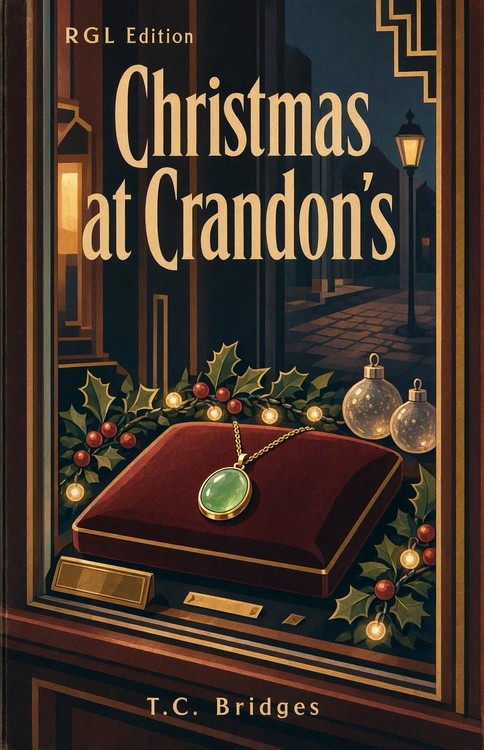
RGL e-Book Cover
Based on an image created with Microsoft Bing software
Roy Glashan's Library
Non sibi sed omnibus
Go to Home Page
This work is out of copyright in countries with a copyright
period of 70 years or less, after the year of the author's death.
If it is under copyright in your country of residence,
do not download or redistribute this file.
Original content added by RGL (e.g., introductions, notes,
RGL covers) is proprietary and protected by copyright.
RGL e-Book Cover
Based on an image created with Microsoft Bing software

At the festive Crandon's Hotel on the English coast, Christmas romance turns into mystery when charming Lally Carr finds herself caught between two suitors: steady, good-hearted Peter Lacey and the dashing, ambitious Jude Cavender. A coveted chrysoprase pendant, a cache of counterfeit banknotes, and a shocking arrest on Christmas Eve plunge the holiday gathering into scandal and suspicion....
LALLY CARR was flattening her pretty nose against the front of Cornish's jewellery shop in Seacombe High Street.
"It's lovely—lovely," she declared in her sweet, clear voice. The object of her admiration was a pendant, a heart-shaped stone hung upon a thin gold chain. It was green—not the green of jade but something even clearer and more luminous. She turned eagerly to her companion, a slim, fair-haired, smooth-shaven man who was probably not quite so young as he looked.
"I tell you what it is, Peter. It's chrysoprase."
"It sounds nice and looks better," said Peter Lacey, but his eyes were on the girl rather than on the stone. Lally was worth looking at. The green frock she wore exactly suited her slender, upright figure, and with her dark, curly hair and big brown eyes, she was really pretty.
Everyone at Crandon's Hotel, where the two were among the Christmas guests, knew how Peter Lacey admired her. Most of them liked Peter, all were sorry for him, for what chance had an insignificant bank clerk against Jude Cavender? True, Peter Lacey was pleasant-natured, not bad looking, and far from a fool, but Cavender was so big, so amazingly handsome in his dark fashion, so good at everything from dancing to skating, that he completely eclipsed the slight and unassuming Peter. And Cavender was mad about Lally. He had monopolized her ever since he had first met her. Indeed, this was the first time for days that Peter had managed to get Lally to himself, and that only because Cavender had been busy writing letters after lunch.
He had finished them now and was walking down the street in search of Lally. He saw her with Peter at Cornish's window and was close enough to overhear what Lally said. But neither of them saw him and he, instead of joining them as he had at first intended, suddenly crossed the street and turned up a narrow alley.
When they had passed he came back and had a look at the object of Lally's admiration. It was only two days off Christmas and he had been wondering what to give her for a Christmas present. Here seemed a chance. A cheap trinket, yet one that she was really keen about. But his handsome face darkened as he noticed the price marked on the ticket. It was seven pounds, ten shillings.
"What a cursed swindle!" he growled under his breath, and certainly no one would have called him handsome with that scowl on his face. It gave him an unpleasantly vulturine expression. For some moments he stood frowning heavily, then turned and followed the others back to the hotel.
Cavender was still in an evil humour when he reached the hotel. Seven pounds ten—where was the money to come from? Yet by hook or crook he must buy that necklet. It was not only that he was mad about Lally Carr's beauty, but also that her father was a big man in the City. Marriage with her meant Easy Street and that was Cavender's ambition. He decided to smoke a cigarette and consider the last of those of his friends who might still be good for a loan.
There were two smoking-rooms at Crandon's, or, rather, the smoking-room was double, a large alcove at the end being walled off. Heavy curtains hung across the doorway. The large room was empty. Cavender was in the act of dropping into a chair when he heard voices in the inner room. One was Lacey's.
"So you got the rest, Lingard—how much?"
"Only a couple of hundred. Here you are, Lacey. You'll have to keep 'em."
Cavender's interest was aroused, and instead of sitting down he tiptoed across the carpet. The curtains were not quite closed, and peeping through the narrow crack, Cavender saw Lingard, a tall man with a long, thin, dark face, who wore tinted glasses, handing Peter four packets of Treasury notes.
"Fifty in each," he was saying. "Want to count 'em?"
"No need, Lingard," said Peter, as he stuffed the bundles casually into his breast pocket.
"Where do you keep the stuff?" Lingard asked.
"Upstairs."
"Aren't you afraid of burglars?" Lingard asked with a laugh.
"Not at Crandon's. We're all entirely respectable. That's why I stay here. None of 'em suspect anything." He sighed. "Well, that's finished. Now perhaps I can have a quiet Christmas."
"You deserve it," replied Lingard. "You've done well down here."
"I hope we've cleaned up," said Peter. "Now will you have a drink before you go?"
Cavender realized it was time to move. He was out in the hall, stretched drowsily in a long chair when Peter and Lingard passed on their way to the front door. And there he stayed until tea came in.
After tea they danced. Here Cavender shone and Peter did not. So Peter had to watch Lally in Cavender's arms. But men were scarce and Peter was not one to shirk his duty. Since there were more women than men he found plenty of partners. By seven, when it was time to dress for dinner, he was warm enough to enjoy a bath. He was wallowing in pleasantly-hot water when suddenly the lights went out, and he had to dry himself in pitch darkness. But almost before he had got into his dressing-gown the lights came on again.
"A fuse blew, sir," a chambermaid told him as he went back to his room. She smiled as she passed. Peter, always courteous, was a favourite with the staff.
There was more dancing after dinner, but Peter was caught to play bridge. His bridge was better than his dancing, and he won at first. Later, when most of the women had gone to bed, Cavender cut in.
"What stakes are you playing?" was his first question, and when Peter told threepence a hundred his lip curled.
"Hardly worth while, is it?" he remarked rather scornfully.
"We'll make it sixpence if that will satisfy you," replied Peter quietly, and with that Cavender had to be content.
He cut with a lawyer named Trafford and the cards ran against the pair. Instead of going slow, Cavender began to overcall, with the result that he was doubled and he and his partner went down badly.
"I'm tired of bridge," said Cavender, "what about a few hands of poker?"
"If the limit is not too high," Trafford agreed. So they started a mild game—threepenny ante and half-crown limit. Here Cavender was in his element. He was a good poker player, and at the end of two hours' play was a winner of between four and five pounds. Most of it came from Peter, who paid from a well-filled wallet. Then they all went up to bed.
Next morning after breakfast Peter went off by himself. It is hardly wonderful that the same idea had occurred to him as to Cavender, namely to buy the chrysoprase as a Christmas present for Lally Carr. His dismay was great when he saw that it was missing from the window. It was greater when he heard that it had already been sold.
Since Peter had no idea that Cavender had ever set eyes on the ornament, let alone known that Lally admired it, his first idea was that Lal herself had come down early and bought it. Her people being well off, she had plenty of pocket money. But when he questioned the assistant he learned that the purchaser was a man. And by the description it could be no other than Cavender.
Peter's face was thoughtful, you might even say troubled, as he walked back to the hotel. It was bad enough that he could not give Lal this present on which he saw that she had set her heart, but it was worse that the present would now come from Cavender. And with it probably a proposal. Peter was not one to wear his heart on his sleeve, but he was really in love with Lal.
At the office, plump Miss Crandon handed him a letter. It was from Lingard and after reading it he went straight up to his room, locked his door, and it was more than an hour before he came down again. Miss Crandon noticed that his expression was graver than before.
"Poor young man!" she said to herself. "It's that Miss Carr."
It was a fine day and the hotel seemed empty.
"Everyone's out," Miss Crandon told him. "Mr. Cavender and Miss Carr have gone down to the pier." Feeling lonely and rather depressed, Peter picked up a paper and made for the smoking-room. There he lit a pipe and settled in a chair.
The door was open, and presently he heard someone at the office inquiring for Mr. Cavender. It was the jeweller, Mr. Cornish. Miss Crandon explained that Cavender was down at the Pier. Mr. Cornish hesitated.
"Is he staying?" Cornish asked, and Peter sensed anxiety in his voice.
"Yes, he's staying over Christmas," Miss Crandon assured the jeweller.
"Will he be in to lunch?"
"Oh, surely," was the reply.
"Then I'll call again," said Cornish, and went away.
Peter read no more, but lay back in his chair, and by the slight frown on his forehead seemed to be thinking deeply. He was roused by laughing voices. A head appeared round the corner.
"Why, Peter, what, have you been doing with yourself?" cried Lally.
"A spot of work," replied Peter with his cheerful grin.
"Good Lord, fancy working on Christmas Eve!" sneered Cavender.
"Or any other time," remarked Peter pleasantly, and Cavender's lips tightened. He had never stuck to any job for more than three months, and sometimes he wondered whether Peter Lacey knew it. But Lally broke in again.
"We're going to the pictures this afternoon. You must come, Peter."
"Of course I'll come, Lal," said Peter, and then the gong sounded and they all went to lunch. Peter had a small table to himself close to a window facing the street. Presently a maid called Cavender out, and Peter, looking out of the window, saw him walking down the street with Cornish. He stared a while, then went on with his meal. Lunch ended, but no sign of Cavender, and at half-past two he was still absent.
"I can't think what's become of him," said Lally vexedly. "You'll have to take us, Peter," and Peter declared he would be ready as soon as he got his hat. There were Lally Carr, her friend Cynthia Nisbet, and Cynthia's young brother Frank, a smart schoolboy of fifteen, and the four were just leaving the hotel when a square-shouldered man in blue serge and wearing a bowler hat came up the steps and stopped in front of them. His keen, slate-coloured eyes signed out Peter.
"Are you Mr. Peter Lacey?" he asked. Peter looked a bit surprised, but answered.
"That is my name."
"Then I must trouble you to come with me," said the man.
"Can't you wait?" begged Lal. "We're just going to the pictures."
"I'm sorry, miss, but this gentleman can't go with you," replied the stranger, and the note of authority in his voice made Lal oddly uncomfortable. Peter spoke.
"You go on yourselves, Lal. I'll join you later." The others watched him as he walked away with the square-shouldered man.
"I think he's a policeman, Lal."
"A policeman!" repeated Lal sharply.
"What makes you think that?"
"I'm almost sure," said Frank. "He's a detective in plain clothes."
Lal went white.
"But what does he want with Peter?"
"I don't know," said Frank, uncomfortably. "But I say, let's be moving. They're all coming out behind us."
PETER did not come to the cinema, and when the three got back to Crandon's for tea the whole hotel was in a turmoil of excitement. Peter had been arrested and taken to the police station. The charge, they said, was that he had been found in possession of counterfeit notes. Cavender, so the story went, had made the charge against him.
Trafford, the solicitor, who made one of the bridge four on the previous evening, told how Peter had lost money to Cavender at the subsequent game of poker.
"But I'm not accusing Lacey," Trafford added, bluntly. "He paid me a note, and it was a perfectly good one."
The place buzzed with rumours. Since Cavender was not yet back they could not question him, but one thing was certain. After Peter had been arrested two detectives had come to the hotel, searched Peter's room, taken away his suit case and left the room locked up.
It was not a happy Christmas Eve at Crandon's. The wireless played as usual and there was some dancing, yet a gloom hung over everything. People gathered in knots and talked in low voices. Some blamed Cavender, for, in spite of his good looks and athletic prowess, he was not popular with everybody, and there were people who vowed he had done it just to spite his rival. These declared that Peter Lacey could not possibly be a forger or a friend of forgers, yet others shook their heads and said you never could tell, for the most simple and innocent-looking people were often the worst criminals.
For Lally it was horrible. Everyone seemed to be looking at her or whispering behind her back. Crandon's was a place where the same people came year after year and everyone knew everyone else's business. She could not stand it, and after tea went to her room and was seen no more that evening.
Poor Lal was desperately unhappy. She had been fascinated by Cavender's good looks yet had not begun to realize that Peter meant a great deal more to her than Cavender. The idea of Peter as a criminal—a counterfeiter—horrified her. She could not believe it. He had always seemed so sound and steady and reliable. Yet there was no getting over the damning fact that he had been arrested or that his room had been raided by the police. In the end she cried herself to sleep.
When she woke, Jessie the chamber-maid, was bringing in her pot of morning tea and on the tray was a small parcel neatly sealed with red wax Lally's slim fingers shook as she opened it. A jeweller's case was revealed and in it the chrysoprase necklet, the lovely green stone gleaming in the electric light. With it was a card:
"Merry Christmas, Lal.—from Peter." Lal sat gazing at that card, her big brown eyes wide with astonishment. Peter in prison, yet he had sent her this present, and just the present she had longed for. But how had he done it? He must have had it sent from the shop. How sweet of him! Again she felt she wanted to cry, but this time refused to give way. Instead she jumped out of bed, pushed her little bare feet into slippers, slipped in a dressing-gown and made for the bathroom.
No one was down when Lal arrived at the foot of the stairs. She was crazy for news of Peter, but did not know whom to ask. Even the office was empty, for Miss Crandon was having her breakfast. Lal wandered through the empty hall and suddenly stopped with a gasp. For there was Peter, himself, standing in front of the letter rack.
"Peter!" she exclaimed, hardly able to believe her eyes. Peter turned.
"Good morning, Lal, Merry Christmas," he said serenely. His eyes fell on the green stone which hung around Lal's slim neck and he smiled.
"B-but I thought you were in prison," Lal stammered.
Peter grinned.
"So did a lot of other people."
"Oh, Peter I'm so glad."
"That I was in prison," Peter bantered.
"No, silly—that you're not." Peter came a step nearer.
"You mean that, Lal?" There was a ring in Peter's voice that Lal had never heard before. It frightened her a little.
"Of course I mean it. I knew you could never have done what they all said you'd done."
"What did they say I'd done?"
"That you had bad money, Peter."
"But that's true," said Peter. "I had—quite a lot of it."
Lal stiffened.
"I don't believe it, Peter." There were steps on the landing above. Peter slipped his arm through Lal's and drew her into the smoking-room which of course at this hour was empty.
"It's true, Lal," he said gravely. "The police found nearly three hundred pounds in counterfeit notes in my suitcase."
Lal was not shaken.
"Then someone else put them there," she declared, but Peter shook his head.
"No, Lal, I can't claim that excuse."
"Then why are you here? Why aren't you in prison?" demanded Lal. Suddenly she caught the twinkle in his eyes and grew quite angry.
"Your pulling my leg, Peter. It isn't fair. Tell me."
At once Peter was grave again.
"I'm sorry, Lal. Of course I'll tell you. You see, I'm not just the bank clerk I let them think I am. It's true that I'm employed in the banking business, but in point of fact I have a Government post. I was sent down here, to Seacombe, because of complaints about counterfeit notes, a lot of which have been passed here lately. Very clever imitations, too, let me tell you.
"Another man and I, working together, collected a number of these notes and incidentally evidence to convict the counterfeiters. Meantime I kept the notes in my room here, locked up in a suitcase." He stopped. Lal was listening breathlessly. The idea of Peter as a detective simply fascinated her.
"All this is between you and me, Lal," he said, warningly. "It's not to go any further."
Lal nodded.
"You can trust me, but go on, Peter."
"You might guess the rest, Lal. Someone slipped into my room the other night while I was having a bath, and stole a number of these notes. Not knowing that they were bogus, this person tried to pass them. Since every tradesman in the place has been warned of these notes he was caught. Then"—Peter's face hardened—"he accused me."
Lal drew a deep breath.
"Cavender—it was Mr. Cavender?" she breathed.
Peter hesitated.
"Yes, it was Cavender," he said at last. "But, Lal, I thought you liked him."
Lal's cheeks reddened, her eyes were brave and honest as she looked up into Peter's face.
"I—I thought I did, Peter," she confessed. "I know better now." Her right hand went to the green stone.
"So you're wearing my Christmas present, Lal," he said softly.
"It was a lovely present," Lal answered. "I was just delighted when I found it on my tray, but I wondered so much how you got it when you were—"
"In prison," put in Peter with a laugh. "As a matter of fact, Lal, Cavender got ahead of me. But, of course, when Cornish found how he had been paid for it he took it back, and that gave me my chance. Cornish is a friend of mine, and the good fellow opened his shop after closing time to sell it to me."
"I shall always keep it," said Lal firmly. Peter looked at her.
"I wonder if you'd keep something else," he said in an oddly low voice.
"Keep something else, Peter—what?"
"Me," said Peter.
"You!" For a moment Lal looked puzzled, then she flushed.
"What—after I've been such a little pig! Oh—Peter!" Lal could not say any more, for Peter's arms were round, her, and if Peter was not very big his arms were most comfortingly strong.
Roy Glashan's Library
Non sibi sed omnibus
Go to Home Page
This work is out of copyright in countries with a copyright
period of 70 years or less, after the year of the author's death.
If it is under copyright in your country of residence,
do not download or redistribute this file.
Original content added by RGL (e.g., introductions, notes,
RGL covers) is proprietary and protected by copyright.