
RGL e-Book Cover
Based on an image created with Microsoft Bing software
Roy Glashan's Library
Non sibi sed omnibus
Go to Home Page
This work is out of copyright in countries with a copyright
period of 70 years or less, after the year of the author's death.
If it is under copyright in your country of residence,
do not download or redistribute this file.
Original content added by RGL (e.g., introductions, notes,
RGL covers) is proprietary and protected by copyright.
RGL e-Book Cover
Based on an image created with Microsoft Bing software
"Tales of the Air," Collins, 1933"
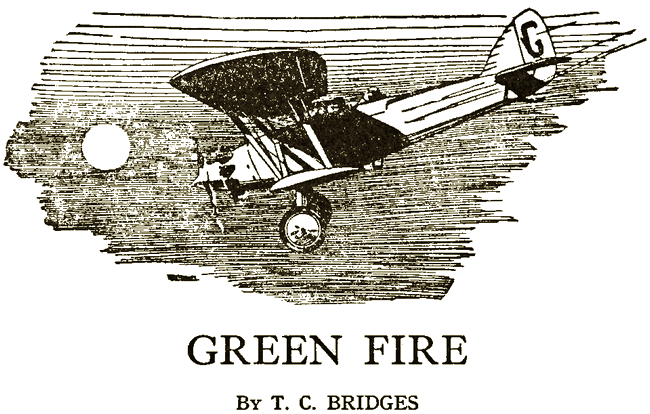

"Keep quite still!" he said.
NED STANTON drowsed over the wheel. The steady thunder of the big Jaguar engine and the scream of the wind through the struts and stays of the 'plane combined in a monotone of sound that dulled the senses and made it difficult to keep awake. The passenger, in the seat behind, was already sound asleep. They had left Crandon aerodrome early that morning and were now over the Rhone valley, moving towards Rome through a perfect afternoon. Ahead, the horizon lay like a faint green mist through the haze of the propeller, above, cloudless blue; and through everything, dulling the brain and lying like lead on the eyelids, that steady ceaseless roar.
The 'plane bumped slightly, and Ned roused himself and glanced at the altimeter; then, pushing the throttle a trifle wider, he slowly eased back the stick. The tone of the engine lifted as the 'plane zoomed into a long upward slant. At five thousand feet he flattened out, and the pitch fell again to the monotonous pulsing roar.
Ned's thoughts turned to his passenger. He had called himself Waterbury—Cyrus P. Waterbury, a director of Sahara Concessions, Ltd. Big, prosperous-looking man. American, of course. Spoke with a terrific accent. Decent sort, though. Ned had liked the twinkle in his eye when he had joked about treasure-hunting. Was it a joke, though? What about those picks and shovels? Waterbury had put them in at the last moment that morning before they took off. He had offered no explanation, and Ned had not questioned him. The destination, too. That was queer. No definite place—just North Africa. He had said he would give further details when they reached Malta. "Oh, well. Some stunt, 1 suppose," thought Ned.
The never-ending roar asserted itself once more, drifting the thoughts from his mind and urging him to sleep.
Suddenly the note changed. A cylinder was missing—two, three. Hurriedly he scanned his gauges. Ah! No petrol. No. 1 tank empty. He reached for a tap and turned on the second tank. The gauge needle did not move. He tapped it. Still no movement. The engine was coughing badly now. Alarmed, he worked the tap to and fro, rapping the gauge again. No result. A last despairing gasp from the engine, then silence save for the whistle of air through the wing struts.
"Hang the luck!" muttered Ned, as he pushed the 'plane into a glide and scanned the earth, still far below, for some place where he might land. Luckily they were still over flat country, and Ned picked the largest field he could see, and went swinging down to it in wide spirals. At fifty feet from the ground he straightened the 'plane, skimmed a fence and, as the wheels struck ground, pulled hard back on the stick, and the 'plane went bumping and lurching over the field to pull up within a dozen yards of the opposite hedge.
Ned untied the flaps of his flying helmet and mopped his face. "Whew!" he muttered, "might have been worse."
"Say, young man," came an aggrieved voice from behind him, "what's the big idea? "
Ned turned and saw the large red face of Mr. Waterbury staring at him over the top of the fuselage. He was rubbing his eyes as if he had only just awakened, and seemed quite unaware of what had happened. "This ain't Rome, is it? " he asked vaguely.
"No, sir," Ned answered, climbing from his seat. "Engine conked out, and I had to bring her down where I could. It's a choked pipe, I think, or possibly a leak in the tank. I'll just have a look."
He unscrewed the tank cap and thrust in a short measuring stick.
"Empty," he announced. "T thought so. Now to find the leak... by Jove, sir, look here!"
"Well, what is it, son? "
"Hole bored clean through the bottom of the tank. Now who on earth...?"
He broke off as Waterbury fairly leaped out of his seat.
"Wh-what?" he yelled. "What's that you say? Bored?" His voice dropped to a growl. "Oh, the hound!" he muttered. Then, eagerly: "Look here, son. How soon can you fix it?"
"I can patch the hole all right in ten minutes," Ned answered. "But we'll need a hundred gallons more petrol and I haven't a notion where we can get that."
Mr. Waterbury said something forcible. Then he threw a quick glance round the field.
"That looks like a road over there," he said, pointing to a line of telegraph poles. "You fix that tank, son. I'll get the gas." And with that he set off at a round pace across the field.
Ned looked after him and a grin spread slowly across his face. Cyrus P. was a sportsman all right. He turned his attention to the punctured tank. Now who could have done that? No friend of Cyrus's evidently. Ned reasoned that some one had got into the hangar during the night, for the tanks had been filled the previous evening, and, as he had noticed no leakage, the drilled tank must have run dry before they started. Rotten thing to do, too. Might easily have smashed them up altogether.
With these thoughts in his mind Ned fished out a box of spares from the body of the 'plane and rapidly set about repairing the damaged tank.
"I RECKON this should do it," said Cyrus P. Waterbury, squinting once again at his compass. "Twelve paces east nor'-east o' the big pillar, an' checked by ten south of the thorn bush. Yep. Can do. Gimme that pick, son."
It was two days later. Ned had made a quick job of repairing the tank, but Waterbury had had trouble in getting enough "essence," as the Frenchmen called it, and half a day had been spent in unloading consignments brought to a field by a single weary donkey (the only conveyance obtainable); while Cyrus P. had stamped about, muttering hard words. As soon as possible they had pushed on to Rome, and at Malta, Waterbury had told Ned his secret.
He said that a short time ago one of the Company's prospectors had crawled into camp, dying of thirst, with a story of a box filled with cut emeralds which he had found in some ruins far in the hinterland. His water was failing, so he had buried the box, bringing back a plan of the place and a pocketful of samples. The samples alone had been worth a small fortune, but some one had played dirty, stealing a duplicate of the plan and selling it to a financier named Marques. Waterbury had luckily discovered this, and had chartered Ned's 'plane in order to "beat Marques to it," as he put it. Marques was evidently hot on the trail, for the damaging of their 'plane was almost certainly his work, and Cyrus P. was in a hurry to get the stuff before he arrived.
While Waterbury had been taking measurements Ned had had time to look at the extraordinary surroundings to which the prospector's map had brought them. They were in a shallow valley some half-mile wide, flanked by huge cliffs of bright red rock merging at their upper ends into one colossal mass, which towered above them in the form of a gigantic pyramid. The valley itself was of hard sand dotted with patches of dense green scrub, with here and there a big bush of camel thorn adding a touch of brown to the scene.
But the most extraordinary part of the place was that in which they were now standing. All about them, dotted over a large area, lay huge tumbled masses of hewn masonry. The stones were red, similar to the rock of the cliffs, from which they must have been taken by the ancient builder. All about lay fallen columns, slabs and pillars, some half buried in the sand, some still standing, their worn carvings still visible through the weathering of centuries. It was a place to make an archaeologist rave, and Mr. Waterbury, who had a real love for old places, commented on it between digs of his pick.
"Say, won'erful spot, ain't it?" he gasped, as he levered out a loose rock and handed the pick back to Ned. "Try along there, son, in a line with me, and gimme the shovel. Gee! I'd sure give dollars to get one of them pillars back to li'l ol' New York."
They picked and dug and heaved, and the dusk drew down upon the valley. The pillars stood huge against the sunset and their shadows lay hard and black in the red glow. All was silent save for the chop of the pick and the rasp of sand in Cyrus's shovel. Suddenly came the thud of metal on wood, and a moment later the air was rent by a whoop of joy from Mr. Waterbury. Five minutes' furious work, a big heave, and pushing, grunting, straining, they had the whole thing out of the hole—a solid square box made of blackened timber and bound with rusted iron bands.
They climbed out after it and together lifted off the lid. Then—even Cyrus gasped. The sides of the chest were immensely thick, but the small square of the interior seemed to have burst into flames. Green flames! Flames that were still at one moment, but when he moved burst into a thousand points of fire, shading through greens into inky blackness, all moving, gleaming, flashing, so that it hurt to look at them. They both stood, spellbound, gazing at that incredible sight; at those glorious gems. And then spoke a voice, a human voice, coming from the shadow of a pillar.
"KEEP quite still!" it said.
They looked up, and two men stepped out of the shadow. One was a little wizened rat of a fellow with an enormous hooked nose. He was obviously a foreigner. But it was at the other that Ned stared in astonishment. He was a tall, lean chap, with a clean-cut face that would have been handsome but for the twisted mouth and hard eyes, that now glinted at Ned over the barrel of a revolver. He wore flying kit and Ned instantly recognised him as Dudley Foster, one of the Crandon pilots. But how on earth had he got here? It flashed through Ned's mind that he must have brought the little man in one of the Crandon 'planes, and he supposed, had been bribed by him to damage the tank of Ned's 'plane. The delay in France had enabled them to get ahead, but they must still have been nervous, for they had hidden their machine. That Ned was certain of, for Cyrus and he had studied the ground carefully before landing and neither had seen a sign of it. There was nothing remarkable in that, for there were a thousand places under the cliffs where a 'plane might be hidden. But Ned was amazed that Foster should have been such a scoundrel.
For a moment they stood motionless. Then the little man burst into shrill chatter, brandishing his pistol in the direction of Mr. Waterbury.
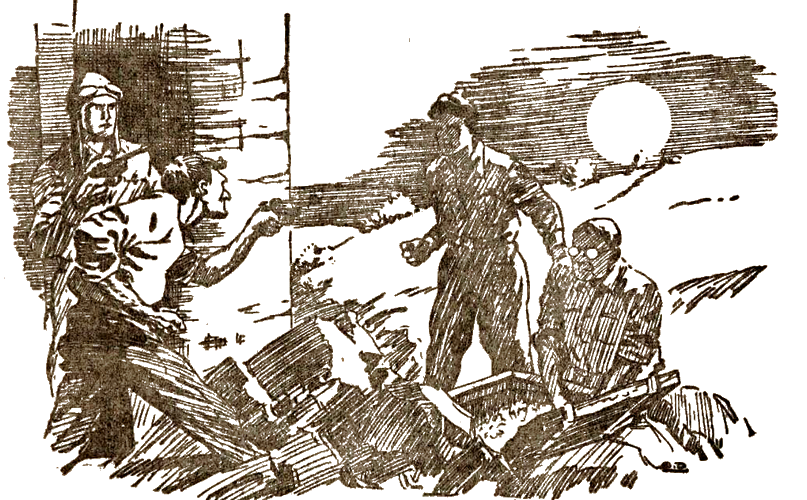
For a moment they stood motionless.
"Zat was my stuff," he cried. "Who was you? What you do here? You clear out sharp!" He advanced, waving his gun.
Foster also stepped forward.
"Move back!" he snapped. "Both of you, keeping your hands up. Stop there! Now sit down."
He kept them covered, while the foreigner rushed to the box and clawed out great handfuls of the green stones, thrusting them into a deep leather bag. His face was convulsed with greed. He grinned from ear to ear, muttering and crowing as the emeralds slipped like a stream of green fire through his fat fingers. Once he stopped over a particularly large one, patting and fondling it, and chuckling with glee, Foster watched him, disgusted.
"Hurry up," he growled. "I'm not going to stay here all night."
Presently the box was empty. The foreigner spilled the last of the stones into his bag and snapped the lock.
"Now!" said Foster. "Marques, you keep behind me. You, Stanton, and you, whatever your name is, don't try to move or it'll be bad for your health." Still keeping them covered, he began to move backwards.
Ned looked him full in the face. "I didn't think you were such a hound, Foster," he said quietly. "How much are you getting for this?"
"Keep your mouth shut!" snarled Foster.
Then came suddenly from somewhere up the valley the roar of a hunting lion. It was an eerie, blood-curdling sound, and they all started involuntarily. And in that moment Ned was seized with an inspiration.
"The lion! Look at the lion!" he screamed, pointing to the shadows behind Foster and Marques.
The suddenness of his cry and the expression of utter terror upon his face completely unnerved Foster. He spun round with a gasp and, a split second later, Ned's fist crashed into the side of his face. He dropped without a sound. Ned dropped, too, fearing that Marques would fire, but nothing happened, so, grabbing Foster's gun, he scrambled to his feet.
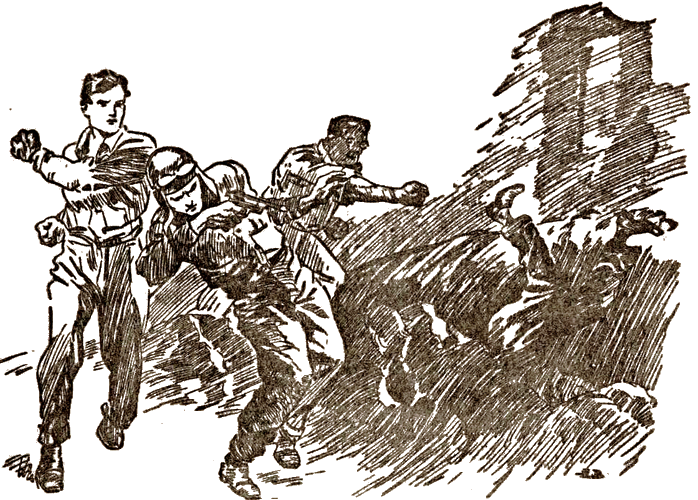
He dropped without a sound.
To his amazement there was no sign of the man, and looking round, he was paralysed to find that Waterbury too had vanished. The sun had dropped over the horizon and the gloom of the short African twilight lay upon the valley.
Suddenly he became conscious of an extraordinary sound—a sort of gurgling and choking that seemed to come from the ground beneath his feet. Turning, he was horrified to see a pair of human legs rising from what he took to be a dark shadow on the ground in front of him. They shot up, waved frantically for a moment, and then vanished as suddenly as they had appeared. And then came a voice, thin and plaintive.
"'Elp! 'Elp! Foster! 'E've got me! Oh, 'elp!"
Thump!
"'E—'elp!"
Thump! Thump!
Silence!
And then, slowly rising out of the shadow, compassed about with a large and satisfied smile, appeared the rubicund face of Mr. Cyrus P. Waterbury.
"Slimy little bird, that," he remarked cheerfully. "Tried to skip out with the loot when he heard your yell, but I collared him, and"—rubbing himself painfully—"I guess we both forgot the treasure hole! Then I got hold of the place where his neck would be, if he had one, and he tried to bite me, so I turned him upside down and gave him the head-bumps, an' that made him real sad. He's resting now, though, all nice and peaceful!"
"How's your guy?" he went on, when Ned had finished laughing. "Pushed him in the face, eh? Well, I guess we must put the kybosh on these little larks. Gotta length of string about you?"
They tied Foster's wrists and hauled Marques out of the treasure pit, and while they were waiting for them to come round, Waterbury opened Marques's bag and began fishing about amongst the glittering contents. A moment later, Marques and Foster, opening their eyes together, were just in time to see him take out a huge cut emerald and press it into Ned's hand with some warm words of gratitude. Foster ground his teeth and Marques uttered a faint moan and closed his eyes.
HALF an hour later Mr. Waterbury brushed away the crumbs of his last ham sandwich and leaned back with a satisfied smile. A huge fire roared in front of him, thrusting out the surrounding blackness and showing the 'plane, dim and ghostly, standing about fifty yards away on the edge of the circle of light. Beside him sat Ned, idly throwing twigs into the blaze. Opposite them, Marques and Foster, their lashings shifted to their ankles, sulkily devoured their rations.
"Say, son," said Mr. Waterbury, nodding towards them (he never called Ned anything but "son" now); " say, son, what'll we do with them gents?"
Ned grinned. "Keep 'em till the morning, I should think, sir," he said, "and then let them go."
"Yes, but you told me just now that that Foster guy's got a faster crate than ours."
Ned's grin widened. "Yes, that's true, if he's brought the same one that he usually flies at home."
"Well then," said Cyrus, "he'll catch us!"
Ned laughed outright. "Don't think, so, sir."
Mr. Waterbury choked with exasperation; then he leaned forward, studying Ned's face.
"Say, son," he whispered, "what's the big idea?... You got something, now!" he accused, as Ned did not answer. "What is it?"
Ned chuckled again. "Can't say now, sir," he said. "I'll tell you in the morning."
"All right. Sure thing, then. Waal, I guess I'll go get a wink," said Mr. Waterbury, rising to his feet. "Can you keep an eye on these fellers? Give me a shout in a couple of hours and I'll take on."
He walked over to the 'plane and clambered into the fuselage.
Dudley Foster was furious, some moments later, at having his wrists securely bound by Ned Stanton. And then he saw Ned move cautiously to the 'plane and take out a shovel, a box, and something that looked like a monkey wrench. With these Ned returned, and then, to Foster's amazement, changed Marques's ropes from his ankles to his wrists, yanked him to his feet, and picking up the box, wrench and shovel, jammed Marques's own revolver into the small of his back and marched him away into the darkness.
Left to himself, Foster lay puzzling over this new development, but could make nothing of it. Still, he would be released in a few hours* time, so what did it matter? He rolled over and fell into a fitful sleep.
When he awoke, it was broad daylight. The fire had died down, and Waterbury and Ned sat down beside its embers, finishing a hearty breakfast. Marques had vanished, and Foster looked at Ned in horror. Ned, however, did not seem very bloodthirsty, for he grinned cheerfully, asked Foster how he had slept, and passed him some sandwiches and a big cup of steaming coffee. As Foster ate, he watched Ned and Waterbury pack up their gear and stow it into their 'plane. Once Ned whispered something that Foster could not catch, and they both burst into a roar of laughter. Then Ned came over with a packet in his hand.
"Better give these to Marques," he grinned. "It's the last of the grub. You'll find him in your 'plane. Sorry," he went on, "but I'm afraid we'll have to leave you now. Your hands are free. You can untie that cord easy enough. S'long."
Still chuckling, he turned and went back to the 'plane. Foster watched him swing the propeller, and as the engine burst into life, saw him duck under the wing himself into the cockpit. The engine roared and the 'plane moved off, gathering speed until finally it lifted. Overhead it thundered in a steep spiral bank, while Foster caught a glimpse of a smiling, rubicund face behind a waving handkerchief; then it shot away into the blue, dwindled to a speck, and vanished.
The knots were tough, and it was half an hour before Dudley Foster arrived at the place where he and Marques had hidden their 'plane. He looked, rubbed his eyes, and looked again. Yes, it was true. The 'plane had no propeller. Coming closer, he discovered that it lacked also the best part of its engine. He peered into the fuselage. Marques sat gagged and bound in the passenger's seat. A scrap of white paper, pinned to his coat, attracted Foster's attention. He took it and saw that it was a single page torn out of a note-book, closely written in pencil. Wondering, he began to read:
Dudley Dear,
I beg to inform you that your engine is distributed as follows:—
Plugs—under the tail of the 'plane, depth about four feet (they'll need a bit of cleaning, too!)
Carburettor—under tip of starboard wing. Depth ditto. Float for same—tip of port wing. Depth ditto.
Needle—inside the fuselage, somewhere. Marques is probably sitting on it. Nuts, connections, etc.—ditto.
Magneto—I haven't dismantled this as I thought I mustn't be too hard on you. You'll find it in the cockpit; leads and fixings, ditto. In case your courage fails you in your search for these various parts, you'll find a box of spares in the treasure hole. There's a shovel in with it too, and six feet of sand on the top, so you'll have rather a job, I'm afraid. Oh, I forgot to tell you that the propeller is up in the top of that big thorn bush to the left of your 'plane; I had rather a job getting it there, but happened to have a bit of string with me which did the trick. Afraid you'll have to climb. Looks horrid prickly, too. Give my apologies to Marques, by the way; I had to take him along last night to show me where you had hidden the 'plane. On the way he must have thought he heard a lion or something, as he got the wind up and began howling like nothing on earth; so I had to gag him. Well, so long! Cyrus P. sends you his love.
Yours happily,
Ned Stanton.
Roy Glashan's Library
Non sibi sed omnibus
Go to Home Page
This work is out of copyright in countries with a copyright
period of 70 years or less, after the year of the author's death.
If it is under copyright in your country of residence,
do not download or redistribute this file.
Original content added by RGL (e.g., introductions, notes,
RGL covers) is proprietary and protected by copyright.