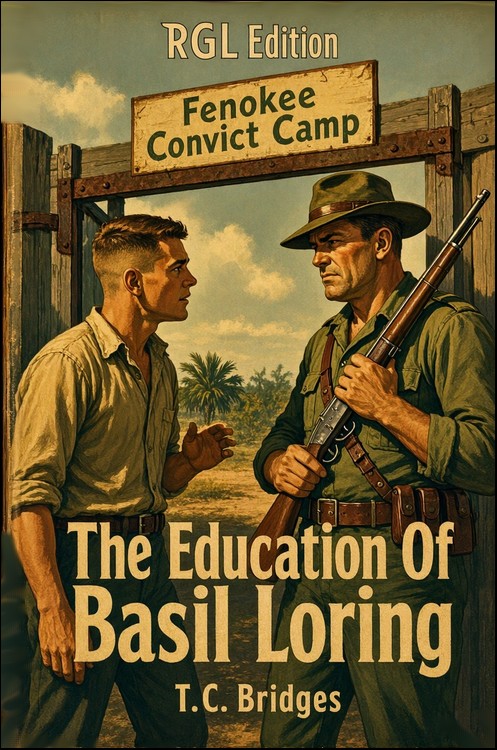
RGL e-Book Cover
Based on an image created with Microsoft Bing software
Roy Glashan's Library
Non sibi sed omnibus
Go to Home Page
This work is out of copyright in countries with a copyright
period of 70 years or less, after the year of the author's death.
If it is under copyright in your country of residence,
do not download or redistribute this file.
Original content added by RGL (e.g., introductions, notes,
RGL covers) is proprietary and protected by copyright.
RGL e-Book Cover
Based on an image created with Microsoft Bing software


Title from "The Evening Journal.", Adelaide, South Australia"
Basil Loring has always drifted through life on charm, confidence, and the comfortable assumption that someone else will smooth the way ahead. But when circumstances force him to face the consequences of his own complacency, he discovers that growing up is far more demanding than he ever imagined. In T.C. Bridges' engaging tale of character and self-discovery, unexpected challenges, hard-won lessons, and a few humbling surprises combine to test whether Basil can transform from a carefree youth into a man worthy of respect. The Education of Basil Loring is a lively and entertaining coming-of-age story in which the greatest adventure lies in learning the true value of responsibility, perseverance, and character.
THERE was only one corner of the big writing table which was not piled with dusty papers. On this Basil Loring carefully bestowed his hat and gloves. His stick he placed across his knees as he sat down facing the stout lawyer.
"What luck, Mr. Grisley?" he enquired cheerfully. "Got the business fixed up yet?"
Mr. Grisley stared at his visitor through his heavy, gold-rimmed spectacles. He shook his large head, and sighed deeply.
"No luck at all, I'm afraid, Mr. Loring. Your late uncle's affairs are in a shocking state!"
He paused and sighed again.
"Out with it, Mr. Grisley," said Loring. "I gathered from what you said the other day that Uncle Richard didn't leave as much as we thought he would?"
"He did not, indeed," answered Grisley dolefully. "Matters are even worse than I had anticipated. The fact is that, when all your late uncle's debts are paid, there will be only a couple of thousand pounds left."
Loring gave a low whistle.
"Phew, that's a bit of a facer! Why, he must have lived at the rate of three thousand a year.
"That is exactly the reason why you are left practically destitute, Mr. Loring," said Grisley. "For years your uncle was living far beyond his means. I do not think it was right on his part. It was not fair to you." Once more he shook his big head and sighed so that the papers on his blotter fluttered like dry leaves.
"His money was his own," returned Loring rather stiffly. "He had a perfect right to use it as he pleased. Anyhow, he gave me a good education, and an uncommonly good time, too. After all, there are plenty of men who haven't even got a couple of thousand to start on."
"That, Mr. Loring, if you allow me to say so, is a very proper spirit. At the same time the amount at your disposal is not sufficient to purchase a share in any business which would yield you a living. I fear, too, that your education has not fitted you for any form of commercial life."
"That's true enough. I don't know the first individual thing about business, and I think the best thing I can do is to chuck England, and try my luck in one of the colonies.
A curious expression flitted across the lawyer's large flabby face.
"And a very good idea, too," he said quickly. "A very good idea, indeed. But in my humble opinion the place for an ambitious young man to-day is the United States."
"The States?" said Loring doubtfully. "I rather be under the flag!"
"Of course! I quite see that. At the same time, I assure you there is a much better prospect of making money in the States; and, as it happens, I could be of considerable use to you if you should choose to go to that country."
"How so?" asked Loring, with sudden interest.
"In this way. I have a business acquaintance, a Mr. Hampson, a most enterprising man, who has taken up a quantity of Government land in South Florida, and is busy turning it into pineapple plantations and orange and peach orchards. I heard from him only the other day. He says that the land is wonderful, the climate good, and all that is wanted is population."
"That sounds all right," said Loring.
Grisley pulled open a drawer and fumbled among the papers with his fat fingers.
"Here is Mr. Hampson's last letter," he went on, as he unfolded the sheet. "This is what he says:—
"'If you know of any young men with small capital who are not afraid of work, this here is the place for them. There isn't a deal in the way of society, but there are woods full of quail and deer, and lakes full of fish. I'll sell land cheap to any one that wants it, and for a man that's not afraid of work there's a mighty good living in raising fruit and early vegetables for the northern market.'"
"By Jove, that's the place for me!" declared Loring energetically. "An outdoor life, and plenty of sport—it'll suit me down to the ground!"
Mr. Grisley's fat face beamed.
"I thought that would be the kind of thing to suit you. I feel sure you will never regret your decision, Mr. Loring, and that your small fortune could not be employed to better advantage. If I may venture to offer you my advice, you will first spend a few months with Mr. Hampson. He will take you as a farming pupil at a small premium. Then you can choose your own land, and clear it by degrees, you will plant whatever crop Mr. Hampson advises, and within a few years will be on the high road to fortune."
"How do I get there?" asked Loring. "I suppose that costs a lot of money?"
"The usual way is steamer to New York, and then on by train. The price of your ticket would be about £25. But here I can help you again. I am acquainted with a director of a line which runs direct from Bristol to Jacksonville, in Florida. They are, of course smaller vessels than the great liners, but they are proportionately cheaper. By travelling in one of these ships you can accomplish your whole journey for £10 or £12. If you will wait a minute I will ring up their office in Fenchurch street, and make enquiries on your behalf."
He got up as he spoke, and waddled ponderously into an inner room.
He was back in a few minutes, with a broad smile on his fat face.
"We're in luck, Mr. Loring. There's a boat sailing on Friday next, the Glandore. You can have a passage from London to Jacksonville for £10."
"Friday next—and to-day's Monday! That's pretty short notice," said Loring. "How about letting Mr. Hampson know? There's no time to write and get a reply."
"But there's plenty of time to cable," said the lawyer, still smiling. "And as Mr. Hampson is a business correspondent of mine I can do it in cypher at the cost of a few shillings only."
"'Pon any soul, you're a friend worth having!" cried young Loring gratefully. "All right. Cable, please, and I'll drop in to-morrow for the reply."
"Not such a bad sort," said Loring to himself, as he made his way towards his club. "Wish he wasn't quite so fat and greasy. By Jove, this is a bit of a quick change! Last week I thought I was going into the army, and now I'm booked as a blooming farmer. Well it's better than an office desk anyhow. And if I can find a phosphate mine and collar a few thousands, perhaps I can come home and sneak into the service by some back door."
While Loring fancied leisurely at his club, the stout Mr. Grisley was very busy. First he went to a post office where he wrote a cable.
It was addressed—"Hampson, Live Oak. Polk Co., Fla.," but the message itself contained two words only—
"I'M COMING."
Apparently Mr. Grisley's Florida correspondent had some previous reason to expect a new farm pupil.
Then the lawyer took a taxi and ordered the man to drive him to a certain address in Fencshurch street. Here, in a shabby upstairs office, he bargained for a berth on the Glandore, and actually obtained it for a discount of 20 per cent. on the £10 he had quoted to Loring. As he drove back to his office his expression was exactly that of a fat tabby that has finished a pound of stolen butter. You might almost have expected to hear him purr.
THE wind was whistling shrilly as Basil Loring came up out of the companion way and looked eagerly round the deck.
A few yards away a girl leant upon the rail. A soft white shawl covered her head, and she wore a long warm coat which reached to her slim ankles.
Loring stepped across to her side.
"Good evening, Miss Desmond," he said, raising his cap. "I was wondering what had become of you. You're the only lady to venture on deck to-night."
The girl looked up, and her big dark eyes gleamed in the light of a ship's lantern which swung overhead.
"It was so dreadfully stuffy down below, Mr. Loring," she answered. "I just felt I couldn't stand it another minute. And I really I don't mind the weather."
"But it's bitterly cold," said Loring anxiously. "Are you sure you're warm enough?"
"Quite, thanks! This coat is very thick. Just look at the waves. They've been getting bigger and bigger ever since I've been watching them."
"It's blowing pretty hard," said Loring. "And I'm afraid there's worse coming. At least the skipper admits that it's going to be a nasty night, and when a sailor says that much it generally means something pretty bad."
"So you've been at sea, before?" asked the girl.
"Sail only," answered Loring. "I used to yacht a bit with my dear old uncle, but I've never done a trip in a steamer except just across the Channel."
"You haven't chosen a very nice trip for your first trip then," said Joan Desmond, with a smile. "This is really nothing but an old tramp, though the owners call her a liner."
"She certainly isn't much of a craft. It's a wonder to me—" he stopped short in evident confusion.
"Go on," said the girl, glancing round at him again.
"I was going to say something that you would probably have considered awful cheek," said Loring bluntly.
"I can't judge of that unless I hear it, can I?" she laughed.
"Well, it was this," said Loring slowly. "Ever since I first saw you I've been wondering what brought you and your brother aboard this rusty old tub."
"The wonder is mutual then. Alan and I have been puzzling our brains as to why you shipped in the Glandore."
Loring was silent a moment. Then, with a short laugh, he pitched the end of his cigarette overboard.
"It's a case of beggars can't be choosers, Miss Desmond. I came in the Glandore because it was the cheapest way of getting across."
"Then we are both in the same boat in more senses than one!" answered the girl. "You see, Alan and I prefer to travel saloon in a small, cheap ship like this rather than go intermediate in a big liner. And, besides, this is much the shortest way to Florida."
"So you are bound for Florida?" There was an eager ring in Loring's voice. "Are you going to settle there."
"I hope not. I hate the very name of the country."
Loring straightened himself and looked at her companion in evident dismay.
"But why? What's wrong with Florida? What makes you say that?"
"Because of what it has cost us, Mr. Loring." and there was a deeper ring in John Desmond's voice.
Just then the ship rolled so heavily that both Loring and the girl were obliged to grasp the rail tightly to save themselves from being thrown down. A gust of spray flung from the summit of a wave stung Loring's cheek.
"The weather's not fit for you to be on deck. You had best come into shelter, Miss Desmond," he said anxiously.
"Not yet. I was telling you why we hate Florida. It is because"—she paused—"because of my other brother, Brian."
"He has died there, you mean?" asked Basil softly.
"Worse!" she answered, balancing herself against another heavy roll. "If he were dead, we should be spared terrible anxiety. He has disappeared."
Her voice trembled a little. Loring waited in sympathetic silence.
"We have made every possible enquiry," she continued. "but we can hear nothing. We could bear the suspense no longer, so we are on our way to see if we can find him, or trace what has become of him."
"But this is most extraordinary!" said Loring. "Where was he bound? What was he going to do?"
"He was going to a man called Farren, who lives in Polk County. He was to live with him for a time and learn fruit farming. Then he meant to take up land for himself."
"But surely you heard from him?" said Loring.
"Yes, both from Jacksonville and from Farren's. After three months he wrote that he was buying a large tract of land. That was his last letter. Alan wrote to Farren, who replied that Brian had left him, and gone south into the Everglades on a hunting trip, and that he had heard nothing of him. Alan wrote again, begging Farren to make every effort to find him, but after a long delay the letter was returned, marked 'Gone away.'"
Before Loring could speak again there was a tremendous crash forward. The steamer had driven her bows right into a great wave and taken it aboard, green. Glancing round Loring saw tons of water racing aft across the deck.
"Look out!" he cried, and seizing the girl around the waist swung her right off her feet, and sprang back behind the deckhouse.
For a second or two her hair brushed his cheek, and he felt the warmth of her breath upon his neck.
"I beg your pardon," he said unsteadily, as he set her down in safety while the water swirled past them along the deck.
She clung to his arm a little breathlessly.
"I—I," she stammered.
"Man overboard!" The shout rose high above the shriek of the gale.
Loring rushed to the side. A tall wave rose towards the stormy sky, and against the whiteness of its foam-faced side Loring caught sight of a dark object—a man's head and an arm raised despairingly towards the rapidly receding ship.
"Man overboard!" shouted Loring again, and, hurling off his overcoat and jacket together, he plucked a lifebuoy from its fastenings, slipped it round him, and vaulted over the rail.
The water was hardly as cold as the air and Loring was a fine swimmer. But he had dropped into the hollow between two waves, and when he got his head up he could see nothing but the great bulk of the ship towering against the dusky sky, but already nearly its own length away.
He shouted again, but the wind swept his voice away, and when he looked round he could see nothing of the man he had gone overboard to rescue.
The ship was passing away into the dimness. It came to him with an ugly shock that he had thrown his own life away for nothing. What possible hope could he have of finding the drowning man in the vast waste of heaving waters, or of being himself picked up again in the darkness and storm.
A huge sea swung high upon its snowy crest. Out of the rushing water close by came a strangled cry, and almost within an arm's length was the man for whom he was searching.
"All right," shouted Loring, "I see you!"
He struck out fiercely, and with a powerful effort managed to reach the man and seize him by the arm.
"Don't try to swim," he said. "The belt will hold us both. We must wait for a boat."
"If they find us," muttered the other, in a choked voice.
Loring started.
"Why, it's Desmond!" he gasped.
"Yes, and you're Loring. I might have known it. I don't believe there's another chap aboard that would have gone after me."
"Nonsense!" answered Loring,trying to speak lightly. "But don't talk. We shall want all our breath before they reach us."
They sank into the depths of a watery valley. The waves towered like cliffs on either side. Some minutes passed. The chill of the water bit into Loring's bones. His wet clothes dragged him down, and the spray constantly breaking over his face made breathing difficult.
"Any sign of a boat?" asked Desmond weakly. "I'm almost done."
"Don't worry. The ship came round. I saw her turn. Yes"—as a wave flung them up again—"I see her starboard light. She's lying to. And there's the boat. Hang on, man, we're not going to drown this time!"
A shout came pealing out of the gloom. Loring answered with all his might. Soon a little craft soared into sight and came crawling down the side of a huge heaving wall of water, looking for all the world like some queer sort of many-legged beetle as she crept towards them.
Another minute and she had reached them, and Desmond, more dead than alive, was hauled aboard. Loring followed, and half a dozen pairs of stout arms pulled them back to the ship, which had dropped down to windward to receive them.
Almost every soul aboard was leaning over the side, and as the boat shot up under the lee, and they saw that the two men were safe, a tremendous cheer rang out across the stormy sea.
A dozen passengers rushed forward to greet Loring and to congratulate him, but he shook them off laughingly, and made a bolt for his cabin. As he passed into the companion he caught one glimpse of Joan's face, and the look upon it rewarded him a thousandfold for the risk he had run.
A hot bath, a hot drink, and a good nights rest put Loring quite to rights; but it was two days before Desmond could leave his bunk. He had been badly bruised against the rail by the sea which had swept him overboard, and he was stiff and sore for a long time afterwards.
Neither Alan Desmond nor his sister were effusive, but none the less they made Loring feel very clearly the depth of their gratitude, and the rest of that voyage was the happiest time that Loring had ever known. As the slow old Glandore steamed steadily south-west the bad weather was left behind, the days became calm and sunny, and in the warm starlit evenings Joan and Loring spent long hours together on deck.
Nowhere more quickly than at sea does acquaintance ripen into friendship, or friendship into love, and before the voyage was over the two had made the discovery that each was the one person in the world for the other.
At last, on the fifteenth day out, the low-lying sandy coast of Florida floated above the surface of the glass-calm sea, the Glandore passed into the wide mouth of the St. John River, and as she came to rest beside the busy wharf at Jacksonville, Loring realized with a terrible sinking at his heart that the moment of parting was at hand.
He went with the Desmonds to their hotel and they had their last meal together in a corner of the great shady dining-room. All three pretended a cheerfulness they did not feel, and laughed and chatted with forced gaiety.
The Desmonds were to stay in Jacksonville for a few days to prosecute enquiries about their brother, but Loring had to take the night boat up the river to Sanford.
Joan went down to the steamer with him, and the two found a quiet corner of the deck out of the bustle of loading.
For a few minutes they stood side by side gazing out across the wide river to the twinkling lights a mile away opposite.
Joan was the first to speak.
"It's horrid saying good-bye," she said suddenly.
Loring swung round and faced her.
"It's not good-bye! I'll never say good-bye to you, Joan." His voice quivered with ill-suppressed excitement, and he paused a moment to regain command of himself. "Joan," he burst out, "I know as well as you do that I've no right to speak. I'm little better than a pauper. But I must say it! I love you, dear. I've loved you from the first moment I saw you. And I shall love you all my life."
Joan held out her hand, and he took it almost reverently between his own.
"I don't know whether it's in me to make a fortune," he went on gravely. "But I'm going to try as hard as man ever tried. Will you wait, dear?"
Joan looked straight into his face.
"Basil," she said, "like you, I have something to do before I can think of myself. I have to find Brian. But afterwards—afterwards— "
She stopped, but the look in her face told Loring all that he wanted to know. Next instant his arms were round her.
All too soon came the sharp changing of a bell and the hoarse roar of escaping steam. A last kiss, then Joan hurried across the gang-plank. The paddles began to churn the water, and the tall-funneled steamer, blazing with lights, glided away from the wharf on her journey southwards through the pine forest.
THE tedious train which took Loring south from Sanford left him stranded on a bare platform of pine planks which, together with an unpainted shed and a tiny ticket office, constituted the railway station of Polk City.
Here he found awaiting him a four-wheeled, springless vehicle known as a buckboard. It was drawn by a lank mule driven by a silent, scared-looking negro. On this Loring loaded up his portmanteau and gun case, and started on the last and, as he found it, by far the most trying stage of his journey.
It was 30 wiles from Polk City to Live Oak, and the track was deep, dry sand, running through endless stretches of monotonous pine forest. It was 11 in the morning when Loring left Polk City: it was long past sunset when the mule pulled up opposite what he at first took to be a cowshed.
"That you, Jake?" came a rasping voice, and a door was thrown open, emitting a glow of red light. "Long enough you've been, too! Put up that there mule and come right along in, and get supper. Be sharp, now. So you're the young feller as Grisley wrote me about?" continued the speaker as he stepped down off the rough little verandah and faced Loring.
It was the tone and manner rather than the words which had the immediate effect of putting Loring's back up, but he answered quietly enough:—
"Yes, my name is Loring, and I have come through Mr. Grisley's recommendation. And you, I suppose, are Mr. Hampson?"
"You suppose right," said Hampson, who was a big, truculent-looking man, yet handsome in a coarse fashion. "Hampson's my name, but we don't worry about no 'misters' down here in the flat woods."
For a moment or two he stood staring at the Englishman, apparently sizing him up. Then he gave a short laugh.
"Pick up your duds, and come along in," he said. "Jake'll be around in a minute to get supper."
Loring took up his things and went in. The interior of Hampson's abode matched the outside in appearance. The shanty, for it was no more, was built of unsquared pine logs roughly tamped with yellow clay. The floor was of beaten clay, the roof of cypress shingles. The interior was divided into three portions by roughly boarded partitions.
The one he entered was kitchen and living-room in one. A cheap cast-iron stove, a cupboard, a table and three or four home-made stools were its only furniture. A few cooking pots were on a shelf behind the store, and dirty overalls, broken harness, and similar odds and ends littered the corners of the room. Everything was black with smoke and dust, and a humming horde of flies buzzed in the light of an ill-trimmed and stinking oil lamp.
Loring's heart sunk. The prospect of his uncle's labourers had been better housed.
"That'll be your room," said Hampson, who had followed him in, pointing to an opening on the left, which was covered by a piece of sacking doing duty for a door.
The place inside was every bit filthy as the kitchen. Loring's gorge rose and the first thing he did was to take a broom from the kitchen and sweep together a heap of miscellaneous rubbish which he flung out of the window.
"Bit particular, ain't you?" observed Hampson, with a grin, as Loring put the broom back.
"I'm not over-fond of dirt," answered Loring drily.
The negro came in, and presently supper was ready. Salt bacon fried in the pan, baked sweet potatoes and muddy coffee sweetened with molasses. Luckily for Loring he was too hungry to be particular, or he could never have touched the mess.
Hampson ate steadily, saying little, but eyeing Loring thoughtfully between bites.
Tired as he was, Loring slept little that night. For one thing, mosquitoes tormented him, but his thoughts were even more active than the buzzing insects. He cursed the foolish impulse that had brought him to this squalid hole and into the company of this bullying ruffian, and he wondered how Grisley could possibly have recommended him to such a place.
Most young men in Loring's shoes would have laid their plans to leave at once. But there was a queer dogged strain in Loring which made him hesitate to do so. For one thing the land might be better than the company, for another he had an instinctive feeling that Hampson was in some vague way trying to get the better of him. He quite realized, too, that the man was only waiting his chance to take the upper hand. There had got to be a row, and Loring was not the sort to turn tail at prospect of trouble of this kind.
The row was not long in coming. After breakfast the next morning, Hampton announced that he was going down to the swamp to get out some cypress poles for fencing.
"You kin help Jake put the logging harness on the mules," he said to Loring.
Now Loring, though he could saddle a horse and drive a car, had no notion of logging harness, which is a most complicated arrangement of multitudinous straps and buckles. He was struggling with its mysteries when Hampson came out, and stood staring at him with his hands thrust deep in his pockets.
Presently he spoke.
"I reckon you haven't never done a day's work in your life, hev you?"
His tone was an insult, but Loring kept his temper.
"I have never handled logging harness," he answered. "Still, I daresay I can learn as well as the next man."
Hampson burst into a hoarse guffaw.
"Man you call yourself! Gosh, there's kids 10 years old in this country could give you points and a beating at any kind of farm work. Don't you forget that, young feller!"
"And there are men who might possibly fail to give me a beating in other useful arts," replied Loring coolly.
"And what may they be?" asked Hampson, with an open sneer.
"Boxing, for instance," said Loring, with significant quietness.
"Sparring with gloves. Is that what you mean?" jeered Hampson.
"Or with bare knuckles," answered Loring. "I'm not particular!"
He dropped the harness he was holding as he spoke, and stepped forward.
Hampson grew angry.
"If you're a-looking for trouble you're going the right way to find it, my lad!" he blustered.
"I never look for trouble," said Loring quietly. But let me assure you that I am quite ready for it if it is forced upon me."
"You'll find it mighty soon if you don't get back to your job," threatened Hampson, and clenching his big fists he advanced threateningly.
It was exactly what Loring was waiting for. Out flew his left, and Hampson reeled back with the blood streaming from a split lip.
He recovered himself in a moment, and with a howl of rage, hurled himself on the other.
He was a much bigger man than Loring, and could probably have killed him if he had got to grips. For all that the fight was hardly fair. Hampson had not the foggiest notion of how to use his fists, while Loring had represented one of biggest English public schools at Aldershot.
For a minute or two he fought the man off, then realizing that Hampson was quite mad with rage and as dangerous as a rabid dog, he let him have it on the point. All the weight of his body was behind his fist, and the bully subsided on his back on the sand, and took no further interest in his surroundings.
Loring was gazing ruefully at his damaged knuckles when an extraordinary gasping sound behind him made him wheel round.
There stood Jake the nigger. His jaw had dropped, his eyes were goggling, and on his ebony face was such a ludicrous expression of amazement that, for the life of him, Loring could not help smiling.
Jake came up to him and laid a black paw upon his arm.
"Boss," he said earnestly, "I'd have done give a year off of my life to see dat. And now you just get on one of dem mules and light out as quick as ebber you can."
"Light out. Why?"
"'Cause when dat man comes to, he'll kill you for shuah."
Loring laughed.
"Don't you worry, Jake. Your boss will think twice before he touches me again."
"He won't touch you, sah—not wid his hands. He'll shoot you."
"Shoot me?" repeated Loring, and laughed again. "No, he won't do that, Jake. I'm worth more to him alive than dead, so don't you worry your woolly head. Get back to your work. I'm quite able to deal with Mr. Hampson."
By the time Hampson came to himself the mules were harnessed. He raised himself slowly to his feet, and stood holding his aching jaw and gazing malevolently at Loring. Then he turned and walked slowly back to the house.
Loring spent the day helping the negro to haul poles, and saw no more of Hampson until the evening. Then he found him in the house half tipsy and crawlingly civil.
Before bedtime he came to the conclusion that he preferred him sober and rude.
Next day Hampson remained, outwardly at least, polite, and Loring decided to stay on for a while and look about him.
Bad as his quarters were, the work, at any rate, was not uninteresting, and as for game, here at least Hampson had not lied. Quail, snipe, and duck were plentiful, and an occasional long tramp with his gun forced a pleasant change to ploughing and hoeing.
For another thing, he had made a friend. Ever since that first day when he had thrashed Hampson, Jake had simply adored Loring. There was nothing the negro would not do for him. He loved him as much as he hated his master.
One morning about a fortnight after his arrival, Loring had word from Jake of a deer in a small bay head a mile away, and taking his gun and a pocketful of buckshot and cartridges hurried off to find it.
Jake was busy and could not come, so Loring went alone. He sighted the deer, a fine buck, but unfortunately a twig cracked at the critical moment, and a running shot only wounded the animal.
He started at once in chase, and tracked the creature for miles through the lonely pine forest.
In his excitement, he forgot time and distance, and after three hours' hard going found that he had lost the trail and himself, too. It was just after he had made this unpleasant discovery that he heard a distant sound of axes on timber, so, guided by the sound, he walked on for another mile, and presently came within sight of a number of men busy with broad axes, cutting long strips of bark from the pines and fixing at the bottom of each gash small cups to catch the turpentine as it oozed out.
They were mostly negroes, but there were one or two white men among them, and what struck him at once was the deplorably ragged and miserable condition of them all.
The nearest, as it happened, was one of the few whites, and Loring went straight up to him.
"I say," he said civilly, "can you tell me my way back to Live Oak?"
The man started, and turned sharply.
"Live Oak!" he said, in a queer, gasping voice. "What are you doing at Live Oak?"
Loring hardly heard the extraordinary question. It was the face of the questioner he was staring at. Worn as it was, grimy and unshaved, its resemblance to that of Alan Desmond was too plain for any mistake. Like a flash it came to him that this was Joan's missing brother.
"You're Brian Desmond!" he cried.
The other's haggard, despairing face glowed with sudden hope.
"Yes. But who—who are you?"
Before Loring could reply there strode out from behind a neighbouring clump of palmetto a big-boned, hard-faced individual, who wore high boots and a broad-brimmed felt, and carried a businesslike-looking Winchester repeater in the hollow of his right arm.
"What do you want here, young feller?" he demanded harshly. "There ain't no strangers allowed in the Fenokee Convict Camp."
"Convict camp?" repeated Loring, startled. "Is this a convict camp?"
"That's jest exactly what it be, and ef you don't want to stay in it the sooner you makes yourself scarce the better," said the guard sourly.
"All I want is directions for finding my way back to Live Oak," said Loring, recovering himself.
The guard glanced suspiciously from Loring to Desmond and back again.
"Due south. As nigh as may be nine mile," he said curtly. "And don't you come around here again unless you wants to stay."
He swung round to Desmond.
"Get on with your work, you lazy devil," he growled. "And if I catches you talking to strangers again you knows mighty well what you'll git!"
He spoke as though Desmond were a dog or worse. Loring's blood boiled, and he had a wild impulse to fell the man with the butt of his gun, drag Desmond away, and run for it. But at that moment a second guard appeared in sight among the red pine trunks, and Loring mastered his anger with a powerful effort.
"Thank you," he said to the guard. "Don't make it hot for this poor devil on my account. It was my fault for speaking to him."
He was turning away when a happy thought struck him. He took out a five-dollar gold piece from his pocket, and slipped it into the willing hand of the guard.
"Don't be too rough on him," he said in a low voice. "By his voice he's a countryman of mine."
The man grinned.
"All right stranger," he said more civilly. 'I'll be good to him. But my advice to you is to git sharp. This here locality ain't exactly healthy for Britishers."
LORING'S brain was buzzing like a stirred-up hive as he walked mechanically away. How on earth had Brian Desmond come to such a terrible position? What had he done? What crime could Joan's brother possibly have committed to keep him herded with black convicts in the turpentine camp? Again, what did that sudden startled question mean?
"What are you doing at Live Oak? Brian had asked, and the horror in his face had some dreadful association connected with it.
Gradually his head cleared a little, and it seemed that his first duty was to let Joan and Alan know. He must do this at once, for every day spent among such ghastly surroundings must be a hell of torture to a man like Brian.
The next question was how to do it. To telegraph, of course, would be quickest, but the nearest telegraph office was at Polk City, 30 miles from Live Oak. Again, a fresh difficulty presented itself. He knew that Joan and Alan had, by this time, left Jacksonville, and he had no idea where they were. Joan herself had told him they would have no fixed address for some weeks He was to write to her, care of the post office at Jacksonville.
Well, there was nothing to do but chance it and send both wire and a letter with as little delay as possible.
But even if they did come down, what could they do? This thought struck him like a blow. He knew nothing of the law of the land, but it was not to be supposed that Brim could be a convict unless he had been duly tried and condemned. And if so, he would have to serve his term. The whole business would be a terrible blow to Joan, and the more he considered the matter the less he liked the look of it, and the more worried he became.
He reached Live Oak at last, dead beat. Hampson and Jake were still out, so he got some food and sat down to write his letter to Joan.
By the time this was finished the others were in. Naturally, he did not say anything to Hampson, but waited his chance, and later managed to get a quiet word with the negro.
When Jake heard that Loring had been into the camp, an expression of extreme alarm crossed his face.
"Doan't you nebber go near dat place again, Marse Loring," he said emphatically. "If you do, you'll nebber get away again."
"Don't talk nonsense, Jake!" said Loring sharply. "I haven't done anything to be shut up for."
"That don't matter one bit," answered Jake energetically. "Dev'll fix up a charge soon enuff. Dere's plenty of men in there what nebber did nothing 'cept have money what other folk wanted."
"Money which other folk wanted!" repeated Loring. "Gad, that may explain it!"
"Splain what, Marse Loring?"
Loring hesitated a moment.
"I'll tell you some time, Jake; not now. What I want is to get a telegram and a letter off from Live Oak tomorrow. Can you manage it for me?"
Jake scratched his woolly head.
"I reckon so, sah. Here's dat nigger, Sam Lowrie, down to de settlement. He'll do it ef you pays him."
"I'll pay him all right. But is he trustworthy?
"You can trust him right 'nuff, sah. Sam's a straight nigger."
So Loring gave Jake the telegram and letter enclosed in an envelope, and to make quite sure of Sam's honesty, added a note requesting the postmaster and telegraph operator to acknowledge the receipt of the two missives. He added that, when Sam brought back the receipts, he should have a reward besides his pay.
The next few days dragged horribly. The mail only reached Live Oak twice a week, and two mail days passed without any reply. When the third came and there was still no answer to his letter, Loring got seriously worried. He began to think of leaving Live Oak and going in search of the Desmonds.
To add to his troubles Hampson was pressing him to buy land, and evidently getting impatient because he still hesitated to do so.
A fortnight passed. Still no answer, and Loring felt that he could bear the inaction no longer. He took his gun, and, under the pretence of a day's shooting, decided to visit the convict camp again, and try to communicate with Brian Desmond.
He knew his way this time, and easily succeeded in approaching the guarded area without being observed. But he could see nothing of Desmond, so, hiding himself in a thick patch of palmetto, he lay and waited.
Gnats buzzed in swarms around his head, large red ants crawled under his clothes and bit venomously. It seemed an age before at last he caught sight of Desmond, axe in hand, moving towards a tree at no great distance from his own biding place.
Desmond walked very slowly. His head dropped forward. He looked even more white and worn than he had a fortnight earlier. It came to Loring that if something were not done soon, it might be too late, for Brian Desmond's appearance shocked him.
Desmond began to chop at the tree. It was evident that he would be busy there for some minutes, and suddenly the idea came to Loring that it might be possible to speak to him.
He looked round. The nearest guard was seated on a log, with his back to Desmond nearly 200 yards away.
To make matters easier, the ground was almost covered with patches of thick stubby saw palmetto, which, though it was not more than three feet high, gave capital cover.
First mapping out his route carefully, Loring went down on hands and knees, and began to crawl cautiously towards Desmond. Now and again he raised his head above the stiff fronds to watch the guard, but the man did not move, and in about five minutes he had taken up a strategic position in a clump not more than five yards from Desmond, and exactly behind him.
"Desmond," he said softly.
Desmond heard, and started so that he nearly dropped his axe.
''Steady!" said Loring. "Go on with your work. Don't let the guard suspect there's any one near."
Desmond was shaking visibly. But he raised his axe again and began to cut away at the bark.
"Who are you?" he asked under the cover of the blows.
"My name's Loring; same who was here the other day. I know your brother and sister. They're in Florida now, looking for you."
"Alan and Joan in Florida! Do they know where I am?"
"I wrote as soon as I knew. I haven't heard yet. I don't know where they are now, so I had to write to Jacksonville. But how did you get into this ghastly fix?"
Desmond swung his axe again. Two crimson patches rose to his gaunt cheeks.
"It was that infernal scoundrel, Farren," he muttered between his teeth.
"Who is Farren?"
"The man I came out to. He sold me land. As soon as he got my money he turned on me, and accused me of robbing him. He's in with all the gang at Polk City. He bribed Snell, the city marshal, they packed a jury, and never gave me a dog's chance. They wouldn't even let me write home."
"They must be a sweet lot! But never mind, we'll have you out of this pretty soon."
"If you don't it will be too late," answered Desmond grimly. "I've been here 10 months, and I don't feel that I shall last much longer. For God's sake, Loring, help me to get out of this!"
"Escape, you mean?" asked Loring sharply.
"Yes. Now, at once. It's as good a chance as I shall ever get. That guard, Burke, is asleep, or near it. If I could once get clear and had a little money in my pocket they'd never catch me."
Loring glanced across at the guard. The man had not moved from his log or changed his position. He was leaning forward with his rifle across his knees. There were no other prisoners very near.
"Yes, it's a chance," he muttered, "and luckily I have money about me. But are you fit, Desmond? It'll mean a long run. We'll have to get to the railway."
"No, there's the creek, the Big Muddy. The landing's a bare mile away, and there are boats. Once we get there we can take one boat and sink the rest. We'd have half a day's start before they could get another boat and follow."
"You know the way?"
"I ought to. Every week for months past I've helped to carry provisions from the landing to the camp."
Loring drew a long breath. The whole thing had come upon him so suddenly that there was no time to think. He knew, of course, that he was running a terrible risk, yet as things were there seemed no choice.
"All right," he said quickly. "You see that clump of oaks over to the left? Drop down and creep along behind me till we reach that. Then we can get on our feet and run."
He turned and started away. Desmond, after one last quick glance at the drowsy guard, followed.
Loring's heart beat furiously as he snaked his way swiftly through the palmetto. Each moment he expected to hear a shout or the crack of a rifle. But none came. The hot silence was broken only by the distant thud of axe strokes, and the soft purr of the warm wind in the pine tops. Within a couple of minutes the oaks were reached, and he and his companion were able to rise to their feet unseen.
"The creek's over there," said Desmond breathlessly. He was very white and his eyes were glassy with strain. "Come quickly."
"Steady, old chap!" said Loring soothingly. "No use rushing things. Once we're in the cypresses they're not likely to catch us."
He peered back through the trees. There was no sign that Desmond's absence was noticed, and they started away in the direction of the black wall of cypress beyond.
Desmond's agitation was painful to see. Starvation and overwork had wrecked his nerves. He kept straining ahead, and Loring had his work cut out to keep him from running them both off their legs within the final half-mile.
For what seemed an endless time they were dodging from tree to tree and from one palmetto clump to another. But, at last, the great black bank of cypress loomed up overhead, and they plunged together into its thick, close shadow.
"Why, it's easy as pie!" said Loring lightly. "If escape is as simple as this, why on earth do any of the prisoners stay in the Fenokee Camp?"
"Because they've got no money and no arms," answered Desmond. "Without a gun a man would die in the swamp, and even if he reached the rail or the sea he couldn't do anything without money. "But come on," he added anxiously. ''Don't waste time. It can't be long before they find I'm gone."
There was a beaten path down to the landing, but they kept clear of this, and dodged along among the trees parallel to it. The rotten ground quaked beneath their feet, and slimy pools haunted by sluggish cotton-mouth moccasins, the deadly water viper of the southern swamp, gleamed faintly in the half light which leaked down from above. The sultry air hummed with hoards of insect life.
They came to a slough of glistening black mud which completely barred their way.
"We must take to the path now," whispered Desmond. "We're close to the creek.
The path lay only a few yards to the left. It crossed the slough by a big causeway. As Loring led the way over this he caught a glimpse of the creek winding sluggishly under its canopy of spreading branches. There was the landing, too, and there flat-bottomed boats lay alongside.
This is what he saw. It was what he heard that made him stop short, and held up a warning hand to Desmond.
For some moments they both stood motionless, hardly daring to breathe.
"What was it?" whispered Desmond to Loring's ear.
"A stick cracked. It was close by the landing. Is any one from the camp likely to be there?"
"Not likely. The shore boats came in yesterday. It may have been a deer or an alligator. Let's go on, every minute's valuable."
The two were stealing forward when from the far distance there came the faint bark of a rifle.
"That's from the camp!" hissed Desmond in a panic. "Come on, Loring. For heaven's sake come on!"
He seized Loring by the arm and dragged him forward.
Loring's senses were all alert, but he neither saw nor heard anything suspicious. There was no sign of any one at the landing.
"This is the boat for us," said Desmond, springing into the smallest of the three. "There's no time to sink the others. Best tow them off, and hide them."
Loring snatched out his knife, and slashed the ropes that held the boats.
"Take these," he said, holding out the ends to Desmond. "I'll pull. I'm stronger than you."
Under the drive of his strong arms the boat shot off into midstream. But her progress was slow. The drag of the other two boats was heavy.
We needn't take them far," said Desmond. "Just across will do. They daren't swim after them. The creek's full of alligators."
"Then you'll be alligators' meat if you don't come back out of that pretty smart," came a crisp voice from the bank.
There on the landing stood one of the camp guards, his rifle at his shoulder, the blued barrel gleaming in a shaft of sunlight which pierced the thick foliage overhead.
Desmond gave a gasping cry.
"Pull, Loring!" he shrieked, and at the same moment dropped the ropes which held the other boats. "Pull. There's a chance yet."
Loring set his teeth and pulled frantically.
"I've warned ye!" shouted the man on the bank.
His rifle cracked and splinters flew from the prow of the boat. Again and again in quick succession the sharp reports rang, out, echoing like thunder through the long aisles of gaunt cypress trunks which bordered the river. And at each spot the wood flew white from various portions of the boat, and the brown water of the creek came spouting through the bullet holes.
"The jig's up!" cried the man again. "Best pull in, and sharp, too, for if I shoot again it's your carcasses'll get the lead and not the boat!"
The boat was filling fast. Loring saw it was hopeless. As he turned back towards the bank, Desmond gave a groan and dropped fainting into the water which covered the bottom boards.
LORING'S quarters at Hampson's had not erred on the side of luxury, but they were paradise itself compared with the lock-up at Polk City.
The calaboose, or prison, was a small, square building constructed of heavy pine logs, and consisted of one room only, which Loring shared with two negroes and a miserable half-witted cracker, or poor white.
Here the four ate, slept, and spent their days in a state of indescribable filth, heat, and squalor.
Their gaoler was a long, lean individual, with a face like yellow parchment and a voice like a file. He never entered the prison without a pistol in his hand, and never spoke except to pour filthy abuse upon his charges.
Two whole days of horror Loring spent in this inferno. On the third morning there entered a stout man with a pompous air. He had a heavy, straw-coloured moustache and very pale-blue eyes—the hardest eyes, Loring thought, that he had ever seen in his life.
"Here, you, Loring, you come along with me," he said abruptly. "Judge Arnott's waiting for you at the Courthouse."
"Are you Mr. Snell?" asked Loring, realising that this must be the so-called city marshal of whom Brian Desmond had spoken.
"That's my name. I'm city marshal. Now don't waste no time talking, but come right along."
"Don't you mean to let me have a lawyer?" demanded Loving. "Aren't you going to give me any chance to prepare any defence?"
"Defence!" sneered Snell. "Why, durn it, what defence can you make? You was caught in the act of helping a prisoner to escape. There isn't no defence, so don't waste any more of my time arguing. You can do that in Court, if you think it will do you any good."
What Brian Desmond had told him had made it clear to Loring that he had nothing to expect in the way of fair play. He shrugged his shoulders and walked out in front of the other.
Snell marched him right up the middle of the broad sandy street to the unpainted frame building which did duty as court-house.
His trial did not seem to excite any particular interest. A score or so of loafers sat or stood about at the back of the large bare room, chewing tobacco and expectorating freely. On a sort of platform at the far end a short pudgy man in a black cotton coat sat at a table. Beside him was his double in shirt sleeves, with pen, ink, and paper before him.
Loring looked round for Desmond, but he was not there; Hampson, however, was to the fore, and there was an unpleasant grin on his coarse face as Loring was brought in. Loring also recognized the guard who had captured them at the landing on the creek.
He had bad a vague hope that Alan or Joan might by some possibility have heard of his plight, but there was no sign of them. His heart sank as he glanced round on the circle of hard, unsympathetic faces. In the whole room there seemed to be no one who was likely to take the slightest interest in seeing that he got even the barest semblance of justice. There was, indeed, only one who appeared to show intelligence or interest—a slight, middle-sized man with grizzled hair, who sat in a corner under one of the windows.
"Here's the prisoner, Judge!" announced Snell unceremoniously. "I reckon you won't need to waste a lot of time over him. We got witnesses as can swear to what he done."
"That's all right, Mr. Snell," said the pudgy man obsequiously. "Charley"—this to the man at his side—"you swear in the jury. All you boys as haven't served yet, come along up."
There was competition among the loafers as to who should serve. As Loring learned afterwards, it meant half-a-dollar apiece. But within five minutes it was all settled, and 12 of the loafers were ranged on two benches on the platform.
The Judge opened his mouth to speak, but Loring forestalled him.
"Mr. Judge, I protest against these proceedings," he said boldly. "I have no counsel to represent me, and have had no opportunity to prepare my defence?"
"You can just shet your mouth," snapped the Judge. "You'll hev your chance to speak when I give you leave, and not before."
Loring's fists clenched, and he bit his lips. But he saw that it was useless. He remained silent.
"Call the witnesses," said the fat Judge. "You, Mr. Hampson! Will you say what you know about the prisoner?"
There was a look of gratified malice in Hampson's face as he stepped forward, and Loring realized only too clearly that the man had not forgotten his thrashing, and that he meant to get his own back, and more also.
"His name's Loring, your Honor," he said. "He came out to me from England about a month ago, pretending as he wanted to buy land off me. But I soon found as that was all bunkum. What he really was after was to get this here friend of his out of the camp. He were always going out fer the day with his gun making believe to shoot birds. What he were really after was messing round the Fenokee Camp, jest waiting his chance. I reckoned from the first he were a bad lot. Most like he's done something in England as brought him into trouble. He—"
"You infernal liar!" cut in Loring. "You know perfectly well who I am, and the lies you're telling are simply revenge for the thrashing I gave you the first day that I was at Live Oak."
"Silence!" spluttered the fat Judge angrily.
As for Hampson, his dark face went livid with rage and for the moment he was quite beyond speech.
"Thet's all right, Mr. Hampson," said the Judge soothingly. "You've told us all as is necessary. Now we'll hear what Mr. Bradshaw has got to say."
Bradshaw was the guard. His evidence was short and to the point. He had been sent by the camp warden to bring up a jar of whisky that had been left in one of the boats. He had heard some one approaching, had slipped among the trees, and seen the prisoner, with the convict Desmond, coming down the path. The prisoner had a gun, so he himself had thought best to wait until the two were in the boat before showing himself. He then detailed how he had captured them.
His evidence was true so far as it went, and he gave it fairly enough. When he had finished the Judge nodded approvingly, and turned to the jury.
"Seems to me as it's clear enough, gents! Is there anything any of you would like to ask Mr. Bradshaw?"
"I reckon we all hev heard enough," observed the lank loafer who acted as foreman "The case is clear as mud!"
"Any gent got anything else to say?" asked the Judge.
There was a moment's silence. Loring himself was too sick and disgusted to attempt to speak. He knew that it was useless. He had been judged and sentenced before he ever he entered the Court.
The Judge looked towards him.
"Ef you wants to say anything you kin say it right now," he remarked sourly.
"What is the use?" answered Loring contemptuously. "You know just as well as I that this whole trial is an utter farce.
Why, you have not even called as witness the man whom I am charged with assisting to escape!"
"Where's the use of that?" retorted the judge "You was seen with him helping him to get away, and it's well knowed as you come here for that purpose."
"I beg your pardon. Nothing of the sort is known. As a matter of fact, I had not the least notion that Mr. Desmond was in the camp until I accidentally saw him there. But this I do know—that he was sent there under a lying accusation, and that—"
"Cut it out!" burst in Arnott furiously. "We aren't a going to have a feller like you a throwing dirt on the institootions of this great and glorious State. This Desmond were tried afore me, and he got justice, and don't you forgit it."
"Justice!" repeated Loring. "Why you don't even know the meaning of the word."
"Shet your mouth!" roared Snell in a rage. "Shet it, I tell you, or I'll durned well make you. Judge, I reckon the case is closed. Put it to the jury, and don't waist no more time on this here scallawag.
For a moment Loring saw red. He was on the point of hurling himself upon Snell, and giving the brute a taste of the medicine he had already dealt out to Hampson. But he knew it was useless. Every one in the place was against him. He would only get shockingly mishandled. With a great effort he controlled himself, and, folding his arms, stood with his eyes on Arnott, who was giving his charge to the jury.
"And now, gents," he concluded, "you kin go into the other room and decide on your verdict. And I defies any one in this room to say as the prisoner has not had a fair trial."
"I feel inclined to take up that challenge."
It was the slight, quiet-looking man with the grizzled hair who made this remark. He rose to his feet as he spoke, and fixed a pair of extraordinary penetrating grey eyes upon the Judge.
For a moment there was dead silence. Every eye was fixed upon the bold speaker.
Snell was the first to speak.
"Who in hell are you?" he demanded savagely.
The other turned, and his gaze fell upon the city marshal.
"I'll show you who I am, he said coldly.
Then he turned the left lapel of his coat, and displayed a large silver badge on the underside.
Snell made a choking sound in his throat.
"The United States Marshal!" he muttered thickly.
Loring saw that Snell's dismay was shared by every one in the Court. Though he himself hardly understood the reason, he realized that this quiet-looking man was a high official of the United States Government, and that his appearance was evidently the very last thing that had been anticipated by the gang controlling Polk City. Hope dawned once more in his heart, and he waited eagerly for what was to happen.
"I've heard quite a deal about what was going on down in these parts," continued the grizzled man in measured tones. "And I reckoned I'd come down to see for myself."
"Wal, you've not seed anything wrong, Mr. Cole," broke in Snell, recovering himself.
"I've been waiting a long while to see anything right," returned Mr. Colt drily. "Seems to me the prisoner's the only one here that knows the first thing about law. Don't any of you know that an accused man is entitled to have a lawyer to help him prepare his defence, and to—"
He broke off, and, wheeling sharply, pointed to some one who was unobtrusively slipping away. It was Hampson.
"Stop that man!" he ordered.
Hampson made a bolt for the door, reached it, and disappeared.
There followed a yell of terror, the sound of a short, sharp struggle. Then Hampson reappeared, dragged in by two stalwart men in the uniform of United States troopers. All his braggadocio was gone. He looked the picture of abject dismay.
Colt fixed his piercing eyes upon him.
"I reckon," he said, "that for once there a going to be justice done in Polk City. And you'll get first share of it, Mr. Farren."
"Farren! Light flashed upon Loring, Hampson and Farren were one and the same man! The shock was so great that for the moment he could think of nothing else.
Presently he realized that four more soldiers had entered the Court, and that Colt was ordering the arrest of Snell and Arnott.
Snell took it quietly and sullenly. Arnott on the other hand, showed himself the paltry scoundrel that he was. He shrieked for mercy.
"You'll get just about as much as you've shown to others," Colt assured him. And the two were led away.
Loring watched it all in a sort of dream. He had been more than half-starved during the past three days, and that and the sudden reaction made him feel faint and dizzy.
Suddenly he found that Colt was speaking to him.
"Young man," he said, "If reckon you did a foolish thing when you tried to get Desmond away from the camp like you did. At the same time, I don't know that I blame you. You'll have to remain under arrest for a few days, but I've had bail for you so you can go free for the present and I think," he added, and there was a distinct twinkle in those piercing grey eyes of his, "I think if you'll go along down as far as the hotel you'll find some friends of yours waiting for you."
"Miss Desmond?" stammered Loring.
"Yes, she's still Miss Desmond," said the other slily. He gave a short laugh. "Don't wait to thank me," he said. "Go right ahead!"
Joan was standing by the window of the shabby little room as Loring entered. As the door opened she turned quickly, and when she saw who it was her face lit up with joy.
"My dear, my dear!" said Loring in a choking voice and next moment she was in his arms.
For some time neither could speak. Presently Joan drew quietly away, and holding him at arm's length, looked at him.
"My poor boy, how they have used you!" she said softly.
"Don't worry about me, darling!" he answered stoutly. "I'm as right as possible. But, tell me, how do you come here just in the nick of time? Did you get my letter, at last?"
"Letter? No, I never had any letter!"
"Nor telegram?"
"Nothing at all?"
"The internal brutes!" growled Loring. "Then they suppressed both. I thought as much."
"It was because we heard nothing that Alan and I came south," said Joan. "We went straight, to Live Oak."
"To Live Oak?" repeated Loring in dismay. "Did you meet Hampson?"
"No, very fortunately he was not at home! But we found a negro there—a dear fellow, Basil, and devoted to you. He told us everything. When we heard about the convict camp, you may be sure we wasted no time. We hurried off to Osceola in the next county, and telegraphed from there to Mr. Colt, whom we had met already in Jacksonville. You know the rest."
"And Brian—where is poor Brian?" asked Loring.
"Here he is to answer for himself," came a voice from the door, and Brian, pale, indeed, and thin, but so smart in a suit of his brother's clothes that Loring hardly knew him, came into the room.
"Colt had me out last night," he said as the two gripped hands. "Oh, he's a wonder, Loring! He's putting things to right here and no mistake."
"But your land?" asked Loving quickly. "Can he do anything about that?"
"It's mine all right. He has told me so. And what is more, it's good stuff. There's phosphate on it. I spotted that before I bought it."
"That's splendid!" said Loring warmly.
"I'm very glad of that."
"I hope you will be," laughed Brian, "for hall of it is going to you and Joan as a wedding present. Not a word!" he added, as Loring began to thank him. "You've earned it, if any man has. But what about that fat lawyer that sent you out here originally? It isn't fair that he should be the only one of the gang to escape."
"Oh, I'll attend to him later," said Loring. "Just at present I'm too happy to worry about him. What do you say, Joan?"— The Novel Magazine.
Roy Glashan's Library
Non sibi sed omnibus
Go to Home Page
This work is out of copyright in countries with a copyright
period of 70 years or less, after the year of the author's death.
If it is under copyright in your country of residence,
do not download or redistribute this file.
Original content added by RGL (e.g., introductions, notes,
RGL covers) is proprietary and protected by copyright.