RGL e-Book Cover
Based on an image created with Microsoft Bing software
Roy Glashan's Library
Non sibi sed omnibus
Go to Home Page
RGL e-Book Cover
Based on an image created with Microsoft Bing software

"The Romance of Buried Treasure, Nisbet & Co., London, 1931

"The Romance of Buried Treasure, Nisbet & Co., London, 1931
"The Romance of Buried Treasure" is not a single narrative but a lively, anecdotal survey in which T.C. Bridges gathers real-world tales of hidden hoards, lost gold, and the often disastrous human quests to recover them. Beginning with historical examples of money buried in times of danger—Pepys hiding his guineas, medieval coin-caches unearthed by chance—Bridges moves outward to legendary troves such as King John's lost wealth and the pirate gold of the Caribbean, then onward across the world to Inca riches, Jesuit caches, and modern treasure-hunting exploits. The book blends folklore, documented discoveries, and first-hand accounts to show how buried treasure has stirred imagination, greed, courage, and tragedy for centuries, and how the hope of sudden fortune continues to lure adventurers into perilous landscapes and obsessive quests.
TO-DAY we store our spare cash in banks or buy securities. But the first real bank—that is, the first to issue bank-notes—was the Bank of Stockholm, founded in 1668, for modern banking is only a growth of the past two centuries.
If we wish to know what troubles our ancestors had with their money before the days of banking, we have only to read Pepys's Diary. "Indeed," writes Pepys, "I am in great pain to think how to dispose of my money, it being wholly unsafe to keep it all in coin in one place." Later, when a Dutch invasion threatened, Pepys hastily carried his guineas into the country, buried them in his father's garden, and suffered agonies until he was able to dig them up again.
In times of stress almost every one who had money buried it. The soil of this country contains thousands of such hoards, mostly small, and these not infrequently come to light.
For instance, in July 1902, workmen at Colchester found buried beneath an old house a leaden casket containing nearly twenty thousand silver coins of the reigns of Stephen, John, and Henry II. At Oulton, near Leeds, an urn made of pewter was dug up, filled to the brim with broad pieces of the sixteenth century. In 1911 there was sold at Christie's a magnificent service of silver plate which was found in a cave on Dartmoor by some labourers who were digging out the place to make a storehouse for potatoes. It fetched £11,500. This was originally buried in the seventeenth century to save it from the Parliamentary troops.
The writer has newspaper cuttings relating to the discovery of many scores of hidden treasures in British soil, some of them of considerable value; but you may take it that, for every one of these finds that became public a hundred have been made which were kept secret. This, of course, is due to our antiquated and absurd Law of Treasure Trove which insists that all treasure trove—that is, all buried treasure—is the property of the Crown, and which makes it an indictable offence to conceal or appropriate it. "Such a law," writes a well-known excavator, "is the best way to ensure that no such discoveries are made known and to drive the finder to put all such treasures into the melting-pot."
Although this law has of late years been somewhat modified, so that the finder receives some part at least of the value of his find, it has been sufficient to crush all enterprise in the way of treasure hunting in England. Much gold lies beneath British soil. King John's treasure, for instance, has never been found. It is said that his waggon train was nearly two miles in length, and we know that he had vast wealth of coin besides the rich loot from various abbeys. Nor does it lie any longer in the quicksands of the Wash, for what was then the Wash is now solid Lincolnshire land.
There is the treasure of Bransil Castle, near Malvern, which is supposed to be watched over by an evil spirit in the shape of a black crow; there is the great chest of gold beneath Stokesay Castle in Shropshire; there is the gold hoard under the hill of Largo Law in Fifeshire, and many others.
All over the world treasures are buried. The two happy hunting-grounds for the modern treasure-seeker are the West Indies and that part of South America which was once the empire of the Incas. The days of buccaneers and pirates are long since past and gone, yet gold and gems won from lordly Spanish galleons or plundered from the treasure vaults of Panama and Cartagena still lie hidden beneath the white beaches of lonely islets in the Carribean.
Forty years ago, when the writer was orange-farming in Florida, an adventurous Irishman of his acquaintance went off with a couple of friends for a cruise in a cat-boat among the cays. The next news of him was that he was in London, living in rooms in the West End and attending every race meeting. True, it did not last long, for he was not the sort that could ever keep money. Later, we heard that he had found treasure. Not a great deal, yet sufficient to give him and his two friends the time of their lives.
Only the other day doubloons to the value of eleven thousand pounds were fished up by Miss Jean Tolley, a diving girl of the Submarine Film Corporation, in Nassau Harbour. Nassau is the capital of the Bahamas. Miss Tolley, in taking a deep dive from the yacht Williamson, saw the handle of an iron chest sticking out of the sand at the bottom, and when this was hauled up it proved to be stuffed with Spanish gold.
Many of the world's most famous treasures are mythical; others, such as those of Cocos Island, are doubtful—that is, they may have already been found and plundered—yet the existence of some is certain. Enough have been found from time to time to keep the spark of hope alive in the breasts of the seekers, and there are to-day, and probably always will be, plenty of men ready to spend time and money in patient, if rarely rewarded, search.
Out of the mass of material available the writer has done his best to choose stories of personal as well as general interest, and he has to acknowledge with gratitude kindly help from many different quarters.
The story of the Jesuit treasure is taken largely from Adventures in Bolivia, by the late Mr. Cecil Prodgers, permission being given by Messrs. John Lane, the publishers. The source of the Kruger treasure chapter is principally the "Wide World Magazine," through the kindness of the editor, Mr. Victor Pitt Kethley, and Messrs. George Newnes. Thanks are due to the editor of the "Sunday Express" and to Mr. Wentworth Day of "The Field" for the story of Sir Malcolm Campbell's adventures on Cocos.
Mr. Stanley Knowles, who has spent nearly thirty years of his life in the effort to recover the gold of Guatavita, gave help with that story; and Mr. H. H. Tiltman of the "Pictorial Magazine" kindly authorized the use of certain material from that paper. Captain Roger Pocock of Frontiersman fame, offered useful suggestions. It is worth mentioning that he is one of the few who have actually found a buried treasure. That was while trench-digging in Flanders during the War. There was no inquest on that treasure, but there was a good deal of beer for his Company out of its proceeds.
As for the story of the Starry Crown, that treasure-ship which must still be lying among the Antarctic ice, it was given me by Miss Muriel Julius, a relative of whom had it from the one survivor of that tragic episode.
T. C. B.
FAR away south, frozen hard and fast on the Antarctic ice, lies a once famous clipper, the Starry Crown. Aboard her is a great treasure of gold and an abundance of stores. The people of old believed that lost treasure was guarded by demons so that those who sought it did so at great risk. If ever a modern story of lost gold bore out this belief it is that of the Starry Crown.
More than half a century ago the Starry Crown, a fine clipper of between fifteen and sixteen hundred tons burden, left Melbourne for London. She was well found, carried a strong crew, a few passengers, and a valuable cargo of Australian gold. She never reached port, no news could be obtained of her, and at last she was given up as lost, and full insurance paid upon her. Just one more of the many mysteries of the sea.
Twenty years later the Swordfish, whaler, left Hobart (then known as Hobart Town), the capital city of Tasmania, to pursue her calling in the chill seas to the southward. She had fair luck and after a six months' cruise started homeward with her hold full of oil. Then the luck left her. Savage gales from the northward drove her back into the ice. Day after day she fought a losing battle until, after a month had passed, she was back in the pack, fast in it and drifting helplessly.
Then one by one the crew fell sick. It was scurvy, that plague of the frozen regions. It is easily cured with the proper remedies, but even lime-juice had run out and there was no help. The captain was the first to die, then one by one the others failed and passed until at last the only survivors were the second mate, a man named Last, and four hands. Last being the only officer left alive, was in command.
One morning Last climbed painfully to the poop and suddenly caught sight of a ship's royal yards and top-gallant masts looming above a great square berg which, since it was not moving, appeared to be grounded. As the pack bore the helpless Swordfish slowly past the big iceberg there came into sight a large full-rigged ship, her masts and rigging still standing, her sails furled. She was protected from the pack by two very large grounded bergs and lay with a slight list to starboard, frozen in hard and fast.
Last and his men stared at her in amazement, but presently they were able to see the name painted on her bows, Starry Crown, and then they knew.
"If we could board her," said one of the poor fellows anxiously, "maybe we'd find some stuff to help us." Last agreed and he and this man, the only two who were strong enough for the venture, clambered out on the ice.
For the moment the drift had ceased and the Swordfish lay motionless, but none could tell when it would begin again, and the pair struggled desperately across the piled floes, and succeeded in reaching the clipper. They went below and found chests of gold with their seals unbroken. The whole ship was in excellent order, the only things missing being the boats. One only of these was left. They found some lime-juice and medicines. There was plenty of food, too, but this they could not carry, and since every moment of delay was dangerous they hurried back to the Swordfish.
They reached her just in time, for a sou'westerly gale had sprung up and the whole pack was moving again. The whaler was driven north and for days they were grinding along in the pack, expecting every moment to be their last. The wind continued to blow from a southerly point and at last they found themselves once more in open water. By this time the Swordfish was a wreck and leaking fast, so it seemed that the survivors had merely exchanged one form of death for another. Then, when the end seemed almost certain, they sighted a ship. She was the Nereus, bound for Melbourne, and they were taken aboard just before the poor battered Swordfish sank.
All five were suffering terribly from starvation and exposure, and of them all Last was the only one to be landed at Melbourne. The rest were buried at sea. Last remained the only man alive who knew that the Starry Crown with all her treasure was still above water, fixed firmly between those two mountains of grounded ice, and likely to remain there to all eternity or until she crumbled to pieces from sheer age.
Some men in Last's position would have talked, but Last had not spent years at sea and won his mate's ticket without gaining a certain amount of what Americans call horse-sense. Well he knew that most folk would laugh at his tale and that if by any chance one was found to believe it, others, not he, would win the reward. He found work again, but times were bad and he was forced to ship before the mast.
Some years passed and Last came under a certain Captain Manton, a sound, sensible man, whom he liked and trusted. One day came a chance of a chat with the skipper, and Last told him the whole story and Manton listened in silence. He knew Last and trusted him. At the end he said:
"Do you know where she lies?" Last took out a battered pocket-case and from it extracted a slip of paper.
"I took a careful observation. Here is the exact latitude and longitude."
"I'll think it over," said the skipper, and Last was content.
Manton was not only Captain but owner of his ship, The Black Dog. He had her thoroughly over-hauled, and properly equipped for a voyage amongst ice; then one morning he, with Last as his mate, and a picked crew, cleared Port Phillip Heads and shaping a course almost due west, steered through Bass Straits. Winds favoured them, and they had a good run down to the latitude of the abandoned vessel, but found themselves a little to the west of the position they wanted to reach. Still, there was not much ice about and they started to beat to the eastward. The very next day The Black Dog met ice.
"Ice on the starboard bow!" came a shout, followed almost at once by "Ice on the port bow!" and then by "Ice ahead!"
"Send a hand aloft," said Last to Manton. "Stay, I'll go myself."
"I'll take the helm," Manton answered as Last sprang aloft. Last saw at once that the ship was in a very tight place. Ice was on all sides. On the port bow a long, low-lying berg was approaching rapidly, while to starboard the whole sea was covered with heavy floe packed thickly together. It looked as though the schooner must be nipped between berg and floe. Last came sliding down.
"Hold on for your lives," he shouted as he regained the deck. Manton's face was full of despair.
"No hope," he said. "We can never get clear. In less than five minutes we shall be crushed between that berg and the floe."
The crew ran aft and clustered on the poop. With white faces and staring eyes they watched the great white berg bearing swiftly down upon them. As it came nearer, its vast size and weight became terribly clear.
"If she doesn't lift on the floe, jump for it," ordered Manton. "It's your only chance."
The words were hardly out of his mouth before the berg struck the schooner and bore her broadside against the floe. The terrible pressure crushed the stout timbers of The Black Dog as though they had been so much paper. The water poured in, and within less than a minute it was all over. The schooner had sunk. Last leaped for the floe and so did Manton, but when they looked round they two were alone. Every other soul had gone down with the ship.
A more terrible situation could hardly be imagined. Two men alone upon an ice-floe, without shelter, without a mouthful of food. There was nothing before them except a lingering death from cold and hunger.
"We're done for," Manton groaned. "Better if we'd gone down with the rest." Last kept his head.
"Steady, sir. We aren't dead yet," he argued. "And we've a chance still."
"What chance?" groaned Manton.
"The Starry Crown," Last told him. "We're not such a great way off her, and it's on the cards we might reach her." Manton shook his head.
"She's miles away. And this ice is drifting. We'll never do it."
"It's our only chance, anyhow," Last told him doggedly. "Any chance is better than none. And the wind's falling. Come on, sir." His pluck put fresh heart into the skipper, and they started.
Luckily they had their bearings; luckily, too, they found no open water, but the labour of scrambling over packed hummocks of ice is severe enough even when the travellers are well fed and have some definite object in view. In the case of those two, perhaps the less said of that journey the better. Night found them still on heavy pack ice; they dared not sleep for fear of never waking; they had no cover, no fire, no food. Somehow they lived through the dark hours and at earliest dawn were on the move again.
Hour after hour they plodded onwards, sometimes climbing great pressure ridges, sometimes being forced to find their way around them. They had no compass, but the sun was visible and so they were able to shape a course. Last began to fail. A deadly drowsiness came over him and several times he staggered and fell. It was Manton who took the lead and helped him on. About midday they came to a high ridge and Manton climbed it. Last heard him give a wild shout.
"I see her. She's only about a mile away." The news gave them both fresh strength, they went off at a sharp pace, and presently Last saw the familiar shape of the great grounded berg and the masts of the Starry Crown rising above it. Actually she was nearer three miles distant than one, and the ice was so bad that it was three hours before they reached her. They had just strength left to scramble aboard and get below when they dropped on the mouldy settee in the saloon and lay until they had recovered a little of their strength.
Since they were both starving, their first move was to the pantry just aft the saloon. Here they found tins of biscuits and some bottles of wine. The wine put new life into them and they felt able to visit the galley, where they kindled a fire and placed on it a kettle filled with snow. Leaving Last to watch the fire, Manton went back to the pantry and got a tin of ground coffee, some condensed milk and sugar. Last said afterwards that this cup of hot coffee was the best thing he had ever tasted.
Fed and warmed, they found blankets, dried them in the galley, selected a cabin, and rolling themselves up warmly, went to sleep. It was nearly twenty-four hours before Last woke, then,though still stiff, he felt a new man. He cooked a meal, roused Manton, and after they had eaten, the two set to exploring the ship.
Although she had been lying deserted for at least thirty years, the clipper was still in wonderfully sound condition, while her stores, protected by the cold, were mostly perfect. There was food aboard to last two men for years, and that, so Last thought, was just as well, for he saw no hope of rescue. Manton talked cheerfully of extricating the ship, but Last believed the task to be beyond the power of two men. In any case winter was coming on, and since it was clear that nothing could be done until spring, they decided to stay where they were and make the best of it.
Last took Manton down and showed him the gold. It was in bars, packed in sealed chests. In all there was something over a ton. Manton was tremendously impressed. He kept on talking about what he would do with his share when they reached home again. He talked too much about it, Last thought.
The weather became worse, the days shortened. The loneliness of the Antarctic is greater than that of the Arctic, for in the south there are no bears, no foxes, no living things except seals, and here the ice was too heavy for seals to show themselves. Day followed day of storm, during which the air vibrated with the roar and crash of the pack ice as it broke on the worn shoulders of the great bergs that guarded the grounded ship. There was little to do but cook, eat, and sleep. Last, who had been much in whalers, stood it well, and for a time Manton, too. The pair were very friendly, sharing the same cabin, each taking their due part in cooking and cleaning.
Then by degrees Manton grew more silent. Often he sat for hours doing nothing, staring vacantly before him. When he did talk it was of the gold.
"Last," he said one day, "we had better get that gold up and divide it." Last gazed at the Captain in amazement.
What on earth is the good of that? Gold is no use to us while we are here; and, anyhow, it can't run away. There is no fear of thieves," he added, with a laugh. There was no smile on Manton's lips.
"It's fairer to divide it," he insisted, and presently Last, willing to humour him, agreed, so they went below, carried the little chests one by one up to their cabin, broke them open, and divided the contents into two equal piles. For a time Manton seemed pacified, but next day he carried his share of the spoil into another cabin and locked it there.
After that he became more and more odd in his manner. Sometimes he spent the whole day locked up in his cabin with the gold. He no longer slept or lived in the same room with the mate. Last grew very uneasy. He knew the symptoms and did all in his power to interest Manton in something besides the gold. Indeed, he often cursed the gold and wished it at the bottom of the sea, for it was only too plain that it was driving his companion mad.
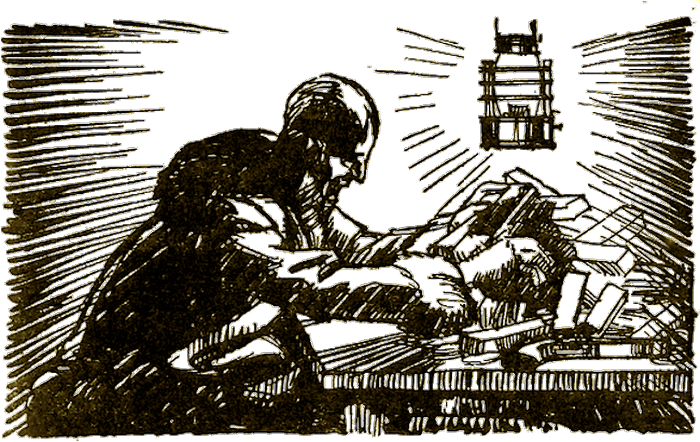
Came a day when Manton refused to leave his cabin. Last knocked to tell him breakfast was ready, but got no answer. Later, he tried again, but Manton was muttering hoarsely to himself. Last had to realize that his companion's mind had given way. That night Last again stole up to the Captain's cabin. The door was ajar and by the light of a lamp he saw Manton seated at the table counting the gold, piling the bars one by one, fondling them as if they were alive. He must have heard Last, for suddenly he sprang up and with a snarl of rage slammed the door in his face and locked it.
After that the unfortunate man refused to leave his cabin. He would neither eat nor speak. But since he did not starve it was clear that he must sometimes have come out at night and found food. What was worse, he managed to get hold of one of two revolvers which they had found in the ship and carried it to his cabin.
Last was forced to realize that his companion had become a dangerous maniac, and he himself was driven to carry the other revolver in his pocket. He kept away from Manton's cabin, hoping against hope that the madness might pass. At night he kept the door of his own cabin locked.
One dreadful night when a furious gale raged overhead and the sound of crashing floes was deafening, a gleam of light roused Last, and looking up he saw his cabin door open. In the opening was framed the face of Manton, shaggy with unshaven beard and moustache, eyes glaring like those of a wild beast. In one hand Manton held a lamp, in the other the pistol which he was levelling at Last's head. Quick as thought Last snatched his own revolver from under the pillow and fired. Manton reeled away and fell with a crash. The bullet had struck him in the forehead and he was dead before he reached the floor.
Imagine the horror of Last! While he could not blame himself for firing the fatal shot, yet it was he who had induced Manton to embark on this terrible treasure quest, so in a way he felt responsible for the Captain's death. He spent a night of misery, and next day set to work to give his shipmate's body the best burial in his power. With infinite labour he hewed a hole in the ice of the big berg, and having sewed up the body in a blanket, laid it there. Over it he read the burial service from a prayer-book found aboard, then covered the grave with piled up lumps of ice. He carved Manton's name and age on a board and fastened this on top of the cairn.
The months that followed were spent in a loneliness so terrible that Last always refused to speak of them, except to say that the marvel was he did not go mad, like Manton. At last the days grew longer and the weather a little better, and he set to work to build a sledge. On to this he carefully lowered the one remaining boat, a small skiff. He took as much food as he could possibly pull, but not even one bar of the gold.
"It had caused the death of a man I loved as a brother," he said later. "I would not touch the damned stuff."
Then he started away from the ship where he had spent nearly eight terrible months. The luck at last turned, the weather was fine and mild, and after a couple of days of terribly hard work he sighted open water, and reaching the edge of the floe got afloat. He had decked in the forepart of his boat with tarred canvas, yet even so she was poorly fitted to encounter heavy seas, and a man with Last's experience knew only too well how slim were his chances.
Yet his luck held. The wind was light, and from the south, and on the second day he sighted the three-master American schooner Spray, commanded by Captain Harmer, and was soon aboard. To pick up a lone voyager in such far southern seas was so amazing an event that every one in the Spray was eager to hear his story, but all Last told them was that he was sole survivor of the schooner Black Dog. He never mentioned the Starry Crown or the treasure, and he had previously taken the precaution of erasing the name Starry Crown from the boat and painting in Black Dog instead.
A few weeks later he was landed at Melbourne, but it was not until long afterwards that he confided his story to a friend in a Queensland port. It is through the kindness of a relation of this friend that the tale of the Starry Crown comes to figure in this book.
IS there anywhere a millionaire who would like to have a real gamble—a man who would risk a few thousands for the sake of a treasure which has been estimated at three hundred millions? If so, he can find his chance within a motor drive of one of the world's capital cities. The city in question is Bogota, and is the capital of the republic of Colombia in the northern part of South America.
Bogota stands no less than nine thousand feet up in the Andes and about two thousand feet higher, in a hollow in the vast mountains, lies a little lake hardly bigger than the Round Pond in Kensington Gardens, yet the most famous sheet of water in the whole South American continent. For this is the Golden Lake, the Holy Place of the Chibcha Indians, the spot to which for centuries on end they brought their treasures and cast them into the gloomy waters.
It all sounds wild and improbable, yet it is true; and if you have the patience to read this chapter you will have proof of its truth.
When the Spaniards, under Pizarro, first reached the Peruvian coast and began to conquer the Empire of the Incas, the great tableland which is now Southern Colombia was inhabited by a race of Indians called Chibchas.
These Chibchas were a nation numbering at least a million, who were by no means uncivilized. They had good roads, remains of which can still be seen; they built suspension bridges over the terrific gorges which seam their mountains, and lived in houses of stone. They made excellent pottery; had, it appears, a regular system of weights and measures, and even a gold currency. They owned fields of natural salt which they traded for gold. It is said that for a pound of salt they demanded a pound of gold dust, and since they had a monopoly of the salt this is possibly true.
The Chibchas were America's best jewellers and known for the beautiful ornaments which they made out of their gold. Some specimens of their skill have been found in their "guacas" or burial mounds. Most of these guacas were plundered centuries ago by the Spaniards and other early adventurers, but a few were overlooked. A nineteenth-century treasure-hunter took jewels worth three thousand six hundred pounds from one mound, another found gold ornaments worth four thousand pounds, a third got eight thousand pounds worth, while a fourth dug up gold to the value of no less than thirteen thousand pounds.
But the Chibchas did not bury all their gold in these mounds, for much of it was sunk in Lake Guatavita. This lake was their sacred place of pilgrimage. They worshipped the Sun under the form of a deity called The Gilded Man, who was supposed to make his home in the bottom of this lake and to whom they made their offerings.
The Chibchas were ruled by a Cacique, a prince who was also High Priest, and this chief was the origin of the legend of El Dorado, that city of gold which lured scores of bold adventurers into the wilderness. Among its many victims was Sir Walter Raleigh, whose last disastrous journey was made in search of this phantom. The meaning of El Dorado is, however, not Golden City, but Gilded Man, and the Chibcha Cacique was the original Gilded Man.
Twice a year the Chibchas gathered around their sacred lake for a great religious festival. The seasons were those of the Spring equinox when the crops were planted, and the Autumn equinox, the latter being a sort of harvest home. Each festival lasted for two days. It began with a great foot race. Guatavita is only one of five lakes held sacred by the Chibchas, and the runners had to visit them all in turn, which meant a journey of more than forty miles, much of it up and down hills so steep they were almost precipices.
The prize was a sacred robe spun out of cotton and beautifully embroidered, and the privilege to eat venison, meat usually reserved for the priests and nobles. The Chibchas were great athletes, and must have put up some wonderful records. What we do know is that they ran until they dropped—and sometimes died. It was thought a great honour to drop dead in one of these races, and any runner who did so was given a splendid funeral and a handsome monument was set up over his remains.
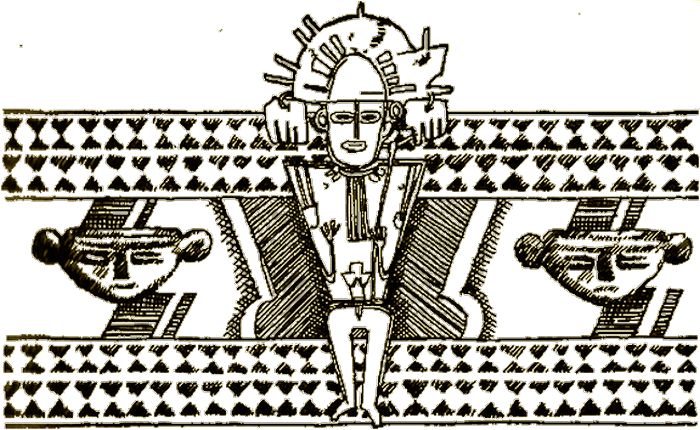
The principal ceremony occurred on the second morning of the festival. At the break of dawn the Cacique came forth from one of the four temples above the lake. Naked, except for an embroidered apron, his body was entirely covered with gold dust, so that he resembled a statue in solid gold. Standing erect on a litter, he was borne by priests down a road leading to the shore of the lake. Three times during the short journey the procession paused while the Cacique offered prayers. The people meantime stood utterly silent.
At a landing-place was moored a sacred barge richly gilded and ornamented. Four brasiers aboard it were charged with scented woods, which were lighted and flung up coils of smoke into the cold, still air. It is never warm at night at these great heights. At the same time other great piles of wood covered with damp bulrushes were lit on the heights around the lake, so that presently the whole air was one fog of smoke.
Down steps cut in the rock the chief stepped and embarked upon the barge. The priests remained behind, and the barge, rowed by eight stalwart oarsmen, was pulled slowly to the centre of the lake. The spot was accurately marked by two cords of silk which crossed in the centre of the lake, the ends being secured to four barges lying at the cardinal points of the compass.
As soon as the principal barge came to rest a signal was given by the priests in the other four barges, and all the thousands who had been eagerly watching turned their backs, for it was looked upon as terrible sacrilege for any one, even the priests themselves, to watch the crowning act of the ceremony. In utter silence, and under canopy of the cloud of smoke, the Cacique dived headlong off the barge into the chill water, and as the splash was heard the silence was shattered by a thunderous roar from the throats of the thousands of Indians. At the same moment one and all, still standing with their backs to the water, cast into it over their shoulders offerings of gold, emeralds, or other precious stones.
The Cacique, all the gold washed off his shining brown body, clambered back into the barge and was wrapped in a great embroidered robe. His next task was to fling a quantity of gold and a pile of emeralds into the lake, after which he was ferried ashore.
Now the spirit believed to dwell at the bottom of the lake was supposed to be appeased, the religious ceremony was over, and the rest of the day was spent in feasting and dancing.
These Indians were not prohibitionists, and supplies of Chicha, a spirit distilled from maize, were plentiful. According to the old Spanish records, Chicha must have resembled the modern American corn whisky, sometimes known as "tangle-foot."
This account of the Chibcha ceremonies is no mere legend. Prescott and other authorities who have looked into the records of the Spanish conquest of Peru are thoroughly convinced of its truth. Besides, as you will read presently, we have other and more solid proof of its truth. All accounts agree that the Chibchas went on flinging their treasures into Lake Guatavita for at least two hundred years, and perhaps for as much as four hundred and fifty years, so that the total amount of gold and jewels sunk in Guatavita must be of almost fabulous value, and may very well amount to the three hundred millions suggested by the traveller Humboldt.
The first Spaniard to hear of the Gilded Man was one of Pizarro's captains named Benalcazar. It was he who captured the city of Quito and was appointed its first governor in the year 1534. Quito held little gold. Either there had never been any great amount there or—as is more likely—the Indians, following their usual custom, had made away with it before the coming of their hated conquerors.
After Benalcazar had ransacked the place without finding what he was after, an Indian named Muqueta told him the story of the Chibcha Indians and their Gilded Man. Benalcazar set off like a stoat on the trail of a rabbit, but went too far north and falling in with some warlike Indians, suffered a severe defeat. Meantime another of Pizarro's captains, Gonzalo de Quesada, got upon the track of the treasure, and with a fairly strong force reached the Chibcha country.
The Chibchas were first-rate fighting men, but unfortunately for themselves were at this time split into two factions under rival caciques, who were known as the Zipa and the Zaque. Quesada saw his chance. He backed the Zipa, helped him to beat the Zaque, then when the Chibchas were exhausted by a series of desperate battles, stepped in and seized the whole country. The unfortunate Zipa hastily threw the whole of his treasure into the lake. It is said to have been as much as fifty men could carry—in all about two tons of gold. The Spaniards caught him and burned him alive, but that did not help them. The gold was sunk in more than two hundred feet of water.
You can imagine Quesada and his mail-clad men stalking around the crater lake, glaring savagely into the black depths where a king's ransom lay hidden. It is said that it was one of the poor tortured Indians who turned on Quesada with the jeering remark:
"If it is gold you want, why do you not drain the lake?" Of course the man did not for a moment believe that this was possible, but the seed took root in Quesada's mind and grew. He, personally, went out—may it have been in the State barge of the Chibchas?—and sounded the depth, finding it to be two hundred and fourteen feet. He then ordered his lieutenant, Fonte, to collect Indians and set them to cut a channel through the surrounding rock. Fonte rounded up hundreds of the wretched Indians and set them to dig, but he was no engineer, and it was not until Quesada's brother, Hernan de Quesada, was sent for that anything was accomplished. Hernan managed to lower the level of the lake by ten feet and got out some quantity of gold—forty pounds weight is the amount mentioned. Then he gave it up as a bad job.
But other Spaniards were buzzing round like wasps after honey, and one of them, named Antonio de Sepulveda, went back to Spain and obtained a concession from King Philip II. to drain the lake. He organized the work, got hold of an engineer to direct it, and cut a huge cleft through the rim rock, by means of which most of the water was drawn off.
Without doubt he recovered a great quantity of gold and stones. One emerald found by him was sold in Madrid for seventy thousand dollars, a huge sum in those days. How much gold he got is not known, but there is a record that King Philip's share was one hundred and seventy thousand dollars.
The depth of the water remaining in the lake was down to something less than twenty feet, when suddenly the sides of the great cut caved in, killing many of the Indians. Probably the sides were too steep and not properly timbered. The water again rose rapidly, and there was an end of Sepulveda's venture.
All through the centuries sporadic attempts have been made to drain the lake. The most serious was in 1823, when an Englishman, Captain Charles Cochrane, joined with a Colombian named Ignacio Paris to reopen the channel originally dug by Sepulveda. The task was too great. Money ran out, and once more the Gilded Man defied his spoilers.
In the year 1897 a Company was formed in Bogota to tackle the problem afresh, but came too soon to the end of its resources; and three years later, in 1900, a fresh Company was formed in England to take over the work. It was called Contractors Ltd., and had an original capital of £30,000.
Since an open cut was obviously out of the question, it was decided to drive a tunnel through the rocky side of the lake so as to strike the lake-bed at a depths of some seventy feet below the surface of the water. The tunnel was to be eleven hundred feet in length, and in order to make the work easier, a vertical shaft was driven in the rocky rim of the lake from which cuts could be made in both directions. The idea was that, when the tunnel was completed, the water could be siphoned out so as to leave the lake-bed completely dry.
The task proved very difficult and very costly. Labour was not easy to find, and the hauling of heavy machinery up to this mountain-top, where there were no roads, made away with a great deal of money. The capital of the Company was exhausted, but another £10,000 pounds was raised and at the end of four years the tunnel was completed and the water began to run out. A sluice was fixed at the outflow with screens to catch the emeralds and larger articles, and riffles of mercury to arrest the gold. Men were also engaged to dig in the lake-bed for treasure.
At once evidence began to pile up of the truth that Guatavita is indeed a treasure lake. A variety of valuable finds were made, one being a breastplate of beaten gold thirteen inches by ten. In the centre is shown the head of one of the caciques beautifully embossed. Massive gold ear-rings, gold pendants, a serpent fashioned in pure gold, gold bowls, drinking-cups, and many other pieces of ornament and jewellery were recovered.
A good many emeralds, too, were discovered, one small lot fetching £350 in the London market. Unfortunately many of the emeralds found were badly flawed, and some, though of extraordinary size, are of very little value. Another interesting find was quantities of beads. They are very beautiful beads and no doubt immensely old, but the problem is who made them or whence they came.
These finds were, of course, most encouraging to the Englishman in charge of the drainage scheme, for they proved beyond doubt the truth of the story of the Gilded Man. All looked forward to the recovery of the main treasure.
So far this has not come about, and the reason are two. In the first place the bottom of the lake is covered with mud, rocks, and sand washed down in the course of centuries from the lofty banks. Much of this has fallen through the years that have passed since the days of the Gilded Man, and the recovery of small articles from this mass of sticky mud is of necessity a slow and tedious task. The second trouble is that in the centre of the lake is a deep cup-shaped hole from which, so far, the water has never yet been drained. The mud, which is of great depth, is always pressing towards this centre, and it is only natural to suppose that the great bulk of the treasure lies hidden in it at the bottom of this cup. Gold, being an extremely heavy metal, sinks in mud, and the most part of what was flung into the lake must be covered with a considerable depth of soil and water.
When the lake was first drained the contractors found themselves at the end of their resources, the shareholders were not willing to put up fresh capital, and, while matters were at a standstill, the Great War broke out, and for the time being all work came to an end. During those years of war the timbering of the tunnel rotted, the roof fell in, and the lake has slowly refilled and now stands at its old level.
Since the War little has been done, yet one of the directors of the original Company recently told the writer that, if a comparatively small sum could be raised, the tunnel could be repaired, a new type of very efficient pump brought out and put to work, and the whole lake-bed laid dry. Then, not only would the original shareholders get back their capital with large interest, but the museums of the world would be enriched with a magnificent collection of ancient Indian jewellery.
The only people who are pleased to see Lake Guatavita brimming as of old are the Indians. Lean brown men, descendants perhaps of the ancient Chibchas, visit the spot and smile.
"It is the work of the Gods," they say. "The Gilded Man still watches his own."
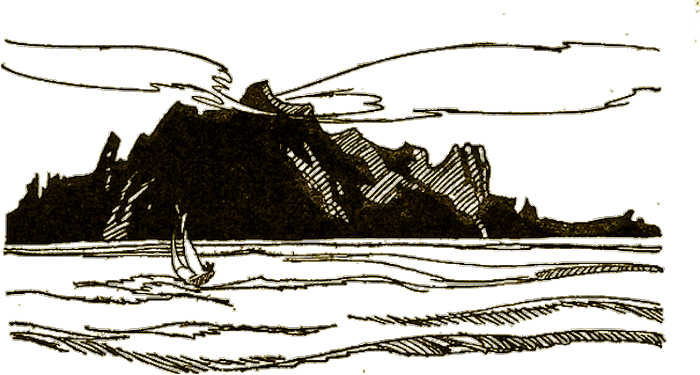
RISING starkly out of an unknown sea, seven hundred miles from the nearest land, Trinidad is perhaps the most savagely repulsive of islands. Certainly no writer of fiction ever visioned anything more fascinatingly terrible than this volcanic mass, most famous of all treasure islands. Read how Captain Knight pictures it in his Cruise of the Alerte:
"The mountains rise sheer from the boiling surf—fantastically shaped of volcanic rock; cloven by frightful ravines; lowering in perpendicular precipices; in places overhanging threateningly and, where the mountains have been shaken to pieces by the fires and earthquakes of volcanic action, huge landslips slope steeply into the yawning ravines—landslips of black and red volcanic debris and loose rocks large as houses, ready on the slightest disturbance to roll down crashing into the abysses below.
"On the summit of the island there floats almost constantly, even on the clearest day, a wreath of dense vapour never still, but rolling and twisting in wild, strange shapes as the wind eddies among the crags. And above this cloud wreath rise mighty pinnacles of coal-black rock, like the spires of some gigantic Gothic cathedral piercing the blue southern sky."
The island was not always so forbidding for, when first seen, it was covered with dense forest from beach to summit and stood out brilliantly green against the blue of the Atlantic. In those days Portuguese from Brazil actually succeeded in settling on it, for traces of stone-built houses have been discovered. They must have had a harbour of some sort, but that, like the green trees and all vegetation, was destroyed when the volcano awoke, like Vesuvius, from age-long sleep. So far as known, no human eye saw the final eruption, for Trinidad is far out of the shipping lanes, but it must have been a tremendous outburst for it changed the whole shape of the island besides destroying the vegetation. The only growth left is a few groves of tree ferns and acacias on some of the higher plateaux and thickets of wild beans in lower gullies.
Now for the reason why Trinidad is classed as the first of treasure islands. In the year 1821 the Peruvian War of Independence was raging. The South American revolt against the Spanish dominion began in Lima, the principal city of Peru, but Lima was the very centre of the Spanish power, and the residence of the Spanish viceroy; so it was in Chile and Buenos Aires that the insurrection began and where independence was first secured. In 1821 a fleet, under that famous Englishman, Lord Cochrane, which had been equipped in Chile, sailed for Lima, and the Spanish Government, panic-stricken, loaded a great store of gold and silver with all the plate from the cathedral into ships, to be taken to Spain for safety. It is certain that the value of this great mass of specie and plate was not less than a million sterling. It was probably five times as much.
Some of this treasure came safe to Spain, but the ship carrying the principal part was captured by a pirate craft under the command of Benito de Soto, and its cargo buried by the pirates on Trinidad. In fact as well as in fiction, pirates do, or rather did, bury their treasure, and this, considering the circumstances, was quite a natural thing to do. Ships were small, risks of wreck or capture were great, banks were not available to these gentry, so they hid their loot in unlikely places, meaning to come back and divide up at some future date.
Benito and his confederates, of course, intended to return for their loot, but on their way north their ship was captured by a Spanish man-of-war; they were taken to Cuba, tried, and most of them suffered that unpleasant form of death known as the garotte. There was one survivor, a Russian Finn.
In 1848—that is, twenty-seven years after the hiding of the treasure—this man was one of four quarter-masters in an East Indiaman which traded to the China Seas. Owing to a great red scar on his face and his somewhat grim appearance, he went by the nickname of "The Pirate," yet certainly none of the crew of the Indiaman had the faintest suspicion that he had ever been one. He was a quiet man, rather better educated and mannered than most of his type in those days.
The Captain of the ship liked him, and when "The Pirate" fell ill of dysentery on a voyage from Hong-Kong to Bombay, looked after him very kindly. In spite of nursing the poor fellow grew steadily worse, and on arrival in Calcutta was so ill that he had to be taken to hospital. The Captain visited him, and one day the quarter-master, who was very weak, told his visitor that he was sure he was not going to get better.
"You have been good to me, sir," he said, "and before I die I wish to reveal to you a secret which will make you a very rich man." He then begged the Captain to close the door of the room in which he lay, and when this was done asked him to go to his chest and take from it a small packet wrapped in tarpaulin. Inside this parcel was a roughly drawn map of the island of Trinidad.
"This is what I wish to give you, sir," said the man. "Here, in the bay called Treasure Bay, under the Sugarloaf Mountain, is buried one of the greatest treasures in the world. You need not doubt the truth of what I say, for I myself helped to bury it." He went on to explain that he had been one of the crew under the pirate de Soto, who had captured the Spanish vessel laden with the treasure of Lima Cathedral. He described the treasure, especially mentioning the great candlesticks of solid gold from the cathedral, the golden shrines, and the wonderful jewels. He stated that he was the only survivor of Benito's band, and therefore the only living man who knew exactly where the treasure was hidden, and gave most careful instructions as to finding it. That night he passed away.
The Captain did not think much of the story which, as he said, was very much like a dozen other similar yarns he had heard. At any rate he did not feel like throwing up the command of a stout ship and risking his whole career and savings in an effort to find what might be a purely imaginary treasure.
Yet he was interested enough to make some inquiries, and by degrees evidence began to mount up in favour of the quarter-master's story. In the first place the Captain found it to be true that a great treasure had been taken out of Lima at the time of the revolution. It was also true that while some of it had reached Spain in safety, the best, the magnificent plate from the cathedral, had disappeared, and the general belief was that this had been seized by pirates.
He got a friend to look up the archives of Cuba and, sure enough, here was the record of a gang of pirates being hanged for plundering a vessel out of Lima.
One objection occurs with regard to this piece of evidence. If the treasure had been buried on Trinidad, how did the Spanish authorities get proof against the pirates? That, however, may be explained by the fact that some small part of the loot was still in their ship.
On his return to England, the Captain told the story to several people, and at last, in the year 1880, persuaded a Newcastle shipping firm to allow one of their vessels, which was trading to Brazil, to visit the island. The Captain's son, a stout young man of twenty-three, went with this ship, a barquentine called John. The John reached Trinidad, but found no harbour of any kind, and the surf broke so furiously on the great black cliffs that landing seemed out of the question.
The boy, however, was so keen that he offered to swim ashore. A boat was lowered and rowed as near the beach as was safe, then the young fellow plunged in. He disappeared in the foaming crests of the great breakers and the boat's crew felt sure he was drowned, but his head bobbed up and they watched him scramble ashore. It was blowing hard—the surf grew worse and after a while the boat was forced to return to the ship, leaving the adventurer ashore.
Early next morning the Captain of the barque went off in a boat and managed to float a line to the beach and so got the youngster off. He was half drowned and quite exhausted. When he recovered a little he told his story. He said he had found the exact spot described by the pirate, but that it was covered by a great mass of earth and rocks fallen from the cliff above. He believed the story to be true and the treasure still there, yet vowed he would not spend another night on the island for all the buried gold. He had barely escaped being eaten alive by huge and ferocious land crabs which came down from the hills in countless swarms, and had spent all the dark hours fighting them off.
That was an end of the first expedition, and it was five years before a second attempt was made to recover the buried gold. Then a barque called the Aurea was chartered by a gentleman living in South Shields. She was a good-sized vessel of six hundred tons and was fitted up with lifeboats, picks and shovels, blasting cartridges, and all sorts of stores.
The island was reached on March 23, 1885, in windy, squally weather, and next morning a life-boat was launched. It was pouring with rain and the wind blew in fierce gusts, causing a dangerous surf to break on the beach. All day long the life-boat fought its way towards the shore, but was quite unable to reach it. The crew were wet to the skin, exhausted with pulling, and in constant danger of being swamped. Darkness fell and the Aurea was out of sight, so the men hoisted a light to the masthead of the boat and luckily for them the ship found and took them aboard.
Next day the weather was much finer, and three boats were launched and towed into South West bay. Though the wind had fallen the surf was still very bad, and close to the shore black reefs showed ugly teeth above the welter of white foam. It was decided that two men should take the dinghy, the smallest boat of the three, and try to make the shore. Since they fully expected to be swamped they took off their clothes, and this was just as well for, as they neared the shore, towering waves rose behind them and drove the bow of the little boat right under, swamping her completely. The two men managed to swim ashore.
Later, their chief and four more men joined the first two, bringing food and tools. They had no sooner landed than the weather took a turn for the worse and the barque was blown away out of sight of the island. The six men had a most unpleasant time. They ran short of food, and were so harried by armies of land-crabs that they got little sleep. Two or more had to keep guard all night, beating off the ravenous creatures with clubs. The killed crabs were promptly eaten by their fellows. It is said that Rider Haggard got his idea of the great crabs which attacked Alan Quatermain from these Trinidad horrors.
During the day they tried to dig, but the heat of the sun reflected from the crags was furnace-like and the enormous mass of the land-slide discouraged them. It was three weeks before the Aurea beat back, and by that time the men, weak and ill, and utterly disheartened, were only too glad to be taken aboard and carried away from this ill-omened spot.
After the Aurea's vain search for the Lima treasure, three separate expeditions were fitted out in America for the purpose of finding it, but in every case it was the same story. First the surf, then the heat and the land-crabs, thirdly the lack of fresh water and of food. All these expeditions were complete failures.
THE most serious attempt to salve the Trinidad treasure was made by Mr. E. F. Knight, an Englishman, well known as yachtsman and war correspondent. Knight was a barrister. He had some money of his own and was keen on the sea. In 1880 he and two friends fitted up the small yacht Falcon and went cruising to South America. At that time Knight had not heard the story of the Lima treasure, and it was purely out of curiosity that he and his companions visited Trinidad, where they managed to land and had various hair-raising adventures, which are described in the Cruise of the Falcon.
It was not until after his return home that Knight heard for the first time of the treasure of Trinidad, and went into the matter pretty thoroughly. He saw the head of the Aurea expedition and studied the ex-pirate's original plan, which made him feel certain that the man had visited the place. The description of the bay was accurate, and it was undoubtedly the spot that would have been chosen as a hiding-place. The directions given for landing were also correct—much more so than those given in the Admiralty Chart. Also there were many small incidents which gave the story the stamp of truth.
In the end Knight made up his mind that the game was worth the candle and that he would make an attempt to recover the treasure.
"I knew, of course," he says in his book The Cruise of the Alerte (Longmans, Green & Co.), "that the chances were greatly against my finding anything. I was quite prepared for complete failure; but I considered there was a sufficient possibility of success to make the venture worth the undertaking."
One advantage he had over the former treasure- seekers was that he had discovered a safe landing-place on the lee side of the island, where a kind of natural breakwater of coral ran some way out into the sea. When you know that the surf on Trinidad is so tremendous that foam has been seen to fly over the top of a cliff two hundred feet high, it is easy to see the advantage of such knowledge to Knight.
Having made up his mind to the attempt, the next thing was to find the money and the men. The money was not difficult to find, for in those days there were plenty of young fellows of good birth ready and willing to take a share in such a venture, but it was not easy to pick a crew. Mr. Knight knew that he must have men strong enough in body and mind to withstand hard work and hardships, yet at the same time those selected must be the sort to obey orders; and since he did not intend to take many paid hands, they must also be good seamen. He had plenty of choice, for as soon as his plans were known about one hundred and fifty men applied to join him.
Out of this number he eventually chose nine. Each was to put up one hundred pounds towards expenses, each was to receive one-twentieth of the value of any treasure recovered, and all bound themselves to obey orders.
The next work was to find a suitable ship, and after a good deal of search Knight picked on the Alerte, a cutter-rigged yacht sixty-four feet long and of fifty-six tons yacht measurement. She was old, having been built in 1864, yet being entirely of teak was still strong and sound. She was broad-beamed, comfortable, had seen service in almost all the oceans of the world, and was quite big enough for a dozen men.
The only objection was that her cutter rig was not suitable. She was over-sparred for such dangerous seas. So Knight had her converted into a yawl. The main boom and gaff were shortened, the area of the mainsail much reduced, and a mizzen-mast was stepped in the counter, carrying a jib-headed sail. This made her more handy altogether.
The next thing was to fit her out, and the chief problem was to find room for all the water they would need to carry—at least six hundred gallons. The fitting-out was done under Knight's own eyes. Besides spades, picks, and crowbars, she carried a drilling apparatus to cut into rocks, a portable forge and anvil, a water-distilling plant to set up on the island, tents, wire fencing to keep off the crabs, surgical instruments, medical stores, fishing tackle, even a few packets of quick-growing seeds. Two boats were also provided, one a light but strong life-boat, double-ended with water-tight compartments, and fitted with sail; the other a small dinghy. Arms were purchased, including repeating rifles and a double-barrelled whaling gun which was lent to Knight by the Duke of Sutherland. For food their mainstay was salted beef and pork and barrels of best biscuit. As they found later, it would have been better to take ordinary ship's biscuit, for this cabin biscuit became infested with weevils. There was also a good supply of jams, tinned vegetables, and tobacco. Certainly no treasure-hunting expedition was ever better or more carefully equipped.
Besides the nine gentleman-adventurers, four paid hands were engaged. The selection made by Knight was good. He had only one "bad egg." This was one of the volunteers who, as Knight says, was afraid himself, and did his best to scare the others. Perhaps, luckily, he deserted the ship at Bahia.
Organizing a treasure-hunting expedition is a very big job, and before all was ready Knight was almost worn out. Then at the last minute a couple of the men who had engaged to go decided that they could not do so, and the leader was forced to find substitutes at short notice. One of the failures was the man who had undertaken to do the photography for the expedition, so the result was that the Alerte had to sail without a camera aboard. This was in 1889, a date at which photography was in its infancy. To-day, films made of such an expedition would go far towards paying the expenses.
As soon as it was known that Knight was starting for Trinidad, letters began to pour in from people all over the world, who professed to know of other treasures much easier to recover than that of Trinidad. One wrote that he knew where ten million in gold bars was concealed, and offered his secret for the modest price of one thousand pounds down. Some of these treasure tales were full of the most gruesome details.
"I had materials," says Knight, "to supply all our writers of boys' stories for years."
While most of these offers were worthless, there was one that seemed genuine. It told of a great hoard of silver hidden on the Salvages, and Knight resolved to look into it.
Early on the morning of November 20, 1889, there was a shout of "Land Ho!" and right ahead a blue peak showed up. But the wind was contrary, the sea very rough, and it was four in the afternoon before the Alerte passed North Point and opened up North-West Bay. From Knight's description his crew expected to find the island a strange, uncanny place, but the reality was beyond anything they had dreamed of.
"An accursed place," one man muttered as he stared at the tremendous cliffs, black as coal, yet streaked here and there with livid streaks of red and yellow, and at the furious surf crashing against their base.
According to the Pirate's map the treasure is hidden in South-West Bay, but from his earlier visit to Trinidad, Knight knew that this bay was a most dangerous anchorage and that landing there was most difficult. Knight's map shows the spot where the Alerte was actually anchored, and where she remained during the whole of the party's stay on the island.
Opposite the landing-place a waterfall comes foaming down from the heights, and since the stream never runs dry, the crew had always plenty of water. A few yards to the left of the spot where the cascade drops into the sea a rocky ledge runs out, forming a natural pier. This is the only spot on the whole island where it is possible to land safely. That is to say, if the surf be not too high you can bring a boat up near to the end, balance it. on a wave, and make a wild jump which may land you on a rough, black crag or very possibly drop you into deep water.
That night a council was held aboard the Alerte, and it was decided that Knight and the doctor should go ashore and try to find a way across the mountains to South-West Bay. The pair were landed safely and started up the gully, which was so steep it was like climbing a giant staircase. The worst of Trinidad is that the rock is all loose and rotten, so that at any moment you may start a landslide. As the doctor clambered ahead of Knight, a great mass of rock came adrift and Knight ducked just in time to dodge it.
The upper slopes were covered with the trunks of dead trees, and everywhere they found sea birds and land crabs. There were men-of-war birds, gannets, boobies, cormorants, all of which were so unaccustomed to man that they treated him, as Knight says, "with shocking want of due respect." The gannets attacked him and the doctor, and a gannet is a big, heavy bird with long wings and a powerful beak. When you are clambering up a cliff face so steep that you have to cling with hands as well as feet, a gannet is a dangerous enemy.
The land crabs were very large, and as fearless as the birds. "They have," says Knight, "hard shells of a bright saffron colour, and faces with a most cynical and diabolical expression. They stand on their hind legs and wave their pincers threateningly, while they roll their hideous, goggle eyes in a dreadful manner."
There were once goats and hogs on the island, left there in 1700 by Dr. Hailey, who was afterwards Astronomer Royal. In 1803 Amaso Delano, who visited the island, found plenty of goats and hogs and some wild cats. There are none now. Knight suggests that the land crabs have gobbled them up, but more likely the eruption destroyed them.
Knight had previously crossed the island and thought he knew the way, but soon had to tell the doctor that he was lost. Later, he discovered that a great gully along which he had travelled, when he landed from the Falcon, had been completely filled by an immense landslide. A whole mountain had fallen.
One of the many difficulties was the scarcity of fresh water in the interior. On his first visit, Knight and his companions nearly died of thirst. Trinidad lies in a rain-belt, but the porous soil swallows up water like a sponge. Luckily, when they at last reached South-West Bay they found a spring, the water from which ran a few yards before sinking into the ground.
It was dark when at last they gained a stretch of sandy beach, where they lit a fire of driftwood and settled down under a big rock to spend the night. You might suppose that a fire would have scared off the crabs, but not a bit of it. The horrid brutes crowded round and prepared to eat the treasure-seekers alive. There was only one thing to do. With a couple of heavy clubs Knight and the doctor took the war into the enemy's camp and slew scores of them. After that they had peace, while the survivors devoured the dead. All around was a sharp crackling sound as the live crabs pulled apart the shells of the dead ones.
Next morning the two were up early. It was a fine day, but immense rollers smashed upon the shore and no boat could possibly have landed. From a lofty ledge to which they climbed they surveyed the bay. The first thing they saw was a channel cutting the reef at the east end of the bay. This was exactly as the Pirate had described it. They then climbed down to look for the gully in which the treasure was said to have been hidden.
According to the Pirate, the gully was in the middle of the bay and marked by three small cairns. Both the previous expeditions had found these cairns, but the Aurea people, for some reason of their own, had blown them up. Knight, however, soon found traces of one of them, and he and the doctor walked up the ravine. There was the great landslide of red earth blocking the mouth of Benito's Cave; there was a trench, the remains of a wheel-barrow and of a broken water-jar.
"This is the right spot," said the doctor. "What do you think of it, Knight?"
"It is the right ravine," Knight answered thoughtfully, "but I'm not by any means sure which is the right spot. The Pirate talked of the bend in the ravine and Mr. A. of the landslide. There are several bends and more than one landslide."
They searched the place up and down; the heat was fearful and the sand reflected the sun's blaze, so that they were forced to lie down, clothes and all, in pools of salt water to cool their burning bodies. Hot as it was in the day, the nights were cool, and with a strong breeze off the sea they were very glad of a fire which they kept alight all night.
The journey back gave one pleasant surprise, for they came upon a tiny valley where a cool stream trickled through a little jungle of fern and grass. It was the strangest and prettiest contrast to the barren black rock surrounding it.
When the two arrived opposite the anchorage, these cairns, but the Aurea people, for some reason of their own, had blown them up. Knight, however, soon found traces of one of them, and he and the doctor walked up the ravine. There was the great landslide of red earth blocking the mouth of Benito's Cave; there was a trench, the remains of a wheel-barrow and of a broken water-jar.
"This is the right spot," said the doctor. "What do you think of it, Knight?"
"It is the right ravine," Knight answered thoughtfully, "but I'm not by any means sure which is the right spot. The Pirate talked of the bend in the ravine and Mr. A. of the landslide. There are several bends and more than one land slide.
They searched the place up and down; the heat was fearful and the sand reflected the sun's blaze, so that they were forced to lie down, clothes and all, in pools of salt water to cool their burning bodies. Hot as it was in the day, the nights were cool, and with a strong breeze off the sea they were very glad of a fire which they kept alight all night.
The journey back gave one pleasant surprise, for they came upon a tiny valley where a cool stream trickled through a little jungle of fern and grass. It was the strangest and prettiest contrast to the barren black rock surrounding it.
When the two arrived opposite the anchorage, they had been away four days. Imagine their feelings when they saw the Alerte two miles off shore beating out to sea.
"Idiots!" groaned Knight. "They've got scared about us and are sailing round to look for us."
"And we've finished our grub and got no place to sleep," added the doctor mournfully.
"I'll get them back," cried Knight as his eyes fell on a patch of dry grass near by. Whipping out s match-box, he set fire to it and up rose a great column of smoke which must have been visible for miles. The Alerte's people saw it and soon put about, but the fire spread, the wind fanned the flames, dead trees began to burn, and after darkness fell the sight was splendid but rather terrible. The whole side of the island blazed.
Safe aboard, Knight gave his orders, and after a short delay caused by bad weather, the whaleboat was launched and loaded, and a working party taken to South-West Bay. Great rollers were thundering on the beach, but the crew were too keen to trouble about risks. Pulling desperately through the first two lines of breakers, they drove the boat to the top of the next and were rushed furiously towards the beach. As the boat touched the sand the next wave broke clean over her, but the men leaped out, seized her, and somehow dragged her up the beach.
Stores and tools were landed, and the men were shown the spot where the treasure was believed to be hidden. Then, with great difficulty and danger, the boat was launched again and Knight and three others took her back to the ship.
The weather grew worse again; it was dangerous to remain at anchor, and it was decided to put to sea and cruise up and down until the wind changed. Whenever it was possible the boat went back to the bay to take supplies and get news. A huge trench was driven into the landslide. It was desperately hard work for the ground was full of large, loose stones which had to be levered out one by one. The heat was so great that it was impossible to work between twelve and half-past three. The men took a whole holiday on Sunday and a half-holiday on Wednesday.
Turtle were plentiful and very good. They almost lived on turtle flesh and eggs, and on fish. Some of the turtle weighed as much as seven hundred pounds. In the pools of the beach were sea snakes, grey and yellow in colour, and savage in disposition.
Day by day the trench yawned deeper in the great mass of the landslide. Queer finds were made—splinters of wood, pieces of bone. The strangest was a quantity of old and good Chinese pottery; but this was not discovered in the cut, it was lying on the surface in a neighbouring gully. Where it came from, how it got there, remains a mystery.
A few days before Christmas, a man working in the trench shouted that the ground beneath sounded hollow. Digging furiously they came upon an opening and thrust down a crowbar, but without reaching any bottom. Every one was wildly excited, but when at last they did open up a small cave it was found to be empty.
The shock was an ugly one, yet the men, one and all, declared that they would carry on. Carry on they did until provisions ran short, and the Alerte had to voyage six hundred and eighty miles to the nearest Brazilian port for fresh stores. While the Alerte was away, explorers from the digging party discovered the old Portuguese settlement already mentioned. Huts built in terraces one above another lined the hillside.
When Knight got back to the island after five weeks' absence, he found that his plucky workers had cut quite through the big landslide. But they had found no treasure. The season of storms was beginning when the dreaded Pampero rages across the Atlantic. The weather was getting worse every day. Each hour's delay increased the danger, and quite plainly the only thing to do was to get all aboard and sail away. Then the yacht started for the other Trinidad, the big British Island two thousand miles to the northward.
Yet, although this expedition was a failure, to the end of his life Knight was convinced that the Pirate's story was true, and that the treasure of Lima had been actually hidden on Trinidad. Whether it had already been removed or whether it still lies buried under some other landslip will probably never be known.
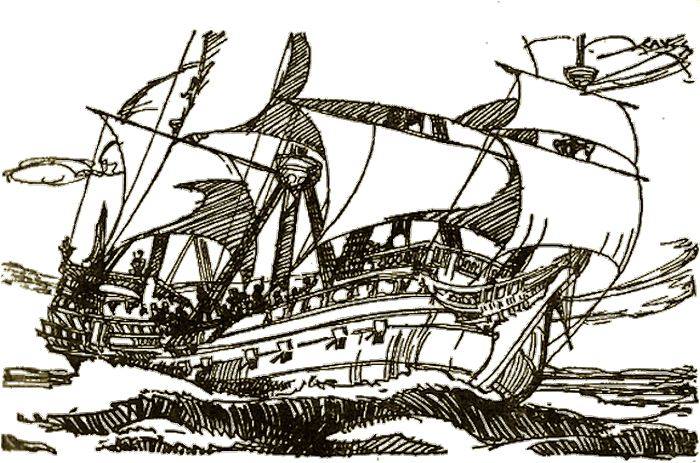
BY far the greater number of treasure stories deal with the New World. The old civilizations of Central and South America were the sources from which the Spanish conquerors drew their great stores of gold and precious stones, and it was their hoards which attracted the swarms of pirates and buccaneers who for centuries infested the Western Seas and preyed upon the great galleons and merchantmen. But here is a pirate story, the scene of which is laid in a very different part of the world, the great island of Madagascar which, even to-day, is perhaps less known than any other island of anything like equal size.
Rather more than three hundred years ago, a young Frenchman named Misson joined the French Navy as a cadet. His first ship was the Victoire, a man-of-war of about five hundred tons, commanded by Captain Fourbin. Young Misson was of good family and had been well educated; but the family was a large one, his father's estates were small, and it was necessary for him to cut out his own career.
The boy became keen on his profession, and learned navigation and seamanship so thoroughly that by the time he was twenty he was mate. In those days when ships' lives were far longer than now, a man might stay with one vessel for years, and when Misson was twenty-five we find him still in the Victoire, acting as first-lieutenant, Captain Fourbin being still in command. Misson's chief friend was another officer named Caraccioli, a tall, dark, sombre soldier of fortune. War broke out and the Victoiree, cruising off Martinique, fell in with an English frigate, the Winchelsea. Then began one of those sea duels which were so frequent a feature of the times.
For four hours the two ships battered one another ceaselessly, until a shot from the Frenchman reached the magazine of the English ship, and she blew up and sank. The sea was rough and no survivors were rescued. In the course of the fight Captain Fourbin had been killed, and Misson was left in command. His first duties were to bury the dead and attend to the wounded; then the carpenters were set to work to plug the shot holes and the ship's prow turned for home. That evening Caraccioli came to Misson's cabin and the two sat smoking and talking.
"So we sail back to France," said Caraccioli.
"But naturally," replied Misson.
"And what do we receive for our victory?" asked the other. Misson shrugged his shoulders.
"The thanks of our Government, and perhaps another ship."
"Exactly. It is but poor pay for all we have been through."
Misson leaned forward.
"What do you mean, my friend?"
Caraccioli fixed his dark eyes on Misson's face.
"I will tell you. I am tired of all this—of hard lighting for small pay. I wish to make a fortune. You, too, I know have the same ambition." He paused. Misson remained silent and the other continued. "We have a ship, we have guns and ammunition. Why, then, should we not use these things for our own purpose?"
"In other words, become pirates?" said Misson quietly.
"Precisely." Misson considered.
"The plan has certain advantages, but would the men join us ?" he said.
"Ask them," Caraccioli answered briefly. Misson agreed, and next day Caraccioli sounded the men. They were not only willing but anxious. By the vote of all, Misson was appointed Captain, and Caraccioli his first officer. Misson then drew up a document which every man signed. All plunder was to be divided equally, but prisoners were not to be killed. They were to be put ashore at the first opportunity. So the black flag was hoisted and the Victoire became a pirate ship.
Her first prize was a small English ship, but since the cargo was worth little, all Misson took was a few puncheons of rum. The English crew, who fully expected to be forced to walk the plank, nearly died of amazement when the pirate Captain thanked them and let them go. Off Cartagena, Misson encountered two large Dutch vessels, both well armed. They put up a hard fight, but after a battle lasting half a day, the larger of the two was sunk and the other surrendered. The pirates found her hold full of a very valuable cargo, chiefly silk stuffs, brocade, and broad cloth. Fourteen of the Dutch crew joined the pirates, the rest were put ashore, and Misson, hoisting the French flag, sailed boldly into Cartagena and, posing as the Captain of a French man-of-war, went to call on the Governor. Armed with an introduction from the Governor, he proceeded to sell his prize to a merchant of the town, the price agreed being fifty-three thousand dollars,
Leaving Cartagena, Misson overhauled a Spaniard and took her without trouble thereby adding fourteen thousand dollars to his booty as well as a valuable cargo of rum, sugar, and the like. Again some of the crew joined the pirates, and the rest were allowed to go free.
The Victoire hung about south of Cuba waiting for a large merchantman, the St. Joseph, of whose sailing they had news, but saw nothing of her. Later, they learned that she had been taken by the ruffianly Rackham whose story is told in another chapter. Word reached Misson that warships were looking for him, so he turned east and sailed for the coast of Africa. Luck still followed this gentlemanly pirate, for he fell in with a big Dutch East Indiaman on her way home around the Cape. She was the Niewstadt, and aboard her he found valuable cargo, including what he was specially in need of—a quantity of powder and shot. He turned south, and sailing down the African coast encountered a second Dutch Indiaman full of silk, wines, and other very valuable cargo. A number of her crew joined him as volunteers, but, as was Misson's invariable custom, those who refused were allowed to go free. Crossing the Equator, the Victoire made steadily southwards until, reaching the latitude of Table Bay, she met a large vessel which proved to be British. This ship carried a crew of one hundred men and a good number of guns, and put up a very powerful resistance. But Misson's metal was the heavier, and at last the British ship, with more than half her crew down, was forced to strike.
Aboard her was the greatest booty which Misson had yet taken, a matter of £70,000 in minted money as well as a great deal of cargo. The ship herself being new and very well built, Misson decided to keep her and use her as a consort, so put Caraccioli in command of her. Since some of her crew were ready to join him, he was able to man her properly. The two ships in company sailed on, and rounding the Cape made northwards. In the Mozambique Channel they met a large Portuguese vessel which resisted them valiantly for nearly a whole day. When at last they boarded her, they found she was carrying nearly a quarter of a million in gold and silver.
With more than half a million in coin and bullion aboard his ships, Misson wisely decided that it was time to establish a headquarters where the treasure might be safely landed, and where his ships might be careened and cleaned. With this idea in his head, he cruised slowly up the west coast of Madagascar and at last found what he was looking for. It was a small land-locked bay which, if you will look at a map, you will see lies very near the northern point of the great island. It is now called Diego Suarez Bay, but Misson's name for it was Libertia.
Here Misson built huts for his men and two forts which he armed with guns taken from his various prizes. He even cleared some land and made his men plant maize and vegetables. This was perhaps the first time on record that pirates turned gardeners, but from all the records of Misson he was certainly the most domesticated, and perhaps the gentlest, of his breed. Yet withal no weakling, for there was never any mutiny in his ship, and his men adored him.
Three months were spent ashore; then, as the itch for adventure grew again, the Victoire was re-commissioned and sailed out of Libertia in search of fresh loot. At sea Misson met a small ship, a sloop which was flying the Black Flag. She signalled him, and her skipper came aboard. He proved to be Captain Tew, a name not unknown in the Black Flag annals, and the two joined forces and cruising together took a number of valuable prizes. Misson insisted upon Tew's observance of his usual custom, that of releasing all prisoners who would not join the pirates, but Tew, who belonged to the old school, remonstrated, and said that one day Misson would be sorry for such ill- judged mercy.
"Dead men tell no tales," he added dryly.
If this story were fiction, Misson would, of course, have been saved—perhaps reformed by one of the prisoners whom he had spared, but the cold and cruel fact is that Tew was right. Early one morning, as the old Victoire was refitting at Libertia, a squadron of men-of-war came up over the horizon. There were five of them, Portuguese, and in those seventeenth-century days the Portuguese were still good seamen and strenuous fighters. They drove straight for the mouth of the bay, but Misson had had time to prepare, and they were received with such a thundering fire from his two forts that the two leading ships were sunk and the rest thought it wise to beat back to sea.
Among the few survivors who managed to swim ashore Misson recognized two men as members of the crew of a ship which he had looted about a year earlier, and had released under their oath that they would never tell any one the position of his headquarters. Now the cat was out of the bag, and it was perfectly clear that Libertia would have to be abandoned. Next time the enemy would appear in overwhelming force.
Misson took it all very calmly and at once dispatched Caraccioli and Tew to search for another and more secure hiding-place. For many days Tew sailed slowly southward, entering many little bays, yet finding none exactly suitable; then at last he dropped anchor in a lonely cove which looked as if it might be what he sought, put over a boat, and rowed ashore.
The day was intensely hot, the air breathlessly calm, and the blue sky shrouded by a faint haze. Tew and his men were ashore, searching for a spring, when of a sudden there broke on their ears a roar louder than thunder. They ran for the beach, but before they could reach it such a blast of wind struck them as flung them all to the ground. Great trees torn from their roots were flung inland like twigs, the tops of the waves, cut off by the fury of the wind, beat upon them like hail.
Clinging to the ground they saw their ship drag her anchor and, themselves unable to help in any way, watched her carried upon a reef, where she was pounded to pieces in a few minutes. Only about a dozen of her crew reached the shore, alive. From the remains of the ship swept on to the beach they built a hut, and for three months eked out a bare existence. Then one morning there was a shout of "Sail oh!" and two small vessels were seen heading southwards. Tew quickly piled up dead wood and lit a great bonfire. The leading ship put about, ran into the bay, and dropped a boat. As the boat pulled in, Tew gave a shout, for the man at the tiller was Misson. Misson's face was grave, and he looked years older than when Tew had last seen him.
"I have no good tidings for you, comrade," were his first words. "Caraccioli is dead and Libertia a heap of ashes." His story was, in truth, a sad record. The same cyclonic storm which had wrecked Tew's ship had caught Caraccioli's further south and had driven her ashore. Caraccioli himself, with about twenty men, had been the only survivors out of a crew of one hundred and sixty. In two open boats they had worked north, and at last, more dead than alive, reached Libertia. That night, while Caraccioli and Misson were discussing what best to do, hideous yells rang out, and a horde of savages from the interior burst upon the camp.
Expecting attack only from the sea, the pirates were caught unawares and swamped by the hundreds of tribesmen. Caraccioli was speared in the first rush and Misson, realizing that all was lost, rallied a few of his men and fought his way down to the beach where they managed to embark in the two sloops which were anchored at a short distance from the shore. As they sailed away they saw great flames leaping up into the night. Their huts were blazing above the burial-place of very nearly five million pounds worth of treasure.
Realizing that it was idle to cry over spilt milk, the two pirate chiefs at once set to discussing how they might best repair their fallen fortunes. It was decided that each should take one of the sloops, dividing their men among them, and sail back to America. But fate had not yet done her worst. As the two vessels neared the African coast they were caught in another furious gale. Misson's ship was dismasted, she broached to, and foundered with all hands. Tew, with his own sails blown to ribands, and his ship almost waterlogged, was unable to do anything to help. So ended the life of a pirate who, whatever his faults, was certainly more of a Robin Hood than any other whose story has come down to us.
And the reason why his story is known is that his log was aboard Tew's ship, and that Tew came safe to America and escaped the penalty of his crimes.
As for the treasure, there is little doubt but that it lies buried somewhere within a few hundred yards of the shore of Diego Suarez Bay. There is no record that any one has ever found it—none, indeed, that it has ever been searched for. And of all the pirate treasures of which records exist it is probably the richest.
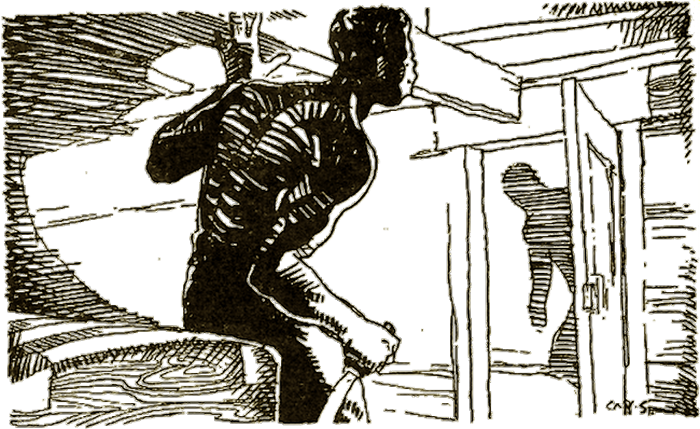
FROM Martinique the English brig Woolpack, commanded by Captain Best, sailed to Guadeloupe and tied up at the wharf at Point à Pitre to load rum for Bristol. The Woolpack was a stout vessel of about two hundred and fifty tons, and as was customary in those days—the date was 1758—carried a couple of guns to protect herself against pirates.
While the loading was going on a man came aboard and asked to see the skipper. He wanted passage for himself and his servant to England.
There was no difficulty about that. The custom of the time was that the skipper of a trading vessel carried a few passengers if he had room for them, and that the fare they paid was his own perquisite. It was, however, a different question when this man, who gave his name as Joseph Broisel, wished to bargain that no other passenger should be taken. In the end Captain Best agreed, yet without doubt Broisel had to pay a round sum for the promise.
The Woolpack was due to sail next morning, and late that night Broisel and his servant came aboard. Broisel was a French Jew, short, rather stout, with an olive skin and hooked nose, but his servant was a giant negro well over six feet in height, and built in proportion. A simple-looking fellow, who spoke Spanish and had a few words of English. He carried his master's luggage, a trunk and a small wooden chest bound with iron which seemed heavy. These were taken straight down to the cabin and the negro, whom Broisel called Pablo, remained in charge.
Sails were hoisted and the Woolpack made westward round Chateau Point, then turned northwards. The breeze was stiff and the sea rough. Broisel retired to his cabin and stayed there. It was noticed by the crew that Pablo remained constantly on guard.
That night, when off Barbuda, the Woolpack was hailed by a fishing vessel and lay to while the smaller craft came alongside. The latter had aboard an English sailor who wanted to get home to England and was willing to work his passage. Since Best was somewhat short-handed he said he would take the man, who at once came aboard. He gave his name as Oxley, and told the Captain that he was one of two survivors from the wreck of the English ketch Kennet.
His story might have been true or it might not. Oxley was a likely looking fellow and evidently knew his job. He took his place among the crew, and Best would probably never have given a second thought to the matter had he not happened to notice a queer incident.
The following morning was fine and Broisel, looking rather white about the gills, came on deck. As he stepped up out of the companion he met Oxley. Oxley passed on, but Broisel staggered back as if he had seen a ghost. A little later Broisel came to the Captain.
"You gave me your word you would take no other passengers," he said angrily.
"And I have kept my word," was the answer.
"Then who is that man who was not on the ship when we left Guadeloupe?" Captain Best explained how Oxley came to be aboard, and demanded of Broisel whether he knew anything against the man. But all that Broisel would say was that he was bad and dangerous. He gave no reason and Best, becoming impatient, cut short the interview.
After that Broisel never left his cabin except when it was Oxley's watch below, and whenever he was away from it Pablo remained on guard.
The voyage was uneventful, and four weeks later the English coast was sighted. Next evening, while the Woolpack lay anchored off Avonmouth waiting for the tide to get up to Bristol, Broisel came to Captain Best and asked him to put him and Pablo ashore in a boat. No doubt he had to pay pretty heavily for the favour, but at any rate Best consented and the two passengers, with their luggage and the chest, were set ashore.
Broisel was well provided with money. He hired horses and he and Pablo rode to Bristol, where they procured a post-chaise and made for London. Broisel appears to have travelled with all possible speed, and to have reached London on the third day after leaving Bristol. Arrived in London he took lodgings and, leaving Pablo in charge of the chest, went down to the docks to inquire for a passage to Holland. He found a ship called the Pelican bound for Amsterdam, and sailed in her.
The weather proved unkind. The wind changed to due east, and the Pelican was hung up for nearly a fortnight in Thames mouth. Broisel was desperately impatient. All day he would walk up and down the decks watching the sky and muttering to himself. He hardly ate, and grew thin and haggard.
When at last the wind changed and the Pelican was able to get up anchor and set sail, her troubles were not over, for a gale blew from the north and she had to beat endlessly up the North Sea. It was not until the twenty-fourth day after leaving London that Broisel arrived in Amsterdam.
There are gaps in this story. It was told originally by Broisel's servant, Pablo Ruiz, and since Pablo spoke only Spanish and a very little English, much that went on was beyond his understanding. What he says is that a man visited Broisel in his lodging at Amsterdam the very night after their arrival; that Broisel and the visitor had a long talk, and that when the latter left, Broisel was so badly frightened that early next morning he hurried away and travelled southwards as fast as he could go.
Judging from the state of politics at the time, it seems likely that the visitor may have accused Broisel of being a spy and threatened to denounce him as such; or he may have been in league with the party of whom Oxley was a member, and who were after the treasure in the wooden chest. A third possibility is that the man was simply a blackmailer who had somehow heard of the treasure-chest and was demanding a share in exchange for his silence.
At any rate Broisel bolted, and travelling partly by road, partly by canal, arrived at Ghent. Here he stopped and again took lodgings, but he was still uneasy. All day he remained hidden, then after nightfall ordered Pablo to take the box and follow him.
Making their way cautiously through the narrow streets, the pair reached the old monastery of St. Bavon. This must not be confused with the Church of St. Bavon, still the cathedral of Ghent, with its famous belfry. The monastery was outside the town and in a ruinous condition.
It is clear that Broisel knew Ghent, for he found his way to the monastery without making any inquiries. Arrived there, he stationed Pablo on guard in a doorway, then took the box from him and carried it inside. Pablo was curious, and creeping silently forward saw Broisel hiding the box in a hole in the ruined wall; then after pushing it well back he filled in the opening with loose stones.
When Broisel came back he found Pablo at his post and asked him if he had seen any one. He seemed much relieved to hear that all had been quiet, and made him swear secrecy before leading the way back to their lodgings.
The wisdom of Broisel in hiding the box was proved when next morning two police officials arrived and arrested him. He was taken to the Town Hall and sentenced to be deported. This latter fact we have from official records.
As for the wretched Pablo, he found himself stranded in Ghent, without a penny in his pocket; and since there was no one who understood his language, no apparent chance of getting work. Turned out of the lodgings, Pablo wandered unhappily about the streets, stared at by people and jeered at by the children. He slept that night in an outhouse, and by next day was terribly hungry and almost desperate.
Wandering hopelessly beside the harbour, he saw two men outside a warehouse trying to lift a heavy barrel into a waggon. It was too much for them and one of them, seeing the giant negro, beckoned to him and by signs asked him to help.
Pablo pushed them aside, grasped the barrel, and single-handed swung it into the waggon. The men thanked him, but Pablo stood pointing to his mouth and making signs that he was hungry.
At that moment there happened to pass a merchant named Van Hamel. He understood what the negro wanted, if the carters did not, and stopped to make inquiries. Van Hamel had been in the West Indies and had picked up a smattering of Spanish, enough at any rate to enable him to talk to the big negro. And the unlucky Pablo, overjoyed to hear his own tongue, poured out the story of how he had been deserted. The only thing he did not mention was the treasure-box. Remembering his promise to Broisel, he said nothing of this.
Van Hamel, a kindly soul, was indignant at the heartless treatment of Pablo, and declared that Broisel should have made some arrangement for sending the negro home.
"Indeed, I will make it my business to see that he pays for your passage," he ended. "Meantime, I will find you some work."
He took the man to his own place of business, fed him, and put him to work as a porter, then went to the Town Hall to find out what had become of Broisel. He heard that he had been sent back to Amsterdam to be placed on a ship bound for Hull. He then sat down and wrote to a correspondent in Hull, asking him to do his best to trace Broisel and to get from him money to send Pablo back to Guadeloupe.
Pablo meantime worked in Van Hamel's warehouse, where his great strength made him useful. He became devoted to his new master, but that strain of loyalty which is so usual in the negro race still forbade him to mention the treasure-box. Though Pablo had never seen its contents he knew very well they must be extremely valuable.
Some weeks passed before Van Hamel had a reply to his letter to Hull. When he did get the answer the news contained in the letter was startling. The writer had succeeded in tracing Broisel, whom he found in an hospital, dying. Broisel had been brought ashore from the ship, badly hurt. He had been beaten in a terrible way, and several of his ribs were broken. He was dying, so the letter ran, from fever—probably pneumonia caused by his injuries—and was beyond speech when found. The ship in which he had arrived had sailed again, and no one had been arrested.
So much for the letter. The mystery of Broisel's injuries was never solved. In fact, it does not appear that any attempt was made to solve it, yet it seems more than likely that Oxley or some confederate of his followed Broisel to Amsterdam, waited for him there, and went aboard the same ship either as seaman or passenger.
The idea, of course, would have been to force from him the secret of where he had hidden the treasure. What horrors occurred down in the hold or fo'c'sle on some dark night remains a black secret.
That this is something more than mere guesswork may be gathered from Pablo's story. Pablo, feeling that Broisel's death released him from his promise of secrecy, told Van Hamel all he knew. He said that Broisel had arrived in Guadaloupe in a ship from Brazil, and had brought the treasure-chest with him,
Now 1758 was the date of the expulsion of the Jesuits from Brazil and of various risings against Spain. Fishing in such troubled waters was a pleasant occupation for various adventurers, and it may well be that the cunning little French Jew had been entrusted with some of the spoil and had bolted with it, leaving his confederates in the lurch. At any rate, so Pablo assured his new master, Broisel seemed to live in a state of terror.
Pablo told Van Hamel where the chest had been hidden, and the next thing was to recover it. So on the first dark night he and Van Hamel, together with a trusted servant of the latter, went to the Abbey ruins and into the inner yard where Pablo had seen Broisel conceal the chest. The first thing they found was a large hole in the wall, and Van Hamel, of course, made up his mind that the rest of the gang had been there before him and secured the chest.
But Pablo said no—that this was not the place where he had seen Broisel hide the stuff. At first he seemed a little uncertain, but after a time hit upon the spot and began pulling out the loose stones. And—here is where this account differs from most other buried treasure stories—there was the chest.
Van Hamel took it back to his own house before attempting to open it, and then, with cold chisel and hammer, the lid was forced off.
Pablo was sadly disappointed, for at first sight the contents of the box appeared to be a large number of small, dull pebbles, but Van Hamel who, like most Dutch merchants, had some knowledge of gems, assured him that they were uncut emeralds and diamonds worth a very large sum.
Van Hamel, who was a man of substance, called in the burgomaster and the find was divided according to the city ordinances, a part to the city, a part to the poor, and a part to Van Hamel himself.
The faithful Pablo was not forgotten, and received a sum sufficient to make him rich for life. Then, since the fogs of Flanders did not agree with him, he was sent back to his own island where he settled down happily among his own people.
Of Oxley's fate nothing is known. He remains a figure of mystery. Nor has the source of the treasure of St. Bavon ever been discovered. Yet it is pleasant to know that one buried treasure, even if it caused the death of a thief, gave happiness to a number of others.
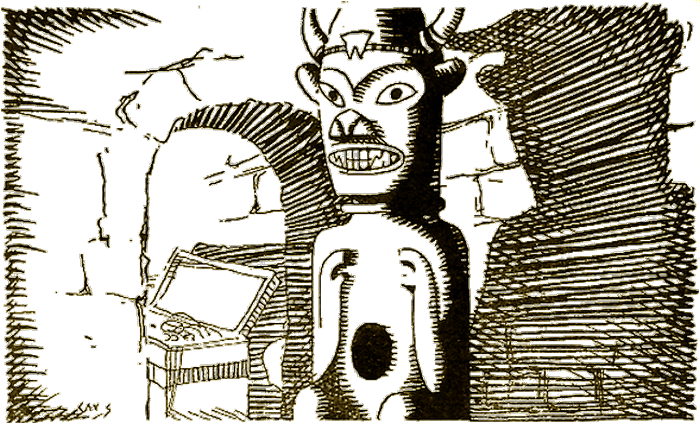
"THE riches that belong to God, our Master, are not for man. A dolorous death awaits him who enters here." These words were inscribed on a parchment found in a casket of black and ancient wood, which was dug from a tunnel near the deserted Jesuit settlement on the Sacambaya River in Bolivia. Here, it is said, lies a treasure amounting to twelve million pounds buried before 1778, the year in which the Jesuits were driven out of Bolivia.
It is definitely known that these Jesuits worked rich mines, and it seems equally certain that huge quantities of the gold they won were not accounted for. It is also an historical fact that seven of the eight Jesuits who lived in the old monastery on the Sacambaya River were hanged by order of the Pope, and that the eighth, Father San Roman, remained in Bolivia and died there.
The story of the search for this treasure begins early in the present century, when an Englishman, Mr. Cecil Prodgers, was engaged by the Challana and Tongo Rubber Company to find out for them the conditions under which the Challana Indians would tap rubber. That was in 1903. The risk was considerable, for it was nearly fifty years since any white man had visited Paroma, the Indian capital, and every one declared that these Challana Indians would kill any one who invaded their territory.
Mr. Prodgers took that risk. He made the long and difficult journey to Paroma; he met three hundred sullen Indians in their Court House; he talked to them in choice Castilian for two hours on end; by sheer honesty of purpose he convinced them, and having done so, marched quietly back. The pedometer he carried registered the fact that he had ridden and walked eight hundred and fifty-seven miles, and he says he enjoyed the journey throughout.
On his way back he stopped for a week at a place called Jura, where there arc some very wonderful medicinal springs, and at the inn there met a stately lady named Doña Corina San Roman, daughter of a former President of Peru. It was from her that he first heard of the Caballo Cunco treasure. In her possession was the original document left, or dictated, by the surviving Jesuit, Father San Roman, to his brother the Prefect of Callao, and handed down to her by her father, grandson of the Prefect.
This document is not in the least like the usual chart guiding treasure-seekers. There is no map or chart, and no direction of any sort as to how to find the place. It is, however, so curious and interesting that it is given here in full*:
"If you find a steep hill all covered with dense forest, the top of which is flat, with long grass growing, from where you can see the River Sacambaya on three sides, you will discover on the top of it, in the middle of the long grass, a large stone shaped like an egg, so big that it took five hundred Indians to place it there. If you dig down underneath this stone for five yards, you will find the roof of a large cave, which it took five hundred men two and a half years to hollow out. The roof is seventy yards long, and there are two compartments and a long, narrow passage leading from the room on the east side to the main entrance two hundred yards away. On reaching the door, you must exercise great care in opening. The door is a large iron one, and inside to the right near the wall you will find an image made of pure gold three feet high, the eyes of which are two large diamonds. This image was placed here for the good of mankind. If you proceed along the passage, you will find in the first room thirty-seven large heaps of gold, and many gold and silver ornaments and precious stones. On entering the second room, you will find in the right-hand corner a large box, clamped with three iron bars; inside this box is ninety thousand dollars in silver. Distributed in the hollows on either side of the tunnel and the two rooms are altogether a hundred and sixty-three heaps of gold, of which the value has been estimated at sixty million dollars. Great care must be taken on entering these rooms, as enough strong poison to kill a regiment has been laid about. The walls of the two rooms have been strengthened by large blocks of granite; from the roof downwards the distance is five yards more. The top of the roof is portioned off into three distinct esplanades, and the whole has been well covered over for a depth of five yards with earth and stones. When you come to a place twenty feet high, with a wall so wide that two men can easily ride abreast, cross the river, and you will find the church, monastery, and other buildings."
(* By the kind permission of Messrs. John Lane, from Adventures in Bolivia, by the late C. H. Prodgers.)
The treasure, so Doña Carina told Mr. Prodgers, came from the rich gold mines of El Carmen and Tres Titilias, and from diamond diggings near Santa Cruz. The Jesuits had no fewer than two thousand Indians working for them. Seventy thousand pounds was reserved for the priests, the rest of this vast hoard of gold and stones was buried under the hill described in the document.
Her father, so said the Doña, had been in the habit of sending a yearly present to an Indian named José Maria Ampuera, who knew where the treasure was buried. The Indian was paid partly to ensure his silence, partly on the condition that he informed Señor San Roman if any treasure-seekers started work. For treasure-seeking is a recognized, respectable and, on the whole, fairly paying profession in the higher parts of Bolivia and Peru. The Indian who carried the present was named Zambrana, but as for José himself he had been old in her father's time, so Doña Corina thought it hardly likely that he was still alive. The lady made two suggestions, one that she should pay Mr. Prodgers eighty pounds a month and ten per cent, of the value recovered; the other that he should pay all his own expenses and give her ten per cent. of what he found. It is proof of the impression made on Mr. Prodgers that he promptly accepted the second proposal.
Do not run away with the idea that Prodgers was a romantic youth. On the contrary he was a man of a certain age and more than a certain weight (he actually scaled two hundred and sixty-five pounds); he knew the country and the people, especially the Indians. He most definitely believed in the existence of this treasure and spent three years in efforts to find it.
Bolivia is one of the most interesting countries in the world, for its climate ranges from intensely hot tropical swamps to that of lofty plateaux covered with everlasting snow. Prodgers' road took him first to the town of Cochabamba, which lies at eight thousand two hundred feet and has almost perfect weather, never too hot or too cold. Here he stayed for a time collecting equipment. It was no use hurrying, for work on the Sacambaya River is possible only during the six dry months of the year.
His first task was to inquire about Zambrana, and he was delighted to find the man still alive and well and quite ready to join the expedition. Prodgers collected three other men, one of whom brought his wife and son with him and four cargo mules, then the party started across the mountain. The Turani Pass rises to fifteen thousand feet—the height of the summit of Mont Blanc—but they crossed it without trouble and camped at twelve thousand feet on the far side. It froze so hard that night that a pool close to the camp was covered with an inch of ice, but the sun soon warmed the world, and they went on to a little town called Palca.
Here they met a very old Indian who told them he was ninety-nine and informed them that José Maria Ampuera was still alive, though past his century. Prodgers at once sent Zambrana to see José and take him a present, and Zambrana came back with an answer from the old man, saying that if Prodgers would come and see him, he would gladly lead him to the hill where the treasure was supposed to be buried.
Prodgers went and could hardly believe his eyes, for José, though undoubtedly well over a hundred years old, was still straight in the back, clear of eye, and able to do a day's work. In fact he had the appearance of a well-preserved man of seventy. He told the Englishman that once he had been rich, but that President Malgarejo had taken away nearly all his land and cattle. The reason was that he had refused to show Malgarejo the site of the treasure.
"But I will show you," he added. "I would show it to any one who came from the daughter of General San Roman."
"Did you ever find anything?" Prodgers asked him.
"Yes," José told him. "Fifty years ago my sons and I dug up a gold bell weighing forty pounds, but in opening the tapada (burial mound) a great stone fell and crushed and killed one of my boys. We took it as an evil omen and searched no more." The two then discussed plans for searching for the Jesuit treasure, and Jose's advice was that they should not go together.
"If people see us together they may suspect something," he explained. "It will be best for us to take different roads, and I will meet you on the Sacambaya River."
Prodgers' road took him again over a pass nearly nineteen thousand feet in height, thick with frozen snow, where in the blue above huge white-collared condors sailed. Luckily the weather was fine, the journey was finished in safety, and they made their camp on a level river-beach at the foot of the Caballo Cunco Hill. There was plenty of wood, the forest was full of fat, wild cattle and guava bushes were thickly laden with yellow fruit.
José was already on the spot, but was too old to climb the steep hill, so next day Prodgers went up with Zambrana and another man. There was the great egg-shaped stone exactly as described in the document, and all the surroundings corresponded with those written down by Father San Roman.
The next thing was to get permission from the Government to work the treasure. Bolivian law is very strict on this subject. The finder of a "tapada" must not absent himself for even one day from the spot until he has formal permission to work. He must notify the owner of the land, if it has an owner. All treasure found must be taken to La Paz (the capital of Bolivia) under escort, which will be provided by the Government, and there divided, twenty-five per cent. going to the Government and seventy-five per cent, to the finder.
It was a long way from La Paz to the Sacambaya and two months elapsed before an official arrived who gave Prodgers a document of formal possession. Prodgers started work by blowing the great stone to pieces with dynamite. It was an enormous mass of rock fifteen feet high and fourteen feet round. The roof of the cave was covered with grass and earth to a thickness of a couple of feet, but below that were stones, which seemed to have been hand-cut, and large slabs of slaty rock.
After uncovering part of the roof Prodgers started work at the south side. To help him he got three more Indians who were each paid a shilling a day and their food. He used the crowbar himself, levering out huge stones which rolled crashing through the brush into the river below. Two days were spent in digging, but solid rock was struck and the searchers thought it best to try the south side.
Here they found bones of birds and of guinea-pigs, pebbles from the river-beach, and when at a depth of twelve feet they came upon a yellow altar slab engraved with flowers, there seemed no longer any doubt but that they were on the right track. A Bolivian friend of Prodgers, Señor Mendizabal, visited the scene of work and agreed that this must be the place they were seeking. He told Prodgers that some time earlier two Indian owners of the Caballo Cunco Hill had found more then twenty thousand pounds' worth of gold. Work was pushed on as quickly as possible, but suddenly the rains broke and leaving one of his men, Manuel, on the hill as caretaker, Prodgers returned to his home.
In the following March he was again at work. Fifteen feet down he came upon solid masonry of immense thickness. Slowly and painfully he and his men drilled through this for a thickness of twelve feet, when they struck a bed or path of cobbles which Prodgers concluded must be the floor of the cave. He therefore decided to make a tunnel. After cutting for a short distance they came upon an opening between two rocks and pushed a long bamboo through for a distance of twelve feet. It touched something soft, and a horrible odour poured through the opening, so that they had to scramble out in a hurry. All felt ill for some time, and three of the men deserted altogether.
This was on June 3, which, of course, is winter in the southern hemisphere. On the night of June 4 the weather changed and the temperature fell to seven degrees of frost. Yet next day at one o'clock the thermometer stood at eighty-seven degrees Fahrenheit. Every night came black frost, and on the 10th there was actually twenty-eight degrees of frost.
The Indians nearly died of the cold, and one by one left. Even Zambrana begged to be allowed to go. Prodgers was left entirely alone, and the next night some one began firing at his camp. In the darkness he heard seven bullets, one after another, whistle overhead. Some one trying to scare him off, he concluded, but he never found out who it was.
A couple of days later four Indians turned up with their packs and asked to be taken on. Prodgers gladly did so and work began again, this time to the left of the stone path. A little later two more Indians arrived and began to dig in one of the many old burial-mounds lying close to the river. A quantity of silver plate was unearthed, which was sold for fifteen hundred pounds.
Prodgers' own man, Manuel, came back with Señor Mendizabal. The latter was uneasy about the strange Indians and vowed they were up to no good. Prodgers laughed.
"They are working well," he answered. "They have given no trouble at all." Mendizabal went home. He had ague and was afraid of the cold in this high country. The Indians went on working and had been busy for three weeks when one morning they were missing.
An hour after they had gone Prodgers himself began to feel very queer. His right leg went numb, then his arm, his finger-nails began to turn blue, and he realized that he had been poisoned. He acted promptly and took a strong emetic of salt mixed with hot tea. After that he felt better, but presently a fresh attack came on. For months the numb feelings came back every third or fourth day. He returned to La Paz, where a doctor treated him with strychnine and nearly killed him, and was finally obliged to go back to England where a course of arsenic put him right. On his way home a fellow-passenger told him that he had been poisoned in similar fashion, and that the poison was the Aba de San Ignacio, a kind of bean which contains strychnine. The only remedy is arsenic.
Many men would have been discouraged, yet the following July saw Prodgers back in Bolivia. Bad news awaited him, for old Jose was dead. He had fallen into the icy cold river when trying to ford it on horseback, and a chill had finished him. He was, so said Señor Mendizabal, at least one hundred and ten years old. Except that he was a little deaf he had all his faculties, and his teeth were so good that to the end of his life he could chew up a ship's biscuit.
Prodgers found difficulty in getting labour. The Indians said they were afraid of the cold; but the truth of the matter was that their superstitions were aroused and they were afraid to work on what they considered a haunted spot.
Jaguars had invaded the forest, and Prodgers organized a hunt and killed one. His Indians spoke of a coal-black "tigre" of huge size. "It was," they said, "as big as a donkey and had killed many cattle and mules." One evening, when out with his rifle, Prodgers suddenly saw this creature ambling up a path about two hundred yards away. And it was every bit as big as the Indians had described, a really terrifying monster at least nine feet in length. Prodgers fired and missed, and never got a second chance.
Luck was still against him. One of his mules got bitten by a vampire bat and was very ill indeed, then Prodgers himself was stung by one of the giant black ants called "tucanderos." These pests, which are luckily rare, are an inch long and their bite is not only intensely painful but actually dangerous. Prodgers cured himself with poultices of castor bean leaves.
An Indian brought news that he had seen one of those rare and almost mythical birds called "King of the Condors." This bird, which in Bolivia is known as the Condor Real, is said to measure twenty to twenty-five feet across the wings. As there was still no labour, Prodgers went after the King Condor and spent a night at the house of his friend Señor Mendizabal. From there he went on horseback up into the mountains, where a bait had been laid for the condor in the shape of a dead llama.
Just as it grew dark Prodgers got off his horse to get a drink of water from a pool a few yards below the path. He slipped and fell down the steep bank, dragging the horse with him. Both together they crashed against a great projecting crag, which saved them from a drop into the abyss. The horse struggled up, and clinging to the animal's tail, Prodgers was dragged back to the pass.
But his back and side were so badly hurt that he could not mount, and was forced to spend the whole long, bitterly cold night seated there on the bare rock, clinging to his horse's bridle. Early next morning an Indian chanced to come along, and with his help Prodgers got back to Mendizabal's house, where he lay on his back for four weeks. The Indian told him that three weeks previously a man had fallen over the same place, and when found his body was simply pulp, every bone broken.
No amount of misfortune daunted Prodgers, and as soon as he was able to get about again he set to work once more. It was useless. Not a man could be found who would work on the hill. Prodgers went down into Chile and tried to form a Company to carry on the digging, but had no success. So at the end of this dry season—that is, in November 1907—he left the Sacambaya. Undaunted, however, this indomitable man later applied to a friend, Colonel Trollope, a wealthy resident of Barbados, who was much interested and promised the money to take over fifty men from Barbados. But just as the plans were completed for doing this, Colonel Trollope died, and since money was not forthcoming for a further attempt on the treasure, Prodgers returned to England.
"I still have hopes," he wrote, "of being able to bring out, say, forty men from the West Indies for each dry season, to finish the job."
But before these hopes could come to fruition, death ended Prodgers' long and plucky search for the Treasure of the Square Stone. This was not the end, however, as readers of the chapter on "The Sacambaya Syndicate" will see.
MANY of the treasures for which adventurers have dug so eagerly are more or less mythical. Concerning the gold sunk in the frigate Lutine there is, however, no more doubt than there is about the authenticity of the table and chair made from her rudder, which you may see at Lloyd's, or of her guns, one of which is at Windsor Castle and another in the Guildhall.
The Lutine, a fine frigate of thirty-six guns, was built in France and was part of the French Navy until, in the year 1793, Lord Hood's fleet blockaded and took Toulon. The whole French fleet fell into English hands, among other ships the Lutine. It was the custom then to make no change in the name of a foreign ship captured and put into service with our fleet. Sailors then, as now, looked upon such a change as likely to bring ill-luck, and the Lutine continued in her new service under her old name.
Six years passed and 1799 brought an exceptionally hard and early winter to the whole of Europe. All rivers, including the Elbe, were completely sealed by ice. Now, at that date, it was customary for London merchants trading with North Germany to send their goods and have the purchase money paid into the Hamburg banks, so that they might use it more conveniently to meet their engagements with continental creditors. These creditors would draw bills upon Hamburg, at so many months ahead, and by the time the bills fell due, goods shipped over by the English merchants had been sold and cash was available to meet them. The great frost, by closing the Elbe, detained the merchants' ships so that the goods could not be landed or disposed of in time to meet these debts. So the London traders, wishing to discharge the debts and meet the bills drawn on them, resolved to send cash across to the Continent in order to meet the drafts as they came due. So large was the sum involved that the merchants asked for a King's ship to carry the money. This request was granted, and the Lutine chosen for the task.
When she was ready, messengers from practically every bank in Lombard Street were sent to carry to her the various consignments of bullion. A curiously mixed lot this was, for there were not only English guineas, but gold piastres, Louis d'or, Sicilian gold pieces, and gold and silver bars to a total value of £1,150,000. The whole of this precious cargo was insured, Lloyd's taking £900,000 of the insurance, and Hamburg about £100,000. £127,000 was public money for payment of British troops on service in Holland.
The Lutine was lying at Yarmouth, and it was there that the gold was put aboard her. Her Captain was Lancelot Skynner, a naval officer who had a very good record and was extremely popular both afloat and ashore. He had been much entertained at Yarmouth, and on the night before sailing he himself gave a party aboard his ship.
At dawn next morning sail was set, and the fine frigate drove out across the grey North Sea. She steered a straight course for Cuxhaven at the mouth of the Elbe, the wind being strong from the north-west. Orders were that, after landing her specie and passengers at Cuxhaven, she was to convoy a number of merchantmen into the Baltic.
The wind increased to half a gale, and the Lutine made so quick a passage that at midnight she was sighted by fishermen off the Dutch coast. They reported that—contrary to the usual custom of King's ships—she was brilliantly lighted up.
After that no one knows what happened, except that, about one in the morning, while running under a full press of sail, she struck the outer bank of the island of Vlieland, which is one of the ring of islands covering the entrance to the Zuyder Zee. She must have been out of her course, her navigator probably deceived by the exceptionally strong tide that was running.
These sands are almost as hard as iron, and striking at the speed she was then travelling, the result was catastrophe. She sank almost at once. Another ship, the Arrow, which was in her company, could give no help, and when daylight came all that could be found was two survivors nearly dead with cold, clinging to a mass of floating wreckage. The fine ship with her crew, her passengers, and her specie, had gone to the bottom. Of the two survivors, one, a seaman, died almost as soon as rescued; the other, a lawyer named Schabrach, did not live long.
The ship had sank in water so shallow that in the following summer Dutch fishermen with diving bells managed to salve £55,000 of her treasure. Lloyd's claimed the money or part of it, and there was considerable trouble with the Dutch Government over the matter. Lloyd's themselves made some effort to salve the gold, but it was found that sand had drifted over the wreck, and it was not until the year 1857 that a real attempt was made. The difficulties were immense, yet another fifty thousand pounds was got up. After that nothing was done until the year 1888, when for the first time a steam suction-pump was used. Coins to the value of about seven hundred pounds were recovered, and also the two guns already mentioned.
Six years later, in 1892, a salvage engineer named Fletcher, who had been engaged in raising a sunken dredger on the Dutch coast, became interested in the Lutine, and in partnership with another engineer, Mr. Kinipple, worked out a new method of tackling the salvage problem. This was to enclose the area of the wreck in a sort of bastion made of sandbags, which would prevent further silting, then get to work with suction-pumps and uncover the wreck. The wall was completed, but the thickness of sand over the wreck defied the efforts of the best pumps made at that date. Relics of the wreck were found, such as the remains of several silver and gold watches, buttons, some silver forks, copper coins, an American quarter dollar, and a Hamburg shilling. Also a small brass gun, but nothing of real value. It is a curious fact that no human bones were found. Once more the attempt failed, and several thousand pounds subscribed by the Company formed to salve the Lutine were wasted and lost.
Never a year passes without improvements in salvage appliances, and the present century has seen fresh attempts to bare the bones of this old wreck and regain the wealth that sank in her. In one made some time before the War, there was tried for the first time a new invention. It was a great steel tube one hundred feet in length, and so large that a man could stand upright within it. At one end was a metal chamber with windows and doors, and beyond it a second provided with all sorts of hooks and tackle. It was built by a firm of shipwrights in their yard at Wyvenhoe. For use, the upper end of the tube was clamped firmly to the side of the salvage ship, while the bottom, weighted by water ballast tanks, was sunk until it reached the bed of the sea.
Divers walked down a ladder in the centre of the tube until they reached the submerged chamber, where they were able to don their diving dress and make their way out through a double pair of watertight doors. Two engineers stationed in the chamber wielded powerful suction-pumps, getting their instructions from the divers by means of telephones. The idea was that the pumps would suck away the sand around the sides of the heavy chamber, until it sank by its own weight to the deck of the lost ship, when the divers would find it a fairly simple matter to reach the hold in which the gold was stored.
Once more disappointment awaited the inventors of this ingenious and costly device, for the wreck lay so deep in the sand that they were unable to reach it.
One might suppose that enough toil and money had been spent in these vain efforts, yet one more attempt must be chronicled, the best thought-out and most ambitious of all. A salvage ship was fitted with still more modern sand pumps and moored over the spot where the Lutine is known to lie. Divers went down, but found no trace of the wreck except a mound of sand on the sea-bed. The Captain decided that the only means of exposing her remains was to cut a deep trench right across the area in which he knew that she was buried. It was for this purpose that he had brought the sand pumps.
These are now of marvellous efficiency, sucking up sand at the rate of thirty tons a minute or nearly two thousand tons an hour. They are so perfectly built that they will go on working for days on end without choking or stopping.
Work was started, and in one day the upper woodwork of the Lutine was laid bare. The hopes of the salvage party ran high, but when they started again next morning, every trace of the wreck was lost. In point of fact, the Lutine could hardly have sunk in a worse place, for she lies in a channel scoured by a tide which at times runs at a speed of no less than six knots. This tide plays the strangest pranks with the sea-bottom. From day to day the shape of the sandbanks is completely altered. One day a deep channel will appear; forty-eight hours later the water is too shallow to float a fishing boat.
These tides and currents were constantly at work filling the cavities hollowed out by the sand pumps. The sand pumps might have won the battle if only the weather had been kind, but it seemed that always, at the critical moment, it came on to blow so that work had to be stopped. Before it could be resumed the hole was filled.
The Captain changed his plan and set to dump the sand so that it deflected the current right across the wreck. In this way the broken remains of the old frigate were kept fairly clear, but it was found that the wreck itself had broken up completely, with the result that the bullion had by its own weight sunk deep into the sea-bed. All the sand sucked up by the pumps from the area over the wreck was poured through a great sieve which was set out on booms over the stern of the steamer. Every now and then the eyes of the watchers were gladdened by sight of a coin which was quickly swooped upon.
Week after week the work went on, until at last the sand was cleared from the shell of the vessel, and the day came when the divers were able to go down to search the hold for the bullion. Every one was in a state of tense excitement. At long last the divers came up, but when their helmets were got off the news they had to give was most discouraging. The magazine in which the treasure lay had collapsed, and there was a solid mass of iron at least five feet thick lying on top of whatever was left below. This iron was the remains of many hundreds of cannon balls which had rusted together into a solid mass.
The one hope was to blow this tremendous mass of metal to pieces with dynamite and remove it bit by bit. Only small charges could be used, and the work was long and difficult. Yet they stuck to it nobly and at last one day a cannon ball came up, which was partly coated with a thin film of gold.
Again hope flared up, but the evil deity which watches over buried treasure had not yet done its worst. That very night the first of the equinoctial gales broke and the salvage ship had to run for shelter. It blew for a week, and by the end of that time the wreck was again many feet deep under the shifting sands. The salvors had shifted something like a million tons of sand, yet all their labour had gone for nothing.
Of the treasure of the Lutine about one hundred thousand pounds is believed to have been recovered, leaving more than a million at the bottom of the sea.
Yet of all the scores of treasure-ships that lie at the bottom of the sea, none is less likely to be forgotten than La Lutine frigate, for every member of Lloyd's is daily reminded of her existence not only by the massive table and chair which are made of her stout oaken timbers, but by her bell which was recovered from the wreck by the Dutch in 1857, and by them presented to Lloyd's. The ship's bell of the Lutine remains one of the chief treasures of the Committee-room. It stands within easy reach of the raised desk of the crier, and when there is news to be announced the crier pulls a string attached to the clapper. One stroke means a loss, two an arrival.
Instantly there is silence in the room.
"Gentlemen," the crier shouts, "Steamer Sea Queen has arrived at Rio on December 17."
An arrival, if it be that of an overdue ship, is followed by a burst of delighted cheering, but a loss by murmurs of sympathy or—worse—by a shocked silence.
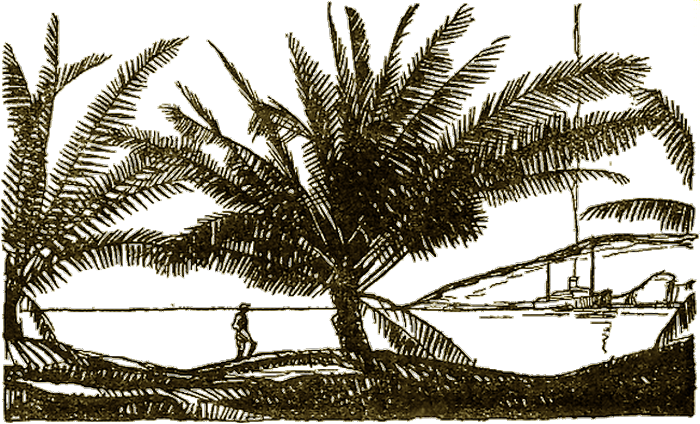
WHEN so hard-headed a gentleman as Captain Sir Malcolm Campbell takes time off from record-breaking to go treasure-hunting, we may take it that there is good evidence for the actual existence of the treasure. In 1925 he and another famous racing motorist, Mr. Lee Guinness, visited Cocos Island in the yacht Adventuress, but after doing a good deal of hard work, returned empty-handed. His conviction, however, that the gold is still there remains unshaken.
Not merely a chapter could be written upon Cocos Island and its treasures, but a whole volume. The stories connected with this remote island, set far out in the Pacific, are endless; and the difficulty is to sift the true from the false, and make a connected narrative. Cocos lies some four hundred miles off the coast of Costa Rica, about half-way between the mainland and that strange archipelago, the Galapagos Islands. No one has better described it than Lionel Wafer, one of its earliest visitors.
"The middle of Cocos Island is a steep hill with a plain declining to the sea. The plain is thick set with cocoa-nut trees; but what contributes greatly to the pleasure of the place is that a great many springs of clear and sweet water, rising near the top of the hill, are gathered there, as in a deep, large pond or basin, and the water having no channel, it overflows the verge of its basin in several places and runs trickling down in pleasant streams.
"In some places of its overflowing, the rocky side of the hill being more perpendicular, and hanging over the plain beneath, the water pours down in a cataract so as to leave a dry space under the spout and form a kind of arch of water. The freshness which the falling water gives the air in this hot climate makes this a delightful place."
Fresh water was the first necessity of the buccaneers; the next was an anchorage and a place for careening or cleaning their vessels, fouled with tropical weed and sea growths. Cocos has two fairly good anchorages and shelving beaches on which it was possible to draw up a vessel and careen her. Thus the island was an ideal resort for the sea-rovers of the seventeenth century, and there are still abundant traces of their use of it. The evidence is equally good for the fact that treasure was hidden here—so good indeed, that for many years past the island has been the goal of one shipload after another of searchers, whose excavations can be found in a dozen different places.
To begin our story we must go back to the year 1683, when an expedition was organized in the West Indies to go pirating against the Spaniards in the South Sea, as the Pacific was then called. At that date many of the great Spanish merchantmen sailed homewards across the Pacific and round the Cape in order to escape the perils of privateers in the Atlantic.
The chief of this expedition was Captain John Cook, the second in command Captain Edward Davis, while William Dampier, who was afterwards the first man to explore the north-west coast of Australia, and told the story in his Voyage Round the World, was the third. A fourth was the Lionel Wafer already mentioned, who was surgeon and kept a journal of the voyage. These men were no ordinary pirates, but rather privateers, and after collecting men and money they left in an eighteen-gun ship called the Revenge, and sailed for the Guinea Coast. Here they met a large Dutch ship which they boarded. Since she was much better suited for a long voyage than the little Revenge, they burned the Revenge and took their prize in her stead. Renaming their new ship The Batchelor's Delight, they made south, rounded the Horn, and worked up the west coast of South America. They visited the Galapagos islands to catch turtle, then bore away for Cocos, but failed to find it. Navigation in the days before chronometers was a very hit-or-miss business. The first land sighted was the mainland of the American continent near Cape Blanco.
Captain Cook, who had been ill for some time, died before they reached land and Davis succeeded as commander. He began the serious business of the cruise by the capture of four Spanish ships, but three of these were slavers with cargoes of blacks. Dampier wished to take the blacks and start a colony on the Isthmus of Darien, where there were rich gold mines. All the Indians, he declared, would flock to them, as well as thousands of buccaneers from the West Indies. "We should," he said, "have been an overmatch for all the Spaniards could have brought out of Peru against us."
But Davis was for more active measures. He released the negroes, and joining up with another buccaneer, Captain Swan, of the Cygnet, sailed to the Bay of Panama where they took several prizes. They were joined by other pirate ships, until Davis found himself in command of a squadron of ten vessels with crews of nearly a thousand men. They sacked and burned the Spanish city of Leon, on Lake Nicaragua, and took great treasure, but after this Davis' army split up, small parties going off plundering on their own account; so Davis, collecting the staunchest of the rest in two ships, went to Cocos to careen and refit.
Making Cocos his headquarters, he sailed south again, capturing many vessels and taking toll of the towns along the coast. When he returned once more to Cocos, his booty was so great that every man had five thousand dollars to his share.
One might have thought that this would have satisfied them, but that was not the way of the pirate. Davis must needs join with a force of buccaneers who were trying to take the rich city of Guayaquil, but making a sorry business of it. Davis wasted no time. He was a born leader, and within a week the town had fallen and he was loading his ship with plunder said to have amounted to one and a half million livres. This money, together with some part of his other treasure, Davis is believed to have "banked" in the soil of Cocos Island, and it is said that another buccaneer, Captain Bartholomew Sharp, also buried much gold in the same island.
It was Sharp who captured that tall ship, the Rosario, with enormous treasure aboard. He took from her whole chests of pieces of eight, quantities of fine wines and brandy, and much other treasure. In her hold were seven hundred bars of rough metal which Sharp's men believed to be tin. They took one bar weighing five hundredweight to make bullets of it and left the rest. It was not until the ship's arrival at Antigua, homeward-bound, that the dreadful discovery was made that the "pig" of tin was really virgin silver, and that they had abandoned the better part of two hundred tons of precious metal. Silver in those days was worth about eight shillings the ounce of our money.
Now we must skip a period of more than a century and come to the story of the greatest hoard of treasure ever buried at one time on any Treasure Island. In the year 1821 the Spanish Empire in South America was tottering to its fall, and one after another the different states were declaring their independence. In our chapter relating the story of Knight's search for treasure on Trinidad, we have spoken of the panic caused in Lima by the approach of a hostile fleet from the south, and of the rush to escape on the part of the wealthier inhabitants. Every ship lying in the harbour was commandeered, or rather their captains and crews were bribed to carry fugitives.
Among these vessels was one of British registry, called the Mary Dier (some accounts give her name as Mary Dear), a good-sized brig under command of a certain Captain Thompson, who is said to have been a Scot. At once he was besieged by people who wished him to carry them and their possessions out of the danger zone.
Thompson had the opportunity of making an honest fortune. Instead, he deliberately chose to perpetrate one of the blackest crimes in the history of the sea. He took aboard all those who were carrying treasure, and the riches rushed aboard his ship almost beggar description. They included such items as two life-sized figures in pure gold of the Virgin and Child, two hundred and seventy-three jewelled swords, immense treasure in gems, especially emeralds, and minted coin to the value of twelve million dollars. The Spaniards kept begging him to put to sea, and as soon as night fell he did so. Once outside the harbour, his men seized the unfortunate Spaniards, slit their throats, and flung their bodies overboard. When this bloody work was finished, Thompson shaped course for Cocos Island, where be buried the whole of his treasure. Off Cocos he fell in with the pirate, Benito Bonito—"Bonito of the Bloody Sword" this man was called (not to be confused with the Benito de Soto of Trinidad fame). The two joined forces and, it is said, captured several merchantmen before the British frigate Espiegle got on their track.
Being a much faster ship than the brig, the frigate overhauled the pirates, and when all hope of escape was lost, Benito put a pistol to his head and blew out his brains. The rest of the crew, including Thompson, were all captured, and at once condemned to death. Thompson, however and one other, promised to turn King's Evidence, and their lives were spared on the condition that they revealed the hiding-place of the treasure. The Espiegle at once returned to Cocos Island and Thompson and his companion were taken ashore under escort in order that they might show the hiding-place.
Cocos is covered with dense bush. The cunning Thompson led the men deep into the thickets, pointed out a cave in a small rock face, then as the excited sailors hurried forward he and his companion slipped into the thick brushwood and vanished. Before their escape was noticed they were out of sight. For three days they were hunted like wolves, but Thompson had the enormous advantage of knowing the island. He and the other man took refuge in a cave behind a waterfall, and lay there until at last the British captain gave up the chase and sailed away.
Thompson, if brute, was brave and resourceful. He hunted turtles, set traps for birds, and somehow managed to live for four long months until a whaler put in for water and picked up the two pirates. They were skeletons in rags, and Thompson's companion was yellow with malaria. He died, but Thompson survived. He stayed with the whaler during the whole of her cruise, and was landed about a year later at New Bedford.
After this we lose all trace of our villain for nearly a quarter of a century. It was in the year 1844 that a native of Newfoundland named Keating who had been to England on some business was returning when, in the ship on which he sailed, he fell in with a man of middle age with whom he became so friendly that after reaching Newfoundland Keating invited him for a visit. Keating had a fishing business, but was apparently not very prosperous; and one day his new friend suddenly asked him if he would like to make a fortune. Keating naturally replied that nothing would please him more, whereupon the other told him that his real name was Thompson, and gave him the story of the treasure which he had hidden on Cocos twenty-four years earlier.
"There is also a second treasure," he said, "for Bonito left vast wealth on the island. He captured three treasure galleons, two of them laden with riches sent out of Mexico when the revolution broke out against the Spaniards. In all he had three hundred thousand pounds' weight of silver dollars besides other valuables which he hid in a sandstone cave in the side of a hill. After concealing this treasure he blew down the face of the cliff with gunpowder.
"In another cave he placed seven hundred and thirty-three gold bricks, each four inches long by three wide, and two inches thick, and this also he carefully covered up. On a piece of land close by the stream he buried several kettles of gold coin. All these," said Thompson, "I can find if I can reach the island."
Keating asked him why he had waited all these years before attempting to recover the treasure, and Thompson's answer was that he had been afraid to tell any one the story for fear of what might happen to himself. Since this seemed a reasonable reply Keating was satisfied, and passed the tale on to a shipowner who, after questioning Thompson, made up his mind to go into the matter. He agreed to furnish a ship, but insisted that it should be commanded by one of his own skippers, a certain Captain Bogue. It took some little time to prepare for so long a voyage, and before the vessel was ready to sail Thompson caught a chill and died. But before passing out he drew a map of the island, marking the place where the treasure was hid, and giving the fullest details for finding it. So Bogue and Keating started off, and after a voyage of some twelve thousand miles which took nearly five months, arrived at last at Cocos.
The ship being anchored, Bogue and Keating were rowed ashore and made straight for Thompson's cache. They found the cliff side and—according to one account—"found there a great rock which turned on its axis and disclosed a door." It seems a little doubtful whether Thompson could have arranged a rock to "turn on its axis," but whatever the truth of that, the fact is that they found the treasure-cave.
The sight was staggering, for here were the two life-sized figures of the Virgin and Child in gold, bars of gold and silver and jewels which seemed beyond counting or estimating. When at last the two came out, breathless with excitement, the first thing on which they agreed was that the secret must be kept from the crew, or there would certainly be trouble.
The very thing they feared came about, for their excitement betrayed them, and the men of course knew that treasure was the only lure that could bring a ship to this deserted island, demanded to know what they had found, and clamoured for a share of the booty. Keating, who seems to have kept his head better than Bogue, addressed the hands, and told them plainly that treasure had been found, but would not be brought aboard until all took an oath that they would wait for division until the gold had been carried back to Newfoundland, and the shipowner had taken his share.
The crew refused, mutiny flared up, and the mate and men went ashore, leaving Keating and Bogue marooned in the ship. But though they searched all day under the hot sun the men found nothing, and came back at night in a very savage humour, threatening to kill their captain and Keating if they did not lead them to the spot where the treasure-cave lay. Bogue and Keating were forced to temporize, and to promise that next day they would show the place.
Actually they had no intention of doing anything of the kind, and waiting until after midnight they slipped into the whale boat which was moored astern and went ashore. Their idea was to collect all the most valuable part of the treasure—that is, the jewels—and hide them aboard in some safe place; then to fob the men off with the rest. They carried out the first part of the programme, reached the cave, filled their pockets and two small sacks with jewels and came back to the boat. But a heavy surf was breaking on the beach, and in pushing off, the boat was swamped and upset. Bogue, laden with heavy jewellery, went straight to the bottom, but Keating clung to the overturned boat and was carried away by the current. Some forty hours later he was picked up more dead than alive by a Spanish trading schooner, which landed him at a port on the coast of Costa Rica.
From there he made his way overland to the Atlantic coast, found a ship, and worked his passage back to Newfoundland. His own ship returned, but it is satisfactory to know that not one of the mutineers was a penny the richer.
Again we come to a gap in our story. Keating was apparently sick of treasure-hunting, and settled down at home. Whether he still possessed any remains of the spoils taken from the cave is not certain, but it is said that he had managed to keep jewels worth about ten thousand dollars which he had carried hidden in a belt around his body. However that may be, he fell upon hard times, and at last—in or about 1870—decided to have another try for the treasure, so went to a friend, Captain Nicholas Fitzgerald, and told him the whole story. Fitzgerald was interested, and talked of fitting out another ship and taking Keating to the island; but before anything definite was settled, Keating died, and Fitzgerald decided to let sleeping dogs lie. Perhaps he had superstitious fears, for it is on record that in the agreement drawn up between him and Keating, Keating insisted that Fitzgerald should enter the treasure cave alone. Nothing, so Keating said, would induce him to trust himself again in that haunted place.
Fitzgerald had Keating's plan, but it appears that Keating's widow—a girl whom he had married late in life—had also directions for finding the treasure, for later on—in 1894—she went into partnership with a man called Hackett, master of the small brig Aurora. They sailed for Cocos, but the ship was not very seaworthy, the crew were troublesome, and after a narrow escape from getting wrecked, they came home without even reaching the island.
Two years later, in 1896, a German of good family named Von Bremer visited Cocos in search of the treasure. It does not appear that he had any very accurate information, and though his expedition was well equipped, and spent more than a month in tunnelling and blasting, he came back empty-handed.
Another German named Gissler reached the island. With true German thoroughness, he first obtained a concession from the Costa Rica Government which is supposed to own Cocos, then took up his residence there and spent years in a steady search for the pirate millions. His is perhaps the only case on record of so persistent a hunt for treasure.
He was there in 1896 when Captain Shrapnel, R.N., of H.M.S. Haughty paid the island a visit. The Captain landed a party of bluejackets, three hundred strong, who blew away with dynamite the whole face of the bluff in which the treasure was supposed to lie; but never a sniff of treasure did any of them find. When he returned to England, the Admiralty gravely reprimanded the gallant Captain for using Government stores for so foolish a purpose as treasure-seeking.
Like Brer Rabbit, Captain Shrapnel lay low; but a few years later, when on half-pay, he collected a number of gentlemen adventurers, chartered a ship called the Lytton, and sailed away for Cocos. It was on August 9, 1903, that this party of treasure-hunters first sighted the peak in the centre of Cocos. As they drew in they were delighted with the intense green of its forest, its steep cliffs, and the sparkling cascades which Wafer had described so many years earlier. On the beach they found boulders inscribed with the names of many a pirate and adventurer who had visited the island in past years.
Where Captain Shrapnel got his clues the writer has been unable to discover, but it is known that he had a chart of some kind and every hope of being successful in locating the hoard of Bonito. For ten days the men worked desperately. They blew down a whole cliff with explosives, and they dammed the stream beside, in which Bonito was said to have buried his pots of gold. All that they found was a metal cross which seemed to have come from some Peruvian church.
Captain Shrapnel called his friends together, and told them that, in his opinion, further search was useless. Landslips caused by the tremendous tropical storms of these latitudes had so altered the face of the island that his clues were useless. So they decided to pack up and return, but before doing so Captain Shrapnel called on Gissler, who was still on the island. Gissler told them that, although he had found many traces of the pirates, including old cooking pots, rusty muskets, and empty bottles, the only treasure which he had discovered was one gold doubloon dated 1788. He told them also that many people had visited the island during his stay there, and spoke bitterly of the way in which he had been treated. They had, he said, stolen his cattle and his crops, and even driven him out of his house and lived in it. Captain Shrapnel left him a quantity of stores, and then the Lytton sailed for home.
It was not long before Gissler had fresh cause for complaint. News was brought him that a company had been formed in Canada to explore the island for treasure. Gissler embarked in his boat—it was nothing but an undecked whale-boat—and reached Costa Rica, where he laid his case before the Government. But there had been more than one revolution since his concession, and the old fellow got little satisfaction.
The Canadian enterprise came to nothing, but while Gissler was on the mainland there arrived a large and handsome steam yacht belonging to Earl Fitzwilliam, who had sailed from England to see what could be found on Cocos. He met Gissler nearly starving, backed his claims, got him a new concession, and gave him a passage back to his island. It was in December 1904 that the Fitzwilliam expedition landed on Cocos, and at once set to work digging and excavating. They were hard at it when another ship turned up, with a party of treasure-seekers under a Mr. Arnold Gray. They, too, landed and started digging within a hundred yards of the spot chosen by the Earl.
Both parties were using dynamite, and when one of the Fitzwilliam men was hurt by a chunk of rock blown out by Gray's crew, the natural result was a pitched battle in which both sides suffered severely. Heads were broken, and the wonder is that no lives were lost. The result was that both parties retired to their respective ships and went home—treasureless like the rest.
Now it is necessary to return to Fitzgerald, for it was his chart which guided Sir Malcolm Campbell on his recent search. Fitzgerald, it seems, was saved from drowning by Captain Curzon Howe, who commanded a ship of the British Atlantic Fleet, and was so grateful that a little later he sent him the chart, with a letter describing his connection with Keating and the original story of Thompson's treasure. All he asked was that if the treasure were at any time recovered by Captain Curzon Howe, a twentieth part might be handed over to him. There is no record that Curzon Howe made any attempt to find the treasure, but he passed on Fitzgerald's chart to a relative through whom it came into the hands of Sir Malcolm.
Malcolm Campbell, so it appears, was already interested in Cocos, and had been investigating the Admiralty documents relating to the island. While busy over this work, a distinguished naval officer presented him with the chart.
The yacht in which the expedition sailed was the Adventuress, belonging to Mr. Lee Guinness. She was a stout motor-driven craft of two hundred and fifty tons, and carried a crew of a dozen besides her owner, Malcolm Campbell, and three friends. Plenty of picks, spades, crowbars, and explosives were aboard, and early in 1925 the expedition started. After a quiet and prosperous voyage a blue speck hove up on the horizon, and presently they were nearing the green island with its many streams of clear water falling over shelves of rock. There are two bays which afford anchorage, Wafer Bay, called after Dampier's companion, and Chatham Bay, and passing the first the Adventuress sailed into Chatham Bay and anchored about a mile off shore. A boat was lowered and four of the party landed on the broad, white strand. Gulls, perched along the water's edge, were the only sign of life, and landing was not easy owing to a line of boulders which rimmed the shore at high-water mark.
The first search was for the treasure said to be buried near the edge of a creek which runs into Chatham Bay. The chart spoke of a rock in the top of which was a hole big enough to take a man's thumb. By means of an iron bar this rock could be moved and would reveal the entrance to a cave. But the brush was thick as a hedge and the searchers were unable to locate this rock, so turned inland and climbed up-hill. The slopes were covered with vegetation, trees, big and little, so matted together with creeping growths that every foot of the path had to be hacked out. Immense boulders barred the way, and the heat was almost intolerable. When at last the little party reached the top it was only to find that, beyond, were fresh hills cutting off the view. All were worn out and covered with cuts and bruises when at nightfall they reached the ship.
Next day they moved the Adventuress to Wafer Bay and landed again. Here was another clear water creek with a fine bathing-pool and, beside it, ruins of huts which must once have been occupied by treasure-seekers. Again they went inland, and after toiling up the creek for a mile, discovered a great pit twenty feet wide and twelve deep, no doubt dug by former seekers. For two days they searched the shores of Wafer Bay, but without coming upon any trace of what they sought, then they returned to Chatham Bay and started afresh. A party struck straight inland and camped for the night on a hillside. The site of the camp was infested with centipedes, ants, beetles, and huge land-crabs. The crabs of Cocos are almost as bad as those of Trinidad. They have been known to eat a wounded man alive.
Next day they tried to push further inland, but the undergrowth was so thick that they literally stuck. Some one suggested that the brush was dry enough to burn, so they fired it. With a crackle and a roar the flames raced up the hillside, sending up huge volumes of smoke and the explorers were delighted with the success of their scheme. They were not so pleased when they saw the fire working backwards in the direction of their tent. Luckily for them the breeze changed and the fire raced away again inland, flinging up rocket-like bursts of sparks.
When the fire had burned itself out, the explorers discovered a zigzag track leading up the hillside, and followed it to the top, but found the summit bare—no sign of cave or fort. Returning by another way, they came upon the dried-up bed of a stream and found that its course had been diverted by a great landslide. This had turned its waters into that of the creek which they had found when they first landed.
Great boulders lay about, and after again examining his chart, Malcolm Campbell came to the conclusion that this was most likely to be the site of the buried treasure. The men set to work with picks and dynamite, but after days of blasting and clearing no sign of any cave was found.
Once more they climbed the height called Observation Hill where, in a patch of jungle grass, they found the ruins of an old stone house. Digging here they soon found that the whole of this ground had at some time been dug over, for the top four or five feet of earth was quite soft. Another disappointment awaited them, for there was nothing to be found at the bottom of the soft ground.
Worn out with heat and hard work, they stopped to rest and eat. But their ill-luck was not exhausted, for in the scramble up the hill most of the contents of the haversack in which the food was carried had been lost. All that was left was a few ginger biscuits and two bottles of water. Presently one of the men, Elmer by name, got up and started exploring again. Malcolm Campbell heard him shout, and hurrying after him found him standing on a steep slope tearing at the stones of what seemed to be a built-in wall, and rolling them down the cliff. Hopes ran high, for this looked like the entrance to a cave, and all set to work to unblock it. After removing a number of large boulders they came to a wall of cut stones, and levered these out, one by one. But behind were stones so much larger that it was impossible to shift them. Almost too weary to walk, they dragged themselves back to their camp.
Further digging proved that this wall was part of an ancient Inca Sun Temple, proving that Cocos, like so many now uninhabited islands, must once have been the home of a prosperous people.
Then the weather changed. It broke completely, and the treasure-seekers were forced to leave the island. But Sir Malcolm Campbell is so definitely convinced that the treasure can yet be located that he intends to leave no stone unturned to discover it.
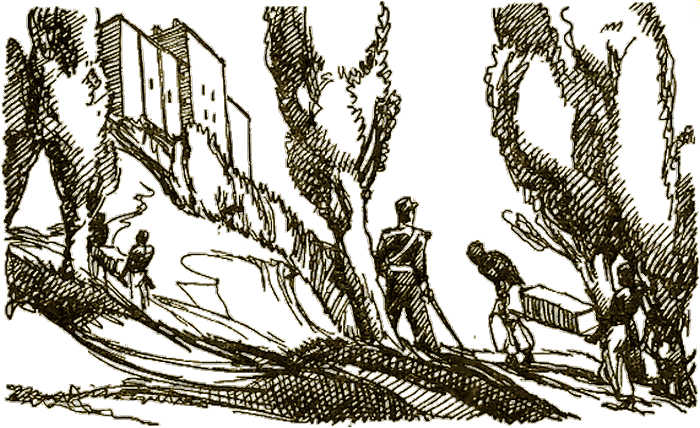
BORN a slave, black as ebony, Christophe of Haiti is perhaps the only pure-blooded negro who has ever raised himself by his own efforts to become an Emperor. He was as savage a brute as ever wore the appearance of a man, and the story of his rise to power, and of the way in which he wielded his power, rivals in horror an Edgar Poe romance.
Haiti, formerly called Hispaniola, is one of the largest islands of the West Indies. In area it equals Scotland, its soil is immensely rich, it has fine harbours, and in the eighteenth century was one of the richest spots in the Western Hemisphere. In 1697 it was ceded to France by the peace of Ryswick, making the first great breach in the Spanish domination of Southern America. Since the climate is too hot for white men to work in the open, the French imported thousands of negroes from Africa, so that, before the end of the next century, the population was nine-tenths coloured.
In 1791 came the French Revolution, and instantly a terrible revolution broke out in Haiti. No quarter was given, and the end was the absolute extermination of the whites, and the establishment of the first black Power outside Africa. France tried desperately to reconquer her dependency, but failed; and in 1804, a negro named Dessalines made himself the first emperor. He was succeeded by Christophe, who called himself Henry I. Christophe, aware of the fate that usually awaits tyrants, set to work to build himself a stronghold where he might defy all rebels. He chose a mountain rising two thousand feet sheer from the plain on the bare summit of which he built the fortress called La Ferrière, whose ruins still crown the great cliffs. There was no road up this great hill; every stone had to be carried up steep winding paths by human hands. The workers were peasants forced into the service of the tyrant. They were allotted neither wages nor food, but driven to toil desperately under the cowhide lashes of Christophe's overseers. Consideration was shown neither for sex nor age; in Christophe such a quality as pity simply did not exist.
A terrifying example of his methods is that one day he stood on the newly built battlements, watching a long line of a hundred men straining at the ropes by which they were hauling a cannon up to the summit. The heat was intense, and every now and then the men paused in their terrible toil to take breath. The Black Emperor turned to a black aide-de-camp:
"Go and ask them why they stop so often," he ordered. In a little the aide came back.
"They say, sir, that the gun is overmuch for their strength, and pray that another hundred men may be sent to help them."
"Bid them come here to me," was Christophe's next order. The hundred came and stood before the tyrant. Their spokesman again preferred the request that they might have further help. Christophe looked them over, then bade them fall in and number off. When this was done he called up his guards and gave brief orders that every fourth man should be shot. To the surviving seventy-five he said that he was going to his luncheon and expected to see the gun in position by the time he had finished. The survivors went sullenly back to work, but at the end of an hour, when Christophe returned to his watching-place, the great gun was still a long way down the hillside. He himself went down the hill, and with one voice the wretched seventy-five protested that it was impossible for them to do the task required. Christophe laughed, and they say that his laugh, though not loud, was a very terrible sound.
"So it seems," he said softly, "but I can cure your laziness. Fall in!" They fell in.
"Now every third man fall out," continued the Emperor. "Guards, shoot those men." The crashing echoes of the volley had hardly died across the cliffs when Christophe spoke again.
"Next time it will be every second man," he said with terrible significance. "There are still fifty men to do the task." The fifty men did it. Some died of exhaustion, but the gun was placed in its casemate where its remains rust to this day. After this, one is hardly surprised to hear that thirty thousand lives were lost in the building of this enormous stronghold.
One more story to illustrate the methods of the Black Emperor. A young man of his household incurred his displeasure and was called before his master.
"You are, of course, to die," said the latter. We are told that he rarely raised his voice above a deep purring rumble. "But I will be kind to you. Instead of being shot I give you your choice of jumping over there." He took him to the edge of the ramparts where wall and cliff drop a sheer two thousand feet to the plain beneath.
The young man chose to jump. By some almost miraculous chance he caught in some bushes growing out from the hillside, and escaped with no worse injury than a broken arm. A little later he presented himself again before his black master.
"Your bidding has been done, sire," he said.
"So I saw," was the answer. "And I am much interested to find that you survive. Oblige me by seeing if you can do it again."
The ruins of La Ferrière are immense. Though shattered by earthquake and broken by a century of tropical storms, the huge walls still rim the edge of the perpendicular cliff, and are broad enough at the top to drive a motor-car along them. No mediaeval castle was ever more massive and none ever built at such terrible cost of human life. Christophe himself planned the dungeons which are huge bottle-shaped oubliettes, in shape somewhat resembling the slave pits to be seen around the ruins of the ancient city of Zimbawe in Rhodesia. Beneath are chambers hewn in the solid rock, and in these Christophe laid away great stores of food and treasure. Of water he had a perfect supply. The immense well which he cut deep in the rock is still in existence.
All his precautions were in vain. His extravagances brought on him a paralytic stroke, and since he had no doctor in his stronghold he ordered his attendants to place him in a bath of rum and pepper, a strange treatment which seems, however, to have brought him back to some degree of activity. But news of his illness spread like wildfire, and at once revolution broke out all through the north part of the island. From his eyrie he watched the rebels burning his fields of cane, and sent for his bodyguard. As they defiled before him he gave to each man a present of money, and ordered them to go down and sweep away the rebels. Again he watched, but only to see his trusted force break up and join the rioters. Then he knew the end had come, and going straight to his own room took up a pistol and blew out his brains. His wife and family buried his body on the hill-top, and the tomb, overgrown with jungle, is still visible.
Next day the rebels arrived, mad to lay hands on the great treasure which for years past their tyrant had been collecting in his fastness. Fifteen million dollars was the lowest estimate of the sums wrung from his wretched subjects and carried up the mountain-side on the backs of slaves. But Christophe was dead, and so were all those who had aided him to hide his treasure. Christophe himself had seen to that. For weeks on end the fortress was ransacked, yet nothing was found. At last the new Government placed sentries on guard and abandoned the place.
The sentries, half-starved, seldom-paid negroes, not only searched themselves, but allowed scores of private treasure-seekers to try their luck. All to no purpose, for the treasure remained hidden.
Years passed. Emperors had gone out of fashion in Haiti and President Hippolyte was ruler of the black republic, when one day a young mulatto named Ortez swaggered into a gambling room at Cap Haytien and flung down on one of the green tables a handful of broad silver pieces of unfamiliar shape and appearance. Other players examined the coins eagerly and no wonder, for they were those romantic and piratical coins, Spanish doubloons of the eighteenth century. Ortez, who was distinctly the worse for liquor, or he would never have been such a fool, was at once questioned, and not only admitted but actually boasted that he had discovered the treasure of Christophe.
Some one slipped out of the room, ran to the palace, and arriving there breathless demanded to see the President. The guards would have beaten him and thrown him out into the street, but the magic word "treasure" stayed them, and the man was taken to Hippolyte. A few minutes later a couple of guards entered the gambling room, arrested Ortez, and took him not to prison but to the palace, where he was put to bed. In the morning he received an invitation to breakfast with the President, and presently Hippolyte, who as a rule preferred flattery to force, opened the ball by a reference to the treasure.
But Ortez, now cold, sober, and probably very sorry for his indiscretion of the previous night, had nothing to say. Hippolyte still spoke to him softly, and instead of threatening punishment, suggested that, though the treasure belonged to the Government, yet, if Ortez would confide in him, a goodly percentage should be his as discoverer, and—more than that—the rank of general in the Haitian army. The bait at first attracted Ortez, but perhaps the covetous gleam in the President's eyes gave him pause. He refused to give up his secret.
The iron hand appeared through the silk glove. The guards were called, and Ortez was flung into prison. A Haitian prison is the world's worst home, to which a London sewer would be a paradise. There are no feeding arrangements, and the guards are brutal beyond belief. Hippolyte no doubt supposed that a very few days of this kind of thing would bring the treasure-finder to his senses. Yet Ortez remained dumb.
Hippolyte made a worse blunder. He decided on torture. It is not a pretty story, and the things they did to the wretched Ortez will not bear recounting in cold print. Sufficient to say that those negroes know all the tortures of the Spanish Inquisition, and perhaps a few more. Ortez, however, proved stubborn. The more barbarous the methods the tighter he clamped his lips. Not one word could be got from him, and Hippolyte realized at last that he had blundered. Not only blundered, but the report he had was. that Ortez was very near to death.
At once orders came to the gaol that the prisoner was to be released. He was sent to hospital, and every means used to make him well again. After months of suffering he pulled round. Then he was released, and carefully shadowed. One smiles to think how very clearly Ortez must have realized the position, and one fancies him vowing to himself that, if he could not enjoy the treasure, certainly no one else should do so.
One night a spy hastened to the palace with news that Ortez had started. Two men were on his track. It was the end of the rainy season, the half-dried slime of the tracks called roads was the consistency of liquid glue, and travel was almost impossible. What happened that night is not known, for neither Ortez nor his trackers were seen again. The general idea was that Ortez was too clever for the spies and somehow eluded them. The spies for their part, having lost him, were afraid to return, so took to the hills and disappeared. There is a rumour that Ortez afterwards reached Cuba; but whether this was so or not I have never been able to discover.
That was more than forty years ago, so the odds are that Ortez is dead long ago. Still, it is an interesting thought that for years the discoverer of the Black Emperor's hoard was at large with the secret of the hiding-place of three million pounds locked in his brain.
As for Hippolyte, he made a last desperate effort to find the treasure. Collecting twelve hundred of his army, he led them to La Ferrière, and dug and blasted furiously for a fortnight.
But his efforts met with disappointment, and those who best know the great rock on which stand the ruins of the Black Emperor's stronghold declare that they are not surprised, and that in all probability the explosives used have broken down the roof of the treasure chamber and hidden its glittering contents for all time.
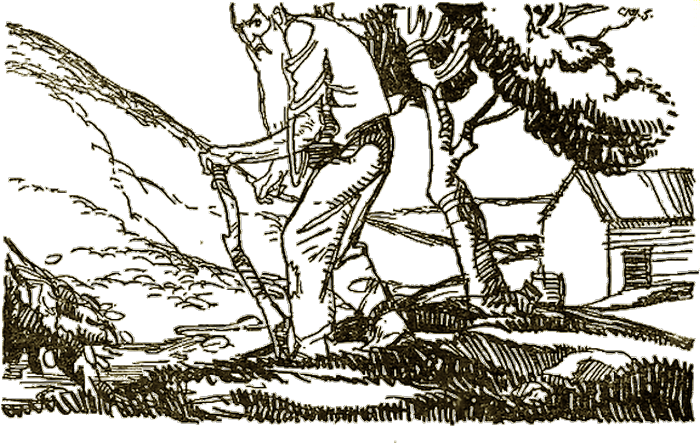
EARLY in the year 1863 a small force of guerillas, under command of two brothers, John and James Reynolds, rode through Texas and New Mexico northwards into Colorado. At that date the whole of the United States was engaged in one of the fiercest wars in history. The Southern States were battling desperately for the right of secession from the Union, but already they had their backs to the wall, and the end was certain.
The two Reynolds brothers were Southerners, and their object was to wrest the territory of Colorado from the Union. At that date Colorado was a wild country with a small white population. But if the whites were few they were a hard-bitten lot, and they gave the Reynolds invaders a hot reception. A good many of the Southerners were killed or captured, and at the end of three months only two hundred remained under the command of the brothers. Sore and savage at their failure, the Reynolds swore to avenge their defeat. They turned bandits, and riding rapidly across the mountain trails fell upon small settlements, robbing and murdering in the most brutal fashion. Again and again they held up stage coaches. Their practice was to shoot down drivers and passengers alike, seize the horses and whatever valuables could be found, and escape into the hills.
On several occasions they found rich booty. One day in late autumn they ambushed a waggon train carrying gold coin, government bonds, bags of dust, and nuggets to Denver. Following their usual custom, they shot down the drivers, guards, and passengers, and leaving the bodies where they fell to be eaten by wolves, got away with more than sixty thousand dollars' worth of loot.
They turned south and travelled fast. Winter was coming on, the nights were bitter cold, and the robbers were short of food and clothing. The men began to quarrel among themselves, and many deserted. In twos and threes they drifted away until only about fifty were left. Then came news that a strong force of troops under Colonel Chivington had left Denver in pursuit,
A council of war was held. The Reynolds brothers wished to entrench above a mountain pass and ambush their pursuers, but could get no backing. Most of their men were set on flight, and the leaders were forced to yield. But their horses were half-starved and in miserable condition; and one thing was quite clear, that they could not carry their plunder with them. It was decided to bury it.
In all her thousands of square miles of wild mountains and rugged valleys Colorado has no wilder spot than that in which the fugitives were camped this night. Above them towered the vast lonely peak known as the Lion's Head, and at its base the wild waters of the great Elk River Falls came thundering down over giants' steps of limestone rock into a deep ravine.
Near the base of the falls they found a small cave, and here they stored their gold. Its value is said to have been more than two hundred thousand dollars (forty thousand pounds). Besides the gold there was a quantity of heavy, old-fashioned jewellery. The mouth of the cave was carefully blocked, then the question was how to mark the spot. It was done by driving a bowie knife into a large pine tree standing near the mouth of the cave, with the haft pointing straight at the cache. The handle of the knife was then broken off, leaving the blade embedded in the wood.
This work done in the dead of night had taken only a few hours, yet, as it turned out, the delay was fatal to the bandits. The troops were much nearer than the Reynolds had known, and at dawn smoke from their camp fires was seen by the fugitives. Without waiting for breakfast all saddled up and rode away up the long rough pass.
Now among the men wantonly murdered by the Reynolds when they held up the treasure train had been the very popular sergeant of the very troop now in pursuit, and his brother was with the pursuers. Scouting before dawn, he had spotted the bivouac of the bandits, and seen them start. He hurried back with the news, and within half an hour the troops were hard in chase.
Their horses were in much better condition than those of the Southerners, and desire for vengeance lent speed to the angry soldiers. Yet even so, it was growing dusk before the Reynolds gang were brought to bay on the face of a great cliff with towering walls of rock on one side and a deep, black abyss upon the other. Escape was impossible.
The bandits fought like cornered rats. Flinging themselves from their horses they sheltered behind rocks and kept up a fierce fire. One and all they knew precisely what their fate would be if captured. But the troopers, bitterly remembering the sights they had seen in the trail of these ruffians, pressed forward steadily. They were better armed than the bandits, many of whom were short of ammunition.
For an hour or more the pass blazed with the flash of rifles, and the echoes crashed among the rocks.
The end was certain. Outnumbered and out-gunned, the raiders were driven back. One by one they fell, their dead bodies in most cases rolling off the narrow ledge and dropping into the shadowed depths of the great gorge below. When night fell, not one was left standing, and the soldiers, their work done, turned and marched back to find level ground where they might camp for the night.
An hour later, when the frosty stars shone on the scene of slaughter, one of the bodies stirred. A man rose to a sitting position, felt inside his coat, drew out a flask, and raised it to his lips. He drank, and the spirit gave him strength to rise to his feet. He was John Reynolds, sole survivor of his band, and was badly wounded by a bullet which had driven through his side and come out behind the left shoulder. He had lost much blood, and was very weak.
Brute as he was, Reynolds was a man of immense vitality and savage pluck. He rested a while, ate a piece of bread, then, reassured by the stillness, got to his feet again and made his way along the ledge, and by degrees down the mountain side. Often he was forced to stop, but with dogged perseverance he kept on. His object was to reach a cabin which he had noticed standing in a small patch of cultivated ground near the foot of the mountain.
It was nearly dawn when he gained it, and he had just strength left to knock on the door. When the owner, a young miner named Anton Glasman, opened, he found Reynolds lying insensible on the ground.
Glasman lifted him in, laid him on his bunk, and dressed his wound, but it was hours before the sick man showed any sign of life. The miracle was that he had travelled all those miles in such a condition. When he did at last open his eyes, he was too weak to move, and Glasman saw that he was dying. Yet he lived for two days, and just before he passed out collected strength enough to tell Glasman of the hidden treasure.
"There ain't no one else to claim it," he said, "and I'd sooner you had it than the Yanks."
Glasman's father was a Pole, his mother Irish, but they were both dead, and he was alone in the world. He was young and strong, and had made his way out into this wilderness in search of gold. So far he had gained a bare living by panning the gravel of a creek running into the Elk River. Imagine then his excitement when told that a great fortune was his for the taking.
But he was too clever to start his search at once. He knew that Government agents would be looking for the gold, so after burying Reynold's body he stayed quietly at home for the whole of the rest of the winter. It was not until the following May that he crossed the mountain on his way to the treasure-cave.
With every word that Reynolds had told him fresh in his memory, Glasman anticipated no difficulty in finding the cache, and when he reached the bottom of the fall, set about searching for the tree in which the knife had been buried. He could find no such tree, and presently realized with dismay that a snowslide had crashed down the great slope, carrying away many trees in its passage, among them the pilot pine. At the bottom of the slope there was still a great pile of hard snow mixed with rocks, logs, and rubbish. He set to searching for the cave mouth, but the whole hillside was a honeycomb of passages. There was no sign of the treasure. Day after day he searched; the snow bank melted and he carefully examined the splintered trunks that remained. But he could not find the knife.
Tired of making the long journey each day, he abandoned his old cabin and built a new one near the Falls. All the summer he continued his hunt. Whenever any hunter or prospector passed, his story was that he was digging for a vein of ore, and he actually did cut a shaft in the hillside near his new home.
There is gold to be found all through this country, and by working with shovel and pan one or two days a week Glasman made enough to buy flour, coffee, and tobacco. For meat he shot deer and bear.
The summer passed, and so did other summers, but Glasman, obsessed with the idea of the treasure, never left the spot except when forced to go to the little settlement of Pinegrove for supplies. Slowly the country settled up, and Glasman found that he had neighbours. One of these, a man named Ward, lived with his daughter two miles from Glasman's cabin, and became Glasman's only friend. To him Glasman told the story of his quest.
Ward died suddenly, and Glasman married the daughter and brought her to live in his cabin. A poor, simple creature, she cooked and washed for him, and worked like a slave in the garden. The only result was that Glasman found more time to pursue his search.
Two children were born, but the dark shadow of the Lion's Head shut out the sunshine from the valley, and the silent father who spent all day digging on the cliff-side killed all joy in life. The children died, and after a time the unfortunate woman, unable to bear the dreadful monotony any longer, ended her life by taking poison.
By this time Glasman himself had become a little mad. He rarely spoke to any one, but at night people who passed the cabin would hear him mumbling and talking to himself. The years dragged on, but Glasman never relaxed his search. By this time the treasure story was known all over the countryside, but few, if any, believed in its truth. They looked upon the searcher as a lunatic, and in this they were not far from the truth, for the man, now growing old, was certainly queer in his head. He was rarely seen, for he rose very early, was in the caves before daylight, and did not return until after dark. From spending so much time in the darkness his skin took on a strange, waxen pallor, and he was half blind in a strong light.
His cabin was pointed out to tourists as the home of the Hermit of Elk Creek. Some of these tourists visited him, and though he usually drove them away, he was sometimes found in milder mood, when he would talk of what he would do when he found his treasure. The one thing that made him furious was when any one cast a doubt on his story or suggested that perhaps Reynolds had dreamed the whole thing, and that there never had been any gold hidden.
Summer after summer Glasman, now grown old and bent, pursued his endless search. When the twentieth century dawned he was sixty-eight years of age and looked at least ten years older. His hair and beard were white as the snow on Lion's Head.
In the summer of 1901 the old hermit appeared one day in the village of Pine Grove where for forty years past he had bought his supplies. It was noticed that his bent form had straightened, that his eyes were bright, and that he looked years younger. But it was the storekeeper who got the greatest shock when the old man fished out a handful of five-dollar gold pieces from the pocket of his shabby trousers and asked that they might be changed for paper money.
"Gosh, Glasman, you ain't found it?" the man exclaimed.
"You bet I've found it," was the prompt reply, and perhaps for the first time in forty years Glasman gave vent to a cackling laugh. Then he leaned across the counter. "I'll ask you to say nothing to nobody till I give you leave," he added. "You won't be the loser."
The storekeeper promised, he changed the gold into notes, and Glasman went straight to the railway depot and took the evening train for Denver. Early next morning he was seen in the street, inquiring his way to the office of a notary. His queer, bent form, his battered old sombrero, and the ancient muffler knotted round his throat made people stare at him.
Some good Samaritan took him in charge and led him to the office of the nearest notary. The old man seemed spent and terribly weary.
"Ain't slept a lot last night," he explained as he sank into a chair. Then he began to tell his story, but it was all so incoherent that his listener could make little of it. Presently he broke down and was silent.
The notary, seeing the grey tinge on his new client's face, grew frightened, and hurried to get a stimulant. When he got back the old man's chin had fallen on his chest, his body had slumped back in the chair. A doctor was hastily called, but it was too late. Anton Glasman was dead with his secret still on his lips.
Search was made at once, but without result. Whatever the old hermit had found he had concealed so cunningly that not a trace was left. Only that handful of forty-year-old gold pieces remained to prove that somewhere in the dim caverns under the Lion's Head lies the treasure that cost so many lives.
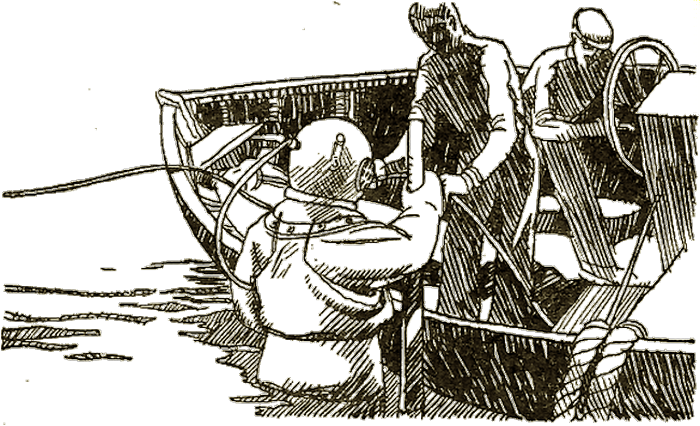
TWO things are fairly certain; one that a great Spanish galleon was sunk in Tobermory Bay, and the other that this galleon had vast treasure aboard her. Spain was immensely rich in the sixteenth century. For a hundred years she had been stripping Mexico of her hoarded wealth; and added to this was the new stream of gold that was coming in from her fresh conquests in Peru. It is historical fact that officers of the Spanish Armada sent to conquer England, ate off gold plate, and that the priests celebrated Mass aboard in jewelled vestments with chalices and candlesticks of pure gold.
If it seems reckless to have trusted such treasures to the mercy of the sea, it must be remembered that Philip II. and his advisers had made such preparations that they never for a moment believed they were running any risk, but were definitely certain of conquering the country which Pope Sixtus V. had formally handed over to them. Of the one hundred and twenty-nine ships of the Great Armada, sixty-five were of more than seven hundred tons burden. They were manned by twenty-seven thousand men, and carried provisions to feed forty thousand for six months.
This is not a history of one of the greatest failures in history. As we all know, after his defeat the Spanish admiral decided to return to Spain by sailing around the Orkneys. He had one hundred ships left, but of these only fifty-four reached their home ports. Of those missing, the majority left their bones on various parts of the British and Irish coast. On the Irish shore, from Giant's Causeway to Blasket Sound, were wrecked seventeen fine vessels, many of them carrying great treasure, little of which has been recovered. Little, indeed, is known of the fate of most of these ships, yet there is one exception, one vessel, the story of which has been preserved, and for whose treasure search is still proceeding.
This ship's name was Florencia. She was not a Spanish-built ship, but was contributed to the Armada by the Duke of Tuscany. One of the finest and largest vessels of her time, she was splendidly equipped, and is said to have had aboard her money to pay the Duke of Parma's great army in Flanders as well as the pay-roll for the troops of the Armada. If that is true, she must have carried something like the value of two millions of modern money in her strong-room.
Tobermory Bay is a landlocked haven in Mull, that large island which lies between the mainland of Scotland and the misty Hebrides. It is a very beautiful bay on the shores of which stand the pleasant little town of the same name. Into it, one day in the autumn of 1588, sailed the tall Florencia. She was in a sad state, leaking, her sails and rigging in tatters, her crew broken with sickness and starvation. Provisions and repairs were her most urgent needs; and Captain Pareira, her commander, at once sent a boat ashore for food.
Hard blows had failed to teach the Spaniards sense or manners, and instead of using common courtesy the message given was in the form of a demand that food should be furnished at once, otherwise it would be taken by force. Had Pareira known with whom he was dealing his conduct would have been different.
The chieftain to whom he addressed his insolent demand was Lachlan Mo'r MacLean, known as "Big Lachlan," a character who might have stepped out of the pages of one of the old Nordic Sagas. Brought up at the Court in Edinburgh, Lachlan came back to Mull in 1576 to find his estates in the hands of his stepfather, who refused to yield them up. The young man wasted no breath in threats, but quickly collecting a small force of friends, attacked Castle Duart by night, seized the recalcitrant stepfather, and promptly beheaded him. He then settled down to enjoy his own.
But the Highlands were full of trouble, and Colin Campbell, sixth Earl of Argyll, took a dislike to the new chieftain and made war upon him. Lachlan retaliated by gathering his clansmen and carrying fire and sword into the Argyll country. The Earl was forced to sue for peace, and with the King's help a truce was patched up. That, however, was not the end of the fighting, for a fresh feud broke out between the MacLeans and Macdonalds. Again Big Lachlan was the victor; but the Macdonalds allied themselves with the MacIans and the quarrel blazed up more fiercely than before. That was the state of things when the Florencia entered Tobermory Bay, and her captain made his foolish and discourteous demand for supplies.
Lachlan's reply was typical. It was, he said, his custom to care for distressed strangers, and their wants should be attended to in due course.
But first he proposed to give their commander a lesson in courteous behaviour. He suggested that Captain Pareira should land and carry out his threat to help himself. Pareira's first impulse was to land in force, but a glance at the shore gave him pause. Scores of well-armed clansmen were already gathered there, and more kept hurrying to the meeting-place. His own men sick, starved, and travel-worn, were clearly unfit to cope with these hard-bitten warriors. Also the officer whom he had sent ashore reported that Big Lachlan was no mere barbarian, as Pareira had at first supposed, but a man well trained in the art of war. Fume as he might, the Spanish captain realized that he must eat humble pie. He sent a fresh messenger ashore with word that he would pay in cash for any provisions Lachlan was kind enough to send him. Food was sent, but only a small quantity. With it a letter from Lachlan to the effect that he was being pressed by his enemies and that, if the Spaniard would lend him a hundred fighting men, provisions should be supplied for the whole ship's company and the help taken as part payment. Pareira agreed, and called for volunteers who came forward readily enough. The men were only too happy to feel firm ground under their feet after long weeks of tossing on stormy seas. With the aid of these reinforcements Lachlan's clansmen made short work of the MacIans, and after harrying their lands drove them into their castle of Mingarry and besieged it. Before it fell, a message arrived from Pareira that he had completed the repairs to his ship and was ready to sail.
This did not at all suit Lachlan, who managed to delay the departure of his allies until the castle was taken. Then the Spaniards marched off, all except two officers whom Lachlan appears to have held as hostages. Returning with these to Tobermory, he found the Florencia still in the bay, and heard that his people had supplied the Spaniards with a number of cattle over and above the original agreement, for which they had not been paid. The chieftain called up a young relative, by name Donald Glas, and bade him go aboard the Spaniard and arrange matters.
Again Pareira blundered. Angered at the detention of his two officers, he seized young Donald, disarmed him and thrust him into a cabin below. He signalled to the shore that he intended to hold him until his own two men were returned. MacLean, furious, flatly refused to do this until payment had been made for the cattle. Night fell, and the deadlock was complete. Neither side would yield.
In the morning those on shore saw that the sails of the galleon were being set, and that her windlass was being manned. It was clear that she was about to sail. A man was brought on deck between two guards, and the clansmen cried to one another that it was Donald Glas. They watched him cast a last, longing look at the heather-clad hills and wave his hand in farewell. Then he was turned about and forced below while his friends, unable to help, voiced their rage from the beach.
The anchor was up, the sails filled, the great Florencia wore round, then as she came broadside to the shore there was a roar like thunder. An immense cloud of smoke shrouded the scene, and when it had blown past the galleon was seen broken in two, sinking fast, while all around the surface of the sea was littered with wreckage and the bodies of dead men. Of her crew, in all nearly five hundred men, only three were saved alive.
Donald had taken his revenge the clansmen vowed triumphantly, and this is probably the truth of the matter, for it was discovered from the survivors that the cabin in which he had been confined was close to the powder magazine. In some way the prisoner must have cut through the partition and set a match to the powder barrels.
This, at any rate, is the story that has been handed down through the centuries, and it is confirmed by documents that still exist, which mention the "plotting or felonious burning and flaming up of a Spanish ship near the island of Mull."
The water in which the Florencia sank was too deep for the wreck to be reached without diving apparatus of some kind, and for more than half a century no attempt was made to recover her treasure. Yet the Argyll family who, then as now, were overlords of Mull, were well aware of the value of the wreck, and about the year 1640 a grant was made by King Charles I. to the Marquis of Argyll of all rights in the wreck of the galleon Florencia and the treasure contained in her. His seamen and doukers (divers) were to have a free hand to recover valuables at his own charges and hazard, the only condition being the payment of one per cent. of their value to the Crown.
The modern diving bell was invented by Dr. Hailey in the reign of George I. It was a box built of wood loaded with lead along its bottom edges, and had stout glass windows fitted at the top. Casks filled with air, weighted to make them sink, were lowered to the bell, and the men pulled them in and turned them over so as to let the air escape inside the bell. Yet long before that date some kind of diving bell was in use, for we know that two Greeks exhibited what they called an aquatic kettle before the Emperor Charles V. of Germany in the sixteenth century. No picture of it remains, but we have reason to believe that it resembled the modern diving bell, except that it was not fitted with means for replenishing the air supply, and consequently its occupants could only remain below for a very short time.
It was some device of this kind that was used by Archibald Miller, who seems to have been the first diver to reach the remains of the Florencia. He found the forepart of the ship broken quite away from the rest, and the whole wreck sunk deeply in the silt. He secured an iron box containing documents which, so far as they could be read, related to the moneys carried aboard the galleon, also two anchors, and a "crown and diadem." The two latter, so the account goes, were lost as he returned to the surface. Presumably his air supply was exhausted, and he became unconscious, and dropped his treasures.
Between 1660 and 1670 another diver was employed. His name was James Mauld, and it is proof of the risks attached to his profession at that date that his agreement gave him no less than four-fifths of the value of all that he might recover. A contrast, indeed, to the one-eighth of one per cent. which was the premium to the divers employed on the wreck of the Laurentic. Mauld was also given lodgings, food, and payment for himself and his assistants, and a three year contract.
Mauld appears to have found the wreck without much difficulty, and made a chart showing its position. The Florencia lay in about ten fathoms of water, and her hull was full of sand. From this sand were brought up several cannon balls, copper kettles and "tankers" (tankards) of the same metal. The treasure probably lay beneath the floor of the main cabin which was in the after-part of the ship; but owing to the explosion this was covered with a great mass of timber which it was found impossible to move. The Florencia, like most of the best Spanish and Italian ships, was built of African oak, wood which is almost as hard as iron and which lasts indefinitely under water. Guns belonging to the ship lay outside the wreck, and several of these were got up. Two were brass cannon, one a great iron gun.
This treasure hunt came to a sad end. Monmouth landed in England, and the Earl of Argyll joined him. There is no need to recount the history of that disastrous rebellion. Argyll was made prisoner with the rest, and his rank did not save him from losing his head.
The next adventurers to become interested in the wreck were a German named von Triebelen, and a certain Captain Adolphus Smith. They got a charter of some sort, and set to work to recover "gold, silver, bullion, jewels," and "all that might be found in the water and about the ship." But they ran into trouble at once. The MacLeans, who had always declared that the wreck was their property and not that of the Argylls, took advantage of the execution of the Earl, and drove the divers from the wreck. Then to make sure that no one else should interfere with their property, they built a fort on the shore overlooking the spot. The ruins of this fort still stand.
In spite of the fort, Sir William Sacheverell, who was Governor of the Isle of Man, visited Tobermory Bay, bringing divers with him. He speaks of their sinking "three score feet under water and remaining there above an hour," so it seems clear that his diving bells must have had some method of renewing their air supply. Unfortunately for the success of his enterprise, he did not arrive until late in the season; and September brought weather so "bleak, stormy, rainy, and windy," that he was forced to abandon the work and sail south again to his own island.
After Sir William's vain attempt to recover treasure, nothing more was done in the matter until the year 1740, when John, second Duke of Argyll, decided to use one of the newly invented diving bells for the purpose of visiting the wreck. His men found the wreck and recovered several vessels of pewter and silver, two gold goblets, and a number of coins, both silver and gold. But their greatest find was a wonderful bronze cannon not less than eleven feet in length, which is beautifully ornamented. It is believed to have been designed by that great artist, Benvenuto Cellini. This gun has been preserved at Inverary Castle, the home of the Argylls. But by this time the wreck had sunk deeply into the sea-bottom, and the divers frankly confessed that it was out of the question to reach the cabin or strong-room where the treasure lay. How could they, working as they did with hooks and tongs wielded from inside their clumsy diving bell?
That these divers spoke no less than the truth, and that their employers believed them is proved by the fact that more than a century and a half passed before anything else was done to disturb the remains which lay upon the floor of Tobermory Bay. About the beginning of the present century a Glasgow man visiting Tobermory became interested in the galleon story, and it occurred to him that it might be worth while to try what modern invention could do in the way of recovering the treasure. After returning home he talked to friends, and presently formed a Company which obtained a new charter from the Duke of Argyll and at once got busy.
Work began in the summer of 1903; but when the divers went down at the spot indicated in the old chart, which was made originally by James Mauld, they brought back word that there was not a trace of the wreck to be seen. If it had ever been there it had sunk deep into the silt. A camera was sent down, fitted for submarine use, and several photos taken, which showed a bank or mound of sand which, it was agreed, must be the tomb of the old galleon. The men were ordered to dig into this bank, and presently began to uncover various odds and ends which evidently came from the wreck. There were ancient bottles, boarding-pikes, and copper pans such as were formerly used for carrying gunpowder. Several swords were found, two with jewelled hilts, two old blunderbusses, a gold ring, and—best proof that this was indeed the wreck of the Florencia— some forty doubloons of the fifteenth century. In 1904 there was an exhibition and sale of these Armada relics in Glasgow.
The work was in charge of a well-known Scottish salvage expert, Captain William Burns, and went on all through the summers of 1905 and 1906. A diviner was employed, yet even with his help it was still found impossible to locate the wreck. Many more finds were made, however, including some fine pieces of silver plate. It is difficult to know just what was or was not found, for no visitors were allowed aboard the salvage ship Brearner, and reporters were not encouraged. All that can be said with certainty is that whatever the Company did find, they did not uncover the wreck itself.
Their lease, which was for five years only, ran out, but was renewed by an American, Colonel Kenneth Foss, who began work with all kinds of up-to-date apparatus in the summer of 1912. The War interrupted his operations, but as soon as peace had been declared he got busy again, using suction-pumps, iron "grabs" and high-pressure water-pipes for blowing the accumulated silt from the sunken hull.
It was the same story as before. More cannon balls, many pieces of rusty metal, flasks, a human skeleton, and a certain number of coins were discovered, but these were scattered over a considerable area of the floor of the bay and the actual wreck was not definitely located. Colonel Foss, however, stuck to his task and had a special diving bell built of his own invention, equipped with plate-glass windows and powerful electric lights. It weighed no less than three tons. His perseverance certainly deserves to be rewarded.
Some students of history insist that the Florencia story is all a myth, and that she was never wrecked or blown up in Tobermory Bay. They point to the fact that Spanish records of 1588 give the name of this ship as one of those that survived the Armada debacle, and found her way back to Spain. Yet the great gun still preserved at Inverary is in itself strong proof that the galleon found her end off Tobermory, and the Argylls themselves have always believed in the truth of the story. Near Tobermory is an old mill, the timbers of which, so the people tell you, were taken from the remains of the Florencia.
As for the Spanish story of her return to port, we all remember how the British Admiralty concealed the loss of the Audacious in order to deceive the enemy as to the strength of our navy. It is likely enough that the Spaniards adopted similar tactics three centuries ago.
Quite recently—during the searches of 1927—Colonel Foss dredged up a finely coloured Venetian bowl, a silver salver of the sixteenth century, and coins of the same period. These are not articles which could be found at the bottom of a bay in the extreme north of Scotland unless a Spanish ship had sunk there.
The general impression is that the remains of the Florencia are still in the bay, but that in the course of three centuries they have sunk twenty, perhaps even thirty feet into the sand and mud of the bottom and that, even if they are found, the odds are long against the treasure itself being recovered.
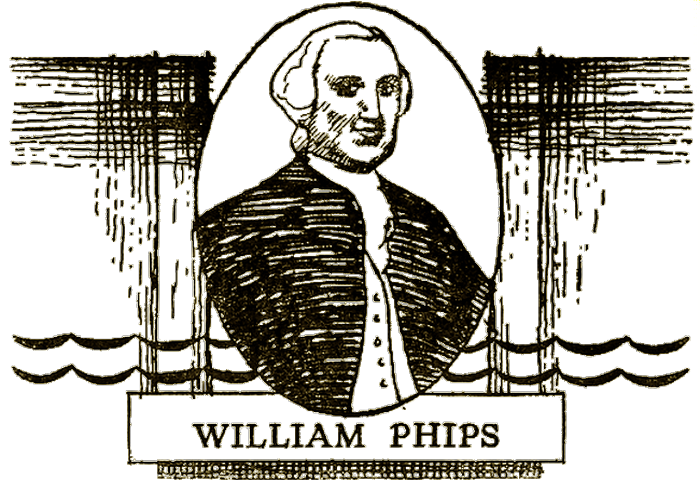
SO many of these treasure adventures end in tragedy or in disappointment that it is pleasant to find a story of success, even if, to find it, we have to delve rather deeply into past history. In this case the hero, William Phips, was a fine fellow, a very brave and honest man, and thoroughly deserved his good fortune.
William's father, James Phips, was a gunsmith of Bristol, who emigrated to America somewhere about the year 1640. He took up land on the river Kennebeck, the most eastern settlement of what was called New England. That unpleasant person, Cotton Mather, who, when he was not hunting and burning witches, wrote books, calls Phips' place a "despicable plantation."
Despicable it may have been, yet it gave some sort of living to James and his numerous family. He and his wife had twenty-six children, of whom twenty-one were sons. William, youngest but one, was born in 1651. His father died when the boy was only three, and up to the age of eighteen William lived at home, "keeping sheep in the wilderness" as Mather says. It must have been a primitive sort of life, for William grew to manhood without learning to read or write. Not that the boy was without ambition, for Mather writes: "He had an unaccountable impulse upon his mind, persuading him, as he would privily hint unto some of them, that he was born to greater matters."
At any rate, when he was eighteen and his youngest brother was old enough to take charge of the sheep, William tramped off to Boston and came to "greater matters" by apprenticing himself to a ship's carpenter, "in which time he became a master of the trade that once, in a vessel of more than forty thousand tons, repaired the Earth—Noah's, I mean."
William worked hard at his trade and made up for lost time by teaching himself to read and write in his spare hours. He was a fine, upstanding lad and—once more we quote the eminently snobbish Mather—"by a laudable deportment so recommended himself that he married a young gentlewoman of high repute, who was the widow of one Mr. John Hull, a well-bred merchant."
Probably the lady had some fortune of her own, for the next thing we hear is that William built a ship, launched her, and loaded her with cut timber on which he hoped to make a good profit. He was about to sail when the Indians rose, murdering and scalping the settlers, who fled to the sea. William at once jettisoned his whole cargo, took the survivors aboard, and carried them to safety. The loss was heavy and, as it very nearly ruined him, his wife was not pleased, but rated him severely. William, however, had perfect faith in his star, and merely told her that he should yet be captain of a king's ship and would build for her "a fair brick house in the Green Lane of North Boston." His promises did not make much impression upon Mrs. Phips, who seems to have been a true New Englander, hard-headed and practical.
Boston lived by the sea. There was great trade between that port and the West Indies. Codfish and timber were taken south and exchanged for sugar and slaves and tobacco. There was also considerable trade with England. In the course of one of his voyages Phips heard talk of the wreck of a great Spanish galleon laden with treasure, which had gone on a reef in the Bahama Passage. No doubt many others heard the story and passed it with a shrug of their shoulders. Not so William Phips. He went into the matter carefully. Here, he said to himself, was his chance to build that "fair brick house." After a time he obtained definite proof that a treasure-ship had actually sunk in this Passage, and in 1681 himself voyaged to Hispaniola to make further inquiries.
It was a risky business, for this was the heyday of the buccaneers. The seas swarmed with pirates—Morgan, Pierre le Grand, Portugez, and Montbard the Exterminator, are names of a few of the famous or rather infamous scoundrels afloat at that date. The worst of the lot was L'Ollonais, the gentleman of whom it is told that he cut the heart out of a wretched Spaniard and devoured it raw; but it was L'Ollonais who found a treasure valued at three hundred thousand dollars buried on one of the Keys, or small islands, off the coast of Cuba.
Phips did not actually locate the galleon wreck in which he was so deeply interested, yet he was so convinced of its existence that he took ship for England in order to raise funds for his search. It speaks well for his confidence in his plan that he had resolved to make the King himself a partner in his enterprise.
It is never easy to interview a king, but it was far harder then than now. At first the lords-in-waiting and the flunkeys of the palace combined to cast scorn upon his wild ideas. But he was not discouraged. Week after week, month after month, he clung to Whitehall, until at last he gained the ear of the Duke of Albemarle, who had a patent from the King as "Receiver-General of Wrecks." And the Duke at last procured him an audience with the King.
Charles II. was always out for a gamble, and he was not a bad judge of men. He must have realized that William Phips was worth encouraging, and he decided to take a chance. He gave Phips a commission as captain of the small frigate Rose, of eighteen guns. She was a sharp-bowed piratical craft which had originally been built and sailed by Algerine pirates from whom she had been captured.
Phips wasted no time in getting together a crew. They seem to have been a pretty tough lot, but that did not worry Phips, who was quite capable of handling any crew, however rough. He was also a very fine seaman.
One day before he sailed there came to Phips's lodging a queer old man, shabbily dressed, who said he was an astrologer, and begged leave to draw the American's horoscope. Phips, tough Puritan that he was, thought little of astrology, but the old fellow insisted, and drew the horoscope, predicting six notable events in Phips's career, and giving the dates for each. Phips glanced at the paper contemptuously, then dropped it into a trunk with his other papers. A few days later he sailed westwards.
Of his voyage we know little except that he went by way of Boston, reached the Bahamas safely, and at once set to work to explore the maze of reefs where his chart showed that the treasure-ship had sunk. His disappointment and disgust were keen when he could find no trace of the galleon. Day after day he sought and searched until his crew of hard cases grew sick and tired of the long toil in the blazing sun, and planned to seize the ship and go pirating.
When the plot was ripe they made a sudden rush for the quarter-deck. Phips had no suspicion of what was happening and was unarmed, but seeing the fellows coming with their cutlasses, realized what was afoot. Without a moment's hesitation he dashed at them, striking out right and left with his fists. What a film it would have made—one man unarmed flinging himself against a dozen all armed to the teeth, yet so fierce and sudden was his onslaught that the mutineers turned and fled, crying out that the devil was let loose among them.
For a time there was peace, but the trouble was not ended. There were whisperings in corners, and the discontented ones waited only for a chance to catch their fighting captain unawares. That came when Phips found his vessel so foul she would not sail, and was forced to take her into a lonely bay where he could careen and scrape her. On these occasions it was the custom to give the men a day off, which they spent in the woods, hunting, and afterwards feasting. All the men but ten were allowed ashore, and presently they gathered to frame a plot against the captain. The ringleaders agreed to seize the ship, marooning the skipper, and those who would not join them, on the island. Then hey for the South Seas and the Black Flag.
The only one of the party who remained faithful to Phips was the ship's carpenter. He kept silence, but as a carpenter was, next to a navigator, the most essential member of a crew, the rest gave him the choice of joining them or having his throat cut. He asked half an hour to make up his mind, and the mutineers sent him back to the ship so as to allay suspicion, but sent with him one of their own number to act as spy and see that he did not play the traitor.
The honest carpenter was in a terrible fix. The last thing he wished to do was to join the mutineers, yet he knew that if he made one move to inform the captain he would be instantly pistolled by the spy who watched him. It is in the tightest places that some minds work fastest. A brilliant idea came to the carpenter, and suddenly he fell flat on the deck, writhing in agony.
"I have the colick," he gasped, then, scrambling to his feet, "I must have a tot of rum or I shall die." He acted so well that his watcher, all unsuspecting, allowed him to stagger below where the carpenter quickly broke his news to Phips. A grim smile curled the skipper's lips.
"Go back," he said. "Go back to those rogues in the wood, pretend to agree with them, and leave the rest to me."
The carpenter did as ordered, and as soon as he was gone Phips collected his ten faithful fellows, among whom was his gunner, and told them what was happening.
"Now, lads," he said, "do you stand by me like honest Englishmen?"
"We do, sir, if you can save us," was their answer.
"By the help of God I do not fear to do that," said the captain. "And trust me, I will bring those rogues to their knees before any long time passes."
While the ship was careened—which meant that she had to lie on the mud with a heavy list—most of the provisions had been taken ashore, stacked under tarpaulin, and protected by a light earthwork on which some guns had been planted in case of an assault by Spaniards. Phips sent some of his men ashore with orders to draw the charges from the guns and carry the provisions aboard; then the guns left in the ship were doubleshotted and trained upon the provision store. When the mutineers came out of the wood, ready to seize the ship, picture their dismay to find the bridge removed and the gun-muzzles frowning down upon them, while beside each stood a man with a lighted port-fire in his hand.
"We are betrayed!" they yelled, but some had the pluck to make a rush for the ship.
"Stand off, ye wretches!" roared the captain. "Stand off, or I blow ye all to perdition." The men fell back in terror, and Phips addressed them.
"I will treat ye as ye would have treated me. I leave ye here to starve and rot, ye mutinous dogs. I have the stores aboard, and not a mouthful shall find its way into any of your bellies."
That was the finish. The mutineers collapsed and begged for mercy. Phips listened grimly, then kept the men waiting while he consulted with his officers. At last he sternly ordered the mutineers to come forward and drop their arms. This done, he bade them all to fall back one hundred paces and sent four of his faithful ten to gather up the muskets and cutlasses. When all the arms were safe aboard, the mutineers were directed to advance again. As they reached the tide's edge he bade them go down on their knees.
"Mutiny," he said sternly, "is punishable by death, and I am in two minds whether it be not my duty to shoot ye down as ye kneel." Tremblingly they begged for their lives, and at last he allowed them aboard again. After that there was no more talk of mutiny. These hard cases had found their master.
The search for the treasure went on until provisions were nearly exhausted; but not a sign of the wreck could be found, and at last Phips decided to return to England. Charles II. was dead and James had no use for tales of treasure. He took the Rose from Phips. This would have been the finish of most men, but not of the sturdy Phips, who again interviewed the Duke of Albemarle and persuaded him to fit out another vessel, the James and Mary, to sail on a second quest for the elusive treasure.
This time Phips made direct for the island of Hispaniola, and after a quick passage put into Port de la Plata, the town where he had first met the old fellow who put him on the track of the Spanish treasure-ship. He was lucky enough to find the veteran still alive and, questioning him carefully, got many fresh details and exact bearings of the spot where the galleon's wreck lay. Phips then bought from some Indians a "periaga" (a large dug-out canoe made from the wood of the cotton tree, capable of carrying ten men and much better fitted for exploring the shallows among dangerous reefs than any ordinary ship's boat).
In this craft he and his men went "busking" to and fro among the reefs, searching for the one on which the wreck lay. Day after day the search went on. There are miles of reefs in the passage and, of course, there were many days when rough seas made it impossible to work. Quite a moderate breeze stirs all this shallow sea into a turmoil of white water in which no boat can live and work. Again weeks passed, but the search was vain.
Came a day when Phips stayed aboard and sent his mate in charge of the canoe. The weather was fine, but very hot. For hours the periaga was paddled in and out among the ugly fangs of coral, while the watchers peered down through the glass-blue water into the tropical tangles which cover the bottom of these warm seas.
Towards evening the mate, looking over the side, caught a glimpse of a great waving sea-feather of singular beauty, rising from the growth below.
"I'll bring back something to the captain," he said, and ordered the Indian diver to go overboard and fetch this beautiful growth. Down went the diver, scattering shoals of little brilliant coral fishes—down until he almost vanished in the tangled sea growth. He got hold of the stalk of the sea-feather, kicked once or twice to pull it loose, then let go and came shooting upwards.
"Guns," he said, as his head rose above the surface. "Great cannon which lie on the floor of the sea." The mate looked at the men and the men at the mate.
"Guns!" repeated the mate. "By heaven, can it be that we have found the true spot at last? Go down again," he ordered the diver. "See what you can find." The diver, waiting only long enough to fill his lungs with air, turned over and dropped, seal-like, to the bottom. A short pause, then up he came more slowly, carrying a heavy weight. It was a great "sow" of metal, black and tarnished with sea water, but so heavy that there was no doubt as to its nature. It was virgin silver.
The sun was setting in a crimson sky, the short tropical twilight was upon them, hastily the mate threw out a buoy and anchored it, then the periaga was driven swiftly back to the ship.
"Keep silence, all of ye," said the mate with a twinkle in his eyes. "We will play a jest with the captain." Phips, waiting for them, asked if they had any news, but the men shook their heads and climbed silently aboard.
"I will still wait patiently upon the providence of God," said their captain, and went forward. The moment his back was turned, the others slipped the ingot aboard and hid it under the table in his cabin. As he sat down to meat his foot struck it, and he stooped and drew it out.
"Why, what's this?" he demanded, as he lifted the mass of crusted metal. He saw the mate winking at another member of the crew, he saw the broad grins on the faces of the men, and up he came to his feet.
"Thanks be to God," he said. "We are made. Our good fortune hath come to us at last."
So it had—very good fortune—for the weather remained fine and calm, and before a break came, the two Indian divers fished up no less than thirty two tons of silver bars. Queer stuff, for it was crusted with coralline substance to a thickness of an inch or more. And after the silver came masses of gold coins welded together by the limestone-like formation of the coral makers, also strings of pearls and other matters.
Before they could recover the whole of the great galleon treasure, provisions ran short, and they were forced to leave the spot. Although this was not the same crew of mutineers that had manned the Rose, Phips had his doubts as to their staunchness. Such a vast treasure was a terrible temptation to rough men. So he called them together and told them that he thought it was only fair, since they had helped to recover the treasure, that they should all have a share in it.
"Each of ye," he said, "shall have that share, even if I have to divide mine own share among ye." A spokesman stepped out from the crew and answered.
"Captain, we have found you a man of your word. We are willing to trust you," whereupon Phips thanked them heartily, and promised they should not suffer by their good conduct. Then, so the story goes, he went down to his cabin, got to his knees, and thanked God for his goodness that he had given him so much of the abundance of the seas and of the treasures hid in the sands. After which he gave orders for the raising of the anchor and the setting of the sails, and so back across the western ocean.
Late in the autumn of 1687 the little James and Mary sailed up the Thames, and Phips delivered to his delighted patrons a treasure worth three hundred thousand pounds, which was equal to more than a million of twentieth-century money. His own share was a large one, yet after performing his promise to his men he was left with no more than twenty thousand pounds.
Another reward was his, for the King knighted this bold mariner and offered him the well-paid post of Commissioner of the Navy. This Phips respectfully declined, having, as he said, vowed to devote his life to his own people in New England. James asked him if there was no other service he could do him, and appointed him High Sheriff of New England; and with that patent in his pocket he sailed for home.
It was now five years since he had left Boston, an almost penniless adventurer. He returned, rich and famous. The first thing he did was to present to his wife a magnificent gold cup valued at one thousand pounds which the Duke of Albemarle had sent her. It was such a piece of plate as had never before been seen in New England; next he gave orders for the building of the "fair brick house" in the very place where he had designed it.
In unpacking her husband's luggage, Lady Phips came across the horoscope written four years earlier by the astrologer. Imagine her amazement to read every incident of his career to date accurately foretold, ending with the prophecy that the King should employ him in a position of great trust overseas, and that he should end his days in peaceful retirement.
It was here that the prophecy went wrong, for William's latter days were by no means peaceful. He fell foul of the French in Canada, and at the end of four years lost his governorship and was summoned back to England to answer charges made against him.
The King, however, was kind, and it is said, received him well, and had almost decided to restore him to his post, when Phips fell suddenly ill and died. He was only forty-five years old, and a fine, strong man.
His body is laid in the churchyard of St. Mary Walnoth, and there is still to be seen the monument erected to him by his widow.
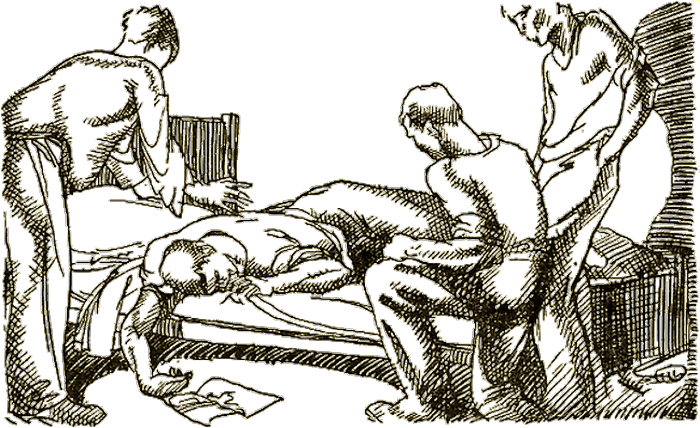
SOMEHOW one connects treasure-hunting with tropic seas or hillsides baking under hotter suns than those of England. But just as gold is not peculiar to any one country, so treasure has been hidden in all parts of the world, and the famous Captain Kidd is said to have buried his spoils on the shore of a small island lying off Nova Scotia.
The story of the search for this treasure begins in the year 1797, when an old sailor named Samuel Kirton lay dying in his home on the coast of Massachusetts. Aware that his end was approaching, he sent for three friends, men named Smith, Vaughan, and Maginnis.
His father, he told them, had been a pirate. He had died in 1749; but before his death had confided to his son that the great treasure-house of the pirates was Oak Island, a small island in Mahone Bay close to the coast of Nova Scotia, and that here was buried an immense store of gold, gems, and plate looted from many merchant-ships. He produced a worn old chart from under his pillow and told his listeners that it would give them the needful directions.
"Why didn't you look for it, yourself?" demanded Vaughan, who was the sceptic of the party.
"Never had no money," replied the old man in a hoarse whisper, then before any further questions could be asked, his eyes closed, a shudder passed through his worn, old body, and he was gone.
The three men discussed the chart, and a few weeks later, when spring had cleared the snow from the land, the three departed quietly and reached Oak Island. It was quite uninhabited, and they took possession under the Settlers' Act, which allowed the homesteading of unoccupied land.
The chart seems to have been rather a rough affair, and did not indicate the exact spot where the treasure was buried; but as the three searched around they came upon an old and conspicuous oak tree, in the bark of which were deep notches, evidently cut many years before. Among the dead leaves at the foot of this tree they found an old and much decayed ship's block. Probing the soil, they discovered that in one place it seemed soft. This was a good enough indication, and they at once set to digging.
They were right, for the soil, in a radius of about six feet, was quite soft and it seemed evident that they were cutting down into an old pit that had been filled. Presently one of the diggers gave an excited shout. His shovel had struck hard wood. Of course he believed he had reached the treasure-chest, but no such luck. The object was a balk of oak timber roughly squared with an axe. Evidently it was part of the shoring of the original pit. Ten feet further down they came upon more timbers, and these they found at intervals down to a depth of forty feet.
Then trouble started. In the first place the pit was very wet, and they had no means of pumping out the water; in the second, the people on the mainland, simple but superstitious folk, visited the island and told the treasure-seekers that they did not propose to have the ghosts of bloodthirsty pirates loosed upon them. Smith, Vaughan, and Maginnis laughed at such foolishness; but presently their laughter was turned to terror, for a deputation armed with bell-mouthed blunderbusses waited on them and gave them twenty-four hours to clear out. As an American would put it, there were no two ways about it. They quit.
Seven years passed, then back came our adventurers. This time they had money, tools, a proper pump, and their own guns. They had succeeded in forming a small Company under the chairmanship of a certain Dr. Lynes, medical officer of the town of Truro in Nova Scotia. Work began in earnest and a shaft was taken down to a depth of ninety feet. At this level a flat slab of cut stone, three feet long and about a foot and a half wide, was discovered. On this stone was cut in rough lettering these words:
"Ten Feet below Two Million Pounds
are Buried "
Imagine, if you can, the excitement of the camp. At last the labour of years was to be rewarded, and the truth of old Samuel's death-bed utterance to be proved. It was late in the evening when the stone was unearthed. That night hardly any of the diggers slept, and at earliest peep of dawn they hurried to the pit. Cries of horror came from their shocked lips, for the pit was filled with water nearly to the brim. The water was salt, and it was plain the sea had broken in. They tried to pump, but you cannot pump out the Atlantic. Sadder men never left an island.
It was many years before any fresh move was made to tackle the pirates' hoard of Oak Island, but in 1849 a new Company was formed for the purpose. The old shaft had fallen in and filled, and work was begun with mining augers. At a depth of ninety-eight feet the steel point of the auger struck timber, pierced a six-inch log, then after sinking a few inches became embedded in heavier wood. When it was drawn up there were found, attached to its point, some wisps of grass peculiar to the West Indies, and three links of a silver chain.
The difficulty was still the water. Search along the shore revealed the existence of no fewer than five carefully made drains built of stone which had been hammer-cut. The main drain appeared to come straight from the pit.
Months were spent in desperate efforts to dam the inflowing tide, but they had not the means or the machinery. Chapter two ended like chapter one in a complete failure. Once more Oak Island was left to its birds and occasional seals.
But the lure was still there, the lamp of gold bound to bring the human moths fluttering around it. Early in the 1860's a third Company was formed to try for the Oak Island treasure. It was not much of a Company, for its capital was but two thousand five hundred dollars in one dollar shares. Of course it was hopeless. Pumping went on for a few weeks, but every ruthless tide refilled the ancient pit, and the two millions in gold were as far away as if they were at the bottom of the deepest trough in the Atlantic Ocean.
There are said to have been several other attempts in ensuing years, but it was not until 1896 that the work was taken seriously in hand by the Oak Island Treasure Company, with a capital of sixty thousand dollars. Real engineers got to work, real steam pumps were installed. A steam drill was purchased and the workmen were highly skilled and well paid. New shafts were sunk, but as before each filled with salt water. Oak Island is but a very small patch of land, and the soil is sandy. Its highest point is perhaps no more than one hundred feet above sea-level.
It was decided that the only possible chance of recovering the treasure was to build a coffer dam across Smith's Cove, the little bay on the shore of which the shaft was sunk, and this was done at great expense. The tide was shut off for a time, but the tides in these latitudes are very great, and the storms beat in with amazing fury. Each winter the waves broke down the work that had been so toilsomely done during the summer, and time and time again the shafts filled with sea water.
One more strange find was made. Late in the season of 1897 an auger brought up from a depth of one hundred and fifty-six feet a soaked scrap of parchment about an inch square. On it could be deciphered just two letters which appear to be V.R. And that is all. No one has yet reached the spot where that two million is supposed to be deposited. Probably no one ever will.
The whole business reeks of mystery. The first question that suggests itself is—supposing that Kidd or Blackbeard or one of the other Pirate kings did actually bury his treasure on this lonely beach, why should he have dug a pit one hundred feet deep in which to hide it? And granted that he had decided to do so, how was it that he succeeded in digging it without getting drowned in the process?
Yet if you say that the whole thing is absurd, and that of course he could not and did not do anything of the sort, how about that stone? That was real enough. So was the timbering of the shaft.
The only possible explanation seems to be that the original pirate was a man who spent most of his treasure in playing a colossal joke on posterity. He dug down and placed that inscribed stone at the bottom of his shaft, then finding the water coming in, filled up the hole, and departed.
Something like two hundred and fifty thousand dollars (fifty thousand pounds sterling) has been sunk in the various attempts to find the Treasure of Oak Island. The old pirate must chuckle if his wraith is still haunting the ruined works of the Treasure Company.
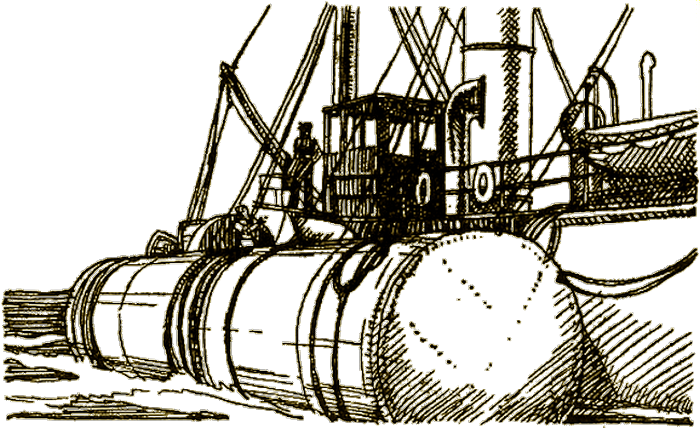
SMEATON, one of the greatest engineers of the eighteenth century, was the first to make a diving bell which was constantly supplied with fresh air by means of a pump.
The modern diving suit was invented by Augustus Siebe in 1829, but was a crude affair, consisting merely of a miniature diving bell which covered the diver's head and a canvas jacket weighted at the lower edge. The air pumped down into the helmet escaped under the weighted edge of the jacket, and at all times the water was only a few inches below the mouth of the luckless diver.
The closed suit as at present worn arrived in 1839, and since that date has been so greatly improved that in it divers have descended to depths exceeding two hundred feet.
The modern diving suit is not only perfectly watertight, but has many devices ensuring the safety and comfort of its wearer. The helmet is fitted with a cleverly constructed inlet valve so that, while air can enter, it cannot return or escape. In case of accident to pump or air-pipe enough air remains in the helmet to allow the diver to return safely to the surface.
There are air conductors from the inlet valve which, by carrying cool air across the eye-pieces, prevent them from being clouded by the wearer's breath. Modern diving suits are also fitted with telephones so that the diver can at all times speak to those above. Formerly the diver had to rely entirely upon signals made by pulls upon his lifeline.
Without such inventions as these such a salvage feat as that described in the following pages would have been impossible.
The veil of silence drawn across most of the major disasters of the Great War concealed from the public the serious nature of the sinking of the liner Laurentic. The Laurentic, one of the finest of the White Star liners, left England in January 1917, carrying in her strong-room gold and silver ingots to the value of just over five million pounds. This vast sum in bullion was consigned to the
United States in part payment for the munitions which were being poured out by America; and the British Treasury was anxious to get the money across with all speed in order to pay the wages of the factory hands on the other side of the Atlantic.
The Laurentic was no longer a luxurious passenger steamer. She had been transformed into an armed cruiser, and had a crew of four hundred and seventy-five officers and men. German submarines were everywhere and a sharp look-out was kept as the big ship steamed up the Irish Sea. She passed the Isle of Man, left that oddly shaped promontory, the Mull of Cantyre, to starboard, and swinging westward began to breast the long swells of the Atlantic. The worst of the danger was over and her officers began to breathe more freely as the Laurentic drove swiftly past the north coast of Ireland. Malin Head was passed, and had begun to drop astern, when, without the slightest warning, there came a tremendous explosion. The ship seemed to stop dead. Struck by a German torpedo, or wrecked by the explosion of a mine, the Laurentic sank swiftly into the depths.
The British Admiralty wasted no time in getting to work, and within a fortnight after the disaster the salvage steamer, Volunteer, was on the spot, and a diver went down. In spite of the fact that in these northern seas the darkness is complete at such a depth as this, the diver found the wreck at once and by the light of his lamp saw that the ship lay flat on her side. He made a rapid survey, then was drawn slowly to the surface. From such a depth as this a diver must come up slowly, otherwise he gets diver's palsy, that is, bubbles of nitrogen form in his blood and either paralyze or kill him. By Admiralty regulations a man may stay at the bottom only fifteen minutes at one hundred and twenty feet, and he must take thirty minutes to come up.
From this man's report it was decided that the only way to recover the gold was to blast a hole in the starboard side of the ship, and so force a way to the treasure-room.
Preparations were made as quickly as possible, and in the middle of March the salvage steamer was again above the wreck. This time the diver took with him two bags of high explosive heavily weighted with iron, and after placing these in position was drawn up. The explosive was fired electrically, and when another diver went down he found that a hole had been blown in the vessel's side through which he was able to make his way into her dark interior which was a mass of floating wreckage. The risk of passing through a tangle of this kind is always great, for if the lifeline gets foul or the air-tube pinched the fate of the diver is usually sealed.
The diver got through safely, but found to his dismay that the hole made by the explosion was some twenty feet forward of the strong-room. Yet with less difficulty than he had anticipated, he reached the door of the great safe, and managed to force it. An hour later news was flashed to the Admiralty that the salvage of the gold had actually begun.
Then the ill-luck which seems to dog the footsteps of nearly all treasure-seekers showed itself. A strong gale blew up from the north-west and raged for a week. During the storm quantities of wreckage were found on the neighbouring beaches. One might suppose that at such a depth as one hundred and twenty feet no storm that ever blew could affect the sea-floor, yet, when the gale had blown itself out, and the divers were once more able to return to their work, they found the Laurentic had been battered to pieces, and that their passage-way to the treasure-chamber was barred by a tangled mass of twisted iron and splintered wood. After long consultation it was decided that it was useless to attempt to clear the first passage, and that the only thing to do was blast a fresh way to the strong-room.
This proved to be a much longer and more difficult business than the first effort, and spring was well advanced before it was finished. The chief difficulty was that the whole fabric of the ship had collapsed, so that every foot of the way had first to be cleared, then shored up just as is done in mining for coal. Imagine the difficulty of putting these timbers in place, working in deep darkness, bitter cold, in a strong tide, and in spells of only fifteen minutes each! Yet by the end of the summer of 1917 a good portion of the gold had been salved, and there was every hope that during the following summer the rest might be recovered.
Meantime, however, the Germans had somehow discovered what was going on, and determined to stop the work. When the Volunteer reached the spot early in the spring of 1918 she was attacked by a submarine, and had hurriedly to escape into Lough Swilly. A destroyer was sent which hunted the submarine out of the neighbourhood, the salvage ship returned to her work, and a diver went down.
He had not been five minutes at the bottom before he was suddenly dragged off his feet. In spite of his struggles he was drawn upwards, and found himself being towed through the water at fearful speed. What had happened he did not know, but almost instinctively his hand went to the tap which closes the valve, by which used air escapes from the helmet, and turned it. Air at once filled his suit and he shot like a bubble to the surface. The shock of so rapid a change in pressure nearly stunned him; his heart thumped, his head throbbed, and his ear-drums felt as if they were cracking. He knew that he was on the surface, because daylight shone through the glass of his helmet, but for the rest he could tell nothing of what was happening, except that he was being dragged swiftly through the waves. He started spinning like a hooked fish at the end of a line, and in spite of all efforts to keep a clear head his senses began to leave him. The last thing he remembered was being jerked bodily out of the water.
The reader may perhaps guess what had happened. An enemy submarine had been sighted by the look-out, sneaking up from the north. There was no time to raise the diver, the ship had to cut and run, towing the diver at the end of his lifeline and gradually pulling him aboard. Happily the stout little salvage ship escaped unharmed, and so, too, did the diver, who was placed in the recompression chamber, where air-pumps raised the pressure until it was equal to that at which he had been working. Then it was gradually reduced to that of ordinary atmospheric air and the diver was able to walk out.
The crew of the Volunteer were anxious and eager to continue their work, but orders came from the Admiralty that all work was to be suspended for the present, and it was not until the spring of 1919, six months after peace had been declared, that a fresh effort was made to recover the remainder of the Laurentic gold. The work was taken up by the new salvage steamer Racer, the most famous ship of her kind in the world and the most wonderfully fitted.
The gales of the previous winter had been heavy, and experts believed that they would have played havoc with the wreck; but the actual state of the remains of the unfortunate Laurentic was worse even than had been anticipated. The first diver to go down reported that she was not only broken into a mass of twisted wreckage, but was also silted under by immense quantities of sand. Nothing could be done until the sand was disposed of, so the tube of the great suction-pump of the Racer was lowered and the sand was pumped away. The modern suction-pump has a pipe with a diameter of no less than eighteen inches, and the rate at which it can devour a sand-bank is little short of miraculous. Incidentally it sometimes devours other things as well, such as iron bars and huge lumps of rock. These travel all right until they come to a bend, but there they stick and there is trouble. The broken woodwork of the Laurentic scattered the sea-bottom, and pieces were constantly drawn into the pipe, clogging the pump and causing great delay. But at last a new way was cleared to the strong-room and a consider quantity of the remaining gold recovered. When autumn storms put an end to the season's work, about a million pounds more of the treasure had been brought to the surface.
In 1920 all the work had to be begun afresh, for the wreck was banked deep in sand. The clogging of the pumps was worse than ever, and by this time the strong-room itself had sunk deep in the ooze. It was not until late in September that the first consignments of gold were brought up; then gales began early and nothing more could be done until the following year.
With the spring of 1921 the struggle began afresh. There were still more than two million pounds' worth of treasure in the wreck, but experts shook their heads and prophesied that the exceptionally heavy storms of the previous winter would have completely buried the remains of the Laurentic, and that it would be impossible to get anything more of value from her.
They were not far wrong, for when the divers once more reached the bottom they found that the Laurentic was in sad case. Though not buried, the storms had shattered the wreck to such an extent that the great boilers had burst from their fastenings and smashed their way through the rusted plates of the ship's deck. The wreck itself was a mere shapeless heap of twisted girders and plates, covered with all kinds of marine growths. Goggle-eyed fish cruised over and among the amazing rubbish- heap which had once been a crack liner.
Finding a needle in a haystack was child's play compared with discovering under water where the remains of the strong-room lay, and the task of reaching it seemed almost superhuman. Yet if the experts despaired the divers did not, and these set to work without delay. Indeed, the difficulty was to prevent their staying below for too long at a time. More than one risked his life by so doing.
To make matters worse for the salvage crew, that summer proved very stormy, and time and time again the Racer's crew were obliged to haul up divers and gear and run for shelter. The force of the tidal currents in the estuary increased the difficulties.
A diver's average weight is one hundred and sixty pounds. On his back he carries a forty-pound weight, while a similar slab of lead is slung upon his chest. His immense boots are each weighted with about twenty pounds of metal, and his copper helmet is also very heavy. Equipped to go down, he weighs well over three hundred pounds. Yet more than once one of these divers, after slipping down the shot-rope and reaching the deck of the wrecked vessel, found himself swept off and dropped lightly on the sea-bed fifty feet or more away. During periods when the tidal stream ran like this work was impossible, and the only thing was to wait until slack water between tides.
The danger of getting lifeline or air-pipe entangled in wreckage became greater as the ship broke up. On one occasion a man, crawling on hands and knees through a watery cavern that was once the brilliantly lit and beautifully decorated saloon of the liner, found himself brought up with a jerk. He knew at once what had happened, but instead of telephoning the ill news to his comrades above he turned and crawled slowly back. The only light he had was from the feeble rays of his electric lamp, but by the aid of this he managed to find the spot where his lifeline had got caught, and clear it. But this took nearly a quarter of an hour, and by the time that he was at last free, he had been down for more than double the statutory fifteen minutes, and was obliged to come up very slowly in order to equalize the pressure.
The greater part of that summer was spent in blasting out a path to the sunken strong-room; but when that was at last done, they found the whole thing buried many feet deep in sand and mud. The great pumps of the Racer were set to work to suck this away, but over and over again heavy gales interrupted the work, and the net results of the whole season's work was only seven bars of gold, worth in all about ten thousand pounds.
"It's dogged as does it," is the motto of the British Navy, and as early as possible in the following year the Racer was again moored over the wreck and work begun once more. It was the same old routine—first blasting, then pumping; but the weather was more kind, and time after time the glad news was signalled from the bottom that another ingot had been discovered. In August of that year, H.M.S. Wrestler ran into Liverpool with one hundred and fifty thousand pounds' worth of gold salved from the wreck. Up to date three millions of the treasure had been recovered.
The work still went on. In the following summer a very large amount of what still remained was salved, and the spot where the strong-room had melted into rust was completely cleared. There was still a considerable amount of bullion to be accounted for, but the authorities had already decided that operations would cost more than the value of the ingots when a curious accident occurred. A diver exploring the fore part of the wreck, caught his foot in some weighty object and took a bad fall, breaking the small bone of his left leg. That something proved to be a mass of gold bars. Under tons of wreckage were found no fewer than two hundred and fifty of them, each weighing either fourteen or twenty-eight pounds. When they were got up they proved to be worth a quarter of a million.
The net result has been that the whole of the Laurentic's gold, except about two hundred and fifty thousand pounds has been salved, the actual work being done at a cost of about twenty-five thousand pounds, and without losing the life of a single man engaged. When one takes into consideration the depth, the fierce currents, and the many difficulties under which the work was done, it is a fine testimonial to the skill of Captain Damant, R.N., who was in charge of the operations, and to the pluck and resource of those under his command.
The divers engaged in the work received a bonus of half a crown for each hundred pounds recovered from the wreck. There were in all a dozen men employed, and between them they shared a sum of just under six thousand pounds. They most certainly earned every penny of it.
A BIG fair-haired man, with the bronzed skin of one who has spent years in hot countries, walked into the Salle Privée of the Casino at Monte Carlo one day in January 1927, and stood looking round.
"Hulloa, Sanders," came a voice, and another man, not so tall but of the same tough Saxon breed, got up and came forward.
"Jolly! the very man I was looking for," said Sanders as the two shook hands. They sat down and began to talk.
"I'm off to Bolivia," said Sanders presently. Jolly nodded.
"Mining, I suppose?" This was a natural suggestion, for Stratford Jolly, who himself has knocked about all over the world and helped to dig up many a relic of the past from long-buried cities, knew Dr. Edgar Sanders as a mining expert. To his surprise Sanders hesitated.
"Don't laugh," he said in a lowered voice. "It's a treasure-hunt this time. I'm forming a Company to search for the twelve millions buried by the Jesuits in the Square Stone Heap on the Sacambaya River."
Jolly did not laugh. On the contrary, he was much interested. Sanders went on to tell him about the treasure which is the same for which Prodgers had already searched.*
(*See Chapter VI.)
"Prodgers," said Sanders, "turned over all his information to me on condition I would take on his liability to the Señorita Corina San Roman. Prodgers died in 1923, but I was unable to do anything until 1925 when I fitted out a small expedition at my own expense, and followed this by a second in 1926."
"And you believe the treasure is really there?"
"I can't believe anything else. The evidence is overwhelming. We know that very soon after the conquest of Peru the Jesuits crossed the Andes, made converts among the Indians, built forts, and began to work the mines.
The silver and gold they obtained was exported to Europe as the property of the Society of Jesus, and they refused to pay to the Spanish crown the royalty of one-fifth which was its due. Naturally there was trouble, but the Jesuits' intention was to form a great colony in the interior which would be independent of Spain, and in this they would probably have succeeded had not the Spanish authorities blockaded the passes across the mountains, and so prevented them from sending out their gold or importing supplies.
This crisis came in 1767, and for eleven years none of the gold extracted from the Bolivian mines left the country. In 1778 the Spanish king issued an ultimatum for the deportation of all the Jesuits on pain of death. The order also laid down that their gold should become the property of the Spanish crown.
In 1635 the Jesuits had built a fortress and monastery at Plazuela, the spot where the river Kato joins the Sacambaya. This became one of their principal centres, and the indignation of its Prior may be imagined when the passes were first stopped. Yet he and his companions still had hopes that Rome would interfere in their behalf, so decided to hide all the gold they had for shipment and also hide, as far as possible, their more important mines. They made ready a place in which to conceal their treasure, and five hundred and sixty Indians were employed for two and a half years in constructing this hiding-place.
So well did they do their work that when the representatives of the Spanish crown reached Plazuela they could find no trace of the Jesuits' gold. Most of the Indians had fled. Those left either could not, or would not speak. It is said that some were tortured, yet that no information could be obtained.
Many expeditions have searched for this treasure, but apparently all the searchers believed that the hiding-place was in the hill called Negro Muerto, on the right bank of the river. It was not until 1905 that the information given by Doña Corina proved the real hiding-place to be in the Caballo Cunco on the left bank.
"And you believe this to be correct?" Jolly asked.
"I am sure of it. I examined the whole hill and found a huge artificial stone structure or filled-in cut which has been named the Square Stone Heap. It is a perfect rectangle, 618 feet long and 128 feet wide, and I believe it to be the roof of the cave in which the treasure is hidden.
"I also found a tunnel, the entrance of which is exactly opposite the monastery of Plazuela, but at some little distance from the Stone Heap. It was filled with earth from roof to floor and we started clearing it.
"After a few days' work we came upon a board on which was nailed a silver crucifix. Four yards beyond was a wall blocking the whole of the tunnel, and in a hole in this wall we found a small wooden box in which was a piece of parchment. On this was written in Spanish a warning. Here is the exact translation." He took from his pocket-book a scrap of paper:
"You who reach this place withdraw. This spot is dedicated to God Almighty, and the one who dares to enter, a dolorous death awaits him and eternal condemnation in the world he goes to. The riches that belong to God our Master are not for humans. Withdraw, and you will live in peace and the blessings of the Master will make your life sweet, and you will die rich with the goods of this world. Obey the command of God Almighty, Our Master in life and in death. In the name of God the Father, the Son, and the Holy Ghost. Amen."
"But are you sure this is genuine?" Jolly asked.
"I took the original to the British Museum authorities who saw no reason to doubt it. It has also been examined by Sir Edward Denison Ross, Director of the School of Oriental Studies, who declares that, in his view, it is absolutely genuine."
"That sounds good," said Jolly. "What else did you find?"
"Nothing. Stupidly I read the translation aloud upon which all my Indians took fright and left. Only my foreman, Juan Mendizabal, and the cook remained. So I decided to organize a fresh expedition for which I want at least fifteen reliable white men. Will you be one of them?"
At first Jolly feared this was impossible, yet in the end found himself able to go. This story comes from his most interesting diary, which he kept throughout, and very kindly lent to the writer.
It took some time to collect the money needed for the expedition, but in the end the Company was over-subscribed.
The personnel was equally over-subscribed. Over three hundred adventurers begged to be allowed to join the expedition. More than two hundred were at once turned down, and Sanders lectured to the rest on the hardships before them. He talked to them about malaria, mosquitoes, sand-flies, days of fierce toil under a tropical sun, but did not succeed in choking many off. Yet only twenty-five men were wanted, and the task of sifting was a difficult one.
The story of the selection of Henry Macallister is worth repeating. Henry was behind the counter in a great shop where a tall, fair-haired man came to buy stores. This man wanted to know whether six hundred pounds' worth of miscellaneous equipment could be ready by next morning. The head of the department was horrified and shook his head. "Impossible, I fear, sir," he answered.
Henry spoke up. "I think I can manage it," he said to his chief, and manage it he did, though he had to work the whole night long to complete the task. Next day, when the big man came in, all was ready and the young assistant got a gruff word of thanks and a look of approval which thrilled him with delight.
Time passed, then one day the big man came in again and Henry hurried to serve him.
"H'm, you're the young man who did the job for me when I was last here," said the customer, who was no other than Edgar Sanders. "Here's a list of what I want. Not quite so urgent this time."
Henry plucked up courage. "You're going to South America again, sir?" he asked.
Sanders nodded. "I am having a try for the Sacambaya treasure."
"You are taking an expedition, sir?"
"I am."
Henry paused—then the words came with a rush. "Could you—is there any chance you'd take me, sir?"
Sanders looked him over. "It's no picnic," he said. "You'd have to work like a nigger; you'd be eaten alive by insects; it's frightfully hot by day and often very cold at night. There are fevers and Indians, storms and floods. Think you could stick all that?"
"Would it be worse than Gallipoli, sir. Or the Somme?" Henry asked.
"No—not worse than that."
"Then you'll take me, sir?"
Sanders' answer was prompt. "I'll take you. We start in a fortnight." And that is how Henry J. Macallister came to be one of the Sacambaya Treasure Expedition.
The expedition sailed on March i from Liverpool, and was not only the largest of its kind that ever left England, but certainly the best equipped. Including such food as could not be obtained locally, the stores weighed forty-five tons, and included two portable electric light plants, one for the camp, the other for the tunnel, a circular saw, and engine. Two six-wheeled Morris tractors were purchased to carry the stores from rail-head to Sacambaya. There was also a photographic kite for taking aerial photographs, a big marquee, and a very complete outfit of medical stores.
"The Star" newspaper sent a special correspondent with the party. He was Dr. P. B. Mellows, who acted also as medical officer to the expedition.
The route was by Bermuda and Havana, then through the Panama Canal, and so down the west coast of the South American Continent to Arica in Peru. Here the treasure-seekers had their first experience of South American ways.
Peru has sold the monopoly of matches, and one of the members of the party who unwittingly went ashore with a box of English matches in his pocket, had to pay a fine of a pound. Another thing that interested the adventurers was a "Safety First" warning consisting of a wrecked motor-car planted on top of a street monument, with a notice beneath it, "Despacio se va lejos," meaning "Slowly one goes far."
From Arica the railway runs inland across the lofty chain of the Andes, and the trains carry a supply of oxygen for the use of those attacked by mountain sickness. But beyond slight headaches at the highest point (over fourteen thousand feet), no one was any the worse. And so they were carried in comfort to the eastern side of the great divide and arrived at La Paz, the capital of Bolivia. There they loaded their goods on the trucks and carried them as far as a place called Pongo, beyond which was no road which had ever been used by wheeled vehicles. Pongo stands nearly twelve thousand feet above sea-level, and the country is bleak and treeless.
The local people talked a great deal about making up the road, but Sanders saw that it would take months, and in the end it was decided that the best course was to leave the lorries and hire a mule-train to shift the goods.
Now a mule carries only two hundred pounds, and the task of taking heavy machinery to pieces, and packing it on mule back is no joke. So while the engineers tackled this task, Jolly, with some of the party, went ahead to make ready the camp, and after fording various flooded rivers, reached Sacambaya, where they were delighted to see trees again, and be once more in the midst of green things. But the mosquitoes were bad, and on the first night, before the mosquito nets arrived, they were forced to cover their heads with their blankets in order to get a little sleep.
Work began in earnest. A bridge had to be built, wood cut, machinery assembled, a corral built in which to keep the mules. The big marquee was erected to be used as a dining-room and a kitchen was got ready with an oven made of mud and stones.
The camp was made at the foot of the Caballo Cunco Hill, where the river Sacambaya joins the Kato. Immediately behind the camp, and facing the Sacambaya River was an old ruin known as The Fortress. The ruins of the Monastery of Palzuela, lay opposite the camp on the far side of the river Kato.
While the camp was being got ready the Square Stone Heap was surveyed, and a party cleared away the brush from its side. Cement bases had to be made for the cranes, and lines of iron pipe laid for the hydraulic pumps.
At first they had no Indians, but by degrees they collected a force which in the end numbered sixty to eighty. These Indians demanded high pay, and a very generous allowance of food. They also kept a large number of feast days on which they would do no work, but went off and got drunk. The white men on the other hand, worked ten hours a day for five days a week, and five on Saturdays.
On Sundays Jolly and others explored the country but saw little in the way of game or birds. The one sort of life that was really plentiful was insects. Mosquitoes were very bad. There were sand-flies (a horrible pest because they are so small they can get through the meshes of a mosquito-net, and they bite like fire), hornets, flying-ants, and midges. Scorpions and tarantulas (large hairy, poisonous spiders) were plentiful. There were also poisonous snakes, including vipers and rattle-snakes.
The worst pest of all were vampire bats which sucked the blood of the mules and horses. It was found necessary to make covers of tarpaulin to protect the animals at night.
Work went on steadily, opening up the tunnel in which Sanders had found the crucifix and parchment. Then came a sad disappointment. The tunnel ceased to be a tunnel any more. The only explanation seemed to be that the Jesuits had placed these things there in order to deceive searchers and induce them to concentrate their attention on the wrong spot.
The tunnel having failed, the question was as to the most promising direction from which to start the search for the tunnel which the Jesuits must have cut to their secret hiding-place in the heart of the hill. Sanders believed that a tunnel probably led from the monastery under the river, but there was also the possibility that its entrance might be concealed in the fortress, which was evidently an older building than the monastery.
It fell to Jolly to dig there, and he spent three weeks at the work. He found no sign of any tunnel, but a variety of interesting relics. These included much pottery, some broken, but at twelve feet some good and perfect specimens of Inca vases; there were stones cut into the shapes of condors, sheep, and cattle, and a beautifully carved stone dish which may have been used for gold washing. Silver pins, a small bronze bell and a wooden bodkin were other finds.
Prodgers, as already described, had found and dynamited the Egg-Shaped Stone on top of the Caballo Cunco. He claimed to have found the roof of a cave, but the Sanders expedition could find no trace of this roof, and as for the hole from which he described poisonous gas as arising, this appeared to be no more than an old mining shaft.
A man named Tredennick had followed Prodgers and started work on his own account, driving a shaft fifty feet into the eastern side of the hill. He struck an old Jesuit shaft partly filled in, and in it found a porcelain vase. To enlarge this shaft he put in a charge of dynamite.
The explosion was followed by a fearful rumbling which went on for a long time, and when he went back to explore, he found the entire shaft filled with broken rock. Nothing daunted, he began work afresh lower down the side of the hill, and drove a fresh tunnel, but his money ran out, and he was forced to abandon the search.
After the failure to find the mouth of any tunnel in the Fortress, it was decided to investigate Tredennick's tunnels, and again Jolly took up the task. At first he could find nothing then, quite by chance, came across a spot where the ground sounded hollow beneath his feet, and after prying up some big, flat stones, he discovered a shaft which, from the new state of the wooden pit props, must evidently have been cut by Tredennick.
This was full of rubbish and it was a slow job clearing it out, for all the rock and earth had to be pulled up by bucket. It went down thirty feet and branched into a tunnel, part of which seemed natural and part artificial. One of the chief difficulties of the explorers was that the whole hill was full of natural caves, rifts, and cavities.
Jolly's spirits rose, and for a while he fully believed that this might be the mouth of a tunnel leading to the treasure-cave. But after clearing it for a distance of five yards, it ended in solid rock and there, at the rock face, lay a small modern crowbar, undoubtedly left by Tredennick.
Sanders had already begun a cut at the bottom of the hill in the base of the Square Stone Heap. This was a colossal piece of work, being no less then forty feet wide, and the intensely hard rock required much dynamite to break it up. It was agreed to abandon work higher up the hill and concentrate on this cut which, Sanders believed, would tap the hidden tunnel.
Here the ill-luck that so often dogs the treasure- hunter showed itself again. The drill-sharpener broke, and while it was being repaired the workers were driven to try the old method of cracking rocks by heat and water. It was an extravagant way of doing things, for it took fifty Indians half a day to collect enough wood to heat the huge rocks. Yet on the whole it worked well.
Although their chief object was the finding of the Treasure of the Square Stone Heap, the directors of the enterprise did not neglect other opportunities of profit from their concession. Two miles from the camp, on the river Kato, lay the enormous ruins of the old Priory of Cuticutuni, covering a space three hundred and fifty yards long by one hundred wide. These were surrounded by a ten-foot moat and massive wall.
Here, gold relics had been found, and there was said to be gold in the river-banks under the ruins. It was decided to move the hydraulic pump to this spot and wash the gravel. The pump weighed nearly half a ton, and the only way to get it down was by water. So a raft was built, made of tree-trunks buoyed by a large number of petrol tins, and the machine lashed on to this. Indians with guide ropes waded on either side.
For a while all went well, then the raft ran upon a shoal. But there was deep water just in front of the shoal, and as the Indians pushed the raft off, a number of them suddenly went in over their heads. Naturally they tried to save themselves by clinging to the back of the raft. The raft tipped, the pump broke from its lashings and sank, and the raft drifted down into the rapids. It took all hands a day to recover the heavy machine by means of block and tackle, then the whole thing had to be cleaned of mud and sand and gravel. But when they tried to start up the engine it was found that the magneto had suffered irreparable damage.
So Jolly took some Indians down to the Priory, and after clearing away the tangle of undergrowth which thickly covered the ruins, started digging. He found dozens of "tapadas" (holes covered by slabs of stones—graves of Indians). Most of these contained earthen pots which had been filled with grain to feed the soul of the dead. Jolly found silver and copper pins, a copper axe-head, and pottery, but not a trace of gold. Further north in Colombia large quantities of gold have been recovered from "tapadas."
Mosquitoes and sand-flies were not so bad as they had been when the party first arrived at Sacambaya, but now there had come a worse pest in the shape of multitudes of fleas. Insect powder was useless to fight these hordes. Sanders had heard of a flea "devil doctor," and a neighbouring planter, Jacinto Aguilar, vouched for the fact that he really could cure any plague of fleas. So he was sent for and came—a quiet, elderly Indian with no suggestion of anything sinister about him.
"Yes," he said, "I can free your tents of fleas, but you must leave me to work in peace. Above all, you must not laugh at me." He then picked up a piece of bamboo which was lying on the ground, set fire to it, and walked three times round each tent. As he walked he muttered incantations which no one could understand. Each time he came to the entrance of a tent he knocked off the ash, spat on it, and worked it up into a little ball. When he had finished he said to Sanders:
"There will be fleas to-night, but not so many; after to-morrow there will be no more." Amazing as it may sound, he was right. There never were any more fleas in the tents during the rest of the stay at Sacambaya. When asked if he could not put a similar ban on the mosquitoes, the old Indian shook his head.
It was quite another devil-god, he said, who dealt with mosquitoes, and he would be offended if his province was encroached on.
Weeks passed, an enormous chasm had been cut in the side of the hill, yet there was no sign of the hoped for tunnel. Although some of the men began to grumble, work still went on steadily. Then one day a native who had been working for the party as blacksmith told them that a party of Turks or Armenians had travelled the country a year earlier with a gold-finding machine, but had no results until they reached the Square Stone Heap, when the needle of the machine pointed straight downwards at the very spot where they were now working. He himself had helped to carry the machine, and had seen the needle move. When asked why he had not given this information earlier his reply was that he did not think it would interest his employers! The news was cheering, and the men worked harder than ever.
The concession owned by the Company covered a good deal of ground, and Sanders asked Jolly to go up to Monte Sapo some distance from the camp, and look over an old Jesuit gold mine. Jolly and two others rode up into the hills, but the mine proved to contain silver, not gold, and at present prices it hardly pays to work silver.
Jolly discovered great veins of sodalite, a semiprecious stone of a very beautiful blue, but the cost of transport was too great to make this find profitable.
Monte Sapo is nearly twelve thousand feet, and the weather turned so cold and wet that prospecting was difficult. At last a heavy snowfall stopped their work and drove them back to Sacambaya.
Bad news awaited them. An underground stream had flooded the workings, and the men had been standing waist deep in water in an effort to stem the flood. The stream, it was thought, was a legacy of the Jesuits, who had diverted it so as to form a protection for their hidden hoard.
To add to their troubles, the rains had begun in earnest. Every day there was a downpour. The men worked in shifts, day and night, and kept two pumps going unceasingly, but it was all in vain. The best result was to keep the water at the same level.
A council was held, and it was decided that nothing more could be done for the present, and that the only course was to return to England and place the facts before the shareholders. The men were very much upset by the decision. They were ready to carry on, ready to face anything to gain the treasure which they all felt could not be far away. One of the older men was actually in tears. Sanders, not feeling too happy himself, had to explain to them the hopelessness of trying to work during the rains. The river would be in flood and even if the camp site were not covered with water, all of them would be down with fever. He congratulated them on having backed him up so nobly and worked so hard.
If the party found no treasure, they found plenty of evidence that something has been hidden in the steep side of the Caballo Cunco. The Square Stone Heap cannot be a natural formation, and whoever made it must have had some object in doing the work. Nor can the other evidence—the Silver Cross and the warning written on the parchment—be forgotten. If only there had not been so many false scents, if only the Indians had worked as well as the whites, the end of the story might have been a very different one.
Some day, when times are better, those Jesuit millions will probably see the light of day.
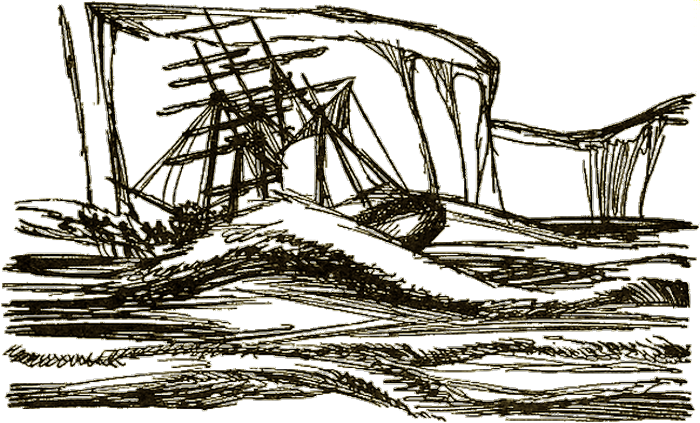
CAUGHT on a lee shore by a sudden, fierce gale, the British frigate Thetis was driven towards the frowning cliffs of Cape Frio on the Brazilian coast. The date was December 4, 1830, and only that morning the fine ship had left the sheltered harbour of Rio de Janeiro, bound for England with a valuable cargo of silver in her hold.
Her Captain and crew strove desperately to save their vessel. Carrying all the sail they dared, they endeavoured to beat out to sea, but the sails were blown from the bolt ropes, and soon it became plain that they could not weather the great point of rocks which runs due east into the Atlantic some sixty miles north of Rio.
Enormous seas breaking over the decks had smashed the boats, and all seemed lost when a small opening was noticed in the face of the cliff. At once the ship was headed for this inlet, but as she reached it she crashed on a reef which barred the mouth, and a wave forced her over against the rocks to the left of the entrance.
Here was a flat ledge of rock and a number of men jumped for it. Forty reached safety, but some failed, and fell into the raging surf. Before the rest could attempt to save themselves, a greater wave than any yet, picked up the shattered hull and carried it clear over the reef into a small cove behind. Half the bottom of the ship had been torn out as she rasped across the rock, and she sank at once.
Happily at this point the bay was so shallow that the upper deck remained above water, and with the help of the forty men who had already gained the shore, the rest of the crew were saved. Of the three hundred who manned the frigate, only twenty-eight were lost. Their escape was almost a miracle, for the opening into which the Thetis was cast is the only one of its kind in more than ten miles of otherwise unbroken cliff.
News of the disaster came to Admiral Baker, commanding the British squadron lying in Rio, who at once took measures to bring the survivors back and at the same time sent a small vessel, the Algerine, to guard the wreck.
A day later the Admiral had a visit from Captain Thomas Davidson, commanding the sloop Lightning, one of the smaller vessels of the squadron. Captain Davidson had the idea that it might be possible to salve at least a part of the silver in the wreck of the Thetis, and after some discussion the Admiral gave him a free hand in the matter. Since the silver cargo of the frigate was worth 810,000 dollars, or say a quarter of a million in modern money, the game was certainly worth the candle.
Davidson at once sailed for Cape Frio to survey the wreck. He was dismayed to find no sign of it. The cove being open to the full force of the Atlantic rollers, the surf had pounded the Thetis to pieces, which lay scattered among the rocks at the bottom of the little bay.
The outlook was not promising, for the cove was surrounded by broken cliffs which rose in places to a height of two hundred feet, and were nowhere less than eighty feet. It was four-sided, an irregular rectangle about two hundred yards in breadth, and a little less than that in depth from the reef to the inner end.
The depth of water varied from twenty feet to no less than a hundred and forty-four feet. The Thetis had sunk in the shallow eastern corner, but her hull had been reduced to matchwood by the sea, and it was impossible to say where the silver lay. To make matters still more difficult, the bottom of the basin was littered with huge boulders fallen from the tall cliffs surrounding it. These and parts of the wreck could be seen through the clear water from the tops of the cliffs.
Had the Thetis been wrecked in 1930 the difficulties of salvage would not have been anything like so great as they were a hundred years earlier. In these days every ship of the fleet carries diving gear, but at that date the modern diving dress was in its infancy, and nearly all such operations were carried out by means of the diving bell. None of the ships at Rio possessed anything in the nature of diving apparatus. There was no diving bell, no hose, no air-pump.
On the face of it, the salvage of the Thetis silver appeared a hopeless task, yet Captain Davidson, who had been trained under the famous Collingwood, was eminently of the bulldog type, and refused to be daunted by difficulties.
"One of the best means to assure success," he has written, "is to have a rational confidence that you will succeed." And from the very beginning he certainly possessed that confidence. He returned to Rio and set about his preparations. Having a free hand, he commandeered two iron water-tanks from the Warspite. From one of these he removed the bottom; from the other he cut a section two feet deep, which he riveted on to the open edges of the other. So he made a diving bell four feet square and six feet deep. This was strengthened inside with iron bars and angle pieces, and provided with iron seats for two men. Beneath the seats bars were fixed on which their feet could rest. Two windows of heavy glass were set in the top of the bell, and "pigs" of lead ballast affixed to the bottom in order to balance the top weight. When completed, this bell weighed no less than four tons.
The air-pump was made from one of the Warspite's water-pumps. That was a comparatively simple matter, but the question of air-hose was not so easily settled. Plenty of hose of a kind could be purchased in Rio, but it was all far too weak to stand the strain of supplying air to men ten or twenty fathoms below the surface. In the end Davidson took his own water-hose from the Lightning and strengthened it with plies of canvas covered with spun yarn, the whole being then thickly coated with Stockholm tar.
These preparations took six weeks, and it was not until the third week in January that Davidson was able to sail for Cape Frio. Arrived there, he found it impossible to anchor anywhere near the cove. The only holding-ground was more than two miles away, and it became clear that the salvage party would have to work from the land. To add to his difficulties, the entrance to the cove was so shallow that it was only in the calmest weather that boats could enter. Fortunately the weather was kind, and he got his gear ashore and set up tents for his men.
His first idea had been to rig cables across the cove, from which he might suspend the bell. But he found the distance too great, so decided to construct a derrick. This in itself was a colossal task and took two months. The derrick when finished was a hundred and fifty-eight feet long, and was built up out of twenty-two spars bolted and bound together with iron bands.
While the derrick was being built, Davidson tried to use the diving bell from a launch. But the bell was far too heavy for even the largest of his launches, so he set to work and built a smaller bell. Early in March this second bell was lowered to a depth of twenty-seven feet with two men in it. It worked perfectly. They stayed down an hour and a half, moved several rocks, and recovered a few bars of silver. But the currents in the cove swirled like whirlpools, and a day or two later the bell was upset and its occupants nearly drowned. It was ballasted afresh, and shortly afterwards a first consignment of three thousand dollars' worth of silver was brought up.
Meantime a platform was being cleared at the top of the cliff on which the derrick was stepped. This was not easy, for it meant blasting away a quantity of very hard rock with old-fashioned black powder. When at last the platform was completed, and the derrick set in position, it would not work. Owing to its great length it was too pliable. In other words it bent like a whip, so that Captain Davidson found he would have to take it all down again and set it up at some point nearer to sea-level. The only possible place was a sort of alcove at the base of the cliffs quite close to the water, and there, after much trouble, it was got into position. Even then it was not long enough, and a fresh spar had to be spliced. Captain Owen of the Eden, who saw it when finished, declared that it was a wonderful piece of work, one which possibly no men but British sailors would have attempted, let alone carried to a successful finish.
The derrick was ready on May 8, and once it was in working order the salvage men got really busy. Great rocks weighing ten or twelve tons apiece were shifted with its aid. It was essential to move these rocks, but the bullion lay in pockets beneath them. Within ten days no less than 130,000 dollars' worth of silver was brought to the surface. But the metal was no longer in its original shape. The "pigs" into which it had been cast had been so hammered and pounded by the waves that they resembled lumps of lead.
The luck was too good to last. On May 19 a gale sprang up from the north which backed to the west and blew with savage force. Huge waves broke into the little cove, and drove the men to take refuge at the top of the cliffs. As the tide rose, the seas mounted high above the bed of the derrick, and presently, with a crash which sounded even above the roar of the storm, the great spar broke off twenty feet from the heel, and dropped into the sea. With it went the big diving bell, its air-pump, and—worse than all—the hose.
It seemed a crushing disaster, yet it failed to discourage Captain Davidson. The moment the gale had died down and the sea calmed, he got the big launch into the cove with the small bell, and ordered the men to use it to recover the hose. At the same time he set others to work to construct a third diving bell out of the water-tanks of the Lightning.
By this time the men themselves were suffering gravely, for the conditions under which they lived were bad as bad could be. In the first place their only drinking-water came from a stagnant pool, and was the colour of weak coffee. In spite of all efforts to cleanse and deepen the pool, this caused much sickness. Then there was a perfect plague of insects. Flies buzzed in millions, ants swarmed in the food. Small red ants infested the flour, sugar, and biscuits. Jiggers, those pestilent creatures which burrow into the foot and lay their eggs under the skin, lamed many of the sailors. Worse than all were the fleas which made sleep almost impossible.
"It afforded us amusement sometimes," says Captain Davidson, who fortunately found humour in the most unpromising conditions, "to pull up the legs of our trousers and see them take flight like a flock of starlings from a corn stack."
The camp was infested by large black rats which grew so bold that they would actually snatch food from the men's hands. Snakes were almost as plentiful as rats. The boatswain mistook one for a rope, and started to haul on it. He vowed afterwards that it was three fathoms long. Many men went down with fever and rheumatism, and had to be taken back to hospital in Rio. Captain Davidson himself had a sharp touch of malaria, yet the result was only to make him more determined to complete his task.
Since he had not sufficient timber to build another derrick he tried the experiment of rigging a heavy cable across one corner of the cove, but the work was hung up by storm after storm. When at last the cable was in position, the small bell was suspended from it, and the work of diving begun again. A great deal of silver was got up and sent back to England in the warship Calypso. Into the bargain the hose belonging to the big bell was recovered, and was so little damaged that all it needed to make it serviceable was a fresh coat of tar.
In July fresh storms broke, and a boat was swamped. In spite of gallant attempts at rescue, two men were drowned. It speaks volumes for Davidson's leadership that these were the only two lives lost during the whole of the operations, which lasted more than a year.
By August the amount of silver recovered from the floor of the cove was 363,000 dollars. Then Davidson decided that it was time his men had a change, and leaving only a small guard on the cliffs, he took nearly the whole of his ship's company back to Rio in the Lightning. There they stayed for a fortnight while the ship was revictualled, and the holiday did them all a world of good. Davidson himself shook off his fever and rheumatism.
Returning to work in September, they found the weather quieter, and were able to use the small bell from the launch. Working over the shallower parts of the cove they got up a fair quantity of bullion, and in October the new big bell was ready and was slung direct from the cable. It proved a great success. As Captain Davidson says, "dollars fairly flowed upwards," and treasure to the value of £15,000 was recovered during a brief, fine spell.
Then one day a big Brazilian warship arrived, and her skipper paid a formal call on Captain Davidson. His Government, he said, had information that the British were fortifying the bay and making platforms for guns. Captain Davidson kept a straight face and took the Brazilians on a tour of inspection, which satisfied them that their suspicions were groundless. So peace was restored and celebrated by a dinner aboard the Brazilian ship.
After that the work went on steadily until the following March, by which time 749,000 out of the lost 810,000 dollars had been brought to the surface. The rest had either been ground to powder by the surf, or had drifted into the deep end of the cove, from which it could not be raised. To recover 749,000 out of 810,000 dollars, under such conditions and with purely home-made apparatus, is a feat of which any man might be justly proud, and which surely deserved a generous reward.
Yet the Treasury, with incredible meanness, decided that seventeen thousand pounds was a sufficient sum to be divided among the salvage party. From first to last nearly eight hundred men had been employed in the work, so the reward worked out at little more than twenty pounds apiece, and since the officers, of course, had the lion's share, the seamen were actually fobbed off with about seven pounds each.
Captain Davidson petitioned the Privy Council, which proved more generous than the Treasury, for it made an extra grant of twelve thousand pounds to the officers and crew of the Lightning in recognition of one of the most successful and spirited instances of treasure-trove ever recorded.
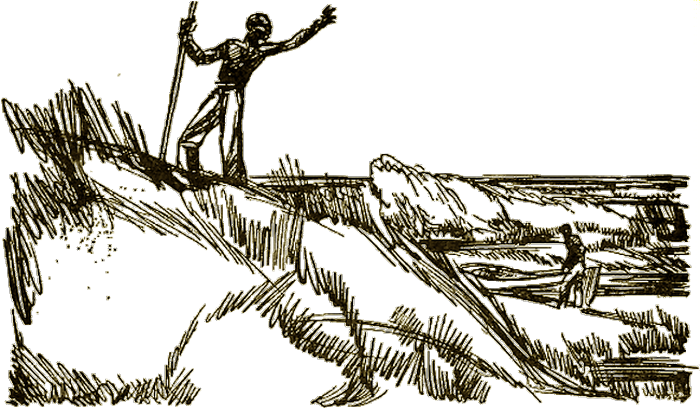
LIKE a pointing finger, the peninsula of Florida thrusts downwards from the American continent towards the great island of Cuba. Most of Florida is flat, sand covered, with an endless forest of pines, amid which lie lakes, great and small, reflecting the heavenly blue of the warm sky; but the southern end is one vast swamp.
In all the world there is no stranger place than this great swamp known by the picturesque name of the Everglades. It is nearly as large as Wales, and is held in a shallow cup of limestone rock between which and the sea is a narrow stretch of drier land seamed with the small rivers which drain the Glades.
In the rainy season the Everglades become a wide lake dotted with islands on which live the few survivors of the once formidable Seminole Indians. Everywhere banks of tall saw grass rise from the shallow water, the harsh grey-green blades forming an impenetrable jungle. The waters swarm with fish and alligators, the islands with snakes, and here is still found that strange water-beast, the Manatee, which is believed to be the origin of the mermaid legend.
The soil is incredibly rich, so that man has been tempted to attempt the drainage of the swamp, and already large tracts at the north end of the Glades have been turned into plantations of sugar-cane. Yet the great bulk of the swamp is still untouched and remains a beautiful, yet savage jungle.
Many strange legends are told of the Everglades. One is of a column of smoke which rises always from a spot so remote and inaccessible that the mystery of its source has never been solved; another is of black slaves held by the Indians on the islands—and this is true. But those of which the fishermen and settlers on its borders speak most often deal with treasure.
The commonest story is that of a Spanish galleon caught in a cyclone and swept inland on the crest of a tremendous tidal wave. The tale told is that she was driven deep into the swamp and grounded there upside-down, and there she lay until creepers had covered her and trees grown through her rotting timbers. Somewhere about the year 1880—the exact date is uncertain—two negro brothers, fishermen, named Cato and Scipio Edwards, found her. Wondering at this curious mound, they climbed upon it, and striking through the earth with a boathook, realized that a ship lay beneath.
With their axe they cut through the still solid timbers and entering a darksome cavern almost filled with hanging roots, discovered masses of blackened bullion. As they searched through this vast hoard of long-lost treasure one trod upon a cotton-mouth mocassin, and the deadly water-viper struck its fangs into Cato's bare leg. Scipio did all he could for his brother, but when he found that his remedies were of no avail, bundled him into the boat and hurried away for help. Before they could reach the coast, Cato was dead.
Scipio told his story, and later he and a white man named Mizell went after the treasure. But they never found it. Scipio, of course, had taken no bearings, and there are few landmarks in the Everglades. The two came back empty-handed, and other expeditions have been equally unsuccessful.
So perhaps this particular treasure story is mere moonshine. We have only the word of one black man for its truth. There is, however, another Everglades treasure for which there is much better evidence.
Late in the reign of James II. there was born in London a man named John Rackham, who as a boy ran away to sea and by degrees worked himself up to the rank of mate. He seems to have served mainly in the slavers which in those days raided the west coast of Africa and carried their living cargo across the Atlantic to the American colonies or the West Indies, which were then the principal markets for slaves. It was soul-destroying work, and Rackham became one of those terrible creatures in whom such qualities as kindness or compassion are completely lacking. A great powerful brute, he was simply a fiend in human form.
In or about the year 1718, Rackham, then thirty years of age, had made himself so hated that even his fellow-slavers would have no more of him, and he was left ashore on the West Indian island of Hayti. He resolved to turn pirate, and scouring the taverns of Port au Prince, collected a score of the scum of the city. On a dark night he and his ruffians stole a fisherman's boat and slipped out with muffled rowlocks towards a brigantine called the Fancey, which lay at anchor in the port.
Crawling over the rail they fell upon the watchman, stabbed him, then closing down the hatches, hove up the anchor and made sail. By daylight they were out of sight of land, then Rackham had the crew brought up from below, and forced them all to walk the plank in regular pirate style. The Fancey was a fine little craft and fast, but she had no cargo and few stores aboard. Rackham chased the first ship he saw, and found her laden with provisions and rum, all of which he seized, then according to his usual custom the pirate captain tied the crew in pairs, back to back, and flung them to the sharks.
His next prize was a convict ship bound from London to Jamaica with prisoners who were to work on the sugar plantations. Some of these convicts were allowed to join the pirates, and were sent aboard the Fancey, then as Rackham began the work of looting the convict ship there was a cry of "Sail-ho!" and an English frigate was seen sailing swiftly towards them. She was twice the size of the Fancey, so Rackham thought best not to risk a fight. Returning to his own ship he piled on all sail, and with the aid of a good breeze the Fancey managed to make her escape.
Within the next fortnight Rackham made three more prizes, two of them rich ones, and pursued his usual brutal custom of finishing off every soul aboard.
"Best to leave none to tell tales," he would say, with his terrible grin.
The "devil's own luck" attended the Fancey, and presently her hold was so full of loot that it became necessary to land some part of it. There were men in his crew who were anxious to divide the spoil and spend it on a debauch ashore, but Rackham himself would have none of it. His idea was to hide their plunder and carry on until they had sufficient to make them all rich, then divide and retire.
He found a small bay on the Cuban coast. It was far from any settlement, the mouth was narrow, but there was deep water inside. Here he made his headquarters, and going ashore built huts which he surrounded with an earth-work. From this stronghold he sallied out to loot passing ships.
The luck turned against Rackham. On some pretext or other a Spanish guardship, powerfully armed, had seized a small English vessel, and bad weather coming on, ran with her for the nearest shelter which, as it happened, was Rackham's haven. Her captain at once sized up the situation, realized that he had chanced upon a pirate settlement, and decided to wipe it out. The hour was late, a thunderous dark was falling—for this was the rainy season—and the Spaniard decided to wait until morning to attack.
That was where he blundered, for Rackham, who realized that he was in a very tight place, saw a way of escape. His own ship was close inshore, and it was impossible to get her out without passing under the very bows of the big Spaniard; but the captured English ship, a brig, was anchored further out. As soon as darkness fell Rackham collected his men, embarked them in small boats, and under cover of night rowed stealthily out to the brig. Slipping silently over the low side of the brig, the pirates fell upon the half-dozen Spaniards who were in charge, and killed them all before they could utter a sound; then leaving part of his crew in charge, Rackham, with the rest, pulled back to the Fancey, and took from her and from the huts ashore the casks and chests which held his loot. Within a couple of hours he had all this aboard the brig. He slipped the cable, got up sail, and was away. Before the sun rose the brig was far out of sight of land. History fails to relate what the Spanish captain said when he found himself attacking an empty ship.
Safe at sea, Rackham vowed that he would find a hiding-place into which no warship would be likely to blunder, and sailing northwards reached the Gulf coast of Florida, and coasted up it until he gained Oyster Bay. A small but deep river coming out of the Glades enters the head of this bay, and manning his sweeps—in those days small vessels were often driven by sweeps—he passed up this river, a distance of some ten miles, and entered the great swamp. It was, as we have said, the rainy season, and there was plenty of water to float the little brig. Somewhere Rackham picked upon an island where he buried his stolen gold; then he and his blackguardly crew dropped back towards the sea and made for the trade routes.
How many ships Rackham captured is not known. There was indeed no means of knowing, for every member of every crew, every passenger—even women and children—were butchered by this brute. News came to him, by one of his spies, of a large Spanish ship called the St. Joseph, carrying a great cargo of gold in bars from Colon to Spain, and he set his mind on capturing her. For nearly three weeks he hung about, beating to and fro; then early one morning the look-out in the crow's-nest sighted her. This was at the end of August 1720.
All day he chased her, but towards night the wind fell and both ships floated idly on an ocean of glass. Rackham had his sweeps manned, but the unfortunate Spaniard had no sweeps. Just before daylight the pirate ship stole up out of the shadows upon the tall Spaniard, and the pirates leaped aboard like wolves ravening for meat. The Spaniards fought bravely, but were no match for Rackham's savage crew. Within half an hour the last of them fell, and their bodies were flung over into the sun-lit sea.
Then came the counting of the treasure. There is no accurate record of the wealth which this great ship carried, but it was certainly not less than half a million sterling. Again Rackham's men wished to divide and scatter, but Rackham withstood them, swearing that he would have double this sum before he was ready to quit the sea.
"With a great ship like this we are match for any," he told them. "First, we will hide this great treasure, then we will seek for more." Putting a prize crew aboard the St. Joseph, he ordered course to be set again for the Florida coast, and reaching Oyster Bay unloaded his gold and took it in boats to his secret hiding-place in the Everglades, where all of it was carefully buried. Then once more he returned to the open sea, and sailed forth in command of the heavily armed St. Joseph.
Now a pirate in a brig may be a peril to small traders; but when he sails forth in a galleon of nearly a thousand tons burden, he becomes a national danger. The Governor of Jamaica, to whom many tales had already been brought of Rackham's cruelties, decided that it was full time to put an end to this ruffian's piracies, so he armed and manned the fastest and strongest warship in Port Royal, and sent her forth, with strict orders to catch or kill Rackham. It was the beginning of November before the king's ship sighted the St. Joseph, and being much faster than the heavily built Spaniard, soon overhauled her.
The pirates fought like cornered wolves, but the long eighteen-pounders sent their round shot crashing through the thick timbers of the St. Joseph, and splinters killed or maimed many of Rackham's desperadoes. For more than three hours the battle raged furiously, and it was not until nearly the whole of Rackham's crew had been killed that he and a few survivors surrendered.
They were taken to Port Royal, and crowds turned out to see them marched through the streets, loaded with chains. They were tried, found guilty, and sentenced to death.
But before sentence was carried out, each in turn was questioned, and told that his life would be spared if he would reveal the secret of the hiding-place in the Glades. And each in turn vowed that he would be damned if he betrayed his trust. So they were hanged without speaking, and to this day the secret of Rackham's cache remains a secret.
Yet in course of years it is probable that the whole of that great lonely swamp will be drained and cultivated; so it is far from unlikely that some day a farmer driving his motor-plough across the rich black soil of the reclaimed land may strike the site of the buried gold and see bars of bullion roll out of the ground before his astonished eyes.
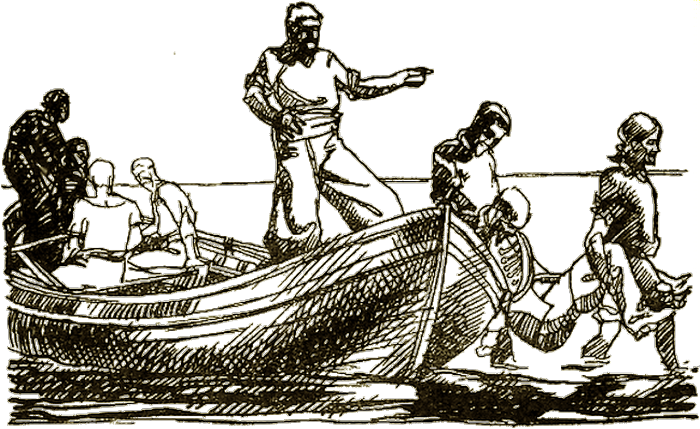
THERE is a certain line of big ships which will take you all the way from Liverpool to Manaos, a thousand miles up the river Amazon. The route is rather roundabout, for the ships touch at Havre, then after crossing the Bay of Biscay visit Vigo, and then Oporto and Lisbon, before crossing the Atlantic.
Vigo, on the north-west coast of Spain, lies at the head of a deep bay which sweeps inland for twenty miles. In history it is famous for Drake's raids in 1585 and 1589, and for the great battle in 1702, when the richest Plate Fleet that ever reached Spain from America was destroyed by a combined force of English and Dutch ships. Most historians write at length about that battle, but few give the story of all that led up to it, or of the series of blunders on the part of the Spaniards which cost them this vast treasure fleet, together with an almost incredible sum in gold.
In the earlier years of her American conquests Spain had been so much mistress of the seas that she was able to ship her spoils home much as she pleased. But with the growth of English naval power and the enormous increase in the numbers of pirates, privateers, and buccaneers, her losses became colossal, and the wreckage of her galleons littered every coast. These great treasure ships were slow sailers, and were at the mercy of the smaller but much faster vessels of the raiders. For a time Spain tried the expedient of sending her gold round the long way—that is across the Pacific and home by the Cape of Good Hope; but the buccaneers lay in wait on the African coast, and at last the Spaniards adopted the modern plan of collecting a plate fleet which sailed once a year under an escort of warships. The gathering ports of this fleet were usually Cartagena and Vera Cruz.
Even then they were not safe. Admiral Blake found one of these plate fleets sheltering at Teneriffe, and fighting his way into the harbour destroyed it under the guns of the forts. From those ships that were not sunk his men took such a treasure that, after landing it at Portsmouth, thirty-five great waggons were required to draw it to London. Drake took prizes by the score and brought millions back to his own country, while Admiral Stayner, one of Cromwell's officers, fell upon another of the plate fleets and, besides other spoil, brought home more than forty tons of silver bars.
In 1702, the year of Queen Anne's accession, Spain was in a troubled state. Two years earlier Charles II., last of the House of Austria, had died, and had been succeeded by Philip V. of the House of Bourbon. Then began the War of the Succession, and the country was not only torn by civil dissension, but was also at war with Britain and Holland. As soon as word reached Spanish-America of the trouble at home, the viceroy ordered that the plate fleet should not sail. The King's share of the treasure was one-fifth, and the viceroy wisely decided to wait until he could see which way the cat jumped—in other words, who was going to have legal claim to this heavy percentage. The delay lasted for three years and it was not until 1702, when a French fleet arrived to escort the galleons, that they at last made ready to sail. There were no fewer than seventeen treasure ships, which were escorted by twenty-three French men-of-war, under Admiral de Chateau Renard, and the treasure which this fleet carried was the greatest ever ferried across the Atlantic.
There is no doubt about the sum, for records remain, and its value is given as one hundred and twenty-six and a half million pesos—in modern money twenty-seven and a half million pounds. Much of it was in gold and silver bullion, but several of the ships were loaded with other cargo, such as ebony and ivory. There is often mention of ivory in the lading bills of these Spanish treasure ships, but it is not very clear whence it came, for ivory is not a product of the New World.
The British were, of course, on the look out for the dispatch of the plate fleet; and as soon as news came of its sailing a strong force was gathered and put under command of Admiral Sir Cloudesley Shovel, the hero of La Hogue, and sent to attack it. But the French got notice of the intended attack, and sent a fast dispatch boat to intercept the treasure fleet and warn them that their enemies were watching Cadiz, the port into which the plate fleets usually sailed.
A council of war was held and the French admiral strongly urged that, for safety's sake, it would be far better to make for a French port, such as that of Rochelle. The Spaniards objected. They were only too well aware that once they found themselves in a French port they would have some difficulty in leaving it. Louis XIV., who then ruled France, was not the sort of monarch to allow twenty-seven million pounds' worth of treasure to escape his greedy fingers, once he had a clutch on it. The council was long, and no doubt the rival commanders eyed one another suspiciously. In the end it was decided that they should make for Vigo Bay, which was far enough north to escape Admiral Shovel's frigates. They reached it, and sailed in without being molested.
Vigo Bay has anchorage for a dozen fleets, and having a narrow entrance is easily protected. As soon as the plate fleet was safe inside, a boom was drawn across the entrance, made of timbers chained together, the forts were manned, and other preparations made against any attack from the sea. You would imagine that the very first task of the Spaniards would have been to unload their treasure and get it away inland. Nothing of the sort was done. The port authorities of Cadiz were furious at the news that the fleet was in Vigo. Instead of being delighted at its safety their one concern was for their port dues. They sent peremptory orders that the plate ships were to lie in Vigo Bay, unloaded, until the British fleet had drawn off, and that then they were to come round to Cadiz.
It would seem that the Government officials in Madrid were against this decision, and that orders were sent that a Customs Official should go from Cadiz to Vigo to examine the merchandise and oversee its unloading. This was all very well, but it is a long way from Cadiz to Vigo, and in those days Spanish roads were almost non-existent. So the days grew to weeks, the red-tape tangle continued and nothing was done.
Yet if the Spaniards were idle the British, who seem to have been very well informed of all that was happening, were busy enough. Although Sir Cloudesley Shovel had been so unlucky as to miss the plate fleet there was another British force close by, under command of Admiral Sir George Rooke, who had won his knighthood and a pension of a thousand pounds a year at La Hogue. With a combined force of Dutch and English ships he had been making an attack on Cadiz, but had not been successful and was on his way home, when he had word that the plate fleet was in Vigo Bay. The news was brought by Captain Hardy of the Pembroke, which had called at Lagos Bay for fresh water.
Rooke's fleet was in a sad state. His ships had been badly knocked about in the unsuccessful attack on Cadiz, many were riddled with shot-holes and leaking, and provisions had run so short that the men were down to two biscuits apiece a day. Sir George himself was suffering severely from gout. Not unnaturally their spirits were as low as their stores, but the coming of this news caused an amazing change. At a council of Captains called by the Admiral, British and Dutch alike agreed with one voice that they should make an immediate attack upon Vigo, and the whole fleet was at once headed for that port. Arrived off the Bay, Sir George saw instantly that the entrance was too narrow for the whole fleet to enter at once, so it was agreed that fifteen British ships and ten Dutch should be sent in, and with them certain fire ships. The rest were to wait outside as a reserve.
Aboard the British fleet was a large force of infantry which had been carried for the attack on Cadiz. They were under the command of the Duke of Ormond. Very early next morning two thousand of these men were landed to attack the forts. The wind was strong from the sea and the landing was not only difficult but dangerous, yet it was accomplished without loss, and the soldiers moved up on the rear of the forts and attacked with spirit. That wind was good for the attacking ships. With every sail set they drove in past the forts at such speed that very few shots hit them before they were past and out of range. Then, four ships abreast, they struck the boom, smashed it and carried it away, and in a twinkling were in among the French fleet. There was no room for manoeuvring. British, Dutch, and French ships were all tangled up alongside, and most of the fighting was hand-to-hand. The British sailors had been provided with hand-grenades and fire-balls and had orders to fire the enemy ships. They obeyed with such goodwill that within less than an hour nearly all the French ships were ablaze.
It was a scene of appalling confusion. Ships out of control and blazing to Heaven drifted and crashed into one another, while men leaped into the water, or hastily lowered their boats. The Spanish crews of the galleons got up anchors and setting what sail they could, tried to escape from the inferno. Some loaded treasure into boats and did their best to escape with it ashore, but by this time the British troops had taken the forts and swept on, and were firing heavily on the galleons. The gale carried two burning French ships in among the galleons, and presently several of them had caught fire. With their huge top hamper, they blazed like torches.
Within a very brief space the whole of the French fleet was destroyed. Every ship had been either sunk, burned, taken or driven ashore; then British and Dutch alike set to work to try and save the treasure ships. But the Spaniards, now quite desperate, preferred to destroy their treasure rather than allow it to fall into enemy hands. By orders of their commander, Don Manuel de Velasco, they fired several of the remaining galleons.
Up to this time the losses of the British had been small; now in their furious haste to save some part at least of the sinking riches, many lives were sacrificed. Some were burned to death trying to reach the holds of the burning galleons; others were drowned through boats upsetting, others again killed by the explosions of powder-magazines. The loss of life on the part of the British and Dutch was nearly a thousand, while the French and Spanish lost twice that number. One of the largest English ships caught fire and blew up. When at last the battle was over, only thirteen prizes had been taken, of which seven were ships of war and six merchantmen. Eleven of the galleons, and these the largest and richest, were at the bottom of Vigo Bay.
Next day an attempt was made by the victors to send down divers to rescue some part of the sunken treasure; but the town of Vigo was still unsubdued, and such a heavy fire came from two forts on the hill above that the boats had to be withdrawn, and the victors left the Bay and sailed for home. Sir George Rooke's principal prize was a galleon called the Tauro. Although not by any means one of the largest of the plate fleet, her cargo, when unloaded in London, proved to be worth two hundred thousand pounds. The Dutch took a fair half of the prizes, but the value of their share and the British together was little more than a million. The amount landed or rescued by the Spaniards themselves appears to have been about two millions. So it follows that something like twenty-five millions of treasure went to the bottom of Vigo Bay. Spanish records of the time mention their "unspeakable loss."
Considering the fact that the depth of water in Vigo Harbour is not very great, it seems strange that so little was done at the time to recover the sunken riches. True, news came from Spain to London during the summer of 1702 that divers were at work on two of the wrecks, but how much, or indeed whether any, treasure was recovered is not known. Then work stopped altogether, the probable reason being that the whole country was in a very disturbed state. Some ten years later, when peace had been restored, a concession was granted to a Company of treasure-seekers, but when these found that the Government demanded nine-tenths of all the value recovered, the promoters appear to have abandoned their task.
In 1728 a French engineer named Goubert was employed as salvage expert. He found a ship, and after the expenditure of much labour and money, dragged her out of her muddy bed, only to find that she was not a galleon but one of the French warships which had been sunk in the battle. She was, of course, quite valueless. Some twenty years later an Englishman named Evans took a diving bell to Vigo and, it is said, had some success. He located one of the galleons and recovered nearly a ton of silver ingots. But the Spanish authorities, jealous of his success, made matters so uncomfortable for him that he was forced to give up and go home. The Spaniards themselves succeeded in ascertaining the position of most of the galleons, but they seem to have been unable to reach them. There is, at any rate, no record that they ever recovered any treasure worth having.
The first person to meet with any real success was a Scot named Macleod, who got permission to dive in the Bay on condition that he paid four- fifths of all he found to the authorities. In order to make sure that he carried out his contract the Spaniards placed two officials aboard his ship who were to keep accurate account of everything he raised. Macleod was either skilful or lucky—perhaps both. At any rate, he got up bullion to the value of some twenty-five thousand pounds. Then, instead of carrying on, he celebrated the occasion by a feast in the course of which he made the inspectors blind drunk. He had them rowed ashore and dumped on the beach, after which he quietly got up anchor and departed.
Early in the nineteenth century a company of Americans from Philadelphia gained a concession from the Spanish Government and set to work in Vigo Bay. By the use of pontoons and chains they lifted one galleon out of her muddy bed and had just got her to the surface when her rotten hull collapsed and fell to pieces. By this time all their capital was exhausted, but they went home, raised more money and came back. They do not appear to have met with any success, and at last their concession ran out and was not renewed.
For the better part of a century after this last failure the wrecks were left to decay undisturbed beneath the waters of Vigo Bay; then in 1903 came news that an Italian Company had obtained a concession to begin a fresh search. The concession was granted to the Pino Company of Genoa. Its head, Cavaliere Pino, was one of those brilliant young Italians who have done so much for modern engineering.
Pino was born at Chiampa, in Venetia, in 1874. His parents died when he was a boy and left him to the care of two brothers much older than he, who tried to guide his steps into the business in which they were engaged. Pino, a born inventor, hated business and presently ran away from home. He had a little money and with this set up a workshop in Genoa and spent his time in experiments. His idea was to perfect a new type of submarine vessel, not for the use of war, but for researches on the sea bed, and salvage work.
Before he could reach any practical success he came to the end of his small resources and had to look for employment, which he found as a labourer in the Royal Bread Factory at Genoa. One day during the dinner hour the manager of the factory, Herr Kunl, came upon young Pino busy with paper and pencil, and questioned him as to the meaning of his sketches. Pino began eagerly to explain the idea of his submarine, which he declared would be able to dive to a depth of nine hundred feet or to crawl about on the bottom of the sea. Kunl, shrewd enough to see that the boy was something of a genius, released him from his task and lent him money to continue his experiments.
The submarine model proved so successful that funds were raised to build a full-sized craft in which Pino explored the Mediterranean to a depth of five hundred feet, making more than a hundred and fifty descents. At the age of twenty-six Pino found himself director of the new Salvage Company which bore his name. He then set to work on a fresh invention which he called the hydroscope, an instrument for reflecting to the surface images of objects lying at the bottom of the sea. The hydroscope was tested in January 1903, from a torpedo-boat which the Italian Government placed at the inventor's disposal, and proved a complete success. Using this instrument, Pino recovered several statues which must have once formed part of the cargo of some Greek or Roman trireme. The King of Italy himself examined Pino's inventions and rewarded him with the honour of knighthood.
The first practical test of the young Italian's inventions was made at Port Arthur, where the harbour entrance was blocked by Russian warships sunk by the Japanese. With the hydroscope these wrecks were located and afterwards raised. For raising sunken ships Pino designed what he called "elevators," consisting of large bags of waterproofed canvas which were placed inside the hull of a sunken ship or attached to it from the outside, then pumped full of air. Each was capable of raising a weight of forty tons.
In 1904 work was begun at Vigo Bay, but the hydroscope showed that most of the old plate ships had long ago dissolved or else sunk out of sight into the silt at the bottom of the bay. One only was seen, of which the hull still bore some resemblance to a ship, and with much care and trouble was brought to the surface.
A sad disappointment awaited her salvors, for she proved to be the Santa Cruz, one of those vessels which had carried ebony and similar cargo. There was no bullion aboard her, and most of what she had carried was rotten and valueless. There was, however, much of interest. Four curious old guns were recovered, a quantity of Mexican porcelain, most of it unfortunately broken, also a pair of ancient anchors with their rusty cables. Some very beautiful old silver spoons were found, and three statuettes of silver inlaid with gold.
So in spite of hydroscopes and elevators and all the marvels of modern invention, Father Neptune still defies man to wrest treasure from his maw. His law is that the work must be done at once or not at all, for the stoutest craft that man can build soon perishes on the sea bed. It rots and rusts away, and its remains sink deeply into the ooze. Pino's dream that his inventions would make him master of all the millions sunk in the sea proved to be a dream. That more than twenty million pounds worth of treasure pave the bottom of Vigo Bay is beyond any kind of doubt, yet the odds seem strong that it will remain there.
It must, however, be remembered that during the past few years the depth at which man can work below the surface has been increased from two hundred to twelve hundred feet, where the pressure equals five hundred and twenty pounds to the square inch. With such a marvel as this before us it would be foolish to declare that the treasure of the lost plate fleet will never be recovered.
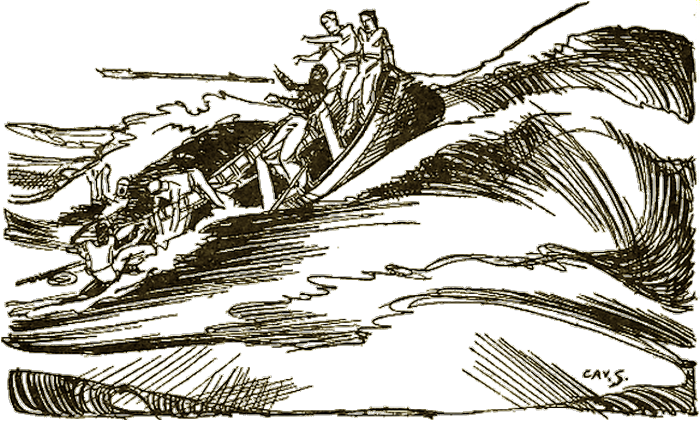
THE years before the South African War were bad ones in the Transvaal. The Uitlanders, many of them rich and powerful people, were groaning under Dutch tyranny, and though the wily Kruger still sat firmly in his Presidential chair, every one knew that trouble was brewing.
None better than Leyds, Kruger's clever secretary, who was in charge of the Boer Secret Service, and who was building up a fund for propaganda in case war did come. The fund did not grow rapidly enough to suit Leyds, and he conceived the brilliant idea of increasing it by buying up stolen gold.
Most of us have heard of the I.D.B. (Illicit Diamond Buying) Laws which are still in existence, and inflict very heavy penalties upon any one rash enough to trade in diamonds without a Government licence. An offender may be sentenced to penal servitude for five years or more, and penal servitude for a white man in Africa is a terrible punishment.
Not so many are aware that there are and have been for many years similar laws against trading in raw gold. These were in force in the Boer Republics before the South African War, yet were constantly broken, and stolen gold commonly changed hands at about sixty-five shillings an ounce instead of the usual price of eighty to eighty-four shillings. Leyds empowered certain secret agents to buy up stolen gold at prices up to sixty-seven shillings an ounce, and promised them immunity if caught.
They bought largely, but rarely paid more than forty-five shillings for the stolen gold. One was caught, and the State Attorney refused to prosecute. The result was a scandal. A local paper called the "Standard and Digger's News" published an article on the subject, was prosecuted, and forced to pay a thousand pounds damages for libel. The unclean trade went on. The robbers were men in charge of amalgamating plants. Such men are highly skilled chemists, and it is an easy matter for them to remove a few ounces of the gold deposited on the plates. Natal papers, which were free from the Boer laws, commented on this state of things, yet nothing could be done to stop it.
Once let loose the forces of disorder, and the result is disastrous. These gold buyers began to feather their own nests, and a gang of five was organized, which sent stolen gold out of the Transvaal over the border into Portuguese East Africa. Their storehouse was an old building standing on the flats near Delagoa Bay. These flats are a dreary waste, populated chiefly by mosquitoes, and most malarious.
The gold accumulated until the plotters had collected no less than a hundred and twenty thousand ounces, an amount valued in round figures at four hundred and fifty thousand pounds. They decided that this was enough, and the next question was how to get it out of the country. It was obvious that it must be smuggled, for the Portuguese Customs had to be reckoned with.
In the harbour lay a Swedish barque named the Ernestine, a vessel of about four hundred and fifty tons. She was old and unseaworthy, but the gang decided that, if she were patched up, she would be fit to carry their spoils across to South America, where the gold could easily be disposed of. The ship was put up to auction and they secured her for £450. They then employed certain Captain Vibart to survey her and see what could be done to render her seaworthy.
Captain Vibart reported that it would cost twelve hundred pounds to make her fit for sea, and told his employers that the work could not be done at Delagoa. At that date there was no slip there on which a vessel could be hauled up for caulking. Also, all stores, such as rope, rigging, and canvas, were extremely costly. He recommended that the barque should be sent to Durban for the necessary repairs. Vibart's advice was good. The gang realized this, but realized also that he was too honest a man for their purposes, so they paid him off and dismissed him. They engaged in his place a Norwegian skipper, and told him to collect a crew and sail the Ernestine down to Durban.
Meantime they set about smuggling the gold aboard the vessel. The gold, weighing in all about three tons, was packed in twelve Transvaal ammunition boxes which were taken aboard secretly and placed in the hold. Liquid cement was then run over these, hiding them completely, and above was piled two hundred tons of sand as ballast. At last all was ready, and in December 1898, the barque, her name changed to Dorothea, left Delagoa Bay. Her papers were marked "Cleared for Guam" which meant that she was on a roving commission. Three of the gang went aboard with their gold, the other two returned to Johannesburg.
As may be imagined, the crew were a very scratch lot. Delagoa Bay is not an ideal recruiting ground, and what decent men were there flatly refused to have anything to do with such a rotten hulk as the Dorothea. Though the skipper had done his best, there was hardly a man aboard, except himself, who could be reckoned a sailor.
December is midsummer in South Africa, yet no sooner had the barque left the bay than she ran into bad weather; and the Dorothea, badly ballasted and much too high in the water, rolled and pitched in a fashion which scared the three gangsters nearly out of their senses. Even the crew were sea-sick. Then it was found that she was leaking like a sieve, and the pumps had to be manned. The weather grew worse. That part of the African coast is notorious for its terrible seas and lack of harbours, and the captain felt himself obliged to tell his employers that he did not like the look of things, and did not feel he could depend on his crew.
This was only too true, for the crew had lost their heads and the ship, with sails blown out of their bolt ropes, was already drifting towards the coast. The coast under their lee was that maze of reefs which lies off Cape Vidal, in Zululand. The captain saw that the ship was out of control, so gave orders to anchor. Two anchors were got out, but the bottom was so hard they would not hold, and the Dorothea began to drag.
One of the smugglers took to whisky to keep up his spirits and got very drunk. He stood on the deck, screaming and shouting as the barque drove steadily towards the black reefs dimly visible among the spouting foam. The captain, seeing that there was no longer any hope of saving the ship, ordered the boats to be launched, and two were safely dropped from their davits. But since it was clearly impossible for any boat to reach the shore through the tremendous seas that were breaking on the rocks, the order was given that the men were to pull out to sea.
The drunken smuggler had refused to leave the ship. He was shouting that the gold was now all his, and those in the boats watched him staggering and raving about the deck as the Dorothea swung round and struck a reef stern foremost. A wave flung her across the reef, and she canted over and disappeared. The boats separated, and one was picked up by the Union liner Greek, the other by a German steamer the Koenig. There is an entry in the log of the Greek describing the rescue of survivors from the Dorothea. So it was that gold weighing some five tons was left under a reef off Cape Vidal.
In the following June, an Englishman, Mr. S. Ward Hall, was staying at Long's Hotel in Johannesburg where he met a friend named Mantell, who told him the story of the Dorothea and her stolen gold.
"You know the country, Ward," said Mantell, "why not make a try for it? Five tons of gold is worth an effort." Hall decided that it was worth trying for, and made up his mind to visit the scene of the wreck. He enlisted the help of two Jews who were ready to put up funds for the trip on condition that they were to buy the gold, if it could be recovered, and the three left Johannesburg very quietly.
Hall had been warned that he would be followed, and sure enough, when the three reached Maritzburg they found a spy at their heels. But he was so obvious a spy that they eluded him without much trouble and went on to Durban, the capital of Natal. Here they ran into fresh trouble, for the Transvaal Police had notified the Natal authorities, and Hall found he was being dogged by the Natal Police. So, after a stay of only a few hours, he and the two Jews cleared out and took train for Tugela River, at that time the end of the railway. Thence they travelled by post cart to Eshowe, the little town which is capital of Zululand.
They bought a Scotch cart and oxen to draw it, and telling everybody they were going shooting, started away for Cape Vidal, a cross-country journey of more than a hundred miles. The police were still on their track, for they were followed and questioned by one of the Natal Mounted Police. But he had nothing against them, and they were allowed to proceed. Through the bush they found the travelling fairly easy until they reached Lake Lucia, which is an immense lagoon infested by crocodiles and bordered by forests of reeds, where the mud is deep and mosquitoes swarm. They had to ford the shallow end of the lagoon, and Hall's Jewish companions were terrified. Mercifully, the crocodiles did not attack the oxen, and after very nearly foundering in the black slime, they reached the far side in safety and came to the Zulu kraal or village of Klakana.
Here Hall had hoped to get information about the wreck, but found that the natives knew little, so there was nothing for it but to push on to the coast and try to find out for themselves. Almost as soon as they reached the beach they saw wreckage, and before long sighted the remains of the Dorothea herself, wedged among the rocks at some little distance from the shore. They had no boat, no means of reaching the wreck, so Hall decided to swim out. The Jews objected strongly, for sharks are plentiful in these waters, and although they had no great love for Hall, they knew they would be helpless in this wild country without him. He, however, insisted and in spite of bad surf reached the reef and the wreck.
That was all he could do, for the hull of the broken ship was under water and it was plain that divers and—probably—dynamite would be needed to reach the gold. He got back to the beach and told his companions what he had seen, and while they talked a storm came up. For hours it rained in sheets, and all that night they had to lie wet. The result was that Hall went down with a violent attack of malarial fever, through which he was nursed by the kindness of a missionary named Freyling.
After that there was nothing for it but go home again, no easy business, for the rivers were in flood and the Umvolusi, a brook when they had previously crossed it, was coming down a torrent four hundred yards wide. On their way they came across a man on foot and alone, who begged a lift which they gave him. Hall met him again at Tugela in the act of sending a telegram to his employers at Johannesburg. Another spy!
Ward Hall's next move was to get into touch with his brother, Sidney Hall, who was in business at Durban, to give him a chart and sketch of the wreck and arrange with him to form a fresh expedition to recover the treasure. The Jews turned nasty and demanded five thousand pounds as the price of their silence. They threatened to go to the Criminal Investigation Department. Evidently they did inform against him, for Hall was stopped on the Transvaal frontier and searched, but since his brother had the chart, nothing was found on him and he was released.
Sidney Hall helped his brother to collect men for the expedition, and in order to avoid suspicion they arranged to leave in two parties and meet later. Ward Hall himself left Johannesburg on his bicycle and boarded a train for Durban at a small station down the line. The police were still on the track, for on arrival at Durban, Ward Hall was met by Sergeant Lee Smith, who said bluntly:
"You are after something in Zululand. What is it?"
Hall flatly refused to give any information, and found himself shadowed by two policemen while he made his purchases in Durban. Again he dodged, this time by walking quietly away and taking train at Berea, two miles out. He reached Tugela safely, and there found his brother with Mantell and four other men.
The party arrived on the coast in the middle of April, and went to call upon the missionaries who had helped them on the occasion of the previous visit. They were now anything but cordial, and it was quite plain that some one had been talking. There was not much doubt who it was, for that same evening Sidney Hall, hearing some sound in the bush, crept through the undergrowth and saw a mounted trooper with three native police. When he told Ward of what he had seen, both brothers agreed that they must let their treasure-hunting wait, and try to make the police believe that sport was their only object. In any case, they were in a good game district, so next day they started shooting. As they walked through the bush a mounted trooper appeared and stopped them. He told them he had a warrant for their arrest on suspicion of gun-running. Gun-running—that is selling arms to natives—is a most serious offence in South Africa, punishable with a heavy fine and two years' imprisonment.
"You can see our guns," retorted Ward Hall. "There are five in all, and we have permits for every one of them." He showed the permits, properly signed, and for a moment it seemed as if they were going to escape. But the policeman had another string to his bow. He demanded to see the game-bag. As ill luck had it, this included a "koraan," the great African bustard for which it was the close season. This gave the trooper his chance, and he arrested them and took them before the magistrate at the little village of Hlabesi, thirty-five miles away. The magistrate heard the case and inflicted a fine of five pounds, which was paid at once.
By this time Ward Hall realized that it was useless to attempt to salve the treasure from the wreck without a Government permit, and the others agreed. So, feeling very sick and sore about the whole business, they packed up, inspanned their oxen, and started back for Tugela. The police had not yet done with them, and once more they were stopped by troopers, who turned everything out of the waggon and searched all their packages. The troopers said that they had a warrant to search the waggon for gold. The Halls were becoming very restive under this treatment, and the situation was badly strained. Finding nothing, the police let them go, and they reached Durban safely.
At the hotel they held a conference, the upshot of which was that Ward Hall wrote to the authorities, offering to give full information about the wreck in return for a share of the gold. He had an answer asking him to call upon the Receiver of Wrecks, but this gentleman said he could give no promises until he had consulted with other officials. To make a long story short, the Natal Government's decision was that the searchers could take only fifteen per cent. of all treasure salved, and that the rest was to go to the State. These were the only terms offered, and the Halls were forced to accept them.
They were kept hanging about in Durban while Inspector Clarke, Chief of Police, travelled up to Zululand in order to assure himself that there really was a wreck on the beach. When he came back and made his report to the Government, the authorities at once got together an expedition which included two professional divers, and they left Durban on June 8, 1899. Butler, the principal diver, was a man accustomed to deep-sea diving, but had never worked in surf. The surf is always bad on the Zululand coast, and as it happened, a series of gales made it even worse than usual, with the result that Butler and his mate refused to risk their lives under such terrible conditions. Inspector Clarke sent word back to Durban that they would have to wait for better weather.
Ward Hall meanwhile remained at Durban, and one day happened to lunch with a lawyer friend to whom he told the story of the treasure. The lawyer asked to see the agreement, and, after considering it carefully, gave it as his opinion that it was absolutely worthless, because Inspector Clarke had no power to bind his Government. Who can blame Ward that he lost his temper? He told his brother, and the two went straight to a big firm of shipping agents, and laid all the facts before them. The heads of the firm decided to back the Halls; and the result was that a powerful tug was provided, under command of an experienced skipper, Captain Wakeford, and two divers engaged, named Olsen and Pietersen. With the two Wards aboard, the tug left Durban in the last week in June.
Again a gale raged, and the tug took two days to make the short passage. When she arrived off Cape Vidal a very ugly sea was still running, and it did not seem possible to land. Captain Wakeford, however, declared that the big boat, brought specially for this purpose, could weather the surf, and Olsen, the diver, agreed.
So the boat was lowered. She was a large craft, thirty feet long, and very stoutly built, yet when the diving suits and stores and men had got aboard her she seemed rather low in the water. The diver's mate, Pietersen, sat in the bow with a bag of oil ready. In the stern were Olsen, Captain Wakeford, and the two Halls. The latter, like Pietersen, were provided with oil bags. Four of the tug's crew, black men, wielded the oars.
The tug was lying a mile and a half out from the land and it was not until the boat neared the beach that the full size and power of the rollers were realized. They were walls of white water each at least fifteen feet in height, thundering in upon the coast in endless lines. The crew bent to the oars, and oil was poured out from the bags. Lifting heaven-high, the heavily laden boat rose, hung on the crest of the first line of breakers, and dropped safely into the deep trough beyond. She drove towards the second line, then—Hall never knew the reason—she suddenly broached to, and lay broadside to the surf. Instantly the next wave roared down upon her, filling her, and as she turned bottom up all aboard were flung into the sea.
Ward Hall, caught in a mass of gear, was dragged down, but struggling desperately, got free, rose to the surface, and looked round for the others. Close by were three of the black rowers, shrieking for help. Hall struck out for the nearest, and had almost reached him when the man, screaming terribly, was dragged under. Next moment the blue water was crimsoned, and with a shock of horror Hall realized that a shark had seized the unfortunate man.
The boat, bottom up, drove past, and Hall grasped it. But the hull was crusted with razor-sharp barnacles which cut his hands so severely that he was forced to let go. Then he saw a plank swirl up out of the smother, and this he seized, and holding it, struck out for shore. Every moment he expected to be seized by a shark, or, if not that, to be ground to pieces on the saw-toothed reefs which here and there showed above the boiling surf.
Yet life was sweet, and he fought on. For no less than three-quarters of an hour the struggle lasted until, breathless and weak as a child, he was cast by a wave on the beach. Exhausted and unable to move, he lay until the undertow began to drag him back. Some one seized him, and lifting him drew him to safety. It was Pietersen, who had reached the shore and had had time to recover a little before Ward Hall was washed up.
"My brother?" Ward gasped, but Pietersen shook his head. Ward staggered to his feet and stared out to sea, and at that very moment a dark object was seen struggling in the surf. The next wave flung him on the beach and the others pulled him in. This was Sidney Hall, unconscious, bleeding, and half dead.
These three were the only survivors. Captain Wakeford, Olsen, and the four Kaffirs were never seen again. The sharks must have got them all.
The two Halls and Pietersen were in a sad plight, their clothes in rags, their boots gone, for they had not worn them in the boat. They were all badly cut about, and they had no stores of any kind. The crew remaining in the tug had, of course, seen the disaster, but were unable to come to the rescue as they had no other boat. What they did was to steam in as near as they dared and try to float food and water in barrels to those on the beach. Not one of these barrels reached the beach, for one after another were caught on the reefs and smashed to pieces. At last, seeing it was hopeless, those in the tug turned her round and steamed away southwards towards Durban.
The survivors consulted and decided that their only hope was to make for the native kraal which, luckily for them, was not very far away. The chief, whose name was Keli, received them kindly, and gave them food and drink and a hut to sleep in. Next day they left and made for a larger kraal near St. Lucia Bay. It was a cruel business walking along the coast, for the beach was not only stony but covered with shells which cut their bare feet badly. Hlakana, chief of the second kraal, was as kind as Keli. He told them that some of his people had seen the wreck of the boat, and that he had sent word to Trooper Higgs, a member of the police who happened to be in the neighbourhood. A little later Higgs himself turned up and showed the Halls that, if the police could make things very unpleasant for those whom they considered law-breakers, they could be exceedingly kind to the same men in distress. The good fellow rode off to the nearest native store and brought back three pairs of boots, and did everything in his power to help them.
After rest and food the three decided to start back for Eshowe. But they had to cross the lagoon, and the only boat was that belonging to the missionary, Mr. Freyling. Not liking to risk a second snub, Ward Hall did not go to the house himself, but sent a native to ask for a loan of the boat. He was surprised and pleased when Mr. Freyling came out himself, and apologized for his previous rudeness.
"I was made to believe you were gun-runners," he said. "Now I know better, and I want to do anything that I can to help you. Come in and have a meal, and afterwards I will myself ferry you across the lake."
A week later the Halls were back in Durban, where they learned that Inspector Clarke had come back, declaring that even if there was gold in the wreck it was impossible to reach it: By this time Ward Hall and his brother had spent nearly two thousand pounds and done nothing, yet they resolved to have another try. But things were very bad in Natal, for war was on the point of breaking out, and it was hard to gain the ears of any Government officials. Weeks passed before Sir Harry Binns, the Governor, granted a permit to explore the wreck. The permit stated that all goods found should be handed over to the Government, "the matter of salvage to be left for subsequent settlement."
Ward Hall consulted another lawyer, who told him that the authorities had a legal right to only ten per cent. of the total amount recovered, so with this comfortable assurance the party started once more. It consisted of the two Wards, Mantell, a friend named Docra, a photographer called Caney, two divers, who were Russian Finns, and an officer of the Customs named Wells. The Halls had had enough of the sea, so this time the party travelled overland. They had to carry not only diving equipment but also a boat, and it took fifteen days to reach Cape Vidal from Tugela.
The wreck was still there. The only change was that the foremast had fallen. The sea was calm, and they were able to get a good look at the ship. For this purpose they used a water-glass, which is an oblong box with a glass bottom. The Dorothea was half buried in the sand, and broken completely in two. The stern lay on the shore side of the reef in about twenty-four feet of water, while the rest of her was in deeper water outside the reef. The gold, as Hall knew, lay at the base of the foremast, so in order to reach it the diver had first to cross the lagoon, then scramble over the reef, and afterwards clamber down into deep water through the surf.
The surf is rarely still. Even at this time when there was little wind, it broke in waves four or five feet high, quite enough to batter the diver to pieces if he were caught in it. In order to save him from such a fate, Hall laid two lines from the reef to a heavy anchor sunk in deep water, and these acted as a sort of banister to which he was able to cling. As soon as this job had been finished, the diver went down and fixed dynamite cartridges to the wreck. The explosion was heavy, yet very little came up except the vessel's stern-post. The diver made a second trip, and found a hole through which he entered the forepart of the ship. He came back with the disappointing news that the whole of the inside of the vessel was full of sand.
Before any steps could be taken to clear this, the weather broke. Day after day the wind blew, and huge seas smashed upon the reef. Days grew to weeks, stores ran short, and at last Hall had to realize that there was nothing for it but to return. So ended the third expedition.
The two Halls might well have decided that three failures were enough. Yet within a few weeks they had hired a tug, for which they had to pay no less than £450 a month, and were once more back at Cape Vidal. They were greeted by a furious gale, during which they had to lie hove to. But the storm passed, and was succeeded by the most marvellous calm Ward Hall had yet seen on this coast.
The tug crept on until actually over the wreck. The surf was mere wavelets tinkling on the reef, and the hearts of all aboard beat high with hope. The diver, a Greek, was sent down. So clear and calm was the water that they could see him walking on the bottom. But instead of going straight in through the gaping hole in the bow, he merely walked round the wreck. Ward Hall had him up, and explained what he was to do.
Sulkily he went down again, but still refrained from attempting to board. The fact was that he was terrified of venturing in among the tangle of wreckage.
Was ever any treasure seeker in so maddening a position as Ward Hall? Here at last were the perfect weather conditions for which he and his party had waited so long; here was the treasure almost within their grasp, yet the diver, instead of doing the work for which he was paid, was wandering about the bed of the ocean, nor by any persuasion or threats could the man be induced to enter the wreck.
There can be no doubt but that, if this diver had done his duty, the bullion, or at least a large part of it, would have been recovered. As it was, the golden hours of calm slipped by and nothing was done.
Ward Hall had led four expeditions to the place, spent money like water, and twice come near to losing his life. The cowardice of the diver cost him and his companions a fortune.
In disgust he abandoned the quest and went home. Kruger's Treasure has never been recovered, and since all trace of the wreck has now disappeared it is unlikely that this stolen gold will ever be ransomed from the sea-bed.
Roy Glashan's Library
Non sibi sed omnibus
Go to Home Page