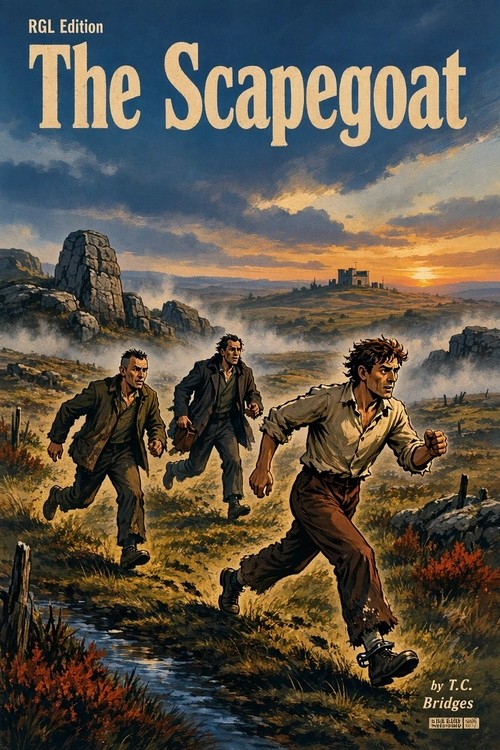
RGL e-Book Cover
Based on an image created with Microsoft Bing software
Roy Glashan's Library
Non sibi sed omnibus
Go to Home Page
This work is out of copyright in countries with a copyright
period of 70 years or less, after the year of the author's death.
If it is under copyright in your country of residence,
do not download or redistribute this file.
Original content added by RGL (e.g., introductions, notes,
RGL covers) is proprietary and protected by copyright.
RGL e-Book Cover
Based on an image created with Microsoft Bing software


Wrongly imprisoned and serving a harsh sentence, Frank Thorpe seems destined to spend years behind the forbidding walls of Blackmoor Prison. But when the crooks who betrayed him engineer a daring escape in order to recover stolen bearer bonds, an unexpected ally steps into the game. As a desperate prison break unfolds across the windswept moor, loyalty, courage, and conscience collide in a race against time....
LOUIS CHARD took the whisky bottle in his podgy fist and tipped three fingers into his glass. "It's going to be the devil of a job," he said in a surly tone.
Albert Catling quietly removed the bottle to his side of the table. "Saying that won't make it any easier," he remarked.
"And it's going to cost a lot," continued Chard.
"Well it's worth it," answered Catling.
"Yes, if we get the stuff."
"Always ifs, Louis. Of course we'll get it. Thorpe will jump at it, and you can be very certain he won't get another chance to double-cross us."
"He made a good job of it last time," said Chard, nastily.
Catling looked at his partner. "That's true. He did us down for seven thousand. But what's the use of rubbing it in? We've agreed that we must have that money or go to smash. Hadn't we better discuss ways to smash. Hadn't we better discuss ways of getting it instead of grousing about the trouble it's going to give us?"
Chard subsided as he always did in the end. Catling's were the brains of the precious pair and well Chard knew it. "All right," he grumbled. "Only getting a chap out of Blackmoor is easier said than done. That warder, Barkell, told me that. Lots of lags have bolted but none ever got clear."
"Simply because they had no means of getting away," replied Catling. "In this case we shall have a car ready, then, when Thorpe makes his bolt we shall get him away at once."
"And who's going to drive the car?"
"I am."
"I wish you joy of it," growled Chard.
"You're coming with me," said Catling, calmly.
Chard's thick face went purple. "You infernal—!" he began in a roar.
Catling held up a hand. "Shut up, you fool," he said, curtly. "Do you want the girl to hear you?"
Chard subdued. "But suppose we're caught?" he gasped.
"We're both running the same risk," returned Catling. "And seven thousand pounds is worth a bit of risk. But let me assure you I have no intention of being caught. Now listen to me."
Chard swallowed his whisky and, steadied a little by the spirit listened to his partner as he laid down his plan for securing the escape of Frank Thorpe from Blackmoor Convict Prison.
Someone else was listening. If the eyes of the partners could have penetrated the solid deal planking of their office door they would have seen a girl kneeling on the floor with her ear to the key-hole. The girl was about 25, and would have been extremely pretty if she had not been so pale and thin, and badly dressed. Just now her face was white as paper, and she looked frightened and anxious. May Bennett was employed by the firm of Chard and Catling as typist, for the partners called themselves brokers, but their office in Morton-st. was merely a blind to cover other and less honest activities. The two talked for nearly an hour, and the whole time May never moved from her cramped and uncomfortable position. "That's about all," said Catling at last. "Now you'd better get busy, Louis."
"You mean I've got to get hold of Barkell?" said the other.
"Yes. Tell him to meet you in Okestock and ask him what he thinks of my plan and if he can work it," grumbled Chard.
"You can go up to a hundred. That ought to satisfy him. Take the money in notes."
May heard a drawer unlocked, and, rising quickly, went softly back to her desk. When the door of the inner office opened, she was writing busily. Catling came up to her. "Take a letter, Miss Bennett," he said, and began to dictate an order for a room, addressed to the Manager of the Duchy Hotel, Okestock.
Chard went out, but Catling stayed to dictate several more letters. He was far too clever to allow his alleged business to be mere pretence. When he had finished he lit a cigarette, and picked up his hat. "Mr. Chard and I will be away for some days, Miss Bennett," he said, "but I feel sure that we can leave the office in your charge."
When he had left. May set for a while quite still. Then, dropping her head on her hands, she began to cry softly. But this mood did not last long, and presently she sat up straight. "They shan't do it," she said firmly. She sat and thought a while, then, taking up her pen, set to writing. It seemed a difficult letter, for, though it covered only one sheet it took her nearly an hour to write. When she had finished it she put it in an envelope and addressed it to Frank Thorpe. No. 2751. H.M. Prison, Blackmoor, Devon. She stamped it, put it carefully it in her bag, put on her hat, powdered her nose before the dingy little office looking-glass, and went out, locking the door behind her. In the street she stopped at the nearest pillar-box and posted her letter. "I wonder if he will understand it," was her unspoken thought. She did not realise that he would never have the chance of doing so. Unfortunately for May, she was unaware that a prisoner is not allowed to receive letters until he has completed the first three months of his sentence.
That was Monday, on the following Wednesday evening Frank Thorpe sat in his cell on the third tier of C Hall in Blackmoor Prison, waiting for his supper. Criminals are usually vicious or weak, but Thorpe did not seem to belong to either class. He seemed just an ordinary decent-looking young Englishman, and in his case appearances did not lie. It was, in point of fact his looks that had led him to the clutches of Chard and Catling, who were cute enough to realise such an asset in their nefarious business.
They had humbugged him thoroughly—how thoroughly be never knew until he found himself running from the police with seven thousand pounds' worth of Bonds to Bearer in his pocket. When he did at last realise the fix he was in, the shock had been an ugly one. But knowing that his case was hopeless in the eye of the law, he had taken his revenge by hiding the envelope containing the bonds and vowing to himself that if he was lagged his precious employers should be the last to score by it.
His door banged open, and the convict orderly brought in his supper, a mug of cocoa, an eight ounce loaf of bread, and a small piece of cheese. He dumped it down and left, then as the warder in charge locked the door a little slip of folded paper fell upon the floor of the cell. Thorpe knew better than to move until the door was locked. Then he snatched up the paper and unfolded it. Written very small in pencil were the following words: "Will you give up the stuff if we get you out and pay your passage to South America? Give your answer to the bearer."
Thorpe got up and stood with fists clenched and a very hard look on his weather-burned face. "The swine!" he muttered, under his breath. "I won't. I've got to have something to give me a start after seven years in this place." Forgetting his supper, he paced up and down for some minutes, then at last dropped on his stool. "Seven years," he repeated, and shivered. Even with the utmost remission for good conduct, that meant five years and three months. He had served less than three months, so sixty were left of his sentence. They stretched before him like an eternity, and the more he thought the more tempted he felt to throw in his hand and say yes. "I won't make up my mind yet. I'll sleep on it," he vowed, and he was still in that mind when lights were put out.
Needless to say he did not sleep; needless also to remark that when morning came Barkell got the message he expected which, as soon as he was off duty, he took straight into Okestock.
Late on Thursday afternoon Albert Catling, quietly dressed in blue serge, entered the Duchy Hotel at Okestock and asked for Mr. Chard. Chard was in his room. It was a warm evening, and he was sitting in his shirt sleeves with the window open, reading an evening paper and smoking a cigar. His heavy cheeks sagged, and his small eyes were bloodshot. Catling's first action was to lock the door, then he closed the window, and came and stood in front of Chard. "You're looking rotten Louis," he said, with some contempt. "You've been drinking."
"Of course I'm looking rotten," retorted Chard. "I'm scared stiff. If we're caught it means quod for us both."
Catling stood silent, looking down at the other who moved uneasily in his chair. "Perhaps you'd like to dissolve our partnership," he suggested, but Chard started up with an oath. "No. I'm going to have my share of that seven thousand."
"Then you'll have to earn it," Catling told him. "And the first thing you have to do is to keep off whisky until the job's finished." He paused, but Chard only scowled. "You've seen Barkell?" Catling asked.
"Yes. He was here yesterday. But the greedy swine wants the full hundred."
"Than he thinks he can work it?"
"Yes," answered Chard. "Thorpe has agreed, and Barkell says his side can be fixed up all right."
"Have you settled the day?"
"He says Monday," Chard answered.
Catling nodded. "The sooner the better. I've brought my own car down. To-morrow we'll drive across Blackmoor and have a look at the country."
"You talk as if we were going on a holiday trip," snapped Chard.
"Well, we ought to have a very nice holiday on seven thousand," replied Catling coolly.
Chard swore again. "Don't you ever give a thought to the risk? Even if it works and we get Thorpe away the telephone will be busy and the police warned for miles round. We'll be nabbed if we show our noses in any town."
"Then the obvious thing is not to pass through any town. But don't worry your head about that, Louis. I've got all that end of it mapped out and once Thorpe is in the car the whole thing is as good as done." He turned towards the door. "Be ready at ten to-morrow morning," he said as he went out.
For the wretched Chard that week-end was a nightmare. Never, except when asleep, were his thoughts off the risky business set for the following Monday, and even at night he dreamt of it and woke up in a cold sweat as a dream warder banged away at him with a visionary carbine. Left alone, he would have drowned his troubles in drink, but Catling saw to it that his whisky was strictly allowanced. When Monday dawned the fat man was in such a condition that nothing but the thought of his half share in the seven thousand pounds kept him on his legs. When the time came to start Catling, seeing that his partner was on the verge of collapse allowed him a couple of stiff drinks. Then, with Catling at the wheel, the car, a big six-cylindered machine in perfect order, purred away up the steep winding road which leads from Okestock to the Moor.
"Just the right sort of day," said Catling in a satisfied tone, as he noticed the heavy clouds hanging over the turreted heads of the tors. "It's going to rain like the devil in another hour or so. There won't be much traffic on the roads to-night."
"You're infernally cock-sure about it all," growled Chard.
"I have no reason to be anything else," Catling told him. "Everything is worked out as far as brain can plan it, and Barkell, I know, won't fail us. I can't see a hitch anywhere."
"I Wish I could feel the same," said Chard. He paused. "What are you going to do with Thorpe when you've got the stuff?"
"Never you mind what I'm going to do with him," said Catling. "Only you can take your oath he won't trouble us again." Chard shivered and was silent, for none knew better than he the cold ferocity that lay beneath his partner's quiet voice and easy manners.
Catling kept his eye on the dash-board clock as he drove, and it was just twenty-seven minutes past four when the big car glided over the top of the hill by the Dole Stone and her occupants saw beneath them the tall grey buildings of the prison standing within their great circle of granite wall. Ineffably gloomy they looked beneath the lowering sky, so much so that Chard shivered again. "They give me the creeps," he said heavily.
All the way up they had seen hardly a single vehicle, but now they met a couple of prison carts, the big, sleek horses led by convicts and a warder, carbine in hand, trudging alongside. And then a Ford van a passed them, driven by a boy. Catling glanced at the clock again and for the first time showed some slight sign of nervousness.
"It's time," he said, as he looked up the hill to the right where the quarries lay. "Ah, here they come," he added in a tone of relief. He slowed to a crawl as a long line of prisoners wearing drab breeches and blue and red striped slop jackets came marching two and two down the hill. "Now, if Barkell—"
His words were cut short by a thundering explosion, and from the crest above the quarry shot up a great column of dust, stones, and smoke. The stunning crash was succeeded by an instant of utter silence, then as the debris flung up by the explosion began to rain down among the trees there came shouts and screams and the patter of running feet. Catling stopped the car exactly opposite the entrance to the side road leading up to the quarry, but left the engine running. His face was a little white, but he showed no other sign of excitement. Chard, however, was shaking like a jelly.
On the hillside all was confusion. The convicts had broken rank and most were running back in the direction of the quarry, but several had bolted into the thick woods lying to the east of the road. Warders were shouting to them to come back.
Suddenly Catling stiffened. "Here he comes!" he said in a tone of relief, and as he spoke, a man shot out of the crowd and raced down towards the high road. There was no one to stop him, and he came like the wind. Next instant he had made a flying leap into the car, and at the same instant Catling shot in his gear and started up. The slope was with the car, and almost instantly she was on top and leaping away. And just then the clouds broke and down came the rain in sheets.
"Couldn't be better!" said Catling, under his breath. "Get down, Thorpe. Hide yourself." He said no more, for all his energies were needed to handle the car, which had already gained tremendous speed. The scattered houses faded from sight, and next moment they were racing down the long slope towards Taviton, flinging sheets of water from beneath the spinning wheels. "What did I tell you?" said Catling, with a touch of triumph. "Simple enough, wasn't it?
Chard's answer was a yell of fright. "Look out! Stop! Car across the road!"
With an oath Catling flung on his brakes. Had they not been four wheel, nothing could have saved a smash, but as it was, the big car skidded to a stop with her bonnet almost touching the other vehicle. It was apparently the same Ford van that had passed them five minutes before, and which had now broken down in such fashion that it completely barred all passage. The boy, spanner in hand, was busy at the open bonnet.
Catling glanced back, but there was nothing in sight. "Got out, Louis," he snapped. "We must push her out of the way. He himself jumped out and went forward. "We're in a hurry," he said to the boy. "We must push the van aside so that we can pass."
The boy swung round, and for once Catling was caught unprepared. A heavy pistol appeared as if by magic in the boy's right hand, its black muzzle held dead on Catling's head. "Put your hands up!" snapped the lad.
Catling's answer was to duck and leap forward. The boy jumped aside, firing as he jumped, and Catling, stumbling sideways, fell heavily in the streaming road.
"Frank! Frank!" cried the boy, shrilly, but by this time Chard had become alive to his own danger, and seizing Thorpe, was trying to force him down into the tonneau. Chard was big and heavy, but fat and short of breath, while Thorpe, after weeks in the prison quarry, was hard as nails with muscles tough as leather. The struggle did not last long, for Thorpe, getting his arms round Chard, hoisted him clean out of the car and flung him into the road, where he lay still and stunned.
Thorpe followed like a flash.
"May! May!" he cried incredulously. "Is it really you?"
May shuddered. "Yes, Frank, and oh, I've killed him."
Thorpe stooped beside Catling and examined him quickly. He looked up with a smile. "Don't worry, dear. The fellow's a long way off dead."
"Are you sure, Frank?"
"Certain. He's only stunned. Your bullet has simply ploughed a shallow furrow across the top of his scalp. But I say, how did you manage it?"
"I will tell you as we drive back."
"Drive back!" exclaimed Thorpe, looking as if he could not believe his ears.
"Yes. The car is all right. I was only pretending it wouldn't go."
"But I'm escaping. I promised them they should have the bonds in return for getting me out."
"I know all that. That is why I came."
Thorpe merely stared. He could find no words.
May took a step forward. "Frank," she said, "that money is not yours. You will give it back, won't you?"
"I—I thought it would give me—that is us—a start," Thorpe blurted out.
May laid a hand on his arm. "I will marry you if you wish, Frank"—she told him—"but not on that."
He caught her in his arms. "You dear," he exclaimed. "I'll do anything you like."
May kissed him, then drew away gently. "Will you go back to the prison, Frank? It's the only way," she added earnestly. "Think, if I take you away now, for the rest of our lives we shall both be afraid of the sight of a policeman. But if you go back and offer to give up those stolen bonds, I believe that you will get a pardon. Oh, Frank, it is the best way. I know it is the best way."
Thorpe hesitated. "I have my doubts about the pardon," he said rather grimly. "And there's five years still to go, May."
"You will find me waiting," May promised.
The hard look passed from Thorpe's face. "Then I'm game to stick it," he said with a smile. "Turn the car. dearest, while I tie up these beauties. It's something to think that they're for it as well as me."
THE gate-keeper of a convict prison is accustomed to shocks, but the sight of a big car being driven into the prison yard by a very wet convict, with a pretty girl in boy's clothes beside him, and two soaked and blood-stained prisoners behind made him stare, and when the Governor came out and heard Thorpe's story, he was equally amazed. Thorpe was, of course, sent off to his cell under escort, but the Governor took May into his own house, and the two had a long talk.
Next day the papers were full of the story. The great British public loves a lover, particularly when she is a girl, and letters poured in upon the Home Secretary in hundreds, begging or demanding that something should be done. Something was done, for three months later Frank Thorpe received a pardon, and not only that, but the offer of a good job. The next day after his release he and May were married, and on that very same day Chard and Catling were tried at the Central Criminal Court, and sentenced. Chard to three and Catling to seven years' penal servitude.
Roy Glashan's Library
Non sibi sed omnibus
Go to Home Page
This work is out of copyright in countries with a copyright
period of 70 years or less, after the year of the author's death.
If it is under copyright in your country of residence,
do not download or redistribute this file.
Original content added by RGL (e.g., introductions, notes,
RGL covers) is proprietary and protected by copyright.