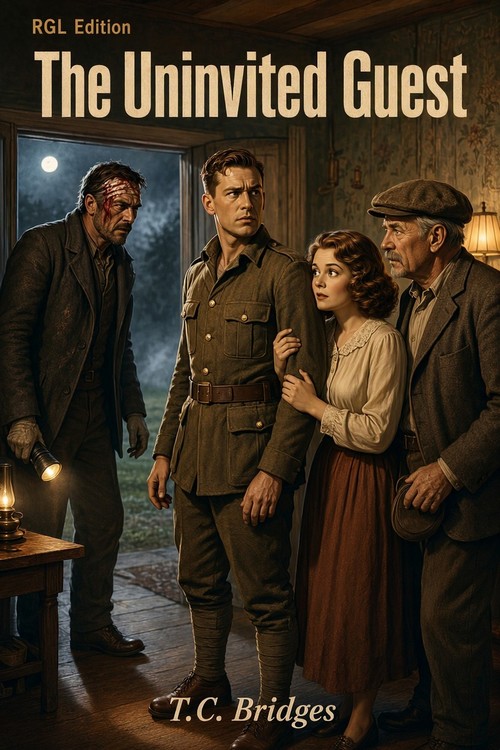
RGL e-Book Cover
Based on an image created with Microsoft Bing software
Roy Glashan's Library
Non sibi sed omnibus
Go to Home Page
This work is out of copyright in countries with a copyright
period of 70 years or less, after the year of the author's death.
If it is under copyright in your country of residence,
do not download or redistribute this file.
Original content added by RGL (e.g., introductions, notes,
RGL covers) is proprietary and protected by copyright.
RGL e-Book Cover
Based on an image created with Microsoft Bing software

Title from "The Lincoln Journal Star, Lincoln, Nebraska"
When stubborn farmer Joshua Cripps vows that his daughter Nan will never marry Kit Wharton, the penniless young soldier she loves, it seems their greatest obstacle is family opposition. But on a stormy night at the lonely farmhouse of Friar's Coombe, an escaped convict turns up as a most unwelcome guest. Holding Nan and her father at his mercy, the brutish fugitive transforms an ordinary domestic quarrel into a night of mounting terror. As danger closes in and hope fades, only one man may be able to save them. Packed with suspense, romance, and a thrilling showdown, "The Uninvited Guest" is a gripping tale of courage proving its worth when it matters most.
"I SEE there be a warder on the bridge, Mr. Trant," said Farmer Noakes as he came trumping into the bar at the Saracen's Head. "I reckon one o' they convict chaps is escaped."
Trant, the landlord, a stout man with curly grey hair, laughed. "Yes, one of 'em's legged it. He'll miss his Sunday dinner tomorrow."
Before Noakes could reply the door swung open again, and a small, elderly man with grizzled whiskers, entered the room.
"Good evening. Mr. Cripps!" said Trant "What brings you along this time of day?"
Cripps shook hands with the landlord and with Noakes.
"I ben up to see my sister along to Batchington," he answered.
"You didn't take your girl along, I see," said Noakes. "I wonder you wasn't afraid to leave her all alone down to Friar's Coombe."
"I reckon Nan can take care of herself!" answered Cripps shortly.
"I wasn't thinking she couldn't. But maybe she's got company while you're away," said Noakes slyly.
Cripps swung round sharply. There was an ugly scowl on his face.
"Be you a-thinking of young Wharton?" he demanded.
"Aye, they do say he and Nan's keeping company."
"That's a great lie then!" burst out Cripps angrily. "My girl isn't for the likes of him, and so I've told him."
"Why, what's wrong with Kit Wharton?" asked Trant genially. "He's a fine-looking young chap, and comes of good stock."
"Aye, and then goes for a soldier. Think I'd have my daughter married to a man as don't earn the pay of a stone-breaker?"
"He might leave the army and take on as a policeman or a warder," suggested Trant peaceably.
"And what good would that be to me?" asked Cripps sourly. "The man as marries Nan'll have to know summat of farming, and have a bit o' money besides to put up against what my girl will bring him. Nan's not for a pauper in a red coat like Wharton. If I catch him in my place I'll throw him out pretty quick, I can tell you."
"You throw him out!" repeated Noakes with good-humored contempt. "Why, bless you, Wharton's the best boxer in his regiment. He'd beat two like you."
Cripps banged his empty glass down on the counter.
"I'd like to see him try," he snarled, and, swinging round, stamped out in a rage. Untying the reins of his pony from the post outside, he flung himself into the saddle, and rode off up the hill at a canter.
Friar's Coombe lay in a lonely valley four miles from Moorlands, and it was pitch dark before Cripps, chilled to the bone, rode into his yard. He stabled his beast and then, in a very bad temper, flung open the back door of the farmhouse and marched into the kitchen.
It was a wide, low-ceilinged room spotlessly clean and tidy, from the neatly wrapped sides of bacon which lay in the white wood racks under the ceiling to the polished Windsor chairs around the walls.
A tall slim girl, with a mass of fair hair coiled neatly on top of her shapely head, was busy at the range, in which a cheerful fire glowed redly. She wore a neat blue print dress, and her finely moulded arms were bare to the elbow.
She turned as her father entered, but before she could speak he burst out angrily:
"Has that young Wharton been here while I been away?"
"That's no way to speak, father," answered Nan Cripps quietly. Nan had a deal of her dead mother about her, both in looks and character, and ordinarily her father restrained himself in her presence. But his ugly temper had been thoroughly roused.
"You're a nice one to tell me how to speak!" he snarled. "The tale's all over the moor how you've been carrying on with that young good-for-naught. Answer me, has he been here this afternoon?"
"Yes, he has," answered Nan, flashing out suddenly. Her pretty face was flushed, and her eyes, real Devon blue, sparkled in the lamp light.
"You shameless hussy!" roared her father. "You stand there and tell me that?"
"I do, and I tell you more. Kit and I are engaged to be married, and nothing you can say shall make me give him up. And so long as I'm here he shall come to see me whenever he likes."
Cripps gave a nasty laugh. "So long as you're here, eh? Then, by Jinks, off you shall go to your aunt up to Bristol. And if Wharton follows you there he'll get a flea in his ear, I'll be bound."
Nan paled. If there was one person on earth of whom she was afraid, it was her aunt Della. She was Cripp's sister, a big masterful woman equally hard in tongue and hand. Besides, Nan knew that her sweetheart could not afford to follow her so far. And his furlong was nearly out.
Having delivered his ultimatum, Cripps flung off his overcoat and hat and went to the scullery to wash his hands.
Nan, still breathing quickly, was laying supper on the table when she heard a queer, strangled cry from the scullery, and scuffle of nailed feet on the flags.
Her first idea was that her father had had a fit, and hastily laying down the dish she was carrying, she ran to the door of the back room.
The sight before her fairly took her breath. Flat on his back on the floor lay her father, and kneeling on his chest was a big, deep-chested ruffian who was in the act of tying his arms to his sides with the roller towel which he had torn down for the purpose.
The intruder's hair stood out in short, pig-like bristles all over his bullet head, and it hardly needed the clay-colored breeches and red and blue striped slop to tell Nan that the fellow was no other than the convict of whose escape from Moorlands Kit Wharton had already informed her.
She had plenty of pluck, but the shock was so great that for the moment she could not move. She felt as if in the grip of some horrid nightmare. Before she could recover herself the man had seen her.
As he sprang to his feet Nan turned and ran for her fathers gun which hung in the rack over the chimney-piece. She was too late. As she reached up for it a great red hand was thrust over her shoulder and seized the weapon.
"No ye don't, my beauty!" came a hoarse voice, and then Nan found herself in a chair, while the convict, gun in hand, stood over her, leering hatefully.
"You're a nice family to welcome a visitor, I don't think," he sneered. "Are you a-going to behave yourself, or do I have to tie ye up like your dad?"
"What do you want?" asked Nan breathlessly.
"Grub first. I'll tell ye the rest arterwards."
"There's plenty of food. Take what you want and go!" answered Nan, trying to keep her voice from shaking.
The man glanced at the table. A loin of roast pork was smoking among roast potatoes. There was a pile of jam tarts on another dish. A big brown jug of ale flanked a loaf of crusty home-made bread. Cheese and fresh butter completed the homely meal.
"Aye, that'll do to go on with," said the man smacking his thick lips. "Now you set there and help me. And don't try no tricks, mind, for I'm not the sort to stand any foolishness."
As he spoke he opened the breech of the gun, took out the cartridges, and reaching up thrust the weapon into the bacon rack under the ceiling.
Nan's knees shook so that she could hardly stand, but she managed to turn her chair round and begin carving.
Meantime the convict had found the beer, and was putting away one glass after another. Nan glanced at him again, and noticed the heavy jaws, the squat nose, the receding forehead, and the small but keen eyes set deep under bony eyebrows. There was not a redeeming point about his face. He was a brute all through, and her heart sank lower than ever.
She passed him a huge helping of meat, and he ate like one starved, champing his food like a pig.
"Help yourself, my gal," he said presently. "You ain't too proud to eat with me, be you?"
Nan tried to obey, but each mouthful threatened to choke her. The lag finished the beer.
"Ain't you got something better than this?" he asked. "Spirits, I means?"
Nan hesitated. Sober, the man was awful. What would he be drunk? Yet it was useless to refuse. He would easily find the liquor for himself if she did.
She pointed to the cupboard. "There's a bottle there," she said.
"Fetch it out!" he ordered brutally.
She obeyed. He filled a tumbler half full, added a little water, and flung down the fiery draught.
"That's prime," he observed, refilling his glass. He went on eating voraciously and drinking as Nan had never seen a man drink.
At last he seemed to be gorged.
"Helloa!" he said suddenly "We've forgot old stick-in-the-mud." He rose to his feet, strode into the scullery and came back carrying Cripps as easily as a baby.
He dumped him down in a chair with a thud that shook the room.
"Now, old pal, give us a song!" he ordered.
Cripps' face was a study. He was nearly choking with rage. "I'll see you hanged first!" he retorted.
"What! Cross, old dear?" jeered the other "Here, have a sip of this, and you'll feel better. He put his glass to the farmer's lips, but Cripps set his teeth and jerked his head back.
"Want to be nasty, eh?" exclaimed the other. "Well if you won't have it one way you shall the other," and so saying he deliberately poured the contents of the glass over Cripps' head.
"Now sing!" he ordered threateningly.
Cripps, with the gin dripping from his ragged beard, turned on his tormentor with a flow of language that was terrifying. He was cut short by an open-handed smack on the side of the face which made his teeth rattle.
"You sing now, or by crumbs you'll get hurt!" threatened the big man.
Nan was driven to interfere. "He can't sing," she said, "but I will if you like." Without delay she broke out into the first song she could think of, "The Last Rose of Summer."
She had a good voice if quite untrained and though she began shakily she gained a little courage when she saw that their awful visitor was listening quietly.
"Not so bad," he said when she had finished. Now give us another. Something more cheerful."
She broke with a quavering voice into "Widdicome Fair," and the lag joined harshly in the chorus. He had nearly finished the gin but the liquor seemed to have little effect. Nan was beginning to feel the strain was more than she could bear. She wondered how it would end.
Suddenly the convict caught sight of a gramophone on the table in the corner. He jumped up. "Stop that squalling. Now we'll have some proper music," he said with an oath, and winding up the machine, thrust a record into place.
It burst out into a squeaky waltz tune.
"Whoop!" he roared, and began spinning round clumsily. Suddenly he seized Nan by the arm, and jerked her out of her chair. She gave a cry of alarm as the man's huge arm clasped her waist, and he began whirling her round in time to the tinny retrain.
His hot breath reeked in her face. She bit her lips, and fought for courage. Twice he wheeled her round the room.
"Don't think much o' your dancing," he growled. "P'raps ye can kiss better than ye can dance."
Nan struggled violently, but she was a child in the burly brute's grip. His lips were within an inch of hers, when suddenly he flung her away from him.
"What's that?" he muttered sharply.
There was a crash. The window frame burst inwards, and amid a shower of glass a man in a soldier's uniform flung the curtains aside and sprang into the room.
"Kit!" screamed Nan, reeling back against the wall.
With a savage exclamation, the lag reached up and snatched the gun from the rack. Swinging it by the barrels, he rushed at the young soldier.
Wharton nimbly eluded a blow that would have brained him, and before the brute could strike a second blow, was on him, and seizing the weapon gave a sudden twist which wrenched it out of its holder's hands and sent it clattering across the flags.
The lag tried to fling his arms round his opponent, but though he was a deal bigger and heavier than Wharton the other was far too nimble for him.
Side-stepping, Wharton let him have it right and left. His fists reached jaw and nose, and the blows were like the sound of beating a carpet.
"That's fine!" shrieked Cripps suddenly finding his tongue. "Hit him again, Kit. Give it to him."
Foaming with rage, the lag went for Wharton, head down like a bull, but again the soldier sprang aside, and with a cold fury, inspired by what he had seen as he entered, let the brute have it on the ear. The whole weight of his active young body was behind the blow, and down went the big man like a pole-axed ox. Instantly Wharton was on top of him.
"Rope, Nan!" he cried.
Nan sprang to obey, and before the convict had recovered his scattered senses he was helpless for further harm.
"Now, father," said Nan, as she untied the towel which fastened his arms, "do you still think Kit's a good-for-naught?"
The old man scratched his head shamefacedly.
"Fighting chaps have their uses, I reckon," he said slowly. "But, Kit, you'll have to leave the army if you wants to marry my gal."
Roy Glashan's Library
Non sibi sed omnibus
Go to Home Page
This work is out of copyright in countries with a copyright
period of 70 years or less, after the year of the author's death.
If it is under copyright in your country of residence,
do not download or redistribute this file.
Original content added by RGL (e.g., introductions, notes,
RGL covers) is proprietary and protected by copyright.