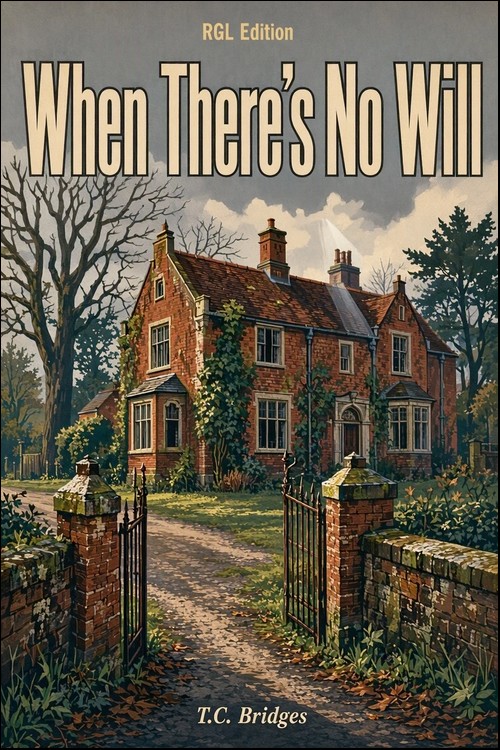
RGL e-Book Cover
Based on an image created with Microsoft Bing software
Roy Glashan's Library
Non sibi sed omnibus
Go to Home Page
This work is out of copyright in countries with a copyright
period of 70 years or less, after the year of the author's death.
If it is under copyright in your country of residence,
do not download or redistribute this file.
Original content added by RGL (e.g., introductions, notes,
RGL covers) is proprietary and protected by copyright.
RGL e-Book Cover
Based on an image created with Microsoft Bing software


Title from "The Adelaide Chronicle."
After illness forces former Malaya planter Frank Hallam to abandon the only life he knows, a surprise inheritance seems less a blessing than a burden: a decaying country estate, neglected for years and too impoverished to restore. Determined to make the best of Swanbourne, Frank settles into its lonely routines, only to find his fortunes unexpectedly entwined with those of spirited Fay Marchant, a young woman whose principles challenge him at every turn...
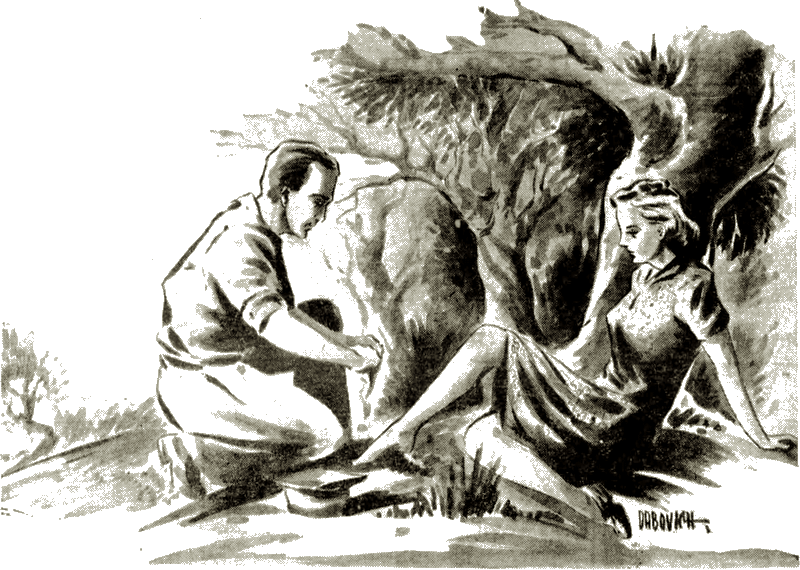
George filled his soft felt hat with water and gently bathed the wound.
Illustration from "The Adelaide Chronicle."s
DR. CARFAX completed his examination of Frank Hallam and looked at him thoughtfully.
"I'm sorry, Mr. Hallam, but it's out of the question for you to go back to Malaya."
"Bad as that, eh?" said Frank, with a wry smile on his thin face.
"It might be a lot worse," returned the other. "If you stay at home in the country, there's no reason why you shouldn't live to be eighty—and be as fit as the next man," he added. "But in the tropics you would not last a year."
Frank rose slowly and laid his fee on the table. The guineas were almost a tenth of his remaining capital. "Thanks," he said. "At any rate I know where I am."
"But I do?" he added to himself as he walked eastwards. "I cannot work; to beg I am ashamed, and £20 won't keep me long even in the cheapest country cottage."
He reached the temperance hotel in which he had been putting up, and the girl in the office handed him a letter. He went into the stuffy little lounge and opened the letter. It ran:
Dear Sir,—
We have to inform you that by the death of your uncle, the late Mr. Geoffrey Hallam, you are heir to his residence of Swanbourne, and the land surrounding it, an area of about 320 acres. It is our duty to inform you that our late client was somewhat eccentric. For long he lived the life of a hermit, never leaving the confines of his estate. None of the land has been tilled for years past, and the house and grounds are in a most neglected condition.
It would appear that your uncle has been living on his capital for, after death duties are paid, the amount remaining will be little more than a thousand pounds, a sum which is, of course, inadequate to put the house in repair, and this naturally precludes any possibility of letting it. We shall be glad to have your instructions in this matter, and meanwhile remain,
Yours faithfully,
Long and Long.
Frank read the letter through twice, then laughed so loudly that a half-scared waiter appeared at the door.
"Answer to the maiden's prayer," Frank chuckled. "At any rate I shall have a roof over my head, even if a leaky one." He got up, went to the 'phone, called the firm and made an immediate appointment with Mr. Long.
He told the lawyer everything, and that he had decided to live at Swanbourne. Rather to his surprise, Long agreed that it seemed the only thing to do, so 24 hours later Frank Hallam got out of a stopping train at the little station of Grendon. A porter took out two suitcases, a gun case, a rod and a large hamper of food.
"Swanbourne," Frank answered, and saw the man's amazement. "I'm the new owner," he added. The porter swallowed his surprise.
"It's a goodish way, sir. Shall I call the taxi?" Frank agreed, and his belongings were packed into an incredibly ancient car driven by an elderly man named Setters, who wore breeches and gaiters and an old tweed cap.
It was a delightful spring afternoon, the hedges were snowy with blackthorn and the high banks yellow with primroses. Two miles out they crossed a wild common and on the far side came to a steep descent. The driver pointed across the valley.
"Swanbourne, sir."
Frank drew a deep breath. On a broad terrace opposite stood a lovely old red brick house bowered in magnificent trees in the tops of which rooks were busy. No smoke rose from the twisted chimneys, there was no sign of life about the place. The pasture below was disfigured by clumps of reeds and the upper with masses of thistles. Everything was deserted and unkempt.
"Her be in a sad state," said Setters solemnly. Frank agreed, then pointed to a pretty little house some way up the valley.
"Who lives there?" he asked.
"Mr. Marchant, sir. A painter." Frank paid little attention, for now they were close enough to the house to see it plainly and its appearance shocked him. He had been prepared for something bad, but the reality was worse than anything he had anticipated. The paint had blistered away from the cracked woodwork; some windows were quite hidden by creepers; the drive was green with weeds and littered with slates which the wind had ripped from the roof.
Two rooms were fairly habitable, a small study and a bedroom. Frank settled into these and next morning an old man turned up. His name was George Ruff and he said that his wife had cooked for Mr. Hallam. Frank arranged with her to come and scrub and tidy up the kitchen and his two living rooms. He also took on George for a couple of weeks to help in cutting the creepers and putting the kitchen garden in some sort of order.
Within a week he had settled down. He gardened as hard as his still feeble health permitted, he started chickens to save his butcher's bill and caught trout in the brook. George insisted on buying traps to take rabbits which swarmed in the neglected fields. Frank was busy all day long and slept soundly. His health began to improve and, though he sometimes felt desperately lonely, he was not unhappy.
FRANK had finished his breakfast and was going out to his daily toil in the garden when a sound reached his ears, which pulled him up short. He waited a moment and it came again. This time there was no doubt about it. It was a cry for help, and it came from Helen's Wood a thick coppice some distance up the brook. He started off as hard as he could go.
The fisherman's path was narrow and rough and it was a hot, still morning. Frank was badly out of breath by the time he reached the edge of the wood.
"Help!" The cry came again, much more clearly and Frank felt certain it was a woman's voice. He scrambled over the broken fence surrounding the wood and plunged into a thicket of s briers.
"Where are you?" he shouted.
"Here, by the big beech. Be quick, I'm in a trap."
"A woman," Frank muttered. "A woman! What a fool I was to let George set those beastly things."
Somehow he tore free and bursting through a tangle of hazel and hornbeam, found himself in a small glade in the centre of which rose a great old beech tree. Under its mottled shade a girl was huddled on the mossy ground. Her slim brown hands were clasped around one ankle, her small face was very white and her lips tightly set. The ankle, Frank saw at once, was gripped in the toothed jaws of a steel trap.
In a flash he had a foot on the spring, forced the jaws open and released the prisoned foot.
"Thanks," said the girl. "I—I couldn't do it. It was too stiff." Then quite quietly she fainted.
"And no wonder," said Frank, biting his lip, for blood was staining the tan stocking and he saw that the teeth of the trap had cut deep into the girl's ankle.
Frank Hallam had not spent five years in the East without learning something of first-aid. She soon came round. He slipped off the shoe and she peeled off the stocking.
"Pretty bad," he muttered, frowning as he saw the ugly wounds, just above the well-shaped ankle. The soft flesh, too, was swollen and discoloured.
The brook was only a few yards away. He hurried to it, filled his soft felt hat with cold water, gently bathed the wounds, then tearing up his handkerchief—luckily a clean one—bandaged the damaged ankle.
"Not a bad job, either."
"It feels better anyhow," said the girl and Frank saw that her eyes were brown, and had little specks of gold in them. The prettiest he had ever seen, Frank thought.
"Wish I had a brandy flask," he said. "You had a pretty bad accident."
"Accident!" Frank had heard of eyes flashing fire but this was the first time he had seen it. "It was no accident. Someone had set that trap—set a trap in Helen's Wood. A ghastly thing to do!"
Frank would have given anything to be able to deny that he had anything to do with it but he had to speak.
"I'm the culprit," he told her.
"You!" She looked him straight in the face. "You set it! How could you do such a thing?"
"I'm frightfully sorry," said Frank. "I never dreamed of you—of anyone walking into it."
"I wasn't thinking of myself. I was thinking of the rabbit or the fox or the cat you might have caught—lying here for hours, half dead with thirst and fright. It's bad enough when gamekeepers do such things. But you—I suppose you call yourself a gentleman?"
Frank bit his lips. He was ashamed but also annoyed.
"I'd better help you home," he said drily.
"I would not accept your help if you were the last man on earth," the girl answered. "Please go away."
She made a sudden effort and rose to her feet, but the moment she put her weight on the injured ankle over she went. Frank just caught her in time.
"You can't even stand," he said roughly. "Whether you like it or not, I'm taking you back to the house." He picked her up and she was too near fainting to resist. He got her to the fishing path but, before he was half way to the house, realized that he had bitten off more than he could chew. The effects of blackwater fever are not shaken off in a few months. His pace grew slower and slower, big drops of sweat ran down his face and he became unpleasantly giddy. When he reached the gate he stopped.
"I shall have to put you down a minute," he said. He laid the girl on the grass and, even as he did so, everything around him seemed to waver before his eyes. "I—I'm sorry," he gasped as he slumped.
FEVER dreams are ugly things and it seemed to Frank that he had passed through a year of Hades before he struggled back to consciousness. He found himself in his own bed. Everything was abnormally neat and tidy, and there were flowers on the table beside him. While he was wondering vaguely where they came from the door opened softly and—there was the girl.
"You!" he said. "You!"
"Me—yes, me!" she answered with a smile. "So you've come to yourself again. I'm glad."
Frank gazed at her.
"But your ankle. You're walking."
"It's quite well again." She held it out for his inspection. "It's had plenty of time to mend."
"How long have I been here?"
"A fortnight." She turned stern. "You were an idiot to carry me."
"So you said at the time," Frank retorted.
"Don't," she said sharply. "I know now it was Ruff who set the trap."
"But who are you?" Frank questioned.
"Fay Marchant. Dad and I live at Otway." She went on. "Your uncle and I were friends. But dad and I were away when you came. We didn't even know you had come."
"It seems to me I've inherited a friendship," Frank answered. "I'm frightfully grateful to you, Miss Marchant."
"You have talked enough. Now drink this and go to sleep."
A week later he was able to get down into the garden and lie in a long chair under the trees He had seen Fay every day.
"Topping place, isn't it, Fay?" he said, looking at the old house, lapped in warm sunshine.
"A dear old place. I love every brick of it," Fay answered. There was a pause, then Frank spoke again.
"It's wicked to see it like this. And I can't even sell a few fields to raise capital to do something with the rest. No one would buy."
"It is hard," Fay agreed. "Yet if it were mine I don't think I could bear to part with even one field." Frank looked at her quickly.
"Do you mean that, Fay?" She looked a little surprised at the sharpness of his question.
"Of course I mean it."
"Then, Fay," Frank said breathlessly. "Would you—will you go shares in it? Oh, I know I've no right to say this. I haven't money to keep myself, let alone a wife. I—I'm a selfish sweep."
Fay stopped him.
"Frank," she said, and there was a tone in her voice which thrilled him through. "I would rather marry you without a penny than any other man with a million. And—" She got no further for Frank's arm was round her and he drew her down. Presently she freed herself. "Listen, Frank," she said. "I am not quite penniless. Between us, I think we may do something with the dear old place and nothing will make me happier than to try."
Mr. Marchant made no objection to the match so, as soon as Frank was fit again, a quiet wedding was arranged in the little country church at Grendon. Frank had written to Mr. Long of his engagement, and was pleasantly surprised when the lawyer announced his intention of coming down for the wedding. Frank who had hardly a relation in Europe and whose friends were all in the East, asked him to be best man, and he agreed.
After the wedding the little party went back to Otway to cut the cake and share a bottle of wine. They had decided to do without a honeymoon.
Mr. Long then produced a sealed packet which he handed to Frank.
"I don't know what is in this," he said, "but your uncle left it with us five years ago with directions that it was to be handed to you either on your wedding day or a year after his death." Frank opened it and found a letter. It ran as follows:—
Dear Frank.
I have not seen you for years, but have followed your career with interest. It is my dearest wish that you should marry Fay Marchant, the best and truest-hearted girl I have ever known. And if, as I hope, you have the pluck to live at Swanbourne I have little doubt you will meet and fall in love with her. I have left instructions that if you two do make a match of it, you are to receive the enclosed bonds as my wedding gift. If, on the other hand, my hopes are falsified, then the money is to be equally divided between you. Yours affectionately, Geoffrey Hallam.
"The old dear!" cried Fay.
"Yes, but how much is it?" asked the practical lawyer.
"I wish you'd tell me, Mr. Long." said Frank handing over a thick bundle to of stiff papers. The lawyer ran through them.
"Something over sixty thousand pounds," he said. "I congratulate you both. You will not only be able to restore Swanbourne; you might even afford yourselves a honeymoon."
Roy Glashan's Library
Non sibi sed omnibus
Go to Home Page
This work is out of copyright in countries with a copyright
period of 70 years or less, after the year of the author's death.
If it is under copyright in your country of residence,
do not download or redistribute this file.
Original content added by RGL (e.g., introductions, notes,
RGL covers) is proprietary and protected by copyright.