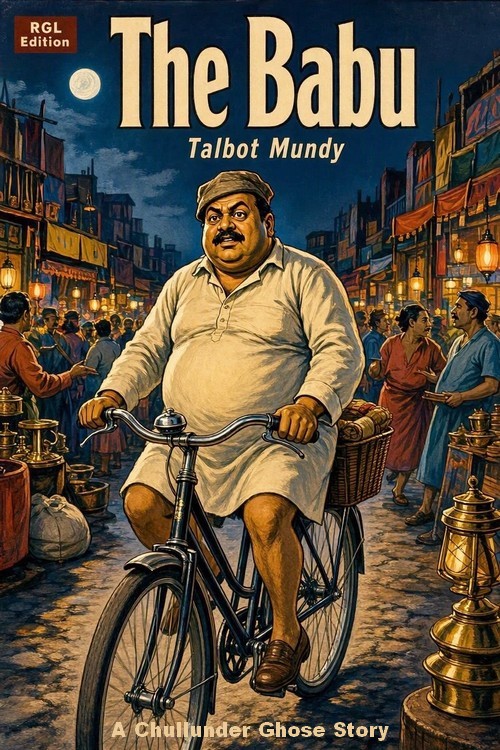
RGL e-Book Cover
Based on an image created with Microsoft Bing software
Roy Glashan's Library
Non sibi sed omnibus
Go to Home Page
This work is out of copyright in countries with a copyright
period of 70 years or less, after the year of the author's death.
If it is under copyright in your country of residence,
do not download or redistribute this file.
Original content added by RGL (e.g., introductions, notes,
RGL covers) is proprietary and protected by copyright.
RGL e-Book Cover
Based on an image created with Microsoft Bing software
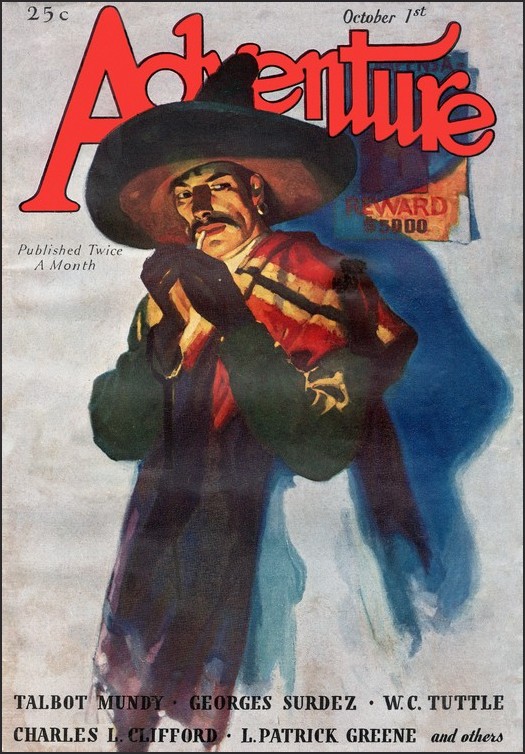
Adventure, 1 October 1931, with "The Babu"

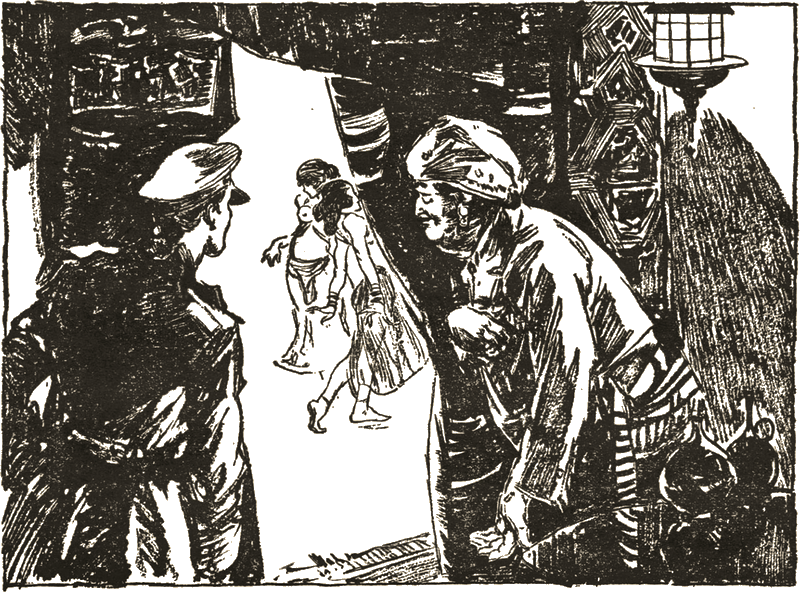
LARRY O' HARA swung into the saddle, laughed, waved his hand and rode away into the dusty wind that had picked up bugle music on its way from the Khyber Pass. He sat his ramping red horse with a finality as reckless and contagious as his smile—as satisfying as the hollow between his shoulder blades.
"What have I done, that a man like that should love me?"
Phoebe Barron watched him canter through the gate of the hotel compound and then settled down into a wicker chair to think things over, gazing at the skyline where the mountains bred those long-nosed Hillmen whom it was Larry's job to understand and keep on terms with if he could. He had not told her where he was going, and she had not asked. She supposed she would have to grow accustomed to secrets that she must not try to learn; officers of the intelligence department are not allowed to share their information even with their wives.
There was a fat Bengali babu standing at the far end of the veranda, watching her. She had seen Larry speak to him,not as officer to servant but as man to man, and just before Larry rode away he and the babu had exchanged signals. The babu saw her glance at him, and drew near. He was an enormous man dressed in a flame colored turban, dark European jacket, white sweater and flannel pants. He looked clean, as well as handsome in a middle aged, portly, elephantine way. There was humor in his brown eyes. Was he laughing at her?
"Salaam, sahiba. This babu proposes to ingratiate himself."
"Why? What for?"
"General principles. I know on which side of a slice of bread the butter tastes best, even when there is no butter, as usual. Am observant—see you have made conquest. Captain young redheaded Larry O'Hara sahib is my one and only ewe lamb. He is my broth of a boy. He is the only genuinely mischievous and wise young laughter maker between Delhi and the Karakorum Mountains. Since you have ensnaffled him—"
"That's impudent!"
"Sahiba, this babu has nothing else to sell but impudence. Same is not like soup in tin cans that purchaser will open next week and a long way off. Nobody buys impudence without first sampling same. It must be good—like Einstein thumbing nose at Euclid—or like Captain young O'Hara sahib putting kibosh on the Orakzai Pathans. I bet you don't know what a flaming young daredevil of a cock-robin Solomon with spurs on his bare heels and fun in his eye you have chosen for yourself to marry."
"Sit down then and tell me."
A wicker chair squeaked under his enormous weight. For a moment he sat with his hands on his thighs and studied her. His beautiful brown eyes were as full of understanding and humor as his metaphors were eloquent and mixed.
"Passport clerk informs me," he said suddenly, "that you are twenty-eight years old, unmarried, a nurse by profession, a citizen of U.S.A. United States, in India for purposes of travel. Travel is cost-plus curiosity, including ticket paid for in advance. Self seek position of plus."
"Plus what?"
"Am cosmic gigolo. Can jiggle hot time out of iceberg. Am charter member of Rogues' Racket Club, that has no dues and only one rule, that there are none."
"You admit you're a rogue?"
"May as well. You would find it out sooner or later. Once was honest babu, but there was too much competition."
Phoebe chuckled. She began to like the man.
"Go on," she said. "You were going to tell me about Captain O'Hara."
"Ladies first, sahiba. Preliminary verb. saps. given away gratis, same as fancy blotters by insurance agents. Am character diagnostician."
"What do you know about me?"
"Plenty. Am portable radio set. I bought myself on the instalment plan—a catastrophe down, and one mistake a day for forty years. Expensive, and a fat thing, but mine own. I know you nursed a millionaire through typhoid, and I know now why he fell in love. But what I want to know is why you upsnooted fifty million dollars? Self was in Chicago—twice. You could have married him and cashed in alimony."
"I don't do that kind of thing," said Phoebe.
"But you let him send you on this trip around the world?"
"Why not? He was grateful. He could afford to be generous; and I wanted to see the world. But how did you know? You must have been talking to Captain O'Hara."
"No use talking to him. I am redhead Larry's uncle, teacher, guide, philosopher, factotum, goat, admonisher and only maiden aunt. He gets himself in trouble, and I get him out again. Chullunder Ghose is my name. He would probably admit that I have taught him all he knows, including how to judge a woman. Nevertheless, I warn him and he does the opposite. But he is Irish. That is to say, he is inconsistent. When I warn him against what I want him to do, he doesn't do it. Contrariwise, to show how undependable he is, I warned him against you as being much too good for him, so he goes after you like a cavalry charge, and now what? I have two of you to teach instead of one!"
"What do you propose to teach me?"
"Something that redhead young Captain Larry O'hot-stuff Hara will never learn, namely: That before he can teach his grandmother, meaning this babu, to suck eggs he must first know a good egg from a bad one; because a bad egg will never be good, though he suck like two elephants at one waterhole. Self am good egg, and he knows it. I have told him that Milk of the Moon is a bad egg. Nevertheless, he trusts her."
"Her? Who is she?"
"Jolly well who is she not? She is the Queen of Jezebels. She is the woman whom the Orakzai Pathans fight duels for. She knows all their secrets, including those which she has not yet told them. She is the night-light naughty lady of Peshawar, who has caused more lovers to be killed with knives than Samson ever slew with an ass's jawbone. Redhead Larry has gone to see her. I have taught him how to disguise himself, and he can speak the language almost perfectly; but she knows who he is. And she jolly well understands that if a British officer were to be scuppered in her den, the authorities could neither punish her nor do much else about it. Because he would be out of bounds."
"Why has he gone to see her?" Phoebe asked. "And why do you tell this to me?"
"He has gone to see Milk of the Moon because, just now, it happens Akbar Sayyid is her lover. Akbar Sayyid is the Orakzai Pathan who leads raids hereabouts. He is as evasive as a jackal and there is a reward of ten thousand rupees on his head. Last night he led a raid along a bank of mist, slew six or seven sentries, stole a stand of rifles, and escaped. Redhead hopes to catch him. But I think Akbar Sayyid will catch Captain hurry-up O'Hara this time."
"Then why don't you do something about it? Go to his general and—"

HE INTERRUPTED her.
"Sahiba, probably you know a lot about wounds and how to bandage them. But you don't know generals—or him, yet. I bet you. This business of marrying an Irish soldier's son, whose great grandfather fought at Waterloo, and whose grandfather rode through the guns at Delhi Ridge, is not so simple as it looks. Whoever is to be the guide, philosopher and friend of Captain catch 'em alive-O'Larry must have a light hand on the rein, plus twice the courage of a tiger, plus the confidence of a mother for her child and the resourcefulness of a magician, let me tell you! Some day he will come home feet first. But he will bring the bacon with him. And his widow will be able to say she loved a first-class man."
Phoebe stood up and stared at the faraway mountains, thinking.
"Gray eyes!" said the babu. "Mouth like mother of successful sons I would bet, if I had any money!"
"Bet what?"
"I can teach you how to make him into a brass hat general in no time. But you must let him take some lickings before you can show him how to win."
"You seem to think you know a lot."
"Verb, sap! Am cynic, with idealistic leanings. Am immoralist, with snappy set of altruisms all my own, original with me. Am abstract pessimist, so concrete in my optimism that I hope he comes a cropper this time, so that you may unscramble the omelet. If not, we must wait until next time. For the present—silence!"
"You make me feel like screaming."
"That is doubtless why you do not scream. You are the kind that thrives on danger. So if hothead young O'Hara gets into a mess, this babu will depend on you to get him out of it. Meanwhile, my salaams, sahiba. May I offer you my card?"
It was a small one, as neat as a cabinet minister's, on which was engraved, "Babu Chullunder Ghose. F.B.A."
"F.B.A?" she asked.
"Failed Bachelor of Arts, Calcutta University. Too much knowledge. Ignorant examiners expected me to tell them what they thought they knew, instead of what I did know. Unlike O'Hot-head Hara and yourself, they were not curious. So I have been forced to live by my wits instead of on my reputation. Wits must go to work this minute—goodby."
He was astonishingly agile, though he looked as if he weighed three hundred pounds. He vaulted the veranda railing and rode away on a bicycle. He looked so funny on it that Phoebe laughed in spite of her emotions, and liked him in spite of his impudence.
What could his object be in scaring her about Larry? Milk of the Moon sounded like a trade name for magnesia. She did not believe a word of that story.
Nevertheless, she was worried. She knew, of course, that secret service was Larry's idea of real life. She rather disapproved. She would have preferred him to lead squadrons. Somehow the thought of the man one loves being killed in the fighting line is half endurable. But in secret—nobody knowing how or why—no trumpet calls, no comrades, no renown, no citations...
"Not so good," thought Phoebe.
SHE forced herself to go and play tennis. And during an interval between sets she talked with a young officer who was just out of hospital and who did not know she was engaged to Larry. He was no help.
"Pathans? Savages. First class savages. Their women are even worse. A Pathan woman is more treacherous than the worst snake you ever heard of. Do I know Chullunder Ghose? Yes. Rotten liar. Don't have anything to do with him; he's one of those rascally babus who knows more than is good for him or anybody else."
Phoebe ventured cautiously beyond the border of discretion, and then wished she had not.
"Captain O'Hara? Splendid fellow, crazy as a March hare. Corking good company. Rides like the devil, and might make the all-India polo team if he had ambition. But he wastes his time learning languages that he'll forget if he ever lives long enough to command a regiment. What he'll get is a knife in the liver one of these days—same as I did, only a Hillman missed my liver, thank the Lord. O'Hara probably will get his from a woman in some mean dive in Peshawar bazaar. Those places fascinate him."
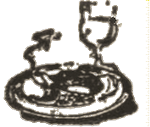
PHOEBE dined alone that night, in the tawdry hotel dining room, at a table between the fly-blown portraits of the king and queen. She hated both of them. To her, just then, although she knew the suggestion was silly and told herself so, they were the Molochs for whom gallant young officers sacrificed themselves on the knives of savages. When she could not endure the portraits any longer she went to her own room, avoiding a game of bridge by saying she intended to write letters.
Perhaps she did intend that. If so, she forgot it. She sat still, miserable, lonely, seeing Larry's laughing, sunburned face—and then imagined him lifeless, looking upward at the dark sky. She could almost see the long knife plunged into that hollow between his reckless shoulder blades. She sat quite still until nearly ten o'clock, trying to force herself to see him whole and well. It was her creed, that thought, held strongly, takes form sooner or later, although she knew there was something inconsistent about that, because—for instance—
She had always disliked Irishmen, sworn she would never marry one. In a railway accident, some years ago, an Irish doctor told her she did not know her business. A professional nurse, on a train, without a first aid outfit in her handbag! She had vowed she would never forgive the Irish for that insult. But she had never since then traveled five miles without two or three times more bandages and dressings, even instruments and antiseptics, than an Irishman at his peak of unreason could dream of asking for.
"Perhaps prejudice isn't thought. If it is, I take it back. I do love an Irishman. And if he loves the secret service, I will love that too. His friends shall be my friends—his enemies my enemies."
She decided she would go and play bridge, or at least look on at it, to keep from worrying. There were usually people in the lobby until after midnight; there might be three playing dummy, who would be glad of a fourth. But when she reached the lobby there was no one there. She turned over the pages of a stale magazine and suddenly remembered she had left her door unlocked, so she called one of the hotel servants and told him to lock it and bring her the key. The man was gone a long time. She went to look for him and met him coming along the corridor. He gave her the key and explained he had had to hunt for it; he said he found it at last on the dressing table. She gave him a small tip and returned to the lobby.
Outside, under the lamp on the veranda, stood Chullunder Ghose. He beckoned to her, but she hesitated, remembering what that officer had said of him. However, curiosity was too strong, so she went outside and followed him to the far end of the veranda. He was out of breath, and there was something so mysterious about his manner that her heart thumped and she dreaded bad news so that she could not force herself to speak. But his first words reassured her, and her relief was so great that she smiled and left off shuddering at the chilly night air.
"Sahiba, I come from O'Hara sahib. Thinking you would like to see the night life of Peshawar, he has sent an escort for you. Do you see that man with a lantern just outside the hotel gate? Follow him to a pony. Mount the pony and let him lead it. But keep silence. Mind now, not a word to any one!"
"I must go to my room for a wrap."
"The man has a cap and overcoat. You are to wear those. They are Captain O'Hara's."
She was suspicious. A note in Larry's writing would have been the proper thing; and why did the babu not want her to go to her room? But perhaps Larry had had no writing materials. At any rate, she decided she might need more money so she went to her room in spite of the babu's protests; and through habit, as she tucked some paper money into her stocking, made her glance toward the table where the handbag always stood ready against emergency. The bag was gone.
The hotel servant might have stolen it. She went to look for him. But he, too, was missing; he had gone off duty, and another had taken his place who answered her questions with blank bewilderment. And outside, the veranda almost hummed with the impatience of Chullunder Ghose. She decided to let the bag go hang and to row the hotel people about it afterward.
"Bohut atcha!" said the babu. "That means 'attaboy!' in Hindustani. "Come on!"
He led her to the compound gate, almost running ahead of her, glancing nervously to right and left when he reached the road. Then he snatched a military cap and overcoat from the man with the lantern and helped Phoebe into them. The cap was at least a size too large. She had not thought Larry O'Hara's head was as big as that; but when she pulled the cap off and held it toward the lantern she could see his name, in his own writing, on the inside leather band. That gave her all the confidence she needed. t
"Hurry, sahiba! Hurry!"
"Where will you be?"
"Omnipresent! Ixion—god on bicycle!"
He vanished into shadow, but a moment later she heard a thump as he set down his wheels in the dust, and a squeak as he mounted. Then he sped past, almost silent, with his light out, and was gone.
So she followed the man with the lantern, doing her best to stride like a British officer and laughing at herself because she knew the attempt was a failure, although the ample folds of the overcoat concealed the outline of her hips, and nobody could see her clearly. It was pitch dark, lonely—no moonlight.
She began to be scared then. Stars shone, but there was a bank of utter black where mountains crowded the horizon. Jackals whimpered. Now and then a dog barked. Lights—lights—lights, but not one that looked friendly. Shadowy graveyards. A few figures—thieves? Pathan robbers? Perhaps servants slinking homeward. It reminded her of district nursing in the shanty towns, and that put heart in her. Nobody molests a nurse. She forgot she was not dressed as one.
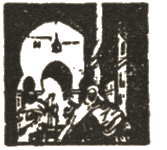
SOMETHING moved within the shadow of a wall, and she saw the pony within ten paces of her, standing with one hip up and its nose to the dust. The man with the lantern unhitched the pony and then held the stirrup and helped her to mount. He wore a turban, a sheepskin jacket and very voluminous trousers. He smelled like a camel. She was glad when he gave her the reins and walked ahead. The pony followed, and she tried to ride as if used to it, rather thankful that the overcoat covered her legs. With the cap pressed low, and the overcoat collar turned up, she felt confident she would not be recognized.
She was startled several times by sentries. Their challenges in the darkness sounded like sudden curses. But her guide answered in a high pitched voice and all she had to do about it was to raise her hand in answer to the salute. She began to enjoy it—lighted a cigaret from Larry's case that she found in the overcoat pocket. It was good of Larry to invite her for such an adventure. Hot-headed? Maybe. But considerate. And he trusted her not to act up like a silly fool and give the game away.
As they approached the native quarter, instead of sentries there were military police—big, bearded, turbaned men who stared hard but said nothing. She had heard that the bazaar was dangerous at night, and even out of bounds; but she was never once out of sight of a native policeman, and never once in total darkness in the winding streets, until the guide led down an alley and they reached a high wall that cast a deep shadow. Then a whistle, a long way behind her, blew shrilly. Glancing over her shoulder, she saw the policeman at the cross street hurry out of sight.
She almost screamed then. Arms out of the darkness seized her. She was lifted out of the saddle, toward where the shadow was deepest. Some one in an overcoat exactly like hers, and with a cap like hers, sprang on the pony's back. The guide walked on, and the pony followed him exactly as if nothing had happened. Strong hands gripped her elbows. A gate opened; she was pushed through, and it closed behind her. Then she recognized the babu's voice as he released her arms:
"You will be mother of gray eyed sons, who will also not need to be gagged to prevent them from making a fuss!"
"Aren't you ashamed?" she retorted, turning on him.
"No. Would be ashamed if I had guessed wrong, like damn fool police who heard whistle and ran looking for murder! So you get in unseen. Do you feel offended?"
As a matter of astonishing fact, she did not. She felt excited and intensely curious. She could hear a drumbeat and something like cymbals, muffled by intervening walls.
"This is dairy of Milk of the Moon," said the babu. "When you enter, be what U.S.A. Americans call snooty. Otherwise there might be fly in amber of our cheerio-ishness."
Strong smells—heavy-footed silence, due to deep dust. She was surprised how confident she felt, with the palm of Chullunder Ghose's hand shoving her forward into darkness that was broken only by one keyhole. Light poured through that. The babu kicked at the door. It opened gingerly. He kicked again, so fiercely that it slammed the face of the man who lurked behind it, making him swear and hiss like a scalded cat.
The babu pushed Phoebe through the door into a dim, square vestibule and the door slammed shut.
Dimness—and she began to be thoroughly scared now. Four men sat on mats against a wall, with swords beside them—fierce fellows—one with a wound and a blood stained bandage. They lowered their eyes when Phoebe stared at them, but an impression stole on her that the babu was as frightened as herself.
Sounds and strange smells—musk and something else—barbaric music, muted by an intervening door. She turned to Chullunder Ghose.
"Where is Captain O'Hara ?" she asked calmly.
Instead of answering, the babu opened the door and pushed her into colored, smoky lamplight.
"Pathan night club," he whispered. "No cover charge, but watch your hat and overcoat, as they say in U.S.A. United States!"
Silence then, as sudden as an explosion. Two young women in silk trousers and jackets, each with a big turquoise on her naked stomach, stood in midroom as if frozen in the act of dancing. Phoebe had not dreamed there were such women in India—intelligent looking and beautiful, almost as white as herself. They were not afraid; they were astounded that she should dare to come among them.
Chullunder Ghose helped off her overcoat and whispered:
"Cap, too. Let them see your gray eyes."
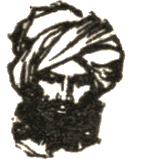
TEN or eleven men lay sprawling on cushioned seats around the walls, some smoking pipes that had a strange, faint smell in addition to that of tobacco. Hasheesh? Oiled lovelocks fell below their turbans. They had prominent noses and rather sly, but pleasant looking, quarrelsome, bold eyes. Even the older ones wore roses tucked behind their ears. Some of them had swords, and all had daggers in jeweled sheaths that looked like heirlooms.
"Pathans," the babu whispered. "Damn good bad men. Upsnoot them before they think you are afraid!"
It is not simple to upsnoot people who have not yet offered insolence. Phoebe stood still.
"Where is Captain O'Hara?" she demanded.
"In a moment. In a moment," said the babu. He was either disguising excitement, or else terrified; Phoebe thought she felt him tremble when his elbow touched her.
Some one drew a curtain with a clash of brass rings. Seven or eight girls, even better looking than the first two, clustered in the doorway of an inner room and stared at her with bold, astonished eyes. There was an amber light behind them; crimson, yellow and green jackets and trousers looked like colors from another universe. Their skin glowed like satin. They were healthier looking than the men.
"Is Captain O'Hara in there?"
Before the babu could answer, the girls stirred and a woman walked out from behind them. She was wonderful in curve, line, movement, and she knew it. If the diamonds at her ears were prodigal, so was the way she traded on audacity. There was something cruel in her beauty, and her smile was as full of mischief as the subtle fingertips that almost imperceptibly began the snake wave motion from which genuine dance emerges.
"Milk of the Moon!" Chullunder Ghose announced.
The woman knew English—laughed.
"My name sounds strange in that tongue. Is this she of whom you spoke?"
"I am Phoebe Barron."
Challenge—eyes to eyes—each woman weighing and appraising the other with wisdom won from life, though differently won. Character met character, and will met will. The men watched. Suddenly Milk of the Moon, as the babu called her, laughed with a note in her voice like the clashing of anklets.
Not a man moved. Milk of the Moon made a gesture with her palm turned upward. One of the girls brought rosebuds woven into one long necklace and Milk of the Moon tossed it over Phoebe's shoulders.
"May the Prophet love you! Are you not afraid?"
"I have come to find Captain O'Hara. What should I fear?"
But she was deathly afraid. There was a creepy feeling up her spine, as if unseen knives were being whetted for her.
"Look into her eyes. She is afraid of nothing—except that she might fail her lover," said the babu.
Milk of the Moon glanced sidewise at the men. Her eyes and her smile grew cruel, and Phoebe knew now, knew beyond the slightest shade of doubt that Larry lay at death's door. She could not have told how she knew it, but her own eyes changed so that Milk of the Moon retreated from her half a step-then forward again, to assert her own spirit. She spoke slowly—
"If you are one who leaks tales, like a roof that drips—"
"I am not," said Phoebe. "Where is Captain O'Hara?"
Milk of the Moon glanced again at the men, and the girls grinned.
"You, and he, and this babu, who is a sack of trash without a buyer, die this night, unless—"
Larry O'Hara was still alive then! Phoebe's voice was as quick as a champion's blow in the ring. She was ready for anything.
"Unless what?"
"Come on!" said the babu. "This way. Jaldee—jaldee! That means, 'Step on it!' "
He hustled her toward a stair between beaded curtains, then led because there was only room for one at a time. In darkness, all the way up the winding stairs, Phoebe heard the clash of Milk of the Moon's anklets. Then there was dim light at the stairhead as the babu stumbled over something and opened a door.
"Here it is—your bag. I took it from your room. I brought it on my bicycle. It is locked—no key—I have a knife—if there are not the right things in it—"
He went down on his knees on a sheepskin mat and began slashing at the leather with a clasp knife. Milk of the Moon pushed Phoebe forward toward an inner door. It was open.
"O my God!"
Larry O'Hara lay still, on a wide cot, with a naked candle throwing shadows all around him. There was blood on the floor. He was pale—not yet dead, though; she could see him breathing.
"Bag is open," said the babu. "Shall I empty it on table?"
"Bring a doctor, you idiot!" Phoebe took Larry O'Hara's wrist and felt his pulse. "Do you hear me? Hurry!"
"And get us all killed? Krishna! Why did I bring you—and your bag?"
Milk of the Moon spoke—
"Do you know a doctor who would not tell tales?"
Then Phoebe's veins unfroze. She pulled her armor on, an apron from the bag.
"Out of my way! Water—lots of it— and hurry!"
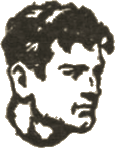
SHE herself dragged the table nearer, took scissors and cut the clumsy, blood soaked bandage with which some one had tried to stanch a knife wound below Larry's ribs. Milk of the Moon watched her, fascinated by the skill of fingers that had broken rules many a time and done surgeon's work before the surgeon came.
Phoebe was aware of nothing but the job she had to do, conscious of nothing but Larry, his wound and her own trained capability. She worked. She heard nothing, not even a man's voice and his heavy footsteps. She spoke at last, believing that the man behind her was the babu:
"Bled like veal, but I've stopped it, and the wound is nothing to write home about. I think it's clean. He ought to get well in a week or two." Then, facing about, "Who knifed him?"
A man grinned at her, his yellow teeth sharp like a wolf's in a gap of his black beard. He wore a smelly sheepskin jacket, a revolver, two knives. He was tall, and the thews of his throat were like whipcord. He had a hooked nose and the eyes of an eagle. He stood boldly, but his grin was cunning; and his lower lip, protruding, indicated greed that overruled all other considerations. In a voice that resembled knife blades grating on each other he said something in a language of which Phoebe knew not one word.
Milk of the Moon interpreted. She stood beside the man, but enough behind him not to seem too confident. Her mood had changed.
"This is Akbar Sayyid—he whom men obey along this border."
Phoebe stared.
"Did he knife Captain O'Hara?"
"Nay. If he did there would be no life left. Akbar Sayyid stabs straight."
What does he want?" Phoebe demanded.
"He will take. You and that one and the babu are his prisoners."
"Why?" Sharp as a pistol shot. She had won the first round. She was ready for the next now. "Why?" she repeated.
"Because that officer O'Hara came to my house to catch Akbar Sayyid. In disguise he came, full of fair speech, I permitting it because that babu told me there will be good ransom money if Akbar Sayyid captures him alive. But—"
Chullunder Ghose made signals. He was standing by a small square window with his big head silhouetted against starlight. Phoebe glanced once and then ignored him. Blackguard! Liar! Betraying Larry—then herself—and daring to make signals.
"But a young fool of the Orakzai Pathans," Milk of the Moon continued, "saw through his disguise, and drew a knife too swiftly. Thus this shambles, in my house, that the police already spy on too much. And so you, and he, and that babu are to be taken away swiftly. The Pathans downstairs will carry him. And if he dies—"
"He will be dead then," the babu interrupted. He came nearer. "Ask Akbar Sayyid who buys dead men, and for how much?"
Milk of the Moon turned on him and answered in her own language, but glanced at the door as if some one might be listening and began her speech again in English.
"But I tell you he was searched. There was no letter in his clothing such as airmen carry. For an airman alive there is a reward, and all men know that they need only to present the letter and deliver up the airman to get the reward. But this is not an airman. This one must be held until there has been much talk and the money is sent for his ransom."
"If they carry him far, he will bleed to death." Phoebe interrupted. "Tell that gangster to take me instead."
"Gangster? What is it?" Milk of the Moon detected insult.
So did Akbar Sayyid, who appeared to know at least some English. His izzat, as the Pathans call honor, was touchy. His eyes looked as if they would strike sparks on steel. No mere woman had the right to call him strange names.
Chullunder Ghose came waddling into that breach—blocked it with his huge bulk, forcing all attention to himself.
"Why did I go for his overcoat?" he demanded. "Why did I pedal my way to his bungalow and kick his servant in the stomach? Did I run that risk for nothing, with half the dogs in the cantonment after me?" He flourished the overcoat Phoebe had worn. He stuck his hand into the inside pocket. "There—look—see!" He produced an envelope marked O.H.M.S, opened the envelope, flourished its contents. "Can you read? His name, his rank, his photograph! And beneath that, what? In his language, and in yours also—read it—read it! 'A reward of ten thousand rupees will be paid for the bearer to whoever befriends him if captured while on active duty, and returns him alive and not ill treated to the army headquarters, Peshawar.' Ten thousand rupees!"
Money is money. Akbar Sayyid's eyes shone flinty in the draft blown candlelight. Larry O'Hara stirred and Phoebe stooped over the pillow, laying a cool hand on his forehead. Akbar Sayyid spoke through set teeth, in his own tongue. Milk of the Moon answered him in English, glancing again at the door, fearing listeners.
"True, there is a reward on your head, Akbar Sayyid. But what of it? Who knows you by sight?"
"She—that woman—she would tell," he answered, the first English words he had uttered; he spoke them slowly and then laughed self-consciously, as if ashamed of using unbeliever's language. Then he muttered something about Allah, perhaps with the notion of cleansing his mouth.
Milk of the Moon clutched Phoebe by the elbow, shook her, and spoke as if words were knives that cut deep:
"You—is that your man? You want him? Can you lie? Will you lie for his life?"
Chullunder Ghose came to the rescue again; before Phoebe could answer.
"Listen, now. Listen, all of you, to what I tell him. Is he conscious?"
Phoebe nodded, and the babu leaned over the cot.
"O'Hara sahib, lie still. This has happened. You saw a raid by Pathans. You followed those Pathans. You hoped to capture one, who might betray the others. You were stabbed—you don't remember where. You were found by friendly Orakzai Pathans, who carried you to this house, fearing you might die if carried farther. This babu, in quest of personal amusement, found you, ran in search of doctor, met Miss Barron on her way home from a dinner party. Brought her to you, and she dressed your wound. Now you shall be carried; and he who commands your bearers is to have the reward for finding you wounded and bringing you in. Do you understand that?"
Larry O'Hara nodded. He was recovering swiftly, even for an Irishman in the pink of condition. Phoebe cautioned him to lie still, and the babu faced his audience with his fists clenched; but Phoebe thought she saw cunning beneath the excitement. She did not trust him. She swore she would never again trust any babu.
"Do you all understand?" he demanded.
"But his clothes?" said Akbar Sayyid, mouthing the words as he ran strong fingers through his beard.
The babu answered, taking charge, sheer will power overcoming the Pathan's irresolution.
"If he were stabbed in the open, would they not have stripped him? You will say you found his overcoat a hundred paces distant, dropped by some thief as he ran. And you—it was beneath your dignity to steal an overcoat. You covered his naked body with it. And in the pocket of the coat you found that paper promising reward. What are we waiting for?" He seized Milk of the Moon by the arm. "You, make him promise me a present when he gets ten thousand rupees!"
Milk of the Moon said something in a low voice. Akbar Sayyid nodded. Phoebe swore to herself again that she would never trust a babu. A commission on blood money!
Milk of the Moon began to speak, but the babu again interrupted, gesturing at Akbar Sayyid.
"Has he lost his cunning, and his courage? Bid him tell those Orakzai Pathans to make a stretcher of a table top and roof poles! Bid him command silence until after they hear the tale that he tells; otherwise each fool will tell a different story. Send him downstairs. Have you lost your power to make men listen to you?"
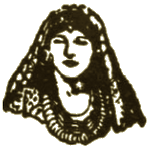
MILK OF THE MOON proved then that Delilah was no more than an amateur. She wasted few words; those she did use sounded like crystallized music. An expression stole over her face that suggested Salome wheedling John the Baptist's head from Herod. Gesture, subtlety of movement—an imponderable concentration, more deliberate but far less obvious than a cat's, all wove themselves together into fascination and appealed to Akbar Sayyid's cunning, that to every savage stands in place of wisdom.
She made no love to him. She suggested love is only won by lending ear to wisdom on the lips of woman. And to Akbar Sayyid, with her perfume and her smiling eyes, that moment she was all the woman in the world. He let her lead him to the stairhead, nodding as she whispered.
"Learn that!" said the babu. "That is hot stuff. But employ it only in emergency, and for another purpose!"
Phoebe hardly heard him. She was down on her knees by the cot, because Larry O'Hara stirred and seemed to want to speak to her. With her ear to his lips she could hardly catch the faint words—
"Obey the babu!"
Then he lapsed into unconsciousness again, or seemed to. But his pulse was gaining.
Milk of the Moon came back from the head of the stairs. Chullunder Ghose met her midway and gave her no chance to say what she had in her mind. He seized her elbow.
"Take this whistle. Send a man you can trust to the end of the Street of the Blacksmiths. There he is to blow the whistle three times, so that the police will think there is a murder and will run toward the sound. Thus no police will see us when we carry this man out into the street. Then bring your girls up here to lift O'Hara sahib very gently on a sheet and carry him downstairs to the litter. And tell Akbar Sayyid he should shoulder one pole of the litter himself, to avoid suspicion and to make his story seem more plausible."
He pushed her to the stairhead. He seemed able to force some people to obey him.
"Next time, Hurry-up young hothead chuck-a-luck O'Hara possibly will listen to me when I tell him how many beans make five," he remarked. But Phoebe took no notice. Larry's eyes were open. He had heard; he understood; he even smiled at what the babu said.
It was only a few moments before the women came, to gather up the sheet with women's skill and lay O'Hara on the litter in the room downstairs. Then, almost before eight Orakzai Pathans had finished arguing about who should shoulder which pole, three shrill blasts from a whistle split the night. The babu led the way. They bore the litter out into the darkness, Akbar Sayyid shouldering the left hand forward pole and Phoebe following, wondering whether it is really true that the Indian sun and the Indian moon make people do things that nobody in his senses would even contemplate. It was like a dream—only that the stars were shining, and the smells, and the tramp of the Pathans' feet seemed real.
And then nightmare, sudden, unbelievable. Akbar Sayyid let go of the litter. A dozen uniformed policemen loomed out of the darkness. All the litter bearers let go. Phoebe caught Larry O'Hara in her arms and broke his fall to earth, but fell with him. Before Akbar Sayyid could draw dagger or revolver, Chullunder Ghose turned and had him down in the dust, with arms pinned to his sides. The Pathan fought like a trapped snake, but the babu's strength and weight crushed the breath out of him,until he weakened, while the twelve policemen fought like grunting shadows with the seven litter bearers and Chullunder Ghose yelled to them—screeched—imprecated—bidding them come and get the right man, even if they had to let the others go.
Then Larry O'Hara, hugged in Phoebe's arms as she knelt beside him in the dust, found speech and strength. He bade a policeman help the babu. In a moment—less than a moment—three policemen pounced on Akbar Sayyid, took his weapons, trussed him, hands behind his back and feet tied like a chicken's in the market. The man whom the first policeman loosed in order to go to the babu's aid struck hard at Phoebe with a knife. He missed with the point, but the hilt and his fist half stunned her. She was lying beside Larry when the babu came, rubbing his own bruises, chuckling, stooping to grin in O'Hara's face.
"Got him, sahib! Akbar Sayyid is in irons. So are the others. Ambulance in half a minute." Then he grinned at Phoebe as he struck a match to see how badly she was hurt. His own face was a mass of bruises where the Pathan had butted him as they fought in the dust. "Bad babu, eh? Never trust him—no, no! All the same, sahiba, you have seen that this babu can follow where O'Hara sahib leads!"
"I beg your pardon," she said simply.
"Have forgiven—frequently—much snootier sahibas than your honorable self! My best salaams. But who is to forgive me? Milk of the Moon will claim and she will get the reward for the capture of Akbar Sayyid. They will hang him, so he doesn't matter. But his friends will blame Milk of the Moon, so she will accuse me and set them after me—which does not matter also, because I shall vamoose, scoot, vanish.
"Self am no use—nothing doing, until Larry O'Hotspur Hara gets well and we take the field again! But what will he say? I let him lie there after he was stabbed. I left him there as bait for Akbar Sayyid, while I bicycled and made a plan with the police, and fetched his overcoat, and brought you. We have to take long chances at our trade, sahiba. It was a case of finishing a job, at the risk—"
"Oh, go to hell!" O'Hara murmured. "Damn you, shake hands!"

Roy Glashan's Library
Non sibi sed omnibus
Go to Home Page
This work is out of copyright in countries with a copyright
period of 70 years or less, after the year of the author's death.
If it is under copyright in your country of residence,
do not download or redistribute this file.
Original content added by RGL (e.g., introductions, notes,
RGL covers) is proprietary and protected by copyright.