RGL e-Book Cover©
Roy Glashan's Library
Non sibi sed omnibus
Go to Home Page
This work is out of copyright in countries with a copyright
period of 70 years or less, after the year of the author's death.
If it is under copyright in your country of residence,
do not download or redistribute this file.
Original content added by RGL (e.g., introductions, notes,
RGL covers) is proprietary and protected by copyright.
RGL e-Book Cover©
Adventure, 1 February 1929, with "A Tucket Of Drums"
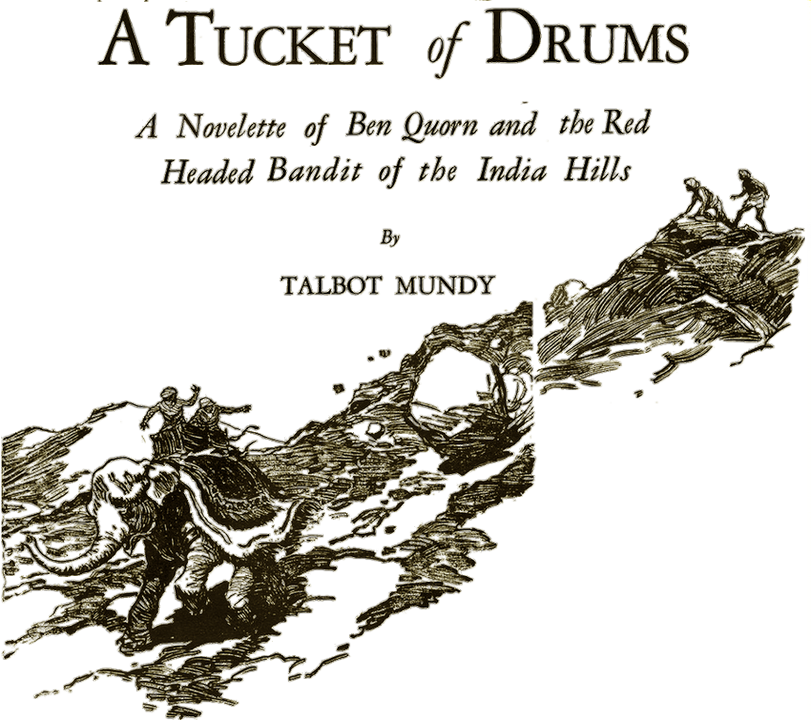
THE palace grounds were a half square mile of wooded darkness and lamplit marble within a high wall, against which the wind and rain drove in furious gusts. Except for the sound of the rain against it, the wall had to be guessed; but where the lamplight shone above the guardhouse there was a glimpse of water streaming from the overhanging eaves, and of a dim, irregular segment of wall upon either hand. A puddle beneath the lamp shone like a pool of liquid fire.
It was Indian night. No sound except that swish of rain against the wall and the sighing of wind swept trees. There was nothing to make the guardhouse gate seem real, or to make the sounds seem other than the formless, melancholy welter of chaos, until a tucket of drums sobbed from the point where the long wall dissolved into the darkness. Then the splash of shod feet. Then, in a lull between the blasts of wind, the clink of it« might be rifle swivels, or spurs, or both. But no lantern to show who was coming. Only the splash now and then of shod feet in step, and the sodden thump of three wet sheepskin drums. But that brought a world into being. It suggested purpose. It redeemed the dismal night.
Three drummers, then an elephant with two men on his back, who looked like something from another world, with overcoat collars up over their ears and bare legs wet and glistening; then an officer, spurred and sabered, splashing gamely through the mud and struggling to hold a cheap umbrella against the wind; behind him an almost naked servant helping him to hold the umbrella; then eight sepoys, overcoated and trying to keep the rain out of their ancient rifle locks; and last of all, a small cart drawn by one humped bullock, driven by a nearly naked man who twisted the bullock's tail and kicked at the animal ceaselessly with his bare toes, passed in under the guard room archway. There were doors that faced each other under the arch. Two sentries, smothered in shawls and overcoats, awoke out of the doorway shadows, presented arms at each other because the procession had already passed them, retired again into the shadows and resumed their sleep.
On one side of the arch was the room in which distinguished visitors wrote their names in an ancient parchment book, in proof that they had called at the palace to parade their courtesy. Light through a hole in the blind sent a streak of mellow gold across the paving stones under the arch—a streak of warmth that made the gloom beyond look more impenetrable.
Within the room, with a cigar in his mouth and his feet on the table, sat Brazenose Blake. On the table were a whisky bottle, a siphon, a box of cigars and three tall glasses. Facing him sat Parbit Singh, the palace chamberlain, dressed in a blue serge European cut suit and dark blue turban, that emphasized the darkness of his eyes. He was a very handsome man, as perfectly at ease with Blake as with Quorn, the other member of the party. Quorn, who made no claim to anything other than his position as superintendent of the ranee's elephants, wore a crimson turban, and a pepper and salt suit.
"WHY a 'tucket' of drums?" asked Blake. "The word is obsolete and it means a flourish of trumpets."
"Well, there were no trumpets," said Parbit Singh. "They only had three drums but a tucket was ordered, so they did their best. They marched around the wall sounding a tucket about every fifty yards. The bandit heard them and took to his heels, believing a large force was coming. That was more than a hundred years ago, when we had an English mercenary officer commanding the state troops. He gave all his orders in English because he was too drunken and lazy to do anything else, but he saved the palace from the bandits by giving that order. And tucket is an easy word to remember. So tucket it is. And ever since that night the march around the walls has been repeated. I don't think you should try to upset such harmless ancient customs as our tucket."
Blake laughed.
"I would as soon think of changing the custom of guarding Buckingham Palace. But here is the point, Parbit Singh. There is a bandit at large, and from all accounts he has a considerable following. If your young ranee is to continue to rule, she must subdue that bandit—capture him—bring him to justice and protect her subjects from anything like armed banditry in future. This tucket of drums may have served its purpose a hundred years ago, but isn't it rather ridiculous now, as a means of—"
"No," said Parbit Singh. He shook his head. "Not at all. You don't understand. We have only fifty soldiers, not counting officers. Those bandits realize our position and respect our difficulties. If we should discontinue that tucket they would say we were not showing them the proper respect. But as long as we continue it, as a sort of gesture of courtesy, they take no serious steps against a government which they recognize as necessary for the good of all concerned. Without orderly government, Mr. Blake, even banditry would cease to be profitable. They understand that. We also understand it. So we arrive at a working compromise."
"Unfortunately," said Blake, "your ranee's enemies have sent complaints to our state department. They say a man's life isn't safe outside the city."
Quorn interrupted:
"That's them rascally priests, sir. Them priests'd take the side of Satan himself against the ranee. Give them bandits justice and we'd pay 'em a bounty for killing off Brahmin priests."
Blake blew his nose behind a big silk handkerchief.
"But the roads should be safe, Quorn."
"Sir, they're safer than if there was a cop at every crossroads. Them bandits don't stand for competition. If you and me was to hold up somebody we'd have 'em down on us in fifteen minutes. The bandits cost much less than the priests. It's cheaper and easier to pay 'em a small fee for protection than it would be to bribe police. It only costs me ten rupees a month to protect all my grass cutters."
"—who cut grass for her Highness the ranee's elephants," said Blake. "That won't do, Quorn. You know it won't. This is not the Middle Ages."
"Well, sir, her Highness has fifty sepoys. Dope it out to suit yourself—only take a look first at the sepoys. Me and my mahouts could beat 'em easy with some pop-guns and a brass band."
Parbit Singh appeared more relieved than annoyed by that summary of the situation. As palace chamberlain he would hardly have cared to speak so plainly.
"Well," said Blake after a moment's silence, "the night is young and it's raining too hard to go home. We have this room to ourselves. Let's try to solve the riddle. What is the bandit leader's name?"
"Nobody knows his real name. He is known as Bagh—and Bagh means tiger," said Parbit Singh. "He came to Narada many years ago from nobody knows where and he has lived in our mountains ever since. He limps a little, but has enormously strong shoulders and arms. He is said to be able to leap into a tree out of the saddle and to escape through the forest like a monkey. But that may be exaggeration."
"Are his men afraid of him, or do they like him?" Blake asked.
"Both."
"That's bad," said Blake. "Fear and affection is the Napoleonic combination. Where does he bank his money? There must be some one in the city who transacts business for him."
"Nobody knows," said Parbit Singh.
"Nonsense," Blake retorted. "A bandit without influential friends is an impossibility. He couldn't last ten days. He couldn't cash his loot to pay his men. He couldn't get warning of ambush. He couldn't keep himself informed as to the political situation. He couldn't issue his own propaganda. He would be at the mercy of the first policeman with a pair of handcuffs and a club. Name me his agent in the city and I will show you how to catch your bandit without much trouble."
"But we have no proof," said Parbit Singh—so lamely that Blake stared.
"Well," he answered after a moment, "I don't want to have to ask for British troops."
THE rain swished and splashed torrentially. A cloud of smoke blew out into the room and everybody coughed. Blake was about to speak again when a door creaked beside the fireplace. For a moment he thought the storm caused it, but he glanced at the door and saw a hand was holding it open. He had supposed the door concealed a closet, but a strong draught swirled through, suggesting a passage leading into the palace grounds.
"Eavesdroppers," he remarked unpleasantly. "Come in, whoever you are."
There were several men in the passage, for he heard feet shuffling. However, only one man came in and he closed the door behind him. Parbit Singh muttered an exclamation and Quorn grinned. Blake sat bolt upright, bringing his feet to the floor with a crash, nearly upsetting the whisky as he jerked his chair around to face the stranger, whose manner was a blend of careless self-confidence and half mocking deference.
"Good evening," he said in English.
Vaguely, with his shock of beeswax-colored hair, he resembled an orang-outang. He had enormous shoulders and a pair of arms that nearly reached his knees. His pug nose had been flattened at some time, and unskillfully restored. His face was framed by tangled red whiskers and tanned by the weather, his teeth were clean and extremely regular, and his mouth was sensitively humorous. Altogether, he was not displeasing. He wore no head covering. From the waist down he was dressed native style in dripping wet cotton pantaloons, with naked feet. He had evidently left his sandals outside the door. From the waist up he had made some attempt at European costume. He wore a coat and vest of brown velvet with brass buttons over a bright green silk shirt. At his hip was a pistol holster and he wore a belt full of ammunition.
"Good evening," he said again, since no one answered. "I am Bagh. You have heard of me?" He looked at Blake, and humor shone in his greenish gray eyes. "No," he went on, "there is no use trying to summon the guard. My men have locked the guardhouse door. See—I have the key here."
He tapped the monstrous iron thing on the table.
"Shall I sit down? Krishna! But I would try to show better manners if you were visiting me in my village."
"Oh, so you have a village? Yes," said Blake, "sit down by all means. Give him a chair, Quorn, won't you?"
But the stranger had already taken one and was holding his legs to the fire to draw the rain steaming from his pantaloons.
"It was reported to me," he said, looking at Blake over his shoulder, "that you told the ranee that you meant to have some unofficial conversations with a view to solving the bandit problem for her. I'm the bandit. Let's talk. Where did I learn English? In England, since you wish to know. I was born in Surrey. I tried clerking in a bank, then prize fighting, because I had heard that Corbett did that, but my punch was not so good as my nerve. I tried the army, but they wouldn't have me because my chest is out of all proportion to my waist—or some such nonsense. So I came to India as a fireman on a Belgian tramp, deserted, led the holy life for two or three years begging by the wayside, tried after that to get a job as railway guard, but was kicked on the hip by a Eurasian for getting in his way. He died a trifle suddenly. I took to the holy man life again until I reached this place, where the bandit business looked too good to pass up. It was. I like it. It's more respectable than banking and less exhausting than being punched by experts. There's no big money in it and I miss seeing the newspapers, but it's a fairly lazy life and I get all the comforts I need. Now tell me who you are."
"The man who is going to put you out of business," Blake assured him.
"Yes, I left you a pretty wide opening there, didn't I. However, now that the referee has counted me out and you have had all the applause, suppose you tell me who you really are. Are you one of the Blakes of Blakewood ? Oh. Not Marmaduke Brazenose Blake, by any chance—captain of the Surrey eleven twenty years ago? Oh, well. My uncle strung and pegged your cricket bats. Remember that time when you fought the cattle drover in Kingston Marketplace—the man who beat his dog to death? I saw that. I was one of three who swore to the police that your name was Jones and that you lived at Elm Road Surbiton. You owe me a lie in return."
"I am told that you caught a man recently and skinned him alive," said Blake disgustedly.
"That will do for the lie. The account stands even. You referred, I suppose, to the money lender. He should have been skinned, but he wasn't. I let him buy his choice of all the ways of dying. He could have been skinned alive for ten rupees. The easy ways, of course, are the expensive ones. He chose to die a natural death—he has the dropsy anyhow—and that's costing him more per month than I thought he had per annum. The climate appears to suit him up there in the mountains and I rather think he likes the separation from his wife."
"Well," said Blake, "your banditry has got to cease."
"That's what I came to discuss. May I have some whisky?"
Blake nodded. Quorn poured him a stiff drink. Blake pushed the box of cigars toward him.
"Excellent, I dare say, but I'm not a judge of whisky," said Bagh. "For too many years I have had to drink and smoke what I could get. You know what that means. No sense of taste or smell left. However, I hear perfectly. Before I came in at your invitation, I heard you say something about British troops. I suppose you mean a regiment of Sikhs or some other blackguards who will rape the whole countryside and force me to carry out reprisals. I hope you won't think of it. It wouldn't be like a Blake of Blakestone to try to solve a riddle that way. Any cad could do that."
Blake scowled. Nearly all Englishmen do when they are struggling against their naturally friendly instincts.
"But somebody was skinned alive," he insisted.
"Oh, yes. One of my men was. We caught him stealing from the money lender—which was the same thing as robbing us, of course."
"So you skinned him alive, eh?"
"Not unless you're talking in terms of occult philosophy. We didn't even hang him. We drove him away to try to live with honest men. Cruel, I admit, but life is that way. He was caught by the police, who shot him. I suppose he knew too much about them. After that they skinned him in order to make out a case against me. The body was no longer recognizable, so they said it was the money lender's. According to Karma, I suppose I skinned that fellow. But as one man to another, you might say I have an alibi."
"If you're telling the truth."
"I always do. It's so safe. It gets you a reputation for sagacity and cunning that is worth a thousand men, and gives you much less trouble than the men would. Let me tell you some more truth."
"Fill your glass first," Blake suggested.
"No, thanks. If that whisky's as strong as I suspect, I might get altogether too gentlemanly. I don't think you would take advantage of me, but I suspect the palace chamberlain. I have done him so many favors that he might welcome the chance to turn against me."
PARBIT SINGH looked scandalized. He had far too perfect manners to defend himself. He appeared pained, yet cognizant of the fact that life is full of slander and false evidence. Quorn nodded unconsciously; it appeared he also had his views. But the bandit sensed the situation and proceeded at once to complicate it by explaining:
"You see, he owes his job to me. I keep the ranee on the throne. The priests are against her because she defies tradition and most of the laws of caste. The priests are great talkers, and some people are good listeners. The less prosperous ones can listen with three ears. Consequently there are at least ten thousand people in Narada who would like to start a revolution and bring in the British. The ranee's fifty soldiers can't prevent them. But I can.
"I inform them that at the first sign of a revolt against the ranee, I will loot the temples, the shops and the banks; furthermore, that I will fight the British troops and spread havoc all over the countryside. I point out to them that I cost much less than a standing army, and almost infinitely less than an invasion by the British troops."
"Nevertheless," said Blake, "this banditry has got to cease. This is an unofficial conversation. I would appreciate your suggestions as to how the problem can be solved. You understand, don't you? At a word from me our government would send sufficient troops to wipe you and your followers off the slate."
"It would take a hundred thousand men, or else several years," Bagh answered. "Even with poison gas and airplanes. Have you any idea how difficult this country is to penetrate with troops? How easy it is for me to hide? How much damage I could do? How easy it is for me to get what few supplies I need? How thoroughly I would enjoy the sport of playing even a losing game against the whole bally British Empire? And besides, there's politics to think of. You see, I'm educated, although I admit I don't see the newspapers very often. I think I know enough to stir the patriotic stink in the noses of sensitive men and women. I think I could set about a fifth of India, say, two fifths of the House of Commons, all Europe and half the United States howling about imperialism and capitalistic greed. If you don't believe it, try me. Maybe I'm wrong. I'm no Lenin—no Trotsky—no Mussolini. I'm new to that wholesale heads-I-win-and-tails-you-lose stuff. It rather scares me. Too many scruples, I suppose. But I will stake my scruples against yours. Summon the troops and I'll cut loose. On the other hand, play on-side and I'll obey the rules too. I think now I'll change my mind and have just one more whisky—not too much soda, Mr. Quorn. When! That's perfect, thank you."
"What do you think of it?" Blake asked suddenly, staring at Parbit Singh.
"I think he has put the situation in a nutshell. On the one hand, he keeps excellent order on the countryside and the roads are safe to any one who pays a little tribute. They are safe to the poor at all times. On the other, it is not compatible with dignity or economically sound, according to the text books, to allow a bandit to do the police work. Others might take example from him. There might soon be no government if this were allowed to continue."
"I agree with that," said Blake. "Now what about it?"
He stared at the bandit truculently. Bagh ran his fingers through his beeswax-colored hair and grinned.
"Play fair," he said. "It's your turn. I've talked enough. I suspect, if I had one more whisky, I would tell you my right name."
"I shall have to inform myself," said Blake, "as to how many men you have and just how strong your position really is."
"Good. I like that. Almost any other diplomat would have tried to disguise the fact that my strength or weakness makes all the difference."
"It makes some difference," said Blake. "I prefer to know how many troops to ask for."
"I would have liked you even better," said the bandit, "if you had admitted that your government particularly does not want to send troops. There's nothing like telling the truth. Oh, yes, I know they could send them. But I happen to know that your instructions are to keep peace if possible."
"I'd like to know where you had that misinformation," Blake retorted. He glared at Parbit Singh, who looked like a man who knows the world is full of false accusers, but that innocence will justify itself in God's good time. The bandit grinned again.
"Well," he said, "I grant you full protection and free passage for yourself and a few servants to visit me at my headquarters. You see anything you want to see, only don't bring any soldiers or policemen. I will provide the bodyguards. It's beastly weather. You will find horses can't manage the mud. Better come on an elephant. If you'd care to shoot a tiger bring your rifle. I can't offer you any decent whisky or cigars, so bring your own. And by the way, have you any old newspapers? I got a copy of the Times three months ago. I almost know the advertisements by heart."
"I'll bring a pile of them," Blake answered.
"Thanks," said Bagh. He stood up. "Care to shake hands?"
"No, not yet," Blake answered. "I hope to be glad to shake hands with you before we've finished."
"Well—if I give you the key of the guard room, will you promise not to let those soldiers out until ten minutes after I've gone? Now and then they shoot straight by accident. They mean all right. It's a pity to have to strafe them."
"Very well," said Blake, "I promise. Ten minutes by my watch."
THE bandit went out by the same door through which he had come, closing it silently behind him. There was only a glimpse of armed men in the passage. Thereafter, though Blake listened intently, there was not a sound. He was sure that they did not go out through the guard room arch.
"It's pretty obvious they've friends in the palace grounds," he said, and stared again at Parbit Singh, who said nothing. It was Quorn who spoke:
"Sir, they've friends everywhere since that man captained 'em. I doubt if you could find in all Narada fifty men who'd take the field against 'em. Some wouldn't dare. Some wouldn't care to. And every living man and woman would be tipping the bandits off to every move you made. The fifty that you might raise by paying 'em handsome would be tipping off hardest of all, for two reasons: first, the longer the campaign lasted the more money they'd get; and second, they wouldn't want to risk their skins. Barring all that the job might be easy."
Blake allowed fifteen minutes to elapse instead of ten, then he unlocked the guard room door. It was none of his business, but he suspected that if Parbit Singh had done it there might have been some sort of official hocus-pocus afterwards. There was no sense in making scapegoats of a few cold, sleepy sepoys. Blake was a trouble hunter, not a maker, and he liked to go deep into the hearts of things before he set surfaces ruffling.
He wished Parbit Singh a good night and, turning his overcoat over his ears, went splashing through the mud toward the great lonely bungalow where he had to live in state, representing the most perplexed, determined and inconsistent—because alive, alert and constantly evolving—government in all the world. He had been chosen to go to Narada because he was daring and unconventional; but he would be chosen for the limbo of retirement on half pay if he should dare too much, or interfere too little.
"Abdul," he said, as his servant came struggling out of the night toward him holding an umbrella and a lantern, "no man can hold his pants up and succeed at anything. Take off your pants and carry them. Give me the lantern. Then you can do one job half decently. Yes, you may hold the umbrella yourself. I would rather be wet."
QUORN found his way to the elephant lines, where the great brutes were chained so that they could stand in the rain, or take shelter beneath brick arches as they wished. Most of them stood in the downpour, glistening like wet rocks when the flickering firelight overcame the smoke where the mahouts, who had run out of opium and could not sleep, were trying to warm themselves. Lately, Quorn had put a cot in the shed where the corn and medicines were kept, to cut down pilfering. That was the chief reason why the mahouts could buy no more opium until next pay day. One of them, splashing through the puddles, followed Quorn toward the shed door, where he watched him light the lamp and tuck the mosquito netting carefully under the mattress before turning in.
"Protector of the poor," he whined, when Quorn noticed him at last.
"Strut your stuff," Quorn answered, and then changed into the local dialect. "You know better than to ask favors unless you've earned 'em. Yes, I know, two opium pills would make me your father and your mother and the shadow of God upon earth. I've heard that several times. Yes, and you'll tell me something I ought to know. I've heard that—frequent. Whenever I pay you fellers in advance I get nothing but lies, so give me your news first. And mind you, I can kick like fifteen mules if that's my judgment, so save your breath if you've been cooking up a yarn over the fire there to get me to open the medicine chest. Also make it short and snappy, since it's long past bedtime."
"Heaven Born, there came a robber from the hills—a follower of that one whom they call Bagh, the Redhead. He besought corn for his horse, which your servant gave him, being chief mahout and knowing well your honor's generosity. No, sahib, it is true there was no key to the corn-bin, but there is a little loose plank where a rat gnawed and an arm can reach in—"
"Lord, but I'll get the better o' you heathen yet! So that's where all the corn's been going."
"Heaven Born, that robber may have been a liar, but your servant tells the truth. He said your honor will be asked to take two or three elephants into the hills, conveying Beelaik sahib and his servants; and that you must not be frightened because Bagh, the Redhead, has not forgotten how you let him hide in your house—"
"The man's a damned liar," said Quorn. "I never knew he was in the house or I'd have opened a bottle. I never knew he'd been there until I missed a couple o' newspapers. And I wouldn't ha' known then, only I started to whack my servant, so he came out with the truth. But go on with your story."
"That was all, sahib. You should not be frightened and you should follow the trail to the place where a tiger slew three charcoal burners."
"And you want opium pills for that? If it weren't such a raw wet night I'd take an ankus to you. Here you are—how many of you shivering by the fire there? Well, here's two each, and no holding out on the others—two for each of you, you thankless bums."
He put a lump of the stuff into his pocket and faced the rain again, splashing his way with a lantern to where the monster, Asoka stood, half under his arch and half out of it, catching the drip from the eaves on his back. It was one of Quorn's obsessions that prolonged rain was as depressing to the elephant as to himself, and the beast was clever enough not to dissuade him.
"Here you are, you big stiff. This'll warm your insides."
He made the great beast get back under the arch, and swore because the mahouts had not provided enough gravel to prevent the dirt from being churned into a slough. Then, under the arch, he went through the regular routine of saying good night. There was a box on which he sat. There was a box of matches in a dark hole where a brick had been displaced. He lighted his pipe.
"You big bum. Ain't you 'shamed of all the trouble you got me into along o' being your friend? Just because I takes a fancy to you and tames one o' your tantrums, I has to assume responsibilities that'd drive a bishop crazy. And the more I spoils you the more you wish on me in the way o' circuses. It stands to reason, luck like me and you've been having can't last forever."
WHEN morning came, he was sure that prophecy was right. The blankets were damp and so was his tobacco. There were beads of water all over the walls of the shed he slept in. He could hear rain drumming on the roof; and the feet of the man who awakened him came splashing through a slippery lake of mud that would have depressed any one except worms and elephants. He opened the shed door and glared at a man with a gunny sack over his head. He listened in scandalized silence. He spat sarcastically.
"Sure," he answered, "my middle name is Noah. I'm the guy what swam Niagara Falls. I'm web-footed. I've a twin-six submarine sedan for just such social visits of a nice bright morning. Breakfast? No, sir, I don't eat it. Coffee? I'm like my elephants, I never heard of it. I'm one o' these here frogs that get fat on water. But say, you cut along home and tell her Highness Ben Quorn's coming, but he ain't going to wear no top hat nor no gilt plush suit. I'm coming in a gee string and umbrella, and if I manage to swim that distance and actually get there, she'll have to talk to me down the periscope."
What he actually did was to ride an elephant, so that he reached the palace a long way ahead of the messenger. And though his tweed suit was drenched and his turban was a wet red rag that dripped cheap dye all over his face, he was, as usual, so pleased to be received inside the palace, and so delighted by the prospect of intrigue, that his ill humor vanished. He was not kept waiting. The ranee and two of her ladies entered almost before he had had time to look into one of the mirrors and wipe the dye off his face with his handkerchief.
THE young ranee appeared weatherproof. She was as radiantly lovely and as mischievously merry as he had ever seen her. She wore no jewels whatever, but was just a charmingly dressed young girl, with flowers in her hair, obviously pleased to see a friend upon whom she knew she could rely for anything, in or out of reason. He refused to be seated for fear his wet clothes would spoil the furniture, but she sent for a cane chair and refused to reveal her business until he was comfortable, one leg crossed over the other, and the servant had left the room.
"Are you ready for an expedition, Mr. Quorn?" she asked then.
"Yes, miss. And you may as well tell me the worst first. I was telling Asoka last night, him and me's due for grief o' some sort."
"Last night? Where were you last night? Weren't you in the visitors' room at the gate house?"
"Yes, miss."
"And you met Bagh—the Redhead?"
"Yes, miss.
"Tell me in ten words what you thought of him?"
"One's enough, miss. He's scared."
She nodded.
"Was any one else scared?"
"Yes, miss. Parbit Singh was. Him and Bagh has been cahooting and maybe there's been some money changing hands. Parbit Singh kept a straight face, but he was scared stiff thinking the Redhead might give him away. And Bagh, he talked a sight too promiscuous about fighting the whole British Empire for him to kid me he wasn't bluffing. And if you was to ask me, I don't think he bluffed Mr. Blake worth ten cents."
The ranee frowned a moment, pondering. Possibly she was trying to scowl, but she could not keep her mouth from looking mischievous, or her eyes from shining happily.
"Well, Mr. Quorn, I am only a girl on a throne, and my throne seems to me to be dreadfully insecure. If it is left to the statesmen to prop it up, it will fall, undoubtedly. Can you think of a way to help me?"
"No, miss."
"Oh, I'm so relieved! I believe I could get along nicely if it weren't for being helped so often. Were you ever a bandit?"
"No, miss."
"Isn't that splendid. You would really believe them, wouldn't you, if they threatened most terrible things."
"Not me, miss. I've drove bandits in a taxicab. They was the scaredest guys I've ever seen. I was afraid the guy that held a gun against my ribs would loose it off because his teeth was chattering."
"Ah! I knew I could depend on you. You know, don't you, that nobody is really dangerous until he is afraid."
"Man or beast, miss."
"Even Mr. Brazenose Blake."
"Yes, miss. But he ain't so easy to frighten."
"I don't want him frightened. But I don't want him to frighten the bandits. Do you think you could bear that in mind if you should take Mr. Blake to see Bagh? Oh yes, I know all about that. He sent a man last night to tell me he invited Mr. Blake to come and see him. Bagh was afraid I might forbid it on the grounds of danger. He has brains. He wants to get the situation straightened out before the rains are over and it might be convenient for the British to send troops."
"It'll be awful mean traveling through the jungle, miss, this weather. Skeeters and malaria—"
"Quinine," she answered. "Use lots of oil of eucalyptus, and I'll give you a new mosquito net to use at night. You won't enjoy it much, but when you come back I will buy you a new Ford car to drive around in, and you shall have a uniformed attendant to take care of it."
"Miss, I'd rather have the corn bin rebuilt. Them mahouts—"
"Very well, you shall have that done too. And I'll let you fire all the mahouts and hire new ones if you like."
"No, miss, thank you kindly. Them I have is bad enough. When do we start on this here expedition."
"Today, if possible. Not later than tomorrow. I learned that Mr. Blake was up before daybreak giving orders to his secretary and his servants. I expect a visit from him as soon as he thinks it's decent to come—he is the most considerate, informal man I ever knew. He is probably itching to go, but afraid to get me up too early in the morning.
"If he only knew how I am itching to see him started! But then, he wouldn't go at all, because he's a diplomat. The way to make him take the worst risks is to persuade him I am anxious about his safety. Do you think you could do that?"
"I could try, miss. He ain't credulous. He likes to let on he believes you. Being a decent feller, he'll go on pretending, so long as no harm comes of it. But he's awful wise under that easy going, gentlemanly manner. My way with him is to tell him just the plain plumb truth and not too much of it at any one time. Then let him throttle his own twin two. He's good at it."
"It would be terrible," she answered, "it would be disastrous if an accident should happen to Mr. Blake. That is why I wish you, and nobody but you, to take him. Do you understand me? I am really anxious about Mr. Blake's safety."
Quorn scratched his head. He thought he understood but he was not quite sure. Perhaps she did not wish him to understand.
"I'll keep him out o' danger," he said looking at her slyly with his goatish, agate colored eyes. He resented half confidences.
"You will mind your own business!" she retorted angrily. She looked contemptuous, as if Quorn were untrustworthy after all.
"Don't you know that danger is the only element in which he thrives? He is one of those men who are no good, can't use their wits unless they are in danger. Danger arouses all his faculties; he becomes wise and does unexpected things. I don't want him frightened. And the only thing that can really frighten him is the thought that he is making a fool of himself. Whereas it is only when he is making a fool of himself that he is really any good. So he mustn't be frightened on any account. He must think he is in deadly danger, and that I am afraid for his safety. Then he will proceed to show me what a Duke of Wellington and Solomon he is by playing beautifully into my hands, and thinking it was he who saved my throne, when, as a matter of fact, I intend to get him promoted for being so stupid that even the statesmen think him wonderful."
"I get you, miss," said Quorn. "I get you. I'll manage my elephant perfect. Barring that, I don't know nothing excep' that quinine is good for skeeter bites, and tuck the net in good under the mattress afore you turn in. And now I'll go and get Asoka's back rubbed good and dry afore we put the howdah on him. I'll be ready to start, miss, whenever you give the word."
THE start was made that afternoon in a drumming rain. Two elephants, loaded with tents, supplies and servants, splashed behind Asoka, who was in holiday mood because the rain amused him.
He was like a dog who delights to roll in unspeakable things. He wanted to stop and smear himself with mud; he wished to fill his trunk with water from the pools and squirt it at his passenger. He chose the slippery places where he could act like a skidding motor car and slide with all four feet together. At times he hurried for no reason, and then Quorn and Blake were drenched by the shower from overhanging branches. At other times he preferred to dawdle, breaking off branches which he alternately chewed and flourished. He pretended to smell tigers in the undergrowth—as if any self-respecting tiger would be out in such abominable weather—and simulated fear. And through it all, Quorn humored him with the patience of understanding.
"He's betwixt and between two memories, sir. What he was, and what he is. And he don't know jes' exactly what he'd like to be. There ain't no harm in him—and tomorrow he'll act like an old gent smoking a cigar."
That first night they camped in a clearing where there was a huge shed without sides, under which piles of firewood had been stacked. But the roof leaked, there were snakes in the wood, and the mosquitos were there in myriads, so that the storm outside was almost preferable.
Blake invited Quorn to sup with him and they sat together under the tent awning, where Quorn could watch the elephants eating their enormous rations of freshly cooked flat cakes.
"You appear to know where Bagh keeps himself," Blake hazarded.
"No, sir."
"Good Lord! Do you propose to wander about in the jungle until we stumble on him?"
"No, sir. I reckon it's up to him to find us. He knows we've started. I saw one of his men go running naked away ahead of us, soon as we pulled our freight away from your front door. Them heathen can run like rattlesnakes. I'll bet you it was Bagh who had that there firewood stacked ready for us. He's prob'ly got relays of runners, and they'll signal to each other from tops o' trees and what not."
"Too bad a man with all his brains and energy should be an outlaw," said Blake. "I've been wondering what I would do in his place. He might kidnap me, and while the troops were looking for me he might make his own escape—possibly even to Europe. Even so, I don't see how he'd get away with any booty."
"Booty, sir? He has to split with grafters. Power, he has. But money? Not much."
"How do you know?"
"I don't know," Quorn retorted.
But Blake doubted that. He studied Quorn's face a long time in the flickering firelight before he threw away the stump of his cigar and turned in.
QUORN set his cot beside the elephants, just out of reach of their trunks, so that they could not damage his mosquito net. After he had smoked his customary pipe beside Asoka, he slept like a man who has no troubles upon his mind. Let Blake and Bagh worry. All three elephants had full bellies and sound feet, and there were no sore backs. If the bridges were down and the fords in flood, then the going would be even worse tomorrow, but the difference would not be worth swearing about.
It was drum beats that aroused Quorn finally. An elephant, that to his experienced eye looked in far too good condition to have come any distance, loomed into the zone of firelight with four men upon his back, three of whom thumped at sodden drums while the fourth, who guided the elephant, sat silent under an umbrella.
Blake poked his head out of the tent but they took no notice of him. He went back to bed. Quorn fell asleep again.
There was no more disturbance all that night. The servants awoke finally and there was the usual shouting and excitement as they slew snakes that had invaded the woodpile while the camp slept.
Then Blake came out in his pajamas, and the four who had come in the night watched him narrowly until he sat down in the camp chair. Then they came before him, making suitable obeisance.
"We are headmen," they said, "of three villages that lie near together about one day's march away. This fourth man is the cousin of a money lender whom the bandit called Bagh, has imprisoned in the hills until he can extort all his money. We have come to have speech with your honor concerning that."
"Why all the noise in the night?" Blake asked them.
"We were afraid of tigers. We were also afraid of Bagh, who is terrible."
"You supposed that that drumming would drive him away?"
"No, sahib. It was to let him know that we were not hiding from him. Therefore he knew that we would pay the takkus on demand—for each of us one anna, the elephant as well—five annas altogether."
"And if you didn't pay it?"
"Our bellies slitted, our elephant stolen, our homes robbed during our absence. It is very cheap."
"Then what have you come to complain about?"
"This, sahib. We have heard that your honor intends to abolish Bagh, the Red Head, and that in his place there will come constabeels and sepoys who will inflict on us more takkus and less peace."
"What says the money lender's cousin?"
"Sahib, it has been said that your honor means to procure the release of that money lender, which, if true, is a calamity. He will set himself to worse extortion than before to recompense himself for all the money Bagh took from him. Though I am his father's brother's son, he sold my heritage; nevertheless, I am still in debt to him. But we pay no interest while he is Bagh's guest. And it may be that Bagh will persuade him to relinquish all those documents by means of which he keeps us impoverished and himself rich."
"How many men has Bagh?*'
"No one knows, sahib, except Bagh himself."
"Where is he now?"
"Who are we that we should know that?"
Blake summoned Quorn.
"Do you know where we go from here?"
"Not me, sir. But there's only one trail as you might say navigable."
Blake ate breakfast leisurely, hoping the rain would cease, then spent half an hour in conversation with the village headmen. Good humoredly, he allayed suspicion of himself and won the admission that each of the men knew Bagh intimately. But he could not learn where Bagh's headquarters were, nor where he kept his army."
"Are you sure he has a thousand men?"
"Perhaps more," said the money lender's cousin.
Finally Blake decided to ride forward.
The headmen led the way until Asoka, who was used to lead all processions, bunted their elephant out of the road and set such a pace that he was presently out of their sight. He and his passengers were in another wet universe all by themselves. He left not even a track to follow; the jungle floor was inches deep in water, and there were plenty of places where even the general direction he had taken might be in doubt.
"We'll be lucky if they overtake us with the beds and grub by nightfall," Blake grumbled.
Quorn remembered the ranee and her rather vague instructions.
"We'll be lucky if we keep our scalps on," he retorted. "I've lost the way. For that matter I never knew the way. This ain't a way; it don't seem to me to lead nowhere."
But it did, and Quorn knew it. Where a great rock heaved itself above the jungle, and a flooded stream on the right hand left only a six foot passage, they emerged through a volley of driving rain into a charcoal burners' clearing, where the clumsy kilns stood like damaged beehives and abandoned, grass roofed huts were falling into ruin.
A woman with only a cotton cloth around her waist, her bare breasts glistening in the rain and a naked child on the ground beside her, stood waving her arms and wailing. Blake shouted to her in a dialect that he thought she might understand. Quorn stopped the elephant. He shouted too, but the woman went on wailing. Then they became aware of ghostlike figures closing in upon them from the surrounding trees.
There were spearmen and bow-and-arrow men among them, although the greater part had only sticks and long knives. They were stealthy, and closed in rapidly. The woman gathered up her child and slipped away between them, laughing. Then a man raised his spear and spoke to Quorn in a voice that suggested no doubt of obedience.
"He says we're prisoners, sir. I might charge Asoka through them, but they might get you with an arrow."
"No," said Blake. "Let's let them entertain us. I haven't been a prisoner since Cronje caught me in the Boer War. Ask them what they propose to do with us."
"We're to go with them to Bagh, sir."
"Are they part of his army?"
"They say not, sir. They say it's none of your business who they are."
"That's the way to talk! We're to ride, I suppose?"
"They say yes, sir—if we act discreet."
"Excellent, Cronje took my boots and made me walk twenty miles. Do they know I've a rifle up here and an automatic pistol? No? Well, you needn't tell them. Say I'm ready to start when they are."
THE rain swished down more dismally than ever, but Blake's spirits rose until he started whistling. He checked himself abruptly for fear of seeming too indifferent to danger. Many a latent danger gathers itself and bursts for lack of flattery.
"It pays to let the masters of a situation feel important," he remarked to Quorn in an expansive moment. He even tried to look dejected and drew down the corners of his mouth, but happiness exuded from him like smell from an onion. He was the least dejected looking prisoner who ever rode an elephant through a driving rain while captors trudged the mud before, behind, and upon either side of him.
They were a gentle-looking mob of cutthroats, dressed in cotton clothing that clung wetly to their bodies like loosened skin. They carried their weapons in the manner of a Robin Hood chorus—that is, more for the sake of completing the picture than producing spinal chills. It was fair to doubt whether any one of them had ever drawn a drop of blood in anger in his life.
"But such men," said Blake to Quorn, "can be more terrible than seasoned soldiers if aroused, although the fury does not often last long." Quorn said nothing.
As they plunged into the jungle, Blake began to try to make his captors feel that they had a most important prisoner, who never for a moment doubted their humane intention. As an amateur actor he shone. He deceived himself at any rate—it stands written in his diary, which he only shows to beautiful women and intimate friends, that he acted the part perfectly. What he actually looked like was a well-bred Englishman having a glorious time.
Ben Quorn. had no complaint to make except that he was wet and getting hungry. He had long since learned that his eyes, and his resemblance to the legendary Gunga Sahib were a passport that rendered him safe from end to end of Narada. There was not a bandit in the country who would hurt a hair of his head. His only dread was lest he should spoil the young ranee's game, whatever that might be; and even that dread was vague—he was so sure of her ability to conjure triumph out of any mess of circumstances.
There was no food when they paused at noon. Asoka was allowed to break off branches, which he chewed contentedly; but Blake and Quorn had nothing except tobacco so dampened that it was difficult to light, and even harder to keep burning. Their captors closed around them and Blake tried, with Quorn as interpreter, to glean a little information. But either Quorn was none too skilful with the dialect, or the captors were determined to keep up a screen of mystery, for it availed Blake little.
"They say, sir, Bagh's army don't never show itself in daytime—and never all at a time in one place unless there's serious fighting to be done."
"How often is there serious fighting?"
"They say not often, sir."
"How long ago was the last?"
"They don't rightly remember, sir. They say, who wants to fight Bagh anyhow?"
"What happens if they don't pay his tax?"
"They say they don't know, sir. Everybody pays it."
"Why have they taken me prisoner instead of letting his army do it?"
"They say they don't want his army quartered on them, sir. Too many men to feed and too much trouble."
"What sort of weapons has his army?"
"They say terrible weapons, sir. Rifles, revolvers, swords, machine guns."
"Funny," remarked Blake. "Where did they get them, I wonder. Have they ammunition ?"
"Quantities, sir." -
Blake began to whistle to himself again. He scented serious intrigue, perhaps involving agents of a foreign power. Treaties are agreements as to what should not be done, behind the screen of which each party undermines the other; it is awfully embarrassing to a friendly power to discover its secret, so to speak, minor treacheries, and there is no better fun in the world.
"Tell them to get a move on," Blake suggested.
THEY resumed the journey, splashing through rain until night-fall, when the crimson glow of village fires came twinkling through a stake fence and the smell of smoke along the wind was sweeter than balm in Gilead. All the village turned out to receive them. It was a place of several hundred huts surrounded partly by a mud and stone wall, partly by a stake fence and, for about one third of its circumference, by the sheer flank of a somber looking flat topped mountain—an outlying spur of the range that isolates Narada from the humdrum world.
Near a huge tree in the midst there was a big hut where the village elders gathered. There they fed Blake and provided him with a cot to sleep on. Quorn was given quarters in another, smaller hut, beside which Asoka gorged himself on rice and warm cakes at his hosts' expense. There was a great deal of quiet curiosity—eyes peering in at Blake, and whispering—eyes peering at Quorn comparing him to the legendary Gunga Sahib—but there was no whispering for fear he might work a miracle. Thrilling though it is to hear of miracles, no sane man wants to see one.
Blake inquired why he had been made a prisoner.
"I would have accepted an invitation," he said blandly.
"Who should know that? Bagh said we are to bring you to him." The village elders were diffident, firm—but evidently nervous. "We didn't want Bagh's army down on us."
"Don't you realize that British troops might be sent to look for me."
"That would be bad, but Bagh, Redhead, would defeat them. He is terrible. Nevertheless, he will do no harm to you unless you disobey him. Obedience—good always comes of that."
Blake went out to see the night sky, hoping that tomorrow's clouds might let the sun through for a while. He saw a row of smoky crimson watch-fires spaced along the flat rim of the mountain.
"Redhead's men," they told him. "They will be gone by morning. They protect us."
"From what?"
"God knows. There are terrible things that never happen as long as Bagh guards us and we pay the takkus."
"What does he do with all that money?"
"It is not much. Indeed it is very little. It is hard to say how he pays his army and has something for himself. Nevertheless when need arises, Bagh is always generous. It was he who paid the Sikh apoti-kari to come and live among us and cure the eye sickness."
"Where is Bagh?"
"No one knows. We will send you forth. Other men will show which way to take. We hope your honor will find no fault with us when your honor speaks with Bagh. We are poor men but we have done our best for you."
Blake turned in, but for a long time he did not sleep because of the sound of sodden drum beats. Drummers appeared to be marching around outside the village wall—two-thirds of the circumference and back again. He awoke the man who had been stationed near the door to watch him and demanded what the noise meant.
"It is the custom. It is the tucket. Redhead says if we do that nightly there shall never be sahibs sent to trouble us. There came a sahib once—in the night—but he heard the tucket and it frightened him away. Redhead said so. So we always sound the tucket, taking turns, no matter what else happens."
Meantime Quorn held conversation by a fireside with some men who were not village elders and whose statements of fact were therefore less conservative.
"Me, I'm thinking loving thoughts, you pockmarked sons of baboons. But that man Blake is another matter. He's important. Making him prisoner is twice as dangerous as setting fire to the whole doggone country."
"Bagh will deal with him. Bagh will show him his army, so he will doubtless tell the British they should keep away. Bagh would never let the British reach our village. Bagh kept the Germans out of Narada. He told us so. He told them he would fight them with his army if they came, so they didn't come."
"Were there bandits before Bagh came?"
"Innumerable bandits, sahib. There was fighting until Bagh conquered them. Since then there has been no bad trouble of any kind. Only we pay the takkus. But that is not much. It is cheaper than being plundered."
"Well, you guys have brought yourselves trouble this time. You've taken prisoner the lord high pussy-footin' snooper of the British raj—which he's a decent feller, but he's on his dignity because that's what he's paid a salary to do. There ain't nothing left for him to do but act nasty."
They laughed, at his efforts to translate slang into their dialect.
"The sahib is pleased to jest with us, and we are merry men, so why not? But we know you are the Gunga Sahib, reborn after a thousand years according to the prophecy. And yonder is your great elephant Asoka. Therefore we know no harm will come to us, because we know that if the Beelaik sahib should seek to injure us you would prevent that."
"Me?" Quorn muttered. "Once I drove a taxicab! Well," he continued aloud, "you suckers, I've seen strange things happen, and I know a young ranee what knows her onions. I've seen that old fat head Asoka there, in one of his tantrums, step careful sideways so's to miss hurtin' a child. And I've seen the blooming British army, guns and all, go back to barracks because some one in a top hat said so. But I'm a nigger if I can see any clear way out o' this mess. You'd better catch Bagh and hand him over."
"Sahib! Eh? Eh? It is not wise thus to speak of Bagh. He has long ears and a long arm."
"Where are them other two elephants what's bringing our loads and the servants?"
"No one knows, sahib."
"Meaning nobody won't tell. Them are the ranee's elephants. Can't you guys see that if you treat her disrespectful there won't be no government?"
"There is the Redhead Bagh."
"Well—don't say afterwards I didn't warn you. That man Blake is picked for pulling just such plugs as this one. He's the unravelingest guy as ever took the kinks out of a snarl. He'll outwit Bagh and bring you all to your senses jes' as sure as this is monsoon weather."
Quorn meant kindly. He also meant to obey the ranee's orders and play into Blake's hands, by impressing the natives with Blake's importance and imbuing them with a sense of Blake's skill, so that they would treat Blake respectfully and make him pleased with himself. But the best intentions have a curiously devious way, sometimes, of straying from their object.
There was nothing more said. Quorn smoked his bedtime pipe beside Asoka and then turned in. But when morning came he was aware of another feeling in the village—nothing overt, nothing even tangible, and nothing in the least unfriendly to himself. He saw suspicious, lowering glances aimed at Blake when Blake was not looking. But if Blake detected any of them in the mirror while he shaved in the watery light outside the hut he made no comment.
THERE was a delay about starting, for no satisfactory reason—all sorts of excuses. Somebody was gaining time for something. Then the start was sudden; Blake was rather bruskly ordered to mount the elephant and follow a dozen guides, who demanded his rifle and pistol, saying they would return them to him if Bagh said so. Blake refused to give them up.
"You needn't worry," he assured them. "I won't shoot you or Bagh. That is not my business."
They waived the point because it seemed that at last they were in a hurry.
They led the way at the mail runners' swift jog that presently left Asoka two or three hundred yards behind them, because Quorn was sparing him, not knowing how long the march might be. The track led before long between steep flanked hills; it became a river-bed along whose ragged banks Asoka scrambled, grumbling, until they reached a gorge through which a flood poured that almost swept Asoka off his feet- He turned and refused to face it. Quorn looked for a way around but there was none. It was a cleft between two granite mountains, shaped like a wedge, as if earth had shrunk and split as skin does on a calloused hand.
"I'm afraid you'll have to use that ankus more severely," Blake suggested. "Animals are like people, Mr. Quorn; they need spurring at times. There's nothing there that he can't scramble through if he tries."
"No, sir. But I know the old skate. He ain't loafing. He's talking back. He knows what I want him to do and he ain't obstinate—not now he ain't. There's something wrong."
He urged the elephant again, forcing him up to within ten feet of the gap, rushing him at it. But again Asoka planted, raising his trunk and swinging to the right toward the ankus, which was a mad way to behave. As he turned, a dozen boulders tumbled from a ledge a hundred feet above and crashed into the gap exactly where Asoka would have been had he obeyed orders.
"There are men up there. They pushed those over," Blake remarked. But Quorn was busy reestablishing relations with Asoka.
"You big bum. For a jinx you're a fair to middling fist o' loaded craps. Now cut out the hysterics or I'll bean you with the butt end. Come on now, snap out of it. Poppa listened to you that time. Now you listen to poppa. Fallen rocks can't pick 'emselves up and repeat, so in you go—you hear me? Do you want me to knock your block off? So, that's more like it."
Asoka went through like a tank going over the top, not thoughtful of the comfort of his passengers. On the far side there was a space of level ground ten feet above the water and there they waited for Bagh's promised guides who were to meet them. Meanwhile the twelve villagers kept their distance, squatting in the rain in two groups, and no amount of shouting could induce them to come near enough for conversation.
"Wait. Wait here for Bagh's men," was the only answer.
And at last only one man came, but he so sure of himself and strode with such easy dignity along a goat track that he looked like the lord of all that countryside. The villagers vanished at sight of him. Blake dubbed him Robinson Crusoe because he wore a goatskin hat and jacket and carried a big, cheap cotton umbrella which turned inside out in the wind whenever he tried to use it. He grinned genially, appeared to know no language that Blake or Quorn could speak, and treated Asoka with utmost reverence, saluting him—perhaps as the biggest elephant he had ever seen. He was armed with a two edged sword and a dagger, both stuck into a girdle that looked as if it might have come from some one's gay silk dressing gown. When he turned to lead the way he gestured like a bandmaster with his loosely closed umbrella, turning now and then to grin with seductive familiarity. He led all day long over difficult mountain trails that made Asoka grumble like an earthquake.
Toward nightfall it occurred to Blake that they had moved in a wide semicircle.
"Quorn," he said, "in my judgment we are not much farther from Narada than we were last night."
However, they were in a maze of tumbled mountains and it might be that there was no other way of reaching their destination. The weariless guide trudged on until he brought them at last within sight of a slope that was scattered with glacial debris behind which a considerable army could have taken cover. Smoke was rising from behind one group of stones. Not far away from it a sodden, soiled flag of some kind drooped from a roughly trimmed pole. One man was visible for a moment standing upon a boulder, from which he gazed, shading his eyes with his hand. He dropped out of sight suddenly and a blast of bugle music came down wind. Then the guide, with a grin and a final wave of his umbrella, turned aside, motioning Quorn forward; and when Asoka had passed him he turned back along the path by which they came, striding as if the long day's march had only whetted his desire for exercise.
Asoka needed no directing; he could smell the sharp smoke and the aroma of flour-cakes cooking. He made great haste along a well-worn narrow path that wound among rocks, and came to a stand in the mouth of a cave that had been lined with timber and hung with gray grass matting. There was cordwood heaped up at the entrance. Inside there were evidently three caves that shared one opening, and from the center one, which seemed to be the largest, smoke was finding its way out through a hole between the boulders overhead. One man was filling a great basket with the cordwood, a spearman beside him. In another moment Bagh himself stood in the opening with his legs apart, hands on his hips, a jovial grin on his face. He wore a bathrobe of yellow toweling over his green shirt, and his feet were encased in beautifully polished riding boots.
"Junction!" he shouted. "All change! Restaurant is on the platform and the hard boiled eggs are guaranteed!"
He motioned to Quorn to make Asoka kneel, and extended a hand to help Blake out of the howdah.
"Welcome to Tunnel Inn—three rooms, all heated. There's a room to himself for the elephant—first on the right and mind the low bridge as you enter—plenty of hay in there and lots of fresh cakes. Supper is ready as soon as you've washed your hands—eight courses and—and did you bring me any newspapers?"
BLAKE followed him into the cavern, noticing the hollow rumbling of two voices in the smaller cavern on the left. The only people in the larger cave were the spearman and four servants who were exceedingly busy with pots and pans in a smoke cloud at the far end. There were some blankets hung to make, the wooden walls look cheerful. From the overhead beams hung several sorts of oil lanterns and lamps that confused light, smoke and shadow into one dim golden haze. There were some camp chairs, a few stools, several comfortable looking heaps of rugs and blankets, and a teak table that might have belonged to a king; but there was no extravagant luxury and there was nothing that even remotely suggested the headquarters of a dangerous bandit. There were not even any weapons on display.
"Did you see anything of your escort?" Bagh asked when a deaf and dumb man with a split lip had removed Blake's raincoat and had wiped his boots.
Blake lighted a cigar and sat down in a canvas chair. He decided to seize that opening.
"No," he answered, "unless it was your men who tried to drop boulders on me. I caught a glimpse of those blackguards. I was taken prisoner—"
"Harmed or insulted?"
"No, except that of course it was a very serious insult to the raj to subject its representative to that indignity."
The redheaded Bagh drew up a chair and sat down facing him.
"I hope you brought plenty of smokes," he said. "Yes, thanks, I believe I will have one. My own are pretty bad. How do you keep yours so dry in monsoon weather? You must show me that trick. The whisky you brought is here at the back of the cave."
"Where are those pack elephants?" Blake demanded.
"Gone home. Would you like a drink now? So would I. Let's take a snifter and feel good tempered."
The service could hardly have been improved. A man set a table between them with a tray and long glasses. There was soda water, wind cooled in a chattie. And the whisky of course, being Blake's, was excellent.
"Wonderful," said Bagh. He drank like a man who might drink gluttonously if he should let himself go. "The worst of a bandit's life in this part of the world is the poor quality of the only liquor and cigars obtainable—that and the lack of newspapers. But there are flaws in everything—even in banditry."
"You promised me protection," Blake resumed, "yet your men tumbled rocks on my head."
"Yes—there are even flaws in popularity. I heard all the details of that incident two hours ago and I have already sent to inflict punishment. The perpetrators shall be beaten. Their own villagers shall beat them—thoroughly, I assure you. The alternative would be a visitation by my army; nobody wants that to happen."
Quorn came in, having seen to Asoka's needs in the other cavern. Bagh ordered a drink for him. Blake gestured to him to be seated, but Quorn refused.
"Soak me," he sneered, "if you want to. I'm a human and I can take my dose of dirty, underhanded foul play standing up. But dropping rocks on a decent elephant—I won't drink with you. You're no sport."
"It was your fault," Bagh answered. "Sit down and be sensible."
"My fault? You're a liar! If you're a man you'll come outside and put your hands up. Suppose you'd broke Asoka's back. Come on—come outside and fight!"
"Yes," said Bagh, "your fault, Mr. Quorn; but it's the world, so somebody else is getting punished. Sit down, I say, and be sensible. Do you want to be made to sit down? I have only to—"
Blake gestured, and Quorn took the proffered chair, but he eyed the untouched drink with baleful contempt.
"Entirely your fault," said Bagh, "In addition to my army I have two very efficient means of controlling this area— propaganda and intelligence. I am thoroughly and almost instantly informed of anything unusual that takes place within my bailiwick. And you are quite unusual, you know. You told several villagers who were seated with you around a fire that Mr. Blake is wise and powerful enough to wipe me off the slate. You even advised them to seize me and hand me over."
"Very foolish of you, Quorn," Blake commented.
"And so," said Bagh, "since they prefer me to any other form of government, they decided to kill Mr. Blake. They are stupid people, or of course they wouldn't prefer my tyranny to the sweet seductiveness of constables and soldiers. But there you are. They were also afraid they had incurred my wrath already. You see, I ordered them to meet you and bring you safely to me. To make doubly sure they made you prisoners. In other words, they exceeded their instructions. They supposed that a fatal accident might serve to cover up that indiscretion."
"You're plausible, aren't you," said Quorn, half mollified.
"I have to be," said Bagh.
"Do you keep your promises?" Blake wondered. "I was told I should see your army."
Bagh smiled. For the moment he seemed unable to suppress the vanity he felt.
"Yes," he said, "you shall review my army—in the morning."
"How many men did you say you have?"
"I didn't say," he answered. "You might not believe if I told you. But tomorrow, if you care to take the time to count them—"
A man summoned them to dinner at the carved teak table. It was excellently cooked and well served on imported chinaware, but few of the plates were of the same pattern.
"My servants are clumsy and break things," Bagh commented. "It would surprise you how rarely we rob any one who has china to match my dinner set. I have one of your plates here. Do you recognize it? It was a present from your hamal, whom I recommended to your butler. You dismissed the hamal afterwards or I wouldn't have mentioned it. This other plate is from the ranee's palace—too ornate—rather bad taste, don't you think? But isn't she a delightful little woman?"
THAT gave Blake another opening. He stepped into it blithely, as a rather too confident pugilist steps forward into his opponent's trap. And the trap was so well laid that Blake grew more and more sure of himself and blundered through sheer obtuseness into a solution of his problem. So that Quorn, who had no notion as yet what the answer to the problem might be, sat still and neglected his meal, marveling at the young ranee's unerring judgment of the man.
"She is more than delightful," said Blake. "She is a young woman of rare character and ability. But she is in a very difficult situation. She is limited by treaty to an army of only fifty men, and yet the Indian government expects her to stamp out banditry if she is to be allowed to carry on. The alternative, of course, would be some form of advisory commission that would take the reins out of her hands, leaving her a mere figurehead; and the advisory commission would undoubtedly call for British troops—at the expense of this state—to handle the bandit situation. If you admire her, as you say you do, I imagine you might care to save her—and incidentally yourself from what, in my opinion, would be something of a catastrophe."
"Have some more whisky," suggested Bagh. "Finished eating. Let's take our glasses over by the fire."
The servants had built a fire on the rock threshold of the cave and had placed the chairs there, so that they might sit and be free from mosquitos in the not unpleasant veil of thin, dry hardwood smoke.
"You are asking me," said Bagh, when they had settled themselves, "to disband a loyal army, to leave all this district at the mercy of any ruthless rascals who care to set up in the bandit business, and to retire myself into oblivion. In exchange for what?"
"I am not sure, of course—this is entirely unofficial—but I believe I can assure you of a pardon and your liberty," said Blake.
"Very good," said Bagh, "let's be unofficial for the moment. How do you suggest that the ranee should rule this countryside? What steps is she to take to keep other bandits from taking over if I resign? What is to prevent my disbanded army from raising a reign of terror? Won't that mean British troops anyhow, sooner or later?"
"I had thought of that," Blake answered.
"So had I," said Bagh. "And between you and me, I would rather stay and fight the British troops, and get the fun of that, and get killed finally. In the long run it would mean less hardship for the villagers—less hardship, I mean, than the anarchy that would follow if I should retire."
Blake was always a man to man diplomat. He believed in straightforward appeals to people's better nature.
"Why fight?" he asked. "You're not an ordinary brigand. You're a man of good sense and public spirit—something of a genius, I daresay. Why not give me time to get a sufficient number of troops quietly into the country—just a handful, you understand—enough to keep the country quiet until the ranee can develop stable government. Then you retire—"
"With a ticket of leave, I suppose, to be indorsed by the police of every town I visit? No, sir! I have established a nuisance value, if nothing else," said Bagh. "Have you another of those cigars? You shall judge for yourself in the morning whether my army can fight or not."
"Well, what do you want?" Blake asked him.
"What do you offer?"
They sat in silence, staring at each other across the glowing embers. From the distance came the sudden thumping of drums, as it might be of men on the march. The whole dark world outside seemed full of a mystery ready to spring. There were no stars visible, although the rain had ceased.
"Would you like a post under the ranee's government?" Blake asked him suddenly.
Quorn sat so still that the other two almost forgot his presence, but he had hard work not to chuckle. Bagh studied Blake's face in the firelight for a long [time before he answered.
"Are you a man of your word? Or are you offering something you can't perform, in order to get me in your power?"
"I can't pledge my government," Blake answered, "but I assure you my recommendations carry weight, particularly if there should be no incidents such as might get into the newspapers."
"Do you mean by that," said Bagh, "that your government would prefer to solve this amicably? Yes? Then why not say so? I'm not the one asking favors. By your own showing, I could put the ranee practically out of business and put your government to a lot of expense and loss of life besides. You've been pretty personal, so why shouldn't I be? I can imagine your future career depending to some extent on how you handle this situation. Am I right?"
Blake squirmed a little, not so visibly as worms do, yet not so secretly that Quorn did not notice it. He was watching with owl-like solemnity, but he was finding it hard to do that. He got up, muttering an excuse about Asoka in the next cave. There in the dark he could let himself go without risk of throwing any light on the proceedings.
"IF me and you, you big bum, was as innocent as our young ranee—and as wise as Blake and the Redhead—Lordy, Lordy, Lordy! Hold me before I die o' laughing!" He buried his face against Asoka's trunk. "She's talked with the Redhead, and she's talked with Blake, and she's talked with me—if I didn't know better I'd swear she talked the monsoon into making all this rain! And she'll leave 'em both thinking they did it 'emselves! But how's she going to handle Bagh's army? Durn 'em, they'll mutiny, soon as they learn he's quit the bandit business. You be still now while I go back and hear the rest of it."
He left the great brute swaying in the dark, stood in the cavern entrance for a moment listening to a far off drum beat and then returned to his chair between Blake and Bagh.
"Elephant's restless," he explained. "Strange quarters." But they had not missed him. They took no notice.
"Officially, our government has no actual knowledge of banditry in this area," said Blake. "It would be quite simple to deny the rumors if the banditry should actually cease. I think I can persuade her Highness, the ranee, to appoint you minister of forests, on salary of course—"
Quorn spluttered, but blew his nose by way of alibi. Blake shot an impatient glance at him but remembered he was only an elephant superintendent who could not be expected to have perfect manners. Quorn spat into the embers and was still.
"If the budget could stand the strain of paying them, do you think your army would consent to build roads?" Blake suggested. "They could be turned into road builders, with possibly some sort of vague police power for the protection of the roads, so as to make them feel important—save their faces for them, so to speak. Do you think they would do it?"
"They might," said Bagh. "Do you think the ranee could employ so many?"
"I would urge her to reduce other expenditure. The roads would be a good investment. How much a month would it call for?"
"We will estimate that in the morning," Bagh answered. "Do you wish to make terms with me tonight? Very well, I'll agree to five hundred rupees a month for me as minister of roads and forests, plus magisterial authority to protect the roads. For my men—five rupees a day for officers, who are to become foremen; a rupee and a half a day for the rank and file, who are to become laborers. My commission to be for a minimum of ten years, with a pension of half pay on retirement."
"Reasonable enough," said Blake. "I believe I can put that through. I am willing to recommend it."
"The trouble with me," said Bagh, "is that I'm a man of my word. If I agree to a thing, I do it. If I threaten, I perform. You see, I have to be that way; I make a virtue of necessity. If I should agree with you tonight, definitely, you could count on my keeping the terms. On the other hand, if we don't agree you can bet your boots I'll use my army for another purpose. Wait till you've seen my army. It's the most efficient and best disciplined body of men you ever set eyes on. It would follow me till hell's bells clang for all of us."
"Well, I'll agree with you," Blake answered. "I'm glad to do it. I would hate to see a man of your genius and good sense hunted by troopers and shot like a dog in the end. But if I accept your word, you must accept mine. All that I can promise is to put this arrangement through if possible. I will return to Narada, interview the ranee, wire the central government for its approval, and send you notice as soon as I receive confirmation."
"Very well," said Bagh. "Is it time to shake hands now? And shall we have another drink? Now I'll be frank with you. My real reason for yielding is newspapers. I find life almost unendurable without them; I'll be able to get them once a week from now on. When you see my army in the morning you'll realize that newspapers mean as much to me as dope does to some other people. We all have our weak spots—dammit!"
Blake was well pleased. He saw a knighthood in the offing. Few men have the opportunity, by sheer diplomacy, without expenditure of one man's life or one cartridge, entirely to abolish banditry in a native state. When he turned in at last on a pile of rugs he lay awake, listening to the drum beats of Bagh's approaching army, which seemed to be coming from three directions. There was drumming and then silence, all night long. He would have liked to go out there in the dark and watch group after group arrive. He wondered at the silence after they had come. He marveled at the discipline, admiring Bagh as any good sportsman admires the good points of his adversary. He was proud of himself for having solved the problem so adroitly. And he was rather annoyed with Quorn for making such atrocious noises in his sleep.
STRANGELY enough, Blake slept toward daybreak, and when he awoke, with sunlight pouring into the cavern, Asoka's great bulk blocked so much of the entrance that he could not see outside. Thereafter there was dignity to be observed, so he permitted Bagh's servants to bring breakfast to his bedside before he displayed any curiosity. But he was thrilled and made restless by the thunder of the drums outside—not many drums but big ones, beaten in staccato quick time—the most exciting sound on earth.
Then the redheaded Bagh came, gentle and grinning, disguising vanity, Blake thought, beneath an air of casualness. He still wore the dressing gown over his green shirt—no hat—no weapons.
"If you'll mount the elephant," he said, "I'll march them past you. Afterward we'll line them up and you may count them if you choose."
So Blake climbed up into the howdah and took post outside the cavern mouth. For a moment he felt rather disagreeably surprised because he saw no army. He could not even see the drummers. But Bagh stood on a rock beside him, looking proud, and he supposed it was part of Bagh's vanity to want to show how suddenly his army could appear from hiding behind the glacial boulders. The drumming had ceased. Bagh blew a whistle and it commenced again. From behind a great rock, line abreast, twelve drummers marched and thumped their bullhide instruments until a thunder pulsed from hill to hill and down along the valley, echoing among the great forest trees. Behind the drummers marched exactly twelve men. They were armed with swords and muzzle-loading guns.
"We agreed," said Bagh, "didn't we?" He appeared excited—almost nervous, Blake thought. "You and I pledged our words of honor?"
"Yes," Blake answered. "Where's your army?"
"That's it."
Blake was able to control himself because Quorn provided distraction. Seated on Asoka's head he doubled himself up forward, spluttering with laughter that almost shook him to the ground. Blake felt furious with him. He called it damned bad manners. He regretted having given Quorn a drink or two the night before. He stared at Quorn's back as if eyesight could wither him, scorch him, burn him up. He exploded at last—
"Dammit, fellow, are you forgetting yourself?"
The army, having marched past, changed direction and deployed itself until it faced Blake at a distance of fifty paces. There it halted and there was silence until Bagh once more blew his whistle. Then a tucket of drums beat out a salute.
"That's what I've terrorized the country with," said Bagh. "Any fool could do it with a thousand men. My limit has been twenty-five—plus propaganda and information. They're all officers—they're to get five rupees a day each. Don't forget that."
"Damn 'em, they must have worked last night—to stage all that drumming," Blake remarked.
"They did. And for two rupees a day. Think how well they'll work for five!"
ALL the way home Quorn was very careful not to resent Blake's irritability. He who has trained elephants understands better than most men that irritability must find an outlet—a target that cannot be hurt, if possible. He endured all things, including a lack of Havana cigars, without a murmur even though Blake himself smoked incessantly and the aroma tantalized Quorn's nostrils. And because Blake was a good sportsman, it eventually dawned upon him that Quorn had saved an awkward moment. So he made amends before they reached Narada, and characteristically he made them handsomely:
"I intend to recommend you for a raise of pay," he said. "I don't see why the budget can't be stretched a bit to manage that."
But there was some one else to whom no thought was necessary, because, as Quorn had said, she knew her onions. She knew Quorn, at any rate. She met him in the doorway of the palace reception room, when he came from delivering Blake at his house.
"Did all go well?" she demanded.
"Yes, miss."
"Did Mr. Blake see the Redhead's army?"
"No, miss."
"Did he see the four and twenty that I advised Bagh to show him ?"
"Yes, miss."
"And was Mr. Blake satisfied?"
"Yes, miss."
"Excellent! Then I can have my Redhead to help me govern, and we'll build roads, and there'll still be a hundred first class bandits under his orders to keep the villagers in hand at no expense to me! I will make a great state of Narada, Mr. Quorn, before I have finished."
"Yes, miss."
"I will show you a government."
"Yes, miss. About that corn bin—could I have the palace blacksmiths put a metal lining in it? Them mahouts is thieves; they'd steal the shadow off a wall."
He rode Asoka home in pitch black darkness, laughing, talking aloud to the elephant, as his habit was when there was no one else to hear.
"You big bum, you're a better diplomat than Blake," he said. "You talk less. How much would you give for all that money lender's mortgages by the time Bagh turns him loose? He'll have to cancel 'em. And I'll bet you the borrowers get back what they're overpaid him. Bandits? Hell! We couldn't live without 'em!"
As they reached the elephant lines they heard the thunder of three sodden drums. The tucket was being sounded around the palace wall, protecting all Narada against outlaws.
Roy Glashan's Library
Non sibi sed omnibus
Go to Home Page
This work is out of copyright in countries with a copyright
period of 70 years or less, after the year of the author's death.
If it is under copyright in your country of residence,
do not download or redistribute this file.
Original content added by RGL (e.g., introductions, notes,
RGL covers) is proprietary and protected by copyright.