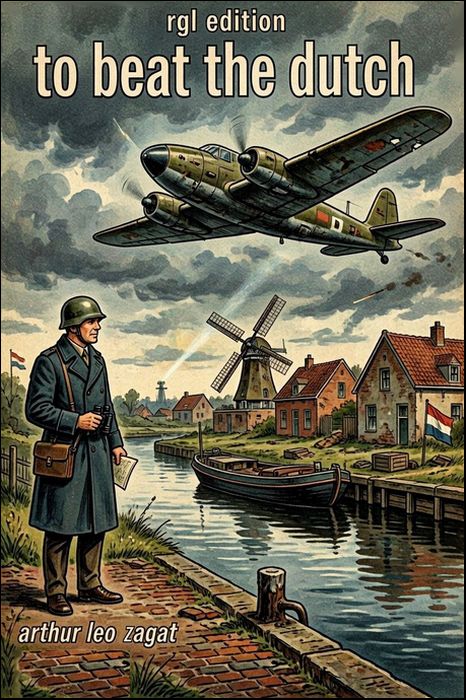
RGL e-Book Cover
Based on an image created with Microsoft Bing software
Roy Glashan's Library
Non sibi sed omnibus
Go to Home Page
This work is out of copyright in countries with a copyright
period of 70 years or less, after the year of the author's death.
If it is under copyright in your country of residence,
do not download or redistribute this file.
Original content added by RGL (e.g., introductions, notes,
RGL covers) is proprietary and protected by copyright.
RGL e-Book Cover
Based on an image created with Microsoft Bing software

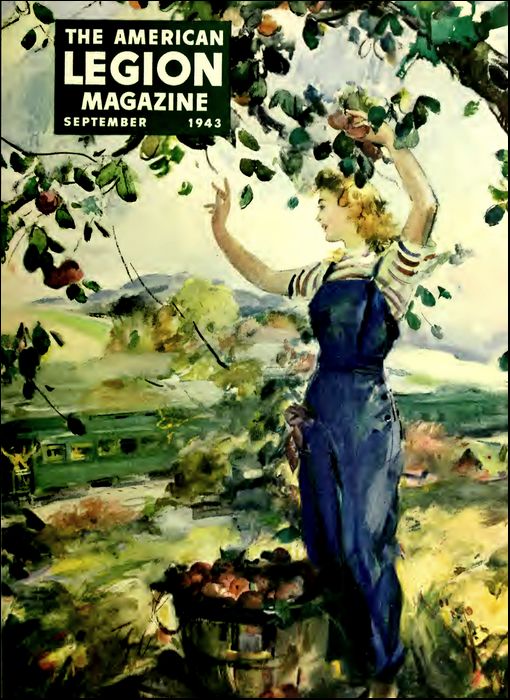
The American Legion Magazine, September 1943, with "To Beat The Dutch"

The Fortress crashed but at least one of the crew was able to bale out.
THE room was too quiet. As Pieter Guilden set down on a red-checkered tablecloth the black bag that is the mark of his profession the world over, he sensed that a sort of shock had come in with him, then this obscurely hostile silence. Light glittered on the fireplace's blue tiles, found no disorder in the low-ceiled, immaculate chamber. Margriet stood just within the door she'd shut behind them with a strange, noiseless haste. Her slender young body was taut, her hand pressed hard against the tight black velvet of her laced bodice, her eyes very blue beneath her winged cap's starched whiteness.
The two windows were shuttered for the blackout, but Katya Imborg sat bent and shriveled in her deep chair by the farther one, as if she still could watch through small diamond panes the canal path along which the people of Zeendam no longer strolled of an evening. Guilden's mouth thinned under its grizzled beard. "You do not seem ill, Katya."
Rheum-rimmed eyes peered up at him. "I am not."
"But Margriet said—"
"That she had an attack."
Falling over her shoulder, the girl's braid was a rope of spun gold. "I had to get you here somehow, and—and—"
"You dared not tell me it was for a 'diver.'" That was what they called the men who vanished underground to escape the labor conscription. "So you lied."
"What could I do?" Margriet's hand came from her breast, but it was to the old woman that its pleading gesture was addressed. "He's so dreadfully sick, and Dr. Laay's in Haarlem and Dr. Hondelink couldn't leave Vrouw Steenburgh—" Her breath caught. She looked up and Guilden too looked up, as if they strained to see through the raftered ceiling into the black sky where a drone deepened to thunder.
"Again," the doctor muttered. "They were over only last night."
Outside, heavy-soled boots pounded suddenly and there was a guttural shout. The roar of the bomber-flight rolled away towards Amsterdam, faded.
Guilden said, voice flat toned, "I brought you, into the world and your brother Rost. When Rost fell at the Grebbeline and your father at Kornweeder-Zandfort, and your mother could not endure to live without them, I eased her last moments. But you went first to Laay and Hondelink—"
"I sent her for them." Katya Imborg's voice was age-thinned, and inimical. "I forbade her to call you."
"You forbade—" Long, surgeon's fingers closed on the table-edge, knobbed knuckles whitening. "It's like that, is it? Because I've urged acceptance of the inevitable, because I see only useless suffering in stiff-necked resistance, I am not to be trusted."
"When a thrown stone cracked the skull of Hoogendam, the schoolmaster who teaches our children their rotten lies, you patched him up. When that German corporal was fished out of the canal, four-fifths drowned, you brought him back to life."
"What would you have had me do, Vrouw Imborg?"
"Let him die. That's what you would have done if you had been a true Hollander."
Guilden did not at once reply. When he spoke, it was without expression. "I am a physician. I have sworn to help all who need my help, no matter what they are." He lifted his bag from the table, turned to Margriet. "Where is my patient?"
He lay in the inner room, on the high feather-bed where Margriet was born seventeen years ago. The lamp she held revealed eyes open but unaware of them. A blunt jaw was blurred by dark bristle and the gaunt, young face glistened with the sweat of fever and pain.
"This is no underdiver." Pieter Guilden said.
"No. He is not."
"You knew—" Guilden recalled how last night Major von Kragg's hand had frozen, putting down a card in the back room of the Red Lion, how they'd listened to a sputter in the sky long after the thunder of the returning bombers had passed over. Then had come a distant, dull explosion and von Kragg had snapped a command to his orderly, and motorcycles had roared in the street. "You and your grandmother must have gone completely mad. You must know what the punishment for sheltering an enemy is."
"We do," Margriet answered, and then she said quietly: "I think his leg is broken, doctor."
His face was a deep-lined, still mask as he stripped down the blanket. They'd somehow undressed the youth, gotten him into one of Rost's nightshirts. The left leg was swollen, with a swathe of strips torn from some sheet. Guilden took scissors from his bag, slit the bandage. "Who fixed these splints?"
"I did, I—" He glanced up to see why she'd checked. She stared, pupils dilated, at the wall on which her low-held lamp threw Guilden's magnified shadow across a high window that was not shuttered but covered with a drawn blind. Moonglow that laid the panes' diamond pattern on the luminous oblong, blotched it just above the sill, with the black and unmistakable silhouette of a German's steel helmet.
In that moment the youth stirred. "Ride him!" Margriet's palm was not quick enough to stifle the thick tongued shout of delirium. "Ride him, cowboy!"
"Did he bear?" the girl breathed. "Doctor. Did the Nazi hear him?"
A pulse fluttered in the shadowed hollow of her white throat.... The helmet slid from the window.
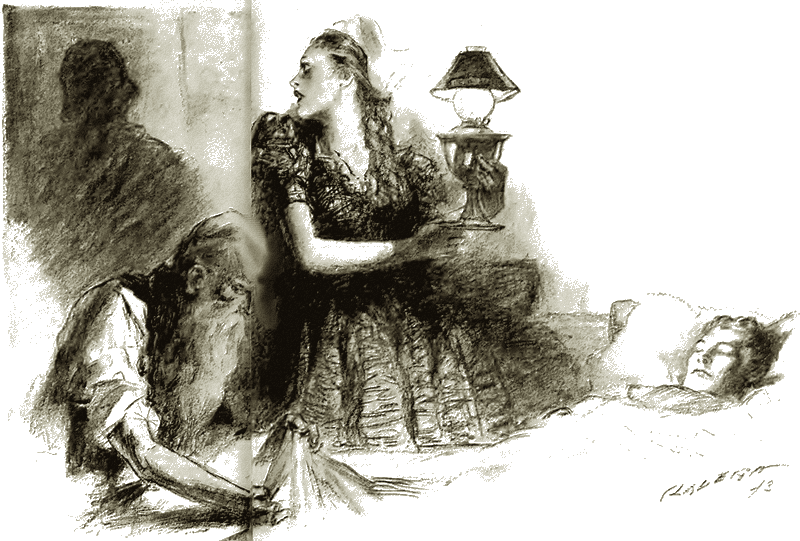
A German soldier at the window, and the doctor had only started his examination.
Guilden's fingers probed the bruise-mottled leg. Earth ground too deeply into the Americans knees to be washed out, told of a long, tortured crawl. "It isn't broken, but he did wrench it badly when he came down." Vinegar smell stung his nostrils as he soaked with Liquor Burovi one of the gauze pads he'd gotten from the Germans. He laid it on the leg. "The fever must—" The door to this room was shut tight but the pound of a revolver butt on the one from the street was very distinct.
"Öffnen!" The muffled shout was intelligible. "Open up!"
Peter Guilden spiraled a bandage—also German—over the wet pad, deftly and without haste. The house reverberated with insistent hammering. "Coming," the old woman shrilled, in the outer room. "I'm coming," and the pounding stopped. Margriet's white hand was pressed tight on the American's mouth. The lamp in her other hand quivered with a continuous small tinkling from its loose chimney. "What is it?" Katya Imborg quavered. "What do you want ?"
Guilden knotted his neat bandage, straightened up. Margriet's eyes followed him as he started toward the door. The guttural voice was clearer now, the old woman must have opened the door. "You know what I want," it said grimly. "A light shows from that other room."
"A light—Oh. My granddaughter must have forgotten to draw the shade."
"Your granddaughter, huh? Well, tell her.... Wait! She's that saftige blonde, isn't she, that walks past a man as if he wasn't there at all. I think I'll tell her myself." A chuckle. "Yes, I'll go and tell her myself."
A foot grated on the sanded floor. "No. No, you can't go in there. She—she's not dressed."
"That's what I thought....Let go of me, you old bitch. Let me go, or I'll—" Guilden opened the door just enough to let him through, pulled it closed behind him. "Ach!" the loutish Soldat whose gray-green sleeve the grandmother clutched, stared at him. Der Herr Doktor Guilden."
"I'm glad you came in, Strasser. You have a 'phone, haven't you, to call headquarters?" Katya released the soldier, her seamed countenance mirroring comprehension, contempt, "Ja," Strasser answered. "Ein Telefunken—wireless—fifty meters down the path, where the canal ends."
"That's German efficiency—call Major van Kragg at once. Tell him I shall be late for our pinochle. I am examining a patient here and it's taking me a little longer than I expected."
"Zu Befehl, Herr Doktor." Strasser started to salute, remembered in time this was not one of his officers, but only a Hollander they deigned to honor with their friendship. "Aber—"
"But what?"
"The light. It shines through the shade and my orders—
"I have to have light. If anyone reprimands you for permitting it, refer him to me. You'd better hurry, Strasser. The major does not like to be kept waiting. Thank you and good night."
"Gute Nacht, Herr Doktor Guilden."
THE morning sun streamed into his office, but Pieter Guilden hardly realized as he read in the quisling Mussert's newspaper, the Nationale Dagblad, of another heavy R.A.F. raid on Hamburg.
Guilden was reminded by this of the American flyer. He must be well on his way along the Underground "Railway" by now. After forty-eight hours that leg would still be painful but would bear his weight. The fever had been due only to exhaustion. Last night, then, those who take care of such matters had spirited him from Zeendam.
Margriet—and the grandmother—were safe. Comparatively. If the Germans ever found out.... A rap of the door knocker broke in on his reverie.
Before he could call, von Kragg was entering, obese, porcine even in his well-fitted black uniform.
"Major!" The doctor sprang up, went around the end of his desk. "This is a pleasant surprise." Schwarz, von Kragg's orderly, followed him in and shut the door. The major grunted something, ignored the chair Guilden pushed forward for him, took instead the one behind the desk. "Sit down, Guilden. I have something to tell you."
The physician sank into the seat his patients usually occupied. Von Kragg balled the Dagblad, tossed it on the floor. "Private Strasser was found on the canal path this morning, by his relief, dead."
Guilden's scalp prickled. "How was he killed?"
"His skull was bashed in." The officer drummed a finger tattoo on the desktop. "So long before he was found that the blood was dry, but not one of his quarter-hourly reports from his sentry 'phone was omitted, all night. Of course," von Kragg shrugged, "one voice sounds like another over the field wireless. Now why, Guilden, do you suppose the assassin risked being caught by some unscheduled patrol?"
"I have no idea?"
"I have. To gain as much time as he could for—" He cut off. "By the way, my friend, you were out there two nights ago. The night after a Flying Fortress crashed in the fields north of here."
"Was I?"
"You were. Strasser entered a house to warn the occupants a light was showing and found you there. You gave him a message for me. Remember?"
"Yes." Guilden's voice was steady. "I recall now. Margriet Imborg had not been feeling right of late and asked me to look her over."
"She came here to fetch you. Why did you not examine her here?"
"My housekeeper had gone to evening services. I never examine a woman unless another is present."
"At your age? Most circumspect. Well. What was wrong with the wench?"
Pieter Guilden was tired of playing mouse to von Kragg's cat. "I cannot answer that question."
"You what? You dare—" The German caught himself, managed a smile. "I see. You do not understand. It is not your pinochle partner who asks. It is as an officer of the Reich."
"I still must refuse to answer." Guilden pushed to his feet, stood before the desk tall and gaunt and a little stooped, but with a curious, quiet dignity. "Major von Kragg. When I received my degree, more years ago than I like to count, I subscribed to the oath every physician in every civilized land has taken since Hippocrates wrote it. There it hangs," His long arm lifted, pointed to a frame on the wall behind the desk. "To place our skill at the service of all who have need of it. To reveal to no one what we learn from any who consult us, or what we see in any home we enter in the practice of our profession. Nothing you can do can make me violate that pledge."
"No?" Von Kragg's smile was sinister now. "Old as you are, you have something to learn." Once more his fingers drummed a tattoo. "Your companionship, Dr. Guilden, has made my life in this stinking hole almost endurable. Because of that, I shall give you time to think over your decision, but I am compelled to place you under arrest, Schwarz....!
THROUGH the barred window he could see the narrow, cobbled street, across it the familiar row of red brick houses with their stepped roofs. Just opposite was the one where young Willem Laay set up practice just a year before the occupation. How proud he'd been of that bronze plate, still new-looking against the dark portal to which it was screwed. The door was opening. Laay came out. What in the world was he doing with that screwdriver?
Guilden shook his head, looked again. It was no illusion. Laay was unscrewing the nameplate from the door. He finished, took it inside. Now he was out again, a tack hammer in his hand, and a large white cardboard. He held the placard against the door—hesitated, took it down again, came to the middle of the street, held up the paper. Straining, Guilden made out what was printed on it:
BECAUSE THE ARREST OF A COLLEAGUE REVEALS THAT WE
CAN NO LONGER PURSUE OUR PROFESSION IN ACCORD WITH
ITS ANCIENT TRADITIONS, THE PHYSICIANS OF ZEENDAM
HAVE RESIGNED THEIR LICENSES TO PRACTICE MEDICINE.
But they must not do that. They must not leave Zeendam without medical attention. The people were half-starved, their resistance was low. Almost any illness might start an epidemic, and it would spread like wildfire. Hold on! Abruptly Guilden was gesturing Laay to come closer, close enough to read the words his lips shaped.
An Oberleutnant hurried into view from the left, shouting at Laay. He started running, but before he got near enough to interfere the doctors had finished their silent conversation.
THEY moved Pieter Guilden to another cell whose window faced a blank wall, but that was the only untoward result of the incident. For three days and nights he saw only the surly warder who brought him his scanty meals, talked to no one. Midafternoon of the fourth day, he heard footfalls approaching, down the corridor.
The steel door grated open, revealed a warder—and the major himself. Von Kragg came in alone, stood spraddle-legged, glowering, "Well." he growled, "have you had enough?"
The physician smiled wearily. "This is the first vacation I have had in years. I am in no hurry to end it."
The officer's shoulders weaved like a badgered bull's. "You stiff-necked Dutchman! Look here, Guilden. The Imborg woman, the old one, was just in my office. Her granddaughter is sick. High fever. Red splotches on her belly."
"Hmm." Guilden pursed his lips. "That's bad. That's what I was afraid she might be coming down with."
"What—what is it?"
"It sounds very much like typhus."
"Typhus!" It was a gasp of terror.
"Probably only a mild form. With proper precautions, there is not much fear of its spreading,"
"Spreading!"
"Neglected, it might run through all Holland, cross the border. But why did Vrouw Imborg come to you with this?"
"Because your verdammte brother doctors in this town refuse to treat anyone until you are released." Von Kragg's face was livid now. "And no physician from another town will touch any of your patients. I'm giving you a parole. You will go there at once and take care of her till she has recovered." He pushed open the cell door. "Go!"
Guilden remained on his cot. "No, von Kragg. A criminal, whether paroled or not, has no right to treat the sick under the Dutch law."
"Blast your Dutch law, I'm the law in Zeendam."
"So you are. But I hold my license under the law of the Netherlands. If that does not exist here, my right to practice does not exist."
"Donner und Blitzen!" Von Kragg's neck was so swollen his collar cut into the flesh. "What do you want of me?"
The doctor stroked his beard, appeared to ponder. "My freedom," he said gently. "Unconditionally, And your guarantee that you will never again attempt to interfere with my professional privileges, or those of my colleagues."
For a moment he feared the Nazi would have an apoplectic seizure before he could answer. Then, "You have them. Now go!"
LAMPLIGHT glittered on the fireplace's blue tiles, found no disorder in the Imborgs' low-ceiled, immaculate room. Margriet came out of the inner room, laughter dancing in her blue eyes. "I don't know what I'm going to do, doctor," she declared, ruefully. "The red ink won't wash off."
Pieter Guilden chuckled. "Good thing it's where it doesn't show. But there was no real need for that, or for the hot cloths Katya tells me you kept on your head."
"Well, they might have found a doctor who'd come to see me. Doctor, what did the American mean when he said, just before they took him away, that you can't beat the Dutch?"
This time the grizzled physician laughed out loud. "It's an old saying they have. And perhaps they're right. Perhaps, while there are girls like you, and men and women, in the Netherlands, Hitler will find out that it takes more than he's got to beat the Dutch."
Roy Glashan's Library
Non sibi sed omnibus
Go to Home Page
This work is out of copyright in countries with a copyright
period of 70 years or less, after the year of the author's death.
If it is under copyright in your country of residence,
do not download or redistribute this file.
Original content added by RGL (e.g., introductions, notes,
RGL covers) is proprietary and protected by copyright.