RGL e-Book Cover©
Roy Glashan's Library
Non sibi sed omnibus
Go to Home Page
This work is out of copyright in countries with a copyright
period of 70 years or less, after the year of the author's death.
If it is under copyright in your country of residence,
do not download or redistribute this file.
Original content added by RGL (e.g., introductions, notes,
RGL covers) is proprietary and protected by copyright.
RGL e-Book Cover©
MR. SMILER BUNN arose carefully from the luncheon-table and moved, in a heavy-weight manner, across to the sunlit bay window, where he proceeded practically to lie down in an easy-chair of a richness, softness, and general luxury that was almost disgraceful. His partner—Lord Fortworth, the ex-millionaire and war-financier, now known as Mr. Henry Black—did the same.
"I envy no man," remarked Mr. Bunn solemnly. "Not even John D. Rockefeller. Pass the cigars, Sing Song, and look alive with the coffee. That's what, you lemon."
Sing Song, the peerless Chinese manservant of Mr. Bunn, passed the cigars as requested and disappeared.
"No man," insisted Mr. Bunn, "not even John D. Rockefeller, I say."
Lord Fortworth smiled.
"Well, I don't reckon anyone who likes a reasonable dinner envies John. Why, he hasn't got a stomach. He offered ten thousand dollars years ago to any surgeon who could sort of graft a new one on to him."
Mr. Bunn sat up straight, flushing with unmistakable indignation.
"I ain't a nasty particular man," he said, "as you know, but that's a thing that makes my blood boil. Ten thousand dollars for a new stomach! Why, it's miserly. Two thousand pounds! A man worth over a hundred million of money! Why, he doesn't deserve" a stomach at all. He don't know the value of a good, powerful stomach. He hasn't got any idea. He ought to be solid throughout. Why, I've spent that much on mine in the last five years —on up-keep alone. And you've spent slightly more, I should say. It makes my blood boil. I can't understand how such a man ever got rich. I couldn't think, or act, or do anything on an empty stomach. I'm surprised!"
His partner agreed with him, and the two crooks gradually relapsed into the dreamless slumber with which they usually concluded the function of lunching.
Sing Song, moving like a saffron ghost about the room, removed the ruins of the lunch and set out whisky and soda at their elbows so that they could clear their heads when waking.
Those who have read previously of the various adventures of the Bunn-Fortworth Combine will not be surprised to learn that, in spite of several very tolerable coups which they had successfully engineered during the past year, the protracted visit to Monte Carlo that had followed the said coups had left them with little over a thousand pounds or so in hand, and that they were even now on the keen look-out for fresh "openings." Their running expenses were heavy, and their "incidental" outgoings appalling. But temporary financial stringencies are only to be expected if people will have the best of everything all the time. And both Smiler Bunn and Lord Fort worth had been down to their last thousand too often to allow such a state of affairs to affect their, appetites.
For, after all, there was always the Rajah of Jolapore to fall back upon. This potentate had once been rescued from a position that was both embarrassing and dangerous by Mr. Bunn—and Smiler never, in any circumstances, permitted him to forget it. Since then he had been of so-called service to the Rajah on several occasions—upon each occasion taking a very severe hack indeed at the treasury of the ruler, who seemed to prefer doing the bulk of ruling in London and Paris rather than in Jolapore. He was a blasé, old-young man, who had seen so much of the world and the ways of the world that he dwelt in a state of perpetual surfeit, into which the intrusions of Mr. Bunn came almost pleasantly. As to the cost of these tonic-like intrusions, the Rajah—¦ with a million or so a year—knew little and cared less. Yes, there was always the Rajah to fall back upon. And, when falling back, there was always the potentate's faithful and confidential body-servant, personal handyman, fetcher and carrier and general intriguer, one Mirza Khan, to help them. Mirza Khan—a fat, fluent impostor, both loved and respected the Bunn-Fortworth duo. He looked upon them as lions of the crooked world, and, for himself, was never happier than when playing third lion to them.
Hence, when times were bad, Smiler Bunn and Fortworth relied upon the Rajah—and Mirza Khan. Indeed, it was "Mirz," as Mr. Bunn had fallen into the friendly habit of addressing him, who broke the slumbers soon after their brief discussion concerning Mr. Rockefeller's anatomy.
Sing Song, who knew that Mirza Khan was usually a sign of money, or (which pleased Sing Song more) a period of active dishonesty—a hobby of the Chink's—did not hesitate to show the native in. He was a glossy-looking sportsman, extravagantly dressed in a particularly shiny silk hat; frock-coat outfit, with Sing-Song-coloured gloves. Tall, burly, sleek, with a smile that was full of teeth, he greeted them.
"How do you do, sars?" he said. "It iss great pleasure to me to recognise thatt you are all right."
They welcomed him, and he thoughtfully, assisted himself to a tolerably stiff whisky-and-soda and a cigar—a proceeding which they imitated.
"Well, Mirz, old man, is there another hole in the treasury wall for a gentleman to get his hand through?" inquired Mr. Bunn playfully.
Mirza Khan pondered.
"Yess, on the whole, I think we may take itt thatt we shall not gain a loss on thiss occasion. But, at the same time, there iss considerable danger in the esspecial affair I wish to explain." He paused for a moment, thinking. Perhaps you have heard thatt in India exists a secret brotherhood of assassins thatt are known as Thugs."
The partners nodded.
"They are after His Highness," said Mirza Khan simply. "Eight members of thatt brotherhood—which was officially wiped out by the Beritish Government seventy years ago—have arrived in London for thee purpose off killing His Highness. Itt iss partly plot for thee throne, off course, but thatt will not be possible to prove, after His Highness iss removed—for thee eight are veree skilful liars, ass well ass veree competent assassins."
Messrs. Bunn and Fortworth looked at each other rather solemnly. There was an ominous ring about the affair, despite Mirza Khan's smile. The native watched them a little anxiously. But that it was anxiety for his bank account rather than for his master his next words made quite clear.
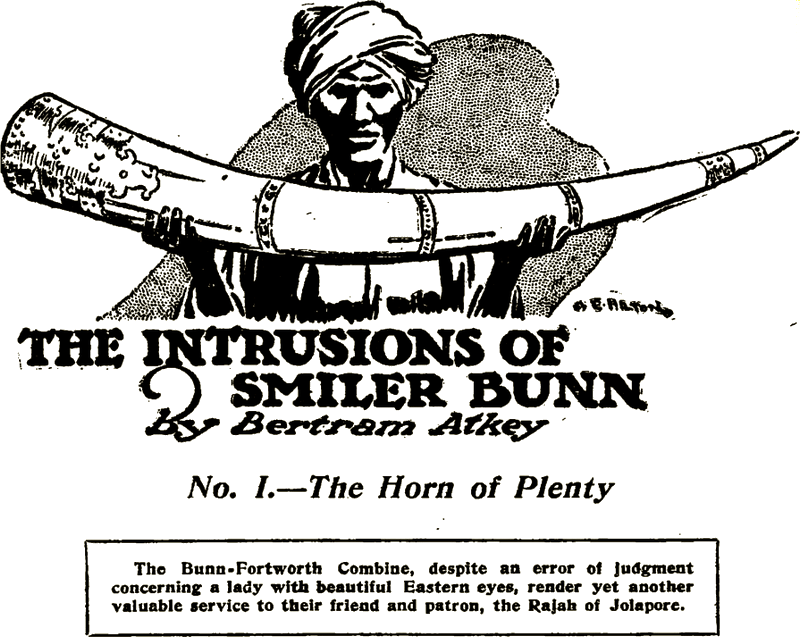
"Itt iss not thee danger to His Highness thatt I fear, but itt "iss for my job that I have qualms. If they kill His Highness I shall lose my job—for me thatt iss same thing ass killing thee goose thatt lays the golden eggs. But there iss good opportunity off saving my job and His Highness, and making handsome profit on thee transaction att thee same time. Yess, sar, I will partake off further whisky and small supply off soda. Thee Thugs I have-spoken off are hired by groups of priests of certain sect in Central India. There iss in thee treasury off my master an elephant tusk thatt iss veree thickly encrusted with precious stones. Itt iss hollow and iss for use as a horn. Thee horn was taken away many years ago from the chief temple off this sect by ancestor of His Highness. Recently thee priests demanded itt back. His Highness refused. Itt iss serious matter, and thee priests approached next successor off His Highness, who says, of course, ' When I am thee Rajah off Jolapore come and ask again for thee jewelled horn and I will restore itt to the temple veree gladly.' So the priests hired thee Thugs to make thee throne empty for my master's successor. Thatt iss the situation. His Highness, now thatt he knows thee priests mean business, would give them thee ivory horn back, I think, only thatt he gave it away as token of esteem to Russian Princess two years ago, and itt iss impossible for gentleman to demand it back. Itt iss gereat pity—for thee priests do not wish to till His Highness if he will return to them thee religious symbol thatt thee Russian lady has. What do you think, sars?"
"Think?" The partners smiled at each other. "It's easy."
Mirza Khan's face lighted up.
"All we've got to do is simply to pinch the horn from the Princess, hand it over to the Rajah, and bank the reward," said Smiler.
Mirza Khan looked worried.
"Thatt is veree excellent plan," he said. "But thee lady was not real Princess—she was adventuress —sharp. She has disappeared."
There was a long pause.
"No idea where she went to, I suppose?" asked Smiler presently.
Mirza Khan shook his head.
"Well, in that case, it looks to me as though the Rajah's up against it for fair," said Lord Fortworth. "The Thugs'll get him."
"But we can't afford it," objected Mr. Bunn, anxiously. "We can't afford to let these Thugs put him out. We've got to do something.
Here, describe this Russian dame to us, Mirza, my lad. Tell us the facts."
And Mirza Khan told them a number of quite interesting facts accordingly—facts which went far to convinca them that, whether she was a Russian Princess or not, the lady who possessed the jewel-encrusted temple horn was by no means the kind of lady who would allow herself to be separated from it by any promptings of sentiment. The prompting she would require would be ready-money-and-plenty-of-it promptings.
"Who introduced her to the Rajah?" asked Smiler Bunn, as Mirza Khan came to the end of his description.
"I am of opinion thatt she made thee acquaintance of His Highness att a spiritual séance att thee house of Professor Vahana."
The partners brightened up. They knew Vahana of old. He was a modern "magician" of the palmist, clairvoyant, soothsayer, and so-forth variety, and as deft a crook in his own particular line as any in the two hemispheres—except perhaps his wife, who was slightly defter. The Bunn-Fortworth Combine had come into contact with Professor Vahana on more than one occasion before, and, as Lord Fortworth had often declared, they had "handed it to him good and hard" more than once.
"Have you got a photo of Her Mighty Highness?" asked Smiler.
Mirza Khan finished his whisky-and-soda.
"His Highness collected large quantities two years ago," he said, "and I will procure you one with great ease."
Mr. Bunn rose.
"Well, procure it," he said, "and send it round to us as quick as you can. Does your pal Santoin know about the Thugs?"
M. Lucien Santoin was the extremely discreet and bewilderingly dishonest European valet and factotum of the Rajah.
Mirza Khan looked shocked and pained.
"No—no—not at all—he iss dangerous reptile. He iss snake in thee grass. He iss dam' crawling crocodile and creeping spy, sar! He does not know off thee Thugs. He does not know anything. He iss different from me—I am native gentleman. My father was veree highly respected Thug. When he was exterminated many native gentlemen mourned badly for him. Santoin iss not gentleman—he iss onlee Paris sewer rat! "
The partners grinned. They knew of the implacable jealousy and unending intrigue for the favour of the Rajah that existed between his two jackals.
"Well, send round the photo as soon as you can," repeated Mr. Bunn, and Mirza Khan, moving .with singular quickness and silence for one so massive, disappeared.
Evidently he lost no time in "procuring" the photograph from his master's collection. Within half an hour a messenger-boy delivered it and the partners were taking turns studying it.
"I've seen her before somewhere," insisted Mr. Bunn. "And she's as much a Russian Princess as I am Tsar of the Zoological Gardens. I can't quite fix her yet, but—"
"But I can," broke in Fortworth. "She's the female sharp that tried to sell me a West African cocoanut concession that never existed (and wasn't worth two cents if it did) about eight years ago. She called herself Comtesse di Eugulera, or words to that effect—sounded like drinking out of the bottle. She got away with fifty pounds for a month's option on the scheme. I remember her because I telegraphed refusing the cocoanut oil industry on the morning I was married by my wife." Fortworth sighed. His wife had cost him hundreds of thousands and left him with exceeding swiftness when he ceased to be a financial magnate. He sighed because he was so thankful that she had. "Yes, she's pretty, this little dame is, but she's a sharp from Sharpville, and it'll take some record-breaking dentistry to separate her from this tusk."
Mr. Bunn, studying the photo, nodded absently.
"Well, we can but try to pinch it. No man can do more than try his best—angels can do no more."
He rang for Sing Song, who appeared with his accustomed celerity.
"Motor, you pineapple!" said Mr. Bunn briefly, and the Chink went to order the car round.
The Bunn-Fortworth Combine were clearing for action.
"PROFESSOR" VAHANA was reluctantly parting from an elderly maniac who believed himself to be haunted, and was paying the "spiritualist" heavily to ban his ghosts, when Smiler Bunn and his partner stepped out from their luxurious car at his door. He greeted them in his glib, hurried, slightly furtive way, and they followed him into his "consulting room," where his wife was refreshing herself with a cigarette. The faces of the two fakers hardened a little as they realised who had come to see them, but they were tactful.
"Well, what can we do for you?" inquired the Professor, uneasily polite.
"Nothing to-day," said Mr. Bunn. "We've come to warn you." He dropped his voice. "Thugs are after you—and they're going to get you," he said.
The Professor went rather white.
"Gonna get us? What Thugs?"
"Indian ones—the genuine article. You know—murderers. Assassins from Jolapore," explained Fortworth cheerfully.
"What for? I don't do business with no Thugs. I never doped it out to no coloured party except the Rajah—and he asked for it," said the Professor anxiously, for he knew from of old that Messrs. Bunn and Co. were not at all in the habit of warning people unnecessarily. Madame Vahana, too, lost interest in her cigarette.
"It's the Rajah we mean," continued Mr. Bunn. "He's laying out for you with eight Thugs—real imported man-killers. It's because of that ivory tusk you snaked out of his jewel tank. That jewellery-studded horn. He wants it back, and he means having it, that's what. You'd better part up, old man. That's a sacred horn, that tusk is, and the bogy folk from India's coral strand'll have you if you don't hand it back to the Rajah like a hot chestnut."
Madame Vahana started up.
"That tusk! Puh! He never got away with that tusk. He wasn't in that. Echo got the tusk and a carpet-bagful of other jewellery as well. We never separated the Rajah from anything but money!" she exclaimed virtuously.
"That's true," said Vahana uneasily. "Echo got her hooks on the tusk. The Thugs don't want us—it's Echo they want."
"Echo what?" demanded Fortworth with a faint sneer. "Echo which? You'd better hand out that Echo dope to the Rajah or that sport across the road. He's watching the house now, and he's one of the Thugs."
The Vahanas crossed over and stared out of the window. A short, burly, morose-looking individual, with an old oak complexion and a turban, stood on the opposite side of the street, glancing every now and then up at the window.
"A man-killer from Madras, if ever I saw one," said Mr. Bunn cheerily. "That's one of 'em, Vahana, and if you ever meet him alone in the dark roll away for home on your top speed, my lad."
The Vahanas, who were courageous, but not fatheadedly so, turned a trifle paler. For, without doubt, Sing Song, in his disguise, looked a Thug of the toughest description.
"But we never got the tusk, I'm telling you," explained Vahana. "It was Echo Paley got it—she got it now, and calls it her bank. Say, she jags a diamond off it with a chisel when she's broke, and then locks it away until she's broke again. It's nothing to do with us. You know us, you two gents. We don't deal in no musical horns—we're in the ghost business."
The partners nodded.
"Who's Echo Paley?" they demanded.
Vahana told them gladly, and since that was all they wanted to know, they left discreetly a few moments later, merely advising the ghost-raisers to make a hobby of keeping indoors for a day or two— advice which the Vahanas decided to accept, for although their consciences were clear as regards the jewelled tusk, nevertheless they had mercilessly "skinned" the Rajah a year or two before, when he had shown a faint interest in spiritualism. And when he had lost interest and civilly choked them off they had introduced Miss Echo Paley to him —as a pro tem. Russian Princess— and left her to make hay while the Rajah shone, which apparently she had. Yes, on the whole, the Vahanas firmly resolved to lay low for a week or so—until the Thugs had blown over.
The partners, meanwhile, had picked up Sing Song round a convenient corner and sent him on in a taxi-cab to repeat his skilful impersonation of a Thug outside Echo's flat, towards which they proceeded gently via the Café Royal.
Miss Echo Paley, alias Comtesse de IyUgulera, alias Princess Opoffski, and many other titles, occupied a very cosy first-floor flat in an expensive block in Knightsbridge. She was a very attractive woman, and she described herself officially as a hypnotist. But her great speciality was fraud. She had begun life in New York as a stenographer, but one day, perceiving an opportunity, she had promptly embezzled everything that was humanly possible, and as promptly left New York.
She had lived on her wits for ten years, and had put a little by for her old age. The provision for the future included the jewelled tusk for which Messrs. Bunn and Fortworth were searching. Vahana had described her to the partners, and they were now aware that she was a perfect pistol-shot, as quick-tempered as a pantheress, as swift to strike as a snake, as cunning as a raven, and as brave as a lion.
"Well, she sounds as though she belongs in the Zoo," Mr. Bunn had remarked thoughtfully, as Vahana concluded his list of comparisons.
"Sure," the spirit faker had agreed. "But I don't hanker for no contract to put her there. She carries a little .22 calibre automatic man-stopper all the time. Only a .22, gents, but she had it specially made for her, and she reckons it'd kind of scoop out a party's brains like an egg-spoon, if necessary. We run with her for a spell, gents, but her gait was too swift for us. She goes at a bat that only lets her hit the high places—whereas we're a pair of jog-alongs. So we dissolved partnership. She was too high-steppin' for the ghost business, anyway. If them Thugs get gay with Echo Paley, there's gonna be some dead. Thugs littering up the sidewalk before long, gents. But she oughta be warned."
And Messrs. Bunn and Fortworth were on their philanthropic way to "warn" her accordingly.
They underestimated Echo. Many successes and much good luck had made them confident, and they underestimated the lady.
She received them very civilly, heard their warning, and laughed with quiet amusement.
"I fear no Thug in shining armour, gentlemen," she said gaily. "You say there's one watching the flat. Is he that black weed growing out of the pavement across the street?" She glanced out discreetly from behind rose-pink curtains, and turned to them, her beautiful, almond-shaped, slightly Eastern eyes narrowing a little. "I will give you my recipe for getting rid of Thugs."
She touched a bell and a gigantic negress who seemed to be her maid, and who appeared to worship her, entered. Echo made a gesture, and the negress fetched a small but very efficient-looking air-pistol.
The partners looked at each other rather awkwardly, as Echo slipped a tiny conical lead bullet slightly smaller than a pea into the chamber of the little weapon.
"I'm going to sting him," she said smiling. "Where will you have it? Shall I snip the lobe off his ear, break one of his fingers, or lame him?"
The partners hesitated. Sing Song was a valuable cook and they did not want him injured.
"Wouldn't it be better to just warn him off?" asked Mr. Bunn, rather feebly.
The adventuress looked surprised.
"Well, that's what I suggest doing—only where shall I warn him off? In the ear, or the hand, or the foot?" She pointed the pistol playfully from behind the curtain as she spoke and laughed softly. "Wherever you like."
"But—" began Fortworth, and suddenly gave a sigh of relief, for Sing Song had vanished. A ray of sunlight had caught the plating of the pistol, and the Chink had seen the sudden glitter. So he went away, allegretto—amazingly allegretto. Lightning might have caught him, with a level start—nothing else.
Echo laughed gaily.
"He moves quickly—for a Thug," she said, and sat down. "And now," she continued, "as I am not a fool, and don't pretend to be able to fight a crowd of those black rats, perhaps you will give me your advice about the ivory horn. I don't mind admitting that it wouldn't be quite safe for me to go and see the Rajah—we had a misunderstanding about something I thought he had given me, but which he said I stole. You know him well, and Vahana telephoned to me that your advice is worth taking. What do you suggest?"
"You'd better part with the thing," said Mr. Bunn without hesitation. "Send it to the Rajah, or, if you like, we'll take it to him and make the best terms we can for you. It ought to be worth a thousand at least."
"Quite that," said Fortworth.
There was a moment's pause, and the partners saw that Echo was smiling queerly. They noticed somehow that a table stood between them and the adventuress. Then, quick and hissing as the whistle of a sword-blade, came two words:
"Sit still!"
Echo's hands moved swiftly and came to rest on the table edge, and in the left was the air-pistol covering Mr. Bunn and in the right was another pistol (no doubt the famous man-stopping .22) covering Lord Fortworth. They sat perfectly still, gazing into the beautiful Eastern eyes of the lady—perfectly still.
"Couldn't you work out a better scheme than that?" she inquired softly. "To steal my tusk and sell it back to the Rajah! I wonder you don't starve at the crooked game. Did you think that eight or eighty Thugs and a pair of fat four-flushers like you would frighten me into parting with that horn? Why"—she appeared almost to give it up in despair of making them see their stupidity. Then, "Why, Santoin has known about the Thugs for a week, and has been negotiating with me for the return of the tusk for the last three days. What good do you fancy you can do by wallowing up and butting in at this time of the day—you balloons? You're old enough to know better. And now, get out!"
She rose, slim and graceful as a girl, and motioned them out of the room with her pistols. They went without words, and Echo followed them to the door of the flat. A light laugh came down the stairs to the main hall, succeeded by the sound of a closing door.
Then they wiped the perspiration from their brows and looked rather sheepishly at each other.
"I don't like that girl," said Mr. Bunn almost plaintively. "Did you see how her eyes get a kind of greeny glint in 'em sometimes? You got to watch out sharp when a woman makes her eyes go greeny at you."
Fortworth grunted.
"I know. My wife had eyes like that," he said.
They moved pensively out of the flats.
"She'd have deafened Sing Song for life if he'd hung about any longer," said Smiler thoughtfully. "I'm glad he didn't wait. What good's a deaf cook with one ear shot off."
Fortworth nodded glumly, and they entered their car rather as Napoleon Bonaparte must have mounted his horse when commencing his retreat from Moscow.
"She's a hummer, all right," said Mr. Bunn, "but she's making the same mistake about us as we made about her. She's underestimating us, that's what."
"Perhaps she is," admitted Fortworth, who seemed depressed, "but I wasn't putting any fancy estimate on myself when I found myself staring foolish and kind of fascinated at her gun. No, sir. She had me buffaloed, for fair."
"Well, I had a rather chilly spine for a minute or two myself," confessed Mr. Bunn. "But an old brandy apiece ought to put us right. Then we'll telephone Mirza. Sing Song will be home as soon as we are."
Sing Song was. Indeed, he had reached the flat even sooner—in time to soothe his Chinese nerves also with an old brandy or so before his "owners" arrived. "Why not?" he asked his conscience in his bland, Celestial way. There was no answer—for his conscience was extinct.
Mirza Khan was considerably "flummoxed" when, over the telephone, Mr. Bunn poured into his listening ear a somewhat lurid account of their tribulations in search of the sacred tusk, and requested him to come without foolish delay to the flat.
Strange oaths of India sped back across the wire as Mirza realised that M. Santoin had for once got a lengthy start of him.
"My dear Mister Huish"—Smiler's name when dealing with the Rajah and his satellites was Coomber Huish—"thiss iss veree bad thing. Thiss iss grave error off judgment, and thee waste of time iss serious matter. Thee Thugs are now on thee look-out, sar. They have discontinued thee negotiations with His Highness. They are off opinion thatt he has thee jewelled horn here, and thatt itt iss incorrect thatt itt has been presented to lady by His Highness. Itt iss matter for speedy decision."
Mr. Smiler pondered, scratching his head absently with the telephone receiver. He spoke to Fortworth, who was sullenly smoking a cigar' across the room, and Fortworth nodded.
"You can take it from me, Mirza, my lad, that nobody's going to get the tusk away from Echo Paley without Echo answering 'Why?'" said Smiler. "Santoin's the sport who will get it, and take it to the Rajah for her. If we're going to get it we got to get it on the way—off Santoin. He might fetch it away any time now, so I'll send Sing Song to shadow him until you get back from here. What size is the horn? How'll Santoin bring it—in his pocket, or how?"
"Itt iss slightly large—itt iss about five feet long and heavy also."
"He'll take a cab," said Mr. Bunn with conviction. "That horn ain't no penny trumpet. Well, now, listen. Sing Song will be along at once. You'll recognise him because he'll be disguised as a Japanese medical student—frock-coat, gloves, and things. Then you come on round here and we can fix up about intercepting Santoin. You'll have to hustle, old man—for a change!" concluded Smiler, encouragingly, and rung off.
TWO evenings later, M. Santoin, empowered by the Rajah to offer ten thousand pounds for the recovery of the tusk—"no questions asked or answered"—in his discreet way, offered Echo Paley five thousand, which she accepted, in bank-notes paid on the nail. The remaining five thousand was to be Santoin's modest commission.
Echo's negress brought in the weighty instrument of music and laid it on the table.
Santoin looked eagerly at it and his face fell.
"What is the matter?" inquired Echo.
M. Santoin threw up his hands in a gesture of horror.
"You have stripped the horn naked of its adornments, madame! I was ordered to purchase a jewelled horn—but there are not any jewels." He examined the big, hollowed tusk anxiously. "Not even one leetle pearl. And there were rubies and diamonds and emeralds—oh! all the most noble gems. They are every one gone."
Echo smiled pityingly.
"Certainly," she said sweetly, her lovely Eastern eyes dancing, "I took those for interest on capital. They were wasted on a piece of discoloured ivory. But you need not distress yourself about them, M. Santoin. The priests do not attach importance to the jewels as much as to the horn."
"But, madame—" began Santoin, who had practically banked on a fistful of the gems for himself, and, indeed, had brought a pair of pliers and a cold chisel and a few little things of that kind with which to yank them out of their setting on the journey back to Grosvenor Square.
Echo rose.
"You will excuse me, I know," she interrupted. "I have an appointment with one of our leading diamond merchants," and touched the bell for her maid to show him out.
Santoin was no fool, and would take a hint—when it was accompanied by a green, wild-cat flash from a pair of otherwise fascinating Eastern eyes. So he hoisted the heavy tusk and staggered down to the big motor of the Rajah, in which he had driven to Miss Paley's flat.
"Home, sacred pig of a pig," he snarled crossly at the driver who was bending over the engine, and entered the car. The driver closed the bonnet, mounted to his seat, and the car stole quietly down the street.
It was about nine o'clock in the evening, and in the ordinary way, the journey to Grosvenor Square should have occupied no more than a few minutes. To-night, however, the car seemed to be taking a slightly different route. It rolled silently through a string of back streets that were unfamiliar to Santoin. But he was not uneasy—he had the tusk and five thousand pounds to boot. He had hoped for a few gems also, but, on the whole, he was satisfied. He lay back smoking a cigarette lost in pleasant dreams of the future. A few more coups of the same dimensions and he could retire and leave the Rajah to some other valet who had sufficient capital to pay the necessary rent. Suddenly the car stopped with a jerk and a hiccup of the sharply-applied foot-brake, and a large, black-faced man stepped into the car, very uncivilly jamming a repeating pistol in M. Santoin's startled face. An instant later another entered, quickly, silently, pressing another pistol into M. Santoin's stomach. Santoin saw hazily that yet another had climbed up in front with the driver.
They were all black as a tarred fence, and Santoin understood.
"The Thugs!" he gasped.
Two of them made a savage gesture that hushed him to silence like magic, and the third gently detached the bulb from the electric light, and drew the blinds so that the interior of the car was plunged into darkness.
In this darkness M. Santoin felt hands running all over him—fluttering, groping, inquiring—as they might have been spirit hands. And M. Santoin, with two rings of cold metal pressing into his face, let them flutter, without comment. The Thugs had him—and had him thoroughly. If he got out alive he would be thankful. He had no remarks to make. Luckily for him he had left his five thousand pounds "commission" at home.
The motor ran on swiftly, smoothly—through the noise and glare of crowded thoroughfares, through the silence and gloom of back streets. A steamer siren suddenly hooted and Santoin was aware that the car was approaching the river.
Half an hour later, his eyes bandaged and hands tied, M. Santoin found himself sitting alone in the car in a quiet alley between two big coal yards near the docks. He listened for a moment to reassure himself that the Thugs had really gone, then called softly to the driver. But the voice that replied was not that of the Rajah's native driver. It was less respectful, and had a police-like ring.
"Wot's all this?" it inquired, and M. Santoin feebly answered "Help!"
He spent the next hour at a police-station, lying feverishly but not unskilfully. He was much too discreet to tell the truth. He had lost the tusk, but he did not intend to lose his "job" as well.
So, as there is no law forbidding a French gentleman to wait about the docks bound and blindfold while his driver has been sent on a message and has failed to return, the police merely took the number of his car and allowed M. Santoin to drive himself home.
But, meantime, His Highness the Rajah of Jolapore was spending several exceedingly uncomfortable half-hours.
He was sitting in the room in which he gave audience (to those who could get it) face to face with a select committee of Thugs. Behind him were ranged a number of his servants, white, black, brown, mahogany, walnut, rosewood, and other shades. They were all waiting for M. Santoin and the sacred horn, and there was very little conversation. The Rajah scowled upon the Thugs—and the Thugs, in attitudes of profound respect, gazed anywhere but at the Rajah. Yet everyone knew that in the event of the horn not being forthcoming there would be trouble of a very troublesome kind. Somebody, in fact, was going to get killed. Every man in the room had a weapon concealed about him—Mirza Khan, indeed, in his simple Indian way, had two, one being a straightforward .45 Colt automatic pistol, capable of blasting the back teeth out of an elephant, and the other being a rather complex blend of pistol and dagger, that looked like the result of a gunmaker's nightmare, but was nevertheless thoroughly effective. (It was the only piece of property Mirza Khan had inherited from his father—the highly respectable Thug who had been "exterminated.")
No doubt it would, have been simpler and less expensive for the Rajah to call in the police, but he had his throne as well as his life to consider. Never what one would describe as a "popular idol" among those far-off dusky folk, it would not increase his popularity for the priests of his country to rise up and declare that he had delivered eight martyrs to the English police. Furthermore, the Rajah disliked publicity. He was quite willing to yield up the sacred horn to the two .priests and their bodyguard of Thugs, if he could only get it. Santoin was now bringing it, and the Rajah felt safe.
Ten o'clock struck, and the waiting crowd squatted patiently where they were.
But the Rajah stirred.
"Give these animals refreshment," he said to Mirza Khan, who ordered in a supply of unwholesome-looking native drinks. The Rajah continued to smoke in gloomy grandeur.
Half-past ten struck, and a faint restless movement stirred the little crowd of Thugs.
The Rajah ordered more drinks. The Thugs obligingly drank the drinks—but continued to stir restlessly.
Mirza Khan nervously fingered the young cannon in his pocket, and assured himself that it was loaded.
Eleven o'clock chimed, and there was a general movement. A lank scarecrow with whitey-brown whiskers stepped forward with a gesture that was deferential, but a stare that was insolent. He was one of the priests who commanded the Thugs.
"The Protector of the Poor mocks us," he said. "He will not give us back the sacred horn of our forefathers."
The Rajah stood up sharply, his nostrils twitching, and addressed his people.
"Dogs and offspring of dogs," he began civilly—and Mirza Khan picked back the safety catch of the Colt—"go to Hades!"
Another five seconds would have produced a very brilliant rough-and-tumble indeed, but—a voice was suddenly heard in the land—the robust voice of Smiler Bunn, who was calling the doorkeeper a variety of things, none of them flattering.
Mirza Khan was at the door in a flash, and a moment later the indomitable Bunn-Fortworth Combine entered, Sing Song tottering along behind under the weight of a horn big enough to be blown by machinery.
The Rajah dropped back in his throne-like chair with a sigh of relief. He did not understand why Santoin was not bringing the musical instrument—nor did he care now. The horn was there. That was all he cared about. And that it should have been brought by his friends Messrs. Coomber Huish and Henry Black was practically a guarantee that everything was all right. He would settle with Santoin afterwards—the ten thousand pounds entrusted to the Frenchman should be transferred to Messrs. Huish and Black as part of their reward.
The partners bade Sing Song deposit the horn at the feet of the Rajah, and then clear out, which he did with his accustomed dexterity. They did not want any question of caste to render the horn valueless to the priests.
"Rajah," said Mr. Bunn in his manly, unaffected way, and wiped his brow. "There she is. We've managed it. Mirza Khan told us of the hole you were in, and—we took a hand on your behalf. We did all that was possible—all that men can do—but the jewels were gone before we got the instrument. Echo had them. May we retire?"
The Rajah beamed upon the pair, briefly thanked them, motioned to Mirza Khan, who ushered them out.
"Oah, veree well done, sars. Oah, veree perfectlee executed, sars!" gabbled Mirza, who seemed crazy with relief. "Did you kill the vampire Santoin?"
"No, my lad," said Smiler, "but we scared the spine out of him. And now lead us to the bathroom, where we can get some of the black washed out of our hair and fingernails while you send us in a drink. We didn't have time to do it properly at the flat. Then you can get back to the main hall and choke off Santoin if he turns up."
Mirza did as he was requested.
Twenty minutes later he returned, smiling wastefully.
"Thee priests are happee and the Thugs have gone forth," he said. "They made homage to His Highness, who pardoned their insolence. He would have had them torn apart by war elephants in India a hundred years ago. But he iss veree highly civilised nowadays. He iss greatlee gratified and much pleased att your kindness and skill and courage. He iss veree exhausted for thiss evening, and begs thatt you will excuse him from receiving you until to-morrow, when he will be most happee to hold discussion with you."
They all smiled at each other, like fat, amiable wolves.
"What's his figure? What'll his gratitude add up to?" asked Fortworth.
"I shall extremely endeavour to lead his thoughts towards twenty thousand pounds," said Mirza Khan. "He iss so veree grateful on thiss occasion. That will be six thousand-odd for each one of uss."
They stared solemnly at the man, who stared back with a front of brass—black brass.
"Mirza, my lad," said Mr. Bunn almost reverently, "you are the King of Hogs!"
"Sar," replied Mirza, "I am thatt! "
The partners sighed, stared, looked puzzled, and finally laughed.
"It's a go, then, provided you settle with Santoin, if necessary?"
"Yes, sars," said Mirza Khan, who knew that Santoin, rather than leave the service of the Rajah, would prefer to replace the five thousand he had paid Echo Paley out of his own accumulation of ill-gotten savings (as, ultimately, he did, when he found that his story of the Thug robbery was disbelieved by the Rajah, who knew that the Thugs had been with him all the evening). "Yess, sars, I will accept responsibility for silencing Santoin, and the driver of motor (who is my cousin)," said Mirza.
"So be it, then," said the partners gaily.
And "so" it was.
Roy Glashan's Library
Non sibi sed omnibus
Go to Home Page
This work is out of copyright in countries with a copyright
period of 70 years or less, after the year of the author's death.
If it is under copyright in your country of residence,
do not download or redistribute this file.
Original content added by RGL (e.g., introductions, notes,
RGL covers) is proprietary and protected by copyright.