RGL e-Book Cover
Based on an image created with Microsoft Bing software
Roy Glashan's Library
Non sibi sed omnibus
Go to Home Page
This work is out of copyright in countries with a copyright
period of 70 years or less, after the year of the author's death.
If it is under copyright in your country of residence,
do not download or redistribute this file.
Original content added by RGL (e.g., introductions, notes,
RGL covers) is proprietary and protected by copyright.
RGL e-Book Cover
Based on an image created with Microsoft Bing software

When Jeremiah Redworth fails to return from home, his family are understandably worried. As time goes on, it becomes clear that Redworth has died in mysterious circumstances that may never come fully to light. But they say murder will out, and when stories start spreading of uncanny goings on in the countryside around Redworth's former home, it seems that the troubled dead might succeed where the police have failed...
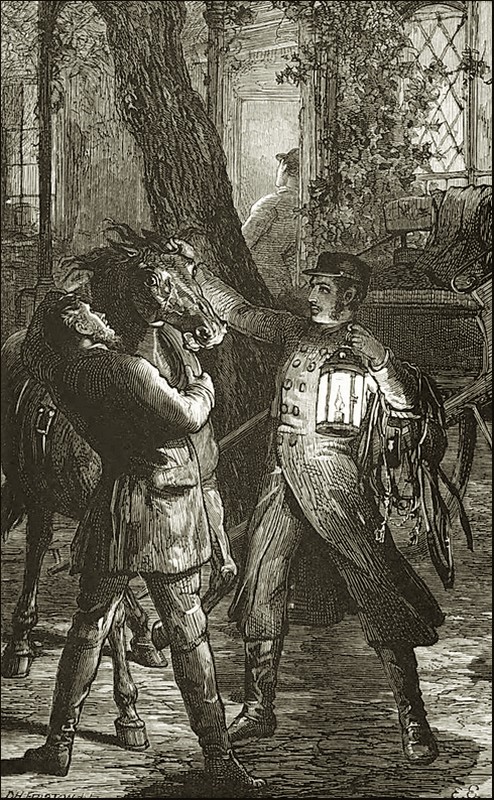
"Perhaps, after all"—he went on pulling the mare's mane from
underneath her head band—"perhaps after all Redworth had not
any money about him: he may have paid it away in Cadlebury.


N a fine July morning, in a certain year of grace, Mr. Jeremiah Redworth left his house, situated in Dorking Street, Ludham, with the intention of proceeding to Cadlebury, distant, as the crow flies, some eight miles.
As no road, however, in that part of Surrey, does follow the crow's flight, Cadlebury, to all practical intents and purposes, is a thirteen or fourteen miles' journey from Ludham.
A journey across country, too, impossible by rail, save by making a considerable detour, and by calculating with much nicety the arrival and departure of corresponding trains.
For a man of his years, the distance might have seemed excessive to those who did not know that Mr. Redworth boasted he could do his twenty miles a day with the youngest fellow in the parish.
Over his head time had passed lightly; life for him had held wonderfully little trouble. Never had it been necessary for him to work too hard, or think very much, or sorrow over deeply; nature, when she created him, omitted from his constitution keen susceptibilities. loving sympathies, quick impulses; and the circumstances of his career, so far from supplying natural deficiencies, tended to deepen and harden every original trait.
Misfortune had spared and sickness overlooked him; never had it been necessary or indeed possible for him to mix freely among all sorts and conditions of men. From the small world of a government office he retired to the smaller world of a sluggish country town, where he occupied the late leisure of his existence by turning his money over to good account by making small investments, by interesting himself in local matters, and laying out plans for his own future and for the future of those who should come after him.
When a human being is so constituted that, practically, he scarcely understands the meaning of suffering, sorrowing, or repenting, the years as a matter of course deal gently with him, and at seventy, Mr. Redworth, who had scarcely known what it was to have a day's real sickness since his teens, did not look so old, and in many respects really was not so old, as men little more than two thirds his age.
In a district where rheumatism racked the bones of quite young people, Mr. Redworth never experienced ache nor pain. Bronchitis had no terrors for him, and the members of his household could not remember that he had ever suffered from a cold in his head.
He was rarely out of bed after eleven p.m., or in bed after half past seven a.m. Nothing could induce him to wear a top-coat, or a wrapper round his throat.
"Thick boots and plenty of exercise!" was his motto.
"If you wear thick boots and take plenty of exercise," he remarked, addressing society generally, "you need never be ill, and you may live almost as long as you like."
Ludham accepted this statement, as it accepted many other dogmatic observations uttered by the same gentleman, without contradiction, and it is not on record that anybody ever asked him what the poor wretches were to do who could not wear thick boots or take plenty of exercise.
Mr. Redworth was in the enviable position of not only being able to make his own laws, but follow them.
There were few theories he chose to advance, that if it pleased him he might not carry into practice. In his own way he was as absolute an autocrat as the Czar of all the Russias, and if he ruled his subjects gently and with a fair amount of generosity, such admirable results were certainly owing less to the system than to the man.
Standing on the pipe-clayed steps leading to his own hall door, for instance, the morning when he left his house in Dorking Street for the last time, neither of the ladies who accompanied him to the threshold with the kindly desire of "seeing him off," ventured to ask when he might be expected home.
Long previously some unspoken law had been laid down that the head of the establishment was not to be questioned, and consequently the members composing his household, like good children, "waited to be told."
Concerning his goings and comings it is therefore to Mr. Redworth's credit that he made no secrets; and many persons will consider it to his praise that regarding his affairs he was silent as the grave.
Thus, although Miss Redworth, his daughter, and Miss Gower, second cousin of his "admirable and lamented wife," had been told overnight that, "if fine, he intended walking to Cadlebury the next day," they were utterly ignorant what he meant to do when he got there; and when standing in the morning sunshine, his hat well brushed, his coat free from speck or stain, his linen spotless, his boots brightly polished, and his umbrella tightly furled, Mr. Redworth said to his daughter—
"You need not expect to see me back much before nine, Amelia." Amelia had no more knowledge than the dead lying in Ludham Churchyard how her surviving parent meant to improve the fleeting hours of that summer's day.
Afterwards Miss Gower remembered that, contrary to his usual habit, Mr. Redworth lingered for a minute on the step before taking his departure. At the time it did not strike her as anything extraordinary, that he should have stood smoothing the wrinkles out of his gloves, and looking up at the sky ere crossing the street, and walking in his gentlemanly manner out of the town, but subsequently she recollected he had done so.
"I think I shall go by the canal," he remarked, as he moved away irresolutely, and then paused once again.
"You will find it much cooler than the road across the heath," observed Miss Gower.
"Yes, much cooler," he agreed; "and pleasanter," he added, swinging his umbrella.
Having made that further observation, he looked down on the pavement, took another irresolute step, then quite suddenly, saying to daughter and niece—
"Goodbye, for the present, my dears," Mr. Redworth walked out of their sight for ever.
MR. REDWORTH had married before he was thirty, and there were now two of his sons settled in London—men verging towards middle age, men with grave faces and staid manners, possessed of wives and families.
The ex-government clerk had done well for them, given them good educations, placed them early in suitable situations, managed to get them subsequently into good business houses, and when the chance of desirable partnerships fell in their way, assisted them wisely and economically to the fulfilment of their wishes. When in due time the young men beheld young women sufficiently fair, and possessed of a little money in the present, and the chance of more in the future, Mr. Redworth once again came to the front, enabled them to buy a couple of houses in a convenient neighbourhood, helped them considerably in the matter of furniture, and, in a word, started them almost unweighted in the race of matrimony.
Both Trenhill and Gower were very good sons of a very good father; neither, it may be safely said, had given an hour's real anxiety in their younger days, and now, when they were no longer young, but men with assured positions in the mercantile world, men safely prosperous, and well able to provide for the families growing up about them, Mr. Redworth might have been excused had he referred to them in a tone of conscious pride, and informed acquaintances, with a certain triumph, that Trenhill Redworth, partner in the house of Basing, Hull, and Redworth, bacon factors, Tooley Street, and Gower Redworth, junior in the firm of Morris and Redworth, bone crushers, Bermondsey, were his two eldest born.
But Mr. Redworth did nothing of the sort. Perhaps it would be going too far to say that in his later life Mr. Redworth felt ashamed of the bacon warehouse and the bone-crushing factory, but undoubtedly he never alluded to either with enthusiasm.
While he was struggling, while he felt, with all the economy he could there may be some difficulty in meeting rent and taxes, paying tradesmen's bills, providing for the proper education of a growing family, and making provision for those left behind in case of his premature death, Mr. Redworth, being unable to indulge the solitary weakness his nature knew, had, with laudable common sense, invested his song, so to speak, in the stock most likely to return a sound and safe dividend.
Since they left school they had not really cost him a penny. While in situations they had received sufficient, if moderate salaries, and for all moneys afterwards advanced they paid him interest at the rate of five per cent.
He had been generous enough to give them a hundred pounds a-piece the day they were married, and the furniture he personally presented to the respective wives might perhaps have amounted to three hundred more; but these things had been of his own free will; and as his sons were always sending him parcels and hampers directed to Ludham station, South Western Railway, carriage paid, it may be assumed that even for that five hundred pounds he had an ample return.
And yet no one ever heard Mr. Redworth speak with effusion of those good citizens, Trenhill and Gower, any more than any man living had ever known him talk with softened voice and smiling face, of—
"My daughter Amelia."
Mr. Redworth, like each among us, had his weakness, and in his case it took the form of—birth.
It was a natural foible, no doubt, in a man who, having risen from nothing, had for years and years of his life been thrown in contact with people who owed everything to connection—who visited at houses, the doors of which were closed to him—who claimed relationship with Lord This and the Duke of That, who had the ways and the manners and the habits of the Upper Ten, and who looked down on trade and tradespeople with an ignorant contempt which to anyone capable of seeing and appreciating the humour of the position, would have been enjoyable in the extreme.
Mr. Redworth, could not enjoy the joke, and suffered in consequence.
The nephew of a woollen-draper in a country town, foisted into a Government office by the influence of a member of Parliament, "Society" to him meant something on the other side of a perpetually-closed door—Paradise—Heaven—if the readers have no objection to strong language.
This story has to deal so little with what the man was, that it is unnecessary to devote space which might be otherwise employed in telling how young Jeremiah modelled his manners upon those of young Tremaine, tied his cravats after the fashion of Gervais, modulated his voice like Howards, and endeavoured to walk like the Honourable major Helleric, chief, in Redworth's calf-days, of his department.
Coming from the most humble stock, he worshipped rank, for which reason he ignored the city, and said as little as he could avoid about the sons who were earning their living honestly and hardly in Tooley Street and Bermondsey.
He had married his wife for the sake of her "family." Happily for him he never knew the ins and outs of that deceptive pedigree.
The real state of the case was this: once upon a time, a hardworking man of the name of Gower rented a farm within walking distance of a garrison and cathedral town in the far west of England.
He had many fair daughters, and amongst them one fairer than all, called Amelia, who, attracting the notice of a certain Major Cartress, left her home, and was secretly married to the officer in question. Eventually a scandal arose about the business.
It was said, and with justice, that Miss Gower's husband had been guilty of bigamy—that she was not his first wife, and that if she liked to proceed to extremities, she could send him to prison.
All this occurred at a distance from Miss Gower's parental home, and close to the parental home of Major Cartress's first wife.
To the rescue came Jenkins, Mrs. Cartress's father, a gentleman accustomed to look upon everything from a pound-shilling-and-pence view.
"Now look here," he said to Mrs. Cartress number two, "we know the fellow is a scoundrel, and that he richly deserves prosecuting; but how will prosecuting him serve you? If he were snug in jail tomorrow you could not be more free to marry somebody else than you are now. As regards supporting you, even if he had any money—which he has not—you could not compel him to make you any allowance. Now I'll tell you what I am willing to do if you choose to keep yourself quiet. Leave the management of the affair to me, and I will write you a cheque for a hundred pounds, and pay you twenty-five pounds a year so long as you remain unmarried. You need not decide today. Perhaps you would like to consult your friends. At all events, take no step you cannot recall till after you have thought the matter over."
Miss Gower did think the matter over, and discovered that what Mr. Jenkins said was perfectly true. The business was a bad one, but an exposure could not mend it. To her it had been a great glory to call herself the lady of a Major, but life with the Major was not, after the honeymoon, destitute of troubles.
A very shrewd and a very sensible woman, she decided to accept Mr. Jenkins' offer if he would agree to change its terms.
"I think," she said, "I could make a boarding-house pay in London. Enable me to purchase or start one, and I will never ask you for another shilling."
"Very well," agreed Mr. Jenkins, after a minute's hesitation. And the same day she left Manchester for London. Arrived there, she dressed in widow's weeds, and commenced her metropolitan career in the character of a lady whose husband was dead.
Ere long, in point of fact, Major Cartress did actually die, and none of her new friends ever suspected there had been anything awkward about the lady's marriage.
She experienced no difficulty in stating where the ceremony took place, and the name of the officiating clergyman. It was impossible for her dearest crony to hint at the existence of any mystery about her. Had it been necessary to show her "marriage lines," she could have taken them at once out of her desk, and with them the certificate of baptism of Amelia Laura, daughter of Major Frederick Cartress and Amelia his wife.
As years went on, she talked more and more of the "reduced circumstances" in which she had been left, and of the struggles she had been obliged to make in order to maintain herself and child.
About the same time she began to find it pay to allude frequently to "the Gowers," and to make constant mention of "Trenhill, my father's property."
Poor old Mr. Gower had gone to a world where anxieties about rent-days, and the failure of crops, harassed him no more, and there was not the slightest fear of that stalwart farmer bringing his horrid fustian between the wind and her nobility.
Mrs. Cartress had been a beautiful girl, and as she developed into a very handsome woman, the friends of her later life, who heard references to "the Gowers," and were treated to many touching reminiscences of "Trenhill," were wont to declare that anyone could see the lady had come of distinguished people. "Her features are quite aristocratic," they never failed to add, "and her manners noble."
Eventually, there can be no doubt Mrs. Cartress herself came to believe she was in some way related to the members of a certain titled house.
Prints representing several of them graced her walls, and the widow often said, with a sigh, "It is heart-breaking to think how far the branches of good families sometimes droop."
"The anomaly of a Gower keeping a boarding-house," she often remarked, with what her admirers called "a queenly gesture."
"It is always those the best born who struggle most bravely against adversity," was another of her utterances. Indeed, in the course of years, she acquired a sufficient number of these sayings to enable her effectually to garnish her conversation with them.
As for the daughter, growing to womanhood, if the blood of all the rightful Gowers had flowed in her veins, she could not have been prouder of her pedigree. Trenhill, to her imagination, was a ducal residence, and her grandfather, she firmly believed, had been a fine old English gentleman.
"She takes after my poor husband in looks," Mrs. Cartress frequently observed. "She doesn't in the least resemble the Gowers."
Knowing a young fellow who boarded in the house of this reduced gentlewoman, Mr. Redworth was brought into contact with his future wife, and it is satisfactory to be able to state that, till the hour of his death, he was never disillusioned on the subject of Miss Cartress's ancestry.
If Miss Cartress had stepped across the threshold of Dunrobin Castle to become his bride, Mr. Redworth could not have felt more certain that she was a relative of the owner.
It was a harmless fancy, and one which tended greatly to his happiness, and as Mrs. Redworth kept herself a little aloof from general society, every one who was thrown in contact with the lady, firmly believed Mr. Redworth's statement that she had come of very great people indeed.
After his two eldest sons were placed in those houses in which they eventually became partners, a great change took place in Mr. Redworth's circumstances. The woollen-draper, then an old man, died intestate, and to the thousands he had put by, and to the goodwill or his business, Mr. Redworth, in default of any nearer relation, succeeded.
It is unnecessary perhaps to say that with all convenient speed the goodwill of the business was disposed of, and Mr. Redworth, banking the amount of the purchase money as well as the thousands already referred to, began to look about him for suitable investments.
At this time his family consisted of only four children; one had died in infancy, and two were carried off by fever in the teens.
Thus there was a gap of ten years intervening between Miss Redworth and her youngest brother John Morrison Redworth, whilst a still wider interval stretched between his "old" brothers and the "boy."
On this lad, this Benjamin, Mr. Redworth expended all the hope and pride of his nature.
As harassed mothers, to whom infants have come so fast that before one can walk another requires to be hushed and tended, say pathetically they have never been able to "enjoy" a baby, so Mr. Redworth, who had always kept up appearances and done his duty towards wife and children, and found both often a struggle, knew when his uncle's money rendered life quite easy to him, he had never got much pleasure out of any one of his sons till curly haired, blue-eyed John began to go to school and bring home his little prizes.
Hitherto everything connected with the Redworth family had of necessity been almost strictly useful, but John, his father determined, should be ornamental as well.
He inherited all his grandmother's beauty, he was quick, and bright, and clever, and he had cast back to some remote ancestor, perhaps to one of the remarkable Gowers, for a temper which seemed incapable of being ruffled—sunny, cheerful, and unselfish.
No greediness or grasping, no envy or jealously about that curly-pated little lad, no dangerous instincts lurking in the depths of his dark blue eyes—a good truthful merry boy full of noble and generous impulses, a boy of whom any father might have been fond and proud, a favourite with servants, and teachers, and visitors, and school fellows.
If his brothers were not quite so fond of him as other people, it was because they felt they too were possessed of admirable qualities, which the world should have been equally swift to recognise.
Naturally also they contrasted the Spartan severity of their training with the many indulgences granted to this Benjamin of the household.
"Our father will rue it all day," they often said, shaking their prematurely old heads over their parent's folly; and yet, despite this jealousy, they sincerely loved the boy with a faithful brotherly love calculated to stand much wear and tear.
What projects that father built upon that son! All his own life had to him almost unconsciously lacked was to find fruition in the future of his youngest born.
John should be not merely a great man, but also a great gentleman. There was no height to which in imagination Mr. Redworth did not sometimes climb when considering John's possibilities.
Had not the boy been born with the typical spoon in his mouth?
Which of his other children found wealthy sponsors who gave costly gifts to the infant for whom they so solemnly renounced the world and a few other sinful items?
The silver mug, the silver knife, fork and spoon, the coral and bells—were not these things laid up as evidences of how fortune had smiled upon the lad's birth?
In itself, John Morrison might not, Mr. Redworth considered, be a desirable name, but when accompanied with many tips, and the prospect of a fine legacy, it became not merely bearable but poetical.
What puzzled Mr. Redworth most was the choice of a profession. To such a prodigy there were so many open.
To be Lord Chief Justice, for instance, was not a bad kind of thing. A Bishopric, too, presented an eminently desirable sort of opening. About the post of Prime Minister there was a certain instability, which to Mr. Redworth had its drawbacks; but still if his son made that goal his ambition, he would not object.
"So much," he was wont to remark, "depends upon the bent of a young man's mind," which indeed, so far as John Morrison Redworth was concerned, proved terribly true. Everything depended upon that, and yet while he was still in his teens, everyone except, perhaps, his father knew the lad's mind had no bent at all.
"If he had only been put to business early!" sighed his brothers, overlooking the fact that if he had been put to business from his nurse's arms, he never would have compassed the successes they achieved; that no matter what his training, nature must have proved too strong for art, and rendered him just as unfit to become a prosperous merchant as to grapple with the difficulties of statesmanship.
But his father considered him perfection, and believed all the shortcomings of his career were attributable to the scurvy treatment accorded him by that shocking old hypocrite his godfather.
"Always led us to suppose John should be his heir, always treated him like his own son, sir. Everyone believed him to be an old bachelor; but when he died there was a wife with half-a-dozen children ready to swallow up the property. Not a sixpence to John—he was not thought worth even the scrape of a pen."
THE long summer day passed slowly away. Miss Redworth, who, since her mother's death had presided over her father's establishment, looked after such household details as required her supervision, and then joined Miss Gower, who was engaged in the harmless occupation of crocheting an elaborate antimacassar.
Miss Gower was a relation of the deceased Mrs. Redworth, and as such very dear indeed to the widower's heart. A certain James Gower, son of the Trenhill farmer, had at an early age gone to Canada to seek his fortune, and this Hilda Susannah, so skilful in all kinds of delicate needlework, was his granddaughter. A correspondence had always been maintained between James and his sister Mrs. Cartress, and that epistolary acquaintance, kept up after his death between the younger members of the family, was sufficient, when Hilda was left an orphan with only a moderate dot, to render her being consigned to England and the care of so respectable a gentleman as Mr. Redworth, as natural as under the circumstances it happened to be expedient.
Not handsome like her far-off relative Mrs. Cartress, or pretty like her own mother, or stately and dignified like Mrs. Redworth, Miss Gower nevertheless was possessed of charms which appealed to the tastes of most of the Redworth family.
Pallid of complexion, slight of figure, with features small and fairly well cut, she appeared to Mr. Redworth an eminently genteel and good-looking young woman.
She never became red with heat or blue with cold; her hair was always perfectly smooth and her dress eminently neat. Her collars, and cuffs, and gloves could not have been smoother or more free from crease or crumple if she had been a lay figure. Her jacket was never dusty, her feathers were never out of curl. When you had seen Miss Gower once you had seen her always. However fashions might change, and what the latest mode she affected, you felt she must have been similarly attired for years. There was never any novelty about her, or, for that matter, any antiquity either; a young old woman, with self-possessed manners; never excited, never very sorrowful, never very glad, never certainly lively, and never greatly depressed; dowered, as poor Mr. Redworth imagined, with that repose which "marks the line of Vere de Vere;" in the eyes of Miss Redworth and her brothers a very superior girl indeed, but who might, to persons accustomed to wider views of humanity, have seemed singularly self-contained and inscrutable.
Such as she was, Mr. Redworth destined her for his youngest son. Some day, it was quite understood—it had always been understood—that Miss Gower and John Redworth should, as the ex-government clerk tersely expressed the proceeding, "Make a match of it."
"A wife any man might be proud of," remarked Mr. Redworth; "fit to ride in her carriage; and who may ride in her carriage some day, who knows."
Of course no one could venture to prophesy what might occur when that vague some day arrived; but there were not wanting persons who said positively unless Mr. Redworth left his son very well off, that young gentleman would have to proceed through life in a somewhat more modest fashion.
Long before the world—the Redworth world I mean—had decided that John Morrison Redworth would never achieve greatness—that he was not very clever—that he was inclined to be extravagant—and that he had not a bit of industry in his nature.
In this case the world's verdict was true, and Miss Gower knew it. And yet Miss Gower loved him. So far as it was in her nature to love anything, Miss Gower loved her handsome, good-tempered, debonair cousin with all her heart.
Someday also she believed he would love her, and meantime there was no one else; of that she felt quite certain. He was still fancy free, he cared for nobody; she was sure she had not a rival in the world!
The day wore on. After partaking of a seasonable repast, at which cold lamb, mint sauce, a cool salad, and some raspberry tarts occupied the chief places of honour, Miss Redworth and Miss Gower proceeded in the glowing heat of a July afternoon to pay visits. Then they had a little walk by the river, and strolled back across the town meadows to Dorking Street.
"John will be at home before us," remarked Miss Redworth, stifling a yawn.
"Yes, I heard his train come in some time since," answered Miss Gower.
Never having discovered whether the bent of his mind inclined to the Episcopal Palace, or the leadership of the House of Commons, John Redworth had, pending the development of any decided taste, permitted himself to accept a "post under Government."
In a word, he was at five-and-twenty a clerk, as his father had been before him; with this difference, that he did as little work as he could; that he was spending more than his salary, and that he had not the faintest idea of trying to do anything better in life than to lounge through it.
He was asked, however, to many parties. Young men of good family called him "Jack," and "Redworth," and, to a certain extent, made him free of their own rank, whatever value such freedom might confer.
Very different, indeed, was he from his brothers, the steady and respectable City merchants; and if his father chafed sometimes at his want of application, he exulted in the son, who, so far as appearance and manner went, "might have been heir to the Crown."
At Ludham the inhabitants knew very little indeed of the habits of courts, or the tastes and ways of princes, and Mr. Redworth's statement was therefore received without contradiction. Ludham, however, had got an inkling that Mr. John Redworth was going to the dogs, but it did not care to tell his father so.
When the two ladies reached home they were informed that Mr. John had not come back.
"He will be down by the next train," said Miss Redworth; "shall we wait tea, dear?"
"By all means," agreed Miss Gower, and so after she had taken off her bonnet and laid aside her jacket, and pulled out her gloves finger by finger, and smoothed her ever-smooth light hair, the young lady descended to the drawing-room, and resumed the manufacture of that antimacassar which day by day grew in size and beauty.
The "next train" had been in some time, and still John Redworth did not come.
"I think we had better have tea, dear," suggested Miss Redworth, consulting her watch.
"Just as you like," answered Miss Gower.
Miss Redworth did like, and so the ladies went into the dining-room, where there were a great many flies, and partook of tea, which was always set out in that dreary apartment.
Mr. Redworth had no patience with people "lolling about" at meals, and the tea-table was therefore invariably spread with mathematical accuracy, chairs being ranged round the festive board, as though the family were above to have a regular dinner.
Thus laid it was a somewhat dismal repast for two persons, and so apparently Miss Gower felt, for she sipped her tea indifferently, and crumbled a biscuit idly, whilst the flies came and went, and the noise of rattling conveyances sounded through the open windows as though carts and cabs were rushing through the room. Children at their play screamed and shouted on the side paths, and there did not seem a breath of fresh air stirring in all the land.
"I wonder where John can be," marvelled Miss Redworth.
"Gone to spend the evening with some friend, I dare say," said Miss Gower; "but it is strange he did not telegraph."
John Redworth had a way of telegraphing. It saved much trouble and prevented useless conjecture.
"Shall we go up to the drawing-room?" asked Miss Redworth, when the decorous meal was concluded.
"Yes," answered Miss Gower, and after having uttered that monosyllable she returned to her crochet work.
Almost in silence for some time the two ladies continued their respective employments.
In that establishment there was never much of the pleasant chatter which obtains in some families. Decorous, respectable, well-ordered, well-managed was the little household over which Miss Redworth presided, but lively—never.
Gaiety is not the distinguishing quality of some homes. Gaiety certainly was about the last sin which could be laid at the door of the Redworths.
"Papa will soon be back now," said Miss Redworth at length.
"It is past nine," said Miss Gower. "I suppose he meant to return by train. Hark! There he is."
But Miss Gower was wrong. The latch-key she heard thrust into the lock belonged not to Mr. Redworth, but to his son, who was greeted over the banisters by his sister—
"Why, John, is that you?"
"Yes, Amy. Late, am I not?"
"We thought perhaps you had gone off for the evening."
"No. I only went on to Cadlebury."
"To Cadlebury? Did you see anything of papa?"
"Nothing."
"How wearily you speak, John," remarked his sister. "Have you had tea?"
"I don't want any tea, thank you."
"Should you like some supper now, or will you wait till papa returns?"
"Where is the governor?" asked the young man, coming up the staircase.
"Where? Why, he told you this morning he was going to Cadlebury."
"Did he? Oh, yes, I remember. Well, is he not back?"
"No—not yet."
"What on earth can he have found to occupy him all day at Cadlebury?"
"I don't know. He said we need not expect him before nine o'clock."
"Then he meant to return by the train which brought me. He can't be here now till half-past ten."
"Perhaps he is walking back," suggested Miss Gower. By this time they were all in the drawing-room together.
"I should think that would be too much of a good thing, even for him," said the young man, throwing himself into an easy-chair. "By Jove! How hot it is!"
"Won't you have a glass of wine?" asked his sister. "You seem quite knocked up. Why did you go on to Cadlebury?"
"Oh! I wanted to see a fellow down there, and I thought I could have been home long ago. Yes, Amy, I should like a glass of wine, please. If you give me the keys I can get it for myself."
But already Miss Gower was at the door, and half-way down the stairs.
One of the delights of her life was to minister to this young man's wants. One of the greatest pleasures of her monotonous existence was to hear him say, "Thank you, Hilda," or, "You are far too good to me," or, "You really make me feel ashamed of my laziness." She brought up the wine and some biscuits, and, pouring out a glass of sherry, carried it to where he sat.
As she did so she tripped over a footstool, and, to save herself from falling, laid a hand upon his arm.
"Why, John," she exclaimed, "your sleeve is quite wet."
"Wet still, is it?" he said carelessly, and yet colouring a little as he spoke. "I thought it would have been dry long ago."
"What were you doing to get your sleeve wet?" asked his sister. If it were a rule of the house that Mr. Redworth's proceedings were beyond question, the same tolerance was not extended to the actions for any other member of the family.
"I was getting something out of the water," he answered.
"Why, John, how odd you are tonight," exclaimed Miss Redworth. "What was the something you were getting out of the water?"
"Ah! That is my secret," he replied, with an uneasy laugh. "Can't you let a fellow have some peace, when he comes home badgered and worried. Look here, do you want any money, either of you? For a wonder I have got a lot—behold!" and he pulled some gold out of his pocket, and let the sovereigns fall from one hand into the other, with a pleasant gliding melody.
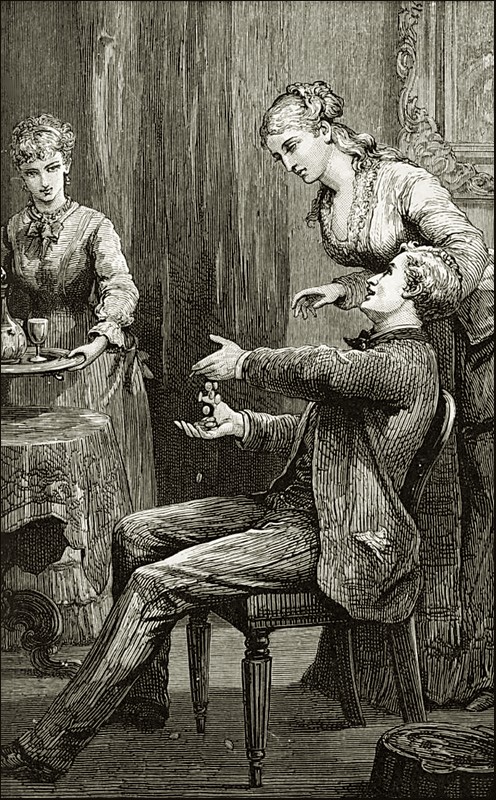
he pulled some gold out of his pocket, and let the sovereigns fall
from one hand into the other, with a pleasant gliding melody.
"My dear John!" cried out his sister.
"How rich you are, all of a sudden," observed Miss Gower.
"Yes—for a wonder a horse I backed won, and this is the result. Now, girls, what shall I buy for you? Don't be modest, Amy. Speak up, and declare what your feminine soul most longs for."
"That my brother should be wise and give up betting and save his money," said his sister, earnestly. "Oh, John! How I do wish——"
"Like a dear girl, don't begin preaching to me tonight. I'm tired to death. I have been running about all day. If you don't mind, I think I will go to bed. I suppose I ought to sit up to remonstrate with the governor about keeping such late hours—but I'll let him off for this once."
As the door closed behind the young man, the two women looked at each other.
"I wonder what is the matter with him," said Miss Redworth.
"I wonder why he went to Cadlebury," said Miss Gower.
JOHN REDWORTH had never achieved a reputation for early rising or regularity of any sort. In a house where punctuality was the rule, he proved the exception. Housemaids had to tap several times at his door before he evinced the slightest intention of turning out of bed, and his sister never expected to see him till she was pouring out second cups of coffee.
For this reason Miss Redworth looked surprised when, on the morning succeeding his visit to Cadlebury, her youngest brother entered the breakfast-room even before the kettle was brought up. Such an event had not taken place since she assumed possession of the household keys, and naturally she felt a surprised astonishment at its occurrence.
"I went to bed last night as such an unearthly time," he explained, somewhat sheepishly, as though not being late for breakfast was a thing any man might feel ashamed of. "Is not the governor down yet? At what hour did he turn up last night?"
"He never turned up at all," answered his sister. "I wish, John, you would not call him 'governor;' it does sound to me so disrespectful."
"My dear girl, there you are quite wrong. 'Governor' is a term of the highest respect. And so he didn't come home? What little game can he have on hand? It won't do, Amy. We must not permit this sort of thing to continue. We shall hear of the dad getting into all sorts of scrapes. It will be necessary for me to speak to him seriously."
"I did not go to bed until nearly two o'clock," said Miss Redworth, a little complainingly.
"You look as if you hadn't been to bed at all," answered her brother, with fraternal frankness. "Eyelids heavy, cheeks pale, and that sort of thing. Sitting up o' nights does not agree with your style of beauty, Amy. And the fair Hilda Susannah, did she sit up also?"
"Yes, it was natural, considering papa's regular habits, we should feel a little uneasy."
"No doubt; when a gentleman of his age takes to evil courses, matters do look serious."
"John," said his sister—by command of Mr. Redworth the young man had been called John by his family since he was a baby, never Jack—"try not to be absurd for a minute—don't laugh at me. I want to ask you a question. Do you think any accident can have happened to papa?"
"Accident," repeated her brother, "what kind of accident could have happened to him?"
"That is what I cannot imagine."
Mr. John Redworth thrust his hands deep in his coat pockets, walked to the window, and then walked back again.
"If the train had smashed up we should have heard of it," he said, after a moment's reflection. "Father always goes about the world labelled like luggage. Card-case, pocket-book with name and address printed on it, linen marked, a few letters directed to Jeremiah Redworth, Esq., invariably upon his person. No, Amy, you need not be uneasy. Ill news, you know, travels fast, and ill news about the governor would have come home like a shot."
"And yet still, John, I cannot help feeling uneasy. I have a sensation of something being amiss, which I am unable to shake off. Last night, or rather this morning, when I went upstairs to bed, it seemed to me as if there was someone lying dead in the house. Do you know, I felt so nervous, I was almost afraid to go into his room as I passed, and while I lay awake—for I could not sleep—I could have declared I heard him walking about as he does when he is dressing, and opening and shutting the drawers. You will think me very foolish, but I cannot get over my fancy that something has gone wrong," and, as if to emphasize her statement, Miss Redworth covered her face, and sobbed aloud.
To do him justice, John Redworth looked sorry and sympathetic.
"Poor Amy," he said, kneeling on one knee beside his sister, and putting an arm affectionately round her neck, "you ought not to have sat up so late. What a brute I was to go to bed and leave you to do work you are so little used to. See how undesirable a virtue regularity is," he added, speaking in his usual tone. "Because, for once in his orderly life, the governor fails to return at the time appointed, you at once imagine something dreadful must have happened to him; whereas if I were to remain away for days, you would say, 'Oh, he's sure to come back all right. No need to be uneasy about him—one never can get rid of a bad shilling.' Moral—don't marry a punctual man, Amy. Ah! Hilda, you're just in time to hear the pith of my sermon. If you desire to keep a quiet mind, and to live to a good old age, never select a husband like the governor. Here is Amy crying fit to break her heart because he did not come back last night at nine o'clock, for all the world as if he were housemaid in this strictly respectable establishment."
"It does not strike me as a laughing matter," answered Miss Gower, somewhat crossly. "Fifty things might have happened to your father."
"Of course they might, my dear," retorted the young man, "and one of these days the sky might fall, but I do not think that is likely."
"If you could be serious for a minute, John, I should like to ask what you consider we had better do," said Miss Redworth.
"Do!" repeated her brother, "what on earth do you mean?"
"About papa not coming home, of course."
"I should suggest employing the town crier," answered her brother. "How pleased the governor would be to hear, as he came along Market Street, old Williams ringing his bell and shouting, 'Lost, Stolen, or strayed—Jeremiah Redworth, Esquire.'"
"I suppose you think all this very funny, John," remarked Miss Gower, "but I confess your mirth strikes me as ill-timed. At your father's age so many accidents may occur."
"A good many accidents may occur to a man at any age," said Mr. John Redworth, dryly.
"I wish we could hear something about him, though," exclaimed Miss Redworth.
"Pooh! My dear," cried her brother, "you will have the governor marching in here directly, cool as a cucumber, and fresh as a daisy, after a fourteen miles' walk, and when you tell him you felt uneasy about his absence, he will say—
"'Business detained me,' or 'I met an old friend, and we partook of a simple dinner at the "White Stag," where I slept. You need never be uneasy about me, Amelia.'"
Having delivered himself of which imitation of his father's curt utterances and pompous tones, the young Redworth finished his breakfast in haste, though there was, for a wonder, abundance of time and to spare before his train started, and saying he thought he would be off, rose from the table and departed.
"He is like all men," commented Miss Redworth, "selfish and unfeeling."
Miss Gower answered nothing. Toying with food, to which she brought no appetite, her heart was singing a dull refrain—
"There is something the matter. Why did he go to Cadlebury, and what had happened to detain my uncle?"
Both questions were destined to be repeated by other people, besides Miss Gower, before many days had passed.
In the chain of circumstantial evidence so soon to entangle John Redworth's future life, that morning's restlessness formed no slight link. It had ever been his pleasant practice to reach the station breathless, to start running when the final bell rang, to dart into the first possible carriage—often as not into the guard's van after the train was in motion; but to be too soon, that never happened before in the experience of Ludham, and on the present occasion it proved once too often.
"Why, there's Jack Redworth. I must be off," said young Homer to his wife, leaving his breakfast almost untouched, and forgetting in his hurry, to kiss the baby and to take his gloves.
"There's that John Redworth," remarked Mrs. Straitlace to her husband. "You will be late again, Mr. S.; I wonder how it is that you never can be induced to get up at a proper hour in the morning."
"What has come to our clock," exclaimed Mr. Harris; "I told you I thought we were all wrong last night, Mary. It is of no use trying to catch that train now."
"Then you may as well have another cup of tea, and make yourself comfortable," answered his sister, placidly.
As John Redworth passed along the high Street, Mr. Nunn, the chemist, stood in slippered ease at his shop door, exchanging some mild words of wisdom with his neighbour, Mr. Hazeldine, saddler.
"Good morning, Nunn—good morning, Hazeldine," said the young man in greeting as he approached.
"Good morning to you, sir. Lovely morning, ain't it?" severally replied the worthies addressed; then, as their eyes followed his retreating figure, Mr. Nunn observed to Mr. Hazeldine—"Something must have happened in Dorking Street. It wants ten minutes to the hour yet, and the church clock is always striking the quarter after, when he passes to the train."
"Shouldn't wonder if the father and he have had a row. Sure to come some day. There are none so blind as those that won't see. If Old Redworth had not wilfully shut his eyes, he must have known long ago the pranks his hopeful son has been up to."
"It is a pity, too," observed Mr. Nunn; "for he is a fine young fellow."
"One of those fine fellows born with a capacity for bringing nobles to ninepences," said Mr. Hazeldine, who considered himself a bit of an orator, and had a reputation in the town for turning neat sentences.
Why that morning of all mornings John Redworth, so proverbial a sluggard, should have been unable to rest in his bed: why the preceding evening of all evenings he had gone to Cadlebury, were matters over which Ludham was puzzling its astute brains before the next new moon.
But as yet there was no thought of harm having come to Mr. Redworth; even the members of his own household, so far the only persons who knew of his absence, feared nothing worse than that an accident had happened—that a train had run off the rails—that he had been attacked by sudden illness—that he had met with some misfortune. It was in these and similar grooves that the thoughts of Miss Redworth and Miss Gower travelled, as they sat wondering what "could be detaining papa," or "when we shall hear anything of uncle."
"Though papa is so active, still he is not very young," remarked Miss Redworth; "and people do have fits and attacks of that kind away from home."
"You must not dwell upon such possibilities, dear," answered Miss Gower, smoothing the antimacassar over her lap, the better to catch the exquisite effect of the pattern. "Depend upon it, we shall either see him about dinner-time, or have a letter by the second post."
But the bright hours wore on—dinner-time came and passed—the postman's knock echoed down the deserted street, and still nothing was seen of Mr. Redworth, neither did any letter arrive from him.
About three o'clock there came a double knock at the front door.
"That's papa!" cried Miss Redworth, forgetting her parent was not wont to herald his advent in such fashion. "That's papa?" and she went on to the landing, and was halfway downstairs when she stopped disappointed. It was only some one asking for her father.
"No, sir, master is not at home," she heard the trim housemaid answer.
"Do you know when he will be home, my girl?" said a rich, jolly, well fed voice, Miss Redworth recognised as belonging to a certain farmer, who owned a considerable amount of land lying high above Ludham in a lonely region known as "The Wastes."
"No, sir, I don't," replied the housemaid a little stiffly, for she did not care to be addressed as "my girl," by a visitor in the hall of her master's house.
Such amenities, in her opinion, should be confined to Sunday afternoons, and to the young men she honoured from time to time with her smiles.
"Well, I suppose there is somebody in the house who knows when he will be visible," insisted the visitor. "Just step up and ask your mistress, Mary, my dear."
"My name ain't Mary, sir."
"All right, Sally then. Step up and ask your mistress. Servant, ma'am," continued the speaker, breaking off his address to the obdurate fair, and turning to Miss Redworth, who at this juncture appeared on the staircase; "I am just taking the liberty of inquiring when you might be expecting Mr. Redworth. I have a sort of appointment with him, and if I could see him this afternoon, why I shouldn't have to make another journey into the town tomorrow. And that is how it is."
"I am very sorry, but I really do not know when papa will be home. He went to Cadlebury yesterday morning."
"Yes, I know he was at Cadlebury," interrupted Mr. Garland. "I passed him yesterday evening on my return journey (I go to Cadlebury twice a week, you understand), and offered to give him a lift as far as the 'Dolphin,' but he would not have it."
"You passed him last night did you say, Mr. Garland; about what time was that?" asked Miss Redworth; and it seemed to the poor lady as if a cold hand were laid upon her heart.
Yes, not without reason had she been afraid. All her apparently groundless alarm had been caused by a sure presentiment of evil.
"Well, I couldn't say to a few minutes," answered Mr. Garland, "but it must have been nigh upon nine, for I didn't start from 'The Three Fighting Cocks,'—that is where I mostly put up, you understand, miss—till after it had gone the half-hour. Oh! It must have been later than that. I met Dick Winterly on the bridge, and he hindered me awhile, and it would take me better than twenty minutes to drive to Saul's Wood Corner. It must have been after nine."
"Perhaps Mr. Garland would take a glass of sherry, Amy."
It was Miss Gower who said this—Miss Gower, who, hearing voices in the hall, had come softly downstairs, and now touching her cousin's arm, looked with a quick, warning glance, first towards the kitchen and then in the direction of the dining-room. Miss Redworth accepted the hint at once. "How could I be so thoughtless as to keep you standing here, Mr. Garland," she exclaimed; "pray walk in and sit down; you must take a glass of wine."
"Well, thanks, miss," said Mr. Garland, whose normal condition was that of chronic thirst. "I did find it main warm driving over they Wastes; there is not a bit of shelter this time of day, the sun pours right down on every inch of the dusty road. If equally agreeable, miss, excuse me, but I see the spirits is there; wine always do turn sour on my stomach. Much obliged, I'll just put in the water for myself."
"Leave me to get out the things, Amy," said Miss Gower, gently pushing her cousin into an armchair; then, after placing brandy, water, biscuits, and a tumbler on the table, she took a seat herself and remarked—
"Mr. Garland, we are very uneasy about my uncle."
"Uneasy," he repeated, pausing in his employment of adding that modicum of water, which indeed, except as a matter of appearance, might as well have been omitted. "I am sorry to hear that; what has happened?"
"He never came home last night."
"Never came home! why, bless my soul, I passed him at Saul's Wood Corner on his way home."
"He has not returned, at any rate," said Miss Gower.
Mr. Garland took a draught of brandy and water, then he replaced the tumbler on the table, laid the palms of his hands flat on his knees, and remarked—
"Well, that's extraor'nary too."
"It is so extraordinary, Mr. Garland, that we do not know what to think of it," commented Miss Gower.
"Never come home, not at all!" said Mr. Garland, struggling to grasp the fact stated.
"We have never seen him since he started yesterday morning," put in Miss Redworth, speaking low and faint.
Mr Garland looked at her, and comprehension dawned upon him.
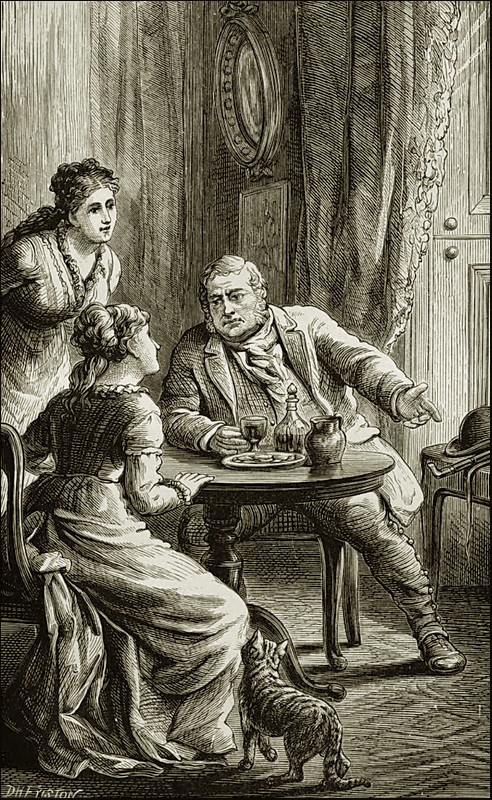
Mr Garland looked at her, and comprehension dawned upon him.
"No, no," he entreated, "don't you go for to be frightened like that. He'll be back soon, never doubt. Why, he was well enough when I left him, though he seemed a bit put out about something. There was nothing wrong with him, bless you. Take a glass of wine, miss. It'll do you good. She had better have a drop of something," he added, turning a look of helpless appeal, which but for the circumstances would have been ludicrous, towards Miss Gower.
"She had no sleep last night," explained that young lady, who knew all the wines in bond would not prove of much service at the moment to her cousin. "It was at Saul's Wood Corner, you say, you parted from my uncle? Three roads meet there, I think."
Mr. Garland nodded.
"Did you notice which he took?"
"Well, to tell you the truth, I did not, Miss," answered Mr Garland, helping himself uninvited to more brandy, and feeling that the exigencies of the position justified his doing so. "The upper road is not good for about a mile thereabouts, and the mare was fresh, and Mr. Redworth had put up my monkey a bit, and we parted a trifle short."
"Did you and papa quarrel then?" asked Miss Redworth.
"No, not by no means," explained Mr. Garland. "You see, miss, he was up in the stirrups, so to speak, rather on the high and mighty; and when a man makes another a civil offer of turning a good three mile out of his way to give that other a lift, why he don't take it kindly to have his nose snapped off, do he, ladies?"
"I daresay not," agreed Miss Gower: "but if you only would tell us exactly what passed, we should be so much obliged. We should know better what to think."
"For the matter of that, miss, there is not a lot to tell. I was driving along pretty sharp, for the mare she were fresh and keen to get home, and not thinking of seeing your governor—Mr. Redworth, I should say—along that road at that time of night, I had passed him before it occured to me who it was. Well, I pulled up, and a job I had with the mare to make her stop, and I backed her a few yards, and your father came along stepping out brisk as he always does, and so I said to him—
"'You are out late, Mr. Redworth.'
"'No, sir, it's not particularly late so far as I am aware.'
"He spoke quite nettled like, but I took no notice; I only said in a neighbourly way—
"'It is late, at any rate, for you to be ten mile from home. Jump up, and I'll give you a lift as far as the "Dolphin." I can just as well take the Trotterbeck Road home. The mare is not a bit tired, and we can talk over that small matter of business of ours as we go along.'
"'Sir', he said, 'you are very good, and mean well doubtless, but when I desire a conveyance I can afford to pay for one, and when I wish to talk with you on business, I shall select a more fitting time and place.'
"Well, this vexed me a trifle, ladies; I had not meant to offend him, and many as good a gentleman as your father has taken a lift and thanked me into the bargain, so I made the remark—
"'Something seems to have put you out, Mr. Redworth.'
"'Whether that be so or not, I apprehend'—yes that was the word he used, and it struck me at the time as queer, because I thought it meant something quite else—'I apprehend, sir, is no concern of yours.'
"That did cut me. It was more the way he said it than the words themselves. If I had been a beggar he could not have come more the tol-de-roy sort of manner over me; so I gathered up my reins and answered, short you know, in a 'good as I got' kind of way, you understand—
"'You are quite right there, whether you are tired or cross is no concern of mine, and I'm ——' (begging your pardon, ladies, for repeating the expression, but I was riled) 'if I make it mine. As regards that matter, however, in which I suppose I may venture to say I have some slight interest, I should like to get it settled one way or another, and I'd be obliged if you would name your fitting time and place for discussing Tomorrow afternoon,' he said, 'at my house in Dorking Street; three o'clock will suit me very well.'
"'I'm glad to hear anything suits you,' I up and answered, for indeed, ladies, he stirred my bile.
"'That will do, sir, good night, sir,' he said, with a wave of his hand; and not to be left behind in politeness, I took my hat off and made him a bow. There you have, I believe, all that took place. I don't think another word passed between us."
"What can have become of him?" conjectured Miss Gower, uttering her thought aloud.
"That's the puzzle," said Mr. Garland oracularly.
"I—I must do something," cried Miss Redworth, rising and laying her hand on the table "I can bear this suspense no longer."
Miss Gower had risen too, and they both now stood looking down upon Mr. Garland, who sat gazing with an expression of profound wisdom into his brandy and water.
"Did he seem—did you notice if he had been at all——" and Miss Gower's glance falling upon Mr. Garland's tumbler, supplied a finish to the sentence.
"I know what you mean," said Mr. Garland, half closing one eye in a manner indicative of genial comprehension. "Bless you, no, not a sign of it on him. Sober as"—"I was," Mr. Garland had intended to say, but a doubt of the fitness of the simile crossing his mind, he substituted—"the town pump."
"How could you ask such a question," remonstrated Miss Redworth, "when you know papa to be one of the most temperate of men?"
"Yes," answered Miss Gower, "and, as a rule, one of the most equable," which remark cut two ways.
"Look here, ladies," said Mr. Garland, who had at length eliminated an idea out of his tumbler, "would you like me to go to Cadlebury, and just take a look round?
"You've only to speak the word," he went on, seeing that they looked at each other, "and here am I, and there's the mare, both at your service. She won't mind the run over, bless you, and I'd feel it an honour, and I may add a pleasure, to do either of you a service."
Having finished which sentence, Mr. Garland once again, as if in utter absence of mind, helped himself to the contents of the decanter.
Had he refrained from showing himself this final mark of attention, Miss Redworth, in her despair, would have accepted his help. As it was she said—
"Thank you, Mr. Garland; but I think I had better telegraph to my brother."
"Ah, yes!" answered Mr. Garland, speaking sapiently, if thickly. "Most like he'll understand all about it. No doubt it was hearing of some of his pranks upset the governor."
"What do you mean?" asked Miss Redworth, surprised out of her usual slow reticence of manner.
"Oh, not much," replied Mr. Garland, "only I heard Mr. Purslet say yesterday, if the chance offered, he would give the old gentleman—your respected father, you understand, miss—a hint of Master Jack's going on."
"Goings on?" repeated Miss Redworth. "How has my brother been goings on?"
"Oh, I don't want to say anything against your brother, I am sure, miss. A nice, free, affable young fellow as anybody need wish to meet. But nobody can deny he does go the pace a bit too fast to be always sure; and now Mr. Purslet says he's getting himself mixed up with a girl. Nothing wonderful about that, you think, and you're right. There always is a girl—I have often remarked the fact as curious, myself."
Mr. Garland was in so pleasant and communicative a frame of mind that, much as the ladies desired to know all about this girl whom he mentioned, both felt afraid of leading him on to further revelations. As there was nothing, they felt satisfied, he would refrain from telling, it seemed all the more necessary they should refrain from asking.
Accordingly, they glanced at each other and remained silent, while Mr. Garland, misinterpreting such reticence, said, in a voice rendered genially husky by the weather, his potations, and his sympathy—
"Don't put any more questions, if you please. I should be loath to refuse you anything, but this is a matter I would rather not be mixed up in, if agreeable to present company. Mr. Redworth, supposing he sees fit, can tell you what Mr. Jack has been up to. But lor! young men will be young men, and I dare swear the governor himself had an eye for a pretty face and a neat ankle once upon a time. Only it's my belief it was hearing about that put your father's temper up last night. I have small doubt when I overtook him he had just come from Taunton Hall—been giving Black Dick a taste of his mind, most like, and a nasty taste, I expect, into the bargain."
"Black Dick?" said Miss Redworth, inquiringly.
"Taunton Hall? Where is Taunton Hall?" added Miss Gower, almost in the same moment.
"Why, Taunton Hall is that grim old house backing up against the canal between Saul's Corner and Cadlebury. It looks right over Wilderness Heath. And as for Black Dick, he's Squire Taunton—save the mark—and brother to the prettiest girl in Surrey, let that other be who she may—present company always excepted."
There came a change over Miss Gower as Mr. Garland finished his sentence. Always pale, she grew still paler; her lips, never red, became quite white; across her eyes there fell a shadow. Miss Redworth had not noticed it there ever before, and her voice seemed altered when she opened her mouth and said—
"Amy, if Mr. Garland will excuse us, I think we ought to telegraph to Trenhill."
Broad as the hint was, Mr. Garland might have failed to take it, had not Miss Redworth, after the slightest inquiry as to whether he would like any more brandy, removed the decanter from the table and locked it up.
"I hope you will pardon our leaving you, Mr. Garland," she said, as she took the keys out of the sideboard. "I really feel very uneasy about my father."
"If I can do anything for you, ladies," remarked Mr. Garland, draining the last drop in his tumbler, "you have only to speak the word. There's me, and the mare, and the trap, quite at your service."
But Miss Redworth did not speak the word, and Mr. Garland departed, to spread the news through Ludham, and round and about The Wastes, that Old Redworth was missing—"went to Cadlebury yesterday morning—has never turned up since, and there is the deuce and all to pay in Dorking Street."
MR. TRENHILL REDWORTH, seated in the pleasant seclusion of a dark office at the back of his warehouse in Tooley Street, received, while engaged in writing letters for the evening post, this message from his sister:—
"Something has happened about which I wish to speak to you. Come down by first train. Let nothing detain you."
Mechanically Mr. Trenhill counted the words of this telegram before devoting his mind to solving its meaning. To his business eye it seemed at first that his sister had needlessly exceeded the regulation shilling's worth. Satisfied on this point, he began to wonder what on earth Amelia could have to say to him.
She was not a woman of mystery, and if his father were dead, or stricken with paralysis, he believed no fear of shocking him would cause her to break the news in such a fashion as this.
"Get a South-Western time-table for July, and be quick about it," he said to one of his clerks; and, while the man ran off to do his bidding, he changed his office-coat for that he wore out-of-doors, brushed his hat, and marvelled "what was up."
"Surely my father cannot be going to marry again," he considered; and yet the idea took such hold of him, that when he looked at the time-table, and found that there was no train that he could catch to Cadlebury for another hour, he decided to drive to Somerset House on the chance of seeing his youngest brother, and ascertaining from him what was in the wind.
"Hallo! what brings you here—what has happened?" asked John Redworth, whom he met lounging out into the Strand.
"That is precisely what I want to know," answered the other, dismissing the cabman, and his remarks about the meanness of his fare, with a wave of his umbrella. "I have just had this message from Amy. Have you any idea what she means?"
John Redworth glanced at the paper. "I expect the governor has met with some accident," he answered. "He went to Cadlebury yesterday, and had not returned when I came off this morning. I was laughing about it before I left—laughing at the notion of his stopping out all night. I hope nothing serious has happened to the dear old chap."
"He has been a good father to you, John," said his brother, sententiously.
"Yes, he has, better than I deserve," agreed the young fellow, noticing, but not replying to the vague jealousy contained in the remark, "but don't let us stop here—don't let us even chance missing the next train. Amy might, I think, have been a trifle more explicit."
"You do not happen to know—that is, I suppose you have no reason to imagine he had any plan in his mind which might account for his absence?"
"I cannot imagine what you mean," was the reply.
"Well, coming along, and puzzling over Amelia's message, I began to wonder whether he was going to marry again, or anything of that sort."
"Governor marry again? That is a good joke," said the favourite son, laughing heartily at the notion. "What could put such an idea into your head, Trenhill?"
"I don't know. It occurred to me as possible, that's all. So you think there is nothing in it?"
"If the governor was up to any little game of that sort, he has kept it precious close. Still, there is never any telling what mischief a young elderly gentleman, with plenty of spare time on his hands, may fall into," and John Redworth laughed again at the expression of dismay on his brother's face. "If anything of that sort were to happen," he went on, "I suppose we would soon all get the rout."
"It would fall hardest upon you," remarked Trenhill.
"Yes, I suppose it would," agreed his brother.
In the full blaze of the afternoon sun they travelled down to Ludham in a train which, having been carefully placed out in the heat to bake, with all the carriage windows shut, seemed red hot to the passengers.
"Pheugh! How warm it is," gasped John Redworth, letting in as much air as is ever to be obtained at the Waterloo Station. "If we were loaves, what fine ovens these compartments would make."
It was cooler by the time they reached Ludham, and in that pleasant little country
town a gentle air, fragrant with the smell of hay, and the scents of roses and lilies, and clover and gillyflowers, came rustling through the trim clean streets, and met the passengers who had travelled down from the noise and dust of London to that rural spot, situated in the midst of green meadows, and surrounded by tranquilly flowing streams.
Somehow, after leaving the junction, both Trenhill Redworth and his brother grew more silent and more silent still. Something besides the calm quiet of the country fell across their hearts, and as the bustling little engine sped now across wide stretches of pasture land, and anon over bridges spanning sluggish rivers and the canal fringed with reeds and grasses of a strange and vivid green, both men seemed disposed rather to look away towards distant points of the ever-changing landscape, than to engage in conversation.
At length talk between them ceased altogether, and in utter silence they left the train at Ludham Station, and walked out into the street leading up to the centre of the town.
As they paced along, many a curious glance and word of wisdom followed them.
"That's the eldest son," remarked Mr. Nunn, the chemist.
"They've heard something, most likely," answered Mr. Hazeldine.
"I wonder if Mr. Redworth has returned," said another.
"Very probably he has been up in London consulting his sons there."
In the faces of all the persons who greeted him as he passed, John Redworth might, had he noticed their expression, have seen a look of suppressed excitement, inquiry and compassion. Every one felt there must be something very wrong. Mr. Redworth had been away all night, and, so far as they knew, two whole days in addition, and now there was Mr. Trenhill Redworth come down in answer to a telegram from his sister—all Ludham knew of the telegram within half-an-hour after its despatch—and he and young Jack were walking up to Dorking Street, silent as Trappists, and grave-looking as mutes.
Miss Redworth saw them coming to the house, and opened the door before they could knock.
"Here I am, Amy, you see," said her eldest brother.
"Yes, Trenhill, I see," she answered, and immediately burst into tears.
"He has not come home, then," suggested John Redworth.
"Have you heard anything of him?" asked Trenhill, as she shook her head in reply.
"Nothing," she sobbed. "Mr. Garland saw him last night at Saul's Corner, and offered to give him a seat to the 'Dolphin,' but he would not accept it."
"What have you done?" asked Trenhill.
"I did not know what to do. I have left everything till I heard what you would advise."
By this time Miss Gower was in the hall, and had shaken hands silently and gravely with both brothers.
For a minute they all four stood quiet, no one uttering a word.
Then Trenhill asked—
"Had he money about him?"
"We cannot tell," answered Miss Gower.
"Where was he going in Cadlebury?"
"We do not know," said Miss Redworth.
"He banked at Cadlebury, did he not?" inquired the eldest brother, practical and alert.
"Yes," replied John Redworth.
"Then the first thing to do is to get over to Cadlebury with all speed," said Trenhill.
"We cannot manage it now by train," explained his brother, "so we must hire a conveyance;" which, however, proved easier said than done. In Ludham not a conveyance was to be had before the next morning. All the horses were out, or tired, or bespoke.
No butcher even, or grocer, or tradesman of any description could "oblige" Jack Redworth with the loan of a trap. In that primitive region people were not accustomed to emergencies, and had a general idea that emergencies, like most other things with which they had to deal, could wait their convenience.
"What is to be done now?" asked Trenhill, when his brother returned and reported the failure of his mission.
"I shall walk over," answered the younger man, "and take my chance of getting a conveyance back."
"I will walk with you," said the other, and without any further discussion they started off.
"We had better go by the canal," remarked John Redworth moodily, when they left the town behind. "He liked that way best, and we may hear something of him at the locks."
"Very well," agreed Trenhill, and accordingly they walked across the fields, stepping out briskly till they reached a lane, which conducted them straight to the canal bank.
Crossing the canal over a railway bridge, they got down on the towing-path, and set their faces due west towards Cadlebury.
The whole of that walk burnt itself into John Redworth's memory. Never while he lives will he forget the glory of light which flooded the water, the trees bathed in the rich evening sunshine—the murmuring reeds standing out, thick though they grew, one by one with a marvellous individuality. It is often present with him how the shadow of the bridges fell athwart the canal—how deep the locks looked as they skirted their edges—how dark the pine woods appeared, blocking up the sky at Saul's Corner—how silent everything was; so silent that the flutter of a bird among the brushwood of the plantations, or the scurrying of a rabbit across some bit of heath land, startled the two men, and caused them to pause and ask, "What was that?"
No tidings of Mr. Redworth at any lock-house they passed—no news of him to be learned from any barge lying alongside the banks, or floating lazily down with the sluggish current.
Two lock-keepers had noticed the gentleman, whom they knew by sight, walking towards Cadlebury upon the previous morning, but they did not see him return. The bargemen could give no information at all.
One of their number was entreated if he heard any intelligence of the person Mr. Trenhill Redworth described, to communicate his news, good or bad, to Miss Redworth, in Dorking Street, Ludham.
"You will find half-a-crown waiting there for you," said Mr. Trenhill grandly, hearing which an old waterman seated in the bows, dressed in a blue jersey and wearing a sou'-wester, laughed out, and remarked—
"You must bid higher than that, master. If we see him a going down with the stream we wouldn't pick him out of the water for four times over half of a crown. For why d'ye see—t'ain't a pleasant job to begin with, and then there's a lot of bother arterwards, and a day, or may be two, or sometimes more, loss o'time over the crowner bisness. It don't pay, sir, and that's the fact; and a working man's time's his money, and that's where it is. Why, when young Mr. Leicester, the vicar's son at Allaton, was missing—a half-witted chap, you may have heard tell on him—his father had notices stuck about offering five shillings reward for news of him. He advertised him, too, in the papers, and first and last must have wasted a mort o' money over the lad. Well, at the time lots of us on the Thames knew well enough where he was; down with one tide, up with another; till at last when someone did fish him ashore he could only be identified by his clothes. Five shillings! If the vicar had only made it pounds, he could have been buried comfortably long enough before he got news of him. If you think of it, sir, five pounds ain't none too much."
"Come away, come on, for Heaven's sake, Trenhill," said John Redworth, looking quite sick and faint.
"Don't like it, sir," remarked the old sinner, with a grim smile; "why, that's just what it is; we don't like it neither, and two and six pence can't make us like it. However, we have seen nothing on the canal such as you enquired about; no gentleman with an umbrella—no hat a floating—no nothing. Thanking you, sir, and hoping you will find him safe and sound on dry land," and the man pocketed the money the younger Redworth flung him, and the sun wrapped the barge round with a golden glory, and illumined the old waterman's jersey and sou'-wester, as though he had been some rare missal adorned with a thousand varying tints and cunning devices.
Almost immediately after parting company with him, they reached a spot where the canal came to a sort of fork, one arm of which went straight through pleasant fields and smiling hamlets, whilst the other branched off into a dark and lonely region, bordered on one side by a wood of stunted oak tress, and on the other by pine plantations, reaching down to the water's edge.
"What a dreary place!" exclaimed Trenhill Redworth, as they crossed a narrow footbridge, and found themselves on a path evidently little used, where the branches of the oak trees brushed their hats, and the acorns and oak-apples of the previous autumn lay thick beneath their feet. "What a horribly dreary place. It might be a thousand miles from London, in an uninhabited land. It is like some picture I have seen of a deserted clearing in the far west. See how weird those felled trees stripped of their bark look, lying on the opposite bank. How white they are and ghostly, stretching up skeleton arms from the ground. And that little bay quite choked up with rushes! I never saw reeds in such rank luxuriance before. It is awfully lonely, John. Do you know, if you were not with me I should feel afraid."
Twenty-four hours previously John Redworth would have treated such a statement with boisterous derision, but a change had come over him, and the gloom of the silent pines and the mysterious desolation of the oak wood, the sullen darkness of the lonely canal, and the dense vegetation on the other side of the water, where reeds grew rank, and weeds and grasses tangled themselves in extricable confusion, affected even his spirits, and touched his soul with melancholy.
It was a place and hour for despondency; the sun had sunk below the horizon, and in lieu of purple, and gold, and crimson, sad grey lines streaked the darkening sky.
Around them there was utter silence, a silence which could be felt; about them everything saddest and gloomiest in nature seemed closing—in the distance, far along the path they were traversing, the woods on each side the water seemed to meet and close the way; stretching where the pines grew densest far beyond its original limits, the canal looked like a darkling lake.
Even in the noontide of a summer's day that lonely spot more resembles some pictured scene in the tropics, than a landscape in fair, pensive Surrey, and with the evening shadows drawing down over dark fir-trees and weird distorted oaks—over glades where mosses had grown tenderly and softly along the rotten trunks and branches of fallen trees—over broken locks through which no barge had passed for years, and bridges too rotten to bear even the weight of a child, the spot appeared so eerie and mysterious, so sympathetic with mystery and sorrow, or crime, that Mr. Trenhill Redworth, a man who had small appreciation of nature even in her most joyous moods, might well be excused the nervous tremor which found expression in the sentence repeated.
"It is a lonely place," agreed his brother, whose own associations with that stretching, watery highway were perhaps none of the pleasantest. "Like everything else, which having served its purpose is laid on the shelf, the canal looks dead; and, in fact, has been dead this many a year. The living branch we left behind us at Saul's Corner, the reeds and the weeds will choke this all up some fine day, and then we shall not be troubled any more with a canal once useful, which is useful no more. I never come here but I think of one of the main coach roads; there are plenty of them on the Middlesex side of the Thames, with the grass growing where the hoofs of four spanking horses used to make good music. What shall we have to put railways out of court, Trenhill? Here is what not very long ago was a very grand water highway, and look at it now. Just on the other side this wood to our left runs the South Western Railway. Hark, there goes an express to Portsmouth or Southampton! How will our great-grandchildren, or, for that matter, our grandchildren travel? An interesting question, if you believe that the progress of the future will be even as slow as the progress of the past."
"I care nothing about the future," answered Mr. Trenhill Redworth, irritably; "or, for that matter, the past either; the present is always quite sufficient for me. What on earth could induce my father to select such a road as this for walking in the middle of the night?"
"If that Garland man really did see him at Saul's Corner on his way home, he took the other side of the canal, and would not get on the bank till he crossed the bridge at Trotterbeck.
"Then, why on earth, did you select this confounded road?"
"I am sure I cannot tell you," answered his brother; "only," he went on, "it did not seem likely we should hear much of him on a lonely country road."
"Where, supposing him to have selected this cheerful way home, would he be most likely to touch the canal?"
"Just where we spoke to those fellows on the barge; this, you understand, would be the route he took in the morning. Supposing Garland to have been correct in his statement, which is doubtful, the man being, except as regards his business capacity, always more or less befuddled with drink, he had from Saul's Corner the choice of two direct routes; he could go straight along the Trotterbeck Road; which would bring him out near Ludham Station; or he could, by crossing Trotterbeck Bridge, get on the canal bank, and so back to Dorking Street the way we have come. There is not much difference in the number of steps, only in the day-time the canal and the fields are the coolest."
"It is all most mysterious," said the elder brother.
"Awfully mysterious," answered the younger, shivering. "I hope we shall obtain some clue at Cadlebury."
"What could induce a man at my father's time of life to take such a walk as this?"
"Well, you see he was fond of walking, and after all, for one so light and active, it is not much of a distance."
"I know my legs are aching, at any rate," said the other.
"You are not accustomed to so many miles straight out," answered John.
He was singularly mild and conciliatory. Even at the time this change of manner struck the elder brother as curious. Hitherto this Benjamin of the Redworth household had been more prone to jeer that to excuse, to scoff than to sympathize, and it seemed remarkable to hear him reply in such measured and unobjectionable sentences.
"What is that strange-looking place across the water?" said Trenhill Redworth, after a pause, devoted to considering how nice John could be when he laid aside his "West End" manners; and as he spoke he paused, and pointed through the gathering twilight to a building on the opposite side of the canal. "Is it a church or a castle?"
"It is neither," replied his brother. "It is Taunton Hall."
"Why, that is where Amy said Mr. Garland thought my father must have called."
"It is not improbable."
"Then why did we not go that way, and make enquiry at the house?"
"You forget. Mr. Garland overtook him at Saul's Corner, which we have long passed."
"True; I had forgotten that. But why should he have called so late in the evening at Taunton Hall? Was he intimate with the owner?"
"No—certainly not."
"Then, I repeat, why should he call? The place looks a mansion, people who live there are great swells, I suppose?"
"Quite the contrary. Dick Taunton, the present squire, is considered the black sheep of the county."
"And why?"
"I do not know. I know facts—I can't pretend to state causes. The place is in bad odour, and, by consequence, the people who live there. The last owner but one elected to be buried in his own garden, without help of sexton, clergyman, undertaker, or any of the conventional assistants; and ever since, even the children scurry past Taunton Hall and say it is haunted. Of course, a man who lives in a haunted house, with one of his progenitors planted out in the garden, must be a very bad man. At least, such is the opinion, of all the people who reside round and about this quarter. It is a queer old place. Might be made very beautiful and very imposing; but the present Squire is letting it go to wreck and ruin."
"Why on earth should my father call there, instead of going back by train to Ludham?"
"The only reason I can imagine for his doing so, is that I know Dick Taunton, and very likely the governor called to tell him he would cut me off with a brass farthing, if the acquaintance were not discontinued."
"Is this Mr. Taunton a very disreputable person, then?" asked Trenhill Redworth.
"Most people think he is," was the reply.
"And what do you think?" persisted the other.
"He is a friend of mine, and, contrary to the custom of friends, I decline to abuse him."
"Then you cannot defend him?"
"Surely his bad or good qualities do not concern you?"
"Only so far as this, my boy," said Trenhill Redworth, laying an affectionate hand on his brother's shoulder, "if he be disreputable, we don't desire to see you associate with him."
"That is very kind of you, Trenhill, since there cannot be the slightest doubt that some day—say tomorrow—the governor will order me out of the house because I decline to dissever myself from Richard Taunton. Cheer up," he added, "there will be all the more left for you, and Gower, and Amy."
"What does all this mean, John?"
"It means that as every family must have its scapegrace I propose to represent that character in ours. In each thousand, so many per cent go to the devil. I am one of the percentage, and I am going to the devil. I have been travelling that nice easy road for many a long day."
"I don't like this, John. You shouldn't talk so wildly."
"Do you suppose I like it?" was the fierce rejoinder. "Do you imagine there dawns a day when I fail to kick against the pricks, and wish—unavailingly—I could get rid of the bad Bohemian blood in me, which hates restraint, and rebels against the awful decorous—killingly decorous life in Dorking Street? I ought to have been a soldier, Trenhill. Some day, I suppose, I shall enlist. The old restless Viking blood will have its way, even in the midst of civilisation. Look, there are the dim religious lights of Cadlebury. Let us push on."
When they reached Cadlebury, they found the manager of the "All England," where Mr. Redworth banked, unbending his mind over a game of backgammon with his wife.
It would be, perhaps, unfair to say he welcomed any interruption of this pastime; but most undoubtedly he greeted John Redworth with effusion, and when he heard the cause which had brought the two brothers so far from home at so late an hour, threw himself heart and soul into the business.
"Money about him," he repeated. "I should think he had, indeed. I will give you all particulars in a few minutes. Let me see!" And having by this time lit the gas, and produced some ponderous books, he opened them and ran his eye from one to another, in search of the information required.
"Yes," he said at last, speaking across to the two Redworths, who stood on the other side of the counter in the bank, which seemed strangely silent and empty. "Yes, I was right. Five hundred in notes, and a bill at sight on London for nine hundred more."
"Good heavens! He has been robbed and murdered." It was Trenhill Redworth who uttered this exclamation. John, leaning against the counter, and looking white and faint, spoke never a word.
"I would not fear the worst," said the manager, kindly. "The first thing to do is to ascertain where he went after leaving here."
"A Mr. Garland saw him last night, about nine o'clock, at a place called Saul's Corner, if you know where that is," answered Trenhill Redworth.
"Saul's Corner? Why, it's on the way to Ludham; and he distinctly told me he meant to return home by rail."
"At any rate, Mr. Garland says he overtook him at the point I have mentioned, and offered to give him a lift, which he declined."
"It looks awkward," remarked the manager, after a pause. "You had better set the police to work. Shall I send and ask the inspector to step down here?"
"No, we will go to the office. By-the-bye, you can give me the number of the notes of course?"
"Yes, they ought to be stopped."
"I will return to London tonight, and get to the bank as soon as it opens in the morning."
"There is an express at 10.5. You will have time to see the inspector, and take a bit of supper before starting. I will go up with you to the office, if agreeable."
All this time John Redworth never opened his lips. Like one dazed, he accompanied his brother and the manager to the police station, and when there he volunteered no statement, and started no conjecture as to the possible cause of his father's disappearance. All the talking he left to his companions, and it was not till the inspector addressed him that he uttered a word.
"You were at Cadlebury last evening, too, Mr. John," remarked the inspector.
"Yes," answered the young man.
"And at Taunton Hall," added Mr. Policeman, with a knowing look.
"Yes, I was at Taunton Hall."
"You did not see anything of Mr. Redworth on your way back here?"
"No, I did not come back here. I walked across to Malby, and took the train from that station."
"I see. Well, your father might have done the same thing."
"If he had he would have turned through the wood instead of going on to Saul's Corner; besides, I don't fancy he was acquainted with the short cut across Malby Mead."
"Mr. Garland might have been mistaken as to the exact place where he overtook him."
"Mr. Garland had an idea my father walked home in order to call at Taunton Hall," said Trenhill Redworth.
"What the ——, ahem!" exclaimed the inspector, suddenly breaking out, and as suddenly checking himself.
"We had better ascertain whether Mr. Redworth did call there," he went on after a moment's pause. "He may have said something to the Squire about where he was going. I think I will take a walk over to the hall now."
"I will walk over with you," offered John Redworth, "it is all on my way home."
"Can't you get back to Ludham by train?" asked his brother.
"I would rather do it on foot," answered the young man.
It was a dreary walk out to Taunton Hall, and, as the inspector remarked afterwards, "Mr. Jack was not the liveliest of company."
In effect he scarcely opened his lips the whole way—a marvellous change for one who had ever been free of speech, and almost too ready of tongue.
"Seems as if everybody had gone to bed," observed the policeman, as they passed up to the back entrance—of late years the front hall door had never been opened—"there is not a light in any of the windows."
"Let us try, at any rate," said his companion, applying his hand to the bell pull, and ringing a loud peal, which seemed to echo through the lonely house. "Here comes some one," he added, as a light flickered in the hall, and the sound of heavy footsteps was heard tramping over the stone floor. A noise of bolts being withdrawn, and locks unfastened, and then the door was flung wide, and Squire Taunton, holding a lamp in his hand, peered out into the darkness.
"It is I, Dick," explained John Redworth. "Can we come in for a minute?"
"Surely, lad; but what's this—and what's the matter?"
"Matter enough," answered the inspector; "at least we are afraid there is—Mr. Jack's father is missing."
"Missing! What do you mean? Come in, and tell me what has happened."
As he spoke he led the way into a small room, poorly and even meanly furnished with old-fashioned chairs and tables, of almost obsolete design, and battered with the wear and tear of years. Though it was summer, a wood fire smouldered on the hearth, and quite evidently the Squire had been drinking, for a decanter of spirits and a half-emptied tumbler stood upon the table.
"Sit down," he said, "and tell me what has gone wrong."
"Well, you see, Squire, it is a very awkward-looking business. Here is a gentleman leaves Cadlebury with, as far as we know, a matter of fourteen hundred pounds about him—he is last seen on the road home at nine o'clock, or thereabouts, and from that time to this nobody has set eyes upon him."
"Where was he last seen?" asked Mr. Taunton.
"At Saul's Corner, by Mr. Garland, who offered to give him a lift, which he refused," said John Redworth, gloomily.
"And he has never been seen since?"
"Never, so far as we can learn," answered the inspector.
"What we came here to know, Squire, was if he called on you last night, and whether he gave you any hint as to where he was going?"
"Call on me!" repeated Mr. Taunton. "What induced you to imagine he should do such a thing? I know nothing of Mr. Redworth. I never spoke to him in my life."
"Mr. Garland thought he had called, at all events," said the inspector.
"Did he tell Garland he meant to do so?"
"No, it was only the old fellow's notion," answered John Redworth, quickly, and as he did so the superintendent looked at him with a certain curiosity.
"Then he did not call here, Squire?" returned that functionary, after a pause so slight it seemed scarcely worth noticing.
"Not to my knowledge. I was away though all day at Fadesley, and did not get home till between eleven and twelve. If he had called though I should have been sure to hear of it. I will ask my sister, if you like, but I am positive he never came to this house. Help yourselves," he suggested, placing some more glasses on the table. "There is cold water in that jug, and hot in the kettle," after which exercise of hospitality, he left the room.
"Won't you have a drop of something, Mr. Jack," asked the inspector, drawing his own chair forward and turning to the young man, who sat with one elbow resting on his knee, and his head supported by his hand. "You look regular done up. Do, sir, have just a nip to pull you together and keep the night air out."
"Let me alone, will you," retorted Mr. John Redworth. "This is not a time for me to be drinking."
In his heart Mr. Inspector thought it was probably not a time for the young gentleman to be making merry. He had his own theory about the matter, and as it happened to be Mr. Redworth's youngest son knew pretty well what had happened to his father, he did not feel much surprise at his refusal to partake of strong liquors.
"Wants to keep his head clear," thought the astute officer. "He does not manage the sorrowful and downcast business badly either, though I dare say he feels a bit vexed too."
As he poured the rum in his own glass and added some cold water, he stole another glance at his companion.
"Ay, he could tell us all we ask to know," decided Mr. Inspector, taking a long pull at his rum-and-water, after which refreshment he drew a long breath, and said audibly, "Ah!"
"No, he did not call here," said Mr. Taunton, re-entering the room at this moment, and then he sat down and mixed for himself, and he and the inspector sat for a little while talking over the matter, discussing the pros and cons in true country gossiping fashion, till John Redworth interrupted the conversation.
"I can't stand this any longer," he remarked, getting up and looking about him with a dazed sort of uncertainty. "I must get home, and hear if they have any tidings there. Dick, can you spare me a trap of any kind? I begin to feel knocked up; I don't think I would walk to Ludham tonight. If you will let me have the dog-cart, it shall be sent back to you early in the morning."
"Never mind about that," said the Squire heartily; "you have the trap and welcome. Should you like me to drive you over? You don't look much fit to go alone."
"With your leave, Mr. Jack," interposed the inspector, "if you are going to drive to Ludham, I'll go along with you. It will be better for me to see some of our people over there at once. Too much time, to my thinking, has been lost already."
"Hold the light then while I put in the mare," suggested Mr. Taunton; and so saying he thrust a lantern into the man's hand, and led the way across the yard to his stables.
"Seems to take it bad, don't he, Squire?" remarked the inspector, nodding towards the house where John Redworth still remained.
"Yes, he does; and that is strange, too, since we can't tell for certain whether anything out of the way has happened to the old man or not."
"I fancy there ain't much room for doubt about that. When a gentleman of Mr. Redworth's habits disappears as if the earth had opened and swallowed him up and the money he was carrying up, I think there can't be any great ground for expecting that he'll show for breakfast, say at nine o'clock tomorrow morning."
Mr. Taunton shivered; he was putting on the mare's collar at the moment, and she feeling the unwonted tremor laid back her ears, and plunged nervously.
"Steady, steady!" exclaimed her master. "Stand clear of her heels, man. Perhaps, after all"—he went on pulling the mare's mane from underneath her head band—"perhaps after all Redworth had not any money about him: he may have paid it away in Cadlebury. There is a deuce of a while, you know, between the time the bank closes and nine o'clock at night, and he seems to have been at the bank early."
"There is; but when the mystery is cleared up I think you will find he had the money on him."
"They have stopped payment, I suppose?"
"The elder brother is going to do that first thing in the morning."
"Pity he had not done it first thing this morning," commented the Squire.
"As I understand, he knew nothing about the matter till between four and five today."
"But Jack knew, why didn't he see to it?"
"Mr. Jack is a careless sort of young gentleman," was the sapient answer. "Altogether he has let a lot of valuable time slip through his fingers."
"Shall you be coming back this way?" asked Mr. Taunton, taking no apparent notice of the reflection on his friend's promptitude, and shoving the shafts of the dog-cart in the tugs as he spoke.
"Very likely I shall, sir, though I can't say for certain."
"If you do, call as you pass, and tell me if anything has been heard of the old gentleman. He might have fallen into the canal, you know."
"He might," agreed the inspector, dryly; "at any rate I suppose we shall know more about it before we are much older."
In which idea, however, Mr. Inspector chanced to be mistaken.
BY eleven o'clock the next morning it was known all over Ludham that Mr. Trenhill Redworth had telegraphed to his sister the news of the notes having been changed on the previous day. At a very much earlier hour Ludham, waking from slumber, learned there was no news whatever of Mr. Redworth; not a trace of him had been found. If, to quote the policeman's words, the earth had opened and swallowed him up, his disappearance could not have been more complete or mysterious; and the population of Ludham stood about in groups wondering what could have become of him. Throughout the day people strained their eyes across the fields, and idled along the banks of the town river and the more remote canal, vaguely expecting to see coming from some remote distance the body of Mr. Redworth—alive or dead. It seemed incredible to the mind of Ludham that so old a resident should never return to it. If it could bury him with every mark of respect, and have its curiosity satisfied as to the manner of his decease, the town might have been satisfied; but as matters stood, everything was so unsatisfactory that all the inhabitants seemed suddenly to grow demoralized. They neglected their business; people talked familiarly to those with whom they had only the slightest acquaintance, the dissenting minister compared notes with the priest, and the collector of poor rates fell into friendly conversation with the man he had summoned three days before.
To the surprise of the whole town, John Redworth had gone up to London that morning as usual.
"It was strange," Ludham said. "It would have seemed more natural for him to stay with his sister."
Not that his sister lacked company, it may be remarked. Directly after breakfast visitors began to wend their way towards the trim house in Dorking Street, and all day long callers came and went, exchanged greetings with each other on the staircase, and in the drawing-room exhorted Miss Redworth to "keep up."
The hours went by—the sunny, weary hours—and still there came no news of Mr. Redworth. Amongst all the visitors, that one most eagerly looked for, most anxiously expected, never arrived. Living or dead, Mr. Redworth never again crossed the threshold of his own house. He had left his home in the bright light of as fine a summer's morning as ever dawned, and no noon, or afternoon, or evening that afterwards shone for others saw him return. He came back no more; not a creature beheld him again walk down the street, or pace steadily from the Railway Station. His place in church was never filled again by him. He was gone, without the escort of kindly friends and mercenary mutes—without the conventional proprieties of nodding plumes and elaborate hat-bands and mourning coaches, and red-faced undertakers he had disappeared; and left nor sign nor token as to how and whither he was departed.
It is no exaggeration to say that the whole countryside was talking about the missing man, the mystery of whose disappearance deepened with every fresh fact elicited concerning him.
From the statement of the Bank of England people it seemed that an elderly gentleman, calling himself Jeremiah Redworth, and giving as his address Dorking Street, Ludham, Surrey, had on the previous morning exchanged some notes for gold.
He came in a cab and went away in a cab, the driver of which being discovered, stated that he took up the gentleman in Lombard Street, and after a short delay at the Bank, set him down at the London Bridge Terminus. Heard his fare inquire when there would be a train for Brighton.
The gentleman was stout built, but seemed old and feeble. Both he and a railway porter helped him out of the cab. He spoke in a low voice, as though tired or ill.
The notes thus changed, it seemed, were those obtained from Messrs. Williams, Deacon, and Co., who cashed the draft, payable at sight, over the counter. The person who presented it asked for the amount "short."
As for the other notes, gold was taken for them, both earlier in the day and later—in the one case the bearer gave the name for a gentleman residing in North Audley Street—in the other that of a builder at Bow.
When matters came subsequently to be fully investigated, it turned out that by a singular coincidence the gentleman resident in North Audley Street was abroad, and the builder of Bow lying ill of a fever at the time their names were used, and it was therefore assumed that the addresses had been taken at random from the Directory.
Nothing seemed to connect either with the affair, and no special attention had been given to the appearance of the persons who presented the notes.
But the circumstances surrounding the cashing of the draft were different.
The signature was not a bad imitation of Mr. Redworth's handwriting. His calligraphy had never been slovenly. Though gentlemanlike, it was clear, sharp, neat, with a tiny flourish here and there, at once old-fashioned and apologetic.
Experts, as usual, took different sides when their opinion on the question came to be asked. One eminent gentleman declared positively it must be the signature of the missing man, giving various cogent reasons for the conclusion he had formed; while another gentleman, equally famous, urged arguments why it could not be the handwriting of Mr. Redworth—admitting, however, that it was a most admirable forgery.
Several friends who had been intimate with the late government clerk for years, said—
"That's Redworth's copperplate, right enough;" but the manager of All England, and the clergyman of Ludham, said the signature was a still and poor imitation of the original, while Mr. Garland declared recklessly—
"He'd have known it to be a counterfeit half a mile off."
Still, the doubt added a fresh piquancy to the mystery. "Could it be that the old gentleman had really levanted with his own money?" was a question men began to put to each other, whilst ladies, who looked with suspicion on the conduct of their own husbands, shook their heads and remarked, there "was no telling."
Even Mr. Trenhill Redworth could not get that idea of a second marriage out of his head, and for a time at least public opinion set strongly in favour of the idea that Mr. Redworth had fallen into the hands of some designing woman, and that he would be heard of when all the money was spent.
"Because, if you think of it," said the representative Miss Gadabout, of Ludham "why should the poor old gentleman have drawn out all that money, when he could just as easily have paid by cheque? Depend upon it, there is a woman at the bottom of the mystery and I should not wonder at all myself if she turns out to be a widow."
That there was no known widow in the whole circle of Mr. Redworth's acquaintances likely to have wrought such ruin, only served to render this solution of the enigma more captivating.
Such a wide field was at once offered for idealism, that Ludham for a time literally lost its head in rambling about the pastures of conjecture, where imaginary widows roved at will and spirited away elderly gentlemen possessed of well-lined pocket-books.
It was whilst Ludham was still holding fast to this idea or a mysterious elopement, that Trenhill and Gower Redworth, laying their heads together, decided to offer a reward of £5 for information concerning the whereabouts of an elderly gentleman missing from his home in Ludham. Height, five feet ten inches; very spare in figure, upright, quick walker; thin face, grey eyes, aquiline nose, grey hair and whiskers; linen marked J. R. Was last seen at Saul's Corner. Any intelligence would be thankfully received by Miss Redworth, Dorking Street, Ludham; Trenhill Redworth, Tooley Street, London; Messrs. Smiler and Riler, Lincoln's Inn Fields; or the Police Inspector, Cadlebury, Surrey.
"You won't make much by that move, Gower," John Redworth was overheard to say at Ludham Station, as the two brothers paused to look at the poster just pasted up. "Much better to have offered a hundred pounds, or even more, at once."
"There is no use in wasting money," answered his more cautious elder. "It is easy to increase the reward if this brings us no intelligence. We will wait a little."
So Mr. Gower Redworth, and Ludham generally, waited, but of Mr. Redworth, senior, there came no tidings. Upon the solicitors in Lincoln's Inn Fields there called indeed a certain Mr. Blex, who stated he had been expecting to hear from Mr. Redworth concerning a farm that gentleman desired to purchase. The matter, it appeared, was so far advanced that on the Saturday subsequent to the date of his disappearance, Mr. Redworth was to have paid him, Mr. Blex, a deposit upon the transaction. It was well known to Messrs. Smiler and Riler that their nominal client had a passion for conducting his own legal business, as far as possible, without the assistance of solicitors.
He never came to them till he wanted matters set what he called "a little to rights"; and, putting two and two together, the firm arrived, without difficulty, at the conclusion that Mr. Redworth intended to devote a considerable part of the proceeds of the bank post-bill to arranging preliminaries with Mr. Blex.
But then, what did he mean to do with the remainder, and with the notes?
Mr. Garland could tell them that.
"I've as pretty a bit of land, sir, as you'd wish to see," he remarked to Mr. Smiler, who made a journey to Ludham with a view of reducing order out of the chaos reigning there, and who went about listening to the small-talk of the town, and "gathering facts" together which he could arrange methodically at his leisure—"as sweet a bit as you'd find between this and London, though I says it, as perhaps oughtn't. It lies just on the slope of the hill looking away towards Dangermere. I've got the mare here. She's standing at the inn round the corner. I can run you up to the very spot in half an hour, and if you'll let me take you round to my house, you can have whatever you like to put a name on, in the way of spirits. Come, let me persuade you."
"Thank you very much, Mr. Garland," said Mr. Smiler, quietly. "Some other time I may avail myself of your offer; but just now I am trying to get some light thrown on the mystery of our poor friend's disappearances and I fear that going with you to see the charming place you mention would not greatly help forward our enquiry."
"There's a deal of truth in what you say, sir," agreed Mr. Garland, respectfully. "But it is a lovely piece of land, and lying dead on my hands now, in a manner of speaking. For over a year past Mr. Redworth has been very sweet upon it, casting sheep's eyes, as it were, every now and then over the fences. It does not greatly fit in with the rest of my freehold; for a three-sided field of Blex's cuts it most away from the other part, d'ye see?"
"I see," said Mr. Smiler, nodding.
"So one day, when Mr. Redworth says to me, 'Garland, if I was to take a fancy to that slice of land of yours, a-looking over Dangermere, would you sell it, and what would you want for it?' I made answer that for selling it, I didn't care if I did, always providing I got its full value, or thereabouts. 'For,' I explained, 'I think I should have more than the bare price as earth. Some day, Mr. Redworth,'—this was how I put it—'when Mr. Blex is dead, them as comes after him will give a fancy figure for that bit o' frontage. Thrown all together, it would make a compact little estate. Anybody as gave his mind to it might build a nice genteel cottage orny there, as the saying is.' 'That is what I should do if I gave my mind to it,' he answers, and went away, and I heard nothing more about the matter for months—not indeed till a week or ten days before I saw him last, when he says, 'I wish you'd set a price on that there slice o' land, and give me the refusal of it for a month.'"
"And did you?" asked Mr. Smiler.
"Well, sir, to be straightforward, as such is always best, I did not. I was, as it happened, a trifle hard up at the time, and I thought he might as well settle his mind and mine about the matter at once; for which reason I fixed a price and said he might either take it or leave it within the fortnight. Directly I had done so, Blex comes to me, and he says, 'I want that outlying few acres of yours, farmer, looking down on Dangermere. They ain't o' no manner o' use to you, and I can work them in with my lot. What price do you set on them?' So I told him Mr. Redworth had the refusal of them, and he smiled, and said, 'Deep old file, that! Well, it don't make much difference.' Then I surmised Mr. Redworth was after his land too."
"You were right," remarked Mr. Smiler. "Go on."
"I thought it over, and jest shoved the mare into harness, and drove down to Dorking Street. Being hard up as it happened—bear that in mind, please, sir—I thought I would try and bring my gentleman to book. So I say to him—this is the remark I made—'Mr. Redworth, sir, Mr. Blex has been with me a-hankering arter that bit o' land, and I must ask you, please, to make up your mind for good about it before Saturday week, arter that I'll let him or anybody else have the slice, as'll give me my price. The fact is,'—I did not hesitate to tell him this (there's no false shame about me, Mr. Smiler. Always paid my way honest, and always hope to do so; but the best of men may be cornered once in a way)—'The fact is, I've pressing need of a trifle of cash, and I expect the value of the mossil would put me a good bit to the right side.'"
"Very straightforward indeed," commented Mr. Smiler; "and what said Mr. Redworth?"
"Oh! he acted honourable too, I'll say that of him. He made me this answer—'I can't tell you for certain by the time you name whether I shall buy the land or not; but, whether I do or no, you shan't be stuck for a few hundreds. If I don't purchase I'll lend.'"
"Most extraordinary!" ejaculated the lawyer.
"Wasn't it, sir? I could scare believe my ears. I felt quite amazed, in a manner; but I thanked him, and said I only wanted to get what I needed in a regular way, and that if he would but make up his mind one way or other, I could have all I wanted from my bankers, without fear or favour."
"And what was the upshot?"
"I could get nothing more from him than that he would manage it all—that I should not be ill-convenienced. He was quite agreeable, and let out he had a fancy for building a house up on The Wastes for the 'young couple. But I haven't quite decided yet, Garland,' he said, 'so don't you tell nothing to nobody. It is time Mr. John and my niece were thinking about settling,' he says, 'and I suppose I shall have to make them a wedding present. The first time you are in Ludham again, give me a call, and we can talk the matter over at our leisure.'
"I never saw Mr. Redworth after, if you believe me, sir, except when I overtook him at Saul's Corner, and he was then that snappish, and that disagreeable, I made sure he had been hearing some gossip about young Jack and Miss Lettie Taunton. We parted to say short, and I'm sorry for it now; I'm very sorry for it now."
"It might have been an awkward meeting for you, Mr. Garland," observed the lawyer.
"You mean because he had money on him, and I was hard up," answered the farmer, frankly. "Yes, I've been a good bit roasted about that already," he added good-humouredly. "Whenever the young fellows are in a mind to tease me, they say, 'Where have you hid Redworth, Garland? They are going to bring a fellow down from the Bank of England to identify you,' and such like; but, lor, I don't heed them. They don't mean no harm. I'm sure if I had thought of any evil coming to the old gentleman, I'd a brought him home right to his own door—that I would. The mare would a-done it, as soon as not, and never turned a hair."
"I quite believe it, Mr. Garland," said Mr. Smiler. "But now, what is your notion about the matter—confidentially, between you and me—what opinion have you formed on the subject?"
"I have no opinion," replied Mr. Garland, "I am all at sea, if you understand."
"You don't suspect anybody, then?"
"Lor, no. Who is there to suspect?"
"Inspector Downing says he has a clue?"
"I don't believe a word of it—that is, your pardon, sir—I think he has only got hold of some cat's egg."
Mr. Smiler looked at the speaker, and remarked—
"You are satisfied there is nothing in it, then?"
"Nothing, I'd take my oath. It's a shame for Downing to think of such a thing, and for half a pin I'd punch his head for his pains. He's a wild lad, and has fallen into bad company, but he's right enough at heart, I'd stake my life on it."
"Thank you, Mr. Garland," said the lawyer, shaking hands very cordially with the last person who was known to have seen Mr. Redworth alive, and he made his way back to Dorking Streets refusing all the former's hospitable entreaties to put a "name on something" at the bar of the "Lion and Bear," just round the corner.
IT was not long in oozing out that Inspector Downing had his suspicions concerning John Redworth.
Putting two and two together, as he himself would have said, he did not indeed feel the slightest doubt but that the young man "knew all about it,"—knew where his father could be found, exactly how everything happened, and why Mr. Redworth never returned home.
For a long time previously the proceedings of the Dorking Street Benjamin had been matters of public notoriety; and at Cadlebury, more especially, the company he kept, the races he frequented, his liking for convivial entertainments, were subjects discussed in bar parlours, amongst the loungers always meeting and loitering upon the bridge, and talked over in second and third class carriages by persons who knew the Redworths by sight and reputation, and travelled constantly up and down the line.
Even to sleepy out-of-the-world Ludham, hints often came that Mr. John Redworth was not the immaculate young man his father believed.
"Lor! the old fellow don't know half his time where wild Jack really is. Some day won't there be a flare up."
It was thus the plebeian herd criticised the going and the prospects and the probable future misfortunes of Mr. Redworth's favourite son.
"If that Taunton girl's eyes don't get him into trouble," remarked Mr. Purslet, "I'll eat my own words. She'll be the bone of contention one day, contradict me who will."
But no one did will to contradict Mr. Purslet, everybody who knew anything of the Tauntons, and of John Redworth's intimacy with them, shared that gentleman's opinion.
"He'll be taken in and done for," said Mr. Purslet to Mr. Garland, on the very day when Mr. Redworth disappeared—"taken in and done for, if no hands is stretched out to stop him. 'Tain't my business, in course, but if I see the governor I'll give him a hint about Master Jack's goings on."
That this hint had been given, the inspector knew.
"I met him," said Mr. Purslet, in answer to a leading question, "on his way to the station. He had dined, but he was just as usual, as calm and precise as ever, and he told me he was sauntering up to the station, where he would have more than half an hour to wait.
"'I left The Grange,' he explained—you know his lofty indifferent sort of way, making believe he did not feel proud of having been over at Whittelbys, and yet determined I should know he had been—'I left The Grange too soon, as it turns out, but that is better than being too late. I cannot recollect having ever been too late in my life, Mr. Purslet.'"
"And then you told him, I suppose," suggested the inspector.
"Then I told him. I said, 'I hope you'll excuse me, Mr. Redworth, but I really do not feel it my duty, knowing what I cannot help knowing, to hold my tongue, and I must tell you Mr. John is mighty intimate at Taunton Hall.'
"That was the beginning of it. Before I had half finished telling him what a radical people considered Black Dick, and what a beauty his sister was held to be, he turned sharp on his heel.
"'I'll settle that matter tonight,' he says. 'I'm obliged to you, Mr. Purslet—yes, I'm truly obliged to you'; and then with a little gasping choking sound in his throat he went off."
Now the theory Downing built up for himself was this—
Having ascertained for a certainty that Squire Taunton was ten miles off about the time Mr. Redworth must have started for the Hall, his not improbable supposition was that the father and son met on the road, and exchanged some high words, after which Mr. Redworth proceeded on his way along, till overtaken by Mr. Garland.
The inspector's presumption was that the son left the high road in order to reach Malby, and that the pair, through some fatality, encountered each other once again, either in the woods or in the lonely meads it was necessary to cross before reaching the fifth-rate station, where, according to his own account, John Redworth took train for the Junction.
The hours, it is true, did not dovetail accurately, or indeed at all, but Downing decided that the young man did not return home by the time generally supposed.
"He is used to all sorts of dodges," reflected the inspector, "and he might even have got a lift on a stray engine or luggage train as far as the Junction, and then he would be pretty sure to fall in with something or somebody who would give him a seat close into Ludham."
That the young fellow ever murdered his father in cold blood, Downing rationally rejected as an utterly absurd idea.
"But they came to words, I am positive," he thought, walking meditatively about Cadlebury, "and then likely to blows. The old man could be blusterous, I'll be bound, and the whole thing needn't have been the work of two minutes; and as for what he did with the body, why, there's holes enough in the old canal to bury a troop of horse, and weeds and dirt and mud enough to keep them down till Judgement-day. The notes are the unlikeliest part of the whole affair; but still in his first scare he would be pretty sure to try to make it appear his father had been robbed as well as murdered. Besides, he has been flush of cash ever since; I know that. He has been paying off heaps of small debts, and he is a changed and altered man. All the town over there," jerking his head in the direction of Ludham, "has noticed a difference in the chap ever since the night his father didn't come home, and I'm not so soft as to suppose he is breaking his heart only because the old man is missing. I wish anybody else had been in it, that I do; for though he was sometimes a cheeky young hound, I don't believe he had really any bad in him at bottom. He's worth a dozen of the other brothers; only to think of them offering a dirty five pounds for information concerning the whereabouts of their own lawful father. Blest if I should not a' felt ashamed to see the bills posted up. Well, they won't hear much about it from me for that money."
Which would have been a very judicious resolution on the part of Mr. Downing, had not other people chanced to be just as sharp, if not sharper than he was.
Long before he began his investigations Ludham entertained its suspicions, and every question the inspector asked only added fuel to the fire.
It might be all very well for old ladies of both sexes to imagine Mr. Redworth was absent of his own free choice, but the sterner portion of the population knew better.
The old gentleman had fallen a victim to foul play of some sort, and in the absence of any other person whom it was possible to suspect of having had a hand in his disappearance, the wiseacres of Ludham laid their hands together, and decided that matters looked bad as regarded John Redworth.
Ere long they were confirmed in this opinion; for within six weeks of Mr. Redworth's disappearance the family in Dorking Street received a very terrible shock, which, in due time, communicated itself to the whole population.
It came about in this wise—John Redworth wanted money—not an uncommon want with him; further, he said he needed it immediately. Now the sum named, though in itself perhaps not large, sounded enormous in the ears of his more frugal brothers.
"Why, what can you want with a hundred pounds?" asked Trenhill Redworth. "You have your salary, and living has never cost you a penny, and——"
"Look here, Trenhill," interrupted the young man; "a hundred pounds now will be of more use to me than probably a thousand in the future. I suppose when matters are squared up there will be something coming to me under my father's will. Advance me what I ask for, and deduct any sum you choose from my inheritance hereafter, only don't torment me with questions, there's a good fellow."
That both Gower and Trenhill Redworth were good fellows there could be no question.
They were honest and kindly, upright, and, in some ways, generous; but they were prudent, and moreover human, and they had always been a little jealous of their father's favourite, and apt to consider themselves rather hardly done by in comparison.
As the coat of many colours stirred up the ire of Joseph's brethren to the pitch of final exasperation, so the story told by Mr. Garland and Mr. Blex concerning those two little properties on "The Wastes," excited the righteous indignation of John Redworth's brothers.
"What had the lad ever done," they asked each other, "that he should be so favoured? Wherein was he better than they, that the old man should buy and build for him, and scarcely take so much thought of their children as to send the future representative of the Toughly Street Bacon Warehouse and the Bermondsey Bone-boiling business a sovereign upon each respective birthday.
"A gentleman forsooth." Were they not gentleman also? If their father had only indulged them in the same chances of making friends, with the same opportunities for elegant leisure, would they not have been far finer gentlemen than this idle brother?
They had always felt sore about the favour shown to John, and most undoubtedly it made them sorer still to hear their father had conceived such generous intentions towards the pair he designed for each other.
"It was not quite fair," Trenhill said to Gower, while Gower in reply remarked—
"It was very unfair."
"And most likely he has left him the bulk of his property," observed Trenhill.
"I have no doubt of it," agreed the other. Perhaps because they felt somewhat anxious to know exactly how matters did stand in the will, the two elder brothers had agreed that no steps should be taken in order to prove it till the following July. unless meantime some tiding reached them concerning their father's fate.
"Everything can remain just as it is," said Gower to his sister. "We will provide such moneys as may be required for the house here, and John has of course his salary. I do not exactly know what provision the law makes for such a case, but however that may be, I should not like us to appear in any unseemly haste about the matter."
"Then you have quite given up all hope of ever seeing our poor father again?"
"Alas, yes. It is possible hereafter some light may be thrown upon his fate. Of course none of us can imagine for a moment, if not dead, he would keep us in ignorance of his whereabouts."
"No, oh! no."
"Yet still, though I feel quite satisfied he has met his end by foul play, I for one should never agree to probate being taken out at present."
"You are quite right, Gower; I should not like it either."
"Because matters can, of course, go on just as they are."
But that happened to be precisely what matters could not do. Theoretically it may appear an easy thing to permit a man's affairs to remain in status quo for twelve months, but practically the arrangement is full of difficulties.
Little obstacles were constantly presenting themselves, which, though unimportant, required patience to overcome, and then came the younger brother's demand for one hundred pounds, which he entreated should at once be advanced to him.
"I assure you, Trenhill," he went on, seeing that his elder hesitated, and looked troubled, "I would not ask for a penny if I were not in pressing need. Let me have that sum, and I promise I won't trouble you for another sixpence till the year is up."
"I must talk to Gower about it," said Trenhill Redworth, gravely. "We are neither of us rich, and of course we cannot deal in any way with our father's property till the will is proved."
"Very well then, I suppose I must go to the Jews," retorted the other irritably. "The next thing I ask you for, Trenhill, I know you will refuse!"
"I don't refuse this," was the reply. "I only tell you I must discuss your request with Gower. I will do so this evening, and let you know tomorrow if we can anyhow arrange to let you have what you wish."
"I thank you," said John Redworth; but he spoke the words ungraciously. Evidently he wanted one hundred pounds there and then. "As if," explained the elder brother, when speaking about the interview, "money were kept in tap, and to be had by running for it round the corner."
"We shall have a lot of trouble with him, I foresee that," observed Mr. Gower Redworth, oracularly.
"If we knew how much money he is to have, it would simplify matters a good deal."
"That is precisely what we ought to know," said Gower, "and I will go to Smiler and explain our difficulty to him."
The result of all of which was that Mr. Smiler said he would fix an early day for running down to Ludham and reading the will.
"Or perhaps," amended that gentleman, who possibly did not see his way to making a sufficiently good thing out of another journey to Dorking Street, "you could bring your sister up here tomorrow, and then the affair might be got over without further delay."
"I think, Miss Redworth," said the lawyer next morning, when, dressed in deep mourning, she, accompanied by her brothers, attended at Lincoln's Inn to hear how Mr. Redworth had left his property, "you told me you did look over your father's papers some time since?"
"Directly we began to fear—— there was something wrong, I opened his desk, in the hope of finding some clue—some——"
"Exactly so; I understand," finished Mr. Smiler briskly, "and in doing so you discovered, I believe, no trace of a will, or anything of that sort?"
"None."
"We may take it, I imagine, for granted, that there was no such thing, because, although the will I hold in my hand was made some few years since, the very arrangements we have been given to understand Mr. Redworth intended to carry out, were in accordance with the wishes expressed in this paper. As his property increased—and his investments were at once so judicious and so fortunate that it did increase greatly—Mr. Redworth was in the habit of altering his will in accordance with the change in his circumstances, and with one exception, which you shall presently hear, every legacy was in each will substantially the same, except in amount: that is to say, he did not change his intentions with regard to the disposal of his money—he merely varied or enlarged the various gifts. This will was drawn up immediately after the decease of his old friend Mr. Jace, who died intestate, and the bulk of whose property went consequently to the son who, if his father had left a will, would certainly not have inherited it."
"I remember my father speaking about that," commented Gower.
"That fact produced a great impression upon Mr. Redworth. He did speak about the matter, and said how grieved poor Jace would be if he could know Willoughby had come in for the freeholds. He said it behoved every man to arrange his affairs before his death, so that there could be no frustrating his intentions afterwards, and, in short, he gave me his instructions and executed this will, which I think there can be no doubt is the last, and which, if you please, I will now read to you."
Miss Redworth and her two eldest brothers simply inclined their heads in answer to Mr. Smiler's final statement. John Redworth took no notice of the lawyer's remark, but with his eyes devoured the paper as if he would fain have grasped its contents without tarrying for Mr. Smiler's slow utterance of them.
Mr. Smiler unfolded the will, softly smoothed out the folds with his plump right hand, cleared his throat, and began.
The faces of the three elder Redworths were gravely expectant—interested, as was natural, but not unduly so. That of the youngest, however, wore a look of eager and undisguised anxiety.
Mr. Smiler, glancing at him as he went on, wondered, but outwardly took no notice. Something was coming which he suspected would try the equanimity of the four.
Stripped of legal verbiage, the provisions of the will flowed on smoothly enough. The aforesaids and whereases, the hereby and the hereinbefore-mentioneds, delayed the course of the reading a little, but did not alter the fairness of the disposition.
The whole of the property of which Mr. Redworth died possessed was to be sold, and dealt with as follows:
Four thousand pounds to his dear son Gower, four thousand pounds to his dear son Trenhill, four thousand pounds to his beloved daughter Amelia, free from the control of any husband she might marry. In the event of her dying unmarried, or without children, such sum of four thousand pounds was to be divided between her brothers Gower and Trenhill, their heirs, executors, and so forth.
At this point Mr. Smiler paused and took a pinch of snuff.
"I am one of the few men now extant," he was wont to say, "who still take snuff."
Gower and Trenhill drew a breath relieved. After all, he had not left everything to John, as they once feared he might. It was not a wholly unfair will—on the contrary.
But John Redworth's face never changed its expression of intense enquiry—never relaxed its look of eager anxiety.
Once again Mr. Smiler glanced at him, and then proceeded:
"The residue of my property (after the payment of the aforesaid legacies, one hundred pounds to each of my executors, fifty pounds to the poor of the parish of Ludham, and a like sum to the Dispensary at Cadlebury), I leave to my youngest son, John Morrison Redworth, subject to no condition whatever, save and except that within twelve calendar months from the date of my death, he shall marry my much loved and highly esteemed niece, Hilda Susannah Gower——"
Mr. Smiler stopped suddenly, and looked up. "You spoke, I think," he said, addressing John Redworth, and his two brothers and his sister turned towards him as if in confirmation of the lawyer's words.
"No, I didn't speak," he answered. "Go on."
"And in the event of the said John Morrison refusing to marry his said cousin, or of his dying before such marriage can be solemnized, it is my will that the whole of my property, always excepting such portion as is devoted to paying the legacies hereinbefore mentioned, shall be employed in building and endowing almshouses for twelve widows, to be called 'The Redworth Charity.' And that I may not embarrass my will with the details of a project only to be carried out in the event of a contingency which I trust may never arise, I leave the plans, specifications, and all other particulars necessary for the purpose named, in separate form for the guidance of my executors.
"On the other hand, should the said Hilda Susannah Gower refuse to marry her said cousin, or die before the marriage, a legacy similar in amount to that left to his brothers—namely, four thousand pounds—is to be paid to the said John Morrison Redworth, and the residue of my property is to be devoted to the purposes before mentioned, the number of almshouses to be reduced to six."
Then followed some directions about the testator's funeral, the names of the executors, a desire strongly expressed that Mr. Smiler, who was one of the executors, should conduct all the legal business connected with the estates, a couple of codicils relating to matters of no general interest, and the will ended.
Mr. Smiler laid his hand upon it tenderly, and looked at John Redworth, on whom also the eyes of his sister and brothers were fastened curiously.
For a moment there was a dead silence. Not one of those present uttered a word.
Then John Redworth rose and walked across to the window, and, with his hands thrust into his pockets, stood there with his back to the company.
All at once he said hoarsely, and without turning his head towards the person he addressed—
"You may give out the contract for those almshouses at once, Mr. Smiler. I shall never come to you for any of that money."
"Now, now, now," began the lawyer.
"You have a year, at any rate, in which to consider the matter," said Trenhill Redworth.
"Your father always intended you to marry Hilda, so it is mere affectation pretending that this takes you by surprise," remarked Gower.
"That is true enough; but I did think he would have left me something—say a five-pound-note, for instance—with no condition hanging to it."
"But, John, you like Hilda, don't you?" here interrupted his sister, crossing to where he stood, and laying a persuasive hand on his arm.
"Like her? of course I like her. Why shouldn't I?"
"That is just what I say."
"But my liking or disliking her has nothing to do with the matter," he persisted.
"It has everything to do with it," pleaded his sister. "If you like her you will marry her, and get all this money."
"I shall never marry Hilda Gower."
"And why not, in Heaven's name?" asked Trenhill Redworth, surprised out of the usual calm gravity which characterized his demeanour.
"For a very sufficient reason."
"Surely you can tell us what that reason is."
"Certainly,"—and he turned his back to the window and faced them all as he spoke—"it is a very simple one. I shall not marry Hilda Gower, because I am married already."
"To Miss Taunton?" said Mr. Smiler, interrogatively.
"To Lettie Taunton," answered the young man. And having thus satisfied the curiosity of his family, John Redworth went out of the office, and shut the door after him.
WHEN Miss Redworth returned to Ludham, which she did by a train arriving at that town about seven o'clock, she went straight up to her bedroom. Terrible as the mystery of her father's disappearance had been, this certainty of her brother's marriage was worse. It involved so many questions, it created such a tangle of mental and family difficulty, it was likely to cause such a division of interests, that the poor lady felt disheartened. To her, as to her father, John had been an idol, and it was hard not merely to feel every hope cherished about him was destroyed, but that another trouble might be connected with his most unhappy choice, the length and depth of which no one belonging to John Redworth had courage to contemplate.
In ten minutes after her return, Miss Gower was in possession of the story. In broken sentences, interrupted by many sobs, Miss Redworth told her dear friend what had happened.
When she had quite finished, Miss Gower made no comment on the news. What she said was—
"Now, Amy, I will fetch you a cup of tea, and you must try to keep quiet. All this has been too much for you."
Then, when her cousin, thoroughly worn out, had fallen into an uneasy slumber, she stole away down the stairs, and wandered about the lonely house, which seemed so silent and so desolate, that the dead might have come and taken possession of it.
She could not rest. She felt as if she never should wish to sleep again.
Every hope, and plan, and wish of her life had been bound up in John Redworth; and now she was told the man she loved—the man she expected to marry—was the husband of another woman.
"How shall I bear—how shall I bear it?" she moaned, as she paced the drawing-room, to-and-fro, to-and-fro. The servants were gone to bed. She was the only person stirring in the house; but still she kept treading the carpet with impatient feet, battling with her misery all alone.
She scarce knew what she was doing. As she thought she tore her handkerchief into shreds. It was a dainty trifle; one she had embroidered for herself. But next morning she found it in her pocket rent to tatters—torn asunder almost thread by thread, and the lace, which had been old and beautiful, a mere ball of rags.
"I must have taken the news very badly," she said to herself, with a bitter smile. "Worse than I thought I did. Lucky I was quite alone."
She remembered somewhat of her agony—remembered drawing up the blind and looking out into the quiet street, longing to rush away and walk for miles and miles through the silent country. She recollected a mad desire to go down to the river and dip her head in the cool water. She knew she had imagined, if she could find rest anywhere, it would be in a particular little dell, shaded by great elm trees, where, in the springtime, grew early primroses and scented violets.
If she had yielded to the wild impulse which seemed to urge her out, she would have rushed away into the night and wandered through the fields and beside the murmuring streams, till fatigue overcame her.
"I was mad," she said, recalling these things and then she repeated her former thanksgiving with a difference. "How fortunate there was no one to see me."
Long after midnight, when she was toiling with weary limbs up to her own room, she heard Miss Redworth calling her name faintly.
"Do you want me, Amy?" she asked, pushing open the door she had purposely left ajar.
"Dear Hilda, I thought I should never make you hear," was the answer. "Should you mind sleeping here for the remainder of the night? I am go frightened; I feel so nervous, you cannot think. I have that old fancy about there being someone moving in papa's room; did you hear that noise? As if the drawers were being opened and closed. I never can continue to live in this house. I must tell Trenhill so tomorrow."
"It is all fancy, dear," said Miss Gower; "there is no one in that room: to satisfy you and myself too, I will look into it, and come back to you in a minute."
And so saying, Miss Gower slipped into her own apartment, undressed hurriedly, put on a wrapper over her night-gown, thrust her feet into a pair of slippers, and then crossed the passage and opened the door of that room, which, living or dead, Mr. Redworth was never to re-enter.
The moon had risen, and each object that apartment contained was clearly visible in the bright light which flooded every corner.
There was the plain iron bedstead, with its snowy hangings and its smoothly-spread counterpane. There were ranged the boots the man would never require more—between the windows stood a bureau his hand should not again unlock—beside the bed was a chest of drawers, where his linen still lay ready for use. In the looking-glass Miss Gower caught a reflection of her own pale face, and for a moment shrunk back scared. In its loneliness and silence the room was terribly suggestive of the unsolved mystery; it would scarcely have seemed so dreadful had a corpse been lying in it, as it did with that aspect of waiting, in the trim orderliness of its arrangement. Everything there was ready for the coming of the man who had never returned home.
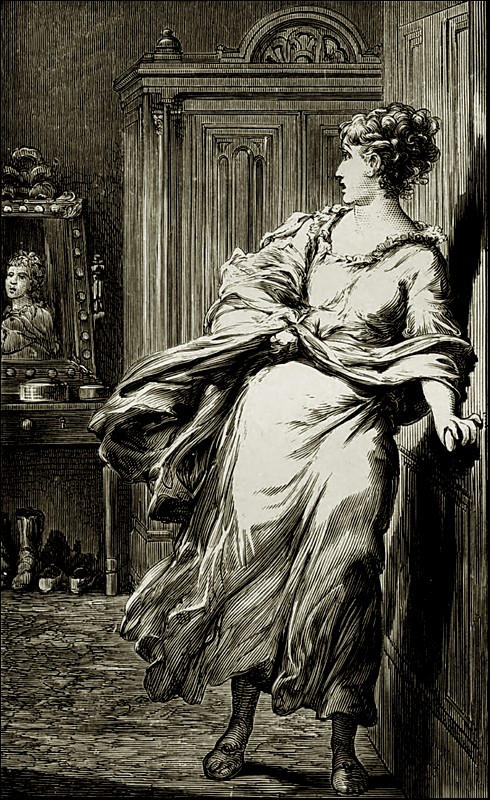
In the looking-glass Miss Gower caught a reflection of
her own pale face, and for a moment shrunk back scared.
As the apartment looked on the evening he was expected back so it looked then.
No one had cared to change the order of the furniture, or to remove any of Mr. Redworth's belongings.
"Where is he?" each separate article seemed to say to the woman who looked around. "Is he in some depth of that long lonely canal—in some sedge-covered bay, half weed, half slime, beside that weird sheet of water by a vegetation which is almost tropical in its rank luxuriance—is he lying in some ditch among the dark woods where last autumn's leaves have drifted thick and brown, or has he floated away through a broken lock along the river which flows into the Thames, and will he be brought back here some day battered and disfigured, recognisable only by such of his garments as the wash and the drift of the water have spared?"
Shivering, Miss Gower retreated from the room and closed the door. As she did so it seemed to her excited fancy that she heard a sound in the deserted chamber, something which was neither sob, nor moan, and yet was like a low wail of pain and sorrow.
She would have opened the door again, but her courage failed her. Overwrought, she stepped swiftly back into her cousin's room, and after shooting the bolts and turning the key, nestled down into the bed beside her.
But not to sleep. No—till after the servants had gone down-stairs, and the stir and hum of awakening life was heard in the street, she never closed her eyes, and when at last she did fall into an uneasy slumber, utterly worn out by mental and physical exhaustion, it was only to be suddenly awakened by a cry from Miss Redworth, who, starting up, panted out—
"Oh! Hilda, I have had such an awful dream; such a horrible, horrible dream! I thought I was in a darksome cavern, the walls of which were dripping with water, and the floor with slime. There were dreadful creatures crawling about and sticking to the roof, and as I slipped, and put up my hand to save myself from falling, I touched filthy things that were cold and noisome. And at one end of this place, so far from me, that for a time I could scarce discern his features, I saw my father. He seemed struggling to rise, and stretched one arm out so imploringly, and turned such a beseeching face towards me, that I tried to rise and help him. But as I ran I stumbled and fell. I strove to save myself, and doing so touched some slimy animal that dropped from the roof to the ground. And then I woke, Hilda—I woke—but it all seems to me real even now."
TIME went on, but Scotland Yard, and Mr. Downing and the Ludham gossips made little progress in unravelling the mystery of Mr. Redworth's disappearance. The body was not found—no clue could be discovered to the identity of the person who changed the notes. Ludham could not fasten the crime of parricide upon John Redworth, although it felt no manner of doubt that he had killed his father; and it is quite certain That even the young man's brothers believed him guilty.
At heart they were loyal and affectionate, however, and even when they felt most satisfied of his sin, they agreed to try and step between him and its consequences. They entertained no Spartan ideas of justice, he was of their blood, and they decided to do all men could to save him form the consequences of his crime.
Upon them there settled a sorrowful gravity, which in a few weeks aged them more than years, whilst Miss Redworth grew old and worn under the incubus of her apprehensions and her memories. She could not forget her brother's manner on the night when she and Miss Gower waited and watched for the return of the missing man. She recollected the jingle of those sovereigns, the sleeve soaked with water, the unwonted hour at which he had risen next morning; and her heart grew sick and faint as she thought all things seemed against him, that he was guilty, and that he alone understood the mystery of his father's fate.
Through all, however, Miss Gower remained apparently steadfast to her cousin. Whether she believed him innocent is open to doubt, but it is certain she maintained his cause.
To her very soul she felt the bitterness of his desertion; but she did not mean to let the world—her world—guess the length and depth of her despair.
When Miss Redworth elected to go to London, Miss Gower determined to remain in the neighbourhood of Ludham. She was free to choose her own path in life, and she decided upon following an extremely independent course. Her money, which Mr. Redworth had managed for her, and managed judiciously, could now, she felt, be expended in a manner likely to attract attention, and secure her a marked position in Ludham. There was no reason why she should not start as a lady of landed property on her own account. Mr. Redworth's programme could be carried out, minus the husband.
Practically, what she proposed to herself was to do what nobody else seemed disposed to attempt.
"I will take John's part against every one. I will visit his wife. I will make myself a person of importance in the neighbourhood; and, for the rest, my day will come. All things are possible to him who can wait. I can wait. There is some secret about this marriage which I have to discover. John is not a happy husband, and it shall not be my fault if she is a happy wife."
Just as methodically as she might have traced a pattern out on muslin, Miss Gower arranged her plans for the discomfiture of Mrs. John Redworth.
"I daresay she is pretty," said Miss Gower, looking, the while, at her own rejected face in the glass. "I have no doubt, indeed, she is; but, before we are any of us much older, he will wish he had never seen her. I don't believe a man reared as he has been will be able to endure the social ostracism his connection with the Taunton hall people must involve. But we shall see." And forthwith she stepped boldly into the breach which had opened between the bridegroom and his family, wrote a friendly letter to Mrs. John, and a congratulatory one to Mr. John; and, in fact, achieved an amount of politeness which poor Miss Redworth could not have compassed had anyone offered her a thousand a year for doing so.
And Miss Gower had her reward. From Paris, where the married couple were gone, after some little delay she received a few gracefully-worded lines of affectionate thanks from Mrs. John Redworth, and a most grateful epistle from John.
"I shall never forget your kindness, Hilda," he wrote. "It was like water in the desert; and certainly, if anyone might have been supposed to possess a right to feel aggrieved at my conduct, you were that person. My dear cousin, highly as I have always esteemed you, I never thought so much of you as I do now." And, after much more to the same effect, he ended by signing himself, "Yours affectionately, J.R."
With a certain set grimness of aspect, Miss Gower folded up this letter, after she had read it twice over, and put it carefully aside.
"Ah! My dear cousin," she mentally exclaimed, "the plot is thickening. I have a great deal still to learn about you and your beautiful wife. This letter is dated from Paris; but if you only knew I had seen you in Bloomsbury, the other evening, you might not feel quite so easy in your mind. What on earth could you be doing in Bloomsbury, when we all supposed you on the other side of the Channel?"
Inspector Downing could have told her, had she propounded the enquiry to him, for he, too, beheld the young man entering a lodging-house situated in one of those quiet streets that abound in the neighbourhood of Russell and Brunswick Squares.
The inspector, or one of his satellites, had never lost sight of John Redworth since the night after his disappeared, and there could be no doubt but that, putting two and two together, the inspector understood the Bloomsbury lodging-house contained another strong motive for getting rid of Mr. Redworth.
That the young man had made away with the old man, Mr. Downing entertained no manner of doubt, and yet he could not fix the crime upon him. Not merely was he unable to trace any one who had seen John Redworth returning home on that particular night in a suspicious and clandestine manner, but he had found several persons who could speak to the fact of having noticed him in the train which reached Ludham a little after nine o'clock.
In a word, at the time when Mr. Redworth was stated to have been at Saul's Corner, his son was seen at Ludham, which, of course, rendered it exceedingly difficult to connect him with the mystery.
The inspector never doubted his guilt, and, for that matter, Ludham also was quite satisfied young Redworth knew perfectly well what had become of his father. But still, the evidence necessary to secure a conviction had not been obtained, and Mr. Downing went about in a dissatisfied manner, looking at the bills placarding the neighbourhood, which bills offered at last two hundred and fifty pounds for such information, et cetera, et cetera, the reward promised by the Redworth family being supplemented by another hundred from Government.
It would be too much to say that the course of conduct Miss Gower elected to pursue met with any violent expressions of disapproval from her relatives; but Miss Redworth did admit that Hilda had disappointed them.
For a young woman to desert her family at such a crisis—to reject the shelter of respectable and well-ordered homes—to set herself up, as it were, above the Redworths, and refuse to be guided, as concerned her pecuniary affairs, by the advice of men who were up in all city matters, seemed to her cousins a very sad thing.
But what appeared sadder than all, was her selecting Mr. Garland's as a fit and proper house in which to take up her residence. "A vulgar, drunken old gossip," said Miss Redworth to Miss Gower, summing him up.
"Yes, dear, but he believes in John, and he has a nice motherly wife, and the air up on The Wastes is crisp and invigorating; and I think London would kill me—and, in short, I mean to remain with the Garlands for the present."
"I don't fancy she can be quite in her right senses," observed Gower Redworth, seeking about for an explanation of her conduct. "We know she was very fond of John. I daresay the disappointment has turned her head a little. All the same, however, I do not think she ought to set our wishes so totally at defiance."
"It is a queer start," thought Inspector Downing. "If she had been his sister I could have understood it, but, as matters are, I confess I do not comprehend the meaning of this move. I'll know all about it some day, however, or my name is not Thomas Downing."
Wherein Mr. Downing chanced to be wrong. He never understood Miss Gower's little move, and his name remained Thomas Downing, as it had ever been.
There is nothing so hard to understand as the secret of a woman's actions, when they are prompted solely by pique. Whilst the inspector was puzzling himself over Miss Gower's motives, she felt all she then wanted was—if John Redworth were happy, to make him unhappy, if he were unhappy, to behold the misery himself had wrought.
She wanted to see him sorry, regretful, repentant. She desired to watch him tire of his wife's beauty, and contrast the life he might have led with her, Hilda Gower—the life of competence, respectability, peace, comfort—with the poverty-stricken, disreputable existence he must drag on at Taunton Hall.
For she knew he was coming to live with his wife and brother-in-law, at the old house on the road to Cadlebury; and, from the hints thrown out by Mr. Downing, and the chatter of Mr. Garland, she understood what a prolonged residence there was likely to prove.
"Mr. Garland," she said one morning, in the fine September weather. "If you are going to Malby this afternoon, I wish you could take me with you as far as Trotterbeck. I can easily walk from there over to Taunton Hall. I want to enquire when my cousin and his wife really are expected back."
"You know the Squire ain't at the hall, miss?"
"It is not the Squire I wish to see, just at present," answered Miss Gower. She was quite at home by this time with the Garland family, and found the homage and respect they paid her peculiarly satisfying. She had her own rooms, and was waited upon as she had never been waited on in Dorking Street; "though I confess I have a curiosity to see both brother and sister; all I desire today is to learn for certain when my cousin means to return. I am afraid, very much afraid, Mr. Garland, his prolonged absence is doing him harm amongst his friends here."
"I don't think there is much in that," observed Mr. Garland, bluntly. "In my poor opinion, except you and me, and may be just one and another here and there, the poor fellow hasn't a friend left in Ludham. He might have lived down the notion of being concerned in that unfortunate business, but he will never live down his marriage with Miss Taunton. It was the worst day's work he ever took in hand, and so, I am afraid, he will find it."
"She is very beautiful, though, Mr. Garland, you say?"
"Very beautiful; but lor! what is beauty, when a man comes to have to look at it week in, week out, for the remainder of his life?"
"I should say it is a great deal," remarked Miss Gower, plucking a sprig of sweetbriar, and inhaling its peculiar perfume as she spoke. "But you have not answered my question yet—will you take me as far as Trotterbeck?"
"I'll take you to any place you like, miss. As I have told you before, there's me, and there's the mare, and we are both always at your service, day or night. The mare won't tire, and I am sure I won't. But as for dropping you at Trotterbeck, I can't hear of such a thing. We will go by Saul's Wood Corner, and, if you like, you can walk from there up to the Hall—that is not far and if you choose to stroll about the Heath or the Canal for an hour so, why, I will call for you at the Hall on my way back from Malby. There are some good gardens and shady walks at the Hall, only the whole place has been let to run wild. I used to go bird's-nesting there when I was a lad. It is a pity to see a property like it running to seed, as one may say. It might just as well be in Chancery. If it were mine, I would dig up that old Squire, will or no will, and bury him where all decent men ought to be buried—in the parish churchyard. I should not like to lie in bed o'nights and think of him being outside the window just at my elbow, as it were."
"His was a strange fancy, certainly," remarked Miss Gower.
"Yes, and if you notice, strange fancies are mostly at the beginning of every evil that happens in a family," said Mr. Garland, sententiously. "When folks commence being odd, they generally end by being beggars—that is what I have observed. Living up here on these Wastes, I look down upon a vast of places that have changed hands, even within my memory, and nine times out often the trouble came through somebody who was different from his neighbours. Look at the Tauntons, for example. Ne'er one of them like anybody else, and going on each heir worse than the man that went before him."
"Till the evil culminated in the present Squire," finished Miss Gower.
"You are right, there. But he never had much chance," said Mr. Garland, for all at once he remembered the Tauntons were now allied to the Redworths, and, in consequence, after a fashion, connected with the lady he addressed.
ABOUT a mile from Saul's Corner, on the main road from Ludham to Cadlebury, there stands, fronting Wilderness Heath, a large redbrick mansion.
It lies well back from the highway, and is screened from the impertinent observation of passing travellers by high walls and a double line of fine old elms.
A place, once upon a time, of considerable pretension—a place which might, even in the time of the Black Squire, have been rendered fit for the habitation of any nobleman or gentleman. But it owned an evil reputation.
Ever since the period when the long avenue, leading right away from the house to Saul's Corner in one direction, and to Wilderness Heath on the other, was converted into a public road, Taunton Hall, shorn of its wild moorland avenue, and of its splendid approaches, shared the fate of human beings who go down in the world.
The high wall, reared by the occupier to shield his mansion from the gaze of the vulgar, at once assumed, to the rural mind, an air of sullen mystery. Had the then Squire Taunton been disposed so to humour the popular fancy as to allow his few neighbours to look through iron gates at the lawns and gardens his walls enclosed, people might have been satisfied; but he did nothing of the sort. Between himself, his grand cedar trees, his parterres, his smooth grass plots, his rare shrubs and beautiful flowers, and the prying herd, he interposed not merely high walls, but heavy wooden doors; and so still, so grim, so utterly silent the place always looked, that ere long the people said the Squire was out of his mind, and then, improving upon that idea, that the place was haunted.
Stories were told of some and purely imaginary crime which had been committed within the Hall. On special nights in the year, it was said, a figure dressed all in black would dart out on any passer-by, and keep beside him for a mile or mores no matter how fast he ran. When Squire Taunton died—the Squire who sold the best part of his patrimony and built the walls—his widow at once went abroad, to "foreign parts," and the house was shut up till, the young heir dying, a distant relative succeeded to the property.
For generations after that, Taunton Hall never descended from father to son, and it was the popular belief that Taunton Hall never would so descend again.
"There is a curse upon the house and upon the owners," said those best informed about the matter. "Someday there will be no owner for the Hall, and then it will be pulled down, and a good riddance, too."
Originally the Taunton quivers must have held an extraordinary number of male arrows, for thus far, in spite of the singular fact concerning the descent, or rather non-descent, from father to son, the Hall had never lacked an heir when the latest owner died.
As a rule, however, the owners did not much affect the place. Most of them had estates elsewhere, or houses in London, or palaces in "foreign parts." So long as they retained sufficient of their ancient prestige to marry heiresses, or to obtain good posts under Government, no Taunton really resided at the Hall, which gradually went, not exactly to wreck and ruin, but was left to repair and embellish itself, as, by the aid of climbing ivy, or twining parasites, and wildly-spreading rose-trees, it managed to do not unsuccessfully.
Back to the Hall at length there came a certain Marmaduke Taunton, who, having in his mad youth inherited and scorned the place, returned to it in his sorrowful old age.
Haunted, then, the Hall was, no doubt, by memories of evil deeds, of sins that had sorrowfully come home at the nightfall, of hopes which had borne no fruit, of resolves abandoned almost as soon as formed. Weary, worn, disappointed, disenchanted, disillusioned, of all the bright dreams of his reckless manhood, the old Squire came back, in the decline of his godless life, to bemoan his fate, and to say, with the wise foolish king, "All is vanity."
He resided at the Hall for years, living the life of a hermit, varying the routine of his existence only by a rare drive into Cadlebury, or a rarer journey to London, seeing no one, save, at distant intervals, his lawyer, who was also his agent; yet keeping up some remnant of his ancient state, being served and waited upon with all due ceremony, by aged domestics who were almost as recluse in their habits and reserved in their manners as the Squire himself.
After about twenty years of this secluded life, Mr. Taunton died, and in dying dealt the last blow to all hope of rehabilitating the Hall.
It was not in his power to deal with the estate, which, after being docked of its magnificent avenues, was strictly entailed, but he possessed a considerable personality, and this he left to the next heir, upon condition that he, the testator, was buried in a mausoleum he had erected in the garden, without any ceremony of consecration or Christian rites being performed over his remains.
It was supposed and hoped that the new Squire would either reject the legacy, and so get rid of the conditions imposed, or else find some legal loophole through which he might creep; but he accepted the burden laid upon him with the most perfect equanimity.
So long as "Old Marmydeuk"—it was thus he pronounced the name of his predecessor—"so long as Old Marmydeuk did not come to life again, he was welcome to rest in the garden, or anywhere else about the premises.
"I'd take a parish full o'corpses on the same terms," further explained Mr. Taunton; and thus, to the scandal of all the country side, the old Squire was planted out amongst his shrubs and flowers, and the new Squire took possession of the Hall, shut up all the best rooms, barred the hall door, and set up his household gods in the kitchen.
There, in the evening, he smoked his pipe and drank his beer, regardless of all the proprieties. He had come from the plough, and Taunton Hall, and the atmosphere of drawing-rooms, would have suffocated him. He said quite frankly that he could not abear fine gentlemen, adding, not very chivalrously, that "fine ladies sickened him."
He rose at four, and went to bed at eight. He liked fat bacon, and loved the odour of a farm-yard. He had never been fond of society, and for that reason, certainly not from any apprehension of overstepping the conventionalities, did not frequent public-houses, or ask any neighbour to drop in and smoke and drink beer with him. Week in, week out, he stood over his labourers in the fields, sometimes working as hard with them as though his living depended upon his exertions. A bear in his manners, an animal in his habits, in every respect a contrast to the refined cynic who lay quite quietly under the rustling trees, and never rose from his grave even when his successor filled the great hall with wheat, and set his men to churn in the dining-room, under the very eyes of his ancestors, male and female, who, wigged, powdered, patched, laced, furbelowed, and clad in armour, frowned or simpered, or stared stolidly from the walls.
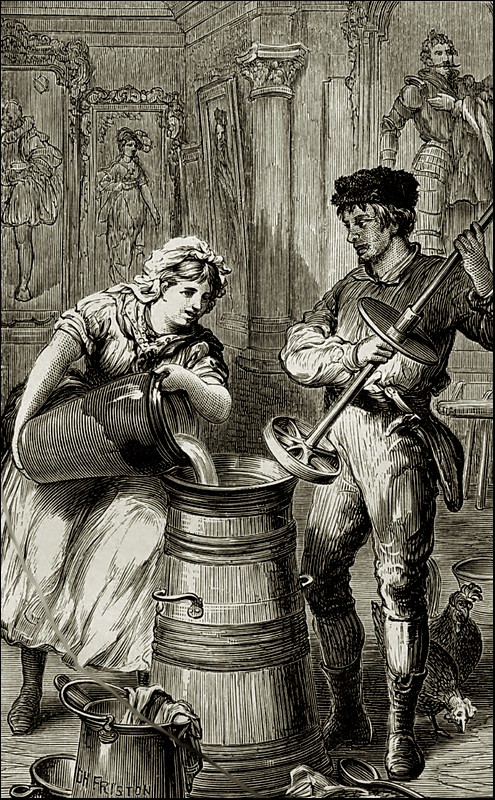
And set his men to churn in the dining-room, under
the very eyes of his ancestors, male and female.
He had vegetated in this manner for about ten years, knowing no variety in his life save that which was wrought by the advent of seedtime and harvest, the snows of winter and the drought of summer, when he met with a terrible accident.
While helping to build a rick, he overbalanced himself, and falling to the ground broke his thigh, also having the disaster to encounter in his descent the prongs of a pitchfork, which entered his side.
All that skill could do for him was done. The doctors saved his life, and patched him up as well as they were able, but the accident left him a cripple, and a peevish invalid to boot. Walking became a pain and a weariness. It was only slowly and with difficulty he could drag himself into the more distant fields. Every change of weather affected his health and consequently his spirits and his temper. The house, as he said, with a certain unconscious pathos, "seemed like a prison to him" and the only thing he appeared really to enjoy was sitting on a low broken wall down by the deserted canal, watching the sluggish waters flowing slowly by, and looking at the fish swimming about in shoals, or making widening circles as they rose to the surface after flies.
What he thought about, or whether he thought of anything, no one ever knew, but there was something so sad and solitary about the appearance of the owner of Taunton Hall, as with sunken eyes he looked across the canal at the woods beyond, or let his glance wander over the giant rushes and the great masses of floating weeds, that most of the few men who passed by on the narrow watery highway stopped to exchange a greeting with him, sometimes bringing him news from the outer world, and frequently praying his acceptance of fish caught in the deeper and darker water further down, where the pine plantation stretched to the brink of the canal, and the alder-trees grew thick beside the woodland paths, leading off, one to Saul's Corner, and the other to Wilderness Heath.
It was then Mrs. Taunton's brother chanced to be asked to assist in managing the estate. The son of a village innkeeper—a man who had tried innkeeping, and various other ways of living, with an almost equal amount of non-success, it was quite in the ordinary course of events he should think himself competent to look after his brother-in-law's affairs.
As a first step, he began to breed cattle; and when he failed in that endeavour he tried his hand at growing flax. The latter attempt resulting in a loss, he next turned his attention to a more congenial occupation—that of dealing in horses— and making one lucky hit, he set that against years of misfortune, and season after season destitute of profit, and would suffer no one to have the best of the argument concerning his system of management.
It was this brother who insisted that his nephew and niece should be sent to school.
"Taking what his father was left, and the money I shall make for him," said that worthy, "Dick will one day have a fine fortune. It is time he was being educated and taught to behave like a gentleman."
As for his niece, in his opinion there was no position to which she might not aspire.
"With her good looks, and a handsome dot, she ought to marry a duke," he was wont to remark, pushing back an old sun bonnet off the girl's face. "You must not run about like a wild colt any longer, Lettie. What a gipsy it is. Ay, I warrant me you and your brother are true Tauntons—true chips of the old block. Anyone may see it who is not stone blind, and likes to compare you with those old dead-and-gones hanging in the house there. Be a good girl, and give your mind to your book, learn how to parlez vous; don't let crotchets and quavers daunt you, and some day you'll see what you shall see, and then, maybe, when I am in my gave you'll remember what your poor old uncle prophesied about you."
And, to school the boy and girl were sent. As a matter of form, the Squire's opinion had been requested on the subject, but he declined to give it.
"Do as you like," he exclaimed, idly picking blades of grass as he spoke, and pitching them into the water. "I'm of no account—I am nowt and I am nobody now. Give them learning, an' ye please, but if learning do no more for them nor this fine place has done for me, then don't come and say it's my fault. We was all better and happier, I'm thinking, in the farm I'll never see more, than we've ever been at Taunton Hall."
Before his children had, to use his own expression, "got much learning" at the very third-rate school where they were being educated, Mr. Taunton died. He was not buried in the mausoleum with old Marmaduke, but carried down the back staircase he had elected to use in life, through the kitchen hall, across the farmyard, and out by the stable entrance to Cadlebury, where the service was read over his remains in orthodox form, and all the rites of the Church were complied with by his relatives on behalf of this English Heathen.
For years he had been a cipher in his own house, regarded by no member of the establishment, and interfering with nothing that was done. Nevertheless, it is possible his death proved a relief to wife and brother-in-law.
Whether looking gloomily into the canal, or nestling in the chimney corner, he had seemed a very skeleton at the feast of life to those still strong enough and hearty enough to enjoy the good things placed before them.
Thus at length the spell was broken, for Richard Taunton did succeed to his father's property, but if people had shaken their heads wisely before, they shook them still more wisely now.
There were evil days in store for Taunton Hall, so declared the oldest inhabitants. There would be wild doings when the young man came into his own. He had never been trained to manage a property. His one idea with regard to money was to spend it. He had every trait of the maddest and most thoughtless of the worst of the Tauntons, without one of their redeeming qualities; whilst as for the girl, she was handsome enough in all conscience, but would come to no good either. So prophesied the croakers and scandalmongers; whilst more charitable folks trusted the brother and sister might meet with some friend who would advise them for their good; and neutralize the evil influence of their silly vulgar mother, and harum scarum, speculative, dissipated uncle.
Much company of a somewhat indifferent sort came to the hall in those days. Gentlemen who talked loudly about race-horses—ladies who dressed mighty fine and who drank a considerable amount of champagne, made up a society which Mrs. Taunton and her brother thought very desirable and fashionable indeed. The old place opened its doors most hospitably at that period; the back entrance, through which the late Squire had been borne to his rest, was now only used by the servants of the house, and the grooms and tigers, and valets and maids, of the grand folks who came driving their tour-in-hands, their pairs of "slashing" bays, their horn-announced tandems, and their fast-trotting nags.
For these great personages the once jealously-closed gates now stood hospitably open. Quite in style the equipages whirled round the short carriage sweep on the hall-door, the moss was scraped off the drive—the grass on the lawns was mown—the roses were cut in—the weeds were hacked down—the handsomest living rooms were swept and garnished, and the "best that could be bought in London," as Mrs. Taunton's brother was wont to aver, procured in the way of eating and drinking.
Once a real lord spent a night at Taunton Hall, and the wife, or rather a lady who had been the wife of a certain nobleman, but who was divorced from him by no wish of her own, spent three days with Mrs. Taunton; and when at eighteen Richard Taunton insisted upon leaving the halls of learning, where he had spent three weary years, and retuning home, he found himself the object of much interest to distinguished persons, several of whom, in the most amiable manner, promised to take him by the hand and show him life.
During the course of the next six years the young Squire may indeed be said to have seen every sort of life, save that which was reputable; but at the end of that time he appeared suddenly one day at the Hall, there and then turned his uncle out of doors, dismissed every servant, save an old woman who had in succession nursed him and his sister, and without the slightest break in the process, relapsed into barbarism.
The primitive life lived by his father when he first succeeded to the property, had at least one element of safety—the man worked. His son, on the contrary, did not work. He led the life of a savage in the worst sense.
Quick and clever, he had learned enough to know better, to understand as his father had never done, that the mere fact of possessing property involves duties. Of which the man who owns nothing is free.
Quite voluntarily he cut himself adrift, not merely from the companions who had exercised so disastrous an influence on his pecuniary prospects, but also from the slightest hope of ever taking up a fair or decent position in life.
He had not the distaste for society which characterized his father, but he selected for his boon companions the lowest of the low—men who laughed at his poorest jokes and joked coarsely themselves in return—who lived like human swine, and who, even in outward appearance, seemed to have set the opinions of the better portion of the world as much at defiance as possible.
His mother did not long survive the changes instituted by her son. On her death-bed she gave voice to many utterances; but, like most of the utterances she had made in life, they were so little to the purpose, that her son might be excused for paying small attention to them.
In one respect he did fulfil her wishes. She had as grand a funeral as feathers and velvet could compass. No money was stinted over the affair, and if very few persons "followed," that was not the fault either of Dick or of the "baked meats" prepared for the occasion.
Her coffin was not carried out through the back door and across the farm-yard. No, as might have befitted one of the ancient ladies whose portraits graced the interior of the Hall, Mrs. Taunton was carried by way of the great staircase to the front entrance, and thence to the hearse, which, with its attendant coaches, stood ready awaiting her.
Through the same portals the mourners returned to the house, and in like manner the few guests subsequently departed.
It was then Richard Taunton closed the massive oaken door, and shot the bolts which secured it—then he raised the long disused bar and dropped it into its place—then he padlocked the chain which for years had hung pendant, and, turning to his sister, said grimly—
"There has been no luck about the house since that door was opened by my uncle. I have closed it now, and we shall see what will happen before it is flung wide again."
IT was to this house, crossing a foot-bridge at Saul's Corner, Miss Gower made her way.
She believed Dick Taunton to be absent from home, but if she had not been certain of the fact, it would have made little difference in her course of action.
There was a mystery about John Redworth, which she imagined could be solved only at Taunton Hall, and as she meant to devote herself to unravelling that mystery, she had no intention of suffering such a trifle as the presence or absence of the master of the house to interfere with her design. Making his way over the canal at Trotterbeck, Mr. Garland, taking the least direct road to Malby, so managed as to set Miss Gower down at that precise spot where the scene assumed a character of utter loneliness and desolation.
Not easily impressed by any of nature's moods, the woman felt nevertheless impelled to stand for a moment on the narrow bridge, and take in every detail of the weird and solitary landscape. She was utterly alone; there did not seem another human being in the universe beside herself. At first in the distance she could hear the jingle of Mr. Garland's wheels, and the regular click, click, of his mare's hoofs; but these sounds grew fainter and fainter, and at length died utterly away, leaving her in the midst of a silence she could hear, of an isolation such as she had never before imagined.
The sombre pines—the dark canal—the murmuring reeds—the rustling rushes—the stunted oak-trees—the sorrowful sobbing of the water as it oozed through some broken lock-gates higher up the disused canal—all these things forced themselves upon her attention at once, and would take no denial about impressing themselves on her memory.
With that still unsolved mystery shadowing her spirits and oppressing her recollection, the gloom of the pine woods seemed to deepen as she stood, the dark waters to look more treacherous, the bays where the stream lapped in upon the sward, and the sward encroached upon the water, more suggestive of what might be lying or have lain amongst the tangled grass and the oozing mud, and the dripping weeds and the rank luxuriance of the reeds and rushes.
Bah! with a shiver Miss Gower sped from the bridge, to plunge into the greater loneliness of the pine-woods. The air was full of that peculiar scent which comes only when the spines and the cones of the firs are falling—a scent which is not that of awaking life, as in the early spring, but of death. As she looked to right and left, she could see nothing but the regular lines of trees, light brown trunks standing in symmetrical order. There was not the sound of a woodman's axe, not even the distant murmur of children's voices; there were no songs or birds, nothing save the rustling of the dry, dead leaves, as some rabbit scurried away to its burrow.
Although every inch of this wood had been examined, and each pit and ditch searched, it seemed to Miss Gower that her relative must be lying in some nook which had escaped observation. Imagination was not her strong point; yet, as she hurried along, she thought she must next day ask Mr. Garland to return there with her, in order that they two might look for themselves, and get rid of the haunting visions that had begun to torment her of this missing man lying there all alone, through the solitary nights, and days; the pines shutting out the blue sky and the breeze of heaven, and keeping grim and gruesome guard over the secrets hidden amongst them.
With a gasp of relief she at length beheld the open country once again, and hurrying onward, soon found herself crossing the stretch of common-land between Saul's Wood and Saul's Corner.
It was a nasty bit of ground, full, as anyone who had ever taken a short cut over the grass knew, of unexpected hillocks, deep drains, the gnarled roots of ancient thorn-trees, and inexplicable swampy spots, in which the unwary adventurer usually plunged over his ankles.
A charming place for children to disport themselves, had there been any near at hand to take advantage of such lavish opportunities for covering themselves with mud and running the risk of breaking their limbs; but there were few boys and girls resident at all near at hand. Such cottages as the neighbourhood boasted were perched away amongst the gorse and heather on Wilderness heath, and there was not a human habitation of any sort of description nearer Saul's Corner than Taunton Hall.
It was with not a little curiosity that Miss Gower paused as she approached this house, and looked at so much of the edifice as could be seen from the highway. A great gloomy pile of red brick, festooned up to the very chimney pots with ivy—a mansion any man might have been proud to call his home—stately, mysterious, with a certain air of dignity, in spite of the decay and neglect visible upon it, which appealed to the best, if the weakest, part of Miss Gower's nature.
"What would I not give to own such a residence," she thought, and then she stepped aside from the main road to ask a passing labourer which was the entrance to Taunton Hall.
"You'd best go through the next gate and across the stable-yard and up to the door you'll see in the right-hand corner," he answered, in the lazy Surrey accent and laborious drawl to which years had rendered Miss Gower so familiar.
"But I do not want to go to the back door," she said, mounting immediately her high horse; "I wish to see some of the family."
"Well, it is all one," was the stolid reply. "Whoever you want to see, you'll have to inquire for them where I tell you. If the Queen was to take it into her head to stop at the hall, she'd have to go in at the back door, or else stay outside. The Squire has sworn a great oath, they say, not to open the hall-door to man or woman. If he had shut it many a year ago, mayhap he'd a-bin richer today."
"A singular family this into which my cousin has married," thought Miss Gower, with a certain amount of satisfaction, as she picked her way up the back avenue, and across a large and old-fashioned stable-yard at the furthest corner of which, and quite overshadowed by a fine chestnut-tree, was the door at which John Redworth and Inspector Downing had entered on the night after Mr. Redworth's disappearance.
On this occasion the door stood wide open, showing the spacious hall stone-flagged, and the numerous doors opening to right and left, which told of the ample domestic arrangements planned by the builders of the mansion, who never could have imagined the day would come when all the pomp and circumstances of a once-great family would be represented by a wild, impecunious, moody, daredevil Squire, an imperfectly educated and gipsy-like sister, and an old serving-woman—the most worthy individual of the three.
It was this person who at sight of Miss Gower came hurrying across from the dairy, a look of eager expectation on her face, which changed to one of despondency when she heard Miss Gower's first sentence.
"I called to inquire when Mr. and Mrs. Redworth are expected back."
"I beg your pardon, miss; I made sure you were one of the ladies from the Vicarage as have come new into Cadlebury, and were talking of taking their butter and eggs from here. I was just printing the pats when I saw you coming, and lovely butter it is."
"They sell to anybody who will buy then," mentally remarked Miss Gower; answering aloud—
"I shall be very glad to have some from you if you have any to spare. I did not know there was such a thing to be purchased here."
"Bless you, yes, miss. We sell everything but fruit, and that don't really pay for the picking. I might say bushels of strawberries rotted on the ground this summer. You were asking about Miss Lettie—or, as I should say, Mrs. Redworth. I had a letter this morning from Mr. Richard, where he says his sister had been very ill—some sort of fever; but he hoped they would soon be able to get her home again. He says she is pining like for the old place."
"It is a place anyone might be proud of," answered Miss Gower, graciously.
"Ay, poor thing; but it's little either of pleasure or of comfort she has had in it," remarked the woman, with a sigh.
"Let us hope, then, the future may make amends for the past," said Miss Gower. "Her husband is one of the most amiable of human beings."
"You know him, miss?" asked the woman, curling up the corner of her apron with her fingers, and looking curiously at her visitor.
"Know him! of course I do—he is my cousin."
"Well, miss; if you'll excuse the liberty, I must make so bold as to say I am very glad to see you. It will be like new life to Miss Lettie to hear anybody belonging to Mr. John has been over. She used to take on because she was afraid none of his friends would be agreeable to the match."
"You seem to be very much attached to your mistress," remarked Miss Gower.
"No one could be off being attached to her that knew her," was the answer. "She hasn't a fault, except that she is at times a bit quick in her temper; but then it's off almost before you could say it had been on. But I am sure I humbly ask your pardon, miss; here I have been letting you stand, and never asking you in, or if you would please to take any refreshment. You must be tired, miss, if you walked from Cadlebury."
"No, I drove over; that is, a friend left me at Saul's Corner, and he is to call for me as he returns. If I should not be disturbing you, I should like to wander a little about the place. I have so often noticed it as we passed; you must have fine gardens, have you not?"
"Ay, no finer in the county, once upon a time, but they are gone to wreck and ruin. Still you can see what they have been, and there is some good fruit yet on the tees, if you have a fancy for any, and I could make you a cup of tea, miss, in about a quarter of an hour, when I have finished printing the butter."
"Oh! by the bye, the butter," exclaimed Miss Gower. "If you could spare me three pounds, and some eggs, and lend me a basket, I should be so much obliged. No, I will not have any tea, thank you; but after I have been through the gardens, perhaps you would give me a glass of milk. You are quite certain I shall not be intruding if I walk round the place?"
"Intruding!" repeated the old woman. "The Squire would be only too proud to think you had come over, and I can tell you, Miss Lettie will be so pleased she won't know what to do."
"They are in Paris, I think you said."
"Yes, miss. The Squire sent me an envelope with the address on, for he knows I am no great scholar. Here it is," she added pulling some papers out of an inner pocket, "and his letter too, if you would care to look at it, miss. They both write to me as free as if I was their mother, which, indeed, I might be, having known them ever since they were born."
THROUGH an arched doorway leading out of the stable-yard, Miss Gower passed into the shrubberies, so wild and neglected in some parts, that the laurels had grown completely over the walks, and made a roof of greenery which shut out even the light of day.
On the lawn the grass grew rank. It had not been mowed all the summer, and the thunder showers and the autumn rains had beaten it down level with the ground. Underneath the trees the dead leaves of the dead years were lying rotting. Every weed of its kind seemed to grow in that place and to multiply exceedingly. Nettles, docks, and bindweed contested the ground with rare shrubs and exquisite plants, but nothing seemed to be cared for; creepers trailed untrained, the roses had flung long branches across the walks—honeysuckles lay prone on the ground, and the jessamine sprays were wildly searching about for something against which to lean.
With that instinctive sense of order and fitness, which was part and parcel of her nature, Miss Gower, as she walked along, employed her deft fingers in finding supports for the creepers, and lifting the roses from the untrimmed box edgings.
Quite as much a matter of course it seemed to her to try to put things straight, as it had evidently been to the Tauntons to leave everything to go awry.
Such a wilderness of a kitchen-garden! Miss Gower, as she pushed open the door leading into it, stood for a moment appalled. Plantations of Jerusalem artichokes, cabbages all run to seed, towering lettuces—turnips showing yellow flower—convolvulus smothering the raspberry canes—bindweed climbing up the espaliers—shoots wildly flying wide from the trees once trained against the walls—ruddy-cheeked apples guarded by a growth of noble nettles—mellow pears, which could only be gathered after a wrestle with briers and thistles.
"Oh! What can these people be?" she cried, almost aloud. "If I had such a home there should not be a weed on the beds, or a bramble across the walks."
She passed on to the fields beyond, where an evident attempt to farm well had been made; but the old story of carelessness and lack of method could be read in the broken fences and the dilapidated gates—in the reeds rotting in the canal—and the mud silted up amongst the rushes.
"Want of money—want of method—want of self-respect—want of respect for the opinion of others—this is the story he who runs may read here, and John has thrown his lot in with such people, and will reap his reward. As he has sown he must gather."
Thus soliloquizing, Miss Gower walked back towards the house, this time taking a different route, which brought her at length close to Squire Marmaduke's last resting-place.
She had heard of this mausoleum before, and now paused to read, with some curiosity, the only words graven on the marble—"Do not pity me, I sleep sound."
She stood and thought about it. Stood and wondered about the dead, with no echo from the outer world breaking the terrible stillness. What could have been his story? What had he done with his life? How all alone in that great house did he occupy those evening hours of existence which preceded this long sleep? She could not feel surprise at the place having an evil reputation. She was not sure herself that she should care to rise morning after morning and look out upon that solitary grave, with its silent iteration of a fact no one would ever have dreamed of disputing.
Had he lain, when living, through long nights awake? had he tossed warily, seeking for rest and finding none? had he in the hours of darkness beheld, as in a vision, the desolation coming upon his house'? had he indeed gone down to his grave hoping nothing, fearing nothing?
The influence of the scene and the hour was upon her, while she walked slowly away, pondering sadly. Was this, indeed, all wealth and rank had been able to do for a man? Was this all the world and its pleasures could give in the way of happiness? The greatest good, to sleep sound—the highest bliss, to lie quite quiet with closed eyes and folded hands.
If this were so—
She had reached this point in her meditations when, lifting her eyes, she saw something that caused every nerve in her body to thrill with expectancy, astonishment, and delight.
She had reached a point from which she could distinctly see the Hall door.
The branches of a great cedar tree shaded her eyes from the glare of the setting sun, but the light fell perfectly distinct upon the porticoed porch, the old-fashioned windows that flanked the door, the steps, and the figure of a man standing upon them.
It was her uncle! She could not be mistaken. At last—at last, quite safe and sound, erect as ever, umbrella in hand, waiting to be admitted. Miss Gower was not in the habit of running, but she did run then—through the long tangled grass she sped, unmindful of bramble or mound, or moisture, or a pain which shot through her left side.
"Uncle! Uncle!" she cried, as she reached the edge of the gravel sweep, but he never answered her call.
His silence did not surprise her, for she heard that her voice was hoarse, and knew that the sound of it could not carry far.
Just for an instant she paused to draw breath, and to ease that dragging pain in her side, then she ran forward once again.
It was Mr. Redworth—there could not be the slightest doubt about that.
It was he as he had left his home more than two months previously, wearing the same clothes, holding the same umbrella; neither leaner nor fatter—changed in no one single respect.
In the rapture of seeing him once more, she forgot to marvel at the singularity of the coincidence—at the extraordinary chance of herself and Mr. Redworth visiting Taunton Hall on the same day and at the same time.
"Uncle! Uncle!' she screamed at the very pitch of her voice, forgetful for once of the proprieties and of all possible listeners and spectators. "Uncle!" but he never stirred.
"Uncle," she repeated, and there crept over her a subtle and intangible dread.
"Uncle, it is I, Hilda?" but still he never turned.
By this time she had grown sick with an inexplicable fear; but she was no coward, this pale-faced, sleek-haired, careful-handed woman—quite the contrary—and for this reason she pressed on and drew closer to the tops, and said again, "Uncle!"
Then all at once her heart seemed to drop out of her body, and she clutched at the pillars of the porch to support her.
For no living being stood there.
She could see the steps covered with untrodden mosses, the straggling hop vine wreathed across the entrance, the door Squire Taunton had closed so resolutely against all comers—but of the familiar figure she had beheld, no sign, no token! Before her there was utter vacancy.
On each side of the porch beneath the high long windows of the Hall stood a very old and curiously-carved stone seat, and it was upon one of these Miss Gower found herself when at length she could again see the light of day, the neglected lawn, the gloomy cedars, and the great sweep of drive in front of the lonely house.
Very slowly memory gave her back a thorough recollection of what had occurred.
"I did not dream it," she considered. "I did see him—fancy played no trick with me then. What does it mean? What can it mean? Have I gone mad, or——"
"I have been a'most all over the place looking for you, miss," here interposed the Tauntons' only domestic. "I could not think where you had got to, till Dan told me he see a lady walking round by the tomb. I've brewed you a cup of tea, miss, hoping you would excuse the liberty; but whatever, miss, the matter with you? Have you been taken with a faintness? You are as white as if you had seen a ghost."
"I don't know about that," answered Miss Gower, slowly; "but I know what I have seen. You have heard about Mr. Redworth's disappearance?"
"Surely, miss—everybody has heard of that."
"Well, of course I scarcely expect you to believe me; but, as truly as I speak, I saw Mr. Redworth standing at that door not ten minutes ago."
"For any sake, miss, don't say that—oh! for any sake, don't think that," and the woman wrung her hands as she spoke.
"I tell you I saw him as plainly as I see you now, I ran across the lawn to speak to him. I called him when I was standing there, and again and again till I came quite close to the steps. The whole of that time I saw him, and then all in a minute he disappeared."
"You fancied it, miss—you just fancied it all. How could it be; here one minute and away the next? What would he be doing here at a door that has not been opened for years? Look at it—at the green mould on the steps, at the hops growing right across from one side to the other—oh! miss, whatever you do, don't go away with a notion like that. It would fairly kill Miss Lettie if she were to hear such a thing spoken of."
"Well, I saw him at any rate," persisted Miss Gower. "Fifty Miss Letties, and a thousand hop-plants, and the accumulated moss of centuries cannot alter that face. With my own eyes I saw Mr. Redworth standing upon the doorstep; and what makes this all the stranger, is that it was not far from here he was seen last alive."
"Well, miss, it is not for me to contradict you, but if it was Mr. Redworth you saw standing here, where is he now?"
"That is just what I would give anything to know," answered Miss Gower; "and what I mean to know," she added, under her breath, as she rose, and, accompanied by the old woman, slowly retraced her way to the house, where that cup of tea was still being brewed to death.
FOR a wonder, Miss Gower felt disposed to be frank and confidential with Mr. Garland, as they drove behind that gentleman's mettlesome mare back to The Wastes; but she restrained her impulse, and, in consequence, lapsed into reverie.
"You seem a bit low, miss," suggested Mr. Garland, when he felt he could endure his companion's silence no longer. "Heard no bad news over yonder, I hope?"
"No, oh, no," she replied, rousing herself. "Only it's a depressing place, I think."
"Well, as for that, any place would be depressing that hadn't made the acquaintance of a good scythe and a sharp pruning-knife for years and years. What the Hall wants, inside and outside, is, what you might call a good spring cleaning. It's a bother while it's about, but lor! How sweet and clean everything do seem afterwards, to be sure! Yes, I take it, all the Hall needs is to be turned, in a manner of speaking, out of windows. It wants a thorough whitewashing, and painting, and scrubbing—all the spiders and their webs swept away, all the corners looked after, the walks gravelled and the grass mowed, and the ricks let stand a year before they are sold. It is a shame to see a fine place let go to ruin, as that is doing. There is not a better bit of land in the neighbourhood. Why, in those meadows by the canal, you should be able to see stock fatten while you are looking on. The Squire ought now to turn over a new leaf, clean and clear up, and try to get before the world a little. I believe he could do it, too, if he would only dig up old Marmaduke, and take him over to Cadlebury Churchyard. 'Tain't right, in Christian times, to have a corpse forming the centre ornament of a pleasure-ground. It is no wonder, I am sure, that folks say the Hall is haunted."
"No, I do not think it is," answered Miss Gower, with a shiver. "It is an eerie sort of place, Mr. Garland."
"Come, come," said Mr. Garland, with rough kindness. "You must not let yourself down like this. Why, I shall begin to think you have seen Mr. Redworth. People do say, you know, he walks about there."
"Say my uncle walks about the Hall?"
"Well, about Saul's Wood, and the Hall, and such like. But lor! what won't people say?"
Miss Gower clutched the rail of the dog-cart, and looked straight between the mare's ears, which were laid amiably flat back on her neck, while she thought over this statement. Then she asked:
"Mr. Garland, do you think my uncle is really dead?"
"Think?" he repeated, surprised. "I am sure of it, miss. Wherever he may be, and that's most like only known to his Maker, himself, and the man as made away with him, he'll never turn up again in Ludham alive. Often when I heard the old ladies talk about his having levanted with some slut of a girl or schemer of a widow, I laughed to myself at the notion of a man of his sort exchanging his comforts for the company of any woman on earth. No, miss, that notion won't hold water, or we ain't driving home to The Wastes tonight."
"You mistake," remarked Miss Gower, who had listened quite patiently to the foregoing sentence. "What I meant was, do you think it possible he may be kept anywhere, locked up?"
"In a madhouse, or such like," suggested Mr. Garland, as she paused. "No, miss, I don't. Because, why, how would his being locked up benefit anybody? People don't run the risk of getting themselves into trouble, now-a-days, for the mere pleasure of the thing. Wherever Mr. Redworth may be, he is dead enough; and so you need not fret yourself by supposing to the contrary."
Had it all, then, been an optical delusion? Miss Gower understood there were such things—nay, had experienced deceptions of the kind when, in her girlhood, she fell into a low state of health. The form they then assumed was that of black spots, and things like morsels of cobwebs floating before her eyes—black spots which appeared to her perfectly real—cobwebs she often lifted her hand to brush away.
She had not thought of these things for years, but now they recurred to her with a curious sense of satisfaction. Far too sensible to try to terrify herself by dwelling upon the figure, which appeared so real, she gladly seized on any idea likely to account for the phenomenon.
Seated beside homely, practical, matter-of-fact Mr. Garland, Miss Gower found that, with every stride of the vaunted mare homeward towards The Wastes, she felt more inclined to disbelieve the evidence of her senses.
The keen fresh air which blew across the hills was less favourable to the tricks of fancy than the damp dull air that hung around Taunton Hall.
There was a mystery, but Miss Gower began to reject the extremity of such a mystery as the appearance of her uncle standing at the door of Taunton Hall suggested.
"I think," she said to Mr. Garland, "when I visit Taunton Hall again, I shall not go by way of Saul's Corner. Its worst enemy could not describe that route as cheerful."
"Cheerful," repeated her companion with a laugh, "my word, no. That bit by the water, where the reeds grow is so thick, and the path to match through the wood, is as ugly a piece of country as anybody need desire to see. I can tell you I did not half like leaving you there today, but you would not be said. A wilful woman must have her way."
"What could be my uncle's fancy for choosing such dreary roads?" marvelled Miss Gower; but Mr. Garland only shook his head in reply, and intimated that some higher power alone could understand that puzzle.
"For myself," added Mr. Garland, playfully touching up the mare, who at once broke into a canter, "I am quite free to say I never did understand the governor, and I never expect to do so now. There was ways in him I never could make head nor tail of, and that I don't believe anybody else ever made head or tail or either, and so far as I am concerned, miss, I just wish you could put him clean out of your head, and never go anigh Taunton Hall no more. It's a nice enough place, and I dare say they are nice enough people for them as likes such a lot, but I don't believe either one or t'other will suit you, miss. There's a breeze for you!" proceeded Mr. Garland, sniffing up the air which came from moors where the heather and the gorse grew thick. "No churchyard smell about that, no dead leaves and rotting rushes—clear and sweet and wholesome."
And Mr. Garland, radiant with natural pride and pleasure in residing so far above his neighbours, drove up to his own door, and commended Miss Gower to the especial care of Mrs. Garland, with the words—
"She's a bit low, like."
Not a week later, however, Mr. Garland himself returned from Cadlebury not merely a "bit" low, but very low indeed.
That he had partaken freely of stimulants was quite evident, yet he immediately called for more.
"Hot and strong!" he roared, and when the desired mixture was brought, he astonished every one by draining off the contents of his glass, and then asking for his prayer-book.
"Now whatever can he want with that, and Sunday three days off," audibly conjectured Mrs. Garland.
"Never you mind, Mrs. G.," answered her husband, "make yourself quite easy, it ain't the order for Holy Matrimony I want to look up, you may be sure. Once was enough of that sort of thing. No, I remember, it ain't here at all. Miss Gower, would you be so good as to turn down a leaf for me in your Bible, if it is handy, where there is that story about the Witch of Endor."
"Certainly," answered Miss Gower, and she found the chapter he referred to without comment, only looking at him curiously as she laid the book beside his elbow.
"My eyes are a trifle weak," remarked Mr. Garland, after he had vainly tried to steady his sight sufficiently to decipher the small type. "Driving over The Wastes is trying after night, more particularly when there is a north wind blowing in one's teeth, and a weakly moon dodging in and out, and playing at bo-peep among the clouds. Would you mind," he added, with an appealing look to Miss Gower, "just reading me out that piece—you know."
Very clearly and distinctly Miss Gower read out the whole of the chapter, Mr. Garland indicating the points which affected him most deeply by striking the palm of his hand on the table.
"You see there were such things then," he remarked huskily, when she had finished. "It seems strange that a man should be able to eat after seeing such a sight."
And Mr. Garland's tone indicated that something in the shape of a stimulant might have been preferable.
At that minute the youngest of the house of Garland entered, holding on to his mother's skirts, and chattering as he ran along.
He had been over to Cadlebury with his father, and was full of the day's adventures.
"And oh! ma," he was saying when his utterances first reached Miss Gower's ear. "Part of the way there was a man walked so fast beside us. Though pa made the mare gallop, he was able to keep up. I never did see anybody walk so quick before; and pa has got a cold, ma, he has been shaking and shivering for ever so long,"
"Now," interposed Mr. Garland, hastily, "is that child going to bed tonight, mother, or is he not—because, when I was young, little boys was not let sit up to interfere with the comfort of their elders. There, run along, sonny, that's a fine little man; and, Miss Gower, my dear, would you just mix me the least drop more spirits, my hand is a bit shaky tonight. I have got a cold driving by those damp meadows. Tomorrow," he added, mysteriously, as Mrs. Garland bore her child off to bed—having previously made a statement to the effect that if "some people would go there themselves it might be better for other people"—"Tomorrow—quietly you know—by that fallen tree on the corner of the path overlooking Dangermere—I have got something to tell you—just by yourself—you understand; but mum's the word now, and indeed I think it may be well to follow the missus's advice, and go to bed while I can."
"Let me assist you to the door," said Miss Gower, amiably, and she helped him to his feet and guided him across the carpet, and placed his hand on the bannisters with a dexterity and an appreciation of the position which would have made Miss Redworth stare.
By this time Miss Gower was quite at home with the Garland family. She had her own private sitting-room, it is true, but she rarely occupied it, preferring the appreciative friendliness of the farmer's circle to the solitary stateliness of her select apartment.
At The Wastes she was made more of than she had ever been, even in Dorking Street. There Mr. Redworth was the prominent figure in the household, but amongst the Garlands Miss Gower was queen. And that she liked the position, there was no denying.
Next morning Mr. Garland was sober and sad. Mrs. Garland had not been agreeable in many of her remarks, and besides, his head was, as he stated confidentially to Miss Gower, "fit to fly into a thousand pieces."
"Sit you down there, miss," he said, indicating the smoothest portion of the fallen tree, "and I'll take a rest at the same time myself. I fancy I must have had a drop too much last night, I feel so queer and shaky. You mixed that finishing up tumbler pretty stiff, didn't you now? You were a trifle liberal with the liquor; but then, lor, tain't that as is the matter with me," added Mr. Garland magnanimously, "and there is no use telling lies about it, though mind you, if I hadn't have let slip what I did when I was all upset, I'd have kept it close and snug, even from you, I would."
"I don't think you would, Mr. Garland," answered Miss Gower, "not from me, at any rate."
"Well, perhaps you're right, and it may be right for you to know it, seeing how things was between him and you. Now, mind, miss, you're not to consider what I am going to tell you was the outcome of liquor, for it wasn't, though I don't deny I had drank a decent lot at Cadlebury. I might have thought this morning I had imagined it, but the child was with me, and you heard what the child said last night."
"Yes, I heard," answered Miss Gower.
"I suppose you know there has always been tales concerning something that haunts the Hall. It is an old story now, and most folks as have not to go past there after dark thinks an idle story, too."
"It is said a figure follows people. I recollect hearing it talked about."
"Well, I've driven past the place often enough after dark, and in the noonday, with the sun shining, and the rain pelting, but I never saw anything worse nor myself till——"
"Last night," supplied his auditor, as he paused.
Mr. Garland took off his hat and wiped his forehead, though the season was autumn, and the day not warm.
"I don't think I am a coward," he said. "I hope I ain't; but, I declare, I shall always take the other road to Cadlebury, though it is a matter of three miles further."
"Tell me what you saw, Mr. Garland," entreated Miss Gower. "If it concerns my uncle, I have, as you say, a right to know, and we may be interrupted."
"That's true, miss, well, here goes. I had met a few friends in Cadlebury, and taken as much as was good for me, though, mind you, maybe I might have taken a tumbler more if it had not been for the child. But I did not want to keep him out very late, so the ostler at the 'Three Fighting Cocks' put the mare in, and I took the reins, and off we went at a good round pace, for the mare she was fresh, and the oats at the 'Cock' are good, and she knew her nose was turned to her own stable, and there! she did spank along.
"I left it pretty well to her, for, lor! she don't need no driving, she don't. I'd back her to thread her way in and out among the traffic of Cheapside as well as I could guide her.
"We had done the distance form Cadlebury in quick time, and were just passing what used to be, in old Marmaduke's time, the main entrance to the Hall, when bang my lady gives a shy that nearly upset the trap, and then off she went like the wry devil—begging your pardon for using such an expression.
"She had never shied before to my knowledge, and what with surprise and being well nigh pitched out of the dog-cart myself (the rug was strapped round the child), and trying to pull her up, I did not at first notice what had frightened her, till suddenly I saw on the grass by the roadside a man keeping up with us. If you believe me, miss, walking and keeping up easily, though the mare was tearing along the road at a mad gallop.
"It was all I could do to hold her. We went down to Saul's Corner like a flash of lightning, and then, of her own will, she was, I may say, beyond my control, she slackened her speed, and stopped dead.
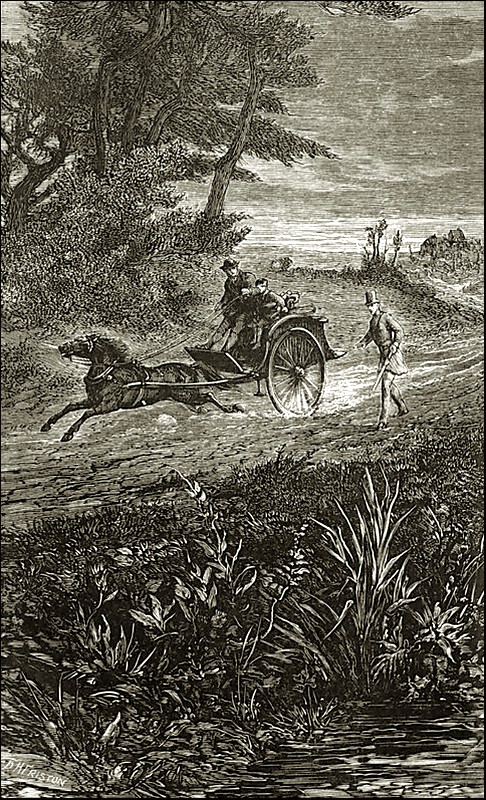
We went down to Saul's Corner like a flash of lightning
"I could feel her trembling. It shook the trap, and at her head, miss—you may believe me or not as you like—was the same figure I had seen. It had kept pace with me all the way.
"Either of her own accord, or because he told her, most like because he did, the mare turned slowly round—I'll swear I never pulled the reins—turned slowly round and began trotting feebly like back to Cadlebury. I could not have hindered her if my life had depended on it, and on the grass by the roadside the figure still held foot with her.
"I could see him plainly in the moon's sickly light. There was the pines of Saul's Wood, there was the bit of common with its tufts of heather, and its holes and pitfalls, there was Wilderness Heath, and there was he.
"'Father, father,' says Willie, 'doesn't that man walk fast—did you ever see a man walk so fast before?' The lad, you understand, thought it was a man, and did not feel frightened like me and the mare.
"At the sound of a human voice, even though it was but a child's, the mare gathers courage, pricks up her ears, and makes another dash for it. The noise of her own hoofs seemed to give her spirit, and maybe she thought she was leaving it behind, for she broke from a trot into a canter, and from a canter into a gallop. And I sat holding the reins without a bit of strength in my hands or body.
"When we neared the gates again, just the same thing happened as had occurred at Saul's Corner, the mare, of her own accord, slackened speed and stopped dead.
"Then I saw the figure once more standing at her head."
Mr. Garland paused and drew a long breath, and stared straight away over Dangermere, as if he beheld something very far off indeed.
Miss Gower, her hands clasped, her fingers locked together, watched him as she had watched him from the beginning of his narrative.
"Was that all?" she asked, finding her companion began to pull the bark off the tree, and made no effort to continue.
"That's not all," he answered, "though in my humble opinion it is more than enough. I was just trying to speak, I had opened my mouth and wetted my lips, and meant to get out some word, when the figure turned and walked quite leisurely through the closed gates. It went straight up to them and disappeared. The mare she tried to follow, there seemed a spell laid on her, you understand, but it waved its hand, and she stopped obedient.
"I do not know how long I had sat there stunned—not long, I dare say—when I felt Willie pulling at my sleeve, and asking if we were going home. He was not a bit frightened, bless you, he did not understand. For myself alone, I don't think I could have done it, but for the sake of the child I tried to draw myself together, and spoke to the mare, and touched her with the whip to waken her up and get her round. If she had been turned into stone she could not have minded me less, no, miss, she could not. She stood there, under the shade of those black old tress, with her head down and her knees bent under her, trembling like a Christian."
"How soon did she move?" asked Miss Gower.
"She never moved at all, if I had left her to herself she would have been there till now. I screwed up my courage at last and got down, and took her by the head, and in a manner of speaking forced her away from the gate. The creature was all in a lather. When I laid my hand on her I might have dipped it in water, it was so wet.
"I had to lead her every step of the way to Saul's Corner. I don't expect you to credit it, but she would scarce put one foot before the other, and I was compelled, as I may say, to drag her along.
"It was the longest mile I ever walked, and the moon she kept blinking in and out, and the wind it howled and howled across Wilderness Heath, and then went sobbing and moaning among the pines, and the mare she did nothing but stumble, stumble, and slip about as if she was drunk or travelling over ice. I had to keep a hold of her till we got to Trotterbeck Bridge. I came home that way, for though she stepped out freer after we left Saul's Corner behind, she made as if to stop every now and then, but at the ferry-house there I got her a quart of ale and put a dash of spirits in it—they are licensed, you know—and she didn't lose much time after that I can tell you. Right glad was I to get up on The Wastes again though the wind blew fit to blow a fellow's eyes out; and now I think that is all I have to tell you."
"No; you have to tell me something more. Did you see the face—did you recognize the——?" and Miss Gower paused expressively.
"I did, miss, I did; it was himself, none other."
"You remember a question I asked you the other day," said Miss Gower. "Do you know why I asked it?"
"I have been turning the matter over in my mind," answered Mr. Garland, slowly, "and I expect you saw him too."
She nodded in answer.
"I suppose," he went on, "you don't feel disposed to say no more about it?"
"There is not much to say," was her reply. "Either he was standing at the hall that afternoon I went over there, or I fancied so. When I got across the lawn and gravel sweep, however, he was gone."
"Aye, aye," commented Mr. Garland, "I thought as much."
"That," she continued, "was why I asked if you conceived it possible he was kept away by anyone. Do you still hold to your opinion that he is not?"
"Firmer than ever," he answered. "I'd be glad to think he was staying away of his own accord, or kept away, or out of his head, or anything except what I must think—I would indeed. But it is out of the question. What you saw at the hall-door might have been him or anybody else for that matter, but what I saw could neither have been him nor anybody else in the flesh. For it was not even as if the thing had run, though the smartest young fellow would have found his work cut out to keep up with the mare. It did not run, it did not seem to hurry; it kept beside us as a shadow does, without seeming trouble or even movement. It was just there always alongside—gliding, gliding on. And then, though it was his face it was not his face."
There ensued silence for a moment, dead silence, during the continuance of which Mr. Garland picked away industriously at the bark of the fallen tree, and Miss Gower let her eyes travel over The Wastes to far-off Dangermere.
Suddenly she said—
"What do you think of it all, Mr. Garland? What is your reading of the mystery?"
Mr. Garland paused before he answered—looked all around him as if suspicious of eavesdroppers, drew closer to his companion—so close that she could hear his voice, though subdued to a mere whisper. Then he began—
"Look here, miss, this is between you and me, ain't it, between you and me only?"
"Of course," she murmured.
"John did not treat you well, everybody knows that; and for my part I can't understand why he should have gone past you for the sake of the handsomest woman that ever lived; but still he was blind and he did choose Miss Taunton, we can't get over that."
Miss Gower winced as if she had received a blow.
"Yet still," proceeded Mr. Garland, "such is the loveliness of your nature, that, instead of being angry with him, as indeed most might, and saying this, that, and the other about his wife, you stand by him, and go over to Taunton Hall and make little of your own slight, and, in a word, to cut it short, act more like an angel than a woman."
The angel so addressed mode no verbal reply. She only raised her hand as deprecating further laudation.
"Such being the case," went on Mr. Garland, "I can speak free—I must speak free. I like the young man myself—I always did like him and I stood up for him, you know that, but when you ask me what I think of these events—these signs and tokens—omens, as indeed they may well be considered, I can only answer you straightforward. I believe John Redworth was the cause of his father's death. I believe the old gentleman met with his death at Taunton Hall or Saul's Corner, or some place between the two. I believe there is great trouble in store for John if he stays about these parts, and that the poor dead father, who was main fond of his favourite son, has come back from his grave to ask you and me, who he knows are faithful friends, to try and persuade him to leave England entirely and go away before worse comes of it."
On the side of Mr. Redworth senior this seemed to be such an entirely preposterous proceeding that Miss Gower looked at Mr. Garland amazed, and was about to express her dissent from his conclusions; but she saw he was so much in earnest, that he felt the power of his argument so completely, that she altered her intention and said—
"It may be so. No one can understand the length and breadth of a parent's affection, and Mr. Redworth loved John very dearly. All I suppose, however, we can do for the present is to wait and watch and see. I tell you candidly that, unless John be very much changed, it would be worse than useless to endeavour to influence him with any account of what we have seen. He would think, perhaps, we were trying to entice him into some admission; or if he did not do that, he would be quite certain to suggest that I had been dreaming, and that you——"
"Had taken a drop too much," finished Mr. Garland, so naively that Miss Gower smiled, in spite of herself. "I thought of that. He was always a trifle given to jeering and scoffing, and mocking, ill-naturedly, but in a good-humoured sort of way. Still, I can't fancy he'd make a jest of this. You see, if his conscience ain't clear, and I'm afraid it can't be, the image of the old man must always be rising before him—always. Upon the other hand, he may be as innocent as our Willie, and then it would be hard to name such a thing to him. There, I must leave it to you, miss—you that are fond of him and that know him so well, can manage to give him a hint better than a stranger. With your good leave I'll wash my hands of the matter, only if you want my help tell me. There's me, and there's the mare, but, lor! I'm afraid she won't be much use at Taunton Hall very soon again. She had a scare last night, poor beast. At any rate, there's my hand, I'll help you by night or day if you will only tell me how, and I'll keep the secret of what I saw close as wax."
Having delivered himself of which peroration, Mr. Garland rose from the tree and walked away, only to return after he had gone a few yards to say, in a tragic whisper, "Oh! I had nearly forgotten to tell you—they are coming home tomorrow, all of 'em, Mr. and Mrs. John Redworth, and the Squire."
DREAR December! very drear, very raw, and very depressing, that year, was far spent, when one morning Miss Gower drove by the long route, over the Wastes and across Wilderness Heath, to Taunton Hall.
Much as she desired to understand the mystery of Mr. Redworth's death, thoroughly determined though she was to pierce and peer and pry till she should be able to fasten the guilt of his father's murder upon John Redworth, and so bring that faithless lover "to his knees," Miss Gower, nevertheless, could not conquer the aversion she entertained to passing Saul's Corner, that dismal bit of road, with its attendant memories of sullen canal and desolate bays, thick with now decaying reeds, of lonely pine woods and neglected common, filled her soul with a sense of fear she felt powerless to overcome. Taunton Hall she could manage, more especially if she kept well away from the front entrance, and from the disused portions of the house, but not that gloomy wood, which looked more terrible than Avernus.
During her many visits to Taunton Hall her resentment and her desire for revenge had both been stimulated to the highest degree by the sight of beautiful Lettie Redworth, née Taunton, and the spectacle of John Redworth's anxious devotion to his young wife.
Here was a change indeed. John, who had always been a sort of grand sultan in his father's house, with a couple of women ever ready to anticipate his wants, now seemed to find no peace or pleasure save in waiting upon a mistress as hard to satisfy as she had been easy to win.
Not a thing seemed really to gratify her. Peevish, affectionate, exacting, demonstrative, all by turns, she tried, and yet retained her slave, by exhibitions of temper, and endless caprices that might well have alienated him from her.
But John's love never changed. The moment after she had irritably bidden him leave her, he was ready to do her lightest bidding; when serving her his feet never grew weary; to try and give her pleasure he would have coined his heart into gold if he had only known how.
Miss Gower looked on and marvelled. "She knows his secret," she would decide one hour. "He is afraid of her knowing it," she decided the next, and then her smile grew brighter and her step more light.
"Some day," she thought, "I will destroy his paradise. His couch is not all roses now, but at no remote period he shall find it all thorns."
By tacit consent she and Mr. Garland avoided all mention of Taunton Hall and the missing man.
"I have washed my hands of the concern," he repeated more than once, when he saw Miss Gower bent on solving the still unsolved mystery. "I know nothing, and I want to know nothing. I am trying to forget, and succeeding, I am thankful to say, fairly. Perhaps I did take a drop too much at Cadlebury that night, anyhow it ain't no concern of mine and if I was you, miss, I'd just drop it. No matter what he has done, he's sorry enough I'll be bound, and maybe it'd be best for nobody to mell or meddle."
"I do not wish to do either," answered Miss Gower with dignity. "All I want is to show my cousin he is not quite deserted, and his wife, she has at least one female friend."
"It is very noble of you," commented Mr. Garland. "but I hope, I do hope, you won't come anigh any harm over there. You have got a neat little fortune, you must remember, if you'll excuse me for making so free as to mention it, and the Squire, all the world knows, stands in need of money, and he has ways with him when he chooses as would wile the bird off her bush, and, oh! miss, whatever you do, don't marry Black Dick. If the old gentleman never rose from his grave for anything else, he'd rise to prevent that, and with reason, too."
"Why, Mr. Garland," answered Miss Gower coquettishly, "the Squire is most agreeable. I call him a delightful man."
With a sigh and a groan Mr. Garland turned aside in despair. He did not now offer his own services or those of the mare so freely as formerly, for he felt that, to use his own expression, Miss Gower had gone a "step beyond him."
"She's lost her head over the reckless scoundrel," he soliloquized; "or maybe she thinks she'd like to be mistress of the Hall. Well, there's no understanding women, and I am sure nobody need want to try and understand them."
So there was silence between Mr. Garland and the young lady, only he groaned when he saw the fat dumpling of a pony Richard Taunton had selected for her, harnessed in what the farmer contemptuously called an old clothes'-basket.
"Aye, she'll drive over there once too often," decided Mr. Garland, and Inspector Downing was of his mind.
"She's got the clue," said that gentleman to himself, in strict confidence, "but among them they'll hush it up. I see how it will be. She'll marry the brother and try to queen it at the Hall, and Dick and she will manage to persuade Jack to leave the country—that is what the plan is, as far as I can see, at present."
All of which only proved that Mr. Downing, like many another of his class, was the victim of a theory—one portion of that theory being that Miss Gower was deeply in love with handsome, unscrupulous Richard Taunton.
And, indeed, the Squire and his brother-in-law were both of the same opinion.
It was only Lettie who dissented from it—Lettie, who in those moments when she could throw aside her mask and appear the wretched woman she actually was, would lay her hand on Black Dick's shoulder and say—
"Oh! my dear, my dear, don't let that Delilah deceive you. She is here for no good. She hates us all. When I first saw her face I trembled and turned cold. See, Dick, I tremble and turn cold now as I speak of her."
But when did man ever listen to the wisdom of woman if its utterances were directed against one of her own sex.
"You do not like Hilda, sweet," remarked John Redworth, one day, "and I am sorry; for, indeed, I who know her thoroughly, can assure you she is very very good."
"You are jealous of her, Lettie, that is about the fact of the matter," said the Squire, complacently; and so poor vehement Lettie, rebuffed on all sides, finding even her old nurse had nothing but words of praise for the fair-spoken lady, who was always so beautifully dressed, and ready with her money, and full of pleasant words, relapsed into silence, relinquished all remonstrance.
Indeed she was too ill to have much energy left either for warfare or argument.
She had come home weakly, and, day by day, she felt her strength failing. When her husband was away, she sat for hours looking out listlessly at the mournful canal, at the gloomy trees, at the wet sodden earth; just as her father had done after his accident, so did Lettie now she seemed to have gained the one good she ever desired—John Redworth for her husband.
Thus it chanced one dreary day in December, when Miss Gower drove over from The Wastes, Mrs. Redworth was very low both in health and spirits. The hand Miss Gower took in hers felt cold and clammy, while the cheek presented reluctantly for her to kiss was hot and feverish.
"I am afraid you are not so well today, dear," remarked Miss Gower.
"I am never well," was the answer.
"We must try to make you better."
"I do not know how you are to set about it then," retorted Mrs. Redworth.
"As a beginning," said Mrs. Gower, softly, while, uninvited, she took off her bonnet and gloves, and removed her fur-jacket, "I should earnestly recommend you, Lettie, not to brood so constantly over the past."
"Perhaps you will be kind enough to mention what portion of the past you would recommend me to erase from my memory."
"There must be several, replied Miss Gower, with amiable candour, "upon which it cannot be pleasant for you to dwell—the mystery of Mr. Redworth's death—the circumstances connected with your hurried and private marriage—John's disinheritance—all these you should discard from recollection. You ought to remember that seeing you so constantly low and ailing must be most wearing to your husband. He is devoted to you, of course, as no one can know better than yourself, but his very love makes his anxiety all the keener. His life in itself cannot be pleasant, on remembering what he must remember, and——" She stopped; there was a look on Mrs. Redworth's face which daunted even her.
"How dare you speak to me in such a manner!" exclaimed the sick woman. "In what way can my husband's affairs concern you, what business is it of yours when or where I was married, or whether I ever was married at all? I wish you would leave the house, and never enter it again. Directly John returns home I shall ask him whether it is by his wish you come here making life intolerable to me. If you are to remain here constantly, I will go away. I would rather be away. I wish we had never re-entered the Hall."
"I don't wonder at that," returned Miss Gower, "if you have seen in it what I have seen."
"What have you seen?"
"Mr. Redworth. John's murdered father," was the answer.
With a moan, John Redworth's wife repeated the words, then tottering to her feet, she raised her arms above her head, and, before Miss Gower could reach her, fell heavily to the floor.
"She knows, but he thinks she does not know," decided that lady as she rang the bell violently, and raised Lettie's head upon her knee, and wiped the blood from her mouth.
"Send someone for a doctor at once," she cried, as Black Dick, followed by the servant, rushed into the room, "your sister is dangerously ill."
MRS. REDWORTH was dangerously ill, so ill that there seemed small likelihood of her ever being better.
"How long has this been going on?" asked the Cadlebury doctor, who was fetched by Dick Taunton, in wild haste.
"She was never very strong, and she caught cold on her wedding trip," explained the Squire, but he said it doggedly, as one who, having reluctantly learned a lesson, repeats it with unwilling lips.
If Miss Gower had never been considered an angel before, she must have proved her right to that character then.
"Do not grieve so bitterly," she said to Black Dick, who sat with arms crossed upon the table and his head resting upon them. "We will all do our best for her. I will not leave here till she is better," and she laid her hand, her soft deft hand, on his shoulder with a caressing assurance as she spoke.
The man did not answer by words, but he lifted his head a little and pressed his lips to her hand in mute acknowledgement.
"There is nothing," went on Miss Gower, "I would not do for John, or your sister, or—you."
Ay, truly, nothing. As she spoke her thoughts sped back to the night when she paced her room in an agony of disappointment and mortification, and felt herself a woman slighted!
Before an hour had elapsed the pony carriage was on its way back to The Wastes, without Miss Gower. The lad she had constituted her attendant bore a very touching and affectionate note to Mrs. Garland, which note next morning brought Mr. Garland and the mare, and a profusion of such homely delicacies as their larder boasted, to the Hall. In the goodness and fullness of his heart, Mr. Garland placed even at the disposal of Dick Taunton the services of himself and the mare.
"Any time, day or night," he said, "there's me and there's the mare, and you, Squire, as is a judge of horseflesh—though I can't say the pony you chose for Miss Gower did your taste much credit—come out and look at my nag. There ain't a better nor a willinger in the whole countryside. She is sound to the backbone; true, and able, like Miss Gower. Ay, there's a woman, if you please; a friend in need a friend indeed, a woman in ten thousand."
"I quite agree with you, Mr. Garland," said Black Dick, wringing the farmer's hand, for Miss Gower's devotion to his sister had touched him sensibly.
"That is right, that is well spoken," remarked Mr. Garland, tossing off the tumbler Mr. Taunton had considerately presented, "a woman in ten thousand, that is what she is," which, if Mr. Garland had known everything, might be regarded as fortunate.
Never was there a more attentive nurse. "I had better stay with her entirely, John," suggested his cousin, "she talks of things the knowledge of which it would be as well to keep in the family."
Whereupon poor John, who was only too well aware that there were things upon Lettie's mind the outside world ought not know, thanked Miss Gower even with tears in his eyes, and invoked blessings that it is humbly to be hoped never bore fruit.
The poor young thing rambled as she lay, wandered from topic to topic, from misery to misery. She was always creating for herself imaginary terrors, and shrinking from them; always pursued by some haunting horror which she tried vainly to elude.
She was so weak—she was so incoherent—she was always in such an agony of fear, it could only be regarded as marvellous that Miss Gower managed to piece together so much as she did—out of so little to weave so great a whole.
Yes, Miss Gower began to understand it all; in fact, she believed she did understand it all, except how Mr. Redworth was murdered, and the precise spot where he lay. That his grave was somewhere in the vicinity of the Hall she felt convinced, but that was a matter of merely minor importance; as regarded all great details, she had now the ball at her feet, and could afford to play with and indulge her victims as an angler humours a trout.
How good she was, and how kind, how untiring in her attention to Lettie, how punctual in her administration of food and medicine—how watchful of her repose!
"We ought, John, to have further advice," she said one day. "If money is the impediment, let me be your banker; I, you know, have enough and to spare."
"If you have," interrupted the Squire, who overheard what was said, "I wish you would let some of it come this way. I stand in sore need of filthy lucre."
"Really and truly?" questioned Miss Gower.
"Really and truly, young lady," answered Mr. Taunton.
"Then why not have some of mine?" she suggested. "It does not matter to me where it is, except that of course I should prefer a friend had the use of it. I may just as well take a mortgage over Taunton Hall as any other Hall or Court in England—better if my doing so will be of the slightest service to you. But, perhaps, all I have would not be enough. How much do you want?"
For reply the Squire, looking more curiously and earnestly at her than he had ever done before in their acquaintance, said he did not want any, he had been only joking; in spite of which statement, however, he went two days running to his solicitors, and put together a few articles such as might prove useful in a hurried journey. Further, he sold some cattle, and did not bank the proceeds in the All England at Cadlebury.
Whilst he was engaged in these proceedings, a great London doctor arrived to see his sister.
It was quite late in the afternoon before he drove up the principal entrance to Taunton Hall, the gates of which were set wide.
No one knew then who had unfastened the bolts; but the flyman, finding them hospitably open, turned in and set down his fare at the Hall door, and rang a peal fit to bring the house about his ears.
It was Miss Gower in person who answered the summons—Miss Gower, graceful and self-possessed as ever.
She had spent a considerable amount of time that morning in oiling the locks and unfastening the chains, and as she opened the door she said softly to the doctor—"I am so thankful to see you," and then stopped—surprised by a sudden horror.
For, pushing in front of the Doctor, though unseen by him, there entered the figure of a tall spare man, arrayed in clothes free from speck of dust, carrying in his hand a trim umbrella.
Stricken for the moment dumb, Miss Gower watched this newcomer flit across the hall and up the staircase.
"I am going mad," she murmured to herself, as the great physician said—
"I trust I may be able to be of some service, madam," and so recalled her to the common affairs of life.
When the doctor saw his patient, he looked very grave indeed. She was sitting up in bed, her long black hair streaming about her shoulders, her eyes bright with a strained and unnatural light, her cheeks flushed with excitement.
"Someone," she began, "has opened the hall-door—that door—Dick fastened up so securely—which I did not open even on the night when—— Who shot back the locks and turned the keys?" she asked suddenly and wildly.
"I did," said Miss Gower, in her gentlest tones.
"And who gave you permission to open any door my brother ordered to be kept shut? You did it on purpose. You did it to let him in. He came straight up here and looked at me with that unchangeable face. He is hidden in some corner now," and she covered her eyes with a cry of indescribable agony and fear.
"This is very bad," remarked the doctor, as he advanced and laid his hand on her forehead; "poor young thing! there, there don't look so frightened. I have only come to do you good. Lie down quietly, I won't disturb you."
"Make her go away," said the patient.
Surprised, the doctor turned towards Miss Gower, but she was equal to the occasion.
"Do you want poor Hilda to leave you, dear?" she cooed, "surely you would not be so cruel."
"Yes I would," snapped Mrs. Redworth. "I hate the sight of you, stealing and crawling about me, and you had no right to open that door. Oh! Dear—oh! dear, dear me!"
Miss Gower directed a swift and meaning glance at the doctor, and then stole out of the room.
"You had better go up," she suggested to the regular medical attendant, whom she met in the passage, "the London physician is here. Mrs. Redworth is frightfully restless and unmanageable."
And then Miss Gower did an extraordinary thing—a thing unprecedented. She went to the cupboard in the Squire's especial sitting-room, where spirits of some kind were always to be found, and, selecting a bottle which contained brandy, poured herself out half a wine-glassful and drank off the contents as if they had been water.
"I wonder if that will make me tipsy," she marvelled, as she looked in surprise at the deed she had done.
"Hey day," cried Mr. Taunton, entering the room at the moment, "how is this, Miss Gower? It can't be possible you have been converted and are taking to my good ways."
And he laughed out genially.
"Your sister has frightened me," answered Miss Gower coldly. "She was angry at my having opened the hall door, as if one could invite a physician of eminence to enter the house through a dirty farmyard."
"You opened the hall door?" he said, inquiringly.
"Yes, I did," she answered, defiantly, replying to his tone rather than his words, "as there was no one else to do it for me."
For a moment the Squire pondered over this utterance, then he strode up to the cupboard, and in his turn pouring out brandy—a bumper this time—emptied it as he muttered audibly—
"By ——, Lettie was right after all."
"Master!" at this juncture cried out a shrill voice, "master, where are you?" and thinking his sister was worse, the Squire set down the decanter and rushed into the passage, followed by Miss Gower.
It was old Deborah who had called—old Deborah standing there, her cap awry, her grey hair disordered, her face distorted with terror.
"Master, someone has set the front door wide, and he is standing there on the step. Go to him quick before anybody else sees. He is standing as he did that night when——"
"Will you hold your tongue, you fool?" demanded the Squire, savagely, but he made no step forward into the hall.
"The door stands wide, master," frantically persisted the woman, wild with affright, "and he is there waiting. I dare not go anigh him myself, but——"
"I am not afraid, I will go" exclaimed Miss Gower, recklessly, and she darted past both of them, and was at the foot of the principal staircase before Mr. Taunton could seize her. Then, with an awful oath, he bade her mind her own business and, pushing her on one side, strode towards the door.
It was fast. There were the locks and bolts and chains as they had been before Miss Gower undid them, but the man's blood was up and his fear gone, and he shot back the locks and undid the bolts, and dropped the chains with a great rattle and flung open the door.
There was not a creature on the step, not a living being to be seen, and yet he and his companions all felt that something had crossed the threshold and was lurking in the shadows beyond.
"What was that?" Mr. Taunton asked, but Miss Gower could not answer him.
For reply all he heard was old Deborah's wail of "master, master, oh! my poor young lady," and then he rushed out into the night, banging the heavy door behind.
THAT same evening Mr. Garland chancing—no unusual occurrence for him—to loiter into the bar of "The Three Fighting Cocks" while the ostler was harnessing his mare, heard three pieces of intelligence.
First, a great London doctor had been down to see Mrs. Redworth; second, he and the local authority agreed that she could never be better, and that she would not be much longer ill; and third, Dick Taunton had passed up the main street apparently either mad or drunk.
Popular opinion inclined to adopt the former suggestion. To gentlemen in the very act of imbibing more than their better halves consider good for them, a certain disagreeable personality seems to attach even to the mildest form of inebriation.
"Ah! Poor fellow," said Mr. Purslet, "enough to drive him mad. He was fond of his sister whatever his other faults."
"And surely it was a bad job for her taking up with that Jack Redworth," added a second.
"It is now said,"—whispered Mr. Purslet, but, at this juncture the heads drew so close and the words of wisdom were spoken so low, that no one outside the charmed circle could catch their sound.
But they meant something pitiful, so much was clear, since Mr. Garland remarked, "Poor little lass! And she motherless;" and some one else observed, "That Miss Gower had a lucky escape;" and another remarked, "He never knew a father or a mother's favourite turn out well."
"Black Dick was well-nigh distraught," capped the fortunate individual who had seen the owner of Taunton Hall; "they say he broke away from the doctors when they told him the news, and took leave of his senses there and then. All I know for certain is, he had no hat on when I met him."
Hearing which, the collective wisdom of "The Fighting Cocks" shook its head, and said "that looked very bad."
"Tell you what, gentlemen," remarked Mr. Garland, buttoning up his coat and winding a muffle handkerchief round his neck preparatory to wrestling with the night air, "as I go home I'll take a look in at the Hall. Of late I have gone the other road, not being, to tell you the truth, over and above partial to Saul's Corner; but duty is duty, and I could not sleep in my bed if I was to fail in asking how it is faring with that poor sick lass, and with my young lady, who has acted noble—I can't say more nor less—noble."
The first event which marked the progress of Mr. Garland's homeward journey was a struggle between himself and the redoubtable mare after they crossed Cadlebury Bridge. He wanted to take the road to Saul's Corner, and she wished to follow that across Wilderness Heath. Upon the mare's mind (it at the time having been perfectly clear) there was no doubt evidently as to the reality of the vision she had one night beheld outstripping even her speed across the stretch of common land, and she laid her ears flat back and twisted her body into a semicircle, and pranced and plunged, and absolutely refused to heed the bidding of either whip or bit.
"I don't want to thrash you, and if I did I don't suppose it would do much good, observed Mr. Garland out loud as he put his whip in its socket, and tied his reins to the dash-board, and resignedly got down to lead the creature along the road he wished her to go.
But she refused to travel it for leading either. She whinnied and tossed her head and put her feet straight out, and lifted the sides of her lips and showed all her teeth, and made, in fine, such a trouble and disturbance, that Mr. Garland was fain at length to leave her and his trap behind at a convenient smithy, and pursue his way to the Hall on foot.
He was passing the great gates when, perceiving they were open, he turned up the front avenue, to save himself, as he afterwards stated, "a good few steps."
"Lor, what a dismal place it is," he thought, when he got well under the shade of the trees, and beneath the gloom of the cedars, and thought of old Marmaduke lying there all alone with never another dead man near to keep him company. "I wonder if what I saw that night was real eyesight or Scotch whiskey. I wonder whether the place is uncanny, and Redworth will some day be found hid away among those unwholesome shrubberies. Bless my soul! What is that?"
He might well ask. In the glimmering light he could just discern a something clad all in white rushing towards him. Then a cold hand touched his, and a wild hollow voice exclaimed—
"Oh! Dick, turn back, turn back: she knows all; she is telling him—I always feared her—she has put the puzzle together, I crawled out of bed and listened—and he—he is in the house too tonight. I saw him clearly, Dick, as I have so often seen him in my dreams, with his poor broken arm and his ghastly face. He came close up beside my pillow, and I—I——"
He had her in his strong grasp even while she swayed and tottered; before he could fall he lifted her. This was no ghost, but the lightest load of flesh and blood man ever carried.
On along the drive, past the darkly-silent windows—up the steps—under the porch—through the door standing so hospitably open—into the great unlighted hall he bore his burden.
Arrived there he did not know which way to carry her, and paused irresolute, till seeing a door in the distance standing ajar and hearing the sound of voices, he strode towards it. He was about to enter the apartment when a sentence he heard stopped him. It was this—
"God in heaven! Hilda! You don't mean to say you think I murdered my father?"
"I do not mink—I am sure," was the answer, spoken in an accent of shrill and vindictive triumph. "I am neither blind nor deaf, John, and I know all the very good reasons you had for wanting him out the way. You were short of money, and he had money about him. You were not aware of the tenor of his will, and you fancied you would have your share to play with. Do you think I am ignorant that when you went ostensibly on your wedding tour, you travelled no further than London, where your child was born two days after your marriage? I know where that child is buried. I have talked with the nurse who attended your wife. I have heard Lettie raving about the dead man, and his broken arm, and his dishevelled grey hair. You thought, no doubt, when you deserted me for her, you did a fine thing, and that I would sit down patiently under the slight, and never lift a finger to avenge myself. But you were mistaken, John Redworth. I loved you with all my heart; and now I hate you with all my heart, and I will never know one night's sound sleep till I see you in the dock, on your trial for wilful murder."
"That is at least a pleasure I can deny you," said Richard Taunton, mockingly, as, pushing open an inner door, he crossed the room to where John Redworth and his accuser stood. "If there were murder in question. I was the murderer. I am the man, madam, and he you have accused is innocent of all knowledge, as he is of any crime."
"Here's your wife, John Redworth," said Mr. Garland, at this juncture pushing into the apartment, and, red and panting, carrying the light figure as if it were some terrible weight. "I met her down the avenue. Herself and One Above alone knows how she managed to get there. She was flying to warn you, Squire, not knowing that miss here had got on the wrong scent. And if you'll be advised by me, you'll just forget what you said this minute, and make a bolt for it. To my thinking there has been mischief enough already; for all the justice and all the confessing in the world won't bring the dead back to life."
But his words were unheeded. Already John Redworth had his wife in his arms, and was carrying her off to her own chamber. Richard Taunton was alternately ringing the bell and imploring Mr. Garland to go for the doctor, while Miss Gower remained immovable, her eyes fastened on the wall opposite to the chair into which she had dropped, repeating some sentences inaudible to the two men, wildly waiting for something to happen, they scarce knew what.
Suddenly, through the stillness of the house, there rang out a terrible cry. It seemed to rend the stillness of the solemn night, and cleave a way after the soul departed.
"Poor lass—poor young thing," said Mr. Garland, drawing the back of his hand across his eyes. "She won't know trouble any more—never any more."
AT the smithy the mare stood waiting for her master till, in despair, the farrier put her up and went to bed himself.
It was blackest morning—a cold, bleak morning, with a biting wind, before Mr. Garland reappeared to claim his refractory quadruped, and then he was not alone.
Miss Gower stood beside him. She had played out her hand and lost, and now she was going away from Taunton Hall, and the dead woman and her revenge, feeling herself beaten. She had heard the whole story told. The mystery of Mr. Redworth's disappearance was solved at last; but it no longer possessed the slightest interest for her.
Driving over those dreary Wastes in the coldest hour in all the twenty-four, the hour before dawn, she recalled the words of Richard Taunton's confession as she might the sentences of some tale, with which she had no manner of connection, read in the years gone by.
"You're shivering, miss; keep the wraps well about you," advised Mr. Garland, but his tone was no longer what it had been.
As he drove, his thoughts were not with the vindictive hypocritical woman beside him, but with the sinner he had heard confess his guilt—the "poor girl" knowledge of that guilt had killed.
In half-a-dozen sentences Richard Taunton told his story.
"There's much to tell," he had said, standing before the three of them, his sister lying dead above, the murdered man's son looking at him through eyes blinded with tears.
"Yes, he did come to the Hall that night," explained the Squire, "but I was away from home. He came to the front door, through which no one had been admitted since I locked it up after my mother's funeral. Lettie happened to be at that side of the house, outside, you understand, and saw him, and he said some bitter things to her, that were true enough, no doubt, but hard for a woman to bear.
"He did not stay long, and then she, low and out of spirits before, on account of what had passed between you and her Jack, down by the Canal side went into the house and cried till she could cry no longer.
"Deborah, it appears, saw Mr. Redworth also, but I did not know that till quite recently.
"It was late before I got to Saul's Corner that night. Coming along, and singing a verse or two of a foolish song I had stopped to hear at Trotterbeck bridge, it struck me all at once that I heard an unusual sound, so I pulled up and listened. There was a feeble cry of 'Help.' I could not see anything, but I could distinguish that one word, and horribly eerie it seemed to me, floating about in that lonely place, with the dark pines to my left hand, and the desolate heath stretching away to my right.
"'Who calls?' I shouted out, and for answer there came the merest whisper of a cry—
"'Here, help.'
"It was some time before I could find him. He had tripped up in one of those holes that abound on the common, and there he was lying, with a broken arm, and something the matter with his ribs, his head cut, and injuries in all directions. I put my flask to his mouth, and tried to get him to walk, but he could not do it, so I had to bring the trap up as close as I was able, to lift him into it. Shall I go on?
"I got him home," he proceeded, after John Redworth had silently signified a wish for the story to be finished—"got him home and carried him into the house. Deb had gone to bed, and there was no one up but Lettie. We did what we could for him, though we felt almost frightened at having brought him to the Hall, fearing if anything happened, the blame would be laid on us, after the words he had spoken to Lettie; but still we did help him—remember that, Jack; I am telling you the simple truth, Mr. Garland, and we went on doing what we could, till even Lettie began to fear it was of no use, that he would die before sunrise.
"I don't know how it happened, but accidentally, in moving his coat his pocket-book dropped out. I opened it, and saw the money, and then the devil took possession of me.
"I had got notice, if I did not pay up the back interest on my mortgages, the mortgagees would foreclose. I was at my wits' end, and as I turned over the notes I thought of all those notes could do for me, of the freedom they might compass.
"As I thought this I lifted up my eyes, and met his glance. It dropped in a minute, but—must I finish? Can't you guess the rest?"
"I want to know how he died," said John Redworth with a forced and terrible calmness.
"I had some laudanum in the cupboard, and I poured it down his throat. Lettie was not in the room, she had gone out to make him a cup of coffee, and when she came back he was dead, or seemed dead, and there could be no return along the road I had travelled. I made away with the body. I placed it, as I thought, out of my own sight and the sight of all men for ever; but I tell you he has been at bed and at board with me ever since from that night, he has sat opposite me at table, and walked with me through the woods. It killed Leftie. She was dying by inches when you"—turning to Miss Gower—"came among us, but the pace quickened after that, for she never imagined but you were following on the right track, it never occurred to her you were trying to fasten the crime on John. She has gone now, and no disgrace or grief of mine can trouble her in the future, so do what you like. The words I have spoken tonight I promise to repeat when and where you will."
But both John Redworth and Mr. Garland shook their heads.
"The best thing you can do," said the farmer, "for the sake of the living and the dead, is to let the mystery of Mr. Redworth's disappearance stay a mystery to the end; and as for Miss here, I'll just take her back with me presently. She will be better up at The Wastes. I always said the air down here did not suit her, and I say so still. If I could do anything for you, Mr. John, be sure and let me know," he went on, turning to the younger man. "Is there anything, think you, I can do for your now?"
For answer John Redworth covered his face with his hands; what could any man do for him, or woman either?
"Thank you," he said, after a moment's pause, "but you can do nothing; leave me alone, please, will you?"
So they went away and left him alone with his grief. He had had his life and he spoiled it. His chance had been given him and he missed it; in the joyous spring-time he had planted thistles, and he could never now hope to gather figs.
Roy Glashan's Library
Non sibi sed omnibus
Go to Home Page
This work is out of copyright in countries with a copyright
period of 70 years or less, after the year of the author's death.
If it is under copyright in your country of residence,
do not download or redistribute this file.
Original content added by RGL (e.g., introductions, notes,
RGL covers) is proprietary and protected by copyright.