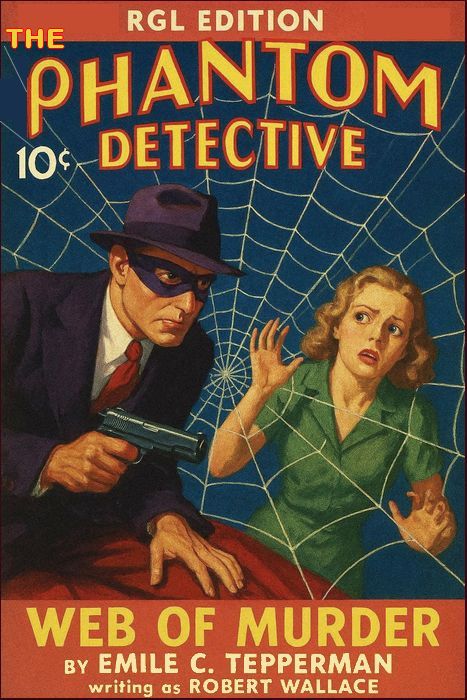
RGL e-Book Cover
Based on an image created with Microsoft Bing software
Roy Glashan's Library
Non sibi sed omnibus
Go to Home Page
This work is out of copyright in countries with a copyright
period of 70 years or less, after the year of the author's death.
If it is under copyright in your country of residence,
do not download or redistribute this file.
Original content added by RGL (e.g., introductions, notes,
RGL covers) is proprietary and protected by copyright.
RGL e-Book Cover
Based on an image created with Microsoft Bing software

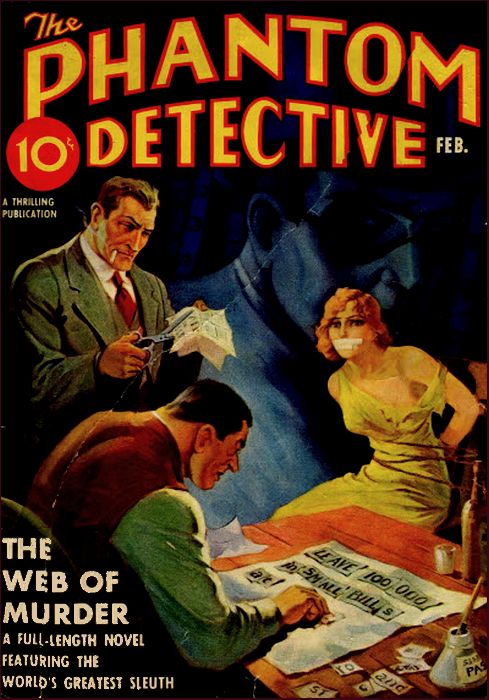
The Phantom Detective, February 1939,
with "The Web Of Murder"
The Phantom hurls body and brain into a maelstrom of death-laden mystery when evil forces smash a city's peace and establish a grim reign of terror! A criminal master brain weaves a sinister mesh of death baited to catch human flies—and challenges the might of law!
AT midnight, all prisoners in the Tombs should be sound asleep. But here and there in the long rows of grilled windows facing on Center Street one might have discerned a white face, lighted by the pallid gleaming of the full moon.
Such a face was that of Wilson Dennison, scheduled to stand trial for murder on the morrow. Already, in the Criminal Courts Building across the street, the drum containing a hundred names was ready—the jury-panel from which was to be selected the blue ribbon jury that would decide Wilson Dennison's fate.
The policeman on the prison beat down at the corner scratched his head and wondered whether it was the money that made these rich men do things like that.
Wilson Dennison, up there, had shot George Cheltenham; shot him in cold blood, and then stood there with the gun in his hand, waiting to be arrested. The papers said he had retained Lance Vickers, the ace criminal lawyer. Vickers had recently risen from comparative obscurity to win acquittals in three almost impossible cases in rapid succession; and it was whispered that Dennison was paying something like two hundred and fifty thousand dollars for a guaranteed acquittal in this case.
If found guilty, he would pay nothing.
The young cop stared up at the window in the third tier, and was glad that he wasn't a rich man, and that he had a pretty young wife and a strapping son of five and a half, and that he could think about going off the beat in twenty minutes and going home to his family and the simple pleasures of an honest man's home...
But a lot can happen in twenty minutes.
On the side street, in a room in a building halfway down the block, a group of men were gathered. The room faced on the street. The blinds were drawn tight. One of the men stood near a window, peering down through a small aperture. From where he stood he could get a glimpse of the Criminal Courts Building—and of the six story building of the International Bonded Warehouse, which stood directly across the street from the window.
Within the room there was not a single piece of furniture. Apparently it had once been the office of a storage company before the entire premises had been condemned by the building inspector.
Six of the men were dressed in the uniforms of New York City policemen.
The others—six also, including the one at the window—were in dark civilian clothes. Their jackets bulged slightly at the armpits, indicating the presence of holstered automatics. Three of the civilian six held widemouthed, sawed-off rifles under their arms. Two others carried Thompson submachine guns, suspended over their shoulders by thick leather straps, but in position to be swung immediately into lethal action. The sixth carried a small canvas bag containing half a dozen tear gas bombs.
There was a thirteenth man, and he was talking. The other twelve, with the exception of the watcher at the window, listened intently to his words. He stood near the wall, alongside a large-scale wall map of the section of the city in which they were located.
Had the police—the real police—seen this thirteenth man, they would have been puzzled by his presence there. For Alexis Konstantin was known to them as a reputable tea broker, with no criminal record against him in the United States. They would have been less puzzled had they known that Mr. Konstantin, under various aliases, was wanted by two or three European countries on old smuggling charges.
KONSTANTIN pointed with a stubby forefinger to the point on the wall map which corresponded to the position of the International Bonded Warehouse across the street from them.
"You each understand your duties," he said in a slightly accented voice. "The warehouse is the first objective. The truck will swing into the street seven minutes after the zero hour. It must be loaded and on its way within four minutes. The truck will pick up all men not in uniform.
"The station wagon will pick up the men in uniform fourteen minutes after zero hour—which will give them two minutes extra in which to perform their part of the job." Alexis Konstantin paused to lend added weight to his next words.
"We are guaranteed fifteen minutes of clear field before any squad cars or police reserves reach this spot. There should not be a hitch of any sort. If any one is captured, he is to remember that his only salvation will be to keep his mouth shut tight. He will have my guarantee that he will be free again within forty-eight hours.
"If any of you talk"—he smiled, showing two beautiful rows of even white teeth—"that will be unfortunate for you. True, there is little you could tell the authorities anyway. Perhaps you would tell them my name. That would be of little help to you. My master will know how to free me—and how to take care of the one who talks!"
The men shuffled nervously. One of them, holding a submachine gun, said: "I thought this was to be a jail-break. I thought we was gonna get this guy Dennison out of the coop—"
"What you thought, Cookey," Konstantin said softly, "does not matter in the least. Be assured that our master knows exactly what he wishes to do. Your only task is to carry out your orders to the letter. Our master pays well for success—and just as thoroughly for failure. I advise you not to fail!"
Almost as he uttered the last word, a small alarm clock on the floor at his feet broke into low musical sound. Its face showed the time to be twenty-one minutes before midnight.
Konstantin grew taut, as did every other man in the room.
"One minute before zero hour!" the tea broker exclaimed. "Every man to his post! When I give one blast on the whistle, go into action!" And now, with every indication of having been rehearsed thoroughly and often, the men moved out of the room, walking swiftly, but not crowding or falling into confusion.
Konstantin was the last man to leave, except for the watcher at the window. To this one he said: "Clean up behind us, Sackett. Understand, you are to remove every single trace of our occupancy of this room—even to wiping fingerprints from the walls, and footprints from the floor!"
Sackett nodded silently, and Konstantin left.
DOWN in the street, the wraith-like shadows of moving men blended with the darkness. The patrolman on the beat at the corner noticed nothing until he saw the figures of two policemen appear, moving toward him. He took them for fellow officers, on their way to the twelve o'clock relief.
He was about to hail them when their faces became discernible under the light, and he realized that they were unfamiliar to him. He had thought that he knew every man in his precinct, and he was puzzled, but only for an instant.
He started to say: "New men, eh—"
The nearest of the two uniformed men stepped in close to him, raised a hand in which a long, wicked sliver of metal gleamed sharply. The hand descended with lightning quickness, and the blade was buried up to the hilt in the young cop's throat. He gurgled, tried to yell, but no sound came through the suddenly bubbling blood. His arms flailed for an instant, and then he seemed to deflate—he collapsed to the sidewalk, dead in the pool of his own blood.
Even before he fell, the two bogus policemen were joined by the other four, and the six of them, in a tight, compact body, moved diagonally across the street, then turned the corner to disappear from view.
In the meantime the six men who were not in uniform were engaged in their part of the deadly, efficient plan.
Two of them headed directly across the street toward the steel doors of the International Bonded Warehouse. A third ghosted into the alley at the side of the building and placed a small stick of dynamite over a conduit manhole which was barred and locked, and which gave access to the telephone and burglar alarm wires of the building.
He sprang away and waited a half minute, till the short fuse ignited the dynamite. There was a small blast, and the manhole grille no longer presented an obstacle.
Without waiting for the smoke of the explosion to dissipate, the dynamiter sprang down into the opening and set to work upon the burglar alarm wires with swift efficiency. He cut through the insulation, and quickly tapped a small switchbox. Then he pushed a lever, grinned crookedly, stood up in the hole, waved a hand in signal to a man across the street. This one in turn waved to the two who had crossed to the steel doors.
These two each held a Mills bomb in one hand. At the signal they set the Mills bombs down close to the steel door, carefully, so that they would not roll away. Then they plucked out the time-detonators.
They raced away across the street, counting under their breaths as they ran. When they reached the count of six they both dropped simultaneously to the ground, and the two bombs exploded.
The detonation was loud, and devastatingly effective. The steel doors of the International Bonded Warehouse fell away as if made of papier-mâché. The entrance to the warehouse now yawned defenselessly open.
The echoes of the explosion rolled down the street, echoing through most of downtown Manhattan, awakening the prisoners in the Tombs, startling the night watchmen in the public buildings in the neighborhood. But the echoes, themselves taken up and tossed about among the buildings, effectively distorted the direction from which the sound had come, concealing the point of detonation.
The man in the conduit hole, who had intercepted the burglar alarm signal system, had not stopped working. He had stripped away the insulation from the telephone wire running through the conduit, and now he extracted a telephone instrument from his bag of tools, which he hooked onto the wire. Using a pronged fork, he made a short circuit, causing the light to flash in the Central Office switchboard. He got the operator there.
"Police Headquarters! Emergency!" he said urgently.
In a moment he had Headquarters, which was only four blocks away. To the sergeant who answered he said: "That explosion! It's an oil boat at Pier 9, North River!"
"Okay," the sergeant snapped. "We were trying to figure where it was. It sounded much nearer. Are you sure?"
"Of course. I'm here, only a block away. You'd better get over here fast!"
A minute later the call was going out over the short wave: "Calling All Cars! Go to Pier 9, North River..."
Radio car sirens screamed in the night, and the clangor of fire apparatus was soon added. But the police and the fire-fighters were all heading away from Center Street. It would be a matter of minutes before they discovered their error; minutes before they finally located the true location of the explosion.
MEANTIME the efficient criminal band was working at top speed, well within the time limit set by Alexis Konstantin. The two men with submachine guns remained outside, covering the street. The others were already in the warehouse, and shortly they began coming out, trundling bales of tea on small hand-trucks.
Moreover, while all this was going on almost under the walls of the Tombs, another part of the clockwork plan was being carried out, in a street not far distant.
At exactly the moment when the alarm clock rang in the room where Alexis Konstantin was coaching his crew, three men were standing at a street corner a half block away from the New York City Department of Sanitation Garage, where the huge refuse trucks of the city were stored for the night.
One of the three held a watch in his hand. Suddenly he snapped it shut. "Twenty-one minutes to twelve!" he announced. "The truck should be here, now."
As if to echo his words, the rumbling sound of a truck was heard, and a gleaming refuse car swung around the corner. It was one of those newly purchased pressed-steel trucks which the City of New York had recently put into service. It had a capacity of ten tons, and the all-metal body was shaped something like the top of a tank. It was returning, as it did every night at this time, from its last trip to the dumps, and would be serviced during the night so that it would be ready to be taken out early the following morning.
There was only one man aboard it now—the driver. His brown uniform with the black insignia on the sleeve, showed up clearly in the sudden flashlight beam that bathed him, directed by the hand of one of the three men at the corner. Before he understood what was taking place, they had swarmed up alongside him, and a blunt blackjack descended with ruthless swiftness in a smashing blow upon his left temple.
The crunch of breaking bone in his skull was unheard beneath the throbbing of the truck's motor. The driver slumped in his seat, dead.
Efficiently, he was lifted up and dumped in the back. The truck did not cease moving, for one of the attackers slid in under the wheel, sending it ahead down the street, past the City garage, and around the corner northward toward Center Street.
The three thugs removed brown coats and trousers from a package they had brought along, and before the truck was half a dozen blocks away they were all dressed as Department of Sanitation employees.
Thus, without attracting the suspicion or interest of any patrolmen on the way across town, the big truck rumbled into Center Street, then turned the corner to come to a stop in front of the International Bonded Warehouse at exactly seven minutes after zero hour, in accordance with the prearranged plan.
TWELVE bales of tea were resting at the curb before the door of the warehouse. The refuse truck pulled in close, and without a single word of command or direction, the entire crew began piling those bales into the truck.
Down at either end of the street, a man with a submachine gun stood guard. Now there were dozens of faces at the barred windows of the Tombs, watching the strange operation with morbid interest. Those prisoners had at first thought that the terrific explosions heralded a jail break of some sort. Now they stared down at the deadly scene in the street, wondering why anyone should want to hijack tea—of all things—from a bonded warehouse.
A solitary policeman, from the next beat at Park Row, came into sight, running and tugging at his service revolver. He never had a chance to pull the weapon. One of the submachine guns suddenly burst into a chattering stutter of death, and the bluecoat pitched forward, riddled with lead. The gun became silent once more.
A passing couple turned the corner and gaped at the scene. The second gunman on guard hefted the submachine gun and yelled: "Scram, you two!"
The man tugged at the woman's arm. "Let's get out of here, Doris. It looks like a robbery—"
But the woman became hysterical, raised her voice and screamed: "Police! Po—!"
She got no farther than that. The man with the submachine gun spat.
"You asked for it, skirt!" He swung the quick-firer into line and depressed the trip. Again the gun chattered, and the man and woman lay on the pavement, wallowing in their own blood.
The four minutes assigned for this portion of the operation were over. The last bale was being shoved into the gaping maw of the refuse truck. From somewhere nearby there sounded two quick blasts of Alexis Konstantin's whistle—though Konstantin himself was nowhere in sight. At once the crew of gunmen climbed up into the truck. The motor roared.
Then, and not 'til then, did a group of guards from Tombs prison come charging out with shotguns in their hands—their first thought too, like that of the prisoners, had been of a jail-break, and it had kept them inside for those crucial few minutes needed.
Now they were greeted by two prolonged bursts from the submachine guns and were mowed down before they could take half a dozen steps.
The two gunners ran toward the truck, climbed up it to join the others, and the refuse car roared down the street.
At the same moment the six thugs disguised as policemen appeared at the corner, moving in a solid group, each holding a naked revolver. One of them was carrying the inert body of a man, which he dumped in the gutter in the path of the garbage truck, which careened over him, crushing out of him whatever life might have remained.
A small tan and black station wagon raced into Center Street, screamed to a stop, and the six bogus cops piled into it. The station wagon swung into motion at once, and raced along behind the garbage truck.
The two vehicles crossed Lafayette Street. Just then the siren of a squad car sounded shrilly ahead of them. But the huge truck did not decrease its speed. The police car tried to swerve out of the way at the last moment, but the truck struck it a glancing blow. The ten tons of steel in that garbage car sent the small police machine spinning end over end to crash into the facing of an office building where it burst into flame.
And then the two fleeing cars disappeared into the night, leaving behind them death and destruction, and unutterable chaos.
Eight minutes later, the garbage truck was at a dock along the East River, unloading the twelve bales of tea into a small launch which immediately chugged away with its burden, as well as with the crew of killers who had perpetrated the robbery.
AT ten o'clock on the morning after the spectacular warehouse robbery, two men were standing in a room in downtown Manhattan, directly opposite the building in which were located the publication offices of the New York Clarion.
One of these men held a long-range telescope to his eye. The other, at his side, cradled a high powered Winchester rifle under his arm, patting the shining stock of the powerful weapon with a loving hand, and carefully inspecting the telescopic sights attached to the barrel.
The man with the telescope was big, thick-jowled and thick lipped, but he was dressed with meticulous care, even to the tan handkerchief in his breast pocket, matching the color of his suit and shoes.
The other, who held the rifle, had the look of a dried-up, wizened dope addict. His eyes were bright and cruel, and his discolored teeth kept biting down against his upper lip, while a quick nervous twitch along the left side of his face gave the impression that he was never at rest.
Suddenly the man with the telescope grunted, holding the glass down at an angle which permitted him to see the long, expensive limousine that had just pulled up at the entrance of the Clarion Building. A tall young woman was stepping out of the car, the door of which was being held open by a chauffeur.
The man with the telescope said: "That's the woman, Cookey! She came here, just as my master said she would!"
Cookey tautened, raised the rifle. "Do I give it to her—"
"No, you killing fool!" The heavy man pushed up the muzzle of the rifle. "You idiot!"
Cookey snarled, like a dog robbed of its bone.
"Then wot am I here for? She's gonna contact the Phantom, ain't she? And you want her knocked off before she talks to him—"
The big man sighed. "If you hadn't been so high when I explained it to you, you'd remember. My master wants her to contact the Phantom. It isn't Madeleine Dennison that he is worried about. It's the Phantom you've got to kill when he comes out."
Cookey puckered his forehead in an effort to get it clear. "But how will you know who the Phantom is?" he rasped. "No one ever seen that guy. He always turns up with a different mug."
"That's true. But we know that Frank Havens, the owner of the Clarion, is the one that makes the Phantom's contacts for him. And we know that Madeleine Dennison called Havens on the phone and asked him to arrange a meeting for her. Get it now?"
Cookey shook his head. He hefted the rifle sulkily. Then he brightened. "Maybe I could shoot the Phantom and the dame when they come out." The other scowled.
"If you were not such a crack shot I would never have hired you—you are so dumb. The Phantom is too smart to come out with the Dennison girl. He will let her go first—or else he will go first."
"Then how will we know? How will we know it's the Phantom?"
Alexis Konstantin grinned. "Bunny Driscoll is hanging around upstairs, near Havens' office. He'll spot the Phantom going in—and he'll follow him out to the street. When you see Bunny Driscoll bump accidentally into a man on the sidewalk down there, that's the time for you to do your stuff."
Cookey showed his discolored teeth in a smile of satisfaction. "It'll be a pleasure, Alexis. And don't worry about me missing. I could hit a guy in the right eye at this distance with Patsy here!"
He stroked the rifle affectionately.
MADELEINE DENNISON turned hurriedly to her chauffeur. "Wait for me, Blane. I don't think I'll be more than ten or fifteen minutes." As she hurried through the lobby of the Clarion Building, and into the elevator, more than one man threw admiring glances at the tall slender shapeliness of her youthful figure, and at the patrician loveliness of a face familiar to many through the rotogravure pages of the society sections of the Sunday papers.
High on an upper floor of the building was the office of Frank Havens, publisher of the Clarion, one of New York's most energetic dailies.
At the information desk, as she gave her name and asked to be announced to Mr. Havens, she did not notice the furtive, rat-faced little man who was seated on the bench outside the railing. This man had come in only a few minutes ago, and had said that he wished to see one of the minor executives of the Clarion, but that he was waiting for a friend to appear before going into the executive's office. The switchboard operator had told him to be seated.
Now, the rat-faced man's eyes narrowed, and he got up casually, moving into a position that gave him a view of the long corridor behind the railing, at the end of which was located the private office of Frank Havens. With his eyes he followed the trim figure of Madeleine Dennison as she went down the corridor and entered that office, after knocking. With a slight smirk of satisfaction, the little man went back to the bench and sat down, settling himself to wait.
Inside the office of the publisher, Madeleine Dennison closed the door softly behind her and stood for an instant, studying the two men whom she found there.
One she knew well. Frank Havens, seated at his fumed-oak desk, was in his middle fifties, rugged, gray-haired, with a square and open countenance that bespoke his innate honesty and integrity.
The other, standing near the window and looking down into the street, was much harder to classify.
She saw, as he turned to face her, a pair of eyes that seemed to read into the very depths of her soul and to understand what lay therein. The features were those of a man of about forty. The man wore an inexpensive blue suit. His build was athletic and powerful.
Frank Havens rose. "Good evening, Madeleine," he said. There was kindliness in his expression—kindliness and deep concern. "I have done something that I promised myself never to do—I've brought the Phantom here for an interview without knowing exactly what it was you wanted of him. Madeleine Dennison—meet the Phantom."
The girl's breast was rising and falling with pent-up emotion beneath the thin gossamer covering of her silk dress. She took an impulsive step forward, stretching out a hand in a pleading gesture.
"I—I don't know who you are, except that you alone can help me. It's about my brother—"
"Excuse me, Miss Dennison." The man whom she knew only as the Phantom raised a hand. "Both Mr. Havens and myself are familiar with your brother's case. He is held on a charge of murder in the first degree—accused of killing George Cheltenham, one of his fellow stockholders in the Inter-Allied Chemical Corporation."
He paused a moment, then went on. "From all accounts your brother appears to be guilty. I really don't see what I can be expected to do about that."
She looked at him with a trace of desperation in her eyes. "Suppose I were to tell you that I am certain Will is innocent? Suppose I were to tell you that I could find proof that some one else shot George Cheltenham? What then?"
The Phantom's eyes narrowed. It was evident that the girl was under a terrific strain, worried to distraction about her brother. Frank Havens, glancing at the Phantom, knew that he was thinking that Madeleine Dennison must be lying; that she would resort to any sort of trick or lie in order to enlist the Phantom on her brother's side.
Legend, gossip, whispered anecdote, had built up such an aura of glamour about the name of the Phantom Detective, that though no one excepting Frank Havens knew the man's mysterious identity, every one in trouble instinctively thought of seeking his aid. And in time of dire stress, people might be capable of lying and cheating to get that help. Madeleine Dennison must have known that the Phantom would never undertake a case without merit—even though she appealed to him as a friend of Frank Havens.
SHE knew that the Phantom's services could not be bought with money. Whoever he was in private life, she knew that he employed his brilliant abilities only for the purpose of bringing to book those malefactors in high places who, through their own cleverness or power, were beyond the reach even of the police authorities.
Therefore, watching her closely, Frank Havens guessed that she might be using this knowledge to try to inveigle the Phantom into helping her brother. Her next words seemed to be calculated solely for that purpose.
"You may ask why—if I have such information—I don't take it to Will's lawyer, so he can use it in the trial today."
The Phantom nodded. It was exactly what he had been thinking.
"I did that!" she said breathlessly. "I went to Lance Vickers yesterday. Vickers is Will's lawyer. Will is paying him two hundred and fifty thousand dollars to defend him and Vickers told me to go home and mind my own business!"
Now she had truly caught the Phantom's interest. Sensing the quick attentiveness that came into his attitude, she went on swiftly: "There's no use going to the police. They're working with District Attorney Barrat, and all he wants is a conviction, so he can run for governor at the next election. And Vickers wouldn't even listen to me. Why—why shouldn't he want to hear about proof that my brother is innocent? Will is his client—"
Her voice was rising in passionate anger, but the Phantom's raised hand made her pause.
"What sort of proof have you?" he asked her.
"It's not proof—yet. But I can get it." She looked appealingly at the Phantom, her whole attention centered on him.
"George Cheltenham had a manservant named Dudley Yerkes. Yerkes came to see me yesterday. He told me something that no one knows. There was a witness to the murder of George Cheltenham!"
FRANK HAVENS whistled. "A witness, you say! Was it Yerkes himself?" She shook her head in answer to Havens' question, though she kept her eyes only on the Phantom.
"No. Yerkes was away all day. The police have checked on his alibi. He definitely wasn't there at the time that Cheltenham was shot, so he couldn't be the witness. But he told me that he controls this witness who actually saw Cheltenham shot by some one other than my brother—but he won't produce the witness unless I pay a hundred thousand dollars—"
"A hundred thousand!" Havens exclaimed. "Why, he could be forced to name the witness—"
"Not so easily," the Phantom interrupted. "He could deny having spoken of such a witness, claim he knew nothing—"
"That's just what he told me!" Madeleine Dennison broke in. "He says he is the only one who can produce this witness. If I come with the money, he'll prove to me beyond a doubt that the testimony will exonerate Will. If I don't come, the witness will disappear!"
"And you've decided to pay?"
"I have. That's why I asked Mr. Havens to arrange a meeting with you. I—I have the money here—" she held up her handbag, which bulged—"in thousand dollar bills."
"And you want me to go with you?"
"Yes. I—I'm afraid it's a trick, and he may try to take the money away from me; or the witness may be no good for Will. I'd like—someone with your experience and reputation to handle it."
Madeleine Dennison was looking at the Phantom pleadingly. "You will help me, won't you? All I ask is that you look into it fairly, and if Will is guilty I don't want a thing for him. B-but if he's innocent—" Suddenly she began to cry. The Phantom thought wryly that he was being inveigled into a routine investigation that might better have been handled by an ordinary private detective. He shrugged and took a step nearer to her.
"I'll come, Miss Dennison," he said softly. "Where is Yerkes meeting you?"
"At the Bassett Hotel uptown. At eleven o'clock."
"All right. You will leave here first. Drive directly to the Bassett Hotel, and wait for me there. I'll be only a few minutes behind you."
He stopped her at the door, as she was about to leave.
"Does anyone besides Mr. Havens here, know that you were coming to meet—the Phantom?"
She thought for a moment. "Well, I told Lance Vickers that if he wouldn't listen to me, I'd get the Phantom to help. He laughed, and asked if I had pull with the Phantom, and I told him I knew Mr. Havens."
"I see!" the Phantom murmured. "And from what phone did you call Mr. Havens when you asked for this appointment?"
"Why—from the phone in my room at home."
"Are there any extensions?"
"Yes, of course. There are several. One in each bedroom, and one in the foyer."
"And who was in the house at the time you called?"
Her face had begun to grow pale as the significance of his questions struck her. "There was the butler, and two maids—beside the kitchen help. And—and there were two guests who had called to offer their help for Will. Walter Morse and Magda Helmuth."
"So there are quite a few people who might know you were coming here to meet me today." The Phantom said thoughtfully. "And Lance Vickers certainly knew it."
"I'm sorry," Frank Havens exclaimed. "I should have taken greater precautions. But it never occurred to me—"
"That's all right, Frank," the Phantom said. "There may be nothing to it, but we may as well exercise ordinary care in leaving. You go first, Miss Dennison. And remember, you're to wait for me outside the Bassett Hotel."
He held the door open for her, watched her go down the corridor and out toward the elevators. And he also caught a glimpse of the rat-faced man who had been waiting all this time, and who now hastily moved away when he saw the door open.
The Phantom turned back into the room, still thoughtful. Frank Havens was watching him with a worried frown.
"I'm sorry about that, Van," he said. "I should have guessed that if there was anything to her story, there might be someone sufficiently interested to listen in on her conversation. But I thought it would merely be a matter of your talking to her, just to convince her there was nothing to be done."
Richard Curtis Van Loan, alias the Phantom, laughed harshly, and acted at the same time.
"Nothing, Frank? There is everything to be done!"
He strode swiftly across the room to the desk, snatched up the interoffice phone.
"Give me the elevator starter, down in the lobby!" he rapped. "And make it fast!"
In the moment that it took to get the connection he said to Havens: "What's his name?"
"Johnny McGuire," the publisher told him quickly. "He's a good lad. Studying for the cops. Alert and dependable. I knew his father. Johnny acts as combined elevator starter and Building Detective—"
He broke off as the Phantom got the connection and rapped out staccato orders: "McGuire? This is Mr. Havens' office. Listen carefully. There's a young lady in a green dress coming down in the elevator. She's being followed by a rat-faced man. It's imperative that she leave without being followed. Can you take care of the rat-faced man, and then escort her in her car to the place where she's going?"
"This isn't Mr. Havens talking," McGuire's keen young voice came back over the wire. "Who—"
THE Phantom had motioned Havens over to the phone, handed him the instrument. "Verify!" Havens was himself a quick thinker in emergencies. He snatched the phone, barked: "Johnny! This is Mr. Havens. Do exactly what you've just been told. It's important!"
He hung up the instrument, and turned to the Phantom, smiling. "He's a good lad, Van. He didn't need to be told twice. He's eager to make good. He'll take care of Madeleine Dennison."
"I hope so," the Phantom said.
Havens tapped a newspaper that lay on his desk. It was a copy of the Daily Clarion, and the headlines blazing across the page proclaimed: Eleven Killed in Tea Robbery!
"I thought you planned to look into this wholesale murder last night," Havens said. "The gang that stole those twelve bales of tea is certainly more than just a small hijacking gang. The robbery was planned with devilish ingenuity, and with an utter disregard for human life. It looks as if they wanted, to attract attention to themselves. And the brains and money that went into planning that job are surely worth more than twelve bales of tea!"
The Phantom nodded somberly. Havens went on disappointedly. "I'd hoped that you'd interest yourself in that. Now I'm almost sorry that I arranged the meeting with Madeleine Dennison. You've let her sidetrack you onto her brother's case—"
The Phantom shrugged. "It's true there are some interesting angles to this tea robbery, as I read them in the paper. But I couldn't resist that girl's pleading eyes. Besides, I've been wanting to look into the methods of this phenomenal young lawyer, Lance Vickers. Isn't it strange, Frank, that Vickers, who was unknown and obscure six months ago, should suddenly be catapulted into fame by winning three criminal trials in quick succession—and each one of them so weak that the D.A. would have staked his life on a conviction?"
Havens nodded. "Everybody is saying that Vickers is either a magician, or that he fixes juries, or hypnotizes them. But in this case of Will Dennison's, I don't see what he can do. That jury is going to be kept under lock and key till the trial is over."
"Then why," the Phantom demanded, "should Vickers have refused to listen to Madeleine Dennison when she offered him proof that his client was innocent?"
He answered the question himself. "For one of two reasons—either Vickers is planning to throw Dennison to the wolves to cover up something else—or he knows what that witness will say, and knows that it will hurt Dennison rather than help him!"
He paused a moment, then went on: "And in the latter case, Vickers must be planning to get his client off in some other way—maybe the same way in which he won his last three trials. Hasn't it struck you, Frank, that there's a good deal more than appears on the surface in Vickers' case? He's collecting stupendous fees for getting these men acquitted on murder charges. It—it's almost like a racket!"
Havens' eyes snapped in appreciation. "I think you're going to have an interesting time, Dick. I wish I were ten years younger—I'd go along with you and watch the fun!"
"Something tells me," Richard Curtis Van Loan said grimly, "that there isn't going to be much fun in this!"
IT was ten minutes after Madeleine Dennison's departure that the Phantom left Frank Havens' office and walked down the corridor toward the elevators.
But as soon as he reached the elevator and pressed the button for the descending car, he realized that he had made a tactical error of judgment when he had assumed that the rat-faced man was in the corridor for the purpose of following the girl.
For the rat-faced man was still there.
His continued presence could mean only one thing—that his mission was not to shadow Madeleine Dennison, but to identify the man she had come to meet—the Phantom!
This theory was borne out when the Phantom entered the elevator, and the rat-faced man moved in unobtrusively behind him.
Someone, therefore, had definitely known that Madeleine Dennison was coming to Frank Havens' office to meet the Phantom. And that some one wanted very badly to know just who the Phantom was. But—to get a look at the Phantom's face would not be enough, for it would be clear that the Phantom would not meet anyone in his true identity. Therefore, the rat-faced man intended to follow him and discover where he lived and what his true name was.
Or —his job was either to kill the Phantom or to put the finger on him!
THERE was one reason more than any other why the Phantom had been able to continue for years his unceasing battle with crime. That single reason was grounded in the fact that he brought to the practice of crime-fighting a brilliant deductive brain, coupled with the ability to act with swift sureness upon any plan which his lightning-fast mind conceived.
In college, and later in the university, the name of Dick Van Loan had always been coupled with outstanding achievement both in academic studies and in the field of sport. He had captained the football squad, leading it from victory to victory against overwhelming odds of superior weight, only because he had been able to think faster and more accurately than the opposition captain.
In the society set where Richard Curtis Van Loan enjoyed the reputation of a wealthy idler, he was respected—not for the qualities which made the Phantom invincible and feared by the underworld—but for his brilliant riding in the fashionable polo tournaments, for his skill with a sailboat, for his expert playing of tennis and squash.
But the frivolous men and women of his set did not stop to think that a man who could outthink and outplay the most redoubtable opponents in the most competitive of sports must possess qualities which should, if properly directed, make him successful in any other field.
Thus, no one suspected that Richard Curtis Van Loan, idler and wealthy sportsman, had secretly, assiduously, and with a deep-lying hatred of crime, directed all his knowledge and ability toward the great task of meeting the fire of underworld ruthlessness with an equally intense fire of courage and daring and swift retribution.
So, the name of the Phantom had become anathema to those men who promoted the suffering of the innocent and helpless for their own devious criminal purposes.
And if the rat-faced chap who followed the Phantom down in the elevator was not one of the highly-placed malefactors who planned and plotted, he was, nevertheless, one of those who carried out the orders of another.
As the cage reached the lobby, the Phantom smiled inwardly. It had occurred to him that it would be a retributive piece of irony if, through this underling who was supposed to discover the identity of the Phantom, he—the Phantom—were to discover the identity of the one who employed the little man.
He paused for a moment after stepping into the lobby, and donned a pair of spectacles which he took from a case in an inner pocket. In appearance they were an innocuous enough pair of eyeglasses, fitted with, a set of thick lenses which one usually associates with near-sighted people.
But anyone examining them carefully would have noticed that the outer end of each of the lenses, near the corner of the eyes, was coated with a dab of quicksilver which caused it to reflect the image of anyone behind the wearer.
Thus, by closing one eye and glancing out of the corner of the other, the Phantom was enabled to see the rat-faced little man standing behind him and going through the motions of lighting a cigarette while waiting for him to proceed out through the street entrance. He could see the little narrow rat-eyes regarding him steadily over the flame of the match.
HE threw a glance around the lobby and noted with satisfaction that Johnny McGuire, the elevator starter, was not in evidence; which meant that the youngster had left with Madeleine Dennison. One of the elevator operators was taking his place at the starting button.
The Phantom walked slowly across the lobby toward the street entrance, noting that his shadow kept right behind him. Then, when he was almost at the door, he suddenly stopped and snapped his fingers as if remembering something, and turned back, almost bumping into the little man. He mumbled a seemingly absent-minded word of apology, and hurried toward the rear of the lobby. There was no other adjacent exit from the building, but there was a door leading to the basement where a barber shop and various other service stores were located.
Through his quicksilvered eyeglasses he saw the little man swing around after him and follow him down the stairs to the basement.
The arcade down here was illuminated by electric light, though it was broad daylight outside. On one side there was a row of telephone booths and the door to the men's wash-room; on the other side there was the barber shop, a shoe shine stand, and a periodical and cigar store.
The Phantom headed into the men's wash-room, hoping fervently that the little man would not follow him into it. He reasoned that the shadow would not take the chance of bringing himself so conspicuously to his quarry's notice, but would remain out in the arcade waiting for him to reappear.
IN this deduction he was correct. He waited while he counted ten, and when the little man did not show up, the Phantom went to work in the cubicle with the swift efficiency of long training.
From his breast pocket he produced a small, flat black leather case which, when opened, revealed an assortment of makeup materials and pigments that would have aroused the envy of any professional character actor.
He spread the case open on the edge of the wash basin, and set to work upon his face. His long dextrous fingers moved with uncanny skill, stripping away the disguise he was wearing. For a moment the rugged, intellectual features of Richard Curtis Van Loan were revealed in the glass. But it was for a moment only.
Swiftly he applied other pigments to his cheeks and forehead; volatile plastic material, deftly handled, had the effect of raising his cheekbones. Bits of cunningly shaped aluminum inserted into his nostrils converted his nose into a wide, bulbous button, while additional pigments gave it an aura of redness reeking of alcoholic excesses.
From a row of tiny vials set in the cover of the leather case he extracted one labeled "C 17 H 23 O N." Swiftly but carefully he used the tiny medicine dropper set in the vial to place a single drop of the substance in each eye. The chemical formula on that label was the formula for the drug known as atropine, a belladonna extract. Its effect was to dilate the pupils of the eyes so that they bore no resemblance, in this case, to the eyes of the man who had entered the wash-room three minutes before.
From a carefully sewed slip pocket in the lining of his coat he drew a wig of unruly black hair which he donned over the wig he was wearing. He stuffed his hat into a back pocket, turned up the collar of his coat, and threw a quick glance into the mirror to view the general effect.
The sedate, middle-aged gentleman who had entered the wash-room had disappeared. Instead, there stared back at him out of the mirror a bleary-eyed, black-haired, tousled sot with thick lips and high cheek-bones. His suit, of course, could not be changed. But the mere act of turning up the collar and yanking down one cuff of his trousers so that it trailed the ground had virtually transformed the suit likewise.
It was this lightning-like ability to change his appearance and very identity which had so often in the past confounded the enemies of the Phantom. It was true that he was known to be a past master of the art of disguise, and those who found themselves opposed to him were always on the lookout for such changes of identity. But often before, as in this case, his sheer swiftness of action took them unawares.
Now as he stepped from the wash-room, staggering slightly in a perfect imitation of a man who has had just one little drink too much, he saw that the small, rat-faced man had just settled himself in the shoe shine chair across the arcade, and that the attendant was just beginning to polish his shoes.
The rat-faced man had his eyes glued to the door of the wash-room, but he did not give the red-nosed drunk a second glance.
The Phantom wound an erratic way up the stairs into the lobby on the street floor, and went out into the street.
HE took up a position near the curb, where he could see the sidewalk as well as the interior of the building lobby. He had not long to wait, for five minutes later he saw the rat-faced man come hurrying out with a dazed, puzzled expression upon his small-featured face. The Phantom smiled. That little man must have at last lost patience and gone into the wash-room, only to find it vacant, his quarry departed.
The Phantom moved unobtrusively into the crowd, so as not to attract the attention of the rat-faced man. The fellow stood uncertainly at the curb for a moment, then turned his eyes upward, and stared up at a window in the building directly across the street. Then he gave an imperceptible shake of his head.
The Phantom followed the direction of that glance, and he suddenly stiffened; for he caught the quick glint of sunlight on steel as some metal object was quickly withdrawn from a window on the third floor of that building. Then a face showed there—a thick-jowled face, for the moment contorted with anger.
Beneath the face the Phantom caught a quick glimpse of a tan shirt and tie, and then the man disappeared from view and the shade was drawn down over the window.
Now the rat-faced man started across the street, and the Phantom followed him. On the other side, the rat-faced chap waited at the door of the office building, where he was shortly joined by two men who emerged therefrom. One was the thick-jowled, tan-clad man; the other was a dried-up, wizened, murderous looking fellow, with discolored teeth and a nervous twitch in his left cheek. He was carrying a long golf bag hung over his shoulder, though he by no means had the appearance of a golfer; rather, he looked to the Phantom's keen eyes like a dope fiend who had recently coked himself up to the killing point.
The three of them began to talk earnestly together, and the Phantom edged closer, passing by them. He caught a scrap of conversation:
"Jeez, Boss," the rat-faced one was saying. "He disappeared into thin air on me. He musta gone out through the wash-room window—though how he could get through that two-foot-square opening I can't figure out for the life of me—"
And the thick-jowled man's reply: "I'm afraid the master won't like this, Driscoll. You shouldn't have lost him. It's not often we can get such a chance. Cookey was all ready—"
The Phantom dared not linger longer near them, for fear that Driscoll, the rat-faced man, would notice him and recall that he had come out of the wash-room.
He moved on down the street and turned in time to see the three men part. Driscoll and Cookey set off south, toward the subway station, while the thick-jowled man went to the curb and raised a hand for a taxicab.
The Phantom hesitated only a second. He knew what was in the golf bag on Cookey's shoulder. That glint of metal in the third floor window had been unmistakable. Somebody had planned to shoot him down! Somebody connected with the Dennison murder case, obviously, since the contact had been made through Madeleine Dennison.
The Phantom's jaw tightened. Here was something a little different from the ordinary routine he had expected.
He stepped back to the building line just as Driscoll and Cookey passed him. Unobtrusively he raised a hand to his coat and pulled it open exposing a small black box which hung from a leather thong around his neck. He stood squarely facing the two men as they passed, and he pressed a small lever at the side of the black box. There was a small, barely audible click.
The two men went by without being in the least aware that their picture had just been recorded upon the sensitive film of a high-speed candid camera equipped with an f.1.5 lens. That camera, built especially for the Phantom at a cost of five hundred dollars, was capable of recording a sharp, clear-cut impression under minimum light, upon a miniature roll of film less than three-eighths of an inch in width. The entire camera was two-and-one-half inches square, and three-quarters of an inch deep. It could, if necessary, be placed in the vest pocket, or hidden in the palm of the hand.
The Phantom had only recently adopted the use of his camera, and its value was clearly demonstrated now. For he had his choice of following either Driscoll and Cookey, or the thick-jowled man. Since they were going in different directions, he had to satisfy himself with taking a picture of those two, which he would, later, be able to show to the police for purposes of identification.
THE thick-jowled man had already entered his taxi, and the Phantom hailed another, instructing the driver to keep close behind.
The trip was a short one, ending on Water Street, below the financial center, in a district devoted to the old and musty buildings which are used by produce brokers.
The thick-jowled man paid off his taxi and entered one of those buildings. The Phantom instructed his driver to wait, and went in after him. It was a small three-story building. The ground floor was occupied by a firm of odd-lot brokers whose name appeared on the door in washed-out gilt letters: "Thurben & Co."
There was no elevator. The thick-jowled man went up one flight, and entered an office at the head of the stairs. The Phantom mounted after him and noted that the name on this door was:
"ALEXIS KONSTANTIN & COMPANY
TEA AND COFFEE BROKERS."
He opened the door and stepped in. The interior consisted of a large outer office occupied by a single male clerk, and an inner office. Just as the Phantom stepped inside, he saw the door of the inner office close behind the back of the thick-jowled man. The clerk, a man of perhaps thirty-eight or forty, looked suspiciously at the matted hair, the distended pupils, and the generally unkempt appearance of the caller.
Also, he swiftly folded up a large sheet of paper over which he had been poring, and placed it in the center drawer of the desk. He closed the drawer quickly—a little too quickly, for the Phantom saw that the folded sheet of paper was not entirely inside, but that one edge stuck out about an inch. In the single swift glimpse he got of that sheet, the Phantom recognized it for a duplicate bill-of-lading, such as all importing and exporting firms handle daily.
The clerk's action in hiding that sheet attracted the Phantom's attention to it more than his leaving it upon the desk would have done.
And now the man's hand stole slowly toward the top right hand drawer, and he asked harshly: "Well? What do you want?"
The Phantom used a wheedling tone. "How about a little handout, Mister? I ain't eaten in two days—"
"Get out of here!" the clerk scowled. "This isn't a charitable institution!"
Just then the voice of the thick-jowled man from the inner office was raised in an order: "Semple!"
"Yes, Mr. Konstantin?" the clerk called back.
"Get Teed on the phone at the Bassett Hotel—quick!"
"Yes, sir!" The clerk, Semple, waved angrily at the Phantom. "Go on—get! Before I throw you out!" Van shrugged with an appearance of resignation, and turned toward the door as Semple first dialed a number, then plugged it in on the monitor board alongside his desk.
"Here's Teed, Mr. Konstantin," he said into the phone.
He pushed down a key, then hung up his own instrument.
He raised startled eyes to find that the seedy looking man with the matted black hair had not gone away. In fact the man was coming swiftly around the desk with a lithe, silent speed that took him by surprise.
"Damn you!" he exclaimed, "I told you to—"
A hard lean fist, coming in a short arc to smash against his jaw, broke off his exclamation. Semple came up off the ground with the impact of the blow, then slumped down in his chair, with his hand almost touching the revolver in the desk drawer, which he had not had a chance to pull out...
The Phantom reached over him, flicked down the key of the monitor board and picked up the phone. He was cut in on the line that Konstantin was talking on, and he caught a snatch of conversation:
"... Driscoll lost him. The Dennison girl must be on her way up there. You know what to do. I'll wait here for your report."
AS Van listened closely, the receiver pressed to his ear, his right hand was fumbling with that drawer in which the clerk had placed the bill-of-lading. He found that the drawer must be furnished with a snap lock, for it would not come open. He was unable to get the rest of the bill-of-lading out. But he noted that the corner which protruded bore a number, stamped in red ink, and he ripped that corner off, stuffed it in his pocket.
The man, Teed, at the other end, was saying: "We got the hotel covered. We worked on that guy in there, but we couldn't get to first base."
"What did you do with him?"
"He ain't no good no more."
Konstantin's angry ejaculation rattled the diaphragm of Van's receiver. "You damned fool! You didn't find it?"
"No."
"Well, take care of the girl. The boss will be mad as hell about this."
The man at the other end was about to reply, but the Phantom had no chance to get the rest of the conversation, for at that moment he heard some one at the corridor door.
The door started to open, and the Phantom swiftly replaced the telephone, stepped away from the desk. At the same time the clerk, Semple, stirred and groaned. He pushed to his elbow, feeling of his bruised jaw.
THE door swung wide, revealing two men who entered swiftly—Cookey and Driscoll! Cookey still had the golf bag slung over his shoulder.
Semple saw them and shouted: "Get that guy. He socked me!" Driscoll grew pale and started to back out, yelling: "Hey! That's the drunk that came outa the wash-room in the Clarion Building! He must be made-up! It's the Phantom—" Just then the door of the inner office was flung open and Alexis Konstantin appeared there—with a gun in his hand. He asked: "What's going on here?"
Semple pointed at Van Loan, gasped: "The Phantom!"
Cookey had thrown off his golf bag, had reached to his shoulder holster, his hand coming out with a blued-steel automatic. The snick of the safety catch accompanied the draw.
But in a movement so swift that none of the four men in the room could possibly have followed it, the Phantom suddenly had a gun in his own hand.
Cookey snarled: "Phantom, eh!" and fired.
But Van had already sprung around the desk, and he sent the clerk, Semple, lurching forward with a mighty shove in the small of his back. The shove sent Semple directly in the line of Cookey's fire, and he took the steel-jacketed slug squarely in the throat. A bubbling scream issued from his throat, and he pitched forward, his body smashing into Cookey's gun arm. Cookey was jarred backward, and his elbow struck against the door jamb, numbing his hand and causing him to drop the automatic, which slithered under the desk out of reach.
Alexis Konstantin sprang forward into the center of the room, leveling his gun at the Phantom's back. At the same moment Cookey made a flying leap for his golf bag, which had fallen to the floor, and from which the stock of a heavy Winchester rifle protruded.
Bunny Driscoll leaped to avoid Cookey's lunge, and he screamed as a bullet from Konstantin's gun smashed into his side.
Cookey had the rifle now, and he was wriggling up to his knees, swinging the weapon to his shoulder.
The Phantom had not yet fired a single shot. In the swift forty seconds of murderous action he had moved directly toward the corridor door; and now, as Driscoll fell with his own boss' slug in his body, the Phantom sprang out into the corridor and leaped for the stairs, taking them in a headlong rush.
Behind him he heard Konstantin shout: "Get him, Cookey! Get the—"
The Phantom reached the bottom of the stairs, swung around in time to see Cookey kneeling up above, with the rifle at his shoulder, the sight rapidly lowering to cover him for the killing shot.
THE Phantom lifted up his arm automatically without waiting to take aim, and snapped a shot up the stairs at Cookey. The coked-up gunman dropped the rifle as the Phantom's shot took him in the shoulder, the heavy forty-five caliber slug whirling him around as if he had been a tenpin. The rifle clattered down the stairs to land with a thud on the ground floor.
Men had come running out from the ground floor offices of Thurben and Company, and they stared in petrified amazement at the man with the matted black hair and the naked revolver in his hand, who ran past them toward the street door.
Upstairs, Konstantin was shouting: "Stop him! Stop that killer!" A man in an alpaca jacket, who was more foolhardy than the rest ran out to tackle the Phantom as he darted past the office door. Van straight-armed him with an open palm, and the alpaca-clad hero went stumbling back against the others who crowded into the doorway.
A single shot sounded from above, the reverberations mingling with the receding thunder of Van's shot. Alexis Konstantin was firing now, from his vantage point at the head of the stairs, but Van was already out of range, and in a moment he was in the street, leaping for his taxicab, which was still waiting.
Down near the corner a patrolman was running toward the building, reaching for his service revolver. The group of men from Thurben and Company were crowding out into the street, all yelling: "Stop that murderer!"
Van got inside the taxi, saw the white, frightened face of the driver turned toward him, and thrust his gun to within an inch of that face. "Drive like hell!" he commanded. The taxi chauffeur yelped: "Okay, Mister. Don't shoot!" He threw the car in gear, stepped on the gas, and the cab went careening down the street toward the corner, away from the approaching cop.
Van looked back to see Alexis Konstantin come running out into the street, brandishing his gun, and waving to the cop to pursue the taxi. He saw the cop leap on the running board of a passing sedan, and he turned forward again, called to the driver: "Turn right at the next corner. Keep going—fast—and you won't get hurt."
He pealed a handful of bills from the roll in his pocket, thrust them at the chauffeur, through the front window. "This is for losing the cops—if you lose them!"
The chauffeur's emotions turned easily and quickly from fear to greed. The sight of all that money—there were several fifties in the handful—spurred him on. He turned two comers on two wheels, swung south for three blocks, then turned east.
The sound of a radio car siren was nearby, but the car was not on their tail, merely looking for the trouble. The sedan with the cop in it was lost.
Van breathed a sigh of relief. He had no desire now to be stopped and questioned by the police. It was true that he would have been able to identify himself to the absolute satisfaction of any law officer. For he carried upon his person a small domino mask, intricately set in diamonds, which was impossible to counterfeit, and which was recognized everywhere as the badge of the Phantom.
That badge would have enabled him, if he wished, to secure the absolute cooperation of the police. He could have had Alexis Konstantin arrested upon his mere word, if he showed the diamond-encrusted platinum domino mask which was synonymous to law officers with the name of the Phantom. But two considerations deterred him.
First, he knew now that he could not afford even the few minutes that it would take him to wait for the police and complete his identification; secondly, his keen, lightning-swift mental processes divined that Alexis Konstantin might be more useful free than a prisoner. In a jail cell, Konstantin would be eliminated from the picture. Free, he might conceivably act as an unconscious link which would eventually lead the Phantom to that "boss" of whom Konstantin had spoken over the phone.
The first reason was more impelling that the second; for he knew that Madeleine Dennison was waiting for him up near the Bassett Hotel on Seventy-second Street. And there was also a man named Teed up there, who was going to carry out certain orders he had received from Alexis Konstantin. Those orders might mean the death of Madeleine Dennison.
VAN ordered the driver to pull up at the Fourteenth Street Subway Station. He got out, said: "There's the dough. Keep it and scram. If you give the alarm before I get down in that station, I'll give you a slug from this gat to go with the dough!"
The taxi driver said fervently: "Mister, I got a wife and three kids. I ain't looking for no slug!"
The Phantom raced down the subway steps just in time to catch a southbound train. He rode one station down, got out and went into the men's room.
Upstairs in the street he could hear the sirens of motorcycles and radio cars. The search for the bulbous-nosed, matted-haired killer must be on full tilt. The hue-and-cry must be on for the man who had shot up three "innocent" men in a tea broker's office.
But when he emerged from the wash-room the bulbous-nosed, matted-haired tramp had disappeared into thin air, and was replaced by a blond-haired, bespectacled, studious-looking young man who rode uptown to Seventy-second Street and then rode across to the Bassett Hotel without once attracting a single glance from the many policemen he passed who had been notified to be on the lookout for the bulbous-nosed killer.
As a matter of fact, he passed a patrolman at the Seventy-second Street exit of the subway. The officer was standing just inside the kiosk, closely inspecting every one who came out. Near the curb a police radio car was parked with its radio going, and a newsboy was standing with one foot on the running board, talking to the sergeant.
The sergeant was saying: "That killer will never get away. His description was flashed to every prowl car three minutes after he escaped. He hasn't had a chance to leave the subway, if he went into it, and he'll be nabbed all right. Every subway station in New York will be searched!"
Van felt like telling the sergeant to inform his superiors that they could save themselves a lot of trouble by giving up the search, for the bulbous-nosed fugitive was already dissolved into his component parts of pigment and plastic material. Instead, he purchased a newspaper from the boy on the running board, nodded to the sergeant, and walked on, reading the headlines.
It was too soon, of course, for the news of the shooting at Konstantin and Company's, but the first page was full of other rather important items.
There were photographs of all eleven people who had been killed in last night's "Tea Party Robbery," as the paper called it. There were pictures of the Tombs Prison guards who had been slaughtered by machine gun fire as they charged out of the prison—and there was also a snapshot of Joe Polittio, the night watchman of the Criminal Courts Building opposite the prison, who had apparently come running out of the building only to be shot in the back by a stray bullet.
There was a good deal of conjecture as to what the gang of robbers could have wanted with twelve bales of tea, which were surely not worth enough to warrant such wholesale slaughter. The tea had been part of a consignment from Ceylon, which had arrived in New York the preceding day en route to Canadian ports, and which had been placed in the International Bonded Warehouse to await transshipment on a Canadian freighter.
An interview with Walter Morse, one of the better-known tea brokers, indicated that Morse thought the robbers had taken the tea under the impression that the bales contained silk. But the markings upon the bales had been clear enough, and anyone with the intelligence to plan such a carefully worked-out attack could surely have read what it said upon them.
In the cab going across town, Van Loan skimmed over the six columns of material about the robbery, then read swiftly down the last two columns which were devoted to the Dennison trial.
DENNISON JURY COMPLETE TODAY
The news item stated that five of the jurors who were to try Wilson Dennison for the murder of George Cheltenham had already been selected, and that District Attorney Barrat and Lance Vickers, defense attorney, both estimated that the actual trial would be able to get under way by the next morning at the latest.
District Attorney Barrat is taking every precaution to see that no one speaks to the jury. The jurors will be taken to an unnamed hotel, where they will be kept incommunicado for the duration of the trial. He stated to reporters that "this will be one case where the verdict will be fair and square, and based upon the evidence alone, and not the result of intimidation or bribery of jurors!"
VAN left the taxi a block from the Bassett Hotel, and walked the rest of the way. He kept his eye peeled for the limousine in which Madeleine Dennison was to have waited for him, and he pondered ways and means of approaching her.
If Konstantin guessed what the Phantom had been doing in the outer office while Semple was unconscious, he would certainly have posted some one here to watch out for the Phantom. And if Van stopped to talk to Madeleine Dennison, the watcher might be clever enough to guess that this was the bulbous-nosed fugitive—minus the bulb.
The Bassett Hotel was down near the corner of Third Avenue. Van saw Madeleine Dennison's car, parked down the street from the entrance, and he slowed up, casting a keen glance on both sides of the street to try and spot anyone who might be watching her.
He had been careful to impress upon her the necessity of waiting outside. For a young woman to go alone into a place with the reputation of the Bassett Hotel, with a hundred thousand dollars in currency in her purse, would be the height of folly. In addition to the possibility of hijacking, there was also the chance that the manservant, Yerkes, had been lying to her about the witness to Cheltenham's slaying, and that he intended to take the money from her by force.
As he approached the limousine he had the satisfaction of spotting a man on the opposite side of the street who was obviously watching the Dennison car. The man was standing in a doorway, making a pretense of reading a newspaper, but he was furtively watching the limousine over the edge of the paper.
Van's problem was to contact the girl without arousing the suspicion of that watcher—for he did not doubt that there must be another watcher somewhere nearby, probably armed with a submachine gun or a Winchester rifle like the one Cookey had carried in his golf bag.
BUT that problem was solved for the Phantom—solved in a way he did not like.
For just as he was within twenty feet of the limousine, the door opened, and Madeleine Dennison sprang out into the street. Behind her, young Johnny McGuire, the elevator starter from the Clarion Building, came expostulating.
"But, Miss Dennison, you were to wait here—"
"I don't care!" she flung back impatiently over her shoulder. "He was to be here at ten o'clock, and I can't wait any longer!"
She swung to the chauffeur: "Blane, if a man comes here and asks for me, tell him I've gone into the hotel. He's to meet me in Yerkes' room—Number Three Hundred and Six."
The chauffeur acknowledged the order, and Madeleine Dennison hurried across the curb toward the Bassett entrance, with young McGuire still expostulating at her side.
Van's lips tightened grimly. He did not quicken his step for fear of attracting the attention of the watcher across the street. But he saw that watcher fold up his newspaper, stuff it into his pocket, and start across after Madeleine Dennison. The watcher made a quick motion with his hand, and another man, further down the street and on the same side as the hotel, also swung into motion heading toward the entrance.
The Phantom slowed up, pretending to stop and look in a store window, in order to give those two men time to enter the hotel after the girl.
Once they were inside he hastened his steps, reached the lobby just as Madeleine and young McGuire, with the two men crowding after them, were all stepping into the single elevator that served the hotel.
The hotel elevator boy was standing inside the cage at the controls, and he saw Van heading toward them, waited for him to reach the cage.
But just then the two men inside the cage sprang into action. Guns appeared in the hands of both of them. One gun thrust into young McGuire's side kept him effectively still, while the second gun poked into the back of the hotel operator's neck.
"Don't wait!" said one of the gunmen. "Go on up!"
The operator gulped, and began to close the door. Madeleine Dennison screamed, but one of the men gave her a backhanded swipe in the chest that sent her staggering against the wall of the cage.
Van was within five feet of the elevator door. He dared not draw his gun to shoot, for the bodies of McGuire and of the hotel elevator operator were between him and the two thugs. And their guns were in their hands, so that he would not have had an opportunity for accurate shooting.
But there was one thing he could do, and did. His left hand slid up to the miniature camera on the chain. He stood very still, facing the cage. And he pressed the lever of the camera three times in quick succession. Three distinct snapshots would now be recorded upon that high-speed, sensitized film—three shots which had caught the faces of the two gunmen—caught them while in the act of doing violence to Madeleine Dennison.
The door of the cage slid shut, and the shadows of the elevator behind the glass began to move upward.
The hotel clerk, behind the desk, was looking at the scene with dull eyes. The only thing he was aware of was that a woman had uttered a short scream. He had not seen the guns, or the action within the cage.
VAN was in motion before the shadow of the cage had disappeared above the glass door. He turned left toward the plush-covered staircase. He reached it in two swift strides, then sent his lithe body racing upward, taking three steps at a time.
Those two gunmen were certainly not acting on the spur of the moment. They were carrying out some preconcerted plan of action. It didn't necessarily mean that they knew he was the Phantom. They had merely not wanted to be burdened with the presence of an additional stranger while they did what they had to do.
As he sped up the stairs, Van cursed his own tardiness in arriving, and the girl's impatience in not waiting for him. He had done everything in his power to prevent what had just happened, even to providing Madeleine Dennison with an armed escort in the person of Johnny McGuire. But there was little that McGuire would be able to do in the face of those two guns; and Van hoped he would not try to do anything rash.
It was a testimony to the prime condition in which Van kept himself physically that he was not in the least winded when he reached the third floor. He stepped out into the carpeted hall, and saw at once that the door of the elevator shaft was open. But there was not a sound of anyone moving anywhere. It was as if the entire hotel were blanketed in a pall of silence.
From the direction of the elevator cage there came a muffled groan.
Van hurried over to it, stepped quickly within. The elevator operator lay on his face on the floor, with a bloody smear running down from his temple to his jaw. The blood was oozing from the raw cut. Huddled in a corner, Johnny McGuire lay still, doubled over on his knees, with his head resting against the back wall.
For an instant Van thought that the young fellow was dead. But when he knelt beside him he saw that he was only unconscious. There was a huge lump on the back of his head, where he had no doubt been struck with the butt of a gun.
At McGuire's side lay Madeleine Dennison's purse—open, with the contents scattered all over the floor. But there was no sign of the hundred thousand dollars she had been carrying in it.
GRIM-LIPPED, cold-eyed, Van spun about and stepped from the cage, his hand gripping the stock of his gun. He came out into the hall, followed the room numbers until he reached 306.
The door of 306 was yawning wide open, and he stepped through it warily, his gun ready, his eyes alert. It was a cheap, tawdrily furnished hotel room. But there was no one here. A man's trousers and coat lay on the bed, hastily flung down. A necktie and shirt lay on the floor, and beyond them a pair of shoes and socks.
On the dresser there was a small round flat can, like the cans used for carrying the small, 8 mm motion picture films. The lid was off, and Van could see without touching it that the can was empty.
A quick glance around at the furniture showed Van Loan that the room had recently been searched with thorough and ruthless efficiency. Every drawer of the dresser was out, and they were piled on the floor, with the contents thrown carelessly back into them after being gone through.
A black leather traveling bag was also open on the floor. The leather upholstery of the easy chair was ripped open as if with a knife, and the stuffing bulging out. The sheets were piled on one corner of the bed, and the mattress had been slit across in several places, apparently so that the searchers could run their hands through the ticking within.
Van took a quick step toward the bathroom, pushed the door open. For a minute he stood staring into the interior of the small cubicle, and then he slowly put his gun away.
HE did not step inside and he was careful not to touch the walls or door. He just stood there and looked with somber eyes at what must once have been the living body of the manservant, Yerkes.
The man was hanging, naked, suspended by his wrists from the shower curtain rod. His head lolled lifelessly down over the left side of his chest. There were deep, long gashes on his torso and on his legs—gashes which must have been made with a razor blade, for the blood-soaked blade still lay on the tiled floor.
Yerkes had been horribly, mercilessly tortured before he died.
It took Van only a moment to grasp the full significance of that bloody scene in the bathroom. Those killers had gotten to Yerkes first—that was the job that Konstantin had told Teed he must do. And then, knowing that Madeleine Dennison was coming with a hundred thousand dollars in cash, they had deliberately waited for her so that they could hijack that money. But they had also kidnapped her.
Why?
The question kept running through Van's mind as he turned away from the bathroom and its scene of unspeakable horror, to cast somber eyes over the hotel room.
Where was this witness that Yerkes had promised to produce for Madeleine Dennison? Had Yerkes been tortured to force him to reveal the name of that witness? He had said that the witness would be here, that Madeleine could judge the testimony to be offered for herself. That would mean that the two killers had also taken the witness away, with Madeleine Dennison.
But then they would have had no reason for torturing Yerkes. That torture indicated to Van that they could not have found the witness.
Suddenly, his eyes rested on the empty 8 mm film can. He stepped over to the dresser and stared at it thoughtfully, without touching it. He took out his handkerchief, picked up the can gingerly by one edge, and turned it over. As he had expected, there was a label on the reverse side, which read:
ROCHESTER FILM COMPANY
This can contains fifty feet of 8 mm
superpan motion picture film.
Do not develop locally or with amateur equipment.
Send direct to manufacturer for development.
Mention serial number below:
F143890
The Phantom wrapped the can carefully in his handkerchief, placed it in his pocket with the edge of paper he had torn from the bill-of-lading in Alexis Konstantin's office. His mind was working swiftly, spurred to an incisive keenness by a vague feeling that this can had to have something to do with the torture of Yerkes.
He was trying to think back to something he had heard—perhaps something he had seen—which had registered upon him subconsciously at the time, and which was forcing itself upon his conscious processes now, as if at a given cue.
And suddenly he had it!
That telephone conversation he had overheard in Konstantin's office, when Konstantin had spoken to Teed! The broker had asked Teed: "Did you find—it?"
It—not him, or her!
Presumably, Teed had come to the Bassett Hotel to torture Yerkes into revealing the identity of the witness he was offering to produce for Madeleine Dennison. And Teed had reported that Yerkes was "no good any more"—meaning that he was dead, of course. But he had also said that he could not find it. Suppose, then, that this witness of Yerkes was not a human being—but a motion picture film!
The process of ratiocination by which the Phantom arrived at that last conclusion took far less time, actually, than it does to follow it in words. It was more like an electric spark, flying from one contact point to another, and ending in an intense flash of illuminating inspiration.
At the same instant, the Phantom also realized that whatever Teed and the other torturer had come here to find, they had not found it. If Yerkes had kept that film hidden in a secret place, it was still there. Manifestly, he had taken it out of the can. That can was only three-quarters of an inch deep, and perhaps three inches in circumference. The roll of 8 mm film would take up very little space, could be hidden in any one of a thousand spots.
He went and stood in the center of the room, let his gaze wander over every inch of possible hiding place. Mentally, he was putting himself in the place of Dudley Yerkes. This was a more intelligent and a more scientific method of conducting a search than tearing the contents of the room apart piece by piece.
HE could see that Teed and his companion had done a careful job in that direction. Nothing had been left untouched. Bed, dresser, telephone table, suitcases, rug—even the radio had been turned on its face, exposing the insides. The mattress and the pillows had been slit open; the shades had been pulled all the way down, to make sure nothing had been wound around the rollers.
The evidence of this search convinced Van that his deduction regarding the nature of Yerkes' "witness" were correct. It had not been a living witness he meant—but a silent roll of film which would tell the story.
How that roll of film had come into being, who had taken it, and what it would show when it was found, were still unsolved puzzles. But it stood to reason that Teed had not pulled out dresser drawers and slit open mattresses and pillows in a search for a living person.
Likewise, it was further established in the Phantom's mind that Teed had not succeeded in finding whatever it was he sought here. And it had not been hidden in the living room, for there was not a single inch of space that had not been gone over.
Van sought to reconstruct the situation of the unfortunate Yerkes before he was tortured and killed. Here was a servant who had in some way come upon a piece of evidence that could mean a fortune to him if sold in the right place.
Van assumed that Yerkes would have known that some one else was anxious to get that piece of evidence. He might fear that his room might he searched—perhaps even that he himself would be made a prisoner and searched.
Suppose he were standing right here in the center of the room where Van was now standing, and were trying to decide on a safe hiding place. Suppose also that it was a roll of motion picture film. He would reject the mattress, and the idea of rolling the film around the shade rollers, or any of the other obvious places, because he would fear that the men who might come to search would be clever enough to look in those places.
PERHAPS he would feel that no spot in the room was safe. How about the bathroom?
From where he stood, Van could see into the bathroom. The dangling figure of the unfortunate Yerkes was not visible from here, but the medicine cabinet was. The door of that cabinet was open, and all the bottles, the comb and brush, had been removed and were lying on the washbasin.
One of the searchers had evidently spilled a bottle of iodine by accident, for its dark discoloration lay upon the white surface of the basin. No attempt had been made to wash it away.
Van Loan stepped into the bathroom once more. The dreadfully tortured body of Yerkes still hung, the wrists swelling into ugly red lumps where the cord bit into them.
Van looked around the bathroom. There was no conceivable place where a roll of film could be hidden. Once more he tried to put himself in the place of the dead man. Suppose Yerkes had rejected the idea of the main room, and had decided to hide his piece of evidence somewhere in here? Where would be put it?
Abruptly, the Phantom's eyes glinted. He had just thought of an ideal spot to hide something small. But in order to hide it in that place, it would be necessary to turn off the water—if the object were a roll of film. Quickly he reached over and turned on the cold water tap over the wash basin. No water came out of it!
He tried the hot water faucet, and that also was dry.
Now the Phantom's pulse was racing with excitement. He glanced up at the dead body of Yerkes, and saw that the murdered man's eyes were bulging, almost with an expression of ferocious triumph in death. He had perhaps felt sure that his torturers would not find the film—because he had hidden it in the most clever and original place that a man could think of!
Van dropped to his knees. From an inside pocket of his coat he drew out a small leather-covered tool kit, containing a complete set of miniature tools, each made of the finest Sheffield steel, each made to order from specifications furnished by the Phantom. That kit had cost him five thousand dollars. It had taken the time of two Swiss toolmakers for three months. But the result was worth it.
Some of those tools folded up into a space no larger than a man's thumb. Others worked upon collapsible rods which could be expanded to a ten-foot length. But each was made with a precision and a care which would have rivaled the work of the most expert watchmaker.
From this kit the Phantom selected a pair of pliers whose jaws could be expanded to handle a screw-nut an inch and a half in diameter, but which could also be contracted to handle the stem of a watch. He fitted this to the screw-nut underneath the basin which held in place the water-trap. He unscrewed this nut, and found that a copper plate had been cunningly fitted underneath the trap. This copper plate came off with the screw, leaving an opening in the trap much larger than the average.
Van Loan's eyes glittered as he saw this, for it was indication that some one—perhaps Yerkes—had cut the opening to its present size, then covered it with the copper plate. Swiftly, he inserted his fingers in the opening. They touched something. He gripped it and drew it out—then got to his feet, holding a small roll of 8 mm motion picture film!
His processes of ratiocination had not betrayed him. He had put himself in Yerkes' place, had tried to figure where he himself would hide such a roll of film if he were in Yerkes' position—and he had guessed right!
The film was sealed with the gummed end of the exposure-tape, indicating that it had already been exposed, and was ready to be sent to the developer's.
Van Loan saw upon the surface of the gummed tape there were printed instructions duplicating those which he had seen on the back of the container, to the effect that this film must be sent to the home office of the film company in Rochester to be developed.
The Phantom did not waste any more time. He had stayed here long enough. Nor had he, in his absorption in this puzzle, forgotten Madeleine Dennison.
He hurried out of the bathroom and into the hall, pocketing the film. The elevator cage containing the unconscious figure of the elevator operator and of young Johnny McGuire was still there, the door open as he had left it.
But from the stairway below he heard the sounds of many men running up.
They were nearing the landing, and he heard the hotel clerk from the desk in the lobby, among them, saying: "I tell you, officer, I'm sure now I heard a woman scream. I didn't pay any attention to it at the time. But now—the elevator hasn't come down for fifteen minutes, and the indicator shows the cage is stopped at the third floor. I—I hope it's not another killing. We've had three in this hotel in the past year—"
The Phantom didn't wait to hear more. He sped down the hallway, turned a corner, and saw a red exit light. The fire door was open, and he nodded in somber confirmation of his guess that the two gunmen had taken Madeleine Dennison out through the back way.
He got through the fire door just as the first of the men came up onto the third floor. He could still hear their voices raised in horrified ejaculation at their discoveries as he hurried down to the rear exit of the hotel.
The back way led him out into a service alley that opened on Third Avenue. When he came out into the street there was, of course, no sign of the two gunmen or of Madeleine Dennison.
A STREET CLEANER was working at the curb, and Van asked him if he had seen anyone come out of the alley.
"Yeah!" the man nodded. "Two men and a girl. I didn't pay no attention to them, though. They got into a station wagon and rode away—downtown, I guess."
"Did the girl seem to be going unwillingly?"
"To tell you the truth," the man said, "I didn't notice. I was working here, and I only got a glimpse of them."
Van thanked him and hurried to the corner, just as a police radio car came slithering around the block toward the alley.
THE Phantom saw a cruising taxicab, hailed it, and gave an address on the upper west side. As the cab sped across Seventy-second Street, he concentrated upon the material he had unearthed in the few hours since he had left Frank Havens' office that morning.
As to Madeleine Dennison, he was convinced that she was in no immediate danger, for Teed and the other gunman would not have bothered to take her away if they had wanted to kill her. He had in his pocket now the "witness" which Yerkes had mentioned to Madeleine, and which Lance Vickers, Dennison's attorney, had not been interested in.
What that film would reveal might have a bearing upon the fate of Wilson Dennison, now being tried for murder; and it might also reveal just what was Lance Vickers' motive in refusing to hear of evidence which might aid in obtaining the acquittal of a client.
There still remained the question of how Alexis Konstantin, the importer, was involved in the Dennison matter. It was clear that Konstantin had tried to "get" the Phantom. It was also clear that Konstantin was taking orders from someone else, for he had mentioned a "boss" when he spoke to Teed on the phone.
If that "boss" were Vickers—but Van Loan refused to speculate beyond that point until he had examined the film, for fear of making an erroneous conclusion which might warp his later judgment.
At Eighty-sixth Street and Central Park West he dismissed his cab, and walked two blocks north, then west to Columbus, and entered a public garage. Two minutes later he drove out in a long, powerful Daimler, one of a half dozen cars that he kept parked, ever ready for service, in various parts of the city.
The particular makeup he was wearing at the moment was the makeup in which he was known to this garage, and they asked him no questions when he drove out. The car, in accordance with his standing instructions, was always fully gassed and oiled, tires checked, and ready to drive.
He tooled the powerful car northward, crossed the One-hundred-and-sixty-first Street Bridge into the Bronx, then drove east into a sparsely settled portion of the county. He pulled up for a few moments at a deserted spot, and pressed a secret button on the dashboard.
Immediately, the rear portion of the car swung open on well-oiled hinges, revealing a hidden compartment behind the back seat, equipped with every facility for speedy makeup. There were two or three changes of clothing, a kit of plastic material which was a duplicate of the one he always carried in his pocket, and a large assortment of wigs.
He busied himself at this open cupboard for five minutes, his long, facile fingers moving over the contours of his face with quick and accurate artistry. Subtly, he seemed to become older, thinner, feebler. A wig of gray hair added fifteen years to his appearance. An old alpaca jacket took the place of his double-breasted blue serge. An old worn fedora replaced the pearl gray hat.
When he was finished, there stared back at him out of the makeup mirror, the familiar countenance of a man who existed solely through the artistry and skill of Richard Curtis Van Loan. This man, however, had a definite reputation and personality, created through years of painstaking effort. The face was that of one, Hiram Bendix, known here and there as an eccentric inventor of great wealth.
Only a few blocks away from the spot where Van had made the change, there stood a bleak, lonely building, on an acre of ground. It was known in the neighborhood as the laboratory of Professor Bendix, and the professor was seen occasionally to come and go at odd hours of the day or night. No one had ever seen another soul enter that place, except on the rare occasions when Bendix brought a visitor.
It was to this building that Van now drove. Within, the modern mechanical appliances, the superbly-equipped laboratory and testing rooms, belied the bedraggled outer appearance of the structure. People viewing that building from the street often thought that old Hiram Bendix ought to refurbish it, perhaps paint and renovate it. Had they entered and looked at the amazing aspect of the interior, they would not have believed their eyes. For no laboratory of any of the great universities could have eclipsed this one.
Here were machines and equipment for testing bloodstains, for analyzing chemicals of rarest origin, for conducting difficult and little understood experiments into the realms of physics and allied sciences; here too were hundreds upon hundreds of volumes dealing with obscure subjects which might have a bearing upon the study of criminology.
There was an entire section of books containing keys to every code which had ever been used by man; and there were logarithmic tables for the deciphering of the new, modern codes which could be solved only through the application of mathematics.
And there was shelf after shelf of loose-leaf note-books, filled with the notes made by the Phantom—notes which would some day be released to the world in the form of a comprehensive and authoritative work on criminology.
Those notes were amply protected against being read by an unauthorized person, even if they should accidentally come into such hands—the protection consisting of a special code which Van Loan himself had devised, and which depended for its secrecy upon a transposition of the dates of the various phases of the moon for the past ten years.
It was to this laboratory that Van Loan now brought the 8 mm film that he had found in Yerkes' room. Although the instruction on the film and on the can cautioned the user not to have it developed except by the manufacturer, Van Loan was not troubled in the least. For here he had as adequate facilities for developing of films as could be found anywhere in the country.
HE set to work at once upon the roll, and while it was in the dark room he went into the office next door and picked up the phone. He put through a long distance call to the Rochester Film Company, and when he got them he asked whether there was any record of the person to whom that particular roll had been sold.
He was told that the serial number was part of an order shipped to a New York dealer by the name of Denby & Company, of East Forty-ninth Street, and that Denby & Company would have a record of the purchaser. He next called the dealer, and gave them the serial number. He had to wait perhaps fifteen minutes until his informant returned to the phone. And then the information he got was startling enough to bring an ejaculation of astonishment to his lips.
"That roll of film," the man said, "was sold to one of our very good customers, who is now dead. His name was George Cheltenham!"
Van Loan thanked the man at the other end, and hung up. He sat very still for a time, fitting that bit of information into the pattern of the puzzle.
Wilson Dennison was at this very moment on trial for the murder of George Cheltenham in the Court of General Sessions, downtown in New York; Cheltenham's ex-servant, Yerkes, had offered to sell this film to Madeleine Dennison, claiming that it would exonerate her brother; Yerkes had been tortured and murdered by men who sought possession of that film; and now it turned out that the film had actually belonged to the murdered man!
Van hastened back into the dark room, took the film out of the specially constructed bath, and set to work to complete the job of developing it, exercising the greatest care to bring out every detail. The job was a difficult one, for it was a roll of super-pan film, highly sensitized, and manufactured for the purpose of taking motion pictures indoors, without the use of photoflash bulbs.
At last, however, the work was finished, and Van threaded the developed film into his projection machine, turned out the lights and set the motor going. The picture appeared with startling clearness and distinctness upon the small six-by-six screen at the other end of the room.
Van watched breathlessly, running the film through as slowly as possible. The scene revealed upon the screen was that of George Cheltenham's library.
Cheltenham was the first person to appear. He was seated at his desk, facing the Phantom from the screen. It was apparent that he was listening intently for some sound. Both his hands were on the desk.
Suddenly he twisted his head to one side, and stared at the doorway. A man appeared there. With a thrill, Van recognized this man. He had seen him only an hour or two ago—had engaged in a gun duel with him. That man was Cookey—the dope fiend who carried a rifle in his golf bag!
Cookey had a revolver in his hand. The revolver was equipped with a silencer. He was grinning wickedly, and he walked slowly into the room, never taking his eyes off Cheltenham, who had risen and was staring at him as if the wrong man had entered.
Cheltenham said something, but of course the voice was not recorded, and he was facing sideways so that Van could not read his lips.
Cookey replied, still grinning. Cheltenham made a sudden move toward his desk, and Cookey took a quick step forward, fired pointblank, twice. Cheltenham staggered backward, fell over the chair, and lay still.
Cookey coolly wiped off the revolver with a handkerchief, dropped it on the floor near the door, and went out.
The film continued to record the picture of the library, with Cheltenham lying dead across the chair. It showed with horrid clearness a slow trickle of blood from the dead man's chest, which dripped down to the floor. Then, after perhaps a quarter of a minute, the body slowly slipped off the chair and hit the rug.
Tensely, the Phantom watched the unfolding of that drama. He realized that he had witnessed here the actual murder of George Cheltenham—by another man than the one who was being tried for the crime!
How that picture had come to be taken he could not understand; but there it was—irrefutable, uncontradictable evidence that Wilson Dennison, now being tried for murder, was innocent.
Now, while the picture of that library still flickered on the screen, another man appeared. This time it was Wilson Dennison.
Dennison entered the room carelessly, carrying his hat and cane. He did not notice the body of George Cheltenham, for it was hidden from the door by the desk. But his foot kicked the revolver that Cookey had dropped, and Dennison frowned, stopped and picked it up, examining it puzzledly. Then he stepped further into the room, and he seemed to be calling a name.
He was directly facing the audience now, and Van could read his lips clearly, could tell that he was calling: "Cheltenham! Are you here—" It was at that moment that Dennison, coming farther into the room, got a clear view past the desk, and saw the body of the dead man. He sprang forward and knelt beside him, and it was then that the film flickered out. That was as far as the fifty feet had gone. There was no more.
VAN sighed, and snapped on the lights. He took the film out of the machine, and rewound it, so that it would be ready for another showing. He handled it carefully, almost reverently. For here was the means of saving an innocent man's life. It substantiated in every detail the story that Dennison had told.
Dennison had been found just that way, kneeling over the body of Cheltenham, with the murder weapon in his hand. His story was that he had gone to Cheltenham's house for the purpose of settling an argument that had begun the previous day at a meeting of the Board of Directors of the Inter-Allied Chemical Company.
Cheltenham had succeeded in obtaining enough proxies at that meeting to force Dennison out as Chairman of the Board, and had taken over control of the company himself.
Dennison freely admitted that he hated Cheltenham, and that he had gone to the man's house full of anger. Cheltenham knew he was coming, and had told him to come right in without ringing, for his servant would be out. Dennison said that he had come in and found the man dead, had picked up the gun unwittingly, and that he had been found that way. His story was scoffed at of course, and it was no surprise to the public to learn that he had hired Lance Vickers at a reputed fee of two hundred and fifty thousand dollars to defend him.
Nobody believed the story. District Attorney Barrat felt that he had never had a case of circumstantial evidence as strong as this one. And yet—here was the proof to clear Dennison.
But Lance Vickers had refused to listen. Could it be that Vickers knew what this film would contain? Could it be that he had framed Dennison, in order to get that two-hundred-and-fifty-thousand-dollar fee for defending him?
Vickers had won three other cases recently—three cases as tight as this one. Had he framed those other clients? Rapidly going over his recollection of the news items concerning those other cases, Van Loan recalled that the three previous defendants had all been substantially wealthy men. But he had not paid any special attention to the cases at the time, and he could remember nothing more.
He went into one of the other rooms, on the upper floor of the building, where he kept on file rag-paper copies of the daily newspapers for ten years back. By consulting the index he quickly located the issues dealing with those cases. And after twenty minutes' perusal he returned them to the files with a grim look in his eyes.
For two of those other defendants had been officers of the Inter-Allied Chemical Company. The third was the head of a large shipping firm which was closely united, through stock holdings, with the Inter-Allied.
It would appear, then, that Vickers was working his racket among those men who moved in a narrow business circle—perhaps for the reason that through some channel of information, he was able to become familiar with the habits, the hates and the passions of those men, and thus frame them appropriately—just as he had, no doubt, framed Wilson Dennison through knowing that Dennison had a motive for murdering Cheltenham.
Now, the Phantom saw a number of steps he could take. The first thing he did, however, was to change his makeup and drive down to Police Headquarters in lower Manhattan. Here, he asked to see Inspector Gregg, and upon giving the name of "Mr. Bilbo," he was immediately asked to come upstairs.
INSPECTOR GREGG was a burly, heavy-set man whose bulk and heaviness concealed a good, analytical mind. He had received the credit for breaking many cases which had really been solved by the Phantom. Unlike the intrusions of most amateurs, the Phantom's interest in a case never irked Inspector Gregg. In fact, he had arranged with his mysterious and unknown friend to use the name of "Bilbo" whenever he wanted an audience with him. And when Van entered the inspector's private office, Gregg could not conceal his pleasure.
"This is a break—you taking an interest in the Dennison case. I confess, I'm stumped. I don't understand why that man Yerkes was tortured and killed. There must be some connection with the Dennison trial, because Yerkes was Cheltenham's manservant. And I understand that Dennison's trial has already started, and it looks pretty black for him, in spite of the fact that Lance Vickers is defending him.
"The clerk up there at the Bassett Hotel reports that a woman who resembles Dennison's sister went up a few minutes before they discovered the murder, and that she disappeared. I'm afraid she's been kidnapped."
The inspector wiped perspiration from his forehead.
"I've got plenty on my hands as it is. There was this tea robbery last night. Eleven people killed—all because that gang of wholesale butchers wanted twelve bales of tea! I can't get a single lead on that thing. We don't even know who those twelve bales belonged to. There are half a dozen tea importers using the International Warehouse for storage, and it seems that the gang last night destroyed the warehouse office records. So it'll probably take several days till they can check up with all the importers and find out whose twelve bales they were."
He slapped his hand down on a still-wet newspaper which was lying on his desk.
"And on top of that—look at these headlines—a crazy shooting down in the office of this Alexis Konstantin. They claim a madman barged in and shot them up. One dead, two in the hospital!"
He snorted.
"All I need now is a madman running loose in the city!"
Van kept quiet about that for the time being. He handed Gregg the negatives of the small candid camera shots he had taken of Teed and the other gunman up at the Bassett.
Gregg looked them over silently.
"What's this?" he asked, frowning.
"You want to know who tortured and killed Yerkes—and perhaps kidnapped Madeleine Dennison, don't you?"
"You bet!"
"Develop these two negatives then"—the Phantom pointed to the snapshots of Teed and his companion in the elevator of the Bassett Hotel, in the act of striking Madeleine Dennison. "Find those two men, and there's the evidence to convict them!"
GREGG'S eyes opened wide as he held the negatives up to the light, discerned the outlines of the figures in the elevator, saw the action they were engaged in.
"Good Lord, Phantom, you've actually snapped these men in the act of striking down the girl—"
"That was after Yerkes was killed," the Phantom told him. "If you have copies made of those snaps, and distribute them, you ought to be able to pick up Teed and the other—and thus find Madeleine Dennison, too."
He refrained from telling Gregg about the roll of 8 mm motion picture film. He had other uses to which he wished to put that film before turning it over to the police. But he did tell Gregg about the shooting in Konstantin's office. He did not say in so many words that he had been the "madman" whom Konstantin had reported, but he gave the inspector the negatives of the pictures he had taken of Konstantin in conference with Cookey and Driscoll, in the street opposite the Clarion Building.
"This man—" he indicated the negative of Cookey—"I understand he was wounded?"
Gregg nodded. "I can't tell his face from the negative, but from his build I'd say that is Cookey. He's in the hospital with the forty-five caliber bullet in his shoulder."
Gregg's eyes narrowed, and he looked queerly at Van Loan. "I understand you use a forty-five—" Van smiled enigmatically. "You wouldn't want me to admit anything, would you?"
Gregg suddenly grinned with comprehension. "You were that madman!"
The Phantom shrugged. "Perhaps. Let it ride. But just let me suggest two things. First, place a guard at Cookey's bed in the hospital. He is to be charged with murder."
"Murder!" Gregg shouted. "Who?"
Van raised a hand. "I'll tell you in due time. You need have no fear of a mistake. I guarantee to give you proof sufficient to convict him of murder."
Gregg nodded. "That's okay with me, Phantom. Your guarantee is all I want. I'll put a guard over there at once. Now, what's the second thing?"
"Get Konstantin down here. Question him about that shooting in his office. Try to trap him in some way, into making a damaging admission—anything at all, as long as you have a pretext to hold him. And then see whom he calls upon for help. See whom he tries to contact."
GREGG raised his eyebrows. "You think he's connected with the Dennison case?"
"I have reason to believe so," Van Loan replied. "I have reason to believe that Konstantin is the executive head of a large criminal combine—but that he isn't the brains of that combine. I think there is some one far more subtle behind him—and I want to find out if I'm right."
The inspector's eyes were gleaming with interest.
"You'll keep in touch with me?" he asked eagerly.
"You can depend on it. This afternoon I'm going over to the Criminal Courts Building and look in on the selection of the Dennison jury. Suppose you write me out a pass in the name of Mr. Bilbo, admitting me to the court room."
Gregg complied with alacrity, and the Phantom left with the pass.
But he did not go at once to the Criminal Courts Building. Instead, he went to the Custom House, at the foot of Manhattan Island. There, he gave the number appearing on the torn corner of the bill-of-lading which he had salvaged from his fight in Alexis Konstantin's office. He asked to see the corresponding copy of the bill-of-lading, of which that sheet had been a duplicate.
And it was here that he got his first real inkling of the far-reaching ramifications of the conspiracy he was investigating. For that bill-of-lading, when shown to him, turned out to be a document of most startling nature.
It was a shipping receipt for five hundred bales of tea, from Ceylon to Montreal, Canada, via New York. The tea had been placed in the bonded warehouse pending transshipment to Montreal, and thus far everything was in order.
The startling portion of the bill-of-lading was in the names of the consignor and the consignee. For that tea has been shipped from Ceylon by Walter Morse, Ltd., and consigned to the Inter-Allied Chemical Company!
Van knew that Walter Morse & Co., Ltd., was the English subsidiary of the Inter-Allied. He also knew that Inter-Allied, under the leadership of Wilson Dennison, had lately been interested in the development of new channels of trade. He had not known that they were going into the business of importing tea. Now, the whole thing began to assume dangerous proportions.
That tea robbery of last night—in the bonded warehouse less than a block from the Tombs—did it have something to do with the case of Wilson Dennison, who had been in the Tombs at the very moment when the property of his company was being stolen from the warehouse?
And again that question—why in the world should twelve bales of tea be worth the lives of the eleven people who had been slain in the course of the robbery? And why had the gang gone to such elaborate lengths to plan the robbery of such an insignificant item as twelve bales of tea?
The possible explanation that Lance Vickers was in some way persecuting the officers and stockholders of the Inter-Allied could not hold water; for there was no possible motive of gain to be associated with last night's robbery.
The name of Walter Morse & Co., Ltd., was familiar to Van Loan. He knew Morse himself casually, having met him around town. It was he whom Madeleine Dennison had mentioned as having been present when she phoned to Havens for an appointment with the Phantom—Morse, and the woman, Magda Helmuth.
Van found a phone, called Gregg. "Did you know that Inter-Allied Chemical had a shipment of tea in the International Warehouse?" he asked.
Gregg swore loudly. "Then you think that those twelve bales might have belonged to Inter-Allied?"
"I don't know. But you might have the warehouse men count the Inter-Allied bales there. If they're short of five hundred, then we can assume that the stolen bales belonged to them."
"I'll get in touch with the company, too," Gregg said. "They ought to have some records."
"Let that end of it ride for an hour or so," Van Loan told him. "I want to go up and talk to Walter Morse."
He hung up and took a cab to the Inter-Allied Building, which was located on lower Broadway, not far from the Customs House.
AT the information desk he gave the name of "Mr. Bilbo," and asked to see Morse, saying that he came from Inspector Gregg. The mention of the police inspector got him immediate admission.
Morse was not alone, however. There were two other men, and one woman in the large, tastefully furnished office into which Van was ushered.
Walter Morse introduced him in turn to Andrew Gerard, First Vice-president and General Manager; to Vincent Stephenson, one of the larger stockholders, as well as Foreign Manager; and to Magda Helmuth, a dark-eyed, provocatively beautiful woman. Morse himself was a handsome man in his early forties, well-built, with a carefully trimmed mustache and a firm handclasp.
The Phantom knew a little of the history of each of these persons, for he had already made it his business to look up the past history of each of the directors of Inter-Allied. He knew that Morse, in spite of a tidy fortune he had inherited from his father, was always broke. Ever since he had come out of college he had been in the habit of spending more than he made. His large export firm of Walter Morse & Co., Ltd., had found it necessary to amalgamate with Inter-Allied because of Walter's improvident management.
Vincent Stephenson was a native of the British Isles. He had begun life a surgeon dentist in His Britannic Majesty's Navy, and had later given up the sea to go into business in India, where he had become an outstanding expert on exports and imports to and from eastern lands. It was that knowledge which had won for him a job with Inter-Allied, and which had enabled him to rise to his present position as vice-president and manager of Foreign Trade.
Andrew Gerard had begun with the company forty-one years ago in the capacity of chemist, and had become so familiar with the ramifications of the business as it grew, that he was indispensable as general manager. Only the fact that Wilson Dennison had inherited the controlling stock from his father had kept Gerard from becoming chairman of the board.
As for Magda Helmuth, she had been a Hungarian adventuress who had married a wealthy Bohemian nobleman, the Baron von Helmuth. The baron had died recently, leaving to her a large block of Inter-Allied stock, which she refused to sell.
THEY all looked at the pseudo Mr. Bilbo quizzically, and a bit nervously. It was Walter Morse who spoke first.
"I suppose you are here in reference to the tea robbery of last night," he greeted Van Loan. "Mr. Gerard, here, our general manager, has just told me that he believes there is a chance those twelve bales of tea that were stolen last night may belong to us."
Van nodded. He was busy studying the individuals of this small group, without giving the appearance of doing so.
"What makes you think that tea belonged to Inter-Allied?" he asked Gerard.
The general manager, a tall, spare man with deep-set black eyes, rumbled, "It's just an idea I have. I've been looking through the invoices this morning, and I find that we had a shipment of tea stored in the International Bonded Warehouse. Wilson Dennison was handling our tea business personally, and I didn't know anything about it until this morning."
Magda Helmuth said nothing. She merely sat quietly, and looked uninterested. Morse saw Van's questioning glance directed at her, and explained, "Mrs. Helmuth is one of our stockholders. She, Gerard and Stephenson here, and myself, are, in fact, the sole remaining stocks holders and directors of Inter-Allied. We had just been holding a sort of—er—conference, and we decided to go to the police. You see—we have been discussing a rather serious problem.
"It is our opinion that someone—we don't know who—is conducting a campaign to wipe out the directors of this company. There were nine of us six months ago. Three of our directors have gotten into the toils of the law in the last six months. Then Cheltenham was murdered, and Dennison is on trial for it. That leaves the four of us!"
Vincent Stephenson had been pacing up and down the room while Morse talked. Now he swung around quickly. "It's that lawyer, Lance Vickers! I'd swear he's been planning all of this! Do you realize that he's collected a small fortune from our directors?"
Morse nodded. "Vickers defended two of the other men. Naturally, anyone with the money to pay him, would retain Vickers, because it seems that he can't lose a case—"
"And I'm sure," Stephenson broke in, "that Dennison is innocent!"
"How can you say that?" demanded Andrew Gerard. "He was caught red-handed. Cheltenham got control of the company from him, and he lost his head and killed him!" The two men glared at each other, and Van Loan could see that there was a good deal of animosity between Stephenson and Gerard.
It was Walter Morse who filled in the awkward silence. "What we are most concerned with," he said, "is how Dennison is going to pay Lance Vickers. Vickers wants two hundred and fifty thousand dollars in cash the minute he gets Dennison acquitted. Dennison must have the cash ready. In order to get that much cash, Wilson Dennison has to sell or borrow on his Inter-Allied stock. Now the question is, do we want to allow that stock of his to go out of our group?"
"We emphatically do not!" Gerard said. "But the company hasn't enough money in the treasury to buy it up. Dennison's fault. He went and spent all our surplus on real estate—in India, of all places!"
The general manager's tone was bitter.
"Imagine buying ten thousand acres of rice lands in Mysore, India!"
Van's interest was aroused. "You say that Dennison bought this land? For what purpose?"
"You ask him!" Gerard snorted. "Dennison had the controlling stock, and he could do pretty well as he pleased. He bought that land without even consulting the board of directors!"
A troubled frown puckered Walter Morse's forehead. "I don't understand why he did it. He wouldn't explain. I sent an expert to India, and he's returning this afternoon on the Indian Princess with a report. Perhaps that will give us some explanation."
"Couldn't this expert have cabled his report?" asked Van.
"No," said Morse. "I didn't want any leaks."
Vincent Stephenson said, "Dennison knows his business. I trust him."
"I don't!" Morse snapped. "We're entitled to an explanation!"
STEPHENSON threw a quick side glance at Magda Helmuth. "Are you sure it's for business reasons that you don't trust him? Are you sure there's nothing personal involved?" Walter Morse flushed, and half rose from his chair. "What do you mean by that?"
Stephenson shrugged. "When I was in India last year, I looked over those rice lands, and they looked good to me for a long-term investment. With the war raging in China, and Japan needing to store up food reserves for a possible clash with Russia it seemed to me that whoever could control a large output of rice would be able to realize a handsome profit. I made my report to the board, but the only one who was far-sighted enough to see it my way was Dennison. You opposed the idea, Morse. Maybe it was because Dennison was interested in Mrs. Helmuth!"
Morse restrained himself with an effort. Mrs. Helmuth was blushing.
"I—I'm sorry if I have caused any hard feelings among you, gentlemen," she said. "I'd gladly resign from the board of directors, if it would help."
General Manager Gerard said impatiently, "Let's not go off on a tangent. What are we going to do about buying Dennison's stock?"
Morse said quickly, "I haven't much cash. I'll take twenty-five thousand dollars of it."
Magda Helmuth added, "I think I could raise as much."
Gerard said flatly, "I'm sorry. I have no money."
Vincent Stephenson, the foreign manager, glared at him. "All right. If none of you will help Dennison, I will. I'll raise the other two hundred thousand."
"Maybe," Walter Morse said sarcastically, "you'd like to take those rice lands in India. Or—would you rather have Dennison's stock?" Stephenson's mouth tightened. "Now just what do you mean by that?"
"It looks to me," Morse said, "as if you'd have the controlling interest in the company after you buy Dennison's stock."
"And you think that's what I'm after?"
Morse smiled at him insultingly. "As long as you think so highly of the rice lands, why not buy them instead of taking Dennison's stock? We paid a million dollars for those ten thousand acres. We'll sell you two thousand of them for two hundred thousand dollars, and with the money, the company will be able to buy up Dennison's stock. That'll prove you don't want to get control of the company!"
STEPHENSON studied Morse intently for a moment. His large hands were knotted into fists. "Suppose I buy the lands," he said slowly. "The company would buy in Dennison's stock, and the stock would go into the treasury, wouldn't it?"
Gerard, the general manager nodded. Suddenly his eyes showed a glint of understanding. "I see what you're driving at, Stephenson. If Dennison's stock is retired, it would leave Morse as the largest stockholder!"
"Exactly!" breathed Stephenson. "You, Morse, would control the company!" He uttered a short, hard laugh. "No, Walter, I don't think I'll accommodate you!"
Morse's face was a deep brick red. Magda Helmuth said, "It's too bad that you gentlemen can't trust each other a little more—"
Gerard spread his hands helplessly. "It can't be helped, Mrs. Helmuth. There's every reason to believe that someone is intent on wiping out the larger stockholders of the company. We've got to be suspicious of everybody."
Walter Morse had recovered some of his composure. "I hope," he said, turning to Van Loan, "that you won't get a wrong impression of us, Mr. Bilbo. We are not all of us crooks—" his voice became low, sibilant, as his eyes rested balefully on Stephenson—"only one of us is!"
Whatever Vincent Stephenson might have replied to that, Van could not learn. For just then a knock sounded at the door, and a girl clerk put her head in.
"Mr. Stephenson," she said. "Mr. Ardsmore has just arrived from the Indian Princess. I asked him to wait in your office as you directed."
Stephenson nodded. "That's the expert whom we sent to India to investigate those rice lands. I'll bring him in here."
He left, and Gerard followed him, saying, "I've got to attend to a few important matters. I'll be back in a few minutes. Without Dennison here, we're working at a disadvantage."
Walter Morse rose from behind his desk and excused himself to go into the outer office, where several people were impatiently waiting to see him. Van was left alone with Magda Helmuth.
She nervously lit a cigarette, looked across at Van, inhaled deeply and seemed to be on the point of saying something. Then she quickly looked away.
Van Loan studied her for a minute, his thoughts busy with the three men who had been in the room. There were cross currents of hatred and distrust working actively among them. All of those three men were used to money, and all of them were ambitious and hungry for more.
It could easily be that one of them was working in some devious and insidious way to wrest control from the others of this great commercial corporation. And then it might also be that they, as well as Cheltenham and Dennison, were the victims of some clever plot of Lance Vickers.
This woman—Magda Helmuth—might hold the key to the riddle. He could see that she had something on her mind. Could he induce her to talk—
Suddenly she sprang up from her chair, crushed out the cigarette in the ashtray on Morse's desk with nervous fingers. She was breathing deeply, quickly.
"Mr. Bilbo!" she said in a low voice. "You are connected with the police, are you not?"
Van smiled. "You have something to tell me?"
"Yes, yes. There is danger—danger to me, and to all of us. I am positive that Will Dennison did not kill Cheltenham. And I am also positive that Cheltenham will not be the last to die. Sometimes I am afraid—" she shuddered, and closed her eyes for a moment—"afraid that I will be next!"
She came closer to him. "Mr. Stephenson was right. It is Will Dennison that I care for—not Walter. And I think—I think—that I will never see Will again!"
Van had risen. He held a match to the cigarette which she had automatically taken from her purse with a shaking hand, forgetful of the fact that she had just extinguished another.
"If Will is acquitted tomorrow, I will have something to tell you. While he is in jail I dare not. But if he goes free, come to my house tomorrow night at ten—and I will tell you something that you should know!"
"Why can't you tell me now?" Van Loan asked, concealing his impatience.
"I dare not!"
"Is it because you think that maybe Dennison is guilty?"
"No, no! I will not say more. But if he goes free, come to see me tomorrow night at ten!"
IT was just as she finished speaking that the door from the corridor burst open and Vincent Stephenson burst in, wild-eyed, his lips trembling. He was no longer the stolid-appearing, solid business man of a few minutes ago. Something had shocked him terribly.
He cast a quick look around the room. "Where—where is every body?"
Van Loan explained that the others would be back in a few minutes.
"Never mind. You—you're from the police. Come—quickly!"
He led the way out of the room, and down the broad, thick-carpeted hall to a door at the end of the corridor which was marked, "Office of Harvey Stephenson—Vice-President in Charge of Foreign Trade."
Magda Helmuth had remained behind.
Stephenson paused a moment, then flung the door open, stepped quickly inside.
"This is where Ardsmore was waiting for me."
Van nodded, a question in his eyes. There was no one in the office.
"This is the way I found it," Stephenson said. "I had stopped at the front to give some orders, and when I came in here I thought that Ardsmore had gone out, or that he was waiting in another office. I went to my desk for a second, and happened to look down."
He fairly dragged Van over to the window, pointed a shaking finger outside. "Take a look!"
Van stuck his head out. There in the court fourteen floors below, a small crowd of pigmy-looking people were gathered around an inert mass lying on the concrete. Even from here Van could tell that it was the body of a man. The crowd was looking upward, and pointing to the window from which Van Loan and Stephenson were peering.
Van quickly withdrew his head, and faced the foreign manager.
Stephenson was sweating profusely. "I—I don't know, of course. But—see here—" he picked up a straw panama hat from the chair next to the desk. "I'll swear that's Ardsmore's body down below. Here—here's his hat!"
He turned out the sweat-band, showed the initials stamped in it: J.L.A.
"John Lewison Ardsmore!" he whispered.
Van looked up to see Gerard and Morse coming into the room, and a crowd of frightened office workers looking in from the hall.
"Where were you?" he demanded of Morse, "during the last ten minutes."
Morse flushed. "I don't know that it matters—but I was in the men's room."
Van grunted. "No one saw you there, eh?"
"Of course not!"
Van Loan turned to Gerard. "And you?"
"I was in my own office," said the general manager. "I was getting some papers out of the file that would bear on Ardsmore's report. Where—where is he?"
STEPHENSON said sepulchrally. "He's dead!"
Both Gerard and Morse paled. "W-where?" asked Gerard.
Van jerked his head at the window. "You can take a look!" he said dryly.
It was several minutes before Morse and Gerard came back from the window. Gerard looked pale and about to be sick. Morse's face had a thin, tight look. He threw a glance at Stephenson.
"This is your office," he said. "Where were you?"
Stephenson flushed. "Out front. Then I stopped in the stock room, and I came to my office."
"C-couldn't he have jumped?" asked Gerard. "Isn't it possible?"
"I hardly think a man would come all the way from India to jump out of a window," Van told him.
"And besides," Morse added significantly, "there's the report he was going to make. Now we'll never know what he was going to tell us about those rice lands that you and Dennison recommended so highly, Stephenson!"
There was a commotion outside, and Inspector Gregg pushed his way in. He spotted "Mr. Bilbo," and motioned him to one side.
"Who did it?" he demanded.
Van shrugged. "It could have been any one of the three—Morse, Stephenson, or Gerard. And then it might have been someone else in the office. I suggest you make no arrest. None of those three men is going to run away. And I think that Dennison's trial tomorrow will bring the whole thing to a head."
"But good Lord!" Gregg groaned. "The commissioner will be wild, and the papers will be on our neck—"
"Why not call it suicide for the time being?" Van said.
"All right," Gregg decided. He turned to take charge, and Van hurried out in search of Magda Helmuth. He was determined now to make her talk, and not wait till the next day. But Magda Helmuth was gone. The girl at the information desk told him that she had left a few minutes ago without saying anything.
Van looked up her address in the directory, hurried to her penthouse apartment, hoping to catch her there. But the maid who answered the door shook her head. Mrs. Helmuth had not returned.
"She just called up, sir. She said if a Mr. Bilbo came here, to give him a message.
"I'm Mr. Bilbo," Van told her impatiently. "What was the message?"
"She said to tell you that there's no use trying to see her before tomorrow night at ten. She says you'll only get her in trouble if you do." Van shrugged, and departed. He had many other things to attend to tonight, before Dennison's trial began in the morning.
Outside, he bought a newspaper, read that the jury had been selected with remarkable ease for so important a trial, and that the case would begin in the morning.
There was no trace of the kidnappers of Madeleine Dennison, and the police could find no motive for the torture and murder of Dudley Yerkes, Cheltenham's manservant. The dragnet which had been thrown about the city in the effort to catch the perpetrators of last night's tea robbery had thus far failed to turn up a single suspect.
There was one more item, buried among the more exciting news, to the effect that the gunman, Pete Cook, alias "Cookey," who had been wounded in a mysterious gun-fight in a tea broker's office in downtown Manhattan, was in a serious condition in the hospital, and that a police guard had been placed over him. He was still unconscious, and could not talk. Physicians refused to say whether he would recover or not.
Grimly, Van Loan put away the paper and set about the performance of the numerous things he had planned, so as to be free to attend the trial of Wilson Dennison in the morning.
"ORDER in the court!" The clerk pounded with his gavel, and as the murmuring of the spectators, jurymen, witnesses and lawyers died away, he said crisply: "All rise!"
People shuffled to their feet—some awkwardly and self-consciously, others with the air of boredom which comes to those who habitually frequent the criminal courts.
The defendant, Wilson Dennison, glanced nervously at Lance Vickers, his lawyer, and got to his feet, squaring his shoulders as if to undergo an ordeal.
Vickers, tall and suave, with black hair parted in the middle and combed glisteningly flat, smiled with an attitude of tolerant self-assurance, and rose languidly.
All eyes turned toward the small door at the left of the court room, through which Judge Wilberforce now entered. The judge's countenance was gaunt and severe as he stepped up to the bench and seated himself.
The clerk intoned: "His Honor, the Judge of the Court of General Sessions. Part Three of this court is now in session! Be seated." There was a rustle as men and women dropped back into their seats. Reporters in the first row were making swift notes in shorthand, noting the appearance of Wilson Dennison, the defendant; of Lance Vickers, his lawyer; and of Harold Barrat, the District Attorney of New York County, who was prosecuting this case in person.
The clerk shuffled some papers on his little desk next to the court stenographer, and called in a loud voice: "Calendar Number 42183—Case of the People of the State of New York versus Wilson Dennison, charged with murder in the First Degree. Continued from yesterday."
Judge Wilberforce nodded, and looked toward the District Attorney. "I believe the jury is satisfactory to both sides. You may proceed to open the case, Mr. Barrat."
DISTRICT ATTORNEY BARRAT rose, holding a sheaf of voluminous notes in his hand. He was a studious, serious man in his early fifties who had reached his present position by reason of his outstanding ability as a trial lawyer on the staffs of the three preceding district attorneys. He was a careful, thorough man, and when he undertook to prosecute a case in person rather than trust it to one of his assistants, people usually felt sorry for the defendant.
It was generally known that he never undertook to bring a defendant into court unless he was absolutely certain that he could obtain a conviction. And yet, this time, he seemed strangely nervous and distraught. He wiped perspiration from his forehead, and after making the usual salutation to the court, began his opening speech, which he made very short and concise.
"Gentlemen, the defendant at the bar is known to every one of us. The name of Wilson Dennison had long been associated in our minds with the names of those captains of industry who are always in the forefront of the news. Few people would be willing to believe that such a man—" he turned and pointed dramatically at Wilson Dennison—"would ever have to commit a crime. Yet he sits there, accused of the high crime of murder in the first degree.
"I ask you, gentlemen, not to let the glamour and renown of this man blind your eyes to the facts which we shall present in this trial. Nor should you permit yourselves to be beguiled by the wily oratory of his attorney, Lance Vickers, whom we all know to be the foremost criminal lawyer of the country—a man who is hired only by those who feel that their case is weak—"
He was interrupted by the suave Lance Vickers, who rose swiftly to his feet and broke into the peroration with a cool, sardonic voice:
"Your Honor, I object to the District Attorney's characterization of myself! He is prejudicing the jury against me. If I have been fortunate to win my last three cases, it is not because of my ability, but for the very good reason that my clients were innocent—just as Mr. Dennison here, is innocent. Does the learned District Attorney insinuate that all the previous juries before which I have had the privilege of pleading were ignorant morons, and that they acquitted guilty men merely because I talked to them?"
Judge Wilberforce frowned and said: "I will sustain the objection. Please confine yourself to the facts you intend to prove, Mr. Barrat, and do not cast aspersions upon a fellow member of the bar!"
District Attorney Barrat shrugged and turned back to the jury, his tone slow and impressive.
"The State will show, gentlemen, that on September 20th last, the defendant, Wilson Dennison, left his home after receiving a phone call from George Cheltenham, a fellow director of the Inter-Allied Chemical Corporation; that before going out, he took from the drawer of his desk a Smith and Wesson automatic pistol, and inserted a fresh clip into it—his butler's testimony to that effect will be put in evidence; that he took a taxicab to the home of George Cheltenham.
"Unfortunately, Mr. Cheltenham's servant, Dudley Yerkes, is not alive today to testify. But we will show that Cheltenham feared violence, by the testimony of his cook. It was she who found the front door open upon returning that evening, and who called a policeman.
"They found Dennison standing over the dead body of Cheltenham, still holding the Smith and Wesson, from which two shots had been fired—that those two shots were the very shots that killed the victim, as will appear from the findings of the Police Ballistics Bureau!"
Barrat paused, and turned to face the defendant, his voice sounding ringing and clear through the packed courtroom.
"You, Wilson Dennison, deliberately planned to murder George Cheltenham, because he was about to succeed in wresting from you the control of the Inter-Allied Chemical Corporation; and you expected that your wealth and power and position would enable you to get off with a plea of temporary insanity. To support that plea, you pretended that you were suffering from a mental breakdown, and you acted dazed and bewildered when you were found with the murder weapon in your hand!"
Lance Vickers chuckled audibly, as if at a good joke. He winked at his client, Wilson Dennison, then smiled at the jury. Judge Wilberforce frowned at Vickers, but there was nothing definite he could say to reprove the famous criminal attorney, for Vickers had not said a word.
BARRAT went on, in a nettled voice:
"Gentlemen, in order to convict this man of first degree murder, you must be convinced that he planned to kill Cheltenham, and that he then did in fact kill him. The proof on those two points will be beyond dispute.
"The State will show you that Dennison was in his right mind, and fully in possession of his senses at the time. It will show you that on the very day of the murder he was able to preside lucidly and brilliantly at a stockholder's meeting of Inter-Allied Chemical, where he learned that Cheltenham had obtained enough proxies to oust him from the presidency of the company. Wilson Dennison is and was a sane man at all times before, during, and after the commission of the crime. Thank you!"
Barrat sat down abruptly.
There was a hush in the courtroom, and Judge Wilberforce looked to Lance Vickers. Vickers waved negligently.
"The defense waives the right to make an opening speech!" he said abruptly.
There was an audible gasp in the courtroom, and reporters' pencils scraped frantically on their pads. Such a thing was unheard-of in a murder trial. Although lawyers for the defense are often wont to waive their opening address in cases of minor importance, they never do so when their clients stand accused of a capital crime.
Wilson Dennison, the defendant, threw a quick, suspicious side-glance at Vickers. "Look here! If you're going to let me be railroaded—"
"Shut up, you fool!" Vickers grated. "I guaranteed you an acquittal, didn't I?"
Dennison subsided, though he was manifestly shaky. District Attorney Barrat smiled in superior fashion, and glanced significantly at the jury, as if to say: "See! He has no defense!"
Judge Wilberforce rapped sharply with the gavel to still the sudden murmur of voices, then said: "Very well. The prosecution will begin its case. Mr. District Attorney, call your first witness!"
Barrat's first witness was the police officer who had been called into the house by Cheltenham's cook when she found the outer door open. His testimony was simple and direct. He told of finding Cheltenham dead of two bullet wounds, one in the base of the skull, the other beneath the left shoulder blade. He had found the defendant, Wilson Dennison, standing in the middle of the room, with the still-hot pistol in his hand, looking dazed.
Barrat finished the direct examination, then turned triumphantly to the defense attorney. "Your witness, Mr. Vickers!"
SPECTATORS watched with fascination to see how the renowned Lance Vickers would handle the cross-examination of this police officer. It was apparent to every one that this policeman was just an honest cop on whose beat a murder had been committed, and that he was telling a straight and truthful story. Would Vickers try to badger him into contradicting himself?
Barrat looked as if he hoped Vickers would try some of his clever cross-examination tactics upon the policeman.
Slowly, Vickers rose. He walked around the counsel table, passing close to the jury box. As he did so, he seemed to be studying each of the jurymen individually.
A spectator in the rear of the courtroom whispered to his neighbor: "This is one jury that Vickers won't be able to fix. The judge is going to lock them up at night, till the case is finished!"
Vickers came around and stood in front of the witness box, where the police officer was confidently waiting for him. The celebrated attorney smiled pleasantly at the officer.
"You are Officer Burns, third grade patrolman?"
Burns nodded. "Yes, sir."
Vickers leaned forward a little, and spoke very clearly, very slowly: "Officer Burns, were you in the city of Syracuse on the night of October 7, 1920?"
Burns looked puzzled. "Why, no sir. I was never in—"
He was interrupted by the irate voice of District Attorney Barrat: "I object to that question as immaterial, irrelevant and incompetent!"
"Objection sustained," Judge Wilberforce said gravely. "What has the night of October 7th, 1920, to do with this case, Mr. Vickers?"
Vickers shrugged. "I withdraw the question, your Honor." He turned and threw a quick glance at the jury, then swung back to the witness.
"Officer Burns, did you ever know a woman named Fannie Davis?" Again, before the witness could reply, District Attorney Barrat was on his feet, voicing an objection.
And once more, Lance Vickers suavely withdrew the question.
Now the murmurs in the courtroom were loud and prolonged. It was certain that Vickers had a deep purpose in asking those two questions, one concerned with a date, and the other with the name of a woman. But what was that purpose?
And now his actions were even more puzzling. For he returned to his seat and said: "No more questions!"
The judge was evidently just as puzzled as the district attorney and the spectators. He said warningly: "I must caution you, Mr. Vickers, not to ask any more questions like those two, of any of the other witnesses, unless you are prepared to connect them with this case!"
Vickers assumed an attitude of mock humility. "I shall remember Your Honor's caution!"
The judge motioned to the witness to descend from the box, and the next witness was called. This man was Wilson Dennison's butler, and his testimony was most damning, for it was he who had seen his master load the automatic pistol before leaving to call on George Cheltenham. That little act of loading the pistol established the fact of premeditation, which would surely require a conviction of murder in the first degree, because it showed that the murder was willful and premeditated.
This was manifestly the spot where Lance Vickers would be called upon to exert his great talents to the utmost; for if he could not break down the butler, his client would surely be convicted. It was with a smile of confidence that District Attorney Barrat finished the direct examination, and said:
"You may cross-examine, Mr. Vickers."
And now came the bomb-shell. For Lance Vickers did not stir from his chair. He merely spoke two words in a very languid and bored tone. Those two words were: "No questions!"
Now there was a real rustle of amazement in the courtroom. Even Judge Wilberforce was startled.
"You—you don't intend to cross-examine the witness, Mr. Vickers?"
"I do not, Your Honor!"
Wilson Dennison ran a moist palm over his forehead, and wiped perspiration from it with the edge of his hand. He was sitting alongside Vickers, with a court bailiff at his left, and a prison guard just behind him. His watery blue eyes expressed fear, suspicion, venom.
"Damn you, Vickers, don't you intend to fight this case for me? I'm paying you a quarter of a million dollars to get me off. Is this the way you do it?"
"I guaranteed you an acquittal," Vickers whispered, "and I'm doing it my own way. If you don't like it, you can get another lawyer!"
Dennison looked stunned, unable to comprehend. "B-but—they'll surely convict me—"
"Do you think I'd take a chance of losing a two hundred and fifty thousand dollar fee?"
Dennison let out a deep sigh. "No. But I don't understand—"
"You don't have to understand. Just sit still!"
BARRAT had already called the next witness. She was Melissa Williams, George Cheltenham's colored cook.
Dennison subsided in his seat, then leaned forward over the counsel table, the better to hear her answers to Barrat's examination.
The district attorney put her at her ease, asked her several questions which brought out the facts that she had been employed by Cheltenham for six years, that he always ate at home, that he had dyspepsia, and was careful of his food. Then he brought her up to date.
"On the night Mr. Cheltenham was killed," he asked, "did he also have dinner at home?"
THE cook fidgeted uneasily in her seat, throwing a quick side-glance at Wilson Dennison.
"Yes, sir."
"And did he appear worried?"
"Well—"
The cook had started to answer, but Judge Wilberforce raised a hand to stop her.
"Just a moment!" Wilberforce looked across at Lance Vickers. "Mr. Vickers, since this is a case where a man is on trial for murder, I feel that he is entitled to every legal protection available—even if his attorney is negligent. Therefore, I call your attention to your right to object to the question the District Attorney has just asked. Don't you know that you can object to it on the ground that it is not factual, and that it calls for a conclusion on the part of the witness?"
Vickers rose languidly to his feet. There was a supercilious smile on his lips.
"I thank Your Honor for calling it to my attention. But I was well aware that the question is not a proper one. However, I do not object. The District Attorney has my permission to ask it!"
The judge looked almost aghast. "But don't you understand that this witness may offer conclusions which will be highly prejudicial to your client?"
Vickers shrugged. "Permit me to conduct this case in my own way, if Your Honor pleases!"
Judge Wilberforce grunted in disgust. He waved his hand.
"Go on, Mr. Barrat!"
The district attorney was as plainly puzzled as the judge and the spectators. He had not expected to be permitted to ask the questions, anticipating that Vickers would object strenuously. Now, he turned to the cook.
"You may answer the questions, Miss Williams!"
Melissa Williams cast another troubled glance at Dennison, hesitated a moment, then gulped and said: "Mr. Cheltenham was worried all right, sir! While I was serving the entree he said to me—'Melissa,' he said, 'if I should be murdered tonight, you'll be a rich girl. I'm leaving you five thousand dollars in my will'!"
Barrat leaned forward eagerly. "Yes, yes, go on!"
Melissa Williams lost some of her nervousness as she continued. "So I says, 'Why, Mr. Cheltenham, who would do a thing like that?' And he says, 'Why, I've had an awful fight with that Dennison fellow at the directors' meeting today. I took away control of the company from him. And he seemed to be ready to kill me. I don't see why, because it won't cost him any money. Maybe it's just that he feels he's entitled to run the Inter-Allied because his father ran it before him. But I'd swear he'd like to murder me. And he's coming up to see me tonight, too. You better leave the front door unlatched when you go out, because Yerkes is off tonight, too. I'm expecting Dennison soon'."
As the cook raced on with her story, paraphrasing what Cheltenham had told her on the night of his death, there were audible gasps from those in the courtroom. Here was definite, tangible evidence—a forewarning from the lips of the doomed man himself, of the event that was to take place that very night—and the naming of his murderer as well!
Barrat said triumphantly: "Go on, Miss Williams. What else was said?"
"Well, I asked Mr. Cheltenham why didn't he notify the police, if he thought Mr. Dennison was fixin' to murder him. Mr. Cheltenham laughed. 'I'm an old man,' he says, 'and I don't much care what happens to this bag of bones. But I've fixed up a little surprise for Dennison, or anyone else who finally gets me. Whoever kills me, Melissa, is going to be caught in a celluloid trap'!"
She paused a moment, then repeated: "That's jest what he said—'Whoever kills me is going to be caught in a celluloid trap'!"
There was a stir in the courtroom. Men glanced at each other questioningly, wondering what Cheltenham had meant by that cryptic remark. Even Dennison, the defendant, leaned still farther forward over the counsel table, his eyes wide open and staring at the cook, as if he would tear from her inner soul the meaning of that strange utterance.
Of all the people in that room, Lance Vickers appeared to be the most unconcerned. He fiddled with a pencil, drawing intricate designs on the back of a sheet of legal foolscap. He did not even seem to be listening to the testimony.
Barrat pushed on with his questioning. "Do you know what Mr. Cheltenham meant by that?"
Melissa Williams shook her head. "No, sir. But I know he was always fooling around with machinery and little inventions, and clocks and cameras and things. He was always busy like that. And he used to say many times that he stepped on so many men's toes that he expected to die with a bullet or a knife in his back, one of these days."
The district attorney went on with the direct examination, eliciting from her the story of how she had come home that evening from the movies, and had found the front door wide open. Although she had left it unlatched when she went out for the evening, she thought it strange that it should be swinging wide. She had started to come into the hall, and had seen Mr. Cheltenham's study door open. Knowing that he never permitted that door to be open because he was subject to colds and wished to avoid a draft, she had become frightened and had gone out and called the patrolman at the corner.
Together they had reentered, and found Dennison, as described by the earlier witness, standing over the body of Cheltenham, with the gun in his hand.
WHEN she finished, District Attorney Barrat heaved a long sigh, as of a piece of work well completed, and stood back.
"Take the witness!" he said to Vickers.
The defense attorney stood up. Slowly, he gazed around the courtroom, smiling. Then he turned his smile upon the cook.
"You may step down, Miss Williams. I have no questions!" Although the spectators had seen him do the same before, they had expected that he would attempt to break down this one important witness. The room was utterly silent as everyone marveled at the cool effrontery of the defense lawyer.
Judge Wilberforce shrugged helplessly. He motioned to Barrat. "Call the next witness, Mr. District Attorney!"
And then for the next hour and a half there passed through the witness box a parade of experts, of outside witnesses, of men who had overheard the quarrel between Dennison and Cheltenham—all forming a long, strong chain of powerful circumstantial evidence that convinced every one in the room that Wilson Dennison had deliberately and with malice aforethought murdered George Cheltenham in cold blood.
And through it all Lance Vickers sat smiling suavely, and repeating the same formula each time: "No questions!"
Thus, the case moved swiftly, with no single rebuttal from the defense. And with each passing moment the amazement and incredulity of the judge and the spectators and the reporters increased, until the tension in that crowded courthouse could be felt and breathed.
AT last the people's case was complete. The last witness stepped down, and District Attorney Barrat said: "The people rest!"
"Now!" thought everybody. "Now Lance Vickers is going to spring his surprise. Now it's his turn to present the defense, and he's going to give Barrat a jolt—maybe produce a surprise witness who'll blow up the whole of the State's case!" But instead, Lance Vickers got to his feet and looked squarely at the jury.
"The defense," he said softly, "also rests!"
That was too much. Wilson Dennison, the defendant, started to get to his feet, his mouth opening in a wild protest. But a single glance from Vickers quelled him.
Even Barrat seemed stunned. Judge Wilberforce said gravely: "Mr. Vickers, I presume you know what you are doing. But I must warn you that if your client is convicted—as he surely must be since you offer no defense—you will be liable to proceedings for disbarment for gross misconduct of a case. You must realize that a man's life is in jeopardy here, and this is not the time for grandstand plays, or for dramatic gestures. Would it not be better if you asked for an adjournment and tried to prepare some sort of defense?"
Vickers' gaunt face did not twitch a single muscle. "If Your Honor will permit me to say so, I am fully aware of what I am doing. I believe it to be to my client's best interests to proceed in this manner. With your permission—the defense rests!"
Judge Wilberforce hesitated. He glanced uncertainly toward District Attorney Barrat, who said: "If the Court please, I suggest that there does not appear to be any possible defense that Mr. Vickers can offer. The evidence adduced seems to prove beyond the shadow of a doubt that the defendant is guilty. Perhaps Vickers realizes this."
He had stepped up close to the bench, and he spoke so that only the judge could hear him.
"I don't know what Vickers has up his sleeve. Maybe he's double-crossing his client. But in any event, I'm sure Dennison is guilty, so I don't feel any compunction about letting the case go to the jury."
Wilberforce nodded. He addressed Wilson Dennison, the defendant.
"In view of the unorthodox way in which your attorney has handled this case, I feel that you are entitled to have this proceeding called a mistrial, and a new trial scheduled. If you desire it, I shall so order."
Dennison glanced at Vickers, who winked at him. The defendant hesitated. Vickers whispered: "Sit tight, Dennison. Remember, I guaranteed acquittal!"
Dennison gulped, and faced the judge. "I prefer to proceed with this trial, Your Honor. I—I have the utmost confidence in my lawyer!"
Wilberforce raised his eyebrows. "Very well. We will proceed. Mr. Vickers, do you wish to make a closing address to the jury?"
Vickers nodded and arose. He walked very slowly around the counsel table, and paused dramatically before beginning. Then he spoke in a low, well-modulated voice: "Gentlemen of the jury, I have waived every right of the defense in this case, and I have permitted the District Attorney to introduce all the evidence he desired. I now wish to leave the case in your hands. You can form an unbiased opinion of the prosecution's evidence, and you will see that it is built upon the flimsiest circumstantial evidence—evidence upon which you could not possibly indict a man. My client is innocent, and I trust you to bring in a verdict of not guilty, and exonerate my client of all suspicion of having committed this dastardly crime!"
That was all he said.
The audience gaped. Was the man mad? The prosecution's evidence was far from flimsy. In fact, it was a rock-bound indictment of Wilson Dennison. And Vickers was leaving it to the jury!
It was Barrat's turn to make the closing address, and he used all the arts of oratory which he possessed, even referring to the fact that the defense had not even attempted to refute a single bit of testimony against the defendant. "Your duty is clear, gentlemen," he finished. "You must bring in a verdict of guilty of murder in the first degree, for we have proved this man's guilt beyond a possible shadow of doubt!" There was utter silence in the courtroom while Judge Wilberforce charged the jury. He instructed them that every witness for the prosecution must be believed entirely, for the defense had not discredited them or cast doubt upon their veracity.
Slowly the jurymen filed out. Judge Wilberforce announced that court was adjourned until the jury should send word that it had reached a verdict.
The spectators were loath to depart, for they felt that under the circumstances the jury would not take much time to come to a decision. Men exchanged sly smiles in the corridors.
"Lance Vickers was only a flash in the pan!" they said. "Winning those first three oases has gone to his head. He must be drunk—or crazy. It's a break for Barrat!"
IT took the jury eighteen minutes to reach a verdict. They sent word to the judge's chambers that they were ready.
Hastily court was convened, and the defendant brought in from the detention room. Barrat came down from his office, and Lance Vickers showed up a few minutes later from a restaurant across the street where he had been drinking cup after cup of black coffee.
The jury looked nervous and ill-at-ease as they filed into the box. The clerk repeated the formula: "Gentlemen of the jury, have you reached a verdict in the case of the People of the State of New York vs. Wilson Dennison?"
The foreman said: "We have."
Judge Wilberforce said: "What is your verdict, gentlemen?"
The foreman looked uncomfortable. He glanced sideways at his fellow jurors, then squared his shoulders and said:
"We find the defendant not guilty!"
NOT GUILTY!
The words reechoed through the courtroom from the startled lips of dozens of men and women. It was unbelievable—impossible. Yet it had happened. A man had just been acquitted by a jury of twelve good men and true—in spite of the fact that he had not offered one single iota of evidence to refute the testimony of the prosecution's witnesses!
District Attorney Barrat stared, speechless, at the foreman of the jury; and the foreman shuffled nervously in the box, then sat down abruptly.
Wilson Dennison seemed more dazed and uncomprehending than any one present. He turned to Vickers with a foolish grin on his face.
"You—you've done it!" he breathed. "I was beginning to see pictures of myself in the chair!"
Lance Vickers shrugged. "I guaranteed an acquittal, didn't I?"
Judge Wilberforce was red in the face with mortification. He took a drink of water from the glass at his elbow, and then addressed the jury in a stern and reproving manner, his eyes flashing.
"This verdict," he said, "is contrary to all the evidence that has been produced. There is no doubt that this defendant should have been found guilty. But you have acquitted him, and he is free. He can never be tried for this crime again. And you, the jurymen who have set him free, may go home to your families. I hereby discharge you, and I say that I will never permit any one of you to sit upon a jury in my court again!"
He paused, then said curtly: "Court is adjourned!"
Lance Vickers grinned triumphantly, and extended his hand to the District Attorney. "No hard feelings, Barrat?"
The district attorney ignored Vickers' outstretched hand, and stepped past him to the judge's bench. Wilberforce motioned to him to come up alongside him.
"This is incredible, Barrat!" the judge whispered. "Vickers is making a laughing-stock of justice. Can you imagine how he did it?"
Barrat shook his head. "I took every precaution to see that he did not get to any of the jurors. I had my investigators tailing him, and every one in his office, from the moment he entered the case. And his phone was tapped, both at home and at his office. I'll take my oath that he was unable to contact any of the jurymen or their families!"
"And yet," Wilberforce mused, "he certainly seems to have reached the jury somehow. Otherwise, why this impossible verdict?"
Barrat's lips were pressed thin with determination. "I'm going to get to the bottom of this, if it's the last thing I do in office. I'm going to have my staff continue to shadow Vickers until they get a clue!"
He dropped his voice. "Do you recall those two questions he asked the first witness—about being in Syracuse on October 7, 1920; and about a person named Fannie Davis? I'm wondering if they didn't have something to do with the jury's verdict!"
Judge Wilberforce said thoughtfully: "Perhaps it would be a good idea to follow up that angle. Put as many men as you can on it."
Neither Judge Wilberforce nor District Attorney Barrat—nor, for that matter, anyone in the courtroom—had noticed the unobtrusive, middle-aged, apparently near-sighted old gentleman who had been seated throughout the afternoon in the last row of benches, and who had watched lawyers, judge, jury and defendant with keen and searching scrutiny. The thick-lensed glasses of this elderly gentleman hid a pair of shrewd eyes that missed nothing.
And no one noticed him now as he arose and sidled out of the room after Lance Vickers and Wilson Dennison.
In the corridor, Vickers took hold of Dennison's arm.
"And now, if you please, I'll trouble you for my fee."
Dennison said, "Surely. Yes." His eyes fell on two men who were approaching them. Andrew Gerard and Vincent Stephenson were coming toward them, and Stephenson had a large leather briefcase. The two men gathered around Dennison and his lawyer, expressing their congratulations upon the acquittal. They were more or less dazed at the unexpected end of the trial, and their congratulations were indicative of the way they felt, on the subtle cross-currents of jealousy, hatred and distrust which were so strong among the directorate of the Inter-Allied.
Stephenson was warm, glad and smiling, and his words came heartily without being begrudged, while Andrew Gerard had very little to say except, "Glad it's over, Dennison."
Stephenson handed Dennison the briefcase. Dennison, without looking at it, turned it over to Vickers. "There's your fee," he said.
The lawyer opened the zipper top, peered into the briefcase. It was filled with stacks of money.
Stephenson said dryly, "You insisted on cash, so that's what we brought you. Will you sign a receipt?"
"As soon as I count it," Vickers replied.
He and Stephenson went into one of the unoccupied rooms to count the money and make out the receipt, while Dennison remained with Gerard. Gerard was telling him of the efforts that were being made to locate the kidnappers of his sister, Madeleine.
He said sourly, "I'm afraid you'll have to start raising more money, Dennison. It looks to me like the kidnappers are holding your sister for ransom."
Dennison's face clouded. "If they've harmed her, by God, I'll strangle them to death with my own hands!"
Vickers and Stephenson were just coming back as Dennison, with a rather dazed expression, said to Gerard, "What I can't understand is why Madeleine should have gone to see Cheltenham's manservant, Yerkes!"
Lance Vickers smiled thinly. "There's no use trying to guess wildly, Dennison. Better go home and try to dig up as much cash as you can. If this is a kidnapping, you'll probably be getting a ransom demand pretty soon."
Dennison groaned. "Dig up cash! How can I! I had to sell my stock holdings to pay you. I have nothing left!"
Vickers shrugged. "A man in your position can always borrow more." He nodded to the others and strode off. Dennison stared after him angrily.
"If he hadn't just gotten me acquitted of a murder charge," he said savagely, "I'd break his neck!"
A half dozen reporters came barging over, and began pounding questions at Dennison.
"Do you think your sister is going to be held for ransom? Are you going to get in touch with the G-Men? Where do you think you could raise money if you had to?"
Dennison seemed bewildered.
"My sister has over a hundred thousand dollars worth of stock in the Inter-Allied Corporation. I could borrow on that. Please print this in your papers, gentlemen: Say that I want to warn the kidnappers of my sister not to hurt a hair of her head, or I'll track them down to the ends of the earth. Say that I'll make every effort to raise a reasonable sum for her ransom, if they'll communicate with me!"
"We'll back him up," Stephenson said.
"The directors of Inter-Allied will make every effort to help Mr. Dennison raise the cash. We won't let his sister be harmed!"
Gerard nodded. "That's right. I wasn't willing to put up much money to pay Vickers, but for this I'll strain my resources to help. If Dennison has to sell his remaining stock, I'll buy it at the market price!"
DENNISON was looking around. "Where's Morse?" he asked.
Vincent Stephenson said lamely, "I guess he was busy, Will. He'll probably see you later."
Gerard smiled thinly. "I wouldn't be surprised if he's over at Magda Helmuth's. I heard him say something about dropping in there this afternoon."
A strange expression came into Dennison's face. "At Magda's, eh?" Suddenly he said, "Well, thanks for everything, Stephenson and Gerard. I'll see you tomorrow at the office." He turned away from them, pushed through the crowd, and made for the street, leaving his two co-directors. The two men looked at each other and shrugged.
"I hope he doesn't get into trouble all over again," said Stephenson. They both left the court house, and separated in the street, each taking his own cab. It was quite evident to any observer that there was no love lost between those two.
As for the elderly gentleman with the horn-rimmed glasses, who had watched the trial that day—he was nowhere in sight. He had come, that morning, with the roll of 8 mm motion picture film in his pocket, prepared to use it for the purpose of clearing Dennison of murder. But as the trial proceeded, he had grown more and more wary. He had guessed long before anyone else that Vickers was absolutely sure of himself, certain of an acquittal. And he searched his mind for some possible hint as to what it was that gave Vickers that assurance.
Thoughtfully, he made his way from the court house over to the police department and into Inspector Gregg's office.
Gregg was virtually snowed under in an avalanche of reports and routine investigations connected with the many-sided angles of the case.
"I confess," he admitted, "that I don't know where to start. We have men assigned to trail Vickers, a man watching Magda Helmuth's apartment, as you suggested, and men are on the job trying to solve that Ardsmore suicide or murder. I've got a whole army searching for Madeleine Dennison, and the G-Men are only waiting for forty-eight hours to expire before the law allows them to consider it an interstate kidnapping under the Lindbergh Law, and come in. And with it all, I can't see a pattern in the thing. On top of it all, Dennison is acquitted, and that means I've got to find Cheltenham's murderer all over again!"
"You needn't worry about that," Van Loan assured him. "That's one problem you don't have to solve. Here's the answer."
He produced the roll of film, swiftly told Gregg what it showed.
The Inspector whistled. "So whoever is after this film, still doesn't know where it is?"
"Right. They'll still be trying to figure out where Yerkes hid it." Gregg was thoughtful. "There's one guy I feel sorry for. That was old Joe Polittio, the court house guard."
"You mean the one who was shot when he ran out last night to find out what all the shooting was about at the International Warehouse?"
"That's the one. He was due to retire day after tomorrow, after thirty-five years of service—and he has to go and get himself shot in the back—"
Suddenly the Phantom tensed, leaned forward.
"Did you say he was shot in the back?"
Gregg nodded. "The shot coursed downward, just to the left of the spine, and got him in the heart."
"Have you got the bullet?"
The inspector went to a cabinet and unlocked it. It contained the evidence which had been collected on the warehouse robbery. From the collection he took a slug and brought it back to the desk. It was carefully labeled by the Ballistics Bureau, and Van Loan picked it up, studied it. He carefully examined a series of long rifling marks that extended along the length of the slug.
"These marks," he said at last. "They're not really rifling marks, are they? Looks to me as if they were the marks of a bullet that's been fired with a silenced revolver."
"Correct," said Gregg. "That's what our ballistics man informed us."
"Doesn't it seem strange to you, Gregg," Van asked tensely, "that those robbers, who used dynamite, and who didn't care how much noise they made, should have made use of a silencer on one of their guns?"
"I had thought of that, Phantom," the inspector replied. "But I didn't attach any special significance to it."
"Mind if I take this?"
"Well, I wouldn't give it to anybody but you—"
"Thanks. I'll guarantee to bring it back."
The Phantom left Gregg's office with a strange light in his eyes, his keen brain working swiftly, his long, sensitive fingers playing with the bullet that had killed Joe Polittio...
MAGDA HELMUTH sent her long thin fingers nimbly flying over the keyboard in a smooth and well-executed rendition of Chopin's Concerto in F Minor.
As the last tinkling notes hung in the air over the costly grand piano, she swung from the instrument and smiled at Walter Morse, who was sipping his dry Martini in the easy chair in the corner.
Morse's thin, ordinarily predatory features were transformed by the beauty of the music that lingered now in the room. His head was thrown slightly back, and his eyes were filled with a deep, appreciative gleam. He sighed and put his glass down, then arose. He picked up Magda Helmuth's glass and brought it to her.
"Magda," he said—and his voice was a bit hoarse—"that music was almost as beautiful as you are!" Slowly that mystic look faded from his eyes, to be replaced by a gaze that was passionate.
"Magda, why won't you marry me? You could get so much out of life—with me."
Quickly she lifted her cocktail glass and drained it, then got up, avoiding his eager hands. Her features, as perfect as those of an Italian Renaissance cameo, were enriched by the heightened color which Morse's ardor leant to her.
"I—I'm sorry, Walter. I don't love you that way. I—"
He broke in swiftly. "Is there anything the matter with me? People say I'm handsome. I have money. I'm almost as rich as you. If we combine our fortunes—"
SHE smiled bitterly. "That's one of the things I'm afraid of, Walter. Would you want to marry me if I were poor?"
He seized her arm, dragged her to him. "You know I would. Come—we can be married tonight, and my yacht is in port. We can sail for the East on the midnight tide—" She tried to push him away, but he held her close in his arms, his lips at her ear. "I've always got what I wanted, Magda, and I want you now. I—"
He broke off with a little grunt of anger as a rap sounded on the door, and Magda Helmuth's maid poked her face into the room.
"Excuse me, madam. But you told me to let you know when there was news of Mr. Dennison's trial over the radio. I've been listening in the kitchen—and they're going to announce it now."
Magda Helmuth slipped out of Morse's arms, hurried across the room to the console radio, flipped the switch. The maid bobbed her head and backed out of the room.
Walter Morse, with a scowl on his face, went over to the decanter and began to mix himself another drink, just as the radio announcer's voice seeped into the room:
"... New York! The sensational trial of Wilson Dennison came to a close fifteen minutes ago, in a most sensational way. And the darkly mysterious hero of that trial is the suave attorney, Lance Vickers—because Vickers has succeeded once more.
"At five thirty-eight P.M., Wilson Dennison was acquitted by the jury—in spite of the fact that no defense was offered! Dennison seems to be dogged by hard luck, however, for his sister Madeleine, who disappeared yesterday, is still missing. The series of strange crimes that has hit the city has still defied solution by the police. It is rumored that they are not over yet. People are wondering who will be next—"
Walter Morse drained his cocktail glass in a long gulp, and banged it down on the table.
He crossed the room with swift strides, thrust Magda Helmuth away from the radio, and clicked off the switch.
Magda swung on him. "Why did you do that?"
"Because—" his face was flushed—"Because if I hear another word of that, I'll go mad! I can't believe it! Dennison acquitted! I'd swear he killed Cheltenham—"
Magda Helmuth reached over and flicked the switch on once more.
"You don't have to be rude. I want to hear the rest of it."
The announcer's voice faded in again.
"... spectators in the court room were astounded. Lance Vickers has indeed earned the name which the underworld applies to him: The Devil's Mouthpiece! He is reputed to have received two hundred and fifty thousand dollars in cash from Dennison, who is known to have sold or mortgaged his stock in Inter-Allied Chemical to raise the fee—"
Walter Morse raised his voice above the commentator's.
"All right! If you'd rather listen to that than talk to me, I'm leaving! But remember what I told you—I always get what I want!"
Magda Helmuth did not reply. She watched him storm from the room, and she did not say a word. She did not detain him as he went out into the foyer, where the maid gave him his hat and coat.
After letting him out, the maid returned to the kitchen. Magda Helmuth continued to listen to the radio.
Perhaps ten minutes later, the phone rang, and the maid answered it. "This is the residence of Mrs. Helmuth—"
SHE broke off, uttering a little gasp, as she recognized the voice at the other end.
"You know who this is?" said that voice.
"Y-yes."
"You are ready to carry out orders?"
"I—I—"
"Yes or no?"
"Y-yes."
"That's better. Don't forget that little matter of the diamond necklace in the last place you worked. You could get ten years for that—"
"Please! I'll do anything you say!"
"All right. In fifteen minutes, two men will be at the door. They won't ring. You will open the door in exactly fifteen minutes, and they will come in. Don't look at their faces. It'll be safer for you. When you open the door, go directly back into the kitchen. Don't leave the kitchen for a half hour—no matter what you hear. After that, you may go into your mistress' room. And, forget all about those two men!"
The voice at the other end paused. Then: "You understand?"
"Y-yes."
"All right. After it is all over, you will receive five thousand dollars. You can go away, and that other matter of the necklace will be forgotten. But don't fail!"
There was a click, and the wire went dead.
The maid put the instrument down, as if in a trance.
She returned to the kitchen, waited the specified fifteen minutes, then went to the door again, and opened it. She saw two men there, with coat collars turned up hiding their faces, but she was careful not to give them a second glance. She hurried back to the kitchen, busied herself with the supper.
After a few moments she thought she heard a little moan coming from her mistress' bedroom. The sound was quickly stifled, and the maid dropped a plate in her nervousness, but she did not go to investigate.
She waited the full half hour, then went, trembling, into the living room. There was no one there, and the radio was still going, emitting the lively syncopation of a swing band. She went through the living room and rapped at the bedroom door. She got no answer.
She pushed open the door, took a single look into the darkened room with the shades drawn, and uttered a piercing shriek.
Her mistress, the Baroness Magda Helmuth, lay across the bed on her back. Her face, once so pretty and attractive to men, was now horribly bloated and livid; and upon her neck there were the dark, blotched marks of the fingers of the man who had strangled her to death!
Twenty minutes later, Inspector Gregg was on the spot, heading a corps of Headquarters men. With the inspector was a quiet, elderly gentleman who said little but looked everywhere, examined everything. It was this elderly gentleman, whom the inspector addressed as "Mr. Bilbo," who directed Gregg's attention to two things. First, he pointed out that the dead woman's teeth were clamped tightly together, and that there were several flecks of blood upon them, as if she had bitten someone in her death agony, causing the blood. Her lips were not broken, so it was evident that she had bitten someone else.
Secondly, Mr. Bilbo scraped up from the organdy bedspread beside the body, a small quantity of dirty-white clay, similar to the modeling clay which children play with.
Gregg examined this last find with a frown. "I don't understand how that clay got here. But this other thing—" his eyes were shining—"those flecks of blood will surely fry her murderer!"
Mr. Bilbo said nothing, but he carefully wrapped up the bits of clay.
It was less than an hour later when Walter Morse was arrested in his home. Upon his right arm, just above the wrist, there was a gash which he had evidently tried to doctor himself. The police surgeon, upon examining it, stated without a bit of doubt, that it was the result of a tearing bite. He took a moulage of the dead baroness' teeth, and found that the indentations fitted roughly into the gash on Walter Morse's arm.
Morse's story was a bit wild and fanciful. He said that he had entered a taxicab upon leaving Magda Helmuth's home, and that two men were in the back of the cab, waiting for him. They had struck him on the head, rendering him unconscious. He had awakened some time later, in an alley near his own home. At first he had not noticed the gash on his arm, but when he entered his bathroom to wash up he noticed that his shirtsleeve was all bloody. That was all he knew about it, and he stuck to the story.
Inspector Gregg grunted thoughtfully and looked sideways at the silent Mr. Bilbo, who was present at the questioning.
"I'm afraid, Mr. Morse," Inspector Gregg said, "that the District Attorney will want to hold you." He was being polite by a great effort, for he wanted to flay the living daylights out of this man who had strangled such a beautiful woman to death with his bare hands.
"Your story wouldn't get to first base with a jury. You'd better hire a lawyer!"
Walter Morse seemed to understand the inspector's feelings. His thin lips tightened. "It looks like I'm in a hole," he said. "I think I'll hire Lance Vickers. If that Devil's Mouthpiece could get Wilson Dennison off, he can surely do the same for me! I didn't kill Magda Helmuth, of course. But I'll pay him as much as Dennison paid him for a guaranteed acquittal!"
WHEN he was led away to a cell, Gregg turned to the Phantom. "Well?" he asked. "Do you think Vickers framed this case, in order to make a fee, too?"
The Phantom shrugged. Since telling Gregg about the motion picture film, the inspector had run it through a projection machine, and as a result, the gunman, Cookey, was now in the hospital ward of the Tombs Prison, formally charged with murder. He was still delirious from his shoulder wound, and unable to talk, but whether he talked or not, the film would surely convict him.
Inspector Gregg arose and stood moodily before the window, talking over his shoulder to the Phantom.
"How could Morse possibly have been framed on this one? If he didn't kill Magda Helmuth, how did he get bitten by her?"
He swung around suddenly. "My God, Phantom, Dennison looked just as guilty this morning—and yet another man killed Cheltenham. Maybe it's true of Morse, too!"
The Phantom smiled. "Have you done anything about getting Alexis Konstantin in for questioning—as I suggested?"
Gregg nodded. "I asked him to come down here in the morning. Don't worry, I'll work him right."
"Good. I'll keep in touch with you."
"Where are you going now? My God, I'm so mixed up with the speed of things happening, that I don't know where to start first. What about you, Phantom? Have you got anything to work on?"
"At present," Van Loan told him, "I intend to concentrate on Lance Vickers."
"The District Attorney is taking care of him. He has a man tailing him night and day—"
"I'm afraid," Van Loan interrupted, "that Lance Vickers will prove too clever for the District Attorney's man—when he finally decides to take any step. Wilson Dennison paid him in cash—the entire fee of two hundred and fifty thousand dollars. Some time tomorrow, I think, Vickers will be ready to dispose of that cash. I want to see what he does with it. The District Attorney's men lost him twice today, since he left the courtroom. They don't know what he did with Dennison's money. I intend to find out!"
"Okay," said Gregg. "In the meantime, I've got fifty men detailed to scour the city for a trace of Madeleine Dennison. Wait a minute, and I'll get a report on those negatives you left with me—"
"Sorry, but I can't wait now. I'll call you later."
The Phantom left him, with a parting admonition to make sure that Konstantin came in the next day.
KONSTANTIN fidgeted uncomfortably in the chair opposite Inspector Thomas Gregg's desk. The lamp on the desk was so arranged that its light caught Konstantin's face sharply in its orbit, and the tea importer was aware that every expression upon his countenance was carefully noted by the keen-eyed inspector.
He spread his hands in a helpless gesture and smiled disarmingly.
"I am sorry, Inspector Gregg, but there is nothing I can tell you that will help you. That man came into the office while I was inside, telephoning. When I came out, the shooting was almost over. He escaped into the hallway, and I followed him, but he got away too fast."
Inspector Gregg listened to him carefully, then consulted a memorandum on the desk.
"I see by the report here that this man, Cookey, followed him out, and tried to shoot him with a rifle, but that he got Cookey in the shoulder."
Konstantin shrugged. "That may have been the way it happened. I was too startled and astounded to notice just what took place."
"I see," Gregg said thoughtfully. "Now, one more question, Mr. Konstantin. This man Cookey, and the other one—Bunny Driscoll. What were they doing in your office?"
Once more the tea importer spread his hands in a futile gesture. "To tell you the truth, Inspector, I don't know. I never saw them before in my life."
Gregg raised his eyebrows. "You know, of course, that Cookey's true name is Pete Cook, and that he has a long criminal record? And that Bunny Driscoll was convicted in 1930 of serving as contact man for a gang of narcotic importers—and that he served five years?"
Konstantin shook his head. "I know nothing whatever about them. Doubtless they came into my office by error."
"Why would they come into your office by error? Yours is the only firm on the floor. How could they make a mistake like that?"
"You will have to ask them about that, Inspector. Am I responsible for what other men do? I am only thankful that they did appear at that moment. Or else I might have met the same fate that Semple, my poor clerk, met."
Gregg continued patiently, almost apologetically. "You are positive that you never saw those two men before?"
"Positive! Their faces are entirely unfamiliar to me!"
Inspector Gregg sighed. From his desk he picked up two developed snapshots, still wet from the developing bath. He held them gingerly in two fingers of each hand, and laid them down on the edge of the desk so that the other could see them.
"In that case, Mr. Konstantin, what have you got to say about these?"
Alexis Konstantin's eyes widened at sight of the two snapshots. One of them showed Cookey and Driscoll, walking down the street. The other showed Cookey and Driscoll engaged in close conversation with Konstantin in front of the building opposite the Clarion offices.
They were two of the pictures which the Phantom had given to Gregg that morning.
Gregg smiled triumphantly. He had cunningly led Konstantin on to state positively that he had never seen either Cookey or Driscoll before in his life. And then he confronted him with evidence that he was lying.
Konstantin gulped hard. "Why—why—when were these taken?"
"Less than an hour before the shooting in your office," Gregg snapped. "Is your memory so bad that you forgot you saw Cookey and Driscoll only an hour before?"
Alexis Konstantin wet his lips and raised his eyes to Gregg. "Well, what of it? Suppose I did know them?"
Gregg smiled. He lifted a paper from his desk. "I have here your sworn statement, in your own words, saying that you didn't know either of those two men. I'm going to hold you as a material witness—and also charge you with complicity in murder—of Driscoll, and of your own clerk, Semple!"
Konstantin's face was suddenly pasty, "I want a lawyer!"
"Certainly!" Gregg told him. "Is there any lawyer in particular?"
"Yes. I want Lance Vickers."
"Whew!" the inspector whistled. "You use the best, don't you?"
Alexis Konstantin withdrew into a shell of silence. "I want a lawyer. Vickers will get me out of this!" Eagerly he picked up the telephone which Inspector Gregg pushed toward him...
LANCE VICKERS, the renowned criminal lawyer, did not seem to be the happiest man in the world.
For an attorney who had only yesterday brought about the most sensational acquittal in the history of criminal jurisprudence, he did not appear to be particularly elated. As he passed down the street, three or four acquaintances nodded to him, would have stopped and spoken—but he moved on, merely giving them a curt nod.
Perhaps he was aware that he was followed. Certainly, he did not know that the elderly gentleman in the thick-lensed glasses was on his tail, for that gentleman conducted his trailing operation with the consummate skill of a master of the game.
But there was still another person who was interested in Lance Vickers' movements. This was a short, stocky man who had every appearance of the professional detective, and who was at no pains to conceal the fact that he was on Vickers' trail. In fact, this man was First Grade Detective Slocum, attached to the District Attorney's staff. He had just been assigned to the task, in conformance with Barrat's statement to Judge Wilberforce. And Vickers was amply aware of his presence.
At the corner of Center and Canal, Vickers stopped and turned around with an exasperated air. He faced Detective Slocum, who was only a few feet behind him.
"Look here, Slocum—what's the idea of sticking on my tail? I demand that you go back to your boss at once. Tell him I know my constitutional rights—and one of those rights is to conduct my private business without undue interference from the bulldogs of the law!"
Slocum shuffled, ill-at-ease. "Sorry, Counsellor. I got my orders. I'm to stick to you."
"But why?"
The detective shrugged. "Maybe District Attorney Barrat thinks your life is in danger. Maybe he thinks there was some funny work connected with yesterday's trial."
Vickers stared at the man silently for a moment. Then he turned on his heel. "All right. If you think you can keep up with me!"
He hurried across the street and dived into the subway kiosk. Slocum kept close behind him, doggedly. Neither of them saw the elderly gentleman, who had actually anticipated Vickers' move, and was already halfway down the steps of the subway station.
When the train pulled in, Vickers stepped aboard, and the Headquarters detective followed him. Vickers hurried through the car, reached the front vestibule just as the door was closing, and stepped back out onto the platform.
Detective Slocum was in the car, and he leaped to reach the platform, but the door slid shut a fraction of a second before he got there. The train started to move, and Slocum's red face peered through the glass pane at Vickers, who waved a hand mockingly from the platform.
The train pulled out of the station bearing the irate detective, and Lance Vickers turned and hurried up the stairs to the street. Once more he failed to notice the presence of the elderly gentleman, who had not been taken in by the ruse, as Slocum had been.
FOR the elderly gentleman himself had occasion in the past to practice that little trick, and he had remained at the front door of the subway car, watching Vickers' progress through to the rear, prepared to go in or out of the train, according to whether Vickers remained in the car or stepped back on the platform.
Thus, when the train pulled out, the elderly gentleman was still on the platform. He followed Vickers up the stairs, watched him get into a cab, then summoned another and told the driver to follow.
Vickers apparently felt that he had gotten rid of all surveillance, for he did not once look back. The two cabs sped uptown to Forty-second Street, where Vickers got out at the Grand Central Terminal.
With the elderly gentleman inconspicuously behind him, the attorney went swiftly through the arcade to the East Parcel Room, where he presented a check and reclaimed a leather briefcase. He then glanced at the clock, saw that it was six-fifteen, hesitated for a moment, and crossed the arcade to a lunch counter.
He seated himself and ordered a sandwich and a cup of coffee.
The elderly gentleman with the thick-lensed glasses remained on the opposite side of the arcade. He stepped into a telephone booth there, and dialed Police Headquarters, asking for Inspector Gregg.
In a moment he was connected with him.
"Gregg, this is Mr. Bilbo."
GREGG recognized his voice at once.
"I'm glad you called. Those two pictures of Cookey and Driscoll talking to Konstantin came in mighty handy. I put Konstantin over the coals, and caught him in a lie. I'm holding him on two charges, and he's burning up the wires trying to locate Vickers to defend him. Vickers seems to have disappeared into thin air. As you know, the D.A. had a detective on his tail, but the man just phoned in to say Vickers had lost him by using an old trick. Barrat's wild to find him again; figures there's something rotten in Denmark about the way that trial went, and wants to keep an eye on him every minute of the day—"
He was interrupted by the Phantom's chuckle. "I saw the trick. Slocum was too sure of himself."
"You saw it!" Gregg's voice expressed amazement. "How do you manage to be at the right place at the right time—all the time?"
Again the Phantom chuckled. "By using the faculties of reason and logic, Gregg. I reasoned that Vickers was the man to watch, for if he had been engaged in anything shady during that trial, he'd have to clean it up now. I don't know that I'm right, yet. We're in Grand Central Terminal now. Looks like Vickers is preparing to take a trip. He claimed a briefcase at the parcel room, and he's having a bite to eat now."
Gregg swore. "Hold on a minute. I'll send instructions to one of our men in Grand Central to cooperate with you."
The Phantom held on for a short while, and then Gregg came back on.
"All right. The radio room is getting one of the patrol cars in Vanderbilt Avenue, and instructing them to detail a man. He'll walk through the arcade with a copy of College Humor stuck in his outside coat pocket so you'll know him!"
"I'm afraid there won't be time," the Phantom interrupted. "Vickers is finishing his sandwich now. He'll be on his way. What have you done about the two men who kidnapped Madeleine Dennison—and whose pictures I gave you?"
"We're blank on that," the inspector told him. "I've got a still alarm out for those two guys, but there isn't hide or hair of them. We know their names, though. Their pictures are in the files. They're Harry Moon, an ex-policy gangster, and Limpy Teed, who used to be the strong-arm for Dutch Hargan. We'll pick 'em up in time. Dennison has already received a ransom note, asking for a hundred grand. He hasn't got the money, but some of his friends on the Board of Directors of Inter-Allied are trying to get it for him."
Into Van's sensitive mind flashed a picture of Madeleine Dennison in some hideout, bound and gagged—her kidnappers, indifferent to her terror, busy with paste-pot and shears—cutting out and pasting the letters that would make up the ransom demand—L-E-A-V-E 1-0-0-0-0-0 I-N S-M-A-L-L B-I-L-L-S—
But he blotted out the picture for the time being and resumed his questioning of the inspector.
"What about Walter Morse?"
"He's still in his cell, and he sticks to the goofy story he told last night. He's waiting for Vickers to show—figures on selling some stock in Inter-Allied to pay Vickers' fee. And we haven't got a thing on Vickers so far. If he shows up, we can't stop him from taking Morse's case—unless you turn something up on him now!"
Gregg was going to continue, but out of the corner of his eye the Phantom saw Lance Vickers getting up from the counter across the arcade, and paying his check.
"Sorry, I have to hang up," he told Gregg. "I don't see your man around, so I'll tail Vickers myself. If he makes a train, I'll call you back and let you know which one, so you can put a couple of men on it at the next stop."
VICKERS, however, did not head for the train levels, as Van had expected. Instead, he came away from the lunch counter and stopped for a moment and compared his wrist watch with the electric clock in the station, which showed the time to be six-fifty-five. Then the criminal lawyer, still clutching his briefcase tightly, crossed the arcade and entered the phone booth next to the one in which the Phantom was standing.
Van's eyes glistened with expectation. Vickers had actually stepped into a setup which the Phantom could not have arranged better.
Swiftly, the Phantom removed from an inner pocket a peculiar looking stethoscope, to which was attached a super-sensitive microphone.
By placing the earpieces to his ears and the microphone against the wall of the booth, the Phantom would be in a position to hear every word. And by listening intently to the spins of the dial, he could also calculate the number which Vickers would call.
Swiftly, Van placed the micro-audiphone in position, waited for the clang of the coin which would announce that Vickers was dialing his number.
But no such sound ensued. There was utter silence in the next booth.
It occurred to Van that Vickers knew he was being tailed, and had stepped into the next booth, then silently stepped out and hurried away. Swiftly, the Phantom replaced the micro-audiphone in his pocket, and stepped out of the booth himself, moved past the next one casually.
To his surprise he saw that Vickers was still there; but instead of making a call, the attorney was standing with his hand on the receiver and his eyes on his wrist watch.
He was not making a call.
He was waiting for one.
The Phantom moved as inconspicuously as possible back into the next booth, and hurriedly got the micro-audiphone in position again. His own watch showed exactly seven o'clock when the phone in the next booth rang.
Before it could ring twice, Vickers had the receiver off the hook, and was saying: "This is Lance Vickers talking—reporting as arranged last week."
THE micro-audiphone picked up Vickers' voice with great clearness, then caught the voice coming from the other end of the telephone only a little less clearly.
"You are prompt, Vickers. Have you got the—material we know of?"
"I have it here, sir, in the briefcase. Look here, I have a complaint to make. I followed your instructions, and put in no defense, and Dennison was acquitted. But it's made it look pretty black for me. The D.A. thinks I've fixed the jury. He had a man tailing me—"
"Never mind that. You can depend on me to take care of you. I take care of all those who work for me loyally."
"But I don't like it—"
"Whether you like it or not, you'll do as you're told! Do you understand?"
The voice of the unknown man at the other end had not been raised in the slightest, but a hard unyielding quality had entered into it which made Vickers say hastily: "All right. Whatever you say. I'm taking orders."
"Very good. Listen carefully. Alexis Konstantin, a certain tea broker, is in trouble with the police. He has phoned your office, intending to ask you to defend him. You will phone Police Headquarters and state to them that you represent Konstantin, and that you insist that bail be fixed for him at once. I will see to it that bail is furnished."
"Yes, sir."
"Then you will come at once to headquarters."
"But I don't know where your headquarters are located. If you'll tell me—"
There was a harsh laugh. "Oh no. You will be taken there. Have you thoroughly memorized the various methods of contact?"
"Yes."
"Then you will use Method Number Three."
"But—"
"That will be all!" The voice of the other man became suddenly subtly dangerous. "You will do exactly as you are told!"
"All right. I—I'll do it. May I ask one thing?"
"Well?"
"What am I to do about the Morse case? I understand he wants to retain me."
"You will take it, of course. And now, come at once. Make sure you are not followed."
"I'll make sure."
To Van's ears through the micro-audiphone came the sound of a click as the unknown party at the other end hung up, then another as Vickers followed suit.
He kept the micro-audiphone against the wall while Vickers made another phone call, this time to Headquarters. He got Inspector Gregg, who barked at him as soon as he made himself known.
"Where the devil are you, Vickers?"
"What business is that of yours, Gregg?" Vickers asked smoothly. "I understand you people had a tail on me today. I object strenuously. I'm going to make a statement to all newspapers that Barrat is hounding me because I beat him in the Dennison case. It's downright persecution—that's what it is!"
"Now look here, Vickers," Gregg soothed, "you don't have to take it that way. Slocum was a fool for telling you that the D.A. suspected you of anything crooked. It was only that we were afraid someone might take a pot shot at you, and we wanted to give you a little protection—"
"Well, I'll do without the protection!" Vickers stormed. "I just phoned to tell you that I'm representing Alexis Konstantin, and I demand that bail be fixed at once, or I'll get a supreme court judge to issue a writ of habeas corpus!"
"All right, Counsellor," Inspector Gregg said in a mollifying tone. "We'll arraign him at once and have bailed fixed. Now—there was something else I wanted to talk to you about—"
It was very evident to the Phantom, listening in the next booth, that Gregg was making conversation in order to hold Vickers in the booth as long as he could, knowing that each moment's delay would give his own man more time to contact the Phantom.
But Vickers must have sensed Gregg's purpose.
"Too bad, Inspector," he said mockingly. "I don't intend to give you a chance to put another tail on me. I'm an American citizen, and I have rights which even the police must respect. Now don't forget to have bail set for Konstantin. I'll be in tomorrow morning to talk to my client. And then you'll have another chance to start shadowing me!"
He hung up and hurried out of the phone booth, and the Phantom swiftly came out after him.
But Vickers still did not make for the train levels. Instead he pushed his way through the evening home-going throng, reached the street and flagged a taxicab. Once more the Phantom got into another taxi and followed him.
This time the trail led south to Twenty-third Street, and then east to the river. There, the Phantom discharged his cab a block away from the river, and hurried forward on foot.
THROUGH the gathering mist that was crowding in from the East River he could just barely discern the figure of Vickers, making his way past the ferry slip. There was a ferry in the dock, and the pier was well-lighted, but Vickers was not heading for it. He stayed in the shadow, and made his way about a hundred feet south, then slipped down along the bank.
Van closed in on him, and caught his breath when he saw that a small rowboat was down there, with a man at the oars. He saw Vickers climb down to it, and he cast his glance desperately up and down the river bank in search of another rowboat. There were several motor boats tied up along here, and the Phantom would have risked borrowing one, later leaving a suitable sum of money in payment to the owner. But a motor boat was no good for following a rowboat. Its noise would instantly warn Vickers and the other of its presence.
Van heard the man at the oars say, "Hurry up, will you? We got to get out in the river before the ferry starts. We have to cross its course, an' if we come too close, its wake will spill us!"
Vickers said, "All right. Here I come!"
In a moment he was in the boat, and the boatman shoved off with one of the oars. The shape of the boat became only a dull blur in the night. Van gazed after it despondently. This was evidently "Method Number Three" of reaching the secret hiding place of Vickers' boss. And here was a dead end. The man who gave Vickers orders was clever enough to have devised a perfect method of eluding followers.
Van stared out into the night with a feeling of bitterness. This was the trail that would have taken him to the man responsible for Cheltenham's death, and for the ghastly murder of Yerkes, and for the death of the man, Ardsmore; also, it might have led him to the kidnappers of Madeleine Dennison...
It was a bitter pill to swallow. He'd have to report to Gregg that he had been no more successful than the routine detective assigned to the job of trailing Vickers...
Suddenly, a glint of hope flashed through his mind. What was that the man at the oars had said? "We have to cross the course of the ferry..."
VAN was running—running toward the brightly lit ferry slip, running with all the speed that his swiftly pistoning legs could command. The last of the cars had already moved on to the ferry. The guard was already swinging the gate shut. Van flashed down the length of the slip toward that closing gate, shouting to the guard to hold it.
The gate was already closed, and Van was coming at it, not slackening his pace. The great bell in the ferry house clanged its warning that the boat was pulling out, and the engines began to growl and rumble, and the crew were throwing off the hawser ropes.
Van kept coming. The gate was closed. The guard waved to him to stop. Van reached within six feet of the gate, suddenly went into a long, hurdling leap, and cleared it with inches to spare. He was over on the ferry!
And with a shudder, the boat nudged the piles, scrunched her way out into the river!
The crew stared at Van admiringly, and a man in uniform came and collected the fare, saying, "Buddy, that was a swell jump. You ought to go in the Olympics!"
"Thanks," said Van absently. He remained on the after deck, and now he strained his eyes, searching for a speck in the night that might be the rowboat.
The river was black with the night. Receding behind them were the lights of New York, and the waves lapped gently at the sides, and the wake of the ferry made a strange gurgling sound. But to none of these things did Van Loan pay attention. His eyes, aching from the strain were focused on the black waste of water, searching for that one speck that would be darker than the rest.
And then he saw it!
Some seventy-five yards behind, he saw the dim shape of the boat, and the outline of a man rowing steadily, and of another man sitting in the prow.
And Van, knowing what he must do now, did not hesitate an instant. Even while he watched, he had swiftly removed his shoes and his coat and vest. Quickly transferring whatever he needed of his belongings to his trousers pockets, he dropped the shoes and coat over the rail, then swung himself over, poised for an instant with one foot propped against the outside of the ferryboat.
He used that foot as a catapult to send him hurtling far out, away from the suction, and he struck the water cleanly in a shallow dive that threw up not a bit of spray.
Smoothly, effortlessly, he stroked toward that rowboat. The noises and the lights of the ferryboat fell gradually behind, leaving the middle of the river in darkness and in silence.
VAN cut through the water smoothly, using the long overhand crawl which ate up distance. At intervals he glanced toward the rowboat. It was not pulling away from him. It was keeping to the middle of the river. What its eventual destination could be, he could only guess. Neither Lance Vickers, nor the man who was rowing, seemed to be worried about pursuit.
Van speeded up the tempo of his stroke, and gained a little on the boat. He heard the faint murmur of voices, and changed to the breast stroke, which enabled him to keep his head above water and listen.
But all he could get was a jumbled mumble of meaningless words. The wind was behind him, and it carried the sounds away. He swung back to the crawl, and the chase went on. Five minutes passed, ten, fifteen.
Van's soggy clothes clung to his body, wet and spongy and sticky. The feel of the East River water is not clean and fresh like that of the Hudson or of the ocean, but it is thick and oily, and the slap-slap of the oars wielded by the man in the rowboat went on and on.
Van was beginning to tire a little, for all his stamina and strength, and only the fact that the tide was going out enabled him to keep pace with the boat.
He began to wonder how far this weird chase was going to lead him. If they were heading for the open waters below Brooklyn Bridge he'd never make it.
But suddenly the slap-slap of the oars ceased. He raised his head and saw that the skiff was floating, and that the rower had lifted his oars out of the water.
The little boat was bearing down upon an old, hulking freighter anchored in the middle of the stream. The figures of three or four men could be discerned at the rail. They did not hail the rowboat, and it was apparent they were expecting it.
Some one threw out a line, which Vickers caught and passed back to the man at the oars. In a moment they were riding close alongside the freighter, directly underneath a Jacob's ladder. The attorney went up first, and then the oarsman followed, leaving the rowboat tied up.
Van trod water, listening for the sounds of the voices on the deck. He heard them receding, and then it was quiet on the freighter. He swam over and pulled himself up on the rowboat, and wrung out his wet clothes as best he could. Then he clambered up the ladder.
He did not climb over on to the deck at once, but put his head over and took a quick glance. There was a single guard, forward. In the cabin on the bridge there was a light. That must be where Vickers had gone, with the others. Whether there was a crew on board or not, Van had no means of telling. He climbed over without attracting the guard's attention, and crawled on hands and knees toward the companion ladder leading up to the bridge.
From where he was now he got a glimpse of the after deck, and he saw there a small pile of freight near one of the open hatchways, as if it were ready for lowering into the hatch, or had just been raised. There were several tarpaulins spread across it, so that it was impossible to tell what was underneath.
At this moment, though, Van was interested only in reaching the bridge. He saw that the guard was standing with his back to the cabin, peering down river as if expecting some one. He got up from the deck, stole quietly up the companion ladder in his stocking feet. He reached the top without attracting the guard's attention.
The light from the cabin window streamed out past him now, and he could hear voices, but could not distinguish what was said. He paused for a moment to take out his revolver and check it, to make sure that the immersion in the water had not affected it. His holster was made of waterproof material, and closed with a zipper flap. But he ran his finger over the metal anyway, to make certain it was not wet.
HE crept closer to the cabin window, raised himself slowly and looked inside.
Three men were sitting at the table in the center. One of them was Lance Vickers. The other two were Harry Moon and Limpy Teed—the two men who had kidnapped Madeleine Dennison—and who had no doubt tortured and murdered Yerkes. It was obvious that all three were waiting for someone.
At the wall directly opposite, a fourth man was sitting in front of an open cabinet. Van Loan could see the interior of that cabinet, and his mouth drew into a thin, grim line. For there were racks of revolvers and rifles inside, a submachine gun, and boxes of ammunition—enough to supply a small company of desperate criminals.
The man who sat there had his back to Van Loan's window, but Van could see that his right ear was shorn off close to the head—probably in some Hell's Kitchen row, or in some waterfront fight. He was industriously occupied in cleaning the guns, oiling them carefully, and making sure they were fully loaded.
As Van watched, Harry Moon arose from the table and went across to a tarpaulin-covered object in the corner.
Vickers, who was holding on to his briefcase with one hand, exclaimed, "Wait! Not while I'm here!"
Moon said: "Aw, don't worry, Counsellor. Nobody's gonna see you!"
He reached down and snatched the tarpaulin away, revealing the limp, cowering form of Madeleine Dennison on the floor!
She was sitting with her back against the wall, her hands tied behind her, and a blindfold over her eyes. Her feet were not bound.
Her head was hanging to one side, resting against the side wall, and as the tarpaulin came off she moaned a little and stirred.
"Take it easy, girlie," Harry Moon said. "No one's gonna hurt you. The boss said to be very nice to you."
He stooped down and solicitously replaced a flap of her dress, which was hanging loose where it had evidently been torn in a struggle with her two abductors. He patted the torn flap of the dress back in place over her shoulder, then he went to the other side of the room and filled a cup of water from a pitcher, brought it back to her and held up her head while he touched a little of it to her lips.
Madeleine gulped the rest of the water, and straightened her shoulders. She twisted her head as if trying to get rid of the blindfold, and asked: "Where am I? What have you done to me?"
Harry Moon chuckled. "Nothin' much, Miss. We just snatched you. You'll be going back to your brother—as soon as he gets the dough to pay off for you."
She gasped. "You—you've kidnapped me!"
"That's right, girlie!"
"But—but the money I had with me—a hundred thousand—"
"Too bad. I mean, too bad for you. That goes in the kitty. We're gettin' another hundred grand from your brother. When the boss comes, he's gonna ask you to write a little note, so your brother will know you're okay. Then we collect."
Suddenly, Madeleine Dennison uttered a strangled groan. "Yerkes! You killed him!"
Harry Moon winked over his shoulder at Limpy Teed and Lance Vickers. "Better not talk about that, girlie."
"And Will! They'll convict him—without the witness!" Her voice changed to a tense, passionate plea. "Please! They'll convict my brother—"
"That's okay, girlie. You didn't get the glad news. Your brother got acquitted yesterday. Lance Vickers got him clear off!"
The Phantom, hearing every word of this at the window, made sure to keep his own face out of the stream of light, lest Vickers or Teed, who were facing him, should spot him. The one-eared man at the closet was facing the other way, toward the rack of weapons, but these two were squarely facing the window.
He backed away just a bit. From the tone that Harry Moon used in speaking to Madeleine, he gathered that Dennison's sister was in no immediate danger of bodily harm, for it seemed that their boss had impressed upon these gunmen the value in dollars and cents that she possessed for them. Van could afford to wait awhile—for the arrival of the "boss."
Harry Moon replaced the tarpaulin over Madeleine Dennison, and returned to the table. Limpy Teed glanced at his wrist-watch.
"The boss ought to be here soon," he said.
Vickers wet his lips. "Look here, you two."
He lowered his voice so that the one-eared guard could not hear; but the Phantom, at the window, was able to catch almost every word he said.
"Do either of you know who this boss of yours is?"
Harry Moon shook his head, grinning nervously.
"Naw. And we ain't askin' too many questions. All we know is—we do what we're told, and we get paid plenty. And when we get in a jam with the law, we got Lance Vickers to get us out."
HE paused a moment, then demanded: "Why do you ask?"
"Nothing, nothing!" Vickers said hastily. He saw that Limpy Teed was looking at him queerly. "Only—I was thinking—you two have a hundred thousand dollars in cash that you got off the girl. I have two hundred and fifty thousand in this briefcase—the fee I got from Dennison. Wouldn't it be nice to hang on to this dough—split it three ways, and not turn it over to the boss? How do we know who he is? How do we know he'll take care of us all the time? And what do you get out of it now? I get a measly ten percent cut of the fees. There's enough money right here between the three of us to take care of us for the rest of our lives—if we keep it."
There was silence for a long minute at that table. Then Limpy Teed sighed and said: "Sounds good, Vickers. But we'd have to gang up on the boss first—knock him off."
"Well?" Vickers sounded on edge. "Why not?"
Teed shook his head. "We couldn't get at the boss in person. He'll send Alexis Konstantin tonight, the way he always does. What good would it do to get Konstantin?"
Vickers said eagerly: "Konstantin isn't coming tonight! He's in jail—" and then he broke off. "I forgot. They've fixed bail for him. Maybe he's out by this time."
Harry Moon grinned crookedly. "And even if the boss did come in person—don't you think he'd protect himself? Naw. Take my advice and forget it. You got no kick coming. You was just a shyster lawyer when the boss picked you up. Now look—every millionaire murderer in the country will be beggin' you to defend them—"
Vickers' lips twisted in a grimace. "Yes. And the District Attorney's office, and every respectable lawyer in the city suspects me of fixing the jury! I'll be disbarred yet—"
The Phantom had been listening closely, filling in the gaps in the information he was gaining, with the knowledge he already possessed. That Vickers was merely a tool, he was now definitely convinced.
BUT he was not to hear any more. For at that moment, before Vickers finished the sentence he had begun, the sound of a low, powerful marine engine throbbed into his ears from somewhere close at hand, off the starboard side of the freighter.
Van started to turn swiftly, step away from the lighted window. But suddenly, a long strong beam of light from the direction of that throbbing motor bathed him in white, glaring light. He swung about, dropping to one knee. And that swift action saved his life. For the high-pitched whine of a heavy-caliber rifle bullet tore through the night air, and a slug smashed into the rotted wall of the cabin, tearing into the sill of the window at exactly the spot where his head had been an instant before.
His lean, lithe body uncoiled itself as if catapulted by steel-springed sinews, and he leaped across the bridge, clear of the lighted window and the merciless glare of the spotlight. He landed on his toes, six feet away just as a second slug pinged into the woodwork of the cabin.
The spotlight swung to follow him, but he had already thrown himself behind the starboard gunwale, where he was sheltered from the rifle fire, but where he could command the cabin door. A single quick glance over the side had shown him the long, rakish lines of a cabin cruiser, less than fifty feet away from the freighter, and a man on the bridge, with a rifle cuddled at his shoulder.
That was all the glimpse he got, and then he was crouching behind the gunwale.
On the deck below, the guard was now revealed by the spotlight which had swung after the Phantom. The guard had a revolver in his hand, and he had been sighting toward the Phantom's swiftly moving shape when light blinded him. Now the people on the cabin cruiser must have realized that they were blinding their own man, for the spotlight was just as abruptly switched off.
Bitterly, as he crouched there, the Phantom realized that he had remained at the window just a moment too long. Vickers' boss, and Teed's boss, and Harry Moon's boss—was on that cruiser. Certainly, he had intended boarding the freighter. And now, having discovered an alien presence aboard, that sinister schemer would be warned away.
Van did not even know whether the man with the rifle, on the cruiser's bridge, was the brains of the gang, or just another gunman in the boss's employ. Had he been sure that that was the boss himself, he would have taken the risk of rising above the gunwale for a snap shot at that marksman.
The cruiser's searchlight was now being deflected at an upward angle which served to throw illumination on the bridge without blinding the guard on the deck. And that one, now able to see the Phantom, was leveling his revolver at him. At the same time the door of the cabin burst open, and Harry Moon came charging out, automatic in hand. Close behind him came Limpy Teed, with a submachine gun under his arm.
The Phantom was caught between three fires. Behind him was the cruiser, with the silent rifleman on its bridge, sending slug after slug into the gunwale. In front of him was the guard at the port rail, whose revolver was barking in wild, uncontrolled dissonance as he fired shot after shot; while from the cabin doorway at his left, Harry Moon and Limpy Teed were merely waiting to accustom their eyes to the change of light in order to open up.
The Phantom did not allow himself to be stampeded into panic by the hot sound of whining lead which pounded the gunwale and tore into the bridge almost at his feet, or by the ugly snout of the submachine gun in Limpy Teed's hands.
He stretched out almost at full length under the protection of the gunwale at his back, and he snapped a shot at the white guard down on the deck. His single shot, fired coolly and carefully, caught the man in the chest, sent him hurtling backward over the side, with his arms wildly flailing the air.
Harry Moon opened up from in front of the cabin door, and the slugs from the automatic crashed into the gunwale six inches away from the Phantom's body. Limpy Teed's finger pressed on the trip of the submachine gun, and a single burst cut through the air to the accompaniment of the staccato, triphammer cadence of the tommy gun's deadly refrain.
The burst was high, and the Phantom could see Limpy lowering the muzzle of the weapon. He could not allow the man to pull the trip a second time, for now the next barrage would surely find its mark.
The Phantom rested the revolver on his elbow, took careful aim. Limpy Teed was standing in the open doorway, and behind him the bound and blindfolded figure of Madeleine Dennison had suddenly appeared, staggering wildly, with the folds of the tarpaulin still clinging to her knees. If he missed Teed, he would hit Madeleine. So he aimed carefully, and fired hardly a split instant before Teed would have pulled the trip.
TEED gave a wild, terror-fraught scream, and pitched forward, with a deluge of crimson spouting from his throat.
Harry Moon sprang away from the open doorway, so as not to have the light at his back, and Van Loan could now see into the cabin. He got a quick glimpse of Vickers, clutching the briefcase in both arms, and he saw that "one-ear"—the one who had been cleaning the guns in the rack—had seized Madeleine Dennison around the waist, and was dragging her back from the door. The two of them tripped, rolled on the floor, and went smashing into the kerosene stove in the corner!
A long white-hot tongue of flame arose from the overturned stove, and almost at once the whole interior of the cabin became a seething cauldron of fire, with the flames licking at the pine walls, and spreading through the rotted timber with a hungry roar.
Harry Moon was still firing from the darkness alongside the cabin, and the rifleman on the bridge of the cruiser was peppering away at the gunwale, effectively keeping the Phantom down.
Vickers came running out of the cabin with a yell of terror, and he zigzagged wildly, still clutching the briefcase, toward the edge of the bridge.
He tripped on an empty orange crate, and went plunging headlong over the side into the river. His arms opened madly in a frantic effort to catch his balance, and the briefcase spun from his grip, landed on the deck of the freighter just as the screaming attorney disappeared over the side.
The flames licked out through the doorway, and Harry Moon ceased firing at the Phantom, ducked away from the blazing heat. He took half a dozen steps, and then jumped. The only ones left on the freighter now with the Phantom were "One-ear" and Madeleine Dennison in the cabin. Apparently there was no crew below deck.
The Phantom could see the guard lying unconscious on the floor, and he could see Madeleine, staggering blindly toward the doorway, trying to make her way to the open air through the fire. Her shrieks rang out over the water clearly, frantically appealing.
The Phantom started to crawl across the deck toward the cabin, keeping low so as to avoid being hit by the rifleman on the cruiser. And suddenly he discovered the rifleman had stopped shooting. He raised his head, saw the man on the bridge of the cabin cruiser, with the rifle at his side staring over toward the freighter.
The man's face was in shadow, and Van could not see his features. But he sensed that the man was staring in the direction of the cabin door, as if waiting to see if Madeleine Dennison would come out.
Now Van Loan no longer bothered to keep hidden. He leaped across the intervening space, reached the blazing doorway of the cabin, and fairly jumped into the infernal maelstrom of fire within those blazing walls. Fire licked at his clothes, but the fact that they were still sopping wet from his immersion in the river kept them from catching. His groping hands found the soft yielding body of Madeleine Dennison, and he dragged her out.
The hem of her dress had caught fire, and he beat it out with his bare hands. Then he ripped the blindfold from her eyes, swiftly untied the knots that bound her wrists behind her.
Her eyebrows were singed, and her hair was scorched. But otherwise she was unharmed. Van Loan had got her out in the nick of time. She gasped: "Who—who are you—"
BUT he gave her no time to finish her question. The fire was spreading and already it was almost under their feet, rolling across the bridge.
Throwing a quick glance to starboard, Van saw that the rifleman on the bridge of the cruiser had run down to the deck and was helping Vickers out of the water. Van stooped swiftly and picked up the briefcase which Vickers had dropped, and then fairly dragged Madeleine Dennison down the companion ladder to the deck. Spars had already fallen from the burning cabin, and flames were beginning to lick along the deck toward them.
Van Loan dragged the girl toward the rail.
"Can you climb down to that rowboat?" he demanded.
"I can try."
"Go ahead then."
"But you—"
"I'll be all right. There's something I have to get."
He fairly thrust her onto the ladder, then ran across the deck. The lights of the cabin cruiser were receding swiftly as she fled down stream, and Van knew the reason for that when he heard the shrill scream of the siren of the river-police boat. He did not stop, however, but hurried to the after deck, picking his way between the flames, to the tarpaulin-covered freight there. He ripped aside the tarpaulin, and with his penknife he began to cut away at the crates. He tore a board off, dipped in his hand, and drew out a bundle of small packages.
Gripping them tightly, he raced back to the rail, with the flames growling at his heels. He sped down the ladder and dropped into the rowboat beside Madeleine Dennison just as the river-police boat came alongside.
Van Loan had no trouble identifying himself as the Phantom, for he had only to show the officers in the police boat his small platinum-and-diamond domino badge to change their suspicious attitude to one of heartiest cooperation. But it was no good sending them out after the cabin cruiser, for she would be well out in the Upper Bay by this time, and could lose herself easily among the hundreds of pleasure cruisers anchored around Governor's Island, and at the various yacht club basins along the Manhattan shore.
Madeleine Dennison stumblingly told her story of how she had been forcibly taken from the Bassett Hotel by Teed and Moon, and brought to the freighter. In a short while the police began to drag the river for the bodies of the gang who had fallen overboard from the burning freighter.
And it was only after the freighter had burned to the water-line, effectively destroying any evidence that might have been aboard her, that Van returned in the police boat, with Madeleine Dennison to the police dock. And it was only then that he took Inspector Gregg, who had arrived at the scene, aside and showed him the packages he had salvaged off the freighter.
"Tea!" exclaimed Gregg.
Van Loan nodded, his eyes glistening, "Your twelve bales of tea were on board that freighter!"
"At least," said Gregg, "we've made some progress. We've flushed the rats out of their hole!"
"I wonder," the Phantom said unsmilingly, "where the Master Rat is holing up!"
AT nine-thirty the next morning, Police Headquarters was a veritable inferno of perspiring activity.
The focus of interest was Inspector Gregg's office, where District Attorney Barrat, and Gregg himself, were engaged in a none-too-pleasant discussion.
It was Barrat who was the hottest of the two. He pounded Gregg's desk, and shouted:
"So what have you got to show for your activity?"
His hand swept over a pile of objects in front of the inspector.
"Packages of tea!" he snorted. "Is that what they dynamited the bonded warehouse for? Is that what they committed murder for? And you haven't caught a single member of the gang. You haven't finished dragging the river for those dead bodies you say this Phantom of yours killed. And you let the boss of the gang get away in that cabin cruiser?"
Gregg shrugged. "You've got to remember, Mr. Barrat," he pointed out, "that we found Madeleine Dennison—"
Barrat snorted. "All right, but that doesn't help me. I've got to have some one to prosecute. And what's the good of this tea? Why, a jury would laugh at me if I put anyone on trial for robbery of this tea. I'd have to show a motive. There must be narcotics hidden in those packages of tea!"
Gregg shook his head regretfully. "I'm sorry, but we've broken open every single package. There's no narcotic hidden in any package. Of course, if Vickers comes in this morning, as he said he would, we can question him. He was aboard the freighter—"
BARRAT was startled. "You have proof of that?"
Gregg smiled. He reached into a drawer, drew forth a leather briefcase, pulled back the zipper, and exposed the fat piles of currency therein.
"Here's the two hundred and fifty thousand dollar fee that Vickers got from Dennison for defending him."
Barrat fingered the money. It was all in large denominations—hundreds and thousands. "How do you know this is the money Vickers got from Dennison? Have you checked the serial numbers?"
"Not yet. I'm trying to get in touch with Dennison, to ask him how he paid Vickers; and if he paid him in cash, whether he kept a record of the numbers."
"Why would Dennison pay Vickers in cash?"
Gregg shrugged. "I don't know. Except that he had to sell his Inter-Allied Chemical stock, and maybe he got cash for it. Maybe Vickers demanded cash. Anyway, here it is."
"But do you have any other proof that Vickers was on board that freighter?"
"Yes. The Phantom saw him."
"The Phantom! How does he enter into this case?"
Gregg smiled. "The Phantom has been working on it since yesterday morning. It was he who hung on to Vickers' trail, and followed him to the freighter. It was he who rescued Madeleine Dennison from the fire, and knocked off those gunmen. He came within an ace of capturing the brains behind the whole outfit."
Barrat paced up and down the room.
"If I could get the Phantom to testify that Vickers was on board that ship, and that he knew that Madeleine Dennison was a prisoner there, I'd get an indictment against him in five minutes! Will the Phantom testify?"
Gregg shook his head. "That's one thing the Phantom won't do. If he once stepped up on the witness stand, he'd have to reveal his true identity."
"What of it? I don't care who he is—if it's a matter of administering justice, he'll have to reveal himself!"
"Maybe if we wait a little, the Phantom will give us some concrete proof against Vickers—"
"Wait! Wait! Must I wait on the Phantom's whim? The papers will be on your neck and on mine for a quick solution of this case. Eleven people were killed the day before yesterday, and those twelve bales of tea were taken from a bonded warehouse.
"Yerkes was tortured and murdered; Madeleine Dennison was kidnapped; there was a gun-fight on the East River, and four men were killed; and on top of that I lose an open-and-shut case against Dennison—he gets acquitted on a murder charge!
"And now Walter Morse is going to get Vickers to defend him on that murder charge. And you want me to wait! Why, the papers are razzing the shirt off me right now. I'm going to get action!"
He waved an irate finger at Gregg. "What have you accomplished? Have you made a single arrest? You weren't even able to dig up enough proof to hold that Alexis Konstantin yesterday. We had to agree to let him out on bail."
Gregg looked pained. "What's the use of digging up evidence, Mr. Barrat," he said. "Everything we find shows that you prosecute the wrong men. Look at that motion picture film. It definitely clears Dennison of Cheltenham's murder. Wouldn't you have felt bad if you had convicted him?"
"Never mind that!" Barrat stormed. "I want Vickers. I want him arrested. I've sworn to get Vickers, if it's the last thing I do in office. And the only way we can get the goods on that devil's mouthpiece, is to have the Phantom come in and testify before the Grand Jury that he saw him on the freighter in company with Madeleine Dennison's kidnappers!"
"I'm sorry, Mr. Barrat," Gregg said firmly, "but I won't be a party to that. I personally don't know who the Phantom really is, but he trusts me, and works with me on the understanding that I'll never try to uncover his real identity."
"Then you're going to be a party to murder, Gregg," Barrat said, with a soft, dangerous purr. "Because I'm sure Vickers is in this thing up to his neck, and by refusing to force the Phantom to testify, you prevent the prosecution of Vickers. You could very easily have the Phantom arrested the next time he visits you here. Then turn him over to me. I'll strip that makeup off his face, and make him talk—never fear!"
Just then an attendant opened the door and announced: "Inspector Gregg, there's a man here to see you—Lance Vickers!"
For a moment the three men were silent. Then Gregg said: "Show him in, Maloney."
They waited, taut, until Lance Vickers entered, suave and collected as usual. He nodded urbanely to Barrat and gave Gregg a winning smile.
"I've come for two purposes, Inspector—in fact, for three. First, I want to thank you for releasing my client, Alexis Konstantin, on bail. Second, I want a pass to visit my new client, Walter Morse, in the Tombs. And thirdly—" his eyes rested on the leather briefcase bulging with money, on Gregg's desk—"I've come to claim my briefcase."
Barrat almost pounced upon him. "Never mind about defending Walter Morse. You're going to have a little defending to do for yourself. So you admit that briefcase is yours? You admit that's your money? You admit you were on board that freighter last night, with the kidnappers of Madeleine Dennison?"
Vickers eyed him coolly. "Admit? Why not? I was held up last night by a man with a gun, who forced me to accompany him in a rowboat to the freighter. They were after my briefcase, of course."
BARRAT was almost choking with rage. "You mean to tell us that you got on board that freighter because you were the victim of a holdup?"
"Certainly. Then, while I was a prisoner in the cabin of the freighter, some one started shooting, and the ship took fire. I made my escape by leaping over the side, and a cabin cruiser picked me up. I was unconscious, and the owner of the cruiser put me ashore at Staten Island this morning, after I recovered consciousness."
"What was the name of the owner of this cabin cruiser?" Gregg asked.
The attorney shook his head. "He didn't give me his name. I was too dazed to ask questions."
Barrat laughed shrilly. "You ask us to believe a cock-and-bull story like that? I'm going to indict you for complicity in the murder of Yerkes, and the abduction of Madeleine Dennison. And I'm going to get another indictment against you besides—for complicity in that tea robbery the night before last. There's the tea that was stolen from the International Bonded Warehouse. It was found on board the ship!"
For the first time Vickers seemed to notice the neatly stacked packages of tea on the desk. His eyes flickered for an instant as if he were genuinely surprised.
"Tea? How interesting." He recovered swiftly from his surprise, and smiled condescendingly at Barrat. "I never drink tea." Abruptly he frowned. "You have proof of all this, of course? You wouldn't be making a fool of yourself by prosecuting me merely because my money was on the freighter? You have someone who can testify that I was in league with the kidnappers?"
BARRAT nodded. "You were seen talking with those kidnappers, in the cabin. You were working with them!"
Vickers laughed. "You'll have to tell the Grand Jury who it was that saw me. You'll have to produce that witness. I hope you have him ready." His voice suddenly became sharp, dangerous. "I could make you look like a gibbering fool if you didn't substantiate your charge in front of the Grand Jury, Barrat. I could kill your chances of ever running for Governor!"
District Attorney Barrat bit his lip. He glanced toward Gregg, as if to say: "I told you so!" Then he exclaimed: "You were seen by the Phantom, Vickers! The Phantom overheard your conversation with Moon and Teed!"
Vickers burst out laughing. "So you have phantom witnesses, eh? How about a couple of ghosts? Are you going to ask the Grand Jury to believe in ghosts?"
"No, by God!" Barrat shouted. "But I'm going to get hold of that Phantom, and make him testify!"
"In the meantime, of course, you have no grounds for holding me, eh?" Vickers asked suavely.
Barrat didn't answer him. He stormed out of the room. The attorney turned to Gregg.
"And now, Inspector, if you'll just give me my money—"
Gregg shook his head. "Sorry, Vickers. The District Attorney may want to hold on to this money as evidence—if he should ever bring you to trial—"
Vickers smiled in superior fashion. He drew from his pocket a document which he thrust across the desk.
"I anticipated that there would be some objections from you or Barrat about the release of that money. So I took a bit of precaution."
Gregg read the document, and sighed. It was an order signed by a Justice of the Supreme Court, directing the police department to return to one, Lance Vickers, certain moneys in the sum of two hundred and fifty thousand dollars, which were being held without warrant.
Slowly, Gregg pushed the briefcase across the table, made out a receipt for Vickers to sign. The attorney elaborately went through the motions of counting the money, then signed the receipt. He drew five one hundred dollar bills out of the briefcase, and handed them to Gregg.
"In appreciation of the rescue of this money, I wish to donate this five hundred dollars to the police pension fund—"
Gregg stood up, his face red.
"We don't take money from crooks, Vickers," he said in a half-choked voice.
He barely restrained his rage as he watched Vickers make a jaunty exit, with the briefcase under his arm.
"That fellow," he muttered, "is the Devil's own mouthpiece!"
THERE was one person who was not seeking for phrases to describe Lance Vickers, or blundering about in the mazes of conjecture.
That was the Phantom.
For the past three days, a certain wealthy young sportsman and idler, Richard Curtis Van Loan by name, had been absent from his accustomed haunts about the city. His friends did not miss him, for he was in the habit of disappearing in this manner, for days on end, and returning with vague and indifferent explanations as to where he had been. Those friends would have been both startled and incredulous had they been able to glimpse Dick Van Loan at this moment.
They would, of course, have had to be informed that this was really Dick, for he in no way resembled the debonair young sportsman. And he was engaged in an occupation of which no one would have considered Van Loan capable.
Dr. Bendix was at work in his laboratory.
Test tubes over Bunsen burners, microscopic slides, complicated chemical paraphernalia of which any chemist would have been proud, were arranged in orderly fashion in the laboratory of that secluded house in the Bronx. And the thing that Dr. Bendix was analyzing was an ordinary and familiar substance—tea!
He had taken one of the packages last evening, and he had spent all of the night in the difficult process of breaking it down into its component substances.
The result of all that labor he now held in a small test-tube in his hand. It was a reddish-brown, viscous liquid, with a cloyingly sweet aroma.
His eyes glittered as he sealed the test-tube and placed it in a small cardboard carton. A second test-tube, containing the same fluid, he replaced in the rack, after labeling it carefully:
SAMPLE OF CANNABINE JUICE
EXTRACTED FROM TEA CONSIGNMENT
While the police were busy searching through the packages of tea for hidden capsules of narcotics, Van Loan had proceeded to analyze the tea itself. And this was the startling result. The packages of tea in those bales were all saturated with cannabine juice—a liquid derived from the narcotic drug which is grown in many sections of India, and which is known by a number of names. Men have called it bhang. In India it is known as hemp, while in parts of Asia it is called gunja, and churrus.
But by whatever name it is known, the drug has wreaked incalculable havoc upon the minds and bodies of human beings. Its narcotic effects are greater and more devastating than those of opium.
This, then, was the secret of why the gang had gone to such lengths of robbery and murder in order to get possession of that tea. The twelve bales they had stolen contained a narcotic tea, blended with diabolic skill, and worth fully as much as five hundred ounces of pure heroin!
Van Loan carried the small test-tube out of the laboratory, and went into his office. Here he took from a rack a number of printed and mimeographed folders, issued by the United States Department of Commerce. Those folders had been accumulated over a period of years. They are issued almost daily, by the Commerce Department, to American business men and exporters, and they furnish information about trade opportunities all over the world, giving the latest news of manufacturing and agricultural conditions throughout the world. The Phantom subscribed to all of them, and he had them so indexed that he could put his finger on any particular item he wished to find without a moment's unnecessary delay.
Now he unerringly found the folder he sought. It was dated almost eight months ago, and it dealt with the subject of cannabis indica, the technical name of the drug, bhang. It told of new sources of supply which had recently been discovered in India, and informed readers that the importation of bhang into the United States was forbidden, but that there was as yet no narcotic law applying to its sale. It also contained a map showing the locations of bhang-growing lands in India and Asia.
It was this map that Van Loan studied especially. After a long time he sighed, and put the folder in his pocket, together with the test-tube.
He took the sample of cannabine juice with him, and left the laboratory to drive downtown. At Forty-second Street he parked the Daimler, then went into a phone booth and phoned to Inspector Gregg. Swiftly, he told the Inspector what he had found in the tea. Gregg did not let him finish.
"Vickers was just here!" he informed him breathlessly, "and left with his money. He got a court order forcing me to release it. I've been trying to get hold of you, hoping you'd call in so I could tell you about it!"
"You have men watching the phone booth in the Grand Central Station?" Van asked.
"Yes. And the wire is tapped, too."
"I'll go right over there," Van Loan told him. "I've got a little idea that I think will work—"
He was interrupted by Gregg's excited voice. "Wait a minute! There's a phone call on the other wire. It's about that gunman, Cookey!"
VAN held the wire for perhaps half a minute, and then Gregg came on again.
"The hospital just called. Cookey has recovered consciousness, and he was shown the movie of Cheltenham's murder, incriminating him. He talked after that. He says he was given orders to go in there and shoot Cheltenham, but he doesn't know who gave the orders. He got them over a phone in Grand Central Station. It's the same number where Vickers goes to get his instructions! Cookey also says that Alexis Konstantin hired him in the first place, and that Konstantin headed the gang that pulled the tea robbery!"
"Good!" exclaimed the Phantom. "I suppose you'll pick up Konstantin?"
"You bet. At once! I've had him under surveillance ever since he got out on bail. He's down in his office right at this minute. I'll have him in the jug in no time—"
"Suppose you hold off for a half hour?" Van asked. "I have a plan that I'd like to carry out."
"Okay," Gregg agreed doubtfully. "But if Barrat finds out I'm holding off, he'll have my scalp!"
The Phantom hung up, and hurried across Forty-second Street to the Grand Central Terminal. He went through the arcade, passed the row of telephone booths where he had overheard Vickers' conversation with the sinister unknown the day before.
Just as he got there he saw Lance Vickers, with his briefcase under his arm, going into the same booth!
Swiftly the Phantom hurried into the next booth, got his micro-audiphone ready, and placed it against the wall. He knew that the wire was tapped, and that Gregg's men would get the conversation anyway, but he felt more certain of results when he was on the job himself.
He waited perhaps five minutes, and there was no sound of the telephone ringing in the next booth. The big electric clock showed five minutes past eleven o'clock. Evidently, Vickers had expected to get that phone call at eleven, and it had not come through.
HE heard Vickers fidgeting in the booth next door, and he guessed the attorney would not wait much longer. Now was the time for him to try out the idea that had been growing in his mind for some time, but which had taken form when Gregg gave him the news about Cookey.
He swiftly picked up the receiver, inserted a nickel in his own phone, and dialed the number of the booth next door, the number of which he had been careful to note the day before. He waited, on tenterhooks for the phone in the next booth to ring. Vickers was already opening his door, no doubt having decided that his boss did not intend to call him at this time.
It was apparent that the unknown boss had appointed certain times of the day when he would call his subordinates. Doubtless, if he did not get the call now, Vickers would return at six o'clock, as he had done yesterday, to get further instructions.
Vickers was now almost out of the booth, and Van could see his face, clouded with worry at not having received the call. Van jiggled his hook, trying to hurry the operator into completing the call. And just as Vickers was stepping away from his booth, the phone rang behind him. An expression of relief appeared on the attorney's face, and he stepped back in with alacrity, picked up the receiver.
The Phantom holding his own receiver to his ear, heard Vickers' voice. "I was worried. I thought you weren't going to call, sir!"
The Phantom spoke into the phone, and it was a marvelous tribute to his artistry that his voice now sounded exactly like the voice of the man who had spoken to Vickers the day before. So close was it to that voice, both in timbre and quality, that a man with a much keener ear than Vickers would have been deceived. "I was delayed, Vickers," he said. "What is your report?"
"I got the money back from the police department. There was very little trouble on that score. But I'm in a bad jam otherwise. It seems the Phantom saw me on that freighter last night, and Barrat is all ready to indict me for complicity in the kidnapping of Madeleine Dennison. I'm depending on you to clear me of suspicion. I'd be no good to you if my reputation were ruined, or if I were disbarred. There's the Walter Morse case coming up, and I can collect a good fee on that."
"I will take care of everything," the Phantom told him equivocally.
"I wish," Lance Vickers said bitterly, "that you'd trust me and tell me who you are. It's hell, working in the dark like this, for a man I've never seen."
"Perhaps I will trust you, soon," Van told him.
"That would be wonderful, sir. I swear I'd never betray you. And now—what shall I do with this money? Where shall I meet you?"
"You may meet me in the office of Alexis Konstantin—in fifteen minutes," Van Loan told him.
"Very good, sir," Vickers replied. "Will you come in person?"
"Yes."
The Phantom hung up. He waited in the booth while Vickers left the adjoining one and hurried down toward the subway station. He was on his way to Konstantin's office to keep the appointment with the man he imagined to be his boss!
Swiftly he dialed the number of Police Headquarters, and got Inspector Gregg. He related what he had done.
"Have your men cover that building, but don't let them get too near, or they may arouse the suspicion of Konstantin and Vickers."
Gregg chuckled. "It'll be damned interesting to hear what these two have to say to each other. I've got a dictaphone planted in Konstantin's office since yesterday afternoon. I'd like to hear what Konstantin has to say when Vickers tells him the boss is going to show up there!"
He hung up, and Van stepped out of the booth. He started toward the subway, intending to go downtown to keep his appointment in Konstantin's office. He took three steps down the arcade, and he stopped stock still. The phone back in the booth Vickers had used was ringing again!
The Phantom's eyes flashed. Was this the sinister, scheming boss at last calling Vickers? He swung on his heel, thrust into the booth, yanked off the receiver and said:
"Hello."
His voice at that moment was a consummately skillful imitation of the voice of Lance Vickers. "This is Vickers reporting, sir. I was worried—"
The man at the other end gave him no time to finish. "Never mind all that!" he growled. "Did you get the money from the police department?"
"Yes, sir."
VAN was tingling with excitement. That voice coming over the wire now was the same voice he had himself so brilliantly imitated a few moments ago for Lance Vickers' benefit. It was the boss himself!
"I'm glad you waited for my call past the usual time. This is important. They're getting too hot on our trail, and we'll have to clean up quickly."
"What about the Walter Morse case?" Van asked, repeating the question Vickers had asked. "Shall I take it—"
"No, no, we have no time for that. I want you to meet me with the money. I'm afraid to use any of our previous methods, because the Phantom may have learned of them. Instead, you'll go out to the Vanderbilt Avenue entrance of the Grand Central Terminal in twenty-five minutes. Stand at the corner of Vanderbilt Avenue and Forty-third Street, and someone will come and tell you what to do next in order to meet me. If you try to double-cross me by turning state's evidence and telling the police, no one will show up. And if there are any detectives or plainclothes men around, you'll be shot dead where you stand. Remember, Vanderbilt and Forty-third in twenty-five minutes. And don't try any tricks if you want to live!"
"I'll remember, sir," the Phantom said, and the phone at the other end clicked off.
THE Phantom was pulsing with the thrill of the chase. He could hardly believe that the clever boss of men like Konstantin and Vickers would expose himself so recklessly. There would be little chance to trap him by posting detectives around the Forty-third Street corner, for the boss would no doubt send someone else to fetch him.
And the Phantom put little faith in the trick of having himself followed. Men like these would know how to throw off pursuit. He did not even phone Gregg to tell him of this development, for fear that the inspector would spoil it in his eagerness to capture the sinister brain behind Lance Vickers.
Instead, he went out through the arcade and stopped at two stores. In one of them he purchased a leather briefcase similar to the one he had seen Vickers carrying. He stuffed this with newspapers, so that it looked as if it bulged with money. Then he went into a haberdashery store and bought a hat, necktie and colored shirt like the ones Vickers was wearing.
He took these articles and went downstairs into the men's room, where one could secure a private cubicle in which to shave and change one's clothing.
Here he set to work, using his flat leather makeup kit. The task he had set himself was a difficult one, for he had to work from memory of Vickers' features. But after fifteen minutes he stood back and regarded himself with satisfaction. He could have sworn that he was looking at a reflection of Lance Vickers in the mirror.
He completed the illusion by donning the shirt, tie and hat. Now it was doubtful if Vickers' closest friend would have been able to detect the imposture.
Van Loan crammed his own discarded hat, shirt and necktie into the briefcase, and went on upstairs. He emerged into the street and walked up Vanderbilt Avenue to the corner of Forty-third.
The twenty-five minutes which the boss had allotted had not expired, and Van had to wait two or three minutes before his elbow was grasped from behind in a hard grip, and a voice spoke into his ear: "Don't look around, Vickers!"
He tautened, standing stock still. The voice went on. "See that limousine at the curb? Get into it and take the wheel. If you look behind you, you'll get a slug in your spine!"
Van nodded wordlessly and then stepped into the limousine, sliding under the wheel. In a moment he heard the back door open and shut, and the car creaked with the weight of the man who had gotten into the back seat.
"All right, Vickers. Drive downtown toward the Battery!"
The Phantom stepped on the starter, put the car into gear and headed down Vanderbilt, then swung west on Forty-second. He tried to get a glimpse, through the rear vision mirror, of the man in the back, but he could glimpse nothing but shadow. The voice of this man was the same voice he had heard over the phone.
He swung south on Madison, and headed downtown. A hand reached out past him and took the briefcase from off the seat alongside him, where he had put it. The man in the back of the car chuckled. "There is a lot of money in this briefcase, Vickers. I'm glad to see you didn't double-cross me."
The Phantom felt his blood racing. If the boss opened that briefcase and saw the contents, he would know he was being tricked.
Van said desperately, "Where are we going, sir?"
"Drive down to the foot of Eighth Street and the North River."
Van obediently drove south, then headed west across town. He kept watching the rear vision mirror, and though the face of the man in the rear was only a blur, he saw that the briefcase was not yet being opened. The unknown boss must have complete confidence that Lance Vickers would not dare to double-cross him by taking the money out of the case.
VAN'S mind was racing, trying to guess the purpose of the unknown boss, in taking Vickers along with him now, after he thought he had the cash. Apparently the reason for this meeting had been only to transfer the money. Why, then, should he remain with him?
At the foot of Eighth Street a small motor launch was tied up at one of the old wooden wharfs.
"Get out," the man in the rear commanded, "and climb down into that boat. Sit in the forward seat, and look ahead. Do not try to get a look at me, or it will be the last thing you will ever see!"
Van might have tried then to take the other. But he could not be sure even yet that this was the genius of the criminal gang. Suppose the boss had sent another to bring him along? Van might have been deceived by the voice. He had to be sure. He had to wait and see where he was being taken.
He got out of the car in obedience to the order, and climbed down into the boat. The sun had disappeared behind a dark cloud, and it was beginning to rain. There was no shelter from the weather in this little open motor boat, and Van sat stiffly, not looking behind.
He felt the boat list under the weight of the other man, and then after a moment the engine kicked over and they shot away from the wharf.
Out across the river they headed through the piling rain.
There was no conversation. It would have been impossible anyway, above the sound of the motor, and of the rising storm. Suddenly the launch's nose swung around, and Van saw that they were heading north in the river instead of out into the Bay.
Mile after mile was ticked off, and then they veered in toward a sleek white cabin cruiser that was tied up several hundred feet off the Manhattan shore, at about One Hundred and Twenty-fifth Street. The motor was suddenly cut off, and they drifted over to her. By her lines Van recognized her as the same one that had bombarded him last night aboard the freighter.
There was a man on deck who threw a line to Van. Van caught it, and clambered aboard. He barely restrained an exclamation when he got aboard, for the one who had thrown the line was Alexis Konstantin!
Konstantin grinned at him, and said, "Back again, eh, Vickers?" There was a half sneer in Konstantin's eyes that Van didn't like.
From the launch came a command. "Take Vickers down to a cabin, Konstantin. You know where."
"Yes, sir!" said the tea broker. He jerked his head and led Van toward the stern, where there was a narrow passageway leading below. Van heard behind him the sounds of the boss coming aboard from the launch.
Down below there was a corridor with cabins on both sides. Konstantin threw one of the doors open and said:
"In here, Vickers!"
Van knew very well what was going to happen. He had already analyzed the situation. The boss was through. He had made as much money as possible through his criminal operations, and he was now ready to retire before the law or the Phantom caught up to him. But in order to retire without fear of being hounded forever after, it would be necessary to hand a scapegoat to the law—one who could be prosecuted as the boss, the brains behind the entire outfit.
Vickers had been selected to be the fall guy!
That was why Vickers had been built up as the phenomenal lawyer who could win cases without trying them. That was why Vickers had been placed in position, time and again, where he would be open to suspicion. The Dennison case had been deliberately made to look fishy so that Vickers would seem guilty.
VAN started to step through the doorway of the cabin, and he heard Konstantin move swiftly behind him. Konstantin was either going to hit him on the head, or give him a shove that would send him into the cabin, and then lock the door. The key was in the outside of the door. Van had noticed that, even as the process of ratiocination just described flashed through his swift-working mind. Now, he pretended to stumble, just as the swish of a heavy object sounded in the air behind him.
His pretended stumble carried him away from that object, and he heard something strike the door with a vicious thud. Van spun around on his heel and drove a bunched left fist upward to where he calculated he would find Konstantin's chin. He connected with a nasty crack, and the tea-broker's head went snapping back.
Konstantin's breath was exhaled in one long gasp, and he sagged, already unconscious hands grasping at the lintel, and a heavy, wicked looking blackjack dropping from his nerveless fingers.
Van caught him expertly as he fell, and dragged him inside the cabin just as the steps of the boss sounded, coming down the companionway. The boss chuckled, and said, "Got him, Konstantin! Sure you didn't kill him yet?"
Van said, imitating Konstantin's voice, "I got him!"
"Good."
It was dark down here in the cabin, and the door was open in such a way that the boss, who was standing in the corridor, could not see into the room.
But the boss apparently, was not interested in looking into the cabin. He repeated, "Good. I'm sorry I have to do this, Konstantin!"
And abruptly, without warning, he kicked the cabin door shut. In another instant the key had turned in the lock.
For an instant Van thought that the boss had seen what actually happened, and was protecting himself. But he was disillusioned at once. For the boss's chuckle could be heard distinctly through the door.
"Too bad, Konstantin. We had planned to leave Vickers here, and set the boat on fire. They would have found just enough evidence to show that Vickers was the brains behind the whole business."
Van imitated Konstantin's voice. "I don't understand—"
"You'll understand soon enough, Konstantin. The only change I'm making in the plans is to leave you here with Vickers. After all, you must admit that I don't need you any more, my friend. I would only have to share the profits with you, and that would be foolish. I repeat, I'm very sorry, Konstantin."
There was the sound of footsteps receding toward the stern of the boat, toward the engine room.
The Phantom stood in the semi-darkness of the cabin, and went swiftly over the situation. It was evident that the boss was double-crossing everyone who had worked with him. The Phantom would die here, trapped in a burning boat, because he had impersonated another man. And the boss would go free.
Quickly he inspected the cabin. He noted now that the porthole was closed, and when he tried it he discovered that it was fastened from the outside. There was no chance of escape.
Now there was the sound of the boss' returning footsteps, coming from the engine room. He paused again at the door, and a surge of hope came to the Phantom. This would be the last chance.
That horrid, chuckling voice came through the door.
"Konstantin? This is good-by, old man. I've opened the pet-cocks of the gasoline tanks. The gas is flooding into the corridor now. When I go upstairs, I'll lay a train of powder on the deck and light it. That will give me just enough time to get to shore. Do you hear, Konstantin?"
The Phantom was standing taut just the other side of the door. He said: "This isn't Konstantin. This is Vickers!"
AN exclamation came from the other side. "Vickers! Didn't Konstantin knock you out?"
"Not quite. I turned the tables on him. He's out cold now."
"Well, well, Vickers. That's quite interesting. Do you understand what's going to happen? I've planned this for so long—I'd like to have somebody see it happen."
"I understand thoroughly," the Phantom replied. "And it's lucky for you that I regained consciousness in time."
"Lucky? Lucky for me? What do you mean?"
"Only this. That I am more dangerous to you dead than alive. There are a number of things that I know about you. I've written them down, in a safe place, where they will be found if I should fail to return. I think on the whole it would be much better for you if I were to remain alive."
There was a momentary silence. Then, "Just what are these things that you know—and that you claim to have written down?"
"Well, for one thing, I know why there was a verdict of not guilty in the Dennison case. The jury in that case wasn't fixed. It was packed. Those two questions I was instructed to ask about Syracuse and Fannie Davis were merely for the purpose of putting me under suspicion of fixing. But the jury was packed."
"Will you explain how you know that?"
"Gladly." The Phantom was talking carefully, weighing each word that he uttered. "During the robbery of the International Bonded Warehouse, it was reported that a watchman in the Criminal Courts Building ran out to see where the shooting was taking place, and he was shot in the back with a silenced gun. Well, if he had been running toward the shooting, as he must have done if he came from the Court House toward the warehouse, he couldn't have been shot in the back. And nobody at the warehouse robbery was using a silenced gun. Their desire was to make as much noise as possible. The reason for that was because they wanted to attract attention away from the Criminal Courts Building, where another squad of their men had gone.
"That other squad killed the watchman by shooting him in the back with a silenced gun. Then they emptied the jury drum of the names already in it, and replaced them with names of the jurors who were either bribed by you, or were in your power. After that, they dragged the watchman's body out into the street and left it there so that it would look as if he had been shot when he came out to see the excitement. Their only mistake was that they shot him in the back!" From the other side of the door the voice of the boss came thickly.
"You are very clever, Vickers. Much more clever than I estimated you. Had I thought you so keen, I would surely have chosen some one else to be the Devil's Mouthpiece. But go on. What else do you know that you have written down?"
"I know your name!" said the Phantom.
There was a gasp of incredulity, then a burst of laughter. "Now you are bluffing. It is impossible for you to know my name. You have never seen me face to face. Even my voice is disguised."
"Nevertheless, I know who you are. Do you want me to speak your name?"
"Yes! If you know my name, then I will believe you have written it down somewhere!"
And now, Richard Curtis Van Loan prayed silently that his careful deductions had been correct. In this matter he was like the captain of a ship in a storm, his compass smashed and his charts washed away. Such a man will stand upon his bridge at the fateful moment when he calculates to make a landfall, and watch with anxiety to see if his figuring is true. So now did the Phantom stand behind that locked door and whisper the name of a man:
"Vincent Stephenson!"
There was a long minute of utter silence, in which Van did not know whether he was to live or die, and all time seemed to stand still.
And then the key suddenly rasped in the lock, the door came violently open, and Vincent Stephenson stood there with a gun in his hand. His face was a cold set mask of hatred.
"Come out!" he said.
Van had not brought out his gun. He had his hands at his chest, and he glanced upward to see that there was a strong light in the hallway. Without betraying to the other what he was doing, he snapped down the lever of his miniature candid camera. He had a picture of Vincent Stephenson as he had never been seen before, face distorted by murderous hate, and with a gun in his hand.
Slowly the Phantom dropped his hands to his sides, and came out into the corridor.
Stephenson faced him, not two feet away, gun pointing at his stomach. "How did you know?" he rasped.
The Phantom smiled. "It was very simple. You made a very little mistake—but one that grew into a terrible error. You made a clay mold of Magda Helmuth's teeth, and then you made a plate from the mold. You had Walter Morse seized by your men, and you used that bridge impression of Magda Helmuth's teeth to simulate a bite on his wrist. Those tooth marks would have convicted Morse."
Stephenson's forehead creased in a puzzled frown. "How was that a mistake?"
"The mistake was in using it at all," Van told him. "I looked up the biographies of all of the directors of Inter-Allied, and found that you were the only one with sufficient knowledge to make such a cast. You had once been a dentist in the British Navy!"
Stephenson said, "Good God, now I understand you! Tell me, Vickers—where have you put this writing with my name?"
Van smiled. "Do you think I'll tell you?"
The other's smile became wolfish. He thrust the gun forward. "Yes, I think you'll tell me, Vickers. Before I am through with you, you'll be glad to tell me. You'll beg me to let you tell me!" He motioned with the gun. "Get forward!"
He nudged Van forward to the companion ladder, then reached up to a wall bracket and took down a length of rope. Dexterously, with one hand, he made a slip knot.
"Raise your hands. I'm going to tie you to the ladder—and then we'll see how much you can stand. I learned many things in India, Vickers. I learned ways to make a man prefer death to life. Raise your hands!"
In order to pick up the rope, Stephenson had put down the bulging briefcase he was carrying. It was the same case that Van had handed to him, but it was far fatter now. Van assumed that he had not stopped to examine the money supposed already to be in it, but had hastily stuffed other things into the case.
Now it was on the floor, and Van could see a thin film of oil stealing along the floor to touch it. The gasoline from the punctured tanks was already in the corridor. But Stephenson was unmindful of that.
"Raise your hands!" he barked.
Van lifted his hands high along the ladder. And at the same time he brought up his foot in the vicious kick known as the savate—except that he did not aim it at the body of his antagonist, but at his gun hand. The toe of Van's shoe struck Stephenson's wrist with a crack like a pistol shot!
Stephenson shrieked, and the gun went flying from his grip, exploding in the air. The muzzle was pointing downward and the hot, fiery pellet of lead sped from the muzzle into the film of gasoline on the floor. In an instant the corridor became a howling inferno of flame and destruction.
Stephenson screamed with the pain of his wrist, and jumped when the flames licked at his legs. He rushed toward the ladder where Van was standing, and he slipped in the oil. He fell to the floor, and his clothing caught instantaneously. In the blink of an eye he became a living, rolling, howling ball of fire.
Van leaped for a fire extinguisher and turned the stream of the chemicals upon the unfortunate man, but it was already too late. He twisted into a ball of agony, and then stiffened, stretched out straight in unbearable pain, became motionless.
The fire extinguisher had pushed back the flames a little in the narrow corridor, but they had spread to the side cabins, engulfing the one where Alexis Konstantin lay unconscious. And now the fire was sweeping back toward Van. He saw the hopelessness of trying to rescue Konstantin, and he snatched up the briefcase, climbed the companion-ladder to the clean, fresh air.
There was a crowd on the shore, and a fireboat was racing toward them. But Van knew that the cruiser was doomed. With a last pitying look down the companionway, he climbed over the side and dropped into the motor launch, cast off the painter and pushed away from the burning craft. It was the second time in two days that he had escaped from a ship afire. The last time he had experienced poignant regret that he had not met the master villain of this series of crimes. Now he had met him.
It was some twenty minutes later that Inspector Gregg and he stood on the shore, watching the twisted frame of the cabin cruiser, watching the rescue squads bring up what remained of the two bodies.
"Stephenson had discovered these lands in India," he explained to the inspector, "and he found that they were ideal for growing the aromatic leaves of cannabis indica, or hemp. At the same time, he discovered a method of blending hemp with ordinary tea to make a most powerful narcotic. In order to cover up his activities, he talked Dennison into buying that land in the name of the Inter-Allied Chemical Corporation, and his agents in India blended the tea, then shipped it through Walter Morse & Co., who were the Inter-Allied's eastern representatives. It was Stephenson's idea to buy certain bales of tea out of each shipment—those bales containing the specially blended tea."
"I understand that all right," Gregg said. "But what about the murder of Cheltenham—and the trials of those other directors, and of Dennison. Why did he stage all that?"
The Phantom sighed. "It was his inordinate greed. Stephenson wanted to buy up those hemp lands himself. He had told Dennison they were rice lands, and if he didn't buy them back from Inter-Allied pretty soon, the company would begin developing them, and his secret growing of hemp would be discovered. So he had to gain control of the company, or else raise enough money to buy those two thousand acres and operate them.
"It was preferable to gain control of the company, for he would then have an ideal way of bringing his narcotic into this country disguised as tea imports. He set about to buy up the stock of other stockholders as cheaply as possible. In order to do this, he first framed them for some serious crime, then had them retain Lance Vickers, whom he had picked up as an obscure attorney and had built up into a lawyer who could not lose a case.
"In the case of Dennison, he arranged to have Dennison acquitted by producing in court those films out of Cheltenham's camera, which would have proved Dennison innocent. He made opportune use of Cheltenham's suspicions of Dennison, and Cheltenham's actions upon them. But the servant, Yerkes, must have got to those films before he did, and he was left without a means of getting Dennison off. He was faced with the loss of a two hundred and fifty thousand dollar fee, which Vickers would have turned over to him."
"So he got desperate, and killed the night watchman in the court house, and stuffed the jury drum!" Gregg exclaimed.
"Exactly," the Phantom told him. "Stephenson killed two birds with one stone then. His twelve bales of narcotic tea were tied up in the bonded warehouse, and he was afraid that Andrew Gerard, as general manager, would order them transshipped to Canada and sold in the regular way. So he ordered the warehouse robbery, and at the same time he packed the jury for the Dennison trial.
"He now had Dennison's stock, as well as the stock of those who had been previously framed. Then, Magda Helmuth must have suspected him, and told me to visit her at ten o'clock the next day. Stephenson entered the office just at that moment, and realized he had to do something. So he once more killed two birds with one stone. He killed Magda Helmuth to stop her mouth, and he framed Walter Morse for it. Only this time he wasn't going to get the defendant acquitted. He was going to let Morse be convicted and electrocuted for Mrs. Helmuth's murder. That would have neatly gotten rid of Morse, and left him virtually in control of the company, with only Gerard to reckon with."
Gregg slowly lit a long nickel cigar. "God, what a twisted mind!"
The Phantom was rummaging in the briefcase. "Here's the hundred thousand dollars that they took from Madeleine Dennison. And here"—he drew out a long folded document which he opened and glanced over—"here is the report of the expert, Ardsmore, upon the rice lands. He was sent by Walter Morse, and this report states definitely that the lands are good only for growing aromatic hemp. If that report had reached Morse it would have queered Stephenson's game. So he hit Ardsmore on the head and threw the body out of the window."
"I think," Gregg said thoughtfully, "that you've covered every angle. We took Vickers in custody when he came down to Konstantin's office on that fool's errand you sent him on, and I guess he'll break down and talk, all right."
The inspector extended his hand to Van. "Phantom, the city and the police department owe you a vote of thanks. If there is ever anything I can do—"
The Phantom said gravely, "No thanks are necessary, Gregg. I am glad I've been able to bring the Devil to book. Good-by—until the next time."
And the Phantom slowly turned and made his way toward the anonymity of the city's crowds. But Inspector Thomas Gregg, staring after him, knew that whenever another monster of crime should rear his head, the Phantom would walk again...
Roy Glashan's Library
Non sibi sed omnibus
Go to Home Page
This work is out of copyright in countries with a copyright
period of 70 years or less, after the year of the author's death.
If it is under copyright in your country of residence,
do not download or redistribute this file.
Original content added by RGL (e.g., introductions, notes,
RGL covers) is proprietary and protected by copyright.