An RGL First Edition, 2026
Based on an image created with Microsoft Bing software
Roy Glashan's Library
Non sibi sed omnibus
An RGL First Edition, 2026
Based on an image created with Microsoft Bing software

Between 1904 and 1918 Edgar Wallace wrote over 200 mostly humorous sketches about life in the British Army relating the escapades and adventures of privates Smith (Smithy), Nobby Clark, Spud Murphy and their comrades-in-arms. A character called Smithy first appeared in articles which Wallace wrote for the Daily Mail as a war correspondent in South Africa during the Boer war. (See "Kitchener's The Bloke", "Christmas Day On The Veldt", "The Night Of The Drive", "Home Again", and "Back From The War-The Return of Smithy" in the collection Reports From The Boer War). The Smithy of these articles is presumably the prototype of the character in the later stories.
In his autobiography People Edgar Wallace describes the origin of of his first "Smithy" collection as follows: "What was in my mind... was to launch forth as a story-writer. I had written one or two short stories whilst I was in Cape Town, but they were not of any account. My best practice were my 'Smithy' articles in the Daily Mail, and the short history of the Russian Tsars (Red Pages from Tsardom, R.G.) which ran serially in the same paper. Collecting the 'Smithys', I sought for a publisher, but nobody seemed anxious to put his imprint upon my work, and in a moment of magnificent optimism I founded a little publishing business, which was called 'The Tallis Press.' It occupied one room in Temple Chambers, and from here I issued "Smithy" at 1 shilling and sold about 30,000 copies."
Link to a complete list of Smithy and Nobby stories.
The present volume contains the second set of 12 installments of the series that Wallace wrote for the London weekly Ideas under the title The Return of Smithy.
"SOME regiments," said Smithy, "are famous for one thing, an' some for another. The Wigshires is celebrated for braggin' an' boastin' an' stealin' other regiments' nick-names; the Hopshires are celebrated for the way they play football; the Highlands Highlanders are famous for the fact that they are all recruited in the East End of London."
"When the trumpet calls to war, as the song says, many a puir wee lassie on the 'eather-covered 'ills of 'Ighgate weeps for her bonnie laddie. No more will he tend the sheep at the butcher's shop off the Mile End-road; no more will they sit together in the bonnie purrple heather on Wanstead Flats. There's trouble in the Highlands of Finsbury when the Highshires go forth to battle."
"The Ireland Light Infantry are also celebrated for the way they play football. When they score a goal in the first half, they spend the second half kickin' the ball over the touch-line. It passes the time."
"Another highly notorious regiment is the Cannot Rangers, so-called because the orderly sergeant cannot go into the barrack-rooms on pay night owin' to the good spirits of the troops. He usually shouts his orders through the keyhole. Then, of course, there's us, the Anchester Regiment."
"We're famous owin' to our smartness at drill, an' our gallant conduct in war; we're also celebrated as the straightest-shootin', hardest-marchin', cleanest an' best disciplined regiment in the army. Otherwise, we're just an ordinary battalion."
"But one of the best-known regiments I know is the 'Sleepy Seven Hundred an' Seventy-seventh,' officially known as the Duke of Kent's Royal Salisbury Regiment. Their collar badge is a feather bed inside a wreath of opium leaves, with the motto 'Dum spiro sleepo.'"
"The Salisburys was the regiment that started off to march from Bloemfontein to Pretoria, an' did the march in record time. Everybody was surprised—even Kitchener was staggered—til what I might call their guilty secret was revealed—they'd been walkin' in their sleep!"
"To get an idea of what sort of fellers the Sleepy Salisburys was, you must understand that they was such a tired regiment that they wore out twice as many bed-cots as any other regiment.
"But their long suit was pro-what-d'ye-call-it? Procrastination, that's it. They had a great idea that you should never put off doin' a thing tomorrow that you can do that day, an' the story of how poor Sparrer Waggit lost his life in the Red Sea is one of the glorious records of the regiment.
"It was whilst we was homeward bound from India that what is commonly termed the sad fatality took place. There was half a battalion of the Salisburys an' two companies of ours, the rest of the regiment goin' by another boat, an' we had what I might call ample opportunity to see how the Sleepy Salisburys got through life.
"It was a sad voyage, an' a hard one, because there was a lot of work to be done on board the transport, an' the chaps who did it was the Anchesters.
"But one day when we were in the Red Sea somethin' happened to upset the smooth run of things.
"As the boat we were on was a Government transport, regular guards were mounted, an' this day I happened to be on the bridge. It was a beautiful, calm, sunny day, a bit hot, but nothin' to what it can be in the Red Sea, an' the transport was makin' the best of her way home.
"In some parts of the ship the Salisbury chaps was sleepin' in picturesque attitudes, an' in other parts the Anchesters was doin' the work that the Salisburys had put off till to-morrow.
"I was standin' by the Officer of the Watch, when a Salisbury feller named Toonks came up the gangway on to the bridge.
"He came up slowly, stoppin' at every two steps to rest himself, an' when he reached the bridge he yawned.
"'Hullo!' sez the Officer of the Watch, turnin' round an' spottin' him. 'What do you want? Don't you know that you're not allowed up here?'
"The Salisbury chap yawned an' blinked.
"'Beg pardon, sir,' he sez very tiredly, 'but there's a man overboard.'
"'What?' yelled the officer.
"The Salisbury feller leant up against the rail an' nodded his head sleepy.
"'There's a—' he yawned again—'man overboard,' he sez, 'an' Private Joy has fainted.'
"'Away lifeboat!' screamed the officer. With one jump he was at the handle of the telegraph an' had rung the engines full speed astern. 'Hard-a-starboard!' he yelled to the quarter-master at the wheel, an' the transport came round in a short curve.
"In twenty seconds the boats was lowered, an' the sailors were rowin' about lookin' for the man overboard. They went here an' there, whilst the officers on the bridge with their glasses fixed on the water tried to pick up the head of a man in the sea. But though search was made for the best part of two hours, he wasn't found, an' the boats came back, an' the engines went ahead again.
"In the excitement I hadn't been relieved of my duty, so I saw all that happened after.
"'Who was that man who reported "man overboard"?' sez the officer, an' Toonks was sent for.
"They found him fast asleep on the fo'c'sle, an' brought him along.
"'What do you mean by sayin' there was a man overboard?' sez the officer.
"'So there was,' sez Toonks, weary, 'or at least,' he sez more cautious, 'I heard tell of a man bein' overboard, an' I know that Private Joy fainted.'
"'Who told you?' sez the officer.
"'Private Goldy of "A," sir,' sez the chap.
"'Go an' fetch Private Goldy,' sez the officer, an' Toonks hesitated.
"'He's dozin' on the main deck, sir,' he sez. 'I don't like to disturb him.'
"'Go an' fetch him!' thunders the officer, an' Toonks goes very slowly down the steps.
"By-and-bye, up comes Private Goldy, lookin' as if he'd just woke from a refreshin' sleep.
"'What about this man overboard?' sez the officer.
"'Yes, sir,' sez Goldy, drowsy; 'I did hear tell there was a man overboard, an' I happened to mention the fact to Private Toonks—an' Private Joy fainted, sir.'
"'Never mind Private Joy—who did you see?' sez the officer.
"'Lance-Corporal Nailer of "B," sir,' sez Goldy. 'He remarked—'
"'Fetch Lance-Corporal Nailer,' sez the officer very wrathful, as Goldy shook his head.
"'He'll never forgive me if I wake him, sir,' he sez. 'He's takin' his sy-escher.'
"'Go an' fetch him, you jaw-breakin', jabberin' jackass!' roared the officer, an' Goldy went.
"After about five minutes, up came the lance-corporal rubbin' his eyes.
"'Now, look here, corporal,' sez the officer quite exasperated, 'this ship has been stopped, an' we've been put to a lot of trouble owin' to a report that a man was overboard. Now, will you be kind enough to tell me who was the man, an' how it happened?'
"'Man overboard, sir?' sez the corporal reflectively; 'now that you come to mention it, I remember that there was a rumour to that effect, sir. I seem to recollect hearin' it from somebody or other—oh, yes, it was Private Joy, the chap who fainted, sir.'
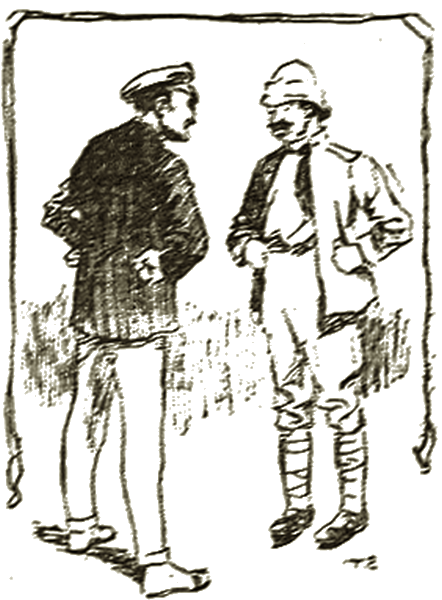
'Man overboard, sir?' sez the corporal reflectively.
"'D—— Private Joy!' roared the officer, shakin' his fist at the lance-corporal; 'I don't want to know anythin' about his faintin'. Was there a man overboard or was there not?'
"Keepin' himself awake with a great effort, the corporal sez, in a dignified way:
"'To the best of my knowledge an' belief, sir,' he sez, 'there was a man overboard, an' Private Joy fainted.'
"The officer paced up an' down the bridge, not trustin' himself to speak.
"'You dreamt it!' he sez after a bit, 'you sleepy-headed devils! You've dreamt it! For two pins—'
"'Beg pardon, sir,' sez the corporal, more dignified than ever, 'if you'll give me permission to wake Private Joy, who at this minute is takin' forty or fifty winks in the lamp room—'
"'Get him!' shouted the Officer of the Watch wavin' his hands wildly. 'Kick him up! Send him! Bring him here!'
"The corporal stood at the head of the gangway, as if debatin' in his mind which was the easiest way of gettin' down, walkin' or slidin' down the handrail, an' then slowly made his way to the deck.
"In five minutes he was back with Private Joy, a little feller with a big round face an' solemn eyes, who was lookin' very pale.
"'This is Private Joy, sir,' sez the corporal. 'This is the young feller that fainted.'
"'Now,' sez the officer, waggin' his finger at Private Joy, an' speakin' with great emotion, 'now, my man, I want to know what the blanked—red corpuscully, somethin'-I-dare-not-write, you mean by causin' all this bother on board this ship?'
"'Sir,' sez Private Joy, shuttin' his eyes an' swayin' backward an' forward, 'sir, it's perfectly true what the corporal sez. Sparrer Waggit jumped overboard an' I see him do it.'
"An' then he told the follerin' story:
(Smithy paused to light his pipe, and remarked that I could believe this story or believe it not, and proceeded with the dramatic denouement.)
"I was sittin' on the main deck sortin' out my curios" (thus runs the narrative of Private Joy) "when Private 'Sparrer' Waggit comes up to me..."
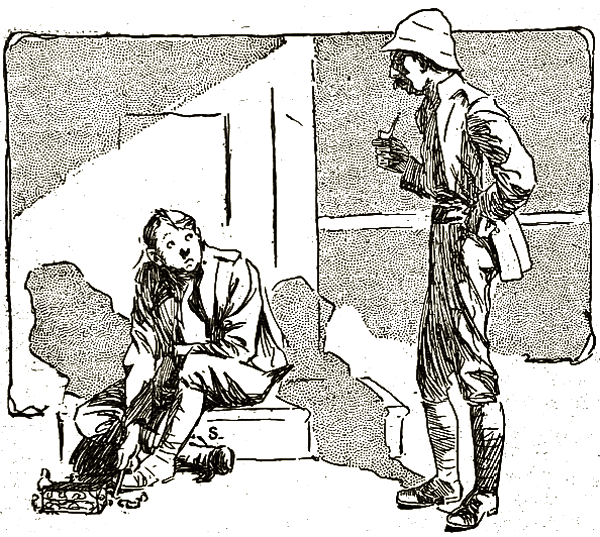
"I was sittin' on the main deck sortin' out my curios."
"'Joy,' he sez, 'can you lend me a pair of slippers?'
"Well, sir, it happened that I had a brand new pair of slippers that I bought in Calcutta for six rupees, so I sez to Sparrer, 'Sparrer,' I sez, 'I've got a new pair of slippers that I bought in Calcutta for six rupees, an' I'll lend you the loan of 'em, providin' you won't spoil the shape.'
"'I won't,' he sez, 'but I've lost me own, an' I don't want to go walkin' about the ship in a pair of heavy ammunition boots.'
"He looked a bit strange, but I thought this was owin' to the heat. I went down below to my bag, an' brought out my slippers—a brand new pair, sir, that cost me six rupees in Calcutta—an' gave 'em to him, an' he put 'em on. I don't know what happened after that, but when I woke up there was a party of four playin' banker on the deck just close to the bulwarks. They was still playin' when I woke up again.
"Suddenly Private Waggit got up.
"'Good-bye, all,' he sez, an' before I knew what he was goin' to do, he jumped over the bulwarks into the sea!
"'I got up, sir, an' me an' the other three chaps we looked over the side. We looked here, an' we looked there, but we couldn't see nothin' of poor Waggit. We looked most careful, sir, for about ten minutes, then I sez to the other chaps:
"'This ought to be reported,' I sez, an' the other fellers said they thought that somethin' ought to be done.
"'You'd better go up an' tell the Officer of the Watch,' sez one o' 'em, an' after we'd had a bit of a discussion as to who should go, I dashes along the alley way till I come to a gangway leadin' on to the upper deck. I was just goin' up 'em when I see a notice:
'OFFICERS ONLY.'
"'Officers only,' sez I; 'it won't do for me to go breakin' the rules of the ship,' so I dashes along till I come to the second gangway, an' I was just goin' to climb 'em, when I see another notice:
'WET PAINT.'
"'Wet paint,' sez I, 'I shall be gettin' myself into trouble if I go that way.'
"Then I remembered that on the other side of the ship there was another gangway, so I dashes back the way I'd come, crossed the ship near the cook's galley, an' was proceedin' along the starboard alleyway when I met the lance-corporal.
"'Hullo!' he sez, 'where are you goin' in such a hurry?'
"'Sparrer Waggit's jumped overboard,' I sez.
"'You're jokin',' he sez.
"'No, I'm not,' I sez, 'he's jumped clean overboard.'
"'That's a remarkable thing,' sez the corporal—'didn't you, corporal?—that's a remarkable thing,' he sez. 'I had a similar experience comin' from Gibraltar four years ago. There was a feller named Darkie Green, who jumped overboard in exactly the same way. I've got his photograph in me box, if you'll wait a second, I'll go an get it.'
"'I'd like to see it,' I sez, so I waited whilst the corporal went below an' got the photo.
"We stood chattin' for a bit, an' then I sez, 'I must be gettin' along,' sez I, 'if we're goin' to save poor old Sparrer.'
"'Good luck,' sez the corporal; 'by the way,' he sez, 'did he have his clothes on?'
"'Yes,' I sez, sir, an' then a sorrowful feelin' come over me.
"'What's up, Joy?' sez the corporal, for I sort of staggered back against a bulkhead.
"'The blighter's got my shoes on,' I sez—didn't I, corporal?—'new shoes what I paid six rupees for in Calcutta!'
"An' then, sir, I fainted!"
"WHAT you've got to remember about the Army," said Private Smith of the Anchesters, "is that it's nothin' like what outside people think it is.
"I've known romantic young fellers who've joined after a row with their girls, under the impression that they'd be sent straight away to war.
"There was one little chap who joined us soon after the regiment came home who had this idea.
"He blew in one mornin', lookin' most desperate an' pale. He'd no sooner got his recruit's kit out of the Quartermaster's store, than he paraded before the C.0. an' asked to be sent abroad.
"'I'd prefer active service,' he sez, 'where there's plenty of fightin' an' forlorn hopes.'
"'I'm afraid,' sez the Colonel, 'we haven't got a war in stock, an' the forlorn hope department is closed for alterations an' repairs.
"Our Colonel had a quiet way of chokin' a feller off, an' he was always gentle an' kind to tin-eyed recruits.
"I'd like to be sent somewhere, sir,' sez the desperate young feller, 'where I'd have to undergo hardships an' torture, where me name would be blotted out, so to speak.'
"'We'll be goin' to Aldershot next month,' sez the Colonel.
"This young chap had had a shockin' row with his young lady over another feller, an' naturally enough, he was in the frame of mind that wanted blood an' slaughter. Instead of which he had to scrub floors, an' polish tea-cans, an' carry coal, which, as every soldier knows, is worse than all the other horrors of war put together.
"Other fellers come into the Army under the impression that the Army can't get on without 'em.
"If all their ideas came off, you'd see a paragraph in the 'Anchester Guardian':
Lovers of the British Army, which has been goin' steadily down hill of late, will be pleased to hear that Mr. Thomas Brown, of High-street, Batham, has condescended to sign on for seven years. Mr. Brown arrives just in time to save the old institution from ruin. Mr. Brown, who has had a distinguished career at college (having passed the sixth standard, where he took a prize for vulgar fractions) will be an acquisition to the Anchester Regiment, an' amongst the poor, ignorant soldiers will soon gain his commission. We understand that Mr. Brown resigned a good position at the greengrocer's in order to take up his now appointment.
Later.
Mr. Brown arrived at Anchester at seven o'clock this evenin', an' was met by a distinguished company, includin' our respected Mayor, the Colonel of the Regiment, an' a detachment of military police. The engines were taken out of his motor-car, an' he was dragged in triumph to barracks, the route bein' tastefully decorated. Amongst other inscriptions, our representative noticed, "Welcome to the Regiment," an' "England Has Need of You."
Replying to an address of welcome at the Barrack Gate, Mr. Brown, who was loudly cheered, said that he had enlisted because he felt that the Army wanted a better class of man. (Hear, hear.) It was time the educated classes took an interest in national defence. (Cheers.) He would endeavour to raise the tone of the Anchesters. (Loud cheers).
Mr. Brown was afterwards entertained to supper by the officers, covers bein' laid for fifty. Messrs. Gorge and Cram were the caterers.
"That is the sort of reception he'd like, an' that is the sort of reception that the superior young feller don't get as a rule
"When he comes down to the Army with all his fine ideas of the favour he's doin' us, be gets a reception that's so warm that he's nearly frozen to death.
"He knocks up against Spud Murphy, or Nobby Clark, or one of them coarse soldiers, an' he learns a lot he'd never dreamt of before.
"He learns that Young Socrates, the eight-stone champion of learnin', is no match for the old heavy-weight corporals who count on their fingers, an' the only time he ever gets a real warm welcome is in the canteen the night before pay-day.
"Nobody wants him, nobody takes any notice of him, he might as well be dead for all the attention he gets, an' when he realises this he sits down, if he is a sensible feller, to build up his reputation from the bottom.
"There was a chap once who got into the Army under, what I might call, a misapprehension.
"To understand this story properly you ought to have a plan of the barracks at Peabury, where all this happened.
"Peabury Barracks are a tumbled-down block of buildings near the Salisbury Plain, an' in the old days before Bordon Camp was built it was the only permanent barracks in the neighbourhood.
"One summer, when there was a big muster of troops on the Plain, we were sent down to Peabury on garrison duty. That is to say, we had to supply the permanent guards, look after the stores, an' had no other job of work but that.
"The 'block' we were in was on the main road, next to the Quartermaster's stores. There was a high wall separatin' us from the road, an' the only light we got in the room from the roadside was from two high windows.
"'B' block was divided into two rooms, with a passage in between. Next door to us was the Quartermaster's store, with a sentry always on duty, because in the store was kept the money with which all the troops on the Plain was paid.
"It was gettin' near to the end of the mouth, at the time I'm speakin' of, an' things were gettin' so desperate in barracks that even Nobby Clark couldn't raise the few shillin's necessary for an afternoon out. On the Saturday money was so scare that Nobby an' a feller called 'Hoggy' Carter was seriously discussin' the advisability of takin' a subscription list round the neighbourin' villages, to raise money for 'a deservin' case' when lo! at the identical moment the gentleman from London came.
"I don't know who brought him in, but that don't matter. The first time I saw him he was with Nobby Clark, an' Nobby was explainin' how he saved the regiment at Modder River, so I knew at once that what I might term the 'financial crisis' was over.
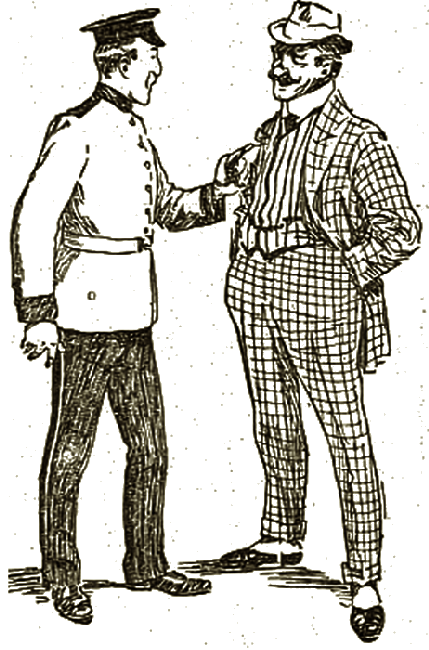
Nobby was explainin' how he saved
the regiment at Modder River.
"He was a real gentleman. He had a big check suit, a heavy gold watch-chain, about three diamond rings, an he waxed his moustache. He was the most affable feller you could imagine, paid for drinks an' took an interest in everythin'—but more especially, he paid for the drinks.
"Parky, his name was, or so he said, an' he was writin' a book about old barracks; so a few of us showed him round.
"'What's that place?' he sez.
"'That's the arms store.'
"'An' what's that place?'
"'That's the Quartermaster's store,' sez Nobby.
"'What's the sentry for?'
"So Nobby explained about the money that was kept in there.
"Seems very dangerous,' sez the gentleman from London, careless.
"'Not at all,' sez Nobby, just as careless.
"'Suppose some of them thieves come down from town?' sez the gentleman from London, 'an' got the hang of the place? Couldn't they get in?'
"'It wouldn't be easy,' sez Nobby. 'Most of the winders are barred.'
"'On the road side?'
"'Yea,' sez Nobby, 'there's only one winder that ain't barred.' An' Nobby went to the trouble of takin' him outside the barracks to show him the winder.
"The gentleman from London went soon after that, an' a chap who happened to be comin' into barracks, an' met him, said he was lookin' most earnestly st the winders that open on to the road.
"Nobby an' the other fellers wished that he'd come back on the Sunday, but he didn't. Nobby sent out skirmishers in all directions to find bin an' lure him into the canteen, but they all drew blank, an' Sunday was a melancholy day.
"There was about threepence, all told, in 'B' Company, an' a chap who searched his old pockets an' found a penny stamp was looked on as a millionaire,
"Nobby spent half the mornin' tryin' to wash the date mark off this stamp, an' eventually sold it to a near-sighted chap in the Army Pay Corps, for full value.
"I don't know what desp'rate things we didn't do that day to raise the wind. I went to the Colour-Sergeant an' tried to borrer a bit on account, but even that was no good, an' Nobby got so depressed toward the afternoon that I began to feel anxious about him.
"'An' to think,' he sez bitter, 'that in the Quartermaster's store there's enough splosh to sink a ship!'
"It was one of them periods that comes to every regiment; it was a sort of financial drought, an' it didn't make matters better to know that we was, so to speak, sleepin' next door to a monsoon.
"Our hopes was raised that night by a report that the gentleman from London had been seen near the barracks. A small column organised very hasty was sent out to capture him, but he'd disappeared.
"The feller who saw him said that the gentleman was with another gentleman, but that only made the blow of his escape all the more severe.
"When the 'first post' sounded that Sunday night all the troops was in bed—there was nothin' to stay up for, an' one of the first to retire was Nobby.
"'This is a day,' he sez, despairin'ly, 'that I shall remember all me life: I've got one last hope,' but what it was he wouldn't say.
"About this time, we had a lot of married N.C.O.'s in the Company, an' the consequence was that in our barrack-room the only single non-com. was Corporal Jones—Juggy Jones—who happened to be on leave this particular night.
"Nobby bein' the oldest soldier in the room, had charge, an' when Spud Murphy started whistlin' as he was takin' his boots off, Nobby threatened to put him in the guard-room.
"'This ain't a time for whistlin',' he sez, sternly, 'this is a moment for silent meditation.'
"He seemed quite anxious to get us all into bed quietly.
"That'll give you some idea of the horrid state of depression the Company was in when 'lights out,' sounded, an' we settled down to sleep.
"I didn't get to sleep for a long time. I lay there wonderin' what I'd do if somebody left me £850,000 an' a few odd shillin's.
"Nobby slept next to me, an' from the way he was tossin' about I guessed he had the same evil thought.
"I must have been sleepin' for an hour or so, when suddenly I felt somebody pressin' my arm, an', wakin' slowly, I saw Nobby standin' by my side. He was half-dressed an' he bent down.
"'Slip into your trousers.' he whispered, an' whilst I was dressin', I saw him go round to the other chaps an' wake 'em the same way.
"He made no noise, an' yet there was a strange noise in the passage outside.
"Nobby put his finger to his lips, an' led the way out into the passage softly.
"At the end of the passage was a winder, which opened on to the road, an' outside the winder perched on the sill, was a man workin' most industrious.
"'Burglars,' sez Nobby, in a whisper; 'they're comin' to rob us.'
"I don't think that burglar would have been so happy if he'd known about the guard of honour that was waitin' in the barrack-room round the corner.
"Me an' Nobby waited, layin' flat on the ground with our heads peekin' through the doorway.
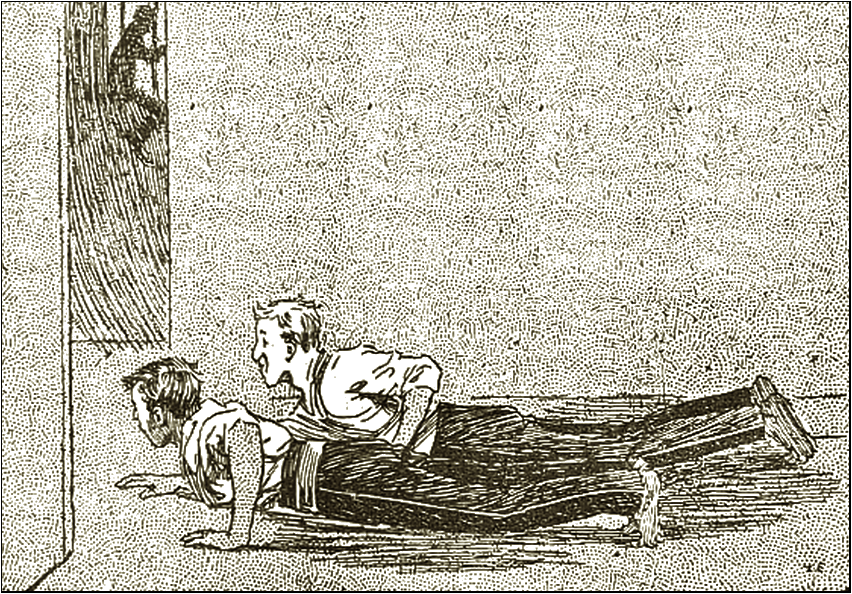
"Me an' Nobby waited, layin' flat on the ground."
We saw him cut a pane of glass clean out, saw his hand come in an' unfasten the catch, drew our heads in quick, as be flashed a little electric lamp to see his way in, an' heard him drop softly on to the stone floor.
"In that flash, we recognised the gentleman from London, an' as he came gently along the passage Nobby gave the chaps the office.
"He hadn't time to shout out or strike out before we had him.
"Ten thirsty soldiers, tortured, in a manner of speakin', with the feelin' that this hard-hearted scoundrel was comin' to rob us of our money, if any, threw theirselves on him, an' carried him into the barrack-room.
"'Lay him on the bed, an' don't make a row, or we shall have the guard up,' sez Nobby, softly, 'an' don't you shout, ole feller, or we'll put the leg of a bed-cot in your mouth.'
"The gentleman from London lay very quiet, There was enough light from the room to see him quite plainly as be looked from one to the other.
"'Now, then,' sez Nobby fiercely, 'what d'ye mean by bein' a burglar?'
"'I've made a slight mistake,' sez the feller; 'I mistook the number of the house.'
"'I dessay,' sez Nobby: 'search him!'
"Willin' hands turned his pockets out. Ho bad a gold watch an' chain, an' diamond rings, but his fingers was too fat to got them off.
"We found six sovereigns, two half-sovereigns, an' a couple of half-crowns.
"'Put 'em on the bed,' sez Nobby: 'we'll probably have to confiscate them to the Crown.'
"In his inside pocket we found a pocket-book, with two five-pound notes.
"'Take 'em, Smithy,' sez Nobby, very firm, 'an be careful to take their numbers.'
"We found other things of no great value, such as a diamond glass-cutter, an' a little steel jemmy."
"'Ain't you ashamed of yourself,' sez Nobby, sadly; 'a feller with your talents to engage, if I might so term it, in dishonest pursuits?'
"'I am,' sez the chap.
"'Burglin' a barrack-room,' sez Nobby, indignant, 'takin', or tryin' to take, the hard-earned money or income of soldiers that live by the sweat or perspiration of their brow!'
"Nobby always had a habit of usin' legal language at a time like this.
"'I didn't think I was burglin' a barrack-room,' sez the gentleman from London, very earnestly; 'I thought you told me that this was the Quartermaster's—'
"'You're makin' your crime worse,' sez Nobby hastily; 'It's me duty as the oldest soldier in the room to try you by court-martial. I find you guilty on all counts, I sentence you to pax a fine of—how much money has he got, Smithy?
"'Seventeen pound five,' I sez.
"'That's the amount of your fine,' sez Nobby calmly, 'an' you can consider yourself lucky. When I told you there was one unbarred winder, I was wonderin' in me mind if you'd be mug enough to try it. I've been layin' awake all this blessed night hopin' that some good fairy would put it into your innercent mind to try for the cash in the Quartermaster's store, an' me wildest dream has popped up.'
"We led him back to the winder.
"'Go out the way you came in,' sez Nobby, an' the gentleman from London didn't want tellin' twice.
"It took us till four in the mornin' to divide £17 10s. amongst fourteen chaps, but we did it to everybody's satisfaction.
"There was a great sensation next mornin' when it came out that an attempt had been made to burgle 'B' Company. All the officers an' all the police in the neighbourhood came to see the winder, but what puzzled them most was the ladder that was propped against the wall.
"'Now how did he get that there?' sez the Colonel, puzzled. 'The ladder is kept in another part of the barracks. He must have been seen by the sentry as he carried it to the back of the buildin'.
"That was the great mystery of the burglary, but only one man could have explained it, an that man was Nobby, who had planted the ladder there the night before."
"No cats will be allowed in barracks without a pass..."
"In future no soldiers will be allowed to wax their moustaches..."
—Certain Battalion Orders.
"NOTHIN' ever astonishes me much," confessed Private Smith, "an' nothin' astonishes Nobby Clark either. But of all the things that don't astonish me, Regimental Orders are far an' away the first.
"Most regiments have Battalion Orders that are about as interestin' as Workhouse Rules an' Regulations. They make your head ache to read 'em. They are the sort of light readin' that a chap would go in for, who found hisself on a desert island, an' had to chose between them an' Alfred Austings slapdash poetry. They're the kind of excitin' literature that a prisoner would take on after he'd got through readin' a book on 'Sin; or, How a Prisoner Turned Over a New Leaf an' Found a Page Missin'.'
"I think that's how battalion orders should be, an' how all military writin' should be, for you can't make orders entertainin' unless you make 'em silly. The King's Regulations could be made a comic book if the chap that draws the Imps was to illustrate it, but the Arm would be upside down in a month, because nobody would take the King's Regulations seriously.
"It's hard enough to make orders for soldiers, without tryin' to regulate cats, an' me own experience is that regimental cats don't take any notice of battalion orders unless they're printed in big letters on a heavy chunk of wood an' chucked at 'em.
"Soldiers are very clever, but there ain't much chance of a chap pickin' up enough cat language to be able to what I might call converse with a tabby in her own chat.
"'Halt! Who comes there?' sez the sentry.
"'Cat,' sez the cat.
"'Advance cat, an' show your pass,' sez the sentry.
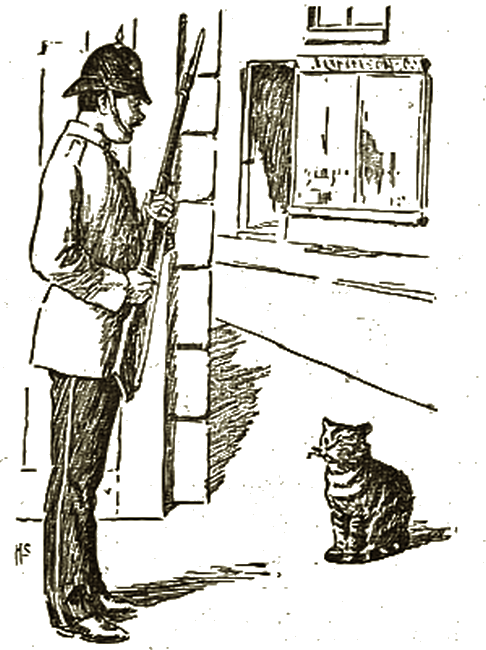
'Advance cat, an' show your pass,' sez the sentry.
"'I'm very sorry,' sez the cat, 'but I've left it at home under me skewer.'
"'You can't pass here,' sez the sentry.
"'You'll get into trouble,' sez the noble animal, 'I'm the sergeant-major's cat, an' he's very fond of me.'
"'Anyway,' sez the sentry, 'you've been waxin' our whiskers, an' that's strictly against battalion orders.'
"'I got me head in a gluepot,' sez the cat, whilst huntin' for mice.'
"'Pass cat—all's well,' sez the sentry.
"Yea, it 'ud be plain sailin if a feller could nallum the language, but unfortunately he can't, an' I see all sorts of things likely to happen to the chap on gate duty in the York an' Lancashire barracks.
"As a rule, colonels of regiments don't worry much about moustaches, an' cats, an' little things like that. They're quite happy if the regiment can march an' shoot, an' the only time a battalion order ever went off the beaten path the result as disastrous.
"Soldiers are no vainer than other men, but then all men fancy theirselves a bit. It's men's faces that wears that silver off the lookin'-glass, an' if women spent as much time curlin' their hair as some chaps spend curlin' their moustaches, they'd never have a minute to bath their children.
"Nobby Clark is a great feller for makin' money out of what I might term human weakness, an' of all the wheezes he's ever wangled I don't think any one of 'em has paid him better than when he sat down to work out a scheme for beautifyin' the regiment.
"I happen to know how he first got the idea. "Me an' him was walkin' down town one afternoon, discussin' various matters, an' we happened to pass an old-book shop.
"Now, some time ago, there was a bit in the paper about a chap buyin' a dirty copy of 'Fox's Book of Martyrs' an' findin' two hundred pound notes stuck into the inside cover, an' since readin' that—it was in all the Sunday papers—Nobby's been one of the most studious chaps you could wish to meet.
"He never passes an old book shop without lookin' into the 'slightly soiled' box, an' he's got quite a reputation in Anchester for his studiosity.
"'Hold hard," he sez; 'let's have a dekko at some of them tomes,' an' with that he began to go over 'em very carefully, feelin' the inside cover with his thumb to discover if there was anythin' that bulged.
"That's when he found 'Beauty Hints, or the Domestic Venus,' which was marked '2d.', an' was honestly worth every penny of the money.
"I'll take this,' sez Nobby thoughtful: 'lend us tuppence, Smithy.'
"It seemed a waste of money, but I parted, an' Nobby took the book back to barracks an' began his study.
"He read that book most diligent for a week, an' got thoughtfuller an' thoughtfuller as he read it, an' at the end of the week, when a lot of us chaps were spendin' a quiet evenin' in the canteen, discussin' celebrities like Charles Peace an' Muller an' other murderers, Nobby very skiLfully switched the conversation in the direction he wanted.
"'... me father,' Spud Murphy was sayin', 'remembers when Jane Maria Clowsen was murdered. He happened to be walkin' down Shooter's Hill——'
"'That was the year Madam Rachel died,' sez Nobby.
"Nobody took any notice of him, an' the conversation went on.
"'Lefroy murdered an ole gentleman in a railway carriage,' sez Tony White, 'The aunt was, travellin' by the same train an' knew nothin' about it till she saw the account in the Sunday paper——'
"'I don't wonder,' sez Nobby. 'Everybody was so excited about Madam Rachel just at that time.'
"But still nobody caught on.
"After a bit—
"'One of the worst murders,' sez Spud, 'was the Burke an' Hare murder. My uncle Jim was livin' in Glasgow at the time, in the very next street. He often told me——'
"'That reminds me,' sez Nobby, patiently, 'Madam Rachel used to live in Glasgow—No. 946, High-street, Glasgow, just round the corner from the post-office.'
"'Madam Rachel?' sez Spud, 'What murder did she do?'
"'She didn't do any,' sez Nobby, quick; 'she was the celebrated beauty doctor who could turn ugly people pretty.'
"'Well, what about her?' sez Spud, resentful; 'what's the good of draggin' in people like her when we're discussin' interestin' murders?'
"But the other chaps wanted to hear about Madam Rachel, an' Nobby told 'em.
"'She was me father's aunt,' sez Nobby, 'an' I was her favourite niece [sic]. The things that woman did were wonderful. She took the Duchess of D—, who was 96, an' made her so young-lookin' that she used to travel half-price on the railways; she made the Countess of L— so beautiful that even the clocks used to stop to look at her.'
"The fellers got interested but more so when Nobby told 'em that the family secrets had been handed down from generation to generation, from father to son, so to speak.
"'I know all them secrets, of course,' sez Nobby careless, 'but what's the good of 'em to me. I can take an ugly chap an' make him good-lookin'; I could turn a feller with a dial like Bill Mason's into a perfect Appolinaris; I could make a funny-faced blighter like Spud so, what I might call, radiant that he'd never get away from the girls——'
"'Why don't you try a little treatment on yourself?' sez Spud, nastily.
"'I've never hankered after good looks,' sez Nobby, lookin' very sternly at him; 'besides which I took a solemn oath in the presence of me father's aunt that I'd never try the beautifier on meself.'
"That night's conversation in the canteen was the beginnin' of the boom in beauty. The very next mornin' Yatesy, of 'C' Company, took Nobby aside, an' had a private conversation with him.
"'Don't think I want to be made beautiful,' he sez.
"'Certainly not, Yatesy,' sez Nobby.
"'I'm quite satisfied with meself,' sez Yatesy, 'an' I'm not one of these vain fellers who worry me head about beauty—handsome is as handsome does, that's me motto.'
"'That's mine, too,' sez Nobby.
"'But I sometimes think,' sez Yatesy, 'that there ought to be a little more sparkle in me eyes.'
"'I've noticed that,' sez Nobby, noddin' his head, very wise.
"'So perhaps if you could give me about six penn'oth of eye sparkler I'd be all the better for it,' sez Yatesy, an' Nobby agreed.
"Then Tiny White came along.
"'Can I have a word with you, Nobby?' he sez.
"'Certainly,' sez Nobby, an' they adjourned to the back field.
"'It's like this, Nobby,' sez Tiny; 'I'm quite satisfied with meself as I am.'
"'Naturally,' sez Nobby.
"'Handsome is as handsome does, is me motto,' sez Tiny.
"'That's my motto, too,' sez Nobby.
"'But I've been told that me complexion ain't all that it might be,' sez Tiny, 'so if you could make me up a pint of face-wash for about fourpence—'
"'Tenpence,' sez Nobby, shakin' his head; 'the stuff costs me ninepence ha'penny.'
"'Well, I don't kick at a tanner,' sez Tiny, an' went away quite pleased.
"Then, one by one, the other fellers came up an' had a quiet talk with Nobby. Some wanted stuff to make the hair grow straight, an' some wanted it to make the hair grow curly.
"'I'm quite satisfied with meself as I am,' sez one of 'em—Ugly Johnson it was.
"'Some people are easily satisfied,' sez Nobby wearily.
"'An' me motto is—' sez Ugly.
"'Handsome is as handsome does,' sez Nobby, jumpin' in quick—'yes, I know, what d'ye want: hair cleaner, or teeth curler?'
"Nobby's prosperity began to increase by leaps an' bounds. All the stuff he gave to the chaps he got out of his little book, an' so long as he stuck to the book he did well, an' the regiment , got beautifuller every day. It was a bit tryin' for people who wasn't undergoin' Nobby's treatment.
"If you went into the washhouse unexpected, you'd find a chap sprinklin' his hair from one bottle, an' another chap smearin' his face with some white stuff from another. If you went down into the back field you'd come across fellers usin' the eye-sparkler; if you came round the corner of the magazine unexpected, you'd find another chap doin' massage on his poor face with great ferocity.
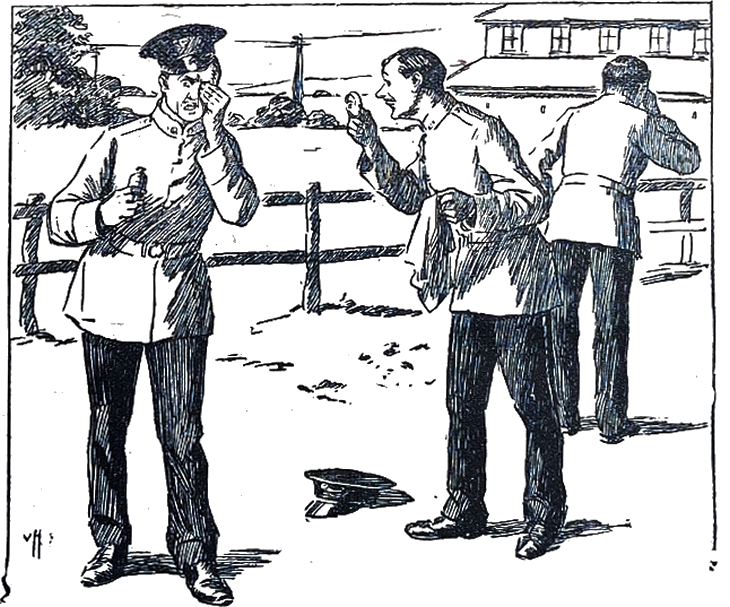
If you went down into the back field you'd
come across fellers usin' the eye-sparkler.
"But what might have been a profitable business was upset owin' to Nobby bein' a bit too clever.
"Just about then our Adjutant was away on leave, an' Captain Oggle was actin'. He was a literary feller. You wouldn't open the 'Naval an' Military Gazette' without findin' somethin' from his able pen on the subject of 'Trajectory Symptoms in War Time: With Some Remarks on High Velocity Food Supply,' or some other charmin' little fancy.
"No sooner was he in charge than he got round the Colonel to issue funny orders, an' the funniest one was somethin' like this:
"The C.O. notices with regret that there is a fallin' off in smart soldier-like appearance amongst the men, Young soldiers are recommended to take plenty of outdoor exercise.
"There was nothin' much in it, but it gave Nobby a line, so to speak.
"Me an' him was discussin' matters one afternoon, when he told me his idea.
"'Smithy,' be sez, 'have you noticed the number of young soldiers in the regiment?'
"'I have,' I sez.
"'Fellers,' sez Nobby, musin'ly, 'that have never felt the hot blazin' sun of India, nor the fierce, flamin' orb of Africa.'
"'Is this a poem?' I sez.
"'They've never marched across the burnin' plains of Egypt—an' they look like it,' he sez.
"'What's the idea?' I sez.
"'When they walk down town,' sez Nobby, enthusiastic, 'all the girls know that they've never been abroad; they can see it. I'm goin' to change all that.'
"'How?' I sez.
"'By me patent invention,' sez Nobby, proudly, 'Clark's Famous Indian Sunburn Mixture an' Weather-Beaten Complexion Wash.'
"Nobby explained the idea. After washin' your face twice in his celebrated Sunburn Dye, a chap looked as though he'd been in India all his life. It caught on from the very first. Especially after Nobby pointed out that battalion orders as good as commanded it. Orders poured in, an' Nobby, after studyin' the matter for a bit went into town to the chemists, an' got a prescription made up.
"I don't know what was in it, but I've got an idea there was a lot of Annatto—the stuff that milkmen use to colour milk with to give it a rich, creamy colour.
"'Now,' sez Nobby, to the chaps who bought the stuff, 'I don't want you to put this on till Thursday because if you don't all put it on together you'll find that one face is brown on' the other face is white. Put it on on Thursday night an' turn up on Commandin' Officer's parade on Friday mornin', an' the sudden change won't be noticed.'
"Thursday night came, an' all the young soldiers were gettin' away into secret places to try Clark's Sunburn.
"I didn't see 'em on Friday mornin', because I was on guard, but Nobby told me that they looked all right. In fact, he was most enthusiastic about 'em, when he brought my breakfast to the guard room.
"'You never saw such a lot of hardened, seasoned warriors in your life,' he sez, 'In fact,' he sez, confidential, 'you'd not only think that they had served in India, hut you'd imagine they was born there.'
"I wasn't on parade when the Colonel went round them ranks of brown-faced warriors.
"But I am told that what he saw highly pleased him.
"'The men look very healthy,' he sez—'very healthy—hard as nails—fit as fiddles.'
"Nobby, standin' in the ranks, was highly delighted.
"'Havin' so many young soldiers in the regiment,' sez the Colonel, an' Nobby heard him as plain as plain, an' so did dozens of other chaps—' havin' so many recruits,' sez the Colonel, 'I asked the War Office to let the regiment off summer manoeuvres,'
("We used to hate summer manoeuvres like poison.")
"'It don't do to work young soldiers to death,' the Colonel went on. 'Twenty miles a day marchin', an' sleepin' out in the open—but I think these chaps will stand it—eh, Captain Oggle.'
"'Yes, sir,' sez the Adjutant, 'they look brown an' healthy.'
"'The Colonel nodded.
"'I'll ask the War Office to put us on the rota for Salisbury Plain,' he sez, 'A month's roughin' it won't come amiss to these gallant-lookin' fellers——'
"An' that's why the Anchesters was unexpectedly taken for the 1904 manoeuvres, an' that's why Nobby Clark was the most unpopular man in the regiment, because, try as they could, the chaps couldn't get pale in time."
"SOLDIERIN'," said Smithy in a serious vein, "is a rum job. It takes you to places where ordinarily you wouldn't think of goin' to; it puts you in what I might term awkward situations, an' in a mysterious way gets you out again. The principal beauty of soldierin' is that when you go away from home you take most of your friends with you, an' carry your home on your back.
"Of all the queer places I've ever been in, the queerest was a country somewhere round the Hindu Kush, which is a land that's like Switzerland magnified by ten all mixed up with the county of Kent. It's a country that's all white lilac an' wild roses an' jasmine, an' black people who ain't quite black an' ain't quite Chinese, but in a manner of speakin' combine the bad qualities of both.
"I've walked up an' down India an' seen every kind an' caste, from Ghoorkas to Sikhs, from pot-tummied Babus to scared-to-death Kashmari's, but the people of this country was the queerest an' the wickedest I ever struck. They was low in manners an' morals, an' they lived on the side of a mountain with twelve thousand feet of snow overhead, an' a sheer fall of ten thousand feet below. It was an awkward place to stay in, but a awkwarder place to get at; but we arrived one fine mornin' an' was greeted affectionately by the native who sat on the top of the ten-thousand-feet cliff, an' dropped stones on our heads. I don't know how we got up, but I've got a recollection that's as hazy as the memory of a bad dream that we went up a narrer path in the face of the cliff, an' that somebody lost his footin' an' went droppin' into the valley below twistin' round an' round like a spinnin' top. I've pot an idea that the whole company stood stock still an' watched him—he was a new feller that had only joined the week before we went up country—watched him as he grew smaller an' smaller till he was like a black pea suspended in the air...
"Anyway we got up, an' Nobby Clark was the first over the stone breastwork an' killed a young gentleman who was tryin' to let an old-fashioned gun off.
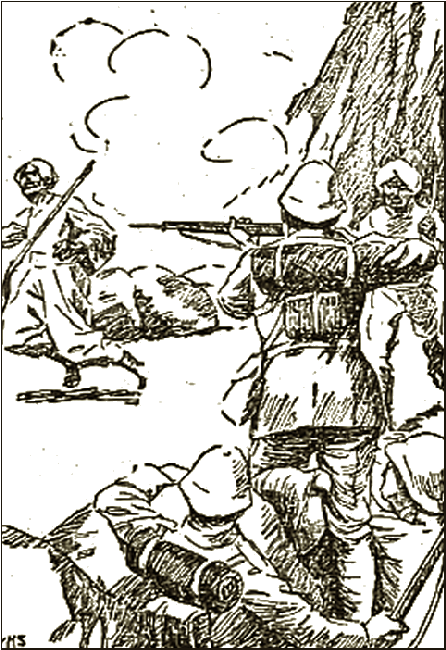
Nobby killed a young gentleman who
was tryin' to let an old-fashioned gun off..
"Then we looked round, an' sent heliograph messages to the general on the plain below.
"The inhabitants of this little village didn't run away, partly because there was nowhere to run to an' partly because the runnin' men were lyin' stark an' stiff behind the stone breastwork, an' our colonel, after seein' that all danger from the villagers was at an end, gave the order to bivouac, an' we wasn't sorry.
"This is a long-winded way of explainin' why we were in the village of Shar-Kish, gettin' sun-stroke by day, an' frost-bite by night. There was a bit of a war on—nobody knew exactly what it was all about, but as several fellers had been killed thereby nobody worried very much as to the cause.
"There was a mountain stream that ran through the village an' a big reservoir, an' after the doctor had examined the water an' given orders that all drinkin' water was to be drawn from the stream above the village, the reservoir was handed over to us to bathe in, an' with that there pool an' all that happened afterwards this story is all about.
"We bathed by companies, one company strippin' an' the other standin' by under arms in case anythin' should happen. Officers an' men, we all went in together, and jolly glad we was to hear the water sizzlin' on our backs. Twenty minutes was the time allowed, an' it was the strongest bath I've ever had, for all the noise we made couldn't drown the moanin' of the women as they mourned their dead in their white little houses. There was a few old men in the village, who crawled out when they found nobody wanted to kill 'em, an' they stood in a group at one end of the pool, an' the expressions on their faces was one of horror.
"Then one of 'em went up to an officer an said something in the bat*, an' the officer laughed. It was Captain Reynell, an' I was dryin' myself quite close to the adjutant when he walked over.
* bat: language
"'Umfreville,' sez the officer with a smile; 'do you know what that old Johnny sez?"
"'Not havin' the ears of an ass, I didn't,' sez the adjutant, who was rather cross owin' to one of the enemy havin' shot away the top of his little finger.
"'He says the men are bathin' in the pool of the moon.'
"'An' what does that signify?' sez the adjutant.
"'He says that as soon as the full moon comes they will all go mad,' sez the officer, an' they both laughed together.
"'There's another twenty days yet,' sez the adjutant, 'before the moon is full.'
"Nothin' more was said, an' although I put the story about, the troops was not alarmed.
"We forgot all about it, for there was plenty of work to do. We had to find a path that would bring us round to the flank of the enemy. There was a mountain to climb, a runnin' fight that lasted ten days an' ten nights, an' in the end a grand finale of a scrap including amongst attractions too numerous to mention, the stormin' of a stone-fort, an' the hangin' of two old gentlemen whose names I forget.
"The war was over, like all those wars are over, before it properly began, an' three days after the fort was taken, the army retired by the nearest way to Rawal Pindi, leavin' the Anchester Regiment to garrison the fort.
"The King in this part of the world was a chap called Mahmut Ali, an' he was supposed to be friendly. After we'd taken the fort he came in an' confessed that be was the best friend that England ever had, an' the general, who was very anxious to get back to his best girl in Simla, took his word, an' skedaddled out of the country for fear he should change his mind,
"There was us, the Old Anchester, left on the top of a rock, with a narrer bridge between us on the world at the mercy of a dirty-faced Rajah.
"'It's like bein' Robinson Crusoe,' sez Nobby watchin' the arms disappearin' round a bluff, 'there's some things about war that I can't understand an' this is one of 'em.
"'Cheer up,' I sez, 'we'll soon be dead.'
"'What's to prevent this Rajah bloke gettin' all his nuts together an' wipin' us out?' sez Hobby.
"'We could hold the bridge for a month of Sundays,' sez I, which was true, but Nobby shook his head.
"'It ain't a question of holdin' on to the bridge,' he sez. 'It's a question whether the bridge will hold on to us.'
"I thought he was pessimisin' until I heard the adjutant discussin' the matter with the colonel.
"It was a rum place, the fort. It stood on a spur of rock that rose up straight two thousand feet. It was like an island in the air, an' the only connection, beside the bridge, it had with the mainland, so to speak, was a wall of rock that wasn't a foot wide, and ran from the rock to the mountain. Nobody but a cat would have dared cross it. Even the people of the county had never crossed it, for a slip one way or the other would send you down a thousand feet before you struck earth.
"I don't pretend to understand the government of India. I don't know why they planted us in that little fort an' withdrew the army. I don't even know why they believed the country was pacified when it was in a manner of speakin' boilin' over with trouble.
"All that I know is that six hundred men (an' two Maxims) was left in the fort at Shar-Pir, an' that within sight was 60,000 hillsmen achin' for blood.
"Things went smooth for a week or so. The rajah used to come across the bridge every day an' pay his respects to the colonel; coolies used to bring us water an' food an' fruit, an' it certainly looked as if what we'd thought was goin' to be a imprisonment was developin' into a picnic...
"One evenin' a lot of coolies came with baskets of bread. They was taken to the quartermaster's tent an' examined by the doctor.
"He looked at one or two of the loaves.
"'All right,' he sez, an' the bugle sounded for orderly sergeants.
"The head coolie was standin' by, an' somethin' in his face attracted the attention of the doctor.
"He stooped an' picked up a loaf.
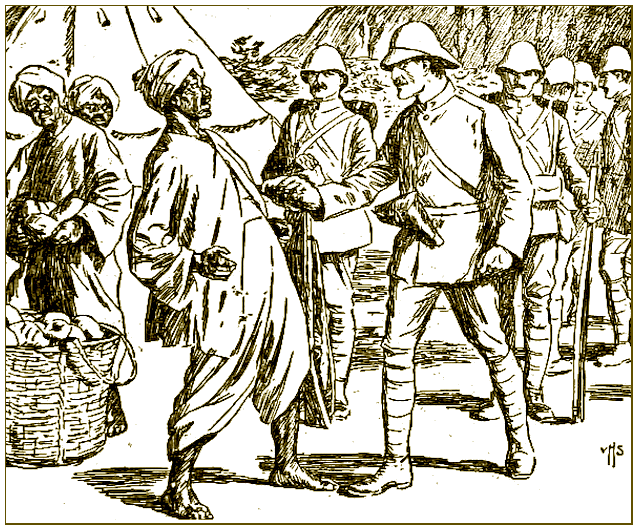
'Eat,' he sez, an' the man shrunk back
"'I'm not hungry, sahib,' he sez.
"'Eat,' sez the doctor again.
"The man looked round, then made a dart, an' before anybody could lay hands on him be was racin' over the bridge.
"'Shoot him,' sez the doctor, an' three of as fired at once.
"He was in the middle of the bridge, an' leapt up....
"'We shan't learn anything from him,' sez the doctor, lookin' down into the chasm where the man had fallen.
"The bread was poisoned, an' cleverly poisoned; for it wasn't till the doctor got his microscope an' his test tubes to work that we discovered that our old friend and ally, Mahmut, had decided that we wasn't wanted.'
"That night the guards were trebled. A picquet went to the far end of the bridge to hold it on the 'shore' side...."
"In the early hours of the mornin' somethin' exploded in the middle of the bridge, and when the sun came up we saw that the bridge was gone.
"We also saw the picquet, because the Rajah had laid 'em out neatly in a row where we could see 'em.
"That's where the siege of Shar-Pir began—six hundred men with little food an' no water, an' sixty-thousand hillsmen snipin' at 'em day an' night.
"I said without water. As a matter of fact, we had had two days' supply, an' we made that last four days.
"On the fifth we had none, an' it was hell. There was no way out of the trap, except along that strip of rock that no man would dare.
"All day long they yelled at us, taunted us, brought out their water an' splashed it in sight of us.
"That night as we lay under arms, more dead than alive, waitin' for the moon to come up to give us a sight of the Rajah's camp, I sez to Nobby:
"'Nobby, our number's up.'
"Nobby nodded. His mouth was too dry for talkin'.
"Then over the mountain came the edge of the moon, an' I watched it, sort of fascinated.
"There was an officer behind me, an' I recognised the voice of Captain Reynell.
"'Full moon, full moon,' he muttered, an' there was somethin' in his tone that thrilled me. It was a curious feelin', just as though I'd had a stroke of good luck.
"The moon rose higher an' higher, then suddenly Captain Reynell stepped forward an' laughed—a wild, mockin' laugh, an' we all laughed, too.
"'Follow me,' he yelled, an' with his revolver in one hand an' his sword in the other, he raced down to the narrer wall that bridged the gulf.
"I saw him step on to it with a firm step, an' run forward straight an' true.
"It was madness, but I follered. I pattered on after him. It was like walkin' a tight rope, but I wasn't afraid. I heard yells of laughter behind me, an' when I got to the other side I looked round an' saw Nobby comin' at a run, his arms outstretched, his rifle slung over his shoulder, and the whole regiment followin'.
"Six hundred men crossed that ridge—an' it wasn't four inches wide in places—six hundred men an' the colonel; an' he was the only brave man amongst us, for he had not bathed in the Pool of the Moon, an' was sane
"We fought our way to safety: we got water an' food an a safe passage. A little while after that, a month or so. they sent another general up from Simla, an' he pacified the country proper. First of all, he caught Rajah Mahmut, then he shot him, an' the rest was easy. I remember that expedition, because the Anchesters was on it, an' when we came up to Shar-Kish a curious order came out:
"'Troops are forbidden to bathe in the Pool of the Moon.'"
AS I understand Private Smith, there was once some slight trouble in the Anchester Regiment over the question of a fallen idol. Nobody really likes to see the great in their moments of human weakness. The Colossus scratching his head, or the Venus de Medici cleaning her teeth, or Jove laboriously cutting his corns with the sword of Damocles, or Ulysses explaining away a variegated and inflamed eye by saying that he got entangled with a rainbow—all these things are calculated to inspire distrust. To no conventional pedestal are there steps by which an idol may descend with any grace. He must stay where he is, or fall to shatterment with a dull, sickening thud.
"It ain't often," said Smithy, and there was a note of apology in his voice, "that we get any very enthusiastic opinion of a chap's ability—more especially when that chap is a rooster.*
* Rooster: recruit
"If we took 'em all at their original prices, as I've often said, we couldn't afford to buy 'em, but owin' to circumstances over which they've got no control they're marked down an' considerably reduced, like the things they sell in shops durin' bargain sales.
"But we took to Ferdinand from the first. A long-faced, solemn young chap with a wrinkled brow, he was. All brain. That was what was the matter with Ferdinand—all brain. His fore'ead bulged with it; a rare thinker, an' a remarkable planner. I don't know why he enlisted. You'd have thought that a chap like him would have been snapped up anywhere.
"I've heard it said that he joined the army owin' to a row with his girl. It appears, accordin' to this story, he invented a patent hand-holdin' machine so that he could still hold her hand whilst he was lightin' his pipe. They had words about it. She said he ought to have thought out an invention for lightin' his pipe whilst he was holdin' her hand.
"Anyway, he come to us, an' Nobby was one of the first to admit that Ferdinand was a genius.
"He used to carry a bit of pencil an' a paper an' draw plans for things.
"You'd see him sittin' in a corner sippin' a glass of lemonade an' porin' over somethin' like this: See Sketch.
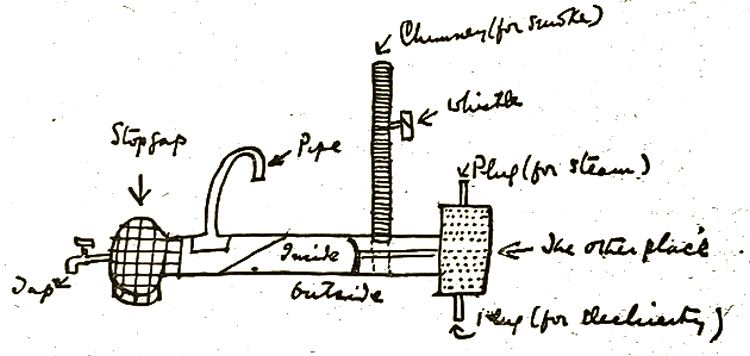
"Nobody could see them beautiful drawin's—all out of Ferdinand's own head—without realisin' what a great brain he had.
"I can't recollect all the things he did, or would have done, if people would nave let him, but I can say this for him that he'd no sooner come into the army than he began applyin' his mind to what I might term, without offence, military problems.
"'The army wants runnin' on scientific lines,' he sez. 'It's behind the times. What we want is more inventions. I've got an idea that'd practically do away with drill. I made a drawin' of it last night. Its a moveable parade ground, worked by steam or electricity, whichever costs the least. Instead of sittin' on a horse givin' orders, the colonel sits in a beautiful room with armchairs, ferns, cigars an' other beautiful vegetables, an' presses a button. He don't have to shout "Right Turn!" He just turns a handle an' the whole bloomin' regiment turns automatic...'
"That's the sort of feller Ferdinand was—brain, all brain. He invented a machine for pickin' oakum—military prison was military prison in them days—but it was never properly tried owin' to the prison authorities refusin' to allow Darkie Tupper (who got 168 hours for givin' lip to a colour-sergeant) to take it into prison with him.
"He invented a machine for warnin' a sentry that the enemy was upon him that ought to have made his fortune, but nobody took it up. These were only a few of the things he did, but it proves what I said about him—he was brain from head to foot.
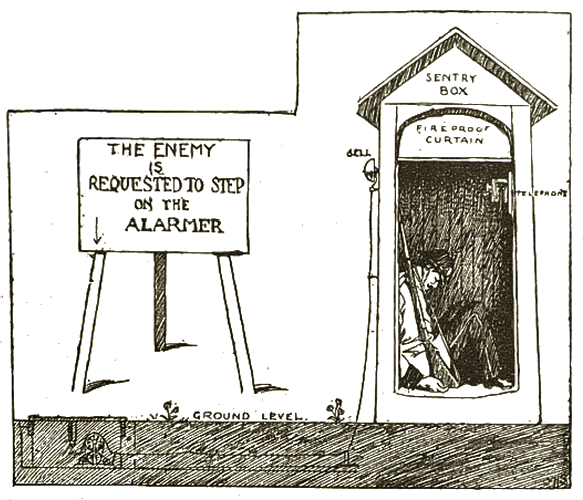
"He joined us just before the war, an' naturally enough his brilliant ways helped him to come to the front.
"His spring-heeled boots wasn't the success they ought to have been, but then they was never given a fair trial.
"When we was up at a little place called Sanderfontein, he did one of the most wonderful things I've ever seen a man do.
"Three companies of ours was sent up to occupy Sanderfontein, an' just outside the dorp there was a bit of a fight owin' to a number of rebels makin' a stand.
"The bullets came flickin' left an' right, but nobody was hurt, an' the only chap who suffered the slightest inconvenience was a young officer, named Lieutenant Mosser, who was hit by a richochet. He wasn't hurt either, for the bullet caught his watch, like they do in Sunday-school books, an' bounced off.
"It wouldn't have been worth while talkin' about but it happened that that watch of the officer's was the only timepiece we had in the three companies, an' when it stopped—owin' to the aforesaid bullet—Lieutenant Mosser was annoyed and signified the same in the usual manner.
"Nobby Clark heard him swearin'.
"'Beg pardon, sir,' sez Nobby, 'but I think I know a man who'll put that watch of yours right for you.'
"'Do you, Clark,' sez the officer.
"'Yes, sir,' sez Nobby. 'Private Ferdinand Brown,' he sez (Brown was Ferdinand's other name—or at least he said it was).
"The end of it was the officer handed over his watch, an' Nobby took it to Ferdie.
"'Humph,' sez Ferdie, after knockin' the watch on the toe of his boot—'humph,' he sez, 'this will try me mechanical genius,' he sez, 'to the full.'
"Ferdie was one of them dauntless fellers that nothin' upsets, an' he got to work on that watch, an' for a couple of days he devoted that brain of his to the heroic task of makin' a smashed ticker tick.
"On the third day he brought it back to the officer.
"'Your watch, sir,' he sez, quietly an' proudly, an' handed it over.
"Yes, sure enough, there it was goin' merrily. The officer was delighted.
"'Thank you very much, Brown,' he sez. 'Did you have much trouble with it?
"Ferdie smiled.
"'Just a little, sir,' he sez, an' salutin' was about to go.
"'Hold hard,' sez the officer, puttin' his hand in his pocket,
"'No, sir,' sez Ferdie in a dignified manner—'thank you, no, sir,' he sez. 'What I do, I do free without recompense, an' to prove me bonny fido—I think that's the dog's name, sir—an' me perfect honesty...' (he fumbled in his weskit pocket an' pulled somethin' out), 'here's a bit of your property, sir."
"The officer looked at it, an' his eyebrows went up.
"'What's this?" he gasps.
"'That, sir,' sez Ferdie, 'is one of the wheels I took out of your watch—there wasn't no room for it to go back!'
"I believe," explained Smithy, carefully, "that the officer's watch kept very good time, if a little inaccurate. Owin' to the wheel wot Ferdie didn't put in, it gained an hour an' sixteen minutes every two Hours—but it was very easy for the officer to work it out, him bein' a scholar.
"Ferdie used to worry owin' to his talents not bein' recognised.
"'There a no chance for a feller of genius,' he sez, gloomy. 'Everybody's jealous of me.'
"He applied to be transferred to the Engineerin' section of the Pioneer Corps, but the Engineerin' section of the Pioneer Corps sent a round-robin to the Commander-in-Chief threatenin' to resign if Ferdie came; an' he might have gone down, so to speak, to obscurity if it hadn't been for the affair at Windy Nek. That's where he got properly recognised, an' that's where be earned promotion.
"It happened when we was on duty on the Block House line. If you remember, to guard the railway, we built, every mile or so, a little tin fort, an' connected 'em with barbed wire. We guarded a strip of line between Springfontein an' Withoek—one of the liveliest sections of the line.
"Quite close to us was a Nek in the hills, called Windy Nek for obvious reasons, an' it was over this Nek that the Boers always come unexpectedly.
"It was no use establishin' a fort on the Nek. It was too exposed, an', moreover, was commanded by a hill which was commanded by another hill. We should have had to occupy half the hills in the Orange Free State to hold Windy Nek, so we left it alone, dependin' to a very large extent for any little traps we could set an' tricks we could play on our Brother Burjer.
"He played a few tricks on his own, I might remark.
"A great joke of his was to put a packet of dynamite on the railway line an' to sit on the hills to watch the fireworks.
"If Windy Nek hadn't been where it was we could have kept him from the railway, but as it was it was impossible to hold him, an' we had to sit an' suffer whilst the Boors blew up the line by night an' Kitchener cursed us by day.
"We did everythin' humanly possible to keep the Boers away from the Nek. We dug a big pit in the middle of the road an' put broken glass the bottom, an' Nobby printed on a bit of newspaper:
'WELCOME'
to lay on the glass, so that if any Boer came into the pit he should know that he'd fallen amongst friends.
"Bat it was Ferdinand who invented the scheme that kept the burjers away. It kept other people away as well, but that didn't matter.
"It was called 'Ferdinand Brown's Patent Boer Remover.' I don't know how to describe it, but Ferdie, who was in our blockhouse, explained it somehow like this:
"'You take a soap-box an' butter the sides. Then mix about ten pound of gun cotton with a pint of nitro-glycerine, an' knead them till they make a stiff dough. Boil gently, addin' a sprinklin' of nails an' bits of old iron, pour into the soap-box, garnish with detonators an' serve hot.'
"I don't know whether this is exactly the way he described it, but it went somehow like that.
"There was a sportin' young officer of ours, by the name of Tigge—the Hon. J. Tigge—an' he was much taken up with Ferdie. So when Ferdie paraded an' asked to be allowed to fix his Patent Boer Remover, the officer was most enthusiastic, an' one dark night him an' Ferdie went out an' put the box in the ground, an' fastened the wires wot would make it go off.
"By a strange coincidence, the officer went home in a couple of days on urgent private leave, an' that left Ferdie as the only survivor of the Bomb Plantin' Expedition.
"It's curious how news travels. The day after the destroyer was put down all the Boers within twenty miles knew all about it, an' for a week we was left in peace.
"The Colonel was highly pleased, an' came down the line to congratulate Ferdie.
"'A very good idea,' sez the Colonel, 'but you must remember exactly the spot you put it or there'll be trouble when the war's over an' you want to dig it up again.'
"'Yea, sir,' sez Ferdie.
"'I'll send an officer down from headquarters to make a plan of the place,' sez the Colonel. 'You can take him out an' show him the spot.'
"Sure enough the next day an Intelligence Officer turned up, an' him an' Ferdie went out together.
They walked toward the Nek for about three miles, an' then Ferdie stopped.
"'It's somewhere about here, as near as I can remember,' he sez.
"'What!' sez the officer; 'didn't you put it in the road?'
"'No,' sez Ferdie, 'they'd have seen it in the road—-it's not far from here.'
"'We'll be able to see the wires, I suppose,' sez the officer nervously.
"'No,' sez Ferdie, very triumphantly, 'that's where we was so clever; we hid the wires. In fact,' be sez, 'we might walk on the wires at any minute without knowin' it.'
"'Let's get back,' sez the officer hasty; an' he walked so careful, liftin' up his feet over every twig, that it took 'em the greatest part of three hours to reach the block-house line.
"To cut a long story short, Ferdie couldn't remember where that Boer destroyer was buried!
"He took several officers out to show 'em the place, an' every time he went to a different spot, an' said he ' thought it was somewhere about here.'
"It kept the Boers away all right; but it kept the British away, too. Morder's column, which came down chasin' De Wet, turned off quick when it came to Windy Nek, an' went twenty miles out of its way to avoid it. Brabant's column, makin' a bee-line for the Orange River, changed its mind when it reached the Nek, an' worked round south of it. Even Strathcona's Horse didn't dare to go near it. For six months every commando an' column gave Windy Nek n wide berth. It was haunted—haunted with the ghost of a soap-box full of gun cotton. When troops had to pass over the ground they sent a messenger for Ferdie to guide 'em—not because he knew where the destroyer was but because he thought he knew where it wasn't.
"He was so pop'lar as a guide that he was promoted sergeant.
"One day a message came to send Ferdinand up the lines to pilot General Bigeyes through Windy Nek.
"The General was one of those nervous generals that wanted a quiet life: he had fewer casualties in his column than any other general, because he always kept out of the way when there was any fightin' on, an' naturally he didn't want to cross Windy Nek on his way south. He'd have avoided it altogether, only Kitchener was gettin' a bit fed up with the destroyer, an' ordered him through.
"'Now sergeant,' sez the General—a most apprehensive man, if you will pardon the expression—'now, sergeant; you're sure you know where this beastly machine of yours isn't?'
"'Certain, sir,' sez Ferdie, an' the march began.
"They crossed the Nek at daybreak, an' camped for breakfast a mile on the other side.
"He liked doin' himself well, did that General, an' there was a fine spread for the officers, an' Ferdie bein' attached to the General's staff, had the best of everythin'.
"It was, 'Give the sergeant a chop, waiter,' an' 'Give the sergeant a glass of champagne, waiter,' till you'd have thought that Ferdie was a Boer prisoner by the way they treated him.
"'Now, sergeant,' sez the General when the column moved on, 'you keep close to me—shall we go to the left or—or right?'
"'Left, sir,' sez Ferdie, guessin' hard.
"They went a little way, then Ferdie sez:
"'I seem to recognise this place, sir; we'll go to the right.' An' the column turned.
"He marched 'em left an' he marched 'em right, an' he marched 'em in a circle, an' all the time the jumpy General was perspirin' freely an' a-sittin' most uncomfortable in his saddle.
"At last, after two hours' marchin' an' counter-marchin', Ferdie turned to the General an' saluted,
"'You're through the danger zone now, sir,' he sez, cheerful, an' the General breathed a sigh.
"'Thank you, sergeant,' he sez, gratified. 'I'll report you to headquarters—you ought to got promotion for this.'
"'Yes, sir,' sez Ferdie.
"'You are sure there is no more danger ? '
"'None, sir,' sez Ferdie proudly, an' the column moved off.
"Three hours later Ferdie came into headquarters with his hair an' his eyebrows burnt off an' the top of his little finger missin'.
"'Is that Brown?' sez the Colonel, who was in his tent an' couldn't see him plain. 'You're the very man I want. I've just had a message from Lord Kitchener sayin' that that wretched destroyer of yours is to be found at once'
"'It's found, sir,' sez poor Ferdie, mournful.
"'Found is it?' sez the Colonel—'good business. Then you can take a horse and ride after General Bigeyes with a message—he's to go to Pretoria immediately.'
"Ferdie shook his head.
"'He's half way there by now,' he sez, more mournful than ever; 'he found the destroyer.'"
"YEARS an' years ago," said Smithy, reflectively, "Nobby got highly moral over a question of money.
"There was a chap in the regiment by the name of Nigger Jones, owin' to his bein' a bit on the dark side. He said he was born in a fog, but some people said—however, I'm not the feller to spread scandal, an' if his parents was satisfied it's nothin' to do with anybody else.
"Well, this here Nigger Jones was a rare chap for hoardin' money, an' the way he used to look at every penny before spendin' it was perfec'ly sickenin'.
"'This lust o' wealth,' sez Nobby sternly, 'is one of the reprehensiblest things goin'—especially in the young,' he sez, 'It ought to be put down with a firm hand.'
"'I can't help it,' sez Nigger, miserable—he was highly attached to Nobby an' respected him—'I can't help it—I'm of a savin' nature. Me father was the same: he got medals for savin' people who fell into the canal. Me mother was what I might term economic, an' could make a pound of sausages go farther than any lady I've met.'
"'The best thing you can do,' sez Nobby, thoughtful, 'is to hand your accursed money over for me to invest—forget that you've got any money; reckon it as lost.'
"That's what him an' Nigger had an argument about, an' that's what made Nobby become a Stow It.
"I don't know what a Stow It is, but accordin' to Nobby, who's got a rare habit of pickin' up useless information out o' second-hand books, the Stow Its was a class of people who lived about the time of Julius Caesar or Napoleon Bonaparte or one of them funny people. They lived most severe, refused to eat more than they wanted, despised washin' themselves, an' never took no notice o' anybody.
"I don't know whether they did it for a bet, but they did it. They was a bit tryin'.
"Suppose a Stow It called at your house.
"'Hullo, Septimus Octavius Smith,' he sez, 'I've just hopped round to remark that we've all got to die, an' that money an' position ain't worth havin'.
"'Come in, Harry Stottlease,' sez I; 'you've arrived in time for dinner.'
"'No, thanks,' sez the Stow It with a sneer, 'I'll just nibble the grass round the edge of the lawn. O woe, O woe! Nothin' matters but death! Roll on the end of the world!'
"The Stow Its—accordin' to Nobby—wasn't as pop'lar as the Russian dancers of the period, an' lots of honest Romans would sooner go to a cinematograph show than to a Stow It's birthday party. But what the Stow Its liked best was to endure hardship an' pain.
"When two Stow Its met in the mornin' on their way to the Coke Yard for breakfast, one'd say to the other:
"'Good-mornin', Marcus; how are you?'
"'I'm happy to say, Augustus Nero,' sez. the other, 'that I've got a severe pain in me pericardium—to use a Roman term.'
"'Congratulations,' sez the ether, mournful; 'beyond a slight attack of delirium tremens—if you'll excuse the foreign expression—I've nothin' to boast about.'
"The beauty of the Stow It system, as Nobby remarked, was that nobody cared for money. They had none to care for. They despised other people's wealth.
"'What's money?' sez Zeno( the famous inventor of Zeno's Fruit Sauce, an' founder of the Royal Antedeluvian Order of Amalgamated Stow Its. 'Bah!' he sez, an' them famous words will go ringin' down the roads of time, as dear ole Shakespeare so truly observed.
"Nobby was the feller that revived the society.
"He was a wonderful chap for gettin' ideas out of the Slightly Soiled basket, an' I think I told you that, owin' to a rumour that went around concernin' a feller who found a lot of bank notes pasted in the cover of an old book, Nobby couldn't be kept out of second-hand book shops.
"'That's the game,' sez Nobby, very gloomy. 'It's the only game worth tuppence—I'm goin' to be a Stow It.'
"I don't think the book that Nobby had gave him full information about the rules of the Stow Its, but he was never above inventin' rules of his own.
"Fellers didn't notice what he was doin', for quite a long time, for Nobby went about his Stowitin' so quiet an' modest that I thought be must be ill.
"'No,' he sez, when I spoke to him about it, 'there's nothin' wrong with me head. Stow Its ain't allowed to advertise; that's one of the strictest rules. If fellers want to find out all about me, they've got to observe me closely.'
"He said somethin' similar in the canteen that evenin' when Spud Murphy asked him about the new society.
"'It ain't a society,' sez Nobby ; 'it's a habit of life.'
"'What do you do?' sez Spud.
"'Watch me close,' sez Nobby mysteriously.
"Nobby had never been so doggo before, an' consequently he aroused everybody's curiosity. They used to watch him from hour to hour.
"At meal times they'd be whisperin' together.
"'He's eatin' kippers with his fingers!' sez Tiny White, eager; 'it's part of the game, I'll bet!'
"'Notice how he lifts his little finger when he's drinkin' tea!' whispers another chap.
"What impressed everybody was the fact that Nobby didn't seem to be makin' money out of the Stow It business. All he did was to go smirkin' an' smiliu* round when other people was feelin' miserable.
"'Clark,' sez the orderly corporal, 'you'll be for coal fatigue to-morrer.'
"'Certainly, corporal,' Nobby, smilin' most 'eavenly.
"'An' take that grin off your dial,' sez the corporal.
"'It's Stowitism,' sez Nobby, still smilin'.
"'It's cheek,' sez the corporal, 'an' for two pins I'd put you in the guard-room.'
"Then we began to see the advantage of Stow It. annoyed corporals.
"To go smilin' on route marches, an smilin' on C.O.'s parade; in fact, to wear a funny face every time there was a bit of graft to do upset the sergeants' mess worse than anything.
"But what gave the chaps somethin' to think about was when Nobby chucked up eatin' meat, an' started dietin' hisself.
"'What's the matter with that sea-pie, Clark?' sez the room corporal.
"'I can't eat it,' sez Nobby, 'It's against me convictions—I'm a vegetarian.
"'I thought you was a Baptist,' sez the corporal.
"The end of it was that Nobby paraded before the Commandin' Officer on' asked to be allowed to go on a vegetable diet, an' for three weeks lived on fish an' eggs an' other fruit, like a fightin' cock.
"He was properly launched on a Stow It career, an' naturally began to have imitators. In fact, he could have made quite a lot of money out of givin' lessons, only he despised money.
"But he wasn't above givin' a few hints to beginners.
"'What you've got to do,' he sez, 'is not to care for anythin'. Nothin' must upset you. If a feller calls you a liar you must smile, an', goin' away to a quiet corner, meditate on death. His death, if you like. If you get ten days' C.B. for nothin' at all, still keep smilin', an' retire to the back field an' meditate on how quick the time passes an' how the flowers fade away with the first nip o' frost. Never get excited, never lose your temper, never get ruffled, an' you'll be a true Stow It.'
"'Seems silly to me,' sez Spud Murphy.
"'Naturally sez Nobby, 'to the pure all things are pure; to the wall-eyed an putty-headed all things are ditto, ditto.'
"'I suppose you're makin' a bit out of it?' sez Spud.
"'Say that again,' sez Nobby fiercely, an' I'll push your monkey face round to your shirt stud.'
"Be a Stow It,' sez Spud hasty; 'don't lose your temper, Nobby—a nice example you're settin' to the buddin' Stow Its!'
"This sobered Nobby, an' after that he said he'd be extra polite to the people he hated worst. It was a good resolution, but it got him into trouble, because people naturally grew suspicious an' nasty when Nobby was especially oily.
"Just about this time—it was in Anchester—our battalion was very popular with the common people. When I say common people I mean the civilians who wasn't either Territorials or Boy Scouts. One result of bein' popular is that most o' the fellows had young ladies, an' Nobby's young lady was one of the nicest girls in the town—this was long before he settled down to one of nicest girls in the world.
"Miss Amy her name was—the same name as that horse you told me that didn't win—an' she was quite fond o' Nobby, till Spud came prankin' around.
"Owin' to smilin' when he was corrected on parade Nobby got seven days' C.B., which prevented his goin' down town, an' Spud, who owed Nobby one or several, took the opportunity o' callin' on Miss Amy.
"'Bad thing about Mr. Clark,' he sez—we always used to speak about one another like that when we was dealin' with civilians.
"'What's happened?' sez Miss Amy.
"'He's got confined to barracks for seven days,' sez Spud.
'What for,' sez Miss Amy.
"But Spud shook his head.
"'I don't like to tell you,' he sez, 'him bein' a comrade of mine.'
"'I don't want to know,' sez Miss Amy. 'What was it?'
"'I can't tell you,' sez Spud,' an sat an' told the story.
"'Well,' sez Spud, 'Nobby's a Stow It.'
"'What's that?' sez the girl, turnin' pale.
"'It's a sort of insanity,' sez Spud, 'that makes you laugh when you're feelin' ill. Fellers who catch it don't care for nothin' an' nobody—they despise girls an' despise money, an' they live on raw carrots.'
"'Good heavens!' sez the young lady.
"'What they like to see,' sez Spud (there was no stoppin' him once he had started), 'is people in pain—that's what they like: it bucks 'em up wonderful.'
"Why, they ain't natural!' sez the girl indignant, an' Spud agreed. She didn't believe it o' Nobby at first.
"'You wait an' see, miss,' sez Spud. 'I can prove it to you in a twink. Now, what do you think would annoy Nobby—I mean Mr. Clark—worst?"
"The girl thought a minute, an' looked at Spud out of the corner of her eye. He wasn't a bad-lookin' chap, wasn't Spud, in them days.
"'I think,' she sez slow, 'that if I walked off with you it would vex him very much.'
"'Suppose,' sez Spud, eager, 'suppose I kissed you in front o' Nobby?—not,' he sez, 'that I should think o' takin' such a liberty—what do you think would happen?'
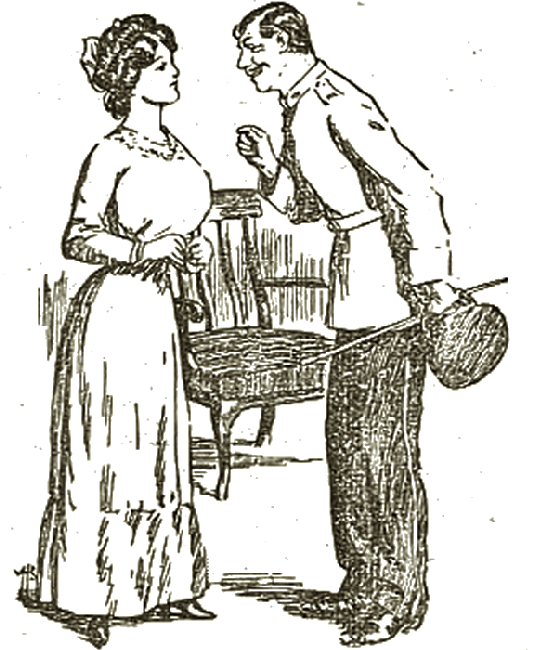
'Suppose,' sez Spud, eager, 'suppose I kissed you in front Nobby?'
"Miss Amy considered again.
"'I should send a wreath,' she sez thoughtfully, 'an' the regiment would send a wreath, an' I know that my father would be only too willin' to put up the shutters on the day of the funeral.'
"'You're wrong,' sez Spud, chucklin' joyful; 'Nobby would only smile—because he's a Stow It.'
"'Then he's a fool,' sez the girl tartly.
"Nobby got through his seven days of as spry as a two-year-old. You'd have thought that he was doin' it for a lark, by the cheerful way ha tackled the drill an' the other little inconveniences o' C.B.
"It's been a hard fight,' he sez to me, 'but I've conquered, so to speak. I reckon I'm one o' the most improvin' Stow Its in trainin'. I've got to the stage where nothin' upsets me.'
"When he'd finished his seven days an' was at liberty to go out o' barracks, he dresses hisself a lot more careful than a proper Stow It ought to have done, an' went down town.
"A tradesman's cart splashed a lot o' mud over him, but he only smiled; a feller came out of a tobacco .shop an' bumped into him, but Nobby only begged his pardon for bein' there; a saucy little boy whistled 'Army Duff' after him, but Nobby only gave him the glad eye.
"I was with him, an' I didn't know whether to envy him or feel sorry for him.
"'You've lost your dash, Nobby,' I sez, mournful.
"'Not so' sez Nobby, 'I've learnt to suppress me evil passions.'
"We called at his young lady's house, but she wasn't there.
"'She'll be in the park,' sez Nobby. 'It's Thursday afternoon, an' the band plays to-day.*
"So off we went to the park. We didn't see her anywhere near the band-stand, so we just strolled round.
"We got to a part where there wasn't many people, an' turnin' round by a clump of bushes we came upon Miss Amy an' Spud Murphy sittin' on a seat-
"'Hullo,' see Nobby, an' I thought his smile was a bit forced, 'hullo. Miss Amy,' he sez.
"'Hullo, Mr. Clark,' sez the young lady, 'I'm walkin' out with Mr. Murphy now.
"'So I see,' sez Nobby, smilin' on one side o' his face.
"'Of course,' she sez very wild, 'If it amuses you '
"'It don't amuse me,' sez Nobby, 'an' it don't annoy me: I'm a true Stow It.'
"'That's the right spirit, Nobby,' sez Spud, an' put his arm round Miss Amy's waist....
"If it hadn't been for me an' a park keeper Spud would have been killed. I don't know exactly what Nobby did, but I happened to notice somethin' strike the earth so violent that the shock shook the leaves from the trees, an' I'm under the impression that it was Spud Murphy. I don't know whether Nobby danced on his chest when he got him down, but I should say that he didn't, because Nobby was never a dancin' man.
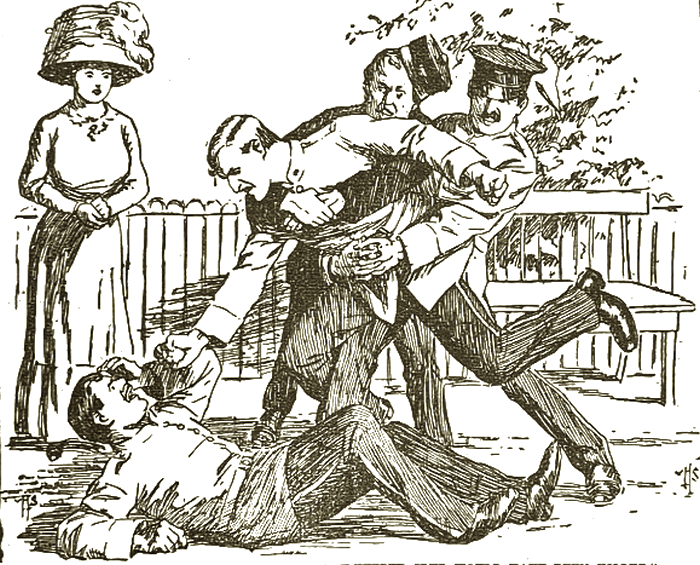
"If it hadn't been for me an' a park keeper Spud would have been killed.
"All I knows is that as Nobby was takin' Miss Amy's arm to walk her round the bandstand Spud recovered consciousness an' sat up.
"'Call yourself a Stow It!' he sez, dazed.
"'I do,' sez Nobby. 'I'm a-bearin' your misfortune very philosophic!'"
IT has often occurred to me that of all classes of society, sailors and soldiers are the most domesticated. Rude and bloodthirsty as are their occupations, there is something pathetically ladylike in the pursuits with which they fill their leisure moments.
"I've known fellers," said Private Smith, "who spent the whole of their service knittin' socks, or collectin' cigarette pictures—they never seemed to get tired of their hobby. Other fellers have taken years to embroider a Union Jack on a pocket handkerchief, whilst the people who've gone in for mat-makin' is surprisin'ly large.
"Me own hobby has been to keep out of debt, which, Nobby Clark says, is one of the most silly hobbies he's ever heard of.
"As a rule, hobbies don't pay me, but they seem to pay Nobby; but the only time I ever went in for one of Nobby's hobbies—which sounds like poetry, but ain't—I was sorry that I hadn't stuck to me own last, so to speak.
"Nobby had a habit of writin' to the papers. It was » perfec' craze with him for a bit. You'd see letters on every subject from politics to poultices which, you could tell at a glance, Nobby wrote.
"Sometimes they'd be signed 'Pro bono public-house'—like that one he wrote about the landlord of the Red Lion refusin' to serve Culley Brown on the paltry excuse that he was drunk—an' sometimes they'd have the magic words, 'From a Mother of Six,' similar to the letter that Nobby wrote to the North Camp Advertiser on the topic, 'Should soldiers be vaccinated?'
"His lit'ry style attracted a great deal of attention—but then some people will laugh at anythin'.
"We was stationed at Aldershot—a nice place to look back on, an' boast about, but not a station that impresses you whilst you're there, for 'Aldershot' was French for 'work.' It's now Smith-Dorrion for hard labour.
"However, as I was tellin' you, Nobby used to spend a lot of time writin' to the papers, an' his e-pistols, as he called 'em, owin' to their goin' off with a bang, got talked about. There was a little paper called The North Camp Messenger that Nobby used to write regular for. He did a column called 'Facts About Certain Regiments.' He had a great followin'. I've known chaps to follow him for miles in the hope of catchin' him in some quiet spot. There was paragraphs in it like these:—
Who is the soldier in the Lincolnshire Lancers that got three days for not washin' his neck?
It is rumoured that the Bedford Highlanders have got a first-class shot at last.
"B" Company of the Manchester Fusiliers are bein' treated for flat feet.
"Naturally, people didn't like it, but as only a select circle knew that Nobby wrote all this, he escaped with his life.
"Them notes of his attracted the attention of one of the London papers, too, for there was always little paragraphs in 'em, pinched from the Messenger, an they was usually headed, 'Strange Story from Aldershot' or 'A Report from the Army.' I think one of those papers must have sent a man down to see Nobby an' got him to contribute a few interestin' notes, because I remember seein' a little time after that, that the paper had gone bust.
"One day Nobby comes to me lookin' a bit troubled.
"'Smithy,' he sez, sittin' down on my bed cot an* disarrangin' the bedclothes, 'I've got an idea.'
"'Have it out,' I sez; 'it won't hurt you if you have gas.'
"'Cease your mirth,' sez Nobby, an' them words was the first intimation, so to speak, that I received he was developin' a lit'ry style.
"'My idea or conception,' sea Nobby, vary firm, 'is to write a book.'
"'On the St. Leger?' I sez.
"'Write a book, not make a book,' sez Nobby, dignifiedly. 'I've got a plot.'
"'I'd let it out for buildin' on, if I was you,' I sez, an' after Nobby had said a few insultin' things about me funny-bone, he proceeded to put me wise to this here tale of his.
"He was quite serious about it; you could tell that by the way ho took everybody into his confidence.
"He only got as far as the title. It was to be called 'The Soldier's First Love, or The Sergeant's Revenge.'
"'I shall draw me characters from real life,' sez Nobby, 'an' there'll be a beautiful picture on the cover showin' the soldier bashin' the sergeant's head against a lamp-post—it'll bring tears to your eyes.'
"It seemed to me that it was more likely to bring tears to the sergeant's eyes, but I wasn't goin' to be a kill-joy, so I made no remark;
"I don't wonder the troops took Nobby seriously, knowin' his gift for writin'. Everybody knows that fellers who write books make, fortunes,* an' the only wonder is that Nobby didn't think of the idea before.
* I pause at this point to laugh grimly.—E.W.
"But what brought the troops flockin' respec'fully to Nobby was the announcement that all the characters was to be drawn from life.
"It made Nobby one of the most popular chaps in the regiment. When he went into the canteen, fellers absolutely fell over one another to offer him their pots.
"It was, 'Have one with me, Nobby,' an' 'Drink hearty, old son,' an' I've seen even Spud Murphy get up from his seat an' offer it to Nobby.
"Which all goes to prove what Hall Caine sez, that the pen is mightier than fixed bayonets.
"The fellers used to approach the subjec' of the book very carelessly.
"'By the way, Nobby,' sez little Fatty Green, in a offhand manner, 'I understand you're writin' a book, with all the characters drawn from still life?'
"'That's so, Fatty,' sez Nobby.
"'Well,' sez Fatty, thoughtfully, 'you'll probably find some chaps objectin' to bein' put in a book—by the way, ole feller, that happens to be my beer you're drinkin' of, but I don't mind in the least—as I was sayin', some chaps might object to bein' caricatured, if I might use the expression.'
"'So they might,' sez Nobby.
"'Well,' sez Fatty, 'I don't mind a bit, so if you want to describe the hero very careful, I'll give you a few particulars. I was born in Wappin' on the 22nd of February, an' educated privately. Me height is five foot seven, me chest is 38, expanded, me eyes are brown—'
"'I see,' sez Nobby, 'what you mean to say is, that when I'm decribin' the hero, I shall say:
At that moment, the handsome hero arrive, his thirty-eight inch chest proudly expanded. Drawin' himself up to the height of five foot seven, he looked proudly round with his brown eyes, as he thought of the days when he was educated privately at Wappin'.'
"'That's it,' sez Fatty, very gratified.
"'Well, it can't be done,' sez Nobby, 'under five bob.'
"All the chaps had a go at him.
"'How does this idea strike you, Nobby,' sez Spud Murphy. 'Suppose you take a chap like me for hero—drink hearty, ole feller, that's my pot with the froth. You needn't call him Murphy but you can describe me so that nobody could mistake me.'
"Nobby took a long drink.
"'If I happen to want a comic character to make people die with laughin', I'll think of you.'
"It made Spud a bit cross, but sooner than be left out of the book, he said he was willin' to come in, even on them terms.
"Some fellers wasn't satisfied with wantin' theirselves in the book, but they wanted to suggest what they should do.
"Little Yatesey, a highly romantic chap—he's left the Army now, an' is writin' trainin' reports for the Sportin' Eagle—couldn't leave Nobby alone.
"'What you ought to do,' he sez, 'is to make me a young lord that's lost a lot of money racin', an' I'm sittin' on the edge of the bed with a pistol in one hand an' a glass of poison in the other.
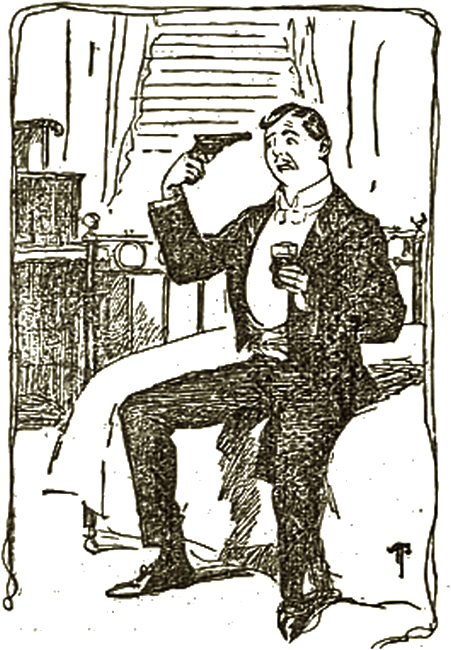
I'm sittin' on the edge of the bed with a pistol
in one hand an' a glass of poison in the other.
"'Suddenly there's a piercin' shriek, an' a girl falls in the water! I launch a boat an' am rowin' towards her, when the whole buildin' collapses owin' to a bomb bein' thrown by a anychist! All is confusion! I lift the girl up from the ground, an' throwin' her across my charger, I gallop to a place of safety! How's that?'
"'Rotten,' sez Nobby.
"But the fact that the villain was to be a sergeant gave Nobby most trouble.
"'About this book of yours, Clark,' sez the colour-sergeant of "B" Company, 'I hope you're not goin' to forgot yourself?'
"Certainly not, colour-sergeant,' sez Nobby virtuous.
"'Because,' sez the sergeant, 'there's regulations in the Army under which I can deal with anybody castin' aspersions on my character.'
"'I'm sure, sergeant,' sez Nobby.
"'I've known a private soldier to get 84 days for slanderin' his superior officer,' sez the colour-sergeant, shakin' his head.
"'Quite right, too,' sez Nobby.
"'That's all,' sez the sergeant; 'a kick in time saves nine.'
"Then Sergeant Greggy tackled Nobby. 'Here, Clark,' he sez, 'what's this I hear about a story you're writin'?'
"'I don't know,' sez Nobby—which true.
"'I want to give you a friendly warnin', sez the sergeant. If you make me your villain, you'll be sorry,
"'I should be very sorry indeed,' sez Nobby, 'to do such a low thing.'
"As it happened, Nobby had arranged to make Greggy the worst villain in the book. He was also tackled by another sergeant on the same subject, an' the whole sergeants' mess seemed to be down on the idea of their comin' into the villain department that Nobby publicly announced that he was goin' to change the title of hook, an' call it 'The Soldier's First Love, or The Corporal's Vengeance.'
"'I'm bound to get into trouble if I make the villain a sergeant,' he sez. 'I'll try a rank down.'
There was a bit of bother over this, an' a spirited argument was started in the corporal's room. Jimmy Sibbett, the senior corporal, came an' saw Nobby.
"'I think that it's only fair to give you the straight griffen that if me or any of my friends recognise themselves in this book of yours there'll trouble.'
"So Nobby altered the title of the hook again. He called it, "The Sergeant's Love, or The Private's Temptation,' an' nobody objected to that, for it looked as though Nobby was gettin' his own back in a highly sub-tile fashion.
"It took about three months to get the title settled, an' then Nobby began to write the book.
"It was a beautiful bit of work. You could read every word of it, an' the spellin' wasn't at all bad. But somehow Nobby didn't make the progress with it he ought to have done, an' the troops got a bit impatient, because Mosey, the orderly-room clerk, had promised to hectograph the instalments as they were written, an' naturally the fellers who'd paid Nobby in advance for the thrillin' chapters—did I mention the fact that Nobby was making a little out of it?—wanted to see somethin' for their money.
"But what was scarin' Nobby was all the threats that had come his way.
"'This bein' a military novel,' he sez miserably, an' bein' full of military characters, so to say, I'm pretty sure to upset somebody or other.'
"So he thought, an' thought, an' thought of some way he could save hisself from trouble, an' at last he hit upon a plan.
"On the Friday sight the first edition of Nobby's novel came out, an' was eagerly read by all concerned.
"It started somehow like this:—
"'That's swank,' sez Nobby when he read it over to me.
It was a dark or gloomy evenin' as Private Orlando Hosh crossed the barrack square. Suddenly he came upon Sergeant Gwuff, his hated rival. He looked calmly but with bitterness upon the red-nosed tyrant (P.S. This doesn't refer to Sergeant Greggy), who was accompanied by another sergeant noted for his meanness. This other sergeant was a red-haired villain of the deepest dye. (P.S. If anybody thinks I am referrin' to Sergeant Smithson they make a mistake.)
"Ha, ha," said the first sergeant, who was the worse for drink. (P.S. No snacks intended). "So I see before me the man who stole my love?"
"You lie!" said the handsome private, and at that moment up came a leery corporal with gig feet (no reflection on Corporal Toms, of "B" Company)."
"Then the tale went on to describe how the hero was put in the guard-room.
"What's this?" said the sergeant of the guard, an ugly lookin' feller, with false teeth. (P.S—This life-like description is not intended for Sergeant Derry, of 'H,' who I highly respect, an' I trust he won't be offended)....
"An' so the thrillin' story went on to tell how the hero was brought before the colonel the next morning.
The colonel was a little man, very pompous owin' to his talkin' through his nose. (P.S. No offence meant.) He was a cruel scoundrel, with a heart of mud, an' he looked at the handsome private scornfully. Turning to the knock-kneed adjutant. (P.S.—No reflection on Captain Timfreville who can't help bein' knock-kneed, owin' to nature) he said in a low voice:
"I shall never understand why Nobby was put into the guard room that night for disrespect to his superior officers, for if ever a chap tried to avoid givin' offence, it was Nobby.
"He came up in front of the colonel the next day, an' the old man was most severe.
"'You've insulted every non-commissioned officer in the regiment,' he sez; 'to say nothin' about myself an' the adjutant. But,' sez he, 'I like to encourage genius.'
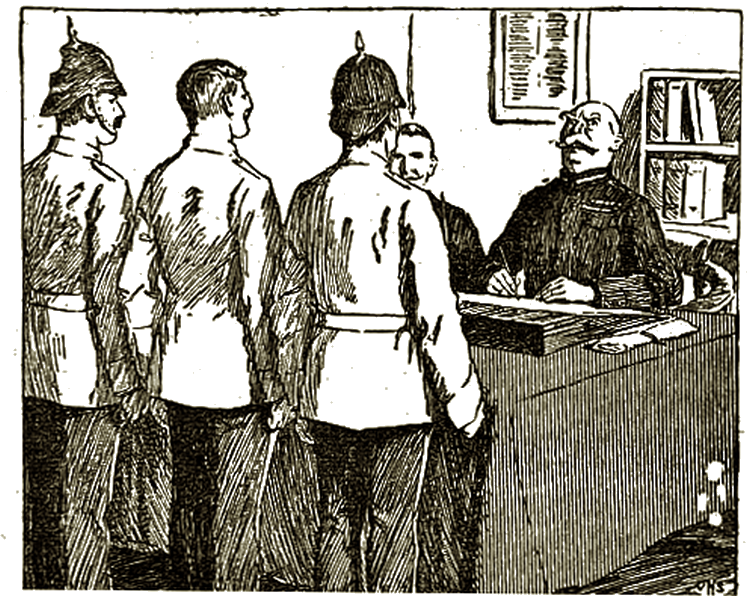
'You've insulted every non-commissioned officer in the regi-
ment,' he sez; 'to say nothin' about myself an' the adjutant.
"'Thank you, sir;' sez Nobby, brightenin' up.
"'I think your interestin' story finished just where the hero was goin' to prison,' sez the colonel.
"'Yes. sir,' sez Nobby.
"'Well,' sez the colonel; 'to give you a chance of describin' his feelin's, I'm goin' to send you there, too—48 hours' hard labour!'"
"THERE'S genius an' genius," explained Smithy, apropos of some remark that had been passed concerning the versatility of Nobby Clark. "Some people I know are geniuses who, so to apeak, stay in the same place all their lives; there's others that go nippin' about here an' there, very nimble. It's the difference between a steam pump an' a locomotive, an' I'm bound to confess that Nobby Clark is the locomotivest genius that ever lived.
"People think Nobby only goes in for schemes because he wants the excitement, but that ain't fair to Nobby—what he wants is the money.
"Every wangle that has ever been wung. Nobby knows. From bookmakin' to bookwritin', from inventin' machines to inventin' excuses, an' generally speakin' he can size up a feller an' get the upper hand of him quicker than any other chap I've ever met.
"Nobby thinks out all his best ideas in church, an' if ever I'm a rich man I'm goin' to have brass plates put up in St. George's Church, Aldershot, an' one of 'em will be:—
ON THIS SPOT
NOBBY CLARK
THOUGHT OUT HIS FAMOUS
HAPPY HALF HOLIDAY WANGLE.
"The idea came to Nobby durin' one of his famous Nature Rambles. Him an' me an' a few other chaps used to go long walks when we hadn't any money, an' sometimes if we was very lucky we used to lure some young feller who happened to be flush to join us.
"'You ought to come out with us this afternoon,' sez Nobby careless; 'if you don't know anythin' about botany or natural scenery, I could give you a pleasant little talk about them interestin' subjects.'
"'Certainly, Nobby,' sez the young feller eagerly. 'I'm much obliged to you for askin' me.—I didn't know that you was that way inclined—botany, I mean.'
"'Oh, yea,' sez Nobby, more careless than ever. 'me father was one of the first inhabitants of Botany Bay."*
* Nobby is perhaps oblivious of the fact that Botany Bay was originally a convict establishment. E.W.
"'I'll come with pleasure,' sez the gratified young chap.
"'Bring a little money,' sez Nobby. 'We may have to pay a few pence for inspectin' the wild geraniums, or gerani wildus, as we call it.'
"So the young feller would turn out, an' Nobby an' me, an' perhaps another thirsty friend, an' out we'd go for our Nature Ramble.
"After a bit we'd get to some fields, an' Nobby would start lecturin'.
"'This is a buttercup, or, as we say in Botany, a cuppi buttercus, so called because of its elongated or restricted vox populi or stem.'
"'Well, I'm blowed,' sez the young feller, very much impressed.
"'This is the dandelion, or leone dandiliculus, so called because it was originally grown in Dandaloo.' Sez Nobby, 'This is grass, so called because it's green.'
"'Where did you pick these things up, Nobby?' sez the young feller, admirin'ly.
"'I was born in the country,' sez Nobby, careless. 'at a place called Flower of Dean Street, so it comes natural. This flower what I'm boldin' in me hand,' he sez, stoopin' to pick up something, 'is the deadly nightshirt, or pyjama obnoxious, so called—look here,' he sez sudden. 'I'm feelin' awful thirsty; let's go an' have a drink.'
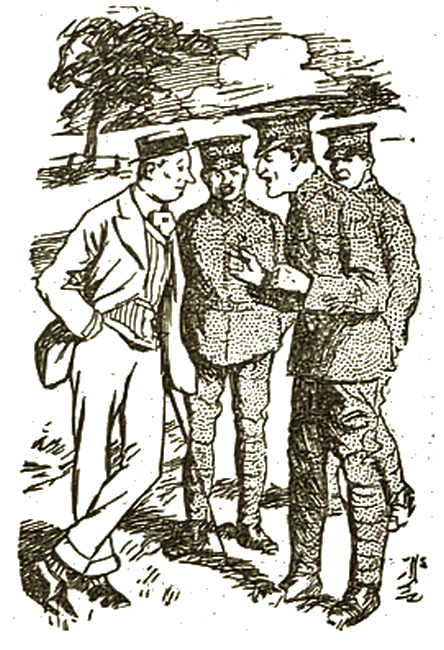
"This flower," he sez is the deadly nightshirt, or 'pyjama obnoxious.'
"So we all tramps to the nearest little pub, an' Nobby sez that we'll take it in turn to buy drinks, an' that it's the young feller's first turn.
"That's where the botany lesson usually marked time for six paces, because when it came anybody else's turn to pay, Nobby hurried the botany party out to see the daisies before they shut their little eyes, an', after we'd seen them, we all went home, owin', as Nobby pointed out, to it bein' too late for any further botonous research.
"But this partic'lar day I'm talkin' about, Nobby was walkin' back to barracks with a young feller—I forgot what young feller it was. but there are always mugs that's had for the findin'—an' be was just turnin' into the gate, when this young feller sez to Nobby, enthusiastically:
"'What a pity a lot of us can't go out a long way, say, by train—'
"'I see the idea,' sez Nobby, quick.
The next day was Sunday, an' I could tell by the reverent way Nobby was goin' on in church that he was thinkin' out a wangle.
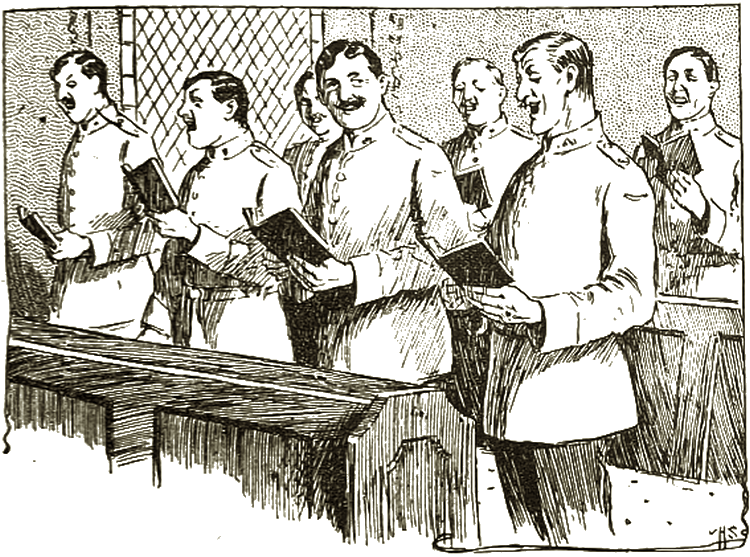
I could tell by the reverent way Nobby was goin'
on in church that he was thinkin' out a wangle.
"An' sure enough that's where the Happy Half Holiday Idea come to Nobby.
"It might be said," added Smithy, after a pause, "to have coincided—if you will forgive me for usin' the phrase—with the arrival in our battalion of Cocky Parsons, who was invalided out of the other battalion an' come to us for duty.
"He was called Cocky Parsons because his name was Parsons an' be was cocky, an' accordin' to coverin' despatches, so to speak, from chaps we knew in the other battalion, there never was a chap so cocky as him, an' he was one of the most pessimistic fellers that ever lived.
"A pert, smart little feller, with a turned-up nose he was, very clean an' tidy, an' most appallin'ly cocksure.
"He fell up against Nobby the first night be arrived.
"We was all in the canteen talkin about how many royal regiments there was in the Army, when Cocky put his nose into the argument.
"'Sixteen,' he sez, prompt.
"'How do you know?' sez Nobby, who'd been talkin' the line that there was only nine.
'"I've got medals for knowin' things like that,' sez Cocky.
"'The curious thing is,' sez Nobby, musin'ly. 'that you've got the use of your limbs if you've been in the habit of interruptin' gentlemen when they're discussin' matters.'
"The little breeze blew over, but I could see that Nobby had the needle. Argument followed argument, an' Cocky kept chippin' in till I was afraid for his life.
"What made Nobby so wild was that when he started talkin' about his Happy Half Holiday, an' when all the chaps in the canteen was takin' up the idea most enthusiastic, Cocky pushed his opinion forward.
"'I used to be a bit of a beanfeast organiser,' he sez. 'I've got a silver cap at home presented to me by the Bermondsey Fresh Air League; I've got a medal an' clasp awarded for long service arrangin' Saturday Sallies for Pallid Potmen. I've got a service of plates—almost every one the same pattern—for arrangin' Seaside Sundays—'
"'As I was sayin' when this human wind began to blow,' sez Nobby, ignorin' Cocky, 'if we all subscribed six shillings. we could have a nice little trip to Bichester-on-Sea, a bit of lunch, an' a cup of tea—'
"'Couldn't be done for the money,' sez Cocky, climbin' into his pessimistic boots. Your special train will cost you so-an'-so, your tea will cost you so much, your cold collection can't be done under so-an'-so.'
"'I'm tryin' to restrain meself,' sez Nobby, his voice tremblin'. 'I'm endeavourin' to forget that a feller like you exists. I've got medals for killiin' chaps like you; I've got a gold cup an' a illuminatin' address for wipin' out fellers that stick their funny noses into business which don't concern 'em.'
"I don't think any man ever tried so hard to crab another man's deal as Cocky tried to crab the Happy Afternoon idea.
"What with shakin' his bead, an' sayin' that it always rained at Margate, an' that the train service was bad an' the sea was no good for bathing in, he almost ruined the finest wangles that Nobby ever thought of.
"But Nobby had the sense to see the sergeant-major, an' the sergeant-major havin' seen the colonel an' had a satisfactory talk with him, the Anchesters' Beanfeast was as good as carried out.
"'Splendid idea,' sez the colonel; 'the men will be able to have a day's amusement, an' the outin' will be as good as a recruitin' march.'
"That will give you some idea of what a noble wangle Nobby's wangle was.
"If there was any drawback to it, it was that the sergeant-major took most of the financial arrangements out of Nobby's hands.
"'If there's any profit on this idea of yours, Clark,' he sez. 'It'll be banded over.'
"'Yes, sir, sez Nobby dubious.
"That sort of depressed Nobby, but he brightened up wonderful when the officers started subscribin' to the beanfeast fund—which they did very generously. The sergeant-major did all the hard work, arranged the special train, wrote about the lunches, an' nigh on four hundred chaps subscribed their dollars.
"Everybody was lookin' forward most eager for the beanfeast, an' what with the sports that the Mayor of Bichester got up for us, an' the rumour that went round that the town was goin' to be decorated for us, pop'lar feelin' was excited in the battalion.
"Only Cocky shook his head an' uttered depressious remarks.
"'Nineteenth of August?' he sez; 'it alway rains on the 19th of August.'
"'It's the 20th,' sez Nobby.
"'That's worse,' sez Cocky gloomily; 'there's usually a fall of temperature about the 20th—very treacherous weather.'
"'There'll be plenty of places to go to,' sez Nobby, who was in a fairly good humour owin' to the sergeant-major havin' told him that the tickets was nearly sold out; 'if it's wet we'll have lunch a bit earlier.'
"'I know them lunches,' sez Cocky, very grim. Me Uncle Sam died after eatin' pork at the sea-side.'
"'If you Uncle Sam goes in for caneblizin', he's only got himself to blame,' sez Nobby,
"But outside of Cocky, the regimental outin' was one of the most popular proceedin's you wish for. All the chaps arranged to take their girls, an' what with the colonel sendin' the band to play at the sports it promised to be a huge success.
"Bits got into the paper about it. There was one headline in the Dispatch that was highly appreciated.
MILITARY MEN MIGRATE.
STALWART SOLDIERS TO SPEND
SATURDAY BY THE SUNNY SEA.
"It excited a lot of argument, an' there was some discussion as to whether the editor had noticed that all the words in each line began with the same letter.
"The nearer the day came, an' the more clear it was that there was goin' to be the greatest thing that ever happened, the dismaller became Cocky. He brooded over it, bought a ticket an' tore it up, just to show his contempt for Nobby.
"'Go?' he sez. scornful, when I asked him whether he wasn't comin'—-'Go?' he sez bitterly. 'Who am I that I should travel with a lot of common soldiers on what I might term a orjee—'
"'What's that?' I sez.
"'It's a German word meanin' a free drink,' he sez. 'No,' he sez, 'if I ever want to go to the seaside, I'll go like a gentleman, by meself—an' I ain't so bloomin' sure that this here picnic is ever goin' to come off," he added, mysterious.
"'For why?' I sez.
"'For reasons,' sez he, more mysterious than ever.
"THE nearer we got to the day, the more an' more melancholy old Cocky Parsons got. He read the papers most industrious.
"'There's a aunty-cyclone comin',' he sez; 'it's spreadin' all over the British Isles.'
"'Go on!' sez Nobby, uneasy.
"'It's one of the worst aunty-cyclones we're had for years,' sez Cocky, tremblin' with joy, an' he read out the weather report.
North-West.—Light variable breezes, accompanied by hurricanes. Midlands an' North-East.—Bright sunshine, local snow showers.
London an' Channel.—Heat wave, slight blizzards, a little foggy (lightin'-up time two hours after dark). Channel crossing, so-so.
"'H'm,' sez Nobby. 'It certainly looks as if it's goin' to be wet.'
"Regularly depressed, Nobby was, an' more so when Cocky came the next mornin' with another weather report:—
North-West (an' Ireland).—Slight frost, accompanied by No. 7 earthquakes; fine locally.
Midlands an' North-East.—Whirlwind, with rise of temperature; fine generally, with rain.
London an' Channel.—Unsettled, with light breezes. High temperature. Calm, but stormy. Cold.
"Nobby shook his head.
"'Looks as if we shall have some rain,' he sez.
"But to the horror of Cocky the weather steadily got better an' better, an' the night before the beanfeast, the heavens, as Nobby put it so poetical was spungled with spangles (in case you don't get the meanin', he referred to stars).
"The excitement in barracks was immense. Cocky said he couldn't stand it, an' went out of barracks, but where he went to nobody know'd.
"As a matter of fact, Cocky was very friendly with a railway porter, an' thought he could persuade him to upset the famous Anchester beanfeast.
"The railway porter was named Cully, an' Cocky went round to see him where he lodged.
"'Look here, Cully,' sez Cocky, 'you're high up in the railway business.'
"'I am,' sez Cully, 'in a way.'
"'Well,' sez Cocky, 'I want to crab that excursion.'
"'I know,' sez Cully, very important, 'the 98 down.'
"'98 or 99,' sez Cocky, 'it don't matter which. Now do you think we could get round the engine-driver?'
"Cully shook his head.
"'It's very unlikely,' he sez, 'but I might try.'
"'Well, it's like this,' sez Cocky. 'I've got an idea that the engine-driver might lose his way—take a wrong railway turnin' or somethin' like that.'
"'Can't be done,' sez Cully, who knew all the ins an' outs of railways owin' to his bein' a porter.
"'He couldn't pretend he'd forgotten to bring any coals with him?' sez Cocky, hopeful, but Cully shook his head.
"'Suppose we pinched the engine-driver an' made him drunk?' sez poor Cocky, who saw his chance of messin' up the Anchester beanfeast vanishin'.
"'That's not allowed,' sez Cully; 'it's against railway regulations.'
"So Cocky's last hope went fluff,
"The only thing for him to do was to nip back to barracks an' buy a ticket—he havin' postponed buyin' it until he was sure the beanfeast was goin'.
"The sergeant-major bein' away, Nobby had charge of the tickets, an' I must say that he was annoyin'. First of all he pretended that there wasn't any tickets left, then he said that Cocky had given him a bad two-shilling piece, an' made him change it.
"The mornin' of the beanfeast arrived. Lots of fellers didn't sleep all the night before, thinkin' about it, an' Cocky was one of the very first chaps up, to see what sort of mornin' it was.
As it happened, it was a glorious mornin', an' when the troops began to make their way to the station, the sun, as Nobby said so prettily, 'showed the country in all its summer garbage.'
"The train was packed. There was sergeants an' corporals an' common privates an' me an' Nobby—we had a second-class carriage to ourselves.
"There was sergeants' wives, an' corporals' wives, an' privates' wives—with a bit of luck—an' there was me an' Nobby.
"Even Cocky looked cheerful when he turned up.
"'Fine day," sez Nobby.
"'Very fine/ sez Cocky.
"'I don't see no earthquakes with variable breezes about," sez Nobby.
"'No,' sez Cocky.
"'Nor no aunty-cyclones careerin' across the sky?' sez Nobby,
"'I haven't seen one,' sez Cocky.
"'I think you'll admit that this beanfeast is a bit of a howlin' success,' sez Nobby,
"'Up to a point it is,' sez Cocky, cautious, which was very handsome for him.
"'In fact,' sez Nobby to me when the train started, 'I don't see a single drawback to the whole proceedin's; if Cocky's satisfied everybody ought to be.'
"We got down to Birchester an' was met by the Mayor an' the Corporation, so to speak, an' havin' listened to a highly successful speech, sayin' what an honour it was for the Anchesters to come to Birchester an' similar comic remarks, we made our way to the beach.
"I don't suppose that you'll be interested to hear all that happened that day. How Nobby won three coconuts an' a couple of glass dishes by his wonderful shootin', or bow Fatty Green met a gentleman on the bench who bet him two shillin's that he couldn't spot the lady—the bein' the queen of hearts. It cost fully six bob before he found out that be couldn't spot, after which Fatty savagely attacked both of the fellers an' got his six shillin's back an' about ten shillin's beside, wot he found lyin' about loose in the road after he'd shook the chap up a bit.
"The incidents of that day would fill a book. Spud Murphy went out for a swim an' nearly got drowned, an' there was other amusin' happenin's too numerous to mention. Jimmy Speddin's was run in for havin' an attack of sunstroke an' strikin' a policeman. Tiny White took the chaps out for a sail an' lost his rudder. Ugly Johnson had a tiff with his lady friend, an' she hit him over the head with an umbrella. In fact, we made history in Birchester—we brightened it up so that you could see your face in it.
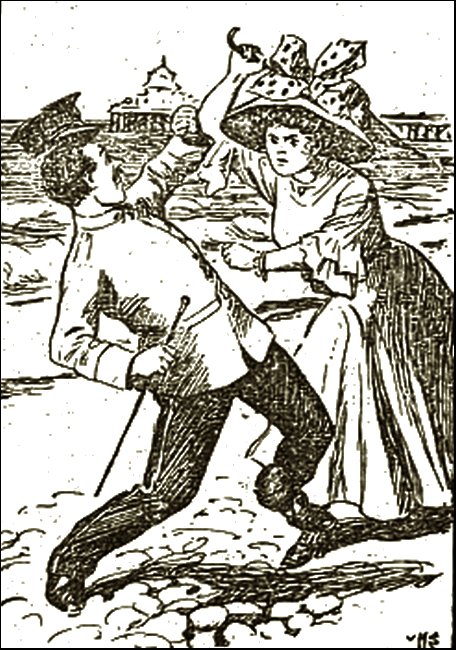
Ugly Johnson had a tiff with his lady friend.
"The Mayor said afterwards that he'd be glad if we'd let him know when we was comin again, an' he'd borrow a few extra policemen for day.
"But it was a successful day—especially the sports.
"Nobby won the hundred yards handicap—he was the official handicapper, an' naturally knew better than anybody else what start he ought to get.
"Pug Wilson won the prize for throwin' the hammer. It just missed Corporal Jones by about half an inch. It was a fine throw.
"Harry Toppetts, of 'G' Company, won the catch-as-catch-can wrestlin'-match, defeatin' Long Smith on points—Long Smith bein' carried to the hospital sufferin' from bites.
"Nobby won the greasy-pole competition—he bein' in charge of the sports. He was the first to go up, an' it leaked out afterwards that he'd forgotten to grease the pole before he started climbin', but the money was all spent by then.
"In fact, that day of ours at the seaside was as full of innercent enjoyment as you could wish.
"Strollin' about the town, an' along the front, me an' Nobby kept comin' across Cocky, an' what surprised us was his cheerfulness.
"Nobby didn't like it a bit.
"'That chap's plannin' somethin,' he sez; 'he's a bit of a brooder naturally, an' here we see him grinnin' as though he'd planned the outin'—I don't like it.'
"The day wore on. The dinner was a success, the tea was a success, the sun was shinin', an' the sea was calm, an' accordin' to them who didn't see no sports, no sun, no sea, an' no nothin', the beer was the best they'd ever drank.
"Surrounded by enthusiastic an' clamourin' crowds, we moved to the railway station to catch the special train back.
"We got to the station, an' there was one d the most fashionable military gatherin' on that platform that Birchester has ever seen.
"Then we said 'good-bye' to all the numerous friends we'd made—they bein' kept at a safe distance by a strong force of police.
"Just before the train started Nobby came hurriedly to me.
"'Smithy,' he sez, 'are you on for a lark?'
"'I am,' I sez.
"'There's an empty carriage at the back,' sez Nobby in a whisper; 'it looks as if it's attached to the train, but, as a matter of fact, it ain't—let's go an' find Cocky.'
"We found him at the end of the platform surrounded by admirin' friends.
"I wouldn't like to say," said Smithy cautiously, that Cocky had been drinkin'—I'd prefer to put it down to the sun. Anyway, he was talkin', as only Cocky knows how to talk.
"'I've got forty-six medals for fightin',' he sez, an' twenty-three cups for meritorious service! I'm the intimate friend of the Colonel's—in fact me an him never pass a public house together.
"'Good gracious,' sez the crowd, very impressed.
"'I'm goin' on a secret mission to Germany nex' week,' sez Cocky, 'to count the soldiers—I'm what is known as a confidential agent—I'm one of the most important—"
"'Here,' sez Nobby, elbowin' his way through the crowd, 'come on, Cocky, the train's goin'.
"'Feller,' sez Cocky very haughty, 'how dare you address me.
"'Beg pardon, sir,' sez Nobby, salutin', 'but your special saloon is waitin'.'
"'Lead on,' sez Cocky, and we led him to the empty carriage at the rear of the train.
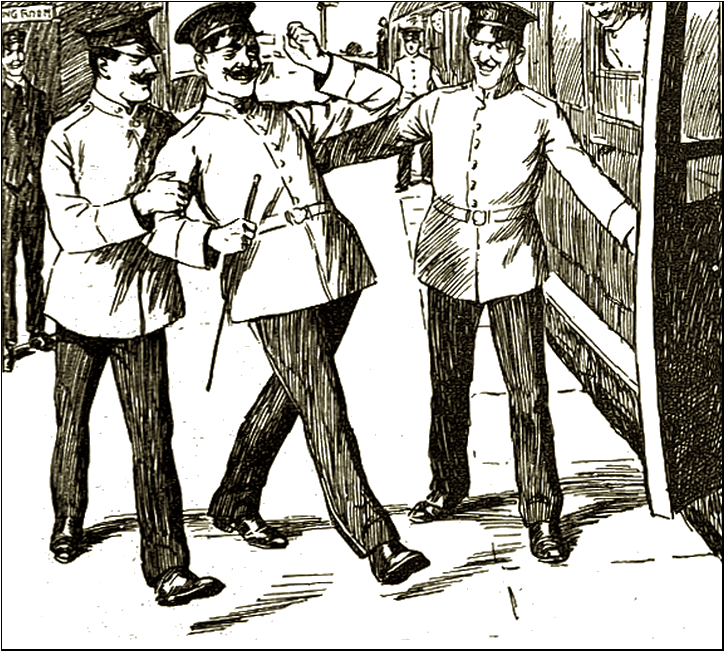
We led him to the empty carriage at the rear of the train.
"We got him inside, an' he went to sleep in two seconds.
"We'd just time to pull down the blinds, nip out, an' nip into our carriage when the train moved out.
"It was a great joke.
"Nobby looked out the window to make sure the carriage was left, an' we made ourselves so tired with laughin' that we dozed off. We must have been asleep an hour, an' we woke up to find the train standin' in a little station.
"'What's up?' sez Nobby, puttin' his head out. It was rainin' cats an' dogs.
"'You're pulled up to allow a special to pass.
"'What special?' sez Nobby.
"'I don't know,' sez the chap, 'he's a King's messenger or somethin', who got left behind at Birchester.
"'Heavens!' sez Nobby, smitin' his forehead, an' fell back on the seat.
"By-an'-by the special came thunderin' through; an engine, a carriage, an' a guard's van, an' ten minutes after, we went on.
"We'd been on the move about a quarter of an hour, when we pulled up again at another little station.
"'What's up?' sez Nobby.
"'There's a special ahead,' sez the porter; 'a chap enrryin' dispatches to the War Office—he's pulled up at the next station for a drink.'
"'Horrors!' sez Nobby, 'Cocky, for a dollar.'
"If we pulled up once that night, we pulled up twenty times.
"Sometimes the special messenger got out for a drink, sometimes to stretch his legs... We got into Anchester at 3 a.m.
"We found the special messenger bein' tenderly supported by the military police.
"It was Cocky all right.
"'There he is,' he sez pointin' to Nobby, 'he'll tell you who I am—am I the confi—what-dye-call-it agent for Mr. What's-his-name at the War Office, or ain't I? Didn't you order me a special saloon, or didn't you? Speak, feller.'
"But Nobby was speechless."
"DOIN' a turn for another feller is one of the silliest things you can do," said Smithy, philosophically. "A chap that does turns is well-meanin', an' well-meanin' is another term for fool. If a chap tries to stop a fight between two friends he usually gets a black eye from both, an' gen'rally gets his pocket picked into the bargain. If you read the papers you'll jolly soon find out that it isn't the feller that falls into the water that gets drowned, it's the well-meanin' chap that jumps in to rescue him.
"Lots of soldiers I know have got medals for rescuin' people from the water, but the medals that me an' Nobby ought to have for not rescuin' 'em would fill a good-sized kit-bag.
"Nobby jumped into the Red Sea once to fish out a feller of the Hussars who didn't want to go to India. The feller never forgave Nobby, even though Nobby pointed out that there was hotter places than India. Used to write threatenin' letters to Nobby from all parts of India, that chap did, sayin' that Nobby spoilt has life. He wanted to die as bad as any man wanted to die, an' eventually he did, for havin' caught enteric fever, he frightened hisself to death.
"Nobby always said that he'd never help anybody else.
"'If you was to fall into the water,' he sez to Spud Murpby in the course of an argument. 'I'd stand by an' see you drowned with pleasure.'
"'I dessay you would,' sez Spud.
"'When you'd be shoutin' "help," or words to that effect, then I'd be smokin' me pipe an' larfin' sarcastic'ly.'
"Nobby got a bit unpop'lar tryin' to prove that he was done helpin' people. Every chap he met he told how he'd watch 'em drownin' or bein' burnt to death, or bein' run over by a aeroplane or some other fableous monster.
"I don't think, on second thoughts, it could have been a aeroplane because all this happened before the war.
"When the war came along, Nobby forgot all his good resolutions an' spent his days an' nights doin' good turns to others. I think the Boy Scouts must have got their ideas from Nobby, for he was the unselfishest feller in the world in them days. Who was it helped Jerry Jordon to get rid of his spare kit? Nobby. Who was it borrered money from Fatty Green to save him wastin' it on furlough? Nobby. He was, speakin' without offence, a angel of light in them days, what the writers call the dark days of war.
"But all that Nobby did knowin'ly is nothin' to what he did by accident, just after Pretoria was relieved, an' we was drivin' the Western Transvaal.
"Anybody who's studied the war knows that, when the army got to Belfast, amongst the little things that fell into our hands was about twenty railway engines, with trains attached, an' they opened a blessed prospect q, if I may use the expression, to thousands of foot-sloggin' Tommies, who'd marched the boots off their feet, an' the skin off their soles.
"It would have been a better blessin' if we'd have captured the engine-drivers, too, but unfortunately they'd left their jobs an' was prancin' over the velt disguised as Boers.
"Engines without engine-drivers ain't so much catch, but the general in command knowin' somethin' about the extra-ordinary ability of the British Army, an' especially of the Anchester Regiment, put it on orders that any man who knew anythin' about steam engines should put his name down.
"I'm not certain," reflected Smithy, "but I'm under the impression that about 16,000 chaps volunteered. Nobby was one of the first owin' to his havin' a cousin who was a stoker in the navy.
"'No, sir,' sez Nobby when he was asked by the adjutant if he had ever driven a railway engine. 'No, sir, I can't say that I have—but me cousin has told me a lot about ships' engines, an' I think that I could manage.'
"He didn't get appointed.
"No more did Fatty Green, who used to work at a gas works, an' naturally knew somethin' about coal.
"Spud Murphy volunteered, but got rejected on the grounds of not knowin' anythin' about it.
"Nobby was a bit disappointed, because engine-drivin' looked an easy job, beside which there was extra duty pay to the fellers who took it on.
"One of the successful ones was young Yatesey, who'd been a bit of an engine-driver, havin' driven a sausage-fillin' machine at a famous sausage factory before he enlisted.
"It was the nearest the general could get, so Yatesey was took on, an' strange to say, made as good an engine-driver as there was in the Transvaal.
"He took the regiment up to Standerton once. We didn't know that he was goin' to drive it until the train pulled in to the platform, an' there was me bold Yatesey, as black as Mike an' as greasy as a company's cook.
"When we realised that Yatesey was in charge of the train, horrow an' consternation, as the local paper sez, was visible on every face, an' quite a gloom was cast over the community.
"'Is that Yates?' sez the colonel, lookin' deathly pale.
"'I think so, sir,' sez the adjutant, tremblin'.
"'Sausage-machine Yates?' sez the colonel in a hushed voice.
"'That's him, air,' sez the adjutant, coughin' to hide his emotion.
"'Gracious heavens!' sez the colonel, an' walked forward thoughtful.
"There was Yatesey moppin' his brow on a bit of cotton waste an' grinnin' proudly.
"He touched his hat to the colonel.
"'Yates,' says the C.O. 'I understand that you're drivin' this train?'
"'Yes, sir,' sez Yates, prouder than ever.
"'I suppose you're quite an experienced driver now?' sez the colonel.
"'Yes, sir,' see Yates boastful, 'I've only had about twelve accidents since I started a month ago.'
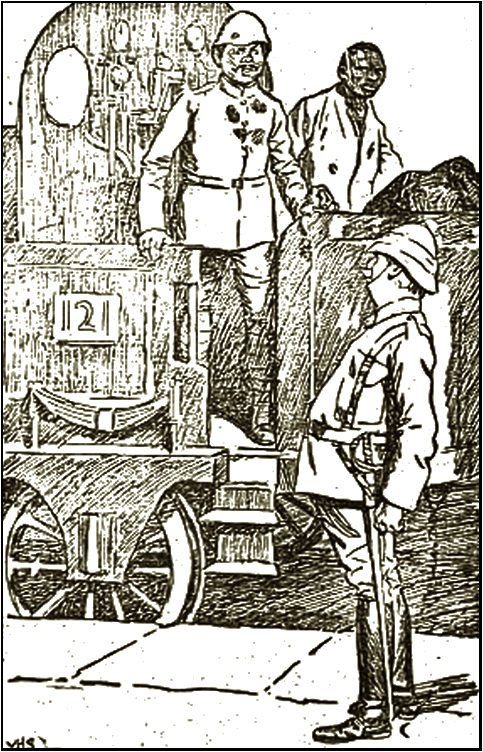
'Yes, sir,' see Yates boastful, 'I've only had about
twelve accidents since I started a month ago.'
"'Twelve, eh?' sez the colonel thoughtful. 'That's not many, Yates.—I suppose you know the difference between a railway engine an' a sausage machine?'
"'Oh, yes, sir,' sez Yatesey.
"'I hope you'll go very steady, Yates," sez the colonel. 'Don't try to make records.'
"No, sir,' sez Yatesey, shakin' his head, 'As a matter of fact I dare not go too fast owin' to one of the cylinders bein' cracked.'
"'Oh,' sez the colonel thoughtfully still, an' walked away.
"By-an'-by the adjutant came up.
"'Hullo, Yates,' he sez, 'how are you doin' now?'
"'Very well, thank you, sir,' sez Yatesey.
"'You're goin' to drive us to Standerton?' sez the adjutant.
"'Yessir,' sez Yatesey.
"'Don't go too fast,' sez the adjutant. 'We've got a sick man with us.'
"'Certainly not, sir,' sez Yatesey.
"'When you get us into Standerton,' sez the adjutant, 'I'll give you a sovereign out of my own pocket.'
"'You shall be there inside of two hours,' sez Yatesey, delighted.
"'Don't hurry,' sez the officer hasty, 'take your time; we'd like to admire the scenery.'
"What with the officers strollin' up casual an' tellin' him to take his time—especially round curves—an' me an' Nobby an' a few other old comrades passin' the word what we'd do to him if he didn't go careful, Yatesey attracted more attention than he'd attracted all his life.
"It was a tryin' journey, that trip up to Standerton, not because we had any accident, but because we expected one.
"From what I've heard, the colonel had a carriage on his own, an' surrounded hisself with cushions. The rest of us held our breath every time Yatesey put on speed.
"As a matter of fact, nothin' happened, as he got to Standerton without as much as runnin' into a cow. We gave three cheers for old Yatesey before we left, an' he blew his whistle handsomely by way of thanks.
"Yatesey must have had a likin' for the job, for he got on at a tremendous rate, an' got all the special jobs such as drivin' the Commander-in-Chief's train, an' runnin' fast specials between Pretoria and Bloemfontein,
"But the part of the country Yatesey liked best was Standerton, where we was stationed, an' the reason was that he found a young lady there who was very fond of him.
"Luckily, in ordinary times he got a lot of work on the Standerton stretch, an' Nobby used to go up to the Station Yard a lot, owin' to the great friendship that sprung up between him an' Yates—
He promised to teach Nobby how to drive an engine, but the only thing he really taught him was how to blow the whistle.
"'Do you mind hangin' on to this engine for a bit. Nobby?' he'd say. 'I'm just goin' up to see my young lady an' if anybody wants me particular, just whistle three times—I can't trust that nigger fireman of mine.'
"'Certainly,' Nobby would say, an' there he'd stand as proud as Punch, tryin' to look an engine-driver.
"This sort of thing used to happen pretty frequent.
"One day, down came Kitchener to Standerton to take charge of some operations in the district.
"The were two drivers to the train, Yatesey an' another feller, because nobody knew how long Kitchener was goin' to stay, an' the orders were to keep steam up day an' night.
"Yatesey was on night duty, an' the other feller was on day work, an' slept in the guard's van at the back of the train.
"Nobby went up as usual the first night, an' Yatesey was very pleased to see him.
"Kitchener's goin' to stay here three or four days,' he sez, 'an' this bloomin' train's got to stand in the sidin' day an' night ready to nip off at moment's notice.'
"'Have you seen your young lady?' sez Nobby.
"'No,' sez Yatesey, 'but as soon as it gets dark I'll pop across—you don't mind waitin' here?'
"'Certainly not,' sez Nobby, an' as soon as the shades of night were fallin' fast, as Shakespeare said, off went Yatesey, an' Nobby got up into the engine-cab.
"The native fireman knew Nobby an' grinned friendly, an' Nobby began lookin' at the various parts of the engine, a thing that always fascinated him.
"He was in the middle of this when he heard a voice outside an' looked out.
"Horror!
"There was Lord Kitchener an' half a dozen officers.
"Nobby recognised 'K' by the light of a lantern, an' he was just deliberatin' as to whether he should nip out on the other side of the engine an' run, or sound the whistle, when a telegraph clerk stepped up to the side of the engine an' handed Nobby a paper.
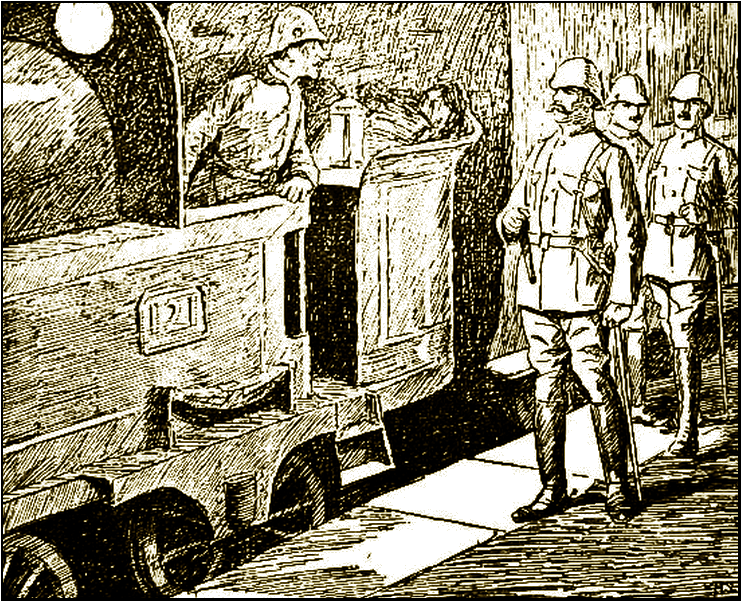
Nobby recognised 'K' by the light of a lantern.
"'Line clear to Pretoria, driver,' he sez. 'Make good time.'
"'Eh?' sez Nobby.
"'Make good time,' sez the clerk. 'Lord Kitchener is in a burry.'
"'Which way do I go?' sez poor Nobby, who didn't even know if the engine was pointin' in the right direction.
"'The usual way,' sez the clerk, an' blew his whistle.
"Nobby knew that he had to go through with it; he whistled frantic three times an' waited.
"'Pull out!' shouted somebody is the darkness, an' raisin' his eyes to heaven Nobby pulled the biggest handle he could find, an' the train started movin'.
"He pulled the handle a bit more, an' the train moved faster.
"Be looked at the black fireman, an' the black fireman looked at him....
"All that Nobby knew was that if he pulled the handle one way the engine went fast, an' if he pulled it another way it went slow. There was all sorts of little taps an' wheels an' levers, but the fireman seemed to know all about them.
"The road was as black as pitch, an' he had to guess whether it was straight or not. Sometimes he came to a sharp curve, an' the train rocked an' rocked till it nearly fell off the line, till Nobby remembered that he had to shut off speed. Now an' then a green light showed up in front of him an' disappeared.
"On an' on he rushed, an' Nobby began to warm up to the work. He took off his coat and hung it up.
"He'd hardly done it, when somethin' went wrong.
"There was a grindin' an' a squeakin' an' a shudderin', an' Nobby's heart jumped into his mouth. He jumped at the throttle, shut off the steam, an' the train came to a standstill.
"'I can't help it,' sez Nobby to himself. 'I've done my best for Yatesey an' I can do no more.'
"He beard someone shoutin' an' prepared to make a clean breast of it.
"By-an'-bye along comes Kitchener with his staff.
"'What have you stopped for?' sez K, in voice like trouble.
"'Beg pardon, sir—' began Nobby; but just then a voice sez:
"'Good heavens, sir, the bridge is down!'
"An' so it was; right ahead of the train a little bridge had been destroyed, an' the engine had stopped not ten yards from it.
"Whilst they was talkin' Nobby heard a voice whisper:
"'Nip into the back carriage, Nobby,' an' he saw Yatesey on the other side of the engine. As he slid out Yatesey said that he'd just managed to jump on the rear van as the train was pullin' out of Standerton.
"Nobby hung on a little to hear what K said.
"'How did you know the bridge was down, driver?' sez K.
"'Instinct, sir,' sez Yatesey, prompt
"'H'm,' sez Kitchener, dubious. 'whose coat is that?'
"'A friend's, sir,' sez Yatesey, recoginisin' Nobby's coat.
"'Well tell your friend,' sez K, 'that I am much obliged to him (or savin' my life, but the next time he wants to stop a train let him find some other way of doin' it than hangin' his jacket on the handle of the vacuum break!"
"IT'S remarkable where Nobby gets his ideas from," said Private Smith, shaking his head admiringly. "There are some ideas that a feller can get out of a book, but there are some ideas that Nobby has that he couldn't get that way. because the police wouldn't allow such books to be printed.
"He's adaptable—that's the word, adaptable. If Nobby was a piece of furniture he'd be one of them bookcases that turn into a foldin' bed whenever you're got company.
"There was a lot of chaps discussin' things the other day in the canteen.
"The subjec' under discussion was the difficulty of gettin' paid what you're owed, an' some very pointed things was said.
"'It's like gettin' blood out of a atone,' sez Spud Murphy, bitterly, 'to make certain parties stump up.'
"'That's true,' sez Nobby very sympathetic.
"'I don't like to keep on nag, nag, nag,' sez Spud meaningly; 'if a feller comes to me on Thursday afternoon an' asks me to lend him two shillin's till pay day, I lend it to him.'
"'Very proper an' right,' sez Nobby; 'that reminds me of a tale I heard when I was in India—'
"'If he tells me faithful that he'll pay up,' sez Spud, 'an' he's a comrade of mine, I lend it.'
"'You've got a feelin' heart,' sez Nobby. 'When I was in Egypt I knew a feller like you—name of Soggy.'
"'You can 'int, 'int, 'int, as much as you like,' sez Spud, shakin' his head gloomy, 'but they take no notice: they try to change the subjec', start yarnin' about people in India an' Egypt, hopin' to got the matter out of a feller's mind.'
"Nobby looks at him very stern.
"'Do I understand,' he sez haughty, 'that all them innuendoes are referrin' to me?'
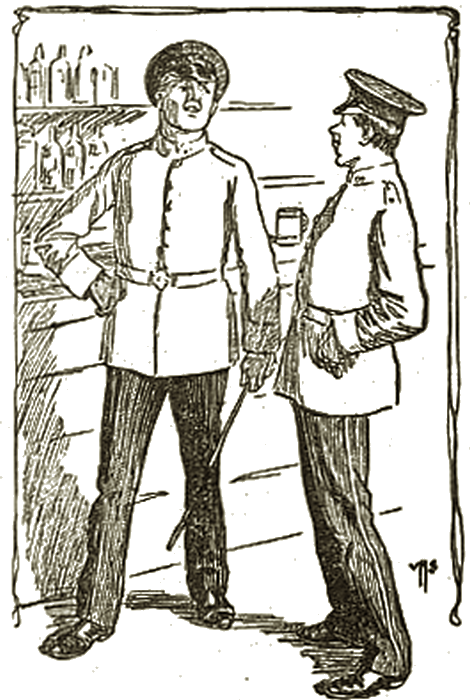
'Do I understand,' he sez haughty, 'that all them innuendoes are referrin' to me?'
"'Innuendoes or outuendoes,' sez Spud breathin' hard, 'but you owe me two shillin's that you borrered last Thursday week.'
"Nobby looked at him contemptfully.
"'Remind me, Smithy,' he sez to me, 'that I pay this Shylock. Remind me,' he sez, 'when I've got a lot of money an' don't seem to have no use for it that I pay this bloodsuckin' dog the few paltry pence he sez I owe him, but which I've got no recollection of whatsoever.'
"'Why!' sez Spud indignant, 'you come up to me an' borrered it—'
"'Spare us,' sez Nobby coldly, raisin' his hand—he looked very noble at that minute, did Nobby. 'Spare us the disgustin' details.'
"People who think that Nobby borrers an' doesn't lend make a big mistake. Nobby often lends money to chaps in distress, but as he sez, he don't go hurtin' their feelin's by beatin' about the bush when he starts collectin'.
"It's no use a feller tryin' to pass Nobby with a vacant look on pay day, or pretendin' he's forgot all about that little matter of eighteenpence.
"Nobby is waitin' for him, kind but firm.
"'Tiny,' he sez to Tiny White one day, 'if me memory serves me aright, you owe me a bob.'
"'Do I, Nobby?' sez Tiny, very surprised.
"'You do,' sez Nobby, 'an' if you don't hand it over you'll got a dig in the jaw.'
"Nobby's got such a persuasive manner, an' is such a quick collector that, so to speak, it was a foregone conclusion that when he started Nobby's Debt Collectin' Agency he got scores of clients.
"Nobby's Agency didn't start work a minute too soon. It was one of them excitin' moments that is met with in regiments an' families—especially families—where everybody owed every-body else somethin', when chaps walked about full of fear an' indignation. Nobody knows why regiments get that way, but they sometimes do.
"The barrack-room on pay day was like the Cotton Exchange, with futures very promisin', an' a great demand for spot cash.
"You'd see little groups of the brutal and licensed soldiery standin' about in odd corners of the room, holdin' on tight to the money they'd drawn, an' talkin' fiercely.
"One lot would be sayin':
"'I owe Jimmy eightpence, an' you owe him fourpence; give me a shillin' an' that'll make us square.'
"Or—
"'You give me sixpence, I'll give Jerry tenpence, an' now you both give me one an' four.'
"It was very wearin' for the brain.
"'The regiment's gettin' demoralized. Smithy,' sez Nobby very grave, 'this gettin' into debt is one of the curses of. what I might call, our Social Cistern. Assets don't balance with capital, liabilities don't equal owin's—the regiment's goin' bankrupt.'
"'Is it as bad as that?' I sez.
"'Worse,' sez Nobby, graver still; 'there's a crisis; we're livin' on our income—that's a bad sign, we're over-capitalised; it's becomin' more an' more difficult to get into debt; I fear the worst.'
"Knowin' what a clever chap Nobby was, a lot of fellers began to get nervous, an' when he tried, very kindly, to help 'em out of their hole, they realised what a serious position they was in.
"Jerry Jordan was one of the chaps whose accounts was complicated somethin' awful.
"It's like this, Nobby,' he sez, 'I owe Billy Mason eighteenpence, an' Billy owes Jimmy Speddin's two bob for a pair of boots that Jimmy bought off me for a shillin', but didn't pay for. Now, accordin' to my reckoning I'm quit with Jimmy if he pays Billy a shillin' an I get my boots back.'
"But Nobby shook his head.
"'That's only compoundin' a felony,' he sez, 'an' if it ever got to the colour-sergeant's ears there'd be trouble.'
"Even Spud Murphy condescended to come to Nobby for advice.
"'My position is this,' he sez. 'In one way an' another I've lent twelve shillin's to various fellers: for instance, you owe me two shillin's—'
"'Don't complicate the situation,' sez Nobby gently; 'don't stir up old wounds.'
"'Well,' sez Spud, 'I'm owed all this, every penny of which I shall he paid, sooner later, except yours."
"'Hope for the best,' sez Nobby.
"'I owe 4s. 6d., sez Spud, 'an' I had a bet with Ugly Johnson, which I lost—I don't think he'd have paid me if he'd have lost—that's another, half-crown: then I borrered fire shillin' from Greasy Parker to pay my fare an' Ginger Carter's fare to London—Ginger owes me 2s. on that deal; then Greasy bought a brand new pair of trousis from me for three shillin's, which he paid, but one shillin' was bad—how much does that make?'
"'My pore feller,' sez Nobby, layin' his hand on Spud's shoulder, 'you owe, by dead reckonin' about six an' six, but I'll do me best for you.'
"Things went from bad to worse: ole friends who'd never fought for years wasn't on speakin' terms; chaps spent their lives makin' up balance sheets that didn't balance, an' then Nobby stepped in like a guardian angel.
"'What is wanted, is a debt collecting agency an' a clearin' house,' he sez.
"'What's a clearin' house?' sez one chap.
"'A clearin' house,' sez Nobby, 'is a kind of place where misunderstandin's are cleared up.'
"Spud Murphy was one of the first to take Nobby's offer
"'Anythin's better than this sort of thing,' he sez, 'an' though well probably be swindled, I'm goin' to let Nobby collect my debts—startin' on hisself,' he sez.
"Nobby made all the chaps write on a bit of paper what they owed, an what they thought was owed to them.
"He did his work thoroughly did Nobby. For two days an' nights—practically all the time wasn't on duty—he was writin' letters to various chaps. An' wonderfully business-like them letters was.
"He got a chap in town in the rubber stamp line of trade to stamp some sheets of paper with the name of the debt agency, an' the letters was most impressive.
CLARK'S REGIMENTAL
DEBT COLLECTING AGENCY.
Managing Director: Pte. N. Clark.
(Office hours: Any time)
To Private J. Jordan.
Dear Sir,—
We are instructed by our client, Pte. Tiny White, to ask you to pay him what you owe him. We are getting fed up with waiting. So pay or be paid. I'm really surprised at you, Jerry. I thought you were an honourable man: why don't you pay Tiny? So settle up. No more at present.
We are, respected sir,
Your obedient servant,
N. Clark, Managing Director
P.S.—Pay Nobby, he's collecting the money.
"'These,' sez Nobby, showin' me a batch of letters, 'are what is called Letters That Bring Business.'
"Some was hotter than others. A letter he wrote to Spud on behalf of Dusty Miller was one of the finest bits of writin' ever put together.
CLARK'S REGIMENTAL
DEBT COLLECTING AGENCY.
To Private Spud Murphy.
Sir,—
We feel sure that we've only got to mention the fact that you owe Dusty Miller 8d. 6d. for you to pay up cheerful. I notice you didn't mention Dusty the other day when you was bragging about the money people owed you! Oh, no!! Oh,no!!! You's got a fine memory!!! You pay up, old sport, quick, for Tiny says that he's about had enough of it. And we don't blame him. Send the money round to Nobby, who is our respected agent, and will bite same to see if good. I know you, you swivelling nut!
With kind regards,
We are, respected sir,
N. Clark, Managing Director.
"There was somethin' so straight-forward about the way Nobby went on that you couldn't be offended with him: at least, I couldn't—but then he never wrote to me. Some of the fellers got rebellious, but Nobby pointed out that even if he was writin' offensive letters to them on behalf of somebody else, he was writin' worse letters to somebody else on their account.
"An' gradually the money began to come in. Chaps brought shillin's an' eighteenpences an' half-crowns to Nobby, an' Nobby gave 'em a receipt an' a cheerful word. It was:
"'Now you're out of debt. Tiny', or 'Out of debt, out of danger, Mick,' an' for once in his life Nobby was popular over money affairs. Even Spud admitted it.
"'It's a grand idea,' he sez; 'it saves a lot of worry an' bother—I've just had a certificate from Nobby sayin' that I owe nobody anythin', an' nobody owes me anythin'.'
"Nobby gave lots of certificates like that, an' slowly but surely the regiment began to settle down to a calm an' sober state.
"One or two chaps stuck out, because they said they wouldn't pay till somebody paid them, but, as Nobby pointed out, if everybody said the same the agency couldn't work.
"The last feller to pay up was Fatty Green. He wouldn't pay till Nobby made up a balance-sheet. Fatty reckoned that b© was well on the right side of the ledger, but Nobby soon convinced him. He worked it out like this:
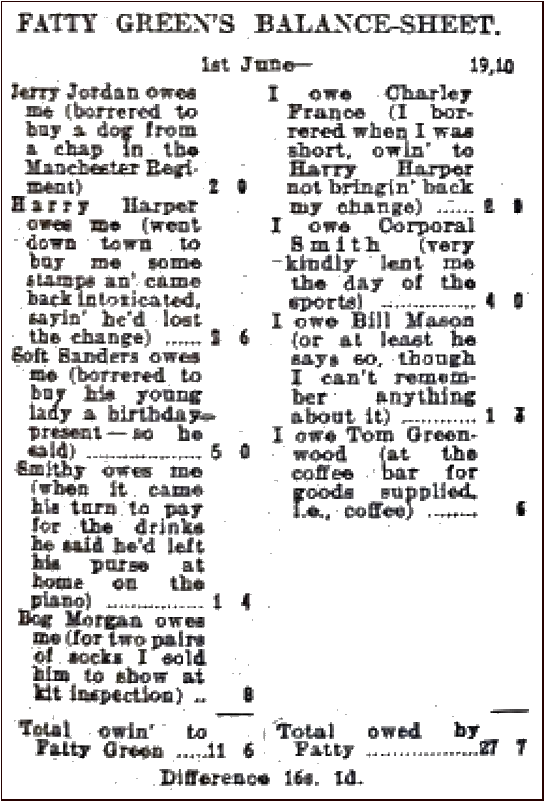
"Nobby made the balance-sheet out under Fatty's eyes, so of course there couldn't be any mistake. Poor Fatty was upset.
"'I can't make it out at all,' he sez very despairin'ly. 'I thought I was a lot of money in—instead of which I'm a lot of money out.'
"'Figures can't lie,' sez Nobby, 'nor black an' white either—but I'll tell you what I'll do. You pay me a dollar an' I'll square the rest of the bill for you.'
"'You're very good, Nobby,' sez Fatty, who was in a regular maze. He paid his five shillin's—an' for days he was walkin' about barracks like a man in a dream, mutterin' to himself, 'Eleven an' six—twenty-seven an' a penny: seven from six you can't—borrer ten, seven from sixteen twelve an' one over.'
"At last came the great day, a day what ought to be written in letters of gold: the regiment was out of debt! Nobby made the announcement at the canteen in the evenin', an' it was received with hearty cheers,
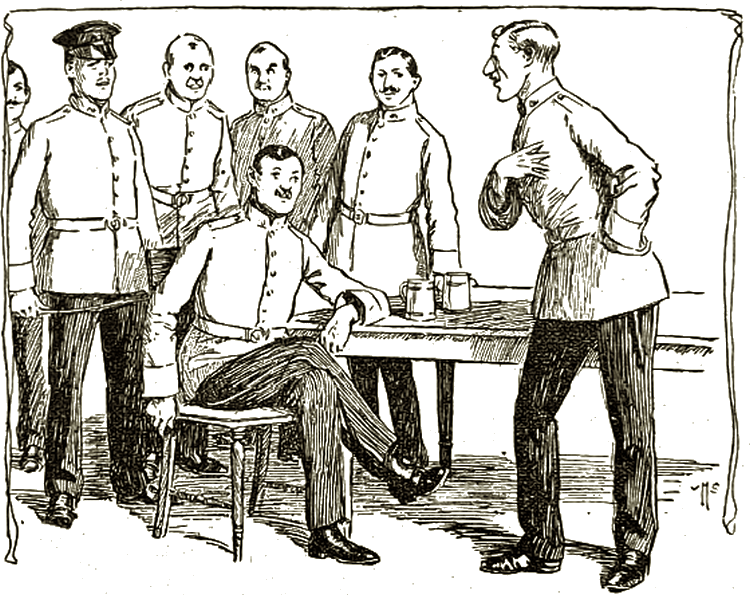
'It's been a labour of love,' sez Nobby in the course of a short speech.
"'It's been a labour of love,' sez Nobby in the course of a short speech, 'an' feelin' that I was workin' in the best interests of the regiment, so to speak, I didn't mind the fatigue. I can lay me hand on me heart an' say I've relieved the regiment.'
"There was another cheer; then Spud Murphy sez:
"'Is there any money to come back to any of us?'
"Nobby looked at him sternly.
"'There's nothin' to come back,' be sez: ' everybody has paid, an' everybody has been paid in full.'
"'Hear, hear,' sez the chaps.
"'Who s been paid?' sez Spud, suspicious.
"'I'm not goin' to reveal my clients' secrets,' sez Nobby. 'All I know is that I'm money out of pocket owin' to my kindness. I've got to go to the savin's bank this afternoon.'
"Which was perfectly true, for I went with him, an' saw him make out the deposit form.
"'Hullo, Mr. Clark,' see the postmaster, 'you've been savin' a lot of money.'
"'Not exactly savin', sir,' sez Nobby, careful; 'but I've been collectin' a few debts.'"
"YOU can do a lot by kindness," said Smithy thoughtfully. "You can tame lions, though you can't tame liars; you can tame insurance agents, an' tallymen, an' people who enlarge photographs an' chuck in a gold frame; you can tame bookmakers an' other f'rocious fawns an' fuma—to use a Latin expression—but there's one thing that you can't tame, an' that is a soldier that's in love with a young lady.
"We had a chap named Wilkie, who was in love for five years. A most true an' steadfast chap he was, with blue eyes an' a bit of a curl over his forehead. I've never known a feller to be in love so long as Wilkie was. It wasn't the same girl all the time, but it was the same love. It wasn't to be expected that one girl would satisfy a large-minded chap like Wilkie, but me an' Nobby often used to wish that Wilkie would hang on to one till we got used to her.
"Wilkie used to confide in us, an' the stuff me an' Nobby had to listen to would have disorganised a gramophone.
"'It's a great blessin',' sez Wilkie one day, 'to have a girl like mine; she's so sensible; won't, let me pay for anythin'.'
"'That's the sort,' sez Nobby.
"The very next week Wilkie was at it again.
"'What I like about my young lady,' he sez, 'is her bright, careless nature, if I may call it so. She don't insult me by payin' for anythin'; she's as free with my money as if we was properly married.'
"'You're young lady's changed her habits since last week,' sez Nobby, a bit puzzled.
"'Oh, this is another young lady altogether,' sez Wilkie; 'this is the one love of my life: she was made for me, an' I was made for her. When I think,' he sez ecstatic, 'when 1 think of how we've been growin' up together, without as much as knowin' one another: when I think that I never looked into her pale blue eyes till last Sunday night, or heard her highly musical voice: when I think—'
"'Good-night,' sez Nobby hasty.
"We gave Wilkie a miss in baulk for a week. When we see him comin', we used to remember that we had an engagement in the tailor's shop, but after the week was over, Nobby sez to me:
"'Wilkie had got over the worst part of the attack. Let's go round an' hold his hand, an' whisper encouragin' words in his ear.'
"So we went round to 'H' Company's room, an' found Wilkie.
"He was worse than ever!
"There he was, a-sittin' on his bed-cot in his shirt-sleeves, with a pencil in his hand an' a memorandum book on his knee.
"'You've just come in time, Nobby,' he sez. 'How do you like this—
'Thy face it haunts me in my dreams.
Thy eyes are like the stars
I am no longer in my teens,
I am a son of Mars.
"'You're a son of pa's, too, ain't you,' sez Nobby.
"'Listen,' sez Wilkie.
'Whenever I see you walkin' down the High Street
My heart goes pitter-pat.
You're Alice by name an' Alice by nature—
Now what do you think of that?'
"'Askin' me?" sez Nobby.
"'No,' sez Wilkie, 'it's in the poetry. What do you think of it?'
"'Very comic,' sez Nobby, 'especially that bit about Alice by nature—I could understand it better if it was Eliza by nature, or Mary Ann by nature—'
"'It's a poetical figure,' sez Wilkie, an' we let it go at that.
"This was on the Wednesday, an' on the Saturday me an' Nobby was takin' a stroll in the country, studyin' the agricultural problem at the Barlow Mow an' the Harvesters' Arms, an' similar farmin' institutions, when turnin' a corner of the road we see Wilkie an' his young lady.
"'This,' sez Nobby, 'is Alice by nature.'
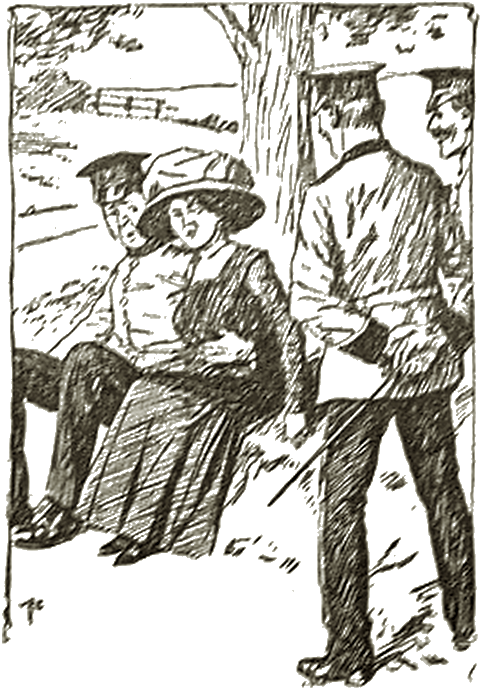
'This,' sez Nobby, 'is Alice by nature.'
"They was sittin' on the grass, her head was on his shoulder, an' his head was dodgin' the sharp edge of her hat (you know what I mean), an' they was very close together.
"Hearin' our footsteps, Wilkie half-looked round.
"'Go away,' he sez. 'Haven't you got a sense of decency?'
"Then, recognisin' Nobby, he got up, the girl puttin' her hair an' her hat straight.
"'Hullo, Nobby,' he sez, 'permit me to introduce you to my young lady.'
"'I've heard a lot about you,' sez Nobby, shakin' hands with her 'Wilkie's always talkin' about his Alice—
"'My name's Gwendoline,' sez the girl, very cold, an' that put an end to the festive conversation.
"'I ought to have known,' sez Nobby bitterly as we wended our weary way home—to use a poetic expression. 'Wilkie couldn't keep a girl longer than ten minutes—he's a bloomin' Mormon.
"Wilkie's companion in crime was a chap named Wisher. A reg'lar sick-o'-funk he was—what's a sick-o'-funk?
"According to Nobby, it's a feller who's always hangin' round lickin' the boots of other chaps.
"Wisher was a very oily chap, parted his hair in the middle, an' was always smilin' at nothin'. It got his into trouble with Nobby once, when he was actin' as umpire at one of our famous cricket matches. Nobby got the ball on his knuckles an' started advertisin' his religious convictions. Catchin' sight of Wisher's grinnin' dial, nothin' was more natural than that Nobby should give him a dig in the jaw.
"Well, this feller Wisher was one of the intensest admirers that Wilkie ever had, an' he was always tellin' people what a fine feller Wisher was.
"'He's got a heart of gold an' a tongue of silver, an'—'
"'A nerve of brass,' sez Nobby. 'In fact he's in the metal trade.'
"'You don't understand him, Nobby,' sez Wisher. 'He's a character.'
"'He is an' he hasn't," sez Nobby, an' Wilkie was a bit puzzled.
"He had a young lady himself, had Wisher, an' very fond of her he was. I'll give him the credit of bein' true to her, but it's all the credit he's entitled to. Somehow, although he knew the horrid character of Wilkie, he didn't mind introducin' his young lady to him.
"'I trust Wilkie,' he sez, 'he's a gentleman.' "'You might trust him a bit better if he was a lady,' sez Nobby.
"What everybody expected happened, an' one day pore old Wisher came to us, gnashing his teeth. He was such a sick-o'-funk that he didn't dare gnash Wilkie's teeth.
"'He's done it!' he sez. 'He's pinched her!'
"'We don't want to know any sordid details,' sez Nobby sternly.
"'He's took her away from me,' sez Wisher, nearly cryin'.
"'Buck up!' sez Nobby. 'Be a man! He'll be tired of her in a day or two. Bear your burden bravely.'
"'I'd kill him for two pins,' moaned Wisher. If I was a feller like Jimmy Britt or Johnson, I'd take him by the neck an' bash his face against the wall. If I was [name illegible] I'd pick him up and throw him onto a heap of broken bottles. If I was Randow—'
"We did our best to comfort him, but he wouldn't be bucked up. I never saw a chap so cut up about the loss of a girl in me life. You might have thought, to see him, that he'd lost somethin' valuable—he couldn't have gone on worse if somebody had pinched his shirt the night before kit inspection.
"'I'll slay him!' he sez very wildly. 'I'll creep up behind him on a dark night and stick a stylotto in his back—I'll send him poison—I'll blow his brains out—or, at least, I would if I durst!'
"There was much to be said for Wisher. He wasn't a little chap but he was thin and hadn't been soldiering long enough to be strong.
"'What you ought to do, Wishbone,' sez Nobby—we always called him Wishbone—'is to go in for physical culture. Put yourself in my hands.'
"The idea seemed to appeal to the pore feller, an' that very night he challenged Wilkie to fight, amid scenes of great local excitement.
"They were both as pale as death, because one wasn't much braver than the other.
"I shall never forget the scene.
"There was Wilkie, standin' up against the bar of the canteen, drinkin' beer, unaware of the doom, so to speak, ahead of him.
"Up comes Wisher, as white as a ghost.
"'Hullo, Wish,' sez Wilkie, friendly an' careless.
"'Hullo, girl-robber,' sez Wisher, very hollow in the voice; 'hullo, kid-napper.
"'What do you mean?' sez Wilkie.
"'I mean,' sez Wisher in a tremblin' voice, 'that you are a cad.'
"'Cat?' sez Wilkie, puzzled.
"'Cad—K-A-Double D—cad.'
"'What's that,' sez Wilkie, 'somethin' to eat?'
"'For two pins,' sez Wisher, shakin' like a leaf, 'I'd bite your ear off!'
"At this, Wilkie got very pale.
"'I understand,' he sez, 'that you're tryin' to be offensive. Do you want to fight?'
"'Give me back my young lady,' sez poor Wisher.
"'Oh, that's it, is it?' sez Wilkie. 'What's her name again?'
"'Aggie,' sez Wisher.
"'I'll look in me little book,' sez Wilkie, 'an' if I happen to find anybody by that name I'll return her.'
^Wisher got wilder an' wilder, an' slowly lifted his fist until it was under Wilkie's nose.
"'See that-—?' he sez—then somebody jogged his elbow, an' biff!—down went Wilkie.
"I've got an idea I know who it was who jogged the elbow, but it's not for me to boast.
"In a few seconds there was a scene of great uproar... We got 'em apart after a little trouble n' there an' then the articles were signed for the great fight.
"Wilkie went into trainin' with Spud Murphy, an' me an' Nobby looked after Wisher.
"Every mornin', before reveille, we had Wither out of bed an' runnin' round - the back field. Nobby had the gloves on with him, an' every other feller who was on Wisher's side bad gloves on with him, too.
"'I ain't fightin' one man,it seems to me,' sez Wisher, very miserable; 'I'm fightin'twenty."
We expanded his chest, an' washed him all over in cold water every day, an' Nobby tried one or two patent inventions of his own to make his man fit.
"Every day chaps used to come over from the other trainin' quarters with encouragin' news.
"'Wilkie's doin' fine, Wisher,' sea one; 'he reckons he'll kill you in the third round.'
"Wisher's as quick as lightnin',' sez another, 'what you've got to watch is his body punch.'
"'Whatever you do,' sez another comforter, 'keep out of Wilkie's reach. He's got the terriblest left I've ever beheld.'
"To return the compliment me an' Nobby an' a few other kind friends used to go over to Wilkie's trainin' ground—which was at the back of the gymnasium—an' offer a few compliments.
°We'd watch Wilkie an' Spud sparrin'; then Nobby would shake his head.
"'I think our man will put this pore feller to sleep, don't you, Smithy ?'
"'I think it'll he strange if he doesn't,' I'd say.
"'Them sort of tactics won't do for our hero,' sez Nobby; 'the fight won't last three minutes.'
"Wilkie would look very despondent, especially when Nobby asked him where his relations was buried, an' if he had any objection to flowers.
"This sort of thing went on for a week, an' by the end of that time both chaps was so scared that they almost had to be carried to the ring.
"It took place in the gymnasium, an' on the understandin' that gloves was to he used, a couple of officers gave up a little rat-huntin' expedition they'd planned, an' came to see fair play.
"Nobby got into trouble—owin' to his sellin' the cinematograph rights of the fight to the local music-hall on the understandin' that it was a fight for the championship of the Army.
"A chap from the ' Anchester Guardian' was present, but the only account of the fight I've see was the one Nobby wrote:
Round 1.—Both man came up to the scratch; Wisher lookin' so smart an' well-trained that it was evident that he'd been in As hands of s capable an' efficient trainer. Takin' their places, one each side of the ring, both sparred at each other without fatal result.
Round 2.—A brisk an' spirited contest. Wisher got within six feet of Wilkie an' struck out wildly. If Wilkie had been anywhere near he would have been hurt. Wilkie hit hack, strikin' within four feet of Wisher. Durin' the hottest part of the bout the referee walked between them without bein' seriously injured.
Round 3.-At the call 'Time' Wisher stepped smartly up to within ten feet of Wilkie, an' both gave a pretty exhibition of themselves. It was easy to see that Wilkie was gettin' tired of wavin' his arms about, an' Wisher looked s bit footsore.
Round 4.—Both men began to show signs of severe nervous strain, an' came close together. Both hit the air scientifically.
"It was is the middle of this round that there happened the singular incident—if I might call it so—that stopped the fight.
"They was sparrin' at each other when there was a commotion at the door, an' the feminine voice of a female was heard speakin' in anguished tones.
"Both fighters stopped dead.
"'Heavens!' sez Wilkie, 1 it's my young lady!'
"Wisher was as pale as a loaf that wasn't properly baked.
"'Don't lot her in,' he sez very husky; 'don't let the false girl in.'
"'Don't you call my young lady names, or I'll bash you in the jaw,' sez Wilkie very loud.
"'Do it!' sez Wisher.
"Biff!
"Before you could say 'knife' they were really fightin'. It wasn't scientific, but it was very relievin'. They rolled over an' over on the floor, an' when the referee tried to separate 'em they bit his leg together.
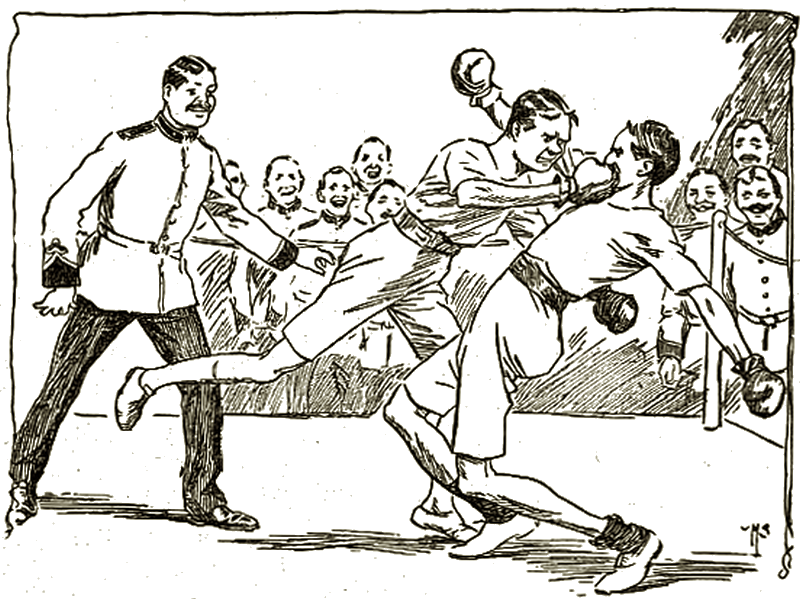
Before you could say 'knife' they were really fightin'.
"At last half-a-dozen of us got 'em apart, an' a pretty mess they was in.
"'That'll teach you to insult my Rosie,' gasps Wilkie out of one side of his mouth.
"'Rosie?' gasps Wisher, lookin' fiercely out of one eye, 'I'm talkin' about Agatha—my young lady what you stole.'
"'Agatha?' sez Wilkie, contemptuous, 'why, I've had three young ladies since then!'"
Roy Glashan's Library
Non sibi sed omnibus
Go to Home Page
This work is out of copyright in countries with a copyright
period of 70 years or less, after the year of the author's death.
If it is under copyright in your country of residence,
do not download or redistribute this file.
Original content added by RGL (e.g., introductions, notes,
RGL covers) is proprietary and protected by copyright.