RGL e-Book Cover
Based on an image created with Microsoft Bing software
Roy Glashan's Library
Non sibi sed omnibus
Go to Home Page
This work is out of copyright in countries with a copyright
period of 70 years or less, after the year of the author's death.
If it is under copyright in your country of residence,
do not download or redistribute this file.
Original content added by RGL (e.g., introductions, notes,
RGL covers) is proprietary and protected by copyright.
RGL e-Book Cover
Based on an image created with Microsoft Bing software


"Daphne In Fitzroy Street," Doubleday, Page & Co., New York, 1909
"Daphne In Fitzroy Street," Doubleday, Page & Co., New York, 1909
"Daphne in Fitzroy Street" is a coming-of-age novel in which an imaginative, high-spirited schoolgirl is abruptly returned to England, where she must navigate poverty, art-world bohemia, new responsibilities, and the confusing beginnings of adult love. It is one of Nesbit's most mature and psychologically observant novels.
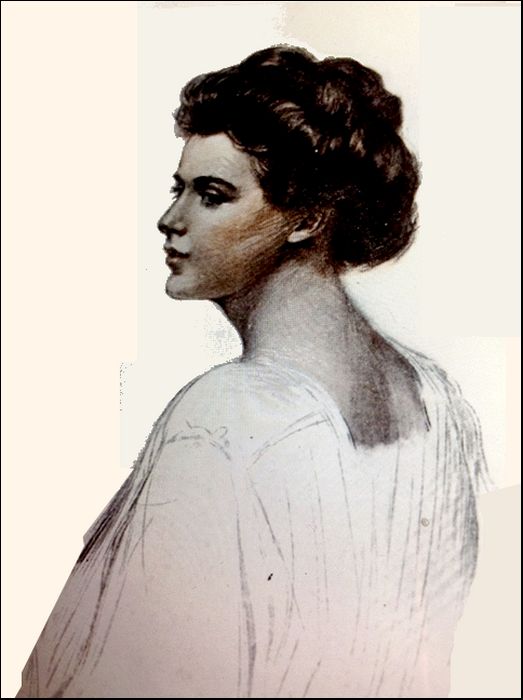
Frontispiece by F. Graham Cootes
IT WAS the fifth of April. Also it was a very fine day. Further, it was Daphne's birthday—the eighteenth. Besides this, it was a Thursday, the jour de sortie, when all the girls who had friends and relations were taken away into the bosom of families. Daphne had no relations or friends in any of the tall, flat-faced, green-shuttered houses in the town, nor did any family of hers have its address at any of the white villas that slept in green gardens out among the orchards.
She was not the only one whom no mother called for, no white-capped, prim-lipped bonne escorted through the gay, interesting, alive streets. Inez de Mattos, her people owned a castle in Spain, and no visitors ever called to see her; Guilberte, her people were in Paris; Madeleine had no relations; and Columbine Pinsent's grandfather was packing in far away Chicago the pork that should make her an heiress. And there were others.
Columbine was to leave at Midsummer, to cross the ocean and take up those honours wrung from protesting pigs. Little Inez would be at school for a long while yet. Madeleine was to be a nun someday, and Guilberte would only leave school to be married. Daphne—well, Daphne had always been at school, and she hated it, and loved it, and was bored by it, and interested in it, and felt for it all the ebb and flow of varied emotion which girls feel for their homes.
The sun shone with a clear sparkle on the ivy leaves that framed the refectory windows. Long, narrow horse-shoe tables, spread with coarse, unbleached linen, were outlined by a vivid, varying fringe of girls, mostly eating thin soup and wide slabs of pain de ménage. The English girls ate eggs and drank chocolate. The whole seventy-four were gesticulating like monkeys and chattering like parrots. For Thursday was a holiday. And on holidays one might talk at meal times without fear or restraint. On other days, if one talked, it had to be done without moving one's lips, in a voice too low to be heard above the clatter of plate and spoon and the setting down of the yellow mug after drinking. Daphne had invented this way of talking, and in it she and Columbine were easily first.
"I've arranged everything," said Columbine, breaking her eggs into her mug and mixing them with vinegar and salt. Usually it was Daphne who arranged everything, but this being her birthday, etiquette demanded a temporary abdication. "Marie Thibault's to get her brother to go back to college to fetch a ball he'll say he lost in the garden. And he can lower the things to us over the wall. It was thoughtful of those old chaps to build the boys' school next to the girls' school, wasn't it?"
"It was all one convent once," said Daphne, through a mouthful of toast. Those whom the cook loved had toast with their eggs—slices of toast as big as little tea-trays and very much thicker. "We're going to have the loveliest feast," she went on, stooping to the round-eyed, thin-faced child beside her, "because it's your Daffy's birthday."
"I know that," said the child, superior; "hasn't my Daffy wondered what its Dormouse has been doing all her playtime in wonderful secrecy?"
"I've wondered till I haven't been able to sleep for wondering. What was it, honey of my heart?"
"You don't think," said the child, "that I could tell you the secret of my life now, all in the middle of the bread-and-butter and soup? Afterward, when all the girls have been fetched. Just you and me, alone in the garden—and Columbine, because she helped. Just us three and the secret splendidness."
"I don't know how I shall bear to wait," said Daphne, who had found it hard, during these last weeks, to avoid knowing every stitch of the secret splendidness ardently worked at and hidden on her approach under the child's black cotton sarrau.
"I've got a present for you, too," said Columbine, "if Doris will let me give it after hers."
"You've remembered what I said?" said Daphne, turning on her friend with a threatening frown. "I won't stand any nonsense, you know——"
"I've remembered. But it's hard to be forbidden to spend more than two francs on the only girl one ever loved, when one is——"
"When one is rolling in money—yes, fling your hateful money in my penniless face! I'm glad you remembered the day, though." Her china-blue eyes were soft and bright.
"It's the kind of date one does forget, isn't it—the day that brought into the world the dearest, prettiest, cleverest, nicest——"
"Mademoiselle Carrmichel," said the cool, clear voice of Madame from the crown of the horseshoe, "will remain after the others. I have to speak to her."
"Oh, Coreopsis!" sighed Daphne—"Oui, Madame—Oh, Coreopsis, what have I done now!"
"And on your birthday, too. What have you done?"
"I don't know," said Daphne, hopelessly.
"When I do naughtiness," observed Doris, with pride, "I always know."
"There's no mistake about your naughtiness, is there, my cabbage?" said Daphne, as the seventy-three rattled and rustled, rose and filed out. "Now for it. Wish me luck, Columbine, or rather pray to St. Nicholas. He's the one who looks after naughty children. My doom is fixed—all is indeed over. Farewell. I'll come out to the terrace as soon as I've caught it."
"Caught what?" asked Doris, eagerly. "Oh, will you show it to me when you've caught it?" "I've no doubt I shall show it," said Daphne ruefully. "Red eyes—on one's birthday, too. Here goes!"
The terrace is built on a cliff that goes down a sheer forty feet to the white road that follows the winding line of the river. This is why the pupils at the most select school in provincial France are allowed to walk there without surveillance, and to look out, from that safe height, on the dangers and temptations of the wicked world. And in safety. Little stray wavelets of the great sea of iniquity that surges outside school boundaries sometimes dash themselves against that tremendous fortification, but always in vain.
When an impressionable Polish artist, fired by the vision of cloudy blond hair and blue and white, the festival dress of an enfant de Marie, purchased a bow, and, winging his arrow with an impassioned billet addressed to La Belle Blonde, shot at the terrace, his shaft stuck in one of the clipped beech-trees of the terrace berceau, and the first person to see it was Madame.
"Hold!" she said, "what a droll of a bird! The gardener shall fetch it down tomorrow—with the ladder."
And, on the morrow, by means of the ladder, the gardener did bring down an innocent arrow, winged with the blank sheet of an exercise book—because Daphne, adventurous, prompt, and alleging a finger cut in the sharpening of a pencil, had escaped from the afternoon drawing-class, her hand bound in a handkerchief where crimson lake and burnt sienna artfully simulated gore. She had run like a deer to the terrace, climbed the tree, disengaged the billet of adoration, replaced it by a folded blank paper, and got back to her sympathising class, when she had torn up and buried the amoristic effusion—less in the interest of school discipline than in that of the enfant de Marie. The adventure made her happy for a week. It satisfied that sense of personal competence to any crisis that the routine of school was inadequate to feed.
It was Daphne, too, who discovered the northwest passage. All along the top of that part of the old convent, which was now the modern girls' school, ran a great garret, eighty or ninety feet long. It was next to the box-room where the trunks of pupils were kept, the trunks where clothes not in use were stored and books not judged suitable for school reading. The box-room was only visited under strictest supervision. At the back of it was a pile of old lumber—things cast out of use, but by some thrifty hand not cast out of house and home—dusty brown saddles, the tangled straps of broken harness; dressers and settles and chairs that no one wanted any more; the carved throne of a bishop, all Gothic tracery and tarnished gilding; the broken, heaped up, angular woodwork of the old chapel, and, God knows how it came into a convent, a squarely-knit oaken cradle.
It was Daphne who spied, beyond all, a light gleam through the shadows of this outworn usefulness, and longed to explore what she knew was a hole or a door in the corner of the partition wall. But surveillance was too keen. In the big garret, however, where the seed potatoes were kept, and the heaps of turnips and carrots and haricot beans, where the onions and the cobwebs hung from the rafters, there was no surveillance—because there was no right of entry. Everyone knew where the key of the grenier hung in the portress's lodge, but it was Daphne who, light-footed and light-fingered, lifted it from its nail while the portress snored in the July afternoon quiet, stole up the many stairs three at a time, fleet as a climbing panther, opened the grenier door, and traversed, quiet and quick as any panther, its whole long length. The box-room was not forty feet long. There must be another room behind it. And there was. The partition did not reach to the outer wall—the rough ends of the laths stuck through the plaster toward the outer wall, but yet leaving a space where Daphne's slimness might pass, did indeed, with a squeeze and a torn apron, pass unhurt. And now she was in a room lighted only by a skylight, the mate to the skylight in the grenier. and in front of her was the door in the wall and through it the mingled lines like broken scaffolding, of chair and table and heaped discarded furniture. She shifted a chair here, a table leg there—made a practicable tunnel through the heap, blocked it with old curtains; and henceforth everyone's box and everyone's confiscated literature was available at any hour and Daphne was the school heroine. The key that Marie Thibault's brother had got made from a wax impression of the key that blinked in the sun on the wall of the portress's lodge lay in Daphne's deep under-pocket. And her heart was glad every time she felt its secret weight jog her knee.
Madame's surveillance was strict; she thought that she knew everything in her girls' lives. And, indeed, she did know most things till Daphne came to her kingdom—Daphne, whose father was a bookworm, whose grandfather was an explorer, whose great-grandfather was a lieutenant at Trafalgar.
Columbine and Doris went down through spring sunshine toward the terrace. The garden was covered with light veils of plum-blossom and little green new leaves, through which boughs and tree trunks still showed strongly black. The borders of the path were alight with anemones, early tulips, late daffodils, and the beginnings of the fallen sky of forget-me-nots. The high wall that lowered above the fruit trees bore a line of mingled fire and blood, wall-flowers red and brown and yellow. The larch by the old convent graveyard, away to the right, wore its new spring green studded with ruby buds. All about was the slender green promise of white lilac and the fat grey promise of flags. The beech alley was all grey stems touched with a million bright, hard buds.
"Like very sharp drawing-stumps, aren't they?" said Columbine, as she and the child passed onto the shadow-netted stones of the terrace.
"Yes, just," said the child, "and the trunks and the branches look as if they had been polished with black-lead. Have you got my present?"
"Next to my heart. Look!"
From the front of her dress she drew a little roll of pink tissue-paper, unrolled it, and showed the "secret splendidness"—a kettle-holder, bearing a kitten on a red cushion worked in Berlin wool, cross-stitched, grounded in blue, and lined and corded with crimson satin.
"It is like a dream of heaven," said the child, in a hushed voice.
"It's very, very beautiful," said Columbine. "Mine's not half so nice. And, mind you, don't say mine's nice or she won't take it. Let's play conquerors till she comes. There are lots here against the rose hedge."
"We've played conquerors," shouted Doris, as Daphne came quickly down the path, "for ever and ever, and I've won. Did she scold you very, very?"
Daphne reached them, a whirlwind of fluttered black pinafore and long red hair.
"Oh!" she cried, catching one in each arm. "Pinch me, both of you. Am I alive or am I dreaming? Am I the most wretched girl in the world or am I mad with joy? Pinch me, pinch me, and settle the question one way or the other."
"What ever?" The three fell in a tumbled heap on the blue-green faded garden seat.
"Oh, my dears!" Daphne gasped. "We're to go home tomorrow—Doris and me. I thought we never, never should, and I'm going to spend every penny I've got in a blow-out tonight. Madame goes to see her sister, and together they go to the Mayor's ball. Course quite clear and I can get round old Claudine, and Miss Henney will be writing to her sweetheart. We'll have the show of our lives. And then I shall never, never see you again, my Columbine!"
"Oh yes, you will," said Columbine, aghast, but conscientiously consolatory. "I'll come and see you the minute I leave school."
"Oh no—I know you never will. Everything's over forever, and I'm to put my hair up, so as to be respectable for travelling!"
UNDER the revolutionary rule of Daphne, secret revels had, before this, occurred. A masterly system of scouts, fleet and bare of foot, posted on commanding positions between the smallest dormitory and the mistresses' salon, rendered the adventure so safe as to be hardly now an adventure at all.
But this last night of her school life Daphne meant to mark indelibly. It was to be something which should keep her memory green forever, so that to generation after generation of awed, admiring schoolgirls the tale should forever be whispered—and the name of Daphne, "une folle Anglaise capable de tout, mais bonne enfant," should live always in the legends told at twilight. She caught Marie Thibault at the exact last minute before her exit; crammed a paper of instructions and all her money into Marie's short, fat hand.
"It is for tonight," she said, "thou wilt see. Forget nothing today, and tonight thou shalt see a fête that thou shalt never forget."
This done, she borrowed a broom and a duster from old Claudine, the cook, and hid them till Madame should have been drawn away by two fat little piebald stallions in a dumpy waggonette to her sister's country house.
Daphne was trusted by everyone—by her comrades, by the servants, by the mistresses, by Madame.
Her adventures were always too well arranged for detection to be possible, and her passionate energy was of the kind that makes days elastic and stretches them till they include all one's duties as well as one's pleasures. Her lessons were always done, and well done. It was she who organised the picnics, the presentations of flowers on birthdays, the dramatic scenes acted at prize-givings; gave out the seeds and plants for the girls' gardens, helped backward children, petted the sad, and coaxed and encouraged the shy. If a favour was to be asked of anyone in authority, it was Daphne who did the asking. Madame praised her continually as a young girl well brought up; one who could be trusted to be as genteel when one had her not beneath the eye as the greater part of girls under the most careful surveillance. One could trust Daphne, she said, and thought. And Daphne, too, thought that she could be trusted. "I don't do wrong things," she told herself, "it's so silly to do wrong."—Because "of course," she said, "little secret adventures are not wrong at all," only natural and poignantly pleasant.
"If Madame knew we climbed trees and had feasts and all that, she'd have to stop it," she said to Marie, on the first and last occasion when conscience reared its head at an apple-munching party. "It's just an old tradition she's got hold of—come down from the times when no one could do anything without being put into a secret dungeon in the Bastille for it. But just ask yourself. Is it wrong to eat apples? Is it wrong to climb trees? Is it wrong to have the things out of our boxes that our own relations meant us to have? Of course it isn't. Well then!"
And the question was settled once and for all.
And now by ones and twos the girls were fetched by friends or maids or relations, and only the usual half a dozen remained. They sat on the terrace, and looked over the white and green of the valley, where the river ran under the beautiful stone bridges, ate sucre de pomme and matured their plans.
"Inez, Guilberte, Madeleine,
Daphne, Doris, Columbine.
How the rest will bless our names
When they see the candle flames.
And the splendid banquet hall
Where the board is spread for all.
How our names will be revered
When from school we've disappeared.
How the trump of fame will blow
Our six names..."
"Speak French, then," said Madeleine. "I understand hardly three words."
"How do you make such lovely poetry?" said Columbine.
"She spins it out of her inside, like a spider. Inside her there is metres and metres and metres," said Doris hitting her sister's waist belt. "Isn't it, chérie?"
"Metres and metres," agreed Daphne. "Now do you all understand what you've got to do? Madeleine and Inez, get the broom and duster—they're in my bed, under the mattress, and you'll sweep and dust the secret chamber, and get a lot of red blankets off the beds and spread them for carpets. Columbine and my Dormouse look through all the boxes and get out every single thing that looks as though it would be good for dressing up. Don't take anything of ours. Our trunks have got to be packed today. Then all four of you get out tables and benches—you can make them stand up all right with bricks, there are lots of bricks in the grenier. And put the bishop's throne up, if you can move it. I'll go to the Alée défendue and get the things from little Thibault. There's an awful lot to do. We ought to get it done before déjeuner. Now, let's arrange our substitutes." She dragged a bundle of cloaks and jackets from under the seat—the garden wraps that hung in the vestibule for the girls to wear in cold weather. Then she drew out a bundle of umbrellas. You can make a wonderfully good dummy by sticking a hood on an umbrella, folding a heavy cloak round it and arranging it in a garden seat.
"That's you, Colombe," said Daphne, contemplating the hideous folding of serge and silk that twenty yards away looked like a human being. "Now you run. Keep behind the espaliers and keep low. Rendez-vous at your desk. You're going to get your embroidery if you're caught. Mina you get it. Lies are of the devil. Now I'll do Madeleine."
Daphne, born general, had arranged her group at the one point where a budding sycamore obscured ever so little the view from the corridor windows. She arranged another deceptive heap. "Run, Madeleine," she said, "and see why Columbine is so long gone."
Madeleine giggled and ran.
Soon a convincing group occupied the stone seat and the twisted beech-root beside it, and all the girls were gone.
"'Tis well," whispered Daphne, as she and Doris crept along behind the pear-blossom, "the secret deed is done, and no human eye has marked our proceedings,"
Daphne was wrong. Two human eyes had marked, with tepid but quickly warming interest, the making of that group on the curved stone seat. Those eyes were grey, and they looked, from very far, through a particularly good pair of racing-glasses.
"Well," said he whom the eyes served. "I really am! Little villains—I wonder what devilry that's the screen for!"
He lowered the glasses. Yes; it was good work. Anyone could have said, glancing terraceward, "A group of school-girls reading and sewing."
"Mighty clever," said he.
Daphne had counted only on the vantage point of the school corridor windows. She had not imagined it possible that anyone could scale the wall of the college next door and thence look down with racing glasses on her little world of school intrigue and adventure. And now the peace of a great freedom lay over the school. The tall porte cochère had closed behind Madame, and her sister's piebald steeds, neighing joyously, had carried her away to the sister's bald-faced villa. The mistresses had gone, each to her own place, and the English governess, today on duty, was rejoicing in the trustworthiness of Daphne, the priceless quality that made it possible for a hard-driven English girl to sit at her open window that the pear-blossom crept round and nodded into, closely covering thin grey sheets of foreign note-paper, and every now and then pausing to look at her life's hidden joy and pride, or to flutter the leaves of the dictionary to make quite sure how one spelt "judgment" or "embarrassed" or "unnecessary." The really important words, "love," "hope," "dearest," are fortunately easy, even when one is a half-educated girl of twenty earning hard bread in a foreign land.
The very sunlight, now warm as an English June's, lay more peacefully upon the garden, and the shadows of trees and buildings were dark and strong. Up in the grenier Daphne's lieutenants were carrying out her orders with a pathetic exactness taught by experience. And Daphne herself, crouched in a clump of white lilac in the allée défendue where the sun shone warmest and all the leaves were already out, was whistling with perfect accuracy the morning song of the blackbird. The song ended. From the other side of the wall should have come the answering twitter of a young linnet. But no sound came. The garden was very silent. A bee buzzed in the wall-flowers on the grey crumbling buttresses. The wall-flowers nodded, drenching the air with perfume. The blackbird's note sounded again. And this time there was a reply. A very faint and not convincing representation of the April notes of the cuckoo.
"Silly to change the pass-word," Daphne told herself. "French boys always think they know better than you do."
She stood, her hands behind her, erect, alert, looking up at the top of the wall. Something showed there, something that moved. A crowded blue handkerchief knotted at the corners. It remained a moment balanced at the top and slowly began to crawl down the wall. It descended some ten feet, then hung a yard above her reach.
"Little idiot," said Daphne, "he ought to know the proper length by now!"
She dared not call out. She could not reach the packet. There was only one thing to do, and Daphne did it. She awaited events, and again the blackbird's song rang shrill and true. Horror! The blue bundle was slowly drawn up and hung just below the wall's level for any fool to see. If she could climb the chestnut that pressed close to the wall she might, or might not, be able to reach the cord.
And Marie Thibault should be instructed how to teach her little brother not to play tricks on an English girl.
Daphne made a leap, caught at a bough, and with a swift swing of black ankles disappeared in rustling green. The tree was easy to climb—the only reason she had never climbed it before was that there had been no need, and recreations needing time, like tree-climbing, were best taken elsewhere than in the allée défendue. Sure-footed, strong-handed, she went from bough to bough, up and up, pushing through the resilient twigs. The change in the light told her when she had reached the level of the wall's top; she trusted herself to a stout bough that had grown straight toward the wall, and, then, baffled, grown at right angles to it; parted the leaves with her arms, caught at the wall and leaned there panting, her head thrown back and her hands gripping the coping stone on its farther side.
Swift as ever hawk swooped on pigeon two heavy, strong hands fell on her wrists.
"All is well," said a voice in French with an accent unmistakable, "resty tron keel."
Daphne had sense enough even in the suddenness and completeness of that shock, to move not at all, save to tighten her grip on the wall. She tried to see, but the hands had come out of the thick of the tree where its green waves surged over the wall-top. She could see only the hands and the cuffs—white flannel. There was a dark signet ring on one of the hands.
"Let me go," she said, and her voice was low and fierce. "Otez vos mains! allez-vous en!"
"Oh," said the other voice, "you're English. That's all right. Are you safe? I'm sorry if I startled you. I thought if I spoke you'd be more startled still, and if you'd come face to face with me—you would have in another moment—you'd have been startled out of your wits."
"It takes a good deal," said Daphne, firing, "to startle me out of my wits. Take your hands away, please."
"Half a moment. Why didn't you take your bundle?"
"I couldn't reach," said Daphne. "Cord too short. Who are you?"
"English master at the college. Are you safe if I let go?"
"Of course I'm safe," said Daphne, impatiently, but the hands on her wrists did not move. "Look here," he said, "go down the tree a bit—and I'll come down too. We must talk this business over. Do as I tell you—don't be a silly child. It's all right. Go on."
Daphne went. There seemed to be nothing else to do. She could, of course, get down and fly the scene, leaving the English spy to complete his treachery as he chose. But it would be more amusing to stay and tell him what she thought about him. Horrid, interfering old thing! Also to show him that she was not a child. She went down till she found a convenient branch, and, bracing her feet on it, leaned against another, safely away from the tree-trunk by which he must descend. The tree shook and shivered to the weight of that descent, and out of the green above her came a young man in flannels. He came to a stay on a bough a little below hers and their eyes, level, met for the first time.
"Why," she said, "you're quite young! I did think you were old. That would have been some excuse for you."
"And you," he said, "are quite old. I did think you were a child. That would have been some excuse for you."
"I don't want excuses," said Daphne.
"Neither do I," he said.
There was a pause. Again their eyes met.
"What I want," he said, sternly, "is explanations."
"Then we want the same thing," said Daphne, shortly.
"Is it quite safe?" he asked anxiously.
"Do you think I'm a baby, or a Frenchman, to tumble out of a tree?" Scorn barbed the inquiry.
"I didn't mean that. I mean, won't they be looking for you, and won't you get into a row if they find me here?"
"Nobody'll find me here—unless you've sent a note round already to tell them where to look for me—or for someone looking out for a blue bundle."
"If you're sure you're safe," he said, "I don't mind beginning the explanations. Only, please remember that I'm quite as bewildered as you, and, I should judge, much more embarrassed."
"You don't look it," she said, and the grey eyes of him looked at her so frankly that she began to wonder. Was it possible that—? Oh thought to be buried forever under mountains of oblivion! No, Daphne! the young man is not a fairy prince who has seen you from afar and has taken this romantic means of offering you his hand, heart, and sceptre. Listen, he is telling you who he is. Listen, never mind if your ears are crimson, he can't possibly know what reddened them. He may think they are always crimson. Loathsome thought. No, don't think about that either. Listen.
"And so," the young man was saying, "when I saw young Emil staggering in under a camel's load of provender, with his arms so full of parcels that they stuck up above the level of his long, long ears, and when he told me he had come back for a ball he had mislaid, I was naturally interested in his regrettable lapse from truth. So I took him into my room, locked the door on him, his parcels, and the Grand Inquisitor—myself, gracious lady—and the inquiry by torture began."
"You didn't?" said Daphne.
"If milder measures had failed," said he, "who knows? For my strongest passion was aroused. Curiosity. But he melted like wax before the flame of a crafty generosity. In return for a stick of chocolate Menier and a promise of eternal secrecy, he told me all. I promised to see things through for him, and bade him return to the bosom of his family, and we parted with expressions of mutual confidence and regard."
"Do you always talk like a book?" Daphne asked, raising her chin a contemptuous half-inch.
"Only in the spring time, and when I'm in royal company. Permit me, tor the moment, to regard you as a fairy princess."
That jumped too near the thought that writhed buried beneath oblivion's mount. Daphne did not know what to say or where to look. So she looked straight at him under proud level brows, and said perhaps the best thing possible.
"I beg your pardon. It was very rude of me. Please go on."
"Well—when I found that though the blackbird whistled—you do whistle like a bird, don't you?—that though the blackbird whistled and the cuckoo replied——"
"It ought to have been a linnet," said Daphne.
"Yes, but I don't know how linnets talk. When I found that nothing happened I made the cord fast to a rusty nail, and hastening to my room I locked the door, climbed along the gutter to the wall, and reached the fatal spot at exactly the same moment as your highness. The agony of apprehension that led me to lay profane hands on the royal wrists has already been explained, and I trust pardoned?" He stopped abruptly on the question.
"Is it pardoned?" he insisted.
"Oh, I don't know," said Daphne, confusedly. "It's all right. Go on."
"That's all. Except that the youthful Thibault expressly warned me that sirop de groseille was part of the royal outfit for this evening's banquet. Have I explained myself to the satisfaction of her highness?"
Daphne smiled. For the first time in her life she smiled in answer to a man's smile, and because it was the first time, she smiled fully and frankly with her eyes in his. He drew back, a little dazzled. And there was a moment's silence in the chestnut tree.
"Now tell me," he said, "your side of the story."
"There's nothing—except that it's my birthday, so I spent all my money on the feast tonight, and that's why there was such a lot."
"Your birthday! I wonder. May one offer a flower or two to her highness on the day of days?"
"You haven't got any flowers. And you don't know me. Why should you give me flowers?"
"The moth knows the star when it sees it."
Daphne felt very uncomfortable. But it was a delicious discomfort.
"I ought to go now," she said.
"But what about the royal feast?"
"Oh, I don't know," was what Daphne said, Daphne, the organiser, the born general. What she thought, with a fascinated new feeling of dependence, was, "Why should I bother? He'll arrange it all."
He answered the thought.
"Your highness is right. I'll arrange it all. When you come—at two—three?—right! you'll find everything in the lowest bough of this tree. Will that meet with her highness's approval?"
"Yes—but you oughtn't to call me that. I'm Daphne Carmichael."
"And I'm Stephen St. Hilary. Pretty names both. So you're the Princess Daphne. I thought you were the Princess Belle Etoile."
"You talk a lot of nonsense," said Daphne, vigorously shaking off this new spell, "but I'm very much obliged to you—and we'll drink your health in the sirop de groseille tonight."
"Shall you tell the others?" he asked curiously.
"Of course," said Daphne, and wondered why she was so sure she would not tell them. Then she said, "I must go," and suddenly held out her hand between the branches. "Good-bye," she said, "thank you very much."
He took the hand, bent, and kissed it.
"It's only the royal salute," he assured her when she snatched it away. She dropped from bough to bough, and as her feet touched earth she looked up; she could not help it. He was looking down. "Au revoir, Princesse," he said, softly. "Everything shall be ready for you at three."
She looked down. Before her lay the ordered sunlit quiet of the garden. It seemed a very long time since she had seen it. A very long time that she had spent in that green world of leafy transparencies, that strange world, between earth and heaven, where one was a princess and where one's hand was——. She hid the hand hastily in the pocket of her black pinafore.
She had not noticed before that the box trees had little powdery flowers. Perhaps they had come out while she had been away.
IT WAS easy for Daphne, the daring, the trusted leader, to evade her comrades that afternoon. She told them nothing that was not true. "I could not get the things this morning," she said. "I must try again now. You all sit on the terrace and do embroidery in open blamelessness. Your dauntless leader has the interests of the bandits at heart."
"I do love you," said Doris. "I love you extra when you talk like a book."
It was not to Daphne the least of the day's experiences to have learned that there was at least one other person in the world who could "talk like a book." She had always thought before that she was the only one.
"Farewell, my faithful brigands," she cried dramatically and kissed the smallest brigand on both cheeks; "here, in my bosom, I bear the magic secret."
She showed a corner of the Berlin wool worked kettleholder. "That shall bring all our plans to a triumphant conclusion. Farewell! Punctuality and dispatch!" she added, and left them to their blamelessness.
She herself, the Daphne she had always known and mostly liked, slipped guiltily away behind the pear-trees to——
"To fetch the things," she asserted, stoutly. But she could hardly hear herself speak for other words that sounded in her ears—"Princess Belle Etoile"—"moth and star"—and there was something about her hand that confused her when she thought of it.
"But, of course, he won't be there," she told herself, at every third step.
"If he is," she found herself adding, "I hope I know how to behave. I was startled this morning—he said himself I was startled, and one isn't oneself when one's startled out of one's wits. I shall behave with perfect dignity, and not let him call me Princesses and things. I don't think I'll go at all. I expect he's been thinking me a horrid, forward, sentimental idiot."
What he had been thinking was so different that, when he spoke to her, looking down to her fresh upturned face from among the quivering chestnut fans, his voice sounded like that of a stranger. ("So he is: of course he's a stranger—you've only seen him once," she told herself, with a quite distinct sinking at the heart.)
"Do come up, just a little way, Miss Carmichael," he said. "I want to beg your pardon."
Daphne set her foot on a mossy stone in the wall, and thence reached the lowest of the chestnut boughs.
"Here are all your cakes and sweets and candles and things," he said; and indeed there they all were, in many-shaped, many-coloured packages, fastened to the chestnut boughs. "And here's a forked branch just meant for an armchair. Do take it just for one moment."
"I didn't think you'd be here," said she.
"Ah, you say that out of politeness," he answered, and she wondered what he meant and was ashamed of her little lie. "After the idiotic way I behaved this morning, you must, I'm sure, have been afraid that I should be here again. The fact is, life as an English master in a French school is not a dazzling round of gaiety. And boredom tends to crime. The leads beyond my window give an excellent view of your wonderful garden. And I am ashamed to say I've sometimes watched you all, through my field glasses. Of course, it's base spying, but I really believe it's kept me alive. And this morning I saw you making effigies out of overcoats, on the terrace. And I was thrilled with the most delicious inquisitiveness. And then I caught young Emil. And then I found a dryad in a tree, and talked like a badly written fairy tale. When you are as young as I am, you'll understand and forgive me, Miss Carmichael. It was so delightful to play a part that wasn't the English master's."
"Yes, I know," said Daphne, eager to show that she deserved these confidences. "Life would be dreadful if one didn't play at things."
"Then, to show me you forgive me, do tell me what you were playing at with your terrace effigies."
She told—and "Oh," she said, ending her tale, "it is so nice to talk to someone who understands. The others, you know, I just order them about. I wish you'd been one of the girls. We'd have been tremendous chums."
"Indeed," he said, "I think we should. And so the banquet's to be held in the old grenier?"
"No—the room at the back of it, where the broken skylight is. I meant to sit in the bishop's chair and wear a crown and be queen of the revels. I'm afraid you think it's very silly, but one must do something besides lessons."
"I know," he said, "one must have the little bit of purple somehow."
"Only the bishop's throne is wedged under an old armoire, and we can't move it."
"I wonder if I could move it."
"I could never get you there—unless I disguised you as one of the girls, and——"
"And I'm a little large for that? Yes. But if you give me leave I'll go across the roofs and see what I can do. It's quite easy. I wonder no one's ever done it."
"French boys can't climb," said Daphne. "Oh—if you would. But don't bother. It doesn't really matter, and if anyone caught you there'd be a frightful row."
"I'm not afraid of that. I only wish I was coming to the party."
"Oh, so do I," cried Daphne; "but that's just the sort of thing——"
"Just the sort of thing you don't count as a fair adventure. Do you think I don't know that? But if I had a sister at your school I'm sure I should make assignations with her at that skylight."
"Have you a sister?"
"Born of poor but respectable parents," he replied, "I have a father, a mother, and two sisters. I was educated in the usual way, and am by trade an overseer of woodmen and the like. Take my life's simple story."
"Then what on earth are you doing here? I beg your pardon."
"Not at all, your friendly interest flatters me. My bosom friend was English master here. He was summoned to the bedside of an ailing relative. I took on his job for a few weeks, to keep the place warm for him. And here we are."
"My stocks!" said Daphne, now quite at her ease, "that was jolly good of you."
"Not a bit of it. I wanted to learn French—you heard for yourself this morning how much I'd learned. But why 'your stocks'?"
"Oh"—her face took on a laughing crimson—"did I say that? I'm very sorry. It's the way I swear. You have to swear somehow, you know."
"Of course"—sympathetic.
"And I hate sapristi and mon Dieu, and the silly little French swears, and I don't quite know my way among the English ones. So I get them out of an English gardening catalogue I've got."
"And what do you say at your very angriest?"
"It's awfully silly, isn't it?—I say Helianthemum."
"Very expressive, as you say it—but the e's long, really."
"Is it? I wish you hadn't told me. But Plumbago's a relieving word too. And you can't pronounce that wrong if you try! And Dictamnus is good. Will you hand me down the bundles when I'm landed below? I ought to go now."
"By the great Chrysanthemum, I protest—this is unfair," he said. "You've got my whole biography, and I've nothing of yours."
"There isn't any of it! My mother died when I was small—and I came to school here—an uncle brought me—and my little sister Doris was brought over as soon as she was big enough. And here we've been ever since."
"Then you don't know your father at all?"
"No, I suppose he hates us—or else he's for gotten all about us. He's always up to his ears in books. However, he's just happened to remember that he had two daughters and he's sent for us. We're going home tomorrow."
"What beastly hard luck," he said, after a pause full of more than silence.
"I'm jolly glad we are going. At least I think I am," she added with a truthfulness that put solidity into his repetition of his words, a truth that was before only in them as a shadow.
"What beastly hard luck. But I meant for me—not for you. Just when we've got to know each other. Are you really going?"
"By the nine-fifteen tomorrow. Our boxes are packed. But if you're going to England I expect I shall see you there, sometime."
"England's a big place," he said, rather ruefully. "What part of it are you going to?"
"London."
"And I live in Falconhurst. So you see."
"Well," said Daphne, definitely, "good-bye. Thank you very much for everything. It was decent of you not to behave like a schoolmaster."
"Don't go," he said feebly; "there are lots of things I want to tell you. How old are you?"
"I'm eighteen, but you oughtn't to ask people their age."
"I never do, except in trees," he protested. "And I'm twenty-five—nearly twenty-six. By Jove—I mean forget-me-not—I wish you weren't going!"
"If you think," said Daphne, loftily, "that I should go on climbing up trees to tell you how young I am, you're mistaken. It's only because I knew I was going tomorrow that I've talked to you at all."
"If that's so," he said, eagerly, "couldn't we—mayn't I—Look here, Miss Carmichael, it's really most frightfully hard not to begin playing at fairy princesses again. There's something about your eyes, or perhaps it's the way your hair blows about. You'll never see me again, as you say. Give me your hand. I won't—I swear I won't—I'll only just hold it a minute and ask you to promise me something."
Daphne gave her hand, at long arm's length.
"Promise me," he said, "that since I'm not to play at fairy princesses with you, no one else shall. For a year. Promise me that. I've no earthly right to ask it of you. And that's why you'll give me what I ask. You will, won't you, my little-girl-princess?"
"No one else will ever want to," said Daphne, because she could think of nothing else to say.
"Not want to? Don't they allow looking-glasses in your convent?"
She said nothing. There really was nothing to say at all, now.
"Promise," he said. His voice was very low, and almost rough.
"Oh, very well," she said, and her voice, too, was low, and her laugh did not sound at all like a laugh, somehow.
"And I'm not to kiss your hand again, little princess?"
"No," said Daphne firmly.
"It was unpardonable of me the last time," he said, "but now—if you said I might—it would be different. Say I may—to seal the promise."
"No," said Daphne, automatically.
"Say yes—it's such an easy word. Say yes, little blue-eyed princess. Say yes——" He suddenly, violently, flung away her hand. "Now go," he said, "go now at once, do you hear? And remember—you've promised."
When Daphne had reached the end of the allée défendue she found that she was trembling. And also—No, she was not crying. How could she be? There was nothing to cry about.
The bishop's throne was in its right place at the end of the table—three long benches wedged tightly together, on which the feast was spread. There were little cakes of all kinds, gaufrettes and mille-feuilles and cream éclairs; there were petits suisses, cool and white, on green leaf-platters. There were French plums, and dragées, and sucre de pommes. There were also candied fruits, Mandarine oranges, pitchers of water and the sirop de groseille. And flowers, wall-flowers, daffodils, and double daisies from the girls' gardens. Candles stuck up by the simple method of melting the ends and applying them to the table, stood all along its length. The final feast was for the little dormitory alone. The big dormitories had had this explained to them with chocolate arguments. The scouts were posted. The guests were dressed. Daphne was to go first, to light the candles and put the final touches. Doris, for the first time, was to be one of the revellers.
"Cover her face up as you carry her through the grenier," Daphne whispered to Columbine; "say you don't want her to catch cold. I don't want her to be frightened of that great, dark, ugly place."
She took her candle and went.
Miss Henney had gone to bed. The other mistresses were safe in their salon. The sixty-six girls who were not invited were softening their exclusion with chocolate. Old Claudine had been confided in, had contributed hard-boiled eggs and apples, and had promised to watch. A devoted and very stupid girl, bribed by a silver chain of Columbine's, crouched on the stairs, ready to hand on the alarm if old Claudine gave it. The lucky six, dressed in costumes as gorgeous as the rifled trunks of the school afforded, stood in an expectant group in the door of the little dormitory.
"It's my first real feast," said Doris, yawning. "Oh, I am so happy. Does being happy make you sleepy, Colombe?"
"Yes, Miss Dormouse. But being happier wakes you up again. You wait a bit."
"You never gave her your present," said the child.
"No—you're to do that. Tomorrow. In the train. Then she can't give it back. And I shall give her something quite different from what I meant, it's a great secret. I wouldn't tell anyone but you. But you're safe, aren't you?"
"I am to be trusted to the death," said Doris, sleepily. "What is it?"
"Only a pretty, pretty. I'd tell you in a minute only I think you'll enjoy being surprised tomorrow when your eyes are wider open."
"I am desolate that she departs, the dear Daphne," Marie was saying; "she is so spiritual—so full of vivacity. Alas, what will school be, lacking its guardian angel?"
"She is indeed a strong spirit," said Guilberte. "And pretty—pretty enough to bite," sighed Madeleine. "Ah, what would I give to see her apparelled for her first ball of ceremony."
"She makes you understand your lessons so well," mourned Inez.
"She dressed my hand when I burned it," said Madeleine.
"She taught me the new crochet stitch," grieved Inez.
"She read to me when I hurt my foot," snuffled Guilberte. Columbine sniffed. The waiting group was fast degenerating into a snivelling party.
Above, Daphne, in her white confirmation dress, with a blue blanket trailing behind her, and on her head a coronal twined of all Columbine's chains, necklaces, and bracelets, squeezed between the wall and the ragged lath-ends and entered the banqueting hall, shading her candle with her hand from any possible draught.
She began to light the candles at the table's lower end. Everything was as she had left it No, it wasn't. As the candles sprang into flame something leaped to her eyes from the shadowy darkness at the table's head—the bishop's throne, with its ornate canopy, its gilding still bright in patches. He had climbed the roofs then, after all. Indeed he had; and here, set in front of the throne, in a green pottery jug, the most wonderful, branching, luxuriant bunch of white roses.
"Oh," said Daphne, and stood. A sudden thought made her flutter the roses with quick eager fingers. Would there be a letter?—no, nothing. "Of course not," she told herself. "I should have been very disappointed if there had been. How could he know that I should be the first person to find them?"
Daphne had her wish. The story of that feast did indeed go down from generation to generation. How splendid Daphne had looked—like Joan of Arc, in the big gilded chair; how Columbine had worn the dress out of the last summer's breaking up pageant—a glorious glittering affair of stars and stripes; how Guilberte had been a cardinal—a costume hastily devised with somebody's red flannel petticoat and somebody else's chemise and the white lace off yet another somebody's confirmation dress. The perfect travesty of a nun achieved by Marie Thibault. The complete success of little Inez as a page in a borrowed suit of Emil Thibault's; Madeleine's ingenious impersonation of a bear—in the winter furs of half her friends. The lean wonderful charm of Doris as Cupidon, with tissue paper wings and a yellow scarf for tunic. There were speeches, there were recitations—songs were impossible—there were more cakes than ever before or since, and better. Daphne had indeed achieved a festival that should keep her memory, with its own, forever green.
"Oh, the roses!" cried everyone. "Who got them?"
"They came from above," said Daphne, without any blasphemous under-meaning.
"St. George brought them, I expect; St. George for England."
When all the healths had been drunk in the sticky pink syrup and water, Daphne stood up in front of her throne and made her farewell speech.
"My friends, my dear brigands," she said, "behold the end of your captain. In the future Colombe will be your leader. I go beyond the seas, forever. Remember me always. I also shall ever remember you. I leave all the plants in my garden to Marie, and my canary to Colombe. Guilberte can have my embroidery; it's nearly done, and there are all the silks and tinsels to finish both watch pockets. Madeleine can have my balls, and les graces—you can divide my school books and cahiers among you. Madeleine can have the silks and things in my desk, and Colombe is to have all my pencils and my paint box. Here's the key of the grenier, Colombe. Be brave but discreet as a brigand captain should. Don't get found out. If you do, tell them I put you up to it. I go to far lands, but my faithful followers will remember their dauntless Captain Carmichael. Oh, Penstemons and Sedum! how you will amuse yourselves! And I shall be no more here."
She paused. "Oh, dear," she added in English, "I do wish we weren't going."
The sleepy Doris, nodding till her paper wings quivered, caught the note of pain and sprang up fully awake.
"What is it, my own Daffy?" she cried, and leapt to her sister's arms. "Don't cry—oh, don't!"
"I'm not," said Daphne, with a wet cheek against the child's. "Or if I am it's because you're a Cupidon and I can't cuddle you. Let me take the little wings off, my own Dormouse." The wings rustled to the floor and Doris nestled her head under her sister's chin. "Colombe," Daphne whispered, "do recite or something. Don't let everything be a failure now—at the last minute."
The child was already asleep. And it was, literally the last moment.
Colombe, obedient and prompt, sprang to her feet and put on the worried expression that all recognised as Miss Henney's. But before the universal smile of recognition could turn to the expected laugh—the smile was, as the old writers say, "frozen on each lip." A hasty hand tapped the skylight above, and a voice, a man's voice, Daphne knew what man's voice, said, softly but very distinctly, "Cave!"
He had not meant to spy on the girls—he had only stationed himself on the roof from whose parapet he could see the long street, and as the rattle of the waggonette and the stamp of the little piebald horses turned in at the street's end, he had sprung to the skylight to speak the word of warning. But as he spoke it he looked through the broken skylight and saw a picture that seemed to him better worth seeing than most of the pictures in the world. The long narrow table, spread with scarlet and lighted with many candles, the scattered golden fruits, the disordered pink-filled glasses. The girls in their vivid, fantastic finery, and at the end the sombre tarnished magnificence of the old throne built for some prince of the Church and now holding—Madonna herself.
The child, wrapped in the blue mantle, showed but the round, tumbled head and one hand against Daphne's face; and Daphne herself, her brow calm and pure between the long braids of her hair, her lashes drooping, her mouth curved in the adorable smile a woman never wears but when she holds in her arms the child she loves——
"And I kissed her hand today in a chestnut tree. Beast!" he told himself, and turned away.
Daphne sprang up.
"Fly," she said. "Each take a candle. Blow out the others. Right. Now go. Get into bed if you've time. If you're caught say nothing."
They were caught. But thanks to the man who had beheld the vision of Madonna they were not caught in the banqueting chamber. They were caught in the little dormitory. Their sentinel, asleep on the stairs, was roused by kicks and hustled into its own dormitory, thus wholly escaping the wrath to come. But the others——
"Go to your beds," said Madame, coldly. "Remove these ridiculous vestments and go to your beds. I shall have of what to speak to you in the morning."
They obeyed. All but Daphne. She stood a moment with the child in her arms—then laid it gently on her bed and went out.
"It can't be worse," she said, "it may make it better for you."
"Isn't she brave?" whispered Colombe.
That a girl dismissed to bed in disgrace should follow Madame to her parlour was a thing unheard of. But then, this was an unheard of occasion.
No one ever knew the details of that interview save Daphne herself, Madame, and Mademoiselle Deluqui—the silent and disapproving witness. But the interview ended in an embrace.
"You spoil that child," said Mademoiselle Deluqui, as the door closed behind the guilty one.
"My faith," said Madame, "there are some whom one cannot prevail to spoil. How eloquent her pleading for her friends. How she was picturesque in her blue and white. And she goes tomorrow."
"But a masquerade-gourmandise at the hour that it is!"
"Bah—one has been young in the time, my good Deluqui. She goes tomorrow. That gives to the pardon a good pretext! I wish there were more pretexts. Pardoning is the one luxury that a Directrice must of all others deny herself."
"But the want of heart—in such an hour——"
"Want of heart? You do not figure to yourself that she knows why she returns tomorrow to the paternal roof?"
"You have not told her?"
"Sapristi," answered Madame, roundly, "she will learn all soon enough. Why should I desolate the pension with emotions? Before all, dear demoiselle, it is important in a pension of young girls to avert the emotions."
"FOOL that I was," said St. Hilary, "and always am and always shall be! Why didn't I talk to the girl like an uncle, and confiscate that little beast Emil's load of rubbish? Then there'd have been no feast, and no row: it's a thousand to one that she was caught and that the head-dragon made the little Madonna cry. Oh, hang all the fools!" He sent another cigarette end to join the others on the hearth.
"There's one thing I'm thankful for," he told himself. "After all—as I said, Queens have their hands kissed and are none the worse for it."
He leaned out of his window. The chestnut trees in the playground below trembled and shivered in the night wind. He shivered also and reflected gloomily on the destiny that allows one to meet nice people—really nice people, and then whisks them away to unknown addresses in other countries. And she was so pretty, so unworldly, so——
"Nonsense," he told himself; "she's probably not really pretty at all. Only you haven't spoken to a girl for nine weeks. And didn't you come away because you'd had jolly well enough of girls?"
The end of his cigarette had glowed like a fixed star at the window for nearly ten silent minutes before it fell as a star falls.
"But all the same," he said, "she's different."
He asked for, and got, a holiday next day. The impulse came to him with the twittering bird-voices and the wind of dawn that whispered among the blossoming fruit-trees of the old convent garden. He had taken no holidays yet; today he would have one. If the principal refused he would go—go that very moment. The idea smiled to him alluringly. He could make it up to Ferrars some other way. Yes, if the principal refused—the idea smiled with a still deeper allurement. Thus it was that he asked for his "day off" in so cavalier a fashion that the principal, undesirous of being left in the middle of the term without resident English master, accorded the free day almost with enthusiasm.
"But perfectly, my good boy," he said (my boy is not quite the same thing as mon garçon, but the way of translators is hard), "it is that one must amuse oneself. Take if you will two days or three. The children will pass themselves well of three days lessons; they will apply themselves to the English even as your return with an enthusiasm redoubled. You go to England, yes——?"
"Yes, monsieur—affairs," said St. Hilary.
"Go, then, my boy. But guard to you," the principal went on, hitting the bull's eye as only complete ignorance can hit it. "Madame at the pension, she told me last night that she sends one of her young girls to England tomorrow. Beware, my good St. Hilaire, of the English mees. Very blond, very beautiful—she travels alone with her sister who is quite infant."
"So it was her sister," said St. Hilary to himself.
"And so, without adieu, good voyage," said the principal.
St. Hilary expressed himself in terms as correct as were allowed by his humble French, and went off to pack a bag. Three days. One can go a very long way in the world of geography as in that of psychology in three days.
I can no longer disguise from the reader that Stephen St. Hilary was a very romantic young man. The passion for romance, for adventure, was as strong in him as in Daphne. But, whereas the passion in her had only led to school-girl escapades, with him it had led very much further than he wanted to go. And this not once but many times in the crucial space that lies between eighteen and twenty-six. The passion of curiosity that leads a boy to try to see what beetles will do when transfixed by pins leads an—or at any rate led this—imaginative lad to try to find out what girls would or would not do when they were transfixed by the arrows of the Love-god. And along that road are sign-posts—danger signals, some call them—labelled "Marriage." Those danger-posts had driven him from England, his friend's unstable living serving well as pretext, and now, oh irony of Fate! he found himself asking truculently for holidays, carrying the demand at, as it were, the bayonet's point, just because a girl—a silly schoolgirl, a perfect stranger—had looked uncommonly pretty in a chestnut tree. But in the bishop's chair she had looked like Madonna herself. And, any way, he could afford himself a holiday, and the nine something left the town that morning.
French men of science tell us that love is a microbe, a bacillus, like the busy little beasts who bring us small-pox and typhoid and consumption and all other ill things. It is a comfortable theory, and explains much. The man who is sickening for small-pox does not know, as a rule, why his head feels like some tortured demon's head and his back like a back that a sportive god has twisted between a playful finger and thumb. He knows that he feels like death, but he does not know why. So St. Hilary knew that he felt like life; was conscious of an odd sensation, new and not wholly pleasant; of a heart whose beats were not the rhythmic beats that the trained athlete knows, but something more disquieting, yet more worth the bearing; but being for the first time in the Presence of the disease, he could not diagnose it. He said, "I am interested"—and flattered himself on his scientific attitude. Whereas he should have said, "I am in love," and abased himself before the commonest of all disorders.
"Fly," Daphne had said at the supreme moment, "each take a candle and fly!" She herself had fled, carrying a candle, the sleeping child, and the white rose bouquet in its heavy pot.
She had carried the bouquet in a hand whose wrist ached as at the touch of red not iron, to the dormitory, and had hidden it behind her bed before she turned to meet the accusing eyes of Madame and to taste the supreme littleness of the utterly found out. The finding out had lacked the completeness she had first dreaded. She came back to the dormitory, shivering in the icy breath of an emotional reaction, and when she crept between the cold, coarse linen of her sheets she held in her hand a chill white rose. Her teeth chattered as she crushed it against her lips.
"I shall never sleep again," she told herself. And with the word she fell asleep, worn out with the complicated vivid kaleidoscopic emotions of her first day's womanhood. Colombe had undressed Doris and laid her in her own place. Daphne, for the first time in three years, did not bring the child to her bed. She lay alone, the white rose at her lips. In the pale dawn, when the tall windows showed gaunt and grey, a stumbling little figure groped and trembled at her bedside. She woke instantly, lifted the child into her bed, felt the cold touch of the little limbs against her own warmth. There were no words that matched the emotion which caught her as she held the child to her and flung, far across the dormitory, the crushed white rose. She saw it next morning as she dressed. The edges of its petals were brown. And she picked it up and held it a moment, two powers warring in her. "I'll burn it as soon as I get to a fire," she said; "there'll be fires in England." And she thrust it between the white of her bodice and the blush rose of her neck.
In his English-cut tweed suit, with his English height and breadth, his insular calm and swagger, Stephen St. Hilary stood, one plain to be seen, amid the rout of dark-skinned, browbent, hurrying, preoccupied French folk talking with rapid speech and expansive gestures in the salle d'attente at the station.
"Tiens," said Madame, in the act of "seeing off" Daphne and Doris, "behold an Englishman. How they are gross! How they are enormous! We will find for thee, my child, a woman serious who voyages to Calais. Look always on the ground, my child, and look not at the gentleman—mais du tout, du tout—never look at them in the face. And if they speak to you reply not at all."
Madame explored the train in all its length, with the quickness of a ferret who explores a rabbit warren, and the care of a cat who seeks a nest for its kittens.
Then suddenly she took Daphne by the arm—with the sudden fierceness of a cat who catches her kitten in her mouth—and bundled her into a close, stuffy, well-filled second-class compartment labelled Dames seules.
"Madame goes so far as Calais?" she asked of a dun-faced woman in rusty black who carried an umbrella, two paper parcels, a black basket, and a large bottle wrapped in brown paper. The lady addressed did in effect go as far as Calais.
"Permit, then," said Madame, "that I recommend to your care this young girl and her little sister." A catalogue of "musts" and "must nots" followed in voluble French, and Daphne was wedged into the crowded carriage. The white roses she carried were crushed by an enormous Frenchwoman on one side, and Doris, lithe and active as any eel, on the other.
"Adieu, Madame—adieu. I shall never forget you—and the school, and the girls and the mistresses. And for the last night—your goodness."
The engine shrieked.
"Adieu, Madame," the child shrieked with the shriek of the engine, in shrill discord. "I will write to you when Daphne is married to a duke and tell you what I wore when I was bridesmaid!"
The heat of the April day, the agitations of departure, the rooting up of her life from the soil where it had grown so long, the loud interest of Doris in everyone's luggage left Daphne little room to wonder who it was that the English master was meeting or seeing off. As the train hurried on she found enough to do in preventing the infuriation of the whole carriage by Doris, and in protecting her person and her roses from the adipose vivacity of her neighbour. So filled, time flies fleetly. They were at Amiens while yet they seemed to have only just started.
"If one opened the window," sighed Daphne, but the obese Frenchwoman, shivering under her cloth cape, repelled the suggestion and spoke with genuine horror of currents of air.
And then the wonderful thing happened. Not the window opened, but the door.
"Ah, here you are! Sorry I missed you at the station. Come farther along; I have a jolly cool carriage—make haste. This your umbrella?"
The tall, broad, tweed-clad Englishman had them out of the carriage as he spoke.
"But, monsieur," said the lady with the black basket, as Daphne passed her. "This demoiselle has been recommended to me—since I travel as far as Calais and——"
"Wee!" said St. Hilary, "say too byang. It's all right. Celle aye mong soeur."
"Who is it?" asked Doris, pulling at Daphne's collar as she was lifted out.
"It's all right," said Daphne, and thanked Fate that the question was put in English. A little premature, her thanks, for Doris was not used to evasions.
"Qui est-ce?" she persisted, and then there was nothing for it but to hustle her away, and leave the carriage to say and think what it would.
It said a good deal.
"The English are without shame, is it not?" said the stout woman, sympathetically; "but you, madame—you have not to reproach yourself."
"You have reason, madame," replied the black basket "One does what one can. But a young girl badly brought up! I ask you a little!"
"And the lie—all ready—only the child spoke the truth. 'Qui est-ce?' And he who said himself her brother."
"If I had a daughter of such character," remarked the old maid with the bird cage, "I should hasten myself to marry her—to the first comer—yes, believe me well!"
"Madame has reason," agreed the black basket. "I blush for a young girl so wanting in reserve. Let us talk of it no more!" And they talked of it very happily all the way to Calais.
Daphne and Doris were whisked into a first-class carriage.
"So you brought the roses!" he said softly, as the train started.
"I'm very angry," said Daphne, in a voice as low as his; "you had no right to do that."
"To do what?"
"To make us get out of the other carriage."
"Don't tell me you were comfortable there!"
"Of course I wasn't."
"Well, then!" said he conclusively.
"You mean I needn't have come. But how could I make a fuss before all those tabbies and before the child?"
"Yes," he said, and smiled at her, "you won't be able to quarrel with me before the child."
The child was investigating, with the deep and thorough interest of her age, the fittings of the carriage—the dainty smooth grey cloth, the brown lace-like trimmings, the dainty, fresh, white antimacassars, all the fine details of spacious and delicate luxury which marks the first-class carriage of the Chemin de Fer du Nord.
"Come," he said, "forgive me, and I'll tell you how I came to be here. I'm sure you're dying to know."
"And saying you were my brother, too," Daphne pursued relentlessly. "It was too bad!"
"Well, all men are brothers, you know, especially if they're English; and if a lie is a thing that deceives, that wasn't a lie—your little sister took care of that? 'Qui est-ce?' It was a wonderful moment."
"Qui est-ce?" said Doris again. She had explored, and would explore again, but in a whirling rest-moment she had come to lean on Daphne's knee and pull at her collar with pinky-black fingers.
"How do you do?" said St. Hilary, gravely, holding out a large hand in which the pinky paw was swallowed up. "I am an acquaintance of Emil Thibault's."
"Yes," said Daphne, eagerly clutching at an explanation that had not occurred to her. She had not thought that any part of the truth could serve her in this hour. "If it hadn't been for this gentleman we shouldn't have had any feast last night."
"Why did you take us out of the other carriage?" asked Doris, with the air of one who has a right to be answered. All children who have not been snubbed give this tone to their millions of questions.
"Because I knew you'd like to come," he answered. "You did like to come, didn't you?"
"I like it now I am come," said Doris, cautiously; "the other carriage was so hot. And it smelt of scent—the kind they sell in penny bottles at the Fair—and I wasn't very comfy. The bird-cage was trying to make a hole in my side. There isn't a hole, I suppose?" She turned a lean side for inspection.
"There's no hole yet," said St. Hilary, gravely, "but there might have been if I hadn't fetched you out when I did."
"I like you," Doris announced.
"And l like you," said he; "so now we're all happy."
"Are you happy? Daffy," the child inquired anxiously; "do you like him too? Do you like her?" She turned a thin, anxious face from one to the other.
"Yes, very much," St. Hilary answered, with a fervency that but half satisfied the questioner, who persisted: "You do like him, Daffy, don't you?"
Daphne had to say that she did.
"Ah," said the child, "you don't very much. But that's because you don't know him as well as I do."
After that what was there to do but laugh?
"Ah," said St. Hilary, "now the sun shines again."
"It's never stopped," said Doris.
"It did for a minute, but I suppose you didn't notice it," he said. "Can you read?"
"Of course I can. Can't you?" Doris questioned.
"Yes, a little. I've got a book here. Would you like to read it?" He produced "Sans Famille," snatched at the last moment from a boy's desk.
"Oh," said Doris, promptly, "I've read that, thank you."
Again the sun shone.
"Well, what can I do to amuse you?"
"Tell me a story," said Doris, snuggling in between him and Daphne.
"Do you mind?—you needn't listen," he told Daphne. "Well, once upon a time——"
"Oh," said Doris, wriggling joyously, "it's going to be a fairy story."
"Once upon a time there was a prince—at least he wasn't exactly a prince——"
"He must be," said Doris, with conviction, "if it's a fairy story."
"Well, we'll call him a prince—and he lived in a tower, and he used to look out of his tower to see what he could see. And he saw gardens with flowers in them, and a river and a road."
"Like from the terrace?"
"Yes, just like that. And one day he saw a lot of princesses playing together, and——"
"What did they play at?" asked the child.
"Oh, ball and shuttle-cocks and—all sorts of things."
"Didn't he want to go and play too?"
"Yes, frightfully; but he wasn't allowed. And so——"
"That's just horrid," said Doris; "it was like that when I had measles, and I used to look out of the little dormitory window. Go on."
"How can Mr. St. Hilary go on if you keep interrupting?" reproved Daphne.
"I didn't mean; but when I know about things in stories I like to say—you know I do, Daffy."
"Well, so he kept on looking out of his tower, and one day his faithful page told him that that day the princess was to come alone and in secret to gather the wonderful fruit of the wonder-tree that grew just under this tower."
"Why had she got to come alone and in secretness?"
"Oh, I don't know. I expect it was a sort of spell—magic, you know. So he got down out of his tower and onto a big wall that was close to the tree."
"What did he do that for?"
"He wanted to see if the princess was as nice as she looked a long way off."
"And was she?"
"Quite. And when the princess climbed up the tree he climbed down, and so they met among the new chestnut leaves."
"But I thought it was a wonder-tree."
"All wonder-trees have chestnut leaves. It's the fruit that's different. And he said 'Hullo,' and she said, 'Hullo' or something like it; and then they told each other their names."
"What were their names?"
"She was Princess Fairstar of Primavera, and he was Prince Stefan of Balliol. Then she looked for the fruit, but it wasn't ripe, so she said she would come again, and he gave her something she didn't want——"
"What?"
"Oh, that's the secret part of the story."
"What was the wonder-fruit like?"
"Oh, it wasn't anything very much to look at—rough and dull, rather like crumpled paper. But the wonder part was that when you opened the rind you found whatever you happened to want inside, candles and cakes and sirop de groseille and——"
"You're not making it up properly," said the child, severely; "that part's just cribbed out of our feast last night."
"I'm sorry. I won't crib any more. So she went away, and the prince did nothing but think about her and wish the fruit would get ripe quickly. And at last—it was years later, at least it seemed so—all the lower boughs of the tree were hung with ripe fruit, and then the princess came back, and the prince was very, very glad. And he was sorry he had given her the secret present that she didn't want and——"
"Why didn't he ask her to give it him back again?"
"You just mustn't interrupt, my Dormouse," said the Dormouse's sister very hurriedly, "or else the story will stop, won't it, Mr. St. Hilary?"
"It will stop dead," he confirmed; "in fact it almost has."
"Oh, never mind; go on," urged the child; "leave out about the secret present."
"The princess didn't want the secret present, but I think she understood why the prince was sorry about it. And it was very beautiful up there in the wonder-tree with the chestnut leaves, and if the princess didn't think it out-of-the-way beautiful, the poor prince did. Because as they talked up there in the green dusk among the chestnut leaves he began to feel that he should very, very much like the Princess Fairstar to be his friend and to talk to him day after day in the wonder-tree, till the chestnut flowers were faded and fallen and the chestnut fans turned brown and gone drifting down to lie, with all the rest of the dead, beautiful things. Because there were so many things for them to talk about—all the interesting things in the world. And then the princess had to go—and—and other things happened, perhaps he saved the princess from a dragon or something—there might have been a dragon coming after her in the night, and he might have heard it coming and warned her. And then, quite suddenly, the prince thought he ought to go back to his kingdom. So he said to the keeper of the tower, 'Look here, I want to go to my kingdom for a day or two, and if you won't let me go—I'll break out and not live in the tower any more.' And the tower-keeper didn't feel that his tower would be anything like so attractive if he hadn't a prince, however cheap, in it. So he gave the prince a holiday, and the prince set out for his own kingdom. And it happened most beautifully and fortunately that the princess was travelling the same way on the same day, to her own kingdom. And they met, and then they were able to talk about all the things in the world and to grow into real friends, just as the prince wished, and——"
"You're telling the story to Daphne and not me at all," said Doris, "and it's very dull anyway. Nothing's happened at all, really, except the wonder-tree. Don't you know any real stories?"
"There's Bluebeard," said St. Hilary, breaking a quite long pause.
"Oh, yes!" said Doris. "Daffy never lets anyone but her tell me that. I'd like to hear if you tell it like her."
"No horrors," whispered Daphne; "let the wives come to life again. I hate her to hear anything that isn't pretty."
But long before the story, artfully drawn out, reached anything that could by any narrator have been rendered "not pretty," Doris was asleep, a warm comfortable bunch, with its round head in the hollow of Daphne's arm.
"She had all the keys, the big keys and the little keys and the middle-sized keys," said St. Hilary, "and she counted them, and counted them, and counted them, and—The dear's asleep. Now we can talk—about everything in the world—can't we?"
They did talk. Daphne talked as she had never talked before. You can't pour out a pint of wine, without silly waste, till you find a pint measure to pour it into. Daphne had found the measure, and the measure rejoiced at the pure new wine that filled it.
The child slept on. When he had told her more of the real stuff of his life, which men call dreams, than he had ever told to any other human being, and when she had told him more than she knew—oh, but far more—there came a pause, only broken by the child's even breathing. It was a pause that called imperatively for something to fill it. Something new—something that had filled no pause ever before, for her. She was shivering, and yet it was not cold. She looked at him; her eyelids dropped deeply. He looked at her, and his look compelled the answer of lids re-raised. Slowly, across the sleeping child, they leaned together. Then a cloud covered them—and when it lifted she knew that he had kissed her on the lips, and that she had not before known at all what a kiss was like.
Daphne bent her face over the child.
"Wake up, my Dormouse," she said, in a new voice, that trembled. "We shall be at Calais soon, where the sea is and the pretty boat."
"I'm not asleep," said the Dormouse, yawning with shut eyes.
"Don't let one moment spoil all the world," said St. Hilary, quickly and softly.
"What do you say?" Doris asked, suddenly wide awake. "What a rosy face you've got, Daffy."
"I was only saying," answered St. Hilary, "that sensible people can easily forget things if they don't want to remember them, especially dreams."
"I can forget things, even if I want to remember them. Look at seven-times," said Doris.
"And I," said Daphne, "remember things even when I want to forget them."
"I remember, and I want to remember," said he, "but you needn't."
And then the train came into Calais, and they stepped out into gold sunshine and the fresh wind from the sea.
THE room seemed crowded with aunts and uncles, though, to be accurate, there was but one of each: but then there were also Cousin Jane Claringbold and Cousin Henrietta Simshall who, though cousins, were just like aunts to look at. They were second cousins, and Cousin Henrietta was only a second cousin by marriage, but then she was well off and thus took the full rank of an aunt in any social gathering. Cousin Claringbold was not well off. She was sometimes introduced to visitors as a distant relative of poor mamma's. More often she was not introduced at all.
A big fire blazed in the grate; the air was heavy with the scent of old leather bindings and the more insistent odour of roasting crape.
The windows were all shut. The green Venetian blinds were lowered, and the room was a green twilight shot with red and yellow gleams from the fire. Outside it was April, and somewhere daffodils were dancing to the wind and primroses bathing their little yellow faces in the sunshine that came to them through the budding branches of hazel and hornbeam. Somewhere gardens were scented with wall-flowers, and alight with the dazzle of white rock-cress.
In the front garden that lay on the other side of those Venetian blinds, however, there were no flowers, only a dejected monkey-puzzle tree on a blackened lawn, a few dingy spotted laurels and a hearse. On the stairs in the house were heavy, trampling feet. A banister creaked and groaned as some weight pressed against it.
Uncle Harold left the fire, to stand by the bow-window and peep through the narrow chink between two Venetian blind slats.
"They're bringing it out now," he said.
"Are they?" said Cousin Henrietta, with brisk interest. "Do you remember, Emily, when poor Mr. Pettigrew died they had to lower the coffin from the first floor window. He was such a fine-built man, they couldn't get him round the turn of the stairs. Those old-fashioned houses were so inconvenient."
"Just so," said Uncle Harold. "They've got it in now. I always think those glass hearses a bit showy. I don't see your wreath, Emily. Oh, yes—there it is; some of the flowers have got knocked off against the hearse door."
"You remember," said Cousin Henrietta, "that cottage where Batts lived—he got the shaking palsy and they took him to the Union—there was a panel made to slip out of the staircase to let the coffin through, a coffin hole, they called it. You remember it, Jane?"
"Yes," said Cousin Jane, slowly, "it used to make me afraid to go to bed when I was a little girl."
"I daresay," said Aunt Emily, briskly; "you were always weak-minded. These new houses are built so conveniently. I noticed there was hardly a jar as they brought it down. Ah—they're moving off."
Outside, wheels ground the gravel. Cousin Jane's hand clenched the black folds of her skirt.
"Uncle Hamley is getting in," said Uncle Harold, fidgeting interestedly at the watch-tower; "he's aged very much, I think."
"I don't wonder," said Cousin Simpshall; "he hasn't even got a muffler."
"I think I was wise to decide not to go to the cemetery, don't you, Emily?—with the wind the way it is, and my chest with that nasty raw feeling coming on again?"
"I should think so indeed," Aunt Emily snorted. "You coming out at all on a day like this is more than poor James had any right to expect, considering." Uncle Harold had an annuity. He paid a share of it to Aunt Emily for board and lodging. And for sisterly care and nursing in his often infirmities.
"The carriage is clear of the gate-post," he said, and pulled up the blind with a rattle. The flood of new light revealed his sparse hair, his small sloping shoulders and pink mouse-like face. "I think I could do with a glass more sherry, Emily, and a tiddy morsel of seed cake. Perhaps," he added as an after-thought, "Cousin Simpshall will join me."
"We'll all join you," said Mrs. Simpshall heartily: and they filled their glasses from the decanters on the green leather-covered writing table—Aunt Emily, expert in funeral etiquette, had seen to all such details—and drew their chairs around the fire. Cousin Simpshall folded back her crape-trimmed skirt, exposing a grey and brown striped petticoat.
"The fire does turn the colour so," she said, apologetically.
"Oh, don't mind me," Uncle Harold giggled, and tasted sherry in little sips.
"They're about there by now," said Aunt Emily, "it's only just up the road."
"They go very slow, you know," said Cousin Simpshall.
"Poor James," said Uncle Harold. "I sometimes think he wasn't quite right in the top story—to act the way he did."
"What was it exactly?" Mrs. Simpshall asked, spreading her handkerchief on her black silk lap and laying her bitten slice of seed cake on it. "Being so long in India I forget these old family quarrels."
She spoke with an air of indolent condescension.
"Oh, he just treated his relations like so much dirt under his feet. That was all—wouldn't listen to advice. We were none of us good enough for him after he wheedled poor mother into sending him to college. Father left us share and share alike, and Harold had the business. Then, before poor father was cold in his grave, what does James do but actually takes all his share out of dear Harold's business, so that Harold had to sell it and buy an annuity."
"What business?" Cousin Simpshall asked languidly.
"Father's business, you know—leather. It wasn't doing very well at the time, owing to father having been ill so long, and Harold coming to it fresh from the wholesale mantles. It was just like James's meanness to draw his money out at a time like that. He went to live in the country—married Lord knows who—and there was a pretty scandal. But he got rid of her all right. Then he married a perfect stranger none of us had ever seen—he met her at Oxford or some out of the way place, I believe, a finicking, silly fool of a woman, always making jokes or else poetry. Imogen her name was. Well, even when she died, he wasn't contented. Shut himself up with his books and wouldn't see any of his family, nor yet answer our letters."
"But why?" asked Cousin Henrietta from India, who remembered every detail of the quarrel accurately.
"Because they hadn't been nice to Imogen," said Cousin Jane, quickly. "I mean he thought they hadn't."
"We did our duty by the second Mrs. James, the same as we've tried to do it by you," snapped Aunt Emily, "but I never do look for gratitude in this world."
"I'm sure I'm grateful enough, Emily," said Cousin Claringbold, putting her seed cake on the edge of the table and beginning to sniff, "but dear James——"
"Yes," interrupted Aunt Emily, with a fierce snigger, "dear James. We know all about dear James, Jane."
"Quite an old story now, isn't it?" was Uncle Harold's feminine rider.
"Have some more port, Jane," said Cousin Simpshall generously.
"It'll only go to her head," said Aunt Emily. "Well, as I was saying when she interrupted, I wrote and offered to adopt the girl. No notice taken—the child was sent to some godless popish school abroad. Sending money out of the country like that!"
"You'd have done better for her," said Uncle Harold, "but that's the way with relations. They don't stand by each other as they did in my young days."
"James didn't, anyway. He mewed himself up writing books nobody wanted to read, and paying for people to print them. But he must have made a bit somehow, to keep on doing nothing. Imogen brought him something, I know; but I expect it died with her."
"He didn't seem to have any luck with his wives," sniggered Uncle Harold.
"Her little girl's gone to the same school as her stepsister."
"Half sister," ventured Cousin Claringbold. She was an accurate woman, and not even the five years she had lived on the charity of Mrs. Veale had been able to teach her not to correct the inaccuracies of her patron.
"It's all the same," said Aunt Emily, impatiently. "And now we'd better decide before they come back and the will's read whether we shall send them back to school or have them to live with us."
"Daphne's eighteen," said Cousin Jane, "you can't——"
"She could go as a governess, I suppose," snapped Aunt Emily. Her face was like a horse's face, and she had large, gaunt, yellow hands and wrists like the legs of hens.
"It all depends whether she's got a nincome," said Uncle Harold, swallowing the last mouthful of seed cake, and pulling down his waistcoat with a jerk so that the crumbs which had lodged in its creases leaped suddenly out at the company, "if she's got a nincome—" "The question is whether we could do with them living with us."
"The child could go to school, surely," said Cousin Simpshall, who had some thoughts of herself living with Aunt Emily.
"Two pounds a week—I mean guineas; I mean guineas each—you wouldn't take less than that, Emily——"
"Not living as you do," said Cousin Simpshall, suddenly pleasant with port.
"We could have that pony and trap, Harold," said Aunt Emily, with an eye to Cousin Simpshall.
"And the double windows," said Uncle Harold, with an eye to himself. "I'd as good as ordered them when James withdrew his money."
"Ah!" whispered Aunt Emily behind her hand, "he's never really got over that. After all these years, too. Dear Harold was always so sensitive."
"I shouldn't go out of my way about it, if I were you," said the widow from India "or she won't appreciate it. Seem to make a favour of it as it were."
"Oh," said the poor cousin, in a voice a semi-tone above her normal key, "Emily is sure to do that." Fortunately no one noticed her. People had a way of not noticing Cousin Jane.
"What's the girl like?" asked Cousin Simpshall.
"Oh, I forgot you'd not seen her. A bold hard nature I should say. And flighty. Never shed a tear when I told her her poor father had passed away. Just pushed past me on the stairs and said she'd put the child to bed first and talk to me afterward."
"I don't think she'd be a nice girl to have in the house," Uncle Harold said; "never cried at all, Emily tells me."
"Oh, you'll soon teach her better," said Cousin Jane, and again nobody noticed her.
"And today she wouldn't go to the funeral even; said she'd stop and keep the child company. As if we weren't company enough for any child. No manners. No sense of what's due to her relations. She will be a trial, Harold."
"She'll sober down with us," he said, thinking of the double windows.
"Oh, yes," said Cousin Jane, eagerly. "I should think she's certain to sober down with you. There's someone at the door."
"Come in," said Aunt Emily. It was not Cousin Jane's place to say "Come in" when people knocked at doors.
The lodging-house servant came in. She held an envelope in her hand'of the floridly decorated stationery that school girls give to each other, in boxes on birthdays. Her hand was superficially clean, but seamed with black just below its surface, as quartz is seamed with gold. And her eyes were red.
"Miss Daphne said to give you this at four," she said.
"Well I never," Aunt Emily almost snatched the letter. "As if I was a tradesman called and wait for an answer."
The letter ran:
Dear Aunt: I am taking Doris to Greenwich Park—Ada says it is near here—to try and cheer her. If we are not back in time to hear father's will read, please don't wait for us. We'll be back to tea.
Daphne Carmichael.
"What did you tell her there was a park for?" asked Aunt Emily.
"I'm not paid to tell lies about parks nor nothing else," said Ada, "and anyway, I'm not paid to tell lies for you, miss!"
The door banged behind her.
"Miss," gasped Aunt Emily. Some sure instinct had taught Ada to use the sharpest arrow in any possible quiver. For Aunt Emily's respectable and childless marriage had left her looking more a spinster than even Cousin Jane. And Daphne! The coolness of it. "Don't wait for me." That girl must be taught her place.
"I'm not sure," fussed Uncle Harold, "that I shall consent to act as trustee for a flouncing, bouncing young woman like that. And my health in the poor state it is, too."
"Upon my word and honour," said Aunt Emily, "did you ever?"
The rest asked each other the same searching question.
The will had been read. The lawyer had gone after handshakes given with a cordiality that was as much part of his stock in trade as his parchments and pink tape. Uncle Hamley had given the tips of cold formal fingers, and gone. The landlady, to whom the dead man had left a hundred pounds, had gone. Once more the parlour seemed to be full merely of aunts and uncles.
"A hundred pounds to the person under whose roof I die," said Mrs. Simpshall, as Ada, chin-tilted, came in, with rattling tea-things on a black iron tray. "What a pity nobody knew that!"
"Good gracious," she almost screamed as the rusty gate creaked, "who's this?"
"It's them," said Cousin Jane, bringing her merino nearer to the window.
"Them?" echoed Cousin Simpshall, "why the child's all in white, and the girl's in green!"
"She would do it. Said it would make the child dismal to wear black. She's got no common decency."
"She's got poor James's money, though," said Cousin Simpshall.
Daphne and Doris stood in the doorway. Daphne's hat was very much on one side. The child's pink, bare hands were covered with dirt and filled with daisies.
"Here we are," said the girl, pleasantly. "Are we late for tea? I hope not. What's the matter?"
"We were a little surprised," said Aunt Emily, "at your going out on pleasure excursions on a day of mourning. However, everything went off quite nicely without you, I believe. The only thing was they hadn't shored up the grave properly and your poor father's coffin—"
"Run, Dormouse!" interrupted Daphne, with extreme vivacity, "run and take off its things and wash its paws." The child ran.
"Your manner—" Aunt Emily was beginning, when Daphne interrupted her again:
"I beg your pardon," she said, smiling brilliantly. "I'm so sorry, but you see it doesn't do to talk to a child about graves and all that. She's quite jolly now. I've been telling her all about father being in heaven."
"I trust so, I'm sure," said Uncle Harold, politely.
"I hope I know the proper treatment of children," said Aunt Emily, and entered into an offended silence.
"Your father's left everything to you," said Cousin Simpshall, affably.
"I suppose so." Daphne was distraite but polite. "Will you pour the tea out, please, aunt? I must just wash my hands. They're all over daisy juice."
"Don't stop to change into your black," said Aunt Emily, with intention.
"Of course not," said Daphne. "Do you know, really, aunt, I think it will be better for us not to wear black. The things you bought for us don't fit us in the least. Doris's frock is down to her heels, and the band of my skirt would go round me twice and a bit over. And you see we neither of us knew father. It feels to me as if he'd died thirteen years ago, when I saw him last. And I don't think he ever liked me."
"I should think not," said Aunt Emily, as the girl's feet patted the oilcloth of the stairs.
"So that's the heiress," said Cousin Simpshall.
"No heart, you see!" said Aunt Emily.
"Not a natom," said Uncle Horace, carefully lifting the remains of the seed cake from the mantelpiece to the tea-table. "Not a natom!"
"Daffy, dear," said the Dormouse, curling itself comfortably in its white nest, "what's a coffin, and what was the matter with the unsure grave? And why did father go and have such funny things?"
DAPHNE had not cried on that first evening when, all aglow from her parting with the man who had kissed her, she had been met at the door by the tidings of death on the cold lips of a fussy woman with a face like the face of a pale horse and wrists like the yellow legs of chickens. There had been too much to do—the cheering and comforting of the weary Dormouse, its supper, the hasty unpacking of its nightgown, its prayers and its bed. Then a tray of uninviting cold food, and cold eyes to watch her as she failed to eat it.
Then one candle, a locked door, a strange room, and on the other side of the wall against which her bed stood that held the sleeping child, another bed, narrow and black and very still. Mrs. Veale had not spared her niece the sight of the sleeper who lay in that bed, cold and quiet, with thin crossed hands that looked like yellow ivory and a smooth forehead that felt like wax. Daphne had been told to kiss the sleeper, and she had kissed that brow of wax and ice. Afterward she felt that her lips would never be warm again.
"It's a pity you hustled the child off to bed in such a flurry," said Aunt Emily. "It'll be too late in the morning; they're coming the first thing to screw him down. She ought to have seen her father, so as to remember him."
Daphne wondered if she would ever forget. As she lay there in the dark all the blankets seemed too thin to shut out the length of the folded shroud, the sharp white features, the white bandage round the jaw, the death-money upon the eyes.
I have put the death-money upon your eyes,
So that you should not wake up in the night.
She had seen the words somewhere, and now she heard them, over and over again; in the thin darkness that might so easily turn into a light whereby she could see again what lay on the other side of that wall—in the thin silence that would so easily break at the sound of any movement in that other room, next to hers, where two tall candles flared and guttered in the night wind from the open windows.
To have taken the child in her arms would have helped her. But she would not.
"I might send something frightening into her dreams if I touched her now," she thought.
She tried to think of beautiful things fit to be sent into the dreams of a child, but she could not think of anything but that other bed, the narrow black one. She could not even think of the man whom she had met only the day before, in the chestnut tree in the school garden.
It is not for nothing that girls tell ghost-stories in whispers in dormitories.
Then she had fallen asleep, and woke—or thought she woke—in the last throes of terror. Something was moving in that room. The dead man was moving. But if he was moving he was not dead. He had come to life again. That thought was more horrible than the other. But if he had come to life again he needed help. She must go.
Not to him—no, no, no, no—but to tell some live person.
Then she found that she was listening, with the key of her door in her hand. And again something moved in the death-chamber, moved stealthily. She does not remember turning the key, but she remembers the sensation of the landing oilcloth, cold and corrugated under her bare feet. And the door of the next room was open. And again something moved in the death-chamber. The terror in her heart reached the point where terror acts the part of courage. She must know what moved in there—know or go mad. She took two noiseless steps and stood in the bright oblong of the open door. The dead man lay there, still as ever—but leaning over him, her hands clasped under the dead man's head, her cheek laid against his, was a woman—erself still as death. Only every now and then she sighed, and once she said, "James, oh, James!" in a voice that was hardly more than a sigh—but Daphne heard it.
The two steps of retreat were noiseless as had been those of advance, and Daphne was in her own room. But not frightened now any more. The dead face laid against the living one had been released from grave-bandage and death money. It looked only asleep. And the girl had been in the presence of something stronger than the fear of death. She slept soundly, and in the morning the gay April sunshine assured her that she had only dreamed that vision. But she found she could think, now, of Him. Ah, if it had been He lying there, and she leaning over him. Daphne would have cried then, if Doris had not wakened and stretched and hugged her.
"Oh, dear," said the Dormouse, its eves still shut. "I dreamed we were in such a horrid house with a lot of nasty ladies that said they were our relations."
The day of the funeral had been spent wholly in preventing Doris from realising what funerals were, and that this was the day of one.
"Well, good night," said Aunt Emily on the night of the funeral. "Your Cousin Jane shall stay the night here again, as you say you've gone and unpacked everything. But I can't think why you did. You must have known you couldn't go on living here in lodgings. I arranged with your Uncle Hamley that you and the child should come and stay with me for the present; you'd better take a four-wheeled cab the first thing in the morning. Good night."
And that night, when Daphne was alone with the sleeping Dormouse, she aid cry. She did not dream of disputing the arrangements made for her by these dreary relatives, but the arrangements were detestable all the same. She wished she had seen Uncle Hamley. He was her mother's brother—he might be different. And only yesterday she was at school—a queen to the girls, a princess to Stephen St. Hilary. Now she was here—nothing to anybody. That was partly why she cried.
She cried, too, for her father. Not because she had lost him, but because, in losing him she had lost nothing—had had nothing to lose. That he should be to her now only something that she might have loved, if he would have let her. He had not chosen that she should love him. But she cried for the lost right.
She cried for herself, too, with the deep generous self-pity of the young. She had had dreams of the day when she should be called home to keep her father's house, to manage everything, to be all in all to him, of showing him by delicate tact and unselfish devotion how many years of comfort and sympathy he had missed by not sending for her before.
And then she cried for Stephen St. Hilary. Because, after that wild dream-moment, when her lips and his had met across the sleeping child, he had no longer played at fairy princesses, but had been instructive as a guide-book, dull as a Bradshaw, and as impersonal, though not less useful. Only as the train neared Victoria he had asked for her address. But he had not said that he meant to write. And now this was not going to be her address any more. She could write and send him her new address. But he had not asked her to write. The people of the house would send letters on, no doubt. No doubt—but Daphne felt one. And if letters were sent on, Aunt Emily was quite capable of opening them. But it wouldn't matter, because there never would be any letters. He had been sorry that he had talked to her, sorry that he had travelled with her, and sorry, most certainly very sorry that he had——She felt the touch of his lips on hers, and the tears stopped. She felt the touch of his hands that held her hands.
"Oh!" she sighed on a deep note of remembrance.
She got up from the floor. She had been sitting there with her face pressed against the counterpane.
"Don't be an idiot," she told herself. "Of course he doesn't care. Why should he? It serves me right for thinking I knew better than the people who tell you not to talk to people you're not introduced to. He thought I was perfectly horrid, I expect. And so I was. So I am. How could I have let him—?"
She stamped her foot. The sting was not that she had "let him" kiss her, but that she too——For, in truth, that kiss had been, on both sides, spontaneous, natural, and inevitable. It had seemed the only thing that could, or ought to, happen at that moment.
"He said, 'Forget it,'" she said, "and I will—oh, he may be sure I will!"
Forgetting—or that shutting up of memories behind locked doors which so often is the nearest we can get to forgetfulness—was easier than it would have been, because life now became crowded with incidents—mostly unpleasant, it is true, but still incidents.
There was the packing, the journey in the four-wheeled cab; then the arrival at the lean, tall house that was to be her home, and, what was worse, the home of the Dormouse. The house was comfortably furnished, the room she shared with Doris had none of the chill shabbiness of that lodging-house room. But the atmosphere almost choked her. It was like a prison, she thought.
"Nasty, nasty house," said the Dormouse, as her hands were being washed. "Nasty aunts, nasty uncle. Daffy, let's elope or go back to school."
"I wish we could," said Daphne's heart. But Daphne said: "It will be all right when we're used to it, my Dormouse. You see if it isn't."
"Cousin Jane may be," said the Dormouse, "but not Aunt Emily. She'd never be nice, however used to her you got."
"Oh, yes, she will," said Daphne dutifully and without conviction; "you'll like her ever so when you get to know her. You see if you don't."
"If I do," said Doris, undutifully, and with a conviction very profound, "I'll give you my new paintbox and my card that Guilberte painted for me, with the pansy on it."
"And if you don't like her," said Daphne, "I shan't give you anything, except a scolding."
"I've never heard you scold," said Doris, with interest.
Perhaps Daphne might have got to know Cousin Jane, only Aunt Emily's house was not the sort of place where you ever get to know anyone. Before Daphne had been a day in it she knew that—and many other things. The atmosphere of the house brought home to her what the personality of her relations had failed, in another house, to teach her. She perceived that they were not like her—that they would not understand her, that she would not understand them. She felt like a bird in a cage—a dull and ugly cage. The days went by and the weeks—and they were long, and very long.
The drawing-room was never used except on Sundays, when everyone slumbered there over good books. All the family sat in the dining-room. If Daphne went to her own room to draw a free breath of solitude, Cousin Jane was sent to ask whether she was not well. Daphne found it hard to bring herself to talk of royal weddings and the foundation stones which the King happened to be laying at the moment. And talk was exacted. "Reading," said Aunt Emily, "is so unsociable." The others talked of the doings of Really Important People, and of the doings of the abjectly unimportant, their relatives and acquaintances. Letter-writing was discouraged, but Daphne managed to write to the girls all the same. You can buy quite a long candle for a penny, and you can write very fast if you contract the habit of composing your letters under the rain of small-talk in the household sitting-room. It can be done quite easily and without detection as soon as you have learned to recognise the voice inflection of the small-talkers. You get to know with almost unerring accuracy, by the mere tone of the voice, when "Yes" is called for, when "No," and when "Indeed" or "Really" will serve your turn. Sometimes, of course, when the talk touches points vital to yourself you leave your letters uncomposed and address yourself to the matter under discussion. As when it was a question of Doris's frocks.
"It is the most horrible house you can imagine," she wrote. "And I never open my mouth without putting my foot in it. Doris broke a saucer the other day, and I said Helianthemum and the Veale aunt heard. There was a lecture a mile long about profane language. She wouldn't believe it was in the seed list. And it wasn't—in hers. I am learning to say 'dear me!' and 'well I never!' and 'gracious,' which I think is much nearer swearing than any of the flower names. It's all choky, choky, choky. How is a girl to live her own life here, I should like to know. There's no life of any sort. Your own or anyone else's. I wish. I could go back to you—or else go and live' in Bloomsbury. Aunt Emily says Bloomsbury is where artists and disreputable people like that live. How lovely! And to think that in Bloomsbury hundreds of artists and nice people are living their own lives, like anything. And I am doing church embroidery for bazaars, and being found fault with for everything I say or do."
In this choking atmosphere the sisters clung to each other like children passing through a haunted wood at night. They seemed to themselves to be, in this dull world of conventional commonplace, the only living things—the only real people.
"I can't think," Doris said, "how people can be so nasty. Madame always told me to put in my prayers for me to grow up good. They haven't grown up good; and they've been growing up for hundreds of years, I expect. Oh, they are nasty, nasty!"
The two were alone, for a wonder. Cousin Simpshall and Aunt Emily had gone out with Uncle Harold in the pony carriage, for there had come to be a weak-springed clattering realisation of the uncle's old dream. And Cousin Jane never worried. So they were in their own room, "tidying up," which is very amusing, when your adored sister empties the glorious litter of two corner drawers onto the counterpane, and allows you to explore, never once saying "leave that alone, or don't touch that"—or telling you not to crumple something that you never had the least intention of crumpling.
"I wish you wouldn't keep saying it, my pigeon," said Daphne, "even if you don't like them. I think it makes it worse. Perhaps if you were to say every day, 'I like Aunt Emily, I like Cousin Simpshall, I like Uncle Harold,' you'd get to like them really."
"Ah, but it would be a story-lie," said Doris, virtuously. "I never tell them."
She didn't. She had never been frightened enough.
"Well, then, you might say 'I want to like them.'"
"That would be story-lies, too," said Doris, pulling at a fascinating end of green ribbon and suddenly tightening into a clumsy bundle the lace, gloves, books, letters, veils, collars, with which the ribbon was entangled.
"Look here," said Daphne, "I'll tidy all that. You shall tidy my jewel box, and look at all my pretties. No, not these; they belonged to mother. I'll show you them some other time."
Doris reverently opened the old-fashioned mahogany dressing-case, its bright-topped bottles and blue velvet lining always made her think of the thrones of princesses.
"Now I'll pull the secret knob—and the secret drawer'll jump out at me, and won't I be surprised."
It did, and she was, quite patently, very much surprised.
"If all these pretties was mine," she said, handling brooch and bracelet, "I'd wear all of them always—yes, even out of doors. Over my gloves I'd put on the rings—the turquoise on this finger and the garnet on this, and the little one with two hands—that's your hand and Colombe's—on my thumb, and—oh, Daphne!"
"What, my pigeon?" said Daphne, swiftly disentangling lace from hair-pins and handkerchiefs, letters and veils.
"I—I forgot," said the child, quite pale, and with drooping mouth, "and now it's lost."
"What's lost?"
"Colombe's present what I got given me to give you in the train. Because then you couldn't have the heart to send it back, she said. You'd have the heart to keep. Oh, dear!"
"You must have left it in the train," said Daphne. "Never mind, Dormouse; I don't mind. Don't cry. It isn't worth it."
"Oh, you don't know," the child winked back the tears. "I expect it's worth ever so much more than a crying. It was fairy-lovely, and shiny, like Colombe's birthday ring."
"Diamonds? Nonsense! I told her I wouldn't have anything that cost more than two francs."
"It didn't cost anything; and it was all written in the letter that's tied round it. But I know it was worth ever so much, 'cause she safety-pinned it into my pocket three time so's I shouldn't lose it."
"And when did you take out the pins?"
"I didn't never."
"You had your green, woolly dress that day?"
"Yes—and that was the one I spilled the soup over, the day the monkey came with the organ and the man—and Aunt Emily said it was only fit for rag-bags, and she would give it to a Deserving Poor."
"It'll be a nice little surprise for the Deserving Poor." Daphne could not take the loss seriously. Still, there was Colombe's letter. That, at any rate, was worth taking a little trouble for.
Cousin Jane appealed to, produced the rag-bag. Neat rolls of stuff, remains of all the dresses and petticoats that had been made in that house for the last twenty years. A little roll of yellowed tarlatan with a pink silk-and-tinsel stripe caught Doris's eye.
"Oh, Cousin Jane, I may have it for dollies—I may, mayn't I? There's lots of lovely pieces, but that's the very loveliest. Diane-Marguerite will look gracious like an angel in it, won't she, Daffy? And I'd like this blue velvet to make her a suit for when I pretend she was twins and it's César Adolphe's turn."
"I can't give you the blue," said Cousin Jane. "It was part of a tuck cut on the bias that your Aunt Emily had with a grey cashmere. But the pink and white is mine—I don't know how it got in here. It was a dress I wore at a party we went to with your father, Daphne. He said I was like a convolvulus flower. But, of course, that was just his notion. We wore camellias in our hair at that time. Every nice girl used to wear camellias. Cousin Henrietta's camellia was white, I remember, and your Aunt Emily's was red—and mine was pink and white striped, and your father gave me a bouquet of the same flower. Everyone said it was most elegant."
It was the longest speech Cousin Jane had ever made in Daphne's hearing.
"You must have looked lovely," the girl said, wondering what that fine-lined, clay-coloured face, those wrinkled eyelids and faded eyes, had really looked like in the days when Cousin Jane was young and went to parties in striped tarlatan, with pink camellias in the hair that was now so pale and fiat and dead-looking.
"Your Aunt Emily thought it was too smart," Cousin Jane went on. "She wore white muslin and blue ribbons, I recollect. But my father gave me the dress himself. He brought it home from the City for a surprise. He was very well off—much better off than your Aunt Emily's father."
"Then you have money of your own," said Daphne—"put the little bundles back in the bag, belov'd—how jolly!" But she wondered why anyone with money and years of discretion should endure Laburnum Villa for an instant.
"Oh, no, my dear father—when he died, it was found he had lived far beyond his means. He was so generous; he liked to have young people around him and to see them enjoy themselves. Your Aunt Emily and Cousin Henrietta almost lived at The Beeches. That was our house—in Sydenham. Sydenham was very fashionable then. And since his death your Aunt Emily has been good enough to allow me to live here."
"You pay for it," said Daphne.
"Oh, no, dear, I——"
"I mean she pays herself—in the work she gets out of you, and the nasty things she's always saying, and the way she treats you."
Miss Claringbold cast a frightened glance at Daphne, and then at the child, who cried, triumphantly: "Aha! Daffy, you do hate her—just like I do."
"Hush," said both the elders together; and Daphne added: "Isn't there anywhere else where the frock could be?"
"We might look in the bottom drawer of the bureau," said Cousin Jane. As they went out of the room the thought of the pink tarlatan and the camellias came over Daphne and she passed her arm round the narrow flat waist, almost as she might have passed it round the slender roundness of Columbine.
"Ah, my dear," said Cousin Jane, with a sigh, "you do make a difference to the house."
The green frock was in the bureau's bottom drawer. Doris dragged it out with a squeak of joy. "There is something lumpety in the pocket; I can feel it," she cried.
And the something lumpety was a little green velvet case lined with white satin, and in it lay a little heart, encrusted with white shining stones that betrayed their hearts of coloured fire as Daphne lifted it from its bed, and put it into the hand of Cousin Jane, who held it gingerly and said: "How exquisite!" And Doris said, "My!" an expression learned from the giver of the heart.
"I'll read the letter. May I?" Daphne opened it.
"Best and dearest and loveliest," said the thin blue-squared sheet, "it is the parting hour, and here is your Colombe's heart—broken, as you see, into little shining bits. You forbade me ever to spend more than two francs on your birthday presents. Well, I guess this isn't your birthday, and this didn't cost two francs. It cost just nothing, because papa gave it me—and he'll give me another when he knows who's got it. You know he said you were fine." (The pork king had indeed said this, and more, when he had come to the convent to see his daughter and had taken her and Daphne—in charge of the pork queen, of course—to Paris for three never-to-be-forgotten days.) "And if you refuse it I shall know what to think. And if you send it back I'll put it in the kitchen fire. Don't be a duffer, my radiant fair star. Anyhow, keep it till I see you again. Then we can wrangle about it. It will be something to talk about. We shan't have much to talk about when we meet (Query). And remember that the minute I leave school I shall come on the wings of love and the amiable Chemin de Fer du Nord, and the darling Southeastern that runs slap through the garden of England, to my dear lovely flower of flowers, the sweetest that grows in any garden in all the wide world. You'll sniff when you read this, and say: 'Sentimental nincompoop.' I wonder whether people ever say nincompoop anywhere except in books. I dare not think of tomorrow. What will school be without its queen? Good-bye, Queen Daphne. A tantôt! When I leave school! Then 'look out for larks!' I wonder whether your father'll read Dickens aloud to you in the evenings. That's what they do in England, in books. With the 'red curtains drawn, and the dancing firelight and the softly shaded lamp.' I do envy you your beautiful home-life that you're going to! And your father so proud of you, and you so devoted to him. I know you. You'll be an angel of a daughter.
"Yours indescribably,
"Colombe.
"P.S. Don't sniff!"
But Daphne did sniff. This breath of sweet fresh incense, coming in the midst of the Laburnum Villa "home life"—the contrast between Colombe's ideal, and the reality that enmeshed Daphne, it all came over her like a wave whose foam broke on her eyelids in tears. Reading aloud! In Laburnum Villa only the Court Circular was read aloud.
The evenings; in them, at Laburnum Villa, was concentrated and condensed the whole insufferable tedium of the day.
Her father——!
"Thank you—yes—it is lovely," said Daphne, receiving the diamond heart from Cousin Jane's anxious knotted, fingers. "I'm so glad we found it."
"Now I'm not a guilty outcast, am I?" Doris demanded joyfully. "I'm just a poor little Dormouse that went and forgot."
It is, of course, pleasant to possess a diamond star and the slavish devotion of a distant friend, but it does not compensate for the daily drab of a suburban frame, not made or measured for the picture that has to fill it. The life was detestable.
But it had a specious appearance of calm. The first seismic disturbance came at the end of three gloomy weeks. It was May, the small front garden was edged with laburnum. "It looks," wrote Daphne to Colombe, "like a golden wig on a wicked old witch." The family sat in the dining-room, and the double windows were closed, partly because to Uncle Harold exhausted air was synonymous with comfort, and partly because when you have double windows it seems wasteful not to use them, and a double window, open, might just as well be a single one. Daphne was busy with her embroidery frame, the delicate art learned at the school where she had been a queen commanded the respect of aunts and uncle, and the necessity of application at difficult points excused the rare lapses from appropriateness of her "Yes" and "No" and "Really" and "Indeed."
Doris was absent. These family parties were to her intolerable, and she found more congenial company in the kitchen, where there were sympathetic maids and a cook who had a pack of cards and a soprano voice, well-scrubbed tables good for building card-houses on, and baize-doors that shut out from the family the flippant items of the soprano repertoire. Also there was love for the child in the basement-kitchen, and life—and to a child all life is interesting, even that of the blackbeetles under the copper in the scullery.
In the parlour there was no love for her save Daphne's, and that was stricken dumb in the presence of people who seemed not to know what love meant. And as for life—there was not even a fly on the panes. Damp fly-papers in plates on the sideboard saw to that.
But today the kitchen was being thoroughly cleaned. So Doris had collected a few objects of interest and taken them onto the stairs—a pair of scales, a nutmeg grater, a bundle of wood, excellent for building, a quantity of excellent string, and a large tin tea-tray. The scales were useful for weighing the other objects; the nutmeg-grater made marks of a most attractive nature on the polished mahogany of the banister rail and the drab paint at the side of the stair-carpet. The wood and the string made a wonder-palace with the help of the banisters and the catches of the landing window. And the tea-tray—if one sat on it and balanced it on the top step, it swung backward and forward entrancingly.
Daphne was picking up gold beads on a needle threaded with yellow silk. Uncle Harold was concealing his slumber with a newspaper, Aunt Emily with red and blue wool and a bone hook was crocheting something for a bazaar; Cousin Jane was marking the new pillow-cases, and Cousin Henrietta was frankly asleep opposite Uncle Harold. A domestic interior full of peace and the calm of the really-respectable.
A bang, a rattle prolonged and inexplicable, ending in a thump and a sound as of tin kettles tied to the tail of a dog wildly alive, and then suddenly dead.
"Goodness gracious!" broke from several lips.
And all rushed to the door. But Daphne was first.
At the foot of the stairs, on the dyed red wool mat lay Doris, a tea-tray, a pair of scales, and a miniature timber-yard of firewood.
"That child again," said Aunt Emily, sourly.
"It gave me a dreadful turn," Uncle Harold, his hand on his waistcoat, assured the world. "The child ought to be whipped, thoroughly whipped," he added, with unction.
But Daphne was kneeling by the child who thus embraced a sympathiser of something about her own height.
"It was the nasty tea-tray," she gasped—and she was very pale. There was a quickly purpling knob on her forehead. "I was just sitting on it, playing it was a see-saw, and it was so nice I thought the scales would like it too. And then the tray started off, like the pony does when Uncle Harold is so cruel with the whip, but I hadn't hit it once—and the scales hit my elbow, and the floor hit my head, but I just held on and I never screamed, did I? And I'm not crying now, am I?"
"You're a dear, brave little Dormouse," said Daphne, very pale herself. "She is brave, isn't she?" The appeal was to all beholders. And none answered it. Only Cousin Jane said:
"Vinegar and brown paper perhaps—for that bump. I remember poor Alfred Pettigrew——"
"Put the child to bed," said Aunt Emily, in an awful voice, "and come back into the parlour."
"But I'm not hurt," said Doris, gaily. "I don't want to go to bed, thank you, Aunt Emily."
"You're a very naughty, disobedient little girl," said Aunt Emily. "Put her to bed at once, Daphne."
Doris's pale face turned very red.
"I'm not naughty. I'm as brave as King George that killed the dragon. I wish I was King George," she added, with a look at her aunt whose meaning even she could hardly misunderstand.
"Will you put the child to bed, Daphne?" she asked, setting the dyed rug straight, and picking up the four-ounce weight which had rolled under the hat-stand, "or must I do it myself?"
Daphne caught up the child and went up the stairs.
"When I grow up I'm going to be a murderer by trade," the child called over her shoulder, "so you just look out. They won't be all dead of oldness before then, will they, Daffy?"
"Don't." Daphne put her hand over the child's mouth, but the mouth wriggled itself away to shout: "You are nasty, all of you. Cats! And Uncle Harold is the cattiest cat of all!"
"Don't cry," said Daphne, setting the Dormouse down on the bed; "its own Daffy will come back almost directly, and you shall have all the pretty pretties to play with. Don't cry!"
"I'm not," said Doris, winking hard. "I'd scorn to. But you'll come back soon. Oh, no! Not real undressing—just my nightie over my petticoats in case of cats coming in."
Daphne yielded, and a bunchy white-nightgowned figure sat very upright between the sheets. All the little boxes that held Daphne's trinkets were hastily ranged on the turned-down sheet. Daphne added the box of her mother's jewellery which her father had sent to her when she was seventeen.
"Oh, I'm glad I tumbled down," cried the Dormouse, squirming with delight. "You've never let me have these before. Oh, glory!" She did not notice that her sister hastily took from the box a folded paper that had the dead body of a white rose in it.
"There, my heart; you're a jeweller in the great bazaar, and I shall come up and buy things from you in less than no time."
"Buy now," said Doris. "Here's a ruby necklace fit for a Turk's bride—very cheap, lady; only five shillings!"
"I'll think it over and see if I can afford it. Now stay quite quiet and you'll hardly know I'm gone before I'm back again."
Daphne had got to the door when a small voice from the bed called to her.
"Daffy," it said, "you wouldn't let them?"
"Let them what?"
"Whip me—like he said?"
Daphne had to go back.
"Never, never, never," she whispered in the hot little red ear. "Don't you be afraid, my Dor-y-mouse. You Daffy will elope with you sooner."
"Elope with me!" Doris was charmed with the idea. "Oh, do let's! Don't let's wait for any more horrid things to happen. Couldn't we elope with that kind Bluebeard man in the train?"
"It would be nicer with just us two, don't you think? Beloved, I must go."
"Give them my unlove, Daffy, and tell them just what cats they are."
"I'll do my best," said Daphne, and went.
Her full vitality, her strong initiative, her power of putting her case—all the qualities that had served her at school, had made her queen of the girls and the model pupil of the teachers—she still had these. Yet she felt that she had nothing. At school she had carried all before her, and now she felt helpless as a bird in a trap. There was a wall of ice between her and these horrible relations. None of the powers that had aided her all her life would help her here. Nothing she could say or do would make any difference. Yet she must face and fight them. One thing at least she must fight for, even calling up the reserve of a threat to write to Uncle Hamley.
Doris must go to school.
Daphne clenched her hands outside the sitting-room door.
There was no time to think, no way of evading the only great sacrifice she had ever been called upon to make. For the child's own sake she must go to school.
In an illuminating flash Daphne saw her life without the child, in this horrible house.
Then she straightened her back, braced her muscles, drew a deep breath, turned the door handle and went in.
"Oh, here you are at last," said Uncle Harold. "We thought you'd put yourself to bed too." He giggled pleasantly.
THE cousins had retired. Cousin Simpshall disliked scenes, because they upset her digestion; and Cousin Jane never, if she could help it, assisted at the orgies of authority which Uncle Harold and Aunt Emily called "a good talking to."
Daphne faced these two alone.
"Have you put her to bed?" Aunt Emily asked. "Yes," said Daphne.
"And there she stays," said the aunt. "It's a pity she has been so spoiled. But we must try to remedy that."
"Oh, that's easily remedied," smiled Uncle Harold. "Spare the rod, spoil the child."
"I wish you wouldn't talk like that," said Daphne, in spite of herself.
"We shan't stop at talking, I assure you, my dear Daphne, if we find that the child can't control herself." Aunt Emily smiled like a cut lemon. "Why, her language! Anyone would think she was a little fiend."
"She's such a baby," said Daphne.
"That's just it; she'll have to learn not to be such a baby. Your Uncle Harold and I have been talking it over, and we've decided what to do. Now, it's no use your making a fuss. We've quite made up our minds."
"It's not a bit of use making a fuss; we shan't take any notice," said Uncle Harold, genially.
Daphne flushed and paled. What had these people decided on?
"Uncle Hamley——" she said. She had not meant to bring her reserves into the encounter so soon, but the enemy was pressing her close.
"Oh, we foresaw something like this the second day you were here—the day that child broke the saucer—and your uncle wrote to your Uncle Hamley, and he leaves the matter to us. So you needn't count on him," said Aunt Emily, spitefully.
"Well," said Daphne, her back to the wall, "what is it you're going to do to Doris?"
"We're going to send her to school."
Daphne's eyes opened; she gasped. So there wasn't going to be a fight after all. She hid her face in her hands and her shoulders shook with the hysterical laughter of a great relief.
"Come," said Uncle Harold, "don't cry."
"Ah," said Aunt Emily, complacently, "I thought you'd take it like that."
Daphne knew so little how to take it, how to avoid letting them see that their victory was hers too, since to let them see this was to endanger it, that with one sob not wholly simulated she turned to fly.
But, "Not so fast," said Uncle Harold. "Your aunt has written a note to the Reverend Mr. Blissop, asking him to advise a cheap and suitable school at a distance."
"Why at a distance?" Daphne asked, through her fingers.
"Well, if you must have it," said Aunt Emily, "we don't think your influence is good for the child."
"And why cheap?" the girl asked, dropping her hands abruptly.
"Why, she wasn't crying after all," said Uncle Harold, visibly disappointed.
"Because your Uncle Hamley finds that you aren't such an heiress as you made out, that's why," said Aunt Emily, "if you insist on knowing all about everything. Sixty pounds a year is all there'll be. And for us to keep you at all is only charity. That's why, miss." Aunt Emily's face burned redly.
"Charity," said Daphne, turning pale. "Oh, do you think I'll stay another minute in your house after that? We'll go now—this minute."
"Oh no, you won't," said Mrs. Veale, with the maddening calm of the fully justified. "You're in our charge, placed there by your guardian. You can't go."
"We could call in the police, you know," said Uncle Harold, with relish.
Daphne spent a full minute in hating her relations. When she spoke it was calmly.
"I've tried to be nice to you," she said, "and I'll go on trying—but please don't talk about charity. I'm sorry if I was rude—but nobody could stand that, could they?"
"A great many people have to stand it, and so you'll find," said Mrs. Veale. "However, I'm glad you've apologised. It was the least you could do. Now put on your things and take this note to Mr. Blissop."
Daphne hesitated. She wanted to go back to the child. On the other hand, she wanted to go out—to go out alone. This did not happen often. She did not want to lose the chance. Because, when she went out alone there was always time, somehow—even if it had to be stretched elastic with hansoms—to call at her father's old lodging and to ask whether there were any letters for Miss Carmichael. There had been one, a round robin from the girls, written on the day of her departure, warm with the emotion of parting and regret. But there had been none from Him.
She took the Reverend Mr. Blissop's letter, caught her hat from its peg in the hall, and went.
"There, look at that now!" said Aunt Emily: "gone out with nothing on—not even her gloves!"
"I should like a teaspoonful of sal volatile in a glass of water," said Uncle Harold. "These set-outs make my heart go anyhow."
"Don't you let yourself be upset," said Aunt Emily. "We'll break her spirit for her. Here's your sal volatile."
"Perhaps a tiddy drop of brandy would be better?" Uncle Harold fluttered.
"Oh, I should take it now it's poured out and all," said his sister.
Cousin Simpshall put her head round the door. "Got it over?" she asked.
"Oh, yes—come in. You've only got to be firm with a girl of that character and she gives in at once."
Mrs. Simpshall came in.
"Did she—did she cry?" asked Cousin Claringbold, following her.
"Pretended to," said Uncle Harold, sipping his opal drink. "Oh, we shall get her in hand easily enough when the child's gone away to school—they abet each other. That's what I say."
"You're never going to part them?" It was Cousin Jane who asked, and she spoke almost fiercely.
"Hoity, toity, Jane, remember who you're speaking to, if you please."
"I beg your pardon, Harold, I'm sure," said Cousin Jane, "but——"
"But a fiddlestick end," said Aunt Emily. "You leave me to deal with her. A good talking to now and then, and we shan't have any more trouble with her. Once the child's at school——"
"She'll be dull without the child," Cousin Simpshall settled her feet on the hassock, "but anything for a quiet life. Good gracious me, what's that?"
"It sounds like somebody clapping outside," said Cousin Jane.
"Ring the bell, Jane," said Aunt Emily.
Jane rang; and no one came. It took the furious touch of Aunt Emily's hand on the bell-handle to produce a sound loud enough to be answered by a fluttered parlourmaid, whose titters strove with her fear of her mistress.
"What's all that noise, Marchant?"
Marchant tittered again.
"It's the people in the road, ma'am."
"What's the matter with them?"
"They're watching Miss Doris, ma'am."
"But Miss Doris is in her room."
"No, she isn't, ma'am; she's out on the leads in her nightgown, with all Miss Daphne's jewellery on, and she's dancing fancy steps with the Japanese umbrella out of the fireplace; and she's locked the door so that we can't get at her. And all the neighbourhood collecting to look and laugh at her. I told her to go in at once, and she said, 'Do you know who you're speaking to?' and the way she said it was the very moral of you, ma'am, if you'll excuse me saying so. And Parsons can't persuade her to go in, and Cook's so sore with laughing, she's no good at all. Miss Doris has taken us all off, ma'am—it's not only you. I never saw such a show in my life."
"Harold," said Mrs. Veale, "you must get through the bathroom window onto the leads and bring that child in."
"That I will not," said he, quite crossly. "Send for the police or a fire-escape to bring her down. I'm not going to risk my neck on the leads for her or you, or anyone else. So now you know."
"Very well," said Aunt Emily; "then I shall do it myself."
Daphne came slowly up the road. There had been no letter from him. There never would be. And she had left Doris alone while she went to see. Serve her right that there was no letter.
There was a little crowd at the corner by the house. A butcher's cart, two or three nursemaids with perambulators, a workman or so, a few school girls and a fringe of boys. A stiff policeman was asking them to "Move along, please."
"Is anything the matter?" asked Daphne. Her heart suddenly leaped and then sank.
"Only a naughty little gell, miss," said the policeman. "Now then, move along there, it's all over——Got out on the leads, she did, and began play-acting in her night-gownd; They've got her in now, miss. Move along there, if you please."
Daphne tore up the steps and beat with the knocker.
"Doris?" she gasped, pushing past the maid.
"She's in bed, miss, now," said Marchant meaningfully.
Aunt Emily suddenly blocked the way.
"Come in here, Daphne," she said, and caught the girl's arm in a hard hand that trembled.
Bewildered, Daphne yielded. Next moment she was in the sitting-room, and Aunt Emily had her back against the shut door.
"Oh, what's the matter?" she cried. "Is Doris all right?"
"Oh, she's all right," said Uncle Harold.
"She's been an extremely naughty little girl," said the aunt, tremulous with passion; "got out on the leads and collected a crowd with all your gewgaws and a Jap umbrella. Locked her door, so that we couldn't get at her. I had to climb through the bathroom window to get her in."
"That was kind of you," said Daphne. "Thank you, Aunt Emily. Thank you so very much. Of course it was frightfully dangerous. I'll go and speak to her at once."
Aunt Emily's bosom heaved.
"She was making a mock of everyone in the house, with butcher boys looking on."
"I know," said Daphne; "you know she is such a clever mimic."
"She won't mimic again in a hurry in this house," said Uncle Harold, with a sinister sweetness. "I don't think she will—do you think she will, sister?"
"What do you mean?" Daphne suddenly saw that Aunt Emily had not been kind—had perhaps——"Let me go to Doris." She moved to the door. Her aunt's heavy hand pushed her back.
"Not now," she said. "Come, Daphne, be reasonable. The child must have a little time for it to sink into her mind, or it won't do her any good."
"What won't do her any good?" The girl's heart was trembling like shaken water.
"It's entirely for her own sake." Mrs. Veale was a little frightened at what looked out at her from Daphne's eyes.
"What have you done to her?"
"I've corrected her," said the aunt, shortly.
"With a slipper," said Uncle Harold; "and it ought to have been done the day she broke the saucer. It saves trouble in the end. I've said so all along."
"You've whipped her?" Daphne breathed the words very softly.
"For her own good," the aunt repeated.
"Please," said Daphne, still very soft and gentle, "may I go to her now?"
"Not just yet." Aunt Emily was pleased to see Daphne so calm. "Let her think it over, and then you can explain to her that it's no use her setting up her will against ours. And then when she's begged my pardon nicely we'll say no more about it."
"Please," said Daphne, very pale but very sweet and gentle, "mayn't I go to her now? I'll promise you that she shall beg your pardon—anything you like. Only let me go to her now."
"No, no, young lady," Uncle Harold put in his word. "Pity to spoil the good effect of discipline. Wait till after tea."
"Mayn't I go now?" Daphne's voice was sweeter than ever.
"Not yet," said Aunt Emily; "your uncle's right and——"
"Then——" said Daphne; and caught her aunt round the waist, spun her round and seated her suddenly on the knee of Uncle Harold, pushed her back into his chest, turned and swept out of the room swift and fierce as a flame that licks up spirit. They heard her feet on the stairs—heard the bedroom door bang, the key turn.
"Out of my house they go, the pair of them, to-to-morrow morning!" The panting aunt disengaged herself from the stricken uncle.
"That's so like you, Emily," said the uncle: "turn away a hundred and twenty pounds a year for the sake of indulging your tantrums."
"Why—you said yourself"—the retort came instantly. He rejoined. One leaves them to it.
Upstairs the room is dark. They have closed the shutters before they locked the child in.
"It's me, my Dormouse—it's your Daffy." No answer.
The light from the landing shows Doris on the bed, the jewellery scattered about, some still fast to the little white nightgown. Daphne takes the key from outside, bangs the door, locks it.
"It's me, my heart."
No one answers.
The girls flings open the shutters. There lies Doris among the bright ornaments. They have tied her with box-cords criss-cross over and under the bed. She is quite still.
"If they have killed her?"
In that moment Daphne is a murderess.
Her hands are quite steady as she undoes the knots. The cords have left no mark on the child's arms and legs. Therefore she cannot have struggled after they tied her up and left her.
Now Daphne has her in her arms. The child sighs and throws up a loving arm—wakes, sobs and clings.
"Oh, Daffy—you said they shouldn't, and they did—they did!"
"Never mind, sweet. They never shall again—never, never, never!"
"Oh, Daffy, I screamed for you—I did. Why didn't you come?"
"I wasn't in the house, heart's dearest."
"I did do everything I could for them not to. I said I was sorry, and I scratched and bit, really I did. And then they tied me up with a box rope—Uncle Harold fetched it; she told him to. And then I felt so funny and it got dark quite suddenly. And then they'd gone, and I knew you'd come back. And so I went to sleep. Oh, you won't let them do it again!"
"You shall never see them again," said Daphne. "Go to sleep again now, my pigeon. Daffy's got you."
The child, worn out with rage and pain, soon slept. Daphne knelt by her, and prayed for courage. She did not pray for patience. It was not she who had been beaten.
Tea was brought up surreptitiously by Marchant. Daphne opened the door a cautious inch.
"You're leaving next week, aren't you," she whispered.
"Yes, miss."
"Then come to me when everybody's in bed and I'll show you how to earn a sovereign."
Marchant earned it—easily. There was no hard work to be done. Only to help Daphne to carry down her luggage and Doris's—to put up the Carter Paterson card, and give the boxes to the carrier when he passed at eight in the morning. This she did.
"How was I to know?" she defended herself to her mistress later. "Of course we knew there'd been a rumpus, and Miss Carmichael asked me to send off the boxes first thing; so of course I did. How did she get them down? I helped her get them down. Leave at once? Only too glad to get out of a house like this where they beats little children till young ladies are driven to run away to protect the little dears. I shouldn't be surprised if the police wasn't on to you for this, for of all the hard places—well—I am going, aren't I? But I'll take my belongings if you please." All this crescendo all fortissimo.
Aunt Emily went into the breakfast room and sat down suddenly in an abandon unusual with her. "The girl," she said, "has run away, and taken the child with her."
"Well," said Cousin Simpshall, "I'm not surprised. You'll set the police after her, I suppose?"
"Too public," said Uncle Harold; "a private detective, perhaps."
"I wonder," said Cousin Jane, "what Uncle Hamley will say."
When Daphne eloped with the Dormouse everything went as smoothly as though it had been rehearsed a hundred times. Marchant was purchasable, sympathetic even to the point of an early cup of tea, and milk for the child; the carrier was punctual. There was no "going out into the night with the unconscious child clasped to her breast." The child and she stepped out very softly in stockinged feet, put on their shoes in the garden and walked quietly away from the house before six o'clock. They saw a policeman, but he did not see them. They had only to wait two hours and a half for the boxes which the carrier took to the station. And Doris slept through these, in her sister's arms on a seat on the fringe of Blackheath. Then they took train. Daphne Knew that her boxes would betray her if she left them at any ordinary station. She took them to the Globe Parcel Office and sent them to Lewisham station to be called for. The aunt would inquire there, first of all, and having inquired once, vainly would never inquire again. So Daphne argued, and rightly. And the joy of successful organising thrilled her through and through.
The Dormouse, refreshed by sleep, was charmed with the elopement. In the Borough Daphne pawned the little diamond heart that Colombe had sent. Pawning was a new sensation. She rather enjoyed it. In books people always blushed and suffered agonies on their first visit to "Uncle's"—oh, she knew the slang, be sure. But to Daphne it was an adventure—a thrilling incident. She noted everything, from the bundles stowed in pigeon-holes at the back of the shop to the pink face of the young Jew who wrote out her ticket. "Can't give you more than twenty quid," he said to the delighted amazement of Daphne, who had not hoped for more than five. "Oh, the naughty Colombe," she told herself; and felt very grateful for that naughtiness. But for that she might have been pawning her dead mother's trinkets. She hated the thought of that. But Colombe's heart—Colombe would enjoy, as much as Daphne did, the spirited adventure in which her diamonds were playing so prominent a part.
"Will Colombe like your selling it?" Doris asked.
"It ain't sold, miss," said the Jew; "you can get it back any minute you like."
And that, of course, was a great comfort.
In Holborn she bought white jackets for herself and the child. The inquiries would be for the clothes they had had—not for new ones. And she had the wit to see that smart, new, showy clothes would be a better disguise than any attempt at frowsy shabbiness. Besides, everyone was wearing white jackets that year; and so far, she and Doris had not had white jackets.
In Oxford Street they had a bun and milk lunch-breakfast, and Daphne there asked the girl who waited on them where Bloomsbury was. Delighted to find that some instinct or chance had led her to the very district of which her aunt least approved, she began to look among its streets and squares for a home for herself and the Dormouse.
"We'll find a nest very soon, my pigeon," she said, "and then we'll go in a boat and see the trees and flowers." And the child skipped joyously, in her new white jacket and slapped the pavement with her best buckled shoes.
But Bloomsbury nests do not easily please one whose life-nest has been in the clean quiet of an old convent, whose only strange perch has been in the well-ordered cleanly comfort of a middle-class suburban house. Daphne hated all the rooms she saw. They were dark, they were stuffy, they were frowsy and fusty. They smelt as if the windows were never opened, and they looked as though the window curtains were never taken down and me carpets never taken up.
"We shall have to try some more countrified place," she told herself. "Nicholas Nickleby had a cottage at Bow; and Mr. Wemmick lived at Walworth."
Destiny spared her the disillusionment. A big house, very newly painted, its door kept open by a brick, wooed her eyes with its fresh clean paint and an air of having just been thoroughly done up. A very large board was on its front. "Rooms to let," it said. And rooms there were, all the rooms of a very handsome old family mansion, with a stone staircase and carved mantelpieces and elaborately moulded ceilings. But even for the third floor, with its three pleasant rooms, the man in charge asked a rent she couldn't dream of. And the rooms were not furnished. And the fourth floor was let.
"It's no use," said she, sadly. "I can't possibly pay thirty shillings a week."
"There's the attic," said the man doubtfully; "that's only thirteen——"
He opened a door and led the way up a narrow flight of stairs, opened a trap door and vanished. Daphne following, stepped out into a great bare room, lighted by a row of low windows and by a skylight.
"Artist's studio," said the man—"fine light."
"Yes," breathed Daphne, "very fine. But the room's enormous."
"The more the merrier," said the man, vaguely.
"But the cisterns!" said Daphne. There were no fewer than three cisterns, and they occupied an eighth part of the big room.
"Keep you cool," said the man.
"I don't think—such a lot of furniture," said the girl.
"Oh, do, Daffy," said the child; "it's got four fireplaces."
It had.
"They was four rooms," said the man—"servants' bedrooms, I expect, thrown into one for convenience in letting. No real artis' 'ud mind th' cisterns," he added, meaningfully.
"Do—do the chimneys smoke, any of them?" It was the only sensible, grown-up sort of question she could think of. And she wished to be sensible and grown up.
"Not as I knows on. Don't suppose there's much soot in 'em." He bent and with one eye looked up the nearest chimney. "Clean as a whistle," he said.
"You really like it?" Daphne asked the child.
"I love it," Doris answered.
"Then we'll take it, please," said Daphne.
A brief business interval followed, and then——
"And now we'll go and buy our furniture—our very own furniture," said Daphne; and they went.
There are side streets, and back streets, and odd criss-cross streets in Bloomsbury where second-hand furniture may be bought. It takes a long time to buy. A table, two chairs, a kettle—"and oh, Daffy, a looking-glass to do your golden hair in,"—two cups and saucers, a teapot, two jugs—"the ones like Indian corn—yes, they are pretty, Daff—I don't care what you say—just peeping out of the green leaves lovely"—four towels, two tablecloths, blankets, four sheets, four pillow-cases, a jug and basin, a chest of drawers.
"Oh, dear," said Daphne, "I had no idea things cost so much!"
The bed she bought in the Tottenham Court Road. "That, at least, must be new," she said.
The furniture made little impression on the vast emptiness of their new home.
"We'll get curtains tomorrow," said Daphne, "and a fender and a poker and coals and a scuttle and pails. And now comes the tug of war."
The tug of war was the recovery of the boxes.
"What am I to do with you?" Daphne wondered. "If I take you to Lewisham to get the boxes, we may be taken alive. And I can't leave you here alone."
"Yes, you can," said Doris, eagerly. "I'll play at being a mouse—not a dor one. I'll be as good as anything. You go, my Daffy-down-dilly, my lovally lily, and get the boxes. Only go now, so as you get back before dark."
And Daphne went, though with some misgivings. The trains were tiresome, the hour late, and the soft summer twilight was thick in the streets, where already the lamps were lighted, when the cabman, staggering under the biggest of the boxes, went before Daphne up the stairs to the trap door.
"Lorlumme!" said he, "if I ever see such a place." He slammed the box down on the bare floor and wiped his forehead, breathing hard. Beyond his breathing was a silence that chilled Daphne to the bone.
"Doris," she called, and pushed up past the cabman into the great, grey, empty room. For it was empty—Doris was not there. The cabman blundered down after other boxes. There was the furniture in the room—the poor little "sticks" that she and the child had bought together. And silence. Nothing else.
"DORIS!" Daphne called softly in the still twilight. "Dormouse!" The corners of the room were full of shadows. "Are you asleep?" She made sure of the corners. There was nothing there. Nothing on the naked bed.
The cabman came heavily up the stairs, dumped down a box, and disappeared again. When he had brought up all the luggage, she asked:
"How much?"
"Ten shillings," said the man, very promptly, "and all them stairs. I wouldn't do it again for thribble the money."
"Here," she said, and gave him a gold coin.
"What," she asked suddenly, "would you do if you lost a child?"
"I've lost two, if you come to that," said the cabman, hoarsely.
"And did you get them back?"
The man stared at her in the deepening dusk. "They died, miss," he said; "scarlet fever, it was."
"Oh," said Daphne. "I am so sorry. I didn't mean to say anything to make you unhappy. But we're all alone in London, and I've lost my little sister. I left her here when I went for the boxes, and now she's gone. What can I do?"
"Police," said the cabman. "I should pop round to the station if I was you. 'Spect she's run out. Children are that venturesome nowadays."
"Will you show me the way to the police? I'll pay you."
"I don't want no pay for a hact of common kindness," said the cabman, and he fingered the gold coin in a momentary hesitation. Then he decided that she could doubtless afford it. If it had been four half-crowns he might have left one—or even two—lying about careless on the floor, but the gold coin——Explanations were habitually difficult to him. And the point was a delicate one.
"You come along er me," he said. "I'll ride you along to the station in my keb and never charge you a halfpenny."
"You are good," Daphne's voice broke on what was almost a sob. "You see, we've only got each other; we haven't any friends in England. And I haven't got any money to pay detectives, like people do in books. Let's go now, will you?"
Fingering the half-sovereign, and greatly affected by Daphne's distress, the cabman stumped down the stairs. She followed. He was waiting for her on the landing.
"'Ush!" he said, as her noiseless footfall stopped beside him; "there's a kid a talking in there." There was a light on the landing. She saw that he pointed to a door. Almost before she saw it she heard, and the door was open, its handle in her hand.
"Oh, here she is!" cried Doris's little voice, and Doris's arms and legs were curled round her sister. "Oh, Daffy, I thought you was never coming and——"
"It's all right," said Daphne to the cabman. "Thank you a thousand times. I hope if ever you're in trouble someone will be as kind to you as you've been to me. Good night." She got a hand free from Doris and held it out.
The cabman shook it loosely.
"Welcome, I'm sure," he said. And achieved the difficult feat of getting away with the half sovereign. It was difficult, but he did it.
"He's been so nice to me," Doris was saying; "he's a real dear."
"He," a very tall boy, with very nice eyes, was standing in the middle of the empty room, looking at them, cheerfully.
"Thank you," said Daphne, "but I was dreadfully frightened when I found she wasn't there."
"Of course you were," said the boy, eagerly. "I am so frightfully sorry, but—"
"You see," said Doris, both arms round her sister's waist, "the room was big enough for so many other people, and our furniture seemed to be getting littler and littler, and something kept on laughing at me in the dark—he says it was only cisterns, so I went and sat on the stairs where the gas was—and then he came and was nice to me."
"I brought her in here," said the boy, "because of the gas being here—there's none upstairs. I've taken these rooms, and I'm waiting for my things to come; so we kept each other company. I don't know how we missed hearing you come in."
"It must have been when we were looking out at the tree," said Doris, turning to where a great ash crushed its leaves against a window.
"Mayn't I light a candle for you?" said the boy.
"I—oh, I haven't got any candles—how stupid of me! Come, Dormouse—we'll go and buy candles."
"Let me," said the boy. "And isn't there anything else you want? Have you got things to eat, and all that?"
"I couldn't think of troubling you," said Daphne, stiffly.
"I say, don't," he said. "You make me feel such a brute for frightening you about Doris. Do please pretend we're on a desert island, and let me go down to the ship to bring up provisions."
Daphne smiled, and the boy realised that he had not, till then, seen her.
"Thank you," she said. "We want something to eat, and coals and candles and a pail and——"
"Look here," said the boy, "it's too late for you and Doris to be out alone. Let's all go together. My name's Winston, and I really am respectable."
"He's a fairy prince, really," said Doris; "he told me so."
"I told her fairy tales, just to amuse her," said Winston, apologetically. "I say, look here. Are you and she living here alone?"
"Yes," said Doris; "at least we're going to—just us two—isn't it lovely?"
"Then we're neighbours," said he. "Look here—Miss—er——?" He paused on the interrogation.
"Carmichael," said Daphne.
"Miss Carmichael, the best thing we can do is to go and get something to eat."
"Oh, do let's," said the Dormouse. "I'm all empty inside, like an air balloon."
"I—I don't know——" Daphne could not but feel that this was perhaps a little too Bohemian, even for her.
"Do let's go," said Doris, and added with unerring instinct, "Aunt Emily would so hate us to."
The other two laughed.
"Come," said the nice boy. "The man can look out for my things, if they come, which I don't think they ever wil. We'll take a hansom, because Doris is tired, and we'll go to a nice restaurant where they speak French, and you can fancy you're in Paris."
"Does somebody else really speak French in England?" said the child, "I thought only Daff and me did."
"Is it very expensive?" Daphne prudently asked.
"Rather not," said the nice boy, "or I shouldn't know the way there. Do come, Miss Carmichael."
"Do come, Daffy," said the Dormouse. So they went.
"Isn't it nice to have the new fairy tale man to take care of us?" said Doris, as she snuggled between the other two in a swift-going hansom. And Daphne had to own that it was. The dinner, though of the simplest that the Petit Riche produces, was a fairy feast to the child, none the less that she fell asleep in the middle of it, and during the later courses lay curled up, half on her chair and half on her sister's lap, to the deep interest and pity of Madame Legae, most charming and welcoming of all hostesses.
"She is so tired," said Daphne. "We got up this morning in the middle of the night, and she's not used to it."
"You came from the country, I suppose."
"No," said Daphne, and stopped dead.
"I did," said the nice boy, so quickly that the pause was hardly a pause at all. "I've been working down in the Marshes the last six months. Do you know Romney Marsh? It's simply—but if you don't know it, it's no good. It's just flat fields, you know, and a few trees and hedges all blown crooked with the winter winds; and sheep and the sea on one side, and the low hills on the other, and the most gorgeous sunsets and mists and skies. Oh, you ought to see it. And you can walk for miles and miles and never see a soul."
"But what work can you do there?" Daphne nearly asked, but stopped at the first three words.
"Oh—I try to draw, you know. One gets through a lot of work in a day of twenty-four hours that has nothing in it but work—and walking and sleeping."
"I wish I had some work," said Daphne.
"And you haven't? I was so hoping you were an art student, and yet I knew you couldn't be."
"Why not?"
"You don't look like one. But almost all the girls who lodge alone about here are going in for something or other—painting or music or enamels or bookbinding or doctoring or something."
"I wish I was," said the girl again, "but my education's been neglected."
The nice boy laughed and heaped haricot beans on her plate.
"It's awfully jolly for me," he said, "having someone to dine with the very first evening after I get back. You'll let me help you to get straight, won't you? Things are so beastly when you're all alone. You don't know London very well, either, do you?"
"How do you know that?" Daphne was leaning her elbows on the table over the child's head, and talking in her old school voice, the low compelling voice that the aunts and uncles had never heard. "Is 'from the country' stamped on me?"
"There's something stamped on you," said he, "that is battered out of London girls."
"What do you mean?" said she.
"Do you know," he said, "I am perfectly certain we are going to be friends. Don't say we aren't! I always know. Shall we make a compact to say what we like to each other, and not to be offended—and not to pretend to misunderstand—just for the sake of a cheap score off each other?"
"I like that," Daphne told herself. "I do like that very much." Aloud she said: "That's a good compact, whether we're friends or not."
"Oh, no, it isn't." He filled up her glass from the half-bottle of cheap red wine. "Unless people are going to be friends it's no use their making compacts or anything. You know I don't think it's worth while being just acquainted with people. I never want to talk to people unless I do want to talk to them."
"No more do I," said Daphne, thinking of the aunts and the rare visitors of the aunts.
"Well, let me see, where was I?—Water? Oh, let me——Yes, I was going to say that a London girl, a nice London girl wouldn't have been so sensible and manly about coming out to dinner with me."
"I oughtn't to have, you mean?"
"That's just what I so very much don't mean—that sounds like Henry James, doesn't it? Don't you see it's your being so perfectly straight and splendid about that that makes me sure that we're going to be friends. I know we are, even if you don't think so now. Have you got a brother?"
"No," said Daphne, "there's only me and the Dormouse." She bent her head a little over the little dark, heavy head, and suddenly remembered that other time when she had spoken with a stranger across the sleeping child. She flushed a slow scarlet.
"What will you like now? Nothing? Let's have some coffee to wind up with. Do you mind if I smoke? Well, look here—I'm not going to offer to be your brother—nobody would believe it anyhow. I'm as black as ink, and you're as fair as Apollo. But what do you think about being cousins? No doubt we are—distant cousins."
"You take my breath away," said Daphne, but she laughed.
"Ah, but don't you see," he said, "I'm serious. We're going to be friends—just keep that in your head, won't you? Well then, it'll be ever so much simpler if I'm your cousin, and then we can go about together, and people won't be forever asking where we met each other and who each of us is, and all the rest of it. Do please try to remember that I'm your cousin, your cousin Claud, from Devonshire—Barnstaple, to be exact—your cousin Claud Winston—you'll remember that, or shall I write it down?"
"I shan't forget it," said Daphne, "but I never met anyone like you."
"Nor I anyone like you. Don't you see that's what makes it the event of the season? Mademoiselle, l'addition, s'il vous plait."
"How much is our share?"
"Two and fourpence," he answered, with puckered brow; "at least I think it's two and fourpence, but we'll settle that when we get home. Let me carry Doris. You might fetch my stick along, will you? Mind the door—this corner's rather awkward."
Madame, who always treats all her clients as friends and in return reaps their rapturous regard, helped to enfold Doris in a shawl which she insisted on lending, kissed the child, and bade farewell to the others with that wonderful air of which she is the mistress, an air that makes all who leave her portals feel pleased with themselves and, very much more, with her.
And then the three were in another hansom, and the glitter and dazzle and noise of London streets were rolling away from in front of them like a bewildering, magic tide.
"Don't you worry about anything," Claud said soothingly, and broke a longish pause. "We're going to be such chums as never were; and you'll tell me all about your relations, and your plans for making your fortune. Oh, don't deny it. Of course you've got some plan of that sort, or you wouldn't be in Fitzroy Street. We're all planting ladders against the sky to gather the stars, except the people who've gathered all they want and the people who have burned their fingers and don't want anything any more. And I shall tell you all my great and noble ambitions and all about the girl I'm in love with, and I'll show you where to go for cold beef, and where not to go for bread, and why you must buy candles at Jones's, and paraffin at Smith's; and we shall never cease to bless the day when we met each other. Is it a bargain?"
"I suppose so." Daphne was relieved by this last speech. As long as this strange, wild, friendly boy was in love with another girl—she did not like the thought that this had answered. It wasn't to be supposed that everyone one met would fall in love with one at first sight like——Besides, this was a London hansom, not a French chestnut tree.
"But," she went on, "what's made quickly is broken quickly, isn't it? If you make friends in such a hurry, does it last?"
"You'll see," he said. "Why do you suppose people waste all the time they do in preliminaries instead of swearing friendship the minute they set eyes on each other? It's just because they aren't sure, for quite a long time, that the other one's the right sort. When you're certain of that, why go on being stuffy and formal, and talking of Shakespeare and the polite arts? I'm quite sure of you. And you're sure of me—aren't you?"
She turned a little and met his honest eyes.
"It's very odd," she said, "but I am."
"Then that's all right. Now here's a pencil." He shifted the sleeping child a little—got out an envelope and paper. "You write down all you want, and I'll go out and do your shopping while you get the dear to bed. Go ahead: Bread, candles, paraffin——"
"A lamp."
"Butter. Got any knives?"
"No."
"Knives, spoons."
"Eggs?" Daphne suggested, timidly.
"Eggs. Tea. Sugar. Is that all? No—soap, of course, and coals and firewood. I'll get the lamp and the oil first. Ah, here we are. And then there's a basin. Have you got a basin?"
He carried Doris up the three steep flights and Daphne held her while he spread mattress and blankets on the spring lounge.
"You won't mind being in the dark just for a few minutes, will you? I'll be back in a jiffy," he remarked, and his boots sounded on the stairs in loud and swift retreat.
It was a very big, dark, empty room, illumined faintly by the lamps from the street below, and by the yellow diffused light of great London. The cisterns made sudden gurglings, the boards creaked. Daphne sat on the lounge with the child's head in her lap. She was very tired, but her triumph had not yet worn itself thin.
"Oh," she thought, as she heard the sound of returning footsteps, "if only Aunt Emily could see us now."
It was good to rest, not even to offer help, while Claud lit two candles and set them upright in little pools of grease on the mantelpiece; then filled the new lamp, trimmed it, and lighted it.
The room leaped suddenly into light and possible comfort.
"Get her to bed," said the boy, "and I'll go and get the other things."
When he came back, Daphne had hung up some big shawls, that had been her mother's, across the three front windows. For the others the night itself would have to serve as curtains, since curtains were among the things she had not remembered to buy. He set down the packets on the table and stood a moment in silence. Then he said, with a shyness that was not at all in the mental picture she made of him:
"I say. I haven't rushed you, have I? You do want to be friends, don't you?"
"Yes," she said, and truly.
"Yes—you think so tonight. But you're tired and everything's new. If you feel different about it tomorrow, it'll be all right. I shan't mind—at least, of course I should mind horribly. But I shall understand. And you needn't be afraid I shall come bothering you. If you want anything, you've only got to come down one flight—any time; if I'm out, you could shove a paper under the door. What I mean to say—if you do care to be friends, it'll be splendid. And if you don't—well, we've had one jolly evening, haven't we?"
"Thank you," said Daphne. "Good night. Oh, I do hope your own things have come. I oughtn't to have kept you dog-dancing about after my errands."
"Dog-dancing's my favourite exercise," he said. "Good night. Sleep well, cousin. You are my cousin, you know, even if you decide that I'm not to be yours."
"Good night—cousin," said Daphne, and closed the trap-door softly. She stood quite still for a long time. Yes, this was all very interesting and like real life, but in the morning she would have to go and see Uncle Hamley. She felt in her bones that no uncle who ever lived would approve of such a cousin.
And it was only when she awoke in the grim dawn and looked out on the blackened Bloomsbury roofs that she remembered, with a shock, quickly spreading into transverse ripples of changing feelings, that she did not know Uncle Hamley's address. It was Something and Hamley, solicitors, but she did not know even the initial of the Something.
She had what was left of the twenty pounds, her jewellery, her clothes, Doris's clothes—and nothing else in the world but her brave heart and undisciplined courage. She thought as she dressed, and heart and courage did not fail her.
"Wake up, my bird," she whispered at last in the ear of the sleeping Dormouse. "We're all by our dear lone, and we're going to have a lovely breakfast with buns in it. You get up and see how many of your clothes you can get on while I run for the milk. And be sure you wash properly."
She met the postman on the steps as she went out, jug in hand; but he had, naturally, no letter for her.
But at that very moment a thick foreign letter was falling with a thud in the large empty letter box at Laburnum Villa. It was not a house where many letters came.
Aunt Emily fingered the letter, looked at the foreign stamp.
"Jane," she said, "I wish you would go up to my room and bring me the blue envelope that's lying about somewhere, or else in the wardrobe."
And when Jane was gone, "I suppose I ought to read it," she said, screening her curiosity with the imperative; "it may throw some light on the girl's extraordinary conduct."
Uncle Harold suggested waiting a few days. "She may send an address, or go to Uncle Hamley."
"I should open it now," said Cousin Henrietta. "You'll do it in the end, Emily. It's no use making two bites of a cherry."
The envelope yielded two foreign sheets, closely written.
"Why, it's another from that man!" said Aunt Emily; "he's got someone else to address it."
"What man?" Cousin Simpshall asked keenly.
"Oh, there have been one or two letters—quite an undesirable sort of man, I should say. Not a word about marriage in any of them. Uncle Harold and I thought it best to say nothing about them."
"You've been opening her other letters?" said Cousin Henrietta.
"Of course—it was our duty as her guardians."
Mrs. Veale opened the letter and read.
"Well!" she said, when she had turned the last page, "she'd better not have been so hasty. I shouldn't wonder if he was to come to the point in time."
"Oh, dear," said Cousin Henrietta, "that's a pity."
"Ah," said Aunt Emily, triumphantly, "she should have thought of that before."
She folded the letter and put it back in its envelope. "More tea, Henrietta?"
"Look out," said Uncle Harold. "The urn's running all over the tray."
"So it is," said Aunt Emily, dropping the letter in the little lake. "There, it's no good now. I may as well burn it." She threw the letter in the fire.
"Well!" said Cousin Simpshall, "I must say you are thorough, Emily."
"Who was it from," Uncle Harold asked; "anybody in particular?"
"English master in a French school," said Aunt Emily, "signed S. T. Hilary. No definite proposals. Only a lot of twaddle about chestnut trees and princesses. Oh, depend upon it, she's better without it."
"Shan't you ever tell her?" Cousin Henrietta asked curiously.
"That," said Aunt Emily, "will depend entirely on how she behaves when I find her."
"I can't find any blue envelope," said Cousin Jane, returning.
"I'VE washed me all beautiful," said Doris to Daphne returning milk-laden, "and I do like the basin being on the floor, and I've got everything on that will go without having to come off again for everything else to be stringed and buttoned. And do me up, Daffy dear. And that tree that's in the fairy prince's room comes right up here and looks in at me. There it comes!"
The plumes of the great ash rooted in the blackness of the Bloomsbury back-yard swayed in the wind and the sun. Daphne, leaning through the window, saw the slow, happy shivers run from the topmost leaves down slender branches to the very base of the tree-trunk.
"Good morning," said Daphne to the tree. "It's very kind of you to come and see us like this. Button own shoes, my Dormouse, before the tree looks in again. Here's milk and buns and eggs and bread and butter. What a breakfast we're going to have."
"No nasty aunts to say, 'Sit up, Doris, and don't slop your milk and crummle your bread in that disgusting way!'" The words were Doris's but the voice was Aunt Emily's.
"You mustn't slop your milk or crummle your bread here, beloved. This is our own house and we must keep it tidy."
Doris was almost too careful not to crumble her bread, and breakfast was a long meal.
"Isn't it lovely with no aunts and things?" She breathed a bread-and-buttery sigh. "I think heaven will be just like this, Daffy."
The large loneliness of the big room, the steady growl of the great city outside, abashed Daphne a little. It made her feel very small, very helpless. But, presently, very brave. All the doors she had tried had opened to her touch: she had led the school, cajoled Madame, outwitted the relations. She was here, free—with Doris. The door that had money on the other side would open if she pushed hard enough. She straightened her shoulders and threw back her head and set her face sternly, a little fiercely.
"What are you going to do?" the child asked anxiously through a mug of milk—"not go and tell aunts what you think they are? Don't let's, Daffy."
Daphne laughed and began to clear away the breakfast things. There was plenty to do—the bed to make, the furniture to arrange, the room to sweep. They went out to buy a broom in Googe Street for the purpose, and bought as well a drooping bunch of peonies. By lunch time—it was just like breakfast, Doris said, and so it was—the room looked less forlorn.
"We'll have a curtain right across that end," said Daphne, flushed with rapturous responsibilities, "and that'll be our bedroom; and a curtain across the corner where the sink is, and that'll be our kitchen. And the rest of the room will be our dining-room and drawing-room and schoolroom and——"
"Why schoolroom?"
"Because Dormice have got to learn."
"I thought," said Doris, injured, "that we were in a fairy-tale. With two princes," she added contentedly. "I would like to see the train one again. Wouldn't you, Daff?"
"Yes—no—I don't know. We shan't anyway," said Daphne. "Now what does C A T spell?"
"You," cried Doris, bubbling with the delightful laughter of a child at its own joke. "You—if you make it lessons. Don't you think holidays now, to get us to forget Laburnum aunts?"
"Well, for today. We'll go and buy curtains. Let's measure the windows."
The windows measured, they went and bought curtains. The stuff was only eighteenpence a yard, and Daphne told herself that nothing could be cheaper. Yet when she came to pay the bill, it was a five-pound note that was inside the magic ball that was jerked up into a network of overhead lines and rolled away across the shop, delighting Doris; and the ball returned holding only one gold coin, a very little silver, and a thin, grey bill.
But when the curtains came home a week later, everyone agreed that they made all the difference. I say everyone, because Doris had a tea-party that day, and her guests helped her to hang the curtains. That is the best of Bohemia. One is not expected to keep the real pleasures of life to oneself. If one buys a new carpet or new curtains all one's friends crowd round with sympathetic interest. Even a new kettle is an event to which no spectator can really be indifferent.
But the next day, after the housework had been done, a little of the Regent's Park explored, and dinner eaten and cleared away, the afternoon stretched long and empty ahead. There was no tea-party to look forward to. Daphne had no reason to suppose that there ever would be a tea-party. The excitement of flight, the agitation of the terror of pursuit, had died out. This—the quiet, spacious room with the scattered, insufficient furniture, the ceaseless moan of London underlying its silences—this was the fabric of life to which events, of any kind, would be only decorative embroideries. Daphne perceived that it might be a beautiful fabric—but she wanted to set bright stitches in it. And materials were lacking. There is no loneliness like the loneliness of a great town. This has been said before, but it is true for all that. She had heard no more of Claud Winston than his boots on the stairs below. She had seen nothing of him at all. He was keeping his promise. He would not come and bother. Well, that was nice of him. The next step in the acquaintance would have to be hers. And she did not choose to take it. Yet she felt a strange sympathy with the child who wanted so very much to go and scratch at the door of the fairy prince's room.
"And when he opened it I'd play I was panthers. He'd like that."
But Daphne said, No. The fairy prince was very busy, no doubt, and did not want Dormice, however dear. Life looked a little blank. Daphne was fully confident of her power to conquer the world—but to do that she must come to close quarters with it, and it looked now a prickly, hedgehoggy thing, hard to get hold of. Where ought one to begin? She felt empty—flat—blank, and found herself wishing that Doris had the habit of the afternoon sleep. She wanted to lose herself, to forget herself, to read, to write. And here was the child, talking, exacting. Till now most of Doris's time had been spent with other people—in classes at school, with the servants, or in the presence of the aunts at Laburnum Villa; and the sisters' moments together had had the value of the stolen meetings of unaccredited lovers. Now they would be always together.
"Let's do something, Daffy," the child urged, and a little pang shot through the girl. Were they going to be bored—they two? It was like the pang that sometimes pierces the golden hangings in Love's palace at about, say, the third week of the honeymoon.
She had wished to be always with Doris. Well, now she was going to be always with her.
"What can us do?" Doris said. She had slipped out of her sister's arm and was wandering aimlessly round the room, looking dully at the furniture that had seemed so interesting when it was in dusty disorder, clamouring for arrangement. Now it was arranged. Everything was neat now, neat with the dreadful neatness that follows a "good tidy-up."
"Shall I tell you a story?" Daphne asked, but without heart. Doris accepted the offer with crushing alacrity. And the story was very dull. For the first time the tale came with effort; ideas were shy and words hard to find.
"I don't think," said the child, when the lame ending was reached, "I don't think that's a very nice story. Tell another."
"I can't," said Daphne. "Look here, we'll play noughts and crosses; and tomorrow we'll go out and buy a real game in a box."
Doris wanted to know what game, and Daphne did not know what game. The game at present was to be noughts and crosses.
"But I'm tired of noughts and crosses," said the child, wrinkling up its face, "ever so dreadfully tired, you can't think. I wish Cook was here, don't you? She is so funny."
At these dreadful words a sudden wave of misery swept over Daphne. This, then, was the end of everything. She had run away with Doris—for the child's sake—she was prepared to devote her life to the child, she had loved her and taken care of her all her little years, and now, when for the first time the two were alone together for a couple of days, she had lost her power, her charm, and the child wanted—"the cook!"
The cisterns gurgled mockingly.
Her eyes, suddenly pricking, saw the pink, fluffy balls of the peonies that had stiffened their stalks in the water, showing green through the glass jam-jar found by Doris on the landing below; saw them clearly, then distorted and discoloured through the prism of tears that she did not choose to shed. She kept her eyes wide open, and jumped up, shaking her head so that the tears fell on the bare floor. She went to the window and looked out. The ash-tree swayed softly, and its green fingers stroked the window. Beyond, all the windows of those blackfaced houses that went down so deep and up so high, and in every room, no doubt, someone was being unhappy, or had been, or would be. It was an ugly world, very large, very lonely. On the terrace at school at this hour the girls would be walking up and down eating their thick slices of bread, thinly smeared with dark-red jam. Not thinking of her, of course—why should they? Even Doris——
"Don't you wish Cook was here?" Doris insisted.
"Yes," said Daphne, fiercely. "I do."
There was a blank silence. Then—"You're not cross, Daffy, are you?"
"No," said Daphne, still fiercely.
"You sound as if you was—cross like aunts," said Doris.
There was another silence.
"Sure?" said the child, catching its breath.
The girl turned quickly from the window and held out her arms.
"Yes, I was," she said, "very cross—not with you, my Dormouse dear. Only I'm tired and my head aches and—don't choke me, beloved."
The little soft arms were close and very comforting.
"Don't be tired," said the little soft voice, "don't be headacherish. Own Dormouse loves it!" The voice was the voice with which Daphne had so often soothed the child's own troubles—soft little kisses were falling, light as butterflies, on cheeks, ears, neck.
"I'm better now," said Daphne, and it seemed to Doris that she was laughing. "Silly Daphne."
The arms tightened for a last hug. "I kissed you better, didn't I?"
"Yes, darling."
"Sure you're all right?" The lank, dark hair was rubbed against the sister's face.
"Yes, darling."
The child leaned its weight back, and hung by its stretched arms to the neck of the kneeling Daphne.
"Dear Daphne," she said, "what can we do? I do wish Cook was here!"
It was a knock on the trap door that interrupted the third quite successful fairy story. Every knock on the door brought Daphne's heart into her mouth. It always might herald a discovering relative. So far it had only announced the charwoman who "did for Mr. Claud on the next floor, and please miss he thought you might be wanting someone to do for you"; or the man who came to connect the gas, and to ask whether the lady didn't want a gas stove; or the vividly dressed young woman who had come to the wrong house, and was really, as she explained, sitting to Mr. Somebody-or-other next door—"and all these stairs, too," she added over a puce plush shoulder. But each time it seemed that it might be one of the visitors whom Daphne least desired. And if it never was, then it was more likely that next time it would be. So now she said: "Come in," not very cordially. The trap door opened, someone said, "It's me," and Doris bounded to its edge.
Winston's head and shoulders, appearing in the black square where the trap door had been, reminded Daphne of the Flemish picture of the Resurrection that hung in the school chapel. The tilted trap-door, at the very angle of the gravestone of the principal figure.
"It's the fairy prince," cried Doris. "Have you come to ask me to tea, like you said you would?"
"That," said the fairy prince—"may I come up, Miss Carmichael—how do you do?—is exactly what I have come for." It was half of what he had come for. The other half he went without, because he saw Daphne's face.
"May I have her?" he asked; "you're awfully tired, and I'll take all sorts of care of her."
"Yes, yes," said Doris, "do let me, Daffy."
"It's very kind of you," said Daphne—"a little washing first, perhaps. London does come off on you so. I'll send her down in a minute."
"Only paws, Daffy," he heard the stipulation as he got his length down through the trap door, "not faces. Faces isn't fair more than three times in one day."
The face, however, was pink and fresh as the hands when Doris presented herself at his door with a tap and "Daffy said to knock—but it couldn't not be me when it's me that's having tea with you—your room isn't so big as ours—and who is it washes your hands, because I think it's high time——"
"It's charcoal—what I draw with, you know. I'll wash it off now, this minute."
"Someone ought to wash you when you get as black as that. You have to have a master-mind—Daffy says so—when it's really black. I'll call Daffy—she'll show you what a real good washing is."
"No, no"—he caught her pinky hand.
"You'll come off on me," she urged, reproachfully. "You wash me," he suggested.
"You're very large—it'll take a long time soaping you thoroughly," she mused, as he took off his coat and turned up his shirt sleeves. "More water because of your being so very. Oh, you've got a real washstand. We haven't yet. We have to go down on our hands and knees like forest beasts drinking at pools. I tried pretending it was a bath this morning, but when I went to walk in it, it went sideways over and everything got wet except me. It was fun. It went all under the chest of drawers and the bed and the hearthrug, and the hearthrug came off on the floor—it's like a pattern, red and blue and splotchy. I do wish you'd keep still, and can't you make your hand go any smaller?"
Daphne, left alone, had put the new kettle on the new spirit-lamp. One may as well have tea, even if one's little sister does want the cook. Then she sat down to face the first situation that had ever baffled her. It seemed to her that Doris would always want the cook. And—would that charwoman be a sufficient substitute? And who was Daphne Carmichael that she should have taken into her hands the sole care of a little child who wanted cooks, and who would want other things, many other things—fresh air, exercise, space to play in, other children, education, training?
Doris's laugh rang out up the uncarpeted stairs, through the still open trap.
"She's happy now, anyhow," said Daphne, and suddenly found that there was no reason why she should not cry. There was no one to see her or to ask what was the matter—that was one comfort. It was such a comfort that at its instance she cried more than ever. Then she shook herself. "You're a nice person to conquer the world, aren't you?" she presently asked a swollen-faced lady who looked out at her from, a shilling mirror over the chest of drawers, "and why should he have asked you to tea, anyhow?"
"Your kettle's boiling over—I can hear it," said a voice below the trap-door. "I've brought you some tea."
Daphne put herself between the trap-door and window so that the light should not be on her face.
"I meant to ask you to come down with Doris," said Claud, putting the tea on the table without looking at her. "It isn't breaking our compact; I've waited two days. But I saw you were tired. You have a good rest—I'll look after Doris. What a dear she is! I'm sorry I haven't got a proper tea-tray."
And he was gone. The "tea-tray" was a worn paper-portfolio. The tea was perfect, and there was cake. The evening light was hanging the bare walls with cloth of splendour. The shadows of the ash-tree made Japanesy patterns on floor and whitewash. Suddenly the loneliness was only solitude—the space not desolate but restful. She got out her blotting book—the one with her name embroidered on it in rosy silks by Madeleine, and began a letter to Columbine.
13 Fitzroy Street, Fitzroy Square, London.
"Dear Angel:
I have got a house of my own, at least Doris and I have. Will you come to tea with us? We have shaken off the aunts—forever, I trust, and here we are on our wild lone. We are frightfully happy. It is splendid to think that Doris is now dependent on me for everything. I shall simply live for her. We have a beautiful big attic, and we do our own housework. I shall give Doris lessons, of course. I intend to earn my own living, but I don't know what at, yet. There is an artist, a sort of cousin of mine, who lives in this house. Perhaps I shall try to be an artist. And I sometimes think I shall become an author. Doris is having tea with the cousin, and I am alone in the big room. There is a tall ash-tree outside the window that bows and waves wanly in the breeze. The solitude and space are beautiful. Life will probably be very difficult for a while, but you know I am not afraid of life. I mean to conquer the world. I know now why people always look back to their school days as the happiest time. All the dear garden, and all of you, are surrounded by the halos of memory. It is a sad-sweet feeling. I feel that I am developing very rapidly. One does, through suffering, and I have suffered.
Here she came to the end of the sheet—read it—re-read it—frowned and moved as to tear it; then she took another sheet, and went on.
The above is rot, but I shan't write it again. Take it cum ever so many grano salises. But we really have fled the auntal roof, and we really do wish you could drop in to tea. And there really is a thing that calls itself a cousin. And I didn't make up the ash-tree either. Give my love to Madame and everyone. And write to me. And tell me everything. Have you seen anybody—anybody new? You can write just what you like now, because there's no one here who'd open my letters. I know they used to try and read through your envelopes at Laburnum Lodge. I shall send this through Maria Spenlove, so that Madame won't see it. And now I've thought of something else—only don't tell anyone. Is it very awful to talk to people you're not introduced to? Because I seem to be always doing it. Y. Ms. I mean. Of course with a lady it wouldn't matter. Doris and the cousin seem to be playing wild-beasts. You hear everything very plainly because there are no carpets, and the cousin's boots. As I am sending this through Maria I may as well say that the cousin is not really one, but a Y.M. and a perfect stranger. He is the second unintroduced person I was telling you about. Is it very awful of me? It's not anything of that sort, and could not be, ever, because he is in love with another girl. So there can't be any harm in it, can there? I should not like anyone to love me unless I cared for them. It must be awful to be the cause of misery and despair to others, I think a flirt is a very despicable character, don't you? Good night. I wish you could see this room. It's just the place for something very romantic. One might see a pale thoughtful face at a window, and then afterward he might come across the roofs after a cat that he had lost, or something, and you'd find he was your soul's affinity. But that would be three unintroduced persons, and one too many. Write soon to your devoted
Daphne.
P.S. Don't forget to write fully—especially about any new person you've met.—D.C.
P.P.S. The cousin seems to be doing the wild beasts in different voices. It is deafening and worse than the menagerie we went to that Whit Monday.
P.P.P.S. I shan't say anything about that darling diamond heart at present. You wait till I get you home—that's all!
It was nearly dark when Doris arrived on the back of the tall fairy prince who was, she affirmed, her little pet elephant. "And there's a bear down there, and a gazelle and a beautiful giraffe-lady and I did Cook for them, and all the aunts and Madame and the girls, and they did laugh."
"When she's asleep," said the little pet elephant diffidently, as he got down into the Flemish grave again, "won't you come down and have supper with us? They're all art students—and all jolly, You will you, won't you?"
Daphne would, and gladly.
"Don't go to sleep till I get you into bed, or I can't undo you. Yes—and you must say your prayers. Very well, you may say them in bed. Now—you're nearly asleep. Now, 'Please God——'"
"Please God—sake, Amen," said Doris, and was asleep.
It seemed worth while to put on another dress—a white one—and to do one's hair. A bear, a gazelle, and a beautiful giraffe-lady, to say nothing of the elephant-host. If the one man in the world is far away and will not take any notice of one, that is not a reason for looking a frump.
As she bent over the curled up Dormouse for one last look she wondered how she could ever have felt impatient.
It is not easy to do one's hair by the help of two flickering candles and a shilling mirror, but Daphne's hair almost did itself, as Columbine had often remarked. Its pure red was a halo round her shell-tinted face. She looked extremely pretty, and knew it. The white woollen dress, plain as a nun's habit, had been meant for a dressing-gown, but by sheer merit it had won its way to a higher station. As Daphne meant to do. Softly falling lace and an embroidery of gold had lent their aid to the making of a gown which no parlour in Laburnum Lodge had ever seen. She put it on now; it seemed the most "arty" dress she had—and was she not going among art students?
Her silk petticoat swished on the stairs. Doris was left alone save for one burning candle—the door open. From below came a confused murmur of laughing voices.
"It's no use beginning till the fire gets clear," she heard.
"Clear your mind of cant," said someone else, as though it were something funny. More laughter.
She hesitated a moment with her hand on the door. Then entered. Sparse furniture—candle-light—young men and girls—introductions—greetings. Then she was in an armchair and looking about her with eyes almost for the first time shy. Here were young people, half a dozen of them, all new, all separated from her by the gulf of mere acquaintanceship. People whom she could not influence, people who would not try to influence her. Strangers, to whom she was a stranger. Daphne felt the world widen. A graceful girl with untidy dark hair and a long neck was leaning forward supported by a stiff arm on the divan and saying:
"What a darling your little sister is," in a tone which convinced Daphne that, to the speaker, Doris's sister, at least, was no darling.
"She is rather nice," Daphne admitted, and wondered whether this was the giraffe or the gazelle. She knew when the girl on the hearth-rug shook back her long-short hair from eyes large, brown, and liquid as the eyes of a toy terrier and said, "Do you like scrambled eggs? I think it's going to be that because I meant it to be an omelette?"
"Very much," said Daphne, politely.
Then a stout young man with fair hair asked whether he had not met her in Paris—at Julien's.
"No," said Daphne, definitely. "I've never been in Paris except for three days once, and then we only did museums and picture galleries."
There was a pause. They were all trying to be nice to her, and she, for the first time in her life, distrusted her own power of being nice to anyone.
A tall, dark man leaning back in a chair apart was watching her with half-closed eyes.
"Miss Carmichael is undecided whether to study art, music, or medicine," said Claud. He meant to be amusing, but no one saw this, and the silence thickened.
The fat art student suddenly said, "Indeed," but that hardly broke the silence at all. Daphne felt an intruder, an interloper. It was she—she, once the life and soul of all school parties, who had cast this blight. They had all been laughing before she came in. The girl on the hearth-rug smoothed a paint-stained pinafore, and moved the eggs on the hearthrug as though she were going to do conjuring tricks with them. A long-nosed young man, leaning against the wall, patiently sought to conceal the fact that his hands had not been washed for a long time. The man in the chair still looked at her. And the look was not friendly. She wished he wouldn't.
"You'll have some cocoa?" said Claud, with the effect of an ultimatum.
"Thank you," said Daphne, in what sounded like tones of contempt.
"Oh, why did I come?" she was saying to herself. "They were so jolly without me. They hate my being here. Shall I have a headache and go?"
Conversation had resumed itself. The others were talking to each other, about things and people that she did not know. But there was none of the gay laughter that had hurried her hands at their hairdressing that she might the sooner be one of that merry party.
"I am a blight," Daphne told herself. "A blight—me!"
They had tried to talk to her—to be civil. She had not known how to reply. She sat in silence listening, watching. Her eyes went from one shabby figure to another and fell on her own white lap. What a dress to have put on to come to a students' tea-party! No wonder they felt her a blight. Such a fool would be. Why hadn't she come as she was? Or put on the old green dress? No doubt they thought she was superior and stuck-up—and she had no way of showing them that she wasn't. That Winston boy might have told them she wasn't a blight. Or shown them. But the situation was evidently beyond him. He still babbled fitfully of cocoa. She looked round her, in something like despair, and all her longing was to "get out of it."
Then her blue eyes met the beautiful eyes of the giraffe-lady, looked long, drew from their green depths a desperate courage. She leaned forward.
"I am most awfully frightened of you all," she said to the green eyes. "I never met anyone really interesting before. Anyone who did things, I mean."
"We don't do much," said Green Eyes doubtfully. "We're only art students."
"I'm a schoolgirl," said Daphne; "at least I was till the other day. And now"—the proper method of making cocoa was being hotly debated and under cover of it she found courage—"and now I feel so silly. Mr. Winston said you were all art students, and this is the only 'arty' frock I've got—and now I feel like a person in a play. But I really did put it on because I thought you'd like it—I thought it was the right thing."
"So it is," said Green Eyes, obviously struggling with some unexplained emotion; "it's perfectly lovely. And so are you."
Daphne instantly felt at home. So, and not otherwise, might Columbine have spoken. A breath of the old familiar atmosphere of admiration came to her, like the air of June dawn.
"Do help me," she murmured across a pile of cushions; "it's all so strange. And I feel that! We just come in and spoiled everything. And I'm not a pig, really. Really I'm not."
"I've got eyes," said she whose eyes were green. "You're not a pig. But I thought you were—superior."
"How very horrible!" Daphne's tone was convincing. Her figure drooped from its prim pose, took on the alluring innocent curves that her schoolmates had worshipped at the drawing-class.
The cocoa controversy raged—the storm of it covered talk. Claud, noting with satisfaction that his white-robed guest had found a tongue and an ear, intensified the bitterness of his defence.
"I've got to earn my living," Daphne said, with soft, confiding glance—she was playing for a place in this society which regarded her as an outsider, and she was playing her best—"and I don't in the least know what to do."
"Do you draw?" asked the other.
"Not well enough," said Daphne—"at least I'm afraid not. But I've got to do something, because we haven't any money at all, hardly."
"The omelette is ready," said the girl on the hearthrug; and everyone got up, and there was a rattle of plates.
"I would love to draw you," said Green Eyes, intensely. "Did you ever sit?"
"Often—no one else ever could—to the drawing class at school."
"I suppose you wouldn't care——It's awfully little, of course. But there's a sketch club. Would you sit for us? It's a shilling an hour."
"I should love to," said Daphne, flushing with pleasure.
"The scrambled eggs are served," said Claud. "There are only three forks. The higher numbers will eat with teaspoons."
The confusion consequent on the disparity between the number of chairs and the number of guests was short, but it was long enough for Green Eyes to convey to the two other girls the true inwardness of Daphne's white-and-goldness—not side, as anyone would have been justified in inferring, but a sheer desire to fit herself for reverent worship at the shrine of art—and art students.
The leaning youth roused himself to place the best chair for Daphne. Green Eyes took her hand to lead her to it. Claud gave her cocoa, and an eggy mess on a chipped plate.
"You are entitled to a fork," said he, "as guest of the evening."
The dark man from the chair was opposite her now. He was thickly powdered with charcoal. He would be able to look at her more than ever. But he had eyes now only for his plate.
The supper had got to petits suisses from Garnier's and to éclairs and mille-feuilles, from the only really French pastry cook's in London—I mean the one in Charlotte Street—and Daphne had had time to wonder whether shyness always thus fools its victims, before Green Eyes spoke up.
"Miss Carmichael," she said, "is one of Us. She has got to earn her living. And she has kindly consented to sit for the sketch club—in that dress—to begin with."
A murmur ran round the table. Daphne suddenly perceived the meeting to be friendly.
"I—I'm not a professional model," she said.
"That sees itself," said the fair youth who leaned against walls.
"But if you'll let me pose for you—I can—I can keep still."
Seven cups, mugs, and glasses of cocoa were raised and drained to the new model.
Daphne moved once again in the atmosphere of assured success. Everyone was as "nice" to Daphne as even Daphne could wish. Obviously she had not only ceased to be a blight, but had become a personage. She was, once again, as she had always felt she should be, and indeed in her school life had been, the centre of things. They acted charades—Daphne had her choice of parts. They sang—Daphne's voice was praised—solos demanded. Her French songs enraptured—her tuning of the dusty guitar reached from its nail on the wall excited respect—her playing of it roused enthusiasm. An orchestra of combs and paper gave an outlet to unsuspected musical talent.
"Oh!" said Daphne at last, stooping her head to release her neck from the guitar—two handkerchiefs hastily knotted together had replaced the guitar's grimy ribbon, "Oh, I have had such a lovely time. I do feel as if I'd known you, all of you, all my life. It has been so jolly."
"The pleasure," said the youth against the wall, "has been ours."
The charcoal-powdered man, who had not performed on the comb, or joined in the songs, but had preserved throughout the attitude of a spectator at a play, nodded a sudden "Good night," and went out abruptly.
"Will you come and see me?" she asked Green Eyes, at parting.
"Won't I just?" Green Eyes answered. "Tomorrow? At five? Right."
"Miss Carmichael ought to have a house-warming," said the dirtiest student, "and I haven't a free day till Tuesday."
"That fixes the date, of course." Daphne was now once again quite definitely her pretty commanding self, "won't you all come to supper on Tuesday, and—and bring your own mugs?"
That settled it.
At one o'clock a chorus of combs and tissue paper accompanied Daphne's retirement to her attic. And the tune that they played was, "Who is Sylvia?"
"What a find!" the gazelle-eyed lady murmured as the trap door closed on her white draperies, and her new friends blundered and rustled according to sex and natural aptitude, down bare, steep, unlighted stairs. "Claud, you ought to be an Arctic explorer."
"I am," said Claud, modestly.
Thus in a little orgy of innocent vanity gratified, Daphne put out the first roots in the new soil.
WHEN Daphne promised to sit for the sketch club (in that white and gold gown) Doris had, for the moment, been forgotten. A pang of remorse pierced sharply the elder sister's heart when she had closed the door on that comb-playing company and found herself alone with the bare attic, and the soft regular breathing of the sleeping Dormouse.
"Life is very difficult," she told herself, standing rigid in her gold and white and the spacious bareness of her kingdom. "If the Dormouse is going to feel like a hindrance—that means there's something wrong."
Undressing in the bigness that almost seemed publicity, she asked herself whether any of her sketches—the pictures of saints that girls had begged for their paroissiens, the satirical sketches that had convulsed submissive classes—might, after all, be marketable. One could—insisted a swift-motioned Daphne divesting herself of petticoats—one could but try. Anyhow, the child was the centre of her universe, the one thing that must not be neglected or set aside. If she could not sit for the sketch club without neglecting the child—well sitting for sketch clubs was not her vocation. That was all. White-night-dressed, brushing out her red hair, she stiffened her limbs to rhyme with her new courage that sprang to life at the instance of that sleeping ball of soft related childhood. She would, whatever happened, she would be all in all to the child. She would be more patient, more resourceful. After all, there was the allowance. If she wrote to Cousin Jane—asked for Uncle Hamley's address? His firm's name? Cousin Jane was always down before anyone else. It was her place, as a charity-supported worm. She would get the letter. She would not betray. Wouldn't she? She should not have the chance. Tobacconists, Daphne's reading of detective novels assured her, received letters for a consideration. Her letters should be received. Cousin Jane should have a chance of betraying—nothing. She fell asleep in the act of composing the affecting letter that should draw from Cousin Jane the address of her guardian, and should at the same time insist on sympathy and silence. Then swift across the soft incoming tide of sleep came the memory of that night when a desolate woman had leaned across a corpse and spoken as the naked soul speaks.
"Poor Cousin Jane," said Daphne. "Suppose I'd asked her to run away with me. I might have, quite safely. She never would have."
And there Youth spoke of Age with all the cocksureness of Youth and all Youth's inaccuracy. It was the next day that Daphne went through her portfolio of sketches, selected the least unworthy and spent a shilling on May's "Press Guide." Then, wearing her quietest hat and gown, with Doris in one hand and the sketches in the other, she went down into the City to call on editors. Someone had said last night that the only way to sell your stuff for magazines was to call on editors yourself. The students had talked enough when once it was realised that Daphne was not a prig but a dear. And someone else had said that the worse your work was the better editors liked it. This in itself encouraged Daphne. The point of view had been mainly commercial. There had been plenty of shop talked, but there had been no talk of the aims of art or the dignity of art, or of anything but the application of art as a means to getting one's bread and butter. Only the tall, dark man, who had been unable or unwilling to dissociate himself from his charcoal dust, the man who had looked at her through half-closed eyes, had scowled a little, and muttered something about crossing-sweepers and rotten work. But nobody had paid any attention to him, least of all Daphne. He was the only one, she remembered resentfully, who had seemed able to go on, to the very end of the evening, not realising at all how nice she was.
She went out gaily, the child stepping beside her. She returned heavy footed with the child dragging after. And the brown paper parcel of sketches, whose string had been untied so often and so wearily, had grown strangely heavy to carry. The three double flights of stairs seemed like the ascent of Mont Blanc. They sat down on the lowest step of the second flight to rest. At least Daphne did. Both Doris's shoelaces had come undone, and she planted a brown foot on her sister's lap.
"Dorothy Draggletail," she said, gloomily.
"We'll have tea directly we get up," said Daphne, knotting swiftly.
"Tired, Doris?" a voice from above called suddenly, and a round, dark head showed above the banisters overhead. "Hold on. I'll come and carry you up." Then boots on the stairs louder and nearer.
"Here's the elephant." He hoisted the child to his shoulder. "The signorina looks fairly fagged," he went on; "if she will crawl slowly up to my unworthy dwelling the tea will just be made by the time the light of her presence dawns upon it. Yes, really. I've got it all ready."
"But we can't be always having tea with you," said Daphne.
"Oh, yes we can," Doris assured him. "Quite easily we can."
"Well, today's my birthday," said Claud, as though that settled it, and went off three steps at a time.
So there was tea, without the trouble of getting it, and a chair easier than her own chair, and a large, handsome, friendly boy dealing with tea-things in a clumsy yet adequate way. And Doris having kicked her shoes off and chosen the largest piece of cake, "crummled" it on the table and breathed into her cup unreproved.
"I've been trying to sell my drawings," said Daphne, suddenly. "Oh, editors are hateful—even when you see them—and when you don't, and you generally don't—they're fiends, I believe."
"I know. But I didn't know you drew."
"I don't; only someone said last night that the worse a thing was the better. For selling."
"May I?" He laid a large hand on the parcel.
"I'd rather you didn't. Much rather."
"Have some more tea," he said, taking the hand away again.
"Very well then. Look. But you'll only laugh." He did not laugh when he had undone the paper and looked at the half-dozen drawings. And Daphne would rather he had laughed. He looked at the drawings carefully, laid them down and in silence poured out more tea.
"I suppose they're no good," she broke a quite uncomfortable silence to say.
"You—you want to study a bit," he said, slowly.
"I see," said Daphne from the depths.
"There's a lot of thought in them, and humour and all that. But you have to learn drawing, don't you know, the same as any other trade."
"I see," she said again, from deeper depths; and did.
The drawings lay accusingly face upward. She put out a hand to turn them over, but before she could do it the charcoal covered man who had looked at her and not liked her, the man who had talked about crossing-sweepers and rot, was in the room. He seemed not so much to enter as suddenly to be there. She drew back her hand. She did not want to claim those drawings, or indeed to lead attention to them in any way.
The newcomer bowed with a carelessness that did not lack courtesy and turned to Claud. "Your door was open. So I knew you were in. I say, shall you be seeing Vorontzoff, tonight?"
"Most likely."
"Just tell him I've got him a studio. I'll meet him at the Mont Blanc tomorrow at two and take him down there. I've had the things moved in that he left at my place, and I'll lend a hand getting them straight. That's all. What's all this rubbish?"
Daphne would not put out a hand to shield her drawings. Claud, instead, put out a ready, kindly lie.
"They're by a friend of Miss Carmichael's," he said. "I don't know whether you ought to look at them."
"I have looked at them, thank you," said the other; and indeed he had swept them one and all with quickly moving fingers and a swift withering glance.
"Mr. Winston is mistaken," said Daphne; "the drawings are mine."
It was as well that she did, for as she spoke Doris, hastily swallowing an incredibly large mouthful of cake, said:
"They aren't any old friend's drawings. They're Daffy's very own—and they're perfectly beautiful. So there."
"I'm sorry," said the man, "that I said they were rubbish. But they are."
Daphne recognised the voice of truth.
"But if I were to study?" she said, a new note of respect in her voice, "to study very hard?"
"You really want to know? Well, I'm afraid you'd never do the least bit of good if you studied from now till Doomsday. They're no good at all. You chuck it and try something else."
"Don't mind him, Miss Carmichael," said Claud, very uncomfortable indeed. "There's room for all sorts in the Temple of Art."
"There's not room for these," said the stranger.
"Oh, but I do mind him," said Daphne at the same moment, "because I know he knows."
The stranger looked straight at her for the first time with eyes not narrowed.
"Couldn't I," she went on, "if I worked very hard—do things good enough to sell? Some of the things in magazines are very bad."
"If you want to sell your soul for tuppence-half-penny it only shows that that's all your soul's worth."
"Oh," said Claud, "when Henry begins to talk about his soul——"
Daphne seemed to sweep him out of the conversation.
"You mean?" She turned to Henry.
"I mean that if one deliberately does bad work for money, one does sell one's soul, whether one's P.R.A. or an old charwoman. There must be something that you can do well, and not despise yourself for doing. What you've got to do is to find out what, and then do it. And don't let anything else in the world interfere with your doing it. You put that stuff in the fire, and never touch a pencil again except to do your accounts. What's the good of getting a little money if you can't look yourself in the face afterward?"
"I don't think I like you," said Doris suddenly.
"You're not the only one, princess," said Henry, turning dark eyes on the child.
"Why do you call me that?"
"Because you are, of course."
"You're not a prince," Doris retorted.
"Don't be rude," whispered Daphne.
"A statement of the obvious isn't rudeness," said Henry; "it's quite clear that I'm not a prince."
"Daffy and I have got two fairy princes already, even if you were," Doris informed him.
"I congratulate you. Good-bye, princess." He took the child's hand and kissed it. And immediately was not there any more. There is no other way to describe the utter abruptness of the man's entrances and exits.
"He's a rum chap," said Claud, apologetically. "I'm sorry he was so rude."
"He wasn't. He only said what he thought. Don't you think that's rather fine?"
"It's very unusual, thank goodness." Claud was still disturbed and displeased.
"Well, I'm not offended, anyhow. Is he a great artist?"
"Well, some people think a lot of him. Oh, he can draw all right! And his work's sincere—and that's something."
"I should think it would be," said Daphne, thoughtfully.
"I don't think," Doris announced, "that I'll have any more tea, thank you; and I don't think I don't like him as much as I thought I didn't. But he's not a prince like you are." She turned to Claud.
"I'm afraid you've labelled yourself once for all," Daphne hastened to say.
"I suppose the world is full of princes—to Doris," said Claud.
"No, it isn't," the child insisted, "only you and the one we met in the train, the story-telling one. I think he might be a prince, that black one, if he was to try very hard!"
"I don't think he'll ever try hard enough," said Claud. "He doesn't want to be a prince either. He wants to be an artist. And he is, confound him."
"What he said about my drawings was true enough, though, wasn't it? Doris says you're a prince. Princes cannot lie—they're like George Washington."
"Well, then."
"Well?"
"Well, he is right. He generally is, the brute. Only no one else would have been such a brute as to say it as he did. I meant to break it to you gently."
"I hate gentle breakages," Daphne smiled full at him, and the words lost their sting.
"I say," he said, instantly, "since we're cousins, don't you think you might call me Claud? My relations do—my other relations, I mean. Everyone else calls me Bill. Will you?"
"Yes, Claud," said Daphne, unhesitatingly.
"I shall call you Bill, like everyone else," said Doris, superior.
"And"—Claud was divided between a fear of going too far, too fast, and a conviction that it is good to strike while the iron is hot—"what may I call you?"
"Daffer-down-dilly.
My lovally lily,"
suggested Doris, kindly anxious to advise and assist.
"Too long," said Claud, promptly; and the two laughed, and she said:
"Daphne, I suppose, cousin."
"I do think cousins are such darlings," said the child, snuggling her black head close to him. "Don't you, Daff?"
That evening Green Eyes came, and the two girls talked in the quiet of the room where Doris slept and the water in the great cisterns interjected splashings and gurglings into their talk. And their talk was of work and of work and of work again. And also of Henry, when Daphne engineered it on to that line.
"Oh, no, he's not the only one who believes in his art and himself; only the rest don't make themselves so jolly disagreeable over it. And then, of course, he's not a student any more. And he knows all the big painters. I can't think why he doesn't stick to them and keep away from us students."
"You don't like him?"
"Oh, I like him right enough. But he can be a fiend. Prides himself on saying just what he thinks, and then every now and then he'll say anything he can lay his tongue to—whether he thinks it or not—for the simple pleasure of quarrelling with the person he happens to be with."
"I think he's interesting," said Daphne.
"All girls do," the other answered dryly. "It's only because he's rude to them."
"He hasn't been rude to me."
"Give him time. You'll know it when he is."
"I shouldn't think Mr. Winston was ever rude to anyone."
"Oh—isn't he! He's rude in that casual easy way of his; if he doesn't happen to be interested. But the more the other one's interested the more he hits."
"I do think the world's full of interesting people," said Daphne, "cramful. And they're nice, too."
"Some of them," said Green Eyes. "You have to be careful who you trust."
"I'd rather die than do that," said Daphne, strongly. "You have either to think everyone's nice till you know they aren't, or that everyone's horrid, till you find out that they're decent. I'd rather believe that everyone's nice. Nearly everyone is."
"You'll hurt yourself if you think everyone nice and everyone interesting. Because they aren't, and when you find that out it'll hurt. It's safer to mistrust everyone."
"Do you mistrust everyone?"
"Yes."
"And do you," said Daphne, slowly, "tell everyone this?"
"I should think not! I don't know why I'm telling you. They all think I'm so jolly and friendly, and undiscriminating. They haven't the sense to see that I'm simply nice to everyone because anyone may have the chance of doing you an ill-turn some day, and it's as well to be on the safe side. I don't trust one of the lot."
"You're trusting me, now," said Daphne.
"Oh, well, everyone's a fool sometimes," said Green Eyes, hardly.
"Everyone's wise sometimes," said Daphne. "I do like it—your telling me things you don't tell everybody."
"Pleases your vanity, doesn't it? I suppose you know that you're as vain as a pretty peacock? Oh, it becomes you."
"Oh, I'm not," said Daphne. "How can you! And I don't think it's that. I'm sure it isn't only that. Do you know I've never had a girl to talk to except the girls at school? And I never knew a young man—to speak to—till two months ago."
"No wonder you find them interesting—and nice."
"You've told me things. I'll ask you something. Are young men really more interesting than girls, or do they only just seem so?"
"Of course they are—to us."
"It's not—not quite nice, do you think?—to find them all so interesting. It ought to be only one."
Green Eyes laughed. "Not nice? It's nature. The One will come fast enough, and then for a little time all men else will be but shadows, as the silly song says."
"I thought," said Daphne, low-voiced, "that he had come. But it's two months ago—and he's never written."
"And other people aren't shadows?"
"I think they would be," said Daphne, trying to be honest, "if he were here. I don't mean that I care the least bit for anyone else. I don't; I couldn't. Only, people are—interesting."
"Have you ever let a man kiss you?" The question was abrupt, yet somehow not to be resented.
"Yes—once."
"And did you like it?"
"I—isn't it rather horrid to talk about things like that?"
"No. But don't tell me if you'd rather not."
"I will—I'll try to. I don't know whether I liked it. It seemed quite right then. And it was as if—as if there was no one in the world but us—and he didn't exactly kiss me. It just happened as if nothing else was possible."
"I know," said Green Eyes; and plainly she did. "And then?"
"I've never heard from him. I've been very unhappy. Because you see, if I was never going to see him again it made it all different—about the kiss, you know."
"You thought he loved you?"
"I didn't think at all."
"Some men kiss every girl who'll let them. And half the girls I know will let anybody kiss them. There was a Slade dance once, and two University College men bet that they'd kiss all their partners."
"Oh!" breathed Daphne, on a note of horror.
"And when they came to compare notes they found they'd each kissed all their partners except three, and they were the same three."
"Do you mean to say men tell those sort of things?"
"Of course they do—and that's one of the first things you've got to learn."
"I don't believe," said Daphne, "that he would have told anyone."
"Of course you don't. That's just it. If one cares one never does believe it. And there you are."
"I hope," said the girl who found men so interesting, "that it's only art students who are so hateful."
"Those two at the dance weren't art students. They were just ordinary college students. Don't you trust any of them. That's all."
"If you mean don't let them kiss me," said Daphne loftily, "you needn't be afraid. I'm not likely to."
"You see," the other went on, slowly, "I didn't understand when I first went to the Slade. I thought a kiss meant—everything it ought to mean. I don't want anyone to hurt you like that."
"I'm afraid"—Daphne got hold of the other girl's hand—"I'm afraid you're very unhappy."
"Not now. But I have been. Light the lamp, will you? I must go. And I don't like having to make you think differently of people. And you're so horribly trustful."
"I'm afraid I always shall be," said Daphne, "but not about kissing people. I think all that's simply hateful. Any way, I've got a friend I can trust haven't I?"
"Well, so have I, it appears," said Green Eyes.
She went, and Daphne, left alone, felt a little sick. So much gilt had so roughly and so suddenly been scraped from the gingerbread.
"But I don't think she can be right," she told herself. "She's soured, I expect. Someone must have hurt her very much. But I do like her."
The next day Daphne rose with the stern determination not to be interested in anyone but Doris; and Doris, in consequence, had lessons. Lessons with Daphne were a complete novelty, and therefore, as complete a success.
The child had written six times, "My cat is pink," an interesting sentence and one giving food for reflection, and that not of the trite, repugnant kind suggested by the abstract reflections which usually head the pages of copybooks. "Be virtuous and" on one page "you will be happy" on the next lent wings to no such romance as lay for the child behind that plain statement of the colour of her cat.
"I haven't got a cat," she said, "but if I had, oh, how pink it should be, and I should know why and I should tell you, and it would be our deep and loyally secret."
"I know the reason why your cat was pink," said Daphne; "just write it once more, that'll make seven, for luck—write that it was pink, to make quite sure, and then I'll tell you exactly how it came to be pink, and what particular kind of pink it became."
"And when it became to be pink, and where it was when it became to be it?"
"Yes, my Dormouse, every single pink thing I can think of about your cat I'll ten you the minute you've put the K to pink. No, don't put it in Cat."
"You said put K," said the child, labouring with stiff, warm, inky fingers. "I'll put a C as well—it makes it more Catty, I think. Kcat—and may I put an extry K to pink—to make it as pink as ever it can be? Oh, here's someone come to ask us to tea again."
"It's only me, miss," said the sailor-hatted charwoman. "It was only to ask you if you knew when Mr. Claud'll be in, and where 'e is."
"No, of course I don't," said Daphne. "Why should I?"
"Young ladies often does," said Mrs. Delarue, "especially when cousins."
"I'll give him a message when he comes in," said Daphne, "if you like."
"That ain't no good, miss, thanking you kindly. 'E's wanted at once, an' Mr. Henry said 'e'd hang me to the stoodio stove pipe if I come back without 'im."
"Don't go back; then," was the obvious suggestion.
"I 'ave a 'eart," said Mrs. Delarue, with dignity, "and a conscience. I couldn't recognise it to my conscience leaving 'im there in that state of blood—and is language!"
"Blood?" said Daphne, aghast.
"He never will have no cleaning," said Mrs. Delarue, "but yesterday 'im being out I took down 'is big looking-glass to dust behind it—such a muck an' crock you never see, except it might be down a harea-grating, and all the letters 'e never answers stuffed down behind to 'arbour all sorts."
"But the blood?"
"Oh, don't you 'urry me," said the woman, her voice as flat as her feet. "I'm a coming to the blood if you give me time. 'E says it was my doing, not fixing the glass up again—but if you leave a nail in forever it stands to reason it ain't going to 'old forever. So down it all come when 'e was a shoving 'is letters in behind the frame as usual, and smashed to hatoms on 'is foot and the blood spurted out all over."
"For goodness sake fetch a doctor," cried Daphne, in extreme and disgusted impatience.
"Much as my place is worth," said the charwoman calmly. "He'll be all right. Only wants tying up. It's a errand 'e wants done and 'e won't let me—and——"
"He'll bleed to death," said Daphne. "Some one ought to go at once."
"Thank you, miss," said the woman, in tones of relief. "I was sure you'd say so when you come to think it over. Don't stop to put your gloves on. It's only just down opposite the Omopatty Orspittle in Great Ormonde Street."
"You expect me to go?"
"Thank you kindly, miss—yes—and I wouldn't lose no time. You could go of 'is errand. And if you've got a bit of clean rag, for there's not a stitch in 'is place that ain't thick with chalk and charcoal. I'll stay along of the little girl and get her her bit of dinner while you're gone."
"You'd much better go yourself," Daphne urged, in intense indecision, "and get a doctor."
"Not to have my head sworn off I don't," said Mrs. Delarue firmly, "so I tell you."
The woman would not go back. So much was plain. If she went, it would be a liberty, an intrusion. She did not want to take liberties with that man. She did not like him or the detached way he had of looking at people. But suppose he bled to death. She would not like anyone to bleed to death—not even people who half shut their eyes when they looked at you. And the youth in her leapt to meet the little adventure—an injured man, a ministering angel. . . But of course she couldn't go. It was absurd.
"You'd best be starting, miss," said Mrs. Delarue, as though everything were settled. "Would you like Mrs. Delarue to stay with you, Dormouse?" Daphne was pulling out drawers in a hunt for handkerchiefs.
"Yes—very," said Doris, cheerfully. "She'll tell me about when she was a little girl—won't you?"
"Yes, lovey—I'll be bound she will," said Mrs. Delarue. "If I was you, miss, I should 'urry. You don't know what a hour may bring forth, when it comes to bleeding, more so when 'e's swearing like 'e is, which always makes the blood run free, as well I know by my husband's nose."
"Does he swear at you?" Daphne asked, spearing on a hat with hasty hat-pins.
"Till he's black in the face sometimes. Not that I ever give him cause."
"Then he's not a gentleman," said Daphne, definitely.
"Oh, miss, 'e is now," the tone was of injured protest, "the very way he swears shows it. Never a low word—only gentleman's swearing."
"I shall fetch a doctor," said Daphne, firmly.
"I wouldn't, not if I was you," said Mrs. Delarue. "Leastways see 'im first. I don't 'old with doing anything for nothing—and 'e'd send 'im off with a flea in is ear as likely as not. Best go quiet and find out what 'is errand is."
"Who says I ain't got a 'eart," she added to herself, as the stairs yielded hollow echoes to the quick patter of Daphne's descending feet. "'Oo says I 'aven't a eye for a likeness? I'd a got her over to get acquainted with 'im one way or the other even if 'e 'adn't 'appened to 'ave hurted of 'is foot. Well, then, what did 'e want to draw fifty little pictures of her red 'ead all on one bit of paper for?"
"When you was a little girl?" said Doris encouragingly.
"When I was a little girl," said Mrs. Delarue, smartly, "I 'ad to wash my 'ands an' face thorough, and comb my 'air out afore I 'ad my dinner, same as what you're agoing to do, miss. See?"
THE stairs of number 7b Great Ormonde Street lacked the spacious quality of Daphne's own staircase, for number 13 had been a great house once, where salons had been held, and hooped and powdered gentry of the Third George's time had passed up and down those stairs which now echoed so emptily to the pitter-patter of Doris's brown shoes, and the more strenuous music of Claud's big boots. The houses in Great Ormonde Street have never, one imagines, welcomed any guest more finicking than a prosperous tradesman and his comfortable family; and now they are fallen to a social level from which no well-to-do tradesman would choose his associates—no respectable tradesman, even, however well or ill Fate determined the matter of his doing. The houses now—at least some of them, for there were just men in Zoar if not in Sodom, and one must not hurt the feelings of any—are mean and grimy. Queer trades are plied there. Men accurately costumed as stage anarchists go furtively in and out. Strange, frowzy ladies in unmentionable undress haunt the basements—ladies whose toilets seem all to depend desperately on the one hand with which they close errant bodices across their bosoms, while with the other they open the door to callers. They are affable ladies, and visitors find them kind and helpful.
"I dunno, my dear," said the one who opened the door to Daphne; "he may be in, or he mayn't. I tell you what—you just go up and see. You know the way, I lay."
"No," said Daphne.
"Oh, a new one? You look out for his temper, then. That's my advice—if you're new."
"New?" said Daphne.
"Ain't you a model?"
Daphne reflected that she was.
"Yes," she said, "but——"
"Oh, it's all right," said the frowzy lady. "New to it, ain't you? But it's what we must all come to, isn't it?—that or something else. It'll be all the same a hundred years 'ence. It's the second floor and turn to the right and along the passage across the roofs and then up all the stairs there are. I'd run up with you, it being your first time, only I was just doing me hair."
"Thank you," said Daphne, and went.
The stairs were as frowzy as the lady. On the first floor a door was open, affording glimpses of plush and displaying with little reserve triumphs of the cheap cabinetmaker's art. The second floor lodger used its landing as a kitchen. An evil lamp stank there—a cooking lamp, on it a crooked-handled kettle, belching forth violent steam. There was a pot of drooping musk on the staircase window ledge, and it seemed that the reeking scent of musk that filled the air could not all come from one innocent earth-rooted plant. Then came a glass door, and a glass-framed ridge across roofs. Daphne thought of the Bridge of Sighs as represented in oleographic reproductions of the work of the late Mr. Turner. Then three steps, another door, a short passage—corridor is too wide a name for it—then more stairs very steep and many, and finally a door, not quite shut, on which she knocked, a knock that had no effect on the perceptible universe. The place allotted in Daphne's scheme of things to Daphne's heart felt hollow. One's heart in moments of extreme nervousness doesn't really beat heavily as novelists would have us believe—it seems to go away altogether. And it is missed.
She knocked again.
"Damnation!" was the immediate response. "Come in, can't you?"
"I can," said Daphne, very distinctly, "but I don't think I will."
There was a pause. Then:
"I am very sorry. Will you please come in. If you don't I must come to the door, and if I do——"
Visions of blood "spurting out all over" painted the stone-coloured door red, and that with no niggard brush. Daphne pushed the door open and entered.
No blood was visible.
The studio was large and airy, in violent contrast to the musk-paraffin staircase. In the middle of it, on a small couch, lay the invalid raised on one elbow, scowling at the door. He found a false, polite smile, difficult as it seemed.
"Do come in," he said, in a voice that matched the smile to a shade. "I knew it was you when you spoke, and yet I knew it couldn't be. Come in—is it some more art-criticism? All I have is at your service."
"Mrs. Delarue said you'd hurt your foot," said Daphne, bluntly, standing about a yard inside the door with her wad of white handkerchiefs held between her ungloved hands.
"So you hastened to the rescue. How kind! And how prompt!"
"Mr. Winston was out—and Mrs. Delarue was afraid to come back without him. She said you would swear so."
"I see. So you offered to come instead. How suitable!"
"She begged me to come," said Daphne, steadily. "I thought you were really hurt, or I shouldn't have come."
"Of course not," said Henry. "I quite see that. And——?"
"She said you would bleed to death," said Daphne.
"She is full of imaginative humour. Yes?"
"And she said there was an errand. Can I get you anything?" She made herself ask the question. After all, a man hurt is a hurt man, even if he be also a bear.
"No, thank you. I couldn't think of troubling you."
"I'm sorry I've troubled you. Good-bye."
"Good-bye," said he, with a politeness more insolent than any insolence. "Thank you so much for calling. It was too sweet of you. No—don't go. For God's sake don't leave me like this."
The "God's sake" caught Daphne in the full swing of her sudden angry turn to the door.
It was Henry who had spoken, of course—there was no one else in the room—but it was not in any voice that she had ever heard.
"Can I," she said, very coldly, "be of any service to you?"
He had raised himself on his elbow and was leaning forward eagerly.
"There's that chap I was telling Winston about yesterday," he said, in tones wholly matter of fact and friendly. "Could you take him a note from me—and a key? He's all alone in London. Doesn't know a soul, and doesn't speak a word—of negotiable English, I mean. You speak French, Billy says."
"Yes," said Daphne, slowly, "yes. I'll do that." To refuse had been sheer inhumanity to an unknown Russian, who, after all, had done one no harm.
"I don't know what sort of chap he is—except that he knows how to draw. He's a great pot in continental circles."
"Yes," said she again. "I'll go."
"And you won't curse me if he hasn't the polished manners of a Labour Member of Parliament?"
"I don't curse people," said she, coldly, "and all the people I meet haven't got polished manners. Shall I get you the paper and things to write?"
"On that table," said he, curtly. Daphne groped among a mass of sketches, paint-pots, brushes, pencils, jars, pots, paint boxes, pastels, and a litter of papers, the whole unified by charcoal dust as a winter world by snow.
"Thank you," he carelessly said, and wrote, Daphne standing very upright, with a very marked air of waiting with accentuated patience till he should be ready.
"Won't you sit down?" he interjected in the middle of the letter, but she would not hear.
"There, then," he said, putting the envelope to pale lips, "and—thank you very much."
"Not at all," said the girl.
"Before you go," he said, with an air of its being almost nothing but just worth mentioning, "will you forgive me?"
Daphne was not enough on her guard to refuse the obvious question.
"What for?"
"For being such a brute beast when you came in. I'm sorry. Things take me like that sometimes. I am sorry. Is that enough?"
"Quite," said Daphne, colder than ice. "Good-bye." To take the note she held out her hand. He caught it and held it.
"It's not," he said in the voice of a very sorry child, "it's not just words. Will you really forgive me? Honestly. You've behaved like a decent human being to me, and I've behaved like a pig and an ape. I want that washed out."
She moved her hand, but it was held and not tenderly.
"In the waters of forgiveness," he said, "you're very kind, you're extraordinarily beautiful, and I can't forgive myself. But your forgiveness would be something."
She made shift to laugh, and get her hand away.
"Of course!" she said. "And it's nothing. It serves me right for interfering."
"It's not nothing if you say that," he said, with an air almost imbecile in its travesty of childish repentance; "it was the right thing for you to come. So few people do the right thing."
She stood looking down at the note. It is so difficult to know the answers to wholly unexpected speeches.
"But," she said, suddenly, "how shall I know the man?"
"Oh," he answered, glibly, "that's all right. He's a Russian-looking chap, long hair, and a beard that—here, give me the pencil again."
She saw grow under his pencil the presentment of a low-browed, high-cheekboned, shock-headed man with large, dark, appealing eyes. "There," he said, holding out the sketch, "you can't mistake him. By the way, he's as helpless as the new-born. All Russians are. If he's in any sort of awful hole—lost his luggage or forgotten his name, or anything, you might be a guiding hand. Do you mind?" He spoke as to a friend of years' standing.
"No," said she, "I don't mind. Good-bye."
"Must you go?" he said, as though nothing could have surprised him more.
"Yes, of course I must go."
"Very well," he said, discontentedly, "go then."
"There isn't anything else, is there?" she asked, doubtfully. She ought to have gone, of course. She wanted to go—but still—"Is you foot really bad? Mayn't I send a doctor?"
"No; but—what's that in your other hand?" He spoke as though the hand he had held were in some way set apart. But she did not notice this till afterward, when she lived through the interview again as she walked back to Fitzroy Street.
"Handkerchiefs," she said, in a tone of studied, sordid commonplace, "for your foot."
"May I have one?"
"All of them, if you like," said Daphne; "but oughtn't it to be bathed or something?" It was only right to suggest this, even if one did hate the man.
"Yes."
"Shall I get some water?"
Incredibly she accepted the quiet affirmative of his answer, and found herself presently under his instructions heating water at the gas-stove in a little slip of a kitchen.
"Shall I bathe if for you?" she asked, standing at the door with the black kettle in one hand and a basin in the other. Surely he would see, at last, the mockery of her attitude's humbleness.
"No," he said. "I mean no, thank you. If you'll put the water here, and then help me to tie it up."
She did these things. The wound as she saw it lost nine-tenths of Mrs. Delarue's estimate of it—but it was a cut, and a deep one. It was the worst wound she had ever seen, and it made her feel rather sick, but she dried it and, lips close set, bandaged it with firm fingers and eyes that avoided the charcoal-grimed, blood-stained rags that had served as first-aid.
"What clever hands you have," he said, looking at them as they worked; "it's a pity they can't draw."
For the first time as she rose from her knees he let his eyes meet hers fully. She had not, she told herself, really seen his eyes before.
"I'm sorry," he said, very gently, "that I said you were beautiful."
Again she had not the skill to refuse him the "Why?"
"Because you didn't like it. I won't again."
And again she found no rules for her reply.
"Have you got things to eat here?" was all she found to say.
"Enough to go on with. You might send Winston along, if you see him."
"I will. Good-bye. I suppose you can move about, to get things?"
"Oh Lord, yes—thank you. I can hop if it comes to that. Good-bye."
He held out his hand; and hers, as it left his, felt that it was not willingly released.
"It's peace, then," he said. "I'm quite forgiven?"
"Oh, that's all right," said Daphne, clumsily, and, on the words, somehow, got away.
Fitzroy Street seemed quite near, as places are near in the sudden evasions of a dream. She must wash her hands and change her dress. Everything was blackened with the all-pervasive charcoal dust of that Great Ormonde Street studio.
Doris was polishing her plate and glass and spoon under Mrs. Delarue's directions.
"Regular little housekeeper she's going to learn to be," said the charwoman. "And how did you find him, miss?"
"He's all right," said Daphne. "I'm going on his errand. Doris, you can come, too."
"I'd rather stay with Mrs. Delarue and be a regular little housekeeper," said Doris, tripping over the long apron pinned round her neck by her custodian, and blundering against her sister.
"No inconvenience to me, miss," said Mrs. Delarue; "if I might boil me an egg with a cup of tea, I could set here and darn my gentlemen's socks as well as not, and you be free as air to do his errand and take him back his answer, which no doubt he'll be worriting himself to fiddlestrings over."
"There isn't any answer," said Daphne, shortly, and disappeared behind the sagging line that supported the curtain behind which was the "dressing room," "but I shall be very much obliged if you can stay with Miss Doris for half an hour."
"I'll stay along of her till her bedtime, if you like," said the charwoman. "All my gentlemen is tidied for the day, so no calls on my time, my dear, and don't you hurry,"
"Thank you," said Daphne, "I'll be back in half an hour. Oh!"—she remembered suddenly the possible claims of Russian incompetence—"I may be kept longer."
Mrs. Delarue nodded knowingly to herself.
"You'll stay with Miss Doris till I come home?"
"Now would I leave the dear lamb?" Mrs. Delarue asked; and Doris added: "I should lock the door if she wanted to, and throw the key into the ash-bin—or the ash-tree. Isn't that a funny joke I made, Daffy? They're different kinds of ashes, of course," she added, doubtfully.
"That's what makes the joke so funny," said Daphne.
The way from Fitzroy Street to the Mont Blanc is not very easy to find when one has not only not been out alone in London, but has hardly been out alone anywhere. There was a good deal of tacking through Soho streets, and among the bare backs and sides of theatres before Daphne at last found Gerrard Street and the little white-faced restaurant with the two round-topped bay trees in tubs outside it.
The patron received her at the door with a bow and smile. Pleasant, that. Not so pleasant the scrutiny, face by face, of the "clients" seated close together at the little crowded tables. To stand in a summer gown that would be at home in a country rose-garden, with a hat that is, in fact, a little garden of roses, and to stare into the eyes of twenty complete strangers in succession, demands some sang-froid. Much, indeed. More, to be exact, than Daphne could command. She glanced at the patron with more appeal in her eyes than she knew of.
"Mademoiselle cherche——?" he responded with instant courtesy, stepping to her side.
"Un Monsieur Russe"—she unrolled the sketch, and handed it to him. All the eyes in the little diningroom were turned on her, forks being suspended in mid-air on their way to the mouths of the curious. Daphne, flushed, withdrew behind the glass screen that separates the passage from the dining-room.
"But perfectly," said the patron, returning the sketch. "This gentleman is in the salon above. He has the air to await someone."
Daphne stumbled on the edge of her dress as she went up the stairs. Above was another dining-room, smaller, less crowded. At the table in the corner by the open window sat the Russian. He was very unkempt, and very shabby; his elbows were on the table, and his haggard eyes watched the door. He had, as the patron had said, the air to await someone. His eyes did not change as Daphne entered. Indeed, why should they? She walked straight to his table and sat down facing him. He made a little courteous gesture that was half a bow, moved the vinegar and oil out of her way, and resumed his fixed scrutiny of the entrance.
Daphne unfolded her table-napkin and said:
"Mr. Vorontzoff?"
The start that he gave and the sudden terror in his eyes recalled all the stories she had ever read of Underground Russia. A hot flush of sympathy dyed her face and neck:
She made haste to lay the note before him. He looked from her to it, and back again. What he saw in her face reassured him. She answered what she had seen in his face with:
"De la part d'un ami. All goes well."
He got his eyes from her face to the note, tore it open and read. Instantly his face cleared like an April sky after rain, and broke into the smile which is one of the chief charms of your Russian—a smile sunny yet with a deep, undying memory of storms gone by.
"Now, in effect, all goes well! My friend writes that mademoiselle will be today the guardian angel. But how they are good, the English! Mademoiselle, I avow it to you. My money comes not from Paris—it is to you that I shall owe my déjeuner."
"Willingly, monsieur," said the girl, pulling off her gloves. "Monsieur has commanded?"
"I have awaited the arrival of ce cher Henry," said he, and beckoned to the waiter.
Daphne had, she reflected, wanted adventures. Well, now she had them. The ministering angel's visit to that blackened studio, and to that studio's owner—its details hidden away at the back of her mind to be taken out and played with later—and now the incident, in itself an event, of lunching in a little French restaurant with a perfect stranger who had, for anything she knew, killed a prison governor or a general of Cossacks and a Russian Grand Duke or two. She crumbled her bread, searching for a suitable conversational opening.
"You are newly arrived in London?" was all she found.
"But yes. It is a strange town. So rich—so rotten."
"Are you staying long?"
"I desire to see the poor, the oppressed. To draw them. For so long we make the attack through the ears only—and the rich are very deaf—all. I figure to myself an exhibition of paintings in which I will show, to the eyes even of the half-blind, the slime of misery on which they build their palaces."
"You mean," said Daphne, lamely enough, "that you're going to paint poor people?"
"I shall paint misery," said the Russian, dropping his spoon in the soup so that it splashed across the table onto Daphne's fried potatoes. "Misery everywhere where I shall see it. In the faces of the tired rich and the tired poor; in the houses that are like the styes of sick pigs and the houses that are like imperial palaces; in the eyes of the children and the old men; in the wrinkled, knotted red hands of the women who work; the listless white hands of the women who are idle. I shall paint so that all must see. The fear of the thief and the weariness of the harlot—I shall paint the Thing that Is."
"Don't you think," said Daphne, timidly, "that if the world's so dreadful, you ought to paint beautiful things?"
"Roses and nightingales—and the baby's bath and the first Communion! Bah! there are many to paint these, and many to buy. I paint men as man has made them. And for beauty," he added, resuming the bedabbled soup spoon, "all that I paint is beautiful—I paint it so."
"Did you paint those sort of pictures in Russia?" she asked.
"But surely. It is so that I am made. I paint the thing that I see. And in my country it is forbidden to see anything but the glory of the Czar. It is for that I am here."
"Did they—did they put you in prison?"
He thrust up the sleeve of his worn coat and a hitherto unsuspected shirt sleeve; there were curious twisted scars serpentining across the forearm. Daphne shuddered and put down her fork.
The Russian smiled—that childlike, confiding smile of his.
"La, la, my child," he said, "that is nothing. I am like that on all my body. But I am here alive, and living to work. And I drink to you," he raised an empty glass, "and to your friend the amiable Henry. But it is he who has the genius, is it not? It is he who has the heart and the spirit—the touch sure, the hand fine."
"I don't know," said Daphne, and suddenly felt again on her hand the last touch of Henry's. "I haven't seen any of his pictures. Is he really a great artist?"
"But yes, he is great. He knows to draw the thing that is. My exhibition it is to him and me—to us two—none other. The world shall see his genius."
"And yours," said Daphne, politely.
"His genius," said the Russian, "and my sufferings. Filet de veau Marengo. And mademoiselle drinks nothing?"
"Oh, I beg your pardon," Daphne blushed, remembering the raised and empty glass, "what——?"
He took the wine card and ordered Médoc.
"Ah, my fortune I have wasted," he said. "When I, too, flattered myself to draw only what the world thinks to be the beautiful, it was champagne I ordered. When we put our hand in a friend's purse we make economies—and it is Médoc."
"Have champagne, if you like," said Daphne, helpless before the memory of those twisted scars. She could go without, oh, anything, rather than that anything should be denied to the man with that arm.
"But no," he said; "it was only a little pleasantry to égayer our dejeuner. In prison there was not even Médoc."
When the wine came he raised his glass, not to Henry, but to "The Social Revolution!"
Daphne's glass was filled, but she jibbed at the toast. He set down his glass.
"You fear the word?" he said.
"Are you an anarchist, or a nihilist, or what?" Daphne asked hurriedly.
"I am a revolutionary," said he, "as the Christ was—as all Christians should be—if there were any Christians. I seek the overthrow of tyranny and injustice, and the triumph of universal brotherhood."
"Oh," said Daphne, as who should say, "Is that all?" and drank.
"Tell me," she said, "more about what you mean by revolution."
He told her. But he told her first the things that set, in Russia, the revolution, as a star, shining through the mists of blood and tears. The things that we read of every week in our daily papers, the things that do not take away our breakfast appetites. But "Further Outrages in South Russia," "Massacre of Jews at Odessa," "Three Hundred Peasants Shot down by Cossacks," "Children Tortured by Russian Officials"—these in cold black and white are powerless to stir jaded nerves.
With Daphne it was otherwise. The lancet of the press had not yet inoculated her to horrors. Young, inexperienced, and sensitive, to her it was still terrible that women should be outraged, then burned alive, and children sawn asunder. These things, told in the living voice of one whose own heart had been torn by these things, whose own body had suffered as had the bodies of his fellows, wrung Daphne's heart with tortures till then unsuspected. That little world of aunts and uncles, comfort and luxury, ill-temper and answering rebellion—this new world of boys and girls chattering of art and drinking cocoa as a dissipation—this other world, only dimly discerned, of girls who were not like the sentimental sweet maidens of fiction, of men who were not like the heroes of novelists—all these worlds died down like a candle flame—went out like a wind-blown candle. And Daphne across the narrow table met face to face for the first time horror, misery, revolt, despair. It all came out in a flood that was not to be stemmed or stopped. The girl listened, helpless and sickened.
The Russian's eyes gleamed, his quick hands gesticulated. All the other guests had, by ones and twos, paid their additions and departed. The waiters, in tired resentment, cursed with their glances the laggard two at the table by the window. Because the hours from three to five are—save for such thoughtless unkindnesses as these—the waiter's own.
"We ought to go," said Daphne; "the waiters want us to. And don't tell me any more! You take away all my courage."
"Your courage?" said the Russian as he rose—"it's our courage that is needed; that is, and will be—so long as life is bitter and freedom is sweet."
Daphne, wordless, paid the bill. "And here," she said, "is the key of your room."
"But where is it then—this atelier?" He hung helpless on her answer.
"You have the address in that letter," she said.
He looked at it forlornly.
"But this Stepney," he said, "how does one find oneself there? It is not possible, mademoiselle, that you abandon me at a moment similar——"
"You don't——" Daphne's heart sank as she realised that she still could refuse him nothing. "Is it that monsieur expects me to go with him, unlock his atelier to arrange his furniture?"
"How mademoiselle understands me!" he said. And again there was the smile. "But mademoiselle is an angel, a guardian angel."
It was not at all what mademoiselle desired, at the moment, to be. But she felt, more strongly than she felt anything else just then, how much the world owed to this man with the scarred arms and the scarred life. The world would not pay. Well, she at least might pay something.
So she went out into dusty, sunny streets where people turned to look at her and at him, and at each more for being with the other——and guessed at the points of the compass, and accosted policemen, and by road and rail at last got herself and her charge to Stepney.
"It is here then," said Vorontzoff—"it is here that your poors live."
"It's here that your studio is," said Daphne, making for another policeman.
It was down a clean road, where in a front garden a tall pear-tree leaned over the pavement its load of baby fruit that would never see maturity—along another road—and there was a big gate, like a Parisian porte cochere, a yard, a motor garage, and a carpenter's workshop. A man in a blue shirt open at the neck was cleaning a big red automobile.
"There's a studio here?" Daphne asked.
"A stoodio? Not as I know of, miss," said the man, civil, but amazed at this interrogatory vision from the far West.
"It is not an atelier," said the Russian: "it is a grenier—a garret."
"Isn't there any place here that a gentleman hired to work in? We've got the key of something." She held out her hand to the Russian. "The key," she said, impatiently. "The key of the atelier."
He felt in his pockets, vaguely at first, then in growing disquiet. An agitated interval yielded only their certainty that he had lost the key.
"Will mademoiselle remain here till I return to the Mont Blanc and find the key which without doubt remains over there, upon the table where we déjeunered?"
No, mademoiselle would not.
"Isn't there," she asked the motor man, "some responsible person, a clerk or a foreman, or what ever he is, or something of that sort?"
Something of that sort was produced from a glass-fronted workshop, high on one side of the yard, a sort of greenhouse on stilts. Another key was found, and then, surprisingly, a door to fit the key.
Up wooden steps incredibly steep and narrow, gritty and ruinous to dress flounces, steps under which a gas-engine pulsed feverishly, and above which trains ran at doubtful and disconcerting! intervals. At the top of the steps a narrow, square platform. From this a door opening into a loft—many-windowed and sky-lighted, bare raftered, bleak.
"This is the workshop the gentleman engaged," said the foreman, or whatever he was, with an air of stating a fact, unbelievable, but still a fact.
"Thank you," said Daphne. And he went away.
There was furniture in the room—odds and ends, chairs and tables, easels, canvases, a few packing cases heaped or scattered in an equal confusion. Crockery dustily not at home on floor or furniture. In one corner a brick parapet surrounded a hearth desolate with the ashes of a fire long burnt out. The chimney, naked and bald, projected its crude yellow brick into the room. But what took the eye, arresting attention and even movement, was a dull sea of brown paper and straw that spread knee-deep over the room—a sea that crackled like a stirred snapdragon when one moved, and in repose obscured the base of all objects.
"This dear Henry," observed the Russian, tenderly, "he has a golden heart. Already he has commenced to disembale my effects."
"I wish he had done a little more while he was about it," Daphne thought and looked.
"But it is nothing," the Russian answered the look. "He has done almost all. You and me, mademoiselle, we put ourselves to the work. A little half hour—zut—all is order and beauty."
It was four hours later that Daphne emerged from the dusty spray of the last wave of brown paper and straw. The Russian had been worse than useless. Sent out to buy a broom he had failed to come across one. Instead he bought a kettle "to make the kitchen," as he gaily explained. Commanded to purchase a pail he brought a saucepan. When soap was needed he brought candles—so that at last Daphne left him in charge sitting on a packing case smoking eternal cigarettes, and went shopping herself. It was an afternoon of the hardest work she had ever done. Yet she enjoyed it. For was she not face to face with Real Things, and was she not now, as almost always hitherto, proving herself competent—able to deal with circumstances, and to deal with them masterfully?
It was a room not handsome, indeed, but at least habitable, on which she turned, at the last, eyes of pride.
"There!" she said, "now all is in order. You say you can sleep on the floor—so I suppose you've everything you want I suppose you'll put your bed in the little room when you get one. I'll wash my hands and go."
She had to fetch the water herself from the tap in the yard, for Vorontzoff smoked on, hypnotised as Russians are apt to be by the energy of their friends.
Her cotton gown, that had been so fresh, was crumpled and soiled, her hair dusty, and on the roses of the little hat-garden there was dust, too.
"Good-bye," she said, holding out her hand.
Vorontzoff got off his packing-case to take it "Au revoir, mademoiselle," he said, "you are an angel of goodness, and when I paint the true beautiful it is you who shall be my only model. I ask no other. I will not have other. I go to dream of you all the night in the house that you have made so charming for me."
There was no trace of gallantry in his speech. Only the open gratitude and admiration of one human being for another.
"I'm very glad," said Daphne, and truly, "to have been able to do anything."
"You are as good as you are beautiful," he said, and kissed her hand; "it is too much for one woman's share."
"Oh—good-bye," said Daphne, awkwardly.
Then she stumbled down those precipitous, dirty steps and across the yard, quiet now; for the gas-engine had ceased to pulsate and the men gone to their homes.
She got back to Fitzroy Street somehow, found Doris asleep on the fat lap of Mrs. Delarue, dismissed that constant and significant guardian, and tumbled herself and the child into bed, worn out, body and soul, with all that the day had laid upon her. She had had two adventures. And two men had told her that she was beautiful.
Her mind was in a whirl of dust, brown paper, French phrases, charcoally bandages, stories of blood and tears knocked at her heart; but her last waking sensations mingled the smell of musk and paraffin with the memory of that hand, so slow to let go her hand—a physical memory, poignant, vivid, insistent
AND the lingering, slow, last touch of that hand filled the last dreaming or the first waking moment of the morning. Then came the memories of the day that yesterday had been; the interest, the fullness of it all. Then sudden and sharp a sense of treachery to Doris. She had left the child all alone, for more than half the day, alone with a dull charwoman, while she herself was greedily revelling—yes, she would spare herself no crushing adverb—positively revelling in visits to grimy studios, luncheons with perfect strangers, hard work, and being told she was beautiful. She drew closer to her shoulder the little dark head that already with the close habit of years lay in the hollow of her arm.
"My own little Dormouse," she whispered, softly, "all the men in the world aren't half so interesting as you are. Oh, how could I leave you alone like that?" She laid her face against the little face. The gentle love-touch woke the child, who yawned, smiled sleepily, and put up a soft mouth and an arm warm with slumber.
"Own Daffy," she said, "did you come into bed dressed up in dreams? 'Cause I never felt you get in. Perhaps it was my dreams was so thick I couldn't."
"Did you miss me dreadfully all yesterday, my Dor-y-mouse. I am so sorry. I couldn't help it,"
"Oh, yes, I missed you," said the child, cuddling her head into its accustomed place under her sister's chin. "I missed you so dreadfully as never was, and Mrs. Delarue sang to me about the Goldenair a 'angin' downer back, and the Honeysuckle on the Bee, and I had another egg for tea, and we played puss in corners and hunt the thimble; and I haven't enjoyed myself so much since we came in the train with the first prince man."
"It doesn't make my neglecting her any better for me, even if she didn't miss me," Daphne told herself. "Oh dear, I wish I knew Uncle Hamley's address."
"Today you'll tell me all about how pink that cat was," said Doris, squirming with agitated delight at the prospect, "and then when Mrs. Delarue comes I'll tell her. But she won't believe how pink it was, whatever I say. I tried to tell her that part yesterday. Isn't she nice, Daffy? Daffy, why are aunts so horrid and Mrs. Delarueses so nice? Why can't it be the other way round, Daff?"
The exactly right sort of letter to enlist Cousin Jane's sympathies and draw from her Uncle Hamley's address seemed quite easy to write until one began to write it. Then it changed its face. An hour of vain effort, a floor littered with torn failures, and the growing restlessness of Doris decided that this was a task for the quiet of the night-time. "Come on then—lessons!" she said. "Your dog shall be blue today, my Dormouse."
"You haven't told me any of the pink things yet, that you promised about my cat," said Doris, deeply reproachful.
That night Daphne was swept in a gay party to see from the gallery a Shaw play. Green Eyes, chained by some illustrations to be finished for the morrow, mounted guard over Doris. Then someone got Daphne several thousand envelopes to address—envelopes to enclose the circular of some wonderful new art magazine or other. These took days and nights, and still Cousin Jane's letter was not written. But Doris was not being neglected. The dog was blue, the cow was mad, the rat was pale—and their subsequent histories showed why. And the child no longer sighed for the cook. She had many friends now. Everyone who came to the house-warming—that took up another writing evening—fell in love with Doris, and she had worshippers to her heart's content till she was put to bed—provisionally—in Claud's room, so that what was left of the evening's revels might not disturb her. That was the night when the curtains were put up, and Daphne perceived how good a thing it may be to be poor in good company.
Then the Russian came to tea, and Doris and he loved each other at first sight. The fact that they both talked French further endeared each to the other. Russians never go away from your house at all, of their own initiative, so there was another evening gone; and it might have been a whole night and a day, a week, a month, a year, Daphne felt; only Claud came up at midnight because he heard voices and thought it was another party, and took the Russian away almost forcibly and set him with his feet on the pavement of Oxford Street, and his face toward the East.
Next day Daphne went with him to a picture gallery, where she spent two awestruck hours listening to his views on art, and felt that she was learning a good deal; but the only piece of definite information which she was able to remember afterward was to the effect that we are on the other side of a dark blind, and that the most any artist could ever do was to prick a hole in the curtain, so as to show one glimpse, pin-hole size, of the glory beyond.
"And that," said he, 'is done also by anyone who is good to the poors. Anyone who has a kind impulse, a noble thought. It is the same thing—all.
She got rid of him at her door.
And now she would write to Cousin Jane. Doris would still be at tea with the gazelle lady. She found cool quiet in the room where the cisterns babbled of fountains, mountain streams, and ideal landscapes, and wrote:
"My dear Cousin Jane: I feel in my heart that you cannot, do not, blame me for what I did. I could not see Doris suffer. You were kind to her. You know what it is to love someone, and you understand. We have no more money now. Will you send me Uncle Hamley's address? I must go to him." And so on, a long, pleading, explanatory letter. She stamped it—she would post it at once, and put it in her pocket for the purpose. But then Doris came home full of the joys of her tea-party, where someone had stood on his head to please her—"and all his coats went the wrong way, Daffy, and his weskit didn't join at all, and he did look so silly,"—and the letter was forgotten.
A faintly shining background to all these days—or rather an almost invisible silken thread running through them—had been the thought that in any moment of any one of them one might meet again the most disagreeable man one ever had met. But this had not happened. Tonight the sketch-club met. Daphne was to sit; Mrs. Delarue was to take care of Doris.
It was not so tiring as she expected. Everyone was kind and friendly, and the eyes constantly fixed on her in that cataleptic stare peculiar to artists drawing from the life were not so disconcerting as one might have expected. At any rate, no one looked at her through disdainful, half-shut lids. Someone said that she posed beautifully. That made the stiffness in her neck easier to bear. Someone else said that Bill had gone to a dance, dissipated dog, and yet another someone said that Henry might perhaps look in for a minute. He was wanting a model—and the someone, a stranger to Daphne, had told him that there was a new one.
Being a model was pleasanter at first than she had thought. But the room was hot and the hour grew late. Also she was posed so that she could not see the door. And there is something extraordinarily exasperating in not being able to see a door which every now and then opens and shuts. When the rests came she looked to see who had come in. It was never Henry. And the lot of the amateur model grows harder with every moment. She was very tired.
And then, at the very end, when she had got away from the sketch-club, had reached her own house and had got nearly up the stairs, there was Aunt Jane's letter to post. She felt it, square and cornerish, in her pocket as she held up her dress for the last and steepest climb.
"Oh, bother," she said, turned and went down.
She ran out of the door, straight into the arms of a man who was passing. He caught her by the elbows to steady them both in the shock of impact, and as he let her go, to the tune of an apology and the flourish of a raised hat, she saw that it was Henry. This sounds unlikely, but it was so. And that was the only time that it ever was Henry, though Daphne ran up against people in the street quite as often as any of us.
"Hullo—the district nurse!" he said. It was true that she had bound up a cut finger at the sketch club, but how should he know that? "I hope I haven't hurt you, Miss Carmichael. My lame foot makes me clumsy. Let me post your letter for you."
"Not if you're lame," said Daphne. "Mrs. Delarue said you were better."
"It was kind of you to ask."
"Not at all. Good night." She ran along the street to the pillar box. When she came back he was standing there.
"Good night," she said again.
"Won't you ask me in?" he said.
"Now?" said she, anxious and tremulous.
"My foot——" he said; "it's a long way to Great Ormonde Street."
Daphne was pitifully anxious not to set at naught the conventions of Bohemia. Perhaps it was "the thing" in Fitzroy Street circles to entertain unexpected callers at half-past ten at night. And when providence sends acquaintances in that sudden way, it is flying in the face of providence to be stiff and silly. But——
"I can't," said Daphne. "Doris is asleep—my little sister, you know."
He looked at the darkness beyond the open door.
"Well, then," he said, "I'll sit at the foot of the stairs and rest. May I?"
"Oh—that," said Daphne.
They went in together. The light from the street dully illumined the hall, and made visible the grey and brown shadows of hall and stairs; the long landing window showed, in squares, the yellowish dusk of London sky at night He let himself down onto the stairs with a sigh of relief.
"It's the first time I've been out," he said, "I walked farther than I was good for. And then I couldn't get there in time. And I very much wanted to."
She felt that he had tried to get to the sketch-club.
"I'm sorry," she said.
"I'm not," said he. Pause.
And once more she said: "Good night."
"No," he said, obstinately, "that's absurd. Sit down on the stairs and we'll pretend that we're sitting out a dance. Isn't the band good?"
"And the floor is excellent," said she. She had sat down two steps above him.
"Have you been to the play lately?" he asked, as the empty-headed do at dances, ask.
"We went to 'Man and Superman,'" she said. "I do think it's silly."
"Didn't you like it? Most young ladies rave over Mr. Bernard Shaw."
"Oh, it was clever," said Daphne, "much cleverer than anything I ever saw. But—"
"But?"
"People don't run after people like that in real life. It's simply caricature!"
"Don't they?" said he. "You think all that about the life-force is nonsense?"
"I don't know," she said; "anyway, even if it isn't, people don't behave like that."
"I wonder," said he. "Well. I wonder. You think it's always the men who do the running?"
"Isn't it?" said she.
"Yes," he said, "in books."
Suddenly, for no reason that she could have given, she wished her stairs clear of him.
"Good night," she said. "It's late. I must go." She rose, and he also rose.
"Do sit down again," he said. "My foot——"
"I can't possibly stay," said she, and stayed.
"You're offended," said he, "at the idea that perhaps some women do do a little of the running. What a strong esprit de corps there is among women!"
"I don't know what you mean."
"Why, you're angry, a little, at a quite simple criticism of those other women who resemble you least."
It was a flat-footed apology for an implication that he ought never to have made.
"I think," she said, "that I could make a noise exactly like a cab whistle. Shall I try to call a hansom for you? It's time, isn't it?"
"Unforgiving," he murmured.
"I wish," said she, "that you would talk so that I can understand what you mean—if you do mean anything."
"Do you?" he said; and even to her ears his voice held the note of danger.
But she was not afraid of danger.
"Yes," she said.
And instantly danger was a far-off thing, and he was saying humbly:
"Yes, I know I'm very stupid. It's my foot that's gone to my head. That's what I want you not to be unforgiving about."
She wished that she knew him better. For she realised that the circumstances were favourable to an exchange of what Mr. Kipling's Indians call "real talk." They were alone. The light was not sufficiently keen to be treacherous, yet it was strong enough to be companionable. The house was quiet, with a quiet that the low murmur of London only accentuated. Once more the memory of his hand came to her, and she hated it for coming. When she said good-bye they would shake hands. Meanwhile there was a silence. It was he who at last broke it.
"By Jove," he said, "I do wonder how you came to be in this galère. Tell me all about yourself."
Folly only knows what she might have told him. The man was there, the girl was young, and the hour propitious, but even then the stairs creaked to a cautious weight, and Mrs. Delarue close upon the two murmured cumbrous apologies.
"Don't you move for me, me dears," she said. "Hearing voices I didn't know but what it wasn't burglars, so I come down to see. Always bold as a lion I was, in the dark, even as a child. Don't you go to get up, miss. I'll step up and stay along with the little gell as long as you like. It's nice an' cool on the stairs—seems as if you could really get a breaff of fresh air here."
"No," said Daphne, who had risen. "I'm going up at once. Good night Mr. Henry."
And she put out her hand—it would be only an ordinary handshake. It was not a handshake at all. He did not seem to see the hand.
"Good night," he said. "Thank you for letting me rest here. Mrs. Delarue, you might try to get me a cab."
Mrs. Delarue came down. Daphne went up. On the first landing she paused and looked down. Would he raise his face to see the last of her? Not he. He was lighting a cigarette. She stood looking down at the pulsating redness of it. There were wheels. Mrs. Delarue's footsteps.
"'Ere's your cab, sir," she was saying, "and I do feel sorry for the way I come interrupting pleasant company just now. If I'd 'ad any idea——"
"Mrs. Delarue," said he, rising stiffly, "if you ever dare to have ideas I will cut you into little pieces and burn you in the studio fire."
"It's all right, sir—I didn't even see what young lady it was, sir. Believe me I didn't."
"They didn't teach lying at your school," said he, "and you haven't the sense to pick up an education, like some people. I've been seeing Miss Carmichael home from the sketch-club, and my foot hurt, so she let me rest. But I don't choose that anyone should know that I'm human. Therefore they're not to know that my foot hurt. Therefore you're not to say that you saw me resting here. If I find that you've talked I'll tell every single person I know that you're a blab, and a dirty worker, and that you take my shirts away to get them washed and don't bring them back, and that you know where I keep my money and that it's never the same after you've been alone in the room with it, and that you don't darn my socks. I'll tell them that you read my letters, and sell my rough sketches to Mrs. Pritchard for sixpence each after you've picked them out of the fireplace. I'll let everyone know that I had eleven handkerchiefs at Easter and now I've got three—and that I don't know where my tea and butter go. I'll——"
"Lor love you, sir," interrupted Mrs. Delarue, "you will have your joke. Never was a pleasanter gentleman and that I will say. But it's eightpence the quarter for the cabman, and the time's getting on. Let me put my arm around of you and you lean on me."
"Come on then, my lovely," said Henry. "Beauty shall help Genius."
And Daphne was aware, from her vantage above, that help was really needed. The two steps which she saw him take bore the stamp of keen pain. They did not need the label supplied by his voice: "Oh damn it all!" were the last words she heard him speak that night.
The room on whose roof and skylights the June sun had beaten all day was hot, and sleep was difficult. Once she got up, lighted a candle, looked for and found a dried rose. She looked at it, raised her hand to fling it out into the soft night, and then put it very carefully into its envelope again. She hesitated a moment, and then kissed the rose, with a definite little air of defying the universe to show any reason why she should not kiss it.
"He understood me," she told herself. "He wasn't rude and horrid and swearing and cynical. Life's very hard."
Life was not hard at all, really. It was soon, to the sisters, an ordered garden, where sudden flowers of gaiety and pleasure sprang up between the vegetable rows of daily duties. Lessons, sewing, house-work, posing for the sketch-club, and for this girl and that. The whole "set" of art students seemed to have adopted Doris. Daphne no longer felt for herself, or feared for the child the boredom—she called it by its right name now—of that dreadful second day.
Green Eyes was friendly and helpful, but never again bitterly confiding.
"She is a dear," Daphne wrote to Columbine. "You'd be jealous if you were here. She's clever, too—does the loveliest designs for art-needlework, and works them too. She doesn't get paid half enough for it, I think. She stencilled a gorgeous portiere. And the shop sold it for four guineas. And they only gave her thirty shillings—her own design and everything. When are you coming to London? How splendid it would be if you came and stayed somewhere near us. Everyone is most awfully nice to us—except one man. He is older than the others, and they all think a lot of his work—I can't think why—and look up to him, and are proud if he condescends to come to their studios. I shouldn't allow him to come to mine if I had one, even if he wanted to most frightfully. He is very rude almost always, though he can be nice enough if he likes." She paused, then put in "they tell me," between the "though" and the "he." "And he swears at his charwoman, and of course no gentleman would do that. I have only seen him four times, and I don't suppose I shall ever see him again. I cannot see what they see in him or his work. I think it makes him more conceited, because though they daren't say things to his face because he snubs them so, of course he must know the way they look up to him, and talk about him when he isn't there. The only person he seems to really like (is that bad grammar? can't remember) is Claud, the boy that is my cousin. When I first met Claud he told me he should tell me about the girl he was in love with. But he never has. But he is awfully nice. It is just like I think it must be having a brother. And he introduces people to me, and they ask me out, and we do have splendid times. I am going next week to a real dinner-party in Gray's Inn. The man has been an art student, and a medical student, and a philosophy student, and everything you can think of, so that he knows all the different sets. And now he has come into a lot of money, and he gives dinner-parties, and gets the very nicest people. And he doesn't mind about people not being rich. They say he is rather a bore or else very amusing, according as you are feeling at the moment I am making myself a dress on purpose. Green Eyes is helping me. It is only muslin, but she is embroidering the top of it for me with green and gold, and it will be a dream. I wish you could see it Quite a lot of people have told me I am beautiful. Isn't it nonsense? But I think they only say it for something to say, and you can't be offended because they say it just as if it was the weather they were talking about. The only one who didn't was that man, and I did feel offended when he said it. It makes such a difference the way people say things, don't you think? I think he ought to have a lesson. All the girls admire him frightfully, and he's not really good looking at all, only very black hair with a hooked nose and a white face and eyes like smoked topazes—or do I mean cairngorms? I wish he would fall in love with me. I'd soon put him in his place. It would be a real pleasure to do it. But he's not likely to. I believe he hates me, really.
"Everyone loves Doris. She has a heavenly time. She's always going out to tea. She has lessons with me and I try to make them interesting. Everyone loves her. Even that man kissed her hand and called her princess. Doris is going to tea with the gazelle-lady and Claud is coming to tea with me. It's quite usual here. Lots of the things people don't do in books or that people are awfully shocked at if they do, are quite the proper thing in London. I shall try to get him to tell me about the girl he's in love with. I don't know how it is, people seem to confide in me. I suppose they have an instinct for the people who would not betray their confidence. It's three weeks today since I eloped with my Dormouse. And I am beginning to feel quite safe. At first I used to live in terror of being found by Aunt Emily and dragged back by the hair to Laburnum Villa. My hair is redder than ever. And that just shows what nonsense people talk. I might be beautiful, I suppose, if my eyes were larger (they are blue enough in all conscience), and my eyebrows black instead of brown, and my eyelashes long, so that they curled and rested on my cheeks. And if my mouth were curved like Cupid's bow instead of opening square like a pillarbox slit, and if my lips were vermillion instead of a pale sort of Indian red. And if I had quite a different sort of nose. And if my raven hair fell like a straight mantle far below my knees. Instead of which, well—you know what I'm like. But it doesn't matter if you're not beautiful so long as people like you, does it?"
"I do wonder why I haven't been caught. The detectives at Scotland Yard can't be as clever as in books. And as for Sherlock Holmes, he would have found me out in a day and three-quarters. A day and a half for jaw about his methods, and a quarter of a day for finding me. Sometimes I think that man is really a detective in disguise. He has such an odd way of looking at you. But the aunts haven't found me, and I am still, and I hope forever,
"Your free and happy
"Daffodil.
"P.S. We are frightfully hard up, but that is only jolly, and a thing for jokes when everyone else is the same. We have to be awfully careful and go without lots of things. Now don't you dare to send me another present of any sort, birthday or not, for a whole year, because I won't have it. If you do I'll send back that dear wicked diamond heart!
"P.P.S. Even if Scotland Yard does find me I shall simply refuse to live with the aunts and appeal to Uncle Hamley. And I hope I shall be able to go to him before they do find me. I must get on with my white dress now. I do wonder why detectives are such idiots. But I'm jolly glad they are.—D."
Scotland Yard may sometimes deserve such epithets. But in this case it had not deserved them. Its failure to discover Daphne did not arise from any lack of skill on its part, but was rooted in a simple fact for which it was not responsible. Scotland Yard had never been asked to find her.
Cousin Jane, in the first bewildered shock of Daphne's disappearance, would have run straight to the police-station, but Aunt Emily controlled all such hasty action with a firm hand.
"No," she said, "we'll just quietly make inquiries among the tradespeople. You just mark my words, we shall have my lady back again in a day or two with her mouth full of humble pie. She'll be sorry enough before she's done."
"Leave her alone and she'll come home," said Uncle Harold, gaily.
"But suppose something happens to her?" suggested Cousin Simpshall.
"Nothing will. With the child," said Aunt Emily, "and she hasn't got enough money to go on with for long. Now you see how wise I was to insist on just moderate pocket-money. We'd better all put our bonnets on and go out at once. Tactful inquiries, remember. As if she was later than we expected and that was all. Harold will put out your cloth-topped boots for you, in your study—and I should wear your purple muffler. These spring days are very deceptive."
Cousin Henrietta and Cousin Jane, left alone, looked at each other.
"I believe she's run back to school." said Cousin Henrietta, calmly.
"If Cousin Emily doesn't tell the police I shall," said Cousin Jane in tears. "Poor dear pretty young thing—all alone in London. And one hears such dreadful stories."
"When you remember what her mother was," said Cousin Henrietta, in tones full of sinister meaning, "I agree with you that she wants looking after."
"Her mother was very generous and impulsive, if you mean that," said Cousin Jane, roused to a show of spirit. "And I must ask you not to speak against her to me. And if no one else goes to the police I shall."
"Well, wait till tomorrow," said Cousin Simpshall. "I dare say she'll be back by night."
By night Daphne had not returned, but Cousin Simpshall had had a little talk with Aunt Emily. And after that breakfast at which Mr. St. Hilary's letter had been opened and discussed, Aunt Emily had a little talk with Cousin Jane. Aunt Emily, it seemed, had now heard from Daphne and was satisfied that she was safe. "And don't you say a word to anyone," said she. "She'll come back in time. We mustn't have a scandal. I dare say if she's in a proper frame of mind, I shall consent to overlook her conduct this once. But if your Uncle Hamley heard of it he'd never forgive her, never."
"No. I see," said Cousin Jane, meekly—"but, oh, you think she's quite safe, don't you?"
"I know it," said Mrs. Veale, "and that ought to be enough for you, Jane."
"It is," said Cousin Jane; "if you say so, Emily, of course it's all right. I didn't know she'd written."
"It's just a silly, girlish freak," said Aunt Emily, who, though not an habitual liar, had had enough practise in lying to perform the trick with the automatic ease of an expert, "but Uncle Hamley would be so angry. We must try to shield her."
"That's very kind of you," said Jane, in such blank astonishment that Aunt Emily needed some self-control not to stamp her foot at her; "but oughtn't we to try to see her and——"
"Nonsense," she said. "Go and put out the clean pillow-cases and don't interfere. And don't worry. You ought to know by this time that I always know best."
"Yes, I know," said Cousin Jane.
It was easy to say don't worry. But it was not the worrying only. It was the missing, day by day, of the bright presence of youth in that house stuffy with the breath of age—imprisoned behind windows of double glass. When you have nothing left in your life of beauty or gaiety—when you have, indeed, never had but the most exiguous scrapings of either, your heart is apt to turn, with a passion that youth neither understands nor appreciates, to those who, in their youth, have both in full measure.
Who, with the heart of nineteen-year-old Daphne open for him to read like a book, would care to read in the faded pages of an old maid's heart? Let it therefore be said, in words as few and brief as may be, that Cousin Jane had loved these girls, and that in losing them she suffered love's great tragedy. Who knows what dream she had cherished of a love returned? That dream is youth's first, and is, for good or ill, the last vain dream of age.
BEHOLD now Daphne taking, in her new white gown with the green and gold embroidery, the centre of her little stage. Subsidiary characters, Claud, Green Eyes, a grateful Russian, and "That Man" of whom gratitude could not be affirmed. Also her host, unknown, and the unknown other guests. Behold her, secure in the assurance of her mirror that she looks "somebody in particular and not just anybody," crushing her undisplayed flounces into one hand and holding lightly in the other the not-to-be-crushed outer dress which will, to the world, be her sole covering—all flounces severely unified by its long straight lines. She walks along Percy Street, Tottenham Court Road, Great Russell Street. The pavements are dry and dusty, and her thin bronze shoes will take no harm. Claud walks with her, tall and effective, with a general air of there being nothing to fear while he is with her. Doris, shiny with scented soap—a horribly strong-smelling pink kind shaped like a baby, to buy which in the attractive bazaars of Googe Street she has wheedled her sister out of twopence—lies in her white nightgown determined to keep awake till Daphne comes home from the "real live dinner-party."
Mrs. Delarue, established by the lamp with a basketful of lumpy, ugly, misshapen balls which are "her gentlemen's socks," is equally, though opposedly, determined.
"I'll sing to you to keep you awake," she says with simple craft.
And the "Honeysuckle and the Bee" succeeds to the "Old Bull and Bush." It is "Bill Bailey," however, with its monotonous demands on one who has cut himself triumphantly free from the life so well indicated by the voice and vocabulary of the implorer, that works the charm. Doris sleeps. Mrs. Delarue watches her, with tears of affectionate admiration.
"Lor, how pretty she do sleep, bless 'er 'eart for a lamb; and I lay her sister sleeps twice as pretty. Her 'air ud be worth a fortune to anyone in that line. Pity there ain't no one to see her."
So she muses, and presently, assured that Doris is now indeed sunk deeper than the tide of dreams, goes out softly, with the key of the trap-door's padlock in her pocket, and seeks a neighbouring house, brightly lit, a house of entertainment, in truth, for man and beast. So Doris is left alone.
Daphne foots it lightly up the long lighted length of Theobald's Row.
"Won't you take my arm?" says Winston, "as if it were a secret."
"I can't—I haven't a hand."
"Then I'll take yours, may I?" He does, unreproved, intrude a hand among the many soft folds bunched up round her.
"I shall be awfully frightened," Daphne says.
"Not you. You'll be the star of the evening. Beautiful star," he adds pensively.
She laughs. He would rather that she sighed.
"Seddon's got a surprise for us," he says. "He's a rum chap. Everything by turns, and nothing long."
"Who's to be there," asks Daphne for a reason that she has, though she knows the list by heart.
Claud rehearses it, leaving out the name which she wishes to hear spoken. She is not pleased with him.
"Is that all?"
"Oh, there's Henry, of course. But you never know whether he'll come or not."
"Does he know who's going?"
"Oh, yes. Seddon always consults him—shows him the list. Henry goes through it with a blue pencil."
"How silly!" Daphne says.
"How silly?" Claud asks.
Her shoe heel twists sideways, and the question slinks away unanswered.
"Did you hurt yourself?"
"No—not a bit. We shall be late."
"I say, Daphne."
"Yes?"
"Don't you hate London in summer?"
"No."
"Wouldn't you like to see green woods and fields."
"Ye—yes."
"Look here—let's run away for the day. I know a lovely place. We'll have a picnic. Just us. Do say you will?"
"Just you and me and Doris?"
"Of course I meant Doris," with a fervour proportioned to the intensity with which he had not meant Doris. "I know a ripping place—Chevening Park, quiet as the Garden of Eden, with trees and lawns and rabbits frisking about. Doris loves rabbits."
"I should love it," says Daphne. "And while Doris runs after rabbits you shall tell me all the things you promised."
"I promised?"
"Yes. Don't you remember? That first evening. You promised to tell me all your secrets. And you've never told me a single one."
"Oh—you know I have."
"You promised," said Daphne, severely, answering the almost imperceptible pressure of fingers on her arm, "you promised to tell me all about the girl you're in love with."
"Did I?"
"Yes."
"Do you really want me to?" very tenderly.
"Yes, very much indeed. I want to know her."
"You do know her."
"This is very interesting. Who is she?"
"She's the most beautiful—the dearest—the loveliest."
"Of course, but who is she?"
"This," says Claud, "is Gray's Inn. I hope there'll be champagne. There generally is at Seddon's parties. His father's a wine merchant."
"I wish my dress wasn't just muslin," says Daphne.
"I bet all the other girls will wish it wasn't whatever it is," says Claud.
And Daphne, intoxicated with the sparkling draught of anticipated pleasure, says gaily: "How can you be so silly!"
The sombre magnificence of perfect taste which marked Mr. Seddon's rooms was to Daphne a new note in life's orchestra. Mahogany, silver, china. What was not Sheraton was Chippendale. What was not Spode was Derby. If anything was not silver it was Sheffield plate. There were bow-fronted sideboards, gleaming wine-coolers and snuffer-trays, wonderfully inlaid chairs, curious black-framed prints, and over all magic candle-light from the sconces of concave mirrors, the twisted splendours of old silver-branched candlesticks. Everyone was in evening dress, it is true, but an evening dress that rhymed, more or less accurately, with the furniture. The host and one or two of the guests wore, instead of the white tie so difficult of successful achievement, black stocks suggesting the youth of David Copperfield. The ladies' dresses were mostly of the middle Victorian period. Daphne wondered where was the crinoline shop. Her own almost classical draperies struck a new note that was yet not a discord.
The Russian was not there.
The host came forward, head bent, shoulders raised high in an archaic bow that Nicholas Nickleby might have been proud to achieve.
"This is indeed a pleasure," he said in soft staccato tones. "I have heard so much of Miss Carmichael that I began to fear that she would prove to be the ideal lady—dreamed of but never seen."
Daphne did not know what to say. The host's oval clean-shaven chin protruded, his round eyes enlarged as he drew her towards the mantelpiece.
"I lived by faith before," he said, "but now, face to face!"
Daphne supposed that he meant something; and smiled politely.
"You smile. Why, there's my picture ready made!" he said. "You ought to sit to Henry. There's no one else could do it. 'If I could have that little head of hers, painted upon a background of pure gold!' But that is not our Henry's method."
"You think Mr. Henry clever?" she found herself saying.
"Clever? But that's not the word, my dearest Miss Carmichael." (Daphne looked round apprehensively, but all the other guests were talking together. No one was listening.) "Henry is The Man. He is an artist. That is to say he is an inspired craftsman—the noblest work of God. Don't you think so?"
Daphne managed to say that she had not thought much about it.
"Ah," said the host, rolling his round eyes impressively, "but it is of these things that we must think—if we would save our souls. Henry has a message, a great message, to the world. He has a great lesson to teach us—the beauty of ugliness and the ugliness of beauty. That seeming paradox elucidates the whole universe—the mystery of evil—secret of salvation. You know Henry?"
"A little."
"Does it not make you proud?" he asked, "even you—crowned with all the gifts of the gods—to think that you have touched the hand of the Coming Man—the genius who is to revolutionise the world of Ideas—to seek out the lost art of today, poor, degraded, prostituted to the base uses of Jew stockbrokers and their diamond-laden women—and to raise her once more to the pinnacle where she shall stand before the eyes of all, naked—immortal—not to be denied."
"Yes," said Daphne. "Oh, yes, of course." She wished he wouldn't.
"I shall let you into a little secret, dearest lady," the host went on. "So far it is a secret to all but me—and now to you—the object of this little dinner. A dinner should always have its object, just as a chaconne has its theme."
"And do you repeat the object three hundred and sixty times?" asked Daphne.
"Very good," he answered, laughing conscientiously, "excellent—Minerva as well as Venus (and Diana of course) presided at your birth. No, the motive of my little dinner is One and Only. It is this picture of Henry's which I have just been fortunate enough to secure. It is no small joy, Miss Carmichael, to reflect that to generations yet unborn, I shall go down—I—with my modest incompetence in all save taste and some poor means of grace—I—even I—shall go down, covered with honour as the patron—the phrase is comic—I mean it so, I assure you—the patron of our Henry."
Daphne definitely disliked the pronoun.
"The picture?" she asked.
"This," he said, pointing to a long panel above the mantelpiece.
"This—the pride of my life, the desire of my eyes. This masterpiece, my dearest Miss Carmichael, I have had the happiness to secure—and, between ourselves, at a price that twenty years hence will turn the readers of the Burlington of that day green with envy. You, I know, can sympathise with my feelings. You can understand. Every curve of your hair, every movement of your lips, every line of your wonderfully conceived raiment tells me that you at least can understand."
"What I don't understand," said Daphne, intentionally stolid, "is how you make a dinner party out of a picture."
"Ah, now you're laughing at me," he said. "The delicious laughter of the gods! There will be other foods—concessions to the vile body, Miss Carmichael, but the little feast is really sacrificial. It is a love-feast. We meet together to honour genius and incidentally to feed our brother the ass—as dear St Francis so beautifully styles our mortal flesh. I can't resist my little ideas, ils sont plus forte que moi. You see tonight we have the dinner—such as it is—and overshadowing it, hallowing it, presiding over it, as it were, in a luminous transcendental way, we have the overwhelming presence of this work of genius. You see I have the seven candles ready to light the moment he appears. And incense in this little square bronze vessel with the four crooked legs and the crouched dragon above. That's symbolical, of course—the earthly breathing homage to the heavenly. And, down below, the Master will be with us, even us—one of us, laying aside his crown and sceptre to taste anchovies and iced asparagus, with his fellows of men (and women," he added, adrift for an instant in a cross current). "And—what was I saying?"
"Crown and sceptre," Daphne prompted.
"Yes—oh yes—laying aside his crown and sceptre to feed on life's common bread and wine with us, his fellow mortals. It's a beautiful allegory, dearest lady—it is the resplendent contradiction that resolves the discords of all religions. You see with me in this, eye to eye. I am sure that you do."
Assured by a sidelong glance that Claud was out of earshot, Daphne was disingenuous enough to say: "Yes, indeed."
The host looked deeply gratified.
"Do you know?" he said, musingly, "the moment that I heard your name something stirred in me—the mystic inwardness that stirs in dry wood when flame draws near? I knew what you would be. I knew it. These intuitions never deceive."
"Mr. Henry is late, isn't he?" was absolutely the best Daphne could do on her side.
"Time," said her astonishing host, "is only a mode of thought. So is space. Is it not wonderful to feel that Henry is here now, in substance, though the accidents we call Henry are probably even now involved in some street accident—the breakdown of a cab, or the sudden soul-sickness of a motor-bus."
Daphne laughed—aloud. The other guests looked enviously as her. One who could find food for laughter in Seddon's talk must indeed, they felt, be fresh from the mint of the gods.
"Oh, Mr. Seddon," she said. "I'm so sorry, but I can't help it You are so funny, you know."
"Yes," he said with a certain gentle sadness, "I know I am. I can't help it, either. But just then I meant to be funny. These impulses capture and control the will, despite the calmer motions of the soul. This is an exquisite moment. Do you ever, I wonder, feel the whole world poised on a thistledown that a breath can displace? Do you ever hang ensorcelled on the wondrous chance of life's next happening?"
"Yes, always," said Daphne recklessly—"at least almost always."
"If one comes to think of it," he went on, "each moment of life is full of divine possibilities as a thistle head is full of soft delicious seed-bearing aeroplanes."
Daphne refused to let her mind dwell on thistles even in their more usual associations.
"I think I see what you mean," she said. What she really saw was that everyone seemed to look likingly at that white dress of hers with the greeny gold embroidery, and that the hands of the old Dutch clock on the bracket pointed to a quarter-past eight
"Even as we speak," he went on, smoothing his chin with a hand on which shone an early Italian ring, "even now Destiny, darkly veiled, may be drawing near to us through the wonder and mystery of the hectic London night Who knows what unspeakable miracle may even now be at our gates—"
"Mr. Henry," said the perfect manservant, and That Man entered.
Daphne had had thoughts of charcoal. Did charcoal, she had wondered, charcoal as ingrained as that, really wash off? It had. That Man looked like any other man, his evening dress perfectly correct, the only personal note the almost savage inaccuracy of his white tie. The atmosphere of the room had, to Daphne, become abruptly changed.
The host whispered to a short, stout friend and rustled forward—so Daphne always declared, though how a man could rustle she never explained—to greet the latecomer.
"Dear master," he said, "this is indeed good."
Daphne heard a low, fierce growl, something that sounded like, "I tell you I won't have it," and her heart sank—but Seddon was unperturbed.
"I was just telling Miss Carmichael—you have already the privilege, yes——" a guarded bow from Henry, a frozen exaggerated curtsey from Daphne—"the thema—the true inwardness of our little meeting."
The fat satellite was going along the mantelpiece with a flame-tipped taper from which light leaped to one after another of the seven candles.
Daphne perceived that that right hand, to whose touch no sensible person would have given another thought, was clenched as a man's is clenched when he means to strike. The smoked topaz eyes, in one instantaneous glance took in, she knew, every detail of her dress, every curve of her hair. And all, as it seemed, aroused in him the same furious distaste.
Seddon's voice went on and on. A spout of hot scented smoke came from the mouth of the bronze dragon. "And the supreme moment," he was saying, "when we can bow the head before your work, and offer, in silence, the tribute of the wine-god to the divine in man—the transcendent in human genius."
"You are an excellent old ass," said Henry, without moving his lips, and so low that only two heard him.
Seddon smiled with his lips only, as one who must smile or burst into tears. Daphne smiled—but only with her eyes.
Henry was speaking, in a voice not for two only, but for all.
"I am most extravagantly sorry, my dear Seddon," he said, "but I have only looked in to beg you to excuse me. A dear uncle, almost a father to me, lies at death's door. I have to hurry away to Upper Tooting to soothe his last moments. Your kind heart, I am sure, will make my excuses."
"Of course, of course, awfully sorry, my dear chap," Seddon was fussing round the other like a woman, "anything I can do, you know," he added vaguely. "You'll come in later, if you can?"
"If I can," said Henry, "yes." And suddenly, in his habitual way, he was not there any more. Slow dramatic exits were not Mr. Henry's strong point. He was, and was not. That was all.
"I suppose," said Seddon flatly, in the echo of the banging of his oak, "we may as well have dinner. Miss Carmichael," he added, struggling like the brave little man he was against overwhelming disappointment, "you will sit by me, and help me to bear this crushing disappointment with equanimity?"
"Equanimity?" murmured Claud, seating himself by Green Eyes.
"Oh, Claud, again," Green Eyes murmured in her turn.
"It isn't again," he said. "It's the first and only time."
"It always is," said Green Eyes abstractedly.
The other guests were scraping their chairs into place on the moss-green pile of the soft carpet.
"After all," Seddon was saying, as the perfect satellite began to revolve in his orbit, laden with choice hors d'oeuvres, "perhaps there's something more delicate, less voulu, in our little dinner as it is. The poignant beauty of the incomplete. Yes? And we know that he is here with us in spirit."
Daphne knew, at any rate, in what spirit he had elected to be not with them.
"All the little plans," Seddon purred, "all the little nuances, that have occupied me ever since I purchased the masterpiece and conceived the master-idea of this dinner party.... Ah, don't refuse an anchovy-olive, Miss Carmichael. They're from a little recipe of my own. We can find the beautiful in all things. Can we not?"
"Seddon's got taste, confound him," Claud was murmuring to Green Eyes.
"He's got Miss Carmichael at present. Don't scowl like a bandit. After all, it's his dinner-party."
"Well, let him have his beastly dinner—hang it all. Isn't she ripping tonight?"
"She always is," said Green Eyes, "no matter what her name is."
"Ah," said Claud, "but this is the real thing."
"I know," said Green Eyes, "it always is the real thing. I wonder why you all put up with Henry in the way you do? If a man behaved like that to me I should kick him, if I were a man."
"What's he been doing now?"
"You don't mean to say you believed that—about the aunt."
"Uncle."
"It was an aunt last time."
"What was?"
"You don't see that it was just his way of telling Seddon not to be an ass?"
"Well," said Claud, taking much lobster salad, "there comes a point every now and again when someone has to tell him that. He works up to it slowly, that point, but he gets there."
"Oh, but it's not only that," said Green Eyes in low tones of intense irritation, "it's everything. And all the time. Look at that night at your place, the first night Daphne came. Snubbed everyone the minute he got into the room and then sat in the corner with an aunt."
"An aunt?"
"He called it a headache that night, I believe; but it was the same thing. A transparent excuse for rudeness that no one would ever stand in anyone else."
"You used to be great pals, I thought."
"I sat for him, if you mean that. Yes, and he was different then. You hadn't all spoiled him. He was——"
"Isn't she, Winston?" Seddon's voice broke in.
"Isn't who?"
"Miss Carmichael."
"Don't—what nonsense," said Daphne.
"Isn't Miss Carmichael what?"
"Exactly like that splendid St. George—you know—in the——"
"Exactly," said Winston: "we always remarked it in my cousin from a child."
"Miss Carmichael your cousin?" said Seddon, fussily. "I should never, never have believed it—no, no, my dear fellow," he insisted, through the laughter that broke out all round the table, "you know what I mean. Such a different type, you know. Now Winston's exactly like Waterhouse's Hylas."
"Sorry you spoke?" Green Eyes murmured' in the red ear of Claud.
"And you," said. Seddon, to Green Eyes, "are exactly like the nymphs."
"All of them, Mr. Seddon?"
"Every single one."
"If that chap," said Claud in a low voice, "ever meets a Botticelli girl, he'll marry her the next day."
"If she'll have him," Green Eyes provided.
"Oh, a Botticelli girl would have him right enough. She'd have anybody. She'd know it was her only chance."
It was Daphne's first dinner-party. And it all seemed very grand to her. The menu, a little unconventional, seemed to her the height of luxurious delicacy. The champagne was good, but not so good as the glass that held it, old Venetian, slender stemmed and opal-tinted. The strawberries, too, were served in Venetian glass, wonderful greens and rose-pinks with threads of gold serpentining through them. The dinner service was Lowestoft; the coffee service Worcester. Daphne was, as Claud had foretold, the guest of the evening. At dessert, after the cloth had been drawn in the old way, and the fruit and decanters and pointed candle-flames were mirrored in the brown mahogany, Mr. Seddon made a little speech, almost all about Henry, and wound up, quite unexpectedly, by asking the company to drink the health—not of Henry, as everyone confidently expected—but of Daphne, to whom he alluded as "Our Lady of Consolation."
"Not very polite to the rest of us," murmured Green Eyes, as the men rose.
"Oh, he means well," said Claud, "but it's rather horrid for her. It'll be your turn soon, don't you worry. He'll come round and tell you how exactly you resemble Burne-Jones's Beggar Maid."
Which was precisely what the little man did. When the guests dispersed about the large, panelled room he was careful to spend with each a few moments filled generously with compliments inoffensive and impersonal as the words of an oft-repeated ritual. He owed a duty to his guests and this seemed to him to be payment. But it was with a little flutter of haste that he crossed the room to where Daphne stood before Henry's picture—for an instant alone. Claud had been appealed to to settle some point about a dance that was to happen in the autumn.
"Ah," Seddon said, looking reverently up, a little out of breath, at the picture, "I have felt all the evening, dear Miss Carmichael, that yours is the only heart here tonight that really beats in unison with my own."
Daphne drew back a step. The little man was amusing. But there were limits.
"In all this little company," he went on, "you and I alone really feel the hard hand of Fate laid upon Henry's uncle. The others—have enjoyed themselves."
"I'm sure they have. So have I."
"Almost as well as though our Henry had been here. But you and I——Why, they have hardly even looked at the picture. But I saw your eyes on it again and again during our little meal."
"The others had seen it before, perhaps."
"They never will see it—as you and I see it. And they'll never see Henry as you and I see him."
If a Punchinello wagging bells at the end of a stick in a child's hand had suddenly opened its wide painted lips and discoursed of Destiny and the heart of things Daphne could not, in the face of it, have felt more helpless than she did in the face of this silly, emotional, too astute little nouveau-riche.
"I—I know Mr. Henry so very slightly," was all she found to say.
"Friendship isn't measured by its length, like crêpe-de-Chine," he said. "I insist, dearest Miss Carmichael, that the fineness of your nature has, in no matter how short a time, pierced to the shrine to which I have won my clumsy way, after blundering years misspent before other altars."
The absurd little man. The horribly acute clear-sighted little man!
"Everyone," said Miss Carmichael, "must admire Mr. Henry's genius."
"And he is the best of fellows." Seddon, to Daphne's breathless relief, got away on this from the associative personal note. "That casual way of his—oh, it hides a heart of gold. I could tell you tales."
Daphne wished he would.
"Tales of unselfishness, of extravagant nobility, of chivalrous courtesy."
She thought of the charwoman at whom he swore. Of someone else whom unseen he had welcomed with damnation.
"Of patient kindness."
She thought of the Russian.
"But," added Seddon disappointingly, "honour seals my lips."
"I really hardly know him at all," said Daphne again.
"You will," said Seddon, his earnest eyes bulging almost unbearably. "You and he were made for each other."
Daphne cast an agonised glance round the room. No: they were all talking. No one was listening.
"Made for each other," he repeated impressively. "He must paint you. Does he want to?"
"He—he hasn't said so."
"He will. I have the collector's eye, Miss Carmichael—I can tell a pair. Others may overlook minute differences—tiny discrepancies. I don't. And I assure you that you and Henry were made for each other. Oh, it may never come to anything. In the old days when I was at the mercy of Mammon I have seen a Chelsea figure in Great Portland Street—another in the Mile End Road. And I have had no skill to bring them together. But they were a pair, none the less—none the less. And Fate, limited no doubt by—by its own—its own—er—limitations—may never bring you two together. But I know. In these things I am a sort of clairvoyant." He laughed a soft soprano laugh.
She glanced at him; behind his light, prominent eyes shone the shifting, unearthly light that illumines life to the visionary. He was suddenly no longer absurd.
"Look at me," he said, very quietly.
Her right elbow was on the high mantelpiece, her hand shading her eyes from the gleam of the silver-branched candelabra, and from the other eyes in the room. He had put his elbow also on the mantelpiece, and his eyes, too, were shaded. She turned her blue eyes full on him, and his held them while one might have counted twenty—slowly, as a tall clock counts.
"Yes," he said, in a breathless undertone. "I was right. You were made for each other. And you know it."
His voice broke the spell of his eyes. Daphne dropped her handkerchief and stooped for it.
"Allow me," Seddon's voice was quite normal as he stooped to the shed cambric. "Dear lady, your handkerchief is scented with the dreams of the garden where the flower of your life has grown."
"It's—it's only lavender," said she.
"Exactly," said he.
"Mr. Seddon," she writhed, restive, in a chain of discomfort and unrest, "you really oughtn't to talk as you do. It's——"
"It is?"
"It's—it's disconcerting. And of course it's really nonsense."
"Is it?" he said, and met her eyes again.
She found it incredible that she should be in these deep, strange waters with this little man whom she had tenderly despised through a whole evening.
"Is it really nonsense? Do you really believe that there are truths—immense, penetrating truths—that are hidden from the wise and revealed to—to people at whom everybody laughs?"
"You know that?"
"That they laugh? Oh, yes. But who minds being laughed at—if he's loved, too?"
"You know that people love you?"
"How can one help knowing? And one loves so many people—so intensely. It's only tonight that I see you—but I love you—you feel that, don't you? It's the kind of love that makes life possible. I don't ask anything of you—I don't even want anything of you. I only want the assurance of your happiness. That kind of love sets life to music."
"I am," said Daphne, "very happy."
"Yes. It radiates from you. I feel it as one feels the beautiful light-heat of a gipsy's wood fire in a sunlit meadow. But I am afraid for you. When two people are made for each other, like you and he——"
"Well?" Daphne asked, breathless.
"One dreads that one of them may stay forever in Great Portland Street, and the other in the Mile End Road. Don't resist if East and West seem to draw together."
"Mr. Seddon," said Daphne determinedly, "do you talk like this to everyone?"
"No," said he.
"I mean," she went on, flat-footed in her resolution to know the worst, "it's bad enough your talking to me like this. But do you talk about people like this—to other people?"
The pale, prominent eyes took on a look like that of a child chidden unjustly.
"You're slipping away from me," he said helplessly. "A moment ago, and we were face to face. Stay here a moment. Do not bury yourself in any of the conventional hiding-places. Ah, stay! I could never talk to anyone about anyone else. Only when I see, it is laid upon me to speak—I—Ah, stay here—don't take refuge in that outer place where one laughs at these things. I am like the prophets. 'It shall be given me in that hour what I shall speak.' And this is what I say. You were made for each other—you and Henry. If ever anything in your relations with him is in your hands, use those hands strongly—firmly. Don't be afraid of blame or shame, or the word of the world, or your own pride—self-respect, you will call it. Go to him with you heart in your hand, and you will save his soul and yours."
Through the intense silence that closed round his ceased speech ripples of laughter from the others broke lightly, yet very far off.
"Wake up," said Daphne, low and strenuous, and without at all meaning to say it. "Wake up. You're dreaming."
He drew his ring-laden hand across those round light eyes, and looked at the hand inquiringly. He drew a long breath.
"Dear Miss Carmichael," he said. "I fear I have been very remiss. I fell into a reverie. Do you not know those moments when the whole world recedes—with all that is most precious in it—like a withdrawing tide, and your soul lies alone on some wild shore whose outline you cannot remember when the tide suddenly laps round you again?"
Next moment he was assuring me gazelle-eyed lady that she was—did not merely resemble, but was, a perfect Murillo, and Daphne, still leaning on the mantelpiece, was asking herself whether it were really possible for a sane person to dream convincing, incredible words that had never been seen or heard.
Claud was at her elbow.
"You will walk home with me, won't you—cousin?" he was saying.
"Yes, of course," said Daphne. "That is if you won't talk to me. My eyes are dropping out of my head."
"Where—where?" The student who leaned against walls had strolled up and now scrutinised the carpet with explanatory intensity.
"With tiredness," Daphne went on. "Can we go now—politely? It's been a lovely party, but I am so tired."
"Has Seddon been asking you to look in the crystal?" asked the leaning student "The very idea of it tires me."
"Oh, no," said Daphne, "he said nothing about crystals."
Seddon was making himself laboriously agreeable to Green Eyes and the Gazelle Lady. They could hear his careful allusions to the masterpieces of great artists.
"Don't let him mesmerize you," said the young man with the drooping lock. "I know a girl he did that to—and—really, you know, she's never been the same since."
"I won't," said Daphne, still trying to make memory rhyme with the possible. Had he mesmerised her? Was that the explanation of this tumultuous, tortured feeling of having been stripped to the bone, regarded, loved, advised, counselled, at last liberated? "Let's go—go now," she added, less calmly than she thought. So, with many elaborate courtesies of farewell, they went.
"Did you enjoy it?" asked Claud, in Holborn. "It was a nice party, wasn't it? He always does everything so awfully well. He's a dear old duffer, isn't he?"
"Yes," said Daphne. "I like him."
"Take my arm," said Claud, as though it were more a secret than ever. The others were going the same way, but in discreet twos and threes, dissociated from, yet connected with, this pair. The dress did not matter now. She crushed petticoat and dress into one hand and took the proffered arm.
"I hoped you wouldn't loathe him," said Winston, wishing deeply that he could dare to press that cool limp hand to his side.
"I didn't," said Daphne. "Don't talk. Do you mind?"
"Is your head very bad?"—a wild impulse to add "dear." Resisted.
"Yes—no—I'm tired. I like walking at night One gets the most out of it like that."
Claud, conscious, in every fibre, of that hand on his arm, took this as he wished to take it.
"Yes," he said, and ventured a pressure so slight as to leave Daphne unconscious of it "Yes, one does."
So they walked on in silence—a silence that lent her room to breathe in this new atmosphere of mystery and portent, and wrapped him in the bright light mists of the dawn of a new love.
"You won't forget," he said on the stairs.
"No—never. What do you mean?" she asked as one suddenly awakened.
"About our picnic," said he.
"Of course not," she said. "Good night, cousin." Something in his face, showing in the light of the gas from his room improvidently blazing, drew from her: "I am so glad I met you that night! Where would everything have been if I hadn't!"
"Where indeed—for me?" said Winston.
Daphne climbed the last flight of stairs alone. It was late, and Mrs. Delarue would be tired of waiting.
The trap-door was open. The lamp-light made its resting place a bright square.
"I'm afraid I'm very late, Mrs. Delarue," she said to the figure that sat by the bed in the dim light of one candle. "I'm so sorry."
"Mrs. Delarue has gone home," said the figure, rising and coming toward her—a figure in a dream, in a dream that had been Daphne's nightmare for weeks. For the figure was a ghost from the past—from that too recent past whose setting was Laburnum Villa.
Daphne caught up the candle and held it so that the light fell full on the ghost's face. And it was, beyond doubt and without the possibility of mistake, not a ghost at all, but, convincingly in the flesh, pale and trembling exceedingly, Cousin Jane Claringbold!
"I HOPE," said Cousin Jane, so timidly that Daphne grew bolder, "that you don't mind my having sent away that woman? She seems fond of the child—but do you think she's quite to be trusted?"
"Quite," said Daphne, shortly. "How did you find me out, Cousin Jane, and where are the others?"
"At home, I suppose," said Cousin Jane, surprisingly, "that woman: when I came there were steps just in front of me all the way up, and I heard a clank—and I didn't meet anyone, and when I got up she was here very much out of breath. And I said had she left Doris alone? And she said she had only been down to see the time. So I said she needn't wait."
"I hope you didn't quarrel with her," said Daphne, nervously. She remembered the advice of Green Eyes—to keep friends with everyone, because who knew when they might be able to do one a bad turn. And Mrs. Delarue knew about her and That Man. What nonsense—when, of course, there was nothing to know. None the less she was conscious of relief when Cousin Jane answered.
"Quarrelled? Of course not. Have you ever known me quarrel with anyone?" she laughed, a dreary, nervous little laugh that helped Daphne to self-control and conscious mastery of the situation.
"How are you going to get home?" she asked briskly.
"I thought," said Cousin Jane, looking down—"I thought perhaps you'd let me stay. I've run away, too! May I stay?"
Daphne had taken off her cloak and was shaking her dress out. She did not at once answer.
Do you remember playing hide and seek when you were young, but not so young as to be unable to find a really good hiding-place for yourself? And do you remember how the triumph of the perfect concealment in the unlikely spot was dashed with mingled emotions when a smaller child, beloved but not at that moment wanted—blundered into your cache with a glad cry, and rejoiced that now it could "hide with you"? You liked the trust—but you did not like your game to be spoiled—and the child with its important whispers, its quivering anxiety and delight, its fidgetty adjustments to the hiding-place, would certainly betray you both. That is how Daphne felt. You remember also how you had to risk the spoiling of your game, had to say "All right, darling, only do keep very still."
This was what Daphne said.
"Of course you're welcome to stay tonight," she answered the wistfulness of the faded eyes. "I suppose the rest of them will turn up in the morning?"
"No, they won't," said Cousin Jane, delightedly, "because they don't know where you are. They haven't found out."
"But you have?"
"Oh—I've know it since ten days after you went."
"And you didn't tell? Cousin Jane—you are a brick! How long have you been here? Have you had any supper? No? What a shame. I'll make you some cocoa. Take off your bonnet, and tell me all about everything. What happened when they found out we'd gone. Were they awfully wild?"
Cousin Jane told, taking off her bonnet.
"So that's why they haven't found me—because they were afraid of Uncle Hamley."
"They're going to find you now," said Cousin Jane. "That's why I came."
"You're a dear," said Daphne, pouring out the cocoa—"here, have the comfy chair. And how did you find out?"
"Well, my dear," said Cousin Jane, stirring the steaming stuff nervously, "I'm afraid you'll think it very forward and interfering of me—and it's a thing I've never been accustomed to—to set myself up against your Aunt Emily in any way—as you know—but when it came to you two being alone in London, and not to know whether you were alive even—oh, no, my dear—I couldn't bear it. I never was strong-minded like your Aunt Emily. It wasn't any good arguing with her. It never is. So when she wouldn't have me tell the police I just went off quietly to New Cross and told a private inquiry that I'd seen in the paper. It was a very bold-faced thing to do, I'm aware—but I couldn't help that."
"And he found us at once?"
"Quite quickly, my dear, really; only it seemed a very long time to me. I went every day till I heard. I told Emily I was going to the dentist. Oh, no, my dear—I did really go, too. I wasn't so untruthful as that. But I did tell him I had the toothache, and I assure you directly I got into that horrible curly chair of his—I had. And it went on all day. So if I did tell a lie it was a sort of judgment on me, and the lie only lasted about two minutes. And then I heard where you were, and that you'd got friends. Your school friends, I suppose, my dear? So I knew you were all right. And I do hope you know I shouldn't have done it out of just curiosity. But I was so frightfully anxious about you and the child. And I never said a word to your aunt, Daphne, though I felt dreadfully deceitful when they talked about where could you possibly have got to. I do hope you don't think it was very dreadful of me."
The timid appeal touched the girl. She really did, for a moment, perceive what all this must have cost the shrinking woman who sat there awaiting her judgment. She put her arm around Cousin Jane's neck, and kissed her, not once but three or four times—the first spontaneous kisses that the tired woman had felt since she was a child on her mother's knee. The kisses of greeting which women give each other, the formal kisses of good morning and good night, and how do you do? and good-bye, do not somehow warm the heart.
Cousin Jane fumbled for her handkerchief in a bag small and mangy with a dulled gilt clasp, and said, "God bless you my dear—you're far too good to me."
And Daphne felt the hot shame of being overpaid for a thing that had cost nothing—or so little.
"Nonsense," she said, briskly, "and you're not eating anything. Yes—you must have some more bread and butter. And now tell me how you came to run away. It is fun running away, isn't it?"
"Oh, great fun," said Cousin Jane and giggled, "but, oh, my dear, I was so frightened. I just packed up a bag, and went out the back way when the servants were changing—about three o'clock it was. Your Aunt Emily was resting—so was Uncle Harold, and Cousin Henrietta was writing letters. And I just went down to Greenwich Park and waited. I thought you'd be in by nine."
"And didn't you have any tea or anything?"
"I—I had a bun, but I was so terrified of meeting your Aunt Emily I didn't dare to go into a shop for even that till I got to London. And you are pleased to see me, aren't you, Daphne?"
"Of course I am," said Daphne as cordially as she could, "and now—you're sure you won't have another cup?—do, do tell me exactly what's happened."
What had happened was very simple. Uncle Harold, taking advantage of a really bright day to visit his solicitors, had ventured, the thermometer marking 82 in the shade, to fold his muffler more comprehensively round him, and to ride on the top of an omnibus. From this position he had seen, quite unmistakably, Daphne, without gloves, and with a foreign miscreant. Though he had had the presence of mind to wave his umbrella without any unnecessary delay, he had not been able to attract her attention. She turned up Museum Street. He was quite sure of that, but though he lost no time in stopping the omnibus, and descended as quickly as was consistent with safety, he had lost sight of her, and had failed to trace her farther.
"But depend upon it, I've run her to earth," he said, again, as he detailed his adventure at tea. "Now we've got something to go on. Now we'll tell the police. That man she was with was shockingly shabby—almost like a working man."
"Yes," said Aunt Emily, "that must certainly be stopped. But the police—I don't know. It would be simpler if we could find out privately, and then get hold of the child. That would bring her to her senses if anything would."
"But suppose Uncle Hamley finds out that she has been away all this time," Cousin Henrietta suggested; "of course it's no business of mine, but——"
"He won't find out," said Aunt Emily, "she'll be too humbled to tell, and we shall not expose her. Now we must talk it all over and decide what to do."
They had talked it over, it seemed, ever since, without any pauses save those necessary for food and sleep. So Jane had run away.
"To warn you, my dear," she said, "and to advise you—if you won't be offended at a little advice from me. After all, you know—Daphne, I am older than you." She advanced this as a little fact that might have escaped Daphne's notice, "and what I advise is this."
What she advised was that Daphne should, without delay, go to Uncle Hamley and tell him the truth.
"And I thought, dear," she added, "that if I'm here it'll make a difference to his letting you stop. Because, though not a married lady, I am quite old enough to be a chaperon. And I should go tomorrow if I were you, in the morning I think, so as to get things settled with your uncle before your Aunt Emily has time to do anything dreadful."
"I always meant to go," said Daphne, "that's why I wrote. Why didn't you answer, Cousin Jane?"
But, Cousin Jane had never had the letter. Daphne suspected Aunt Emily till, weeks later, she found the letter in the pocket of the gold and white cloth dress she had worn at the sketch-club on that night when she had sat on the stairs with a lame man. Heaven knew what she had posted—some old letter or empty envelope.
"Come," said Daphne, "you must go to bed. It's nearly two o'clock. Oh—yes—you must sleep with Doris—I can sleep in the deck chair. I can really. I'm almost as much of a dormouse as she is."
Daphne did indeed sleep soundly. Cousin Jane slept, for the first time in her life, with her arm across a child.
It was Daphne who woke first, perplexed and stiff. She got up and the shawls fell from her—and she stood looking at the other two—who lay very close together, their heads on one pillow. She had been sick with vexation the night before, that Cousin Jane should have followed her, like some faithful mongrel that one has tried to lose. She had felt that Cousin Jane would be a tie—a drag—in this new free life. She would be also a critic—a watcher. And Daphne did not want criticism or watchfulness. But now, as she looked at the two, she saw that Cousin Jane would be, more than anything else, the lover of the child. The child had always been inclined to like her. Daphne would, in fact, if Uncle Hamley should prove amenable, be more free than ever to "live her own life," an exercise which now seemed to hold more possibilities than she cared at the moment to analyse. Because now there would be someone to look after Doris—someone who could be trusted—and no remorse for neglecting the child could mingle with the intense retrospective satisfaction of having, say, sat for the sketch-club, or gone to tea with a Russian, or visited a picture gallery in company with Green Eyes, or exchanged a few words with a charcoal-covered artist whom she disliked. It behoved her now to brace herself for the interview with Uncle Hamley.
The loud splashings behind the dressing-room curtain woke Cousin Jane. To rub sleep from her eyes she tried to raise her arms—one of them was held fast by something warm, heavy, adorable. Some intimate thrill of pleasure fluttered her dry eyelids and set her thin throat pulsing. Her arm recurved on what it held—her hand felt the warm rhythmic expansion and contraction of a ribbed barrel, human, beloved. The child lay in her arm. She lay still, fearing to breathe lest she should break the spell, change this live thing that, trusting, clinging, lay against her side, to a child, awakened, surprised, possibly antagonistic.
Daphne came out from behind the curtain in a white and quite effective substitute for evening dress.
"Daphne," said Cousin Jane, very softly because of the still sleeping Doris, "I've thought of something. Uncle Hamley is a woman's suffrage man. Can't you tell him what it's really like at Laburnum Villa?"
"I should think I could," said Daphne, beginning to brush out her hair. "Cousin Jane—do you like being a cousin?"
"I don't know—my dear. It's so long since I was anything else."
"Perhaps you'd like being an aunt better," suggested Daphne—who had decided that "Auntie Jenny" would be a pleasant change for the crushed "poor relation."
"Perhaps dear," said Cousin Jane, still very careful not to move because of that sleeping sweetness cuddled so closely to her side, "but you see, there's Aunt Emily."
Daphne, her hair standing out like copper wire from the strenuousness of the brush, was poignantly inspired.
"I think Cousin Jane's so stiff. Would you mind? Would you think it disrespectful if we were to call you—if we were to—won't you be our sister, and then we can call you—Jenny."
"Oh," said Cousin Jane, "if you only would!" And suddenly Daphne perceived, in a strange flash of enlightenment, how Cousin Jane might have looked, twenty years ago, to the eyes of a man who might have loved her. Doris woke.
"Own Daffy," she murmured, flinging out a protective arm.
Daphne's arm was over the two of them.
"It's Cousin Jane that's come," she said. "Dear Cousin Jane that loves us. She's come to stay—and she's going to be our sister, and let us call her Jenny."
"I say," said Doris, in awestruck tones, "that will be grand!" She wriggled herself up till she was sitting squarely on the pillow. "May we really?" she asked—and stooping, put her arms under the chin of Cousin Jane.
"Good morning, Jenny," she said. "Jenny," she repeated ecstatically, "oh, Daffy darling, wouldn't Aunt Emily think it cheek!"
The one alleviation to the tedium of an articled clerk's professional life is the possibility of interest always latent in clients. Some clients are comic, some contemptible. There is the angry client, always a boon—also there is the incoherent client, sometimes a joke. But the really perfect client, a rare bird flitting but too seldom across the Fields of Lincoln's Inn, is the radiant young woman with whom a whole office full of clerks can fall in love, without effort or, of course, hope. Such was Daphne in her clay-coloured, rough silk, and the hat that was a rose garden.
Mr. Hamley was engaged. If Miss Carmichael could wait? Only a few moments—Miss Carmichael's card should be taken in at once, and the speaker was sure—with much to the same purpose.
Daphne arranged herself in a perfect pose—a pose completed in the mere act of permitting one of the dull leather chairs to support her eight stone odd of slender young womanhood, and the clerks in their hutches of brass and mahogany felt that this was indeed June. The selfish ones, biting the feathers of their pens, hoped that the Old Boy would not hurry himself—those capable of a really unselfish passion felt that it would be a shame if the Old Buffer should keep her waiting. When she unfurled the squat black fan than hung from her waist, the least attractive clerk was also the most prompt. To him was the honour of opening the window which everyone had thought of opening. For him the smile which rewards alert chivalry. The handsomest of Mr. Hamley's clerks had the happy idea of offering the Times. She refused it, and all the others were glad, till she added to her "No thank you," the memorable words, "It's awfully kind of you, but I want to think over what I've got to say to Mr. Hamley," and then everyone was overpowered by the keen longing to know what it was that she wanted to think over. The youngest clerk of all made a transparent excuse about wanting the letter-book, and passed so close to her that he could smell the live rose she wore in her belt and see that it was a live rose. But he lost something by the move, too, for when he came back the door of Mr. Hamley's private room had just closed upon the vision.
"Ward in Chancery, I expect," said the handsomest clerk.
"Heiress to the missing will fortune," suggested the ugliest.
"Rot," said the clerk who had shown her in. "She's the old boy's niece. 'Good morning, Uncle Hamley!' Oh—it's a fine thing to be an uncle."
"Did she—did she——"
"No—they didn't, either of them. She wanted to get something out of him, though. Well, God speed the plough! I hope she'll get it."
Daphne did get it. The interview was long. It began with surprise on one side, nervousness on the other, and on both sides distrust. It ended in the complete victory of Daphne. She had been adroit, she had been clever—she had worked woman's rights for all they were worth, and she had painted Laburnum Villa with the studied restraint of your true artist. She dwelt lightly on the unchaperoned interval between her flight and Cousin Claringbold's and drove home strongly the weighty point of Cousin Claringbold's presence in Fitzroy Street. She mentioned the addressing of envelopes, and the little bits of embroidery with which she had helped Green Eyes. It did not seem worth while to mention that she had made quite a number of shillings by sitting as a model to the sketch-club, and others. The world, she already knew, cannot readily believe that there is employment for any but undraped models, and she did not want to labour explanations of the high-necked character of this vocation. She had, half unconsciously, embroidered the embroidery incident, and Uncle Hamley had admitted such work to be a not undesirable employment for a young woman. Also, he had admitted that a rational human being has some right of choice as to companions and employment. "And if," he added, "you are happy with your Cousin Jane, I am willing to allow you to remain with her. I shall come to see you tomorrow afternoon; if I consider the house to be a suitable one for you to lodge in I will write to your aunt, Mrs. Veale, and explain that I have given my sanction to this new arrangement."
"Oh, thank you," came from Daphne's heart "You'll come to tea, won't you? At five?"
Something in the frank hospitality pleased Uncle Hamley. "I will," he said heartily, and Daphne, handshaken, and "shown out" by the most fortunate of the clerks, felt in the fresh air of Lincoln's Inn Fields a sudden intoxication of freedom and success that claimed as its full expression a hansom, no less!
"It's all settled," she appeared through her trapdoor sparkling with joy as a harlequin sparkles with spangles. "You're to live with us, Sister Jenny, and we're to live with you—and Uncle Hamley's coming to tea tomorrow—to see that the house is a suitable lodging. And I'm to have the whole allowance. Oh Sister Jane, dear, Aunt Emily is really a downright-no-nonsense-about-it pig!"
"My dear!" Cousin Jane gently reproved.
"Isn't she just!" said Doris—coming out from beneath the table where she had happily played wigwams all the morning, Cousin Jane being by turns a squaw, a bear, a forest, and the Hostile Tribe. "A very big pig."
"She really is," said Daphne, apologetic but insistent. "You know she said we had only sixty pounds a year. And really we've got a hundred and twenty pounds—that's two pounds one and fourpence and some odd farthings and things a week. I did the sum in the cab coming along. The lap of, my dears."
"The lap of? And is that sum quite..."
"The lap of luxury. The cab was the beginning of the lap. Oh, I do hope he thinks this is a suitable house. I'll go out and buy the Wesleyan Magazine, and the Rock, and the Record, and leave them on the stairs so that he may see what sort of suitable house it is. Dearest Sister Jane, I am so glad you came. Everything's going to be perfectly heavenly. I am happier than any old bird."
She explained her happiness to Claud that afternoon when she met him on the stairs. He smiled embarrassedly and looked thoughtful.
Later on she received a note—very unlike his usual notes. For one thing, it was almost legible, and seemed to have been written with a pen, instead of with a hat-pin, or a skewer dipped in Higgins's waterproof ink.
"Dear Miss Carmichael," it said, "I have let my rooms for an unlimited term to Miss Sabrina Severn—a very amiable elderly lady—one of the Shropshire Severns—a good old family. She takes possession this evening.
"Yours sincerely,
"Claud Winston."
When she went down to buy the galantine for supper, a large and beautifully lettered card was nailed on his door.
MISS SABRINA SEVERN
BOOKBINDING IN ALL ITS BRANCHES
Uncle Hamley could not fail to see this when he came up. He did not, indeed, fail.
"Your downstairs neighbour a nice girl?" he asked, casually, at his third cup of tea.
"I don't know her," said Daphne, truthfully. "I hear she's an elderly lady, one of the Shropshire Severns."
"You want some more furniture," said Uncle Hamley. "I've one or two chairs and things at home. I'll send them along."
"You are good," said Daphne. "Oh, uncle, it is nice to be with nice people, that don't hate you—and like you to have comfy chairs and things."
"You are a charming hostess," he said at parting. "You won't think me unappreciative if I avail myself but seldom of what is really a great pleasure. My time is so much occupied with public work. Good-bye. Your cheque shall be forwarded tonight. I should advise you to open an account with the South-western Bank. Good-bye my—my dears." He included the three in the one endearment and stumbled down through the trap-door.
Next day Miss Sabrina Severn's card was not, and Claud was, at his door.
"Why—Claud?" said Daphne, as though she had not had her doubts. She had paused, her hands full of parcels—for the portals of the heaven of shopping had been flung wide, or at any rate set ajar, by Uncle Hamley's first cheque.
"Miss Severn," said Claud, unblushing, "did not like the rooms. She found them not sufficiently airy, and too low. The outlook also appeared low to her. She objected to the view of the dust-bins in the back yards."
"So she's gone," said Daphne, and for the life of her she could not control her dimples.
"She's gone—bag and baggage," said Claud, "of course it's a great financial loss to me. And she was such a good tenant—one of the Shropshire Severns, you know, and that makes such a difference. But after all—I'm not sorry to be back again. There's no place like home, is there, when you come to think of it?"
"No," Daphne agreed, and turned to climb her attic stairs; "now you come to mention it, there really is no place like home."
"Was the uncle all right?" Claud asked.
"Right as rain," said Daphne. "Oh Claud, it was most frightfully wicked of you——"
"Wicked? Me? What?"
"But I do think it helped," she went on. "Wicked things do sometimes. That's what's so odd."
"I don't understand in the least," he protested, looking at her with those honest eyes of his. "Miss Sabrina Severn——"
"Yes," said Daphne, "Miss Sabrina Severn."
"Well then—all I can say is—may I bring her to call on your aunt——"
"Cousin," said Daphne, "but we call her sister."
"Yes——" said he, and a long pause followed the yes; one could fill it as one chose—"only I call you cousin."
"You may call," said Daphne, "tomorrow at five. And," the dimples left a face that had suddenly grown appealing, "you'll be as nice as ever you can to Sister Jenny, won't you?"
"Aren't I always nice?"
"Ah, but extra. I think it's so dreadful, don't you, when people have grown quite old, and no one ever seems to have been nice to them—worth mentioning?"
"You wait," said Claud, "you mayn't suspect your ignorance, but I assure you you don't know what niceness really is. Wait till you see me with Sister Jenny!"
UNCLE HAMLEY'S chairs and tables included a carpet, a coal-scuttle, fenders—quite a miscellany of useful objects.
"And," said Miss Claringbold, "you know, my dear, they're new, most of them. He must have felt very kindly toward you. He's certainly bought those brass fenders. And four of them! At the Stores, I shouldn't wonder."
"I shouldn't wonder either," said Daphne. "Oh, people are nice really, all of them—if you take them the right way."
"Not Laburnum aunts; they're not nice," said Doris, firmly. "Oh, what a beauty rocking chair." She climbed into it. "I can rock all round the room on it. I do love Uncle Hamley. I do love everybody. What time's Claud coming?"
"Claud?" Miss Claringbold dropped the corner of the carpet which, with Daphne, she was unfolding.
"He's——" began Daphne.
"He's a fairy prince," said Doris, pulling the brown paper off the brass coal-scuttle handle; "he's going to marry Daphne!"
"Doris! You are too bad. It's nothing of the kind. You know it's not true." Daphne's ears were crimson.
"He said so," said Doris, "he did, he did. The night you dressed up and he was a king and you were a beggar maid. He said so!"
Cousin Jane had sat down very abruptly.
"Oh, that," said Daphne relieved; "that was just acting you know, Sister Jenny."
"I see," said Cousin Jane, slowly.
"Oh dear," Daphne's thought told her, "now there's going to be no end of a bother."
"And are you acquainted with many gentlemen?" Cousin Jane asked.
"Heaps," Daphne answered, recklessly, "and heaps of girls, too. It's not like Lewisham. We're all friends together here—like a big family of brothers and sisters. You'll see. I thought it was odd when we came first. But you wait. There's no nonsense of that sort—you'll see."
"I may be old-fashioned," said Cousin Jane, "but——"
"No, you mayn't," cried Daphne, "you mayn't be old-fashioned, not for a minute. Aunt Emily's old-fashioned. You're going to be new, new, new—like Doris and me. Don't you see, Laburnum Villa was arranged on purpose for people to be unhappy in. Fitzroy Street's arranged for people to do as they like."
This was true, and discreet Fate decreed that neither Daphne nor Cousin Jane should ever, in all their experience of Fitzroy Street, have the least little glimmering of the extent to which it was true.
"But——" said Cousin Jane.
"Yes, I know," said Daphne, smoothing out the carpet, "but——"
"When I was young——" said Cousin Jane.
"Things are always different from what they were when other people were young," Daphne announced another great truth and stood up, flushed from carpet-pulling. "And oh, Sister Jenny, aren't you glad things are different from Laburnum Villa? I know you are. Aunt Emily would hate it all because it's so different, but you won't, because you're different too."
It was different. The life in the one room, where you did for yourself, with pleasant flutter of timid amusement, all the things that all your life servants had done for you. The tentative essays in cookery, where failure was a joke, and success a triumph. The very shops were different. In Lewisham you went through dull decorous roads to a shop where the shopman's face was as familiar, and as uninteresting, as your own, with a list of someone else's writing, left it, and presently the shopman sent the things home—to someone else's house. Here, you went out into a street that was a bazaar, bought in strange, foreign-looking shops objects of your own choice, paid for them, and brought them home in your own tired, delighted arms. Sometimes, even, you bought things off barrows—flowers, for instance, or lettuces, or strawberries, or cherries. And in the streets something was forever happening. Through them flowed the stream of life, muddy perhaps, turbulent sometimes, but still a stream. The Lewisham roads were mere canals; and their water was stagnant.
But the change in the outdoor world was a mere ripple compared to the great change in the inner life. For her to be welcomed and petted, who had so long been snubbed or ignored, to find herself listened to when she spoke—spoken to when she was silent, to find herself treated as though she mattered, as though, so she put it to herself, as though she were anyone else. From her chill position of domestic doormat at Aunt Emily's, the spinster lady found herself caught up as in a warm compelling cloud—lifted to a pedestal, by hands that loved her. Her opinions seemed to count, her little speeches were answered, her little jokes laughed at. Daphne seemed to have thrown an arm about her—against the world. And the child loved her. Little unimportant things treasured from her long ago childhood—the things memory holds to the last—these were important now. When Doris in the sudden bursts of affection that come when a child is tired of play, hugged her and said: "Now Sister Jenny, you tell me all about when you was a little girl," there was incredibly much to tell. About the old man who had lived next door, and cared for nothing only to collect pins. "He stuck them into his coat-sleeves, dear, rows and rows and rows of them, till his arm looked as if it were encased in silver armour, it did indeed." And about how she had used to go fishing with her cousin James—"a little stream between Hildenborough and Sevenoaks, it was, my dear," and had caught trout. "Your grandmamma used to let the cook grill them for our breakfast. They were quite delicious." And how she had once shot at a rook, with a bow and arrow, and killed it. "Your father said I was a sportsman, my dear, and I remember how proud I was."
No one else had ever cared to hear of these memories. But now—"I kept one of its feathers, my dear—would you like to see it?"
Doris would like, very much. So out of a long shell-covered box came the long, black, rusty feather. There were other things in the box—pieces of hair done up in squarely folded papers, dried flowers, a bow of blue ribbon crushed flat and frayed where the folds were, a crockery rabbit, white with black spots, couched on a green crockery grass-plot.
"Oh, the rabbit, the rabbit!" cried Doris.
"I used to love the rabbit better than anything in the world, when I was quite little," Miss Claringbold told the child. "My cousin James—your father, my dear—bought it for me at Sandhurst Fair. He had only one penny and he spent it on that. He was always very noble-hearted, was your father. I used to take the rabbit to bed with me every night. I couldn't go to sleep unless I had it in my arms."
"I wish I had a rabbit," said Doris. "I'm sure I'll never sleep again unless I've got a rabbit to be in my arms."
"I'll buy you one," said Cousin Jane.
"Ah, but that wouldn't be a tame rabbit," said Doris, rubbing her face coaxingly against the other face. "I'd like this one, Sister Jenny—cause it's tame and used to going to sleep in people's armses. Do let me have this rabbit, Sister Jenny."
Cousin Jane let her have that rabbit—and within the day Doris had dropped it on the hearth and broken it into three pieces. Then the rabbit was mended with cement, and went back to the shell-box, with a new set of memories wrapped round it.
Claud came to call on her, also Green Eyes. Green Eyes was "nice" to Cousin Jane, but it was Claud who, as she said later, treated her like a queen. He brought her tea, brought her cake, brought her a cushion, talked to her, not all the time, which would have made her uncomfortable, but much more than he talked to anyone else. He made jokes—to her—showing that he really considered her clever enough to understand jokes. He talked to her about the Royal Academy, and St. Ives, and the Welsh mountains, and his mother and his "work," and never seemed to notice that she was a person whom people had not been used to speak to unless they wanted her to do something for them. Miss Claringbold watched anxiously for any signs of what she would have called the tender passion, and surprised Claud's open secret in the first five minutes. But she looked in vain for any corresponding manifestation from Daphne.
"Poor young man," she said to herself. "Well, perhaps she'll be a good influence."
"You must let me take you to the National Gallery," Claud was saying, "or the Tate perhaps, or both. There are lots of pictures you'd like."
"I have not been to any picture gallery since I was a young girl," said Miss Claringbold. "My Cousin James, Daphne's father, you know, took me four times."
Claud noted the careful numeral, and in the dry-bones of his duty-kindness, live pity and understanding awoke.
"I am so glad you have come to live with Daphne," he lied. "If she should be ill—or Doris. And it's so nice to have someone to show things to—I feel as though you were a distinguished foreigner."
"I know I'm very ignorant," said Miss Claringbold.
"You know I didn't mean that," said Claud, "how can you!" And her heart warmed to the nice boy who spoke to her almost as to an equal, who did not seem to remember the twenty-five sad years that lay between her and him. "You know I only meant—why, of course, when you live in a place you never see the sights. I knew a chap who d lived in Paris for years and had never seen the Venus of Milo."
"You see," said Cousin Jane, "I—I have not had much leisure. Being here with the girls is the first holiday I have had for a—for a considerable number of years."
"We'll make it a jolly holiday if we can." Claud was throwing himself more and more energetically into his part. He looked across to where Daphne and Green Eyes, deep in talk together, absently kept up the ball of a conversation with Doris. "Daphne and Doris and I are going into the country for a day soon—of course you'll come too. It will be most awfully nice. I'm sure you love the country."
"Yes," she said, "oh, yes," and told him of the country between Hildenborough and Sevenoaks. Claud hated to think how he hated the thought that that day in the country would be shared by anyone but Daphne and him. What a day it might have been! What a day it would be! Suddenly he decided that the more people who came on that expedition the better it would be for his enjoyment of it. So he spoke across the room to Green Eyes, and asked her if she, too, would not be of the party. She would.
"Then I'll ask one or two other people," he said. "We'll make a regular beano of it."
"Beano?" Cousin Jane repeated.
"Beano—beanfeast—special occasion. In your honour, Miss Claringbold. Let's fix the day." So they fixed it.
And all this time, days and days, almost a fortnight, Daphne had neither seen Henry, nor heard of him. He did not come to the sketch-club. There seemed to be a fixed resolve on everyone's part not to mention him. Even Mrs. Delarue, bristling to a possible conflict with Miss Claringbold, spoke of him no longer.
Daphne felt a growing irritation with people because they were not Henry, with all the little incidents of her life because they had nothing to do with him.
"I don't like the man," she told herself (and Columbine). "I think there's something sinister about him. Sinister's such an expressive word, isn't it? And of course he's most dreadfully conceited. Someone ought to give him a lesson."
It was on a Sunday that Daphne was spurred by a power she did not understand to do something which in anyone else she would have termed rather horrid. Cousin Jane had gone to the Temple Church. Daphne and the child were to meet her afterward in the garden of Lincoln's Inn Fields. There are several ways of getting from Fitzroy Street to this garden. Daphne chose to choose as the shortest the one that lay through Great Ormonde Street. She noticed, in Southampton Row, that Doris's shoelace was undone, and she deliberately forebore to tie it till she was close to the door that led to Mr. Henry's studio. Then she said: "Your shoe's untied, my pigeon," thought better of it, walked another half-dozen yards, and then stooped to tie the brown silk.
Then the two walked on, down the length of his street. They did not meet him, and the adventurous sally yielded no result save hot ears in the remembrance.
The picnic party was growing. Claud, the charm of the proposed tête-à-tête once broken, gave invitations recklessly. And everyone accepted. It was two days before the day that the letter came. Daphne knew the handwriting and felt that she would have known that it was from him even had the name and address been typed on the hand-made envelope. She opened the envelope with a hairpin, running it along the top to spare the seal—
"Dear Miss Carmichael:
"I am wanting a model for a thing I'm doing. Will you sit for me from nine to five daily, beginning next Monday?
"Yours faithfully, "H. Henry."
What had she expected?
Not this.
Suddenly, Pique disguising itself as Prudence and a dignified reserve seized on Daphne. She wrote:
"Dear Mr. Henry:
"I am sorry to say that I have no time to spare at present.
"Yours truly,
"Daphne Carmichael."/p>
posted the letter at once, and wished she hadn't. Reading and answering the letter lasted five minutes. Wishing she hadn't seemed likely to last indefinitely. The wishing was so intense that it gave her a headache, and she could not go to the theatre with the others, who had made up a party, at least Claud had made up a party, to go and see "The Gondoliers" from the gallery.
She was very sorry, she said, but her head was too awful for anything. And tomorrow was the picnic.
"Shan't I stay with you," Cousin Jane asked, adorned by a new bonnet and delightful anticipations.
"No, really not," said Daphne, seeing her off on the stairs.
"Oh, do come," Claud pleaded, "it'll do you good. There's nothing like the gallery to cure a headache. Do come."
"Really not," Daphne answered, a little crossly. "
Everyone will be horribly disappointed, but I suppose you know best," Claud said, in a really quite broken-hearted way. "Seddon is coming, and Henry and——"
Daphne did not hear who else was coming.
She went back into her room, with Doris's arms round her waist.
"Now I'm going to be the goodest, mousiest Dormouse that ever was. I'm going to whisper and creep, and not make my Daffy's head worse. Shall I tell you a story, Daffy dear, or would you rather play lions?"
Daphne set her teeth. She might just as well have gone to the theatre. Perhaps it would have done her head good. Oh—what was the use of lying to herself, with her heart in her throat trying to choke her. Fool! Idiot!——
"I'll play anything you like my Dormouse—only if it's lions let's play they've all got colds and lost their voices."
She was conscientious with the play. To enter thoroughly into Doris's game seemed somehow to be paying for something. And the effort brought its own reward. The enormous swelling sense of loss and folly lessened, and by the time Doris had fallen asleep—an event coincident with her head's meeting the pillow, her sister was able to sit down and be merely miserable. Not furious, resentful, finding herself intolerable, but merely miserable.
"I think we'll go away," she told herself, "it's perfectly absurd that a man I really dislike should interest me like this. Why should I want to meet him? I don't want to meet him. I'm glad I didn't go. I'll join the Slade in October. How does he know I couldn't learn to draw? I will learn to draw. I'll begin to draw now."
But she did not begin to draw then. She sat near the window watching the gold haze of the western sky through the black of the ash-leaves, and presently remembered the spring green of the chestnut tree in the school garden.
"How could I?" she asked herself. "What a child I was! I wonder whether I shall ever really fall in love." She lost herself in a reverie—to be really in love—to see only one face distinctly in a world of shadows, to be the slave of a look—from one pair of eyes—no, any coloured eyes—of course—not necessarily topaz-coloured eyes—to hold as a live, haunting memory the slow lingering withdrawal of a hand—anybody's hand. To thrill to the sound of one footstep—to have one's whole life set to the tune of one voice—to hear that voice say "I love you!" Oneself to say—how would it sound if she said it?
"I love you, I love you," said Daphne, aloud. Her hands lay on her lap, her eyes were liquid with looking very far off to where love might be—her lips trembled, a little apart.
"I beg your pardon?" said a voice at the open trap-door.
Daphne leapt to her feet. Had she said those words aloud? She could not have said them. Because if she had——
"May I come in?" said a voice that might well set some people's life to its tune. "Why did you write that letter?"
"The child's asleep," said Daphne. She had drawn near to the trap-door and now looked down to where, from its dark square, a white face was upturned to her.
"I will be very quiet. May I come in?"
Daphne had carefully learned the conventions of Fitzroy Street. Must she violate them because this man was Mr. Henry, the artist for whom she had refused to sit?
"Come in," she said, "I will light the lamp."
She lighted it, and set it on the chest of drawers where the light would not fall on Doris's face.
"Won't you sit down?" she said.
"You," said he, and she sat down in the armchair that Uncle Hamley had sent. He stood before her.
"Why did you write that letter?" he asked again, but at the same moment she said, "I thought you were at 'The Gondoliers.'"
"I was—but I came away."
Silence.
"They said your head ached. Does it?" his voice was very low, very gentle.
"Not now," said Daphne, "it's better. Won't you sit down?"
"Won't you let me stand and look at you?"
What would you have said in answer to that, my lady who reads this?
Daphne said, "Mayn't I make you some coffee?"
He said, "No, thank you. I had been looking at you a long time before——"
Daphne felt her cheeks burn—was he—could he be going to say "before you spoke?" Had she spoken! Had she said those impossible words aloud? The air, through all the words that had been spoken since, still seemed to hold the echo of them.
"Before I ventured to break in on your day-dream. What were you dreaming about?"
That, too, was not easy to answer. Daphne said, "It was very kind of you to come and ask after me."
"Don't make that mistake," he said, very earnestly, "I'm never kind."
Daphne thought of the Russian. Caught at the thought as a way out into the safe shallows of ordinary conversation.
"Mr. Vorontzoff's living in a dream of wonderful work. He's like a man possessed. He——"
"I don't want to talk about Mr. Vorontzoff," Henry said with gentle persistence. "I want to know why you wrote that letter."
"What letter?" said Daphne stupidly.
"Saying you wouldn't sit?"
"Because I can't."
"Because you won't?"
She gave her shoulders an impatient shake. "Very well, because I won't."
"Why?"
"I don't care to."
"You sit to the sketch-club—and to Winston—and to all sorts of people. Am I to take it that you dislike me, personally?"
"Of course not."
She wished he would not stand over her in that masterful, possessive way.
"Then what is it?"
"I've no need to sit for anyone. My uncle has given me an allowance," she found herself saying.
"But you'll sit for me?"
"I'm afraid I can't," said Daphne.
"You looked very beautiful when you were sitting dreaming. I could have watched you forever, only you——"
He stopped. Was he going to say "only you spoke"—no—he went on—"only suddenly I seemed to wake up, and then I saw it wasn't fair to watch you when you didn't know I was there—I might have read your soul."
"I'm afraid people's souls don't show in their faces."
"Yes—they do. Always when they're alone or when they're with the people they love. Sometimes when they're with people they don't care twopence about. Your soul's showing now—a little bit, through veils."
"You do talk the most awful nonsense," Daphne made herself say, and moved as though she would have risen.
"Ah, don't move; go on looking like that."
Daphne felt an absurd regret that her dress should be that old green cotton one.
"I haven't seen you," said Henry, "since that night on the stairs."
"Oh, yes," she said quickly, "at Mr. Seddon's—the dinner-party, you know."
"Ah—I'd forgotten that." She was angry with herself then. Why should she not have forgotten and he remembered? That was how it went in books
"I've thought about you," he said, "a good deal, And you have thought about me?"
"Why should I," she asked. And in an effort to change the current of everything. "Do let me make you some coffee."
"Why shouldn't you?" he retorted, not concerning himself with the coffee.
"What is there to think about?"
"For me?"
"No—for me—I mean?"
"Well—you might have thought that you would like me to hold your hands."
"Mr. Henry!"
"Oh—of course you never have"—he calmed her sudden movement, "but you asked me what there was to think about. How quiet it is here. And the two lights—and the glow dying out in the sky. Have you ever wanted anything frightfully and not had it?"
"No," said Daphne, "I always get what I want."
"So," he said very slowly, "do I."
Pause. Then—
"I want you to sit for me. Will you?"
"I can't. I've got a middle-aged cousin with me. She wouldn't approve."
"You could make her approve. You could make anyone do anything."
Daphne told herself that she wished he would go. Her hands were very cold and her heart was beating irregularly. She was restless and unnerved under his eyes.
"I wonder," he said, "if you know how beautiful you are."
"I know," she said, "that you are talking a great deal of nonsense. Hadn't you better go back to 'The Gondoliers'?"
"Not till you've said you'll sit for me."
"But I won't——"
His eyes held hers. She made herself look away, and then looked back.
"You will!"
"No!"
"Yes!"
"No!"
He was kneeling by her. He had taken her hand.
"By heaven," he said, "you have the most beautiful hands in the world. No—don't take it away. Let me hold it a moment. It's nothing to you, and to me—it's so very much."
She did not take away the hand. He leaned nearer to her. Instinctively she threw her head back against the velvet of the chair.
"Take your hand away from him—get up—make some coffee—light the other lamp—anything but what you are doing," she told herself and sat moveless, hushed as a bird that looks in a serpent's eyes.
He was leaning over the arm of the chair, and still his eyes held hers.
"Daphne," he said, "Daphne. It's a beautiful name. It's the only name for you."
Every nerve stretched tight as a harp-string, she flattened her neck and head against the far corner of the chair.
"Daphne," he said again, in that voice that might well have been the life's music of someone else, "Daphne, kiss me——"
She could not speak; she could hardly breathe. His eyes still held hers. His face did not move, and yet their faces were drawing nearer together.
"Kiss me," he said again. And he only needed to move his head forward a very, very little to take the lips she did not refuse. She drew back from that kiss and hid her eyes in his neck. His arm went round her shoulders. Almost at once he put her back into the embrace of the chair very gently, very definitely. Her eyes were closed. When she opened them he was at the other end of the room, looking down at the sleeping Doris.
"How lovely children are when they're asleep," he said. "The loveliest things in the world, I think."
"Yes," said Daphne, very low.
"I must be off," he said, "you will sit for me; won't you?" His tone was careless and commonplace, as though he had asked a cup of cold water, or the loan of a penknife.
"Yes."
"On Monday?"
"Yes."
"At nine?"
"Yes."
"Good night'"
And he was gone.
"It was lovely," the others told her when she met them in Claud's room to serve the cocoa she had promised to have ready for them, "everyone turned up, even Henry—but he had to go early. He said there was a trifle that he must get to-night."
"He wouldn't get it; all the shops would be shut," said Cousin Jane.
"Oh," said Claud, "Henry always gets what he wants."
WHEN Daphne looks back at that summer it seems to her that the sun always shone. She sees always the glare of the glazed shop-fronts, the dry pavement that scorched one's feet, the fruit and flowers and barrows wheeled by hoarse-voiced, anxious-looking people, who sold everything very cheaply. She sees through the iron railings of University College the students sitting on the grass eating their lunch, or having inviting looking tea-parties, the coloured pinafores of the girl students, the interesting attitudes and coloured neckties of the young men. She sees the women in the little by-streets that to them were home, and to her short cuts, combing out their hair on their door-steps. And everywhere little children playing in the dust. For the sake of Doris she would like to take each child of those thousands, and wash it and dress it cleanly and sweetly, kiss it, and set it to play in a green field of buttercups and daisies. For the sake of Doris, whom she loves. Doris, meanwhile, is given over, for eight hours of the twelve that make a child's day, to Cousin Jane. For it is on her way to and from Henry's studio that Doris gets to know so well those narrow streets where one has to be careful where one walks, because doorsteps and pavements and gutters are alive with little playing children. There are children not older than Doris, playing the careful, anxious mother to little ones who can just walk, just crawl, and even to pale babes whose age is counted by weeks, whose heavy heads loll on necks thin and fragile. In the evening all the windows look like the boxes in a play-house. At each window is at least one spectator of the drama of life in the street below. In the street there are dramatic arguments, fights sometimes.
The evenings were light and long that summer, so it seems to her remembrance, and very slowly died in the afterglow that merged in the wonderful lighting of London. The lights were so varied. There was the heavy yellow light of Leicester Square. Daphne avoided this. It made her feel ashamed though she did not know why. The lights of Oxford Street were better. The days and the nights, as she remembers them, were hot and dry and alive with the swarming, crawling life of the streets.
Only one day she remembers to have been wet—the day of the picnic. It dawned wild and windy, and though hope held out through breakfast the desperate sheets of rain that beat against the windows changed, after that, to a straight, steady downpour that drowned hope beyond hope of recovery.
Claud looked in to ask "what they thought."
Only one thing was possible to think: Impossible.
Cousin Jane said it.
"Oh, it can't go on," said Doris, piteously; "it hasn't rained ever since I can remember, almost."
"Well, it's raining now, chicken," said Winston, rather shortly. "I'm much more disappointed than you are. So now you know."
"You're not," cried Doris, "you're not. You can't be. You none of you are. If you were, you'd do what you ought to, and make it stop."
"I wish I could," said Claud, sitting on the edge of the trap-door with his long legs disappearing into the void below.
"Then why don't you pray for fair weather like they do in church?" the child asked. "There's enough of you. Sister Jenny told me two or three together was enough, and now there's four, counting me. Do begin to say your prayers now. This minute, and it'll stop. I know it will."
Daphne broke the embarrassed pause.
"It wouldn't be fair," she said, earnestly. "You only pray for fine weather when everybody wants it. We want it to be fine today, but I expect all the farmers have been praying for rain for weeks and weeks, and it wouldn't do for us to interfere just when they're getting it. You see, people want different things and—"
"I don't see the use of saying prayers at all if everyone wants something different," said Doris.
"I'll tell you all about it another time," said Daphne, desperately, and with a guilty knowledge that she had been glad of the rain, glad that there would be no picnic. Everyone else was disappointed. People did indeed want different things. She alone was glad that this would be a day when she would be alone a little—able to take out her memories of last night, to look at them, analyse them. She put her hand to her head.
"Your head's aching again," said Claud, lowering his voice to show that he desired a confidential conference. Daphne drew near. Cousin Jane began to put the breakfast things together. "Doris, go to the window and see if you can't see a bit of blue sky—just enough to make a cat a pair of breeches," Claud urged.
"Cats don't wear sky-blue breeches—they have cat-skin breeches, you know they do," said Doris, not moving.
"Well, you look, all the same. If you look very hard perhaps a bit of blue will come, and if it comes it means it's going to clear up and be fine."
The child went, but—"I don't believe in your old sky-blue cats," she said. "You want to say something to Daffy, and you want me not to hear."
Claud came up through the trap-door and taking the tray out of Cousin Jane's hands, carried it to the sink at the end of the room farthest from where Doris with her back to the window surveyed the interior with gloom.
"She's dreadfully discerning," he said to Miss Claringbold. "I did really want to say—let me take you to a picture gallery or something. Don't say yes, if you'd rather not—and since Doris hasn't heard me propose it, she won't be disappointed if you refuse. But I shall."
Cousin Jane did not refuse.
"It will be delightful. You are very kind," she said, fluttering a little. "You'd like that, Daphne dear, won't you?"
"I think Daphne's head isn't well enough," said Winston with conscious nobility: "she'd like a quiet day—wouldn't you?"
If Claud had not already been Daphne's, that grateful smile of hers would have enslaved him.
So Doris was told that though no cats could be tailored from such a sky as that, life still held delights that rain could not spoil—and with a little rustle and fuss of preparation they went.
Daphne banged down the trap-door, threw herself on her bed, and thought. At least, she did not think—she surrendered herself to the physical memory of that moment when he had held her in his arm—the moment that went before she liked less. She would not look at it. She drugged herself with the memory of that arm round her shoulders. That had been his doing. The other—she would not think of the other. Yet really, of course, it had been his doing too. She would never have done it if he had not made her. She had not done it, really. All the same{{bar|2}
Mrs. Delarue, coming noisily up with dust-pan and brush, routed the reverie. Daphne sprang up, and opened the trap-door to admit Mrs. Delarue's hat, a flighty affair with a flattened straight purple feather, on whose brim dust lay, as it lies on a top-shelf long disused.
Three minutes of ostentatious sweeping and furtive observation were enough for Mrs. Delarue.
"Cheer up, me dear," she said abruptly, "more's been lost on market days!"
"I'm all right," said the girl, adding a thank-you, as an after-thought.
"That's what we all of us says, when it comes to be the morning after," said Mrs. Delarue.
Daphne opened a book. It was the only shield she could think of against the woman's horrible penetration.
"Lor bless you," Mrs. Delarue disregarded the shield, "you ain't the only one. Went to the theatre last night, didn't you? So did my Mr. Henry. 'Twouldn't be the same theatre, not likely! But he got out of bed the wrong side this morning same as what you've done."
Daphne pretended to read.
"I s'pose it wasn't the same theatre?" Mrs. Delarue mildly suggested.
"I didn't go," said Daphne. "I had a headache last night."
"'E's got one this morning," said Mrs. Delarue triumphantly. "What was I a telling you? 'E was cursing in 'is bath fit to split 'imself—and the floor a mask of water where 'e'd splashed. 'E's always that way when 'e's been on the bust."
"I don't know what you mean," said Daphne, very uncomfortable.
"I don't want to ask no questions," said Mrs. Delarue, "it was never me 'abit, but if you did 'ave a bit of a tiff, why not let bygones be bygones? You wouldn't like to drive a young man to low courses, miss, would you?"
"I don't know what you mean," repeated Daphne, much more uncomfortable than before.
"Well, miss, since you ask me," said Mrs. Delarue, putting down the dust-pan and brush and settling her hands palms downward upon her hips, "I'll tell you."
"I didn't ask you anything."
"If there's a thing I do 'ate it's insinuendoes," Mrs. Delarue went on. "Let all be straight and above-board's what I say. Well then, miss, I see 'im come out of 'ere last night, looking like a devil, and seeing your light I knowed you was in—and the others all out for me daughter see'd 'em go, and when he come out like that and went straight to the Horse Shoe calling for brandies and sodas, for I follered him and heard it with these very ears, I know'd there'd been a bit of a tiff, and I says to myself, I'll give the young gell a warning—no offence, miss, 'young lady' I meant of course—for I know my gentlemen, every one of them, and what they'll do if druv."
"Please don't," said Daphne urgently. "I want to read, Mrs. Delarue, and Mr. Henry's affairs don't concern you, or me either."
"I might be your mother, miss," said Mrs. Delarue with sudden pathos. "You 'aven't got one to speak a word in season. That old maid aunt of yours 'asn't got it in 'er. And I say this sollim. Don't you trifle with 'im, miss, for 'e won't stand it. I know 'im."
"I'm not trifling with anybody," said Daphne impatiently. "Do stop talking, Mrs. Delarue, if you can't talk anything but nonsense."
"Nonsense or no nonsense," said the charwoman, "it's gospel truth. Don't you be so 'ard, miss. You and 'im was made for each other—I said so first time I ever seed you. If you're highty-tighty with 'im you'll rue it all your born days."
"Look here, Mrs. Delarue," said Daphne. "I won't have it. Do you hear? I'm sure you mean kindly, but Mr. Henry—there's nothing—I mean I hardly know Mr. Henry at all. You've got a lot of romantic rubbish in your head. Please let me go on with my reading."
"One of my gentlemen," Mrs. Delarue related, calmly, "he got the 'orrors and died of them in 'orspital—H Ward it was—which just proves it, 'e says to me—'e says—he knew his friends, 'e did pore boy, 'e says: 'If girls only knew how they drive a chap to the pit,' 'e says, 'they wouldn't say the 'arsh things they do.' And you and Mr. 'Enry being like I said made for each other if ever there was a pair since Adam——"
"I'm going out," said Daphne, flung on mackintosh and hat, and stooped for her walking shoes. "Mrs. Delarue, I forbid you to say another word."
"Not if wild horses drawed me, miss. Least said, soonest mended's what I always say."
She flopped on her knees to tie Daphne's shoelaces, and sniffed pitifully as she did it.
"I don't mean no 'arm, miss," she said very humbly, "don't you think that. You see, miss, I didn't 'ave the young man I fancied, meself. It was me own doing. I got a bit highty-tighty with 'im an' off 'e went. 'E was a baker. Charlie 'is name was."
"But you married Mr. Delarue."
"To me sorrow," said Mr. Delarue's widow. "Never sober from week's end to week's end 'e wasn't, and it was a word and a blow with him. But there—if I begin about me troubles! I put 'im away 'an'some—I will say that, which was what 'e'd no right to expect. 'E can't throw that up agin me anyway."
"Of course he can't, now he's dead," said Daphne.
"Oh, miss," said Mrs. Delarue, very shocked indeed, "there's another an' a better world, you know, for people to throw things up at each other in—if anything to throw. But Delarue 'e ain't got nothing. 'Beloved husband of' on the stone, and 'deeply regretted.' If that ain't enough 'e's 'ard to please. Not that he always wasn't, when alive, if you come to that."
"Do you think, then," said Daphne, interested, "that you'll meet him in the other world?"
"I hope I know me catechism," said Mrs. Delarue, "course I shall. An' Charlie too. An' that slut of a gell 'e married when 'e couldn't get me. Charlie'll understand the difference betwixt us then and see what he lost. I should quite look forward to it if it wasn't for the dying part, in between. Seems so odd to think of it being my funeral and me not there."
"And your husband," said Daphne—"I suppose you'll be glad to see him again and——"
"Not me 'usband, miss, if you please. Mr. Delarue I'll meet with quite friendly, but no 'usband. In 'eaven there ain't no marrying nor giving of yourself away. That's the rule. That's what I always think's so comforting."
"But suppose you'd married Charlie, would you have liked there not being any marrying in heaven?"
Mrs. Delarue flushed and giggled like a schoolgirl, but she blinked her eyes, too.
"Oh, Miss Daphne," she said, "go on with you! For shame! If I'd married Charlie we'd a found some way to get around the rules up there, you trust us two for that, me dear!"
Daphne smiled. She could not help it.
"Just the same as what you and Mr. Henry would, me dear," the charwoman added pensively, as Daphne disappeared down the trap-door.
The rain was splashing on the shiny pavements, the gutters ran stream-like. Daphne stood a moment in indecision. It was all very well to say, "Go out," but where should she go? "To Henry's studio," said a voice she hushed with burning check—to Henry's studio, to see why he was unhappy, to hear his voice say that she was beautiful, to feel, perhaps, his arm round her shoulders. She could say she had come to say she would not sit for him had he left her so suddenly last night? Perhaps—the thought came so unexpectedly that she had no courage ready to face it with—perhaps he had only kissed her because he thought she cared—because he thought if he condescended to that she would consent to sit to him. He wanted a model and he thought he could buy one with a kiss.
"I won't sit to him I won't see him again. I'll go and see Mr. Vorontzoff," and she looked at the flooded street; "and I'll go all the way in a hansom," she added.
"Forty-seven Wednesbury Road, Bow," she told the dripping driver of the hansom she hailed—"and stop," she added, "at a post-office."
At the post-office she wrote a letter-card. "I have changed my mind. I will not sit for you," underlining the not so fiercely that the jaded post office pen spluttered and splintered. She licked round the blue oblong and hammered it together on the desk with her fist.
"Somebody's going to catch it," one clerk said to another.
She went out with it in her hand, hesitated and got into the cab. "Stop at Sixty-three Great Ormonde Street," she said.
When they got there, "Will you take this letter up for me?" she asked the cabman, looking up at him from the wet pavement. "I'll stand by the horse's head."
"Why not ring, miss, and hand it in?" he sensibly asked.
"I want to be sure it gets to—it gets there at once," she said. "I know you'll take it up safely."
Touched by her confidence he climbed heavily from his perch.
"You just go up to the second floor, and then along a passage like a bridge and up some more stairs. You'll see the name. Just put it under the door. There's no answer."
She stood in the rain, feeling a certain pleasure in the discomfort of damp ankles and an umbrella that dripped loudly on her shoulders. When the cabman returned he banged the door after him, winked and came close to her.
"I give it into is own 'ands, miss," he said confidentially, and climbed to his place.
Daphne climbed to hers.
"Drive quickly, please," she said, looking over her shoulder at the closed door of number 63.
"It's all right, miss," he said, "'e can't come out. 'E's got a lady there. I see through the crack er the door—in white she was, very flash."
In Newgate Street she raised the trap to say, "Did the gentleman say anything when you gave him the letter?"
"No, miss," he answered, with one eye for the traffic and one for her flushed face and bright eyes, "nothing special."
Daphne's star did not shine that morning. In the Mile End Road the horse came down, and could not find its feet again. A crowd sprang up, apparently out of the ground, stared curiously at the horse, more curiously at the lady. Daphne jumped out, pushed much more than his fare into the hand of the man as he stood rubbing his forehead and cursing his horse and his luck, put up the umbrella, and started to walk what was left of the way. It was much longer than she had thought it would be. The drive had been such a horrible drive—so long, so long, so long. The last time she had come that way she had travelled by the District Railway, and the distance had been nothing. She plodded on through the rain. Her ankles were wet now, so were the skirts that flapped against them. Her wrists were wet between sleeve and glove, and the water dripped through the umbrella and ran in cold trickles down her neck. The mackintosh and the burning fire of her indignation against Henry kept her warm. The thought of the lady seen "through the crack er the door all in white, very flash," turned her sick—set her trembling. And still she walked and walked down the wide street that seemed to have no end. Its end did come for her, however, with the name of a road she remembered. She turned down it, found Wednesbury Road and the archway and the desolate yard where the water dripped from stacked wood and dirty steps, and the rain was over all, like a curtain woven of steel wire.
She climbed the steep dirty steps to the studio door. And then for the first time thought—if he should be out.
He was. He would be. It was just like life. The door was locked, and she stood there under the grey dripping sky. A train hurtled by shaking the rotten steps and hooting at her, as it seemed. She stood still. To wait there was impossible, ridiculous. She must go home again. A sob rose in her throat. She had not known till then how she had been looking forward to shelter, to a welcome, to——Hot tears started to her eyes, met the rain-drops that she had ceased to ward off with her umbrella. Two or three men watched her curiously from the glass-fronted workshop across the yard. She did not know herself watched—she could not help crying. She felt so small, so unimportant, so ill-used, and so very, very wet. She fumbled among her skirts—there ought to be a handkerchief somewhere.
Then there were steps in the yard and on the stair. The Russian's mild, tired eyes met the blue swimming ones of his visitor.
"Daphne Carmichael!" he cried, "what is it—an unhappiness? But enter, my child, enter." He tried one pocket after another, and made a gesture of despair. "The key," he said. "I have lost it—I am the child of the unhappy hour—and you have come—oh, it is too much."
"Have you tried all your pockets?" Daphne asked, sniffing to suggest a cold that should explain her brimming eyes.
"You weep. Oh dear Father of Heaven—you weep—and I have lost the key!"
A little more and he would have wept himself. Daphne, perceiving this, laughed; unconvincingly, but she laughed.
"I am sure you have," she said, "but—the window."
It was close above them—easily to be attained from the broad step-top where they stood.
"Never," the Russian asserted as he raised the sash with blunt, blackened finger nails, "never have I known such geniuses as the English. I should have stayed here forever, and never had the thought of the window."
Daphne believed him.
He climbed in, opened the door.
"Now enter, sweet angel of mercy," he said. "You must be an angel," he added as she passed the threshold, "only on angel's wings could you have come so quickly."
This speech seemed to her but the usual irrelevancy of a Russian, and she passed by it into the unspeakable confusion of the studio.
"All is in disorder," sighed Vorontzoff—"if only you had come later! But then I should not so soon have had this pleasure."
A sudden shiver took hold of Daphne, shook her irresistibly.
"You are cold," he said.
"I—I am very wet," said she.
"I make some fire—at the instant I make some fire," he said. "You out you of your habits. I dry them."
While he busied himself with sticks and coals and newspaper she took off mackintosh and hat, and sleek, soaked gloves. But in the end it was she who made the fire.
"Your feet," he said, looking at the foot that rested on the brick hearth—"your shoes that were brown are black with rain. Out them, out them, out all this humidity that enrheums."
She took off her shoes, and her stockinged feet showed stains with wet.
"And the stockings—the stockings, too," he cried. "See—I turn away not to embarrass. I bring the vodka."
To take off the stockings seemed sensible. She did it. He returned with a bottle.
"Not to drink," he explained. "I appliqué it to your feet."
Daphne laughed.
"Is that good against colds? I will apply it," she said, and did.
A ragged but comfortable chair, one's cold bare feet on brick-work rapidly warming. No wet umbrella to carry, no heavy slapping folds of mackintosh.
"Oh, this is nice," said Daphne. "I am glad I came."
"And I! You are in the poor atelier like a rose in the coat of a beggar. Now I make you coffee."
But in the end it was Daphne who made it.
"Show me your pictures," she said. And he showed them. Daphne knew nothing about pictures, but she knew a little about pain. The agony—the long-drawn, lifelong wretchedness that these pictures of the East End expressed was something that, by imagination and the sympathy of an unspoiled heart, she could understand.
"Oh, you are great. They are splendid," she said, drawing a deep breath. "When people see these they—must understand."
"Understand? What is it that they shall understand?"
"Where it is that we have put our brothers," said Daphne.
"Ah, that is well said." The Russian came near to her. "Now you are one of us—you, too, are Socialist. You, too, understand that for us there can be no rest, no joy, no delight in life till we have overthrown the system that turns the light of all those lives to darkness."
"It is splendid," she said, "to be able to say all this in pictures."
"You," he told her, simply, "say it all in the closing of your lips as you look—in the softness of your beautiful eyes. Tell me, why did I find you weeping when I came to my door?"
"I wasn't weeping," said Daphne.
"Ah, my child," he said, very sadly, "truth is stronger than all the world. And why lie to me? Did I not see your eyes, like wet flowers? Tell me what it is that you weep? Brothers should help each other."
"I—I was tired," said Daphne, "and—and life is much more difficult than you think it is going to be."
"Truth," said the Russian, squatting on the brick hearth, "truth and again truth, and always truth. There is nothing else that prevents the life to be difficult. In art, truth. In life, truth. And in love, because you are only young once, truth too. Does he not love you?"
To be cast out of one's home by the plain speaking of one's charwoman, to seek the refuge of a friend's house only to be met by Russian plain speaking which is the plain speaking of children or angels—it was hard.
"I don't know," she found herself saying.
"No matter," said Vorontzoff, eagerly, "if he does not love it is he who loses. For the love seek not to gain. The love seek to give. Give him all your heart, even though he know it never. It is giving, giving, giving that makes us near to God and all beautiful things."
At that moment Daphne had an instant of clear perception. She knew then that the love—if it were love—that was playing the earthquake with all her dreams, convictions, ideas, was not the love that seeks to give, without reward or recompense.
She saw it. She even said it.
"I want to be loved," she said.
"Ah, poor child," said the Russian—"that is the fountain of bitter waters."
"But suppose he does——"
"That is not thy affair. It is thou must love, with all thy soul, without hope of return, without thought of self. That is the water of life, that quenches the thirst of the soul. You have not had lunch? no? I go to buy food."
"Thank you," said Daphne, glad to see her soul unbound from the dissecting table. "You are very kind."
"I did not think you could be here so soon," he said, searching wildly for an overcoat among a litter of canvases, brushes, tea-cups, letters, and costumes. "I did but return from sending the telegram and behold you at my doors."
"The telegram? I had no telegram. I just came."
"It was telepathy, then," he said. "The transference of the thought I have a friend who is, too, your friend. He say he like to see you. I invite him with you today."
Daphne would not ask the friend's name. A hot blush burned her face. She put up her hand to keep the fire-blaze from it.
"The fire jumps to your face," he said. "I give you screen."
He folded and handed to her a very dirty newspaper, found his coat by some miracle, retrieved his hat from among the coals, and went.
The moment he had gone Daphne sprang to her feet and looked round her—for a looking glass. There was one on a nail by the door. She pulled out the damp masses of her hair with fingers that trembled. He did want to see her again, then. He did care. His going off last night was only—oh, it might be a thousand things—love—respect—a doubt of her love, perhaps. Oh, why had she sent that letter-card? Now, perhaps he would not come. But he would. He must. He would understand. He would know that unless she had cared, oh, very, very much, she wouldn't have——
She caught at her stockings, and as she did so there was a step on the rotten stairs outside, and it was not the step of the Russian. In one movement she hid the long brown things under the chair's cushion and sat down, her bare feet well under her skirts. He was here. He had wanted to see her—so much that he had made the journey quite early to get Vorontzoff to telegraph. He would come in, he would look kindly at her. He would speak in that slow, soft voice. He would hold her hand as though he wanted never, never to let it go. He would kneel beside her, if Vorontzoff took long enough in buying that lunch; and he would be long—she knew her Russians by this time. Perhaps his arm would go round her shoulders again, possessing, compelling. She felt in all her nerves the memory of the touch upon hers of his soft, smooth lips.
A hand rapped on the door's panels.
She had to moisten her lips with her tongue before she could say, "Come in." She said it. The door opened slowly and all her life seemed to hang on the opening of it. "Come in," she cried again, and a man came through the door and toward her across the big studio. And the man was Stephen St. Hilary.
"YOU!" she said.
She could not get up to greet him. The hidden pink feet embarrassed.
"Did you not expect me?" he asked. "Did not Vorontzoff——"
He came to her with hands outstretched. To put her hands in his was the simplest thing, and she did it. He seemed to her like a dream come alive—a dream that she had had when she was a child, a very long time ago.
"Mr. Vorontzoff told me—a friend," she said. "I did not know it would be you." And, on that, got her hands away. "Do sit down," she went on hurriedly, "he has gone out to buy lunch. And how is everyone? Did you ever meet anyone else in the chestnut tree?"
That was a false move, and she felt it, even as she felt that the chestnut tree was not to him, as it was to her, a childish memory of a school-girl romance, but a reality, a thing to be reckoned with.
"So my princess hasn't forgotten?" he said, tenderly, gaily. "Oh, yes, I've met Columbine and Madeleine and Alberte. I know them all."
"You must tell me all about them," she said, in her most conventional tone; "it seems so long since I left school. Why don't they tell me?"
"It is," he said, "very, very long. Why did you never answer my letters?"
"I never had any letters." One's life, then, it seemed, was to be spent in answering questions about letters—her own or another's.
"I wrote," he said, "many times."
"I never had your letters."
"Then you must have thought—oh, princess, what must you have thought?"
"I never," said Daphne, very deliberately, "thought about you at all."
"That," said he, troubled now as much as she, "is not true. Why are you saying things that are not true?"
"Do sit down," she said, indicating a remote chair over which a red robe lay. If He should come in, and find this man hanging over her—what might he not think? But of course he wouldn't come. He wasn't the friend who had wanted to meet her.
Slowly St. Hilary walked to the allotted chair and sat down.
"I see," he said slowly, "you aren't my princess any more. Or—you've been enchanted by some wicked magician."
She laughed, and hoped that her laugh sounded more natural to his ears than to her own.
"Oh," she said, "one leaves off playing at princesses when one leaves school."
It was a horrible position. She hated Vorontzoff for having placed her in it. And no doubt with deadly Russian discreetness he had gone out for that lunch just at the time when he knew St. Hilary would come. He would probably come back in five or six hours "But you've got lots to tell me," she said. "How did you meet Mr. Vorontzoff?"
"Columbine told me you knew him. I looked him up directly I came to town. He's a celebrity, you know. Anyone may call on him. I bought two of his pictures and asked him to ask you to come here—and to ask me too. Was I wrong?"
"Of course not," she said with false heartiness and her eyes on the door. "But why didn't you come and call on me, like a reasonable person, instead of arranging this wonderful surprise party?"
"I didn't know but that your home might be infested with aunts and uncles. And I thought you'd like the surprise party. Was I wrong?" he asked again.
"No—of course I'm frightfully pleased," she answered with hurried politeness, "but it seemed a little odd till you explained it."
"Are you ill?" he asked, breaking a silence in which she had had time to wonder again for the thousandth time who was the lady whom the door hinge had shown to the bearer of her letter.
"No—why?"
"Because you're changed. You're not my princess any more," he said from the far-off chair to which she had exiled him.
"One can't go on being people's princesses forever," she said, and made herself smile. "I was a child then. Lots of things have happened to me since then."
"I see they have," he said. "Do you mind telling me—I know I've no right to ask—but you promised me you wouldn't—wouldn't play at enchanted princesses for a year. You haven't, have you?"
"Of course I haven't," she said, her chin in the air. "I promised, didn't I?" But in her heart she was wishing feverishly, longingly, that the man who had made her advance her lips to his kiss had ever wanted her to take part with him in such beautiful play. He had not. He had only wanted——
St. Hilary was leaning back in that remote chair, his eyes fixed gloomily on the ground. She looked at him. He was good to look at, and he loved her. He was far, far handsomer than a dozen Henrys, and he loved her. To him she was a fairy princess—to Henry she was—what?—a desirable model?
Some instinct of which she was completely unconscious, some instinct of prudence, of insurance, some shrinking from the burning of boats made her say:
"I know I must seem perfectly horrid, but I do hate surprises. Don't think me absolutely hateful. And I got so wet, getting here, and I'm so tired and——If I'd known you were coming—you see, don't you? No, please stay where you are."
He stayed. His handsome face took on a rather mulish look.
"I see," he said slowly, "that nothing is as I thought it would be. But I won't bother you. Rest till Vorontzoff comes back. I won't talk. I want to think."
At first Daphne was grateful for the silence, but soon it began to be more embarrassing than his words had been. To have this man sitting on that chair behind the door screen, looking at her—this man who, over the head of Doris, had kissed her. She sought hurriedly in her troubled mind for something to say. Something true yet not unkind. And she could find nothing. Such a silence as this could not be broken by such banalities as were all she could command.
"What a day—oh, what a horrible day," she told herself. But to have told him this would not have mended matters, and the silence endured. What broke it at last was the sound of feet on the steps outside. Daphne breathed an almost audible sigh of relief. Vorontzoff and the lunch would be shields. If only he would not be tactful.
And then Henry was in the room, his hat thrown in a corner, coming toward her with hands held out as St. Hilary's had been and—"Well, my lovely lily!"—on those lips that were so smooth and soft.
And even as he spoke, though his eyes never left Daphne, he perceived the other man. He came on without change of voice or face or gait. "What godlike chance brings——" Then he stopped short.
"A thousand pardons, Miss Carmichael," he said, in exactly the right tones. "I'm blind with the rain and the wind—I thought you were Miss Joyce, who's sitting for my Love Lily picture. How delightful to find you here. How do you do?"
He held out one hand now—there was no lingering about the withdrawal of it.
"What ghastly weather, isn't it? There was to have been a picnic today, wasn't there? But of course in this rain——" Here he appeared to become conscious of the presence of St. Hilary, who had risen.
"Mr. Henry, Mr. St. Hilary," said Daphne. "Mr. Vorontzoff has gone out to get lunch."
The two men exchanged guarded bows.
"Queer little place, this of Vorontzoff's," said Henry, conversationally.
"Delightful," said St. Hilary, conventionally.
"There will be a picnic after all," said Henry; "meals in studios are always rather like picnics, aren't they?"
"I'm afraid I have no experience," said St. Hilary.
"Have you any experience yet, Miss Carmichael?" he asked, and she wondered why, since it was at a studio supper that he had first met her. Or perhaps he had forgotten that?
"Oh, yes," she said. "I've been to lots of studio parties. They're great fun, aren't they?"
Oh, but this was difficult! If only Vorontzoff would come back. Suppose his Russian discreetness should prolong itself for hours and hours. How was she to get away? She tucked her bare feet more carefully under her chair and hoped that no one had noticed the brown shoes drying on the hearth.
"Mr. Vorontzoff and Mr. Henry are going to have an exhibition in the autumn," she told St. Hilary.
"I am sure it will be very interesting."
"I am afraid not to the ordinary person," Henry could not help saying.
"Mr. St. Hilary admires Mr. Vorontzoff's work very much," Daphne went on laboriously; "he has bought two of his pictures."
"Ah, yes," said Henry, in the tones of politeness overlying a blank lack of interest.
"Have you seen Mr. Seddon lately?" Daphne went on, desperately. It seemed very important that there should be no silences. Surely the others must see this, too. They might have helped a little, she thought, and looked at one and the other resentfully. Both men saw and understood the look, but it was St. Hilary who answered it.
"There were wonderful doings at the Distribution des Prix," he said. "I was invited, with monsieur, of course. Your friend Miss Columbine got all the first prizes except those that Madeleine got. I knew Miss Carmichael when she was at school," he made himself say, for Daphne's sake.
"You were fortunate," said Henry, in tones that robbed the words of all meaning.
"Oh, that's nothing," said Daphne—"the prizes I mean," she was silly enough to add. "Madame always gives heaps of first prizes to the girls who are leaving. She thinks it makes other parents send their girls. And were the prizes all gilding and as big as tea-trays, just as they used to be? You've no idea, Mr. Henry, how big and thin and gilded French prizes are."
"It must be most amusing," said Henry. The other two might try as they would. "It's no use trying to include him in this silly talk," Daphne told herself, "but thank heaven he isn't all over charcoal today. There's always something to be thankful for." She felt, somehow, suddenly, less wretched. Henry was here, at any rate. To be where he was was already enough to change the colour of the world. She gave up the attempt to draw him into the conversation, and talked with St. Hilary of the school and the girls and a thousand little things that Henry knew not of. Presently it began to be a pleasure to her to show him that she could talk to someone else in his presence, as though he were not there.
Henry walked quietly round the studio, turning back the canvases that leaned there against the wall, and looking down at their painted faces. Presently he strolled up to the hearth where St. Hilary, an arm on the mantelpiece, was talking down to Daphne, immovable in her chair.
"I'm afraid I can't stay longer," he said to her. "Would you be kind enough to tell our friend, if he ever returns, that I was sorry to miss him—but time is time and light is light."
"I'll tell him," said Daphne, but her eyes implored. "Must you go? He's sure to be back in a minute."
"I must go," he said, looking at her as one looks at an unattractive stranger whose petty question one is obliged to answer. "I have learned to bow to the inevitable. Good-bye, Miss Carmichael. Good-bye, Mr. St. Hilary."
And he was gone.
"Is he any good as an artist?" St. Hilary asked, as one who realised that the other could not possibly be any good in any other capacity.
"I don't know," said Daphne; "he's supposed to be Really Great. I've hardly seen anything of his, but I like the ones I have seen."
"He must be pretty good if his work's going to count for anything beside Vorontzoff's," said St. Hilary—"or perhaps our excellent Russian wants a foil."
"I didn't think you were like that," said Daphne, simply.
"I'm not, of course," St. Hilary obligingly explained. "Do you never say things just to annoy other people?"
"No," said Daphne—"at least——"
"Exactly," said he, "so you understand. Look here, princess, all the green chestnut dreams are shattered to bits, scattered to the winds. It's all over. I was a fool to think it all meant anything to you."
"Oh, it did," said she, reproachfully, "only I——"
"Whichever way you put it, I was a fool," he persisted. "But one thing I can't and won't stand. And that's your being afraid of me."
"I'm not," she assured him, "afraid of anybody."
"I mean," he said, "that however little there was in the green chestnut dream, there was enough in it to make me forever your friend. Blot out everything that doesn't belong to that—there was little enough, God knows. Give me your hand, and let's be friends. Tell me all about the child."
And Daphne, reassured and almost at ease, was telling, when the Russian returned with paper bags, and an air of having only just gone out for a moment.
"You come to arrive—good!" he cried with gestures of welcome made awkward by the parcels; "and here I have in my arms the déjeuner."
"Mr. Henry has been here," said Daphne; "he said he was sorry not to see you, but time was time and light was light."
"Alas, this dear Henry," said Vorontzoff, bundling down the parcels among the litter on the model's throne, "ah, there is a genius par exemple, Monsieur St. Hilaire, a true genius. When we have our little expositiondejeunerthen the world will know what genius it has ignored."
"I'm afraid I haven't much faith in ignored geniuses," St. Hilary said. "If a man's worth anything the world knows it."
"Poof!" The Russian snapped his fingers immediately under the other's nose. "You are infidel to all progress. It must that some be first. The prophets, the pioneers to the beginning no one to them believes. You are atheist. You deny the Spirit of God."
"Have you a tablecloth?" St. Hilary asked.
"I have the idea that mademoiselle gave me such things," said the Russian, "but all things itself conceal. Mademoiselle, of pity! Where are the nappes?"
He drew near to ask the questiondejeunerand she spoke low.
"Talk with him over there," she said; "go to fetch water—what you will—I wish to replace my stockings."
"Ah, foolish that I be!" said the Russian aloud. "Monsieur, let us talk a little behind the screen. Mademoiselle desires to shoe herself. Her stockings that were so wet, are dry now, and her naked feet are no doubt cold."
The two men turned away, leaving Daphne ashamed of having been ashamed in this matter of her bare feet that the Russian treated so simply.
The stockings weren't dry, of course. Still, that couldn't be helped. With a conscious and quite successful effort Daphne, as she drew them on, put away at the back of her mind all thought of Henry. That would keep. She freed her mind from it but she could feel it lie heavy on her heart. Heavy—yet not for worlds would she have been without it. Its weight was as the weight of a sleeping child on its mother's breast.
This gift of being able to put aside, at will, the troubling things of life, laying them apart till a more convenient season, not cowardly, shrinking from them, but bravely holding them for a time at arm's length, this gift is one of the best that the gods bestow. Courage it is not, but it needs courage. It is not self-control only, though self-control is needed. Needed, too, are imagination, the power to discriminate, to weigh, to appraise. It is a gift that stamps its owner brave, and keeps him young.
The stockings were put on; the tablecloth was found, behind some leaning picks and mattocks, crumpled into a ball. Altogether, newspapers were deemed neater, more satisfying.
The food the Russian had bought was bread and cold meat, large rounds of purple sausage spotted with squares of white fat, butter in a greasy paper, bananas, dry, limp biscuits. Yet they made a merry meal. St. Hilary began to see again his princess as he and she washed up the impossible crockery—to which the dry remnants of food weeks old stuck like glue. Daphne herself felt the pleasure that was always hers in the exhibition of competence. To her, to be mistress of whatever she undertook, was in itself happiness. To control all things, events, herself, others, this was her ideal. In her relations with Henry she could control neither events, nor him, nor herself. She allowed herself the thought as she took the seat of honour before the newspaper-covered table. "If it had been this other man, I should never have known what it feels like to fail."
They were gay, with the rain peppering the skylight and the fire glowing in its brick corner. St. Hilary had much to tell of the school, of Columbine, of Madeleine.
"How did I come to know her? Oh, I sent a note by Marie Thibault, asking for an assignation."
"In the chestnut?" Daphne asked.
"Where else? And your friend came. We met many times to talk of our absent friends. An inexhaustible subject, is it not, Monsieur Vorontzoff? Also she told me secrets, swearing me to secrecy. My tongue itches to tell them, Miss Carmichael, but my lips are sealed."
"Secrets?"
"Ah, that intrigues you. She insisted that she herself must tell you. She writes often, doesn't she?"
"She hasn't written at all lately," said Daphne, and was sorry that she had not before been sorry that her friend had not written.
Then there was coffee, and talk, and in the end the Russian asked for, and got, an invitation to tea in Fitzroy Street. It was impossible not to stretch it to include Mr. St. Hilary. And then it was time to go.
"You permit me to conduct you to your house?" the Russian asked.
"Or me?" said St. Hilary. "I am going that way."
"I should like you both to come," said Daphne, warmly, "but I want to go home in a hansom, and three people can't ride in a hansom. If Mr. St. Hilary didn't mind getting one—I think it's stopped raining—I saw some in a side street near a station—Stepney, I think it was."
When he was gone, she turned to the Russian.
"I was sad when I came to-day," she said earnestly. "I expect I talked folly. Forget it, will you? I am quite happy now."
"Is it ce beau St. Hilaire who renders you happy?" he asked in his pitiful, pitiless, Russian way, "or is it that you have seen this dear Henry?"
"Neither," said Daphne—"It is you who make me happy. You are so kind and you were glad to see me, and——"
"I should wish," he said slowly, "to render you always happy. All the world I would render happy if I could, and you more than all the world."
"I wonder," she said, on an impulse, "whether everyone who has suffered is like you."
"Like me?"
"So kind, so gentle—so brotherly."
"All those who have suffered aright, little sister," he said.
The long cab-drive back to Bloomsbury held space for the thoughts she had put aside, but she would not look at them yet. She would go through the rest of the day deaf and blind to the voice and the eyes that were waiting for her to listen and look. At night, when the others were asleep. Till then she would not.
As the cab swung into Fitzroy Street a man stepped out of a doorway, with hat raised and hand that signalled. She rattled the trap above her head, that the cabman should stop. Because the man was Henry.
"Ah!" he said, "Drive to Chelsea," threw back the streaming apron of the cab—it was raining now harder than ever—and took the place beside her. When the glass was down, and the hansom again moving, he took her hand, let his shoulder rest against hers, not closely, yet as a shoulder that had a right to be where it was, and said:
"Now tell me all about it."
"There's nothing to tell," she said, and could not cast away the comfort of that contact.
"You said you wouldn't sit. So I came after you to Vorontzoff's."
"But how did you know?"
"Your cabman was venal. I asked him where you were going. I've lost a day's work—aren't you sorry?" He had unfastened her glove, and torn it off. Now her hand, cold and bare, curled in his.
"Yes—but—the cabman said there was a lady there with you."
"My model—yes. I've had to pay her for the whole day. But you wrote the letter before you knew that. Why?"
"I don't know. I thought you—I wished I—I didn't want to see you again."
His hand caressed her hand.
"Go on," he told her.
"And then at Mr. Vorontzoff's—you were—horrid!"
"I desired to impress your pink and white friend with the utter impossibility of my having meant my opening speech for you."
"You were horrid," said Daphne, repeating the phrase for the sake of the sweet sense of daring familiarity that it gave her.
"Only when I realised that you weren't alone. When I came in I called you my lovely lily—what more do you want?"
"I don't want anything," she said, and her hand pretended to come back to her—vainly, "only it's so hateful not to know whether you're friends with people or not—and——"
"Do you know now?" he and his hand asked in unison.
"Yes—but——"
"Yes—but——?" Ah, if he would always speak to her like this.
"It's all nonsense," she said, and let her shoulder feel the touch of his.
"Yes—but?" he insisted.
"Last night—I wasn't sure——"
"You weren't sure?"
"I wasn't sure—I didn't know whether you really liked me, or whether you just wanted to make me do what you wanted."
"I meant you to do what I wanted. Are you going to hate me for it?"
"I mean," she said in haste, "I thought perhaps you just wanted me to sit for you—and you didn't like not getting your own way and——"
"I don't like not getting my own way—and——?"
"And they said you'd gone away from the theatre to get some trifle you wanted and——"
"You wouldn't have had me tell them how much it was that I wanted? And——"
"And I thought perhaps—I don't want to say any more—it's all right. I'll sit for you."
"And you thought perhaps?" he repeated, with the inexorableness of a machine.
"I thought perhaps you didn't like me."
"Ah," he said, "you thought that? Well—I do like you. I like you very much. Are you satisfied?"
His hand asked the question too. The clock tower stood up in front of them, outlined to her in rainbow-colours. All this time he had looked straight before him. Now he turned and looked at her.
"Don't cry," he said, very gently and aloofly. "Don't cry. Believe me I'm not worth it."
"Oh, yes, you are," said Daphne, no longer mistress of herself. "Oh, I have been so miserable."
Her head leaned toward him behind the rain-streaked window of the hansom The plash of the horse's feet in the wet road emphasized the silence.
"Let's have the glass up," he said; "it's stopped raining. I should like to point out to you the beauties of the landscape."
THAT was how it all began. Henry, in an incredible correctitude of dress and on Sunday afternoon, called on Miss Claringbold and won her to the admission that he was a most gentlemanly man. She quite understood that his desire to paint Daphne's portrait was an honour—an understanding emphasized by a visit from Mr. Seddon, who was brought to call by Claud. He balanced a teacup and spoke of Henry as "The Master." Claud had one of his enthusiasms. He brought everybody to call. To call on Miss Claringbold became a fashion with art students, like wearing green ties or dabbling in lithography. There was a piquancy in the freshness of this withered lady, planted by capricious destiny among the young, consciously exotic flowers of the student-world.
"She is like a November rose among May tulips," said Seddon.
On that Monday at nine of the morning clock, Daphne Carmichael put on her chains. She went to Henry's studio, and, for the first time, posed as his model. He greeted her coldly, posed her, and set to work. She was restless, anxious. She wanted him to talk—he would not talk. Everything he drew that morning went into the fireplace. He made her rest often, but even in the rests he walked about, and took no notice of her.
"Your dress," he said, at the end of the long silent hours, "it's the dress you wore that night at Seddon's, isn't it?"
"Yes," said Daphne. "Don't you like it?"
"It's perfection," he said, carelessly, "only it's absolutely wrong. I want you in something wild and white—with your arms and your neck showing—and your hair—no, your hair's all right."
"I'm glad something's right," said Daphne, in her embroidered dress and her disappointment.
"Everything's more than right," he said, more carelessly than before, "but you must get another dress. Can you do it in a day? Right—then don't come till Wednesday."
"I don't know what sort of dress you want."
"Don't you? Then go to Miss Joyce—she'll show you. I'll explain to her."
"Why can't you explain to me?"
"I have. Come, cheer up. I'll make some tea." It was as she sat pouring the tea that he said: "I was quite wrong, come tomorrow, and wear a pinafore."
They might have been strangers. Pride forbade her to try to show that they were anything else.
She came the next day, in a blue pinafore with purple roses embroidered round the neck, borrowed from Green Eyes.
"Is this right?" she asked.
"You're beautiful whatever you wear," he said. "This is Tuesday. It's three days since Saturday. But I don't like that pinafore. Is it yours?"
She told him whose it was.
"I wish you'd take it off."
"I can't," she said. "I've not got any dress under it."
"What have you under it?"
"A—a petticoat bodice," she said, looking straight at him.
"Well," he said, "I daresay that's all right. It's white, I suppose?"
"Yes—oh, yes—it's white. Yes," said Daphne, and did not move.
He looked up from fixing paper on a board to say impatiently:
"Why—you're not ready yet. Do hurry up. There's the screen."
Daphne, in the darkness behind the screen, took off the pinafore and was ashamed to be glad that the petticoat bodice was her prettiest one, with much lace, and a blue ribbon that held it round her shoulders. She had fallen in love with it in a shop window in the Tottenham Court Road, and had bought it, and she was glad of it.
"That's better—that's right," said Henry, looking at her through half-closed eyes, as on that first night; "it's like an evening dress. It's prettier than most evening dresses."
That set her more at her ease.
"Now," he said, and came to her, touching arms and throat, to pose her to his mind, with a touch that might have been his touch on a lay figure. This calmed while it exasperated.
"Now," he said again, and began to draw with strong, swift fingers. But in a very few moments he threw down the charcoal.
"Hopeless," he said, "you look like the Soul's Awakening or the First Communion. By Jove, I could do a Soul's Awakening that would wake people up—I've got some things somewhere——"
He fumbled in a big chest, pulling out top-boots, coats, cloaks, draggled ballet skirts, and crumpled muslins.
"Here we are," he said. "You get into these, and we shall go ahead like a house on fire."
These, to Daphne's dainty dismay, were the rough, dark garments and heavy bonnet of a Salvation Army lass—dusty, crumpled, and black to the point of coming off on one's hands.
"Must I?" she asked.
"Not if you don't wish to," he answered.
So she put on the horrid stiff, stuffy things, and her flesh crept at the thought of them.
"Ah," said Henry, when she re-appeared, "that's something like. Now look at me as if—never mind, look at me as you like. Here's the tambourine. Hold it high—that's right. Now then!" She had sat before to the sketch-club, to Green Eyes, to himself yesterday, but always someone had called time, as at a prize-fight. Now there was no one to call time. Henry had forgotten time in his work. Had forgotten her. Had forgotten everything but the work in hand. In the long looks that he gave her his eyes did not see her, but only the vision that would materialise as his picture. He had chosen a difficult pose for her. It grew more and more difficult. Intense weariness gave way to sharp pains in the arm he had raised. The neck he had turned grew stiff. The minutes fell slowly past, each minute longer than the last. She kept unbroken silence. And still his charcoal passed with swift, dry rustle over the paper. Pain grown intense merged in weariness that was almost oblivion.
"Why don't you talk?" he said, and, after a pause, "Do talk if you want to; it will keep your face from that dreadful set expression that it's getting."
She did not answer.
"Do talk," he said again.
"I can't," she said. "You—I——Oh!" She dropped her arms, took two steps forward, swerved and sank into his armchair. Consciousness was going but it clung to her long enough for her to hear the intense irritation in his "Lord, she's fainted!"
When consciousness fully returned he was fanning her with a sheet of drawing paper, and his eyes were on the far wall of his studio. But there had been a half-conscious moment when she had half believed that she was held in his arms and that his lips were on her face.
"I am so sorry," he said politely, and the paper swayed with mechanical regularity, "it was most thoughtless of me. You must always sing out when you're tired. You see I get lost when I'm working, and I don't notice things. Are you better now? If you are I'll get lunch."
Daphne learned the limits of her endurance, and just before they were reached learned to "sing out." But she thought bitterly that he might have seen when she was tired. St. Hilary would have seen—Claud would have seen. And the hours were long—long—long. Daphne had time to think, and thought was not always pleasant. To maintain a tiring position, with brief rests, for eight hours a day, with no talk to distract one's attention from muscles that ached and heart that hungered, when one might have been doing all sorts of pleasant things with people who liked one, or with Doris whom one loved. She could look at him, it was true, The pose demanded that. It was something to see him. To have him entirely to herself—that seemed good at first. But quite soon she began to realise that she had not at all got him. He had got her, that was certain, but she, in those long hours, had nothing of him but his preoccupied face—the eyes that were the eyes of a stranger—the lips that did not move to speak or to smile. In the rest intervals he would walk up and down, hands in pockets, now and then pausing to scowl at the canvas, to add a touch, or occupy himself with his palette.
She reached home too tired to play with Doris, too tired for anything but to lie flat on her bed and listen to Cousin Jane's prim, gentle chatter, Doris's hushed rompings, as the child was undressed and made ready for bed. She would rouse herself for the evening meal, and, perhaps, for some little meeting of friends—but through it all she was tired to the soul. And her sleep was restless and broken. Again and again she told herself, in those grey hours when one tells oneself the truth and more than the truth, that the whole business was a mirage, that she was giving every thought, every dream, her strength, her youth, her beauty, and getting nothing in return.
And then, before she had time to nerve herself to break the chain—he would offer her some sudden sweet caress, some abrupt, poignant love-word, and she would feel that to live for him was little enough—since was she not ready to die for him it he needed her?
But the constant strain of desire constantly denied, the desire of a girl for romance, the desire of a woman for caresses—this wore upon her, hollowed her cheeks a little, and lessening her beauty heightened her charm. Not in his eyes, however, and she knew it.
"You are much more difficult to paint than I expected. You change and change and change. I've got you all wrong. I shall scrape this thing and begin another," he said at the end of a long day of silent work for him, silent endurance for her.
"I won't sit for another picture," she said. She was trembling, and her hands were very cold, "it is too much. You take all my life out of me. I can't bear it."
"I thought," he said, mildly, "that you liked to help me."
"I don't help you," she said vehemently; "it's not me—it's the shape of my face and the colour of my hair. Any other model would do just as well. You don't want anything from me—not the real me that thinks and feels and—and is real. Oh, I won't sit to you any more, anyhow, not even for this picture. I'm tired of it all. I'm tired of you. You don't care about me. You never speak to me, you never look at me—I'm just your model. I——Oh, I wish I'd never come. I wish I'd never seen you. I wish I were dead!"
He came to her then, held her hands, looked in her eyes, brought a red rose from the table and laid it against her cold lips.
"Don't be heartless," he said.
"It's not I," said she.
Then he sat down on the floor at her feet still holding her hand, and spoke.
"Look here," he said, "have you ever done any work?"
"Lots," said Daphne.
"Then you ought to understand."
"I believe I do."
"Not you!" he said, and his voice caressed. "But it's like this. I'm painting your portrait—when it's done it will be good, if you'll only not change like a sunset and be different every day. When I am at work there is nothing in the world for me but the work I'm doing. There may be other ways of working. If there are I don't know them. That's my way. When I'm working I don't care a straw for anyone in the world—not even for you."
"I see."
"You, I suppose, care for me all the time?"
She would have liked to say, "I do not care for you at all," but the pride of her womanhood forbade it.
"You do care for me?"
Another pride awoke and fought the first, was beaten, and she said:
"Yes—or I shouldn't be here."
"I like you for saying that," he said. "Yes, I like that; but if you try to come between me and my work—I want you to know that I—I mean if you make me choose between my work and you—it is not you I shall choose."
"You're impossible," she said, and tried to go.
"No," he answered, holding her hand more closely, "I'm only truthful. All men who work feel this more or less. But their minds are swayed by this, that, or the other, and they won't look the thing in the face. If I loved you more than all the rest of the world I should still love you less than my work. Is that clear?"
"It is indeed," said Daphne; "you are impossible."
"Not if you face the truth. There's courage in your face as well as beauty. My work is the thing in me—it's my atmosphere, my backbone. Bah!—I never was good at metaphors. But one can't work all the time. There are little flowering corners in life, where one can look at the sun and forget for a very little time what one's really made for. Can't a woman understand that that flowery, sunny place is her place? Can't she wait for a man there—and be beautiful to him when he comes tired from his work, wanting to rest and to forget?"
A vision of a home, neat, simple, beautiful, with herself, her beauty at her highest, her helpful womanhood applied to the end for which God gave it—his true helpmeet. She hugged the vision and said angrily, violently almost:
"Yes, when my lord pleases to throw the handkerchief. I'm to wait humbly in my horrid flower-corner, and when he throws it I'm to pick it up."
"Rather, my lady is to keep herself calm, calm and beautiful and patient, and when I am very tired I shall come and lay my head on her knees—like this."
He threw his head back and looked at her with eyes that, now, did see her.
"Isn't it good enough?" he asked, putting up his hands and drawing down her face to his. "Isn't it?"
Her arm went round his neck, and he held her hand under his chin, as he spoke again.
"You want it to be always like this. You think I don't care because I don't kiss you every time you come here. If I let myself do that I should never paint another picture. Other men have a talent for love-making. Let them develop their talent. Mine's for painting and I don't mean to bury it in a nest of roses—no, nor of lilies either."
"I don't want you to"—said Daphne, brokenly, her face against his hair—"be always nice to me I mean. On, you know I don't mean that. But you hardly ever speak to me. I feel as if I'd jumped off the firm land thinking it would be water that I could swim in, and it's only air, and I'm falling, falling—no, it's not that either. It's as if I'd tried to walk on a green meadow, and it was all loose grass and I'd tumbled into a pit and couldn't get out. But I don't mind so much if you'll only talk to me, and not look at me as if you didn't see me."
"Do I do that? Only when I don't see you, believe me. Lean back and let me look at you. Am I looking at you as though I didn't see you? Am I? Am I?"
She covered her face with her hands.
"I don't like being shut out," she said, took his head in her hands and turned it and laid it on her knee again so that he could no longer see her face. "I don't mind about your work. If only you'd let me help you. Won't you let me help you?"
"The only way in which you can help me is by letting me alone—by not forcing me to set you beside my work and to choose. I've heard chaps say that love was the reward of work. It isn't, it's the breathing time between."
"Then when you're working you don't care about me?"
"When I'm working I care for nothing else in the world. Now you understand."
"You are horribly selfish," she said.
"No," he answered, and raised his head from where it lay. "I'm not selfish, and I'll prove it. If it isn't enough for you to be what you can be to me in the times when there's no work—then go. Leave me. Cut the whole thing. I can do without you."
"That's just it," said poor Daphne. "I know you can. You don't care for me at all."
"On the contrary," he said, "if you leave me I shall be very miserable. My work will all go to pieces for awhile, but I shan't break my heart or ruin my career. But you won't leave me, my lady, you won't leave me!"
He raised himself a little till his head lay in the curve of her arm. "It's all quite simple," he said, "if you'll only try to understand."
"I do," she answered; "almost all your life's to be given to your work. You'll live with that in a dream. And when you wake up I'm to be there, in case you happen to remember me."
"No," he said; "it's when I have time to rest, I want you to be there waiting for me in my dream—like this." He drew her closer.
"Because, you see——" he was going on, but she stopped him.
"Ah, no," she said, "don't talk any more."
"But I thought you liked me to talk to you," he persisted.
"Not now—not like this. Don't talk any more. Let me pretend for a minute or two that you like me always and not just when you've nothing else to do."
"I hate pretences," he said, but after that he said no more, and his arm went round her.
It was she who broke the silence, speaking a little breathlessly.
"Ah," she said, "you do care really—you do like me."
Instantly he freed himself from her arm and stood up.
"I do. I like you very much—let me pose you again. I mustn't lose all the light."
This was the fabric of her life. But it was not all her life. There were all the friends she had made among the artists and art-students—there was Cousin Jane, there was Claud, there was Uncle Hamley—and presently, after all sorts of delays, there was the picnic. Henry would not go. "Why should I," he asked, "want to see you among all those people when I can see you alone?" And by that time she knew him too well to press the point.
It had been planned to begin the day with a railway journey, but Seddon came round to Claud's rooms the evening before with a beautiful suggestion of motor-cars. Daphne was called down to give the casting vote.
"The motor-car is the emblem of sordid modernity and Mammon worship, dear Miss Carmichael, is it not?" Seddon said. "The Mammon worship against which we are all pledged to fight to the last drop of our blood. What nobler victory than to enslave the motor, Mammon's badge, to the service of the arts? My own," he added modestly, "is a forty h.p. Mércèdes, and I can borrow a couple of Daimlers. The picnic is in Miss Carmichael's honour, I take it? I entreat permission to lead captive motors in her train—Una enslaved the lion, did she not?—and we should all be much more comfortable."
"The picnic is in Miss Claringbold's honour," said Daphne, "and I've never been in a motor-car, and I think they're most frightfully wicked. And I should like it most awfully. You do have lovely ideas, Mr. Seddon."
"He has a lovely lot of money to burn," said Claud.
"And I burn it on the Altar of Art," cried Seddon, delighted with the metaphor.
"You're a jolly good fellow," said Claud, thumping him on the back. "You always said you'd do these things if you ever got any money, and by Jove I believe you're the only man in the world who ever did it."
"Did what?"
"Stuck to his bargain. I believe you made a compact with the devil or the Angel Gabriel or someone that if you got money you'd spend it on making things jolly for other people. And you've kept to it."
"It is all of you who make things delightful for me," said Seddon, prettily. "I make bold to say that there is not another man of my income in England, nay, in Europe, who has so many delightful friends. Do you not think that I am a happy man, Miss Carmichael?"
"I am sure you are—and deserve to be," she said.
"Ah, if we only got our deserts," he said, "I should not now be where I have the happiness to be," he bowed to point the compliment. "You will communicate with the rest of the party and I will come round with the cars and collect everybody. At nine? Yes. You will give me a list. Our Henry is of the party?"
"He won't come. Too busy he says," Claud told him.
"Ah, he is no doubt achieving with blood and tears the masterpieces which are to figure in the exhibition which he and Mr. Vorontzoff have projected."
"He is painting Miss Carmichael's portrait," said Claud, bluntly. He would so much have liked to do that himself, and while he had hesitated from motives of delicate consideration, Henry, with no manners and covered with charcoal, had asked—and to him had been given.
Seddon looked at her oddly—and she quailed in spirit.
Would he—now, before Claud, restate his conviction, so oddly shared by Mrs. Delarue, that she and Henry were made for each other? She believed him capable of it.
"I think Mr. Henry has done all the pictures he means to show in October," she said, very quickly. "He is not exactly doing my portrait. It is my coloured hair that is so difficult to find. He doesn't know any model who has it—not naturally, I mean, and you can always tell, can't you?"
"I can always tell," said Seddon, dreamily. "Will the portrait—I mean the picture—be for sale, Miss Carmichael? Already I have been fortunate enough to secure some half-dozen masterpieces by our Henry. Seven is the mystical number. I should be indeed the favourite of the gods if I could count my treasures as seven, and the seventh the sevenfold prize—the portrait of Miss Carmichael."
"It isn't a bit like me, at present," said Daphne.
"Not to your eyes perhaps," Seddon allowed—"in its unfinished state of course, no. Yes. But the completed masterpiece? Dear lady, I have a new interest in life."
Daphne hoped intensely that Henry would not sell that picture—that he would want to keep it to look at when she was not there, to talk to, perhaps, as he did not talk to her. The hopelessness of that hope took her suddenly and she laughed aloud. Claud looked scandalised and Seddon said very simply:
"Have I said anything foolish?"
"Oh, no," she said. "I laughed from mere lightness of heart. It isn't every day that has a motor-drive in store for its tomorrow. Claud, have you any postcards? Because if you have, Mr. Seddon would post them for us"—Mr. Seddon murmured sweetly about Mercury—"and we must let everyone know they're to be fetched by motor cars, like grand-dukes."
"This exhibition of the Master's," said Seddon, as Daphne and Claud wrote postcards, kneeling opposite each other at the table, "it is a new idea."
"It's Vorontzoff's idea," said Claud. "Old Henry would never have bothered. He just paints—and if he sells he sells, and if he doesn't, he doesn't care. He hasn't his living to earn like the rest of us. That's why hardly anyone has heard of him yet, though he's been at it for years."
"And how came Mr. Vorontzoff into the Master's life?" Seddon asked.
"Oh, Henry knew him in Paris—and when he came over here he was rather decent to him—lent him money and set him on his legs. And Vorontzoff has egged him on to this, to show his gratitude, I suppose. He says the show is going to make everyone in England sit up—everyone, that is, who knows a picture from a pork-pie. It'll be rather a long way, going to fetch him, by the way."
"If you have a decent motor there are no long ways in London," said Seddon.
"And I think it would be fun going to fetch him in a motor. You don't know what his studio's like, Mr. Seddon."
"Oh, yes," said Mr. Seddon, "I have made expeditions to the Far East. It was my happy destiny to acquire two of his pictures there—I wish it had been twenty. In his way he is a very great man. Are these all the postcards? I will post them. Au revoir, dearest Miss Carmichael. Winston, your stairs are death-traps."
"I'll light you," said the other man, and Daphne was left alone.
"I say," Claud said, when he came back, "what a fellow Seddon is, isn't he? He simply insists on providing the hampers for tomorrow. Wouldn't hear of anything else. I'm certain the gates of heaven will be specially enlarged to admit him. He is a brick. But I don't know that we ought to let him stand treat in the way he does."
"Why," said Daphne, open-eyed, "can't you see that 'standing treat' is all the good his money is to him? I think it's so awfully nice of all of you to let him enjoy his money in the only way he could ever care about."
"You're always right," said Claud, with admiration.
"And he appreciates his blessings," she went on. "He's right. As he says, I don't suppose there's another rich man in the world who has such nice friends—friends who let him stand treat just as if he were one of themselves. Don't you see? What he likes so much is to pretend that he's one of you—a hard-up art student, and that he's just got a windfall that lets him stand treat for once—just as you all stand treat when any money happens to happen to any of you. If he made friends with rich people, his money wouldn't buy him anything but a sameness with them—I'm saying it very badly——"
"No, you're not," said Claud. "Go on."
"But among you—among us," she hastily added, "it buys him the wonderful delicate pleasure of making us all happy and of pretending that it's only this once, and that next time we shall stand treat."
"By Jove," said Claud, "you do know how to put things. Yes, I see. And if ever I do get there, I'll stand old Seddon a treat he'll remember all his days."
"Ah, you don't see," said Daphne. "Don't you see that you're standing him the treat now, by letting him in as an equal, by letting him stand you the treats, which is all he cares about?"
"You think he's such an altruist as that?" Claud asked.
"I think he's a dear," said Daphne, "and," she added, thoughtfully, "I think it must be very, very lonely up there among his stocks and shares and banking accounts and things."
DORIS began the day by pulling open, with small, sharp fingers the eyes of Cousin Jane, and then skipping across the floor with a slapping of bare feet on boards to do the same service for Daphne.
"Wake up, wake up," she whispered in her sister's neck; "it's picnic morning, and the sun has been shining for thousands and thousands of years." Daphne had two reasons for not being in any hurry for the sun to shine on this particular day. For today she would not see Henry, and it was almost certain that she would see Stephen St. Hilary. Henry had declined his invitation, and Vorontzoff in answering his had asked leave to bring his friend Monsieur St. Hilaire. She did not want to see Monsieur St. Hilaire ever again. That talk of friendship was all very well, and had bridged an awkward chasm, but she had no use for the friendship of her first lover. Still—the sun was shining, a new blue muslin dress spread crisp alluring flounces from the nail where it hung ready. She was young, and, all said and done, a picnic was a picnic.
"Be a dormouse with all the pillows, while Daffy gets dressed," she urged, springing up.
"All the blankets and sheets too," said Doris. "I'll be a dormouse that's made itself a nest inside of a giant's pin-cushion—but it's all pinny inside so you can't 'spect the dormouse to be quiet very long:, because whenever it sneezes the pins bite it."
Through the toilet of the others the child's voice ran on.
"Where've you got to, Daffs? Is your stockings on yet, and your shoes? I should put on my out-of-door shoes now, to save time. Sister Jenny, when it comes to your hair let me come and look—I want to see you put the hairpins in your mouth."
"Whatever put such a thing into your head? I don't put hairpins in my mouth," Miss Claringbold affirmed.
"Well, Mrs. Delarue does. It makes her look like she'd swallowed a hedgehog and left bits of it sticking out. She does her hair at your looking-glass always when she's done the room, if you're not here, with a bit of comb that lives in her pocket in a piece of newspaper. When I grow up I'll have a bittety comb in a newspaper home, and whenever I come to a new looking-glass I'll do my hair in it. Oh, that's poetry.
"A bittety comb
In a newspaper home.
A bittety comb
In a newspaper home!"
Song replaced speech, till the discovery that she was a mole and not a dormouse at all roused her to the necessity of building a mole palace with the bed-clothes.
"Silly old mole,
He lives in a hole."
she called from the midst of the labyrinth.
"Silly old mole,
He lives in a hole.
The mole is blind—
I don't mind!"
"Isn't that an unkind poetry, Daff? Claud taught it to me. And it isn't true, because I do mind, dreadfully. If I was to meet a mole that was blind I should give him my compliments and kind sympathy, like Mrs. Delarue does to people when their husbands die. Shall we see any moles today, Daff?"
"I don't know," said Daphne, "but there'll be rabbits, I know that. Claud said so."
"He said me that too. Little frisky-whisky rabbits with white stick-up tails and ears that go like that."
Bed could not contain her energetic illustration of the ways of the ears of rabbits.
"Get up off the floor and come and be washed," said Daphne, now nearly dressed. "Then you can put on your rabbit fur yourself—while Daffy gets breakfast."
"Sister Jenny gets the breakfast," said Doris. "You come and be a rabbit like me."
The breakfast was ready in the part of the room that looked like a studio now that the screening curtains were drawn, and Daphne was calling Doris to her bread and milk.
"I can't come yet. I want to be a boy. Why can't I be a boy, Daff?" Doris was saying when a tap came at the trap-door.
Daphne, in the blue muslin, drew up the door, and a bright green hat with pink roses in it bobbed up through the opening like a Jack-in-the-box.
"Is Miss Carmichael within?" said a voice she knew and didn't know.
"I am Miss Carmichael," said Daphne.
"You're the queen of my heart," said the wearer of the hat, and threw her arms round Daphne's knees, unable, as it seemed, to defer the embrace till they should meet on an equal footing.
Daphne sat down suddenly on the floor and found herself much kissed.
It was, as you will have suspected, Columbine from France.
"You?" said Daphne. "You might have told me!"
"Not I," said Columbine. "I wanted to surprise you. Have I?"
Daphne reassured her on that point.
"I am the handsome St. Hilary's secret," said Columbine. "Aren't you glad to know me? Haven't you been eating your heart out to know his secret?"
"Of course," said Daphne, realising that she had not once remembered that he had a secret; "and you're staying in London?"
"I'm at the Langham, of course. That's my free American blood, and papa's orders. Say, Daff, I could sit and kiss you all day in this four-foot bottomless box, but I've got a companion. May I call it up?"
"You're not—married?"
"I knew you'd ask that," cried Columbine, deeply delighted. "No—it's a humble companion, my poor put-upon drudge that heiresses always keep with them—and then, when the crisis arises, you pretend that you are they, and thus secure the disinterested affections of the tutor next door. Come up, my down-trodden worm."
She herself stepped into the room and someone else came up the stairs, radiant, conscious, beautifully dressed in the fairest fabrics that Liberty can furnish. Her sleek mouse-coloured hair loosely and becomingly arranged, her eyes bright with excitement, her mouth running over with English; Madeleine, little Madeleine, who was to be a nun.
"Oh, Daphne, this hour supreme!" she cried between two French kisses. "Colombe, she have learned me the English. She makes my life handsome like the sky."
"Beau comme le ciel—yes, don't I? Who read to me when I had mumps, and did my French exercises and—but these compliments weary our hostess—Daphne, where's the infant?"
It was for this that the child behind her curtain had waited. Now the curtains were flung apart, and Doris in a towel, turban, a towel mantle, and the little green silk knickerbockers that went with her best soft green silk frock rushed out, struck an attitude, and cried: "Behold it! It has stopped being an infant since it came to England. It is a Turkish boy! And," she added pensively, through the shower of kisses that followed, "it has not had its breakfast yet."
"Neither have we," said Colombe.
"You'll have it with us," said Daphne. "Oh—yes—and—Sister Jenny—here are my two dearest friends that I've told you about—Columbine and Madeleine—Miss Claringbold."
Cousin Jane emerged from the kind shelter of the largest cistern.
"Pleased to know you, Miss Claringbold," said Columbine. "What a beautiful apartment it is you've got here. Isn't it, Madeleine?"
"But it is a true dream!" said Madeleine, with clasped hands.
It was a merry breakfast though there was nothing in it but coffee and eggs and bread and butter. Doris was permitted to retain the character of the Turkish little boy. The three girls chattered like cockatoos—which indeed in their pink and green and blue they did rather resemble, and Miss Claringbold was not left out. Indeed, it sometimes seemed to her that no one wished to leave her out—except Aunt Emily and Uncle Harold. It is not easy to include a strange, middle-aged lady in a conversation which is almost wholly: "Do you remember?" and "Have you forgotten?" but the girls did it. For the first five minutes, perhaps, the two newcomers were a little timid, a little embarrassed, but the more confident key was set by Doris's fearless loving demands on Sister Jenny, and Daphne's daring in reminiscences.
"How jolly your cousin is," said Columbine, when Miss Claringbold had gone to the tap to fill the kettle anew. And Miss Claringbold heard. Perhaps Columbine had meant her to hear. If she had Miss Claringbold never knew it. And all her days she treasured that comment as the finest compliment that had ever been paid to her—at least since she was young and beloved. She was good, she was unselfish, sympathetic, kind—but she was not, and never could have been "jolly." Perhaps this was why it pleased her so much to be called so.
"And you're staying in London?" Daphne asked. "For a long time, I do hope and trust."
"Till the end of August most likely."
Daphne's heart sank. And she was ashamed of its sinking. Oh, what was friendship worth? Was it possible that she was sorry that her friends were to be near her, because their being near might make it a little more difficult to spend eight hours a day in watching the work of a silent man who only remembered her when there was nothing more important to think of.
"And now," said Doris, laying down her spoon—"For what we have Lord make 's truly thankful Amen I'll be a girl again, because it was Doris girl that was invited to the picnic, and not Aladdin and the wonderful towels and Colombe and Madeleine must come to the picnic an' if there's not enough places in the motor carriage I'll sit on everybody's lap."
"If there were not room——" began Miss Claringbold. And at the same moment: "Could you come to the picnic?" Daphne asked.
"It's what we're here for—so early I mean—to be asked to it. Mr. St. Hilary told us about it. We only got here last night. And—if you won't have us we'll have a picnic of our own, three yards away from yours, and say rude things about your hats all day."
"And Colombe, she has retained an automobile of the most chic, so that we shall not have need to sit us the one upon the other. Au moment où je vous parle he is there at the portal who makes teuf-teuf."
Here Doris returned, remarking that she was Doris-girl now, and would Sister Jenny please button her up at the back.
"It is ripping to see you both," Daphne said, and meant it much more than half an hour ago she had expected to mean it. They were standing on the steps waiting for Claud to come back with the motor which he had gone to "hurry up."
He had been presented, had found favour and had bestowed it.
"We're going to have the day of our lives—I know it. Madeleine, pretend to be the heiress. I have a presentiment that a duke is to be won this day."
"I understand not the half of that which you say," Madeleine protested. "Oh, that the world is large and beautiful. And my parents who destined me to the cellule of a convent."
"Yes—you'd have missed something, wouldn't you?" said Colombe. "Say, let's stand back a bit—I guess our plumage agitates your neighbours some. They turn back from two blocks away to look at us."
The three were worth looking at. Madeleine in her perfect Liberty draperies, seemed to have stepped out of some old Italian picture. Colombe had certainly hit on the style of dress that alone could give to that long, pale face and drab hair the cachet of beauty. Columbine herself, very smart, very small-waisted, dressed as only American girls can dress—Doris skipping in the best green frock—and Daphne, as always, a picture that men, and women, too, turned round to look at. Cousin Jane better dressed than she had ever been in her life, looked almost comely.
"I've seen Seddon," Winston came back and said. "Something's gone wrong with his infernal machine—no, it's not swearing, Miss Claringbold—it's what the most respectable papers call it when it's dynamite. But hearing that we had already Miss Pinsent's automobile champing its bit at our door, he said if you didn't mind giving us a lift he'd catch us up before we got to Sevenoaks."
"Oh, he will, will he?" said Columbine turning to the chauffeur. "This is a 40 h.p. Panhard, isn't it?"
"Yes," said the chauffeur, with a sort of military salute. "I take it you do not think that your friend will catch you at Sevenoaks."
"I'm sure he won't," said Columbine, and flashed her prettiest smile right into the chauffeur's face.
"Oh, Columbe, ce n'es pas convenable," Madeleine murmured: "un mécanicien—et tu ne connais pas même son nom."
"It would make all the difference if I did, wouldn't it?" Columbine answered, and turned the same smile on Claud, who stood waiting to hand her in.
"I wonder if she smiles like that at Stephen St. Hilary," Daphne found herself asking, and wondered why the question should disturb her "She has learned that smile since I left school I wonder whether she learned it in the chestnut-tree?"
With motor cars careering not only on all our roads but through all our fiction and up and down the columns of our daily press, a narrator may be excused for announcing "Sevenoaks" as the next stage in his story. Daphne had insisted on occupying the front seat, enjoying in silence the wild exhilaration of laughing at the law to the tune of some fifty miles an hour. The chauffeur sat silent also, his eyes on the track. As they reached the foot of River Hill, a timber waggon lumbering across the road called a halt. It was then that the chauffeur turned and met the eyes of Columbine. Again she smiled. And this time Claud confounded, to himself, the impudence of the fellow. For he had been sitting face to face with Columbine for the best part of an hour—and in the hopeless condition of his feelings for Daphne it was only fitting that he should be interested in Daphne's schoolfellow. Columbine stood up to look back along the road.
"No sign of your friend," she said.
Nor was there any sign of him when the car reached Bodiam Castle, and they got out onto dull firm ground, easily first at the rendez-vous.
"That was very well done," said Columbine to the chauffeur. "I shall ask to have you whenever I hire a motor."
"Why don't you buy one?" he asked.
"I—well, I don't see why I shouldn't. Papa—my father wouldn't mind. Only he'd want it to be the best."
"I should be delighted to advise you," said the chauffeur, with calm courtesy.
"You're real kind," said she. "I won't forget."
"Colombe!" called Madeleine, in a shocked whisper.
The castle lies in a hollow of the Sussex down; trees are about it, and a moat. Its eight towers stand grey and strong as when the Normans built them; and on the moat are white water-lilies and a peace beyond words.
"It's very different," said Claud, who had managed to lag behind with Daphne as they slowly walked down the grassy slope, "it's very different from what our picnic was to be. Just you and me, and Doris, in Chevening Park—all quiet, among the beech-trees, looking down on the warren and watching the rabbits. I was to be allowed to tell you things. Don't you remember? Will you give me the chance of telling you today? If you only knew—oh, Daphne, if you only knew!"
Daphne felt herself immeasurably the elder of this boy. Secure in their position at the rear of the party, she took his arm and pressed it gently.
"Dear Claud," she said, "I wish you wouldn't."
"Wouldn't what?" he asked, his boy's pride in arms.
"Want the impossible," she said. "You know it's not possible to talk secrets in a crowd like this," she added, hastily. "And, besides, I want you to be nice to Columbine."
"While you're nice to Henry, I suppose?"
"He isn't coming," said Daphne, steadily. "You know he isn't."
"Oh yes, he is," said Claud, with extreme bitterness. "He's coming right enough. Seddon went round and got him this morning before he was half awake. Why are you letting him paint your portrait? No one else sees you at all now."
"You are the most unreasonable boy I ever met," said Daphne. "You know you told me ages ago that you wanted him to do my portrait."
And indeed he had.
"But to sit eight hours a day to him—no one ever does that."
"He wants to get it done for his exhibition," said she; and purposely tripped over a blue flounce. The sacrifice was vain.
"His exhibition! The misery of the West End! He can't put your portrait in that."
"He means to, anyhow," she said. "Come, don't be silly. I do so want to enjoy myself."
The possibility of this had suddenly grown alive.
"Come on," he said; "let's run. The others are waiting for us." He held out his hand, she put hers in it, and like playing children they ran down what was left of the slope.
Daphne, devoting herself wholly to Madeleine, Claud had the choice of the others. It would serve Daphne right, he thought, if he were to devote himself to the child, and leave Daphne's smart friend to talk to Miss Claringbold, or to sit silent. But Columbine smiled at him, and he perceived that it would be rude not to talk to her, since he had been asked to talk. Besides, his destiny always led him to the side of the prettiest girl in any assembly. Daphne, of course, was hors concours.
"Now, sit down right here, Mr. Winston," said Columbine, "and tell me straight what you think of Daphne and the Dormouse."
He found himself saying that he had known them such a short time.
"For shame, gentle stranger," Columbine said. "You forget that she's my best friend. What do you suppose the post is for? Do you think I don't know all about your elopement with Doris the very first night, and the restaurant dinners and the parties and all? If she's been at all loyal to me, you and I know each other most frightfully well."
"Then let's start on that assumption"—Claud got his eyes away from Daphne's profile. "I feel, of course, that I have known you all my life. If you feel it too—I had a presentiment that something beautiful was going to happen today—I saw a spider yesterday and didn't kill it. That always brings luck."
"You don't say!"
"I always know when I'm going to be friends with people, don't you?" he found himself saying fluently. "I don't care a bit to talk to people unless I do care to talk to them, do you?"
"Your experience confirms my own, Mr. Winston," said Columbine. "And yet there are people who say that if you make friends in haste you repent at leisure."
"Oh, no!" said Claud, "that's only marriage; not a serious thing like friendship. And what's the use of going on being stuffy and formal and all that when you're quite sure that the people are the real right sort?"
"And the people? You are sure they are sure of that about you?"
"Oh, well!" he said, "of course one always hopes they would be; and if they are the really right people that you're sure they are, then they are sure to be sure about you, and that's sure to be all right."
"And are you always so sure about people?"
"Of course not," he said, looking at her tenderly with his nice eyes. "Why do you suppose people waste all the time they do in preliminaries instead of being friends the minute they set eyes on each other? It's because they haven't the sense to be sure."
"I take it," said Columbine dryly, "this is what you call a heart-to-heart talk in your country, Mr. Winston?"
"And now I've offended you."
"Don't you think it! Why, I'm having the time of my life! You are talking just like I knew you would from Daphne's letters. She tells me everything, you know."
And Winston wondered, not for the first time, how much girls do, in their letters, tell each other.
Daphne was revelling in intimate school news from the transformed Madeleine, and Doris was using all her eloquence to persuade Miss Claringbold to climb to the top of the slope and roll down.
"It's a lovally game," she assured her reluctant hearer. "Mrs. Delarue told it me. The boys and girls play it at Greenwich Park. They call it Praps because when you roll down p'raps you spoil your clothes and p'raps you don't."
"How frightfully grown-up you and Colombe have got," Daphne observed—"and you only left school the day before yesterday."
"Ah, but we have studied—since a month we have studied. Colombe has made make her dresses at Paris—and the mine have been made in London—and then we have tried them, to learn to promener ourselves, to sit ourselves down, to hold ourselves on end, to bow, to smile, to kiss the hand. The night, in the grenier when we made the fête—it is always we two who give the spectacle. Sometime I am the monsieur, sometime it is Colombe. Then we make the polite—as at a dinner, or sometimes one of us is a pretendu and makes the declaration of love. The last evening Guilberte and Inez were our cavaliers. We sat at table with their arms round our waists. I was Lucreizia Borgia—when she was jeune file and had not commenced her empoisonments, and Colombe was the Impératrice Eugénie. You see us armed at all point for the battle of life."
"You dear, wonderful children," said Daphne.
"Ah, Colombe has said that you would say that—you who are in advance of us by four little months, but it makes nothing, Daphne cherie—it is you who are the queen and we are your demoiselles d'honneur. And here your court that arrives."
It was the contingent from the second motor-car. Daphne's attention had to be twice called to their approach before she turned her head to look at them. There was Green Eyes and the giraffe lady, the youth who leaned against walls, and four or five others whom she knew. St. Hilary was not there—Ah! And Henry was not there. Oh! Nor Vorontzoff, nor Seddon. Well, it couldn't be helped.
"We have the hampers," said Green Eyes, "so if the worst has happened to poor Mr. Seddon, we shan't die of starvation as well as grief."
"We ought to wait till two, don't you think?"
"Not later, I implore," said the boy who was finding a tree an imperfect substitute for a wall.
"We might unpack now," said Claud, "so as to be ready to fall to the moment the missing links appear in the offing."
"I do adore your friends," said Columbine to Daphne under cover of the unpacking of the baskets and the chorus of speculation concerning the fate of the Third Car. "They all look nice—every single one of them. All art-students, you say? My—I wish they could all marry dukes and duchesses."
"Are you thinking of marrying a duke?"
"Why, certainly," said Columbine. "Say, it's a downright pity that nice boy of yours isn't a marquis."
"Don't turn his head," Daphne pleaded.
"It's turned, your Majesty," said Columbine. "He's told me already that he's got a secret sorrow, and after lunch we're going to explore the Castle towers and he's going to tell it me."
"He began like that with me," Daphne assured her.
"He won't end there—with you, though he may: with me. Do you think I'm blind?"
"Colombe, don't encourage him."
"I'm not. But you must have. You didn't tell me everything in your letters, fair maid."
"Yes, no—I—I wish you would encourage him—for yourself."
"There! And it's not love's young dream. Well, I do think! And I ready to put my arm round his neck and let him sob out his lovelorn little tale on my sympathetic shoulder. And you don't really care?"
"Hush!" Daphne urged—"someone will hear you. No—no—no. Don't be silly."
"Ah," said Miss Pinsent, complacently, "then there's someone else. You must tell me all about him, dear, when we're alone."
"And now you're simply vulgar."
Colombe crimsoned. Daphne had been Queen at school, but——
"I forgot," said Daphne with clouded brow. "I mustn't bully you now. You're grown up. More grown up than I am, I think. I'm sorry."
"Another word, and I hug you over the champagne bottles. Do art students always drink champagne?"
"Invariably," said Daphne, "when they can get it."
The cloud vanished. All the same, under its brief shadow the relative positions of the school friends had been made clear. Colombe would never mould Daphne's life—she never had moulded it. And Daphne would never again mould Colombe's.
Anxious eyes watched the road; motors passed but none stayed. It seemed heartless and ungrateful to begin to eat the glorious lunch provided by the absent Seddon; yet, as Claud said, what were they to do?
A proposal to explore the Castle met with no response. An energetic young worker in metal proposed games, and in a party weakened by hunger no one was found strong enough to resist him. Games were played. The kind of games where you "think of something," and the others try to find out what you have thought of. The games flagged, the guesses were slower, more inaccurate; the right solution found, with difficulty, was recognised with indifference.
Columbine thought of plum pudding, the leaning youth of fried potatoes; Daphne thought of geese and Doris of chicken. It was Winston who recognised the inevitable.
"Jove!" he cried, "you've all thought of things to eat, every one of you. And the Dormouse is asleep. It's half past two. Poor old Seddon must have fallen down in a fit—or else his motor car has. Let's have lunch. He'll never forgive me if we don't. Doris-girl, come and sit longside er me."
So they had lunch. It was a beautiful lunch, with lobster salad and chickens and ham, and raspberries and cream and apple-pies and ravishing French pastry and fruits. It was eaten in the courtyard of the Castle where the turf, smooth-shaven, lies like a green sea round the rocks of masonry that time and weather and the guns of the Roundheads have cast from the Castle walls; and all round them the Castle walls stood up like grey cliffs topped with feathery sun-dried grasses, and open arches that framed pictures of blue sky and fleecy cloud.
Lunch over, everyone was only too ready to explore. Eight towers, all with practicable staircases, and the remains of chapel and kitchen, afford scope for the explorer, and solitude in the exploration. The boys and girls paired off. Miss Claringbold declined Claud's pressing invitation to climb the gate-tower with him, in favour of "a rest."
"I have never been in a motor car before," she said. "The rapid movement has fatigued me—oh, a very pleasant fatigue. No—don't anyone stay with me. I shall really like to be left alone. Then no one will know if I go to sleep."
Daphne took Madeleine's arm. It was no part of her programme to climb towers with Claud, who, with one deeply reproachful look at her turned to Columbine, imploring her to console him for Miss Claringbold's cruelty.
Madeleine's draperies unfitted her for active exercise. Daphne had her own reasons for wishing to be near the gate. They wandered onto the bridge and looked down on the lily leaves and talked and laughed, and always Daphne's eyes strayed to the road by which, if at all, the belated motorists must arrive.
And at last the motor did come. And in it was one man only—its owner.
"There's Mr. Seddon," said Daphne: "let's go and meet him."
"Go then, you," Madeleine answered—"An elastic fillet has broken itself in this tunic. I hide myself to arrange it."
She disappeared under the portcullis, and Daphne went to meet Mr. Seddon alone.
"We had lunch," she said. "I hope that was right?"
"Right, most right," said Mr. Seddon, who was hot and anxious looking. "Dearest Miss Carmichael, how sweet of you to come to meet me like this. I owe a thousand apologies. But it was impossible to avoid this delay. And need I say that if to all of you it has been an inconvenience, to me it has been positive agony. To have kept you waiting."
"It was a lovely lunch," said Daphne; her tact had worn a little thin.
"There was an accident," he said.
"Did you break a tire?"
"Ah, no," he said gravely. "The accident was rather a serious one—nothing else, believe me, could have detained me so long."
"Where are the others?" she asked suddenly.
"Mr. Vorontzoff and Mr. St. Hilary and——"
"And our dear Henry. Ah yes," said Mr. Seddon, "you must prepare yourself for a shock, dear Miss Carmichael. It was at Vorontzoff's studio. I called for them there—with Henry, whom I secured early by a special effort. It was necessary to close the skylight. It seems that cats occasionally fall through it which is of course most undesirable, for every reason."
"Yes," said Daphne, "go on."
"The fastening had become disordered. It was necessary to climb on the roof. He stepped carelessly—his foot slipped, and he fell through the skylight—shattered it to bits, my dear lady, I assure you."
"Is he dead?" asked Daphne, steadily. "No of course he can't be, or you wouldn't be here. Much hurt?"
"He is a good deal knocked about," said Mr. Seddon. "Fortunately his right hand is uninjured, but his left arm is badly cut, and his collar-bone dislocated. Also there is an injury to the ankle, and to the head."
"My God!" said Daphne, white as wax, and stopped short in the field path. "My God. Let us go back to town now, now."
She caught at his arm. He had stopped, too, and looked at her very keenly with his light prominent eyes. Then he laid his hand on hers.
"Dear Miss Carmichael," he said tenderly, "you mistake me. It was not our Henry. It was only poor Vorontzoff," and gently pressed her hand.
The blood slowly crept back to her face, pink, carmine, crimson. She tore her hand away.
"Dearest Miss Carmichael," he said, standing prim and trim in his dapperness, and still holding her eyes with his, "why need you mind my knowing? Have I not known from the first that it must be so? Take my arm? You do not need it? Good! Our Henry remained to minister to poor Vorontzoff, and Mr. St. Hilary is at the Inn washing his hands of the blood of our poor friend. We did not notice till we had started that his hands were covered with blood."
"And Mr. Vorontzoff," Daphne found herself asking, in a quite ordinary voice, that surprised and pleased her; "he isn't very seriously hurt, I suppose."
"He will need nursing," said Mr. Seddon. "When he recovered his consciousness—or partly recovered it, he asked first for you and then for Henry. And Henry remained with him. He is a noble heart—no sacrifice is too great for him."
Daphne feverishly hoped that it had been a sacrifice.
"I suppose Mr. Henry will nurse his friend," she said, and hated herself for feeling how much she should hate it if Mr. Henry did nurse his friend.
"Oh no," said Mr. Seddon, now walking by her with quick, even little steps, "that would be impossible. I called at a nursing home and engaged an attendant on my way here."
"I will go and see Mr. Vorontzoff tomorrow," she said.
"That will be like you." Suddenly he stopped and said in a breathless, ardent way, that would have been funny if it had not been so many other things: "Look—look! What radiant vision is this?"
Across the bridge, her dead-leaf draperies floating in the soft breeze, bare-headed, her pale hair a little loosened came Madeleine, serene in her triumph over the "elastic fillet." She smiled at Daphne.
"Oh, day of wonders," murmured Mr. Seddon, his eyes rounder and fuller than ever. "Dearest Miss Carmichael, it is a vision, a heavenly vision! A perfect Botticelli in an English landscape! And she will pass, and I shall never see her again. Ah, for the age of chivalry, when any knight might accost any damsel without these inanities of formal introduction. She will pass. I shall never see her again!"
"Oh, yes, you will," said Daphne: "it is my friend, Madeleine Delavigne."
And next moment his bow surpassed all bows, in face of the Botticelli's graceful, dignified, convent-taught courtesy.
SINCE the night of Henry's first kiss Daphne had waked each morning with a cloud on the heart, that materialised as a rose of joy when she remembered him, and all he seemed to be to her, and all that she had deeply determined to be to him.
On the morning after the picnic she awoke as usual to this experience. But almost instantly the rose was obscured by cloud on cloud of remembered happenings. Colombe and Madaleine had come—two more chaperons.
St. Hilary had been at the picnic, playing the friendship for all it was worth—devoted, observant. Another watch-dog.
There had been a picnic. He had not been there. The poor Russian had been hurt. He was so kind: much of his time would be given to his hurt friend. Daphne grudged the giving. "Beast that I am," she said, "what has happened to me?"
There had been a picnic—pleasant, amid beautiful surroundings. Her eyes were filled even now with pictures: grey Norman arches, the crumbling lichened stone of high walls, lilies on still water, the calm dignity of old elm-trees, the everlasting peace of the hills. Claud had quite obviously "told all" to Columbine. She had enjoyed it. And Madeleine, little Madeleine, who should have been a nun, she had had at her feet the prize parti of the Fitzroy Street crowd. Mr. Seddon had never relented for a moment in that insistent homage which had begun before even she had spoken to him. He had recognised the child as a Botticelli and all was over—as someone had once foretold. Madeleine, shy, angular, attractive, self-conscious, had accepted his homage. How easily things went for some people!
Everyone had been very happy yesterday. Even Green Eyes, even the boy who leaned against walls. How pleased one would be if one could be pleased so easily. Doris had been pleased, too—delighted, passionately interested, till the little live, eager soul, sated with pleasure, had sunk from pleasure to sleep. Not in her sister's arms, though. In Cousin Jane's. Daphne roused herself. Was she going to be jealous now? And of Cousin Jane?
"Doris," she called, "come and wake me up!"
Doris came. But why had she to come? Why was she not there, safe cradled in her sister's arms? Daphne would not let herself remember how she had acceded to Cousin Jane's entreaty that the child might sleep with her. At the time Daphne had taken credit for self-denial. Now she knew that she had wished to be alone with her dreams, free to hold them to her heart without the restraining, disturbing influence of little arms that loved her.
"I shall see him tomorrow anyway. Perhaps today—if I go to see Vorontzoff," was, however, the outcome or her musings.
But when she announce her intention of visiting the wounded Russian, Cousin Jane experienced one of her rare spasms of conscious conscientious chaperonage.
"Do you think, dear," she asked, "that it's quite the thing for you to go and see a gentleman—in bed, I suppose he is? I don't want to force my company on you—but won't you at least take the child?"
"I don't really think it's necessary," said the girl.
"I don't want to go and see horrid gentlemen in bed," said Doris, her lip drooping. "Lady Green Eyes has got tickets for the Zoo gardens where it's full of beautiful beasts. She said she'd take me. Green tickets they are, too," she added as though the colour consummated the proposed outrage.
"Then—may I come with you, Daphne?" said Cousin Jane, so tenderly, so humbly, that Daphne told herself: "Well, I shall see him tomorrow anyhow"—and agreed, smilingly agreed, to the companionship that would make it impossible for her to see him today—alone, even if he were with Vorontzoff. "And of course most likely he isn't," she assured her disappointed heart.
So it was that she and Cousin Jane came together to the East End studio, and stood on the steps outside, and Daphne knocked.
The door was opened by a prim nurse in blue, with a crackling white apron and an aggravating cap, and an air of feeling herself to be in her own proper person the whole college of physicians and surgeons.
When she understood their errand, which was not at once, for she was as stupid as she was self-contented, she led them across the studio, smoothed over with a merciless superficial neatness, to the door of the smaller room beyond, where the sick man lay.
"He's rather feverish," the nurse said; "he wanders a good deal. I hardly had any sleep all night. I expected his friend to come and relieve me, but he has not come. I am very tired, and I have had no proper meals since I came." She flung open a door, and said in loud, distinct accents, such as one might use in speaking to a deaf idiot:
"Here are some ladies to see you, Mr. Vorontzoff."
And they passed to the bedside where the Russian lay, his heavy hair tossed on a not too clean pillow, and his hands moving restlessly on a sheet turned down and tucked in with neat, relentless tightness. His eyes fastened on Daphne.
"Ca fait mal," he said, just as a child might have done, and caught at her hand.
"I suppose you'll be staying some time," the nurse said. "I shall go out for my hour's exercise. Of course you'll not leave him."
She went.
"Is she gone, that terrible woman?" Vorontzoff asked, clinging to Daphne's hand. "Yes? Permit her never to return. If she returns I die. I am very ill. I suffer atrociously. If she returns I perish."
"Very well," said Daphne; "she shan't come back."
The Russian's eyes wandered restlessly about the room.
"Who is that?" he asked suddenly—"there, in the shadow of the door? Come where I can see you; come into the light."
"It is my cousin," said Daphne; and Miss Claringbold moved forward. "You met her at my rooms, don't you remember?"
"How are you?" she said.
"I am ill," he said pitifully. "I suffer. But—who is this—it is not your cousin. This woman has been in prison—I have been in prison, and this woman also."
"Daphne," said Miss Claringbold on a note of horror.
"Sh!" said Daphne. "Don't you see how ill he is?"
"You think I do not know?" said Vorontzoff—"I who have passed so many years shut out from the free sky. I see the look in her eyes. How should I not know it? Do not be afraid, sister," he said in tones exquisitely tender. "I too have suffered."
"My goodness!" said Miss Claringbold, and sat down suddenly on a pile of portmanteaux.
"Must the sheet remain so fastened across my chest?" Vorontzoff inquired.
Daphne loosened it.
"It is good on your part to come to me," he said—"and of her, your poor cousin who has suffered, it is good too. Ask her not to be afraid. Ask her to sit near to me. I desire much to drink tea. That woman of wood in the white coif cannot make tea."
Daphne looked at Miss Claringbold, who slowly drew near to the bed, sat down on the kitchen chair, and slowly let her hand go into the one that the Russian held out for it.
"I have been in prison," he said, "like you—not for any wrong-doing. You have never merited the prison where you suffered so long time. Nor I. It was because I spoke the truth that I suffered the loss of freedom. And you?"
"I don't understand," said Cousin Jane. "I have never been in prison."
"There are prisons that have not locks nor keys, and further, no doors for escaping. My sister, I can see it in your eyes. You have lived in a life where there was no love, no freedom; where no person cared if you should suffer, none were glad of your gladness——"
"Ah," said Cousin Jane, on a deep indrawn breath.
"Where your will was not free; where another will trampled yours; where the good and the right were not the good and the right as you see them. You have borne torture at the pleasure of another. And do you tell me that you have not been in prison?"
"Ah, that," said Cousin Jane. "How do you know all this?"
"It is written on your face. I know the handwriting of tyrants. And now you are free, and it feels so strange, like when at first in convalescence you put your feet weak to the ground. Is it not, my sister?"
"Ah," said Cousin Jane for the third time, "you do understand."
Then Daphne, who had lingered near the door went to make tea.
When she came back she found Miss Claringbold stroking the hand of the Russian as she was used to stroke the hand of Doris.
"We are already old friends," said he; "she stays and takes care of me. The wooden woman shall not return. She has promised."
"I said she shouldn't come back," Miss Claringbold's fluttered voice explained, "but as for staying——"
"Someone must," said Daphne.
"Do you think I might? Stay, I mean?"
"Why not?" Daphne asked. "Or I'll stay if you like—at any rate till we get another nurse."
"No more wooden women," the patient insisted. "She slept all night like a pig, I crying vainly for tea—or even, at last, for water. I will not any more of her. You will stay with me, my sister?"
"I should, if I were you," said Daphne—"if you feel you'd not mind the bother, I mean. I'll go home and get your things. It will be most awfully good of you."
"I used to be considered a good nurse," Cousin Jane murmured. "I nursed your father once, Daphne."
"Yes," said Daphne, pouring tea. She wished she could speak with a clear heart, see with a straight eye. Of course it was kind of Cousin Jane. Russians always expect everyone to do everything for them. And it would be good for Cousin Jane, be interesting, make her feel of importance. It would be pleasant for her to be wanted, to be needed. Yes. She tried not to hear the voice that, speaking from the back of her mind, told her that it would be a relief to her to be free once more from her cousin's gentle chaperonage.
She made the journey to Fitzroy Street—lent Doris to Green Eyes for the rest of the day, returned with Miss Claringbold's things, fetched food for her, and left her, oddly in charge of a Red Revolutionary, who, already was calling her by her Christian name, and further, insisting that she should call him, not merely by his, but by its affectionate diminutive.
Then Daphne was quite free. And, for once, she used her freedom as she wanted to use it. She went straight to Mr. Henry's studio. Would he be in? Of course he would not. But she could leave a note about Vorontzoff. If he were in—but of course he would not be in—she would just tell him about the wooden woman and the substitute that Vorontzoff had found for her.
She climbed the stairs, through the reek of paraffin and musk that always clung there, crossed the bridge and found herself at his familiar door. She stood a moment before she dared to knock, dared to risk the yes or no that her heart, half asleep, feared and hoped.
It was yes.
He rose from his divan where he had been lying at full length.
"You!" he said, and her heart awoke instantly in a garden of roses and nightingales. "Dear Beautiful! I was wishing for you. But I did not think you would come. It's so very seldom the time and the place and the loved one all together." He held her in his arm, and shut the door with his other hand. "You never went to see Vorontzoff?"
"I should have gone this evening. I left a nurse. But now I needn't go. You've been. Tell me all about it."
Daphne, held closely by his arm, told.
"And Doris? Where is she?"
Daphne told that too.
"Good! Then for hours—five, six—you're mine! Now we're going to be happy. Your eyes are as blue as the sky, your mouth's a rose, your face is a flower, your hair is threads of sunshine, and it's all mine, mine."
He spoke gaily, tenderly. He drew her head to his shoulder. Never before had she met in him this mood.
"Let me map out our immediate future, my Pretty," he said. "First tea. Then I shall sit at your feet and you shall read to me. Poetry. I've got some dusty poetry books somewhere. Then we'll go out to dinner—a real dinner, not Soho. Then we'll come back here for more poetry—only we'll make that ourselves. The world's full of flowers and sunshine. I am eighteen and so are you, and we have loved each other since the beginning of the would,"
"And shall to the end," said she.
"Yes, that's part of the play—to the very end."
"Is it only a play?" she asked, and moved from him, but he held her fast. Her resistance, resisted, set her heart beating faster.
"No, no, no—I told you I never pretend. I only say what I feel. Today I feel that there's no one else in the world, only you and me. There's no such thing as art. There's no such thing as yesterday and tomorrow. There never is, by the way. There's always only today. You love me, and I worship you. Tell me that you love me. Tell me why you love me. Tell me if it's my beautiful eyes, or my charming smile, or my pretty manners."
"I don't know," she said—"it's—it's you."
"Best of answers!" he said gaily.
"Love me not for comely grace,
For my pleasing eye or face.
"How smooth you are, and slender. It is like having one's arm round a lily stalk. Are you happy? Do you love me? Very much?"
"You know," said Daphne, her eyes hidden in his neck.
Then there was silence.
It was he who broke the spell. It always was he. He sprang up.
"Tea," he cried, "tea! Boil the kettle, loveliest lady on earth, while I fetch the milk."
The programme he had sketched was carried out in every detail, and through it all he was gay, devoted, tender as she had never seen him. Every moment brought its interest, its joy. And she hugged it all to her heart with innocent abandonment.
Only when, after the long, lazy dinner of many courses in a room that was all silver and mirrors, with discreet waiters and a hushed sense of enormous luxury, they stood together in the dark outside his studio door, something caught her, and she said:
"Hadn't I better say good night and go home now?"
"Not for all the kingdoms of the world," he said, and his key clicked in the lock.
They entered, and she stood alone a moment in the dark while he stumbled toward the table where the candles were. Their faint blue flames burned low, burned bright. He came to her, drew out her hat-pins, gently removed hat and gloves. Then he set her in the big chair and kneeled before her.
"How quiet it is here," she said.
"Yes," said he. "We are all alone in the quiet night." He sat at her feet, and laid his head on her knee, drawing her hand to lie against his face. "You were perfectly right. This is worth everything else in the world, to be alone with you, just you and me, and the world shut out."
"I never said that."
"You have never said anything else. Your eyes, your lips, your pretty hands, they've all been saying that to me from the first moment we met, and by heaven they have been right, all the time."
"I—are you sure you mean it?"
"It's the only thing I do mean. Ah, the nonsense I talk about art—oh, you foolish dear one, did you think I meant it? Didn't you know it was only because I was afraid of—this—fool that I was."
Daphne, drunk with the joy of being near her lover who loved her, was silent. But without knowing why she said presently:
"I ought to go."
"Why should you ever go? Why can't you be here always?"
Daphne supposed herself to be listening to an offer of marriage.
"Do you really want me?" she asked tenderly.
At that his arms went round her—and there came a knock at the door, and another—three knocks very distinct. He sprang to his feet. Daphne put up her hands to her hair. He moved toward the door, but before he could get to it it opened, and a girl came in: Green Eyes.
"Oh, I came to ask about poor Vorontzoff," she said calmly. "Mrs. Delarue's with the child, Daphne."
Daphne had to hold on with both hands to keep herself from explanations, apologies almost. She insisted to herself that no one in Fitzroy Street circles thought anything of anyone's being in anyone else's studio at nine o'clock at night.
Henry was slowly and carefully, with much detail, elaborating an account of the condition of Vorontzoff.
"My Cousin Jane is staying with him," said Daphne, breathing more freely as Green Eyes unconcernedly sat down. Certainly she would not have sat down if she had had any idea that she had interrupted an offer of marriage.
"I shall go and see him tomorrow, of course," Henry was saying. "It is very sweet of you both to come asking after him. See what it is to be popular. Oh, these Russians, these Russians! Take your hat off, won't you? I was just making coffee for Miss Carmichael. I'll go and see if the kettle's boiling yet."
He went.
"Your French friends are delightful," said Green Eyes. "I wish we could persuade them to join our camp next week."
"Yes—you're all going away," said Daphne; "how lonely I shall be."
"You ought to come, too," said Green Eyes.
"Perhaps I will," said Daphne, who knew better.
"It will boil almost instantly," Henry returned to say. "You are all going to live in some wonderful Kentish farm-house, they tell me; and sleep in tents in the orchard. How idyllic. Why don't you go, Miss Carmichael?"
"I think I will," she said. "One must get away from London some time in the year."
"Then will you come?"
"I couldn't next week," Daphne said. "You see there's the portrait."
"Oh, I should hate that to interfere with your plans," Henry said. "Three more sittings at most will be enough now."
"If it's as near completion as that, mayn't one see it?"
"But surely," said Henry. "I wouldn't show it to anyone else, but you and I are such old friends, aren't we?"
He turned the canvas from the wall, lifted it to an easel, lighted the hanging lamp, and pulled it down to the right level.
Green Eyes looked and looked, drew a long breath.
"Oh, but it's fine!" she said. "It's the best thing you've ever done."
It was Daphne in the Salvation Army dress, her hair a halo under the Salvation Army bonnet, her raised hand holding the tambourine, and on her face the light that transfigures equally the face of the religious enthusiast and of the woman in love.
"You are great," said Green Eyes, grudgingly, after a long pause. "Yes, you are."
"A thousand thanks!" said he, and put the picture back against the wall.
Daphne saw by this time that she must either give Green Eyes her secret, the beautiful secret as yet hardly even quite her own, or else go when Green Eyes went. She chose the latter. Henry talked much and saved her from the need of much talking. He talked of art, but not as he had talked to Daphne; he talked as though art were a trade, and eccentricity its advertisement—a pose its trade-mark. And they drank coffee when, after a very long time, the kettle boiled. And then Green Eyes rose to go, and Daphne went with her. Henry's hand-clasp did not linger on Daphne's hand that night. He lighted the girls to the street and bade them good night, with cheerful courteous banalities.
"Daphne," said Green Eyes, as they went down the street, "may I come home with you? There's something I want to tell you."
Daphne experienced that sinking of the heart which comes like a physical nausea to the Utterly Found Out.
Because the voice of Green Eyes was changed, and Daphne knew that she knew.
"Of course," she said, "I should love you to come. You might begin to tell me as we go."
"No," said Green Eyes; "I'll wait till we get to your place. Unless you'd rather come to mine."
"No, no," said Daphne, hospitably; "come home with me. Mrs. Delarue'll be wanting to get away. And there's Doris."
"Yes," said Green Eyes, "there's Doris,"
"WELL?" Daphne said.
"Oh, but it's difficult," said Green Eyes. "You'll hate me, though, anyhow, whether I tell you or not—so here goes."
Upon which she was silent.
One candle hardly lighted the room at all. Doris was asleep. The cistern gurgled and giggled. The two girls sat, rather upright, on chairs that were not the most comfortable.
"Well," said Daphne again. It was not her fault, she told herself, that her voice was hard.
"Well," said Green Eyes, and her voice, too, was hard. "What I want is to warn you—about Him."
"What about him?" said Daphne. It was not worth while to pretend, and to say "Who?"
"I like you—I do, very much. You'll believe that, won't you. That's why. It's not jealousy or mischief-making, or any underhand rubbish—it's just—I like you—and I don't think it's fair."
"What?"
"Look here," said Green Eyes, speaking very fast, twisting writhing hands in her lap, "when I first came to London I loved him—just as you do. He made me love him just as he's made you. And then, when there was nothing else in the world but just him, he—changed his mind."
"Well," said Daphne, still hard. "I suppose he couldn't help that."
"Very well." Green Eyes got up, "I'm sorry I tried to tell you—good night."
"No, don't—I didn't mean that—I mean—Oh, sit down—don't be horrid. I don't mean to be horrid—only—oh, don't hate me, but are you sure he loved you?"
"I was then, and I loved him—you know what loving him is—and I lived just to see him, just as you're doing. And then, quite suddenly, he wrote and said it was all over, that he felt he must choose between me and his art—his art!—and he couldn't choose me."
This bore the stamp of truth.
"And then," said Daphne, very much more gently.
"Then—he went to Italy. That's all. And you know. Think if it had been you."
"Do you love him still?" Daphne asked calmly.
"No," said Green Eyes. "I hate him. At least——No, don't pity me, don't be kind to me; I shall hate you if you do. Oh—I don't suppose, it's done any good my telling you; has it? You love him just the same, don't you?"
"I don't know," said Daphne. "Oh, don't cry—I love you anyway. It was splendid of you to try to help me. Oh, don't cry! I don't know what to say. Don't, dear, don't."
There seemed indeed nothing more the saying of which would help either of them, and presently in a forlorn silence they parted. Daphne was very sorry for Green Eyes, of course. It was very sad that he should have left off loving Green Eyes—but if he had left off what was he to do? And perhaps he had never really loved her.
"Not as he loves me," her heart whispered.
"Perhaps I ought to have told her that he wants to marry me. He never wanted to marry her. No—she'd have said so if he had. Oh, how horrible it is that you can't be happy without making somebody else unhappy!"
The rose of happiness that lay on her heart next morning was redder and sweeter than ever before. She sang as she dressed.
And then there was a letter, from him; he must have written it last night after poor Green Eyes had broken in on the love-dream, and taken her from him. No words of endearment, but the letter itself was a caress.
"I cannot live without you. I am going to Brittany next week. You will come with me—I know you will. It is not possible for us to do anything else. Write to me, but don't come to see me till I write again. I must work day and night all this week if we're to go to Paradise next. I am not going to think of you again till next Sunday—if I can help it. Good-bye, my white Witch Lily.
"H.
"Of course you will not tell anyone till afterward. Other people are so tiresome."
What did Green Eyes matter now? How little and faded a thing was any other woman's joy or sorrow! "He is mine, mine, mine," she told her heart, against which his letter lay. She felt it there hard and cornery, all through the morning, which was a full one.
Madeleine and Columbine came early, full of joyous plans. Columbine was going to take a house near the summer camp. Life would be a glorious picnic for the next six weeks. Daphne and Doris must come.
Daphne smiled. She would see.
The party was starting almost at once. Yes, already Colombe had seen a house-agent: there was a lovely old Manor House to let. Mr. Seddon was taking them down in his motor, to look at it. If it were anything like as nice as the house-agent said it was—"We should go down at once. It's perfectly sweet of you, Daphne, to have found such nice friends. It's the loveliest set," said Colombe, all aglow with the illumination of youth and hope.
"It is ravishing," said Madeleine. "All the world is so amiable. Monsieur Winston—even at the hour of the little breakfast, he was at the hotel, to counsel us and explicate us the things."
"You'll come too, won't you?" Colombe asked. "My dear, do. We shall have the time of our lives. New-mown hay, new-laid eggs and honey and cream and pigs and motors and tennis. You will come, won't you—you and Doris?"
"I do like new-laid hay," said Doris reproachfully. "You know I do, Daffy."
"If I can," said Daphne, and flushed a little at the lie; "but there's Cousin Jane. I can't leave her alone in London, like Jessica, or whoever it was, can I?"
"Well, anyhow you'll come today, to see the house?"
"I can't," said Daphne, falsely.
"I can," said the child. "I can quite easily—can't I, Daff? And you can stop on the way and buy me the white mouse you promised, and the nougat, and——"
"Don't be a little pig, my pigeon," Daphne said. "Colombe doesn't want you today."
But Colombe did, it appeared, adding something about years not being really necessary to a chaperon, which Doris thought quite unmeaning.
When they had gone with fluttering of scarves and rustling of pretty skirts, taking Doris, the beautiful bigness of the room was left to Daphne for herself and her thoughts of him.
And then Claud came—a new anxious, over-explanatory Claud.
Why wasn't she coming in the motor with the others? Was she sure she wouldn't be dull? Wasn't there anything he could do for her before he went? Get anything? Post any letters? Sure? Well, it was good-bye then—but he did wish she'd come. Then he, too, was gone, with the sound of boots and a whistling of the Peer Gynt spring melody.
And now indeed she could be alone with her beautiful happiness. No. More feet on the stairs—a messenger boy. He brought a letter, and she heard his retreating boots as she read it. There was an organ outside playing, "Alice Where Art Thou?"
The letter was from Him—of course. How dear of him to write again so soon. Ah, he did love her. She was sure of him now! She shut and fastened her trap-door; she kissed the letter; then she pulled out the other, and read it again. "You mustn't think I don't love you because I've got another one," she told it. And kissed it also. Then she remembered that she had not said her prayers. Well, she would say them now, and as a penance she would not read the letter till she had said them. How ungrateful to forget one's prayers on this the first morning of her new happiness, the "birthday of her life," she called it to herself. And it was unlucky, too, to forget one's prayers. She knelt by her bed, and tried to pray, with the unopened letter on the counterpane, between her planted elbows. But it called to her too sweetly, too insistently. All the taught prayers and thanksgivings lost themselves in a warm, sweet mist of joy, and she found herself, her arms stretched out and her head on them, saying over and over again: "Oh, God, thank you, thank you—oh, God, thank you!"
Then she opened the letter, and read it. She read it standing by the window. The dusty ash-leaves rustled outside, and the sun shone. Inside, Daphne with hands that would not tremble, though joy plucked at them, opened her letter and read:
"It is no use. I can't do it. I can't give up my work even for you. I was mad last night. I don't want to see you again. Go into the country with the others. The picture is finished. She was quite right. It is the best thing I ever did. Thank you for that. Good-bye.
"H.
"Do not try to see me. It is no use. I have made up my mind."
As drowning men are said, in the moment before death, to see all their lives spread out like a scroll before their eyes, so now Daphne. Catching at the heart that seemed to have shrunk till it was too small for the empty space about it, came old dreams, old memories—the school life, the happy hopes of this new life in London—thoughts of Doris, of Cousin Jane, even of Aunt Emily's fancy work, and Uncle Harold's sal volatile. She had lived through all these things, and now—well, it felt like death.
She sat down, holding both hands to her bosom, as though the agony could be stilled by their hard pressure. "Oh, what shall I do?" she asked herself. And again: "What shall I do?"
It was a long time after, when for a long time she had sat very still, watching the shifting of the shadows of the window sash on the floor, that she stood up suddenly, caught her hat from where it lay, just as she had thrown it down last night in the carelessness of her new joy, thrust hat pins through it, and went out like a whirlwind. There did not seem to be time to walk. She must have a hansom. There was not one in Fitzroy Street—the delay seemed, unbearable. She went along the street at racing pace, feeling that while she was creeping along like this he would be going out. She should just miss him. No—it was impossible that Fate could serve her this last sorry trick. He would be at his studio. He would open the door—very angry he would be that she had disobeyed him, but she would tell him everything. Yes—she would tell him how much she loved him: she had never told him that—not fully, not thoroughly. When he understood that he was everything in the world to her, surely that would make a difference? And she would promise not to interfere with his work—she would efface herself, just be there when he wanted her, but otherwise not there.
"Aren't you too proud to go to him if he doesn't want you?" something asked her.
And she answered as one who does not understand: "Proud?"
And when she had told him how she loved him, he would see that he was sacrificing her, as well as himself. Then he would laugh, in that way he had, as of one who seems suddenly to awaken from an angry dream, and take, her in his arms and never let her leave him any more. How much, she wondered, did a special licence cost. Yes—and hadn't Seddon said that they two were made for each other, and that she wasn't to let any pride or anything stand in the way? And the Russian—he too, and even Mrs. Delarue. Oh, it would be all right; it must be. How slow cabs were—but this was the Square—yes, and here was the door. The staircase with its scent of musk and paraffin, the glimpse of frowzy lady on the first floor—it was all as it had always been. He must be there.
But he was not. His door was shut, locked inexorably. She waited, listening breathlessly. It seemed to her that something moved within. She knocked again. Nothing answered. Then she retreated, sat on the stairs to wait. He might come in at any moment. But the moments ran to an hour and he had not come. Then, walking heavily, with a step not her own, she went back to his door, which, perhaps, was shut only against her. She knocked a strange loud knock, not the little tap-tap natural to her hand. And only silence answered her.
Again she sat on the stairs, gazing wretchedly at the brown leaves of the wretched musk-plant till the frowzy lady, now unspeakably ornate of costume lurched heavily up the stairs to offer her sympathy.
"It ain't no use, me dear," she said; "'e won't be 'ome today. Told me so. If I'd known you was here I'd a come up before. But 'e'll pay you all the same," she added consolingly: "'e often leaves 'is models on the lurches, but 'e always pays up like a gentleman."
"Thank you," said Daphne, moving to go.
"Got a 'eadache, I lay", said the sympathiser. "'Ave a drop of scent. No? I'd get it for you in less 'n 'arf a mo'. Scent's so cheering, I always say. Gentlemen think a lot more of you if you've got a drop of nice scent on you, don't they?"
"I dare say," said Daphne. "Thank you. Good morning."
"Why not leave a letter?" the frowzy one suggested, panting with the long climb and the tight high-breasted stays. "I'll give you a sheet of paper and an ongvlope in a minute if you'll come along down to my room."
Daphne, too crushed to resist, went "along down" to a strange dark parlour out of which opened a stranger, darker bedroom. There the smell of musk was stronger even than on the stairs. On a dusty round table with artificial roses on its middle, Daphne, kneeling, wrote. The paper was pink, with violets in one corner.
"Don't decide without seeing me," she wrote; "it's not fair. You ought to see me. I will come again tomorrow. At eleven.
"D.C."
Something in her face as she wrote moved the woman to lay on her shoulder a fat hand with many cheap rings embedded in pink swellings of flesh.
"Are we down-'earted?" she said. "No! Don't you worry about 'im, my dear. Take my word for it 'e ain't worth it—there ain't no man is, 's far's I can see."
"I don't know what you mean," said Daphne.
"Not that I've any call to talk," said the frowzy one, laying her hand on her terraced chest—"and me at the mercy of any 'an'some man. Always was."
Daphne ran up the stairs, pushed her pink letter under the door and got away.
The interview with the impossible lady had somehow strengthened her. She would not lie down and cry all the afternoon—which had seemed, as she waited on the stairs, the inevitable sequel of her waiting. She had courage—she had always had courage—everyone had always said so. Well, she needed courage now. She would go on exactly as though nothing were wrong. She would go and see the Russian, and be nice to Cousin Jane, just as she had intended to do. Tomorrow she would go—to sit for Him as usual. It he were there—ah, he must be there—then all would be well. Daphne felt that not in her presence could he renounce her.
What passes for courage consists far less in the facing of dangers and difficulties than in the ignoring of them, in the thrusting of them back to some dark-curtained corner of the mind, some secret drawer of the heart. One turns one's eyes from them resolutely; resolutely facing the rest of life. The clown—familiar example—jests and leaps, and delights a laughing crowd while his child lies at home under the chill linen and the death-money and the horrible white flowers. You talk to me at afternoon tea, delight me with anecdote, pique me with epigram, and all the time your heart is wrung, only you won't look at its agonies, by the illness of the woman you love and have no right to love. I do my share of the tea-talk and will not look at my heart, desolated by the knowledge that my dearest has quarrelled with me about something that is not my fault, and certainly not hers, and that can never be explained except by giving away someone whom one can't give away. And so we plume ourselves not unjustly, on our courage, while all the time, if we dared to look in the face of our sorrow, our own set face would break up in tears or curses, and we should throw our secret to the winds and put ashes on our heads.
Quite definitely Daphne put her agony away, went back to the room where the cisterns giggled ironical applause, bathed her face, dressed her hair, and went off to Bow.
The Russian and Cousin Jane were hand in hand. It seemed as though they must have remained hand in hand all the time since she had left them ever and ever so long ago—yesterday. The great studio was neat beyond belief. Vorontzoff, still in bed, could not see it. One could only conjecture what his feelings would be when he did see it.
Daphne was careful to sit where he could not observe her face. She feared his sympathetic intuition, the sympathetic intuition of a dog—a child—a Russian.
"You see me today convalescent," he said. "The good Jane, she is a guard-ill altogether uncredible. She remains with me for always, is it not, my good Jane?"
"He will keep on like that," said Cousin Jane—"and of course I'll stay till he's better. Is everything all right at home?"
"Oh, yes—as right as it can be without you," Daphne answered, her eye on the door and her ears in the yard outside. Courage is courage: but hope, too, is hope. Henry had not been to see his friend yesterday. Today he might come. If he did! Hope cheated courage and stole a swift panoramic view of the Mile End Road and two lovers walking along it, explaining to each other how dear they both were.
"No," Daphne answered another question, "no, nothing has happened. Doris has gone for the day with Colombe and Madeleine."
"No," another question, "no, I'm not sitting today."
"Yes, the portrait is nearly finished."
"It is amiable of your part to come again today to take of my news," Vorontzoff said. "You English are so good, so good. Our Henry was here this morning at the little day. And they say he has no heart!"
"He is going away, isn't he?" Daphne's courage asked.
"Not yet—first we arrange for the exposition that is to make the world know him as we do. For himself he would not give himself the pain; for me—it is another thing! And I—I have my reputation—it is for him I do this exposition and he knows it not. Life, my little one, is all lies. You say to yourself: Some lies are kind and some are cruel,' but if you do not guard yourself, all your life is lies."
Daphne was in no mood to disagree with him.
"So long as they are not cruel lies," she said.
"All lies are cruel," the Russian said, raising himself on his unhurt elbow to emphasise his points with his eyes, "if not to others then to yourself. If Henry had the heart open as it is kind—if he were my friend without pride and the love of self between, I should embrace him—figure it to yourself—and say: 'Behold, for you I make the exhibition, brother;' and he in return would embrace me, replying: 'Brother, I accept your gift-of-love!'"
Daphne tried to figure it—failed, and laughed.
"Ah, you laugh. But is it not as I say? Even with you, charming and good to the deep of the soul, even with you I dare not say all the truths. Only this dear Jane—to her I can say all things."
"He does," said Cousin Jane, in an intense undertone.
"And you don't mind?" Daphne's tone evened the other's.
"What's the use? He's like a child: you have to humour him."
"What is it—this humour?" Vorontzoff had caught the last words.
"To be kind," said Daphne hastily—"to try to understand the truth—and other people."
"Ah," said the Russian, falling back on the pillow, "it is there all, all! To be kind, to try to understand each other."
"He does say very odd things," said Cousin Jane, "but sometimes he's right. I do think there's something in that, don't you, dear?"
But to her world—and her world was now The One only—Daphne was not permitted to be kind. And to understand him—ah, that was difficult indeed.
"I know he loves me," she told herself again and again to the shining gliding rattle of the electric train. "I know he'll be miserable, just as much as I am." She twisted her hands in her lap till a tired work-girl stared at her. That he was as miserable as she—she would have given her little finger to be certain of it. But she had never been certain of him, or of anything about him, for more than half an hour at a time.
Her room was full of Paris fashions and pleasant voices. The whole house-hunting party had seen Doris home.
"And it's the beautifullest house you ever, Daffy, my own; and you and me's going to stay there and eat cream and honey all day long, and make castles in the new-laid hay."
Mr. Seddon was there, obsequious and adoring at the feet of the Botticelli Madeleine. Winston was there, vanquished but uneasy at the feet of—was it a pang that shot through Daphne at the sight? She aid not want Mr. Claud Winston. Why, then, should it hurt her to see that he was no longer hers? Could she grudge him to Colombe? Or Colombe to him? Of course not. Only one was so thoroughly out of everything. That was all.
She was very nice to them all and made tea picturesquely. Stephen St. Hilary was there in the pocket, as it seemed, of Green Eyes. Why had Green Eyes come? But it didn't matter. Let her have him! She hadn't got Henry anyhow.
"Nor have you," her heart told her; but she would not listen. Instead, she talked to the long boy who leaned against walls. He also had happened. It didn't matter how. Nothing mattered. She wondered whether anyone had ever loved him enough to want to push back that long lock that fell over his eyes. Henry's hair now——
"Yes, indeed," she was saying, "I'm certain too that the exhibition will be a great success. As you say, Vorontzoff's work and Mr. Henry's."
Everyone wanted more tea. And the kettle was slow to boil. Doris was very wide awake and talked all the time she was being undressed.
It had been a long day. And the rest of life would be made up of days just like it—unless——But courage thrust Daphne aside, pulled down the curtain across the stage where her dreams wanted to act the parts they knew by heart—and she read herself to sleep instead.
TO BE the centre of an admiring circle, and in the intervals of friendly admiration to search blindly for one's lost happiness—that was how Miss Carmichael put it to herself in the day time. At night something else put it to her otherwise. In the hours when there are so many clocks with so many different views about time it was made plain to her that she spent her days in trying to get rid of her friends so that she might run after a man who did not care for her, and that, moreover, the running was in vain.
Henry sent no answer to her letter. He was never at his studio in all the many, many times when she toiled up those horrible scented stairs, treading softly, that she might elude the sympathy of the scented lady. He was never at the East End studio whither every day went a distracted Daphne in a whirl of uncertainty as to whether she really went to visit the Russian in his affliction, to see after her cousin, so strangely adopted by that impulsive foreigner, or merely to look for her lover. Her eyes ached with scanning the faces of crowds; her head ached with the composition of letters to him, letters denouncing, imploring, explaining. Some of the letters were written but none were sent. At least she knew better than that. If he had not answered that first piteous pink note he would not answer any of these.
Anxiety, thwarted longing, the persistent consciousness of unspeakable disaster, induced in the girl a continued physical nausea. She was driven to the craftiest expedients to hide from her friends how little she could eat, and how seldom. But she did hide it, hiding with it all the rest.
And then after days—mercifully few though always afterward it seemed that they had been very many—the crowd that had been such pleasant friends when all was well, and such torturing involuntary spies when there was nothing but what was ill, all went away, taking Doris with them to the summer camp and the old Manor House near by. And Daphne was left alone, to set her life's tragedy to the obligato of the dripping, gurgling, giggling cisterns.
It was a relief. She told herself so, many times. But it was very lonely.
After the duty visit to Cousin Jane—she had almost persuaded herself now that it was duty only that took her where perhaps some fortunate day she might meet him—after that there were the long hours in which if she spoke she spoke to herself, and if she heard others speak they did not speak to her. There were the organs and the street-cries far below, and the growl of London. There were letters from the others, in the pleasant country, imploring her to delay no more to come to them.
She heard of him, from Vorontzoff. The exhibition would be in October. Berners's gallery was to be engaged. No—Henry did not come to Bow. He was busy. But he wrote, often—to Vorontzoff. It did not seem necessary to tell Cousin Jane that Doris was with the others in the country, and that Daphne was alone in Fitzroy Street.
And now she began to haunt Bond Street, walking up and down it till the burning pavements scorched her feet. She thought of Hans Andersen's little mermaid. Never for a moment did she waver in that faith of hers that if she could once see him for a moment all would be well. He would know how she loved him, and how such love was worth more than all the world.
And one day she did see him.
She was walking, as she so often walked now, from nowhere to nowhere, and the way led along Brooke Street. And as she turned the corner she saw him, on the other side of the way, civilised strangely, almost unrecognisably, but still Henry.
There was no hesitation—she followed him. Another man was with him, a man she did not know. This man waited outside the door at which Henry presently stopped and entered. Daphne did not wait outside. It was a picture-gallery. She had as good a right in a picture-gallery as anyone else. He had not seen her. In the gallery he would see her.
But if he did he made no sign.
She had followed him through a door between a jeweller's and a bonnet shop, and down a longish passage past a turnstile where no shillings were paid. Also she followed him through the little door beside the turnstile. He had not seen her yet. Now surely he would see her. But if he did he made no sign.
A little bald, well-groomed man came forward—something like a very superior shop-walker; he actually rubbed his hands as he came. His frock coat was perfect, his trousers "like Mr. George Alexander's"—Henry himself, on that day wore the uniform of the affluent caller in ducal circles.
Daphne could not thrust herself between them. She turned and feigned absorption in the dark brown landscapes and large naked ladies that lined the walls of the ante-room. And she listened.
"You don't know me," said Henry abruptly.
"But pardon me, Mr. Henry," said the other. "I know you very well. 'You have passed through our hands more than once. Your work is a special market, Mr. Henry."
"I want," said Henry, more abruptly still, "to give a show."
"Quite so," said the other, "quite so," and stopped at that.
"A two-man show," Henry went on; "the other man's Vorontzoff."
The change in Mr. Berners's attitude suggested almost audibly: "Now you're talking!"
"Mr. Vorontzoff has not exhibited at all in this country, I believe?"
"No; but he's going to now."
"Names," said the tall man—"names. The public buys names."
"Well, his name's good enough," said Henry.
"And yours, I'm sure, Mr. Henry; but it's not a question of being good, but of being popular."
"I want you," said Henry, looking straight at the other, "to make me popular. It will be, I assure you, a paying business."
The other shrugged his shoulders.
"Did you see my portrait of Mrs. Van Lup? They had a private show of it, before they took it to Chicago. I got four hundred pounds for that."
"Whatever price you get for your pictures we can get double," said the dealer.
"I suppose you get all sorts of people here."
"Ah, it's not the picture, nor the people who come to look at it; it's the man behind the picture."
"Of course," said Henry.
"Ah, not the artist," he said, and Daphne suddenly perceived that this egregious person meant himself.
"Well," said Henry, "I'm going to have the show—and Vorontzoff's going to have the show. Would you like us to have it here?"
"On terms, Mr. Henry, on terms. That wall, sir, is worth a hundred and fifty pounds—and thirty-three per cent. On those terms, of course, we should feel a certain pleasure in bringing forward the work of an artist who only needs to be known, Mr. Henry, believe me, to be appreciated. A picture on that wall is worth double the price it would fetch on any other wall in England."
"Look here," said Henry, "this show of ours is going to be the success of the autumn season—Vorontzoff's name, and my painting. It's a chance of a life-time to any gallery."
Mr. Berners looked sympathetic and said nothing.
"You don't believe me," said Henry. "Well, I'll make you a sporting offer. I'll give you fifty per cent. on the sales, and you can throw the wall in."
"I imagined, sir, from what I have seen of your work," said the dealer, "that you had a sense of humour."
"I imagined," said Henry, "that you had a sense of business. That's why I wanted the show here. Well, if it's off, it's off. Good morning."
"I will," said the dealer, "refer to my brother. It is an unusual offer. You shall hear from me."
"Not later than tomorrow, please," said Henry. "I've got to get the thing fixed up this week."
Then he went out. He had to pass close to Daphne, but he did not see her. She lingered a little between the bonnet shop and the jeweller's and just in front of her was the frock-coated back of Henry. He stood a moment, speaking to his friend.
"That counter-jumper," he was saying, "would sell a bad copy for more than any other man would get for an original. That's why one goes to him."
"I wish you hadn't to, though," said his friend.
"It's not only my work, it's Vorontzoff's."
And Daphne perceived that Henry really imagined himself to have sacrificed his pride on the altar of friendship.
"Did you get on all right with him?" the friend asked.
"Oh, I don't know," he said impatiently. "Most likely I offended him for life. I cannot lick boots; I've had so little practise. We'll hire a workshop and give the show there——"
Then the friend hailed a hansom, and as Henry turned from the curbstone Daphne took two steps forward and stood in front of him, looking straight in his eyes. She would not speak. He should do that. That at least he owed to her. She would not make things too easy for him now. She had done enough. It was his turn.
His eyes met hers without smile or light: he looked at her, indeed, but with eyes that aid not see, took one step back and another to the side, raised his hat and passed on. Courage—pride—anger. She had her choice of the epithet. The thing itself kept her motionless till he had hailed a hansom and been driven away in it.
It was at that moment, when she was walking very slowly away from the place of her humiliation, that she met Mr. St. Hilary face to face.
There was no pride left now, nor courage, to help her. She looked at him, and she held her hand out. But the limits of self-possession were reached. She literally could not speak.
He hardly gave her a chance. He was gay and fluent. Congratulated himself on the meeting; he had meant to call. Yes, the summer camp was a great success. Doris was a darling—yes, of course she missed her sister—wanted her frightfully; and the lady with the green eyes—what was her name?—was so delightful with children, wasn't she?
Daphne, recovering the use of her senses slowly, did presently get back the power of speech sufficiently to say, almost, as it seemed, with resentment:
"You seem very happy."
"It's a beautiful world," said he, "full of beautiful people. But London's very hot, very dusty. One almost forgets how green a chestnut-tree can be in spring, doesn't one?"
"The trees are all brown now," said Daphne,
"Not in the country," he said. "I wonder? Are you very, very busy today? If you aren't I wish you'd come into the country with me—we'd have such a nice quiet play-time."
"I—I'm rather tired," said Daphne. "I don't think I want to play. All the others are better to play with than I am."
"Then we won't play. Do come. I'm so lonely. The others have gone for a picnic somewhere; and the man I came to London to see isn't there, of course. Do come."
She thought of her too quiet room, the long silences broken only by the derisive exclamations of the cisterns. She glanced at him, tall and strong, well-dressed, his face tanned till the grey of his eyes showed almost blue. Yes—she was very tired. It would be nice to be taken care of.
Yes, she would go. So she said:
"I'm afraid I can't. There are hundreds of things I ought to be doing. And, besides, it would be very dull for you—I have a wretched headache."
"Then you oughtn't to do even one dozen out of the many hundreds. Ah, do come! I am feeling crushed by my failure to do what I came to town to do. Give me back my self-respect by letting me pretend that I'm taking care of you. Ah, do come," he said.
And she, wondering how his voice could ever have echoed in her ears and made music there, said:
"Very well then. Only don't blame me if you're bored."
After that there was telephoning and a hansom cab; and then a motor's smooth rush, broken continually by congested traffic, and ever taking up its swift course again like a mountain stream after the opposition of fallen tree or fallen boulder.
And presently they were on a white road with green on both sides of it.
"It is nice," Daphne owned, and leaned back more luxuriously.
"Yes, it is, isn't it?" was all he said; and no one would have known, to look at him, that he felt more than that—just that. It was "nice."
Daphne was grateful to him. He had talked when his talking only could have saved her from a speechless betrayal of her misery. Now, when she once more had herself in hand, he was kindly silent. And the silence and the swift movement—yes and the friend at one's side, the friend who did not chatter or bother—these made rest. She sighed and closed her eyes.
The telephone is our modern magic-worker, for when Daphne opened her eyes again it was a luncheon basket that St. Hilary was lifting off the front of the motor; and the motor itself was snorting and vibrating in face of a padlocked gate that barred.
"We'll walk this little bit, if you don't mind," he said—"over this stile and along by the hedge."
"Where are we?"
"Chevening Park."
"Why, that's where Claud and I meant to come for a picnic—only it turned into Bodiam because everybody else came and was so wealthy. Do you remember?"
Curiously enough Mr. St. Hilary had not forgotten.
"That," said Daphne, feebly, "was quite a different picnic, wasn't it?"
And Mr. St. Hilary agreed that it had been indeed quite different.
He had shouldered the basket and walked beside her through the meadow path that leads to the steep sloping woodway of the Park.
That other picnic! There had been a sun in heaven then. A sudden keen pang of resentment against Green Eyes shot through Daphne—and, oddly enough, it came for the first time.
"If she hadn't come interfering that night," she told herself. "I might have been here now—with Him."
She stole a glance at the man beside her who carried the basket. Oh, not brown hair it should have been, but black, that the gold sunshine lit on. And for eyes, what colour was there in the world but brown—smoked-topaz, she had called it? Why had she come away like this, to be bored all day by this other man?
"You're awfully tired, I know," the other man was saying, "but it's not much farther. There's a jolly place at the end of this path and then to the right."
"I didn't know you knew Chevening," Daphne said, with tired politeness.
"I don't. Winston told me."
"Told you what?"
"That it was a nice place to be quiet in."
"You meant to come here today, then? You meant to ask me?"
"No—yes, of course I did if I only got half a chance! You and I were made to be friends, Miss Carmichael—you read my inmost thoughts with such unerring accuracy."
When you reach the bottom of that steep path, you turn sharply to the right, climb a little, and then you are on a narrow chalk ridge among the roots of beech-trees with on one side a gully full of the beech's brown drifted leaves, and on the other the steep grassy descent of the warren, where the short grey turf and the thyme and the harebells are, and where grey rabbits pop in and out of their holes and sit up and wash their furry faces with no care at all for your presence. It was on the edge of the ridge that he established her.
"See how green everything is here," he said—"and own that you are hungry."
She owned it, and was surprised to find it true. The rush through the clean air, the sense of kind companionship, the sudden inclusion of her loneliness in the circle of human tenderness—one or other or all had brought to her a renewed sense of physical well-being. She looked out over the valley to the close green of the woods beyond.
"Oh," she said, "I am glad I came." And when the meal was over—it was a very pretty, very dainty meal, and contrasted sharply with the food in which she had, lately, taken to tepid an interest—St. Hilary talked a little—made her talk, not too much—and there were silent moments. She lay back on the slope, her head on her arm, resting tired eyes with the green and the grey. The shadow of a leafy branch fell across her face, while all about them was good sunshine. When he turned to speak to her, after a silence longer than any yet, he found that she was asleep.
And now that her will was no longer awake, to hide them in smiles and bright looks, he could see on her face the lines drawn by pain. There were dark marks by the eyes, the brows were drawn sharply together, and the mouth drooped very sadly. And he looked at her, and loved her, and wondered for the thousandth time why she had never answered his letter. She slept very peacefully, and it occurred to him that of late her sleep had not been peaceful. He remembered the face of the girl in the chestnut tree, and he looked on this different face, and cursed That Man.
"And I can do nothing—just nothing," he said.
The sun had moved the shadow of the bough away from her face, and laid his bright kiss on her eyelids. St. Hilary moved the luncheon basket so that its open lid should shelter her. The creaking of the wicker-work sounded through her sleep. She moved, reached out a hand. He did not mean to take it, but he found that he had taken it. It curled contentedly in his, and her face grew peaceful; the brow smoothed itself out; the mouth almost smiled. But every now and then, as she slept, her shoulders twitched; it was like the ghost of a sob that shook her from time to time. And his hand was glad of her hand—yet never, in all his life, had he felt so sad.
He sat very still, resolved to withdraw his hand before she should wake, so that she should never know that he had had this glad sadness. But it always seemed that he need not move just yet. And so it happened, all in a minute, that, as she woke, her hand, stirring in his, felt itself strongly clasped. She smiled, still not awake, and reached out her arms—both arms—opened her eyes, and saw his face.
"Oh," she cried, and sat up, put her hands to her eyes and held them there. "Oh," she said again, "I thought it was—I was dreaming. Oh."
Then she took her hands away and blinked at the sunshine and smiled and said she believed she must have been asleep. But the lip that smiled trembled too.
Then he could not bear it any more, and he said:
"Dear Daphne, dear little girl, don't be unhappy all by yourself. Tell your friend that loves you," and then wished he had bitten his tongue out before he had said it, for now she would be angry with him, and everything would be over.
But she was not angry. She was too miserable and lonely. But she said:
"Oh, there's nothing to tell. Everything's all right."
At that he grew very busy uprooting a tuft of dog violet leaves and said, looking at those leaves very earnestly:
"I wish you wouldn't. I know you're unhappy. Can't I help you? You're very young, dear. Perhaps it's all a mistake, and I could help to set it right."
"It's not any mistake," she said.
"There's always a mistake somewhere, when people quarrel," he said, still earnest with the violet root—"people who care for each other. Won't you let me help you? Why have you quarrelled with him?"
"With whom?" was her last defence. For when he said, ever so kind and friendly, "with the man you care for," she broke down and a reckless torrent of words told him the truth, as she knew it.
"And I know," she ended. "I ought to be too proud to go on caring, and much, much too proud to tell anyone about it, but I'm so tired and everything's so hateful—and I know if I saw him it would be all right. And I never shall see him. And that's all and I wish I hadn't told you."
She had not told him of the weary search for her lover, prolonged from day to day, of the constant agony of hope deferred. Her story stopped short at Henry's letter of renunciation.
"And now I've told you—and you'll despise me," she ended.
He did not find it easy to answer her. He had known that there was another man; and male instinct had shown him unerringly, and at the first meeting, who that other man was. But he had not known that she cared like this.
"You can despise me as much as you like," she went on, desperately, "but it isn't only that I want to be happy; I want him to be happy. And he won't be. I should have helped him in his work—I know I should. And I know he'll be unhappy, and he'll be too proud to say so, and I shall never see him again, and let's go back now, shall we? I wish I hadn't told you."
"Yes," he said, "we'll go back now, if you like. But don't be sorry you told me. It's the highest honour I've ever had in this world, or ever shall have, that you've trusted me like this. I am very, very grateful. Don't be sorry. I was your friend before, always, but now I'm ten thousand times more your friend. We won't talk about it—but this makes us friends forever, doesn't it?"
"Yes, if you like," she had to say, "but I'm not any good, even as a friend. And nobody's friendship's any help. I'm sorry I told you."
"You won't be," he said, simply; "you'll be glad. Friendship's a very mysterious thing, dear. You won't find everything quite so hard now there's one person that you don't need to pretend with—to keep secrets from."
And in the days that followed she found that he was right.
Abandoning the summer camp, St. Hilary took up his quarters in London, and every day he came to see Daphne. The first time, remembering her wild confidences, she met him uneasily, awkwardly. But this passed with the meeting hour, and the hour that followed it was full of an unexpected peace. It was indeed good to have one friend with whom one need not pretend—from whom one need not keep secrets; one friend whom one could trust and lean on. Poor Daphne, who had set out to conquer the world single-handed! One friend—and not a girl—girls were so silly and so unreliable.
So now, behold our Daphne spending long hours with one young man whom she does not love, but likes very much, and in the hours when she is not with him scheming to see, "once more, only once," the other man, whom she would hate if she did not so terribly, so desperately, love him.
YOU would like to know what Henry was thinking and feeling all this time? My gentle reader, I cannot tell you. He has been destined to move across these pages as he moved across the life of Daphne, a "dark, inscrutable figure," often additionally darkened by charcoal, and by the disapproving gossip of his friends. You probably look upon him with disfavour, and wonder what the girl could see in him—a wonder that would have been shared by any of those who knew them both. Unless of course you have blue eyes and red hair and nineteen years to your age; in which event you will understand perfectly what Daphne saw in him, and will possibly go the length of seeing it yourself.
A great deal of ink has been spilled, many fair rhymes have been wedded, much talk has been talked, and many songs made of this business of love—and we are all as wise as we were before. We know just what we have always known—that you fall in love with people not because they are handsome or clever or good—oh, certainly never because they are good—but because they are lovable. No, not that either, but—because they are the people you fall in love with.
Hear further the wisdom of Mrs. Delarue, the only other actor on the stage where Mr. St. Hilary and his poor fairy princess go through their interminable duologues.
"Love," says Mrs. Delarue, pensively, dustpan in hand at a drooping angle, "love's most awful queer when you come to think of it."
"Ain't it now?" she says, after a pause, persuasively.
Daphne, diligently embroidering a dress for Doris—one of her acts of atonement—supposes that it is.
"It's different with different people, of course," Mrs. Delarue goes on. "I 'ad a cousin—least she was me mother's cousin, though young, she 'ad a disappointment with a young man owing to his being a Baptist and looking higher quite unexpected. She never says a word, doesn't cry or swear or go for him in any way soever, just sits still where she is, gets the yellow jaundies and—"
"Did she die?" Daphne asks.
"Lorloveyer no. Only lost 'er looks. So it never really come 'ome to 'im what 'e'd done."
"She was a red-complected girl, too, something like you, miss," the consoler goes on. "She took up with a undertaker after that. But I've often 'eard 'er say it wasn't the same thing."
"It wouldn't be," politeness spoke with Daphne's tongue.
"Some it goes to the 'ead with," pursued Mrs. Delarue, sloping the dustpan more and more; "with Nelly of course it went to 'er stomach. But 'er brother—a builder's foreman 'e was—'e was after a barmaid that never looked same side er the road where he was—and when 'e found it was no go he up and went off 'is 'ead. 'E's in a 'sylum now. Thinks 'e's the Tower of London or something and says they ought to underpin 'im. Cries 'cause they won't. Some said it was the drink, him taking so much for the pleasure it was to him to see her draw it. But Lor no—it was love."
"What an unfortunate family!"
"Well," says Mrs. Delarue, and now the dust trickles slowly off the edge of the dustpan, "you may say so, but at any ways they didn't 'urt no one, only themselves. But when it goes to the temper, I give you my word, miss, I'd rather do for a cage of howling wild beastises than what I would for a gentleman that's bin crossed in love and gone to 'is temper."
Hope, fear, shame, doubt, dance in Daphne's heart that disreputable jig which is known as the "tumult of conflicting emotions." She does not wish Mrs. Delarue to go on. But she hopes she will. She does.
"Poor dear young man! If I didn't know what it was through me own 'eart having gone through it, I shouldn't bear with him that patient like I do. I give you my word, miss, 'e downright flies out at me, for the least thing. This morning I just says to him, 'Where'd you wish all these drawings put, sir?' which they'd slithered out of a portfoley all over the floor when I was a dusting—and he ups with a cushion an' 'urls it at me 'ead with a 'owl you could a 'eard at King's Cross. A reg'lar 'owl like a wild beast it was. So I come away. What else was I to do? You tell me that, miss. I'd like to a give 'im a word of comfort, but it's my belief 'e'd a had me life if I'd a tried it on. But my 'eart ached for 'im—and so would yours 'ave, miss, if you could a seen 'im—all over charcoal dust and lookin' like a devil."
"I don't know what you're talking about," says Daphne, falsely.
"I'm a-talking about that poor dear lamb, Mr. Henry, as well you know," says Mrs. Delarue. "Oh, miss, 'ow you can 'ave the 'eart!"
Daphne begins to put her silks together very quickly, and with a decision that urges Mrs. Delarue's speech to a torrent.
"I wouldn't let a bit of a tiff stand in my way, knowing what I know, so I wouldn't. I'd put me pride in me pocket, and I'd just go and say 'Let bygones be bygones and all forgive and forget. Why not look in this evening, miss? 'E'll be there. 'E's got a gentleman coming to see 'im—I see the letter, all but the bit 'e'd lit 'is pipe with that 'ad the name on. It said he'd come at eight and wouldn't detain Mr. 'Enry more than ten minutes on a matter of business. If you was to 'ang about on the stairs and then when the gentleman comes out you pops in—and there you are—and no thanks to me, I can see."
"Mrs. Delarue, will you be quiet?" says Daphne, who has heard all she wants to hear. "You've no business to read Mr. Henry's letters."
"'E shouldn't throw 'em in the fender then. Oh well, love's a striving after the enertainible, ain't it?" says Mrs. Delarue, and goes off with the empty dustpan, leaving Daphne to the angry certainty that she and he—her pursuit, his elusion—have been the subject of exhaustive discussion between Mrs. Delarue and the unspeakable scented lady of Great Ormonde Street.
A really nice girl would instantly have put away from her thoughts every word that Mrs. Delarue had said, but then a really nice girl would not have listened to Mrs. Delarue at all. Strong in her real niceness, she would never, at any rate, have given a thought to Mrs. Delarue's shameless suggestion that she should "hang about on the stairs and wait till the gentleman came out, and then pop in."
Daphne, alas, thought of nothing else. All day she thought of it, saw herself hiding in the shadows of that musky staircase, heard the noisy feet of the gentleman going past her, saw herself flying on noiseless feet along that corridor bridge, reaching his door, opening it. And then——
You see, Daphne had always made her dreams come true. She had engineered all things as she chose, till this thing came upon her. It was not possible to believe that now there were two elements which she could not control, her love for Henry, and Henry himself. The love, she admitted, was stronger than she was. But Henry could not be stronger than she and her love together. She was certain of victory if only she could meet him face to face.
All day she spent, in spirit, on that staircase of his. And all the time she was telling herself, over and over again, that of course she should not go.
And of course she went. The "tumult of conflicting emotions" was tearing at her heart, goading it to mad leapings and flutterings as she crept up the staircase whose darkness a lamp with a blackened chimney only faintly mitigated. It was ten minutes to eight. She could not risk meeting "the gentleman" on the stairs.
It is a mistake to suppose that time is measured by clocks. By all the clocks of London it was only ten minutes that she spent crouched there near the pot of musk dried long since; by all the true measurements of time it was ten years. The musk scent had survived the green musk-leaves; it crept round her in thick waves and sickened her. Her heart was behaving, she thought, more like an alarm clock than a heart; her breathing was difficult to control, and her hands, which were very cold, trembled.
And at long last came the ring at the front door, the voices of the unspeakable lady and her step on the stair. Also another voice and another step. And the other voice and step were the voice and the step of Stephen St. Hilary.
Daphne would have liked to draw farther back into the shadow, but she was afraid to move, afraid to breathe.
Now the woman had conducted the visitor to Henry's door and was coming back. Would she see Daphne? No—she passed, unconscious, breathing heavily.
And, the moment her vast scented bulk had turned the corner of the stairs, Daphne was on the corridor bridge; next moment she was at Henry's door. It was not quite closed. She stood, trembling more than ever, uncertain of everything in the world. If she listened—and she wanted to listen—St. Hilary coming suddenly out, might, would, surprise her there. If she did not listen——But she must listen, for she knew, quite unerringly, that this talk, already begun behind that door that had so often withstood her, and now showed this welcoming chink of light, that this talk would be about her. A fury of resentment against St. Hilary fought with a sick sense of disgust at the base creeping thing Daphne had become, Daphne who had always meant to be so brave and noble and honourable.
Should she listen? Should she not listen? Meanwhile she was listening.
"No apology is needed," she heard Henry say. How different his voice was from everybody else's voice! "I'm quite at your service."
She could not hear what St. Hilary said.
"No," said Henry, "no—I do not wonder at all. No doubt you will enlighten me in your own good time as to the object of your visit."
She wished St. Hilary would not mumble so. She could hear nothing of what he was saying, and he was saying quite a lot.
"No brothers and no father. Quite so," said Henry. "And you propose to take their place.! I see. By the lady's wish?"
"No," said St. Hilary. She heard that.
"With her knowledge?"
"No," again.
"In that case," said Henry, "I have the honour to wish you good evening. No, I am not turning you out. I am the soul of hospitality. Pray stay as long as you wish. I am going out myself."
St. Hilary moved—nearer to the door, it seemed, for now she could hear what he said.
"I know I've no earthly business to interfere—but she is all alone. She is very unhappy. I don't want to ask any questions—to say anything to offend you."
"May I ask," Henry's tones were cut out of clean ice—"what other object you can possibly have in view?"
"I want," said St. Hilary, slowly, "to know whether this quarrel is—whether it's not possible to make it up."
"Then you are the lady's ambassador?"
"I answered that before." St. Hilary's voice was growing colder and harder. He paused. Then said more gently: "I am her friend. Will you not be patient and let me speak—for the sake of that poor child."
"If you insist—and stand with your back to my door—I have no alternative."
"I am her friend. She told me about you. She is very brave, but she is very young and very unhappy. She told me—oh, not your name, but I knew that."
"Perspicacity itself," murmured Henry.
"She told me that you had made her an offer of marriage——"
"Oh—she did, did she?"
"And that then you had broken everything off because love stood in the way of your work."
"Indeed," said Henry, "and then——?"
"She is breaking her heart. Is your work really so much more to you than a child who loves you? If you married her——"
"I never," said Henry, deliberately, "had the slightest intention of marrying anyone."
Outside Daphne's hands tore at the neck of her dress.
"Do you dare to tell me——?"
"Do you dare to ask me what I did intend? I'll tell you, with the greatest pleasure. I asked her to go away with me. Then I thought better of it. Are you sorry I did?"
"You devil," said St. Hilary, slowly.
"I wonder," said Henry's voice, low and sweet, "I wonder why I am not killing you. And by God," he cried, very loudly and harshly, "if you don't clear out I will. Clear out. Go and marry her yourself. Since she lies to you, she probably cares for you. I may be a devil—you'll know it in another minute—but I'm not devil enough to wish to tie any woman to me. I don't care for any woman—for more than half an hour. I never have; I never shall. Go, I tell you—go back to your——"
Then there was no more speech, but a sound of feet moving, then some words heavily spoken under the breath. Daphne, outside, became aware that it was a struggle—two men angry to madness. And Henry had said—what horrible thing was it he had said among all the other horrible things?
"At least I'm not a coward," she said; and with that she pushed the door open and went in. "Oh, don't," she cried. "Oh, stop—oh, don't—it's me."
Two faces turned toward her. Two faces that haunt her dreams to this day. Then the men gripped each other again in a struggle. It was like two dogs fighting, she thought—only dogs growl and bark and shriek, and these two were so horribly quiet. They stamped and struggled, and she could hear them breathe thickly. They writhed to and fro—and Henry's face was thin and white and horrible; St. Hilary's face was swollen and pink. Now Henry's hands were on the other man's throat. Daphne tried to throw her arms round Henry. He shook her off roughly, and she saw his face again—St. Hilary's, too. And she saw, very plainly, and quite without any possibility of mistake, that in another minute Henry would have done what he had said he would do.
All the woman's wit supplemented the child's dramatic instinct. She threw up her arms, screamed, and fell headlong on the ground, her bright hair, quite intentionally, among the black of fender and fire-irons. There she lay for a little eternity of half a minute before she could be sure that she had won. Then she knew. Yes. The struggle had ceased. Then there were arms round her—oh, arms she knew. She was being lifted. Ought she to go on pretending to faint, or——She let her head hang limply over the shoulder that supported it. She was being placed in a chair; the arms were being withdrawn. No one had spoken a word. Now she spoke.
"No, no, no!" she said, and "no, no"; and her arms went round Henry's neck and held him. He must have read in the touch of her the truth about her swoon, for he laughed as he pulled her roughly to her feet and faced St. Hilary, with his arm still round her.
"Will you let this gentleman take you home, or will you stay with me?" he asked.
And Daphne, still tingling with the shame of the words she had heard him speak, clung blindly to that certainty she had always had. If she could only be alone with him all would be well.
She deliberately laid her head on his shoulder again.
"You see?" said Henry, to the other man—"your doing entirely. I hope you are satisfied? Good night!" And he leaned his face, with studied tenderness, over Daphne's hair.
St. Hilary stood still, swallowed once, turned and went out.
Then both Henry's arms went round her for a moment, before he held her at arms' length to look at her face.
"God, but it's good to see you again," he said.
For a little minute it was enough to be with him—to touch him—to see him.
"Oh," she whispered, "I have wanted you so."
"Not as I've wanted you," he answered, almost savagely.
"You didn't—" she said, "it wasn't true—what you said to him. You only said it because you were angry with him."
"What, my lily-love?"
"That you didn't want to marry me? It wasn't true?"
She looked at him with those blue eyes—wide open, full of the horror of the question.
"True? Don't be a darling idiot! Of course it wasn't true! I want nothing else."
"And your work—I won't interfere with your work?—you know I won't."
Everything was coming right, just as she had always known it would.
"Oh, damn my work!" he said, and kissed her.
"Oh, I have been so unhappy," she said.
"I'm not worth it," he said, and kissed her again.
"But it's all over now, isn't it?"
"Yes," he said, "it's all over now. Come, I must take you home. That man's probably gone to fetch all your relations in cabs, and it would be just as well that they should find you at your own place and not at mine."
"That man," however, was where Daphne had been—on the staircase beside the dead musk plant. It was a satisfaction to him to see the two go past, to hear them go out, and, following them to Daphne's door, to witness there their parting.
It was the only satisfaction he had.
Unless you count his freedom. Which, at first, he did not, execrating it, rather, and longing passionately for the pretty chains so suddenly, so sharply, snapped. For it was all over. He had loved Daphne when she was a little princess in a chestnut-tree in April, he had loved her when he saw her caught in the spring of passion, loved her even when she showed him her heart, with the image of another man enthroned there. All this had not touched that altar in his own heart where incense burned before the image of Daphne. The intellectual idea of her love for another had not affected his love for her. But when he saw her in another man's arms—saw the tender, innocent, passionate response of her body to another man's clasp—he felt in his own body a pang like death's, and in his heart the image fell headlong from the altar, never to be set up again. Even if time should be kind, and Daphne change and turn to him, still it was all over. He could never raise to the altar where a girl's image had stood among white flowers, the image of the girl who had been in that man's arms, beautifully unashamed in the strength of her young nature. It was all over. St. Hilary was his own man again. Cold, bruised, wretched, like one wakened from soft dreams in a warm curtained room, beaten, and turned out into the air of a winter's night—bewildered, resentful, but—his own man.
AND now at last the way seems clear. Daphne is to be happy with the man of her choice, her young, undisciplined choice. In the rapture of achievement, for has she not done what she all along meant to do?—seen him, and spoken with him and by her voice and her presence made it "all right"—all the loves she has shut out of her heart come back like bright birds to nest there. We see her writing long letters to Columbine and Doris—printed this last, that Doris may read it, and enlivened by pictures to lure her to the reading. We see her taking to that East End studio so bright a face that the nursing aunt and her convalescent Russian can look at nothing else while she is there. She has her heart's desire, the light of life is hers now once more, she can afford to be the light of other people's lives. She can afford even to forgive St. Hilary, and does it, when he crawls, broken and penitent, to her feet.
"I'm sure you meant to be kind," she says; "and all that that he said was nonsense, and he only said it because he was in a rage with you; and we're going to be married before Christmas."
These were the days when her heart went singing, and through the song of her heart rang a note of triumph, She had not failed, after all. She who had always succeeded had succeeded here as always. She had won back her lover, she had overcome his scruples, she had been wiser than he—she had always been by way of being wiser than other people. She had known better than he did what he really valued most highly, most deeply desired. Entering the lists against his art she had carried all before her. And his art, beaten by her strength of purpose, weighed in the balance against her and found wanting—his art should not suffer. She would take care of that. She would take care of everything. She would order his life so that there should not be a care or a worry in it. All a bed of rose leaves and not a wrinkled one among them. It was what she was made for, to organise, to control, to make things go as she chose. She could see what was best for people—and she could make them see it, too. She would manage Henry, and with such delicate tact, such consummate skill, that he would never know that he was being managed. Only he would be very happy, and so would she.
How right she had been. How wise, not to let pride or shame or any flimsy false sentiment stand between her and her love. She had taken things into her own hands, her strong, capable hands, and had moulded them as she choose that they should be moulded. She had set out to conquer the world, and behold her world was conquered, at her feet—humble, submissive, adoring.
For now she saw Henry every day—a Henry no longer uncertain and capricious, but one devoted and tender, gentle and loving—the man she had made of that other Henry, the man Henry would always be.
Other people's stories, too, were moving quickly toward their fairy-tale endings. Other people were preparing, quite definitely and with no nonsense about it, to live happy ever after. Mr. Seddon's engagement to the Botticellian Madeleine had been from the first a foregone conclusion; still it was pleasant to hear of their assured happiness.
Claud, about whose heart Daphne's heart had had faint guilty twinges, was now quite evidently at the feet of Columbine, and if Columbine did not think him exactly suitable for that situation—well, that was not Daphne's fault. At any rate he was not at her feet, and that, of course, was the greatest possible comfort. For the situation at Columbine's feet there was, apparently, another applicant. Claud's letters told of a newcomer, a friend of St. Hilary's.
For shoving his oar in where nobody wants it or him, the brute hasn't his equal in this round and overcrowded globe. He is staying at the Peal of Bells and I wish he would change his address. The churchyard is only next door. He plays the guitar—thoroughly unmanly, I call it—and sings French songs. Bah. Yah. I hate a fool. The kind of man who's good at theatricals and fancy dress, and he can play all those loathsome games where you give everyone a pencil and a little bit of paper, and keep saying, 'Hurry up—you've had ten minutes and everyone else has done.' He has always done. Of course she encourages him—she did that from the very beginning. But I think it is only for fun. That silly idea of his—oh, I forgot I hadn't told you that. You remember that chauffeur that she smiled at the day we had the picnic? Well—that's him. It was his motor all the time, bless your dear innocent heart, and when he and St. Hilary saw that you girls thought he was the chauffeur they tipped each other the wink, and played the rotten game out. Columbine thinks it was so romantic and interesting. Bah, Yah, again! St. Hilary, by the way, went to London for the day about a fortnight ago. Since when we have used no other. I mean he's lost to sight. I wonder whether he's got run over or run in or run away with. Why didn't you tell me he was a landed proprietor in these parts? Why don't you come down and turn that chauffeur's head? You could, easily. You nearly turned mine once, do you know? There's a confession for you! But, of course, I knew it was no use, so I choked it down in my strong, stern, silent way. Ah, Daphne, little do you know the depth of a strong man's agony! We are having a ripping good time if it wasn't for the beast. Bus car's number is 566: Only 1 out. What a pity! Do come down. I can't think what you're sticking on in town for. We all want you! specially Doris and your despairing admirer and faithful chum,
"Claud.
P.S. Duval. I wish I was. The High Toby's my absolute line. I'd wait for him at the cross-roads with my barkers and my black velvet mask, and shave half his moustache off by the light of the moon. Then he'd have to lie low for at least two months or else shave the other side. In either case a really high-souled youth would then get an innings. No one wears a moustache unless he has some fatal weakness or grossness to conceal. Reflections like this are my only comfort. Now you pack up and come along, because this is where you're really wanted. See?"
Cousin Jane was the only person to whom Daphne confided the news of her happiness. The Russian being now well again, Miss Claringbold had returned, much against his will, to Fitzroy Street, so that such a confidence became necessary as well as kind.
"I am so glad, dear Daphne," she said; "it sounds old-fashioned and sentimental, I know, but I do really think mutual affection is the only safe ground for marriage. Your dear father—it is so long ago now dear, that I think I may venture to speak of it without indelicacy—your dear father and I were much attached. At one time we thought our lives would be spent together. But Providence decreed otherwise."
"I wish it hadn't," said Daphne impetuously, throwing herself down by Cousin Jane and laying her round arms across those spare knees. "Why didn't you marry him?"
"I—it was an affair of honour with your father, my dear," said Cousin Jane, blushing very pinkly; "Some entanglement, and he thought himself bound to—"
"An entanglement?" said Daphne, slowly, and her arms grew rigid. "With my mother?"
"No, no—my dear child, no. It was quite a different sort of person. He married your mother afterward. Your Aunt Emily—there was a misunderstanding."
"There's one now," said Daphne.
"I don't think," said Cousin Jane, "that I ought to say any more."
"You've got to," said Daphne firmly.
"Well—it doesn't seem right. But your dear father was weak, my dear, very weak. It was only part of his lovable character. His first wife was very much beneath him in position—a tobacconist's daughter, I believe, and her character—I am afraid there is no doubt your dear father was entrapped, so to speak. And even after marriage her conduct was so improper that he was compelled to divorce her. Then your Aunt Emily told him that I had said divorced people should not marry again—and perhaps I may have said something like it, but I should not have refused to hear his side of the case. And he married your mother. Your mother was a most charming woman, my dear, and very devoted to him. And he had shown her a good deal of attention—in a friendly way—and then he found she had misunderstood him; and she was very frank and generous, like you, Daphne, and when she found he didn't—didn't come forward—she—she thought it was because she was better off than he. And she was, much. So she—well, she practically made him an offer—in her noble, splendid, impetuous way—and he thought he had been to blame, and that he might as well try to make her happy, since he thought I wouldn't have him. I was at Worthing at the time, governess in a family there. I wish you hadn't made me tell you all this. I oughtn't to have done it."
"You couldn't help it. I dragged it out of you," said Daphne. And so she had by corkscrew questions, with keen insistences breaking up very small indeed the thick slab of a speech that you see printed as Cousin Jane's narrative. "Well, go on. What happened then?"
"Well, then, dear—he was really very fond of your mother—no one could help it. You remind me of her every day. And she was an angel of goodness to him. He became much attached to her."
"Only he'd rather have had you," said Daphne, bitterly.
"Oh, my dear! No, indeed. Your father was the soul of honour. I am quite sure that he never gave me a thought after his marriage. It would have been most unsuitable. Only, when he was dying he sent for me, and—and told me things."
"Don't cry," said Daphne, with a sort of impatient gentleness. "Don't cry. Tell me. What about Doris?"
"I am coming to that," said Cousin Jane—"no dear, I'm not crying. Well, at the last, you know, he thought he would like to tell me exactly how it all happened. I sat up with him, the last night, and he told me, a bit at a time. I wish you could have heard how he spoke of your mother. He said she was the dearest, noblest, bravest—"
"But she made him marry her when he didn't want to," said Daphne.
"Ah, but she didn't know that. He would have perished sooner than have let her know that. She never knew it. That is a great comfort to me. Well, when they had been married some time, one night very late, he said—but I really don't know whether I ought to tell you this—it's hardly——"
"I'm not a child," said Daphne with gentle impatience.
"No, love, of course you're not. Well, it was his first wife—that he divorced—and she'd come back—in rags, absolute rags, he said—and with a baby—that was Doris."
"But——" said Daphne.
"He took her in, my dear, and your mother took her in—she seemed very ill. They never asked any questions about the baby—whose it was, I mean, or anything. They were too delicate-minded, of course. And they put her to sleep in the best room—and next morning she had gone, with a lot of your mother's clothes in two portmanteaus, and most of the silver, and all the money out of your father's bureau. A dreadful woman. They never heard of her again. And she left her dear baby behind. And your mother put it out to nurse, and she would have brought it up herself, like the sweet, brave, noble woman she was. And then your dear mother died."
"And why didn't he marry you then?" the girl asked.
"Oh, my dear you must draw the line somewhere. You can't keep all on marrying people. And besides—we were both old—and——But I should have liked to keep house for him. He wished it. Only your Aunt Emily told him it would not be at all the thing. I never knew he had wished it till the end. So you were sent to school. And your father wouldn't have you home, because he was afraid Doris might find out about her mother. He was weak, dear; that's what it was, weak."
"And my mother was strong," said Daphne, musingly.
"Yes, very strong and splendid. She managed everything so beautifully. Everything seemed to go by clockwork in his house, while she lived."
"But she made him marry her, when he didn't want to," Daphne persisted.
"Don't dwell on that, dear. I oughtn't to have told you. And, besides, she did it in that impetuous queenly way of hers. Of course, if she hadn't been quite sure he wanted to, she would never have done it."
"Surely she could tell."
"I should have thought so myself. But I don't always understand. Gentlemen are different from us, I believe. He admired her very much, he was quite fascinated at one time, but only when she was there, he told me. And when a gentleman sees that a lady has an attachment for him, it seems to lead him on in some curious way that I never could understand to do rash things that he never really intended to do."
"I see," said Daphne, and indeed she did see.
"I hope you do see, dear," Cousin Jane said, anxiously, "that your father and mother both behaved most wonderfully over it. In their different ways they were beautiful characters, both of them. And I could never have managed his house as she did."
"Jenny, dear," said Daphne, with sudden tears in her voice, "I do think you're a saint. To speak of her like that when she simply rushed in and took everything away from you."
"Not everything, my dear," said Cousin Jane, feeling for her handkerchief. "It was I who was with him at the end. There was no misunderstanding between us then."
The girl had got hold of one of the spinster's hands. Now she laid her face on it and said:
"I do love you for loving him so—I've always loved you for it. You know that night we came back from school? I heard you saying good-bye to him. So I've known all this time. I thought I ought to tell you now."
"Oh, Daphne, I did love him. I do love him. I suppose it was very wrong, but I never could leave off loving him, though I used to make it a—a subject of prayer. I needn't pray against it now any more. He had a bit of my hair in a locket, and kept it all those years; he showed it me that last night."
They were both crying now, and in each other's arms. But Daphne's tears were not all for the other woman.
It was much later in the day that Cousin Jane said:
"Referring to our conversation this morning—dear Daphne, I should like to ask your advice. You are so strong and sensible, and I always from a child found a difficulty in making a decision when two or more courses were open to me. Does it seem to you that it would have been at all outre or unusual for me to keep house for your father?"
"Of course not," said Daphne, angrily; "that was only Aunt Emily's hatefulness."
"I was only thirty-five then," said Cousin Jane, doubtfully. "Of course I am very much older now. I suppose Doris will live with you when you're married."
"Of course," said Daphne. "Doris will live with me always, whether I'm married or not."
"Then—if Doris would need me, I wouldn't think of such a thing. But I have been offered a situation."
"A situation?" said Daphne. "Nonsense. Uncle Hamley must do something. Or perhaps——"
"I—it is unusual in England, but Petia assures me not in Russia. He—in fact, he desires to adopt me as a sister. I believe he really finds me useful."
"He's frightfully fond of you, if that's what you mean," said the girl, wondering a little all the same, but not giving all her mind to the wonder because half her mind—oh, but much more than half—was busy with a torturing treadmill of its own to which it had been chained for long hours now.
"He is, I believe, attached to me in his affectionate foreign way. He says—you know what queer expressions he uses—that he and I have both been prisoners and so can understand each other. If you approve, dear Daphne, and if Uncle Hamley approves I think I should like to accept his offer. I esteem him very much, and I think I could make him comfortable in quite a lot of little ways. You know, dear, it makes quite a difference, doesn't it, if you have someone to do things for? Someone who needs you, I mean, and that you're fond of?"
"Yes, indeed," said Daphne, heartily. "I'm awfully glad. I think it's splendid. I didn't know Russians had so much sense."
"It isn't as though we were the same age," Cousin Jane insisted. "Why, he might almost have been my—my son, if I had ever been married." And her face was warm and pink.
Daphne made a strong effort and said brightly and lovingly.
"It's absolutely the one thing that was wanted to complete my happiness—to see you settled in life. And I think your Petia's the luckiest Russian dog that ever was."
Daphne sat up very late that night, writing a letter, the cistern applauding maliciously. It took a long time and a great deal of note paper, but it got itself written at last.
It was a pale Daphne with dark rings under her blue eyes, who got up very early and went out with that letter. She carried it to Great Ormonde Street and dropped it herself in the letter box before the postman had begun his rounds.
Then she went back, had breakfast, was quite kindly and cheerfully interested in Cousin Jane's little doubts and fears and plans and hopes. When breakfast was over she persuaded Cousin Jane to take a day in the country, to see Doris, and to take her the little embroidered dress, now fortunately finished, saw her off at the street door, and then sat down to wait for the answer to her letter.
She made herself sew, as she waited, white daisy flowers on another Doris-frock. She has always been very proud that she was able to sew that day, as she waited. For the answer to her letter was long in coming. She had hoped—she saw now that she had believed—that her lover would himself bring the answer, would indeed in his own proper person be the answer. But as the slow minutes grew into hours she knew that she could not at all know what she might presently have to believe. And still she sewed and sewed. Perhaps he was out—had not had her letter. She told herself that, but she knew he was not out. She was to have gone to his studio at ten to help him in the packing of his pictures for that exhibition. He must be there. He had had the letter. And still she sewed and sewed. The lights and the shadows changed, and the sun went away from the back window and came round to the front and looked through the front window at Daphne still sewing.
And then, when the last daisy petal was worked on the last sleeve and she stood up and stretched out her tired hands, the answer came. By post. It was a thick letter, sealed with that big ring of his.
She had to take it to the window to read it. It might be all right, even now, she told herself. Something might have happened to prevent his coming. This might be only to tell her, as he had done once before, not to be a darling idiot and that he would come for her tomorrow. She read:
"My darling, you are quite right. I ought not to marry. I do not want to marry, not even you—not even you. You see how I love you when I can tell you that and know that you will understand. I never loved anyone as I love you. I never loved you as I love you now—after reading your letter. If any woman in the world could hold me, dear, you could have done it. But no woman can. You can't. And I adore you for seeing it before I have had time to spoil your life. Dear, brave, generous, little girl. There is no one like you. You must be happy. You will be happy. You don't really love me. It's only romance, isn't it? You'll soon forget it. Ah, how wise you are!
"I daren't see you. You know what happens when I see you. The impossible pretends that it's possible—and I pretend it, too, and so do you.
"Even now—do you know, I've written this and torn it up and written it again a dozen times, and walked about the studio, where we've been so happy, and cursed and hesitated. But it's no good. Better end it now than make us both wretched for life. For it wouldn't last, dear, and then you'd hate me. You'd come between me and my work, and I shouldn't be able to forgive you for that—not even you. You are the light of my life—but my work is my life. And you understand that. There's no one like you—no one else would understand.
"I'm off to Paris tonight. Vorontzoff will have to see to that damned exhibition. You might explain to him which of the Embankment pictures we decided to show, and that your portrait's not to be in at all. At least I think not. I should like to keep it all to myself. All the same it's the best thing I ever did. Oh, do what you like—what does it matter? Good-bye, my dear little girl, my own little girl. Make haste and forget me. You'll marry that interfering chap. He loves you as you deserve. He hasn't got any work, confound him. No—I won't tear this up. I'll send it, because it's what I really mean. Giving you up hurts damnably, Daphne. It won't hurt you as it hurts me. That's one comfort. As long as I live I shall honour you for the splendid courage of that letter. You owe your mother that gift anyway.
"I'll do something fine one of these days and then you won't be ashamed of having been in my arms once or twice. I wish—I wish I wasn't such a fool. But I do love you—more's the pity. But I wasn't made to love anybody. I was made to work, and by God I'm going to do what I was made for.
"H."
"Ah," breathed Daphne softly, "it's a nicer letter than the other."
The room was all dark when Cousin Jane stumbled up the stairs. In the darkness she could hear Daphne sobbing.
"My dear," she called through the darkness, "is that you? What is it? Where are you? And oh, where are the matches?"
"I'm here," said Daphne, stumbling heavily in the dark. "Where are you? Oh, there isn't any God; I've found that out while you've been gone."
"My dear," Cousin Jane held something hot and shivering that clung to her, "my dear, what is it?"
Then Daphne laughed.
"Oh, nothing," she said—"only I'd followed in my mother's footsteps, and I was going to make a man marry me when he didn't want to. And I found out in time—that's all. Oh, hold me, hold me—I've been in the dark alone with it for years and years and you're letting me go. Ah, don't let me go; there isn't any floor to the room."
There was a silence. Then——
"Mr. St. Hilary," said Cousin Jane in a hushed level voice, "would you be so very kind at to strike a lucifer and light the gas. Thank you. No, I can manage perfectly, thank you. She's very light. If you wouldn't mind going away—and never let her know I was bringing you in to supper with us tonight?"
Ten minutes later when a man, in the white heat of passion, asked sternly for Mr. Henry, a lady unspeakably musk-scented informed him that Mr. Henry had gone to Paris. "It's a gay city, so they say," she added, "but Lord, I dare say he'll be glad of a change the way the English girls run after him."
IT WAS was all over, then. There was nothing to be done. The Fairy Palace was only a Castle in Spain, and Daphne's own hand had pulled it about her ears. The one clear drop in the nauseous brew poured for her drinking was this—that it had been her hand, and not his.
It would be pleasant to relate that Daphne, brave as ever, faced the inevitable—fought and overcame her sorrow. It would be pleasant, but not true. On the contrary, once compelled to accept defeat, Daphne accepted it thoroughly. She was never one for half measures. It was all over; there was no more fighting to be done. And all her fighting energy set itself to resolute acceptance of the end of fighting. She gave up, lay down, and let the deep waters go over her. Breathless, at first, she questioned, doubted, agonised. If she had acted differently—had been more patient, had done that, left that undone—would this have been otherwise? Was it all her fault? If she had submitted then, as now she submitted, would things have worked round to something less bitter? If she had not had the silly, superb confidence in her power to organise, to engineer all things—if she had left a little to Chance or Fate—or even to Henry? You know the sort of pattern questions like those can draw on the background of white nights? But quite soon she got her breath: The thing was done, and it had to be got over. Some sage has said that the only way to get over sorrow is to go through it. Daphne perceived this truth. So she opened her heart to her sorrow, let it live with her, get up with her, lie down with her; and the deep waters were waters of healing as they are to all who have the desperate courage to lie still and let the waves have their will.
It was Cousin Jane who "held her hand," as she said later, through those bitter weeks. Cousin Jane quiet, commonplace, offered no intrusive sympathy or pity that would have been intolerable: instead, an understanding reticence that Daphne herself could not have bettered had she stood in the place of comforter to one suffering as she suffered. And the pain was bitter—love, pride, vanity, passion, self-esteem, all lay wounded and bleeding.
After that first wild night when agony could not, and did not care to, disguise itself, Daphne, to all outward seeming, took up her life where she had left it, did her best to go back to that parting of the ways where she had turned aside to follow the path that had promised to lead her to the stars, and had led her—here.
When the others came back riotous and brown with their long holiday in the sun, they found someone who looked and talked and laughed like the old Daphne. She was a little thinner perhaps, and pale, but what else could one expect who stayed in town all the summer? Only Green Eyes understood, and though she never showed it by word or look, Daphne knew that she understood, and hated her for it. Doris found again the adored playfellow and comrade, who was never too busy to play—a comrade missing from these last months.
Everything looked as it had been before. Grass grows quickly; especially on graves. That her heart was broken Daphne had now no doubt whatever. But her ideal of herself was not the girl who sits down and cries over milk spilled or hearts broken. There was his exhibition to see to. She had always wanted to do everything for him. Well, she could do this.
In conjunction with Vorontzoff, that was the worst of it. She would have to face his child-like, frank questionings. How could she meet them? The idea happily came to her of forestalling them by a statement frank as his own questions. She got him alone, in Henry's studio it was, where they had met to send off the pictures.
"Mr. Henry has gone to Paris," she said. "Will you be kind, and not ask me any questions? He has gone, and I shall not write to him, and I shall never see him again. You understand, don't you?"
"Yes—no," said the Russian. "But you will see him again. This world is too small a place to hide oneself from the beloved."
"That's what I mean," said Daphne—"the way you talk. It isn't only questions. Please, please be kind, and never speak of him to me."
"Poor little sister," said Vorontzoff, "but do not forget how little a place is this great world compared to the world that is in our hearts. Have courage. If he has lost you, you have not lost him."
"After today you won't talk about it, will you? But I have lost him. And he hasn't lost me. Now you know everything."
"It is what I tell you always," said the Russian impatiently; "You lose not your love while he is your love. Now your soul can be free from selfish longings for happiness to you. You give him your love—you ask no return. You will give, give, always give."
"Indeed I hope I shan't," said Daphne, half laughing with sad eyes.
"You see what you can do for him. You look round. Ah, the exhibition. He leaves you that to do for him. And now to make it good for him—that will be your life. He goes away—he thinks of himself, his art: he is afraid to embrace life. It is too great, too fine. And all the while he thinks it is his art that is so fine, so great. He is excommunicate; but you pray for him and he return to the fold. He is on the wrong path, but you think, think, always think of him, desiring not that he may return to you, but that to the good path he may return, and be wise and strong and happy. And your thoughts are strong like prayers. They control him, they move him to there where your good love wishes him to be—to there where he is best, strongest—his real good self, even if that is somewhere where you are not. It is thus that you possess him. Ah no, little sister. You have not lose him. You hold his soul in your hand."
"He does not love me," said Daphne.
"If he does not, that makes him more yours. For you have nothing to take from him—only to give, to give, to give continually. It is like this that God loves us, and so we are His."
"I don't want him to be mine," she said. "I want to——"
"You want to be his. I know. And it is so you will be his."
"No. I want to forget him."
"Ah," said the Russian, dropping the ball of string, "it is true. You are a child: the children forget so quick. You will forget what you have suffered for him, but not what you have done for him. To the work! Courage! Let us dispatch ourselves to exspeed his pictures to the exposition where the world shall see them and know how he is great."
He waved the brown paper, picked up the string and entangled his feet in it.
"It is well, little sister," he said, struggling as in a coarse cobweb, and answering the demand of her eyes. "It is well. After this moment I speak no more of him. All is said."
It was bitter-sweet work, dragging out from their leaning places in the dark ante-room those canvases which he and she had looked at together, tying them up face to face, with the little wooden pegs between, to keep the paint from possible hurt. To remember the ones he had chosen was easy. Not so easy to make her own choice among the others that were to hang on the wall that was "worth twice as much as any wall in Europe." She might have known—on that horrible day when he passed her as one passes a stranger, she might have known.
Over her own portrait she hesitated. Vorontzoff did not hesitate. "We expose it," he said. "Is it not the chef d'oeuvre? We expose it, but on it we place the red sign of sold, and at the end it returns to our Henry."
Daphne's face looked at her from the halo of the Salvation Army bonnet, and now she saw, for the first time, what it was that Henry had painted there.
"I think," she said, "I would rather not have it in the exhibition."
For she saw written more plainly than in any words it could have been written all the passion and longing of her love for the man who had painted it—the man who had seen how she wanted him and who had not wanted her.
"You find it tell your secrets," said Vorontzoff, with the deadly insight of his race. "But I tell you no. To me and you it say it: yes. Because we know, me and you. But to the others who know not it tell nothing but the love of heaven and the hope of the Lord coming in clouds of glory to save the world. Do not be like a woman, my child, to think only of yourself and hide away his best work because you helped him to do it. Be rather the brave comrade, and show the world what it is, this, his great work."
"Oh, all right. Never mind. Do what you like," said Daphne. "I believe he wanted to show it, though he said he didn't."
"See then," the Russian was triumphant, "how he requires a comrade to help. So often we have the two wishes that contradict almost exactly. One only so little stronger than the other, so that we cannot tell which shall win while they fight like wild bulls in our souls. Then comes the good comrade, and sees what we cannot—the true desire superlative, and translates it for us into the action. We send the picture."
It was already framed. There only remained the tying of it up in brown paper ready for its case. Daphne did it, while Vorontzoff achieved incredible entanglements with the ball of string.
It was all very hard, but quite wonderfully it was helpful. In all the business arrangements for the exhibition—the hanging even—she had to be at Vorontzoff's elbow, explaining, arguing, insisting. She knew how Henry meant the pictures to be hung. The picture-dealer knew how he meant them to be hung. In the inevitable collisions, her fighting strength came out again. She was doing something for him, and she would do it well. Mr. Berners had no such driving force behind his neat little plans as lent power to Daphne's. She had her way.
And the weeks went by—and it was this work, so lightly asked by him, by her so freely given, that seemed to make life possible. She worked harder than she had ever worked at anything in her life—naming the pictures, for Henry never named anything, revising the catalogue, overseeing the advertisements. She knew nothing of any of these things, but she made it her business to know, as she had always made it her business to master the details of any scheme she chose to undertake. And, as usual, she succeeded. Only once in her life had she tried and failed. Only once.
The naming of the pictures was difficult. She knew how Henry hated what he called literary titles. Yet one could not call everything a nocturne or a symphony. "Nightpiece" did for the embankment picture, but it was difficult to find other names as non-committal. Her own portrait she could not name. "Portrait of Miss Daphne Carmichael" was what it purported to be. "Girl transfigured by longing," was what it was. Vorontzoff solved the problem and called it "La Vie Eternelle," which served.
And Daphne's organising, supplementing the merit of the pictures and the name of Vorontzoff, achieved the purpose that had served her instead of happiness for those weeks. Parliament was sitting. London was full, the Spirit of the Age was propitious: the show was a success, complete and instantaneous. From the very first there was no doubt about it.
The critics, heartened by Vorontzoff's continental reputation, set themselves to praise the less known work of Henry, though some few thought it clever to belittle his work. But the thing was done. Every picture was sold, and sold as Mr. Berners had foretold, at a price that made the 50 per cent. an unimportant loss. The weary faces of great ladies, of courtesans, of ladies' maids, waiters, footmen—painted with ruthless fidelity and the brush of a master—weary rich folk, sick for a new sensation, crowded to buy them. They were more popular than the brutal East End tragedies on the canvases of Vorontzoff.
"East and West" had a vogue unprecedented—unforeseen by any save by the girl and the two men who had made it, and Seddon hugged himself on the pictures he had had the luck and the wit to buy before all this gold and fame came to Henry's door.
Henry, all the time, was abroad, in Paris, Dresden, Vienna. Vorontzoff wrote to him, sent him little stacks of press notices. But no word came from him.
And now that there was nothing more to do for him save to read and re-read his press notices and stick them in a book, Daphne grew suddenly very tired.
Somebody must have seen this, because there came a quite unprovoked gift from Uncle Hamley—a hundred pounds—and the request that Daphne and the child and Jane should go away somewhere for the winter. Vorontzoff was going to Paris. Henry was in Rome. No one, not even oneself, could suspect one of running after him. Why should not they all go to Paris? They went. The big room in Fitzroy Street was shut up. The cisterns gurgled and giggled alone together, telling each other who knows what cold-blooded stories of warm human folly and suffering. The room proclaimed on its windows that it was to be let, furnished or otherwise, but in neither state did it attract a tenant.
They only waited for the now near wedding of Madeleine and Mr. Seddon, and then it was no longer a room in Fitzroy Street but a flat in the Rue de Rennes—a new life, a new stage, new supers in Daphne's life drama. There were new living interests that blotted out the faces of dead memories. The grass grows on graves—and presently weeds grow too, and flowers.
There was the new flat to arrange, to organise, to make a home of. Cousin Jane, happy, busy, and important, to guide and encourage. Doris to play with, and take to and from the Convent School in the Rue Notre Dame des Champs. There was Vorontzoff, full of dreams and schemes and plans for the regeneration of the world. Full, too, of home-tendernesses, of gentle gratitudes—a friend better than a brother.
"Daphne must have a career," he said. "Not art! No! my faith, there are too many artists in the world. But much too many! Why not the school of agriculture? To learn about the brown earth that is never ungrateful, and pays back a hundredfold all gifts given to it? To live in the beautiful life of trees and flowers. Someday a little farm—in England, a farm with many flowers and patient beasts that know you. The sketch pleases, is it not?"
The sketch suddenly flashed before tired eyes in all its allurement of green restfulness and growing beauty, did please. Daphne became a student of agriculture. And she studied intensely, strongly, as she did everything. And slowly the cloud lifted. Life, she perceived, was not wholly bitter. The great waters were retreating. Slowly, slowly, till only sometimes she heard their faint withdrawing beat on the shores of this new world, a world lacking the golden summer lights of that other world where she had staked something that she would never have again. Staked and lost. Well, there were other things.
The crowded life of a city chattering incessantly in the tongue she loved better than her own, the gleaming challenge of the Boulevards—in face of it all how dared one, for very shame, not be gay? The days, the lengthening days of spring, when buds swelled to bursting like the hearts of children overfull of sudden joy, the swift, clean river where willows grow happily in the very middle of the city, sheltering the patient anglers in their shadows, the woods of St. Cloud and Clamart, the haunted formal splendour of Versailles, and through it all the spring, growing, growing, the winter over, summer beckoning across boulevards growing green—the barrows in the streets alight with pink pæony and guelder rose: youth insistent clamouring for its birthright of joy and laughter. And in it all the mysterious magic of time and change, working, working, molelike, underground, to make a new palace for a new princess. And the palace was preparing, and the princess, all unknown to herself, was making ready.
For, of all that the bitter months had taught patience now stood forth crowned, the lesson best earned, perhaps—since the world is what it is—most needed. Never again would Daphne, open-armed, run though the sunshine to meet joy halfway. It was that gay, glad welcome of life that Henry had first loved in her. And that, for good and all, was over. If ever in the green ways of spring or summer joy should meet her again, it would not be she that would advance to meet it. Rather she would stand aloof and repellent, distrusting anything that seemed to promise what once had been promised to her by everything. And if love ever came to her again, he would have to come, she promised herself, as a suppliant, to be pitied or not pitied, at her free will, not as a conqueror resistless, a strong man armed.
Time and change were busy with Daphne, and in the full splendour of spring a day came when she could look into her heart, and assure herself that her eyes no longer met there those eyes of his that she had likened to smoked topazes, when she could again draw free breath, love the new green of the trees, the new love-notes of the birds, could, surprised and doubtful, question her heart deeply, only in the end to say sincerely to a soul that suddenly felt free: "It is all over. Thank God, I do not love him any more!"
"But oh," she told herself, "if only he would love me again, and try once again to make me love him! That is what I really want. That's what would make the world really good again. If only I could hurt him as he hurt me. What's the use of my not loving him when I can't tell him so?"
NEWS travels by odd channels—Things "get round," as we say. And by one channel or another came to Henry the news of Daphne's marriage to Stephen St. Hilary. It must have come from some acquaintance, if one comes to think of it, because it came to him in the street. He was on his way to a picture gallery, where there was a show by a new man, a genius. The tidings did not turn him aside from his purpose. He heard it, dropped a few banal flowers of speech on the bride's path, and went on to his picture gallery. It was in Paris, somewhere on the Quays.
"She was bound to marry someone, of course," he seems to have told himself, adding a rider about her having been certain to be miserable with him.
Then he looked at the new man's pictures, and saw that they were very good.
"They're better than mine, confound him," he appears to have admitted, and then fell deep in thought. I cannot transcribe for you the thought of Henry. His thought has always been a sealed book to me. All I know is that it caught, grasped, held him, that he sat on a narrow bench which he did not feel, opposite a picture which he did not see—and that quite abruptly something happened to him.
Things do happen to people. That is what makes life so interesting. Things do so definitely and without doubt happen. I cannot explain what it was that happened now. All I know is—and this I only know because Henry afterwards said so—that something happened to him then and there, in the picture gallery, something that changed him, so that never any more could he be as he had been. The raw Philistine mocks at sudden conversions. But they happen. They do happen. One is converted from black to white, from white to black, by a sudden, convincing magic-lantern revelation, and, thereafter, life is never again at all the same. Religious people understand this; to mystics it is the A B C of their mysticism. To us, the common people, it is the great miracle. Whatever it is, it befell Henry.
He went home to his hotel—it was the Hotel of the Universe and Portugal Reunited—and perceived that in himself elements even more contradictory were united definitely and forever.
We all get what we deserve, they say. Heaven knows what Henry deserved, and heaven alone knows what he got. Whatever it was, it served to colour the weeks that followed. In work or play, in meeting friends and skirmishing with enemies, Henry—at least so he said later, believed himself to be not one, but two. He felt himself to be at one and the same time the Henry who had posed, worked, made love, made mischief, done kindnesses and forgotten them, inflicted pain and laughed at it—and the Henry who had attained enlightenment. And the two warred unceasingly. Much knowledge came to him, in odd unrelated bits like the stray pieces of a child's puzzle, but, the key lacking, he could not make of the scattered coloured fragments any coherent whole. Until the day when he went to the Musée de Cluny.
The Musée de Cluny holds very beautiful furniture in a very beautiful house, with, as annexe, a ruined Roman bath, and, as setting, a calm green garden.
It was in this garden that Henry, sitting dejected on a stone seat that had been part of a Roman pillar, saw suddenly, beneath dazzling green and gold of moving leaves, Daphne of Fitzroy Street, moving toward him with sunshine in her hair as it had always been, and in her eyes, as always, the light of life.
So the time had come. He had known that it must come. One would have to learn to meet her as one meets people who have not the light of life in their eyes. He rose and went toward her, and as her eyes, becoming aware of him, met his, all the detached bits of that puzzle which his life had lately been to him wriggled into place, joined up and presented to him the complete picture of himself. Not without plain-spoken explanatory legend, either.
He went to meet her, nastily getting ready a bow and a false smile; he would have passed her. What was there that he could find to say to another man's wife, who might have been his? But Daphne's outstretched hand took from him the choice of speaking or not speaking.
"How are you?" she said. "Isn't it lovely here? I think it's the loveliest place in Paris. We often come here."
"It is lovely," he owned; and he says he thought that she might have spared him the "we." "But how was she to know?" he admits having asked himself.
"I suppose even you were satisfied with the exhibition?" she went on, making conversation.
"The public's an Ass," he said. "By the way, I have to thank you for all you did for my pictures—Peter Vorontzoff told me. If it hadn't been for your kindness the thing wouldn't have gone off at all."
"Oh, but I liked doing it. You know I always liked organising things—running a show—"
Then she was sorry she had said that.
"Well—good-bye," she hastened to add. "Paris seems to be full of old acquaintances—and friends. The Seddons are here—and Colombe—and her motor man. They're engaged, you know, and Claud's over too and——"
"Must you really go?" he suddenly asked. And he had not at all meant to ask it. "You've only just come, haven't you? Can't you spare me a few minutes? I found out one or two things, quite important things—to me, I mean—a little while ago. I should like to tell you about them. Do you mind?"
"Not at all," said Daphne, politely, and they walked side by side to the seat that had once been a pillar.
She wore a white dress, and a hat that shaded her face. She was more beautiful than ever; he saw this, but he did not look at her. They were silent—and people walked past them, and the sky was blue through sunlit trees.
"Well?" she said at last, breaking the long silence with perfect self-possession.
He did not answer.
"You wanted to tell me?" she spoke out of a still longer silence.
"Yes," he said, and seemed to rouse himself. "The whole thing's ancient history now, so I may speak as frankly—mayn't I?—as though I were detailing discoveries among the excavations in Babylon or Carthage."
"Certainly," said Daphne, with aloof courtesy.
"You're changed," he broke out suddenly; "you're changed, absolutely."
"I am older and wiser than when you knew me, Mr. Henry," she said, looking young as Psyche and innocent as a wood nymph. "But that wasn't what you wanted to say?"
"What I want to say's very difficult. Do you believe in sudden conversions? I mean in a sort of kaleidoscope shifting of everything in life, when the pattern and the proportions and the colours all change suddenly, and can never be the same any more?"
"Of course I do," she answered, and against her will remembered how the kaleidoscope had changed when Henry had kissed her—that first time, in the attic where the cisterns uttered their ceaseless cynical comment on life and love and destiny.
"Well, I never used to believe in them—or in anything that was worth believing in, for that matter. I thought that the pattern was the pattern I chose to make it, and that it would always be like that."
"That would-be quite nice, if one could always be sure of making pretty patterns," she said. "I used to think I could. But that was when I was a silly school-girl."
"I thought it long after I was old enough to know better. You don't mind my talking about myself, do you?"
"It was always one of your special subjects," she answered, sweetly.
"Ah," said he, "Daphne Carmichael would never have said that—in Fitzroy Street."
"Daphne Carmichael never said anything sensible in Fitzroy Street. Go on please."
"Well, you know when I was a boy I studied over here and in Munich, and all over the place—and I could always make the pattern I wanted. And I saw other men making beautiful patterns, and then just when they were getting more than beautiful there'd be—a—'a patter of feet and little feet,' don't you know—and the whole design would be trampled out, scattered, kicked to pieces, done for, forever. There might be a new pattern, but—"
"Yes," said Daphne, "of course that particular pattern that was kicked to pieces was always the finest in the world; the new pattern, whatever it was, couldn't possibly be better."
"I thought not, then. And I wanted to be stronger than all these other chaps. I didn't mean to have my pattern spoiled. My general attitude, as far as I can reconstruct it, was 'Wha daur meddle wi me?'"
"A strong, defensive attitude. I see."
"And being friends with other men, and letting all sorts of things that weren't work get into your life—that seemed to me so fatal. And praise—I was afraid of that. I wanted to stand alone and be great—all to myself—I! It is amusing when you come to think of it, isn't it?"
"Is it?" she said.
"And there were girls," he went on, slowly.
"Yes," said Daphne with the air of one who had never been a girl, "there always are."
"It would," he broke off to say reproachfully, "have been easier to say all this to Daphne of Fitzroy Street."
"I don't mean to be unsympathetic," said Daphne of the Cluny garden; and she spoke as one speaks to a stranger to whom one wishes to be polite. "I assure you I am quite interested."
He sighed. But spoke again.
"I deserve everything. You know that silly pose of mine—the charcoal dust and the untidy studio and the bad manners—all that was really——"
"I see—a danger signal. A gentle warning to friends and admirers and—girls. You are considerate: and I suppose they usually understood?"
"No—they didn't. Nobody did. Why should anyone have understood anything so idiotic? People simply thought, I imagine, that I hadn't learned how to behave, that I was afraid of cold water and soap. I wanted them to think that I was too absorbed in what I was pleased to call my art, to care about any of the ordinary comforts and joys of life. I wanted them to think that my art was my life. I don't suppose anyone ever did think it, except me."
"You did?"
"Oh, I did, right enough. I hypnotised myself into believing the whole silly business. My art! Why, I was in the most deep and deadly earnest about it—like a schoolboy is about his stamp-collection. You see?"
"Yes, indeed," murmured the sympathetic voice of Daphne, whose eyes were occupied with the water of the Roman bath.
"And much more. I was in earnest about it, like an early Christian about the incense and the idols. I thought it was rather fine of me—very fine, let's say, quite out of the way fine. Here I'd got this great talent—genius, I think I used to call it in my modest soliloquies—and nothing was to be allowed to interfere with it. Oh, God help all fools!"
"Amen," said Daphne, still polite.
"Of course," he said, "I've no right to wish that you'd be yourself, but——"
"But I am myself," she said. "I'm not Daphne Carmichael of Fitzroy Street any more, you know,"
"Yes, I know. I know right enough. You don't even care to hear——"
"Yes, I do—oh, indeed I do!" The voice was almost the voice of the Fitzroy Street Daphne. It soothed and lured him to the resumption of his tale. She listened with downcast eyes that sparkled.
"I took a pleasure in being hurt, in hurting myself—and offered up the pain as a sacrifice to—my idol. Yes, of course, the idol wasn't my art at all. It was me—me—charcoal-dusty, rude, blind cruel, careless. Just me—forgive the French locution. After all we're in Paris."
"Quite so," said Daphne, playing with her white parasol's china handle.
"I may speak frankly, mayn't I? It can't matter to you now—and I do want to tell you."
"Do," she said, cordially.
"Well then—I didn't mind how much I hurt other people. It hurt me to hurt them and that made it seem noble, a sort of martyrdom, you know, for the sake of that damned art-fetish, as if art that was worth its salt couldn't take care of itself without being kept in cotton wool. As if you could divorce art from life without ruining both. As if art wasn't strong enough to live out of doors. Well, the silly glass house I kept it in is smashed now, anyhow. And even after September——"
"Never mind September." Her voice was low now, and a little hurried.
"Do allow me to turn the knife in my own wounds. It can't hurt you to look on. Even then I felt I was being noble in some obscure idiotic way—following the light, don't you know, and all that."
He paused.
"Of course it was all rot," he said slowly, "but I think it kept me from going mad, all the same, after September, you know. That, and telling myself how young—I mean that a very young girl couldn't really be hurt, as I'd had the silly courage to hurt myself."
"Yes," said Daphne, "that must have been the greatest possible comfort—if you wanted comfort."
"Well," he urged, thinking how soon her hurt had healed under the ministrations of her other lover—her husband, "it was true, anyhow. And so I went on, and every time I thought of—of September—and the summer, it hurt like blazes. And I thought what a splendid chap I was. It sounds very silly, doesn't it? But I assure you it was as real to me as—as the law of gravitation—while it lasted. And then, quite suddenly, all in a minute, the kaleidoscope shifted, and I saw."
"You saw?"
"What I'm saying isn't impertinence. But I don't wonder you look disgusted. I'm just showing you my bare soul. And I know it's not pretty. It was at a picture gallery. It was a show of that big Frenchman's—what's his name?—a man worth fifty of me."
"I don't know his name, then," Daphne allowed herself to say.
"Never mind. Well, I looked at his pictures—they're fine, mind you—as good as any modern stuff there is, and before I knew it I found myself with a sort of simple, quiet waking-up feeling, saying: 'Yes, and what are they all worth? Suppose he'd never painted them, wouldn't all the things that matter have gone on just the same?'"
"You are changed," said Daphne, abruptly. "You never used to throw the door open like this."
"No, I used to keep the door shut—and pinch anyone's fingers who tried to get it open, pretending there was something real inside, when really there wasn't anything."
"You were saying——?"
"I was saying? Oh, yes, about that chap's pictures. Well, I said to myself, 'Suppose he'd never put brush to canvas? Take the best of them—take the whole lot—are they worth making one girl miserable for, for half a day?' And I knew they weren't. And then I thought of my rotten work——"
"It isn't," said Daphne: "You can say what you like of yourself—I dare say you know best—but your work is all right."
"Even if it were, the whole lot of it isn't worth all that I've paid for it—let alone making you sad for half an hour. That was what I saw—though even then I didn't know I saw it—and I wanted to tell you, that's all."
"I see," she said: "That's all?"
"I don't suppose I shall ever see you again," he said—"not to talk to really, I mean. And I wanted to tell you. I was a vain, blind fool and I've paid for it; I think I've paid a little of the price. And there's more to pay. Oh, quite a lot more. And I thought I'd like you to know. That's all."
"That's all!" said Daphne slowly. "Yes—well—it was nice of you to tell me—and I'm sorry if you've had to pay. Because it was really quite unimportant to me. I mean it didn't hurt me really. Those sort of sentimental sufferings are almost all imagination and romance, aren't they? And now I must really go. I'm so glad I met you. Good-bye!"
"Mayn't I walk home with you?" he asked. To walk along the streets of Paris beside Mr. St. St. Hilary's wife could not ease heartache. It was not ease he wanted, it seems. It was to turn the knife in the wound—see her eyes and her hair—to hear that voice of hers—to feel her presence beside him, and know to the depths of his awakened heart what it was that he had thrown away.
"Certainly," she said "I shall be charmed. We really ought to have heaps of things to talk of, besides you—oughtn't we?"
"Heaps," he agreed; and they walked in unbroken silence to the door of the flats where her lodging was in the Rue de Rennes.
At the foot of her stairs she paused and held out her hand to him.
"I'll see you, if I may, to your very door," he said, and, as they went up the stairs, "I haven't asked after anyone I ought to have asked after. How's your cousin, and Doris, and your—Mr. St Hilary?"
"My cousin blossoms like the rose," said Daphne; "and Doris flourishes like a green baize tree, as she says."
"And Mr. St. Hilary?" If you are going to turn knives in wounds you may as well turn them with vigour and no relentings.
"Mr. St Hilary? On, he's very well, I believe," was Daphne's astonishing reply. "I do wish I could have gone to the wedding!"
"What wedding?" Henry asked, and stopped short, above and below them the hollow solitude of the empty staircase. They were now at the second story.
"Why, his and Green Eyes'," said Daphne, her foot on the first step of the next flight "Didn't you know they were married?"
"But," said Henry, leaning an arm on the polished banisters and looking up at her, "but if he's married Green Eyes—who is it that you've married?"
"Oh—I?" she said, steadily mounting, "I'm not married, and not likely to be."
Then it was the old Henry, the Henry of the charcoal and the Great Ormonde Street studio, who took three steps at once and caught her arm.
"Not likely to be?—aren't you—aren't you?" And his eyes, as of old, implored, wooed, commanded.
"No," she said, very definitely. "Let me go—I don't love you any more."
"Don't you? Don't you? Ah, what's the use of saying that? Don't I know you?"
"No; you don't know me. I'm not the Daphne you used to know."
"You're my Daphne anyhow," he said, in the old masterful way, and put his arms round her.
"No—no—no. I'm not that silly girl. You've taught me too much. I can't unlearn it all. I don't love you—I don't love you."
"You do, you do! I'll teach you new wisdom—I——Oh, my love. And it's not too late after all?"
"I tell you I don't love you now—I don't know how I ever could have," she said, and, saying it, yielded to his arms and hid her eyes against his neck. "Kiss me," he said.
"No, no," she said. "I tell you, I'm not the girl you used to love."
His lips were close to hers. "You are, you are; it's not true," he said.
But it was true. Her whole soul and body trembled and thrilled to the unbelievable joy of his arms about her—but the girl who had loved him last year, the girl whose innocent passion of hope and faith had drawn him even to this, was not there in his arms, could never, whatever life might hold for those two, be in his arms again.
The Daphne of Fitzroy Street, was not now anymore, anywhere—could never, anywhere, anymore, be again.
Roy Glashan's Library
Non sibi sed omnibus
Go to Home Page
This work is out of copyright in countries with a copyright
period of 70 years or less, after the year of the author's death.
If it is under copyright in your country of residence,
do not download or redistribute this file.
Original content added by RGL (e.g., introductions, notes,
RGL covers) is proprietary and protected by copyright.