
RGL e-Book Cover
Based on an image created with Microsoft Bing software
Roy Glashan's Library
Non sibi sed omnibus
Go to Home Page
This work is out of copyright in countries with a copyright
period of 70 years or less, after the year of the author's death.
If it is under copyright in your country of residence,
do not download or redistribute this file.
Original content added by RGL (e.g., introductions, notes,
RGL covers) is proprietary and protected by copyright.
RGL e-Book Cover
Based on an image created with Microsoft Bing software


The Munsey Magazine, April 1926, with "Highfalutin'"
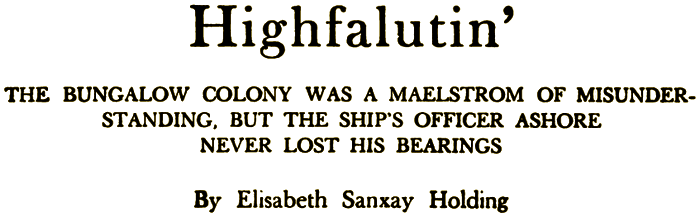
Two refined, genteel sisters—Nina and Rose De Haaven—lose their fortune after their lawyer ruins their finances. Forced into sudden poverty, they retreat to a tiny, shabby beach bungalow on Staten Island to learn how to live without servants or comfort. Their new neighbors are the Morgan family, rough, loud, quarrelsome, but fundamentally decent. The story follows the emotional and moral entanglements between these two households.
"WE must simply look on it as a—a lark!" said Mrs. De Haaven, resolutely. But her voice was not very steady, and her smile was somewhat strained, for in her heart she saw this, not as a lark, but as something very close to a tragedy.
"It's wonderfully light and airy," her sister Rose began.
This was true; a fresh sea breeze went blowing through the rooms, fluttering the curtains and stirring the dark hair on Rose's temples. The tiny house was sweet with sun and salt wind. Both Mrs. De Haaven and her sister could appreciate this, and they were sternly determined to appreciate every possible good point about their new home.
But—it was so tiny, so bare, so terribly strange; a sitting room, a bedroom, and a kitchen, divided by partitions which did not reach to the unstained rafters; painted floors, badly scuffed, the queerest collection of scarred, weather-beaten furniture.
"It will be like—camping out!" Mrs. De Haaven decided.
The trouble was, that neither of them had had any sort of experience in camping out, and, what is more, had never desired any such experience. They had led the most casual, pleasant existence; when they had wanted to be in the city, they had occupied Mrs. De Haaven's charming little flat; when it occurred to them that they would enjoy the country, they had gone out to the old De Haaven farm on Long Island; if the impulse seized them to travel, travel they did, in a comfortable and leisurely fashion.
Wherever they had been, in town or in the country, in Paris, in Cairo, in Nice, there always had been plenty of people about to do all the disagreeable and difficult things for them, and to do them willingly, because not only had the two ladies paid well for all services rendered them, but they were polite, kind and appreciative.
And now, with a jolt and a jar, that smooth-moving existence had stopped. Their lawyer, who had had complete charge of their nice little fortune inherited from their father, had either done something terrible, or something terrible had happened to him. They preferred, in charity, to believe the latter, and anyhow, it did not matter.
The money had dwindled down to almost nothing, the flat was sublet, the farm rented, and the poor ladies had taken this beach bungalow on Staten Island for the summer. They took it because it was cheap, and because it was their tradition that one had to leave the city in the summer, and because they hoped in this obscure little place to be let alone, to get accustomed to their new life in peace.
So here they were in their new home, all paid for, all furnished, all ready for them to begin living in. It was certainly quiet enough, yet somehow it did not impress Mrs. De Haaven as being peaceful; on the contrary, there was something alarming, almost terrible, in the quietness.
Nobody was doing anything or preparing anything for them; nothing would be done until she and Rose did it; the house simply stood there, waiting for them to begin. How did one begin?
She was a little shocked with Rose for turning her back on the house and sitting down on the veranda railing.
"Oh, Rose!" she said. "Shouldn't we set to work—get things in order?"
But Rose only reached out and caught her sister by the arm and pulled her down beside her.
"Look, darling!" she remarked. "That is something, isn't it?"
"That" was the sea before them—the North Atlantic, which rolled into the bay and broke upon the sands. They had looked upon the Pacific, upon the blue Mediterranean; they had seen many harbors, many beaches, beyond comparison lovelier than this flat shore.
But this, after all, was the great salt sea, the very source of life, and the sun made it glitter, and the wind blew off it, fresh and invigorating. It was something.
There they sat, with their arms about each other, such forlorn and lovely creatures! Nina De Haaven, dark and delicate; Rose taller, stronger, with a beautiful eagerness in her face, as if she waited in trust and delight for whatever her destiny might bring. She was twenty-four, and she had never really feared anything in her life.
Rose was not afraid, now, of this new existence, only a little puzzled, because she would have to be the one to start it. Nina was five years older, but she was too gentle, too easily rebuffed; she had never quite trusted life again after her beloved husband died.
"There's dinner," thought Rose. "I'm sure they don't supply food with furnished bungalows. I'll have to buy it and cook it. Mercy!"
She had to do it, though, and she would.
"Bread and butter," she also thought, "and eggs and milk, and tea and coffee, and sugar and spice. Everything goes in pairs! Coal and wood—"
Nina, less abstracted, started up.
"Somebody's knocking somewhere!" she said. "I believe it's our own back door. I'll go." And she vanished into the house. Rose followed promptly, and found her in the little kitchen, stooping over a basket on the table.
"It must be the dinner!" Nina declared, very much pleased. "There are all sorts of things here."
"How can it be the dinner?" Rose asked. She, too, bent over the basket and was enchanted by the varied assortment therein.
"Perhaps the tradespeople do that when some one new moves in," Mrs. De Haaven suggested. "As a sort of sample. A boy just left it without a word."
Rose shook her head.
"I don't think that's likely," she said. "I'm afraid it must be a mistake. But—" She was busy cataloguing these household things in her mind. Salt—she hadn't thought of that; and a box of bacon, and matches.
"I wish I'd kept house when Julian was alive," said Mrs. De Haaven, "and not lived in hotels. Then I shouldn't be so—useless."
Rose gave her a little shake.
"Encumberer of the earth!" she said, smilingly. "The thing is—whether I dare to pretend to be as artless as you really are."
"What do you mean, Rose?"
"I want to keep that basket!"
"Oh, Rose! When you think it's a mistake!"
"Yes!" said Rose, firmly. "I'll pay for it, of course, when I find out who it belongs to. But it's such a wonderful collection. I want it! Here's a package of pancake flour, and it tells you exactly how to make them. And the tin of coffee has directions on it, too. We could get on indefinitely, with pancakes and coffee."
"It would be terrible for our complexions," Nina objected.
"We can't afford complexions, any more," said Rose. And she began unpacking the basket, setting the tins and packages in neat rows on the dresser. The effect delighted them both; they were beginning to feel really at home now.
THE sun was going down behind the house, and the sea before them reflected in its darkening waters the faint purples and pinks streaking the sky. Mrs. De Haaven and her sister were on the veranda, facing the spectacle, but it aroused no enthusiasm in them; they were silent. They were tired, dejected and—hungry.
It was early in the season, and most of the bungalows were still unoccupied; there was not a soul in sight, not a human sound to be heard, nothing but the quiet breaking of the waves on the beach. A vast and inhospitable world.
"There comes some one!" said Mrs. De Haaven.
Round the corner of the shore two figures came into sight, a girl and a man. They came on very slowly, so close to each other that now and then their shoulders touched. The strange sunset light touched their young heads with a sort of glory.
"We can ask her," Mrs. De Haaven began doubtfully.
"I suppose I'll have to," said Rose. "There's no one else alive on the surface of the earth. But—somehow I hate to bother them about oil stoves at such a moment. Still, I can't let her go!"
She sighed, and got up, but just then the couple turned and began walking up the sands directly toward them. They were so absorbed in each other, not talking very much, but looking at each other from time to time, long, long glances.
The man was a passably good-looking young fellow of a somewhat scholarly type, lean and tall, and wearing spectacles, but the girl was a marvel, a miracle of soft, rich colors and vigorous health. Her eyes were blue, her hair the shade of ripe wheat, her sunburned face beautifully flushed. She was strong, lithe, straight-limbed, and such a joy to see that Rose forgot all about oil stoves.
"Well, good-by, Margie!" said the young man in spectacles, in the most casual sort of tone.
"Good-by, Paul!" the girl rejoined, equally casual.
Their eyes met, and they both glanced hastily away. The girl essayed a smile.
"Well," she said. "Good-by, Paul!"
"Good-by, Margie!" he repeated. "I—"
There was a long silence.
"I'll have to go in," said she. "It's late. Good-by, Paul!"
She held out her hand, and he took it. They stood hand in hand, looking at each other. Suddenly she snatched away her hand.
"Good-by, Paul," she cried, and ran off.
"Good-by, Margie—dear!" he called after her.
She had gone into the bungalow next to them, slamming the screen door behind her.
"How—sweet!" Mrs. De Haaven declared. "How dear and young, Rose!"
"I'll give her a chance to get settled first, before I go and ask her," said Rose. "It's too sordid to ask her how to light a stove when she's just said good-by to Paul."
So they waited a little. Their neighbor was extraordinarily noisy in there; doors banged, all sorts of things rattled and slammed, and while they waited for this alarming racket to subside, a small open car came down the road behind the houses, stopped, and presently the back door slammed and a voice sounded in there—a man's voice, and a young one, too.
"Look alive with that dinner, Margie! I'm in a hurry!"
"The things haven't come down from the store yet," said Margie. "I ordered them—"
"Don't make excuses," the man interrupted. "I told you I'd be home at six, and that I'd be in a hurry."
"Oh, I'm not making excuses!" answered Margie, scornfully. "I wouldn't bother to do that to you. I was just explaining. It's not my fault if the man doesn't bring the things."
"We've got their things!" Rose whispered to her sister. "I know it!"
"If you'd stay at home and look after your job, instead of running about with that measly little lawyer," the man began.
"Shut up!" cried Margie.
And somehow that furious exclamation hurt both the listeners. For both those quarreling voices, in spite of their bad temper and unrestraint, were good voices, the voices of people who ought to know better.
"All right!" said the man. "You wait till Bill comes home, young woman!"
"I don't give a darn about Bill!" she retorted. "If you're in such a hurry, take the car and go up to the store and get the stuff."
"Not much!" he said. "It's your job to get the meals, and I won't help you. I've got enough work of my own to do."
"I'll have to take them their things," murmured Rose, and she and her sister went into the kitchen and, by the feeble light of an ill-trimmed lamp, began to repack the basket in haste.
And while they were so engaged, there came the most tremendous slam of all, next door, and a new voice sounded, another man's voice, not loud and angry, like the others, but cool, deliberate, and masterful.
"What's up?" he demanded.
"No dinner ready," the other man replied petulantly.
"Because the things haven't come from the store," explained Margie, sullenly. "I ordered them in plenty of time."
"Take your car and go and get 'em, Gilbert," said the masterful voice.
"But, look here, Bill! I'm in a hurry—"
"Step!" said Bill.
And Gilbert was "stepping" out of the back door just as Rose was coming in with the basket. He backed into the kitchen again, and she followed him.
"I think these are yours," she said. "They were left at our house—by mistake, I'm sure."
Some one took the basket from her, and looking up, she had her first sight of Bill.
He was, she thought, the most impressive human being she had ever set eyes on, and one of the handsomest. A tremendous fellow, blue-eyed and fair-haired, like Margie, but without a trace of her sullenness; there was a sort of grim good-humor in his face.
He was not smiling, though; none of them were, and Rose was seized with a sudden uneasiness in the presence of these three silent, blue-eyed creatures. With a deprecating smile, she opened the back door, to flee—when she remembered Nina.
"I—I wish—" she said, addressing Margie. "After you've quite finished here, of course. If you could just spare a moment to show me how to light that oil stove."
"I'll show you now," said Bill. He followed her out the door, and his fingers closed like steel on her arm as he helped her down the steps in the dark and across the little strip of grass behind the houses. He did not release her until she was safely in her own bare, dimly-lit kitchen.
"Good evening!" he remarked to Nina, and swept off his white-covered uniform cap with a magnificent gesture. Then, without words, he dropped on one knee beside the stove, and he turned up the wick and struck a match, just as Rose had done.
"No oil in it," he announced, rising. "I'll get you some."
"Mercy!" said Nina, after he had gone. "What a-an overwhelming creature!"
"Isn't he?" Rose agreed. "He made me forget that, even if the stove ever does get lighted, there's nothing to cook on it. I'll have to ask him where the store is."
"It's dark now, Rose. You can't go wandering about in this strange place."
"There's nothing I wouldn't do now for the sake of food!" said Rose.
There was a knock at the back door; they both called "Come in!" and Bill reëntered, letting the screen door crash behind him. He was carrying a tin of kerosene, and at once he set to work filling the stove.
"I'm very sorry to put you to all this trouble!" Nina asserted, earnestly.
He didn't answer at all; he lit all the burners, and then:
"What next?" he asked.
"If you'll please tell me where the store is—the store that basket came from—and how to get there—"
"Now? It's closed," said he. His keen glance traveled round the bare little kitchen.
"I'll see that you get your dinner," he declared, and went off again, before they could say a word.
It was Gilbert who brought the dinner in on a tray, and no one could have performed a neighborly service more ungraciously. He was a remarkably good-looking boy of nineteen or so, but so surly, ill-tempered—
"He's a young beast!" said Rose, indignantly.
Nina was silent a moment.
"Isn't it queer—" she remarked. "How contagious that is!"
"Beastliness? You'd never catch it!" Rose declared.
"My dear, when he banged that tray down, and never even took off his hat, I wanted to throw a plate at him," said Nina, seriously. "I'd have enjoyed it!"
It was a good dinner, served on the coarsest of china, but well cooked. And after they had eaten it and washed the dishes, they were ready to go to bed and to sleep, not quite so forlorn in their new home.
THEY were awakened the next morning by a persistent and none too gentle knocking at the back door, and Nina, slipping on a dressing gown, hurried to respond. She opened the door upon a riotous, glittering June morning, and Margie, clear-eyed and glowing as the dawn—but far from amiable.
"Here's your breakfast!" she said, thrusting a wooden box into Nina's hands.
"Oh, but how awfully good and kind!" cried Nina. "I never—"
"Bill said you didn't have a thing in the house," Margie remarked, scornfully, "and couldn't even light the stove. So he told me to bring this."
Her brusque contempt was a little too much even for the gentle Nina.
"It's very kind of you," she said, with a polite smile. "But we'd have managed somehow—"
Margie shrugged her shoulders.
"Well, Bill told me to bring your breakfast," she said. "And to ask what you wanted from the store."
"Thank you, but I couldn't think—" Nina began, but with another disdainful shrug Margie had turned away.
"We'll have to swallow our pride," Rose suggested from the doorway. "Let's be quick, too, before it gets cold."
"I'm going to dress first," said Nina. "Because when that scornful Margie goes out, I'm going to follow. I'll follow her all day long till she goes to the store."
And she meant that. She dressed herself with all her usual unobtrusive art, and she kept an eye on the house next door. In the very act of lifting her second cup of coffee to her lips, she heard the front door slam. She sprang up, pulled on a delightful little hat, and ran out of her own front door.
Margie was walking quickly up the road, a strong, lithe young figure in a jersey and a short skirt, bareheaded in the sun. And after her went the slender and elegant Mrs. De Haaven, going to market for the first time in her life.
In a happy mood Rose set to work; she washed the dishes, made the bed, set the little place in order, and then began unpacking the two big trunks. Most of the clothes could stay in them, but there were all sorts of other things—silver toilet articles, photographs, books, writing materials, all the dear, friendly things that had often made even hotel rooms look homelike. They worked wonders here. The only trouble was, that there was no shelf for the books, and no flowers.
"I'll make a shelf!" Rose told herself.
So she went out on the beach and found a suitable small board; then she screwed two coat hooks into the wall beneath the sitting room window, laid the board across them, and stood the favorite books on this in a row.
"Crude, but well-meaning!" she observed, surveying her first piece of carpentering with a smile, and she went out to see if there were any flowers about to delight Nina with when she came home.
The first thing she saw was Bill coming down the road. Her impulse was to step back into the house, but she was ashamed of such weakness; Bill ought to be spoken to and thanked. So she sat down on the steps, and Bill, catching sight of her, swung off his hat with that same fine gesture.
"Comment ça va?" he inquired, standing bareheaded before her.
Certainly she had not expected French from Bill, but she politely suppressed her surprise and answered cheerfully:
"Tres bien, merci, monsieur! I was just wondering if there were any wild flowers growing about here?"
She looked up at him, but hastily glanced aside, for Bill was looking down at her with a smile which disconcerted her.
"Flowers, eh?" he said.
They were both silent for a time. Then Rose began, in a somewhat formal tone:
"My sister and I are both very grateful for—"
A crash interrupted her.
"What's that?" asked Bill.
"It sounds like my shelf," she replied, ruefully.
"Did you try to put up a shelf?" Bill demanded. "Let's have a look at it."
Somehow she did not want Bill to come into their house. Not that she distrusted or disliked him, but he made her uneasy. Still, she could not very well refuse to let him come, so, with a good grace, she opened the door and they entered.
His blond head almost reached the ceiling; his great shoulders blocked all the sunshine from the window; he seemed completely to fill the little room. And she did not like him to be there.
The pretty little things she had set out on the table seemed like a child's toys, the house was like a doll's house, and she herself, with her ineffectual shelf, felt altogether too diminished. He had been staring at the fallen shelf and the coat hooks for some time with an odd expression—as if he felt sorry for her.
"Look here!" he said. "When you want anything of that sort done, tell me."
"There's no reason on earth why I should trouble you, Mr.—"
"Morgan," said he. "It wouldn't be a trouble. There's nothing I wouldn't do for you. Nothing!"
The earnestness with which he spoke confused her.
"Thank you, Mr. Morgan," she began, hastily. "But—"
"Look here!" he interrupted. "I've got to go away—and I don't like to leave you like this. You can't look after yourself any better than a baby."
Rose turned scarlet.
"You're mistaken, Mr. Morgan!" she declared, with a cold little smile. "You're very much mistaken!"
"No," he said. "No, I'm not. I knew, the first moment I saw you—"
"We won't discuss the matter, if you please."
"I'm not discussing anything," said he, with a sort of gentleness. "I'm only telling you that you've got me to count on whenever you need me."
Her hands clenched, but she answered quietly enough:
"I can't imagine any possibility of 'needing' you, Mr. Morgan."
He turned toward the door.
"I don't mean to make a nuisance of myself," he declared, gravely. And then he smiled. "I'm going away," he added. "But I'm coming back!"
The screen door banged after him, and Rose sat down on the couch and began to cry.
"Beast!" she cried. "I'd like to shake him!"
But the idea of her shaking Mr. Morgan made her laugh. She dried her tears, ashamed of her temper, and when Nina got back, she was her usual good-natured, delightful self again. She did not mention the episode to Nina; it would only distress her.
"And I think I'm capable of managing Mr. Morgan!" she told herself, grimly.
NINA was surprised by her sister's censorious attitude.
"But they do try to be neighborly!" she protested.
"I don't care!" said Rose, with unwonted heat. "I don't like them, and I don't want anything to do with them. They're a family of—savages!"
"Oh, Rose! When that poor little Margie brings us flowers from her own garden every day!"
"Yes, because that Bill told her to!" thought Rose. But aloud she said: "Brings them! She pretty nearly throws them at us."
"That's just her way."
"Well, I don't like her way, and I don't want her flowers, and I don't like any of those Morgans, or anything they do. I never imagined such an ill-tempered, quarrelsome family."
"I know," said Nina, seriously. "And I think it's pitiful."
"Pitiful! To snarl and snap at one another—"
"Yes," said Nina. "Because there's something so splendid about them, in spite of all that—something so honest and fine."
"Fine!" cried Rose, with a snort.
"You must have noticed. They're rough and unmannerly, but they're never vulgar. And they speak well. I think they've come down in the world, Rose."
"They certainly have!" Rose agreed. "Down to the bottom. Nina, you're sentimental about your Morgans. You've seen how they live. A coarse, ugly life, without one gracious touch. They eat in the kitchen, on a table covered with oilcloth."
"Yes, and it's a spotless kitchen, and everything about them is wholesome."
"It's no use," Rose objected. "I don't like them, and I won't like them. Now, you sit here on the veranda and read. I'm going to buy the Sunday dinner."
"I'll come with you," said Nina, but she was glad Rose would not let her. It was a long walk, and she felt tired, very tired and languid. She did not want Rose to know how tired she was, or how worried.
It seemed that their financial affairs were not definitely settled, as they had believed. Mr. Doyle, the lawyer, kept writing to her letters she could not quite understand, anxious, almost desperate letters, accusing himself of "criminal folly"; begging her forgiveness, and making all sorts of promises. He wrote always to her, never to Rose, and she was glad of that, for she did not want Rose to know.
But she was so tired. She tried valiantly to do her share, to be a good comrade to her beloved sister; but she was not strong, either in body or in spirit; she was a gentle soul; she could endure, but she could not fight. She wanted only to live in peace and good will, harmless and lovely as a flower.
It was a Saturday afternoon; Gilbert had come home early in his little car, and he and Margie had at once begun to quarrel fiercely.
"Bill told you to take me to the village in the car, if I wanted!" she declared.
"Do you good to walk!" said her brother.
"I won't walk!"
"All right! Then stay home!"
Presently the back door slammed, in the Morgan fashion, and Nina hoped he was going away. It hurt her to hear these two young creatures quarrel so; she always wished that she had some magic word to stop them, to bring quiet to their stormy spirits. She was waiting for the sound of his engine starting up, when, to her surprise, she saw him standing on the path before her.
"Mrs. De Haaven," he said, "can you spare me a few minutes?"
"With pleasure!" she answered, as if this amazing request were quite a matter of course. "Come up on the veranda, won't you?"
He did come up, and when she asked him, sat down opposite her. He was silent for a few moments, and Nina studied him with frank and kindly curiosity. For the first time she saw what a remarkably handsome boy he was, a little haggard, a little too thin, perhaps, but tall and sinewy, and notably distinguished.
Yes, that was the word; he was distinguished looking, with his thin, rather arrogant face, his slender, well-kept hands, his neat dark suit. He was not surly to-day, and not shy or awkward; he looked at her candidly as he spoke.
"I hope you won't mind," he said. "But I knew you could tell me. If you'd give me your advice. I've got an invitation—but perhaps I'd better show it to you."
He took a letter out of his pocket and handed it to her. It read:
My dear Boy:
Why not run down for this week-end? Don't bother to let me know—just come if you can. I often think of you, and it seems to me perfectly terrible that you should be living like that. And quite unnecessary. I want you to meet some of your own sort.
Yours—most sincerely, Lucille Winter.
Lucille Winter! And writing in this vein to this boy! Nina held the letter in her hand for a long time, unable to say anything to cloak her thought.
"You see," said Gilbert, "I couldn't go until to-day, on account of my job. And I'd have to come back to-morrow night. D'you think that would be all right?"
"No!" thought Nina. "Nothing could be less right. It's—a horrible thing. You're only a child. And Lucille—You don't know Lucille, but I do."
"You see," he went on. "Mrs. Winter is my father's cousin. You wouldn't suspect it, but my father's family were—decent people."
"Oh!" Nina breathed.
"I don't mean that mother's family wasn't—all right," he said. "My mother—" He stopped. "My mother was a saint," he announced. An odd change came over his face; all the arrogance vanished, leaving it weary and sorrowful. "And my father wasn't," he added.
Another silence ensued.
"So Bill's got this idea of a simple life," he said, with something like a sneer. "He won't let us see any of father's people. Wouldn't let me go to college. He made me take this job—in the National Electric—when I was only seventeen. In a year I'll be twenty-one, and then Bill can go to blazes. In the meantime—not much I can do. He controls the finances. He's away now, though. And I'm to Mrs. Winter's."
"Oh, I don't blame you!" thought Nina. "What a dreadful thing—to take a boy like this and put him to work at seventeen, and make him live in such a way! And if Lucille is his father's cousin—She knows really good people—It really would help him—"
And because she was, in spite of her worldly experiences, so innocent and good at heart, so ready to think well of every one, and so anxious to help this unhappy boy, she did give him her advice. She told him what clothes to take, what to tip the servants, and so on.
"Please don't tell Margie where I've gone," he said. "I'll be back to-morrow night for dinner. And she'll be all right—with you next door." He arose. "Thank you!" he said. "You've been—very kind to me."
She had meant to be. She hoped, she believed, that she had done well in helping him to elude the tyrant Bill.
SUCH a quiet afternoon. Rose turned off the highway, into the beach road; the bright sea lay before her, roughened by a frolic wind, and on its edge three or four little children played; their voices came to her joyous and clear. Their end of the beach had been described by the real estate agent as "the quiet end," and so it was; their bungalow and the Morgans' were the only ones occupied as yet, and even these two showed no signs of life to-day.
Rose entered the house. It was certainly not a good house to hide in, and she very soon discovered Nina in the bedroom with her hat on!
"I had a telegram from Mr. Doyle," she explained, hurriedly. "He wants to see me about—something. So I thought to-day would be a good time to run into town."
"That won't do!" said Rose, severely. "You can't treat me this way, Mrs. De Haaven! I want to know all about it."
Nina turned and put both hands on her sister's shoulders, looking steadily into her face.
"Rose!" she said. "Let me do this—my own way—alone. I've been such a useless creature. No! Please, darling, let me finish! I have been useless. I know you don't mind, but—sometimes—Rose! I do so want to manage this all by myself. And I know I can!"
They were both silent for a moment.
"All right! Go ahead, darling!" Rose agreed at last. "Only don't come back to-night. Stay in a hotel and come back to-morrow morning."
"And leave you all alone?"
"The Morgans are here, and they're enough. If you don't promise not to come back to-night, I'll—I'll go with you!"
So Nina consented, although reluctantly, and a few minutes later they set off together for the railway station. Rose stood on the platform, looking after the train.
"God bless you, darling!" she said, softly to herself.
Poor valiant, gentle Nina, going off to attend to business affairs, to "manage" the elusive and plausible Mr. Doyle.
"But it would have hurt her if I'd said anything," thought Rose. "And, anyhow, things couldn't be much worse, financially."
She walked back to the bungalow, a long walk; but she was in no hurry to reënter the empty house. It was ridiculous to miss Nina so, just for one night; it was weak and sentimental to feel so lonely.
"I might learn a lesson from the Morgans," she thought, as she went down the beach road. "No one could accuse them of being too sentimental in their family life!"
And suddenly she felt sorry for the Morgans, with their quarrels and their banging doors and their stormy, miserable existence. She thought of them, and she thought of the love between Nina and herself which made any place home, any trial endurable. And she pitied them with all her heart.
There was Margie on the veranda now, sewing—sewing in such a Morgan way! She had a paper pattern spread out on the table, and the wind fluttered it, and Margie pounced down upon it furiously, upsetting her workbasket and getting herself tangled up in the yards and yards of green charmeuse on her lap. Rose watched her for a minute; then she said, moved by a friendly impulse:
"Miss Morgan, won't you let me help you?"
Margie spun round, upsetting everything again.
"No, thanks!" she replied, in her scornful way. But something in Rose's face made her flush and glance away. "Well," she said, sullenly, "I am having a pretty bad time. There's no reason why you should bother, but—"
Rose came up on the veranda beside her, and surveyed the woeful muddle.
"What a pretty shade!" she remarked. "It ought to go well with your hair."
"I know," said Margie. "Paul—I mean—I've been told I ought to wear green. And I'm going somewhere to-morrow afternoon."
"But you don't expect to have this dress ready for to-morrow afternoon."
"I've got to."
Rose reflected for a moment.
"I'll tell you what!" she announced at last. "I have a green dress—a really pretty georgette. I've only worn it once. With just a little bit of altering, we could make it do beautifully for you to wear to-morrow. It's a good model. I got it in Paris last autumn. Won't you come and look at it?"
"No!" cried Margie. "I don't want any of your old clothes. I don't want—" Her voice broke. "I just hate you and your—highfalutin' ways!" she ended with a sob.
"Upon my word!" Rose began, indignantly. "Is that—" But her resentment could not endure against the sight of Margie weeping in that furious, defiant way, the tears falling recklessly on the green charmeuse.
"You don't really hate me, Margie," she said. "You couldn't—when I like you so much."
"Like me?"
"I liked you the very first time I saw you," Rose explained. "You were saying good-by to Paul, on the beach."
"You saw Paul?" cried Margie. "I suppose you'll tell Bill. Well, I don't care! If you don't tell Bill, Gilbert will."
Rose found it surprisingly easy not to get angry with Margie.
"But why should your brother object to Paul?" she inquired.
"It's not that," said Margie. "Only what do you suppose Paul would think of Bill—and this house—and the way we live? Oh, I'm so ashamed of us! I'm so—so ashamed of us! If you knew—when mother was alive—three years ago—we had our dear home, and everything so dainty and pretty in it—and she kept us from fighting—just by being there. Oh, mother! Mother darling! You don't know—nobody knows—what it's like—without her."
Rose knelt down beside the girl, put an arm about her, and drew the bright head down on her shoulder.
"You poor little thing!" she crooned. "Poor little Margie!"
"And now—I'm going to lose Paul," Margie went on, in a choked voice. "He's always asking why he can't come to see me in my own home. He's awfully particular and high minded. He hates to meet me on the sly that way. And—"
"I'd let him come, if I were you."
"I won't! I'm too much ashamed of us."
"Couldn't you make things a little better?" Rose suggested, very gently.
"Bill won't let me! Bill's a beast! When mother died, he gave up our dear old house—he's packed up all her pretty things—they're in the woodshed, in barrels and boxes. He won't let me touch them. He says we've got to learn to work and to live simply. He just adored mother, and he thought father didn't make her happy enough, so he's got this idiotic idea about our not being like father's people—not being highfalutin'. 'Plain living and high thinking,' that's what he's always saying. High thinking, when he hasn't left one beautiful thing in our lives! It's all very well for him; he's away at sea most of the time—"
"At sea?"
"Yes; he's first mate on a cargo steamer," said Margie, with a change in her voice. "I know he's a beast, and all that, but there is something fine about Bill, after all. He's a real man. And he's been awfully good to us—in his way. When Gilbert had bronchitis last winter, Bill was—wonderful. And when mother died—I—I don't know how I could have lived without Bill."
She was silent for a moment. "Mother said she knew Bill would take care of us—and he does—only it's in a wrong way. Bill's so—I don't know how to describe it—Bill's so—big, he could live on a desert island and not be discontented. He can live in this rough, common way and still be—dignified. I don't suppose you've ever noticed, but Bill has a way of coming into a room sometimes and taking off his hat, that's like—like a king."
Rose felt her cheeks grow scarlet.
"He is—impressive," she agreed.
"Bill's big," Margie went on, "and he only wants a few big things. But Gilbert and I are little, and we want lots of little things. And—" She sat up straight.
"Paul wants to take me to see his sister to-morrow afternoon," she said, "and I'm going! There'll be a row—because Gilbert said he'd have to have his dinner at six, and he's not going to get it. I'm not even going to try to get home by six. He can tell Bill about Paul if he wants. I don't care. It's got to happen some day."
"Margie, I'll get Gilbert's dinner for him to-morrow."
"You?" said Margie.
"I'd like to. And you can enjoy your afternoon with an easy mind. I'll get Gilbert's supper, and—Margie—bring Paul back with you, and I'll have something nice ready for you both."
ROSE had left a lamp burning in her own sitting room, as a beacon for Nina, and all the time she was busy in the Morgan's kitchen, she was listening for that footstep. And for all her pleasure and excitement in this surprise she had prepared for the Morgans, a vague anxiety lay in the back of her mind, because Nina was so long in coming. She had expected her for lunch, and the whole afternoon had gone by without her.
She wished Nina could have seen Margie set out, in that Paris dress—the loveliest, happiest creature! And she wished Nina were here now, to lend her moral support in this wildly audacious plan, for, now that the thing was done, she felt a little frightened. Margie and Gilbert were little more than children; she could manage them; she could really help them.
But it seemed to her that the shadow of Bill lay over the house; he himself might be hundreds of miles away, but she couldn't forget that this was his house, and that she was defying him. The thought caused her an odd sort of pain; you might dislike Bill, she thought, and vigorously resent his domineering ways, but it was impossible not to respect him.
It was even impossible not to like him just a little when you thought how honestly he tried to take care of his unruly household, and when you remembered all those little kindnesses. Well, the sensible thing was, not to remember.
She had a natural talent for cooking, and with the aid of a cookbook, she had managed an excellent dinner. That part of the plan caused her no worry. But the rest—She opened the oven door for one more look at the pair of chickens sizzling richly in there, and then with a sigh, went again to the dining room door.
An amazing change was there! The round table was covered with a fine damask cloth, and set out with gay, old-fashioned china, frail glassware, sturdy old plate, all gleaming in the light of the shaded lamp. On the walls hung two or three framed pictures, not masterpieces by any means, but somehow lovable and friendly.
"She'd like me to do this," thought Rose. "For her children."
Because, as she had unpacked these things from the boxes and barrels, such a strange feeling had come over her; she had felt that she understood that mother. Standing here now, surrounded by the perishable and infinitely touching belongings of that beloved woman, dead, but so tenderly remembered by all her children, she thought she knew how she had felt toward them all, how she had managed each one of them, wisely and patiently; how she had loved them for the qualities which were so splendid in them, and the faults that were only pitiful. And she wanted them to remember their mother, not in bitterness and grief, but happily, as if always conscious of her dear spirit.
A sound startled her; a noise like little feet running over the tarred paper on the roof. At first she thought, with no great comfort, that it was rats, but then the pattering came upon the windowpanes, against the door. It was rain.
"Nina!" she thought. "What can be keeping her so late!"
She went into the kitchen and opened the back door; the summer rain was driving down with steady violence, drumming loud on the roof now, spattering up from the path. Such a dark, strange world for Nina to be out in alone! Moved by a sudden impulse, she ran out into the rain and entered their own house; the lamp still burned clear and steady in the neat little room. The clock struck six.
"Oh, Nina!" she cried, aloud, in an unreasoning panic of fear. "Nina, darling!"
And then, above all the noise of the rain, she heard a familiar sound, the slam of a door by which all the Morgans announced their home coming. She hurried back there, her courage, her generous hopes, all gone now.
"I'm an officious busybody!" she thought. "Why didn't I stay at home and mind my own affairs? Oh, I wish I'd let the Morgans alone! I wish—"
She stopped short in the kitchen doorway, staring at Gilbert. He was wearing a dinner jacket, and it was soaked through with rain; his collar was wilted, his tie askew, his fair hair plastered across his forehead, his blue eyes very brilliant. And his face, his clear-featured, handsome young face, so white, so strained, so lamentably changed! The momentary disgust she had felt turned to a painful compassion.
"Gilbert!" she said, in a pleasant, matter-of-fact voice. "Get on dry clothes. Your dinner's ready for you."
She spoke to him as she thought his mother might have spoken; she thought she felt a little as his mother might have felt to see the boy like this.
"No!" he said, in an unsteady voice. "Let me alone! What are you doing here?"
"I'm so glad I am here!" she thought. "So glad! Poor little Margie! If she brings her Paul here now—" And aloud: "Gilbert!" she said, with quiet authority. "Please do as I ask you—at once. Change your clothes."
"I won't!" he said. "No, I won't! You don't know. You can't understand. Only Bill. Bill knew. Bill was right. I wish I was dead!"
The same childish passion and unreason that Margie had shown. He sank into a chair by the table and buried his face in his hands.
"I wish I was dead!" he said again.
And Rose, always listening for Nina's step, had also to listen to this boy's sorry little tale. He had gone to visit his father's cousin, Lucille Winter.
"Bill told me they were no good," he said, "but I wouldn't believe him. And—you don't know what it was like. I lost over a hundred dollars at bridge. And I drank. I didn't mean to, but every one else did, and I've come home to my sister like this. If I'd had a penny left, I'd never have come home again—never! It's—you don't know—it's all so beastly, and I thought I'd like that sort of life, but—I couldn't get out fast enough. I've found out now that old Bill was right—but it's too late."
"It is not!" Rose declared, firmly.
"I can't pay that hundred," he said. "And I've got to pay it to-morrow. I—you can't understand."
"And if you weren't so honest and sound at heart you couldn't feel so sorry!" thought Rose. But she did not intend to give him too much consolation; his shame and remorse were of inestimable value to him. "If you'll wash and change your wet clothes, and eat your nice hot dinner, you'll feel better," she insisted.
"I'll—I'll never feel better!" said he.
"I'll give you a cup of coffee now," she began, when that sound, welcome beyond all others, reached her ears—Nina's step on the veranda.
"Wait, Gilbert!" she cried, and ran back into her own house. Nina was standing in the front room, drawing off her gloves.
"Rose," she said, in a strange, flat voice. "It's all gone—every cent!"
Rose helped her off with her wet jacket, took off her hat, pushed her gently into a chair, and kneeling, began to unfasten her shoes, such absurd little shoes, and soaked through.
"Never mind, Nina!" she said. "We're together, and that's all that matters."
Nina's hands and feet were cold as ice, and her cheeks flushed.
"Even the check we gave for this rent was no good," she explained. "The house belongs to Mr. Morgan, and I suppose he didn't like to tell us. I tried to borrow—just a little—this afternoon—from friends—I thought they were friends—"
"Hush, darling! Who cares? You'll get straight into bed, with a hot-water bottle at your poor cold feet, and I'll make you a cup of beautiful coffee."
She stopped short.
Margie, bringing back Paul, to find Gilbert like that. And she had told Margie to bring him. It was all her fault.
She looked at the clock; half past six. Margie was to be expected any minute now. Gilbert was sitting there in the kitchen in his wet clothes. He didn't look very strong. And Nina! Nina was telling her about Mr. Doyle, and she pretended to pay attention, but she was listening for Margie's home-coming now with as much anxiety as she had listened for Nina's. This might spoil Margie's poor little romance forever—and it was her fault. Gilbert would be ill.
She had just got Nina into bed when the screen door slammed in the next house.
"One instant, Nina!" she cried, and rushed out, down the steps, through the sodden little garden in the driving rain, and back into the Morgans' kitchen. Gilbert still sat just as she had left him, his head on his arm.
"I'll—lock him in!" she thought, desperately. "But I'll have to tell Margie."
She went into the little passage, closing the kitchen door behind her, and on into the sitting room. No one there. So she went toward the dining room. The doorway was blocked by a tremendous figure, standing there hat in hand, his back toward her.
"Oh, Bill!" she cried, in her immeasurable relief.
He turned; he saw her there, with her soft hair wet and disordered, her face so white; he had seen his dining table set out with his mother's sacred possessions—and he showed no surprise. She thought that nothing would surprise him, nothing would shock him, that he would meet anything in his life coolly, honestly, and steadily—like a man.
"Gilbert's been to a week-end party at Lucille Winter's," she said. "He's—he's in the kitchen. You've got to be very careful with him. He's only a child."
"All right!" Bill agreed, with the shadow of a smile. "I'll take Gilbert back into the fold. But this—" His smile vanished as he glanced toward the dining room again. "This—"
"I'm sorry," said Rose. "But—poor little Margie's bringing Paul—a friend of hers, home to dinner to-night, and—" She paused a moment, then she looked resolutely up at Bill. "I thought she would like it," she went on. "For her children—so that they'd remember—the things they've forgotten. I'm sorry, but—" A sob choked her.
"Please," she begged, "be very kind to Margie—and Gilbert—and Paul. I've got to go. I meant to stay, but—my Nina's sick."
She turned to go, but tears blinded her; she stumbled against the lintel. Bill's hand touched her arm, the lightest touch, to guide her.
"I promise you," he said, "that everything shall be just as you want it."
She brushed her hand across her eyes and looked at him. And she thought she had never in her life seen anything like that look on his face.
"I want to help you," he announced. "That's what I've always wanted, since the first moment I saw you."
Neither of them had another word to say, to spoil that moment. She ran back again to Nina, through the rain, and she thought she must sing, for joy and relief.
Everything was all right now, for Bill had come. She was so happy—so happy—just because Bill had come.
Roy Glashan's Library
Non sibi sed omnibus
Go to Home Page
This work is out of copyright in countries with a copyright
period of 70 years or less, after the year of the author's death.
If it is under copyright in your country of residence,
do not download or redistribute this file.
Original content added by RGL (e.g., introductions, notes,
RGL covers) is proprietary and protected by copyright.