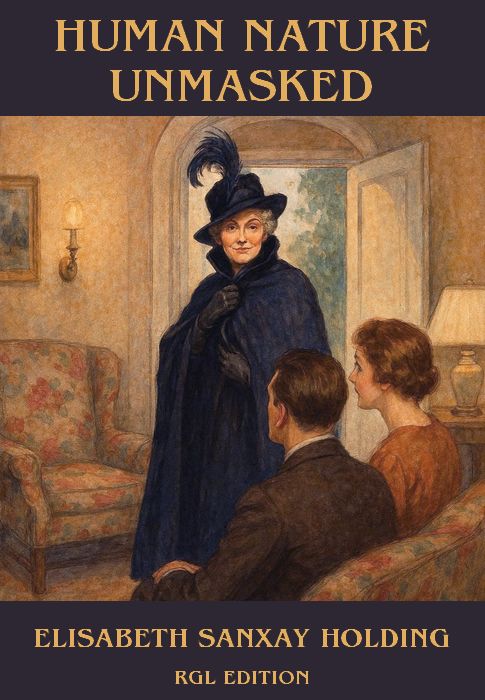
RGL e-Book Cover
Based on an image created with Microsoft Bing software
Roy Glashan's Library
Non sibi sed omnibus
Go to Home Page
This work is out of copyright in countries with a copyright
period of 70 years or less, after the year of the author's death.
If it is under copyright in your country of residence,
do not download or redistribute this file.
Original content added by RGL (e.g., introductions, notes,
RGL covers) is proprietary and protected by copyright.
RGL e-Book Cover
Based on an image created with Microsoft Bing software

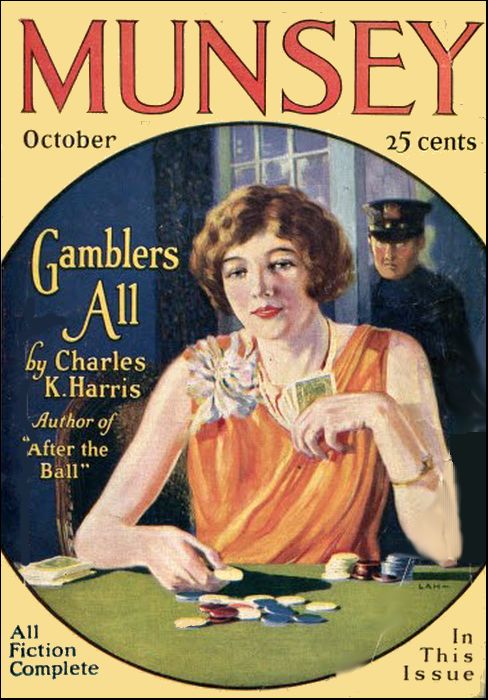
The Munsey Magazine, Oct 1926, with "Human Nature Unmasked"
"Human Nature Unmasked" follows Leonard Wilder, an exhausted, sharp-tongued architect whose cynicism about people has hardened into a world-view. After a draining day, he returns home to the small household he shares with his brother Evan, Evan's wife Marian, and Marian's younger sister Violet. Wilder feels hemmed in by obligations, irritated by domestic routines, and convinced that everyone around him is weak, foolish, or self-interested. His brittle equilibrium is disrupted when a flamboyant, unexpected visitor arrives claiming to be a long-lost relative. Her dramatic entrance—and the story she brings with her—throws the household into emotional and moral confusion. As Wilder watches the reactions of the people he thought he understood, he becomes increasingly convinced that human nature is petty, greedy, and disappointing. But the events that follow gradually force him to confront the limits of his own cynicism. What he believes he sees in others may not be the whole truth—and what he refuses to see in himself may matter even more...
WILDER sprang off the train, jostled his way through the crowd on the platform, and dashed up the steps to the street, scowling with impatience; and yet, when he got there, he stopped short.
The trolley car that met the train was waiting in front of him, and there was a rush of commuters toward it. He had meant to get on that car, but he could not. He was too tired, too mortally sick and tired of his fellow creatures. He could not and would not be crowded in there. He wanted miles of uninhabited space about him. He felt that it was impossible to endure the sight of a human face or the sound of a human voice.
Then, just behind him, some one called out cheerily:
"Hello, Wilder!"
He pretended not to hear, and set off down the street, with that headlong gait of his.
"Let me alone!" he said to himself. "Oh, Lord! I'm so tired!"
All he asked was to be let alone, but he never was. At this moment Marian was waiting for him.
"Let her wait!" he thought.
But, just the same, he hurried home to her.
"I'm a slave!" he thought. "I'm a fool, an ass, an idiot, an imbecile!"
These weaknesses were not obvious in Leonard Wilder's appearance. A big fellow, well set up, lean and vigorous, he looked like one abundantly able to take care of himself. His face, with its big, bold nose, its keen gray eyes, and that out-thrust underlip, looked like a clever face. He was by no means handsome, but there was something about him that pleased the eye. People were inclined to stare at him. People who knew him detested and loved him at the same time. He was impossible to get on with; yet, once you got used to him, it was hard to get on without him.
He was an architect; but he said that if he could choose again, he would be a house wrecker. There was, he said, no room on earth for an architect until ninety-five per cent of all buildings now standing had been razed to the ground. Feeling as he did, he nevertheless helped in the erection of more monstrosities. The owners of a "development park" employed him to design houses.
"Regular little love nests!" said Connolly, the senior partner.
"Why d'you call these things 'nests'?" asked Wilder. "Haven't you ever seen a nest? Don't you realize the fundamental decency of birds? Why, man, birds hide their nests! 'Love nests,' eh? Sheep pens, you mean!"
Connolly laughed; but he always arranged to keep his architect and his clients as far apart as possible. When this could not be done, he took care to explain in advance that Wilder was a genius. Connolly believed this. He believed that only a genius could be so outrageous; that only a genius would do such good work for so little money. He liked geniuses.
Leonard's own opinion of himself was less flattering. He called himself a fool. For instance, here he was, hurrying home, when he so violently did not want to go home, simply because it would upset Marian if he were late. He always hurried home, and not out of good will. He felt no good will toward anybody on earth. He was the complete cynic. He did not love his fellow man. If he caught trains, it was only through a very contemptible weakness.
The sun had gone, but it was not yet dusk. As he reached his own corner, the street lamps suddenly came alive, glowing with a faint, luminous violet against the pallor of the sky. He was startled and enchanted by the effect. He stopped, to stare up at them, to watch the delicate changes in the sky.
"Extraordinary thing!" he thought. "I spend my life looking for the beautiful line—the clean, strong, inevitable line; and here is beauty without line, almost without form or color—half tints, shadows—of nothing. Why is this beautiful to me?"
He wanted a formula, and could find none. He lit a cigarette, and leaned back against the lamp-post, meditating. Marian saw this from the window. She saw her brother-in-law standing on the street corner, smoking a cigarette and staring at the sky, when he knew very well that dinner was ready. Let him! She made up her mind that she would not say one word. She put everything into the oven to keep hot, went out on the veranda, and sat down there.
When, at last, Wilder came down the street, and saw her, he knew by her face that she was not saying a word. Instead of admiring this forbearance, a fierce exasperation rose in him. He wanted her to say a word, so that he could reply in other words. He desired a barrage of peppery words. He had stopped, just to look at the sky—and she begrudged him that!
"Good evening, Leonard," she said, quite politely.
"Oh! Good evening!" said he, as if surprised. "You here?"
Then he sat down on the top step and lit another cigarette.
"And here I sit until you do say something!" he thought.
"I will not be drawn into a dispute with Leonard," thought Marian. "He's simply looking for a chance to be nasty; but I shan't say a word."
From inside the house came a sound of hammering. It was Evan Wilder, doing some little carpentering job; and this—this creditable and helpful thing—filled Leonard with still greater exasperation.
He was weary and hot. He wanted peace. He wanted a dim and lofty dining room, a silent and highly competent manservant, and a rare sort of dinner; and when he thought of what he was actually going to get—
He had meant not to speak, but that hammering was too much.
"Peter Pan, the Boy Scout who never grew up," he observed. "What good turn is he doing now?"
Marian still said nothing, but the effort she made to hold her tongue vibrated through the air.
"He is misguided," Leonard went on. "If he were to follow our example, Marian! Here we sit, developing serenity of soul in contemplation. I'm happy to see you contemplative, Marian. Don't you feel strengthened by it?"
"Leonard," she replied, in a voice unsteady from many suppressed emotions, "if, instead of sneering at Evan—"
"Shan't I put dinner on the table?" interrupted a voice.
It was the voice of Marian's young sister, Violet. Leonard rose.
"Why didn't you tell me she was here?" he asked sternly.
"Why should I?" returned Marian. "I didn't want to disturb you in your soulful contemplations."
She, too, had risen. He admitted that she was a nice looking girl, but it exasperated him to see that she was tired. It made him feel that every one in the world was tired. He thought of Marian working all day in this detestable little house. He thought of Evan sitting in his office, waiting for the patients who did not come. Everything was awful!
Violet disturbed him. He was sorry for her, just entering upon life in all its awfulness; and she was so unsuspicious. She did not look either tired or discouraged. She was a designer, working in a fashion studio, and she did not seem to mind it.
There she stood in the doorway. The light behind her shone on her bright hair, making it glitter like gold wire. She had a nice color in her cheeks, and across her nose was a band of freckles that seemed to Wilder funny and very touching. She had serious blue eyes. She was a serious girl altogether, but he always felt that the seriousness was not quite honest. He strongly suspected that there were moments when she laughed.
She glanced at Leonard as he came in, and smiled seriously. He would have said that he was sorry he was late, only that Marian would have heard, and it would have been mean to be sorry to Violet and not to her.
As he went upstairs to wash, he met his brother Evan coming down, with a clean collar, and his dark hair still damp. He looked neat and subdued, yet cheerful. Evan was always cheerful. His valiant smile did not soothe the cynic, who came downstairs worse than ever.
They all sat down at the table.
"Ah! Tomato soup!" said Evan, bravely and brightly.
"Tomatoes have gone up awfully," observed Marian.
"Listen!" said Violet. "That taxi—isn't it stopping here?"
"Good Lord!" cried Evan, springing up. "A patient!"
"Probably an accident who can't afford to pay," said Marian.
Evan retired, so that he might be mysteriously invisible to any patient, and Marian went to open the door.
FROM the dining room, Leonard and Violet could see who stood outside—a large figure in a plumed hat and billowing cloak, like a cavalier. It was no cavalier, however, but a lady.
"Dr. Wilder's house?" the stranger asked.
"Yes," said Marian. "If you'll step into the waiting room, I'll see if the doctor's disengaged."
"Deary," said the visitor, "tell him it's his Aunt Jean!"
At this Evan stepped forward.
"I am Dr. Wilder," he announced sternly—sternly, because he had no Aunt Jean.
"No!" cried she. "You don't say! You must be one of the boys; but it's old Dr. Wilder I'm looking for."
"He—" Evan began, and hesitated. "My father—"
"No!" said she, all sympathy. "Gone? That's just terrible! I looked in the telephone book, and I saw 'Dr. Wilder,' and I came here. My! That's sad! And you're a doctor, too? Deary, you've got a grand presence!"
Evan was considerably taken aback.
"Deary," said she, "I'll explain—"
Just then she caught sight of Leonard, who had come into the hall, urged by sheer curiosity. He wished to hear the preposterous tale this woman would surely tell. It was almost pathetic, to think of her coming before him, the cynic, the merciless detector of human weakness, with her ridiculous yarn.
"You're the one to remember!" she said. "Your eyes—so kind o' piercing looking, and all! You remember your Auntie Jean, I bet!"
"No," said Leonard, "I can't say that I do."
Indeed, he felt that if he had ever set eyes on her before, he would have remembered. She was not one easy to forget. Stout and tall, she carried herself with majesty. In her face, powdered white as a clown's, her lips were a vivid scarlet. Sticky dark lashes surrounded her eyes, and crowning all was a bushy halo of blond hair, dry and unreal as a doll's wig. No, Leonard did not remember her.
Nevertheless, looking at her, a queer sympathy stirred in him. There was something honest in her. Even the paint and powder and dyed hair were honest. They showed no intention to deceive, but merely an artless desire to make the best of what nature had provided.
"Deary," she said, "I'm your Uncle Lambert's second."
There really had been an Uncle Lambert, a black sheep brother of their father's, and Leonard thought he could remember some talk about a dreadful marriage. He was almost ready to believe that this lady might be a relation—by marriage; but that did not exclude the possibility of her being also a swindler.
"I remember," said she, "as plain as plain. Your mother was the only one in the family that ever had a kind word for me—a sweet, lovely woman, she was. Well do I remember her saying to me: 'Jean,' she said, and those were her words—'Jean,' she said, 'come and see the children.' Then she took me up through that rich, elegant house, and the taste there was in those lace curtains I shall remember to my dying day, and the carpet on the stairs as thick as fur, and there you were in the nursery, the two of you, in little black velvet pants and white silk shirts, as sweet and clean as two little lambs." She sobbed. "Two little lambs!" she insisted. "And Evan, he sat on my lap and played with my locket, and well I remember he broke it off the chain and tried to swallow it, and you stood in a corner, saying, 'Go 'way! Go 'way!' Two l-little l-lambs!"
Leonard believed her. He could not recollect the incident, but he believed it had been as she said.
"Sit down, Aunt Jean," he said firmly.
"Aunt!" said she. "Deary, I will not forget this sweetness!"
Still in tears, she sat down, and so did Leonard, but the others remained standing.
"Boys!" she said. "I'm all kind of fluttery." She paused. "Boys!" she said solemnly. "How are things with you?"
"Bad," replied Leonard, promptly.
"Oh, no!" Evan chivalrously declared. "I'm married—"
"A sweet, lovely woman!" said Aunt Jean, looking at Marian. "I can see that; but—" She glanced about the neat, quiet little room. "Boys!" she said. "I know!"
There was something so portentous, so mysterious in her manner that Evan glanced behind him, as if a specter had thrown a shadow.
"This is not what you've been accustomed to," she went on. "This is not what you ought to have. No, sir! Servants to wait on you hand and foot, and a fine house and all—that's what you ought to have; and that's what you're going to have! That's just what I came for!"
She was gratified to see that they were astonished.
"Yes, sir!" she continued. "As soon as ever I heard the news, I came right here. You've heard of Darcy Rose, of course?"
To her surprise, they had not.
"A grand man!" she said. "Him and I—he and me—were partners years ago. A novelty act, it was—Rose and La Reine. He did mind reading and mesmerizing, and I was Jean La Reine, the galvanic girl. I used to be galvanized, you know, stiff as a board, lying in the air, all dressed in white, and my hair down. It was a real pretty act, if I do say it myself; but it kind of went out of style. Darcy, he went in for private mind readings—séances and all, and he made a lot of money."
"Won't you join us at dinner?" asked Evan, because he saw Marian looking so patient.
"Deary, I will!" said she. "And sweet it is of you to ask me!"
She flung off the voluminous cape with a fine gesture, and stood before them in a low-necked black satin dress, with a rope of pearls reaching to what might be called her waist. Combined with the plumed hat and the high-heeled velvet slippers, the effect was remarkable—especially if one did not notice how worn and dusty the slippers were, how shabby the dress, how bedraggled the feather.
"Darcy Rose is doomed," she said. "A grander spirit I never saw. One week ago this very night he sent for me. 'J.,' he said, 'I'm going,' he said." She wiped her eyes. "'And I'm ready,' he said. 'I haven't one of my own kin left,' he said, 'and me with a million dollars! J.,' he said, 'you and me were partners;' and the way he talked about old times would have wrenched tears out of a stone. He wanted to know what I was doing, and I told him the solemn truth. 'Darcy,' I said, 'I won't tell you I'm resting, for the truth is, I've given up the profession. I may look all right to you,' I said, 'and there are many who admire a stately figger; but it's not the style just now, and on the stage I do not look so young. I will not hide from you, Darcy, that I am demonstrating French Cream Balm of Lettuce in the stores.' Tears came into the man's eyes." She turned to Marian. "He made a last will and testament," she said, "leaving all to me."
"I see!" said Marian.
"And I wish to share it with the boys," said Aunt Jean. "Darcy Rose isn't the only one can be grateful. Their mother was an angel to me, when the rest of the family were—were not; and I've come to set things right."
"That's mighty kind of you," said Evan.
"Do have another slice of ham!" said Marian.
"And wouldn't you like a nice cup of tea?" asked Violet.
Leonard said nothing. Although he had long ago lost all illusions about human nature, he felt a queer sort of pain at seeing them all so very kind and attentive—to a million dollars. It sickened him. He was not going to join the crowd of flatterers. Let them truckle as they liked to the poor old soul; he would be rudely honest.
He was.
It was an unseasonably hot June that year, and Wilder suffered from it. He was tired to the bottom of his soul. A competition for a model house was organized by a popular magazine, and he had been working in the evenings on a set of plans, and had sent them in.
He knew he would not win, for his house was much too good. Nobody would appreciate that roof line, that staircase. He had done it to please himself, as a relief from the love nests, and to divert his mind from the sickening state of affairs at home, where Aunt Jean was now installed in the house, an honored guest.
The hot weather had brought on a boom in love nests. His firm advertised that "every house will be built according to your ideas. The home we build for you will be your Home o' Dreams;" and clients came in with all sorts of queer ideas.
Basically, the love nests were strangely alike, but it was Wilder's task to give each one a mendacious air of individuality.
"Seems to me that sort o' cupola effect isn't so artistic as the others," said Connolly, the senior partner.
"Oh, yes, it is!" said Wilder. "More so, if possible. That cupola is the most arty thing I've ever done. It makes the love nest a perfect little hencoop."
Connolly glanced at his genius with a shade of anxiety.
"Wilder," he said, "you're all wore out."
"No," said Wilder, "I'm a man of iron." He took off his eye shade and got up. "And now," he said, "peace and rest at length have come, all the day's long toil is past." He stopped to light his pipe. "And now," he continued, "each heart is whispering 'Home—home at last!'"
"I'll say you got the right idea," said Connolly.
"Just think of that to-night, as you're going uptown in the subway," said Wilder. "Try to realize that all the hearts crammed in there with you are whispering, 'Home—home at last!' Good night!"
He took his hat and stepped out of the office; and there, in the arcade of the big building, he saw Violet. She was looking at the window where small models of the love nests were displayed.
He had not seen Violet for some weeks, and it seemed to him that she had improved during that time. He had seen her wearing the same hat and dress before; but she had not looked like this in them. No—formerly she had appeared serious and competent, and now she looked a gentle, an appealing figure. You could imagine her waiting for a man, and glancing up when he came, with a charming blush.
"Hello, Violet!" he said.
She glanced up, but she did not blush. On the contrary, the hot weather had made her unusually pale.
"Hello, Leonard!" she replied in her usual serious and friendly way.
But he was not quite as usual. He could not help thinking that if she had been waiting for him, it would be a curiously agreeable thing.
"I haven't seen you for a long time," he said.
"I've been to the house for dinner two or three times," said Violet; "but you weren't home, and I can't stay overnight any more, on account of Aunt Jean having the spare room."
Violet lived in a furnished room on West Twelfth Street, and she had been in the habit of spending the week-ends with her sister; but not any more. She had been sacrificed. Compared with Aunt Jean's million, all Violet's kindnesses, her loyal assistance in family crises, didn't count at all. She looked pale and jaded, and she had grown so extraordinarily pretty in these last weeks! Leonard had been missing her—that was what was the matter with him.
Over her shoulder, he looked at the model love nests in the window. One of them was lighted now; there were curtains in its tiny windows, through which shone a mellow pink glow. Wilder knew that there was nothing inside except an electric bulb with a crape paper shade, and yet—
Somewhere there was a real house just like it, softly lighted in the summer dusk, with flowers in a little garden. He could imagine that a tired man, coming home to a house like that—to a smile, a kiss, to quiet and tenderness—might find even one of Connolly's love nests not without beauty.
"Vi!" he said.
This time she did blush, and glanced away.
"They are sweet little houses!" she said defiantly.
"Vi, let's have dinner together! I'll telephone to Marian."
"Well—" said Violet. "I should like it awfully. I get so lonely, sometimes!"
She had never talked like this before. She had never looked like this before.
"I'll get a taxi," said Leonard, "and we'll go up to Claremont. I only ask you not to come across with the usual family line about its being an extravagance."
"I wasn't going to," said Violet. They had come out into the street now, where a wan daylight lingered. "I've been thinking about that a lot—about being extravagant. I've been—just afraid. I could do ever so many things; but I've been afraid to get the thing I want to-day, because then I might not be able to get something else to-morrow."
"That's thrift, my dear girl—keeping your cake until you haven't any teeth to eat it with."
"Well, I—there's a cab, Leonard."
He hailed it, and the driver slid up to the curb. Wilder opened the door and took Violet's arm, to help her in. Somehow it was such a young sort of arm, firm and sturdy enough, but very slender—too slender. She herself was altogether too slender and too young. It worried him.
"I'm going to stop being afraid," she said. "I'm going to trust life."
Wilder was silent. They were going up Broadway in an endless procession of cabs and cars. Out of every building more and more people were pouring, going home. Perhaps, for some of them, home was not a joke.
Trust life? Just go ahead, and take the things that belong to youth? Not to be so bitterly afraid of being disillusioned and disappointed, but to trust life—and trust this girl? Didn't he know by this time how faithful, honest, and kind she was?
"Could you rent one of those love nests?" she asked.
His heart stood still for a moment.
"I could buy one, on easy terms," he said.
"I mean could any one—could I rent one?"
"You?"
"Yes," she said. "You see, Leonard, I've been thinking. I'd like a little house."
He reached out for her hand, and took it, and she did not draw it away.
"Vi!" he said.
"I want to get a house for the summer, where I can take Aunt Jean," she said. "I think I can afford it. She's nearly sixty, Leonard. Don't you think she's—pathetic?"
"Pathetic?" said Leonard.
The most pathetic thing, he thought, was a man's unconquerable longing for the sort of girl who didn't exist—a gentle young thing who waited for him, who would be happy with him, in one of Connolly's houses.
Violet was a practical girl. She was perfectly willing to be sacrificed for Aunt Jean's million. She was sensible, and he was a fool.
He could not very well push the girl's hand away, but his clasp became so limp that she withdrew it. She looked at him, but he did not look at her. She tried to talk to him, but he answered with marked indifference.
"If you can't be a little more agreeable," said Vi, a trifle unsteadily, "I don't see much use in our having dinner together."
"It wasn't intended as a useful thing," said Leonard. "Simply a diversion."
"Well, I'm not diverted," said Vi. "You're being very—trying, Leonard!"
"I'm sorry," said he; "but I didn't think you'd be able to stand me very long."
"If you'd try—"
"Didn't you say I was trying?"
"I think—" said Violet. "Please stop the cab! I'll take a bus home."
Very well, he was not going to argue with her. He stopped the cab, and they both got out. He put Violet on a bus, and then he walked uptown along the Drive. There were lights in almost every window, now, and across the river other lights shone out—from homes.
"She was crying," Leonard mused.
Was he to be held responsible for that? Hardly. He had been on the point of offering her all he had, but he had discovered in time that she was after bigger game. Life in a love nest—with Aunt Jean and her million, not with him! It was funny, in a way.
And in another way it was not so very funny. He knew all about human nature, but for a long time he had thought that Violet was different. Well, she wasn't. She had reproached him for being disagreeable. All right! He reproached her, in his heart, for something a good deal worse than that.
It hurt—he would admit it. It hurt like the devil!
LEONARD did not telephone home to Marian. After a solitary dinner in a restaurant, he caught the nine o'clock train. He walked up from the station at a leisurely pace. He was defying Marian.
"Just let her start something!" he said to himself.
The trouble was that she never did start anything. In her way, she was a pretty decent sort of girl, and patient with Leonard. That winter, when he had had the flu—
If she knew now how he felt! Of course he could not tell her, ever; but if she did know! She would call him "poor boy," and would not care how late he was.
He stopped in at the Greek confectioner's and got a box of chocolates. It would please the foolish woman, and he was rather fond of her.
As he came down the street, he heard voices from the porch. He concealed the chocolates in his newspaper. When he entered the house, Marian would follow him, and then, if she happened to mention that he looked miserable, he might admit he was, and let her call him "poor boy."
"And you'll get a car," he heard Aunt Jean say.
"It certainly would help," said Evan.
"Deary, you've got to put up a good front. Just you get a bigger house, and a car, and a maid in a cap and apron to open the door, and the patients'll come fast enough!"
"You're right!" agreed Evan, heartily.
"And Marian ought to have a fur coat this winter. Deary, things like that are an investment!"
"I shouldn't know myself in a fur coat," said Marian, with an unnatural little laugh.
"And we'll travel!" Aunt Jean went on, growing excited. "Go to California, and all!"
"Wonderful!" cried Marian.
"And I'm going to get Leonard to build me a house," said Aunt Jean. "He's a real genius."
"He is!" said Marian.
"And Violet—"
Leonard could endure no more. All of them eager to take anything they could get from that poor old soul! Sitting there, discussing plans for the spending of her money! Even Vi—Vi was going to rent a love nest for Aunt Jean's million.
"Well, Leonard!" greeted Aunt Jean, as he came up the steps. "Sit down! I bet you're all tired out after this hot day."
"I am," said Leonard. "I'm sick and tired."
"We were just talking about—"
"I heard you," Leonard interrupted; "but you can count me out, thanks. I don't need any assistance."
"But, deary!"
"No!" said Leonard. "I'm grateful to you, but you'll have plenty of others to help you get rid of your money. I'm going—" He paused for a moment. "I'm going away," he went on. "I'm going out to California. After you've finished helping everybody in sight, you can come out to me, any time you like."
He went into the house, slamming the screen door behind him. He was sick of it. He loathed human nature. Knaves and fools! Aunt Jean was one of the fools, and he was another.
There were some letters for him on the hall table. He took them into the sitting room, and flung himself into a chair. He had never felt so tired and so dispirited in his life. All of them, even Vi!
He realized now that he had not been a really complete cynic. He had thought that Evan was a darned fine fellow, making a gallant fight in the world. He had thought Marian was a rather wonderful girl, loyal and patient and strong. He had thought that Vi was the pluckiest, dearest kid. He had had faith in these people.
But no more! He was a cynic now, all right; and he really was going away. He had not dreamed of such a thing until he said it, but he meant it now. He would leave the rest of them to divide poor Aunt Jean's million, and, when she was cleaned out, he would look after her.
He lit a cigarette and lay back in his chair. The room was tranquil and pretty in the lamplight. The curtains fluttered in the night wind, and he could smell the honeysuckle outside. This place had been a home for him. He had believed that he hated it, but he hadn't. He had loved it—the neat, airy bedroom upstairs, the porch where the honeysuckle climbed, the cheerful grin Evan had for him, Marian's thousand affectionate little services, and Vi coming and going.
"They were all right," he said to himself, forlornly, "until they smelled money. Well, that's human nature."
But he wanted to get away from human nature as fast as possible. There would surely be work in California for an expert designer of love nests. He knew nobody there; he would have no ties.
Marian entered the room.
"Excuse me, Leonard," she said evenly, "but I'll have to make up the couch here for Vi. She's coming out on the nine fifty."
"Don't mind me," said Leonard.
Let her be offended! Plain speaking might have helped them; anyhow, they knew now how he felt about things. He picked up his letters. The first one was addressed to "Miss Jean La Reine." He rose.
"Letter for you, Aunt Jean!" he called.
"Leonard!" said Marian, in a whisper. "Don't!"
He paid no heed. Holding the letter in his hand, he stood waiting until Aunt Jean came in.
"A letter?" said she. "My!" She looked at the envelope. "Boys!" she cried. "It's from the lawyer! I'm all fluttery!"
Evan had come in with her, and, to Leonard's furious disgust, he put his arm about Aunt Jean.
"Don't be fluttery," he said. "Take it easy! Sit down!"
She shook her head, and the ready tears came into her eyes.
"It's the news," she said. "Poor Darcy Rose! He was a grand friend to me!"
Leonard sat down again, and began to open his letters. He heard Aunt Jean tear the envelope.
"Oh, my God!" she cried.
"Take it easy!" said Evan. "Never mind, Aunt Jean!"
"Boys!" she cried.
Her face had grown chalk white beneath the rouge. She looked her years now.
"Boys, he never left a cent—for any one."
"Never mind, dear!" said Marian. She was kneeling beside Aunt Jean, her smooth cheek pressed against the raddled old one.
"After I promised you—all I promised you—"
"Aunt Jean, dear, we knew."
"Knew?"
"We asked Vi to see the lawyer, weeks ago, because we were afraid, from the very beginning, that—that you were going to be terribly disappointed. Poor old Mr. Rose didn't have anything to leave."
"And you let me stay, when you knew?"
"We only wished you'd never find out, dear. We thought that if you got used to us, you could be happy to keep on—"
"A s-silly old woman without a c-cent!" she sobbed. "And all those plans—that see-dan car for Evan, and the fur coat for you, and a little holiday this summer! Oh, I wish I was dead!"
Leonard had risen again. He saw that Evan and Marian were doing more for the silly old woman without a cent than even a millionairess could have expected. They had known all the time, all of them—Violet, too. Here was human nature unmasked at last!
Leonard had grown as pale as Aunt Jean.
"Look here!" he said, with a frown. "Aunt Jean, your idea was—to share with the family. Well, we can manage the car and the fur coat and the little holiday, all right. I've won the competition."
"Leonard!" cried a voice from just beyond the doorway.
He knew it was Violet, but he did not care to look at her just then.
"Here's a box of candy," he said briefly, and turned toward the other door.
"Len, old man—" Evan began.
"Leonard!" cried Marian. "Oh, you splendid boy!"
"I knew he was a genius!" cried Aunt Jean.
He could not speak just then. He went into the dining room to escape; but Violet came after him. He turned and faced her.
"Vi!" he said. "I'm—I'm sorry."
She held out her hand with a friendly smile, but somehow the friendliness vanished. It turned into another sort of look, such as he had never yet seen on any face.
"Vi," he said, "why didn't you tell me about Aunt Jean?"
"I hated to, Leonard. You—you do feel things so. You'd have been so upset. You have said that life was unjust, and—you're such an idealist, Len!"
"What?" said Leonard. "You think I'm like that?"
"I—I know it!" replied Vi, with a break in her voice. "You can't bear it if everything isn't perfect. You don't understand human nature or—"
"You mean you think I'm a fool," said Leonard sternly.
"I do not!" contradicted Vi. "I think—" She tried to get her hand away, but it was impossible. "Imagine your wanting to give away your money the moment you get it! I—I think—"
Leonard was silent for a time, looking at her.
"Violet," he said, somberly, "I need some one to look after me."
"I've always known it!" agreed Violet.
"Don't disturb 'em!" whispered Aunt Jean. "We're young only once. That's just human nature. Deary, what could be sweeter?"
Roy Glashan's Library
Non sibi sed omnibus
Go to Home Page
This work is out of copyright in countries with a copyright
period of 70 years or less, after the year of the author's death.
If it is under copyright in your country of residence,
do not download or redistribute this file.
Original content added by RGL (e.g., introductions, notes,
RGL covers) is proprietary and protected by copyright.