
RGL e-Book Cover
Based on an image created with Microsoft Bing software
Roy Glashan's Library
Non sibi sed omnibus
Go to Home Page
This work is out of copyright in countries with a copyright
period of 70 years or less, after the year of the author's death.
If it is under copyright in your country of residence,
do not download or redistribute this file.
Original content added by RGL (e.g., introductions, notes,
RGL covers) is proprietary and protected by copyright.
RGL e-Book Cover
Based on an image created with Microsoft Bing software

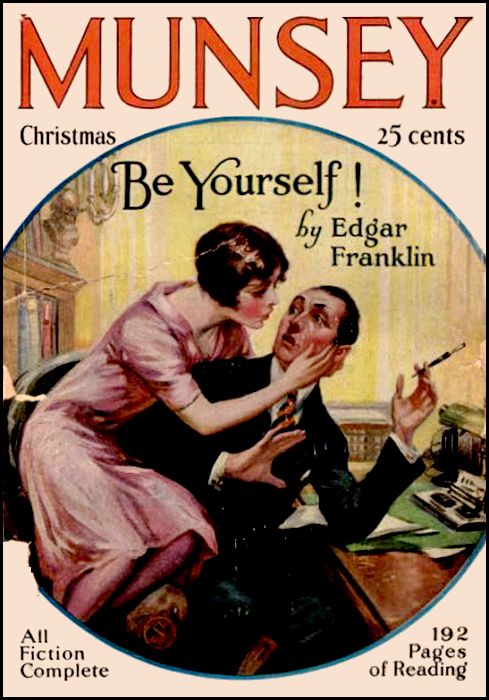
The Munsey Magazine, Dec 1927, with "Incompatibility"
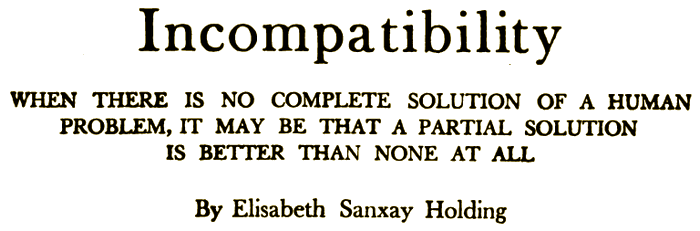
A story of divorce, wounded pride, and the painful clarity
that comes when parents see their children suffer.
FROM the window of his office Blakie saw them coming, hand in hand, looking very neat in their white dresses, shiny black pumps, and big straw hats. They came quickly, eyes front, with a rigid, frightened air, among the hurrying crowds of the down town street.
"What's she thinking of, to let them come alone?" he cried to himself.
Snatching up his hat, he went out to meet them. A man jostled them, and they stepped aside, directly in the path of another man in a hurry, who ran into Irene and went on, frowning. Her hat fell off. She stooped to pick it up, still holding fast to Martha's hand.
Blakie swung her up and kissed her hot, anxious little face.
"Well, Renie!" he said.
"Daddy!" she answered, with a sigh of relief.
"And Marty!"
"Oh, daddy dear!"
Taking a hand of each, he turned back toward the office. No one would jostle them now—not with his strength to protect them. Poor little devils!
There came back to him, in a rush, all the old savage exasperation he thought he mastered. Just like Katherine, to send them alone!
"Daddy, I've got a kitten!" said Martha. "It's a gray, fluffy one!"
But he was not listening.
"You shouldn't have come alone," he said curtly.
"Only just from the corner, daddy! Madge brought us to the corner, and then she pointed where your office was, and there weren't any streets to cross or anything." Something in Martha's voice made him glance down at her. He found her looking up at him with a queer, anxious little frown knitting her brows. "She brought us right to the very corner, daddy!"
"That's all right, chick!" he said, squeezing her hand. "I mustn't even hint anything against—Katherine," he thought. "Poor little kid—she's worried. This way!" he said aloud. "In here!"
He opened the door of his new suite of offices. A fine suite it was, and he was proud of it.
"Rather different from the old place, eh?" he said.
"Oh, yes!" said Martha.
She had taken Renie's hand again, and they stood stiff and straight, terribly conscious of so many strange eyes regarding them. They were beautiful children, dark as gypsies, with a lovely color in their sunburned cheeks. Both of them were straight and sturdy, like himself. They were unmistakably his children.
"Dead image of you, Blakie!" said Crisson, his partner. "Fine kids! Let's see—how old are they?"
"Martha's ten and Irene is eight."
"Lord! How time flies!" said Crisson.
The past six months had not flown for Blakie.
Katherine was to have the children for six months of the year and he for the other six months.
"But you won't really do that, Lew?" she had said. "You won't take them away from me?"
Just like her, when she had tried to take them away from him! She had come to his office—that was just like her, too; an outrageous thing to do. They were divorced, by her wish. She had a generous allowance, and he had agreed to everything she wanted, except to give up his children.
"I won't discuss it," he had said to her.
At first she had begged and pleaded, with tears streaming down her face. When he remained unmoved, she had grown angry in her reckless, vehement way. He was pretty sure that Crisson had heard her that day, and he often wondered how much Miss Deering had heard. Certainly every one in the outer office had seen her when she went out, with the marks of tears on her face.
He could never think of that day without growing hot with shame. For a moment he even felt ashamed of the children, living reminders of his disgrace. His wife had left him—every one knew that.
"Miss Deering!" he said.
He felt a little thrill of pleasure at the girl's instant response. She was always so eager, so willing. She answered his call with a smile on her grave young face and a quick glance at him, as if she were trying to read in his face what he wanted.
"Do you think you could entertain these two young ladies for half an hour?" he asked.
"Oh, I think so!" she replied cheerfully. He saw the color rise in her cheeks. She was proud to be chosen for this duty.
She took the little girls by the hand and went off, and Blakie stood for a moment, looking after them. Then he went into his private office and shut the door. There was some work he wanted to do before lunch; but he could not do it. The feel of those little hot hands had stirred him intolerably. His children! He loved them so, he wanted them so! His children!
"I'll never forgive her!" he cried in his heart. "It was a damnable thing to do, to break up their home! They're worried and puzzled. Poor little kids!"
His life with Katherine had been a misery to him, but he would have endured it all his days rather than hurt his children. It was she who had left her home. She had told him often enough that she "couldn't stand it," but he had never expected that.
"Heartless," she had called him, and "a stiff, solemn prig." That had been her standard reproach for him—that he was a prig. When, coming home late, he had found the children still up, romping with Katherine and mad with excitement, and he had protested, she had called him a prig. When he had asked her not to come down to breakfast in a dressing gown, and when he had asked her to be more careful of her gossip before the children, she had said the same thing.
He had wanted to give them a normal, decent life, to assure them a good start.
"And, by Heaven, I will!" he thought. "I'll have them, alone, for half the year. I can give them some sort of idea!"
Then, at the end of his six months, they would go back to Katherine and her careless, rebellious life—breakfast in a dressing gown; old Madge doing the work of the house just as it suited her; the telephone ringing and people dropping in; Katherine, with her shining black hair in a great, untidy knot, sitting at the piano, singing.
He could never think of her singing without a twinge of pain, because of what it had once meant to him—the big, glorious voice that came pouring from her throat without effort; the feeling in it, the pity, the tenderness. "Theatrical," he had learned to call it, just as he had learned to look upon her beauty with a fastidious detachment. Certainly she was beautiful—a tall, full-bosomed, long-limbed creature, with a lazy grace in every movement, and a face indestructibly lovely, with dark gray eyes, clear, fine features, and a mouth too wide, too generous, unforgetably sweet.
It seemed to him that whatever Katherine took in her careless hands she ruined. She wasted everything. She had had a magnificent career before her, in light opera, and she had thrown it aside to marry him; and now she had thrown him aside, hurt beyond healing. His love for her had been a madness. He had been swept off his feet, infatuated, desperate; and she had been so kind in the beginning—kinder than any other woman could be.
"Because she had her own way," he thought.
He had never criticized her then. He had not been doing so well in business. They had lived in a tiny house in Brooklyn, with only old Madge to help; and he had come home there at the end of the day like a soul to Paradise. He remembered how he used to open the door with his latchkey and go in; and no matter how quiet he was, she would always hear him.
"It's himself!" she would call to Madge, with the trace of brogue that never quite left her. "Put the dinner on the table, Madge darlin'!"
Then she would come running to him, fling her arms around him, and draw his head down on her breast.
"You're tired, my heart's darlin'! There! Don't you talk! Come in and see what Madge and I have got for you!"
"I've got to wash, Katherine."
"Wash in the kitchen, so you'll not have to go upstairs, and you so tired, my dearest!"
But he never would wash in the kitchen.
Then they would have dinner, old Madge joining in the conversation as she waited on the table. Katherine had spoiled Madge from the start, calling her "darling," and sitting in the kitchen to talk with her; but still, how Madge could cook!
After dinner people would usually come in—friends of Katherine's, whom he did not much like, theatrical people, some of them charming, some of them queer old friends whom she would not abandon. To show her husband that he was supremely important, that he was not left out, she would sit on the arm of his chair, with her hand on his shoulder, bending now and then and kissing the top of his head.
"Talk now, Lew darlin'!" she would say. "Listen now, will you, to what Lew's got to say!"
But he had not liked such public demonstrations.
"I loved her, though," he thought. "I was happy."
He did not want to remember all that. It was intolerable to remember, in his bitterness, those warm, glowing years of love and delight; and yet it seemed to him that it would be wrong and cowardly to shirk the memory, to shut his mind to any of the vivid little pictures that rose before him. He closed his eyes, to see more clearly, and let the full tide of the old pain rush over him. He was a man, and he could bear it. He must bear it.
Katherine had spoiled everything. As he got on in the world, he had had to live differently, and she would not help him. Once he had asked Crisson and his wife to dinner. He was not a partner then, and it was an important occasion for him; but Katherine took it with her usual careless good humor. When her guests arrived, she was not dressed. After a very awkward wait of nearly half an hour, down she came, laughing and lovely—and untidy.
Blakie saw her through the Crisson's eyes that night. He got a fresh view of things to which he had grown almost accustomed—Madge's casual fashion of waiting, and the badly ironed napkins.
After dinner she sat down at the piano and sang for them, and her coil of shining hair came loose and slipped down. Mrs. Crisson, with a tight smile, rose and put the pins in firmly, while Katherine went on singing.
They had their first real quarrel that night.
"Can't you do your hair decently?" he said. "Mrs. Crisson—"
"And her with a wisp of hair that looks like nothing at all!" Katherine cried indignantly.
"That's not the point," he told her, but she would not listen, and they said cruel things to each other.
In the morning she was her usual jolly self again, but it was harder for him.
That had been the beginning. Later there had been more and more quarrels—when she had bought things they couldn't afford, or, in one of her fits of repentant economy, had insisted upon going shabby.
"What do you care at all what people will be saying?" she would say, when he protested.
For she never cared. She came of a good family; her father had been aid-de-camp to the governor of a British colony, but she had never cared.
"No!" she assured him, laughing. "Nobody else cared, either. They all loved me. I could have gone to a ball in a flour sack, and nobody would have cared!"
"But, see here, for my sake, Katherine—"
"I'll try," she said, and that same day she bought herself a huge plum-colored velvet hat that appalled him. They had quarreled about that, too.
At first she had only laughed at his criticisms, but as time went on she grew to resent them. In her girlhood, and during her brief time on the stage, no one had criticized her. Every one had loved her.
"And you!" she had cried once. "You're the one ought to love me best of all, and you do not, Lewis!"
"What about your loving me a little? Won't you just try?"
There were years and years of that. Even after they had two servants, the house was always a little untidy—not dirty, but with a disorderliness that tormented him. The meals were often late, and she herself was always late. Her friends were forever dropping in. They came to her with all their troubles, and she would lend them money, or give them warm-hearted, prejudiced advice, or just sit listening and crying gallons of tears over some sad tale. Then she would want to tell her husband all about it, and would grow angry at his lack of sympathy.
All this went on until there was nothing left but bitterness between them; and then she had gone away with the children and had written him a letter to say that she was not coming back.
He remembered that first night in the house. He had gone into her room, all in disorder from her packing, and then into the empty nursery, where Renie's despised and ill-used rag doll sat in a broken rocking chair. If he could have seen Katherine then he would have begged her to come back; but when it came to writing a letter, that was a different matter. He had his pride to consider.
He had written briefly, asking her to come back for the sake of the children, and he had had an answer from her lawyer. He had not been sorry. Lonely as he was, there was an immense relief in that loneliness, and there was a dignity which had long been lacking. It was as if he had found his soul again.
Finished now all their life together; but life itself was not finished. Blakie was only forty-five, and there were years and years ahead of him.
He thought of Frances Deering, with the curious uneasiness that the thought of her always caused him. He couldn't help knowing! She was very grave, very businesslike in her manner, but he couldn't help knowing!
Sometimes, when he caught her looking at him, the honest, innocent admiration in her eyes gave him a thrill of pride and pleasure. At other times it troubled and irritated him. Twenty-two she was, not much more than a kid—a good girl, and a pretty one, but he was not interested in that sort of thing. He had loved Katherine with a love that would never come again, and he wanted no more of that.
Yet sometimes, in his hours of dejection and loneliness, he would think of the solace of an honest, faithful affection, of what it would mean to have some one waiting for him at home, some one to care if he were ill, a companion for his older years.
With an impatient frown he pushed away his papers and rose. He couldn't work now.
As he went into the outer office he saw Frances sitting at her desk, with the little girls beside her, all of them busy cutting out rabbits from colored memorandum pads, and talking quietly together. Something in the sight displeased him. The girl's fair head, as it bent down toward the children, had a meek look about it. Her quick and whole-hearted acceptance of all Blakie's orders made him feel like a sort of sultan, a very lonely autocrat. He didn't like that.
"Thanks, very much, Miss Deering," he said. "Now, kids!"
Her eyes sought his face, as if to read there the meaning of his crisp, impersonal tone.
"What have I done that you don't like?" her eyes asked.
"You are not the one," his heart answered. "You are good and pretty and young, but you are not the one. What you want to see in my face no woman will ever see again!"
BLAKIE had made very careful plans. He had taken a flat near the park. He had engaged a good cook, and a nursery governess who would come every morning to take the children to the school on Riverside Drive where Katherine had started them. It was not the school he would have chosen, but they could not change every six months.
He had consulted with his doctor about a proper diet for children of their age. He had drawn up a schedule, not too rigid, for their baths, meals, study, and exercise. He had bought roller skates for them to use in the park; he had arranged riding lessons and dancing lessons for them; he had bought them books and toys.
He had furnished a room for each girl. Martha's was pink—a pink rug, rose-colored curtains, a little lamp with a rose-colored shade, wicker chairs with cushions, a bookcase, a desk, and a rose-colored eider down quilt on the foot of the little white bed. Next to Martha's room was Renie's, decorated in blue.
"How does that suit you?" he asked, opening the two doors.
They stood one on each side of him, looking into those bright, cozy little rooms with wide, solemn eyes.
"They're awfully sweet, daddy dear," said Martha.
"Awfully sweet," Renie echoed, but he saw her restless dark eyes roving about, looking for something. What could he have neglected or forgotten?
"She feels strange here," he thought. "It was bound to be like that at first." Aloud he said: "Dinner in ten minutes, chicks."
For it was his policy to give them no time to be homesick.
All afternoon he had had them out at the Bronx zoo, and the cool April air and the excitement had made them healthily tired.
"Just time for a wash and brush," he said.
"I—can't unbutton my shoes, daddy," said Renie.
"Never mind about your shoes," he answered.
"But mother said not to wear our best shoes in the house."
Just like Katherine, he thought! Dress up for a public appearance, and never mind how you looked at home!
"Never mind about your shoes," he repeated a little impatiently. "Just brush your hair."
"But mother told us—" said Renie, and he saw her lip tremble.
"All right!" he said hastily. "Sit down!"
He knelt down and unbuttoned the shiny pumps, while Martha, with a brisk, competent air, opened their small suitcase and brought out two pairs of cracked old pumps.
They went off hand in hand to the bathroom, and came back damp and rosy.
"Now!" he said, hoping that the sight of the dinner table would arouse them to some expression of delight.
It had seemed to him a matter of great importance that his daughters should learn to like a well appointed table, to appreciate a charming and orderly environment, and he had done his best here. A damask cloth and gleaming silver, a centerpiece of roses, and before each child a silver knife, fork, and spoon, monogrammed, and, to charm them, a little china basket filled with pink and white sweets.
"This is the way things ought to be," he wanted to tell them. "This is the way you ought to live. This is what I longed for, all through those years of carelessness and disorder!"
But he could not say that. He must not even hint at any disapproval of their mother's régime. That would be an inexcusable treachery.
He felt certain that Katherine had never belittled him to them. He could trust her for that. There was nothing petty about Katherine.
"It's awfully pretty, daddy!" said Martha.
Renie echoed her sister's approval; but they didn't seem impressed.
"They are strange here," he thought. "After a few days it will be different."
Their appetites were good, he noticed. Their mother had always looked after their physical welfare most vigilantly. Their table manners were good, too. Well, so were hers, when she bothered to think about such things.
"She's taken good care of them," thought Blakie.
He had known that she would. Her love for her children was an unfaltering, inexhaustible passion. She was often injudicious with them. She spoiled them, of course, and sometimes she grew angry at them. Once he had heard her call Martha a darned fool; but Martha had only laughed at her, and then Katherine herself had laughed and hugged the child tight.
"Didn't mean to be so cross, sweetheart baby!"
"Oh, I know it, mother!"
What sort of way was that to bring up children?
"She'll be missing them to-night," he thought.
It was hard to imagine Katherine without her children. She had always been with them, and had taken them everywhere with her. Indeed, she had been ridiculous about them, running to the school to say that she feared Marty was tired, and calling in the doctor on any pretext. Yes, she would be missing them to-night!
"Good God, haven't I missed them for the last six months?" he thought. "They are my children, too!"
He glanced at their little dark heads bent over their plates, at their blunt little fingers grasping the new knives and forks, and such a wave of tenderness and pain swept over him that he could scarcely breathe.
"I want to keep them!" he thought. "I want to give them the very best! Poor little things!"
After dinner he took them into the sitting room and read to them from one of the new books. They were passionately interested.
"Go on! Go on, daddy!" they cried, whenever he stopped to puff at his cigar.
At eight o'clock came the moment he dreaded.
"They'll miss their mother," he thought. "It'll be hard, this first night."
"We'll have a race with the undressing," he said. "Call me when you are ready—and the first one in bed gets a prize!"
That worked very well. In an incredibly short space of time Marty shouted:
"Ready, daddy!"
And her faithful little echo cried:
"Ready, daddy!"
They were both under the covers, grinning from ear to ear. Their clothes were scattered all over the room, but he decided not to notice that to-night. He even had an impulse to pretend to forget their prayers, for fear of troubling them, but he resisted that. He didn't insist upon any great accuracy, however.
"Now," he said, "I'm going to be there in the sitting room. You can see the light from your beds. If you want anything, call me."
Then he turned out their lamps, opened their windows, and kissed them in a cheerful, casual way, fighting down his longing to catch them up, to hold them fast, tight in his arms, after these six long months.
"Night, daddy!" they called simultaneously.
He sat down with a new book to read; but after all he could not read. Here they were, safe in his care, surrounded with everything they ought to have—except one thing.
He smoked, staring at nothing. They were here with him, his children, and yet there was a desolation in the place. He felt it, and he knew they must feel it.
He put down his cigar and went into Renie's room. She was sound asleep. He touched her head, found it damp with perspiration, and took off the eider down quilt, which she had pulled up.
Then he went into Martha's room. She, too, was perfectly quiet, but her head was covered up, and, as he tried quietly to draw down the quilt, she clung to it.
"Marty, dear! Are you awake?" he asked gently.
"Yes, daddy," replied a muffled voice.
"Uncover your head, pet. It's not good for you."
She obeyed him, but lay with her back turned to him.
"Look here, Marty dear! Don't cry!" He sat down beside her, and stroked her hair. "Don't cry, pet!"
She was very quiet, but he felt her little shoulders shake.
"Look here, Marty! I know how it is. You miss your mother."
"Oh, no!" she declared with a sob.
"You needn't mind telling me, Marty. It's quite natural, dear."
"But it isn't—polite," she said, with another sob.
"Yes, it is, Marty. I don't mind."
"Don't you really and truly mind, daddy?" she asked, turning to him.
"Not a bit, Marty. It's quite natural."
She sat up and flung her arms around his neck, burying her head on his shoulder. She was drenched in tears. Even her little hands were damp.
"Oh, I do miss mother!" she whispered. "I do miss her, daddy! I don't want to be unpolite, but I do miss mother so!"
He held her tight, in despair.
"I know, Marty, I know; but you'll be going back to her soon, dear."
"Then I'll miss you," she said. "All the t-time I'll be going away and m-missing you both!"
He was frightened to feel her tremble so. He picked her up and carried her into the bathroom. Her face was stained with tears, her eyes were heavy, her body was shaken with sobs.
He bathed her face with cold water, and gave her a drink. Then he carried her into the sitting room.
"Don't cry so, Marty dear! Shall I read to you?"
"I didn't mean to be—so unpolite to you, daddy darling!"
"Don't say that, Marty!" he cried. "It's—"
Her wet cheek was pressed against his.
"I missed you so, daddy," she whispered, her voice hoarse from sobbing.
She was growing quieter now, and he held her in his arms, feeling her little heart beat against his. Then, suddenly, she burst out again wildly:
"Oh, daddy! Oh, daddy! I've got to be—always going away—and missing you both! I can't bear it, daddy! Oh, I miss mother so awfully, terribly much! Oh, daddy, I want mother!"
"Hush, Marty!" he said in anguish. "You'll wake Renie, you know."
That calmed her at once. She sobbed a little longer, but her tears had ceased.
"It's worse for Renie," she said soberly. "She slept right in mother's room. I just had the door open between. I'd hate to have Renie wake up."
"So we'd better not talk, eh?" said Blakie.
"I guess probably we hadn't," Martha agreed.
She fell asleep there in his arms. Presently he carried her back to her bed, and sat there beside her in the dark.
Every six months a cruel parting, a difficult readjustment! It was bad enough for a mature and armored spirit, but for children, two little loving, bewildered children—what would it do to them?
They were too young to be critical. They gave only love to both parents, making no comparisons; but as they grew older it would not be so. Suppose he succeeded in his attempt to make them appreciate a gracious, well ordered life? Then, when they were with Katherine, they would suffer—would suffer all the more because they loved her. Every six months a cruel parting, a difficult readjustment!
"It can't be like this," he said to himself.
It was not for them to suffer, to make readjustments, to have their love so tormented, their faithfulness so tried. No, let the guilty suffer, not these innocent ones!
He was guilty—he knew it; and Katherine was guilty. They had had a beautiful and invaluable thing, and they had destroyed it by a thousand almost imperceptible blows. It was gone now, and could never again be restored; but it need not have perished. If he had been less critical, if she had been less willful, if only there had been a little more patience and generosity on either side, their love could have lived.
Perhaps they were not well suited to each other. What did that matter? He and his business partner were ill suited to each other, but it was expedient for them to get on peacefully together, and they did. His mother had been a very exasperating old lady, but he had considered it his duty to get on with her, and he had done so. He had ardently disliked the captain of his football eleven at college, but as a matter of course he had mastered the dislike. He had learned to get on amicably with all sorts of people; but this woman whom he had chosen—
Any two persons who were reasonably civilized and self-controlled could get on together, if they tried. They might not be particularly happy in doing so, but they could do it, if they tried.
"We didn't really try, either of us," he thought.
It was too late now to start again. There was too much to be forgiven and forgotten; but these children should not suffer.
THE next day was Sunday, and Blakie had promised to take the two girls into the country for a picnic; but at breakfast he suggested another plan.
"Suppose we go and see mother," he said.
Renie's sensitive face grew scarlet, but Martha frowned a queer little anxious frown. She couldn't understand this.
"We'll go early," he went on, "so that she won't be out."
He sent them into the kitchen to talk to the cook, while he went into Martha's room to repack their bag. They would not come back to these gay little pink and blue rooms!
Then he took the bag downstairs, put it under the seat in the car, and went up to fetch the children. He would not tell them they were not coming back. If he could help it, there should not be another cruel parting for them.
He drove the car himself, leaving them together in the back seat; and all the way he tried to find some consolation for his great bitterness.
In all the world there was nothing but Frances Deering.
"I'll marry her," he thought. "I'll have a home of my own. She's a dear little kid!"
He must have some one, and he saw clearly that he could build up a good life with Frances. He was fond of her; perhaps he could love her, in a way. He could have a good life, honorable and dignified and comfortable.
Katherine's flat was in a very second-rate neighborhood. That was just like her!
"What do I care at all for the neighborhood," he could imagine her saying, "if it's a nice flat with plenty of air and room?"
He stopped the car before the door.
"You wait here for awhile," he told the children.
Going into the ornate entrance hall, he asked the colored boy to telephone upstairs to Mrs. Blakie that a gentleman had come to see her on business.
"You're to go up," said the boy.
She opened the door for him herself. At the sight of him her face grew white as death.
"Oh, God!" she cried. "Something's happened to them! Oh, God! I knew, if I let them go—"
"Don't be silly!" he interrupted sharply. "They are both perfectly all right. I simply want to speak to you for a moment, if—"
He stopped short, shocked and dismayed that he had spoken in the old tone of irritation.
"Come in, Lew," she said anxiously.
He followed her into the sitting room. It was untidy, with music scattered all about, and through the open doorway he could see the breakfast dishes still on the table.
"Madge has gone to mass," she explained.
There was a strange sort of humility about her that he had never seen before. She was wearing a silk kimono, with her hair in a loose plait. Her face was pale and jaded and stained with tears.
"I'm sorry the place is so upset," she said.
He knew what made her so apologetic. He had the upper hand now—he had her children.
"Sit down, Katherine," he said, stung to a great pity. "I shan't waste time beating about the bush. I've been thinking—most of the night."
"So have I," she replied. "All night!"
"It's not right, Katherine. It's not fair to them."
"I know," she said.
He was silent for a moment, looking about him. It was easy to see why her children loved her so, why she had so many friends. In all her carelessness there was something lavish and generous. She was never petty. She was like a child herself, reckless and impulsive—and lovely. Hadn't Blakie loved her himself, and known how beautifully kind she could be? Never could his children suffer any great harm from her.
"I've brought them back," he said.
"Lew!"
"Yes," he said. "It's too damned hard on them—this way. I've brought them back to you—to keep."
"Lew!" she cried. "Oh, my poor Lew!"
Tears were running down her cheeks. He patted her shoulder.
"Buck up!" he said. "You've got to think of something to tell them, so that they won't—be upset—about me."
He turned away, but she followed him.
"Lew! They will be upset! They've missed you. They need you."
He knew that.
"All the night long I've been thinking," she went on. "Can't we start again—for their sakes?"
They faced each other now, and all that they had lost. If they were to start again! There would be no gracious and dignified life for him, no careless freedom for her. They would exasperate and hurt each other, again and again.
He walked over to the window and looked down to Renie and Martha, sitting side by side in the car.
"We can try," he said.
Roy Glashan's Library
Non sibi sed omnibus
Go to Home Page
This work is out of copyright in countries with a copyright
period of 70 years or less, after the year of the author's death.
If it is under copyright in your country of residence,
do not download or redistribute this file.
Original content added by RGL (e.g., introductions, notes,
RGL covers) is proprietary and protected by copyright.