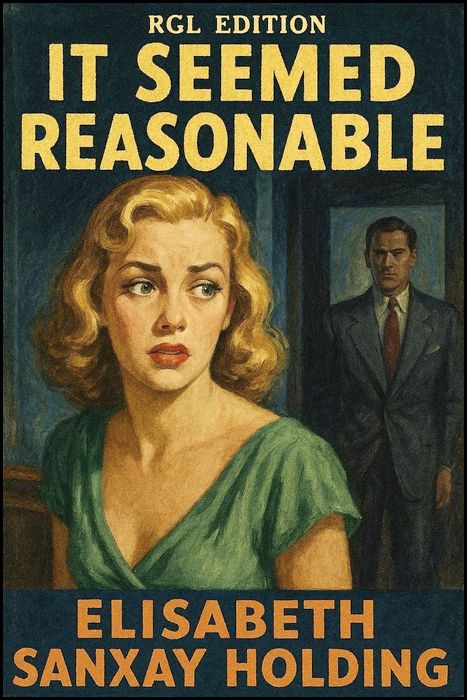
RGL e-Book Cover
Based on an image created with Microsoft Bing software
Roy Glashan's Library
Non sibi sed omnibus
Go to Home Page
This work is out of copyright in countries with a copyright
period of 70 years or less, after the year of the author's death.
If it is under copyright in your country of residence,
do not download or redistribute this file.
Original content added by RGL (e.g., introductions, notes,
RGL covers) is proprietary and protected by copyright.
RGL e-Book Cover
Based on an image created with Microsoft Bing software

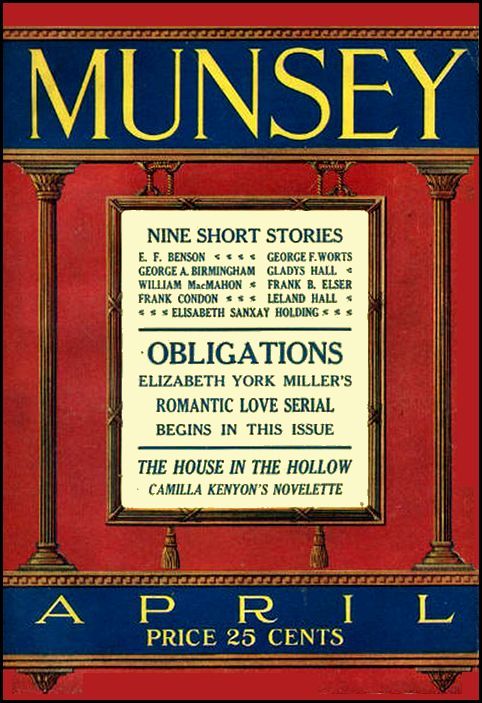
The Munsey Magazine, April 1923, with "It Seemed Reasonable"
A seemingly harmless, "reasonable" decision made under social pressure leads an ordinary woman into a tightening web of suspicion, fear, and moral compromise—classic Holding territory, where danger grows not from violence but from psychology.
CHRISTINE and Paul were peaceably reading that evening in their model sitting room. The room was properly ventilated, the air was kept at the correct degree of humidity, the lighting was restful and hygienic, the furnishings were all in the best of taste.
They were a serious young couple. Paul was reading "Post-War Conditions in Beluchistan," Christine was reading "Civilization's Last Sigh," and they concentrated their attention upon the books. Beside Paul, on the table, lay the three cigarettes which he allowed himself every evening, while Christine had three ounces of milk chocolate. There was not a sound from either of them, because the correct hygienic temperature, the bland light, and their own well balanced temperaments, prevented them from being fidgety. They had made up their minds that marriage should not make them frivolous, narrow, or dull, and it had not.
It was a January night of cruel, silent cold, black as the pit. It was nearly ten o'clock, and they certainly expected no intruders upon their serious quiet. Once, when Paul found that he had not exactly grasped the meaning of a paragraph, and had to turn back, he glanced up. By chance Christine also looked up, so that he met her eyes—her clear, honest blue eyes, so soft as they rested upon his face that he grew a little dizzy with the joy of it.
He could not take Christine quite sensibly yet. He knew that she was nothing but a human being, with many faults; yet very often he had wild hallucinations that she was an angel, a goddess, a mystery. She may have been subject to similar delusions, for she continued to look at her Paul, half smiling, as if lost in the contemplation of a miracle.
But suddenly their peace was destroyed—and for a good long time, too, as it happened—by the sound of the doorbell and the entrance of a glowing, dark-eyed girl with a tam-o'-shanter and a scarf of violent green. She brought an icy breath of air with her, but she herself seemed warm, almost fiery, with her rosy cheeks, her red hair, her gay and confident manner.
"Excuse me, people!" she said. "I know it's an awfully unconventional time to burst in on you, but I've locked myself out of my poor little house, and I'd rather be a little unmannerly than freeze!"
Paul drew forward a chair, and down she sat, drawing off woolen gloves from a pair of very pretty little hands. She was very pretty, altogether, in a startling sort of way, and she had an incomparable self-possession.
"My name's Lucille Banks," she remarked. "I've taken that little cottage down at the crossroads. I moved in this morning, and I was so busy getting settled that I forgot about dinner until awfully late. Then I went out to buy something to eat, and I forgot my key."
"But you're not alone in the cottage?" said Christine.
"Lord, yes!" replied the other cheerfully. "I don't mind that. I'm used to being alone. I like it." She laughed. "I look like a kid, but I'm not," she said. "I'm twenty-four. I was with the Red Cross in Italy. I've lived in Paris and London. I did a thousand miles by airplane. I've written a book. So you see!"
The serious couple were astounded and greatly interested.
"But where could you get anything to eat at this hour in this place?" asked Christine.
"I couldn't. I didn't; but that doesn't bother me. I've never pampered myself by eating a certain amount of food at certain intervals. If I could possibly beg a cigarette?"
"Oh, by all means!" said Paul hastily, and brought out his case.
Christine protested.
"Let me get you something to eat, instead," she said. "It's so bad for you to—"
"Nothing hurts me," Miss Banks coolly interrupted. "Even if it did hurt me, I shouldn't care. I'm going to do all the things I like to do, and hang the consequences!"
This speech did not please Christine very much. She glanced at Paul. Somewhat to her surprise, she found him with a faint smile on his lips.
"Every one who says 'hang the consequences' thinks there won't really be any," he said.
"Consequences fall alike upon the just and the unjust," remarked Miss Banks, through a cloud of smoke.
She, too, was smiling now, with her strong little white teeth gleaming, her dark eyes alight. She went on to express her audacious theories of life, and her energetic and reckless views about everything else, at some length.
Christine liked it less and less. She admitted freely that this Miss Banks was extraordinarily pretty, and had a debonair charm of her own, but she imagined that the girl was not to be trusted very far. She felt sure that Paul would think as she did, for they always agreed; so she looked at him, and the expression on his face surprised her. He was regarding Miss Banks with a sort of indulgence, almost compassionate, as if she were a rash and silly child, and he a man of the world.
Until this moment, Christine had looked upon Paul as a comrade, a friend, whose heart she knew as she knew her own; but now it suddenly occurred to her that Paul had been alive for twenty-six years before she had seen him, existing and thriving by himself. For some reason this idea hurt and dismayed her. She no longer listened to the lively dialogue between him and Miss Banks. She wasn't good at talking; what she liked was to listen to Paul—but to Paul when he was talking to herself, not to Miss Banks.
"Of course I'm not interesting," she thought. "I've never done anything but grow up and go to college and get married. I've never seen Paul so interested!"
Her far from pleasant reverie was disturbed by Miss Banks springing up.
"Well!" she said. "If you can get me into my little house, please do. I've got to be up early to-morrow morning, to cover the Industrial Women's Peace Convention for my paper."
"Are you—" began Christine.
"I'm a free lance journalist," said Miss Banks. "I suppose they picked me for this job because I don't know anything about industry, and hate peace and women!"
Paul had risen.
"Do you hate women?" he asked in that same amused, indulgent tone.
"As much as Nietzsche did," Miss Banks assured him. "Only in general, of course. There are exceptions."
She smiled at Christine and held out her hand—which Christine had to take, and from which she received a fierce grasp that tingled through her arm and positively made the color rise in her face.
"You little beast!" she murmured, with energy, as Paul and Miss Banks went out of the front door.
AS they stepped out of the tranquil, bright house, the cold sprang like a wolf at Paul's throat and made him gasp. The blackness and the stillness of that night!
"We'll make a dash for it," he said, taking Miss Banks's arm—a very solid little arm it was, too.
"No hurry," said she. "I like this kind of weather, and I like this awful, dismal little place. At night it doesn't look like a suburban residential park. It might be Siberia!"
Paul, being a man, was therefore obliged to conceal his extreme discomfort, and to stroll along at the girl's side, though the cold bit him to the bone and made his throat ache, though his numbed feet struck against stones and caused him anguish. He had to talk, too, and even to laugh, as they went down the long, lonely road.
Then they reached the corner, and turned off down a lane, not yet improved, but full of ruts and ridges of frozen mud. Paul had heard of the good old-fashioned punishment in which the culprit had to walk over red-hot plowshares. He thought that it could not have been much more painful than traversing this lane. The friendly interest he had felt in Miss Banks was greatly chilled. He thought she was an inhuman little monster.
They came in time to her cottage, all dark and silent, with a low, white fence faintly visible, like a necklace of bones round the stark garden. There wasn't another house within sight. No one but an inhuman little monster could have endured to live here.
"Now!" said she. "Let's see you get in!"
She perched herself on the fence, quite blithe and unconcerned. She even whistled.
Paul and Christine had always agreed that woman should be man's comrade and helper. When woman, however, was not a helper and comrade, but sat upon a fence, whistling, and simply waiting, man was conscious of a new and not displeasing sense of obligation. He felt that he must display the primitive manly qualities of strength and cunning, that he must be practical, energetic, and so on.
Christine would have wanted to help and advise him. If he had insisted upon doing it alone, she would have thought he was "showing off." Well, perhaps he was. He deserved that privilege, set down as he was on a bitter night before a strange house and told to get into it.
He did get into it. After finding everything locked, he broke a window pane with a stone, inserted his hand, and turned the catch. The window then lifted readily enough, so that he could crawl through. Ingenuity, always ingenuity!
Nothing for him to stumble about in that musty, cold, strange blackness, find a lamp and light it, and open the front door. Nothing for him to light a fire on the hearth of the sitting room and another in the kitchen stove. Nothing to him that his hand and wrist were cut and bleeding. He pretended not to notice that, and Miss Banks really didn't.
Then he stuffed up the broken window pane with rags, and then Miss Banks had plenty of other little things for him to do—boxes to open, furniture to move, and so on.
"I can't do a blessed thing for myself," she observed.
Now Paul was grimy and very weary, and those cuts were painful. The sight of Miss Banks sitting comfortably in an armchair by the fire did not give him the unselfish pleasure it should have given.
"How did you manage to get on, then, in Siberia, or wherever it was?" he demanded.
"I've never been in Siberia," said she, "but I'd get on there—or anywhere. I know how to get things done!"
This struck Paul as a very tactless remark. Such knowledge was not a thing to boast of; but he happened to look at her, and she was looking at him, and his serious face broke reluctantly into a grin.
"Don't you know," said she, "that Adam delved while Eve spun? I'm perfectly willing to sit comfortably by the fire and spin, as long as there's a man to go out in the cold and delve; and there always is!"
Now Paul did not like this attitude. He thought Miss Banks a selfish, unscrupulous, and domineering creature—but challenging. She was quick and clever and audacious, besides being very pretty; and it was necessary to show her that he was not a cat's-paw.
Of course, he could not very well refuse any of her requests. He had to chop wood, to break open a cupboard door, and to nail up rows and rows of hooks; but he did all this with a bland and superior air. Being unused to such work, it took him a long time. When at last he had done, and had put on his overcoat, instead of thanking him, Miss Banks remarked:
"They say that if you want a thing done well, you must do it yourself: but for my part I'd rather have things done badly—by some one else!"
"Thanks!" said Paul frigidly.
Miss Banks was standing quite close to him, staring at him with candid interest.
"The trouble with you is," she said, "that you're spoiled!"
Paul was hard put to it to find a superior smile.
"Thanks!" he said again. "And now, if there's nothing more you want done I may as—"
"There'll be lots more things to-morrow," she interrupted; "but you've had enough, haven't you?"
This was too much for Paul. He saw by her self-satisfied smile that she fancied she had exploited him and made an idiot of him, and was laughing at him.
"No," he said, in a calm, reasonable tone. "If you want me to help you, I'll come again to-morrow."
Then he went off, scarcely feeling the cold now, because of the wrath and resentment that burned in him.
PAUL found Christine just beginning to grow alarmed.
"It's nearly one o'clock," she said. "I thought—"
Her husband sat down and lit a cigarette.
"The silly girl has things in such a mess," he said, "I thought it would only be decent to stay and help her a little."
"Of course," Christine agreed.
She was uneasy at Paul's appearance. He looked pale and tired and severe. There were smudges on his face and on his collar; and then she caught sight of a grimy handkerchief tied around his wrist.
"Have you hurt yourself, Paul, darling?" she asked anxiously. "Do let me see—"
"Certainly not!" he answered, frowning. "I'm not one of those clumsy imbeciles who are always getting hurt!"
This was the first time that Paul had ever behaved quite so much like a married man; but Christine was prepared for it, and was tactful.
"She's a very pretty girl, isn't she?" she asked.
"She may be pretty," Paul answered judiciously; "but she's not the type that appeals to me. Personally, I think she's the very worst type of modern woman. She's—there's nothing feminine about her. She's an egotist." He paused. "After all," he went on, "what a woman should be is a man's comrade and companion. They should share their work and their play. This idea of a woman having all sorts of absurd privileges, and behaving like an empress, simply because she's a woman, is monstrous!"
Christine made a heroic effort not to cry. She knew Paul was not speaking of herself. Never had she behaved like an empress, or wished to do so, and she did share the work loyally. Of course it wasn't his fault if her share was composed of very monotonous, dusty, dull little tasks, and of course it wasn't his fault that there was mighty little play to be shared.
He went on, in that severe tone, talking about women, and she was certainly one of them. Indeed, she had a guilty consciousness that she was more of a woman than Paul suspected. She tried to stifle her shameful, ignoble feelings, and when she couldn't stifle them, she hid them. Never should Paul know how she felt about Miss Banks. He expected his wife to be a comrade, and a comrade she would be, at any cost.
Thus it was that a curious situation arose. Paul would denounce Miss Banks with great energy, while continuing to go and see her and to assist her; but Christine, who avoided the girl as far as possible, defended her chivalrously.
Miss Banks now had a telephone, and knew how to use it. Suddenly, in the middle of a calm, sensible evening, her voice would come over the wire, asking Paul to come and mend a leak, or kill a rat, or investigate a mysterious noise. Paul always said no, he wouldn't go, but Christine always persuaded him to go—and generally cried after he had gone, because he so obviously wished to be persuaded.
He never suggested that Christine should accompany him. Neither did Miss Banks. Indeed, she said things about tame husbands that prevented Paul from even considering such an idea.
Why he liked to see the girl he couldn't understand. She was as rude, as impertinent, as mocking, as she chose to be. She frankly admitted that she liked to "take him down a peg." She made fun of him, she kept him busy at arduous and humiliating tasks. And all this, instead of crushing him, had the odd effect of making him—well, Christine's private word for it was "bumptious."
He really was bumptious. He was bumptious while he killed rats for Miss Banks, and still more bumptious when he got home and told Christine about it.
Generally, when he went down to the cottage, he stayed there a long time. After he had finished the work she set for him, Miss Banks would graciously let him sit before her fire, and smoke, and be baited. One night, however, he came home so promptly that he almost caught Christine in tears. Although he was so much upset, he probably would not have noticed.
"That girl's a little too much!" he said. "Of course, I make allowances for her being so silly and spoiled, but—"
"Who spoils her?" inquired Christine unexpectedly.
"Who? Why, every one, I suppose," he answered, a little taken aback.
"Why?" asked Christine.
Well, Paul didn't know. He said it didn't matter; that wasn't the point. The point was, apparently, that Miss Banks didn't understand what a man would put up with and what he would not put up with. Paul said he had already done too much for her, and would no longer submit to her outrageous claims.
"If she's so blamed independent," he said, "then let her be independent, and shift for herself!"
And their peaceful evenings began again. Christine was delighted. She didn't mind Paul's being bumptious and talking so sternly about women. In her heart she thought it was rather pathetic and sweet and young. She was very sorry that Miss Banks had hurt him, for he was hurt, though he called it disgust. He had firmly believed that the girl couldn't get on without him, couldn't light a fire or open a reluctant door; yet he hadn't been near the cottage for a week, and she still lived.
Now, in his heart, Paul didn't care two straws for Miss Banks. He believed that there never had been, and probably never would be, a woman in any way comparable to his own Christine. Christine was beautiful, good, kind, sensible, and brave; only Christine admired him and Miss Banks didn't, and by some diabolic art Miss Banks had aroused in him a violent desire to be admired by her.
Paul was almost ashamed to remember how boastful he had sometimes been, with what an air of unconcern he had done things frightfully difficult for him to do; but not once had Miss Banks praised or thanked him, or even been agreeable to him. Nevertheless he was obliged to go on and on.
He missed all that when it ceased. He felt like a warrior tamely at home after the war. He didn't miss the outrageous girl, but he greatly missed the inspiration she had given him to exert himself mightily. He found it irksome to sit still and read in the evening, without the least chance of an emergency arising in which he could distinguish himself. He became restless and sometimes a little irritable.
Christine, seeing this, believed that he was unhappy because he had quarreled with Miss Banks. That made Christine bitterly unhappy herself.
She set to work with all her heart, then, to win back her hero. She kept the most miraculous order in the house, and cooked the most appetizing meals. She worked out a number of ways in which to save more money. She read "Post-War Conditions in Beluchistan" and other such books, in order to discuss them with Paul. She dressed her hair in a new way. She did all she could think of to make herself and her home delightful to him.
He noticed everything, or almost everything, and he praised her; yet his praise lacked something for which she longed. It was sincere, but it had no enthusiasm. In some way she failed.
She had always accepted Paul's theories without reservation. It seemed reasonable to her that Paul should wish to find a helpmeet and comrade in his wife, and it also seemed reasonable to believe that Paul really knew what he wanted. When she made of herself exactly what he said he wanted, it seemed reasonable to expect that he would be satisfied; and yet he wasn't. He tried not to show it, but he wasn't.
ONE evening Christine decided to make apple fritters. Not that she so little understood Paul as to imagine that fritters, even if made with apples from the Garden of the Hesperides, would move him to tenderness, or that she was so stupid and so gross as to think any sort of cooking a solution for spiritual problems; but he liked the things, and she liked to please him, even in the smallest way.
When he came home, she met him at the door, with the smile and the casual air she knew best suited him. She didn't ask him to hurry with his interminable routine of washing and changing his clothes, because it did not agree with him to hurry, and he could not, even when he tried. Instead, she wisely made due allowance for that time, and when at last she heard him coming down the stairs, she dropped the first spoonful of batter into the frying pan—
Paul heard her scream, and flew to her, but she had already flung a box of salt into the blazing fat, and she turned toward him, smiling again; only it was a distorted and piteous smile.
"What's the matter?" he cried. "What happened, Christy, darling?"
"Nothing," she answered, struggling with an anguish nearly intolerable. "The fat blazed up, and I burned myself a little—that's all."
"Let me see!" he demanded.
She held out her pretty arm, cruelly scalded. Paul was beside himself. He telephoned for the doctor and then set to work to assuage her pain, with the best intentions in the world, but without much skill. He spilled a great deal of linseed oil on Christine's frock and on the rug, he put a frightfully thick and clumsy bandage about her arm, and he got cologne into her eyes, while trying to relieve a headache which did not exist.
All the doctors in the world could not have done Christine so much good. She lay on the sofa, and Paul sat beside her, looking into her face with miserable anxiety; and so great was her delight in his awkward tenderness, his terrible concern, that it needed no effort to smile.
"Don't worry so, Paul, dear," she entreated.
"I can't help it, my dearest girl. If we love each other, and share our work and our play, we can't help sharing each other's pain. And you know, don't you, little Christy—"
She could have wept when the telephone rang, because she wanted so dreadfully to hear the rest of that last sentence. She watched Paul cross the room and take down the receiver. Then he turned and dashed toward the hall.
"Miss Banks's house is on fire!" he called over his shoulder. "I'll leave the door unlatched for the doctor!"
Off he went. Christine sat up.
"You beast!" she sobbed. "You horrid little beast! You've spoiled everything! You did it on purpose—I know you did!"
This was manifestly unjust. Miss Banks might have been capable of burning down a house to attract attention, but she couldn't have known just the right moment in which to do it. She might have been glad enough to interrupt Paul's speech, but she couldn't have managed it so well unless chance had favored her.
Christine, suffering as she was, may well be excused for being unreasonable. Perhaps it would be kinder not to tell you all the things she thought about Miss Banks.
The village fire apparatus went tearing down the road with a noble uproar. Surely that should have released Paul, but still he didn't come, or the doctor, either, and Christine began to grow alarmed.
"He'll be hurt!" she thought. "She'll urge him to do all sorts of dangerous things! He'll be killed! He'll be killed, showing off!"
In another instant, regardless of the pain that made her sick and faint, Christine would have run out of the house and down the road, if she hadn't heard Paul's voice outside.
"Now, then!" he was saying. "Only a step more! That's a brave girl!"
Christine threw open the front door, and there he was, supporting a partially collapsed Miss Banks up the steps. Christine forgot all her resentment at the sight of that limp, helpless figure. She forgot her own bandaged arm, forgot everything except the honest sympathy and kindness that made her what she was.
"Oh, you poor child!" she cried. "Is she badly hurt, Paul?"
Paul half carried Miss Banks in, and she dropped face downward on the sofa—a pitiful little figure, with her bright, disheveled hair and her slender body.
"The house," he said solemnly, "is burned to ashes!"
"But Miss Banks—is she badly hurt?"
"She's not exactly hurt," said he, still solemn. "It's more a nervous shock, I think."
All sorts of curious things took place in Christine's mind, but she said not a word. She watched Paul ministering to the nervously shocked one. She watched Miss Banks growing a little better, so that she was able to sob forth a catalogue of the marvelous things she had lost; but never a word did Christine say—not even when Paul sat down on a near-by chair, and wrote lists for the insurance company, dictated by Miss Banks with many sobs.
Suddenly she started up.
"Oh! My photograph of Deccabroni!"
"What's Deccabroni?" inquired Paul.
"He's a wonderful patriot—from one of those wonderful, brave little countries—I forgot which. It's a signed photograph. Oh, I can't bear to lose it! Not that! Anything but Deccabroni!"
She became hysterical about the lost Deccabroni. When the doctor came, she was in an alarming condition, and was making quite a disturbance. Taking it for granted that this was the patient, and with only a bow for the silent Christine, the doctor advanced to the sofa, and calmly and competently set about tranquillizing her.
He showed little enthusiasm for the task, and perhaps Miss Banks noticed this, for quite suddenly she became tranquil, and explained that the cause of her agitation was the loss of an invaluable photograph. She even began to relate some of the exploits of Deccabroni, in so interesting a way that the doctor sat down to listen more comfortably. He might have sat there for a long time, if Christine had not fainted.
PAUL had not needed the doctor's blunt words to awaken his violent remorse. He walked up and down the sitting room for the better part of the night, hating himself, blaming himself beyond all measure or reason. He had neglected his own Christine, forgotten her suffering, in his shameful preoccupation with Miss Banks and Deccabroni. He wasn't fit to live!
As is often the way with human beings, he wanted very much to blame Miss Banks for everything; but he was, after all, a just and logical young man, and he refused to do that.
After Christine's arm had been dressed, and she had gone to bed, he had politely conducted Miss Banks to the door of the guest room. At intervals she had called down the stairs for towels, for cigarettes, for matches, for a glass of milk, for a book to read, and for the exact time. He had responded politely to each summons; but never in his life had he felt less chivalrous.
Toward morning he lay down on the sofa and dropped asleep. It was late when he awoke, with stiff limbs, heavy eyes, and the frowzy discomfort that comes from having slept in one's clothes. He ran up to see Christine, but she was sleeping.
His next idea was to take a warm bath; but Miss Banks had forestalled him. She required one hour and four minutes, and she took every drop of hot water.
When he came downstairs, she was waiting impatiently.
"Oh, do make some coffee!" she cried. "I'm worn out!"
"I don't know how to make coffee," he told her.
"You can try," said she.
"So can you," he retorted.
Christine had got up, and was just then at the head of the stairs, prepared to make coffee; but when she heard this dialogue, she stopped where she was, and listened.
"Not in my line," said Miss Banks. "I'm not domestic."
"It's got nothing to do with being domestic," said Paul. "You might simply be fair. You don't understand the rudiments of fair play. You want—"
"I want a cup of coffee, and I'm going to have it!" said she. "Fair play doesn't interest me. Women aren't expected to play fair."
"On the contrary," said Paul, "a man has no respect for the type of woman that—"
And so on, about sharing work and play and being comrades. Christine listened with great delight. So severely eloquent was Paul, so reasonable did his arguments seem, that she expected Miss Banks to be abashed. But—in the end, Paul made the coffee.
Christine went quietly back into her room, with an odd smile on her lips.
"Very well!" she said to herself. "I'm not too old to learn!"
When Paul came home that evening, the door was opened by a trained nurse.
"Is she—worse?" he cried.
"Oh, no!" said the nurse pleasantly. "Your wife's resting comfortably; but she's suffering from nervous shock, and the doctor thinks she'd better take a good, long rest."
He found Christine resting comfortably, to be sure, and not much inclined to talk; so he left her, saying that he would come up again after dinner. He went into the sitting room, where Miss Banks was reading and eating some fudge that she had made.
"Good evening," he said.
"Good evening," she replied.
Paul took up a book, to read while he waited.
He waited.
The nurse was moving about upstairs, but no sounds came from the kitchen. Still, with three women in the house, he could not credit the monstrous suspicion that was dawning upon him.
At seven o'clock the nurse came downstairs, in hat and coat.
"Good night," she said. "I'll be here at seven in the morning. Just give your wife her medicine at nine, and I think she'll sleep all night."
And off she went. Miss Banks continued to read and to eat her candy. Paul saw now that there was no dinner, that there would not be any dinner that evening.
At nine o'clock he went up to give Christine her medicine. He was as gentle and affectionate as he knew how to be. He knew she mustn't be worried; yet he couldn't help asking, in a somewhat plaintive voice:
"Did you have any supper, Christy?"
"Oh, yes," said she. "The nurse made me some delicious soup and some nice, crisp toast. I think you'd better see about getting a servant to cook your meals, Paul."
Then she closed her eyes, and he didn't dare to disturb her repose by asking questions.
He was not afraid of Miss Banks, however.
"Can't you help me?" he demanded. "Just tell me what to do, if you're too high and mighty to do anything yourself. I'm hungry. I don't know how to cook anything."
"I always said you were spoiled," said Miss Banks. "You're a perfect baby. You can't even feed yourself!"
"My share is to provide the money," Paul began, when a horrible idea came to him.
It was one thing to provide money for the thrifty and ingenious Christine, but a trained nurse, a servant, and doctors' bills! He didn't care so much about dinner now. He ate some bread and butter, while he did some constructive and intensive thinking.
He came home the next evening, earlier than usual, bringing with him a cook—a masterful and unscrupulous woman who saw his deplorable plight and intended to take the fullest advantage of it. Still, she did go to market, and she did cook dinner; and if he paid an exorbitant price for the privilege of eating a collection of the dishes he most disliked, he was nevertheless grateful.
He sat down at the table with the nurse and Miss Banks, and he was in a better humor than he had been for weeks. Christine, upstairs, heard his cheerful voice and his laugh, and tears came into her eyes, although she smiled.
He came up later to sit beside her, and he was so affectionate, so genuinely concerned on her behalf, that her heart smote her.
"All this is a horribly heavy burden for you, Paul," she said.
"See here! You're not to worry, you know," he said. "I can manage very well, Christy. All you have to do is to rest. I want you to rest, my dearest girl, and to enjoy it as much as you can."
"But the expense!"
"I've arranged for that," he said magnificently. "I've got some extra work to do in the evening, and next month I'm going to a new firm, at almost double my present salary."
She knew he wouldn't like her to appear surprised or too much delighted, so she merely said:
"That's very nice, isn't it?"
"Oh, yes—nice enough," he replied casually; "but I shouldn't be much of a man if I weren't able to get you whatever you needed."
"And the more I need, the more you'll get," she reflected. "Oh, you dear, splendid, silly boy!"
She found it hard not to hug him violently.
"But isn't Miss Banks rather a superfluous burden, when you have so much on your shoulders?" she asked, after a long silence.
"Well, you see, Christy," he answered seriously, "now that her little fool house is burned down, she hasn't anywhere to go. We can't very well turn her out, can we? Shell be gone in a few weeks, anyhow. She's going to take charge of Deccabroni's publicity campaign, and she'll have to live in the city."
"Who's Deccabroni?" asked Christine.
"Didn't she have a picture of him that was burned?" said Paul. "I don't remember who he is; but Heaven help him!"
Paul rose.
"I've got to get at my work now, Christy, darling," he said. "You won't worry any more now, will you? You see that I can handle things fairly well."
Modest words, and a modest enough expression upon his face, but in his heart the fellow was shamelessly exultant. Certainly he could handle things, all things, and not fairly well, but wonderfully well. Wives, cooks, trained nurses, and Miss Bankses could all be borne upon his capable shoulders.
So full was the house of dependent females that he had no place to work except a cold and dismal little sewing room; but what did he care? His little world was revolving, and he was its axis. Everything depended upon him and him alone. He put on an overcoat, lighted a cigarette, and set to work on a pile of documents with zest and good humor. He didn't care any longer whether he had eight hours' sleep or a temperature of the correct humidity, or how much he smoked. Nor was he much interested in post-war Beluchistan. He had a man's work to do!
He didn't hear Christine as she came down the hall and stood in the doorway. He was absorbed in his work, his black hair wildly ruffled, his overcoat collar turned up, and his feet wrapped in a quilt.
"Paul," said she, "I've brought you some hot soup."
He disentangled his feet as quickly as he could, and sprang up.
"You shouldn't have done that!" he cried, with a frown. "You're supposed to be resting, Christy."
She was ready then to tell him that she was a fraud, and her need of rest a deception; but she valiantly resisted the impulse.
"But I like to do something for you, Paul," she said. "I want to help you."
"I don't want help," he said proudly. "I don't need it."
She put down the bowl of soup on the table and threw her arms around his neck.
"Oh, Paul!" she cried. "You're wonderful!"
"Nonsense!" said he, grinning in spite of himself. "Now you run along and rest."
And she did. She had said that Paul was wonderful, and she knew, and he knew, that it was true. That was what he needed.
Roy Glashan's Library
Non sibi sed omnibus
Go to Home Page
This work is out of copyright in countries with a copyright
period of 70 years or less, after the year of the author's death.
If it is under copyright in your country of residence,
do not download or redistribute this file.
Original content added by RGL (e.g., introductions, notes,
RGL covers) is proprietary and protected by copyright.