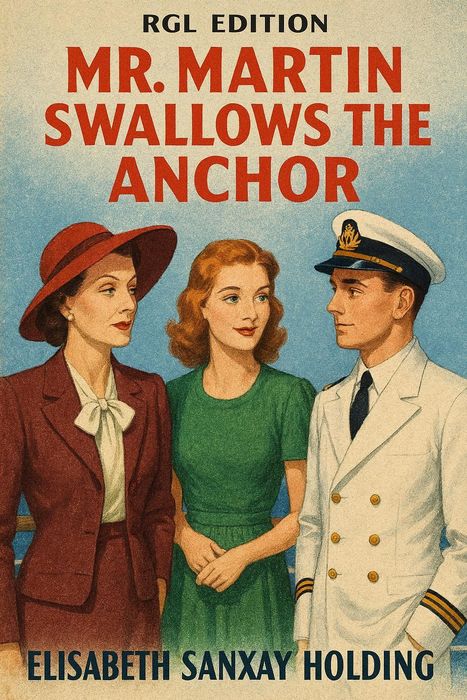
RGL e-Book Cover
Based on an image created with Microsoft Bing software
Roy Glashan's Library
Non sibi sed omnibus
Go to Home Page
This work is out of copyright in countries with a copyright
period of 70 years or less, after the year of the author's death.
If it is under copyright in your country of residence,
do not download or redistribute this file.
Original content added by RGL (e.g., introductions, notes,
RGL covers) is proprietary and protected by copyright.
RGL e-Book Cover
Based on an image created with Microsoft Bing software

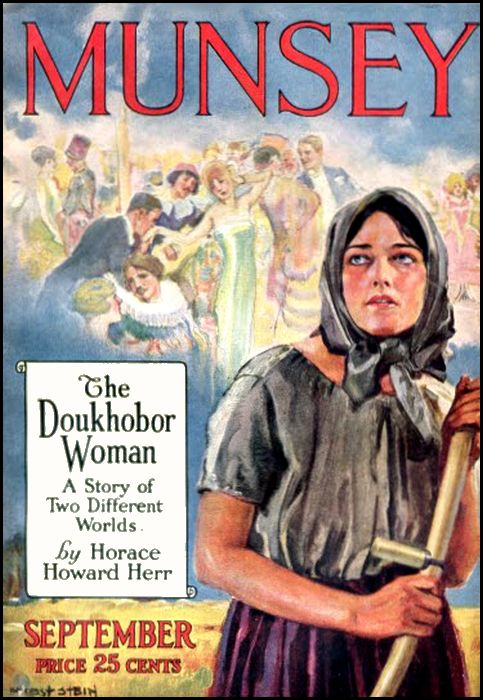
The Munsey Magazine, September 1924, with "Mr. Martin Swallows the Anchor"
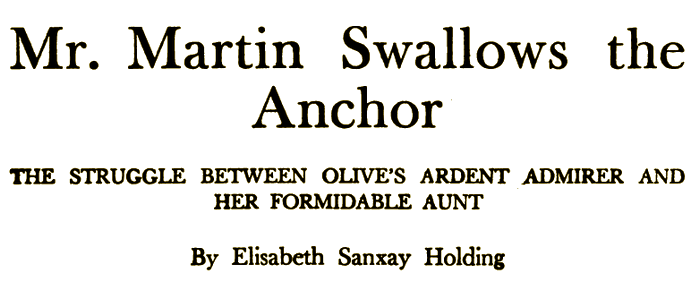
Miss Torrance, a strong-minded, practical 35-year-old office worker, and Olive, her gentle 21-year-old cousin and protégée, leave a movie theater in the rain. A friendly young stranger—Sam Martin, a ship's officer—helps them get a taxi despite their protests . Olive is quietly charmed; Miss Torrance is suspicious and protective....
OLIVE was weeping quietly, but Miss Torrance, sitting beside her in the dark, was very calm, and even a little scornful. The unmerited sufferings of the hero and heroine on the screen before them didn't trouble her. It was sure to come out all right in the end; and even if it didn't, who cared?
Olive was a sentimental little thing, and yet the strong-minded, prodigiously sensible Miss Torrance could understand, perhaps too well, how she felt. It wasn't the story that made Olive cry. It was the spectacle of that swift, vivid, intense life that so disturbed her; and it disturbed Miss Torrance, too.
Yachts, tropical islands, coral reefs, dark figures in oilskins seen by lightning flashes on storm-swept decks, clear lagoons, palm trees in the moonlight—when you saw all that, and when you thought of getting up six mornings a week at half past seven, and going down to the office, and coming back to the boarding house at twenty minutes past five, and when you were a stern, adventurous spirit, like Miss Torrance, or only twenty-one, like Olive—
Miss Torrance and Olive often talked about traveling. They even got booklets from the steamship companies, and planned routes and figured expenses. Olive took it all very seriously, but Miss Torrance smiled indulgently at such a childish pastime.
Miss Torrance was not the sort of woman to cry for the moon. She often said she wasn't, and she never suspected that she was one of those still more romantic creatures who try to build bridges to reach the moon. Olive longed for impossible things, but Miss Torrance tried to get them.
"Come, my dear!" said she, with just a trace of impatience. "This is where we came in."
"All right!" answered Olive, with a resigned sigh.
They squeezed past a row of people and went up the aisle and out into the lobby.
"Oh, mercy!" cried Olive. "Raining!"
Miss Torrance said nothing, but her brows met in an anxious frown.
The April rain was coming down in a steady torrent, drumming loud on the roof, and spattering on the pavement. The streets shone like deep, black water under the arc lights. Taxis spun by like incredibly swift motor boats. It hadn't at all the appearance of a shower. It was obstinately and definitely a rainy night—chill, too, and windy, so that it was almost impossible to believe that only six days ago, on Saturday, spring had begun, and Miss Torrance and Olive had been irresistibly tempted to buy spring hats.
"We'll take a taxi," said Miss Torrance. "It's cheaper than ruining our new hats."
"All right!" said Olive.
So Miss Torrance advanced to the very limit of the covered entrance, and signaled to the taxis that went by, fleet and careless; but not one of them stopped—no, not one.
"Beasts!" said she.
"Maybe they're all taken," suggested the gentle Olive, but Miss Torrance would have none of that.
She, too, still had in her mind the images of tropical islands and coral reefs and high adventures, and somehow it hurt and angered her, and the taxis that would not stop were like the stream of life itself that hurried past and left her behind.
"I'll make one stop!" she declared grimly. "Here!" Taking off her brave new hat, she thrust it into Olive's hands. "I'll stop one if I have to stand in the middle of the street!"
"Oh, don't!" cried Olive. "Wait just a minute!"
"Let me get you one," said a cheerful voice.
Turning, they both looked into the face of an unknown young man. It was by no means a face to inspire alarm, nor was his manner at all sinister. He was a sturdy, square-shouldered young chap, with a sunburned face, in which his eyes looked amazingly blue. As he stood there, hat in hand, he looked altogether so good-humored and friendly and honest that Miss Torrance's glare softened.
"Well—" said she.
He needed no more than that grudging consent.
"Half a minute!" he cried, and off he darted into the rain.
"Oh!" cried Olive. "Oh, Miss Torrance! Oh, we forgot! We can't pay for it! We have only fifteen cents!"
"Oh!" said Miss Torrance, too.
She certainly had forgotten, for the moment, that they had come out simply for a walk, and hadn't meant to go to the movies, or to buy the cake of chocolate they had just eaten inside. To-morrow was pay day at the office, and only that morning Miss Torrance had deposited the week's surplus in the savings bank, and Olive never had any surplus.
"I'll stop him!" she said hurriedly, and she, too, dashed off into the rain.
Just as she reached the curb, the young man arrived there on the running board of a taxi.
"Here you are!" said he, opening the door.
"I meant—" said Miss Torrance. "Thank you just the same, but we have changed our minds. We—we are going in the subway; but thank you."
The lights from the brilliant lobby shone across the street, making it very bright where they were. The rain was pelting down on her sleek blond head. The valiant little white ruffle at her neck was already beaten flat, but she herself was indomitable—a little woman and a good-looking one, although, by her severe expression and her curt manner, you might fancy that she was trying to deny both the littleness and the good looks, and to force you to remember only her thirty-five years and her ability to earn her own living.
"But—" protested the young man.
"Thank you, just the same," said Miss Torrance again, and, turning, hastened back to Olive.
The stranger was not a faint-hearted young man, however. He followed her.
"Look here!" he said earnestly. "You haven't even an umbrella. You'll catch cold!"
"Thank you, but it can't be helped," said Miss Torrance.
She spoke sternly, but she didn't really dislike this man. There was something rather engaging about him, and she was very much pleased to observe that not once did he even glance at Olive. Miss Torrance did not wish strange young men to look at Olive.
"I meant to take a taxi, anyhow," said he. "Won't you please let me drop you?"
He looked at Miss Torrance with a wistful, humble expression, which she knew very well to be false. There was precious little humility in that young man! Still, she didn't dislike him on that account, either. Indeed, she was almost ready to smile, when he added:
"I'm going through West Twelfth Street. If you live anywhere near there—"
All thoughts of smiling abandoned her.
"Thank you, no!" she replied frigidly. "Good evening! Come, Olive!"
To her dismay, Olive did not come.
"Let's!" the girl whispered. "Why not? He seems—"
Politely the young man stepped back a little. Miss Torrance gave Olive a long and severe glance.
"No!" said she.
Olive was silent for a moment. Then she raised her eyes to her friend's face.
"But I'd like to," she said quietly.
Then Miss Torrance had her turn at being silent.
"Very well!" she said, at last.
In those two words there was something not far from tragedy. Miss Torrance was not stupid. She had seen in Olive's face the dawn of a new spirit of independence, and the shadow of the end of her own fiercely benevolent despotism. And she loved Olive so!
She put on her hat—such a smart little hat!—and, at that moment, she hated it. It was absurd that any one who felt as she did just then should wear a jaunty little hat like this!
The young man was standing by the open door of the taxi. In they got, she and Olive side by side, the stranger facing them. There was something else in that cab which almost stifled Miss Torrance—something which she insisted upon in stories, but found unbearable here—something known professionally as "heart interest." Olive did not speak one word, and did not stir. The stranger's conversation was quite impersonal, and yet Miss Torrance knew. It seemed to her that she knew exactly what was in the minds of her companions.
The young fellow's cheerful voice was speaking in the darkness.
"Beastly weather, isn't it?" he remarked, to fill a long, long pause.
"Personally," said Miss Torrance, "I don't believe in thinking about the weather. I agree with Dr. Johnson that it is contemptible for a being endowed with reason to live in dependence upon the weather and the wind."
"Well—" said the young man, who knew not Dr. Johnson, but was respectful toward Miss Torrance. "You can't help it very well at sea, you know."
"Have you been at sea?" came Olive's clear little voice.
"Ever since I was seventeen. I'm chief officer now," he answered, with modest pride. "Passenger ship."
It seemed to Miss Torrance that even as he spoke she could smell a salty vigor in the air. He came from the sea, did he—the sea of which she and Olive talked so often? He was a sailor, was he? Miss Torrance's heart sank, remembering all that she and Olive had said about sailors. The romance of the sea—what nonsense!
They had reached the house. The young man sprang out and held open the door of the cab; but he stood in the doorway, so that no one could get out.
"I wish I could see you again!" he said earnestly. "We're not sailing until Monday—engine trouble. The cargo's all in, and I know I could get another afternoon or evening on shore."
He waited.
"My name's Martin—Sam Martin," he went on anxiously. "I—I know a fellow who lives in your house—Robertson. He could tell you—"
"We don't know any one in the boarding house," said Miss Torrance stiffly; "but thank you for bringing us home, Mr. Martin. Good evening!"
The house door closed behind them, leaving them in the dark hall and Mr. Martin out in the rain. Miss Torrance began to mount the stairs, and Olive followed her, rather slowly. They entered the room which they shared.
"How," inquired Miss Torrance, "did that young man know we lived on West Twelfth Street?"
"Well," said Olive, who was taking off her shoes, so that her fair head was bent and her face not to be seen, "I think perhaps he saw me coming out of the house this morning."
NOW Olive was not inclined to object to anything that Miss Torrance might say or do. Her memory for office details was not remarkable, but her memory of her friend's thousand queer little kindnesses was unalterable, ineffaceable.
When she had been left an orphan by the death of her father, the very first person to arrive at the house was Miss Torrance, her mother's cousin; and as soon as Miss Torrance entered the door, she had taken charge of the bewildered and heartbroken girl. She had brought Olive home with her, got her into bed, brought up dinner to her herself, and looked after her in a brisk, matter-of-fact way for a long, weary fortnight.
There remained, for Olive to remember forever and ever, a Miss Torrance who got up half a dozen times on bitter winter nights to mix medicines and heat broth and milk, or even to talk pleasantly to an invalid who sometimes wept for sorrow and weariness; a Miss Torrance who rose earlier in the morning to attend to Olive's breakfast, who rushed back from the office at lunch time with little delicacies, who hurried home at five o'clock as brisk, as competent, as unfailingly kind as ever. Her salary was not a large one, yet she was ready, was glad and willing, to feed, clothe, and shelter Olive for the rest of her days. She loved the girl. From the very first moment that Olive had wept on her shoulder she had loved her in a fierce, generous, tyrannical way of her own.
She had never loved any one before, and sometimes she couldn't quite understand why she was so very, very fond of Olive; for the girl had none of the qualities which Miss Torrance herself possessed, and which she admired in others. Olive was a slender, quiet young girl, pretty enough in her gentle way, but not of the type Miss Torrance was wont to praise. Her brown eyes had a wistful sort of eagerness, and her mouth was oversensitive. Altogether, there was something dreamy and unpractical about her.
At the end of the fortnight she had told Miss Torrance that she wanted to set about earning her own living. The older woman was torn between her wish to shelter and protect this gentle young creature and her conviction that every human being should work. Conviction conquered, and she found a place for Olive in the office of the Far Afield magazine, of which she was fiction editor. With a severe sort of patience, she labored over Olive until she had made a pretty fair worker out of her, but she had no illusions as to the girl's lack of business ability. She had begun now to train her for the career of a writer, and she saw more hope in that.
They were not friends in the office. Miss Torrance would not permit it. Directly they entered the building, all intimacy was put aside until five o'clock. They did not even lunch together, because Miss Torrance considered it a bad precedent. Yet, the morning after the meeting with that Mr. Martin, Miss Torrance, to save her life, could not help looking very often through the half open door of her office toward the end of the outer room where Olive sat.
"Nonsense!" she said impatiently to herself. "She'll forget him in a week. She doesn't know him—doesn't know anything about him. He wasn't at all the type to suit her. A very ordinary, commonplace young man! I'm glad I discouraged him. He was inclined to be troublesome."
Olive was quietly working away, as usual.
"If she were—interested in him," thought Miss Torrance uneasily, "she'd look different."
The telephone on her desk rang.
"Miss Torrance speaking!" she said briskly.
"This is Sam Martin," came the answer. "I wanted to ask you and—and—I don't know her last name, but I think I heard you call her Olive—I wanted to ask you both to lunch."
A sort of panic seized Miss Torrance. Was she never to be rid of this young man, never to have Olive all to herself again?
"Olive cannot come," she answered, in a voice that trembled with anger.
"Then won't you?" said he. "I'd like very much to talk to you." She consented to that, and at twelve o'clock she put on her jaunty little hat and hurried out of the office, giving Olive a very strained smile as she passed her.
How much she regretted having consented to see Mr. Martin! She had meant to crush him utterly, to point out to him how ungentlemanly, how disgraceful, it was for him to persecute two defenseless women with his unwelcome attentions; but instead of being offended or ashamed, all he did was to entreat her for a chance.
"Just give me a fair chance!" he begged. "If you find you don't like me, why, there'll be no harm done. Let me come to see you, or write!"
"No!" said Miss Torrance. "It's ridiculous. It can't possibly matter to you."
"It does," he declared.
For a moment they were both silent, sitting at the table in the very good restaurant, and not eating the very good lunch the young man had ordered.
"Look here, Miss Torrance!" he went on. "I've got to tell you. I'd been in to stay overnight with Robertson, and in the morning I saw—her—going out. The moment I saw her, I—look here, Miss Torrance, you'll have to believe me—the moment I saw her—she's so—I—I can't tell you; but she's so—sweet!"
Miss Torrance could not endure this. She could not endure the sound of his earnest, entreating voice, his pathetically inadequate words, or the sight of his unhappy, honest young face. She did not know whether she was contemptuous and angry, or even more unhappy than he was; but she did know very positively that she wanted to get away, wanted to end this.
"You don't know Olive," she said coldly; "and I do. I tell you frankly, Mr. Martin, that I shall do all I can to protect her from—" She stopped. "She's all I have in the world!" her heart cried. "I won't let her go. I won't let her see you! Because, if she does see you—you confident, good-looking, detestable creature!—how can she help loving you and forgetting me, and how shall I live without her?"
"But I'm—I give you my word I'm—respectable!" said he, in despair. "I'll tell you all about myself. I'll get people to write you letters about me. I—"
"I don't doubt you, Mr. Martin," said Miss Torrance, with a chilly smile; "but that's not the point. You'll pardon me, but I see no advantage to Olive in making the acquaintance of a man whom she might never see again. A sailor's life—"
"Oh, but look here! If she would marry me—"
"Marry you?" cried Miss Torrance. "What preposterous nonsense is this, when you haven't spoken half a dozen words to each other?"
"I can't help it," said he, terribly downcast, but resolute. "That's the way it is with me; and if she even seemed to—to be beginning to like me, I'd give up the sea."
Miss Torrance smiled—not a trustful smile.
"I mean it!" said he. "I have to make this trip, but when I come back, I'll stay. I promised, long ago, that if ever I met a girl I wanted to marry, I'd swallow the anchor."
"Indeed!" said Miss Torrance.
Like all innocent persons who wish to be convincing, Mr. Martin added details.
"The best friend I ever had made me promise that," he went on. "He'd had a hard lesson when he tried to mix the two—falling in love and going to sea, I mean. He lost his ticket and his girl both."
"Indeed!" said Miss Torrance again. "Very interesting, I'm sure!" The poor young man believed that she meant that.
"Yes," he said, "it is an interesting story. This chap—I'll call him Smith, if you don't mind, because naturally he wouldn't like to be named. It happened some time ago—eighteen or twenty years ago, and this chap was third officer on a cargo steamer running between London and Antwerp. Well, one trip he met a girl in London, and he—well, you know, he liked her, and she seemed to like him. He told her when he'd be likely to dock again, and she said that that was her birthday, and that she wanted him to come to a little dance she was having. Well, of course, he got her a present. He pretty well broke himself to get her something he thought she'd like, and I suppose he thought about her a good deal. A fellow would, you know, at night, on watch, you know, and so on. Well, they got in the morning of the very day he'd said—docked at Tilbury—and then the old man told him he needn't expect to get ashore this trip. The first was married and lived in London, and the second was signing off, so Smith would have to stay on board. Of course he couldn't say anything, but it hit him pretty hard. Look here, Miss Torrance, does this bore you?"
"No," said Miss Torrance, who was interested in spite of herself.
"Well, then, as soon as the others had cleared out, Smith stepped ashore and telephoned to her. She began to tell him how glad she was, and how she'd been hoping he'd be able to come to her dance, and he had to tell her he couldn't come. She asked him"—Martin grinned—"she asked him if he couldn't tell the captain it was her birthday, and then she asked him if he couldn't get some one to do his work for him. You know, girls never understand responsibility; but they're—there's something sweet about—"
"Oh, nonsense!" said Miss Torrance sharply.
"Anyhow, this girl didn't—or wouldn't—understand. She said if he didn't come that night, he needn't ever come. She told him he was no better than a slave—had no spirit, and so on. Well, there he was! It was a rainy day, and—ever seen Tilbury Docks on a rainy day? I wish I knew how to give you the—the effect. It's the most dismal, desolate place you'd ever want to see. The Alberta was coaling, too, and you know what that means.
"Except for a steward and some of the crew, there was no one on board but Smith and the second engineer, and they didn't hit it off very well. The cargo was all out of her, and the new lot not coming in till the next morning. The coaling was nearly done, and there was a train up to London about four o'clock. Well, if you were making a story out of this, you'd put in a lot here about a moral struggle. He must have had one, you know—love and duty," said Mr. Martin, obviously pleased with his phrase. "That's it—a struggle between love and duty, and love conquered. He must have been very fond of that girl! He went to town on the four o'clock train. He saw his girl, and she must have been a remarkably pig-headed, unreasonable young person. She said she'd marry him if he would give up the sea, but he would have to make up his mind then and there, or she'd know he didn't really care for her. So he said he'd let her know before he sailed.
"The dance broke up pretty late, so Smith went to spend the night with a friend of his in London, and took the first train back to Tilbury in the morning. Hadn't been able to sleep all night, trying to make up his mind whether he'd give up the sea or the girl. Well, he got back, and on the dock he meets the marine superintendent of the line—a terrible old fellow, Captain Leavitt. Poor Smith felt pretty sick when he saw the captain. Anyhow, he says 'Good morning, sir,' and goes on to explain that he'd just stepped ashore for a bit of breakfast at the hotel.
"'Ship's breakfast not good enough for you, eh?' says old Leavitt.
"'Oh, yes, sir,' says Smith. 'It wasn't that—'
"'If you've any complaints to make,' says old Leavitt, with a queer sort of grin, 'now's the time to make 'em, Mr. Smith!'
"Smith said he had none.
"'Satisfied with the Alberta, eh?' asks old Leavitt. 'Everything all right on board when you stepped ashore for a little breakfast, Mr. Smith?'
"By this time Smith felt pretty sure that Captain Leavitt knew how long he'd been away, but he thought he'd better try to see it through. So he says yes, everything was all right.
"'Humph!' says old Leavitt, staring hard at him. 'Well! So you're quite sure everything's all right on board this morning, eh?'
"'Oh, yes, sir!' says Smith.
At that Leavitt takes his arm, and, without another word, stumps along beside him to the Alberta's berth. The Alberta wasn't there!
"'Sure everything's all right on board, eh?' says Captain Leavitt. 'My eyes aren't as good as they were.'
"Poor Smith just stared and stared at the empty slip. He couldn't say one word.
"'She's gone to the bottom!' shouts Captain Leavitt. 'And too bad you didn't go there with her, you young liar and blackguard!'"
"Do you find that humorous?" demanded Miss Torrance, with a severe glance at his laughing face.
"Well, I can't help it!" said Martin. "No one was hurt, you know. The trimmers had loaded her down too much on one side, and she simply rolled over and sank. And when you think of old Leavitt asking him if everything was all right on board, when he knew all the time, I can't help thinking it's funny!"
Martin stopped, quite overcome with laughter.
"This friend of yours—this Smith—did he consider it funny?"
"Oh, Lord, no! But he's a serious, high-minded sort of fellow. He thought it was a disgrace, you know, and he went off and told the girl that he was disgraced and ruined, and she threw him over. He never got over it, and that's why he got me to promise that if ever I—well, you know, if I got seriously interested in a girl, I'd swallow the anchor. I think he's right. It's not fair to a girl—"
Miss Torrance rose.
"I think, Mr. Martin," said she, with a frigid little smile, "that if I were you, I shouldn't renounce my trade."
"Profession," Mr. Martin suggested.
"Occupation," Miss Torrance compromised. "It is one thing for you to be seriously interested in a girl, and quite another thing for her to be seriously interested in you."
And with that she walked off, leaving her unfortunate young host standing beside the table, on which remained the last course of that excellent lunch.
IT was a lamentable day. There was a smoky fog outside, which was, for some reason, twice as bad inside the house. When Miss Torrance let herself in, the ill lit hall was thick with it, and the puny gas jet spurted as if panting for breath.
As usual, she stopped at the hall table to look at the letters there. She picked one up hastily, and put it into her hand bag. Then, as she was about to ascend the stairs, she caught sight of Mr. Robertson standing in the doorway of the sitting room.
"Good evening!" said he.
Even in the dusk, she could see the gleam of his white teeth as he smiled. She knew how he looked when he smiled, anyhow, for hadn't she been seeing him twice a day for at least six months? Olive had remarked that he "looked like a darling." Though Miss Torrance didn't agree with any such extravagant statement, she had secretly thought him a rather distinguished man—until she had learned that he was a friend of Mr. Martin's.
He was tall, very slender, very dark, with keen, thin features and an odd smile that lifted his neat black mustache up to his narrow nostrils, giving him an expression a little fierce, but altogether agreeable. Of course, she didn't know him, and wouldn't know him. Let him smile! He was a friend of that Mr. Martin's, and he and Mr. Martin were both in a conspiracy to rob her of Olive.
Still, she couldn't very well refuse to answer, and so she did, after a fashion. Mr. Robertson did not seem to be discouraged. He made another remark, which she also felt obliged to answer. Indeed, he began to talk, and so artful was he that before she realized what she was doing, Miss Torrance was engaged in conversation with him.
She was thus engaged when Olive came, but that brought her to herself. With the coldest little nod for Mr. Robertson, she went upstairs.
"I see you were talking to Mr. Robertson," Olive observed.
"I couldn't help it," said Miss Torrance, with a frown. "He's—well, I don't like the man."
Strange, then, that as she lay awake that night Miss Torrance should constantly see before her the image of Mr. Robertson—a tall, dark form in the dark hall, lounging against the hat stand in one of his characteristically easy and nonchalant attitudes! Strange that she should keep seeing his gleaming smile, and hearing in her ears his quiet, courteous voice!
All this caused her a curious uneasiness. For some reason it seemed to her a great misfortune, almost a disaster, that he had spoken to her. A very great misfortune! There he was, however, whether she liked him or not.
Being in all things so much quicker and brisker than Olive, she got downstairs first in the morning. When she entered the dining room, Robertson spoke again, and smiled. He pulled out her chair for her, and paid her various polite little attentions not at all remarkable in themselves, but new to Miss Torrance. She couldn't actually be rude to the man, for he hadn't offended in any way, and he wasn't really obtrusive; but—
Morning and evening, for an endless week, she was obliged to see him, and to make civil responses to his civil greetings. By the end of the week she knew why she didn't like Mr. Robertson. She didn't like him because she couldn't manage him. She couldn't overawe him. She couldn't impress him. When she was with him, she couldn't really be Miss Torrance at all.
This, of course, she couldn't endure. She wasn't much used to talking to men, and she had a pretty poor opinion of them in general. She thought they ought to be ashamed of themselves, and Mr. Robertson evidently was not at all ashamed of himself. He was a surveyor of hulls, and she couldn't help admitting that he had advanced further in business knowledge than herself. He had lived in all sorts of outlandish places—in Surabaya, in Hongkong, in Cape Town. He knew the world, and seemed to take it for granted that she didn't. Apparently he regarded her as a dear, helpless little creature, and the incredible thing was that, while with him, Miss Torrance couldn't help feeling like that.
One morning, when they were alone in the dining room, talking together in what certainly looked like a friendly manner, she looked up at him and asked him a question, with exactly the look and the voice of a dear, helpless little creature. Mr. Robertson looked back at her. Their eyes met. This made Miss Torrance very angry.
"I'm down town almost every day," said Mr. Robertson. "Can't we arrange to have lunch together some day?"
"Thank you," said Miss Torrance, "but I have no time."
She said it in a way that Mr. Robertson could not very well help understanding. And the whole morning long she remembered this—remembered how the smile had vanished from his face, how stiffly he had bowed.
"I hope I did discourage him!" she told herself vehemently. "He's the friend of that troublesome Mr. Martin, and he's trying to scrape up an acquaintance with me, so that he can give messages and so on to Olive. Well, he shan't!"
IT was really spring now, a wild, gay April day, and Miss Torrance felt unusually restless. She was wearing a new suit, dark blue, very plain, very smart, and what with that and the spring in the air, she felt inclined to festivity. She thought it would be nice if she was going to meet somebody for lunch. Well, of course she wasn't, but instead of going to the tea room where she had been going for years, she went to a near-by hotel.
The first person she saw there was Olive, very cozily lunching with Mr. Robertson.
Miss Torrance got away without being seen, and went back to the office, for she did not want any lunch now. She went home a little earlier than usual, but she left nothing undone that should have been done.
Olive noticed nothing amiss with her friend. When she left the office, she didn't hurry. She was glad to go slowly through the sweet afternoon. The western sky was clear and clean, ready for the down going of the sun, and the quiet and beautiful light of that most beautiful hour shone full in her face. Seeing her at that moment, you could well understand why poor Mr. Martin had been so suddenly overwhelmed.
She gave a last glance at the sky before opening the front door. Then she entered the house and went upstairs. The door was closed, so she knocked.
"Come in!" answered Miss Torrance.
She was on her knees, packing her trunk.
"What are you doing?" cried Olive.
"I'm packing," answered Miss Torrance. "I'm—going away."
"But why? Where?"
"I saw you!" cried Miss Torrance. "I saw you—with that man!"
Olive was silent, not by any means from guilt or confusion, but because she was struggling against an unwonted anger. She thought of a good many things to say in regard to this unwarrantable interference with her affairs, but she did not say one of them. Instead, she looked down at Miss Torrance, who was working away in hot haste, and every one of her friend's generosities and queer little kindnesses rose up before her. She crossed the room and knelt by the other woman's side, putting an arm about her shoulders.
"Oh, my dear!" she said gently. "If I've done anything to—to hurt you, can't you forgive me?"
"It's not that," said Miss Torrance, in a hard, cold voice. "I've nothing to forgive. It's simply that I've—I've made a fool of myself." The tears were rolling down her cheeks, but she pretended not to know it. "I've made the worst sort of fool of myself—and I will not face that man again! I will not!"
"But, darling," said Olive gently, "if you feel like that, we'll both go."
"No!" cried Miss Torrance, with a loud sob. "I will not come between you and your precious Mr. Martin!"
"What do you mean?" said Olive. "I don't—" She stopped. "That's silly, darling," she went on, in an airy sort of way. "I've forgotten all about Mr. Martin, and he's gone off to sea and forgotten all about me, long ago."
"He has not!" said Miss Torrance. "He wrote you two letters, and I tore them up. Take your arm away, please, and let me get up!"
Olive, too, had risen.
"My letters!" she said faintly. "I didn't think you would—"
"Well, now you know," said Miss Torrance. "Now you know what a—a beast I am!"
"Stop!" said Olive.
"I won't!" said Miss Torrance. "I pretended to myself that I wanted to save you, but to-day, when I saw you with that man, I knew that I was nothing but a jealous, meddlesome old—"
Suddenly they were in each other's arms, clinging to each other and weeping.
"Of course I'm going with you!" said Olive. "You might have known!"
IT was nothing—nothing at all—for Olive to give up the hope of seeing Mr. Martin again. Twice only had her eyes rested upon his jolly, sunburned face, and it ought to have been very easy to forget that. His letters she had never seen, so they were surely nothing to think about. Altogether, he and his letters were only the briefest sort of episode in a life that might go on for thirty, forty, even fifty years longer.
She had so much to be thankful for—a good position, a comfortable home, and the immeasurable gratitude and devotion of her friend. Well, to be sure, she was as quietly good-tempered as usual, and gave no sign that she had not forgotten the whole thing; yet Miss Torrance knew that Olive hadn't forgotten.
She could read it in the girl's face, and she could read it in her own heart. She could understand how Olive felt about her lost Mr. Martin. She understood very well what it was to remember one face, one voice, so constantly that all others were a weariness.
"It really is like that!" she sometimes said to herself, with a sort of awe. "I didn't believe it, but it's true!"
She never spoke about this to Olive, nor did she think it necessary to tell her that a week after they left the boarding house she had returned there, to see Mr. Robertson, and to get from him the address of the roving Mr. Martin. Mr. Robertson had gone away, the landlady didn't know where, so Miss Torrance was spared that humiliation, and had no inclination to mention it. She had done away with the young man so effectively that now, when she would have given her right hand to get him back for Olive, she couldn't find him.
She tried her very best to atone. She no longer attempted to interfere in Olive's affairs, for she no longer felt herself supremely competent to manage other people's affairs. Indeed, the poor little woman was sometimes so subdued, so crushed by remorse, that it was all Olive could do to enliven her.
There were times when Olive found it rather a strain to enliven any one, when she would have welcomed any one who would perform that kind office for her. To-day was one of those days. The work in the office had been very heavy, and the weather was warm and sultry. She wanted to go home and rest, and yet she was reluctant to enter the new boarding house, so discouragingly like the old one.
She closed the front door behind her, and sighed. The servant had forgotten to light the gas, and the hall was inky black. There wasn't a sound in the house, and the only sign of life was a steamy smell of rice and mutton ascending from the basement.
Olive was about to go upstairs when the doorbell rang furiously, and she thought she would wait and see what it meant. There might be a telegram for herself. She knew of no living person to send her one, but still, who knows what may happen?
Anyhow, she lit the gas herself, and pretended to be looking at the letters on the rack. She heard the maid coming up the basement stairs. The bell rang again, louder and longer.
"Mercy on us!" said the servant. "You'd think it was a fire!" She opened the door, and in came a man, in great haste.
"Miss Torrance!" he said. "I want to see Miss Torrance at once!"
"She ain't in," said the maid, as if pleased.
"Look here!" said the stranger. "I made them tell me at her office where she lived, and this is the place, and I'm going to see her!"
"She ain't—" the servant began again, when Olive stepped forward.
"Will I do?" she asked.
"You!" he cried.
Olive was not so much startled as he, because she had been looking at Mr. Martin ever since he entered. Nor did she seem pleased. Mr. Martin had apparently come here filled with rage against her Miss Torrance, and that she would not tolerate.
"What was it you wanted?" she inquired coldly.
"I came," said Mr. Martin firmly, "about this story—in this magazine. It's—it's an outrage!"
"Oh!" cried Olive. "Oh! The—the story?"
He looked at her sternly, yet with a sort of compassion.
"Do you mean that you know about it?" he asked.
"Yes," said Olive, in a faint little voice. "But—I didn't think it was so—so bad."
Mr. Martin looked at her with growing horror.
"Look here!" he said. "You don't mean—you can't mean—it was signed with a man's name, but I felt sure Miss Torrance wrote it, because it's based on a story I told her myself, about Robertson. I called him 'Smith,' but I suppose she knew all the time—"
"No!" Olive interposed. "No! Mr. Martin, I'm awfully sorry, but—I wrote that story!"
"What? You?"
"I'm awfully sorry," Olive said again, and she looked so. "You see, Mr. Robertson told me the story himself, and he didn't say that it wasn't to be used."
"Naturally he didn't. It never entered his head that you would—"
"But, you see, I didn't mean—I didn't think—I only thought it was funny."
"Funny!" cried Mr. Martin, all his indignation returning. "You thought it was funny to say—wait a minute!" He pulled a magazine out of his pocket and turned the pages. "This!" he said in a terrible voice. "You say, 'The man went bowed under the weight of his infidelity. False to his duty, false to his inmost self, he—'"
"I didn't!"
"Here it is in black and white. 'Raising his glass in his shaking hand, he drank again, his bleared eyes peering—'"
"I did not!" cried Olive.
"You've made him out a drunken old beach comber—Robertson, the finest fellow who ever lived! You've got all the facts there—any one could recognize 'em. You say—"
Olive could endure no more of this nightmare. She snatched the magazine out of his hands. "Remorse," the story was called, and the author's name was given as "John Hunt." She suddenly collapsed upon the bottom step of the stairs.
For a moment the young man remained the just and stern judge. Then he bent over her and said, in a voice of quite human solicitude:
"I'm—perhaps you didn't realize. Look here—I wish I hadn't said all that! I'm—please don't cry!"
"I'm not crying," replied Olive, in a stifled voice. "Please forgive me! It really isn't funny, but—oh, oh, I just can't help it!"
He bent nearer.
"Are you laughing?" he demanded incredulously.
"Oh, please forgive me! It's horrible, but—I'll stop in a moment. You see, that awful story is Miss Torrance's, but I wrote a story, too—only mine was better, I think, and funnier. You see, we both—"
"You and Miss Torrance each wrote a story about Robertson?"
"Yes, both of us, and neither of us knew. Oh, imagine the editors, and Miss Torrance, and poor Mr. Robertson, and you, and me—"
"Personally, I don't see anything—" he began in a frigid tone, but it was of no use.
The dull, dingy old house rang with his great, hearty laugh.
THEY were all having dinner together in a restaurant. In the circumstances, Miss Torrance could not well refuse, especially as it was Mr. Martin's one night on shore; but she was not happy. Every one else was happy, but not she.
As a rule, she strong-mindedly concealed her feelings, but to-night she didn't. She allowed Mr. Robertson to see just how miserable she was. Olive and Mr. Martin might have seen this, too, if they had looked at her.
"It looks as if there was a new story beginning there," observed Mr. Robertson. "Might be called 'Mr. Martin Swallows the Anchor.'"
Miss Torrance refused to smile.
"I shall miss Olive so," she said, in a not very steady voice, "if she—"
"I'm sure you would," agreed Mr. Robertson; "but she couldn't find a better fellow than young Martin. I've known him all his life, and—"
"Yes, I know," said Miss Torrance; "but I shall be lonely—oh, so lonely!"
It turned out, however, that she was not destined to be lonely.
Roy Glashan's Library
Non sibi sed omnibus
Go to Home Page
This work is out of copyright in countries with a copyright
period of 70 years or less, after the year of the author's death.
If it is under copyright in your country of residence,
do not download or redistribute this file.
Original content added by RGL (e.g., introductions, notes,
RGL covers) is proprietary and protected by copyright.