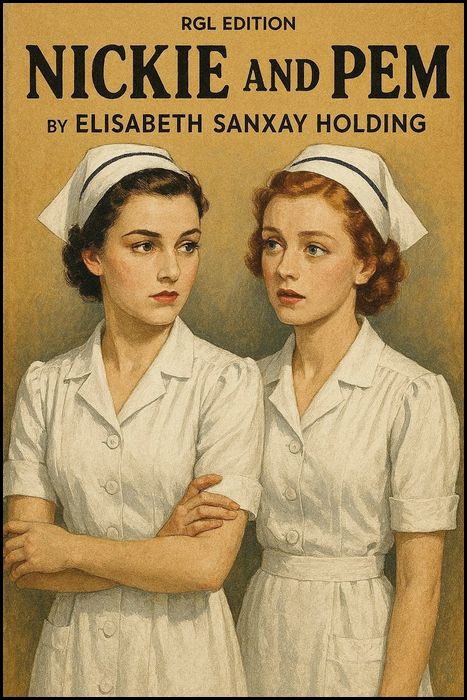
RGL e-Book Cover
Based on an image created with Microsoft Bing software
Roy Glashan's Library
Non sibi sed omnibus
Go to Home Page
This work is out of copyright in countries with a copyright
period of 70 years or less, after the year of the author's death.
If it is under copyright in your country of residence,
do not download or redistribute this file.
Original content added by RGL (e.g., introductions, notes,
RGL covers) is proprietary and protected by copyright.
RGL e-Book Cover
Based on an image created with Microsoft Bing software

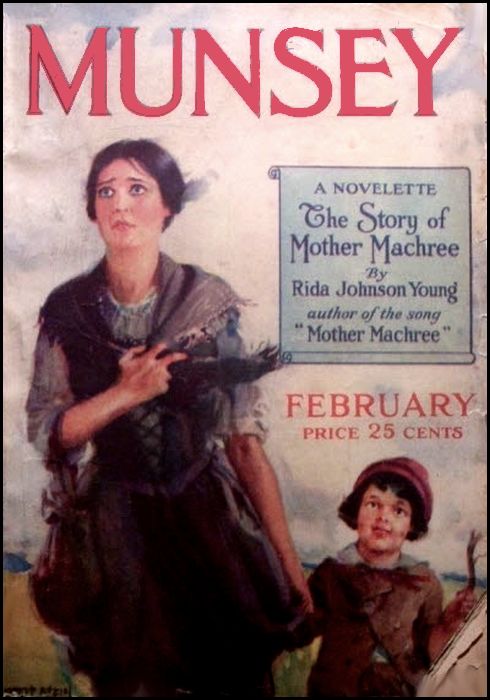
The Munsey Magazine, February 1924, with "Nickie and Pem"
Pem (Miss Pembroke) and Nickie (Miss Nicholson) are graduate nurses sharing a crowded flat with three other nurses. Pem is disciplined, reserved, self-respecting, and exhausted after a difficult case; Nickie is lively, sociable, impulsive, and eager for fun. Their temperaments clash: Nickie wants Pem to join her parties, while Pem wants peace and solitude. Their argument opens the story....
"PEM, you're too darned good!" said Nickie.
"I don't call it being good," replied Miss Pembroke. "I call it simply being self-respecting."
This was the sort of thing her friends found objectionable, and Nickie began to object now.
"Lord!" said she. "Don't we work hard enough to deserve a little fun now and then? It won't hurt your precious self-respect to speak to a man now and then, will it? I can't—"
"Oh, that's all nonsense!" interrupted Miss Pembroke. "I see enough of men, and I put up with enough from them. When I'm off duty, I don't have to put up with anything, and I won't!"
"Nobody wants you to. The boys who are coming this evening are awfully nice boys. If you'd just come in and speak to them—"
Miss Pembroke closed her book sharply.
"Nickie," she said, "I'm very fond of you; but I don't like your friends—not any of them—and I wish you'd let me alone."
"Certainly," replied Nickie, in a haughty and offended tone.
She turned all her attention upon the process of manicuring, but neither the haughtiness nor the silence reassured Miss Pembroke, who knew that they wouldn't last. It was hardly worth while to open her book again, for Nickie would be sure to interrupt.
"It's getting to be too much of a good thing," she reflected. "I needed a good rest after that last case, but I'll never get it while Nickie's here. This whole thing was a mistake. I ought to have taken a room somewhere by myself, where I couldn't be bothered."
This was by no means the first time she had regretted her present domestic arrangements. It was all Nickie's fault, of course. Nickie had told her what a fine thing it would be to join with three other graduate nurses in taking a flat.
"A nice little home of our own," Nickie had said, "where we can rest when we want to, and entertain our friends, and keep all our things. The other girls are simply great. You'll like them."
Miss Pembroke had said that five girls were too many.
"But we'll never all be home at the same time," Nickie had assured her. "Lots of times you and I will have the place to ourselves."
In the course of a year this had happened only once. When Nickie was at home, Pem was off on a case. When Pem came home, instead of finding her faithful Nickie, one of the other girls would be there, or sometimes two of them; and Pem didn't like them. She didn't like their "parties," or their conversation, or their cheerful, careless style of housekeeping.
She herself was never careless, and, though she was even-tempered and polite, she wasn't often cheerful. As a nurse, she was matchless. Doctors wanted to send her to their most troublesome and exacting patients, because not only was she quick, capable, and intelligent, but she could hold her tongue and keep her temper, and she had a cool, quiet way with her that kept her patients in good order.
But this cool, quiet way of which doctors so highly approved was not at all pleasing to her housemates. Even Nickie thought it deplorable.
"Pem," she had said to her once, "you could be young and beautiful, if you'd only learn how!"
There was truth in that observation. Miss Pembroke had both youth and beauty, and somehow managed to disguise them, so that they often went unnoticed. People would say that she was "impressive," or "dignified," or something of that sort, because they never saw her off guard, as Nickie saw her now. She was a tall, slender, dark-haired girl, with an austere, fine-bred face—not the sort of face one would turn to look after in the street, but a face which patients—above all, male patients—found very, very hard to forget. Her slender hands were clasped about one knee, and her clear amber eyes were staring thoughtfully before her. She was, thought Nickie, engaged in daydreams of some mysterious and enchanting kind unknown to more ordinary girls. But in reality—
"Nickie's getting coarse," Miss Pembroke was reflecting.
There was no coarseness to be seen in Miss Nicholson's rosy, jolly face, nor to be observed in her manners and conversation. Indeed, no one but Miss Pembroke had yet seen any trace of it; but Pem was by nature critical, and just at this moment she was jaded and dispirited after six weeks of a ferocious typhoid patient, who had fallen in love with her in a very trying and ill-tempered way. Moreover, she was mortally weary of Nickie's persistence.
"I'm sick and tired of men," she thought. "All Nickie ever thinks of is men, and going to parties, and having what she calls a good time."
Now this was not quite doing justice to Nickie. When she was not working, she was undeniably very fond of playing; but when you consider how very short and infrequent were her play times, and how very hard and exhausting was her work; when you consider that this lively, warm-hearted young creature had to witness every sort of human agony and wretchedness; when you bear in mind the tremendous responsibilities she so faithfully accepted; her generous readiness to do more than she needed to do, her charity, her sympathy, her sturdy courage—when you think of all this, it is not difficult to forgive her for being somewhat frivolous during her little hours of freedom.
There were weeks at a time when men, parties, and having a good time gave her mighty little concern. Just now, however, her mind was entirely given to such matters; and, as Pem expected, she couldn't help trying again to persuade her friend.
"Oh, Pem!" she said coaxingly. "Just this once! Come in and speak to the boys, and if you don't like them—"
"No!" said Pem.
But she did, and, by doing so, she changed the course of three lives.
She had no intention of seeing Nickie's friends. In fact, she came nearer to quarreling with Nickie than she had ever yet come, and she retired to her own room with flushed cheeks and a frown on her calm brow. She was not in the habit of losing her temper, and this unusual annoyance disturbed her. She was restless, and couldn't settle down to read or sew.
Her neat little room seemed all at once too neat and too little, and she wanted to get out of it. It was a clear, fine night. A walk, even a solitary and aimless one, wouldn't be bad. She had put on her hat and coat, and was just about to open her door, when—when Nickie's party arrived.
Impossible to go out now! In order to reach the front door, she would have to pass by the sitting room, and Nickie would see her and stop her.
"Nickie has absolutely no pride!" she thought, angrier than ever. "Even after what I said to her, she'd try to drag me in there!"
She took off her hat and flung it on the bed.
"I'll read," she decided.
She couldn't read. The party disturbed her too much. They were laughing and talking, and presently some one began to play the piano and sing. It was an idiotic song, but it was delivered in a hearty, boyish voice that was somehow very touching.
There was violent applause when the singer finished, and after a few minutes he began again.
Pem came nearer to the door, her face grown very pale. "Keep the Home Fires Burning!" Some one else sang that—one night in Montreal—the night before the troop ship went out—a boy in a lieutenant's uniform. Pem snapped the light and stood listening in the dark, her hands clenched, her eyes closed.
"So turn the dark clouds inside out,
Till the boys come home."
"Oh, God!" whispered Pem; for that boy would never come home, and the Pem who had listened to his gallant young voice was gone, too.
The singing stopped, only not for Pem. It went on sounding in her ears. The voice that she would never hear again and the living voice mingled together until she could bear it no longer. She must go in and see this other one—see with her own eyes that he was a stranger, in no way like—any one else.
NICKIE welcomed her with a cry of joy.
"Here's my pal!" she said, triumphantly. "Now you'll all have to be good little boys. Pem, here's Mr. Brown and Mr. Caswell and Mr. Hadley. Look 'em over!"
But the only one Pem wanted to see was Caswell—the boy who had been singing, the boy who must not look like some one else. Well, he didn't. That one had been fair and this one was dark. There was no resemblance in a single feature; and yet the spell was not broken.
There was some quality in this man that stirred intolerable memories to life in Pem—something in his voice, in his smile, in the hearty grip of his hand. She looked and looked at him, trying in vain to catch that fugitive likeness.
She had never been so lovely, or so utterly careless of her own beauty. Her eyes were wonderfully luminous and soft in her pale face. Her hair, a little disordered by the hat she had pulled off, floated about her forehead in tiny, misty threads. She hadn't a trace of that cool, quiet manner now.
Under that look of hers young Caswell grew suddenly ardent.
"I say!" he began. "You know—you're simply—simply marvelous!"
"Didn't I tell you so?" said Nickie, delighted. "Now sing some more, Cas. That's what brought her to."
"No," said Pem. "Please don't."
The spell was slowly dissolving. She could see Caswell without illusions now—an ordinary nice-looking young fellow, unfortunately a little the worse for drink just now, like the others.
She had come in without any idea of staying, but for Nickie's sake she resigned herself to a wearisome half hour. This was Nickie's idea of a good time, and these were Nickie's "awfully nice boys"! One of them offered Pem his pocket flask, but she declined, civilly enough, and sat down on the piano stool, so that Caswell couldn't sing again.
She was quite aware that he was looking at her all the time. Very well, let him look! She felt a thousand miles away from him and the others, and somehow very lonely.
This sudden change disturbed Nickie. Now that she had got Pem here at last, it would never do to let the party prove a fizzle. She whispered to one of the men, and then called out:
"Pem, get your hat on! We're all going up to the Devon to dance!"
"No, thanks," said Pem firmly.
There was a chorus of protests.
"Oh, come on, Pem!" Nickie entreated. "I don't want to go alone with three fellows, and I'm dying for a dance. Please, Pem, just for an hour!"
"No, thanks," said Pem again. "I'm sorry, but I don't feel up to it. I'm tired."
And then, beside her, she heard a voice which, in spite of herself, she could not hear unmoved.
"I say, Miss Pembroke! Please!"
She shook her head, but she smiled, for once more she caught a glimpse of that curious likeness, and it made her gentle toward him. What was it? What could she see in this flushed, unsteady boy to put her in mind of that other, fine and stern, a young knight?
"Look here!" said Caswell, bending lower, so that only she could hear. "Please don't—don't judge me by this. I—I'm—I can't tell you how sorry I am for you to see me—like this. I—I don't do it, you know, I give you my word. You see, I've just come back from Melbourne, and this was my first night on shore, and—if you'd just give me another chance!"
"All right, I will," said Pem suddenly. "I'll see you again. I'll be glad to."
And she meant it. She no longer wanted to deny the unreasonable, half scornful liking she felt for this man. She did like him, and that was enough.
"Oh, but, look here!" he cried. "We're sailing to-morrow for Halifax. I've only got this one night!"
"But you'll come back to New York, won't you?"
"Oh, some day!" he answered bitterly. "God knows when—I don't. We're running all over after cargoes. We may come back here from Halifax, and we may go anywhere. It may be months before I see you again."
"Would that be so awful?" asked Pem, with a smile.
But he didn't smile.
"Yes," he said. "It would—for me!"
Pem was annoyed at her own response to his emotion. She wanted to laugh at him, and she could not. This was the worst sort of nonsense—the sort of thing Nickie was always telling her about. Nickie would call this "thrilling." Well, Pem didn't.
"I'm sorry for you," she said ironically; but, as if there were magic in his eyes, the words turned to truth when she looked at him. "Please don't be silly!" she added, in a quite different voice—gentle, almost appealing.
"The only silly thing would be to pretend it wasn't like this," said he. "I didn't want it to be this way, but—it just happened. As soon as I saw you—"
Pem jumped up.
"All right, Nickie!" she called out. "I'll go with you!"
CASWELL got into the taxi after her and slammed the door.
"Oh, Pem!" he said. "Pem, you wonderful girl!"
"You know you really are silly!" she protested.
"Then I hope to Heaven I'll never be anything else! I'd give all the common sense and prudence and so on in the world for one night like this. Hang being sensible, anyhow! Let's be silly, Pem!"
"I am—I have been—sillier than I ever was before in my life. Don't, Arthur!"
She felt obliged to object to his putting his arm about her shoulders and kissing her—a very unconvincing little objection, however, to which he paid no attention.
"You do love me, don't you, Pem?" he asked, and waited a long time. "Pem! I say, Pem! You do love me, don't you?"
"Oh, I really don't know!" she cried impatiently.
Was it love, she thought? It was not in any way the love she had felt before—not that strange and terrible thing, half pride, half humility, half anguish and half ecstasy.
"That couldn't ever come again," she thought.
It had been her consolation for so long, that never again would that intolerable emotion stir her heart. After she had lost that one man, there wasn't another walking the earth who could capture her interest—until this evening.
She couldn't understand the glamour that enveloped young Caswell, the inexplicable charm of him. He was neither very handsome nor very clever—just an ordinary nice-looking boy; and yet, when he said that he would give all the common sense and prudence and so on in the world for one night like this, she agreed with him in her heart.
They had gone to a restaurant and danced, they had taken a taxicab to another restaurant and danced again, they had had supper—that was all there was to it. It was simply one of those brainless "parties" so dear to Nickie—with too much drinking on the part of the men, too much smoking, the stupidest sort of talk and laughter. Then why had it been so beautiful? Because of that boy's glance which always followed her, that look on his face, his fervent, halting love-making?
Suddenly she stopped trying to reason about it. It was beautiful. She had been utterly happy again; she was happy now.
"Pem!" he said. "Oh, Pem! Can't you tell me? I'm going away, you know."
His voice broke, she felt the arm about her shoulders tremble a little, and her eyes filled with tears.
"I'm afraid I do love you," she said.
She gave him one kiss, and then, with a little laugh, pushed him away.
"Don't talk any more about it—not now," she said. "Look! The sky's getting light. It's morning."
"And I'm due on board at ten o'clock," he said. "I'll come back to you, Pem. Pem, you won't forget me? You won't—you couldn't, could you, Pem?"
"I don't think so," she answered.
The taxi had stopped before the apartment house, where Nickie and the two other boys, just arrived, were waiting for them in the street. A pallid light was spreading in the sky, and a strange quiet lay over the city. Trucks rumbled far away, but there wasn't a voice or a footstep. The street lamps still burned wanly.
"It's time for breakfast," suggested one of the boys. "Let's go to a beanery and have something to eat."
"No!" said Pem sharply. "We've had enough. Good-by! Come on, Nickie!"
For she had seen on Nickie's face something that hurt her—something that she had often seen in the mirror, reflected in her own eyes.
NICKIE was lying on the bed, flat on her back, without a pillow, her eyes resolutely closed, in a stern effort to rest. That morning, just as she was saying good-by—very willingly—to the cantankerous old lady with a broken arm whom she had been attending for three weeks, Dr. Lucas had telephoned and told her that he wanted her for night duty on a pneumonia case. It was a bad case, and she had a bad night ahead of her. She must rest now; but she couldn't. This wasn't rest.
She heard the key turned in the latch, and the front door opened quietly.
"Hello, Mac!" she called.
But it was not Miss McCarty who answered. It was Pem.
"You home, Nickie?" she said. "That's nice."
She came into the bedroom. Nickie sat up and stared at her with wide eyes.
"For Pete's sake!" she exclaimed. "What's the meaning of all this, Pem?"
"I don't know," replied Pem slowly. She had taken off her hat and coat, and was looking at herself in the glass—at her carefully dressed hair, the artful touch of color in her cheeks, the new frock of navy twill with red leather buttons. "I look rather nice, don't I, Nickie?"
"Yes," said Nickie, "stunning; but—well, I suppose I'm not used to it. But what's the reason, Pem?"
Pem's explanation did not satisfy her. Pem said that her patient was a wealthy young woman suffering from a mild form of melancholia. She had to be diverted, and—
"I had to look halfway decent, going about with her," said Pem. "She wanted me to."
"Finished now?" Nickie asked.
"No—it may last for months; but I often get an afternoon off when her sister comes to stay with her. She likes me to clear out sometimes, so that she can tell her sister how awful I am."
"Doesn't she like you, Pem?"
"Oh, pretty well; but she doesn't really like anybody but herself. That's what's the matter with her. She's got everything on earth—money, and friends, and a wonderful husband. Lend me some of your powder, Nickie?"
"Powder? Going out again now, Pem?"
Pem nodded.
"Who with?"
"With a man," said Pem, laughing. "Don't faint!"
"Of course it's not my business," observed Nickie, "but it—it isn't the husband, is it?"
She waited a long time for an answer.
"I wish you'd tell me, Pem. I always tell you things."
Pem turned and looked at her steadily.
"No, you don't, Nickie," she said; "not always."
Nickie looked back at her friend quite as steadily.
"I do," she said. "I tell you anything that really matters. You see, Pem, the reason I am asking this is because I thought you were rather gone on Arthur Caswell. You see, I've known him for a long while, so I—"
Pem turned to open the bureau drawer, and to take out a pair of white gloves and a handkerchief.
"I'll tell you something, Nickie," she said in a curt, cool voice. "He would never have looked at me that night if I had been my real self. I acted like a fool, and that's what he liked. That's what every one likes. After he'd gone, everything seemed tame and flat, and I felt so lonely that I couldn't stand it. I'm going to keep on being a fool, Nickie. I'm going to make people like me. I'm going to live, and enjoy myself!"
"All right," said Nickie; "but what about Arthur Caswell?"
"He'll never come back."
"Yes, he will."
"If he does, then—but he won't. I'm not going to waste my life—or what's left of it."
"If I was going to waste any lives," said Nickie, "I'd rather waste my own than any one else's."
Pem was astounded.
"What's the matter with you?" she demanded. "Are you trying to preach to me, Nickie? It was you who started the whole thing—always pestering me to go to parties."
"I never went out with a married man in my life," said Nickie; "and I never would, either."
"That's a little too much, after that last party!" returned Pem scornfully. "You wouldn't go out with a married man, but you don't mind three fellows who've been drinking!"
"How do you know I didn't mind?" cried Nickie, jumping up. "Just let me tell you, Pem—I knew Arthur Caswell's people in Halifax. His father's a strict Presbyterian. I know what he'd think about that, and I'd have stopped Arthur, too, if—"
Pem was about to make a sharp retort, but she changed her mind in time. Going over to Nickie, she put her arms about her friend.
"I'm sorry, little pal," she said gently. "I didn't mean to."
Nickie gave her a rough little hug.
"All right, Pem," she said. "I know! But, Pem, for my sake, please don't go out with this man. You'll be sorry for it—awfully sorry. It's not like you. Don't do it, Pem!"
"You don't understand, Nickie. He's a wonderful man, so honorable—"
"He's not honorable if he goes out with you behind his wife's back."
"How can he help it, when she's turned her back on him for good? She's horrible to him. Nobody else would have put up with her as he has. He is honorable, Nickie; he's a gentleman through and through. He's so lonely—you don't know what that is, but I do. He's longing and longing for women to be nice and friendly to him. If his wife was ever halfway decent to him—"
She stopped short, because the doorbell had rung.
"There he is," she said. "Nickie, it's nothing to be ashamed of. I wish you'd see him and talk to him. Then you'd understand. Open the door and talk to him while I'm getting ready."
Nickie hesitated for a moment.
"All right!" she said, then. "I'll talk to him!"
Without even troubling to smooth her unruly hair, off she went, down the passage. In a moment she was back.
"Pem," she cried, "Arthur Caswell is here!"
They stared at each other in a sort of dismay, both speechless for a time.
"I'll take him out, quick," said Pem. "When Mr. Blanchard comes, tell him something—anything. I'll see you later, Nickie. I'll stop here before I go back to Mr. Blanchard's."
"All right," Nickie said again.
When Pem had gone, she closed the bedroom door after her; but she didn't even try to rest now.
PEM went down the passage with a lagging step and a heart strangely troubled and doubting.
"No," she said to herself. "Of course it can't be like that. I just imagined it. I've thought about it so much that—no, it couldn't really have been so wonderful. He couldn't have been so dear. When I see him again I shall get over being so silly."
But that silliness was the best thing in her life. For weeks the glamour of that enchanted evening had colored all her days. The music they had danced to still sounded in her ears, faint and stirring. When she closed her eyes, she could see again the sparkle and glitter of that tinsel fairyland of Broadway, made true and fine by the boy's love.
"I won't be an idiot!" she told herself. "When I see him again, I'll find that he's—not really like that!"
So, with what fortitude she had, she entered the little sitting room. He didn't hear her. He was standing at the window, with his back toward the room, his hands in his pockets—such a straight, stalwart figure!
"Hello!" said Pem. "It's a surprise to see you here again!"
Then he turned, and it was true, all of it—that look she had remembered, that glamour, that enchantment.
"Oh, Pem!" he said. "Didn't you know I'd come?"
For a minute she was utterly content in his arms, as if her restless and disconsolate spirit had at last found peace; but not for long. She moved away, still holding his hand, and looking at him with a misty smile.
"You're so beautiful!" he said. "Sometimes I thought you couldn't be as lovely as I remembered, but you're a hundred times—"
The clock on the mantelpiece struck three.
"Let's go out!" she said hastily.
He was a little taken aback.
"Can't we stay here, Pem? I want a chance to talk to you."
"Not here. We can talk somewhere else. I know a nice little tea room where we can dance."
"I don't want to dance," said he; "and—look here, Pem! I'm a bit hard up, this trip."
She couldn't help kissing him for that.
"As if I cared! We'll take a bus ride, then."
"No, we won't do that, either," said he, half laughing. "We'll stay where we are. I want to talk to you. I—does this suit you, Pem?"
From his pocket he pulled out a ring, carried loose in there, without a box, without even a bit of paper, and laid it in her hand. There it was, honest and unashamed, like himself—the tiniest little diamond. She stared down at it through a veil of tears.
"Best I could do," he said a little forlornly. "You see, I never tried to save my pay, and it's darned small, Pem, old girl. I'm only third mate. I dare say I don't make as much as you do."
"Never mind! That doesn't matter," she answered, so low that he could scarcely hear.
It seemed to her the most touching and beautiful thing that had ever happened, that he should come to her with his poor little ring, so simply and loyally offering her all he had.
"But we can manage," he went on more cheerfully. "I've figured it out. We can take a little flat, you know, and if we're careful, we can get on. You won't mind a pretty quiet life, will you, Pem? Nickie told me you weren't keen on going out and all that. I'm not, either—at least, not now. I was, you know, but not now. We'll settle down—"
He stopped short, looking at her with a faint frown, but she did not meet his eyes. She was shocked, appalled, at her own traitorous thoughts. She glanced again at the ring, and tried in vain to recapture the tenderness and pity she had felt.
To settle down and marry this boy—not to dance with him, not to listen to his love-making to the accompaniment of music, in a bright dazzle of light, but to marry him and settle down to a deadly quiet life—she knew very well what that meant. She had often enough been in the sort of little flat they would have to live in. She went into such places when sickness was already there. She had seen all the makeshifts, all the sordid and pitiful anxieties of such existences—people who hadn't enough towels and sheets, who couldn't afford hot water bottles, who couldn't afford even the necessary sunlight.
The quiet life! What had he to do with a quiet life? He had come suddenly into her own chill, somber existence, startling her into youth and gayety—that was why she loved him. A dear, honest, silly boy, to dance with, to be happy with for an evening, but—
"Pem!" he said abruptly. "What's the matter?"
At his peremptory tone, she found it less difficult to speak. She put her hand on his shoulder and spoke as kindly as she could.
"I'm afraid you're going ahead a little too fast," she said. "After all, we've only seen each other once before, you know. Doesn't it seem—"
"Do you mean that you don't care for me?" he interrupted.
His bluntness disconcerted her.
"No," she said, with a trace of impatience; "but we don't really know each other. I think we ought to wait—until we're sure."
He was silent for a long time, searching her downcast face.
"You're sure now, aren't you?" he asked at last. "All right, Pem! All my fault! I might have known—"
And in the face of his sincerity, his honest and unresentful pain, she could give him no false hope, no false consolation, nothing but the truth revealed to him by her silence.
He took the ring from her hand and looked at it with a shadowy smile. Then, before she knew what he was about, he threw it out of the open window into the street.
She came to the window and looked down, but she couldn't see it in the street far below.
"Oh, why did you do that?" she cried. "Why, didn't—"
A sob rose in her throat. She turned away her head, so that he should not see her tears.
"Don't cry!" he said. "It's all my fault. I should have known better, of course. I say, Pem! Please don't cry! The whole thing isn't worth it. Just—let's say good-by, Pem!"
She held out both her hands. After a brief hesitation, he took them in his.
"I'll never forgive myself!" she said unsteadily. "Never!"
"Nothing to forgive," he assured her, with a gallant attempt at a smile. "I—anyhow, I'm glad I ever saw you. Good-by, Pem!"
If it could only have ended then! If he could have gone then, with that moment for them to remember! But it was their great misfortune that no such memory should be left to them.
The doorbell rang, and Nickie came out of her room.
"Shall I go, Pem?" she asked. "Or—"
Pem looked at her helplessly. As the flat was arranged, the front door could not be opened without affording a plain view of the sitting room.
"I'll let it ring," said Nickie, with a fine effect of carelessness. "No one we want to see."
But that was not Pem's way. She came of an austere and stiff-necked family, living secluded on an exhausted little Vermont farm. They had nothing much but pride to keep them warm in winter, to feed and clothe them. Pride was the only heritage that came down to Pem, and pride would not allow her to refuse admission to Mr. Blanchard, no matter what it cost her. As for the possible cost to Arthur Caswell and to Nickie, that didn't occur to her just then.
She opened the door herself.
"I'm afraid I'm a little late," said a courteous, apologetic voice. "Please—"
Then, as he followed Pem inside, he caught sight of the others, and made a general bow.
"This is Mr. Blanchard, Nickie," said Pem.
He looked altogether what Pem had called him—a gentleman through and through. He was a rather slight man in the middle forties, with a sensitive, harassed face, hair a little gray on the temples, and fine, dark eyes. He hadn't in the least a furtive or shamefaced air. Indeed, there was a quiet sort of straightforwardness about him that favorably impressed Nickie, in spite of her prejudice against the man.
"I've heard a great deal about you from Miss Pembroke," he said.
Nickie liked his smile, his voice, his well bred ease. She liked all this, and yet, when Pem presented Caswell to him, her liking was a pain. Arthur seemed so young, so awkward, such an immature and unimpressive creature, in contrast to his senior. She wanted to defend him against comparison. She wanted to force Pem to see, and Mr. Blanchard to see, the splendid qualities in the young sailor.
But she had no chance. Before she could interfere, Blanchard had mentioned that it was growing late. Pem had answered that she was ready, and off they went.
"I WOULD never have told you," said Blanchard. "I would have gone on the best way I could, without you; but now—"
Pem looked at him across the table. By the light of the gold-shaded electric candle his thin face was almost incredibly fine. He looked, she thought, a little inhuman, with his delicate features, his dark, glowing eyes, and the silvery gleam of white on his temples. His tremendous consideration for her, his squeamishness, had made his story such a long one!
After all, she wasn't a girl just out of school.
"I've seen more of life than he has," she reflected; "and yet it has taken him two hours to tell me that his wife is going to divorce him. I suppose it'll take another hour before he can tell me that he hopes I can marry him when he's free. I suppose it ought to take me a week to answer him!"
She stifled a sigh. It was nonsense for him to try to shield his wife from Pem, who had two months in which to observe her savage egotism. Such a dilemma for his chivalrous soul—to make it clear to Pem that his wife had no just cause for divorcing him, and yet to protect the woman against the implication of cruel unreasonableness. All things considered, he had done very well.
"A—a mutual agreement,", he had called it. "I think you'd better not go back," he went on gently. "She's very much upset. Her sister and her mother are with her."
Silence fell between them. The orchestra was playing in a gallery behind them—a gay and delicate air. The rooms were filled with the sort of people Pem liked about her, with light, laughing voices, faint perfumes, and the smoke of cigarettes.
One of Blanchard's hands was extended on the table—a slender hand, beautifully tended. He was so fastidious in everything, so kind, so honorable, so appealing in his masculine assumption of her ignorance and helplessness. He wanted to take care of her and shelter her. He would have been horrified at the thought of her living in a little flat on a third mate's pay. He would have turned pale at the sight of that poor, poor little ring.
"You're very quiet," he said, a little anxiously. "I hope I haven't—"
Pem looked up with a smile.
"No!" she thought, as if defying a voice that had not spoken. "It's no use! I'm not like that. I couldn't stand it. I shall be happy with Everett. It's his kind of life that I want." Aloud she said, in the ladylike, noncommittal tone he expected of her: "I'd better be going back to Nickie now."
Blanchard took her back in a taxi, and all the way he talked of impersonal matters—not a word of love. She knew he wouldn't mention that until he was free to do so honorably.
He left her at the door. She turned as she entered, and saw him standing bareheaded in the street—a handsome and distinguished man, yet somehow pitiful to her, with that touch of white at the temples.
The flat was empty when she got in. Nickie, of course, had gone to her case. Arthur Caswell—she couldn't imagine his destination.
On the kitchen table were the disorderly remains of a tea for two. The sitting room, too, was very untidy, as Nickie always left it. Pem turned on the electric light and began to set it in order. She emptied the ash tray, full of the stubs of those horrible cheap cigarettes she had seen Caswell smoking. She picked up the magazines that lay on the floor, and straightened the chairs.
The piano was open, with music on the rack. She went to close it. The lid slipped from her hand, and, falling, jarred the strings with a queer, trembling discord. She could have imagined it the faint, distant echo of a voice—a young voice.
Roy Glashan's Library
Non sibi sed omnibus
Go to Home Page
This work is out of copyright in countries with a copyright
period of 70 years or less, after the year of the author's death.
If it is under copyright in your country of residence,
do not download or redistribute this file.
Original content added by RGL (e.g., introductions, notes,
RGL covers) is proprietary and protected by copyright.