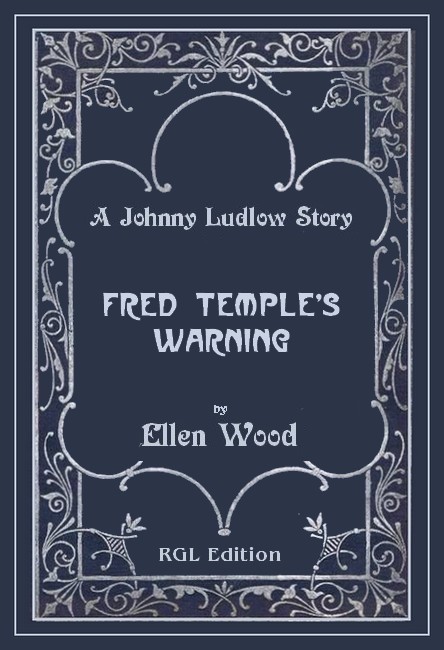
RGL e-Book Cover©
Roy Glashan's Library
Non sibi sed omnibus
Go to Home Page
This work is out of copyright in countries with a copyright
period of 70 years or less, after the year of the author's death.
If it is under copyright in your country of residence,
do not download or redistribute this file.
Original content added by RGL (e.g., introductions, notes,
RGL covers) is proprietary and protected by copyright.
RGL e-Book Cover©

"Johnny Ludlow" was the name used by Ellen Wood as the by-line for a series of 90 popular stories and serial novels published in the British monthly Argosy, which she bought in 1867 and edited under her married name, Mrs. Henry Wood. The first story signed by and featuring "Johnny Ludlow" appeared in January 1868, the last in January-June 1891.
Six collections of stories in the series were published in book form. The first story, "Shaving the Ponies' Tails," was not included in any of these collections, presumably because some elements of the narrative and characterization are atypical in comparison with the rest of the series. The 48th story, "Fred Temple's Warning," was also omitted.
—Roy Glashan
YOU cannot relate two narratives at the same time; any more than you can be in two places at once. If you are at this precise hour and minute in Africa, it stands to reason that you cannot be in Asia. After I had told you something about Oxford the beginning of the year, I ought to have gone on with this account that I'm going to write now; but Janet Carey intervened and crossed my life, and she had to cross my papers.
When we got back to Oxford for the Easter Term—which does not begin, as everybody knows, until Easter's over—things went on quietly. The fret and worry introduced during the last term was over; over for good: and we just minded our business and were as staid as the severest dean or tutor could wish. Tod stuck fairly well to his studies, only varying them—and not too much—with boating and riding.
Fred Temple and I grew better acquainted that term: I liked him, and he liked me. He was one of the best looking men I ever saw; and a rare good fellow. Slingsby Temple, the elder brother, was a dark little man, reserved, and proud as Lucifer; Fred was taller, and had affable ways; his every look and movement bespoke the gentleman, and his face was beautiful, fresh and fair to look upon, with perfect features and dark blue eyes. It sounds like the description of a woman's face: but it's true; and I still see it sometimes before my mind's eye just as plainly as I used to see it then.
Their place, Templemore, was in one of the remote counties. Long Webster (who was built like a lamp-post and had come up as servitor at Magdalen's) knew all about them. Old Webster was Perpetual Curate down there, and dined regularly at Templemore twice a year. Mr. Temple was dead, and Slingsby Temple would come into Templemore when he was twenty-five; not before. His mother had it to live in until then: she was a lord's daughter and the Hon. Mrs. Temple.
"The curious thing in that family is that the heads of it never live to be old," said Webster, one day that he and I and Tod had to run to a shed for shelter in an unseasonable thunder-storm, and we happened to get talking of the Temples. "At about thirty they drop off."
"Drop off!" said Tod, taking him up. "How's that? Do they go off of themselves?"
Webster (who was not half a bad fellow, and more industrious than a working bee) shook his head in denial. "Something takes them off: sometimes it's natural illness, fever, or that; sometimes it's accident; but they never get beyond thirty. They have all married young; and just as the little ones are coming on, off they die. The late Mr. Temple was shot by accident when he was out shooting."
"Leaving these two?"
"Leaving these two, and three more," replied Webster. "There's a younger brother, and there's one girl: the oilier girl died."
"I should try and break the spell, were I Slingsby," cried Tod. "Is Templemore a nice place?" .
"Very. And has plenty of money to keep it up. Mrs. Temple has never gone out of widow's weeds yet, though it's ever so many years since he died. It was a great blow to her; people thought she'd have died of it herself but for her pride."
"Is she proud?"
Webster threw his long neck back at the question. "Proud! Well, we have known some proud people down yonder, but we never knew one like Mrs. Temple. The heir is the same—Slingsby."
"He's awfully reserved," said Tod.
"And proud, too, with a pride rarely seen," added Webster: " and i: will grow upon him as he gets older. Pride such as that is not to be coveted: but I think it helps to keep a young man straight. The rain's over."
We exchanged the shed for the wet grass, soaking with the heavy shower, and went back: I thinking of what Webster had said, for it interested me.
That Easter term, a fresh man had entered at Queen's; one MacRae. A Scotchman; as may be guessed by his name: and by his speech, too, if you had heard it, for it had the Scotch ring in it. He was a plain man in all senses of the word, but he was liked very well; a hard reader, he, and steady as Old Time. I need not have brought in his name at all but for one peculiarity—he believed in second sight. Nay, more: he said he possessed it: possessed it himself.
When this belief of his first crept out, he was roasted finely; but it made no impression upon him at all. He just went on in his civil, quiet way, and cared no more for the ridicule than eels do for skinning. MacRae would look steadily at the fellows with his deep-set eyes, listening attentively, a half smile on his wide and projecting mouth; and tell them at the first break that they were welcome to laugh at him as much as they liked, and at second sight also, for they did not understand it. So the roasting ceased by degrees: when mockery falls harmless, where's the fun of it?
One evening some few of us, including MacRae, were at the Temples' rooms in Trinity, with Fred. Slingsby was off, star-gazing: he had one great hobby besides his pride, and that was astronomy. Somebody started a little quiet chaffing at Mac: but the only result that came of it was, his telling us some stories that would have made your hair stand on end. Mac called them his experiences, and said they were solemn ones.
One of the stories I particularly remember; and I'll give it here that you may judge of their nature. He said he was nearing his home in the Highlands one evening on foot after some days' absence, and had got to within twenty yards of his door, when a funeral procession suddenly issued from it. He declared that at the moment he believed it to be a real funeral coming forth, the personages real personages; and he stood back against the fence in dismay, wondering who had died during his absence. It was only when he found the procession passed him without noise, their footsteps making no echo, that the truth flashed over him that it was a vision of Second Sight. He watched them wind by in the moonlight; the coffin and all the followers, his father and a crowd of his brothers being among them—for they numbered a baker's dozen. He watched the procession glide, glide on, with the regularity of silent clock-work; watched it until it was out of sight; and he said you might just have wrung the wet out of his hair. He went in, and found his father, mother, sister, and all the young fry of brothers—Mac was the eldest—at their supper of oatmeal porridge. Mac called it parritch: and he did not in the least mind giving these homely details: but the family had come into money since then. He said he looked round on them all, his heart failing him and inwardly wondering which of them it was that would have to go; but he held his peace as to what he had seen. It turned out to be the youngest of all: and in little more than a week's time the same procession he had seen as a phantasm filed out of the house in reality, to bear him to his grave.
We could have stood those tales decently: but what nobody liked was another thing—Mac deliberately avowed that he had occasionally foreseen the death of some particular person in whose company he might chance to be: it had happened to him three or four times. This was not at all a comfortable idea. Fancy! for anything we knew to the contrary, the foresight might come to him while he was talking to us. It might be one of us that he saw was doomed to go! You may laugh; and I daresay are laughing: but it was not a thing that any of us relished. The singular part of it was, that Mac himself so implicitly believed it all. There could be no mistake in that: any more than you could mistake the pain and earnestness in his voice when he said how miserable this gift of Second Sight made him, and how he had prayed to be delivered from it.
That's all I have to say in this paper about MacRae. It was through him that I and Fred Temple got talking together as we did talk. Mac had just concluded another of his dreadful experiences, when Slingsby Temple came in with his night telescope, and we separated. Slingsby generally acted as a wet blanket on Fred's visitors: and when they had dispersed, he would go on at Fred for making himself common with undesirable gownsmen: meaning the gownsmen who had not the state and pride of the Temples.
On the following afternoon, it chanced that I and Fred Temple met, and we turned off together for a stroll by the river. Naturally enough we began to speak of Mac's tales of the previous night, and then passed on to talk of superstition generally: a subject that would never have entered our minds but for Mac. Fred had rather a habit of mocking at many things in a good-natured way; and, of all topics in the world, I should have expected him to mock at this. But he did not: he was more silent than usual: and it was only when I found he was letting me have all the talk to myself, he just answering Yes or No, as might be, that I turned to look at him.
"You don't believe in it, Temple! "
For a minute or so he did not answer. He had a bit of the growing clover between his lips, and his nice blue eyes looked straight out at the sky.
"I don't believe all the things Mac treated us to," returned he. "They are not credible; and how Mac himself can put the faith in them that he evidently does put, is incomprehensible. But I think more people are imbued with a spice of superstition than their friends would give them credit for. There are whole families who hold belief in some superstition or other; a ghost, or what not."
"Of course. Just as some houses are said to be haunted. Remember the tale about one of the Lords Lyttelton."
"Our family has a tale attaching to it," he went on, twirling the clover about with his lips.
"Yours has!—Oh I know," I thoughtlessly added, as the recollection of what Webster had once said flashed up. "The head of your family always dies young."
"That's fact, Johnny: not superstition. Why it should be so, I don't know, but for the past hundred years not one of the reigning Temples has lived to be much past thirty. The collateral branches, brothers and sisters, and that, live long enough: but not the possessor of Templemore."
"What did you mean, then?"
"Well, amidst the people that enrol a ghost in their family archives, we boast of one. When any of the Temples are going to die, the tale runs that they are called."
"Called?"
"Called by the head of the family, who has last departed. You are staring, Johnny," he added with a half smile, biting the clover to-bits: "you don't understand, I suppose."
"Not quite."
"Well, I'll make it plain. My father died several years ago: the superstition, rife amid us is, that when any of us, his children, come to die, he will first of all appear to and beckon us."
"But you don't believe it, Temple!"
"Perhaps, in a case such as this, no one absolutely believes or disbelieves," he returned. "You see, until the warning comes to our own individual selves, we can't speak to it personally: no one, I believe, man or woman, gives another unlimited credit for seeing an apparition: and after it has come, you know, we don't live to assert our belief in it."
Was he joking? I thought and said so.
"No, I am not," said Fred. "We Temples are all, so to say, brought up in the superstition, because we hear of it when we are young. You can't shut people's mouths, servants' and dependents' and neighbours'; and children always get hold of exactly what they ought not to."
"Has the warning ever come in your time? "
"Yes; twice. Said to have come, at least. A day or two before my father died he had been out shooting partridges. It was the 4th of September. Coming home at dusk with the head-keeper, they were passing through a coppice, talking of the birds, when my father suddenly stopped, and put his hand upon the keeper's arm. *Who's that, Patterson?' said he. Patterson looked in the direction that his master's eyes had taken, but could see nothing at all but the trees. 'Where, sir?'he asked: 'what is it?' There was no answer, and upon looking at his master he saw that his eyes had a wild stare in them and his face had turned ghastly. Patterson has said many a time since that he felt as queer as could be, and did not like to speak again. 'He's gone,' said my father in another minute, loosing hold of the man's arm: 'Patterson, that was my father standing there. He looked at me, and had his right arm lifted; I thought he beckoned with it.' Patterson, knowing of the superstition, felt worse at this: he says it came into his mind with the words. But he thought—and said—that some intruder might have been pushing himself into the coppice; and he beat about a bit, but could see no one. Of course, he did not speak of the incident: he knew his place better than that: and the next morning the man thought his master seemed to have forgotten all about it, for he was in high spirits, full of some friends who were coming that day to stay at Templemore, and giving orders for a grand day's shooting for the following one. Patterson got all things in readiness, and the party, a large one, went out early. Before ten o'clock had struck, Johnny, my father was brought home with his death-wound."
"How dreadful!"
"I saw them bring him in. I was a little fellow of five, and I shall never forget the bustle and the grief. I shall never forget my mother's cries. She was in weak health: the baby was not a month old. Johnny, if I ever want to be sobered I think of that day."
"Was your father dead? "
"No; but it was known that he could not live. Some one of them, in getting through a hedge, had let his gun go off and the charge entered my father's body. He was quite sensible until he died; which was about twelve hours after he was shot; and he disclosed the fact of having seen, or thought he had seen, his father on the previous evening in the coppice. Patterson spoke of it afterwards, and there was a good deal of talk about it in the neighbourhood."
It almost seemed to me that I could see that past day, its confusion, and its troubles. Temple broke the silence.
"Since then it has been said that my father has appeared to give this warning in his turn. My little sister—the one who was the baby when he died—had scarlet fever when she was about eight years old. You must know, Johnny, that just before my father's death he had caused his portrait to be painted, life size. It was done by only a local artist, but the likeness was wonderful: it was himself on canvas. They painted him standing up, a roll of paper in his hand. Everybody agreed that it was a living likeness; and many a friend, entering the drawing-room where it was hung, has started back with an unpleasant sensation, believing for the moment that they saw himself. Thus you will understand that we children grew up with a perfect knowledge of his person; and the child, Ella, knew him by sight as well as though she had known him in reality. Well, Ella had had scarlet fever, and was supposed to be getting well. One morning, however, upon my mother's going to the room, the nurse reported that Miss Ella had had a good night, but that she thought she must have been dreaming, for she said she had seen her papa. Ella, who still seemed better, took up the words and said she did see papa. He had stood at the end of the room by the drawers where the night-light was, and he seemed to want her to go to him "
"Was she frightened when she saw this?" I struck in, interested in the tale.
"Not in the least. I see what you are thinking of, Ludlow; but the superstition had never been allowed to reach the child's ears. She evidently thought no more of having seen her papa, or fancied she saw him, than she would have thought had he been living. They told her she had only dreamt it; they told her, I believe, that the doctor called in the night, and was standing there—which was not true; they told her all sorts of tales to take her thoughts off. All of no use: it was papa, and nobody else, she persisted, and she wished he'd come again and talk to her. Some unfavourable symptoms set in, and before the week had worn itself out, Ella was dead."
"It seems very odd, Temple."
"Well, it does," he answered. "Down with us, the public call it the Temple Superstition. But you see now why it is hard to disbelieve; and, being men of the world and of the enlightened nineteenth century, equally hard to believe. I have just related the exact facts without colouring; as you would have known them were you one of us. You'll not repeat this, Johnny."
"Certainly not."
"Slingsby would go wild if it pot about here. It is not exactly the thing one would like talked of in this place."
"Does he believe in it?"
"No. He says he does not. He is an exclusive-natured fellow, you know, and looks down upon ghosts and fancies as beneath the Temples.—And by Jove! here comes Slingsby! Is he after me. I wonder? Have you seen any papers to-day, Ludlow! It's thought the ministers must go out."
The weeks went on, one week after another; and the term and its duties with them. I did not see so much of Fred Temple as at first. At leisure times he seemed to keep to himself: or, at least, not to be available for me. We were just as good friends as ever, only less together.
Going in to the stationers, head foremost, one day, after some paper. I nearly upset an old lady in a brown bonnet, who was coming out of the shop. Begging her pardon, I drew aside to let her pass, when a voice behind called me by my name.
"Johnny Ludlow! Grandmamma, it's Johnny Ludlow."
It was Mabel Smith. And but for Mabel, I think I should not have remembered the old lady: who was Mrs. Golding.
"Very happy to meet you again, sir," said the old lady, her face as amiable as ever. "I hoped to have had the pleasure of seeing you at my house; but I suppose you find it too far. I and Mabel have talked of you sometimes."
I made the best excuse I could—busy; reading hard. In truth, I had forgotten all about the old lady and her invitation: and I supposed Mabel had left weeks ago.
"Are you here still, Mabel? Or have you come back again?"
"I have been here all the while," said Mabel. "The children at home took measles last April, and papa wrote word I had better not go home. Every week, every week after Easter Term came in, grandmamma and I looked for you, Mr. Ludlow: but you never came. You don't care to come? "
"But I do care, and I will come," I answered, amid the pricks of conscience—for the old lady was a nice old lady; and I had been taught in my early years that it is next door to a sin to neglect the old or slight their wishes. "I'll be sure to come one of these days, Mabel."
Mabel gave me the address again, and I helped,Mrs. Golding into her fly, which had a restless horse, and Mabel after her; and they drove away.
There was a change in Mabel Smith that struck me. She was hardly like the same. The sallow, sickly face had a tinge of bright colour, the keen dark eyes had a pleasant light in them, the thin shrill voice was softer than I had ever heard it. It was a marvellous improvement. Deformed and undersized poor Mabel always would be; but her muslin dress was made with frillings and furbelows which rendered the defect less conspicuous; and her straw hat was a gay one, with a wreath of flowers round it. Mabel was coming out!
I walked over the next Saturday afternoon, and readily found the house at the end of about two miles and a half. It was a very pretty place: a small villa with a grass-plot and flower-beds before it, enclosed by iron palisades painted green, and a low green gate in the middle.
I asked for Mrs. Golding. The maid-servant, a neat girl, shut me into a drawing-room, and said she would tell her mistress. The furniture was bright and good, and the glass-doors opened to the back garden. Before the window was another grass-plot, with shrubs round it, and beyond lay fruit-trees and vegetables. I stood at the window, looking out.
And you might just have knocked me down with a feather. Not often in my life had I been so surprised as then. Strolling about amid the trees beyond the lawn, with no eyes for anybody but themselves, were Mabel Smith and Fred Temple.
I rubbed my eyes; I pinched my arms: was I awake or dreaming? Yes, it was Fred himself, his slender figure bending down to her, his fair, refined face bright as life's morning.
"My mistress's respects to you, sir, and she will be down in a few minutes to welcome you, and she is very glad you are come," said the maid, entering, and who seemed to have caught some of the old-fashioned formality. "My mistress has not been well to-day, and she went to lie down after her dinner. Would you please to take a seat, sir; or would you like to go in the garden and eat some fruit? The strawberries are ripe."
"Thank you, I will go into the garden. I think I see Mr. Frederick Temple there? "
"Oh yes, sir, it's Mr. Temple. He comes over to see his aunt."
His aunt! Surprise the second: and a huge surprise too. What was there in common between the high and mighty Temples of Templemore. and this obscure old lady in the brown satin bonnet?
They did not see me till I was close upon them. Mabel's face flushed to a bright rose colour, and for the time it lasted she looked almost beautiful. Fred turned as red as brick-dust.
"What, have you really come to see us, Mr. Ludlow!" cried Mabel. "I did not expect it."
"I said I would, you know. Mrs. Golding is not well, I hear."
"It has been very warm, and the heat takes grandmamma's strength away. There she is! "
Mrs. Golding, in a black silk gown and lace cap with lilac ribbons, was standing at the window. I went to her at once. She welcomed me very heartily; and after a bit I spoke of Fred's being her nephew.
"Oh dear no, he is not my nephew," she said with a smile. "We are but very distant relatives, though it pleases Mr. Temple to call me aunt. Some young men have pleasant ways with them, you know, sir; and I'm sure I like to hear him say it. His grandmother and I were first cousins in the old days, so the relationship is not much now. The Temples have never had any knowledge of me till one day this term the young gentleman came over and found me out. It was very pretty of him, I thought, Mr. Ludlow, and I begged him to come whenever he could."
They were in view, Fred and Mabel, through an opening in the trees-Was it a case of love! Nothing I ever saw looked so much like it. And yet, it was scarcely believable. Putting aside the disparities in their condition, there was that wonderful disparity between themselves: Fred Temple with his beauty of face and form, his distinguished air and bearing, every look, every movement bespeaking the high-bred gentleman; and poor Mabel with her thin, querulous face, and her misshapen figure! That she should fall in love with him, opportunity being given for it, was more than likely: but how could his fancy have been taken by her? It was just one of those things that are incomprehensible; that can never be understood in this world.
"The tea is ready, ma'am."
Mrs. Golding got up at the maid's announcement, and took her stick. I gave her my arm: and the maid waited respectfully outside for us to pass into the other room.
"Go and tell Miss Mabel, Hannah," said the old lady. "I think she is in the garden with Mr. Temple. And give my respects to Mr. Temple and say I hope he will take a dish of tea with me."
The tea was laid on a white cloth in the other room, with bread-and-butter, biscuits, and two glass dishes of strawberries. "We take tea early," said the old lady, as she sat down in her place. "I am always ready for it myself, and I know it is more convenient to Mr. Temple, who has to get back to Oxford."
Fred came in first: Mabel followed in a minute or two. She stood at the table, and began to wet the cups. The old lady told us she never made tea herself: when her granddaughter was not with her, Hannah had to do it
"You'd be better without that tippet, child. Take it off."
"I like it on, thank you, grandmamma,"
Mabel went red as she said it. I thought I knew why, and why she wanted to keep the cape on. It was a frilled muslin cape the same as her dress, and it served in a measure to hide her deformity.
Fred eat nothing, and hardly talked at all. I made up for him in the former department, for the bread-and-butter and strawberries were all delicious. The old lady said she liked to see us enjoy ourselves; and that her cook was an excellent hand at bread-making.
"You are getting tired of strawberries, I expect," she said to Fred.
"No, aunt, I'm not: but I have a headache this afternoon."
"It is the heat," she answered. "You should bring an umbrella over with you, my dear, when you come, to keep the sun off."
Which made us both laugh. Umbrellas had not come into fashion for men then, except in the rain.
We went away together. Fred put his arm into mine in turning from the gate. "Field way, or road way, Johnny?"
"Field way, I should say, if there is one."
"Oh, there is one. It is the route I always take."
Upon the intimate terms we were, it was impossible to ignore the topic that lay uppermost in both our minds. Which of us spoke first I don't remember, but we had soon plunged into it, hot and strong. It seemed that when Fred was at home at Easter, he chanced to tell his sister, as something laughable, of the queer old lady named Golding, who had interrupted a luncheon party. Mrs. Temple, sitting by, carelessly remarked that she had heard her mother speak of some obscure relative, a cousin, who had married a Mr. Golding. When Fred returned he was out for a walk one day, and in passing a house (her house as it turned out) saw the same old lady at the gate, looking up and down the road as though she expected company. On the spur of the moment Fred stopped; he had plenty of impudence in a gentlemanly way, and inquired into her pedigree, never supposing, he said, that she was the person his mother had alluded to. The old lady, taking all the questions as put bona fide, answered them in the same spirit; and Fred found that she really was the cousin. She invited him in, and ordered refreshments. From that day, Fred had been a frequent visitor: and there lay the secret of his diminished intercourse with me.
"I like the old dame," said Fred; "like her uncommonly. She is so genuine and yet so courteous, worth a hundred of the people of the present day."
"Well, I like her too, Fred. But I should never have supposed there was any relationship between her and the Temples. Your mother was the daughter of Lord —"
"You can't judge of people's relatives by themselves," he interrupted before I could finish. "Take two members of the same family; one goes up in life, the other goes down; by the next generation, or so, they and theirs will be wide apart in social standing: one in a peer's ermine perhaps, the other selling baked potatoes in the street. That's an extreme illustration, Johnny; but it will serve to show the argument. Female relatives especially get divided; marriage gives all the chances of it."
"Has Slingsby recognized Mrs. Golding? "
"I should think not! When I told him I had been and found the old lady out, he thought I must be getting fit for a lunatic asylum."
"You have been up there a good deal?s"
"Well, it's just a nice walk, out and in."
"Look here, Fred: it's not the walk that takes you. I can't understand it, though. I never was more astonished in my life than I've been this afternoon. First, at seeing you there, at all; next, at seeing what I thought I did see."
"What was that?"
"You know."
"Well, I have nothing to reply to it," he said, after a pause. "Mind you hold you tongue abroad, Johnny."
"But it wouldn't do, you know, Temple. Between Fred Temple of Templemore, grandson to a peer, and Mabel Smith, the wine merchant's daughter, there's a gulf that can't be got over, Fred. You must know that it would never do."
He had a light cane in his hand, and began switching the tufts of grass on that side the path-way; but he did not answer.
"Even if that gulf could be bridged over, Fred, there's another."
"Another?"
"Why yes."
"What is it?" He seemed to be asking the questions mechanically, his mind far away.
"Herself. I don't like to speak of her in this way, Fred, but truth's truth. A poor, afflicted girl, like that, is not—is not suitable for a man to make a wife of."
"I say, how you go dating onwards!" he cried, with a brief laugh that had more of vexation in it than merriment. "It will be years before I shall think of marrying. As to Mabel, she's not likely to think of it at all. And she's not much better than a child."
"Do you wish her harm, Fred? "
"Wish her harm! What are you talking of? I would rather shield her from it"
"Yes. But don't you see that the very fact of your going there brings it upon her. She is in love with you already: and what can come of it?"
He was switching the grass perpetually, a frightfully perplexed look on his face. I saw plainly that he had gone over all this in his own mind; but had not the resolution to break through the trammels.
For he, that handsome, courtly fellow, loved the deformed girl. Make the best and the worst of the incongruity, it was so. Some things in this world are utterly unaccountable, and that was one.
"An end must come to it, Temple. It must, you know."
"But it need not come yet. Where's the harm?"
"But look at what it will be for her when it does. The farther it is prolonged, the more cruel it will be."
An expression of pain sat on his, at all times, sensitive lips. He looked straight forward at the sky in the horizon.
"I see your argument, Ludlow. Of course I—I know all this."
"Well, I'll say no more, Fred; I don't want to preach; and you are older than I am. When I saw how it was this afternoon, I could not help pitying Mabel, that's all. She is the last girl a generous man would like to bring pain upon: she is not like other girls."
"I never thought of it quite in this light," he said gently, after a while. "You are right, though, Johnny."
"Do you mean to pass me, Johnny Ludlow?"
I should have passed her, for I was going along with Budd of Skimmery, and had my head turned to him. Some one had caught hold of my gown. It was Mabel Smith. She was in High Street, walking towards home, an old maid-servant with a basket behind her.
This was about a week—ten days perhaps—after the time I had been over there; and the term was now drawing near to its ending. Of Fred Temple I had seen but little since, and we had not exchanged one private word. His mother and sister had come to Oxford, and I concluded he was occupied with them.
"I thought you told me you never walked in the town, Mabel," I said, as Budd strolled onwards. The old servant turned to feast her eyes at a shop-window.
"I scarcely ever do," she answered. "Grandmamma does not let me. But I had to come in to-day to the dressmaker's to have a cape tried on. You have never been over again!" she added, in a strangely mournful voice, that had a sound of reproach in it.
Again there seemed to me to be a change in Mabel. Her eyes were bright with excitement, her cheeks wore an unnatural flush, and her thin fingers, that looked not unlike birds' claws in their grey gloves, twitched as she held her parasol.
"There's plenty of time yet, Mabel. I have been busy this week."
"Where's Mr. Temple?" she abruptly asked. "Is he too busy to come?"
"I daresay he is busy. Have you not seen him lately? " Never since the evening you came over and went away with him," she replied, her shining eyes looking straight at me now. "What did you do to him, Johnny Ludlow? "
"Nothing—" I was beginning: and then I felt my own face flush; for I remembered what I had said to Fred. Was he staying away in consequence of that? It was hardly likely. Mabel fidgetted incessantly with the parasol.
"Mrs. and Miss Temple are at Oxford; Fred is occupied with them," I went on. "I have hardly seen him since that morning myself."
"Mrs. and Miss Temple are here!" repeated Mabel. "Do you mean his mother. She is the Honourable Mrs. Temple, is she not? "
"Yes.'
Mabel's face fell. "I see now," she said, speaking more to herself than to me, "they are keeping him away from us. Perhaps they'll never let him come again! We are not good enough for them."
"I don't know anything about it, Mabel. Fred is reading hard, I'm sure."
Mabel stood very still, thinking inwardly, and then, with a catching of the breath, a kind of sobbing sigh, she put out her hand.
"You will come over just once, won't you, Johnny Ludlow, before you go away? It is very dull there, I and grandmamma always alone "
"Yes I will; If I've no time for it, I'll make time. Good-bye till then, Mabel."
That same night I met Fred Temple. He was skimming along towards his rooms, with an armful of books, and stopped when he saw me.
"Where have you been burying yourself, lately, Fred? You've been as scarce as sunshine in November."
"Been rejoicing my tutor's heart—going steadily in for lectures and all that," he returned. "The mother's here, too."
"Those are just the pleas I setup for you to-day, Fred."
"Set up pleas for me? "
"I met Mabel Smith in the High. She seemed to think you had finally deserted them, and asked what had become of you."
We were pacing slowly onwards together towards his college. It was one of the loveliest nights ever seen, the moon as bright as day. In changing his position Fred let one of the books fall. I picked it up, and carried it for him.
"I have not been over there, Johnny, since the time you know of," he continued, speaking in a low tone.
"Mabel said so."
"I thought it over that night in bed, Ludlow: what you had said, and what my own common sense showed me. I had driven the thoughts away before—would not think them, if you can understand that. But I took shame to myself that night for a coward; and I strove to put the present and the future before me, undisguised."
"Well? "
"Well, I saw how wrong and heedless I had been; wicked, if you like. I saw that nothing could come of it but pain to Mabel. I did care for her, Johnny; I care for her as I believe I shall never care for any other girl in the world; but I knew that the gulfs you spoke of could not be bridged over. The one relating to herself especially could never be spanned; for a man must not, in justice to his possible children, make such as her the mother of them. I daresay," he rather suddenly broke off, "you have heard the reproach of ultra pride cast on my mother."
"Something of that."
"Its a true charge I believe. But with all her pride, Johnny, she has been one of the best of mothers to us: and she has done her utmost to train us to know what's right and to practise it. 'Do your duty as before heaven,' she would say to us when we were little shavers; 'be true to yourselves and to your better conscience, no matter at what cost of pain.' And so—I went over all these things in my mind, and I resolved, be the cost what it might, to break through the—the intimacy."
"It is a cost, I see, to you."
"Yes, it is a cost," he quietly answered, changing his books from one arm to the other. "I deserve it, you know: I should not have been so careless. In future I hope I shall be less selfish."
"Selfish!"
"The word's right, Ludlow. Nobody but myself knows, or ever will know, what my visits there were to me—the intense happiness they brought I had not the courage to abstain from them, though the still small voice within warned me that I ought to. All I hope is that she is not going in for too much pain—for regret"
It struck me she was; but I did not say it. I only said that I thought he had broken it off too abruptly.
"It is hardly good manners, Temple, to have been there so much; and then, without explanation or warning, to drop it altogether. It's not behaving well to the old lady."
"But you don't suppose I'd be guilty of that, do you, Johnny? I intend to call once, perhaps twice, before Term's up, and I shall tell them that, what with reading and what with my mother being here, I have not been able to come before. I might have allowed less time to elapse before making the call, you will say: but the truth is, I have put it off from day to day, hardly feeling sure of myself."
"You mean sure of your resolution when you see Mabel? I cannot imagine, Fred, how it was possible for you to get up a liking for her."
"One does not get up these things, Johnny; they come of themselves," he quaintly said. "I think the first element in the affair was pity. I looked upon her quite as a child: and the first day I was there she stood before me, letting me hold her hands, and glanced up in my face with her sad eyes, telling me some of the troubles of her life. Those eyes haunted me till I saw her again.—By the way," he added, again turning abruptly to another topic, "I want you to come with me, the first opportunity we have, and be introduced to my mother."
I said I would go with pleasure whenever he liked: and we walked on in silence, Fred's eyes fixed on the lovely sky.
"A curious fancy comes over me sometimes on such nights as these, Johnny. That the sky there will hereafter be the dome of heaven: one cannot imagine any canopy more beautiful."
He spoke in a dreamy tone. I had never seen Temple in so solemn a mood as he was that night; I had never heard him speak so seriously as he had been just speaking. It was more like a parson than Fred Temple. Close at his quarters we parted, shaking hands and turning our different ways.
I might have been running a minute and a half when I discovered that I had come off with his book. So I went back, and clattered up the stairs to the Temples' rooms, gave a hasty knock and entered.
The lamp was on the table, and Slingsby Temple sat by it, two of his astronomical maps spread out before him on the green baize. He was not looking at them: he was staring angrily at Fred and blowing him up. Fred stood on this side, his face as white as chalk. They had not heard me; they did not see me—at least as it seemed—for Slingsby kept raging on, telling Fred he had been drinking.
"Don't put yourself out, Slingsby," cried Fred—and his voice seemed to have got a change. "It was my father stood there; or his exact image; but there's no need for you to go on like this."
"What's the matter, Fred? " I asked, going forward. "Look here: I forgot to give you the book I was carrying. What's been up?"
They turned to me, Fred with a kind of start; and he told me what it was. Upon entering the college, the lamp fell upon some one standing at the corner of the stairs. Fred looked to see who it might be, and saw his father. But for being agitated, hardly himself, I don't believe he would have repeated it to me: at any rate, before Slingsby.
"It was certainly the face and figure of my father," he said. "He stood in this way "—lifting and curving his right arm inwards. "I thought the arm moved. At first I felt no fear, only very much surprised. It was but for a moment I saw it; the next it was gone."
"If you have been drinking, Fred, it is very disgraceful," struck in Slingsby, in his cold way. "I don't know what else can account for it. No? Nonsense! You must have been, to fancy so absurd a thing as that. It was only one of the gownsmen. Or perhaps a man from the buttery with a tray."
"If it was either, he took the form of our dead father, Slingsby, and vanished afterwards into space. I saw him and looked at him as plainly as I am now looking at you."
"Have you been with MacRae?" demanded Slingsby.
"I have, not seen MacRae for days. I had been slowly walking in with these books, talking with Ludlow. Never mind, let it drop."
"Did you see any one about as you were coming up?" cried Slingsby to me.
"Not a soul. It was all still and quiet. Well, good night. I daresay it was somebody or another who had stuck himself there."
"Of course it was," said Slingsby, in his haughtiest manner. "And pray don't talk of this outside, Ludlow," he added. "I should be ashamed to hear of it again; and I think my brother would be."
Fred came out with me: shaking hands in silence, as he looked up ami down the stairs.
"It must have been fancy, Fred. That is, some fellow who bore a likeness, you know."
"Perhaps so," said he, in a careless tone as he went in again. "Good night, Ludlow."
On the day but one after this, I was leaning over Mrs. Golding's gate with Mabel. It was a Saint's day, and a day I shall never forget; and having leisure I went over early in the afternoon. Mrs. Golding was in her room. Mabel and I, strolling in the garden, came to an anchor at the low front gate.
"I think grandmamma can't be well," said Mabel. "Nearly every day now she has to go and lie down after dinner."
"It is hot, you know, Mabel."
"That's what the servants say—and grandmamma is old. How old should you think her, Johnny Ludlow?"
Seventy."
"She is seventy-five. Have you seen anything of Mr. Temple?" she went on, with some of her old abruptness.
"I saw him the day I met you in High Street: and yesterday also for a few minutes. He told me he was thinking of coming here; but he has been very busy."
She had her thin fingers up to her face, partially hiding it from me. Presently she put her other hand aside and plucked a small crimson rose from the tree that grew there.
"Which do you like best, Johnny Ludlow: lilies or roses? Here come some horsemen," she continued, giving no time for an answer.
Three or four of them were riding up from the direction of the town. It did not matter much to me who they were, and I'm sure I did not think of Fred Temple: but Mabel's cheeks suddenly took the hue of the crimson rose, and that told me he made one. Yes; there he came, riding on, his bright hair glistening in the sunlight.
Slingsby Temple, Bill Whitney, and a fellow I did not know much of were the others. Whitney nodded to me as they passed. Fred turned aside and rode up to the gate.
"Are you well, Mabel?" he softly asked, bending to shake hands with her. "How is Mrs. Golding?"
"Grandmamma is poorly," said Mabel. "I am—very well."
"I feel quite ashamed not to have been up for so long, will you tell her," went on Fred, who had a fine glow on his face as if the wind had caught it. "I will call in a day or two."
"You have been—more busy than usual? " replied Mabel, her voice rather jerky.
"Yes; there's always plenty to do for the reading men as the term draws onwards," he remarked. "I am going for a good long ride to blow off some of the cobwebs that too much work gives the brain. What a nice rose, Mabel?"
Mabel shyly held the crimson rose up to him. "I can pick another for myself if you would like this," she said; "it is very sweet." And perhaps without downright rudeness Fred could not well refuse the rose: but he hesitated for an instant.
"Thank you: yes, these roses are very sweet," he said, as he took it from her, smelt it, and began placing it in his button-hole.
Nodding to me, and saying adieu to Mabel, he backed his horse, and turned him in the direction the rest had gone. At that moment, a low, open cart came tearing round the bend of the road, with a sweep and a bag of soot in it, the horse one of those wretched animals one hardly likes to look at. Poor and bony though he was, he seemed to have run away, and the man was standing up and lashing him for it.
Whether the animal or the cart touched Temple's horse, or whether the object they presented and the clatter they made only startled the animal, I know not. I never have known to this day. Fred's horse reared and bounded forward: and Fred, the next moment, was lying on the ground, and the steed flying madly onwards. He had been sitting carelessly: and it might be that one hand was still occupied with the rose and the button-hole. I can't tell; I did not see: I was looking at that wretched cart.
Fred's horse was nowhere: he had dashed round the bend of the road close by, and was lost to sight. The sweep and the cart had dashed on the other way and must be nearing Oxford. Mabel gave a low, shuddering cry, and I hastened out. It all passed in a moment of time.
In another minute, as it seemed, the horsemen were back again: the riderless steed, catching them tip, had aroused their fears. Temple was lying perfectly still, face upwards, his gulden hair mingling with the dust.
"We must get him in somewhere," cried Slingsby, looking at the house. "Who lives there? "
"Mabel," I said, going back to the gate where she stood trembling, "run and tell Mrs. Golding what has happened; ask permission for him to be brought in."
Whitney galloped to the town for medical assistance, and the rest of us carried Fred indoors. The old lady came out in her lace cap, lifting her hands in sad concern. She was most hospitable; the two servants ran about asking what they could do. A mattress was put upon a low table, and he was laid upon it.
The first to enter the house after that was Williams of Trinity, rather a chum of Slingsby Temple's, for he went in also for astronomy. Whitney had met him, and called out what was amiss as he passed at a hard gallop. Fred lay without motion; he just breathed, and by that we knew he was alive. Williams was more affected than you would have thought, as he stood by and looked at him.
"The last time I saw him was last night in chapel," he said, in a low tone, catching up his breath. "We sat together. I was wondering to myself whether there could be another face in the world to match with his. He always looked well in his surplice. It was a surplice night you know."
Someone asked for water, a big bowlful, to sprinkle his face with, and I went to get it. Mabel was sitting on the lower step of the stairs. Her face seemed to have become pinched again just as it used to be; her voice was acute in spite of its low whisper,
"Is he much hurt, Johnny Ludlow?"
"I don't know. The doctors have not come. He lies unconscious just as you saw him at first."
"I wish I might go in ! Why can't I? Grandmamma saw me at the door, and told me to go away."
I had nothing to say to that and went on to the kitchen for the water.
"Perhaps he has only fainted !" cried she, watching me back.
"Perhaps so."
The doctors came, and Mrs. and Miss Temple came. One of the Deans came. The house was like a mournful fair. The injury lay in the head, and the surgeons looked grave. Mrs. Temple was very much like Slingsby. Whether she understood who Mrs. Golding was, I don't know : she seemed to pay her great respect on account of her years, and thanked her warmly for what was being done.
"Don't you speak of that ma'am," said the old lady. "I'm sure if he had been the greatest stranger to us, I hope he would have been welcome to a shelter here—happening at my gate, and all. You see, ma'am, we had got to like the young man: he was often here."
"Often here!" repeated Mrs. Temple, her tone as coldly surprised as Slingsby's could have been.
"Yes, ma'am, often. It was a walk for him, you see, out and in, just a nice distance: and he would sit down and drink a dish o' tea with me, or eat away at my beds of strawberries as sociable as you like. Just lately I've not seen so much of him; he was engaged, I presume. I trust in heaven the doctors may be able to bring him round."
"You seem to have been very kind and hospitable to him, and I thank you," said Mrs. Temple, seeing nothing but "the walk" in the motive that must have taken Fred thither. She had looked at Mabel in the passage and passed her with a glance of pity: how could any possible ideas associate her with her bright and well-born and handsome son?
It is of no use to linger over the day; as good let the end be known sooner as later. Frederick Temple died at dusk, and he never rallied at all. Slingsby was cut up to an emotion man rarely shows; those cold, exclusive natures sometimes are at a blow like this. He hushed it up; but the grief was there.
And Mabel? She did not cry, she did not speak. Her face seemed shrivelled up to its old ugliness; her eyes were dim, and she was just as still as death. Knowing what I knew, and what no one else now knew in the wide world, I read plainly enough that the gleam of sunshine, falling so briefly across her lonely life, had set for ever.
"You remember what happened the night before last," I said to Slingsby Temple below my breath. "That seems very strange now."
Slingsby did not answer.
"Some people would say it was his warning."
"It was nothing but fancy," spoke Slingsby then. "He admitted 'to me the next morning that it might have been."
"Well, I don't know. He—"
"The less said about it the better," curtly interrupted Slingsby. "Mind that, Ludlow. It would be very painful to me to hear ridicule cast on my brother. A Scout was standing there about that time, as I chanced to hear incidentally: it must have been him Fred saw."
Of course it might have been: or it might not. Who could tell? Some people say the moon's made of green cheese, others say it isn't. Being so far off, down here, we are unable to decide.
One thing only seemed certain. That Frederick Temple, who had seemed to have a bright career before him, who promised to be one of the world's good and great and noble men, had gone to join his father on the everlasting shores.
Roy Glashan's Library
Non sibi sed omnibus
Go to Home Page
This work is out of copyright in countries with a copyright
period of 70 years or less, after the year of the author's death.
If it is under copyright in your country of residence,
do not download or redistribute this file.
Original content added by RGL (e.g., introductions, notes,
RGL covers) is proprietary and protected by copyright.