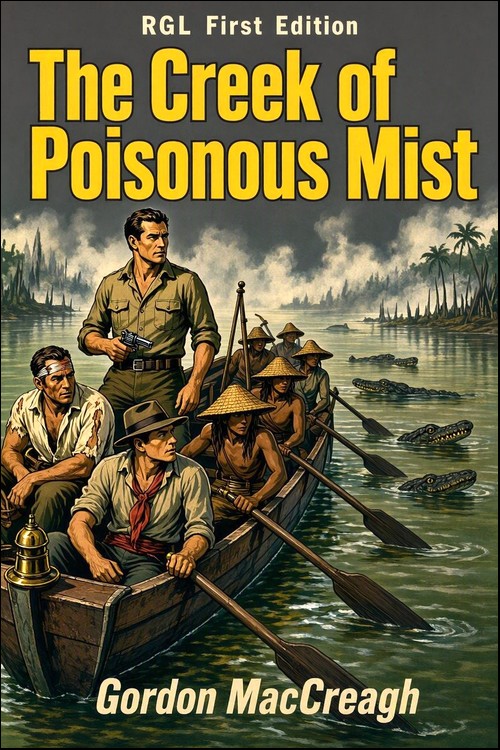
RGL e-Book Cover
Based on an image created with Microsoft Bing software
Roy Glashan's Library
Non sibi sed omnibus
Go to Home Page
RGL e-Book Cover
Based on an image created with Microsoft Bing software
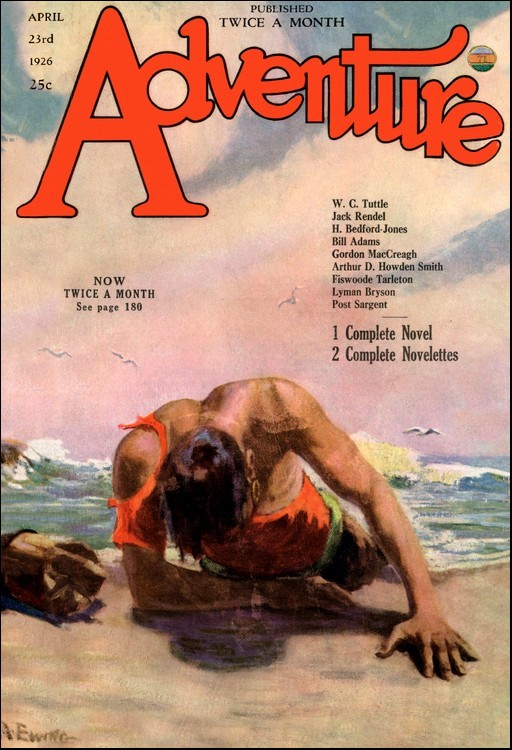
Adventure, 23 April 1926, with "The Creek of Poisonous Mist"
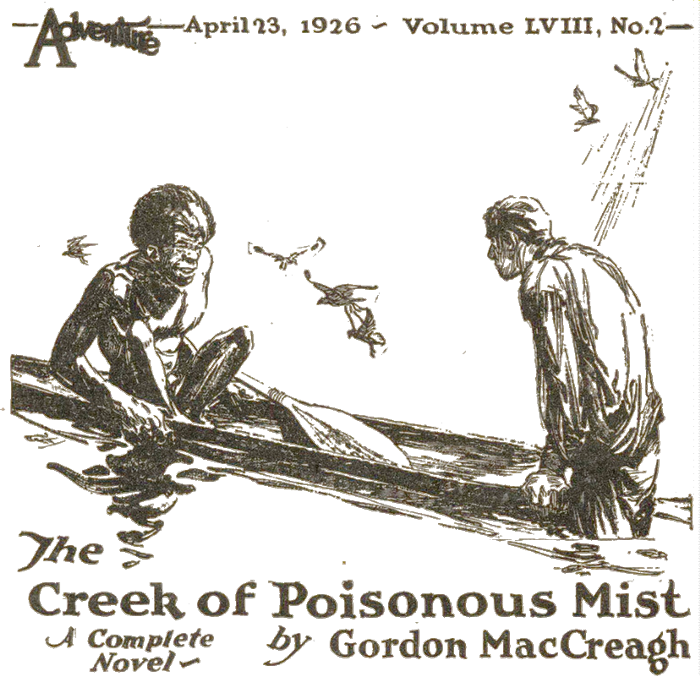
"The Creek of Poisonous Mist" follows Bill Blair, a quarrelsome young American drifting through the Amazon who becomes obsessed with a rumor of gold hidden beyond the Jatuarana Creek, a region feared for its lethal, shimmering toxic vapors and tales of witchcraft. After reaching Manaos, Blair recruits two dubious adventurers—Big Jim Tully and the shrewd Petros Kuyumjian—and acquires an extraordinary river guide, Ohkohthithero, the "River Cat," whose uncanny aquatic skill and cryptic knowledge of the jungle's dangers prove indispensable. As the party pushes deeper into unmapped territory, they confront treacherous tribes, deadly wildlife, and the eerie, beautiful mist itself, which guards a natural phenomenon of geological and chemical peril. The novella blends pulp-era adventure with scientific mystery, portraying Blair's stubborn ambition as both his driving force and his undoing as he seeks the truth behind the golden "quill" rising from the poisonous creek.
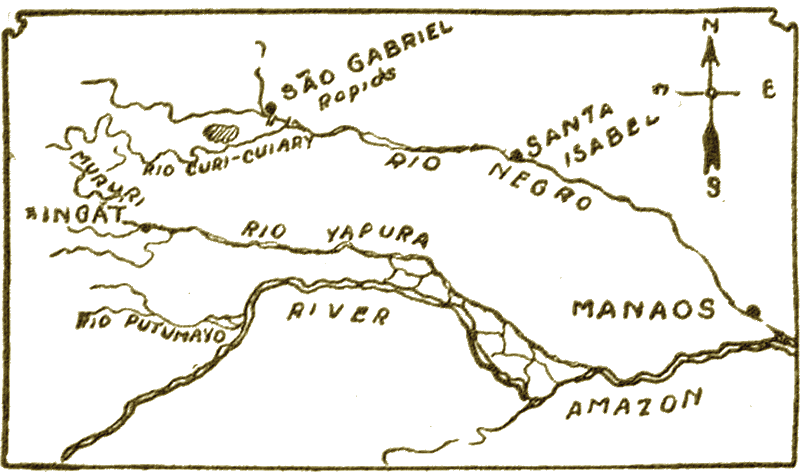
BLAIR was headstrong. Even he admitted that. He was also intolerant. And there were times when he admitted that, too, or, at least part of it. When he quarreled with the head salesman or with the chief shipping clerk he would bounce off to his own desk and would growl savagely to himself that there were too darn many restrictions in that office and too gosh-blanked many bosses. His uncle, when he dispensed with his services, put it very concisely.
"You're intolerant of restraint as well as of discipline."
And Blair admitted the charge and saw no reason for being ashamed of it. But his uncle told him more, which he did not admit. For Blair was a young man of simple speech and direct action, and no analyst of terms and emotions.
"You're intolerant, too, of anybody else's opinion. You get into arguments with everybody about everything, and you haven't the guts to finish what you start."
That hurt. Blair winced under that charge. Nor was it altogether just. Blair was big enough and athletic enough and—yes, courageous enough to finish anything that he had started. But it did seem, somehow, that the other fellow was nearly always the one who had his way in the end. It requires something more than just muscle and courage to push one's end of an argument or a discussion—or a fight—through to a satisfactory finish. Perhaps the uncle would have been nearer to the truth if instead of the wide Colloquialism of "guts," he had said "confidence;" or better still, "tenacity of purpose." But he was not choosing niceties of expression just then. He had counts enough against his nephew to be wholly anxious to be rid of him. He summed up.
"It's been a year now since I took you into my office with a futile hope of knocking some of your college foolishness out of your head and making a business man of you. But you've learnt nothing. You've quarreled with every single one of my heads of departments. You've been a glaring example of that most disruptive force, the relative of the boss; and you have never conscientiously applied yourself to your desk."
In all of which Blair was not so very different from many another American of his age and type and upbringing; and he remained steadfastly,headstrongly unashamed. But his uncle had reached the point of delivering himself of his ultimatum.
"Therefore, William, my boy," said he with finality, and paused a moment while he framed the right words.
And the nephew took advantage of the interruption to interject petulantly—
"For Pete's sake, uncle, don't call me William."
His objection was indicative of his character. His fond mother had called him Willie, and from his earliest boyhood he had loathed the soft significance of the name. "Bill" was more consistent with the type of man that his ambition visualized himself to be. It stood so much more for the things and places which were far removed from an office desk.
His uncle conceded the point.
"Very well, Bill," he said. But there was no relenting in his tone. "I have come to the conclusion that you just don't fit in my office. In fact, you don't fit in any office, and I'll be hanged if I'm going to recommend you to the offices of any of my friends. So what are you going to do about it?"
Bill Blair remained unabashed and, for once, singularly tolerant of his uncle's opinion. He admitted to the final charge with a cheerfulness amounting to alacrity.
"Guess you're right about an office job, uncle, and I don't know what I'll do. I suppose, since I took Spanish at college, I'll drift south somewhere and see what happens."
SO THAT was how Blair came to be at Manaos, that
ghost of a city that had hewn a place for itself out of the
farthest rubber jungles of Brazil and was now struggling
against all the odds piled up by a treacherous river to
keep from sinking into the grave that had suddenly yawned
and engulfed the industry upon which it had mushroomed like
a mining camp of '40.
He had done just that very dangerous thing for a white man who goes south. He had drifted. From Havana to Kingston, to Bridgetown, to Curaçao, to Caracas, to Sao Paolo, to Para and finally up the great river to Manaos. Some of the time he had loafed, reveling in his freedom from restrictions and bosses and avidly absorbing new experiences that were not of an office official. Some of the time he had worked. Though not much. There had been desultory jobs, each a little less dignified than the previous one; for jobs don't last well with a headstrong young man of intolerant opinion and wavering tenacity.
Blair had reached the very fine dividing line between respectability and the stage at which the men of the gringo dub shrug and describe as "another of them." The one thing that had saved him from going the way of those others had been that the stern precepts instilled into him by his athletic instructor at college had established a sound inhibition against stimulating his flagging energy in the tropic heat with aguadiente. And that was how he came to be sitting with the American consul, still hard-muscled and able to think soberly. His uncle would have been interested to note that his opinionativeness had been rendered sufficiently plastic by knocking up against other hard-set opinions to make it possible for him, at least to ask if not to take advice. The consul made a suggestion.
"Braunschweig's export man went out with amebic dysentery a couple of days ago. I fancy I could get you in with—"
But Blair shrank from the idea with a swift interruption.
"No, sir, indeed. I've about reached the end of trying to hold down that sort of a job, any sort of a job. I've got to do something on my own, and I've got to hustle and find out what it's going to be 'cause my string is close to its thin end and it doesn't take the sour looks of the fellows at the club to let me know it. So cut out the usual platitudes and tell me. What do you know about an occasional quill of gold coming from somewhere down the Rio Juruá side?"
"Oho!" the consul raised his eyebrows. "So you've heard that story? Well, I don't know much. But I can tell you that it's no use thinking about that."
Blair's headstrongness was immediately to the fore. His own somewhat prominent brows came together in an argumentative scowl.
"Why not?"
The consul pulled a wry face. This sort of an argument was nothing new to him. But that was what he was there for—to explain conditions and difficulties of the back creeks to his overconfident countrymen. He had reduced it to a formula.
"Why not is simple. You can go up the Juruá as far as Cigano by launch if you've got the money. From Cigano you can go on by batelão as far as this Jatuarana Creek if you've got the knowledge and the rare ability to find a crew of Indian paddlemen and humor them along so they will go there with you. You can go up the creek, as they call it—though it's a considerable river full of rapids and bugs—for some nine or ten days if you've got the grit to stick with that kind of travel, and let me tell you that no man knows what it's like till he's tried it. However, it is possible to make, say ten days up Jatuarana. And then there you're stuck. You can go no farther."
The consul did not know it, but he was enumerating a list of difficulties that were so far removed from the contents of an office desk that they appealed to all the pent-up rebellion against business routine that surged within Blair's turbulent soul.
"Why not?" came from him again with unshaken insistence.
"Because," said the consul as one locking a safe door, "ten days up you come to an Indian outpost and they won't let you go any farther. It's no use trying. There's a whole lot of tribes in the back creeks of these Amazon tributaries who have just withdrawn from the exploitation of trader men and have developed an ingrowing hate of blancos. This Jatuarana crowd seems to be particularly bad. And I'll tell you how I happen to know all this. There was a fellow called MacNeish who went up. He'd heard this yarn about gold coming from somewhere up there, so he thought he'd make a stab for it. And he had all the awful stick-to-itiveness of his race. Well, they stopped him. He came back and died of something or other that he had caught there. Some new thing that the local medicos couldn't place. MacNeish had a wild yarn about witchcraft and ghosts and trench gas and what-not. But he was all hooched up with native caxiri, and was woozy up to the minute he passed out."
Blair was far from relinquishing the topic. His mouth corners, naturally drooping in indication of his argumentativeness, drew down yet farther to an expression almost of sulkiness.
"Well, I've met a couple of men," he maintained, "who swear that if I can scratch up an outfit they'll go up to the last dry pan end of any blasted creek in all Amazonas."
The consul exhibited quick distress.
"My dear fellow, you don't want to get mixed up with that pair," he urged. "I know them. They claim to be Americans. But—gosh, I'm not here to knock our compatriots—but those fellows are adventurers pure and simple."
Blair could see no reason for avoiding a pair of men on account of that charge. The term, as a matter of fact, was part and parcel of his "Bill" complex. The consul saw the antagonism in his face and hastened to qualify.
"I mean, my dear fellow, they're a brace of men from God knows where, who live by their wits without being too particular how. And they're loud-mouthed and braggart and know-it-all, and, in fact, they're the kind of would-be he- men who rant about the wide open spaces."
The consul, as a matter of fact, had expressed the wide difference of meaning of that misused word very well. But his first hasty expression had aroused the ready opposition in Blair. Added to"which he felt that he could well stand a dose of men of the wide open spaces just then.
Some men would have thanked the consul for his advice and would never have withdrawn to follow their own desire. And that type of man would never have quarreled with office managers. It was characteristic of Blair that he thanked the consul and added:
"But I guess I'll take a shot at that gold, anyway. I've got close on a thousand dollars left, and I'll gamble it on any last slim chance before it gets spent and I just have to take a job or else become another of those'."
There spoke the Bill Blair whom his uncle had feed a year ago. The uncle just now would have been quite sure that his bull-headed nephew would, without any doubt, start on this quest of rumored gold. But he would have reverted with his tongue in his cheek to his charge about "guts enough to finish." The consul could see the hull-headedness in the frowning brows and the down-drawn mouth and wide jaw before him, and sensed that argument would be useless. The best that he could do would be to help his headstrong compatriot to a good start.
"Very well, then, if you must," he conceded. "I'm not here to restrain citizens, only to advise them. Let me advise you then and let me recommend you to a good Brazilian batelero who knows the rivers. Those two fellows haven't much river experience or they wouldn't brag about going up any blasted creek. And, as a matter of fact, you can't get them anyway because they pulled out of town yesterday."
"I know," said Blair. "They were fired out of their hotel and they went across river to São Joaquim to jump the Maranão launch without tickets."
"Well, that settles it then," said the consul with relief. "You can't connect with them today any more, and they'll be gone early tomorrow morning. Now I can recommend you to—"
"Why can't I get a couple of Indians to run me across in a dugout?" Blair interrupted. "Why can't I borrow a dugout and paddle over myself? Why can't I swim across?"
His impatience of restraint was reacting with hostility against so much repetition of "you can't." Not such a very bad characteristic, this—when one is not a subordinate in an army or an office or some such institution idolatrous of discipline, and when one tempers it, as Blair did not, with sound judgment.
The consul gaped at him and then, all innocently, drove him on to destruction.
"Don't talk foolish, man," he snorted. "You can't because you can't. You might find a couple of Indians with a canoe somewhere, though I couldn't bell you where. But as for padding across yourself, it just can't be done. A dugout is a long cry from an Old Town canoe, and this Rio Negro < of ours is a longer one yet from the worst water you've ever known. It's four miles solid of tricky whirls and currents and undertows. Maybe you don't know that the story along the waterfront is that if a man falls off the dock he never comes up again even once. So swimming talk is plain craziness. No sir. My bet stands. You can't connect with those men before they hop that Maranão launch."
SO THAT was how Blair came to be out in the middle of
the Rio Negro alone in a dugout canoe late on a scorching
afternoon. From the point of view of the consul and of
the other gringos in Manaos it was crazy enough. For it
is not compatible with the dignity of blancos, solidly
entrenched in unimpeachable businesses on alien soil, to
attempt to paddle dugout canoes across any sort of water at
all, far less across the treacherous currents of the Rio
Negro. And furthermore, most white men, when their evil
fate plants them in a tropical country, lose interest in
doing strenuous stunts. And this was distinctly a stunt.
Though from Blair's point of view it was perhaps not quite so crazy a stunt as it might have been to many another man. For, while he had been perverse enough not to tell the consul anything of this, swimming happened to be his longest suit. Four miles of ordinary water would have been nothing to him, and he felt stubbornly confident that a man who had swam the tide-ripped water from the Battery to the Lower Bay could, in the event of an upset, negotiate any river current.
He was beginning to regard the possibility of an upset with a certain measure of scorn too. A one-man dugout canoe, it is true, was a far cry from a scientifically designed Old Town. Heavy and with a scant four inches of freeboard and built, not with a view to water lines, but according as God had shaped the log, it was unresponsive to the short circular-bladed paddle that felt so unaccustomed to his hand. But he was beginning to get the hang of it. Sufficiently, at least, to keep its nose to a more or less diagonal against the four-mile current and to progress, when the cross currents let him, in the general direction of the farther shore..
Away upstream to has right another solitary canoe, the only otter moving thing on the mirror-black expanse of-water, angled toward him, throwing a long V ripple behind it as it sped, apparently to overhaul him. Blair experienced a wave of envy at the long, easy strokes of its occupant, and with it an angry resentment at the ignominious thought of being so easily overtaken by an undersized native. He bent over and plowed along with considerable splashing and wasted effort for some minutes. He was almost beginning to congratulate himself at his progress when he felt a soft bump under the round bottom of his craft.
"Hallo! Shoals, sand bars, this far out?" was his thought.
But he remembered instantly that the Rio Negro at Manaos was navigable for ocean steamers from shore to shore.
"Must have scraped a log," he told himself, and paddled on.
But that was a most wilful log. In another minute it was in the way again. It rasped softly along the under side with a grating sensation which was not unfamiliar to Blair—like drawing a clam-rake over the bottom. The crazy canoe heeled to the very gunwale edge, and Blair suddenly tasted his heart in his mouth. However good a swimmer one may be there comes an inevitable qualm at the thought of some monster beneath one's boat that is unafraid enough to nuzzle up against it.
Caimans and sharks, of course, were the first thoughts that shocked him. But he knew that the caimans were no lovers of fast water and that they kept to the sluggish creeks and stagnant lagoons. Sharks, too, were out of the question twelve hundred miles from the ocean. Yet in the next instant a great serrated fin ripped sleekly out of the water in a long, lazy arc. It was full three feet long and its comb of bayonet spines stood a foot clear above the surface. It slipped under as silently as it had appeared, and then a flirt of the great tail left a sudden sucking cone which dragged the nose of the canoe toward itself and boiled round it in whirling bubbles.
Blair caught at his breath and drove his paddle into the water with great plunging strokes to get away from that place in a frenzy of apprehension. Futile thought. What hope could even an expert canoeman have of outdistancing such a monster in its own element? And this beast seemed to be as sportively inclined as a dolphin. With an effortless surge it was alongside again, and whirled and scraped under, heaving the tail end of the canoe up so that the nose dipped and took water, and Blair sat six inches deep.
Warm as the water was, the sudden clamminess of it through his duck pants sent Blair's heart out of his mouth all the way down to his white canvas shoes. The first qualm at this submarine attack had developed into something very like panic. Coupled with half formed thoughts of the pistol at his belt holster was a flash of very definitely formed regret that he had not listened to the consul's advice about venturing out on the wide Rio Negro in a dugout canoe. A plight which was very good for Bill Blair.
But he was given scant enough time either to plan or to regret. While he still thought vaguely of his pistol, the sportive monster rasped under his canoe again slowly, almost luxuriously, and then heaved up like leviathan rising out of the deep. The canoe see-sawed for a moment, lifted drunkenly, rolled and slid down on its own tail. Blair caught a glimpse again of that great saw-toothed fin, of a broad, gray-green back, and then he was in the water with that fearsome creature that lived in it.
Blair was much more at home in the water than in a dugout canoe. A subconscious memory about shark stories told him to dive and get beneath the enemy. With it came a crowding question as to whether his pistol would go off under the water—perhaps right up against the creature's belly. He dived, and realized then for the first time why the Rio Negro was so named. Six feet below the surface he was in the blackness of thin ink. Clear but impermeable. He could distinguish no more than the dim shadow of his hand before his face. Horror of the lower depths seized him. Convulsively he shot to the surface and clawed through the water with a powerful overhand crawl, rolling to the exact fractional angle and breathing with instinctive perfection, his whole mind and muscle and sinew concentrated on the single frantic effort to get away.
A voice impinged on his consciousness. Dimly at first. But the insistent cries bore in. It was a voice shouting in crude Portuguese.
"Await me, senhor. It is I, Ohkohthithero, no less. Have no fear of the fish. It is pirarucú."
Pirarucú! The name came to Blair's mind in connection with the huge slabs of semi-sun-dried fish that were such an offense to the nostrils in all the trade outfit stores along the waterfront. He knew the fish to be monstrous denizens of the black water that ran into three and four hundred pounds. But that was all. Of their food proclivities he knew nothing. Yet there was comfort in a human voice. He ceased from his wild race and whirled in the water.
The other lone canoe was bearing down on him, throwing a bow wave like a miniature speed boat. In it, or rather as if protruding out of its bottom, were the naked shoulders and arms of a six-foot man. But their lack of proportionate height above the gunwale was grotesquely apparent to Blair even from the water level. The canoe swooped down on him at full speed, missed his head by six inches and then, with a powerful out-drive of his paddle, the man spun the craft on its tail and brought it stationary alongside.
"Ammá-u!" said the man. "It is a gringo. Only a gringo is mad enough to do this. Am-mu i qua! Do all gringos swim like the pira itself? Have no fear of the pira. It is not an eater of men. But get in, gringo."
It is remarkable how the confidence of a single man may offset the panic, sometimes, of a whole regiment. This extraordinary person's expert handling of his canoe, his cool familiarity in his queer jargon of broken Portuguese interlarded with exclamations in Geral dialect, his goblin grin were all so indicative of a confident command of the situation that Blair's courage swept back in a warm wave.
"If the fish isn't a man-eater, why should I get in?" he demanded. "How can I get into that canoe? It is barely big enough to hold you."
"Qua gani!" The man's voice cracked. "What a madness! This is the danger, gringo, for which cause people do not come in little canoes out into the black water. The pira loves to scratch its back under floating logs, and with its many-knifed fin it may rip your bowels forth like a rope. Safer is swimming far from anything that floats. Get therefore in. I sit my weight at the one end. Climb you in over the other."
Recollection of that great jagged fin that cut the water so sleekly was vivid in Blair's mind. Not so far downstream he could see his own craft rolling and heaving spasmodically as the great fish still tried to rid its back of the clinging parasites. At any moment it might transfer its attention to this new and more solid medium. A swift stroke carried him to the farther end of the canoe. The man grinned again and, with cat-like balance, swung his startlingly inadequate body backward between his long arms till he perched like some misshapen goblin at its extreme stern.
Blair had climbed into canoes before out of the water'—Old Town canoes. He knew that it was a tricky procedure, but it could be done. Possibly even with this crazy thing of minimum flotation. With infinite precaution he heaved himself up over the end till his weight rested on his arms, all clear of the water except his legs. So far good. Remained the more finicky operation of edging forward till he could straddle the craft, and then he would be safe. The goblin at the other end grunted approval and balanced like a performing ape. Inch by inch Blair edged forward on his hands. Almost was he far enough to hoist himself to a sitting position when an oily undercurrent, boiling up from below caught the canoe and spun it sidewise. Blair's trailing feet acted as a drag. Just that much was necessary to upset the delicate balance. A wave slapped the side with a soft chuckle and the canoe rolled quietly over, as smoothly as a turning log.
IT WAS then that the goblin laughed. With a single long
stroke he overtook the canoe and, with a dexterous heave,
righted it. Blair was alongside in an instant. Never more
than a few inches out of the water, the clumsy thing, full,
floated with a bare half inch of clearance.
"What now?" said Blair. "We can never bail this."
"Never," agreed the other cheerfully. "We can but hang on and push, and maybe by midnight we reach the shore."
"What about pira?"
"If pira comes, we must push the canoe far from us and swim alone."
The man was so cheerfully carefree at the prospect, and Blair, who knew swimmers, had noted his so easy dexterity that he felt hopeful in asking.
"Could you swim alone so far?"
The man laughed again.
"I tell you, gringo, my name Ohkohthithero. In Portuguese, Gato do Mar, the River Cat. This is my water."
"Then," said Blair. "Since it's safer, let's leave the canoe and swim."
Still the man demurred.
"Gringo can swim this black water. I have seen. If he can swim that far, let him swim. For me is risk of pira necessary, for that canoe is all that I have of possessions."
Blair would not have clung to so tempting a lure for a gamboling, razor-backed, freshwater monster for all the money that the world could produce, and he was just as unwilling to leave this extraordinary character to so perilous a task.
"Come on," he ordered curtly. "I'll buy you another canoe."
The man was immediately willing. He grinned cavernously.
"Good," he agreed. "Gringos keep their word. We swim. I lead and show where currents are easiest. This is my water."
The next instant he called again:
"But this way, gringo. This way. The. Manaos shore is much nearer."
Blair looked over his shoulder.
"That may be," he said shortly. "But I'm bound for São Joaquim."
The River Cat chuckled gurglingly and overhauled him with another of those phenomenally reaching single strokes.
"Ek-heh, amma-uru," he was muttering. "This gringo is a very great senhor."
Blair paid no attention, but settled himself down to take a three-mile swim with an easy side stroke, holding plenty of power in reserve for another mad dash, if need be, from he didn't know what further menace in that unholy black water. The water-cat man swam in a manner all his own, more often below than on the surface. But he kept abreast. They had progressed in silence for perhaps a minute when he suddenly gave a cry of dismay.
"Awá, but am I a fool! In that canoe that used to be mine I left in a cleft cane my package of ipadu leaf for chewing. Let Senhor Gringo go on. I go fetch and I catch up."
And before Blair could remonstrate about the idiocy of returning into the danger zone all for a miserable package of chewing leaf, the man had spun round and was making amazing speed back to his abandoned canoe. Blair was in two minds about going on or standing by to assist if need be. Though he did not know of what possible assistance he could be to a man who might suddenly be gashed wide open by a three-foot-long, saber-toothed fin. Nor was he anxious to prolong any more than necessary his sojourn in the neighborhood of that fin. There is something more than merely nerve-racking in being far from dry land in deep swirling water of evil reputation and sufficiently unknown to contain almost any possibility of horror.
But despite the impulse to snatch his toes out of the cold lower currents and flee madly away, he trod water and waited. He saw the man arrive at his canoe without mishap and reach his arm over the gunwale to fumble within. Apparently he found what he wanted, for almost immediately he started back. Then Blair turned and rolled into his long overhand racing stroke. It piqued him to hear this sawed-off individual speak with such careless certitude about catching up, implying almost, since senhores indeed did not do this sort of thing often, that none of them could swim worth much consideration anyhow. Well, he would show him.
That was the second time within that hour that Blair had to admit the error of his opinion. And overwhelmingly. He had about a hundred yards start. He made perhaps a half a mile at his best speed when an abnormally long and knotty-muscled brown arm clove the water alongside of him —almost like a fin—and disappeared again. Six feet further another arm reached out from under and dragged forward, and then the round mop of a head emerged, already well past him.
Blair had sense enough not to waste any more strength in a futile effort. Any man who could overhaul him in a half mile with a hundred yards start was no person to race with. This misshapen creature was abnormal in more than form. It seemed that his very deformity recompensed him in this one respect by offering less resistance to the water or something. The man swam with uncanny ease, just as if he reached out with his great arms and took hold of the water ahead of him and dragged himself forward; and Blair noticed now that the powerful arms were fitted at the ends with great hands almost like paddles.
"Hm, Gato do Mar," he said to himself with new understanding. "Why, that must be the Brazilian name for the great otterlike creature of Amazonas."
He swam in silence till he had regained his breath after his spurt, gratefully cognizant of a warm comfort in the presence of a fellow human by his side in the same plight who seemed to be familiar with the conditions and amazingly carefree about them. He was curious to know more about this queer person who seemed to know so little about the deference that was customary from a down-river Indian to a white man.
"What is your tribe?" he asked him. "Where is your village?"
"I have no tribe," said the man. "I am Ohkohthithero of the rivers. I lost my tribe when I was as tall as I am now but not so broad. I used to make my food by spearing fish, the pira, for the sellers in the market. Now I am the great senhor's servant."
"Which senhor's?" asked Blair, wondering what big boss in Manaos employed this extraordinary character.
"But the senhor's own," said the man with startling confidence. "What other gringo knows the water well enough to be a worthy master?" And he asked a question then of his own. "Where are we going, padrão?"
Blair did not know that he was in the market to employ a circus freak. But, after all, he reflected. A naked Indian did not cost much to support, and one who knew the rivers might prove useful as a guide if for nothing else. However, that could be decided upon later. He hid his smile as he rolled to swim on the other side, and answered:
"I go to São Joaquin to hire two white men who know the rivers to make a journey to the Jatuarana."
The Indian's quick reply held his interest.
"Am-mu! To the igarapé of poison mist?"
Blair turned quickly.
"Do you know this place?"
The man shook his head so the water sprayed as from a twirling mop.
"I have never journeyed there. But I have heard of the great witchcraft. What matter? Water is water. Where there is water, Ohkohthithero can go. For the rest, master, no white man knows the rivers. Let us turn and swim back to Manaos. In a canoe but a little bigger than those last two we can go to Jatuarana, and the great senhor can there doubtless overcome the witchcraft."
Witchcraft! Just what that Mac fellow had babbled about, according to the consul's story. But then, that other was fuddled with native cane alcohol and this was a superstitious Indian. Not that a little witchcraft would not be an exhilarating novelty, Blair thought. But as for going wandering up a mysterious river in a two-man canoe with this so insistent servant, that was another matter altogether. Besides, if the American consul couldn't dictate to him whom he should hire, by no means at all could a servant.
So Blair only grunted a short "hmph!" and kept his face in the opposite direction from Manaos town. But when the man grunted too and glided easily to the lead and called over his shoulder that by holding just such and such an angle against the current they would bring up at São Joaquim front, five miles lower down, he did recognize the fact that this man had amply demonstrated superior experience, and so followed. Which was quite a concession for Bill Blair.
"To São Joaquim let us then travel,'! said the man. "Water is water. It is all one to me."
It was perhaps an hour later that they pulled out at the sand spit below the granite outcrop which protected the nut sheds of the little settlement of São Joaquim from the fifty-foot rise of the river in the monsoon season. Blair, for his part, gratefully. And then for the first time he was able to get a full view of this phenomenon who called himself Ohkohthithero.
In the canoe out in the river there, when he had tried to climb in, he was fully occupied with the very delicate balance that the feat demanded and he had noted only the startling disproportion of the powerful shoulders and arms and the confident grin. He was able to see now, as the man stood up clear of the water, that a great barrel chest matched the shoulders—the upper torso of a wrestler. But with that it seemed as though Nature, attempting too colossal a task, had expended all the material available and had been compelled to piece out the job with remnants. Despite the upper body of a she-foot athlete, the man stood barely up to Blair's chest—a scant four feet. Yet he was no cripple. The loins fell away in a clean run and the short legs were widely bowed and knotted with muscle.
"The perfect swimming machine," Blair muttered to himself. And then he found himself wondering why an ape was not a good swimmer, for the disproportion of the man's lower limbs brought his great hands down to his knee level. And his face, too, was elfishly simian, wizened and preternaturally old, with the shrewdest of alert black eyes and a gash of a mouth that grinned ever with strong white teeth.
"No family butler," 'thought Blair as he took stock of his new retainer. "But perhaps not such a bad man if he knows the rivers." Aloud he asked, "What do you know of boats and of river travel?"
"Everything," said the man without hesitation. "Senhor Padrão will now follow and I will lead to the hospedaria of Sebastian, where will be those two gringos who know nothing."
SO THAT was how Blair—not of his own volition, be
it noted—came to acquire a servant The man padded
ahead of him in a quick, rolling trot that kept his much
longer legs extended as much as was comfortable in the
loose sand. The settlement lay beyond the sand spit on an
extension of the outcrop that was well above flood water;
and the dwarf took the slope without ever relaxing his
trot. The stiff rise was nothing to the lungs within that
barrel of a chest.
But Blair was panting when he halted at last before a rambling, single-story barrack of adobe faced with pink tile.
"That is the hospedaria," said the man. "It is the sundown hour when the gringos eat jantar. They will be in there eating and drinking. The blanco, Sebastian, does not permit Indios without clothes to enter as servants. I wait here while the Senhor Padrão talks with the gringos. I say only one thing. I know where boats of all the kinds, monterias, batelãos, canoes, may be hought."
Blair was aware of the very catholic courtesy accorded to the word blanco. Just as a gringo in Brazil meant any American or European of the non-Latin races, so a blanco ought be any Latin or native of the country. Anybody, in fact, who wore pants to distinguish him from an Indio. Yet he was surprised to meet the negroid person who came forward as Sebastian, the proprietor of the strictly European plan hotel.
"Assuredly," said Sebastian.
The two gringos were his distinguished guests. They had not paid their day's reckoning in advance, as was his unbreakable rule with ordinary blancos who came to his establishment. But since these gentlemen were awaiting the senhor, their wealthy compatriot, he had gladly made the concession. And much relieved was he now that the senhor had arrived. Though he could not understand how, for there had been no boat. Very much relieved, indeed, for those two gringos, distinguished though they were without doubt, were men of domineering nature, and would have been most difficult to restrain when the Maranão launch came in the morning and they remained still in his debt.
Blair's only reply to this disclosure was a grunt, and he ordered the man bruskly—
"Take me to your guests."
The senhores, the distinguished compatriots of the wealthy American, were in the largest room of the strictly European plan hotel—the one with the smoothest trampled mud floor and the long table of solid three-inch mahogany, the permanent coat of grease on which was gratefully disguised by the pleasing dusk. For though the hour of jantar is universally set for 7 p.m., at São Joaquim, which is less than three degrees from the Equator, daylight lasts strictly from six to six. The distinguished guests greeted Blair with loud acclaim and, Blair thought, with a certain relief.
"Ho, hallo! Sit right in and jantar a bite with us, Billyum. We bin expecting you right along. Figured the consul' ud give us the right send-off, an' if you're thinking of goin' up river, we knew we were the right men for you."
This was Jim. "Big Jim" Tully, as he introduced himself with a jovial laugh, to all and sundry. He was a trifle taller than Blair, and heavier all round. His features were big, too, and florid and—just that-jovial. Older residents than Blair in the
Brazilian ports would have placed him unerringly with the criticism that he was just a little bit too ingratiatingly jovial.
The other was Petros Kuyumjian. "Pete," a small, darker man, unassuming and quiet, with alert, dark eyes; very clearly the brains of the partnership.
To the older residents a single word would have sufficed to describe both of them to a nicety without further comment. They were pajameros. That is to say, white men who felt that they might with perfect propriety, dress in pajamas as soon as they were "out," which meant anywhere beyond the immediate limits of a city as large as Manaos.
They were both in pajamas just now. Kuyumjian's wide- awake eyes lighted just once as Blair entered, and he extended the invitation, in precise English, to join then- meal.
"Beastly native grub, Mr. Blair. Dried pirarucú and rice and red-hot chili pickle. But the coffee's good. Sit in and let's talk business while we eat."
Under the table he softly withdrew his foot from his slipper and kicked his partner twice in the signal which meant, "Now you keep shut and let me handle this."
He was nervous with eagerness. For this newcomer had been the best chance that had come their way. Almost their last chance, in fact. He had cursed his fate and his God equally with the flinty hotel keeper who had refused to let them stay any longer in Manaos to play their fish. And here the fish came asking to be caught.
"You leave me handle this smart alec," he had told Big Jim. "He's the easiest thing that was ever made for us by Providence. If he has any real dope about gold, so much the better. But I don't care. He wants to outfit for up-river and he thinks he knows it all. All right, let him. If we can get him to stake us to a trading outfit, we're fixed. 'Cause trade, I tell you, is my meat. I don't care where it is. If these dumb river traders can skin anything out of the jungle tribes, I'll go over the same ground and skin them twice. So you shut up and leave me make any deal that he wants."
Big Jim knew that when it came to diplomacy Mr. Kuyumjian could give him odds and a long start and still beat him to the post. So he kept shut as directed and restricted himself to his forte of genial fellow of the great outdoors.
"Shoot the proposition, Blair," was his cordial invitation. "We're wide open."
Headstrong and opinionative Blair might be in seeking out these two men against the advice of the consul, but those doubtful qualifications do not carry with them, as a necessary adjunct, foolishness. Blair had drifted close enough to the thin borderland of respectability where the gentlemen of the beach subsist in their many gradations of brokenness to know that this pair of schemers were hoping to find in him an angel for any sort of proposition at all that would relieve their existing predicament and might lead to anything else at all.
MOST men with that knowledge would have steered well
clear of the pair. But Blair—it would have surprised
his uncle very much to know—had drifted close enough
also to tropical borderlands to have acquired a feeling of
the vastness of the empty beyond and, with that feeling,
an unwonted sense of humbleness that his knowledge was
insufficient to meet those unknown conditions. He had heard
the border dictum too often—"A white man can't go
into the jungle alone." And the earnest intensity of the
restraining negative for once did not antagonize him.
Awe of the great silent unknown convinced him that he needed the company and support of at least one white man, even if such a one's experience were not so very, much greater than his own. As for experience, it was Bill Blair's stout contention that a man picked up experience as he went along. But where his opinionativeness came out was that he felt he could go into the jungle with any two men and keep his own end up. Which brought the question of opinionativeness down to a matter entirely of opinion. For, after all, it would be according to the result that he Would ultimately be judged. For who without bias shall say where lies the fine distinction between pig-headed opinionativeness and a fine, firm confidence?
So Blair sat down on the rickety chair of scented cedar that was offered to him and announced—
"Well, I've about decided that I can gamble an outfit for this jaunt up to the Jatuarana."
Both men beamed on him. Here were their dreams coming true.
"I knew you couldn't go wrong on that proposition," enthused the jovial Jim. And Mr. Kuyumjian followed it up with: "Well, you've come to the right men, Mr. Blair, to get that outfit together, though I do say it myself. Now between the two of us, we know where a boat and trade goods—"
"What I came to talk about," Blair interrupted, thinking of that queer River Cat's almost prophetic last word, "was just what kind of a dicker can we make about the proposition? You see, I can just about afford to grubstake an outfit and expenses. But I can't talk salary with you fellows. If you'll gamble your time, I'm open to listen to you on a split basis."
Mr. Kuyumjian deftly turned the delicate matter of suggesting the basis on which they were to share back to the greenhorn with the quick assumption that he would be easy to deal with..
"And what would be your idea of a fair split, Mr. Blair?"
"Grubstake rules," said Blair promptly. "Fifty per cent, to the stake and an even three way split for our time after that."
Mr. Kuyumjian winced. This greenhorn was not so green. But he kicked his partner under the table again before the ready remonstrance on his lips could find utterance. What did terms matter after an? If they could but once get afloat with a trade outfit there would doubtless be ways and means which ought be devised by an astute man for evening up any discrepancy,
"Those are the rules, Mr. Blair, and fair enough they are, I'll say. Now about getting all this stuff together. I suppose, since you don't know anything about the rivers and the conditions, you'll be wanting us.to do your buying for you."
The greenhorn was still disappointing.
"Mm-hm, I may need a little of your help. But what I principally came over for was to see you fellows before you jumped that Maranão launch. So if we can call it a deal, we might shake hands on it."
"Shake hands—! How about a drink on it?" boomed Big Jim.
Blair shrugged.
"Well might as well, I suppose, 'cause I'll be buying no hooch for our outfit. I've heard the story of one man who went under with cashassa on this same quest."
This was something of a blow, but there was worse coming. Blair crooked his finger to the single moço of the establishment and ordered three green ones. The new partnership drank together and shook hands on their pact. And it was then that it was forced upon the attention of the others that Blair was wringing wet.
"Why? What? How come?" was the question.
"Came over in a dugout," explained Blair laconically. "Upset out in the middle and had to swim the rest. That's what I'm in a hurry about. I've got to hustle out and arrange to get back. I'll square your account here and see you in Manaos tomorrow. Right? So long then."
Short, sweet and concise. Hearty Big Jim and clever Pete were left looking at one another. Big Jim turned on his partner fiercely.
"Easy, yuh said he was, yuh punkhead. He didn't know nothing about the rivers. Leave 'm to you. I'm here to tell you, Syriac, that any fool who starts from Manaos in a dugout an' swims half way knows things about rivers 'at you'n me don't. Pm for jumping that launch an' see what turns up at Maranão.
Mr. Pete Kuyumjian threw out his hands in a gesture of deprecation and defense.
"Sh-sh! For Mike's sake now, listen to me," he urged. "We want an outfit, don't we? Well, listen to me then."
The irrefutable simplicity of his premise reduced Big Jim to dissatisfied growlings. Outside, Blair found his giant dwarf squatting like a ghoul in the dusk by the door. Where he had been all this while Blair had no means of knowing. But the man delivered himself of an ultimatum.
"I have one thing to say. I am the great senhor's servant. But from those two gringos I take no orders."
Blair was beginning to understand that just as there was a distinction between gringos and blancos, so there were grades of each. Some remained just gringos or blancos. Others might also be senhores. Others again, a few, might rise to the eminence of great senhores. He laughed and told his master of heraldry.
"Bom, it is well. Nobody at all takes orders from those two gringos."
"Good," said the dwarf. "I am the Senhor Padrão's servant, and I have borrowed from a catcher of fish here a canoe to take us back to Manaos at no cost."
AND that was how Blair came to strike a partnership with
the two men against whom the consul had warned him. Despite
which he felt that he was well started on his way to his
last gamble with fate for a free life in God's good open
places against the drudgery of some sort of a job in an
office.
Started. But would he finish? He thought sourly of his uncle's accusation as he followed the River Cat down to the dim edge where the great black river lapped chucklingly at a long canoe.
Blair thought that he might do better on the following morning than wait for the arrival of his distinguished compatriots to do his buying for him. He had won a stubborn battle against the proprietor of the hotel the night before on the subject of his naked retainer. In that far border country which knows no color line so many of the patrons of the establishment were so mixed up in their ancestry that a line of demarkation had to be laid down somewhere and there rigorously maintained. Since color was a delicate subject and language offered no shibboleth, the line that marked a blanco must of necessity be what the gringos, safe in their pale purity, referred to as the clothesline.
The proprietor, then, had angrily maintained his point that it was against every rule of procedure for a decent hotel to permit a man who wore no more than a gee-string to enter. Blair had taken the belligerent stand that it was midnight and he was there and his servant was there, and he saw nothing in the immediate landscape that might prevail upon him at that hour to go elsewhere.
This was the following morning, and he was still there; and so was his servant, who had slept on the soft gray-toned tile floor of the veranda outside of his door and who was more convinced than ever that the senhor padrão who could successfully flout a rule that was almost a state law was a very great senhor indeed. Blair called him into a consultation over the daybreak cup of black coffee served in bed, which is called almoço and means breakfast.
"How does one travel to the Jatuarana?" he asked.
The dwarf squatted and swept the thin carpet up into a heap with one enormous paw. Then very simply he wet his finger in his mouth and drew a map on the floor.
"Look. This is the way of the waters. Here is the black water flowing east. One day's journey down it meets the great water, Solimoes.* Solimoes comes from the west. No man knows where. Seven days up is Juruá, coming from the south. Ten days up is Jatuarana, coming from I do not know where. But what matter? Water is water."
* The Amazon.
Blair let him finish his exposition, anxious to see just how much the man did know. With a dry smile he compared this simple admission about the Jatuarana with the brag of his partners, and asked his servant again— ,
"What I particularly wanted to know was how does one—by what means is it best to travel to Jatuarana?"
"I would take an uba," said the dwarf promptly. "A light canoe such as the senhor padrão is going to give me—"
Blair had to laugh out loud at the simple directness of this man's mind.
"Listen, River Cat," he said. "I want to know how I must travel to the Jatuarana. As for a canoe, I don't know where to buy a canoe. I will give you money to buy one for yourself."
The dwarf's grin broke out like a sudden gash across his face.
"Of what use is money to me? If I had money, some blanco trader would cheat me of it for something of poor make. Also of what use is a canoe to me who am senhor padrão's servant? Why does padrão want to go to Jatuarana, which is bad water?"
A blanco—and most gringos who knew the customs of the country—would have cuffed the man about the ears and would have dismissed him as being entirely too lacking in deference for a servant. But Blair was unaware that his dignity required such careful watching. He answered the dwarf's question.
"Because I have heard a story about gold somewhere up there. What do you know of that story?"
The dwarf's face screwed itself up to a wrinkled mask of monkey shrewdness and he swung his body between his long arms confidentially closer to his master.
"I do not know Jatuarana, padrão. Many lies come out of the rivers. But I have heard that the people who live beyond the great witchcraft of the poison mist have gold. Blancos may not go beyond the witchcraft. But if senhor padrão can overcome that magic and if the tale is true, how will he get the gold?"
That was just what Blair would very much have liked to know himself.
"Darned if I know," he muttered to himself. "Trade for it, I suppose."
The dwarf grinned all over his face again.
"That is good," he announced. "Senhor padrão is a great senhor. In these rivers many would have in mind to cheat for it. For trade padrão must go to Jatuarana in a batelão with goods. But—" he pointed a thick finger with sudden warning—"not with bad goods such as the trader blancos carry. For look, padrão, those people beyond the witchcraft have heard how the custom of the blanco is to cheat the people of the rivers and to beat them and to steal their women, and that is why they have built a wall of magic across their road."
A veritable mine of wisdom this strange rover of the rivers was proving to be. It took time to dig the valuable facts out of the mine. But Blair was getting what he wanted.
"The custom of my country is to trade with good goods," he assured the dwarf. "Now where do we buy such goods and a good batelão?"
The dwarf spread his hands like fans.
"Good goods are easy if one will pay, as the trader blancos will not. A batelão may be bought in Manaos if one will pay. Paddle men may be hired if one will pay. But the smoke boats go to Juruá. In the Juruá will be batelãos of traders who have died or who are sick or who need money. I, Ohkohthithero, know of good paddle men in the Juruá. My word >s to buy a batelão in the Juruá. And besides," he added naively, "I have never ridden in a smoke boat."
Blair felt that the advice he received here was as disinterested and free from bias as his partners were self- seeking and prejudiced. He felt, too, that since he was buying the outfit, he had a right to purchase what he chose without consulting them. They would be coming from across the river by the launch that arrived at noon. So he laughed shortly to himself, not without a certain satisfaction at their prospective disappointment, and spent a busy morning shopping in the great trade supply house of Araujo where everything for up-river trade, from beads and brilliant print cloth to beans and imported pâté de fois gras, may be found under the one roof.
It is not usual for a gringo to outfit for up-river trade. Blair, therefore, caused comment, which was augmented to wonder at the extraordinary figure of the Indian who padded at his heels, and was raised to the nth degree of amazement at the quality of the goods that he selected.
Naked Indians, of course, everybody had seen. But Manaos is a town which prides itself on its civilization, and a selvagem, as they called him, a savage or a feroz, a ferocious person, was as rare in a Manaos store as an Iroquois brave on Broadway. And such a savage! Even old, established rivermen stopped to stare.
But the dwarf, all unconscious of the attention he was attracting, was experiencing the adventure of his life. He had heard of stores where there were piled up treasures such as the trader men so sparingly displayed. Ever he hovered at Blair's back and ever with unconscious effrontery his long arm reached out and took samples of the goods under discussion.
Beads he weighed in his hard hand as in a jeweler's balance. Print cloth he tested and tasted and tore with all the care of a New England housewife. Knives he tried out on the horny sole of his foot. For a machete he sought a counter leg to hew.
"This is bad goods, padrão, and that is trader quality. This other you must buy. And that there is worthy of good trade. For such a knife—" indicating a ten cent store kitchen knife— "I will hire in the Juruá a paddle man for a week."
To the remonstrances of the salesmen, who wanted to unload upon him the regular line manufactured for the delusion of the unsophisticated and who chafed at hearing their shoddy material so mercilessly exposed in the balance according to their lasting quality, Blair growled:
"Shut up. Maybe I act green. But he knows what the Indians back in the jungles want'."
Which, of course, was a clinching argument. And so he bought fish-hooks and little mirrors and iron nails— "for arrow points, padrão"—and knives and queer little ax heads which, for some curious reason, have become a standard demand in the upper rivers, and porcelain teeth for necklaces and big iron spoons.
AN ASSORTMENT which to those practised trade outfitters
was crazy enough, for at that quality there was little
profit in these things. Cheap print cloth at fourteen
cents a meter they would have sold him, three meters of
which a "piece" was the standard price of a woman among
the debased lower tribes; and brittle bladed hardware that
could be relied upon to break and keep up the demand for
replacements. But Blair's natural contrariness found zest
in repulsing their importunities with:
"Have any of you counter-jumpers ever been in the upper rivers? No? Well then, let the man be. He doesn't need any amateur advice about what goes there."
Perhaps if it had occurred to him that he himself was without question submitting to didactic advice from a naked selvagem feroz, his ego would probably have felt the need of asserting his own opinion. And yet again, the savage so confidently and obviously knew just what he wanted, and Blair on the edge of the great beyond had reached a state of humility in which he admitted that he himself knew nothing; that expert advice, instead of irking him, was as easily acceptable as manna in the wilderness.
And so the pile grew. Hardware and flaming wall paper pattern calicoes and beads. Honest goods, fit to be retailed in the markets of Manaos City itself rather than to naked Indians of the farther rivers who had never known that such serviceable qualities existed. Then came rope, apparently useless fathoms of it, made of a coarse native fiber. And finally, with fine irony, the enemy itself. Pirarucú. A couple of bales of it, the great slabs wrapped in palmyra matting and gunny which afforded no protection whatsoever from their rank odor. Blair rebelled.
"Great land! Why do I have to carry that stuff?" he demanded. "I thought that salt cod stank. But this beats all death. I'll be hanged if I'm going to five with that on my boat for a stretch of months."
A sturdy trader man who had been watching the purchases with a keen eye laughed and told him:
"The senhor travels into the upper rivers, no? I judge that by the rope which will be necessary for .the rapids. Well, you must first pass through many days of flood country. And what will you then feed your crew? Believe me, senhor, men can not do that sort of work on farinha alone. And believe me again when I tell you that the time may come when you will be glad to eat pira yourself. Let be. Your extraordinary servant knows. As for the charnel stench, you will get accustomed to it in time, as we of the rivers do, for pira is always with us.
"Take but one advice. Above all things, preserve it from the wet. Rather than your clothes or your blanket or your hammock. In this season that will not be so difficult. But if your travel extends on into the rainy season, then have a care, for pira is but sun-dried and rubbed with a little salt—not much—on account of the tax which makes it so expensive, yet just enough to draw the damp out of the monsoon air. And wet pira will as surely taint every last thing that you carry as well as will the kerosene oil for your lamps which will inevitably ooze over your whole batelão."
"Ouve lhe. Listen to him, senhor," one of the clerks told Blair. "For if any man knows the rivers, it is Theophilo."
Blair listened perforce. The man's not very lucid comments were uncomfortably suggestive of strenuous travel. The consul's words came to his mind: "If you've got the grit to stick with that kind of travel." His uncle would have called it "guts" to stick with it. Blair's eyebrows came together in a pugnacious frown and he bit hard upon murmured profanity. His whole expression was indicative of a fierce resolve to go through with it, to stick at all costs. But it might have surprised his uncle to know that he was thinking of himself in this connection not at all. He was wondering all unconsciously and not very complimentarily how those two newly acquired and untried partners of his would stand up under the strain and he was growling to himself in advance at the prospect of the trouble that he imagined he would have with them.
Trouble, or, at all events, the dawning intimation of it, commenced that same afternoon with the arrival of the pair from across the river. All eager, they came in pleasurable anticipation of an orgy of buying, one of Mr. Petros Kuyumjian's oftenest expressed tenets being that he who handles money makes money. They found Blair taking his ease in the hotel out of which they had been ejected the morning before. There was no abasement in the manner of either of them as they strode in. Big Jim, on the contrary, greeted Blair in his most jovial manner.
"Howdy, brother. How's the boy today? Here we are, right up to scratch. That's us. On the mark when we says it. That's how we do business. On the job an' ready to go as soon's you'll be."
"M-hm," said Blair. "That's fine. We'll go tomorrow morning's boat."
Pete chimed in.
"Tomorrow morning? That's short notice, Mr. Blair. But never fear, we can make it. We know just where to go for all the stuff you'll need, and we'll have that outfit all collected by tomorrow morning down to the last dot."
"Outfit's all bought," said Blair. "It'll be delivered direct to the steamer where my moço is waiting to check it off."
"Bought?"
This was a shock to both of them as severe as it was beyond all bounds of evil expectation. Pete's careful English went to the winds as he clamored:
"All bought, you say? But—but that's a of a note. We thought—we figured on doing your buying—er, getting the stuff we'd really need. Why, how the deuce did you know what outfit we need for a river trip?"
Blair lolled with a leg thrown over the arm of his chair.
"Advice of a man who knows the rivers inside out," he said tersely.
Big Jim's disappointment got the better of him. He had fondly counted on filling out quite a number of little needs out of that business of purchasing for the greenhorn. Now his bleak prospect was to spend the next few months as achingly short of his pet weaknesses as the preceding six. His expression lowered. The difference between boisterous joviality and blustering is only one of tone.
"Well, jeez! Say, pardner, if yuh ask me, I'll call that a stacked deal. If we're aimin' to work this prospect as pards, I allows to have the right in pickin' outfit."
It is usual when a man has a reputation for starting trouble such as Blair was accused of, that he backs down when trouble starts toward him. In justice to Blair, however, it must be said that he was quick to meet this advance of Big Jim's with quick resentment. Yet he found himself smiling at the other's pose of talking "Western." Instead of entering into one of those arguments then, for which so many office-managers had cursed him, he fished a document of several sheets from his pocket.
"There's Araujo's invoice," he said. "I don't concede your right. 'Cause I'm grubstaking, and my stake is whatever I care to provide or can afford. But if either of you can think of any item which we ought to have and which isn't there, I'll go ahead and get it. If you think the stake isn't good enough for a trip to the Jatuarana and clear through to Bolivia if need be, there's no harm done. We can call the deal off."
The unconscious threat conveyed in that last was a clinching argument. Blair had not intended it as such. He spoke only to show his fine independence as a matter of establishing something of the proper relationship between himself and his partners. He knew that they were anxious to make connections with some sort of employment, but he did not know that they were ready to go anywhere, or rather, to start for anywhere with almost any sort of equipment.
Big Jim took the invoice sheets and turned them over uncomprehendingly. Then he confessed. Though confession is hardly an adequate description of his action. Big Jim was the kind of bold he-man who never confessed. He covered his ignorance under brag.
"Shucks, I ain't any sort of a hand at this spig stuff. Plain Amurrican was all the lingo my father had an' my grandfather before him, and it's good enough for me. Here Pete, you run yer eye over that and see how she reads."
Pete Kuyumjian was one of those dark citizens of New York and the rest of the world to whom all languages are an open book. He skimmed over the invoices with rapid ease and, though he was unaware of it, the lift of his eyebrows from time to time betrayed his surprise. There were items there that neither he nor his running mate, for all their boasted knowledge, would have thought of. Items, not merely of convenience, but of vital necessity. A most complete and well ordered outfit in fact.
His agile mind was quick to accept his disappointment and to turn it into channels of gratification. It was unfortunate that he had not had the buying of all these goods; but who could tell what lucky accident of river travel might not leave him heir to a trading outfit such as a potentate of exchange and mart would envy? He handed the papers back to Blair with a complete resumption of his silkiest manner.
"I can find no fault Mr. Blair. In fact, I must congratulate you upon having availed yourself of the advice of a man who knows more about up-river travel than either Jim and myself."
"M-hm," said Blair. "He sure does. You'll be meeting him on the boat tomorrow."
"And I suppose," added Mr. Kuyumjian, hoping against hope, "that it is upon the advice of this expert that you propose to buy a batelão at some point farther up? If by any chance not, I know of just the boat for—"
"Yep, up in the Juruá somewhere we'll get a batelão and crew," was Blair's concise interruption.
AND that was how he started upon the trail into the dim
creek of reported witchcraft with two white men as his
stand-bys for mutual protection in case of need.
Steamboat travel up the farther reaches of the Amazon river is no more eventful than steamboat travel up any other river. One eats too much and sleeps too much and between whiles one watches the monotony of endless bank slide past. The only difference is that the manner of eating and sleeping and the scenery of the bank varies.
Blair learned, for instance, that the conventions of civilized society reached no farther into the interior than Manaos; that carefully dressed business men, the moment that the steamer pulled out, gratefully relaxed and faced the heat in pajamas and grass slippers.
To which custom was appended a subtle coronary, to wit: Gringos who became pajameros were looked down upon. Not because there was any intrinsic sin in pajamas—Don Rabeira da Gonçalvez-Cardozo, the rich estanceiro of Fonte Boa, himself wore the floweriest silk ones—but because gringos who held themselves in esteem did not wear them by day. He found himself thus insensibly distinguished from his partners by the rest of the half dozen passengers.
It was to him that questions about his plans were directed; to him that advice was tendered.
Unconsciously at first he was made to feel—and presently his natural assertiveness accepted the fact—that whatever might be the share basis upon which they traveled, he was the boss of that outfit; and with that came the uneasy glimmerings of a realization that he was coming to a country far removed from law where a man was boss, not because of the authority behind him as in an office, but because of the material— the "guts" of his sardonic uncle—in his own lone self. He thought sourly of that uncle of ill omen.
Blair learned, too, that beyond Manaos one slept not in the bunks that the little steamboat's six cabins provided, nor in a bed nor in a camp cot, but in an abnormally wide and ornate hammock, a thing that could be rolled up when one went where river steamers didn't go and could be stuffed under a bale in a saddlepack or into the bow of a batelão. It gave him a feeling of confidence to note that all these smallish—some of them rather sleekish—swarthy gentlemen were supplied with hammocks and were, by inference, going without a qualm beyond the ken of river steamers.
He learned, also to eat farinha, that brittle, nutty substance which is the national food adjunct and is more than a condiment; an auxiliary, rather, to be sprinkled over everything from soup to meat and to take the place of nuts. He learned in connection with it the disquieting fact that it was made from the manihot yam and that it formed the main diet of whole tribes of Indians who lived in the upper rivers where he was going, for the reason that the manihot yam, before preparation, was so full of hydrocyanic acid that .it was the only cultivatable thing that the great sauba ants did not eat up.
Big Jim scooped a spoonful of the stuff over the juiceless piece of meat, which passes in all Brazil for steak, and said:
"Funny stuff these spigs eat instead o' the reg'lar trimmin's. But there's a heap o' grub to it When we get our own crew, this is what we feeds 'em. This an' nothing else. Costs a cent a day per each. That's easy ridin', eh?"
Blair nodded.
"I've been figuring on letting them have some fish to help out," he said.
"Shore," said Jim. "They'll fish every time we let 'em rein in for a breather. That's one of their best suits. They'll make a noise like they're all tuckered out, an' when we falls for it and let them rest, they'll catch fish. You gotta drive them Injuns, lemme tell yuh."
"What I meant," said Blair, "was that I've got about two hundred pounds of pirarucú in the stores." .
"Two hundred pounds o'—"
Big Jim remained agape while he did a painful calculation. Two hundred pounds of pirarucú must have cost at least a hundred and fifty milreis. Real money. Enough to have purchased a considerable quantity of his own needs which he was having to do without.
"Say, pardner," he blurted out, "you shore ain't aimin' to pamper an Injun crew with pira?"
"I wouldn't just call it pampering," said Blair. "I've been told that in fast water work they need—"
Big Jim flared up.
"Say now, —— burn my brand if I ain't fed up o' hearin' what that blasted gorilla o' yourn tells yuh 'bout how to run this expedish! I'll tell yuh what's more. I'm fed up on him too! Yuh'd think he was yer pardner 'stead of us, the way he acts up!"
Blair was all too prone to enter into wordy argument. But not, even in his own country, across a public dining table. Here he felt that something of the prestige of his race rested upon his shoulders. All that he said, therefore, was:
"It was not the River Cat who told me that. It was somebody else who knew enough to give him credit. And please don't shout."
The soft answer, coupled with a continuous covert kicking by Pete, was effective in turning away wrath, and Jim subsided into the mutterings of a discomfited bear. But Blair knew that his resentment at the dwarf's off-hand attitude had settled down to a definite issue and he felt that the issue had been only averted. Once again the disquieting thought about holding the position of a boss assailed him.
Tehiu, marked on the government map as a settlement of considerable size near the mouth of the Rio Juruá, they found to be an adobe village of some twenty houses on a high clay bluff fronting the river. Almost a seaport village, for the farther bank of the Amazon was away below the muggy horizon. Blair was interested to ask what was the reason for Tehiu's existence; there was no industry and it was not a collecting point for river trade. He could discover none. Except, they told him, here the bank was above the monsoon floods, and the ants were not bad. Little enough reason, yet ominously illustrative of the country they were coming into.
At Tehiu they transhipped, for the river steamer went on to Fonte Boa, a real town of almost three hundred souls. From Tehiu there was a theoretical service as far as Breu on the Juruá in the dry season. But neither passenger traffic nor trade justified a regular run for a river steamer. This was the very threshold of the wilderness.
On the Juruá the desultory trade that had survived the demise of the rubber industry was carried on by batelão and launch. Blair struck a bargain for passage with a man who operated a little wood-burning launch. The man was arranging to go up to the settlements of a couple of trader men, towing their batelãos, lashed on either side of his boat. Blair's application for passage and food was an unheard-of piece of luck, and he immediately charged the greenhorn an unheard-of price.
Passagem com rancho for three gringos and a moço would be fifteen milreis per day. That was nearly two dollars, and was twice as much as he was charging the trader men. The greenhorn was not so green that he did not suspect the universal tendency to mulct the stranger within the gates. He said nothing, but waited for his partners, who boasted so much river experience, to raise an objection. But never a chirp came from either hearty Big Jim or clever Pete. Either they did not know or, since there was no hope of a rake-off for them, they did not care. Blair could not tell which. But his was not one of those egocentric natures that can not abide the thought of being cheated even of seventy-five cents a day. He was content to say nothing and to be glad of the chance to get a lift under any conditions at all until opportunity should arise to buy his own boat.
In this connection clever Pete held a long conversation with one of the traders and must have arrived at some arrangement satisfactory to himself. For he came to
Blair and told him that the man was willing to sell his boat, and that here was a splendid opportunity to acquire their own craft and to open Up their own food supplies, which would be vastly preferable to the beans and fish fare provided on the launch under the arrangement for rancho, and they would be independent, then, of further expense.
An admirable suggestion from whatever angle it was regarded. But the River Cat was vehement in his denunciation of it, and he drew Blair aside to point an object lesson from the very craft in question.
"Look, padrão, at the knowledge of the rivers which those two gringos have not. These boats are large and well built of strong planks, as the gringos say. Yet for our journey they will not serve. Look, their bottoms are of planks, too, which will open out so, like my five fingers, among the rocks of the rapids which we must travel. A batelão for rapids must be built of planks added to a bottom consisting of a whole tree trunk hewn out like a canoe which can not open out."
Armed with this more than merely plausible argument, Blair returned to laugh at Pete.
"Well, what do you say to that, you who know so much about river travel?"
Pete for once was at a loss for a smooth explanation. He tried to hedge by saying that he had' seen those dugout- bottom boats, but that he didn't think so much of them personally. Though he was willing to admit that the Indian might have a certain amount of right in his contention. Yet he, for his part, didn't know where such a boat could be acquired, particularly since they were now reaching a point where traders' sitios were few and far between.
But the River Cat spread his great hands and clicked his tongue and insisted that in another day's time they would be coming to a place where the trader who had located there had a batelão just such as they needed; and that there was an extreme probability that his wife would be a widow and would be glad to sell the boat; and if not there, then there was a last place yet farther up where the wife would surely sell.
AND sure enough, when they arrived at that place on
the next day, the two trader men on-the boat were shocked
to hear that their compadre was no more. And, just as
the River Cat had prophesied, the stricken wife was only
too glad to dispose of his effects-and to get out of that
desolate place.
The batelão was a stout boat, built of hand-hewn planks of itauba wood, which is as everlasting as teak; and what would have been its keel strake and eighteen inches on either side was in effect a dugout canoe of luiru wood of a springy grain which when wet is almost elastic. Thirty feet long it was, with the after half roofed over with a high hood of palm leaf thatch over cane hoops and the forward half decked with split cane to form seats for the paddle men.
An ideal boat, built expressly for work in rapid water. The woman asked four hundred and fifty milreis of the gringo for it, and the gringo smiled and paid without a murmur. When the transaction had finally been concluded and when even Big Jim and Pete had expressed their satisfaction with it, Blair demanded of his prophetic moço how he had ventured to guess that it might be a part of the estate of one deceased. The dwarf grinned up at him gnomishly.
"Padrão, that was simple," he explained. "A year ago I was in this water, and the word on the river was that this man who traded yet higher up among the Xibaue people was paying too much attention to their women. So it seemed to me that in a year's time it was likely that his wife would be a widow, for the Xibaue are no downriver Indians."
A simple explanation indeed, and a wholesome moral was to be drawn therefrom. The distinction between down-river and up-river was one of more than just a name and a few local boundaries.
So there at the sitio of the man who had failed to recognize that distinction the little party transferred their goods and their gear and their voluminous baggage into then-own ship, stowing the perishable goods, such as cloth and hardware and cartridges and pirarucú, under the thatched roof where the night-dews, heavy as light rain, could not get at them.
The launch owner, disgruntled at losing thus unexpectedly his lucrative fares, insisted that he could never tow three heavy batelãos against the current and would have left them there to their own devices. But the River Cat appealed to Blair most urgently to persuade the man by hook or crook to take them farther.
"What sort of a crew can I get here?" he demanded'. "The men of this place are women. Trader's Indians, well tamed and spiritless. Let the blanco take us but today's full journey farther to the igarapé Mari-marié. Up that creek there live men."
So Blair reasoned with the launchman, and the latter, for a further exorbitant consideration, agreed to tow the batelão as far as the igarapé. It was approaching late afternoon when they reached at a broad creek that oozed sluggishly out of a wall of dense jungle, and the launchman ran them skillfully on to the sand spit at its mouth and cast off their line.
They were at last alone and dependent upon their own resources and they found themselves to be suddenly very helpless and bewildered.
A hundred things seemed to be their immediate necessities. Mooring their craft. Food. Shelter. Cooking arrangements. And finally a crew of paddle men to propel their newly acquired boat against the stiff current. Blair's expertly advised list of goods, of course, included all the necessary equipment. But, even though one may have the necessary gear and may have seen, all these things done a hundred times, an ordered camp does not arise of its own volition out of the mere, possession of the essentials. Blair always counted, as has been said, on picking up his experience as he went along. But these other two, the boasted river men! Where was their vaunted familiarity with getting things down to a smooth working basis? No helpful suggestion was forthcoming. They were as bewildered as Blair.
There seems to persist in the best of men or, at all events, in those whose primitive urge for the outdoors has not been entirely eradicated through the ages—and who shall say that these are not of the very best— there seems to persist in these a subtle hang-over of a still earlier primal urge—the desire, at times, for solitude. Otherwise, why is it that men, and the very best of them, at that, who have traveled in close and enforced contact with one another for quite a while inevitably begin to wear upon each other's nerves?
When to this regular and recognized wear is added the circumstance of travel in discomfort and with poor food, the condition becomes acute. Blair's partners, accordingly, had worn upon his nerves to the extent that he was sufficiently chastened in mood to admit that the consul at Manaos had perhaps been right in his diagnosis of those two. That they were—well, men who lived by their wits. And in his present mood he was willing to admit what he had persistently closed his eyes to hitherto—that they were, to put it charitably, not over particular just what muddy channels the exercise of their wits might lead them into. His embittered introspection went yet further. As he now sized his friends up, their conception of a partnership was to keep an unswerving eye upon the interest of number one. If number one and number two might benefit together, there was no objection. But number one ran without compromise in the far lead. His final admission to himself was that in this combination he was most indubitably number three.
All of which chastened acknowledgment, while it did not any way tend to alleviate Blair's discomfort, was very good for his soul. For a correlative incident to Blair's happy faculty of picking up his experience as he went along was that he was one of those who had to learn his lessons through experience.
Experience was coming to him in good measure just now. He liked it no more than anybody likes hard experience. But he had made his own bed—though contrary to the conclusion of the proverb, the choice did still remain with him, as to whether he would he in it or whether he would, before leaving the last contact with civilization, turn and go back. He was in the familiar old position of having started something. He thought of his uncle's passionless criticism of his character and, with the thought, cursed him. He'd be if he'd quit now and go back to face that thin smile of cynical 'told-you-so.' Particularly would he be a hundred times if he would go back to an enforced acceptance of a job, perhaps in a office.
A decision as pig-headed as was to be expected of Blair. Pity, indeed, it was that there was nobody to agree with him and back him up in his decision and thereby elevate it from the obloquy of pig-headedness to the dignity of firm resolve, for the difference in terminology is surely no more than one of agreement, or otherwise, with the policy involved.
Though there was another condition which might have a bearing on the verdict as to whether Blair was acting as a strong man of indomitable will or whether he was merely the desperate victim of enforced circumstances. His expenditures on the grubstake that he was putting up for his bold gamble with fate for the life he loved against the life he hated—what with the quality of trade goods that he had bought and the gringo freight rates that he had paid—had piled up to more than he dared to calculate, and with his purchase of a boat as the final stake in the gamble he had, so to speak, burned his boats behind him.
All that he had now was in that batelão that rested on her nose on the sand spit of the igarapé Mari-marié, not even moored yet to any solid object against the suck Of the insidious current under her stem. All things considered, it was excusable that he was in a mood keyed up to the flash point when he set about hauling at the confusion of gear which piled on itself in the boat. Not overpatiently he shouted:
"Hey, what about lending a hand here to get this rope out? Are the moço and I the only two workers in this outfit? You, Jim, get a hold of this end and make fast to something."
There spoke hot-headed Blair. What he was not taking into consideration was the possibility that he may have worn upon the nerves of the other two just as much as they on his. That was just what had been his trouble in his uncle's office, what had started those arguments with salesmen and buyers. Justified or no, Blair had started an argument now.
But it was far from an office this time, where neat and exact employees had been schooled in order and repression and where a wholesome fear of the power within the inner sanctum maintained a curb upon feelings that tended to go farther than words.
Big Jim had nursed one grievance after another ever since the first shock of having been cheated of the anticipated orgy of buying. He had nursed them along, curbed partly by Pete's admonitory kicks and partly by a wholesome fear of the power within the sanctum of a law court, and when he passed beyond the reach of law, by the presence of witnesses who might possibly be produced in a law court. Now he was free of all these restraining influences. They were alone on the sand spit of a desolate creek. Just the three of them and a naked grotesque of an Indian. There was no longer any need to be "hearty Big Jim." His answer was a surly introduction of the first of his grievances.
"Seein' the way things was shapin', I allowed as how yuh preferred to work with yer naked Indian man rather'n with yer partners."
The long smoldering argument was upon Blair, smoking hot and fuming to burst into flame. It had been his uncle's gibe that, while Blair started it, the other fellow always had his way. It was true too in the office. Possibly because Blair, also, had felt that curbing influence. His answer to Big Jim was free of any sort of repression.
"I worked with him because he was the only one who worked. What did you do to help load our gear into this boat?"
Big Jim's florid countenance flushed deeper under the thrust. He had, as a matter of fact, loafed deliberately and nursed his grouch. He had no excuse, and he made none.
"Well, an' I'll tell yuh why. If yuh figures yer nigger that-a-much top hand 'at yuh goes to him for every say-so on how to run this expedish,'n if he's that swelled up over it 'at ne won't take no orders f'm me, I don't work along side o' him. No, nor Pete neether. So now yuh got it straight."
This was rebellion, flat and unequivocal. Blair flared up.
"I suppose you're both afraid he'll show you up for the big bluffs that you are. And he isn't a nigger. And if he was—" with reckless heat— "he'd be a sight better man to work alongside of than you, anyway."
Big Jim was one of those slow-minded discredits to his country whose racial pride could accept any contumely rather than comparison with the colored brother. With his shouted oath at Blair he flashed a look over his shoulder at Pete, as if for instructions. Clever Pete, since he also stood in the line of Blair's vision, remained non-committally, immobile. But that was encouragement enough for Big Jim. With another oath he rushed at Blair.
Blair, in his existing mood, felt a sudden surge of fierce satisfaction that the thing had come to a head. Satisfaction, too, that there was no uncompromising figure in an inner office to restrain or hamper. Now the matter could be settled definitely and for all time. There would be no rankling hang-over. His position as boss of the expedition would be established in the only way that it could be established with satisfaction over a brace of men like his two partners. It was good that this thing had happened.
He met Big Jim with wide-spread feet on the loose sand and a stiff left fist in the throat which stopped the bull charge and left them both face to face for a fraction of a surprised moment—Blair, because his clean punch with all his hundred and eighty-odd pounds behind it had not knocked the other off his feet, and Big Jim, because he had never suspected that Blair could hit so hard.
Jim swallowed spasmodically and choked forth:
"Blast yuh! I'll mark yuh for that!"
And he fell from the wild rush of his first rage into a defensive crouch which showed that he was master of his anger and not inexperienced in argument that has flared beyond hot words.
It was then that Blair realized that he had a fight on his hands. He himself knew perhaps just a trifle more about the science of boxing than comes to any youth of athletic tendencies who has not spent all of his time at college on study. He was rather better than the average all-round athlete. But swimming was his long suit, not boxing. Even so, he would have been, with his height and weight, more than a good match for any man, however big, who knew nothing about boxing at all. But Big Jim showed in his well-covered crouch, in the easy weave of his open hands, in his wary eye that somewhere or other he had' picked up more than just the rough and tumble methods of a bar-room fighter.
Decidedly, Blair's hotheadedness had started something this time. This was going to be a fight. Big Jim was bigger and heavier than he all around. It was going to be, very possibly, a losing fight.
ALL of these things came home to Blair in just that
fractional moment while they stood eye to eye. The only
advantage that he could see for himself was that he was
quicker in his movements and in much better condition. Not
very much advantage, when not backed by superior skill, to
count . against some thirty pounds of extra weight.
Blair had started something this time that was not going to be easy to finish. Curiously enough, his only reaction was to curse his uncle.
"—— you, I'll show you," he muttered through set teeth.
"Yuh will, huh?"
Big Jim took the challenge to himself. And he stepped in with a heavy lead low to the body. Blair was able to drop his elbow to stop it, as he was also able to throw up his other arm to intercept the ponderous swing to his head which followed. The man was slow. Slower than he had dared to hope. He shot in his own left to the other's face before the heavy guard could swing up and stepped clear to the right, and swore softly again.
This time at his luck. With his superior speed he might be able to keep out of serious harm and with his superior stamina he might wear the big fellow down. But, curse upon if, the loose surface of that sun-scorched sand spit had a terribly neutralizing effect on his advantage of speed. Still, as the other plowed forward again, he contrived to shift so that the low afternoon sun shone into his opponent's eyes, and seized the opportunity to slug left and right hard into his face.
Big Jim bellowed, rushed again, and the sand spurted under his heel with the effort of his smash for the body. Blair saw it coming in plenty of time. But the sand impeded his retreat. The blow landed low over his heart with but half its weight, yet heavily enough to drive a grunt from him and to show him how powerful that big bull of a man really was. His own counter to the face was automatic, and he retreated again, his eyes growing big with apprehension.
Experience was coming to him in hard lumps again. If only he had not been so impetuous! Away at the fat end of that glaring tongue of sand was what looked like a little level of hard ground. He had already noted it as a possible site for the camp. If only he had stalled off that first rush and taken the fight to that spot he could have made the most of such advantages as he had!
And how he needed every last ounce of everything he had just then! The apprehension in his eyes widened to desperation. Not at the possibility of being licked by a big bruiser. He was fighting for more than just personal satisfaction or prestige. His beat. His grubstake. His whole gamble against fate for his future—if there was going to be any future. It was alarmingly patent to him that he fought alone on that desolate sand spit at the edge of the trackless jungle. He knew that his partners coveted that grubstake, and he knew them to be not overweighted with scruples. If that big ox brute should, by sheer weight, batter him into insensibility—
With a hoarse shout he hurled himself at Big Jim's hulk. A clean and hard left over the growling mouth lifted the head and jaw clear of the protection behind the shoulder that the crouching position afforded. And then Blair swung his right over and upward with all the force of his arm and body and leg.
Force enough there was in the blow to have knocked out any world's champion— if Blair had possessed skill enough or had been lucky enough to plant it at the precise spot on the angle of the jaw from where it might communicate its benumbing jar to the base of the brain. But he did not possess that skill and he was not traveling with hick just then. His fist smashed, instead of on the' jaw, low on the left cheek bone and ripped a gash to the outer corner of the eye. It staggered.Big Jim. Shook him so that for a moment his knees sagged and his hands dropped. Had Blair been on a firm footing, he might, with luck, have braced himself to land another and a decisive blow. But that treacherous sand! That shifty floor of his ill-advised arena!
The priceless moment of opportunity passed, and Big Jim, with a bellow of rage that was half a groan, lurched into a closed clinch.
It is in a body to body hug of that sort that thirty pounds of extra beef and bones makes itself felt. The big man wrapped his great arms round Blair and leaned all his weight upon him while his head cleared.
Blair could feel the warm blood from the gash, that he had laid open on the other's cheek, dripping down the back of his neck, and he knew that this was his last chance to enlarge his temporary advantage to victory. He struggled furiously to free his arms and to get in those shot body punches that are so effective in close fighting. But the other knew how to hold a clinch, and he hung on unscathed. And presently, as his dizziness passed, he began to pound in heavy body blows of his own—-short, telling smashes over the ribs and kidneys that drew gasps from Blair and weakened his knees.
And with that Blair found that he was fighting under yet another disadvantage. While he instinctively adhered to the rules which he had governed the friendly glove contests at high school and college, Big Jim, having been to neither, was under no such handicap. He fought no rules at alL He hit how and where he could and he used the heel or the elbow or the knee as occasion offered. The dizziness that had been Jim's was now enveloping Blair. Only the horrid remembrance of his utter aloneness kept him on his feet and struggling against the fate that went with defeat.
Big Jim was panting with his effort. But he was able to spit the blood from his mouth and grin—
"Now I've got yuh, my bucko."
He reached round and jerked down a dragging blow over Blair's kidneys, and then as Blair's knees went limp, he threw his weight forward and fell to the ground on top of him. Blair tried to roll from under, but the bulk above him dug his knees into the sand and remained anchored like a derrick. With a thick forearm across Blair's tin-oat he snatched a fist free and crashed into his face.
This was killing punching. A head ground into the hot sand with no give behind it required only a few such blows to pound the face into a pulp. Hazily Blair could see in the drawn-back lips that snarled above him and in the blood-suffused eyes the fighting lust that grips a low mentality to beat a helpless opponent into complete insensibility and perhaps to the Emit of life. In a last desperation he threw his arms round the bull neck above him and dragged the brute face-down close to protect his own, and so hung on, hoping for nothing.
Big Jim ground his teeth and panted hot oaths as he strained to free himself. Blair felt a surge of sudden hope that perhaps he was choking him, and gripped his arms the tighter with his last remaining strength.
Then a shriek cut the air. A sudden strangled scream of warning.
"My —, the nigger! Look out, Jim, for the Indian!"
It was Pete, standing at a distance and screaming with wide terror in his eyes. So compelling was the note that both men, locked in their embrace, stiffened and strained their heads round to look in the direction where he pointed.
There, between them and the stranded boat, Eke a gnarled and stunted tree, black against the sun, stood the River Cat, his knotted legs bowed wide apart, massive naked torso tensed forward, eyes glinting as cold as black marbles above his great hand which held a short cane tube to his lips.
The animal battle lust in Big Jim's face was transformed in an instant to an animal fear of equal intensity. His clutching muscles relaxed and, with a hoarse croak of affright, he hurled himself off from Blair and crabbed along the sand on his hip and hand in a series of plunging heaves, holding an arm protectively raised before his face as a futile shield and to shut out the horrid sight, yet not daring to get up and turn his back upon it to run.
Blair sat up dizzily and found time to collect his wits and his breath while the dwarf still sighted menacingly along his tube after Big Jim, who continued to shuffle himself over the sand till he thought he was sufficiently out of range to risk a leap to his feet and a zigzag rush away to the far edge of the jungle where Pete stood, ready to dash into the cover of the undergrowth. The dwarf lowered his compelling tube from his lips and, on a sudden, his whole face broke out into his gnomish grin.
"That gringo knows nothing about anything," he said, as one repeating a well established axiom. "I could still reach him easily from here."
"What is that wonderful thing?" Blair asked him, though he half knew.
The dwarf held the innocuous looking piece of cane up for inspection and chuckled at his own cleverness.
"I am Ohkohthithero of the rivers," he said. "AH the peoples of the upper rivers use the zarabatan as long as a tall man and a half. But I have seen the blancos and their ways. Therefore, as the trader blancos carry a shortgun with which to shoot people who are close, so have I made me a show blow tube which is easy to carry with my paddle and my cooking pot."
IT WAS then that Blair remembered weapons, and
looked hastily to where his partners stood together in
uncertainty, white in the sun against the black green
of the jungle. But guns, thank Providence, along with
everything else, were still in the batelão. The River Cat
made a cheerful suggestion.
"Padrão, let me shoot at that gringo now. We do not need him for any purpose at all. Nor that little blanco. They are both quite useless. Just a scratch to each of them, padrão."
Blair stood up, a little shaky on his feet, but firm. He felt tenderly at his purpling forehead while he frowned at the two figures who knew so little of jungle craft as to offer so splendid a mark.
"No," he told the dwarf shortly. "It is against custom."
That was an argument which the Indian could understand.
"If it is against custom, then, of course, it can not be. Yet it is a bad custom."
His acceptance of the verdict of costumbre was final. Yet he put his tube away, not where it had lain hidden with his tiny bundle of belongings in the batelão, but thrust it with his knife through the cord of his gee string at his back.
In a flash Blair's mind was made up. His first impulse, of course, had been the natural one of taking possession of all the firearms in the batelão, thus maintaining an ascendancy over the others. But he was no gun expert, and he shrank from the thought of the eternal vigilance that such a course would require of him. Now a fantastic and misshapen god seemed to have stepped out of the machine for his benefit. He laughed crookedly and slowly walked across the sand to his partners and, without preamble, told them:
"Now, you two, both of you, will lend a hand to make that boat fast and to unload gear for setting up camp. Your share, no more and no less. But just remember one thing. Don't play around with any fool idea about gun play with that Indian. If either of you touches a gun, I turn him loose on you. So come along."
High-handed talk from a man who had just been on the verge of being beaten in a fight. But Blair had seen the terror in Big Jim's eyes when that little cane tube was pointing at his face. He knew more than ever now the vital need of taking command right from the outset of their travel together, and he felt as secure in giving his orders as if he were a sheriff backed by a deputy gunman. Perhaps more so, for Big Jim might have taken a desperate chance against a gunman; he was no coward.
But there was an unholy deadliness about that silent little tube that could put a chill upon any man's spine.
Every white man n\ the Amazon country has heard a hundred stories about the awful potency of the blow-gun poison. Few have seen one in action. The sudden confronting with this uncanny weapon added all the shock of ii to its already murderous reputation. It was as if a thug, thinking to beat up a defenseless citizen, had found himself face to face with a sawed-off shotgun.
And the thing was as hideously efficacious. It was small. It could be whipped from behind and brought to the lips as fast as a pistol could be brought into play. The thin sliver of reed, tufted with tree cotton and tipped with the far-fabled uirari poison, was always in place. A puff. A scratch. And ten seconds would be the limit of life.
Neither Big Jim nor Pete entertained for a moment any thought of resistance. At all events, not open resistance. But the mental reservations with which they submitted to the condition was another matter, and their respective responses were most useful warnings of what might be expected of them in the future. Big Jim remained surly. He shrugged his heavy shoulders.
"Well, I guess yuh hold the cards pardner," he growled. "But I shore had yuh beat afore yuh drawed that blasted black ace."
His was the gross type of mind to which the only argument that appealed was force. "To the victor the spoils" v?as his unspoken creed. A fight was to him one of the simple occurrences of life. Every once in so often conditions arose which necessitated a personal encounter. One fought and, if victorious, seized the utmost personal benefit. If vanquished, one hoped for as little personal loss as might be (possible. A force greater than his own had vanquished him, and his tendency was to accept the condition for just as long as it might be able to maintain its superiority. He was able to adjust himself to defeat even with a rough philosophy of making the best of it.
Pete was smoother. He had not fought. He never fought. But the discomfiture of his catspaw had none the less upset his fond hopes of cruising the rivers as master of a princely trading outfit with a big strong-arm dupe to do his heavy arguing for him. Though not exactly upset, for Pete was a gentleman of fertile brain. In clever Pete's thoughts the realization of his hopes was merely postponed. His chief asset in his own mind just now was that he had not been implicated in the fight. He had wisely stood aloof. Therefore,Pete felt that his rôle might be that of peacemaker. His attitude of regretful deprecation came to him without effort.
"Gentlemen, my partners," he said suavely. 'This, affair has been a pity, a great pity. Of course, I do not. feel that I have any right to butt in on an argument between two gentlemen. But I am sure that both of you will very presently be in a frame of mind to admit that both have been hasty. As an impartial observer—" clever little Pete!—"I can see the fault on both sides. Now why can't we wipe this incident off the slate and continue as we have come so far—good partners all working together for our common good?"
He threw out his hands, palms uppermost, and smiled with tentative benevolence upon the late Combatants.
"Hm," thought Blair to himself, "that's the one that'll want watching." Then aloud and not any too conciliatingly, "Seems to me that's what we scrapped over, because we weren't working all together."
Big Jim's wits were not equal to analyzing Pete's subtleties. He felt that the onus of blame was being piled upon his shoulders. He shuffled his big feet and growled:
"Well, I ain't got no kick agin my end o' work. But that Injun shore done got under my hide like a sheep tick."
Pete looked dubiously at-Blair, and past him at the Indian, who stood scratching a twisted knee without bending and watching all three with the same screwed-up expression and wise eyes of an ape that almost understands. Blair settled further discussion by saying bruskly:
"Well, for Mike's sake come ahead and work then. There's enough to do."
He swung on his heel and plowed through the sand toward the batelão, and the others followed, not, as might have been expected, muttering to one another. A tiny rift had appeared. Jim felt that Pete had willfully put him in the wrong, and Pete had not yet decided how to square himself. He realized that he had made an error, but he was content to leave the correcting of it to his own shrewdness.
THE work of making their first camp progressed after
that almost with alacrity. There was a certain constraint,
of course, between Blair and Big Jim, but both felt the
instinct of making concessions toward reconciliation. Jim
lent his willing, weight toward shoving the batelão nose
off the sand and hauling it round closer to the jungle
edge, where a rope could conveniently be made fast to a
tree. They all burrowed to find needful equipment and to
carry it to the spot selected for their tent. Blair was
driving tent pegs while Pete held up the pole when Jim
bellowed from the boat.
"Hey, tell yer blasted Injun tah shift these rifles. I gotta dig out a frying pan."
Blair thought swiftly. It seemed to him that the loud and ostentatious tone indicated indignation at restraint rather than rancor.
"Go ahead and shift them yourself," he shouted without looking round.
As a matter of fact, he had told the River Cat nothing about standing guard over the other two white men. His action now was the normal impulse of a white man not to rub it in; and in taking the risk that he did, he felt that he might rely on the quick vigilance of the Indian to forestall any treachery. Had he been a keen psychologist he could have done no better. Big Jim moved the rifles and got the pan and, when he brought it, his manner was not as surly as it had been.
Camp progressed. The hundred and one little confusions of a first bivouac were ironed out. The omissions which necessitated a dozen trips back and forth from the boat were filled. A meal was prepared, rice and fish and chili peppers, which the partners sprinkled liberally with farinha and ate in constrained silence and without appetite. It was the identical, so often cursed rancho food of the launch with the one added luxury of plantains baked in ashes to serve as bread.
They were learning, these three, that the much despised launch had supplied, after afl, pretty well the best that the country of the lower. rivers afforded. Meat? One could have it if one carried it in tin cans or if one could shoot it. Potatoes were imported into Manaos from Europe and arrived eighty per cent. bad. Vegetables? The ants ate up everything that had any nourishment in it with the exception of the poisonous mandioca yam. This was what was meant by that familiar term, "living off the country." As they finished their meal the sun dropped behind the tree fringe across the river and darkness came down like a blanket.
When darkness comes in the jungle there is little to do but go to sleep, for the lamp has not been devised that can provide any sort of light efficiently when far from sources of civilized and specialized fuels. The only question of importance then becomes—
"Are there any wild animals hereabout?"
The River Cat grinned amusedly at the question.
"Padrão, this is flood country. How can there be any animals?" The answer was entirely illogical. Yet he seemed to be so confident and the white men were so tired after a strenuous day, as two of them surely had a right to be, that they were content to waive elucidation and roll into their blankets which the swift night chill of the river after the blazing tropical day rendered gratefully inviting.
Blair slept with an easy mind. He had not at any time worried much over the thought of wild animals slinking treacherously upon him in the dark. But during the last few days, as he had seen the tension growing, he had thought often and uneasily about the enforced relaxation of vigilance in sleep with the two men whom he had taken unto himself for protection in the jungle. Yet, after today's happenings he gave himself to rest with as much confidence on the score of human treachery as of animal. He knew that he had in some way secured the loyalty of this queer River Cat person and he knew that the man would sleep with the jungle-bred wariness of the feline tribe; that no move could be made within the tent but that he would be on the alert. And finally he knew that both of his partners had absorbed a very wholesome fear of this naked savage who might very well, despite his stunted legs, have disposed of Big Jim, even without a blow gun.
It is a pity that guardians of civilized peace can not work on the principle that fear of a swift death is the most potent deterrent to violence. Morning arose upon that tent, which contained all the elements of robbery with murder, as peacefully as upon a harmonious little family outing. The breakfast, despite the monotony of fare, fish and plantains and rice, passed without even an angry word. In brooding silence, as a matter of fact. The only member of the party who seemed to be entirely satisfied with the meal was the River Cat. After yesterday's sterling service Blair had all unconsciously issued a blanket invitation to all to sit in, and .the Indian had just as unconsciously accepted a situation, the parallel of which probably did not exist in all Amazonas. To eat with white men seemed in no way incongruous to him who had remained all his life hitherto a master-less man, and to his starved Indian taste this was princely provender. He ate enormously and, having wiped his fingers clean in his mop of hair, announced with extraordinary cheerfulness—
"Now I go to gather a crew of paddlemen who are men."
Blair looked at him with doubtful calculation, wondering whether he could dare to let his stout ally depart. Yet a crew was a sine qua non if he intended to persist in the gamble against fate upon which he had embarked. Fate, in the meanwhile, seemed to be introducing new and puissant cards into the game at each turn/ To the Indian Blair said:
"How are you going to fetch a crew? How far up this creek do these Marie people live? You couldn't hack your way through that jungle ten kilometers in a whole day."
The dwarf flexed his great arms and stretched his shoulders till the muscles cracked and laughed.
"I am Ohkohthithero of the rivers. All ways in the rivers are waterways. I swim. In one day I return with a crew in canoes. Yet, time will be saved to me if padrão will shoot for me that caiman that sleeps on the sand across the creek there."
Another thought came to Blair.
"I can shoot that one, yes. But in this slow running warm water won't there be other caimans? What of them?"
The dwarf laughed again with delight to show the things that he knew.
"Nay, padrão, that little one is nothing. Surely there will be other caimans in tins, igarapé". Big ones. But I will rub my body with the oil that comes from the sides of that one, and the others then will not know my smell from their own kind."
It sounded fantastic and seemed a slim protection indeed from a hungry alligator. Yet the man seemed to be so carelessly confident. Blair felt that in the face of such cool courage his own hesitation would stand up and assail him to his everlasting shame. Soberly and slowly he went to the batelão and got his rifle.
IT WAS an easy shot that he could not miss, and the old
stories about the difficulty of killing an alligator have
been exploded by modern high velocity so-called explosive
bullets. The copper-jacketed shell struck the sleeping
reptile just forward of the eye and tore the whole front of
its head nearly off so that the ugly snout flapped over and
hung by a shred.
Before its tail had ceased to churn up water and sand the River Cat had reached the other side of the creek and Blair could hear his grunts as he sawed at the creature's horny side skin with his knife. Squatting there by the water's edge in the shadow of the overhanging woods like some misbegotten imp of the inner jungle performing a demoniac rite, he ripped out lumps of the strong musky-smelling yellow fat and greased his body thoroughly with the foul stuff. Then he swam back with fewer strokes than seemed to be humanly possible, and the only other preparation that he made for his long journey was to tie his sawed-off blow-gun carefully into his hair.
"Até logo, padrão," he said. "Till one full day. Six strong men I will bring. I will promise them three fish- hooks each for every day or a little round mirror for four days or a knife for ten days. I have only one word. Those two gringos are evil men. I have hidden their guns in the batelão under the pirarucú."
With that he rolled, rather than waded, into the water and showed off his skill in a burst of phenomenal speed. Blair remained standing on the shore, looking after him and thinking many things. The thought that crowded first and strongest, of course, was the urgent need of coming to a decision as to the course he was to take. Now that his stout henchman had gone, he stood entirely alone, to do whatever he would do without the potent support of that compelling blow-gun. He was in better case than he had been before, as a matter of fact. A reassuring condition had developed out of yesterday's events. Whatever the other two might contemplate, they would not dare to murder him. For the two of them could not handle the batelão, and when the River Cat returned with a crew of six strong men there they would still be. Blair did not think that they would care to face the resultant war, even though they might be in possession of their rifles.
The easier and weaker course would be to rest upon that security. An easier one yet would be to issue the simple order to the crew to paddle downstream again to where safe and sane river steamers plied and to abandon the crazy hope that a man who had proved to be unfitted for a job in an office could win a gamble against fate.
At that thought Blair scowled and cursed his uncle. An alternative, such as Bill Blair of the office-days would eagerly have dallied with, was to stow all other weapons carefully out of reach and to swing his own revolver at his hip and so to maintain himself as boss of his own expedition.
That was a thought worthy of serious consideration. Yet consideration immediately brought out a score of serious drawbacks. Endless vigilance, burning resentment, ceaseless plotting, defenselessness at a time when the swift need might arise of three men back to back with weapons in their hands. No, that would be an impossible way to conduct an expedition. Blair's frown became a ferocious mask as he turned and stared for long minutes across the sand at the camp where the two stood talking together. At last he drew a deep breath and exhaled slowly through wide nostrils, and then, with set white lips and just a spot of color high on either cheek, he walked to face the other two. It was to Big Jim that he addressed himself.
"The Indian has gone," he said.
Jim looked at him uncomprehendingly. Blair amplified.
"With his blow-gun."
Still Jim did not understand.
"Well, what about it?" he wanted to know in a sulky growl.
Blair surveyed the level firm ground upon which the tent stood. It was hard enough and dry enough to afford him the fullest use of the natural advantages that he had so terribly missed yesterday. In a hard, dry voice he said:
"Jim, there's got to be a boss over this expedition, over any expedition. A man whose say-so goes. You or I, Jim. I'll fight you for it. Here and now."
Jim looked at him in sudden ii and with quick, narrow suspicion in his eyes. He looked at the hard level ground with practised calculation, his expression none too confident. Then, by long habit, he looked at Pete. Pete, in full view of Blair, cleverly refrained from making any move at all, bodily or facial. Aloof and noncommittal, he did not even look up at Pete. The big man felt deserted by the guiding intelligence. His heavy face became resentful. This was the second time that Pete had let him down. He shuffled uncomfortably while his eyes looked this way and that, anywhere except at Blair. At last he blurted:
"Aw—, I ain't hankering for no job as foreman. What's the use o' scrappin' over it?" Then with a sudden resumption of belligerence, "But if yuh think yuh got me bluffed, pardner, I'm game tuh—"'
"I don't," said Blair quickly. "And I'll say I'm plenty glad you don't see any use in scrapping over it. Very well then, it's between me and Pete."
Mr. Kuyumjian looked up with startled apprehension at this sudden home-coming of his plotting.
"Why, how absurd, Mr. Blair," he professed his loyalty. "Of course, you are the leader of your own expedition."
Blair regarded him with a curling lip. He turned his back and spoke to the other.
"All right then, Jim, let's go and get that mess of gear in the boat straightened out so we'll be ready to go when our crew comes without any more piffling around." With the relief of the tension he was able to grin. "By the way, the Indian hid your rifle under the pirarucú bale."
Big Jim's ready belligerence flared.
"The —— he did! Well, he can gosh durned well fish 'em out himself. Yeah, an' clean 'em too. I ain't gonna burrow under that muck." And as a grumbling afterthought, "Less'n maybe we stick the Syriac on to that job."
Blair laughed outright. He beckoned clever Pete and together they went down to the batelão.
And that was how Bill Blair became boss of his own expedition.
ANOTHER night passed in camp, this time the three white
men alone, with no lynx-eared jungle Indian to keep a
light-sleeping vigil. Yet Blair felt that he could sleep
in security. Pete, however much he might covet the princely
trading outfit, would never have courage enough to attempt
any sort of physical treachery single-handed, and Big Jim,
while a heavy-witted animal, was at all events animal
enough to feel a rough sort of respect for another male who
had put up a good fight and, vice versa, a resentful scorn
for the weakling who not only dared not to fight at all,
but was, over and above that, too pusillanimous even to
back him up openly.
Blair's security was justified as far his partners were concerned. But the feebleness of their security from outside sources was brought home to all of them with a start when they woke up in the morning and, stepping out of the tent, saw the River Cat with the promised six strong men squatting in a silent semicircle, each man with a spear thrust into the ground before him.
Sturdy fellows they were, with the thin legs and muscular upper bodies of a people who spent half their lives in canoes. They seemed to have no form of greeting, no recognition of the munificent master who was hiring them for the generous sum of three fish-hooks per day or its cumulative equivalent in hardware. They remained squatting dumbly, holding their spear shafts close before their faces in the direct central line between their eyes in order to avert any" overlaying of witchcraft upon them by the white men. The River Cat introduced them.
"These two want machetes, padrão, and that one a piece of cloth for his woman who will go back with the canoe, and the others, knives. Their language is Marieta, but they understand Geral of the rivers."
"Good," said Blair. "You are the capitão of these men. Pay them in advance for good will and make them understand how many days each thing is worth. When will they be ready to start?"
The River Cat grinned delightedly at the title and the responsibility that had been bestowed upon him.
"They are ready now. As soon as padrão has eaten they will start. These are good boatmen. I will take them and give them the knives."
He grunted to them and led them off, looking like a gorilla leading its captors rather than a proud capitão, the manager and navigating officer of a princely batelão.
After a gobbled breakfast, farinha and fish and rice, the white men went down to the boat and found that the new-crew were boatmen indeed. They had lashed their canoe paddles to poles to convert them into oars and had fastened stakes along the forward gunwale for thole pins. The River Cat noticed Blair examining the arrangement, and made an illuminating explanation.
"The only good thing that the trader blancos have brought to the rivers is that oars for a big boat are better than paddles. Give the word, padrão, and we start."
During the next few days illumination was shed, too, upon a former cryptic remark about security from wild beasts in flood country. The white men sat with rifles ready to hand—the River Cat with much uncouth inward chuckling had unearthed Big Jim's from beneath the pirarucú bale and cleaned it from the foul oily exudation—ready to snap up and shoot the first denizen of the jungle upon which they might chance, and so to vary the horrible monotony of their diet. The River Cat, perched on the palm thatch cabin roof at the stern, watched the swirls and eddies arid cross currents with the instinct of a fish, and with a long steering paddle guided the boat sometimes so close to the dense wall of greenery that the overhanging branches swished by his face. Shooting would have been easy if there had been anything to shoot at. When he understood the white men's eagerness, his round eyes opened in wonder at their ignorance.
"But consider, padrão. Here we travel in comfort without stinging insects. How, then, may animals be here?"
This was jungle logic that was beyond Blair's perception. He wondered what frightful blight haunted that tropic paradise for crawling things and killed off even pests that made human life miserable. But his natural guess was as far from the mark as is most guesswork about the jungle. This was a matter of cause and effect. The dwarf explained.
"How shall there be animals here when this country for six months of every rainy season is covered with water as deep as three men or four, no man knows how far back. Only the fish-eating jacaré lives here. For the same reason no insects that suck blood are here. When we come to mosquitoes and piume flies, then will be the time to look for meat."
A shrewd observation on woodcraft that was novel to one who had come with the idea that all of the dense Amazon jungle teemed with wild life. Novel but true. The river wound between a wall of trees on either side; unbroken miles of solid verdure, dense and matted with lianas and parasitic growths, cover enough for all the wild life of the earth. Yet the awesome silence of the inner gloom was only accentuated by the glare of the hot sun on the river. Not a live creature was seen till long after they had passed the last of the traders' sitios; and then one day the River Cat put his fingers to his lips and rendered a perfect imitation of the mournful call of the black spider monkey. Immediately the hoarse bark of a challenging mate answered from the forest.
"Ha," chuckled the River Cat. "There is meat, padrão. The marimono is the best of them all. I will send two machete men to cut a path."
But the white men were not such hardened explorers yet that they could relish the thought of monkey meat. That was to come later.
Not so the Indians. It was a rule of those starved rivers that the procurement of food took precedence over other activity. The thought of permission never entering his head, the River Cat swung the boat inshore. The rowers snatched their weapons and leaped, silent-footed, to the outstanding roots and low limbs of the tree fringe and like ghosts melted into the dimness. Came a period of silence, then hoarse challenges from the ground level, angry replies from above, an almost human shriek and a commotion among the tree tops. Another silence, and that the same thing repeated farther away. Those men, as are all savages, were pot hunters pure and simple, insatiable as long as meat remained in sight. In about an hour they came back, trooping through the dimly lighted forest like ogres after raid, carrying five gruesomely human corpses thrown over their shoulders.
And the same token was the signal for the advent of mosquitoes. Famished great brutes as big as gnats and with proportionate virulence to their sting, though happily not of the genus anopheles, the malaria carrier. The naked Indians bore with them stoically, as being but one of the lesser trials of life in the jungle. The River Cat was even able to regard than as something of a blessing.
"No traders' sitios above this place, padrão," he laughed.
But the white men's patience was exhausted within the same day, and they crouched under the shelter of the palm thatch roof and swore viciously at the insects and the heat and each other till a queer twist of irony brought about that Big Bill, of all unexpected people, resigned himself to the evil with an approach to philosophy. He was the one whose uncontrolled appetite had suffered most from the monotony of fare, and he culminated his steady cursing of hours with a final grandiose oath and growled:
"Well, by gawsh! If skeeters means meat 'at we kin git our teeth into, I takes back a good day's cussin' over 'em."
Yet many 'weary days passed before meat other than tree dwellers was met with. First had to come higher ground with better drainage to rise above the level of that terrible flood country. Higher ground meant rapid water. The place, Cigano, which the consul, had mentioned and which turned out to be a group of seven rubber gatherers' huts, was passed, and the batelão had turned due south into a swift-flowing stream, which the River Cat called the Taroacá, before the first fast water had to be negotiated.
THIS was no brawling rivulet dotted with rocks and
white-crested riffles, but a mile's width of deep water
that glided down in long, smooth undulations and lifted
in great oily domes over unseen obstructions below the
surface. Awe-inspiring in the silence of its volume.
"This is no caxoeira," said the River Cat. "This is easy water."
And for a rapid it was easy. An Indian tied an end of the stout piassaba fiber cable round his middle and crawled with it from tree to rock and on to twisted root along the bank to the cable's limit. There he made fast, and the rest of the crew hauled up on the rope while the capitão, with expert paddle, kept the boat just clear of tire shore. There were places round the angles of jutting boulders where the fierce current sucked so hungrily at the boat that the crew, with straining muscles, were held at a standstill. The capitão then, like a true skipper, yelled to his owners to pitch in and give a hand. Blair jumped to snatch up the loose end of the rope and Big Jim followed. Their combined weight almost jerked the boat out of the water's grip before crafty Pete could bestir himself.
"Amm-mu!" muttered the River Cat. "That big gringo knows nothing at all, but he can pull on a rope like a speared pirarucú."
That ascent lifted them out of flood country, and that evening the River Cat nosed the boat into a soft sand patch formed by an eddy behind an outcrop. On long arms and crooked legs he humped himself ape-wise over the sand and presently pointed at a splayed-out clover leaf track as wide as the palm of his hand.
"Meat," he grunted. "Here it drinks. This must be its path from the lie-up. If that gringo who must have meat can sit by the path for one half hour at the sunset it will surely come."
A half hour's vigil beside a jungle path did not seem to be any particularly difficult feat, and both Blair and Big Jim took their rifles and followed the well marked run for some fifty yards into the underbrush and made themselves comfortable for a wait which they knew would have to be as nearly motionless as possible.
Within five minutes they knew that it was not at all possible. All the stinging insects of the earth came out of their lairs with the first hush of dusk and accepted joyfully the tender meal provided for them by the gods who stir in men's breasts the lust of the chase. Jim, like many big strong men, could be driven to distraction by petty afflictions which a much weaker person, a woman for instance, could bear with fortitude. For ten minutes he bore it, though shuffling and slapping in a manner that would have scared off the most ferocious beast within hearing. Then he cursed all meat and doubly cursed all crawling things and thrice cursed himself if he would stay another minute. Rather would he live upon cold boiled fish for the rest of his days.,
Blair remained alone. He was, of course,' as badly stung and nipped as the other. But hard experience was teaching him the rudiments of psychology. He was convinced of the need, hardly acknowledged boss as he was, of holding that ascendency over an unruly follower by the continual demonstration of ability to do something that the other could not do. He gritted his teeth therefore and sat on with tingling hands and a burning face and a determination that was almost a prayer that he might be able to hold out.
And the gods^ of the chase, who always reward mortals who will pass their stern tests, rewarded him sooner than he had dared tor hope. The soft light of the lower jungle was toning everything to a universal gray and Blair was experiencing that inevitable crawling of the spine that assails even a hardened jungle man at dusk, wondering whether some soft-footed killer may not be stalking from behind, when all of a sudden, with the astonishing silence of jungle creatures, a large brown beast with an extraordinarily square snout stood in the path before him and looked with instinctive suspicion almost into the muzzle of his rifle. Blair, keyed up as he was, was startled into firing without coming to shoulder. He ought to have missed, of course. But the nearness of the beast was his fortune. It plunged forward and lay still. Blair had never seen one before, but even in the dusk that extraordinary mallet head could not be mistaken. He knew it for a capybara. Sixty pounds of tough, red stringy sinew and gristle. But meat. Something that the teeth could take hold of and chew upon. Something other than fish.
Big Jim was almost the hearty, jovial Jim of the old days when Blair dumped it off his shoulder by the little fire that already awaited it on the sand patch.
Pete, during these days of toil and stress, had been quiet enough and unobtrusive enough to be almost a good traveling companion. The need of self-preservation had thrown back groping fingers into the misty realm of heredity and was bringing out tenacious traits that had persisted through a generation or so of assimilation in the melting pot. The heat did not worry him. While the other two sweated in inaction and longed to strip down to the buff in order to absorb what coolness they could by evaporation from their bare skins, yet dared not expose any larger surface than necessary to the insects, he sat or lolled on a box or a bale in comfort. When the other two swore in futile frenzy at the accompanying host of buzzing, crawling, stinging things, he bore the irritation with an oriental patience. Food was an infinitesimal item in life which didn't matter as long as it contained nutriment, and his sparse frame heeded little of that. While the others growled in ill temper, he remained, suave and polite.
Sterling qualities, these; of inestimable value to a traveler of the far, waste spaces. Qualities which would have made an all-conquering pioneer explorer if backed by certain other even more necessary ones. Pete had not assimilated sufficiently to have absorbed the sterner qualities of personal courage, of direct thought and action, of physical energy.
When the others growled and argued, Pete remained discretely silent. When the thousand little emergencies of travel arose, his mind responded least quickly. When there was need for exertion, while the heat lassitude of the equatorial belt did not affect him, it was never Pete who jumped to haul on a rope or to fend off a floating tree trunk. In his philosophy of life all such things were well enough for lesser minds; for brawn, not for brains. He kept much to himself, aloof and preoccupied. Pete was thinking.
Except that he shirked shamelessly, his conduct, as the laborious days went by, was all that was to be desired. The diametric opposite of Big Jim's. While Pete's response was always "Yes, Mr. Blair; sure, Mr. Blair," with Jim, Blair had a difference of opinion or a wordy quarrel over every contingency that arose. Yet Blair, watching the two of them, herding them along with all his craft of leadership, craft that was corning to him with every fresh day's experience now, reverted to his earlier muttered comment.
"Wonder what's going on in his slick skull. I'll have to watch him."
In comparison, Big Jim was a simple problem in animal psychology. Blair was beginning to understand how to handle him. When they came to a turbulent run of rapid water which even the River Cat admitted to be a caxoeira, bad water, where it was necessary to drag the batelão bodily through a racing current and over slippery rocks by sheer pulley haul and wrestle of sweating muscle; when the big fellow lay back and voiced his scornful opinion of the Indians' struggling efforts and shouted directions to them in his own brand of Portuguese which nobody could understand, Blair egged him on.
"Well, why in blazes don't you show them, if you're so good?"
"Betcha that I could show 'em how to snake her out o' this," growled Jim. "I bossed a nigger road-gang once, pardner.
But I didn't pitch in an' heave with 'em. What's yer gorilla capitão good for?"
"Huh! Easy talking!" was Blair's taunt. "But I guess those lads would show you up in this job. They're used to this kind of work."
And with that he left him. He eased his body over the side of the boat into the swirling water and shoved or hauled with the Indians wherever he thought it would do the most good. This was diplomacy as taught by observation in the school of experience. The kind of diplomacy that wins. In less than a minute Jim's voice was shouting with testy authority:
"—, we'll never get outa here this way. Hey, nigger, take a hold here. You too. Now then!"
And there he was up to his armpits against the side of the boat, heaving with the strength of three.
Decidedly, Blair was learning the leadership that stimulates rather than drives; and with it he was learning that the leadership of an expedition was a labor fraught with weariness and endless responsibility and, more difficult for him, control of his own temper in order that his wits might be alert to make the best of a situation; and finally, most difficult of all, the indomitable will to endure and persevere, guts enough to stick with that kind of travel.
PLENTIFULLY right had the consul been when he had said
that nobody knew what up-river travel was like until he
had tried it. All the difficulties of the worst journeying
piled together here. Blistering heat, hard labor, constant
water-soaking, half drying, soggy food and, over and above
all, all the time, without ceasing, the scourge of noxious
insects, the frenzied exasperation of which drove strong
men to screaming fits of impotent blasphemy.
The nightly pest of mosquitoes was to be expected, of course. But precautions could be taken against mosquitoes, even though they were more poisonously voracious than all others of their kind in the known world. It was the daily harassment of piume flies that inflamed tempers to a pitch of savagery that bordered on the perpetual edge of fight. Tiny creatures they were, of a tremendous thirst, that settled without warning, buzz or sting and, having feasted, left a purple-brown blood blister that itched, each one individually, for days. And so active were they in the heat of the sun, when the need of travel rendered it impossible to cower under a net or behind a smudge, that the concurrent blisters over every exposed millimeter of face and hands gave the white men at a short distance the appearance of Indians.
It was small compensation that they were now in a splendid game country and that meat could be killed almost at any turn of the river without stepping off the batelão. Bush turkeys drummed among the tree-tops and stretched inquisitive necks from the shelter of the leaves to peer at the unaccustomed invaders. Curassow, white-meat birds as tender as chicken, flapped from one side to the other, offering splendid shots. On the clay banks gorgeous macaws strutted clumsily, apparently eating the stuff, and bunched so thick that a single shot would slaughter a dozen. Tapirs bathed in the eddies at sundown. Agoutis and paca, Lucullan delicacies, scratched about their jungle business at the water's edge. Peccaries drank in herds.
Meat in profligate abundance for the taking. But the eternal irony of the jungle manifested itself again in that meat, when it is plentiful, loses its savor. It was Big Jim of course who voiced the discontent.
"Burn my brand if I don't take back all I said about "me for the bugs if they means meat. Cripes, what a blasted country! Lost is what's the matter with us. Lost in the middle o' burnin' nowhere. Even the gorilla don't know where we are nor where we're goin'. I open's a vote for quittin' this fool trail an' goin' back."
It was true. Even the River Cat did not know this water. There were tributary streams, any one of which might have led to the Jatuarana. He chose the one he chose only by instinct.
"What matter what country we are in?" he maintained. "Maybe we are over the border of the country that the blancos call Bolivia. But who knows in these upper rivers where are borders. This is good water. Where there is meat there will presently be men, and of them we can inquire the road to the witchcraft. If we are wrong we can turn and go back. What matter? Water is water."
His instinct, like that of a fish, was unerring. Two days later they rounded a bend and came upon a dugout canoe in the bow of which a bronze statue poised with a spear uplifted, peering into the depths of a pool. A slimmer figure, a boy, who held the canoe motionless with a broad-bladed painted paddle, gave a shrill cry of alarm. Immediately the fisherman snatched his paddle and together the two drove their craft upstream in a frenzy of speed.
The River Cat stood up on the thatched cabin roof and shouted after them in the Geral dialect, scraps of which Blair was able to make out to be a eulogy of himself to the effect that he was no trader but a munificent white" chief whose aim in life was to give astounding bargains to poor Indians. The man looked back over his shoulder, but continued to ply his paddle as if the evil one had appeared round the bend. The River Cat shouted again.
"It is I, Ohkohthithero of the rivers, who take service with no trader blanco. Await me and take my message to your chief. The senhor padrão will pay a whole handful of salt."
Perhaps the man had heard something of that name. Perhaps the magnitude Of the remuneration tempted him to take a chance. At all events he ceased paddling and let the canoe drift till the batelão came up with him.
"Where is your village?" the River Cat asked him.
The man pointed mutely with his chin to where at the next far bend of the river a little creek cut a swath through the solid bank of verdure.
"Good. Go swiftly and announce that white men come. And, here. My padrão pays in advance. Here is salt for a year's eating."
The man stared dumbly at the proffered wealth and then cast about him in confusion for something to put it in. What receptacle could a naked Indian in a dugout canoe have for salt? Finally he bade the boy take it in his cupped hands, and so holding it, like an egg and spoon race, he dipped his paddle with careful strokes.
The village, a big one of five molocas, or community houses, was hidden half a mile up the creek. At the narrow places trees, hewn through at the base, poised above, held by ropes of twisted lianas, crude portcullises which could be dropped at the slash of a machete as a defense against the passage of a batelão. At the village landing naked men stood about, solemnly noncommittal, as if they just happened to be there.
The appearance of things was as of a village going about its business peacefully-enough. But it was not what the River Cat had hoped for. The little beach should have been deserted except for two armed men holding between them the feathered community spear and behind them a formal committee of sub-chiefs to extend an invitation to the strangers to come up to the council moloca and go through the ceremony of breaking mandioca bread and dipping in the manisawa sauce. The River Cat climbed slowly from his perch on the cabin roof.
"Here also have traders been some time," he said. "But these men make no war with us. Senhor padrão and the gringos may at least land."
Blair stepped ashore, feeling very bewildered. It was his first contact with a purely Indian community, and he was eager to go among them, to observe, to learn and, above all, to ask questions and glean information. But there was just enough suggestion of incipient hostility among these studiously careless loungers to give mm pause. Here, however, clever Pete shone. His hereditary thirst for trade overshadowed all hesitation over possible hostilities. He hopped ashore and bustled off up the slope to ferret out whatsoever he might, and it was he who unearthed and tried to hide what the others would never have found.
Blair stayed to suggest a warning to the main trouble element of his party.
"Jim, this looks to me like a good place to watch your step in. So don't go holding up a piece of cloth to any women.
Jim only growled—
"I ain't hankerin' for no truck with them flat faces, nor I ain't thankin' yuh for no advice, neether."
Blair felt that he could safely leave him, and so wandered up to the village after Pete to see what he might see. Which was nothing. Five great barns of split palm trunks and paxiuba thatch fronted a clearing. A few plantain trees grew at drunken angles, a few men stood at tie single door of each moloca, ostentatiously unarmed; a few dogs and chickens scratched in the dirt. That was all. Blair wandered for fifteen minutes as much a stranger as in the middle of Broadway, and then the futility of it overcame him and he turned to go back to his boat. At the edge of the clearing a man suddenly stood by his side. He carried two magnificent pineapples.
"Kariwa trade?" he asked in the simple construction of the Geral.
"No trader, I. I buy." Blair answered.
The man emitted a grunting noise and followed him down to the batelão. Here Blair was at a loss. He had no idea how much two pineapples were worth, and the River Cat, as well as the whole crew, had disappeared.
"What give?" asked the man.
"What want?" asked Blair.
The man sniffed, head high, like a hound.
"Pirarucú," he said.
It staggered Blair that any man should ask for that stuff that tasted as strong as it smelt But he realized at once that it was the salt content that the man craved. He drew his knife from belt and handed it to the man, pointing to the well in the forward part of the batelão between the slatted deck upon which the rowers sat. The man scrambled in and carved himself off a slab about ten inches square.
"So much?" he asked, holding it up.
"Good," said Blair.
Further speech was unnecessary. The man scrambled out with his delicacy, returned the knife and went up the slope to the molocas. This was business reduced to its most primitive form, both parties honest and both satisfied. It led to more business. A man came down with a bunch of plantains and a woman with some cassaba cakes. But that was all. What else did these savages possess that white men might want to buy?
NOT so with clever Pete. His inherited nose for trade
found a business contact soon enough. Trade was his meat,
he had boasted once to his partners, and if a trader
could do any business with naked savages, he would go
over the same ground and skin them twice. Pete came and
rummaged among the goods and strolled off again toward the
village. He came back, followed by no man carrying goods in
exchange, and sat down in the boat with studied unconcern.
Blair was amused at the apparent failure to do business.
"What in thunder did you think you were going to get out of the poor ——?" he asked.
Pete's smile flashed out. He didn't mind being laughed at.
"Oh, nothing. I thought perhaps I might, but—"
He shrugged whimsically to complete the sentence. But Big Jim knew his partner better.
"What yuh got in yer hand?" he demanded.
"Nothing," Pete started to say again.
But Jim heaved himself up with a sudden movement and closed his great paw over the other's tightly clutched fist. Then, like an inexorable starfish opening an unwilling oyster, he thrust Pete's wriggling body between his legs and pried the desperate fingers apart one by one. His rage, as he got sight of their contents, was that of a man strong in virtue confronted with base treachery.
"Why, blast yuh, yuh lousy pole-cat!" he roared. And then dropping him like a discarded sack and turning to Blair, "Lookit here, pardner. Lookit what that Syriac was tryin' tuh hold out on us!"
In his great palm lay two little quills of a water bird, stopped with clay at the open end, and they contained what looked like little grains of a rough yellow sand.
Blair's pulse pounded suddenly in his head and his breath came as if he had been running.
It was true then, that rumor about gold from somewhere up in these lost headwaters! He whooped once with the wave of exhilaration that swept over him. The long journey with all its hardships had not been a wild goose chase! The object, at least, of his desperate gamble with fate existed. Gold in quills! If only there ought be more of it and if they could get hold of it.
"Where did you get it?" He fired a foolish question at Pete.
But Pete remained sulky. His eyes flickered just once and he scowled and remained silent. Big Jim's great paw reached across and closed over his thin wrist. He gave it a slow half turn.
"Cough it up, crook," he threatened. "Where d'ja get it?"
Pete was no martyr to stand personal pain. He squeaked like a rodent and confessed.
"Ooh! ow! Let go. I got it from a man."
Of course it was obvious. The eager demand had been foolish. Blair's wits came back to him.
"Let the trade rat go, Jim. What's it matter where he got it. The question is, from what man and whether he or anybody else has any more."
But Pete had confessed all he knew. It was a naked man, that was all. He didn't think he could recognize him again, and he did think that that was all the man had, otherwise he would have traded it in.
"We'll have to get hold of the chief or some one and make him some sort of a present and find out whether the tribe has gold to sell," was Blair's decision.
It was the sensible and only thing to do. There followed then a hopeless afternoon of trying to approach people who did not want to be approached, of talking with men who knew nothing and did not want to talk, of inquiring about a chief who held himself as aloof as a society matron. Blair had difficulty in restraining Big Jim's hot impulse to catch the next nearest person and apply the same arm twisting method of extracting information.
"We must find the River Cat and see if he can't make a contact," he determined.
But that seemed to be as hopeless a quest as the other. The River Cat was not anywhere in the village. Blair refused to accept Jim's growling accusation that the gorilla had deserted them.
"He's a queer bird. He'll show up in his own good time," he insisted.
And so he did. With sunset he appeared, accompanied by an ancient, bent nearly as short as himself. He assisted the old man on to the little forward deck of the batelão and squatted, elfishly pleased to show that he knew all about the afternoon's events.
"The chiefs of these people are but the talking heads," he announced. "This is the chief, ipagé, who walks only after the sun has gone. He will accept a present. He wants an iron spoon and a small piece of red cloth with flowers on it, and afterward, if padrão is satisfied, just a little piece of pira for good will."
Blair understood that the first named presents were strictly payment for service rendered, for information, and that the last was to be a tip.
"Good. Give him the spoon and the cloth and the pira. I am already pleased."
The old man gathered in his treasures with the avidity of a monkey who has never been sure that he will get the banana. Then he spat a wad of ipadu leaf from his cheek and settled back. He was ready for conversation.
Gold, of course, was the only subject that the white men wanted to talk about.
But the old wizard shook his head. One or two other young men of the village might have a quill or so of gold. He did not know. No gold was found in this vicinity, but a little came in trade from higher up. Not much, because what would the young men do with gold? Except perhaps hold it till some trader came, and they never paid a fair price anyway. For a quill of gold was worth at least a knife, but the traders—
The old man drivelled on in a querulous treble. Blair did a swift calculation. Those little quills held perhaps an ounce of the rough grains apiece. Even considering the cost of transportation, time and risk and the sweat of one's brow, such a quill was worth at least a ten cent store kitchen knife, gold being at some sixteen dollars an ounce in Manaos City. The train of thought led him to inquire quickly what Pete had paid. Pete demurred about giving a straightforward reply. But the Raver Cat was shrewd enough to guess the purport of the cross-fire of questions.
"He made a haggle with the man," he said accusingly. "And he paid him a knife and five fish-hooks for the two. That is what trader blancos do, and I told these people that we were no trader men."
"Hm! Astute little Pete!" commented Blair. "Good. Pay the man another knife and let him keep the fish-hooks for good will. Ask the father of wisdom from where do these quills come then."
The answer, delivered simply as a matter of existing fact, brought a forcible reminder to Blair of what he had passed over with amusement.
"The men from beyond the great witchcraft bring it down and exchange it for iron which our young men get in exchange for the feathers of the garça from the men of—"
Blair would have been interested at another time in the tortuous ramifications of intertribal trade. But just now he interrupted the old man's garrulity with a question that was tinged with anxiety.
"What is this witchcraft, ipagé? Tell me more of it."
The wizard spread out his hands.
"I do not know that witchcraft. It is a very great witchcraft that prevents enemies from passing. If I knew, I would tell, and Kariwa would make me a present of a machete."
And that was the sum total of the information that they could get out of him. Blair felt that the naive old man was telling the truth.
"Brother," he said to him, affecting a lightness which he did not quite feel, "you do the fire witchcraft of the dung and the entrails on my behalf, and when I came back from that great witchcraft I will give you a machete."
The ancient withdrew his shrunken neck into the bone- ridged hollow between his shoulders and with the effort, closed his lids of fine-grained leather over his eyes, just like a tortoise. For a half minute he remained in retreat and then, like a slow-waking tortoise, emerged, blinking wonderingly. Then pointedly he said:
"Good. You will return. I will take a machete with a wire handle."
He gathered up his presents and crept away. Blair looked at his partners questioningly. Pete sloughed off his disgrace as a snake leaves its skin.
"You can count on me, Mr. Blair. Show me gold and I'm with you, even if you are fool enough to pay more than its worth."
Jim was still in the dark.
"What did the old buzzard say? I couldn't get the hang o' half of it."
Blair told him. Jim cleared his throat and spat. There was nothing that he could see to be backward about.
"Shucks! All I says is, show me thet hokum. If them quills comes f'm further up, they ain't no snake dance nor no hoo-hoo spooks gonna keep me out."
Which was what Blair thought himself. Yet it seemed to him that it behooved a wise leader to approach with circumspection a barrage of magic which apparently was more than a mere imagination and which, trick of some sort though it must be, had been strong enough to repulse another white man, that Mac person whom the consul spoke of. He made an opportunity to speak to the River Cat about it, to ask whether he had picked up any information in his prowlings. The dwarf attempted in grotesque imitation of the wizard's gesture to shrink his head between his burly shoulders.
"These men knew nothing, padrão, except that it is a witchcraft of a white mist which descends upon traders. What matter? Where there is water, you and I can go. Furthermore, what has that witchcraft to do with us? For—" he lowered his voice confidentially— "the wizard said that you would come back. For those two gringos or their happenings, what do we care?"
Blair had not thought to arrogate to himself the ancient soothsayer's pointed prophesy. He laughed at the dwarf's solemn acceptance of the thing as a promise of immunity and at his cheerful callousness about the fate of the other two.
"What of the crew?" he asked him. "Will they face this witchcraft or will they jump and swim for it and leave us perhaps in midstream, three men and the crafty one, to handle a heavy boat?"
The dwarf swelled up like a toad in the dark.
"The crew will do exactly as I tell them, padrão."
Blair felt that the crew would face that witchcraft as long as any man of the party; and forthwith he gave his orders with an easy mind.
"Very well. Tell them to be ready for a start with sunrise tomorrow. Get all the directions for the right road, and we will go and have a look at this witchcraft.
GOLD! The stuff that has been decried by moralists ever
since it was first cursed with the name of filthy lucre!
Just two little quills of it! Yet what a psychological
medicament for the curing of jangled nerves and the
smoothing over of ragged tempers and the bolstering up of
tottering morale!
The strenuous days that followed were twice as hard as all the preceding. The rapids were more frequent and faster and fuller of rocks. The insects could not be worse, but they remained just as bad. Yet Big Jim, with the golden prospect before him, was the hearty Big Jim of the old days. Pete emerged from his aloof introspection and set to compiling comparative lists of goods on the basis of kitchen knives as the unit of exchange for quills of gold, sort of multiplication tables reading, "A knife into a mirror goes twice; a knife into a spoon, three times; a knife into a machete, twenty-four times." Blair, watching him, could not resist throwing in the monkey-wrench to upset his fine calculations.
"You're overlooking a business bet, amigo. Consider. If a knife down there was considered a fair price for a quill the same knife so much farther away from the source of production will be worth more, while a quill of gold, so much nearer to the source of production, will be worth less."
Pete almost snarled at him. That is to say, his flashing smile was sour, which was as close to snarling as Pete ever permitted himself to come.
"There isn't one last little item in this deal that I've overlooked, Mr. Blair. I'm figuring a knife because of your pig-headed attitude toward trade with these savages."
Pig-headed! There was the old accusation thrown up at him again. But Blair somehow experienced none of the old resentment against the word. If according to results he would be judged, he felt that he had followed his own opinionativeness and stuck with what he had started till he was at last very close to results. He laughed.
"Let it stand at a knife, brother. I guess we can afford to buy gold at that price,"
Three days later they swung into the fabled Jatuarana, a foothill river which ran in steps.. That is to say, in long levels of sluggish water between short and steep rapids. Some of them so steep and rock-filled that the batelão had to be unloaded of all its gear and dragged now and then over dry land. Blair understood now what the River Cat had meant when he said that a plank-bottomed boat would have opened out like the fingers of a hand under this treatment.
But the solid dugout tree trunk survived eleven such rapids as only experienced up-river men, or men who bought their experience as they went along, would think of passing in a boat. And then the River Cat announced—
"Between the eleventh and the twelfth, they said, on the left hand side was the igarapé of the witchcraft."
And there was awe in his tone, for he believed very implicitly in witchcraft.
Almost immediately there opened out the entrance to a haunt of trolls and jungle goblins. Or say rather, of nymphs of the inner forest, for the entrance was darkly beautiful. In the middle of a long, smooth, silent water the tree wall suddenly gaped in a tall gothic arch, fronted with the fluted columns of towering scented cedrellas and roofed with the groined tracery of their interlaced branches. The face of the arch, where the sun struck it, was hung with holiday festoons of flowering lianas and six-foot trailers of orchids, yellow as butter, that swayed and nodded as orchids do in the stillest air, and filled the atmosphere with an overpowering scent of bananas.
Beyond that gay entrance a vaulted cloister stretched away still and silent into dim green distances that never saw the sun and were steamy with moisture that never dried.
"Port your helm and bend to it!" Blair shouted.
And much though he tried to disguise it under cover of boisterous exhilaration, there was awe in his tone, though he believed in witchcraft not at all.
The dwarf leaned hard against his steering paddle; the crew responded to his croak of command with a will. The batelão heeled as it swung in a sharp curve and-shot between the garlanded pillars, for all the world as if entering the welcome arch of a water carnival. And then everybody gasped.
A bank of hot air, many degrees warmer than outside, enveloped them. The stillness was eerie. From far above sounds came to them, the shrieks of parrots and the high- pitched cough of toucans that frolicked somewhere up there in the sun above the canopy Of entangled limbs and vines.
Warm drops fell upon them from the matted roots of parasitic growths. Long ghostly feelers with pale and sensitive tips reached down to tap the surface of the water and perhaps to find lodgment and root, so that the tunnel looked as if it were hung with countless pale pink and white ropes of a thousand lengths and sizes. Below, the water was clear and rusty brown with the exudations from submerged root bark. A very canal tunnel they had plunged into, old and disused and overgrown.
Insensibly the rowers' pace slackened. The boisterous voices of the white men descended the tonal gamut till they talked in suppressed murmurs befitting the scene. Eyes grew big with uneasiness and heads turned over shoulders looking for they didn't know what. Only the dwarf, crouched ghoulishly at the extreme end of the cabin thatch, harmonized with the spooky surroundings, and appeared at his ease. Blair addressed him, and his voice was a whisper.
"Where in this beastly igarapé is this witchcraft thing supposed to happen?"
The dwarf shrugged his great shoulders and made the fan motion with his hands. That was all. Big Jim, whose imagination could not rise to anything so elusive as magic, rolled out an oath and made a long reach into" the cabin shelter behind him, emerging with two rifles and a cartridge bag gripped in one enormous paw.
"Aw, what the —!" he growled. "What'r we actin' up like a bunch o' yearlings? I'll bet a hundred-an'-ten- grain hunk o' lead, four o' five caliber's as good white man's witchcraft against any highgaloozum that any nigger Injun can turn loose. Let 'er go, pardner. What'r we layin' up for?"
With that practical reminder of material things Blair was able to shake off the oppression of that gloomy canal and to laugh at himself. He gave the orders to proceed, though slowly and keeping a sharp lookout against a trap.
BUT THERE was no trap. The creek wound, silent and
empty, into the inner jungle, widening a little now
and then, narrowing again, but always between its
encompassing wall of tree and cane and vine. For some
hours they progressed. Nobody knew how many; time seemed
to attenuate itself and stretch enormously in that humid
warmth. At last away ahead of them they saw the cheerfully
incredible—an actual patch of sunlight on the
still water. Some giant of the forest had completed the
span of its three or four hundred years and had fallen,
tearing away with it the tangle of aeroids that had sapped
its strength and leaving a hole in the roof. Its great
buttressed root end reared itself like a clay-daubed cliff
over the water. After so many hours of gloomy shade the
voyagers approached the open stretch of sunlight with a
grateful feeling of good cheer.
And then suddenly a patch of color in the full sunlight that struck the root top resolved itself into a man.
"Wah!" the dwarf croaked, and the rowers froze in their stroke.
The white men tensed and gripped their rifles, expecting anything at all. The batelão drifted with its own momentum till it grounded softly, almost as if willfully, on some under-water rootlet directly below the sentinel.
The root buttress formed a natural platform on which the man stood as motionless as a painted heron or a kingfisher poised over a pool and waiting for its prey. He was a tall fellow in middle age, well muscled and of a haughty truculence of manner that was not without a certain savage dignity. The color of him that caught the eye was the feather decoration which, with slight local variations, designated a sub-chief among all the up-river tribes.
He wore a band or chaplet of red and orange toucan feathers round his forehead, from which projected straight into the air two tenuous horns of crimson macaw tail. At elbows and knees were circlets of soft brown monkey fur trimmed with orange and black plumes. Round his waist a belt of peccary teeth supported his bark cloth gee string and an old and much worn machete. Straight in front of him, hanging loosely with one end projecting over the platform edge and pointing directly down into the boat, the man held a ten-foot-long, businesslike tube, the upper end very close to his lips. He stood so and looked down at the boat with the cold hostility of one who feels himself to be very comfortably in command of the situation. Then he said with an air of finality.
"Greeting, Kariwa, and good-by. This is the place of the blue beyond which no traders may go."
Blair felt his own vocabulary inadequate to argue with this man over the fine distinction which the River Cat had set up for him and which his own mind had accepted, about the difference between a trader and one who wanted to buy gold for a certain price, even though he paid in trade goods. He motioned to the dwarf, who was nothing loth to talk at any time. Humped over his steering paddle like a swollen toad, he croaked up at the man:
"Good-by, little chief. We go on to visit the big chief of your people."
The man was too conscious of his dignity to wrangle. He only scowled down and repeated what was obviously a formula.
"This is the place beyond which no trader batelão may go."
The dwarf felt himself to be stigmatized by the trader taint.
"We are no traders," he said shortly. "Therefore we will wait here till you send a message to the chiefs in council with our present to say that we await invitation to make the ceremony of eating bread in the council moloca."
The man stuck doggedly to his formula.
"This is the place beyond which no trader may go." And added an explanation. "Our people have no chiefs in council. It is the order of our Wise One."
Big Jim burst impatiently in upon the impasse.
"What all is them two nigger men holdin' a convention about?"
"Oh, shucks!" Blair explained. "This fellow is a sort of a dumb traffic cop who understands nothing but this one and only order—no thoroughfare. We've just got to ride over him and get to the big chief and explain it to him that we're not looking for trouble or women or any flim-flam, but we want to make a fair and square deal for gold at so much per quill. I take it that those people aren't fools, and they'll soon see that we're not the trader kind on whom they've such" a hate." To the man he said, "We have a present for your big chief. If you will not send it, we must carry it in our own hands."
The man remained unperturbed. Not for him was it to weigh and to decide. He was the perfect sentry.
"I am not here to fight," he said, indicating his feather ornaments which were a token of the formal nature of his office. "I am here only to warn. Beyond me is the witchcraft of the Wise One. It is enough." He shrugged as if he had said, "It is the impassable gulf." Then he laughed with a sudden evil humor. "It is well. In our molocas are fighting men whom the trader blancos would not care to meet"
His duty was apparently done. He stepped backward along the great tree root, the last of him to disappear being the end of his long blow-gun which remained pointing menacingly at the boat till its baneful black muzzle drew itself over the edge and was lost to view. Almost immediately, as if the man had disappeared into a hole in the ground, a bush .turkey flapped down into the sunlit patch, alighted, spread its wings to strut, saw motion in the boat and, with a startled squawk, whirred off into shelter again.
The unwelcome guests were left looking at one another in the silence that shut down as if resentful of having been aroused from its doze in the steam bath. Experience had taught Blair that a wise leader, if his authority be not backed by all the force of an organization, such as an office, must not be too didactic; he must at least let his followers think that they have a share in decision. He laid bare his thoughts therefore.
"Well, partners, we've had our warning. So far we've been safe. As I understand it, these up-river Indians will warn off people whom they dent want, and then, if the intruders insist, whatever is coming to them is their own lookout. Now here's my cards on the table. I've got to make a stake out of this thing. Either that or go back to an office job and—well, I just won't do it. I've come so far and I'll be and deserve it too if I quit now. Mind you, if that gate keeper had promised a line-up of blow-gun men, I'd maybe have thought twice about it. But since it's magic that we're up against—something deadly enough, I suppose, if it seared that Scotchman off; but some sort of a trick at best—I for one am-"
"Aw, cut out the sermon," Big Jim interrupted him. "Come ahead. There's no Injun kin scare me."
And Pete added his vote with a hint of sarcasm which he could not repress.
"You have no monopoly, Mr. Blair, in wanting to trade ten-cent knives for gold, even if you do call it buying. When we once get into this crowd I see no reason why our superior intelligence should find any difficulty in showing this Wise Guy or whatever it is who bosses them that it will be to his advantage to deal with us on a fair basis."
Blair looked at Pete.
"Too smooth," he said to himself. "Too darn smooth. Wonder what he's got in mind." Then aloud, "Seems we're agreed then. Remains to be seen if the crew will face this witchcraft."
"Leave 'em to me," Jim voiced his aggressive demand. "I've driven crews before now, an', by golly, if I can't handle six naked Injuns, I'll give up my share o' the loot, an' that's somep'n I ain't doin', buddy."
But Blair turned to the River Cat. That one expressed his sublime confidence.
"They will go wherever I tell them, have no fear, padrão. Besides, they know that this is a witchcraft prepared against trader blancos, and they know that padrão is no trader. Also, I have told them that the great senhor can easily overcome this witchcraft."
"Hurt" Blair muttered. "Hope to you're right. Anyway, since we've been forewarned plenty enough, we don't have to butt into it blind. My vote is that we camp right here below the dead line and tackle this witchcraft thing tomorrow when we can give a whole day to it." "Second the motion," said Pete.
THE morning mists were still steaming off the creek when
the batelão got under way. At that open space where the
falling tree had torn a path to the upper air the vapors
were able to shred out in thin wisps and disappear. But
above that, where the matted roof tangle closed in again
and there were no dissipating air currents other than the
slow down draught of any creek, they could do nothing but
rise and float aimlessly for a while and then condense
again over the surface of the water. So that it looked as
though the boat, like Merlin's enchanted barge, drifted
upon a pearly sea of cloud.
The crew pulled stolidly with a slow stroke while the white men lay under the thatched cabin, sheltered from blow-gun darts as much as possible, and watching with ready rifles, for they did not know what. Away to the right a dull drumming sounded in the jungle. Thump-thump, thump-a-thump, thump-thump-thump. Blair grimaced.
"I had a kind of a sneaking hope that maybe, if we'd get up early, we might get ahead of that magic. River Cat, can yon read that stuff?"
The dwarf shook his great head.
"The reading is known only to the witchdoctors who send. What matter?' I know what it says. They signal the witchcraft to be prepared, that we are coming."
"Then it's not right at hand," said Blair. "We can afford to speed up for a little distance anyway,"
The creek wound on, apparently without end, still and silent and steamy. The ghostly root feelers that hung from above brushed the faces of the intruders with wet white fingers. The screams of macaws far above passing to their feeding grounds sounded like tortured souls that ranged the skies. A good place here to work a witchcraft. But not yet. The maker of this witchcraft apparently understood something of the psychology of wearing down the nerves before springing his trap.
The creek widened here and there a little, and where it did so the light that filtered from above was as soft as in a photographer's studio. Once it opened out so that the trees no longer met, and the life-giving sun itself broke through. Immediately orchids blazed in their painted festoons. Butterflies flapped lazily like kites cut adrift. Beetles hurtled across the opening with the angry buzz of bullets. A magic glade of teeming tropic life.
Then the canal closed in again and the batelão crept up a dimly lighted, sweltering tunnel once more. This was narrower than before and correspondingly gloomier and , steamier. The miasmatic vapors floated higher than ever, and where a vagrant down draught stirred them, they rose in wet billows that filled the dim passage to the roof. Ahead of them it looked as if they were about to plunge into a veritable fog bank.
Suddenly the dwarf croaked a warning.
"The mist, padrão! The tale was of a poison mist!"
Blair looked at the smoky white rack uneasily. It seemed to be more than a thickening of the prevailing morning vapors.
"Maybe we'd better turn the boat round," he said.
With some confusion the crew executed the maneuver. They were not used to backing on the one side and pulling on the other, as was necessary in that narrow space. As it was, there was just room for the batelão to turn, and that, only by poling off at bow and stern.
They waited so to see what that fog might want to do. Slowly, with the faint downstream current, it drifted toward them. The dwarf, nearest to it at the extreme stern, lifted his head and sniffed. It was nervous work, {his waiting for a mystery that might be nothing at all.
And then, all in a second, as if actuated by some cunning and malign force, the witchcraft enveloped them. A billow of vapor rolled out in advance of the rest and blotted the River Cat from view. A moment he was lost to sight, and then he emerged out of it, leaping like a huge frog along the cabin top. After him the billow, loth to lose him. The current that he drew with his flying body brought a suffocating whiff to Blair. It caught at the back of his throat with a strangling grip that held him gasping. Twice he essayed, but succeeded only in gagging and choking before his voice could confirm the frantic command of his hands.
"Pull!" he wheezed at last. "Back to—to the open, like —"
A fit of coughing cut off his speech. But it had been unnecessary. With the arrival of the dwarf sprawling among them, the crew were already pulling with straining muscles as if the jurupary of the black jungles had looked out of the fog at them. Then Blair remembered.
The steering oar! It was untended. If the boat's nose once crashed into the tangle of overhanging canes and creepers at either bank, as it surely would, there they would be entrapped while the witchcraft swept down and devoured them at its leisure.
The cabin roof was like the half arc of a narrow funnel, open at the farther narrow end, over which opening a gunny sack was hung. It was a direct dispensation of Providence that it was so, and it was the only chance. Blair dashed back inside the cabin, scrambling and tumbling over the piled cases of goods, skinning his knees and elbows cruelly. But he reached the end and thrust his arm through to grope for the paddle, holding the sack as close as he could with his other hand.
He found it. Wisps of white vapor found their way round the edges of the gunny sack and rasped at the mucous lining of his throat, fighting with him for the possession of his breath. Yet worse than his own torture was the horrid thought that the coughing and choking which he heard out in front might sap the strength from the rowers' muscles. And added to his plight was the desperate need of keeping his eyes open. He could see down the length of the cabin funnel and far ahead the converging perspective of a lane of trees, and by this he steered, hanging on grimly while his head tried to tear itself loose with coughing.
"God helps a discreet man, while the devil catches a fool," is a shrewd proverb of Brazil. Perhaps because Blair had been discreet enough to turn the batelão around in time, God helped him to win that desperate race against the strangling vapor. He certainly would never have won it otherwise. The boat, despite the handicap of gasping lungs, made better time than the drifting witchcraft. It drew clear and presently shot out of the cramped tunnel into the sunlight space where fairy flowers bloomed and butterflies chased each other in their brief span of love-making and witchcraft was a fantastic belief of a far nether world.
Without command the rowers stopped, shrinking from plunging into another tunnel at the farther end and glad of the respite to lean limply over their oars and cough their hearts out. Blair crawled out of the cabin and found his knees cumbered by the clinging arras of the dwarf.
"Padrão, I am shamed!" he moaned. My manhood vomits within me. I would have come back, but that is a strong witchcraft. It held me by the throat and I could not move for choking. Padrão, I am no better than those gringos."
"Cheer up, amigo," Blair choked forth.
"There is no shame. You got a mouthful of it."
He was glad to sit with his feet hanging over the side and to hold his own head. The others were in no better case. And so they floated and watched the white fog drift slowly down the tunnel—it was in no hurry now. It billowed quietly out into the open and writhed upward in graceful whorls and spirals and softly dissipated itself in the sunlight.
Jim cleared his throat and spat, cleared again and said hoarsely:
"I know what that stink is. It's raw rubber. There was a rubber shed took fire down at Maranhao an' it stank out the populace for half a mile round."
"Yes, and sulphur too," said Blair. "And something more than that to bite so sudden and sharp. Some jungle gum that their wizard has found. Looks like that Wise. One is wise."
"How d'yuh reckon he shoots the hull crick full with it?"
"Hanged if I know—yet. That's up to us to find out."
Pete said nothing. He had been very close to a physical danger, and quick readjustment was not a part of his heritage. For perhaps an hour between intervals of coughing, they watched the innocuous looking mist drift out of the jungle tunnel, and then it thinned out and presently it was gone. And the morning mists of the water surface had dissipated themselves too, and there the creek lay, dim and silent and empty.
The River Cat made his proclamation of sublime faith-
"How does padrão propose to overcome that witchcraft?"
Blair started. He had been immersed in a contemplation of weighty issues. Of one, for instance, that this opposition to their advance was more than a mere gesture of discouragement by a sulky tribe who did not want to have white men come poking into their country. For another, that perhaps it would be a safer and saner policy to leave such a tribe to its own seclusion; that perhaps gold might be less dearly bought somewhere else. But the dwarfs simple faith that harbored no thought of abandonment snapped him back to take up another train of his cogitations. He stiffened, physically as well as mentally, and asked a quite irrelevant question of his own.
"I've noticed no jacarés or caimans in this condemned creek. Where can I shoot me a caiman, River Cat?"
"A caiman? Amm-mu! Does padrão know how to make the magic of the caiman bowels? That is a very strong magic, too, if padrão knows."
"No, fool. I want the fat to rub over myself like I saw you do once."
The River Cat grinned pleasedly.
"We go to swim? That is good. But in this brown water are no ordinary caimans or jacarés. Where do we swim, padrão?"
Blair was constrained to laugh, too, at the dwarfs instant inclusion of himself in any venture in the water, blind though he might be as to its purpose. He wondered whether he would back out when he knew.
"This I am going to do," he explained. "It is necessary to find out how that witchcraft is made. Now it is clear that men watch and when a batelão comes into the trap, they loose it. But it seems to me that if a batelão waits here as a decoy, a man swimming softly under the overhanging tree fringe will likely escape notice and may so come to the place where the witchcraft is brewed."
"So?" said the dwarf. "Two men can swim as softly then as one man."
Pete was staring at Blair round-eyed. It was an incredible thing that he was going to do. Incredible to Pete's mind for two reasons. For one, it was an unthinkable thing to himself to go off naked and swimming in crawly water to explore heaven only knew what danger, and for another, it was equally unthinkable that a man should leave his boat like that, full of valuable trade goods in the hands of any person, even though a saint in the calendar.
Blair turned to Big Jim.
"Partner Jim. I'm looking to you, if I should holler for help or shoot off my gun, to make this crew face all the in that creek and come a-running."
JIM was much too obtuse to sense what was in Blair's mind. But he responded with alacrity to the compliment of the confidence reposed in his ability to drive that crew.
"Don't yuh worry none, pard. I'll drive 'em," he rumbled. And Blair knew that he meant it and would be glad for the opportunity. His own preparations were almost as simple as the River Cat's. He stripped down to the buff, replaced his belt to hold a machete, and gave his Luger pistol to the dwarf to tie into his hair with his blow-gun. Then he had the crew paddle the boat close to the edge of the open pool where watchers would not be able to observe and there slipped quietly over the side.
"One shot will mean that I want you, Jim, and two, that I want you good and plenty bad."
Big Jim nodded, his face heavy with resolve. Pete sat watching him with sidelong speculation. There was drama in that picture. The one man, big, slow-thinking, callous enough and powerful enough to do just what he said and single-minded enough to mean to do it. The other, slender, dark, crafty enough to do just what would be to his own advantage and single-minded enough to do nothing else. Drama and the imminent risk of disaster were there. Blair saw both. But what he. was setting out to do was an absolute necessity, and he hoped that some of the things that experience had taught him to do had built a safeguard against that risk. If not, after all these weeks of learning, he would almost deserve disaster, he said to himself. At all events the' risk had to be taken if he were not prepared to throw up his hands and go back to civilization and safety. The picture of all that that meant decided him. He let go of his hold on the gunwale and glided easily under the branches that hung over like an awning. The River Cat just as easily glided into the lead.
"Only one danger is in this water, padrão," he said. "No caimans or jacatarés, but jararacas, whose bite is more certain than witchcraft, sleeping with their heads above water. My eyes have seen many jararacas before now."
Blair was glad enough to let the water phenomenon lead. This was nasty swimming at best. Out in the middle he might almost have enjoyed it. But here at the edge were constant obstructions. Fallen trees that had to be scrambled over, roots that projected treacherously, eel grass that caught at one's feet. Slimy things all, from which the skin of a white man accustomed to clothes shrank with loathing.
But they progressed without mishap. Progressed beyond the place, where the batelão had been when the poisonous vapor first struck it. Here under the sheltering branches a faint acrid smell remained. Blair was struck by a thought and called softly to the dwarf.
"This is in my mind, River Cat. We do not know from which side came this witchcraft. Dare you then take one side alone while I follow the other?"
"Where there is water Ohkohthithero dares to go," said the dwarf stoutly.
"Good. Since you carry the gun, I will dive."
He went under as silently as an otter and came up under the bush fringe on the other side through a mass of floating potamogetum that clogged his nostrils and all but racked a cough from his excoriated throat. Suddenly he felt dreadfully alone. But in the shadow on the other side he could see the mop head of the dwarf progressing with cool confidence. He called himself a fool and set himself to keeping pace with the other as nearly silently as he could, feeling suddenly, confident himself that he could, if danger threatened, dive again like an otter to security. With confidence came room for the tingling thrill of the adventure of discovering he did not know what wild and fearsome thing.
But adventure lies in the unexpected. This discovery, like all unexpected thrills, was so tame that he almost missed it. It was. that strongly acrid smell again that caused him to stiffen in his stroke and then slowly, very cautiously, to investigate. A fallen tree slanted from the bank close to the water's surface. A stout pain. He was almost pushing under it when the smell held him. The end of the palm which projected over the water was too smooth even to be a natural break. It was hollow, and around its edges the excoriating smell clung strongly. Blair summoned the dwarf across. The latter inspected the thing wonderingly.
"A chunto palm, its pith rotted out," he murmured.
Blair lifted himself softly out of the water, careful to avoid a splash, and crawled on his belly into the under- brush. He found a track almost like that of an animal running alongside the fallen trunk. Some sixty feet taB had been that palm. At its end another palm trunk abutted it in line, the joint cemented together and hidden under a little mound of hard clay.
"A pipe-line, by golly!" Blair muttered. "A ten-inch sewer! Wise old wizard! Now where's the power house?"
He continued to crawl with infinite caution along the track. One trunk length joined another, each carefully cemented in place. All the vicious insects of the undergrowth came out and fell joyfully upon his naked white skin, but he dared not slap, or scarcely even wriggle, and only one who has been helpless under the attack of as much as a single ant can understand what fortitude was required of Blair to set his teeth and go on rather than go back to the refuge of the water. Maybe a hundred yards he crawled, though it seemed like a tortured mile. Then he stopped abruptly. Ahead of him voices sounded. The River Cat squirmed noiselessly to his side. Blair put his lips close to his ear.
"Can you understand?"
The dwarf shook his head.
"They talk their own talk. But they laugh and are merry."
Blair lay thinking and burning all over from a million stings. Then his face lighted with a twisted smile and he backed away as noiselessly as he had come. At one of the clay mounds he stopped.
"Maybe we, too, can laugh," he said to the dwarf. "Help me break away this mud with your machete."
When the joint was exposed he rose and, straddling one trunk, lifted the end quietly clear of the other. Then he turned and grinned at the dwarf like a boy.
THE return was an easy matter, of course, and fast.
Faster than necessary. But Blair, now that the clearing
of the road had been accomplished, was consumed with
anxiety to know whether the potential disaster that he had
left behind him had befallen. It was with a feeling of
exultation greater than the material fact itself that he
saw the batelão with its cargo of all his hopes still
floating peacefully in the open lagoon;
Jim sat very much as he had left him, moody and heavy with the responsibility of a duty to be done; but it seemed that his expression was more satisfiedly truculent than before, indicative almost of a duty well done. Pete was in the cabin, the look of cold calculation on his face replaced by sulkiness; and it seemed as if he was a trifle more disheveled than he had been. Blair laughed whole-heartedly as he climbed on board. But that laugh might well have been one of satisfaction at his success. ' He asked no questions. All that he said was:
"Good for you, fun!" And then, "Found a regular pipe-line up there coming out of the water, and back in the woods where they burn the stuff I guess they have some kind of a blower. I disconnected the pipe, and all's clear now. I suppose you haven't changed your mind about going ahead?"
"—— no!" exploded Jim. And added, "Pete has."
He looked up under his eyebrows at Blair and then, for the first time in long weeks, grinned. Into Blair's mind came the thought that this great animal was not without certain good points which could be brought out by careful handling, and on the heels of that, another thought that an animal was far superior to a snake that needed careful watching. He did not consult the latter, but gave the order to the River Cat, indicating the crew with a motion of his head as he scrambled into clothes.
"Tell 'em about it and get 'em started. We'll shoot through before those jolly fellows at the pumping station can find out what's wrong and do anything about it."
The River Cat launched into a speech in the Geral, elaborating on the adventure and explaining what a mighty exerciser of witchcraft was the padrão and what an able assistant he had in himself. The men drank in the marvel with wide-eyed wonder and when the dwarf gave the word, "Awai ongh, pheo anâ!" and they bent to their oars without fear, and the boat swung into the dim canal like a power launch. Again the signal drumming sounded in. the jungle, and the white men laughed. Blair muttered:—
"Considerable joke on us if some wise bird has had the merry thought of inspecting the line."
But those men in the jungle were underlings, mere fire- tenders, neophytes probably of the Wise One who had devised the clever plan, and to no one of them had it occurred that a shrewd leader of the invading blancos might have done something about their witchcraft. The batelão raced along past the place where the vapor had met it before, only a faint odor hanging in the air betokening the choking death that had filled it an hour ago. 'A commotion arose back in the jungle, excited chattering and cries of consternation. Then a furious chumming. Blair laughed without anxiety and free from care.
"Signaling home that the ghost didn't walk. That means we're through, and there's lots of gold, so I've been told, on the banks of the poison creek-o."
Pete emerged with sublime shamelessness from his sulk at that potent word.
"I'll hand it to you, Mr. Blair, for pulling us through a hard trail to a good finish, and if I can't persuade those savages up there that they need ten-cent knives and small junk more than they need gold, my name isn't Petros Kuyumjian."
Blair could do no other than to marvel at the man, and so accustomed had he grown to suspecting Pete's motives that he could not help wondering just why he had chosen this hour for ingratiating himself. Then in the next instant he banished the thought as unworthy. Why might it not be that the man with the trader's soul had waxed honestly enthusiastic over success? Blair himself could not altogether share the other'% conviction that a boatload of useful goods would so readily appease the people who set up such a vehement unwelcome sign on their private road. The experience of more than one trader had shown that it was a risky matter to thrust one's self upon a community of Indians who had withdrawn themselves behind their jungle barriers from the white men whom they had learned to distrust.
But, Blair told himself, the trouble had always been the traders' own fault, aggravated by their conduct after getting in among a tribe who were already hostile. He felt that in their own present case, tact coupled with scrupulous fair dealing would bring these people to see reason and, as for risk, he had already become familiar with risk and he was cheerfully willing to meet more of it if it were necessary in order to emancipate himself from the horror of an office desk.
With a feeling of exhilaration, then, he planned his course of action after arrival at the stronghold of this most aloof of all tribes. What he was not taking into consideration was that a shrewd and cunning intelligence was making other plans. Some three miles after passing the poison pipeline the water lane which they traveled opened out into a smooth, sunlit lagoon at the far end of which the steep roof apexes of molocas showed above the green velvet sheen of plantain trees. Beyond hung a purple cloud of low hills. Men lounged about at the waterfront with much the same air of indifference as had done those at the previous moloca. But the first thing noticeably different about these was their height.
The befeathered sentry who had warned the strangers off had been a tall man verging on six feet, and it seemed that he was no exception. Stalwart fellows these were, naked and without ornament of bead or bit of brass such as the Indians of lower down wore, the only resemblance they bore to those being the same expression of unfriendliness. The next noticeable thing about them was the pleasing dearth of hardware. Lower down most of the men carried some kind of a knife or a machete, old and worn though it might be, but very few of these could boast such a treasure. Pete was agog with eagerness.
"See that?" he pointed. "See how hard up they are? Here's the place to do business all right!"
"Hm, if they'll deal with us at all," said Blair. "I'm hanged if they aren't more stand-offish than I thought they'd be. Here's the place to watch your step, I'm thinking."
A single man stood at the water's edge to give the strangers a morose greeting—a tall sub-chief, decked out in the formal feather insignia of a messenger, but he carried no ornamented lance of welcome. To him Blair said:
"We come to visit. We bring presents. We demand the ceremony of breaking the cassaba bread."
To which the man replied shortly—
"The mouth of the Wise One will talk to you."
"None too darn cordial," muttered Blair. "Maybe it's rude to go visiting with rifles, but I guess we better hang on to them."
THE man grunted to the crew to stay where they were,
which injunction the dwarf did not accept as applicable
to himself, and scrambled ashore, too, looking suddenly
startingly troll-like among these tall, naked men of his
own color. The befeathered messenger only scowled at his
inclusion of himself with the white men, but he said
nothing and turned abruptly to lead the way up a neatly
fenced path through the banana grove. His bruskness was an
irritation to Big Jim's innate sense of racial superiority.
—— blasted sassy coon. I'd like tuh swag one on
his ear," he growled.
"You'll swing nothing on nobody," Blair warned him quickly. "You won't even growl. This may turn out to be a tighter place than we figured."
Jim's answer was to growl at Blair, but before any argument could develop they debouched into the clearing. A great council moloca faced the center, flanked by two others on either side; a barrack with an eighty-foot front of split paxihuba palm trunks rising to a lofty steep- angled ridge of overhanging thatch and having not a single window-opening in the whole wide face of it; only a door which swung from cane hinges along the upper edge like a portcullis. It was customary among all the communal tribes of the river to keep this door permanently open in time of peace. Just now it was ominously shut down. But it seemed that there was some sort of a reception committee after all.
Upon a raised platform of clay abutting the front Watt squatted an elderly man of grave demeanor, who wore feather insignia similar to those of the sub-chief who escorted the party, with the only difference that from his headband of toucan plumes, instead of the twin feather horns, a circle of flame-colored macaw tails radiated like the crown of the Statute of Liberty and over his broad chest hung a necklace of overlapping triangles of hammered silver. On either side of this dignified figure stood a pair of splendid brown statues holding tall blow-guns stiffly upright before their faces.
The man looked steadily at the strangers without speaking; and Blair felt curiously like a prisoner standing before a judge. He was about to repeat his formula about visiting and presents when the man said coldly—
"You are bold men and clever to come beyond the white fog which the Wise One has built against traders."
This was a greeting more like an accusation before a court. Blair was a little nonplussed by the unexpected, but he contrived to reply:
"We are bold because we come with good intent. Take us to your Wise One and we shall show him that we are no traders."
The man sat in silence again before he spoke. Then:
"So say all traders. If you come with good intent why do you carry guns? Let the young men take your guns, and the Wise One will make known his word."
His eyes, looking past the group, told Blair the significance of that reference to young men. He scarcely needed to flash a glance over his shoulder to know that all around the clearing at the edge of the jungle fringe stood tall, silent figures armed with bows and poisoned arrows or blow-guns. With that heart-stopping realization came the instant desperate impulse to fight out of it before the surrounding circle should become impossibly strong. He had heard tales enough and he had read many more of the battles put up by a handful of white men with rifles against a horde of savages. But on that thought crowded another sickening realization that his party of three white men and a dwarf might as well be surrounded by a hundred rifles, for a blow-gun at close range in the hands of an expert can be used as fast as a rifle and is infinitely more deadly.
"Better give them up, fellows," he told the others m a low voice. "We've got to talk ourselves out of this jam."
As if they understood that resistance was not to be considered, a group of men who had gathered at the moloca door in readiness came forward and took the rifles that the white men handed to them. The judge on the bench held his curious habit of silence before speaking, and then coldly—
"Men of good intent would not hide little guns under their clothes."
Suddenly Blair knew that this man was actually a mouthpiece; that he but relayed the orders of some keen intelligence who chose to remain unseen, probably behind the mat wall of the moloca from where he whispered his instructions. He knew that he would have to call upon all the wit and the presence of mind at his command to cope with this invisible power behind the throne.
Meekly enough he surrendered his pistol. Pete followed suit. But Jim was fiercely restive under the disarmament.
"Blast his hide for the freshest coon I ever struck. II any one of his filthy niggers lays a paw on me I'm gonna jump that stage an' bust him wide open f'r a start, I don't give a hoot in what happens."
His was the recklessness of the bull male who feels himself assaulted and must retaliate in a blind fury of fight, regardless of consequences.
"Shut up, Jim," Blair snapped at him. "And don't De a fool. There's nothing fresh about his frisking our guns. We've butted our nose into his country in spite of plenty of warning that we're not wanted and he's taking the precaution that we don't start anything. We're up against it, hard, and if you don't hold your fool temper you'll queer all our. chances."
Fine advice from Bill Blair, the hotheaded. But Bill had been taking a grueling course in the hard school of Professor Experience, and whatever else he had been in those days left so far behind, he had never been a fool. With his own hand he took Jim's gun from his waistband and handed it to a sullen-faced, expressionless youth. After the silence the judge spoke.
"Kariwa is wise to avert death and to learn the chance of life. This is the word of the Wise One. Among our men are many who have dealt with traders in the rubber jungles. Always have the traders lied and cheated and killed our people. Therefore it is our custom that no traders shall come among us. Still you have come despite the warning and the witchcraft. Yet the Wise One is wise. This is his word. He will trade for the goods in your batelão which our people need.
For a moment it seemed to Blair that he was not hearing aright. Then the heavy cloud of his anxiety lifted. Having insisted upon proof of peaceable intent, these people were amenable to reason after all. Of course they needed the trade goods in the boat. They were desperately in want of the commonest utensils. In his elation it did not occur to Blair to inquire of himself what was to prevent these people from just taking what they wanted. But it was only for a very short moment that he was permitted to congratulate himself. The mouthpiece continued with inexorable impersonality to pronounce sentence.
"He will trade them against your lives, which he gives back to you. Also your boat, so that you may go back and give warning to other traders!"
Blair's heart stopped. With it his pulse and breath and all his functions. It was the cold finality of the thing that hit him with such benumbing force. Haled to judgment and condemned without having been allowed to plead his defense. This was the end of everything. All his labor, all his suffering, all his lessons which had been so hard to learn had come to this futile end. Far away he heard a voice, chattering, crying and cursing. It was Pete, explaining hysterically to Big Jim that all was lost. Blair felt aloofly disinterested in the griefs of Pete. Through the dead numbness of his brain came a sense of bitterness oozing, It was the cynical reminder of his uncle.
"Opinionated, pig-headed, and lacking guts."
He had been opinionated enough to stake his everything on a gamble against fate, and fate stood by, laughing. He could see his uncle laughing, too, with the I-told-you-so expression Of a man who has proved himself in his own business. The natural aggressiveness of Blair began to overcome the shock to his system. Hie thoughts commenced to function again. Anger began to overlay his bitterness, the anger of rebellion against his uncle's dictum. Well, him, he had at least shown him that he had the guts to pull through to the end. And if he was pig-headed, all right, he was pigheaded enough not to quit now. He strode forward a step and shouted his decision.
"I won't go back with an empty boat. I won't talk with a mouthpiece. Bring me to ; this Wise One and I will show h—"
THE stiff guards on either side of the mouthpiece had
lowered their long tubes, and they held them poised and
alert, as a trap-shooter holds his gun ready for snap
action. An instant Blair halted open-mouthed, cut off in
mid-word, and then he knew that their eyes were directed
over his shoulder. He knew why, without hearing Big Jim's
ursine growl, and all his own plan and intention was
immediately obliterated by the desperate need to stop that
insensate animal before he should bring destruction upon
them all. He turned and threw himself at Jim just as he was
lurching forward with his great hands clutching out before
him and with red madness in his eyes.
"Jim! You crazy fool!"
He flung his arms round the other's waist, low beneath the reaching hands, and twined his heel behind the farther leg. The big fellow beat furiously at his back. But Blair's sudden charge threw him off his balance. He sprawled, cursing, with Blair on top.
"Leggo o' me, blast yuh! Lemme get me hands on that talkin' idol! Tell a white man where to get off, huh! I'll show 'm how to talk to me!"
Strong brown hands reached down and clutched at his limbs, and muscular knees pinned them down. Blair got up, glad to be able to leave that maniac in other hands and to be able to press his own demand. The mouthpiece was speaking again, pronouncing leniency upon his judgment.
"Kariwa is a wise leader of men. No man sees the Wise One, but some of the greater witch-doctors. But this is his word. Among us is another custom. When there is dispute between our people and another people, in order to avoid much killing one of our men fights with one of their men, and who wins has the right of the dispute. That big one wants to fight. Good. Tomorrow he will fight one of our men. If he wins, your side has the" right, and your goods with your lives are yours. H our side wins, we have the right, and your goods with your lives are ours. Tomorrow will be the fight."
That verdict was final. That Wise One who passed his judgments so mysteriously was an inexorable autocrat. Having decided according to his whim, there was no further choice for the prisoners, which was what Blair knew themselves to be. The mouthpiece pointed silently, and immediately men closed round them. There was no violence, no hustling; they merely indicated direction with their blow-guns. Even Big Jim had sense enough to go peaceably. The guards led the way to a path through the banana grove, showed the prisoners into a hut, and left them alone. Just a flimsy grass hut with an open oblong for a door and walls of matting through which one could see. But it occurred to no one of them to try to escape. The River Cat accepted the situation with his cheerful fatalism.
"Here is time to talk. Better is speech on a full belly. I go to demand of those, tall guards that they give me passage to the batelão."
The white men were left alone to their Recriminations, and they would have been super-angelic had they not felt the need of telling each other many things out of their tried souls. Big Jim, of course, furiously assailed Blair for giving up their weapons. If he had had his gun, he would have shown those people of an inferior race what a white man could do; he didn't care how many of them there were. All of which was manifestly absurd. He might have snatched a gun and fired it off once before a thin sliver of hard wood would have punctured his skin, and within ten seconds he would have ceased to move.
Pete ranged from fits of morose despair to fits of wringing his hands and wailing. If it had been his boat he would have done differently. But who could reason with a man who held ideas of business so foolish as' Blair? Only the rawest trader ever went into a market with all his goods, holding none in reserve. If he had been listened to, he would have hidden half the goods somewhere before coming up to this community of unknown possibilities, and now they would have their boat and could pick up at least half of their gear to start with all over again; and that would be no so very great calamity, for all they would have to do would be to charge twice as much. As for this decision to rest upon a fight, there was no saving grace in that at all except that they did not all have to fight. There was a trick to it. Mark his words, there was a trick to it somewhere.
Blair held his hands to his ears against this ceaseless bleat and told Pete to shut up. But he agreed with him.
"This isn't going to be any kind of a cinch," he told Jim. "The idea seems to be some crude form of trial by combat. I don't know whether there's any way-back connection, but let me tell you this—the Aztecs had such a form of trial. So had the Incas. They'd give a condemned prisoner a chance. They'd chain him by one leg to a ring bolt and let him choose his weapon and then they'd send six warriors up against him. If he won, he was innocent. I don't know what this game is going to be, but I do know that this secretive witch-doctor fellow who runs this tribe from off stage is nobody's fool, and if he thought you'd stand a chance he wouldn't have given it to you. It's going to be some fight that you wished on to yourself with your crazy temper."
But Big Jim had all the supreme confidence of his type of big man in his own size and strength and bull courage. He suffered, in fact, from the superiority complex. It was no mere bravado with him; he was just inherently reliant upon his own might. His sneer was ungracious.
"Aw shucks! I ain't scared, if you are. They ain't no coon injun built 'at I can't tear wide open, I don't care what he fights with."
And that was the burden of his boast for the rest of the evening. With the following morning he was the only one of the three who remained confidently untroubled. In fact, he almost looked forward with a sort of angry belligerence to the opportunity to repay some of the indignities to which he had been submitted upon the person of a representative of the tribe that had so treated him. It is the same spirit that enables a pugilistic aspirant to face the mightiest man of his hands in the world. Big Jim's face, as they were led out to the clearing before the molocas, wore a scowl of pleasurable truculence.,
The speaker for the invisible ruler sat as before upon the platform in front of the council moloca with his statuesque guards. Evidently his function today was that of master of ceremonies. And this was to be dfetinctry a.ceremony. Men squatted in silent rows all round the clearing. No women were in sight. In the center of the clearing five spears had been thrust upright into the ground in pentagon form. At each spear stood a man, five in all, under, the direction of a befeathered chief.
"The ring," Blair thought to himself immediately, "and ring keepers."
He wondered if there might be any significance in the number. The dwarf at his side seemed to understand his thought.
"Five is the number of the molocas,"he muttered. "A spear to each, so are all represented!"
And Blair could see then that the feather decoration on the haft of each spear differed from the others.
Their guards led them up to the edge of the platform and arranged themselves a semicircle behind, them. The mouthpiece addressed them without preamble, or rather, he addressed himself to Blair.
'This is our rule, Karma, which explain to the big one. One man only from each side fights. Who wins, goes free. Who loses, dies. Who interferes, dies first. Also, since our side offers this trial, your side may choose how the fight shall be."
"You mean with what weapons?" Blair asked quickly, wondering at this quixotic chivalry on the part of these savages.
"Such is the word of the Wise One, excepting the white man's guns."
At that reminder of the cunning power behind the veil Blair should have suspected. That crafty magic-maker was no fool to make such a concession without having something up his sleeve. But Blair was so suddenly exalted at the unhoped-for chance for victory that he overlooked everything in his hurry to explain the conditions to Big Jim.
Jim's truculent scowl melted into a ferocious fighting grin as he understood the incredible gift that a foolish custom of combat presented to him.
"I can choose muh weapons, he says? Is he coocoo? Yee- eeow! Then I'll fight six of 'em right like I am, with me bare hands. Bring him on, tell him. He's my meat."
Blair translated, half expecting still to meet some demur about a method of combat so unaccustomed to the savage mind. But the Wise One's deputy accepted the condition with unruffled cairn, and for the first time the corners of his mouth twitched and he almost smiled. He signaled. A man at the moloca door grunted a call, and then Blair saw the trap that had been so carefully laid for them and into which they had fallen with such simple credulity.
Escorted by two men, painted with genipapa vermillion in diamond designs all over their bodies and carrying tortoiseshell rattles—witch-doctors obviously—a perfectly enormous naked man emerged. A freak. The witch men were well up to the average of the tribal stature, verging on six feet. But this colossus topped them by a full head. Seven feet high he must have been, and was far from being a reed whose substance had all gone into height. He was heavily muscled in proportion. His chest and shoulders were as broad as were the River Cat's, who had gone into exaggerated breadth to make up for lack of height, and his great limbs matched. His arms and thighs were in ponderous proportion. Ponderous, because the bulging muscles were just a little too much overlaid with unnecessary flesh due to an insufficiency of hard exertion. Not often was this giant called upon to fight. He was the local Goliath, the tribal champion whom his confrères matched against their deluded enemies with a savage sense of humor at the titanic joke.
This was what the assembled tribe was waiting for. A gale of laughter went round the squatting circle of warriors. They rocked on their haunches and slapped their knees as they guffawed in enjoyment of the jest, and they looked to see the consternation in the chosen victim's face and to laugh the more.
But Big Jim remained truculently confident. One of the few, perhaps the only good point in his character was an indomitable courage due to lack of imagination to see danger.
"The bigger they are, the harder they fall," he quoted the dictum of an old master of the ring.
But Blair felt not so easy in mind.
"You'll have to watch out, Jim," he warned him. "Nobody can afford to underrate that mountain. He's big enough and strong enough to tear an arm clear out of its socket if he ever gets the right hold on you."
"Ah, quit croakin'," snarled Jim. "He ain't gonna get no hold. He's slow as a house. An' what does them Injuns know about a swing on the jaw? I'm two hundred pounds o' white man in hard condition, an' what I hits good an' square drops. This ain't gonna be more than one round."
His preparations were as crude as his ideas. He threw aside his hat and ripped off the raggy ends of his shirt sleeves. Coat, he had none. He was ready and primed with confidence in his strength and his half knowledge of fist fighting against unsuspecting brute force.
THERE was no need to urge either gladiator into the
ring. The Goliath was equally supremely confident in his
knowledge of easy past victories. His expression, as he
waited the word to annihilate the white man, was the usual
among primitive minds—a scowl of horrid ferocity in
order to strike terror into the heart of his opponent. He
leaped ponderously into the air, slapped his thighs and
chest with his huge hands and opened his great mouth and
roared. The challenge was inarticulate, but the squatting
tribesmen must have found a meaning, for they guffawed and
shouted encouragement. Blair, with the queer tricks played
by racing thoughts in a tense situation, found himself
remembering that so does a gorilla face the white hunter,
beating its chest and roaring before rending him limb from
limb. And Jim, just as the white hunter faces the enormous
brute with cool confidence in the weapon that civilized
knowledge has given him, faced the huge savage with supreme
confidence in his civilized knowledge of a knockout punch.
Confident and savagely glad of the opportunity, he crouched
with a fighting grin on his face that displayed all his
front teeth, almost as animal as the giant who roared at
him.
"The men are ready. Let the fight begin," ordered the mouthpiece of the Wise One.
One round, Big Jim had prophesied in the pride of his strength, and horribly true was his boast. Blair, looking over the shoulders of the guards who hemmed him round, saw the big fellow set himself and felt that he was glad that the other had been in no such hard condition when he had fought him. Jim braced his feet wide apart, body leaning over and his big right fist swinging low by his thigh. Flagrantly wide open. But what did the savage know about the deadening shock of a blow landed upon the point of the chin? He advanced upon the white man, roaring, his thick fingers outstretched to seize and twist and tear.
Jim grunted with the force of his tremendous swing. It was a crushing blow, picked right up from the ground, as a pugilist would say. A blow such as even a world's champion seldom finds so wide open an opportunity to land. Unfortunately for him, fate in its slow cycle was dealing out to him the same mischance that it had dealt to Blair when the two had fought Just as Blair had lacked professional accuracy, so did Jim lack the perfect judgment of time and distance to plant his first blow unerringly upon the fatal spot. As the unskilled nearly always do, he struck high. His fist grazed the jaw and smashed into the angle of the giant's nose and eye, a frightfully painful but not a vulnerable spot.
Vast as the savage was, the blow jarred him to his heels. He lurched back, a hand clapped to his nose and blood fairly spouting between his fingers.
"Am-ma-ah!" a gasp went up from the circle of his tribe.
But the man was too big to be injured by a blow like that. He roared his pain and surprise and rushed upon the white man. Jim sidestepped, and the mountain blundered on. There would have been an opportunity for an alert man. But Jim was a slow thinker. He let his chance slip. The savage turned and rushed again. Jim contrived to avoid him once more; he was not ready yet. From the partizan circle came shrill whistles and the slapping of palms upon bare buttocks. So obviously the counterpart of cat-calls from the gallery that Jim, with his superiority complex, was stung into showing off before he was properly set, and the end came then with horrid suddenness.
The giant rushed, and Jim swung again with all his force. Another tremendous blow. Better this time, but too hasty. Only by fractions of an inch it missed the point and crashed into the throat. The giant staggered back in short steps on his heels, head back and gagging over his roars of fury, sprinkling blood in crimson arcs from his shattered nose. Once again any quick thinking professional could have jumped in and finished him off. But Jim's reaction was sluggish, and when he acted, he moved too late. The giant, lurching backward in gorilloid rage, found his hand upon a weapon to which it was well accustomed—one of the spears that bounded the pentagon of battle. With the familiar touch, his fury swept over his little reason in a hot wave. The old killing lust of primal man blazed up in all its uncontrollable heat. He tore the spear from the ground and, just as Jim saw his belated opportunity and leaped forward, struck.
The muddy blade stood out a yard beyond the white man's back, and instantly the orange toucan feather scroll about the haft began to redden against his shirt pocket. Jim toppled forward. For a moment he poised on wide spread legs and spear-butt, as on a tripod, his arms hanging horrible and slack, and then one of the legs gave way and the body thudded to the ground.
IN THE long, dead moment that followed Blair was
aware of only one sentiment. Foul! A foul and brutal
shattering of all rules! He knew nothing of the sense of
fair play that these savages might have, but this was a
base treachery against the very crudest sort of decency.
Then came the hot rage of vengeance, the blazing impulse
of civilized man to punish a despicable act of perfidy.
He realized suddenly that guards were holding his arms
and that he tore away from them and was shouting to the
director of ceremonies as to an umpire:
"Foul! I claim a foul! That is no fair contest! I claim the right to take up the fight with that man beast!"
He began to realize, too, that his was the only voice raised. A hush had fallen over the whole wide circle of the spectators. It was clear that their champion in his insensate rage had committed an enormity. The mouthpiece, too, had gone into his silence, listening for his instructions. Blair's words died away in his throat, but his burning indignation remained. At that moment he felt sure that he could defeat that clumsy hulk and take a fierce joy in doing it. He -was not as heavy as Big Jim, but he stood six feet of hard athletic man himself, and he had seen chances that the slow-witted Jim had missed. He would let nothing like that escape him. Then the mouthpiece was speaking again.
"It was no contest. The man has brought shame upon the moloca of the spear. Your side has the right to fight him with whatever weapon you will."
With the sudden acceptance of his hot challenge Blair's brain cooled and his thoughts raced to consider every possible angle of advantage. Weapons, of course, did not include guns. They meant only such as were familiar to the tribe. Was there any tool, then, in the use of which speed and presence of mind would overbalance familiarity? He could think of none. Fists, the white man's natural weapon, would be the only method of offence which would swing the balance of familiarity to his side. A desperately small advantage against such odds, yet it was the best available, and he was fiercely ready to make the most of it.
He became aware of the River Cat tugging at his sleeve.
"Padrão! Oh, padrão! Listen. Let me fight him, padrão."
Blair was amazed. What savage weapon was the dwarf familiar with which he thought would offset his discrepancy? And yet, as he looked at him, Blair felt that the disadvantage was not so very absurd if there might be some suitable weapon. It was only in the legs that nature had dwarfed the phenomenon. His torso was that of a heavyweight wrestler, more powerful than either Blair's or Big Jim's; as massive as the giant's, and much harder.
"Listen, padrão. Come down close. That of a witch-doctor may be wise enough to understand even Portuguese. Listen. I am Ohkohthithero of the rivers. All water is my water. Like the goto do mar, I see under the water and stay, holding my breath. Let me fight that great bull in the water."
Blair could have shouted. Of course that was where his advantage lay! How stupid of his civilized mind to think of fighting only in terms of fists or guns! In the water, unless the giant should happen to be an exceptional swimmer, he with his swimming powers would hold a tremendous advantage.
"Good," he said to the River Cat. "That was a good thought. I will fight him swimming."
"But, padrão, listen yet." The River Cat clung to his arm. "Padrão is a mighty man of the water, I have seen. But I am Ohkohthithero, better than a man. And listen, padrão. This is a matter of more than a vengeance. It is a matter of winning the right to buy the gold in quills for which padrão has come so fax."
Blair was torn between emotions. His hot blood clamored for the punishment of the murderer, and he was ready to pit his life against the task. And yet his skill might not be adequate. The River Cat was, beyond any doubt, an infinitely better man than himself; as much a freak in the water as that great brute was on land. And as for pitting his life, he had already pitted it in a gamble against fate^ It would be hard, very hard, to withdraw now after his loud challenge and to bring derision upon himself by giving place to a cripple. And yet again—how long ago had he heard it?—
"Too set in your own opinion to listen to anybody else."
Bill Blair flung his head up with a growl. He had decided. He would forego this contest in favor of the River Cat and would accept whatever derision came. And there, as a matter of fact, he had already won his own fight. He turned sharply to the mouthpiece.
"The fight may be according to my choosing? And if my side wins we have the right to our goods and our lives? Good!
Then my friend, this dwarf, will fight that giant. . In two canoes will they go out to the middle of the lagoon where that coward can not reach for a spear and there they will fight with their bare hands."
The astonishment occasioned by this bizarre challenge left no room for derision. The squatting circle of men uttered explosive grunts of wonder. They clicked their tongues and clapped their hands over their mouths. Blair could not understand their comments in their own dialect, but one man called in the Geral—
"Is it a magic, Kariwa, that the great little one has?"
The mouthpiece relayed his instructions without a flicker of emotion.
"The word of the Wise One is that such a fight is within the rules, that the warrior who has brought shame upon the spear of a moloca requires no rest, that the fight shall be now."
The River Cat grinned like a gargoyle.
"Pity that there are not two such champions, padrão, so we might together show these people what men are we of the waters."
The guards closed round the two white men and the River Cat once more. The spectators got up and trooped off down to 1 the waterfront. At some unseen signal women came from behind a moloca and carried away the body of Jim. A remarkable thing about this hidden away tribe was the orderliness and decision with which they did things. There was none of the confusion about the unusual arrangements for this contest that would be expected from most of the river tribes. It seemed as if the wise old maker of witchcraft had imposed upon them, along with his autocratic rule, some of his quick decision.
THE five spear guards of the ring under their
befeathered chief automatically took charge. Blair found
time to notice that the ornamented spears themselves were
emblems of authority, backed, apparently, by the communal
weight of opinion of the respective molocas which they
represented. When a spear bearer stretched out his emblem
to make way or to hold back the crowd, the crowd obeyed.
Blair noticed, too, that the fifth spear, the polluted one,
was missing.
At the beach the directing mouthpiece wanted to know what kind of a canoe the dwarf desired and what kind of a paddle, for in his mind this thing could be none other than a naval battle.
"Any kind, any size," said the dwarf. "Look, this one-man uba with a split paddle will serve. Enough. I go. Send that buffalo out to meet me if he be not afraid."
The same spirit again. That supreme confidence of victory which actuates the fighting man, whether civilized white or naked savage. Blair was very much more easy in his mind about this trial by combat than he had been about the other. He felt that he himself would win under these conditions, and he admitted freely that the phenomenal dwarf was his immeasurable superior in everything connected with the water. He admitted, too, with a curious sense of disloyalty to the dead that the dwarf was Big Jim's superior in intelligence —not in knowledge, which is a mere accumulation of facts, but in quick-thinking native wit. He would let no opportunities slip by on account of failure to grasp their fullest possibilities the instant that they opened.
He called to the grotesque who was testing the feel of his paddle in the water, conveying the startling appearance, as when Blair had first seen him, of standing upright on the bottom with his body protruding through a hole in the canoe.
"Amigo, you go to fight in my place, and you come back as my partner in this whole adventure."
The dwarf spun his canoe with a dexterous stroke and answered only—
"Assuredly I come back, and that with speed."
It was the very equivalent of saying "in one round." He drove his blade in a long, sweeping stroke, and the clumsy dugout sprinted into way as if pushed off from solid land. The giant wedged his bulk into a canoe of similar size and in Gargantuan contrast to the gargoyle dwarf, gave the impression of a dinosaur being led to slaughter. His chest was clotted with blood from his smashed nose. Wide across his cheek was a smear of it where he had wiped it from his mouth with his arm. And he was nervously sulky as a beast that scents disaster.
There was an extravagant irregularity about this whole thing, a grotesque unnaturalness that filled his dull intellect with , forebodings of magic, of dealing with some evil goblin of the jungle. It was his not unpleasant business to fight; distinctly agreeable in fact, since he always won. But these queer strangers from the outside who looked upon his immensity and were not at all afraid and who elected to fight with empty hands and fought, withal, so terribly, were something new in his experience. Uncomfortably new. And now they had elected to match against his enormity this massive dwarf who looked so grimly efficient in his little canoe.
The dwarf was calling to him now tauntingly from out in the lagoon. A tall youth on the bank passed some comment that drew a guffaw from his neighbors; something so well appreciated that they had to pass, it on, and the laugh that followed it was broad with derision. They were very like any other fight fans, these people who had had spirit enough to resent the exploitation of traders. Their natural sympathy was with their champion, but they wanted a winning champion, not a hesitant one.
Their derision served to add the stimulus of anger to the champion's sulkiness. He plunged his paddle into the water furiously and went out to redeem his self-esteem. Immediately there was a hurrying and a pushing among the crowd to draw every available craft out of the reeds and to pile in to the limit that the traffic would bear. With shouting and scuffling and many upsets and much laughing the whole tribal fleet paddled out, loaded down awash. Among the. disappointed ones on the steep slope remained the director of ceremonies, whose dignity had not permitted him to participate in the scramble for ringside seats. With him were his guards and the emblematic spear bearers and Blair and Pete.
Blair tingled with the excitement of the spectacle, free from apprehension.
"Give the word, Mouthpiece of the Wise One," he urged.
The mouthpiece seemed to be flustered at the absence of authority behind his ears. But there was no need.
"Look! They commence." He pointed. "Ah! He will cut your man down!"
The giant was driving his canoe with furious strokes straight at the dwarf's, who sat still and watched him with supreme indifference. Blair waited to see some sort of an exhibition of extraordinary skill, some spectacular stroke of canoemanship at the last moment which would avoid the charge by a miracle of bare inches. But the dwarf squatted toad-like at the stern and floated broadside on without making a move. In another second it would be too late even for a miracle.
"Lookout!" Blair could not hold himself from shouting.
But almost before the sound of his voice could have carried across that short distance the charging canoe crashed into the other full amidships. Over it rolled as smoothly as a log. The attacker rode up on it for a third of its length and then it, too, in spite of the frantic waving of the giant's arms in his attempt to hold the balance, rolled.
"Amm-ma-a-ah!" came a murmuring wave from the assembled fleet.
There was the giant swimming around alone. No other head bobbed up. The tension drew into long seconds. The mouthpiece voiced an unexpected sentiment.
"Almost I might have wished that your side could win, for the man has brought great shame upon a whole moloca."
Suddenly the giant shouted horrid surprise and began to flail the water with his great arms. This way and that he heaved his body and twisted, clawing into the empty air. But with each frenzied heave his head sank lower. Lower, till only his face with goggling eyeballs was above and his hands clutched wildly up at nothing. Then gurglingly it was gone.
"Whau!" The wave from the fleet was. a roar of breakers. And, "Amm-mu-i-qua! What devil craft is that?" murmured the mouthpiece. "So does a man when the caiman seizes him."
The surface of the water swirled and bubbled and eddied in twisting whirls. Once with a vast splashing a leg kicked clear, thrashed a moment and disappeared. A long stillness while men held their breaths. Then the water broke in a cascade, and half the length of the giant's body appeared, heaved up from the very bottom apparently, and again the surrounding fleet groaned amazement. Clinging to his head and shoulders, like the horrible old man of the sea, was the gnarled shape of the dwarf.
With spluttering bellows, partly of rage but more of terror, the giant lifted his great arms to tear at the strangling shape. Wisely the dwarf, as if pushing off from a float, pushed away with his legs and swam easily aside, grinning warily. The giant so far from plowing on to an attack, turned with desperate strokes and took hold of one of the overturned canoes, to which he clung, blowing and choking.
WITH a repetition of ancient history in like case, the
dwarf taunted him to let go and come forth to the fight.
David taunting Goliath. But Goliath only hung on, too spent
even to glare. The Philistines of the fleet, some of his
own tribe, began to jeer. The whistles and buttock-slapping
that had stung Big Jim to indiscretion were directed at
their own champion. But the champion suffered from no
superiority complex; the cat-calls of the mob did not hurt
him. fie hung on and puffed and spat water from his lungs.
Then the dwarf did a fearsome thing.
Close in front of the giant he trod water and grimaced. His eyes opened to their fullest demoniac glare, his grin widened till his .cavernous mouth split his face in half, showing all his teeth like some hungry hobgoblin of the blackest jungle. Then slowly, very slowly, his' mouth still voraciously agape, he sank beneath the surface.
The giant screamed at the uncanny horror of the thing, and by the spasmodic heave of his shoulders it was evident that his impulse was to snatch his legs up out of the depth. With desperate effort he threw one leg over the upturned canoe and tried to hoist his body on to it. But it only rolled smoothly as a log, and its buoyancy was far short of supporting his weight. Suddenly he screamed in panic again and tugged convulsively at his trailing leg.
"Amm-mé-éh!"
The shuddering gasp once more. The horror had him by the leg below water. The giant screamed hoarsely and beat with his fist in insane fear at the surface of the water, which suddenly tinged with crimson. Panic seized him and he gave up his last advantage. He let go his hold on the canoe to thrash with both great fists at the reddening water. That was his last hope. As the caiman drags its victim, he was drawn under.
The fleet waited, rigid and staring. The surface commotion subsided. Bubbles came up through the dispersing tinge of carmine. The water became placid. A little farther another bubble. Still the fleet waited. To Blair it seemed that he waited with pent breath for many minutes. Nothing happened. Good , no man could stay under that long!
And then suddenly, away beyond the circle of canoes, close in shore a broad, brown hand reached out, took hold in its inimitable fashion and hoisted to the light the River Cat. He blew whistlingly like a manatee, drew a couple of great, sucking inhalations and rolled into his long dragging crawl. A few strokes brought him to the shore. He climbed out and stood bow-legged, panting hugely, his long arms hanging low where he could clutch the grass to steady himself. Then he shook the water in a circle from his mop of hair and grinned. At that human action Blair was able to find words.
"Is—is it finished? When he comes up will he—"
The water freak cleared his throat and spat with deliberation.
"It is well finished, padrão. He will not come up. I stuffed him well into the mud. Bat—phthu-u-agh! I had to bite him in the leg to make him let go. Bom, what says the mouthpiece? Are we free?"
That very practical question served to focus Blair's half forming, racing thoughts on to the more immediate need of settling the question now of his status. He turned aggressively to the man, who was still gazing fascinated out over the water as if expecting yet to see a great body roll up from under.
"What now? Say, Mouthpiece of the Wise One, does the word hold good that he who wins has the right?"
But the man was only a mouthpiece. He signed to the guards, who immediately dosed round and escorted them back to the baked clay bench of judgment. Blair, looking back all the time with anxious fascination, saw the fleet scattered over the lagoon, men gesticulating and peering into the water for a body that would never come up.
At the council moloca the mouthpiece took his seat with all the dignity of an augur to wait for the still small voice that should come to him. Blair was on tenterhooks. Would this savage, the power behind the throne, stand behind an agreement that had been made with the full conviction that the tribal champion must surely win? He looked at Pete. Pete was evidently under a fearful tension. His swarthy complexion was blanched, his eyes were wide and staring, his face twitched, and he picked nervously at a fingernail with his teeth. In uncomplimentary contrast was the River Cat, who balanced on one leg, and, without stooping, picked the sticky black mud from between his toes while he discoursed in low tones with one of the guards about the merits of blow-guns. At last the judge handed down the verdict with the same grave impartiality that he had ordered the battle to the death.
"The word of the Wise One is that your lives are yours and your goods are your own to do as you will."
"Whee-ee-eeyow!"
Pete's squeal cut into the sober formality of the occasion like a locomotive whistle tears into a still night. Without restraint he capered his relief at the reprieve and his beatification at the permission to trade in this market, so starved for his wares. Blair under other circumstances might have shouted too. But two things restrained him. One was that Pete shouted with such vulgar unrestraint and another was a vague feeling that it would not be quite the decent thing to do to exult so openly over his own good fortune with Big Jim barely an hour murdered and not yet buried, even though the man had been a gross character, impossible either to like or to respect. He was dominated rather by his accepted obsession against being tarred with the trading brush. To the mouthpiece he said with sudden imperiousness:
"I have said that we are no traders. I came to buy gold in quills. Take me before your Wise One and I will place my demand before him."
The man's reply dazed him and brought Pete's unseemly transports, to an abrupt end.
"We have no gold to trade. The Wise One sees nobody. You are free to go."
With that he rose, stepped from the seat of judgment and disappeared into the moloca. The tail guards with the blow-guns relaxed their vigilance and strolled away. The white men were left amazingly alone, standing in an empty clearing before a bare platform of clay. Blair experienced a ridiculous feeling of foolishness, as if the whole fantastic events of the morning had been no more than a hideously realistic play, and the players, their parts done, had quietly walked off the stage. They were free to go. But where?
The River Cat offered a practical suggestion.
"My belly is empty like a drum. In the batelão is food."
THE thought was a good one. They crossed the clearing
and went through the banana grove unhindered. There was
nobody to meet. All the village was still at the beach. Out
on the lagoon some canoes still lingered. Some had come in,
and their men stood talking with much gesticulation and
repeating to one another the details of the marvel that
had befallen. They looked at the white men with a certain
wonder, but not, apparently, with any of the hostility
that had greeted their coming. It seemed that the trial
by combat, according to the inexorable law of custom, had
wiped the slate clean.
The batelão had been towed a little distance away from the actual landing place and tied securely to a stake, evidently awaiting the Wise One's decision as to its disposal. The crew lounged in enjoyment of their rest. Being Indians, they had not been molested. Viewing it after that full morning and the anxious day before, it seemed to Blair that a week, had passed since they had landed so full of hopes.
And where were their hopes now?
They had won the right to their lives and to their goods. But of what value were their goods if there was no gold to be bought with them? What other produce could these savages have that would be worth transporting even a mile?
Pete suddenly laughed like a fox's bark.
"He lies. —— him, he lies. I dunno why, but I known darn well they've got gold here. Those fellows told us down river, and we haven't taken any wrong detour. Sure there's gold. I can smell it, I tell you. And what's more, I'm going to find it. I don't want any grub. Gimme a pocketful of trading truck and you see if I don't roust out the other pocket full of quills."
Blair felt, too, that there was some mystery about this denial that needed to be unearthed, but he was mistrustful of Pete's methods.
"No trader business, Pete," he warned him sharply. "We've saved our bacon by the skin of our teeth, and don't you go around trying to skin anybody else now."
Pete had always been at least polite. He had sulked and he had shirked and he had plotted by hook or by crook to get possession of the batelão with its princely trading outfit, but he had warily avoided entering into any direct argument. But now he smelled gold.
Gold, that potent metal that has so often demonstrated its magic power to stir in men the most desperate of emotions. His nearness to gold, his passion to get his fingers upon it gave him the sudden courage to snarl at Blair and the greater courage to circulate alone among these Indians who an hour ago would have whooped delight to have seen him torn apart.
"What the do you care if I skin anybody? Did these savages give us any fair chance? Quit being a fool, Blair. We've been through to get here after this gold, and it'll take all to keep me from it now."
He stuffed an assortment of small goods into his pockets and scurried away up the path through the banana grove. The River Cat, of course, had understood nothing of the little flare-up, but he spat impassively over the side.
"Pity," he said, "that that one was not killed also. He is the more dangerous, and will do us a harm yet."
Blair remembered that he had yet to express his appreciation to the dwarf for the astounding fight that he had put up, which had so happily snatched them from under the very heel of impending disaster.
"True," he told him. "He is more dangerous because he has much more cunning and has much less principle. But the killing of one of our party is already too much. Well have you avenged that one, River Cat. And, as I have said, the share that was to be his is now yours."
But the River Cat was a disconcerting person to try to compliment. He was trammeled by no civilized hallucinations about the value of human life just because it happened to be white. He was just a cold-blooded savage and, therefore, entirely practical. He grinned.
"Padrão knows that that gringo was at no time worthy of a vengeance. I fought for the goods and the gear that the batelão contains, with which padrão will buy gold. As for a share. What will I do with gold? Can I eat it? I am capitão of padrão's boat. It is enough. My only word is, kill that other gringo before he does us a harm."
Blair was aware of the danger well enough. He had known from the beginning that
Pete devoted twenty-four hours a day seven days a week to the earnest consideration of the material welfare of Mr. Petros Kuyumjian and that no silly inhibitions of decency would be permitted to stand in the way of that personal welfare, provided that not too much personal risk were required. And now the cumulative effect of hardship and hope long deferred had brought Pete to the verge of desperation. It was with regret that Blair recognized his own inhibitions which prevented him from following the dwarf's very sound advice.
It seemed, too, that in some subtle manner the shrewd old witch-doctor, who guarded the welfare of his tribe so cleverly, sensed a repulsion toward Pete,
A COUPLE of days passed. Blair, in spite of his friendly
advances, in spite of tentative little presents of fish-
hooks and beads, could elicit not the slightest information
about gold. The men of the tribe were more than anxious
to trade; they were consumed with the desire to acquire
some of the treasures they needed so badly. But at the
mention of gold they lowered their eyes and became sullenly
uncommunicative. It was as if a strong taboo had been laid
upon that word.
The River Cat had no better success. As an Indian among Indians, he circulated among the tribesmen, keeping his ears open and trying to pump information from them in conversation. But his position was unfortunate. A barrier stood between him and the others. They looked upon him with awe as a sort of half human, born of wood demons. All that he could report was that if there was any gold, it was certainly not in the possession of individuals. It must be communal property in the keeping of the cunning old witch- doctor, who sent it out in small quantities to trade with the tribes lower down as the occasion demanded. '
Even Pete's sharp nose could ferret out nothing. He ran hither and yon with the avidity of a hunting ant. Like an ant he stuck tirelessly to his quest, showing up only at long intervals to snatch a half meal and to rave and curse at the closeness of the Wise One. Blair felt sure that whatever could be thought of by a fertile brain to do, Pete did. Yet his results were, if possible, poorer than those of either of the others. They were just up against a blank wall of baffling mystery.
And then one afternoon a messenger with feather trappings came to Blair and said that the mouthpiece of the Wise One would speak with him. With quickened pulse Blair hurried up the path through the banana grove. Some sort of a disclosure was going to be made, he felt sure. Otherwise, why the summons?
The mouthpiece squatted gravely upon his platform exactly as upon their first meeting. The stiff guards were in attendance. Blair felt almost as if he stood before the judgment seat again. The mouthpiece began as usual with startling absence of greeting or preamble.
"The word of the Wise One is that he has heard Kariwa's word that he is no trader. Good. But that other white man is a trader of traders. It is our custom which may not be broken that we have no dealing with traders. Yet by the judgment of the fight that man, being of your side, has the right to his life. This, then, is the word of the Wise One. Let Kariwa therefore kill that trader, and the Wise One will look upon Kariwa's face."
It is curious how environment affects one's reactions. A year ago at home, even half a year ago in Manaos City where ethics were not nearly so oppressive, Blair would have been indignant that any one should insult him by making so monstrous a suggestion. But all that was far away. Miles and miles away and years and years ago. Here, in Blair's immediate present, life balanced too closely on the thin edge of sudden obliteration for there to be any shock in the suggestion of wiping out one life more or less. Blair was accordingly no more than mildly speculative about the cold bloodthirstiness ' of the grand wizard. He regretted, he told the deputy. It was not the custom in his country to kill for so little reason.
"And yet," the mouthpiece almost flashed back at him, so quick was the reply, "the Wise One has heard that in the country of the white men gold is reason enough for much killing."
Blair was embarrassed at the shrewdness of the observation in which there was so much more truth than this savage could possibly know. All he could do was to mumble again that it was not his custom. If the mouthpiece had been more than a mere automaton, he would have laughed at his confusion. Instead, he said evenly:
"Very well, if that is not reason enough, the Wise One would have Kariwa know that that trader man sought audience this very morning and at this very platform proposed to share half the goods in the batelão with the Wise One and to trade the other half for gold if by chance Kariwa might die."
"What?"
There was shock enough in that suggestion. Blair had come fondly hoping for a disclosure, and he was getting it with a vengeance. That Pete was capable of treachery, he knew. But that his disappointment and rage should have moved him to so foul a perfidy was worse than he had suspected of him in his basest moments. Yet what could he do? Indignant he was, and angry. Furiously angry. But still, what? He could not seek that rat out and offer to fight him. He might catch him by the scruff of the neck and shake him. But what satisfaction is there, after all, in shaking a man who has just tried to sell one's life away? And what protection was there to prevent a man who had gone so far from attempting something equally treacherous again? Could he hale him before a magistrate and bind him over to keep the peace?
Blair was experiencing that helpless feeling that comes sooner or later, but comes inevitably, to all who wander in the waste places of the earth when they realize that in a savage community a man who is restricted by the inhibitions of a civilized community is very much at a disadvantage. He could do nothing but mutter again that it was not the custom of a certain class of his people to kill in cold blood or even in hot blood with malice and aforethought.
There followed a long silence, and Blair felt that he was being looked over. He wondered whether his refusal to comply with the cold-blooded suggestion of the wizard would react to his own prejudice. Then the verdict.
"The Wise One says that Kariwa is a man of strong resolution."
That was all. The mouthpiece rose and passed with slow deliberation into the moloca. Blair was left to his own thoughts and plans. With head bent on his chest he was half way back to the boat before he knew that he had no plans, that he was not even planning. His thoughts were far away, reviewing a scene the farthest possible from this one. The picture was of an office, hemmed round by all the restraints of civilization, and an irascible autocrat who wielded a rule of fear from an inner sanctum behind a glass door was telling him that he was pig-headed. He contrasted that scene with this one where a cold-blooded autocrat who wielded a rule of fear from an inner sanctum behind a grass mat told him that he was a man of strong resolution. He wondered just where was the difference. And, so far from thinking of Pete and being angry, he grinned.
When he told the River Cat of the conversation and of the shocking disclosure, the latter was not shocked at all. To him the news was perfectly normal and to be expected. He had never thought any different of that gringo. What he did seize upon was of vastly greater moment.
"Ha, then there is gold hidden somewhere. The Wise One has admitted it."
Which was a point that Blair, in his confusion, had quite overlooked. The problem remained how to get it. There remained, too, the problem of what to do about Pete. Beat him? Ignore him? Pretend that one knew nothing and watch him? Decision was difficult. But wily Pete solved the difficulty himself. Conscience made a coward of him. He must have known that Blair had been summoned to an interview, so he quickly decided that he would find it safer to stay away.
HE CAME to the boat only at times when Blair was not
there. He slept, Heaven knew where, and he ate, the Lord
knew where else. There was something of a mystery to it
till the River Cat reported that Pete had contrived to
insinuate himself into the confidence of a small group of
Indians and that he must be sleeping and eating with them.
How had he managed to become so friendly? That was easy.
Those Indians were suddenly in possession of shiny new
knives and were flaunting bead arm bands. And, by that same
token, since these were a naked people without ornament
except for ceremonial occasions, those Indians were a band
of nine" hunters from another tribe who lived up the next
creek above the poison tunnel, which creek wound round
behind those hills.
"Why?" was the question.
Since Pete never did anything without good and proper reason well thought out, why did he select foreign Indians to make friends with? Blair thought he had hit upon the right solution when he told the River Cat: ,
"The other side of those hills you say those men live? Well, this is why he makes friends with them. The gold that these people have comes without doubt from the stream beds of those hills. Well, then, if on this side, why not on the other side too? And those men maybe have no cunning old witch-doctor who hoards it. He is wise, very, very wise is our Pete. It is in my mind that some day he will steal as much of the trade goods as those nine men can carry and he will go with them over those hills."
The River Cat grunted angrily.
"What chance will he have to steal? We are two and our crew are six more, good men and faithful. If between us we can not keep a watch we deserve that he steals."
But the River Cat was underrating the extreme cleverness of Pete. A week passed. A long week of monotony and of blank endeavor to discover some loophole through the dense wall of obstruction. The thought did come to Blair that perhaps the condition was hopeless and that it would be better to give up and to try, possibly, that other creek on the other side of the hills. But that was only a flash. After all—he grinned—he was pig-headed, wasn't he? He would stick it out.
The reward of virtue came as unexpectedly as it always does. It seemed to be a case of who could outlast the other. Blair's persistence won. The wall suddenly fell of its own accord. The plumed messenger came and announced that the Wise One himself, no less, would look upon the Kariwa's face.
BLAIR felt as if he were being summoned to an audience
with royalty, but was very much more elated than if such
had been the case. He had been sure all along that if his
exclusive highness would but give him an interview he
could convince him of the mutual benefit to be derived by
opening up business. What kind of a fantastic personality
was he going to meet, he wondered. Something of the man's
character he knew already through his actions. Clever, of
course, as evidenced by that supremely cunning death-trap
down the creek. Implacable against traders and coldly
emotionless about their elimination. Withal, the man seemed
to have a certain sense of honor; otherwise, why did he
not simply take the goods as well as the lives which were
entirely in his power? What sort of an argument could he
present before this unusual savage?
At the portcullis door of the moloca the messenger entered into a low conversation with the stiff guards while Blair waited, exactly as if at the anteroom of royalty.
"Hm," he thought to himself. "Arranging some sort of clap-trap to impress me."
And he steeled his mind against being surprised. The wait was interminable till, for no apparent reason, the guards stood aside and permitted the messenger to conduct Blair past them into the gloomy interior of the council moloca. A great empty barrack it was, except for a row of tall palm trunks down its center which supported the roof. The only light was what filtered through the interstices of the heavy matting that formed the wall. At first sight it looked to be entirely empty and barren, but as Blair's pupils adjusted themselves to the dimness, he saw that the comer at the left of the door was partitioned off with matting. A smaller portcullis in the front of this stood open.
"Let Kariwa enter," said the messenger.
Blair stepped in with mingled feelings of excitement and curiosity, and found himself before the presence. This cubicle was even gloomier than the outer moloca, but Blair could distinguish a huddled figure upon a pile of skins on a platform which corresponded with the one outside. And there, in spite of his determination hot to let himself be surprised, he was. First, because there was no impressive clap-trap. Next, because the man was not at all old, as Blair had pictured him. And last, because he was no naked necromancer, smeared with paint and festooned with snake skins and finger bones. Instead, he was shapelessly wrapped in a cloak of monkey skin, so humped up and crooked that it flashed upon Blair that this man was a cripple.
His eyes, sweeping quickly from the crouched figure round the little room, saw that they were apparently alone, and then were drawn back to the extraordinary eyes that stared at him from above the huddled wrapping. Enormous eyes they were, deep ^sunken beneath strong brows set in a high pale forehead. The nose was thin between high, thin cheek bones, and, was not the usual low bridged type; it was sharply aquiline. Then came the most startling surprise. The face was bearded.
Suddenly Blair knew that he stood before a white man.
The deep eyes still stared at him as if trying to read his very soul. Then a thin band appeared from beneath the cloak and beckoned and a thin, sneering voice emerged.
"Come nearer, my bold trader."
The man spoke in Portuguese, but even Blair could tell that that was not his native tongue. His own tongue was dumb. He had come prepared with a list of arguments to appeal to a savage mind, and here he was face to face with a keen white man's intellect. He did not even think of entering his customary denial against the accusation of trade. All he could say was—
"I am much surprised."
"I am not interested in your feelings," snapped the man. "Sit down."
Blair noticed a low stool hewn out of a single block of wood on the platform before him. Since that was the only available seat, he climbed up and squatted himself upon it. The man continued to glare at him. Then suddenly he shot a long finger accusingly at Blair's face.
"You make things very difficult for me, you hide-bound fooL"
Blair was taken aback at the unexpected charge. He was doing nothing other than be continuously surprised ever since he stepped into the sanctum of mystery. But he thought he sensed the meaning of the man's virulence.
"You mean about, er—my partner." The word came with distaste. "Well, as a white man yourself, you understand how I feel about—"
"I am not interested in your feelings," snapped the man again, and closed thin lids ova his eyes as one drops a stage curtain to close a scene.
It seemed that he was going to hold that pose indefinitely,.stiffly crooked and head thrown back, like a pale death mask of one who has passed in pain. But a detail of tribal administration caused an interruption from without. A group of men arrived and stood outside the moloca door. Blair could hear the low tones of their conversation, but could not understand anything. The irascible dictator, with ears trained to keen hearing through his mat walls, strained to catch what was said. Blair knew better than to interrupt. Shortly another man came hurriedly and altered the moloca, but-stood without the holy of holies. He announced something in his own tongue. The wizard's eyes blazed open and he sat upright to ask a fierce question or two. Then he gave a curt order, and the messenger departed.
The eyes closed again and the Wise One sank back to huddled silence. Presently a dull drumming commenced somewhere back of the moloca. The Wise One smiled as in sleep, almost chuckled Then he awoke himself with a jerk and focussed his malevolent eyes upon Blair again. He was going to issue more orders, and he punctuated his points with stabs of his long finger.
"Now, young man, I can talk to you. First of all—" he leaned forward and glared:
"Who I am and why I am here is my business. Understand? Well, don't—let—yourself—ever—forget— that—for—one—minute."
Blair nodded without saying a word. A dozen swift theories were racing through his mind about the reason for this amazing person's self-incarceration in this last corner of the earth. Crime, jealousy, fear—who could guess? But this was not a time for speculation. The man was going to make some sort of confession or concession, and Blair was not going to interfere with his acrimonious whims. The man shot out his finger again.
"Why I will not have traders here is my business"—
Blair could guess perhaps why.
—"my business and my people's. But I'm not a fool. We need trade. We have none because there's no trader who isn't a lying, treacherous dog like that clever ex-partner of yours. Now shut up and let me continue. I'm not answering questions. I'm telling you my terms."
Blair subsided The dictator ruminated a moment before firing another string of shots.
"I haven't killed you off-hand and taken the goods you were foolhardy enough to shove into this trap because these people have a stupid custom about this single combat thing that even I can't break and because one boat-load of stuff isn't sufficient for our needs. Now, I've been watching you and making inquiries about you from your crew and—yes, and testing you. I'm not a fool. I learned that you seem to regard Indians as human beings, and I believe that you can be trusted if it's to your advantage.
While your slimy friend lived I could have made no sort of arrangement with you—"
That was more than Blair could stand. The previous hint, he thought, might have been an accident of speech. But this was direct statement.
"What do you mean, while he lived?" he demanded. "What are you hinting about? Come on out with it."
The dictator of orders peered at him quickly, sensing that he was dealing with a temper that he could not browbeat indefinitely. Then he chuckled with malicious enjoyment.
"Well, since you're so rudely insistent, my young bravo, I will tell you, and see how you Eke it. Your very clever partner, as you call him, as soon as you were safely out of the way here, got one of his friends from over the hill to put on some feathers and to take a message to your freak to say that I wanted to see him and your crew, too. You heard them arrive a little while ago. They're waiting outside now."
He paused to chuckle again and to enjoy the spectacle of Blair's anxiety. Then he rang in the dramatic surprise with all the skill of a stage director.
"Your trader friend, then, as soon as the freak was out of the way too, jumped your boat with his nine new chums, and they've gone with the whole trading outfit down our poison creek, bent for open water!" .
BLAIR leaped to his feet. So that was the cause of all
this vulture's chucklings! And Pete, cunning Pete, had
succeeded at last in bringing off the coup that he had
planned for so long. The princely trading outfit and a crew
of nine well-bribed men were his. Blair's one thought was
pursuit in the fastest canoes he could get, jammed to the
gunwale with paddlemen. The twisted comedian shook in his
robe as he cackled at Blair's leap to action. He held out
a restraining hand. "Sit down! Come back!" he shrilled.
"Good lord!" shouted Blair. "How can you talk about doing
business when they've got away with the whole outfit of
goods? I've got to get after them. Give me an order for a
couple of canoes and some men."
"Sit down! Don't get excited!" panted the autocrat between spasms of mirth. "I've already ordered two canoes to get ready to go after them and bring your boat back. Sit down. There's no hurry. My men will pick them up when the mist has cleared."
Again that suggestion of mystery half understood. Blair flared right out at the exasperating dramatist. . *
"Confound you! Don't talk vaudeville at me! Out with what you've got, or I'll grab the first canoe on the beach and get after them with my own men."
The man waved a hand weakly to indicate the stool. Blair's anger was but adding to the humor of the occasion.
"Sit down! They can't get away. They'll be caught for certain, if they aren't in it already. You heard—heh-heh-heh — you heard the signal drum? Well—ho-ho—we— we mended that pipeline!"
Then Blair understood. His fury of action passed from him in a long, whistling exhalation. So that was the grim joke that so tickled the fancy of this theatrically minded wizard! Pete, through his own clever treachery, had furnished the means of eliminating the barrier which he himself presented to the opening up of negotiations. Dramatic justice on the villain.
Blair sat down slowly. He felt that he ought to be horrified. But once again environment asserted its dominion. In the jungle one's sensibilities could not respond with renewed horror to each new death! The shrewd grasper of his opportunities gave him no time to think. The little joke over with; he was himself again.
"Come now, young man," he said with his natural asperity. "That matter is well settled. The man was a menace. While he lived I could have made no arrangement with you. Now we can deal more freely. You are a white man. My observation credits you with being a man of sound judgment, pertinacity and courage. Otherwise I would have killed you long ago. I'm not a fool. Now, you want gold. I want goods. I will trade with you on certain terms.
Blair held his breath. Then—
"Let's hear the terms."
The dictator shot out his finger to enumerate.
"I will take everything you've got and I'll give you in exchange all the gold I've got—three hundred and seventy-four quills. It's a big price to pay for a boat-load of goods. But I'm not a fool. I know I must make it worth your while to come back."
"Not too big a price for six months of getting here," said Blair. "But I'll take it."
"Don't argue, young man," snapped the other, and shot out his finger again.
"You will never mention to anybody what you've seen here nor give any information to anybody about this place."
Blair nodded. The finger pointed the next condition.
"I shall give you a list of what we need most—mostly hardware. You may come back, and you alone. If any trader comes with you, I'm not a fool, I shall have devised another witchcraft that won't fail."
Blair nodded again and interposed a condition of his own.
"What basis of exchange? I can't stake a boatload of goods against an indefinite number of quills."
"Young man," snarled the other, "by the time you come back my men will have washed more gold than you can buy with twice as big a boat. And I'll meet your own rate—a knife for a quill or equivalent."
"Good," said Blair. "Then I'll bring two boats."
"As long as you come alone, you can bring ten. I'll meet you," growled the capitalist. "So that's settled. Now get out and see about getting your boat back and turning over the stuff."
Blair stepped out of the cubicle and, in the gloom of the moloca, almost fell over the River Cat who was in the act of putting his sawed-off blow-gun away into its place at the back of his gee string.
"I thought," said he, "that maybe some precaution might be necessary against that wise old devil-devil in there. I made faces at the guards and they let me pass. I have heard all the talk that happened. But, padrão, there is a serious matter. All the goods of the batelão can not be delivered against three hundred and seventy-four quills.
"Huh? Why not?" Blair wondered.
"Padrão, that ipagé of down river who promised that you alone of the gringos would go back. We promised him a machete with a wire handle."
"Hm-mm, true," Blair agreed. "We must then forego a few quills, for a promise is a promise."
"Yes, padrão. And it is a promise that I am to be the capitão of your boats in all these river running that are to happen?"
"My promise and my desire, amigo Ohkohthithero of the rivers.
The dwarf grinned like a goblin in the dark.
"Then that was a good talk that happened," said he with simple conviction. "For those will be good days."
They passed out of the dim moloca into the white sunlight, and Blair knew suddenly that he was passing out of the dark days of struggle and intrigue and anxiety into the brightness of glorious life. Before his blinking eyes pictures flickered. Away in the hazy distance, upside down and distorted, hung the mirage of an office with a desk in it and a glass door from behind which an autocrat imposed his will upon other humans.
Nearer and clearer stood fate, who used to grin at him ova: the matter of a gamble, now sour-faced and sulky. Closer was his uncle, trying to understand with some mystification how the words which he had pronounced, "argumentative, pig-headed and lacking guts," should be translated by another very shrewd observer into "sound judgment, pertinacity and courage." By his side stood old Professor Experience, who understood it all very well indeed and smiled as he presented a diploma to his pupil. Quite close before his eyes was the last dazzling picture of all. Quills and bundles of quills that glittered in the sunlight.
Suddenly Blair was able to throw back his head and to laugh at all his pictures out of full lungs and a full heart. For the world was a wide open place in which to go up and down; and if by results he was to be judged, then three hundred and seventy-four quills of gold would weigh an awful lot in the balance.
Roy Glashan's Library
Non sibi sed omnibus
Go to Home Page