RGL e-Book Cover
(Based on an image created with Microsoft Bing software)
Roy Glashan's Library
Non sibi sed omnibus
Go to Home Page
This work is out of copyright in countries with a copyright
period of 70 years or less, after the year of the author's death.
If it is under copyright in your country of residence,
do not download or redistribute this file.
Original content added by RGL (e.g., introductions, notes,
RGL covers) is proprietary and protected by copyright.
RGL e-Book Cover
(Based on an image created with Microsoft Bing software)

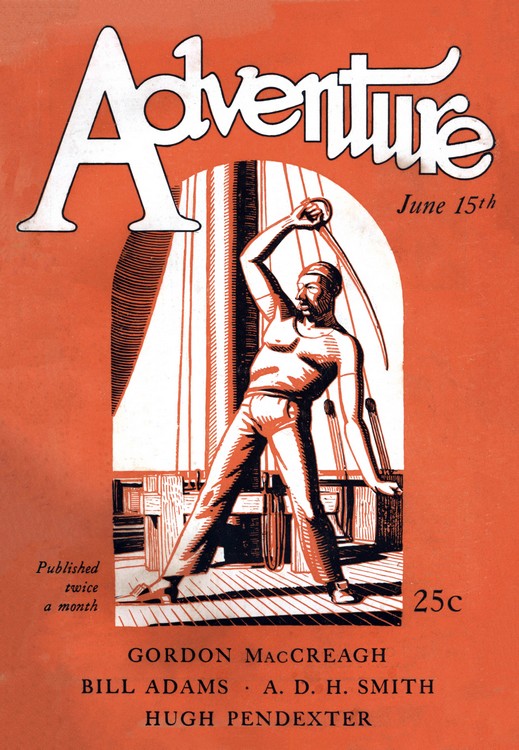
Adventure, 15 June 1927 with "Reward"

Gordon MacCreagh's "Reward" follows jungle prospectors Dillon and Luis as they stumble into the schemes of the dangerous river-country outlaw Jorge Davis, who aims to swindle wealthy lumberman Wallfurth by murdering his young engineer, Hammond, whose expert report would reveal that the coveted cedar tract is worthless to exploit...
IT WAS Luis who saw him first. Luis, you know, has eyes as dark and alert and fast as a Cébu monkey, and notices just about as much. We were coming down the Rua Lisboa in Porto Velho, the other one of its two streets, where the less respectable of the stores are; and as we passed the drinking shop of Perez, Luis caught me by the arm and motioned with just his eyes to the window.
"Look, that's Jorge Davis," he said, out of the side of his mouth. "I wonder what deviltry brings him up so far out of his territory?"
I had never seen the man before, though I had heard enough about him; and, like Luis, I couldn't imagine what would bring an operator of his caliber all the way to this dead place. He was a man who played the towns of the lower Amazon; anything from big swindles to holdups, and if a killing should be necessary, why, Jorge had no conscience to hold his hand. And here he was.
There was no money in Porto Velho; never had been since rubber went smash. Big river-boats still came all the way up the Rio Madeira once a week to take balata and a little hardwood, but there was no profit in that. They came only because the company had a cast-iron subsidy from the government that they had shoved through when all the world thought that the rubber from the upper jungles would make all of them rich.
The same with the railway: Two hundred kilometers through the solid jungle to get round the sixteen cataracts of the Madeira-Mamore, because the water was so bad that rafts would be smashed into toothpicks and canoes stood one chance in a hundred of getting through. Millions of dollars it had cost them, and the talk was almost a slogan, "A life for every tie." And now a train ran every two weeks.
There was nothing in Porto Velho to interest a man like Jorge Davis. There was nothing to interest anybody at any time; the place was dead.
So I said to Luis—
"Let's go in and look this bad man over."
And Luis—well, for all that he is a smallish man and a Brazilian, nothing scares him; he's so fast he can look after himself in any company. He shrugged and laughed.
"Pois bem," he said. "Let us go. But you, you great guariba, don't you go and get into any fuss. We've got our balata business that we came here to look into."
The guariba, you know, is the great red howler monkey of the foothill country, noisy great brutes that you can hear roaring a full mile away as the sun comes up. And the big males will fight almost anything in the jungles, except perhaps the larger cats. Our paddle-men— you know how those river Indians are; not awfully complimentary about nicknames—they call me the Guariba on account of my size and red hair; as they call Luis the Macaco, because he's small and dark and as clever as all sin.
Well, we went back up the street and into Perez' place and called for a gourd and bombilla. I stick to the mate myself 'cause I've seen too many white men go under with aguadiente. There's no white man can stand hooch when the temperature stands at an even hundred and the humidity somewhere near sixty.
Jorge was bragging about something or other that he was going to put over on somebody, and the gang of hangers-on that always collects around that sort of fellow was applauding his loud mouth. He looked us over with a hostile frown as if we were butting into some place that he owned. And of course he pretty nearly did right then. He was one of those big, hard looking fellows who are natural gang leaders—truculent and determined enough to swing the crowd his way; and there wasn't any doubt at all that he could have had the place cleaned out in a minute if he'd wanted. You run up against that kind every now and then in any country that's far away enough from a policeman. He'd had his own way for so long that he was just asking for trouble and ready to meet it on the jump.
Those fellows always get me steamed up. But Luis was kicking me under the rickety table so that our drinks spilled over, and he was telling me:
"That one is a malo hombre, my friend; nine parts of mixed Indian and negro and renegade Spanish and one part of far back American or English or something, wherever he gets his name from. And he carries pistols hidden as is your custom in America."
Well, I'm a peaceable man myself. I'm never aching all over for a fight; there's always trouble enough in that back country anyway. So I sat still, and the fellow figured we were harmless enough and went ahead with his bragging. The crowd of mestizos and breeds around him laughed at his every second word, so I couldn't get much of what it was about. But I caught this—
"—that gringo may think himself muy caballero because he has some money, but I tell you, my friends, when I shall be finished with him—"
That was all I got, and at that Luis kicked so quickly at me that he knocked a silly leg from under the table and down went the whole mess, mate, gourds and all. The stuff" was still boiling hot, and Luis got most of it over his pants leg. Luis is a neat dresser, even in jungletown on the edge of nowhere. White duck pants and all that sort of stuff, and he surely absorbed that hot drink plenty. He jumped up with a yell, trying to hold them off of himself; and I got so weak with laughing at him that Perez was able to curse us and throw us both out of his shop.
Luis, of course, had to go right back to our room in Mother Gomez's and get into clean pants. As for me, I was glad that I wore cord breeches and jungle boots, and a spot or two didn't matter. I was going out just as I was when Luis grabbed me. He's uncanny sometimes, is Luis.
"I suppose you're going to the hotel now, amigo mio," he guessed. "You want to find out about this gringo that that great gorilla spoke of. Now listen to me. Compatriot of yours he may be or no; but don't you go shoving your nose into anything that is none of our business."
I had to laugh at his cleverness. Of course I wasn't aiming to horn into anybody else's trouble. I'm none too keen anyway on this rushing up to a stranger and calling him brother just because he happens to come from some spot in our three million miles of United States. I've seen too many of our people come out and make plain fools of themselves just because they can't seem to understand that they're foreigners now in somebody else's country. But there was half an afternoon to be killed yet in this dead town, and I'd been figuring that if this gringo had just come up on the last boat I might as well go over and visit and swap yarns and maybe get an old newspaper or a magazine.
"Very well, then," said Luis. "I shall come with you and see that you do not become entangled, my friend."
So we went over, and they told us, sure there was a gringo, arrived by the last boat—three of them in fact; two and a gringita. And at that I would have backed away, because, shucks, while I was dressed as good as need be for any man in a jungletown, I was in no way dolled up to meet a lady. But Luis was right at home there. He dragged me with him into the wide veranda—all copper-screened because the yellow fever mosquitoes at Velho are something awful— and before I knew it he was presenting me. Luis can stagger along enough with English, though he's a scream; he just turns the high-flown Portuguese idiom over. It's fine among themselves, but it just doesn't fit into plain homely American. He swept his hat over the floor and bowed and spouted out:
"Most excellent senhor, I present the illustrious, the American of the North, Senhor Jeem Dillon. Explorer most renowned of the jungle productions and— my friend the much esteemed."
That's their way, you know. Introducing first to the gentleman, the boss of the party, and leaving the lady out of it for the senhor to present or to chase away, as he may think best. There was no mistaking who was the boss. He was a pursey old party with an air of assurance and reserve that comes with having money enough to buy most people's services. I could see in a minute that he wasn't longing to throw himself on my neck just because I happened to be another American and we were in the far-away end of nowhere.
I suppose rich men get to be that way, upstage and suspicious, because there must be an awful lot of people trying to graft on them for something all the time. But he stood for us courteously enough, though he oozed all over him that he wanted us to make no mistake. We didn't belong in the same crowd and this wasn't going to be the beginning of any lifelong friendships.
He introduced us to the girl, his daughter, and to the youngster who was with them.
"My engineer, Mr. Hammond."
Just like that. He had bought the engineer's services and there was no mistake about that either. But there was no high-hat about the girl. She was home folks American all the way through, the best kind, and a prize winner. Tallish and slender, sun-tanned, with brown hair and eyes—or maybe they were blue—but, thunder, I can't describe them. It takes Luis to do that.
She came right out and she wanted to know all about us. We were jungle prospectors, were we? And we got out jungle produce? What kind of produce? What was balata and what was the meaning of bleeding chicle latex? Were we ever attacked by Indians, and what about the big snakes? That's the one they all want to know, and they're always disappointed when you tell them you've never seen a thirty-foot anaconda, let alone the hooch-dream sixty-footers. They don't want to believe you; they look at you in a hurt sort of way when you tell them that; as if you were lying to them.
She wanted to know just about everything there was, and she dragged the engineer youngster into it, too. He was as eager to find out things as she was; his interests ran right along with hers. But, much as he wanted to get into the talk, he hesitated to horn in; he was diffident in the presence of his boss. It was pretty clear that he didn't measure up to the social scale, either.
I let Luis have the girl and I got the young fellow to open up a bit with me; though he kept listening with one ear and half the other to those two; and it was easy to see which conversation he wanted to take part in.
A good looking lad he was, too. I don't mean handsome. I mean a good, husky looking youth, with plenty of bone right were it belonged—in the shoulders and the jaw and along the eyebrows. He sized up like the makings of a good jungle-man and his questions showed that he knew something about the beginnings of it. His side specialty was forestry, it turned out. Mr. Wallfurth—that was the boss— was interested in hardwood lumbers and had come up to investigate the possibilities here. And that was all I could get out of him. With pa sitting there, smoking fifty-cent cigars and saying never a word, the youngster of course froze right up about his affairs.
Well, it's a finnicky kind of business at any time to shove in and give advice that nobody has asked for; and with Pa Wallfurth it was impossible. I did manage, without giving offence, to bring the talk round to Jorge Davis. Said I'd seen him in town and understood that he was interested in a deal with our friends—and you should have seen pa's eyebrows go up at that last word! And I tried to slip a hint that Jorge's reputation along the river country would bear watching. But, pa blew smoke out of his nose and flicked ash from his cigar as slowly and watched it as carefully as if that was the most interesting thing he'd seen for a long time, and then he said:
"Thank you, Mister—er—Dillon, is it? I have been in lumber deals before; and while I am no technician, I have taken pains to assure myself that Mr. Hammond's expert knowledge is ample to form an accurate estimate of value."
There he was warning me off before I'd ask him for a job or something. So I quit trying to poke my nose where it wasn't wanted. I've never been one to go around advising people about their business; and if all that this bird needed was expert advice about lumber values, I'd be the first to admit that this forestry youngster would know more about woods and what they were worth than I ever knew was in the book.
We jawed around a bit after that, but it was never what you'd call a sociable evening amongst friends. The old man wasn't exactly hostile, and he made no yowl about his girl and his hired engineer treating us as if we were classmates from the same home town, but he oozed all over that we didn't belong to his lodge; and there was no getting over that. We got up and reached for our hats before he froze us in that warm tropic evening, and no sooner were we clear of the hotel compound than Luis rhapsodized forth into the night.
"Name of the holiest, but what an offspring it is that that old manatee has! What a graciousness! What a smile of the white teeth! Did you note the limbs, amigo Jeem? Sacred hat of a Pope, que completamente simpatica!"
Luis, you know, cusses like a good parrot, and with all those fellows, when they rate a woman as simpatica, that's the extreme limit. You can't buy them any better.
"But what a shame," he gabbled on, "what a crime that this stuffy old horse of a father is presently about to be swindled by Jorge Davis! Amigo, it is up to us, who know the country, to see that—"
But I fired his own medicine back at him.
"Don't you go shoving your nose into anything that is none of your business," I told him. "We've got our own balata business to look after."
And I asked him how did he know that Jorge Davis would get the better of Mr. High-Hat? He'd made money; and it's a pretty safe rule, I've always figured, that if a man has made money he's made it by being smart enough to get the better of other people. This clammy old cuss knew his markets, I guessed, and he was wise enough to hire a man who knew woods.
"You wasted your time chattering with the girl," I told Luis. "But take it from me, brother Jorge Davis isn't going to put anything over on that engineer lad. That boy's got it all above the eyes. And, look you, friend, he's crazier about the girl than you are; so he'll be loyal to Pa. Jorge isn't going to be able to buy him."
To which Luis grunted and he groaned a while to let it soak in about the girl, and then he said:
"Well for you to talk like a professor of logic, but all I can say is that you don't know Jorge Davis! Diablo, the man has a method! He never fails."
IT WASN'T later than the next evening that we had an opportunity to see something of the deadliness of the man's method. We were loafing down the Rua Lisboa—there wasn't a blamed other place to go—and as we came opposite Perez's place we both stopped suddenly.
We were on the other side of the street and we could watch from the shadow. You see, there are no street lamps in Velho and the only lights are the dingy oil-lamps of the shops every here and there. Perez' place had no doors or windows, of course—just square holes in the 'dobe wall; and being the botequim, the local saloon, it was the best lighted show in town. So we could see in easily enough.
And why we stopped was because we saw what didn't belong in that hole. And that was Hammond the engineer youngster.
Perez was right up to date and had an American bar. All along one side was a shelf behind which he kept his bottles, and those who thought it was too provincial to sit at one of the greasy tables stood in front of this and called their drinks. And there was Jorge, laughing loudly and clapping the youngster on the back and calling him, mi compatriota. His big bull-voice came out to us across the street.
"I too, my very good friend, I am an American, though of the South. Davis, my illustrious father—"
And at that some one laughed. It was too much even for that gang of toadies to hear this almost black seven-eighths breed claim the father he had never known. Some one he couldn't see; but the laugh choked in his throat. At another time Jorge would have ripped him wide open for that, but just now he was playing another game. He didn't want to frighten his newest friend away—or let me say, rather, he didn't want to put him on his guard, for I don't think that lad would be easily frightened.
So instead of whipping out the knife that stuck out from his high boot, Jorge but half-hunched his shoulders and scowled at the offender and demanded in a voice out his belly like a jaguar—and he was clever enough to slide over the real issue.
"Is it that I understand you to laugh at my illustrious father, you offal?"
And, "No, no! By no means Senhor Davis—I but—" the man stuttered and his voice choked again in a dry rattle of deadly fear.
"Ss-ssso." Jorge hissed like an anaconda and you could see him grow smaller as the wind went out of him. "Ss-ssso it is therefore that you still live. But your presence, none the less, gives me to vomit."
It was enough. In another second the man slunk into the wide shaft of light that came through the doorway, and then he was gone in the shadows. Jorge's shrug was as good as a whole ten minutes of brag, and then he turned to carry on his game with the engineer lad again.
Oh, he had power all right. Out of the dozen or so of men there, not one of them dared to talk or laugh or to breathe until they saw how Jorge wanted it; and they were pretty hard cases who went into Perez' place.
We leaned against our wall across the road and watched, and presently another figure appeared in the sudden light of the doorway; going in this time. I recognized this one, a fellow called Lobo, a dock-front loafer about whom the talk was that he could be bought to stick a knife into a man for as little as fifty milreis. He seemed to greet nobody; but in another second we saw him through the window hole take up a position near this Hammond lad and call for a drink.
In about a minute another man went in, a big Jamaica nigger fellow left over from the days of the railroad construction, and if anybody could have a worse reputation than Lobo, this boy had it. He edged in alongside of the other killer and made as if he'd just stepped in for a drink. Luis smiled up at me from the corner of his eye and said very softly—
"I told you, amigo, that you did not know this Jorge Davis."
Of course I could see the game now. It was one of the oldest in the book, but it had every chance of working against a new hand who didn't know the river country. There would be an argument about something, the lights would go out and there'd be a scramble; and when it was all over there would be young Hammond with a knife in his belly. And who would mourn loudest but his new friend and compatriota, Jorge Davis?
"But why? What's he got against the youngster?" I asked Luis.
And Luis laughed hard and short and said to me:
"Sometimes, friend Jeem, your head is as thick as your arm. He has nothing against the youngster but his knowledge. It is the lad who is the expert on the values of timber. Therefore that knowledge which is the old man's protection must be removed. Oh yes, Jorge has a method with him, I tell you."
And then Luis hummed a little tune and beat the time with his loot; and then he cussed a red streak and complained, as if it were my fault.
"I tell you, amigo, people who are hampered by any scruples of the conscience are always at a sore disadvantage. Here we are put to no end of a trouble and danger just because you won't let me kill this Jorge dog out of the safety of our darkness here."
I had said nothing at all, of course. But Luis knew, I suppose, that I would have kicked about taking a pot-shot at the fellow out of the dark. Not that I'm any purple and gold saint, but it's a funny thing, the prejudices a man grows up with. If you're out to kill a man, what difference does it make whether you sock him from a safe distance or whether you walk up and give him the call when you know all the time that you can pull a gun faster than he can. But if a man has grown up with our American notion of fair play it just sticks, that's all.
So Luis cussed me for a hide-bound fool and stepped down the road to a little old chucheria store and called to see some knives. Cheap things with a heavy blade and thin handle in a papier-mâché case; and he picked one that balanced comfortably to the hand. To me he said:
"One does not throw one's own good knife—which moreover remains as an identification. And since it is your fault, my friend, that we must sink to such a subterfuge, yours be the position of danger. You go and stop Jorge as he comes out and leave it to me to get the young gringo away."
I guessed what he was aiming to do and I knew just about what would happen. So I crossed over and waited in the shadow just outside of Perez' door. Slanting through the opening, I could see Jorge and the youngster and the two knifers, and I hoped almost that Luis would miss his throw and stick one of them.
But Luis' hand was too sure. In just about another second the knife zipped in through the window and smacked into the wall between two bottles; and after it had passed it seemed as if Jorge's hat twisted round on his head. The talk all stopped dead, just as if the knife had cut it off. And then Jorge roared out a Santa Maria and snatched the knife from his boot and came charging out like a bull.
That was what I was there for. As he came out of the door I stepped out from the shadow as if I were just passing, and Jorge barged right into me. He was a heavy great beast and he was coming bent, but I was ready for the shock, of course. My shoulder took him just under the chest bone so that he bounced and gagged from the jolt of it.
I hollered out, "Whoa there! What the—!" and I grabbed him and tripped him up and fell on him hard; and then I rolled under as the crowd streamed out, and let his friends trample all over him. But you can bet I kept hold of his hand with the knife.
He yelled blue murder and howled at me to let go and swore he'd rip me up; and I hollered just as loud for him to get off of me. And between us we put up such a racket that presently the crowd came back, figuring surely that Jorge had caught some one in the shadows there; and they all stood around and yelled advice to him about how to stick me.
So then I turned him over and hoisted him to his feet. He was heavy rather than husky and I could handle him all right. I pushed him back through the door into the booze joint and I put on a high tone and demanded.
"Now senhor, perhaps you will explain why you rushed out without provocation and attacked me in the street?"
I pushed him off and stood far enough away so that I could smash him if he tried to jump me with his knife. He was just a bit leery about the way I'd handled him, but he was so mad that he forgot all about telling me the reason for his wild charge into the night. Instead, he ramped and brandished his knife around and yelled what he would do to me. And the gang, all primed now to see somebody carved, egged him on.
"Go ahead—show the gringo."
And so on.
Luis told me afterward that I was a fool. If he'd been in my place he'd have jeered the fellow on to make some play and then would have plugged him in self-defense and would have done a service to the community as well as saved all kinds of trouble later on. But I let the chance go. I guessed that the diversion had given Luis plenty of time to get hold of the youngster and since I didn't see him anywhere in the crowd I figured my job done. So I made a grandstand play. Something of a take-down was coming to that big lollop anyway.
I said—
"Listen, you who talk so much about knifing gringos, I will show you a trick about knives that we gringos learn at school."
And I made a quick lunge and caught his knife arm at the wrist, as they used to teach us in the police school back home when I was learning to be a cop, and I gave it the old twist and drag so that the knife spun away and he gave a yell and grabbed his arm as if the elbow were dislocated. And I told him:
"That other gringo, the young engineer, is newer from home than I. He will be able to show you many new tricks about knives."
And I left the crowd gaping and went out; and the minute I was out of the door, I ducked into the shadow and round the corner of the building, and I went on home round by the back lots. I wasn't passing in front of any shafts of light from windows.
Luis had the boy safe in our room when I got back—and considerably pop-eyed he was looking, too. He couldn't understand it and he didn't want to believe it. Why, the man was so cordial and he was hoping to put a business deal through with the boss and all that. How could it be reasonable that he would want to put a crimp in the deal by starting trouble now? So I said to him:
"Listen, buddy, back home you'd be careful what kind of a dive you went into with a tough looking stranger, wouldn't you?"
And he said, of course, anybody but a fool would watch where he went in the back alleys of New York. And I asked him then what made him think he was any safer here in a back alley of Porto Velho than he would be in New York. And that left him looking foolish. Of course there was no answer; but a lot of fellows are like that. They come out all green and stick their faces into places they'd walk blocks to avoid at home.
Anyway, we convinced him that he'd had as close a shave as was necessary and that Jorge Davis was a man to watch. And then of course he was all full of thanks, and nothing would do but that we should go right over with him and explain to the boss what kind of a man he was dealing with. Luis was ready enough and thought it would be a nice little visit. But I just laughed at him and told him, "Não presta ti la donça," which I figured the youngster wouldn't understand, being Brasileiro slang for "Swell chance you've got with the girl." And I told the boy to run along and explain his own troubles to his boss. I wasn't shoving my face in to get told that I'd be asked for my advice when Mister High-Hat thought he needed it.
SO WE saw nothing more of our good folks from back home till a couple of days later we jumped the fortnightly train for up beyond the cataracts. And there they were too. They were going to Villa Martinho about two-thirds up the line. It's only about fifty or a hundred kilometers but it takes two days to make it, because that train doesn't run at night —I suppose on account of the jungle having grown over the track since it was last there. I got talking with the youngster and I said to him—
"So it's cedar that your chief is interested in?"
And his eyes popped, as if I'd tumbled into a trade secret, and he wanted to know how the heck I knew about it. Though there was no trick to that at all. What else would a man be interested in at Martinho unless it were cedar? So I asked how they intended to get the stuff out. And he said that that was what he was there for; to look the stuff over and make a report and all that before the old man would close any deal. And right then the old man called him. Afraid he'd let some vast business out, I suppose.
It gives me an awful ache, the way business men get to be close-mouthed and suspicious; just as much as to say to every one's face that he's a probable crook and will steal the deal if he can find out anything about it before it's all closed and tied up and everybody's name is on paper. Jorge Davis wasn't on the train, so I couldn't feel that it was up to us to wet-nurse my fellow countrymen along; and I nudged Luis and we drew off, leaving them to their merry party of grouchy one with two well controlled assistants— which pleased the young fellow and the girl well enough, I suppose.
But at Martinho the old man creaked open a bit. Martinho is a place about half as big as Velho and twice as dead. Just a score or so of 'dobe houses that had blossomed out to hope for rubber and had died right then. One of the houses had three rooms, and that was the customs, because right across the river was Villa Bella on the Bolivian side. Another one had four rooms, with mud floors and mosquito netting nailed to the window holes. That was the hotel, where you could get a meal served on a three-inch thick mahogany table with another half-inch of grease on the top and eat it with wonderful old Spanish silver which the proprietor wouldn't sell because it was a proof of the kind of folks he came from.
Pop and the girl were going to stay there while the youngster cruised this cedar prospect; and the old man loosened up enough to say that our experience of jungle work would be of use to his engineer here and he'd like to hire our services. So I said I'd hire out to be anybody's servant and so would Luis—at our own price; and our price was ten dollars a day each. He swelled himself all out, of course, and ate up a cigar and said he didn't see any need of paying a price like that just because I was an American. And I told him, all right then, there were some fifty men in Martinho, every one of whom knew that back jungle country, and he could hire any twenty of them to be his servants for ten dollars a day; and we had business of our own to attend to across on the Bolivian side anyway. And with that I left him.
But after chewing over it a while he sent the youngster after us to smooth us down and to say go ahead. So all we had to do was get our camp stuff across from Villa Bella and we were ready to go in the same day. And at that I don't think we stuck the old grouch so much. He would have paid nearly what we charged him in sheer wasted time getting equipment together if he'd hired the local talent. And as it turned out, it was just our speed that saved his hide in the end.
We took the youngster in and showed him what there was, and he surely was a treat to take around. Of course he'd had forestry experience, and that helped him a whole lot. But even so it was a wonder how he got the hang of jungle work. In just a couple of days we could let him go so he wouldn't lose himself, and he got into the swing of a machete in the underbrush so he could cover distance as well as most men. We looked over the ground pretty thoroughly, and he was all enthused about the timber.
We'd walk him dead all day and then every evening he'd sit and write a report of distances and quality and measurements and so on which he'd send in to the old man by Indian runner. It was wonderful stuff, of course, as everybody knew— virgin growth, never cut over, and averaging about forty inches diameter. Miles of it, and all splendid timber without a flaw. The boy would look at some of those trees almost as if saying a prayer and then he'd pretty nearly cry when he began to understand that there was no way of getting it out. That was what was going to spoil the deal, of course, and it was easy to see why Jorge Davis had been anxious to get the engineer out of the way.
But Jorge had a method, as Luis always said; and he never failed. And he'd have held to his record this time, too, only he hadn't reckoned on our getting through with this job as fast as we did. Speed is always difficult for those fellows to understand. We covered that district pretty well in about a week, till the expert knew just about what there was and what it was worth and how small were the possibilities of working it. And then we came out to tell the old man it was no go. Exactly what I could have told him right away from the start if he hadn't been so darned secretive and upstage with us.
And then we learned about clever Jorge. The old man was lounging in the mud veranda with his feet on the rail, looking as pleased with himself as all those fellows do when they've put another big deal over.
"Well," he said, "I've bought. Pretty stiff price, but if that timber is as good as your report said I know where I can get seven cents a foot for it."
"Bought?" yelped the engineer. "How the— What—?"
"Yep." The boss put all the snap and pep of big business decision into it. "Yep, Mr. Davis came up in a hand-car and he was willing to make a price since he needed some money for another deal, and—"
"And he's gone back by yesterday's down tram, I suppose," I cut in on him.
The big boss nodded. Nothing had hit him yet. I pushed the engineer lad aside. His job depended on this sleek goop and he'd be saying things that the old man wouldn't forget.
"D'you mean to tell me," I said, "that you paid money to Jorge Davis for that piece of jungle?"
The chief began to get stuffy. He could see that there was something not altogether right, and he began to defend his business head.
"Oh I've examined his title all right. I took the precaution to have that looked into before we came up here. He has clear title from the government."
"How much?" was all I said to him.
He was becoming a whole lot stumer about the way I stood in front and looked at him; and there was Luis smiling like a cat behind me and murmuring at the same time.
"Deu graça, alas for the so beautiful girl who loses just that much of her inheritance."
And the engineer lad just sweating blood, though he stood to lose nothing out of it. He was just loyal to the man whose money he was taking.
"Your questions are verging on the impertinent, Mr. Dillon," the boss swelled up at me. "It's none of your business, but I don't mind telling you I gave a check for ninety-five thousand dollars, and if my engineer's reports—"
He was going to tell me how much money he figured on making out of some thirty miles of standing cedar at seven cents a foot. But, thunder, I wasn't dependent on his temper for a job. I stopped him. I said—
"I don't know how well you can afford to lose ninety-five thousand dollars, Mr. Big Business Man, but I do know how you're going to lose it, and it'll do you good to sit still while I tell you.
"Listen now," I told him. "Of course Jorge Davis' title was good. That title has reverted to the government half a dozen times 'cause the holders couldn't prove up on it. Jorge probably paid ten dollars per hundred hectares for it. And why? D'you think you're the first big operator who found out the timber was there? And I guess you won't be the last to find out you can't get it out."
He began to growl something about the railroad. But I stopped him again. Gosh, as if Luis and I hadn't gone into every angle of that thing six years ago!
I shoved him back in his chair and, "Listen some more," I said. "When this railroad started it had about eight boxcars and two flats, figuring on rubber. Now its got maybe one flat that can be fixed up to carry lumber. If you're good at sums, do a few in your head and figure out what it will cost you to have enough cars built in the United States and shipped out here to carry enough lumber to pay for them. And when you've got over your headache from that, figure out how much it'll cost you to import enough Jamaica niggers to work your lumber and to insure them according to their government demands. The railroad brought over all in all some forty thousand—and thirty thousand of them are buried all along the track.
"Your hired engineer would have told you all this in his finished report if you hadn't been so darned cocksure of your business cuteness. And I'd have told you all of the same and more if you hadn't been so businesslike and suspicious of a stranger from back home. You and Napoleon, you play lone hands, don't you? Well go ahead and figure a play on how you're going to get your check back."
Well, he was looking pretty purple by then. I guess back home where his money hired servants for him, nobody had talked to him properly for a long while; and I think, too, the money was more than just a drop to him. But he managed to work up a sickish sort of grin and he asked—
"What's the matter with rafting it down?"
And it did me good to see he was not so slick sure this time. Kind of hesitant, because he'd taken in enough from my little speech to allow that all the other people weren't altogether fools, and he knew there must be a hole in that idea somewhere. And I told him the hole.
"Listen," I said. "There's about two hundred miles of river between here and Velho, and about seventy-five of that is cataracts. Not just rapids, but half a mile of river going somewhere else lower down in a hurry. All of that two hundred miles of river bank is boardwalked with cedar that folks have tried to raft down. Up here it's whole logs; about middle it's splits; down that end it's a sort of mush of match-sticks and kindling."
Of course, I was stretching a bit there. But it was true that any loose stuff that came down was so ripped up that it was worth nothing—you know how that Spanish cedar splits. Well, the old man wasn't so stiff-necked that he wouldn't admit, since other folks knew all about it, that there was more than one good and solid reason why no one had grabbed off that concession before. But what was he going to do about it?
He just sat with the spine wilted out of him and looked at me and then at his engineer. I was waiting to see whether he'd try to blame the boy. But no, he wasn't mean. His whole trouble was just that he was too stiff in the collar. The starch was out of him now though, and he just slumped back and looked to his engineer for help. I guess he figured he'd done nothing to earn our particular loyalty or support.
"Is there no way?" he kept asking the youngster. "No way of stopping it? The next train—"
Well, the boy didn't know. So I told him.
"The next train down will come two weeks from yesterday. Yesterday's train reaches Velho tonight, where the river steamer meets it and leaves tomorrow morning at just about this time. And that's how much time you've got to stop him."
The old man shut his eyes and let his head drop back as if he'd been hit; and I guess that money hit him harder than he'd like to admit. And then the corner of my eye caught a flutter, and there was the girl, standing in the doorway. She was just looking at the youngster, too. Not at us, mind you, not at Luis and me, who knew the country and knew the inside out of things. No, her confidence was all in the boy. All big-eyed and white she was, and her lips trembled red like a grenadilla flower against a white-washed wall.
Luis groaned as if he had a cramp and cussed a long streak of red-hot Brazilian saints and took oath about all the things he would do for a girl like that. And I— well, I suppose she did look like a combine of all God's good things that a man misses out on when his itching foot drives him out into the jungle places, as had been my luck. So I grabbed the boy by the arm and took him outside and, "Listen brother," I told him, "if you've got guts enough I'll see what I can do to help you."
He just hung open, waiting for me; and I told him that it could be done by taking the river. The Indians used to make it in dugouts sometimes before the railroad came. They used to say that one out of a hundred got through all right if they were good men and made the proper sacrifices first. Odds enough to keep the thing from being a popular sport, but you know how Indians will take risks that's make your hair fall out, just to earn half a dollar's worth of cheap trade-goods.
There were a few of them left still and there was one right there in Martinho who bled balata for us—a good man with an eye like an otter's for fast water. So I told the youngster what the chances were, and if we made it at all we'd shoot that two hundred miles of water like taking the chute at Coney Island.
He grabbed me by the hand and pumped up and down and said sure he'd have the guts to risk a canoe ride for the sake of—and then he boggled and reddened up just as if he had something to be ashamed of. But I told him, shucks, shooting fast water that an Indian would do for half a dollar didn't call for guts. What I meant was if he'd have guts enough to hold up the old man and tell him flat he'd gamble his neck to snake him out the hole on just one condition; and that was that ninety-five thousand dollars would even up the social difference between an engineer and a big business man and the boy'd get an even break with the girl.
His eyes popped as if some one had thrown in a ten thousand volt switch behind them and he left me as suddenly as a wild pig. And I, I went off to find our Indian canoe expert. I knew that the boy, with the pep that he now had, would come back with pop's consent all hog-tied in his pocket.
And of course he did. He shone all over like a meteorite and said it had been simply wonderful and wonderfully simple. Pop didn't have a peep in him and even his cigar hung limp. And he had to shake hands with both of us all over again; and then he had a sudden thought.
What about us? What would we be getting out of it? Why should we be risking our necks, and all that blah. He was a good lad. But Luis cussed him and growled:
"Saints' teeth, is it not that this foolish pig-head is paying us ten dollars a day? We have no notice of discharge. What a delay about words while that train is still running! By this time the canoe will have been torn from its tie-rope."
So we pushed him along with us, still blithering; and our man was already waiting where I had told him to. He had brought his son along too, a stout lad who he swore was as good as himself on the steering paddle. He himself would perch kneeling right up in front, of course, with his toes hooked back into a little loop of rope. You'll hear a lot of rubbish from people who don't know anything about it that it's all to the steersman. But let me tell you, in fast water it's the bow man who does all the work, and any half-way fool with a paddle can follow him.
The three of us piled in between them— it was a good big dug-out built for carrying balata. All we did was to take our heavy boots off and lash them fast as a precaution against the upsets which we knew were a certainty, and then we were off. And, holy rum, did we go!
The first stretch of white water began less than half a mile below the settlement, and we took it in a thin brown streak.
"Awai-ang!" yelled the Indian; and we dug in, because the more speed on the canoe, the better the control in fast work. The trouble with these Madeira cataracts is not only the big black rocks that stick up like jagged teeth, but worse than them, the fellows that don't stick all the way out.
That's a considerable river you'll understand, since ocean steamers can come all the way to Velho, just below the last of them. There's an awful volume of water going down, and where it comes on some of those submerged benches it just climbs up in a hill and swooshes down the other side in roller-coaster waves. That's where the danger comes. Any good canoe man can dodge the teeth, but it takes control, let me tell you, to jerk the canoe nose clear of a hollow into which it's all bent for diving.
But we made it all right, and I can tell you I sweated. I'd been in fast water, but I'd never worked in anything like this. When we reached a stretch of easy going at the end of it, the youngster behind me laughed. He asked:
"How long d'you make that run?"
I knew the lengths, pretty near all of them, from reading up the survey reports when I was considering working that same cedar prospect, so I told him—
"'Bout eleven miles."
He laughed again. He carried one of those wrist-watches in a rubber case such as they sell to greenhorns in the sporting goods stores, but it was still going, and he reported—
"Seventeen minutes, by golly!"
"Well, do not be downcast, amigo," Luis told him. "There will be some twice as long where we shall go much faster."
And, of course, we did. The fourth run after that was a killer. "Diente d' diablo," it was called. Devil's teeth. And it was well named. There were places where the rocks stood up like a comb and the water piled up and then sizzled between them under pressure like soda water. There were still relics of five years ago when the last man had tried to run lumber. Logs had stuck end on and ridden high up, and there they hung, split in two and dangling on either side.
But our man was a wizard. He hugged close by the edges till the banks slid by in a blur; or he made out for the middle and whizzed between frothing black teeth according to the requirements of what came beyond. You'd have sworn he had a government chart of that water. And so we made that one too. I forget in just what time. But the youngster timed it and whooped us on. By golly, we'd make Velho before the train at that rate, he kept yelling.
And then, of course, came the accident that we knew would come. And at a simple little place too. It was just a short run of water, not half as bad as what we'd come through. I don't know just what happened, but it felt as if we rode on to a submerged rock, and in a second the current swung us broadside on, and in the next second we were in the race.
My luck was against me that time. There was no chance of anybody's making the bank right out of the run. Nothing to do but keep afloat and try to avoid getting smashed till we'd reach the next half-way smooth spot. I was getting along fine till some funny current sucked me under for longer than usual, and then I got bumped on the head. It knocked me pretty dizzy and I could only just about remember somebody grabbing me —and then a long haze of water and scuffling, till presently I was hauled out on the sand of a back eddy.
When I could see straight again all the rest of them were there and our Indians were bringing the canoe in. There was no damage except that I was a bit too woozy to swing a paddle for a while. But that boy was a terror. He was pretty well scratched up himself and bleeding some about the face, having been unable to look after himself so well while hauling me out.
"Come on," he yelled as soon as I could sit up. "Come ahead. We've lost fifteen minutes already and we've got a race on our hands."
And so they hefted me in and I was glad enough to lie down in the wet while the rest of them whooped and swooped on down. I couldn't see any more than t he branches of overhanging trees whiz by every now and then, but the rest of it was just about the same as the foregoing. Toward the end I was able to sit up and help a bit, and— Well, in the long run we made it without any further trouble. We reached Velho by daylight, and I was excited enough to stagger along with the rest of them to the station yard and I whooped and hopped there with them till I went dizzy again.
We'd done it, by golly! We'd made close to two hundred miles of water travel in about eight hours—and that's some going, let me tell you.
And the train wasn't in yet! We'd beaten it by fifteen minutes. And as it came snorting in, Luis said to me:
"Now you keep your great hands out of this, amigo. You sit still and watch. I can handle this Jorge Davis."
And I was glad enough to sit on a crate and look on. I knew Luis could take care of anything that was likely to happen.
I WISH you could have seen Jorge Davis when he stepped from that train and saw us. He was the only passenger— that's how much business that railroad did—and he swung out of the coach with a grin on his face as if he had already cashed that check. And then he saw us and the grin dribbled loose from his jaw and his burnt-coffee skin went clean mottled like a good soap.
Almost before his feet reached the ground the youngster was in front of him and was telling him, hard and steady—
"I've come to get that check, Mr. Davis."
Jorge was no coward, of course, and no fool. He didn't have to gape and ask questions—how, why, what? He wasn't a man to waste time in guessing. The point was that here we were and it was up to him to act. And he wasted no time about acting either. His heavy brows came down like a monkey's and, believe me, when he scowled he was one bad looking hombre.
"So," he growled from his belly.
"That check, my gringito, yes?"
And his hand began to sneak down to his boot. But Luis was on to that.
"No lower, Dom Jorge," he said easily.
And there he was smiling like a tea party and balancing his knife comfortably in the palm of his hand, all set for a fast underhand throw. It stopped Jorge just the same as if it had been a gun. He cursed Luis plenty and loud, and as he cursed his eyes, like a snake's, were flickering quick glances around the score or so of people who make up a crowd in Porto Velho.
I could see he was playing for time and whatever luck might turn up. And it began to turn all right. The man had power. The sheer cussedness of his reputation was the sort that will draw tough eggs to a man, hoping for a share of whatever loot might be going and a return of the favor maybe some other time. A few hard looking citizens began to edge in on the three of them. I was in no shape to start a battle with the whole gang. So I yelled to Luis to hold the crowd and I jumped from my crate to take a crack at Jorge. But the youngster was way ahead of me.
"Sit down!" he bellowed at me. "He's mine. I gotta earn what I held pop up for."
And he waded into Jorge. But the young fool didn't smash him on the jaw as he should have done. He seemed to think that since the other wasn't standing with his hands up and the gong had not struck, it wouldn't be fair. Instead, he tried to grab him and search his pockets at the same time. Thunder, I couldn't have done that myself! In a second it was rough-and-tumble.
But what a rough-and-tumble! Luis waved the crowd back with his knife and they made room pronto and very respectfully. Jorge Davis had the weight over the boy, but he was none too hard, as I had already learned, while the boy was as clean and hard as a steel tape. Together they went down and rolled like terriers, with the station gravel flying in clouds, Jorge trying to get his knife from his boot and the youngster trying to get the check from his pocket. They kept rolling under the wheels, and all at once I saw Jorge's game. He was aiming to roll under the carriages and then knife his man and get away on the other side of them. I yelled to the boy to warn him. He spat gravel from his mouth to holler back that he was all right. And then Davis got the knife clear and got in a short stab that put it well through the kid's cheek.
My heart came up into my mouth where I could taste it, and I thought it was all over and cursed my dizzy head. But the boy hit his teeth on the blade, and the next thing it was clear of Jorge's hand and there was the boy trying to shake it free of his cheek and Jorge snatching for it as it wagged in the air.
But that was the beginning of Jorge's end. Losing his knife took the guts out of him, as his wind was pretty well gone too. The boy loosed the knife in a little while and managed to get on top and stay there. And then he started methodically, between whiles of fighting back at Jorge, who kicked and bit like a gorilla, to rip the pockets out of his clothes, one after the other, and, with them, whatever cloth came away in the fistful.
He had Jorge three-quarters naked and raw from the sharp gravel before he found the piece of thin blue paper that he was after. Jorge bled as much from the cuts over his body as the youngster did from the hole in his cheek. And at that, Jorge made a last despairing grab at the fortune that he was losing and tore it in half.
It's funny how a man, when he's been trying hard for something, gets to attach a value to the thing itself. As in this case. For a minute the youngster felt that something precious had been ruined, as if it had been a treasury note for the amount. And then it broke in on him that tearing the check up was just what he wanted to do most and he grinned; and the stretching of his cheek emptied half a pint of blood out of his mouth on to Jorge's face.
And the crowd, that had been all tense, suddenly haw-hawed at the queer look of the thing.
So then the youngster got off his man and stood up and the first thing he wanted to know was how soon we could get a hand-car and start back. But Luis took him on one side and I on the other and we led him away, soothed him. We told him that we'd all had a pretty strenuous day and here was sundown and he needed patching up a bit and, by golly, it wouldn't hurt his boss to remain in ignorance about his check for a day or two longer. As for us, we aimed to rest up until the next train went.
But the boy—well, I'll swear that the one side of his face went as red as the side that was smeared with the blood from his cheek; and he shuffled his feet and mumbled—
"Well, you fellows can stay if you want to of course, but—I've got to go and claim my reward."
And hanged if he didn't get a hand-car and go the very next day.
And two fatheads went with him; and they were Luis and I.
Roy Glashan's Library
Non sibi sed omnibus
Go to Home Page
This work is out of copyright in countries with a copyright
period of 70 years or less, after the year of the author's death.
If it is under copyright in your country of residence,
do not download or redistribute this file.
Original content added by RGL (e.g., introductions, notes,
RGL covers) is proprietary and protected by copyright.