RGL e-Book Cover
Based on an image created with Microsoft Bing software
Roy Glashan's Library
Non sibi sed omnibus
Go to Home Page
This work is out of copyright in countries with a copyright
period of 70 years or less, after the year of the author's death.
If it is under copyright in your country of residence,
do not download or redistribute this file.
Original content added by RGL (e.g., introductions, notes,
RGL covers) is proprietary and protected by copyright.
RGL e-Book Cover
Based on an image created with Microsoft Bing software

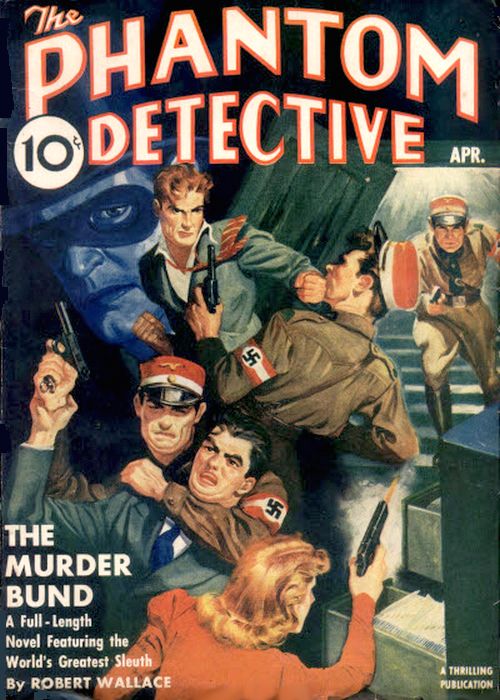
The Phantom Detective, April 1941, with "The Murder Bund"
Follow the Phantom on the trail of fifth column killers who threaten the peace and security of America! Death hangs over a great city when democracy's foes plot a grim coup!
MURDER struck swiftly and silently.
Woodward Avenue, Detroit, in the early evening, was among the widest, the most heavily traveled, and gayest of America's greater city main streets. Yet death stalked without any fanfare, except for the single scream of a suddenly pallid-lipped woman, into the midst of the thronging pedestrians, the lines of motor cars.
Swiftly and silently. And yet there had been warning of its approach. A warning known by few as yet, however, for it had come only minutes in advance of the evil climax.
To some men in that vast industrial city there had come a voice over the humming telephone wires, a taunting voice out of the ether, one that the country was coming to fear. It had predicted murder—three murders, to be exact. It had come in the voice of an unknown who called himself the Murder Prophet, a man of mystery for whom a nation-wide search was being made by authorities of cities, states and nation as foremost in an adroitly publicized Fifth Column terrorism, an elusive Bund devoted to Kulturkampf which was boring into the heart of the national defense industries.
For weeks that sinister voice had inspired terror among industrialists and defense workers. "Kulturkampf! The conflict of humanity!" Everywhere the word was on the tongues of patriotic citizens, on the radio, over the teletypes, and in the newspapers. And now the cold, uncompromising voice that promoted it had spoken again.
Three more men, the voice had droned, were to die in a few minutes. Three among all the teeming thousands in Detroit's vital, speeded-up defense industries. And they were only three in a series of murders and acts of criminal sabotage that had been predicted by the gloating Murder Prophet—and had come to pass as predicted.
It happened in the middle of a busy block. A big sedan rolled to a stop as its brakes were applied. An awful bundle rolled out into the street—a bundle that at first flash was made up of bright garments, white face and hands.
On the seat of an armored truck, the youthful driver and guard chilled at the sight. With a sharply grated expletive, the driver jammed his foot down.
"She didn't know what hit her!" he groaned.
The woman lay squarely in front of the huge truck. Guard and driver forgot all rules about keeping their doors closed before reaching their destination, though fully aware that their cargo was the newly finished torpedo from an arms corporation on which, should it prove itself, might depend the destiny of mighty nations.
They should have thought, should have remembered that, but—a dead woman in the street was enough to upset all rules.
Two men were getting out of the halted sedan. Other cars rolled on. A crowd was quickly gathering, but the messenger truck driver and his guard were the first to reach the woman.
Both were suddenly pushed and jostled. The guard may have had a last second instinct of danger, for his hand gripped his gun. But in that instant, death struck!
The driver sprawled on his face, his outflung hands touching the woman's bright dress. The guard slumped down. His gun fell from his hand unexploded. None in the crowd nearest the two men seemed to understand what had happened.
A WOMAN cried out half hysterically. Men shouted and pushed back, anxious to be clear of something sinister. And even as the startled, awed crowd momentarily fell back, the apparently dead woman leaped lightly to her feet. The door of the sedan opened and closed. The sedan rolled swiftly away, and the woman was in it.
In the same breath the truck also was moving. Two men were on the seat of the armored vehicle. Their green uniforms duplicated those of the guard and driver lying in the street. From where they had appeared, no one in the sidewalk crowd could have told. But swiftly they had usurped the places of the legitimate driver and guard who lay in the street with faces contorted in death agony.
In the speeding sedan, the woman who had played dead sank into a seat. A man laughed evilly and spoke to another who sat beside him, a man with marble-like, protruding eyes, a round face, thick lips, and a pouchy chin.
"Hit you hard, eh, Slater—to see the plan in action? You're too soft."
Another man, seated beside the girl, was bullet-headed, with hair so blond it was almost white, and was as coarse as pig bristles.
"Good work, Freda," he commended. "You made it look like the real thing."
The woman was black-haired, but there was something in the blue of her eyes in her handsome, hard face that suggested the hair might once have been the blonde of a Teuton.
"Step on it, Fritz!" she snapped. "We have to pick up Hauptmann Karl!" She glared at him. "And you'd better button up your coat over that swastika before we meet him. It's an order never to wear those shirts away from the Bund camp, and you know it."
The sedan was lost in traffic before the first police arrived at the scene of death left behind. But there was nothing to be discovered from those bodies in the street—then—to show how death had swooped down on them so swiftly. Only later, in the autopsy room, would the red spot on each of their necks be discovered. Or the peach-stone odor that was about those tiny wounds...
AT about the moment the morgue wagon was arriving to take away the dead truck driver and guard, the phone on the desk of the city editor of the City News Association rang. Red-faced, excitable McCable listened to the slow, emotionless voice that spoke.
"This is the Murder Prophet, speaking for Kulturkampf," the voice said woodenly. "As you have already been notified would happen, two men have just died on Woodward Avenue. The dead men are unimportant. Another murder is about to be committed. His death will shock the nation. That is all now. You will hear from the Kulturkampf-Bund again, and each message will be the truth, as it has been in the past."
Sweat glistened on McCable's brow as the line went dead. He swore violently at the futility of attempting to trace the call over dial phones.
Only a few weeks before such a message would have been regarded as a hoax. But there had been many such messages. Each time the man calling himself the Murder Prophet had foretold murder and sabotage. The calls and the crimes had moved from one industrial city devoted to national defense, to another.
Never, however, had any details been given so that it had been possible for the police to interfere. This time Woodward Avenue had been mentioned, but Woodward Avenue was Detroit's main street, extending for miles. It seemed useless even to call the police about this newest sinister prophecy, but McCable did, chilling as he thought of that cold, emotionless voice promising death.
There was nothing more he could do—except wait, and wonder about the identity of the man high up in the defense industry who was unaware that the black shadow of death was hovering over him...
Blinding, pitiless light played into the pain-sunken eyes of the elderly man bound securely in an armchair. His body, his face, sagged from the agony which had exhausted him. A queer head-set lay on the floor beside him, and a thin trickle of dried blood made a line from his ears down each side of his neck. Roger Latham, head of the great Latham Corporation, makers of war weapons, had been subjected to fiendish torture.
Opposite him, also bound by wrists and ankles to a straight-backed chair, sat a woman. Janet McGregor, confidential secretary to Latham for years, was no longer in the full flush of youth, but she was maturely beautiful, calm, poised, and with high intelligence and courage in her clear eyes.
Man and woman looked up as the door opened and another man and a woman entered. The man was staggering under the weight of a coffin-like wooden crate which he set down and swiftly proceeded to open. Fritz and Freda of the delivery truckmen murders!
From the rectangular box the hulking Fritz took a gleaming cylindrical tube. He laid it on the floor between the two captives, chuckling as he saw their eyes go wide, recognizing it.
"Ah, Freda!" he said. "So now we take up our inquiry where we left off to go for this torpedo model. Now these two know we mean business. The stubborn old fool is deaf now, so we will have to use the cards on him."
Freda nodded and pulled some hand-lettered cards from a briefcase. The huge Teutonic torturer selected one and held it before Roger Latham's eyes. It read:
HERE IS YOUR MODEL TORPEDO.
WHAT IS THE EXPLOSIVE FORMULA?
"Speak, Schweinehund!" Fritz growled. "Tell me the secret!"
"He can't hear you, Fritz, and he refuses to focus on the card," said Freda angrily. She reached out and slapped Roger Latham viciously over the face.
THE victim barely quivered. Painfully slow, he raised his head and stared at his inquisitioner.
"You may cut me to pieces, if you like," he choked, "but I will never reveal to spies and agents of terrorism the secret of this weapon which belongs to my own country."
Fritz snarled, while Freda clawed her nails across the face of the defiant old man.
"Fritz! Freda!" came a hollow command out of nowhere. "You gain nothing, because you do not use your heads. Call Hauptmann Karl and ask him how to proceed."
Both torturers stiffened and turned toward what appeared to be a window of faint glowing blue glass. Nothing could be seen, but both two Teutons trembled slightly and hastened to obey that command of the Murder Prophet whom they also knew as the "Little Fuehrer."
In a moment a young man with long black hair and dreamy eyes, but with the thin, hard, cruel lips and hawkish nose of a beast of prey, entered. He carried an old violin in one slender white hand and a flexible bow in the other. Plainly Fritz and Freda feared this lieutenant of the Murder Prophet. A mystery man himself, Hauptmann Karl, from the wild heart of Hungary, an inscrutable being who would have been more at home in the vampire castles of medieval Europe than in the modern Detroit of the New World.
Fritz' right arm came up in a stiff salute, which the long-haired musician acknowledged with a lazy nod.
"So you have failed, in spite of my lovely amplified music?" he said disinterestedly. "You have overlooked the next logical step. We will work on Mr. Latham through this woman, the charming Miss McGregor. Go quickly, Fritz, and bring your cavalry sword."
In moments the gross Fritz stood in front of Janet McGregor, his big hand flicking the heavy, sharp sword he carried as easily as though it were a small carving knife. Janet paled, but eyed him bravely. Hauptmann Karl chuckled as he selected a blank card and swiftly printed letters on it. He held it before Latham. The tortured manufacturer read:
LAST CHANCE TO TALK. KEEP SILENT AND YOU WILL WATCH YOUR SECRETARY LOSE HER FACE AND EYES, FEATURE BY FEATURE.
The old man groaned in anguish.
"Even such devils as you could not do that!"
Hauptmann Karl raised his eyebrows and dropped the card. A radio on the nearby table was playing low, sweet music. He picked up his violin and swept his bow across the strings in perfect harmony with that distant orchestra. It was ghastly, macabre.
"That part of Die Fledermaus is lovely," he said softly. "All right, Fritz! Not too deep a cut at first. Just enough to dimple the chin."
Roger Latham was straining forward, his bruised lips trembling, the claw marks on his face standing out like the red canceling of a postage stamp.
"No, no, no," he was muttering feebly.
Into the dark eyes of Janet McGregor appeared a light that was beyond the perception of those about her. She looked at her employer, a loyalty and affection in her gaze that could only have been built up by years of devoted service to a kindly and noble man. She smiled faintly, and shook her head at the man who could not have heard words if she had voiced them.
The brutal Fritz, the feral Freda, the silken Karl should have taken warning. But Hauptmann Karl was entranced with the music of his own making. Freda was intent only on Fritz as he flicked up his sword and made a smooth, expert jab. The sharp point cleaved a reddening line down Janet's face with the precision of a surgeon's scalpel. With the poise of a dancer frozen into immobility for the applause, Fritz posed thus in tableau.
THIS was too much for Roger Latham. "No more, you fiends!" he cried. "Janet, I must speak! I can't—" He broke off with a scream of agony.
For quick as a flash Janet McGregor had thrown herself forward, chair and all. She impaled herself on that glittering sword point, the blade sinking deep into her throat.
Cursing, Fritz jerked back. But it was too late. Janet McGregor toppled forward to the floor.
"Don't talk, Mr. Latham," she choked. "They'll keep you alive—as long—as you don't—tell—"
A hemorrhage cut off her words, as her life's blood spread out about her head in a halo of scarlet heroism.
Hauptmann Karl drew his bow across the violin strings in a weird chord.
"Magnificent!" he murmured. "A Spartan gesture I had not anticipated. Now we will have to proceed with our alternate plans. Freda, you will go at once to the Latham home and effect your entrance there by that fake car accident and a sprained leg. There are still the wife, the son, and the daughter. Macht schnell!"
Coolly he studied Roger Latham as he plucked in pizzicato on his violin.
AT a few minutes before eight, more than a score of men had assembled in the directors' room of the Latham Corporation Building just off Cadillac Square. It was of significance that all the men, of national prominence, were vitally important to the defense industry—Amos Stout, production manager of the Latham Corporation, manufacturers of war weapons and supplies, young Paul Latham, second only to his father in importance in the corporation, Herman Slater of Slater Foundries, Randolph Merkle, the kingpin of the alloy industry—others whose names ranked high in the country's defense program.
Downstairs at the entrance to the building, a small, slender man kissed a pretty girl just before getting out of her coupé. He was Horace Craft, a mild, almost colorless man, the fiancé of Lela Latham, and the plant superintendent of the Latham Corporation. Little in physique but big enough in capability.
"Please drive straight home, Lela," he said anxiously. "Don't stop for anything. I'll come out with your father after this meeting."
Lela laughed lightly at his apprehension. "Don't worry, darling, I'll be all right. And that was a lovely dinner."
She drove away, and Craft hurried up to the directors' room on the fourteenth floor of the building. As he entered, bulletins on the latest Murder Prophet warning were being broadcast. There was a tenseness in all the listening men, but perhaps of them all the big, gray-eyed Merkle, a partner and big investor in the Latham Corporation, was most intent, aside from the anxious young Paul Latham.
Craft was showered with questions the instant he stepped through the door. For now the Murder Prophet had named names. Now the whole world was informed that the latest victim was Roger Latham. But there was nothing more that Horace Craft could tell them. He had first heard the news while having dinner with Lela Latham. As to its truth, he could not say, nor had he any idea of Roger Latham's whereabouts.
"I last saw him at the plant late this afternoon, " he said. "I can't understand this at all. The last thing I did before leaving was to follow out his instructions to supervise the boxing of the aerial torpedo models and see that it was delivered here promptly at eight o'clock... Paul, have you heard anything at all from your father?"
"Nothing," said Paul Latham, white-lipped. "There is nothing we can do right now save wait—and hope he has escaped the Murder Prophet."
"If Latham has been kidnapped, none of us are safe," said a heavy-featured man—Grayson of United Aircraft Engines. "Something must be done about this Murder Prophet and his Kulturkampf-Bund."
"Where is that Phantom Detective who was supposed to be here at this meeting?" demanded Amos Stout, but none had an answer.
In that hour of stress, the Phantom, greatest of all detectives, famous Nemesis of crime and criminals was, in fact, the sole remaining hope of these men, big in business, but futile in the face of a hidden danger with which they could not cope. And it had been with the knowledge that there was but one man who could fight the mysterious Murder Prophet with his own weapons—and win—that already the Phantom had been summoned.
A frantic, urgent call had gone out from the publisher of the Detroit Recorder to Frank Havens in New York, publisher of the Clarion and a coast-to-coast chain of other powerful newspapers. Havens alone, as these men knew, as the world knew, was the one man who could contact the Phantom whose real identity had always been so closely hidden that no one had ever been able to make even a wild guess as to who the Phantom actually was.
And had anyone known, the astonishment would have been all the greater, for the man whose exploits had made his very name feared above all others in the ranks of evil-doers was the last man anyone would have guessed him to be. In private life, and among his friends, the Phantom was Richard Curtis Van Loan, one of the wealthiest playboys in the country, a man who was believed to live only for the pleasure he could get from life, dashing about from one of his homes to the other, aboard his yacht, a devotee of night life.
YOUNG Van Loan's father had been a lifelong friend of Havens, and it was after the elder Van Loan's death that Frank Havens had been responsible for the existence of the Phantom. The idea had first been born when Havens had suggested that Dick Van Loan, bored with life and restless, try his hand at solving a mysterious crime which had stumped the police of the nation. And so successful had he been that the young heir to the tremendous Van Loan fortune had gone on and on, perfecting himself in what had become his lifework until now the name of the Phantom led all the rest in the annals of crime detection, a name known and admired by the police of every nation.
From his first taste of the composite science of crime prevention and the keener art of man-hunting, detective work had enthralled Dick Van Loan. He had ardently applied himself to the mastery of his profession, which was his vocation and his avocation, exploring the very by-paths of crime through the twisting and devious channels of the underworld. He had plunged into studies that required long months of grueling, exhausting work to complete—and had completed them all, until now he was as well versed as any man living in all aspects of crime, its prevention, and detection.
His studies of the psychological make-up of the criminal, his laboratory work on the physical aspects of crime, had made him the unchallenged leader in his field. Long since he had become a master of disguise, without an equal. He was endowed with a prodigious memory which retained and recalled to him, given time, facts, names and dates that would have vanished completely from the memory of an ordinary man.
Wide-shouldered, powerful, Van Loan's vitality constantly amazed those who met him in disguise as the Phantom. He could stay on his feet for ninety-six hours at a stretch and appear as fresh at the end of the long grind as when he started it. For he had learned how to cat-nap and cat-rest in scant, broken minutes of utter relaxation. He was adept at nearly all sports, an expert with the fencing foils, at ju-jitsu, la savate, and his marksmanship with guns of all kinds was uncanny.
In one careful disguise, that of a stoop-shouldered scientist who called himself Dr. Bendix, he maintained far up in the Bronx one of the most modern-equipped laboratories in the world. But of all the thousands of disguises the Phantom used, his best characterization was played without the use of a single bit of make-up, false hair, moulage, or gadgets. This was when he appeared as himself, the playboy Dick Van Loan, idly circulating around in the upper-crust circles to which his name and background gave him entrance. And only Frank Havens knew all this.
Such then, was the famous detective so earnestly awaited by these men now at their momentous meeting in the Latham Building in Detroit. It was Amos Stout, an oldish man who wore rimmed glasses and a dipped mustache which gave him a fatherly appearance, who finally broke the silence that had become more and more tense when the news bulletins had been finished.
"While I am worried badly about your father, Paul, I am also worried about his aerial torpedo and his plans on that."
"If Dad is right," Paul Latham said tightly, "and I think he is, that light aerial bomb will supersede all heavier torpedoes. And if furnished to Great Britain in quantity, we believe it will quickly end this present war."
"I'll have to see this model first," wheezed Herman Slater dryly. "Your father is much of a dreamer, Paul. Look at the flying wing he didn't finish."
Paul Latham's dark eyes flashed.
"My father isn't the only one who abandons mistakes!" he said tersely.
Herman Slater's slightly bulging blue eyes had a cold look. Amos Stout moved placatingly into the threatened breach.
"I understand, Slater, that you are still experimenting with Roger Latham's flying wing idea."
Paul Latham swung on the head of the Slater Foundries. "So you are stealing my father's flying wing idea, are you, Slater? Perhaps you also have commercial spies in our plant?"
Slater wheezed out an oath and doubled one of his fists. The elderly Randolph Merkle halted this belligerent move.
"No quarreling, men," he said crisply. "We have troubles enough. " His keen gray eyes studied each man closely, but his face was inscrutable, expressionless.
Randolph Merkle, key figure of the alloy world, was a big man in industrials, and was a close acquaintance of Frank Havens. So his voice had already been added to that of the Recorder publisher, to Havens to contact the Phantom. And Havens, he knew, would not fail them.
"I don't know what can be keeping the delivery crew of that torpedo," Horace Craft said anxiously, for it was now past eight o'clock.
At that instant the corridor door opened, and four heavily armed men in police uniform filed into the room.
"I'm Captain Reagan from Headquarters," said the man in the lead. "We just dropped in to make sure that everything is all right here. You have no word yet on Roger Latham, I suppose?"
"That blasted murder Bund —giving all German people here a bad name, even when they are loyal Americans!" Herman Slater mumbled.
What answer would have been made to that was not voiced, for it was at that moment that heavy feet came along the hallway, then four men came grunting and panting into the luxurious room carrying a long box of unpainted wood which bore the black stenciling of the Latham Corporation. The expected torpedo had arrived.
Young Paul Latham nodded shortly after he had tipped the messengers and they had swiftly departed.
"Open it," he directed curtly, as all eyes were centered on the long crate. "You men are to be shown the invention no matter what—may have happened to—my father. Your plants may be called upon to help manufacture the torpedo."
Horace Craft began using a screwdriver with hands that shook slightly.
"You're sure that box is okay?" demanded Captain Reagan.
"I personally saw the torpedo packed at the plant, " declared Paul Latham. "Mr. Craft saw it checked out. It isn't loaded."
The lid came off with a rasping sound that somehow was chilling. An awful choking cry was torn from the throat of Paul Latham. Frozen horror gripped every man in the room. Then Paul's cry became agonized words.
"My God! Janet McGregor—Dad's secretary!"
INSTANTLY the room became bedlam. The four policemen endeavored to take charge, to bring about order, to prevent a panic. Perhaps strangest of all was the sudden action of the usually aloof Randolph Merkle. He leaned over the opened crate and studied the dead woman, noting the disfiguring cut on the chin and the slashed throat. He it was who picked up the little card pinned to the dead woman's chest and read it aloud:
ROGER LATHAM IS UNAVOIDABLY DETAINED BY DEATH.
That was all.
"Hey, you!" growled Captain Reagan. "What did you touch that card for? There might have been fingerprints..."
He broke off as Merkle suddenly bent his head over the crate, tensely listening. Everybody heard it then—an ominous ticking, steady as the rhythm of death came from near the feet of the corpse. Merkle plunged his hand quickly into the foot of the box, tossing aside the packing as he did so. Captain Reagan angrily grabbed one of his wrists.
The two men stared into each other's eyes. Then Merkle swiftly put one hand into his pocket and brought it forth with something palmed that only the zealous police captain could see. It was a tiny diamond-studded platinum mask, the badge of the Phantom, known to the police of the entire world.
"The Phantom!" gurgled Reagan. "But where is Randolph Merkle, then?"
"With Mr. Frank Havens," said the Phantom. "I arranged earlier to take his place at this meeting, and—" He whirled, and raised his voice sharply. "Run for your lives! There's a bomb planted here!"
His hand came up with a small box from which the rapidly ticking sound came. And at that moment all the lights were blacked out.
The Phantom clutched the ticking box of death enclosed with the corpse of Roger Latham's secretary.
"Into the corridor, everybody!" he yelled. "It's a bomb!"
Captain Reagan, near the Phantom, swore roundly, and the Phantom was jolted off his feet as every man in the room rushed for the door. Rising above the yells and shouts suddenly came a crunching blow and a cry. But only the Phantom realized that that cry was in the voice of Paul Latham. And to him the wheezed oaths of Herman Slater, the foundry-man, were unmistakable.
Grimly holding onto the box in the rush of panic-stricken men, the Phantom realized only too well that the bomb undoubtedly had been set to go off within a minute or two after that torpedo model box was opened to show the body of Janet McGregor.
That would mean a horrible death, death for many key figures in the defense industry if it exploded now, or if it were carried into the corridor. The Phantom raced with the box toward the opposite end of the long room. He judged wisely, that if he threw it from him, concussion might hasten the explosion.
Perhaps a third of the men were out of the room when battering blows and shouts came from the corridor doorway.
"Clear the way!" shouted Captain Reagan's voice. "Get out—" His shout was cut off so short that it sounded to the Phantom as if Captain Reagan had been knocked cold.
"The door!" someone else was yelling. "They've locked it!"
AS part of his intensive training, until his senses had become superfine, the Phantom always memorized all details of any room he ever entered. It was that habit which now gave him the only slim chance there might be.
"Lie down! On the floor, everybody!"
His voice was a command, showing nothing of his full realization of the danger to every man still locked in the black room with him. And with no way out except by the windows—with the street fifteen stories below.
To hurl the ticking bomb through the glass might mean the death of no telling how many men and women down in the street But here—well, the interior of the room was photographed on his amazing brain, and he might save the others at the expense of his own life. He might even survive, himself, if he acted quickly enough, racing against a time bomb that might have only seconds to go. He sprang along the wall, calling out: "All of you stay on the floor, and crawl away from my voice!"
Because he had already studied the identity of Randolph Merkle, when he had met the industrialist with Frank Havens, the Phantom was deliberately speaking in Merkle's voice.
"Merkle!" a man's voice cried out in the dark. "He'll be killed! Merkle! Drop the thing! Come on!"
Men were hammering at the locked door as the Phantom reached the spot that was photographed on his brain. A thick steel door swung partly open. He had earlier marked this as the directors' room vault where possibly the records of the Latham Corporation were kept.
Thrusting the ticking box inside the steel door, the Phantom swung it shut, throwing the heavy bolt. And as instantly, he threw himself to the floor, rolling away. But as he sought his own safety last of all, he saw two men who had disregarded his warning. Their silhouettes showed against the window, as if groping uncertainly—and moving toward the steel door behind which death was about to let go! The Phantom leaped. He carried the endangered men with him to the floor just as the time bomb exploded.
The sides of the building seemed to split. The Phantom, every man in the room, were blown against a wall with breath-taking force.
"Merkle!" men were calling out. "Merkle! Are you alive?"
"I'm all right!" said the Phantom. "Get ready to smash down that corridor door! Be careful! There must be Fifth Column Bundists among the employees of this building! Maybe here in the room with us!"
The Phantom sent a thin sliver of light from his pencil flash across the long room. The blast had been terrific. The great steel door of the vault had been blown off. The vault was ripped apart and he knew that if that bomb had let go in the room, everybody there would be dead.
Pushing through to the locked door, he shouted:
"Stand back!"
Possibly the real Randolph Merkle never had been marked as a man of action, because even in this moment of stress, men exclaimed with amazement. The Phantom's flashlight showed a heavy automatic in his hand.
TWO shots blasted the lock from the door. The entrapped men barged through it—only to be stopped outside by the body of a policeman. And on the floor, near an elevator, lay the two operators. Both were alive, but had been slugged.
The Phantom took a swift inventory of who was with him. About half of the score of the men who had gathered for the defense council meeting had escaped before the door had been locked. Among those were Paul Latham, Herman Slater, Amos Stout and Horace Craft. And the Phantom's mind dwelt for a moment on Craft, remembering now that the man had kept an eye on his watch after that time bomb had arrived in the death box.
"Good heavens, Merkle!" a man cried out to him. "You don't think all of those men have been abducted by that murder Bund, do you?"
The question was answered wordlessly when Captain Reagan came down the corridor with Herman Slater, Horace Craft, Amos Stout, and some of the other men.
"I'm holding every man who was in that room until we have investigated this thing!" Captain Reagan shouted harshly. "Someone knocked out Paul Latham and he's missing! Two men who worked on the freight elevator are gone! Some other employees here— Bundsmen, of course—were responsible for the lights going out! What happened in there, anyway, before that bomb let go?"
The Phantom was wondering about that himself. He might have ideas about who had been responsible for this horror and the attempted wholesale bombing, but pinning it down would be difficult. Several persons had already been on the move toward the door when the lights had gone out. Just one thing was plainly apparent—Paul Latham had been knocked out and taken away.
Even as he was pondering, the Phantom was fading away, while Captain Reagan was speaking. He was on a winding back stairway, dropping swiftly downward.
Crowds were being held back by quickly formed police lines as the Phantom reached the street. Thousands had been attracted by the terrific explosion so near Cadillac Square.
Near the Latham Corporation Building a deserted messenger truck still stood. But the messengers who had brought Janet McGregor's body instead of the aerial torpedo model were well away from here now, probably with the other Bundsmen who had abducted young Paul Latham.
In the side street into which the Phantom turned, a small coupé was drawn up to the curb. One of the Phantom's own powerful cars was parked not far away, and in heading for it he would have passed the coupé without giving it special attention had he not suddenly heard a radio in it playing low—the music of a symphony orchestra.
To his amazement, the Phantom saw in the coupé a young man with long hair, who looked like some down-at-the-heels music teacher. The young man was holding-an old violin under his chin and moving the bow with delicate fingers.
The Phantom knew good music when he heard it. He knew he was hearing it now, as that young violinist played in perfect tune and rhythm with the orchestra. He barely seemed to be aware of the Phantom who paused close to the coupé. His dreamy eyes seemed to indicate that he had been deaf to the explosion that had drawn crowds into the nearby block.
THE Phantom moved into the shadows. As he did, a street lamp showed him the face of a slightly built youth crossing the street. The youth moved quickly, but did not come directly toward the Phantom.
Instead, he whistled a gay little tune and disappeared into the darkness of a doorway. The Phantom smiled to himself. Chip Dorlan, his fighting aide and pupil who had come up the hard way in San Francisco slums, was on the job all right. As he always was, as he always had been since the Phantom's efforts had won freedom for Chip's framed brother, and had brought to the Phantom Chip's own undying loyalty and devotion.
The Phantom knew now that Chip Dorlan probably could inform him better than any other person what had happened outside the Latham Corporation Building when Paul Latham had disappeared. But for the moment, the Phantom, now invisible, was busy studying the seedy-appearing violin player sitting leisurely in the coupé.
As he waited, watching, listening to the violin, the Phantom took quick stock of his reason for being here, recalling all that he had learned from Frank Havens about the operation of the so-called Murder Prophet and the Kulturkampf-Bund. For the Murder Prophet's methods had gained the murdering Bund columns of space in newspapers, including the chain owned by Havens.
Havens resented being forced to print this news of murder and sabotage, believing it only to be clever propaganda. But the Kulturkampf-Bund was news, and so were the murders and sabotage. Though Havens well knew that the Murder Prophet-warnings, the sureness of the murder Bund crimes were inspiring fear among workers and defense manufacturers alike.
"And they're deliberately using our newspapers, " Frank Havens had told the Phantom. "It has to be stopped, Dick. But the Federal Bureau of Investigation, state and local police are insufficient to cover all the angles. These Bundsmen are being paid by foreign governments. Many employees have been added in all consular shipping and other German offices everywhere since the war, although their business has dropped to nothing."
"Which means, Frank," the Phantom had admitted, "that under diplomatic immunity, agents, spies and saboteurs must be filtering into all of our defense industries. They are members of Bunds that are still unchecked, or meet secretly in unknown places."
And so it had been as much to work for the end that Frank Havens desired—the cleaning up of the festering Bund sores on the body politic—as to answer the frantic call for and from the publisher of the Detroit Recorder that the Phantom, the man of truly a thousand faces, was now in the Michigan city. And catapulted at once into the heart of intrigue and danger. There was also another consideration. As Dick Van Loan, the Phantom was the friend of the Latham family, having often met them at social functions, and he felt it a duty to stand by them now in this hour of trouble. Now, as the Phantom remained motionless, watching the queer violin player in the coupé, and aware that Chip Dorlan was hidden, awaiting a signal, the Phantom was thinking of Frank Havens, now in the apartment of the real Randolph Merkle.
"Frank will be burning up when he hears of the explosion, until I make contact," thought the Phantom. "But it must wait. A kind of hunch tells me that violin player isn't altogether what he seems."
ODDLY, he was recalling, the odor that had come to him when he had bent over that torpedo model box containing the corpse of Janet McGregor.
"Like the bilge water in some old ship," he remembered. "That model box didn't get that in the Latham plant. It wasn't the crate that originally went out from there with the torpedo model. The man responsible for that exchange, for the murders must be well informed on the workings of the Latham plant."
That reasoning brought Horace Craft to mind. The meek, little plant superintendent's face had been gray and frightened before that box had been brought up. Why?
Then there was Herman Slater, with whom Paul Latham had tilted at the meeting. Van was not prejudiced against any man or woman who bore a German name, but he had to remember Slater's quick anger when Paul Latham had accused him of having spies in the Latham plant.
To be sure, there was Paul himself, who would inherit the multi-million corporation, with his sister, Lela.
"Not Paul Latham," he told himself grimly. "His affection for his father is deep. Could Paul have been temporarily deranged by the horror, and be rushing off to his own death?"
Van put that thought from him. Across the street, the violin player in the coupé suddenly ceased accompanying the symphony being played on his motor radio. Van's keen ears picked up a muffled, sepulchral voice, which also came from the coupé.
It came to Van that perhaps the regular radio was being used to cover another special set. The words spoken in the muffled voice were indistinct, and Van edged closer.
While he could not determine the words of the person speaking to the violin player, he hoped to hear the violinist's reply. He did hear this much:
"That is good. Now listen closely—"
Ping ping-ping-ping. Ping-ping!
The man in the coupé was picking at one string of the violin. The pinging was all on the same note. But each one was spaced so that the string formed little groups of numbers in series of threes. Like 6-7-4 and 5-8-3.
For more than a minute, the violin string pinged its combination of numbers. A code message was being put on that special short-wave set in the coupé!
"And if any amateur happened to pick it up, he would learn exactly nothing," Van said softly. "If I could get to my own car and be ready to trail that coupé, it might be worthwhile."
All doubt had been removed of the violin player being somehow connected with tonight's tragic horror. Van started from the shadows, but halted just in time to remain unobserved. A short, fat man was waddling along the opposite sidewalk. The street light showed a white, round face and heavy figure. He paused beside the coupé and opened the door.
The violinist's greeting came to Van's ears.
"Good, Slater. Everything's set."
"But I don't like it, Haupt—er—Mr. Lawson," the fat man spoke quickly. "If Paul Latham won't talk, then what?"
"It is arranged," said the violinist.
THE Phantom was quick, but silent, and almost upon the coupé, angling toward it from the rear.
Then he heard the violinist say: "Randolph Merkle is one of the Latham big shots, Slater. He's next on the list. You understand? The Little Fuehrer named him tonight. "Van would not have been so confident had he known that his figure, in his disguise as Randolph Merkle showed in the coupé windshield. But Van had no time to think of that, or that words might have been spoken for his benefit. He was springing directly upon the strange violinist.
"Hold it!" he snapped, his powerful fingers shooting to the arm of the violinist.
It did not appear to Van that a man armed only with a violin could offer much resistance. But if his fingers even reached the violinist's arm, the Phantom was unconscious of it. The violin, still tucked under the man's chin, seemed to Van to burst with a squashy explosion. Brilliant fire and blinding fumes shot into his face. The blast, scarcely loud enough to be heard more than a few yards, jolted the Phantom back on his heels with all the effect of a powerful blow.
Fumes shut off his breath and seemed to be burning his eyes from their sockets. He heard Chip Dorlan cry out, and knew the youth was plunging toward the men in the car.
Choked as he was, Van managed to speak, "Back, Chip! Get back! Wait!" He was fully aware his warning might mark him as the Phantom, if those in the car knew of Chip Dorlan. There was no time, then, to consider that perhaps these men in the coupé already knew that the man who appeared to be Randolph Merkle was in reality the disguised Phantom. But even before the Phantom's vision entirely cleared, the coupé was speeding away. Then Chip Dorlan appeared as Van was beginning to see through an agonizing mist.
"Phantom!" cried Chip. "You hurt bad?"
Van shook his head. "No, Chip. That car turned out of the street. Which way did it go?"
"The first turn to the right, Phantom," said Chip. "Toward the river and the Lake-St. Clair road."
Slowly the Phantom's throat became less painful.
"That's the first time I was ever attacked and stopped by a musical instrument, Chip," he said ruefully. "This Kulturkampf-Bund is the coldest-blooded and the cleverest group of criminals we have ever opposed, I'm beginning to realize."
He was debating swiftly what steps he should take first.
"I was down here, Phantom," Chip said, "when several men came into the street. They were carrying a young fellow, and a car picked them up. That coupé with the man playing the fiddle was here all the time. He didn't seem to notice anything or hear that explosion. Phantom, gee! I was afraid you had been—"
"Listen, Chip," interrupted Van, his brain working at lightning speed. "As a boy you had a job as a core-maker in a San Francisco foundry, didn't you?"
"Yes," said Chip. "It was tough work."
"Still remember enough to apply for such a job here?"
"Sure, Phantom! But, gee! I'm pretty soft!"
"Not so soft as you think," said Van. "This is so vital to all behind this murder Bund that I would try the job myself, if the lives of several persons were not in deadly danger right now. Chip, get into old clothes, and I'm fairly sure you'll land a quick job in a foundry. The Herman Slater foundries, among the biggest in the defense industry."
"But there won't be any fighting—" Chip started to complain.
"Don't be too sure of that," said Van. "Get that job, the first thing in the morning, if you can, Chip. I want you to find out all you can about a new plane or any kind of a plane or flying wing that may be in the foundries. Contact me through Frank Havens at the Cadillac Hotel at noon tomorrow."
CHIP nodded gloomily. But Van knew if there was anything of importance to be discovered in the Herman Slater plant, Chip would surely find it.
As Chip moved away, Van sought the nearest telephone booth. He called the number of Randolph Merkle's apartment. He must put Randolph Merkle, the alloy expert whom he was impersonating, on guard because of the threat he had heard made upon his life.
The voice of Frank Havens replied.
"I'm certainly glad to hear your voice, Dick, " Havens said heartily. "I'm all mixed up with the conflicting stories I've been hearing. It was reported that Randolph Merkle had saved several lives, then ducked out on the police, so I've been on edge, knowing you were the man they believed to be Merkle."
"You know what's happened, of course," said Van quickly. "I have no time to waste. Send police to the Roger Latham home, if they're not already there. And tell Randolph Merkle I'm still impersonating him, and for him to keep under cover. I know that his life is threatened."
"So that's it!" Frank Havens said bitterly. "Merkle isn't here, Phantom! He had a mysterious call, asking him to go to the Latham home at once. I haven't heard from Merkle since he left."
So perhaps Randolph Merkle had already been called to his death! But he had been posing as Merkle at the defense meeting over the torpedo model. There could be but one answer to that. Someone in that room, some member of that council, must have been aware of the Phantom's identity. Perhaps Merkle himself had trusted someone there. Merkle had agreed only reluctantly to allowing even the Phantom to impersonate him when Van had considered that advisable. But Merkle must be saved now, though he might have been rash in exposing himself to the killers.
Van's decision was instant. "I'm starting for the Latham residence on Lake St. Clair, Frank. I'm convinced there's where the murder Bund is all set to strike next—if it hasn't already struck."
SHOOTING his battered old car, with its super-powered motor, toward the Grosse Point Boulevard that led to the swanky Lake St. Clair residence section, the Phantom was fully aware that in retaining the appearance of Randolph Merkle, he had become a living bait for murderers.
"If I am in time, it may be that I can still mix up their signals," he thought grimly. "If I only knew what those violin string signal numbers meant! Three numbers in groups."
The Phantom knew all of the codes employed in international espionage, so far as they had been studied up to this time. But he was well aware that some simple form of communication could be a code, and because of its simplicity it could balk the smartest detective living.
Even as one part of his mind kept working over the signals, he was reviewing with horror the number of persons involved who might have some connection with the infamous Kulturkampf-Bund, and one or two angles that did not seem to fit in directly with the acts of sabotage and murder that had brought him into the matter.
Swiftly, he reviewed the men he had met, considering their positions in the puzzle.
Paul Latham, son and heir of Roger Latham, undoubtedly had been abducted. And that of course was because Paul Latham knew all the secrets of the aerial torpedo which might prove a devastating war weapon.
Then there was Horace Craft, superintendent of the Latham plant. He was well informed about the torpedo model, but possibly lacked some of its details known only to Paul Latham. Craft had seemed furtive and frightened. It seemed impossible to believe, but Craft probably had been in better position than any other person to have exchanged those model boxes.
Herman Slater, who had aroused Paul Latham's anger, seemed to have secret work going on in his foundries. And this same Herman Slater apparently was working with the mysterious violinist who might be the head of the murder Bund.
"Slater called him Hauptmann. " mused Van. "Which he changed to Mr. Lawson. And Hauptmann means head man, the captain. Still, I'm not so sure that violinist could be the leader. Someone is behind this who has great stakes, a personal interest in the deliberate sabotage of defense work."
There was Amos Stout, the production expert. He was a big man in all of the defense work. He was counted upon to bring about mass production of the Latham torpedo, if it could be made to work.
"And so probably Amos Stout's life also would be endangered," considered the Phantom. "He is a key figure the Bund would want to remove."
Swiftly he ran over in his mind several other names of the defense council. And wound up with only one element that might be vital. Someone in that room seemed to have known of that time bomb, of the minute for which it was set, and had been prepared to have the lights go off while Paul Latham was seized, and he himself escaped.
But there was a more direct reason for Van speeding toward the Latham home. He was thinking of pretty Lela Latham, remembering her as he, as Richard Curtis Van Loan, had met her several times in New York.
"Paul Latham will prove as stubborn as his father, " was Van's thought. "So if they have snatched Lela Latham, they may do for her what they did for poor Janet McGregor."
THAT might have been what those queer violin signals had meant! That Mr. Lawson, that Hauptmann, might have been radioing in some simple code for the seizure of Lela Latham!
Roaring along the boulevard, chancing the speed limit, Van was aware that he had done all he could by sending the police through Frank Havens.
But would the police be enough? Police had not counted much in the Latham Building explosion and murders. It was maddening to the Phantom to realize that this murder Bund probably controlled uncounted numbers of men, and perhaps of women. They were working in every industry.
Unquestionably some had been among workmen in the Latham Corporation Building. Others might be servants in the Roger Latham home. It was like trying to put a finger on many drops of quicksilver.
The seventy miles an hour the Phantom was making was over the limit. He kept a watchful eye out for police cars, to prevent being delayed. He could establish his identity and be freed quickly, but he wished to avoid that.
Thus on guard, he noticed the lights of a car behind jump out into the passing lane. It was coming up on him. Van eased on his speed, prepared to produce his platinum domino with its tiny diamonds, the recognized badge of the noted Phantom anywhere.
To his surprise, the pursuing car also slowed. Van eased down to fifty, then forty. The headlights of the other car moved back into traffic, staying behind him.
Van pulled out into the passing lane and shot ahead. His guess had been correct. The pair of lights again took on speed. He knew now that whether he was known to be the Phantom, or believed to be Randolph Merkle that he was being directly tailed.
Perhaps the driver had never been born who could trail the Phantom and remain, undetected. Sure of his shadower, Van watched the lights ease in and out of thinning traffic behind him. It was only a mile or more now to the turn-off leading to the side highway that passed the Latham residence, as Van had learned.
As he reached the turn-off road he was grimly sure that members of the murder Bund must be in the vicinity of the Latham place. Likely, some would be between him and the residence.
"The way that radio was used, the Bundsmen are making special contact," came to him. "And the most logical place to get me, either as the Phantom or Merkle, is in the darker road beyond the turn-off."
Van really let his car out then. The trailing lights merely kept pace. Van was watching the turn-off, the shadows, everything that his own headlights revealed. He freed the heavy automatic under his armpit.
He was in the turn-off safely, then into the curving, dark highway along the lake shore. His quick eyes saw the steep grade of a side lane, and was rushing toward it when the shadowy bulk of an unlighted car started shooting down the side grade.
Few drivers could have acted so calmly and so quickly as the Phantom did then. The lights of the other car had been turned off to prevent him being warned. Van flicked out his own lights instantly. He shot forward at sixty into temporary blackness.
But every foot of the road for a hundred yards ahead, as far as his lights had reached, was imprinted upon Van's brain. He was the one-in-a-million driver who could hold his car to a road that was suddenly blacked out.
HOLDING the road, he accelerated, and shot ahead. Just as the shadowy bulk of the other car hurtled into the highway, Van twisted his steering wheel sharply. His car climbed the shoulder and went down into a shallow ditch. That swift turn off the road probably saved his life. As it was, the dark car that had been intended as a murder weapon jolted the rear of his coupé. There was a crackling smash. A rear fender was ripped off.
Van seemed almost to lift the car back onto the road by sheer strength. He grinned a little grimly over the closeness of the murder ambush. His lights on again, he watched the curves ahead, estimating he had only about one more mile to go, and was convinced that, having dodged the death car, he was on a clear road the rest of the way.
He was too late to avoid the log that was suddenly swung across his headlights from the side of the road. At sixty he could neither turn out nor stop.
His coupé smashed head-on into the log in a skid that had reduced his speed to a possible thirty miles. The coupe's hood crumpled and it somersaulted over the log, landing on its top.
Half a dozen shadowy figures rushed from the bushes from which the log had been swung. Sharp exclamations were uttered in guttural German. A command was given—an order from a masked and hooded figure who stood well above the road, flanked and guarded by four other hooded men.
Although spoken in German, Van interpreted that order. It was: "If he still lives, smash in his skull! Don't start shooting yet!"
Other masked men were climbing upon the overturned coupé. They could not see inside, although they flashed torches through the windows. For at that instant the gas tank exploded, the fuel ignited from a shorted wire of the motor.
Black smoke and gaseous flame enveloped the coupé, driving back those who would have completed the murder as ordered by the hooded leader. Within a few seconds the coupé was a flaming mass.
Again the masked leader spoke in guttural German, gloatingly.
"That is the end of the great Phantom! His cleverness failed! Those of you who are not assigned for further duty, will return to the camp!"
The masked men moved from the highway into the woods bordering Lake St. Clair, jabbering about the triumph they believed had come to the one they called the Little Fuehrer.
Under the bushes, where he had rolled in the darkness, after one of the quickest jumps he had ever made from a car, Van was half stunned. His jump had been instinctive, but he had left the car, hitting the ground and rolling in the split second before it had crashed the log.
"So it is the Phantom they believe has died in the car," came to him in an illuminating flash. "They were not seeking to murder Randolph Merkle!"
Van would have trailed the Bundsmen as they moved away, but it was still firmly fixed in his mind that if death had not already struck at the Latham home, or some other crime had not been committed, that it was direfully imminent. And those men were on the job now. The masked and hooded leader had spoken to them of"further duty."
The Phantom's muscles were bruised and aching, but his bones were all intact. He waited until sure all of the Bundsmen had departed, then started afoot toward the Latham home, keeping well in the woods at the side of the highway.
JUST at the moment the Phantom was following the road to the Roger Latham mansion Lela Latham was proving she had courage as well as charm. Her face was white and drawn, and her eyes reddened, but her voice was quiet and fully under control.
Outside the residence, isolated in its wide grounds, heavily armed policemen were on guard. Two guards were likewise stationed on the porch of the motor driveway entrance.
Lela Latham was speaking now to a woman who lay on a couch in the big living room, a woman who had suffered an accident and had been brought into the house. The woman, who had told Lela that her name was"Miss Andrews" apparently had a badly sprained ankle. Alarmed, Lela had at once telephoned the Latham family physician, but he had been out.
By a stroke of good fortune, one of the police on guard had been able to flag down a passing car carrying a physician's license. That doctor, who introduced himself as Dr. Cross, was in the Latham house now, and there was need for his services. For not only did"Miss Andrews" need attention, but Mrs. Latham had finally collapsed, so that Dr. Cross was busy alternating between the two women—Mrs. Latham in her bedroom upstairs, and Miss Andrews downstairs.
The black-haired woman's shapely right leg was bandaged at the ankle, and her blue eyes reflected every evidence of pain. This woman, the same who had played dead on Woodward Avenue, and had been called Freda, unquestionably was a finished actress.
"Dr. Cross says you should not be moved until the swelling goes down," Lela Latham was saying. "So I am having a room prepared for you, Miss Andrews."
"But it's so terrible for you, Miss Latham," Freda said compassionately. "After hearing of your present trouble, my ankle is a trivial matter. If you'd call a car, I could go home now."
Lela shook her head firmly.
"We're only too glad to do whatever we can for you, Miss Andrews," she insisted. "It must have been agonizing getting from your car to our house."
When Freda had come limping into the Latham grounds with a stick, the policeman at the entrance had carried her into the house.
After the shock of the news over the radio, Lela Latham had kept on her feet by sheer will. She now knew, which her mother mercifully did not, that Paul also was missing. Horace Craft had phoned, saying he would be out as quickly as he could leave the police.
Beside the police sent as the result of the Phantom's warning through Frank Havens, other guards had been called. And Randolph Merkle, the alloy expert and close friend of the Latham family in both a personal and business way, had arrived shortly after the Latham murder had been broadcast.
Merkle had remained with Lela, trying to comfort her. And at the moment the wily Freda was apparently seeking to relieve the Latham home of her presence. Merkle came into the living room.
He was a big man, with slightly stooped shoulders, a partly bald head, and a habit of seeming to look into other men's minds with his cool, gray eyes. The Phantom, in impersonating him, had done an excellent job of duplication.
Frank Havens had phoned. He had warned Merkle of what the Phantom had heard and advised him to leave the Latham home. But this warning had gone unheeded.
"I'd like to come to grips with some of those killers, Frank," Merkle's reply had been. "Since what has apparently happened to Roger Latham, rooting out this Kulturkampf-Bund with the help of the Phantom will be my sole business."
SO, as Freda again voiced her plea to go home, Merkle added his arguments to Lela's.
"Leaving tonight in your condition is not to be thought of, Miss Andrews," he said. "You're as well off here as you would be at home. Otherwise I would have an ambulance called for you."
Freda's blue eyes looked from Lela Latham to the kindly Merkle. The eyes suddenly brimmed with tears.
"I'll never be able to thank you enough," she said brokenly.
Merkle smiled slightly.
"You listen to Lela, Miss Andrews," he said. "And do as she says. I'll be upstairs in the study, if you want me, Lela. I have some calls to make. Everything is quiet outside, and I'll let you know the minute any news of Paul comes in. I have been all over the grounds in the past hour."
"I guess men who are really big are the kindest," Freda said, as Merkle left the room.
"Mr. Merkle is always that way," said Lela. "Now put out of your mind any thought of leaving before tomorrow. I'll go upstairs to Mother now, but I'll be down in a few moments."
Freda stirred a little. Her eyes were fixed upon one broad window of the drawing room. It seemed impossible, with the police outside, and added guards called, that anything could happen.
The Latham butler was moving just beyond the open doors of another room as Lela started toward the stairway. The wide window suddenly reflected a light, as if a car had turned and directed its beams upon it.
The light was reflected and blacked out three times quickly.
The butler stuck his long face through the door, looking at Freda. She made a little gesture with her hand, and he nodded. The Phantom had been correct in judging there might be Bundsmen planted even in the Latham home.
Freda then moaned piteously, as if in sudden pain.
"Please, Miss Latham!" she called. "Will you wait just a moment? I'm—"
Lela Latham was beside Freda instantly, rubbing her hands, calling the butler.
"Harden! Bring Dr. Cross at once!"
The butler moved stiffly to the stairs. Crackling shots sounded from several directions outside. They had the chattering staccato sound of many riveting hammers. Submachine-guns!
A man screamed with death agony. Lela Latham sprang to her feet. She did not see Freda's glinting blue eyes open, watching.
The entrance door burst open. One of the policeman staggered in, as if blown upon the stream of death lead from a chopper. Then the policeman was down, firing his revolver wildly. He quit shooting. He lay quiet.
Lela Latham screamed as a double explosion rocked the house. It seemed to come from upstairs. Almost immediately a ceiling burst through and billowing fire rolled from what must have been an incendiary bomb. Tongues of fire licked through a doorway into the big living room.
Lela's first thought was for her mother. She started for the stairs. The tall figure of Randolph Merkle appeared at the top of the stairs.
"Get out, Lela!" he shouted. "I'll help Dr. Cross with your mother! The fire hasn't reached her room!"
Freda cried out then. She was standing on her uninjured foot, holding onto the couch. She swayed, almost falling.
"Oh, please, Miss Latham!" she called. "Help me! I can't walk!"
Lela Latham sprang back to Freda's side, supporting her. Together they started toward the door where the policeman lay motionless.
Fiery tongues ran along the ceiling of the living room, and flared up over the window draperies. Women servants screamed with terror at the rear of the house.
In the face of this appalling horror Freda appeared to go to pieces. She moaned and clung to Lela Latham as if every step caused her acute agony. From outside came more crackling gunfire. Machine-guns were cutting down the police guard.
Helping the cold-blooded, soulless Freda, Lela was compelled to pass close to the dead policeman. She could see another policeman huddled outside. And if only she could have read Freda's hard blue eyes, she would have known that she was in the power of a merciless monster in the guise of a beautiful woman. Freda was watching the private driveway which curved to the house.
Just inside the doorway, close to the dead policeman, Lela's foot slipped in the little pool of blood by the dead man's head. Her strength left her then. She swayed under the other woman's weight. She was falling when Freda uttered a guttural oath in a foreign tongue.
"Fools! Why don't they swing in?"
Freda's supposedly injured foot now was firmly planted. She suddenly demonstrated that she possessed the strength of a man. She picked up Lela Latham and stepped through the front doorway, carrying the girl with ease.
She was in the driveway when a big car swung off the highway into the curve, its rubber shrieking. Five seconds later, a man wearing a hooded mask lifted Lela Latham into the car. Freda was berating the others.
"Turn it off, Freda!" ordered one man harshly. "The Little Fuehrer will be with Hauptmann Karl at the camp tonight! You have earned a little cross!"
That appeared to calm Freda. The car swung along, taking a route which would lead away from the city. There were countless by-roads that crossed Grosse Point in the vicinity of Lake St. Clair.
The spreading fire of the mansion painted the cloudy sky with an orange glow. Just as the Kulturkampf-Bund car neared the open concrete of the outside road, a pair of headlights came into view.
The driver of this car narrowly missed a head-on crash with the Bund machine. It seemed that the Bundsman who was driving deliberately swung the rear of his car so that his bumper ripped into a fender of the smaller car.
The coupé whirled off the road into a tree. Its driver fell out and rolled. He climbed slowly to his feet, staring after the kidnap machine.
The driver was the meek appearing little Horace Craft...
A DOUBLE explosion, the bright orange flare in the sky, the staccato hammering of machine-guns burst upon the Phantom's sight and hearing when he was still a quarter of a mile from the Latham mansion. He forgot his bruised muscles and broke into a run through the woods.
Already the sprawling Latham residence was blazing fiercely in the upper stories. Van judged instantly that the blaze must have been set off upstairs.
"Servants!" he grated. "Hirelings of the murder Bund!"
The wide lawn between him and the house showed several bodies in police uniform. Shooting was still to be heard beyond the house. Van saw two figures move swiftly through the shrubbery. In the bright light he saw the masks over their heads and faces and the swastikas on their sleeves.
In the shooting, he had heard what had seemed to be the crash of two cars.
He was at the end of the curved driveway when he saw a small car with its hood crumpled into a tree.
Near the ditched car, Horace Craft was standing, staring at the blazing residence as if he were dazed. In the distance, sirens were sounding. Horace Craft acted as if he had been knocked silly as he saw the Phantom approaching.
"Merkle!" he cried. "For God's sake, Merkle! They've got Lela! She's in there! She'll be burned alive!"
Craft started running straight toward the wide front entrance. Flames were licking out, touching a uniformed body on the steps.
The front door was becoming solid flame and smoke. Yet Horace Craft did not hesitate in his dash for the entrance. Van overtook him and gripped him with one hand. Craft's face was contorted as he swung around on the man he believed was Randolph Merkle. His fists pounded into Van's face.
"Lemme go!" he screamed. "Merkle, you fool! Lela's in there with her mother! I've got to get her!"
Van held Horace Craft firmly, trapping his wrists.
"Be quiet!" he commanded. "I'll do what I can!"
VAN'S gaze darted along the flaming house. Three women servants were huddled together on the lawn. They were looking at a window which was a smoky square with lurid flame behind it.
As Van first saw the window, a tall, bulky figure materialized from the smoke. The man got outside, struck the roof of the porch, and rolled. His clothing was on fire in places. As he came to the low edge of the porch roof, the man turned, held with his hands and dropped.
"Randolph Merkle!" exclaimed Van. "That was close! Now there are two of us!"
His disguise was no longer of service now. He would have made a quick movement to make a change in his appearance, but at that moment Horace Craft broke free. He seemed demented, shouting, running toward the burning house.
Van swerved and made sure that Horace Craft would stay out of the fire. One short punch and Craft lay on the lawn, his eyes closed. As Van started back toward Merkle, Merkle turned and disappeared around the corner of the house, crying:
"Mrs. Latham is still in her room! Find a ladder!"
The women servants seemed paralyzed. They stared at the Phantom, the image of Randolph Merkle, were as much frightened by this sudden doubling as they were by the fire.
Van turned from them. His hands flew over his face and head. Moulages popped from his jaws and nose. The bald spot disappeared. The gray eye-shells came out. And in moments only the Phantom was as different from Randolph Merkle as he could possibly be. His hair was thick and dark. But over his face he had slapped a tight-fitting domino mask.
"Don't be frightened," he said to the women. "I'm the Phantom, and I have been called to help the Lathams."
They were but servants. But the wide fame of the amazing Phantom never had better proof. For even those women house servants knew of the Phantom.
"The Phantom!" one of them exclaimed breathlessly. "I never expected to live to see the day—"
Van cut off her excited speech. "Tell me all you know of what happened," he said.
"Oh!" the servant exclaimed. "Fire exploded all over the kitchen. I saw a big car come up and a woman and man put Miss Latham into it. It went away fast and knocked Mr. Craft's car off the highway. Then it went out toward the lake roads."
"I see," nodded Van. "And Miss Latham was forced to go?"
"Yes! The woman we thought had a sprained ankle carried her out after the house was set on fire!"
Van bit off a sharp oath. It was clear enough why Lela Latham had been kidnapped. If it was true that Roger Latham was dead, as the message in the horrible torpedo model box had indicated, it was easy to judge that Paul Latham would undergo any suffering rather than reveal the torpedo plans to this Kulturkampf-Bund.
But if the Bundsmen had Paul's sister? Van was bitter because he had apparently arrived a few minutes too late. And Randolph Merkle had been cut off by the explosion and fire upstairs, and had been unable to go to the assistance of Lela Latham.
VAN raced around the rear of the flaming house. He expected now to run upon Merkle, but when he had reached the opposite side of the mansion, the only persons moving were firemen bringing up two lines of hose.
By this time the highway was filled with fire apparatus. Police sirens screamed. Apparently the attacking Bundsmen had made as clean a sweep of this mob attack upon the police as they had of a lesser number of murders.
Van could not see any wounded policeman or guard who might tell of what had happened, or from which direction the attack had come. The thickly forested shore of Lake St. Clair could have given cover to several hundred killers.
Van's attention was suddenly drawn to an open side door. The fire had not yet swept this side of the house. Smoke was coming from the door and there was glowing red light in some of the upper windows.
Before he could reach it, a tall, thin scarecrow of a man darted from the door, heading toward the nearest shrubbery. He was carrying a small black bag.
"The doctor!"
Van almost gasped his amazement. The man with the black bag was fleeing as if some evil pursued him. He was looking back over his shoulder, giving every evidence of having left something or someone behind and of his desire to escape notice. Undoubtedly the man was the doctor who had been attending Mrs. Latham. His clothes were still smoking as if he had come through fire.
"And Mrs. Latham is still in there!" shouted Van.
The Phantom rarely gave vent to anger, but he was cold with rage now. He had one glimpse of the doctor's face in the glare of the fire, and that face was photographed upon his retentive brain. This doctor had a long face, with long ears, coming to a point at his chin. Upstanding black hair above the forehead looked somewhat like horns.
"It makes him look like the devil, and he's a devil of a doctor," grated Van, springing toward the open doorway. He would find and settle with that man later.
Two servants came around the corner of the house dragging a ladder, but it was impossible to judge where it might be employed. Too many windows had fire behind them, and only the doorway seemed clear.
The Phantom flashed into the doorway and found himself at the foot of narrow stairs. There was a glow of smoke-darkened fire in the space he could see above him. Driving through this seemed impossible, but Van nevertheless started up the stairs. At that moment a woman's high-pitched scream came from somewhere back of the fire.
"Help! Somebody help me! I can't get her out!"
Smoke was striking the Phantom's eyes. He whipped his coat across his face as he made the top of the stairs. A bulky figure seemed to fall blindly out of the smoke, lunging into him, carrying his legs from under him. Van rolled halfway back down the narrow stairs before he could check either himself or the man who had come plunging out of the fire. A heavy stream from a fire hose struck the wall, broke through and deluged both men.
"Help! She'll burn up! I can't get her out!"
The fierce scream of the woman above was repeated. Van freed himself from the man who had smashed into him. The other man remained limp. Aware of the need for haste, Van half pushed, half threw the other man down the stairs, following and pulling him outside.
The man was Randolph Merkle who had made an heroic effort to reach the trapped Mrs. Latham, only to be overcome by the smoke as he stumbled into Van, or he may have struck his head during their plunging fall down the stairs. Merkle was out, cold.
Firemen were opening up now with two streams from the high pressure hose. The red glow was increasing above the stairs inside the door. The woman up there had ceased screaming.
Firemen, white-coated ambulance men, and police were hurrying from the highway.
"Hit the house hard with that water!" the Phantom shouted to them. "Two women are in there! Drown out this doorway!"
And even as the firemen shouted a protest, Van was up the stairway again. Two streams of water smashed through, rained down upon him. It thickened the smoke until he was compelled to hold his breath.
He reached a closed door and burst through it. By the glow of the fire he saw a heavily built woman bending over another even more portly figure in a luxuriously furnished bedroom. The heavy woman was in a nurse's uniform.
"It's no use," she said to Van. "Mrs. Latham's dead. Dr. Cross said she was, but I didn't believe him. Well, she is now. We'll have to leave her."
The nurse overlooked Van's domino mask in the uncertain light. The portly Mrs. Latham must have weighed well over two hundred pounds. Water came through the ceiling now like rain. It hissed in live fire not far away.
Van saw that Mrs. Latham's face was as white and quiet as marble. And his fingers failed to detect any pulse.
"Perhaps Dr. Cross cannot be criticized too much for saving himself," he muttered quickly. "He's too thin to have carried her, and he must have believed her dead. " But with a movement so fast the nurse missed it, Van had produced a little mirror, and when he held it over Mrs. Latham's mouth and nose, a slight vapor showed. "She's still living," he said. "Get out yourself. I'll bring Mrs. Latham."
For the first time the nurse noticed the domino mask worn by the Phantom. It seemed to mean nothing to her, except that he must be a criminal.
"No, you don't, you murderer!" she cried. "You only came up to make sure! There were others wearing masks like you, killing the police before the explosion up here!"
The nurse was brave. She caught up a chair, swinging it. But Van trapped the chair easily, then held the nurse powerless.
"Don't be foolish," he said. "I am a friend of the Lathams. You can help get Mrs. Latham out, so you will be sure I intend to save her."
The nurse nodded dumbly.
The aid given by the nurse was slight, though Van carried Mrs. Latham easily. Continuous streams of water made the air steamy, but breathable.
Going quickly down the narrow stairs, Van asked: "Was the explosion upstairs?"
"Yes," said the nurse. "In the next room to Mrs. Latham. Two bombs or something let go."
"Were any servants upstairs?" he asked.
"I don't believe so," she replied. "There was only Dr. Cross and he was out of the room when the explosions came."
That gave the Phantom food for thought. So Dr. Cross had been out of the room at the time of the explosions. That made it look rather bad for him. Possibly the explosions had narrowly missed trapping Randolph Merkle whom the nurse evidently had not known was also upstairs.
WHEN Van placed Mrs. Latham on a blanket spread by firemen outside the house, he saw that Randolph Merkle was still unconscious. At this moment a swearing policeman appeared, gripping the arm of the long-faced, scarecrow Dr. Cross.
"Sure, an' he's the doctor, an' he was runnin' away when I bumped into him," said the policeman.
"But I wasn't running away," Dr. Cross protested. "I told the nurse to get out. Mrs. Latham was dead, I tell you, and I could not lift her. I was trying to save my own life."
"That was apparent," spoke up Van dryly. "But Mrs. Latham is alive. See!"
At that moment Mrs. Latham breathed deeply and one hand fluttered toward her face.
"You bring her around now, Doc," the policeman grated, "or I'll see that you have no more practice around Grosse Point!"
Dr. Cross was beside the woman, preparing a stimulant.
"Dr. Cross believed Mrs. Latham was dead, Officer," stated Van. "When I got inside, I thought so, too. I took a chance on there being a spark of life."
The policeman had time to notice Van's domino mask for the first time. He was instantly beside him.
"What's this?" he demanded. "So you're one of them murderin' devils of Bunders! You'll—" But the next instant the policeman stopped short, staring at a piece of platinum shaped like a domino. Tiny diamonds gleamed from it.
"The Phantom?" he gulped. "I didn't know. Sure, an' I'll keep my lip buttoned up. An' what might I be doin' to help you, Phantom?"
"Walk to one side with me and keep me covered a few minutes," said Van, his hands bringing a few articles from inside his clothes.
The policeman's broad figure covered the Phantom as the domino mask came off, and Van's hands went over his face. Something happened. In only moments, the policeman was looking at what might have been some coarse-featured mobster of the old Detroit Purple Gang. It was the quickest change that Van ever made. And that policeman had failed to glimpse enough to ever have identified Richard Curtis Van Loan before the face was changed under the Phantom's moving hands.
When they moved back Dr. Cross was still applying restoratives to Mrs. Roger Latham. Looking at the thin doctor with his slight, blue-veined hands, Van realized anew that the physician could not have brought Mrs. Latham out himself. He also noted that Dr. Cross was still a young man, and not so ill looking in spite of his long, thin face. His eyes were of piercing blue, and the Phantom could see that the doctor was watchful, as if on guard against something. And it was still to be explained why he had been away from the nurse and Mrs. Latham when the fire bomb had been exploded.
Dr. Cross turned to the unconscious Randolph Merkle.
"From what I heard," he said, "Mr. Merkle must have been close to the explosion. He's burned slightly. " Van could see that Merkle's hair was singed on one side below his slight bald spot. One sleeve of his coat was burned some, as if he had beaten out the fire that had caught him there.
Van dropped down beside Dr. Cross.
"Need any help, Doc?" he asked. "I used to be an interne."
"No!" snapped Dr. Cross.
VAN arose, but not before he had checked and memorized all of Randolph Merkle's burns. Knowing of the deliberate attempt to blot out defense leaders, the setting off of the bombs might have been intended to catch Merkle as well as burn the Latham home.
When Dr. Cross arose from Merkle's side, Merkle appeared to be breathing regularly.
"Where is Miss Latham?" he asked. "She should be with her mother. Will someone find her?"
"From what we have learned, it looks like a snatch," the Phantom growled. "Miss Latham was taken away in a car."
"Taken away? Gone?"
Van read either real or simulated anguish in Dr. Cross' exclamation. It appeared to Van as if there was much more feeling in the physician's voice than would have been expected of a doctor who had only so recently come to know Lela Latham.
Van saw a big car pull through the police lines. He had been expecting Frank Havens to arrive, especially after news of the fire had been broadcast. He was about to move toward the car, but halted. He saw that Merkle was conscious, and was getting to his feet. Captain Reagan, who had been in the Latham Building, came up and confronted him. The alloy metal magnate rubbed his hand across his forehead.
"Just why did you run out on our investigation at the Latham Building, Mr. Merkle?" demanded Captain Reagan. "Even if you did discover that time bomb and probably saved the others, you should have waited."
"I discovered—"
Randolph Merkle started to speak, then caught himself up. Van then judged Merkle had not yet learned the details of the time bomb and the arrival of the body of Janet McGregor, the secretary to Roger Latham, downtown.
"Oh, yes," said Merkle. "Well, I thought I would be needed out here, and so I came right along. I'm sorry."
Dr. Cross was staring at Merkle. His blue eyes were perplexed.
"Did I understand you to mean that Mr. Merkle was downtown when that time bomb exploded in the Latham Building, Captain Reagan?" he asked. "Why, Mr. Merkle was out here at the time the news of it came over the radio."
Under less tragic circumstances, Merkle's position would have been amusing.
Because of the Phantom, the man had to explain being in two places at once.
The Phantom judged this would be a good opportunity for him to fade from the picture. Then he heard Merkle say calmly:
"You might as well know it, Captain Reagan. I was not attending that meeting downtown. The Phantom Detective was there in my place."
The look on Captain Reagan's face and his exclamation was all that Van waited to hear. One little thing that might be vitally important had been in his mind for the past few minutes. He had some independent checking to do.
The fire had died down under battering streams of water. Moving with his usual speed, Van reached a darker side of the house. Here he easily fixed the origin of the fire, probably the exact spot where the incendiary bombs exploded, judging by the condition of the ruined residence.
HE groped his way into the dripping structure, though he realized that his effort might be useless. The incendiary bombs might have been of a type that destroyed all vestige of their own structure. But so accurate had been his judgment of the fire's point of origin, that he did come upon a twisted piece of burned metal. It was of brass.
The metal was but some three inches in length. Van examined it, sniffed at it carefully. Then he wrapped it in his handkerchief and slipped it inside his clothes...
"It might match up," he said softly. "There's one chance in a hundred that the burned powder or acid is the same."
From the ruins, Van moved directly into the darkness toward the woods. As he did, he saw Frank Havens crossing the front lawn. The rugged publisher, with his iron-gray hair, was a striking figure. Havens looked worried, too, so Van relieved that worry by a simple trick, without revealing himself.
A voice that seemed to come from someone close to Havens halted the publisher. But few professional ventriloquists could equal the Phantom.
"Everything is okay so far, Frank," said the voice. "You might do well to continue staying with Randolph Merkle, for I have instructed Chip Dorlan to communicate with you at noon tomorrow."
Frank Havens wore a hard smile as he paused, listening. Even to him, the man responsible for the Phantom's marvelous skill and talents, the Phantom was sometimes amazing.
"I have a little errand to perform, Frank," said the voice. "The word sent by the Bund that Roger Latham is dead may or may not be true. I mean to find out. You will hear from me."
Even as his voice was giving Frank Havens assurance of his own safety, Van was moving toward the trees bordering the lake beyond the burned Latham home. The ease of the attack had been facilitated by the proximity of those trees.
Moreover, Van was again recalling that from the box containing the corpse of Janet McGregor he had detected the odor of bilge water. And there were many old vessels up here, the majority of them iron ore carriers that were important links in the defense industry.
The Phantom was in the fringe of the trees, moving cautiously. Bundsmen and their hooded leader believed the Phantom had died in his overturned car before the Latham fire, but some of the killers might still be lurking in the woods, watching for the first move of the police and government men who were arriving on the scene. As he moved through the trees, Van was considering the Latham family angle of the Kulturkampf-Bund attacks.
QUITE evidently, Van saw, the Fifth Columnists were making a direct drive to obtain the secret of the Roger Latham aerial torpedo. But with one or two other items coming to his shrewd attention, he was becoming convinced that something more than the possession of the torpedo secret might be involved.
He had a thought for Chip Dorlan and hoped he would manage to become a core-maker at the Herman Slater foundries in the morning. Right now, the biggest business at hand was the finding of a lead to the whereabouts of Paul and Lela Latham.
"And unless I do find that lead, it might be that all of the Latham family are due to be annihilated," murmured the Phantom.
He was summing up in his mind the night's activities of several persons.
There was Herman Slater, for one. That brought him to the exploding violin and the man whom Slater had addressed as Hauptmann Karl.
He thought of Horace Craft's position as the fiancé of Lela Latham, and acting head of the Latham Corporation plant. It would be fortunate indeed for Horace Craft if others of the Latham family were removed, and Lela Latham could be rescued.
Then there was Dr. Cross, one of the few persons upstairs who might have set off the fire bombs. His manner had indicated he was infatuated with Lela Latham, might have been her admirer from a distance for a long time.
Still, a servant, a member of the Bund, could have planted time bombs.
Van had got that far, when he was halted by scuffling feet in the darkness among the trees. He glided, ghostlike, toward the sound.
Faint light still came from the dying fire. By it, Van saw two or three shadows cross an open space, going toward Lake St. Clair. He might have believed these to be some of the manhunters if his keen eyes had not detected the hooded masks. Gliding swiftly upon the masked figures, Van picked up their voices.
"Perhaps Heinrich made it out," he heard one hooded man exclaim in guttural German. "I saw him fall, but he might not have been badly hit. We can't search much longer or we'll be cut off."
The others grunted assent. The little group started away in the direction of the lake. The Phantom would have followed, but at this moment he became aware of another figure moving among the trees between him and the burned residence.
Van dropped and his movements were as silent as those of a creeping deer. The man bulked alongside a tree. Van saw then that he was carrying something draped over one arm.
Unable to distinguish the man's features, Van slipped closer, without disturbing a twig or a leaf. Suddenly the man flashed a cigarette lighter, holding it toward the ground. It failed to reveal his face but it showed Van that it was a black, hooded mask the man was holding.
Van sprang from his toes. His jump and the blurring of his fist were perfectly timed. Being in a half-bent position, as if he was seeking some place to hide his hooded mask, the man could not have been better placed for a knockout punch.
Van's smashing knuckles snapped up his head and seemed almost to lift his bulky body from the ground. The man was out cold when Van picked up the dropped hood and mask.
He had entered the woods with the definite idea of taking on the identity of a Bundsman, if he could have the luck to find one who could be overcome without raising an alarm. Now he had his chance. His next step was to slip out his makeup case, then prepare to make himself quickly into the person of the man he had knocked out.
HIS pencil flashlight picked out the features of the big man on the ground. Seldom had the Phantom been handed a greater shock of surprise. For he was looking at the benign, fatherly features of none other than Amos Stout, mass production expert.
A bruise showed where Van's fist had clipped Stout though the man's rimmed eye-glasses hung from a cord and had not been broken. Van was forced to admit to himself that, although he never overlooked any person or possibility, Amos Stout had escaped all suspicion up to this moment.
Van could recall but one act of Amos Stout that might have been significant. He had been close to Paul Latham when the time bomb was found in the model murder box. And Amos Stout also had glanced at his watch.
"He could have known of that time bomb, and he was in position to have helped knock out Paul Latham, get him out, then return with the others who had rushed out," ran Van's thoughts.
Anyhow, here he was in the woods, apparently hiding a Bundsman's hood and mask, with the probable intention of appearing at the Latham home. It was beginning to look to Van as if almost everyone connected with the Lathams and the defense council might in some way be involved with the Kulturkampf-Bund.
One of the greatest assets of the Phantom was his ability to read character. In every way, Amos Stout has seemed to him to be a kindly man. Now it seemed evident that Amos Stout must be an unusually clever actor. Could he possibly be the chief, the Little Fuehrer, who had stood near the Phantom's burning car and ordered his killers to make sure of the Phantom's death?
The Phantom was a great detective because he could identify and work with cold facts. He was greater because he found vital facts in trivial items that the average manhunter would pass by. He was greatest of all detectives because he had at times almost an occult clarity of reasoning.
Still Van hesitated about assuming the identity of Amos Stout. Remarkable as were his powers, he had not enough information concerning the activities of this Kulturkampf-Bund to attempt a successful impersonation of its Little Fuehrer, its commander. For that he must first know more of the inner workings of the Bund, of the mechanics of its sabotage and murder system, of its code and various other details, including knowledge of its members.
"So, Amos Stout," Van thought grimly, "for a little while you will have a break. I'll have to find some other Bundsman of less importance, and you will have to wake up believing you were knocked out by someone who saw the chance for a holdup."
It was a new experience for the Phantom, but he quickly rifled Amos Stout's pockets. He took his well filled wallet, his watch, a gold fountain pen and even his gold-rimmed eye-glasses. Then, as he faded back into the woods, the Phantom left the hooded mask lying beside the unconscious man.
TWO minutes later, having gone through Amos Stout's wallet, and examined everything he had taken from the production expert, the Phantom shook his head. It was apparent that Amos Stout was too smart, too clever, to have the slightest trace of anything upon his person that might connect him with the Kulturkampf-Bund or any other such Fifth Column organization.
However, more from routine habit than from hope of finding anything, Van unscrewed the top of Amos Stout's fountain pen. To his surprise a tightly rolled paper fell into his hands. His pencil flash was on it but for a few seconds.
"Yes, clever," Van said softly. "Too clever perhaps."
There were only figures upon the papers. These were in groups of three, beginning with 5-7-4 and ending several groups later with 9-10-1. Van's memory recalled Hauptmann Karl's twanging violin. That violin had sent numbers over a special radio in groups of three. Those numbers had been a code that undoubtedly had directed the Latham fire and kidnapping. Van debated but a moment.
"A trapped fox cannot lead the hunters to its lair," he told himself.
He had moved but a short distance from the unconscious Amos Stout figure. He circled back now. It might be well to keep an eye upon the production man.
He had heard no sound or movement, but when he reached the spot where he had knocked Amos Stout cold, the man was gone. The hooded mask still lay there, but the man himself certainly had aroused and fled quickly.
Van was now back near the Latham grounds and the motor driveway. He saw Horace Craft's wrecked car still crumpled, with its hood jammed into a tree. Police and many other persons were thronging about the burned residence. Van could hear Captain Reagan's hard voice directing groups of policemen in the hunt that had begun.
There was no one near the Horace Craft car. Van heard its radio and approached the car cautiously, ready for instant action.
There was no one in the coupé. Evidently the radio had been tuned in when the car had been ditched. News bulletins were flashing into the instrument which was tuned low.
An announcer was saying:
"Following the Latham fire, the kidnapping of Lela Latham, and the probable murder of Roger Latham, the Murder Prophet has been heard again. It is stated that the Kulturkampf-Bund is prepared to strike in a dozen key industries within the next forty-eight hours. The warning evidently is intended to frighten thousands of workers off their defense jobs. The latest word of the Murder Prophet is that mines will be tied up, airplane and other factories will be disabled, and that an hour has been set for great explosions in several munitions works. The police and government agents are discounting the Murder Prophet's latest warning as an attempt at terrorism, asserting that it is impossible for such a widespread organization to have gained such a foothold in the industries—"
The Phantom was in the car. He cut out the radio.
"All of it could be true," he said through gritted teeth. "But it could also be a deliberate effort to divert the authorities from the main issue of what is now happening to the Lathams. If the Murder Prophet succeeds, it means the scattering of police and government men, instead of concentrating on running down the killers in this latest outrage here."
RUNNING his hand over the instrument board, the Phantom found what he sought—a built-in, special short-wave radio set designed to communicate two ways. He was instantly sure it was the same kind of set that had been in Hauptmann Karl's car when he was sending code with his violin.
And this was Horace Craft's car! Van looked at the driver's license strapped to the steering post. His whole body stiffened. The driver's license belonged to Amos Stout. Doubtless Stout had loaned Horace Craft his car to come out here.
The Phantom was leaving the car when a ripple of gunfire seemed to run along one section of the woods back of the burned Latham residence. Van judged the shooting to be some distance back among the trees.
He heard Captain Reagan shouting. Policemen, government men and county deputies started in a wave toward that part of the woods. To Van's amazement, Amos Stout came from among the trees in a direct line with the chattering guns.
Amos Stout was running, zigzagging. He stumbled once and fell, but got to his feet and continued toward the police and others grouped near the burned home. Van started toward the fleeing man, then halted abruptly. He saw Amos Stout reach the police. Then he saw Frank Havens and Randolph Merkle reach Stout. Amos Stout waved his arms, talking.
The burst of gunfire was maintained for half a minute or more. All available armed men were vanishing into the woods, converging toward the sound of the shooting. Then as suddenly as it had broken out, the gunfire died.
It seemed to the Phantom that the shots had been directed at Amos Stout. But Van's judgment of distance and sound told his reasoning brain another story.
"The gunmen were too far back among those trees to have hit Stout or anyone else dashing outside," he said musingly. "Those guns were fired deliberately. It's ten to one the men doing the shooting wanted to pull the bulk of the police away from this end of the woods."
Van acted upon his own quick idea. Amos Stout and the others would keep. Right now he believed that murder Bundsmen were making a getaway out into the lake. The shooting had been accomplished by men set as a rear guard, who likely were well prepared to escape in a car or in some other manner.
The trees were thicker near the lake. Van glided between them. He was well past the spot where he had met and knocked out Amos Stout when a single, shadowy figure weaved through the trees not far away.
With long, silent leaps, the Phantom neared the man and saw that he was unmasked, but that he was carrying a hooded mask in one hand. The man moved as if he were dazed. Recalling what he had heard a short time before, Van sent his voice off to one side.
First he uttered a few words in German, then he called:
"Heinrich! Heinrich!"
The weaving figure halted, turned slowly toward the sound of the Phantom's voice off to one side.
"Fritz!" he replied hoarsely. "That you, Fritz? Rudolph!"
Van's quick surmise had been correct. This was the missing Heinrich for whom others had been searching. Again Van sent his voice off to one side, keeping the Bundsman turned in that direction and covering his own swift attack.
HEINRICH heard him just before Van sprang upon him. Perhaps because he had heard that this Heinrich was wounded, Van may have lessened the drive of his fists. It was as if he had suddenly thrown himself into a fight barehanded against a powerful, raging beast.
Heinrich had all of Van's weight. His hard jaw seemed to break Van's knuckles and the man scarcely staggered. Instead, he gave evidence of having had plenty of training in rough-and-tumble battle. One of his driving knees sank into Van's stomach.
The impact was unexpected and drove Van's breath hissing from his throat. Van ripped in an uppercut, that was weakened because of his own pain. A hairy hand, as clawed and strong as that of a wild gorilla, hooked behind Van's neck.
The hold was ordinary enough, but this Heinrich seemed possessed of the strength of a madman. Teutonic oaths frothed from his lips as Van was sent to his hands and knees. Heinrich apparently had some training in the deadly art of savate.
The hard toe of a boot drove to Van's ear. It felt as if his head had been spun from his shoulders. The ground heaved up into his face. Van, forced to admit his mistake in making his first attack in the belief that Heinrich was wounded, was now stunned.
But realizing the physical strength of the Bundsman, Van had the quick wit to change his tactics. As Heinrich's toe snapped his head to one side, Van flattened limply, his hands and legs outspread as if his senses had been knocked out of him. It was an even bet now whether the surprising, maddened Heinrich would send in another finishing kick or blow, or make a mistake.
Heinrich made the mistake. He grunted a satisfied oath in German, bending over the Phantom. He put one hand upon Van's shoulder and started to turn him over, and this time it was the Phantom's steel fingers that hooked over the back of Heinrich's neck. Because of his own dizziness, Van employed one of the most forceful of all Oriental holds. The Bundsman's heavy body jerked into the air, driven by the reflex action of his own legs.
He turned over once, but Van's fingers never loosened their hold. The ganglia of nerve ends behind the Bundsman's jaw administered as effective an anaesthetic as if ether had been applied.
The Phantom was still dizzy and his stomach was aching as he got to his feet. In the trees near him it was silent. Farther up the shore, man-hunters ranging through the woods where the shooting had been heard, were shouting to each other.
The Phantom propped Heinrich against a tree. His make-up case came from under his clothes. He never had worked faster. A light from his case outlined Heinrich's features, his short, blond hair, his lips and broad cheekbones. Van guessed that Heinrich's ancestors had been as much Slavic as German.
Within five minutes, Van was comparing his own face with that of Heinrich. He looked odd with his lips thickened, and with his own dark hair tightly held by the short blond covering that made him a perfect image of the Bundsman.
Van was forced to pry open an eyelid to get the correct color of the eyes. Then his own eyes became light blue. Another three minutes got him into Heinrich's rough clothes. When he left, Heinrich was well hidden and good for several hours of sleep.
VAN slipped the hood and mask over his head, and hastened to the slanting shore of Lake St. Clair. Except for some rotten shore ice, the water was clear. Riding lights of a few boats could be seen out half a mile or more.
"If those Bundsmen are still trying to find Heinrich, it will work," he thought. "Otherwise, I'll have to try something else."
Watchful for possible police, who were still scouring the woods, Van started along the soggy shore. He judged the police were making the mistake of believing that all of the murder Bund killers had been traveling in cars.
In that his judgment was good. The police had looked along the cold, lonely lake and had seen nothing. But Van saw the black hulk of a cruiser with a whispering motor gliding along the edge of the shore ice. It was without lights, and could easily have passed unnoticed if Van had not been expecting a boat to appear. Van took a long chance. Being hooded and masked, he flashed a cigarette lighter he had taken from the Bundsman's pocket. As he did, he called out softly in German:
"It's me, Heinrich!"
His imitation of Heinrich's voice was perfect. His light had showed his hood and mask.
"Hurry, Heinrich!" commanded a voice from the boat. "You'll have to come out on the shore ice!"
Half a minute later, the Phantom was pulled aboard the boat.
Just a little later than that, the Phantom sat with some two score Bundsmen at a long table in an iron-walled space, the converted hold of a mammoth iron ore carrier, which appeared from the outside to have been either grounded on shallow flats or to have been laid up for the winter. Van knew this, because the half dozen Bundsmen who had been searching for Heinrich had been pulled directly through the side of the rusty plates. The hull had opened and closed. Inside, Van had seen several small cruisers, and one amphibian plane. These were floating at one end of the three hundred foot hull.
That the remarkable interior of this rusty ore carrier would never be suspected was plain enough. The lake ship was apparently too far up on the flats, and it was winter time with but little navigation of small boats around Lake St. Clair shores.
With all of this, the Phantom was not at this moment concerned. Everyone had removed the masked hoods. Van was interested in a huge, blond man with small eyes and heavy lips he heard called Fritz.
It was this Fritz who had first spoken to him inside the strange camp of the Kulturkampf-Bund.
"They say you have been wounded, Heinrich?" said Fritz.
"It was close, Fritz," replied Van, his German as perfect as that of any Bundsman. " A bullet rapped me behind my ear, but I was only stunned a little while."
He rubbed the bloody gouge behind his ear where the real Heinrich had kicked him. That had been a lucky kick, although he had not thought so when it had happened.
"We almost did not find you, Heinrich," Fritz said.
Van's fellow Bundsmen were at the moment more concerned with the liquor that was being passed along the table than in the misfortune of Heinrich. Van had time to study the interior of the old ore carrier.
"LITTLE wonder the police have not caught up with these Bundsmen here," was Van's thought. "And with the weapons they have, and the explosives, there's plenty of foreign money behind the Bund, and plenty of men being paid in the defense industries."
Van joined the others drinking for a time, and then it was that he noted a glowing, blue window, and that the other lights now on in the camp cabin were small electric bulbs covered with black paper. It was a blackout to prevent possible light being seen.
Several bulkheaded compartments had been built toward the forward end of the old lake vessel. But all of the time he was fixing all of this in mind, his eyes were upon one figure, a man who was tightly bound to an iron stanchion, but who was seated in a chair around which the ropes had been passed.
The Phantom's impersonation of a Bundsman had carried him directly to his objective. For the man in the chair was young Paul Latham. Paul's face was drawn and haggard with pain, plainly enough having already been subjected to torture.
But there was nothing Van could do about it now. He could only await the turn of events, and make sure that he drank and talked and laughed as Heinrich would have done. Still he realized that a greater test was coming quickly.
Paul Latham had been tortured, and there was to be more of it. The Phantom was alone, in a spot isolated from all possible opportunity to summon aid. Still, it would be maddening to sit through a torture scene.
Suddenly the light glowed a little brighter in the blue window at the after end of the cabin. A toneless voice spoke. Van instantly decided that a man was speaking over a microphone wire, or a radio connection, and that he was not present. But Van grew tense. For it was equally certain that the speaker was seeing and hearing all that transpired in the Bund cabin.
"Hauptmann Karl," said the voice. "You will forget your infernal music for a little while. We must finish soon. It is certain now that the Phantom did not die. Go on with what you were doing and follow instructions. I will watch awhile as I am alone now."
So the Little Fuehrer was watching. And he was alone for awhile, wherever he was. That indicated he must be somewhere with persons who did not suspect his identity.
"Watching?" ran Van's thoughts. "Through that blue window?"
It came to him what that meant now. It matched up with the special radio he had found in a car owned by Amos Stout, and one he had heard in the car occupied by Hauptmann Karl. The blue window must be part of a private television system.
In the dim light, with a violin under his chin, the long-haired young man with the dreamily cruel eyes was here. Until the voice came from the blue window, he had been playing soft, low music. Van saw the tall, graceful figure of a black-haired woman near Hauptmann Karl. Van could not see her eyes, but he could tell from her attitude of watching that her big interest here was this musical murderer.
READY for anything now, Van was well armed. He had his own guns, and the Luger automatic he had taken from Heinrich. But he was outnumbered something like forty-four to one. He could but wait and watch, and be ready for any break that might come.
He heard Hauptmann Karl speak to the black-haired woman.
"You are ready, Fräulein Freda? The girl still sleeps?"
"She still sleeps," said the woman.
"All right, then," said Hauptmann Karl, and his low, soft music ended. "You may proceed, Fritz."
Fritz apparently was Hauptmann Karl's right-hand man. The blond giant lifted hands thickly matted with whitish hairs. He held a large white card as he stepped in front of Paul Latham.
Another Bundsman pulled what appeared to be an aviator's helmet with ear-phones over Paul Latham's head. The young man's lips were bloodless. His body writhed as if against his will.
"Only if my father is alive, and I see him, will I ever talk!" he screamed. "You have lied! He is dead, or you would bring him here! You murdered Janet McGregor and then my father!"
Hauptmann Karl disregarded Paul Latham's words. Van guessed that at first the Bundsmen must have attempted to coerce Paul into talking by telling him his father was alive and that he could save him.
Roger Latham might be alive or dead. But Van knew that there was no question that Lela Latham was alive and was here, and he was also convinced that what he was about to witness would drive him into action against any odds.
With this in mind, he studied every possible advantage he might gain by knowledge of the cabin's interior, and again studied the men. All of them wore black swastikas on yellow arm bands, the emblem of the Nazis. Van could read intelligence in many faces. Here were internationalists, fanatics, Bundsmen, men whose souls had been bought for murder.
Van's eyes turned back to Paul Latham, and he saw the white card being held up by Fritz.
Paul Latham could not hear speech with the odd helmet over his ears. The card read:
YOU HAVE ONE MORE CHANCE. NOD THREE
TIMES WHEN YOU ARE READY TO TALK.
Paul Latham screamed out. Van had never heard more poignant agony in a human voice.
"Kill me if you want to! I'll follow my Dad! You did this to him! He wouldn't talk! You tortured and killed Janet McGregor and still my Dad defied you, or you would not have needed me!"
Fritz only smiled a little and turned around. Hauptmann Karl's cruel, dreamy eyes glistened like those of a snake. His long-fingered hands, as delicate as those of any woman, drew the bow across a screeching string of the violin. Drew it back and forth, holding it upon a single, high note.
Back and forth, slowly, the bow rubbed out that bit of strident, wailing sound. Then Van saw the amplifying instruments, and the wires leading to Paul Latham's ear-phones.
The note never varied. Its continuous wailing made even the stupid-souled men at the table nervous.
"It will not be long now," said one of the men. "The blood will run from his ears. Hauptmann Karl always gets them with his violin. They talk or they die. This Paul Latham's father was the only one who was too tough to kill."
VAN caught that remark in a flash. Roger Latham had been too tough to kill. Perhaps there was still a chance for the head of the Latham family.
Van could feel his blood chilling. That persistent, single, wailing note was like a steel point pressing slowly into his own brain. The face of Paul Latham was a rigid mask of agony.
The fiendishness of the torture came fully to Van now. That wailing note from Hauptmann Karl's violin was being amplified perhaps a hundred times. Van could tell that it was reaching Paul Latham's burning brain as a steady, piercing scream.
Hauptmann Karl was smiling a little. Fräulein Freda was beside him, straining forward, intense enjoyment pictured on her hard, beautiful face.
"She's a devil from Hades," breathed Van.
Another card was placed before Paul Latham's eyes.
WHEN YOU ARE READY TO TALK, NOD THREE
TIMES. SOON YOUR EARS WILL BURST AND
BLEED, THEN YOU WILL NEVER HEAR AGAIN.
Paul Latham swore.
"I'll never talk! I'll die like my Dad did! You'll never find what is missing from the torpedo model you stole! I'm the only one who knows, and who has the explosive formula!"
Van's fingernails bit into his palms under the table. The odds might be a thousand-to-one, but he could endure just so much. Only one thing kept him waiting. Lela Latham was a prisoner of these fiends. He had to know where she was, if he was going to be able to save her. Though just how he could save the girl and Paul Latham, with the fighting odds at forty-four to one, the Phantom was—not sure.
The single violin note was being magnified now in Van's own ears. How many minutes, how many hours could Paul Latham endure it? His brain must be on fire.
Then suddenly Paul Latham ceased to writhe. The agony of endurance passed from his face. Little threads of blood crept from under the earphones and down his neck. Yet it seemed that he had ceased to suffer.
The brutal Fritz saw that, and cursed.
"It is finished," he said. "His eardrums have burst. He can hear nothing."
That card was held up again. Van's nerves were as tense as tight wires. Against any or all odds, the time was at hand when he must fight, win or lose.
"We'll have to put on the pressure while he's still able to think," Hauptmann Karl said. " Fräulein Freda, I'll have to play my violin for the girl. We have to have results for the Little Fuehrer. Bring her out."
The changed card before Paul Latham read:
YOU THINK YOU WILL NOT TALK. YOU WILL. WATCH.
There was movement in the shadows. Paul Latham cried out in an awful voice:
"Lela! Not you, too!"
"Paul—Paul!" her anguished voice cried. "What have they done to you?"
Seldom had the Phantom seen a girl of more wistful charm and appeal than Lela Latham. As she was moved into the light, with Fräulein Freda's hands holding her arms, the exquisite, oval face was white. Golden hair clustered about her ears.
NEVER had the Phantom been more greatly stirred. It was as if an angel had suddenly appeared in a den of beasts.
Paul Latham was rigid, silent, after his first outcry. One of the Bundsmen lifted the helmet of screaming torture from his head. The girl uttered a cry that would ring long in the Phantom's ears.
"Paul! Paul!"
The red threads of scarlet trickled from the youth's ears. The amplified shriek of Hauptmann Karl's violin had forever destroyed his hearing.
The brutal Fritz brought the helmet over to Fräulein Freda. This thoroughly evil, if beautiful woman, slipped the helmet over Lela Latham's head. She pulled out a handful of the golden hair that was in the way, as if she hated the girl for her beauty.
Paul Latham seemed too stricken to speak. His eyes stared at his sister and his mouth was a tight line. He was like some dead man who still could see. Then the youth threw back his head and laughed, loudly, horribly, until he was screaming.
"He's gone nuts!" grated a Bundsman in English. "So what do we get?"
Fritz walked over and slapped Paul Latham until his head rolled sideward. The awful laughter continued. Lela Latham's burning eyes were fixed upon her brother.
The Phantom knew human emotion too well to be deceived. He saw that the youth was making one desperate effort to save his sister, and still keep the secret of the father he believed to be dead. Paul Latham was feigning insanity.
Then Van realized that Hauptmann Karl was not being fooled either. The long-haired violinist uttered a harsh command.
"Gag him until he knows his sister can hear my violin! When he sees that, he will recover!"
Big Fritz whipped a cloth around Paul Latham's mouth, ending the crazy laughter. Van was glancing casually at the ceiling, at the electrical wiring and the dim, blacked light bulbs. But his feet were already planted, and one hand was upon his heavy automatic.
The thing that happened was almost too incredible for belief. Hauptmann Karl glanced at his watch. He stood there, his violin under his chin, his bow motionless.
"All can wait until I hear this one," he said. "I never miss it."
He turned the dial of a small radio. There was a crash of drums, the rumbling of brasses, the faint but rising voice of violins. Hauptmann Karl stood there, his cruel, dreamy eyes half closed.
A symphony orchestra was rising to the highest crescendo. Hauptmann Karl nodded, and his violin bow moved over the strings in perfect harmony with the orchestra. Then he turned off the music.
"Beautiful!" he exclaimed. "Beautiful! Now we will proceed!"
He glanced at Lela Latham, her wistful face half concealed by the torture helmet. The bow touched that one string, drew forth that single, wailing note. Van's eyes were fixed upon the girl's face.
ALMOST instantly, he realized the note of the violin was not being magnified as yet in Lela Latham's ears. For some reason the amplifier was cut off. That semblance of torture to trick the brother into talking suggested wide possibilities to the probing brain of the Phantom.
"Someone does not want Lela Latham really hurt," he thought. "Only the pretense is being made. Who would that be but the Little Fuehrer? By whose command would this mock show be put on, yet apparently with every idea of sparing the girl from permanent injury?"
Horace Craft was said to be the girl's fiancé. Dr. Cross was mad about her. Even Amos Stout might have it in mind to marry the girl. And Herman Slater might have some of the same interest, purely from a selfish point of view.
This summed up, to Van, that others of the Latham family, possibly of the Latham Corporation stock holders, would be permanently removed. And that meant danger for Randolph Merkle, who was one of the biggest of the stockholders. It could have been intended for Randolph Merkle to have died either in the downtown bomb explosion, or at the Latham home.
Van's thinking was cut off. Paul Latham had broken. He could see only that the torture violin was being applied to his lovely sister. He was nodding his head violently, a signal that he would talk.
The gag was removed and Paul Latham's voice screamed out because of his own deafness.
"No!" his sister cried. "No, Paul! Don't tell! Dad died to keep his secret! I can die, too!"
But Paul's voice screamed on.
"All right, you beasts! Stop it! Turn my sister free, and I'll tell you everything about the torpedo! I'll give you—"
The eyes of all Bundsmen were riveted upon the tense scene. Van crouched, his muscles bunching. He would have leaped upward, but another voice cried out fearfully from the darkness. At the same moment, a gun exploded and a man screamed.
With ropes trailing from his body, Roger Latham sprang from the darkness at the end of the cabin. He was swinging a gun, and his voice was like a cry of doom.
"Don't talk, Paul! They'll kill us, anyway! Kill us and your mother! Janet McGregor died to keep me from telling our secret, and if all of us must die, we can't destroy what she gave her life to save!"
Two Bundsmen were jumping toward Roger Latham. The elderly man was a fearful figure. His clothes were in rags. His face seemed scarcely human. Blood was clotted under his ears.
In a split second, the Phantom understood all that must have happened before Janet McGregor had been sent as a message to the defense council. She had died to protect Roger Latham's secret.
Even as the truth came to him, the Phantom jumped from his toes. He had a flashing glimpse of a Bundsman pointing a gun at Roger Latham. Van's heavy automatic jolted in his hand. The intended murderer jerked around and fell without shooting.
VAN'S free hand gripped instantly onto the ceiling wires of the lights. Startled oaths, the sounds of blows, the rush of feet over the iron floor came into the darkness that blotted out everyone as Van ripped the wires loose.
He had but one chance in a thousand, and he knew it. If he failed, there was not the slightest hope of him or any of the Lathams getting out alive. He must drive through in the darkness, seize Hauptmann Karl, and then use Fräulein Freda's voice to trick the others.
His chief fear now was that some of the Bundsmen would strike at the Lathams. So as the wires came free and blackness shrouded the place, Van deliberately sent his voice to the other end of the cabin.
"Your Little Fuehrer spoke the truth! I am the Phantom!"
He heard the rush toward the sound of his voice. He dragged the wires down and killed all of the lights. But the wires still were unbroken as his feet struck the iron floor.
Blue fire flashed across the darkness.
It had been Van's own body that had shorted the wire. The terrific shock of grounding the electrical current into the iron floor knocked him down.
It stiffened and numbed his body and for the moment he was completely paralyzed.
Heavy feet trampled upon him. He could not speak or again employ his voice to trick the murderers.
"It is Heinrich!" one Bundsman called out. "He is the Phantom! Get lights! Find Heinrich!"
The Phantom fought desperately to bring his numbed muscles back to life.
He could but wonder if Roger Latham was still alive.
ENGINES stuttered furiously on the Herman Slater foundry trackage. In the chain welding rooms the big and little hammers created a deafening din. In the molding sheds where the cast-iron parts were poured in liquid red metal to become gray shapes for various articles from meat grinders to stoves, there was the grind and thunder of the high tramway motors where magnets lifted tons of plates and bars.
Chip Dorlan was nearly black of face, and there were cinders in his hair. He was shaping sand neatly in a mold. A foreman watched him and nodded.
"You'll do, kid! You didn't lie none! You've been a core-maker!"
"Sure," said Chip, grinning. "I can make cores in my sleep."
The foreman passed along. Chip's sharp blue eyes turned toward a wall of corrugated iron that extended nearly to the skeleton framework in the high roof peak of the building.
But one small door opened through that wall. Yet Chip had watched many men going in and out through that door. Whatever activity went on behind that wall, the heavily barred and double guarded door blocked casual investigation.
Chip Dorlan had not waited for morning to try for a core-making job in the Herman Slater foundries. He had squeezed himself in on the midnight shift by picking out a foreman and putting his case up to him.
"I just got pushed off a rattler, an' I've gotta have a job to eat," Chip had said. "How about it?"
The foreman had frowned at his light weight, and shaken his head.
"We don't use waterboys, and there's a child labor law. Here's a two-bit-piece for a meal. Good luck, kid."
"Nuts!" was Chip's reply. "I'm twenty-two, an' I can make cores faster'n any guy twice my weight! Lookit!"
A much soiled San Francisco birth certificate, Chip's grin, and his refusal of two-bit charity turned the trick. So he was in the foundry molding room, but, in the back of Chip's mind were the Phantom's instructions.
"Keep an eye out for a flying wing or some knew kind of a plane."
This general casting factory was not the place to look for that class of machine work, as Chip well knew. Foundries made cast-iron stuff. Little steel was employed. But Chip had found out the Slater plant made chains.
"Chains need good steel," reasoned Chip. "So there's more than cast-iron being made."
He was a fast worker. He had that grinning way about him that was his biggest asset. And he looked like a thin, half-starved kid.
Chip first noticed the barred door, the iron wall and the guards when he saw a fat, round-faced, marble-eyed man pass toward it with several others.
"Herman Slater," Chip said to himself quietly, recalling this must be the man he had seen in the car with the violin player who had knocked out the Phantom with a gas gun. "Somethin' goes on in there."
He asked a fellow workman about that.
"Less you say about that end of the shop, the longer you'll last," growled the workman. "Some sort of experimentin' is goin' on in there, an' only a few men picked by Slater himself ever get in there. Keep your nose clean, kid."
CHIP nodded and grinned, as if it did not matter. But his sharp eyes were turned upon the iron wall, following it to the open space above. Here girders and steel beams supported the plant roof. Someone with the agility of a monkey might climb over the wall.
He had the agility of a monkey. All he needed was opportunity. And in one brief hour he had learned that Herman Slater was not working directly upon anything considered as defense material, unless it might be the anchor chains for ships. Therefore, the immense plant was not under government inspection.
Herman Slater had his own private police force. The guards at the iron wall door were in plant uniform and wore guns.
Chip worked away for two hours. Because of the terrific bedlam of the switch engines and the chain mill hammers, he was unable to gain anything by listening—Whatever went on behind that wall was concealed from the human ear as well as the eye.
At the end of the second hour, Chip felt a sudden chill of cold air on his sweating back. He turned. He could have sworn that the end of the big building beyond the wall had somehow opened and closed.
There had been a swift humming sound. It had died out quickly.
"By golly!" grunted Chip. "I'd almost swear that was an airplane motor. And that the plane took off. But it couldn't be done, not in here. " He was studying the beams and girders under the high peak of the roof. It looked dark up there in contrast to the brilliant lights below.
The barred door opened. Chip saw the marble-blue-eyed Herman Slater come out accompanied by two men. As they passed close to him, Chip heard one of the men say:
"Well, Slater, I guess tomorrow night cleans us up. We'll shoot the last one out of here and take out the catapult. That'll—"
The voice faded away. But one word had impinged upon Chip's brain. Catapult!
That was the contrivance employed to shoot planes into the air off of plane carriers. So the end of the building had opened and closed beyond the wall.
At lunchtime, Chip's fellow workmen thronged toward the locker and washrooms for their twenty minute snack and smokes. None noticed that the new kid core-maker was not among them.
Chip Dorlan played it smart. He moved away from the barred door and the iron wall as far from the police guards as possible. When he reached an upright girder with crosspieces, Chip proved the human race might after all have come up, or down, from the monkey tribe.
High in the dark peak of the roof, he swung lightly from one hold to another. He was sure the guards and others could not see him in the blackness above.
A motor swinging a magnet load passed close to the wall. A second too late, Chip realized the motorman was above the lights. He saw the man's face turned briefly toward him as he was swinging from one cross-piece to another.
"If that guy saw me, I'm sunk," he muttered, but he went on faster until he was directly over the mysterious space behind the wall.
GLANCING back, he saw the magnet motor being run toward the far end of the building. The motorman would go there to descend, if he had seen Chip.
"Anyway, I'll see all I can, an' make a break for it before they get me," thought Chip, and then a gasp of surprise opened his mouth. He had hoped he might see work being done on some kind of a plane. His view gave him the shock of realizing that he had come upon something big, something that had no place in the Slater foundries.
Four small planes were lined up at one side. He saw the catapult with its cylinders and springs, and a runway along which a plane could be shot toward the closed end of the building. A huge door appeared to be connected with the catapult.
"Now why would they want to be taking that chance instead of using a regular air-field?" muttered Chip.
In his excitement he risked climbing to a much lower beam, forgetting all about the motorman who might have seen him. More than a score of men were at work behind the wall, packing bright, metal objects into plain wooden boxes. One box was being carried over to one of the planes, and Chip saw it slid in.
"Bombs!" jumped from Chip's tongue. "Great gosh! They're packin' an' loadin' bombs!"
Then he saw a queerly shaped machine, like a single wing of a giant plane. But it had two motors set in its sides. There was a covered cockpit between the motors.
Chip was elated. He had found what the Phantom wanted! This must be the flying wing. Some men were working around it. They had a long, gleaming metal object that looked like a torpedo. The men were arguing, waving their hands, in heated dispute as they examined the torpedo.
"I've got to find out about that, if it's the last thing I ever do," gritted Chip.
Here was something bigger than Chip had ever encountered on his own in any of his adventures with the Phantom. That metal thing might be that missing Latham torpedo, and if it was, the Phantom would never forget how he had discovered it.
Clinging to the side of an upright steel in the darkest corner, Chip started sliding toward the floor. The door of the iron wall was suddenly slammed open. The two police guards came through, guns in their hands.
Too late, Chip started to shinny upward toward safer darkness.
A bright searchlight swept around the walls. When it struck Chip, he was almost blinded by it. He heard the little crackling sound of guns amid all of the bedlam of the chain mill and the foundry. A splotch of gray appeared on the steel directly in front of his face.
Looking down, he saw a guard with a gun held upon him. The guard motioned and shouted. He indicated that Chip could have his choice—climb down or be shot off the steel. Chip decided on the safest way. He slid slowly toward the waiting guard, who jerked him around and shot questions at him.
Chip tried to grin. "I like to climb, Mister," he said, "So I—"
THE guard backhanded Chip across the mouth. Then Chip saw Herman Slater come hurrying into the secret room. Before Slater's thick lips slammed out a guttural oath, Chip realized the jig was up.
This Slater had seen him with the Phantom downtown near the Latham Building. Now Slater was saying something about the Phantom, speaking rapidly in German. Chip wished he knew languages like the Phantom. Then a man spoke to him in English.
"So, the smart Phantom sent you here? He knows about this place, huh?"
From what he had seen, Chip could well believe his life was not worth a thin dime now. But he had to make as good a bluff as he could.
"Sure, the Phantom knows about this place, and so does the FBI, and if I'm not back when I'm expected, they'll bust in here."
But when he saw the cold blue eyes of Slater, and the mocking smile on the thick lips, Chip knew his bluff had failed. For some reason, they knew he was lying.
Slater gave an order in English. "You will put the meddlesome fellow into a box!" said Slater. "It will be one of the boxes on the wing when we send it up tonight! Fritz will be flying it, an' he'll bail out when the bomb load is over the city!"
Chip had a cold chill along his spine, even if he did not believe all of that threat. This Slater talked as if it was intended to drop a load of bombs in Detroit. Even this Kulturkampf-Bund would not dare do that. Or would it?
"Perhaps you could tell us who the Phantom is working with here in Detroit," Slater said, "if we promise to fly you out of here and turn you loose a long way off, say, down in Mexico?"
"I'm not telling anything, Mister!" said Chip emphatically. "You might as well put me in a box!"
Two minutes later, Chip had been forcibly picked up and slammed into one of the long, empty boxes by two of the Slater men. The solid lid was shoved into place. Then hammers started pounding.
There was air, for Chip could see threads of light along the loosely built shipping case. But the nails were being put in all along the lid. Chip guessed he had made a mistake, this time for keeps.
When the hammering ended, Chip experimented with the strength of the box. He might as well have been sealed in a coffin for all he could do now. The chilling thought caused his heart to pound until he could hear its beating.
This box might become his coffin.
MEANWHILE, the Phantom seemed in a hopeless position. Though there came one heartening note while some measure of life was beginning to return to his shocked nerves and muscles as he lay upon the iron floor, not moaning, almost lifeless.
The heartening note was the clear but wooden voice that Van knew must be emanating from the glowing blue window, the only faint mark of light left in the iron ship camp of the Kulturkampf-Bund. It was a command of the Little Fuehrer, who must be hearing all that pandemonium.
While the order marked the Phantom for quick extinction, it gave temporary hope for the other prisoners.
"Seize the Phantom! Make no mistake of his death this time! But keep the Lathams alive! We must have their secret!"
As the Phantom had fallen, and one of the men had cried out that he was in the guise of Heinrich, two small flashlights had been produced, but their beams were little more than firefly flashes in the vast darkness of the spacious ore carrier cabin.
Van's power to send his voice to any point had saved him, and now it must save him again. Strangely enough, it was the trampling of rushing feet that gained him the time he needed now to bring back his own strength.
A small sharp heel prodded his neck. There was the brushing of smooth silk across one of his ears. This could be no other than the panther-woman, Fräulein Freda, probably trying to reach safety from possible shooting.
As she passed over him, and toward where Van recalled were the iron doors to bulkheaded compartments, Van employed his power of ventriloquism. His tone was that of the beautiful Freda herself. He spoke in German.
"Karl! Karl!" the voice cried out, some distance to one side. "Help me! It—it's the Phantom! Karl!"
The voice trailed off chokingly, as if Fräulein Freda had been seized. The sudden surprise must have kept her silent for several seconds. Then her voice could scarcely have been heard above the roaring curses of the Bundsmen, the harsh, rasping voice of Hauptmann Karl.
"Over there, by the bulkhead!" shouted Hauptmann Karl. "Beat out his brains!"
The Phantom, strength at last returning, heard a guttural assent in the voice of the hairy, brutal Fritz, the Hauptmann's chief torturer. Van estimated where Fritz was as he surged to his feet.
As men rushed toward what they believed to be Freda's cry for help, Van used another voice, that of Hauptmann Karl.
"Stay beside Paul Latham and the girl, Fritz!" was the command.
Before Hauptmann Karl could have conjectured the source of that quick command in his own voice. Van was lunging toward the prisoners. A Bundsman intervened.
Van smashed unerringly down upon the man's skull with his heavy automatic. He went on over the falling body to collide heavily with Fritz.
An oath from Fritz, the rubbing of the wire-like hair on one of his slapping hands made Van sure of his target. He put everything he had into a ju-jitsu hold that would paralyze brain and body alike. Just to make sure, he flailed the side of Fritz' hard, blond skull with his gun.
THE torturer collapsed. And instantly Van took on the wooden voice of the Little Fuehrer himself. His command was quick and logical.
"Fools! The Phantom will escape! Get to the exit dock! He'll seize a boat or the plane!"
Van was sure the real Little Fuehrer would reply to that order, knowing that his Bundsmen were being tricked by the elusive Phantom. The glowing, blue window was between him and the doors leading to the boat and plane dock. Van hurled his heavy automatic with scarcely less than the speed of a bullet. The weighty weapon smashed glass, made a crackling sound, and purple flame shot out for a split second.
Then there was no blue window. Nor was there any further voice of the Little Fuehrer. The special television radio communication was temporarily wrecked. Van could but hope there was not a substitute system that it could not be connected quickly.
In mass panic, the Bundsmen went rushing toward the dock exit doors. And in that single moment of grace, while the two small flashlights were with the mass of men, Van flung the big, hairy Fritz over his shoulder, carrying him as he might have carried an empty sack. He headed for one of the remembered iron doors leading to one of the bulkheaded compartments.
The door's bolt slipped easily. In fact, it seemed to Van that this door had been unlocked. It had a heavy, iron lock on the inside. As he deposited the heavily breathing Fritz, Van made sure the door was secure.
He bent over Fritz, producing his body-fitting make-up case. He was about to flash on the little light to study Fritz' features, when a rustle of silken garments, or it may have been a whiff of heavy, cheap perfume that warned him that Fräulein Freda was somewhere near.
It was pitch dark in this tight little room which might be equipped with a loudspeaker alarm. Guided by his sense of smell alone, Van moved lightly.
He was the tenth of an inch from the knife that hissed viciously past his face. But in the next breath he had pinned the black-haired, cold-blooded woman to prevent any sound. Not, however, before his face was liberally scratched. He was forced to slap a fairly hard punch to Freda's jaw before she subsided.
Then Van was down beside Fritz, his make-up light revealing the face covered with wire-like blond hairs. It was one of the toughest jobs of makeup with which the Phantom had ever been confronted. Moreover, within the next few minutes, he was confronted by a situation far from pleasant. At the wrong moment Fritz revived, sufficiently to put up a strong battle, though fortunately for the Phantom it was a silent one. It was quickly over, however, and Fritz, already divested of his clothing by the Phantom, had stumbled through an outside door, to splash into the lake.
Quickly, before Freda should awaken, the Phantom got into the clothes of the brutal Fritz. Van could hear through some microphonic connection into the compartment. He had been correct in surmising there was an auxiliary radio system, if not of television. He heard Hauptmann Karl command silence, then speak a few words. This was followed by the quick twanging of his violin string.
EVEN as he worked, converting his face into the heavy-jawed, thick-lipped counterpart of Fritz, Van's brain was noting the code numbers given via the violin string—9-17-6, 4-3-7, 7-13-4, and on like that in grouped letters of three until he had some twenty-five or thirty combinations to keep in mind. Now his face had been broadened by moulages. New eye-shells and thick, blond brows gave his glowering features the perfect appearance of Fritz.
He could hear Fräulein Freda sighing, as if she might be coming out of her coma. Then it was, while slipping on Fritz' coat that Van came upon a small, printed book. A flash of his light showed a volume of old German lore. But as he flipped the pages, the complete working of the violin code came to Van, for his light showed where Fritz had marked words on many pages. Each word was numbered from one upward. Van felt quick elation. He had come upon the radio code, which all of the FBI and other experts could never have discovered without the proper little book! And he saw now that each time Hauptmann Karl's violin twanged three numbers, it supplied the page number, the number of the line, and the position in the line of the word that made up a part of the message.
It was so simple a child might have grasped it.
"But the age-old truth of gravitation was just as simple," mused Van, "until an apple fell and hit Newton on the head."
Now he flipped the pages of the book, picking up Hauptmann Karl's present signal. The message received was astounding!
Tonight—wing—will—trap— ghost—
Van judged the word "ghost" was employed because the little book failed to have the word"phantom" in it. The violin message proceeded.
Free camp ship—ten—fleet—ore carriers—river tunnel—Fritz—wing—crash—city—bomb—set off—camp ship—wreck carriers—smash—tunnel—all— scatter—Hauptmann—
The Phantom's disguised mouth was grim. So the message of warning by the Murder Prophet had been true! The Kulturkampf-Bund was planning its greatest terrorizing smash for tonight.
But, like the tapping of a metal object on wood, series of numbers were coming back to Hauptmann Karl, presumably from the fiendish Little Fuehrer.
Ghost—gone—may live—his—aide—be—on—death—wing—send—girl—keep—father—brother—girl—useless—have—caught—Craft—Stout—Sending—camp—
Because of the quickness of the tapped numbers, Van was forced to thumb the little book rapidly to pick out the words. He chilled all over at two parts of the message. The Little Fuehrer evidently was informing Hauptmann Karl that the Phantom's aide, Chip Dorlan, and the girl, Lela Latham, were to be on the exploding wing tonight.
And his quick brain read an amazing revelation. "Fritz," who now was himself, was also to be on that wing, was to be the pilot of the bomb wing, which was to carry death and destruction, and also to be the murder ship for Chip Dorlan and Lela Latham.
It required possibly no more than two or three minutes for Van to make his interpretation of the simple code. And then he heard Fräulein Freda moving.
Van glanced at the faint light around the door opening in the outside plates. Somehow, he had to deceive this Freda. He worked that by giving a good imitation of two men struggling, and cursing in German as Fritz might have cursed before Freda should be entirely out of her daze. Grunting, apparently fighting, he got the door open. A hurled box made a heavy splash in the lake. Immediately Van was swearing in Fritz' voice.
"An' that finished the meddlin' Phantom!" he concluded.
NEVER before had the Phantom put on a greater show of ferocious triumph. In German he berated the Phantom, apparently looking into the darkness where the body had disappeared in the icy lake.
He turned back to where he could hear Fräulein Freda trying to speak. It was well that his demonstration had taken place when it had, because someone had discovered a way to repair the shorted electrical wires. A light bulb flashed on in the compartment, along with the outside lights.
"I heard all of it, Fritz!" Freda exclaimed. "You'll wear the little cross for that. Did you know the Phantom struck me as he was fighting with you?"
"Ja!" muttered Van, adding in German, "That was why I finished him for sure this time."
As they came into the long cabin, Hauptmann Karl and the other Bundsmen were milling about. Van entered as the shuffling, wire-haired Fritz, with huge, awkward hands. His position was made all the stronger, because it was the cold-blooded Freda who told the story of the fierce fight she had heard between Fritz and the Phantom in the dark compartment. Hauptmann Karl sent Bundsmen outside to scan the lake.
"There's no sign of the Phantom," one reported, coming back. "No man could survive five minutes in that ice water."
Van shivered a little. So much for Fritz, but the Bund torturer and killer had had it coming.
The three Lathams were still alive and not further harmed. Roger Latham was bound again.
"Good enough, Fritz," approved Hauptmann Karl. "The Little Fuehrer will know of this. Now we have some quick work to put through before daylight. Lela Latham and Freda will be going ashore farther down the lake. You will drive them, Fritz. Your car will be met by the one from the chosen place, and Freda will remain with Lela Latham until she is safely confined there. We have orders to keep the Latham men alive, but the girl has become unimportant to the Little Fuehrer. We have some visitors coming, so she is no longer required."
It was then that the Phantom was made sure of his vast importance in the widespread murder and terrorism planned by the Kulturkampf-Bund for tonight, still several hours away.
"You'll be carrying the girl, Fritz, on that exploding wing tonight!" said Hauptmann Karl crisply. "And don't have any ideas of your own about Lela Latham. You'll parachute out as planned, and let the boxed prisoners ride down with the bombs. Any wrong move, and our other ships will gun you out of the sky, for you'll be trailed every minute."
Van grunted in the voice of Fritz. Yes, he was to be the pilot of the plane to rain down death, and to carry Lela Latham and Chip Dorlan to their doom.
A buzzer sounded near the entrance from the dock. Van heard the whispering of a boat's motor. All eyes were upon the opening door, but no one there was more amazed than Van over the new arrivals.
Securely taped and blinded, three men were prodded into the camp cabin. The first to appear was little Horace Craft. His partly bald head was streaked with blood.
Hauptmann Karl selected that moment to play a soft melody while Van stared at the second prisoner. Either circumstances were far wrong, or here was one of the reddest red herrings he had ever seen. For the genial, kindly Amos Stout stood there, contusions on his face and his clothing torn. He seemed trying to see through the tape over his eyes.
But it was seeing the third prisoner who stirred the Phantom to icy anger and apprehension.
THE third man was none other than Frank Havens, the newspaper publisher! Havens, the Phantom's friend and sponsor. But before a guess could be made as to why Frank Havens was here, Hauptmann Karl supplied the answer.
"Well, the famous Mr. Havens!" he taunted in English. "The interfering newspaperman who had to send the Phantom to meddle in our affairs. It may please Mr. Havens to know that his noted Phantom is now groveling in the mud at the bottom of Lake St. Clair, and all others who know too much will be lucky if they meet as pleasant an ending."
Frank Havens' teeth ground together. His jaws were hard-set, even though his usually ruddy cheeks were white. And the Phantom knew that just now he could take no chances even to relieve Havens' anxiety. All he could do was play out his role of Fritz, to reach the real Little Fuehrer. He must locate the Kulturkampf-Bund's stronghold and striking point on the land, the place where Chip Dorlan surely was a prisoner, and from which the mysterious exploding wing was designed to rain death upon innocent persons.
A break now, an attempt to rescue the prisoners, or even to contact Frank Havens might be fraught with disaster. Had Havens' eyes been unblinded, Van might have signaled that he was in the role of Fritz, but now all were surrounded by the armed Bundsmen. And before he was to leave the murder Bund's supposedly grounded ore carrier camp, the Phantom was to learn ever more of the ingenious terrorism planned by the Little Fuehrer's clever brain.
Hauptmann Karl called him to one side, through a door near to the inside dockage space for boats and the small plane.
"You understand all of your part tonight, Fritz?" he asked. "After you have jumped from the plane, you will go to the Little Fuehrer's garage.
I will be there, and we will be ready to start South. None of us have been suspected, except by the Phantom, and through your good luck you have removed him as a menace."
"Ja!" replied Van. "I understand, Hauptmann Karl."
He wished that he did. He would have to trust to luck after he had arrived at the stronghold in the city, wherever it might be. His mind had been on the Herman Slater foundries, but that did not fit in with a belief that had come to him at first, and which had grown stronger. For while it had seemed that Herman Slater himself was likely to be the Little Fuehrer, the Phantom had more positive reasons for suspecting another man. Because of this, he was already trying to formulate some plan whereby he might drop the role of Fritz for a short time in the city, then resume it.
HOWEVER, the truth that now came to him was that this supposedly grounded and useless iron ore carrier used as the Bund camp, was really afloat. Also, he had just seen the Diesel engine by which the old vessel could be moved. The Diesel bright and shining, was close in the stern of the carrier. Three Bundsmen were working around it. Its pumps were clicking. Hauptmann Karl followed the supposed Fritz' eyes, and smiled.
"Too bad, Fritz, you have to be on your own assignment when this ship collides with the iron fleet in the river and the big explosion blocks the Detroit-Canada railroad tunnel, and fills the channel. It will be a tremendous spectacle."
The temptation to throttle this Hauptmann Karl, with his torturing violin, his love of fine music and his heinous soul, was strong. There also might be an opportunity to disable the Diesel engine and disrupt this phase of the Bund plot.
It might also be possible, by another complete blackout to rescue the prisoners. Six captives now. The three Lathams, Frank Havens, Horace Craft and Amos Stout.
"Is Amos Stout a bonafide prisoner?" flashed into Van's mind.
Even as this came to Van, he realized that it could not possibly work out. If he failed, then the prisoners would die. That would leave the Little Fuehrer free to carry out the major part of his program of terrorism.
As the trusted Fritz, he might make contact with the Little Fuehrer. And only as Fritz could he possibly locate what he believed to be the industrial heart of the Kulturkampf-Bund.
"This Frank Havens, and the others, they are to die, to be blown to bits with the ship?" he said in German, half a question, half a statement.
"Especially Frank Havens, Fritz," was Hauptmann Karl's quick reply. "Knowing that his great Phantom is dead, he would leave nothing undone to track down the Bund. His newspapers are powerful, greater than our explosives, I'm afraid. But with Havens and the Phantom both gone, we have nothing to fear."
Van stepped from the motor room of the ore carrier, planned by the Bund to bring death, block a tunnel between the United States and Canada, and hamper important ore shipment on the Great Lakes, with the knowledge that upon his brain and his other powers depended the lives of many persons, and the fate of a vast portion of the American defense industry...
The Phantom regretted that Hauptmann Karl remained with the murder Bund ship, as a dark cruiser slid from its side. Two powerful Bundsmen, Fräulein Freda and Lela Latham were in the cruiser with Van. It was his job, he discovered, to operate the craft.
To the Phantom this was simple enough. He glanced at Lela Latham. She was in a trancelike state. Van could understand that. Her fear was not now for herself. She had been told that if she refused to obey any command, her father and brother, Paul, would die.
Van was unable to communicate with the girl. The circumstances of the future hours might give him an opportunity, but just now he had to play the role of Fritz as he never before had essayed the role of any other man.
The dark cruiser was equipped with one of the special radio sets. They were nearing a deserted wharf, when the voice of Hauptmann Karl suddenly came in.
"I'll play for you, while you read the little book."
Van signaled one of the Bundsmen to hold the cruiser off shore while he produced the little book of German lore he had taken from Fritz. He thumbed the book. The E string of Hauptmann Karl's violin twanged.
DURING his whole crime-fighting career, the Phantom had never been confronted by a more fantastic situation than was brought to him by Hauptmann Karl's radio code on his murder violin. He thumbed the book rapidly, finding page numbers, lines and words.
The message conveyed to his quick brain added one more angle to the complicated tangle of the Bund plot. In substance, the message stated that Mrs. Roger Latham, still suffering from the shock of the night, had been removed to a small, private hospital on the River Rouge road.
"There she is under the care of Dr. Cross," was Hauptmann Karl's message. "You will see that the girl is placed, then go with Fräulein Freda to this hospital. She will be made up as a friend of Mrs. Latham. She will use the hypo with the cyanide. When she calls for help, Mrs. Latham will be dead. Fräulein Freda will have time to escape."
Again it came to the Phantom that the annihilation of the Latham family was apparently as important to the murder Bund, or to its Little Fuehrer, as the hampering of defense work, or the ferreting out of the aerial torpedo plans for the master of the Bund overseas.
The radio became silent. Van was now more than ever convinced that a deduction he had made hours before was being confirmed. He took the wheel of the cruiser, guided by what might have been the flicker of a cigarette lighter three times on the deserted wharf. Lights in the cruiser cabin were hidden from the outside by heavily blacked-out port-hole windows.
Van took a chance and laid the cruiser alongside the unoccupied landing place. Back of the wharf he saw a waiting sedan. Fräulein Freda was watching him, her blue eyes bright and expectant. Van surmised that she must have guessed part of the radio message.
"She has a soul for murder," was his thought. "Somehow she knows that she is to have the chance to kill."
The two Bundsmen with them were strong-armed, burly men, but all of their strength seemed to lie below their necks. Van realized, that as Fritz, he was in full command. He was computing time and the order he had been given.
"I have until tonight before the death plane is to take off," was his thought, "and before the Kulturkampf-Bund ship of death is to start upon its way. It would be natural for Fräulein Freda, playing the role of some friend of Mrs. Latham, to choose the afternoon visiting hours at the hospital."
The instructions about the"hypo" and"cyanide" came to the fore. Undoubtedly such a death instrument was somewhere at hand, ready for Fräulein Freda. It might be here on the cruiser. Or it might be in that waiting car, or even at the place to which Lela Latham was being taken.
Van, adopting the surly tone of Fritz, pulled Freda to one side. Quickly he growled out the instructions he had received. He was intent, watching the woman's reaction, and he had been correct.
There was an unholy light in Fräulein Freda's bright blue eyes. That woman did have a soul tuned to murder.
"Good!" she exclaimed. "It is always ready, the quick way to kill, and they never suffer."
FREDA'S hand sought a fold of her dress. She produced a hypodermic needle of shining metal.
"When I have done this," she murmured, "then I will be sure of Karl. Today you will drive me to the hospital, Fritz, but I will leave alone. I am quick, you see. I will be one of Mrs. Latham's society friends when I enter, and I will be one of their own nurses walking out for a little air when I leave."
The Phantom had known that Fräulein Freda was a finished actress. His estimation of her ability was suddenly increased now. Freda had a little mirror. She employed but three or four minutes, and she turned back to the Phantom and the Bundsmen.
Her hard, pretty face had taken on unexpected lines. Her eyes had changed, and her hair. She pulled a fur cape around her shoulders. Even to Van, the world's greatest make-up artist, Fräulein Freda proved herself as one nearly as great.
She might well have been some middle-aged socialite of New York. Her voice, when she spoke, in English, had a definite Boston accent.
Van nodded. "Ja, Freda!" he grunted.
He was still at the wheel and the throttle of the cruiser motor. Gruffly he ordered the two Bundsmen to make the boat fast, directing both now to make sure they were not being observed as they would go to the waiting car.
The Bundsmen stepped to the wharf, carrying the mooring lines. Van suddenly touched the throttle, kicking the boat ahead, its prow ramming a wharf piling as if by accident. At the same time he cut off the light inside the cabin, which had been so blacked out that it could not have been observed outside.
"You blundering dolt!" Fräulein Freda cried. "Fritz, you are dumb-headed!"
Van muttered, as he felt Fräulein Freda thrown off balance and jolted against his shoulder. In the darkness, his hands moved with lightning speed. Yet their touch was imperceptible to Fräulein Freda.
From Van's inner garments came a hypodermic that he nearly always carried. It contained a potent drug. But the effect of that drug would never be lethal.
Even as Freda cried out and Van was apparently preventing her from falling, his lightning hands made a quick substitution. Fräulein Freda might later today satiate her soul with the belief she had ended another woman's life. But Mrs. Roger Latham would not be greatly endangered.
For Van now had the hypo of deadly cyanide. Freda had his harmless but potent drug. But there was more now to Van's unexpected jarring of the cruiser before he cut off the speeded-up motor.
He swore hoarsely in German. He switched on the lights inside the cabin, where the windows were blacked out, and he was groaning. His right arm was in a peculiar, contorted position.
"My shoulder!" he exclaimed. "It's dislocated!" He was moving his left hand, working with it. "It is bad! I should see a doctor! We must get to the car, quickly!"
LELA LATHAM was helped to the wharf by Fräulein Freda. Van noted the closed sedan had a driver. But, as they came along the wharf, this Bundsman driver came from the car.
"I'll take the boat back into the lake and sink it, as ordered," he said.
Van had not guessed what was to be done with the cruiser. Fräulein Freda spoke to the other two Bundsmen.
"You will keep this Fräulein Latham in the back seat," she said. "Don't bind or tape her. She knows what will happen if she tries to raise an alarm. Fritz has hurt his arm badly. So I will drive the car. The doctor at the place will fix your arm. It must be all right for the ride this afternoon and your great flight tonight."
The Phantom was in the seat beside Fräulein Freda. As the plane pilot for tonight, as the operator of the cruiser to this point of meeting with the car, he had saved himself by his uncanny faculty of guessing what might lay ahead. He had judged that he might be expected to drive this car carrying Lela Latham and the others. And thus far, he had not been given the slightest hint as to what the car's immediate destination might be.
A blunder would have upset his future plans, which were much too vague even now to suit him. His feigned dislocation of his shoulder had put Freda at the wheel of the car. He had planned it that way, although he had expected that one of the Bundsmen guards might have become the driver.
Fräulein Freda sent the sedan through a waterfront industrial district. Soon the Phantom would know of the Kulturkampf-Bund's connections ashore, probably in one of the defense plants. But in the back of his mind was a major part of a plan whereby he might make personal contact with the so-called Little Fuehrer.
Gray daylight fogged down over Lake St. Clair and the famed River Rouge, where the main plant of the Ford Company was situated. The sedan crossed a multitude of tracks. Freda glanced occasionally at Van, slouched in the front seat beside her, his right arm and shoulder still queerly twisted. That arm was as good as it had ever been, but he had learned to perform that contortion of the muscles which made his shoulder appear useless.
"If there's a doctor where we're going, I'll have to make it look good," was his thought. "If I could only have been free for an hour or two now, it would have helped. But I'll have to take a chance on what this afternoon will turn up. Yes, Fräulein Freda, I'll see that I'm in condition to drive your car for the murder of Mrs. Roger Latham."
Only the Phantom's clever brain, and his trick had maintained his role of Fritz. Even had he guessed their destination was the Herman Slater foundries, he would not have known the route to it through the roaring industrial center.
So it was Fräulein Freda, with keen anticipation of murder in her blue eyes, who shot the car through a gateway and into a huge iron shed shortly after daylight. Lela Latham still seemed to move as if she were living in a dream.
"Down this way!" directed Fräulein Freda, guiding the girl in front of her.
Van groaned and managed to stay beside the two Bundsmen. He made his pretense of pain to permit Freda to lead the way to a huge trap-door that opened in the floor of the dark, iron shed.
They passed along a tunnel, then there were stairs leading upward. Van apparently had no thought for anything but his dislocated arm as they came into a brilliantly lighted place, but his sharp eyes missed nothing. There were small planes here. Part of the interior of a high-roofed building was piled with plane wood boxes. There were rows of bright objects that could be no other than aerial bombs.
CONTROLLING himself by supreme will enabled the Phantom to pass up all that he saw as if he had been here many times before. His vision and his ears did not miss a trick, but all the time he appeared to be interested in only his personal suffering.
"The doctor?" he demanded of Fräulein Freda. "The pain is unendurable!"
He seemed barely to notice the huge catapult, the automatic connection with the end of the Slater Foundry building that would permit planes to be shot into the air. He could understand the aerial bombs and the boxes.
"So the Bund has been smuggling out planes loaded with bombs, probably at night, shooting them from the catapult," he was thinking. "And this is the heart of the Kulturkampf-Bund terrorism. But Chip Dorlan? Lela Latham?"
He saw two armed guards in plant police uniforms, as all the time he remained half doubled with the apparent agony of his dislocated shoulder. There were at least forty men at work in the building, placing, bombs in boxes, and loading some of the planes. He saw a queer one-winged plane with two motors.
"The wing," he thought, remembering the altercation between Paul Latham and Herman Slater at the defense council meeting. "So that's what, as Fritz, I'm supposed to fly tonight! Loaded with bombs! Carrying Chip Dorlan and Lela Latham! But how did Chip get in here, and where is he?"
The clanging of the foundry chain mill, and the blasting roar of its other machinery drowned out any unusual sound that might have come from this place of the planes and bombs. Fräulein Freda was beside Lela Latham. She had seated the white-faced, terrorized girl upon one of the empty boxes, and was bringing a white-shirted little man over to the supposed Fritz. The little man evidently was a doctor. He spoke in German.
"Fools!" he said to Freda and the two Bundsmen who had come with them. "Why didn't you pull the arm back into its socket? Here, Fritz, you ought to know what to do! Sit down on the floor!"
The Phantom knew exactly what to do. Even if his arm had been dislocated at the shoulder, it was but a minor, though painful operation to put it into place. The doctor pushed one foot under Van's armpit. He caught Van's hand with both of his own hands, then jerked suddenly, pulling the under-arm solidly against his foot.
Van let out a German oath expressive of intense agony. His shoulder resumed its normal shape. He was grateful that the doctor had been quick and rough, instead of removing his coat and shirt to examine that shoulder. It had not been dislocated.
Van was arising. He was close to a plain, long box. Because of the infernal racket of the foundries, it was almost impossible to hear minor sounds, but Van had felt the thumping of something or someone inside that box while his back had rested against it.
When he glanced at the box lid, he saw that it was nailed down tightly. A chill ran through him. Chip Dorlan must be in that box. He glanced once more at Lela Latham. He was sure that the girl now was feigning stunned stupidity.
INSTEAD of adding to the Phantom's self assurance, this pretense of the girl but presented a greater problem. He realized that her nerve might break at any moment, or that she might make some wild attempt to gain her freedom.
Van lacked any possible means of communicating with either the girl or Chip. He saw Lela Latham watching him with all the loathing and fear she must have had for the real Fritz who had helped with the torture of her brother.
Van noticed that the plane shaped like a single wing, which must be Roger Latham's creation, was being loaded by some of the Bundsmen. However, the bombs being placed in the wing were sliding into a metal rack. They were not being packed in boxes. That made him sure that this was the death threat of the Kulturkampf-Bund. This load of bombs was to be dumped on some section of an unsuspecting city tonight.
To some degree, this knowledge gave the Phantom a sense of elation. It was mixed with his acute fear for the safety of his best friend and sponsor, Frank Havens. For now, acting as the brutal Fritz, he was to be entrusted with that wing loaded with bombs, and presumably the boxes that would carry Chip Dorlan and Lela Latham.
"I can prevent the air bombing and save Chip and the girl," was Van's thought. "But how can I be in time to avert the death of Frank Havens, or the other disastrous explosion in the river?"
His mind jumped ahead. In a few hours he was scheduled to drive Fräulein Freda to a private hospital for the cold-blooded murder of Mrs. Roger Latham. He was to leave the Fräulein to escape as a nurse.
"And in that time, if I am thinking straight, I'll have the self-styled Little Fuehrer in my power," was his relieving thought. "That accomplished, all of this may be stopped, all of the Kulturkampf-Bund may be delivered into the hands of the police and the FBI."
At this moment, the Phantom believed he could not be mistaken concerning the identity of the so-called Little Fuehrer. He could already picture himself in control of the Little Fuehrer's radio communication, in position to frustrate all of the murder Bund plans.
Blankets were arranged on bunks at the side of the Bund stronghold. The sight of them brought to Van the realization that he needed rest, a restoration of strength after the past exhausting hours.
The Phantom had the trained ability to fully recuperate in a few hours. He grunted a few words in German to Fräulein Freda.
"My shoulder will be all right by the time we are to drive to that hospital," he told her.
She nodded, her eyes bright and cruel with anticipation. Van ignored the nailed box in which he was sure Chip Dorlan was a prisoner. He crossed the space among the boxes, picked out some blankets and stretched himself out.
He was arranging the details of what must happen this afternoon, as he closed his eyes. It was an extreme emergency now. It compelled him to strike hard and surely at the Little Fuehrer if many lives were to be saved.
"Even Frank Havens will be the last one to believe the identity of the head of the murder Bund," Van told himself.
THERE was some commotion at the side of the room. An outer door opened. A small group of men entered, with several of the plant policeman. Van was watching through slitted eyes.
A chill struck through him. He was looking at the short, fat figure, the round face and marble-like eyes of Herman Slater. He could not hear words in all of that din, but he could read Herman Slater's lips.
"Everything is ready," Slater was saying. "Load all of the bombs the planes will take. We strike at midnight, or a little before. When the wing is out, then all of the planes will take off. In here there will be the great explosion that will demolish what we have set up. We will get to the ore carrier, then transfer from it before the river blast."
Herman Slater's round face was marked by a cold, ruthless smile.
"It will seem to these government fools that we have had an act of sabotage, but all will be destroyed, and they will find out nothing," he said. "And this is one time that even the blood of one's kin cannot be permitted to stand between the Little Fuehrer and success. Heil Hitler!"
"The blood of one's kin?" murmured Van, studying Slater.
There was a round of quick-armed salutes from the men nearest Herman Slater. Van closed his eyes. At this time, he was more confused than at any moment since the first break of the Kulturkampf-Bund.
Herman Slater was being obeyed. His boastful reference to the Little Fuehrer was as if he had spoken of himself. His fat body drew up and his chest puffed out. Then Van read the fiendish order that came from the thick lips.
"Place Lela Latham ready in a box," commanded Slater. "Why was he so dumb as to permit her to rest? If she thinks this is the end, she may tell something she knows that will be of value. Otherwise, we will be compelled to employ other methods to learn the secret of the Latham aerial torpedo."
The Phantom had endured many crucial moments in his long career. He had often steeled his impulses against action that would have been disastrous. But never had the force of red, human rage fought with his inward control as now.
He saw Fräulein Freda's lips. "I'll bring her," said the murderous woman.
The Phantom's nerves were like drawn, tingling live wires as he saw Lela Latham walking as if she were still in a dream. Perhaps it was her great courage, her unflinching pretense of being numbed beyond feeling that prevented the Phantom from acting then. As Fritz, he was armed with two automatics. He could have shot down Herman Slater and Fräulein Freda.
Or perhaps he could have bluffed all of the other Bundsmen by capturing Herman Slater.
But there arose the vital question. Herman Slater seemed to be the Little Fuehrer. Yet if he were not, all that Van might do now to save Lela Latham would accomplish nothing for many others who faced death.
And the Phantom still had one or two small items that must be checked before he could be sure of naming the Little Fuehrer. So his slitted eyes watched, and he remained rigid, apparently stupidly asleep.
Lela Latham was lifted from the floor by one of the Bundsmen. She made no outcry as she was placed in one of the long bomb boxes.
A hammer pounded. It seemed to Van as if every stroke of the hammer drove a sharp point into his own spinal column.
Lela Latham was being nailed in a wooden box. There she must wait through the long day, until time for the wing of death to be shot into the sky.
WINTRY rain sogged down upon the smoke-fogged city in the vicinity of the gray, private hospital as the Phantom sent the sedan he was driving into the curved motor entryway.
Fräulein Freda sat stiffly beside him, her blue eyes fixed ahead. Those cruel orbs glinted with relish for what lay before this woman of the strangely warped soul. Her face was middle-aged, wrinkled, and there was no resemblance, except in the eyes, to the actress she really was.
The Phantom had to admit he himself could have mistaken her for some rather weary society matron. He opened the car door for her. She went up the steps into the private hospital.
Van touched the hypodermic syringe in his clothes. It was loaded with lethal cyanide. He smiled a little. But his mouth went grim again.
It was mid-afternoon. He was glad of the winter rain and the fog. Perhaps it might aid him in what he was about to undertake.
Back in the Herman Slater foundry, he had rested for several hours, compelled his nerves to be quiet by force of his iron will. For Lela Latham was nailed in a wooden box. Chip Dorlan was in another. He had to keep to the role of Fritz or chance the lives of all those who were threatened. This hospital visit was important, and Fräulein Freda must be convinced she had murdered Mrs. Roger Latham.
Call in the police? Summon the FBI?
The Phantom had gone over all of that. He was balked by the certainty of death itself. The Herman Slater bomb shipping room was loaded with high explosive, ready to blow all of it to bits at the first alarm. The Bundsmen could escape by the tunnel to the garage shed.
And there was the iron ore carrier, the camp of the Kulturkampf-Bund. One word from the Little Fuehrer, and the ore ship could be blown to pieces. On the carrier were Frank Havens, the Lathams, Horace Craft and Amos Stout.
"I took it all on, and I have to finish it alone," Van thought grimly, as he watched Fräulein Freda go inside the private hospital. "Any call for help means murders, and probably the loss of any chance to capture the Little Fuehrer himself."
KEEPING in character in his disguise as the blond, wire-haired Fritz, Van was carrying out the afternoon plan of murder that the code message of the early morning had commanded. As arranged, he was now to drive away. In the hospital, Fräulein Freda was to end the life of Mrs. Roger Latham with what she believed to be a deadly needle, then escape with the cape and hood of a nurse.
"She's smart enough to do it, too," gritted Van. "And if she doesn't believe she has accomplished the murder, and she does not return to the Slater foundries, or join Hauptmann Karl, whichever she means to do, everything may break loose at once. " He was easing off the brakes, permitting the sedan to slide slowly out of the hospital roadway. He had purposely waited for several minutes, as other cars nearby were discharging visitors. But he desired to be away as soon as possible, for his own plan called for the fastest action of his career.
As the sedan moved, Van was picturing the hard-eyed Fräulein Freda. By this time, doubtless she had been admitted to the room occupied by Mrs. Roger Latham. She would seize the first opportunity to jab the hypo needle into the woman's body.
"And that drug will act instantly," thought Van. "So Freda will believe she has accomplished her purpose, and she—"
Van bit off his thoughts, let his car roll along, but turned it toward a side parking space. As if he had been hurled bodily from the hospital entrance, the thin, long figure of Dr. Cross, flew into view.
At the foot of the broad steps a woman screamed shrilly. Dr. Cross somersaulted, landing on his back. Other women took up the chorus of frightened screaming.
For Dr. Cross was not alone. Van recognized Fräulein Freda springing from the hospital doorway. It seemed as if the cold-blooded, beautiful actress had suddenly gone insane. She was leaping upon the rolling doctor, as their bodies came together on the hospital steps. Van caught the gleaming flash of a weapon.
Even as a small caliber automatic cracked twice, Van muttered:
"I should have known it, and taken that from her!"
Dr. Cross managed to get to his feet, but he was entangled with Fräulein Freda.
"You murdering devil!" Dr. Cross cried out. "I've got it—"
Van could but guess that in some manner Fräulein Freda had slipped up. Perhaps the physician had seized the hypo. For its effect would have been as quick as if it really had contained the murder acid.
Freda's little gun cracked again, then again. Dr. Cross went off his feet, as if his spine had stiffened, then bent into a backward bow. But Fräulein Freda was falling with him. Van saw then that the scarecrow doctor's hand must have seized the small gun and fired those last shots.
Fräulein Freda and Dr. Cross, the doctor who was mad about Lela Latham, lay together at the foot of the broad hospital steps. Van's trained senses informed him with unerring accuracy that both Fräulein Freda and Dr. Cross had been mortally wounded.
THE Phantom set his sedan rolling again. His lips were set tight. If it had not been for the killing of Dr. Cross, he knew he would have felt grim satisfaction over this unexpected tragedy, the sudden passing of the soulless Fräulein Freda. In one way, Dr. Cross had redeemed himself for whatever he had done, in killing Freda.
But the police now could take care of that. Van was sure that Mrs. Roger Latham was saved. It might be believed that she had been fatally drugged, but the hypo Fräulein Freda had used would do no more than give the already suffering woman a few hours of sound and dreamless sleep.
Van kept a close watch, to be sure that no one had connected the car he was driving with Fräulein Freda. He was two blocks from the hospital when he heard the first police siren. Then he turned into a side street and toward blocks that appeared to be only vacant lots. There, the Phantom worked with lightning fingers, using his make-up case. In a few minutes he was driving again, heading toward downtown Detroit.
"The word of the deaths will reach the Little Fuehrer at once," he reminded himself. "It will make my excuse, as Fritz, all the stronger, to say I stuck around awhile to see what I might discover. I can still show up at the Slater foundries without being suspected."
Van parked the sedan in a broad street of better-class apartment houses. When he locked the door of the car, a man who was passing nodded and said:
"Hello Merkle. Glad to see you after your tough experience in that Latham fire."
For the Phantom was again the figure he had appeared to be the night before at the meeting of the defense council. He was the stoop-shouldered, partly bald Randolph Merkle.
"Thanks," he said. "I came out of it without more than my hair singed a little."
He was thankful that the friend of Randolph Merkle passed on without stopping for further conversation. He had never seen the man before.
Van crossed the street and entered the corridor of a big apartment house. He was thinking of a man on the seventh floor of this apartment house, as he glanced at the tenant directory and picked out a name. That of"Herman Slater" stood out.
On the seventh floor, Van discovered that the corridor was empty except for one woman. He waited until she disappeared, then pushed the buzzer of an apartment.
The man who opened the door was holding himself stiffly, his elbows at his sides, as befitted a good butler. Van's entering movement was a flashing surprise that erased all of the butler's dignity. His hands shot out, and the butler's senses faded out with his stiff-elbowed poise.
A swift hold, a pressure of his fingers, and the butler was asleep with his back against the wall. Van glided silently into the hallway of the big apartment, as surely as if he had long been familiar with this place.
Van listened for the possible murmur of voices. There were none. The apartment had a long thickly-rugged hallway. From it a dozen doors led to other rooms. He was opposite one of these doors when a heavy voice spoke.
"Harkins, who was that at the door?"
VAN had heard the butler speak but once. Yet his voice was a perfect imitation of that of the servant.
"It was a woman, sir," he said, opening the door but partly. "I do not know her. She is waiting, sir."
"A woman, Harkins?"
Van heard the occupant of the room moving toward the door. He started it swinging open, stepping to one side so that he would be invisible until the man was fully in the door.
The Phantom's greeting to him was similar to that with which he had greeted the butler. Only this time he smashed out straight and fast with a fist that blinded the other man before he hooked him with a nerve-deadening hold.
The light in the room was dim, so inadequate that Van employed his own pencil flashlight as he bent over the man. The Phantom had developed a light that had a peculiar quality, and one that had only recently come to the attention of other criminal investigators. This brilliant ray of light had a strange effect of magnifying the object upon which it fell.
Van played it over the man's face, his clothes and his hands. He smiled grimly. When he arose, he held some bits of skin that had been so expertly shaved off that the wounds failed to bleed.
Listening, Van determined that only the master and his butler had been in this part of the apartment, but he proceeded warily. First, he disposed of both his unconscious prisoners in what appeared to be a storage room for odds and ends. When the Phantom had finished, he was sure they would remain quiet for hours, and that they would be helpless, even if awake, in the huge storage boxes where he had placed them. He made certain they were well supplied with air.
Ten minutes later, Van was puzzled. He had been seeking a special short-wave radio, but there was only a standard model in the living room, and a small portable in the servants' quarters which were vacant. All other servants, except the butler, appeared to have been sent away.
It was in the library that Van concentrated his efforts at last. There was an elaborate liquor cabinet. What struck Van was that it contained three bottles of Scotch of the same brand, two unopened. There was other liquor...
"There aren't usually two spare bottles of Scotch kept ready for service like that," he mused, then he acted.
When he grasped the two unopened bottles, the cabinet divided suddenly. Little lights glowed. A special shortwave radio set was revealed. Also he saw a short metal rod and a small wooden block that gave forth a hollow sound when struck.
Van had no time to waste. He started calling, using a wave frequency with which he was familiar. Within half a minute he had a reply in the low voice of Hauptmann Karl, aboard the Kulturkampf-Bund ship.
Van produced the little German book he had taken from Fritz. He tapped out page numbers, lines and positions of words he wanted as he employed the simple code. His voice had been the wooden tone of the so-called Little Fuehrer.
Also, that tone was the same as that of the dreaded Murder Prophet. Hauptmann Karl replied by his twanging out a code on his violin. The Phantom smiled as he finished his message.
THAT simple message from the Phantom, with the voice and the code of the murder Bund's Little Fuehrer, changed some of the plans for the coming night. Van moved out, after closing the liquor cabinet, but not before he had removed some of the small parts of the two-way-radio, the metal rod and block, and a small book of German lore he discovered beside the radio.
The little book was the same as that he had taken from Fritz. Van was moving out through the hallway, alert, realizing that discovery now would mean his own death and the murder of many others. From overhead came a weird, ghostly thumping.
It was too persistent, too well timed to be some chance workman overhead. Van then recalled that this apartment was on the top floor. He saw a trap-door overhead, or rather the outline of faint cracks around it. Before investigating this, Van made a phone call. He talked with the local FBI chief, gave directions for action, but withheld his own identity.
Although time was valuable, Van hunted until he had found a long stepladder in the storage room. Two minutes later he pushed open the trap-door. The thing that greeted his eyes in the dim light was more incredible than any other phase of the activities of the Kulturkampf-Bund.
A figure that might once have been that of a fat man, judging from his flabby, sunken cheeks, was securely chained to a beam. He was little more than a skeleton. He had been thumping on the floor with his heels. His whispering voice hoarsely begged for water.
Van brought water and some food. Five minutes later he was listening to the strangest story he had ever heard. It recalled and connected up directly with what Van had read upon the thick lips of Herman Slater in the bomb shipping stronghold when Herman Slater had said, "And this is one time that the blood of even one's kin cannot be permitted to stand between the Little Fuehrer and success!"
Van's teeth ground together thinking of what the next few hours must bring out. He was convinced now that he was striking at the heart of the Kulturkampf-Bund. But he could not now throw away the chance to save others who were prisoners, before calling upon the government and the police to take over.
"I have to have control of the explosives in the Herman Slater plant and of the menacing iron ore carrier, for any slip would mean extinction for those who have suffered the most," he said. "If it works out right, the FBI will be on the job."
To the skeleton prisoner, he said: "A few hours more won't mean much. All of this fiendish injustice shall be set right, I promise you. " The other man nodded dully. He thanked Van with thick speech, speaking in German. That prisoner must have much medical care before his mind would be fully restored to normal.
OUTSIDE, early dusk was striking. Newspaper headlines gave the news of the murder of Dr. Cross and of Fräulein Freda, although she had not been publicly identified. The Phantom realized he must change his identity and return at once to the Herman Slater bomb shipping room.
The papers gave nothing of the disappearance of Frank Havens, of Horace Craft or of Amos Stout. There were still stories of the missing Lathams, and a secondary headline that read:
MRS. ROGER LATHAM DYING
This accompanied the story of Dr. Cross and Fräulein Freda. It related how it was believed the woman who had died with Dr. Cross had administered a lethal drug to Mrs. Latham.
Van nodded with satisfaction, thinking of the order he had issued to Hauptmann Karl on board the iron ore carrier that was to become a terrific bomb, that was to destroy ore vessels, possibly block Great Lakes navigation for some time, and smash in a railroad tunnel between the two countries that had never been at war. He reviewed what he knew as he drove swiftly toward the Herman Slater foundries.
First, the iron ore carrier. The vessel that had been used by the Kulturkampf-Bund carried enough high explosive stored in compartments in its forward end, under the high bow, literally to rip the Detroit River. It was so placed that striking of the bow in collision would set off tons of the terrific explosive.
The new Diesel engine operating the propeller was placed far back in the stern, aft of the inside dockage space for small boats, and the plane by which the Bundsmen planned to leave the ore carrier once it was set upon its way.
Van knew that the crew of the Diesel engine could operate and steer the 360-foot carrier from their position at the stern. When these men were sure the carrier could not miss a collision, they were to leave hastily by means of the small amphibian plane, which was to be held ready for them.
This much the Phantom had learned before he had left the carrier in the role of Fritz. Over that hidden radio that he had used as the Little Fuehrer, the Phantom had changed that order but slightly. If his plan worked, it would give the government a long awaited chance.
As he had changed it, he had been thinking of the slow, expensive and uncertain system of convicting murderous Fifth Columnists in the courts.
Van's lips were a hard line now, and his eyes were like agate.
"This will be a different conviction," he said softly. "And an execution all at the same time."
A brief halt near vacant lots, and shortly again the Phantom was the brutal, heavy-jawed, blond Fritz. As such he rolled the sedan into the iron shed at the Herman Slater works. Two plant policeman were quickly beside his car.
"You saw what happened at the hospital?" one questioned quickly. "Is what the radio and newspapers say true?"
Fritz nodded, speaking in German. "Ja! It is all truth. I saw the Fräulein Freda die, but I could be of no help. She accomplished her purpose; though, as you may have read. Mrs. Roger Latham is dying."
THE uniformed policemen, who wore swastikas on their arm bands under their coats, nodded.
"Hauptmann Karl will be glad to know how you have used your head, Fritz," one said. "He has just come with new orders from the Little Fuehrer."
"Hauptmann Karl?" exclaimed Van. "New orders? But I want to fly the plane tonight. I want to watch it tearing the heart of this town apart! I have only been waiting—"
"Not so fast, Fritz," said one of the Bund policemen. "You are still to fly the plane. It is only that all of the Bundsmen are to escape by a different way, a smart way that our Little Fuehrer has figured. Instead of risking our staying or leaving by cars on guarded roads, we are to be aboard the camp vessel until it reaches the Detroit River. In the darkness we are to transfer to another ore carrier, which the Little Fuehrer has provided."
Van nodded, his thick, blond eyebrows working.
"That is very smart," he said. "For who of the stupid law would think of looking for any Bundsmen on an ore carrier in the river, when others have just been destroyed by our blast?"
They went down through the tunnel and up into the lighted bomb shipping stronghold. Outside night had fallen. Van shot quick glances around. He saw the long-haired Hauptmann Karl, with his dreamy, cruel eyes, seated upon one of the closed bomb boxes. He was playing his ever-present violin. He glanced up.
"I have heard, Fritz," he said, "and I am not blaming you. But I am sad for Fräulein Freda. If circumstances were not as they are, this Lela Latham would be most charming. You see, I play for her the beautiful music."
Realizing that Lela Latham was imprisoned in that wooden box on which Hauptmann Karl was sitting, Van's fists clenched. Many times in the past hours he had been compelled to keep a grip upon himself, but none greater than now.
"The orders have been changed by the Little Fuehrer, Fritz," Hauptmann Karl said. "Because of what happened at the hospital, we are to act at once. I am flying back to the camp ship, and those Bundsmen who wish to move South are to be taken on board an ore carrier in the Detroit River before the great explosion."
"And I am to take up the death plane then before midnight?" Fritz asked.
"At once," said Hauptmann Karl, his violin still giving forth plaintive, low music. "All right, load the boxes. The bombs are in the racks. You will parachute out, Fritz, over the fields at the outskirts, but be sure you are high and that the plane is headed straight for downtown Detroit. Lela Latham and this aide to the dead Phantom never will be found after the explosion. There is enough in that rack of bombs to level a dozen city blocks."
Van shivered a little, but he nodded. He wondered about the instruments and controls of this flying wing, but dared make no inquiries. As Fritz, he probably was supposed to be familiar with the wing idea that had been stolen from Roger Latham.
A Bundsman brought a parachute, and Van slipped his arms into the straps.
"You will land near Lake St. Clair, Fritz," said Hauptmann Karl. "You know where you are to meet us in the South."
VAN nodded, buckling a parachute strap. Bundsmen picked up the box containing Lela Latham and slid it into the death wing.
Van started to walk over to inspect the bomb rack. It was then that he saw the bomb rack was simply metal strips to hold the deadly bombs in place. There was no mechanism by which the pilot could release the bombs. It made him sick inside. All of the bombs were meant to crash with the wing, so the opportunity for the pilot to dump his load had not been provided.
This was an appalling discovery. Yet Van dared not speak now. The plane was to be shot from the catapult. Even as he noted its landing wheels it quickly came to him that all of his recent plan must be now changed.
"I'll have to set that ship down carefully at the airport," he thought. "Then I'll have to summon every available arm of the law to get to the Kulturkampf-Bund ore carrier and trap those on board."
He was thinking desperately of the plight of Frank Havens, Roger and Paul Latham, Amos Stout and Horace Craft. Could they be saved? Even if he succeeded in landing that wing of concentrated destruction safely?
The wooden box containing Chip Dorlan was slipped into the carrying compartment of the wing. A Bundsman was warming up the two motors. The wing was being turned and wheeled toward the steel grip of the huge catapult that was to hurl it into the air.
"All right, Fritz," Hauptmann Karl said. "Good luck, and—"
A hoarsely screamed oath was followed by a clatter of angry words. From the door, followed by two plant policemen, came a huge figure. The man was plastered with mud. His coat and shirt had been torn off and his chest was a bare mat of thick, whitish hairs.
"Hauptmann Karl!" he screamed with bull-like rage. "It's me! Fritz! Me! He—he's—"
The huge, brutal Fritz halted as if struck by a bullet. His speech failed him. He pointed a shaking finger at the Phantom, as if seeing his own image in a mirror where there was no mirror.
Hauptmann Karl was much faster of wit than his dreamy, cruel eyes indicated. The Phantom also had a quick decision to make. Then all decision was out of his hands. His action had to be governed by those two helpless prisoners. Lela Latham and Chip Dorlan, secured in what was intended to be their coffins.
Fritz was again crying out words in German that convinced Hauptmann Karl of his identity. How he had survived the icy water of the lake, then made his way here was of little interest. The desperate fact was that he was here.
Van wisely kept his hands away from his automatics. Already the guns of Bundsmen were trained upon him. Alone, he might have made a quick fight of it, seized Hauptmann Karl, attempted to have controlled the situation.
But the girl and Chip in those boxes would have no chance. Van slowly lifted his hands, and offered no resistance as his weapons were stripped from him.
A QUICK command was uttered by Hauptmann Karl, his dreamy eyes glinting with the joy of contriving what possibly would rank as the top among all murder committed by the Kulturkampf-Bund.
"The Phantom!" he gloated. "And he is a great flyer! Orders of the Little Fuehrer will be unchanged! Only we are changing pilots!"
A quick hope sprang up in Van's heart. It died almost as quickly.
"The Phantom will fly," Hauptmann Karl said calmly. "Wheel the wing into the catapult. Remove its landing gear. Those bombs are so sensitive they'll explode whether they hit land or water. Take the parachute from the Phantom. Smash that radio in the wing. Put the Phantom at the controls."
"I'll fly the wing, as you say," Van said quietly. "But is it necessary that the girl and the other one must die?"
"Oh, yes, my fine Phantom," said Hauptmann Karl. "They know too much. The girl is in the way of the Little Fuehrer. You are clever. You almost succeeded. But once that wing is shot from the catapult, there can be no landing but one that will leave not even a trace of the plane itself."
GRIMLY the Phantom watched the wing being stripped of parachutes and parts of its radio. He saw its landing gear taken off and temporary wheels substituted for the run off the catapult. The two propellers were turning slowly.
"Perhaps the Little Fuehrer will not approve of your orders, Hauptmann Karl," Van said. "Why not communicate with him?"
The reply came in Hauptmann Karl's low, mocking voice.
"Unfortunately, we have our final orders from the Little Fuehrer," he said. "And he cannot be contacted until all of tonight's plans are carried out."
Van spoke calmly, as if he were thinking deeply.
"You mean, your Little Fuehrer possibly desires to be with other company at this time, with persons of prominence, so there can be no slip-up on his future alibi, if he happens to need one?"
"You're smart, Phantom. " Hauptmann Karl nodded. "You couldn't have guessed it better if you had been the Little Fuehrer himself. " Van said nothing. His speech had been uttered with a purpose. For he was repeating exactly what he himself, acting as the Little Fuehrer, had told this Hauptmann Karl within the past two hours.
"If only he goes ahead as he believes the Little Fuehrer intends, there may still be hope," he was thinking. "I can stay up, and wait. Given time enough, I can somehow stabilize the controls and get to those bombs. It'll take time but—"
The wing was being rolled upon the runway of the catapult.
"Wait!" broke in Hauptmann Karl. "The fuel tanks. Drain them off. Cut them down to only a few gallons, a few minutes of flying time. It would be regrettable if our good Phantom smashed his load of death somewhere in the woods or perhaps outside the city where its effect of terror would be lost."
The Phantom had never before felt so empty and sick as now. Ace of flyers that he was, he could accomplish just so much. If only they had overlooked that little matter of the gas!
But the acrid fumes of the gasoline were biting his nostrils as the tanks were being drained. Bundsmen kept guns trained upon him as he sat in the control seat. In a new plane, an untried ship, he could but guess at the intent of some of the instruments.
The Phantom was rigid. His eyes swept the bomb loading stronghold, hidden here in the Herman Slater foundries. According to schedule, its occupants would be leaving as soon as the death wing was shot from the building.
A time fuse would be lighted. Within a few minutes, all that part of the building occupied by the murder Bund would be a mass of wreckage. Van fully believed there would be no evidence left here to connect the foundries or Herman Slater personally with the Bund. It would appear as if an act of sabotage had been committed against Herman Slater.
As Van had one last look over the Bundsmen, Herman Slater was missing. Van smiled grimly, in spite of the desperate emergency now confronting him.
HE could hear the whistling hiss of the air compressors of the giant catapult. The wing was being moved back into the grip of the monster arm that would hurl it through the automatically opening doors of the building at better than one hundred miles an hour.
From the instant the catapult would spring, the Phantom would be riding a death wing. That death wing seemed to afford no possible chance for even the super-skill, the super-brain of the world's mightiest man-hunter.
"Chip," said Van under his breath, "Frank—and the rest of you, there has to be some way to avert this monstrous crime. There must be. For myself, perhaps I have served the ends of justice long enough, but the rest of it isn't fair."
His hands gripped the controls hard. He saw Hauptmann Karl's hand rise and fall. The wing started a breath-taking rush. It was as if he were being hurled from a giant Big Bertha.
The wing shot through the opening wall. Misting rain instantly glazed over the shield glass, but a wiper started automatically. Van's first few seconds was all instinctive action. All he could do now was to keep the elevators of this queer-shaped wing depressed and its broad, two-motored nose pointed upward.
Not too much, not enough to stall, but enough to clear any wires or stacks that might be outside. Then—
Van felt the roaring motors take hold, shooting the wing into a climb at a speed he never before had attained even in his fastest low-winged monoplanes. He had a glass, foot-view window. Through it he could see the beading lights of Detroit in the misting rain.
The great city's luminance seemed to drop away, faster than lights on the ground had ever fallen away from any plane Van had ever piloted. Pressure against his diaphragm drove his breath upward in his lungs, making him a little dizzy.
"Glory!" he exclaimed. "This wing's climbing as fast as the average plane would dive. And perhaps it'll come down just as fast!"
He began feeling out his controls, lightly touching the ailerons, the rudder, and the elevator. Never before had he experienced such instant ease of control. Below him now the lights had seemed to fade altogether in the rainy mist.
His instruments showed an upward air-speed of over 300 miles per hour, which was incredible. Van flattened out tentatively. Would the single wing construction throw him into a spin?
It was as if he had suddenly cushioned the plane on a mass of clouds filled with feathers. In spite of its load of bombs, the human weight of Van, and the helpless girl and youth back there in the wooden boxes, the wing, the idea of Roger Latham, was pillowed on the air as easily as if it had been a broad-winged glider carrying no weight.
"Why, this alone would be of the greatest help to Great Britain!" muttered Van.
His minute or two of finding the maneuverability of the wing was over. He forced himself to look at the fuel indicators. They showed so nearly empty that Van drew in a sharp breath, feeling a desperate nausea at the thought of Chip Dorlan and Lela Latham, riding helplessly, unknowingly to their doom.
"If they have only passed out, it will be a good thing," he said slowly. "We're heading for the lake now. That's the best I can do. And, if it has to be my last act, I can do that."
THE wing rushed downward until lights came into view. Van could pick out the central luminance of the city, then the misty beads that ran along avenues and highways. Then he found the gap where the Detroit River separated Detroit from the Canadian shore.
Over there he could just see the lesser lights of Windsor and of Sandwich, the Canadian towns. From these he picked out the dark blot that was Lake St. Clair. His hand found a switch and landing light beams shot out. He cut them off.
"One little thing Hauptmann Karl forgot," he said grimly. "If I could find the camp ore carrier, I could crash—"
But Frank Havens and the other prisoners came into his mind. If only the ore carrier had been occupied by Bundsmen alone! At least the death crash of the wing might have had some recompense.
Van held over the blackness of Lake St. Clair. He started climbing again. He was afraid to glance at the gas gauges. He expected at any minute to hear the motors begin to stutter and quit.
In all of his experience, the Phantom never had expected miracles. He was not hoping for one now. If he'd had fuel, he had learned enough control of the wing to accomplish the release of Chip Dorlan and the girl, by taking a long chance.
But lacking fuel, he could do nothing with a dead-motored plane when it once started diving. With this wing, it seemed to him there could be only a swifter rush to earth than with any standard plane.
Still he climbed, keeping as nearly as he could in a banking spiral that would maintain his position over Lake St. Clair. All lights vanished again. He was in the upper gloom, in the blindness of the rain clouds.
Suddenly the wing passed through. Van saw the stars. He saw the bright, steel-cut lanterns of the sky, and he felt as if he might be seeing them for the last time. Still he kept the nose of the plane pointed upward.
"It'll happen any time now," he whispered. "Any time now—"
It happened. One thundering motor stuttered, missed, picked up and stuttered again. The wing seemed to be falling off to one side. Van compensated on the controls on the motor still pulling.
The second motor faltered. Van was leaving the control seat. He had found and fastened a stabilizing bar. The wing was dropping.
"It'll hold the spiral a little while," he thought. "At least I can get them out of the boxes. We may die, but we'll not be blown to bits."
One of the motors seemed to have become imbued with sudden life. Its propeller thundered again, went into the steady beat of power. Before Van could get back into the seat, the other motor was revving up.
The Phantom never had listened to sweeter music than the renewed thunder. His unbelieving eyes went to the fuel indicators.
A MIRACLE? It appeared to be nothing less. Then Van's gaze went over the instruments, scores of them. And he saw a red lettered circle that had sprung into view. That red circle was a warning of danger to any pilot who might be in the wing. But it was life itself to the Phantom.
The letters read:
EMERGENCY RESERVE ON
"Always—always," came from Van's stiff lips. "Always the smartest of killers overlook some one little thing."
He realized now what had happened. Hauptmann Karl and his Bundsmen had overlooked a reserve tank of emergency fuel. The designer of the wing had built into it one foolproof device. With the stopping of the motors for lack of fuel, some automatic mechanism cut in the reserve without the pilot being required to act.
"And, unless I've misjudged it, that gives at least half an hour of flying time," came to Van, studying the new position of the fuel indicators.
Yes, he had more flying time. But he still carried a rackful of bombs where his landing gear should have been. He was flying two passengers, confined in wooden boxes. There was no bomb trigger, no connection, no means of releasing the deadly explosive.
The Phantom's lips were compressed.
"A miracle can do just so much," he thought grimly, "then the other fellow has to carry on from there. So—"
Once again he started climbing. He was at 15,000 feet before he set the stabilizer. Never had he worked faster or employed his great physical strength to better advantage.
The only tool he could find quickly was a heavy wrench. He slid back, raised it and smashed down into the corner of one of the box lids. A little scream responded.
"Never mind, Miss Latham!" Van shouted. "I'll come to you next! Everything will be all right!"
He wished mightily he could believe his own shouted words. The wrench splintered the corner of the other box lid. Chip Dorlan made no outcry. Van feared he was unconscious, but he had to have Chip with him now, or all of the miracle of the extra fuel tank would be wasted.
FOR average men a chisel, a hatchet or a nail puller would have been required to have got the lid off that box. But when the Phantom's hard fingers gripped into the smashed corner, there was a rasping sound of nails being pulled out.
Van's massive shoulders heaved once, and the splintered lid was in his hands. Chip lay as inert as if he were dead. The plane hit an air pocket. Van held his breath, imagining the stabilizer had failed, but the wing slowed again into that downward spiral at which he had set it.
He lifted Chip's light body from the box. It was no time for gentle methods. Chip was breathing. Van slapped his thin cheeks until they reddened and Chip's blue eyes opened slowly.
For seconds he stared at what was still the ugly face of the Bundsman, Fritz. Then Van spoke.
"The Phantom?" breathed Chip. "I knew—you—"
"No time, Chip," cut in Van. "Swing your arms. Get your muscles limbered up. You've got some flying to do in a kind of a ship you've never seen before. And either you fly it within the next few minutes, or our landing isn't going to be a happy one."
"Gee, Phantom!" gulped Chip. "I can fly anything that's got wings!"
"That's the trouble, Chip," stated Van. "This hasn't wings. It has only a wing, one wing, that's all. Now we'll try it."
Whatever Roger Latham or some other designer had put into that arrow-like wing, it was easily mastered. Chip had the feel of it quickly.
Van sprang back to the box in which Lela Latham was still imprisoned.
"Miss Latham, I'm the Phantom," he said quietly. "I am leaving you in the box for a little while. I have something more vital that must be accomplished quickly."
The girl's tortured eyes stared at him. She saw the features of the terrible Fritz. But Van's voice was reassuring.
"It doesn't matter," she said. "Nothing matters, because my father and Paul are dead."
The Phantom could only say, "They are alive, Miss Latham. What I am about to do may save them. I can only hope it will."
He was back beside Chip. Lights were coming up. So was the black space that was Lake St. Clair.
"Hold steadily until you are down to two hundred, Chip, and keep your nerve," directed Van. "I'm going outside, and you keep on flying. I'm trying to spot a dark ore carrier on the lake, and there is but one way it can be done."
"How, Phantom?"
But Van was down now, peering intently through the bottom view glass. Tiny riding lights of small boats came into view. He touched Chip's arm.
"Hold steady, level off, bank slowly but be ready to give it the gun, Chip."
Van's eyes cornered on the fuel gauges. He had to beat the exhaustion of the gas. He was sure he could save them now, but he had an even greater idea in mind.
Spotting a blacked-out ore carrier on that lake in that misty rain seemed impossible. Van's eyes ached as he scanned every foot of space below. Then he saw what he had been seeking.
There was the intermittent red glowing of an engine's exhaust and no other light. That could be no other than the Diesel engine operating the Kulturkampf-Bund's ghostly ship of murder as it moved slowly toward the thickly navigated Detroit River.
LIGHT as was the rain, with the wind it seemed to form a solid wall that tore at the Phantom's swaying body. Chip Dorlan was employing all of the flying skill his famous mentor had taught him. The wing's landing lights painted the old ore carrier, the Kulturkampf-Bund ship, as an ugly-looking black hulk against the lake.
Chip's job was to hold that darting wing at the lowest possible altitude, and still keep the murder Bund ship in a banking circle beneath him. There was the faint, red glowing of the exhaust from the big carrier's Diesel engine.
The wind of speed almost tore the Phantom loose from the door as he opened it. His great strength alone swung him down to that improvised bomb rack. He was also remembering that Hauptmann Karl had said that the mere impact of water would explode them.
"Hold it, Chip," he breathed, knowing he could not be heard by the thin-faced youth. "Keep to the course. Cross the ship's stern."
The Phantom's body swayed, slapped hard against a bomb. He swung by one hand, slipping the first bomb along the rack. Then he had to wait. Chip had the landing lights concentrated upon the ore carrier's high, rusty afterdeck.
It seemed to the Phantom that the tip of the wing almost brushed the Bund ship. It was his moment. He heaved against the first bomb, felt it slide free, then his own breath was held as the wing shot onward.
There was an explosion, a muffled, thundering sound. The wing and the bomb rack rocked in the vacuum of the air. Van had his teeth locked, and he was grimly satisfied. He was sure the bomb had hit water instead of the ship.
"If only it was close enough," he muttered. "Bank it, Chip! Bank it!"
Below him was chaos. Tons of water arose and fell back. Rain and wind shrieked in Van's ears, rasped at his face and hands. The wing lights were playing only over water.
"But they have to come off now, all of them, wherever they may fall!" shouted Van.
Clinging, fighting, he battled the inert bombs as if they were living enemies. They were more than that. They were annihilation if he failed. Once more he saw the wing lights touch the stern of the murder Bund ship.
"Right there!" he grated, and one of the bombs went down.
In the darkness he saw the steady, hammering red flashes that he knew must be a machine-gun. He had one satisfaction. As the sting of the rain and wind tore at him, the shock of a bullet would scarcely be felt.
Now Chip was climbing with the wing. The Phantom went sick. What had happened? For the moment he overlooked that Chip was inside, and that he could see more clearly. The wing arose higher.
Bomb after bomb went off the rack. One bomb stuck. The Phantom tore at it until his hands were bleeding, his body lying across the metal. Part of the rack went down with that last bomb.
Below him it seemed as if the lake was a churning, roaring cauldron. That died down. Van tried to pull himself to the wing's door. It was impossible.
SUDDENLY he had the sense of knowing that the motors had ceased thundering, stopped vibrating. The wing was sinking.
"Chip can't hold the ship," was Van's last conscious thought.
But even unconscious, perhaps the Phantom's highly trained brain was working on a reflex of its own. For he freed himself as the wing seemed to stall, then dropped as flat as a pancake on the lake.
Van suddenly knew that he was swimming, and that erased some of the fog from his senses. He could see a box, like the rough box used to cover a coffin. Instinctively, he was beside it, and his hands pushed through a broken corner.
"All right, Miss Latham!" he said chokingly. "I'll have you out quickly. " His hands gripped the girl's shoulders. Lights like shining knives shot out. Small guns cracked and cracked again. Boats were coming upon the wing, surrounding it.
The Phantom was clinging to Lela Latham, keeping her face above the surface of the water as he lay beside the box that had been intended to be her coffin. Deep oaths were uttered by the uniformed harbor patrolmen who got the box, then the Phantom into the boat.
Van opened his eyes quickly. He could see many bright beam lights playing. The stern of an ore carrier was sinking and its rusty prow was pointed upward into the rain. It was the murder Bund ship, and it was sinking, going down slowly.
The after-hull of the carrier had been shattered. Its propeller had been torn off, and its rudder. Inside four men were dead beside the gleaming, but useless Diesel engine.
Hooded figures were climbing from the sinking ship aboard another rusty ore carrier that lay alongside the wrecked ship. Van fought against restraining hands. He could see some of the figures in the light. He realized with grim humor that Bundsmen imagined they were being rescued by the Little Fuehrer.
A member of the patrol crew gave him a drink, but Van pushed it aside.
"Frank! Frank!" he called out. "The Phantom! Have them find Chip Dorlan!"
Van saw Frank Havens walking with others across the gangplank laid from one ore carrier to another, one sinking and the other riding level. He also saw Roger Latham being supported by Frank Havens, and Paul Latham limping beside them. The fatherly Amos Stout and Horace Craft were in the group.
As he watched, Van cried out: "No! Stop him!"
For he saw the long-haired Hauptmann Karl leap from the side of the ore carrier. The light showed this dreamy, cruel-eyed aide of the self-styled Little Fuehrer clutching his violin. He held it strangely as he fell, tucked under his chin, as if he might be playing out his final rhapsody of murder.
Van was standing on his feet now, seeking the wing.
"You're the Phantom?" one of the guard crew said. "This is the greatest stuff we've ever had. Bombs stopped that ore carrier, and I hear it carried enough high explosive to have blown the Detroit River clear out of its bed, and not one man was hurt outside its own engine room."
"But the wing?" said Van. "The plane that carried the bombs? There's a young fellow, a—"
"Aw, gee, Phantom!" exclaimed a voice behind him. "I tried to make 'em bring me over here, but they wouldn't! So I jumped out of the boat that picked me up and swam over! I made it awful tough for you Phantom on that last bank! I almost hit that ship and I was scared stiff you went down with the bombs! I guess I'm just dumb when it comes to pushing a new ship! Seems like I can't ever learn!"
THE Phantom's strong hand was on Chip's shoulder.
"Never mind, Chip," he said, "the dumb way you fly will do until you learn. Now we've a clean-up to make." He issued a quick request.
"It seems as if they've rounded up nearly all of the Bundsmen," he said. "Put me aboard the FBI ore carrier. " For it was that he had ordered, acting as the Little Fuehrer, a government ore carrier to"rescue" the members of the Kulturkampf-Bund permanently. Minutes later he was beside Frank Havens, his appearance hardly human after his fight with the wind and the rain. Roger Latham was sitting beside Havens, silent.
"Latham got the word of his wife being poisoned and near death, Phantom," stated Havens.
Van put life into Roger Latham with a few quick words. He told him how he had substituted a sleeping drug for deadly cyanide. At the same time, Lela Latham had been brought aboard among the government men and police.
"Darling, they tried to make it appear you were against my father," Lela Latham was saying, and she was in the arms of Horace Craft.
Kindly Amos Stout stood near them, his mild eyes showing his approval. Stout walked over to the Phantom. His hand was extended.
"I have learned," he said sternly, "that you are a holdup man and a thief, Phantom. And you pack one big wallop. You have my wallet and my watch?"
"I'm not a very good thief, Mr. Stout," the Phantom said. "Your valuables were later taken off of me. But I can give you a clean bill of health, except for a special radio that might pick up the Bund code that was in a small car you loaned to Horace Craft."
Amos Stout smiled genially. "That's right," he said. "I was given that special radio by Herman Slater. Perhaps he wished it to be found in my car in an emergency. Also, I started for the Latham fire with Herman Slater, but he ran his car into the ditch. The next thing I knew, I was wandering through the woods with a funny hooded mask over my head. Then you found me."
"Good enough," stated Van, to the surprise of Frank Havens and several government agents. "It checks. " Then it was that Captain Reagan, red-faced, came into the scene.
"How does it check?" he growled. "We have Herman Slater, Phantom, over here. And he was with the Bundsmen, but claims he was prisoner. A third of the Slater foundries was blown to bits not long ago."
Two agents came over and the round-faced, marble-eyed man known as Herman Slater was between them.
"So, it seems as if Herman Slater was the Little Fuehrer all the time," said Captain Reagan. "He was running the works at the foundries, and jumping bombs to Mexico on night planes shot from a catapult. They were picked up by submarines below the Border."
LOOKING like fury incarnate, the marble-eyed man had only cold rage in his eyes, and his tongue was silent. Van looked at him closely.
"You have made a mistake, Captain Reagan," he said. " Herman Slater is a good American citizen, and he is not the Little Fuehrer. I'm afraid even my close friend, Havens, has been deceived. Has the visit been made to the downtown apartment, as I directed?"
A harbor police boat was coming alongside. From it three men were pushed up the Jacob's ladder to the deck. Frank Havens was the first to utter an exclamation.
"Great glory, Phantom! If Herman Slater had been on a desert island for weeks, left unshaved and starved, I would say this was he!"
A short man, who was little more than skin and bones, was being held up by two government men.
"Right, Frank," said Van. "This nearly starved man who has been a prisoner for weeks is Herman Slater. The Herman Slater you have known recently is his worthless brother, Hans Slater. And because their mother and sister have been held in a German internment camp, subject to a death sentence, Hans Slater first gained power over his good American brother Herman.
"But at the last, when Herman realized his brother was a member of the Kulturkampf-Bund, plotting against the United States, it became necessary to imprison the real Herman. It became easy, because Herman's wife was also in Germany. Also Herman lived in the same apartment building with the real Little Fuehrer."
Frank Havens and the others now were staring at two prisoners brought on board. One was in the uniform of a butler. The other man was sputtering and fuming.
"This is unthinkable!" the man was raging. "It will cost you your fortune, Frank Havens! You have been with me! Why, I arranged myself for the Phantom to appear at the defense council meeting! And I—"
The Phantom took up the words of the prisoner. "Yes, you did arrange for me to appear at the defense council meeting. Except for Frank Havens, you were the only man in Detroit who knew I was there. Your alibi was perfect.
"A time bomb came to that meeting with a corpse in a box. At one stroke, you hoped to wipe out the Phantom, and many of the defense council. It was arranged that Hans Slater, your helper who was posing as his brother, Herman Slater, would seize Paul Latham and get him away before the time bomb exploded. But you were making sure that the Phantom would die."
The prisoner stared at Van. "He is lying," he said. "That story is crazy. There is no evidence against me! Why, I have given my time, my money—"
"It's no use, Randolph Merkle," said Van calmly. "Surely, you gave your time to enacting the role of a Little Fuehrer. You stood to win vast concessions if your master in Europe should win. But you were making more sure than that. You were a stockholder in the multi-million Latham plant, and as such stood to gain possession of its control. You were after the great aerial torpedo evolved by Roger Latham, and you had learned that his fighting wing was an amazing weapon.
"If your master should win in this war, you would have had a position of power and wealth. If he loses, and you had destroyed all of the Roger Latham family, as you intended, then you still would have become a man of power and great wealth."
THE dignified, angry Randolph Merkle was defiant.
"I have been known too long in Detroit, and there is no evidence to support such tommyrot!" he cried out. "I have worked for defense. Moreover, I nearly lost my life trying to rescue Mrs. Latham from the fire at her home. I—"
The Phantom was producing a small leather case. From it he was taking bits that looked like human skin and tiny fragments of metal.
"You mean, Randolph Merkle, or Rudolph, as your name really happens to be, that you came close to losing your life when you set off the incendiary bombs in the Latham home," stated Van. "You injured—" Everyone there saw Randolph, or Rudolph Merkle, glance quickly at the palm of one hand. Van smiled.
"Yes, that's it, Merkle," he said. "You were too close to one of the exploding bombs. I have here bits of the bombs I took from the Latham residence ruins. I also have something you never can disprove, for it matches. I have some of the burned skin shaved carefully from your injured hand. That skin matches the skin I found on that exploded brass. Is that clear—"
Randolph Merkle attempted to wrest himself free. Steel clicked. Havens stared at the Phantom.
"And I was in his apartment with him when you were appearing as Randolph Merkle?" said Havens.
"That's right. " The Phantom nodded. "You don't often take a drink, do you, Frank?"
"No. Seldom."
"But Randolph Merkle must have left you several times to go to his library for a little drink of Scotch?"
"Why, yes, Phantom," said Havens.
"So he was in constant touch with his Hauptmann Karl and his other Bundsmen through his radio and a private television set, concealed in his library liquor cabinet," stated Van.
He was looking at Roger and Paul Latham, at Lela Latham and Horace Craft. In a hospital, Mrs. Latham would be recovering from a harmless drug. Many persons had died, but the great climax of the Kulturkampf-Bund, the extinction of the Phantom, of the Latham family, and the blowing up of the tunnel and blocking of the Detroit River had failed.
The Phantom walked beside Frank Havens toward a waiting boat. Chip Dorlan trailed along behind them.
"I love good music, Frank," stated the Phantom. "But it will be a long time before I'll enjoy hearing a violin. If there is any special punishment hereafter for the cruelest of murderers, I wonder if that Hauptmann Karl will not be compelled always to hear the music of a violin."
Frank Havens shook his head. Sometimes even he could not fathom the depths of the Phantom's thinking. The publisher was sure of but one thing.
The world-famous Phantom had removed a national and international menace. Also, he had rescued the great freedom of the press, of the newspapers, from being converted into instruments of propaganda in this still-surviving free land of America. And then, only a little later, the weary Phantom also was thinking—there was compensation for living, in being able to accomplish what he had with this murder Bund. He was sick to death with it all, and now he must rest, perhaps as the playboy, Richard Curtis Van Loan. But none knew better than Van himself that when the next call came that he would be there to answer the cry of the oppressed.
Roy Glashan's Library
Non sibi sed omnibus
Go to Home Page
This work is out of copyright in countries with a copyright
period of 70 years or less, after the year of the author's death.
If it is under copyright in your country of residence,
do not download or redistribute this file.
Original content added by RGL (e.g., introductions, notes,
RGL covers) is proprietary and protected by copyright.