RGL e-Book Cover
Based on an image created with Microsoft Bing software
Roy Glashan's Library
Non sibi sed omnibus
Go to Home Page
This work is out of copyright in countries with a copyright
period of 70 years or less, after the year of the author's death.
If it is under copyright in your country of residence,
do not download or redistribute this file.
Original content added by RGL (e.g., introductions, notes,
RGL covers) is proprietary and protected by copyright.
RGL e-Book Cover
Based on an image created with Microsoft Bing software

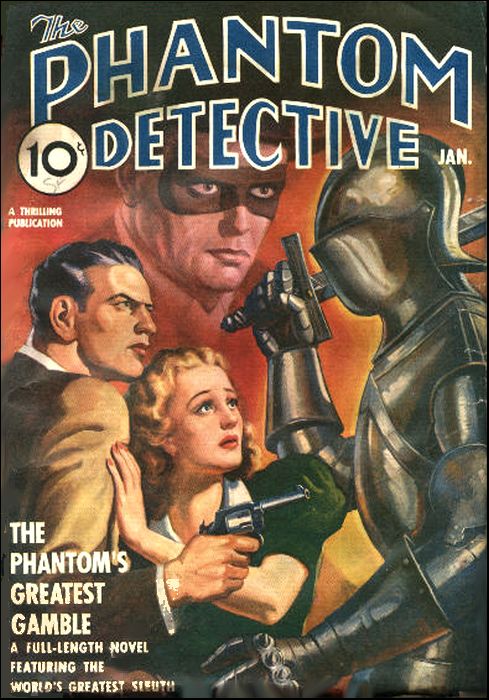
The Phantom Detective, January 1941, with "The Phantom's Greatest Gamble"
Van Loan battles modern pirates who glean millions in swag as innocent victims walk the plank to doom! The world's greatest detective pits brain and brawn against Satanic slaughterers!
ACROSS the Hudson from the mighty island of Manhattan lie the New Jersey marshes, a grim, desolate expanse of swamp grass and mud.
High out of this wasteland, near where rise the spidery towers of Radio Station WUBC, a blue sedan glided to a halt, and an ape-shouldered, swarthy-faced man carrying a long, curiously-shaped parcel stepped out. He plodded across a fill-in of garbage and ashes toward a fenced-in cluster of neat brick buildings beneath the sending antenna.
Stopping there, he peeled the burlap from his parcel to disclose a contraption that looked like a cross between a shotgun and a heavy fishing reel. Working swiftly, he secured this device to a crude tripod.
A grin overspread his face as he squatted down and sighted.
A sharp metallic swish sounded.
Leering triumphantly, the simian one sprang away from the instrument, ran at top speed across the ash heaps to the waiting car.
On the antenna, all hell broke loose. Bursts of flame, zigzag blue flashes like lightning leaped from white-hot wires to light up the heavens.
Men poured from the buildings to gaze stupefied at the holocaust, then began to rush hither and thither like ants. One of the antlike figures seized another's arm and pointed.
"Look! That man running across the marshes!"
But by the time he had been seen, the ape-like man had reached the road. He sprang into the waiting sedan, which roared off to be lost in the late afternoon traffic...
MEANWHILE, in the New York skyscraper studios of WUBC, Alan Greenwood, newscaster, sat at his desk before a live mike.
Vernon Davis, the station manager, glanced through the glass paneling at him and spoke to an assistant.
"The idol of the airwaves," he muttered, then added, with a frown: "What the devil's the matter with him tonight? He looks nervous, as if he was afraid of something or other."
"Yeah, that's right," the assistant agreed. "See, his hand is shaking while he's reading his script. Mmm—that's funny."
Greenwood, a paunchy man with a loose-jawed, pasty face, ran a finger under his moist collar and kept on talking.
"... and Monday I discovered evidence regarding a truce in the Republican management," he was reading unsteadily. "The potentates actually have everything worked out. Ostensibly Hollister, Levy and Huntington decided to abandon the close race, announcing their complete withdrawal Friday. I am definitely convinced James Franklin Tate will be the compromise candidate. He will satisfy the desires of Republican voters for an experienced candidate and also—"
An abrupt silence fell in the control room.
Graham, the "mixer," frowned, bent over the instrument panel, touching various controls, then with a puzzled look tossed down his earphones and summoned Davis.
"We're off the air," he said shortly.
"What!" Davis exploded. "What's the trouble? Where?"
"Must be in Jersey. We're okay here."
Davis waved his arm in a cut signal to Greenwood.
"Get Jersey on the phone," he said to the mixer sharply. "See what's wrong and when they'll have it fixed. Hurry it up."
He dashed into the studio, elbowing aside excited employees.
"A breakdown?" Greenwood repeated, his face going oddly pale. "Davis, this—this... You've got to do something about it. Ten million listeners will be tuning in some other station. My sponsors will be furious!"
"Take it easy," Davis said, with a shrug. "They'll get a refund."
"Davis!" Graham came rushing into the studio. "Davis, I just got Jersey! Somebody shot a wire across our antenna and it made a wow of a short. They're going nuts out there—can't get under way again for half an hour!"
"A wire over the sending antenna?" Davis said in astonishment, and scowled. "That would raise the devil. But why should anybody—"
"They saw a man running away—and found what he did it with. Of all things, Davis—a whaling gun!"
"A whaling gun!" Greenwood, the newscaster, echoed hollowly. This time his face went the gray-white of putty. He swayed dizzily and then slumped to the floor.
Davis sprang to his side, slipped a hand inside the man's coat, then unfastened his collar.
"Get some water, Graham," he said shortly. "He's just fainted." He added grimly: "And unless I'm crazy, it looked to me as if he fainted from fear!"
Graham looked puzzled. "Of what?" he demanded.
"I'll be damned if I know," Davis said...
IN Desmond Steamship Lines offices just off Wall Street, elderly Duane Desmond, the president, stood talking to an attractive girl in a gray traveling suit.
"I can't understand, Doris," the man was saying wearily to his daughter, "why you want to go to Buenos Aires right now. It's winter down there!"
The girl smiled. "I'm old enough to know what I'm doing, Dad," she remarked.
"I'm not so sure you do," Desmond said flatly. "Not with all this talk of yours about sabotage on our ships. I don't see why you have to insist on that. I tell you that explosion aboard the Belle Isle last month, for instance, was an accident—might have happened any time."
"You forget about the Mary Belle running onto a sandbar," Doris reminded him, "and the Santos ripping open her bow on a drifting barge off Fire Island. It's high time somebody did some investigating—and that's what I intend doing on the Belle of Bermuda."
"Nonsense, child." Desmond chuckled indulgently. "I don't mind your taking a cruise on one of our freighters if it pleases you. But if I thought there was the slightest chance of any trouble, I'd instruct Captain MacHugh not to let you set foot on board."
"What an old fuddy-duddy you turned out to be!" Doris said, and kissed him swiftly. "But you're a sweet one... Well—see you in a month or so!"
She went out lightly and, summoning a taxi when she reached the street, gave the address of the company docks.
As the cab made its way uptown, she felt happier than she would have admitted. There was one thing her father did not know—yet. She and the Captain MacHugh, of whom her parent had spoken, had seen a good deal of each other in New York, and she was beginning to think he was—well, she would not have admitted that she was in love. But the thought of being with young, handsome Captain Tom MacHugh under tropical skies was not unpleasant.
A sudden swerve of the taxi roused her. The driver was going at unusually high speed, dodging in and out of traffic.
"Please go more slowly," she called to him. "I've lots of time."
"Okay, Miss," the man said, as he stopped the cab for a red light.
A frown of annoyance touched the girl's lovely face. She looked at her driver carefully then, a thin, scrawny man with bronzed skin and a bristly shaved neck. She glanced at the picture on the license card in the cab. The picture was that of a chubby, fat-faced man!
The taxi twisted around a corner and roared along the lower level of the elevated waterfront highway, whizzing close to the row of steel and concrete pillars.
Fear welled in the girl's throat. "Driver, stop this cab!" she cried. "I'm getting out."
She heard a throaty chuckle. "Oh, no you ain't, Miss Desmond."
Terror gripped her. She must pound on the windows, she thought wildly, attract attention, get out of this before something terrible happened! But before she could do anything, suddenly she screamed. "Driver, look out!"
Didn't he see it—that concrete pillar just ahead?
A deafening crash sounded as the taxi plowed into it. She heard the grinding of rent and twisted metal. Glass fell in a tinkling shower.
The crash knocked Doris to the floor. But she found to her surprise that aside from a throbbing in one arm she was unharmed. She had started to struggle up when abruptly she huddled back against the floor. The driver was leaning through the broken glass partition, an evil grin on his narrow face. In his tattooed hand was a heavy metal hub-cap spanner.
"Good sailor, ain't you, Miss?" he jibed, leering at her. "Stood that bit o' rough weather mighty well." He raised his arm. "Well, this'll fix you!" The girl stared at him, frozen stiff with fear, speechless as the wrench descended toward her head. Then a million stars—and blackness enveloped her.
OF the three men who sat at luncheon in the somberly elegant Murray-Plaza Hotel next day, one was Duane Desmond. Another was a rugged, gray-haired man whose face showed that he was one in whose make-up were deep human sympathy and a capacity for forceful, decisive action. He was a man who possessed a nation-wide reputation for both, for he was Frank Havens, publisher of the fearless, independent New York Clarion.
The Clarion's energetic young advertising manager, Don Bixby, completed the trio. Desmond Lines was an important advertiser in the Clarion, and the meeting had been arranged by Bixby to discuss business problems. However, when the talk drifted to remarks concerning a recent mysterious explosion aboard the S.S. Belle Isle, new interest appeared in Frank Havens' cool gray eyes.
"I'm curious about these ship disasters of yours, Desmond," he said. "Have any clues come to light recently?"
Desmond laughed a little.
"My daughter considers these mishaps the work of some "mysterious group of saboteurs," he said. "Personally, I think that's ridiculous. Accidents happen when they happen. We may go another five years before another such—"
"Your competitors have lost rather heavily too," Havens cut in. "Frankly, Desmond, I'm inclined to agree with your daughter."
"Indeed?" Desmond stared at him uncertainly, then abruptly a quick change of expression passed over his face. "That reminds me," he said. "My daughter is meeting me here. She had a rather harrowing accident yesterday, although fortunately she was not seriously hurt. A taxicab crash. She—"
But Doris Desmond herself entered the restaurant just then. Although she looked trim and smart in crisp white linen, there was a very strained expression in her clear eyes.
"I am happy to meet you, Miss Desmond," Frank Havens said, as he rose, "and glad to see that you have quite recovered from your accident."
Doris smiled at him. "Oh, yes, they kicked me out of the hospital this morning," she said. "A shoulder bruise and a bump on the head—that was all. But my boat sailed without me."
"Funny thing about that head bump, Havens," Duane Desmond said, laughing indulgently. "My daughter, for instance—she actually insists that she did not receive it in the crash. Such things can give curious mind-twists sometimes."
"That driver did strike me deliberately," Doris said promptly, "and there is nothing funny about it!" She leaned impulsively toward the publisher. "Mr. Havens, you'll believe me, won't you? I know that driver was acting on orders to keep me off that boat! An innocent-looking accident had been planned, and when that did not work, the driver finished the job by putting me out with a belaying pin or something!"
"Why should anyone want to prevent you boarding the boat?" Havens asked gently.
"Because something terrible is going to happen on the Belle—I know it!" the girl said earnestly. "I've talked with Captain MacHugh lots of times about my suspicions of sabotage, and sometime we must have been overheard. Someone knew I was determined to get to the bottom of that low business, and didn't want me aboard."
"Desmond, have you had any word from the Belle of Bermuda since she sailed?" Frank Havens demanded. "It seems to me there is a pretty good basis for your daughter's suspicions, so—"
AT THAT moment a waiter stopped beside Desmond.
"Telephone call for you, sir. Shall I plug it in here?"
Desmond nodded, frowning. He picked up the receiver.
"Desmond speaking," he said. "Oh, the office, eh?... Yes, Baker?... The Belle of Bermuda, you say?"
A tense silence fell as the faint rasp of a man's excited voice came over the wire. The ship owner's face reddened almost to an apoplectic purple, then turned chalky pale as his hand groped to put the instrument back into its cradle.
"Good Lord, Havens," he choked, "it's the Belle! Fire just broke out in the forward hold—flames sweeping aft out of control. Word from MacHugh says she may be a total loss!"
In a short time, leaving the luncheon party rather abruptly, Frank Havens took a taxi to the Clarion office. When the taxi was caught in traffic, not far from the building, he leaped out and walked, almost ran, the remaining distance.
Because of a hurried phone call he had made before leaving the Murray-Plaza Hotel, he found the desk in his private office piled high with clippings from an envelope marked "Maritime Disasters." A secretary had brought them from the paper's "morgue," as reference rooms are called in newspaper parlance.
He sat down, reached for one of his three telephones. About his square chin were grim lines of determination.
A faint, steady hum met his ear, as the call on that particular private line was answered, then he spoke a few low words into the transmitter. When he replaced the instrument and sat back, a look of distinct relief was on his face...
Half an hour later a young man entered the outer office of the Clarion, and spoke to the girl at the information desk.
"My name is Hickerson," he said, "and I'd like to see Mr. Havens on an important private matter."
The girl sized him up. "If you're looking for a job," she said, "our employment office is on the fourth floor."
He shook his head, and became so insistent that at last the girl gave in to his request.
"I'll give Mr. Havens your name," she said reluctantly, "but I'm quite sure he won't see you."
She trotted off on her high heels toward an inner office.
The young man reached swiftly through the partition in the window and pressed a switch under the edge of the information clerk's desk. A click sounded as the catch on a nearby door was released, and he slipped through it.
Crossing the outer office, he flattened himself against the oak paneling beside Havens' office door until the girl came out past him to return to her desk. Then, slipping through Havens' door, he closed it quietly after him.
The publisher rose from behind his desk and scowled under his bushy brows.
"I'm sorry," he said firmly, "but I told my secretary I could not see you, young man."
The shadow of a smile crossed the face of the man who had called himself Hickerson, as he strolled over to the desk.
"Don't tell me I can still fool you, Frank," he said.
Havens' scowl was replaced by a look of amazement.
"Phantom!" he exclaimed. "Well, I'll be—You told me over our private wire that you'd be right over, Dick, but you certainly caught me napping in that get-up!"
ABRUPTLY then the publisher's manner grew grim. There were vital matters for these two men to discuss.
"Something has just come up that I can't handle alone," Havens quickly explained. "There are new forces of destruction abroad, Dick—a vicious organization operating on a vast scale against American shipping, and so far they are so much under cover that only the Phantom's skill, probably, can rout them out. These clippings tell the story—thirteen disasters within thirty days! See for yourself." The man Havens had greeted as the Phantom came around the desk, took off his sunglasses and leafed through the clipping file. Havens watched in silence, but on his face was a look of satisfaction.
During the many years that Frank Havens had been the publisher of the Clarion and a string of other papers from coast to coast, he had been a constant champion of justice, and an arch foe of crooks and racketeers. The work he had done had been widespread, but never could he have accomplished it without the marvelous operations of this young man on whom he looked as a son—Richard Curtis Van Loan to others who knew him only as a wealthy dilettante whose only reason for living, apparently, was the pursuit of pleasure; but the Phantom to Frank Havens who alone knew his young friend's true worth and purpose in life.
That purpose was to rid the world of human leeches, killers, and vicious criminals in general. So well had he accomplished it that all over the world the Phantom had become known as the relentless Nemesis of the underworld, persistent foe of crime in all its ugliest phases.
And always Richard Curtis Van Loan—the Phantom—had been Frank Havens' most powerful secret ally. He had been ever since that day, long before, when Havens had noted the restlessness and dissatisfaction in Dick Van Loan, whose father had been the publisher's oldest and best friend.
Havens had suggested that, to relieve boredom, Dick try his hand at solving a crime so puzzling that it had the police guessing, and up in the air. Dick Van Loan had tried it, in disguise for the first time in his life, and it was at the moment that it had finally been cleared up that the Phantom had been born.
From that time on, young Van Loan had thrown himself heart and soul into his avocation, studying criminology until now he possessed one of the finest libraries on the subject extant. He had studied makeup, ventriloquism, all the arts with which science constantly combats crime, and his own laboratory, if not as large as that of the F.B.I. in Washington was as complete. It now had reached the point that from Scotland Yard and the Paris Sûrete, to the farthest outflung Oriental outposts, all men who battled criminals took their hats off to the prowess of the Phantom.
It had also reached the point that, without the Phantom's exhaustive knowledge of criminology, his shrewdly analytical brain, and his mastery of every method of crime detection known to modern science, Frank Havens would have been helpless to follow up his own crime crusades.
As had been decided from the beginning, Havens alone knew the Phantom's true identity, or how to contact the terror of the underworld. He did that only when dire menace loomed on the horizon—peril too great to be coped with by the recognized forces of law and order. For Havens alone knew that Richard Curtis Van Loan, gay young scion of an old New York family, a man who moved in the best circles of New York society, a playboy and gallant spender of his inherited millions and whom no one suspected of ever having a serious thought, was in fact the dreaded Phantom.
NOW Richard Curtis Van Loan, the Phantom, who in his present role called himself Harold Hickerson, looked up at the publisher.
"This is interesting, Frank," he said thoughtfully.
The publisher nodded.
"Month before last," Havens said, "there were also many disasters—ships running aground, mysterious explosions, collisions. All from unknown causes. And the Belle of Bermuda is on fire right now." He told of the phone call Desmond had received, and added: "There's something else, too, that I have a vague idea may have a connection with the same things, though I must confess that so far it is only a hunch. It is the strange and brutal murder last night of Alan Greenwood, the radio news commentator."
Van Loan nodded. "I read the account in this morning's paper—an odd case."
"More than odd," Havens said, "in view of a new development which didn't appear in the story. In Greenwood's vest pocket the police found a column torn from yesterday's Clarion—the shipping notices. And the sailing time of the Belle of Bermuda was underlined!"
Van looked at him sharply. "Wasn't there also a little item in the Clarion about an accident in a radio sending station involving a sailor? If I'm not mistaken, that happened during a broadcast by Greenwood."
"That's another thing," Havens said quickly. "There was also an assault made on Desmond's daughter, when she was on her way to board the Belle. It's all mixed up and I can't make much out of it. But for some vicious reason thousands of dollars worth of shipping is being destroyed. I'm convinced the destruction is deliberate—and heaven knows where the next blow will fall. Or why! Van, I want your help—the public needs it desperately—to get to the bottom of this mysterious menace."
"It seems to me, Frank," Van said slowly, "that the Belle is the most interesting part of this affair—a deviation from the pattern. According to these accounts, the damage in the earlier mishaps was serious but not disastrous. But on the day some radio man is murdered with the name of a boat in his pocket, that boat, cargo and all, is virtually wiped out. It's like witchcraft. Kill a newscaster; lose a cargo—a devilish theorem indeed." There was a sparkle in Van's eye. "Frank, you've just hired yourself a new reporter—name, Harold Hickerson. He's clamoring for his first assignment. What will it be?"
A slow smile crossed Havens' face.
"Hotfoot it up to Alan Greenwood's apartment," he said, "and don't come back here without a story!"
INSPECTOR GREGG of the Homicide Bureau sat in a deep white leather chair and looked gloomily at a bowl of gardenias. Gregg was a heavily-built, cool-headed officer who was universally accredited with an extraordinary amount of sound judgment. He did not, however, feel entirely at ease in this luxurious modernistic apartment of the dead radio commentator, Alan Greenwood. Tracking down the big-shots of the underworld was more in his line.
A door opened quietly and a young woman in modish black appeared. There was a touch of red about her eyelids, as though she might have been crying. But Gregg's shrewd glance noticed that her lips were freshly rouged and that the cut of her frock was not such as to conceal her attractive figure.
He arose and made a clumsy bow.
"Thank you, Inspector," she said in a low voice, "for allowing me time to relax after my trip. I'm ready now to answer any questions you wish. Please be seated, won't you?" Carefully she took a chair with her back to the window. Gregg balanced himself precariously on the edge of the deep white chair.
"When I got you by phone at your Connecticut place, Mrs. Greenwood," he said gently, "I didn't tell you much about your husband's death. I suppose you've got the facts from—"
"Yes, from the newspapers," she replied. "Last night as he returned from the radio studio around six o'clock, wasn't it? The two killers were waiting in the apartment here, I understand."
"That's what the police believe."
Gregg said, watching her closely. "The body was found just inside the apartment door this morning by a building employee who noticed a stain of blood under the door. The knife used had been taken away. Police experts have combed the place all day, but have been unable to dig up a single clue to the murderers' identity. That's where we want you to help us, Mrs. Greenwood."
"I haven't the faintest idea who could have killed my husband, Inspector." The woman in black appeared serenely composed. "You see, we hadn't been on close terms for several years. And for the last few months I've been in the country and haven't even heard from him."
"Do you know if he had any special enemies? Received threatening letters?"
"I really wouldn't know about that."
"Your husband," Gregg observed, "must have been pretty well fixed. Would you mind telling me whether he left a will?"
"Shortly after our marriage seven years ago"—she met Gregg's eyes coolly—"my husband told me he had made a will leaving everything to me. If he has changed that will, he hasn't informed me."
Gregg cleared his throat. "As a matter of routine, would you tell me where you yourself were yesterday evening?"
"Let me see." She hesitated. "I drove to the village alone last night to a movie. It was a double feature and I was there all evening."
"You'd already left home by six o'clock?"
The young woman in black caught her breath. "I see what you mean. No, it must have been nearly seven before I left. Two servants were in the house with me until then." She smiled faintly. "No, Inspector, I didn't drive to New York and murder my husband."
"One more question, Mrs. Greenwood," Gregg said. "Was your husband hooked up in any way with a steamship line?"
"A steamship line? N-no, not that I know of. In fact, I'm quite sure he wasn't."
"Thank you very much, Mrs. Greenwood," Gregg said. "You'll pardon me if I look over things here a little?"
WHEN she had left the room, Gregg was thinking that she seemed a smooth customer. But a man couldn't be too tough on a widow with an air-tight alibi.
He went over and stood scowling down at a small table on which stood a half-empty liquor bottle and two glasses. His theory that two men had been waiting to kill Greenwood was based largely on this evidence. Yet no prints but Greenwood's had been found and the inspector's hypothesis looked pretty flimsy.
Hearing a noise in the corridor, where he had left a man on duty, he strode to the door and flung it open. The guard was grappling with a young man in sunglasses and a straw hat.
"I'm a reporter!" the young man shouted indignantly, and Inspector Gregg laughed shortly.
"Sure you are," he snapped. "That's why you're not getting in. Now scram! Before a little trip to Headquarters—"
He stopped short, eyes widening, as in the hand of the reporter he suddenly saw a gleaming platinum badge set with tiny, flawless gems. The badge of the Phantom!
The inspector quickly hid his first astonishment.
"Let this guy in, Clancy," he said. "I'll give him enough story to ease his pain... Come in—"
"Hickerson," said Van. "Of the Clarion."
As the door closed, Gregg laughed. "Phantom, you sure caught me good that time. Mmm, guess you must have had some reason for not letting that plainclothesman out there know who you are. Well—I'm glad you're here. This case is more in your line than mine."
The Phantom had worked on cases with Gregg often. Naturally the inspector did not know the Phantom's true identity, but for his wizardry where ferreting out criminals was concerned he had nothing but admiration. Always he welcomed the Phantom on any case, and in turn Van had a genuine respect for the inspector's abilities.
Gregg gave the Phantom a concise account of this case, as far as anything was known, talking while the Phantom moved slowly around the room, taking in details.
"The body of the murdered man was taken for autopsy a couple of hours ago," Gregg said. He indicated an ugly spatter of blood on the white door frame. "It was found there—where those stains are."
That interested the Phantom for a moment. Then he moved on, pausing before a broad window with drawn Venetian blinds. He flicked the slats of the blinds open and then peered out—but instantly closed them, dodging swiftly back.
"What's up, Phantom?" Gregg asked sharply.
"I don't like the looks of that empty apartment across the court," the Phantom said.
GREGG started to look, but Van pulled him back.
"No shades, no curtains, or lights," he said. "A bit strange, since the sign on the building downstairs says, 'No Vacancies'."
"You mean somebody rented that apartment just to keep an eye on Greenwood?"
"The fact that Greenwood's blinds are closed on this side of the room may indicate that Greenwood thought the same thing," Van said. "Incidentally, I noticed that a man who left the Clarion Building right after I did, arrived here on the same bus I took, and entered the building next door."
"Tailed, eh?" Gregg shrugged.
"I'm not sure," the Phantom told him. "It may have been pure coincidence. I didn't bother to lose him because I was a little curious to see just where he was going." He straightened and looked at the inspector. "Just why do you think there were two murderers, Inspector, and that they were waiting here for Greenwood?"
"That's the way it looks to me," Gregg said, with another shrug. "There's a doorman downstairs who takes everybody's name. He says he was away about five minutes around five o'clock, and the guys could have come in then and sneaked up the stairs. But from then until half-past seven everybody is accounted for. After that, there were two or three dinner parties, a lot of people going in and out and the doorman got kind of mixed up. I figure there were two guys and they came around five, before Greenwood got here, because of these two glasses by the liquor bottle. They had a little nip while they were waiting."
"But you say only Greenwood's prints are on the glasses."
"They could have worn gloves."
The Phantom bent over the glasses intently.
"Then why would Greenwood's prints be there? Somebody washes glasses around here once in awhile." He smiled. "And look—there's a dead fly in this glass."
"So what?" Gregg said.
"So why couldn't Greenwood have come home, sat around awhile and had a drink. A fly got into his glass and he got another one. Then when his doorbell rang and he answered, somebody killed him."
"That's right," Gregg said. "I guess anybody could have sneaked in with those party guests." His face lighted up. "Say, that shoots Mrs. Greenwood's alibi since the medical examiner said the guy could have been bumped any time between five and eight. Guess I better have another little talk with that lady."
The Phantom had crossed to a small telephone table, where he stood for some moments examining the Manhattan telephone book, which seemed to him to have a particularly worn appearance. But then, without comment, he strolled over to a small modernistic desk by the window.
"The boys have already given that desk a good going over," Gregg observed.
"I was wondering whether I might run onto a radio script," the Phantom said.
Instead, in the top drawer he found a large scrapbook.
"News clippings about how good he was," Gregg informed. "And some old diplomas from journalism schools and stuff."
"So I see." The Phantom held the book open to an elaborately scrolled document, then turned another page. "He has a lot of them pasted in here, all right... Hey, wait a minute. Gregg! Do you see what this is?" His voice rose excitedly. "Two are diplomas, yes. But the rest—stock certificates! A perfect place to hide them—right out in plain sight. I thought you said your men went through this desk."
Gregg's face reddened. "Yeah, they did."
THE Phantom was examining the certificates.
"East Coast Shipping Service—common stock," he reported. "East Coast is a competitor of Desmond Lines. More than two hundred thousand dollars worth of stock at the present market, Inspector!"
"Gosh!" Gregg whistled. "Whatever his racket was, it was a good one. Anything else in there?" He went to one of the side windows. It was now growing dark. "Wait, we need more light."
Pulling the cord, he flipped open the horizontal shutters of the blind.
The Phantom looked up swiftly. "Stay away from that window, Inspector!"
He leaped instantly, threw his weight against the inspector and knocked him away. A second later there was a rattle like that made by a far-away woodpecker. Glass clattered, and wooden splinters spun from the blinds. A neat pattern of gray spots powdered the wall plaster.
"A tommy-gun!" Gregg said very; hoarsely. "They must have seen you at the desk! Lord, you were tailed, whether somebody guessed you were the Phantom or not!"
Van leaped swiftly to the front window, stepped to the narrow iron balcony. Far below on Park Avenue he could see a blue sedan before the next building. A rear door was open. He whipped out of his pocket a pair of small binoculars with special ultra-powerful lenses that had been ground to his specifications in pre-war Germany.
Gregg had headed full speed out of the apartment. Van heard an elevator door clang shut. With luck, Gregg might get down there in time to head off whoever that sedan was waiting for.
But an instant later a running figure emerged onto the sidewalk and vaulted into the car. Van's binoculars caught only a top view of the hat the man wore, before the car roared off down the avenue.
Gregg, arriving on the street, spotted the fleeing sedan and leaped to the running board of a passing car which spurted into pursuit. Van glued his glasses to the disappearing sedan.
He could almost make out the license plates.
Then by a stroke of bad luck, Gregg's driver got caught in a traffic jam which the clamorous blast of his horn would not clear.
The blue sedan swung around a corner, to be hopelessly lost in crosstown traffic.
But not before the Phantom's powerful lenses had finally made out the license number and he had carefully filed it away in his memory. MC-48-19.
The Phantom smiled. A green felt hat and a license number—slim clues on which to go after a powerful unknown organization for crime. But clues they were.
He turned from the balcony and made his way swiftly to the street.
FIVE men with hard, weather-beaten faces sat around a cigarette-scarred table in a room with grimy, cracked windows above a waterfront bar. The rattle of poker chips and an occasional muttered oath mingled with the intermittent boat whistles from New York harbor.
The door was jerked suddenly open and a tall, sandy-haired man with a cruel face and a stump instead of a right hand stood in the room. A sharp silence fell as the eyes of the five turned to the new arrival—Ole Sundsten, of whom they all stood somewhat in awe.
Without speaking, Sundsten strode to the table. The game was forgotten as the men stared at him uncomfortably. Sundsten's thick lips were set in a twisted smile as he looked at each of them in turn.
"I don't see Mugsy here tonight," he said sourly.
There was dead silence. No one ventured to speak.
"Well, where is he? Which of you punks know?" The man's voice was hard, menacing.
Again no reply. Sundsten's smoldering eyes flamed into fury and he slammed the stump of his hand against the table top. Stacks of chips fell with a clatter.
"Don't sit there like a pack of dummies," he commanded. "Who's seen him—Shorty, Joe, Lop-ear, Gunner, Hank?"
"Not me, Boss." One by one each man made the same reply. "I ain't seen him."
Sundsten's enormous iron-muscled left hand caught the man called "Shorty" by the nape of the neck, his talonlike fingers biting mercilessly into the flesh.
"You cheap punks, talk!" he bellowed. "I'm lookin' for Mugsy, and I'm goin' to find him if I have to turn the heat on every one of you wharf-rats."
"Cripes, Boss, leggo." Shorty's face twisted with pain. "Sure, sure I'll talk. Only leggo."
"You'll talk first;" Sundsten's viselike grasp tightened.
Shorty let out a yell of anguish. "He's in his room down the street, layin' there in the dark with the doors barred. He was scared you'd be lookin' for him, Boss."
Sundsten's fingers relaxed and he shoved the squealer away from him. Shorty sprawled on the floor.
Growling Sundsten turned to the door.
"Spike! Buttsy!" he shouted.
The door swung on creaking hinges to disclose two grim-faced torpedoes in the dimly lighted hall.
"Yeah, Boss?" croaked one of them.
"Mugsy's in his room," Sundsten snapped. "Get him. Bring him here to me."
"Okay, Boss."
As the door closed Sundsten turned on the five at the table.
"Next time you lugs hold out on me, you'll get what Mugsy's gettin'," he rasped. "You're doing pretty well by yourselves, ain'tcha?"
"Sure," one of them managed to get out.
"Not one of you was ever in the gravy like you are now."
"That's right, Sundsten," the man who answered to the name "Gunner" said. "You ain't heard us kicking."
"I just didn't want there to be no mistake about that," Sundsten said. "The Big Shot has you boys and me in on a good thing and it's up to us to keep it good. But from now on the goin' will be tougher. Plenty tougher, the way it looks."
"You got trouble?" Gunner asked.
"Could be trouble," Sundsten said gruffly. "But it don't hafta be if you mugs stay on your toes. But the first one that makes a slip—it's curtains. The Shot can't afford to take no chances. A couple more little stunts like Mugsy pulled and the cops'll catch up with us. I guess you know what happened to Greenwood—"
"I don't mean to be talkin' out of turn," Gunner said meekly, "but what are we gonna do without Greenwood?"
"Yeah," Shorty piped up. "Why was he bumped, and who done it?"
THE danger signal showed in Sundsten's eyes.
"He was bumped because the Shot wanted him bumped," Sundsten growled. "Does that answer your question, you yellow-livered—" Shorty scrambled back out of range.
"Shorty didn't mean nothin', Boss," Gunner said. "What's this trouble you was tellin' us?"
Sundsten sat down and leaned across the table. "Listen, you punks—tricks is better now than ever. The Shot is givin' us more jobs and for bigger dough. We got one on the docket for next week—a big shipment of munitions machinery for Peru. They're holdin' the boat and date secret till the last minute. But the Shot will case the job all right in plenty time for us to go to work. Don't worry none about that. And with things so good, what does Mugsy do but mess 'em up! So now we got the Phantom on our necks."
"The Phantom!" Gunner let out a low whistle.
Sundsten grinned crookedly.
"Yeah, I guess you know plenty about him, all right. And I ain't aimin' to scare you guys. But when you're buckin' the Phantom you gotta keep on your toes. If there's one guy in the world it ain't healthy to tangle with, it's the Phantom. Even the Big Shot knows that."
"But who put him wise?" Shorty ventured.
Sundsten glanced at him contemptuously, but deigned to answer.
"A gent named Havens that's got a newspaper. You low-lifes wouldn't know about him. Mugsy fell down on the job—so hell broke loose and the Shot had to have Greenwood bumped to save his face. Havens put two and two together, and he's got an editorial in this afternoon's paper about a new shippin' menace. Well, the Big Shot knows that Havens and the Phantom work hand in glove—and when Havens gets up on his ear about some guys turnin' an extra penny, the Phantom swoops down out of nowhere."
"Uh-huh," Shorty whispered. "I know."
"The Shot figures that the Phantom may turn up at the Clarion office," Sundsten went on, "and he's got five plenty smooth boys posted around the place with orders to jump on the tail of every suspicious-looking gent that comes out of this Havens' office, and see where they go. He don't know what this Phantom looks like—nobody does because he can look like anybody he wants to—but he ain't takin' chances. Them guys has got orders to shoot first and ask questions after if they think they've spotted the Phantom. This ain't no small-potatoes racket, and the Shot would rather bump a coupla poor saps by accident than miss the Phantom. He's offerin' a reward of—"
The sound of heavy footsteps penetrated the room. Then the door was kicked open.
Sundsten's torpedoes entered, dragging between them a short, small-boned man with a frightened face. Mugsy had been produced all right.
"What do these two guys want with me?" Mugsy cried anxiously. "They say you wanted to see me. Aw-right, here I am, but I ain't done nothing, Boss—honest!"
Sundsten stood up. "Let go of him, boys," he said.
STRIDING over to the terrified Mugsy, he raised his good hand and cuffed him a stinging blow across the cheek. Mugsy let out a yell.
"Lay offa me, Boss! Sure I stuck around with the crowd and had one drink too many. But a guy's human. I knew I had to get the gorilla to the radio station before five o'clock, and after you found me I darn near broke my neck tryin' to make it. We was only a few minutes late."
"Those few minutes," Sundsten said grimly, "cost the Big Shot around a hundred grand, made him hafta have Greenwood bumped, and got the Phantom on our tails."
Mugsy gulped and his teeth began to chatter.
"Give me another chance, can't-cha?" he pleaded. "I swear I—"
Sundsten jerked his head. "Take him in the other room, boys."
"Listen, Boss, what's the sense in doin' that?" Gunner protested.
"Shut up!" Sundsten wheeled on him, a sardonic grin on his face. "When a punk who knows as much as Mugsy starts crackin' up, there's only one way out. He knew that when he joined up. This racket's too big to risk a washed-up sap shootin' off his mouth."
Gunner didn't say anything more.
The two gunmen took Mugsy out.
A moment later a muffled shot was heard. Just one shot. A grin twisted Sundsten's lips.
"And that," he said, "is what the Big Shot wants to happen to the Phantom. One hundred grand hard cash is waitin' for the lug that does it!"
"IF I'd only got to the street a couple of seconds sooner, I could've nabbed those birds!" Inspector Gregg said to the Phantom, mopping his brow after he had given up chasing the blue sedan. "I'm going to have a look-see at that apartment where the guy with the rattler was. Want to come along?"
The Phantom shook his head. "I've a couple of other little things to do. Besides, I don't think you'll find much up there. If you get a chance, though, you might check up a bit on the East Coast Shipping Service, in which our friend held so much stock."
"Right, Phantom," Gregg said.
He went into the apartment building, while the Phantom started off down Park Avenue. The inspector could not guess that Van headed for his own apartment on the same avenue, and entered it through his own private entrance.
Van's first act, at home, was to cancel all his social engagements and to leave word that he was not to be disturbed. Then with the concentration characteristic of him when faced with a bewildering new problem in crime, he threw himself into the task that now faced him.
Books he wanted were in his own library, and for some time he pored over volumes concerning certain branches of maritime law, with Federal Communications Commission rulings, and with New York motor vehicle ordinances. A phone call informed him that the Pindar Company, manufacturers of a famous shave cream, were Alan Greenwood's sponsors, so he looked them up in Dun and Bradstreet, and in more specialized financial surveys.
For a long time he sat in a brown study, jotting down notes, getting things organized in his mind.
Then he was ready for action.
Checking with the state license bureau, he found that the license number he had noted on the blue sedan—MC-48-19—had been issued to a corporation called the Easy-Way Drive Ur-Self Garage, on First Avenue in the Fifties.
A phone call to the radio sending station in New Jersey brought him confirmation that the car that had been seen to leave after the curious disaster there, had been a blue sedan. Of course there were thousands of blue sedans on the streets—but here was a coincidence at least worth looking into.
STILL in the disguise of Harold Hickerson, Van left the apartment then. Stepping from his private exit into the street, he hailed a cab, and a few minutes later reached the Easy-Way Drive-Ur-Self Garage.
"I would like to rent a car," he said to the fat-lipped, barrel-chested man in the office. "A large car I think, Mr.—"
"Nixon," the man supplied, readily grinning. "Takin' some of the crowd on a party, bud? What you want, I reckon, is one of our older, heavier cars. Now I got one—"
"Do you mind if I look over what you've got?" Van said.
Nixon led the way into the garage and waved a hamlike hand at a row of cars.
"Take your pick. All the same price."
Van regarded them critically, looked disappointed.
"I was looking for a particular one," he said. "A big blue car—license number MC-forty-eight-nineteen. A friend of mine had it. He said it had a swell motor."
Nixon's eyes darted searchingly to Van's face for an instant. Then he laughed.
"You're too fussy, bud. That car's out. You'll have to take one of these others."
With a resigned shrug, Van chose a lumbering old black vehicle. Nixon took him back into the office and, producing a small index file, began to thumb through a sheaf of cards. The cars were filed by license number.
"Look, that's the car I wanted!"
The Phantom grabbed the box and swiftly thumbed through to MC-48-19. Nixon's unshaven face grew black.
"Gimme that box, damn you!" he yelped, and grabbed at the file.
Van seemed abashed. He started to hand the file back, but in doing so clumsily knocked the telephone on the floor. As he bent to pick it up, his eye caught the name of the last renter of the blue sedan—"John Larch, Hotel Mayfield."
"I told you that car was out!" growled the heavy man, as Van replaced the file. "Go on outside and I'll have one of the boys put gas in your car and wheel 'er out to you."
Instead of going out, Van strolled toward the rear of the garage. A wired-off enclosure that was evidently a repair shop attracted his attention. A sallow-faced youth in a grimy shirt was working at the junk-laden bench.
"Ever do any work on taxicabs?" Van asked casually.
The youth spun around.
"None of your business," he snarled.
Van only laughed, and hurried out without answering. But the surly youth had not seen Van slip into his pocket a small paint brush that was still wet with black enamel. It had been lying next to a sprayer which had last been used with bright green paint.
At the doorway, the car Van had hired was turned over to him. He got in and rounded the corner to Second Avenue, drew up in front of a drug store and locked the car. Smiling to himself he bought an envelope and mailed the key back to the garage, thus saying a final good-by to the clumsy wreck.
STEPPING into a phone booth, the Phantom called Inspector Gregg.
"I want some information—quick as you can get it, Inspector," he said. "What color was the cab Doris Desmond was riding in when she had her accident?"
"Bright green," Gregg answered promptly.
"Have you found the driver yet?" the Phantom asked.
"You mean the one that wrecked the cab?" Gregg said. "Not a trace of him. My boys figured on locating him from the cab number, but when they checked up, the cab company said there was no such number. So they took another look at the cab and found the original number had been painted out—changed."
"Right so far," Van said. He told about stumbling onto the paint brush in the First Avenue garage. "It means the cab was stolen from the real driver, as Miss Desmond tried to point out. How about the license plates?"
"License plates were stolen from another cab. But the engine number wasn't tampered with."
"Good," Van said. "That means the real driver must be alive."
"How do you figure that out?"
"Because whoever stole the cab counted on the owner's reporting the theft anyway. He just wanted to make sure the cab wouldn't be spotted on the street for a day or two. If they'd bothered to change the engine number and forge ownership papers so they could use the cab indefinitely, they'd have got rid of the driver, too."
"That makes sense," Gregg admitted. "Wait till I check the stolen cars division. I'll call you back." Van hung up. A moment or so later the phone rang. Gregg was on the wire.
"Yeah, a report just came in," the inspector informed. "A driver named Sam Thalman was batted over the head night before last by his fare. His identification was stolen and he just now got well enough to tell who he is. He's at the Sisters of Charity Hospital. I expect he's our man. I'll send a couple of the boys up to talk to him."
"I'll save you the trouble, Inspector," the Phantom said. "What have you found out about the East Coast Shipping Service?"
"A new company," Gregg said. "Headed by a young fellow named Travis Tanner who has a rep for being smart as a whip—and cagey. I'm checking on him now."
"How about the apartment where the shots came from?" the Phantom wanted to know next.
"I drew a blank there. The place was vacant. No clues. Not even a fingerprint."
"Did the apartment happen to be leased to a certain Mr. John Larch of the Mayfield Hotel?"
"Yeah," said Gregg, in surprise. "Name and address both phony. But how did you know?"
"Just a guess," the Phantom said laconically. "The same imaginary Mr. Larch rented the blue sedan, and my guess is that the Mr. Nixon of whom I told you was paid plenty to ask no questions. I'm afraid you and I have been going head-on down blind alleys so far, Inspector. Perhaps things will pick up when we see this taxi driver, Thalman."
Van put down the receiver, but picked it up immediately again, to dial the Clarion.
"Mr. Havens," he said, "this is Hickerson. Will you please contact Doris Desmond for me? Ask her to meet me in Sheridan Square right away. It's important."
"All right, Hickerson," Havens said promptly. "I'll see that she gets to you on the double-quick."
HALF an hour later Doris Desmond stepped out of a cab at the appointed place and was accosted by Harold Hickerson. Her blue eyes regarded him steadily.
"Mr. Hickerson," she said, "are you the—the Phantom, who so often works with Mr. Havens?"
"Yes," Van admitted in a low voice. "And I want to help you." He told her about the cab driver.
"Of course I'd recognize him," she said eagerly. "From his picture in the taxi."
On the way to the hospital Van said to her:
"One curious thing I've noticed is that your father takes remarkably little interest in these ship disasters. If I were in his place, I'd be clamoring for police aid—even Federal investigation."
"Dad is inclined to be too easygoing," Doris said. "The Desmond Line has always made lots of money. He can't realize that with a few more disasters he'd be ruined!"
"Perhaps he knows more than he lets you know," Van ventured.
"You mean he's having his own ships wrecked—for insurance, perhaps?" she burst out hotly. "Really, Phantom, if for one instant I thought you believed—"
"Nothing like that," Van said hastily. "But suppose someone in his company had a grudge against him, or were trying to blackmail—"
"There are no dark chapters in my father's life," Doris said firmly defensive. "He has no enemies. Everyone respects him. He contributes thousands to charity. If he has faults they are those of too much kindness."
They arrived at the hospital before she could elaborate. There they were led to a ward where a fat-faced man with his head swathed in bandages sat propped up in bed, with pillows. Van introduced himself as a Clarion reporter.
"That's the man!" Doris Desmond exclaimed instantly. "His picture was on the identification card—but he's not the man who was driving the cab."
"Tell us how your cab was stolen," Van suggested to Thalman.
"You bet I'll tell," Thalman said heatedly, "and when I get hold of the dirty rat that done it, I'll tear him apart... It was this way, see. I'm drivin' along downtown by Trinity Church and I pick him up and he says he wants to go to Tudor City and I should take the East River Parkway. We're bargin' along and it's dark and there ain't no cars around, and I hear the glass slide behind me. I start to turn and whambo! I get clanked over the head."
"While the car was in motion?" Doris interrupted.
Thalman shrugged.
"Sure. Why not? He just reaches over, flicks the ignition switch, steers for the curb and the cab stops. He figured to put me out like a light, but I'm a tough baby." Thalman grinned broadly. "With my head splittin' I had just steam enough to grab him and hang on when he got in the front seat. I figured maybe I could start yellin' until somebody came along. I ripped his shirt all to hell. I tried to grab his hands, but then he conked me again with that gun butt. That finished me."
"What did the man look like?" Van asked.
"I couldn't see his face," Thalman said.
"Didn't you notice anything—his voice, probable age, clothes?"
"It was too dark." Thalman looked thoughtful. "I guess he was a kind of thin guy, not so husky."
"Think, man, think!" Van snapped.
"Heck, I was too busy to see how he looked," the driver declared. "Come to think of it, though, it seems like when I ripped his shirt I did notice somethin'—somethin' about a red heart."
"A heart?" The Phantom scowled. "You're not meaning—a tattooed heart?"
"That's it!" Thalman's face brightened. "A car was passin' and I saw it in the headlights—a red heart tattooed on his chest. I could even see the words in it—'Slats and Marie.'"
THE Phantom reached over and clasped the injured taxi man's hand.
"Good boy, Thalman!" he commended. "Better than I'd hoped for!"
And he told Doris Desmond when they had left the hospital:
"That is the first real break we've had in this case. It's a crazy clue, but at least we're making progress."
The Phantom sent Doris home in a taxi. Returning to a street near his penthouse, he took a fast car which he had kept parked nearby in readiness, and drove to an address on the east side of the Bronx, close to the Westchester line. Arriving at a small, unpretentious building standing off by itself, where what went on inside was safe from prying eyes, he drew from his pocket a curiously-shaped key which he inserted into a special multiple lock in the front door.
This was the Phantom's workshop. Several years before, it had been rented and equipped by a certain Dr. Paul Bendix, a stoop-shouldered old research chemist with a scraggly gray beard and thick-rimmed glasses.
Dr. Bendix had always been a credit to Van's knowledge of the make-up art.
The long, raftered room contained one of the finest collections of crime-fighting equipment in the world. The work-bench at one side was fitted with chemical apparatus of the most up-to-date type for the investigation of toxic substances, for analyzing blood stains, and bringing out latent clues on all kinds of materials. There were also special microscopes of the type used in the world-famous laboratory of the Homicide Bureau of Essex County, New Jersey.
A closet on the left contained a small arsenal of deadly explosive weapons, and there were racks with blowguns and curious death-dealing implements from all the nations of the world.
In a curtained alcove was a long dressing table spread with a bewildering array of theatrical materials, while in three huge steel cabinets nearby were clothes for every conceivable disguise.
Frank Havens, the only man who knew the Phantom's identity, was also the only man alive who knew that the stoop-shouldered old Dr. Bendix who had equipped this amazing little laboratory was the Phantom.
With the door locked behind him now, Van unlocked the heavy steel wardrobe doors and thoughtfully considered the contents. He withdrew a pair of wide duck trousers, a blue turtle-necked sweater and a shapeless black coat. The trousers looked too new, he decided, so he spent some time rubbing a hole in one knee and making grease stains and smudges. He slipped into the garments and then, seating himself at his make-up table, proceeded with one of the miracles that Richard Curtis Van Loan could so well perform.
An expertly made wig of rumpled gray hair was slipped on over his own hair, and bushy gray eyebrows were pasted in place. The skillful use of grease paint aged his face twenty years in a few minutes, and he darkened his teeth with a special vegetable dye. Celluloid plates deftly inserted beneath his lips gave him the loose-mouthed appearance of a shiftless, slouching loafer.
At last, satisfied with the old sea-dog that stared back at him from the three-way mirror, he went to an unusual-looking machine at one end of his work-bench—a radio recording device which the Phantom had had made specially to his order.
It differed from those in common commercial use in that broadcasts were recorded not on discs but on thin steel wire, which turned between two spools. The spools contained enough wire so that it was possible to record ninety-six consecutive hours.
THERE was also a clock device for turning the machine on and off at the desired intervals. The Phantom adjusted the radio dials to Station WUBC and set the time-clock to cover the intervals between 5:00 and 5:15, and 11:00 and 11:15. Whether he were present or not, future broadcasts of the program sponsored by the Pindar Company would be recorded automatically.
It had already grown dark when Van slipped out of a rear entrance and into the garage which housed several of his powerful custom-made automobiles. It was a building that looked ramshackle, but was steel-enforced from the inside, and equipped with every modern protective device.
Pushing the automatic release button of the garage door, he slid behind the wheel of a black coupé and drove out. The door slid smoothly into place behind him, and locked itself.
Driving to downtown Manhattan, he parked on a side street and shuffled his way to the waterfront. He picked a dimly lighted tavern from which came singing and raucous laughter, and pushed his way in. There he plodded up to a group of sailors and waterfront laborers at one end of the bar.
"Seen Slats tonight?" he asked mildly.
"Slats?" a red-headed stevedore repeated. "Who d'ya mean—Slats?"
"He comes in here quite a lot," the apparent waterfront derelict said, apologetically.
The stevedore shook his head. "Ain't nobody by that name comes in here that I know of."
Van shuffled away. He tried several other taverns with the same results. But at last his inquiry of a bartender brought a laugh and a reply.
"Slats? You mean the piano player? Sure, he's over there. Been on a four-day binge. Ain't hardly played a note."
Van took one look at the bleary-eyed old figure at the piano and went on out, convinced that this was not the man he was seeking. Just another "Slats." It was not an uncommon nickname.
For three hours he literally combed the waterfront. He had to succeed eventually.
And succeed he did—far downtown near the Battery at a dive called "Blimpy's."
A GRAY, greasy mist of smoke hung over the dimly-lighted barroom. There was no music, no gaiety, and only an occasional mutter of conversation came from the row of grim-faced men at the bar.
"Well, whadda you want?" the tough-faced bartender said as Van shuffled up to the bar.
"I'm a-lookin' for Slats," Van said.
At the other end of the bar Van saw a thin-faced man with a bristly neck glance up.
"That's him—down there,"
Van's quavering voice said. "I don't know if he'd remember me." He called in a cracked old voice, "Hi, Slats!"
The thin-faced man set down his drink slowly.
"Who the hell are you?" he growled. The back of his left hand had a bird tattooed on it.
"They told me you was here, Slats," Van said jovially. "I figured to look you up for old times' sake."
"Yeah?" Slats' eyes narrowed. "Where'd you know me?"
"Five years back—we rounded the Horn."
A sudden quiet had fallen over the room and all eyes were turned in their direction as Van sidled close to Slats.
"Make out like you know me," he said under his breath. "I got somethin' to tell you."
Slats' expression did not change. "D'ya mean that trip to Santiago in Thirty-five?" he said. "Yeah, you was in that crew, wasn't you?"
Along the bar conversation started again.
"I got a tip for you from a friend of yours," Van whispered to Slats. "Let's get out of here."
"We're stayin' here," Slats said flatly.
"Suit yourself." Van shrugged. "But that cab driver looks like he might croak. An' the cops have been tipped that you done the job."
Slats' expression changed with ludicrous suddenness then. His jaw sagged.
"You're nuts!" he snapped. "Nobody knows I clouted him."
"Okay, I'm nuts. But the cops are on their way here right now."
Slats' eyes darted around the room. Silence was falling over the place again. Two heavy-muscled bruisers had appeared from somewhere and were standing on either side of the street door. Behind the bar a radio had been snapped on. An announcer was droning:
"The latest news will now be brought you by the eminent commentator, J. Franklin Griffith, under the sponsorship of the Pindar Company, makers of the world's finest shaving preparations."
Then Van noticed a quiet little well-dressed man with shiny black hair and an olive complexion, sitting alone at a rear table. The man's glittering birdlike eyes were watching his every move.
Slats was getting nervous.
"If I thought you was stringin' me—" he growled. "But cripes, you couldn't be or how'd you know? Who squealed about the job? For Gawd's sake, talk!"
"There's a room at the back, ain't there?" Van said.
"Yeah." Slats called to the bartender: "Set up a couple in the rear, Joe," and nodded for Van to follow him.
Then everything seemed to happen at once. At a nod from the bartender the two bouncers started to stroll after Van and Slats. Slats' face blanched, but he kept moving. The Latin-looking man got up from the table and wandered into the telephone booth—and abruptly the lights went out.
"Get that guy!" Van heard somebody's hoarse cry, then heavy footsteps pounded behind him.
HE wheeled. By the dim light from the street he could see the two big bruisers coming at him. One carried a wicked-looking length of lead pipe.
The bludgeon was raised by a knotty-muscled arm. But when it fell, Van had ducked low and rushed the giant, landing a heavy blow with his fist just above the belt line.
The hoodlum grunted and stumbled back against the bar.
His partner swung a murderous blow at Van's face. Van dodged, and the fist glanced off his jaw. But the hoodlum kept coming. Van retreated against the bar, braced himself, then sprang like a cat, full into the fury of the giant's flailing arms. The big man lost his balance and Van crashed down on top of him.
The Phantom not only was strong, but he was a master at the science of self-defense. Two swift hard jabs at the flabby jaw put the giant out like a light.
Quick as a flash the Phantom was on his feet. Now a pair of toughs from the bar were rushing him. Van sidestepped one, tripped him with a quickly extended foot. He caught the other by the arm and with a quick twist catapulted him over his shoulder into a table.
The tavern was a bedlam. Through the chaos Van heard a sharp voice with a curious Latin accent.
"It's the Phantom! Remember—one hundred grand!"
No old sea-dog could have the pugilistic skill that had here been displayed. That had given the Phantom away.
Men came at him from the bar in a mighty tide. Knives gleamed dully in the melee. Fists swung blindly. The Phantom ducked low and fought his way back to the bar. For a moment he huddled beneath it, eluding his attackers.
A swift dash to the front might take him safely out the door, but the Phantom had not yet accomplished his purpose.
He could just make out the lean form of Slats scuttling up a narrow flight of stairs at the rear. Crouching close to the bar, the Phantom made after him.
A door swung open above and Slats vanished into the darkness. Van took the steps at a bound, pushed through the half-open door.
Unaware that he was not alone, Slats was making for a rear window outside which a faint glow revealed the iron railing of a fire-escape.
"Stop or take a slug in the back!" The Phantom's command was cool, sharp.
Slats turned slowly, with hands raised. But something shiny gleamed in the right hand. Van caught the gleam just in time to duck the knife that flew with deadly aim at his face. Then a bullet from the Phantom's gun whipped accurately through the flesh of Slats' leg.
Slats doubled over, his face twisted with pain.
"That was a sample," the Phantom said grimly. "Talk and talk fast, or you're finished. I'm the Phantom all right!"
"Don't shoot!" Slats pleaded huskily. "How can I talk? They'll get me sure."
"Take your choice." The gun prodded Slats' chest. "But make it fast or it's curtains for you. You're mixed up in a damn big shipping racket, punk. Who's behind it?"
Slats winced at the touch of steel. "A guy named Sundsten's behind it—a big guy with one hand. He gimme orders to swipe a cab and I done it. I didn't mean to croak the driver."
"Sundsten isn't the big boss," the Phantom snapped. "Who is?"
Again the gun bit into Slats' chest.
"Hell, you mean who's the Big Shot?" he rasped. "I swear to Gawd I don't know! Nobody knows. But Sundsten gets his orders from a fella named—"
FOUR shots barked from somewhere in rapid succession. Like a flash Van dropped to the floor as lead whipped through the sleeve of his coat. Slats choked, twisted about, and slumped over dead—with a bullet placed squarely between his shoulder blades.
Van rose to his elbow, gun in hand, just in time to see a hand with a gun being withdrawn from the sill of the open window.
His automatic spoke swiftly, and the other gun spun crazily into the air. Van leaped to the window—but he was too late. All he saw was an unidentifiable dark figure darting into the rear door of the floor below.
Men from the tavern came pouring out, attracted by the shots. Footsteps pounded up the stairs. Unless the Phantom acted at once he would be trapped.
He saw another door near the staircase, and took a chance. Lunging through, he found himself in a room containing a big table and several chairs. At the front a row of dirty-paned windows overlooked the street. It was a good fifteen feet to the sidewalk, but there was an awning below.
Outside, he heard curses and cries.
"There he is! Get him!"
He slipped through the window and lowered himself until he was hanging by his fingers from the sill. A shot splintered the sill near his fingers, while another showered broken glass down upon him.
He dropped, twisting his body in the air, and landed on the awning in a sitting position. The awning held, and he slid to the edge.
Catching his heels against the iron frame, he sprang like a monkey to an iron telephone pole six feet away at the curb. His arms clasped it and he slid to the sidewalk. More shots sounded behind him, but hugging the buildings closely, he ducked around a corner and ran to the side street where his car was parked. A moment later, as the car roared, the Phantom disappeared into the night.
Van was now thoroughly convinced that the shipping racket was controlled solely by one man—the mysterious "Big Shot" whom Slats had mentioned, in all likelihood a man of vast power and cunning who kept his identity a secret. To crush the racket meant this man must be ferreted out and destroyed.
So far, though, the clues had led only to minor henchmen. Since they did not know who the Big Shot was, Van realized he was up against a blank wall from this angle.
He determined on a change of tactics.
Reaching his Dr. Bendix laboratory again, he spent a few moments in his wardrobe. Then, stepping into a powerful car, he paid a visit to Inspector Gregg and gained his permission to adopt the character of a sergeant from the Bureau of Detectives.
"It would be my neck if the commissioner ever caught me loaning out police badges," Gregg said ruefully as he handed one over, "but I guess I can stretch a point for you, Phantom. Say, you sure look the part in those big shoes and that shiny blue suit. Where do you figure on going in that outfit?"
The Phantom smiled mysteriously.
"I'll get in touch with you later," was all he said.
MRS. ALAN GREENWOOD had discarded all pretense at mourning. Although it was nearly noon, she received the Phantom in his policeman's disguise in a filmy rose-colored dressing gown over her negligee. Van noticed that there was no wedding ring on her left hand.
"I'm habitually a late sleeper." She yawned in such a way as to show her dimples. "Now how can I help you, Mr.—Mr.—"
"Horan," Van said. "Sergeant Horan, ma'am, investigatin' into the death of your husband."
The girl's soft brown eyes betrayed a trace of nervousness.
"At least it's a relief to talk to you police," she said. "You officers seem to want to do nothing but shadow me."
"That's a pity now," Van said. "Well, I'm just after a bit o' information concernin' your deceased husband's friends."
"I know nothing about his friends," the girl said irritably.
"Wasn't there a visitor who came regularly every day?"
"No, I'm quite sure there wasn't."
"Perhaps a messenger then?"
"I think not."
"How about the telephone?" Van persisted.
"As far as I know," she said wearily, "my husband made and received few phone calls."
"Now that is interestin'," Van said. "Did—er—did you ever notice your husband's mail when you was livin' here?"
Mrs. Greenwood, who preferred to be known by her professional name of Lois Dorset, gave a low, rippling laugh.
"Mail? He used to get hundreds of letters a day. Fan mail. The studios forwarded it here in large envelopes."
"Did he answer his fan mail, ma'am?" Van asked.
"Oh, yes," she said lightly. "I used to hear him in his room with his typewriter, sometimes late at night."
"That was somethin' I was after findin' out, ma'am," Van said. "Thank you."
She arose as he did and came close to him.
"Sergeant Horan, you believe I was in that movie all evening, don't you? Inspector Gregg seems to think that I may have driven to New York—and murdered my husband."
"Well, ma'am," Van said, "there ain't any denyin' you had the motive—and the opportunity. But you notice the inspector ain't arrested you."
"N-no, but I can't stand this—my every move being watched."
"It's lots better than bein' in jail," Van pointed out. "I'll be goin' along now, ma'am."
He went on out the door...
AN hour later, Duane Desmond scowled across his heavy oak desk at a visitor—Sergeant Horan.
"But I fail to see what my charities could possibly have to do with maritime disasters," he said in a voice that betrayed that he was half annoyed, half embarrassed.
"But you got to admit, Mr. Desmond," Van said, "that it wouldn't do a bit o' harm to give me a line on the organizations you're interested in."
Desmond hesitated. "Well—I suppose not." He reached into a drawer and withdrew a small notebook. "I'll read you the list."
As he read them, Van took notes. There were about twenty charities on the wealthy ship owner's list, most of which were familiar to Van.
"I ain't so sure how to spell some of them names," Van said. "Just let me see that book a minute, will you?"
But as Van innocently reached for it, Desmond quickly withdrew it. He slipped it back into the drawer and Van heard the click of a spring lock.
"Sorry, but I'd rather not let you see the amounts of my gifts unless absolutely necessary," Desmond said firmly. "Most of my gifts are anonymous. I prefer them to remain so."
VAN was watching Desmond carefully. He thought he could detect a definite nervousness in the elderly man's manner. But when he arose, he smiled disarmingly.
"That's all right, Mr. Desmond, and thanks for cooperatin'. By the way, do you know a fella named Travis Tanner, president of the East Coast Shippin' Service?"
Desmond nodded slowly.
"They're a new company, formed as a merger of three old lines," he informed. "I don't know Tanner personally, but he is said to be ruthless, unprincipled to some extent. At least his methods of getting business are far from ethical. Incidentally, I do not believe any of his ships have had trouble with sabotage."
"They haven't," Van said. "Well, good-by."
Outside Desmond's office, Van noticed a water cooler alongside the desk of Desmond's personal secretary. He strolled over to get a drink, but appeared to have difficulty in extracting a paper cup from the holder.
Smiling, the girl turned from her desk and rose to help him.
She did not notice Van's hand move swiftly across the desk, remove a certain small object, and slip it into his pocket. Nor did she discover her loss until the Phantom was well on his way uptown...
"Mr. Tanner will see you now," a quiet-voiced secretary in the offices of the East Coast Shipping Service said to the Phantom. "But only for a few minutes, please. He is a very busy man."
Tanner sat at his desk in shirt sleeves—a tall, broad, mustached young man with a deeply-tanned face and a friendly smile which belied the cautious, reserved eyes. Behind his desk was a wall of solid glass paneling to the floor, through which he could command a full panoramic view of river shipping.
"Sergeant Horan? How are you? Sit down." He spoke rapidly in a low-pitched, resonant voice. "Inspector Gregg phoned me this morning. I told him I haven't had any trouble on my boats. Don't expect any. What can I do for you?"
Van hesitated deliberately until he saw impatience registered in the shipping man's face.
"Now I was just wonderin', Mr. Tanner," he said at last, "whether anybody had come to you askin' for money, maybe."
"Protection racket in shipping?" Tanner laughed. "Nonsense!"
"But you got to admit it's funny. Desmond Lines, Graham-Dixie, Townsend Lines and all the others have had losses but you."
Travis Tanner laughed again, shortly.
"Maybe I've been sending my boats out to torpedo my competitors. Don't be an ass, man."
"But how do you account for your competitors' losses?"
"I haven't given it a thought," Tanner said. "Carelessness, perhaps... Pardon me." He broke off as his secretary's voice, coming over an interoffice communication system, announced someone was waiting to see him.
"Not in," he said bruskly, and turned back to Van: "Or maybe my competitors are working an insurance racket. I wouldn't know." His friendly smile had faded. "As a matter of fact, Horan, I don't give a damn. When I start having trouble, I'll... Pardon me again."
Van heard the voice over the interoffice speaker once more.
"Mrs. Greenwood is on the phone," the girl said.
Tanner's eyes shot quickly to Van's face, but Van was staring absently through the glass paneling, out over the river.
"Ask her to hold on," Tanner said in a low voice. To Van he continued: "When I start having trouble. I'll get in touch with you. Now if that's all you wanted, Sergeant—"
Van arose. "I guess that's about all. Good day, Mr. Tanner..."
A PHONE call brought Frank Havens to a small, quiet restaurant near the Clarion office the following day. The publisher strode into the little French café and stood looking uncertainly among the patrons.
"You are Mr. Havens, sir?" a waiter asked. "Mr. Gravitch is the gentleman at the corner table with the newspaper."
Havens stared at the portly, middle-aged man the waiter indicated, chuckled, and went over.
"Mr. Gravitch!" He smiled. "My friend, you grow more ingenious every day. What's the reason for this new role?"
"I am a buyer of shaving creams and such," Van said cheerfully.
Havens shook his head as he sat down.
"You'll be the death of me yet. But tell me, what progress have you made?"
Van told the publisher briefly of events of the past two days.
"Frank," he said then, "if you were the head of a vast criminal organization with men everywhere—some of them at sea—and wanted to keep in constant touch with all of them, how would you do it?"
"By radio, of course." Havens' face lit up. "Do you mean to say you think that Greenwood—"
"I'm sure he was the link between the gang I tangled with and the higher-ups," Van said with positiveness. "It's more than a coincidence that the radio at Blimpy's was tuned to the Pindar Company's broadcast. There's no further doubt in my mind that Greenwood's broadcast contained a code to direct the racketeers' movements."
"But Greenwood is dead now," Havens objected.
"But he has a successor—a gentleman named J. Franklin Griffith."
"But how does this gang operate?" Havens asked, bewildered. "And where does the profit come in?"
"Those are the next questions we have to answer," the Phantom said. "I see by the Clarion, incidentally, that an ore boat on Lake Superior shifted her cargo in a storm yesterday and had to be brought in under tow. Amazing bit of negligence in loading—if it was negligence."
Havens scowled. "Do you know anything about one of Gregg's men named Sergeant Horan who visited Desmond yesterday, asking information about Desmond's charities? It seems this man stole a telephone list from a secretary's desk."
"I returned the list by mail this morning," Van said, with his ready smile. "It gave me an interesting bit of information—the name of one of Desmond's charities which he neglected to mention to me when I asked for all of them. The Franco-American Welfare Association."
"But what the devil can that have to do with these maritime disasters?" Havens expostulated.
"That," Van said, "is something I've asked Inspector Gregg to look into, and also another little matter which came to light yesterday—the fact that Mrs. Alan Greenwood and Travis Tanner of East Coast Shipping Service seem to be rather close friends, after Mrs. Greenwood explicitly denied knowledge of her husband's East Coast stock."
He described the phone call which Tanner had received while the supposed Sergeant Horan was present.
Havens' bushy gray eyebrows went up. "Well, that is interesting," he said. "In the meantime, why this preposterous outfit you're wearing?"
The Phantom smiled. "In the meantime, I'm going to do a little investigating at the offices of the Pindar Company, sponsors of Alan Greenwood and more recently of Mr. J. Franklin Griffith."
THE offices of the Pindar Company, occupying three upper floors of the Grand Terminal Building, were humming with activity when Van arrived. Men bustled about in shirtsleeves, looking as though they were performing many pleasant, important duties in record-breaking time.
Van tendered a card to a young man receptionist who sat behind a desk in a tastefully decorated outer office. On the corner of the desk was a chromium placard bearing the inscription:
MR. NAPIER
Mr. Napier, who kept his nails immaculately polished and wore a dotted blue bow tie above a gleaming white shirt, smiled politely and examined the card.
"You are Mr. Gravitch and you have a chain of drug stores in the Baltimore area," he finally remarked. "How do you do, sir."
"Your radio program has created quite a demand for your products in my stores and I was considering putting in your line," Van said importantly.
"I see," said the receptionist. "Mr. Bates will be glad to talk with you personally. He's our manager of sales and advertising. Come with me, please."
Napier led the way through a large room filled with girls busily at work, to an attractive chromium and blue office, and introduced Van to John Bates. Bates was a well-filled, affable man of forty with an official manner and a prematurely bald head. Van noticed that he had curiously strong, big-knuckled hands.
Bates listened politely, and showed Van samples of the Pindar line of creams and so on.
Van nodded, regarding the samples critically.
"Yes, I'm sure my stores will want to stock your line."
Bates produced an order pad and carefully wrote down the items Van specified.
"They will be shipped, direct from our factory at Pleasant Grove in western New York State," he informed.
Turning to go, Van said: "By the way, that radio program of yours. It's the best news broadcast on the air. Have you a script I could have as a souvenir?"
Bates hesitated. "Most of it is written by the commentator direct from the wires," he said. "I write the one-minute commercial myself, but I have no copy of a complete broadcast."
"I'm much interested in radio," Van persisted. "Perhaps you have a copy of today's commercial I could see."
"Sorry, but I just sent it over to the studio," Bates said. "Mr. Napier, our receptionist, leaves at half-past four and takes it on his way home."
When Van left John Bates' private office it was a little before five, and no one was seated at the receptionist's desk in the outer office. Van's eyes darted about the room. In one corner he saw a small door and investigation proved it to be a mop closet. He stepped inside quickly and waited.
By the time his luminous wrist-watch dial said five minutes after five, the office was quiet and apparently deserted, but when Van cautiously emerged from the closet he heard the sound of two voices from somewhere in the offices. Apparently some employees had remained overtime.
Avoiding that direction, he began a hurried search of the offices. A time-clock close to the outer door attracted his attention. There was a neat rack of more than fifty time-cards of the Pindar employees. Van went through them carefully. He displayed particular interest in the card of Claude Napier, receptionist. For Monday, the day of Greenwood's death, the card read as follows:
IN—OUT              IN—OUT
8:55 am 12:33       3:03 pm 4:32 pm
VAN made a note of the time. He was about to investigate a nearby filing cabinet when, from the opposite direction, he heard a subdued murmur of voices.
He paused, listening, then made his way quickly across a corridor to a door which opened beneath his hand. The door led to a washroom, and he stepped inside. Across the washroom was another door, bolted from the other side. The voices came louder now, but he could not distinguish what was being said.
Then abruptly the conversation died down and a familiar voice spoke. The voice of J. Franklin Griffith—coming over the radio.
Listening carefully, Van could hear the familiar phrase, "And now a bit of local gossip." A news item which followed was about some Broadway theatrical producer.
Van looked quickly about the washroom. In the cabinet with some shaving equipment he found a small hand mirror. Standing in a corner was a long window pole.
He attached the mirror to one end of the pole with his handkerchief. By raising the washroom window and holding the pole at just the right angle he could see into the window of the next room.
Sitting at a long, table, which was bare save for a telephone and a telephone directory, were six men. The features of two of them definitely suggested Central or South America, while another looked like an Oriental. The others apparently were American. All were well dressed and looked prosperous.
Van caught his breath as he focused his mirror fully on the man at the head of the table, who was jotting something on paper. The Phantom had seen that face before—recently. The neatly parted black hair and snapping black eyes had been impressed on his memory. Here was the man who had been sitting at the table in Blimpy's, the man who had entered the phone booth just before the lights went out! There was no mistaking the olive-tinted features.
Who were these men and what relation did they have to the Pindar Company?
Suddenly Van heard footsteps approaching and, swiftly replacing the mirror and pole, he slipped back into the reception office. But before he could reach the outer door, John Bates came into the room. Van was thoughtfully examining a bottle of shaving lotion from a sample rack.
"Appealing merchandise," he murmured. "Splendid packaging." He nodded toward the door. "Sounds like a directors' meeting."
"Our foreign representatives," Bates said. "They meet in New York every six months."
"I see," Van said. "Who is the small gentleman with the black hair I saw going in?"
"He is Mr. Bezazian," Bates said. "One of the company's most valuable men."
Van nodded and started for the door. He paused.
"By the way, Mr. Bates," he asked, "how long is the usual lunch hour in this office?"
Bates looked his surprise. "One hour," he said. "Why do you ask, Mr. Gravitch?"
"Just curious about big city methods," Van replied casually. "And I presume it is important to be quite strict with your clerical help about punching the time-clock?"
"Yes, we are quite strict," Bates agreed.
Van sighed. "I suppose that must be done for efficiency's sake," he said thoughtfully, and went on out of the office...
THE following morning the Belle of Bermuda, with her holds still smoking, was towed into the Brooklyn shipyard for repairs.
Doris Desmond, standing on the pier among a small crowd of reporters and curiosity seekers, was aware that the man next to her seemed familiar.
She drew in her breath sharply. "The Ph—"
"Ssh!" came a cautious whisper.
"Oh," she said apologetically, "Mr. Hickerson. You seem to go anywhere and everywhere."
"The Clarion," Van said solemnly, "has the best city news coverage in New York. I'm down here to see Captain MacHugh. Can you arrange it?"
"Of course," Doris said promptly, and laughed lightly. "You don't want to see him any more than I do... Oh, there he is!"
On the heat-twisted metal structure that had once been the bridge, a young man in a neat blue uniform, but with a face drawn from sleeplessness and exhaustion was barking out commands. But only minutes later the charred freighter was made fast to the dock and the young captain was holding Doris Desmond in his arms.
"Dad is waiting to talk to you at his office," Doris said to MacHugh. "But first let's have a cup of coffee with Mr. Hickerson of the Clarion."
Van steered the couple through the group of clamoring reporters to a lunch room at the far end of the shipping platform.
"I was mighty disappointed when I got that phone call you had sent to me to say you couldn't sail on the Belle," MacHugh said to Doris. "But it was apparently for the best."
"But I didn't have anyone telephone you!" Doris said sharply.
Captain MacHugh stared at her in blank surprise.
"My radio operator said there was a call on our ship-to-shore phone connection—a man's voice—to go ahead without you and you'd explain later. The operator supposed it was someone in your father's office."
Doris told him briefly about the cab accident, and his fists clenched as he listened.
"I'd like to get my hands on the fellow responsible for that," he said grimly. "Well, on the Belle everything was okay until noon of the second day. I was on the bridge. Suddenly there was a terrific explosion in the forward hold. The hatch cover was ripped off and thrown into the sea and the deck was torn up like cardboard. Every window on the bridge was broken and the ship listed heavily to port. I thought she was going to founder, but luckily her cargo held and she righted herself.
"Then I saw smoke pouring out of the hold and I knew the cargo was afire. I thought we'd been torpedoed or had struck a mine, but though the plates on one side were badly sprung and we were shipping water, there were no bad holes, and we seemed in no danger of sinking.
"I ordered the crew to the pumps and fire extinguishers. And then I saw a man run out of the stern companionway and dive overboard. I recognized him—a new hand named Johnson I had hired in New York. I ran to the rail and saw that a long black speedboat had drawn up on our starboard and he was being hauled aboard. No one paid any attention to my order to halt, and the boat roared off toward shore."
Doris caught her breath sharply. "Didn't I tell you?" she demanded. "Saboteurs!"
"Well, I went on below to direct the work," MacHugh went on. "Only to find that all the fire extinguishers had been emptied and that the fire main and the pumps had been tampered with, and were useless. The hold was choked with smoke, and the flames were going up through the forward decks. The whole textile cargo was ablaze.
"I ordered an SOS, but as luck would have it there wasn't a steamer within fifty miles. We hauled water in buckets, but it was useless. At last several small craft arrived and after a six-hour fight we managed to get the flames under control—although several times we were on the point of abandoning the Belle."
"You say there was no boat within fifty miles?" Van put in. "If there had happened to be a boat a few miles away, would that have saved the situation?"
"Certainly," MacHugh said promptly. "At the beginning, one hose line thrown over the side could have brought the blaze under control. But with no water at all we were helpless."
"I see," Van said slowly. "Did you find what caused the explosion?"
The young captain hesitated. "There's no way to be sure—but personally I think an explosive was brought on board. By the man who escaped. It's ten to one, though, that all clues have been destroyed."
"Perhaps if Mr. Hickerson could go aboard he could pick up some clues," Doris suggested eagerly. "He's clever that way."
MacHugh smiled grimly. "He couldn't get within a mile of the holds. The metal down there is still white-hot."
"One more question," Van said abruptly. "What is the policy of your company regarding stowaways?"
"Customary maritime procedure is to put them off at the nearest port," MacHugh said. "But—well, frankly, our company has been rather lax. I know of several cases where their discovery wasn't put on record, and they were carried wherever they wanted to go. I had a case several months ago just out of Rio, and radioed the home office for instructions. I received no answer until we were nearly home."
"That is just like Dad," Doris complained. "He probably felt sorry for your stowaway—and likely as not he was planted to attempt sabotage."
They started back along, the long stretch of open dock toward the street. Ahead of the Belle of Bermuda along the pier was a smaller boat of another line upon which repairs were being made. Snorting little donkey engines on board operated cranes which were hoisting lumber over the rail.
"There'll be at least six months of that sort of thing for the Belle," MacHugh said gloomily. "She'll have to have complete new equipment, be virtually rebuilt before she can put to sea again."
The Phantom noticed that Doris' gaze was interestedly following the course of a two-ton pile of lumber wrapped in steel cable that was mounting slowly toward the ship's deck.
Abruptly her eyes widened in alarm.
"Mr. Hickerson!" she screamed. "Look out! Above you!"
Van looked up quickly. Hurtling down came a great pile of planks, falling directly toward him.
Like a flash the Phantom sidestepped—just in time. He stumbled into MacHugh and the two landed together as with a terrific impact the lumber struck the concrete dock not six inches away.
From every side people came running.
"That man at the engine—he did it on purpose!" Boris was screaming excitedly.
Van had caught a glimpse of the man, also, and as dock officials and special police came up, he quickly explained what had happened and sent them up in search of the would-be murderer.
"They'll find him all right," he said to MacHugh. "But when it comes to proving that it was not an accident, that may be another matter. However, I believe we can safely leave this business in police hands, since no damage was done."
EARLY the next day the Phantom talked over the phone with Inspector Gregg.
"I'll have to be out of town today, Inspector," he said, "on a little matter that needs investigating. Just wondering whether you had any news for me first."
"Plenty," Gregg said, "but it doesn't add up to much. I've had men on Tanner's tail, as you suggested, but he hasn't seen Mrs. Greenwood as far as we know. I've been getting a line on Desmond's Franco-American Welfare Association. They have offices on Twelfth Street and seem to be on the up-and-up, but they weren't so anxious to give out information. Also I've got three men hanging around the Pindar Company. They haven't seen a thing of your six foreign representatives—or anything else out of the way."
"What about Blimpy's?" Van asked.
"There isn't any murder until you've got a corpse," Gregg said sourly. "You know I take your word for it you saw this Slats croaked. But I've been down there and everything is in apple-pie order and officially I can't even frame a charge of disturbing the peace to haul those guys in with."
Van smiled to himself. "Where did you get with the fellow who tried to liquidate me at the docks yesterday?"
"We have him here at Headquarters," Gregg replied. "He says it was an accident—the machinery jammed. I've got the boys working on him, but he's a clam and sticks to his story. Maybe we can loosen him, though. So far, Phantom, we're getting nowhere fast."
Van said a word or two more, and hung up. He had not expected much progress on these angles of the case and so was not disappointed.
A few moments later he stepped into a long, low-built black and chromium roadster, drove rapidly downtown over the express highway, and headed through the Holland Tunnel toward the Jersey countryside.
Once on the open road, his car leaped forward to a steady eighty miles an hour. Although the Phantom was normally a moderate and careful driver, when great things were at stake he did not let traffic regulations interfere with the swift carriage of justice.
Four hours of driving brought him into the small city of Pleasant Grove, New York State. On the outskirts of town he came upon a group of large red brick factory buildings with a huge electric sign reading:
THE PINDAR COMPANY
There was a bustle of activity about the place. A railroad spur ran into the factory yard and dozens of men were at work loading boxes and crates into freight cars. Men shouted to each other checking orders, or pushed hand trucks with merchandise. The Pindar Company appeared to be doing a lively business.
Van entered the office. A slim girl in a neat brown business suit arose, smiling.
"I am Mr. Gravitch," Van announced. "I've just placed an order with your New York office, and since I was driving west anyway, I stopped in to have another look at the stock I am going to receive."
"Of course," the girl said. "I am Mr. Pindar's secretary. I will see that you are taken care of at once."
As Van took the chair she indicated, the girl went into the factory. Through the open door Van caught a glimpse of complicated machines and long benches where men and girls worked. In a moment the secretary was back with a box filled with toilet preparations.
"Your order has not been received yet, Mr. Gravitch," she said, "but this is our complete line and you'll find the corresponding goods here."
Van thanked her and pretended to examine the samples. But his gaze wandered to a door marked:
LUCIUS PINDAR, President
"I had some display ideas of my own for your line," he said thoughtfully. "I believe I ought to discuss them with Mr. Pindar personally."
The secretary hesitated. "I'm terribly sorry," she said, "but I'm afraid I can't disturb Mr. Pindar this morning. He has given strict orders—"
"Rubbish!" said Van. "A good executive always has time for anything that will help his sales. He'll talk to me."
He strode toward the door. The girl moved quickly in front of him.
"I'm sorry, but I said he could not see you, Mr. Gravitch," she said firmly.
Van gently pushed her back and opened the door.
The office was beautifully decorated, and the fittings, dictaphone, telephones, conference table, metal furniture suggested that a man might be busy in there. But seated in an arm chair, with his feet on a table, was a small man with a bald head and a mustache who probably was in his late sixties. There was a peaceful look on his ruddy face.
Mr. Pindar was spending his busy morning fast asleep!
Van closed the door and grinned as he saw the secretary's angry eyes.
"Perhaps we had better not disturb him," he said. "I'll write a letter. Good-by."
As Van was going through the outer door, he dropped his hat and, as he bent to pick it up, his fountain pen and pencil fell out of his pocket. If the brown-haired secretary had been watching him more closely, she might have noticed in his hand a tiny penknife with a spring blade. As the Phantom gathered up his belongings, one slash of the sharp edge served to cut an exposed bit of wire which lay along the door sill...
THAT night the Phantom returned to the Pindar factory. No lights shone from any of the many windows. Only a dull moon illuminated the scene.
Leaving the black roadster a block away, he halted a moment to listen, then tiptoed along close to the nearest building. Peering around a corner, he could see one light then—in an outbuilding.
He took from his pocket his tiny but powerful binoculars and trained them on the window. Within the shack he could make out two watchmen, playing cards at a table on which a kerosene lantern was burning.
Van stole to the office door. His pocket flash told him that it had not been discovered that he had cut the burglar alarm that morning. He drew from his pocket a key case—a special set which in the hands of an expert would open any Yale-type lock. He tried several keys, and at last the door swung open and he stepped in.
Going straight to the secretary's desk he went through the drawers systematically. He next turned his attention to a filing cabinet alongside the desk.
But if Van had hoped to find here a clue to the forces behind the shipping racket, he was doomed to disappointment. There was nothing to indicate that the Pindar Company was engaged in anything but its legitimate cosmetics business.
CROSSING to a row of filing cabinets against the wall then, he pulled out the drawers one by one, examining their contents. He frowned thoughtfully. One entire cabinet was filled with fan mail addressed to Alan Greenwood. This was interesting. Why, he wondered, should radio correspondence have been shipped all the way out here from New York? Yet as he read through some of it, he found nothing to arouse his suspicions.
He closed the drawer and sat for a moment staring gloomily into the darkness. In his own mind he was certain that Alan Greenwood's broadcasts, sponsored by the Pindar Company, contained a code which directed the shipping racketeers. But beyond that he had been unable to go. All the activities of the Pindar Company seemed perfectly open and aboveboard and the employees he had met seemed to have nothing to conceal.
The only outstanding circumstances were the interest of the six foreign representatives who had been listening so intently to the news broadcast—and the fact that Lucius Pindar, the president, was clearly no longer the active head of the company. Still there might be clear explanations—as there might be concerning the whereabouts of Claude Napier on the afternoon of Greenwood's murder.
Van wondered whether his trip to Pleasant Grove had served only to waste a day of precious time. Had he been following a false scent? Then he turned sharply as the phone on the secretary's desk rang.
He hesitated, then picked up the instrument slowly.
"Hello," he said in a muffled voice.
"Long distance," said the operator. "Calling Mr. Gravitch. Is he there, please?"
"Speaking," Van said.
"New York calling," said the operator. "Go ahead, please."
The voice that came over the wire was soft and curiously precise.
"Let's not mince words, Mr. Gravitch. You are the Phantom, aren't you?"
When Van did not deny this, the voice continued:
"I have good reason to believe you are. As for me, the men who work for me call me the Big Shot—more affectionately, the Shot. I was informed late this afternoon that you were in Pleasant Grove. Never mind the name of my informant, who unfortunately was unable to give me news of your visit in time for me to arrange a suitable reception." There was a significant pause. "But I assure you, Phantom, you are wasting your time. You'll find nothing out there that will lead you to me."
Van's voice was steady, while his mind worked rapidly.
"I have already discovered that, Big Shot," he said. "You are clever at covering up."
"I have to be," came the reply. "My profits at present are so good that it would be foolish of me to overlook even the minutest detail. I called, Phantom, to warn you to drop this investigation—and I have an argument which I believe will impress you."
"It would have to be a good argument," the Phantom said.
"It is," came the answer. "I assume you are interested in the welfare of Miss Doris Desmond?"
The muscles of Van's lips tightened.
"Unfortunately," the voice went on with silken softness, "I found it necessary to take Miss Desmond prisoner. She is unharmed and in perfect health. She will remain so, however, only if you carry out to the letter the instructions I am about to give you."
"What are the instructions?" the Phantom asked evenly.
"Be at the southwest corner of Broadway and Forty-second Street tomorrow night at exactly midnight. Come as you are dressed now. A blue sedan will drive slowly up to you and you are to get in. If you do this, Miss Desmond will be released unharmed. But any attempt at trickery on your part, I promise you, will result in a swift and most unpleasant death for her."
An abrupt click sounded at the other end of the wire. Van put down the receiver. He knew that to attempt to trace the call would be useless. He must obey the instructions given him and rely on his wits to extricate him from a most difficult situation. But it was a situation which he looked forward to with a good deal of eagerness.
He crossed the office toward the outer door. With his hand on the knob he hesitated. Footsteps sounded on the cinder driveway outside the window. He doused his flash swiftly and listened.
The two watchmen he had seen playing cards were coming around the side of the building, one holding a flashlight. He could hear their muffled voices.
"That sure looked like a light inside, Manny," one said.
"Damn right it did," the other replied. "We better take a look inside. You take the side door. I'll take the front."
Van was relieved to find that the two were merely acting on orders to guard the premises and apparently had no knowledge of his real identity, or that he was inside. But he did not want to waste valuable time in a battle with them.
He measured the distance to the side door, decided there was no time to make a dash for it. And already a key was clicking in the front door.
He ducked quickly behind the front door and his fingers closed firmly around the barrel of his automatic. The blow had to be quick, certain.
The door swung open and a flashlight's beam cast a disc of light upon the floor, palely illuminating the room. The butt of the Phantom's automatic fell accurately on a man's head in a sharp, well-timed blow.
The flashlight clattered noisily to the floor. But not a sound escaped the big man's throat as he sagged down at the Phantom's feet.
Across the room his partner, who was just entering the door, waited cautiously.
"What's up, Manny? Where's your flash?"
The Phantom did not need to guess at Manny's voice, for he had heard it. This was an exacting test for his powers of mimicry, and his voice issued low and steady in the gruff tones of Manny:
"Stumbled over a chair and dropped it. Don't stand there like a dummy. Hell, help me find it!"
For a breathless moment Van waited. Then the answer came.
"I guess there ain't nobody in here at all, huh, Manny? Where'd you drop it?"
"Here by the door," Van growled.
He remained stooped over until, in the faint light, he could see the other watchman at arm's length from him. Then, rising swiftly, he broke off the man's startled cry with a swift blow of his gun-butt.
The second watchman slumped alongside Manny.
Van picked up the flashlight and examined the two men as they lay side by side—out cold.
With a grim smile he stepped over them and, going out of the door, made his way to his car.
A moment later he was on the open highway, roaring back toward the metropolis and the challenge of the Big Shot.
LIGHTS gleamed softly in a midtown cocktail lounge where a neatly dressed man with an olive complexion, who sat apart from the gay young socialites who lined the bar, spoke a few words to a waiter. The waiter stepped to the radio and switched the dial to the eleven o'clock news broadcast of J. Franklin Griffith.
The olive-complexioned man, listening casually, appeared to be making idle marks on his cocktail napkin. Actually his pencil flew in lightning shorthand. For half a minute swift hieroglyphics were spread over the little napkin until both sides were covered.
When the smooth rhythms of a dance band flooded the lounge once more the man sat studying the characters he had written, a frown furrowing his forehead. Then, paying his check, he strolled out of the room. A moment later he made a phone call.
Fog blanketed the city as he stepped out beneath the brilliant marquee and summoned a taxi. The cab threaded its way along the blurred brilliance of Broadway and headed downtown. Bearing eastward it crossed the long span of Williamsburg Bridge into Brooklyn.
Following the crisp instructions of his passenger, the driver entered a maze of narrow streets and doubled back to the river some distance away. Then he drew to a halt.
The passenger stepped out. Pulling the brim of his green hat down over his eyes, he started off at a brisk pace along a row of ramshackle wooden buildings that lined the waterfront. Finally he turned into a narrow space between two buildings. He knocked sharply on a door.
The door swung silently open and the man's quick eyes caught the glint of a gun.
"That gun is not at all necessary, Sundsten," he said. In his clipped voice was a distinct Latin accent.
In the darkened doorway the gleam of steel disappeared at once.
"That you, Boss? Hell, I'm sorry I stuck a gun on you. Come on in."
Sundsten led the way down a short corridor to a dimly lighted room. The room was piled with packing cases and provision sacks.
"Did you come about the dame, Mr. Bezazian?" Sundsten asked.
"But naturally," the man with the green hat replied. "She is here? Yes?"
Sundsten jerked his head toward a door. "She's in that room."
"That is good. That is very good." Satisfaction overspread Bezazian's face. "During the capture—you had some difficulties, I presume?"
"You mean did she put up a fight?" Sundsten grinned reminiscently.
"Yeah, she put up one hell of a fight. We get her just as she's comin' out of her house lookin' for a taxi. There ain't nobody on the street. We drive up alongside and Gunner and Shorty hop out and get her from behind. Shorty slaps a gag on her and we toss her in the back seat. We truss her up good, but she fights like a wildcat all the way. H-m-m—what a nice little number she is, Chief!"
Bezazian's smile showed gleaming white teeth. Although he had the complexion of a Latin-American, his features, the sharp black eyes and beaklike nose, hinted at an admixture of Asiatic blood.
"I should like to see this girl, if you please," he said.
SUNDSTEN opened the door of a small room. On the tumbled blankets of an unmade bed lay Doris Desmond, her slender young body lashed tightly about with rope. A gag of white cloth hid the lower part of her face, but her blue eyes flashed with mingled fear and rage. Bezazian's eyes sparkled.
"Good work, Sundsten," he commended. "Very, very good. But did you follow the Big Shot's instructions implicitly?"
"You bet, Chief. She wasn't harmed none."
"Fine. Excellent." The Latin rubbed his hands in satisfaction. "But tomorrow night everything must go like the clockwork. The Phantom—he is so very shrewd and clever. You have your instructions. Have you perhaps questions?"
Sundsten grinned. "You don't have to worry none, Chief. She gets the water cure, don't she? Me and the boys know what to do."
"And also you know the penalty for failure."
"Yeah. But I ain't worryin'."
"That is good." The olive-skinned Bezazian looked down sadly at the girl, lying helpless on the bed, who tried to mumble something through her gag. "It is such a pity we work for a hard master," he said. "Such a great pity."
"Yeah, that's right, all right." Sundsten wet his dry lips.
"However, there are the compensations." Bezazian sighed. "When the Phantom is no more, the money—it will be more than ever. That is the important thing. No?"
"That's what talks," Sundsten said. "The dough."
FRANK HAVENS sat at the desk in his home, in a dressing gown and slippers. A telephone call had just roused him from sleep, and he sat with clenched fists now, realizing its seriousness, staring grimly before him.
The doorbell rang sharply and, answering the summons, he was greeted by the portly "Mr. Gravitch."
"I had to talk with you, Frank," Van said quickly. "Something desperately important. Were you in bed?"
"Until Desmond's call came," Havens said. "Phantom, Desmond's daughter has been kidnapped! She left the house early this evening to meet Captain MacHugh—and vanished into thin air. Desmond is frantic."
"That is what I wanted to talk to you about," Van said soberly.
"Then you know?" Havens said. "But how could you? You've been out of town."
Briefly the Phantom told Havens about Pleasant Grove, and about the phone call he had received.
Havens sprang to his feet excitedly.
"You mean you actually talked to the head of the ring? He kidnapped the girl? Well, at last we know for sure there is such a person. Would you recognize the voice again?"
"I'm not sure," Van said. "He was attempting to disguise it—muttering through a handkerchief, I think."
"Whoever he is," Havens said, "he's the man we've got to find if we ever hope to crush this gang. Do you think it's someone we've already run across? Someone in the Pindar Company? Or perhaps Tanner?"
"I have a feeling, Frank," Van said thoughtfully, "that he's someone I've talked to personally—someone masquerading as an honest citizen."
"Who?" Havens demanded. "Have you any idea?"
VAN produced a pencil and paper and wrote down four names. He handed them to Havens.
"I may be wrong," he said, "but I think our Big Shot is one of these four men."
Havens read the names aloud.
"'Travis Tanner, John Bates, Claude Napier, Duane Desmond'." He stared at Van. "Why have you got Desmond's name in here?"
Van shrugged. "He's been pretty reluctant about being investigated and has withheld information. And one fact alone is certainly suspicious—that his daughter was forcibly restrained from boarding the Belle of Bermuda. Who would be more anxious to keep Doris off a doomed boat than he? Also he has made little effort to prevent stowaways on his boats even though saboteurs customarily board ships as stowaways."
"Yes, I'll admit these circumstances are suspicious," Havens said thoughtfully. "But would he have his own daughter kidnapped?"
"It's conceivable—as a bluff," Van said. "However, I agree that the chances are against it and she is undoubtedly in very real danger. Something must be done at once to save her life. Frank, the Shot has us in a spot already, and we've hardly begun to fight him."
"But Van, you can't place yourself completely at his mercy for the girl's sake," Havens objected. "I know how these crime rings operate. They take no chances. Once you stepped into that car, no matter how clever you are, you wouldn't have a dog's chance. And probably they wouldn't release the girl anyway. No, we must think of some other way."
"What other way is there?" Van demanded. "With the girl in their possession, they hold the whip-hand. If we're to save her, there's no alternative. I must walk into their trap—and depend on my wits to get me out."
Havens' heavy gray brows met in a thoughtful scowl.
"Well, you're the doctor," he said after a moment. "But you'll need help."
"Yes, I'll need help," Van admitted. "The help of Inspector Gregg. I got him on the phone awhile ago and took the liberty of asking him to come up here. I have a little plan. It may work..."
Gregg arrived a short time after and the three men sat for more than an hour in grave consultation.
"Well, we'll try it, Phantom," Gregg said at last. "You can count on the police to back you up to the limit. But I'm telling you—it's a long chance."
BEFORE the Phantom's appointed rendezvous, there still remained nearly twenty-four hours. During that time there was much to be done.
After a few hours' sleep, Van was up early the following morning and visited the house of Dr. Paul Bendix in the Bronx. Entering unobserved, he went quickly to his recording machine. He found it had been functioning in his absence as he had known it would.
It was difficult for him to tear his mind from the perils he knew to be in store that night. But there was important work that ought to be done in the meantime. He played back the Pindar Company recordings and copied off portions of the broadcasts on the typewriter.
He sat for some time examining the result. He noticed that the phrase, "Now a bit of local gossip," appeared in every broadcast. It occurred to him that this might be a key, and he examined the words that followed with particular care.
For a sample, he found the previous night J. Franklin Griffith had begun his five o'clock gossip in the following way, as copied on the typewriter:
Anyone tolerably familiar with happenings in town a few seasons back, definitely should remember Joe Barberoni's speakeasy, an uproarious place before repeal. During depression I frequently went to Barberoni's. Instead, moreover, of socialites, soft lighting, weak champagne and bad Manhattans, bloomed a complete abandoning. To cap Barberoni's tough breaks with a vengeance, I discovered Joseph Barberoni leases a condemned and apparently tenantless old Seventh Avenue structure. In definitely sincere sadness I report that wreckers will begin work on Barberoni's tomorrow.
Van noticed that, although the gossip was apparently authentic, the language was unnatural, as though twisted to form the medium for a code. This peculiar wording would, he was convinced, get by over the radio without attracting undue attention from the general public, since Griffith's entire broadcast was in a long-worded pseudo-intellectual style. All commentators had a style of their own.
Van began working various decoding systems on these passages. There was no quick way of telling whether this was a word cipher or a letter cipher, and he tried substituting letter for letter with great rapidity. He eliminated all the obvious systems, then tried skipping letters in various arithmetical and geometrical progressions. But the rarity of short words and the curious frequency of ten-letter words soon led him to abandon the theory of letter substitution. It was a far more complicated code—probably not a word code at all.
Still Van doubted that a code book had been used, because the risk of discovery would be too great. This was some new and ingenious system, and Van sensed that the task of deciphering it would be one of the toughest of his career.
All morning Van worked on the code, but without making appreciable headway. In the afternoon he put it aside and spent some time at his wood-working bench, developing certain equipment which he felt would be useful that night.
Then a call from Inspector Gregg took him to the Homicide Bureau.
Across the desk from Gregg sat two men—John Bates and Claude Napier, both of the Pindar Company. Bates sat uncomfortably in the straight chair, scowling belligerently, continually crossing and recrossing his legs. Again Van noticed his big-knuckled hands. There was something in his manner implying that he considered he was doing the Police Department a favor by responding to Gregg's summons.
NAPIER, too, appeared ill-at-ease. A fine dew of perspiration stood out on his forehead and his fingers played with the lapels of his neat white coat.
"Sergeant Horan," Gregg said to Van, "according to you these two men are the only ones in the Pindar Company who have anything to do with the radio program. I've been havin' a friendly little talk with 'em. Thought you might like to question 'em too."
"Sure, and that's a fine idea," Van said. He turned to Bates. "You two gentlemen handle the commercial copy. Now what I'm after findin' out is, don't you also send Griffith the local gossip copy?"
"Griffith writes that himself, just as Greenwood did," Bates said.
"I see." Van looked at Bates curiously. "How long have you been working for the Pindar Company?"
"About two years," Bates said. "Mr. Pindar hired me to take over the New York sales and advertising office."
"Where did you work before that?"
"I can't see how that has any bearing on the death of Greenwood," Bates said irritably.
"Please answer the question," Gregg said curtly.
"Very well. I worked as sales manager for a grocery chain on the West Coast. They've since gone out of business, but I can show you my references from them if you'd care to—"
"How long did you work for 'em?" Van wanted to know.
"About twelve years."
The Phantom looked sharply at Bates. He said, "Excuse me a minute," and went out of the room.
In a washroom he found a water glass, which he washed clean and wiped with a towel. Re-entering Gregg's office he handed the glass to John Bates. Bates took it and looked puzzled.
"This glass," Van said in an accusing voice, "was found in Greenwood's apartment with liquor in the bottom on the night o' the murder. Do you recognize it?"
Gregg looked puzzled himself as Bates turned the glass over in his hand.
"I never saw it before in my life!" Bates said.
He started to set it down—and a curious thing happened. His face suddenly flushed a painful red. He dropped the glass and it broke into pieces on the hard floor.
A smile played about the Phantom's mouth.
"That's all I was wanting to know, Mr. Bates," he said.
"You can go now, Bates," Gregg said, "but I wouldn't plan to leave town if I were you."
When he had gone, Van turned to Napier.
"How long have you worked for the Pindar Company?" he asked.
"A little over a year," Napier said, his hands moving nervously.
"Who hired you?"
"Mr. Pindar hired me—or rather his private secretary, a Miss Brown, did. Mr. Pindar has been in rather poor health and no longer takes a very active part in the business."
"I see," Van said. "Where were you on the day Greenwood was murdered—between twelve-thirty and three o'clock?"
"I had an errand to do downtown," Napier said. "A suit I am having made. I stopped in for some fittings. On the way back, I'm afraid I got on the wrong subway. I—I landed up in Canarsie and had to take the next subway back."
Gregg glanced dubiously at Napier. "Would you give me the name of your tailor?"
"Certainly," Napier said and mentioned a tailoring firm on Church Street.
"Are you sure," the Phantom asked, "that you didn't also visit a second-hand store?"
Although Van was watching him very closely, he could detect no change in Napier's expression.
"A second-hand store?" he asked, surprisedly. "Of course not. I've never been inside of one."
"That's all then, Mr. Napier. Thanks for helping us." Van smiled at him. "And don't try to take another Canarsie train uptown."
When the dapper little man had gone, Gregg said:
"I don't see why you attach so much importance to that time between twelve-thirty and three o'clock if Greenwood wasn't killed until evening."
"I was just thinking," Van mused, "that somebody must have bought that whaling gun that was used out at the Jersey radio station. It would take a little browsing around to pick one up in New York nowadays, I expect."
"That Canarsie story does sound like a phony," Gregg admitted, "but you certainly don't think that little guy is head of a gang!"
Van shrugged and said, "One never knows." He began to pick up the pieces of the tumbler John Bates had broken, taking them carefully by the edges. He placed them in a heavy envelope, which he slipped into his pocket.
"You know damn well that glass is from my private washroom," Gregg said. "Why did you pretend it came from Greenwood's house. And why did Bates act as though he were guiltier than hell?"
"I have a little theory about Bates," Van said, and smiled slowly. "If I'm wrong I wouldn't want it to get around. So let's just await developments."
POUNDING his beat on the southwest corner of Broadway and Forty-second Street that night, a bluecoat stared with mild curiosity at the large blue sedan which had just cruised up to the curb and come to a sudden halt.
The door swung open and the car remained there for several moments. The officer was about to tell the car to move on when he noticed that the driver was trying to attract the attention of a portly man in a white suit who was reading a newspaper at the curb.
At last the gentleman became aware he was being summoned. But he did not step over to, the car. Instead, he looked puzzled.
"You want me to get into your car?" he demanded. "What for? I never saw you gentlemen before in my life."
At the same moment the beat officer noticed an odd thing going on at the rear of the car. A dark-suited man who looked much like the man in the white suit had appeared from across the street. When he was immediately behind the blue sedan, he stumbled over something in the street and fell against the car bumper. But quickly recovering his balance, he continued around the car and approached the open door from the sidewalk side.
The idly watching officer now noticed two things—that the facial and bodily appearance of the two men was so similar that one might easily have been mistaken for the other at a short distance, and that the dark-suited latest arrival carried one arm beneath his coat, as though it were injured.
This man spoke a brief word to the occupants of the car, and stepped in. The car drove off.
The white-suited man, apparently somewhat flustered, returned to reading his paper.
"Funny thing, those two gents just happenin' to look so much alike," the beat officer thought, without much interest. "Even the guy's friends in the car was fooled!"
He promptly forgot the entire incident.
But the dark-suited man inside the car was having no chance to pass it off lightly, when he found himself wedged between the business ends of two guns. The man beside the driver surveyed him with dark eyes that glittered coldly.
"You were warned, I think," he said in a clipped voice with a Latin accent, "not to attempt tricks. This, you were told, would cause the immediate death of the very nice girl you are wishing to save."
In the semi-darkness of the moving car, the Phantom's gaze met the piercing black eyes steadily. "Tricks?" he inquired mildly.
"The man on the corner in the white suit. Who was he?"
"How should I know?" the Phantom asked, and shrugged.
"His resemblance to you—it was, shall we say, extraordinary?"
"Yes?" the Phantom said easily. "Well, life is funny, isn't it? They say that somewhere in the world every man has his double."
The man in the front seat was silent a moment. Then he said:
"Your arm. What is the matter with it?"
"Broken," was the Phantom's answer. "Maybe you can guess how. Your crowd seems to know where I was yesterday."
He waited to see what effect that remark would have. Did these men know of his visit to Pleasant Grove? Had they any real connection with the Pindar Company?
"We ain't so good at guessin' games," the man on Van's left said.
"At least," the Phantom remarked, "two men at the factory will remember what happened to them."
"A broken arm makes an excellent excuse for the hiding of weapons," the Latin accented voice said. "Gunner, you and Charlie must search the gentlemen with great care."
THE Phantom submitted willingly to the search. The two men addressed as Gunner and Charlie searched his clothing methodically, then turned their attention to the sling in which Van carried his right arm.
"No gun in here, Chief," one grunted.
"A knife, perhaps?"
"No knife either. No place for acid or nothin'. Just wooden slats and some rolled-up bandages. I guess his busted arm is the McCoy all right."
The man in the front seat suddenly shot the yellow beam of a flashlight directly at the Phantom's bandaged arm. A pale glow illuminated the fellow's olive face as his long fingers swiftly felt over every inch of the bandage.
"Wood and cloth," he murmured. "Yes, harmless enough. You must forgive our suspicions of you, Phantom."
"They're quite understandable, Mr. Bezazian," the Phantom said good-naturedly.
The olive face disappeared in blackness as the flash was snapped off.
"I see that you know my name," came in his clipped tones. "That is very clever of you. Very clever indeed."
"I not only know your name, Bezazian," the Phantom taunted, "but a good many things about you. Would you like to hear them?"
"Yes, to be sure," Bezazian replied. "I would be delighted."
"To begin with," Van said, "you are the New York leader of a powerful ring of racketeers who prey on shipping interests, and you work directly under the person so quaintly called the 'Shot'. Ordinarily you don't mix personally in the more dangerous deeds of your gang. However, twice where important matters were at stake, you have.
"The first time was when you followed me from Havens' office to the apartment across from Greenwood's. I suspect also that you are the mysterious John Larch who rented both that apartment and this car. In any case, it was you who shot at me. I recognize you, Bezazian, not only by your face, but by your green hat, which I clearly saw through my binoculars as you were running from the building and which you are wearing at this moment."
"Very incautious of me," Bezazian admitted. "I shall destroy the hat—at once. What other infamous act have you caught me in?"
"Murder," the Phantom said coolly. "Murder of the man known as Slats. I saw you in Blimpy's bar. And the hand with the gun which later reached over the window sill was yours. I shot the gun out of your hand. A moment ago when you turned the flashlight on me I observed the swelling around your finger joints and the bruised condition of your right hand. Bezazian, you shot Slats—to keep him from telling me who you were."
There was a momentary silence from the front seat. Then Bezazian's voice said icily:
"You are so very lucky, Phantom, that I work under the orders of another. Otherwise I should have a bullet put through your head this instant, I think. But now I shall make sure—doubly sure—that during the evening the same effect is accomplished."
The whine of a police siren brought Bezazian abruptly around in his seat. However, the prowl car was headed in the opposite direction and sped on by them.
THE blue sedan was headed downtown at a rapid pace. It turned abruptly, and the great steel structure of Williamsburg Bridge loomed ahead.
"Okay behind us, Gunner?" the man at the wheel sang out.
Gunner had been watching through the rear window.
"Yeah," he said. "Spike is still behind in the coupé. He don't seem to be havin' no trouble."
"It would be wisest to make certain," Bezazian said.
The driver pulled to the curb. A small black coupé coasted alongside.
"What's up?" asked the driver of the coupé.
"We been tailed?" Gunner called.
"Nope, you got clean away," came the reply. "The last car that looked suspicious turned off way back."
"Okay, Spike," Gunner said. Then to Bezazian, "Ain't nothin' to worry about, Chief."
"Excellent," said Bezazian. "We go on."
The sedan started again and the little coupé fell behind.
The gleaming lights of the East River shone far below in the crystal clear night as they made their way across the great span into the twisted streets of old Brooklyn.
Bezazian looked at his watch.
"Twelve thirty-five," he murmured. "Splendid time." To the Phantom he said, "You have been wise, my friend, very wise. The Big Shot's instructions were explicit. Had you attempted to have this car followed, had you tried tricks, I should have stepped to a telephone and the girl would have died at once. Or had this car failed for any reason to reach its destination by the stroke of one o'clock, her death would have been automatic. As it is, you will perhaps have a chance to save her"—Bezazian's white teeth gleamed in the half-light—"by your own death!"
The Phantom did not reply. He was gratified that they were so sure his death was shortly to be an assured fact that they had not troubled to blindfold him. Moreover, his "broken arm" had got by them, and Bezazian had been so satisfied with a rather superficial examination that he had not bothered about removing the bandages.
That was something—but would it be enough when it came to a crucial showdown? What was this foolproof trap that had been prepared for him? He would soon know, at any rate.
In the meantime his sharp eyes took in every landmark, every turning in the street by the waterfront, and they were indelibly engraved on his memory. Give him just the one single break for which he was hoping, and he would know what to do.
At last the blue sedan drew up before a long wooden building that fronted the water.
"Here's where we get out," muttered Gunner.
At the point of a gun, the Phantom was marched before them down a narrow alley to a door which opened silently into darkness.
GRIM and silent was the scene into which the Phantom was led. In the small warehouse room hung a blue haze of smoke. Eight men lounged around—tough-faced stevedores and dock-hands, with guns bulging in their pockets. One of them bolted the door behind the new arrivals.
Sundsten's face broke into a sardonic smile.
"Well, if it ain't the Phantom himself! Boys, shake hands with the terror of the underworld—come to pay us a little visit."
"There is no time for jokes," Bezazian's voice cut him off. "Have you taken the precautions I recommended, Sundsten? The windows? The doors?"
"Everything boarded up tight as a drum, Chief," Sundsten assured. "The Phantom couldn't get out of here even if he could fly."
"That is good—very good," Bezazian said. "Then there is no need for delay. Is everything in readiness on the dock?"
"Sure thing, Chief."
"Phantom"—Bezazian turned to Van—"the Big Shot has asked me to say he is sorry he cannot be here tonight. But he is sure you will understand. He is deeply touched by your so great chivalry in wishing to save the life of a young woman."
The shadow of a smile played across the Phantom's face.
"All right," he said. "I'm here now and my escape looks impossible. It's your turn. Release the girl."
"I am so sorry"—Bezazian shook his head sadly—"but it would be embarrassing for me, you see, if we released her and then by some ingenious device, for which you are well known, you escaped us. No, my friend, I think we will take no chances. You will die first."
The expression on the Phantom's face did not change, but his eyes were darting about, noticing particularly the position of the windows.
"But suppose I let you kill me," he pointed out, "and then you decide that the girl should die, too."
"That," said Bezazian, "is a chance you must take. As a matter of fact, we thought it necessary to arrange a little object lesson for you—to further discourage any attempt at escape. You will be shown the fate awaiting Miss Desmond. You will see that I have only to raise my voice in command and nothing can save her from instant death... All right, Sundsten."
The one-handed giant nodded toward two of his men, who closed in on the Phantom with drawn guns.
"If that busted arm is a trick to keep us from tyin' your wrists, Phantom, it won't do you no good when we get ready to tie you all up," Sundsten said. "All right, show him the dock first, you mugs."
Van felt the sharp prod of gun-steel in his back. He moved obediently to a door at one end of the room. Cool, fresh air struck his face. His body was tense, ready.
In the murky darkness, he found himself on an old dock of crumbling concrete. The dock seemed to have a full-length cover of corrugated iron, but the sides were open to the water's edge.
"Keep movin'!"
He felt a gun jab sharply against his backbone.
At one side of the dock was a good-sized boat with a grayish-green hull. The name painted on her bow was the Scotia, of New York. She was a tugboat, a large ocean-going tug.
Along the other side of the dock was an empty old barge from which a particularly obnoxious odor arose. Over its side Van could see the twinkling lights of lower Manhattan. Neighboring wharves showed no lights and there were no boats in the vicinity.
"OKAY," Sundsten snapped. "This is far enough, Phantom." His face broke into a smug grin as he added: "We do a nice little business here, see, Phantom? We got a tug and a couple of scows and we haul garbage privately to hog farms. Pick up a nice little piece of change."
"The girl—is she below, Sundsten?" Bezazian demanded.
"Sure thing, Chief," Sundsten said, then went on talking to Van. "Them scows last for years. They ain't like other boats, havin' to be fixed all the time. Once you get a good scow, you don't have to take her out of the water maybe for twenty or thirty years."
"Attend to business, Sundsten," Bezazian said.
"Sure, Chief," Sundsten said. "I was just tellin' him about our scows."
The one-handed man bent over, seized an iron ring in the floor, and pulled up a small trap-door of heavy, planking.
Van gazed down into the cavernous void below. Along one edge a rude ladder descended the six or eight feet to the water level. A lantern, hung on the piling, cast the scene below into ghostly illumination.
It was like some curious aquatic cathedral. The piling that supported the dock stood at regular intervals, giving the effect of a long, narrow, vaulted room. The sides were enclosed with solid walls of heavy timber.
Van's attention was riveted to the scene below him. His blood chilled as he began to realize its full significance.
At the bottom of the ladder, a rude platform had been built. On this platform was Doris Desmond, tied hand and foot, and gagged. Her disheveled hair hung about her pretty face, and her eyes were bright pits of horror.
The creature beside her might have come from another world. It was a man in a diving suit, the helmet already over his head. He looked like some high priest of the ocean depths, presiding over his watery temple.
"But you do not understand?" Bezazian said, close to the Phantom's ear. "The Big Shot himself contrived this means to dispose of troublesome persons. Observe closely—at the side of the dock where the barge is. Just below the water level is an opening."
Van's gaze followed the pointing finger. He could just make out the place where the siding had been cut away.
"Now this barge, my friend," continued Bezazian, "has what you call a flat bottom. Bear in mind, please, it is used for garbage. Always it has about it the odor of decaying organic matter. Through the opening below the water, when your eyes accustom themselves to the darkness, you will be able to see the bottom of the barge. You will see the device of the Big Shot for disposing of unwanted persons."
There was a momentary hush as Van peered intently into the watery gloom. The Gargantuan figure in the diving suit moved restlessly. Doris Desmond's eyes sought the Phantom's in mute appeal.
At last Van could see distinctly. And what he saw made his blood run cold.
Fastened to the bottom of the barge in the water was a row of three-foot cubicles constructed of steel bars—like cages built to house small vicious animals in a zoo. Each had a door. Of the four Van could see, two were occupied, and two were empty. One contained a shapeless mass of rotting flesh that had once been a man. The second body was in good condition and Van could barely discern on an exposed arm the blurred mark of tattooing.
It was the body of the murdered Slats!
"AN effective device, is it not so?" crowed Bezazian. "You observe the advantages. There is no chance of the body floating to the surface, as when a body is simply sunk to the bottom of the harbor with some heavy object attached. Decomposition, although slow, is thorough, and soon the cage is empty again. Meanwhile any slight odor is hidden in the much more fetid smell of the garbage. I have personally known of seven men—some alive, some dead—who have taken the water cure. I assure you no trace of them will ever be found."
"Do you mean that you put living persons into those cages?" Van demanded grimly.
"Oh, yes," Bezazian said. "But what is the difference? Drowning is not an unpleasant death. It is soon over."
Van's eyes were darting swiftly about the dock. He had hoped there would be longer delays than this in the death the Big Shot had prepared for him. He needed to gain time before attempting to use the one and only device he had prepared for his escape—a device on which he had staked everything.
"Drowning?" he said to Bezazian. "Yes, I suppose that's so. Still, a shot would be more swift."
"You Americans," Bezazian said, "are such sentimentalists. And now I think we are ready to begin with Miss Desmond."
The muscles of Van's jaw tightened.
"Then you never intended to release Miss Desmond?" he snapped.
"Certainly not, my friend. It would be too dangerous." Bezazian's eyes glittered. "There is where you made your supreme tactical error. She would have been killed whether or not you obeyed the Shot's summons. We were quite sure, however, that you would oblige us by coming."
"I see." Again the mysterious smile played about Van's mouth. Then his shoulders seemed to sag in dejection. "Well, if I'm defeated, I'm defeated. I always thought my excursions into the underworld would eventually bring about my death. One should, I suppose, meet death philosophically."
"Yes," mused Bezazian, "that is the best way."
"Then you don't mind if I have a cigarette? As a last gesture to life, say?"
"If you wish," Bezazian said magnanimously.
The Phantom reached into his pocket with his good left hand—luckily Sundsten had not yet got around to having his hands tied behind him—and withdrew a cigarette, which he put between his lips. During the past moments he had been edging cautiously toward a nearby packing case that was filled with excelsior.
Van produced a match, struck it. But in raising it to his cigarette his fingers seemed to fumble—and the burning match sailed accurately into the box.
"Look out, Boss!"
Sundsten's warning came too late. A tongue of flame leaped upward, began to spread in the excelsior, showering sparks over other unopened packing cases.
"Out! Put it out!" Bezazian's voice rose to a shrill scream.
The gangsters sprang as a man for the burning case. They managed to kick it apart and began to trample the excelsior underfoot.
For one instant the Phantom was left unguarded, but it was the moment for which he had been looking. And had anyone shot a glance in his direction he might have noticed a curious hissing sound, accompanied by an abrupt flash which had nothing to do with the burning box. There was a slight ripping sound, too, as if a sharp penknife had cut through cloth or gauze. Which it had. For that one moment, however, no one was watching or listening.
WHEN the last spark in the burning excelsior was extinguished, Bezazian spun on the Phantom, his eyes like twin daggers.
"Hah! You thought to make a fire and so bring help!" His voice was choked with rage. "But you failed! We were too fast for you. At least you were wise not to try to escape, which would have been impossible. You will soon pay dearly for your attempted cleverness, my friend. But first, the girl!"
As the tough-faced stevedores closed in once more around the open trap-door, Bezazian made a gesture to the man in the diving suit. Machinery was started.
The diver, moving with difficulty above water because of his heavy equipment, reached out slowly toward the cowering, horror-stricken girl.
He took her in his arms. A muffled cry of abject terror broke from her gagged lips as he started down the ladder with her.
Once more the Phantom felt the prodding of steel in his back. It took all his will power to keep from plunging into the water to help the girl, even though he knew that to do so would mean certain death for both of them. But he had to force himself to wait. He still had that one long chance of saving her.
Descending the ladder, the diver drew the tightly-bound and struggling girl into the water. Her legs, her body, finally her head went under.
He started toward the death cages beneath the barge.
Still the Phantom waited, his taut nerves strung to the snapping point.
And then suddenly the weird shriek of a siren rent the river quiet.
Out of the murky darkness beyond the barge, a searchlight sprang into brilliance. A great dark hulk floated alongside. From three separate points came the streaking fire of machine-guns.
From the gang came cries of surprise, howls of agony. Pandemonium broke loose. Some of the men started wildly to answer the fire; others turned and fled.
Under the dock, the diver hesitated, glanced upward.
At last, sensing the danger, he released the girl and began to climb the ladder.
Van gave a great gasp of relief. Then, slipping off his coat, and hurling aside bandages and broken splints that had bound his "broken arm," he dived headlong into the watery depths.
WITH the drenched, trembling body of the half drowned hysterical girl in his arms Van swam back to the platform.
The diver must have moved fast, even in his clumsy rig for he had disappeared from sight. Van swiftly cut the bonds that held Doris and removed the gag when he had laid her gently on the platform. She stirred, smiled a little, and tried to speak to him. But the moment her body was free, she collapsed in his arms and blessed unconsciousness came to her.
For the time being, he knew she would be as safe as anywhere on the platform. He left her there and raced up the ladder, closing the trap-door.
Shots whistled over his head to ricochet off the concrete floor, but he dodged them, and then he heard Inspector Gregg's voice close to his ear, and a service revolver was thrust into his hand.
"Thank the Lord you're okay, Phantom! Here—take this. You'll be needing it. I've got a chopper." As the roar of the police bullets filled the air, Sundsten's mob scattered, retreating toward the shore-end of the dock. Three or four of them leaped into the water and swam out of range of the police searchlight, while the rest, trapped on the dock, took refuge behind boxes and packing cases. Two already lay dead as the courageous police, leaping across from their boat, pursued them.
A tear-gas bomb soared over Van's head to explode in the gang's midst. That did it. For a moment more the mobsters continued firing. Then gradually it died out as one by one the men crawled out of their hiding places coughing, their hands in the air.
Then suddenly the Phantom became aware that in the excitement the dark hulk of the Scotia that had been moored to the other side of the dock, had slid into movement. With her propellers frothing the water behind her, she was already slipping rapidly away from the pier, a shadowy blur with no lights showing.
Just as the stern drew away, one figure appeared from behind a pile of boxes and, ducking low, streaked across the dock through a hail of bullets. The man leaped over eight feet of water to grasp the tugboat's rail with one hand. With a superhuman effort he swung himself aboard. Police guns barked, but the man flattened himself on the deck out of range, the moment he was over the rail.
The Phantom had instantly recognized the escaping man. He was Sundsten.
"Shall I come about and go after 'em, Inspector?" a booming voice from the police boat sang out.
But before Gregg could reply, another man was trying a dash for freedom. Holding a handkerchief to his mouth, he ran staggering for the door leading into the warehouse.
"Get that guy!" Gregg shouted.
A police rattler droned out at the weaving figure. The man lurched drunkenly, but plunged on, grabbed the knob, jerked the door open. Then the Phantom gripped the service revolver the inspector had given him, aimed steadily, and fired one shot.
Plunging through the open doorway, the Latin-featured Mr. Joel Bezazian fell on his face and lay still.
"Gregg—the tugboat—it's gone!" a running police officer cried.
Gregg wheeled about, muttering under his breath. In the few moments' diversion caused by Bezazian's attempted break, the darkened Scotia had slipped out of sight around a curve in the shoreline. In the maze of small craft moored in that part of the harbor it would be a hard job finding her at night before she got clear away—out to sea, or lost in the shipping in one of the rivers.
"Well, we missed our chance that time, all right," Gregg growled. "But it's pretty hard to hide a tugboat for very long in Brooklyn harbor, or anywhere in the rivers."
Van nodded agreement. "I have a feeling the Scotia will turn up again—and soon," he said noncommittally...
LATER that night Van and Gregg stopped in to see Frank Havens, who had been waiting sleeplessly for reassuring news of the Phantom's nocturnal adventure.
"It's always a relief when you turn up safe!" Havens said, and his tone of voice proved that. "How did you manage it this time, Phantom?"
Van grinned at the publisher. "I didn't have to do much managing," he said. "Inspector Gregg did most of the work. I merely contrived a few devices to put him on my trail."
"Those little devices certainly, worked," Gregg said admiringly. "It was like this, see, Mr. Havens? The Phantom knew those guys wouldn't let themselves be tailed by another car, and so we figured it out that if we dressed up one of the boys at Headquarters to look like this Mr. Gravitch that the Phantom was being, that it would give the Phantom a chance to doctor up their car a little while something else was holding their attention and had 'em confused... Phantom, what was that thing you hung on the inside of their back bumper there at Forty-second and Broadway?"
"Red paint," Van said, "thinned with turpentine, and in a long, flat container which could not be seen from a car behind. It released about sixty tiny drops of paint a minute, which also went unnoticed by the gang's convoy car, since they weren't looking for anything of the sort. But the paint left a clear trail for your men, Inspector, especially as they knew about it in advance and had time to stop to examine the street whenever there was any doubt."
"It still seems to me you took a pretty long chance, barging into the gang's stronghold that way," said Havens.
"It was the only thing I could devise, long chance or not," Van said. "And I had done all I could to make the odds more even. For one thing, I had a small Fourth-of-July skyrocket concealed in the bandages wrapping my fake broken arm. Three men examined that arm carefully, but didn't notice a thing. I finally got a chance to touch off the rocket by 'accidentally' starting a little fire. Gregg's police boat arrived a few moments after the rocket went up."
"The whole scheme went like clockwork," Gregg declared. "The Phantom had thought he would be taken somewhere along the waterfront, so I had a police boat ready—although I had men in cars, too. I was at Broadway and Forty-second Street in a car two minutes after the car they took the Phantom away in left there. The paint spots were easy to follow. I kept in touch with the police boat by radio. They had orders to lie off the dock without lights. At the Phantom's rocket signal, we closed in by land and water."
"Great—great!" Havens applauded. "I wasn't so sure you'd ever come out of it alive, Phantom! Lucky you were able to use that skyrocket. Suppose you'd been in a closed room?"
"I'd have tried to get to a window. But the important thing is that the scheme did work, and we got Doris Desmond back. But we're not through with that gang by a long shot—which is no pun. For the Shot may strike again at any moment. We must strike back—and this time we must smash him."
Inspector Gregg stirred uneasily. "I'd feel a lot better," he said, "if we'd captured that tug Scotia..."
THAT afternoon the big new coaler, Peter Stirling, cast off from her dock at Norfolk and churned her way slowly out of Chesapeake Bay into the open ocean. Her holds were brimful of West Virginia coal, and she rode low in the water.
Storm warnings had been posted earlier in the day, and a stiff wind was whipping in from the southeast. The heavily-loaded ship heaved and plunged, her prow ploughing up sheets of frothy spray which streamed down her decks in little rivulets.
But Captain Sanderson, snug in his modern bridge house, smiled at the weather as he directed his course northeast along the coast. His was a stout new ship and a little tough weather would serve only to give her a proper breaking in.
All went peacefully aboard until late that night when the big coaler was off Cape May. Suddenly the rumble of the engines below ceased to function.
A thunderous explosion shook the coaler from stem to stern. Her engines idle, the ship quickly drifted full into the trough of the waves. With the explosion came a violent lurch to starboard.
An ominous rumble from below announced the shifting of tons upon tons of coal in her hold. The ship listed until her starboard decks were completely awash.
At last the cargo settled, but the ship continued to toss helplessly in the waves, her decks at a thirty-degree angle.
Captain Sanderson burst into the radio room.
"Send an SOS!" he shouted to the operator. "We're without power—drifting inshore. We'll be pounded to pieces!"
Skirting the dizzily tilting decks, he made his way to the engine room from which great clouds of steam issued. In the doorway from which a heavy steel door had been twisted as if it were tin, lay the pitiable figure of his chief engineer, his clothing in tatters, his body badly scalded.
"Number Two boiler gave way," the engineer gasped. "Water feed tampered with—gauge frozen. I saw—just too late. She blew sky high."
As the captain swept the tortured man into his arms and carried him above, the radio operator was shouting at him through a megaphone.
"Help coming, Captain! Ten minutes away."
Within that time a stout little tugboat painted a grayish-green appeared out of the night along the port bow. A mountainous black-bearded man in oilskins stood on the windswept deck with a megaphone.
"We're the tug Scotia, of New York, bound for Savannah!" his great voice boomed. "Captain Dawson. Need any help?"
"All we can get—and quick!" bellowed Sanderson. "We're drifting toward the rocks!"
"Are you sinking?" came the shouted reply.
"No, but our power is gone."
"We can't tow you inshore in this wind."
"You can hold us off the rocks—till more help comes."
"All right, we'll get on your starboard and try to hold you off!" Dawson shouted. "Throw us down a line—quick!"
The line was tossed overboard, and the big coaler was made fast with a heavy chain—passed around the drum of the tug's towing engine to take up dangerous slack caused by the heavy pitching of both boats.
The tug's powerful engines were just equal to the task of counteracting the inshore drive of the wind until an hour later when other boats appeared.
The following morning, with the dying of the wind, the Peter Stirling was conducted safely through treacherous shoals to the nearest port.
VAN read the account of the coaler's rescue as reported in the Clarion's morning edition carefully. What, he wondered, was the tug Scotia doing off the Delaware coast? Had she been headed for Savannah solely to elude the New York police? If so, why had she troubled to respond to an SOS?
Getting down several volumes on International Maritime Law from the shelves of his exhaustive library, he read and reread certain passages, pondering over them for some time.
Other duties were pressing, however, so he put the volumes aside and went to pay a visit to the New York studios of Station WUBC. In his role as Sergeant Horan, he was conducted into the private office of Vernon Davis, the station manager.
"What can I do for you, sir?" Davis asked politely.
"You could be tellin' me a thing or two about your five o'clock news program, if you don't mind," Van said to the station manager.
"Everybody seems to want to know something or other about that program," Davis said, smiling. "Well, I'll tell you what I can. Shoot!"
"The commercial copy on that program," Van said. "Who would be supplyin' that?"
"The advertiser, naturally," Davis said. "I think a Mr. Napier brings it over every day from the Pindar office. But Griffith himself, the man who broadcasts that news program, could tell you more about it. He's usually here by this time."
Davis spoke into a transmitter at his elbow, inquiring whether Griffith had arrived yet. The Phantom heard a girl's voice reply over the interoffice phone.
"Just this minute," she said. "He picked up his mail and is on the way to his desk."
"Better talk to him, Sergeant," Davis said. "You'll find him in the first studio to the right."
Van headed for the studio, but paused as through the glass partition he saw that someone was already inside at the newscaster's desk—a rather small, dapper man immaculately dressed. He was in the process of removing an envelope from a briefcase and placing it in a drawer of the desk. The man was Claude Napier.
Van entered the studio briskly, and Napier looked up quickly.
"I guess you remember me—Sergeant Horan of the Detective Bureau," Van said heartily.
"Of course," Napier said, adjusting the flower in his lapel. "Anything I can do for you now, Sergeant?"
"You could tell me what you're doin' right now," Van said affably.
Napier shrugged. "Just delivering the advertising copy for today's news broadcast."
The Phantom's heavy eyebrows lifted. "Mind lettin' me take a squint at that copy?"
Napier smiled tightly. "I'm afraid I would mind. My instructions are to deliver it directly into Mr. Griffith's hands, and—"
But Van's eye had caught sight of an interesting-looking sheaf of papers on the desk. Without asking Napier's permission, he picked them up and began to study them. Napier merely shrugged again.
The papers were press dispatches, and script copy, some written in long-hand, some typewritten. Van flipped through the pages until he saw one typewritten page that began with the phrase: "Now a bit of local gossip." A sudden sneeze seemed to catch him unawares, and he took out his handkerchief and blew his nose.
"Nothin' in these things to interest the police," he grumbled, as he laid the scripts down and shoved the handkerchief back into his pocket. "I guess—"
But at that moment another man entered the studio and all of Napier's smiling attention was for him.
"How do you do, Mr. Griffith," the receptionist said.
J. Franklin Griffith looked belligerently at Van. He was a heavy-set, grizzled-haired man, inclined to be stoop-shouldered. The expression on his face suggested that he bore a constant aggressive grudge against the entire world.
"Hello, Napier," he growled. "Who is this?" His voice had an unpleasant rasp.
"Sergeant Horan of the Detective Bureau," Napier explained. And then, briefcase in hand, he slipped away.
Griffith's sullen eyes were fixed on Van's face.
"I'm getting damned tired of you cops hanging around here," he said.
He went over and sat down heavily at his desk, began to go through a pile of papers. The Phantom ignored his grouchiness.
"Where does your advertisin' copy come from?" he asked casually.
There was no answer and Van repeated the question. Griffith continued to study the papers laid out before him on his desk.
"Aren't you going to answer me?" Van asked at last.
Griffith looked up slowly. Then he slammed the papers aside.
"Listen, I've answered that crazy question ten times a day all week. All right, I'll answer once more. Bates of the Pindar Company writes it. He gives it to Napier and Napier brings it to me."
"I see." Van nodded. "And who writes the gossip copy?"
"I write it." Griffith's eyes challenged Van's, as if daring this inquisitive Headquarters man to deny it.
"Where do you get your material?" was all Van said.
"That is none of your damned business," Griffith said. "I have my private sources, and respect confidences."
Van struck out on a new tack. "How about fan mail, Mr. Griffith. Would you be gettin' much of it?"
Griffith's mouth twisted into a snarl. "Get out of here, copper!" he thundered. "You're not getting anything more out of me. I'm too busy to answer fool questions."
Van chuckled. "All right, Mr. Griffith. Just like you say. Only for your own sake I hope you ain't forgettin' what happened to Greenwood."
Griffith sprang to his feet, and was still glowering after the Phantom as the man he believed to be Sergeant Horan, of the Detective Bureau went on out of the studio.
DUANE DESMOND settled himself in his favorite easy chair and puffed at his curved stem pipe, studying the young man in a ship captain's trim blue uniform who sat opposite him.
"I would not have asked you to come to my house, MacHugh," he said, "unless this were a matter of the greatest importance. Can I depend on you for absolute secrecy?"
"You can rely on me implicitly, sir," Captain Tom MacHugh said firmly. "I believe—"
He broke off short as a knock sounded on the library door. Desmond, looking annoyed, called, "Come in."
Doris Desmond, in a simple white evening dress, came into the room, smiling and animated. All traces of her harrowing experience at the hands of Sundsten's men seemed to have left her, and again she radiated only loveliness and charm.
"No fair!" she said, pretending to pout. "You went off by yourselves after dinner. I want to be included in your heavy conferences. I'll be quiet as a mouse—truly."
"Doris, please," Duane Desmond said patiently. "I explained to you that Captain MacHugh and I want to talk privately tonight. I'm sure you can find some way to amuse yourself until—"
"Go play with my dolls, I suppose!" Doris tossed her head in pretended pique. "All right, you two big men—decide the affairs of the world between you. I'll not interfere!"
She stormed out of the room, turning in the doorway to make a face at her father, and to wink audaciously at MacHugh. MacHugh answered with a grin. There was something in that small interchange that was illuminating to Doris' father. He studied the flushed young captain anew when the door had closed behind the girl, a twinkle deep in his eyes.
He cleared his throat.
"Could I be mistaken, young man," he rumbled, "or has your friendship for my daughter developed into—shall we say something more personal? Hmm, that's an interesting turn of events, indeed. I must be growing blind as a bat not to have noticed it sooner."
But almost immediately Desmond's tone became serious.
"However," he said, "now to more immediate matters. MacHugh, I have just come this afternoon from a conference with the International Tool and Machine Company. As you are perhaps aware, our company submitted bids for the transportation of a large shipment of machinery for making munitions to the Peruvian government."
"I didn't know, sir," MacHugh admitted.
"Well, it's a fact," Desmond said. "Frankly I was afraid one of our competitors would underbid us. But this morning I was told we had received the contract. The details must be kept in the deepest secrecy, since the value of the machinery runs well into the millions and a belligerent government might attempt to destroy or even capture the shipment. Well, we have decided to send the machinery on the company's flagship, the Belle of Barbados. She will be taken to another dock, where she will be secretly loaded and made ready to sail next Thursday."
Desmond paused an impressive moment, and looked Tom MacHugh straight in the eye.
"I have given this matter a good deal of thought, MacHugh," he said. "Captain Peters of the Belle of Barbados is getting along in years and has been anxious for retirement for some time. My boy, I want you to take over command. And your first voyage will be to Callao with that machinery."
"You mean, sir, that you're making me commander of the flagship?" Tom MacHugh stared at Desmond incredulously. "But I'm not in line for it yet, sir."
"You're the man for the job," Desmond said flatly. "But it will be a rigorous test of your mettle. You'll assume command of the ship tomorrow, and it will be your duty to take every possible precaution that there is no mysterious 'disaster.' Do you understand?"
"Yes, sir," Tom MacHugh said. "You can rely on me."
DESMOND withdrew from his pocket a long white envelope. "Here," he said, "are complete orders for your procedure—the dock to be used, the method in which machinery deliveries will be made to you, your sailing time and course. I suggest you take these orders to your hotel and study them carefully."
"Might it not be dangerous for me to carry such important papers on my person tonight?" MacHugh asked.
"I think not," Desmond told him. "No one knows I have the shipping contract. But remember—the orders must be carried out to the letter."
"I understand, sir," MacHugh said gravely.
Desmond waved his hand and smiled. "And now that that's settled," he said, "perhaps you had better go look up Doris. I like to keep peace in the family."
They shook hands and MacHugh strode out of the room. Opening the door, he narrowly escaped knocking Doris to the floor. There was a guilty twinkle in her eyes as she smiled at him impudently.
"Uh-huh, eavesdropping," MacHugh accused her. "I'll bet you had your pretty ear to the keyhole all the time."
"You guessed right," she told him loftily. "I never trust men. I wanted to know what was going on, and I found out. Tom, I'm so happy for you I could cry! The flagship of the line!"
They spent a happy hour together, and when at last she walked to the front door with him, her face sobered.
"But you oughtn't to carry those orders home with you tonight," she insisted. "It isn't safe!"
"If you'd listened a little more carefully at your keyhole," MacHugh pointed out, "you'd have heard your father say that no one even knows the Desmond line has the contract."
"I don't care," Doris said. "It was all in the papers—about International Tool and Machine making the machinery and equipment. Why wouldn't the Shot, as they call that terrible shipping racketeer, keep a spy posted at the company's offices? And if he did, and the spy saw Dad bustle in there, he'd feel pretty sure the contract had been awarded. He'd follow Dad—and when you turned up for a conference with Dad, he'd follow you."
"That's possible," MacHugh admitted. "But don't forget that if there is a spy, the next thing he'll have to do is take these orders away from me. That might not be so easy, darling."
Doris' lips trembled a little. "But Tom, there might be more than one of them, and then what could you do?" She started to say more, but something in his eyes, as if he believed she did not trust him to protect the papers, stopped her. "Oh, well," she sighed, "have it your own way. But at least be careful."
"How about making another stab at coming on a cruise with me—this time to Peru?" he whispered in her ear, as he kissed her good-by.
"That," she said, wrinkling her nose at him, "will require a little thinking about."
DORIS DESMOND went to the telephone and dialed Frank Havens' home number the moment Tom MacHugh left. Briefly she told the publisher what had happened.
"The papers in his pocket are terribly important," she repeated, as she finished.
"Which way will MacHugh go, after leaving your house?" Havens asked immediately.
"He'll take the subway to Brooklyn," Doris said. "But he has eight or ten blocks to walk when he gets there."
She named the subway station nearest the hotel where he was staying.
"You're right," Frank Havens said promptly. "The Phantom should know about this. I'll get in touch with him at once."
Outside, Tom MacHugh went down the stone steps of the big old Desmond house, paused on the sidewalk to glance about, then walked the long block to the subway entrance.
The moment he was out of sight, a man stepped out of a parked car and walked with rapid strides to a drug store nearby. Entering a phone booth, he dialed an unlisted number. He spoke a few quick words, then hung up. A smile of satisfaction was on his face as he strolled back toward the car...
When Tom MacHugh emerged from the Brooklyn subway exit half an hour later, he was in high spirits. He was to be captain of the company's flagship! Most officers never reached any sort of captaincy until well past forty. He was sitting on top of the world.
As he walked through the waterfront section toward the big modern hotel that catered principally to ships' officers and well-to-do shipping men, he was thinking of the importance of the documents he carried. It might be as well to take a few precautions to make sure he was not being followed.
Turning a corner, he drew into the shadows to wait.
No one appeared. Everything was all right. Three more blocks and he would be safely in his hotel room.
He had started to walk on again when, around the next corner, on a street that led toward the water's edge—one that he knew to be poorly lighted—he heard sounds. Angry voices; blows being struck.
He halted, peered into the murky darkness.
"You lousy little rat—tryin' to hold out on me, huh?" a gruff voice barked.
Again the sound of blows and a muffled howl of pain.
Tom MacHugh grew tense. Stopping again in the shadow of a doorway, he could see the two men now. A husky, bullet-headed two-hundred-pounder had a puny little ragged man down on the hard pavement, and vicious jabs of the big fellow's fists were being landed in the little fellow's face.
MacHugh knew that this was no time for him to interfere in other people's fights. But the cruel punishment the big bruiser was giving a man half his size made his blood boil.
He stepped up behind the big bully and grasped him by the collar. With a swift jerk he twisted him off his puny victim. Bullet-head let out a howl of rage, fell sprawling on the sidewalk.
"Clear out of here while you've got the chance!" MacHugh snapped to the little man.
BULLET-HEAD'S ineffectual little sparring partner shook his head dazedly and started slowly to get to his feet.
Bullet-head struggled up, too. He crouched low and sprang, his outstretched hands aimed at MacHugh's throat.
MacHugh ducked and a heavy, well-timed swing of his fist caught the man on the ear.
Swiftly he followed up. As Bullet-head retreated, punching aimlessly, cursing violently, MacHugh backed him toward the building. One good sock on the point of the chin should take the fight out of him.
Out of the corner of his eye, MacHugh saw then that the man he had rescued was behaving strangely. Instead of sneaking away, he had put his fingers to his lips, and was blowing a long, low whistle.
From a doorway, four men appeared—slovenly dressed, big-bodied men of Bullet-head's type.
MacHugh caught the drift now. The fight had been a phony! He had been framed!
As he drove Bullet-head back against the wall, the four fanned out and came at him from behind. He tried to sidestep, keep them all in front of him. But the next instant he felt an arm under his chin, straining upward, choking him. He tried to seize the arm. A cruel blow struck him full in the mouth—then another.
Still fighting gamely, he went down underneath the four.
From somewhere a police whistle shrilled out.
A beat officer came on the run, and a moment later a prowl car showed up. A half-dressed crowd had collected, filling the narrow street.
MacHugh, bruised and bleeding, his clothes in rags, was hauled to his feet and frisked for weapons by two policemen.
The puny man was talking to a sergeant.
Through a haze, his voice drifted to MacHugh crystal clear, as he saw the little man pointing at him!
"Yeah, he's the guy that started it. He's stewed to the gills and he picks a fight and jumps me and these other guys pull him off and try to calm him down."
MacHugh saw Bullet-head and two of the four others he had fought. The other two were missing.
"Take 'em all to the station," the sergeant from the prowl car snapped out. "The wagon'll be here in a minute."
MacHugh shook his aching head dully.
He had been given such terrific punishment that he could barely stand up.
Then he remembered! His hand shot to his pocket. But the white envelope was gone!
His mind cleared in a flash.
"Listen, Sergeant," he said levelly, "this is a frame-up! I've been robbed. I was just walking by and—"
"Shut up, you!" A bluecoat shook him roughly.
"But it's the truth!" MacHugh protested. "I was carrying important papers. I'm a ship's captain—"
"Sure, and I'm the Secretary of the Navy!" jeered the policeman. "Come on, stew-bum! You and your buddies are spendin' the night in the jug. You smell to heaven of booze."
MacHugh noticed this, then. And knew what had happened. Somebody had drenched his clothing with whiskey.
At that moment the Black Maria rolled up. Other hands grabbed him and he was thrust inside...
ALTHOUGH Tom MacHugh could not guess it, more than one had been following him to the waterfront. A shadowy figure had been following him all the way from the Brooklyn subway station—a wizened old salt with a shuffling gait.
When MacHugh went to the rescue of the man on the sidewalk, the old salt shook his head in silent disapproval—and turned into a doorway to wait.
During the confusion accompanying the arrival of the police, however, the old salt watched the proceedings with the eyes of a hawk. Then he crossed the street and walked rapidly toward the waterfront, keeping at a safe distance behind two men who had slipped out of the crowd.
Someone less well aware of the ways of the members of the underworld might perhaps have plunged into the fight and attempted futilely to rescue MacHugh. But the Phantom, who quickly had changed from his Sergeant Horan role to that of the shambling old salt again, on the receipt of a hurry-up call, felt sure that once the white envelope was obtained that the captain would not be further harmed. Starting a brawl was an old ruse to cover theft.
The pair ahead, walking rapidly, turned down a narrow street paralleling the waterfront. A thin mist was blowing in from the harbor and the night was black and clammy. Ahead Van saw the ghostly outlines of the very dock to which he had been taken.
The two men he was following did not turn in at this dock, however.
Several blocks farther on, they appeared to vanish suddenly into a blank wall.
Van quickened his pace. He saw a high old board fence with rusty barbed wire along the top, and found a doorway with a latch. But the latch would not yield, and since there was no keyhole, Van assumed the door was padlocked on the inside—which probably meant that someone had been waiting to let the two in.
Van glanced upward at the twelve-foot fence. Too far to jump, and no nails or knotholes to afford a foothold in climbing. Then he saw a car parked near the end of the fence—and the street was deserted! Grinning, Van got out his skeleton keys and selected one which opened the car door immediately.
He put in two minutes' work under the car hood and had the motor humming.
Backing onto the sidewalk, he ran close along the fence. Easy! From the top of the car he could easily reach the top of the fence now—and did swing himself up.
He squeezed through the barbed wire and looked downward. Inside the fence, extending to the water's edge, was a marine junk yard, full of old rigging and chain and iron castings.
Seeing no one, he dropped to the ground.
Swiftly he made his way between the piles of rusty tackle. In the distance he could see a faint gleam of light, which resolved itself, as he approached, into a window in the pilot house of a boat.
Footsteps sounded on wood. He saw three men mounting a gangplank. Two were the pair Van had shadowed.
The third must be the man who had been waiting to let them in.
Van waited until they were out of sight around the deckhouse, then he crept cautiously closer.
He could make out the name of the boat now. The Scotia.
She had not been southward bound at all at the time of the Peter Stirling's rescue, but had steamed straight back to New York!
UNSEEN, Van went up the gangplank and tiptoed around to the pilot house which the two had just entered. From his pocket he took a small periscope and pushed the end of it up to the glass.
The rectangular picture which met his eyes revealed five men—the three who had just entered, the cruel-faced Sundsten, and another man Van had not seen before. Beneath a mariner's blue cap, the stranger's face was thick-set and heavy-jowled, his chin bolstered by rolls of fat, partly concealed by a full black beard. The man was mountainous in stature, with a great protruding belly.
On a table lay the open white envelope, while the man-mountain was bending over a sheaf of papers clipped together, examining them. His eyes peered eagerly beneath black brows.
"We took 'em off this guy MacHugh, just like the Shot gave orders, Dawson," one of the three said. That told the listening Phantom something. So Dawson was the man-mountain's name.
The big man growled something in response and continued to read.
"That stuff's going on the Belle of Barbados, Desmond Line, Thursday," Dawson said, as he laid the papers down. "This is just what we were lookin' for. Gives all the dope we needed."
"What a sweet job that will be!" Sundsten gloated.
Dawson chuckled. "Won't that young punk MacHugh be surprised when he wakes up in the cooler without these orders!"
The Phantom waited no longer. Surprise was always a big element in his favor, and now was a time to use it.
Lifting his automatic, he took careful aim at the single dull light globe. A shot spurted out, splintering the window and dousing the bulb.
"Hey, what the hell!" Sundsten shouted.
Before the startled men realized what was taking place, Van was through the door. He knew exactly where the papers lay on the table, and the next moment had them in his hand.
A man stumbled against him in the darkness. A blow of Van's fist sent him crashing over the table. Then the Phantom was out of the door again like the wraith that was his namesake.
As he ran down the gangplank, stabs of fire came from guns in the pilot house and hot lead whistled close to him.
But Van kept on. Once in the yard, he streaked for a stack of old life preservers against the fence. As a street light revealed his figure on the top of the fence, gunfire whizzed close to him once more. He turned long enough to shoot back once at the stabs of flame, then, slipping through the wire, he dropped to the pavement.
He ran the half block along the fence, dodged around a corner, and disappeared...
BUT the Phantom's work that night was by no means over. Changing as swiftly as he could back to the disguise of Horan of the Detective Bureau, he hastened to the precinct station where he knew MacHugh would have been taken.
There he found MacHugh pacing the floor of his cell. The ship captain glared at him from behind the bars.
"Well, what do you want?" MacHugh demanded.
"Sure, and I just came to see how you was gettin' along," Van said mildly. "Creatin' a public disturbance, huh?"
"If you'd let me get to a phone," MacHugh said savagely, "I'd be out of here in a hurry! Dammit, I tell you I was framed. I—"
He almost swallowed his words as he saw a white envelope which Van nonchalantly drew from his pocket.
"Where did you get that?" he burst out excitedly. "That's what was stolen from me!"
"The New York Police Department," Van said, grinning, "is a very efficient organization, and don't you be forgettin' it. We lifted it off the guys you was fightin' with when they tried to sneak away. I figured it might be yours."
"Give it to me!" MacHugh demanded. "It's of vital importance."
MacHugh seized it eagerly as Van handed it over.
"Just put it in your pocket like nothing had happened," Van advised. "And if I was you, I'd keep closer watch over it after this."
MacHugh looked quickly through the papers and relief showed in his face.
"Thanks," he said briefly, but meant it. "You certainly saved the day for me and I owe you plenty... How about getting me out of this place?"
"If you will just keep your shirt on," Van said mildly, "I think that can be arranged."
At the outer door he found Gregg just coming in, and drew him aside.
"Phantom, I got your phone call," Gregg said. "What are you doing down here?"
Van smiled. "A friend seems to have got himself into trouble. I thought you might do something." He explained the situation briefly, but mentioned nothing about the papers, or how he had recovered them at the boat.
"Yeah, it was a frame-up, all right," Gregg said. "We'll get him out right away."
He disappeared inside the station and a moment later returned and nodded briefly.
"It's fixed," he said. "MacHugh will be on his way home in a few minutes... But I'm glad you called me, Phantom. A couple of things have come up that I wanted to see you about."
He produced a folded sheet of paper from his pocket.
"Those typewritten specimens you gave me," he said. "I had our experts check them over. This gossip page wasn't typed on any of the machines in the studio. I had 'em all checked. I thought you told me Griffith wrote all this stuff at the studio himself."
"He said so," Van replied.
"There's something phony then, Phantom. But if you say the messages for the gang are hidden in this gossip item, then all we've got to do is find the typewriter it was written on. And personally I'd bet on its being Travis Tanner's machine and that that big shot of East Coast Shipping wrote it himself! Say, who do you suppose Tanner is having dinner with tonight?"
"Mrs. Alan Greenwood," Van guessed.
"Well, that isn't all," Gregg said. "One of my men managed to slip into the restaurant booth next to them, and he just phoned me. They're going to get married, Phantom! How's that for a set-up for murder, with her inheriting Greenwood's dough, and how's this for a theory? Alan Greenwood was the head of this shipping gang. His wife found out. She was nuts about Tanner, so they talked it over and figured if they got Greenwood out of the way, they could get married, inherit all his dough, and a sweet little racket too."
"I'm not sure that idea satisfies all the facts," Van said thoughtfully. "Are you still shadowing Tanner?" Gregg nodded. "I've got two men at his apartment right now while he's at the theater, going over the place. I figured we might find enough evidence to get out a warrant."
The Phantom looked at his watch. "Half past eleven," he remarked. "Still early. And he'll probably stop for a snack somewhere on the way home. What do you say we take a run up to see how your boys are getting along?"
"Great idea," Gregg agreed. "I've got a car outside..."
TRAVIS TANNER'S apartment occupied the top floor of an impressive old residence on lower Fifth Avenue. When Van and Gregg arrived, a faint crack of light around closely drawn blinds indicated that Gregg's men were still at work.
"They should be through there by now," Gregg said, as they went up the stairs. "Unless they've turned up something good. I told them to be out by eleven-thirty."
"Does that mean," Van asked, "that you're searching without a warrant?" Gregg nodded sheepishly. "Yeah, we didn't have any basis for a warrant. But I had a hankering to have a look through his stuff."
Three of Gregg's men were at work in the richly furnished bachelor apartment, but everything was in order.
"Find anything, Jacobs?" Gregg asked.
"Plenty," Jacobs said, grinning. "Have a look."
He led the way to a bedroom closet. In a corner of the floor was a small wooden box.
"What do you think is in there?" Jacobs asked dramatically.
Gregg bent down toward the box.
"Be careful," Jacobs said. "Let me open it."
He gently removed the lid. The box contained four sticks of dynamite!
"What did I tell you?" Gregg said to the Phantom eagerly. "If Tanner isn't mixed up with the gang, how do you explain this?"
"Looks suspicious, all right," Van admitted.
"Want to take it down to Headquarters?" Jacobs asked.
"No, leave it here," Gregg told him. "He mustn't get suspicious. Find anything else?"
Jacobs led the way toward a heavy walnut desk and produced a thick packet of checkbook stubs.
"This guy Tanner made out an awful lot of checks to 'Cash'," he observed.
Gregg examined the stubs, handed them to Van.
"Yeah, he sure did at that," Gregg said. "Checks for a thousand dollars, and it looks like one a week. That's the way a lot of these gang big-shots keep their payroll from showing up—charge it off to entertainment."
Van looked through the stubs without comment and handed them back to Gregg. His attention seemed more fixed on a stenographer's notebook in the open drawer. He picked it up and began to leaf through it.
"How about that notebook, Jacobs?" Gregg nodded toward the book Van was examining.
"It's shorthand," Jacobs said. "Business dictation. Lots of executives write letters at home."
Van flipped shut the cover of the notebook. "But they don't keep their stenographer's notebooks in their own desks usually. Gregg, this is a word for word transcription of the Greenwood and Griffith news broadcasts, and I think you'll find that they were not copied by a stenographer but by Travis Tanner himself."
"Then this ties up Tanner definitely with the gang," Gregg said excitedly. "I'll bet plenty he's the Big Shot we're looking for!"
"We haven't found evidence that would stand in a court of law—at least not yet," the Phantom reminded. "And in the meantime it might be a good idea if we'd get out of here in a hurry."
They went down the stairs and out onto the street. A taxicab drew to the curb directly in front of them before there was time for them to get into Gregg's car.
Travis Tanner stepped out of the cab, tall and handsome in summer evening clothes.
He frowned as his eyes went from Gregg to Van.
"You're the men who came to my office," he said. "What do you want now?"
VAN put a hand quickly on Gregg's arm.
"You don't mean to say this is where you live, Mr. Tanner? Well now, ain't that the coincidence, though! We was just down in the Village on another matter entirely."
Tanner's face was expressionless as he paid off the cab driver and dismissed him.
"Listen, I don't know what you police have in mind," he said. "But you're wrong. I know nothing about those ship disasters."
"Would you know anything about a Mrs. Alan Greenwood, whose husband was murdered last week?" Van said casually.
Color raced into Tanner's face. "You leave her out of this!" he said savagely. "She has no connection with what you were questioning me about. Not the slightest."
"Sure and it's odd though, ain't it, Mr. Tanner, your knowin' her like that?" Van said.
"If you want to question me about Greenwood's death, go to it," Tanner snapped. "But not tonight, please. When you want me, I'll be at my office. But you'll find I don't know a thing."
He turned sharply and strode to the door.
Again Van put a hand on Gregg's arm.
"Let him go," he whispered. "I have a strong feeling he won't run away."
HAVENS was a little surprised to receive a late visitor. For when Van left Inspector Gregg, he went direct to Havens' home.
"What brings you here at this hour, Dick?" Frank Havens asked, when he had cheerfully got out of bed to see the Phantom. "Good news, I hope."
"Not exactly," Van said. "I'm going away again—this time for several days, and I wanted you to know about it."
Havens' eyes brightened. "A fresh lead? What is it?"
The Phantom smiled. "This time I'm going to hold out on you, Frank. When things develop, I'll get in touch with you."
"You mean you think you've solved the case?" Havens asked, surprised.
Dick Van Loan sat down, and then nodded slowly.
"I believe I do know how the racket operates, where the money comes from, and most of the key persons concerned," he said. "And believe me, it's a vast and powerful organization! What's more, they might easily have gone on milking shipping interests for years!"
"Don't hold out on me altogether, Dick," Havens said, smiling. "At least you can tell me where the profit comes in, can't you? What is it? Insurance? Protection? What?"
Van smiled faintly. "There's no profit in destruction," he said. "But there is a profit in salvage—a whopping big profit!"
"Salvage?" Havens exclaimed. "Why, I suppose that would be possible, but—"
"Why not?" Van said. "I've had lawyers checking back the salvage bonuses paid by the United States District Courts in admiralty cases this year. They run to a staggering total—far into the millions. And a good part of this money has found its way into the pockets of the Shot! He must have made himself several times a millionaire."
"I guess I can see how it would work," Havens said thoughtfully. "If a rescue ship can prove that she saved or helped, to save a disabled ship from destruction, she is entitled by maritime law to a reward, usually based on the value of the cargo. The judge fixes the exact amount, as I remember it, and the shipping companies or their insurance underwriters have to pay. Why, these salvage payments sometimes run into the tens of thousands—occasionally hundreds of thousands of dollars!"
The Phantom nodded.
"Exactly," Van said. "And with a general European war, our Big Shot figured out there would be many cases of sabotage, deliberate damage, on American as well as foreign vessels. A little extra damage would go unnoticed, he must have argued, or it would be attributed to foreign agents or Fifth Columnists. All that was necessary was to organize a sabotage gang on one hand and a fleet of rescue ships on the other—and huge salvage payments would roll in!"
"A perfect set-up for a racket, all right," Havens agreed, and nodded at the Phantom. "Well, now that you've got it all figured out, Dick, what are we waiting for? Why don't we get in touch with the Maritime Commission, the Coast Guard, the—"
"We're waiting for proof," Van said coolly. "The men responsible must be caught in the act. And that may be the most difficult task of all."
"Perhaps not," said Havens. "The leader, Dick—do you know who he is?"
"I suspect," Van said. "I might even go so far as to say I'm pretty sure. But that isn't enough."
"Who is it you suspect?" Havens asked bluntly.
Van hesitated, smiled a little wryly.
"Several days ago, Frank," he said, "when we were not nearly so far along as we are now, I gave you the names of four men and told you I thought the Shot was one of them. These men were Duane Desmond, Claude Napier, John Bates and Travis Tanner. Well, let's just let it go at that for the time being. In a few days I hope to be able to point my finger definitely and say, 'He is the Big Shot', and to have indisputable proof that—"
THE jangling of the extension telephone on Havens' bed table interrupted. The publisher picked up the receiver, said, "Havens speaking," frowned, and cupped his hand over the mouthpiece. "It's someone asking for the Phantom. How in the—"
Van took the instrument swiftly from his hand.
"The Phantom speaking," he said. The voice at the other end of the wire was soft, but distinct.
"Ah, Phantom, so it was you who just entered the Havens' house. One of my agents reported that Mr. Havens was entertaining a nocturnal visitor. I thought it a good time to let you know that though you are very clever, Phantom, enough to have outwitted me several times, that I am vigilant also... I suppose you are attempting to unravel my little code? And how are you coming, may I ask?"
"I'm waiting"—Van's tone was cool, sharp—"to hear what you really have to say, since this will probably be our last little chat—before you are on your way to the electric chair."
The publisher had already slipped out the door, at a wave of Van's hand toward the study.
"The electric chair?" the voice at the other end of the wire repeated. "I'm afraid you will not live long enough to carry out that threat, my friend. Incidentally, it will do you no good to have Mr. Havens attempt to trace this call since I will have vanished into the crowd outside before he could reach the proper authorities."
The voice took on a tone of sinister threat.
"Your disguises, ingenious as they have been, have not entirely fooled me, Phantom. I am sure I would have known you had I been present when you so cleverly permitted my men to see the secret orders for the Peruvian shipment, then seized them to return to their owner as though they had not been seen, so that the plans would not be changed—when, of course, for reasons of your own, you want them to be carried out. I deduce that you want me to go ahead with my designs against the Belle of Barbados—which I fully intend doing—and that you propose to be present on the ship to 'catch me in the act', as you have so foolishly boasted you would do."
The low laugh Van's telephone communicant gave was jeering, though softly restrained.
"I assure you, Phantom," he said suavely, "I would not be stupid enough to board the Belle of Barbados. I further assure you that if you attempt to sail on her that such arrangements have been made for your death that this time there can be no slip-up. If you try to carry out your plan, it will be a struggle to the death between us. And I will win!"
The receiver at the other end of the wire clicked.
Van went into Havens' study, where he found the publisher talking irritably to the operator on another wire. As Van appeared, he hung up with a bang.
"It's no use, Dick," he said. "I did manage to get that call traced to a drug store while you were still talking. But by the time somebody answered another phone, the man in the other booth was gone. I couldn't even get a description. Nobody noticed him. Did you recognize the voice?"
Dick Van Loan shook his head.
"I have an idea that we'll never trace the Shot through telephone calls," he said. "But there is a way to trace him, and every minute we spend talking here is time wasted before going to it." He grinned at his friend as he put on his hat. "So long, Frank. When you see me again—if you do—it will not be until the Shot is either dead or behind bars!"
WHEN he left Frank Havens, the Phantom took a roundabout way to make sure that the Shot's "agent" was not following. He was certain of that when he finally reached the house of "Dr. Bendix." There he had a few hours of refreshing sleep.
He arose early the following morning, to get to work at once. After a hasty breakfast he spent some time in copying the radio programs that had been picked up by his recording machine. He was particularly interested in the five o'clock broadcast of the day before the Peter Stirling disaster. He had taken a page of this broadcast from the script that had been in the briefcase—without Napier having been aware of it.
He studied the gossip copy carefully. It read:
In just a week, Scarsdale's enchanting young Elizabeth Brentwood, a gal publicized everywhere, and a gentleman a bit publicized in Cincinnati, actually anticipate marriage. To outfielder Ward, Cincy's smiling Sultan of Swat, I telephoned personal greetings. Outfielder star and Manhattan's winsome social celebrity clearly intend a remarkably easygoing honeymoon—a visit to the Brentwoods' Adirondack estate. For our Jimmy Ward, retirement should seem normally expected course. No indication of leaving baseball has come, however.
The copy did not make a great deal of sense, although it conformed roughly to known facts. A baseball player named Ward was scheduled to marry an heiress.
Again Van was struck by the number of ten-letter words. Certain industrial codes, he knew, were made up entirely of ten-letter words, but he looked in vain for words resembling Peter Stirling.
He copied down the number of letters in each word, tried different mathematical combinations. Then he noticed that beginning with the fifth word, every seventh word following had ten letters.
Swiftly he ran through other copy and found the same thing. In one message this might be coincidence, but not in six or seven. This code must be based on those ten-letter words, at least partially.
But as he checked other broadcasts, he discovered that his seven-word progression did not entirely hold water. Occasionally the seventh word would turn out to have one letter instead of ten. But from then on the message would continue with ten-letter words at seven-word intervals.
Dividing the words of the baseball player gossip into sevens, he got this result:
His eyes lighted up as he saw that it was the fifth figure that was always 10 or 1. He had made a start! So it was with reluctance that he put the code away, temporarily, because other things were more pressing immediately, and as he had said, time was short.
HE crossed to one of his telephones, called the Desmond Line offices, and asked to speak to Captain Tom MacHugh on urgent police business.
"This," he said importantly, "is Sergeant Horan of the Detective Bureau speakin'. Police business. Would there be a ship-to-shore phone on the Belle of Barbados?"
"Just a moment please," the girl said, and after a few minutes' wait gave him the temporary number.
"Captain," Van said, when he got MacHugh on the phone, "this is Sergeant Horan. I was just thinkin' that bein' as how the police got back them papers for you, you might be willin' to do a little favor for the police."
"Glad to if I can," MacHugh said. "What's the favor?"
"Well now," Van said, "I got a son-in-law that ain't had work for quite a spell. He's done a bit o' sea-farin' and I was thinkin' maybe you might sign him on for a voyage or two."
"As a matter of fact, I could use another deckhand or two," MacHugh said. "Is your son-in-law reliable?"
"Sure, he's straight and loyal as the day is long," Van promptly assured.
"Well, send him down," MacHugh said, and gave the location of the pier, which Van promised not to reveal. "I'll see what I can do for him, although I can't promise anything for this particular voyage until I meet him."
Van thanked MacHugh and hung up.
JUST one more call Van made to the New York headquarters of the United States Coast Guard, to whom he spoke for several moments. Then he turned to his makeup table and set to work.
A shampoo with theatrical hair dye mixed with an oily substance gave his hair a bristly red appearance. Tiny brackets placed behind his ears and covered with wax made his ears stick out from his head. He thinned his eyebrows and lashes and made use of sponge rubber patches against his gums to further bring out the honest but dumb look he wanted to create. Then he dyed his teeth a dingy yellow, and gave his face a convincing sunburn with a violet-ray lamp.
He set to work on his hands next, rubbing dirt and grease into the creases and under the nails. Red and blue indelible ink applied to his arms provided a skillful American flag on one, and the initials "M.S." in a wreath on the other.
He selected old but stout shoes and a clean, heavy shirt and work pants from his wardrobe. The crowning touch to his disguise was a shabby but carefully mended valise into which he put shaving equipment, a tiny portable radio, an assortment of old knickknacks and keepsakes, and several bathing beauty photographs.
Picking up his suitcase, he surveyed himself in the long three-way mirror with satisfaction.
He entered his garage, chose a car in which to drive to Manhattan. Even the black coupé he had left parked on the street when he had run into difficulty with the shipping racketeer gang was there. It had been waiting for him in a police garage when he had called for it. The police always recognized the private markings on one of the Phantom's cars, placed there for their benefit, so that they could care for any of them that he found it expedient to abandon, for the time being.
Driving down to lower Manhattan now, and parking this car in a West Side garage, he made his way to the docks...
Van encountered little difficulty in being signed on as a member of the Belle of Barbados' crew. And never once did MacHugh detect any resemblance between the burly sailor, Maury Shaughnessy, and either Harold Hickerson or Sergeant Horan, which were the other disguises in which he had seen the Phantom.
Van was assigned a bunk and a locker, then directed to go above and get to work. Loading operations were in full swing, and he took his place in the line that was bringing sacks and cases of provisions aboard.
Giant cranes were loading the big ship. Van observed that one crane was loading heavy boxed goods and long curious-shaped parcels thickly padded and wrapped in burlap. The valuable munitions-making machinery, of course—the shipment of which had been kept shrouded in such great secrecy.
At four o'clock Van saw a slim, familiar figure in a blue traveling suit walk up the gangplank. He smiled. Doris Desmond was about to begin her belated South American cruise.
At five o'clock, watching his chance, he slipped out of the loading line and down to the bunk-room. In his bunk he turned on his little earphone radio and took down Griffith's broadcast in shorthand. He puzzled over it a moment, without success, but with the dread realization that in all probabilities the fate which was to befall the Belle of Barbados was detailed in that message. He had to break that code—and soon!
AT six o'clock, the Belle of Barbados, her precious cargo stowed safely away, pulled out from the dock under the power of two chugging tugs and headed slowly out into the harbor toward the open sea.
Van watched grimly from the rail. That she was a doomed ship only he knew, and upon his shoulders and his alone rested the responsibility of saving her.
Southward along the Jersey coastline the big ship headed. When darkness fell, a round white moon appeared, to cast a shimmering trail of silver out to the horizon.
In the messroom, Van ate in silence, carefully sizing up the crew. When dinner was over, he found a man he had talked to in the loading line and offered him a cigarette.
"Any new men in the crew this trip?" he asked casually.
"Two, besides you, that I've seen." The sailor nodded toward two men in a corner. "Them two guys over there."
Van had not noticed the two until now. But he recognized them instantly. He had seen those men before, and remembered where. At Blimpy's! They were two of the men at the bar who had rushed him. He even remembered the names he had heard them called by. The narrow-headed, gangling one with the close-clipped haircut was Lop-Ear. The stocky, black-haired one was Hank.
Van strolled out on deck, but kept a casual eye on the two men who made a point of mingling with the regular crew, unostentatiously. The Phantom did not miss it, though, when he saw the sailor, Lop-Ear, who was talking to one of the crew, nod in his direction. Lop-Ear, too, was asking questions—about new men in the crew.
Unquestionably, Lop-Ear had been ordered to look out for new men of the crew who might be the disguised Phantom, and though the dim-witted, hulking sailor had no reason to believe that this dumb-looking redhead was the feared scourge of the underworld, there was no doubt but that now Lop-Ear would keep a pretty close watch hereafter on Maury Shaughnessy.
Having no further duties that evening, Van roamed around the boat, getting the general lay of the land. He did not believe that trouble was scheduled to happen that night. The two men he believed to be the Shot's saboteurs were new to the boat, and would want more time to find their way around.
Van smiled grimly, remembering the Big Shot's warning. Was it the duty of these two to "get him," or to sabotage the vessel—or both?
Returning to crew quarters, Van examined the locks on the lockers carefully, then got to work on his own locker key with a small triangular file. He tried it in several locks, filing off more each time. At last he had a passable skeleton key.
He went to his bunk to take down the eleven o'clock news broadcast, and stayed there until all the crews were in their bunks and the mutter of conversation had ceased. Then he slipped out quietly, went to the lockers and tried them. He had to find the lockers that belonged to Lop-Ear and Hank, and believed that the contents of the various lockers would show which were theirs.
He was nearly at the end of the last tier when he made a discovery. In a dog-eared old satchel was a large shabby candy box, such as sailors often use for keeping old letters and photographs. Opening it, he found a brand new fiber welder's helmet!
He closed the box quickly and returned it to the satchel. So that was the sort of disaster the Big Shot had planned. He closed the locker door. He would not forget the number—71.
Returning to his bunk, he took out his tiny pocket flash, for which he had brought a good supply of batteries, and set to work in a final desperate effort to break the code.
The Griffith "group" message he had taken down at five o'clock read:
To save a new desolation, Americans should constantly dispatch help for countrymen caught in a holocaust. I now re-announce—in a helpless, bewildered condition in devastated Europe, American artists, actors of note, a world-famed baritone, musicians, vaudeville acts are helplessly trapped. Having advocated instant relief, I constantly seriously attempted a drive to get government assistance sent for the vital task-evacuation. Rumors that hundreds willfully stayed in situations of danger may prove disastrous to operations, however. I eagerly suggest individual help. Positively any persons knowing past location of theatrical relatives in the war districts I definitely urge to send funds direct.
In this rambling, half incoherent broadcast, again Van noticed the ten-letter words coming at seven word intervals. There had to be some importance to this, so he set laboriously to work on the theory of a concealment cipher, until he had exhausted the hundreds of possibilities of this type of cipher both on a five-and a ten-letter basis. He tried columnar transposition, Myszkowski's encipherment, multiple anagramming, the Gronsfeld, Porta and Beaufort ciphers, the Playfair cipher. But when daylight seeped through the portholes, he had arrived exactly nowhere.
Van was put to work polishing brass that day, but he did not for a moment take his mind off the code. The thought of a code-book returned to him. If those ten-letter words represented other words in a code-book which each of the gang's lieutenants carried, then Van's search was hopeless.
Still it did not seem sensible that the gang would use a code-book, which might so easily fall into the wrong hands.
Those one-letter words breaking into the regular sequence of ten-letter words annoyed Van. Perhaps, it was the number of letters in each word that the code was based upon.
Watching his chance, Van hid his polishing rag and went below to work on the code.
Arranging last night's war message, according to the number of letters in each word, he made a sudden new discovery. Using the seven-number grouping, while the fifth number was always either 10 or 1, the fourth was always either 1, 2, 3 or 4!
He was on the right track! He was positive of it. The code had all the earmarks of a book code after all—not a special book listing one word to mean another, but the sort of code which uses any given book!
If, for instance, the seven-groups were divided after the fourth figure, the first reference would be to page 2413 and the 1096th word on that page.
Van laughed shortly. A lot of gangsters lugging around a 2413-page book! What would that be—an encyclopedia?
He knitted his brows, and his eyes cleared. Suppose that group were to be divided after both the third and fourth figure and that the 10s were used to mean Os, since there were no O-letter words. Then the first reference could be:
PAGE 241
COLUMN 3
WORD 096
That was it! But what books had columns any more? The Bible? A dictionary? Well, not four columns.
Then suddenly it came like a flash out of the blue. Suppose it was a four-column book that didn't have to be carried around, but was readily available! Of course! What was the matter with him? He must be getting as dumb as the role he was playing! Why hadn't he thought of it at once—when with his own eyes he had seen such a book, badly worn, in Greenwood's apartment, had seen Bezazian use one at Blimpy's?
He lunged out of the bunk room and upstairs to the main deck, pushed a junior officer away from the ladder leading to the deck and dashed up the companionway.
"Hey, have you gone nuts?" the junior officer bellowed. "Come down here!"
Van dashed on through the door of the main saloon. Doris Desmond, who was sitting there reading, stared at him in amazement.
"Young man, what is the meaning—" the ship's doctor, sitting near her, began to splutter.
Van burst on through to a door marked "Radio."
"A Manhattan telephone directory!" he demanded of the startled operator. "Have you got one?"
The operator took off his earphones. "You crazy, sailor?" he said. "What good would it do? The ship-to-shore service was disconnected when we left harbor."
Van saw what he was looking for in a corner and pounced on it, heading out of the door.
He saw the junior officer looking for him as he short-cutted through the saloon, and out on deck. Nearby was a door marked "Hospital," and he ducked inside. No one was there, so he plunged through to the lavatory and bolted the door.
With telephone book and message before him, he worked furiously. On page 241 in column 3 the 96th name was DAWSON! On page 84 in the third column the first word of the 62nd name was BELLE! On page 191 in column 3 the 21st name began with CLEARING! The following name was PORT and the next ON.
Amazing the number of words to be found in the telephone book as names, or the first words of names!
The next name was SCHEDWELL. That was puzzling for an instant, then allowing for the book's limitations Van realized that the word intended was SCHEDULE. And when the entire message was written out before him it read:
DAWSON:
BELLE CLEARING PORT ON SCHEDULE. STAND BY FOR SOS FRIDAY PM NINE FORTY.
A chill of apprehension crept over him. Nine-forty! And his wrist-watch told him it was already six minutes after nine!
QUICKLY descending the ladder to the main deck unchallenged, Van ducked out of sight below. Passing the lockers, he saw that Number 71 was standing open.
There was no time to lose. He got the tiny automatic which he had smuggled aboard in his radio, and made for the engine room.
From the platform within he could see the ship's giant engines turning away smoothly far below him. No one was in sight as he went down the twisting steel stairs. A quick glance showed him that everything was in order here.
Three water-tight doors led out of the engine room toward the stern. Van chose the middle door. It swung open on well-oiled hinges, and Van pulled it to behind him.
In front of him stretched a low, narrow passageway of sheet steel, lighted by feebly glowing bulbs.
Van stopped to listen. He thought he could hear a faint hissing sound toward the stern. He crouched low and ran.
A sudden rumble mingled with the creaking of chains startled him until he realized that it was only the little engine which operated the steam-driven rudder. The helmsman was changing the setting of the wheel by a few points.
When the rumble stopped, Van could hear the hiss again, seeming to come from directly behind another watertight door. The door was shut, but there was no lock.
Van knew that to swing that door inward was to take a desperate chance. Whoever was inside might be watching, could whip a shot at him in the split-second before Van could discover him. But there was no other way.
His hand gripping the gun in his pocket, he sent the heavy door crashing open.
There was no shot. Before Van was a long, low-ceilinged room which seemed to extend back into deep shadows all the way to the stern. This room was chiefly taken up by the rudder mechanism, which converted the rotation of a steel rod running lengthwise of the boat into the swinging lateral motion of the rudder.
Near where the steel shaft passed through the forward bulkhead, two men were bending over a blow torch. Van knew those two—Lop-Ear and Hank! Their heads, covered by welders' helmets, were tinted a ghastly blue in the flickering light.
Intent on their task, they had not seen him. Van's heart chilled. If the flame of that torch were allowed to eat through and snap the shaft, the ship would be helpless, drifting rudderless in treacherous seas. Death might be at hand for all on board! The hand in his pocket tightened around his gun.
"Don't move, Phantom!"
The command came from back in the shadows—but Van knew that back there somebody had the drop on him.
From the darkness then a tall menacing figure emerged—Sundsten! Behind him were five men, like pale fiends from hell in the unearthly cobalt glare.
Van stood motionless, hands in his pockets. He had suspected a trap, but there had been nothing he could do about it.
The six closed in. Only Sundsten had a gun, but the rest carried wicked-looking knives.
"All right, put them hands up," Sundsten growled.
Van's hands lifted slowly above his head.
"Frisk him!" snapped Sundsten.
A man came at Van from each side. Hands slapped his clothing. One hand shot into his right trousers' pocket.
"A knife, Boss," the man reported.
HE took the slim, strong blade which Van had had concealed in a leather sheath in his pocket and handed it to Sundsten.
Sundsten grinned broadly.
"Smart, huh, Phantom? Figured guns ain't much good in a steel box like this, eh? You go to plug a guy and the slug bounces around off the walls like three-cushion billiards and like as not hits you. Knives is better in a place like this. How about it, you guys?"
He glanced around. The infernal light gleamed on five steel blades.
"Well, Phantom, I guess we got you this time," Sundsten gloated. "You're like a rat in a trap—and there's eight hungry cats ready to get you and split the hundred grand reward the Shot promised."
The Phantom had contrived to move part way back into the shadows, and in the semi-darkness he still held his hands in the air.
Sundsten chucked evilly.
"The Shot give you credit for bein' damn smart, y'know. That's why he had the boys an' me stow away down here after we hauled that acetylene tank out o' the ship's storeroom. He said to wait here for you. He knew you'd be aboard, and he knew you'd locate Lop-Ear and Hank before they got their little job done. How'd you do it, Phantom? Break the code?"
The rumble of the engine sounded as the boat's course was put over a few points. The steel rudder shaft spun around spewing hot metal as the two with the torch backed quickly away. But the shaft did not snap—yet.
"I broke the code," he said easily.
"Well, ain't that just swell!" Sundsten sneered. "Now if you could only stay alive long enough to tell somebody, you'd make it pretty hot for us, huh, Phantom?"
The mob was edging Van away from the door, back into the darkened corner, knives in hands, eyes aglow with killers' lust.
Van kept retreating until they were all in front of him. The steel ceiling of the room was so low that his raised hands almost touched it. Sundsten remained a little behind the others, with his gun.
"You're trapped, Phantom!" he gloated. "At last! These boys'll stick you so full of holes you'll look like Swiss cheese! Then we'll finish takin' care of the rudder shaft."
He gave a sharp order to his mob. "All right, you mugs! Ready to split that hundred grand?"
A mutter of impatient assent came from the other five.
"All right! Let him have it!"
The five men, knives raised, sprang for the Phantom.
Van's hands were still in the air. No one noticed in the dim light that he had been keeping the palm of his right hand turned inward.
The little automatic was still in it! At Sundsten's command to put up his hands, and before the order to search him, he had cleverly palmed it out of his pocket, and it had remained safely hidden behind his raised hand. His one trump card!
There had been no chance for Van to lower that right hand without inviting pointblank fire from Sundsten's gun. Now as the five sprang at him, blocking Sundsten's aim, Van had just time to move his arm carefully a few inches forward.
HE squeezed the trigger rapidly, deliberately emptied his automatic at the heavy steel ceiling in front of him. The spouting lead traveled the six inches on a slant, ricocheted downward into the midst of Van's attackers. Howls of surprise mingled with the deafening clatter.
Van had figured that a full clip of bullets, ricocheting unexpectedly into the closely-packed group, would cause momentary panic, and ought to strike several of them. This was what he had been counting on.
Luck was with him and the fellow in the lead was halted with upraised knife, a look of stark amazement on his face. He sank down, with an ugly wound where a flattened bullet had cracked in the top of his skull.
Another, caught in the forehead by a bullet erratically bounding with less force, slumped over stunned.
Two hits out of the five men was not quite as good as Van had hoped for. But a third man, trying to retreat, stumbled over the other two and went sprawling.
The two left standing gaped bewilderedly amid the deafening roar—and Van sailed into them.
Knocking aside an upraised knife, he caught its owner a telling crack on the head with his gun butt, then lunged out with a hard straight left for the fifth killer. The blow lifted the man off his feet. He stumbled backward, his head cracked sickeningly on the floor, and he lay still.
Sundsten, his face twisted with pain, was nursing his left shoulder, where a partly spent bullet from the ceiling had dug into the flesh. Van smiled wryly. That improved his average of hits.
But before the Phantom could reach Sundsten, the gangster's good arm went up, his gun aimed at Van's chest. Van dropped flat to the floor, in the same movement flinging his emptied automatic at Sundsten.
Sundsten's bullet whistled through the Phantom's red-dyed bristly hair, while Van's own automatic caught the one-handed man full in the face. Sundsten stumbled backward—and the next moment the Phantom had him on the floor and was on top of him. Two smashing rights and two lefts to the big mobster's jaw, and he was out cold.
Across the room, the two with the blowtorch cowered stupidly, stunned at the Phantom's unexpected Blitzkrieg.
Weaponless, crouching, the Phantom moved toward them—and at last Fate lent a hand. As Lop-Ear stumbled back against the steel shaft, the engine rumbled into action and the shaft spun around.
A sharp protrusion of the metal chewed by the cutting tool caught Lop-Ear's coat. Like some vengeful monster, the swift-turning powerful shaft picked him up, spun him once around, and flung him with brutal force against an opposite bulkhead, leaving him broken-boned, insensible.
The torch, spewing its white-hot flare, spun from his hand and landed across the luckless Hank. Screeching, writhing helplessly beneath it, Hank fell to the floor, his neck and face horribly burned. Van quickly kicked the torch away from the body. He would have no trouble with those two any more.
He examined the shaft. Although badly weakened, he thought it would still hold if not subjected to too great a strain.
In the carnage he had created, two of the five killers were on their feet again. One swayed uncertainly toward him with a knife.
Van did not wait to fight it out with him again. Emerging from the gunfire-choked room, he slammed shut the watertight door and headed at full speed down the passageway toward the engine room.
RACING to the water-tight door and swinging it open, Van was confronted with a group of some twenty men, engineers, wipers and deckhands, all armed with fire axes, wrenches or any weapon ready at hand.
"There he is!" an engineer bawled. "Get him!"
For a moment Van eyed the group that blocked his way. Several officers with guns, attracted by the rumble of gunfire below, were rushing up from behind. Van did not believe they would shoot. They wanted to capture him. But Van had no time to waste being captured.
Ducking low, he sprang into their midst. Weapons and fists flew, but he dodged through somehow without being struck, his bleeding knuckles landing telling blows on the way.
He sprang for the winding steel stairway, started up two steps at a time. Behind him the crowd raced in angry pursuit.
He let them come. Then, halfway up, he turned.
"Come on!" he shouted cheerfully.
He waited until the vanguard caught up with him. Then, bracing his hands on the two railings, he lifted himself, swung out. Both feet caught the leading engineer full in the chest, knocked the wind out of him.
Gasping, purple-faced, the man lost his balance, toppled over onto the man behind him. They, and the others behind them on the narrow stairs, went down like dominoes, piling into a cursing heap near the bottom of the stairs.
Van ran safely up to the door and out into the corridor.
He found MacHugh on the bridge.
The young captain stared at his grimy, blood-smeared clothing.
"What's the meaning of this, Shaughnessy," he demanded. "Don't you know that—"
Van's hand withdrew from his shirt a tiny jeweled pin, and MacHugh stared at it in astonishment. Sea-faring men, as well as the police of the world knew the description of that badge, even if they had never seen it.
"I've got to talk to you," Van said grimly. "There's no time to lose."
MacHugh spoke a word to his navigator and led Van into the officers' room behind the bridge.
Van briefly told what had happened below, and MacHugh gave word for the ship's doctor to be sent there.
"Now listen carefully," Van said seriously, "and believe that my directions must be obeyed without question! To begin with, stop the engines and send out an SOS at once."
"An SOS?" MacHugh frowned. "But sending a false SOS carries a heavy penalty that—"
"Do what I tell you," Van said bruskly. "You'll see why later."
MacHugh pressed a button and when the radio operator appeared, he said briefly:
"Send an SOS. Give our bearings and say that we are in dangerous waters with a disabled rudder."
"Yes, sir," the radio operator said, and turned away without question as MacHugh called to his navigator to stop the engines.
"But I can't keep the engines off for long," MacHugh said. "We'll drift inshore. And you can see that we're in a heavy fog."
"Half an hour will be long enough," Van said. "When help arrives you can start up again."
THE radio operator appeared.
"The SOS was answered at once, sir," he said, "by the tug Scotia of New York. From her signals I'd say she wasn't over five miles astern of us. She's coming under full steam and should reach us in less than half an hour."
"Keep in constant touch with her until she can see our lights," MacHugh ordered. He turned to Van, a sudden gleam of understanding in his eyes. "The Scotia!" he exclaimed. "Why, that's the tug that rescued the coaler Peter Stirling!"
Van smiled. "And a good many other ships in distress, too. Now as soon as she is alongside us, countermand the SOS, say that we have sufficient help, and give other ships instructions to proceed. And that is where the excitement begins."
Leaning over the table, Van gave MacHugh instructions about how to act on the arrival of the Scotia. MacHugh's eyes glowed with appreciation of the strategy.
"Okay, Phantom," he said. "I think the boys can manage it all right." Twenty-five minutes later, following an exchange of whistle signals, the tug Scotia appeared off the port stern, her lights twinkling dully through the fog.
The tug's engines were cut as she slid alongside the drifting Belle of Barbados. In the calm sea she ventured to ride in close.
MacHugh saw the mountainous form of the black-bearded Captain Dawson at the window of the tug's pilot house, megaphone in hand.
"We're the Scotia of New York!" he called. "Captain Dawson. What's the trouble, Belle of Barbados?"
"Broken rudder," MacHugh yelled back. "Give us a tow into Beaufort."
"I guess we could tow you," Dawson called up. "Want to use our chain?"
"We'll get a chain down to you," MacHugh called. "Can you drift in closer?"
"We'll try it."
The tug nosed slowly away from the drifting freighter and, reversing her engines, backed in within twenty feet of the keel.
On the foredeck of the Belle a sailor leaned over the rail with a coil of small rope. The rope was attached to a larger rope which was to carry the chain aboard.
The rope fell short of its mark by several feet, landing in the water. The sailor hauled it in.
"We're drifting faster than you," MacHugh called. "Come in close under our windward bow."
The tug's engine brought her up until her rear bumpers were within a few feet of the big vessel's hull.
The sailor with the rope bent over the rail. But he did not throw it. The loading doors of a lower deck were suddenly swung open directly above the tug's afterdeck.
One after another, men of the Belle's crew made the six-foot jump. Dawson, taken completely by surprise, made the blunder of thinking there was some misunderstanding.
"You don't need to board us!" he bellowed. "Heave us the rope!"
A warning bullet whirred past him and shattered a window in the pilot house.
He realized the trap too late, dropped the megaphone and spun around.
"Full speed ahead!" he roared to his engineer.
Before the tug could get under way, eleven of MacHugh's crew, with Van at their head, were on board.
"Up and fight, you lubbers!" Dawson roared to his crew.
A MOTLEY crew of cruel-faced seamen, armed with guns and knives, poured onto the deck to meet the intruders. The two crews met face to face. A shot came from a man of the Scotia's crew, and one of the Belle's seamen cried out with pain. Half a dozen guns answered. Then the fight was in full swing!
The tug's lights were suddenly doused. Guns spat jets of orange flame. Shouts and curses mingled with the sound of heavy blows. In the darkness two of Dawson's men went overboard, to be sucked to their deaths by the pull of the Scotia's rapidly spinning propeller. Gunsmoke tainted the air with an acrid odor.
Van climbed the steps of the pilot house, peered through the glass. The wheel was lashed in position. His eye caught a flash of movement from the darkness within, and he ducked just as the window, shattered by a stream of bullets, clattered down over him.
The Scotia was gaining speed, widening the gap between the two ships. The freighter's searchlight, which had been brought into play, cast an increasingly feeble light through the fog.
Crouched behind the pilot house, Van raised his gun and fired two blind shots through the shattered window.
By the time the other gun spoke in answer, Van, keeping below window level, had skirted the semi-circular pilot house to the opposite side. Peering through the broken glass there, he could dimly see Dawson, automatic in hand, facing in the other direction.
"Drop that gun and reach!" Van's voice was brittle with menace.
Dawson hesitated a moment, uncertainly. Then the gun fell from his fingers and he raised his hands.
Van's pocket flash sprang into glow as he stepped through the window and approached the bearded giant.
"YOU'RE the Phantom, ain't you?" Dawson muttered.
"You guessed it," Van said. "And I'd advise you to stay put!"
The eyes of the two men clashed. But at that moment one of the Belle's crew broke into the pilot house.
"We cleaned 'em up, Shaughnessy," he reported to Van, whom he did not yet know as the Phantom. "But it was a close fight. Three of 'em gave in and the rest is either out cold or overboard—a couple dead, I guess."
"Keep the prisoners under guard," Van ordered, without taking his gun off Dawson. "Then go below and stop the engines."
As the sailor went out, Dawson's tension relaxed. He sighed.
"All right, Phantom," he said. "I guess you win. It was a sweet little racket while it lasted. But I had a hunch it was finished when you busted into the picture."
"As far as I know, Dawson, you're due for a long stretch in the penitentiary," Van said grimly. "But I don't believe you can be convicted of complicity in the murders. You might make things easier by telling me a few things while we're waiting for the Coast Guard. They were warned to come prepared to make a capture when they heard the SOS."
"The cops may sweat the whole racket out of my boys sooner or later," Dawson said grimly. "But me, I ain't no squealer. And if you wanted me to tell you who the Big Shot is, I couldn't anyhow—because I don't know. None of us know, and that's on the level."
For a moment, weariness from the strain of sleepless nights seemed to be catching up with the Phantom.
"I thought you were the one person who might testify in court," he said. "But if you don't know the Shot's identity—and I believe you don't—then my work is still not finished. There's only one way left to bring him to justice." His jaw tightened. "It's a long chance—but I've got to take it!"
CUTTING through the fog sounded the siren of a U.S., Coast Guard cutter, which was answered by the deep-throated whistle of the Belle of Barbados.
The big freighter drew alongside the tug and MacHugh and his first mate came down a rope ladder to the tug's deck. Explanations were made to the Federal officers, who put a skeleton crew aboard the Scotia to bring her to port, while the prisoners were taken aboard the cutter.
"I couldn't make head or tail of your message when it was relayed to me from New York," the officer in charge said. "But I kept men on the cutter, ready to put out at a second's notice when the SOS signal came."
"Take me ashore with you on the cutter," Van said. "I've got to return to New York at once."
MacHugh, with his arm around Doris Desmond's waist, said: "Couldn't it wait a few days, Phantom? How about sailing on south with us now that the ship is safe?"
"Dad and I had a little talk before I left New York," Doris said. "He promised that if Tom MacHugh proved that he was up to the job of getting this munitions machinery safely to Peru—and with your help he's already proved it—then I could m-marry Tom." The flush that tinted her face made her even more lovely.
"As captain of a ship at sea," MacHugh said with a grin, "I have the power to perform marriage ceremonies. I'll have to look it up, but I think I can marry myself. If not, we'll be married in Callao. In any case, Phantom, we want you to be a witness."
The Phantom smiled, but shook his head.
"I'd like to," he said. "But the biggest job of all is still ahead of me—to capture the leader of the shipping racket! No, I must return to New York at once. But the best of everything to both of you. You'll hear from me."
Forging full speed ahead with sirens screaming, the Coast Guard cutter sped through the fog and made its way past Cape Lookout into Beaufort. Van leaped ashore, telephoned the nearest airport, and was driven there by taxi.
A chartered plane was fueled and ready, when he arrived, her motor idling.
The airline official eyed Van's bloody, disreputable appearance with distrust.
"Are you the man who phoned to charter a plane?" he said. "I'm sorry, sir, but the fog is thickening and we shall be forced to cancel—"
The man stopped in mid-sentence, gazing at the jeweled badge which Van held in his hand. He, too, knew that badge.
"The Phantom!" he whispered. "Okay, sir. Your plane's ready to take off."
In an effort to conserve his strength for the task ahead, Van dozed as the plane droned through the pea-soup weather.
When at last daylight converted the all-pervading blackness into a clammy gray, he awoke with a start, to see the pilot, a worried look on his face, talking into the two-way radio.
"Too thick to land," he shouted to Van. "I've been circling between LaGuardia Field and any other possible landing for an hour. They won't let me down."
Van pointed casually to the gas gauge. The indicator was hovering close to the zero mark. The pilot nodded grimly.
Since there was nothing he could do to help the situation, Van sank back into his cushions. No use worrying about what he could not help.
A few minutes later the pilot called to him, grinning.
"I got an okay from LaGuardia Field," he said. "The fog is breaking a little there."
A moment later the plane soared down out of the sky to make a bumpy but effectual landing.
THE Phantom took another cab, and rode to a garage where he had parked one of his own cars. Tired as he was, he drove to the house of Dr. Bendix in the Bronx. A quick bath and a change of clothing, and he was ready for the job ahead of him.
He picked up the phone that was a private line between this place and Frank Havens' private office in the Clarion Building.
Although it was before nine, Havens answered.
"Dick! You back in New York? Tell me all about it!"
"Later," Van said. "Now there's something you can do to help me. What reports have you had on the Belle of Barbados?"
"Press dispatches that an SOS was received and the tug Scotia was proceeding to the spot to give aid.
"Later a report countermanding the SOS."
"Have you printed the report of the SOS?" Van demanded.
"Yes. It's on the streets now."
"Good," Van said. "Then take your reporters off the case. Not another word must appear in print until after six o'clock tonight."
"All right, if you say so, Dick. What happens at six?"
"By that time," Van said, "I hope I'll have captured the Big Shot. But keep your fingers crossed."
Van hung up and called Inspector Gregg on his other telephone.
"Sure, Blimpy's is still wide open," Gregg said in answer to a quick question. "We had no evidence that the management had anything to do with the gang. But we've got the place watched night and day."
"Does what's left of the gang show up there any more?"
"Some of them," Gregg said. "But nobody we've got anything on. What can we do? We're up against a blank wall as far as the shipping gang is concerned right now."
"You won't be at six o'clock, Inspector," Van promised. "But I need your help again."
Van told Gregg briefly the help he needed, and the inspector agreed to send the men.
Van cradled his phone and went to his radio recording device. He did not copy off the broadcasts this time. Instead he listened carefully for more than an hour to the recorded voice of J. Franklin Griffith, playing the thin steel wire through over and over again.
He shut off the machine at intervals, repeating the words Griffith's voice had just spoken, striving to duplicate the exact intonation and diction of the commentator.
He worked for nearly an hour in this manner. Then, speaking into a dictaphone, he recorded his own voice, compared it with the voice which had been recorded from the radio. At last he was satisfied. He turned from the machine and went to his make-up table. There, his face took on the features of Sergeant Horan once more. He dressed himself accordingly.
TAKING one of his fastest cars, he drove to an apartment building on Madison Avenue, where he showed his police badge to the doorman.
"I've some important business to talk over with Mr. Griffith, the commentator," he said, in a voice that brooked no denial. "Which would be his apartment, young man?"
"Seven A," the doorman replied, and his eyes brightened. "I bet you are going to question him about the death of that other announcer, Alan Greenwood!"
Van grinned. "Something of a detective yourself, eh? Well, you know how it is, then. So if Griffith has any other visitors, you just tell 'em to wait down here."
"Yes, sir," the doorman said with alacrity. This having himself put on a footing with a real detective from Headquarters was something.
The elevator shot Van to apartment 7A and he rang the bell. After a few moments a man in a black satin lounging robe appeared at the door. Griffith himself. He tried to close the door, but Van had his foot in.
"So it's you again," Griffith said surlily. "I'm not answering any more of your stupid questions, so you may as well save your breath."
"Just a few questions won't hurt you, Griffith," Van said mildly.
HE started to push into the apartment, and Griffith's face paled as he saw the automatic which had suddenly appeared, pointed directly at his waistline.
"Put that away, copper!" he said. "It's against the law to obtain evidence with a weapon. I could have you kicked the hell off the force. You can't intimidate me!"
"Can't I, now?" Van said.
Slowly, surely, he backed Griffith from the door and closed it.
Only a short time later the doorman bowed to the heavy-set, grizzled-haired man who stepped out of the elevator.
"You're leaving early today, Mr. Griffith," the doorman said politely.
"What if I am?" the man said in a surly tone.
"Nothing, sir," the doorman said hastily. "I was just wondering—the police officer who visited you. Were you able to help him at all? I'm interested in mysteries and—"
"Shut up!" the gray-haired man growled. "And if you let any more coppers up to my flat, I'll have you fired! I'll be out all afternoon. And if you want to hold your job, don't let anyone go near my apartment. Understand?"
"Oh, yes, sir—yes, sir," the doorman said, and scowled at the man as he marched on.
Going on to his car, the Phantom smiled to himself. Griffith's features, his build and posture, and particularly his voice had been difficult to copy, but so far it appeared that he had been successful.
He hoped Griffith would not be too uncomfortable, tightly gagged and strapped to a chair in his apartment.
At four o'clock the Phantom, in his role of Griffith, arrived at the door of the radio studio. Several men were loitering about outside. Van's left eye closed in a careful wink. Gregg nodded his head almost imperceptibly.
Van went on in.
"Good afternoon, Mr. Griffith," the girl in the outer office said.
"Let me have my mail," Van snapped.
"Here you are, sir." The girl handed him several letters.
Van growled acknowledgment and strode toward Griffith's studio.
"Hello, Mr. Griffith," Vernon Davis said.
Van snapped, "Hello", and went on to the broadcasting desk.
At Griffith's desk Van opened the letters with a paper cutter. Three of them were of a personal nature. The fourth, in a plain envelope with a New York postmark and a special delivery stamp, was the one he had been looking for. He opened it swiftly and unfolded a single sheet of paper. It began: "Now a bit of local gossip."
VAN smiled with satisfaction. He had known that gossip copy would be waiting, and he had believed it would come by mail. His pencil flew over the message that followed, dividing the words into groups of seven and counting the letters. With the help of a telephone book he translated the message word for word. The result was:
DAWSON: IS EVERYTHING OK? LET ME HEAR FROM YOU.
That was all. The rest of the gossip copy was fill-in.
Van slipped the sheet into his pocket. Taking a blank sheet of paper from the desk, he began looking up words in the telephone directory. He composed a message of his own about a current Broadway musical success. He placed this in with the stack of dispatches on his desk.
Van had had no experience as a radio commentator, but from the releases supplied him, he managed to make up a complete script which he thought would serve. The commercial copy was in the drawer where Claude Napier had left it before.
Van waited impatiently as the clock crept slowly around toward five o'clock. At last he got the signal and, clearing his throat, prepared to speak into the live mike on his desk.
Copying Griffith's intonation carefully, he gave the commercial and the day's news events. He paused a brief instant, then began in a clear voice:
"Now a bit of local gossip."
He related his anecdote about the musical comedy. From that he went on to other gossip items and more news. As the clock approached 5:14 he finished the news and recited the closing commercial.
The microphone on his desk clicked dead, and he rose with a sigh of relief. So far everything had gone off perfectly. Now if the broadcast only had the desired result.
The message he had sent over the airwaves in the Big Shot's secret code lay on the desk before him, and he glanced at it again and smiled. It read:
IMPORTANT. ALL MEN MEET AT BLIMPY'S SIX O'CLOCK THIS PM WITHOUT FAIL.
He had already told Gregg to have a riot squad on hand at Blimpy's and expected no further trouble in capturing the remnants of the gang. But it was not the gang he was worried about now. He waited at his desk, pretending to be working over the eleven o'clock script. He waited five, ten, fifteen minutes. Nothing happened.
And then outside the glass of the studio he saw a familiar figure—a dapper man in a neat white summer suit. The man opened the door and strolled into Griffith's studio.
Van looked up from the desk.
"Hello, Napier," he said gruffly. "Come on in."
Claude Napier came to a stop before the desk.
Van's attention returned to his releases and for a long moment he did not speak. Neither did Napier.
"Well, what are you doing here this time of day?" Van asked at last.
"Just a friendly little chat." Napier's voice had a curiously soft, deadly quality.
"I'm pretty busy right now, Napier," Van said. "Better make it another time."
Van did not look at Napier's face, but he saw the man's hands which rested on his desk. They were small and white, clenched so tightly that the veins stood out a vivid blue.
"So you think you too can defy me?" Napier said coldly.
Van looked up suddenly.
"Say, what are you talking about, Napier?"
"That gossip copy!" Napier's voice was a low, hoarse rasp, barely above a whisper. "Where did you get it?"
"Through the mail," Van said.
"That was not the copy I sent you," Napier said.
Van's face showed no change of expression.
" You sent me? Don't try to tell me you write the gossip copy. I've been under the impression you had it prepared by a gossip expert."
"To pretend will do you no good," Napier said softly. "Greenwood defied me, and now you. Do you remember, my friend, what happened to Greenwood?"
For a moment the eyes of the two men met, challenged each other. Behind Napier's cold eyes, Van could see the smoldering of fury approaching the maniacal.
"All I know," Van said casually, "is I'm supposed to broadcast the gossip copy I get in the mail—and I did. Maybe somebody switched the copy."
"You lie, Griffith!"
The voice sank to a low hiss. Van could see the white fingers twitching. They were heading for a coat pocket, moving in little slow jerks.
"Look at the script yourself, Napier!" Van said quickly.
He whipped open the drawer, held out a script to Napier.
Napier hesitated, then started to take it. Van seized the hand in a grasp of steel. Springing around the desk, he twisted the arm. Napier let out a scream of rage and pain, and as he spun around Van seized his other hand, neatly clapped a pair of handcuffs on the two wrists.
Gregg and three men who had been waiting in the hallway rushed in.
Gregg looked stunned.
"You don't mean to say that this Pindar receptionist is the Big Shot!" he exploded.
Van nodded slowly.
"Don't be disappointed, Inspector, that he didn't turn out to be some high official. This man was the secret head of one of the most vicious and profitable rackets in years. He owes his success equally to the cunning of his brain and the ordinariness of his appearance and position."
"I don't know what you're talking about!" Napier shouted, straining at the handcuffs, his eyes burning. "You're crazy, all of you! I'll report this! You'll go to jail, Griffith. And—"
He stopped. He stared at Van intently, a ludicrous expression of dismay crossing his face.
"Why, you are not Griffith!" he said faintly. You—you're wearing a disguise. You must be the—the—"
"That's right, Napier," Gregg said with a strange gentleness. "You can at least feel proud that it took the Phantom to bring you to justice!"
NEXT day, in the restaurant of the Murray-Plaza Hotel, Frank Havens was host for luncheon. He and his guests were deep in absorbing conversation.
"You certainly did a great job, Phantom," Havens was saying, "but I freely admit I don't see yet how you managed to round up that whole sabotage mob.
"I didn't even know any headway was being made," Duane Desmond said, "until I saw Napier's full confession in today's Clarion."
"That's how the Phantom works," Inspector Gregg said, with a chuckle. "You never seem to be able to put a finger on him until whatever he's working on is all cleared up... Why not give us the low-down on how you worked out this case, anyhow, Phantom?"
"It wasn't exactly easy," Van said, with a slow smile. "Because Napier's shipping racket was one of the most carefully organized and efficiently run criminal organizations I have ever run across—and Napier himself was one canny crime head. He was actually the 'brains,' leaving all the strong-arm work to his lieutenants—and he had them in coastal cities all over this hemisphere. Bezazian was his high mucky-muck in New York, and the sub-bosses, Sundsten and Dawson, took orders from the South American.
"Sundsten took charge of the sabotage on the ships; Dawson, with several other tugboat captains working with him, brought in the money—salvage bonuses to line the pockets of the Shot.
"But a cover-up was necessary if such a vast and lucrative racket was to be kept secret. With plenty of money, Napier bought into the Pindar Company, gradually obtaining complete control of it, and establishing himself inconspicuously in the New York office. Lucius Pindar, John Bates, and all but two of the hundreds of employees of the Pindar Company were completely in the dark about what was going on.
"Because of the company's broadcasts which were being used by the racketeers, it was natural to suppose someone in the company was tied up. But Napier was so damned clever that it came to a point that the only way I could pick the real criminal was to force him to strike at me—believing me to be Griffith—as he had struck at Greenwood. I was pretty sure he would show up in person when a fake message was broadcasted."
"Smart guy, he was," mumbled Gregg, and the Phantom nodded.
"Yes, using a radio program as a means of communication with his men everywhere looked fool-proof. And using the New York phone book instead of a regular code-book was a stroke of genius." The Phantom chuckled. "Though it was hard on the telephone company—having to replace worn-out phone books so often."
"It seems to me, Phantom," Frank Havens said thoughtfully, "that from what you say at least two members of Napier's organization must have known he was the Big Shot—those two newscasters, Greenwood and Griffith."
"They did," the Phantom said promptly. "Napier gave all his orders through them, though he furnished the 'gossip' copy himself, and never wittingly let either of them know the code."
"Yeah, banged it all out on a typewriter himself," Gregg put in. "We found the machine in his hall bedroom." The inspector laughed. "Hmmph! He sure wasn't putting up a front, unless he was living a double life. But he would have, give him time, I reckon. Anyway, with that hall bedroom, he must have felt pretty safe and sure of himself, to keep the typewriter right there." He chuckled again. "Yeah, all big shots get like that—feeling safe—and then blooey! Curtains!"
VAN grinned, and then went on: "Napier's other lieutenants, who had never seen him, passed along his radio orders. Then after a ship was wrecked and salvaged, the salvage ship captains would present their cases to the courts, and after a few months would get nice fat payments. This money was mailed to Greenwood, and later Griffith, at the WUBC studios, where the letters passed as innocent fan mail.
"Those newscasters even attended to forwarding the blood money for Napier's organization, and the rest of the fan mail went to Pleasant Grove to be filed—where one other Pindar employee also knew the Shot's identity. A certain Miss Brown, Lucius Pindar's private secretary who—as Napier has confessed—is his wife. 'Miss Brown' is pretty clever herself. At least she was clever enough to be suspicious that I was the Phantom when I went to Pleasant Grove as Gravitch, and to remove any incriminating correspondence from the files and call Napier in New York."
Gregg was frowning heavily as he stared at the Phantom.
"What I still don't get," he rumbled, "and what Homicide still has hanging over their heads, is who killed Greenwood? And why?"
"Yes, how about that, Phantom?" Havens demanded. "That hasn't been cleared up."
"Hasn't it?" The Phantom shrugged, and his grin was a little wry. "That had me stumped, too, for a time," he confessed. "I couldn't get an answer to the question I asked myself: 'What has Greenwood done to deserve killing, in the mind of the Shot?' " He glanced over at Gregg. "That little act I put on in your office, Inspector, didn't mean that I believed Bates had anything to do with the killing. His guilty flush when I handed him that tumbler was for an entirely different reason. He had suddenly realized that I didn't believe his story of where he had worked for twelve years before coming to the Pindar concern, and that I had handed him that glass just to get his fingerprints.
"Checking with the Fingerprint Division, I found that John Bates had spent ten years in a Southern prison for killing a man in a brawl. I suspected prison when I first saw his strong, gnarled hands. He had changed his name, and obtained a job with the Pindar Company on forged references. But he was doing his best to make good, and didn't want his past bobbing up. He knew absolutely nothing about the shipping racket or about Greenwood's death."
"But, man!" protested Gregg. "Who did kill Greenwood—if you know? Why? We couldn't get a thing out of Napier about that."
"One of Napier's men killed that broadcaster, nevertheless," Van said firmly. "And you'll probably know which one before Napier goes to the chair—or when you break down some of the other prisoners. And here's the 'why.' It suddenly dawned on me when I solved the code, and checked back on some earlier messages."
The Phantom turned to the ship owner who was listening intently.
"Mr. Desmond," he said," if other boats had been close to the Belle of Bermuda when the explosion came, couldn't that fire have been put out with little damage?"
"I'm sure of it," Desmond said.
"All right," said the Phantom. "There was no vessel close by. Because of this little message that Alan Greenwood sent a few hours before he was murdered."
He passed a paper around. Greenwood's message, decoded, read:
DAWSON: SPECIAL ORDER. DO NOT STAND BY BELLE BERMUDA. NEW PLAN. RETURN NEW YORK.
"Greenwood sent a false message!" exclaimed Havens. "Then he must have known the code."
"He learned the code," Van said laconically. "As I did—by hard labor. And began to realize his power. He demanded a tremendous cut of Napier's profits, threatening to broadcast a false message unless he got what he asked for. The Shot laughed at him—and had him killed when he was too late to cut the program off the air with a whaling gun that short-circuited the sending station. He was too late only because a punk named Mugsy—who paid with his life—stopped off for a few drinks with the boys and didn't get out to the New Jersey station in time. With Dawson on his way back to New York, without going to the Belle of Bermuda's rescue when the saboteurs got no word not to fire the ship, the best the Shot could do was to get his man off the burning Belle in a fast speedboat, so he wouldn't fall into police hands."
"A hellish scheme—all of it!" snapped Havens. "And why the devil you should have suspected Desmond—"
A slow flush spread over the ship owner's face as the Phantom's twinkling eyes met his.
"He wouldn't talk," Van said, with a chuckle. "How was I to know what he was up to?" He nodded at the ship magnate. "Go on and talk now, Mr. Desmond—tell 'em what you told me this morning."
"Well, it was like this," Desmond said, plainly embarrassed. "From the Franco-American Welfare Society, in which I was interested, I learned that many European nationals had made their way to South America, and were eligible for entry into the United States, but had no money. I offered to let them come in as stowaways on my boats, and instructed my crews to be lax with them in this respect. This, however, is in strict violation of the rules set down by the Transoceanic Conference, so—well, naturally I did not wish too much investigation."
"Your deep, dark secret is safe in our hands, Desmond," Havens said genially. He was frowning, though, as he turned to Van. "But Phantom, since Napier has confessed, are we to take it that Mrs. Greenwood and Travis Tanner of East Coast Shipping are entirely innocent? Their engagement—"
"Mrs. Greenwood didn't kill her husband, if that's what you mean," the Phantom said, laughing. "But I imagine she's shedding no tears over the 'tragedy'. In fact, since she and Tanner are to be married soon, probably she is rather glad her estranged husband was mixed up in a racket. Since it was because of that that she met Tanner—when he went to the Greenwood apartment to see the newscaster, after his keen, but ruthless mind had figured out a few things.
"It was no coincidence that Tanner's vessels were not harmed by shipping racketeers. Tanner was the only one of the shipping magnates to suspect an organized gang. I got the whole business out of him when I talked to him this morning. He knew positively that the 'disasters' were the work of saboteurs, when two men were caught on the point of setting off four sticks of dynamite on one of his boats. He confiscated the dynamite, and oddly enough kept it in his apartment as a grim sort of remembrance.
"Instead of turning the miscreants over to the police, he had them held prisoners on the boat, using his own methods to make them talk. All they knew, though, was that the gang got their orders in code from Greenwood's broadcasts.
"So he went to see Greenwood—and incidentally met the attractive Mrs. Greenwood, too. He couldn't get a thing out of Greenwood, though, so finally slammed a thousand-dollar-bill on the table, saying the same amount would be forthcoming every week as long as his ships were not molested.
"That worked—but Tanner soon got tired of paying such heavy blackmail, so got busy trying to figure out the code. When he was successful, he did a little blackmailing of his own—on Greenwood—letting the man know that if East Coast Shipping vessels were harmed, he would make the whole business public. That turned out to be an all-round stroke of business, for Greenwood feathered his nest—plenty—buying East Coast Shipping stock, and it was useful to Tanner to have competing shipping lines preyed upon.
"I suppose the law will have something to say to Tanner about concealing evidence, but in the meantime he has something else to think about. After Greenwood's death, he and Mrs. Greenwood—" Van spread his hands and grinned. "Well, such things do happen."
INSPECTOR GREGG got up and reached for his hat.
"And that's one swell way to wind up a hellish shipping racket, if you ask me," he announced. "Well, so long, all of you. And Phantom, I'll be seeing you—when the next bunch of killers or blackmailing devils bust loose."
The Phantom grinned as he and Gregg clasped hands. He knew that what the inspector said was true. He would be in it, battling on the side of right and justice—as he always did—if duty called, and there arose a reason to battle crime with all his powers, keen wits, courage, and the girding armor of knowledge with which he had provided himself.
And though he said nothing, he knew that Gregg understood. There was no need for words between these two men whose lives were dedicated to combating crime in all its ugly phases, each in his own way. But each also knew that the other would not be found wanting when the tocsin rang. Each knew, too, that he could depend on the other to the limit of physical, mental, and spiritual ability.
Their handclasp was an unspoken renewal of faith, one in the other, and a promise to go on and on with a struggle to wipe the destructive forces of crime and criminals from the earth.
Not long after Gregg had left, the Phantom also took his departure. Frank Havens went with him to the door of the restaurant, a hand affectionately on his young friend's shoulder.
"What now, Dick?" Havens asked in a low tone, and the Phantom shook his head.
"We never know, do we, Frank?" he murmured. "Until a red light appears on the Clarion tower. I'll be looking for it."
Then he was gone, swinging down the avenue. "What now?" he did not know himself, and would not have bothered to guess. For a time, perhaps, he would take the days and nights, and the pleasures they offered his playboy alter-ego, as they came. But they would pall. He knew that only too well. Some day, some night, that red light on the Clarion tower would blink, calling the Phantom. And he would answer, refreshed and ready to swoop down on the underworld with lightning speed once again, answering his own clarion call—to duty!
Roy Glashan's Library
Non sibi sed omnibus
Go to Home Page
This work is out of copyright in countries with a copyright
period of 70 years or less, after the year of the author's death.
If it is under copyright in your country of residence,
do not download or redistribute this file.
Original content added by RGL (e.g., introductions, notes,
RGL covers) is proprietary and protected by copyright.