RGL e-Book Cover
Based on an image created with Microsoft Bing software
Roy Glashan's Library
Non sibi sed omnibus
Go to Home Page
This work is out of copyright in countries with a copyright
period of 70 years or less, after the year of the author's death.
If it is under copyright in your country of residence,
do not download or redistribute this file.
Original content added by RGL (e.g., introductions, notes,
RGL covers) is proprietary and protected by copyright.
RGL e-Book Cover
Based on an image created with Microsoft Bing software

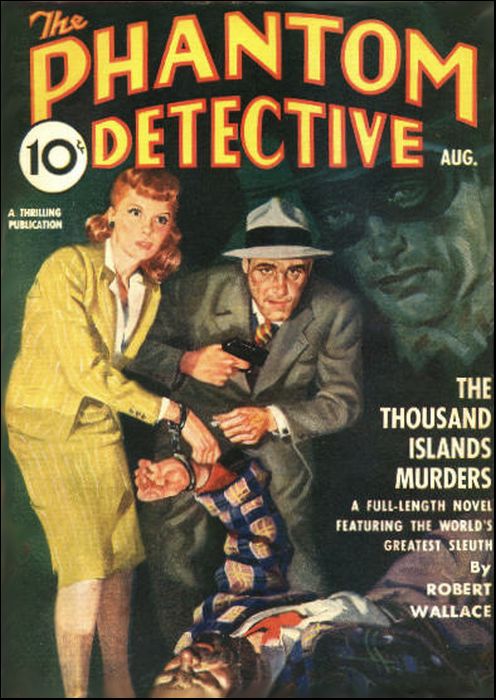
The Phantom Detective, August 1941, with "The Thousand Islands Murders"
The world's greatest sleuth lands in the middle of mystery and intrigue at Smith Island—and follows a grim trail of blackmail and peril that challenges his keen crime-fighting power! Voluntary exiles present a crime puzzle that keeps the Phantom guessing!
WEIRD throbbing, as of a thousand distant drums, pulsed through the midnight rain over Smith Island. The man whose long-booted and corded legs were stretched to the red log fire was smiling. He seemed to take keen enjoyment from the eerie, throbbing sounds.
"The drums of the Devil's Fire, according to the superstition of our Injun Joe," he said to his lone visitor. "But while it may sound like the devil to a stranger, I believe I could explain the phenomenon if I wished. However, it's too real and too chilling to newcomers to spoil the illusion, and on a night like this—"
He let the sentence hang upon the warm air of the log cabin with its two square-cut windows. His visitor shivered, as if the sinister throbbing of the distant drums penetrated to his marrow.
The visitor wore city clothes that showed under his opened slicker that was still wet with the rain. He kept his snap-brim hat well down over his eyes and half his face, as if he feared spying eyes might be spotted in the square blackness of the windows.
"You're a brave man, Jerry Smith, and I have to admit you may be wise," this visitor said, his voice deep and pleasant. "But suppose death came to you here, came quickly? No one would ever know the truth about you."
The man called Jerry Smith laughed into his reddish beard that was thickly shot with gray threads. His hair was long and looked almost shaggy as he shook his head. The laugh had all the heartiness of outdoor wind, and sun and storm.
"Death, Bruce Larner?" he said. "Our Injun Joe here would say that death is close tonight, when the drums of the Devil's Fire beat like that. He would tell you that shades of long dead braves are dancing, and that ghostly warriors are beating the drums. But death for me? Larner, I've only begun to live! Safely out of the world that once knew me."
Jerry Smith's blue eyes had fire and zest as they looked at his visitor. His ruddy cheeks glowed with keenest life.
"Your mission as a private investigator is to find missing men, Larner," he went on. "I judge you have learned there are many men on this island who are missing from their world?"
BRUCE LARNER was a big man with a craggy chin. His voice had a deep resonance.
"Yes, I find missing men," he said. "But I do not always report them to my clients. Sometimes I judge it is best that they remain missing. "He glanced at the black windows, and pulled his slicker closer about his shoulders. "Death always comes, Jerry Smith, sooner or later," he said. "And there is your insurance to be arranged. You have a fortune in negotiable bonds right here in this cabin. I would advise you to be cautious. I have a gloomy assistant, a Jim Harley, and he thought I should warn you."
"Ho! Ho!" Jerry Smith's laugh boomed out. "The rain and the wilderness have got you, Larner. It did me at first. On nights like this it seems to drop over the island like tears falling in the blackness. The pine needles rustle as if they were millions of living fingers. "He paused, and listened a moment to the rain. "This Jim Harley, your aide, is with you, Larner?" he asked.
"Yes, he's keeping a watchful eye outside. He's cautious, and a little bit afraid."
"I hope he doesn't run into any of the other Smiths here," said Jerry Smith. "Listen to the tree limbs groaning with misery."
It appeared that Jerry Smith possessed the soul of a poet. But it was true that the pine needles whispered, and the gaunt limbs of other trees creaked under the increasing weight of freezing, late spring rainfall.
All of the island outside was invisible now in the night. In the darkness, the pines and the hardwoods, and grim granite ridges lay across the wilderness land like wrinkled skin upon an old man's face.
The island was taking on an armor of sleet. When morning broke, the trees, and rocks, and the ferns in the deeply cut ravines would be white and ghostly. Pines would be bending low under a freezing blight.
In the channel at one side of the island, wide, thick ice cakes from northern streams made shuffling, crackling noises as the shoreward floes jammed upon the granite rocks.
Bruce Larner shrugged his slickered shoulders. He could not dismiss the sinister throbbing of the drums as easily as his host. He watched the windows closely. Once he saw a long, white face at a window. He knew Jim Harley, his right-hand man, did not feel comfortable out there in the night.
Jerry Smith smiled, and looked at a flat package his visitor held in one hand.
"You had trouble with your small boat in the ice, I take it," he said. "If you'll have your guide swing the western headland of the island when you leave, you'll be in the quiet water of the bay and out of the ice until you reach Alexandria."
"I came without a guide," Bruce Larner said quickly. "I want no such a witness about. Now, Jerry Smith, you trust me to deliver this ten thousand to your niece, Mary. And this other five thousand is for my discreet silence and my loss of memory?"
He held a smaller flat package in his other hand.
"That's it," said Jerry Smith. "And you're welcome. It's cheap enough.
Anyway, I have another hundred and eighty thousand, more than I'll ever need for the remainder of the life I have chosen. You've seen it right here in the cabin, and you have agreed that my motive for all this is adequate."
"I agree so thoroughly," Larner said, his voice deep, with the timbre of understanding between one man and another, "that I am leaving the five thousand on the table. I want no money for what must be regarded as my failure to find you. I will do my best to convince Mary Sanford that you are not in the Thousand Islands, and that this ten thousand I will take to her was received from a distant city."
JERRY SMITH'S hand gripped that of Bruce Larner.
"I would insist that you take the five thousand," he said, "except that I believe you feel exactly as you say, and that sort of feeling inside any man is worth a hundred times five thousand any time."
The visitor was pulling his slicker together. The distant drums were throbbing ceaselessly. It was easy enough to imagine, as Injun Joe believed, that they were made by the shades of vanished braves.
This island, and hundreds of others scattered about it had long ago been named"Manitonna, the Garden of the Great Spirit," by the departed Indians. It was the happy hunting grounds of their dreams.
But that did not account for Injun Joe's belief in the Devil's Fire, or the death that he declared always came with it.
The Devil's Fire?
Those black window squares Jerry Smith's visitor had been watching fearfully, suddenly glowed with a blinding white brilliance. Its impact upon the eyes was so great that it seemed to render the ears more acute.
The throbbing of the distant drums appeared to increase in cadence, to a rumbling thunder. Or perhaps that was because Jerry Smith's visitor sprang to the log cabin door and jerked it open.
Behind him, Jerry Smith seemed to lose his humorous confidence, and his skeptical view of an Indian superstition. He rubbed his arm across his eyes, and pulled his red and black mackinaw jacket closely across his throat, as if he might have felt the cold fingers of death touching him. But that might have been only the icy air of the freezing rain that rushed in through the open door, permeating the cheerful warmth of the small cabin.
"I don't like it, man!" grated Bruce Larner, who had slipped the ten thousand dollar package into his coat. "What makes that fantastic light? Why, it looks like one of the Very flares might be dropping right on top of us."
"It looks exactly like that," said Jerry Smith. "I've seen it before, twice. And just to make Injun Joe's crazy idea about the Devil's Fire good, three men were killed. Two the first time, and one the second, but they were plain accidents. Nothing else. Two Smiths were lost in a motorboat explosion, and one guide fell on the icy rocks and killed himself with his own rifle."
There seemed no point of origin of the brilliant whiteness that glowed for long seconds. Its blinding light was everywhere at once. Then, just as suddenly as it had come, the blackness swallowed it up, and only the rain was dripping.
Bruce Larner was just outside the cabin door. He was utterly blind in the moment the light disappeared. So far as he might have known, it could have been Jerry Smith who struck him from behind.
Or it might have been a hand that smashed a blunt weapon down upon his skull from the darkness to one side. At any rate, the throbbing of the drums and the dripping of the rain faded from the mysterious visitor's senses...
A HAND was slapping the unconscious man's cheeks, bringing him back to painful wakefulness. Hot liquid poured down his throat, strangling him.
"Chief! Let's get out of here! There was a crazy figure in a red robe who looked like Satan himself in that fire! Why did you shoot Jerry Smith? Did that light drive you nuts? Or did Jerry Smith try to kill you?"
Bruce Larner sat up. He stared at the melancholy face of Jim Harley, his agency assistant, and the man on whom he depended to remember the faces of missing men.
Then Larner looked into the lighted cabin. Jerry Smith lay on his back. There was a flat gun in Jerry Smith's hand. Bright blood stained his beard. He no longer could use the hundred and eighty thousand dollars he had said was in his cabin.
For he was dead. The mattress from his bunk was on the floor, ripped open. But it was not this that jolted Bruce Larner so much as what the man reviving him had said.
"Why did I do it?" he muttered. "Good Lord, Jim, I didn't! I couldn't! What is this? There was the Devil's Fire... Say!"
Wonderingly he lifted his hand. It was heavy. He was tightly gripping the butt of his own revolver. Like some man in a dream, he lifted the weapon, sniffing. Powder had been freshly burned.
"You shot twice, Chief!" said Jim Harley. "Jerry Smith got in one shot, but he missed. Let's get to the boat, before the whole island wakes up! Lucky about the rain and that blasted drummin' sound. They may have drowned out the shots."
Bruce Larner tried to shake off his assistant's hand. Jim Harley gripped his arm.
"Maybe you don't know what happened, Chief," he said. "But we haven't a Chinaman's chance! We haven't any good reason for being on Smith Island. Get to the boat, and away, and we'll try and figure it out. Did you get his dough? Was that it? An' then he come to himself an' started shooting?"
Bruce Larner, acted as if he were in a complete daze from the blow on his head. Jim Harley took the gun from his chief's hand. The night and the rain swallowed them up.
Scarcely had they disappeared than a figure of a man wrapped in a cloaking slicker materialized from the darkness back of the cabin. He avoided the lighted doorway, crouching under one of the windows, listening intently.
There was now but the sob of the rain, the suffering creak of gaunt tree limbs borne down by the weight of freezing sleet. The cloaked man raised himself, moved through the blackness, then he was through the cabin doorway quickly. He bent over Jerry Smith's body, turned it over. A knife flashed in his hand, as if he were driving it into the back of the corpse.
The knife did not touch the still warm, but dead flesh, though. But the mackinaw, the shirt, and the underwear under it were ripped from waistband to the neck. The slickered man bent low, his sight guided only by the blaze of the fireplace log.
"No, not him either," he muttered, arising quickly and catfooting through the doorway.
The night engulfed him within thirty seconds after it had swallowed the visitor to Jerry Smith and his companion.
THEN it was that a pair of other shadows that might have been mistaken for low-lying rocks moved, and one guttural voice spoke.
"The Great Spirit smiles upon us again through the Devil's Fire," it said.
"Snap out of it, Joe!" another hard voice said harshly. "You don't have to play Injun with me. Wait'll I scatter some feed for the birds. They'll be hungry with all this ice coverin' up everything."
A shower of wheat grains and cracked corn spread from his hands flung out in the darkness. Some of the food, so queerly intended for hungry birds, pattered in the cabin doorway. A few grains went inside the cabin and fell upon the mackinaw of the dead man.
"Injun Joe no more call Devil's Fire," muttered his companion. "The Great Chief must speak again. He has gone now in his red robe of war. Many birds come in morning to tell all Smiths the Devil's Fire has struck again."
"Okay, Joe! The birds will come in the morning. But this time, Joe, the great chief of the red robe has other work for us to do."
Jerry Smith lay there dead. Perhaps he had found that new life of which he had spoken, when he had told his mysterious visitor, "Death for me? Why, I've only begun to live in these past few months!"
WHEN "Injun Joe's" sinister Devil's Fire flared from the murky night, dispelling for long seconds the darkness of the rain over Smith Island, it was like the brief rolling up of a curtain.
Yet the unholy brilliance that had flared while death had come to Jerry Smith had revealed only more mysterious life among the wilderness trees and granite rocks. With the light, elongated red squares appeared at widely separated points—cabin doorways, with the reddish blaze of wood fires behind them. Some of these fires were bright and some were dull and dying out.
But it seemed that the faces showing in the doorways were much the same. All were heavily bearded. And the hair of most of the men who peered fearfully into the wet night was long.
Some of those who seemed to have been awakened this late spring night on this particular island in the Thousand Islands group in the St. Lawrence, were clad only in heavy underwear. Apparently they had been aroused from their bunks, perhaps by the blinding flare of the Devil's Fire, or by the ceaseless, distant drumming, or possibly by the faint crackling of the shots that had ended the new life of hopeful Jerry Smith.
But whatever it had been—light, or ghostly drums, or murder guns—each bearded man showed no apparent desire to brave the sleety rain and investigate. One cabin door after another was opened, and one after another was closed as the Devil's Fire died out.
These cabins were so spaced that no lighted doorway could be seen by the bearded occupant of any other cabin. It was as if the bearded men, all strangely alike whether the hair was black, or brown, or red or gray, were animals holed up against danger.
And, like wild animals, these bearded men seemed to have built their cabin dens where each might be safely concealed from all others. So the bearded men, whatever their apprehension or their beliefs concerning the Devil's Fire, were certainly not making it their individual personal business.
In what had been his own cabin, Jerry Smith's log fire was dying to red embers. The fading blaze had the deep low light, the unflickering luminescence of candles around a corpse in an airless room...
By that Devil's Fire, while it lasted, a figure steered an almost silent speedboat through drifting ice cakes toward the jutting gray granite headland of Smith Island. The steersman stood erect, shooting the fast craft in a snaky line to evade the white patches of ice that had come down from Canadian streams to the north of the river and Lake Ontario.
The steersman's head was thrown back, and his figure was commanding as his gaze swept the grim, unfriendly shore. A polished brass searchlight was ready to his hand, but he refrained from employing it.
Until the glaring Devil's Fire spread its guiding luminance, the capable pilot of the speedboat appeared to be finding a clear way by an amazing sense of seamanship. It was the same sense that could land a plane blind, set it down in a fog upon water or land. The sense that was the master of any moving mechanical machine possessed of speed.
For this man had set a small, amphibian plane down upon a quiet bay in the lee bight of an island not far from Smith Island within the past hour. The light, fast speedboat had been launched from its place in the fuselage of the plane.
Few men in the world could have threaded that boat through the treacherous rifts, the dangerous ice of the open channel and among the outlying rocks of the Thousand Islands. But this man could—for he was the Phantom Detective, world-renowned hunter of killers and criminals. In a great city or in the vast wilderness, he was equally at home.
The Phantom! The Nemesis of the underworld! The deliverer of innocent victims of criminal oppression! A man whose very name was one that struck fear to the hearts of the cleverest crooks.
The Phantom's face, now revealed briefly by the passing Devil's Fire, was ruddy with the wind, and burned by the sun. His longish, light hair and what appeared to be several weeks' growth of beard—though it had been applied by clever hands only hours before—were those of a man who was just returning from an early spring hunt in the Canadian woods.
Yet he was only hours out of the heart of Manhattan, and his last meal had been a dinner in a smart night spot. Truly"the man of a thousand faces," as he was called, the Phantom had, in short order, metamorphosed himself completely. He had been at home in the bright lights of New York; he was at home here. In any environment, city or wilderness, he was always in every point of character and appearance at home.
As the Devil's Fire died, the Phantom grounded the speedboat quietly between ugly rocks, securing it quickly and safely. He turned, speaking to the three persons seated under an oiled canvas shelter near the warmth of the powerful motor.
"A new sort of beacon landing light," he said, as if this phenomenon of the Thousand Isles were to be expected. "Saved us from having to betray ourselves by using our own spot. Now, we'll find the safest, driest spot for the moment, and you will remain there, Miss Sanford, with Miss Havens and Chip Dorlan. I'll see about finding a trail to the main lodge of this John Smith, who bosses the island."
A dark-haired, dark-eyed girl whose lovely face showed by the dim light of the boat's instrument board smiled at him.
"I'd think the driest, warmest place would be the boat, Phantom," she said. "Unless we could have the much needed exercise of going with you."
Muriel Havens, who spoke, was the daughter of Frank Havens, the owner of the New York Clarion and other associated newspapers across America. He was also the sponsor of the noted Phantom, responsible for his having become the most amazing and highest trained manhunter of his time.
Only Frank Havens knew the Phantom's true identity. In private life, the Phantom was, surprisingly, Richard Curtis Van Loan, sportsman, playboy, spender and eligible society bachelor. Though that was not even vaguely guessed.
It had been because of young Van Loan's cynical boredom several years before that Frank Havens had put the wealthy young man in the way of criminal investigation. Van Loan had distinctly liked it and, thorough in all things, he had trained himself mentally, physically and psychologically to become the world's greatest detective, which at once became his ambition—now one that had been reached.
Muriel havens , who was in his party now, was an exceptionally intelligent girl, a member of the social set in which Van Loan moved in his rightful role. But even she did not remotely guess that the careless spender, Van Loan, was the Phantom. Frank Havens was the only person in the world who knew that.
Nor did Muriel Havens ever see the Phantom for long in the same guise, or as the same character in looks, voice or manner. He was as much of an enigma to her as to all other persons, yet Muriel Havens admired him and his work so much that she had become one of his most valued assistants.
Perhaps Frank Havens' heiress was as bored with her life as Van Loan, the orphan son of Frank Havens' best friend, had been.
To Muriel's suggestion that they remain in the boat or accompany him, the Phantom made a quick reply. He heard the quick explosions of another speedboat almost immediately after the mysterious brilliant light had faded.
The Phantom saw the other boat then. It was without lights, but was silhouetted against the floating white ice cakes.
"That boatman's taking a long chance in this stormy muck," the Phantom said, eying the somber blackness of the island. Then he returned to their own problem. "It will be difficult to find any human habitation in the rain. And I want all of you safe ashore, Miss Havens. Come on, Miss Sanford, and you, Chip."
The dim light in the boat showed the girl he called Miss Sanford, who was a close friend of Muriel Havens, to be a petite, dark-eyed girl with clustering black hair. Her face was white, and it appeared to be strained with anxiety.
"You'll return for us as soon as you find my uncle?" she begged. "I'm sure the one they know at Alexandria Bay as Jerry Smith must be my uncle. They identified Uncle Jerome's photograph. Only there are so many Smiths on this island."
"It's funny, Phantom, that all the men on Smith Island should be called Smith," said Chip Dorlan. "They say there's even an Injun Joe Smith."
Chip Dorlan was the Phantom's thin-faced young protégé. He had been taken from the San Francisco slums by the Phantom and was being given an education, but his overweening ambition was to be a detective like his idolized Phantom. And he would fight for the Phantom at the slightest excuse.
Chip's inquiry had much to do with the real reason for the Phantom being here. It was to seek a man now known as Jerry Smith, but who, as Mary Sanford's uncle, had another name. She knew he was on this island, and now must be known as Smith, for her inquiries had brought out that this whole extensive island was peopled only by men by the name of Smith.
Believing that Jerry Smith was in reality Jerome Sanford, Mary's uncle, it was reasonable for the Phantom to suppose that all the other Smiths, all the men on the island, might be living under assumed names. That supposition—or probability—had offered the Phantom an intriguing mystery. A whole island of missing men, all calling themselves Smith, and apparently plentifully supplied with money, suggested several angles to the Phantom's probing mind.
Some of them might be merely wealthy men who wished to disappear. But, as it was in the case of Mary Sanford's missing uncle, there was the suggestion of a crime against society in the odd circumstances of so many Smiths being in one spot.
The Phantom's quick brain had told him that there was also a chance that the head of this island, a man generally known as"Long John" Smith, might be the leader of a new variety of criminal mob. Or at least he might be affording protection to many men who might be criminals of the upper brackets.
SO the Phantom expected to find much more than the answer to the presence of Jerry Smith—or Jerome Sanford—here in the St. Lawrence. This, he believed, was one of the most interesting missions he had ever undertaken. For he would waste no opportunities to inquire into the real identities of many Smiths here who were known by different Christian names.
Also, he was well aware that he likely would be pitting his powers against clever men who had found it necessary to their safety to disappear from the world they had known, to become a part of this big colony of Smiths. He intended first to find Long John Smith, the head, of the island, then to take the other Smiths as he encountered them.
After a moment's thought he replied to Chip Dorlan's comment about there being so many men called Smith. Even an Indian was among them. But the Phantom had watched the other boat disappear in the ice before he spoke.
"It isn't strange, Chip," he said then, "seeing that the owner of the island seemingly populated by a great and growing clan of Smiths is named John Smith, the most numerous of all the American Smiths, and might be desirous of establishing a sort of home or retreat for poor, downtrodden Smiths."
"But, Phantom," Mary Sanford protested, "they know my uncle here as Jerry Smith—I'm sure they do—and his name isn't anything like Smith. And he never was poor or downtrodden either."
"And seeing that your uncle is who he is, and knowing the reason for his being a missing man for so long, and there being so many Smiths, is the reason I am willing to help you investigate this," stated the Phantom. "And I believe this Jerry Smith here is your uncle. The people at Alexandria Bay who have seen this Jerry Smith, even with his beard, agree that the photograph of your uncle without a beard may be the same man."
"You say you're intending to find John Smith, the owner of the island, first, Phantom?" asked Chip Dorlan.
"Not if I can discover some stray Smith who can direct me first to Jerry Smith," said the Phantom. "In that case we may accomplish our purpose without stirring up too many miscellaneous Smiths. That's why we have arrived in the night, in secret. So stay under cover until you hear from me. If you are discovered, or there is trouble, shoot the green light, Chip."
Chip nodded, feeling of a peculiar device in his pocket that was shaped like a small gun.
Leaving the three in a small dry cave of granite, the Phantom went swiftly up over the shore rocks. Because of the rain, the trees and ridged rocks, visibility was cut down to but a few yards.
The Phantom might have acted differently had he known that Indian woods-wise ears had picked up the sound of his motorboat as it had come through the channel ice floes. Even as he now followed a rocky ridge, hoping to sight some sort of light or habitation, a pair of burning eyes was fixed upon the rocks where Chip Dorlan was standing guard over Muriel Havens and Mary Sanford.
They were the eyes of the Indian known as Injun Joe, for whom the Devil's Fire had so lately spotlighted murder.
But the Phantom, as far from the haunts of Richard Curtis Van Loan as he could possibly be within a few hours of dining off Broadway, was unaware of several circumstances vital to his own safety, and that of the three persons left in the dry cave. He was uninformed of the visit of Bruce Larner and Jim Harley, private investigators, to Smith Island.
WHEN the square bulk of a log cabin loomed suddenly before him, a faint red glow of a fire showing on one window, Van Loan made for it.
Reaching the window, he lifted himself quietly and peered inside.
The fire log was burning low. One glance showed the cabin and the single bunk along a wall to be empty. But as he moved around a corner, Van discovered the cabin door was open.
Seeing no movement in the nearby darkness, Van stepped cautiously into the cabin. He had taken but two steps inside when the shuffle of a foot turned him just in time to see a bearded man leaping toward him with an uplifted knife.
Even in that flashing second of a surprise attack, Van noticed that the man had a heavy brown beard, that he was young, and that he was a powerful six-feet of well-knit power.
Van ducked lithely to one side to avoid the knife. Further surprise came quickly, taxing his speed and trained fighting ability.
For the rangy stranger struck, not with the knife, but with his bunched left fist.
Van's right hand shot out and gripped the knife-wrist as hard knuckles grazed his jaw. He countered the blow with a short-arm punch that traveled less than eight inches.
The bearded man's head jerked back at the solid impact of knuckles on his chin.
VAN twisted the knife from the man's hand as he fell. The bearded man shook his head groggily, getting to his knees.
He stared up at Van.
"You pack a punch, stranger," he said without raising his voice. "No, you don't have to hit me again. I wouldn't have jumped you, but this is my cabin, and I'm a little edgy. After all, you might have come to steal, especially if you are one of the other Smiths."
Van Loan grinned a little at that. "And suppose I am one of the other Smiths, or at least, a Smith?" he asked. "Does it follow that I must be a thief?"
"You would have to be a Smith, or you wouldn't be here," the bearded man said. "Long John Smith only takes Smiths on Smith Island. But I wouldn't trust any Smith here."
"Well, then for the time, I'll say I'm a Smith," agreed Van. "And you are also a Smith, I take it?"
"Charles Smith," said the bearded man. "Are you lost? Or have you just landed and haven't seen Long John?"
"I was looking first for a Jerry Smith. You know him?"
The bearded Charles Smith seemed to lose all of his friendly manner.
"Get out!" he ordered sharply. "You go see Long John! I don't know anything about Jerry Smith, except that you'll never see him alive, and if you're smart, you'll stay away from his cabin!"
Van's keen senses picked up Charles Smith's glance, the direction of his eyes. He smiled and backed out of the door.
THE Phantom's trained senses never overlooked the slightest detail. He was thinking fast as he saw Charles Smith standing in the middle of his cabin, watching him fade into the rain. "Charles Smith isn't a killer at least," thought Van. "He could have made an effort to use that knife, but he swung his fist instead. His eyes are too clear for him to be a mental case, and yet the mention of Jerry Smith upset him... Hmm—he said I'd never see Jerry Smith alive."
Van was pushing rapidly through the trees in the direction in which Charles Smith had glanced as he had spoken of Jerry Smith's cabin. Van followed a straight line, climbing over huge granite boulders and wading waist-deep in ferns that crackled with frozen sleet.
The cabin was not far away. Its open door showed faintly in the rainy darkness, the fire log having almost died out. Van approached the doorway with infinite caution, pausing to ascertain if he had been followed by Charles Smith, or if any other person was nearby.
From what Charles Smith had said, Van rather expected to find an empty cabin. He was speculating on what might have happened to Jerry Smith, the one Smith he had come to the island in the night to find for Mary Sanford. He discovered the answer the moment he stepped in through the open cabin door.
Van had not quite expected murder, but there it was. Making sure his heavy automatic could be brought instantly into service, he knelt beside the body he saw sprawled on the floor.
He saw a mark on the face where one bullet had struck, and had remained imbedded in the dead man's skull. There was another mark on the white skin of the back where another slug had come all the way through the body.
"That's a queer one," Van mused. "I would say that a knife slit that mackinaw and his other clothes after he was dead. And Charles Smith had been out of his cabin, and he had a knife. Plainly he had reason to know that Jerry Smith had just been murdered. This will be a shock to Mary Sanford, if this is her uncle, and I would say from his face that it is the same as the photograph of Jerome Sanford."
Van studied the situation, taking in swiftly the ripped mattress off the bunk and the position of the body. Then he saw a small, flat package lying in plain view on a table. It contained five thousand dollars' worth of negotiable bonds, and lay as if it had been placed there carefully when a murdering thief had killed Jerry Smith and looted his cabin.
Van picked up the bonds, came back and bent over the body. His fingers picked up several grains of wheat and cracked corn. It seemed as if this queerly out-of-place donation to the dead had been thrown through the open door.
"It couldn't have been possible that anyone on the island knew that Mary Sanford was arriving tonight, looking for her uncle," thought Van. "She was to meet Bruce Larner, of the Larner Missing Persons Agency, in Alexandria Bay tomorrow and no one could have known we were flying up from New York tonight."
Keeping an eye upon the doorway, listening for any alien sound against the distant throbbing that sounded like drums, and the noises of the rain and sleet, the Phantom produced a tubular device.
It was one of the most powerful of small, handy microscopes. Operating on the power of rumbatrons enclosed in a tiny copper sphere, it magnified many hundreds of times. Van placed under it the package of bonds he had found. There were distinct fingerprints.
Half a minute later, after examining the dead Jerry Smith's hands under the powerful glass, Van knew that the prints were not those of the dead man. That indicated they must be those of the killer. But why, if he had held these bonds, had he left them lying on the table? The Phantom judged they might have been left by accident.
"And the clothes could have been cut by the killer, thinking perhaps that Jerry Smith had more bonds or cash hidden in his clothes," decided Van. "Though that doesn't seem probable."
Not a sound from outside indicated that any notice had been taken of Jerry Smith's abrupt demise. Though the Phantom was sure that it had happened within the past hour.
Van had a quick thought of the speedboat he had seen leaving the island.
Could it be that Bruce Larner had been on that boat, after having made a visit to Jerry Smith?
"It will be a good idea for Miss Sanford to meet Bruce Larner at Alexandria Bay tomorrow morning," he thought, "and to get the state police over here by telephone tonight."
It was then he noticed the pencil. It was only a stub and looked as if it had seen hard usage. Especially at the top. The eraser seemed to have been chewed off by the teeth of some nervous person. The metal cap itself was marked by the same chewing teeth.
But the oddest part was the position of the pencil. It was lying upon the back of the corpse, caught under the edge of the knife-slitted mackinaw. Van studied it briefly before stowing it into his pocket.
Another sudden thought had come to him. It concerned Charles Smith and the knife with which he had made a bluff at attacking Van. The pencil could have fallen from Charles Smith's pocket, if he had been the one who had slit the corpse's shirt.
The Phantom moved warily from the cabin. He could hear only the noises of Nature in the rain. The blackness of the night, and the roughness of the wilderness suggested that he might find it best to return to Charles Smith and compel him by force or otherwise to guide him to the island's main lodge, and Long John Smith, the owner. The lodge would undoubtedly be where he could find the nearest, if not the only telephone connection to call the proper authorities. Also he wanted Charles Smith's fingerprints.
Van started back up over the granite ridges. A big pine tree topped the first rise. He had just reached this when a weapon—whistled so close to his right ear that he fell flat, waiting. The weapon thudded into the pine tree and stuck there with its handle quivering.
EVEN as he heard the shuffling of feet going away fast, Van ran his hand over the weapon that had missed him. He touched yarn-like wrapping and a smooth blade. The weapon that had just missed his skull was an Indian tomahawk.
Swiftly springing forward in the direction of the unseen, fleeing man, Van's brain was churning with the fantastic aspects of what he had encountered. A strange fire out of nowhere. Charles Smith's attack in which it had seemed to Van that Charles never could be a killer. Jerry Smith murdered almost at the moment of Van's own arrival on the island. The queer appearance of scattered corn and wheat. The slitted clothing. The pencil with the chewed-off eraser.
Van suddenly halted. The man who had thrown the tomahawk at his head was so familiar with the ravines and the ridges that Van judged he might be an Indian guide. He was out of hearing now.
The Phantom was as much lost as ever, so far as knowing the direction of the main lodge and Long John Smith.
He retraced his steps, which brought him again above the cabin of the ill-fated Jerry Smith.
A spiral of flame, of blinding, brilliant fire seared his skin and drove him to plunge into a ravine and bury his face in the cold, sleet-clothed ferns.
The blinding fire lasted but a few seconds, but it sent a wave of heat across the Phantom, melting the ice on the trees over him and deluging him with water. Then all was darkness again. There seemed no place, except the air, from which that fire had come, before the light had died out.
Yet for those few seconds it had been the hottest blaze the Phantom had ever encountered.
He was dizzy when he came to his feet.
The cabin of Jerry Smith, the murdered man, should have been in the hollow he quickly reached. But there was nothing there except pitted ground where rocks still gave off heat, and where there was the odor of burned wood.
Not a single log or any part of a splinter of Jerry Smith's cabin remained. Neither were there ashes. All of the space where the cabin had stood and for some distance around was as barren as if a giant steel hand had scooped away all earth down to the granite underneath.
Van did not risk using his flashlight, but his nose told him that the needles of the pines for some distance around had been turned brown.
Had he been spied upon as he had discovered the body of Jerry Smith? That must be the answer to what had happened.
For it must be known he had leads to the killer.
Had someone spirited the corpse away, then employed that terrific fire to wipe out the cabin? Or had the body been burned with the shack?
Once more Van's mind jumped to the speedboat he had seen leaving the island. The killer, or killers, might have been in that boat! For some reason they could have returned and chanced upon him.
AS Van moved into the rainy blackness, his thoughts were divided. He regretted having yielded to Mary Sanford's plea to make this surprise night trip to Smith Island. He had planned to leave the Sanford girl with Muriel Havens at the nearby town of Alexandria Bay while he investigated the island.
Then he had thought that Mary, having visited Alexandria Bay a few days before, might be in danger there, if it were known that she was looking for her uncle. Moreover, Van had been virtually forced to land his plane on the quiet bay not far from Smith Island as it had shown on a map he had made.
His thought then had been that Mary Sanford's return to Alexandria Bay with Muriel Havens and himself might also endanger her uncle, whom she believed was the man known as Jerry Smith, should someone want him not to be found, as appeared to be the case.
MARY SANFORD had received a mysterious letter some weeks before, a letter from Jerome Sanford, her missing uncle, telling her that he was sending her money. He had given no address, but had written that he hoped never to be discovered. He undoubtedly had believed his new identity of Jerry Smith was safe enough. But his letter had been mailed from Alexandria Bay, and by that the girl had traced him with a photograph.
The Phantom could understand the belief of Jerome Sanford, who had good reason for wanting to lose himself, in spite of his niece's anxiety to find him, that he was secure on Smith Island. For this island was but one of some eighteen hundred islands, large and small, in the vast wilderness of the St. Lawrence River tourist and fishing grounds, long ago named the Thousand Islands by the first French explorers.
Now, with the swiftly striking tragedy upon which he had come, Van believed his best course was to remove Mary Sanford and Muriel Havens from the island as quickly as possible.
But there was one job yet to be accomplished. He must have the fingerprints of the strange bearded man who had called himself Charles Smith.
And Van believed he had the means of getting those fingerprints.
CHARLES SMITH'S log cabin was but an ominous black bulk in the night as the Phantom returned to it. The windows reflected no light. The log fire evidently had died out. Charles Smith had either retired, or had left his cabin, perhaps to give warning of the presence of a stranger on the island.
Van tried the heavy slab door softly with his weight. Its unyielding resistance told him that it must be held by a heavy bar inside. Then he moved around to one of the black windows.
He listened but could hear no movement inside the cabin. Outside there was only the steady drip and rustle of the rain in the pine needles, punctuated by the sharp cracking now and then of some ice-burdened tree limb.
Van smashed out the square of window glass with the butt of his gun, stepping to one side. There was almost instant response. A tongue of red flame came with the report of a heavy caliber gun. The slug chewed the window frame.
"Charles Smith!" Van called sharply. "I'm the man who came to see Jerry Smith! I have seen him! It wouldn't pay you to shoot again! I have something for you!"
Van waited. Black silence brooded inside the cabin. Then the floor creaked a little. Charles Smith might be moving toward the window, taking a chance on shooting again with greater advantage.
"Come to the window, Charles Smith," said Van quietly.
"Get away, whoever you are!" rasped the voice inside sharply. "I knew Jerry Smith had been killed! I had nothing to do with it, and I want nothing to do with you!"
"Perhaps you have lost a pencil," replied the Phantom. "A little pencil with the eraser chewed off of it. I don't believe you killed Jerry Smith. But when the police come, they may think differently. I have the pencil. "Charles Smith's deeply labored breath came clearly. But his reply was full of confidence.
"I am not fooled," he said. "The Devil's Fire burned tonight. No one will ever be convicted of Jerry Smith's murder. The corpse never will be found. It has happened before. So the pencil means nothing to the police, or to you, stranger. But I'll give you one thousand dollars for that pencil."
Van heard the man's feet shuffling over the floor. He judged Charles Smith was attempting to reach the window, perhaps to bring the man outside under his gun.
"That's a huge sum of money for a lead pencil, Charles Smith," said Van. "Suppose you tell me why it is valuable."
"It isn't valuable to anyone but myself, yet there is one on this island who would pay five times that amount for it," said Charles Smith. "However, that other one, who is also a Smith, is more likely to take a shorter and cheaper way to get the pencil, if he learns who has it now. He doesn't know that anyone has it. I'll still give you a thousand for it."
"Open the door, and we'll deal," said Van.
He did not intend to accept a thousand or any other sum for the chewed pencil. But it jumped into his mind that he might make a trade for further information, from what Charles Smith had hinted.
Other men apparently had died, been murdered on Smith Island. What was this Devil's Fire? Why had corpses disappeared, and why had there never been a police alarm in the past that would have brought Smith Island under closer scrutiny? Also what could possibly make a penny lead pencil, like some school child's pencil, worth a thousand or five thousand?
Van already had a glimmering of an idea about that. But he wanted to learn what Charles Smith would tell under pressure, if anything. He had detected something like a desperate fanatical note in the man's voice. He was marking every inch the man was moving toward the window, and he stayed close to the wall.
THE man's voice sounded, right by the smashed window.
"I have the thousand here," he said. "I'll exchange it for the pencil. I do not intend to open the door."
There was then just the shadowed outline of Charles Smith's head and shoulders in the window space. The Phantom's movement was almost as fast as light. His straight arm whipped out and up.
Charles Smith dropped to the floor inside. Van went in through the window square, shrugging his broad shoulders past the narrow frame. He bent over the man who was crumpled down by the wall.
The man's heavy automatic was still gripped in his hand. Strangely, Van still believed that Charles Smith was not a killer, though he had fired a shot when the window was smashed and he might have tried another slug to obtain possession of the pencil.
Van switched on his flashlight. Soft moulage wax came from a makeup case that had been fitted snugly to his body under his clothes. Charles Smith's fingerprints were quickly taken.
Van used the flashlight, then the tubular microscope with its rumbatron illumination which caused it to magnify many hundreds of times. That microscope was his own device. It had served him well.
The world's greatest detective had little need for fingerprint records for his own use. For he had an imperishable memory for lines and whorls of such prints. But a more readable record for others was often required.
Quick comparison of Charles Smith's prints with those upon the flat package of five thousand dollars in negotiable bonds confirmed Van's theory. This man had not handled those bonds. Nor were the prints those of the dead Jerry Smith, as he had already discovered.
The murderer had to be some other man than Charles Smith, Van decided in the following minute or two, for Charles Smith's heavy calibered gun was not of the type that had killed Jerry Smith.
As Van's pencil flashlight went over the cabin, he worked swiftly. A loose granite slab before the now dead log fire came up in his strong hands and he saw a sum of money in United States currency packed under the slab.
"That goes along with the pencil," Van muttered softly. "The bills are of odd denominations and all are old. There must be up to fifty thousand in cash."
A grim smile was upon the Phantom's mouth in the darkness. He was convinced now that he knew what Charles Smith had been seeking when he had ripped the clothes of Jerry Smith. He studied the unconscious man under his flashlight for a moment, picturing the features as they would be without the light brown beard and the long hair.
HE tried to recall where he had seen such a face. He was sure it had been in a newspaper photograph of sometime before. And as he flicked off the flashlight, he restored the chewed pencil to the man's coat pocket where the coat hung on a chair back.
"It is as I thought it might be," Van decided. "I imagine that it will soon be discovered that Smith Island holds much more of interest than the murder of Jerome Sanford, the uncle of Mary Sanford, who was known as Jerry Smith here and in Alexandria Bay. Judging from that little pencil alone, the mystery of this island extends all the way to the Pacific Coast, unless all of my theory is wrong."
He thought for a moment of the many odd Smiths who were reported to form a fairly large family on the island. Of how it was reported that the owner of the island, Long John Smith, was immensely wealthy, and had carried out a queer eccentric project of making this out-of-the-world island a community of men by the name of Smith. But was that true? Was Long John's motive an altruistic one, or was there something more sinister about this island?
All of the Phantom's visit to Charles Smith had occupied only a few minutes. He left the door barred on the inside and moved back to the window. If what he believed to be true should be borne out later, he was sure that Charles Smith would be shown to be a missing man, but that he was far from being a criminal.
The thought of getting Mary Sanford and Muriel Havens off the island and back to the safety of Alexandria Bay was uppermost now. He hoped they, with Chip Dorlan, had obeyed his instructions and remained hidden.
Van eased himself out through the narrow window, after cautious listening. He had heard only the mournful whispering and creaking of the sleeted trees. But a hand shot out of the darkness beside the window, fastened into his collar, and the cold bore of a gun punched into his neck.
Had he been any other man than the Phantom, it would have jerked him from his feet. But he was the Phantom, trained in every art of physical combat from boxing to wrestling to ju-jitsu and la savate. So his reaction was a lightning move.
His body snapped forward, instead of back. His head jerked, and the menacing gun slipped to one side. The wrist of the hand holding the gun was locked in a pincer grip. Van's rawhide muscles contracted with elastic power.
There was an oath and a grunt. Van turned on over, taking his attacker with him. The man was hard-muscled, lithe and strong. The Phantom discovered instantly that only his own unexpected use of that fast wrestling hold had saved him.
For his attacker shot a hard fist to Van's neck. He did not withdraw his hand after the jolting punch, but twisted his body, caught his fingers in Van's hair and jammed a thumb into the base of Van's jaw.
Agonizing fire spread over Van's head and body. That hold was ju-jitsu, and it could be paralyzing in a second. Van split up the second. He countered with a body punch that drove his hard knuckles deep into his attacker's body just under the breast bone.
A groaning oath, and the man rolled over in the darkness, his neck-hold upon Van broken. The Phantom held him there easily, for both of the man's hands were clasped over his stomach as he fought for breath.
Van's pencil flashlight picked out the attacker's face. It was covered with a thick black beard. Cropped black hair surmounted a broad, tanned forehead, below which black eyes glowed, but they were pain-filled now.
Making sure the man was all alone, Van said:
"You might explain. I haven't time to be particular, and I don't want to leave you asleep to freeze along with the trees."
The black-eyed man got his breath, and spoke with an effort.
"Funny. I thought I was good, and knew all the tricks, but I'll never be that fast."
"That doesn't explain much," said Van. "Why the ambush? I hope you were only acting in defense of the man in the cabin, Charles Smith? If you were, he's all right. I am neither a thief nor a killer. I saw a murdered man, and a fire that apparently destroyed the corpus delicti with a purpose. My visit to this cabin was merely to prove to myself that Charles Smith is not the murderer. "The black-eyed man sat up. The Phantom saw that he was young, and that this was probably the first beard he had ever grown. Moreover, Van had a faint suspicion that he had heard the man's voice before, under more auspicious circumstances.
Either the man decided to trust him, or he was making a very smart play.
"I was only looking out for Charles Smith," he said. "You sound all right and what you say is reasonable. I saw a little light in the cabin, and heard you coming out of the window. I'm Luke—Luke Smith to you. You're growing a beard yourself, and you have a swell case of wind and sunburn, so I judge you're another Smith who has just arrived."
Van nodded. He had this Luke's gun. Luke's tone was easy, assured under the circumstances. One of the Phantom's greatest assets was detecting falsity or truth in another man's voice. He never needed a lie detector.
He decided Luke Smith was telling the truth. But he was not yet ready to reveal himself as the Phantom to anyone but Long John Smith.
"I'll take your word, as you take mine, until we know each other better," he said quietly. "Now I want to reach Long John, the boss of the island, as quickly as possible."
"His lodge is two miles away, and it's tough going," said the man who called himself Luke. "I'll guide you near it, if you insist, or you can come to my cabin and wait for daylight. As man to man, you're someone other than just another wandering Smith, brother. So I'll tell you—I don't want Long John to know I was prowling tonight, and was too close to that Devil's Fire for comfort. I didn't know for sure that Jerry Smith had been killed, but I suspected he was burned with his cabin. The Devil's Fire has removed others."
Van decided it might be as well to put some faith in this Luke. He extended the gun he had taken from him.
"I would like to go directly to Long John's lodge," he said quietly.
Luke studied him a few seconds before he accepted his gun. Then he took it, and said:
"Perhaps we'll get along together. Anyway, we'll find out about each other."
The Phantom nodded. Luke was on his feet, turning, when a snaky line of green fire wiggled high into the air over toward the throbbing sound like ghostly drums along the channel of floating ice. The green line exploded into a mushrooming green cloud.
VAN knew what that meant! It was a call for help from Chip Dorlan. Something had happened. Chip never used an emergency signal unless the danger was critical. He preferred to fight his own way out of jams.
"Come on, Luke—I'm trusting you—" Van had started to say, when shadowy figures materialized all around them. Half dozen or more bearded figures. They closed in and a torchlight flared and showed guns bearing down upon Luke Smith and the Phantom.
"Curt Smith!" snapped Luke.
"Hold it, both of you!" commanded an oily voice that came from the fat throat of a short, roly-poly, round-faced man. "Joe, grab their rods! We'll find out about this mug dropping out of nowhere and prowling around!"
Any quick move would have brought a dozen slugs tearing into the Phantom's body. Luke Smith spoke up.
"Okay, Curt," he said. "I was only holding this stranger until someone came along. He claims he's here to become a Smith."
AT the moment the second Devil's Fire of the night lighted up Smith Island, Chip Dorlan was on guard at the entrance of the little cave sheltering Mary Sanford and Muriel Havens. The keen-eyed, thin-faced youth, whose loyal aid to the Phantom in numerous cases had made of him one of the toughest and grittiest fighters of his size to be found anywhere, was watching the flowing channel with its floating ice cakes.
"What is it, Chip? What do you see?"
Muriel Havens touched his shoulder. He thrust her back into the cave almost roughly. Chip's heart was suddenly like a heavy chunk of lead.
"Stay back, Muriel," he said thickly. "A couple of fellows are prowling along the shore below us. Don't make any sound."
Chip's light body blocked off Muriel's view where the white brilliance converted the icy channel into a shining river of silver. He had spoken truthfully of men appearing on the shore below, but he had not divulged all that he had seen.
For more than two men had appeared. Three others were carrying a limp, long bundle that could be nothing but a man's body. The bright light revealed the men clearly, but was too blinding to bring out details.
"The Phantom?" was the awful question that sped through Chip's mind. "Could it be the Phantom?" Muriel was protesting in a hoarse whisper, but Chip said:
"We haven't been seen, but if those fellows happen onto the Phantom's speedboat, they'll maybe make a search to see if anybody is around. "Chip's pulses pounded and his fingers wrapped around the heavy automatic he carried. Had he been alone, Chip would have chanced the odds, counting on the advantage of surprise, even against five men. But the girls had been put in his care.
Mary Sanford was a brave girl, for all of her small size. She was talking with Muriel behind Chip.
"I was foolish to have come to the island, but I thought it was the only way I might see for myself if this Jerry Smith is really my uncle," she said. "Everyone says Uncle Jerome is a criminal, that he robbed his own bank before he disappeared, but I know he was protecting someone else. I wonder if that Bruce Larner of that missing persons detective agency has gone to Alexandria Bay, or would he have come on over to the island before I arrived?"
"It's too bad you called in the detective agency before I persuaded my father to have the Phantom take up the case," said Muriel. "I don't believe the Phantom would have come just for your uncle either, Mary, but my father has heard some rumors concerning the strange collection of men, all named Smith, on the island. That was one reason, when it seemed sure that your uncle, Jerome Sanford, was living here and known as Jerry Smith, that the Phantom immediately decided the other Smiths might be fully as important."
"Please keep quiet!" Chip whispered. "Those fellows are pulling a small boat out over the rocks. It's only a rowboat, and not big enough for that ice out there. I hope they make it, and get away from here though."
He did not tell what really was happening. The small boat was being pushed out into the ice cakes that were churning along the granite rocks. That much stood out clearly in the queer white brilliance that glowed until raindrops seemed like sharp little spears falling through it.
CHIP scarcely breathed as he saw the inert body lifted and laid in the boat. Then the five men were pushing the boat out into the ice. A long pole sent it through to clearer water.
The sluggish current caught the little boat and it went bobbing away among the ice cakes.
The men were muttering among themselves, starting back toward the rocky headland, evidently headed for the middle of the island.
Chip was stripping off his coat and his shoes.
"Chip, have you gone crazy?" exclaimed Muriel. "What are you thinking of doing?"
"Never mind," muttered Chip. "Whatever happens, you and Miss Sanford stay right where you are. You will be discovered if you move. I have to go outside, and I don't want my shoes to make a noise."
"That's silly, isn't it, Chip?" demanded Muriel. "You couldn't hear anyone with that ice grinding along the rocks, and you know it."
"If you don't trust me, it may cost the Phantom his life," gritted Chip, trying to keep his voice from breaking. "If you have to know, I think they're trying to get rid of the Phantom, and I have to go to him."
Chip paid no attention to Muriel's cry as he darted from the little cave and down over the rocks. His automatic was in his hand, and he was praying that the strange light would hold out until he had a chance to start swimming toward the bobbing little boat carrying the body away from the shore.
He was halfway to the churning ice, keeping in the shelter of rocks as long as he could. Then there came a sharp cry from one of the men climbing the headlands. A gun exploded and slugs whined viciously close to Chip.
He threw himself flat, rolling toward the water as the five men started charging down the rocks above him.
He threw up his automatic and started it jolting.
One of the men threw up his hands and fell, but scrambled to his feet again.
Chip took a chance and sprang to his feet. If he could only cross the shore ice and dive, he was confident he could make it to the drifting boat. It would not be his first swim in ice-cold water.
More slugs buzzed like angry bees off the rocks near him. He threw his empty gun aside as he ran.
He was on the first of the piling ice cakes when his feet slipped and he fell.
"Get the crazy guy, whoever he is!" shouted a hard voice. "Plug him, but keep him alive! There's too many visitors here tonight!"
A slug scored Chip's leg. But he would have rolled on into the water, if the white fire had not suddenly blanked out. He realized then that it was useless to attempt swimming. The little, boat was instantly swallowed by the blackness. In that tricky channel he could never reach it.
Then he had no choice. Rough hands seized him and dragged him to his feet. A torch flared into his eyes and by its light he saw a half-circle of evil, gleaming eyes in roughly bearded faces.
"He ain't one of the Smiths!" snapped one man. "Maybe this guy is a pal of the one that was in Jerry Smith's cabin before we grabbed off the body! Okay, kid! Who are you, and who are you with?"
A GLEAM of hope came to Chip. These men had grabbed off a body from a cabin, Jerry Smith's cabin. He thought, "Why Jerry Smith is supposed to be the name Mary Sanford's uncle uses!"
Chip took what he imagined was a smart long chance.
"Why, I'm—I'm Jerry Smith's nephew," he stammered. "You mentioned my uncle. Has he been hurt? Take me to him."
Chip kept his eyes from wandering to the cave where the girls were hidden as he spoke.
"So Jerry Smith's your uncle, huh?" One of the men uttered a mocking laugh. "I'm afraid you're a little late, kid, but you've seen too much. And why did you try to swim after that boat? Where's your coat and shoes?"
"He came from up there in the rocks," said one of the other men. "Maybe he ain't alone. Maybe he was in that speedboat that Injun Joe reported landin' up here somewhere. Injun Joe lost the four that got out of the boat, but he said there was two dames."
"Dames, on this island?" growled the leader. "That's something! Now where's your shoes, kid? Talk, before I twist off your ears!"
Chip's reply was to dive at the man's legs. He got in one solid blow that caused the bearded man to grunt. But the toe of a heavy boot caught him over the ear. His senses started to fade, then he heard Muriel Havens' voice cry out:"Stop it! I'm here in the dark! I've got a gun on all of you and I'm behind a rock! I'll start shooting if you don't let him go!"
It made Chip sick all over. The torch holder was smart enough to snap out the light and the men sprang to one side. The leader locked his fingers on Chip's throat and pulled him along.
The men scuffled among the rocks in the darkness. Then they had Muriel Havens, and two minutes later, Mary Sanford was brought down from the cave.
The torch lighted the white faces of the two girls.
"Curt and Injun Joe will like this. "The bearded leader laughed evilly. "We'll take them down to the Devil's Oven and wait while Curt and Injun Joe are rounding up that other fellow. Injun Joe almost got him with that tomahawk of his, but he missed for once."
In spite of their tight situation, Chip breathed easier. It seemed they must now be talking about the Phantom.
And from what they had said, it must be the body of Mary Sanford's uncle out there in the little boat.
One of the men moved up the shore with a torch.
He returned, shouting.
"Their speedboat's grounded up here! It's a crackerjack! Looks like one of the latest portables! The kid can tell us who the mug is that's been prowling around tonight! Looks to me like this is some kind of a special visit! And it had to happen just about the time Jerry Smith got himself full of slugs!"
"Jerry Smith? He's my uncle!" Mary Sanford's anguished cry was sudden.
Chip was sick and dizzy, but he blurted out:
"Don't talk any more, Mary! Don't tell them anything!"
"So that's the way it lays!" snarled the bearded leader. "All right, boys. Take the dames along to the Devil's Oven. I'll see what we can find in that speedboat. Buck, you come along with me."
CHIP clenched his teeth as he saw Muriel and Mary hurried away in the darkness. He was blaming himself now for what had happened. But how was he to know it was not the Phantom's body that had been placed in the little boat set afloat in the channel?
Ten minutes later the bearded leader of the thugs who had trapped them was cursing loudly. He was holding up a photograph that had been dropped in the speedboat. It was the picture of Jerome Sanford, Mary's uncle, known on the island as Jerry Smith.
"It's the police as sure as guns!" grunted the bearded man. "Now we'll have to make the kid or the dames talk!"
Chip felt the hand of the other man on his arm loosen a bit. He jerked free, and clipped the man with his other fist. Then he was running, pulling a flat little weapon from under his shirt.
When the flat device exploded, a snaky line of green fire went high in the air.
The next minute, a blow from behind knocked Chip flat on his face. A hard rock blanked out his senses.
YOUNG Chip Dorlan felt as if he had been left out in the rain and had been frozen into an icicle. Dim and smoky light struck his aching eyeballs. He forced them open against the smarting sting. As he did, he heard Muriel Havens cry out with pain in her voice.
"You could kill me, but I'll never tell you anything!"
That brought Chip to full consciousness. He saw the gray walls of a huge cave. There were little cracks in the granite floor through which little jets of steam arose. A wood fire burned in one corner and filled the cavern with a weird, murky light. It was the wood smoke that was stinging Chip's eyes.
He could not tell how long he had been here, but he was firmly bound to an upright column of wood, with raw-hide wrappings around his legs and arms. He could see Muriel and Mary Sanford. One of the roughly bearded men was twisting Muriel's arm. As she cried out, one of the bearded men uttered a protest.
"Listen, Tom," he said. "I wouldn't be trying any of Injun Joe's tricks on a good-looking dame like her, until Curt Smith sees her. It won't be so good if he doesn't happen to want her hurt or her looks spoiled."
The bearded man dropped Muriel's wrist, and growled.
"Okay, then, there's a quicker way to loosen her tongue," he said. "Get Injun Joe in here an' fix up the bow an' arrow for the kid. That'll start both the dames talking."
Chip Dorlan was filled with cold rage. He never liked being called a kid, anyway. His position rendered him helpless, for he had discovered that rawhide wrappings also held his head immovable. His chin was strapped up with the cutting thongs.
Injun Joe, who entered almost immediately, was the ugliest human Chip had ever seen. He was short and broad. His nose was flat and his eyes were like black coals. Coarse hair hung over his forehead. His buckskin suit was greasy and torn.
"He'll make talk quick," grunted Injun Joe, nodding at Chip. "An' he'll say many words with his teeth shut or he'll never say any more."
Chip stared at the greasy Indian face, at the cruel, black eyes. What Injun Joe said did not make sense. The Indian held a short bow with a taut rawhide string in one hand. In the other was a short arrow, with a deep, feathered groove and a sharp, stone point of flint that had been ground down to a razor edge.
Injun Joe lifted the bow, affixed the arrow, then drew back the string. Chip went cold all over. The wicked arrowhead was pointed at his face, or so it seemed.
"Now you talk to Injun Joe?"
The Indian's words were slow and mocking. His tongue licked at his thick, cruel lips.
"Wait!" Muriel Havens cried. "Don't, Chip, I'll tell them!"
"Don't talk, Muriel! No matter what happens, don't tell them anything!"
Muriel was silenced. Chip could see her white face. He knew she was torn between her loyalty to the Phantom and her desire to save Chip Dorlan from the terrible death by the arrow.
"Okay, Joe!" snapped one of the men. "Give him the works! The dame will talk all right!"
INJUN JOE removed the arrow from the bow. He grinned with bared yellow teeth and stepped toward Chip. Then he was fastening the bow to the post behind Chip's head. When he finished, the taut string was a few inches from Chip's face.
"You can kill me, but I'll never tell you anything," Chip grated.
"That we will see before the sun rises, or its light will never shine on Manitonna for the young one," said Injun Joe.
Chip could see Muriel Havens clenching her hands.
"Take the dames out until Injun Joe has fixed up his little arrow," one of the bearded men said. "It will work quicker if they don't see too much."
As Muriel and Mary Sanford were moved through an archway that appeared to lead into another cave where steam arose even more thickly, Injun Joe snapped the deep slot of the arrow upon the string of the bow. He drew the string back until the flint arrowhead was even with Chip's mouth.
Chip could feel icy fingers tickling his spine. He set his teeth hard together to repress a cry.
"The young one will do well to keep his teeth gritted as they are," said Injun Joe.
The next instant he had set the sharp point of the arrowhead against Chip's white teeth. And as suddenly he released his hold upon both arrow and bow string. The arrow point was between Chip's teeth.
It seemed to Chip as if the pressure would push his front teeth from his jawbones, but he could do no more than clench them tightly, biting down hard upon the tip of the flint with its razor-sharp sides.
His head was held so firmly in place he could not twist it to either side. To relax his jaws in the least would slowly, but surely force the arrow into his mouth, into the back of his throat.
Then for a minute or so the pressure did not seem so great. The bearded men watched him closely. Injun Joe stepped back, his black eyes snapping.
"Soon it will seem like the heavy hand of the Great Spirit is tearing his jaws apart," announced Injun Joe. "Then the white girls will speak freely of the one we have been seeking."
Four or five minutes passed. Chip could neither lift nor depress his chin. If he could have moved his head either way, the slipping of the arrow from his teeth would have torn away one side of his face.
A bearded man came and stood smiling in front of him.
"You'll help yourself some, kid, if you'll tell who you are, and who came with you," he said. "You can't hold that arrow in your teeth more than fifteen or twenty minutes. You ought to have seen the poor mug that did try holding out until his jaws failed him."
Chip shivered. The pressure was becoming more painful each second. His jaws seemed to be weakening in spite of himself. He had often pictured how he might someday die, but he had hoped it might be in an open fight, as he was sure the Phantom might someday be lost to him.
But this way was a horror. He could feel the agony of that cutting flint being forced into the back of his throat until it would pierce through to his spine. Or it might take a course into the roof of his mouth.
FOR once in his life, Chip wanted, to scream, but couldn't. Then, as if through a red haze, he saw Muriel and Mary Sanford being brought back into the cave. Muriel uttered a heart-deep cry when she saw Chip.
Strength seemed to come back to him.
"Don't talk, Muriel!" He gritted through his clenched, aching teeth. "It's all a trick! It doesn't hurt!" Little beads of sweat, forced by agony through the skin, were rolling from Chip's forehead into his eyes. Then Injun Joe brought over a burning stick of wood and laid it at Chip's feet.
The smoke arose, choking and gagging him.
Chip bit down hard upon the death that pressed against his teeth. Muriel Havens was talking, fast, and low, so that Chip could not hear. There was little doubt but she would tell the purpose of the Phantom's visit to the island, in order to save Chip.
And Chip, choked and blinded by the smoke, dared not even attempt to utter more words. He had the wild idea of sacrificing his life suddenly. Then Muriel and Mary Sanford would have no more reason for talking.
For Chip realized that if these bearded ruffians, who reminded him of the stories he had read of pirates of a past century, understood that the Phantom had come here because of the wide possibilities opened up by the incredible colony of Smiths, the Phantom's life would be at stake. He even wondered if it would be terribly painful if he were suddenly to open his teeth and permit the arrow to drive into his spine or his brain.
Then, for the third time that night, the Devil's Fire burned outside over the island. It lighted the cavern entrance with a weird, unholy brilliance. Injun Joe uttered an oath in a strange tongue, springing toward the mouth of the cave.
And with the flashing on of the light came rattling shots of a machine-gun. There was the high scream of a man.
"Bring the dames along," one of the bearded men shouted. "Get out of here! It may be the police from the mainland!"
"But Chip—" Muriel cried out, but her mouth was silenced by a rough hand. The men, including Injun Joe were rushing from the cave.
Chip Dorlan was alone with what seemed to be certain death. And, as the Devil's Fire faded, he could see the gray of morning beginning to appear outside. Contrary to Injun Joe's prediction, he was seeing the light of morning, but the agony in his jaws was evidence that he might see little more than that.
BEARING torches two bearded men walked on each side of the Phantom. His heavy automatic and his sleeve gun had been taken, and the men apparently believed their prisoner to be helpless. Another man with a flashlight torch headed the little procession. The Phantom kept an eye on the lithe Luke Smith, in whom he had been ready to repose some faith just before he had been captured. He had not entirely formed an opinion about Luke Smith.
Ahead of the Phantom walked, or waddled, the roly-poly man called Curt Smith. Torchlight gleamed on his round face and his little eyes. Schooled to know the worst killers, Van was not fooled by Curt Smith's solemn face or his oily voice. His instant decision was that this Curt Smith was a killer of the most brutal type.
They followed a crooked trail that dipped into icy ravines, and wound around rocky shoulders among the pines and the maple trees burdened with sleet.
"So you've been poking your nose into the business of some of the Smiths tonight, wise guy?" said Curt to the Phantom. "You ain't said who you are, but it looks like you've prepared yourself to become one of us Smiths. Maybe you're okay, and if you are, we may make a deal when we get to the Devil's Oven."
So he was expected to make a deal, the Phantom thought. That must mean he was supposed to have money. In his brief hours upon Smith Island, he had learned enough to judge that probably all of the assorted Smiths had money.
There had been valuable bonds in the cabin of murdered Jerry Smith. There was money in the thousands hidden in the cabin of the strange man who called himself Charles Smith.
"He was willing to pay a thousand for a chewed lead pencil," ran Van's thoughts. "And Charles Smith said another man would give five thousand to have that pencil. That means the Smiths of this crazy island are accustomed only to thinking of money in large figures. And Jerry Smith was Jerome Sanford, the uncle of Mary Sanford—that's sure. Charles Smith is someone whose face I have seen in the news, and if I'm correct, whatever story concerns him had its origin as far away as the Pacific Coast.
The Phantom's keen reasoning summed it all up to the likelihood that here must be a nation-wide assembly of men known only as the Smiths of Smith Island—but who, in fact, had had other identities. Then this reasoning was given further confirmation.
Van noticed two other bearded men who did not appear to be armed. They were walking ahead of the Phantom, and seemed also to be under the guard of men keeping behind the leading torch. One of these guards suddenly called out.
"Curt, Landon Smith says he can't dig up the dough because he's placed all of it in Long John's safe," the guard said. "He says if we'll let him go back, he'll get the thirty grand for us, and sign the notes for the folks back in Boston."
Curt Smith, walking beside the Phantom, swore and waddled up ahead. Van's eyes went to the black orbs of Luke Smith who was keeping close to him. But there was no answering sign that might indicate Luke was playing a role of his own.
Still Van refused to condemn Luke in his mind. He wanted to believe that Luke Smith had attacked him only because of his encounter with Charles Smith. If so, then Luke might be figuring on some kind of a break.
UP ahead, Curt Smith raised his voice. It had an oily quality that went along with his mournful, round face. It sounded as if he were about to start crying. But his words did not match his tone.
"It's no go, Landon," snapped Curt Smith. "You say you'll get the thirty grand from Long John's safe. Well, you'll go to Devil's Oven first and sign the notes to your family. We've got our boys over at Alexandria Bay now, and they have several cities to visit. If you don't sign the notes, and the boys go to your family—well, you'll no longer be a Smith. You get the idea?"
Van's mind worked like lightning. Landon Smith had a good sum of money on this island, it appeared. Notes to his family in Boston were doubtless intended to keep his presence here a secret.
And that meant more money, blackmail money perhaps. Or a payment to prevent the discovery of Landon Smith's true identity, whoever he might be. He might be a criminal in hiding, or he might have other reasons for having become a Smith.
The other unarmed man beside Landon Smith broke in. He was a little man, and his beard was straggly. His voice was shrill and piercing.
"You've already got my money, Curt!" he almost screamed. "But I'll never sign anything to be taken back there! That's the only reason I'm here! I'll tell Long John! I'll—"
The little man with the straggly beard appeared to have worked himself into a high frenzy, for he suddenly broke off his words to yell wildly.
"Make a break, Landon! Get away! We'd never come back from Devil's Oven!"
The little man made a surprising jump to one side, hurling himself away, seeking the protection of the rainy darkness. And Landon Smith, as he was called, appeared to have been waiting only for this cue. He also sprang out of line—in the other direction. Instantly Curt Smith's hand whipped up, a rapid-firing Luger appearing in it. The little man who had made the first break seemed almost to be transfixed in mid-air as the Luger rattled out its shots like a machine-gun.
The little man's back bent and his head snapped on a neck broken by slugs.
As the ruthlessly murdered little man sagged into a heap of dead flesh, the Phantom acted. His fist whipped up and back, smashing into the face of one of his armed guards. That one back-handed punch was driven with a force that would have jarred a gorilla. Then Van was using a la savate kick that must have shattered the elbow of the other closest guard.
As the second guard howled and spun in a circle, Van's hands moved incredibly fast. He had the guard's gun when he whirled, hurling himself into the black space between two pine trees. There was a sharp bank beyond the trees and Van went on, crashing into the gully.
There were shouts, and guns cracked, tearing sleeted bark off the pines over the Phantom's head. But he was moving backward when the first man followed him between the trees and jumped for the gully. Van's gun was bearing upon his pursuer who was only a split second away from collecting a slug when he called out:
"It's Luke Smith! I'm with you! Don't shoot! Keep going!"
The diversion among Curt Smith's evil band of killers afforded Van time to reach the opposite bank of the gully in the darkness. He could hear Luke scrambling after him. It warned him to have proof he had been right in his judgment of the fighting Luke Smith.
Curt Smith was shouting. His men were cursing. There were but six of them besides Curt Smith, and their attention and action had been confused. Landon Smith had taken one way, the murdered little man had pulled their eyes another, and Van had given them still a third angle of pursuit, with Luke Smith following him closely.
Luke suddenly reached out a hand, touched the Phantom's arm. Dropping down, Luke silently indicated that Van should stick here beside him.
"Don't move, stranger," he said in a low tone. "Wait! I have seen other men make a break to escape. I fear Landon Smith won't make it. Because... Listen! I saw Curt Smith drop something into his coat pocket!"
Curt Smith's voice rang out now.
"Get that stranger and Luke Smith! Never mind Landon Smith! He can't go far! The Devil's Fire will burn again! He'll be finished!"
At this moment, Van had a vague glimpse of the fleeing Landon Smith. The fugitive from Curt Smith's killers started over a ridge of granite where the torches of his pursuers reflected his shadowy figure briefly.
And there came to Van's ears the eerie throbbing of the distant drums, as though hundreds of hands were strumming out some kind of a weird death dance.
Landon Smith's reflected shadow did not go on across the ridge. Instead, a mighty spiral of blinding, white fire shot upward, spreading into a brilliance that seemed to ascend a thousand feet or more. It was lucky for Van and Luke Smith that they were shielded by ice-covered rocks and thick ferns, for a blistering heat struck across them. Curt Smith's killers were dropping to the ground, covering their faces.
Sleeted trees, vegetation and even the sharp edges of rocks appeared to dissolve in the spiraling flame.
Landon Smith did not cry out. He did not do anything. For Landon Smith was no longer there. And the Phantom knew, from the fierceness of the heat even at a distance, that not a vestige of Landon Smith would ever be found, not even metal buttons of his clothes or any other object that might have been upon his person.
The white brilliance lingered but seconds, yet it seemed to be long minutes. There was a red glowing of molten rock and earth as the consuming flame subsided.
Curt Smith was cursing in his smooth, oily voice.
"Landon Smith and Little Smith will never sign the notes," the Phantom heard him say, "so we'll have to have their signatures copied in the usual way. Well, we can pick up Luke Smith and that other mug any time, so get back to Devil's Oven now. It's Red Bill's turn, but it's too close to morning. We'll wait for night again."
The bearded killers were moving away. Van watched the last glow of the Devil's Fire die out where Landon Smith had been, and now was not.
But his thoughts were more for another flame he had seen as he had been captured—Chip Dorlan's green flare signal for help.
"The Devil's Fire!" Luke was muttering. "If I only could figure how they work it!"
"THE so-called Devil's Fire is already upon its victim when it explodes," the Phantom said quietly. "And, taken with that natural phenomenon somewhere near that sounds like many drums, they have made it mystifying and terrible."
"You know what the Devil's Fire is, brother?" asked Luke. "And that sound of the drums? Who are you? I have a fair idea myself of how the fire is created, but not how it is worked so neatly upon its victims. I do know that when it strikes no one could ever be convicted of murder. Bodies are never found upon Smith Island. Again, brother—who are you?"
"I have to trust you, Luke," said Van calmly. "I am known as the Phantom, and I have an idea I must reach this Devil's Oven quickly, if I am to save some friends of mine. If they have been trapped, that probably is where they have been taken."
"The Phantom?" exclaimed Luke Smith. "I might have known! And I was fool enough to tackle you all by myself! I've heard much about you, Phantom, and I'm proud to be with you!"
"Pass it, Luke," Van said, and added quickly, "Is there any way we can reach this Devil's Oven ahead of Curt Smith's men? We must take a look at the body of that little man who was shot, and get going as fast as we can."
"There's only one trail to Devil's Oven, and no way for us to reach it before Curt and his men get there," said Luke. "Besides, there are other of Curt's thugs on the island. They're probably at the Devil's Oven now."
They were moving back to where the little man had been riddled with lead. Van's pencil flashlight flickered over the spot. There were bloodstains on the crushed, icy ferns, but the body was gone.
"I told you that a body has never been found on Smith Island," Luke said grimly. "I've been trying to get to the bottom of all the mystery here myself, but I haven't reached first base. I'm sure of one thing, though—that of all the men here named Smith, there isn't a real Smith among them."
"Including yourself, Luke?" asked Van.
"Including myself," confessed Luke. "But we won't go into that, Phantom. Not now. You said friends of yours are in danger. I suppose we'll have to go on to Devil's Oven, even if Curt Smith reaches there ahead of us?"
"We'll go on to Devil's Oven," said Van grimly. "If my friends are not there, I'll find them if I have to take Smith Island apart to do it. And who is Red Bill who's next on the list, according to Curt Smith, Luke?"
"There are good Smiths and bad ones, the way I figure it," replied Luke. "Red Bill seems to be one of the best, along with the Charles Smith you were visiting tonight. Jerry Smith was another of the good ones, and there are two or three more."
"Including yourself, Luke?" repeated Van quizzically.
"That's subject to question, Phantom," said Luke.
"I think not, Ray Lukens," said Van abruptly. "I always figured you good, right down to the last chukker of polo."
"Great grief!" exploded Luke. "How did you know? How did I ever come to the attention of the noted Phantom? No wonder you are famous! But tell me—what tipped you off?"
"You'd be surprised, Luke," Van said drily, "and we'll let it go at that."
HE could have told Luke that he had played against him in more than one fast polo game. But even if he had—which was an utter impossibility—Luke would never have believed that the Phantom was Richard Curtis Van Loan. It was almost as difficult for the Phantom to believe that Ray Lukens was here on this island in this present role of his as bearded, fighting Luke Smith. For the Ray Lukens the Phantom had known was almost as much of a Broadway playboy and spender as Richard Curtis Van Loan himself.
They were moving swiftly through the darkness, headed for Devil's Oven as Luke puzzled over the Phantom's knowledge of his identity. The thunder of drums grew louder as they drew nearer the shore rocks of the ice-filled channel.
Suddenly Van's hand caught Luke's arm. So faint that only Van's keen ears had heard it, the scream of a woman had sounded down on the shore. Van plunged to the rocky headland with Luke hard put to it to follow him.
They were just in time to see the lights of a boat making its crooked way out into the channel, weaving this way and that among the ice floes.
Van snapped a question. "Are there any women here, Luke?"
"Long John doesn't permit women, Phantom."
Just then a voice called back from the boat to some man or men concealed on the shore.
"See you in Alexandria Bay if the ice doesn't block us!"
The lights of the boat were quickly vanishing. Van felt suddenly sick. Muriel Havens and Mary Sanford must be in that boat.
With Luke beside him, Van swiftly explored the rocks. But they could find no trace of the man or men who must have been there when the boat departed into the chugging ice of the channel.
"We'll go on into Devil's Oven," the Phantom said grimly, remembering that Chip Dorlan was not in that boat, and fervently hoping to find him alive. "Then I'm heading for this Long John Smith, and a boat to Alexandria Bay."
He could not guess what little hope Chip Dorlan had, at that very minute, of surviving to tell of the fiendish torture he was undergoing. His jaws and his neck were one aching agony like burning fire. He could see the gray dawn outside, but the bearded thugs and Injun Joe had disappeared with Muriel Havens and Mary Sanford.
SINCE that third appearance of the Devil's Fire outside and the crackling shots, apparently no one had approached the Devil's Oven where the steam seeped through cracks in the rocks. Chip fought to retain consciousness, but a great weakness and sickness threatened to break his will.
The point of the flint arrowhead now felt as if it were a ton of weight pushing against his teeth. Chip tried feebly to wiggle his head, but the raw-hide bindings gave it little play.
Chip's jaws opened a little, and the rough arrowhead slipped slightly. He clenched his teeth desperately, holding it. As he did, he saw the feathered slot move the merest fraction on the taut string.
A wild hope surged through Chip, giving him new strength. He relaxed his teeth a little and the arrowhead penetrated farther into his mouth. He clamped down upon it hard, feeling its smooth sides slip, while one edge cut the corner of his mouth.
But the feathered slot had slipped a trifle more on the taut, driving raw-hide string. The point of the arrow was cutting Chip's tongue. He jerked his head as much as possible, giving it a motion on his bound neck somewhat like that of a rattlesnake shaking its warning rattles.
The feathered slot slid a little, but not enough to ease its certain death pressure.
"Here's where I die, if I miss this one," Chip thought. "If I can make it, there's a chance. I have to make it. I must find the Phantom! Muriel and Mary will be killed, maybe tortured!"
Blood pounded at Chip's temples. He permitted the flint arrowhead to slip a little, then a little more. The point of it was touching the back of his throat, gagging him. Then he made what he knew was his supreme effort, his last chance for life.
His teeth unclenched, then he snapped them together as pain shot from the point of the arrow far back in his throat.
But the arrowhead stopped there. Chip's hard, white teeth were gripped upon the shaft of light wood, with all of the arrowhead in his mouth, almost strangling him.
He started his head upon its nervous jerking again. And the lessening of the pressure upon the taut string sent the feather slot slipping all the way to one side.
For a long minute, Chip was unable to believe he was saved. Then life flowed back into his pounding heart. With his tongue he managed to work the loose arrow and the cutting point from his mouth and his bloody lips.
That done, Chip's head fell forward. The will that had made him fight was temporarily lost. The gray of the morning turned black, and he was unconscious...
CHIP DORLAN imagined he heard birds singing and that the sun was shining in his face. It was like being in heaven, he guessed, and he must be dreaming.
But a warm, heartening liquid was being poured into his throat. He opened his eyes and saw the Phantom, the face still wearing the tanned and bearded disguise, as he had been when he left him.
"That's better, Chip," said the Phantom. "I don't know all that happened, but I made a fair guess. How you saved yourself from that fiendish arrow, I can't tell."
"Neither can I, Phantom," Chip said weakly. "But Miss Havens, and Miss Sanford? Are they all right?" Van's grim frown gave him his answer. Chip saw the bearded man with the Phantom then, and Van introduced Luke Smith.
"Did you hear anything, Chip?" the Phantom asked. "Any word that might indicate why Muriel and Mary would be taken to Alexandria Bay? Or if they are to be taken some other place from there?"
The Phantom wished heartily he had refused to allow the girls to come to Smith Island. Now and with an increasing mystery of murder before him, the saving of Muriel and Mary became of paramount concern.
Chip shook his head, his heart sinking. He told Van all he could recall. It threw no light whatever upon the possible destination of the two girls, or their intended fate.
"We'll have to get moving," Van said sharply. "Luke, you say that Curt Smith and his bearded thugs hole up during the daytime, probably on some nearby island?"
"They strike here only in the night, Phantom. Either they all go to some other island, or there is a secure hiding place in the Devil's Oven itself. The boiling springs, the hot caves and the hot rocks extend for several miles on this end of the island. It would hide a small army."
The Phantom made a sudden decision.
"We're visiting Long John Smith, Luke. I must find some possible clue to the whereabouts of those two girls. Curt Smith and his crooks might want Mary Sanford out of the way, if what I'm thinking about their system is correct. And Muriel Havens would either be held for ransom, or put out of the way. I have to work fast, but I must know what Long John has to tell."
"Long John has been greatly worried," said Luke. "With all that has been going on, he has mentioned several times that police should be called, but he doesn't want to destroy Smith Island as a refuge for his many queer Smiths. He has called this the island of the Happy Lost Smiths, you know, and he is trying to make it true. "Morning sun never broke over a more dazzling or colorful scene than the bay in a mile-wide bight of Smith Island. The Phantom, for all of the anxiety that goaded him to speed and action, thought he never before had seen such a magnificent setting for a wilderness lodge.
Blue spruce and pine, maples just beginning to leaf out, and a variety of other trees and vines formed a sharp contrast of green, blue and gray against the greenest blue stretch of water Van had ever seen. A dozen boats danced on the bay. Some fishermen were trolling for early season pike and pickerel, the only game fish permitted to be taken during May. After July other thousands of sportsmen would be casting for gamy, small-mouth bass or trolling for the mightiest fish of the lakes, the giant muskellunge and sturgeon.
YET Van noted, as the lodge of Long John Smith came into view, that all boats kept a respectful distance from the granite wall of Smith Island. It was as if the Devil's Fire of night, and the throbbing drums, had drawn a taboo line somewhere a few hundred yards offshore.
Luke Smith halted Van in the edge of the pines above the low, rambling log lodge.
"Here's where I call it a night, and turn in for a few hours, unless you happen to need me, Phantom," said Luke. "But I'll see if I can pick up anything among the other Smiths that would help give a lead to the whereabouts of Muriel Havens and Mary Sanford in Alexandria Bay. I didn't tell you, but they are both my friends—especially Mary Sanford."
"I knew that, too, Luke," said Van. "And you say you have been unable to ferret out anything important in connection with the several other Smiths?"
"I didn't come here for that reason, but because I was bored with night clubs, afternoon cocktails and the Lord knows what all," said Luke. "I wanted to fish and hunt, and to live as much alone as possible for awhile. I started out to find myself. And that's about the answer to some of these other 'Smiths', but still others are here for much more sinister reasons. I'm sure."
"And they live apart," said Van. "You say it is a strict rule that everyone attends to his own business?"
"Right, Phantom. And while I know there have been murders, and disappearing bodies, many of the Smiths, perhaps even Long John, take it for granted that the vanished Smiths have decided to go back to the lives from which they came. Not many Smiths know just what wealth the other Smiths have, or any of the history of the others. They pay a fixed sum when they arrive, are assigned a cabin, and while there is a main dining room at the lodge, all more or less live their lives apart from the others. Long John has made himself a fortune, for I know what I had to pay."
It seemed in keeping with the brilliant morning following the night of sleety rain, that weird music should break forth. The harmony of gifted hands upon a piano emanated from the lodge of Long John Smith.
The music swelled to a crescendo approaching savagery, then died away to a mere throbbing pulse. It seemed to touch the pines and the hardwoods that glistened with myriad colors where the sun struck upon their ice-coated branches and needles.
For here in the Thousand Islands, spring and winter always met. Spring coming up from the far south. Winter still pouring its harvest of ice floes from northern streams of the Canadian side of the St. Lawrence River. May nearly always had both spring flowers and snow, warm winds and frozen, sleety rains.
"You passed my cabin, Phantom, and know where it is," said Luke Smith. "I'll be there if you want me. We are being watched right now, so I'm fading out."
Van thumped Luke's shoulder. "I'll probably be along soon," he said.
He had achieved a real regard for Ray Lukens who had become Luke Smith because he had been bored with a life of useless playboy spending. The Phantom—or Richard Curtis Van Loan—knew how that was. He had himself become the dangerously living Phantom to escape boredom and cynicism, and the uncertain privilege of having too much money.
PLUCKY Chip Dorlan was beside the Phantom. As they moved into the open, Van became aware of a figure moving quickly among the trees. He had one glimpse of a long, white face, then the man who had been watching faded out, moving back among the pines. Probably one of the Smiths, Van thought, but he did not pursue to find out.
The piano player in the lodge had the crashing strength of a master musician upon the keys, and again the light touch of a woman's fingers. As the Phantom and Chip came in sight, a great Dane dog arose beside the lodge entrance, standing there motionless, without so much as a rumble in his throat.
"Chip," said the Phantom, "this certainly has been a black night on Smith Island. But there never was a brighter morning in a more wonderful setting."
A smashing crash of the hidden musician's hands upon the piano keys broke in upon his speech. It was quickly followed by two quick gunshots that came almost together. A man screamed with pain.
As Van sprang forward, the Great Dane whirled and threw his weight against the closed door of the lodge. Van heard the splintering of window glass somewhere along the side of the lodge, and pivoted to go around the corner where the ends of roughly laid logs jutted out.
He could see no one on that side of the lodge, but saw that the side wall arose abruptly from a forty—or fifty—foot granite cliff. The shore dipped beneath this cliff.
Suddenly a fast speedboat with a roaring outboard motor seemed to jump from under the cliff, laying a white wake across the blue bay. Three men were in the boat, but they were too distant for the Phantom to chance a shot, even if he could have been sure there was reason to stop the boat.
He turned back to the lodge doors. The great Dane was barking and scratching at the panels. The same long, white face that Van had seen in the trees appeared suddenly from a corner of the lodge.
The owner of the long face was lanky and fast moving. He came on without hesitation.
"What is it? What was that shooting?" The man's eyes studied Van and Chip Dorlan. "I'm Jim Harley. I suppose you are one of the Smiths? Do you know Bruce Larner, or have you seen a big man up this way?"
Van was working at the lock of Long John's closed door. He had recognized the name, Jim Harley, instantly.
"I haven't seen Bruce Larner," he said. "You are his assistant, I take it. I was expecting to meet Mr. Larner at Alexandria Bay this morning, with Miss Mary Sanford."
"You were to meet Mr. Larner?" Jim Harley was evidently puzzled at that, as he took in Van's rough beard and his appearance of having been long outdoors.
"That's right," said Van, getting the lodge door open. "I am the Phantom Detective."
Jim Harley's mournful face screwed up, then he smiled.
"I might have known that!" he said. "But—Look!"
Inside the lodge was a long room with a balcony around it. Doors from the balcony led into many rooms. A man lay beside a grand piano, under the keyboard. Long John, of course, the Phantom thought at once. For Long John Smith's figure was a good reason for his name. His face, however, might have been that of Basil Rathbone, the movie actor.
When Van got to him, he saw a ridged furrow along the scalp over one ear. A bullet had missed the brain, apparently, by the fraction of an inch. Long John opened bewildered brown eyes, as Van gave him a quick stimulant.
"What is it—what has happened?" muttered Long John, shaking his head as if to clear away a fog.
The Phantom had never heard a voice of such deep, sympathetic timbre. It was one that sounded as if Long John had a kindly feeling for all of the world.
"You're all right, Mr. Smith," said Van. "I can't tell you what happened. Except that I heard a shot, and I saw a speedboat going away. Then I came in."
Before Long John could speak again, there was a deeper roaring. The motor of an airplane thundered. The shadow of the ship crossed the wide windows on the bay side of the lodge.
"My plane!" exclaimed Long John. "Someone is stealing my plane!"
Van leaped to a window. He saw a two-motored Lockheed ship winging rapidly skyward in the direction of the mainland.
LONG JOHN looked at Jim Harley and frowned heavily as the Phantom bandaged the wounded head of the island leader.
"You back again on the island, Mr. Harley?" he said. "I told you and Mr. Larner I would give you no information concerning any of the Smiths. I thought Mr. Larner knew that I meant what I said. What do you want?"
"Mr. Larner does believe you, Long John," he said placatingly. "I'm not here this morning about any of the Smiths. Mr. Larner left Alexandria Bay before sunrise to get in some fishing, and I had a message for him. He had spoken of possibly fishing over here, so I came to the island hoping I might find him. That's all. I heard the shooting, so of course came to investigate."
Jim Harley looked at Van as if he expected him to reveal his identity as the Phantom, but was wise enough to keep his own counsel until Van should speak.
"All right, Mr. Harley," said Long John. "I would suggest then that you continue looking for Mr. Larner."
"I take it I'm not welcome. "Harley nodded. "So I'll go along. Sorry you've had trouble, Long John. It strikes me there is too much funny business around this island. I may or may not see you again, Long John. I must be back in town when Mr. Larner returns."
Jim Harley looked at the Phantom meaningly as he spoke, then made his way out of the lodge door. Van passed up what Harley had said about Larner, for half a dozen roughly bearded men were arriving, singly, and in pairs. Inquiry into the activities of Bruce Larner could wait.
"This bullet came close," said Van to Long John. "You think the sound of your piano may have covered up the opening of your safe, and the man who shot you was watching, ready to try killing you?"
"My safe has been robbed?" exclaimed Long John.
"I can see a big safe with the door opened and papers scattered on the floor of what must be your office den, Long John," said the Phantom.
"That's it, I guess," said Long John. He was so tall when he got to his feet that even Van had to look up at him when he stood erect. "It seems someone was clever enough to work the combination. The safe was locked. "Doubtless, thought the Phantom, the safe had been looted by one man while another man had stood guard, ready to shoot Long John Smith at his piano.
"He must have stood right here," said Van, picking up a bright .38 shell where it had been ejected from the gunman's weapon. "He fired two shots. From his apparent position, the bullets must have struck the log wall at the other end of the room, including the one that clipped your head, Mr. Smith."
"Yes, I saw the man just as he fired," said Long John. "He wasn't any of the men on the island, for he had a smooth face. That's all I noticed until it felt as if a hammer had hit me."
Of the half dozen bearded men who had entered, Long John introduced only one at the moment.
"This is Bill Smith," he said. "Better known among the boys as Red Bill. "Long John seemed just coming fully to his senses, for he managed to laugh a little then, as he nodded at Van. "And for all that you just fixed me up, stranger," he added, "I didn't get who you are. Seeing you have a beard, I can make a guess you have been sent to me by someone, and you may want to be known simply as a Smith. Is that it?"
"I'm afraid I'm already known to some of your Smiths, Long John," Van said, and his next words startled Long John. "So just call me the Phantom. This young man with me is Chip Dorlan. He also has met some of the Smiths."
THE man called "Red Bill" Smith was a physical giant. His beard was fiery and it bristled. His hair bushed out like a flame over his head. His gray eyes were quick and his voice had bass depths.
"The Phantom?" he boomed. "The Phantom Detective? Now what in all creation brought you to Smith Island?"
Red Bill laughed as he spoke, but Van did not miss an undertone of concern in his voice. Nor did he miss the same sudden apprehension in the faces of the other five men who now were in Long John's small office den.
Long John himself was drawn up to his full and lanky height. He looked like some dignified composer or professor, seeing that he was the only man there who gave attention to his beard and wore it as a pointed van-dyke.
"The Phantom?" he repeated. "Hmm! First I have Bruce Larner who is interested in finding missing men. And now the great Phantom, of whose prowess I have often heard. Did someone here send for you?"
"No one sent for me," said Van. "I came calling upon one of your Smiths. The night has been somewhat of an adventure. But surely, all of you must know something of that. Probably Bruce Larner was interested in the same Smith as myself. I had no interest in any of your other Smiths. "The silence that fell, the shifting of all eyes from one face to another, and Long John's studied consideration, informed Van he must have trodden upon something forbidden. Long John broke the tension.
"If you mean the storm, and the thunder drums of the Devil Fire that springs up from some undiscovered place in what we call the Devil's Oven—why yes, we know of that," said Long John. "You arrived before daylight then, Phantom, and saw the Devil's Fire?"
"I saw the Devil's Fire," Van said quietly, looking straight at one of the men who had come in and had not spoken—the strange Charles Smith. "In fact, I saw the Devil's Fire three times, and each time there was trouble, murder trouble, Long John. "Long John looked more bewildered than when Van had picked him up from the floor. Van watched his eyes travel from one to another of the faces of the several Smiths.
"Murder trouble, Phantom?" he said slowly. "You sure it wasn't just the storm, and that the Devil's Fire made you imagine there was murder? Or did you actually see a murder?"
"I actually saw a man who was called Jerry Smith, after he was murdered in his cabin," Van said firmly. "But neither Jerry Smith nor the cabin is there to prove it. The Devil's Fire apparently got them both."
"But, Phantom—"
Chip Dorlan started to speak. He recalled now that in his excitement over the disappearance of Muriel Havens and Mary Sanford, he had overlooked the matter of the dead man he had seen in a little boat.
"Never mind, Chip," interrupted Van, as he watched all of the assembled Smiths, but mostly Long John.
"Perhaps you only believe Jerry Smith was murdered," said Long John. "We have had men disappear on nights when the Devil's Fire burned, but there was never a trace of them, and we decided they had their own reasons for leaving the island, preferably on a dark and stormy night."
A SHORT, stocky Smith, with sloe-black eyes and a swarthy skin under his thick, black beard spoke up.
"We don't yet know why the Phantom is here, and it is news that he thinks he saw Jerry Smith murdered and his cabin burned," he said, a hard note in his voice. "Perhaps the Phantom has been sent to break up our freedom here. He sees where a cabin has been burned, maybe by lightning, which is all there is to this Devil's Fire, and he thinks Jerry Smith was murdered."
"Phantom," Long John said, "this is Blacky Smith. He has always claimed the Devil's Fire is a kind of freak lightning found only in the Thousand Islands... But you say you actually saw Jerry Smith after he was murdered? That is bad. It means we must call the state police at Alexandria Bay. Bruce Larner was seeking information about Jerry Smith."
"You have greater need for the state police than that, Long John," said the Phantom. "Aren't you forgetting your own safe being robbed, and the attempt to kill you?"
Long John rubbed his long chin thoughtfully.
"I had thought of the police, naturally, seeing that the thieves tried to kill me and have stolen my plane," he said. "But I was thinking quickly, and I imagine the police will have to watch the mainland airports or other places for the plane, so there is no need for them to come to the island. As for my safe, there was nothing of value in it. I happen to have made a deposit... No! Good glory!"
The mellow voice broke with sudden excitement.
"We'll have to get the police on this at once!" he exclaimed. "I'd almost forgotten your money, Red Bill. I put it in the safe only yesterday with some bonds for Landon Smith."
The voice of Red Bill Smith boomed with anger.
"You left it in the safe, Long John? And you forgot it? Maybe it was too small to remember, seeing it was only—only—" Red Bill took a hitch in his speech and swallowed hard. "Never mind it," he growled. "But I thought it had gone to a bank by this time. If it's gone, then, why blast it all, it's gone."
In all of his uncounted fantastic adventures, the Phantom had never had an experience to equal this one. He had mentioned but one murder positively, though he knew of at least two others, and he had been promptly doubted by Long John and Blacky Smith who had spoken out, and by all of the others from what their eyes said, with one exception.
Charles Smith had remained silent, staring at him. Van knew Charles Smith was thinking of his own encounter with the man he now knew to be the Phantom, and of how he, Charles Smith, might be connected with the murder of Jerry Smith.
Yet queer Charles Smith seemed entirely unafraid. Rather, he appeared to be waiting, as if he wished to get the Phantom alone. Van would have said there was much more of relief than fear in Charles Smith's face when he learned Van was the Phantom.
The others followed into the long room, as Van walked from the den and crossed to the far wall. He quickly found what he was seeking. Fresh splinters and gray lead showed where two bullets had buried themselves. One of those bullets had missed Long John's brain by only the miracle of luck.
LONG JOHN stood watching intently, his face thoughtful. He seemed trying to make up his mind whether or not the Phantom had told the truth about Jerry Smith. He came over to Van.
"Phantom, I have an idea you don't make mistakes," he said. "And if you saw Jerry Smith after he had been murdered—and you knew he had been murdered—I'll put in a call for the state police at once. They have visited here once or twice when men have disappeared, but decided with us that undoubtedly the disappearing men had left the island."
"Undoubtedly," agreed Van—and let go the rest of his bombshell. "Just as Landon Smith left the island last night, along with the man you called Little Smith. Only I happened to see Little Smith shot to pieces by one known as Curt Smith, and Landon Smith was snatched away alive by the Devil's Fire. Also, there are two girls who came here with me missing, taken away by members of an island mob that seems to be headed by this same Curt Smith. They may or may not have been taken to Alexandria Bay. Yes, Long John, I think it would be best to call the police!"
"Nothing like that has ever happened here before, Phantom, but I would not dispute your word," said Long John. "I'll put in a call to Alexandria Bay at once. In the meantime, I'll have every Smith on the island take up a hunt for the missing girls. Who are they, Phantom?"
"Mary Sanford," Van said slowly, "is the niece of Jerome Sanford, long missing New York banker, better known to you as Jerry Smith. And Muriel Havens is the daughter of Frank Havens, the New York Clarion publisher, who probably would use his influence to call out the navy and sink all of these islands if his daughter isn't found."
Van was watching the short, chunky"Blacky" Smith as he spoke. If ever he had seen venom in a man's face, it was there, in the glint of Blacky Smith's shoe-button eyes. Then it was that Van became convinced that Blacky was one of the men who had been with Curt Smith, who had been in on the gun death of Little Smith, and the Devil's Fire erasure of Landon Smith.
"I'll call the police," Long John said, "but if there are no bodies, nothing can be done about the murders, if it is as you say, Phantom. Still, I'll admit we have been having trouble with a gang of thugs who may have come from one of the big cities and holed up either on another island, or in the Devil's Oven wilderness."
Long John moved toward a telephone in his den. Van decided then that Long John must have a great deal of money invested in this island, and had laid his own private phone cable under the great river.
As Long John moved away, a blond, bearded Smith, with a crooked scar across his forehead, extended his hand.
"I'm Danny, Phantom," he said. "Of course, the other name is Smith. If I can help find the missing girls, count me in. I can fly, and have been flying for Long John. It's to be regretted our plane was stolen just now. We can see more from a plane, especially if the girls happen to be in a boat. Or I can run you over to Alexandria Bay in a hurry."
Danny Smith showed a set of white teeth when he laughed. Chip Dorlan took a dislike to him instantly. Perhaps he didn't like the man's teeth, or more likely it was because he had offered to help the Phantom, when Chip figured he himself was about, as good a flier as anyone except the Phantom.
Long John was heard to exclaim in the den. He came hurrying into the long room.
"I guess you know what you saw, Phantom," he said. "But if you saw Jerry Smith in his cabin, and the cabin was burned, how is it he was found only a little while ago in a boat over in Alexandria Bay?"
"Alive?" said Van.
"Dead," replied Long John. "Shot dead. The gun he had in his hand had been fired, and there was a bullet-hole in the side of the boat where a bullet had gone through his body and through the cedar wood. State police are already on their way over here to make inquiries, seeing that Jerry Smith was known to be a member of our colony."
INSTINCTIVELY the Phantom could feel the restlessness of men who wanted to depart hastily, but were restrained by the knowledge that the others would know of their uneasiness. And there was quick fear in the eyes of all the assembled Smiths in Long John's lodge.
Blacky Smith, whose coloring and eyes marked him for a descendant of Southern Europeans, cast furtive glances about, the venom in his black eyes still marked.
Charles Smith, who had offered a thousand for a chewed lead pencil found upon a murdered man, was clenching and unclenching his strong hands. He was watching the other Smiths as if only waiting for someone to make the first move to get away.
Danny Smith, who had proffered his aid to the Phantom, was pacing between the windows. After Long John announced that the state police would come to the island, Danny seemed to have his own special worry.
Long John presented the other Smiths to the Phantom.
Lennie Smith, one of them, was a middle-aged man whose heavy beard seemed prematurely gray. He glanced keenly at the Phantom, and Van sensed that Lennie Smith wished he were some other place. Fear was in Lennie's slaty eyes.
"About the two girls, Phantom," Lennie Smith said. "If they were in a boat in last night's storm, it's an even chance they were lost or the boat was driven back upon the island."
Van nodded and turned to one of the other Smiths.
Otto Smith was corpulent. His skin showed broken veins above his heavy beard. His eyes shifted constantly to the windows.
There was a Tom Smith, another who had fear in his eyes. He had the trick of rubbing at his nose and chin. Each and all of the Smiths appeared to be waiting only for a good excuse to take themselves out of the presence of the Phantom.
The Phantom quickly determined that each individual Smith had his own reason for fear. It was fear of the police who would soon appear, and fear of the Phantom himself.
The Phantom studied Long John more than he did the others. Fear was also in Long John's eyes. Long John with his grand piano, of the finest make. Long John with his facile fingers and the white bandage around the furrow across his scalp.
But the fear in Long John's eyes had a different quality from that in the eyes of the others, according to Van's keen analysis. For Long John kept glancing at the other Smiths, as if he felt responsible for them, as if his fear might be more for them than for himself.
Once more the Phantom took in the long room. His eyes studied the two bullet-holes in the log wall and gauged the position of the doorway to the den from which a gun had been fired.
He had known from the first there was something on this island that was not as it should be. It was something as mysterious as was the announced appearance of the body of Jerry Smith in a small boat at Alexandria Bay, with every evidence he had shot himself to death in that boat.
For a mistake had been made in this lodge also. Neither of the slugs in that wall could have possibly scored the head of Long John Smith. The Phantom had dressed Long John's wound, and that had been genuine enough. So deeply furrowed along the skull that Long John had undoubtedly been knocked out, stunned.
Then Long John had first said there had been nothing of value in his looted safe, and had changed it to admit that money belonging to Red Bill Smith and the vanished Landon Smith had been there.
THE thieves and apparent would-be killers had taken off at once in Long John's own plane, the two-motored Lockheed. That meant the plane motors must have been warmed up, for the sleet storm of the night would have chilled them.
All of this, the fear in the eyes of the Smiths, the contradictory circumstances of the assault upon and robbery of Long John, the restless desire of all the Smiths to take themselves away, all was observed by the Phantom within two minutes after Long John had called the police at Alexandria Bay.
Then the phone rang insistently. The Phantom could almost feel the battle of nerves going on inside the Smiths. Long John went into the den and replied. All heard his amazed exclamation.
Long John came hurrying back into the long room.
"My plane was landed at Star Lake, not far from Watertown," he said. "It capsized a fisherman's boat on the lake, and it was at once reported to the Watertown police. Three men left the plane and were seen to go away in a car heading northward. The plane was undamaged, but the fisherman was drowned."
"Star Lake?" said Van instantly. "In the mountains! They were too smart to fly farther."
He was thinking that if they had landed that close, less than a hundred miles away, the thieves might be headed back for the vicinity of Smith Island. That might link up with the strange circumstance of Long John having been wounded by something other than a bullet that could not have hit him.
Danny Smith showed his white teeth, coming over to Long John.
"I'll take a speedboat to Alexandria Bay and drive up to Star Lake, Long John," he offered. "I can have the ship back here before noon, if the thieves haven't tinkered with the motors. If the Phantom's friends cannot be found in Alexandria Bay, we can use the plane to look over the island and the water around it."
Long John nodded agreement.
The Phantom arrived at a quick decision.
"I could go along with you to Alexandria Bay, Danny," he said. "If the two girls were landed there, someone must have seen them. Also, I would like to have a look at the body of Jerry Smith."
He was thinking he would also like to have a talk with Bruce Larner. And he was becoming doubtful that Muriel Havens and Mary Sanford had been taken to the mainland.
"Sure thing," agreed Danny Smith heartily. "Glad to have you along. We can have a good talk."
The other Smiths were shifting their eyes. It was written in their manner that it was undesirable for any individual Smith to talk with the great Phantom. Blacky Smith spoke up.
"I have a new casting rod to pick up in town, so I'll go along, Danny. I'd like to have a look at Jerry Smith's body, too."
"Possibly the state police might not approve of too many Smiths leaving the island," suggested the Phantom.
"That will have to be an order from the police," replied Blacky Smith.
"Okay, Blacky," agreed Danny Smith. "I'll get the flying togs from my cabin. I'll meet both of you at the boat-house in half an hour. We'll take the fast sea-sled."
THE assembled Smiths were breaking up. Van glanced from a window. At a distance along the shore was a little cloud. It moved in many directions. Van realized it was a flock of many small birds. That made him suddenly remember the grain he had found near the murdered Jerry Smith's body.
A quick idea came to him. He called Chip Dorlan to one side.
"Stick to the island, Chip," he directed. "I'll return as quickly as I can. See if you can pick up any traces of Muriel and Miss Sanford, but stay out of trouble. And, Chip, watch out for any gathering of birds at one spot. I have an idea that the leader of the killers scatters grain feed so that birds will gather and form a signal, something like the Indians once would have sent up a smoke call. Look out for Curt Smith and don't lose yourself in the Devil's Oven."
Chip nodded and was silent. He did not like being left behind, but he never questioned an order from the Phantom.
As the others went out, Long John said:
"Have you any ideas you'll divulge, Phantom?"
"Yes," said Van decisively. "One very good idea. "He glanced over at the bullet-holes in the wall. "You could not have been hit by either of those bullets, Long John. They would have been almost in line with where you sat at the piano, but they are three feet too low to have touched your head."
Long John smiled a little and nodded.
"I know that, Phantom," he said. "And I was sure you did. So it makes it appear as if the robbery, the shooting, and the wound on my head were framed. That's what is puzzling me. I was hit and knocked completely out, and whoever did it apparently did not wish to take the risk of killing me by accident."
The direct frankness of the statement, and Long John's attitude injected a complication that Van had not foreseen. Or was it the kind of a complication it appeared to be?
The shooting, the quick landing of the big Lockheed where it could be brought back quickly, and the apparent stealing of money held in trust for the murdered Landon Smith and the living Red Bill Smith had every angle to pin the frame-up upon Long John himself. And Long John had himself just suggested that it was a frame-up.
The Phantom was confronted with two answers.
Either Long John had been framed without his knowledge or cooperation, or Long John was the coolest and cleverest crook the Phantom had ever encountered. All of his open admission that this seemed to be an attempt to frame him could be the result of realizing that the Phantom could not be fooled by the wildly fired bullets.
The Phantom might have pursued his ideas then, but a glance through a window took him quickly from the lodge.
The Phantom had seen Chip Dorlan disappear among the pines. He knew he could depend upon his youthful fighting protégé. Chip did not often run into trouble, especially when he knew the direction from which it might come.
Van left Long John staring after him as he made his quick exit. But if Long John was puzzled over his movement, Van was equally nonplussed by Long John's position. Either he was a man with an altruistic idea about providing a refuge for missing men, or he was a criminal of the first water, with a clever brain that promised to tax all of the Phantom's ingenuity. But to decide which must await developments.
THE Phantom glided along the side of the rambling lodge, keeping to cover as much as possible. What he had seen that had brought him from the lodge so hastily—the figures he had seen up among the scrubby growth topping a gray granite ridge—were not now in sight.
But in one quick glance from the lodge window, Van had identified the bulky person of Red Bill Smith and another man.
Red Bill had climbed the granite, and had been searching the bay with a pair of field-glasses.
And Red Bill could not see the other man who had been keeping hidden by the scrub bushes, and was stealing toward him with every intention of remaining unseen. Both men were now out of Van's range of vision.
But he had identified the second man as Charles Smith. There had been a gleam of the sun reflecting from something in one of Charles Smith's hands.
Van thought instantly of Charles' ready knife.
NO jungle cat ever moved with greater speed or silence in stalking its prey than the Phantom did now. He followed a fissure in the rough granite, a rift that might have been made during the ice age that had carved out these Thousand Islands here upon the blue bosom of the St. Lawrence.
Evidently, Red Bill had started down from the ridge. He must have passed close to where Charles Smith had lain in wait. For Van topped the ridge, and looked down to see Red Bill sprawled on his face close to a clump of bushes.
Charles Smith had vanished. Red Bill's huge body lay as inert as if he were dead. His arms were outspread, and it was evident his chin must have hit the granite when he had fallen.
Red Bill had been struck down from behind the Phantom discovered as soon as he reached the unconscious man. Van quickly felt of the long bump across the back of Red Bill's skull. The skin was unbroken, and that clicked Van's teeth together.
"Charles Smith still isn't a killer," he thought tightly. "But he had the same object here that he had in the case of Jerry Smith. And used the same method in searching for whatever it is he wants."
For, as in the case of Jerry Smith, Red Bill's mackinaw and his shirt underneath had been ripped from waist to neck. The broad, freckled back was laid bare where the shirts had been pulled apart.
"But I'll gamble there isn't a chewed lead pencil dropped this time," thought Van. "What's more, Charles Smith wasn't looking for anything of value that Red Bill might have hidden in his clothes. So that leaves something else—"
Red Bill was very much alive, but breathing heavily. The bump on the chin had probably done more to put him out than the blow with some sort of padded weapon that had knocked him down. Blood seeped from a cut on Red Bill's face.
Staring down at the unconscious red-bearded, red-whiskered man, the Phantom made a mental note to have Frank Havens start a check on his newspaper files of a story that had appeared more than a year before. He would have that done as soon as he could reach a phone at Alexandria Bay.
Van was on the point of leaving Red Bill to recover alone, seeing he was not seriously hurt, when he saw the grimy paper that evidently had fallen from the pocket of the mackinaw. Van unfolded it and saw a few lines printed in ink, apparently with a leaky fountain pen.
The note was brief, but its contents hit Van hard. It read:
Red Bill:
We will bring the woman to your cabin at midnight the 16th. You would not want to see any woman die slowly as this one will if you are unreasonable. We know you are here because of a woman, so you will pay to save this one. You know the price. Half of the stuff under your cabin floor and the notes to be written to your brother. That is all. If you talk, you and this woman will die together. She came into our hands by luck last night. Injun Joe knows what to do.
One of the Smiths.
With fresh apprehension for the safety of Muriel Havens and Mary Sanford, Van's thoughts jumped to one conclusion. It looked as if Muriel and Mary Sanford were still on the island, and in the hands of the brutal killers!
THE fiendishness of the torture that had been meant eventually to kill Chip Dorlan, flashed to Van's mind. This murderer who signed himself merely"One of the Smiths" possibly intended to sacrifice one of the girl prisoners to compel Red Bill to submit to extortion that he probably had resisted previously.
"Red Bill here because of a woman," mused Van. "At midnight tonight. Mmm—and Curt Smith said they would take care of Red Bill tonight. "Red Bill groaned and showed signs of recovering consciousness. Van slipped the crude note into Red Bill's pocket and faded from the place. But he knew that unless he found the girls before then, that he had a definite appointment at Red Bill Smith's cabin at midnight.
Van's face was grim as he went down toward the lodge boathouse.
Danny Smith was already waiting. The speedboat was a sea-sled that probably could tune up to better than forty miles per hour.
Blacky Smith, who had insisted upon going to Alexandria Bay, was not there. But the Smith known as Otto, big and red-veined about the face where his beard failed to cover it, was waiting in the boat.
"Blacky was down here, but said he had forgotten something at his cabin," said Danny impatiently. "Otto wants to go, and the three of us make enough of a load for the sled, Phantom. I want to get to the plane, so Blacky can find himself another lift."
The Phantom nodded. He wanted to reach the town as quickly as possible. And Danny had said he knew a little-used channel that would jump them to Alexandria Bay in half an hour.
"I've got a wire to send," Otto Smith said, "and the quicker the better. I'm glad you're here, Phantom. "Van was thinking fast. Danny's idea of a short-cut to the town might mean that he wished to avoid meeting a state police boat that must be on its way to the island. Perhaps Blacky Smith had decided not to go for the same reason. Still, Blacky Smith had been down to the boat.
"Have you looked over everything since Blacky Smith left, Danny?" Van asked.
"I think of everything, Phantom," declared Danny. "I don't trust anyone. I had a pretty bad crackup once, and—"
Abruptly Danny's smile left his lips. He quit talking and pushed the boat's starter. The powerful motor drowned out anything more he might have said. Van judged Danny had not intended to say as much as he had, for what again looked like fear in Danny's eyes might have been produced by his own words.
Van's analytical mind sent a quick thought through his brain. "A flier—had a crackup—it is on his mind—he is afraid of something in connection with a plane crash—"
The sea-sled stood on its fanned tail and went out of the Smith Island bay, leaving a wash that rocked several small fishing boats. There was little chance for conversation because of the motor's thunder.
There were no boats between the walls of granite in the channel, separating two apparently uninhabited islands which Danny picked. The sea-sled was doing an easy thirty. Otto Smith had his head bent down against the spray. Van noticed a fountain pen hooked in Otto Smith's coat pocket.
VAN was looking ahead then. Danny was controlling the sled from his seat in the stern. The channel here was as smooth as a mirror. Van could see the boil and ripple where game fish were feeding on early spring flies blown from the shores.
And it was at that calm instant that an explosion rocked the boat. A wave of fierce heat came with it, but died swiftly. Then tongues of fire were shooting out of the motor housing, licking at the oily bottom and the thin sides of the sea-sled.
"Jump! Jump!" shouted the panicky voice of Danny Smith as Van whipped around.
Danny already had pulled a life preserver around him, and was rising on his toes. The tongues of fire became a hotter blaze that prevented Van from reaching the extinguisher of chemicals close beside Danny.
Danny kicked the motor control dead with one foot, and as the sea-sled lost headway, he jumped into the blue water, making no attempt to use the extinguisher. Van heard Otto Smith utter a guttural oath.
The Phantom caught up a preserver and slapped it across Otto's big shoulders. The man fastened it clumsily as the flaming boat slewed around and headed straight for the granite wall, its speed well checked.
Van saw Danny Smith floating, beating the water with his hands as the channel current swept him along. From Otto's awkward movements, Van judged the man was not a swimmer, and decided to stick by him.
Only a few yards from the broken granite shore, the heat drove Otto Smith overside. Without a preserver himself, the Phantom stayed with the boat until the fire was searing his face. He saw that Otto Smith's preserver was supporting him, and that the channel current here was eddying toward the shore.
Van left the boat in a clean dive, thinking to be ready to pull Otto from the water when he reached the rocks. But as Van came up, he saw Otto Smith's life preserver floating nearby. It had slipped from the big man's body. Van was treading water, looking for the first break or bubbles on the blue surface that would indicate Otto's position.
Then Otto Smith bobbed up more than fifty yards away, his hands beating the water in the panic of a drowning man.
Van was taking his first long stroke toward Otto when the Devil's Fire came. It was not concealed by the night this time. It could not be freakish lightning. And it exploded upon Otto Smith, just as the same annihilating fire had exploded upon Landon Smith the night before.
But here in the river, it was like a geyser of white flame that hissed, suddenly converting the water to steam. Even at fifty yards, Van was aware that only the icy water of the river saved him from being destroyed.
The blasting heat drove Van under the surface. It seemed then that the river was boiling where Otto Smith had been. The steaming subsided quickly, but all around Van for as far as he could see, scores of game fish rolled belly upward, floating—great wall-eyed pike, Great Northern pike, pickerel, small-mouthed bass and other fish. And where Otto Smith had disappeared, one giant sturgeon slowly came to the surface, dead.
Van knew, though, that Otto Smith would never come up again. For Otto Smith had not gone under that last time. He had gone upward, dissolved to chemical vapors in a white flame that held a heat of thousands of degrees.
The Phantom seldom was shaken, but as he waded to shore and made the rocks, he felt sick and weak. A sleepless night had wearied him, and this latest escape would have destroyed all of the reserve vitality of a lesser man than the Phantom.
The need to go on, however, drove him to his feet. His eyes swept the blue channel. There was now no vestige of a drift that showed where the sea-sled must have sunk.
The water was blue and calm again, with only the scores of white-bellied fish marking the spot where Otto Smith had been.
Danny Smith was nowhere to be seen. Van believed the man's quick dive with the preserver probably had saved his life, but the current had carried him out of sight. Nevertheless, there had been something about Danny's panicky escape that connected up with something else in the Phantom's mind. Danny had said something about a crackup, then he had quit talking.
"The way he left that boat, he would be the kind of a flyer who would walk away from a crashed plane," was Van's grim thought.
REASONABLE conjectures confronted the Phantom. Danny Smith could have known that Otto Smith carried the devastating Devil's Fire on his person. He might have been expecting it to explode at any time. That meant it was probably intended to remove the Phantom also.
So Danny, knowing the terrific, destructive force of that Devil's Fire, was in a veritable panic to be safely away. Could Danny himself have timed the explosion and fire in the boat's motor?
But there was Blacky Smith, with the midnight venom in his eyes. Blacky had visited the boat, then made an excuse to delay, so that the sea-sled had left without him. He could have planted a fire bomb and timed it. Blacky might or might not have known that Otto Smith was going to his awful doom. But the Phantom judged that the chief objective had been his own removal.
The Phantom's lips were stiff with the chill from the icy water, in spite of the sunny spring morning.
"So if I'm supposed to disappear," he was telling himself, "why not do it?"
The Phantom slipped into the rocks. He recalled that Otto Smith had worn a dark suit and a city coat instead of the island mackinaw, cords and boots, facts which would aid him.
Never had the Phantom performed a more expert feat of make-up than he did now. For he had but the mirror of memory from which to work. He produced a curved, body-fitting case from under his shirt. When it opened, he had a miniature make-up table, with its own magnifying mirror and light powered by a battery.
First there was the beard. With the disguise beard the Phantom already wore he had only to use a water-proof dye powder to make it lighter. The same applied to his hair.
Now came a triumph of the makeup art when Van converted his clothing into a semblance of corpulence. Great skill was also required for the skin. A touch here and there, and broken red veins actually seemed to lie beneath the surface. This applied also to his hands.
The light blue eye-shells he slipped into place were veined and slightly bloodshot. Moulages thickened his lips, broadened his nostrils and puffed his cheeks.
"I think you'll do, Otto Smith," he said aloud finally, and his voice was the thick guttural tone of the Otto Smith whose body had not been resolved to chemicals and water by the Devil's Fire.
That fire! From the first, the Phantom had had no superstitious illusions concerning it, any more than he had with regard to the rolling of distant drums in last night's storm. He was aware that the"drums" were a natural phenomenon, but the primitive mind of an Indian might well believe the sounds were made by the shades of long dead warriors.
Now it was the perfect image of Otto Smith who scanned the island channel. Neither Danny Smith nor anyone else was to be seen.
The Phantom was bone weary from the night's activities, but there would be no sleep for him until he had word of Muriel Havens and Mary Sanford. Then he must reach Alexandria Bay and contact Frank Havens in New York City.
There, too, was the body of Jerry Smith. He must know what the town authorities and the state police were doing about that murder, though he was certain that when the police visited the island they would find little or nothing upon which to work.
THE police might wonder at the burning of Jerry Smith's cabin, with no vestige of wood or stone or metal remaining, but speculation was not evidence. And Long John would probably put his own interpretation on the shooting and robbery at the lodge.
Also at Alexandria Bay was the head of the Find Them Detective Agency—Bruce Larner, of New York. A dependable and conscientious man was Larner, as the Phantom knew. Larner would be waiting for word from Mary Sanford.
Larner had instructed the girl to meet him, having informed her that he believed Jerome Sanford, her uncle, and the island Jerry Smith to be the same man. Van could understand why Larner would have become curious concerning other Smiths on the island. It was his business to find missing men, and the island promised a sort of missing man treasure for any enterprising private agency.
Also, Van was sure that if Muriel and Mary had been landed at Alexandria Bay, close to the international bridge across the islands to Canada, a trace must have been picked up. For there were immigration officials, and also a barracks of the state police.
It was tough going across the tangled wilderness of the uninhabited island. Van was no longer chilled when he reached the other side.
Two fishermen were not far offshore in a boat with an outboard motor. Van's signals brought them closer. When they could see him distinctly, the fishermen held their boat offshore and argued in low voices. Van produced a small pair of objects resembling ear plugs, but in reality they were highly sensitized microphones of his own devising.
The fishermen's voices carried to him clearly.
"He's one of the Smiths, and I don't like it," said one man.
"But he's stranded, and they've got rafts of dough," was the reply.
"But Long John Smith keeps all outside guides off of his island, and his own guides sure ain't natives. They all looked more like city hoodlums when they come here, before they grew beards."
Van thought of Curt Smith's killer gang which had captured Muriel and Mary, and tortured Chip. He had already reached the conclusion that they were different from the well-heeled Smiths of the island.
"But the Smiths always pay outlandish prices for everything they get," one man in the boat said. "I'm taking a chance."
Luckily for Van, he was prepared to pay an"outlandish" price. The fishermen accepted his money, but clammed up as they turned their boat toward Alexandria Bay...
The Phantom was aware of curious, probing eyes upon him the moment he stepped upon the little wharf at Alexandria Bay. Two state policemen on the wharf started toward him, but changed their minds, and he walked unmolested up Market Street to the post office, a short distance back of the Cornwall Dock.
Here Van became aware of a shadow on his trail—and that the shadower was the long-faced Jim Harley, assistant to Bruce Larner. Van smiled for, of course, Harley believed him to be"one of the Smiths. "Harley would have been amazed to know that this Smith was the Phantom.
BECAUSE he was being followed, Van turned into the post office and went to the general delivery window and inquired in a guttural tone:"Any mail for me?"
He took a chance that the clerk must know each of the Smiths on the island. He was correct.
"Why, there's a registered letter notice in your box, Mr. Otto," said the clerk.
"I know," Van said quickly. "But I changed clothes and forgot my key. Will you get the letter, please?"
It was a long, official-looking envelope. Van opened it, and suppressed a low whistle. He saw the figures of one of a dozen bonds and replaced them quickly, putting the envelope in his pocket.
He had to sign for the letter, and there was a chance that the clerk might know the signature of the real Otto Smith. Van contrived to bend the point of his fountain pen, and his signature was mostly a smudged blot.
"Sorry," he said. "My pen's leaking."
"It always is, Mr. Otto," the clerk laughed. "You said last time you intended to buy a new pen, remember?"
Van grinned. "Maybe I'll get one today."
So Otto Smith's fountain pen had always leaked. That note of warning in Red Bill's pocket had been printed with a leaky pen. It might be the same, but other pens could leak.
Van frowned a little. He had held another theory about that fountain pen he had seen in Otto Smith's pocket. It had to do with Devil's Fire that would destroy a man under water.
As he came to the door, Jim Harley ducked behind a small shed. Van went up Market Street, turned over a block on Walton, and into Church Street. Two churches stood opposite each other in the middle of the block. Van stepped quickly to one side, into the yard of the historic old stone church, one of the sights for summer tourists.
The shadower dropped all pretense then, and came straight to him.
"Well?" growled Van. "Here we are."
He was uncertain whether Otto Smith should know Jim Harley. But evidently they had met before, for Harley glanced quickly around and said:
"You got word that we might have something to interest you, if you would see us here in town?"
"I'm here," grunted Van. "What is it you want?"
"How about going over to our hotel, Otto?"
Jim Harley's words appeared to put a different light upon the activities of Bruce Larner. Instead of being only generally interested in the many Smiths on the island, it would seem that Larner must already have made direct contact with Otto Smith, at least.
And that had been Otto Smith's reason for starting to the town. To see Bruce Larner.
The Phantom decided quickly that he might discover much more as Otto Smith than if he permitted Jim Harley and Larner to know he was the Phantom, though he had first intended to reveal himself to Larner.
The Phantom followed Harley into one of two cheap rooms thrown together. He was waiting for some break that would give him an inkling of what he was supposed to know.
Suddenly he realized there were two men in an inner room, but as he entered, one of the men came out.
"Okay, Mr. Larner," this man said over his shoulder. "I'll be ready at any time. That's easy money."
The man passed Van and Harley with scarcely a glance. He was young, and was wearing an aviator's outfit, with a helmet pushed back from his forehead. The Phantom's eyes narrowed as a brand new thought struck him forcibly.
When finally Bruce Larner came into the room, Van saw lines of worry in the private detective's rugged face. Larner was a rough-hewn man, big and clumsy of body, and addicted to tweeds. His eyes traveled from Jim Harley back to Van.
"This is Otto Smith, Chief," said Harley. "He just came from the island. I thought you'd like to have a talk with him."
"Yes—well, yes, Jim," said Larner. "Sure, I want to have a talk."
The speech came out as if it were being forced from a dry throat, as if Bruce Larner was not quite prepared to talk with Otto Smith. Or as if he had something more serious on his mind.
"Mr. Smith just received a registered letter, Chief," said Harley. "I thought you would like to know about it."
Van was undecided what attitude he should take, but played the obvious card.
"Spying on me, huh?" he growled. "Well, what if I did get a letter?"
Understanding glances passed between Harley and Bruce Larner. Then Larner shrugged his broad shoulders.
"Some of your friends would be interested more in a letter addressed to Otto Schermer than in one for Otto Smith," said Larner. "Undoubtedly you have heard what happened to Jerry Smith. It seems he tried to leave Smith Island in a boat, and some friend must have caught up with him. Two slugs got him. I have reason to believe that a few of your friends have ideas that the same thing may happen to you, Otto Smith—Schermer."
MARY SANFORD, the Phantom was thinking, as he faced the private investigator who believed him to be Otto Smith, had trusted Bruce Larner's detective agency to find her uncle, Jerome Sanford, who was the murdered Jerry Smith. Shortly after her uncle had been murdered, a queerly framed robbery of Long John Smith had been committed, and apparently the robbers had got away in an airplane.
Now the Phantom had seen an aviator come from Bruce Larner's room. Was it possible that the men who had robbed Long John's safe and staged a phony shooting had returned from Star Lake?
It was apparent, too, that Bruce Larner had learned about other Smiths on the island as well as Jerry Smith. He had said that Otto Smith was really Otto Schermer. And Otto Schermer was wanted by"friends" who had violent ideas. Could it be that Bruce Larner had deliberately paved the way for Otto Smith, or Schermer, to say, "How much for silence?"
In his role of Otto Smith, Van simulated agitated concern.
"So you know all about me?" he said. "What is it worth to forget all about me?"
Van's tentative offer brought him a sharp surprise.
"You have me dead wrong, Otto Smith!" said Larner angrily. "I have accepted a fee to find you. I don't doublecross my client. I have found you, and I am so informing the persons who employed me. I don't believe you know how to play square, but I'm giving you a chance. I am hoping, now that you know your little game is up, that you'll make immediate restitution of the funds you stole."
Van drew in his breath slowly. He was half tempted to reveal his true identity now, but he was getting a break in the Otto Smith role, and might learn more.
"And suppose I don't feel like doing that, Larner?" he asked.
"You may think you can jump again, but I assure you that a close watch will be kept, and if you make a move to get away again, I'll see that the state police or other authorities step in. That is all."
Van nodded. At least, Bruce Larner spoke clearly and honestly. On Jim Harley's long face was a hard smile, as if he were enjoying the assignment of watching Otto Smith.
"All right, Larner," grunted Van. "I suppose it's okay to go back to the island and straighten things up before I finally make up my mind?"
"Sure, you can go to the island, but Harley will see to it that you don't drop out of sight," said Larner. "And don't think you can make it out any other way. We will notify the Canadian authorities to be on the lookout for you. You go back and make even a showing at paying up, and we'll play along with you. But don't make the mistake again of offering a bribe. That's all, Otto Smith. "For a moment, Van decided to leave matters as they were. At least, here was every evidence that Larner was an honest private investigator. He had no idea of how much Otto Schermer was supposed to restore to those who had employed Bruce Larner, but he remembered the bonds that had just been made to Otto Smith, and he would also have a chance to search the man's cabin.
"You can count on restitution being made," he promised.
"Very well," said Larner. "But don't make any bad moves, Otto. Harley will keep you in sight until he is sure you are going back to Smith Island. You have forty-eight hours to start making good."
VAN felt good about Bruce Larner, until he remembered the flier he had seen. But that might have been something else.
Jim Harley was not far away when the Phantom reached a telephone. He put through a call to Frank Havens. He spoke quickly about what he wanted, but said nothing about Muriel being missing.
"Get me what you have on Otto Schermer in the files, Frank," he requested. "There is another story concerning a Charles MacDonald, on the Pacific Coast, a year ago. You might put the clippings about him in the mail for me, addressing them to Otto Smith at Alexandria Bay."
Finishing his call, Van went outside. He was planning now to reveal himself to state police and make some inquiries about Muriel Havens and Mary Sanford, hoping they might have been seen landing.
But two state policemen suddenly changed his plan. They swung alongside him in the street.
"You're Otto Smith from the island, aren't you?" said one.
"That's right," grumbled Van. "Why?"
"We have orders to hold you on suspicion of the murder of the Phantom Detective in a speedboat this morning," said one of the policemen. "Come along. Danny Smith made the charge, and he's waiting down at the office. He says you blew up the speedboat and burned the Phantom in one of the channels."
Of all the fantastic angles of the Smith Island happenings, none was a greater surprise. And nothing could have pleased the Phantom more. He had his own means of getting quickly out of this situation, but he always liked to discover that men he suspected happened to be playing a square game.
This was the second jolt of the kind he had received in a few minutes. He had thought Bruce Larner would attempt to extort money from Otto Smith, and he had been fooled. Before that, he had suspected that Danny Smith might have had a hand in what he must have believed to be an attempt to murder the Phantom, and now Danny Smith was accusing him, as Otto Smith, of murdering the Phantom. Perhaps Danny Smith might be a valuable aid if he was told the truth.
At the state police barracks, "Otto Smith" listened to Danny Smith repeat his accusation. Danny said he had suspected a plot to kill the Phantom when fire had driven him out of his sea-sled.
"He's crazy," the Phantom growled. "I barely managed to save my own life."
As he spoke, Van was extending his hand where only the sergeant, a state trooper named Kelly, could see it. In his hand was a gleaming platinum badge set with tiny diamonds. It was the Phantom's only badge, but it was known to virtually every peace officer in America, and too many in other countries.
Van saw the sergeant hesitate, and knew he was thinking that Otto might have taken the Phantom's badge.
"I would like a word with you and Danny Smith alone, Sergeant," Van said quickly.
In a private office, Van passed his hands rapidly over his face. His light-blue eyes turned brown. His flat nose became straight. His voice changed.
"Well, I'm a crazy grease monkey!" exclaimed Danny Smith. "I see it, and I don't believe it!"
VAN restored the nose moulages and his eye-shells.
"Suppose we keep this between the three of us, Danny, and you, Sergeant Kelly. I would like to go back to the island at once, with the word given out here that Otto Smith was arrested, but gave the police the slip."
"Prisoners don't often give our boys the slip, Phantom. "Sergeant Kelly scowled. "But I'll say okay, seeing it's you, and we should know much more about Smith Island."
Van might have divulged his information concerning the two other disappearance murders he had witnessed, the deaths of Landon Smith and the one called"Little" Smith, at the hands of Curt Smith's mob. But that would be to bring the state police in force, overrunning the island. There were no bodies to be produced in these other two murders, so a report now would only alarm all of the various Smiths, perhaps start them in flight from the island, and balk any effort to get at a true solution of all the baffling mystery of what appeared to be an island mob preying upon the Smiths who might or might not be criminals.
The Phantom wanted to make an investigation in his own way, in the guise of Otto Smith, while the killers of the island must believe the Phantom to have been removed. One thing was puzzling him deeply. Why had the killers allowed the body of Jerry Smith to be found, while the bodies of all the other murdered men had been disintegrated by the Devil's Fire? Van meant to find out.
Van spoke of Jerry Smith's death, asking the sergeant what he knew about it.
"He had been shot twice," said Sergeant Kelly. "We have one slug. It's a Thirty-two. Not so many Thirty-twos are registered under the Sullivan Law. We are checking that. The killing seems to have happened in the boat, for there are powder burns to be seen."
Sergeant Kelly gulped when Van told him the true story of Jerry Smith's murder in his cabin.
"The Devil's Oven gang!" Danny Smith exclaimed. "Curt Smith and that devil, Injun Joe! But they'll be hard to find in the wilderness end of the island—in Devil's Oven."
Sergeant Kelly told the Phantom then he was positive that two girls could not have been brought into the town without encountering the night guard along the docks and the shore. That made it imperative for Van to return to the island as quickly as possible.
The Phantom and Danny Smith hired a motorboat to return to Smith Island.
Van was most anxious now to reach Chip Dorlan and learn whether Chip had discovered any trace of Muriel or Mary.
Danny Smith piloted the motor-boat into the same isolated channel where Otto Smith had vanished. The granite walls shut them in.
"I never thought the Devil's Fire would burn in water," said Danny. "I guess Otto didn't know what hit him."
Van nodded, his eyes scanning the desolate gray shores, relieved only by the banks of green trees above the rock.
He had now three direct calls for action. Muriel Havens and Mary Sanford must be found quickly, he must discover what Otto Smith might have hidden in his cabin, then there was a midnight date to keep with Red Bill Smith, in which a woman seemed to be involved.
SUDDENLY Danny Smith spoke, and his voice was as cold as chilled steel.
"Turn around slowly, Phantom! Get your hands up! Don't think this Luger won't beat you to any of your smart tricks with a rod! So you thought I was trying to put Otto Smith away for killing you? Too bad you wasn't killed, Phantom, but I was lucky. I was up in the rocks watching you when you pulled the lightning change stuff."
Van was as bitter at himself for having believed Danny Smith honest, as he was over the clever way in which he had been tricked.
"So now what do you propose to do, Danny?" he said.
Danny's teeth were bared in a snarl.
"Unfortunately, I haven't any Devil's Fire, and I have an idea the big chief might want to talk with you, but I'm not taking that chance, Phantom, you've made your last quick change until maybe they pin angel's wings on you!" Danny Smith had been smart—the Phantom could see that now. Danny had made his play with the state police only to get the Phantom into his power. That was only too plain, now that he was facing the unwavering, deadly gun in Danny Smith's hand.
THE high sun was slanting down into the west over Lake Ontario. Chip Dorlan was crouched between baking rocks. Steam seeped from fissures in the granite surface and gaseous heat spread choking poisonous fumes.
Chip had arrived undetected by any of the Curt Smith pirates of Devil's Oven in the barren jumble of giant rocks at the uninhabited end of Smith Island. For several miles he had trailed a man who had taken a direct route from the portion of the island where the scattered cabins of the several Smiths had been built.
The man was Luke Smith, known by the Phantom to be Ray Lukens, one-time playboy and spender. The black-haired, athletic young man had traveled swiftly, but furtively, which made the game of trailing him worthwhile for Chip.
The youthful protégé of the Phantom wondered if confidence in Luke Smith had been misplaced. For Luke was acting queerly, and as if he were familiar with this barren badlands.
As Chip watched, Luke was dipping grain from his pockets and scattering it widely among the rocks. It was no time before blue jays, robins, scolding crows and other birds were circling over the vicinity.
"Now I get the idea," thought Chip. "The Phantom said that Curt Smith was always feeding the birds. And he believes the birds are a signal like Indians use smoke. If Curt Smith or any of his killers see that cloud of birds, they'll probably investigate. It looks as if Luke Smith is sending up a signal for them to join him."
At this point, a blue jay was but a short distance away over a gray ridge. Chip grew more alert as he heard the low humming of a boat's motor. Luke Smith evidently had expected something like that, for Luke slipped aside, hiding behind a smoking rock that looked like a square chimney, with a plume of steam coming from it.
Chip gripped his automatic and waited. Suddenly a strange figure topped the gray ridge. Chip had heard the weird drums, had seen the eerie Devil's Fire that killed without a trace, but now here, in bright daylight, it seemed as if the devil himself had appeared! The figure on the ridge was clad all in red. A tight hood was fitted over the head, and while there were no horns, there was a suggestion of them.
The face was also masked in red, with holes for eyes. Chip watched this ghostly daylight visitor survey his surroundings.
Then the man in the devil's hood was coming directly toward the spot in the broken rocks where the cloud of birds was hovering. Chip watched tensely for Luke Smith to step out to meet the strange apparition he had apparently signaled.
"If I can get close to them, and put my gun on them, I can take them," thought Chip.
The hooded man halted near the birds, glancing sharply in all directions. Chip heard a muffled voice speak.
"All right, come on out! I have news! By this time we need have no further fear of the Phantom! For once his cleverness has failed him! Right now he is weighted down at the bottom of the river!"
THE speech denoted that the speaker must be sure the sender of the bird signal was within hearing. Chip clenched his teeth. Well, he would see to it that Luke Smith did not again deceive the Phantom. He could not understand how Luke had won the Phantom's faith, for Chip's idol was rarely ever mistaken in any man's character.
Then Luke Smith came out of the rocks. He emerged with a flying jump that landed him beside the hooded man and behind him. As the red-masked figure whirled with surprise, Luke had his gun pointed within a few feet.
"Okay, brother! Put up your hands! I thought the birds might bring something, and along comes the devil himself! Well, that game's over! I'll see what's under that hood!"
The red-masked man raised his hands without speaking. He had turned slowly. Chip let out a yell and sprang into view, happy that Luke Smith was playing a straight hand.
Luke Smith glanced up, startled at Chip's shout.
Something flew toward Luke's head from nearby rocks. Chip tried to yell a warning, but he was too late. A tomahawk with a feathered handle struck Luke Smith's skull, knocking him to his knees.
Luke's reflex action triggered his gun, but the bullet went wild. The red-hooded figure laid him on his back with a quick blow of a red-gloved fist.
Chip's automatic came up as he saw the flat features and the greasy scalp-lock of the hated torturer, Injun Joe, appear from the rocks.
"Don't do it, if you want to live!" spoke a voice behind Chip, harshly. "You might eat an arrow, but you can't chew lead!"
Curt Smith, a hard smile on his round face, was holding a light machine-gun pointed at Chip's back. Chip slowly released his own weapon and let it hit the rocks.
Two seconds later, Chip was firmly held by two bearded men. Curt Smith and the red-hooded figure were pulling Luke Smith to his feet as he looked at his captors with half-glazed eyes.
"So you got smart and—decided you'd like to play with my birds?" snarled Curt Smith. "Sorry, Chief, that you had to walk into this trouble before I could send up my own signal. But we saw the birds and came hopping along, thinking you had called them. Lucky break, too."
"It was luck," said the muffled voice of the man in red. "I have thought this Luke Smith should be removed. We have tricked the great Phantom at last. Now we must rid ourselves of all who might know something of what the Phantom has discovered."
Curt Smith's little eyes rolled toward Chip Dorlan.
"That kid is the Phantom's pal," he said. "He knows too much. And we are holding the girls for you. What's the answer?"
Chip's skin crawled, as he tried not to believe they had captured the Phantom. And now he had Luke Smith in a bad situation. For, plainly enough, this man in the red mask was the evil genius behind the crimes of Smith Island. Apparently he was not known to the other killers, though Curt Smith seemed to know who he was.
AS the red-masked man stood in front of Chip, his eyes glittered through the holes of his mask. His muffled voice was low and filled with mockery.
"Anything you'd like to tell us about the Phantom before we send you on your way, Chip Dorlan?" he asked. "You might know something that could make it easier for you. "Chip ground his teeth. If there had been anything he could have told, he would not have spoken.
"All right, Curt!" the red-masked man said. "We can't waste time! We could use the Devil's Fire, but it isn't advisable here. But there's the devil's own fire in that chimney rock. Get rid of the Phantom's pal. We'll take Luke Smith along. He might help us to influence one of the girls to do as we wish."
The strong hands of two bearded men gripped Chip and he knew it was useless to fight. He was lifted, and rolled into the square hole of the chimney rock from which the plume of steam was coming.
An awful emptiness was inside Chip as he was dropped into space. But his hands flew out instinctively. One hand encountered a projection. He caught with his fingers, gripping desperately and hanging on.
Then he thought of something that was worthy of the Phantom himself. He uttered a scream, as of fear and pain, letting it diminish and die out as if he had fallen to a great depth. His toes dug into the rough rock and he clung there.
The steam blinded him, but his hearing was acute. He heard the red masked man speaking.
"So you imagined, Luke Smith, that you could trap the devil in his own oven?" the voice jeered. "You have learned too much, and so, like Mary Sanford, you are dangerous to us if you live. With state police already on the island, we regret we cannot warm you with the Devil's Fire, but perhaps you will not appreciate the colder finish we have planned for Mary Sanford."
"You're devils, all right!" came Luke Smith's defiant voice. "Perhaps I know some things that would make it worthwhile for you to make terms, say, let Mary Sanford go free. I have a big fortune, and I'm willing to pay for the girl's life."
The red-masked man laughed mockingly.
"Willing—until you get a chance to strike back, Ray Lukens! Sure, we know you! Just as we know all of the Smiths! Don't worry about paying for Mary Sanford! There are those who will pay more and for a longer time, if you and Mary Sanford disappear for good! So we will see that you and Mary have your last chance all alone together!"
"You can't frighten me with your Devil's Fire!" raged Luke Smith. "The Phantom knows all about that fire, and so do I!"
"The Phantom did know, possibly," corrected the red-masked man. "Just as Mary Sanford has learned too much. When it is dark, Ray Lukens, you will start a little ride with the girl, and it will not be toward Niagara Falls. The ice is floating the other way, and we'll pick out a nice, large cake so you will be far down the river before it is ground to pieces in the night."
"You can't do that to Mary!" Luke Smith cried desperately. "That is torture for no purpose! Kill me, if you want to! But Mary Sanford and Muriel Havens can do you no harm!" The red-masked man laughed again.
"We have other plans for Muriel Havens," he said. "Her father is a rich man, a very rich man. But he is no fool. Only his daughter's voice would convince him she is our prisoner, now that the Phantom is out of the way."
Chip Dorlan heard all this, even as choking steam threatened to make him lose his hold. Maddening anger surged through him. He clawed at the rocks, trying to climb. His toes lost their place suddenly. Then he was falling, engulfed by the blinding pall of rising steam.
DANNY SMITH'S treachery was a shock to the Phantom, but Van slowly raised his hands to the level of his shoulders. The few feet of distance between them made it almost impossible to miss with the German Luger pistol that could fire ten shots to the second.
Danny was apparently relishing his great moment. Few men had ever outwitted the Phantom to the point of cornering him single-handed. Danny had cautiously slowed the small motorboat.
It was Otto Smith's heavy face now worn by the Phantom that smiled a little at Danny, as if the Luger were no more than a toy.
"So you were in a panic when you jumped from the burning sea-sled," said the Phantom in measured, scornful tones. "I take it you are scared inside right now. I believed you might be dead, or I wouldn't have phoned New York, telling them where you are now, and who you really are."
As he spoke Van could read sudden cold fear in Danny Smith's eyes. Although Danny held the upper hand, he was afraid. Danny's white teeth suddenly vanished under tightened lips.
"You phoned New York, about me?" The words were almost a husky whisper. "You couldn't know anything about me, so you wouldn't know who to phone. You can't trick me now, Phantom! I've everything in hand, and when you're gone, I'll walk away from this one, too."
The way the words were said, supplied Van's lightning brain with his own next words.
"Yes, you think you'll walk away from this one, as you walked away from the other one," he cut in. "How many died in that crash, Danny?"
Van was shooting in the dark. But from the language of the aviator Danny had used, and other things the Phantom had already noted, he believed that Danny Smith probably had walked away from an air crash somewhere. Which was the reason for him being on Smith Island.
Van saw Danny's eyes widen. He saw Danny's fingers tighten on the Luger trigger. Danny uttered a sharp oath.
"Who did you phone in New York?" he demanded. "I'll know that before I send you to the bottom of the river!"
Fear and anger shook Danny Smith and it all added up to the slimmest chance for the Phantom. The motor-boat was idling. Van's long legs kicked out, hitting one side of the boat and tipping it, even as he twisted his body half around and dropped across the other side of the boat.
The Luger flamed. It could hardly miss at that distance, and the slugs struck the Phantom under the left armpit, pounding into his ribs. By all the laws of projected force, the Phantom ought to have fallen with his heart split by lead. Instead, the amazing Phantom laughed and sprang from his toes.
Danny Smith cried out wildly, the fear that had been in his eyes becoming terror in his voice.
"Don't! I didn't mean—"
Van's weight struck Danny full in the stomach as Van dived. Danny screamed and went overboard backward. His Luger bounced on the boat floor.
Another man might have speeded up the motor and left the death bubbles made in the blue water by Danny Smith floating on the calm river. Van went overboard with a clean dive. In half a minute he was pulling the inert body of Danny Smith into the boat.
DANNY lay on the bottom of the boat, breathing heavily. Van made a wry face, opened his coat and shirt, and rubbed his left side. When he had removed his body-fitting makeup case from under his left armpit, there were blue bruises where the slugs had hammered the bullet-proof side of the case. The make-up case had taken up the shock of the slugs! Van debated, smiled grimly.
"Yes, Danny," he said to the unconscious flier, "you're going back to Smith Island, but not as you figured it. In fact, you're still going after Long John's plane, and you'll come flying it back. Now I wonder just who you might have communicated with in Alexandria Bay?"
Van was thinking of how he had been shadowed by Jim Harley, and of how Bruce Larner had surprised him with his honesty. Could they have been informed of his real identity?
"It might add up," mused the Phantom. "Hmm, my plane's the best means of reaching Star Lake quickly. Danny Smith will stay out of the picture for awhile. If he contacted anyone in Alexandria Bay, it must have been Larner. In that case Larner knew who I was and was putting on a show of honesty for my benefit. I wonder what plane Danny Smith crashed, and why he feared a call to New York?"
Working from his life-saving makeup case, Van performed one of the quickest changes of his career. This time he had the face and figure of Danny Smith before him as he converted his features from those of Otto Smith to those of Danny, with the perfect white teeth.
When he had changed his own clothes for Danny's flying togs, the Phantom headed the motorboat for the spot where he had left his own plane...
It was mid-afternoon when the Phantom lifted Long John's graceful, two-motored Lockheed plane from Star Lake, in the Adirondacks. Danny Smith was safely in the custody of the state police down at Watertown, held on an open charge made by Van in his true identity as the Phantom.
Van had quickly transferred several weapons and some of his own devices from his low-winged monoplane then, to the bigger Lockheed.
"We'll soon take up the twisting trails of the numerous Smiths from a new perspective," he thought grimly, as the island-studded St. Lawrence appeared ahead. "We will meet the other Smiths now through the eyes of Danny, and perhaps Long John may have some other version of that robbery to tell to Danny Smith."
Van set the Lockheed down in Long John's landing bay. He had been seen, and a boat made out from shore quickly. Van was humming a little tune when he saw the piercing, black eyes of Blacky Smith looking up at him from the small boat.
"The Phantom, Danny?" demanded Blacky immediately. "We had word from Alexandria Bay that the state police arrested Otto Smith for killing the Phantom, then the Phantom got away. But we also had word directly from the chief that the Phantom left town with you, headed for the island. And now you're here with the plane. What's the truth?"
Van spoke with Danny's quick, mocking voice.
"Well, you see I'm here, Blacky, and the Phantom isn't," he said. "That's the second time I've had trouble with boats today. First the sea-sled burned and sank, then the motorboat ran onto a sharp rock and foundered. I tried to save the Phantom, but I couldn't reach him."
"Now ain't that too bad," said Blacky mournfully. "I wouldn't be surprised if it was the same way you tried to save the two prospectors that time."
VAN feigned anger, as he recognized the raillery in Blacky Smith's voice. So he had hit the nail on the head when he had upset Danny Smith by almost the same kind of accusation.
"Long John's waiting for you," Blacky said. "But make it snappy, Danny. The chief was in Devil's Oven this afternoon. He got rid of that Chip Dorlan who was with the Phantom, and he's ordered that Sanford dame and Luke Smith started on an ice ride as soon as it's too dark to spot them on the river."
Instant anger, concern for Chip, for Mary Sanford and Muriel surged through the Phantom. He glanced at the sun. It was about ready to dip into Lake Ontario. He had wasted too much time with the police at Star Lake.
No more than half an hour of daylight remained. Van must, in his role of Danny Smith, reach the main gang of island killers before Mary and Luke could be harmed.
Apprehension for Chip Dorlan tightened his nerves, but he controlled himself, and was in the small boat with Blacky, starting for shore, before he asked as casually as he could:"So they got rid of that Chip Dorlan, huh? How'd the kid pass out?"
"He was thrown into the chimney rock where he would roast alive," said Blacky pleasantly. "And if the state cops get too close tonight, the chief says to lay off the Devil's Fire and dump that Havens dame into the chimney, too, after she's talked by radiophone to her father in New York."
Van's throat was so tight that he felt as if he were choking, but he forced his voice to imitate Danny Smith's light tone.
"Let's make it quick with Long John, Blacky. I'd like to be in on seeing the finish of that blasted Luke Smith! He was making trouble. An' after that, I want to be in on the show when they put that Havens dame in the chimney."
"Okay, Danny," said Blacky. "But you'll have to stall some. I'm afraid Long John wants you to hop him over to Alexandria Bay. I don't know what's eating him, but I'm guessing he's wise that the records of all the Smiths have been taken from his safe.
"He didn't think of that this morning when he saw some of the money had been grabbed."
The records of all the Smiths!
So that was why Long John had been robbed! Why he had either been framed or had helped to frame himself! Or had Bruce Larner sensed the profit in playing a double-crossing game?
"But, Blacky," said Van, groping for a safe suggestion to bring about an excuse to have Blacky guide him to where Muriel Havens and Mary Sanford, and now Luke Smith, must be prisoners, "Long John can wait. Suppose we see Luke Smith and that Sanford dame start on their ice ride?"
He was not sure what the ice ride might be, but could make a fair guess.
"Huh, Danny, come to think of it, the chief told Curt you were to bring Long John over to town right away, if you came back with the plane. We couldn't get to the south tip of Devil's Oven, anyway, before they start the dame and Luke Smith out on the ice cake."
CONFLICTING demands hammered at Van's brain. Perhaps Chip might still be alive in the chimney of which Blacky had spoken, and could be rescued! Or quick action with Long John's plane might avert the threatened death ride for Mary Sanford and Luke Smith!
Yet it was evident that the sinister figure behind all of the Smith Island crime must he desirous of seeing Long John, and if Van flew Long John to town, he might get a direct lead to the leader.
Long John's true position was still an enigma.
Did he or did he not know the master murderer who had been destroying his island Smiths?
Then there was Muriel!
Van made up his mind quickly.
"If Long John wants to hop to Alexandria Bay, that comes first, Blacky," he said.
AS Blacky's eyes met the Phantom's own, Van could see that Blacky was puzzled by something.
"Okay, Danny," Blacky said at last. "But if the state cops happen to horn in, you let me take the controls. I've got a license, and you're still flying illegally, you know."
So Danny Smith had lost his flying license. Everything was adding up, but at this moment there were too many grim death angles and too little time to study them out, to please the Phantom.
He made another sudden decision. In the time remaining before darkness, there was one way he could reach the southern tip of Devil's Oven which meant the southern end of Smith Island. And that was by plane.
The small boat was swinging into Long John's dock. Then Blacky let out an exclamation.
"There's the signal, Danny! The chief is leaving for town, and Long John was supposed to wait for the birds, to make sure he would be there."
Van glanced down the rocky shore. Perhaps half a mile away, a cloud of small birds was circling. Their sharp, hungry cries were borne to Van on the still evening air. The bird signal was working again! As effectively in the deepening dusk as if it were smoke sent up from a waving Indian blanket.
Then Long John Smith himself hailed from the dock.
"Hurry along, Danny! I want to get to town as quickly as possible. There are those birds again, and that means more trouble. There's a strange launch gone up that way, so we'll taxi up the shore and have a look at it."
The Phantom wondered if any more odd angles of the Smith Island could crop up now. The minutes were racing by, darkness was coming closer, and down there at the tip of the island two persons, Mary Sanford and Luke Smith—or Ray Lukens—were in deadly peril.
Once they were put on a floating ice cake in the darkness, only a miracle could save them.
Muriel Havens was to be forced to talk with Frank Havens by telephone, and then she was to be finished. She was to be thrown into the deadly chimney rock!
LONG JOHN had said there was a strange launch down the shore. There was a possibility that the fiendish leader of the island killers might be there.
If so, then by following Long John's wish to investigate, the Phantom might come directly upon this leader who might be one of the Smiths. Or he might be an outsider.
Van spoke crisply, as if he wished only to please Long John.
"Okay, Long John, we'll get going," he said. "Come on."
Then Blacky Smith did not leave the small boat.
"I'll go along, as I said, just in case the state cops butt in and find you flying the plane, Danny," he said.
Van had no time to argue. With Long John aboard, the small boat turned back toward the big Lockheed ship.
GRIMLY and determinedly, Blacky Smith sat in the second control seat when the Phantom lifted the big Lockheed ship with a fast, skipping run across Long John Smith's landing bay. Van's eyes cornered upon Blacky as the pontoons left the water.
There was something in Blacky's eyes that sounded a warning bell in his brain. Blacky was puzzled. He was more than that. His eyes held suspicion, a doubt.
Van realized instantly what it might be. Danny Smith probably was a flier with panicky impulses, because of an underlying fear in emergencies. So Danny Smith would not have ripped the big plane from the water as Van had, taking a chance on a bad stall. Perhaps Danny was not so expert. But few fliers were.
Blacky glanced around at Long John. Then Blacky's eyes came back to Van, the suspicion seeming to grow to a certainty.
"Never saw you jump the gun that way before, Danny!" rasped Blacky. "Maybe it's your nerves! Maybe I'd better take over the controls!"
Van saw Blacky's hand slide into his mackinaw at the front. Unquestionably Blacky, one of the killers of the Devil's Oven mob, had a rod concealed there.
The island darkness was deeper, now that the plane was riding a little above it. If he was to be of any possible help to Mary Sanford and Luke Smith, and to Muriel Havens, he had no time to waste.
Then Van saw the motor launch with the spot of red splashed in it. Long John was looking down at it from a window.
"There's the launch, Danny!" Long John called out. "There's a man in a red robe in it. Drop down and let's see what this is all about."
"Okay!" snapped Van, one eye on Blacky, and one of his feet sliding just a few inches to one side.
He promptly cut the motors, putting the heavy ship into a breath-taking glide. As he did, he saw Blacky reaching one hand for the dual controls.
The small launch was almost directly ahead. Van had the quick idea that he could smash the launch, and that would at least finish the man in red who might be the murder chief. But that involved the risk of crippling the plane. If that happened, all hope of his intervention for those in danger of death on the island would be ended.
He banked a little to one side, preparing to set down not far from the motor launch. He had decided that he must have the pontoons in the water before he would have a chance against Blacky. For he was sure that his identity would be challenged, and that he would be attacked the instant the ship floated safely.
Van was tense, waiting until the pontoons were almost ready to skip. He had it in mind to gun the motors suddenly then, enough to unbalance the watchful Blacky.
"You gone nuts, Danny?" rapped Blacky. "You'll be hittin' the rocks!"
Then it was that Van saw a head and shoulders bob up in the blue water, so close to the gray granite he was uncertain it was a human head until he saw hands begin to reach out in beating strokes. The plane neared the suddenly appearing swimmer so fast that Van recognized Chip Dorlan's face as it flashed by.
IT seemed to Van as if Chip had come from under the gray granite wall where there then appeared to be no opening whatever.
Van gunned both motors, slewing the plane around. Blacky's hand whipped from his mackinaw, his rod bearing down upon the Phantom. Then every muscle in the Phantom's agile body went into startling action.
One foot blurred upward. Its toe smashed into Blacky's gun-wrist. His rod exploded, but it was flying through the air. The side swing of the plane threw Blacky toward Van.
For a split second, Van let go of everything. His hard knuckles made a crunching, drumming sound upon Blacky's swarthy features. The would-be killer slumped back in his seat like a suddenly emptied bag.
Long John was on his feet, yelling.
"Danny! Blacky! You both crazy?"
Van whirled around—to look straight into the bore of an automatic in Long John's hand.
"Stop it, Danny!"
Van's reply was to duck forward, at the same instant he jimmied the elevator blades. The plane floor slanted up sharply, then jerked downward. Long John went to his heels, then to the back of his neck.
Van cut out the motors again. He was all the way around. The plane settled like a huge bird, about midway between the motor launch in which was the red-clad man, and the spot where Chip Dorlan's hands were beating the water. Then he saw a machine-gun in the launch leveled upon the plane.
"It'll be some surprise, but it's the only way," gritted Van.
He caught up Blacky's dropped gun, smashed a window and cut loose with full trigger upon the motor launch. Lead hammered into the launch hull just at the water-line.
Van had his own automatic in his other hand as he snapped open the plane door. This time he intended to send the lead high enough to nip the other two men in the boat with the one wearing red. He now could see that the red garb was a hood and mask.
He could understand the reason for that. It was common enough for a leader of criminal killers not to trust his own men too much. Either this man in red was their chief who did not want his identity known, or he was enacting the role for another man.
Van snapped two shots between the men in the launch. He heard the red chief's guttural order:
"Get going! There must be state cops on that plane!"
Before the launch was swerved and speeding away, Van was in the water, making for Chip Dorlan. As he got him back to the plane, Long John was struggling to his feet. Long John seemed dazed, as if he could not understand what had happened.
Chip was nearly exhausted, but Van's quick command seemed to bring back his strength. Blacky Smith was still out from Van's punches. The status of Long John was still in doubt but Van had no time to investigate that now.
"Look after Long John, Chip!" rapped Van. "Tie him up! Watch out, we're hopping off fast!"
AGAIN the big Lockheed skip-jacked for a quick, dangerous take-off, even as Van shook the water from his eyes. He leveled the plane at only about two hundred feet.
"How about Muriel and the others, Chip?" he called.
Chip's voice was tight and strained. "I don't know, Phantom!" he cried. "I heard them say Mary Sanford and that Luke Smith were going on an ice ride! Muriel is to be kept alive for awhile! They tossed me into a steam hole, and I fell into an underground pool! I had to dive under the rocks, but I got out!"
Van nodded, feeling sick. For now Smith Island was swathed in the shadows of dusk.
A jump of half a minute brought him over what he believed to be the southern tip of Devil's Oven. Being in the eastward lee of the granite wall, the shore here was all in blackness. Beyond the tip that stuck out like a great thumb into the deep river the main channel was white with swirling ice cakes.
The floating ice stretched as far as Van could see. But though the sky was clear and the northern stars as clear-cut as diamonds in blue velvet, the swirling, moving ice cakes formed a confusing and shifting mass.
As Van saw a dark blotch upon one big ice cake, he depressed the ship's nose, flying as low as he dared without slapping the pontoons. In passing he had a swift view of the dark blot upon the ice, but it was only driftwood. And other dark spots ahead were driftwood, Van saw, as he kept just enough speed to prevent a crash.
In half a minute he was far out from the tip of the island. The current made it possible for an ice cake bearing human life to be anywhere within a radius of several miles. In daylight, the plane could have spotted such a cake quickly, but now with the river surface misty, it was an impossibility.
Van turned on the fog landing lights of the Lockheed. These spotted the ice more clearly, but Van knew it was less than a thousand to one hope of that shifting circle of light chancing upon Mary Sanford and Luke Smith, if they had been set afloat.
Van banked, eyes straining downward. He heard Chip cry out, got one swift sight of Blacky Smith reeling toward him—too late. Then the weight of a solid weapon crashed upon his skull.
ONE-TIME playboy and spender of Broadway, Luke Smith shifted his long legs and his body, aware that he was rapidly growing numb and helpless. But he was holding the slight body of Mary Sanford close in his arms, keeping her from contact with the wet and freezing ice.
She had been silent since the ice cake had been pushed out into the river channel in the deepening dusk. Now she lifted her white face, and there was less fear than puzzlement in her limpid dark eyes.
"I understand why they must kill me," she said quietly. "They want to get at my uncle's new fortune, which he never knew he had. But why have they put you here with me? You are one of them."
Luke Smith was of sterner stuff than the playboy Ray Lukens had been, or this new adventure in living had brought out something he had never known, even when risking his neck swinging a polo mallet.
"I guess I'm here because I refused to play their game of murder, Miss Sanford," was all he said. "Cheer up! If we last out awhile, a boat will come along."
He had not told her who he really was, because he believed she would be less troubled if she thought him a stranger. But Luke Smith had not counted upon the instinct and the memory of a woman.
Mary Sanford snuggled closer in his arms. A wave broke over the ice cake, and she shivered.
"What made you come here, Ray Lukens?" she said abruptly. "What were you running away from? Yes, Ray, I know you. You couldn't change your voice. Funny, isn't it, that only a week before you disappeared, I thought you liked me well enough to tell me something special. Could it be possible that you ran away from me?"
"No, Mary! And why did you have to recognize me? But don't worry about it now. If I only had some way to light a fire, or give a signal! Mary, darling, it's a little late to say anything to you now, but—but you understand?"
"I guess I understand," she whispered. "But, Ray, will we be drowned, or will we just freeze to death? I feel as if I'm turning into an ice cake myself."
Luke uttered a low oath as another wave smashed into the ice cake and a portion of the little island broke off. And at that moment, Luke heard the sound of a plane coming toward them fast.
"If we only had a light, any kind of a light!"
Luke's voice held all the despair of knowing the girl he loved was to die with him. He had managed so far to keep his body between her and the ice, but he was becoming numbed. His arms around Mary were like lead, without feeling. Even when suddenly her arms went about his neck and she kissed him, he had the mad fancy that her lips were as chilled as ice cubes.
"Anyway, Mary," he said, "you might as well know why I went away. I wanted to find something better than being a playboy, and then I intended to ask you to marry me."
"I would have said yes," she murmured. "You didn't have to be any different than you were."
A LARGER ice cake ground into their tiny island. Its rough, saw-like edge climbed their ice cake. A ton or more of its weight slid toward Luke, and he had no strength to move or attempt to separate the grinding floes.
Luke felt his numbed body being pushed from the ice cake. Plucky little Mary saved them for the time being. Because Luke had protected her, she had escaped the full force of the chill, so now she was out of his arms, her small feet slipping, but managed to get over the edge of the larger cake. Her hands pulled at Luke's massive shoulders. She could not lift much weight, but the feel of her hands, the heroic effort she was making put new strength into Luke.
He managed to roll, to make the larger island of floating ice, just as the smaller cake disappeared. Desperately Mary slapped at his face, trying to move his arms.
Again the humming of a plane passed over not far away. Luke revived a little. That flier was soaring erratically—or did he know they were on the ice and was searching for them?
"If it is a searcher, it could be no one but the Phantom," he muttered. "If only we had a light! Look, Mary! See those fingers of white reaching down? They are fog-piercing landing lights. But there isn't a chance in a thousand unless we can attract attention."
Mary's hands were upon Luke's mackinaw.
"Your cigarette lighter, Luke!" she cried. "Will it help?"
"If it will only work!" Luke croaked huskily.
But his fingers fumbled, too stiff and cold to flick the contact. The cigarette lighter flew from his hand and slid along the ice. He rolled after it, clawing frantically. The ice cake dipped and the lighter splashed into the cold river.
Luke lay flat on the ice. Mary's hand caressed his face. He struggled to an upright position, groaning.
The river was roughing up. A rising, night wind from the east was meeting the current, chopping it into waves that began shifting their ice support.
"Even if a pilot could find us, he couldn't set down in this swelter, with all the ice," murmured Luke. "Mary, you must believe that I didn't disappear for any other reason than wanting to find myself. I have found myself—and I have found you! It can't be in the cards that any man can lose like this after he has tried his best."
Mary's voice was weak with cold and fatigue, but she said:
"We haven't lost yet, Luke. I don't believe we can lose. Not even if we—don't come back, darling."
The sound of the plane had died out. There was only the misty river, the arching dark blue of the sky with its steel-cut stars, and the hungry slapping of the waves at the last of the ice that remained between them and death below.
"No, we haven't lost, Mary," whispered Luke.
Their ice cake whirled into an eddy of the swift current and seemed to Luke to be swiftly dissolving under them...
TRAPPED by Blacky Smith in the sharply tilted plane, already dangerously banked in a turn, only two hundred feet from the swirling current of the big river, the Phantom had his head driven downward. A wrench in Blacky Smith's hand glanced off Van's skull, and the weight of the swarthy Smith Island killer jammed him low in the control seat.
"Blacky, you fool!" yelled Long John Smith. "You'll kill us all!" Long John Smith was securely bound. Chip Dorlan who had just completed the job, instantly was throwing himself toward Blacky Smith, gripping the automatic that had fallen from Long John's hands.
Van saw lurid lights. His brain seemed to have exploded. He was on the edge of utter blackness, and yet his long years of training, of building up super-resistance, gave him instinctive action that required no conscious thought.
His elastic muscles stiffened. His hard skull was propelled upward like a steel piston. Blacky Smith's leering face was directly over him, and Blacky was slightly off balance in the slanted plane.
How many bones of Blacky's face were crushed by the terrific impact with Van's head would have required a surgeon to determine. Blacky did not utter a sound as he started to fall.
Perhaps the concussion really killed Blacky. He may have been dead before Chip Dorlan's automatic jolted a slug into his body. Chip scarcely realized that he had fired the shot, for he was thinking only of the Phantom.
Chip could feel the sickening sideslip of the plane. He braced himself, striving to reach Van, believing that no power on earth could now prevent their crashing into the icy river.
Again it was the incredible instinct of the Phantom, the coordination of his subconscious mind with his skilled muscles that shot his hands to the controls. One wing-tip actually touched either ice or water, with a quivering jar through the big Lockheed.
Then the motors were roaring with full power. The plane was headed into the wind, and the motors alone seemed to be lifting its weight by the propellers. The Phantom slumped down a little as he had the plane leveled off.
Blood was trickling into Van's ear from the cut where the wrench had struck him. But he shook his head, as if he could shake his brain back into thinking consciousness that way. Perhaps it did just that, or possibly it was the sudden jumping of one of the fog-piercing lights so close down to the river that provided the necessary reviving shock.
"Chip!" called Van hoarsely, swinging the big plane into another dangerous bank. "The flares! The light balls! Here beside me! Smash a window! Drop them!"
As he called the command, Van sent the plane thundering upward in as tight a spiral as any big plane could take. For he had seen the two figures flattened upon a small ice cake. The fog light had revealed them for a split second.
The Phantom had drilled into Chip Dorlan the necessity for coordinated action that might someday be required in just such an emergency. Chip quickly got two globes from the box under Van's control seat. That box had been brought from Van's own plane, and if Blacky Smith had seen the box, it probably had intensified his suspicion of the Phantom.
AS Van held in the climbing spiral, which maintained the plane in approximately the same area of the river, Chip smashed out a window glass with Long John's gun. Van was dizzy, sick, but now that he had sighted Mary Sanford and Luke Smith on the ice, he realized that if he lost them he might fly for hours and be unable to find the spot again, or the floating ice island that was rapidly disintegrating.
A spherical flare flew from Chip's hand. It exploded into a white, glaring brilliance, not unlike the murderous Devil's Fire. The second globe from Chip's hand floated downward in another blaze of spreading luminescence.
But these would die quickly, or as soon as they struck the water.
"The others, Chip, quick!" ordered Van. "Throw them, all of them!"
JUST as fast as he could handle them, Chip hurled half a dozen smaller spheres from the smashed window. These seemed to be of fragile glass. They were just that. They gave no light, but they broke into white flares on the ice and the water of the river now a thousand feet or more below.
"Good boy, Chip!" Van was banking the plane, sending its nose downward. "Now we'll have both mirrors and a slick that will smooth out the rough water for a landing! Buckle into a belt! We may strike ice in landing!"
Van held the plane on its downward slant as one of the white flares hit the river and faded out. But as the other flare stayed lighted a few more seconds, a miracle seemed to have taken place on the choppy, ice-filled water.
It was as if a polished mirror had been spread over a wide area. The waves created by the east wind against the current were restrained as if by heavy oil.
Van cut down the motors as the white flare disappeared. But his own fog-landing lights had picked up the mirror. This was so clear that the floating ice cakes stood out plainly. Van guided the big plane skillfully between two larger cakes, and the pontoons slid into the apparently oily surface as easily as if grease had been spread for the landing.
On the vanishing island of ice, Luke Smith lay stretched at full length, holding Mary Sanford. Luke's black eyes glowed as the big plane came alongside.
Then Chip and the Phantom were out upon a wing, pulling Luke and the girl to safety. Mary was barely conscious, but there was a smile on her white face such as Van had seldom ever seen.
"Help Luke first," she whispered. "He kept me from freezing. Please! I'm all right."
Then Mary Sanford lost consciousness, still smiling.
Van was back at the controls. Chip was administering first aid, and wrapping all the spare clothes off Blacky and himself around the drenched girl and Luke Smith.
Cautiously Van taxied the plane through the ice. The pontoons slid out of the smooth water and the plane rocked on a rougher surface, then Van was rounding the southern headland of Smith Island.
He idled the motors as the plane came out of the wind into a smoother bay. Luke Smith opened his eyes and smiled at Mary Sanford. He turned, staring at Chip Dorlan and at Van, for Luke was seeing Danny Smith.
"Don't be fooled by appearances, Luke," said Van. "I am the Phantom. "He added quickly:"Do you know where Muriel Havens has been taken?"
"The Phantom?" cried Luke. "But how did you reach us? I never saw anything like that. The river became smooth. It turned into a glassy surface and all the lights were reflected from it. It was a miracle!"
"Simply powdered aluminum, Luke," Van told him. "All ocean fliers use it now. It creates a polished slick that reflects the sun by day, and other lights at night. It lasts long enough for any pilot to come back to a spot he has passed... But Muriel Havens, Luke?"
"Yes—Miss Havens," said Luke, as if he did not want to reply. "Phantom, she was to be taken to the inhabited end of the island. I heard Curt Smith say she was to talk to her father over the phone to New York, then—"
"I know," interrupted Van. "So I have to reach Curt Smith's killers before their scheme is carried out. You can direct me where it's best to land, Luke, but you will have to stay with the others in the plane. I'll have Chip swing the plane away from the island. And keep an eye upon Long John here."
THE bound Long John had kept silent until now. His voice as low and mellow as ever when he spoke.
"So that was why Blacky tried to kill you, Phantom?" he said. "He knew you were not Danny Smith. I believe you can free me now, Phantom. I assure you that I have only been trying to discover those responsible for the terrible Devil's Fire and the other crimes of my island."
"But you were going to meet the criminal's chief in Alexandria Bay, Long John," said Van. "It's a little involved, isn't it?"
"I'm telling you, Phantom, I have nothing to do with the killings on the islands, nor with the attempt to murder you," Long John said firmly. "You will find out that I have been and still am the friend of every Smith on the island, at least those who have not become ravenous wolves."
"I would like to believe you, Long John," Van said. "And before this night ends, I may know all of the truth. But for the present, you will be safer as you are for Chip Dorlan to guard."
Long John Smith bowed his head dejectedly.
"Perhaps that is best, Phantom," he said slowly. "I could tell you more about the mysterious Devil's Fire, and the Indian drums that beat in the storms, when there seems always to be murder."
"It is unnecessary, Long John. "Van said crisply. "I know what causes the Devil's Fire. I have also learned the cause of the thundering sound of the distant drums. Now if you don't mind, I will take that fountain pen you have in your coat pocket."
"No, please, Phantom! Don't take that!"
Long John's voice was suddenly raised, breaking with emotion.
The Phantom nodded.
"I thought so," Van said calmly. "But I will take it, and be careful of it, Long John. I happen to know it is the Devil's Fire. Possibly you intended to use it as a last resort?" Long John's lanky body seemed to collapse. His chin sunk to his bony chest.
"Understand, Chip, you hold the plane out in the calm bay all night if necessary," said Van. "Wait until you hear from me. Long John must remain a prisoner. I am going ashore alone, as Danny Smith. Curt Smith and the others have no means of knowing anything that has happened, at least until they communicate with the man in the red robe, who probably is their chief."
"But can't I go with you, Phantom?" begged Luke Smith.
"This calls for a lone-handed play, Luke," said Van. "I have an appointment to keep at midnight, with the Smith known as Red Bill. You've had enough shock."
"Red Bill?" exclaimed Luke. "Phantom, I forgot something, and it's important! Muriel Havens isn't the only woman in the hands of Curt Smith's gang! There is another, not exactly a girl like Miss Havens, because she's a little older. She's a pretty woman, and I heard her called Lambert! She knows something in connection with Red Bill!"
"That's all the more reason why I should go alone, and why Curt Smith and the others must believe me to be Danny Smith," said Van. "I'm swimming ashore. In case Curt Smith has learned that Long John is in trouble in the plane, I'll have a story that may pass. How many state police are on the island?"
"Only four troopers, so far as I know, Phantom," said Luke. "But they weren't getting anywhere on the Jerry Smith murder, and they may have left the island."
"That would be just as well," said the Phantom.
HE slipped quietly into the icy water. As his sweeping arms carried him toward the rocks, Chip Dorlan was sending the plane farther out into the bay.
The Phantom was grimly determined to reach Red Bill Smith's log cabin before midnight. He might have an advantage if he could be there before the Devil's Oven gang tried to carry out their threat to compel Red Bill to accede to their demands, whatever they might be.
The warning note had said Red Bill would see a woman in danger. The woman named Lambert whom Luke had said was their prisoner might be that woman. But it might be Muriel. She was still their captive.
The Phantom went up over the shore ridge of granite. Just in time to see the white, blinding brilliance of the Devil's Fire break out, perhaps a mile away among the pines. And at the same moment, as on the previous night, distant drums seemed to throb with weird rhythm. Others might believe they were drums beaten by the dead hands of Indian warriors, but the Phantom was sure the sounds were made by the pounding of ice cakes driven by the wind into the hollowed caverns along the shore. And to him, the Devil's Fire was simple enough to explain.
Van now carried the Devil's Fire securely wrapped inside his own clothes. He knew it was in that fountain pen he had taken from Long John Smith, and was positive it had been the Devil's Fire in the fountain pen he had seen upon Otto Smith that had caused Otto to vanish in the isolated channel on the way to Alexandria Bay.
The night was clear. Except for the steady drumming of the ice on the distant rocks, it was silent. Van went through the tree-clad rocks toward the part of the island occupied by the cabins of the several Smiths, and could only hazard a guess, as he saw the white brilliance of the Devil's Fire light up the forest, which of the Smiths had vanished now.
Muriel Havens was in his mind every instant. Fervently he hoped that it had been impossible for her to have been taken to a phone, to talk to her father. He fought against any idea that dark-haired Muriel could be tonight's victim of the Devil's Fire. Yet the thought would not be banished.
For some time before the Phantom had determined just why it was necessary to remove all trace of the murdered Smiths. And he was sure it was a part of the most gigantic and widespread blackmail and extortion plot he had ever encountered.
"Yes, it could be possible that Muriel would disappear that way," he thought, his teeth gritting. "It is highly important to the hellish scheme involving all of the Smiths and many others, that bodies vanish. Who then could say that those who have disappeared are alive or dead?"
VAN was moving through the trees, making toward the Devil's Fire with the swift movements of a jungle cat. The Devil's Fire faded as abruptly as it had appeared. It made the darkness of the woods seem more opaque.
But Van had his sense of direction over the island firmly in mind. Only, he was not sure of the exact location of Red Bill Smith's cabin, and he must reach there before Curt Smith's gang and their prisoner or prisoners did.
Then he heard the crashing of brush, the murmuring of voices. Several persons were moving not far ahead. Abruptly, a woman cried out, with terror in her voice.
"I can't go on! I won't go on! You can kill me here, but I'll not be a party to—"
Brutal fingers apparently throttled the cry. Van whipped silently between trees. The voice was not Muriel's, so it must be the Lambert woman.
Van debated swiftly as to how he should join the party ahead. Then he had the idea which he speedily put into action. Reaching the top of a little ridge, he suddenly fell, rolled down the slope.
"Help!" he cried. "Curt! Help!"
He followed up his sharp, agonized cry with a groan. The voices of the men ahead were instantly hushed.
"It's me, Curt—Danny Smith!" Van called out again as men appeared above him and flashlights streamed down upon him.
"I think I've twisted a leg!"
Two bearded ruffians pulled Van to his feet. He heard Curt Smith's oily voice.
"What's this, Danny? Where's Blacky? The Chief said you and Blacky had been nabbed by state cops in Long John's plane."
That confirmed Van's belief that the red-robed man in the launch was the murder master.
"Yeah, we were," he said,"and the police tried to make me fly them out, but I took a chance and jumped. Blacky was shot, and they were shootin' at the Chief in the launch. I was scared."
"Yeah, sure, Danny!" growled Curt Smith. "You would be scared! Well, if you can walk, we've got to be moving!"
Van had put in the one touch that he was sure would convince Curt and his killers that he was Danny Smith—that bit about him being scared and jumping.
Great relief went through the Phantom. For Muriel Havens was walking between two men. Her hands were fastened behind her, but she appeared to be unhurt. She stared at Van, but he knew this was no time to let her know he was the Phantom. Her nerves might be too much on edge.
Another slender woman walked between two men with her arms bound. There was a sad sweetness about her face. She was limping, but she tried bravely to keep up.
"GLAD you came along, Danny," Curt Smith said. "You and Injun Joe and a couple of others will walk in on Red Bill. I'll stay out with the others and the Lambert dame. Red Bill will be stubborn, but when he looks out his door and sees who we have and what's about to happen, I guess we'll have no more trouble with him."
"Okay!" agreed Van, but adding, in keeping with his Danny Smith role,"But suppose Red Bill starts shooting?"
"You would think of that, Danny," grunted Curt Smith. "Don't worry. He hasn't anything to shoot with. We made sure of that. All we want is to have him sign the papers, and to dig up about twenty grand in dough he's kept hidden in his cabin. Injun Joe will put the screws on him, then we'll produce the dame to soften him up. "Van nodded. He was still wondering if Muriel Havens had already talked with her father on the phone. Curt Smith suddenly enlightened him.
"After we clean this up, Danny," he said,"we'll take the Havens dame over to Long John's. She can talk to New York from there. You don't suppose the state cops will be hanging around?"
"They headed for Alexandria Bay with Long John," said Van.
"We sure got a lucky break when the Phantom got rubbed out," said Curt Smith. "All right, boys. Take it easy. There's Red Bill's cabin..."
Red Bill Smith's log fire was burning brightly. He sat before the blazing sticks, his red-bearded chin jutting out belligerently. Red hair covered the backs of big hands that swung an old-fashioned cooking kettle over the log fire.
The copper kettle hung on a hinged triangle of pipe fitted together and hooked onto the stone side of the fireplace. The tantalizing smell of a stew came from the kettle.
But Red Bill Smith did not appear to be greatly interested in the stew. He was reading a scrap of paper. It was the note which Van had returned to his pocket, warning him that a woman would be hurt if he did not accede to the demands of the Devil's Oven gang.
"The dogs," muttered Red Bill. "I'll see 'em roasting in a hotter place than the Devil's Oven before they get anything out of me. Maybe I'll send a few of them along myself. That's their stripe—picking on helpless women."
He swung the cooking kettle out, sniffed at its contents, and swung it back over the fire again. His eyes turned to the door of the cabin.
"According to their threat, it'll be soon now," his thoughts ran. "All right, you rats, you're coming to get it."
He got up and went to the window. Then he saw the distant trees flare into white brilliance. A slow, hard grin passed over Red Bill's rugged features.
He went back to the fire and once more he tested the stew in the copper kettle. He appeared satisfied now, and left the kettle swinging outside the fireplace. He sank into a chair beside the kettle and sat facing the door...
THE Phantom was beside the flat-faced Injun Joe when the renegade guide hammered on the door of Red Bill's cabin with a bedecked tomahawk. Two bearded white thugs were close behind Van and Injun Joe.
Curt Smith and another man were holding the Lambert woman in the shadows to one side of the cabin door. Curt Smith's hand was clamped over the woman's mouth.
"Who's there?" growled Red Bill, as Injun Joe knocked.
In reply, Injun Joe thrust his weight against the door. It was unbarred, and it flew open. Van saw the bulky figure of Red Bill seated in an old rocking chair. The odor of a savory stew came from a copper kettle swinging beside the fireplace.
Red Bill did not move from his chair, as Injun Joe and Van stepped inside, followed by the other two men.
"Well, what do you want?" he barked.
"You have already been told," said Injun Joe. "The money that is here, and there is the paper you are to sign."
"I'll see you blasted to eternity first," said Red Bill, without raising his voice. "Get out."
Injun Joe juggled his tomahawk, as if he would like to practice throwing it. The other two men suddenly produced their rods. Van reached for his own automatic to make it look good.
"Why didn't you call out the army, Injun Joe?" said Red Bill. "Now, do you get out, or do you want to be carried out?"
There was so much calm assurance in Red Bill's tone that it put Van on guard. But Injun Joe and the others evidently could not read the menace in the stubborn man's voice.
"You have one chance, Red Bill," said one of the bearded men. "You dig up the dough you have hidden here or we'll—"
It seemed as if Red Bill merely reached for the handle of the long spoon in the copper kettle of stew. But the Phantom was watching that hand. And with his quick recognition of danger, Van dropped flat and rolled toward the cabin doorway.
At that instant, he heard the woman Curt Smith had been holding cry out:
"Hal! Hal! It's you! Your voice, Hal!"
Red Bill started as if he had been stung, but it was too late to change the movement of his hand from the handle of the spoon in the copper kettle.
The top of the triangle supporting the swinging kettle burst into living, stabbing fire. It was like the racketing of a machine-gun, and perhaps it was a converted chopper, all made up into the kettle triangle.
Injun Joe let out a death whoop, clutching at his stomach. One of the bearded men got his rod working, but he was too late. For the bearded man was dead before he hit the floor and before his rod quit exploding. The other bearded man went into a queer heap nearly on top of Van.
Van could almost feel the whistling slugs that chewed off both jambs of the doorway. Then Red Bill Smith lurched to his feet.
"Myrna!" he cried. "Good God, Myrna! It's impossible!"
Outside, Van heard Curt Smith bark out an order.
"Shoot his legs out from under him as he hits the door! Don't shoot to kill! Cut his legs to pieces!"
"Hal!" the woman screamed. "Hal! Stay back!"
But the only reason stubborn Red Bill Smith with his neat copper kettle gun trap did not plunge into streaming slugs that pounded through the doorway was that the Phantom shot out his hands just in time, gripping Red Bill's ankles.
RED BILL cursed as he went down, striking at Van with his fists. But Van had his mouth close to Red Bill's ear.
"Stay back, Red Bill, if you want to save her," he warned quickly. "I'm the Phantom. Now keep still."
Van reared to his feet, groaning and holding onto his side as if he had stopped a slug or two.
"Don't shoot, Curt!" he yelled. "It's Danny! I've got Red Bill! Come an' take him!"
Van was waving a gun weakly, pointing it in the general direction of Red Bill. Red Bill was staring at him. For Van was palming what looked like a fountain pen in the hand that held the gun.
Curt Smith was moving toward the cabin doorway, pushing Myrna Lambert in front of him to shield his body. Van was watching the other bearded men who had fallen back.
Muriel was being held by those farthest away. Van swiftly thrust the deadly fountain pen back into his clothes. He saw Red Bill climbing to his feet, and all the big man's fighting spirit seemed to have oozed from him.
Red Bill half staggered to the doorway, his hands reaching. Curt Smith's hard, mocking laugh rang out.
"So you thought we were only bluffing, Red Bill!" Curt Smith's voice was triumphant. "Now will you do as you're ordered, or do we make the woman pay for Injun Joe and the other two boys you just rubbed out? We understand Myrna Lambert is your brother's wife, Red Bill, and that you once were in love with her."
"I'll sign," Red Bill muttered. "You can have the devilish money. Only let her go first. You've got to do that."
"No, Hal, no! Don't do it! George is dead, Hal! I know the truth of everything! You can go back! Don't—"
Curt Smith shut off the woman's cry with an oath.
And Red Bill hurled himself directly upon the brutal gang leader. Curt Smith jerked Myrna around, throwing her into the hands of two other men.
Red Bill's fist blurred and Curt Smith started to fall. But Myrna screamed with pain. One of her captors had pulled her bound arms upward, lifted her full weight, in a position that threatened to break both arms.
Red Bill was halted as suddenly as if he had been shot.
"All right, you win," he said thickly. "For God's sake, stop that!" At this moment three figures came through the trees. One wore a red-hooded robe, and a red mask. A muffled voice came from the mask.
"Grab that Danny Smith! He's the Phantom!"
Had Van been alone, he would have chanced a battle. He might have employed the devastating Devil's Fire. But with Muriel Havens and Myrna Lambert prisoners, he was powerless.
UNSEEN, the Phantom contrived to keep the deadly Devil's Fire pen concealed, along with his domino mask badge. But about everything else was stripped from him. Then he was tightly bound from his waist up before he was started for the walk through the trees that might be his death march. Red Bill also was bound.
The red-hooded man walked ahead beside Curt Smith. Two other men were with the man in the red mask. They had the smooth faces of city mobsters, where the island gangsters wore beards.
The red-hooded man limped, but nevertheless his walk gave away his identity to the Phantom. Van recalled the prematurely gray Lennie Smith he had met with other Smiths in Long John's lodge. And he knew positively that the red-masked man was Lennie Smith.
The whole set-up of murder seemed to be Smiths against Smiths.
Curt Smith had let loose a stream of curses over being tricked.
"This is the blow-off, Curt," Van heard the red-masked man say. "We have been ready for it a long time, so we will have to see that nothing slips. We can make sure of the Phantom, and all of the others on the island, but Danny Smith is in the hands of the police, and he's the kind of rat that will squeal loud and long. We've got to break it up here."
"But we have the other end," replied Curt Smith. "Once we leave the island, there won't be a thing to tag us with."
"No, all will die, and not one will ever be found," said the red-masked leader. "It's in the bag. This is one of the nights when all of the Smiths will keep to their cabins. Lucky we have been ready for it a long time."
Van's eyes were following a trail toward Long John's lodge. Here and there were the isolated cabins in the island woods. And as the queer procession filed along the trail, now and then the red-lighted square of a doorway would come into view.
Van could see a bearded man come to each door, look out, then close the door hastily. Instinctively Van knew that bars were going up for the night. He estimated now that there must be fully two score of the bearded men named Smith on the island. He had met less than a dozen.
But what did the red-hooded leader mean by saying that everything had been ready for a long time, and that all would die?
Van could readily understand how, in a showdown, the only safety for the island killers might lie in all of the Smiths vanishing. And what he had heard seemed to make certain that wholesale murder, a massacre of all the Smiths must be the program now.
The limping red-hooded leader came close to the Phantom.
"So the great Phantom loses," said his muffled voice. "We have an idea that the passing of so great a detective should be above the ordinary, Phantom. So it is to you we may give the pleasure of pulling the switch to send you and your pals, the three women, and all of the Smiths to Kingdom Come."
"Nothing is ever sure," Van said. "You said three women, and you have but two as prisoners."
Curt Smith gave an oily, scornful laugh.
"The Chief hasn't told you, Phantom, that Long John's plane was neatly picked up not long ago," he said. "We found Long John and Blacky's body, and we have brought your friends to keep you company on your last long mile."
"That's enough, Curt," said the red-hooded man. "Let him guess the rest of it when they are all in Long John's lodge. The Phantom has always been noted for his surprises. I want him to get the one big surprise of his life just before he passes out."
THE Phantom's muscles writhed inside the rope binding about his arms. In the darkness, the Devil's Oven gangsters had failed to prove themselves adept with knots. Moreover, they had missed the swelling of Van's arms and his body as the rope was placed.
Van had the ropes partly loosened. The feat of freeing himself at any opportune time was hampered only by the precarious position of Muriel and Myrna Lambert. And Mary Sanford, Chip Dorlan and Luke Smith were again in the power of the island gang.
Torches picked out the winding trail to Long John's rambling lodge and the ghostly, whispering pines. Half of Curt Smith's killers had weapons ready in their hands. Van saw Muriel turn her eyes toward him. She gave him a wan little smile, as a torch played over her face.
"Don't get ideas, Phantom," said the red-robed man. "You're clever, but you're not quick enough to beat a slug for your good friend, the Havens dame. When the boss—when we get to the lodge, you will hear her phone her father in New York."
Van said nothing. But he had caught that slip of the tongue. It fitted in with an amazing theory that had formed in his mind. At first it had seemed that Long John might be the real Chief, and that Lennie Smith was wearing the red robe, substituting for him, putting up a front for the men.
Now it appeared that Long John must be out of the picture as the real leader. And this red-robed Lennie Smith must be the real master of murder on Smith Island.
All of this reasoning went back to the killing of Jerry Smith, and the unusual moving about and keeping of this one body to be discovered by the state police. It had to do with the presence of the strange Charles Smith, with his handy knife, that he had employed only to rip the shirts of his fellow Smiths, both dead and alive. It had been in Van's mind all along that Charles Smith must have been an eye-witness to the Jerry Smith murder, that he had seen Jerry Smith's killer, if he had been near enough to make his own queer appearance on the scene immediately after the murder.
When the log lodge of Long John Smith came in sight, the reddish blaze of a fire inside glowed against its windows. Another small group of men, with flashlight torches, was waiting just outside the lodge.
Long John himself, Mary Sanford, Chip Dorlan and Luke Smith were encircled by their captors. Again the red-hooded man, beside the Phantom, could not keep from gloating over the seizure of the famous detective.
"In another half hour or so, Phantom, the police won't be able to find a shred of a clue to anything that's happened on Smith Island," he said. "You and your friends, and Long John will be prisoners in the lodge. Out there in the bay, half a mile out, is a buoy. All of our men will be in the fast cruiser passing that buoy. I have changed my mind about letting you do the honors, and I, myself, will push a little plunger. Long John's lodge, and every cabin will instantly be destroyed with everybody in them, by the Devil's Fire. And you, my good Phantom, and your friends, and all of the Smiths who are not with us will have ceased to exist. One little push of the hand, and we are free to carry out our purpose in the outside world."
EVEN as the ghastliness, the fiendish perfection of the final strike of the Devil's Fire impinged upon Van's brain, there came the sound of a man crashing through the brush of the dark pines. The red-hooded man rapped out an order, and weapons whipped up.
The queer Charles Smith came directly on, springing into the trail. Light of the torches was reflected from his burning eyes. He waved his long arms, as bearded men started to close in upon him.
"The police are coming back!" he shouted. "They have landed from boats a mile down the island! They are making a night raid into Devil's Oven, hoping to trap those they believe to be there! I took a short-cut back to warn you!"
Van was watching Charles Smith's face. He saw the burning eyes upon Muriel Havens and Myrna Lambert. And he was convinced that Charles Smith was lying, that he probably had been close to Red Bill's cabin, or had been drawn there by the shooting.
Yet there was a faint possibility that Charles Smith's mind was twisted enough for him to be telling the truth.
But Curt Smith evidently had the same thought as Van's first one.
"Grab the fool!" he snarled. "Tie him up! He's trying to pull a phony trick! Him and his knife, and his roaming the woods at night! We'll make sure of him, for he knows too much!"
Charles Smith's face was drained of blood. As his arms were seized, he laughed with hollow mirth.
"All right, you won't believe the truth! That will be your own hard luck! I could have told you more, but you don't believe me! You think I am crazy! But I wanted you to live, until I have found what I have been seeking! I want only one of you—the right one—that is all!"
Van was wholly unprepared for what happened then. Curt Smith stepped close to the tall, gaunt man. He leered at the prisoner, then slapped out with one hand, stinging Charles Smith's cheek.
"I wanted to be more certain of your dying, than I did of any of the others, Charles Smith!" sneered Curt. "I've known all the time what you've been hunting, going around slitting men's shirts! You've been looking for a man among the Smiths who dropped a lead pencil. That lead pencil belonged to your kid. The kid died in the trunk of a car, the car of a kidnapper who had demanded only a measly fifty grand as ransom. And the kid's dog had bitten the kidnapper's shoulder and torn off a part of his coat.
"So you've been looking for a Smith with a scar from dog's teeth on his back. You had the ransom money, and when you found your kid dead in the road and the kidnapper gone, you tried to trail him. But that kidnapper was onto you—he knew you had the police spotted and ready if you had paid the ransom money. Then your wife died of the shock before you could get back home, and you kept on trailing a car. You lost it up here, but you used the ransom money to buy yourself the identity of a Smith from Long John."
Van's arms were working loose. He was estimating a possible opportunity to act without bringing death to Muriel and the others. Curt Smith's taunting tone seemed to act upon Charles Smith as if each word was the lash of a whip.
"You—you—you—"
THAT was all Charles Smith seemed able to utter. Even when Curt Smith's hand dipped into Charles Smith's pocket and produced the pencil, the chewed little school pencil for which Charles Smith had offered to pay the Phantom a thousand dollars.
"Well, you won't need your knife any more, Charles Smith," snarled Curt defiantly. "Your hunt is all over. Look!"
Curt Smith jerked up the side of his mackinaw and his shirt. A livid double scar crossed his shoulder where a dog's teeth had ripped his flesh.
"So Charles Smith, or Charles MacDonald, you'll go with the other Smiths in the Devil's Fire!" gloated Curt Smith. "And back in Seattle, that kidnapping case will be a closed book. I'll keep the kid's pencil to remember you by."
That was as Van had recalled the story of Charles Smith, or Charles MacDonald. It was the story of the MacDonald kidnapping that he had phoned Frank Havens to dig up from the Clarion files.
And even as he watched all the life fade pathetically from Charles Smith's eyes, Van connected another story of the Smiths in his retentive brain.
"Red Bill Smith?" ran his quick thought. "The woman they brought to the island called him Hal. Her name is Lambert. And Congressman Hal Lambert disappeared a year ago. He had a brother George who was in Government service. This woman cried out about George being dead, and Curt Smith said that Myrna was the wife of Red Bill's brother. Also, before Congressman Lambert's disappearance there was a scandal about some Government contracts bearing his signature..."
But even as he swiftly assembled the case histories of two of the strange Smiths in his mind, Van knew that only swift surprise action now could possibly save the lives of these Smiths, or of the other prisoners and himself.
For Curt Smith had just laid himself wide open for a death sentence in order to satisfy his own mean, brutal soul by torturing Charles Smith.
"You fool!" the red-hooded man growled. "Curt, you haven't any brains!"
"And who are you to tell me anything?" rapped Curt Smith, pivoting, and slapping a hand across the red-masked face. "You're nothing but a stooge! I've been running the works!"
So this red-hooded man was not the real murder master, after all! But the momentary turning of all eyes upon this sudden split between the two apparent leaders gave Van the opportunity for which he had been waiting.
FROM the dark pines above the trail, a hard, cutting voice rapped out a command. It struck upon the group that had become suddenly hushed and watchful when Curt Smith, in anger, slapped the man of the red mask. "Stop that, you fools! None of you can be trusted! Charles Smith spoke the truth! Police have landed in Devil's Oven! Put all prisoners in the lodge at once! Make for the buoy and throw the switch! Curt! Lennie! Come up here!"
"The boss himself!" gasped the red-masked man.
The Phantom had not moved. If any man had been watching his lips, he would not have seen them move either.
Yet that voice of sharp displeasure and command came from the Phantom's throat.
Master of ventriloquism, along with his many other powers, the Phantom had employed the exact tones of the one man he was now convinced was the master of crime on Smith Island. The red-masked man's tongue had slipped just once, indicating that the real boss would have to arrive on the island before Muriel Havens would be compelled to telephone her father.
It had struck Van as logical that the master of crime, the man he now believed had murdered Jerry Smith, the man who was responsible for missing men being trailed to the island, and for the presence of Mrs. George Lambert here, would want to be in at the finish. He would want to make sure there was no slip. He would want to know that all of his killers got safely away. Then he would resume his life outside the sphere of Smith Island.
Under the whipping voice, Curt Smith proved his mean, cowardly soul. He had been a gloating beast, taunting the father of a murdered boy, and he was now a cringing cur, obeying the command of his real master. The red-masked man also moved with Curt Smith toward the pines.
The voice again rapped out a command.
"Wait! I would speak with the Phantom! Curt! Lennie! Bring the Phantom and Muriel Havens to me! You others, get the rest of the prisoners into Long John's lodge!"
The red-masked man whom Van knew to be the gray-haired Lennie Smith, was more composed than Curt Smith. He repeated the order.
"Phantom! Muriel Havens! Come this way! The rest of you do as the boss ordered!"
He had a rod in his hand. Curt Smith snapped out his own gun with an angry movement. The Phantom, with his arms apparently bound behind him, moved with Muriel Havens toward the dark pines from which the command had come.
Muttering, because the mention of the police had brought fear to them, the other men started toward the lodge with Red Bill Smith and Myrna Lambert. The Phantom walked with awkward steps, permitting Muriel to go ahead of him.
In perhaps no more than ten seconds, Muriel reached the pines and Curt Smith seized her arm roughly. Van was beside the red-masked man whose rod was held upon him.
From the trees, another voice spoke, a voice smooth and mellow.
"But we haven't time now for Miss Havens to call her father," it said.
"Why take them from the others?"
"We will still have the Havens dame for a pay-off," the hard, cutting voice of authority replied. "And I have a special treat for the Phantom!"
ALTHOUGH Lennie Smith was close beside the Phantom, and he had flicked on a flashlight to keep Van under his gun, he could not have seen the slightest movement of the Phantom's lips. In fact, the Phantom's eyes were lifted toward the sound of the two voices, as if he—were trying to see the speakers.
Yet it was he who was carrying on the little dialogue, accomplishing it solely from the memory of voices he had heard.
Curt Smith moved ahead with Muriel Havens. The red-masked Lennie prodded Van with his gun, throwing the beam of his light ahead. Entangling ferns and broken rocks impeded the way up a steep bank.
Van was taking one of the longest gambles of his career. An eye cocked over his shoulder observed the other killers moving down the trail, taking Red Bill Smith, Myrna Lambert and Charles Smith with them toward the lodge.
Van acted then with a speed that had all the silent striking power of a mountain cat hitting its prey. One fist blurred out as his arms whipped from the loosened ropes. There was only a dull, chunking sound of bone upon bone.
Then Van's other hand snapped the gun from the red-masked man as Lennie Smith went down under the paralyzing blow. One quick, noiseless leap ahead, just as Curt Smith turned at the sound of the fall, and Van crashed the weapon upon Curt's skull.
Into that blow went all of Van's memory of Curt Smith's cruel mockery, his taunting of the father of a murdered child. Curt Smith's skull cracked like an eggshell over his little, murderous brain.
Before Muriel could cry out, Van caught her, warning her to silence.
"Keep going, Muriel, and hide among the trees," he whispered. "Stay as far from that lodge as possible. Don't appear until you hear from me. There may not be police on the island, but if there are, they will soon be on their way."
Muriel gripped Van's hand, then he was moving away. He glided through the pines, two guns now gripped tensely. He paralleled the trail to the lodge, passing the group of killers below.
His movement carried him down back of Long John's lodge. The remainder of the island gang were outside the front entrance of the rambling log structure, waiting for the others to reach them.
Once more the hard, cutting voice that Van now knew belonged to the clever criminal master of the island rang out in a sharp command, and a sudden warning.
"Break for the boat! The police! Get back from the lodge! I'm shooting the Devil's Fire from here!"
The commanding voice was well to one side of the lodge. Then Van started both of his captured guns hammering slug's among the bearded men with the prisoners. The shooting was apparently some distance from where the criminal master's voice had given its command.
Van had the guns going in a steady racketing. And it must have seemed that those two automatics could be no less than a dozen guns in the hands of police. For Van was singling out the bearded killers. Each shot picked out a target. Confused, attempting to reply with their own guns, but darting for shelter away from the lighted front of the lodge, the island gangsters were in a panic that could give no thought to the prisoners they had been guarding.
Van saw Charles Smith start running away, with his arms bound. Behind him trailed the others, Red Bill Smith trying to help Myrna Lambert with his bound hands.
The discomfited killers were throwing themselves behind rocks, with a few making a dash toward the boat dock. Chip Dorlan and Luke Smith appeared, and their hands were free. Luke Smith was guiding Mary Sanford, and Chip was giving a hand to the lanky Long John.
VAN chanced a warning shout now in his own voice.
"Keep going, Chip! Get away from the lodge!"
At this moment, Charles Smith stumbled and whirled, as if a slug had caught him. A few of the island killers were beginning to rally, for there were no more shots, now that Van's guns were empty.
Then it was that Van sent one empty weapon smashing through the glass of a lodge window. The fountain pen he had taken from Long John was in his hand. He clicked a little catch on the pen and hurled it through the window, turning and darting away at top speed.
The Phantom was barely beyond the exploding white flame that burst from the lodge windows and doors. It seemed as if all of the long log structure had been converted into a powder keg and had been touched off.
Fierce heat beat upon Van's back and shoulders as he reached the nearest rocks and rolled behind them. The Devil's Fire had struck Long John's lodge, but not as the island master of murder had intended.
The great logs and every article of furniture, wood and metal inside the building were being consumed by a heat of above five thousand degrees. For that fountain pen was loaded with mixed aluminum powder and iron oxide. The combination was thermite, the same as employed in the incendiary basket bombs of Europe. Concussion set off its deadly cap. Or it could be exploded by a tiny timing device, as Van had discovered. The miniature thermite bombs had become known as the Devil's Fire.
"And there go the wires and the other larger thermite bomb!" muttered Van as a new explosion rocketed into the blazing sky. "With the wires burned off, the other bombs undoubtedly planted under the cabins of all of the Smiths cannot be set off by batteries planted on a buoy half a mile out."
Thinking of the terror the Devil's Fire inspired, and of the distant, heavy sound of drums that had always seemed to accompany it, Van could readily understand how men with keyed-up nerves, or superstitious men could misunderstand those"drums."
"The drumming runs like thunder through the whole island," thought Van. "The solution is simple enough, when you remember all those hollowed-out caves along the channel shore, and how the inshore wind drives the huge ice cakes into the caves. The cakes pound the rocks underground, and the drawing of the air in and out of the caves creates the hollow sound. Only men here but a short time, and hearing it in the spring storms, would associate it with giant drums. Injun Joe probably knew the real origin of the mysterious rumbling, and played upon it."
Van stayed close enough to watch the surviving island gangsters dashing pell-mell down the hill toward their cruiser. Chip Dorlan and the others were circling in the trees.
VAN removed a sheaf of papers from his shirt. He had taken them off Curt Smith when he had seized Curt's gun. Riffling the papers, Van nodded.
"A widespread plot to blackmail many innocent persons, the relatives of the missing Smiths," he thought tightly. "Orders for money, bank drafts, and promises that certain Smiths will remain missing if their families pay enough. Very clever."
Then he was studying some of the signatures in the clear, white glow from the fiercely blazing lodge. For his keen eye had detected that while some of the papers evidently had been signed by some of the Smiths, there were indications that others had been expertly forged.
"Which would be a handle for the extortionists to demand blackmail as long as the Smiths remained missing," decided Van. "So it was highly necessary for each murdered Smith to vanish in the Devil's Fire to make the game secure for the future. The blackmailing of families could have been carried on for years. So that fits right in with a nice racket for a missing persons detective agency, like that conducted by Bruce Larner."
Van suddenly replaced the papers inside his clothes, for he had heard rattling shots down by the shore. A machine-gun racketed out in the quiet bay. There were shouts and screams. From the inner part of the island, a strange procession of bearded men was making off into the pines. A hard smile crossed Van's lips.
"The missing Smiths have at last been routed from their cabins, and are making for the concealment of Devil's Oven," came to him. "Charles Smith was telling the truth. Those are police guns. I knew if the state troopers were nearby that that Devil's Fire and the shooting would bring them."
"Phantom!" Chip Dorlan's voice cried. "Phantom!"
Van replied and circled through the pines. He found Muriel, and she was sobbing and laughing all at the same time.
"I haven't been much help this time, have I, Phantom?" she said.
"You've been a great help, Muriel," he said gravely. "But I believe we are about to have some visitors from Alexandria Bay. If that isn't your father coming up from the shore with the police and those other men, then I don't know Frank Havens when I see him. I suspected he would fly here, instead of mailing the clippings I requested."
Frank Havens, the rugged publisher with the iron-gray hair, was passing through the light cast by the blazing lodge. A dozen state policemen appeared, and with Frank Havens were two other men in civilian clothes—Bruce Larner, head of the private detective agency, and Jim Harley, Larner's assistant who had trailed the Phantom in Alexandria Bay.
EVERY minute Jim Harley kept close to Bruce Larner, his chief, and head of the Find Them Detective Agency. It seemed to Van that Bruce Larner mistrusted Jim Harley, and at the same time feared him.
Long John Smith was wounded, but he told his story.
"I did provide a refuge for missing men, because I am one myself," he confessed. "I am not a criminal, but I tried to protect another person, and I got into difficulties that made my disappearance advisable. I had the money to buy this island. I converted it into a haven for other missing men, and I thought it a good idea to call all of them Smith. I have to admit that I made them pay well—too well—and made myself a fortune.
"Nearly all of the men were honest, and still are, and had good reasons for disappearing from the world. Unluckily, some of those who paid to come to my island were criminals. Then an outside criminal, who is still unknown to me, got in touch with those men.
"Soon my missing men were being made the victims of extortion, the outsider working through the crooked Smiths, like Curt Smith who was a kidnapper, Otto Schermer who swindled many in real estate, Lennie Smith who absconded with a brokerage firm's funds, Blacky Smith, a foreign banker who robbed his clients, and Danny Smith who looted a gold-carrying plane when it crashed, and left two passengers to die in the wilderness.
"I tried to break up the criminal business, and then the Devil's Fire started. After you reached here, Phantom, my safe was robbed of the Smiths' records I had kept. Some money was taken. I was knocked out, as you know, then shots were fired to make it appear I had tried to draw a red herring across my own trail. But you know all about that, Phantom."
Van looked around the group of prisoners held by the state police. Lennie Smith, still in his bedraggled red robe, though his mask was gone, had been an absconder.
Curt Smith was dead, so were others of the criminal Smiths. Only eight of the killers of Devil's Oven remained alive. State police were fast identifying them as former smugglers and rum runners who had posed as fishing and hunting guides along the Border.
"But, Phantom," said Frank Havens,"Long John says the criminal control was from the outside. You came here to locate Jerry Smith, or Jerome Sanford, for his niece. Have you any idea who headed this fiendish scheme of wholesale murder and extortion?"
Van produced the papers he had taken from Curt Smith, and explained how it appeared that a clever forger must be one of the outsiders.
"For it seems that endless extortion was planned against the relatives of those Smiths who vanished in the Devil's Fire," he said. "The blackmailers had become possessed of good signatures, either from Long John's records of the Smiths, or from papers the killers compelled the various Smiths to sign.
"Some men had good reason to disappear. The bank of Jerry Smith, or Jerome Sanford, failed because of a defaulting nephew, and Sanford took what funds of his own he had left and came to this island. He wanted to help Mary Sanford, and wrote her a letter. She had Bruce Larner trace the letter to this island, and 'Jerry Smith' was found.
"Mary was anxious to find him, not only because she was deeply attached to him, but she wanted to tell him that some old land he owned had made him a new fortune. But Jerry Smith was murdered before Mary Sanford reached him. And that particular murder points directly to the chief of the gang, the real instigator of all of this killing."
Long-nosed Jim Harley was watching Bruce Larner, his chief, with his quick eyes.
"It was made to appear that Jerry Smith was shot to death in a boat, Phantom," Larner said. "Have you any idea about that?"
Van stepped toward the head of the detective agency. He held his tubular microscope in his hand.
"Mind my examining your fingerprints, Larner?"
Bruce Larner glanced quickly about. He hesitated, then said:"Why, no, I guess not, Phantom. "Van examined the rings and whorls of Larner's fingers quickly. He turned abruptly to Lennie Smith, the red-hooded stand-in for the murder boss.
"You know who you were representing, Lennie Smith?"
The gray-haired man shook his head.
"Only Curt Smith knew the chief's identity," he said.
"Are you intimating, Phantom," Bruce Larner said coldly,"that I may be responsible for all of this murder?"
Van produced a flat package of bonds. He glanced through the tubular microscope at the fingerprints on them.
"You were in Jerry Smith's cabin, Larner, just before he was killed, or at the time, weren't you?" asked Van.
"I was there, but—"
"Your gun is a Thirty-two caliber, isn't it, Larner?"
"Why, yes, it is. "Larner's face was queerly white.
"Would you say the bullet taken from Jerry Smith's body after it was found in the boat was not from your gun, Larner?"
Larner swallowed convulsively. He looked at Jim Harley.
"The police have all the murder gang, Chief," Harley said. "You might as well tell it."
Larner nodded unhappily. "The bullet may match my gun," he admitted. "But I don't believe I killed Jerry Smith. According to what the Phantom says, he was killed in his cabin, not in that boat, and he was robbed. Contrary to having murder or robbery in my mind, I wanted to do Jerry Smith the favor of allowing him to remain 'Smith', a missing man. He gave me ten thousand in bonds for Mary Sanford, and handed me five thousand for myself, but I refused it."
"That's a crazy story, Larner, if the bullet matches your gun," a police sergeant interrupted. "You don't seem to know whether or not you killed him. Harley, you were on the island with Larner. Did you see the shooting?"
"Well, I heard shots," Harley said reluctantly. "But Mr. Larner had been knocked cold when I got to him, and—"
"Had he been shooting? Where was his gun?"
"I saw his gun on the ground beside him. I took it. I still have it."
"So you were passing up reporting on missing persons you found, eh, Larner?" snapped the sergeant. "There's our case in a nutshell, Phantom."
"Sorry to disagree," Van said quietly. "But Larner's fingerprints were plainly on this package of five thousand in bonds left in Jerry Smith's cabin. Then the cabin was suddenly burned, the body was removed, and it was planted in a boat to be found at Alexandria Bay. With the gun, it looks bad, and I venture to say it was meant to look that way."
CHARLES SMITH was sitting on the ground, his head bandaged. His deep eyes no longer burned. He looked dully at the Phantom. But the Phantom apparently was not noticing. He was going on:
"The trouble with the evidence against Bruce Larner is that it is too well put together. But it happens there was an eye-witness to the murder of Jerry Smith...Charles Smith, tell us who killed Jerry Smith, and where he was standing when you saw him use Larner's gun to commit the murder."
Charles Smith spoke slowly, as if life had gone from him.
"The murderer of Jerry Smith was—"
"Stand back, all of you! I'll let the first one who moves have a bellyful of slugs!"
Jim Harley's lean body whipped suddenly to one side, behind Mary Sanford. One arm enwrapped the girl's body. A mean-looking automatic weaved in his free hand as he started backing away, pulling the girl with him.
The state police were stopped from shooting. The sergeant side-stepped, drawing his gun. Jim Harley's automatic cracked and the sergeant dropped his gun from a shattered hand.
"Stay where you are, or so help me, I'll let the girl have it next!" cried Jim Harley.
The gun that cracked was held low at the Phantom's side. He did not appear to aim it. Jim Harley's hand and arm jerked and seemed to be almost torn from his shoulder. His gun flew into the air. Two state troopers were upon him before he could turn around.
"I tell you it's a trick to put all of this upon me," Harley grated with a curse. "From the minute the Phantom appeared as Otto Smith in the town, I figured he would frame someone. "Van's lips twisted in a little smile. "And who told you, Harley, that I was in the role of Otto Smith at that time? Only Danny Smith and Sergeant Kelly here knew that."
"Why, I was—the state police—everybody knew it."
"Especially Danny Smith, who phoned you," said Van. "And you had Bruce Larner where you wanted him, making him think he might have shot Jerry Smith. He couldn't say anything. Now we'll have Charles Smith tell us what he saw."
"The murderer of Jerry Smith was standing in the dark where I couldn't tell who he was," Charles Smith said slowly.
FROTH came with oaths to Jim Harley's lips. And Van looked at Bruce Larner.
"Funny, Larner, but this is one time fingerprints at the scene of a murder appear to acquit their owner," said Van. "The fingerprints on the five thousand in bonds proves you did leave that money lying there. So it must be assumed the man who later robbed Jerry Smith did not notice the package...What do you know about your assistant, Jim Harley, Larner? Isn't he the man who once was known as 'Jim the Gent,' an expert forger and confidence man?"
"I'm afraid that is true," Larner said with reluctance. "But I was sure he was going straight until this came up. I didn't know about all of the murders over here, or I would have spoken, even if it did look as if I had committed a murder. I have protected missing Smiths when I thought they had good and honest reasons to disappear, as Jerry Smith had. I knew about Congressman Hal Lambert who called himself Red Bill Smith. He was missing because he wanted to save his brother's wife from the grief she would have known had it come out that her husband, George, had signed his brother's name to those crooked Government contracts. Congressman Lambert took the blame and disappeared, for Myrna Lambert's sake, because he had always been in love with her.
"I could name others among the Smiths who are like that. Long John was tricked by Jim Harley into giving our agency some records. Then Harley must have robbed his safe and got other records.
"Some families have been ready to pay to see that their men remain missing, so they can enjoy the fortunes left behind. Others will pay to avoid scandal, where the missing men are criminals. Long John Smith got plenty of money to shelter these men, but I can see now that Jim Harley was planning to operate a bigger swindle. If I had only known all of this sooner, I would have risked being accused of murder. But like any other man, I was scared off by what appeared to be the open evidence against me."
The Phantom nodded.
"There are a number of Smiths wandering about the island," he said. "Some may be criminals, and some may be here for other reasons. I rather imagine, however, that Smith Island will be depopulated quickly, as fast as these men can get away."
Luke Smith, his arm around Mary Sanford, grinned at the Phantom.
"Here's one Smith who is going to leave the hectic calm of the great wilderness for the peaceful racket of old Broadway," said Luke. "And, Phantom, seeing you knew I was Ray Lukens and you have seen me play polo, just who are you, anyway?"
The Phantom smiled at Luke and Mary.
"I'm one of the crowd that will be dancing at your wedding, Luke, I hope," was his cryptic reply.
"That is," amended Frank Havens,"if there doesn't happen to be an urgent call for the Phantom about that time."
Which was true, and which the Phantom himself well knew to be the truth. For a time he might find relaxation with the social crowd that knew him so well. He might find surcease from the bitterness that sometimes oppressed him at the realization that there lived such criminals as these with whom he had battled on Smith Island.
But not for long. When the Clarion call came for him to do more battle with the minions of the underworld, whether that summons came when a red light flashed atop the New York Clarion Building or came in another way—he would be ready to answer.
Roy Glashan's Library
Non sibi sed omnibus
Go to Home Page
This work is out of copyright in countries with a copyright
period of 70 years or less, after the year of the author's death.
If it is under copyright in your country of residence,
do not download or redistribute this file.
Original content added by RGL (e.g., introductions, notes,
RGL covers) is proprietary and protected by copyright.