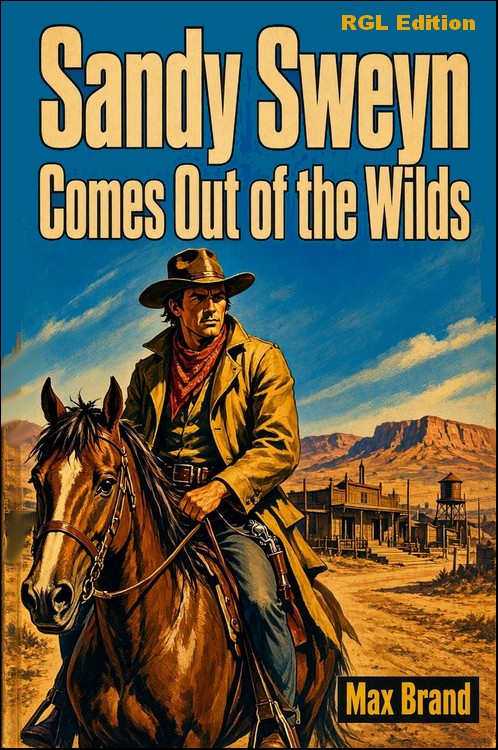
RGL e-Book Cover
(Based on an image created with Microsoft Bing software)
Roy Glashan's Library
Non sibi sed omnibus
Go to Home Page
This work is out of copyright in countries with a copyright
period of 70 years or less, after the year of the author's death.
If it is under copyright in your country of residence,
do not download or redistribute this file.
Original content added by RGL (e.g., introductions, notes,
RGL covers) is proprietary and protected by copyright.
RGL e-Book Cover
(Based on an image created with Microsoft Bing software)

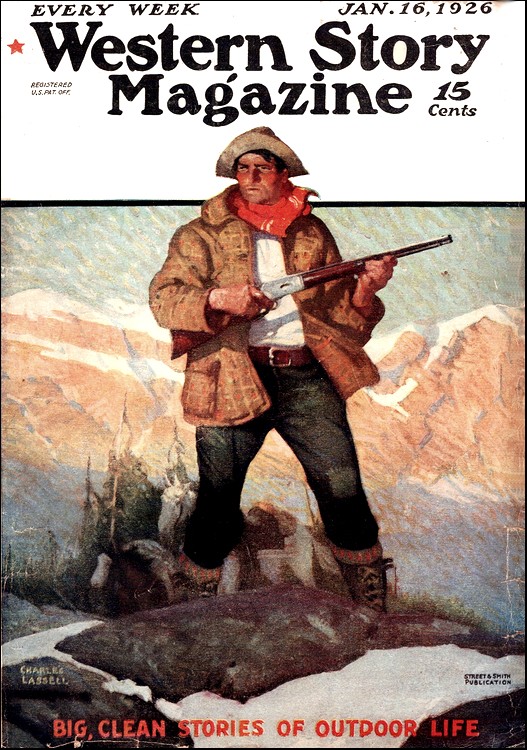
Western Story Magazine, 16 January 1926, with
"Sandy Sweyn Comes Out of the Wilds"

Title illustration from "Western Story Magazine"
Sandy Sweyn, a powerful but simple-minded man with an uncanny, almost mystical bond to animals, captures the runaway white mare Elena Blanca and unknowingly triggers a social and moral crisis in the Mirandos household. Catalina Mirandos—vain, cruel, and adored in her community—has publicly vowed to marry whoever returns the mare, a promise her stern father insists must be honored for the sake of family honor. When Sandy brings Elena toward her home, Catalina’s former suitor José Rezan ambushes him, steals the mare, and leaves Sandy bound in the sun; yet Sandy escapes with brute strength and animal cunning. The novel unfolds as a clash between Catalina’s vanity, her father’s rigid honor, José’s ambition, and Sandy’s raw, instinctive justice, with the loyal Irish setter Dick quietly witnessing the human cruelty and the unfolding drama.
IN the long run, everything depends upon Dick in this narrative. The strength and the strange wisdom of "Sandy" Sweyn, the fiery beauty of Catalina Mirandos, the sage gravity of her father, the big shoulders of handsome José Rezan, the resourceful courage of Sheriff Kilmer, the wind-blown grace of Elena Blanca, and even the freckled face and the crooked smile of Peggy Kilmer, could not have brought about the final conclusion of this history, giving it the shaping which it took, without the presence of Dick. It is really necessary to give him a little space in the beginning.
Dick was only five years old, but into those five years he had crowded such a quantity of learning that, in certain ways, he was wiser than the wisest king who ever sat upon a throne. There was in Dick a mild nobility such as others might envy but never imitate, unless their ancestry was clearly traceable, as was Dick's, through a family tree so long that it fairly filled a volume branching out to truly colossal proportions. There was courage, too, in Dick, and such devotion to the cause he espoused as the Spartans of old might have striven toward as an ideal.
Dick was a setter—a beautiful, red-coated Irish setter—clad in long and curling silk, with the grace of an angel arid the mild eye of a saint. He was a saint, this dog. Any bird man will tell you that all good setters have been breathed upon by heavenly virtues before ever they enter this world of thorns. Since Ireland is just a little nearer to heaven than any other country-—as several million people will agree —it is natural that the Irish setter should have entered just a little more deeply into sainthood than any other breed.
Dick, lying on the lawn outside the patio of Señor Mirandos, maintained his composure with a steadfast eye. One would never have guessed, to see the manner in which he wagged his tail arid softened his eye on the approach of the gardener, of the deep sorrow in the soul of the dog.
Yet how many crosses were here! From ranging after birds in old Erin to running the arid trails of the great Western desert of the States is a great difference, indeed. However, Dick would not show these swift emotions as they crossed his mind. As the gardener drew near to him, he abased his head a little and brushed the lawn with the long feather of his wagging tail. Into his eyes came a gentle light of love.
The gardener was a stranger, but that really did not greatly matter. Long ago, while he was still in the awkwardness of puppyhood, Dick had been taught by his lovely mother and had partly learned for himself, that all men are good, gentle, and true. Therefore he greeted them all in the same manner, with only a certain reservation of extra grace for those whom he knew arid loved.
However, all was not well in the soul of Dick. If he had allowed himself to give over to melancholy, he would have crept into a corner and died of a broken heart. Poor Dick yearned for just a single breath of peat smoke, such as, he had known of old.
Here men forgot his name of Dick and called him Ricardo. Men spoke to him in a strange language whose accents were all new to him. He would have been quite at sea, had not his mother taught him from infancy that one can read the faces of men just as clearly as one can hear their spoken words.
Dick lay on the lawn and listened to the humming of the wind down the valley. That wind brought to him keen scents of the pine trees; from time to time his delicate nostrils informed him that birds were on the wing, but no such birds as he had hunted in green Ireland. He closed his eyes, dropped his head upon his forepaws, and yearned after older and better days.
Then a high, musical voice called, "Ricardo!" He heard it twice before he realized that the name was meant for him. Up he jumped with a guilty start and hurried through the patio, to where his young mistress waited for him in the shade.
He approached her with care, head lowered, tail wagging in the most conciliatory manner. It was true that her voice was wonderfully sweet, but there was a quirt in her hand. He knew of old that that quirt could sting. However, he came at her voice, for still the instinct and the lesson remained firm in his mind that, no matter how strange and cruel some of their ways might be, mankind must be right. It was foolish and very sinful to doubt them. Only children might be shunned, for they did not seem to know that when one's tail is pulled it causes an exquisite pain; also, they are most careless about stepping upon sensitive feet.
"Sit down!" said the girl. "Sit down, Ricardo!" Ricardo sat down at once.
"Don't look at me as though I were going to beat you!" cried Catalina Mirandos, and she slapped the quirt angrily against her skirt.
A shiver ran through Dick. He gave, in spite of himself, only a tithe of his attention to the face of the girl. The rest of it was concentrated upon the lash of the whip, which he knew could cut so deep. Therefore, he failed to understand when the silver voice commanded sharply: "Come closer, Ricardo!"
Since that order was given in Spanish, Dick did not budge.
"Come closer! I have never seen such a stupid dog! Come right over here!"
Poor Dick merely crouched lower to the ground and wagged his conciliatory tail. The quirt whirled in the air. There was an angry shout from the girl, and Dick blinked his eyes shut in supreme dread.
The whip did not fall upon him, for accident intervened.
"Catalina!" called the voice of a man. She looked askance at her father, who entered the patio.
He was no great lover of animals, but he was a just man, this Mirandos. He said:
"What a devil is in you, Catalina, to make you beat your dog in this way!"
"I am only trying to teach him a lesson," said she, more angry than ever, "but the fool will not learn."
"Ah, well," said her father, looking curiously at her, "I often wonder, my dear, if you beat him because you wish to teach him!"
"Why else should I?" cried she and stamped her foot.
"Another reason may be that you like to use your power to make him crouch, poor devil! You wish to feel your power over him, just as you wish to feel your power over men. Just as you make men crouch before you and act like cowardly fools, because they want your smiles. Is there not some truth in that?"
Tears of passion sprang into the eyes of the girl.
"It is always this way," said she. "You always find the hardest things to call me, the worst interpretation to put upon everything that I do. You are never kind!"
"There you are!" said her father. "In a temper at the dog because he doesn't understand your language. In a temper with me because you will not listen to what I say!"
"Do I not listen?"
"Yes, but you will not try to understand me. Have you ever sat down by yourself, Catalina, and wondered if you could be wrong about anything? Do you not always tell yourself that you are right, and the rest of the world is cold and brutal if it happens to disagree with you?"
"I am going to my room," said Catalina. "I shall not stay here to be abused."
Her father watched her leave, while Dick crawled to his feet and lay down there, looking humbly up to his new master, thanking him with melting eyes for this kind intervention.
When Catalina got to the door into the house, Señor Mirandos called: "I think you had better stay here, my dear. I have news in this letter that will interest you."
"T don't want to hear your news," said Catalina. "I only know that you hate me!"
Her voice choked with self-pity.
"It is about Elena Blanca!"
At that, she whirled about and came running back.
"Oh," cried Catalina, "what has happened? Has my horse been seen again?"
"The mare is caught," said Mirandos, "and the man who caught her is bringing her here to claim his reward."
"His reward?" said Catalina. "You will reward him, father, I know. My beautiful Elena!"
"You forget," said Señor Mirandos, "you promised a reward, yourself. You promised the greatest reward you could give, to any man who could bring back the mare to you."
Catalina leaned a hand against a pillar and blinked her eyes as though a flash of light had dazzled them.
"You promised to marry the lucky fellow," said Mirandos sternly.
"It was a joke!" gasped out Catalina. "It was only a joke, as you know! Who would dare to keep me to such a promise?"
"It is a joke," said Señor Mirandos gravely, "that has kept men hunting for your mare for months. It is a joke that has appeared in the newspapers. It is a joke that has caused poor devils to squander thousands of dollars and their time and hope and labor to catch the horse. No, no, Catalina, it is not a joke at all, but a sad reality!"
"Ah, ah!" cried the girl. "But you do not mean it! You would not give me to some nameless stranger!"
Her father unfolded a letter.
"Listen to this," said he. "It is from Peter Dunstan. You know Peter Dunstan, Catalina?"
"He is the rich rancher," said Catalina eagerly. "It is he, father?"
"It is not he who caught the mare," said her father dryly. "It is quite another man, my dear. It is Peter Dunstan who writes the letter, however, and here it is."
He read aloud:
" Dear Señor Mirandos:
"This will let you know what you may have heard already— that Elena Blanca has been caught. But it will tell you what, perhaps, you cannot learn from any person quite so well as from me. The man who caught the mare is named Sweyn, and the only Christian name that is known for him is Sandy. To give you your bad news in a lump—Sandy Sweyn is a hopeless half-wit."
At this, Señor Mirandos lowered the letter and smiled grimly upon his daughter.
"No, no!" said poor Catalina. "You would never give me to such a creature as that!"
"Do not try to tell me what I would do, but listen to me, Catalina!"
"I listen, father. But—a half-wit—a dull-eyed, loose-mouthed, stupid—"
"If you had exceptions in mind, you should have made them before you published yourself abroad, my dear. The whole world knows that you have vowed to give yourself to the man who brings the mare to you. And as for—
"You are a Mirandos," said Catalina unevenly. "You would never see—"
"Hush!" said the rancher. "There is more to follow. You have not heard all the facts which concern this lover of yours!"
HE shook out the letter again. Dick, seeing that he was unnoticed by either of them, slunk gladly away toward the lawn. He could not quite decide to go out of sight. It might be considered by that quick-tempered and suspicious mistress of his that he was committing a fault by slipping from view. Therefore, the setter lay down at the entrance to the patio, and with one eye he watched the seductive green coolness of the lawn; with the other, he kept in mind the uneasy face of his mistress.
Señor Mirandos continued:
"I have known this fellow for a long time, and it is only right that I should give you the advantage of my experience and my knowledge of him. It is not unknown to you, perhaps, that I myself have spent a good deal of time and money to capture Elena Blanca. As a matter of fact, the half-wit was in my employ when he caught the mare. At the last moment, a freak of fancy came over him. He stole her away, and now he is going through the mountains to find her and claim the reward of her hand."
"That is theft!" gasped out Catalina, shuddering with fright. "Something can be done about that. There is a sheriff who— "
"Your promise," said the rancher, "was only to take the mare from any hand that brought her back, and thereafter to marry him, as a reward. If he has stolen the mare, does that make any real difference? No, no! You did not say that it should be the man who secured the capture of the mare. You only specified him who brought her to you. You must remember the facts, my dear, and you must be limited by them!"
He went on with the reading of the letter:
"It occurs to me that you may find it worth while to attempt to stop this man before he can come to your daughter with the mare and claim that reward of which we know. This would be a tragedy so terrible that I am as much horrified as you can possibly be..
"Let me tell you, in the first place, that any attempt to stop the half-wit would have to be made by more than one man. He is, as I have said, defective mentally, but he replaces the lack of real intelligence, to a certain extent, by a species of brute cunning. He is sharp and wide awake. You may take that for granted, when he is on the trail, however dull and sleepy he may appear in a house.
"You will need more than one man, and you will need numbers for several reasons. One of these is his enormous strength. In this, as in a great many respects, he is very deceptive. He looks to be, say, a fellow of about five feet and nine inches. He appears to be rather broad and plump, and you would put him down at about a hundred and sixty or seventy pounds, at the most.
"As a matter of fact, he is not much under six feet in height, I believe, and what appears to be plumpness is in reality iron-hard muscle. I am not a weak man, and I have known many powerful people, but he is without exception the strongest man I have ever seen or heard of. I have no hesitation in saying so. I really believe that there is more brute power in his hands and arms than in those of any two men!"
Here Señor Mirandos looked up from his reading.
"It would not do to anger such a fellow, if he were your husband. Do you agree to that, my dear girl?"
Catalina, clasping her delicate hands together in front of her white, sick face, could not make any answer. Her imagination was far too busy in probing the unimaginable horrors of the future.
Her father, after a single keen glance at her, continued:
"There are other qualities which make him formidable. He is, as I have said, very deceptive in his appearance, which disarms people whom he meets for the first time. He is about two inches, I should say, taller than the usual guess. And I think-that he is thirty or forty pounds heavier. His sleek and sleepy appearance gives an impression of stolid immobility, but that is by no means what he possesses. When he is roused to his work— and in the open air and on the trail he is nearly always roused—this man unites to his physical strength an uncanny power of eye and ear. He is so thoroughly in tune with the animal world—of which he is really a part —that nothing escapes him. He draws information, I should almost say, from the very scents on the air, like a hunting wolf. Though I don't want you to take this literally —some of the things which he accomplishes are positively beyond any normal understanding.
"In addition to this, let no one think that he is incapable of moving with celerity. Among men, he is like the wolverine. And you know that the wolverine, when it is roused, can fight with the speed of a demon. It is the same with this monster, Sandy Sweyn.
"He travels armed, of course, and he handles a gun or a knife really as if it were a part of him—equipped with the same nerves and senses that run in his own flesh. He seems incapable of missing his mark, the more sudden the emergency, the more critical the need, the steadier and surer he is bound to be. There is only one way to gain an advantage over him without a terrible loss. That is through surprise, I should say.
"I must say, also, that so far as I am concerned I should not regard this person as a human being, but as a sort of beast that walks upon two legs, and wears the face, the voice, and some of the mannerisms of other men. At heart, he is totally dissimilar to other men.
"As for his appearance, I have warned you, in part. I must say that his face is not displeasing, except in its stupidity. When he is on a trail, and his face lights, he is positively handsome, though in the house there is sure to be something disgustingly sodden and piggish about him. It is only when he is roused that a flare of light appears in his face. The rest of the time, h . wits sleep.
"His hair has the color which his nickname suggests, or it is perhaps a little more yellow than actual sand. And he has strange colored eyes—very close to the shade of the lashes and brows themselves. They give a very odd effect. One often can hardly tell when he is watching one. The emotions never show in those eyes until he had been roused to a frenzy, and then they turn to yellow flame.
"I have talked to you about this man at a great deal of length. It may be, as I suppose, that you will decide to stop him on the way. But you will not succeed. He has proved too strong for me, and I am sure that he will prove too strong for you, unless you send out sure marksmen to lie in wait for him, as you would make an ambush for a wild grizzly bear. Believe me, the similarity is not entirely far-fetched 1
"I remain yours with a thousand good wishes. Instruct me in what I can be of service.
Peter Dunstan.
"Let me see!" pleaded the girl.
Taking the letter, she read it through again, letter by letter, printing the awful truth deeper and deeper in her mind.
"But it is not possible!" gasped out Catalina. "You could never give me to a beast like this."
Her father was very pale, and his face had become quite drawn. He began to walk up and down the patio. As he walked, he talked—not so much to her as to his own soul.
"You have always been a delight to my eyes, Catalina," said he. "I have always been foolishly proud of your beauty. But I have not given you the sort of treatment that a girl should be able to expect from her father."
"You have always been kind—you will still be kind!" cried Catalina, sobbing.
"Exactly. I have always been kind. I have been too kind, and a child has a right to expect that its parents will give it such discipline that it will be prepared for the coldness of the rest of the world. A girl who has been raised with love only is not prepared for the facts in the world as she will find it. That is cruel. I have been cruel in just this way, my dear! In the meantime, shall I tell you a little truth?"
"Yes, if you will!"
"Very dear as you have been to me, I have been able to see certain faults in you—such as cowardice, cruelty, selfishness, and others of that kind."
"You hate me!"
"No, child; I have a great and foolish love for you. I see these faults in you, but still I hope that they are things which will be lived down. I hope that you will change before you come into full womanhood. That is what hope says, rather than what reason speaks! In the meantime, there are the facts for me to face. On the other hand, there is another thing to which I have given half of my love."
Catalina started erect.
"In that other thing," said Señor Mirandos, "I can see no fault. It is pure and perfect, and I shall keep it so at the cost of everything—my life and yours. It is my honor, Catalina!"
She turned paler than ever, now— and there was a hopelessness in her eyes. The "honor" of her father was an old, familiar foe to her. No matter of what malleable stuff he might be made, when that sense of honor was encroached upon, she reached a wall of granite that threw back her advances.
"Since the honor of this name has been clean in my hands, I must give you a final warning, my child. I shall not raise so much as a little finger of one hand to prevent the approach of this man who has caught the horse. Once he brings her here, I shall see that you marry him, if I have to drag you to the altar and whip the responses from your lips!"
As he spoke, it was no longer flesh and blood to which she listened, but an abstraction. Honor, indeed!
He turned away from her on his heel, as he said this. Catalina watched him go, filled with horror, knowing that to appeal would be the height of folly.
She ran toward the entrance of the patio, as though she hoped that help might be seen coming to her—or as though the flashing white body of Elena Blanca might be in view. There was nothing except the windy hillside.
She quirted the setter at her feet. "Stupid fool of a dog!" cried Catalina through her teeth. "How can you help me?"
SHE ran out to the stable. "I want the bay gelding!" the girl cried to Filipo.
"Ah, but, señorita! He is very wild, and he is very fast. And he has not been ridden during these two weeks!"
"That is why I want him, fool! Now hurry, hurry!"
While she waited for the gelding to be caught, she looked down at her clothes. Now that she was in a crisis, she must make her appeal carry the greatest possible force, and she could never do this if she were not looking her best. Back to the house she ran. In her room she scattered all about her and made two hours' work for her maid in five minutes of searching.
At last she had the correct silken scarf, knotted in the proper manner about her waist. She had the proper sombrero on her head, tilted at the smartest angle, with the right feather curling in a crimson streak along its brim. She pirouetted and viewed herself from every side. She needed still something—some touch of color—so she caught up a pair of gaudy emerald earrings and set them in place.
After that, she was content, and with a greater sense of power warming her blood, she raced from the room, still clutching the letter which had brought the fatal warning.
The bay gelding was waiting when she reached the stable. Woe to Filipo if he had taken longer than this to prepare the wild colt! He threw her up to the saddle, for she rode like a boy.
There was need for good riding, here. The bay gelding reared and danced like a very devil, his ears back, foam in his gaping mouth. At length whip and spur rocked him forward. He left the ground with a long leap, and shot off like a* greyhound down the valley.
She knew that road well, and it was good that she did, for never did a horse career over it more wildly than the horse of Catalina on this day.
The first mile was done at the first speed of the gelding. After that it began to falter a little from this terrible pace, and the spurs on the heels of the girl turned crimson as she drove them home. Every second seemed an eternity. In the meantime, there was a savage satisfaction in tearing the last ounce of power from the tormented body of the gelding.
She turned in a cloud of dust through the gateway of another ranch, leaped down, threw the reins at the head of the moso, and rushed into the house itself. A house mosa appeared with a smile that turned into a stare.
"Where is José Rezan?" cried Catalina. "Where is José Rezan? Instantly! Do you hear? Instantly!"
"He is here. Has your father been hurt, señorita?"
"José! Bring José to me, instantly!"
The mosa fled as for life. Presently a door crashed, there was a hurrying footfall, and here was big José Rezan, looking, if possible, more handsome and more huge than ever. He could hardly speak; he was delighted to see this unexpected visitor. He could only extend his hands toward her, but Catalina thrust into those hands the letter which she still carried with her.
"And my father will do nothing!" cried Catalina.
She threw herself into a chair and clasped her hands before her eyes. As for José, he was in a passion of dread when he saw his idol in such a state of mind. Before he had read two words in the letter, Catalina herself was almost forgotten. He read that dreadful missive through from beginning to end, and then glanced back to make sure of the more vital parts. All was vital; all was terrible to him.
He threw himself upon his knees before the girl.
"A half-wit!" cried Catalina.
"Catalina, my dearest, have I your permission to try to stop him?"
"Do you have to wait for that?" cried Catalina. "Do you stand here kneeling and moping while the half-wit is bringing Elena every instant closer to me? If he brings her in, actually, then it is the end! It is the end! Because my father swears like a madman that, for the sake of honor, he will force me to marry this insane man. He will drag me to the altar with his own hands. Do you hear, José Rezan? And still do you stand there and do nothing?"
José Rezan stood still no longer.
Even Catalina was satisfied by the manner in which he rushed from the house; even she smiled with content when she heard his great voice booming in the distance.
There was a hasty stir of preparation in the house. She was aware, past doors and down corridors, of the running of the moso and mosa. She heard the clattering of voices, frantic with haste. Here was a household to her taste. Here the position of José Rezan was not that of mere landowner, but, like a feudal lord, he had some claim upon the very lives and souls of his dependents, as it were. Obedience to him was an almost religious duty. Oh, that such an atmosphere could be imported into her father's house!
Presently José Rezan himself, mounted upon a superb cream-colored charger with a glistening silver mane and silver tail, rushed forth past the house, still thrusting his rifle into the long holster which ran along the saddle beneath his knee. Behind him rode a full dozen of hardy young cavaliers and old, men devoted all their lives to the service of the family of Rezan, now ready to live or to die for him.
It was a glorious cavalcade, and as they swept past each cavalier raised his quirt most gallantly to little Catalina— all saving Don José. He bowed low above his saddle and swept his great sombrero toward the ground.
The heart of Catalina was contented. After that moment, it was plain that she had not lived in vain. When she walked out to look after them, her soul was so well within her that she even extended her hand with much graciousness toward Dick. He had followed her flying horse at his best speed, as in duty bound. But not even a greyhound could have kept pace with the matchless burst of the bay thoroughbred as it flew up the road toward the Rezan house. So Dick arrived, faithful but a little tardy, and skulked toward his mis- , tress with head abased.
It only needed that half gesture of kindness to transform him. He passed into an ecstasy at once, frolicking around Catalina until he dared to rear and touch her with his fluffy forepaws, deeply coated with the powdery dust of the road.
"Filthy beast!" cried Catalina through her teeth, as she saw her skirt disfigured. She slashed furiously at the setter.
The agile foot of Dick enabled him to escape to a safe distance, but Catalina would never rest with a blow which had missed the mark. Now she shouted:
"Ricardo! Come again! At once, fool of a dirty dog!"
Dick slunk back. The hardest lesson of all was to come back for punishment, even when one was conscious of no sin. For that matter, he was never at all sure wherein his guilt lay when he was with this pretty young mistress, but he knew that the whip fell hard and often. He sneaked back to the girl and crouched upon his stomach, whining a little. There, with eyes closed and body shuddering, he accepted not one lash, but three,
"For running away like a coward, when you know that you have done wrong! I have half a mind to send you back to your stupid Ireland, where there is never sunshine I'll* that threat could have been translated so that Dick might have understood! He only knew that the mystery and cruelty of the girl seemed to increase from day to day. When he first came, there had been nothing but smothering caresses. He had been squeezed and petted from one end of the day to the other. There was a special mosa appointed in the ample household of Señor Mirandos, whose duty was to do nothing save to comb and tend and brush and feed the noble dog.
After this, there was a change. Having become familiar, Dick was more than half despised. There was now only one reason why Catalina kept him with her, .always—it was because the red silk of Dick's coat and the grace of his carriage made a note of color and beauty against which she appeared to good advantage. It drew eyes toward her, and there was nothing in the world which Catalina liked better than to draw all eyes.
She mounted the bay gelding again and set off toward her home with greater content in her heart. She told herself that it would be very strange if twelve gallant warriors, who knew the whole countryside as they knew a book, could not find this formidable Sandy Sweyn. No matter how dreadful a fighter he might he, they would crush him.
Catalina looked with much complacence upon this. She felt no twinge of horror. It seemed to her that the impertinence of the half-wit in daring to raise his eyes to her deserved punishment.
She minced down the road, enjoying the picture which she. presented to the eyes of others, rejoicing in the mirror of flattery that presented her to herself in every eye which she passed.
Here a cloud of dust swirled by her, and, with a clatter of flying hoofs, Peggy Kilmer, the sheriffs daughter, rattled down the road in front of her, the heels of her mustang tossing up a cloud of dust that showered thickly down upon pretty little Catalina.
Catalina reined in her thoroughbred with an exclamation of supreme disgust. She brushed herself off as well as she could. That was like Peggy Kilmer—to rush about the countryside in this unmaidenly fashion, her hair done into two pigtails, and the pigtails twisted into an ungracious knot at the back of her head, her divided skirt not very much more maidenly than the trousers of an ordinary cow-puncher. Here, for instance, she was galloping off without even a saddle on the back of that ragged mustang—only a blanket strapped on it, and no spurs on her heels as she drummed them against the ribs of the mustang.
No wonder Catalina was disgusted.
As she passed the house of the sheriff, presently, where Peggy was dismounting and dragging the bridle and blanket from her horse, Catalina drew rein a little.
"Hello!" yelled Peggy. "How's things, Catalina?"
She quite missed the answer of Catalina, for she had to leap backward to escape the heels which the mustang flung at her head before he darted away toward liberty.
"I hear your pa bought the Gregory Ranch," said Peggy, dropping her hands upon her hips and turning her freckled face toward the Mexican girl.
"He has bought it, yes," said Catalina. "You must come to see it soon."
"Can't do it to-day! Got the washing to turn out. So long, Catalina. Come in and have a cup of coffee with me some afternoon!"
Catalina could barely force a smile. She was shuddering with disgust as she rode on up the way. It seemed to her that the entire female sex was disgraced by the existence of such a creature as Peggy Kilmer.
Dick seemed to be of a different opinion. He stood with his head pressed against the gate, and wagged his tail as he looked toward the little shack of the sheriff.
IN the meantime, like hunting wolves sweeping forward in a swift line, the men of José Rezan rode rapidly across the hills. As they rode, they scattered until there was a great gap between man and man, but never a gap so great that the sound of a rifle shot would not have alarmed the companions to right or to left. There was only one way by which Sandy Sweyn could make his approach to the dwelling of Señor Mirandos. Along that way, which was a deep, broad valley through the mountains, the riders of Rezan were combing every inch of the ground.
While they searched diligently, through the pines before them a slender white mare trotted to the first break in the woods, and, seeing a single horseman in view, she whirled and raced back. Making a short detour, she came to another gap, and here again she saw a rider closing slowly upon the trees.
At that, she whirled and galloped straight back through the trees, until she came upon a great blue roan, a monster mare hardly distinguishable from the shadows of the woods through which she was passing. In the saddle was the lumpish form and the impassive face of Sandy Sweyn, with dull, sand-colored eyes and forehead perpetually wrinkled as in doubt.
From that rider Elena Blanca did not sheer away as she had from the two she had sighted before. She pressed in close to the side of the blue roan.
That was sufficient warning for Sandy Sweyn. He dismounted, and with a word he turned the blue roan into a statue, while he went forward in person to the edge of the wood.
There he saw an armed rider coming slowly down the valley, looking often from left to right, scanning all before him with the unmistakable air of the hunter.
Sandy Sweyn smiled and would have drawn back. As he started to move, he saw horse and rider suddenly go down heavily in the dust. At that he paused, very curious. It was not for the welfare of the man that he cared, but for that of the animal, since every beast was to him as one human is to another.
Apparently the horse .had stepped into a hole in the ground, for it rose almost at once and hobbled a little. When the rider mounted the saddle once more, his mount cantered a stride or two and then paused, shaking its head.
The rider had little patience to expend on his horse. He urged it once or twice with his voice—the quirt rose and fell and the spurs thrust deep. Thus stimulated, the pony bounded forward for a stride or two, and then came to a resolute stop and refused to budge.
There is nothing in the world that will madden a cow-puncher more than a balky horse. This rider fell into a fury at once. His spurs were quickly reddening the sides of his mount when he heard a rushing of hoofs down the slope and, looking up, he saw above him a blue roan mare, moving with gigantic strides. In the saddle was a man who answered in every respect to the description which had been given of Sandy Sweyn.
More than that, in the background ran that delicate beauty among horses —Elena Blanca. There could be no mistaking. That cow-puncher had seen the famous little mare once before, when pretty Catalina Mirandos was in the saddle upon her back, and he had never forgotten.
What he thought of first was to reach for his rifle and try a flying shot at the stranger, but he remembered in that crisis the last warning of José Rezan— that this fellow was a desperate and sure fighter. No one should attempt to handle him without help.
Moreover, the stranger did not seem to be approaching with any hostile intent. He called out in a friendly manner as he came, and he waved his hand. So the vaquero twisted the end of his mustache and waited, trembling with excitement.
When Sandy Sweyn came up, he dismounted at once and went to the puncher with a smile.
"You'll never get that hoss forward like that," said he. "Never in the world! It ain't the whip and the spur that he needs. It's a little talking and a little rubbing."
The vaquero—in the nick of time to keep himself from bursting into heartiest laughter—remembered that this was a half-wit with whom he had to deal. He nodded gravely.
"Talking and rubbing," said he. "I have seen many strange things done with horses, señor, but when they balk I have never seen them persuaded with rubbing and talking. I have heard some grand cursing of them, too, but never anything in the way of language that would get them to move. Nothing but whips—or even a fire built under them!"
"You'll have a chance to see," said Sandy Sweyn. "I may be wrong. Will you get off the hoss?"
The cow-puncher was glad to oblige, for it chanced that, at this moment, he saw two riders heaving into view, one far to his left and one far to his right. He knew that the men of his master would soon be gathering thickly around them. There was the flashing beauty of the white mare to apprise them, even at a distance, of what was there. If only they could send a signal on to the others, in the distance, and so let them know and gather them in a silent circle, it would go very hard, should Sandy Sweyn escape.
In the meantime, as soon as he had dismounted, Sandy stepped toward the mustang. The latter was now frantic with the pain of whip and spur, and backed off, snorting.
"Come to him, Cleo," said Sandy Sweyn. "Come talk to him, girl. He needs quieting down!"
The vaquero gaped. He was not a superstitious man. He believed that sundry of the saints had been capable of miracles, but he had never seen one that could not be explained by sleight of hand. This, however, was a very different matter, for he could swear that Sandy made no sign to the great blue mare. Yet, as though she actually understood every word which had been spoken to her, she went instantly to the balking, trembling pony and stood beside it. The mustang leaned heavily against her as if to say: "Stand by me, comrade, and we may yet prove too much for these devils—these terrible men!"
The blue roan touched noses with that frightened mustang. Whatever message it was that she conveyed to him, Pedro, the vaquero, could vow that his bad-headed cutting horse grew calm. He allowed the stranger to approach with open hand. Pedro would take his oath before any jury in the land that this, was a matter without precedence in the history of that broncho.
In another moment the mustang allowed the saddle to be stripped from it. It was turning its head and pricking its ears as it skeptically eyed the stranger.
"Magic!" whispered Pedro, and he crossed himself.
After that, the hands of the half-wit began to roam swiftly over the body of the broncho. Another moment—and there was a sharp squeal of pain from the horse.
"Here it is!" said Sandy Sweyn in triumph. "I knew that it was something near the hocks."
"Señor!" cried young Pedro. "Have a care! That demon of a horse has already put my brother in the hands of the doctor for a full six months. Beware of his heels!"
"His heels?" asked Sandy Sweyn, standing up with a blank eye directly to the rear of the broncho. "Oh, he'll do me no harm. He's feeling happier now!"
With that, he leaned over and began to massage the great tendons and knotted muscles in the back of the pony's right hind leg. So deeply did his finger tips work that the horse fairly groaned with the pain. Its other heel lifted tentatively from the ground half a dozen times, while Pedro looked on in an agony of half-joyous expectation.
There was no kicking. As Pedro declared afterward, even in its pain the mustang attempted to raise its ears from time to time—sure sign that it knew good was being done in its behalf!
In the meantime, Sandy Sweyn talked gently:
"He gave that leg a wrench when he went down. If I were you, I tell you that I should not ride him home. I should simply walk, and let him walk behind you. Better still—to camp out here, to-night, and rub his leg down half a dozen times before morning."
"Walk home—camp out all night—stay awake to rub him down! Ha, señor, do you think that I am taking care of an old mother? This is only a horse, and not a very good one. No, not a very good one at all. He'll take me home to-night or I'll know why, and I'll ask him the question with my spurs. They are sharp enough, if I care to make them talk!"
He laughed rather savagely. Sandy Sweyn bowed his head and seemed to be lost in thought. He was so deeply lost in it, indeed, that he did not notice beautiful little Elena Blanca come running from the distance to press close to him, her head thrown high, trembling in every limb. He was so lost in thought that he did not hear the creaking of saddle leather as other riders approached him. If he heard, the sounds passed into his subconscious mind and did not affect his consciousness.
At last he said: "If you ride this here hoss, stranger, you're gunna ruin him. If you ride him before to-morrow morning, you will ruin him, sure!"
"Put back the saddle on him, then," said Pedro, growing more confidently insolent as he saw the others pressing nearer to him in a thickening circle. "You've done your part and wasted plenty of my time."
"I'll put back the saddle," said Sandy Sweyn, "but you can't have this hoss to ride until to-morrow morning."
"Can't?" cried Pedro. "Can't? Are you threatening me?"
He reached for his gun with great speed, but he did not make the draw. Light winked at the right hip of Sandy Sweyn, and the long, black body of a Colt glimmered wickedly in the sun as it pointed straight at young Pedro.
"You watch yourself, stranger," said Sandy. "I don't aim at no trouble with you, but— "
His voice trailed away; he had looked up and found a circle of enemies had been thrown around him.
SOMETIMES, when more than one gun has secured the drop on him, a desperado, to whom surrender means eventual death at the hands of the law, has been known to risk a move and even to win away to freedom, by diving at the table which supports the lamp, or some other trick which throws the others into confusion. There was never a man, since the beginning of time, who could boast that he had defied and escaped from five leveled rifles, twenty or thirty yards away, all with a careful bead drawn upon his heart and head.
Sandy Sweyn stared feebly at these apparitions.
"Where did they come up from, Elena?" said he. "Dog-gone me if it don't look like they had growed up out of the ground in the last couple of minutes!"
Elena Blanca sidled closer to him as she heard her name. She had had no doubt, for her part, from the first moment when she saw these strangers approaching. She had distrusted them with all of her heart. To her thinking, there was only one human being who was really worthy of sublime submission and love. That was Sandy Sweyn. All of the rest were traitors and devils, to be avoided like poison.
"All right, Sweyn," said José Rezan. "Just put up your hands, my friend. I want the guns that you carry, and I want your knife. Move fast, Sweyn."
A smile rose to the lips and the vague eyes of Sandy Sweyn. He lifted his hands above his head.
"If you want money," said he, smiling still, "you'll find that I ain't got none. Money is a thing that I get along without pretty well. But you use a pile of men in your holdup game, don't you, stranger?"
He looked on with admiration.
Half a dozen other riders were now swarming over the edges of the hills,, coming at full gallop toward him. José Rezan saw fit to overlook this speech.
"Get to him. Pedro," said he. "And go through him for guns. Be quick, man!"
Pedro obeyed with alacrity. The clothes of Sandy were swiftly searched. One revolver and an old hunting knife were all that were found in his possession.
"And now," said José Rezan, "back up, Sandy Sweyn, and keep clear of us. Valentino, take the blue mare. Get a rope on Elena Blanca, some of you."
Elena Blanca, too late, seemed to realize that protection for her was not in the power of her companion at this moment. She bolted like a white flash for freedom, but swifter than any horse could dash was the leap of the lariats in the hands of three or four of the vaqueros. In a moment she was plunging blindly in a tangle of lariats.
Valentino, making for the blue roan, had a different problem on his hands. A shrill, sharp whistle from Sandy Sweyn made the big mare leap away, and Valentino lunged hopelessly after her. There she stood, dancing in the distance.
"Watch Sweyn!" called big José Rezan. "Three of you keep an eye on him. The rest of you—except the first two topes on Elena Blanca—scatter and get the blue roan. We have to have her unless we want Sweyn trailing right at our heels! Get your ropes ready."
They scattered obediently, forming rapidly into a great semicircle, whose horns began to stretch out toward a complete encircling of the big mare. Another whistle came from Sweyn, thin and high as the whistle of a kite and repeated with a rapid tremor,
"Stop that fellow's whistling," called Rezan, "or put a bullet through him. Cut in, lads!" 9"
They went at the blue roan with a willful rush, but the whistle had been like a precious warning to her. She wheeled away and flaunted off across the valley at a speed which left the horsemen of José Rezan hopelessly to the rear. In a moment or two she was obviously safe from all pursuit.
Rezan saw that before the others. He called back his men and jerked his rifle to the shoulder. When he glanced down the sights and found the body of the blue mare gathered in their ominous circle, he shook his head and lowered the muzzle again. He was an honest fellow, this José Rezan, and perhaps the very worst act of his entire life was this capture of the white mare from the hands of the man who had taken her on the desert. Evil breeds evil, and the heart of Rezan on this day was blacker than ever before. Yet there was not viciousness enough in him to permit the slaughter of this magnificent creature.
It was said by some that, blinding as was the speed of beautiful Elena Blanca, with her legs of an antelope and her slender body, yet so much greater was the strength and the swiftness of the blue roan that it had borne the binding weight of a great range saddle and the impost of a two-hundred-pound master and still retained enough stamina and speed of foot to carry it up to Elena in fair racing over the desert.
Rezan did not believe this wild tale, but he felt that the mare was indeed matchless among desert or mountain horses. He could not shoot her down now. Another plan formed at once in his mind.
Old Valentino—the steadiest and the most formidable of all his vaqueros— together with young Pedro, was detailed to remain behind with Sandy Sweyn as a prisoner, while Rezan galloped swiftly away with the rest of his men to carry the white mare to pretty little Catalina Mirandos.
"Take him over to* the shade of the trees," said big Rezan. "Give him water when he wants it, and roll a cigarette for him when he wishes to smoke. But see that his hands are tied together, and never take your eyes off him for an instant. I tell you, this man is more dangerous than his dull eye may lead you to think. Watch him till well past noon, and then you may take the rope from his hands and you may ride in. Ride fast, too, for fear lest he should overtake you on the way."
With this he galloped off, and his men followed, with only one thing to lessen the speed of their riding—the refractory conduct of Elena Blanca.
Valentino and Pedro, the height of all respect while their master was with them, altered their attitude somewhat as soon as he was out of sight.
They first fastened the wrists of Sandy Sweyn behind him. Then they led him toward the grove of trees. They did not take him into the shade. Pedro felt, in some mysterious manner, that he had been disgraced in the eyes of his fellows by the strange manner in which this fellow had secured the drop on him, even though he was allowed to make the first move toward his weapon. That union of speed of hand together with such vague blankness of eye composed a perfect mystery. Since Pedro could not solve it, he grew vicious.
"The sun," said he to Valentino, "will make this man less dangerous. Let him cook for a while out there, while we watch him in the shade!"
"It may kill him," aid Valentino with some caution.
"Well," said Pedro, "do you think that our master will very greatly care for that? Does he really want this man to come in and accuse him of stealing Elena Blanca away from him?"
The logic of this was great enough to beat down the objections of Valentino at once. The pair of them ordered Sandy Sweyn back into the sun with a wave of their drawn Colts.
There was no objection from Sandy.
He settled down against a ragged-edged heap of rocks and sat there with the stolidity of an Indian—not a muscle of his face changing.
Pedro settled back in the shadow of the trees.
"We shall see when he begins to moan and beg!" said he, and he laughed until all his glistening white teeth showed.
There, was about seven eighths Indian in the blood of that Pedro. Valentino had his share of the same cruel spirit. They lay back in the shadow and smoked their cornucopia-shaped cigarettes, letting the ashes fall where they would, as all Mexican gentlemen should do.
If you have ever ridden under the summer sun in the mountains, you know with what a force it descends. If you draw rein for hardly more than a moment, that sun begins to eat in through your coat and your shirt. It will scorch the surface of your skin. To sit motionless in that white heat, with the rocks and the sand reflecting it like dull mirrors all around, is more than human nerves can endure, really.
The face of Sandy Sweyn turned crimson; then it began to grow pale. Perspiration formed on his forehead and ran down into his eyes, stinging them like fire and turning them bloodshot. Valentino shrugged his shoulders in some sympathy with this agony; Pedro laughed aloud.
"This will teach him," said he, "that only fools have gentlemen for their enemies—at least, such gentlemen as José Rezan! It will teach a gringo dog to raise his eyes to such a lady as Catalina Mirandos! And this gringo—look at him, Valentino! He is no more than a pig!"
If the pig heard, he made no sign. He was working his shoulders steadily, in a patient endeavor to shrug the heat off or to create a little air space between his shirt and his skin. This foolish, patient effort caused a shout of laughter from Pedro, who found it an exquisite amusement.
Only, there was this to be noted— while the shoulders of the wretched Sandy were working ever so slightly and restlessly, his arms were moving behind his back still more. His hands and wrists were steadily tugging up and down. With the tips of his fingers he had located a sharp and serrated rock edge just behind him. He was sawing the rope which bound him, patiently up and down against that stone.
IT was well for Sandy Sweyn that he had been fastened with rope instead of rawhide. With rawhide, as a rule, your true vaquero much prefers to work. Made supple with oil, it is braided close and seasoned by weathering and dragging upon the ground. It is tested by using it to wrench a mesquite out of the ground; it is as flexible as the body of a dead snake, and as strong as iron. When it is thrown through the air, it whistles like a thrown knife, and it cuts very nearly like a knife when it strikes. With rawhide young Pedro had wished to bind the hands of the prisoner behind him. In that case, all would have been safe for the guards. But it chanced that Valentino had a convenient rope end, and Valentino could imagine no better use for it than this. So it was wrapped close about the wrists of Sandy. Indeed, it seemed strong enough to hold a pair of raging horses, let alone a single quiet, patient man!
In the meantime, that patience was scrubbing the good rope up and down. The rock teeth would not bite into the fabric at once; each strand had to be frayed and then rubbed thin. Finally it parted, shred by shred.
"I think that he is getting sick, Pedro. Look at his face!"
To be sure, it was very pale and haggard, and the lines sank deep.
"He is like a balky horse," said Pedro, "He will not stir or complain. However, I shall see how he is!"
He stepped forward and, with the loop of his quirt dropped under the chin of the prisoner, jerked the head of Sandy suddenly and brutally back. His hat fell off, and his eyes looked up into the face of Pedro.
Valentino laughed heartily, consumed with mirth at this prank of his companion.
"His eye has not the look of the eye of a dead fish, as yet," said Pedro, returning with a smile to the cool of the shadows. "But we will let him cook for a while with his hat off. That may hurry the boiling! That sun has an edge like a knife. It bites through my coat!"
Sandy Sweyn sat without a hat, sweltering in that cruel sun. but never changing a muscle of his face in acknowledgment of the increased torment. It was not torment which he had to crowd back from his eyes and mouth. It was a savage exultation and an expectation of revenge, for now the rope was deeply cut.
He worked harder than ever.
"He is fainting. Pedro!" exclaimed Valentino at last. "See how he sways! You see that these white skins were never meant to endure the full sun of the day. See how he sways!"
"Gringo!" said Pedro. "Will you beg for help now? Will you crawl on your hands and your knees, or will you wriggle like a worm, if we let you come into the shade?"
He raised the quirt with an angry snarl.
"Will you speak, pig?"
He got no answer. Therefore, Pedro lurched a long stride forward, swinging the quirt high. The thought of how that quirt would feel, swishing down upon the scorched shoulders of the prisoner, forced an irresistible temptation to Pedro.
This hurried the process which had been carried on with such patience. He forced Sandy Sweyn to place the knuckles of his hands together and then to buckle the wrists outward. Under that tremendous strain, the last strands of rope parted with a snap, like a parting cable. The thick arms of Sandy Sweyn swung far out from his side, free!
Ah, Pedro, however swiftly you have leaped and sidestepped in your wildest dances, be far faster now, for there is need! Pedro leaped, you may be sure, with a scream of terror, forgetting his raised whip and clawing at the revolver at his belt.
He was pulled down from below. Fingers stronger than the talons of an eagle laid hold upon his ankle and wrenched him to the ground, where his back struck with such force that all the air was knocked at once from his lungs and the revolver shot far away across the sands.
Valentino, filled with amazement and horror, whipped out his own gun and leaped to his feet. As he rose, the gringo rose also, with the helpless body of Pedro in his arms. Where could Valentino shoot, without sinking a bullet into the body of his compatriot?
Pedro danced backward and then to the side, in an ecstasy of terror and of impatience.
"Valentino! Do not fire! Do not fire, Valentino, my friend, my brother, my father! I shall give you my gray colt and my blue silk shirt."
"God teach me what to do .'"gasped out Valentino. "I shall shoot for his legs, amigo. Raise up your feet."
Then a miracle happened. The body of young Pedro shot backward through the air straight at Valentino's head, propelled from the inhumanly strong hands of Sandy Sweyn.
There was no more than time for a partial dodge; one of the wide-flung arms of Pedro struck full across the face of his friend.
Valentino was man enough to rally in spite of this handicap. He fired, but he was still more than half blinded by that unexpected blow, and before his eyes cleared the wrist of his gun hand was in a grip that made the bones bend. The Colt dropped from his numbed fingers.
Sandy Sweyn gathered his captives together, one in either arm. Then he shifted his grip. In his left hand he gathered the long hair of their heads and held them so. With his right, he went leisurely through their pockets.
He said nothing as he worked, but he proceeded with care. Nothing escaped him. Not even the brown papers of Valentino's cigarettes. Even these were extracted and tossed into a careful little pile.
Then Sandy Sweyn stood up. Still holding them by the hair of the head, he dragged them backward to the spot where their horses stood.
"Kill me at once!" cried Valentino. "After such shame, I do not wish to live!"
Sandy Sweyn only laughed, and that laughter made Pedro scream again. He wrapped his hands around the leg of Sandy.
"Señor!" he gasped out. "I swear that I shall be your servant. I shall always—"
"Peace!" cried Valentino. "Peace, cowardly dog, because if we live I shall slit a throat that shames our whole race. Will you beg—after what we have done to him?"
Pedro begged no more; he had fainted in utter anguish of spirit.
In the meantime, from their own saddlebows, two rawhide lariats were detached. With these Sandy tied them, back to back and heel to heel. He secured their heads together by knotting their long black hair—an ingenious device which pleased Sandy. After that, he tied them to the rocks. Then he stood up and regarded his work.
"So!" said Sandy Sweyn. "You will toast a little, also. Come, Cleo!"
At his call, the blue roan mare, which had lingered not far off all of this time, came sweeping in to him with a joyous whinny.
He leaped into the saddle and regarded the prisoners with another critical stare. The sun was hanging at its hottest pitch, and every instant of their exposure would be a keen agony. Unless they died of panic, before very long the setting sun would throw a shadow from the pines toward them. For that shadow, how eagerly they would wait!
These things were noted by Sandy Sweyn, and he nodded his head and smiled to himself. Although he felt in his heart a loathing for all humans that he had ever seen, he could not bring himself to downright laughter.
He turned loose the two mustangs, also. From the back of the lamed horse of Pedro he removed the saddle and the bridle with care. He nodded while he watched it hobbling slowly off, throwing its head as the strain came at each step upon its injured leg.
Quiet and the heat of the sun would restore that leg by the next morning, thought Sandy Sweyn. He turned for a last look at the vaqueros. Valentino was silent, as ever, composing himself.
"Water!" screamed Pedro, who had revived. "A little water, kind Señor Sweyn! A little water!"
The deadly snarl of Valentino interrupted him. "Puppy! It is not ten minutes since you half emptied your canteen. Be still, or I shall find a way to kill you sooner than the sun would do that good work!"
The voice of Pedro broke into a wild sobbing. Sandy Sweyn, with a shudder of disgust, turned his back and sent his horse cantering swiftly up the valley in the pursuit of the troop which had carried Elena Blanca away.
He thought of the little white mare and the injustice of the men. As for Catalina Mirandos, he hardly thought of her at all. She was to him a strange mystery. Why men should hunt the little mare for the sake of Elena's swift-footed self was explicable. Why they should wish to hunt her merely for the sake of a woman, he could not understand. He had been filled with only a mild curiosity to look upon the face of Catalina.
IN riding up the valley Señor Rezan had not neglected to place final outposts, two reliable men. Where the valley narrowed to a simple gorge they were instructed to wait among the rocks, so that, if Sandy should escape from his guards, they could block his way from these final points of vantage.
When he had established these final marks of safety, Rezan hurried on. Finally he reached the Casa Mirandos.
Straight into the patio he rode. Others had seen him coming. They had heard the trampling of the hoofs of his horses. They had looked out and seen the famous beauty of Elena Blanca, and in that -single picture they were able to read a story which told them that the long chase was over, at last. The most romantic incident that had ever taken place in those old mountains was .now preparing for its last act. They tumbled out and mounted their horses in haste to follow.
It was a happy party, There was hardly a young man in that party who / had not striven for the prize or yearned to have good fortune in it. Now that they had failed, and the quest was over, there was not one of them who was not glad that José Rezan had been the lucky-man. They all knew that he had loved beautiful Catalina Mirandos longer than any other man. He had, at one time, been the accepted lover of the girl; she had been engaged to him and all but the wedding day had been arranged. What more fitting, then, than that he should return to her in such a triumph as this?
Besides, there was no other man in all the mountains who had half the stately dignity, the fine bearing, and the handsome face of this same José Rezan. Just as Catalina exceeded all the women in her beauty, so did José exceed all the men. The babble of talk that went up and down the procession was gay and rapid. "How did he find her? How did he take her? He was at his house, only this morning, and now he is here with Elena! How did it come that she wandered back here from the desert?"
"We shall tell you the truth. It has to be known. She was captured by another man. And that other man was bringing her in-—when our master met him with us all behind him^-and we took the mare from the stranger—a half-wit with a stupid, dull eye. His name is Sweyn. We left him sitting like a fool in the valley, guarded by our men. Now he is losing the price of all of his work!"
"There will be trouble, then, if he comes to make a claim to the sheriff?"
"Oh, there might be trouble, then. But what would they do, except to put a great fine upon Don José, perhaps? They cannot take the mare away from Catalina Mirandos again, because all men know that the mare belonged to her and merely had strayed away. Neither can they accuse Don José of refusing to pay the worth of the mare. What is money to him? Is he not rich? Does not this marriage mean everything to him? When the sheriff comes to him, he will simply say: 'Let the man Sweyn put a value upon the horse which he says that I took from him, and then
I shall pay him his money in full and a little bit more!' That is how the business must turn out!"
The procession passed toward the house of Mirandos. When they arrived at the patio, Don José would have kept the others back, but there was a great roar from all their voices: "We will have Catalina Mirandos come down to the patio! Where is she? Let her come. Señor Mirandos, bring down your daughter to the patio!"
Señor Mirandos would have been glad to escape from such a necessity. He would have sent Catalina closely to her room, to stay there until the mob was gone, for he was not one to enjoy having his daughter stared upon.
But how could he control her? The chance of being looked at was so charming to our Catalina that the roses blos- somed at once in her cheeks. She was at her glass only long enough to crowd a red rose into the shadows of her hair. Then she was flying down the stairs and dodging past the sedate form of her father.
Yet when she slipped out onto the patio, it was with the shrinking step of a deer frightened by the hunter from its covert. The color which vanity and haste had put in her cheeks appeared the blush of maiden modesty. Oh, wise Catalina! So well did she manage it that a veritable shout went up from the crowd, not only from her Mexican compatriots, but from the true Americans, also, who had ridden up to join in the formal triumph of big José Rezan.
Then she saw Elena Blanca and started forward with a glad cry. You would have thought that Elena was really something more than a mere peg upon which the notoriety of Catalina Mirandos had been hung. The men grinned in pleasant understanding. It was, of course, the general idea that Catalina was so terribly fond of the mare, and the white mare was so terribly fond of her, that when that beautiful companionship was interrupted Catalina could not help but offer any reward in the world to the lucky man who could bring back the mare to her.
Elena Blanca, like the little devil that she was, now threw a monkey wrench into the idyll by beginning to rear, paw the air, and prance around when she saw her mistress, acting as though her one passionate desire was to smash the fair Catalina to a pulp. Catalina had no idea of letting herself come too close to the white devil.
"See what they have done to her! They have made her into a savage beast!" cried Catalina, with tears in her eyes—she always had tears at her command. She clasped her hands together.
As for the men, they were busy controlling that little white flash of a mare. There was only one pair of eyes which remained fixed upon Catalina. Glancing down toward the rear of the crowd, she encountered the quizzical smile of Peggy Kilmer, the sheriff's daughter. The flush deepened upon the cheek of Catalina.
She knew that Peggy understood. What men could never understand, the quick glance of a woman could unravel. Catalina knew that her mystery was open as the day to the glance of this girl. She sighed, turned a little away, and wished that the freckled face of Peggy Kilmer were any place in the world other than here.
Now came tall José Rezan and stood before her, looking stupidly guilty and ill at ease. She drew José with her into the house of her father. The crowd gave its last shout as they disappeared together. Inside, they encountered the wicked tongued Señor Mirandos himself. He said:
"So she is taking the bear to escape from the lion. Is that it, José?"
His daughter made answer with an ugly look, and then she drew José on to the living room and sat him down beside the great open window.
"José, my José," said she, "what a hero you are! And how did you manage to do it?"
"We met him and took Elena from him by force," said José, "and that was all that there was to it."
"And he was not so terrible, then, as a fighter? There was no one really hurt?"
It might have seemed, to a discriminating eye, that there was a shade of disappointment in the eye of the girl as her lover answered: "No one was hurt. He looked merely simple. One could see that he was a half-wit. He looked like a man only half awake."
"But how could he have captured Elena, if he has only half of a normal man's wits?"
"Because he rides the fastest mare that I ever saw, and the strongest. We tried to catch her—to keep him from following us. She simply laughed at us. I have never seen such speed!"
"Then he will follow?" exclaimed the girl. "Oh, José, be careful. You are all mine, now, and you must take the greatest care of yourself!"
José could not help smiling, remembering the rope which bound Sandy Sweyn and his two guards posted in the valley.
"There is no fear," said he. "You shall not see him here. He will not follow!"
"And yet," said Catalina, "I can hardly believe that he may not find a way—if he had wits enough to capture Elena, you know!"
In one thing more José felt himself enormously lucky. When he pressed for the wedding day, Catalina was willing to discard a long preparation. It might be to-morrow, she said, and the face of honest José Rezan lighted with a consummate joy.
As the day was turning toward the dusk he rose to depart. Before he reached the door of the Casa.Mirandos there was a rattle of hoofbeats outside in the patio, then a babbling of voices at the door.
The door opened. A man staggered in before them, his face drawn, his head tied in a crimson rag.
"Carlos!" cried big José Rezan. "What has happened?"
"Sandy Sweyn!" gasped out the other. "He has broken through us!"
José Rezan pushed him into a chair and brushed the chattering servants from the room.
"It is one of the two whom I left to guard the head of the valley and keep back Sweyn," he explained to the girl. "Now we must find out what has happened!"
AS for Catalina, exclamations of pity and of distress poured from her lips. As she hurried to bring wine, warm water, and to make a clean bandage for the head of this Carlos, it seemed to that hardy vaquero that she was an angel of mercy, sent from heaven to relieve the woes of man. In the eye of the girl there was a profound satisfaction.
Sandy Sweyn, seeing that he was a half-wit and a fool, of course, should not be permitted to claim the reward which she had offered to him who brought back the little white mare. At the same time, she was consumed with curiosity about him.
Of all the cavaliers who had ridden forth to perform this great feat, it had remained to this mysterious Sandy Sweyn to conquer. It seemed hardly right that he should be caught like a foolish bird in a net at the very moment when he had almost brought the horse back to her! It seemed very wrong, indeed.
Now it seemed that the foolish goose of a man was a bit of an eagle, also. The net which had held him had been broken through, and as he burst to liberty, here was one mark of his talons! Her eyes-kindled like that of a kindred bird of prey.
Carlos, comforted with wine and a soft bandage, could speak once more.
"Mateo and I watched from among the rocks in the very places where you had put us, señor. We did not sleep, I can tell you. We did not think that this Sandy Sweyn could break away from two such men as our friends, Pedro and Valentino. Is not Valentino a great fighter? However, we watched well, if only because the señor had intrusted this duty to us."
"I want no more compliments," said José Rezan tersely.. "Let me hear what happened!"
It was Mateo who, looking down the valley, caught sight of the blue roan mare and her rider coming with incredible speed up the rise of the ground.
Mateo called a soft warning; he moved to get into a better position, to command the direction from which Sandy Sweyn was riding. The two vaqueros came to a brief and clear understanding. Since this man had been able, in spite of his limited wits, to elude the bonds and the guns of their companions, Valentino and Pedro, since Valentino was a known man of prowess with weapons, Mateo and Carlos had decided that it would be far better if they made no attempt to destroy this fellow after a parley, but to shoot as soon as he had ridden into point-blank range.
They prepared their guns and watched the stranger dip out of sight for the last time before rising up into the danger of their weapons—he and his blue roan. However, he did not rise at once.
"I am a patient man," said Carlos. "But the moments began to seem long. I have sat to wait for a rabbit to come out of its- covert. I have outwaited even a snake in its hole. But as we sat there to keep watch among the rocks, a pair of crows kept scolding at us from a blasted pine tree near by. Their voices seemed to be calling attention to us. I made a sign to Mateo that I would go forward a little to see what I could see. Mateo agreed.
"So I slipped away—a snake could not have made less noise, I swear to you, señor. You would have found no fault with me, if you could have seen with what care I went about this work. I pushed my rifle slowly before me. Not even the ear of an owl could have detected me. I came, after much labor, to an edge of the rocks, and when I looked down, I saw the blue roan mare • —and her saddle was empty!
"At that, I guessed that Señor Sweyn, having seen the narrow passage between the rocks ahead of him, may have guessed that there was a danger there, and so he had gone ahead to examine the place.
"When I made up my mind to this, I turned at once, and I went back toward my friend, Mateo, as fast as I could. All was silent, for the crows were making noise no longer. When I came to the place, suddenly there was a great form of a man leaping up and at me from the crevice where only Mateo had been crouching before.
"I tried to fire my rifle at him, but there was no time. He held a rock in his hand, and he threw it. That made the wound which you see along the side of my head.
"I fell into a darkness. When I wakened, I crawled to Mateo, and I found him lying, breathing, but very sick.
"There was a canteen filled with water beside him. And there was a little flask of whisky. The señor, Sweyn, had left these things for him.
"I asked poor Mateo what had happened. He said that a little after I had started, just as the crows stopped their chattering, something leaped on him from behind. A hand was pressed over his mouth which kept him from crying out; another arm passed around his body and crushed him until he felt his ribs giving way.
"He heard a voice behind him saying that if he remained quiet and made no sound, all would be well with him. It he attempted to give a warning, he would be shot instantly.
"Poor Mateo! There was no need of giving him such warnings. He was too sick to pay any attention to anything in the world except himself. His ribs had been broken by that terrible bear hug. He could barely whisper to me, even so long after it had happened. He said that there was such a power in the arm of that man that he could not believe a human being had done it. It was really as though a terrible machine were crushing him, and he heard his ribs pop like pipe-stems!
"After that, I gave him a little of the whisky, and I dragged him under the shadow of the old pine tree out of the sun. He screamed when I lifted him, but I could not leave him to be baked there.
"Then I took my horse and galloped him as fast as I could make it all the way to your house. When they told me that you were here, I spurred hard to get to you. I have told you everything, señor. There is nothing left out. Will you believe me?"
"I believe you!" said José Rezan. "There is only one thing. It is nonsense to say that he might have looked ahead and judged from the narrowness of the rocks, there, that the place was guarded. How was he to tell? There were a hundred other places which I might have guarded. No, no, Carlos, you have told everything except the most important thing of all—the thing in which you were to blame. Confess to me that just as this Sandy Sweyn was coming close to you, either you or Mateo stood up and showed yourself foolishly or else you made a noise that warned him!"
Carlos grew pale with protestation. He threw his arms high above his head.
"T swear to you, señor, as I hope for a heaven hereafter, that we did not stir. We could not have showed our- * selves!"
"Humph!" exclaimed Rezan, unimpressed. "How could you see him so clearly without giving him a chance to see you?"
"Because, señor, each of us had chosen a place where there was only a narrow chink between two rocks, and looking down through those chinks there was not half an inch of our faces to be seen. That half inch was covered with black shadow. No, señor, if you will come back with me to the place where we were hidden, I shall point out the very spot. Believe me that I do not lie!"
"Consider this, my friend," said José Rezan, frowning, "there is a mystery in the story as you tell it. There is a great mystery. You swear that you could not be seen and that you made nO noise?"
"No, señor. Neither of us stirred. Even if we had, the noise which the cursed chattering of the crows made would have covered us. Even so, we did not stir. We knew that this man had found a way to break from Pedro and Valentino. We knew that they had as great an advantage over him as we had in our secret places. Therefore, we were determined to throw away no chances, and, believe me—we did not! No, señor, we did not show ourselves, and we did not make any noise."
"Your horses, then?"
"Our horses were half a mile away. I myself took them and tethered them there."
José Rezan shook his head.
"I want to believe you, Carlos," said he. "I know that you are honest, and I think that you are trying to tell me what you believe to be the truth. But there is something left out of your story. In some way Sandy Sweyn received a warning that there was danger waiting for him up there among those rocks, and, after he had received that warning, he dismounted and stole ahead on foot with the greatest caution to see what the danger could be. Your own surety was, of course, what ruined the two of you—that and your foolish maneuver forward to see what had happened to him. The great question that remains is—how did he get his warning?"
"I have a wild thought!" said Catalina, her eye flaming.
"And you, my dear?" said José Rezan, smiling fondly on her.
"He heard the chattering of the crows. Do not the crows act like wicked little spies? He heard the chattering of the crows from the pine tree, and he knew by the pitch of their voices that they were not chattering at another animal but at men! Tell me, José. Is not that possible?"
José Rezan smiled at Carlos, and Carlos smiled at José with the superiority of man to man, looking above the head of a mere foolish woman.
"Ah, well, my dear," said José, "we suppose that all things are possible. And perhaps, after all, this Sandy Sweyn knows the language of the birds!"
He could not help breaking into laughter, and Carlos choked himself respectfully to keep from joining.
"That is not what I meant!" said Catalina, filled with fire. "And you may learn that this Sandy Sweyn is not such a fool as you all think!"
WHAT she had said remained keen in the mind of pretty Catalina all through the evening, and when she went up to her room that night there were only two things of crowning importance that remained in her imagination.
Neither of them had to do with José Rezan and the fact that she had most impulsively promised to marry José on the following day. Nor was it her concern at the anger and contempt of her father when Señor Mirandos. had learned of the hasty decision of his child.
José Rezan had so often been in her life, and out again, that she was used to him; she was also used to the angers of Señor Mirandos himself. There were two new features in her history that seared her thoughts.
The first of these was the keen glance with which Peggy Kilmer had looked straight through her armor of elaborate affectations to the truth about herself. It was a new and almost an unheard-of thing for Catalina to feel that any human being had looked in upon the shadowy inside of her existence, with all its turmoil and noisy shallows.
She hated Peggy Kilmer for having seen so many things so well. She hated the freckle-faced girl for the superior power which enabled her to smile at what she saw in Catalina. We chiefly rage, not at those who attack us in passion, but at those who glance aside at us in scorn. She vowed chiefly that she would be avenged upon Peggy Kilmer, for knowing too much. However, Peggy was not even the major half of her thoughts. There was another person looming larger and larger. That was Sandy Sweyn. Surely his actions on this day had hardly been like the actions of a half-wit! He had twice handled two fighting men as though they were silly children.
The report of what had happened to Valentino and Pedro had come in before the dark. They had brought in Pedro, raging with fever and sickness of mind. He would recover his wits, the doctor said, if he had plenty of time to rest and good nursing and fine food. It was the shock of that long exposure to the sun that had unsettled him. It was the dread of what might happen, rather than the pain of what actually had happened, that had undone him. However, he would soon be well again.
Valentino had nothing to say, except that, when the name of Sandy Sweyn Was mentioned, he smiled to himself and showed all his gleaming teeth.
"You will be eager to have a chance at him again, Valentino," said José Rezan, "and I shall see that you have the very first opportunity."
"No, no, señor! I have been in the fire once. I do not wish to be burned again!"
"What, Valentino? Will you let the other men who have always looked up to you as a greater fighter without fear —will you now let them see that you are really afraid of this half-wit?"
"Half-wit? Half-wit?" repeated Valentino. "Well, I would change all of my brains for his half wit, as you call it. No, I want nothing more to do with him. If he comes near to me again, I shall put my hands into the air and say: 'Hello, friend! Do not shoot! Valentino is only a weak little child, and he will do you no harm!' That is what I shall say to him. No, I want no more chances at Sandy Sweyn! I have had my one big chance, and that was entirely too much!"
With this astonishing speech of resignation, Valentino shrugged his sunburned shoulders and rolled another cigarette. Thereafter, he walked forth among the other vaqueros.
"You have met one who was too much for you?" said one of his friends, with a rather malicious grin.
"Does not every wise hawk run away from an eagle?" said Valentino calmly. "Nevertheless, no hawk fears a foolish crow like you!"
Which was sufficient to establish that the spirit of this Valentino was as high as ever.
All these reports had been carried to
José Rezan as a matter of course, and he had been forced to retail all of them to Catalina. He did not wish to, but he could not help it. \She would not rest until she had dragged from him every detail, little by little.
"It is because I tremble for you, love!" said Catalina. "When I think of this dreadful man roving around through the mountains, do I not tremble for you? Tell me everything!"
José Rezan told her everything, and with each syllable that she heard the eyes of pretty Catalina burned brighter and brighter. She clasped her hands together and shrank deeper and deeper into her chair; she pressed her hands against her breast and gasped out as she heard each new detail: "Ah, José, what a dreadful, dreadful man! Is there any other like him?"
"Have no fear!" José would say, smiling. "You must not tremble for me. If he comes across my path, I trust that I shall be able to handle him well enough!"
She would close her eyes, overcome with her fear for his sake, as flattered José thought. In reality she was wishing to close out the sight of her lover and take home upon her mind the image of this odd fellow—whose hair was the color of golden sand and whose eyes were the color of his hair, so that you could not always tell when he was looking at you.
Early in the evening, when she developed a dreadful headache, it was only because she wished to go upstairs and lie there in the semidark, with only one lamp lighted and the flame turned low. There on her couch, with a mantilla gathered around her flashing shoulders, she lay and brooded and dreamed and smiled, because this was a figure of a man such as the world had never seen before. For its very oddity Catalina could almost have loved him. She loved novelties for their own sake. With eyes half closed, she,pondered over this figure, who lay more in a world of dreams than in the world of reality—a half-wit with the strength of a giant and with a craft in fighting which turned even such sturdy vaqueros into mere puppets and children.
What roused her from her ponderings was a mere whisper of sound at the farther casement, on the other side of the room. Catalina looked up in time to see the figure of a man swinging through the open window and dropping lightly to the floor—so lightly that, in spite of his bulk, his feet made no sound whatever as they struck.
It brought Catalina instantly to her feet. It was characteristic of her that in ordinary times she chose to be excessively feminine, while in a crisis she was as cool as a young tigress. She sprang back toward the door, and she laid a hand upon the knob of it, ready to flash away to safety at the first movement of the stranger. She lingered for an instant, and from her dress she plucked forth a little Italian stiletto, delicate and deadly, shaped to a long needle point. In spite of her soft beauty, this Catalina was a true daughter of the desert, practiced in its ways.
She knew him instantly by the descriptions which others had given to her of him. She knew him by the deceptive appearance of softness and the real power which underlay it. She knew him by the deft quiet in which he had climbed the smooth side of the house and swung into her room. No leopard could have been more dexterous in the hunting of his prey. She knew him, above all, by the dull and handsome features, that unlighted eye, the color of sand, which seemed blurred and lost under lashes of the same tone.
Staring at her beauty, the eyes of Sandy Sweyn opened a trifle, and there began slowly in their deeps a tremor of golden fire that waxed and waxed until, at last, it was flaming at her.
It seemed to Catalina Mirandos that he stood straighter, his head raised, and a faint smile of joy stirred his mouth. What a fire was this she had lighted in' him! The beautiful form of Dick slipped in from the outer room, sensing trouble though there had been no sound even to reach his sensitive ears. He sprang in front of his mistress like a true hero, ready to do his duty. When he faced the stranger, a little tremor ran through Dick, and presently he crouched on the floor and was staring up with wonder at Sandy Sweyn, beginning to brush the floor with his silken tail.
Danger in this man? Catalina was no fool, and she knew that where her Ricardo could love so quickly there must indeed be something lovable. She, looking wide-eyed upon the stranger, began to see what those qualities might be— endless strength, endless simplicity, endless trust, endless power to worship. She knew that as she was, at this moment, seeing Sandy Sweyn no other person had ever seen him. She had been able to strike a great fire which hitherto had never flamed, and which might never go out. It was an exquisite flattery, so subtle that it was beyond words.
When he spoke it was as directly as a child.
"I came to bring back Elena Blanca, but they stole her from me. Then I wanted to see you, so I came here. You are not afraid of me?" ,
"I am not afraid!" said Catalina.
She saw the silken softness of her voice send a tremor through him. He passed across his eyes that hand which had beaten down so many men this day.
"I've been walking in a dream!" said Sandy Sweyn. "But now I'm awake. I never knew that a woman could be like you, Catalina! May I come closer?"
She was too excited to answer. Perhaps it looked like fear to Sandy; to the girl it was really only the thrilling joy of her power that moved her, and wonder at this strange creature which had come to her hand. She saw him move a step nearer, and another. He stood just before her, and now his eyes plunged deep in her great black eyes.
Dick stood up, but the stranger had no eye for him. He made a vague gesture toward her, and Catalina shrank a little; yet she did not step back. All that he touched was her hand, and he raised it to his cheek, to his lips.
Then he stood straight before her again, and her hand had fallen away. It was unlike all that other men had ever done in her presence. It was a strange mixture of the worship of a child and the love of a man. There was such joy in him that he was almost laughing.
"I listened at the window below," said he. "I know that Don José is to marry you to-morrow. Tell me, Catalina, do you love him?"
She had no words. A sort of trembling weakness spread through her body and rose to her throat and closed it.
"Ah," said Sandy Sweyn, "I knew that you did not! Forget him, then, because he does not exist!"
He stepped back to the window. One gesture swung him out. He turned to give himself a last look of her, with the expression of one drinking the wine of the gods. Then he was gone. Only then Catalina realized that she had not spoken a word since his entrance, except: "I am not afraid!"
It was not much to say, yet she felt that she had conquered a new world.
She ran hastily to the window to stare after him, but he was gone in the blackness beneath. Not so much as a whisper came back to her.
Dick, standing at the casement also, with his paws resting on the edge of it, looked down also, and whined as though his heart were breaking to be out.
THOSE who listened through opened doors and windows heard a man ride singing down the valley that night. There was never a voice so great and so ringing, they thought. They hurried outdoors, but all that they saw was a vague figure, under the dim moon, riding down the road. Even when they stood in the open, they could not distinguish the words of that song or the language of the singing. The tune itself seemed to be a merely inarticulate overflowing of joy.
When the rider came to the house of Sheriff Kilmer, the wind blew tidings of food to him. The sheriff had returned late this night from a long ride, and his daughter had barely set the meal before him on the table. An instant later there was a knock at the kitchen door, and Peggy Kilmer opened that door on a man with wild yellow eyes and long, thick sandy hair.
"I'm hungry," said the stranger. . "Will you feed me?"
The black cat leaped up from the warmth behind the stove and ran into a far corner of the room, where it cowered in the sheltering blackness.
Peggy Kilmer had never been afraid of men, any more than had little Catalina Mirandos, but from a different reason by far. Catalina knew that they were helpless in the power of her smile. Peggy Kilmer considered that they were all her brothers.
Nevertheless, she was afraid now. Never had the night showed to her such a person as this. Yet her duty was clear before her. In the mountains, when food is asked for, it must be given even by a miser. She was very glad that her father was here with her, sitting at the kitchen table with his supper spread before him. She cast at him a single glance which was enough to show him that here was something extraordinary.
The sheriff leaned forward a little and loosened the revolver in his holster.
What he saw, as the stranger stepped through the doorway, made him come to his feet.
"You're Sandy Sweyn," said Kilmer.
The stranger turned on him with such a sudden lightness of body that the sheriff started again; when he met the yellow light in those eyes he caught his breath.
"I'm Sandy Sweyn," said the stranger. "Who are you?"
"Kilmer is my name. I'm the sheriff of the county, Sweyn."
"Good," said Sandy Sweyn. "Have you got chuck here for an extra hand, partner? I've never ate with a man-sized sheriff before!"
He laughed in an odd, joyous way that made Sheriff Kilmer, for an instant, suspect that his guest had been drinking.
"Sit down," said he, "but before you sit down I have to say that I have an idea that I ought to put you under arrest, Sweyn. You're accused of having attacked four men, to-day. And one of them is badly hurt. There's no charge against you, and that's why I'm a little in doubt."
"We'll talk it over while I eat," said Sandy Sweyn.
The sheriff nodded. "Put on another steak in the frying pan, honey," he said to his daughter. "Excuse me a moment, Sweyn. I have to telephone."
As he passed from the room he heard Sandy Sweyn saying: "Never mind the new steak. I smelled beans as I came in."
The stranger went to the stove and, taking from it the great, blackened bean pot at the back of the fire, he sat down .contentedly with a huge iron spoon.
At the telephone, behind closed doors, the sheriff was speaking rapidly and softly. "Is this you, Rezan? I have news for you. Sandy Sweyn is in my house. He stopped to ask for his dinner. Now, Rezan, never mind exclaiming. What I want to know is if you are preferring any charge against this man?"
"No!" said Rezan instantly. "He's more likely to prefer a charge against me. You understand, don't you, sheriff?"
"I understand," said the sheriff. "You stole a horse from him, and he raised the devil with four of your men. One of them is still out; of his wits, and another is dangerously hurt. I don't know where the balance lies, but I suspect that it lies against Sweyn. You don't want to do anything?"
"Not a thing!"
"Then I make one suggestion."
"What's that, sheriff?"
"Keep a gun under your pillow when you sleep to-night. I've never seen such a queer-acting fellow, and he may be up to mischief."
"I'll take your advice, sheriff, and thank you."
"One thing more. Can you tell me why people call this man a half-wit?"
"Why, sheriff, there was never any doubt as to the reason for that. He's different from other people. And his dull eye, if nothing else— "
"Dull eye?" asked the sheriff. "I've never seen a bright one, then! But I've sent you a warning, Rezan!"
"A thousand thanks. I'll be on my guard. But I wish nothing but good luck to this fellow. Has he made a charge against me?"
"Not a word, but it may come, later!"
The sheriff returned to his kitchen, and there he found Sandy Sweyn deep in the contents of the bean pot, talking to Peggy Kilmer at the same time. As for his Peggy, he had never seen her so flushed nor so pretty, sitting in the window, swinging her heels. In the instant that her father had been away, she seemed to have pocketed all of her fear of this stranger.
"Look, dad!" said she. "Old Tabby has found a friend! Never knew her to look at a man before!"
The sheriff could hardly believe his eyes. Black Tabby sat upon the broad shoulder of Sandy Sweyn, her tail wrapped around her forepaws, purring in blissful content.
Every movement of the spoon she regarded with much interest, as though this were a sort of food that even she could enjoy! The sheriff was in awe when he sat down. In years of effort he had never secured the confidence of that mysterious cat. No wonder, then, that the heart of his daughter had been touched!
"But," went on Peggy, as though her father were not there at all, "if you live all alone in the woods most of the time, what do you do for company? I should think that you would die of loneliness!"
"Oh," said Sandy Sweyn, "I never lack for company. You see?"
He whistled, and instantly, through the open kitchen door, the head of a magnificent blue roan was thrust. She whinnied no louder than a whisper and pricked her ears at her master.
"You see," said Sandy Sweyn, "that I have company!"
"I see. But very queer company, •most people would call it! And only your horse?"
"There's a bear," said Sandy, "that drops in on me in the summer. And we often hunt together. There is more fun in going fishing with a bear than with a dozen men, I suppose."
She started to laugh, but when she saw that he was in earnest it did not occur to her to doubt. The sheriff himself felt no question in his mind. To the man with those blazing eyes and that inward joy all things seemed possible.
"But to-night," said Sandy, "I've got a different slant on things. I've waked up to the fact that there's something besides animals in the world, Girls, for instance. I never really saw them before!"
He looked straight at Peggy Kilmer and laughed—not an insulting laugh, but as though he were flooded with such happiness that it had to find some expression. A flare of color went up the cheeks of Peggy—and she looked rather guiltily and impatiently at her father, for all the world as though she wished him out of the way! The sheriff was amazed. It was not in the cards for his daughter to pay more than the most casual attention to young gentlemen—except to include them as sort of secondhand brothers.
Sandy Sweyn was enlarging on the point. "Look at her!" said he. "I've tried out men and found that most of them are hounds. But the girls are different. There's something in her that no man could ever have. Will you see the color in her cheeks, sheriff, and how her eyes sparkle? Why, I tell you that it makes me happy only to look at her!"
The sheriff started to frown. Suddenly it dawned upon him that this was not brazen boldness, but merely a true naivete such as no other man in the world possessed. Peggy herself seemed to know the honesty of the stranger; certainly her blush was not one of displeasure.
The iron spoon grated on the bottom of the iron pot. The steaming cup of coffee was poured at a single gulp down the capable throat of Sandy Sweyn. He stood up and laid Tabby on the floor.
"Adios!" said Sandy Sweyn, standing at the doorway and smiling back at them. He turned to the girl. "I'd like a lot to come back, some time, and talk to you again, if I can."
"Sure," said Peggy Kilmer. "There's nothing to keep you from it, I suppose."
"Because," said Sandy, "if I was to talk to you a little longer, I think that I might be able to find out why it is that you make me so happy. You understand? Adios!"
He was gone into the night.
The sheriff stared after him in complete bewilderment.
"Look at that confounded cat!" said he. "It's following Sweyn, or trying to!"
There was no answer from his daughter. When he stared at her, he saw that she was peering far off at things which he could not see and which, he guessed, he never could entirely understand. The dream was in her eyes. Her ringers twisted idly together. A faint smile touched her lips.
"I never saw another fellow like him!" said the sheriff.
"Nor I!" said Peggy Kilmer.
"Fresh talking, but not really brassy. No manners, either, and yet he didn't seem to need 'em."
"Manners?" cried Peggy. "What was wrong with them?"
"What was wrong?" gasped out the sheriff. "Why, honey, he didn't take his hat off for a minute while he was in the house!"
"I didn't notice," said Peggy.
"And how much did he thank us as he left?"
It seemed that Peggy was slipping back into her dream again, and she made no answer. Presently she stood up from the low window sill and left the kitchen, and the sheriff, frowning into his cup as he stirred the sugar into the coffee, realized that Peggy was a woman, after all. Soon she must leave him!
It was a lonely supper for him. When he went into the front of the house to smoke his pipe and read his paper—a week old—a glance through the door of his daughter's room, which was a little ajar, showed her sitting in front of her mirror, untwisting the stiff pigtails of her hair. With busy comb and brush she was transforming them into a soft and shining fluff of brown.
The sheriff sat down to his pipe, but he forgot to light it. There was a day not far hence when his life must be lived in a boarding house, while Peggy went elsewhere to shed happiness like a light.
IN the house of big José Rezan, he was as good as his promise to the sheriff. He searched his mind to pick out the men best qualified to serve him. First, he selected two stout and watchful vaqueros and bade them keep constantly roving about his house. To sharpen their watchfulness, he murmured one word only: "Sweyn!" That was enough.
Then he remembered two men who were both dreaded and despised by his vaqueros, two surly giants, black of brow and dark of face, who had recently come down from the mountains and taken employment with him tending his flocks of sheep. He had sold his sheep. Now they waited for the purchase of his new flock; they waited in sullen silence, speaking to no man, communicating even to one another by signs only, most of the time.
Vicente and Lorenzo stood, thick of neck, with crooked wrists from much hard labor which they had done in their lives. In such hands as these, gun or knife would be out of place. Such hands were not meant for adroitness and agility, but to crush with the seizure. Such hands were made to break and to rend. They were like the paws of bears.
He put a stout cudgel in the hand of either man.
"Now," said José Rezan, "here is the corridor in front of my room. The window of my room is barred, and no man can come through it. I expect that an attempt may be made upon my life to-night. To-morrow I am to be married, and such great happiness, my friends, seems almost too much for me to look forward to. Therefore, I put my life in your hands, and I give you a great trust."
They heard him without a sound, and they went to the ends of the halls, where they were concealed in the thickness of the dropping shadows. Rezan knew that there would be no danger; eyes that watched over his flocks by day and night would not close in this greater time of need! He went to his bed and slept like a child, secure that all would be well.
When he wakened, it was to hear a slight groaning sound in his room. He sat upright; again he heard the groaning, and this time he made out that it came from his window. Presently he recognized that awful sound as the noise of iron bent with a terrible force against the stones!
Rezan could hardly stir, for a moment. Then, against the stars, he saw the head and shoulders of a man thrust into his chamber. He tried to shout— but the result was a scream, rather than a call for help. He jerked the revolver from beneath his head and fired. Even as he pulled the trigger, he knew that the shot had flown wild from his trembling hand. The next instant, the black form had slipped through the window and dropped to the floor of his room.
In the corridor, outside, there was a stir of great voices. Vicente and Lorenzo knew that danger was there, and they were beating against the door to come to his aid—that door which he had so madly locked the night before, secure in the strength of the iron bars that guarded his window!
In a moment, unless his hands could be steadied and unless he could shoot straight, the hands which had bent the iron at his window would be at him, breaking and rending!
Another scream rose from the throat of José Rezan, as he fired again and again! But his nerves were shattered.
Through the dark a form leaped at him like a cat, which springs in and dodges with a swerve as it springs. A hand shot past his gun arm; a frightful grip was laid upon his wrist. Then a blow struck full against his face.
He fell with a faint moan and knew no more.
That instant, however, the door of his chamber fell with a crashing. The two giant shepherds were rushing in to the defense of their master. What they found was a confused tangle of shadows upon the floor. Vicente struck, and his master groaned like a dying man beneath the stroke!
They threw themselves into the struggle with their bared hands, and therein they made their mistake. With the clubs they could have felled oxen. Under their hands they felt a lightning and an animal power, shifting from their grips. When they strove to sink their fingers into the flesh of this man, it turned instantly to India rubber beneath their touch. Their fingers slipped harmlessly away. In the meantime, dreadful hands laid hold upon the two brothers.
The house had been roused by this time. The two vaqueros from the outside were speeding in. The stout mosos had tumbled from their beds and come, knife and gun in hand, in a swarm.
Sandy Sweyn heard the rushing of the many feet. Intent as he was upon the dreadful work which lay before him, he knew enough to understand that this was the limit of his daring. He must turn and strive to get away, if he wished to live.
He rose from three prostrate figures and rushed to the door. There he met a flood of struggling, shouting men, and he clove through them like a hot wedge through butter. He had scooped up one of the clubs of the two brothers, and before the very shadow of his' stroke the mosos gave way. The tangle of their forms as they strove to flee from him blocked the efforts of more valiant fellows.
Perhaps Sandy would have come unscathed from this strange battle, had it not been that Vicente had risen from the place where he fell. His left arm was broken by the terrific wrenching grip of Sandy Sweyn, but his right arm was intact. In that arm there was the strength of two.
Besides, he was nerved by a frenzy of excitement, now. As he plunged for the door, he gathered up the club which he had let fall when he leaped to the help of his fallen master. Armed, he leaped with a shout into the hall. With his broken arm swinging and hanging drunkenly at his side, he sped forward. His footing was upon fallen men more often than upon the floor.
Sandy Sweyn heard that shout and guessed at the flying danger behind him. As he turned, his foot slipped. He dropped to one knee and, before he could rise, the blow was driving at his head. He reared the club as a guard; in his hand it was like a shield. Had there been power enough in the wood, he would have been saved, but the blow of Vicente's club snapped the bludgeon which Sandy Sweyn raised to meet it, and descended on his head.
What seemed to Vicente himself the greatest miracle of all was that the stranger was able to rise even after this blow. To be sure, its force had been partly checked by the guard which he had raised against it. Even so, there seemed enough sheer weight remaining to have broken the head of any normal man.
Sandy Sweyn was no normal man; even he was staggered. He rose to his feet and lurched at Vicente, but half of his power was stolen from him, and his head rang with the effects of that blow.
They could close on him now, and .close on him they did, like valiant bulldogs pulling down a bear. By the grace of chance no ready knife was sheathed in his body, but he was fairly swathed in stout ropes. By the time his senses had cleared, his arms were almost helpless.
They stood about him, panting and gasping with their efforts. Seeing the great rise and fall of his breast as he breathed himself, it seemed to those awe-stricken men of the Casa Rezan as though the stranger would snap even the strong ropes that bound him.
Some of them guarded him closely with ready weapons. Others went running back to the room of the master and lifted the senseless body of big Lorenzo.
They found José Rezan breathing, but senseless. He would not be married on the morrow. That much was sure. A driving blow from the fist of the stranger had smashed his nose as though a horse had trampled upon him. His throat was swollen and purple where the grip of Sandy Sweyn had rested for a moment.
They carried him to his bed and cared for him tenderly. In the meantime, the telephone was busy, and the sheriff was speaking again at the other end of the line. He only waited until he heard the name of Sweyn. He dropped his receiver and made for the horse which, day and night, was always saddled, ready to receive him. As he ran down the hall, the door of his daughter's room opened, and he saw her pale, strained face in the glow of the lamplight from her room.
"Dad, it is Sandy Sweyn again!" cried she.
"Aye," said the sheriff, "Sandy Sweyn!"
"He has not killed' a man?" cried Peggy Kilmer.
He paused for one startled backward glance at her. ..Plainly she was in an agony of dread.
"I don't know," muttered the sheriff.
"I don't know. I hope not, honey. I'll be back before long."
Then he rushed away through the night. He knew, now, what he had only guessed in the earlier evening. Sandy Sweyn was something more than a mere chance acquaintance to his daughter. It made his heart sore to think of it. He was an honest man, was the sheriff. He may be forgiven if, as he galloped his horse furiously down the valley, he hoped fervently that the mischief which Sandy Sweyn had done this night might be enough to keep him secure behind prison bars until the madness should have died from the brain of Peggy. If, indeed, it would ever die.
He knew her very well, and he knew that, when once her heart was made up, it would not soon be pulled down.
The curse, to the mind of the sheriff, was that when at last she looked with favor upon a man, it should have been this wild fellow, this mystery among men—Sandy Sweyn!
WHEN the sheriff arrived, he found six men guarding the bound form of Sandy Sweyn. So far as he could see, there was no sign of any harm done to Sandy himself. His head was high and jaunty, and in the eyes which so many men had called dull there was still burning that brilliant yellow light of life. He greeted the sheriff with a careless and confident smile, and Sheriff Kilmer passed on without saying a word.
He reached the wreckage of the upper hall of the house. He passed on to a room where the two brothers, Vicente and Lorenzo, lay on two beds, silent, controlling their agony with set teeth. He gave them one look, and then went with his guide to the chamber where the master of the house lay, his pale face almost obscured with bandages.
"Something is gone inside of me, sheriff," he said faintly. "He hit me in the face and in the body, when he came at me. The blow in the face broke my nose. The one in the body turned me numb, and I'm still numb, now. That's the window that he came through. My father had it barred with the iron when he had the feud—you remember?—with the sheep-herders!"
The sheriff stepped to the window. The bars had been fastened in place with a thick layer of stout cement. That cement was torn away. One bar remained only drawn to the side, instead of being torn bodily away. It was greatly bent, and the sheriff, using all the force in his wiry body, strove to complete the removal of that single bar. He could stir it a little back and forth, but he could not break it out entirely, neither could be bend it any farther back.
A broad-shouldered vaquero stood beside him.
"I have tried it, too," said he in an awed whisper. "But I cannot break it out. Consider,- señor, that this devil, climbing up from the outside, could not have had more than one hand free for pulling at the bars!"
Kilmer put his head out and looked down. The wall fell sheer away, a dizzy height, and it seemed to him that there was nothing where a man could plant his feet. He drew back with a little shudder and returned to his prisoner. He examined the ends of Sandy's fingers. One nail was splintered and the very tips of all the other fingers were a little chafed. It was a conclusive proof, to Kilmer. By power of hand alone the stranger had drawn himself up that steep wall, with such deadly peril to life and limb that Kilmer hardly dared to conceive.
Still in silence, Sheriff Kilmer substituted for the many ropes a single pair of stout handcuffs. The prisoner was placed in a buckboard and, with a voluntary guard from among the men of Rezan, he was brought to the jail.
It was a modern jail, built, through the importunities of the sheriff himself, of strong natural stone for walls, with strong steel bars for the block of cells. Into one of these he showed the prisoner.
Kilmer sat down outside the bars and loaded his pipe, and he lighted it carefully.
"Now, Sweyn," he said, "I'd like to know what devil got into you. How did you come to try to murder three men tonight?"
"Three?" asked Sandy mildly. "No, sheriff, only one!"
"Sandy," said the sheriff, a little moved, "I want you to realize that whatever you tell me here will be repeated in the court before the face of the judge and the jury. Do you understand? Whatever you confess to me now will be used against you. Still, I'd really like to know what was in your mind. Because you look rough to me, but you don't look like a midnight murderer! Not you!"
Sandy Sweyn shook his head.
"I never meant to kill three," said he, "but only one. That one it was my right to kill, of course."
"Of course? Of course?" echoed the sheriff. "Man, what gave you a warrant to kill any one?"
Some of the .light departed from the eyes of Sandy, and for a moment the sheriff could understand what people meant who had called him a half-wit.
"What warrant?" said Sandy Sweyn. "Why, sheriff, he was to marry Catalina Mirandos to-morrow!"
"And what the devil has that to do with it?" asked the sheriff.
"Everything." said Sandy, recovering some of his confidence. "Everything, of course, because I am the man who will marry her!"
The sheriff stared. Then he rose and paced up and down the floor of the alley between the cells. Then he came back and took his place on his stool again.
"Go on," said he. "You're to marry little Catalina, then? And does she know about it?"
"I did not speak to her in words. But her eyes said yes, I think!"
"You've seen her, eh?"
"Of course."
"Of course? It's the first that I've heard about it, and I think that if you'd called at the Mirandos house, I should have heard. When did you go there?"
"Just before I came to your house for food."
"And you saw Señor Mirandos and his daughter—and they didn't let me know that you had been there. This begins to look like a devil of mystery."
"I did not see the señor— "
"What? Would the girl see you alone? More mysterious still!"
"I climbed up to the window of her room and went in to speak with her."
"The devil! She didn't call for help?"
"She started to run away, but she changed her mind. We did not talk long, but we said enough, I think!"
The sheriff tilted back his head with a long whistle.
"I'd never believe it!" said he. "And yet—I can't disbelieve you. Anything seems possible to you, young fellow. But after you had talked to Catalina, you decided that you would marry her —and you went singing down the valley?"
"Yes."
"Intending to kill Don José? Don't answer me unless you fully realize that your confession is damned dangerous."
"Of course I intended to kill him."
"Will you tell me why you take it for granted that you had to kill José?"
"That is something that even a child could understand. I have said that he was to marry the girl to-morrow, and I had to stop that marriage."
"Ten thousand devils! And so you would stop it by killing the man?"
"I could not ask Catalina to break her word to him. You will see that, of course."
The sheriff groaned.
"This is a mess such as no judge in the world ever tried to unravel before!" he said gloomily, shaking his head. "I am glad that / don't have to sit on the bench and pass judgment! Man—child —fool—whatever you are, you deliberately decided to kill this Rezan?"
"I did not intend to harm him, at first," said Sandy Sweyn. "All I wanted was to steal Elena Blanca away, again. But I thought that I would see this Catalina first, and after I had seen her, I knew that I wanted her more than I wanted Elena. Now, Don José had stolen the mare from me. With that stolen horse, he got the hand of Elena. Also, he tried to keep me from coming to her. He posted four men to keep me from it. The first two tried to kill me with the heat of the sun. They tied me in it."
"The devil they did!"
"It is true, however. And the second two tried to kill me with their guns."
"I know—I think I know."
"Therefore, certainly it is clear that I have a right to kill José Rezan if I can. He robbed me, and then he tried to murder me!"
The sheriff scratched his head.
"And the other two that you piled up in the room on top of Rezan?"
"I ask you fairly, sheriff. Did they have a right to interfere between me and the man that I had a right to kill?"
It seemed so clear to Sandy Sweyn that he leaned back and smiled in a broad and open confidence at the sheriff. Sheriff Kilmer gasped. Then he stood up.
"Sandy," said he, "maybe I'm violating my oath as the sheriff of this county, but I can't help seeing that you're different from other men. I'm going; to forget everything that you've told me. And I'm going to send the best lawyer that I know about to you. Maybe he can do you some good. I don't know of anything else that can! In the "meantime, I hope that you^sleep well. Adios, Sandy. I'm sorry to see you in this mess. But I've got to tell you this, to begin with.
"A man who breaks into another man's house in the middle of the night, with intent to rob, is a burglar, and as such he stands in danger of taking a mighty long sentence from the judge. The man who breaks into another man's house, in the middle of the night, to commit a murder on him, is going to get about as long a sentence as the law allows—or else be sent for life to some insane asylum. Heaven knows where you'd be better off! Good night, Sandy. I'm sorry for you!"
With that the sheriff turned out into the night. He said first to the jail keeper: "Sam. do you know what we've got in the jail to-night?"
"Sure," said Sam. "We've got that Sweyn, sheriff. The half-wit, of course. I know that."
"No, Sam," said the sheriff, "but I'll tell you the truth. We've got a grizzly bear in there! And, if I were you, I wouldn't trust to any weakness of his wits. If I were you, I'd see to it that every half hour of the night I walked down through that alley between the cells with a shotgun in my hands—that big, double-barreled shotgun, yonder, loaded with the big slugs. Because, you may have to use it. And if you do have to use it, don't shoot for the legs to stop him. Shoot to kill!"
WHEN the sheriff got to his home, he found what he had expected to find. Peggy was waiting for him. He had left his house really interested only in what reaction Peggy would have to this affair. Although a great part of his interest was back yonder in the cell, in the strangest prisoner that had ever fallen into his hands, still his daughter came first by long odds. ,
He put his horse up, and went around to Peggy's window, and peered into her room. He found her sitting beside a lamp in which the flame was turned down low. There was a book in her lap, but she could not maintain even a pretense of interest in it. Her face was white, and her vacant eyes were turned toward the empty blackness of the window beyond which her father was standing-Sheriff Kilmer came slowly around to the back door and let himself in. It was as bad as he could have feared, possibly. This odd chap had worked into the secret heart of poor Peggy, and now it was Kilmer's determination to get him out, if he could.
He had. barely opened the kitchen door and stepped into the house before he heard the slippered feet of Peggy, as she came running.
"Was there anything wrong, dad?"
He could hardly force himself to look into that strained face.
"When I got to the house of Rezan, I found things in a mess. This Sweyn, that we've seen, had been there. Do you know what he had done?"
Her voice was nothing more than a Husky whisper.
"Don't ask me to guess—only tell me, quickly—no dead man?"
"No one dead," said the sheriff, "but just about as bad, I can tell you!"
Peggy had slipped against the wall and leaned there with eyes half closed, breathing slowly and deeply. "Oh, I'm thankful for that!"
Certainly there was no shame in her. She did not care in the least if her father should guess how the stranger had moved her heart. The sheriff was not in a mood for talking about such tender subjects. If it were possible to raise horror in the heart of the girl, he intended to try his hand at it.
"I'll tell you what that man did—not a man, a gorilla—he got to the house of Rezan and climbed up the wall clear to the top story—holding onto the crevices by the tips of his fingers only."
"Aye," said Peggy Kilmer, a faint fire coming to her eyes. "I knew that he could do a thing like that. There's the strength of a giant in him. I could tell that by the first glance."
The sheriff bit his lip.
"There he tore out the iron bars that the old don put up at the time of the feud with the sheep men."
"With his bare hands?"
"His bare hands!" ,
"Wonderful!"
"Wonderful? Then he swung himself into that room, and I tell you that he dropped to the floor and ran at Don José."
"Was Don José asleep while the bars were being torn from his window?"
"No, he was awake and shooting."
"Ah, good heavens!"
"But Sweyn got him by the throat and— "
"Sandy was not hurt, then!"
"Confound it, Peggy, you really act like an idiot. Have you no sympathy for poor Rezan?"
"Of course—of course. But what happened then?"
"Two more men that Rezan had wisely posted in the hall of his house,-came running in and tried to handle this Sweyn. He smashed them almost to bits, and it took the whole household to beat Sweyn down and tie him. I got him then, and put him in the jail. Confound me if the madman doesn't talk as if it were the most natural thing in the world!"
"And wasn't it?" asked the girl.
"What!" cried her father.
"Why, dad, he had tried to. have his men destroy— "
"Confound it, Peggy, you talk like Well, now I have to tell you the rest of the story—the reason why he really wanted to kill Rezan."
He had hoped that he would not have to use this weapon against her. He had hoped that the picture of Sweyn, like a long-armed gorilla, climbing the wall of the house, and tearing his way in to murder a man, would have been enough to revolt her. Apparently she was not touched.
"It was because the marriage of Don José and little Catalina was set for tomorrow!"
Now he had touched her, to be sure. The color which had been surging back into her cheeks, making her pretty face almost beautiful, now was being swept away, again, at a stroke.
"Because of that?" murmured Peggy, looking suddenly down at the floor.
"You'll never believe it, Peggy. But this wild man had climbed to the room of Catalina—seen her—gone mad with the love of her— "
Peggy reached for the wall, found it, and steadied herself against it.
"And then?" gasped out poor Peggy.
"Finally the madman decided that the only thing that was left for him to do, was simply to murder this Rezan, so that the girl, if you'll believe me, would not have the trouble of breaking her word to José Rezan! Yes, sir, he considers that Rezan is his by right—and with Rezan dead, he, Sandy Sweyn, will marry the Mexican beauty! Isn't it enough to make you laugh?"
"Yes," said Peggy faintly. "Enough to make one laugh—but—it's pretty late. I'm going to bed!"
She went slowly off toward her room.
The sheriff closed his teeth upon his pipe so hard that the stem splintered in a dozen shards under the pressure. Then, stealing down the hall, he leaned his ear at the door of his daughter's room.
For a moment, he heard nothing, and then there was a muffled pulse of sound, hardly,louder than the beating of his own heart.. Poor Peggy was inside there, almost sobbing her heart out, he knew.
The sheriff went to his room and paced up and down, full of anxiety. He knew that Peggy was deeply in love with this strange fellow from the wilderness, who charmed animals with his voice and eye, and stirred the hearts of impressionable girls with a glance. He was determined to keep the wild man behind the bars so long as honesty could do it.
He went back to the jail at once, and there he found Sam, the keeper, just finishing his rounds. Sam was very glad of company.
"Just sits and looks at me," said Sam, "and never closes his eyes, so far as I can see. Never even winks them. I offered him a cigarette, but he laughed and said that he wasn't smoking. There he sits still on his bunk, and when I come in with the lantern, the first thing that I see is the yaller light of his eyes; when I go out with the lantern, the last thing that I see is still the yaller in the same eyes. It's the spookiest job that I ever had in my life, and by the looks of this fellow, I'd say that he wasn't no half-wit, but a lot more like a fellow that knowed that before morning some of his pals would come along and crack this jail like a walnut and take him out with them! Which is one way of saying that I ain't having a very pleasant night here, old-timer!"
The sheriff grinned.
"Watch him like he was your right hand, Sam," said he. "Now bring me all the keys—those to his handcuffs and his cell door; set an extra pair of irons on his legs, and bring me the key to that, while you're about it!"
Sam obeyed, and, when the keys had been brought, the sheriff pocketed* them with a grunt of satisfaction.
He returned at once to his house; there he found Peggy, fully dressed, waiting in the kitchen. She came to him with a gasp.
"Was there another telephone message, dad?" she asked him. "Has something gone wrong again?"
"Nothing has gone wrong. I was simply making a little surer of our friend, Sweyn."
"What has he done now?"
"In the jail? Nothing, and 1 don't intend that he shall do anything. I have the keys in my vest pocket that unlock his irons, honey, and no matter what happens, I'm sure of keeping him safe till the morning, now."
"But could???b$n??? any way have escaped?"
"How can I tell what friends he has that might break in to him?" asked the sheriff. "No, Peggy, I want you to go back to bed. Sweyn is in that jail for keeps!"
He set the example by going to his room. There he lay awake until he heard Peggy stirring about in her own chamber, and finally he closed his eyes. He wakened once, a little later, with a start, and reached to make sure that his coat and vest were still hanging on the chair at the side of his bed. Then he turned over and fell asleep in real earnest, as one who had performed a bard day's work successfully. ,
In the morning he wakened and listened for a moment, surprised by the silence, for in the kitchen there was generally the stir of Peggy, at this hour, busy about her task of preparing his breakfast. There was no sound now.
He rose, feeling that the evening before had been too hard on her, and deciding that he would let her sleep as long as she might. He reached for his coat, to feel the familiar jangling of the keys. To his horror, there was no responsive sound. He felt hastily in the pockets—the keys were gone!
THE keys were gone, and not by chance. In the black hour which precedes the rising of the sun, a figure skulked close to the wall of the jail, until it came to the little rear door, set strongly into the wall, and secured by an outward tangle of strong iron bars.
It was Peggy Kilmer. From beneath her cloak she produced, now, a number of keys, tried two or three, and finally fitted one to the lock. It opened easily, noiselessly, for Sheriff Kilmer was not one to allow the locks at his jail to grow rusty. So she drew the door wide, and a whistling gust of wind rushed into the interior of the jail.
Closing the door hastily behind her, she leaned for a moment against the wall, faint with fear, listening to the beating of her heart.
The whistling burst of wind had not caused alarm, apparently, within the jail. There was* no sound of voice or footfall. When the silence had continued for a moment, she began a stealthy progress toward the nest of cells.
She had not takes half a dozen steps when a door at the farther side of the big apartment opened suddenly, and a shaft of yellow light struck her full in the fate.
Terror made her. collapse. She dropped to the floor, and waited, unnerved, for discovery. It did not follow.
Sam carried his lantern into the place for his final tour of inspection, stepping along with a weary stride. The swinging lantern which he carried threw waves of barred shadows up the walls and flooded onto the white ceiling. At the cell of Sandy Sweyn, he paused and held the lantern high.
"Still awake, eh?" said Sam. "Still waiting?"
There was no answer. Peggy, looking through the forest of crossed and intercrossed bars before her, could see the prisoner sitting erect, his arms folded, with a flame in his yellow eyes, as he smiled at the guard.
"Well," said Sam, "in half an hour more there'll be sunrise light, and that's the end of your hopes, young feller. Keep that fact in your mind, will you? And—if I was you, I'd go to sleep. You must be plumb tuckered out."
Sam turned away, and his hobnail shoes gritted upon the concrete floor as he left the room. The heavy door closed with a ponderous sigh behind him and showed, at last, only a thin rim of light outlining the rectangle of the door.
Peggy crept to her feet and hurried softly to the cell. There was a night light in the jail—a single smoking lamp —which burned in a far corner, making the cells and the steel bars seem ten times their normal size. By that light, it seemed to the girl that it was a monster rather than a man who was waiting there in the cell.
She had studied the keys before. One was for the door; this for the leg irons. When the irons were loosened, and fell away heavily into her trembling hands, she looked up, and saw the faint glimmer of those yellow eyes above her. Still Sandy had not spoken! She fitted the last key of all into the handcuffs, and now the man was free to do as he pleased.
He did not rise.
"Hurry!" whispered Peggy Kilmer at last. "The irons are off. The door is open. I left my own horse outside, and I think that he'll carry your weight— for a ways. Here's an ammunition belt and a Colt. Don't use it unless you have to, Sandy Sweyn!"
He would not take the proffered weapon, but reached out and took her face between both his hands.
"What'll they be doing to you, Peggy, when they find out that you've turned me loose?"
"I don't know," said Peggy, "and I don't care! They'll never find out, if I can get back, quickly enough."
"I got a feeling," said Sandy Sweyn, closing his eyes in intense thought, "that maybe it would be best if I was to stay here and see this thing right through! Better than letting a girl save me from the jail!"
"Don't you understand? It's not a question of fairness. They'll put you in prison for years and years. I've heard my father talk. They'll coop you up in the darkness, Sandy. Maybe they'll never let you out. They can do queer things if they want to!"
"But you see," said Sandy Sweyn earnestly, "I had to do it. I had to try to kill that José Rezan, didn't I? It was the only way, wasn't it?"
"I don't know—I don't know! But hurry, Sandy. Sam may come back, any minute! And if he comes—if he comes and finds me here— "
"You're right," said Sandy Sweyn. "If the sheriff wouldn't believe that I'm right, and Rezan is wrong, would any judge believe it, either?"
"No," said Peggy Kilmer, "no judge would be as easy on you as my dear old dad!"
"I believe you, and I'm going with you, Peggy."
He glided beside her from the jail, and she turned the key in the lock. All seemed blackest night still. Sandy raised his head and" took a breath.
"The dawn'll be up in another minute," said he. "D'you smell the morning coming? Aye, there's the rim of it beginning."
It seemed impossible to detect the change. .Only, the eastern mountains were a little blacker than the western, and the eastern stars were turning pale, while the western stars still shone bright. It was the faint beginning of the dawn.
"I've got to hurry!" gasped out Peggy Sweyn. "Good-by, Sandy. Take good care of that mustang!"
"I don't need your horse," said Sandy. "My own must be somewhere around here, waiting for me."
"Your own? Waiting for you?"
"Don't tell me that they caught her!"
"Caught her? Not that I know of."
"Then she would follow them along like a dog, when they brought me away from Rezan's house, and she would have stayed just out of sight behind them until she seen them bring me into this place. Then she would stay around and wait, because that's her way! Come over that next hill, and I'll try to call her!"
They crossed the low, wooded ridge, side by side, with the slippery pine needles under their feet, and the pure sweetness of the pine trees in their nostrils.
Where the trees hung like a veil around them, she heard Sandy Sweyn whistling long and shrill, like the whistle of a bird. It did not jar against the ear of the night. It melted into it, and she could only judge of its strength and carrying power by the echo which presently came faintly flying back to them from across the little valley.
In the blackness, they waited, and while they stood, a rosy pencil streaked the horizon line in the east, just above the hills as they joined the sky. Presently, a distant rhythm was felt rather than heard, and then came the unmistakable noise of a galloping horse.
"It's Cleo," said Sandy Sweyn, with a sigh of relief. "I knew she wouldn't fail to come to me."
Here was the blue roan. She came like a winged thing out from the shadows of the trees and plunged at her master. Now he stood with one arm thrown over her head.
"What I don't make out, though," said Sandy Sweyn, "is how you could do this for me, or why you should do it?"
"A woman doesn't have to have reasons for everything," said Peggy.
"That doesn't go," said Sandy. "I can see through that. I've got one more thing to do, and then I'm coming back" to see you. May I come?"
"I can't keep you away; I'm not a, whole posse," said Peggy Kilmer, laughing. "But before you go, you'll give me one promise?"
"I'll give you a hundred."
"That you'll not use that gun against another man, unless your back is against the wall, Sandy."
"It's a good deal to ask," said Sandy. "What if they hunt me?"
"You can keep away from them, if you want to. You know that you can!"
"Tell me this. Is Rezan to marry Catalina to-morrow?"
"No, of course not. He'll spend a' week in bed, they say. Or maybe a month! He's badly hurt where you-struck him in the body!"
"Then," said Sandy, "I'll promise to do no harm with this gun for a month."
Peggy gasped.
"But you do promise, Sandy?" "On my honor." "Then—so long."
"So long, Peggy. You'll be late home. The sun is pushing a lot higher."
She realized that, as she swung into the saddle on the mustang which she had intended should carry Sandy away to freedom. When she came to the next hill and looked back, there was plenty of light to show her Sandy Sweyn still standing at the side of Cleo. He took off his hat and waved to her. Then she was swinging away on the straight road toward her father's house.
As she galloped the mustang fiercely on, hoping against hope that she might arrived before her father's wakening time, she realized that Sandy Sweyn had given her no thanks for the help which she had brought to him on this night. However, manners were not what one expected from him, or the usual way of doing anything.
In the meantime the east grew rosier and rosier with flooding light. When she came in sight of the house, her heart sank, for she saw the smoke rising slowly from the kitchen chimney, and sloping in a long, white column across the valley.
She did what one would have expected from Peggy Kilmer. She went straight up to the kitchen door, and there she threw herself from the saddle. The door opened at the same moment, and there stood the sheriff before her.
There was no torrent of questions or guesses or reproaches from his lips. There was merely: "Morning, Peggy. Where the devil is the sharp butcher knife? I can't get the bacon cut with that other infernal thing!"
She brought the sharp butcher knife, and she sliced the bacon, waiting in a tremor for the trial to begin.
As she poured his coffee and finally sat opposite him at the table, watching him eat, she began to realize that there would be no crisis. He simply sat with a pale face, and lips compressed with an iron determination.
By that she could guess how deeply she had cut him. It had been a necessary act from her viewpoint; from his, it was a betrayal!
She endured it until she could stand the pain no longer. Then she stood up and placed the keys on the table.
"He's gone away on the roan mare, dad," she said at last. "I don't know where. I only know—that I wish that I were a man, and a stranger, so that you could treat me the way that I deserve!"
The sheriff did not so much as look up. He kept his glance fixed upon his coffee cup, into which he was stirring the sugar industriously.
THE whole valley learned the news before the morning was an hour older. The sheriff sent the tidings far and wide, sitting at his telephone and ringing number after number.
He talked to the judge, first of all. His honor listened to the story with many most illegal curses.
"What's in the girl's idiot head?" asked the judge. "Has she lost her mind about a half-wit, Kilmer?"
"I'm not guessing," said the sheriff sadly. "I'm telling what she did, and not why she did it. The question is— what should we do with her? She's broken the law, your honor. She's broken it bad!"
"Leave her be!" said the judge. "When a fool girl gets sentimental, there's no use in trying to discipline her back into her senses. No use in the world! Cheer up, Kilmer. This will turn out for the best. By the way, who's laying the charges against Sandy Sweyn? We ought to know that."
"Why, José Rezan, of course—I suppose," said the sheriff. "I'll get a statement from him at once."
In the meantime, a youngster on a fast horse had brought to the house of Rezan a little pink envelope addressed in the handwriting which meant more than all others to honest José Rezan. He tore it open eagerly. In place of a message of sad and loving condolence, he read within:
José, José, do you know that they are hunting Señor Sweyn up and down the valley-to-day? And for what crime? For having attacked you and your men in your own house. Where he, poor simple man, thought that he had a right to go to seek redress after you had robbed him of Elena Blanca. I am told that you are the only person who can lay a charge against Señor Sweyn. I know that that charge will not be pressed. There is too much generosity in you.
Let the boy know when you are well enough to receive a visit from your devoted Catalina.
Poor José read this letter again and again. It made him excessively ill at ease, but there was certainly a shred of justice in what Catalina said.
What shocked him, indeed, was simply the vein of chivalry which appeared to have developed in her at this late moment. Chivalry in Catalina, of all the people in the world!
However, there was not much time remaining to ponder upon this note, for now the sheriff was announced to him. When Kilmer entered, he spoke as though he had Just been looking over Rezan's shoulder to read that same letter.
"Rezan," said he, "I want you to swear out a formal warrant before I start rampaging up and down the valley to find this Sandy Sweyn,who's made a monkey out of us all!"
"How in the name of all that is wonderful," said Rezan, could he have escaped? They say that the door to his cell was found unlocked, the rear door to the jail!
"How he got away is interesting but not important," said the sheriff. What is to the point now, is getting him back. I need posse to help me withe that rascal, and I need your warrant before I open a case against the fellow. Can you write enough to sign your name?"
"Enough to sign it a hundred times," answered José Rezan, "But I'll never write it under a warrant to arrest this Sweyn. And the reason, sheriff, is simply that I got what I more or less deserved. I tried to impose on a. poor half-wit, and the poor half-wit that it had robbed turned around and nearly wrecked me and my home!"
"The whole world has gone mad with its talk on the side of Sandy Sweyn. I begin to think that crime pays. It's a moral virtue—to hear you madmen talk about Sandy!"
"Sheriff," said José Rezan, closing his eyes and shaking his bandaged head, "I do not complain. Hunt up another witness. I'll not serve against Sweyn!"
That news spread instantly abroad. The sheriff was not one to allow bead-hunters to proceed with their work when they did not have law and order behind them. Since the work of law and order had been checked by the odd inconstancy of José Rezan, the sheriff sent out riders to call back his hunters. They came, and they came without tidings of the hunted. One thought that he had seen a blue roan shadow moving through the trees here; another thought that he had seen a bluish horse galloping down a hollow—but all was on the testimony of fleeting glimpses of which they could not be sure. So it was that Sandy Sweyn went unscathed, after such a career of wildness as the valley had never seen before.
As that day wore toward a close, a dozen armed men guarded every inch of th« ground around José Rezan's house. Around the corral where Elena Blanca was kept Señor Mirandos had posted more warriors. It was commonly felt that if the wild man chose to strike again, it would be in one of those two places, although Mirandos was rather startled by a telephone message from the sheriff, saying: "While you're on your guard, keep an eye of your daughter to-night, Mirandos."
"A thousand thanks," said Mirandos.
When he hung up the telephone he smiled to himself. The rest of the world might regard his Catalina as a shrinking flower and a tender bud, but he, who knew her for these many years, felt that she was the last person in the world to need any cherishing from any person, even from her father. He paid no heed to establishing any guard over his daughter.
Little Catalina was left strictly alone. She had spent the entire day in her room. She was smiling and gay in the morning, when she heard of the escape of the prisoner, But as the day wore on, the miracle which she had expected did. not develop. No Sandy Sweyn came to her, and toward night she grew into a towering passion.
Something had to bear the brunt of it when nine in the evening came, and no wild lover appeared at either window. When poor Dick stood up and stretched himself with a yawn, she flew into a mad, unreasoning passion, snatched up a whip, cut him twice with it, and as he fled with a howl, she threw the whip after him, and stamped with all the passion in her furious little body.
Poor Dick! He would never know that in this moment he had accomplished his destiny and one more good service to the world than any other of his kind in many and many a year. At that moment, as the whip was raised and cut against his tender hide, a shadowy head had risen at the casement of the bedroom. Two blazing, yellow eyes watched the scene, then the head slowly disappeared.
Catalina rushed into her inner chamber to be utterly alone with her disappointment, but Dick, cowering in the corner, suddenly came to life, and hurried toward the casement, whining softly.
To another girl, that evening brought no eager expectations. Peggy Kilmer felt that she had abdicated in behalf of her rival. There was not the slightest doubt in her mind that Sandy Sweyn was mad with love of Catalina. How could Peggy guess that a dog, a mere dog, might come between?
In the soft black of the night, Peggy sat in the hammock outside the sheriff's house and watched the stars which shimmered through the trees above her. She stroked old Tabby, who lay purring in her lap. Purring in her lap one minute, but with a snarl and a gasp, here was Tabby scooting up the trunk of the first tree and spitting from the branches, while a dog whined underneath, eager-eyed.
"Heavens above!" said Peggy Kilmer. "It's Dick—it's Catalina's dog!"
We will sometimes speak our thoughts aloud, when we feel ourselves most securely alone, and Peggy spoke hers aloud on this night. A deep voice answered her at once from the thick of the black night beneath the tree.
"Aye, it's Catalina's dog. I went looking for a girl, and I only came away with a dog. Sit down here, Peggy. I'm gunna tell you why."
Sit down by the side of a strange youngster like Sandy Sweyn? She had not time or chance to make up her own mind. For Sandy scooped her lightly into the hollow of his arm, and there they sat in the hammock, side by side.
"I went up the valley to the Mirandos house," said Sandy, "looking to find Catalina, because that pretty face of hers has been living here behind my eyes for the last day, you understand?"
"I understand," said Peggy faintly.
"When I got there, I worked my way up to her window, as I'd done before, and as I got there, I was just in time to see her take a whip and flog this dog— flog him for nothing at all. Why, Peggy, when I watched it, it turned things into a red blur. I wanted to take her by the throat. I waited till she was out of the room, and then I scooped up Dick and brought him down here. What I want to know is, do you think that a delicate dog like this could follow me the way I live, in the woods, without getting sick?"
"I think he could—I know he could!" said Peggy with more animation.
"Well," said Sandy Sweyn, "you think you would trust a dog to me, then?"
"I would, Sandy."
"Then there's one thing more, Peg. There were two faces in my mind. One very pretty, and one very freckled. One of them has gone out, to-night, and I'll never see it again. That leaves the freckled one, Peg. And that leaves one question more that I've got to ask. If you'd trust a dog to me, Peg, d'you think that one day you would trust yourself?"
"I—" gasped out Peggy. "I&mdash,How can I tell?"
"Who but you could?"
"Dad, and he's yonder in the house."
"The sheriff!" cried Sandy Sweyn.
"Aye," said Peggy with a strange note in her voice, "and I think that he's sort of expecting you to call!"
"I'll do it," said Sandy Sweyn. "The sheriff is a white man, and I'll do it. Dick, you come along and back me up!"
He started slowly toward the lighted window of the house, with the setter close against his heels.
Roy Glashan's Library
Non sibi sed omnibus
Go to Home Page
This work is out of copyright in countries with a copyright
period of 70 years or less, after the year of the author's death.
If it is under copyright in your country of residence,
do not download or redistribute this file.
Original content added by RGL (e.g., introductions, notes,
RGL covers) is proprietary and protected by copyright.