
RGL Edition, 2026
Based on an image created with Microsoft Bing software
Roy Glashan's Library
Non sibi sed omnibus
Go to Home Page
This work is out of copyright in countries with a copyright
period of 70 years or less, after the year of the author's death.
If it is under copyright in your country of residence,
do not download or redistribute this file.
Original content added by RGL (e.g., introductions, notes,
RGL covers) is proprietary and protected by copyright.
RGL Edition, 2026
Based on an image created with Microsoft Bing software

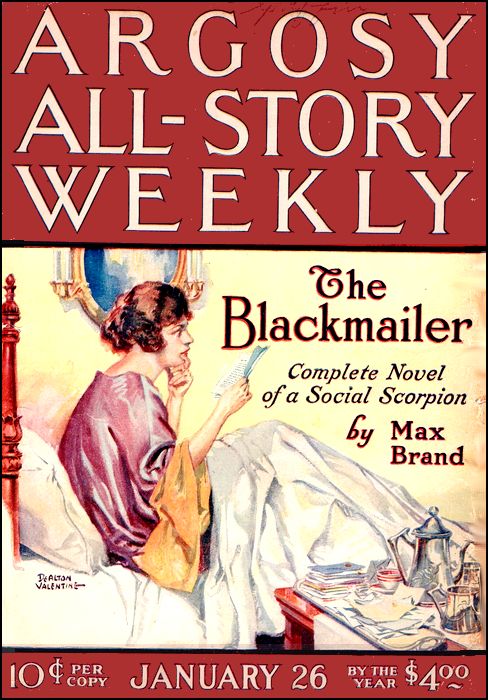
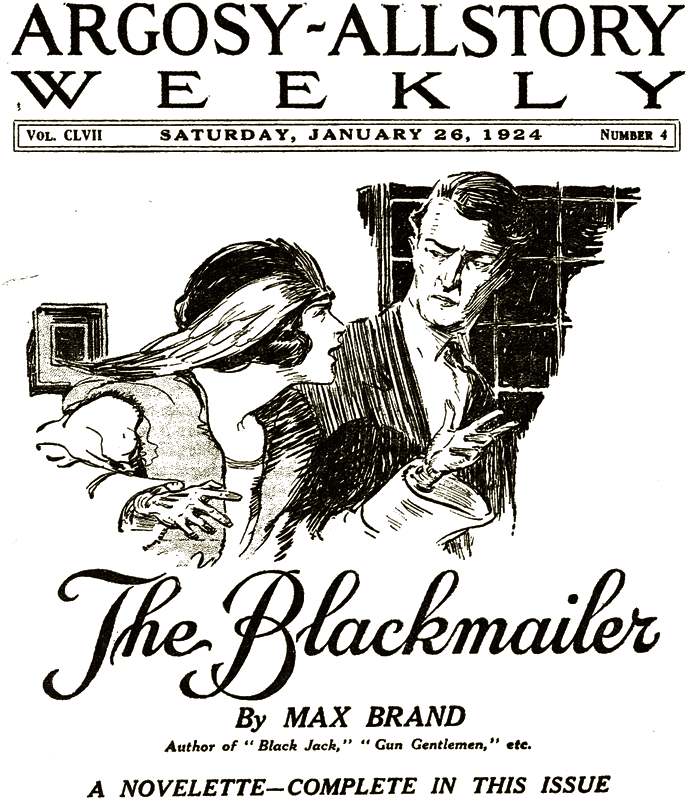
Argosy Allstory Weekly with "The Blackmailer"
MARY CHANDLER had learned in Paris that there is only one way of awakening in the morning, and that is by means of the café au lait which a crisply dressed maid brings at the appointed hour and mixes deftly—a thick stream of milk, piping hot, and a thin stream of coffee filling the room with the pungent richness of its perfume. It was a great discovery to Mary. She walked and danced and laughed and ran and sang and rode and talked with such divine enthusiasm all of every day that her sleep at night was deeper than any dream and the hour of her call each morning was a season of sadness.
But if café au lait was the greatest discovery, Cecile was at least the second. When Mary was eighteen, her mother had presented Cecile to her and for three long years the maid had been pampering, petting, scolding Mary Chandler—slaving, worrying, yearning over her.
Cecile was an inch short of five feet and the prodigious heels of her slippers could never, alas! make up the difference. She had a wizened, hollow-chested body and a neck whose strange leanness had to be masked with high collars; but her head was big enough to have fitted the shoulders of a giantess.
But she was a genius whose talent made her physical oddities disappear. As Mary sometimes used to say: "To know her is to love her!" For there was no voice to be matched against her soft and cheerful: "Good morning!" always thrice repeated, and calling the sleepy soul by gentle steps out of the dark of slumber. Above all, she was the only maid in the wide, wide world who could carry a breakfast tray without letting the dishes chatter to one another.
This morning, Mary did not open her eyes until the fragrance of the coffee was at her very bedside. Then she opened one of them and watched that fascinating process of mixing, saw the one lump of sugar dropped in and stirred, allowed herself to be raised and propped with pillows, and took one swallow from the cup which was held at her lips. Then a dressing-gown was drawn around her shoulders, there was a steaming towel brought for her hands and a complete face massage accomplished in one vigorous minute. After that, she was ready to finish her first cup and take a second mingled by Cecile.
Yet it must not be supposed that Mary Chandler was a languid victim of ennui, for indeed she could back a hunter all the forenoon, play three sets of hard tennis in the afternoon, and then dance until two in the morning. But when one stays up until two, one must sleep until eleven and then lie abed another delicious hour until the weariness has floated away. That was the only lazy hour in Mary's day, and almost the happiest, for it was during this time that she read her mail.
Oh, what stacks of it there were! Not even a statesman viewed such an array beside his cup of coffee in the morning, or at least not one so motley. There were long envelopes with a legal look to them; there were great square ones of stiff paper with stiffer cards inside announcing those war bulletins from the social world—marriages, engagements, or births; there were long narrow envelopes; there were short thick ones; there were pink and gray and white and blue ones; and every envelope heralded an unknown sail on the far horizon which, on nearer scanning, might prove to be richer than any Spanish galleon that ever rolled over the blue of the Main.
The letters were heaped upon a long, narrow ivory tray, fretted with delicate carving. With an ivory paper knife Mary opened the envelopes, and made two heaps. In one she dropped the greater mass, glanced through at lightning speed. In the other she placed epistles which would require careful reading. For Mary, at twenty-one was a seasoned veteran with three seasons behind her as crowded as can fall to the lot of a very pretty girl whose father has one child and five large millions of dollars; she knew that she must conserve her time by bestowing it where it was most needed.
So, in the first place, she acquired a talent for guessing the importance of a letter by the tone of its first six words. In the second place, she learned to be ruthless with the "dead wood." The heap of the useless paper was very large on this morning; the pile of the important communications was correspondingly small. At least, it contained an invitation from Mrs. Van Ord, whose greatness in the social world was like that of a sun which has not even a moon to make a dim rivalry; and there was a passionate declaration of love and a marriage proposal given weight by sundry millions in the background but quite outbalanced by the pug nose and foolish smile of rich man's son. Such proposals had grown few and far between since rumor had sped abroad and linked Mary's name so closely with that of Jimmy Paine.
Then, last of all, she opened a thin little envelope with a typewritten address and found inside it not some stilted advertisement but two little sheets of the finest linen paper, thin to transparency, and inscribed with typewriting in tiny italics. That letter was to the following amazing effect:
MY DEAR MISS CHANDLER:
May I claim a few moments of your time? I have information concerning James Paine and Mrs. Charles Gray which I am sure you will be glad to see in private before it comes into the press. Newspaper headlines are such shocking things; don't you think so? And then there are those unflattering newspaper pictures. I cannot imagine why our great dailies do not keep better photographers.
I hesitated to press in upon your week's engagements, but I am sure that you will understand I am impelled only by a desire to serve you. I shall be at home to you on Wednesday, Thursday, and Friday of this week between twelve and two. Of course you will wish to consult with your lawyer before coming, and I urge you to do so, by all means, though you will see that it is unnecessary to communicate this embarrassing news to your father.
In the meantime I beg you to believe that I remain
Your obedient servant,
F. ST. JOHN HARRISON FARGO.
22 Great Hoffmann Street.
She read it through a second time and then scattered all the other mail, important and unimportant, on the floor.
"Blackmail!" cried Mary. "Brazen blackmail. Poor Jimmy!" And she added: "Poor me!"
Concerning that foolish and highly improper escapade which had involved Mrs. Charles Gray and Jimmy she knew all that she cared to know. Solicitous friends had seen to that! She had been angry at first, of course, but she inherited from her father an ability to think twice and the second thought was that the very reason she loved Jimmy was on account of his reckless impulsiveness. So, while the matter remained sub rosa, she could afford to ignore it, but if it became public property, dignity would demand something of her, to say nothing of her father's opinion of a newspaper scandal.
She pressed the bell and to Cecile, entering, she said: "I must be dressed in fifteen minutes!"
Cecile wore on most occasions what vaudevillians call a "property" smile, but now her smile went out and her hands went up.
"Mademoiselle!" she cried. "Can an artist paint a picture in a quarter of an hour?"
It was one when Mary stepped onto the street and into the automobile, but though she had fumed and fretted through forty minutes of Cecile's ministrations, she could not but admit that her maid was right—even a street dress was worth care because one never could tell who might come by. She wore a tailored suit of dark blue, a plain black hat with a stiff black quill in it, rough gloves of yellow chamois, and a plain blouse with a little black bow at the throat.
Oh, so plain a costume, but how rare an effect? Who shall say that Mary, sitting in the open landaulet and looking before her with such dreamily unconscious eyes, was not sipping the sweets of admiration showered upon her from every car and every towering bus that stopped near by in the traffic jams of Fifth Avenue? Indeed, she was even smiling when she reached the law offices of "Uncle" Ben Thomas.
He had been the family lawyer for so long that he had earned that title of affection, but none other than the Chandlers would have dreamed of addressing him with such familiarity. He was an austere gentleman of sixty who looked ten years older on account of the whiteness of his hair and the length of it. He was very tall, very heavy, and the years had built him out so far in front that he was uncomfortable unless he sat very erect in a chair.
His firm consisted of himself alone. But he maintained as offices his private sanctum, his own library, a reception room, and a long, narrow chamber where five capable lawyers ground out the details for Benjamin Thomas. He sat in his office every day from eleven to three, scraping his large finger nails thin with a delicately edged pocketknife. Not more than one visitor a week came to him—not more than half a dozen cases a year—but his receipts topped his expenditures by nearly a quarter of a million per annum. When Mary asked her father bow this could be, Mr. Chandler used to tell her that she could not hope to understand the intricacies of "big business."
Mary was taken at once to the sanctum itself. Upon the floor there was a Persian rug of sober blue arabesqued with dull red. Upon the wall hung one picture—of himself in the fat robes of a doctor of philosophy. An Italian table served him as a desk, and curled across his feet was a little cocker spaniel like a ball of rich black silk.
"Softly, Mary, softly!" cautioned Benjamin Thomas in a whisper as the girl entered. "Cymbeline has just gone to sleep."
So he received her without rising, pressing her slim, cool fingers between both of his fat palms and accepting the kiss which she bestowed upon his forehead. He hated to leave that chair, and Cymbeline's sleep had served him for years as an excuse for not getting up to welcome a visitor.
"Let Cymbeline sleep if he can!" said Mary. "Uncle Ben, a terrible man is trying to blackmail me!"
"Stuff!" exclaimed Uncle Ben, and he began to rub together his soft, thick hands which he could never get warm, so it seemed.
"But he has! And he dares to ask me to call at his house and interview him—oh!" cried Mary, growing more and more furious. "I want you to send him to jail at once!"
"So I shall," said the lawyer, bending a frown upon the whole abstract world of crime. "So I shall, my dear. I suppose he has addressed some sort of communication to you?"
"Yes—this letter. Can you imagine such a thing? The impudent, low rascal! I hope that you send him to jail for life!"
The great lawyer adjusted the letter for reading, poising his hand on top of the dome of his stomach, which brought the page into exactly the right focus for his eyes. As he perused the document his indignation grew and forced small outbursts from his lips:
"James Paine and Mrs. Charles Gray? Indeed? My dear, is there anything in this?"
"Nothing! Even if there is, what business is it—"
"Of course—of course. 'Newspaper headlines are shocking things; don't you think so?' I'll have him heartily of that opinion, the smooth scoundrel!" exclaimed Uncle Ben Thomas. "I'll make the fellow-sweat for daring to have opinions and information about his betters!"
With this, he finished the first page of the letter and came to the second, but his eye had no sooner touched upon it than his entire manner changed. He sank back in the chair without so much as reading that page of it. The little pink spots of indignation which had sprung into glowing life in his cheeks were extinguished, and he looked at Mary Chandler with dull eyes.
She was alarmed. She flew to him, dropped on her knees at his side, and cherished one of his great, splodgy hands between both her own.
"Uncle Ben—have you had a stroke? Oh, Uncle Ben, what is wrong?"
"Fargo!" said Uncle Ben.
"That's the name the rascal signed," said Mary, beginning to feel that the excessive emotion of anger had worked this change in the face of the lawyer. "Did you ever hear of him before?"
Benjamin Thomas shook like the loose wabbling of a jellyfish.
"Yes," he whispered. "Yes!"
"Uncle Ben, you're actually afraid!"
He cleared his throat as he answered hoarsely: "I thank God that I have sense enough to be afraid!"
"Oh!" cried Mary Chandler. "But what am I to do if you are afraid of him?"
"Go to his house," said the great lawyer, breathing fast and hard and patting her arm as he spoke. "Go to the address in the letter—by all means. And when you are there, tell him that you consulted me, and that I urged you to trust him—that I convinced you that no harm would come to you from him—that I finally persuaded you to go to his house. Tell St. John Fargo that, Mary. Give me your word for it."
"Heavens!" cried Mary, springing to her feet. "Is this good counsel? Uncle Ben, you talk like an accomplice of this Fargo. And—I'm not going to do a thing you say. I won't—I won't!"
"What?" exclaimed the lawyer. "You won't?"
"No, no, no, no, no," cried Mary, and fled from the room.
She stamped up and down the hall while she waited for the elevator, saying to herself over and over again: "I won't! I won't! I won't!" But all the time she knew perfectly well that she would go; and she did, just as fast as the elevator could take her to the street and the automobile could carry her to the address. She stopped the machine two blocks away from Hoffmann Street, in Fourth Avenue. Then she slipped out into the crowd, and hurried along until she came under the front of 22 Great Hoffmann Street.
GREAT HOFFMANN STREET is as small as its name is large. It was once a part of a winding path made by Dutch cows in the pasture grounds. Then a village street followed the cowpath, and finally the great and permanent print of Manhattan was placed upon the town. In some places the town was crushed out; in others the village pattern was retained. As in Greenwich Village, so it was with Great Hoffmann Street.
It was a little alley, wriggling from one great avenue to another. Only westbound traffic flowed through it in the morning. Only eastbound traffic entered during the afternoon. But whether in the morning or in the afternoon, few vehicles chose to launch forth on such a serpentine adventure. So that Great Hoffmann Street was empty nearly all day, except for stragglers.
The street itself was hardly broader than a large sidewalk, and Mary Chandler, hurrying on so that the speed of her walking could keep up her courage, looked up and saw the tops of the buildings fencing a curving path through the heart of the bright heavens, though Great Hoffmann Street remained dark as evening. The entrance to No. 22 was a plain door opening just off the pavement like a little postern gate in some old castle, with an iron lantern hanging above it.
The door opening as soon as she had used the knocker, she found herself before a middle-aged woman with a pleasant face who smiled cordially upon her.
"You are expected, Miss Chandler," said she. "Mr. Fargo will be able to see you at once."
Yet, so far as Mary could remember, she had never seen this person before. "I am to be surrounded by mystery," Mary told herself, "but I must show no surprise."
She was taken up one flight of steps and into a bright little room at one side of which French doors opened upon a balcony flaming with flowers. They were arranged like a miniature garden. The tiny paths were laid out; in the center a wee fountain spray tossed up and fell again over the figure of a dancing nude cast in bronze and not four inches high. The water glistened upon the cheeks and the smiling lips of the dancing boy like sunshine.
Mary could not restrain a little exclamation of happiness; what a heavenly thing that garden would be to a child, she thought! The room itself glittered like a jewel-box. The walls were covered with mirrors, and across the mirrors was worked a gilded tracery; the chairs seemed almost too splendid and frail to sit on; upon an ebony stand at one corner of the room stood the chief treasure—a Ming vase of a blue more divine than the transparent sky of a summer evening. Mary half forgot that she came here in fear and with a grievance; she was a little dizzy, as any one might be who had turned off a New York street into the heart of fairy tale.
Then F. St. John Harrison Fargo entered. He had a pale, handsome, intellectual face—long, delicate hands—the clothes of an exquisite with a little white blossom dangling from the buttonhole in the lapel of his coat. He might have passed for a musician had it not been for a trace of humor about his mouth.
Mary had never seen just such a man as this, but she knew without hearing his name that this was St. John Fargo, and that he was capable both of creating the quaint beauty of this room and of blackmail.
He bowed to her as soon as she caught his eye. Then he said in exactly the right voice: "My dear Miss Chandler, it is so awfully kind of you to come down. But Great Hoffmann Street is worth seeing, isn't it? It has a touch of the Dark Ages about it, don't you think? And won't you sit down here—near the garden?"
"I won't sit down," responded Mary, making herself study him calmly in spite of her anger. "And—I do think that there are things out of the Dark Ages in Great Hoffmann Street."
"Quite so," said Mr. Fargo, blandly failing to see the point of her remark. "You are quite right."
"I went to my lawyer," continued Mary, hastening to get at the heart of her business. "I showed him that amazing letter. And he astonished me by saying that instead of putting you in jail, he could only advise me to go to you at once. That's why I'm here. Not because I intend to give in one iota, Mr. Fargo, to any demand you may intend to make upon me, but simply because I'm curious; I wanted to see what manner of man it was who could so hypnotize Uncle Ben Thomas."
"Ah," said he, "is Benjamin Thomas your lawyer? Well, well, I'm a thousand times obliged to him for putting in a good word for me. Astonishing how valuable a few good words may be, don't you think?"
Mary Chandler snorted—there is simply no other word for it. Then she stamped a blunt-toed brown Oxford upon the head of a Chinese dragon which crawled at her feet.
"What have you to say to me, Mr. Fargo?" she asked.
"I knew that if I could have a chat with you, we'd come to a cordial understanding."
"I hope so," said Mary.
"As for Mr. Paine and Mrs. Gray—"
"Well?"
He made a little gestured
"Some extraordinarily unscrupulous people have secured information about that affair, you know."
She swallowed a fierce comment, yet she could not help hunting about in her mental armory for some blinding phrase of scorn which would strike his complacency at the heart. She found nothing; the armor of his pleasant nonchalance was perfect.
"What do they know? What do they think they know?" she asked.
"Really amazing things," said St. John Fargo, and handed her a letter written in a neat little feminine hand—a letter from which only the last page and its signature was missing. But Mary did not need to read that far—she had barely scanned the first page of the script when she folded the epistle hastily and gave it back. She felt as if she had peeped through a keyhole at the faults of Jimmy Paine, and she was crimson with shame.
"Of course," went on Mr. Fargo, "you know just as I know that there is nothing important about this. Mr. Paine is a thoroughly worthy fellow, but like most high-spirited young men, he is apt to—er—step beyond the limits, now and then. For that matter, people like you and like me are quite willing to forgive him, but the rest of the world is not always liberal. Not always! There are people like your own father, say, or like Jimmy's. Horribly old-fashioned!"
She writhed at this subtle inclusion of himself in her own class; but she could not help feeling that every door to his mind which he opened did show that there was much in him which she could at least understand. And now a new apprehension made her cry, unguardedly: "That's true—good Heavens, I'd forgotten what Jimmy's father will think!"
His picture rose before her. He had made his money in real estate. He wore long hair and a long coat. He was so pompous that he presided over his table like the speaker in the House of Representatives. He was so old-fashioned that he could not talk for five minutes without talking about "these degenerate days." He sold his real estate with speeches modeled after Webster's at Bunker Hill. And if such a scandal connected with his son should get into the papers, it would start the entire city laughing at him. He would disown Jimmy. There was no doubt of that.
Mr. Fargo picked up the train of her thoughts as accurately as though she had been speaking aloud.
"The trouble is that Mr. Paine, Jr., though a delightful fellow, was never meant for the dusty ardors of a business life. Don't you agree, Miss Chandler?"
She looked helplessly at him.
"And if Mr. Paine disinherited his son, I think your father would object to supporting him."
The idea of that iron-hearted man giving anything except to his idolized daughter brought a wan smile to the lips of Mary.
"It has to be stopped," she said firmly. "How can it be stopped?"
"I think you have already guessed. A bit of money will turn the trick. I shall be glad to be your agent in this affair. For you must know, Miss Chandler, that I am what might be termed a social doctor. My operations are painless, but expensive. In this case, I think that five thousand dollars would be enough to—"
"Five—thousand dollars!" breathed Mary.
"Which is not a great deal, considering your father's millions, Miss Chandler."
"His millions; not mine! Do you think that I can get the money from him? He'd let ten thousand Jimmy Paines be ruined before he'd lift a finger to help him!"
"But do you need to turn to him?"
"Not if I can pick the money up in the street!"
"You forget," went on Mr. Fargo, "that you have something more than an allowance, now. You have the bonds which Mrs. Norton promised you."
"But they have not—" She broke off to cry. "How do you know that she promised me bonds?"
"It was at Charleston House; she was walking with you across the lawn after the tennis match."
Mary Chandler clapped a hand to her face, and above it stared at her host in manifest terror.
"Is this—clairvoyance—or what? Spirits?" she demanded. "How could you have known that unless you walked invisible beside us when we were talking?"
"One must have one's little secrets," said Mr. Fargo genially.
"But since the bonds have never been sent to me—you really cannot expect me to ask Aunt Elizabeth for them!"
"A thousand times—no! I could never dream of subjecting you to such humiliation! However, when you go home you will find the bonds waiting for you. They were mailed to you last night. You could sell them in ten minutes. They're a little bit better than just so much gold. You can sell five thousand dollars' worth and keep the other half. Isn't that extremely simple?"
Another girl would have been completely baffled by these continual revelations of omniscience on the part of Fargo; but Mary Chandler refused to wonder past a certain point. She now began to shake her head.
"Extremely simple until Aunt Elizabeth inquires about the bonds later on!"
"She will never remember them. Mrs. Norton never thinks of yesterday so long as there is any to-morrow, you know."
"Suppose," said Mary, "that I send you the bonds—then what will make me sure that I shall not be called upon to pay more money later on?"
"Nothing but my promise."
She started to say that this was hardly a sufficient guarantee when suddenly she knew that his word could be trusted implicitly. If there was such a thing as an honorable blackmailer, it was he!
"But all these people," she protested, "who know about the affair of Mr. Paine and—"
"If I tell them to be quiet, not one of them but would rather jump in the river than deny me. You must trust me in that."
At this she could not help but break out: "Mr. Fargo, what can make such a man as you take part in these—these—affairs?"
"My dear Miss Chandler," he replied, lifting the little white flower in his buttonhole so that he could breathe its fragrance, "what would society do without me? By the suppression of slander, how many reputations I save, how many suicides are prevented, how many broken hearts, how many hours of tears I keep from the world? No, no; if for no other reason, I should continue my work because I feel that I am morally bound to do so!"
She knew that it was half jest, but she knew that it was half earnest also, and she left the house feeling that she had looked around the corner of the world and seen another phase of life.
She had no sooner been shown to the door by Fargo than he returned to the room which he had just left and said quietly: "Come in, Tom." Whereat a panel of the mirrors opened and a fat man stepped out of a dark closet, his forehead beaded with perspiration. He carried a pencil in his hand. A small sheaf of them projected from his vest pocket. He bore, also, a large scratch-pad of which the top leaves had been turned back and were covered with characters of shorthand. He fanned himself, breathing hard.
"It's a Turkish bath, chief," he told Fargo. "I nearly passed out."
"Did you get it?" asked Fargo.
"Every word. But tell me, chief, what can you get out of chatter like that?"
"As for that," said Fargo, "one never can tell. Let me have the stuff."
"I'll typewrite it." "Your shorthand will do for me."
"Anything else I can do for you, chief?"
"One great thing, Tom. Get thin!"
MRS. NORTON sat at the telephone with the receiver pressed tightly against her ear, the morning newspaper in her other hand. She tried the home of her brother, Peter Chandler. She was told that he had gone to his golf club the evening before. She tried the golf club and learned that he had just departed in his automobile for town. She tried his office and was told that he had arrived and left for his broker's. Her impatience could endure it no longer.
"Mr. Garrison!" she cried. "What has happened to the Cassidy Car stock?"
Mr. Garrison coughed.
"It has fallen a bit, you mean?" he asked discreetly.
"It has fallen so far that you'll have to dig a hole in the ground to find it!" moaned Mrs. Norton. "Oh, what can have possessed Peter to advise me to buy such stuff!"
"Oh, he must have good reasons!" suggested the junior partner.
"Good fiddlesticks! What's the telephone number of his broker?"
She wrote it down, rattled the hook until a cross Central asked for her call and finally reached the firm of Blaine & Corrigan. Yes, Mr. Chandler had just come in. He was on the wire in another moment. And now she poured forth all her woes.
"Peter, Peter, Peter!" sobbed Mrs. Norton. "I'm ruined!"
Her brother made some pretense at being a wit. He removed his cigar from between his teeth and blew a cloud of smoke into the mouthpiece.
"At your time of life, a very sad condition, my dear!" said he.
"Peter!" she snapped, all sign of tears gone from her voice. "Do you mean to jest?"
"I never jest," said he. "What's wrong?"
"Everything is wrong! Your precious Cassidy Car has dropped so far it has disappeared. Or—oh, Peter, tell me it's a misprint in the Herald. Tell me that it hasn't dropped to fourteen."
"The Herald never makes misprints," said Peter. "Not in its quotations."
"But what does it mean? How can you sit there so calmly?"
"Why, it means that Cassidy Car has fallen off a bit; that's all."
"But I bought at thirty."
"Yes."
"At your advice."
"Of course."
"Then I've lost more than fifty thousand dollars!"
"If you sold now."
"Peter!"
"But why should you sell?"
"It may still go down."
"Perhaps."
"Then I am ruined."
"My dear, no matter how far it drops, what's to prevent it from rising again just as fast?"
"Do you mean it?"
"Elizabeth, how old are you?"
"Forty-seven last month. You know it."
"At forty-seven, you shouldn't be acting like a silly girl. If I got you into Cassidy Car, you may be sure that I'll take care of you. If you have to sell at less than thirty, you'll have my check for the difference."
"I couldn't let you -take such a loss when—"
"Hush, Elizabeth. I'm very busy and have to ring off. But I want to give you a little advice."
"Yes, dear?" breathed the comforted voice of Mrs. Norton.
"Keep away from Wall Street news."
"I certainly shall."
"Good-by."
"Good-by, dear Peter!"
He turned from the telephone and grinned across the room at Mr. Steve Blaine, head of Blaine & Corrigan.
"These women!" murmured Peter Chandler.
"Well," said Blaine, "what would the Street do without 'em?"
And they laughed in unison.
"How's things?" asked Norton, who had not yet had time to make his daily inquiries.
"Finer than silk. Cassidy Car is rocking like a ship at sea."
"The little fellows are scared, eh?"
"They ran for cover this morning like rabbits."
Mr. Chandler could not help rubbing his hands as if he were giving them a dry cleaning.
"Where is she now?"
"Thirteen, and still dropping."
"Very neat, Blaine!"
"When do you start to cover?"
"At twelve, I thought yesterday. But from the looks of things to-day, I won't budge until she hits ten."
"That's drawing it fine. Don't be a pig about it, Chandler."
"I have them on the run."
"Where do you think it will go to?"
"It may drop lower. It may even shade nine. But afterwards it ought to recover to twenty-five in a week, and go to thirty again in a month. There's nothing wrong with the Cassidy Car. Not a thing! I drove one out to the golf club last night. A neat little trick, Blaine. Picks up like a race horse, dodges through traffic like a football player—a sweet thing, the way she answers the wheel. A child could drive one up Broadway at five p.m. I mean it! Then those four wheel brakes—I stopped her on a wet street inside of thirty feet. No, there's nothing wrong with the Cassidy machine. I've simply scared the little fellows—and maybe some of the big ones, eh?"
"Well," said the broker, "these pup stocks are fairly easy to manipulate. They're like dough; you can kick them into any shape you want. Going to sit in and take it right off the wheel to-day?"
"It's half-past eleven, isn't it?"
"Just."
"I'll read the tape, for a while."
The broker led him to a little private room where the ticker was working busily. There Mr. Chandler ensconced himself in a big chair, crossed his fat knees, not without difficulty, and lighted a fresh cigar from the butt of the other, which he threw through the open window, then chuckled as he wondered on whose head it would light. After that, he worked his cigar into a good draft and began to let the tape slide through his hand.
The very first sale that met his eye was:
"CDY. 12 7/8."
Mr. Chandler grunted his pleasure. He shifted the cigar between his teeth, tasting the oily richness of that black tobacco. He still looked at the tape, but a mist of happiness had rolled across his eyes. Instead of owning what he considered a mere comfortable fortune, he would now advance along a career of conquest. He would become a great captain of finance. There were other enterprises like Cassidy Cars which could be squeezed dry and the profits emptied into his bank account. So, with this genial expectation, he grunted once more and resumed his pleasant vigil.
An hour rolled by. Still CDY. was dropping. The bottom was falling out of Cassidy Cars! And still he sold, sold, sold. Now and again word came from Mortimer Yerks on the floor of the Stock Exchange. It was he who was agent for Chandler in this bit of work. Always his news was reassuring. There was no serious competition. Nothing but a herd of small fry running for fire as the big guns of Peter Chandler boomed and shook the small investors to their toes.
"Nerve!" said Peter Chandler. "It's all nerve. That's what makes a place for a man in this little old world."
What a jolly place it was—this same little old world! And this was only the beginning. Now that he had rolled his sleeves up and showed himself what he could do, he would continue. More millions! Mary had always wanted a real country place—not a mere cottage. She wanted a stable of jumpers—real jumpers, too. She should have them, by the Lord! The sky was the limit for Mary now! Still he went on pinching the tape where the CDY. sales were marked upon it, each one a new note of thrilling music in the new song: "The Ruin of Cassidy Cars"; words and music by Peter Chandler. It went straight down to twelve. It hung there a moment and dipped to eleven and a half, coming back with astonishing suddenness to twelve and a quarter. He began to sweat at this point, but his fears were foolish. He stepped to the telephone and shot a bracing order to Mortimer Yerks. The result was that Cassidy Cars crashed to eleven even, then down to ten and seven-eighths—down to ten and three-quarters.
How simple it was! How strange that others could not do it! How beautiful to be one of the strong—to have nerve! The weak were suffering now. People who had hoarded earnings were seeing their speculations smashed to bits. But—to the victor belong the spoils. A President of the United States had said that. And is there not a philosophy of the strong?
"To him that hath shall be given!" murmured Mr. Chandler.
He would not be a dog in the manger, however. His wealth would be a stream of happiness to the world. It would irrigate arid minds; it would be the making of wasted regions and wasted men. He would be a reclaimer. He would be a true philanthropist—give all away before the end—all, saving one or two millions for Mary, dear girl!
Mr. Blaine came in with a cheerful: "How's things?"
"Ten and a half," said Mr. Chandler, and frowned to keep from smiling.
"Not bad," nodded Blaine. "I didn't think it would go like that. Thought you might have caught a Tartar, depressing it too much. But this green stuff—never can tell—no guts in it. Only aiming at ten?"
"Yep."
"Might get it lower."
"I'm not a pig," said Chandler. "Enough is enough."
He felt a philanthropic thrill at this moderation. He had bought heavily at thirty, with the surety that the stocks would go to forty at least. Now he hammered the stocks down to ten. When he reached ten, he would throw in every available penny and scoop it up. Then he would hold, and hold hard. The prices would mount. Immense quantities which he bought at ten he would sell again at thirty—at forty—it might skyrocket to fifty or even sixty. One dollar turned into six! That was brains; nerve; power!
Blaine took the tape. He was a steady man. He had been through a hundred wars on the Street, but even Blaine was excited now.
The ticker still sang. Blaine stepped in between his client and the "wheel." He took the tape.
"CDY. 10 3/8," sang the ticker.
"By gad!" murmured Blaine. "Like a machine!"
"CDY. 10 1/8."
"Down to ten and one-eighth," murmured Blaine again. "Are you ready to cover now?"
"Sell short! Sell short!" cried Chandler. "I don't budge till she's at ten flat. Then I'll rake it in."
"Here you are—No—still an eighth over what you want."
"Get Yerks. Tell him to dump a handful of stuff. Flatten that price. I want elbow room!"
It was done. But before they received a reply, the cigar of Peter Chandler tilted sharply up between his teeth.
"CDY. 10 1/4," said the ticker.
"The devil!" whispered Chandler.
"CDY. 10 3/8," said the ticker.
The heart of Mr. Chandler began to thunder.
Something was wrong somewhere.
"Has some one spotted your deal?" asked Blaine with concern.
"No. Everything that I've done is masked. There's nothing wrong with my work in this deal."
"But some of the old boys have noses like foxes. You know that."
"Don't tell me what they have. Watch the tape."
"CDY. 10 1/8."
"You see?" laughed Chandler. "I know this stuff. It may flutter a bit, but it has my slug in it. It's got to come down out of the air. Lower! Got to come down right where I want it."
He set his teeth through the cigar in an ecstasy of strength. Close his fingers—something has to bust!
"Well," said Blaine, "perhaps you've—Hello! Up to ten and a quarter again."
"A little flyer—that's all. Game would be dull without a few struggles. Everything kicks as it dies."
And Peter Chandler laughed again, heartily.
"CDY. 10 3/8," quoted Blaine.
"Well, well!" murmured Chandler. "I will have to get to Yerks again. Must flatten this stuff out—"
"Ten and a half!" cried Blaine.
"The devil!"
"Two devils! It's going up, Chandler. Up and up. Ten and three-quarters—ten and seven-eighths."
"What?"
"Eleven!"
Chandler threw the cigar through the window.
"Better cover, Chandler."
"I—perhaps you're right, Blaine. You send word for me quick. Quick, Blaine!"
He sat sweating. It jumped again to eleven and a quarter, while he waited.
When Blaine came back it was twelve, and now, as Chandler began to buy, the stock acted like a race horse and leaped ahead at full speed—twelve and a quarter—twelve and a half—two points at a time.
"What does that do to your profit, Chandler?"
"I've something left."
"How short are you of this stuff?"
"Oh—enough!"
"Ah!" said Blaine.
That little monosyllable cut Chandler to the quick. He dared not speak. Still CDY. acted like a mad thing. It rose to thirteen—to fourteen—to fifteen. Thousands of dollars were straining through the fingers of Chandler. He tried to steady himself, but his hands shook when he lighted a new cigar.
"More bottom to this than I thought," said Blaine. "Plenty of life, in fact."
It reached twenty at fifteen minutes to two. It went up to twenty-three in five minutes.
"Get Yerks!" yelled Chandler, leaping to his feet and stamping his cigar into a great, wet, oily smear on the inlaid linoleum.
But Yerks was already in touch. Sanderson and Gwynn, he said, were fighting for that stock. They had put in three large orders.
"You've caught a Tartar, Chandler," said Blaine very dryly. "If I were you, I'd begin to scratch like hell. Some one is gunning for you. Maybe some one has you now. How short are you?"
Chandler turned a strained, pasty face toward him.
"Advice is damned cheap," he said. "I don't ask for it; I don't want it. Somebody is gunning for me. I think I know who, but—"
"Is it Vandermeyer again?"'
For an answer, Chandler jerked the receiver off the hook and called his sister, Mrs. Norton.
"I want that Cassidy stuff I told you to buy. I'll give you the thirty for it. It's at twenty-three now."
"Twenty-three? Has it climbed so fast? Then I'll hold onto mine!"
"Elizabeth—I—want—that stock!" he shouted.
He barely heard her frightened answer. "All except three hundred and fifty shares. I gave those to our Mary."
"Good!"
He rattled the hook and called his own house. Mary was out and would not be back for half an hour. He could not wait in the office all that time. He would go home and find her there; he would pick up the other stock from Elizabeth on the way.
"What are they getting?" he roared at Blaine, who was chattering at another wire.
"It's tied up tight. Gone to twenty-five, and still you can't blast loose anything but a handful here and there—my God, Chandler, how short are you?"
Chandler shrugged his shoulders.
"Enough to cover, thank God," he said. "I'll lose a penny or two out of this mess, but still I can cover."
Then he left. His broker, behind him, dropped into a chair with a sigh of relief.
"These new Napoleons of the Street!" sneered Mr. Blaine. "A bunch of bums—that's all! Nothing on the ball—nothing but a prayer!"
In the meantime, the elevator dropped Chandler to the pavement. He stepped out into the rush and scurry of the broad business world, but all was like the quiet of the country to Chandler, compared with the storm in his mind. After all, there was something in the Street beside strength.
"Dirty, crooked work," he decided. "A gang of thugs and cutthroats. No decency. Take a man's last dollar."
On the next corner, as he was about to step into his car, he glimpsed Vandermeyer himself standing in a blotch of yellow sunshine which had pried a way down among the crowding skyscrapers. He saw the same old wide-brimmed, black felt hat, the same low forehead, the same bushing white brows, the same glittering little sharp eyes, the same narrow face, the same smile, like the smile of a greyhound. He gave way to an impulse. He rushed up to Vandermeyer and snapped his fingers in the face of the tall old man.
"I know your handiwork, Vandermeyer!" he cried. "But do your worst! I've got enough to cover. I've got enough to deliver every share of the stock I've sold!"
Vandermeyer looked deep into his eyes without speaking a word, and still he smiled, like the smile of a greyhound.
WHEN Mary reached her home she found her father waiting for her. He had no time even to give her a greeting.
"Your Aunt Elizabeth gave you three hundred and fifty shares of CDY.," he said.
She gave him a wan look.
"Of what?" she asked, out of breath at this storm.
"Damn it, I mean Cassidy Cars. She gave you three hundred and fifty shares, I want it. Get it—quick—"
"But, dad, you see—"
"Don't 'but' me. I want the stock. Quick, quick! Little fool, it may be life and death!"
She fumbled mentally for a support and found none. The truth came perilously near her lips, but she checked it in time. Now that her father stood before her with his feet braced wide apart and his hands clenched, she could appreciate what others had said of him—a man without mercy. If she were to tell the whole story—and yet what other way out was there left her?
"I'll look in my room," she said.
"I'll give you two minutes."
She ran up the stairs. It was useless to look in her room, except for one-half of the shares. The others were now in the hands of F. St. John Harrison Fargo. The dark and handsome face of that young man smiled suddenly before her mind's eye. After all, he had been playing for something much more than the five thousand dollars. She rallied her thoughts and returned. When she reached her father she gave him the stock which remained.
"This is only half," she told him. "And I don't know where I can have put the other half—"
"Ten thousand devils!" thundered Peter Chandler. "Not know? It may cost me fifty thousand dollars, if you can't remember. Quick, Mary!"
Again she fumbled desperately for some manner of expedient.
"I went down to see Uncle Ben," she told him. "I may have left it in his office. I wanted to show him the stock and ask him what it was worth. And—I may have dropped it there—"
"I'll phone him."
"No, let me talk to him—"
"Nonsense! Takes a woman a hundred years to turn around at a telephone."
He went to the instrument, and she followed him with her knees bending beneath her. Uncle Ben, of course, would have no clew to guide him. He would simply deny that he had seen the stock at all—and then what would happen? If her father believed that she had deceived him even once, in an important matter, there would be an end of all trust and all affection on his part.
She looked after him in a sort of agony of sadness. Twice she summoned her strength to cry out to him and confess. But something held her back. She feared her father mightily; but she was not quite sure that she did not fear the subtlety of St. John Fargo even more.
Chandler was talking at the telephone.
"Thomas! Ben Thomas! Is this his office?"
A little pause.
"Then go find him and bring him back. Tell him Chandler. That's right! Hello, here you are at last. Ben, you have a pack of numskulls and sapheads in your office. Why don't you get some living men there? It'll pay you. Well, well, well! I suppose you do; I suppose you do. You're growing testy as you're getting older, Ben. Listen to me; what's become of that stock Mary left lying about in your place? You don't know? The devil you don't! I tell you I know it's there!"
"Dad!" cried Mary in despair. "I only meant that I think I left it there."
"Be quiet!" he growled at her over his shoulder, putting his hand over the mouthpiece. "Only way to get anything out of people is to be sure of what you say."
He snapped again at the phone: "What's that? Didn't see them? Why, man, she took them down there on purpose to show them to you! Either she's lost her wits or you're growing absent-minded, Ben! Well, well, well! You do begin to remember something about it?"
Mary sank into a chair, almost fainting with relief. Uncle Ben, it seemed, was willing to play a game for her sake.
Her father went on: "It seems that she did show you the Cassidy stock? You even remember the name, now. Well, what did you think of it? Of course you don't. Like a woman to take stock to a lawyer who knows no more about the market than a horse knows about oil paintings. The point is, Ben, I need that stock. Must have it; at once. Go through every corner. Arrest every man in your office, if you have to. and search them aH—the rascals—didn't like the voice of the chap who talked to me just now. Not a damned bit. You'll have a thorough search, I know. Good boy! Then ring me back in five minutes."
He slammed up the receiver. "Mary!" he called.
But she had already fled up the stairs to her room.
She entered it, white-faced, frightened, and locked the door. The omnipresent Cecile was there and breathed an alarmed: "Mademoiselle!"
"Oh, Cecile—terrible trouble! Don't ask me! Only leave the room—"
Cecile went to the door and unlocked it again.
"If you have anything to conceal, mademoiselle," she said, "it is always best to smile and go to a dance. If there is anything to hide, you must make others think that you have not a care. Not one!"
And so, with a smile, she slipped out.
Mary had the receiver off the hook before Cecile was gone. One eye was on the door, expecting it to fly open at any instant and to see the burly form of her father stride in.
"Hello! Hello! Hello!" boomed Uncle Ben Thomas over the wire, still angry, it seemed from his talk with Chandler.
"Uncle Ben!" she breathed.
"Louder!" bellowed Uncle Ben.
"It's Mary," she said.
"What under heaven have you been telling your father, young lady? Making me out a thief, or what?"
"I'm in the most awful trouble, Uncle Ben."
"You'll have me in trouble, too, it seems. Well, well, Mary! Tell me what's wrong?"
"I saw Mr. Fargo—"
"Wait!" came a changed voice from Ben Thomas.
His receiver ground against the surface of his desk. She heard his heavy footstep crossing the floor. Then a door slammed.
"Go on," he said presently. "Talk soft, Mary. The walls will overhear you! What about him? What did he want? Did he mention my name?"
"He seemed to know you."
Benjamin Thomas groaned.
"The infernal—" he began, but broke off and said instead: "What did he want of you?"
"Five thousand dollars." A whistle came over the wire.
"Five thousand, eh? Well?"
"I didn't have it, but he knew that Aunt Elizabeth was giving me some Cassidy Car stock—oh, I wish I had never seen it!"
"So do I!" he said heartily. "But you did see it?"
"And Mr. Fargo said that half of that stock would be all that he'd require."
"Modest man, I'd say. So you gave him the stock?"
"And now dad wants me to give it to him. I gave him the half that remained. He wanted the rest. I didn't know what to do. I told him that I'd taken some of it down to your office to ask you about it—"
"I know," groaned Thomas. "I guessed that much. What's the matter with Peter? He seems half mad!"
"Something has gone wrong."
"He's been playing the market and he's had his fingers singed. That's what's happened! I always told him—but go on!"
"There's nothing more to say—except that I'm ruined, I think!"
"Why? If you haven't the stock, you haven't it; and there's an end!"
"But that's not all. Dad insists—"
"Let him talk. He can't do anything more than talk."
"But he acts as though the world would come to an end if he didn't have it."
"It won't come to an end. Don't worry about that. He's had a little lesson. That's all. Now sit quiet. And don't talk too much!"
"But I can't stand it, Uncle Ben. I must tell him the truth and have done with it."
"No!"
She could hear him gasping and fighting for his breath as though he had been suddenly ducked into cold water.
Then he was able to speak again and he panted: "D'you know what that means? It means dragging the whole thing over the coals—"
"Wouldn't that be best? Wouldn't it be better to expose such a creature as this Fargo?"
"No!" roared Uncle Benjamin Thomas. "Girl, you don't know what you say."
The very telephone seemed to tremble with his earnestness.
"I want to do the right thing," she managed to say.
"The right thing is never to mention Fargo to your father. Because Peter—between you and me—is an ass in certain ways. He can't keep quiet. He'd have to talk. And if he talked—"
"It would get into the papers?"
"Not a line! Fargo can choke the papers off. But after he'd done that he'd start to work choking me, because I've been in this—God knows against my will! And he'd go on to choke Peter Chandler until Peter wished he'd never heard the name of Fargo!"
"As I do!"
"As every one does. Who loves a pestilence? But who wants to fight it without the right germicide at hand? Mary, whatever you do, don't—"
The door yawned wide behind her.
"Good-by!" said Mary cheerfully. "I can't come over to-day. Awfully rushed, Charlotte. But to-morrow if I can—possibly. Good-by, dear."
"Who the deuce was that?" rumbled her father.
"Charlotte McKenney."
"Eh? Sounded like a man to me. Has Charlotte got a bass voice?"
"She has a cold."
"H-m! What did she want?"
"Asked me to come over."
"Thought you and she were not on speaking terms?"
"Oh, no!"
"Last week you said that you were through with her."
"But that was a whole week ago, dad!"
Plainly he was suspicious. But she could only remember what Cecile had said. She must smile and face this thing out to the end, no matter at what price of nerve strain. But the matter of the stock pressed so heavily upon his mind that it shut out all else except for a moment now and again.
"You're sure that you left that stuff at Uncle Ben's?"
"Reasonably."
"No such thing as 'reasonably sure.' You know or you don't know."
She was silent. She had been dragged into half a dozen brazen lies all in a moment. Why, after all, did the name of Charlotte McKenney have to come into mind at this crisis? If he made inquiry of Charlotte to confirm his suspicions, it would go hard with her. He would stop at only a very large barrier. She could tell that by the very manner in which he stamped up and down through the room, glaring at her from time to time.
Suddenly he stopped.
"Mary," he said, "tell me the truth."
She remembered Cecile, and managed to smile.
"I have, dad."
He stood over her. his face working.
"If you've deceived me, Mary—" Then he changed his mind and turned slowly away from her.
She wanted to run after him and throw her arms around him and pour out everything she knew, but the strangled, desperate voice of Uncle Benjamin Thomas was still ringing at her ear, and she allowed her father to go, and slam the door heavily behind him. The change of draft which the closing of that door caused made the door into the adjoining room swing a little open. In the pier glass at the end of her chamber she saw the reflection of a small slit of the other apartment, and in that slit there was revealed Cecile, the trusted and long faithful Cecile, pressing a piece of paper into the hand of a man whose back was toward the mirror, but whose slinking and secretive carriage made Mary certain that he was no member of the household.
Even Cecile, then, was corruptible!
IN five minutes, according to his promise, Benjamin Thomas rang up his old friend Chandler and assured him that the stock certificates were not to be found in his offices—that every person he employed had been searched—and that he feared that Mary must have dropped the certificates on the street.
"It can't be!" groaned Chandler.
"I'm very sorry, Peter. It simply looks that way to me."
"And they're negotiable," sighed Peter Chandler. "They're indorsed with a firm's name. They can be sold—like so much cash!"
"Will you tell me where the shoe pinches so badly?"
"I'm caught short, Ben."
"The devil!"
"It's worse than that."
"Bad luck?"
"No, a hound went gunning for me."
"Who?"
"Vandermeyer."
"Well, Peter, I've always told you to keep away from the big boys and play in your own back yard—"
"Damn what you've told me!"
Chandler slammed up his receiver and, acting in the heat of his anger, jerked it down again. He got his number at once. It was the McKenney house, and he got Charlotte on the wire at once.
"Did you telephone Mary a few minutes ago?" he asked. "This is Peter Chandler."
"Mary?" she echoed in her sharp, shrill voice. "Oh, no. No, I haven't talked to Mary for a week, as a matter of fact. We've missed one another!"
"Thank you. That's all I wished to know."
He hung up. The delicate innuendo of Charlotte did not reach him. Another and a greater fact had sent the blood rushing to his head. For what he now knew was that while he was fighting for her existence and his own, his very daughter had stabbed him in the back.
He hesitated for an instant, intent upon rushing in upon her and accusing her to her face and at least having the sordid pleasure of seeing her wince from the naked truth. But that was a small pleasure. He was partly infuriated; partly weak and sick with what he had just surmised. Instead of going to Mary he went back to his automobile and so to the subway, and then rushed back to the Street.
He found Blaine still in his office.
"Vandermeyer has just telephoned," said Blaine.
"About what?"
"He says that he's waiting in his office. He's willing to see you."
"Where's Cassidy at closing?"
"Thirty-two!"
Chandler blinked. Twenty-nine had been his worst expectation. And there was no need of an interpreter or a mind reader to help Blaine discover what was wrong with his friend.
"They have you, Chandler. Is that it? That old devil Vandermeyer has turned the trick again?"
"He has," said Chandler sadly. "Not Vandermeyer alone. But he put spies in my own camp; he corrupted my own—"
He stopped with the word on his very tongue. He could not let the world guess that his own daughter had betrayed him. But, oh, the bitterness in the heart of Peter Chandler at that moment!
"What shall I do, Blaine?" he asked meekly enough. For there was not a shadow left of the lion he had been earlier in that day.
Blaine stared at him; then the broker bit his lip.
"Go to see him, of course!"
"Suppose his price is high?"
"Look here, Chandler, you haven't been stuck for very many. How short are you?"
"A hundred and fifty shares."
"Well, a fellow with your resources can stand that. Easily! It's hardly more than a drop in your bucket."
"How high do you think he'll go?"
"He may make you pay four or five hundred. I should think that would be the limit, even for a money-grabber, like Vandermeyer."
"Four or five hundred!"
"You've danced; now you have to pay the piper!" said Blaine curtly.
"I know."
"Better go face the music, then."
"But—"
"Chandler," cried Blaine in sudden alarm, "you don't mean to say that you haven't a way of getting the price?"
"Do you know what this little splurge has cost me already?"
"In round figures, yes. I could guess."
"Guess, then."
"Nearly a quarter of a million. But what's that? You're worth twenty times that amount."
"According to theory—yes!"
"But not in fact?"
"Not half! I've talked a little bigger than the truth. Just as you've talked a little smaller than the truth just now."
"How much smaller?"
"I've lost in solid cash about four hundred thousand dollars, to-day!"
Blaine whistled.
But his only comment was: "Vandermeyer is a clever devil. I asked him how he did it. He merely smiled at me. Devilish chilly smile that fellow has, Chandler!"
He went back to his original trouble: "But about the payment: even if you've lost nearly a half a million, you still have a couple of millions in property—"
"Tied up so that I can't get at it."
"What?"
"Well, you know how it is!"
"I know? Damnation! I know that if you don't pay what Vandermeyer asks, I'll have to pay! What do you mean, Chandler?"
"What I've said. I'm tied up. I have property, of course. I could liquidate such debts ten times over. But my stuff is so involved!—and Vandermeyer will put pressure on me—"
"Tell me in two words—can you pay?"
"What's five hundred times a hundred and fifty shares?"
"Seventy-five thousand dollars."
Chandler groaned.
"I might manage that," he said. "It will be a squeeze. But I might manage that! Well, I hope to God that he goes no higher."
Blaine smashed a fist into the opposite hand.
"Every thousand over that I suppose will be thrown on me? By Heaven, Chandler, if you duck, I'll put you over the coals and roast you! You come down here to play a game. You act like a jackass. You buck a big man like Vandermeyer. You get a bloody nose. And now you want me to bleed also? Not before I've seen you bled white! Understand?"
His face bloated with his rage, but Chandler merely sighed. He had seen through another man's friendship.
"Do you know the difference between friendship and enmity, Blaine?" he asked suddenly.
"No, and I don't want to know," growled the other. "Nothing you know interests me!"
"The difference is hard cash," said Chandler.
"Let me see some of it, and I'll believe you!"
There was no purpose in further conversation. Chandler left and went straight to the office of Vandermeyer. The financial district was already empty; it was not so empty as the heart of Chandler. He had lost more than money on this day. He had lost self-respect in the first place; he had lest all trust in every human being in the world in the second.
Vandermeyer sat before a window with his broad hat on his head and his heels on the window sill.
"Well, Mr. Chandler," he said over his shoulder, "I've waited a long time for you; the price has gone up."
"To what?" asked Chandler.
"A thousand, my friend."
Chandler reeled, gripped a chair, then steadied himself. It was as though he had been struck with a heavy fist.
"A thousand dollars?" he echoed.
Vandermeyer was silent.
"Listen to me, Vandermeyer—"
"I used to listen to people when I was a young man—when I was your age, Chandler. I don't listen now."
"Ah?"
"No. I was a failure at your age. Then I learned to shut my ears—and my mouth. After that, I made money. I'll keep right on making money. I've made some to-day. I'll make more to-morrow. Let me have your check, Mr. Chandler."
"I haven't the cash."
Vandermeyer folded his arms, but he did not speak, though the effort to restrain words made his jaw muscles bulge.
"Too bad, Mr. Chandler," he said.
"I won't crawl and beg," said Chandler quietly. And the echo of his own loud talking of that same morning rang in his ears. "But I want to know how much time you'll give me?"
Vandermeyer yawned.
"Well," he said at last, "you can have a day."
"One day!"
"One day—twenty-four hours—fourteen hundred minutes. That's a long time—fourteen hundred minutes, Chandler."
"And then?"
Vandermeyer stretched out a hand before him and closed the fingers slowly against the palm.
It was, after all, a sufficient answer, and Chandler did not wait. He turned on his heel and went slowly to the door, opened it, went slowly out into the hall and stood waiting for the elevator. There was no spring in his step, and he noticed it.
"I am growing old," he said to himself.
When he reached the street he went on. Presently, he found that he was humming an old song which he had forgotten for twenty years. He sung it in his boyhood on the farm, following the plow.
"When people are about to die, their whole lives pass before them."
He had read that somewhere.
Then he discovered that he was walking in the wrong direction. He turned back in a dream.
A friend rushed up to him, a belated worker in some office.
"Hello, Mr. Chandler!" he called, and extended his hand.
"Mary, too," said Chandler half-aloud, and walked on without seeing the hand.
WHEN Mary watched her father leave the house, she knew he was desperate; she knew the lost stock was the cause of his desperation. She took the runabout and started down town as fast as she could go, driving the car herself. She made the big machine jump about like a well-trained athlete, threading the Manhattan traffic which was rushing north, inexhaustibly, from the deep wells of the office buildings. On the way, as she dropped over to Madison in the Fifties, some one shouted, and she saw a big man running at her from the sidewalk. He jumped on the running-board as she slowed behind a traffic jam. It was Uncle Benjamin Thomas.
"Are you holding tight, girl?" he asked her,
Perhaps it was the strange light of the late afternoon, glowing golden at the tops of the building, but thickest blue in the shadows on the streets—blue streaked with gasoline vapors, clouds of tobacco smoke, and dust flicked into the air by cord tires as soon as it settled upon the pavement—perhaps it was this light that made the difference, but it seemed to Mary Chandler that the famous lawyer's face was battered and worn and haggard since she had last seen it. What did he fear?
"I'm holding tight," she nodded.
Then she bit her lip and the tears of self-pity filled her eyes.
"Dad thinks that I've betrayed him. He almost told me as much. I've had to lie to him. And—oh, the whole thing is low and vile—vile—vile!"
"Of course," said Uncle Ben. "Of course. A great deal of life is that way."
"I'd rather not live—then."
"That's what you think at the end of the day. But wait until the morning comes—the world is a lovely place then, my dear!"
Many a day she had wondered to herself as she sat in her childhood and stared at the puffy bulk of the lawyer, why he lived, without companions, without amusement saving to sit in a chair immense and unwieldy, or to lean with a grunt and pat a spaniel, or to make money in his law business—which seemed to take only his odd moments—many a day in her childhood she had wondered why he lived. Even a senseless thing like the grass which grew over the face of the fields, or the trees, sending their roots deep and deeper in the quest for water—such things derived more joy out of existence than did Uncle Ben Thomas. She had never before seen him take a running step—never before this evening!
"One more man like Fargo would spoil this world," she said.
"Be quiet!" barked Thomas at her. "Don't use that name so much. Call him Mr. F., if you want to. I tell you, he doesn't like to have his name used so often. Besides, it's dangerous!"
"Why?"
"There—there—there—" he stabbed at the crowd in differing directions. "You can't tell which of those men are his spies. He works under you, above you, around you. The lover who holds your hand, the valet who polishes your boots, the father who gives you advice—I tell you they may all, easily as not, be Fargo men!"
Mary had had a stinging illustration of that truth.
"I'm going to see him now."
"Dear Mary! Has he sent for you again?"
"No."
He stared at her.
"Then what do you mean by going to him?"
"To talk to him."
"Talk to him?"
"To ask a favor of him."
"Mary, are you mad?"
"Are you coming with me?"
"No, no, no!"
"Then get off the running board, because I have to move along."
He got down to the street. It was like the settling of a heavy box; the jar of his heel made his head shake. He was like a packing case loosely nailed together, which has to be lifted and carried and cannot be rolled. To get rid of Uncle Ben Thomas—or the image of him in her mind—she started, shifted hastily to intermediate, and flung the big runabout down a rift in the traffic like a javelin out of a strong hand. She dodged through another snarl—
"Hey!" yelled a policeman, and a taxi driver wailed through his nose: "Why, damn you, what the—"
She twitched her car into a gap in a quietly moving stream of machines. With these she continued on, automatically stopping and starting when the others stopped and started. A motorcycle policeman whirled up and down the street a few times, clearing his way with nasty blasts on his horn, but Mary did not heed him. He was looking for her, which she knew, but that did not matter to her. Her mind was otherwhere. She rolled south; she twisted to the left; she reached the mouth of Great Hoffmann Street.
"Hey, you!" yelled a policeman with a yellow wheel stamped on his sleeve. "Don't you know nothing, you fool? That's a one way street. Some of you act like you was the only cars on the road."
She leaned out to him, and he, seeing that it was a woman, stopped short and turned red over his whole Irish face. She was not too troubled to try a trick which had served her many times before.
"What am I to do?" she cried. "I'm late—and I can't drive clear around—"
"Come right in here," said the officer. "I didn't see—I mean, I didn't know—you come in here, and leave your car where you please. I'll see after it or me name ain't O'Rourke."
He guided her car in; he walked ahead of it as an escort; he drove ruthlessly back before him a poor Italian fruit vender who had driven his wagon into Great Hoffmann Street in the legal direction.
"I'll only be a minute," said she as she left the machine.
"You can be an hour," said the officer. "They ain't so busy—a lot of these bums!"
She went around the next corner, smiling back at Officer O'Rourke until his heart choked his throat and his eyes swam. Before she disappeared he wanted only one thing in the world, and that was a chance to die for her. Then he hastened after her to see where she had gone; but when he reached the corner she had already disappeared. The door of 22 Great Hoffmann Street had swallowed her.
"Queer!" said O'Rourke. "Didn't look like she belonged along here. Suppose something should of happened to her—"
Cold dread stopped his honest heart. He recovered to pluck a street urchin from the tail end of a truck and kick the youngster down the length of Great Hoffmann Street by way of a lesson.
In the meantime Mary Chandler was gripping one hand inside the other and hoping for the best. But F. St. John Harrison Fargo had not yet arrived. She had been shown into a little waiting room—not at all like the brilliant chamber of mirrors which she had seen before, but done like a perfect corner of a Gotham hall. It was filled with books; the shelves were like choir stalls, so covered and screened were they With delicate wood carvings. But her troubled eye had barely surveyed this when Fargo came in to her in haste and took her band, panting as though he had run up many flights of steps.
"I'm so sorry to keep you waiting. How can I serve you?" he asked her.
"Give me back the stock," she begged him. "You have to do it, Mr. Fargo. My father is in trouble—"
"Dear me!" said St. John Fargo, shaking his head sadly. "In trouble? Indeed?"
"Or did you plan that he should be?"
"Not at all! I was only doing a little work for my clients. I was only trying to serve them, you know. Also, I was striving to shut off larger troubles from your father, because I know that he doesn't deserve them!"
"Ah-ah!" murmured Mary. "Are you speaking the truth to me?"
"Oh, on my honor!"
"Mr. Fargo, I don't understand all the Wall Street terms. But dad has been caught by an enemy. He's short in some stock. That is, he has promised to deliver certain stock which he didn't actually own—and now that stock has been bought up and is actually owned by his worst enemy. You know what it means?"
"It means a bad blow," admitted Fargo. "And, now that I understand how—wait here!" he said.
He was still smiling as he left the little chamber; but he was black as night when he reached his own private office a few seconds later.
"Get Garnet for me," he said to his telephone operator, and when she rang him back she added a little information:
"Garnet can't talk. I have his wife on the phone."
"I'll talk to her." Presently he heard a pleasantly childish voice.
"Are you there, Nell?"
"Yes, sir. I've tried to find Sam—"
"Is he gone or is he drunk, Nell?"
"I—he's been drinking too much. That bootlegger—"
"Nell, he can't talk, I suppose."
"Not very well."
"Are you following his business?"
"What I can, sir!"
Her voice was frightened. It always sickened Fargo to hear that voice, because it made him see the picture of her, shrinking. He had a sick feeling that Sam sometimes beat her. If he were only sure, he decided now that he would have Sam killed.
"You know the last dodge?"
"Yes, sir."
"Who was behind it?"
"Mullen."
"I know! I know! That's what Sam tried to tell me. But I knew better; I knew the truth. And the truth is what I want to get out of you, Nell."
"Sir?"
"Quick, Nell. I'm not to be put off. I want his name."
"Of whom, sir?"
"This won't do, Nell. I want the name of the man who put this whole dodge up to Sam; who sent him after the stuff about the Chandlers—who was behind Sam all the way through it?"
"I think—a man named Granger, Mr. Fargo—"
"Nell, speak the truth; mind you, one lie to me is worse than a hundred—"
"Yes, sir. It was a man named Vandermeyer. And—Sam will kill me when he finds out that I've told you that—"
"Sam will step on a straight line," said Fargo. "How long will it take him to get here?"
"Sir, he can't—"
"I'll sober him. Take him by the shoulder and when he opens his eyes say: 'The chief!' That'll wake him up. It'll sober him, too. Then send him straight to me. Don't fear him; and tell him so. Tell him that I'm watching every move he makes. I expect him in five minutes."
For five minutes he paced his office, gritting his teeth in his anger. Then a white-faced man appeared with hair black and sleek from a recent wetting. He stood in the doorway, his hat in his hands, shifting from foot to foot. His upper lip was numb and thick and he mumbled when he spoke.
"You sent for me, chief?"
"You've had a beauty, Sam," said the chief, banishing all his ill humor, so it seemed. "Where did you get it?"
"Skinny Thompson's place."
"Oh, yes. Who was with you?"
"Nobody much."
"Who, Sam?"
"Well, there was a bird you don't know. It was Whitey Martin."
"Is that yegg back? Well, well, well! I thought he was in the pen?"
"He got out."
"What was he in for?"
"Just a stretch."
"What on?"
"Nothing much. They framed him, that's all."
"Will you see him soon."
"Yes, sir."
"Tell him to come to see me—early some morning—you know the time and the place. Now, Sam, why did you lie about Vandermeyer?"
Sam huddled back against the wall.
"You made the kid squeal on me, eh? You got—Nell—to talk?"
"I did. Luckily for you I made Nell talk."
"I'll—well—"
"Watch yourself, Sam," said Fargo. "You've been falling from grace lately. Do you know what that means? What I ought to do with you I don't quite know, but I'm fairly sure of one thing: the only reason I let you live outside of a prison is because of Nell. Remember that! If anything were to happen to her—but you'll see that nothing does. It would be fatal recklessness, my friend! In the meantime, you have lied to me about Vandermeyer. Why? I mean, how much?"
Sam ran the red tip of his tongue across his dried lips and raised his eyes for one rat look at Fargo.
"He—he had something on me, chief. Honest to God he did," whined Sam.
"What was it?"
Sam snarled as though the very thought of it hurt him.
"I was pushing some queer in Chi, once. This Vandermeyer—well, he got that on me."
"Sam, I have to have that stock back."
"I ain't got it, Mr. Fargo. I took it straight to Vandermeyer. It was worth too much; I didn't keep it long, you see?"
"I want the stock Sam," said Fargo calmly.
Sam crowded back into a corner and raised the crook of his left arm a little, as though he would defend his face from a crashing blow.
"Swear to God, chief! I ain't got it! It was too much money! I ain't got it. I wouldn't trust myself to keep that much stuff around. I took it straight to Vandermeyer."
Fargo sighed, as though he realized that the truth had been told. "You can go," he told Sam, and then went back to the girl.
"I've tried my best to get the stock back for you," he said. "But it can't be done. I'll still keep on trying, but I'm afraid that we can't locate it—will you believe that I have really made an effort, and that I would have given it back to you freely?"
"Because you know that I'd pay later on? I don't know, Mr. Fargo. But I hope so."
"Now your first step?"
"God knows!" said Mary, and she left the house at once.
MARY knew what her step must be when she was in the open air. She must find Jimmy. So she drove madly uptown. She found Jimmy stepping into his car to spin out into the country with a bristling array of golf sticks in the rear and a broad-faced, flat-nosed man in the front seat with him. She heard the other presented as "a very old friend of mine" then she drew Jimmy to one side, but for all their troubles, she could not help saying: "Jimmy, why will you cart such impossible people around with you?"
"Who's impossible?" answered Jimmy, quick to defend. "Old Tommy, there? Impossible? Why, Mary, he was the middleweight champion when I was in college. Now he's down on his luck. I can't step on a man when he's down, can I? Besides, he plays a good game of golf, and is hard to beat at bridge or poker. There's nothing wrong with old Tommy except his face!"
"Of course not," said Mary, and then they chuckled together,
She told him that there was something of importance in the air; there could be no golf trip, but first of all, she needed just five minutes of talk in which to dear the air. She began as they stood there on the pavement; and she had suffered so much herself that she could not help beginning at the hardest end for Jimmy. He had scratched a match to light a cigarette, and then she struck him heavily:
"Jimmy, we're all hard hit. We're all in trouble."
"Why, Mary, about what? Has that new cook left?"
"Scandal, Jim."
"The deuce! About whom?"
"You and Mrs. Charles Gray."
The match dropped from his hand and flickered out before it struck the pavement. He looked past Mary at the yellow lights glowing through the avenue of blue gloom-in Central Park. The night was settling rapidly over Manhattan.
"WelL" said Jimmy at last, "I'm very sorry that any such talk should come to you."
"Of course it isn't true," said Mary.
"Of course not!" replied Jimmy.
"Of course Mrs. Gray is a lady."
"Of course. Of course!"
There was no heart in his voice.
"Well," said Mary, "the whole wretched mess is about to tumble into the papers."
"Sacred heaven!"
"You will be disowned by your own father; and my dad is already smashed by the same thing. Oh, Jimmy, Jimmy, what a beautiful piece of work you've done!"
"Not so loud! Mary! In God's name, what has happened? Tell me at once, Mary—you despise me, you hate me; you won't believe that I never—"
"I believe that you're a gentleman, Jimmy, and that of course you must do your best to protect the reputation—what there is of it—of that detestable creature—Mrs. Charles Gray. How Charlie could ever have married her; but I don't care about that. I don't despise you; I don't hate you; but oh, how I'd like to have a birch switch and give you a spanking that would make you sting the rest of your days!"
"I wish you could do something worse to me. Only, tell me how it can have hurt your father?"
"They blackmailed me; I gave them some stock which belonged to me, but which dad now needs desperately to cover some sales he made; and then—"
"Blackmail—you! Oh, what a hound I've been! Wait!"
He ran to the automobile and dismissed his friend. Then he came back.
"Now the whole story!"
And she told it. No matter how terrible St. John Fargo might be, she was too desperate to keep anything back. She had tried her best and failed; a man's best might be better than a woman's. When she had ended, Jimmy stood silent for a moment. Then he said quietly: "Go home and wait. Leave the rest to me. I have an idea."
"Only promise one thing: that you won't go near Fargo. He's dangerous, Jimmy."
"Never mind me; I have an idea, I say; try to trust me, Mary! Go home and wait. I'm going to try my hand; good-by!"
By the light of the nearest street lamp, Mary saw Jimmy's face, gray and stern, as she had seen it once before in a polo game when he had been struck a crushing blow on the left shoulder and had ridden on through the match like a wild man, and won it for his side a little later. She had followed him with her glass at that game, and wondered at him, as she began to wonder now. Then she left and saw him dash into his house, three steps up at a time.
As for Jimmy, when he had reached his own room and thrown off his golfing togs, the idea which had come to him settled more strongly in his mind while he dressed again. That idea made him go to his dresser and take out a blunt-nosed automatic pistol which, at one pressure of the fore-ringer, could throw a spray of six forty-five caliber slugs. Fargo had the stock, he was certain, and Fargo must be made, at the point of a pistol, to disgorge. It was a primitive method. But, as he remembered from his football days, when trick plays failed, often old-fashioned hammering at the line got great results.
Thus equipped, he hurried down town, straight to No. 22 Great Hoffmann Street. He rang the bell, and the middle-aged woman answered it. Mr. Fargo was not at home, she regretted to say, and neither was he expected back for some time. If he would leave his name—
Jimmy left no name, and sauntered down the street, full of thought. It was probably a lie, he decided. The many lights behind the shades of 22 Great Hoffmann Street certainly suggested that the master was at home. He turned straight back and surveyed the adjoining buildings.
The one to the right of Fargo's building was apparently a rooming house—a tall, old-fashioned residence of five stories, now converted to undignified uses. He tried the front door. The latch was off, and he entered a dark hallway dimly illumined by an old gas burner without a hood. Up the stairs he went, followed by the smell of food, stale and reeking in the still atmosphere. He reached the top floor uninterrupted, and passed on up to the attic. There he lighted a match, found the ladder to the roof, and climbed up it.
He found himself under a cloudy sky, glowing with the reflected lights from the streets and the houses of Manhattan—a wide funnel of brilliance stabbing through the dark of the night. There was plenty of illumination to show him what he was about, but the thing was so simple that he could have done it in the dark.
It was only half a step from the edge of one low-parapeted roof to the edge of the other. He paused there and looked down. He could see the cement sidewalk between the two buildings—for it was the outthrust at the roof that narrowed the gap so greatly. There was an electric lantern which illuminated that pavement, and someone was strolling down the narrow walk whistling:
"What made the ball so fine?
Robin Adair!
What made the assembly shine?
Robin Adair!"
Jimmy felt in himself an identity with that romantic Robin of the song. He was full of the surety of power, and though the adventure was strange enough, he would have given great odds that he would succeed. He felt, too, that he was stepping into the border region of another part of the city's life. No wonder that there were men who lived by their wits and the deftness of their fingers, for was it not a simple matter to enter a house, and would it not be equally simple to leave?
He stepped to the roof of the adjoining building and at the same instant the rain began, as though by a prearranged signal. There was a sharp, staccato rattling upon the myriad roofs, then the beat fell into a long muttering. Jimmy was soaked to the skin in an instant by the downpour, but this did not bother him.
On top of the roof there was a small building of corrugated iron. He tried the door, but found it locked. He went to the window and this he found luckily was ajar.
The room was empty, but a swirl of blue-brown smoke under the electric light told him that it had been only lately vacated by some tenant. Then a new danger occurred to him. If he entered here, his wet clothes would be sure to leave a dripping trail by which he could be traced. However, he could not stay to debate these small points. Some of his courage and his confidence were ebbing from him, so he jerked the window up, and slid instantly into the room.
NO doubt the chamber was occupied by a servant of the house. There was a narrow cot at one side, a chest of drawers of cheap, varnished wood, and the walls were covered with pictures of screen stars, clipped from the magazines.
Jimmy had one hope of covering his trail. The electric light was capped by a funnel shaped green shade, so that it poured down an illumination only on the little center table and the portion of the floor surrounding. So that Jimmy Paine, stealing around the outer edge of the floor, could hope that his steps would be left in darkness and that the dripping water might not glisten enough to attract attention. In that fashion he gained the door.
He discovered then that it was well that he had not wasted time. For now heavy footsteps began to creak on the stairs outside. He slipped out onto the landing place. Luckily, that outer passage was very dimly lighted, but even so, he was able to probe the lower darkness far enough to make out the burly outlines of a man climbing up toward him. The stranger was singing, and the song was still:
"What made the assembly shine?
Robin Adair!"
It was he who had been walking on the pavement a few moments before. And it seemed to Paine that there was fate in this meeting.
There was no chance to escape. All that Paine could do was to step to the farthest shadow of the narrow platform and flatten himself against the wall. He dared not look up. For he knew that the eye is like a magnet to attract attention. The shadow loomed before him. It went past. It was gone, and the door slammed heavily behind the man; there was only a fragrance of whisky to tell of his passing.
"I start with luck; I'll finish with luck," said Jimmy to himself, and he began to descend into the house.
He went straight down for two floors. There he hesitated, trying to make sure of his location. He must be three floors above the street still. He went down one flight more and crouched against the wall as voices approached.
"Bring her to this room," said a man's tones.
"Very good, sir."
A door opened. Jimmy saw a slender, handsome fellow standing in the lighted frame; his companion turned and went down the stairs. And, in that room as the door closed, he had no doubt Fargo was about to wait for one of his victims. In the meantime, he himself went momentarily in danger of being discovered, for it seemed to be a house full of people. Every instant he heard footfalls; every instant he heard the deep, hollow sound of voices locked away and blurred by intervening walls. He felt that he was in a factory of crime, where great and small dangers were momentarily manufactured.
First, he went to the end of the hall. It opened by French windows upon a small balcony. Onto this he stepped. It was a complicated little imitation of a garden, and as he remembered Mary's description, he had no doubt the adjoining chamber was the one in which she had interviewed Fargo.
He stepped ruthlessly across the small flower beds. Then, through a slit of light between the edge of the shade and the molding, he looked into the interior of a room paneled with mirrors, thickly chased with gilded arabesques. Beyond a doubt this was the very place; and there was the blue China vase upon its ebony pedestal. Yonder, too, was the slender, handsome fellow, now seated at ease, smoking a cigarette.
The door opened. A veiled woman entered, and closing the door hastily behind her, leaned her shoulders against it, keeping one hand upon the knob as though prepared to dart out again if she were alarmed.
"Mr. Fargo?" she began.
He rose and bowed.
"It is I, madam," he said.
He pushed out a chair and waited behind it for her to sit down.
"It is clumsy to talk standing, you know," he said, and smiled genially at her.
"It is Fargo beyond a doubt," thought Jimmy Paine.
The visitor hesitated for another instant. Then she threw back the wet cloak from her shoulders and took the chair. Fargo resumed his place just opposite her.
"I have your message," she said in a voice so quiet that Jimmy had to strain his ears to catch the words. "I have your message. And since I was coming through this neighborhood—"
She paused, a little confused.
"You were good enough to drop in on me. I am a thousand times obliged to you," said Fargo.
She nodded.
"I have only a short time—"
"I shall not take more than a moment of that time," said Fargo. "I merely wished to make sure about a small matter; I was quite certain that I had seen you in another place."
"That you had seen me?"
"Yes."
"But where was that?"
"In Italy."
"I have been there."
"It was Como, I think."
She shook her head.
"I have never been there," she told him.
"Truly? Then I was mistaken. But you have missed a charming place."
"No doubt, no doubt!" said the lady impatiently.
"And many delightful people come from Como, you know."
At this, she started and sat stiffly in her chair. Apparently Fargo had touched her in a tender place, though in what fashion Jimmy could not imagine.
"Perhaps," she admitted. "But what has this to do with me?" she went on.
"I only thought, madam, that we might hit upon some mutual acquaintance—from Como."
There was again an almost imperceptible start on the part of the woman.
Then: "What is your meaning, Mr. Fargo?"
"They have a charm—those Italians from Como. They have a rare charm in their talk. And they all dance well. Have you found it so?"
"Most Italians talk well; most of them dance well. I really don't see what—"
She paused again and he waved aside her impatience.
"Among our rough-and-ready Americans such qualities are sure to be appreciated, are they not?"
"I suppose they are," she agreed huskily.
"In short, Mrs. Withers, when a lady finds that her people are a bit too much confined, mentally, to the pursuit of money and the talk of money matters, she is certainly to be forgiven if she turns to those of another race—say from Italy—who can talk of pleasanter things—of music—of art. Am I wrong?"
She did not answer. But when he offered her a cigarette, she shook her head, then changed her mind and accepted it. She furled the heavy veil to the bridge of her nose, revealing a face, so far as Jimmy could make out, of a woman in her late thirties. She began to smoke rapidly, until the end of the cigarette was a long red coal. The hand which raised it to her lips was trembling.
"If all Americans could go to that delightful southern country," went on Fargo, "how much better company they would be! But still, one cannot remake one's husband, always. That is unfortunately true, as you will agree!"
"Mr. Fargo," she broke in, "come quickly to the point!"
"The point?"
She looked hastily around her.
"We are alone; I can guess why you have sent for me—I have heard whispers about you—speak frankly—quickly—I cannot endure these pauses—these insinuations—"
"In short," said Fargo, "since you wish frankness, and since frankness is a failing of mine, you might say, let me be as brief as possible, and admit that it is because of Legnano that I have presumed—"
She started from her chair and clasped her hands at her breast.
"I have been slandered!" she cried.
"I have no doubt!" said Fargo, rising also, and picking up the cigarette which she had dropped and which lay fuming upon the floor. "I have not the slightest doubt that you are about to be bitterly slandered. It is to prevent that that I have presumed to ask you to call upon me. Mrs. Withers, I am here to help you. Will you believe that?"
"What is known?" she cried. "I mean—what is guessed at? What lies do they circulate about me?"
"Nothing is yet circulated. I assure you that you need not suspect that any whispers are afloat among your acquaintances—"
"Thank Heaven for that mercy!"
"My own conviction, I hasten to assure you, is that nothing has occurred of which you need to be ashamed. But that is not the conviction of others. Will you understand me? There are others who desire to make use in a dastardly fashion of what they think they know. Unfortunately, they are aware of the extremely suspicious nature of Mr. Withers."
"It is his mania—his mania! God save all poor girls from marrying men old enough to be their fathers," cried Mrs. Withers, half sobbing.
"They know, for instance, how brutally he carried on on account of the ridiculous suspicion which came into his mind three years ago because of a report that came to him from Nice, concerning—"
"Even that is known?" moaned Mrs. Withers. "Mr. Fargo, I see that I am in your hands. If money will stop this calamity, in the name of Heaven, tell me what sum. I have a fortune in my own name. I can pay. Tell me what—"
"No money is needed," said Fargo. "I give you my word that there is no money required to stop the mouths of the rascals who desire to slander you so that the slanders may come to the ears of your husband. It is quite another thing that is desired."
"And that?"
"In the evening, these inquisitive people have discovered, it is the habit of your husband to sit in his library for an hour and talk with you."
"Talk at me, not with me," said Mrs. Withers bitterly. "It is only because he cannot think unless he talks aloud. I am the audience, you see."
"Very well. But it is his custom to run over his accomplishments of the day and also to outline his financial schemes for the future. He debates each case at length. He demands from you no better answers than yes and no."
"That is true."
"Very well. All that is desired of you is that, from this moment forward, you will take note of whatever plans he lays for a certain little operation in steel which he is at this moment busily planning. Perhaps he has mentioned it before?"
She was silent.
Then she said: "I am to tell you, afterward, what I discover?"
"It is hoped that you will be willing, Mrs. Withers!"
"And for that I am to have silence?"
"Yes."
"But this thing may continue. Blackmailers never stop. They may try to drain information from me all the rest of my life!"
"Not at all! I give you my word that this is the only occasion on which you will be solicited. All that is demanded is full information, with nothing held back."
"Then, Mr. Fargo, it is a bargain. If some money is lost, we are rich enough to endure it."
"Of course."
"May I say good evening?"
"If you wish."
He pressed a button, the door was opened by the same woman who had admitted Jimmy, and in her company Mrs. Withers departed. She had no sooner disappeared than a section of the mirror paneling swung open and there appeared a man with a notebook in his hand.
"Everything down?" asked Fargo, striding to and fro, apparently vastly well pleased with himself. His man nodded.
"Tell me one thing, chief. Did you really have anything on her?"
"Anything on her? Not a shadow of a ghost of anything. Only a guess, my boy; but guesses are what make the world turn round!"
THE man with the notes left the room at once. Mr. Fargo lingered a moment, singing softly to himself, and standing back to enjoy the color of the China vase against a brilliant patch of the gilded tracery on the wall behind it. In this pleasant occupation he was interrupted by a sudden draft which fanned his hair and the back of his neck. He whirled as a cat turns, reaching into a pocket at the same time, but what he faced was a wide-shouldered young man with a square-jawed fighting face, now set in lines of fierce determination. He was closing the French window behind him with one hand. In the other he presented a stub-nosed automatic with a black mouth yawning dangerously.
"Put your hands in sight," said this ominous visitor. "You don't have to put them out. But just keep them in sight. That'll do. I have to tell you that there are six slugs under this trigger, and if I don't like what yon do, I'm apt to turn loose the whole bunch."
Mr. Fargo folded his arms. He seemed quite at ease.
"My dear Mr. Paine," said he, "do you think I am unaware that you will not risk murder. My friend, I have not the slightest fear of you."
"You are an ass, then," retorted Jimmy grimly. "If you knew the ache in my trigger finger just now you'd be saying your prayers. No matter what comes of it, the satisfaction of putting a cur like you out of the world is enough to entice me into planting a little lead in your carcass."
"And gaining the electric chair for yourself?"
"Perhaps. That's a small matter. What I've done with my life so far has been a damned poor thing, Fargo. So poor that I don't particularly value it. That's on the side. The important matter just now is that I've come for that stock. You know what I mean. I intend to have it. You intend to argue that you haven't it. Those arguments of yours will not be worth a damn. I tell you that beforehand. What I intend is that you shall press that button, yonder, and when it is answered, you'll give directions that the stock be brought here and placed in my hands. After that, I'll be glad to have you accompany me down the stairs with the muzzle of this automatic in the middle of your back—as a reminder that you must keep on your good behavior. When we are in the street, I'll bid you a pleasant farewell. Now, sir, do you understand me?"
"You are a determined fellow," remarked Fargo, with some admiration.
"I'm not to be wheedled," said Jimmy with equal calm. "You have an adroit tongue. But if you try to drive any trick plays through my line, you'll wish to Heaven that you'd never called the signals for them. Now, Mr. Fargo, press that button and get the stuff for me."
"I quite understand," said Fargo, nodding. "You are convinced that I have the stock, rather naturally. When Miss Chandler rashly told you about me, you felt that you would come down here and force me to disgorge the loot. Very natural. Very manly. I applaud you, Mr. Paine. But I give you my word of honor that your trouble is taken in vain, because I have not a single share of that stock."
"You mean to tell me, and expect me to believe it, that you received nothing as your share of that transaction?"
"Well, sir, I hasten to assure you that I was amply recompensed for my mediations. But I received my share in cash. I always take cash. I have no desire to mingle in the mysteries of high finance."
"Except to force a poor woman to betray her husband. Aside from that, you never mix in affairs of high finance?" sneered Jimmy.
The face of Fargo hardened for a single instant, and in that instant Jimmy Paine saw enough to make him freshen his grip on the automatic.
"You have overheard, then?" asked Fargo.
"Every word. A nasty little scene, I should call it."
"A necessary piece of work," said Fargo, recovering himself at once. "I could not avoid giving that woman a warning. She has become rash. It was necessary for the sake of her own happiness that she should be brought back to the highroad of safe going. Accordingly, I sent for her. Incidentally, I am forced to make a profit out of the indiscretions of these people. If they did not have to pay in one way or another for their mistakes, what would be the end of the wild goings on of certain among our moneyed folk?"
And he made a little gesture of appeal to Jimmy.
This was such frank rascality, that Jimmy could not help chuckling, but he grew grave again, all in a moment.
"Very well," he said, "I begin to appreciate you more and more, Mr. Fargo. But in the meantime, the moments are .moving along. You have wrecked the home of Miss Chandler—or very nearly wrecked it. Now, sir, I want to gain through you the means of restoring that home."
"A worthy object," commented Fargo.
"In a word, I don't believe a syllable of anything you have been telling me. The stock is in your hands. You know perfectly well that those shares are the pivot on which a whole crisis hangs; you know perfectly that they are worth more than a hundred thousand dollars to Mr. Chandler—"
"By Jove, as much as that?"
"But you value your life still more highly. Very well, sir. I expect to have that stock. Will you or will you not give it to me?"
Mr. Fargo snapped his fingers lightly; then he extended his hand to the electric button.
"Mr. Paine, you win. It is a bluff, of course. The first time in my life that I have allowed myself to be bluffed. But I have a shadow of suspicion that you might be as good as your word and bestow a few of those slugs in my body. Therefore, I am taking no chances. You are quite right; I have the stock, and my life is worth more than all the coined money in the world—to me! I shall send for them at once."
Jimmy nodded, with a sigh of relief.
"You have sense," he remarked. "I hoped that I'd have no trouble convincing you, and I see that you will live up to my expectations."
He lowered the point of the pistol and waited.
"Your servant seems to take his time," said Jimmy. "If there's any double-cross in this—"
"Not at all. I'll ring again, and show you—"
He crossed towards the bell, walking past Jimmy, but as he came in front of him, he whirled and struck his knuckles across the wrist of the athlete. Jimmy's fingers grew numb. The heavy gun slipped to the rug with a dull thud, and at the same time he received flush on the jaw a blow of astonishing force, considering the meager body which was behind it.
It forced him back a step, but he was not one to be overwhelmed by a single blow. He came on with a rush, feeling that if he could ever put his hands on the smaller man, he could crush him with one grip. But it was like trying to catch an eel in the water. Fargo flashed out of his path. His reaching hands caught at the coat of the blackmailer and beneath his finger tips he felt muscles of steel, sliding and rolling.
He had missed that charge. He turned to rush again but found that Fargo had not fled. Instead, he closed suddenly with his big antagonist.
What happened then, Jimmy never could quite tell. He was a fine boxer, but wrestling he knew nothing about and apparently Fargo was an expert. Hands caught at Jimmy. As he smashed full at the face of Fargo, the latter ducked, caught the arm that shot over his shoulder—and behold! there was the champion of many a football, many a polo field, lying prone. On his chest sat the blackmailer, panting, with the automatic which he had scooped from the floor shoved into the throat of his victim.
"I need exercise," said Fargo heavily. "This damned sedentary life is the ruin of us business men. I must take to golf, I presume. In the meantime, lie quietly, my friend, or you'll disappear from the streets of Manhattan and people will have nothing left of you except the wonder of where you've gone."
As he spoke, with his free hand he felt at Paine's pockets and under his armpits. Satisfied by his search, he rose and stood back, giving Jimmy permission to regain his feet.
He did not cover the big man with the automatic, but dropped the latter into his coat pocket.
"Don't blush, man," he said. "You have the strength of a bear. I still ache where you had half a grip on me. But I had two advantages. In the first place, I've wrestled off and on all my life—nothing like it for one's health, you know. In the second place, you expected to find me a weakling. For my weight, I'm not. But putting all this aside let's get down to business on a new basis."
"Fargo," said Jimmy Paine, speaking from the heart, "I'd give ten thousand to know that trick."
"Nonsense!" replied Fargo. "I'll teach it to you for nothing. All you need to do is to live in fear of your life for the better part of twenty years among men who really respect nothing but brute force. That sharpens one's eye and nerve amazingly. Then take three hours of hard exercise every day for a dozen of those years. After that, provided you are naturally apt, you'll be able to learn the trick. Come to me then and I'll teach it to you!
"But about the stock," he went on, ceasing his raillery. "I have had to do all this to give you my word, once more, that the stuff is not in my possession. Had it been," he added, "I assure you that the good will of the Paines and the Chandlers would be worth much more than the value of the stock. You have no idea what trouble I take and how much money I spend to gain the good will of people. But, in the meantime, the stock is not mine; it is in the hands of Vandermeyer. If it were with any other person, I'd say that we have an excellent chance to buy it back or take it by force even. But Vandermeyer, you know, is impregnable!"
"Even to your—persuasion?" suggested Jimmy, more and more bewildered, but beginning to feel that Fargo had told him the truth in the first place.
"Even to my—persuasion," answered Fargo, smiling. "I've made full inquiries about Vandermeyer long before tins. He's a man without a wife, children, father or mother, sister or brother, or even any distant cousins, so far as I can find out. He lives alone. He exists for himself. His heart is in his money. And I cannot operate in money. I am an artist, Mr. Paine, and I use the heart and its emotions to gain my successes."
"And every one has a heart—and emotions," said Jimmy dryly.
"Of course."
"Even a Ben Thomas?"
"My dear fellow," said Fargo, winking, "the oldest men have some time been young!"
He grinned amiably at Jimmy Paine, once more.
"Neither is there anything in the past of Vandermeyer," he went on. "He was a grocer in a small town. He acquired a chain of stores. He was rich in ten years. He came to New York to organize on a greater scale. He lost everything he had in the Street. He started over again on nothing. He spent ten years learning details. He began to operate on a shoestring. Now he's wealthy again. There's nothing in his record with which he could be shamed, simply because he's incapable of feeling shame. He's a man who's never done a bad thing in his life, and who's never done a good thing. He's a monster. Therefore, he escapes my power!"
"We're lost, then," said Jimmy gloomily. "Nothing can be done to save the situation. Chandler goes down with a crash—Mary's heart will be broken because her father will blame this on her—and I lose Mary into the bargain."
"Ah," said the blackmailer, "you must not give up hope. Consider: You are an honest man and I am a rascal. It will be strange if, between us, we cannot accomplish something!"
The watchman in the back yard of the Vandermeyer home moved in a precise course. He made a triangle. The apex was the rear door of the house. From this he turned and walked to the northern corner of the yard, near the alley wall. Then he turned along the wall, walking close under it but with his eyes raised, as though he expected enemies might appear above it. He proceeded to the southern corner of the same wall, where he turned on his heel and made for the rear door again.
When he wanted variety he reversed his direction, but he never passed out of his beaten course. The reason was that he had been a watchman there for seven years. Every night he walked that beat. He had nothing in the world to do save to protect that back yard from invasion.
In front of the house a similar watchman kept his post. It was not because there were many valuables in the Vandermeyer house but because, as the financier said, he wished to enjoy undisturbed sleep. And, since the day he first occupied the residence, there had never been a disturbance of any kind on his premises.
Even seven years of this monotonous vigil had not dulled the edge of the watchman's attention. In the first place he was well-paid. In the second place, he was an old soldier. In the third place, he had served one prison term, was in danger of serving a second, and could be sent up at any time if his master said the word. Accordingly he was a watchman par excellence.
Upon the alley side of the wall, two shadows with the forms of men, but without sound when their felt-soled shoes struck the pavement, glided up to the gate, listened to the pacing of the sentinel, and then turned to each other. The smaller pointed to the top of the wall. The larger stooped over. Upon his back the slighter man climbed. He stood there as on a platform and regarded, looking cautiously over the top of the wall, the course of the sentinel as he paced off his triangle with such clocklike regularity. Then he lifted himself on slender arms and laid himself along the wall as flat as though he had been crushed on the place with a great weight. The guard came again, passed the wall, turned back toward the rear door of the house—then hesitated and whirled around toward the wall again.
His suspicion, though very just, came to him too late. The body of a man, hurled boldly from the top of the wall, struck him fairly on the head and he was crushed to the ground. By the time the larger man had clambered over the wall, his smaller companion had already gagged the watcher, Between them they bound him.
"You should have played football, Fargo," whispered the larger man. "You have a fiendish knack for it!"
"Any game is a game, Paine," said the other.
He added: "Carry him yonder and put him in the shadow." He stood by and admired the ease with which the young Hercules gathered the form of the watchman in his arms, carried him to the designated corner of the wall, and laid him gently down again where the shadow fell the steepest.
They went on toward the house.
"And how do we get in?" asked Jimmy Paine. "Shall I try the windows on this side—"
"The door first. If I have a bit of luck I think we'll manage it that way. I hate to go into a house through a window. There's something treacherous and sneaking about it."
And he laughed in the darkness without making a sound. But when they reached the door, the keys which Fargo softly tried on the lock failed to work. They tried the windows. They were all securely locked. Then Fargo brought out from beneath his coat a roll of canvas which he spread out and from it selected a small steel bar. There were other bits of well-oiled steel, glistening in that case, and Jimmy wondered.
He saw his companion now fit that bar into place and begin to pry at the window. He worked for five minutes, softly, with a few pauses. Then a wind sprang up and, as it rattled the shutters and the windows of the old house, Fargo threw himself into his work with more abandon. The window presently stirred, groaned, and then gave way. They had forced its lock.
"You first," said Jimmy, "and then—"
"Wait at the door. I'll open that for you. We need an easier retreat than any window will give us."
Accordingly he disappeared through the window, and presently the rear door yawned wide. In the darkness of the interior, Jimmy could make out the dim white spot which was the face of his companion.
"If there were money in this game," said Fargo, "I'd follow it. Could anything be easier?"
He actually was speaking aloud!
"For God's sake, whisper!" pleaded Jimmy.
"Not at all," answered the blackmailer. "There's nothing here worthy of very special alarm. The wind is making enough noise to cover a voice, so long as you talk when the shutters are creaking. Besides, people don't believe their ears when they hear noises in a house at night. That's what makes this sort of thing so possible."
So saying he went down the hall, with Jimmy fumbling in his rear. He could make out Fargo, and Fargo served him as a guide, drifting through places crowded with furniture as though a mysterious extra sense told him where the various pieces were. It was a darkness like the black days of the blind through which they were wandering now. Mr. Vandermeyer did not believe in using electricity where it was not actually needed.
Then they came onto the stairway and found it bathed with a soft twilight from a few globes scattered along its course. Up its carpeted length they went like ghosts. There was no danger of squeaking from that massively built structure, still Fargo went first, walking close to the wall, and Jimmy by his direction followed in the same footsteps. They reached the second floor. They wound up to the third. Down its length they moved to the rear of the house.
"This," said Fargo, "is the door."
He laid his hand on the knob and began to turn it slowly, slowly. It seemed to Jimmy that five whole minutes were consumed in the deadly care with which that handle was turned, yet in the midst of it the blackmailer had the careless assurance to whisper over his shoulder: "Has to move like the hand of a clock—so that no one but a fox can see it stir. However, they say that Vandermeyer is a fox—"
He broke off and added: "Your gun!"
Jimmy jerked out his weapon and at the same instant Fargo cast the door wide, and drew up his own automatic.
What they looked into was a bedroom with an old four poster in one corner—for the chamber was of immense size—and at the other side of the room there was a plain office desk with a roll top, now lifted, in front of which sat old Vandermeyer in a bathrobe, with soft morocco slippers upon his feet and bared ankles showing between the tops of these and the bottom of his pyjamas. He wore a tightly-fitted black skull cap upon his head. The shaded light on the desk left his face in shadow, but showed the smile of a greyhound still upon it. For that expression never varied. And the terrible quiet smile seemed more deadly when one came to know that it was not a smile at all.
Through the dark of that shadow his eyes glistened, and a single ray of light gleamed upon his bushy white eyebrows.
But the glow from beneath the shade fell upon something of far greater importance. It was an old-fashioned army Colt of forty-four caliber, which the rich man grasped in his bony old hand and leveled full upon the doorway.
It was the instinct of Jimmy Paine, for all his courage, to call the expedition a failure at once and flee for his life. But Fargo stepped quickly into the room, his own gun fixed on its mark, and his hand steady.
"Stay back in the shadow," he said to Jimmy. "If the old sap drops me, kill him and take the stuff. You'll find it in the breast pocket of his pyjamas."
"Keep back where you are," ordered Vandermeyer. "You'll get nothing from me except bullets. I give you warning, my friends. An old man's life is not worth much to him. Come a step nearer and I start firing—and shall not miss!"
"You'll not miss," answered Fargo. "Neither will my pal miss you. If you want to snuff out the rest of your days, my old friend, open fire and take the medicine. Keep back, pal, but draw your bead!"
"You are a pair of fools," said Vandermeyer, without altering his expression in the least. "The instant a shot is fired, my watchman in the front of the house sounds an alarm that will bring ten men to the doors in as many seconds."
"Your watchman would sound the alarm," said Fargo calmly, "if he were able to. But your watchman is not in a condition to sound an alarm. We fixed him before we came in."
Vandermeyer merely smiled.
"It makes no difference," he said. "There is still a second in the rear of the house. It is impossible to trap me, my young friends. I have prepared for this for a dozen years."
"Your man in the back yard of the house is like the one in the front—fixed so that he can't wriggle."
Now Vandermeyer started.
"That," he said, "is a lie. However, I admire good cool nerve. I'll do this much. I'll give you ten seconds to make your start down the stairs. After that, I'll sound the alarm. The ten seconds begin now."
"A good bluff," chuckled Fargo. "But not good enough. I'll do something better for you and show you that I've told you the truth."
He went to the side of the room and raised one of the windows.
"Look down there in the corner of the yard," he said. "You'll see your man in a huddle!"
Vandermeyer rose from his chair and cast a single glance, without lowering his weapon, in the same direction.
"Good God!" he whispered. "What have you done to him?"
"Dead, Vandermeyer," lied Fargo with consummate ease. "Dead as a door nail."
"Dead!" echoed the captain from Wall Street.
"This game is worth a few killings to us," said Fargo. "But I'll be damned if it's worth so much talk."
"And the man in front?"
"He'll never step again. And do you think, Vandermeyer, that if we've killed two young men, we'll stop on account of one old man? One killing will hang us just as well as three!"
Vandermeyer set his teeth. Then with a sudden change of mind which amazed Jimmy Paine, the old fellow laid aside his revolver and took a stiff envelope from the pocket of his pyjamas.
"I am almost glad," he said. "You teach me that there is more in living than I had thought. Much more than mere money. I shall be indebted to both of you, my lads!"
And he held forth the envelope.
"Keep him covered," commanded Fargo. "Don't show yourself; keep him covered."
He opened the envelope and examined the contents.
"All Cassidy stuff," he said gayly. "Mr. Vandermeyer, you are a scholar and a gentleman. Good night."
"Do you leave me without securing me?"
"If your alarm can raise your two dead men," said Fargo as lightly as ever, "you're welcome to our scalps."
Saying this, he backed out of the room, and closed the door softly behind him.
Then he ran like a frightened rabbit along the hall and down the stairs, followed by Jimmy. They had reached the second landing below and were blundering toward the rear of the house when a gun boomed above them. Before its echoes died out, they were through the rear door and in the yard. But already the house was full of movement.
They fled across the yard, gained the wall, and tumbled down in the alley.
"Masks off!" gasped Fargo.
And he tore away the cloth which shielded his face, while Paine did the same thing.
"Now walk quietly along," commanded Fargo. "Tell me a story—laugh! Good!"
For Jimmy Paine, in fact, broke into semi-hysterical laughter.
"You like the game, eh?" asked Fargo eagerly.
"Like it?" said Jimmy. "Not for one million dollars would I do again what we've just done to-night."
Fargo sighed.
"For one minute," he said, "I thought that there might be a chance that you'd think of—however, I'm a fool to have had it in mind for even a second. Listen to hell popping back at the Vandermeyer house! The old man will be wild for a month—not because he lost the stock, but because I made him believe a lie!"
Three blocks farther on he handed Paine the envelope containing the stock.
"Walk all the way home," he said. "I mean, walk all the way to the Chandler home. Don't take a taxicab. Half the crimes in the world are traced because people take taxicabs—particularly, you mustn't take a cab to the Chandler home."
"And in exchange for this, Fargo?" asked Jimmy Paine. "What do you get?"
"A rare party," answered Fargo calmly. "And, best of all, a friend!"
"You have that, at least," answered Jimmy, winging his hand. "You can call on me and my wife to be, and our children after us, so long as there is life in the body of a Paine, by Heaven!"
"Hush!" murmured Fargo. "Confound it, Paine, you begin to make me feel like a man of virtue!"
So Jimmy Paine strode off through the dark with his heart singing. He turned back at the next corner and observed Fargo leaning against a lamp-post, smoking a cigarette, and gazing up at the moon which had newly broken through the clouds and looked down at the earth.
But Jimmy, turning on his way again, went whistling. He felt that he carried in his pocket the key to the seventh heaven.
It was a thirty minute walk to the Chandler home. And when he rang the bell and the door was opened by Hubert, that worthy opened his eyes very wide indeed.
Mr. Chandler would see him—gladly! He entered the library and found Mr. Chandler standing in front of the fireplace. And at the other end of the room was a white faced Mary, who cast a glance of agony at her lover.
"Mr. Paine, good evening," said the host with ironical courtesy.
"Mr. Chandler," said Jimmy, smiling in spite of an effort, "I'm the bringer of good news."
"I have no doubt," said Chandler coldly. "Of what important nature?"
"Why, sir, let me ask what would be the best news you could possibly receive?"
"That my daughter is true to me, Mr. Paine!"
"Mary?" cried Jimmy, turning to her in mock surprise. "Why, all that I have to tell you about concerns some stock which—"
"Stock?" thundered Chandler.
"Yes."
"What stock?"
"Cassidy Cars, I think, is the—"
"Dear God! What of it?"
"I went to see Mr. Thomas to-night. He gave me this. Said that Mary was right after all, and that some stuff left by her at his office had become mixed up in his papers—"
He handed over the envelope. It was emptied at once, and Chandler, with a choking groan of relief, dropped into a chair. He stared at the certificates for a long moment, then raised happy eyes to Paine.
"Jimmy," he said, "I can only hope that God will bless you for being the messenger with good tidings. Not for the money it means—but because now Mary and I—dear Mary, will you forgive me?"
She could not speak, so greatly was her heart swelling.
"But your clothes, Jimmy? What under heaven has happened to you? They're covered with mud and slime—"
"I tripped, like a fool, and fell flat on my face on the sidewalk," said Jimmy. "A sedentary life is proving too much for me, Mr. Chandler!"
Roy Glashan's Library
Non sibi sed omnibus
Go to Home Page
This work is out of copyright in countries with a copyright
period of 70 years or less, after the year of the author's death.
If it is under copyright in your country of residence,
do not download or redistribute this file.
Original content added by RGL (e.g., introductions, notes,
RGL covers) is proprietary and protected by copyright.