RGL e-Book Cover
(Based on an image created with Microsoft Bing software)
Roy Glashan's Library
Non sibi sed omnibus
Go to Home Page
This work is out of copyright in countries with a copyright
period of 70 years or less, after the year of the author's death.
If it is under copyright in your country of residence,
do not download or redistribute this file.
Original content added by RGL (e.g., introductions, notes,
RGL covers) is proprietary and protected by copyright.
RGL e-Book Cover
(Based on an image created with Microsoft Bing software)

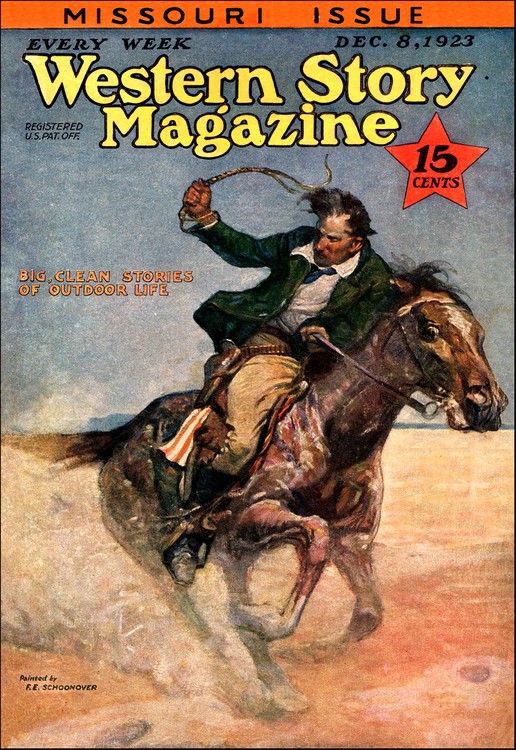
Western Story Magazine, 8 December 1923, with
"Uncle Chris Turns North"
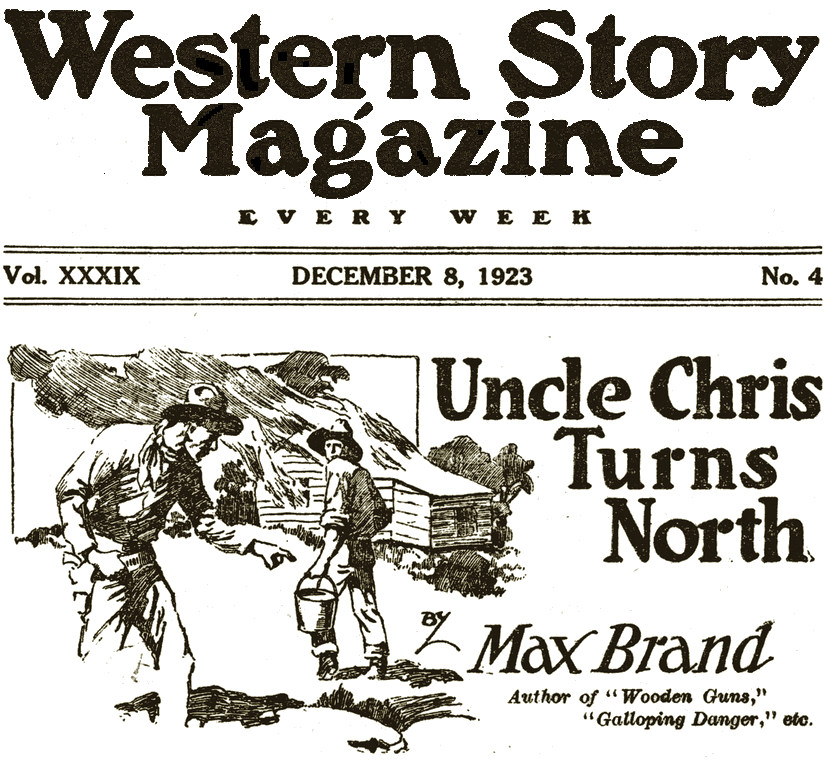
Title illustration from "Western Story Magazine"
Uncle Chris Turns North follows the collision between youthful hope and entrenched tyranny in a small Western settlement, where young rancher Willie Merchant—hard-working, earnest, and newly ready to marry Jennie Martin—finds his dreams crushed by Jennie's guardian, the domineering Chris Martin, who controls the town's land, water, and people with absolute authority. After Chris threatens Willie's livelihood by cutting off access to the only water source, Jennie is manipulated into believing Willie a coward, while the beloved village blacksmith Hank Ballon, driven out by Chris's cruelty, becomes a symbol of the community's quiet rebellion. As Willie finally confronts Chris openly and vows to fight for his rights, the town witnesses the beginning of a dangerous feud that exposes both Chris's brittle power and the rising courage of those he has long oppressed.
WHAT Willie Merchant decided, when he had finished dressing and looked at himself in the glass, was that his face was not so bad—it was his name that damned him. There was nothing spectacular even in his appearance, to be sure. That is to say, he was of about average height; his hair was between sandy and brown; his eyes were between gray and blue and looked a little green in some lights; and his features were simply as average as the rest of him, except that his mouth was a little wider. He stretched that mouth with a grin; and the effect startled him.
"But, after all," he decided, "old Chris Martin won't give a hang about my looks. It's my bank account that he'll inquire after!"
He stepped to the door, and the hot wind rolled heavily against him. It burned up his perspiration in an instant; it scorched his body even through his clothes. But it was better than the stifling closeness of the atmosphere inside. He scowled, so that a steep shadow fell across his eyes, and thus sheltered, he was able to look forth upon the landscape.
"Mostly 'scape," he said to himself.
And, in truth, it was not a very attractive picture. There was just enough roll to the ground to spoil the grand effect of an absolute plain level standing away to the horizon; but there was not roll enough to give the comforting variety of hills. The surface was simply thrown into little waves a hundred yards apart; that was all. It looked to Willie Merchant as though that landscape had been turned out with a gigantic rolling pin. The only bit of mountain sculpture was the Diablo Range to the south and west. They were a huge distance for riding, but the eye went to them so easily through the dry air that no tint of the horizon blue was on them in the midday.
They were simply big, brown, naked ugly masses, a poor monument to the Creator of this wretched country. Yet Willie Merchant surveyed the scene with much complacence; if in some respects it were ugly, in others it was delightful. For instance, that sunburned bunch grass, withering still more in this hot wind, had the most astonishing nutritious properties. And it fattened certain scores of wide-horned, red-eyed cattle that roamed the desert, branded with a peculiar scrawl and cross. A most delightful hieroglyphic, in the eyes of Willie, because it meant that they were his property!
No wonder, then, that he looked fondly at that brown grass and then away to a single form of a cow which "strolled into the sky line across the top of a knoll and then disappeared. Only a fleeting glimpse. But he knew the creature. It was the four-year-old brindled mongrel among the half dozen he had bought for a song from Peterson last winter, when they were half starved. He had nursed them through the bad season almost by hand. To-day five of the six were living and prospering! They were money in his pocket. By such shifts as these he had built up his little herd in the amazingly short time of two years. And, after all, he had not received the weight of a single hand to help him. It was all his own work! And the only previous preparation had been the year he spent accumulating his pay. That saved cash and then infinite labor to eke out his capital, had given him these returns.
So great were the returns that Willie Merchant lifted his brown face and smiled toward the white-hot sky; his ideas concerning a divinity were very vague, very less real than the wisps of cloud forms here and there which the sun had not yet been able to burn up. But to whatever god there were, he rendered up his thanks.
The house in which he lived was small, but it was his own. His own money had bought the remnants of old Sam Chandler's shack in the draw. How few dollars had been needed to persuade the whisky-loving old scamp! His own labor had brought that lumber across the hills; his own uninstructed hands had, somehow, contrived to erect the shack. And for two years he had struggled on, propping it, refitting it, making it finally ugly enough, but sound and strong. He rejoiced in the possession of three rooms. There was a kitchen-dining room. There was a bedroom. And there was another room more splendid that the others. He himself hardly knew what to call it. Surely it would be presumption to name it a parlor!
At the thought, he turned from the door and went to the front of the house and, gingerly, pulled open the door of the sealed chamber. The window was kept tight shut lest sand and dust blow in. Accordingly the room was furnace hot, and the stinging smell of new varnish, half melted, came to the nostrils of Willie Merchant. But that he did not mind. What he looked at was the grass rug on the floor, embroidered with a brilliant Indian design, and two pictures on the wall which had been cut from magazines, but which looked well enough in neat frames, and, most of all, he regarded three great bundles wrapped in coarse cord and paper. The biggest was the rocking chair. The other two were straight. Willie regarded them with a leaping heart. Her hand was to cut the strings, remove the paper, and bring those chairs to use and the light of day!
She was pretty Jennie Martin, so gay and so happy that the only blot on hen life was the freckles across the bridge of her nose. But Willie was blind to such small defects; to him she had seemed an angel, on a day, three years before. The sight of Jennie had made him begin his savings. The sight of her had made him toil and slave for two more years. And now, at the last, he was ready to marry her.
There was a single last hurdle to be jumped. Jennie, herself, was willing; she had told him so two months before. She had ridden to the ranch. She had inspected everything with cries of delight. She had nodded with a flushed, uncomprehending face of joy as he explained with magnificent gesture, how his little ranch would expand west and west toward the Diablo Range, and how the cows would multiply. She had been escorted through two of the rooms of the house and had declared it was more than good enough to start housekeeping in. And to think that he of himself had planned and executed this dwelling! How big and wise and strong he was! The heart of Willie ached to think of her words.
And how she had teased and pleaded to be allowed to peek—one single glance, no more—into the sealed chamber. But he had been adamant. He had wondered at his own strength. And in the end, when he took her home, she had cried for pure happiness, into the hollow of his shoulder, and all the stars in heaven had seemed to look down upon Willie Merchant to bless their union.
Yet still there was one hurdle to cross, and that was to gain the consent of Chris Martin, her uncle. He had raised her. Therefore he had a right to speak as to her destiny in her years to come.
What answer he would give was the great question, now, and though Willie Merchant could not imagine why he might be refused, yet no one could be sure of what old Chris would do. All the old-timers declared that his mind was as unreadable and whimsical as the mind of the sphinx. Yet to Willie himself he had always seemed a kind and simple man, singular only from the fewness of his words.
There was no time to ponder now, however. So Willie picked rope and saddle from the wall and went out to the corral. The four horses began to swirl about when they saw him coming. It did not confuse Willie. He opened the gate, stepped inside, dropped the saddle upon the top rail of the fence, and with a single wrist movement shook out the noose of his rope. Then he advanced. It was the roan he wanted, the fiery, ugly-headed roan. He wanted to feel the strength of that indomitable little mustang under him on the way to town for the momentous interview. It would give his very mind greater power. So he sifted through the others, and let the three fly to the far corners of the corral. But the roan he cornered and advanced on tiptoe toward him, prepared to spring to either side. For the roan was rope-wise to a degree. And it could dodge like a house cat. In one hand Willie held the rope end, noosed. In the other hand he carried the real noose. When the roan plunged to one side he feinted with the nearest hand, and the horse finally was backed into the corner, watching him with glittering little eyes of hate.
At length, desperate, the roan made a blind charge for freedom, neither to the right nor the left, but straight at Willie. Willie dodged like a bull fighter, just before those gaping teeth were in reach of him. The rope slithered out of his hand. The noose floated out, formed in a perfect circle above the roan, and then dropped around his neck. The roan stood still. He had been rope burned too many times not to surrender the instant that prickling coil had hold on him. He stood like a lamb while the master saddled him, and like the most well-trained saddle horse, he cantered off when Willie Merchant had mounted him. Only his ears were flattened along his neck, and his little bloodshot eyes watched the rider from their corners. Some day that horse would make him trouble; but Willie never worried about the future.
He was in the presence of Martin before he even saw the old Tartar, for when he entered the town he was upon Martin's land. All the town and all the houses upon it belonged to the little czar of the district. There were twenty houses or shacks. They were all Martin's. There was a combination hotel, and general merchandise store. It was Martin's. There was a blacksmith shop. It was Martin's. So were broad stretches of land outside the town and the cattle which grazed on them. All belonged to Martin. Perhaps he was not worth, actually, many hundreds of thousands of dollars. But he seemed to be richer than a millionaire, for, what he owned, he owned with an absolute right. The families which were his tenants were almost his slaves. They owed him money; and they were powerless in his grasp. But he never pressed his tenant debtors for the money they owed him. He gave them freely his keen, practical wisdom. There was not a man in his village who did not live in comfort. And yet they feared him rather than loved him, for they knew that to differ with him was to be ruined. Rebellion he would not tolerate. In short, he was a tyrant. He was a kindly tyrant usually, but when his fur was rubbed the wrong way, his claws were instantly out.
Willie Merchant could not help thinking of these things as he entered the town, and for every step his horse advanced, his heart sank lower. If the czar refused him, what would he do? What could he do?
HIS courage returned when he actually faced the great man. Old Chris kept a room in a comer of the hotel as his office. It was a most unpretentious place. It was up two flights of stairs, in the little corner room which was all that the third story consisted of. The stairs were unpainted, rickety, with the center of the boards hollowed out by the treading of many rough boots. The door of the office sagged upon one hinge. For three years old Chris had let it hang like that, lifting it carefully open and shutting it again with equal caution. He used to say that he could read the character of a man by the fashion in which he opened and shut that door. The office itself was a heap of scraps and a little of odds and ends. Whatever old Chris found, he picked up; whatever he picked up, he saved.
Martin was dressed, when Willie Merchant found him, in a soft white shirt with a double stripe of blue and red lines running through the cloth. It had shrunk so that the collar and the sleeves were much too small for him. But he made short work of those hindrances. He cut off the sleeves at his fat elbows; and he left the collar unfastened. Such was the shirt of the great man; the rest of his costume consisted of a pair of old brown trousers, faded to a tan across the knees and the seat, and bagging beyond conception at the knees. They were held up by a single suspender, which was used out of preference and not carelessness. It crossed the left shoulder, and Chris used to say that this gave him a little more freedom in his right shoulder and arm. What he needed that slightly greater freedom for, need not be said. His boots, to complete his costume, were heavy, unpolished, shapeless things, and, most of all offensive to the eye of a cow-puncher like Willie Merchant, who would not have donned other than shop-made boots had he starved to buy them.
Martin was short and heavy without being wide of shoulder. He was simply very thick through. He had, in fact, a round build. His strength was enormous, but it was disguised even on his ponderous forearms by a thin layer of fat which was spread over the surface of his body. His muscles, indeed, showed at only one place, and this was at the base of the jaws, where a great permanent knob pushed out on either side, and, when he set his jaw, as he was continually doing, either in meditation or in anger, those knobs turned into corrugated knots. He had a rather pale face, for, much as he talked about the value of labor, he no longer touched any sort of work. His face showed fat and soft. The flesh under the chin was flabby. His nose was short and flattened a bit, like the nose of a pugilist. He had great, flapping ears, which thrust out on either side of his face, and which were even exaggerated in size by his habit of keeping his hair closely cropped. All of him, as might be seen at a glance, was extraordinarily commonplace, with one exception, and this was that he possessed a pair of those bright blue eyes which never falter, and which denote without exception, a bull-terrier courage, an indomitable will, and a cool, steady brain in all trials.
He sat with his chair tilted back and his cowhide boots resting on the face of his desk. That desk was piled with papers blackened with house dust and yellowed at the edges. They had lain there for years, with a bit of iron lying on the top of each pile. Those piles of paper were never touched. Perhaps they stood there to give the office an appearance of a lively industry. But the singular inertia of old Chris kept him from maintaining the bluff or removing it. The only vestige of recent industry consisted of certain handfuls of iron junk, red with rust, which he had recently picked up. His hands were red with the same rust; where he had rubbed the side of his face there now appeared what seemed to be a broad marking of dried blood.
All the drawers of his desk were stuck fast. They could not have been opened without a hammer and chisel and many wedges. That is, all were fast-sealed by the warping of dry summers, with the exception of a single one. This was that in which old Chris kept his cigars. He had one expensive habit only. That was his choice of tobacco. Some said that on a time after prosperity came to him, he made a long trip to the West Indies, studied tobacco on the spot, and selected for himself a certain type of leaf of a certain type of tobacco; he even selected the maker who was to prepare the tobacco, and instructed him in the exact shape of the cigar he desired. It was a long, fat cigar. Its color was a pale, yellow-brown. It was rolled very compactly, and though it drew clearly, it made a slow smoke at the best, even for old Chris. It produced a long, black ash. That is to say, it was really a mottling of gray, but so much darker than an ordinary cigar that it seemed black. It was commonly supposed that old Chris spent his time in his office smoking steadily at these cigars and thinking of little other than the length to which he might draw out the ash of that particular smoke.
Certain it was that he handled his cigars with the greatest delicacy, that he kept his eyes constantly on the length and condition of the ash, and that he never knocked them away. He waited until the ash fell of its own weight, or was pried away by a draft of the wind.
Into the presence of this soiled, ash-streaked figure, then, walked Willie
Merchant. And oh, thought he, for another name than this name "Willie!" Cursed be the day when that name was applied to him! But for that matter, it was not the fault of the world in general. It was the fault of his dear mother, who had insisted upon calling him Willie long after all the rest seemed united that it was time to call him Bill. Bill was a good name, a good, manly derivative from William. But Willie? The soul of the young fellow shrank within him. He talked like a frightened pupil reciting a lesson when old Chris, in his quiet voice, asked him what brought him there.
It was Jennie who brought him there, he explained. They'd agreed that it would be a good idea to marry.
"You've both agreed that?" asked old Chris.
"Yes," said Willie. He would have added a "sir," but his breath was too short to admit of that. - "Go back home and think it all over for a week," said old Chris. "Then come back a week from to-day and talk it over with me again."
Willie Merchant went out, and the rich odor of the Havana followed him down the stairs and to the street. He found himself in the open air at last, and he made a fierce resolution never to smoke another cigar so long as he should live. That decision, for some reason, made him feel more at ease. He started, but not for his home. Instead, he drove out to the Martin ranch house, and there he found Jennie under the mulberry tree and told her what had happened.
"It don't mean anything," Jennie assured him. "He's just taking his time about it. That's his way. It'll all turn out all right in the end. Besides, Will, dear, how can he stop us from marrying if we really want to?"
It was an angel voice to Willie. He went back to his place and, because he could not sleep at night nor remain quiet during the day on account of the tumult and the hope in his brain, he worked like a madman during that next week. So that it was a weak and haggard fellow who stood before Martin at the end of the week. Old Chris was smoking with a concentrated frown of attention, for he had actually succeeded in smoking two thirds of a cigar without having the long ash drop off! And this miracle of skill and good luck seemed to mean far more to him than the interview with the young man who had come to talk to him about marrying his niece. He kept watching the ash.
"Well, son," he said, as kindly as ever, "you been thinking all week?"
"All week, sir."
"Well?"
"I've made up my mind; I'd rather die than not to marry Jennie." "You would, hey?" "Yes, sir."
"I've talked with Jennie," said old Chris. "She says that she'd die rather than not to marry you."
He considered his own statement for a time, while the heart of Willie Merchant beat with triumph. Then, from the street beneath the window, there arose a nasal, droning, drawling voice —a cracked and ruined tenor of an old man which began to sing the old ballad, so appropriate to this very moment:
"Of all the girls that are so smart
There's none like pretty Sally;
She is the darling of my heart,
And she lives in our alley.
There is no lady in the land
Is half so sweet as Sally;
She is the darling of my heart,
And she lives in our alley."
Here old Chris started from his chair so violently that the long ash tumbled from the cigar and struck his knee, and, still remaining solid with a wonderful firmness, rolled off and struck the floor before it cracked apart. Old Chris looked down on that small ruin with a black face. Then he strode to the window and peered down into the street.
"It's that darned old fool, Ballon; old Hank Ballon, I see!" said Chris.
He jerked the window up wider and leaned out. "Hey, Hank 1"
"Aye?" called the nasal voice of Hank.
"Stop that darned noise!"
He slammed down the window and turned on Willie Merchant "Look here, Willie, what have you got to marry on?"
"I got a bit of land; I got some cows that are doing fine; I got a house that Jennie says is good enough to live in."
He gave this recital proudly. He added: "I went over to the auction at the Sterne place last month and bought in some plows and harrows and old harness for dog-gone near nothing. But they'll still work. I bought a few mules off some Mexicans that run out of fodder and money and sold mighty cheap. And now I'm all ready to start working that bit of loamy land down in the draw. I figure that they's some good crops in that land."
"It's a hot country, Willie. I've always sent Jennie away through the heat of the summer."
"I could manage it, too!"
"Not if she had children."
"Well, that's a little different. But in a year or two, we'd be better fixed."
"Unless you hit a bad season."
"There's chances to be took in everything."
"Maybe."
For the first time, Willie began to fear. This continued opposition might become a stone wall before him. What could he do to climb it? The silence during which he pondered these thoughts lasted for some instants. Then he looked to the older man with a sigh.
"If Jennie will take the chance and gamble with me, I thought you wouldn't mind, Mr. Martin."
"Did you? Well, Willie, I dunno that I quite agree with you. I've invested quite a little coin in Jennie. I got to think about that I've fed her and clothed her all these years. I've give her everything she asked for. I've fixed her so's she needn't be afraid to look at anybody in the world. She gets everything I got; and what I got, when I die, is worth having. I don't suppose that you thought about that, Willie, when you picked on Jennie and decided to marry her?"
Willie grew crimson. In fact, that she would be the heir to Chris Martin had actually never come into his mind before. He had thought of nothing but Jennie, herself, and never had troubled to think of her background. When Chris Martin figured in his thoughts, it was not as a rich father-in-law, but as a possible obstacle to their union, and in no other wise
Old Hank Ballon, in the meantime, had forgotten the recent injunction of the terrible Chris. His wailing voice now arose again, taking up the burden of the second stanza of "Sally."
"Her father, he makes cabbage nets,
And through the streets does cry 'em;
Her mother she sells laces long,
To such as please to buy 'em;
But sure such folks could ne'er beget
So sweet a girl as Sally!
She is the darling of my heart,
And she lives in our alley."
Chris rolled his eyes at the window but he did not stir from his chair, and his voice, which had now become a sort of a low thunder, was directed at Willie Merchant only.
"Old Hank, he's a type of what comes to men that marry on nothing. Old Hank, his girl was one of the prettiest you ever see! What happened? She worked herself ugly having three babies in three years, scrubbing their clothes, tending the house, doing the sewing, and cooking for Hank. But their shack was so small that there wasn't no room in it for three babies and Hank. There wasn't no peace there for him. He went out and started drinking. He's done it ever since. He's full of moonshine right new! More booze, less work! His blacksmith shop started running downhill. Then along come a bad winter. The kids got colds; Hank didn't have money to buy 'em the right sort of food. Dog-gone me if they didn't all die. And that busted their mother's heart and she died right after 'em. And that's all what come from a poor marriage!"
From the street the tenor voice of the old man rose again, and now he had sung himself into tune, it might be said, and there was the resonance, or the ghost of it, that had once made him sought for at all youthful parties.
"Of all the days that's in the week,
I dearly love but one day,
And that's the day that comes betwixt
A Saturday and Monday;
For then I'm dressed in all my best
To walk abroad with Sally;
She is the darling of my heart,
And she lives in our alley."
Both Chris and young Merchant now remained for a time staring at one another.
"You ain't favoring this here marriage," said Willie stiffly, at the last. "I ain't."
"Then, Mr. Martin, with all respect to you, I guess that me and Sally had better go ahead and do the best we can in spite of what you say. We figure that we can't get along without one another."
The voice of Hank Ballon, reenforced by a long swig of colorless moonshine whisky in between stanzas, now thrilled through the air, young and filled with the music of joyousness.
"When Christmas comes about again,
Oh, then I shall have money;
I'll hoard it up and box it all
I'll give it to my honey;
I would it were ten thousand pound,
I'd give it all to Sally."
Chris Martin was at the window again. His voice was not raised; it was murderously low.
"Hank," he called, "go home and wait for me there. I'm coming to see you, pronto."
There was a chorus of shrill protest from the little children who had gathered to hear the old toper sing; but Chris slammed down the window and shut out the noise. He had the fuming stub of the cigar between his teeth. It was so short that it burned his lips. But he spoke around it, grinding his teeth into the tobacco, and his clear blue eyes under their wrinkled lids were devilish in their intensity.
"You two'll go on without me, eh? Not by a darned sight, Willie. No, sir, you ain't going on without me. You ain't going at all. You're going back to your work or wherever else you want to go. Understand? You're going to see Jennie, and you're going to tell her that you've changed your mind after all; you ain't ready to marry her yet!"
"But I am—"
"You lie!" shouted the tyrant. "You young fool, you lie! What'll you marry on? Your scrap of land, and your dozen or two cattle? I say, what's that land worth and what's them cattle worth without water? And where d'you get water except from me? And d'you think I'll let you have it if you start bucking me? Nope—I'll smash you flatter'n the devil, Willie! That's me! I smash men. I got hands made for smashing them. I grind 'em up to dust. You'll marry her whether I want you to or not, will you? Why, I'll turn you and your cattle into skeletons. You'll marry on thin air, that's what you'll do!"
It was too true. For water, his cattle went to the great water hole on the Martin lands, that huge spring which never failed to run. Cut off from that supply, he was ruined indeed. His three years' work evaporated. Perhaps a hero would have thrown defiance in the teeth of Chris. Willie was not a hero. He was brave as the next man. No one had seen him show the white feather. But now he was crushed. For, as Chris said, he could not live on thin air—not with a wife to support. He swallowed hard and admitted defeat.
"Mr. Martin," he said slowly, "you got me beat. I can't move."
There was a change instantly in the cruel eyes of Martin. He dropped the cigar butt on the floor and ground the tobacco under his heel.
"That's sense, Willie. You and me will get along. I knew you had sense. But that fool, Hank Ballon, got me mad with his darned singing. This is what you do. You tell Jennie that you and she got to wait. Don't tell her that you've talked to me. You hear? I ain't going to have any trouble made between me and her. Not a bit! You go tell her that you thought it up out of your own head. Another year, and then, maybe—we'll see!"
But Willie, as he left the room, knew in his heart of hearts that the barrier which Chris had raised to their wedding would never be lowered. Martin had other plans for his niece. And, as Willie had frankly confessed to Chris, he was beaten.
He went obediently to Jennie and told her, not the truth, but what Chris had told him to say. They had to wait for another year.
"When we marry, we want children. They cost money. Another year everything will be hunky-dory. You see, Jennie?"
She looked up to him and nodded, but there was a wrinkle of wistful sadness and surprise in her forehead.
"I guess you know what's best. Will," said she.
And Willie rode home with dust of ashes in his heart. He unsaddled the roan and had barely the energy to dodge the heels which that vicious brute flung at his head. He went back to his shack. He dropped the saddle in the middle of the kitchen floor, and he went on to the sealed room, dragged open the door, and looked within.
Then he dropped upon his knees beside the big rocking-chair, and the tears ran fast down his face.
OLD CHRIS had conquered, but he was far from contented with his day's work. On the whole, he did not believe in the use of brute force, when the other side had any weapon with which they could strike back at him. And, in this case, the weapon that Willie Merchant had was the love of Jennie for him. Martin was sensible that love is a dangerous adversary at all times, that it is full of tricks and wiles, that it is as remorseless as a poisonous serpent, and that it has a strength which is never spent. And though he did not see exactly how Willie could strike back at him, yet he was willing to be cautious, and he had planned to be most diplomatic in that last interview. He had planned to put the situation to Willie with advice and insinuation without any overt threat. And if he hinted at the use he might make of his control of the water to enforce his decisions, he bad intended that it should be no more that a hint. He wished, in a word, to handle Willie with gloves.
And he had failed in that effort. He had shown his bare, clenched fist, ready to strike. He had roared and bellowed at Willie as if the latter were no more than a tenant of his. He had revealed himself as a brute, and that knowledge made him wretched. In the first place, he did not like enemies. He was too wise to tread deliberately on the toes of others. He preferred diplomacy, always, to the mailed fist; though the single blow was all his instinct.
Such was the mind of Chris Martin. This day he felt that he had made a fool of himself, and he blamed his folly directly upon the voice which had sung the old love tune from the street. In a word, Hank Ballon had been his overthrow. And he determined, before his passion evaporated, to take out his grudge on the old blacksmith.
He went immediately to the shop, and there found Hank lying on the floor in the coolest corner, with his head upon a small sack of shavings, sleeping off the effects of his liquor. A smile of bliss was on his lips. His thin face was flushed by the happy vision which visited his sleep. One old hand lay, palm upward, on the floor of hard-compacted earth. Its palm was calloused like the heel of an athlete. The fingers were shriveled and wasted by age. They were curled almost as far shut as though the familiar handle of the sledge were in their grip. It was a noble and weary old face. Seen apart from his garb, those features would have served a sculptor for the type of a great statesman, wearied with the cares of his nation, and sinking under the burden of public service. The nose was long and finely formed. The forehead was a towering magnificence, with the blue tracery of veins showing distinctly at the temples. The eyes were very large, and sunk deep, as with long mental labors beneath the overhanging brow. The chin was long, square, and beautifully formed.
And even Chris Martin, who was as devoid from sentiment as stone, was touched with emotion and awe as he looked down upon the sleeper. But awe and emotion could not rule him long. He presently extended his foot and ground the toe of his cowhide boot into the ribs of the old smith. Hank Ballon groaned, clapped his hand to his bruised side, then opened his eyes and saw the face of his visitor. He pushed himself into a sitting posture with his long, thin arms.
"Howd'y, Chris!" he said pleasantly, and he smiled upon Martin. It was a beautiful smile. In sickness it made him seem whole. In age it made him seem young again.
"Stand up," ordered Chris Martin.
The smith caught hold upon the old anvil which stood near him and heaved himself up. He yawned widely, stretched himself, and was suddenly quite sober and steady. The imminence of the danger which confronted him was sufficient to make him rally all his faculties.
"I come here to wait for you, like you told me to do, Mr. Martin," he said ingratiatingly.
Old Chris looked steadily upon him, and a savage satisfaction in his power filled him when he saw the glance of the other waver and fall away.
"You been drunk again, Hank!"
"Drunk? Me?" began Hank with honest indignation.
"Ain't no good to lie. Not to me!"
Poor Hank passed a hand slowly across his forehead, bewildered, as though unable to remember accurately what he had been and what he had done even no earlier than this same day.
"Maybe I had a mite too much." he admitted.
"You've been drunk again," said the tyrant. "How much did you borrow from me last month?"
"Ten dollars," said Hank, in a dying voice.
"What'd you promise me then?"
"That I'd stop drinking, Mr. Martin. I aimed to do it, too, but seemed like this morning—"
"Darn what it seemed to you. Looked to me like you'd lied."
And at the insult, Hank flushed to the roots of his gray hair. But he looked steadfastly down upon the floor. He was more enchained than any galley slave. He could not strike back.
"How much d'you owe me altogether?"
"A hundred and thirty-five dollars," murmured Hank, almost inaudible, now.
"A hundred and thirty-five dollars!" cried Chris, with honest indignation. "A hundred and thirty-five dollars is a lot to be owed—by an old gent with one foot in the grave. A darned lot of money!"
Hank shifted his weight from his left foot to the right. He sighed, but could not speak, and still he looked steadily down at the floor.
"You been going from bad to worse," said Chris. "You used to have some sense. Darned if you ain't losing even that. You get worse all the time. And I'm tired; I'm through!"
Hank shuddered as the blow struck. He looked up now, indeed, bewildered, incredulous. But the face of old Chris was the face of a demon. He kept his voice low, but the effort made him white.
"I'm through," he continued. "You can move out your things. You can go wherever you please. You can pay me back that money you owe me when you've made any—which'll be never, I guess! But I want this shop and the house you been living in. I've charged you low rent on 'em both. I'll put 'em where they'll pay me better, now. Good-by."
He went out, not too hastily, for he wanted to enjoy what was sure to follow. And, just as he reached the doorway, a step came up behind him, and a hand touched his shoulder. He turned halfway around.
"You ain't serious, Mr. Martin?"
"Ain't I? You old loggerhead, d'you think I been talking just for lung exercise? Aim to make a fool out of me?"
He was not even answered. Hank clasped his long hands nervously together and looked up and down the street.
"I been pretty much tied up to this here town," he commented thoughtfully.
"What good have you ever done for it?" queried the master.
"Outside this town, there ain't nobody I know. I'm considerable too old a man to start out and make a new place for myself in the world."
"It ain't my choosing," announced Martin. "I've give you chances and chances. But you ain't done your part. And now I'm through!"
And he turned away again. He had not the slightest thought that he would be allowed to go. He expected that frightened figure to follow him. His first steps, therefore, were followed by shorter, halting ones. But nothing came behind him. There was nothing saving a most eloquent silence; Hank would not beg!
Now, it had never been in the mind of Chris for a moment to drive the old blacksmith out of his shop and home. He had, to be sure, done things as cruel as this, but on this day he only wished to be repaid for a recent annoyance by enjoying the spectacle of the humiliation of Hank. He wanted to be entreated. He wanted to whip the tears of despair into the eyes of Hank. But he had failed lamentably. The grief of the old man had been terrible and calm rather than ridiculous and weak. And old Chris cursed steadily and softly to himself as he went up the street. However, the matter would have another termination than this beginning. Ballon would not move until he was thrown out, bag and baggage. And this the rich man of the town, cruel and tyrannical though he was, dared not attempt. For he knew that the old smith had wound himself around the hearts of every man and woman and child in the village.
He decided, however, to allow Hank to suffer through the night, but on the morrow he would hunt him out and let him know that judgment was suspended —on a promise of future good behavior. With this resolution, he drove out to the ranch house and ate his supper alone; Jennie was not to be seen, and the cook announced her message to her uncle, that she was troubled with a headache and was lying down.
"Heartache," said the veteran to himself. "That's her trouble. Them kind of aches take a time to get over, but they heal up after a while. Besides, Jennie has some sense. In a month she'll be thanking me for keeping her out of the hands of a cow-puncher squatter."
This consideration so warmed his heart toward her that he could not keep from going to her, after a time. He found her in her darkened room, lying on her bed with her face buried in the pillow. He sat down beside her and removed his after-dinner cigar from his mouth.
"Look here, Jen," he said, "I'm sorry you're all cut up with this here headache. Come out and try the fresh air. It's turning off tolerable cooler."
She shook her head.
He pondered upon her for a little while. The tan of her neck was as brown as when, in her childhood, she ran about under the sun with a bared head. And the wisps of hair which half curled and half floated at the nape seemed to him strangely childish, too. Indeed, he told himself, she was still only a little girl. And the consideration of her weakness of body and of mind and of character brought pity into his mind. He took one of her hands. It was hot and wet; the skin was as soft as a baby's.
"I'll tell you, honey, I'm going to send you out of this darned hot climate where you can draw a cool breath. I'm going to send you up into the mountains. Understand?"
"Dear Uncle Chris!" she whispered, and then no more except to shake her head.
"You won't go?"
"No."
"What's wrong?"
"We're not to be married—not for a whole year, Uncle Chris!" "Why not?"
"Willie wants to make more money. And while he stays here and slaves, / can't be gadding about on vacations, can I?"
It was a side of the picture which Chris Martin had not considered.
"Will it make him happier to have you miserable?"
"But I've got to be a partner, you know. Then, in another year—"
"Bah!" cried Martin.
She sprang from the bed and to her feet in an instant, bright-eyed with suspicion. She was not so young and tender after all, he decided. He put on a manner of calm masterfulness. She must do what he told her to do. It would be much better for her peace and her comfort of mind. Stop thinking; he would do that for her. But oil had no effect on the stormy sea of her suspicion. Why had he cried out in scorn at the mention of Will Merchant's name? There was something strange and hidden about this whole affair.
"Because he ain't worthy of you!" cried Chris, losing his temper for the second time that day. "He's yaller. That's what he is. He's plumb yaller, Jen!"
"That's not true!"
"Don't tell me, girl. I've seen!"
"Seen what?"
"Seen him crumple up like a dog when I threatened him—"
"When you Uncle Chris, what does it mean?"
He saw that he had blundered on much too far. He decided to brave it out.
"Means that I told the pup that if he married you I'd shut his cattle away from the water. He didn't have nothing to say. That's why he come out and talked to you. Puts his cattle above you. A devil of a fine kind of love that is. Love? He loves my money. That's all. That's why he wanted to marry you, Jen. Nothing else. He's a crook, and he's yaller besides!"
Thrice she had been about to make a fierce retort; and thrice she had controlled herself.
"And that's all true?" she said huskily, at last.
"What else made him change his mind?"
"Then," she said, "thank God that I've found him out in time."
She spoke so gravely that Chris Martin was touched with a slight misgiving. He began to feel float he had meddled in something more than an affair of calf love, perhaps.
"I guessed that he was no good," he said. "I wanted to give you time to find it out for yourself."
"I'd like to be alone," said Jennie.
And he left her to walk, as he did every evening, up and down under the mulberry tree, smoking his long, black Havana. He made it last a long time, as he did every one of those costly cigars. It endured with him until bedtime. But during the whole space he thought not once of the cigar between his teeth; what was in his mind was that he was in a grave crisis. He was beginning to understand that if he lost the affection of the girl, he did not care what calamity followed. She was more to him than he had dreamed; far more. She was more, even, than a child of his own could have been. And, realizing this, he was more pleased than ever that he had broken that engagement with young Merchant. If only everything turned out well!
HE went to bed and dreamed troubled dreams. He wakened with a headache, and no Jennie to sit opposite him and pour his coffee and smile at him while he growled at the world in general. Once, as he looked at her empty chair while the Chinaman awkwardly hovered about and tried to take the place of the young mistress of the house in making the rancher comfortable, a panic came over old Chris.
Martin said to himself that if love and sorrow had crushed the girl to such an extent—for to miss a meal was not in the comprehension of Chris—perhaps it would be better, after all, to let her marry the youngster. However, he felt that he had taken a step from which he could not recede. He had poisoned the mind of the girl against Willie Merchant, and on that point he was entirely comfortable, for he had only told her what was, to a great degree, the truth. Like all truly masterful liars, indeed, he never based a falsehood upon thin air. His conscience would never trouble him for what he had done, if only Jennie could be made happy again; and to help him to that end, he trusted deeply to time, as all wise men do.
Having had a debauch of sternness and cruelty the day before, when he arrived in town the next morning he opened the three letters which lay upon his desk, read them, answered them with his swift, illegible scrawl, and then finished smoking his cigar. By this time the effect of a night's bad sleep had well worn off; his natural vigor was beginning to assert itself, and he left his office and walked down the street, banging his heavy heels against the board walk which was his only needless extravagance in the construction and the maintenance of the village. He reached the house of Hank Ballon and kicked the gate open.
"Oh, Hank!" he called.
His voice struck like a blast through the open front door and echoed faintly back to him from the rear wall of the house.
"Hank's got up early, the dog!" grinned old Chris. "Done him good to get a talking to, and he's got up and started in work the same's younger men do. Well, he won't keep it up long. Not him. It ain't in his bones!"
He was so convinced of this that he went on down the street toward his office, again, but at the door of the hotel he turned sharp about, driven by something which he could not explain. He went hastily around the corner of the street and there he saw a semicircle of youngsters standing at the entrance to the blacksmith shop, and gaping in the most intent interest.
That was most usual. Wherever Hank appeared, the children were sure to show their faces before long. And, while pressing jobs awaited his hand, he would sit down on the old barley bin in the corner of his shop and hold forth to all who cared to listen, but particularly to the children. Rocked far back into the shadow, with his long and bony fingers hooked in front of one knee, his head deeply sunk, his eyes either closed or else looking out with startling glimpses of light, he would tell his stories. They were better than fairy-stories. They started not with "Once upon a time," or "In a distant land across the seas," but out of the very stuff of which their lives were made he built his romances. His heavens were no bluer than the skies above their heads; and he, by the mere naming, made the old swimming pools, the twisting white roads across the hills, and the smoky colors of spring upon the desert, enchanting.
He was about to turn on his heel again and go to the office; but he decided that he would steal up and listen to the old loafer's voice for a minute or two. So up he crept, all unheeded by the enrapt children. When he arrived, he found that he had apparently come into one of the pauses in the narrative. There was no voice speaking. It was a pause of terror and fear and grief in which the cunning talker allowed their own emotions to work in the minds of his audience. And all of those emotions were in the faces of the children who stood so silently around the door of the shop. Old Chris looked around the corner of. the shop to take a peek at this eminent faker. But to his amazement, he found ~that the shop was empty of a single human form!
But upon the flooring, near the forge, there had been written with the point of a red-hot iron:
Dear Chris:
Here are all my tools, and I guess that they pretty near pay for the money i got from you. I find it's hard to go, but I'll never come back.
Hank Ballon.
This, then, was the meaning of the movement upon the fascinated lips of the children. They were repeating that terrible sentence over and over again: Hank was gone, and he would never come back again!
And then, suddenly, some one of them caught sight of old Chris. There was a white flashing of faces as they turned upon him. And not a word was spoken. Old Chris turned and fled. There was no other word for it. He ran away! And as he went he wondered what under heaven had happened. If the shouting of children was a mere noise and annoyance, why should their silence be worse than a thunderbolt fallen upon him?
When he was at last in the shelter of his office, he did not even light a cigar, but walked up and down for a long time, trying to put his thoughts in order, and failing lamentably in the effort. Hank had left town! Hank had actually taken him at his word and gone! If a dog which had barked at him a hundred times and then run when he snapped his fingers, had actually run out and put teeth in him, he could not have been more appalled.
He finally decided that he must go down to hear what people were saying of him. And he had not far to go. He found half a dozen black brows bent upon him. The very clerk behind his grocery counter would barely bid him good morrow!
These were signs; these were portents, indeed!
Then he went out into the street and saw Sam Patrick, and gave him a good morning.
"A darn poor morning to poor old Hank!" blurted out Sam Patrick, and went on past him without another word.
In short, it meant revolution. But Chris Martin thrust out his lower jaw and decided to meet the brunt of the opposition right there on the spot. He called back Sam Patrick with a voice of thunder. Then he told him why he had driven Hank away. The blacksmith was a lazy old drunken ruffian, stated Chris Martin. For years he had not been worth his keep. For years he had been running deeper and deeper into debt And now the time had come for him to leave. He was incurable.
"He'll be a big loss to the kids," was all that Patrick would say, and so he left Chris.
In the meantime, as they talked, windows had gone softly up, and heads had looked out and even many ears unseen had listened carefully to every word from the street. When the tale was ended, each window was closed again all as softly. Not a word was said; not a voice was raised. But old Chris knew well enough all that would follow, and how they would gather together to converse about the thing which had been done. They would have harsh things and hard things to say about him, beyond a doubt. But he resolutely damned them and went on his way. Yet something was stinging him to the heart. What would become of old Hank? Where had the old rascal gone?
Then he forgot his pity. It seemed to him that Hank had simply left the town and .left that sad and stern message behind him because he wished to raise the hearts of the villagers against Chris. Five minutes before he had been condemning himself for his cruelty to Hank. But from this moment he began to hate the old fellow and wish that even the memory of him might perish from the face of the earth.
His anger grew with brooding.
In the meantime, his niece had left her room not five minutes after her uncle left the house. She went to the corral, caught and saddled her own horse, and then flogged at full gallop across the hills and through the delicious fresh coolness of the morning air. Oh, how thin and still and how vast it was! Still it seemed to Jennie that the curve of the great earth's surface was pressing her dizzily up into the sky!
There was no joy in her heart. She went savagely on to the house of Willie Merchant, and she met Willie at the door, just coming out, with his saddle resting against his hip, and his head sunk.
She was too blind with anger and rage and disgust to do more than know that it was he; had she looked any closer she could not but have been touched by the despair in his eyes. But she saw nothing. There were too many tears in her eyes after she had spoken the first words.
Jennie told him, quick and plain, that she was done with him. She offered him back his ring, and when he would not lift his powerless arms to take it, she dropped it in the dirt at his feet. She took out a dense packet of letters and tossed them down after the ring. Then she turned and rode away. And when she crossed the next wave of ground and looked back, what did she see but poor Willie Merchant standing just as she had left him, with the white batch of letters at his feet, and the saddle resting against his hip, and the quirt dangling in his hand.
"A coward! A coward! A. coward!" gasped out Jennie, as the gallop of her horse rocked her along. And then she cried in the same voice: "I wish I were dead! I wish I were dead! I wish I were dead!"
She rode on blindly until her horse began to stagger. Then she looked about her and found that instead of heading straight back for the ranch, this wrong-headed beast had turned aside and was veering toward his old home, which was the Jacobson Ranch. So she had to make a detour through rough ground before she could get back through the broken country and come within line of her uncle's ranch again. And thus it was that she encountered old Hank Ballon.
She came over the first rise from which that old ranch house was visible and saw the deserted shack which old Bud Hervis had built there twenty-five years before, in the days of the cattle wars. But it was no longer deserted. Smoke, as gladdening to the heart as the flag of a man's country, waved out of the patched and re-erected chimney, and snapped away to nothingness in the morning breeze. The door was open, and a broad white piece of new pine showed where it had been recently repaired and held together with nails. Indeed, the old place had come into a sudden and not unpleasant life.
Then, looking down into the hollow, she was amazed by the sight of the bony bay gelding, "Timothy," and the goat, "Jud," which, as all the world knew, were the property of the good old man, Hank Ballon. She knew all about Hank's faults. But she knew all about his virtues. And like every one else, except her uncle, she loved him with all her heart.
In her astonishment, she forgot her own grief and rode up to the door and knocked against it with the loaded butt of her quirt.
"Hello!" said the familiar voice inside, and then the door opened and the old blacksmith was before her. He came out with a laugh and a wave and took both her hands in his big, bony fingers.
"Jen, my darlin'," said he, "how long and how long it is since you've been to see me an' talk to me. Where have you put yourself? Into Willie's pocket, doggone him!"
Hank knew, then; and that meant that everybody knew. It was going to be much harder than she had at first anticipated.
"There's nothing in that, Uncle Hank."
"I guess not!" said he with too much emphasis, and winked brightly at her.
"But what on earth are you doing out here, Uncle Hank?"
"Me? I'll tell you how it is, honey. Dog-gone me if I ain't been pondering and pondering, and I figured it out that there ain't no chance for rest and quiet in a great, big place like the town. So I decided that I'd come right out here and take a swing at—what you might call suburban livin', eh?"
"But seriously, Hank, you rascal, what's in your mind?"
"Nothing but a wish to get away from the noise, Jen. There ain't nothing more than that. All I want is this little shack and you to talk to half an hour a day, and dog-gone me if I ain't plumb contented!"
"But the village, Uncle Hank. Good heavens, what will it do without you? How can it get on?"
"I'm an old man, honey. Folks get along right tolerable well without old folks!"
"Uncle Hank!"
"Heavens girl; I ain't aiming to make you cry!"
"Who've you had trouble with?"
"Ain't you going to believe nothing that I tol' you?"
"Not a word! Not a word!"
"This here comes from givin' women votes," pronounced Hank. "Dog-gone me if it don't!"
She tried again to make him talk.
"I'm just out here restin' and waitin'," was all that he would say.
But when she went on to the ranch, she heard more details. One of the cow-punchers had come on Uncle Hank in the old shack and had helped make him comfortable there.
The message that he sent by the cow-puncher to the world was that he was waiting indeed—and waiting inside the sight of the ranch house of Chris Martin. Because, he said, when a man had done as much wrong to the world as old Chris had done, it was time that he began to pay for it.
"Some day," he concluded, "Chris will go smash, and everything that means the most to him'll be lost. I'm just staked out here waiting to see when it happens!"
WHEN Jennie heard this, she refused resolutely to believe that Uncle Hank could ever have said such a thing.
"Why," she said, "I love Uncle Hank, and he loves me, Pete!"
"Sure he does," said Pete, the cow-puncher. "Sure he does. But nobody can love half as hard as he can hate. And here's where your Uncle Chris comes in for some dog-gone hard hating!"
He went away and left Jennie by herself to digest this remark and all that it might imply. And she decided at once that when her uncle came home that night she would have a long and most serious talk with him.
But a great deal was to happen that day before the night came on and the veteran drove his buckboard home, with the dust sluicing off the wheels and the tires bumping over the bumps which were hidden beneath the velvet of the dust. For, before that time came, a white-faced Willie Merchant came on a foaming horse into the town and entered the office of the terrible Chris Martin.
He stood at the doorway and regarded the landowner as though the latter were a ghost. Chris had vowed not to lose his temper for another month, but he was angered by this interview, and, besides, he despised Willie for the whiteness of his face.
"What in the devil d'you want?" he asked of Willie.
"You lied to me," said. Willie in a dead man's voice.
"I lied? You rat-faced brat—"
"You lied," said Willie.
And terrible Chris saw, with the most utter amazement, that in spite of all appearances which indicated it, Willie was not afraid. Not in the least! In fact, he was in a fighting fury, and would as soon pull out a gun as a handkerchief. To Chris it was hardly credible. For he prided himself on his ability to judge men. And he could not believe that he had gone so far wrong with Willie. Not that he doubted his entire ability to handle Willie in a personal conflict of any kind. And as for gun play, though he seldom had a chance to indulge himself in the actual sport itself, he practiced his draw and his shot every day. When he drove home behind the rat-tailed sorrels every night, as he bumped along the roads with no one within hearing of him and no one within sight, he used to empty his revolver at least once, at stumps and stones. So that old Chris was in perfect practice. And, being in perfect practice, he considered himself as dangerous a fighter as any one in the world, with the exception, perhaps, of a few desperadoes.
He regarded Willie rather with a cold and scientific interest than with a passion of anger. He did not want to kill this boy. simply because the boy could not put up a fight good enough to make the war interesting. Old Chris had arrived at that stage of mind!
"You're talking big and brave," he told Willie gently.
"I say that you lied when you swore that Jennie shouldn't know about what you and I had talked over. Then you went and told her everything!"
"You ain't remembering right, Willie. I said that you must not do any talking to her about this here talk we had. I didn't say whether I'd do no talking or not."
"You can't speak behind that sort of a cover, Mr. Martin!"
"I never speak any place, Willie. I'm always right out here in the open; and everybody in the world knows right where they can find me!"
"That's why I've come down here to tell you that you've double crossed me. She's turned me down, this morning. She come and give me back my letters and give me back my ring. She said that she was through with me, because I was a coward, and because I thought a lot more of my cattle than I thought of her!"
He shrugged his shoulders. "I guess she heard that from you, Chris Martin?"
"Maybe. Maybe she just made up her mind that she only wanted an excuse to break off with you, and any old thing would do!"
"That sort of talk don't bother me none," said Willie with a strange loftiness. "I know what she was yesterday, and I know what she was to-day. And you're the one that done it!"
He paused. Old Chris did not move in his chair. He lighted a cigar and through the smoke peered earnestly into the face of Willie. With each instant he was making astonishing and most delightful discoveries about the rich mines of manliness in this round-faced youth. And it always pleased Chris to find a man, under whatsoever guise. But not a gleam of his pleasure, of course, was allowed to appear in his face.
The next thunderbolt, however, completely threw him off his guard.
"I been wishing that you was a young man," said Willie. "But you're old, and I can't fight you. You're old, and you're safe from me. But for that, I'd have your gizzard out!"
It brought a sort of groan from Chris Martin. "You young fool!" he said. "If trouble is what you're after, I can give it to you inches thick. First place, keep your cattle away from my water hole. To-morrow, I fence it in! That's a beginner. Then I'll follow it right up. I ain't ever started to show you what I can do. I'll make this here country so hot for you that you'll howl like the devil for help! Don't forget that!"
Willie sighed. "I'm kind of glad that we know where we stand, each of us," he declared. "Let me tell you, that if one of my cows dies because you starve her out of water that you ain't got any need of yourself—I'll come and take a fat cow of yours to fill her place!"
"You'll steal, eh, kid?"
"I'll take my rights and keep em!"
"You'll bust the law?"
"When the law busts me!"
"That's the sort of talk that makes for murder, Willie."
"I'm rich an' ripe for it, Chris Martin. You can lay to that. I'm all set for it. For Heaven's sake don't give me no chances!"
Chris Martin laughed. "Get out, kid!" he said, and rose from his chair. He waved his arm as toward bothersome flies. "Out of this here room. Never come back! You? I'm going to bust you. If you raise a hand to hit back, I'll have you pinched. If you swipe my cattle, I'll have you lynched. Now get out. I'm tired talkin' to a fool!"
Willie Martin went most obediently. He retreated to the door, backed through it, and then went slowly and steadily down the stairs.
"He thinks that I'll shoot him right in the back if I get a chance," translated the older man slowly. "He don't know me. He don't know the half of me, that fool kid. But he's game!"
Four revolver shots crackled through the air of the street. And old Chris hurried to the window, almost rejoicing. A fight was what he wanted most of all. To see one was the next best thing to being in one himself.
But all that he saw was Willie sitting in his saddle in the street calmly putting up a smoking gun into his holster. He had fired the four shots himself, a pair close together and then another pair, just like two men exchanging a brace of shots at one another. After which the deathly silence sounded like a double murder.
He gained what he wanted to gain. In five seconds the entire population of the town was assembled around him. He spoke quietly from his place in the saddle above them, and yet Chris could hear every syllable of his enunciation.
"Boys and friends," said he, looking about him with no signs of stage fright, before such an assemblage as this was, "I've just had a little talk with your boss, old Chris Martin. Him and me have agreed to fall out right here. What he aims to do is to shut my cattle away from his water. Well, boys, you know that I've soaked in three years' work on that there little ranch. I've got my own cattle running pretty slick and fat. I've had no help from nobody and showed that a gent don't need no help in this here country. All I need is water. Martin ain't got cattle enough within marching distance of that water to use it. You all know how it soaks away and goes rambling off into the sand and dies in the desert after it leaves the watering pool. But old Chris says that he's going to shut me away from that there water. And I say that whenever a cow of mine dies for the want of water, I'm going over and take one of his cows. And I mean it, every word."
Willie paused. The faces beneath him were stunned with wonder, and, as old Chris could plainly see, with admiration.
"How this'll all come out," he said, "I dunno. I'll be breaking the law if it gets that far. And then I'll be run off my place, my cattle will die, and I'll probably get grabbed by a sheriff or a deputy, while I'm trying to get even with old Chris. But before they start in lying about me, I want to tell you the straight of what's going to happen if Chris bars me from the water, and so help me God!"
He actually raised his hand as he swore it, his gun hand—his right hand —and looked up into the white-hot sky. Then old Chris knew that he could never draw back from this solemn engagement. It was a matter of honor—of pride. He had to crush this defiant young fool no matter how much his heart bled for him.
AFTER that, old Hank Ballon was not the only one who waited for the downfall of Chris Martin and the denouement of this strange little war, for the whole range heard the tale and wondered heartily what the outcome of it could be. Of course, on the face of it, there was no hope for Willie Merchant. He had bid defiance to a giant, and therefore he would be crushed. Yet there is an element of suspense even in a lost cause. And the course of that battle was waited for with the keenest expectation. And there was hope against hope that justice might somehow be done to the weaker of the two combatants and justice done at the expense of old Chris.
In the meantime, Chris could not help but go ahead. What he prized more than anything else in the world was the fear with which he was looked upon by his neighbors. That which he had spent his life working over was the subjugation of the men of the village, so that they dreaded him more than they dreaded death. They were in the palm of his hand; and that sense of power was most delightful to Chris. He could observe the workings of his perfect system now. For no matter what black looks were cast upon him by the villagers, they dared not speak to him of what they thought. They were his men as absolutely as though he were a feudal lord and they his serfs. To maintain himself in that proud position he must convince them that it was ruin to oppose him. And he could only convince them by promptly crushing young Willie Merchant.
He proceeded at once with the work at hand. He sent his men to erect stout fences which shut away the southwestern lands from his great water hole; now Willie might take care of himself as best he might. The gantlet was down!
After that, the contest was followed with the keenest anxiety in the town. The whole range heard of what was happening, -and the whole range wondered how it would come out. Not a man, perhaps, who did not sympathize with Willie Merchant up to a certain point; but suppose that he were actually to cut fences and run off the cattle of the tyrant-—what would happen then? What would the law do?
There was no appeal to the law for the time being, however. Willie saw his cattle grow wild of eye. They no longer ate. They waited in front of the fence which barred them from the water hole where they were so accustomed to go. And, every day, Willie went out and watched them with an aching heart. Nothing tames the wild so much as thirst. It is more terrible than mere hunger, because it strikes sooner, and the pangs of its torments are sharper in the vitals. The thirsty cattle grew so gentle that they huddled together, but when Willie dismounted and came among them, not a foot stamped and not a horn swung at him.
It seemed to him that they turned their brute eyes upon him with a dumb appeal for help, he who had helped them so often, who brought them through the most terrible winters with a little extra forage, who got them up and scraped the chilling snow from their backs in hard weather; who pulled them from the bogs in spring; who was ever seen, through the day, hovering somewhere against the horizon. And so long as that familiar silhouette was near, there was nothing to fear from the wolves. They dared not come near the eyes of the man.
Of course it was sheerest fancy, but it seemed to Willie that all of these things were running in the brains of his cattle as he walked among them.
At times the cow-punchers from the big Martin ranch came down to the fence and sat calmly in their saddles there and viewed the dying herd. They tried to talk to Willie. .But he could not speak a word to them. He knew that if he parted his lips, it would be to curse and rave like a madman. So he would not speak to them. And again he knew that if he started to talk, his voice would break and he would weep like a woman. For he was very sensitive, very proud. He carried himself with a haughty air, with a chip on his shoulder, simply because he knew that his face was incurably boyish, and he was ashamed of that appearance. He loathed the weakness which made him come close to tears at every crisis. 'Shame is a terrible power that lives in the human soul; and it was what controlled the life of Willie Merchant.
Sometimes, as he watched his herd, and the cow-punchers on the farther side of the fence, he could see them talk to one another and shake their heads. Then a mist of self-pity would make his eyes dim; he would look upon the whole affair as from a pinnacle of a great height. It was a petty matter. He was a sullen fool, and Chris was a
.stupid old boor, no more. There was nothing here worth dying about.
Sam Hitchcock, the foreman on the ranch of Chris, called to him one day.
"Are you getting your guns limbered up, Willie?"
It was half satirical and half sympathetic, the voice which asked this question, and it brought the last phase of the contest into the mind of Willie with a start. He was no expert with guns. He had used a rifle and a revolver ever since he was a youngster, just as every one did on the range. But he could claim no particular skill with either weapon. His time was put in on the practical part of ranch work —the tending of cattle, and not the shooting of coyotes. He had not wasted three hours in his entire life pumping lead at targets. If he wished to make a showing, and against odds, he must certainly begin to practice at once.
He observed the fellows on the farther side of the fence. There were at least four of them who were infinitely better than he; and all the others were at least as expert as he. Yet, in another moment, he knew that if the time came when he must oppose fighting men, something would happen in him and make him capable of disposing of his work or else enable him to die as a brave man should. For, from this time forth, he began to feel that he was in the hand of a directing destiny which would drive him on to ruin or success as the case might be.
Then came the trip to town and the talk to the banker in an effort to sell his cattle. He had done small business with that banker before. He was astonished now by the price which was offered to him.
"I'm mighty sorry for you, Merchant," said the banker, "but I hear that your cattle are in poor condition, just now."
"They're starved for water, that's all. They need a drink, and then they'll be as good as ever. Two weeks will put them back."
The banker shook his head. That might be, and again it might not. His sympathy was all with Willie, but this was a business proposition. It was not his own money; he was investing for others; the directors would take him to task; and therefore he concluded by offering a tithe of what they were worth. It was a joke, thought Willie, and went elsewhere to strive to strike a bargain. But nothing could be done in reason. His honest friends whom he knew would not cheat him were all too poor to offer a price. The men who were able to pay wanted the cattle for nothing. Finally one old codger answers is complaints with a bit of dry, remorseless logic.
"Look here, you want a fair price when I know you're cornered and that you got to sell. I ain't a philanthropist. I'm a business man. I've climbed on the heads of them that have gone down. If I can climb on you, all right. If I can't—then sit down and smoke a cigar, but don't try to talk business with me!"
Willie went back to the ranch and straight to the herd. And the first thing he noted was a cow lying on its side, with the upper hind leg stiffly extended. He knew without another look that that poor creature was dead. And a sudden panic passed through Willie. What if they were all to die because of the lack of water, simply because he could not get his price for them? Then, with anguish in his soul, he fled to the nearest squatter—a fellow who was playing the same game he had tried to play, and had failed in. It was ten miles of hard riding.
"Come get the cows, Jerry," he told his friend.
"I seen 'em to-day," said Jerry. "We could never drive 'em this far."
"They'll need watering first?"
"Sure."
"Then," said Willie calmly, "they'll have their water." "How?"
"Leave that to me."
"Willie, you ain't going to play the fool? Because you lose some cows, you ain't going to throw away yourself after 'em, are you?"
"What happens to me," said Willie, smiling, "don't make a bit of difference. I'm just playing the game with Chris. He's won the first move. Maybe I got a chance at the second, though."
At this strange talk, the eyes of Jerry stared. But he rode home with Willie. He helped the latter harness up an old watering wagon which had been abandoned and left there by a wandering hay press. Willie's ingenuity had patched the holes in the iron. Willie's skill and industry had repaired the ruined running gear. Now he hitched six staggering, red-eyed mules to that watering cart, though two could have pulled it in the days of their strength.
"The whole shebang goes to you, Jerry," he told his friend. "These hosses and cows and mules are all done and all in. Now you stay here and wait for me to come back."
Jerry waited, and Willie went straight on toward the ranch of old Chris. Three more cows were dead as he passed the herd. All the others were down, sleeping or resting or dying. He cut a way for himself and the team through the wire fence, and drove on. There was no guard on duty this night. As though Chris were inviting him to break the law 1
The cows saw him go through. But not one lurched to its feet to follow him. They were spent in the last stages of exhaustion. So then he hurried as fast as he could go. He reached the great "fountain" where the spring welled out of the ground, and he tied the mules with fifth chains so that they might not get to the water and kill themselves by drinking great drafts too suddenly.
He carried water to them in buckets, poor frantic creatures, until they ceased chafing in their harness and were able to endure the sight of the glimmering waters of the pond in patience. Then he went on to fill the tank of the wagon itself. That was slower work; but when he backed the heavy wagon under the great pump at the farther side of the pond, he made good progress in filling it. It was a two-man pump, but Willie could have done twice that work with ease on this night. The tank was filled full. The last stroke of the pump sent water swishing cool and black along the sides of the wagon; and then Willie put on the cover, sealed it, watered the mules again, letting them drink more freely this second time, and finally started on toward the gap in the fence.
Jerry was out there to help him, by this time. He had refrained from cutting fence or in any wise breaking the law; he could not help lending a hand to reclaim the cows from death, which were to be his own; and so they passed the water in buckets; and the weakness of those which were down kept them from fighting the buckets out of the hands of their saviors. They could only bellow feebly as the smell of the water reached them. So they were given drink, one by one. Strength returned to them by magic. They rose to their feet. They began to crowd about the wagon, a mass of tossing horns, fighting to get more drink.
By this time they were strong enough to drive, so they started the herd toward the road, and then up the road to Jerry's place.
"You can buy water off Sawyer on the way," suggested Willie, and then left his friend and turned to go back.
"I'm only keeping these here for you," suggested Jerry rather feebly.
"They're yours for always," insisted Willie Merchant. "I'll never take a horn of 'em back again."
"I'll come back and help you tend to the hosses so soon as I get these fair started up the road," said Jerry.
"The hosses are dead," said Willie calmly. "They died to-day. All except the roan."
There was no answer from Jerry, as though he realized that words would not do in a case like this. And Merchant turned back to his ranch alone, while the long train of the cattle which had once been his passed down the road before him, bellowing and fighting, for the water had given them just enough life and energy to make them ugly.
BACK to the ranch went Willie. He had four dead cows, now, to replace. The living ones were no matter. He had saved them by giving them to another man, as poor as himself, one who could never have afforded to buy them, but who would be able to support them. With what he already possessed, this would make the nucleus of a fine herd.
But all this was behind Willie. The live cattle meant nothing. Only the dead belonged to him. And he had not forgotten one syllable of the oath he had sworn in the presence of the people of the town. He went straight through the gap he had cut in the fence. He found a group of a weather-beaten old cow and four gay heifers. These he drove through the gap and back onto his ranch. After this, he carefully spliced the broken fence, and the sun was just rising when he finished his work.
He went back to the shack. He had been so active this day, that he had not had time to realize all that was happening. But when he put on a pot of coffee and built a rousing fire under it, the first fragrance of the coffee as it passed through the shack made the heart of Willie shrink in him. He threw himself down on the bunk and lay motionless, with his face buried in his arms. The whole agony flooded down on him at once. He had lost the three years of his labors. He had lost Jennie. And the house which had been so much to him was now no more than a coffin to him; it inclosed all of his lost hopes.
Willie slept, And when he wakened, there was a hand on his shoulder. It was the tall form and the stern face «f Harry Vance which appeared above him, saying: "You've finished your game, kid. You just hop up and come along with me!"
Young Merchant sat up and yawned and stretched the sleep out of his arms until the last of it tingled out of his finger tips.
"Hold out your wrists!" said a voice behind Harry Vance.
It was young Pearson. Willie and Pearson had gone to school together, played together, fought together. They had flirted with the same girls, joined the same gang, followed the same ideals. But here was Pearson, looking at him as though the skin of Willie had turned into the hide of a wolf. There was dread and wonder and hatred in his face as he approached, carrying the handcuffs. Willie, as he obediently extended his wrists, thought the thing over. The conclusion came to him in a flash. He was reported a lawbreaker, a cattle rustler. And, being such, not only were the sympathies of people for him destroyed, but he had actually begun to be an object of hatred and fury.
He did not think of this with a passion of resentment, but calmly remembering another occasion when he himself had ridden out with a posse to catch a parcel of cattle thieves. He could recall the battle fury which had risen in his breast when he had first sighted the fugitives. He could recall how his fingers had itched to pull out his gun. But the gun had not been drawn, and now the situation was reversed.
He despised and pitied young Pearson, just as he despised and pitied the being which had formerly been Willie Merchant, for far different was he now! It was almost worth the price of the agony he had paid and still was paying, this superior knowledge of the hearts of men which was now his!
"Hold on," said big Harry Vance. "I guess we ain't going to need no irons. Willie's got his brains back again by this time. He ain't going to make things a mess for himself by trying to resist arrest. Besides, he knows me! He ain't—a fool!"
And he frowned ominously upon Willie.
Indeed, Willie knew the deputy well. The whole county knew and feared him, and the greatest of all mysteries was why the good sheriff should use such a creature as a tool.
"We don't need no irons; Willie ain't no fool," repeated the deputy. "Leave them handcuffs where you found 'em, Pearson."
Pearson retreated, frowning.
"Cook us up something to eat—fix up a snack, will you?" said the deputy.
And Willie Merchant went obediently to work. He cooked the best that he had. He had bought some eggs from Mrs. Chundar the day before. He scrambled them now with slices of ham cut crisscross until they were almost minced. He made strong, black coffee whose fragrance filled the whole house. And, with an expert hand, and with wonderful speed, he mixed fresh batter and fried flapjacks that puffed up as light as a feather pillow shaken by the chambermaid's hand.
And the deputy and his assistant ate ravenously. They ate until they leaned heavily back in their chairs and watched the cook industriously puttering about the stove. Neither of them thought to offer to exchange places with him and let him eat while they cooked. They took his service as their due. And he worked most cheerfully, talking as he cooked,
Finally Vance wanted to know why under heaven he had been such a fool as to rustle the cattle off the Martin place without running for it after he had done the work. He answered that he had done that rustling not because he expected to escape afterward, but because he had told the townsfolk that he would do that thing, and therefore he must live up to his word.
In the meantime, as he talked, he went back and forth, and finally, stilt talking, he went out the door of the house to the water wagon. He filled a bucket and brought it in, and turned from the wagon in time to see young Pearson slipping back from the door with a naked revolver in his hand. It made the blood swim across his eyes. Even while he cooked for them and gave them his best, they were prepared to pounce on him!
When he got back, Vance and Pearson were tilted back in their chairs, asking for more coffee. And now he filled their cups and then brought forth the ham and scrambled eggs. They had already eaten too much; but like creatures that cannot turn from good food, they fell to upon the new dish with groans. The deputy shook his head like an aggressive bulldog; and Pearson returned valiantly to the charge. So, placing the last bucket of water which he had brought to heat upon the stove, and picking up another, Willie went out as to get a second supply from the wagon.
And he talked as he went.
"How about more eggs, sheriff?" For, by that name, he was complimenting the deputy.
"Why, darn it, Willie. You're a good fellow. But I'm stuffed, darned if T ain't!"
Willie had put down the bucket of water and untethered that tall, long-legged, powerful racer of a horse, the gray upon which Vance had ridden out to the ranch house.
"More ham, then, Mr. Vance?"
"Not a darn thing more, but maybe a swaller of coffee, Willie."
"Help yourself," said Willie from the saddle of the deputy's horse.
"What?" called Vance a little anxiously, as though catching a new note in the voice of his host.
"You take my" ham, I take your horse," said Willie calmly, and rapped his heels against the ribs of the gray.
At the same time there was a stifled yell from Harry Vance; his knife and fork clattered against his plate; his chair went back with a screech, and then was thing from him and smashed against the wall as Vance dove for the door.
"You rat—if you " Willie heard that much. Then he was gone.
He headed the big gray straight along the side of the shack until the front of the house was just behind him, and then he rocketed across the hollows. Harry Vance came thundering into the open, but by the time he had taken his bearings and rushed around to the front of the house from which he could view the fugitive, there were scores of precious yards between them. Moreover, the sheriff's assistant had no rifle with him. That rifle—-a beautiful Winchester with fifteen newly loaded cartridges resting in the magazine—lay in the long holster which extended along the side of the gray and under the right knee of Willie Merchant. And to complete his arming, on either side of the saddle there was another holster, and in each holster there was a fine Colt, finished each like a jewel.
And with only a revolver to work, Harry Vance was quite helpless. His first two shots flew wide. His third was straight enough, but it only kicked up the dust at the flying heels of the gray, and after that the tall horse worked quickly out of range. Harry Vance, for his part, stormed back into the house.
He met Pearson on the way, a white-faced Pearson, whose eyes were almost starting from his head.
"What's happened? What's happened?" stammered Pearson.
"You blockhead, what d'you think?"'
"If only," groaned Pearson, "you'd let me have my way about them there handcuffs—"
"Who stopped you? Who stopped you? You talk like a fool! If you'd had a head about you. you'd of kept an eye on him. That was what I was trusting to you. I couldn't be everywhere. I couldn't do everything. I had to leave something to you."
"On your horse!" said Pearson suddenly. "People'll never stop laughing when they hear that he got away on your horse, Harry Vance!"
"They'll never forget that. I'll stick on his trail until I've cornered him, and then——"
It was absolutely necessary to his physical well-being that he should smash something. So he caught up the heavy stool near the door and hurled it with all his might. It caught the stove, in ring parlance, fairly in the solar plexus. That is to say, it caught the structure fairly amidships and scattered it to bits. It was only a flimsy structure of the thinnest cast iron, hardly able, indeed, to endure the weight of the steaming bucket of heating water which now was fast approaching the boiling point upon its top. At this shock the entire face of the stove caved in. The bucket of hot water dropped to the floor and tipped its steaming contents upon Harry Vance and scalded him to the knees.
At this his fury became madness. He rolled his eyes wildly about him for something alive on which he could wreak his vengeance, but he saw nothing as he danced back and forth outside the shack in an agony of suffering.
Then chance stepped in at this point. For, when the stove collapsed, all the contents of the fire box were scattered across the floor. Some of them fell upon the place where the water had already soaked the floor, and there they harmlessly smoked. But others rolled to the corner where there happened to lie the crumpled wreck of a two-weeks-old newspaper. This paper smoked for a moment, and then, as it reached the point of conflagration, burst into a broad tongue of yellow flame which, in an instant, had licked up the whole height of the wall. A loose end of wall paper caught and passed the flame on to the shade with which poor Willie Merchant had recently covered the window. Then the sashes caught the fire beneath them, for all the wood was baked and rebaked into a state of the most perfect tinder dryness. In thirty seconds more that flame was curling around the eaves of the house.
"What'll we do!" cried Pearson, panic-stricken.
"Stay where you are, and drop that water bucket, you fool!"
Pearson hastily obeyed, but he wondered what public opinion would be when they learned that Willie's home had been burned over his head!
"Don't you see nothing?" thundered Harry Vance. "He's resisted arrest. You hear? Resisted arrest!"
On the tongue of Harry Vance it sounded like the breaking of all the ten commandments at the same instant.
"And resisting arrest," cried Harry Vance, "he turned over the stove himself and set fire to the house!"
"That'll make us seem like fools—that we let him get out of our hands!"
"Not a bit, Pearson. Stick by me and we'll lie our way out of it. You and me turned to and done our best at putting out the fire and paid no more attention to the escape of Willie, because we figure that the saving of the house was worth a pile more than the life of a rascal like him! Pearson, that lets us out. Now let her burn, and be damned!"
IT was not the way of Chris Martin to lean unduly upon the law. There was a maxim which he had written in his mind early in his career: "Keep away from the law and the law will keep away from you." But this day he had a particular reason for using it.
Shortly after the morning began, he received word that his fence had been broken, that there were wagon tracks to the pond, and that there were further tracks to show that not only had his water been stolen, but some of his cattle had been driven through the gap. That gap had now been closed, but it was plain that foolish young Merchant had lived up to the letter of his threat, spoken before the people of the town. It was now the turn of the rancher to act, and he prepared at once to take back his cows.
First of all he went to the room of Jennie. But here good fortune had favored him greatly. She was out of the way. She had risen at daybreak, after a sleepless night, saddled her horse, and gone off for a long ride. That put her out of his way and cleared the ground for action.
When he had discovered this, he went out to the cow-punchers and gave them his orders. The whole number of them were to ride over to Willie's place, take the stolen cows, and bring them home once more; and if Willie resisted, they were to act as the occasion justified. This was the order of old Chris, but after it had been spoken, not a man stirred. They merely looked to one another and scowled. Finally the foreman spoke for the others.
"This here," he said, "is a game that I don't like. And none of the rest of the boys like it. Willie Merchant has been plumb badgered into doing a crazy thing. If we go over there, he'll pull a gun on us."
"Are you afraid of him?" roared old Chris.
"Not a bit. There ain't one of us that wouldn't tackle him alone. But there ain't one of us that wants to have his blood laid agin' us! He's been a hard-working kid. Now he's cleaned out and plumb busted. Let him go, for all of me. It ain't my job to walk on him now that he's down!"
On the tip of the tongue of old Chris there was an order for his men to pack their belongings and ride for town, but he checked himself. If he discharged these old hands, he probably would find it hard to enlist others who would be any more willing do the work of destroying Willie Merchant. He turned on his heel before that tigerish temper of his should take the mastery. He went back to the house and sat down to confer with himself. And he deliberated in the following fashion:
"If I ride there myself, I'll meet Willie, and his pride will make him fight. Then I'll have to kill the young fool. And if I kill him, what will Jennie think? She's disgusted because she thinks he's showed yaller. If she finds out that he's pulled a gun and started a fight, she'll know that I've lied about Willie. And what'll be in her head then? She'll go on loving his ghost and hating me for a murder! Nope, this is a case for the law!"
So he rode to town and swore out the warrant which sent young Pearson and Harry Vance out on the road to the Merchant place. Then he sat in his office and waited. It was early in the afternoon before the word came in of what had happened, and it was strange tidings indeed. The mild Willie Merchant, with the round face of a boy, had resisted his would-be captors desperately, in a hand-to-hand struggle, it appeared.
"We didn't want to do no murder to arrest him," said big Harry Vance. "I told Pearson that we'd take him with our hands. And he fought like a doggone wild cat. Pretty soon he rolled into the stove. A kettle dropped off and the water scalded me. That gave him his chance to work loose. He got away and ran through the door and jumped on my hoss. Pearson wanted to foller him or to shoot him out of the saddle. But in the meantime, the fire was scattered all over the floor and the fire was catching the wood. I told Pearson that we'd better let the kid go and try to put out the fire in his house. So we started to work and done our best. But it wasn't no good. The fire spread a pile faster than we could put it out. Pretty soon the whole kitchen,was flaming, and then we seen that there wasn't no use in working any longer. Nothing could stop the whole house for burning. And up she went in smoke, like a bonfire."
All of these statements were reenforced by the agreement of Pearson. And the town promptly voted that it had been an exceedingly generous action on the part of the deputy. They even got a collection together with which they bought him a good horse to take the place of his stolen gray. The kindly old sheriff rode in specially to take charge of the man-hunt, which had grown to such surprising proportions, and to compliment Harry Vance for his good conduct. /
As for Willie Merchant, public opinion was shocked into another course. There had been nothing but pity and sympathy for him hitherto. There was now a revulsion of feeling. In the first place, they argued, a man had no right to rustle cattle, no matter what happened. To cut fences and rustle cattle was bad, mighty bad. To resist arrest was even worse. And to have crowned all with that unspeakable offense of horse stealing was still worse. In short, men put their heads together and decided that something should be done and done at once, to bring Willie to his senses and lodge him in jail.
"He'd get off with a pretty light sentence. And a couple of years in jail would give him time to think things over," was the final verdict.
Before the evening came, the pick of the town had offered itself to serve with the sheriff and Harry Vance on the trail of the fugitive. They started out, well mounted and armed, from the town of Copper Creek, where the sheriff lived, in the evening of the day. And Harry Vance rode at the head of the party.
But there was another shock of common opinion in store. And it was produced the following morning. That night, when Copper Creek was dark, a figure slipped into the hotel and, while the clerk snored in his chair, leaned over the register and made out the number of the room which was assigned to young Pearson. Harry Vance would have taken his recent ally with him on the man hunt, but Pearson declared that he was through with the labors of in-forcing the law. He had been singed, or nearly singed, in one affair. And now he feared the fire.
Alas for poor Pearson! He had waited for the blow which now hung over him! The shadowy form now slipped up the stairs, and so softly that not a squeak came from them. It reached the door of Pearson's room. It tried the knob and found that it was locked. Nothing daunted, the midnight prowler went through the hall, up the stairs, into the attic, out the skylight window, and then, like a monkey, climbed down the wall of the building. The window was open. Through the window it passed, and wakened Pearson with the chilly touch of the muzzle of a revolver beneath his chin.
"Wake up," said the voice of Willie Merchant. "I got to have a little chat with you."
And Pearson sat up in bed with his arms rigid above his head.
"Now," said Willie Merchant, sitting deliberately upon the bedside and dropping the muzzle of his gun, "I've heard the lie that you and Vance have circulated around the town to-day. But it ain't going to ride, son. I'm going to have the truth knowed. I'm going to have it signed with your hand and swore to all solemn and square. You understand?"
"Wh-what?" breathed poor Pearson. "Wh-what am I to do?"
"Let folks know that you and the skunk, Vance, burned my house and everything of mine that was in it. Let 'em know that! Give 'em the straight news, and I'm satisfied."
"Vance!" groaned the victim. "He'll never stop till he has murdered me, if I do this here thing that you want me to do, Merchant!"
"You'd rather have me turn the trick than him, then?" said Willie.
"Would you murder me, Willie? For heaven's sake!"
"I'd murder you, son. What's a life to me, more or less? They've ruined me. They've run me out. One man more ain't nothing to me. Will you write out the truth, Pearson?"
And Pearson, with a groan, surrendered.
"Because it wasn't me that done the burning!" he exclaimed. "It was him. Let him pay for it, then!"
"Sure," said Willie soothingly. "Sure. Here's paper. I guess you got a pen. Nope, a pencil won't do. Steady, partner. Take it easy. Wait till your hand stops shaking."
THE confession that Willie secured, at last, was far more than he had dared to hope for. Under the stimulus of terror, with that long, ominous-appearing Colt beneath his eyes, Pearson wrote more freely than he might otherwise have done. He wrote all that Willie could have hoped, and more. He described every incident of that arrest, of the calm manner in which Willie accepted it, of the meal which was cooked for them and which they ate, of the sudden drumming of the hoofs of horses, and their discovery that Willie had escaped. He told of the fury of the deputy, of how he smashed the stove by throwing the stool at it, of the fall of the fire box and the spreading of the flames, and of the plan which Harry Vance thereupon laid for concealing the truth about that act of vandalism from the eyes of the public. He wrote out all this amazing story and signed it with his name, dated it, and dropped the pen. And Willie, reading it with dazed eyes, folded it, tucked it into a pocket, and departed through the door, leaving his victim with his head between his hands.
It meant much to young Willie Merchant, the paper which he now held. It fixed the blame for a detestable crime which was, in his eyes, like a murder. The house had been more than a house to him. It had been the work of his hands. It was to him what the picture is to the painter, a thing that cannot be duplicated, once destroyed. And so all the hours of hope and pain and happiness which Willie had put into the building of his shack were gone beyond recall, and those three chairs which had stood in the "sealed room"—aye, and the room itself! She could never walk into it now. She could never unwrap them. He could never hear her exclamations.
She herself was gone from him and could not be brought back. And all that he had been a few days before was scattered to the four winds. A giant had struck his work and his dreams, the concrete and the unreal, and that stroke had demolished him quite. It was old Chris who had done it. And when he thought of that grim old man it seemed to him that the soul of the devil lived in that squat body. Such had been the men who first conquered the mountain desert and made it habitable. Such had been those who blazed the trails which wearier mortals like himself had been able to follow a short way. It was no wonder that Chris had grown rich! And indeed, what Willie Merchant felt for his conqueror was not hatred so much as a sort of reverence. He had not seen how he could be undone, only a short time before, and now he was a fugitive, pursued by the law. He saw before him a dim prospect of a few wild years during which he might live by the gun, riding hard, sleeping in the open, frozen in winter, burned in summer, taking by force, spending in wild debauch, paying for his very food with bullets and eating it in stealth like a wolf.
Such were the thoughts of Willie as he went down the hall of the hotel and then slipped down the stairs. In the lobby beneath, he found the clerk still sprawled in his chair, his mouth open, snoring loudly. The door was wide, open, and through it he stepped into the street. There he hesitated, looking up and down. But what difference did it make? All ways and all directions were the same to him; they all led to varying forms of misery.
The question was solved without his own effort. He felt a shadow stir behind him. Then a gun muzzle ground into the tender flesh at the small of his back. An old, stern voice said: "Well, youngster, I guess you and me'll talk!"
It was the voice of Champion, the sheriff. What under heaven had brought him there at this time of the night? Or how could he have found the trail so soon?
After all, perhaps it was better this way.
"Put them hands down, and put 'em down behind you, slow and easy," commanded Champion.
He obeyed. Cold iron touched his wrists, and there was a snap. He was hopelessly shackled.
"Now, son, let's have a look at you!"
He turned, saying: "Well, sheriff, it's me. Kind of soft for you, eh?"
"Willie Merchant?" murmured the sheriff. "Well, well, well! Step along!"
And he waved up the street. The jail lay in that direction, and Willie needed no explanation. He went calmly to its doors. They were unlocked, and he was taken in. He was brought into a little office. The sheriff sat down at a dusty desk, opened a big book, and asked him many questions. He answered them one by one. Only half of his mind was there; the other half was searching out the image of old Chris Martin and wondering what would be the expression of sardonic satisfaction on his face when he heard the news.
The book was pushed back.
"I'll have a look through your pockets, Willie," said the sheriff.
He brought out the matches, the cigarette papers, the half ball of twine, the pocket knife. He unbelted the cartridge belt, and swung it off, together with the revolver. Then, from the inside coat pocket, he took out the paper which Pearson had just written.
"Read it, Mr. Champion," said Willie.
And Champion flicked the paper open and began.
"Looks long enough to be a love letter," said he with a grin on his wrinkled face.
The grin presently disappeared. He read with an occasional grunt and droop of the eyebrows. When his eyes had run to the bottom of the page, he raised them and began again at the beginning. He now studied out every phrase, as though it were written in a language with which he was only half familiar.
When, at last, he was ended, he raised sorrowful eyes to Willie.
"I'd rather of lost a year of life than to of seen this," he said simply. "I'd of swore that Harry Vance was on the square now. But this here letter is straight. Mighty straight. It'd convince any judge and court in the mountains that Pearson was yaller—and telling the truth!"
He shrugged his shoulders and looked at Willie again with new eyes.
"Willie," he said, "this kind of changes things. But I'm afraid that it don't help you none. It shows that you're going to have company in jail. But it don't save the fact that you swiped old Chris' cows. Does it?"
"I ain't aiming to save myself," said Willie. "I figure that after some of the honest men that I've met up with, spending a few years with the crooks in the open will be sort of restful."
"Going to plead guilty?"
"I sure am. Let 'em finish up the case quick. That's all that I ask!"
"Willie, what got into you? Mind you, this is after arrest, but what you say won't be used against you in court. But open up and tell me what got into you? If I'd been asked to pick out the plumb soberest young gent in the county, dog-gone me if I wouldn't of landed on you right off for a hard-working, money-saving kid. And here you go bust in one grand slam!"
"I was needing excitement," said Willie with a smile. "I'd played sober so long that I had to go on one big bat."
"Well," said the sheriff, "I was just curious, but if you don't want to talk, I reckon that I can't make you."
"Listen to me, sheriff; if you'd never been a friend of mine before, I'd reckon you one now, since you've put the irons on me just when I was getting set to run wild. It's better to go ten years in the pen than to go ten months in the open and wind up like a coyote, with a slug of lead to digest."
"You was aiming to play the game wide open?"
"I was a fool," said Willie, "but my heart was busted, sheriff."
The sheriff, without; another word, rose from his chair and led the way out of his office into the cell room. There, with a rusty key, he turned the wards in the old lock. They screeched as they moved, and he waved Willie into the compartment. There he removed the irons, but still he lingered a little.
"You've lived honest, worked honest, and now you talk honest, Willie. And when they send you up to the prison, dog-gone me if it ain't a mark agin' old Chris, not agin' you! You can lay to this, too, kid, when you get out of the coop; come back to me. I'll have a way to give you a hand!"
IF Chris Martin heard the news of the imprisonment of Willie that next morning, he could not relish the word. In his brutal heart of hearts, he had really only one wish about the young fellow, and that was that he would turn outlaw and go the way of that kind. And there was other news than that of the capture of young Merchant. Big Harry Vance had been served with a warrant for arson, and he had promptly knocked down the bearer of the warrant, rushed out to a horse, and ridden far away. But Pearson, his accomplice involuntarily, was now in a cell.
The public opinion was put in the greeting of an old acquaintance of Chris who rode in from Cedar Creek that day.
"I hear you've gone out and bagged a couple more, Chris. Having, a kind of a nice little game all by yourself, ain't you?"
It was spoken with a faint, ironical smile. And old Chris answered with a grunt. He had received nothing but black looks from the entire village ever since old Hank Ballon vanished.
3D—West
"Time takes care of hard feelings," he was heard to murmur.
And, as for his villagers, they would not dare to revolt against him. They were deep in his power, and they were not free-handed, like Hank. They had wives arid children, and they dared not defy him. So secure was he in his hold upon them, that he began to relish this new situation, It proved so conclusively who was their master! Every hour of the day he had a new testimony concerning his position. He was, in fact, the undisputed tyrant of the town, and the realization was sweet to Chris Martin. He went home that night whistling half the way, and actually forgot to light a cigar.
The foreman came out and watched him unsaddling his horse, for Martin was at least enough of a democrat not to make any of his cow-punchers do menial work.
"I hear they got Willie," said the foreman.
"When any young fool," said the rancher, "runs into a stone wall, he's going to get knocked down."
That, for him, ended the narrative of Willie Merchant.
"He'll go up, all right," said the foreman.
"Sure will he. He's done."
"How many years?"
"I dunno," said Chris. "It's pretty serious. Cutting wire and then swiping water—that's as good as burglary right there, ain't it? And then rustling cows on top of all that; the law is pretty hard on cattle rustlers, partner."
"The law'd rather see cows starved to death, I reckon," mused the other.
"Eh?" said Chris.
"Law'd rather see 'em starved," repeated the foreman steadily.
"You aim to be one of them that waste time pitying a blockhead?"
"I do."
"I got no time for soft heads, son!" "I got no time for you, neither," said the foreman. "You can find somebody to take my job. I'm through."
And he turned upon his heel and walked away.
Chris was dumfounded. Here was a new expression of public opinion. Here was a man whose hair was grizzled, whose step was no longer light, who had, for many and many a year, labored like a slave in the service of a hard master. But now he was willing to sacrifice the pension which, in a few years, was sure to come to him, in order to enjoy the exquisite satisfaction of telling the master that he disapproved of his conduct!
It was almost bewildering to Chris, but he put it into a maxim and threw the fact behind him.
"Some fools blossom early and some blossom late," said Chris to himself, and went to the house.
And there was Jennie waiting. She was dressed in riding togs, her best outfit. There were yellow gloves on her hands, and a black, snaky quirt was dangling from her fingers. Her head she held very high. And in her eyes there was something that made him a stranger. It troubled Chris.
"She's sulking," said Chris to himself. "And when a woman is sulking, the thing to do is to act dog-gone serious. Like you had a toothache or something. They sure hate a smile when they're on a grouch."
With this in mind, he shied his hat into a corner and slumped into a chair as though the weight of the world had crushed him. But the eye of Jennie remained as frosty cold as ever. And it seemed to the old rancher, as he watched her, that she had never been so beautiful. For to him she was beautiful. A man who called her nose too short would have been damned by him as blind, to begin with, and a fool, to finish. Even her freckles were, to him, each a separate grace. And he wondered, as he watched her, how God could have given him the joy to be bound by a blood tie to this marvelous creature.
"Uncle Chris," she said, "I've waited for you to come home before I left."
He refused to admit the meaning of the words.
"Left for where, Jen?"
"For Cedar Creek first, I suppose."
"Going to visit the Lorings?"
"No. I'll stay in the hotel for a while."
"Bad place, Jen."
"Perhaps."
"How long d'you aim to be gone?" "Forever."
He peered at her with a squint, as though he were looking across the blazing sand of the desert at the far, cool image of mountains.
"Forever, Jen?" he murmured.
She rose. "Forever," she answered.
"You ain't joking, honey?"
"Joking?" she said savagely. "No, I haven't your sense of humor. It doesn't make me smile. I—I—"
She shook away tears that were coming, and then stamped a foot to drive away the coming weakness.
"Jen," he told her, "you sort of stagger me. What have I done except love you like you was my own?"
'You've ruined my life," she told him. "You've ruined it! You lied to me about poor Will and sent me there to scorn him and break our engagement —and that drove him to all the rest. You called him a coward—a coward and—"
She choked with the immense injustice of it.
"And I've learned the whole truth! A coward? He was brave enough to defy the whole law—and you—and all the rest. A coward!"
"Public opinion," said a still voice in the heart of Chris. "She's only a part of it. Public opinion!"
"Jen," he said, "suppose that you and me was to talk all of this over, slow and easy."
"There's nothing left to talk about. Will's gone from me. The prison will have him! The prison! And you—it's all you—"
After that what happened was too stunningly swift for Chris to follow. But it was all stormed out at him. She was going, and never to return. She would stay at Cedar Creek until she had fought the case for Will with her money. For now those old investments which he had made for her had flourished and grown into a small fortune. And she, being of age, would claim them. She would do this, and then, when Will was gone, she would take herself she cared not where, so long as she never had to see her uncle's face again.
Then she was gone, and .he watched her throw herself on the back of her horse and gallop away with her head down into the wind. At that he weakened enough to run outdoors after her and cry out, but his throat was cramped and small; not a whisper's volume issued from it. And she did not pause to look back at him—not even when her horse had galloped over the top of the hill to the west. She drove straight on, and presently the horse and rider vanished.
He went back slowly into the house. The screen door stuck, and he plucked at it with numb fingers, rather wondering why he did not curse it. When he went in, the shuffling feet of old Wing,, the Chinaman, whispered past him. And he saw that the eyes of Wing were wet. At this' he wondered, rather dimly. That the very cook should weep because she was gone, and yet to him there came not a vestige of a tear.
Her glove lay in the middle of the floor, where it had fallen when, in the The screen door stuck, and he plucked it off and let it drop. He had a foolish pang as he saw it, a desire to go out and call her back. As though she would return for the sake of a riding glove!
So, instead of going out, he sat down again with the glove in his hands, and fell to smoothing it with his stubby fingers. He began to look at it with a new wonder, for it was so small that it seemed to him that Jen must be still a child if her hand could fit into it. She was not a child, however. It was a woman who had raged at him. It was a woman who was about to fight her best for Willie Merchant and save him from the prison if she could.
When he looked up again, the Chinaman was moving softly about the room, laying the table; the thick dusk was everywhere.
"I ain't eating," he told Wing, and went outside again.
He felt at first that it was better outdoors. He could breathe more easily in the freshening wind, and he said to himself: "Time'll take care of all this. I ain't broke. Not yet!"
Then, turning the corner of the house, he came on the swing under the mulberry tree. It still hung there in the blackened ropes, though it was ten years since it had been used. And it seemed to Chris, suddenly, that it was ten years since he had been deserted. He turned hastily back, lighting a cigar. But it had no taste. He began to crumble it, bit by bit, in his fingers. He began to think of that old trip to Havana; his interviews with the cigar manufacturers
That was in the newness of prosperity ; that was when Jen had first come to him. And time could never heal him, he knew at last.
"I'm too old," said Chris, and he tossed away the fragments of the Havana.
I WANT acquaintances," Chris used to say. "I'll get along without friends. I want folks around me that need me; not them that I need!" He had lived on that basis so successfully that now he found there was not a friend in the world to whom he could turn, and yet he knew that he needed a friend most desperately. There was no advice which could help him, but though he was aware of that, he felt that he must talk. The mere utterance of words would lift some of that mysterious weight which pressed down upon his heart.
Nothing would do. There was not a living soul to whom he could turn. He spent two days revolving his misery in his mind. Each day he continued his usual routine. He went into the town in the morning and returned in the evening. But now he spent his day not in the office, but wandering around through the village. What he was hunting for, he himself did not know. But finally he made sure that he was looking for one kindly eye; and he found none. There was nothing but the bitterest resentment and suspicion in every face which he encountered.
And, on the third day, his strength melted away, and he surrendered. He would go to Cedar Creek and tell Jen that he must have her back; that he himself would throw all of his giant strength into the battle to save Willie Merchant; but that she must come back to him and stay with him.
So he drove to Cedar Creek that day and actually up to the hotel, before his heart changed. It was not that he minded humbling himself to Jen. It was that some other person might hear how he debased himself and cringed. The walls of that hotel were paper thin. Even a whisper might be heard in an adjoining room. ,So he drove on past the hotel, through the town, with his hands cold and his face hot. He drove five miles out on the farther side of the town. And by the end of that distance he had made up his mind. He turned the team around and drove them, smoking, back into Cedar Creek.
Martin went to the jail and asked for
Sheriff Champion. That veteran upholder of the law was not there. He went to the home of Champion, and the old man came out on the porch to meet him. It seemed a little strange to Chris that he was not asked inside to talk. It seemed a little strange, also, that there was no smile on the face of the sheriff. Yet they were men of the same period. Together they had fought in the cohorts which won the West. Together they had seen the great men of the border rise and fall.
They shared many memories.
But the sheriff greeted him with a distant eye, as though he were a stranger.
"Sheriff," said Chris, "what'll happen to Merchant?"
The sheriff turned that cold eye upon him, and then looked away again.
"About ten years, maybe," he said. "Maybe more."
"Mightn't he wriggle off?"
"Sure. Anything's possible. If you wasn't to appear against him to press the charge—if the sun was to stop shining—sure, he might get off!"
And the sheriff smiled, without mirth.
"Well," said Chris tentatively, "he'll learn something in jail, that kid."
"He'll learn to be a bad one," answered the sheriff. "I know the makings of men. Willie had the get-up of a man-killer, Chris. He's high-strung. And he thinks too much. A hard worker will make a hard fighter—pretty near every time!"
"He'll be still young," said Chris. "He'll be young enough to make another start."
"A gent like you," said the sheriff, "can make a new start any time. But this here setback has made Willie an old man."
Old Chris took his way back to the street and to his team. He had enough to think over. Willie was an old man. Jen would be happy with no other for a husband. What was to be done?
After all, the whole problem ceased to be a problem. It became exceedingly simple as he put it to himself in short words.
If he stayed in that country, he could not live unless he were known as Chris Martin, the ruler of men. And if he surrendered his case against Willie, he would be broken. The old halo of terror which surrounded him like a mystery, would be vanished. He would be a common creature like a hundred other men. And he could not face that end to a long career. But there was another possibility. As the sheriff had said, a man like Chris could never be too old to make a new start. And there were new countries, too; far north among the snows of Alaska there were borderers conquering a new country. Suppose that he were to surrender here, but go North to make himself as strong and as terrible there as he had been in the southland?
He went' back to his own town; he retired to his own office, and there he wrote a letter in his wide, sweeping hand.
Dear Jen:
I'm pulling out for the North. Things have got sort of stale and tame here in the South. This is to say good-by.
Merchant will come off clear. I won't be here to press the charge. When he's free, go to my lawyer, Benedict. He'll have something to tell you. Good luck,
Uncle Chris.
Martin mailed that letter. Then he wrote another to Benedict, which would make that iron lawyer stare, and then swear, with astonishment. But when that was mailed in turn, he felt that he could breathe again for the first time since Jen had left him.
He took for himself five thousand in cash. He had not had fifty with which to make his first start in the West. Then he went down to the buckboard, gave the team the whip, and whirled out of the town—his town no more— and north and north.
They heard of him no more. Not even Jen could get trace of him. For the northland and a new name had swallowed him. And, though they continued to hope for news, none ever came.
As a matter of fact, according to his own maxim, time took care of that. He grew into a legend long before his death, and the children of Willie Merchant and Jen, on the old Martin ranch, listened to tales of Chris as they listened to tales of fairies, strangely evil, and strangely good.
Roy Glashan's Library
Non sibi sed omnibus
Go to Home Page
This work is out of copyright in countries with a copyright
period of 70 years or less, after the year of the author's death.
If it is under copyright in your country of residence,
do not download or redistribute this file.
Original content added by RGL (e.g., introductions, notes,
RGL covers) is proprietary and protected by copyright.