RGL e-Book Cover
Based on an image created with Microsoft Bing software
Roy Glashan's Library
Non sibi sed omnibus
Go to Home Page
This work is out of copyright in countries with a copyright
period of 70 years or less, after the year of the author's death.
If it is under copyright in your country of residence,
do not download or redistribute this file.
Original content added by RGL (e.g., introductions, notes,
RGL covers) is proprietary and protected by copyright.
RGL e-Book Cover
Based on an image created with Microsoft Bing software

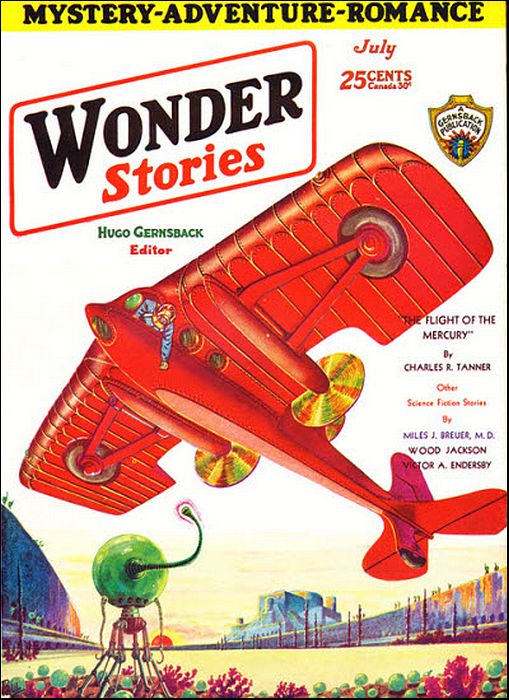
Wonder Stories, July 1930, with "The Time Valve"
WE take great pleasure in presenting to our readers the long awaited sequel to Dr. Breuer's marvelous story "The FitzGerald Contraction." In this story which, truly, has all the elements of mystery, adventure and romance, we get a startling vision of what our earth may be like in the far distant future. Dr. Breuer does not pose as a pessimist when he shows us such a terrible picture of our human race 200,000 years hence. He tries instead to point out with scientific clarity that the human race is treading a dangerous path, that there are things that we must avoid if we are to keep our present civilization. And with it all, he has given us a thrilling story that cannot help but keep our readers breathless to the very end.
IT is now twenty years since the arrival and departure of the photon-ship. The events in connection with Wendelin's departure on a two hundred thousand-year honeymoon, once so vividly before the public mind, are now probably forgotten by all except some of the middle-aged and old people who were immediately concerned. Since it is my privilege to present the first connected account of the reappearance of Wendelin in the twentieth century, it will be necessary for me to give the briefest synopsis of the strange events that led to his abrupt and unexpected departure. My only excuses for this preliminary review are, that Wendelin's return to our own time will arouse intense public interest in the photon-ship and the little romance that caused it to vanish in a blinding glare; and the fact that The FitzGerald Contraction(*), in which I related the tale in all its particulars, has been twenty years out of print.
(*) The FitzGerald Connection by Miles J. Breuer, M.D., January 1930, Science Wonder Stories.
Herman Wendelin was six feet three, and proportionately powerful; he looked slow and clumsy, but had a clever brain, and was a skilled aviator. At the time of which I speak, he was superintendent of the Cicero Landing Field in Chicago. He and I had been close chums and faithful friends since boyhood, and were at this time sharing a bachelor apartment, while I held a position as Instructor in Mathematical Physics at the University of Chicago.
Many strange ships landed on the broad acres of the Cicero Airport, but never one that compared with the huge polyhedron that appeared in a glare of blinding light, and contained thirty human beings. The coming of this vehicle had been watched through telescopes from near the moon. The inmates were human beings like us, and perfect specimens of mental and physical development. When they had first emerged from their ship, one of their girls, mistaking Wendelin for someone very dear to her, had run up to him and flung her arms about him. As soon as she saw her error, she retreated in confusion.
The visitors who had arrived from space learned to speak English with amazing speed, and within a couple of weeks one of their number, Addhu Puntreeahn, a powerful young engineer, was able to stand up before an audience of scientific men and explain their story in English to everyone's complete satisfaction.
He stated that they were racially related to us; in fact that we were their descendants. His race had once in the dim, remote past, lived on the continent of Mu, which had occupied the Pacific Ocean north and east of Australia, a fact which is being confirmed by scientific research of the present day. As the result of a huge cataclysm, the continent of Mu was torn off from the earth and flung out into space. It constitutes what is now the Moon. Its inhabitants foresaw the catastrophe, and prepared abodes deep down in solid rock, so that they might survive it.
The few survivors founded the civilization of the Moon. Within a thousand years, marvelous scientific and material progress had been made by them. The progress was partially stimulated by necessity, for the Moon's thin atmosphere was rapidly disappearing, and its none too abundant heat was being dissipated at a rate that caused grave alarm. The object of the Moon scientists was to develop vehicles that would carry their people back to the earth, where their telescopes showed them new continents, inhabited by races in the lowest stages of savagery. Eventually a method of space travel was devised, by means of elements composed, not of electrons, but of photons or light-corpuscles. A new chemistry was developed, and it was found that these light-elements would float on a light-wave and be carried along at almost the speed of light. While the main group of scientists worked on the problem of transportation to the earth, an adventurous group decided to circumnavigate the Universe. They spent ten years in building a space-ship, and were prepared to live in the abundantly equipped vehicle to the end of their lives, to raise new generations, and thus to arrange for a remote future generation to return from the trip around the surface of the Cosmos. It was exactly analogous to Magellan's circumnavigation of the earth. Just as the thirty-one people were ready to start on this trip, and the daughter of Drahnapa Dhorgouravhad, the learned old leader of the expedition, was about to be married to one of the young engineers of the spaceship, this man fell fatally ill of a cosmic-ray burn. Her resolute disposition enabled her to make the heroic decision to leave him behind and start with the expedition, though she suffered intensely from it. It was this man who so closely resembled Wendelin. They entered the ship, started it, and within what seemed hardly more than a few hours, their automatic alarms, which were set to ring when the ship had re-entered the solar system, and which were not expected to sound for several generations, suddenly roused them with a determined clangor.
Thinking that something had gone wrong with the machinery, they looked around, and found that they were actually back in the solar system. But they saw the Moon cold and dead, and their civilization gone. They found the earth dotted with strange, new cities. Landing in one of them, Chicago, they made observations and calculated that they had been gone for two hundred thousand years.
Both their scientists and ours were able to answer the riddle. Their immense speed had caused a shortening of all their properties, length, time, etc., according to the Lorentz-FitzGerald formula, and two hundred thousand years had passed like a few minutes.
However, the Mu people became rapidly acclimated in Chicago, wore American clothes and rode American automobiles. Only six of them, three married couples, took slowly to our life. Wendelin and Vayill, the daughter of the old leader Dhorgouravhad, promptly fell in love. Suddenly, in the midst of a tremendous blaze of light, the photon-ship disappeared; a note left behind for me by Wendelin stated that he and Vayill had been married, and had started off in the space-ship on a honeymoon, accompanied by the other three couples.
I TRIED repeatedly to persuade Wendelin to write of his trip. But Wendelin cannot write; and if he could write, he would have refused to do it. He displayed the same attitude that was so noticeable among the soldiers who returned from the trenches after the recent World War; he refused to talk about his racking experiences. The best and most connected account he gave was on the sandy beach, just after we had rescued him from the savages. But upon his return, he shut up like a clam.
I was equally determined to get the story out of him, and I did get it, a word or a remark at a time. I carefully noted down every stray bit of information, but it was a couple of years before I had enough data to enable me to put the stuff together as a story. Consequently the story is in my own words. The reader must first picture this curious situation. Before all these strange events had occurred, Wendelin and I had been about of an age; we had roomed together, argued together on scientific matters, and played tennis together. We were evenly matched in our views and aims, because we were both young. But now, I am twelve years older than Wendelin. He is still a young fellow in his late twenties. I, who used to frolic with him, can see in him a reflection of myself as I was twelve years ago. To me the matter is clear, for mathematical theory is home-ground to me; but Wendelin has never been able to get it through his head. It still seems uncanny to him; he still has a scared light in his eyes when he looks at me.
Because of the time-shortening due to the FitzGerald contraction, Wendelin traversed a period of two hundred thousand years into the future, without gaining in age more than a few minutes. It then required twelve years for us to devise a method of finding him and bringing him back again. During these twelve years the world kept growing old, and I along with it; but to Wendelin only a couple of months had passed.
He and Vayill are still a delightfully young couple. His favorite device is to begin singing her praises whenever I try to get him to talk about his two hundred thousand-year honeymoon. But every now and then a few words about some of the features of the trip would slip out, and I always pounced on them, without letting any change show in my face at my satisfaction in getting the information. Here is what I make out of his tale:
The trip itself was short. Vayill did not like the noisy, disorderly, hurly-burly rush of Chicago, and wanted to get away from it. They talked it over, got married, and decided to get into the space-ship and start it around the Universe again—just to get away. The other three couples, who were equally dissatisfied with our civilization, were delighted with the idea of going with them.
There was the same surprise at the short duration of the trip that there had been the first time. Hardly had the vehicle got under way, it seemed, when the alarms went off, and the lights went on, all over the ship; and their observations showed that they were back in the solar system.
"Didn't you know it would be that way?" I asked Wendelin; "it's just exactly like Addu described the first trip of the vessel. What did you really expect?"
"We hardly stopped to think about it; we just went." That was very much like Wendelin.
Their observatory showed them the earth, looking quite familiar and commonplace; and then the Moon. But, queer to relate, the Moon looked very small; and after some moments they discovered another moon. Obviously our satellite had broken into two fragments. They took their ship within the orbits of the two Moons and studied the earth a little more closely. Then they had to admit that there were a number of rather new features about the face of good old mother earth. The Atlantic Ocean was astonishingly wide, twice as wide as they had known it before, while the Americas were quite close to Asia. Florida was no longer a graceful peninsula, but a mere little wart. Australia was twice its familiar size, a big new piece of it extending to the north.
Upon approaching close enough to make out details, they were aghast to see, that while the continents looked pleasant and green, there were no cities! Not a trace of the huge, spreading splotches where should have been New York, Chicago, London, and the other vast collections of human structures. Not a city could they find, though they cruised about and studied the earth's entire surface. We must keep in mind that they were looking for cities with large buildings and paved streets and a great deal of material construction work. They did note that America's mountain ranges had changed; that the Cordilleras were low, rounded, and green, while the Appalachians were terrifically high, steep, rocky, snow-covered. Evidently cataclysmic changes had occurred. Yet, the main general features seemed about the same.
It was natural that they should pick out as a landing-place the foot of Lake Michigan, at the former site of Chicago. There could be no mistaking the exact spot; Wendelin had studied the topography too often from airplanes. The Lakes looked just about as they always had; there was little if any change in their shapes. The travelers poised their machine above the spot where Chicago had once been. But there was no city there. There was sand, gleaming in the sun, a broad belt of it. Then, a mile from the water was a black forest.
THEY got out of the ship and looked about. The trees in the near distance were conifers, and farther on were sunflower trees. Wendelin spoke of them as sunflower trees, and described them as real trees, tall and hard-wooded, with great composite flowers of yellow petals and black, disc-like centers. He mentioned several times the tight, gripping discomfort that came up within him as he looked across the sandy beach and saw nothing of the glorious city that had once been his home. They saw two amazing things before they were finally found by the people.
The first thing was the civilized insects. They looked like dark-brown bees, but were shiny, like ants. They had no wings. In fact it was chiefly their size that suggested that they might be bees; otherwise they were really ants. They had a tiny city, consisting of several thousand mud mounds grouped in hexagonal arrangements, with streets between them. On these streets were tiny vehicles dragged by beetles; and the bees or ants or whatever they were, carried little sticks and strings and other tiny objects. It was amazingly like looking into a child's story, where Bre'r Rabbit acts and talks like a man. But there they were on the sand, and the silk-clad scientists of Mu gazed at them with as much amazement as did Wendelin himself. They all felt an instinctive impulse to keep their hands off the ant city, and to avoid touching it so that they might not frighten or bother the insects.
Then the queer horses distracted their attention from the insects. A dozen or so of them came galloping down the sandy beach. Wendelin looked sheepish when he told me that these horses had trunks, like elephants; but immediately grew sober and insisted that it was true.
"Why not?" I asked; "it is certainly possible that such creatures may have evolved after two hundred thousand years."
The animals saw the group of people and stopped in their gallop toward the water, as though to investigate. They manifested quite an intelligent curiosity in the strange spectacle that the group of people must have presented to them, and gazed at them for a considerable while.
"It is not a horse; it is really an elephant," said one of the Mu men.
The animal had a broad, short, flat head and wide, floppy ears, just like an elephant's. Its proboscis tapered from six inches in diameter at the head, to less than two inches at the end, and was very active, always curling about here and there. I judged from Wendelin's description that the animal was really a true elephant which had evolved into this form for lightness and speed. He insisted that its body looked very much like that of a horse; and that at the distance at which they were, the illusion of a horse with a proboscis was perfect.
Suddenly the group of animals turned around and galloped back in the direction from which they had come.
There was now no doubt in the minds of Wendelin and his companions that they had traversed two hundred thousand years. Wendelin once tried to describe his sensations about it.
"It didn't seem real that so much time had passed. It seemed more like flipping the hands of a clock; and the queer plants and animals were more like some odd show."
Vayill, his wife, was fascinated by the gigantic sunflowers in great profusion all over the trees, and was anxious to get nearer to them. The entire group turned toward the forest of sunflower trees. Then the savages appeared.
"Savages!" I exclaimed, when Wendelin said it.
He couldn't think of anything else to call them. They were mounted on galloping horse-elephants, and there must have been twenty-five or thirty of them. They scattered themselves between Wendelin's group and the photon-ship, yelling and gesticulating. It occurred to Wendelin that the group of horse-elephants had at first seen them, and had gone out and brought this outfit back with them.
"My God!" Wendelin said, looking at Vayill. "Shut off here, two hundred thousand years from home! And this bunch of bloody savages between us and the photon-ship!"
"The photon-ship can't get you back home," one of the Mu men told him. "We shall never see Chicago again, any more than we shall ever again see Maj Halore, our city on the moon. Those thousands of years are gone, and can never come back."
The savages dismounted and rushed toward them. Wendelin was surprised at their appearance. They were short, not over five feet in height; they were practically naked, and copper colored, just like our original American Indians. They yelled and gesticulated and contorted themselves as they rushed toward our group of travelers.
"At first I thought they were talking English," Wendelin said; "it sounded just like it. I listened closely, but couldn't make out a word. It wasn't English at all."
Their hair was brown and was worn long, hanging to the shoulders. They were active, wiry, and lithe; but their bodies were not well built and finely developed as had been those of the American Indians. They had round, fat bellies and projecting shoulder-blades and bow-legs. They were intensely ugly. They grimaced and cackled in a demoniac laughter, and gabbled their odd language. But they looked strong and active; and they looked intelligent. They were savages, but savages can be intelligent.
THEY closed around into a semicircle and finally a circle, surrounding Wendelin and his companions, flourishing spears and bows and arrows. They looked at the tall clothed men and women with unaffected interest, but they wasted no time and took no chances. Efficiently and swiftly they surrounded them and held them covered with their weapons. It reminded Wendelin of military strategy on the part of well-disciplined troops. All that he and his companions could do was to stand in silent dignity and await what would happen next. They held up their empty hands to show that they had no weapons.
"I could have kicked myself into the Lake for not having brought some pistols. We could have cleaned up the whole bunch of them," Wendelin said in disgust.
The savages searched them efficiently for weapons; Police-Sergeant Riley could not have done it any better. There was much talk that sounded like a gabbled English, but could not be understood. The savages seemed puzzled; they stared at our people and discussed them. But they were neither frightened nor awed. In fact, they seemed to hold Wendelin and the Mu people in a sort of contempt.
With rough shoves they indicated which way they were to walk, and took them along. They maintained good military formation, with a careful cordon about the prisoners, and the rest in front and behind in columns of fours. Even the order for "squads right!" had a very natural ring to it, although the words were strange. At this time Wendelin noted that the heads of the spears and arrows were of stone. One of the savages took charge of the entire herd of horse-elephants and conducted them away.
The march led away from the photon-ship.
Wendelin was depressed as they marched along. All his friends were dead and gone two hundred thousand years ago. How complete was their decay he could judge by the fact that even the steel and stone and concrete of Chicago were gone, and only low, round mounds of smooth sand remained in their place. There was no way of getting back to Chicago. This was all a silly thing to have done, just for a strange girl. Then one look at her, trudging along beside him, filled him full of pity for her because of the tragic fate into which their impulse had led them, and full of fury against the perverted looking savages. Heaven only knew what awaited them.
They marched only a short distance before they came to the city of the savages. It was quite a city! Of square houses it was, with slanting flat roofs; shabby, ugly shanties—unutterably dreary, thousands upon thousands of them. They were arranged in square blocks with straight streets between them, sandy streets filled with all imaginable filth. Horse-elephants roamed everywhere. The houses were made of logs that seemed to have been burned off instead of cut, of sticks and thatch and stones and mud; they looked thoroughly messy, Wendelin said.
They walked through a mile or so of dingy street, and entered a gate in a tall stockaded enclosure, in the middle of the city. Here they arrived just in time to see an odd ceremony. The stockade might have been a quarter of a mile square, and contained a good many shanties; but these were not regularly arranged as were those in the town itself, but haphazardly scattered. Here and there were trees and holes and piles of rubbish. People were filing into the guarded gate, and ranks of warriors among which mingled a few ugly women, were ranged in front of a raised platform at one side.
Four bald-headed, long-whiskered fellows in skin robes, whom Wendelin at once guessed to be priests, led a man up on the platform; and as they stood there in view of the audience, clay bowls were passed about, like collection-plates in church. Everyone dropped a twig into the bowl as it went past him. The bowls were brought up on the platform and the priests took out the twigs, one by one. The man between them was pushed off the platform, and slunk away; while another was put up in his place. He also was rejected by the popular vote and sent about his business, as appearances went; and a third, rather capable looking fellow, was "elected." The priests bowed to him, put a fantastic looking hat on his head, and handed him a terrific looking war-club, a gnarled chunk of oak with a knob at the end set with stone spikes. The populace cheered like a bunch of turkey-gobblers, and then the meeting broke up. They all bowed and groveled to the new chief, and he led the procession out of the stockade.
THE ceremony as Wendelin described it, was to my mind a self-contradictory piece of horse-play. It appeared to be an election of some kind, conducted by methods which had a close resemblance to those used among civilized people. Yet these people certainly were not civilized. Up to this time, for instance, Wendelin had not yet seen a single bit of metal. By this time, in the progress of the story, I had made up my mind that these people were not savages in the ordinary sense as we understand it as evolving upward from a lower type. They were a degenerate race, come down from a higher, more civilized plane; they were savage to the core, but had perpetuated many of the outward forms of civilized practices.
Nearly all of the people went out of the stockade and the gates were closed—in a clumsy fashion by carrying logs across the opening. Spear-bearers conducted Wendelin and his companions to one of the shanties. The few other inmates of the stockade were savages, just as ugly as the rest of them. They lay about idly, and gobbled food when it was brought to them later in the evening from the outside. Wendelin and Vayill found the food very repulsive, and eventually learned to eat the partly raw and partly scorched meat and bitter roots only because hunger forced them.
Without the loss of a moment the Mu men set about learning the language. They were treated gruffly by the savages whom they approached, but with true scientific meekness, they persisted. I might say that later on Wendelin also learned the language readily, and as he is no philologist, I judge that it must have been easy. Its resemblance to English impressed him strongly.
One of the Mu men who had some knowledge of astronomy, awaited the coming of night with considerable interest. When darkness came on, the stars were for a moment crowded out of their attention by a weird play of colored glows of light to the northwest. A mingling of pale colors played in the sky, in spreading, ray-shape from horizon to zenith, ranging from a violet color to the dull red of the neon tube of the commercial display sign. It had some resemblance to the aurora borealis, but was a pillar or a column instead of an aurora. Its width was an arc of about five degrees, and it spread like an inverted cone toward the top. Its lower portion was very bright and the colors mingled and changed rapidly there; toward the top it paled and dimmed. More than anything else, it looked like the glow out of the top of some enchanted furnace. They spent a couple of hours watching the wonderful spectacle before they turned their attention to the stars.
Wendelin knew the stars from the practical standpoint of an aviator, and was astonished to find that the pole-star no longer stood in the North. Its place was occupied by a bright blue star, which we have later checked up to be Vega. Between him and the Mu astronomer, some sketches were made; Wendelin has preserved two of them, showing the arrangement as they found it, of two familiar constellations, the Big Dipper and the Northern Crown.
The next day there was a trip to see the chief, made under rigid guard. The chief sat on a pile of skins in a shanty just as shabby as the rest, but hung with more skins. He was the same uncouth fellow with the glorious club who had been "elected" the day before. He stared and gabbled at them a while, and then ordered them back again. People did not treat the captives with much respect. They stared with rude interest and curiosity, and shoved them roughly about, and laughed hideously at these people who wore clothes and had clean faces. The savages acted as though our people were some new type of tame, harmless domestic animal for which they as yet had no use, prodding them with curiosity, shoving them out of the way, and turning their backs on them when their momentary curiosity had evaporated. I can picture Wendelin holding himself in restraint, with no signs of his impatience visible, but internally boiling with wrath and aching to get a good crack at one of them. But he would not fight without provocation.
The inmates of the stockade were not very friendly either; but for that matter, they were not very friendly with each other. There was a fight between two of them the following day, a snarling, treacherous melee which followed no rules, and in which teeth and blows and kicks and holds were all used. The rest of the savage inmates of the stockade gathered and watched it, howling with delight at the spectacle, until one of the contestants was left dead or unconscious on the ground. Wendelin never knew what became of him, but the incident left him worried.
However, they all managed to maintain relations sufficiently friendly to enable them to learn the language. Though the people treated them with contempt, like stray dogs, there was no actual cruelty. Before they learned enough of the language to get the status of affairs quite clear, an incident occurred to increase the savages' respect for Wendelin and his friends.
A GUARD with a stone-headed spear tried to get "funny" with Vayill, as Wendelin put it; grimaced at her and caught her by the arm. Wendelin swung around and hit him a straight-arm punch on the point of the chin. It knocked the ugly little wretch six feet. Fifteen minutes passed before the man groaned and gradually got up and crawled dizzily away; in the meanwhile a crowd of savages watched him, gibbering with delight.
After that, the inmates of the stockade were immensely respectful to all of them. Crowds from without the stockade came in and stared with intense curiosity at Wendelin. In a few days some of them gathered courage enough to reach out and pluck at Wendelin. Shoving them away seemed to do no good; finally he kicked several of them roundly on the shins and sent them away howling, and this stopped their interest in him for the time being. The crowd seemed very much dissatisfied, and hooted and hissed. This curious performance continued for two or three days. Our people were patient with it because it gave them opportunity to study the language. Also, they could not help admiring the military effectiveness with which citizens were permitted to pass the gate and prisoners were barred. Eventually, one of the savages got the idea of plucking Vayill by the arm. Wendelin promptly knocked him sprawling.
Immediately the crowd began to yell and stamp with delight. That is what they had been after all of this time. It seemed to afford them the keenest pleasure to watch the unconscious man, to see him groan and turn over, and to stagger to his feet and slouch away. The next day another one sidled up to Vayill and grasped her shoulder. Wendelin was getting nervous; his fist fairly lifted the man off his feet. They did the same thing for several days in succession, until Wendelin recovered his sense of humor. He caught on to their game, and even noticed that the victim of his punch was thereafter an honored individual, so that they jostled for their turn to touch Vayill and get knocked down. He therefore kicked them on the shins and other opportune parts of their anatomy, until they got tired of the game. But no more were any of the party treated with the former contempt.
A considerable number of days passed, of which they lost count. They continued to marvel at the cone-shaped pillar of changing colors at night, and at the changes in the stars, at the two queer little moons following each other about the sky. They discovered a tall tree from the top of which they could see over the city and out on the desert where the photon-ship stood. Day after day they longingly looked at its huge hexagonal bulk on the sand, so near and yet so far, and talked endlessly over plans for escape, which, no sooner proposed, were discarded as impossible. One day two of the Mu men were up in the tree watching, when a dull roar sounded and a deep vibration shook the ground. The observers reported that an explosion had torn a jagged hole in the side of the photon-ship. They attributed it to the explosion of tanks of liquid gases, oxygen, hydrogen, etc., which were stored in the vehicle for air, water, and fuel supplies. Obviously, the savages had been inside, playing with things, and had blown themselves up. For three days the photon-ship burned; and left behind a crumpled mass of blackened beams and plates. In spite of the fact that they had known all along that it could not lead them backwards through Time, Wendelin felt a vast depression at its destruction.
However, in the meantime they learned the savage language, and found out something about the situation in which they were. The people in the stockade were prisoners of war, members of other tribes captured in fights. War—it was a difficult conception for the Mu men—was the natural state of existence for these savages. It was their greatest pleasure, and they lived in it. They were always fighting, for any reason and for no reason. The prisoners took their fate philosophically; they weren't badly treated after the heat of the fight was over, though they were occasionally tortured. At times they were made to perform labor, and this they considered worse than torture. They were treated by the citizens with more respect than Wendelin's party had been, because they had been overcome in a jolly fight, whereas our people had given up without resistance.
The most astonishing thing about the business was the "election" of the king or chief, every time the two moons rose together. Apparently this was every month. At that time, the reigning chief was sent "to visit the God of Light." This was some sort of a euphemism; for, as a new chief was always elected, the conclusion is that the old chief never came back. In reply to questions about the God of Light, they stated that the god made men's hands fall off, and caused them to go blind, and ate off their noses. When asked if the God of Light was the same as the purple glow at night, they nodded violently in affirmation.
The warriors of the city voted for the new chief and all had an equal vote; but—here comes the perverted part of it—the chief was always from among the prisoners of war in the stockade. However, when "elected" he had absolute power, and lived in all the luxury they could give him. He could kill his subjects, have all the women he wanted, make war, or do anything except escape. It was an odd, inconsistent mess of customs. No savage race in the past ever did things like that. All these things were traces of degeneration from civilized customs and this idea was abundantly borne out by their physical characteristics, their pot-bellies, thin shanks, flat feet, and ugly faces.
A DREARY, monotonous month passed. Wendelin himself learned the language. All of them exhausted their brains trying to devise some method for escape. They agreed that there was no hope of getting back to any civilized age or time; but they looked forward to escaping and establishing a little civilized colony of their own, from which in time a civilized race might arise and re-people the earth. A lot of inspired talk was expended among them on that subject, Wendelin said.
Then, so swiftly as to take away their breath, things happened; another double moon came, an election was held, Wendelin was put up on the platform and elected king. Before he realized it, he stood there with the ridiculous hat on, and the perfectly wonderful war club in his hands. For the moment he was terrifically undecided as to what to do, but resolved, in the absence of a better plan, to go on and play the game. What else was there left to do? At least his new position offered more chances of escape than did the situation heretofore. Had it not been for Vayill, he says, he would not have cared; he would have drunk the month to its fullest and accepted what its end had in store. But one look at Vayill made him determine that within the month he must find some method of deliverance.
When he was conducted to the royal abode, the savages acted as though they considered it the height of luxury and splendor; their reverence was such that they held their breath and scarcely dared touch it. But Wendelin could hardly see the difference between one dirty shack and another; perhaps we have to make an allowance in our final opinion for his point of view as much as for theirs. Anyway there was a profusion of skins and pots and slaves, the latter such miserable, cringing creatures that Wendelin wondered why they cared to remain alive.
The savages took it for granted that he would want to take Vayill with him to the royal palace. But when the six other Mu people started along with him, the savages pushed them back. Whereupon Wendelin whirled around and roared at them—I've heard him do it on the aviation field—until they shrank back and let him do as he pleased. At a point further along on the march, several warriors bowed to Wendelin but held their spears in front of the Mu people to prevent their passing. Wendelin knocked one of them a dozen feet sidewise with the flat of his palm against the man's face. From then on the people all fawned upon him and let him have the Mu people with him. The Mu men were not to be despised physically; but they were still handicapped physically by the earth's greater gravitational pull.
Wendelin spent the month studying the city, becoming absorbed in his problems as a ruler, till the matter of escape really slipped his mind. Without watches and calendars, the time sped by with surprising rapidity. He felt that there ought to be some way of helping these people and doing good among them. There were so many things that needed to be done, and the people were so helpless and so ignorant: they needed better houses against the rain and the cold; the streets needed cleaning; the methods of preparing and preserving food were terrible. The problem of sickness was a terrific one. Though he was no doctor he saw that there was much that he could do with the medical training he had received in his aviation work. The number of babies that were born and died under his observation was appalling. He kept seeing new problems, but could do very little. During the entire time he was there, he saw no metal anywhere.
The month slipped by rapidly. One night he was surprised by the onset of some sort of ceremonies. Hoarse drum-beating, shrill chanting, fires, suddenly roused the occupants of the royal palace.
"Tomorrow the King goes to the Lord of Light!" came the words of the chant from the swarming streets of the city. Vayill gasped and held on to Wendelin's arm; I could picture that because I've seen her do it. However, Wendelin was glad of the warning, and slept with his club, the head of which was studded with stone spikes. He had a plan in mind.
The next morning an amazing procession arrived at the royal palace, with drums and feathers and grease and paint and grotesque antics. Wendelin went with them down the street, at the head of the parade.
When the cavalcade went past the gate of the stockade, he turned in. They tried to stop him. He planted his foot down and roared at them. They were somewhat taken aback, but the whiskered priests, though puzzled at the unusualness of it, protested. The God of Light commands, they said. I am the God of Light, said Wendelin. The priests signaled to the warriors, and the warriors rushed at him. Wendelin swung his club and knocked over a dozen of the poor little fellows with spears, before they let him alone. He hated it. There they were, sprawled about with their heads battered flat and their limbs twisted up and everything gouted with blood. The smell of the blood made him sick. But he led the way into the stockade, commanding the priests to follow him. There, upon the raised platform, with the big club whistling round his head, he forced them to hold an election. One civilized man with a club forced the entire city to change a fixed custom. He wondered why someone did not shoot an arrow at him; but no one did. Wendelin was elected king for another month.
PROMPTLY thereupon, he decided to investigate the God of Light. He announced that he would visit the God privately. Would the priests go along and guide him? A few priests were willing to do so, and they set out mounted on horse-elephants. East to the Lake they rode, and then north. Within an hour there was no more vegetation. There was only bare sand and rocks and a smudgy, black deposit on the rocks that looked like the soot of a fire, but would not rub off. Soon they were among low, rounded mounds of sand. There were long rows of these mounds, and aisles between them, intersecting each other at right angles. Here and there were larger mounds or empty spaces that interrupted the symmetry. Streets between mounds of sand! Eventually it struck Wendelin that he was on the site of Chicago. And only that evening did the full power of the realization strike him. Chicago! There was nothing left of it but low mounds of sand.
The little cavalcade stopped among the mounds and the priests would go no further. The God of Light would burn off their hands and feet and all their hair would fall out and they would go blind, they said. But they were willing to wait right here until night, and watch the beam of colors, from pale-violet to deep red, spreading upwards toward the zenith. At this distance there was a steady rumbling, roaring, rushing sound and a trembling of the earth, that kept up day and night.
Wendelin lay there that night, and solved the question in his mind. Thousands of years ago, Chicago had been destroyed by a radio-active bomb, which was still exploding. He had heard of continuous explosives; radioactive materials which, once set exploding, would continue to explode; and in ten thousand years would be only half destroyed; in the next ten thousand, half the remainder would be exploded, and so on. There must have been some terrific warfare in that part of Time which he had bridged. The wars had left behind only mounds of sand and savages, and a bomb that after thousands of years was still destroying itself.
The next month there was a repetition of the ceremony. They again attempted to lead him to some sacrifice in the radioactive volcano, and he had to smash the heads of a score of them and cripple up another score, before they elected him their chief for the third time. Then he attended to the wounds of those he had injured.
"That's another month to the good," he said to Vayill. "But I don't know how long I can keep it up."
He felt very blue and depressed about it.
From this point on, I can connect up the narrative from my own side.
LET me begin my own story with the time when the photon-ship suddenly departed never to return, as a result of the caprice of the two lovers, Wendelin and Vayill. While the remaining twenty-three Mu men and women mourned the permanent loss of their companions, they seemed as a matter of fact less sorry than were the scientific men of the University of Chicago, who had expected some sensational findings in the contents of the photon-ship. I myself regretted tremendously the loss of the opportunity to probe into the scientific knowledge of a race that had advanced so much further than we.
There was one exception among the remaining Mu people, and this was the old man, Drahnapa Dhorgouravhad, the learned and venerable leader of the expedition. The departure of the ship containing his daughter made a broken man of him. These Mu people treated each other, on the other hand, with the outward evidence of a deep and tender love, and on the other hand a dignified and controlled reserve, which was especially marked in the attitude of the members of the married couples toward each other. To see a man and wife of them together made me realize that human beings are capable of deeper, nobler, and more wonderful emotions than any we have ever experienced.
Yet, they took the loss of their friends quite philosophically. One of them, later on, was, outwardly at least, quite reasonably resigned when his wife died of the influenza, and went bravely about his business. But, old Dhorghouravhad's whole life was wrapped up in his brilliant daughter. He was crushed. He spent most of his time sitting and gazing dumbly into space.
The rest of the Mu people who had come with him in the photon-ship needed money to live on. The Chicago Tribune's subscription fund served them temporarily and as a start. Then they talked on the radio, gave lectures, wrote books on the things which they knew and for which the world was hungering, the ancient civilization of Mu and the civilization of the Moon now long dead and gone, and a great mass of scientific knowledge with which they were familiar and we were not. They all promptly got busy and traveled all over the world, all but Dhorgouravhad. He sat in silence and would not talk, except when directly addressed. The others grew independently wealthy, took an entire apartment house, and took care of their old leader.
I went to see him frequently; I felt bound to him by the tie of the common loss, for Wendelin had been my chum from boyhood days.
"Why do you take it so much to heart?" I asked him. "As far as you're concerned, she is dead; and you people take death philosophically."
"That is just the trouble. She is not dead, and will not be dead for two hundred thousand years. If I could know she is dead, I should be at peace. But she will be back here in two hundred thousand years. What will she find? What will happen to her? What sufferings and tortures are in store for he?"
The old man seemed as distressed as though he were actually witnessing the sufferings of his daughter.
"But by that time you will have been long dead and gone—"
"It seems as real to me as though it were right now," he said. "Twenty-three minutes. A little trip of twenty-three minutes is all that separates me from her, if—"
"Then let us make another photon-ship and go after her," I suggested.
He said no more just then. The idea must have made some sort of an impression on him. He must have spent many days in thought and study over it. The next time I came to visit him, the first thing he said was:
"There is an easier way than a photon-ship and a trip around the circumference of the Universe. I have been doing a great deal of thinking. It is quite possible to find out what kind of a world she will find here when she returns after two hundred thousand years. Our Moon scientists had done a great deal of work on the matter of looking forward into the future. Nothing clear and definite had been accomplished by my time, but the principles were well established. I never paid much attention to it. However, Addhu and I can work it out."
He had to wait until Addhu returned from a lecture trip in South America. But he waited patiently, saying that it made no difference; in a year from now the future would look just the same as if we did it today.
Dhorgouravhad did look into the future, and saw what the world would look like in two hundred thousand years, and confirmed the conditions about which Wendelin told. He did it by plain, straightforward scientific methods; there was no mystery, no hocus pocus about it. Dhorgouravhad and Addhu were scientists of marvelous ability; but their science was the same science as ours. It involved no new and unknown principles; it utilized the same physics and chemistry and mathematics as we use; only it had developed these to an amazingly further advanced stage.
I HAVE the manuscript of a book to publish, giving the mathematics of this thing in detail, giving all the steps from algebra to the marvelous results they achieved, just as I learned it from Dhorgouravhad and Addhu. For, the problem was chiefly a problem of mathematics. When it came to experimental work, apparatus, and mechanics, I was at least as good as they were; in fact, I devised or supplied most of the mechanical portions of the method. It was the theory of it that was marvelously advanced beyond my capacity. However, under their instruction, I was able to comprehend it, and my book will soon make the details of it public.
"The mathematics of it is simple," Dhorgouravhad told me. "It can be done in a couple of weeks," he said. "It's the gathering of the statistics that will be tedious."
"How long will it take?"
"Several years, if we organize a laboratory of several hundred technicians, and install the proper machinery for handling statistics."
"That will take money," I objected.
"We shall get the money."
Within a year he had the money. It was too late for him to go into lecturing and radio broadcasting; by this time all that he could tell the public had lost its novelty; and doing such things seemed trivial and distasteful to Dhorgouravhad. But he devised a cold light which cost two cents per thousand candle-power per year to operate, and a process for deriving electric current directly from coal. I don't know how many millions he had at the end of the year, but it was all he needed.
There was a fifteen-story building on the Midway, with two hundred and forty offices, each in charge of an expert in his line, for gathering data in sociology, geology, finance, genetics, sport, warfare, etc. Dhorgouravhad was training two hundred and fifty mathematicians to work with the statisticians. That buzzing fifteen-story hive of a building, with wires coming to it from all parts of the world, with laboratories for working out such statistics as were not already available—that was the "machine" for looking into the future. All for a slip of a daughter who was a little headstrong.
I have been too tedious already. For fear the reader will begin skipping, I shall summarize briefly what this machine said of the future period about which we are concerned. There has been so much sensational exaggeration in the newspapers about our five years of work, that I am disgusted with it. But, nevertheless, discounting for all the sensationalism of the newspapers, the "machine's" verdict is a gloomy, disheartening one. I have lost my faith in civilization, in the Universe, and in the "high things" to which my life was devoted.
THERE are two things which I must make clear before it is possible to understand properly the terrible fate which the equations predict for mankind. Several facts which came out of the calculation astonished us, although intelligent persons had seen them long before our calculations had ever been thought of. It is simple; there is nothing surprising about it. We all know it. The terrible thing is that scientific methods have made it seem so inexorably true.
One thing that was predicted was that the racial intelligence would decline over the next few hundred years, and leave us a race of lowered intelligence, highly emotional, improvident, lacking any ability to advance civilization or even to hold its own. That alone would drown civilization.
The next result indicated the direction from which the active destruction would come. We know that even at the present time there are available enough explosives and destructive agencies so that a half dozen shallow-brained vandals could blow civilization off the face of the earth. It was evident that the future would bring more powerful explosives and more frightful destructive agencies.
It doesn't need any process of summary-integration to foretell what will happen with the decrease of average intelligence and the increase of destructive power. Only, the equations gave a fairly accurate idea when the catastrophe would occur. The equations allowed the present civilization about five hundred years. That certainly was a small fraction of two hundred thousand.
Beyond five hundred years we had a picture of mankind almost destroyed. The billions of people were gone. Only a few were left, at the level of brutes. Then there was a slow evolutionary climb—in thousands of years a little step forward; in many thousands of years, mankind had climbed up to the stability of savagery.
After the five years of gathering data were over, it took a lot of figuring to get this final result. Dhorgouravhad grew more pale and grim every day.
He rebelled against Fate. His giant brain would not permit this terrible thing to happen that seemed to be fated. Fate conquers mountains and races, but my friend from Mu would not submit to it.
"I can't leave her among a lot of perverted savages!" he said grimly.
"Let's build another photon-ship and go after her!" I said, thinking my idea was a bold one.
"I've thought about it," he sighed. "It would take ten years. I doubt if I shall live that long."
I had hoped that the future-solving machine would give the old man some sort of peace. Instead, it had driven him frantic.
DHORGOURAVHAD, the marvelous old scientist of Mu, became active again. He presented a fierce appearance in his fervor. In a few weeks he had given to the world his invention of the direct application and storage of solar power, and millions of dollars in royalties began pouring in again. Everyone remembers that time, how within a few months industry and transportation were revolutionized because power had become so cheap and efficient. Especially aviation leaped forward. The bullet plane is really a result of solar power; the advantages of the modern short, swift plane over the old type with wide wings and long fuselage, are due to extra power more than to any other feature.
I had grown to love the old man. I sincerely pitied him for his fierce and futile love for his daughter. He was beginning to look piteously old, but was intensely occupied in his fifteen-story building with some sort of scientific work. I disliked very much to leave him, but I had been planning a trip to Europe for a long time, and had just received my leave from the University. However, he assured me that he needed no help now, and would have something surprising to show me when I got back.
He did. The year and a half that I spent in English, French and German observatories means nothing in this story. But what he showed me when I got back, does. I looked him up at once on my return. He hustled me to the fifteen-story building which had once been the future predicting "machine." It was now a laboratory.
He led me feverishly to the back of the building and showed me a bullet-plane of the type that has now become popular. It was of about the ten-passenger size, and was a marvelous thing, all made of glass. The stubby wings and the short body were all one glass shell. Inside of it, was a great deal of machinery visible; more than the usual solar-power plane contains. Outside, the only things that were not glass were the propeller and the rubber-tired landing-wheels.
I gazed dumbfounded.
"In that we shall travel two hundred thousand years!" he said dramatically.
I looked at him amazed. It sounded childish. It seemed for all the world like the things in the stories of the science-fiction magazines written by writers who know insufficient science. Had the old man's mind begun to undergo senile degeneration? I could see no sense in the thing. Why make it of glass? How could he fly two hundred thousand years? I was genuinely grieved to think that the shock of the loss of his daughter had really unsettled Dhorgouravhad's mind.
I was due for a real surprise. He asked me to sit down with him at a table covered with blue-prints, facing the odd-looking glass plane. He talked to me.
"I've done it. I've found how to jump ahead in time, or backwards. I think I can easily make you understand it."
He beamed on me with a placid satisfaction that certainly had not been apparent in him when I had left for Europe.
"What I have done," he said, "is to construct a time valve which will allow us to escape into the future. The construction of the valve was not intrinsically different from making the valves for electrons that are used in radio transmission and reception. These latter valves permit electrons to go in one direction only. My entropy valve, which I call it, works just like an electron tube, my experimental models look just like the tubes used in radio."
"And that time valve as you call it will take us into the future."
"Precisely," the old scientist smiled. "It works on the principles of entropy, with which you are no doubt familiar. You see entropy is..."
And soon afterwards his explanation was over my head. And even today when I try to puzzle the thing out, it escapes me. It makes me feel a little humble for my race, too, to realize that this old man had a brain and a scientific knowledge that could cause our best scientists to feel like little schoolboys.
"So far, that is quite simple," he said on concluding his explanation of the valve. "It was a much bolder idea to make the whole tube in the form of an airplane."
"But why an airplane?" I said, somewhat groggy from his discourse.
"For use on arrival. It isn't altogether a safe bet to transport yourself through two hundred thousand years. We stand quite comfortably on this spot now. But in two hundred thousand years, you don't know whether there will be fire or water or solid rock or a hurricane or an explosion here. Suppose we made our time-trip in the usual helpless, immovable 'sphere' or box that you read about in science-fiction stories, and suppose on our arrival we found ourselves in the middle of a desert; or far out on the ocean; or on a battlefield between two armies, on foot, defenseless, without food, supplies, or transportation? The amount of good that we could do Vayill wouldn't be worth noticing. But, if we fly high up in the air and then jump across the desired time period, we shall be safe and in a strategic period."
"Then the fact that this machine is an airplane has nothing to do with the time-travel part of it?"
"Nothing. We could skip our time-period in a ball or a box or a bottle just as well. But I wanted a plane for safety, and as a convenient means of getting about in that future savage age."
I drew a breath of relief. It all began to look reasonable again. The old man's brain was functioning at its usual brilliant level.
"You see," he continued, "whatever system it is that is to rid itself of the illusion of time, or travel in time, must be between the electrodes in the vacuum. So I have made the whole plane in the form of a vacuum tube. The electrodes are in the tips of the wings. The inner compartment can be sealed and filled with air to breathe. The solar power motor generates the power to operate the grid and the plate.
"With this we can go backwards and forwards in time. We can get rid of time. I have not studied any general aspects of the question; I have concentrated all my efforts on jumping exactly two hundred thousand years, minus eleven years, four months, and the odd days. I expect to get it accurate to within a few weeks; and we are equipped to spend that much time in searching and waiting around."
I sat silent and thought. I might see Wendelin. The affair with Wilma that I had mentioned in the account of The FitzGerald Contraction had turned out to be a transient one, for Wilma was now happily married to a doctor on the South Side. Dhorgouravhad looked at me expectantly.
"When do we start?" I asked.
WE sat in the inner compartment of the glass airplane. Both of us were breathing through the tube of the respiration-colorimeters which were to determine the current to send through the time valve. Finally the old man put away our breathing tubes and moved a switch. The filament of the huge vacuum tube glowed beneath us.
"What now?" I asked.
"We shall rise twenty thousand feet into the air and then charge our electrodes. At that height we can depend on it that we shall be safe, in the period to which we are going, from running into a building or a fire."
The plane shot up in the abrupt spiral characteristic of the bullet plane, which I can never cease admiring. Dhorgouravhad handled it well; but for that matter, these planes are so easy to handle that I can see the time when even "infants and invalids" as the malted milk advertisement says, will be handling them. Chicago melted together into a blot below us, and soon there was only gray mist down there.
"Now!" said Dhorgouravhad.
The only thing of which I was conscious was the extra hum of the generators, just as when an X-ray transformer is running and the current is switched into the tube. Anyone who has had X-ray pictures made of himself can picture vividly how it sounded and felt, Possibly there was an added thrill in the sensation that, unlike the usual patient under an X-ray machine, we were inside the tube. But, the little extra buzz of the generators was all that told us that anything had happened.
"Now we shall descend and see how it has worked," Dhorgouravhad said. "I've tried it a few times for experiment, and it has always been like this."
Below, was the very same mist. As we spiraled downward, Lake Michigan appeared, looking quite like itself. But there was no dark blot where Chicago ought to be. Chicago was not there, where it had been a few seconds ago!
There was a bright white strip of sandy beach against the black water on one side and the dark forest on the other side. Down, down we went, and as we came within a few thousand feet of the ground, we did see a blot; a rather small blot—a dim, misty, empty looking blot. It might have been a hole in the ground, a crater of some sort, though its depths were not black. The middle of it had a sort of suggestion of luminosity about it.
Suddenly Dhorgouravhad acted very excited. He stiffened and jerked the controls; the plane wobbled sickeningly and shot abruptly upwards. His face was pale and sweaty as he looked at me. As the ground sunk away from us into the dim mist, he breathed in relief.
"Narrow escape!" he hissed between thin lips. "Some sort of an electrical disturbance; high-tension charges. I noticed the meters kicking, and it gained intensity like a flash. By the time I noticed it, it came near being too late. If it had wrecked the valve—"
"But!" I exclaimed, almost speechless in amazement, "the future machine stated that at this time the earth would be peopled only by savages. How can there be an electrical disturbance—in the absence of a storm?"
"I cannot answer it any more than you can," Dhorgouravhad said, shaking his head. "I cannot understand it. But we'll go down more cautiously this time."
Slowly we descended again, and as the needles fluttered, Dhorgouravhad turned the plane flat and headed southward. As he kept the plane on a level and flew southwards, the needles became quiet again. That is, it was not our distance from the ground that determined the electrical disturbance, but our distance from the queer blot on the site of Chicago. We were therefore confident that the electrical disturbance was due to the misty spot with the hazy center. We kept the machine in sight of the spot, but far enough away to keep the needles quiet.
Below us was bright sand. The afternoon sun threw shadows of little rounded hummocks that were arranged in straight rows, here and there interrupted by a larger hill or a flat space. There were miles and miles of the low dunes, symmetrically arranged in rows crossing each other at right angles.
"Chicago is a field of sand-heaps," Dhorgouravhad said mournfully. "Under the sand is probably steel and concrete."
It was a gloomy spectacle and a depressing thought, and kept me quiet for a while.
"But the queer hole? And the electrical disturbances?" I exclaimed.
Dhorgouravhad was silent.
"It acts as though it might be some radioactive disturbance," I suggested.
He nodded as though that were self-evident.
"But how can that be?" I exclaimed. It took a long time for the thing to dawn on me. "Such intense radioactivity breaking out on a cooled planet! The earth is too old for phenomena like that."
Dhorgouravhad looked at me sadly.
"Do you remember what I said about the living mind interfering with Nature. Man gets together great accumulations of energy. He gets up little wars and throws about radioactive bombs—"
"You mean—?"
"Civilization wrecked itself. What you see below is the crater made by a bomb of continuous explosive of radioactive material; the bomb that destroyed Chicago. Probably there is such a bomb on the site of every other large city."
It left me weak and speechless. After some minutes I managed to stammer:
"Detroit isn't far away. Let's look at it!"
DHORGOURAVHAD turned the plane eastward. We sped over dense forests and saw tiny moving things here and there on the ground. It seemed only a small number of minutes before the shape of Lake St. Clair appeared ahead of us. In ten more minutes we saw the misty crater and the jerking of the needles on our dials, and the innumerable mounds of sand arranged in rows with the shallow valleys of the streets between. Detroit was also a vast field of mounds, with that horrible, bottomless chasm in the center. We headed back toward the site of Chicago, unutterable despair gripping at my heart.
I could picture to myself that last war. There was a period of legal peace under a world covenant; the future-machine had told us that. But, with the continued lowering of the racial average of intelligence, individuals were no longer able to live up to it. Passions flamed up; some small group, say a city, worked up a grievance against someone in another place. Legal restraints proved inadequate for the old savage fire, with fast planes and stores of the terrible continuous-explosive so conveniently available. Possibly just a few individuals took it on themselves to sally out and perform the heroic feat of destroying their enemy city.
Then, someone from the destroyed city, or some friend of the destroyed city, was dissatisfied with legal means of dealing with the crime, and took retaliation into his own hands. Planes and bombs could be obtained. The offending city was the second one to be smashed. Thus the feud started. There could be no defense, no fighting of any kind, only retaliation for the destruction of one city by the smashing of another. With highly advanced explosives and highly advanced means of transporting them, it would not be long before there was not one stone in the world left standing on another, and men, such of them as were left, were without homes. So that is what our glorious civilization is headed for!
As we crossed the lower end of Lake Michigan again, the twilight was deepening, and we pushed the machine hard so that we might be able to land on the sandy beach while it was still light enough to see; we didn't want to smash the glass machine in the dark. However, as daylight receded, a strange purple glow ahead grew brighter and more brilliant. We saw that we need not worry about light enough to land by. The purple brilliance was sufficient.
As we curved down toward the shore, as near as possible to what was once Chicago, we saw a winding procession of tiny figures moving across the sand; a long, thin string of them crawling along.
"People!" I exclaimed.
A few moments' observation showed us that they were moving across the violet-lighted waste of sand, directly toward the radioactive crater. We turned on our searchlights and slid down close, so that we might see them better. They were indeed people, almost naked, and dark hued. The figure of a huge man, head and shoulders above the rest, towered at the head of the procession.
Suddenly, as our searchlight picked them up, the line broke and ran, and the people scattered far and wide in all directions. And all of them scampered in the direction from which they had come, and away from the crater. The line was gone, and there were only scattered black dots disappearing in the distance. Then came the strangest spectacle of all.
There were four or five horses in the line, which were also thrown into a panic by the searchlight. They broke into a gallop, but went straight ahead, directly toward the changing blue and violet glow. Something queer in the shape of the horses made me follow them with my gaze; they formed little black profiles against the misty glow behind them. All of a sudden one of them seemed to burst into a bluish blaze. He continued running and the blaze spread over him and obscured him; and the blazing spot of him continued to run. Gradually it dimmed and went out, and there was nothing left behind, no horse, nothing. One after another the galloping horses burst into a blaze, kept on running until they were all consumed, and left us staring at the spectacle open-mouthed. Several blazing, galloping specks, and then nothing left.
But we had to look about us and land the plane, and when we did, we noticed that the fleeing men had left one of their number behind. He now stood alone, with our searchlights blazing on him as we taxied toward him. He hobbled slowly toward us, as though his feet were bound together. Gradually, as we sat there and stared, it dawned on my amazed intelligence that it was Wendelin!
I nearly smashed the machine getting out. I went toward him in big jumps, and then stopped within a few feet of him to look him over. There was something amazingly queer about him to my eyes. He, on his part, stood there with wide-open eyes at the glass plane.
"Some bus!" was his greeting, after a separation of two hundred thousand years. "Where'd you get it?"
That was the true, dyed-in-the-wool aviator for you. He stood there with his hands tied behind his back and his feet hobbled together with a leather thong, obviously rescued by our opportune appearance from some sort of death and extinction; yet his first thought was to wonder at our plane. It required time for me to realize that this plane was far in advance of any he had ever seen; and at the same time in the back of my brain I was trying to solve what it was that was so strange about his appearance. In a moment I had it. He was young? Unconsciously I had expected to find him aged by the same amount that I was; but here he was, the same fresh, round-faced youth that he had been twelve years before. Then Dhorgouravhad spoke: "And Vayill?" he asked. Wendelin jumped.
"Cut these things!" he said.
I CUT loose the leather strips with my pocket-knife. He flapped his hands from the wrists to relieve their stiffness.
"We've got to get her," he said, as if to himself rather than to us; then to Dhorgouravhad: "There's six more Mu people there."
"Where?"
"In their dirty town. Filthy, ragged, stinking dump. We've got to get her out. But how the hell it's going to be done, I don't see."
Anyway I was sure that it was Wendelin; his conversation sounded natural.
"Tell us about it," we urged in burning anxiety.
So, he told us the story; not as completely as I have given it, but sketchily and incoherently.
"They tied me up in my sleep," he concluded. "Taking me out to visit the God of Light. You saw what happened to the horse-elephants? They enjoy that sort of thing."
He was clear on one matter.
"The stockade is in the middle of the town," he said, "and there are thousands of the fierce little devils all around it. We can't get through them."
"Would it be possible to land inside the stockade and take off again?"
"No. There isn't fifty feet of clear space there; it's full of trees and holes and shanties. And every kind of rubbish."
We all stood puzzling and panicky.
"We've got to get Vayill out!" Wendelin said.
"We've got hand grenades," I suggested. "We could cut a way through the town from the beach." I was the same person who an hour before had been so horrified at the signs of destructive warfare all over the earth and so disgusted with man's fighting and destructive proclivities.
"Do you know the way through the town to the stockade?" asked Dhorgouravhad.
"Yes, but we couldn't slip through, not even in the dark. We are too big, and the little runts would spot us first crack."
Dhorgouravhad nodded. I could see that there was a plan forming in his head. We went back to the plane. The old man motioned to me. He handed me out two spare headlights and a sack full of automatic pistols. The headlights, run by solar storage batteries, gave a blinding glare in the night, and weighed about fifteen pounds apiece, including the batteries.
"Each of you hang one on his chest," he said to Wendelin and me. "Take a pistol in each hand and several spare ones in your pockets. With the lights and the pistols you can make your way to the stockade and back. You can frighten your way through the town when you cannot force it. If the lights do not settle them, a few shots will. Kill a few if necessary."
Suddenly Wendelin whispered: "Sh-h!" and snapped off the lights.
"Do you hear that cackling chant?" he breathed. "They never sing that except on a trip like the one they took me on."
We stood and looked.
"Quiet!" he whispered again. "They must be coming back."
Indeed, before long, the harsh, squawky singing became louder, and a dark column slowly emerged from the distance. We pushed our plane back out of their path, and lay down flat and watched. If they were indeed headed toward the crater of violet light, they would pass within a few feet of us.
I watched them with interest as they came on. Their precise march, quite military in character, contrasted oddly with the shrill, cackling effect of their song. I could hear Wendelin beside me panting in his efforts to restrain himself from leaping at them; for there indeed in the line were figures, hobbling along with tied feet, looming a foot taller than the rest. Which of them was Vayill, I could not tell, though I was confident that Wendelin knew. I could hear Dhorgouravhad whispering to him.
"He says wait till he gives the signal," Wendelin whispered to me. "Then jump up and yell and turn on your light and shoot up into the air."
Dhorgouravhad waited till the line was well past us. Then we all rose up—it must have been a terrific shock to the poor savages, the huge blazing eyes of dazzling light, the yells, and the shots. They broke and ran, in the only direction possible to them, for we had cut them off from behind, toward the pillar of violet light. Behind them they left seven shadowy and motionless forms standing on the sand. In a second, Wendelin had one of the figures in his arms, Dhorgouravhad was patting her head and murmuring something in the language of Mu. I was busy cutting thongs.
"And now quick!" Dhorgouravhad said. "It will take ten or fifteen minutes to measure the entropic rates of the new passengers. It's got to be done right, or we'll land back in the wrong period, which might be either inconvenient, or positively disastrous."
He led them into the car. I was last, and stood on guard outside the door, till he should finish the preliminary tests that were necessary before we could start. Though I had a pistol in each hand, I was worried stiff, what with the uncertain violet light, the queer shadows, the moving dots in the distance, and the fragile glass ship. Could an arrow damage it? A crack in the glass with its ensuing loss of vacuum, and here we would be, stuck in a degenerate world, with a roaring radioactive volcano near us, two hundred thousand years away from our home and kind. No sentry ever watched more keenly than I did then.
So, when several black forms showed up in the distance, trying to creep up on us, I potted at them with my guns without the least qualm. That they were human meant nothing to me just then. I was too tensely anxious about my own fate.
"All ready! Get in quick and seal the door!" came Dhorgouravhad's voice from within.
I jumped and obeyed, screwing the clamps down tightly. As I took my last look through the door, a tangled mass of black forms was charging at full speed toward us. But the drone of the propeller rose into a high-pitched whine, and the sand and the racing figures sank down from under me. It took me thirty seconds to get to a window; but the time I got there, the savages were fleeing for the third time, running madly toward the purple flames, away from our (apparently) pursuing ship. Even as I watched, two or three of the swiftly fleeing black spots broke out into a violet blaze, which trailed behind as they rushed onward. Those behind stopped in indecision, but in a moment were blazing too, racing madly in circles.
The first two or three rushing spots of flame went out, leaving nothing behind. My last fleeting glimpse as we rose up into the darkness, was a violet-lighted desert of sand, covered with racing, blazing spots. Thus did the curse of man's petty wars descend upon the remotest of his children's children, thousands of years later.
* * * * *
THE ten of us in the cockpit held our breaths in tense anticipation. A moment ago there had been darkness below us, blackness and void. Then had come the crash of the switch and the rise in pitch of the transformer hum.
Now we thought we saw lights and glows below. Our heads throbbed with expectancy, as Dhorgouravhad sent the plane down toward the earth. Several glowing spots appeared down there, and rapidly spread beneath us to a sea of bright points of light, in long rows and dense clumps, and scattered at random. Wendelin was peering closely down.
"Ah!" he breathed. "The Hammond beacon! A slow red circle and a fast green one. A little more to the west."
Dhorgouravhad turned the ship to the west. Wendelin spoke again.
"Ah! The slow white circle! The Cicero landing field! Back home. Are you sure you can land her all right?"
His hands itched for the control stick, but Dhorgouravhad paid no attention to him; so Wendelin sank back in his seat and turned his attention to Vayill. She was pulling at his arm.
"This time," I heard her whisper meekly, "I am willing to live with you in that—what did you call it?—apartment."
Roy Glashan's Library
Non sibi sed omnibus
Go to Home Page
This work is out of copyright in countries with a copyright
period of 70 years or less, after the year of the author's death.
If it is under copyright in your country of residence,
do not download or redistribute this file.
Original content added by RGL (e.g., introductions, notes,
RGL covers) is proprietary and protected by copyright.