RGL e-Book Cover
Based on an image created with Microsoft Bing software
Roy Glashan's Library
Non sibi sed omnibus
Go to Home Page
This work is out of copyright in countries with a copyright
period of 70 years or less, after the year of the author's death.
If it is under copyright in your country of residence,
do not download or redistribute this file.
Original content added by RGL (e.g., introductions, notes,
RGL covers) is proprietary and protected by copyright.
RGL e-Book Cover
Based on an image created with Microsoft Bing software

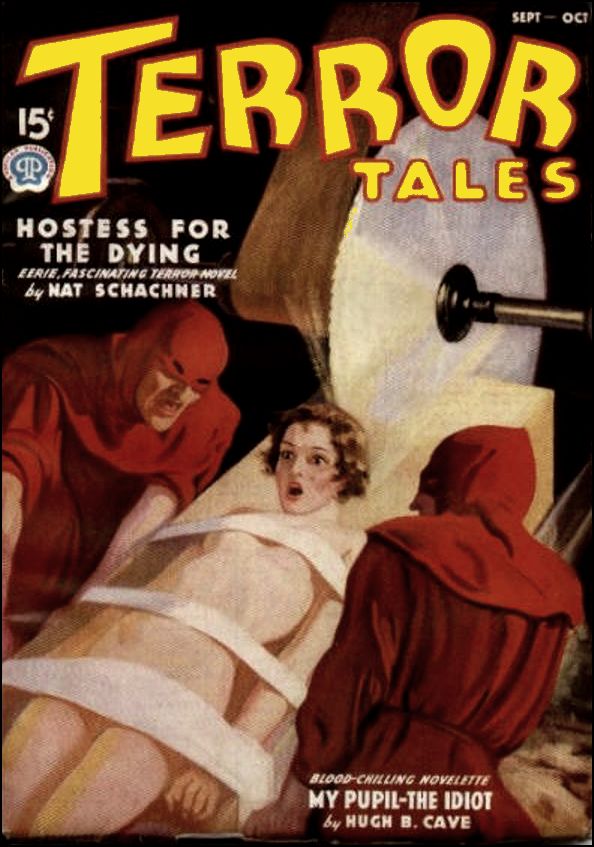
Terror Tales, Sep-Oct 1937. with "Hostess For The Dying"
Lane Parsons sought the answer to the horrible riddle of those weird charms purchased at great price from the Nameless One by the wealthy girls of Comstock. For the wearer was not only "protected" from the ravaging plague, but inspired to an uncontrollable carnal lust—and a thirst for the blood of the man she loved!
I HANDED Gay Biddle out of the taxi, paid the driver, and watched him vanish down the silent road. Then I turned to the night-blurred stoop of the Ballou mansion, and that persistent fear made me hesitate. Light blazed through curtained windows; music and shrill laughter filtered out into the gloomy street.
Gay shook my arm impatiently. "Well, Lane Parsons," she demanded, "are we going to spend the rest of the night out here staring at shadows? Jean expected us an hour ago. Let's go in."
Yet still I did not move. "You know why we're late in the first place," I retorted. "I don't like the idea of this affair. There's an epidemic in Comstock—and Jean Ballou throws a party as a gesture of defiance. It's flying in the face of Providence. Gay, darling," I pleaded fervently, "please listen to me. There's still time. Let me take you away from Comstock—anywhere. This strange sickness, that kills only young and beautiful girls, suddenly and without a sign or mark of infection, scares me. The doctors don't know what it is; they're helpless. No one knows whom it will strike next."
The street light splashed illumination over her trim figure, made a halo around her lovely face, shadowed dark, tender eyes under a perky hat.
"I can't run away," she said quietly. "Your business is here; you've first established your legal practice. You can't leave it, unless—"
"Let's not go over that again," I interrupted hastily. I knew what she was going to say. She had said it several times before. I would never take a cent of her money. The one flaw in our otherwise perfect love—to me—was the fact that Gay Biddle possessed a fortune in her own right.
"There, you see—" she began, and broke off with a little gasp.
A moment before I could have sworn there had been no one but ourselves in that deserted thoroughfare. Yet, as I looked up quickly at Gay's sharp intake of breath, I found myself staring at an old woman who seemed to have materialized suddenly in front of us.
She was not good to look at; in fact, she was like no other aged crone I had ever seen. Her face was a withered parchment on which the years seemed to have overlaid each other with obliterating marks. Scattered black hairs made a fuzzy beard on her toothless chin; a mustache bristled on her shriveled lip. A wide-spreading cloak fell to her heels, shabby and green with the decay of time. In the crook of her left arm she carried a little covered basket; her right had fastened on Gay's elbow.
"What the devil do you mean by creeping up on us like that?" I declared angrily. "Take your hands off the lady."
She did not seem to hear me, nor did she relax her grip. Instead, she peered into Gay's frightened face with eyes that glittered in the dark. "You are pretty, Gay Biddle," she mumbled toothlessly, "and your fair skin is unmarred. Yet you enter the House of Death."
Involuntarily my eyes jerked over to the brownstone stoop, to the sedate lift of Henry Ballou's house. It was modest enough from the outside, quietly fashionable; but old Ballou was the richest man in Comstock. The music had gained in speed and vigor; the laughter was shriller than ever. The party was in full swing.
"I—I don't understand you," Gay faltered.
The crone thrust her baldish head forward. A strange grin puckered up her face. "They don't know it," she whispered, "but even now Jean Ballou is marked with the shadow of death. She will die, like the others, writhing in her agony. For she has defied him, has refused the token whereby she might have gained beauty and love and life."
I took a step forward, fists balled. "Now listen here," I started in a rage.
But the evil croaker paid no heed to me. Her eyes were twin boring holes on the shrinking girl. "Do not make the same mistake that she did, Gay Biddle," she said ominously. "Do not refuse to buy this potent charm of mine that will protect your pretty body."
HER hand groped under the cover of her little basket, emerged into the light of the street lamp. A pear-shaped sack dangled from brown, skinny fingers, flat yet undulant, pearl-grey in texture and queerly iridescent.
"A potent charm," she repeated insinuatingly, "When you wear it, my brother Death will pass you by and seek his prey elsewhere; when you wear it, life and beauty and allure will flood your being, and all men will come eagerly at your slightest call." She pointed a bony finger at me. "You will hold him too, my dear; without it, he will stray. A powerful talisman, indeed, and cheap, considering what it is. Take it, Gay Biddle, for five thousand dollars, paid me on the morrow in a place that I shall name."
A vast relief mingled with my loathing. The fearsome crone shrank suddenly in my eyes to a paltry fortune teller, a seller of magic charms to the ignorant. Then fury seized me. She had given poor Gay a case of the jitters—her face was ashen and her lips trembled. Worse yet, the beldame's wild talk was but cunning blackmail. Five thousand dollars, indeed! She knew then of the Biddle inheritance.
I caught her skinny arm, ripped it roughly from its clutch on the girl, flung her staggering away.
"Get out of here, you hag," I snapped, "before I turn you over to the police."
She righted herself with an effort, and crouched against the shadowed wall. Slowly her eyes fixed on mine, and I shivered involuntarily. Never had I seen such venomous hate in human eyes before. Slowly she spoke, and her voice was like the closing of an inexorable door. "In two thousand years no one else has dared lay hands on me, the Nameless One. For that your hand shall palsy and your brain constrict with madness, your body writhe with tortures beyond those of hell itself."
Gay cried out in horror. "Wretched woman, how dare you—"
The crouching hag turned on her. "As for you, Gay Biddle," she spat, "you shall come crawling on hands and knees to me, begging me to sell you this talisman. "Five thousand dollars did I say? Nay, the price has risen. Ten thousand dollars shall you bring, and more, far more, shall you offer before the Nameless One will be appeased."
"You devil!" I snarled and lunged for her. "This time you've gone too far. I'll—"
I crashed into the stone wall, pawing wildly for her. But she was gone, vanished into the narrow passageway that separated house from house. It was black as pitch inside, and I turned reluctantly back.
Gay was trembling. "Lane, darling, what did that horrible woman mean? How did she know our names?"
I affected to laugh lightly. "Just a bunch of silly nonsense to scare superstitious folk into being blackmailed. As for our names, dear, that was easy. The Biddies are pretty well known in Comstock, and its town gossip that I'm your one and only true love."
But I was only partly convinced by my own glib phrases. As a hard-working lawyer, trying to build success, I had made it my business to become familiar with the town and its inhabitants, and especially, the little underworld that fringed its aristocratic precincts. Yet I had never seen this old hag before. Her grotesque, incredible features would have stuck out like a sore thumb. What had she said? Two thousand years! Bah! It was part of the patter! I was getting as credulous as any sucker.
The butler ushered us into the huge drawing room of the Ballous.
IT was ornate, immense, and lavishly furnished. Old Henry Ballou concocted rare and heady perfumes in his plant on the edge of the town and had become incredibly rich thereby. He stood now to one side, a tall, distinguished looking man, with white goatee and piercing, cynical eyes, watching the riot to which his house had been given over.
Riot is the only word to describe Jean's party. All the wealth of Comstock was concentrated in the room; hard faced men whose money had come from the mines and factories of the town, their rouged and wrinkled wives, ablaze with priceless gauds, and the younger generation of sleek young men and giddy young women. All the ordinary conventions seemed to have given way. A dusky orchestra sawed and fiddled and blared hot tunes from a specially constructed platform. The young couples danced wildly, with abandon, wriggling close to each other on the crowded floor; hot male eyes stared boldly down into low bosomed gowns and the girls giggled shamelessly. Even the older people seemed to have caught the universal contagion. The portable bar was crowded, and the glasses tilted in rapid succession. Conversation was high-pitched, laughter shrill and strained. The air was close, swimming with heady currents.
I paused with a gesture of repulsion. I forgot the ominous episode of the beggar woman and her bag of charms. What had happened to these people—clients, potential clients of mine? I had never seen them cut loose like this before. Then I sensed the answer. In their eyes was fear—stark, vivid terror—dread of the plague that caught young girls and snuffed them out like brief candles. Already a dozen had died in a week. Only that morning a young girl of eighteen had dropped in her tracks with a shriek and never spoken again.
So far only the youth and beauty of the middle classes had been afflicted, but no one knew where it would strike next. They were seeking surcease, oblivion to the ever-present fear in gestures of defiance, in a wild whirl of the senses.
"I don't like it here," Gay whispered to me. "I didn't dream it would be like—this. Let's slip out quietly."
"Okay, honey," I whispered back. "It's no place for us. Let's go."
But Jean Ballou had seen us, had dissociated herself from a short, dark man of indeterminate years with whom she was dancing, was rushing over to us with shrill cries of welcome.
"Gay Biddle! Lane Parsons! You two love birds! It's about time you showed up. Come join the merry throng. It's a perfectly gorgeous party. Make love, drink and be merry, and to the devil with the Plague! That's the motto."
She was a vivacious little blonde, voluptuously built, with a full bosom that left little to the imagination. Her eyes were wavering with drink and something else, her voice was hard and reckless. She caught me by the arm, pressed close, pulled me away from Gay with loud laughter. "This is my dance, Lane!" she shouted. "Gay will have to shift for herself."
And before I quite knew what had happened, I was out on the floor, bumping, whirling, shamefacedly aware of the way Jean was cuddling close to me, of Gay's level look as she followed our erratic flight. On a sudden swing around, I also caught the black scowl of the short, dark chap with whom Jean had been dancing when we came in. He veiled his naked glance as our eyes clashed, turned hastily away. I knew what was wrong. He was Bruno Morris, manager of Ballou Perfumes, Inc., and the whole town knew he was making a play for the vivid young heiress. Just as they knew that Jean had not liked it one bit when I had fallen in love with Gay.
I mumbled excuses, and broke away from the too-clinging Jean as fast as I could, hurried back to Gay.
"Good Lord!" I muttered, wiping my brow, "but Jean's in a state."
BRUNO MORRIS had squirmed his way to the young hostess, was saying obviously nasty things to her. There was a snarl on his sallow countenance. She was laughing at him openly, mocking him.
Gay watched with troubled eyes. Then, suddenly, she gasped.
"What's the matter?" I asked in alarm.
Her face had gone white. Her fingers were taut in mine. "I—I just remembered!" she breathed hurriedly. "That awful woman who threatened us outside. She said things about Jean—that Death was stalking her—that this was the House of Death! Oh, Lane, do you think—?"
"It's all poppycock," I answered roughly. "Don't you go believing that hag. I'm sorry I didn't turn her over to the police." But unwillingly my eyes followed the oblivious Jean. She was alone now, standing near the bar, swaying slightly. Bruno Morris had lost himself in the crush. And cold fingers of dread clamped down on my heart. The air was hazy with swirling smoke and waves of heat. Yet I could have sworn I saw a shadow enveloping Jean, a shadow of blurred edges that swayed when she swayed, moved when she moved; a gray shadow splotched with blood; a shadow in whose misty depths dead-white fingers seemed to move and grope.
I looked again, and it was gone. As from a great distance I heard Gay's cry. "Lane! You look as though you've seen a ghost!" I stared at her with haggard eyes. It was an illusion, of course, born of that wretched beldame's words, compounded of shifting smoke and air currents; but I felt chilled to the marrow.
"We'd better be getting out of here," I said unsteadily. "It—it's too hot.
But even as I jerked blindly toward the door, it opened again, and the butler was ushering in new guests. I recognized Dr. Walsh at once. He was a grim, secretive individual who had a certain reputation in tropical diseases. It was he who had been called in for attempted diagnosis of the dread plague that had descended on Comstock. But for the moment I did not recognize the gorgeous passion flower who accompanied him. The butler had taken her cloak, and, as she stood silhouetted in the doorway, the talk and laughter died, the dancers froze in their complicated steps, the drinkers at the bar held glasses untasted at their lips. Even the orchestra faltered on a particularly hot passage, and crashed to a sudden stop.
Her dress was a bright scarlet and clung to her limbs in sinuous folds. Her breasts, vivid, alive, lifted boldly above its low slash. A gleaming chain hung round her neck, disappeared down the luscious valley of her bosom. Her face glowed with a strange luster, her lips were parted in voluptuous breath, her eyes blazed. An aura of electric allure surrounded her every movement; her limbs quivered beneath the unconcealing thinness of her dress, beckoning to strange delights.
Even at that distance, I felt the physical impact of her; I felt the upward surge of blood in my veins. Then I recognized her, and her name ripped involuntarily from my lips.
"Hilda Lessing!"
Good Lord, it was impossible! I had known Hilda since childhood days, and had never paid more than casual attention to her. She had always been a timid, retiring sort of a creature, with pallid, somewhat blotched and unsightly complexion. No one had ever thought of sex in connection with her. She was wealthy, it was true, but that was all.
Yet here was Hilda, blossomed out overnight, radiating sensuousness and heady allure. Nor was I the only one affected that way. I could feel the wave of lust that spread over the male members of the gathering, young and old, married and single. Their heads turned as one, and their gaze was speculative on Hilda's form and maddeningly revealed treasures. But the women tightened their lips in disapproval, though envy peeped behind their appraising glances. I saw Jean Ballou straighten up, round-eyed, slightly sick—as if some opportunity had been hers and she had passed it by. Her fingers went tremblingly to her neck, and groped for a chain that was not there.
GAY said with childlike innocence. "I never saw Hilda look this way before. Why, she's perfectly beautiful!"
But I hardly heard her; I hardly even knew she was at my side. For Hilda's eyes had lighted up with a wanton, come-hither light at the sight of me; her undraped arm beckoned with imperious gesture. And I obeyed. Dimly I justified myself as I moved forward. After all, I had known Hilda for a long time; it was only right that I greet her on her entrance. But in the back of my brain I knew I was lying. I went to her because something about her had called; because her sudden beauty stirred my senses in a way that Gay's chaste loveliness never had.
I saw Gay's white, strained face as I left her side. She was too proud to hold me back. Yet it did not matter. My senses burned toward this strange new Hilda. I could not have been restrained.
Dr. Matthew Walsh made way for me as I came up. His forbidding features did not relax a muscle. If he resented my cavalier intrusion on the girl he had escorted to the party, his enigmatic face did not show it. Silently he left us alone, went quietly over to Henry Ballou.
We were not alone for long. There was a swift surge of all the males forward, a grouping of tight-lipped women at the farther end. Desire beat upon Hilda in a thick, clinging cloud. Voices rose eagerly, clamoring for her attention. But she singled me out. "Now, please," she laughed in protest, "you'll crush me if you crowd any closer. Now all you boys run along a moment while I talk to Lane. Later on—maybe..."
It was not what she said; it was her glance that sucked out their souls; it was the electric surge of her body that made each think he had a special invitation for later. Unwillingly they ebbed away. Hilda whispered in my ear, and the warm breath of her voice intoxicated all my senses: "Let's get away from the crowd. I want to talk to you."
I knew I was hurting Gay, yet I could not help it. I followed Hilda into the conservatory, sat close to her behind a sheltering plant. She fell into my arms with sudden passion. "I've always wanted you, Lane darling," she husked. "Now you are mine."
Every fiber in my body leaped to that wild embrace; my arms crept around her voluptuous form, my lips shuddered on hers. I was lost to all honor, all decency, all thought but the fierce glow of her body, the ripeness of her breasts.
Then I heard a faint cry. It ripped across my blazing senses; it brought me back to remorseful sanity in a sudden access of shame. I jerked away from Hilda; stared up at—Gay! I never saw such a stricken look in human eyes before as I saw then. Behind her stood Seth Kalman, thin, of medium height, blue eyes grim with disapproval. He had been all over the world in his youth, and was now a bachelor, retired, living on his income. He had known Gay's father before he died. "Come away, Gay," he urged. "There's no sense making a scene."
I barely heard him. I saw only the terribly hurt look in Gay's eyes. I fumbled over words, seeking some excuse. The enchantment had left me. I knew now I loved Gay—and Gay only. Even Hilda Lessing had the grace to look ashamed. But Gay had spun on her heel, darted for the door to the drawing room. I followed, calling vainly.
And then it happened. Inside, the music had resumed its blaring rhythms and the couples their dancing. But as we burst into the room, we both stopped short in our tracks. For Jean Ballou had pulled suddenly away from Bruno Morris. Her face was contorted with agony. Her voice rasped out in a toneless scream. Her body shook convulsively.
The music stopped on a crazy note, the dancers fell away from the stricken girl with cries of horror. Morris seemed paralyzed in his tracks. Jean swayed, her eyes meeting mine in mute, imploring fear. Then she toppled headlong.
As I sprang for her, I heard behind me Gay's cry of alarm: "Lane! Lane! Don't touch her! She has the Plague!"
Bruno Morris, his face a dirty grey, his eyes popping, took up Gay's cry. "The Plague!" he shouted. "It's got Jean!" He whirled around and ran screeching from the room, catapulted through the door hatless and coatless into the night. In the twinkling of an eye the dance floor was cleared. The guests stampeded, fought each other, trampled on those not quick enough to get out of the way. "The Plague!" The dread word jittered from frozen lips, mingled with cries of pain, with the thud of escaping feet.
THEN there was silence. On the floor, where she had fallen, lay Jean Ballou, sprawled in the limp distortion of death. Those of us who remained seemed rooted to the ground, tongueless, voiceless.
Then Henry Ballou cried out sharply, flung himself upon the body of his daughter, lifted her head, called on her to answer, to prove she was alive.
Dr. Walsh moved fast for a man of his size. His features seemed set in a mask. Very quietly he hauled the stricken father to his feet, knelt expertly before the girl.
When he arose at length he said in somber tones, "The Plague has struck again. I'm sorry, Mr. Ballou, but there's nothing I can do. I'd suggest you give me permission to perform an autopsy. Perhaps something might be disclosed—"
"What?" Kalman cried involuntarily, "and torture that poor, lovely body more?"
"The dead are beyond torture, Mr. Kalman," Dr. Walsh said dryly, "but they can help science save the living."
"I wouldn't consider it for a moment," Ballou interposed harshly. "I won't permit it."
The doctor shrugged his shoulders. "Then the funeral must take place tomorrow. Victims of an infectious disease, as this seemingly is, must be buried at once." He turned to Gay and Hilda Lessing, the only others who had dared remain behind. "I would advise you two," he said gravely, "to quit this house immediately. This plague strikes at young girls only."
But Gay was staring at her stricken friend in wide-eyed fear. "She was marked with the shadow of death," she whispered. "That horrible old woman said so. She knew." Her shuddering vision fell on me, swung to Hilda; then, with a little gasp, she shielded her eyes with her hands. "She knew everything," she sobbed. "She cursed me, warned me of other horrors to come. She said Lane would leave me; that I couldn't hold him."
The words were like plummets plunging into my heart. I had forgotten, in the immediate horror, our weird encounter. Gay was right! The beggar woman's ill-omened mouthings had proven only too true so far; would the rest of her prophecies come to pass.
"No! No!" I cried in torment. "It isn't so. Gay, I—"
But Hilda Lessing had deliberately come forward. As deliberately she bent and fondled the poor dead girl. I started forward to prevent her, but Kalman got to her first, seized her by the wrist, jerked her away. "You fool!" he cried hoarsely.
She looked boldly around at us all, threw back her head and laughed. The merriment jarred on me—it was callous, grating in that house of death. "I am not afraid of the Plague," she jeered. "I am immune."
As her head went back, her breasts heaved boldly from their skimpy covering. They were warm and supple and soft, but it was not on them that my eyes stared as if transfixed. For, dangling from the gleaming chain about her throat, half hidden in the deeper curve of her bosom, I saw a flat, nestling packet. Greyish white it was, yet glowing with a strange phosphorescence, cuddling against the milky skin beneath, and seeming to convey to it a glow, a heat, that beat out at us in waves of seductive invitation.
I stared, bereft of all speech. The other men, even Ballou, gazed hotly on those unshielded beauties, yet did not seem to see the dangling bag, or seeing, did not realize its awful significance.
But Gay stricken once more at my unwavering gaze, followed my speechless glance. Her eyes went wide; she raced over to the still chuckling girl. Before the other knew what she was about, she had snatched the sacket from its hiding place, was gazing at it in shuddering fascination. "Hilda!" she breathed hard, "where did you get this?"
HILDA cried out sharply, tried to snatch it back. But Gay clung desperately to it with a grip of steel. "Let go!" Hilda snapped.
"I won't. Not until you tell me how you got it."
The girl seemed to shrink within herself. "I dare not, Gay," she whispered fearfully. "Don't—don't ask me about it."
"I'll tell you, then," Gay said wildly. "You got it from a hideous old crone. It's a charm, that's what it is—to keep the Plague away. And more! That's why you're so beautiful now; that's why you took Lane away from me!"
"Gay," I cried fiercely, "that isn't so. I still love you."
But she would not listen. A new look had crept into her eyes. A look of longing, of tense possessiveness. Her fingers crept and twined around the yielding bag. They fondled, they pressed its strange texture with greedy delight. Her face flamed with a queer eagerness, her breath came, in staccato gasps.
In a haze I heard Kalman saying: "Superstitious nonsense! A witch-bag. I've seen them in the voodoo country, among the hill people of Haiti, but I wouldn't have believed a girl like Hilda would have fallen for it."
Dr. Walsh compressed his lips. "I too have seen them," he said—and said no more.
But a great fear was burning in my veins. I didn't like that strange absorption of Gay; I didn't like the way her hands slid over that pear-shaped container. I sprang forward, ripped it suddenly from her hands—and almost dropped it at that first sensation of touch. It was smooth and warm and glowing. It sent tingling up my arm, spread in a fiery passion through my blood. Hilda stood as if turned to marble, while I examined the sacket, the chain uplifted from her throat. I sensed again her sexual presence, but all my thoughts were riveted on the little sack as it lay cupped in my hands.
"Give it back to me!" Strange how harsh, how avid, Gay's voice was. But I pulled it away from her clutching grasp—and forgot all about her. I did not see her leave us; I did not see Gay depart from the house. God help me for that strange absorption in Hilda's charm, twin to the one I had last seen proffered by the Nameless One! Had I been in control of my senses; had I stopped Gay then and there, what endless horrors would have been spared to both of us!
But I was as one bewitched. The smooth, delicate texture of that bag reminded me—strangely—of a woman's skin, soft and tender and quivering to the touch. My fingers clung to it, even as Gay's had done. It held a weird fascination, as if I could never let it go; yet mingled with it all was a stranger repulsion—a shuddering, a hackling of my flesh, as though I were touching something vile, something loathsome beyond all human comprehension.
Then Hilda jerked to life, clawed the charm out of my hands, thrust it back to its hiding place between her breasts. And, even while I stood there stupidly staring, she was gone.
"Don't you think," Kalman remarked, "it is time for us to be going? There has been enough trouble tonight."
I whirled. In my absorption I hadn't noticed that Gay had disappeared. Ballou had slipped to the floor, was holding Jean's lolling head in his lap. He seemed oblivious to us all. Dr. Walsh's secretive eyes were glowing with strange lights—but at my sudden turn a film crept over them.
"Where did Gay go?" I demanded. No one answered, but I fell back as though I had been stricken. At the farther window that gave on the street, I had seen a face. It was flattened against the glass, and its eyes glared at me with triumphant hate. It was the hag who had called herself the Nameless One.
"There she is again, damn her!" I shouted.
The three men turned in unison. "Who?" Dr. Walsh demanded.
But already the peering face had merged into the blackness of the night, like a mist spreading over the pane.
I had no time to answer. An awful fear clutched at my throat, stifled all utterance within. She had threatened Gay, and Gay had just gone out into the night.
WITH a snarl that was more animal than human I catapulted for the door, heedless of their shouts. Seth Kalman tried to stop me, but I ripped away. Then, hatless, coatless, I had lashed down the brownstone stoop, glared wildly up and down the long dark street.
It was deserted, quiet, save for the little splotches of wavering illumination that the street lamps shed. But no sign of the ancient hag, no sign of Gay!
I cried out in my anguish, calling upon her name. There was no answer. The girl I had loved and the hag who had threatened her with nameless torments, were both gone, vanished. Behind me, from within the house, I heard the quick thud of footsteps. The three men were hurrying after me. I heard Henry Ballou's voice raised in sharp anxiety.
Then my eyes were riveted on a slender figure up the block, gliding swiftly along the shadows of the looming houses. It darted out momentarily into the aura of a street light, vanished again into the sheltering darkness. But in that second I recognized her, and the recognition sent me plunging forward in hot pursuit. It was Hilda Lessing, without hat or outer garment. Her face, which had seemed so lovely in the warm glow of the drawing room, now bore a snarl of feral eagerness, her nostrils snuffing the night air like the muzzle of a beast of prey on a bloody track.
But when I reached the corner she too was gone, vanished into thin air, and the crowding houses mocked me with their blank exteriors. I stared bewilderedly around, while my heart pumped suffocatingly in my breast. For directly ahead, at the end of the street, lay the town cemetery—a long stretch of bleached monuments thrusting gauntly at the sky. A place of dread for the superstitious factory folk of Comstock; a place to be given wide berth by day and by night. A place in which already eight new graves had been dug within the past week, to hold the fresh young bodies of maidens stricken by the mysterious plague.
Yet Hilda Lessing, I was positive, more vampire than human being, had vanished into that place of sinister connotations. The thin night air was suddenly full of menace. What had happened to Hilda? What had transformed her over night into a creature of hot desire and flaming loveliness? What had made her now, when she thought no one was looking, into a snarling creature of the dark, whose goal was the last home of the dead?
The questions were like plucking fingers of fire in my brain. Who was the crone who called herself the Nameless One; what was that smooth-textured sack she had placed on Hilda's neck? And where was Gay? I started forward again with a hoarse cry of fear. Good God! Was Gay herself somewhere within the cemetery?
I felt the muscles of my face harden into a grim mask as I moved swiftly forward. At all hazards I must find the answers to my questions.
Yet even in my torment I did not lose all vestige of cunning. I kept close to the shadows of the houses to avoid being seen by prying eyes until I reached the edge of the cemetery. Then I slunk in, dodging from stone to stone, crouching at every untoward rustle of fresh earth beneath my feet, seeking—I knew not what.
It was a huge, forbidding stretch, where the dead of Comstock had been buried for fifty years. Where I had entered, the poorer factory folk lay in serried rows, surmounted by modest headstones. Farther on rested the wealthy, in tombs and ornate mausoleums; to the farther side, against the base of Gallows Hill, was the final home of the substantial middle class—the shopkeepers, the white collar people—and of those eight young girls, all buried within the week.
SOME inner instinct drove me thither ducking and dodging, yet hurrying through the wilderness of brooding death. Why had Hilda slipped into here? What connection was there between her unmasked snarl and Gay's vanishment?
I had just made my way cautiously past the last of the resplendent tombs, had stuck my head warily around its marble corner, when I froze in my tracks. Directly ahead, against the dark uplift of Gallows Hill, there was vague movement. The moon was partly veiled behind obscuring clouds, but a ghostly light glimmered through, revealing a strange scene.
A half dozen figures, all in formless black, were huddled over a newly made grave. With a tightening of my scalp I recognized that grave. The last of the plague victims before Jean Ballou—Anna Marsden—had only that afternoon been lowered beneath the moldering soil.
A half dozen figures were bending and lifting in dreadful unison. To my ears there came the sound of spades delving into earth, of stones thudding into little piles. The tiny hairs lifted and stirred on my neck. The ghouls were uncovering the new-rested coffin, were disinterring the plague-stricken girl!
But it was not at that my limbs refused their normal function, and my tongue clove to the roof of my mouth. Another figure had darted into the pale patch of illumination. For one horrible moment I thought it was Gay. But it was Hilda Lessing!
She ran toward the laboring figures in black. Her nostrils sniffed the air, her arms were extended, her small, red tongue licked thirstily at her lips. "Give me blood to drink!" she clamored. "Blood! I want blood!"
The ghouls jerked erect. A hoarse guffaw burst from them. "Not from us, sister," one of them jeered. "We're wise to you. Get back to your friends. Maybe you'll find a pint of blood among the whole stinking lot."
But one who seemed the leader lifted his spade threateningly. "Silence!" he snarled. "Do you wish the whole town to hear us? As for you," he swung upon the panting girl. "Go back to your quarters, or the Master will hear of it."
Hilda shrank from him as if she had been whipped. With a low moan she fled among the tall, pointing stones, was gone.
The ghouls returned to their task. The soft earth spattered again. Then, suddenly, they heaved, and a coffin lifted slowly into sight—the coffin in which Anna Marsden lay.
I could stand it no longer. I forgot all caution. With a cry I catapulted forward. The next second I was among them, lashing out wildly to the right and left. My fists sank into soft, yielding stuff, smashed against cowled hoods. Then I went down, overwhelmed in a smothering rush. A dull-gleaming spade swung above me. In vain I flung up an arm to protect my head. There was a crash, a shower of vivid sparks, and the grave yawned beneath me.
VOICES muttered and swirled, overhead.
"He's dead, poor fellow," I heard a familiar voice faintly, as at a far distance.
"Look at that gash on his forehead," another said.
"Wonder what he was doing here?"
The darkness split and flamed into light. My head seemed a balloon filled with exploding gas. Dizzily I thrashed upward.
"Hello! He's alive!" My eyes blinked open to see Dr. Walsh bending over me. Crowding behind him were Henry Ballou and Seth Kalman. Their faces were pale, furtive masks; their eyes peered at me strangely, as if I had risen from the grave.
The grave? Recollection flooded me. I tottered from their supporting grips; I shrieked in desperate accents. "Catch those ghouls before they finish their fiendish task! Get Hilda—!"
"What the devil are you talking about?" Dr. Walsh knit his black brows in a grim straight line, cut across my wildness with repressed accents of anger.
"They opened Anna Marsden's grave," I exclaimed. "And Hilda Lessing was just here, crying thirstily for blood."
I saw Ballou tap his head significantly; I heard Kalman's pitying intake of breath. But Walsh grabbed my arm in a black rage, shook me until my teeth rattled. "Take care what lying slanders you concoct, Lane Parsons," he gritted. "Hilda's going to be my wife. Prove what you say, or by God—!"
I was too weak to resist; the blood still trickled from my forehead. But Ballou and Kalman thrust interposing hands between us. "Don't you see," said Ballou, "the poor fellow's still in a daze? He must have fallen against one of the grave stones and bashed his head."
I flung clear, horror and anger bringing new life to my limbs. "Look for yourself, if you don't believe me," I cried, pointing toward Anna Marsden's grave. Then I stopped short, as if again a spade had crashed down upon my unprotected skull.
The fresh-made entombment of all her earthly remains was level—peacefully intact. Where I had seen a yawning hole, piles of little stones, the heaving group of shrouded ghouls, no sign remained. No sign of desecrating hands, no marks in the carefully patted earth.
The hair bristled along my spine. "But I tell you I saw them," I cried.
"You dreamed it," Dr. Walsh said professionally. Once more his face was secretive, obscure. "It's almost three in the morning now. We've been searching for you for two hours, since you ran out of Ballou's house. You must have strayed in here, stumbled, and crashed into this headstone. We found you lying like one dead—and nothing else in the entire cemetery. In your unconsciousness you conjured up frightful visions. I'm sorry I got hot under the collar."
But Kalman was not so easily satisfied. "There's more to this," he muttered. "I think Parsons is hiding something. He pretended to go out in search of Gay. Gay was hurt by his manifest interest in Hilda. He talked wildly in the house of a witch-like hag he saw at the window; he tried to rip a little sacket from Hilda's throat. More, he was the last one to dance with poor Jean before she died."
Henry Ballou crouched away from me. His face worked strangely. "There is some connection," he said hoarsely. "I remember now. Jean told me only this morning about a beggar woman who had tried to sell her a charm against the Plague, and that she had refused in derision. The hag had threatened her—and then Lane danced with her. If he—"
Kalman jumped in between us. "Lane had nothing to do with Jean's death," he said quickly, "if that's what you mean. And witch's talismans and evil eyes belong in the Middle Ages. But I'm scared about Gay. There's something tangible."
I stared at them with haggard eyes. Their faces were hostile, hard, each for a different reason. But Kalman's last words exploded new fear in my numbed brain. Somewhere, even now, Gay was in the clutch of the crone who called herself the Nameless One, expiating my rash action in laying hands on that withered body.
"You're right," I shouted. "While we're standing here, Gay is in terrible danger. We must find her—find her before it is too late."
DR. WALSH said practically. "Very well. But before we go on fool's errands, let's make sure she's not already at home. And then," he added with a peculiar intonation, "we'll go to Hilda's house."
We were losing precious time, I thought to myself in anguish, but it was the only way to prove to them that my tale was not the mere figment of a disordered imagination.
Walsh had his car parked in front of Ballou's house. Candles glimmered behind the curtains. Already the death watch had been installed over the latest victim of the plague.
Ballou excused himself in choked words and vanished into the house of mourning. But we found another man in his place.
Seth Kalman saw him first—a dim form lurking in the shadows on the opposite side of the street. "What the devil," he grunted, "is Bruno Morris doing out at this time of the night?" He raised his voice sharply. "Hi, Bruno!"
The shadow dissociated itself, crossed unwillingly to the car. "What do you want?" he mumbled ungraciously. "Can't a fellow stay near the body of the girl he loved?"
"It's a queer place to linger," Seth retorted suspiciously. "And especially when the watcher was the first to run like hell when Jean died."
Morris bristled his short body, clenched his hands. There was murder in his dark eyes. But Dr. Walsh interposed hastily. "Don't mind Kalman," he said. "His nerves are on edge. Lane Parsons here has been feeding us crazy stories, and we're on our way to unravel them."
I said nothing. Let them think what they wished. God grant it were all a hideous dream, and nothing else!
Bruno's brow cleared quickly—too quickly, I thought. "I'll join you," he proffered.
Gay Biddle lived on the opposite side of the town, close to the winding river which flowed through the valley. Since her parents' deaths she lived there alone, with a housekeeper and a cook to run the establishment. All during the twenty minute drive through the silent streets of Comstock I sat in a bath of perspiration, hands clenched in agony. The blood on my forehead had dried; though the pain in my skull persisted. But it was masked by a greater torment—the thought that Gay even now was in the clutch of that evil old hag. I had no hope of finding her at home—yet the others were right. The Biddle house must be our first port of call.
The car had not quite rolled to a halt in the graveled driveway when I hurtled out, was scrambling up the stately front steps. Not a light showed anywhere; a deathly silence brooded over house and surrounding grounds. Already dawn was glimmering in the east. It was past four in the morning.
My finger jammed heavily on the bell. Its burr reverberated hollowly within, but not as loud nor as hollow as the thuddings of my own heart. The others were now at my side, watching me grimly, covertly.
For an unconscionable period there was no other sound within than the frantic clamor of the bell. The footsteps shuffled toward the door; the latch yielded, and Miriam, the housekeeper, her face clouded with sleep, her eyes dark with irritation, peered cautiously out.
"Who-all's making dat drea'ful racket dis hour o' the night?" she grumbled. Then she saw me, and her eyes widened. "Ef it ain't Mist' Parsons," she exclaimed. "What you-all want dis yere—?"
"I want to know if Miss Gay's at home," I interrupted sharply.
Her black face showed surprise. Her eyes slithered over the others, puzzled. "Ef dat don't beat all," she grunted. "Sho'ly you oughta know, Mist' Parsons, yo' done tuk her out. Le' me see. 'Pears to me I done heard her come in. But I kain't be sure; I sleeps real sound."
But I had already brushed her aside, was taking the steps to Gay's bedchamber three at a time. Behind me, at a more leisurely gait, came the others.
I pounded on the door. "Gay!" I cried. "Gay!"
HARDLY had the second shout left my lips when the door swung open. I fell back, unable to believe my eyes.
Gay Biddle stood silhouetted in the doorway, framed by a night-light within. She held tightly around her a long night-robe, concealing her slender form within its ample folds. Her face was calm, expressionless. Her eyes skimmed over my frantic figure with indifferent glance, went to the men behind, to the puffing amplitude of Miriam.
"Why do you gentlemen break in on sleep at this ungodly hour?" she asked coldly.
I had started forward again, joyfully, wildly, arms extended to enfold her dear form. But her words, her attitude, drenched me with icy spray.
"Gay, darling!" I cried out, "I thought—"
She stared me full in the face then. "You thought?" she repeated. Her face was set in a rigid mold; her voice icily sarcastic. Surely this was not the sweet girl I had taken to Jean Ballou's party a few short hours ago. "What you thought, Lane Parsons, concerns me not in the least. I never want to see you again!" And I found myself gaping in utter bewilderment at the slammed door.
"Gay obviously didn't like your philanderings tonight," Bruno Morris grinned smugly.
Kalman looked at me peculiarly. "There goes part of your story," he remarked to the blank walls. "I suppose the rest is just as good. We might as well go home."
"Oh no, we're not," Dr. Walsh cut in grimly. "Parsons made some nasty statements about Hilda. "I'll give him a chance to prove them now."
I was in a daze. The sudden access of joy over Gay's safety had died abruptly with my queer reception.
Perhaps Morris—damn his filthy leer—was right. Gay had taken umbrage at what had passed between Hilda and me—and I couldn't blame her for that. But there were other things. She had opened the door too fast—she must have been crouching behind it, waiting my coming. And beneath her long robe I had caught a frightening glimpse—of the hem of her party gown, soiled and muddied, as if it had been dragged across fresh-plowed fields; of discolored stockings covering feet thrust hastily into slippers.
Gay Biddle had just come home, moments before we reached there. What had she been doing these three long hours since she had vanished from Ballou's house?
All the way over to Hilda Lessing's home Dr. Walsh drove with a silent ferocity. Kalman and Morris whispered to each other, cast stealthy side glances at me. They did not speak to me. But I did not care. I had seen Hilda with my own eyes in the cemetery, calling on the grave robbers for blood to quench her thirst. That had been no dream, no hallucination. Something had turned the once timid, retiring girl of sallow complexion into a vampire, sucking the blood of human beings, feeding on unholy food to gain that hellish beauty, that lust-provoking ardor. From her I'd wring the true story with my bare hands, if need be.
BUT we found her sleepily responsive to our insistent ringing. Her father, a nondescript little man in slippered feet and bright red bathrobe, and her mother, a fussy, voluble creature with nearsighted, blinking eyes, flanked her in some astonishment at our arrival.
"Eh, bless me!" blinked Lessing.
Hilda, modestly clothed in a muffling garment, stared at us inquiringly. Then she flung herself into Walsh's arms. "Darling, this is a surprise!"
Her look was demure and chaste. But desire, like an aura, enfolded her quivering form, wrapped the doctor in its inextricable embrace. The harshness fled from his face; but his eyes caught and held mine in unmistakable threat.
"Hilda dear," he said, "Lane Parsons fell and hurt himself. As a result he had some queer hallucinations—about you—and we came here just to prove to him he was mistaken."
Her eyes were candid on mine. "What were they, Lane?" she asked with childish innocence.
I shook my head dumbly. How could I say those horrible things before the others again, in the face of her mother and father? I glanced stealthily at her feet. They were bare—and unmuddied. The hem of a filmy nightgown peeped coyly from underneath the robe. "I—I guess we'd better forget it," I mumbled.
Then, even as I was half convinced that I in truth had been the victim of a dreadful nightmare, my eyes caught something. In the corner of Hilda's ripe, lush lips, as if overlooked in a hasty scrubbing, I saw a fleck of red! I remembered the way her lips had snarled back from her teeth, I remembered that which she had demanded—and a stab of horror seared my vitals. That overlooked fleck was—fresh blood!
I still do not remember how I got home that dreadful night. My wearied body, my wounds, my blasted brain, erased all recollection. All that next day and the following days I tossed on a bed of fever, tended by my faithful housekeeper, visited professionally by Doctor Walsh. He made no mention of what had happened, and I was too ill to speak. And obviously, Sarah, the housekeeper, had been given strict instructions not to talk.
On the fifth day Dr. Walsh discharged me—by telephone. He was too busy to come, Sarah told me with a peculiar look. I stumbled weakly into my clothes. Little things I had noted during my delirium—and had not understood—came now to me in a rushing flood. The fear that had grown large-eyed in Sarah, her furtive ways, the meticulous care she took by day and by night to lock and bar each door and window. The doctor's increasingly haggard face, the tight repression behind which he locked a gnawing dread. The fact that in all my illness no one had visited me.
I uttered a little cry at that. Gay had never come. Surely she must have known of my brain fever; even if she had been angry at me, and rightfully so, Gay was not the one to nurse her anger in time of illness. I couldn't believe she had meant what she said.
I pounced on Sarah. "Miss Biddle was not here to see me?" I demanded.
She averted her eyes, but already I had seen the queer grimness of her look. "No," she muttered.
An awful dread seized me by the roots. I grabbed the woman by the arm. "Tell me," I gasped, "is she—dead?"
"No." This time there was a certain repressed ferocity about the answer that was unmistakable.
I shook her then until her grey head jerked convulsively. I was no longer master of myself. "Tell me the truth," I cried, "or by God—!"
She disengaged herself, crouched away from me. Her eyes were staring with terror, her hands shook as if palsied. "If you must know, Mister Parsons," she blubbered, "she was here, demanding admittance; so was all the rest of 'em. But I didn't dare let 'em in."
SOMEHOW the awful fear in her communicated itself to my shuddering brain. Yet I strove against the truth, said hoarsely: "How dared you refuse Miss Biddle admittance? Don't you know she is my fiancée? And who were the rest that came to see me?"
Sarah wrung her hands, lifted them imploringly. "Kill me if you wish, Mr. Parsons," she husked, "but don't let any of 'em come near you. You don't know what's been happening in Comstock while you've been sick."
The flesh ridged in little mounds all over my body. "What do you mean?" I stammered.
"Remember how they say Miss Lessing looked the night Miss Ballou died?"
I nodded with bated breath. I knew what was coming, and shrank from it.
"Well, all the girls of your set are like that now—all the rich ones—and they got every man in town crazy wild over them."
My voice was the merest whisper. "And Gay also?"
She nodded wordlessly, but I staggered back as if she had shouted it from the housetops. "Oh my God!" I groaned.
"And that ain't all," she went on. "There's been more girls dead of the plague—all young, and all poor. The last one, Elsie Richards, was buried only this morning. Nary a one of the rich been touched, since Jean Ballou." Now that the floodgates of her silence were broken, her tale of mounting horrors found no stopping. "And what's more, the morning after Jean was buried, her father was found—dead on her grave. His—his throat had been bitten open as if—as if—wolves had been at him. And you know, Mr. Parsons, there ain't been a wolf seen in these parts for nigh fifty years."
I clapped trembling hands to my bursting skull. "No more," I moaned. "I've heard enough."
But now Sarah was relentless. "You ain't heard the half yet. That was four days ago. Since then there's been three more bodies found—all young men who've been gallivanting around with those—those girls I been telling you about. And each one of 'em had his throat torn out, too."
My limbs were suddenly too weak to support me. I sat down. "And—and Gay?"
She knew what I meant. "I—I don't know," she whispered. "She looks like the others, but she ain't running around with no men—yet! She comes here every day, and wants you." She went down on her knees before me, lifted her hands. The tears were streaming down her aged face; her eyes were pinched with horror. "Mr. Parsons!" she cried wildly, "listen to me. I've been with you since you were a baby; I raised you with my own hands. Don't see her; don't let her even get near you. Don't you know what she is—and the rest of 'em? Don't you understand? A curse has fallen on Comstock. I seen the same thing when I was a little girl—in my native village in the old country." Her voice rose to a screech. "They're vampires, that's what they are. Every one of 'em. And they must have blood—fresh human blood to feed on. That's what makes 'em so lovely, so blooming, so desirous to men."
I tried to lift my voice in horrified denial, to curse her for her superstitious nonsense—but the words died in my throat. I remembered that fleck of blood in the corner of Hilda's mouth; I remembered that nightmare scene in the graveyard; I thought of Henry Ballou and those other men with their throats horribly mangled.
For ticking seconds there was dreadful silence. Then, suddenly, the door bell made sharp, insistent burr and I leaped to my feet. But quick as I was, Sarah was even quicker. She had flung herself to the door, faced me with arms outspread, scrawny breast heaving, eyes desperate.
"It's her," she croaked. "She comes this time every day. For God's sake, Mr. Parsons, don't let her in!"
THE bell rang again, long continued, impatient. I shook as with ague; the blood seemed to pump in thick clots around my heart.
Outside a voice cried out: "Sarah! Open up! It's Gay Biddle! You can't fool me any longer. I met Dr. Walsh. He tells me Lane is all right again. Let me in!"
The old woman shook her head fearfully in negation. "I—I told her you were delirious," she whispered, "that it was life and death for visitors to disturb you."
But something had happened to me at the sound of that dear voice, so fresh, so lovely, so morning-beautiful. All my terrors vanished like swamp mists before the noonday sun. I almost laughed out loud my relief. They must have been due to the weakening effects of the fever. Gay a vampire? Those other girls I had known and played with then we were children, vampires? Ridiculous superstition, utter nonsense! I took a step forward.
Sarah read my decision in my eyes. She flung herself in an ecstasy of terror across the door. "No! Don't!" she screamed.
But I pushed her roughly away, unbarred the door. My beloved was waiting on the other side.
"Lane, darling! Oh, it's so good to see you again after these awful days. You might have died without my knowing."
She was in my arms, and all thought fled but the awareness of her presence, the perfume of her lovely, yielding body. God, but she was beautiful! My arms tightened, and she returned my embrace with ardor. My eyes devoured her hungrily. I had never known she was so beautiful, so desirable.
They had been wrong, every one of them—wholly, damnably wrong! I laughed aloud my joy. The mists fled that had clouded my brain. Gay Biddle was normal, her own sweet self. Her eyes were clear and candid, her every gesture filled with a lovely grace.
"Gay, dearest," I whispered, "you'll never know what I've been through."
Her arms tightened. "I know," she whispered back, and her body trembled. "It—it's been horrible, hasn't it?"
Sarah, the housekeeper, still crouched against the wall where I had flung her. She was staring at Gay with hat and concentrated terror. Anger flared up in me. What the devil had she meant by keeping us apart? How dared she look at my beloved like that?
"Get out of here," I shouted suddenly, "and never let me look at your witch's face again."
She went, hastily, with a little cry of fear. The front door slammed. We were alone.
Gay stroked my face with long, soft strokes. "You poor boy," she murmured. "To think you were locked up in your bedroom all this time. Let me see where you slept."
Gently, yet with a curious eagerness, she drew me into the farther room. There was a little click behind me. At the time I did not know what it meant; only later did I realize its ominous meaning.
The sight of my tousled bed did something. For even as I turned to Gay, her sport coat slipped from her shoulders with a quick, wriggling motion, and revealed to my dazzled eyes a daring garment, so thin, so sheer, that it hid nothing beneath. Her lovely bosom arched itself at my gaze; her limbs were white and palpitating beneath the revealing texture. Her lips parted voluptuously.
"Lane, darling," she whispered headily, "I've wanted you—so much!"
My pulses leaped and hammered. I felt myself slipping, yearning. "Gay," I husked, "you mustn't—"
But already, with a lascivious gesture, she had shrugged out of her filmy dress, was shedding her underthings in haste. All, that is, except one—a girdle that made a narrow band around her shapely thighs. Then her lovely, warm-glinting arms went out to me.
I WAS dazed, lost. My senses fogged with hot desire. Yet for a small moment, I hesitated. Decency was still not dead to me. Was this the Gay I had always known, had loved for her purity, her clean, sound character? I hardly recognized her in this voluptuous creature, tempting me beyond all control, her eyes hot on mine, her breath coming in faint, panting rhythm. My eyes traveled hungrily over her rounded limbs, up the rosy flush of her throat. Had there been a chain with a dangling bag I would have cried out, retreated; but I saw none.
"Come!" she said softly.
I came, trembling in every limb. I was like a bird under the hypnotic eye of a beautiful, sinuous snake. Her arms folded around me; her hot mouth went to my throat. I felt greedy teeth; a sharp pain. Something in the back of my mind shouted alarm; but my limbs were sluggish, my senses befuddled. Her mouth nuzzled closer, deeper. A wild eagerness flared in her eyes. I felt a sticky trickle down my neck. I was lost—my will was paralyzed.
Someone shouted my name. The door rattled; it was locked. "Open up!" It was Sarah, shrill with terror. Confused voices thudded through the panel.
Gay sprang away from me, snarling. There was red on her lips. Blood— my blood! My hand went stupidly to my throat, came away sticky and red.
There was a crash; the door leaped from its hinges, and Dr. Walsh, Kalman, and Bruno Morris dashed in. Sarah, wringing her thin hands in fright, hobbled on their heels.
Gay uttered a piercing cry at the sight of them. With a single bound, half nude as she was, she was at the window, had whipped over the sill, jumped lightly to the turf beneath, and was gone.
"Good God!" jittered Kalman. "I didn't believe Sarah when she ran to get us. Look at Lane's throat!"
Bruno's eyes glowed, and he licked his lips stealthily, as if he were reveling over Gay's undraped charms in his memory.
"She's a vampire," shrilled Sarah. "Mr. Kalman is right. If we hadn't broken in..."
With a mighty effort I caught up the frayed edges of my will. In an awful access of fear I knew that Sarah was right—that in another second Gay's teeth would have bitten deep. Vampire! My brain rocked and reeled, came back to grim awareness. If these men knew, if I told them, Gay would be lost—forever. And I knew that I still loved her—human being or vampire—that nothing could change my love to hate.
"This blood?" I said vaguely, craftily. "It's nothing; just a scratch—from shaving."
They didn't believe me—I could see that. Whereupon I grew furiously angry. "And furthermore," I shouted, "what the hell do you mean by breaking in on me like this? This is my house and you're trespassers. Get out, all of you. You too, Sarah. You're fired! Get out before I shoot you down!" I sprang to my dresser, jerked open the top drawer, pulled out my automatic, leveled it at them. I must have looked like a madman.
WHEN the last one had tumbled out the front door, I sank into a chair and held my head.
It was true—I told myself over and over again in anguish. Every word Sarah had uttered, every insinuation of the others. I remembered Gay's girdle. That was where she had hidden the charm which turned lovely young girls into demons—all the more hideous because of their tempting bodies.
The old crone who called herself the Nameless One had done her work thoroughly, just as she had threatened she would on that horrible night that Jean Ballou died.
The hair lifted on my head. Was she in truth a creature beyond life, endowed with a soulless immortality?
I sprang up again, filled with a desperate resolve. I must lay once and for all these nameless terrors, save Gay from the horrible fate that was hers. My lips tightened, the muscles of my jaw went hard.
I could trust no one; I must penetrate the roots of this by myself, before it was too late.
Already the afternoon sun was setting behind Gallows Hill. The long fingers of night were groping stealthily down the slope, spreading their blinding incense over the town. I ran down into the cellar, picked up a thin-edged chisel, and a flash, and thrust them into my pocket. Then I was out the back door, hurrying through the thickening gloom toward the cemetery.
Comstock was deathly still. One after another the street lamps flared into being at the touch of the central station, but no wayfarers were on the streets. Yet it was very early. Yet a beautiful evening which should have been enjoyed by the inhabitants of Comstock. Yet terror seeped from every house, as if the occupants were hugging their fires, listening behind tight-barred doors to my running feet.
I met no one, and was thankful. By the time I reached the cemetery it was pitch dark. There was no moon. Yet I managed to pick my way between the ghostly headstones, intent on my goal. It was the family mausoleum of the Richards'. Sarah had said Elsie Richards had died of the plague, had been buried only this morning.
A terrible suspicion had slowly been burgeoning in my brain. I was beginning to tie up everything in one horrible, unspeakable deviltry—the plague that hit only poor girls, except in one solitary instance; the crone and her packets of strange texture; the glow and lust and unholy loveliness of the wearers. It was a desperate chance I was taking, but I would go through hell itself to save Gay from the ultimate doom that awaited her.
I found the mausoleum of the Richards family easily enough. It was an ornate structure, built in the days when grandfather Richards still had money. Like a madman I threw myself upon the ponderous door, chisel in right hand, stabbing flashlight in the left. I must hurry, before the ghouls would come, as I knew they must...
It was an easy task to jimmy the rust-eaten lock. Then I was inside, with the iron door tight behind me. The musty foulness of the tomb assailed my nostrils. The thin pencil of light danced around, came to rest on a modest pine coffin. Old John Richards could buy his daughter nothing more expensive—now.
I took a deep breath, went to work on the lid, careful not to make any betraying marks. I soon had it open—and I was staring at the completely enswathed body of Elsie Richards. My first hunch had been correct—those dying from the plague would be sealed against possible infection of the living.
I unwound the wrappings with trembling fingers. Elsie's body, youthful, lovely, unspotted as that of a child, was revealed to my gaze. I touched her face, gritting my teeth to force my hands to the deed. If in truth she was infectious, I must die—even as she. I was gambling desperately. The skin was still soft, velvety. Somehow rigor mortis had not yet set in. My erstwhile suspicion became an appalling conviction.
I WORKED now with feverish haste. I lifted the poor dead body from its shroud, hid it in a corner behind ancient coffins. By my sacrilege I was preventing a far more frightful, far more bestial desecration.
Then, overcoming the shuddering revulsion of my flesh, I wrapped myself round and round in the grave cerements until I was completely enfolded, except for infinitesimal holes I made in the face-mask through which to peep, and slitted openings through which to draw my hands. Then I hobbled into the coffin, pulling the lid down on my head, yet keeping it slightly ajar for air.
I waited. Hours seemed to pass, hours of stifling agony in which my limbs burned with cramping pains, and stinging fire-ants seemed to crawl up and down my motionless form. Was I in truth catching some dread infection from these ghastly winding sheets; would I ever emerge to tell the tale?
Then I heard them. Cautious, fumbling fingers on the mausoleum door, the scraping of many feet. I stiffened in my noisome box, hardly dared to breath. They were coming for Elsie Richards!
I heard above me the scrape of a chisel, the low exclamation of surprise as the casket cover yielded easily. Then light—the light from a pencil flash—filtered through the tiny holes in my shroud.
"This is strange," I heard a muffled voice. "The lid was not screwed down."
"What's the difference?" grunted a second voice impatiently. "Here she is, all ready for us. The undertakers must be getting nervous handling the stiffs."
I shall always remember that tense moment of hesitation. The first speaker was suspicious. He wanted to unroll the shroud that covered me. Stealthily I gripped my automatic. But the second voice overruled him. I felt myself lifted out of the coffin, carried by many hands out into the night.
"Hello!" grunted some one. "This gal's pretty hefty. She'll yield plenty of material to the Nameless One."
A wave of horror swept over me in my darkened prison. I wanted to cry out, to jerk out of their hands, to run as I had never run before. But it was too late. Already I was dumped into the body of an enclosed delivery wagon, the door slammed behind, and I was being transported over bumpy, rutty roads... Where?
It seemed ages, but it couldn't have been more than a ten minute ride. Then the night air assailed by nostrils again, and I was roughly lifted and carried along. I tried to orient myself, but the slits I had made in the winding sheet had shifted, and I could not see. But I heard the soft lapping of the river, close by. Then I was indoors again.
Down, down, we seemed to go, interminably, into the bowels of the earth. I stifled an exclamation within the smothering folds of my shroud. I knew now where I was. There was only one place along the river bank with a subterranean passage; only one place where these monsters could make their lair without fear of detection. The Haunted Sawmill!
Years ago, when Comstock had been a settlement in primeval wilderness, it had been the center of a flourishing lumber industry. Oak and pine were hewn down, converted here into sizable logs, which were then floated down the river to civilization. But the forest receded with over-cutting, and a mysterious accident in which nine men had vanished without a trace had caused the old mill to be abandoned as accursed. They were lumbermen who had heard sounds in this underground chamber where the great undershot wheel furnished power from the river—the hideous moaning sounds of little children in torment. They had gone to investigate—and never returned.
And, since the mill was barely meeting expenses anyway, the place was eventually boarded up, and the superstitious among the townsfolk declared to this day that the groans and cries were still to be heard, that the lights of the nine who had vanished still flickered on dark nights through chinks in the boards, eternally searching for the source of those unearthly cries. So, at night, the old mill was given a wide berth.
These reflections but added to my fear. Whatever obscene work was being done within the mill would be safe from all interruption.
Then I was falling through air...
I CLUTCHED out wildly, bathed in a dew of horror, but before my arms could break loose from the clinging folds, I bumped with a spine-jarring crash. I had been callously dropped to an earthen floor.
"Here's another doll for you, Granny!" I heard in loud, coarse tones.
A shrill voice answered. "My curse on ye for a foul-mouthed upstart," it cried. "May red hot needles prick your flesh with ceaseless agony. How often have I told ye I am the Nameless One—and no granny of yours?"
My heart stopped beating. I recognized that envenomed croaking. It was the beldame who had accosted us the night of Jean Ballou's plague-defying party.
But the one she had cursed only laughed. "You the Nameless One!" he said contemptuously. "Be your age, Granny—what is it, a thousand years?—and let not the true Nameless One hear you. Get on with your work."
Feet scraped on dank earth, and were gone. But one sound remained—the shuffle of the withered crone, her mumbling voice lifting gradually into a weird, cackling incantation that froze my scalp. I understood but half the words—but they were enough! The foulest, most obscene phrases in all languages were inextricably mingled into a single hellish broth—the shibboleths of ancient Lilith, of the hideous idol worship of Baal and Toth, the terrific snatches of the Saturnalia, the wildest portions of the Devil's Mass—made a pattern in which all evil since the beginning of time was caught and held.
With chattering teeth and gelid hands I wriggled my body cautiously about, until my eyes were once more parallel with the slits I had made. A hoarse scream welled in my throat, was choked back only by the sheerest will.
The underground chamber was long and narrow and walled in with damp-dripping earth. At the farther end hung the huge mill-wheel, its wooden shafts festooned with ancient cobwebs, its outer reaches lost in unfathomable darkness. Unseen, but heard, was the gurgle of the swift-flowing waters beneath.
A dim red light pervaded the musty chamber where once new-made hogsheads had been stored. It flickered upward to the earthen ceiling, displayed great cobwebs thick with huge, ugly spiders, big-bellied, hairy, their faceted eyes glittering with baleful reflections.
The light emanated from a fire that leaped on a circled hearth, and over which bubbled a foul-smelling brew in a great iron cauldron. Above the kettle, suspended on a line, were fluttering pouches of grey, shimmering texture. Again a barely withheld shriek tore at my throat. Good God! Their shapes, their sagging fullness! Now I knew...
The crone moved swiftly into the angle of my vision. Her bent form, her snarling, incredibly seamed countenance, seemed in truth to justify a timeless birth.
Her incantation rose to heights of obscenity. She took down the sinister sacks, ladled into them one by one the bubbling, slimy stew of the cauldron, sewed them tight at the flaps with a blood-red needle.
"Ha!" she cackled, fondling each in turn before she put it down on a drying rack. "My pretty charms, you are doing your work well! Lilith used you to seduce Adam; Cleopatra paid me a king's ransom to befuddle Mark Antony with lust; Madame de Montespan gave me her soul and the jewels of the Madonna in exchange, and governed France thereby; all the great courtesans of history from Phrynne to Salome, from Madame de Maintenon to Peg Woffington, have worked their fearsome will on men through my aid. And now, here in Comstock, they clamor for you—and they pay and pay and pay!" She chuckled gruesomely. "Little do they know yet what the ultimate, the final payment, is. But I must have more—they do not bring me enough. The Plague must grow and furnish countless sacks of this pretty material to hold my magic herbs intact."
The last dreadful sacket was sewn. She picked up a keen-bladed knife, moved swiftly. I jerked at my gun. She was coming toward me. But no—not yet. I froze again to immobility in my muffling shroud.
THEN I saw something I had not noticed before. Four of them. They were laid to one side, in a row, each on a separate wooden pallet. Four nude bodies, four corpses of young girls! Girls whom I had known, girls reft from their grieving families by the sudden, mysterious Plague, who even now were thought to be resting quietly in the sanctity of their graves.
I tried to cry out; couldn't. I tried to fling myself free from my cerements, to curl my frozen fingers around the butt of the automatic; but the paralysis of utter horror held me in immovable grip. God in Heaven! I had suspected this, but even suspicion did not save me from the retching sickness of the actuality!
The hag bent over the first of the poor dead girls. The sharp blade flashed, made swift, shallow incisions around the tender, swelling breasts. Then, with practiced fingers, she ripped at the skin. It came up, a gory sack; then another, and another, leaving behind raw mounds of flesh.
As she reached for the last body my horror burst its bounds. This, then, was the vile packet which Gay and Hilda and all the others had bought at fabulous prices; that stew of bubbling filth had filled the sacks, had burned against the tender bodies of those lovely girls to instill the vilest lusts, the vilest thirst for human blood.
My limbs jerked wildly from their enclosure. With a cry of loathing I sprang to my feet, gun tight in hand. "Filthy monster!" I shrieked, "drop that knife before I blast your evil soul back to eternity!"
The hag whirled, eyes glittering with baleful flames. But the knife clattered with a dull thud to the earth. "Quick!" I rasped, "what have you done to Gay Biddle, to the others? What hellish spell have you laid upon them? What can be done to bring them back to normal? Tell me, or by the God you deny, I'll—"
I saw her beady eyes widen with sudden triumph; I pivoted wildly on my heel, but it was too late. Something heavy crashed on the back of my head, thrust me spinning and falling into the black waters of oblivion.
SOMEONE was shrieking in an ecstasy of pain and torment. A girl's voice, high-pitched, toneless, familiar. My skull expanded under the terrible sound, ballooned until it burst shatteringly into consciousness.
I was within the mill, upright against a beam, my body held erect by stout lashings that wound round and round my limbs from armpits to dangling feet. Straight in front of me, bisecting my vision, was the huge disk of a rotary saw, its jagged, rusty teeth fouled with a thick, brown substance that instinctively I knew to be—blood.
But before its implications could penetrate my pain-slashed brain, I jerked my head to one side, toward the source and fount of those fearful cries. I saw a girl suspended from the raftered beams by a noose underneath her arms which left her naked feet beating a convulsive tattoo in mid-air. Her head was sunk upon her shoulder, and her dark hair fell in tangled torrents round her face.
The ancient hag had just stepped back from her quivering, dangling form. Blood dripped in a slow stream from the knife blade in her hand. Madness seared my senses, jerked me with corded muscles against my ropes. The girl's body was a gory, shapeless mass. She had been flayed— flayed alive!
Then I heard another voice, dull, booming. My eyes swerved, blurred with crazy unbelief. A bull stood on its hind legs like a man. Its shaggy head was spiked with twin sharp horns, its gaping mouth showed yellow, serrated teeth, its eyes were leering pits of red-flecked flame. Its shaggy body ended in sharp, cloven hooves, but its forelegs were like human hands, encased in black, fingerless gloves.
The Minotaur! The Cretan Bull, to whom in ancient times virgin maidens and vigorous youths were offered in sacrifice. It was speaking!
"Hilda Lessing!" it rumbled, "you have tried to betray me—the Nameless One! You pretended love for me, yet you ogled and fondled Lane Parsons. You swore by the tortures at my command that you would never reveal the secrets entrusted to you, yet you placed Parsons on my trail. It is not your fault that he did not succeed, that he fell into a trap of my contriving!"
Hilda raised her head with straining effort. Her face was no longer voluptuous, infused with desire. Once more it was sallow, ugly, grinning with pain beyond human conception.
"No! No!" she cried weakly. "I didn't! I swear I didn't! Have mercy!"
"There is no mercy for the traitorous," the Minotaur intoned inexorably. "Proceed with your duties, grandmother of all Evil!"
The beldame started, her withered countenance suffused with rage. "There you go again, giving me names! You know I am the Nameless One; yet you persist in stealing from me what great Zeus himself had not dared arrogate to himself."
She was mad, stark mad! Her cunning brain was cracked with the horrors she evoked. The Minotaur laughed harshly. A whip flashed suddenly in a black-gloved hand. He shook it threateningly. "Beware, old crone," he snarled. "I brought you from your island Crete because you were an adept in the concoction of herbs and drugs to flame the senses, to bend all women—and all men—to my will. You insisted that the tender skin from virgin breasts was the only membrane through which your weird concoctions could seep to penetrate the pores of the fools who wear my signs—and pay with all their fortunes for their delights. I gave you that. But remember—and seek not to set yourself above me—that I am the Minotaur, the ancient Sacred Bull of your native Crete—that I am the giver of the Plague, the Lord of All—the Nameless One himself."
The mad creature fell back, toothless jaw working fearfully. "Yes, O Nameless One!" she moaned, "forgive me. I had forgotten." She rushed feverishly upon the dangling girl, knife extended to cut and slash again. But the poor body was still, swinging idly. Hilda Lessing was beyond all further torture!
The Minotaur twitched angrily. "She has escaped the final punishment—damn her!" he snarled. "Very well, then; bring in the other. I have pleasant work for her to do."
The crone hobbled out, came back again, leading by the hand—Gay!
ALL through the nightmare scene I had been as one benumbed. I seemed in a sleep-bound dream, unable to move, to cry out, even to groan. But now, at the sight of the girl I still loved with a love beyond life itself, I shrieked out her name.
She lifted her head, looked at me. God! Those were her eyes, but the flame that glowed in their once-candid, loving depths was that of a cunning, calculating beast. She was stark, naked, and her beautiful body rippled with lustful undulations. An aura of unspeakable desire enveloped her tender white limbs, played like a lambent fire around the shimmering sacket that hung on a chain between her breasts.
She broke loose from the hag, ran eagerly toward me with murmurous words of desire. Behind her I could hear the vile laughter of the bull-headed creature. "This will be rare sport," he chuckled.
"Gay!" I cried wildly again. "Don't you recognize me? It is Lane, whom you loved!"
"I love you now," she crooned. "I want you, as you want me." She threw her arms around my prisoned form, pressed her nakedness against me in an ecstasy of lust. Horror chilled my veins—that this vile-seeming creature could be Gay. Then sudden hope flared through me. "Swell acting, darling," I whispered hurriedly. "Quick, untie my knots while they cannot see."
But dear God, it was not acting! She did not seem to hear my frantic exhortations, her warm, burning flesh enfolded me; her hands pressed my head backwards, her panting mouth opened to expose greedy teeth, she sank them down upon my neck.
Pain was a white sword across my throat. Gay's head dipped again. This time her teeth would rip and tear. With a tremendous effort I jerked my head aside. She snarled like an animal, reached again for the bleeding wound. Despair seethed in my veins, despair and a horror beyond all telling. Then my eyes fell on the gruesome thing that nestled in her bosom. Perhaps, if only I could...
I surged forward as far as I could against my ropes, I strained the muscles of my neck to twisted cords. She tried to spring back, but my teeth had gripped. A shudder of revulsion turned my stomach, but I ripped at that deadly packet with all my strength. The chain gave; it fell to the ground with a little plop.
Even as it dropped, a tiny spark of awareness came into Gay's eyes; a dulled understanding of what she had been about to do.
"Lane!" she moaned. "What's the matter? Why are you here? What has happened?"
The masked Minotaur strode forward with a frightful curse, caught the shrinking girl by the arm. "Damn you!" he howled. "Drink his blood; rip and tear out his throat if you wish to live."
She shrank away, dully knowing that she was naked, sensing in her befuddled mind that I was Lane Parsons, the man she loved. "No!" she gasped. "I cannot! I don't want blood—it—it's vile! Who are you? What am I doing?"
The bull's head was a nightmare. "Then die!" he screeched in frenzied tones, "and die horribly, in the sight of your lover!"
He caught her in his powerful arms; he dragged her unresisting to the grooved table over which the great rotary saw poised grimly; he thrust her lovely body flat on its surface, tied her arms and legs tightly to iron pegs on either side.
Then he sprang to the rusty controls, roaring like the great Beast of the Apocalypse. "Now, Lane Parsons," he yelled, "behold your charming Gay die inch by inch, neatly sawed in half."
He jerked at the levers. The long idle machinery started to grind, as the paddled wheel in the subterranean depths unlocked and turned with the tumbling waters.
Slowly, creakily, the great rotary saw moved round and round in its greaseless axle; slowly but inexorably it moved forward in the long groove of the table. A bare six inches separated its whirling, cruel-curved teeth from the tender soles of Gay's unprotected feet.
IN my madness I shrieked unspeakable things; repeatedly I dashed myself against the unyielding thongs, calling down the curses of an outraged God upon their monstrous heads. But the grinning head of the Minotaur mocked me with its red-pocked eyes; and the hag crouched by my side, knife still gripped in bony fingers, fleshless lips smacking with delight on the sight before her.
Oh God! I prayed. If only I could somehow press against that knife! But the beldame was too far away from my writhing, sweat-drenched body, and the great saw whirled remorselessly closer to Gay. She lay limp, outstretched, staring with still-dulled eyes at approaching doom, mercifully unknowing what it meant. The poison was yet in her veins. But when the tearing teeth would first slash—at her feet!
A last wild expedient flashed into my brain. A thousand to one chance. But it was my only hope. In a minute more, the short four inches would have vanished...
I gathered my failing strength, whispered crafty words to the crone at my side. The whir of the groaning machinery blanketed my voice from the monster at the controls.
"You have been betrayed, oh Nameless One!" I said rapidly. "He, the Minotaur, pretends that he is that sacred one, whereas in truth you are."
Twice I repeated it before she turned her withered head, looked at me suspiciously. "Eh, what's that?" she wheezed.
I repeated it again, while the precious moments fled. "More," I added in wild invention, "he has fooled you in other things. He is not the Minotaur, your sacred father. He is a pretender who slew your father while he lay asleep, and flayed him of his skin and horns and hooves even as he has bidden you flay these girls."
She stared at me with mad, cunning eyes. "How know I that you say the truth?" she demanded.
I glanced wildly toward the whirring saw. A scant two inches was all that intervened. "Because," I answered desperately, "would your great father have withheld from you the potent appellation of the Nameless One?"
I had struck a responsive chord. In her madness this evil hag had brooded on that silly title, had made of it the core and center of all her insane aberrations. "Yes!" she hissed suddenly, "you are right. I am the Nameless One! He whom I served is a skulking pretender. I shall slay him for that."
She would have darted forward had I not stopped her. "Wait!" I whispered fiercely. "I am the only one with magic powerful enough to slay him. Free me from my bonds."
She paused doubtfully, a struggle going on in her crazed brain. "No," she cackled finally. "Perhaps—"
A wild shriek rocked through the mill. It was Gay, suddenly come to tortured life. Her white body jerked and twisted on the table of pain. The saw whirled upward, spattering blood as it turned.
At that cry the ancient crone spun around, every wrinkle, every fold of her shriveled countenance aflame with peering cruelty. I had lost my last chance! But the knife she held was close against my body.
Stealthily, so as not to alarm her, yet with feverish haste, I writhed my body back and forth, rubbing the strands against the blade. They sagged, they parted; and still she did not know!
Then, with a mighty thrust, I burst my bleeding body from the slackened ropes, swept up the long knife from the witch's palsied fingers, sent her sprawling across the room, catapulted with the scream of a wild beast upon the Minotaur.
He swung from his gloating gaze upon Gay, turned to me with a startled yell. I was a crashing thunderbolt of insane fury; the knife blade lifted and sank to its hilt in shaggy skin. Blood spurted. He spun around, toppled headlong.
But already I was swinging with all my might on the main lever. Slowly, reluctantly, the great saw trundled to a halt. Then, in a mad race, I was at Gay's side, slashing at her bonds, dragging her from the table into my arms. She had mercifully fainted. The soles of her feet were sliced and bleeding, but luckily the wounds were not deep...
THEY found us that way when they burst in upon us—Gay in my arms, covered with my coat; the withered beldame in the corner, gibbering to herself.
Sarah, my aged housekeeper, led the posse of grim, determined men. She blubbered with joy to find us still alive. "I didn't desert you, Mr. Parsons," she cried, "I hid outside, followed you to the cemetery, saw you enter the vault of the Richards' family. Then I crouched behind a gravestone, until the hooded men came and carried out a shrouded figure. I was sure it was you. After they drove off, I ran back to town, and got the men together. Thank God we came in time!"
Dr. Matthew Walsh sat suddenly down, buried his face in his hands. Behind him crowded the men of Comstock, tight-lipped. With them, hands sullenly uplifted before jabbing guns, were the henchmen of the dead Minotaur.
Walsh lifted his head. His eyes were burning coals, his face a ravaged mask of tragedy. I understood. His girl—the one he had loved, in spite of her unworthiness—was shielded from view by a blanket someone had thrown over her.
Old John Richards sprang forward, kicked viciously at the fallen bull head which rolled from the crumpled figure. Underneath, sightless and hideous in death, were the grimacing features of Seth Kalman!
"I think I understand why he did it," Dr. Walsh told us in his grim, repressed way. "Seth hated Gay's father. They had been friends, but old Oliver Biddle surprised Seth about to attack a little girl in the woods. It was Hilda Lessing—she was only twelve then. Oliver came upon them in time, was going to kill Seth. But the dread of scandal for the Lessings held him back. Instead, he swore that if Kalman showed his face in this country again, he would kill him with his own hand, law or no law.
"Seth packed his things hurriedly and went, swearing retribution on Biddle and his whole family. He roamed the world, meditating his vengeance, but not daring to return until after old Oliver died. He didn't know that Biddle told me the story on his deathbed.
"In his wanderings, he picked up this old hag on the island of Crete. Doubtless she was a vendor of love philtres and more dangerous drugs to the ignorant peasants—and she was mad.
"He played cunningly upon her addled brain, brought her to America with him. Her gruesome methods worked in with his schemes. By loosing the Plague he procured victims from which to make the horrible packets, at the same time scaring the wealthy out of their wits."
"The Plague," Dr. Walsh interrupted, "is no plague. At last I have diagnosed it. It is an African poison that the bush-pigmies use—it attacks the heart and shows no trace. It also leaves the skin soft and supple for days after death. Kalman had a ring. I think you'll find the stone hollowed out. A slight scratch was enough."
"Yes," I answered sadly, holding tight to me the still silent figure of Gay, "but the poison the old witch brewed is far more dangerous. Some of the drugs that have been handed down by generations of witches on Crete may be new to science. They pass rapidly through the pores of the skin, penetrate the blood stream, suffuse the victims with a temporary glow and vigor, and impregnate them with an overpowering lust. Worse still, they instill in the sufferers a wild thirst for blood. The slightest sign of it, the faintest taint, transforms them into ravening beasts of prey."
"Vampires," Walsh said, "were known from times immemorial in Crete. Of course these poor girls did not realize it, when they paid out their thousands and tens of thousands for fancied immunity against the Plague, and for the startling beauty and attractiveness to men they had beheld in—in—"
I knew whom he meant. He himself had not been able to resist that drug-induced aura of sexual delight. But an unbearable fear that would not down impelled me to break in upon his tragedy. "Doctor!" I implored, "do you think these—these victims will recover?" I had not mentioned Gay by name, but my eyes were haggard on her blank, dull countenance. A murmur of tense expectancy rose from the crowding, staring men. There was hardly one of them whose daughter was not infected.
"I think," Walsh answered slowly, "they will. There are certain chemicals that cleanse the blood of these aphrodisiac poisons. But," he warned, "it will be a long, slow process. In time, though..."
I was content. Let it take a year, two, or three even, if only once more Gay's eyes would rest on me with pure, sweet affection, and her arms embrace me with the chaste ardor of old!
Roy Glashan's Library
Non sibi sed omnibus
Go to Home Page
This work is out of copyright in countries with a copyright
period of 70 years or less, after the year of the author's death.
If it is under copyright in your country of residence,
do not download or redistribute this file.
Original content added by RGL (e.g., introductions, notes,
RGL covers) is proprietary and protected by copyright.