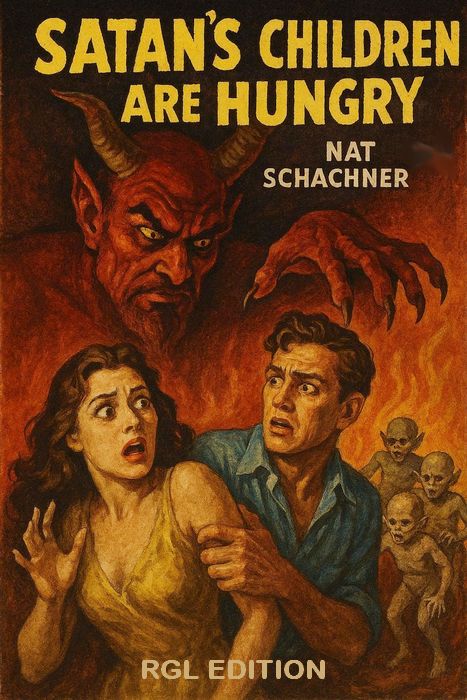
RGL e-Book Cover
Based on an image created with Microsoft Bing software
Roy Glashan's Library
Non sibi sed omnibus
Go to Home Page
This work is out of copyright in countries with a copyright
period of 70 years or less, after the year of the author's death.
If it is under copyright in your country of residence,
do not download or redistribute this file.
Original content added by RGL (e.g., introductions, notes,
RGL covers) is proprietary and protected by copyright.
RGL e-Book Cover
Based on an image created with Microsoft Bing software

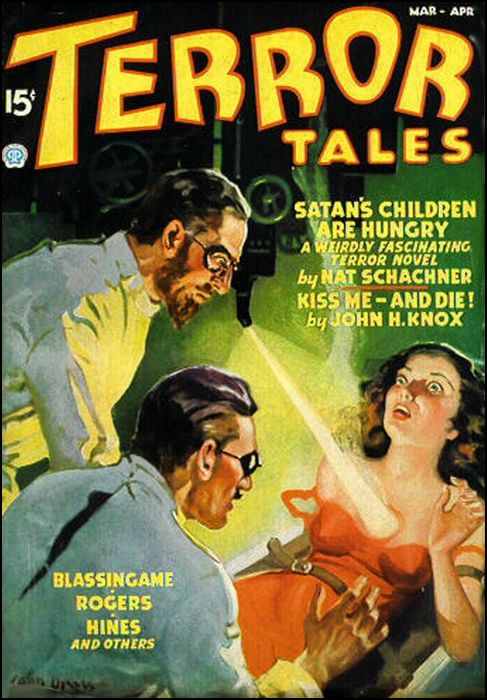
Terror Tales, March-April 1937 with "Satan's Children Are Hungry"
Could the heretofore pure, healing waters of Minnemac Springs turn those peace-loving, doddering old men into a horde of blood-hungry, ravening beasts? Or was there some other, more sinister influence, known only to John Rice, mayoralty candidate?... Hal Stevens found the answers, but not until the polls were opened—by the Brotherhood of Hell!
PEGGY RICE laid a small, gloved hand on the arm of her companion. Even through glove and the shaggy stuff of his ulster, Hal Stevens sensed the taut fear that stiffened her warm, soft fingers. "If only I knew what's wrong in Minnemac," she whispered for the hundredth time on their long ride.
For the hundredth time, Hal lied soothingly. "Nothing at all, darling. You'll see soon for yourself. We're almost there now."
They had left the broad state road, and were climbing a winding, twisting grade that led steeply into the higher mountains. The night air grew rapidly cooler and more tenuous, and the powerful motor of the long, streamlined roadster began to cough and sputter as the carburetor, adjusted for lower altitudes, provided less and less of the precious mixture.
"Then why," she persisted, "did Dad send me such a strange telegram? 'For God's sake, stay away from Minnemac...' " She had learned it by heart, had repeated it over and over again, seeking something concrete in the hidden meanings that had aroused her fear... " 'Imperative you change your vacation plans. Stay in city, go elsewhere, but under no circumstances come to Minnemac. Will explain later.' "
"And, like a dutiful daughter," Hal grinned, eyes glued to the road, "you obeyed. You dragged me away from an office full of clamoring clients, shoved me into your expensive roadster, and hustled us both straight for—Minnemac!"
"Your office was empty," she started indignantly, then broke off with a wan attempt at an answering smile, "as is right and normal with a young, beginning lawyer." But she could not keep up the pretense. Her face clouded. "Don't you see, Hal dear, Dad would never have sent that telegram if there wasn't something desperately wrong; something terrible that he wanted to shield me from. We haven't seen each other for almost a year. It's the longest I've ever been away; I've counted so on this chance for us to be together—so has he. And now—" She clung, suddenly small and pathetic, to the young man behind the wheel. "I'm so afraid we'll be too late."
Hal patted her awkwardly with his free hand. His other gripped the wheel hard. The road was treacherous, and the night dark. The mountains were grim pinnacles piercing a scudding wrack of clouds. Only the laboring motor disturbed the strange silence.
"He's running for re-election," he observed doubtfully. "John C. Rice for Mayor of Minnemac. The people's friend... He simply did not want to get you mixed up in a hot campaign."
"Dad wouldn't worry about that," Peggy said tightly. "He's been mayor twice before. There won't be any opposition. There never has—"
She broke off abruptly. They had surmounted the highest point of the cleft in the mountains. From there on, the road descended in a long, slow slant to the shallow valley in which Minnemac, famed for its curative waters, lay cupped.
The lights of the city twinkled up at them with normal cheeriness. Yellow spangles of glittering flame festooned the valley, sprawled up to the very base of grim, tradition-haunted Bloody Mountain. Hal had been to Minnemac years before. Nothing seemed changed now, as far as he could see.
Even the springs, the backbone of the town's prosperity, were identifiable in the night. They lay close to the road, just before it entered the town, and the circlet of lights that marked its esplanade was lit as always.
Minnemac was known far and wide for the fame of these bubbling springs. The lame and the halt, the sick and the ailing, flocked to drink of their curative waters, to bring once more the flush of health and youth to their creaking limbs, to stave off for a while the inevitable approach of death.
THE townsfolk were proud of their waters. Under the guiding administrations of John C. Rice, the gushing stream had been led into a large, walled-in pool, which in turn was surrounded by a colonnaded esplanade, where the partakers of the cure could saunter and chat between the careful doses prescribed by the doctors.
A ring of gleaming arc lights played shifting colors on the pool's clear depths, and illuminated the gigantic statue of the god Pan, who seemed to have just arisen, dripping wet, from the center of the waters, one shaggy hand outflung, scattering largesse of health upon the crowding ill, his goat's face grinning benevolently over his votaries. Even the chill of November would not keep the people away from the pool.
A gasp of relief broke from Peggy. "Thank God!" she declared fervently.
Hal twisted toward her in some surprise. "What had you expected?" he asked.
In the dim illumination of the panel-dial, color showed again in her cheeks. She shuddered, pressed closer to his comforting body. "I—I don't know," she confessed. "I suppose I was a little fool, imagining all sorts of horrible things. But seeing those lights twinkling in the valley..."
The roadster slid down the grade with a whoosh of tires. No other sound disturbed the strange quietude. Not another car was on the road. The city gleamed like a far-flung mantle of stars, but not the faintest whisper rose from it into the still mountain air. The pool and its circlet of colored arcs swept closer. Already Hal could see the dim form of the towering god, Pan.
He himself had felt a sudden cessation of anxiety at the sight of the town. He had been more nervous than he had cared to admit to Peggy. Old John Rice was not the kind ordinarily to send hysterical telegrams. But of course everything was all right, perfectly...
They swung around the bend in the road. There, to one side, were the springs. Hal squinted and frowned. Perhaps it was the darkness of the night, or the mist that was slowly creeping up in vaporous exhalations, that made the rainbow-colored lights so dim. It was hard to distinguish anything. The tall once-gleaming columns seemed curiously dull and tarnished. The pool, that should have reflected back a sparkle of jeweled flame, was a strange, black void. And Pan!
His foot jammed hard on the brake pedal. The hurtling car decelerated to a shuddering halt, not fifty feet from the pool. He had heard something. He felt Peggy's fingers tight on his arm. The blood had fled once more from her face.
"Hal!" she whispered shakily. "What—what was that noise?"
His eyes tried vainly to pierce the vague illumination. The mist was coming up fast now, swirling, billowing. "Nothing," he lied gruffly. "Must have been some animal."
"No," she answered very low. "It sounded like a man—a man who started to scream, and whose voice was smothered in something that bubbled. There it is again."
The cry of a man in agony rose sharp and piercing into the night, stabbed their eardrums with lancing horror, broke off in a sudden retching gurgle.
Hal jerked hard at the door handle, leaped out of the car. Then he was racing for the shadowy pool. Behind him Peggy cried out in swift fear, "Hal, where are you going?"
"Some one's drowning," he flung back over his shoulder. "I've got to—" He skidded to a halt, even as the girl's voice rose frantically again. "Come back!" she screamed. "There's something..."
He had seen it too. The moon had torn itself loose from its obscuring veils. Frozen, wintry light made of earth a wan, grey corpse, even as the misted arcs flickered and died. The pool that once had housed crystal-clear, healing waters lay starkly revealed. The floodlights swung slowly overhead—empty silhouettes. The colored tiles of the promenade around the basin, always spotlessly clean, were broken and muddied with filth. Pan crouched as ever. But he was grimed and crusted, and a foul verdigris covered his goat-like head, made of him something sinister, indescribably malign.
BUT it was the pool itself and that which swung shapelessly up and down, that drew Hal's horrified eyes. The basin was a yawning pit. The waters had fled, and in their wake lay exposed a black, odorous filth. The entrails of the earth, bare to the moon!
Into the slimy muck dipping with terrible regularity, a figure rose and fell. A human form, fouled from head to foot with dripping ooze, suspended by a rope from the outstretched hand of Pan. As the first shock of discovery held Hal immovable, the tortured man rose slowly from the smothering depths, dangled momentarily in the revealing light.
His shapeless body twitched and jerked. His face was a black, unrecognizable mass. His mouth opened, and a great scream blasted out. Then, slowly, inexorably, the rope lowered—down, down. His thrashing feet touched the greedy, sucking ooze, sank out of sight. Then his waist engulfed, his shoulders, and, with a final, hideous, smothered cry, his head submerged.
Hal forced his paralyzed limbs into action. He shot forward like a bullet from a gun. No human being could survive more than a few seconds in that suffocating muck.
At the edge of the pool he stared in helpless despair down into the bottomless ooze. His toes balanced on the broken rim, seeking purchase somewhere in that quaking slime to leap across to the tortured sufferer. But bubbling filth met him everywhere, filth which would suck him down even as it had the suspended man.
Slowly, before his gaze, the rope jerked taut again. An invisible wheel creaked. The black mud broke, and a dripping head emerged. It lolled heavily to one side.
Grim rage exploded in Hal's skull, purged him of all fear. An unseen agency was torturing its victim to death with hideous deviltries. It must be somewhere... He whirled, just as Peggy's voice crackled through the night. "Hal!" she screeched. "Look out! They're coming for you!"
He had not seen them before. They had emerged from the cloaking shadows of the pump house, at the rear of the pool. The wan moon and the mist distorted and made them into vague shapes of menace. A half-dozen dim-seen figures, swathed in formless black garments, surmounted by peaked, blood-red hoods. They drifted slowly toward him, their feet making no sound in the billowing fog. The man—their victim—had fallen with a dreadful plop back into the embracing ooze.
For one instant Hal froze in his tracks. Primeval fears jelled his blood. Then, with a reckless oath, he lunged forward to meet them. Whatever they were, he'd pit hard, smashing fists against their evil masks.
The fog swirled, and dropped away. Hal ground to a halt, swore. He stared vainly around. Where had they gone? What had happened? The hellish crew had disappeared, had merged into the farther shadows.
He cast a quick glance backward. Peggy was calling on him frantically to return, but he could not—not yet.
"Hold tight!" he shouted, as much for Peggy as for the man whose ears were shut beyond all hearing. He ran behind the pump house, whence the shrouded figures had come. His fists were tight knots, his eyes raked the gloom warily. They were not there. But he found what he had expected. A block and tackle, a series of pulleys over which a stout rope ran smoothly, swung upward over the roof, and from its peak, down and across Pan's outstretched hand.
He jumped for the dangling rope, heaved downward with all his strength. It yielded easily. On the other side, mingled with Peggy's imploring cries, he heard an unmistakable squishing sound. He looped the cord rapidly around a jutting knob in the mechanism, so that it barely held. In desperate haste he crashed into the pump room, heedless of possible lurking dangers, intent on making every second count. Strangely enough, a light burned dimly inside, disclosing the great pumps. There was no sign of the evil creatures of the fog.
Ah, there it was! With a little cry of joy, he flung forward, swept up the long-handled boat hook he knew must be here for emergency use, and in the same swift rush was out again, hurtling for the pool.
IN THE haze-shrouded moonlight, the awful figure of the man hung grey and limp, dangling under the leering gaze of the god, his slime-covered body suspended by a rope drawn under the armpits. His torturers had not wished him to die quickly or easily.
The girl was at his side, her breath coming in short, quick gasps, her eyes shuddering away from the dreadful sight. "It—it's terrible," she moaned. "That poor fellow!"
Hal swung out with the long pole. The steel hook caught in the slippery rope above the man's head. He yanked hard. The loose loops he had tied yielded. The body jerked in a great dripping arc toward the edge of the pool. Hal grabbed for the slimy feet, pulled him safely to solid ground. Heedless of odorous muck, of liquid mire that spattered him as he worked, he laid the unmoving form gently on its back, whipped out pocket handkerchiefs, wiped furiously at the shapeless face. There was not much chance that he was still alive; nevertheless...
Peggy pulled off her scarf, said, "Take this. It's bigger." Slowly, features emerged; a face took form and being. But the eyes remained closed, caked with drying mud.
"It's no go," Hal groaned. "He's dead!"
"No, he isn't, the girl cried excitedly. "I saw him move."
Daubed eyelids flickered, lifted. Glazed eyes, filled with suffering, stared blankly at Hal, turned to the girl. Something lit up within. The lips worked; thick words forced their way through dried mud.
"Peggy Rice! You must not—"
She bent swiftly, breathed a terrified whisper. "Uncle Jim! What have they done to you?"
The man's eyes were dull again. His mouth worked frantically, but only faint sounds came through. They strained close to catch their meaning.
"They're going to—I heard them—your father—watch—out..." His voice trailed to the merest whisper. His body heaved suddenly; there was a dry, rattling noise. Then his eyes closed, and he was still.
Hal rose grimly. His mouth was hard and his eyes burned. "He's dead!" he rasped harshly, "but the devils that got him are still alive."
Out of the close-pressing fog, as if in answer, came a mocking chuckle. Hal whirled. There was nothing to be seen; only the grey fingers of the mist, the dim hulk of the pump house.
"Let's get out of here," Peggy implored. "I'm afraid."
They left the poor, tortured body at the edge of the pool, climbed into the car. The started whirred; the car bounded forward. Hal breathed easier. He was glad to get away. "We'll get help in town," he said, "and come back for Uncle Jim. Then—" and his jaw was a lean, hard line—"we'll go after those devils who did that to him."
The girl clung to his free arm. Her voice was frightened. "Poor man! He's not really my uncle. He's Jim Harding, an old friend of Dad. He used to play with me when I was a tot; I've always called him Uncle." Her grip tightened. "Hal, did you hear what he said? About father? Do you think—"
"Of course not," Hal retorted loudly. "Nothing to it. Just the ravings of a man tortured until his mind snapped. Don't worry about your dad, darling. He's all right."
"But why was this terrible thing done to poor Uncle Jim? What is wrong in Minnemac?" She was suddenly a trembling little girl, clutching at him blindly for support. "Oh Hal! I'm so afraid!"
He comforted her as best he could. He did not know the answers himself. Had he known them, he would have turned the car around, would have fled that valley of the damned as fast as ninety horsepower could have carried them.
Minnemac seemed tense with excitement. As they honked through the main street of the town, they noticed that the people were congregated in groups at the various street corners; that on all faces angry passions dominated. There was something else. The groups, seething with loud, excited voices, were nevertheless homogeneous. The young and middle-aged held together. And so did the old, the scrawny, those with wrinkled skins and palsied limbs. They seemed more angry, more aroused than the others. Their voices were shrill and cracked and lifted in hate; their withered arms shook feeble threats at the others—the ones on whom life still smiled.
HAL did not stop. He wanted to get to John Rice, Peggy's father, and mayor of the town, as fast as possible. Murder—and worse—had been committed. He kept pressing the horn to clear the road. A particularly vulturish old man twisted his bald head angrily. His voice went up in a screech of hate at the sight of them. "There's, the mayor's daughter," he yelled, "trying tuh run us down. You just wait—you and your damn' father!"
"What a horrible old man!" Peggy shuddered. But they were already past him, and the road was fairly clear of people. The car leaped forward.
"Don't mind him," Hal said tightly. "He evidently doesn't like your dad." But uneasy forebodings made him press his foot down on the accelerator. This was more than a mere pre-election crowd. Something sinister was in the air of Minnemac.
The Rice home was near the farther end of the town, toward the end of the residential district. Beyond that, the road led through fields, past a cemetery, up to the base of Bloody Mountain, and there came to a dead end. The gaunt, craggy hill was an insurmountable barrier. The valley was a cul-de-sac.
It was John C. Rice himself who opened the door for them. He fell back startled at the sight of his visitors. "Peggy! Hal Stevens!" he gasped. "In God's name why did you come? Didn't you get my telegram?"
Hal shook hands hastily. "She got it all right," he declared gloomily. "That's why she's here. You should have known better, John Rice, than to warn her to stay away."
But Peggy had flung herself into the old man's arms. "I'm so glad you're alive and safe," she sobbed.
Rice stared at his daughter. "Safe? Alive?" he snapped. "Don't talk nonsense. Why shouldn't I be? But come on in. We're holding a meeting."
As they walked into the living room, Hal thought that Rice's snappishness covered a haunting dread. He was shocked at the change in him since he had seen him a year before. Lines of repressed fear had etched themselves into the formerly vigorous smoothness of his face; his hair was white instead of iron-grey. His blue eyes slid away from them, instead of meeting theirs in open frankness.
But already they were inside, and three men rose from their chairs at their entrance. Rice introduced them.
"We're planning our campaign," he explained. "Election's the day after tomorrow. You know Doctor James Thurlow, Peggy." He laughed shortly. "Doc caters especially to the old people who came for the waters. He's also commissioner of the Springs."
Thurlow bowed coldly. He wore a black, professional beard, a glossy, pointed mustache, and his black eyes were reserved pinpoints of light.
"And this," Rice turned to a lank, angular man with high cheekbones and a sallow, muddy complexion, "is George Wheeler, my running mate, candidate for vice-mayor, and owner of the only night club and gay spot in Minnemac."
Wheeler smiled a sickly smile, wheezed, "Glad to know you." He seemed jittery.
"And finally, this is Fred Oberly," Rice waved toward a youngish man with thin, sandy hair, and a ready smile on his round countenance. "My campaign manager; but you know him, too, Peggy."
His daughter was not listening. She stared from one to the other, eyes wide with what she had been through, with what she had just heard.
"Election campaign!" she echoed. "Oh, daddy, you don't mean to say there's any opposition to your re-election?"
Rice essayed a wan smile. "Plenty, my dear. There's a rival ticket in the field. I don't exactly understand what's up, but hell's been popping here for the past week."
"Ever since the springs went dry," Oberly interposed.
"Exactly," Rice agreed. "Up till then everything was smooth. No one took the trouble to be a candidate against me. I had tried to give the town an honest, efficient administration, and everyone seemed satisfied. Then the springs went—suddenly. The town's continued prosperity depends on them, as well as the hopes of all those old people for further life and health. They'd been acting queer even before the springs gave up. Dr. Thurlow noticed it. Since then, however, they've been crazy wild."
THURLOW shook his head gravely. "I can't quite make out what's wrong with them." he said in cold, clipped accents. "They're the old people who had come to Minnemac to get a new lease on life. The kind we always welcomed. Most of them were tottering, wheezing with asthma and the usual complaints of those for whom the graves are already marked; but otherwise normal, decent enough folk. Of course there were, as in every community, lecherous old devils, burnt out with the sins and lusts of their own contriving, but they didn't give us much trouble." He glanced queerly at Wheeler, Rice's running mate. "They usually hung around George's night club up the road—Hell's Kitchen is the name—a rather macabre get-up to tickle jaded palates. There they'd spend whatever money they had on wine, women and song."
The sallow man jerked angrily in his chair. "No look here, Thurlow. If you're insinuating—"
"Not a thing," the doctor broke in with a humorless smile. "Each to his own taste. This is a free town, and there have been no complaints about your place. John Rice wouldn't have allowed you on the ticket with him if any of us had thought otherwise."
Wheeler subsided, muttering to himself.
Hal said nothing. But he was watching them intently, listening. He did not want to spring his grisly information until he knew exactly what was happening. After that, there would be too much excitement for him to get a connected picture. Peggy looked helplessly around. "But what has all this to do with Dad?"
"Just this." It was Fred Oberly's smooth voice. A typical campaign manager's voice, thought Hal, too smooth for complete sincerity. "Three things have happened. First, the springs have dried to a filthy pest hole; second, the old people of this town have gone crazy; third, they've put a ticket in the field against us. Cornelius Vance for mayor; Tom Carstairs for vice-mayor."
Peggy stared bewilderedly. "Vance!" she exclaimed in a choked voice. "But he was a friend of yours, Dad."
"In politics," Wheeler said harshly, "there ain't no such thing as friends."
"Nor relatives either," Oberly grimaced. "Tom Carstairs is a cousin of mine. That's why he's running, because he hates me worse than poison."
Hal decided it was time now to spring his dreadful news. "Any of you know Jim Harding?" he asked quietly. Peggy gave a startled "Oh!" and sank white-faced into the nearest chair. The men turned to Hal. Surprise was stamped on their countenances. "Why, of course," said Rice. "What about him?"
"He's dead—murdered—by friends in black shrouds and red hoods—down at the springs."
If it was a bombshell that Hal had tossed into their midst, its effect was strange. They did not jerk up from their seats, as normal people would under like circumstances, clamoring around the bearer of the news for further details. Instead, a deathly silence reigned in the room. They seemed turned to images of graven stone. Wheeler licked his dry lips stealthily. Oberly's face was a white, staring mask. Dr. Thurlow's dark eyes glowed. Rice's shoulders sagged, as if under an unbearable weight. He was the first to break the strange spell.
"They kept their threat," he whispered huskily. "I didn't think they meant it. Poor Jim. He had nothing to do with it at all."
"What do you mean?" Hal snapped.
Rice raised his head wearily. "There was a placard on Jim's house, this morning. Letters of blood on a black background. It was signed, 'The Brotherhood of Hell.' He was marked for death, it read; so was everyone else who had had a hand in stopping the Springs."
Peggy jerked out of her chair. "Dad!" she cried sharply. "Was there—was there a placard on—on—?" She could not finish the question.
"Yes," her father muttered, and looked away.
"And on all our houses," Fred Oberly snarled. The smoothness had fallen from him. "All of us are in the same boat."
Hal sprang to Peggy just in time. She was swaying. Cold fear clutched his heart. She was in danger too. He remembered the ominous threat of that half-crazed old creature in the street. A sickening memory of Jim Harding, dangling in the moonlight, swept over him. If those red-hooded demons ever laid their filthy paws on Peggy, even that might not be the worst that would happen to her.
JOHN RICE rose from his chair. His shoulders straightened out, his voice crackled. He was mayor of Minnemac again. "We're going down to the Springs—right now," he rasped determinedly. "We'll get poor Jim's body for decent Christian burial, and we'll hunt the hellhounds that were responsible for his death."
George Wheeler shrilled out suddenly. "Not me! Not for a million dollars! Not for all the offices in Minnemac!" He was trembling violently.
Dr. Thurlow rose quietly. "I'll be glad to go along," he announced.
Oberly forced a laugh. "If Thurlow isn't afraid, I'll trail along also." But his smile was a bit sickly, as though his heart were not in his words.
Rice stared at the sallow man with edged contempt. "All right, George," he said faintly. "You run along home and get under the sheets. We men are going to perform our duty."
"I'm going," Peggy said bravely. "I'd be afraid to stay here alone."
Her father looked at her. "You might as well," he answered finally. "It will be safer. Nora, the housekeeper, quit this morning—told me the devil had come to Minnemac, and she was getting out." He laughed shortly. "I'm not so sure she wasn't right."
They bundled in silence into Rice's town car, after Peggy's roadster was run into the garage. Wheeler slunk away with a muttered good night. He was obviously glad to go. The fog had cleared a bit, and the moon was brighter. It was late. The gesticulating groups had left the streets. The houses were tight-shuttered; no lights showed anywhere.
In silence the automobile lumbered down the main street, toward the outskirts of town. It grumbled to a halt beside the deserted pool. They hunched out together, as if afraid to be away from their fellows. A gun glinted surreptitiously in Fred Oberly's hand. They moved warily forward, in a compact group.
Hal exclaimed suddenly, darted forward.
"Wait!" Peggy cried out. "Don't go!"
But he ran on, unheeding. Around the pool, around to the place where he had carefully deposited the body of Jim Harding. There he stopped and stared. He did not even hear the panting of the other men, their following footsteps.
Jim Harding was no longer there! The filth-dripping form was gone, vanished. More! There was no sign that it had ever been there. The marble flagstones, broken and dirty though they were, showed no trace of ooze or mud.
His eyes jerked upward to the crouching stature of Pan. That pagan god seemed to grin back at him with evil triumph. No rope dangled from his hand. The boat hook with which he had fished Harding from the muck was likewise gone.
"What's the matter?" he heard Peggy's frightened voice. But he was swinging away, pelting headlong for the back of the pump house. Even before he got there, he knew what he would find. Exactly nothing! The pulleys, the block and tackle, the long, dangling rope had disappeared as though they had never been.
He turned back slowly to meet the others, suspicion flared openly in Thurlow's cold glance. "It's a strange story," he observed to no one in particular.
"It's not strange at all," Peggy flashed in defense of her lover. "I saw it also. It was I who recognized poor Uncle Jim. Those fiends came back after we left, took away all the evidence of their terrible crime."
"You're right, of course, Miss Peggy," the campaign manager agreed. But there was a queer, preoccupied look on his face as they went back to the car, after a thorough search of the surrounding underbrush and the pump house, had revealed no sign of the murdered man or of his murderers.
HARDING'S house was near the center of the town. No one said anything as they rolled up before its gloomy portico. But their breathing was sharp, staccato, while they waited for the answer to their ring.
A sweet-faced woman opened up finally. There were traces of recent tears on her face, and her eyes were red. "Oh!" she gasped, and drew back her eager forward gesture. "Excuse me! I thought it was Jim." Then she saw who her visitors were. "John!" she greeted. "Where's Jim? I'm almost frantic with worrying. He's never been so late before."
The group on the porch looked at each other. Hal felt a chill run through his veins. The night was suddenly full of ominous rustlings. Peggy gave a little pitying moan. No one spoke.
Mrs. Harding peered into their faces, cried out in sharp alarm. "You've come to tell me. I know it! I know it! My dearest Jim!"
Rice took her hand, patted it. "Don't go off like that, Alice," he said gently. "We don't know a thing. We just dropped in—just to talk over some election matters. Thought Jim might be home. Don't you go worrying now. He was just detained a bit on the road, that's all."
She caught pathetically at the straw. "Do you really think so, John?" she asked hopefully. "Maybe you're right. But that awful placard they left on our doorknob this morning got me all jittery. And when Jim didn't come home his usual time... Excuse me, all of you. I'm really ashamed of myself."
"That's all right," Rice said gruffly. "Just you go on to bed, and don't wait up. There's really nothing to worry about."
But as they went back to the car, dragging leaden limbs, not a word was said. They knew that never again would Alice Harding see her husband alive; perhaps not even his poor dead body. And they knew that death was stalking the streets of Minnemac, seeking out its victims, seeking to slake its hellish lust. Each of them was marked by the invisible doom for its own!
There was little sleep for Hal that night. He lay awake hours listening for sounds in the old Rice mansion, ready to fling out of bed at the slightest hint that all was not well. But the stillness was unbroken. Finally he slept. When he awoke, John Rice had already gone to attend to campaign duties, and prepare a more thorough search for Harding's missing body.
The sun streamed into his window, clear and frosty, and Peggy's knock was loud on his door. They had breakfast together in the old house, each carefully avoiding the topics that were uppermost in their minds. But the pale rings under Peggy's eyes showed that she had not slept much either, showed the terrific strain under which she was laboring.
Nevertheless, when Hal, with careful casualness, suggested that it might be wise for them to return to New York at once, that his office needed him, she declared firmly: "I can't leave dad alone with this horrible thing hanging over him. After the election tomorrow, yes; but not before."
Breakfast over, they went out into the cold sunlight, down toward the center of the town. Surely, thought Hal, in bright daylight there would be no danger.
Yet there was obviously something wrong. Men hurried through the streets with averted faces and quick, sidelong glances. No women were to be seen; no children. Doors were tight and windows barred in the flanking houses. And, as they neared the business section, a confused murmur was heard, a buzz of many voices.
For the moment Hal hesitated. Peggy was with him, and he wished to take no chances. But she had paled at the growling sound, urged him forward. "Maybe it's something to do with Dad," she said with a little catch in her throat. "Darling, I'm so afraid for him."
The crossing near the post office was black with surging people. They overflowed the sidewalks, filled the street. Someone was speaking on the post office steps, addressing them with shrill emphasis and many gestures. A murmur went up from his listeners; their faces were pallid with fear.
The man was ranting. His eyes flamed with a wild light; his collar was open and his tie askew, as if he had ripped them wide in his frenzy. He was old, and his voice was a cracked falsetto.
"The Brotherhood of Hell has struck again," he screeched. "Satan has marked his victims for his own; they will strike and strike again. Nothing can stop them in their appointed tasks, therefore I say unto you, oh children of evil, repent of your sins now, before it is too late."
A man burst out of the crowd, shrieking. "They marked my door this morning. They marked me for death. But I ain't staying; I'm leaving Minnemac right now. I'm getting out, oh Satan; spare me, spare my children!"
THE foam flecked his lips and there was the glare of madness in his eyes as he sped by them, looking neither to the right nor to the left. A shudder swept over the assembled crowd; men fell away from each other with looks of stealthy fear.
"What the devil does this mean?" Hal demanded angrily of his nearest neighbor. The man's face was pale, and a vein pumped on his forehead.
"Ain't you heard yet?" he answered without turning his head. "They found Jim Harding's body on his own doorstep this morning; and Herb Corey, the bank cashier, was dangling down at the springs like a scarecrow in the wind. An' a lot more doors were marked this morning." The man gulped, and the vein swelled. "By golly, I'm a-going, too. I ain't afraid for myself, but there's Ethel and the kids." With that he whirled about and started to walk away fast.
Peggy gave a little gasp. "Herb Corey! Another friend of Dad." Her frightened face turned to her sweetheart. "Hal! It's deliberate. They're striking at father through his friends and supporters; next they'll—"
But the exhorter on the steps had swung around. His eyes glittered on the girl. His skinny arm went out. "And there," he screamed, "is the mayor's daughter, Peggy Rice, come from New York, that abode of sin and lust and harlotry. No wonder Satan has come to claim his own; no wonder the Brotherhood of Hell is about its grisly work. John Rice's door was marked; that warning went for her, too. Repent!" he thundered at her. "Repent, I say, oh child of sin!"
The crowd swayed like leaves in a wind, craned necks to see the object of his tirade. Peggy shrank back with a moan. "Let's get out of here, Hal—quick!"
But her lover had jerked forward, shoulders hunched, parting the crowd like a ship cleaving the waters. His eyes blazed and his fists were knotted. "You old devil!" he ground out, "I'll make you eat those words."
A hand clapped on his shoulder, tightened. He swung around furiously at his detainer. It was George Wheeler.
"Don't take him too seriously," advised the night club owner. "That's Clem Biggers, from the hills. He's touched in the head; and he's forever ranting wild nonsense about the wrath of Satan, and the sins of Minnemac. Tried a one-man campaign to close up my place last year, but no one pays any attention to him."
"They're paying a good deal of attention to him now," Hal retorted grimly. "And if he's going to drag Peggy's name into this—"
But the old fanatic had slipped off the steps, had merged with the crowd. Terror ebbed and flowed among them, but here and there a loud, determined voice arose. "I ain't going to let any one, man or devil, drive me from Minnemac," shouted a red-faced man. "Old John Rice'll take care of 'em after the election."
"Hurray for John C. Rice, our next mayor!" yelled another. A cheer went up at that, wavering at first, then gathering strength.
But immediately another voice cried out. "Hurray for Cornelius Vance an' the Fund." That was taken up as well by a hundred shrill falsettos.
Wheeler steered the raging young man and the trembling girl firmly away. His sallow face was muddier than usual. "You'd better go back home," he muttered. "You can't do any good down here, and there've been rumors floating around about Peggy. No one knows how they started. But she ain't quite safe where the people can see her. There ain't no telling when they'll get scared clean out of their wits, and run crazy mad."
Hal submitted unwillingly. He hated to appear to be running away, but there was Peggy.
"Damn them!" he gritted. "If they try anything—" He stopped, swung on the night club owner. "What's in back of all this?" he demanded.
Wheeler looked away. "I wish I knew," he answered in a jittery voice. "It's the election. We should win easily, but there's been talk—about the old people making a deal with hell to beat us."
"Surely you don't believe such nonsense," Hal asked angrily.
"I don't know," Wheeler confessed shakily. Then his nerves seemed to snap. "I wish to God I never was on the ticket with John Rice," he moaned. "We're doomed, every last one of us. We're all marked with the bloody sign."
Abruptly he left them, darting down a side street, and breaking into a stumbling run when he thought he was out of sight. "Weakling!" Hal said bitterly. "Come on, darling; let's go home."
PEGGY'S father came home for a hasty lunch, his face set in hard lines, his lips bloodless. "They got Sam Sellers, too," he said tonelessly. "We found him up the hillside, his head bashed in as though it were an eggshell. And little Hetty Glover just ran screaming down the street like a madwoman. Claimed she saw a band of devils with black bodies and red, shapeless faces prowling around her wood lot."
Hal said quietly: "We saw them too, last night." Then he arose grimly. "Don't you think it's time we got up an armed posse of determined men to hunt out these devils?"
The mayor spread his hands hopelessly. "You can't fight creatures who strike horribly, and disappear into thin air. Besides, just now you couldn't get a half dozen men to join you in a hunt. The town's getting scared. Half of those whose doors were marked have left town already. I've called the governor on long distance to order out the militia for tomorrow's election. But he was away, and his secretary didn't know where to get in touch with him. Down at our campaign headquarters men are afraid to show their faces, for fear the invisible death will mark them too."
He got up heavily. "Well, it's time I'm getting back."
"Don't go, Dad," Peggy cried. "You're the one they're after."
He kissed her. "It's my duty to go," he said gently. "I'd be a fine leader if I deserted my followers in the face of danger. Besides, nothing'll happen to me in broad daylight."
Hal said, "I'll go with you."
The mayor wheeled. "No, don't, Hal," he declared. "You stay close to Peggy and see that nothing happens to my little girl."
The long day wore on. The terror grew slowly but surely on Minnemac. More people had seen the dread hooded demons; another supporter of Rice had been found in a back lot, slashed horribly with knives. He was still breathing when his poor, tortured body was discovered. Closed automobiles, shades tight drawn, hurtled in a constantly growing stream down the highway, fleeing the doomed town.
Panic grew and fed on its own fears. As the long shadows of late afternoon fell, men hastened to the safety of their own homes. Only the old and the halt, those of Vance's party, hobbled triumphantly along the streets. Their withered faces were aflame with strange hate; their eyes were glazed with strange madness. As they passed Rice's house they raised skeleton arms, shook feeble fists, and shouted their hymn of anger. "Down with Rice! Hurray for Vance!"
Peggy's slender form trembled every time she heard that menacing cry, yet she held Hal back when he raged and wished to annihilate the shouter. "You can't fight old people," she told him. "And besides..."
Supper was a silent meal. Rice was not disposed to talk. The long shadows fell; outside, Minnemac clothed itself in somber silence. The chill November mist started to rise again from the valley. At eight o'clock the campaign committee came surreptitiously for final consultation. The day had not been easy on them. Fear rode high in their eyes, lines of dread penciled their faces. George Wheeler, candidate for vice-mayor, Fred Oberly, the campaign manager, and Dr. Thurlow, Commissioner of Springs.
"Well, gentlemen," Rice began jerkily, "tomorrow morning's the election. And I'm afraid—"
Someone rapped loudly on the door, sound reverberated startlingly through the room. They froze in their seats. Wheeler shrank back, eyes popping. "They're coming for us!" he cried out.
Oberly's hand crept toward his back pocket. Dr Thurlow sat bolt upright, his face a mask. Hal's fist clenched unknowingly. Who could be coming for them at this hour? He had heard no sound of a car, of approaching footsteps.
The knock was repeated; louder, more peremptory. Wheeler moaned to himself. "Shut up!" the mayor snapped irascibly. His nerves were close to the breaking point. He got up, went slowly to the door. "Who's there?" he called. The thick wood muffled the response. Unwillingly he turned the lock, opened the portal slightly. There was a startled gasp of surprise. "Vance!" he mouthed, and fell back.
The door swung on its hinges. Clammy mist poured in, and with it, two men entered silently. Hal stared unbelievingly at the leader. This then, was Cornelius Vance, head of the opposition ticket. He was a fat, puffing man, his paunch quaking with his movements, his ruddy complexion splotched with grey. Inconspicuously on his heels came a small, ratty man, with sharp, bloodless nose and shifty eyes. He closed the door behind them.
THE men in the room sprang to their feet, muttering curses. Fred Oberly said violently, "You've got a hell of a nerve coming here, Tom Carstairs!"
The ratty man leered at him mockingly. "My old pal, Fred," he grinned, showing wolfish teeth. "Always glad to see his favorite cousin."
"Well?" snapped Rice to Vance. "What do you want?"
The fat man wiped his brow with a large red handkerchief. "I came to warn you." he said hurriedly. "You'd better give up the race; announce your withdrawal. I can't control my followers any more."
The old mayor took a step forward. "Why, you dirty—" he started in a thick, apoplectic voice.
Vance backed away in alarm. "Now, don't get me wrong, John," he exclaimed. "I'm not responsible for what's going on. I was sort of asked to head the ticket. In a foolish moment I accepted. I wish to God I could withdraw 'stead of you! I can't! Don't ask me why. But I'm telling you this, John, for your own good, and the good of every one here." His eyes flicked to Peggy, flicked away again. "If you don't quit—tonight—now—what's been happening will be a pink tea party compared to what's going to happen."
"An' I'm in the same boat," whined Carstairs.
"You shut up!" Fred Oberly yelled at him venomously. "You're just as bad, or worse, than any of those filthy old men who make up your party."
They glared at each other with open hate.
Rice disregarded them. "I'm being threatened, eh?" he spoke softly to Vance. "And my daughter, Peggy, too? Don't think I didn't catch your drift." His voice rose suddenly, became a roar. "You—you—get out of here! Get out before I kill you!"
But the fat man's hand was already on the door knob. He twisted it open, tumbled out in ludicrous haste. Hard on his heels was Carstairs. Rice slammed the door, locked it with vehemence. From outside a voice floated in, muffled, strained. "All right, Rice, you old fool. It's your lookout—and Peggy's." Then there was silence, and the fog billowed in a grey-white blanket against the window panes...
Hal moved quietly to Peggy's side, held her tight. Her heart thumped loudly against his. "What are you going to do, Rice?" he demanded.
The old man stared at him. "Do? By God, I'll fight them all to hell before I quit!"
His words, thought Hal resentfully, had a brave ring, but they masked a tremendous inner fear. If it were not for Peggy, he too would feel the same way about it. But outside, death—and worse than death—was prowling the streets of the town, the enclosing mountains about.
Dr. Thurlow rose suddenly. "I'm going home," he announced. "Need sleep for tomorrow. Hard day ahead. Polls open at eight in the morning. Good night."
Through the door he had opened, there was not even the sound of retreating footsteps. The night had swallowed him up.
The night club owner shook his fist after him. "If you ask me," he cried in a cracked voice, "he's going to concoct some more of his hellish inoculations. He's in back of all this. He's infected all his patients with madness, made devils out of them."
Rice said sharply, "Nonsense, George. Thurlow's a reputable doctor. Those inoculations were necessary. When the springs started to dry, and became slimy, he was afraid of typhoid."
Wheeler's face was an angular contortion. "Bah!" he jeered. "And who dried the springs? Who had charge of them? And who knows what filthy stuff he put in his needles? It's the old people that went nuts, the ones who drank the waters, the ones he jabbed— for protection, says he. Bah!"
Then he too had flung out of the door. The fog beat around his lank form, sucked him greedily into itself.
Oberly shook his head. "Wheeler sounds a bit cracked himself. That Hell's Kitchen he's rigged up is enough to send both frequenters and owner driveling." He clapped a politician's hand on the mayor's shoulder. "Don't worry, John. The other side's trying everything from threats to murder—and worse. But they won't scare us. At the polls tomorrow, in broad daylight, we'll win in a walk. The sane people—the young folk, the middle-aged guys like myself, will come out and vote, and roll up a whopping majority. They won't want to see the fund squandered recklessly."
"What fund?' Hal asked, pricking up his ears.
OBERLY looked at him in surprise, then laughed. "I forgot! you're a stranger in town. It represents the profit from the Springs," he explained. "Originally they were owned by a man named Norcross. On his death he left them to the town, on condition that the surplus income from their use be kept intact in a fund to be known as the Norcross Endowment. It seems as if he realized they would go dry some day. When that happened, his will read, the fund was to be expended in such manner as the next mayor saw fit. He specified the next elected mayor, he said, because he didn't want to put temptation in the way of any official to dry up the waters somehow." He spread his hands, shrugged his shoulders. "The springs are dry. The old people who kept alive on the water cure have gone crazy. They want the money split up among them, so they can have a last wild fling before the grave claims them—quench every lust of the flesh in one grand debauch. Vance promised to give it to them."
"That fund," declared Rice grimly, "is going into education, parks, help to the poor."
"If you are elected," said Oberly softly. Simple, normal words, but Hal started. Did they too contain a veiled threat? Was his future father-in-law's campaign manager to be added to the list of suspects to be watched? But Fred Oberly had already bidden them all goodnight. They were now alone, the three of them.
John Rice was suddenly a haggard old man. His shoulders sagged, his grim pretense dropped away from him like a cloak. "Peggy, darling," he muttered brokenly, "why did you come? They're after you; they'll seek to force me out through you."
The girl went to him, put her arms about his drooping frame. "I'm glad I came, Daddy," she said bravely. "We'll help you fight it out; won't we Hal?"
The young man grimaced. "Of course we will," he said with a confidence he did not feel. Damn it, if only Peggy were out of this. The thought of those hooded devils pawing her adorable body, their fingers edging themselves lustfully over her quivering flesh, went through him like slashing knives. Aloud he went on soothingly: "We'd better get some sleep tonight. Tomorrow's a big day. Ho-hum!" He stretched, affected a yawn.
The old man permitted himself to be led upstairs. He was muttering to himself: "I was hasty. I should have withdrawn... for Peggy's sake."
When they were alone, the girl stood straight and slim before Hal. Her face, colorless, pale, was lovelier than ever. "Hal!" she whispered.
"Yes?" he queried, drinking in her beauty, the revealed tender lines of her bosom where the low cut dress fell away.
She flung herself suddenly, convulsively into his arms. "Whatever happens, Hal," she cried, "remember, I love you!"
For a long moment he pressed her to him, intoxicated with heady perfume, feeling the beat of her heart, seeing as in a haze the charms that were revealed to his inspection. In that convulsive gesture the protective shoulder strap had slipped off, left her palpitant and bare to his ardent gaze.
Sanity returned. He pushed her gently away. She hitched the strap modestly over her undraped shoulders. Hal said in an unsteady voice. "Nothing will happen, darling. Go to bed." And pulled himself away. He could not trust himself any more.
When the door of her room had softly closed, he stood there in the hall, deliberating. The single light burned dimly near the stairs. At the farther end was his room. It was very silent. Then, with tight clenched jaw, he went noiselessly down stairs. There would be no sleep for him this night. With an awful clarity he realized that, before the night was over, terrible things would happen. He must be ready to meet them. His right hand gripped the stock of the revolver he had borrowed from Rice. It had a comforting feel.
He sat in the easy chair in the living room, every sense straining. His imagination worked relentlessly. Time and again he started, peered at the darkened windows. He could have sworn he saw distorted, demon faces flattened against the glass, watching him stealthily. But it was only the twisting coils of the fog, writhing into fantastic shapes. Outside, no lights showed in the town. Even the street lamps were out, as if in preparation for ghastly deeds.
A deep toned bell struck somewhere. Twelve. Then one. Hal, keyed to fever pitch, nodded, jerked himself upright. He must— must stay awake. Faces formed and re-formed before him—Vance, Carstairs, Oberly, Dr. Thurlow, Wheeler. Each grinned and mocked at him, pointed behind to slimy, oozing creatures with the red fires of hell in their lusting eyes. They came toward him, a dreadful rout...
A CRY of terror went racketing and crashing through his sleep-sodden brain, jerked him to his feet in a semi-stupor. What had happened? Where was he? It was dark; dark as pitch. The light had gone out while he slept. Then the cry was repeated, but by someone else. It was no longer a man's shout for help; it was a woman's now—a girl's. The shrill scream, "Help, Hal! Help!" the horrible muffled gurgle with which it ended, ripped the cobwebs from his brain, left every nerve quivering in an ecstasy of torture. First John Rice had cried out; then Peggy!
With sobbing, inarticulate words Hal slammed headlong for the invisible stairs, careened upward, heedless of shins and hard, unyielding balustrades. He had slept, he—the watcher—while Peggy and her father were being attacked. In the swift confusion of his senses he did not even know that the gun had fallen from his limp fingers while he had dozed.
Neither cry was repeated. In all the hollow darkness of the house there was only the racket of his mad rush, his panting shouts: "Coming, Peggy! Coming!"
The deathly silence was more horrible than any noise. He skidded to a slithering halt before the door behind which Peggy should be asleep. He grasped the knob, twisted convulsively. It would not turn. The door was locked. With a groan he hunched his shoulder, retreated, and smashed headlong like a battering ram against the oak. It quivered, went crashing and splintering inward. Hal catapulted sprawling into the room, sprang to his feet, raced for the bed.
There was no one there. The sheets were rumpled, the blankets on the floor. They were still warm, and the clean perfume of Peggy's body still lingered. He raised his head, madly shouted her name. The walls re-echoed the words tauntingly. Clammy coldness breathed upon him, thick mist swirled around the room. He rushed to the open window. He could see nothing but grey billowing smoke that obscured town and mountains. No sign of Peggy; no sign of any one else.
He turned, raced furiously from the room. Half way to the stairs he jerked to a halt. Peggy's father! What had happened to him? He flung into his room. Here, too, the night fog slithered through an open window. His hurtling feet stumbled over something yielding. With a cry Hal stared downward. In the grey gloom he saw old John C. Rice, pajama-clad, sprawled, face upward, on the floor. His eyes were closed, and a gashed forehead oozed blood.
Hal hurriedly felt his heart. It was fluttering, growing stronger. He was still alive; the blow on the forehead had merely knocked him unconscious. Swiftly the young man came to a decision. He lifted the old man, carried him gently to the bed, made his limbs comfortable. Rice would have to take his chances. Peggy had been carried away—alive or dead. He must find her, rescue her, before it was too late. Almost he hoped that she was dead.
He clattered downstairs, rushed from the house. There was not time even to grope around for the fallen gun. Every second was infinitely precious. He knew just where he was going. To the Springs! There, he felt, was the hub and center of the horrible proceedings in Minnemac. He did not yet realize the whole dreadful truth.
The night was a sodden blanket of fear. On the farther edges, dim, wavering shapes seemed to crawl and slither. But all Hal's desperate attention was focused on getting to the garage in the rear of the house, where the roadster had been driven. Suddenly he froze.
A car was coming swiftly down the road, straight from the dead end where Minnemac ceased and Bloody Mountain began its unscalable heights. Its headlights were two great glowing eyes that strained futiley against the mist. The engine roared wide open, and the tires hissed against the pavement. Whoever it was who rode the night was in furious haste.
Hal spun on his heel, darted out into the glare of the onrushing headlights, waved his hands wildly. He'd beg, demand, force a lift. It would be faster than getting Peggy's car out. Every second counted.
The rushing sedan rocked to a grinding halt at his frantic signals. A man peered out. It was Dr. Thurlow! His neat beard was awry, his collar gaping, his tie askew. His eyes were round with frozen terror.
"Oh, it's you!" he yammered. "Quick! Get in!"
INSTINCT shrieked its warning to the young man, but already Thurlow's surprisingly strong hand had darted out, was yanking him into the noiselessly opened rear door of the car. Dim figures rose inside, hauled his struggling form sprawling in. The door slammed with irrevocable thud, the automobile lurched, swayed, and swung around.
"Get up, Stevens," someone grunted. "We're in a hurry!"
The car was picking up speed. Hal felt himself dragged upright, thrust violently into a seat next to two men. He tightened for a desperate leap forward, but the sound of the man's voice held him as in a vise.
"Oberly!" he cried out sharply. "You! What's the meaning of this?"
Rice's campaign manager grinned wanly in the swaying interior. His sleekness had fallen from him; he seemed badly frightened. "We're trying to round up help," he said hoarsely. "We've found out who's in back of all this—or rather, Dr. Thurlow has."
Hal braced himself against the side of the car. He trusted no one any more. "Who is it?" he demanded with edged suspicion.
"George Wheeler, John's running mate," Oberly answered. "The doctor was making some night calls up near Bloody Mountain. He saw lights moving in Hell's Kitchen—that's Wheeler's night club. It's the other side of the cemetery—a nice, gruesome idea that used to bring the thrill-seekers tumbling in, until the Springs stopped, and business fell off. Curiosity overcame his fear, so the Doctor says. He got out of the car, crept stealthily to a window. He saw inside a masked, shrouded figure busy over something. What it was he could not determine. But he stumbled in his anxiety to find out what was going on; made a noise. The masked man whirled, saw him at the window. Thurlow ran for his car; he had parked it at the very end of the road. By the time he came hurtling past, the lights were out, and everything was still. He picked me up on the way—my house is close by, and I had been awakened by a strange rumpus near the mountain. We also found Vance slinking along the road, got him too."
"Vance!" Hal echoed.
The second man stirred in his seat, where he had been trying to shrink into small compass. "I tell you I ain't got nothing to do with it," he whined. "I warned you all—you can't say I didn't."
Thurlow whipped back over his shoulder. "We'll see about that. You're coming with us to make sure."
Horror stabbed suddenly through Hal. "They've got Peggy!" he said through clenched teeth. He had almost forgotten.
"Oh, my God!" Oberly breathed. Vance crouched away with a moan. Thurlow stiffened in the front seat, said nothing.
"They kidnapped her," Hal went on tonelessly, "and left Rice for dead. But he was only knocked out. I'm going to the Springs. They must be there by now. We've got to hurry!"
Dr. Thurlow hunched over the wheel. Hal couldn't see his face. "They're not at the Springs," he insisted. "They're at Hell's Kitchen. I saw them."
Suspicion flared into an explosion of dread. Hal knew now where they were going. Not to the Springs, but to the night club. The car had swung around, was roaring back up the way it had come; back to Wheeler's place, back to Bloody Mountain. Thurlow had pretended to have gone for help; yet he had obviously not intended stopping at Rice's home. Why was he now so desperately anxious to keep Hal from the Springs?
The young man acted swiftly. His hand darted out, twisted the door handle. Fred Oberly cried out in alarm. "You fool! What are you doing?" He reached out a restraining arm. Hal jabbed back with his elbow, sent the astounded campaign manager tumbling against Vance. The next second he had ripped the door open and jumped. The car was doing sixty. He landed with a sickening thud on the hard macadam, went rolling and whirling over and over down an embankment.
The last he saw of them was Vance's pale, perspiring face at the flapping door. Then the car disappeared from his revolving view. Thurlow had not turned his head; was hunched at the wheel as if all the devils of hell were on his trail. Oberly cried hoarsely on the doctor to stop. Then that too died.
Hal dug bleeding fingernails into the embankment in vain attempt to stop his hurtling fall. But down he went, in a shower of rocks and earth, over and over. Blackness rushed up to meet him; there was a sudden solid crash—and oblivion overwhelmed his senses...
HE GROANED, lifted his head. It seemed to weigh a ton. Blood caked his face, blinded his eyes. Ice pierced the marrow of his bones. It was deathly cold. Hoar frost sparkled around him. Every move was an agony, yet he forced himself upright. The pain clenched his teeth, stabbed his heart; but it cleared his aching head. And with clarity came horrible realization.
He was in a ditch, where he had fallen after his escape from Thurlow's car. How long had he lain unconscious? What had happened to Peggy in that unknown interval?
His bloody hand clawed at the crumbling wall of dirt down which he had tumbled. He must get out, find Peggy, somewhere, somehow. Dread gnawed his vitals. He shook his head viciously. He must not think. Dear God—he must not think, or he would go mad.
Sound whispered through the night, stiffened him in his tracks. A confused murmur of voices, of shuffling feet, muffled, queerly distorted by the fog. Hal strained to listen. The sounds grew louder, more ominous. They seemed close by. A vast concourse of people, gathered in the bitter night, where town ended and only fields remained—for what purpose?
Only fields? Something blasted at Hal's reeling consciousness, froze the blood in his veins. Yet he forced his stiffened limbs toward that dreadful sound. He must find out, at whatever cost. Blindly he groped along the ditch. It sloped upward to meet the crown of the road. The noise increased. Then, suddenly, he threw himself flat on the icy stubble, teeth chattering with more than cold, eyes starting out of his head. He had seen!
The cemetery of which Oberly had spoken extended before him. A city of the dead; a forest of skeleton fingers glimmering white in the rolling fog. Flat, graven stones, heavy monoliths, marking the dead of Minnemac.
The dead? What then were those sheeted figures, shrouded in grey corpse-cerements, who stood among the bleached emblems of decay, swaying and rustling their stiff swathings, lifting stiffer faces toward a vision of hell?
A figure hung suspended between a merciless heaven and a more merciless earth, limp yet gaunt with suffering, nailed with great spikes to a cross that had been intended only to mark the last resting place of one dearly beloved, and was now put to fiendish, sacrilegious use. His torso, bare to the waist, twitched with slow agony, his head drooped in sunken torture on his feebly laboring chest. Black blood dribbled in long runlets from the gaping holes that yawned about the spikes.
Another figure stood at the tortured man's side. Satan himself—lord of all the fiends. His brown, sleek skin glistened with droplets of mist; his fleshy calves ended in hard, cloven hoofs; his face was a fearsome mask of red, surmounted by sharp-pointed horns. In his clawed hand there was a wicked trident, its steel prongs dabbled with gore.
He thrust the prongs deep into the side of the crucified man. The sufferer jerked convulsively, but did not lift his head.
"Brethren of the underworld," Satan raised his voice sepulchrally. "Too long have you lain in your graves, food for the worms. It is time for you to rise, to assume once more your rightful stations in Minnemac, to live again your lives and taste all the lusts of the flesh, all the delights of the body, of which you had been reft so long."
The dreadful assemblage surged forward, yammering, mouthing, their faces stiff with long disuse. Satan raised a brown-red hand. "Wait, my children. It is not yet time. Soon you shall drive from your path those who seek to hold you in your wormy coffins, who in their madness which to keep from you the delights of earth. But first you must eat and drink, that strength may flow into your shrunken veins. Here," he chuckled cruelly, "is both meat and drink. Here is a creature who intruded on our revels, who thought he had penetrated the secrets of our domain. He has paid the penalty for his prying curiosity; he shall continue to pay. There were others with him. They have escaped, but not for long. Come, my children!"
He lifted both hands in obscene benediction. The ghastly horde surged forward, grey lips smacking at the sight of the streaming gore. They flung themselves upon the hellish feast, corpse-thin hands clawing out from grave clothes at the body of the sufferer.
He jerked on his pedestal of pain, screamed, and lifted his head in a last convulsive effort. Nausea gripped Hal; a shuddering wave passed over him. Without knowing what he did, he sprang from his concealment, slammed forward.
THE dying man's face was contorted with agony, but beard and thin mustache, once trim and glossy, now dabbled with blood and pouring sweat, disclosed his identity. Dr. James Thurlow!
At Hal's wild outcry of horror, the grisly assemblage ebbed from their goulish feast, flung around. Satan jerked a hideous mask in his direction. Flame seemed to shoot from his eyes.
"Another intruder," he shouted in hate-twisted voice. "Seize him, my children; bring him to me."
They came on in a ghastly, hideous riot. Their faces were grey, stiff daubs, their hands seemed to be whitened bones. Stark fear rooted Hal to the spot; when he turned to flee, they were already upon him. He fought with the despair of one doomed to a frightful death, but they were too many for him. His knuckles crunched into the pasty, grave-dried countenances of the dead; weird screams forced themselves through unmoving lips; then he slipped and went down. His skull, painful with former wounds, seemed to crush like an eggshell. He knew no more...
Once again he weltered up through a sea of blackness, into a world of reality and pain. Reality? A groan burbled through swollen lips. He was in hell, in the innermost chambers of the damned, chained like Tartarus, with great black links, to a rock of torment.
The place seemed a murky cavern, with crusted stalactites dripping from rocky ceilings. Demon shapes pursued skeleton forms through lakes of boiling pitch and sulphurous flames, so skillfully executed upon the uneven walls that one almost could hear their cries of anguish, the hiss of seething tar. To the right, dim in a recessed alcove, a blood-red throne reared itself. Upon it, in a semi-darkness of unholy shadows, Satan sat, the gory trident in his hand, his face a mask of grinning cruelty.
At the other end, around tables fashioned in the shape of huge goblets filled with blood, and glassed over with the painted figures of nude female sinners struggling in the arms of lustful demons, hunched forward in hideous array the grey-shrouded creatures of the cemetery.
But more than these, more even than the dreadful knowledge of his own predicament, was the sight that unveiled itself directly in front. Peggy, the girl he was to marry, the girl he loved beyond life, hung suspended by bound wrists from a chain hooked to the ceiling. The tips of her bare toes barely touched the floor, and every muscle of her unclad body quivered with strained agony. Her lovely satin limbs, her glorious thighs, every inch of her beautiful body was exposed to the hot eyes and avid, drinking glances of that gruesome audience. A foul miasma of lust enveloped them, steamed almost visibly from their panting breaths.
Next to her stood a huge, transparent tank of water. Within its depths immersed up to his chin, held immovable by clamping spokes that radiated inward and held his head in a vise-like grip, his face blue with cold, his white lips chattering uncontrollably, was John C. Rice, her father, Mayor of Minnemac, and candidate for re-election.
Hal crashed against his chains with the wild fury of despair and rage. His swollen lips mouthed thick curses; he shouted mingled threats and pitiful entreaties. The grey corpse-creatures paid him no attention; all their straining eagerness was toward the quivering beauties of the girl, toward the man whose chin barely held above the icy waters.
But Satan turned his dim bulk slowly toward the chained captive. "Hal Stevens!" he mocked. The cupped seclusion of his throne made his voice oddly resonant. "Welcome to Hell's Kitchen. This domain of mine has witnessed many delectable orgies in the past, has been the scene of much wantonness and riot, but never has hell itself witnessed such a scene as shall now be unfolded before the eyes of my faithful children who wish to drink life to the lees before they return to the dark, unending grave."
Hideous gabblings of approval burst through the stiff, grey lips of his auditors. "And you, too, Hal Stevens," the seated monster resumed, "shall witness it equally with them. Gaze upon your beloved; think with regret of all the charms you had been foolish enough to overlook, and which must now forever be denied to you. My children yearn for her tempting nudity; they can hardly wait. Soon their desires shall be gratified; but first their natural impatience must be titillated by the pleasurable torture of John C. Rice."
Satan's thick red lips curled sarcastically. "He would have withheld the accumulated gold that meant a satiation of all the lusts, all the unspeakable obscenities of delight; now he must pay the penalty." He waved his trident slowly. "Proceed!"
THE papier-mâché walls of Hell's Kitchen took on a deeper, scarlet hue. Red licking flames sprang up in a circle round the quivering body of the girl, reflected greedily from her straining limbs. The great transparent tank misted swiftly. Frost crystals formed on its walls, laced in an intricate network the icy waters within. Faint, chattering moans forced themselves through Rice's frigid lips.
Peggy shrieked. Her body writhed, swung in a gigantic pendulum. A mechanism hidden in the ceiling oscillated the hook from which she dangled. Higher, higher, sweeping in long, frantic curves from side to side, a living metronome.
In a red haze Hal saw it all. The veins bulged to huge knots on his forehead; his muscles swelled to bursting as he yanked in berserk rage against the biting steel. The simulacrums of the dead at the goblet tables leaned forward like ghastly skeletons at a graveyard revel. "Doubtless," Satan intoned inexorably, "you have guessed what will happen. An ice-making machine is freezing the waters. Ice, my dear Stevens, expands in the making. The rigid walls of the tank confine the expansion, drive it inward. John C. Rice is flesh and blood, yielding, crushable. Soon you shall see what will happen."
Already the still waters were shot through with long ice crystals. They froze on the mayor's clothes, solidified with exceeding swiftness about his twitching body. A great shriek tore from him; with tremendous effort he moved his jaw against the imprisoning spokes. The ice broke and churned around his chin, and re-formed, more solid, more relentless than before. The breath came from his gasping lungs in wheezing exhalations; soon the inexorable pressure would crush his straining ribs.
Peggy swung higher, higher, in great arcs, her limp white limbs almost to the ceiling. Toneless screams ripped from her tortured lips. Hal tore and battered against his chains; he shouted and prayed and cursed in blinding horror. But the steel links were imbedded in solid wood, within the superstructure of papier-mâché. They gouged his heaving body cruelly, made long streamers of blood flow. The saturnalia of lust and torture rose to a hideous pitch. Satan gripped the arms of his throne, bent forward, his eyes pools of unslaked desire. Rice's groans grew more and more feeble.
Suddenly a door slammed open. All heads turned unwillingly from the gruesome sight. An old, old man, face wrinkled with four-score evil winters, hobbled into the seething chamber. Satan's mask twisted in anger. "What do you mean," he grated, "by interrupting our festivities?"
The hideous old man salaamed, squeaked: "The polls have opened. They are voting. You must hurry. Rice's party is already there. They outnumber us. Hurry, or it will be too late. I was sent by—"
"Enough!" the seated monster interrupted. "Morning has come unbidden, unnoticed on our revels. Fear not! These, my children, shall be present in time. Go!" he commanded. "Perform your tasks as you have been taught. I shall wait behind."
The horrible assemblage clattered stiffly to their feet, shrilling through corpse-pallid lips a gabble of assent. Then they trooped out, leaving only the three and the cruel torturer.
The masked figure did something in the dim recess, stepped out and down. Slowly the naked girl ceased her endless swinging, died down to a limp, unmoving body whose toes barely dragged the floor. She had fainted. But the ice continued to solidify and harden about the rigid, blue form of the mayor. His eyes were closed; his face screwed up in gasping agony.
SATAN'S gaze gleamed like hot coals upon the undraped nudity of the suspended girl. "I've changed my mind," he declared thickly. "It will be better sport first to try her charms, while you two, father and lover, look on. Then I'll give her to those poor dupes outside; watch old Rice die a hideous death, and attend to you, young man, with certain refinements of my own contriving. Thus I'll have revenge and money and everything—Rice dead, the others swept from my path, the election in my power. Stupid puppets—they think I'll divide almost a half million among them—dodderers who are better off in their graves. It will be mine—all mine!"
"Damn you, whoever you are!" Hal mouthed in a red glare of madness. "As surely as there's a God in heaven you'll suffer in hell for this!"
"Words, mere words," Satan retorted contemptuously. "In the meantime, my dear..." He moved over to the limp, dangling girl. The circling flames had vanished back into the hidden pit from which they sprang. "I've waited long for this," he gloated. "The last time you were in Minnemac, Peggy Rice, you scorned me. You dared to slap me when I put my hand where now..." His fingers stroked avidly over her virgin breasts, groped downward. She stirred and moaned under his unholy lust. Hal was a shrieking madman. Blood spurted from a mass of wounds; he screeched frantic, unheeded execrations and threats.
"I've hated you—and desired you, ever since," the masked fiend went on. "I've hated the smug stupidity of your father, too. Honest John, they call him, eh? Damn him; he stopped me from making big money in Minnemac by his honest administration. I could have joined the Springs with gambling, liquor and women into a resort that would have made Tiajuana look like small change. There'd be millions in it. I'll do it yet, when all of you are cleared from my path." His arms went out suddenly. He crushed the girl to his foul body. Her eyes opened; she screamed with unutterable loathing and horror. Satan's red-painted lips reached avidly for hers.
Hal hurled himself once more against his chains in a last ecstasy of delirium. They tightened, flung him back with shattering force against the simulated rock. He was helpless, a writhing prisoner; while Peggy—
There was a creaking noise behind him. His head lolled around; nothing mattered now; nothing... A hoarse exclamation burst from cracked, bleeding lips. The figure of a man had lifted heavily from behind the rock. His rotund countenance was ashen grey; blood and grime in equal proportions distorted his features. He swayed groggily, pudgy fingers busy with something hidden under the papier-mâché.
"Cornelius Vance!" Hal croaked.
The blood-spattered rival of Rice for the mayoralty grimaced in desperate warning for silence. His hands were busy, unhooking, unfastening. Fortunately Peggy screamed just then, and Satan, trying to crush his lips against hers, had not heard.
"All right," Vance whispered huskily. "Get him!" He swayed collapsed upon the floor.
But a great fierce joy flooded Hal's being. The steel links had fallen away with a clatter. He was free. Red, seething murder was in his heart as he crashed forward. Satan heard the thud of metal on wood, the swift rush of feet. He darted back from the girl with a startled yell; saw the hurtling thunderbolt of vengeance. With a cry of alarm he whirled, darted for the recessed throne. Hal swerved, hammered after him. But a panel swung open; the disguised demon flung through, and whirring wood slammed shut in Hal's face as he bounded on the dais. Satan had escaped!
For a blinding moment he thought of battering down the wall with steel, with a heavy chair, with any weapon within reach; then Peggy's cry brought him to his senses. With a groan he ran for her, untied the binding cords with stiffened fingers, laid her gently down, shed his coat in desperate haste, covered her nakedness with it.
"I'm all right, Hal," she gasped. "It's father—"
The young man whirled, snatched up a chair as he ran. With furious blows he smashed the glass enclosure. Water gushed forth, ice splintered and powdered under his frantic onslaughts. John Rice fell into his arms, chattering with cold, lips working feebly. "Never mind me," he muttered thickly. "I'll find things, blankets. So will Peggy. But the polls, the election!"
Hal hesitated, torn between fear for those he loved and duty to the innocent people of Minnemac. Vance raised his head, cried in terrified accents. "The polls! There's something hellish going to happen. I heard—" He fell back, limp, sodden. He had been through frightful things this night. Peggy whispered bravely, "Go, Hal. It's for Dad. If he loses the election, he'll never survive."
Hal said, "Be careful honey. There's liquor behind the bar. Make your father drink—he needs it. I'll be back soon."
IT was day, but the fog had not lifted. The valley was dripping blackly; it was impossible to see more than a hundred feet away. About a half mile down the road the polling booth had been erected. Below the cemetery. He started to run, dread lending him wings. Wild, conflicting thoughts tore at his mind. He had been a fool to leave Peggy behind, unprotected. Rice and Vance would be of no help in case... He jogged on, panting. Nothing would happen to them. It was at the polling booth that the next act of the terrible drama would be enacted. A sixth sense told him that, and shrieked simultaneous warning against his going. What could he, a single, unarmed, wounded man do against the massed cohorts of hell, those pledged from the grave, the slimy wallowers in the Springs?
Nevertheless he forced himself onward. The noise of his racing feet was muffled in the grey hoar smoke. He seemed alone in a word of billowing mist. Somehow his laboring senses brought him dreadful knowledge. He was not alone. Across the fields, keeping even pace with him, something else was running. He heard no sound, he saw no shape, but his tortured brain was certain. Devil or man or beast, it paralleled his course, slowing when he slowed, increasing speed when he did, holding stealthy watch on him.
Then, ahead, came an unmistakable sound; one that curdled his veins to whey. The sound of marching things, far off, clumping up and down with hideous regularity. The shrouded corpses risen from their graves, marching inexorably upon the election place, to perform their dreadful unknown task.
He flailed his weary limbs to increased motion. As he ran, a sinister chuckle floated across the frosted, fog-enveloped fields. The thing that paced him was mocking his efforts, luring him on to death and destruction.
Hal gritted his teeth, swung suddenly into the fields on the left, away from the grisly thing that had chuckled. His breath came in thick, tearing sobs; the frozen soil crunched beneath his labored feet. One overwhelming thought bore all else before it; fear, terror, wild apprehension. He must get to the booth before that dreadful procession of the damned, before the thing that ran equally with him across the meadows.
He remembered now; the road took a deep bend to the left. By cutting across the arc, he was saving precious time, might leave them all behind. There, at the booth, the brave spirits of the town, who had ventured out to vote for Rice in spite of hell itself, would be foregathered. He must get to them before—it happened. Vance's incomplete words, Satan's ghastly speech, his own forebodings, told him that a dreadful doom awaited the voters. If he could warn them, organize them before the marching dead came upon them...
His leaden limbs pistoned under the furious drive of his will. To the right, through the shifting dirty grey, he heard the measured clump of the marching dead, hurrying to their appointed tasks.
He hurtled on, reeling off the yards, stumbling, gasping, seeking frosty air for his bursting lungs. Then, ahead, he heard the murmur of voices, and a deep-toned bell. Eight muffled strokes, beating out remorselessly an unknown doom for the men of Minnemac.
Already he could see them, vague shapes in the swirling mist. He tried to cry out, but could not—could only manage a hoarse whisper. His throat was dry, his larynx constricted. The wavering figures grew more plain. There were two groups gathered. One was larger, composed of ordinary, decent folk, crowded around the one-story, single-roomed building that had been made the polling place. But on their faces shone alike an ineradicable dread, a fear that lurked in their sidelong looks, their white-glistening faces. They seemed to huddle together for protection.
Across the way, apart, was a smaller group. Old men, tottering, feeble, but with eyes glaring hatred at their opponents, toothless mouths mumbling imprecations. Members of the second parade, those who had been with Vance at the Springs. Standing alone at the side of the road, away from the polling place, hand inconspicuously on a little black box that rested on the stone fence, was Tom Carstairs, candidate for vice-mayor on Vance's ticket. His ratty face seemed more peaked than ever; he leaned forward with absorbed, straining eagerness.
AS THE last dire reverberation of the bell died down, the door of the polling place flung open, and a man stepped briskly forth. On either side of him was a policeman, white-faced, alert, keeping gun hands surreptitiously close to back pockets. But the portly man they escorted did not seem perturbed. He spoke in a loud voice:
"The polls of Minnemac are open for voting. I need not explain the method. You have been instructed in the use of the voting machine at the last election. Kindly enter, one at a time, and record your name with me before you vote." Then he turned, and disappeared behind the swinging door. He was the town clerk.
The men of Rice's party shuffled uneasily, held back from being the first. None of their leaders was present—Rice, Wheeler, Oberly or Thurlow. Carstairs said nothing, but his beady eyes snapped. He ran a red-pointed tongue over dry lips. Hal flogged himself on. He was stumbling now, blind with exhaustion, weak from loss of blood. His drunken stagger was slower than a slow walk. He tried again to shout, to scream; his voice was only a hoarse, whispering croak.
Already a vulturish old man had darted forward, entered the polls. Twenty seconds elapsed, during which time Hal had pitched headlong to the hard earth, was dragging himself erect by sheer, indomitable will power. Then the old man issued, cackling horribly, rubbing bony hands together in high glee. He had voted—for Vance and Carstairs.
That seemed to encourage the adherents of Rice. They had been afraid—of what, they did not know. A young fellow, a rough clad farmer, moved to the door, went in. As he did, Hal staggered out upon the road, bloody, clothes in shreds, hand uplifted, clawing forward. "Stop him!" he croaked. "There's something wrong in there. Stop—"
They swerved on this bloody apparition that had stumbled into their midst. The policemen hustled forth, eyes grim, mouths hard. This disheveled tramp was trying to interrupt the orderly processes of an election. But they were only half way across the road when a scream of agony seared through the fog like a branding iron. The scream of a strong man in frightful pain, in the last ecstasy of awful torture.
The closed door thrust violently open. The portly figure of the town clerk catapulted out, no longer pompous, self-possessed. His mouth gaped wide, his face was splotched with terror. He ran blindly down the road toward the center of Minnemac, his heavy feet drumming on the hard macadam.
Confused cries burst from the gathered voters. The two policemen stopped in their tracks.
Then another figure staggered out. A dreadful, almost unrecognizable figure. At the sight of him a wail of mingled fear and horror rose from a hundred throats. The minions of the law jerked forward, thought better of it and hastened, mumbling and jittering, after the fleeing clerk. The fog swallowed them all in its gaping maw.
Hal cried out with the rest, lifted his arm as if to ward off the horrible sight. It was the man who seconds before had entered the polls to register his vote.
He staggered blindly out, his twitching hands groping before him. Where once eyes had gleamed and gazed upon the world, were now two hideous red rips of pulped and soggy flesh. Blood dripped in thick streams from his sightless sockets. His eyes had been torn from his head, and a hideous gash laid open his skull.
Screaming and moaning in unendurable agony, the sufferer weaved in stumbling fight across the road, smashed headlong into a tree trunk, collapsed, and shuddered to a twitching silence.
Hal tottered forward, to catch the blind man before he fell. It was too late. No one else had stirred, had moved from frozen immobility in those awful moments.
Then, from up the road, fronting the fog, came the army of the damned, the figures clothed in grey corpse clothes, marching with white, plastered faces upon the polls. As one man, the men of Rice's party, already sodden with fear, broke and ran madly toward Minnemac, toward the locked seclusion of their homes.
Hal shouted after them vainly, begging them to stop, to come back. But they did not hear his broken voice, or hearing, but spurred on to hastier flight.
HAL was alone, unarmed, in the midst of lust-maddened enemies. They came for him, mouthing and screaming their hate. Tom Carstairs, his weazened face a triumphant mask, cried them on, urging them to rend limb from limb this solitary man who dared oppose their will. Along the road, the creatures of the cemetery quickened their pace, eager to be in at the kill. Across the field, coming fast, emerging from the shrouding mist, was a new figure—Satan.
Wildly Hal stared around. He was almost enringed by a raging horde of beasts—they were no longer men—egged on by the scheming plans of Tom Carstairs and the unknown disguised as the ruler of hell. Only one path for safety remained—the way back to Minnemac. But he knew, in his present weakened condition, he could never make it. They would be upon him like a horde of ravening wolves. And up the road, in Hell's Kitchen, were Peggy, her father and Vance. If he fled, they'd be at the mercy of these devils.
His desperate eyes fell on the polling booth. Its door hung blackly open. An insane plan flashed into his mind. It might be suicide, but there was no other possible way. He dived headlong for the door, slammed inside, banged it close behind him, jerked the bolt into the groove. For the moment he was safe.
But not for long. He knew that. Already the raging madmen were hammering at the flimsy door. It would not take much time to break it down. Panting, he stared around him.
The room was not large, and was illuminated by a single bulb, over the clerk's desk. At the farther end, flush against the wall, was the polling booth. It was the usual type. The shrouding curtains, behind which the ballots were voted in secrecy, the long lever that thrust them open and at the same time tripped the little levers against the names of the candidates and registered the vote on strips behind the panel.
Just now the voting machine gaped horribly open, even as it had been left when the poor, blinded voter staggered forth.
Hal raced to the machine, inspected it swiftly. Behind him, the door creaked and sagged with the furious weight of the thirsting horde. He must discover the hidden mechanism, and discover it fast. But everything seemed normal, untampered. His fingers itched to pull the great lever, but he was afraid. A shiver coursed through his veins at the thought of what might happen. Yet he must find it out—and soon.
The door bent inward. A triumphant shout echoed outside. In another minute... Despairingly his eyes went up to the low overhang of the ceiling. Something caught his flicking gaze. Two thin, almost imperceptible slits in the wood. Perhaps, somehow...
His swollen lips tightened. There was only one way to find out. Cautiously, yet in desperate haste, his hand lifted, grasped the great outside lever that worked the curtains. He swung them shut. Nothing happened. He took a deep breath. Now... Again he swung, but this time his body bent away as far as straining muscles could hold it. He had duplicated the voting process. The second shift of the lever would register the votes, leave the voter as he turned to face the curtain, out into the room.
There was a soft swish. In spite of a certain taut preparedness, Hal could not prevent the cry that ripped from his lips. Two long knives had dropped, gleaming and bloody, from the slots in the ceiling, had slashed across the interior exactly where the voter's head would normally be, twisted in horrible gouging motion, and retracted silently and smoothly again out of sight.
Hal, shuddering and retching, nevertheless let out a second, and piercing scream. Exactly as that which the first victim of the diabolic instrument had uttered. Then he flung across the room, tore out the cord that led to the electric light, and, in the darkness, crawled silently back to the voting booth. There he hurriedly looped it over the lever, knotted it, and dropped in a huddle on the floor. The loose end he kept in his hand. Now, if he knew human nature...
OUTSIDE, at the sound of his agonized screech, the battering had ceased. There was an ominous pause, then a voice raised in triumph. The voice of Tom Carstairs. "The poor fool! I got him that time. My little instrument gave me warning when he entered the booth. I turned on the juice. He contacted the lever again, and he's blind, dead or dying now. Break down the door, men. I want to see him."
There was a rending, grinding crash. Hal, grimly tense, saw shuffling feet retreat before Carstairs' command. Then a new voice, resonant, authoritative. "No, you don't, Tom. I'm taking charge. It was my idea. I rigged up the apparatus before you even knew what I was going to do. I want to see Stevens' body—alone."
"Oho!" Carstairs sneered. "Afraid he's alive, eh? I get it. He knows something you don't want me to know. He might talk before he croaks, and spill the beans. Well, I'm telling you—"
"Shut up, Tom," said Satan in deadly tones. "I've got enough on you to hang you, and you know it. Now you obey orders."
"All right, all right," Carstairs whined. "I was only saying—"
But a single pair of feet clumped into the room. In the uncertain glare of torchlight from the door, Satan stalked to the booth, grumbling to himself. He paused at the sight of the closed curtains. "Hell!" he said in surprise. "How come they're shut? Well—"
He took hold of the lever confidently, yanked it, and the curtains flung open. Hal sprawled closer to the floor, not daring to breathe. If the masked figure discovered the looped electric light cord...
But evidently he didn't. He peered in, a horned, red-brown form with cloven hoofs. As he did, Hal yanked. The lever swung again.
Two long knives flashed down with lightning speed. They slashed across the horned forehead, twisted, gouged, and flashed up into invisibility, their dreadful work accomplished.
Satan screamed horribly, once, and fell writhing across the prone form of his supposed victim. Blood gushed as from a fountain, bathed Hal in a smother of gore. He jerked upward in shuddering disgust. The body of Satan fell heavily to one side, lay in a huddled, dripping mass.
Outside, at the sound of their leader's screech of pain, bedlam arose. Something had happened, something had gone terribly wrong. The horde of old men, the shrouded figures, were suddenly filled with fear. Hal sprang from the booth, crouched in the semi-darkness to one side, waiting for the next move. He could hear Tom Carstairs' gasping voice: "Cripes! I forgot to turn off the current. He's done for!" Then came his voice again, exhorting his followers to wait, not to be afraid. "Just a little mistake! I'll take care of you, like he promised you. The Fund—"
But the death scream of their leader, Satan, had snapped some fuddlement in their brains, had twisted them back to a semblance of sanity. They were suddenly old, old men again, with weak limbs and asthmatic breath. They were frightened, terrified.
Hal, waiting with clenched, perspiring hands, heard their nervous milling, their cries and moans. Carstairs evidently lost his head. He rushed upon his erstwhile followers, kicking and belaboring them with his fists, cursing them for fools and cowards. There was an angry snarl, a sudden surge, Carstairs' frightful outcry, then—silence.
But only for a moment. A new sound arose, more dreadful than snarls, than wild outcries. It was the slow inexorable pad of many feet. They were coming for Hal Stevens, hidden within the polling booth, to wreak on him their final vengeance for what they had done, for what had been taken away from them by his single act. On they came, a new surge of demented men. They had tasted blood again, and they had found it good.
Hal heard their coming, glared wildly around for some weapon. It was too late to try to rip the knives from their slots in the ceiling, and there was nothing else.
Already heavy feet thumped on the outer step. Faces, distorted, bloody, frightful beyond all imagining, glared in on him. Faces daubed thick with white clay to give them a ghastly effect.
They saw him, and a terrible screech broke from their frozen lips. On they came in a rush. Once more Hal battled desperately for his life. The room swarmed with yelling demons; they leaped upon him, clawed at him with raking fingers. Time and again he flung them off, only to have them hurl forward again. His arms grew leaden-weary; his body, bruised from former torture, sagged. Then he was down, and a great cry of exultation burst about him. They were smothering him with the weight of their writhing bodies, gouging his eyes, seeking his throat. A wave of darkness clotted his eyeballs; it was all over.
Then, above the horrible tumult, came a different sound. Shouts, angry cries, the rush of determined men. The clawing old men flung violently away from Hal; new faces, strong, young, took their place. As in a dream he saw the worried features of old John Rice, heard the imploring sound of Peggy's voice. Then they too had faded and were gone in inextinguishable blackness.
It was the day after the election that he heard the full story. Peggy on one side of his bed, John Rice on the other, alternated in the telling.
After he had quit Hell's Kitchen, Peggy had insisted that they go for help. Rice knew a short cut through the rimming woods that brought them out below the polling booth, out on the main highway again. There they met the straggling rout of the people of Minnemac. Rice called on them in ringing words, shamed them back to their senses. They came back, led by Rice and Peggy, burning to avenge their cowardly flight. They had found Hal battling with the picked battalion of Satan, had touted them, scattered them into hiding in the woods.
Later in the day, while Hal still lay unconscious, the militia had come. They rounded up the horde of Satan's followers, carted them off to hospitals. For they were found to have been under the influence of powerful drugs—hashish, cantharides, certain rare East Indian herbs—which had inflamed their senses, had temporarily stimulated their bodies and their lusts. The drugs had been secretly poured into the Springs, and they had drunk it daily, unknowing. Then, after the drugs had taken full effect, a small charge of dynamite at night had diverted the springs, had sent them into crevasses in the earth, to sink out of sight. But it wouldn't be difficult to rebuild the spring bed...
"Satan," said Rice grimly, "had played a bold game. By threats against Vance's only daughter, he had forced the poor fellow to accept the nomination, and remain in the campaign. It was only when he discovered that it was intended to kill him after the election, and thus elevate Tom Carstairs to the mayoralty, that he summoned up enough courage to rebel. He barely got away with his life from the horde that Satan set upon him, and got to Hell's Kitchen just in time to set you free."
"But why should George Wheeler have wanted to put Carstairs in office?" Hal asked in surprise.
"Wheeler?" Rice echoed, and looked at the young man queerly. "We found poor Wheeler dead, with a slashed throat, in the secret chamber underneath Hell's Kitchen, where he used to work the machinery that made possible all the silly stunts with which he thrilled his patrons."
"Then who—?"
"Satan," Peggy shuddered, "was Oberly. It was he who engineered the whole devilish plot. He used his cousin as a tool. They had pretended a violent hatred for each other in order to throw off suspicion. He wheedled dad into giving him the job of managing his campaign for the same reason. Oberly, the last time I was here, had tried to—to—" She stammered, flushed and stopped.
"I know," Hal reached up and patted her hand tenderly. "He bragged about it while you—" Then he too stopped. "Anyway, what happened to the election?"
"Oh, that!" Rice answered. "It's been already decided to run another one next week. And," he added grimly, "It was also decided that there would be only one candidate in the field."
Roy Glashan's Library
Non sibi sed omnibus
Go to Home Page
This work is out of copyright in countries with a copyright
period of 70 years or less, after the year of the author's death.
If it is under copyright in your country of residence,
do not download or redistribute this file.
Original content added by RGL (e.g., introductions, notes,
RGL covers) is proprietary and protected by copyright.