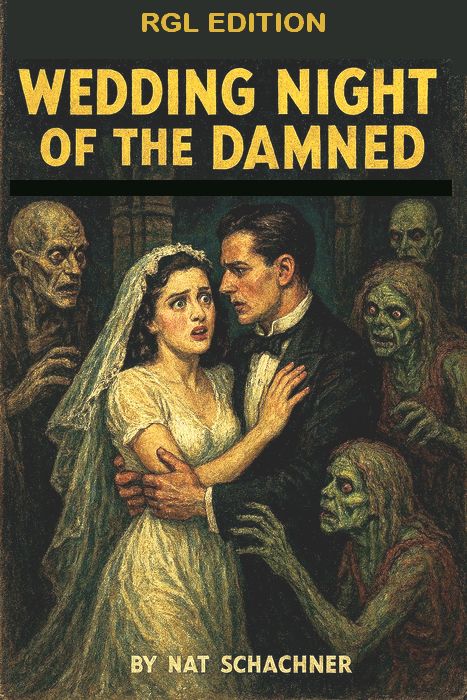
RGL e-Book Cover
Based on an image created with Microsoft Bing software
Roy Glashan's Library
Non sibi sed omnibus
Go to Home Page
This work is out of copyright in countries with a copyright
period of 70 years or less, after the year of the author's death.
If it is under copyright in your country of residence,
do not download or redistribute this file.
Original content added by RGL (e.g., introductions, notes,
RGL covers) is proprietary and protected by copyright.
RGL e-Book Cover
Based on an image created with Microsoft Bing software
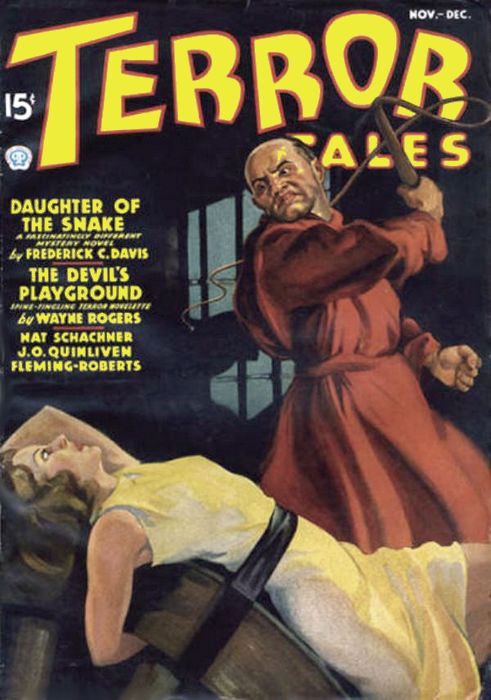
Terror Tales, Nov-Dec 1936, with "Wedding Night Of The Damned"
Long ago, so the story went, a newly-married couple had begun their honeymoon in the chamber where Clive Armstrong brought his young bride—and death and worse than death had been their tragic portion. Yet Clive and his lovely Rhea had no fear, until they knew they had been trapped by nightmare forces of inhuman hatred and deathless lust!
THE wedding ceremony had long been over, and the white haired preacher had driven off in his rickety old carriage. The scattering of villagers we had invited had departed, too, in one concerted farewell, and with anxious looks at the late-setting sun as it dipped its red rim into the slimy waters of the swamp.
Three guests remained, making no move to go, though it was late and a storm was brewing. They sat, smoking cigars, drinking the wedding wine, and speaking but little. I was becoming annoyed. I cast a sidelong glance toward Rhea, who had seemed strangely uneasy all through the ceremony. Now she sat tense in her chair, her face queerly white in the flickering lights of that somber, high-ceiled room of an elder day.
A puff of wind billowed the swaying curtains; the lights dimmed and rallied. The great room was suddenly a place of shadows, deepening. Yet the three men sat on silently, staring, saying nothing. The tips of their cigars glowed like wicked red eyes.
I essayed a weak laugh. "It's getting late," I remarked inanely. The sound of my own voice startled me. I had not realized how the conversation had died down. Still no one spoke. Rhea made a convulsive movement, and subsided. That was all. I stirred, grew angry. After all, it was my wedding night. A man is entitled to some consideration...
Josiah Cooper took a deep puff on his cigar. He was a gargoyle of ugliness. He was eighty, yet remarkably strong and sturdy for his age. All his life he had lived alone, except for a man and a woman servant, as ancient as himself, in this ancestral mansion of our family. His hair was jet black—dyed, it was whispered—and remarkably kinky. His skin was swarthy and seamed, his lips broad and thick. They opened now.
"Heh, heh!" he wheezed. "You're not in a hurry, Clive, my boy? Time enough for you and Rhea. Time enough!"
I do not like such jestings. Rhea shrank back at the words into the deep barrel of her chair. I frowned. Why didn't they go? Soon the storm would break, and the clay road across the causeway would turn into bottomless muck. Yet I couldn't say anything. After all, Cooper was my uncle, though I had never seen him before last month. I belonged to the Armstrong branch of the family, who had gone north after the War.
In a month's visit to Fitchburg, I had snatched Rhea, by far the loveliest of the local beauties, away from a dozen eager swains. Not only that, but by the terms of an ancient will—because Josiah Cooper had never married, and I had—Grimacres, with all its rice fields, river bottoms, swamp, and piney acres went to me. This day was the old man's last in the home he had occupied for over half a century.
The second man stirred and said sarcastically. "Time, Josiah? You ought to know." I stared at him. What had Jim Barlow meant by that? But he had averted his face again—that sullen, young-old face that always gave me the shivers. He was a remote cousin of mine, on the Cooper side, and he was manager of the one bank in Fitchburg. Before I had come, it had been understood that he and Rhea were to get married. And now, at his own insistence, he had been best man at our wedding.
The third man moved uneasily in his seat. His cigar went out and he was chewing the dead stump. "I really think," he muttered, "we ought to be going. It's getting late, and—well—!"
He grinned in my direction. He was Timothy Goodhue, a Northerner, who had purchased only recently the plantation that neighbored Grimacres. That is, if the broad, brackish river between the two properties were overlooked. I glanced gratefully at him: a tall, well dressed man, his forehead marked by a dead-white scar almost hidden by carefully combed hair.
Josiah looked up. "Sure," he chuckled at Jim Barlow. "But if I were Clive, I wouldn't be hurrying the nuptials with a nice young girl like Rhea—in Grimacres."
Rhea gasped and shrank deeper into her chair. Her face flushed, then suddenly went white.
I STARED from one to the other. His broad humor disgusted me, but there was something else in Josiah's ancient leer, something that had brought swift fear into Rhea's eyes. "Now look here," I grated. "What's the point of all these side remarks?"
My uncle knocked the glowing ash from his cigar, took a deep draught of blood-red wine, smacked his thick lips. "Nothing much, my boy," he replied, "nothing much. Just a fool superstition every man jack in the village knows. But—" he paused deliberately, "well—there ain't been a Cooper, nor an Armstrong either, who has been married and spent the wedding night in Grimacres since—"
"Since 1865," Jim Barlow concluded softly.
Cooper puckered his small, alert eyes at him. "Since about that time," he admitted.
" 'Twas your mother's bridal night," Barlow went on relentlessly. There was something gloating about his voice. "Nine month's later you were born."
Josiah Cooper sprang to his feet, his saddle-colored face a sudden mouthing mask of hate. "You—you damned young hound," he screamed, "I'll—"
I jumped up in alarm, so did Goodhue. "For God's sake," I cried, "what's the matter with you two? What's the matter with this house? Tell me..."
I turned to find Rhea at my side, stark terror in the deep pools of her eyes. "Please, Clive," she implored. "Pay no attention to what they say. Ingrown communities like this, shut off from the world, thrive on the most stupid of superstitions. Sensible people don't believe in them."
"I still don't understand," I said stupidly.
Goodhue shifted uneasily from one foot to the other. "I'd better be going," he muttered again, but no one was listening.
Barlow swung on me. "I'll tell you, Armstrong," he ripped out. "Back in 1865, in the last days of the war, Jeremy Cooper brought his sweetheart to Grimacres to marry. They had slaves then, plenty of them, even though old Lincoln had already proclaimed them free. The slaves complained, but Jeremy used the whip and the stocks to break them. That wedding night something happened. Exactly what, no one ever knew. But in the morning, Jeremy Cooper was a mangled corpse, his bride a mumbling idiot, and the slaves had vanished."
Old Josiah had fallen back into his chair, covering his face. Rhea made a gesture. "Don't—don't!"
In the breathless silence, punctuated only by a low mutter of thunder, Barlow's voice crackled sharp and bitter. "Nine months later Josiah Cooper was born."
A searing horror went through me. That kinky hair, that saddle color—I understood them all now only too well. Rhea was panting, "It's horrible—horrible, bringing all these ancient things back to life. I—I hate you, Jim."
Goodhue said placatingly, "Now really—"
Barlow's eyes glowed on Rhea, then he looked away. "Sorry," he muttered. "The village knows about it; thinks it knows more."
Rhea was pale as a sheet. "You can't drive us out of Grimacres with such folly," she cried. "We're living here—Clive and I—no matter what old wives' tales are being circulated."
My head was spinning. I was an outsider, a stranger, being kept from dreadful secrets that the others knew. I gripped my wife's arm. "Rhea, darling, tell me. I insist!"
I was hurting her. "No, no," she whispered fiercely. "Don't ask me now, Clive dearest. Tomorrow, yes, but not tonight."
Old Cooper got up. "I'll tell you," he shouted, his cracked voice rising above the sudden outburst of storm. The lightning blazed with uncanny glare into the house, dimming the lights. The thunder crashed and the rain swept and howled over the tangled live oaks of the swamp. But none of us heard or saw. All eyes were fixed on the ancient owner of Grimacres.
"THESE youngsters mock at the story," he spat out. "They're the modern generation. But 'tis said the slaves that ran away—they've been seen to come back, every time the thunder rattles and the lightning rips over the swamp, peering in windows, looking to see if maybe there's another bride being bedded. They tasted it once, and hell itself can't keep them from wanting more. That's why I never married; no gal of my day would come to Grimacres."
Good God! So that was it! Strange thoughts thronged my mind. The still-living horror of that ancient rape; pity for old Josiah. The village tale was but a defense mechanism—in this Southern community no white girl would have married him—knowing what blood flowed in his veins. Other thoughts, too...
Rhea twisted suddenly, screamed. I jumped; the others stared. "Good God, darling!" I cried. "What's the matter?"
Her eyes were wide gleams of terror, her slender body a taut, curving bow. "I saw him—out there," she panted. "Just now!"
I swerved to the open window. The curtains were billowing and flapping like ghostly wings. The sheeted rain poured in, drenching the wine-dark of the carpet. The heavens split in twain, blinding me with their molten fury; then pitch darkness followed. Thunder crashed in invisible derision.
"Saw whom?" I demanded.
Rhea was shaking now—uncontrollably. "A big black figure," she shuddered. "Silhouetted against the lightning. His eyes blazed at me. I screamed, and he—he vanished." She clung to me. "Clive—Clive! Perhaps we'd better go—somewhere else. I'm afraid now."
I disengaged myself, rushed to the window. Timothy Goodhue had beaten me to it, blocking my way. I shouldered him aside and peered out into the night. Nothing but a stygian hole of darkness, and the gusty storm, cold and drenching against my face.
Goodhue turned back, his dark countenance strangely twisted. "It was just your nerves, Mrs. Armstrong, and the nonsensical stories we've been hearing. You imagined it—perhaps it was the shadow of a tree." For the moment I thought I saw hatred in his eyes; I couldn't be sure. Had he been resentful at the way in which I had shoved him aside?
"Of course it's superstitious nonsense," Barlow interposed sullenly. "All except what happened back in 1865." He seemed to take an unholy delight in bringing up that ancient horror.
Cooper shook his head like a wagging pendulum. "Nonsense, eh?" he mumbled. "Maybe—maybe!"
"Of course it is," I echoed, my arm tight around the quivering figure of my bride. "Poor Rhea is overwrought. I think we'll retire."
It was more than a hint. I was fed up with their company, with the grisly conversation. Besides...
"I'm going now. Sorry!" apologized Goodhue. Barlow made no move Josiah Cooper whipped like a cat to the window. The sky was blazing again, illuminating with a sooty flare the swamp and the long causeway which was the only exit, except for the turbulent river to the rear. "Won't be any going tonight," he wheezed, and his thick lips seemed to smack over the thought.
It was with a sinking feeling of despair and a tinge of ominous foreboding, that I realized he had spoken only the truth. The black swamp was a shoreless sea of inky muck and water; the slender causeway a bottomless gumbo, over which the slimy waters slithered and writhed. No automobile, no horse, could make its way across that tortuous path that night.
I pulled myself together. "Of course not," I echoed with hollow heartiness. "Gentlemen, you'll stay with us for the night." I pulled the old-fashioned bell rope. I was the master of Grimacres now. Josiah Cooper had moved his belongings out the day before, in anticipation. No answer. I pulled the cord again, impatiently. What the devil had happened to Mack Sam, shriveled and ancient as his former master, and his ample, coal-black wife, Miranda?
Cooper looked suddenly alarmed. "That's funny," he remarked. "I trained those Nigras to jump when the bell sounded."
WITH one accord we all moved through the hall toward the passageway that led toward the ramshackle wing in which the kitchens and the servants' sleeping quarters were located. No one, it seemed, relished being left alone in that dark-paneled room of grim shadows. Already fear was stealing into our hearts, congealing the blood in our veins.
We found everything in perfect order. The dishes from the wedding luncheon had been washed and neatly stacked away. The kitchen quarters were swept and tidied. But there was no sign of Sam or Miranda. We called their names aloud, shouting to make ourselves heard above the beat of the wind and the rumble of the storm; we peered into every nook and cranny—kitchen, laundry, storeroom, bedchamber. We even thrust open the door that yawned on the black, foaming waters of the river, only to retreat before the wall of rain that tumbled in over us. They had vanished without a trace.
I think then, for the first time, terror flooded my being, sapped my vitals. Rhea's hand as it touched mine was cold and lifeless. "Clive," she whispered shakily. "I have a feeling that this is the beginning of dreadful things. Let's take the car and get away before it's too late."
"It's impossible," I pointed out. "That causeway—"
Jim Barlow's sullen voice was like a bitter tonic. "No use standing here and gaping at each other as though we've seen a ghost," he said. "Those two old black fools were superstitious as hell. They just ran out on us." His laugh grated on my jangled nerves. "I'll bet they expect those black slave devils to come back from hell and repeat the job they did in sixty-five."
"Now look here," I started angrily. I didn't like his tone, I didn't like his constant harping on that ancient theme, and I didn't like the somber glow in his eyes as he stared at Rhea.
"They were scared to death of the swamp at night," Cooper pointed out. "And on a night like this—"
"I bet they left with the villagers," Barlow insisted. "Afraid we might stop them if we knew."
There was a certain plausibility in that. I remembered now we hadn't seen either one since the other guests had departed. Yet something crawled up and down my spine. The hasty departure of the people of Fitchburg, the horrible story of what had happened here long ago, the face at the window that Rhea thought she had seen, and now the queer disappearance of those two faithful servitors. I might easily set it all down to the superstitions—and imagination but... I shrugged my shoulders angrily. Hell, this was my wedding night, and I was acting like an old woman.
With an effort I broke the web of dread that was slowly encasing me. Tomorrow morning I'd be able to laugh at it all; so would Rhea. I felt a sudden yearning for the soft enfoldment of her arms, the warm pressure of her lips. I turned to her blindly. "Barlow is right. Let's forget about them, sweet. It's getting late!"
Her pallor suffused with sudden redness at the unmistakable ardor in my glance, the significant meaning of my tone. I turned quickly to see old Josiah grinning at me like a weazened, malevolent monkey, and to feel the searing strangeness of Barlow's half-veiled eyes.
In the dull confusion of my tumbling thoughts, I heard, as from a great distance, Cooper's cackle. "Sure the sweet bride and the groom want to be left alone. It's their wedding night, he-he-he! Come on, Jim, and you too, Goodhue. I'll show you the spare rooms. You can take your choice."
We went slowly upstairs. The storm was subsiding a bit. The lightning flared intermittently, and the thunder rumbled vaguely with defeated mutterings. The gusts of wind were weaker now.
OUR bridal chamber was at the head of the stairs. The guest rooms were further on. I went into our room, switched on the light. It was really beautiful, with the massive, rubbed-mahogany pieces of an early period; and a canopied bed, hung in red silk, that invited rest and happy dreams and the tender ardors of love. Yet almost unconsciously I stared around, seeking, probing. The walls were solidly smooth, the window looked down on a sheer drop of twenty feet; there was no other door except the one we had entered. Surreptitiously I examined that door. It was thick oak, built to resist an army, and there was a massive iron bolt that slid into an iron socket. Only then did I breathe a sigh of relief. God alone knew what thoughts had been crowding my mind.
"Darling!" I whispered, and reached to enfold Rhea in my longing arms. Then I ripped away with an exclamation of annoyance. Some one had knocked on the door—a light but insistent knock. I swung it open, trembling with strange excitement. The hall was dark now. I peered out at the tall, shadowy figure. It was Goodhue. The scar his sweeping hair tried vainly to cover glimmered ghastly in the reflected glow from our room. "What do you want?" I grumbled, making no attempt to conceal my annoyance.
His deep-set eyes flicked past me, held lightly on the half-veiled charms of my wife—her dress had slipped part way down, and her bosom peeped from behind her modest hands—then locked with mine. "I'd like to speak to you about something," he whispered, so Rhea could not hear. "It's quite important."
I hesitated a moment. I had had enough annoyance on my wedding night, but the man's voice was urgent. I said, "All right, what is it?" and closed the door slightly behind me.
Goodhue's hand whipped out and caught my arm in a grip of steel. His shadowed head bent to mine. "Listen, Armstrong," he gritted. "There's something phony about this whole business. I didn't like that talk downstairs and I don't like the sudden disappearance of your servants."
I started. "You mean—" I began.
"I mean," he interrupted rapidly, "Cooper and Barlow have been weaving a smoke screen for your special benefit to cover up something hideous. You and I are Northerners, Armstrong, and we don't believe in haunts and ghosts and Civil War stories. But they wanted us to believe. Why?"
It was a shock to me, that slant. I could think of several reasons why either one might want to scare us away from Grimacres. But...
Goodhue's voice was harsh in my ear. "I didn't want to say anything downstairs—Barlow was too anxious to fix up a pretty story—but Sam and Miranda did not go with the villagers. I saw them watching us from the hall that leads into their quarters after the last carriage had gone. It was dark already."
I swung around in turn, gripped his arm tightly. I could not see his face. "Good God, Goodhue!" I gasped. "Then where are they?"
His head was a dark, nodding shadow. "Exactly what you and I are going to find out," he returned. "And I think the answer lies somewhere out on the grounds, or in the swamp. We've searched the house already."
I stood there, torn between conflicting emotions. Rhea, my bride, warm and loving, was waiting for me. And outside, stark horror beckoned. I said, "Tomorrow morning, Goodhue. I can't leave my wife alone now, if what you imply is true."
He shook my shoulder impatiently. "Tomorrow will be too late. We've got to know tonight what we're up against. She'll be safe. Let her lock the door until you return."
I remembered then the solid bolt, the more solid door. My lips tightened. "All right," I said. I opened the door cautiously, stuck my head in. Rhea was already in her nightgown, a filmy thing that accentuated, rather than hid, the glories of her body. My head swam with sudden dizziness. Her arms, molded and firm, had gone out to me in an unmistakable gesture. My voice was oddly thick as I spoke. "Dearest, I'll be back shortly; it won't take long. You lock the door, and don't open it for any one except me. Do you understand?"
Swift fear ebbed the color out of her face. "Where are you going, Clive?" she asked in alarm. "Don't leave me; don't—"
"I must," I told her, and closed the door softly. I didn't want to infect her with our suspicions. "Slam the bolt," I cried through the portal's thickness, "and remember, no matter what happens, don't open!"
I WAITED until I heard the comforting clang of iron on iron, then I turned to Goodhue and said, "Let's go." A flash flicked into a thin pencil of brilliance in his hand, boring through a tunnel of darkness. The hall was deathly quiet. The doors to the rooms of Cooper and Barlow were closed.
"I hope I'm mistaken," Goodhue gritted, "but—"
He moved like a lank panther down the hall, his feet the merest whisper of sound. I followed more clumsily. My heart was pounding. I was afraid now; not for myself but for the lovely girl in our room. Those horrors of long ago, the queer events of the night, Goodhue's suspicions, were taking their toll... Then Goodhue flung open the outer door and we stepped out on the veranda.
The rain had ceased, and the storm was muttering away in faint flashes of lightning and distant, grumbling thunder. We could not see the swamp or the causeway. Blackness, deeper for its intermittence, enveloped us. We slid over the wet grass, seeking we knew not what. The darkness swallowed us up. I looked up suddenly and a great fear tugged in my bosom. The light in our bedroom had gone out. The house had vanished, merged with the Stygian background.
"Good Lord!" I cried. "My wife..."
Goodhue shook my hand off impatiently. I could barely see his face in the reflected light from his flash. He was hunched over, nosing the swath that the torch cut like a hound dog on the trail. "She must have decided to go to bed," he explained. "No need to worry... Ah!" He broke off and bounded forward. I followed, torn with dread of what had caused that sudden exclamation and anxiety for the sudden quenching of the light in our room.
I came up to him. His face was an inscrutable mask. The pencil flare held steadily on two irregular mounds on the lawn where I knew there should have been none. A sudden, sickening realization came to me even before I had come close enough to see. Staring up at us with sightless, pain-swept eyes, were Sam and Miranda. Their clothes had been ripped from their wrinkled, black-glistening bodies. I turned away in quick revulsion. Fiends had tortured them to death. The flesh had been gouged away in huge lumps; from the gaping, hideous wounds the blood still oozed, thick and clotted.
As from a great distance, I heard Goodhue's flat voice. "I was afraid of this. Look! Their bodies are not even wet."
I swung around again in shuddering horror. "Good God! That means they've been just killed."
"Yes."
For a long time I stood there, rooted to the spot. The night was pregnant with whispering terror. In spite of myself, a picture seared in my mind, a picture of long dead slaves growling and slobbering over the nude body of an ancient belle, tearing at each other to be the first...
An animal cry burst from my tortured throat. I had barely heard Goodhue's frightened whisper. "We'd better get back and lock ourselves in." I had just thought of Rhea, alone in our bridal chamber—waiting. My eyes rose madly to the darkness where the light had snapped out. The cry choked in my throat.
The oblong window was illuminated once more. "I wonder—" I started, and never finished. Across the yellow smoothness of the drawn shade figures were moving. Two figures—black silhouettes, projecting their forms on the shade as they passed before the light. Two figures! The thought blasted me, rocked me on my heels with its dizzying implication. I tried to run forward, to scream, but I was rooted in nightmare paralysis as the dreadful scene unfolded before my very eyes.
THE woman was stark naked—her slender, sinuous form swayed and moved voluptuously. The other figure was a man, and as he turned to the girl, she threw herself with passionate abandon into his arms. Her head went back in ecstasy, and his long hands groped lasciviously down her naked flanks, while his lips crushed against hers.
A scream of mingled rage and madness burst from my lips. Rhea, the girl I had loved, had married, naked in the arms of another! Our wedding night, and already... I sprang forward, red murder in my heart. Behind me I heard the hoarse cry of Timothy Goodhue. He, too, had seen.
But even as our shouts rang out, the figures stiffened, sprang apart, out of the betraying angle of light. Then darkness descended swiftly, suddenly, as at the hasty turning of a switch.
Everything else was forgotten as I pounded into the house, up the stairs. Goodhue raced with me, panting, trying to restrain my obvious madness with hurried words. "For God's sakes, Armstrong," he was saying. "Be careful what you do. There's been enough killings around here. After all, Jim Barlow was her lover before you came. Maybe..."
So it was Jim Barlow. Silhouettes are difficult to recognize. Yes, I must admit it. As I went up the stairs three at a time, murder was in my heart. A man is not responsible for himself in a moment like that. I swear I don't know what I would have done had I found him inside our room. But as we reached the top, the darkness split wide into a revealing flood of illumination.
Old Josiah Cooper, with hairy, swarthy shanks sticking out from a flapping nightgown, his finger still on the light button, blinked peevishly. "What's all the racket about?" he demanded. I stared in a red haze at the closed door of my room, started for it. As I did so, Jim Barlow's voice caused me to swing around as if on a pivot. The door at the farther end of the hall slammed open, and he came out—fully dressed, I noted. His sullen face worked dreadfully at the sight of me. "Good Lord!" he exclaimed, and took a step backward. "Have they come—already?"
Terror was painted on his sallow countenance. Was it terror of me and my wild looks, or terror evoked by his own superstitious fears? It was hard to tell just then, and I was in no analytic mood.
But what he said brought me to an abrupt halt. In an awful voice I cried at the still shut door. "Open, Rhea!"
She must have been crouching behind it, for the bolt creaked almost immediately and she flung herself out into my arms. "Oh Clive!" she gasped, and her teeth seemed to chatter with fear. "I was so frightened. I heard shouts and screams, and the thudding of feet. But I dared not open until I heard your voice—you told me not to."
For the moment my arms tightened around her yielding form. The perfume of her warm body was heady in my nostrils. Then I remembered—and I thrust her away roughly. A silken wrap enveloped her—underneath peeped the filmy nightgown. I strode into the room stiff-legged. The light was on. My glaring eyes took in every detail. There was no one else in the room; her clothes hung mutely appealing over a chair, the coverlet of the bed was back and the sheets still held the impress of an extended figure.
"Why, what's the matter?" Rhea shrank away from me, from the look in my eyes. Behind us crowded the others. In a daze I heard Goodhue's low warning. "Take it easy, old man."
Somehow that steadied me. I could not kill Rhea now. As for Barlow... A dull despair succeeded my former flaring madness. After all, it had been a whirlwind courtship. I had swept her off her feet. Perhaps she had loved Jim Barlow before—though she had maintained stoutly she had not—and had rediscovered it after it was too late. All my dreams of happiness came tumbling about my ears.
"What had you been doing—just before?" I did not recognize my own voice.
Her eyes widened on me. I could have sworn they were innocent, if I hadn't seen what I did. "Why, Clive darling, nothing. I was in bed—afraid. I turned off the light and waited for you."
"You didn't turn on the light again, and open the door—for someone?" I insisted.
HER gaze seemed more puzzled. "Not until this moment," she answered with what appeared the utmost candor. When I heard cries and someone thumping up the stairs, I switched on the light. But I didn't dare open the door until I heard you." She came suddenly closer, staring. "Why, what do you mean, Clive darling?" she quavered. "Why do you look so pale and wild—as though you had seen a ghost?"
Old Cooper let out a quavering cry. "I know what it means," he moaned. "They've come back. I knew they would. Clive's seen them! They've come back to do again what they did in sixty-five."
My brain was in a whirl. What were they trying to do to me—all of them? I swung uncertainly from one to the other. Rhea, the veritable picture of anxious alarm, of lovely innocence, yet I had seen her—great God, with my own eyes—in the arms of Jim Barlow! Barlow himself, his ageless face a mask of concealment was retreating stealthily to his room before the murder that must have flamed openly in my eyes. Before my muscles could bunch themselves to fling myself upon the foul betrayer, his door slammed shut, and I heard the grating of a bolt as he locked himself in. Cooper stood bobbing his swarthy, vulturish head in seeming senility, as if he could never stop.
Then I remembered the terribly torn bodies of the two faithful servants, out there on the lawn. In the wild access of agony at the treachery of Rhea I had forgotten that grisly sight. Now it came to me in a new thrill of horror.
"Cooper," I said suddenly. "I saw Sam and Miranda. They're—"
Goodhue interrupted quickly. "You'd better get to bed, Mr. Armstrong. You'll have a bad night if you don't."
He was winking to me significantly. He did not want the old man to know. But Josiah Cooper had heard enough. His thick features turned a dirty grey, he spun on his heel and ran stumbling down the hall. "Oh Lord, save me! They got Sam and Miranda; they're coming now for Rhea, for all of us. Back from hell they're coming." His voice was a thin shriek now. "Tell them, Lord, not to harm me. Tell them, Lord, not to harm their son!"
Silence fell like a dead weight in that gloomy place, as we stared at each other in fear. Rhea was pale as a sheet. "It's horrible, horrible!" she shivered. "It's done things even to you, Clive. I—I hardly recognize you."
A red frenzy possessed me then. She stood there, glorious in her slim beauty, pretending—when I had seen—seen! I clenched my fists, while maggots of madness crawled and leaped in my veins. I took a step toward her, forgetting all but her infidelity. Rhea shrank away, with a soft, molded arm half lifted to ward me off. "Clive!" she cried desperately, "Clive! What is the matter?"
I think—God help me—I would have strangled her then, had not Timothy Goodhue interposed his lank powerful body. "Don't be crazy,' he said very low, so only I could hear. "That won't help matters. She may not be to blame... Get to bed now; tomorrow you'll think more clearly."
I threw back my head and laughed wildly, horribly. Think? I was beyond thinking. And what could tomorrow bring to me—a cuckold on his wedding night, with two corpses out there on the lawn, and superstitious terrors creeping like swamp-miasma through the echoing corridors of the house?
Rhea did then a very brave thing, though I was too crazy at the time to realize it. She stilled the shuddering of her flesh, came over to me, linked her cold white arm with mine, and said steadily, "Come, darling, it is late. Let us go to sleep. You are ill—sometimes the swamp fever gets people from the North. They imagine they see and hear things. Tomorrow, when the sun shines and drives the mists away, you'll be better."
I permitted myself to be led into the bridal chamber. Perhaps, I thought to myself in a daze, Rhea is right. Perhaps it all was hallucination—the figures in this very room, even the mangled bodies of Sam and Miranda. Tomorrow, when the sun is shining, the vapors will pass that have distorted my brain... Goodhue stood against the door lintel, bowing as we went in. He caught my eye with a significant look. "Remember," he muttered, "this is your wedding night."
I LIFTED my hanging head, but already he had shut the door behind him. What had he meant? Was it a threat, or a warning? Was that quick glance he sent sidelong toward Rhea mere friendly interest or was it charged with anticipatory lust? What after all did we know about the man, except what he had told us? Why was he taking such an interest in my affairs? He had dragged me out to find the corpses, had blocked my way to the window, had recognized Barlow when I hadn't. Who was Goodhue?
I remember shooting the bolt in the door, but not much more. Black hell was in my heart. Rhea must have sensed it, for she said nothing.
With a lithe movement, she shrugged off her night wrap, stood a moment revealed in every glorious line, then crept under the blankets. Mechanically I snapped out the light and followed. Every fiber of my being cried for her body, so near and yet so far. The warmth, the perfume of her nudity close to me, yet not touching, stole into my senses, maddened me. With maidenly timidity her hand moved over, touched my hand. A blissful thrill shot through my veins, sent the blood pumping. But I gritted my teeth and pushed it away roughly. I had seen too much; this superb body had been tight-embraced by another.
"Clive!" Her low voice, pleading, filled with quivering tears, penetrated the darkness. "Something is wrong, dearest. Tell me, please, why do you act this way?"
I shrugged away. "No!" I answered harshly. "Not tonight. Tomorrow." Almost her own words of the earlier evening. In my own crazed mind I had determined on my course. If those dreadfully mangled corpses were still out there, almost under our window, then I'd know that it wasn't fever, that it wasn't madness. Then I'd wreak my vengeance on Jim Barlow, and on...
Rhea, in spite of my rebuff, had come closer. The warmth of her body surrounded me, enfolded me. I was yielding... I was forgetting... remembering only the great love I had had for her... my own arm flung out eagerly... I turned...
In the pitch darkness of the room Rhea shrank suddenly away from my groping fingers. A low gasp of fear escaped her. The lulled worms of jealousy exploded into swarming life again. She had shuddered away from me—her husband—she, whom I had seen wanton enough in the clasp of Jim Barlow!
"It was true then," I snarled in the bitterness of my anguish. "You—you—" God knows what foul name I would have called her in my madness. But suddenly she was pressing close to me, her body cold with a glacial fear. "Hush!" she panted. "There it is again! Clive, there's something in our room."
I stopped my insane patter, listened. As I did, the cold hand of terror laid its icy burden on my heart. There was something—someone, moving with stealthy tread in the room. I lay as one paralyzed, hearkening to that dreadful slithering sound. Feet dragged and whispered over the carpet. Many feet padding, naked and flat, coming closer, closer.
I wanted to scream and could not. The muscles of my throat were dry and hard. I had bolted the door with my own hand, the window was tight shut and blank, yet ghosts were marching into the room in endless procession! Ghosts risen from hell, incarnate once more with the foul fires of an ageless lust, coming to claim my bride as their own!
Rhea shrieked and heaved convulsively. Her body tore away from mine, her foot lashed out in a desperate attempt to find a purchase. A foul breath snarled over my gelid cheeks. Someone grunted. Then Rhea was lifted, screaming and choking. "Clive! Clive! Help!"
The bonds of nightmare terror that had bound my limbs fell away like broken threads. I forgot my strange dread; I forgot that Rhea had betrayed me. I remembered only the warm love that once had leaped into her eyes at the sight of me—I remembered that she was my bride, ravished away by the immortal lusts of slaves long dead. I screamed with animal rage, came up lunging, fists flailing like pistons. "Rhea!" I shouted. "Where are you?"
It was dark as the bottomless pit, but my wild fists slammed into corpselike flesh. Far off, strangled and choked. I heard Rhea cry my name, and go silent. Something grunted at my blow. I lashed out again, catapulting off the bed in the direction of Rhea's last scream. I crashed into unyielding bodies. Hands gouged and ripped at my pajamas, my naked flesh; blows fell like piledrivers on my unprotected head. I fought with the fury of a tiger bereft of its mate, but bodies, foul and damp with swamp ooze, smothered me in their gagging embrace, bore me down in a heap on the floor. I raised my voice in a last desperate yell, then something smashed with blinding force upon my skull—and the darkness of impenetrable night enveloped me. But first, in a numb daze, I heard, or seemed to hear, a gloating voice: "Got him, Jim!"
THE inside of my skull was a huge, dull ache. I groaned. The sound startled me into awareness. My eyes opened, but saw nothing. Feebly I put my hand to my head. A warm, sluggish fluid wet my fingers. Blood. I groaned again and struggled wobbling to my feet. Where was I? What had happened?
My pain swept eyes met nothing but a solid wall of blackness. My moans echoed dully around me. Silence, thick, ominous! Then suddenly, the swelling in my head throbbed with pounding hammers. A great fear ripped through my being, burnt all thought of selfish pain away. Rhea! She had been taken from me, ravished away from her bridal bed. I raised my voice, I shouted to the unyielding darkness again and again in fierce accents; "Rhea!" The echoes mocked me with clipped syllables.
Terror pulsed through me, terror and terrible passion. "Got him, Jim!" That last triumphant phrase as I sank into unconsciousness. Then it had been Jim Barlow; somehow one with the risen slaves of an elder day. I laughed wildly at that, and shrank from my laughter. Jim had been clever, had used the village superstitions to good effect, had duped Josiah Cooper himself. But mingled with my blasting horror was a queer exultation. Had Rhea been unfaithful, he would not have needed to seduce her. I had seen—it was true—but perhaps Goodhue had been right. Barlow had gained entrance by guile, had caught her in his arms. Silhouetted on a shade, struggle might well have seemed like passionate surrender. Black and white is confusing. Perhaps he threatened Rhea if she told on him; perhaps...
Good God! Even now she was in his blasphemous hands, with his hellish crew, and I was swaying groggily, doing nothing. I jerked forward, slammed into a wall. I groped my way along until I felt the switch. I pushed the button. Nothing happened. The lights were dead!
The terror in my heart grew until my breast seemed close to bursting. I must hurry, hurry! Rhea, lovely and slim, in the hands of a lustful crew, of Jim Barlow himself with that sullen, strangely glowing look in his eyes. I dared not think what might even now be happening. My fingers clutched at the door, slid along to the bolt. My heart seemed to stop its loud beating, I felt suddenly faint. The bolt was still in the socket; the door had not been opened since I had locked it for the night.
Little moans forced themselves through my clenched teeth, as I blindly slipped the bolt. I forgot my glib modern sophistication in a surge of primeval terror. No living being could have entered our room. There was no other way but through the door; I had made sure of that earlier in the night. Then it was true—what they said. Those black beasts had never died; had lurked in the depths of the swamp waiting with corpse-like patience to rise and glut their unholy appetites once more on the sweet flesh of a newly bedded bride.
I crashed into a crouching form in that stygian dark. I shrank back with a quivering cry, then lurched forward again. Someone had grunted, hissed with escaping breath. "Who are you?" I shouted wildly to still the crawling of my flesh. "Who are you—devil, beast, or damned soul out of hell?" My reluctant fingers went out, gripped.
A long, quavering cry rose into the darkling quietude, crescendoed into a shriek. "Don't hurt me, don't take me! I am your son, flesh of your flesh," it babbled.
"Josiah Cooper!" I cried.
He ripped out of my clutching fingers, clamored down the long hall with tortured sobs and whistling breath. Then all was suddenly still again. I stood a moment like one in a numbing daze. Old Cooper had thought me one of that long-dead rout—or had he? Why had he been crouching by my door, waiting? Was his terror a mere sham, a cloak for an evil design. It was he who had first brought up the grisly legend; he had been woman-less all his life, except for furtive prowling in the village among the purchasable; a hot miasma of lust had mingled riotously in his veins.
God!
I CLUTCHED my forehead to stop its ceaseless pounding, and stumbled on in the dark, down the curving stairs, fumbling to the outer door, and out into the clouded, sullen night. The warm breath of the swamp was stifling in my nostrils; a faint wind stirred the damp stickiness of my hair.
I went out like a sleepwalker, reft of immediate awareness. I must find Rhea, before—before... I gulped and sobbed aloud. Then I jerked into quivering attention. At the sound of my voice something had moved, not far away. A rustling, as of feet over trodden grass. My eyes, accommodated now to the lack of light, saw a faint shadowy thing, hunched over, unbending.
I moved forward, softly, though the tiny hairs on the back of my neck were erect and bristling. There, on the faint green-greyness of the lawn, were the mangled corpses of Sam and Miranda. And even as I trod quietly, a vaguely hunched ghoul stood erect, turning to me with a snarl.
I stopped short. I had recognized that throaty growl. "Jim Barlow!" I husked, and a fierce glow surged through my veins like a fiery liquor. I had him—the ravisher. Not all his hellish crew could save him from my vengeance now. He heard my exultant cry, sprang away from the poor dead servants over whom he had been bending, laughed nervously. "Oh, it's you, Clive! For the moment I thought—"
At that I lost all sense of discretion, of stealthily stalking. Damn him—the smooth, cozening scoundrel! Trying to put me off with fair words, trying to pretend—
I leaped for him then, with a hoarse, animal-like scream. He thrust up an arm, cried out: "Clive, wait!" Then his eyes widened on something behind me. Even in the dark I saw his features twist with horror. "Look out!" he screeched in hoarse warning. An age-old trick. Yet I half-twisted my head, stumbled. When I clawed to my feet again, he was gone, melted into unrevealing darkness, and only the grisly, huddled things at my feet remained. Wild despair flooded me. I had had the monster in my grasp and had let him escape through a hoary ruse. Too late my ears caught the stealthily approach of whispering feet, too late I turned. Something dark and ominous whistled through the night, descended on my unprotected head with crushing force...
Yellow flares stabbed at my eyeballs, lanced them with searing pain. My head was a huge, blistering torment, my skull a throbbing balloon. Someone was weeping and crying, "Clive, darling, open your eyes. Speak to me!"
I forced heavy eyelids open, blinked. That voice! Then I gasped. Rhea was at my feet, on her knees, her head almost touching the ground before me. Her long hair was a tumbling splendor; her flimsy nightgown was a thing of shreds and tatters, through which the firm whiteness of her satin skin gleamed. Two muscular Negroes, their coal-black countenances grinning with unsated lust, held her nude arms in a tight, lascivious grip.
At the cry I uttered, Rhea raised her head with convulsive gesture. Her dear eyes streamed with tears, her face was marked with shame and terror. "Thank God!" she whispered. "You're not dead then."
"He will be soon, my sweet, unless you do as I say," a muffled voice interrupted. "Even as that old fool over there."
I lifted my heavy with a jerk at that. My eyes widened with horror. I was in a smoky cabin, lit by pitch-pine torches which illumined a scene out of hell. Their sooty yellow flare played gleefully over a sagging figure that nodded in ghastly fashion directly across from me. Its swarthy body, shrunken now and jerking in the final convulsion, was bound to an upright post; its kinky hair showed streakings of alternate black and dirty grey, as of dye that had run.
"Josiah Cooper," I shouted, in utter horror. He lifted his poor, mangled head at the cry, and my voice choked to imbecile maunderings. His swarthy face was grey-white now, drawn with pain and suffering; his thick lips mumbled wordlessly. But his eyes—dear God—his eyes! They had been torn out from his head, and two great, round, sightless sockets stared owlishly at me, red with still-dripping blood. He stiffened, forced his pallid lips open. "They—killed—their—own—son!" They were the last words he ever spoke. A red froth bubbled from his lips, his head slumped downward on his breast, mercifully hiding those frightful sockets. He was dead!
"THE old fool thought to the last his torturers were the slaves who had misused his mother," the same false-sounding voice said contemptuously. I saw him then, the foul master of these unspeakable crimes. He was shrouded in a great black robe that fell to his feet. His face was black, too, but somehow unreal. A thick, daubed-on make-up covered his features. And I thought I recognized those low, sullen accents. Madness descended on me at the sight of my wife struggling in the loathsome grip of those two black devils, and of old Cooper, mercifully delivered from his agony. I crashed forward, not realizing in my befuddlement what had been done to me. "You filthy fiend!" I gritted. "Nothing can save you now, Jim Barlow."
But I rebounded like a snapped rubber band, my body ripped in lateral stripes from the tight steel wires that wound me round and held me upright against a wooden post. Rhea cried out sharply and writhed desperately in the unbreakable grasp of those two dark-skinned monsters. They grinned, smacking their thick, pale lips at the sight of her struggling nudity.
"None of that," rasped the master harshly. "She's mine, do you hear. She scorned me once; now she'll submit to my embraces and love it." Slowly, reluctantly, the two captors ebbed away from her pulsing flesh.
"Never!" I yelled, heaving with all my might against the cruel metal. "I'll see you in hell first."
He chuckled grimly. "She's lain in my arms once and she'll do it again," he insisted.
All my strength ebbed at that. Had it not been for the restraining wires I would have fallen. The dreadful suspicion that had almost been quenched, now howled once more with demon laughter in my brain. That picture which had etched itself with indelible fires into my vision, that lascivious yielding I had witnessed, and which I had vainly tried to tell myself was in fact a struggle—it all smote me with redoubled force at those terrible words.
He laughed obscenely. "You saw it then," he gloated. "Then you know."
Rhea lifted her head. Tears but enhanced her loveliness. Her eyes were desperate on mine. "I don't understand," she cried. "He's saying horrible things." She must have seen the awful look on my face, for she shrank down again. "Oh, God!" she whispered. "Clive, you don't believe that horrible man."
"I saw you myself." I did not recognize my own voice; it was so bitter, so full of loathing.
Barlow giggled behind his horrible make-up. "You see," he said. "First I got rid of Josiah Cooper, that slave to superstition. He stood in the way of my getting Grimacres. I used his weakness to good effect. And now I'll have your sweet Rhea— before your eyes, my fine fellow."
Rhea wrenched suddenly away from her guards, flung panting into a corner. "Never!" she announced determinedly. She snatched up a penknife that lay on a table, turned its point toward her heaving breast. "I'll kill myself first."
The other two pretended Negroes—under the lampblack I now saw streaks of sallow white—caught up heavy whips, moved toward her. "Wait!" commanded the black faced master. "I have a better way." He turned to my wife, quivering at bay in the corner. "If you submit—willingly—to my embraces," he proffered, "I'll let your husband go. If not, he dies."
"Don't listen to him," I screeched. "Let him kill me. Rather that than—than—" I broke down, sobbing. "Forgive me, darling, for having doubted you."
"All right, then," the tormentor grated. "He's asking for it. Let him have it. As for you," he swung angrily on Rhea. "I'll have you—willingly, or unwillingly. But first you'll see your fool husband tortured until you'll crawl on your knees begging me to take you."
Rhea's hand trembled. "Don't kill him, please," she whispered thickly. "I'll—"
I STRUGGLED madly in my bonds, heedless of cruel wounds from the sharp wire. "I won't permit it," I shouted. But even as Rhea's attention wavered to me, one of the black-sooted beasts sprang for her, wrenched the knife out of her hands, and held her slim, writhing body in an unbreakable embrace.
Barlow laughed. "Even now she must come begging." He nodded to the other torturer. "Start working on him."
The man hurriedly gleefully to a remote corner of the cabin—I knew it now to be one of the abandoned slave huts of long ago that lined the banks of the tidal river. There, in my straining anguish, I saw an awful sight. A low brazier of glowing charcoal, in which a branding iron was buried, and glowing white-hot almost to the handle.
He put on a thick glove, grasped the iron, pulled it out. Before my horrified eyes there sparked and sizzled two curving horns of blazing metal. "It is quite appropriate," nodded the swathed figure. "Horns—the immemorial symbol of the cuckold. Let the whole world see them sprout from his head, and mock."
With a bestial grin the black-faced thug came toward me. The branding iron thrust closer and closer to my face. The heat blinded my eyes, shriveled my eyebrows. I tried in vain to turn my head from the awful sight, but the torturer relentlessly followed my every twist with the searing iron. Closer, closer, higher, straight for my forehead it came. Through a blind haze of unshed tears I saw vaguely the grinning, evil face of the thug, the fierce, insupportable glare of the brand. My head was a blaze of fire; in another second...
"Stop!" Rhea's shriek pierced the agony in my skull. "I—I submit, Jim Barlow, or whoever you are. Only let Clive go. Set him free."
With an oath the wielder of the brand sullenly withdrew it, bringing blessed coolness to my forehead. "Good!" I could hear the smothered exultation in Barlow's voice. "I thought you would, my dear. I'll keep my word. Once you rise from my loving embraces, I'll let your weakling husband go."
The molten anguish of my brain burnt away the dazzling haze from my eyes. I saw Rhea in the arms of the fiend, her undraped bosom and shrinking thighs crushed in his lustful embrace.
I was no longer human; I was a wild beast, tigerish in my strength. I slammed forward with a power beyond my own. Blood spurted from a dozen wounds, but they did not matter. The wire had snapped. It was a wild beast that plunged across the hut. The attacker sprang erect, crying out in alarm.
The two thugs whirled. I crashed into one, and he went down like a poled ox. His neck twisted against the wall at an insane angle. I lashed out at the other, even as his whip snaked over my head. My fist caught him on the point of his jaw. He went down, a weird, hoarse scream burgling through his lips. But the whip had fallen. Its razor-like thong ripped across my cheek, laying it open like a saber flash. The blow caught me off balance. I staggered and went crashing, even as Rhea screamed and a black, ghastly figure reared upward and over me. A long, evil knife glittered in its hand.
"Damn you!" he cried in his strange-sounding voice. "I was going to free you, but now you die. And Rhea too, after I'm through with her."
I tried vainly to lift myself from the blood-slippery floor, to ward off the on-rushing doom. I saw Rhea struggling to her feet, but she would be too late. Already the keen blades was plunging, down, straight for my heart.
A SHOT rang out. Another. Hoarse cries, the quick crunch of heavy boots on gravel.
The tight-clenched hand above me opened convulsively, the knife fell harmlessly to one side. The bending man in black staggered, retched horribly, and fell heavily across my fainting form.
It was all over when I opened my eyes again. My head was pillowed comfortably in Rhea's arms—a cloak had been thrust over her nudity—and the cabin was filled with men. "Good thing we got here in time," rumbled a bearded man, his eyes still wide with the horror of what he had seen. It was the sheriff of Fitchburg.
Someone came out of the shadows grinned at me. "I had to swim like hell," he observed, "but I made my getaway from the murderer's gang. And it was lucky a motorist gave me a lift back to Fitchburg."
I lifted my head in amazement. "Jim Barlow," I breathed. "You! Then who—then who—" I stammered in my bewilderment.
He grinned again, and somehow his face was no longer sullen. "You mean him?" He pointed to a huddle of black cloth, now truly a shroud. I nodded dumbly, my emotions too deep for words.
"Oh!" he said carelessly. "That's our good friend, Timothy Goodhue, gentleman planter, murderer, and bank robber extraordinary. Otherwise known as Gentleman Tim. You see," he went on to explain, "this whole horrible mess was really my doing. Goodhue came out of nowhere a few months ago with a lot of money. The first thing he did was open a whacking big checking account in our bank, the next was to ask my advice about buying a plantation. He wanted Grimacres, but I told him it was not for sale, and suggested the old Shelton Estate instead. It was to be a hideout, where he and his gang of petermen could be safe until the storm up North blew over; but I didn't know it then.
"One day he walked into my private office, just as I was casually looking over the latest list of bank outrages the Association sends around. I was in the middle of a particularly atrocious one. A hundred thousand had been lifted, and two night-watchmen shot in cold blood. The second one, before he died, had identified the leader as Gentleman Tim."
"Did you recognize him," I asked breathlessly.
Jim shook his head. "Not then, but he was afraid I might, if I had time to read it more carefully. He sat down at my desk, cool as a cucumber, talking away about certain investments he wanted me to handle for him. When he left, however, I discovered the broadside missing. I was sure I hadn't mislaid it. Somehow that made me think. The police had no picture of Gentleman Tim, but they did have a description. And a ragged white scar on his forehead was mentioned.
"I didn't want to do anything until I was sure, however, I sent away for another copy of the broadside, and just as I finished dictating, I looked up and saw Goodhue standing in the door of my office. I was sure he had heard everything. But he didn't change color, or anything. Just pretended he had forgotten something. He was a pretty cool customer. Then it was that he must have concocted this frightful scheme to fix everything in one holocaust. I think he wanted Grimacres for one thing. It is a much better hideout than the Shelton place. The river's ideal for getting away in case of pursuit and the single causeway from the mainland could be easily watched for strangers. That meant getting rid of poor Josiah. Ourselves, too, for that matter, if we couldn't be persuaded to sell out cheap."
"But he was willing to free me," I interrupted, "if—if—"
JIM nodded somberly. "That was the most hellish part of his plan," he said. "He saw Rhea in the village—and wanted her passionately." He took a deep breath, and the pain deepened in his eyes. "I suppose most of us in Fitchburg were pretty much crazy about Rhea before you came, Clive." Rhea blushed and her arms tightened around me.
"Anyway," he went on hurriedly, "I had to be gotten rid of before the new broadside came. He sensed that I was already suspicious of him. He didn't dare kill me outright—there might be too much of an inquiry. But Clive, if you killed me, he'd be out of the picture completely."
I stared. "I kill you?" I exclaimed, and stopped short. My face, I am sure, was red.
He grinned ruefully. "Yes, you!" he repeated. "I saw it in your eyes last night, when you came rushing back into the house. He had carefully instilled the poison of jealousy in your veins."
I remembered how Goodhue had used the name of Jim Barlow in connection with that strange, lascivious scene I had witnessed between... I stirred uneasily in Rhea's arms. "Rhea!" I said abruptly, "who was in the room with you last night?"
Rhea said in astonishment. "That's the second time you've asked, dear. I've already told you—"
"I can explain," Jim broke in. "We found a motion picture projector set in a tree opposite your room. A member of Goodhue's gang was showing the movie of an obscene picture for your special benefit. The shade over the window made a perfect screen. It helped work up your frenzy against me. Even at the end, when I had escaped his clutches by diving into the river, he kept up the pretense. He actually would have let you go free. You'd have been sure I was to blame, and you'd either hunt me out and kill me on sight, or the law would do it on your evidence. In any event, I'd be through. He'd have Grimacres, his secret would be safe, and he'd have enjoyed Rhea."
Rhea shivered with remembered horrors. I held her tight. "One thing more," I demanded. "Why did he kill poor Sam and Miranda?"
Jim shook his head doubtfully. "His gang must have done that. They were lurking in the back swamp all during the wedding. The old couple wanted to sneak out—they were afraid of the old superstition—and evidently saw the gangsters in hiding. They were killed to stop their mouths. Incidentally, it was because Goodhue stayed behind when the other guests left, that I also remained. I had nothing more than a mere suspicion as yet to go on, but I didn't want to leave him out of my sight."
"How did they get onto our room?" I wondered aloud. But even as I spoke, the solution dawned on me. When Goodhue shut the door it would have been easy to slip a slender chisel between, which, in the hands of an expert cracksman, could move any bolt out of its socket.
The sheriff's posse had meanwhile removed the grisly remains. I could hear the low mutter of their voices outside. Jim Barlow looked at us queerly, rose silently, and went out also. Rhea and I were alone. Our lips met.
"What a dreadful wedding night," shuddered Rhea.
I kissed her again. "Darling," I replied. "Only the dreadful part is over." Even in the dying flare of the torches I could see that she was blushing.
Roy Glashan's Library
Non sibi sed omnibus
Go to Home Page
This work is out of copyright in countries with a copyright
period of 70 years or less, after the year of the author's death.
If it is under copyright in your country of residence,
do not download or redistribute this file.
Original content added by RGL (e.g., introductions, notes,
RGL covers) is proprietary and protected by copyright.