RGL e-Book Cover
Based on an image created with Microsoft Bing software
Roy Glashan's Library
Non sibi sed omnibus
Go to Home Page
This work is out of copyright in countries with a copyright
period of 70 years or less, after the year of the author's death.
If it is under copyright in your country of residence,
do not download or redistribute this file.
Original content added by RGL (e.g., introductions, notes,
RGL covers) is proprietary and protected by copyright.
RGL e-Book Cover
Based on an image created with Microsoft Bing software

"CRACK!"
The sharp crack of a revolver rings out upon the midnight air.
Simultaneously is heard the shivering of window-glass, followed by a loud cry of agony, a heavy fall, and a deep groan.
Then, for an instant, all is still, as though the horror of the act just consummated has paralyzed sound and activity.
Then one brief instant passes, and the air is filled with shouts and cries, while one prolonged scream rings out, far above the other noises. There is the rush of many feet as people crowd into the room where the tragedy has taken place, only to behold a sight so full of horror that they turn away, sick with dismay and alarm. William Burnham is dead.
While sitting in a chair near the window, which opens out into his own yard, the yard back of his own hotel, the assassin crept stealthily upon him, took careful aim through the glass, and fired.
The deadly bullet crashed its way past the glass, and buried itself in the back of the victim's head, stealing away his life instantly, and leaving the man, who, but a moment before, was full of energy and activity, a cold, senseless, pulseless corpse.
"Murder!" cries out the man who is Burnham's companion.
"What is it?"
"What has happened?"
"Who fired?"
"Is anybody hurt?"
Four people rush simultaneously into the room within twenty seconds of the sound of the pistol-shot.
Each shouts out a question as he enters, but Belden Green only points silently at the corpse upon the floor, still too greatly stupefied by the shock to speak or to act.
The answer to their questions lies there cold, still, dead.
They know that William Burnham has been murdered; that he has been mercilessly shot down by an unknown assassin, who, in order to fire the fatal shot, must have stood just outside of the window, and they rush into the yard crying for vengeance.
LET us go back to a time just fifteen minutes prior to the moment when the report of a pistol startled every person in the house.
It is nearly midnight.
The hands of the clock point at twenty-two minutes past eleven.
It is the night of December 23, 1891.
A buggy draws up at a corner two blocks away from the popular roadhouse, which is kept by William Burnham.
There are two people in the buggy, a man and a woman.
The night is not particularly dark, nor yet is it moonlight. One can distinguish objects quite clearly at a considerable distance.
When the buggy stops, the man leaps to the ground, while the woman takes the reins, as though to await his return.
"Will you be long?" she asks.
"No; only about five minutes."
"Hurry."
"Yes."
Then he glided away.
But his back is scarcely turned ere she also leaps from the buggy to the ground, after throwing the reins over the dashboard, seemingly regardless whether the horse takes a notion to move on, or to remain where he is. She, too, hurries away, but in the opposite direction from that taken by the man.
Reader, take your pencil and draw an oblong square. Mark it thus:
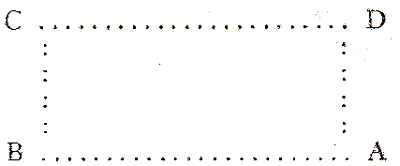
Burnham's roadhouse is at A, and the buggy, with its two occupants, pauses at C. The man, who gets out first, walks rapidly toward D, and the woman, who leaves the horse to care for himself, glides away toward B.
It is twenty-two minutes past eleven when the buggy stops at C.
The horse, being left alone, moves along, step by step, not with any intention of wandering away, but simply because of a disinclination to stand still.
He moves toward B, because he is headed that way.
He goes very slowly, scarcely taking more than two or three steps in a minute, but even at that rate, after the lapse of five minutes, he has gone some little distance.
Had you, reader, been standing upon the corner at C during this time you would have wondered, doubtless, at the strange manoeuvres of the pair who alighted from the buggy, and went their separate ways, apparently with no connection with each other's movements.
At twenty-eight minutes of twelve—or just ten minutes after the buggy stopped—you would have seen the man (who wore a slouch hat and full black beard, whose coat collar was turned up about his ears, and whose shoulders stooped somewhat), turn the corner at D, and walk rapidly toward the spot where he had parted with his companion.
But he did not continue all the way to C.
At about the middle of the block he paused abruptly and turned back again, once more disappearing around the corner.
Five minutes more pass.
It is exactly twenty-three minutes of twelve when the sharp report of a pistol is heard.
Two minutes later the woman suddenly reappears at the corner, B. The horse and buggy have almost reached it also, by this time, and the woman, with one bound, leaps into the seat and grasps the reins.
Then she uses the whip, and the animal starts into unusual activity.
She is a good driver, for the horse turns at a trot, and yet without touching the wheel to the crank-bar, or chafing-iron, as it is sometimes called.
In a half-minute; or less, they turn the corner at C, going toward D.
There is nobody in sight.
Still the woman does not rein in the animal.
She drives rapidly to D, and turns to the right—that is, toward A.
But the corner is not completely turned when the man leaps toward her from the sidewalk.
The reins are tightened just enough to slow up sufficiently for the man to leap up beside the woman.
Then the left rein is pulled violently and the horse wheels again and dashes away at a fast trot at right angles with a line drawn by D to C, and directly away from A. Refer to your diagram once more, reader. Draw an oblong square inside of the original square, at the Corner A, thus:
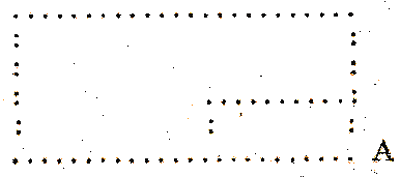
The inner square represents the roadhouse, owned and conducted by William Burnham, the front being at the narrow end where you have placed the letter A.
At the time when the fatal shot was fired, the murdered man was in a back room on the ground floor in company with a friend and boon companion named Belden Green.
They were seated at a table, and were discussing race-horses, in which they were both deeply interested.
Both men had been drinking heavily, and neither had any thought of the terrible tragedy, which was so soon to be enacted.
It came, however, in the midst of their conversation.
There was no warning whatsoever.
It seemed almost as if the sound of breaking glass, the report of the pistol, and William Burnham's death-cry, happened simultaneously.
"I will bet you fifty to thirty that Vladimir is distanced," said Green.
"Take you!" cried Burnham. "I'll be shot, if I—"
He never finished the sentence.
The crack, the crash, the cry, the fall, the groan, and he was a corpse.
A dark figure had stolen through the gate into the back-yard while they were sitting there.
It had peered through the window at them.
The owner of the figure had laughed softly, and yet, with a sound that was perfectly audible a few feet away.
Then the weapon had been raised, and careful aim taken.
The flash, the report and sudden death followed.
Was the figure in the darkness that of a man or a woman?
Who can tell?
Standing twenty feet away, in the obscure light, it would have been impossible to determine.
It was a strange-looking figure, with slouch hat pulled far down over the eyes, while the size and shape of the form were completely hidden beneath the folds of a huge lap-robe, such as are used in driving when the weather is cold.
The fatal bullet having been sent upon its errand of death, the owner of the figure did not turn and fly with all speed, but laughed again while for one instant the dread weapon was pointed at the heart of Belden Green.
"Why not?" whispered the strange being. "And yet, what's the use? Bah! I am even with Will Burnham, at all events."
Then it glided away; not precipitately, but as though confident of its ability to avoid detection for the awful crime. It glided away, and the darkness swallowed it.
ONE more glance at the strange buggy, and then to the solution of the mysterious case.
When the man leaped into it at the corner (D), seized the reins, and said, savagely:
"Where were you?"
"When?"
"Just now. I came back to the corner. The buggy was gone; you were not there."
"Did you go way to the corner?"
"No."
"If you had, you would have found me."
"Why didn't you wait where you were?
"Because I considered it safest to move. Did you deliver the note?"
"No."
"No! Why not?"
"I had no chance. I tried twice."
"Didn't you see him?"
"Yes."
"Well?"
"I tell you I didn't deliver it."
"Then give it back to me."
The man felt in his pocket. Then he swore, Then he looked once more, and swore again.
"I haven't got it. I've lost it," he said, presently.
She did not seem to care much for the note, although she frowned when he said that he had lost it.
"Where did you go with the note?" she asked.
"Where you told me to go."
"Nowhere else?"
"No."
"Who fired a pistol?"
"How do I know?"
"Didn't you hear one?"
"Yes."
"Who was it?"
"Somebody shooting at a cat, I suppose. How the dev—"
"Didn't you hear a cry?"
"What kind of a cry?"
"Like a man who was wounded?"
"No."
"I thought that I did."
"What of it?"
"Have you deceived me, Bert?"
"No."
"Did you quarrel with Will?"
"Not to any extent."
"Where did you see him?"
"At the front door."
"Nowhere else?
"No."
"Bert, did you fire that pistol?"
"I?"
"Yes."
"No."
"Listen to me," she said, coldly, and she turned and looked him squarely in the face. "I believe that a murder was committed there to-night, and my intuition tells me that Will Burnham was shot. If he was shot, and if you are the murderer, I will give you up to justice as surely as you sit beside me now."
The man shrugged his shoulders, but made no reply to her words.
NICK CARTER and his assistant, Chick, were seated together in the great detective's Liberty street office, which was popularly supposed to be the headquarters of one T. Bolt.
Nick was arrayed in his now famous character of "Old Thunderbolt," otherwise known as Joshua Juniper.
Chick looked like a bootblack who had been invited in from the street to shine the detective's boots, for he was seated upon a low stool with a blacking-box at his side and a brush in either hand.
Although he seemed ready to begin work at any instant, the actual operation of "shining" had not yet commenced.
"She should be here in a few moments, Chick," said the detective. "When the bell rings, begin work."
Nick had arranged an ingenious, though well-known device by which nobody could approach his office, with out involuntarily announcing the fact.
The mat at the foot of the stairs covered an electric button, which rang a muffled bell in the detective's office.
The person who caused the bell to ring could not hear it from where he or she stood, and was, therefore, all unconscious of the fact that the approach was known before the first step of the stairs had been passed.
Such was nevertheless the fact.
That Nick Carter was expecting a caller and that he wished Chick to overhear all that took place was evident, and Chick was only waiting for the bell to ring, to begin his task of shining the shoes of Mr. T. Bolt, detective.
Chick had just entered when we discovered them.
"Here is the letter," said Nick; "read it for yourself."
Chick took the missive and read:
"Mr. T. Bolt.
"Dear Sir: I have been informed that you are a very expert detective. You have doubtless heard of the mysterious murder of William Burnham at his hotel. I have reasons for wishing to engage your services in connection with that affair, and to that end I will call upon you at noon of the 26th. I hope that I will find you at your office, and that you will consent to receive me as your client. Very truly yours, BARBARA BENNETT."
"Doesn't say much," murmured Chick.
"No."
"Queer sort, I guess."
"Shouldn't wonder."
"Have you heard of such a name, mentioned in connection with the Burnham murder?"
"No."
"Nor I."
Suddenly the bell rang.
"There she is, Chick; go to work, now."
Chick got upon his knees, placed the detective's right foot upon the box, and began in true professional style to polish his boots.
Presently there came a tap upon the door.
Nick paid no attention, and it was repeated.
"Come in!" he called.
The door opened, and a woman entered.
She might have been young or old, beautiful or ugly, but she had left no means of determining those facts.
A heavy veil entirely concealed her face, and was so adjusted that it hid her throat as well.
"Mr. Bolt?" she asked.
"I be, ma'am."
"I am Barbara Bennett."
"Git out! be yew! Won't yew sit?"
"Thank you, yes. You received my letter; I suppose?"
Nick nodded.
"Will you take my case in hand?"
"Mebby."
"Can you not say positively?"
"Not till I hear it."
"How soon will you be alone?"
"Sum'er's about milkin' time."
"I beg your pardon?"
"About dark."
"Will it take until dark for that young man to finish blacking your boots?"
"Not quite."
"Then I will wait until he is through."
"Suit yewerself, ma'am; only ef yew dew that, yew'll have ter wait till another day ter see me."
"Why?"
"Cos I gotter go out in jest fifteen minutes. Can't wait, nohow. Important matter, and—"
"But I don't want to talk to you before him."
"Afraid he'll hear yew?"
"Yes."
"Wal, ef yew hev a mind tew ax him tew go out, I don't keer."
"Young man!" said the woman to Chick.
He paid no attention.
"Young man!" she repeated.
If he heard her, he made no sign.
"Young man!"
"Yew'll hev tew screech a leetle louder, ma'am, ef yew want him tew hear yew. He's deefer'n a stone hitch-in' post."
"Then he can't hear what we say, can he?"
"Don't look's though he could, does it?"
"No."
"Then say yewer say; I've got about ten minutes left."
"Have you heard of the Burnham murder, Mr. Bolt?"
"Most people hev."
"Has any trace of the murderer been discovered?"
"Not es I've heer'd about."
"Do you think you could find the assassin?"
"The wot?"
"The murderer?"
"Mebby—an' mebby not."
"I have come to you on a strange errand, sir."
"Yew hev, eh?"
"Yes."
"Wot is it?"
"In the first place, I have no interest in the crime, or in the criminal, other than to discover the present location of certain articles of personal property that belong to me, and to secure possession of them."
"Then you don't want me tew hunt fur the murderer?"
"Yes, I do."
"Wot fur?"
"The person who killed William Burnham has my property. I want to recover it, and you may suit yourself about giving the criminal up to justice."
"What is the property?"
"A package of papers, not so large but that it can be conveniently carried in a man's coat-pocket."
"What air the papers?"
"A will, a marriage certificate, and a deed."
"Humph! Whose will?"
"The will of Darius Bennett, of Chicago."
"What marriage certificate?"
"One that certifies to the marriage of Barbara Bennett to William Burnham Judson, which marriage took place in Chicago in 1879."
"What deed?"
"A deed of gift from Barbara Bennett to William B. Judson, which was executed and delivered the day before the wedding."
"Was it recorded?"
"I think not. I care very little about the deed. I only described it, as it forms a part of the package of papers that you are to discover. I also care but little about the marriage certificate."
"Ah! Then it's the will yew want??
"Yes, the will."
"Are you the Barbara Bennett mentioned?"
"I am."
"How do you know that those papers are in the possession of the murderer of William Burnham?"
"Because I know that William Burnham had them before he was shot."
"Yew furget, ma'am, that the man was killed by being shot while in the house, by a person upon the outside, and that whoever did the shootin', had no time nor opportunity tew git hold of the papers, even if Burnham did have 'em."
"I beg your pardon; I do not."
"Oh! yew don't, eh?"
"No. I am familiar with all the circumstances of the shooting. I have read the papers very carefully."
"Indeed."
"I know that Burnham was shot while sitting with his back toward a window, which looks out into his back yard.
"I know that he was not alone at the time.
"I know that the assassin had no time or opportunity to get the papers then from the pockets of the murdered man.
"But I also know that the papers were not upon his person at the time."
"Oh? Well, yew seem tew know a lot. Mebby yew'll tell me some more. Where were the papers?"
"In his overcoat pocket."
"Where was the overcoat?"
"In the bar-room."
"Well, how in—"
"Wait. Were there not several people in the bar-room when the shot was fired?"
"I believe so."
"Did they not all rush pell-mell to the scene of the murder?"
"I s'pose they did."
"That is, everybody except the murdered man's wife. She fainted, I have read."
"Yes."
"Very well, suppose two people worked together to get possession of those papers?"
"Well?"
"Suppose one of them was just outside, in front of the roadhouse, while the other went into the yard."
"I'm s'posin'; go on."
"When the shot was fired, the bar-room was cleared. The person in front of the house simply opened the door of the bar-room, stepped inside, placed one hand in Burnham's overcoat pocket, found what was wanted, secured it, and withdrew.
"Such an act would not require thirty seconds. The excitement would be such that nobody would think of such a thing, and the two who knew the crime could walk quietly away unmolested. Do you follow me, Mr. Bolt?"
"Yew bet! say."
"Well?"
"How'd yew know so much?"
"Because I had seriously thought of trying some such plan, not, of course, including the crime of murder, myself."
"Jest tew git the papers, hey?"
"Yes"
"Where were yew the night of the murder?"
"I was within half a block of the scene of the crime when it was committed."
"The duse yew were?"
"It is true, sir."
"Mebby you saw somebody there?"
"Maybe I did."
"The murderer?"
"Perhaps."
"Humph! Madam, will you oblige me by shovin' back that air veil?"
"No. sir"
"Humph!"
EVEN Nick Carter was somewhat puzzled by the strange demeanor of his mysterious client, her boldness and her thorough knowledge of the facts connected with the murder of William Burnham.
"Yew don't want me tew see yewer face, hey?" he said, slowly.
"No."
"Why not?"
"Excuse me, but my face has nothing to do with the business in hand."
"Mebby it's got a good deal."
"How so?"
"Wal, it sorter strikes me that yew've succeeded in making out a purty strong case agin' yewerself."
The woman laughed aloud.
"Did you think so?" she asked.
"It looks that way."
"You should not risk your reputation, as a detective, by making such a statement as that, Mr. Bolt."
"Mebbe not," replied Nick quietly. "I'm lookin' fur somebody tew give me a few lessons. Mebby I kin engage yew."
Again she laughed.
"Don't lose your temper, Mr. Bolt," she said. "I will admit that your statement may not seem as absurd to you as it does to me. I will also admit that there was a time when I thought seriously of devising some scheme of putting Burnham out of the way. I abandoned it, however, long ago, and when I started for the vicinity of his hotel on the night of the 23rd, I had no more idea of such a thing than you had.
"I heard the pistol-shot when it was fired, and I saw something of the tumult that followed; enough to satisfy me that I could not successfully carry out my own schemes that night, and I hurried away.
"I believed that the shot was the result of a bar-room fight, and had no idea that William Burnham had been killed, until I saw the papers the following day.
"Then I began making certain inquiries which will neither interest you, nor help you in the work you have to do; but the result of them is that I have satisfied myself that the crime was the result of careful premeditation, and that the motive was the possession of the papers to which I have referred.
"I believe that I can put you on the track of the assassin, if you care to take the case. If not, I shall apply to another detective.
"I will give you one thousand dollars for your expenses, and put you in possession of all the facts I know. If you recover the papers, and deliver them to me, I will give you ten thousand dollars more. If you fail to recover them, I will pay you nothing more. You can do precisely as you please regarding the murderer. You can give him up to justice, or you can let him go. I have no interest in that part of it. Personally, I am not sorry that the man was killed, nor would I have objected to his remaining alive. I only make one stipulation regarding this part of it."
"What is that?"
"If you decide to deliver the murderer over to the law, you must secure sufficient evidence of another kind, so that you will not be obliged to make any use whatever of the papers to convict him."
"That's fair enough."
"Yes, I think so. Now, will you take the case?"
"Yes."
"Here are one thousand dollars. Please write a receipt for the amount, stating. why it is paid?"
Nick did so.
"I perceive that although your bootblack is a very slow workman, he has finished your boots. If you will dismiss him now, I will tell the rest of my story."
Nick dropped a dime into Chick's hand, and pointed to the door. Chick nodded, and went out.
As soon as he reached the pavement, he hurried around the corner into Pearl street and disappeared, but fifteen minutes later, a young man, with leather apron and balehook, who like a truckman, was sitting upon a box on the curb, in front of old Thunderbolt's office, kicking his heels and whistling.
It was Chick, who had returned for the purpose of awaiting a signal from his master, which would tell him whether he was to follow the mysterious client or not.
In the meantime, the woman had been left alone with Nick.
"Now, madam," he said to her, I hain't got much more time, an' ef yew'll be kind enough tew talk fast, I'll be dewly obleeged. Fust, how'd yew know thet Burnham had them papers?"
"Because they were missing, a week before he was killed. They had been taken from the place where I expected to find them, and I learned that he had been there a little while before."
"Then he knew where they were?"
"I did not know that he did."
"Had he any interest in 'em?"
"None."
"Have you?
"Yes."
"In the will?"
"Yes."
"Did you make any effort to get the papers before the night of the murder?"
"Yes."
"What??
"I employed two different persons to get them for me."
"They didn't succeed?"
"Both failed utterly."
"Who were those persons?"
"A man and a woman."
"Who were they?"
"A man named Miller—"
"The one who has been suspected of having some motive in connection with this crime?"
"Yes."
"The woman's name?"
"Blanche Bullard."
"Ah! How did you happen to employ those two?"
"I knew that Burnham was in love with Blanche Bullard."
"Yes."
"I knew that Miller was also."
"Well?"
"I found out that the Bullard girl cared nothing for Burnham, but was really in love with Miller. She was, however, afraid of Burnham, for some reason that I have not found out, and, fearing him, she learned to hate him most cordially."
"You showed her a way to get even."
"I did."
"Did you suggest the pistol?"
"I'm not such a fool."
"Tell me what you did do?"
"I told Blanche Bullard about the papers, without telling her what they were."
"Well?"
"I described the package in which they were tied together, and told her that Burnham carried it about with him. I agreed to pay her a thousand dollars for the papers, and she swore that she would get them. She got her thousand dollars, but I did not get the papers."
"How was that?"
"The night before the shooting, she brought me a package. I needed but to glance at it to feel assured that it was the package that I wanted. I paid her the money, and she went away.
"Then I opened the package, and very quickly discovered that I had been hoaxed, either by Burnham himself, or by the woman to whom I had paid the money.
"The outside of the package was all right, but the papers that I wanted were not there."
"You were angry."
"I was furious."
"What did you do?"
"I started at once to find Blanche Bullard."
"Did you succeed?"
"Yes."
"What occurred?"
"I claimed my money, and she refused to return it."
"What did she say?"
"She said she had had trouble enough to get the papers; that she had taken the package from Burnham's coat, and that when she handed it to me, I had said that it was the package that I wanted. I could not deny that, and so I left, resolved to get the papers myself."
"Where does the man come in?"
"Miller?"
"Yes."
"He was present when I first engaged the Bullard girl to do the work."
"Then you did not really engage him?"
"Yes."
"How so?"
"He wanted to know if I would pay him the same amount that I had offered Blanche if he got them for me. I told him I would, and he said that he would get them."
"Have you seen him since?"
"No."
"You believe now that they made another attempt to get the papers, and that the murder was the result?"
"No."
"What then? It was the morning of the 23rd that you started out on your own hook, wasn't it?"
"Yes."
"You stated a while ago that you knew the papers were in Burnham's overcoat, didn't you?"
"Yes."
"How did you know that?"
"I had followed him and watched him all day long."
"Ah!"
"I saw him put them there."
"Do you think that either Miller or Blanche Bullard shot Burnham?"
"No."
"I thought you did."
"I don't."
"Did somebody else know of the existence of these papers?"
"Yes."
"Who?"
"The man who now has them."
"Do you know who he is?"
"Yes."
"Who?
"His name is Albert Dorning."
"Can you describe him?"
"Yes."
"Do so."
"He is tall—nearly six feet in height: not very broad-shouldered or heavy, and yet possessed of great strength. He wears a mustache and long side-whiskers—"
"Like the fellow who was known to be loafing around the hotel some time before the shooting?"
"Yes."
"Do you think that was Dorning?"
"Yes."
"Do you know where he can be found?"
"No."
"Have you no idea?"
"If I had, I would not come to you."
"How did Dorning know about these papers?"
"I told him."
"You!"
Yes."
"When?"
"Two years ago."
"Why did you do that?"
"It does not matter why; it is enough that I did tell him, and that I have since discovered that I was foolish to do so. Have you never believed that you could trust a person, and found out your mistake too late?"
"WHY," asked Nick, "if you are so positive regarding the name and description of the man who you say shot William Burnham, do you come to me to find him for you? One would think, since you know the man so well, that you would have no difficulty in finding him yourself."
"If you knew him, you would understand; not knowing him, I will explain."
"Please do so."
"He is a sphinx—a mystery—a phantom—a devil. He is here to-day and gone to-morrow and back again the day following. He wears a hundred different disguises, and delights in deceiving others. Such is Albert Dorning."
"Humph! You suggested a manner in which this strange robbery was committed?"
"Yes."
"To work out your theory, there must have been two people concerned in the affair."
"Yes."
"If Dorning did it, he had a confederate."
"Yes."
"Have you any idea who that confederate could have been?"
"None."
"You knew that the papers you wanted were in Burnham''s overcoat pocket; didn't you?"
"Yes."
"Did you see Dorning after Burnham put the papers there?"
"No."
"Then how did he know where they were?"
"I don't know."
"Prior to the day of the murder, when did you see Burnham last?"
"Not in a long time."
"Weeks, months, years, or only days?"
"About two weeks."
"Did you talk to him, then?"
"No."
"Did he see you?"
"Not to recognize me."
"What are the contents of the will that you wish me to recover?"
"That is something that cannot concern you, sir."
"Perhaps not. Now, once more, will you reveal your face to me?"
"No."
"How am I to know for whom I am at work?"
"It is unnecessary that you should know more than you do now."
"We may differ in that idea, ma'am."
"I am the employer, you the employee. It is for me to make terms, sir, not you."
"Indeed. This is the thousand dollars you just gave me, isn't it?" and Nick laid the money in the woman's lap.
"I believe so."
"Will you count it?"
"Why so?"
"To see if it is correct."
"There are ten one-hundred: dollar bills.
"Count them."
She did so.
"They are correct," she said.
"Very good, ma'am. Now, oblige me by putting them into your pocket."
"Eh? But they are for you."
"I don't want 'em."
"Why? You surely will not take my case without pay?"
"Neither with nor without it."
"Do you refuse the case?"
"I do."
"But—"
"Excuse me, ma'am. I am not the employee now. My time is up. I must go. Our interview is at an end."
"I will double your pay; I will triple it."
"If you should multiply it by ten, I would not touch it. Now, will you permit me to close my office?"
"You agreed to take my case."
"Before I understood it, yes. Now I refuse. I will say one thing which may convince you that you do not want to employ me after all. If I took the case, I should devote my energies to finding out all about you, before I looked for your friend, Albert Dorning. Good-day ma'am."
"Bah! you are a fool, sir."
"All the more reason why you should seek another detective. I really must go now."
Nick saw that the woman fairly trembled with anger.
She turned and walked to the door.
Then she paused with her hand upon the knob, and faced Nick for a moment as if about to speak.
But no words came.
She wheeled suddenly, and went out, slamming the door behind her.
"Well," muttered Nick, "she's the queerest character that I have dealt with yet. She either knows more about the murder of William Burnham than she cares to tell, or else she's a crank; and I guess the latter term just about fills the bill.
"Anyhow, Chick will find out all there is to know, in a few hours, and now, I'll just keep my engagement and skip over to Burnham's Road House."
Nick had already been engaged to work up the murder mystery surrounding the death of William Burnham, and he lost no time in hurrying to the scene of the crime, leaving Chick to shadow the mysterious woman who had called upon him, and whom, because she had referred to that very crime in her letter—he had waited to see.
It was about half-past two when he reached the house where the murder had been committed, still wearing his Old Thunderbolt disguise.
He was shown at once to the room where the murdered man had sat when he was so suddenly shot down.
Burnham had not been directly in front of the window, but a little to the right of it, as one looked into the room from the yard.
There was the hole made by the bullet in the glass, which told its awful tale of horror.
There was nothing in the room that interested Nick. A dozen detectives had been there and pulled and hauled everything this way and that, since the fatal shot was fired. He shrugged his shoulders, and went out across the hall and into the alley-way that runs along the north side of the house, and thence into the back-yard.
The window, he found, was nearly ten feet from the ground.
He calculated the spot where the death-chair was located in the little room where Burnham was shot, and then he selected the spot where he judged the person who used the pistol must have stood.
"Just about here," he mused.
Hundreds of feet had trod the ground since the murderer stood there, and yet the detective examined it carefully, particularly about the spot where he stood.
Presently he stooped and picked up a long horse-hair, and began winding it around his fingers.
After a little he strolled through the alley on the north side of the house, and while his manner did not indicate that he was particularly interested in his occupation, his restless eyes were roaming back and forth, taking in every detail of the place with more than ordinary care.
He reached the street, and turned back again toward the yard.
There he drew near the fence that separated it from William street.
His eyes ran along the stringers, and then along the top of the fence.
Then he stepped forward, and raising himself somewhat, he seized the top stringer and pulled himself up.
Another horse-hair was presently wound around the finger with the first, and a little tuft of wool, such as might be torn from manufactured goods of some kind was in his grasp, when he again leaped to the ground.
He spent a full minute in examining the bit of wool.
It was a mixture of shreds; some were black and some were red, while there were not more than a dozen in all.
Suddenly he placed the shreds to his nose, and drew in a long breath.
"I thought so," he muttered. "These came from a horse blanket, or from a robe of some kind that has been in constant use around a horse. The horse was a sorrel, too, or a chestnut. No, a sorrel, and those hairs come from the mane, I think."
"Good, so far. Funny that nobody has found these things before me. Horse hairs are too common, I suppose.
"Still there is another view to take. Some of the curious crowd that have yearned for a look at this place, might have climbed up there and left these things. Still, that would hardly account for the hair in the yard, just where the murderer probably stood.
"Let me see; if a horse-blanket came over that fence with the murderer, and that horse-blanket had been upon or behind a sorrel horse, as I imagine, these two hairs would not be the only ones that were dropped.
"There would be others somewhere around; shorter ones, and the winds that have blown since, and the tramping of many feet would not have disposed of them all.
"I think I will go on a hunt for horse hairs."
He began at once, making his starting point the spot where he believed the murderer stood when the shot was fired.
The result of his search was one of the most remarkable specimens of detective work that Nick Carter ever did.
NICK CARTER spent nearly half an hour groping around the yard in the rear of Burnham's roadhouse.
He found five short horse hairs, as fine as silk, and not over half an inch in length, near the spot where he had picked up the first one that came from the animal's mane.
Between that place and the fence he picked up three more.
Then he searched toward the alley and through it, but found nothing.
Then he passed out through the alley and turned the corner on to William street.
He did not spend any time in searching until he reached the point near the fence, where he had found the shreds of wool.
There he began another minute search.
"The wind would influence them more here than in the yard," he mused, "and yet some of them should be left for me to find."
He brushed aside lumps of dirt, little sticks and the bits of waste that will gather against a fence where the wind has a chance to sweep along without impediment.
Now and then his search was rewarded by the finding of a hair.
It was strange that he only picked them up to throw them aside again, but that was what he did, taking care, however, to dispose of them so that he would not find the same hair the second time.
First he searched back toward the corner from whence he had come, but he found fewer and fewer, and presently none at all.
Then he returned to the starting point and searched in the other direction.
The reader must not suppose that the ground was strewn with horse hairs, for such was not the case.
During the entire search from beginning to end, he found in all only twenty-one hairs; but he found them in places which revealed the direction from which the blanket that had contained them had been brought.
If the reader will refer again to the diagram, the oblong square, he will see that Nick now started toward the point marked "B."
It was a fatiguing search, and no one not possessed of the wonderful patience of an expert and thorough detective would have continued it as he did.
But his efforts were constantly meeting with rewards. Now and then he found a hair, and each hair found told the detective something.
The hairs he found were not always sorrel in color, either.
He occasionally picked up a bay one, or a black one, or one that he believed had some time adorned the back of a dog.
Nevertheless he did find sorrel hairs, and each one that he found took him nearer to the corner, B.
At last he reached the corner.
By that time several people were curiously observing the actions of the strange old man, who looked as though he had suddenly been translated from the backwoods into their midst.
They thought that he was crazy; they jeered at him; but he paid no attention.
Exactly upon the corner he paused, stooped over, and began to scrape in the dirt, where he found several of the hairs and a few mere shreds of wool (only three this time) clinging to the end of a jagged stick, which was a piece of broken barrel hoop.
Then he noticed a circular spot in the earth, close beside the pavement.
It was an indentation, and just such a one as a person would make by throwing the entire weight upon one heel and then turning the foot first one way and then another.
The circular indentation was small, too.
Not such as would be made by the heel of a man's boot, but rather by a woman's shoe.
Nick observed another thing as he remarked the spot, and that was that the heel that had ground the hole had been provided with little steel guards, such as are often put on high heels to prevent them from wearing away at one side.
"I had begun to suspect it," he muttered. "Now, let us see why she paused here and dropped the blanket upon the ground, and why she ground her heel into the earth in that way.
"She would not have dropped the blanket if she had not needed the use of both hands, which would be necessary, in case she wished to remove an empty shell from the chamber of a revolver.
"Good! Having removed it and replaced it by a good cartridge, she dropped the useless shell upon the ground and pressed it out of sight in the soil with her heel.
"Now, let me see if I am correct. If I am, I should find a cartridge-shell right in that spot."
He took the bit of barrel-hoop and began digging.
The second jab that he made was fruitful.
He turned up an empty shell.
Placing it in his pocket, he straightened up and looked around him.
Suddenly his eye caught sight of an object that nobody but Nick Carter would have noticed.
It was a piece of dirty rag, but it happened to be exactly what he was searching for, and he quickly secured it.
"Correct!" he muttered. "Two and two make four, every time; I never knew it to fail. This is a queer piece of rag to be galloping around the street here, for unless I am greatly mistaken, it once formed part of a very delicate cambric handkerchief.
"How dirty it is, too. Looks just as though somebody had used it to clean an axle with."
He wrapped the empty cartridge-shell in the dirty rag, and placed them both in his pocket, and then he walked slowly along the edge of the walk toward John street.
Several times he paused and studied different things that he noticed as he moved along.
It was nearly dark when he found himself again on Washington avenue, but he felt that he had accomplished a great deal, and that he could now see his way very clearly to a speedy solution of the mystery.
Nevertheless, he did not hurry away from the neighborhood, but, having lost himself from the view of others, he changed his disguise to one that gave him the appearance of a police officer in citizen's clothes, and then he began a systematic visit at every house in the neighborhood.
His statement and inquiry were the same at every house.
"I am a detective. Did anybody in this house see or hear a horse driven rapidly by on the night of the murder, at about the time that it was committed?"
The answers were varied, but they were, withal, confirmatory with his theory, and at last he found a man who had seen a horse and buggy.
"It had driven down John street to Washington avenue," he said, "and turned south."
"Then it must have gone directly past Burnham's house," said Nick.
"No; it wheeled and went off the other way."
"How many were in the buggy?" asked Nick.
"Two, I think; but I won't be sure."
"They drove rapidly?"
"Very."
"You say it first turned toward William street?"
"Yes."
"Then wheeled and went the other way?"
"Yes."
"What color was the horse"
"I didn't notice; bay, I think."
"Wasn't it sorrel?"
"I can't say."
"You are not sure that it was not sorrel?"
"No."
Nick did not see Superintendent Brown until the following morning, but he was closeted with that gentleman by half-past eight.
"Well, Carter, have you anything to tell me this morning?" asked the superintendent.
"Yes."
"What?"
"The person who shot William Burnham was a woman."
"Think so?"
"I know it."
"Hem! well?"
"She came here in a carriage, or rather a buggy, that was drawn by a sorrel horse."
"Bless me! this is getting things down fine."
"She was accompanied by a man.
"They both left the buggy on John street at the first corner west of Washington avenue.
"The horse was headed toward the south."
"Wait. How do you know all this?"
"I know that there were two in the buggy, and I know that the horse was left alone; therefore they both got out of the buggy."
"How do you know that the horse was left alone?"
"By the way in which he wandered along toward William street, and I know that by his droppings and the marks left by the wheels in several places where they have not been since obliterated.
"I know the color of the horse by hairs that I have found."
"Go ahead; I'm all attention."
"The woman turned toward William street; the man went the other way."
"Down John, eh?"
"Yes. The woman carried a red-and-black horse-blanket or lap-robe, with her.
"She managed in some way, and just how I do not yet know, to scale the fence which separates the yard back of the hotel from William street.
"I know just where she stood when she fired the shot that killed Burnham.
"Then she left, going out the same way that she got in.
"When she reached the corner, she dropped the blanket upon the ground and then removed the empty shell from her revolver.
"Having removed it, she dropped it upon the ground, and pressed it in, out of sight, with the heel of her shoe.
"Then she tore a piece of cambric out of the centre of her handkerchief, and with that wiped the empty chamber and the barrel of her weapon.
"Then she reloaded the chamber that had been used, returned the revolver to her pocket, picked up the blanket, ran to the buggy, leaped in, seized the reins, turned the horse, drove back to John street, down John to Washington avenue, and started to turn toward William to find her companion.
"But he met her almost as she reached the corner, and the horse was quickly turned the other way, and the pair drove off.
"There, chief, is the story of the murder, and I would stake my reputation that it is true."
"But how in the world have you discovered so much? My men have been searching day and night with no results, and you tell the story of the crime in a few hours. How do you know all this?"
NICK regarded the superintendent with a smile on his face.
"It is very simple," he said.
"How so?"
"If I build a house, I first dig my cellar and then lay my foundation wall. If I write a letter, I have a pretty general idea of what I am going to say before I begin. If a crime is committed and I seek to find its perpetrator, I begin at the beginning.
"To successfully work out the mysteries connected with a crime, it is essential to begin where the criminal began, and to keep moving forward. The mistake that the average detective makes, is that he begins in the middle—that is, puts up his balloon-frame before he has begun his foundation, and the inevitable result is that the structure falls in ruins, leaving the builder worse off than he was before, simply because he is forced to clear away the debris before he can recommence his work."
"All very fine, Carter, in theory."
"In practice also."
"Tell me how you worked out this case to the point you have reached."
"I first went into the room, and found the exact location of the chair in which Burnham sat when he was shot."
"Yes."
"Then I went into the yard and picked out the place where the murderer must have stood when he fired."
"Well?"
"Having satisfied myself that I was standing almost in the murderer's foot-prints, I still believed the criminal to be a man, and I began to examine the ground at that point."
"A hundred had stood there since the murder."
"Very true."
"Well?"
"Presently I found a horse-hair, such as would be shed from the mane or tail of a sorrel horse."
"Horse-hairs are found everywhere."
"True; and I picked that one up more from habit than anything else, and did not, in any sense, connect it with the murder at that moment.
"I sometimes think that there is a magnetic current of a thought when I touch an article connected with a crime, that brings my mind involuntarily in association with the truth."
"Psychology, eh?"
"Perhaps so. I looked around the yard, and presently went to the fence."
"Ah!"
"Clinging to the top of the fence, I found another hair, exactly like the one I had discovered in the yard.
"I climbed upon the fence, and found several shreds which had been pulled, rather than torn, from a horse-blanket or woolen lap-robe."
"Wait; how do you know that they came from such an article?"
"By the smell. Anything that is in constant contact with a horse, or that is habitually left in a stable, smells 'horsey,' and any quantity of airing will not altogether destroy the odor."
"True; go on."
"Then, for the first time, I connected the horse-hairs and the shreds with the person who shot Burnham."
"I see."
"I resolved to hunt horse-hairs."
"Horses are not shedding their coats now. The hairs you found might have been there for weeks."
"That is true. I recognized the force of that argument, even when I began my strange search.
"The odor clinging to the shreds was, however, too strong to render the presumption possible that they had been there very long. The fact that horses are not shedding their coats now had very little to do with the matter."
"Why?"
"Because the blanket was of rough, coarse wool. If used about the horse when he was shedding, they would cling to it for years, as you know, and no amount of brushing could get them off."
"Exactly."
"On the other hand, they would keep dropping continually, and the blanket could not be moved without dislodging an occasional one."
"True again; but by your own admission you may have found hairs that were growing upon a horse last summer, or a year ago, while if it is true that there is a horse in this case, he may have been black or bay, and you be none the wiser; since he is not now shedding."
"You forget the two hairs from the mane, or tail."
"What have they to do with it?"
"They are stiff and coarse, as well as long."
"Well?"
"They would not cling to the blanket for any length of time, but would be easily shaken off."
"Hum!"
"Their presence, in connection with the others, satisfies me that the blanket from which they dropped was in use very shortly before that time, about a sorrel horse. You will admit the force of that argument."
"Yes."
"I was satisfied that a woolen blanket had come over that fence, and that the blanket had been in use about a sorrel horse. I was satisfied that the blanket went to the very spot where the murderer must have stood when the shot was fired. I was also satisfied that it went no further."
"I will admit that you interest me."
"Thanks! I next went to the street, hair-hunting, for I believed then that I should find out the direction taken by the person who carried the blanket, and that it would bring me to a point where a horse and buggy had been in waiting.
"I was not mistaken.
"I turned west, and by degrees—that is, by the occasional finding of a hair, worked my way past the Catholic Church to the next corner.
"Standing upon the corner, I noticed a piece of broken barrel-hoop with a jagged end. One end of the stick was wedged in under a stone so that it could not be easily moved. To the other end there were clinging more shreds of wool like those that I had found upon the fence.
"I leaned over to examine it more carefully, and found a little nest of several of the short hairs lying about.
"I said at once, 'The blanket was dropped here. When it was picked up it caught upon the jagged end of that stick.'
"Then came the question, 'Why was it dropped here? Accidentally or for a purpose?'
"Evidently for a purpose."
"What purpose?" asked the chief.
"That was the next question that I asked myself. The answer was obvious."
"I don't see it."
"Simply because the person who dropped it wished to use both hands in such a way that holding the blanket would be an impediment."
"How an impediment?"
"To speed, if not to freedom of action."
"Go on."
"Supposing the person who carried the blanket to be the murderer, what motive could be powerful enough to induce him, or her, to pause, even for an instant, while still in close proximity to the scene of the crime?"
"A hard question to answer."
"Pardon me, an easy one, for there could be but one motive."
"What one?"
"The wish to destroy any existing evidence of the crime that might be about that person."
"Ah!"
"If the murder had been committed with a knife, and there had been a watering-trough upon that corner, the natural inference would be that the murderer stopped to wash his or her hands, and to cleanse the knife, would it not?"
"Certainly."
"Very well; this crime was committed with a pistol. The murderer could not be defiled by contact with the blood of the victim."
"No."
"But the pistol still contained an empty cartridge-shell, and the empty chamber and the pistol-barrel were, of course, blackened by burnt powder and hot grease from the bullet."
"Yes."
"If a person carrying such a weapon were found in the neighborhood, the recently-discharged revolver would be strong circumstantial evidence against that person, would it not?"
"Surely."
"Therefore the existing evidence of the crime just committed was the condition of the weapon that did the work."
"Yes."
"To destroy that evidence, the empty shell had to be removed and disposed of, the chamber and barrel of the revolver wiped clean, and the weapon reloaded."
"Hum! yes. Well?"
"All this flashed through my mind in an instant, when I discovered a circular indentation in the ground, such as would be made by a person in pressing the weight upon one heel, and turning it several times.
"I believed that I would find the cartridge-shell pressed out of sight beneath the earth, and I did."
"Bravo!"
"I then looked for the rag with which the revolver had been cleaned."
"And found it?"
"I did."
"What was it?"
"A piece torn from the centre of a cambric handkerchief of very fine quality, such as a lady would carry."
"Ah!"
"That, and the size of the heel-mark convinced me that the murderer was a woman."
"What did she use for a ramrod, or cleaner, to force the rag through the empty barrel."
"I don't know. A lead-pencil or a piece of wire would do. But the bit of rag tells me an interesting story."
"Eh? the rag?"
"Yes."
"Did it have a name on it?"
"No there was no mark whatever except the dirt from the weapon."
"How, then, does it tell you anything?"
"Let me inform you first what it tells me."
"Well?"
"It tells me that the crime was carefully premeditated, with every chance foreseen and well calculated, even to the cleansing of the weapon. It tells me that the person who committed it was thoroughly aware of the habits of the murdered man, not only when he was away from his home, but while he was in it."
"Would you mind saying how you read all that from a bit of dirty rag?"
"Not at all."
"THE rag," continued Nick, "was taken from the centre of the handkerchief. Why? Because the border, even though it bore no name, might be recognized or matched some time. What does that mean? Premeditation and calculation.
"The rag was cut from the handkerchief, and not torn out. What does that mean? Premeditation and calculation.
"It shows that the person who threw that bit of rag into the street had designed it for the very purpose to which it was put, and had, therefore, taken great care to destroy all evidences by which it could by any possibility be traced to its owner."
"If the piece from which it was cut could be found, the two would fit?
"I would wager that the other piece was burned long before this one was put in use. It will never be found. It is not a clew in that sense."
"Well, what has all this to do with the previous knowledge of the murderer, regarding the habits of William Burnham?"
"This—the careful premeditation and calculation could not have been so thoroughly arranged, and the plan so successfully carried out, if it were otherwise. The rag proves the premeditation and the premeditation proves the previous knowledge. One never plans unless one knows something about the things planned about.
"To proceed, I next examined the street where the horse might have been waiting, and I found droppings and other evidences, besides wheel-marks against the curb, which convinced me that the horse had been left alone and had wandered slowly along, a step at a time, from John street nearly to William.
"You have seen horses move along in that way, haven't you?"
"Yes."
"I am satisfied that the horse was unattended during that time, because if a person had remained in the buggy, or at the horse's head, he would not have wandered; but, even if he had, whoever had him in charge would not have permitted him to scrape paint from the spokes and felloes as I know he did, nor to have rubbed his neck for several moments against a young tree that stands there."
"Did he do that?"
"Yes, and rubbed off a lot more sorrel hair from his neck and mane."
"Go on, please."
"The horse was turned and driven back the other way, because we knew that he came through John street to Washington avenue. We have sufficient testimony that a horse was seen about that time."
"Yes. You said a little while ago that the woman had a companion."
"Yes."
"How do you prove that?"
"I don't prove it; I infer it."
"From what?"
"First, a woman, driving alone at that hour, would be particularly remarked, would she not?"
"Yes."
"I have already proved careful premeditation and calculation, I believe."
"Yes."
"Very well; one who had so thoroughly calculated every other point, would not neglect one so important as this. She would provide herself with a companion.
"Second, the fact of her stopping to clean the revolver proves her to be thoroughly cool-headed. Being so, she would know exactly where she wanted to go, when she leaped into the buggy after the crime. We know that when the buggy reached the corner of John street and Washington avenue, it partly turned toward the south, and then wheeled and dashed away toward the north.
"We do not believe that she had lost her bearings, for she has already proved that she knew the ground too well for that.
"We do not believe that she was undecided which way to turn, because she had so nicely preconceived every other move."
"Why, then, did she turn?"
"Because she had a companion whom she was obliged to pick up and take away with her. He was not in sight when she reached the corner, and she knew that she must look for him in the direction of the roadhouse.
"But he reached the corner almost as soon as she did. He sprang into the buggy, and the course originally decided upon was taken.
"There is one more point worth considering."
"What is that?"
"I know that the buggy stopped at the corner west from Washington avenue, or John street, when it first came. I know that both its occupants got down there, and that the horse was left alone. There arises another inference.
"If the woman had determined to commit the murder, and if she had made the man her confidant, he would have remained in the buggy to wait for her, for under such circumstances it would not do to leave the horse by himself, and thus run the risk of losing the means of escape from the scene of the contemplated crime.
"If the man did not know that such a crime was contemplated; if she brought him along with her simply as a shield, she would naturally send him upon some errand in order to clear the way for her own designs.
"In that case, the horse was stopped at the corner, and the man got out, leaving the woman in the buggy.
"She remained where she was until he was out of sight. Then she sprang from the carriage, taking the blanket or lap-rope, whichever it was, with her, probably to wrap around her as a disguise, or to throw over the head of a pursuer.
"How she scaled the fence I do not know; what her motive could have been in committing the crime does not appear; but I believe that I am right, and if the murderer of William Burnham is ever discovered it will be found to be a woman, who came to the scene of the crime in a buggy drawn by a sorrel horse, exactly as I have recited it."
Nick Carter had certainly worked out a remarkable case, when we consider that he began with twisting a single horse-hair around one finger.
For obvious reasons he said nothing to the superintendent about the mysterious woman who had called upon him at his Liberty-street office.
Nick was not at all satisfied that she was not a crank, and, at all events, he felt that he would rather see and talk with Chick before he committed himself in any way regarding her.
The superintendent asked him what he proposed as the next move, but Nick shook his head.
"I haven't determined yet," he said.
"I prefer to devote a little time to thinking it over before I decide what course to pursue."
"When will I see you again?"
"In a day or two. Perhaps to-morrow."
"Very good."
Nick returned to New York at once, and went immediately to his own home, where he confidently expected to find a message from Chick.
But Chick was there himself.
"So Barbara Bennett wasn't worth much attention, eh?" said the detective, when he saw Chick.
"On the contrary, I think she is."
"Then why didn't you keep her in sight?"
"Because I couldn't."
"Eh?"
"Because I couldn't"
"Do you mean to say that you let a woman outwit you?"
"I mean that she did outwit me."
"Whew!"
"Inside of an hour, too."
"You followed her when she came down from the office?"
"Of course."
"Where did she go?"
"Straight across to the Courtlandt street station of the elevated road."
"Well?"
"I went with her to the station and got on the same car.
"We rode to Twenty-third street, and there she got out.
"I followed. She walked straight through to the Fifth Avenue Hotel, and went in through the ladies' entrance.
"I couldn't go in with the rig I wore, and I had no chance to make a change quick enough to do any good, so I waited.
"When it got dark I managed to make myself somewhat more respectable without losing sight of that door.
"By and by I walked boldly in and went to the ladies' parlor.
"My party wasn't there, and, after satisfying my self of that fact, I went to the hotel office and inquired if a lady named Barbara Bennett was stopping there.
"There was no such name on the books, and it was entirely unknown to the clerks.
"I hung around the place nearly all night, making frequent changes in my disguise to avoid attracting attention.
"But it was no use.
"I haven't seen Barbara Bennett since she entered the hotel, and it's my opinion that I won't.
"Where she went to is more than I can say, and I would not be surprised if she dissolved into air, or something equally impossible."
Chick was greatly chagrined over his failure, for it was the first time that he had ever been defeated in that way.
"Do you think she left the hotel, Chick?" asked the detective.
"Of course."
"I don't."
"Why?"
"I believe that she is stopping there under another name, and I think I will become a guest of the house myself for a few days."
"What shall I do?"
"Find Blanche Bullard, and verify the statements concerning her made by the woman you lost. Get all the particulars you can, and bring them to me at the hotel."
"What name?"
"I will call myself Dudley Graham."
"When will you go there?"
"Now."
"Any further instructions?"
"Only do your best. If you light upon a clew of any kind, follow it. If such a person as Albert Dorning exists and you can get track of him, do so. I feel that the first necessity of this case is to find Barbara Bennett again."
That night saw Nick installed as a guest of the hotel.
He was religiously observant of the hours for meals; he frequented the ladies' parlors more than gentlemen usually do, and he passed his time in closely watching the faces of every female guest, using every opportunity he could get for that purpose.
Nevertheless, three days passed and brought absolutely no result, and he was forced to the conclusion that Chick was right, and that the woman had gone into the hotel and out again by some other entrance, somehow managing to leave no trace of her transit.
"Three days wasted," he mused, as he paid his bill at the office and strolled through the wide corridor toward Broadway. "It is rather strange, too, that I have heard nothing from Chick."
Thinking that something might have happened to cause Chick to report at home instead of at the place agreed on, Nick went to his own house.
This was on Sunday morning.
He did not find Chick, or a report from him, but he did find an urgent note from Superintendent Byrnes, requesting him to drop every thing else, if possible and tackle another case. It was not Nick Carter's custom to drop any case upon which he was engaged until he had completed it or unless, in his own judgment, something would be gained by deferring action; on the other hand, it was still less his custom to remain idle.
The three days spent vainly watching at the Fifth Avenue seemed to him like illness, and he longed for something more active.
He could do nothing on the roadhouse case until he had rediscovered Barbara Bennett, or until Chick had reported.
His decision, therefore, was quickly made.
"I'll look into this other matter a bit," he said to himself, "and if Chick reports before I get through with it, I may yet be able to give Byrnes a lift by pointing the way which his men can follow."
"SAY, Humpy!"
"Wot?"
"Did yer see der bloke?"
"Which?
"Der swell wid de gal on his fin."
"Naw, where?"
"Over dere; gittin' in de waggin."
"Wot! der Duke?"
"Yes."
"Oh! wot of it?"
"Did yer notice der gal?"
"Naw."
"Where's yer peepers?"
"In my head."
"I should think yer'd spouted 'em wid de ticker yer swiped from de drunk last night."
"Shet up, Blinker, 'r I'll bust yer face wide open! You hear me?"
"I aint said nothin'."
"Yes, yer hev. Talkin' 'bout ther ticker ain't square papers, Blinker; see?"
They were two bootblacks, and they were standing together on the east side of the Bowery, about two blocks below the London Theatre.
It was Sunday night in the month of June.
The day that had just closed had been unusually warm for that season of the year, and, as a consequence, the broad pavements of that old and world-known thoroughfare were thronged with people.
They were passing to and fro, jostling each other; exchanging impertinent and obscene remarks; laughing, shouting, singing, cursing; many were in the incipient stages of intoxication, others were barely able to carry the load of vile liquors already imbibed, and a few others, too sober for their own contentment, were evidently in search of the frightful decoctions which are sold on the Bowery under the name of whisky.
The "Bowery Boy" (of which Blinker—who had received the sobriquet because he possessed only one eye—and Humpy—whose name was derived from the condition of his back—were typical specimens), knows everything. He is an animated bundle of shrewdness, and, to put it tersely, what he knows, he knows.
Business had been slack for the last half hour, and the two Arabs had degenerated into matching pennies in the gutter, when the foregoing conversation took place.
The subject of their remarks, to whom Humpy had referred as the "Duke," was a character whom they knew well—if only by sight.
They had shined his shoes many times, and they knew him for one of those all-around "sports" (?) who always have money, always dress expensively and flashily, and yet who possess no visible means of livelihood.
They knew what it meant to see him in company with the woman who was his companion, for she was quite as notorious and as well known to them as he was.
"Somethin's up!" commented Blinker, laconically, after a short pause.
"Why?"
"Cos dere is; see?"
"Naw, I don't."
"Well, de gal wid der Duke was Bowery Bell."
"Spose'n 'twas. Ain't they got er right ter walk together, an' ter git inter ole Bone's hack ef dey wants ter, hey?"
"Sure."
"Den wot—"
"Say!"
"Wot?"
"Yer a chump, Humpy!"
"Say, Blinker, didn't I tell yer I'd break yer jaw ef yer got too fresh, hey?"
"Oh, come off! Wot's eatin' yer, say? Yer can't break nothin' ef ye are allers talkin' 'bout doin' it; 'sides, yer wouldn't lick me if yer could; see?"
"That's so, Blinker: now, tell us ther yarn."
"Do yer remember de bloke wot guv me a shiner (dollar) fur runnin' a muck (errand) fur him this mornin'?"
"Sure."
"I hed ter go ter Brooklyn."
"Well?"
"Dere's a church in Bedford avenue—"
"Git out! Is there?"
"Yep. Dey calls it Christ's Church. 'Tain't only a little ways from Broadway, an' I went past it jest as ther folks was comin' out."
"Is it dere yet?"
"Wat, der church?"
"Yes."
"W'y?"
"Cos it's a wunner it didn't fall on yer; see?"
"Aw, dry up, Humpy, or I'll do a little jaw bustin' my own self; see?"
"Go on wid yer yarn."
"Well, I seed Bowery Bell a-comin' outen de church."
"Yer a liar, Blinker."
"I ain't, neither; I seed her, an' wot's more, she was hangin' onto de Duke's fin, same's jest now."
"Whee-ew!"
"I thort yer'd w'istle."
"Go on, Blinker; tell me de rest."
"I spotted 'em dead ter rights, ter oncet; see?"
"Yep."
"Den I sloped behind de crowd an' kept me eyes peeled."
"Sure."
"Dey sorter stopped near de door when dey comed out, an' in a minute more two gals—der purtiest gals—"
"Aw, stow that!"
"Well, they was; I ain't lyin'! Dem two gals comed out togedder, an' dey bowed ter Bell an' der Duke's though they'd knowed 'em allers; see?"
"Yep; go on!"
"Bell begun chinnin' de gals—yer know she's as han'some as they make 'em, an' looks like a genuine lady anywheres; so's der Duke fur that matter—an' purty soon she said somethin', an' then the gals bowed ter de Duke, an' de Duke bowed ter de gals; see?"
"It's gettin' kinder thick, Blinker. Can't yer find er point to yer yarn?"
"Dat's de point."
"Where?"
"Why, yer crooked fool, when two sharks like de Duke an' Bowery Bell goes ter church, it means somethin', don't it?"
"Yep."
"An' when dey stop an' chin wid two purty gals, it means somethin' more, don't it?"
"Yep."
"Well, Humpy, I ain't smart enough ter tell wot it means; but by der hokey, I know wot it don' t mean!"
"Wot?"
"It don't mean any good to dem air purty gals; see?"
"Sure!
"I'd almost forgot ther hull thing when I seed them two jest now, but dat brung it all back; see?"
"Course."
"Dere's a bloke wants a shine over dere, Humpy. Go and collar de nickel; I'll wait."
Humpy ran away to earn the half dime, while Blinker, after leisurely fishing a dilapidated cigar-butt from his pocket, proceeded leisurely to light it.
There had been an attentive listener to their conversation whom neither of them had noticed for the reason that they considered him so drunk that he was not worth it.
He was a decrepit specimen of the aged "Bowery tough" in the last stages of dissipation.
The boys had been standing near an old lamp-post, and the man who had listened to their conversation was leaning against it within five feet of them.
When Humpy went away to do the shine, the old fellow, after keeping his eye upon the other lad during the process of lighting the cigar-butt, addressed him.
"Come here, Blinker," he said, in a voice quite unlike the one which was to be expected from a man in his apparent condition.
Blinker looked up quickly, so startled that he dropped the butt.
Then, with a leap, he attempted to run away, but the bummer was too quick for him.
With one bound he caught the boy, and held him in a vise-like grip.
"Not so fast, Blinker," he said. "I want to talk to you."
"Lemme go!" cried Blinker. "I ain't done nothin'."
"Nobody said you had. I'm not going to hurt you."
"Rats! I know you: you're a fly-cop!"
"Right, Blinker, I am."
"What d'yer want o' me?"
"I want to ask you some questions."
"Wot about?"
"About the drunk."
"Wot drunk?"
"The man you and Humpy robbed last night."
"It's a lie; we didn't rob nobody. He guv 'em to us."
A quiet smile changed the old bummer's features. He was Nick Carter in one of his many disguises, as the reader has already guessed.
Nick well knew the terror his name inspired among evil-doers, and he sometimes used it when he was impatient to hasten matters.
"Have you ever heard of Nick Carter, Blinker?" he asked.
"I should smile, boss!"
"Well, I am Nick Carter. Now—"
The boy made a violent effort to free himself, and almost succeeded.
The terror upon his face was almost ludicrous as he gasped out:
"Say, let up on me, an' I'll never do so any more. It's de fust time I ever stole a thing in my life, honest. Oh, I'm in for it now, sure!"
"TELL me about that drunk, Blinker," continued Nick Carter.
"Wot d'yer wanter know?"
"All that you know."
"Humpy 'n me was comin' through Houston street, an' over Crosby we found a bloke layin' in de gutter; see?"
"Yes."
"Humpy shook him, but he wouldn't wake up."
"He hasn't waked up yet, Blinker."
"Hey?"
"Go on with your story."
"He had a sparkler in his shirt, 'nother on his finger, an' a ticker wid a heavy chain in his pocket."
"Like this, Blinker?"
As Nick spoke, he drew a gold watch and chain from his pocket and held it before the boy's astonished gaze.
"Holy smoke!" he cried; and he made another effort to free himself; but all to no purpose.
"That's the very ticker!" he gasped.
"Exactly. Go on with your tale."
"Hey? my wot?"
"Your story."
"Oh! Well, afore I knowed wot was wot, Humpy dives inter de bloke's vest an' pulls out de watch; see? An' then—"
"You shoved your hand into his pocket and stole his money; isn't that it, Blinker?"
"Yep. How'd you know?"
"I know everything. What did you do next?"
"Sloped."
"Without the shiners?"
"Yep."
"Why?"
"'Cos we saw somebody comin'."
"Who?"
"The Duke."
"Ah! Now we're getting at it. Are you sure it was the Duke?"
"Dead sure."
"What then?"
"We hid an' watched."
"Well?"
"The Duke comed along, an' he didn't seem a bit s'prised ter find ther drunk there."
"Didn't, eh?"
"Naw. He looked every way fur Sunday, and then seein' there wasn't nobody lookin"—'cos he couldn't twig us—he jest bent over an' took the shiners an' walked on."
"Are you sure he took the shiners?"
"He'd be a blasted fool if he didn't."
"That isn't the question. Did you see him take the diamonds?"
"I thought he took em."
"But you're not sure?"
"No."
"Did you go back after he went away?"
"Not much!"
"What did you do?"
"Flitted."
"Now, Blinker, when you robbed the drunk did you notice him particularly?"
"Dunno wot yer mean."
"Did you see his face?"
"Cert."
"Describe it."
"Couldn't, 'cept he had a black mustache an' a mole on his right cheek."
"Very good. Did you notice anything else about him?"
"Nope."
"Are you sure that he was alive, Blinker?"
"Alive!"
"Yes."
"Cert. He wouldn't wake up when he was shook, but he mumbled out somethin' bout 'nother round o' drinks."
"What did you do with the money?"
"Hid it."
"Where?"
"In a place I know in Rivington street. I'll take ye there ef yer wantter go, an' ye kin have ther stuff; blowed 'f I want it."
"Why?"
"Don't taste good. I hain't spent a cent of it. It's the fust money I ever stole—an' ther last. I'll—say, I'll guv yer a shine fur nothin' ef yer'll take ther cussed stuff an' let me off."
Nick smiled.
"How much is there, Blinker?"
"Sixteen cases."
"Dollars, you mean?"
"Yes."
"Blinker, when the man you robbed was found he was dead."
"Dead!"
"Yes—murdered."
"Great glory!"
"He had been stabbed, but there was no weapon left in the wound. Now, are you sure he had not been stabbed before you and Humpy went through him?"
"Say, boss, I know it jest es well es I know how ter shine a pair of brogans. He was jest as much alive es I be, but drunker'n a—a fiddler. Who killed him, hey?"
"Suppose I should say you did?"
"Yer'd tell ther cussedest lie that ever was spoke, ef ye are Nick Carter," and genuine indignation gleamed in the boy's single but remarkably brilliant eye.
"I guess that's true, Blinker. I don't think you did it."
"I didn't."
"How long did the Duke stay beside him?"
"'Bout er minute."
"And you thought he took the shiners?"
"Yes."
"Did you see anything glisten in his hands?"
"Nope."
"Did you see him make a motion which looked as though he struck a blow?
"Nope."
"Would you have noticed it if he had?"
"Dunno."
"There comes Humpy. Send him away. I haven't done talking with you yet. I'm not going to take you in, Blinker, so you need not be afraid to talk."
"Yer a brick!"
"Thanks. Send Humpy away."
"He's all right."
"Do as I tell you."
"Cert."
Then, when Humpy joined them, he added: "Me an' his nobs here are talkin' biz, Humpy; light out."
"W'acher talkin' about?"
"Ther McKinley bill, of course. Can't yer see that he's a Senator from Senatorville? Slope!"
Humpy sloped.
Then Blinker turned again to the detective.
"Fire away," he said.
"How long have you been blacking boots on the Bowery, Blinker?"
"Ever since I kin remember."
"How long have you known the man you call the Duke?"
"Two 'r three years."
"And Bowery Bell?"
"'Bout ther same."
"What do you know about them?"
"I know they ain't no good!"
"Why?"
"I've seed ther Duke git fellers full an' then steer em to Bell's place more"n oncet."
"Have, eh?"
"Yes."
"They work in concert, then?"
"Never seed 'em in a concert. Bell runs a mill'ner an' dressmakin' shop, an' ther Duke runs a pack of cards."
"Exactly. I mean they work together."
"Always."
"Does the Duke live at her establishment?"
"Dunno. Wot's that, anyhow?"
"Does he live at her house?"
"Dunno."
"Do you know where it is?"
"In Rivington street."
"Correct. You were talking to Humpy about having seen the Duke in Brooklyn this morning."
"Yes."
"Bell was with him?"
"Yes."
"Have you been in Brooklyn often?"
"Not very."
"Did you ever see the drunk you went through over there?
"Never."
"Now, how long have you known Humpy?"
"Humpy? Oh, a month 'r so."
"Where did he come from?"
"Dunno. Philerdelphy, he says."
"You and he are pals, aren't you?"
"Yep."
"How did you make his acquaintance?"
"He was a tenderfoot; his back ain't straight, an' he ain't got no muscle, if he is allers talkin' 'bout breakin' somebody! s face. The boys picked onto him, an' I licked em fur it; see?"
"Yes."
"An' he's sorter stuck to me ever since."
"He hocked the watch, didn't he?"
"Yep."
"And spent the money?"
"Yep."
"Now tell me how you happen to be in Houston street, near Crosby, that night?"
"I went with Humpy."
"What for?"
"Dunno; he axed me ter go."
"Can you remember what he said when he asked you?"
"Yep."
"What was it?"
"He said, 'Say, Blinker, let's take a walk.' 'Where?' says I. ''Cross town, says he. 'What fur?' says I. 'Fur instance,' says he, an' we went."
"And found the drunk?"
"Yep."
"Did Humpy say anything to you that you remember, while you were on the way over there?"
"Yep."
"What?"
"He said, 'Look out fur drunks, Blinker this is Saturday night; mebbe we'll spy one.'"
"Good! Go on; and then?"
"W'y, then, purty soon he spied one, an' 'twas this one, an' you know the rest."
"Exactly. Now, Blinker, I want you to keep your eyes and ears open and your mouth shut; do you understand?"
"Yep."
"I may want to talk to you again."
"O. K., boss."
"Be here to-morrow night at this hour, and contrive to leave Humpy somewhere else."
"O. K."
"That's all; here's a dollar. Good-night," and Nick Carter turned and hurried away.
As the reader has suspected, the great detective was engaged in solving the mystery surrounding the death of the man who was killed in Houston street, and chance had brought him in contact with the two boys who saw and robbed the man before he was killed.
"There is much more in this crime than the police suppose," mused the detective as he hastened away, "and the death of Donald Payne was planned and executed with consummate skill and forethought, as sure as my name is Nick Carter."
IT was ten o'clock when Nick reached his own house, and Patsy, who opened the door for him, told him that there was a gentleman in the reception-room who had been waiting two hours to see him. The detective hastily assumed a more presentable disguise, and joined his caller.
"Are you Nick Carter?" was the first question asked by the stranger.
"Yes."
"My name is Ryerson."
"Yes? And what can I do for you, Mr. Ryerson?"
"You can find my two daughters."
"Eh?"
Nick started, for the recollection of what Blinker had said to Humpy suddenly rushed upon him.
"Explain," he said.
"They went to church this morning, and they have not been seen since."
"Indeed! To what church?"
"Christ's Church, in Williamsburgh."
"They are probably with some friend."
"No."
"You seem very certain."
"I am."
"My servant tells me that you have been here two hours."
"That would fix your arrival at eight o'clock. To get here at that time you must have left home about seven."
"Yes."
"Don t you think you were rather hasty?"
"No."
"May your daughters not have returned by this time?"
"No."
"Have they run away, Mr. Ryerson?"
"They have been abducted."
"Ah! You surely have some reason for jumping at such a decision."
"I have. Read that."
He handed Nick a letter as he spoke.
"I received that letter nearly a month ago," he continued. "and foolishly paid no attention to it. I now know that I should have heeded the warning."
Nick, in the meantime, was reading the letter. It ran as follows:
"SIR:- You have enemies. In all probability you know who they are. A crime against those you love is meditated. Take heed that you watch over them assiduously. People are given to sneering at anonymous letters. Don't sneer at this one, as you value your happiness. Personally I wish you neither harm nor good. but I take pity on my own sex when threatened. A word to the wise is sufficient."
That was all.
There was no attempt at a signature.
The writer was evidently a woman.
The chirography was fine and perfect. At first glance there seemed to be no attempt at disguising the handwriting.
"Humph!" said Nick, looking up from the letter, "this says you have enemies."
"Yes."
"Do you, as this intimates, know who they are?"
"I suspect."
"Don't you know?"
"No."
"Well, tell me what you suspect."
"Before going into that, Mr. Carter, let us touch upon another subject."
"As you will."
"Have you heard of the murder of Donald Payne?"
"Yes"
Nick did show the slightest trace of the surprise he felt at the question. And he added:
"Why?"
"I believe the same people who murdered Donald Payne abducted my two daughters."
"Mr. Ryerson, you are making a lot of statements without explaining any of them. We must get at this thing systematically, if you expect me to help you."
"Very well."
"Was Donald Payne your relative?"
"He was my wife's brother."
"Is your wife living?"
"No; she died one year ago."
"Ah, I begin to see. There is money in question."
"About two hundred thousand dollars."
"Which descended to your wife and her brother?"
"Exactly."
"Your wife being dead, your children would inherit her portion, and their uncle out of the way, they would get it all."
"Yes."
"Some one who wants that money then is, you think, responsible for the death of Donald Payne and also for the disappearance of your daughters."
"Exactly."
"Do you know who this some one is?"
"I think so."
"Well, who?"
"A man who bears my own name, Ryerson—Samuel Ryerson."
"Related?"
"A cousin."
"But how can he hope to inherit?"
"Ah! you have asked me something now that I cannot answer. I only know that he loved my wife before I married her; that he swore to be revenged, and that the last time I saw him, about two years ago, which was the time when my wife inherited the fortune, he threatened me."
"Do you remember his words?"
"Perfectly well."
"Repeat them."
"He said: 'It is your turn now, Paul Ryerson, but mine will come.'
"'What do you mean?' I asked.
"'This,' he said. 'If you live, you will lose your wife, your children, and the fortune that they have inherited. I will make you suffer, curse you!'"
"And then?"
"That was all. We parted. I have not seen or heard from him since!"
"Where does this Samuel Ryerson live?"
"In Seventeenth street. Here is his card, with his address upon it."
"Good! I will want it. Still I don't see—"
"How he can inherit?"
"Exactly."
"How old are your daughters?"
"Nineteen. They are twins."
"Their names?"
"Pauline and Selina."
"When did you last see them?"
"This morning as they were departing for church."
"Why are you so sure that they have been abducted?"
"For many reasons: the letter you have read, the threat made by Sam Ryerson, the message that was sent to me by Pauline—"
"What was that?"
"That she and Selina were going to New York with friends, and would be home at four."
"Who brought the message?"
"A girl friend of theirs."
"Who was also at church?"
"Yes."
"Did you question her?"
"Certainly."
"Well?"
"She said that my daughters were talking at the church door with a gentleman and lady; that Pauline called to her and gave her the message, and that she then got into a carriage with the strangers."
"And Selina?"
"Had to be urged. She hung back at first, refusing to go. Then Pauline, who was already in the carriage, leaned out and said:
"'Don't be a goose, Sella; come along. We'll be back by four; and when will we have another such chance?'"
"And then—"
"Selina yielded, entered the carriage, and it drove away."
"Did the young lady describe the strangers?"
"As well as she could."
"Repeat it."
"The man was tall, dark, and handsome; his eyebrows joined above his nose—"
"The Duke!"
"Eh?"
"Never mind; go on."
"The woman was beautiful, not more than twenty-five, exquisitely dressed, and such diamonds!—I use her exact words."
"Humph! How old is this cousin of yours?"
"Sam Ryerson is my own age—sixty.
"Indeed! Then it could not have been he who induced the girls to—"
"No, no. He is too smart for that. His agents did it."
"Have your daughters ever seen your cousin?"
"Never."
"Or his picture?
"No."
"They would, then, have no means of recognizing him?"
"None."
"What is his business?"
"He has none. He has always dabbled in stocks, and gambled some. I believe he has some money."
"Doubtless. When you first heard that your daughters were gone, did you at once believe that they had been enticed away?"
"Yes."
"What did you do?"
"I went at once to my cousin's."
"Ah! Did you see him?"
"No."
"No."
"Why not?"
"He refused to admit me."
"And then—"
"I sent word to him that if he refused me an interview I would have him arrested for stealing my daughters."
"What did he reply?"
"He wrote on the back of my own note, 'Do so,' that was all."
"Then?"
"I returned home. I waited there till seven; then I came here."
"Why did you come to me instead of reporting the matter to the police?"
"Because I knew that the police would only laugh at me. My daughters are nineteen, and are considered old enough to take care of themselves; they have been stolen by a man who will oppose cunning to cunning, and the case needs a man like yourself."
"Do you believe that your daughters are in any immediate danger?"
"I DON'T know. Sam Ryerson is a man who will dare anything. I am calm, sir, outwardly, but my heart is breaking."
"I know that. Be brave, we will do the best we can."
"You will take the case?"
"Yes. Do you really think that this man, Sam Ryerson is the instigator of the crime which ended the life of Donald Payne?"
"Yes."
"Why?"
"The money."
"Is there any other reason?"
"None that I know of."
"Mr. Ryerson, I have already been requested by the superintendent of police to search for Donald Payne's murderer—"
"You have?"
"Yes. My assistant is now in Brooklyn, looking up the family history for me, and I will soon be in possession of all the necessary facts. Is there anything connected with the lives of your wife and her brother that you ought to tell me?"
"Nothing of importance."
"Let me judge of that. Tell me any incident that you recall which can possibly have any bearing upon either of these cases."
"I have already told you that Sam Ryerson loved my wife and sought to marry her even before I met her."
"Yes."
"She might have become his wife but for her brother."
"Donald?"
"Yes."
"Ah!"
"He was much younger than his sister, being about ten at the time to which I refer."
"Well?"
"Bent only upon mischief, he examined the pockets of Sam's overcoat, which hung upon the hat-rack in the hall. He was looking for candy. He found some; also a letter. He put the candy in the envelope after thrusting the letter into his own pocket. Somehow he dropped it upon the floor and his sister found it. Almost the first thing she saw was her own name. Then she read it all, and from its contents she discovered that Sam Ryerson was a most despicable scoundrel. When next he called she handed him the letter, telling him how it came into her possession, for Don had confessed. The boy was near, and Sam struck him a savage blow and left the house.
"I am sure that Don never forgave that blow. I am equally sure that Sam never forgave the youngster for what he did.
"They did not meet again until about five years ago, and that was in a gambling room."
"Ah! tell me of that."
"Don saw Sam sitting at a table, and without a word of warning he strode forward and struck my cousin a terrific blow, knocking him insensible to the floor.
"That is for the blow you struck me fifteen years ago!" he cried.
"Then he walked out of the place, and came and told me all about it.
"I was shocked and frightened."
"You are afraid of Sam Ryerson, I see."
"I am afraid of his villainy."
"Describe him."
"His face is very pale—almost white; his eyes are black, small, piercing, supernaturally brilliant; he wears long side-whiskers which are as white as snow, and heavy, bushy brows, which have never turned white, but, on the contrary, are as black as they were in his youth. He is a fine looking man. He looks more like a retired bank president than a gambler.
"Intellectually he is a marvelous fellow, and he has the energy of a man of twenty. He is near being a human devil, clothed like an angel, as you could find."
"A very good portrait, Mr. Ryerson. Did you ever hear of a man who is called the Duke?"
"Never."
"Or of a woman named Bowery Bell?"
"No."
"Was Sam Ryerson ever married?"
"Yes; he was a widower at the time I mention—twenty years ago."
"Any children?"
"I don't know: I think not."
"Well, we must work and not talk. Go home now, for I can work better alone. If I wish to see you I will come to your house."
"Better not; sir."
"Indeed! Why?"
"If my suspicions are correct I will be watched."
"Well?"
"I will be the next victim, and all in whom I have confided will only thrust themselves into danger by coming near me."
"You seem to think that there is a regular gang at work here."
"I do; I have long thought so."
"Why?"
"Because I know Sam Ryerson so well."
"Is that your only reason?"
"Yes."
"Very good; I will find a means of communicating with you if such a course is necessary, notwithstanding the danger you think I will run. Now I think you had better go, for I have work to do to-night."
The old gentleman rose and extended his hand.
His voice shook and he trembled visibly as he said:
"You will find my children for me, Mr. Carter?"
"I will do my best, sir."
"Save them, and you may name your own reward."
"My reward will be to save them, Mr. Ryerson. Innocent girls, astray in New York, are in more danger than though they were wandering in a swamp in Florida among the snakes that abound there. You know the perils as well as I."
"Alas, yes."
"We will do our best, and we will hope for the best."
"Thank you, sir. I will try to be content."
"Good! If when you get home you should find them there notify me at once."
The old man shook his head.
"I will not find them," he said.
Then he went away, and the detective repaired to his study, where he speedily donned the disguise of a Chinaman, and by eleven o'clock he was again in the street.
He made his way directly to the Bowery, for he had determined to find out at once if his suspicions were correct, and if Pauline and Selina Ryerson were imprisoned in the house of Bowery Bell.
It was midnight when he stood before the door of that notorious place.
To the uninitiated it presented on the outside the appearance of a millinery and dressmaking establishment.
But Nick knew better.
He knew that the outward appearance was only a cloak to hide the real character of the interior.
Inside the place was a nest of vice of all kinds.
To the initiated the place was ostensibly a gambling house, but all forms of wickedness were practiced there, and Bowery Bell ruled her followers with a rod of iron.
To gain admittance without being known was impossible, and so, still retaining the character of the Chinaman, the detective loitered before the house, seeking to attract attention.
He was not disappointed.
The basement door opened presently, and a man came out and approached the spot where Nick was standing. "As I suspected," mused Nick, "somebody is constantly on the watch. It would be hard work to raid that place and find anybody there."
The man drew rapidly nearer.
"Hello, John," he exclaimed, gruffly, but in a voice that was meant to be genial.
"Hello," replied Nick.
"What'r ye standin' here fur?" continued the man; "are ye lost?"
"No lostee; no, me hungly, allee samee eatee ole shoe; sabe?"
"Hungry, eh?"
"Ye'."
"Well, ye don't s'pose grub'll fall on ye from the roof, do ye?"
"No; allee samee hungly like blazes!"
"Well, mosey along."
"Hey?"
"Light out! skip! vamoose! dig! see?"
"Ye', me see. Me no blind; me no digee, neither; sabe that? Me cookee."
"Oh, you're a cook, eh?"
"Ye'."
"Lookin" for a job?"
"Ye'."
"There's a feller in the next street wants a cook. His name's Mike. Go and see him."
"Whatee you name, hey?"
"My name?"
"Ye'."
"Peter."
"Petee, givee John somethin' to eatee, allee samee now?" murmured Nick, persuasively.
"Go and see Mike; he'll feed you."
"Me faintee: me weak. Say, me tellee you lily seclet; sabe?"
"Secret about what?"
"Me juggle; sabe?"
"Juggler?"
"Ye'. Me plane him; sabe?"
Nick, who was a proficient sleight-of-hand performer, stepped quickly forward, caught the man by the nose, and gave it a tweak which made the tears start to his eyes.
A curse leaped to Peter's lips, but it died there, for he forgot his anger in surprise at what he saw in the pseudo Chinaman's hand.
WHEN Nick pinched the nose of the man who had come out to interview him a large white rat seemed to drop from the nostrils and alight in his hand.
"Belly funny nose, that," said the Chinaman placidly; "allee samee like lat tlap; sabe? John catee lat bimeby. John much obliged to Melican man; sabe?"
"Well, I'm blowed!" ejaculated Peter. "Do that ag'in, will yer?"
"Melican man cally funny thing 'lound wif him, allee samee like menagely."
"What d'ye mean, John?"
"Melican man gottee lat up him pant-leg."
"Hey? What? Which one?"
"Thisee one; sabe?"
Nick leaped forward, and before the man knew what was going to happen he was seized by one leg and shaken vigorously.
To his utter astonishment another rat fell, seemingly, from inside his garments to the pavement.
"Melican man like lattee. Lattee nice. Good lattee. John fly lattee over fire; John eatee; lattee good."
"Ugh! you heathen. Say, can you do that thing ag'in?"
"You bettee."
"An' more besides?"
"Ye'."
"Will you do some of your tricks for some friends of mine ef I'll feed you, eh?"
"You bettee."
"Follow me."
"Me allee leady."
Peter turned and led the way without more ado back to the basement door.
He drew Nick inside.
Then he closed and bolted the door.
"Now mind, John," he whispered, "we're ole pals; see?"
"Ye'."
"Know'd each other fur years; see?"
"Ye'."
"Wait here."
"Me waitee."
Peter disappeared.
He was gone fully five minutes, and when he returned he was accompanied by no less a person than Bowery Bell herself.
She looked Nick over with a cold stare, which was meant to read his very thoughts,
"What is your name?" she asked, coldly.
"Ah Sin."
"A good name," she replied.
Then with a suddenness that was startling she begun talking rapidly in the Chinese tongue.
Had Nick not been a perfect linguist he must have been caught; as it was, he smiled placidly, and replied in Chinese.
"You speak Chinese almost as well as a Mongolian. I am your servant, madam."
Then lapsing again into pigeon English, he added:
"Melican lady hitee pipe; learnee Chinese; talkee allee samee like smoke; sabe?"
"How long have you known Peter, Ah Sin?"
"Petee an' Ah Sin ole pals. Me know Petee. Petee allee lite when he no dlink too muchee lum; sabe that, Petee?"
Peter scowled, and Bell smiled.
"I guess you'll do," she said. "Come."
"Where?"
"To the parlor. We want to see you perform."
"John no juggle on empty stomach," said Nick, determined to keep up the character in every detail.
"I'll feed you later."
"No; feedee John now. John no budgee wifout feedee; sabe?"
Bowery Bell turned to Peter.
"Feed him," she said, "and then bring him to the parlor."
Nick was conducted to the kitchen, and enough lunch was set before him to feed two men.
Leaving him there, Peter went to take another look through his peep-hole at the street.
He was gone but a few moments. Nevertheless, when he returned the lunch that he had placed before the Chinaman had entirely disappeared.
"Cussed 'f don't think ye war hungry," he muttered. "Say, think ye've got strength enough ter do yer tricks now?"
"Ye'. Me do 'em now, allee samee like Helen Blazes. Melican man sabe Helen Blazes? She belly tlicky galee; sabe?"
"Come on."
Nick followed his conductor up the stairs to the parlor, and was presently ushered into the midst of a scene which can only be viewed in New York, and even there is only enacted along the Bowery or upon some of the thoroughfares which lead from it.
The house was very deep, and the three parlors of which that floor was comprised were opened together as one.
The furniture was of the most expensive and "showy" kind, and the rooms were decorated without regard to expense.
At the rear, concealed by a forest of plants and flowers, was an orchestra of five pieces, and scattered about the rooms were at least fifty persons of both sexes, laughing, talking, drinking, telling stories, shouting, gesticulating, and otherwise making themselves perfectly at home with that air which says, "I can do as I please here if I pay for it."
From the hallway, evidently proceeding from the next floor above, came the monotonous click, click of gambling chips, Nick knew that the people he saw before him represented, so far as the men were concerned, some of the best families in New York.
The company quieted down somewhat when he entered. for the proprietress had already announced his coming.
Having calculated upon some such opportunity as that which presented itself, the detective had come prepared, and as he entered the room he walked gravely toward the orchestra, seized the bass viol and shook it lustily.
The next instant a huge green snake dropped upon the carpet and began wriggling along the floor toward the very thickest group of spectators.
There was a chorus of screams, a few oaths, and then everybody leaped upon chairs to be out of harm's way.
One man drew his revolver and leveled it at the snake.
But Nick leaped forward with a sudden bound, seized the reptile, and seemed to fling it with all his force straight at the man who sought to kill it.
There was a chorus of cries of dismay.
Everybody dodged.
But the snake never struck anywhere.
It disappeared as mysteriously and suddenly as it had appeared.
"Melican man see snakee," said the pseudo Chinaman, suavely. "Snakee always gleen. See him clawl allee samee likee leal snakee; um putee finger on snakee an' snakee allee gonee; sabe?"
Everybody laughed.
A tall, handsome man sat in the front row of spectators. He was in full dress, and although rather the worse for wine, was trying to look dignified.
Nick approached him solemnly.
"Melican man light fingered," he said.
"Eh?"
"Melican man stealee, allee samee like thiefee; sabe?"
"What d'ye mean, you heathen?"
"Swipee ladies' bonnets; sabe that?"
As he spoke he leaned forward, seized the man by the shoulders, and the next instant a shout of laughter went up from everybody, for the strange Chinaman had pulled three bonnets and a hair-switch from beneath the young fellow's dress coat.
But Nick was started now.
He turned quickly to another one of the company, and seizing him by both arms shook him till his teeth chattered.
Every time he shook him something dropped.
There were knives, forks, spoons, bottles from a table caster and two sandwiches.
The company was now in excellent humor.
Somebody ordered wine for the crowd.
Nick in the meantime kept busy.
He turned to the woman who was sitting beside the fellow from whom he had taken the bonnets; and nearly paralyzed her with horror by taking two white rats from her lap.
Then slowly he began to gather up the things that he had scattered about.
The moment had come when he intended to perform the greatest feat of all.
Having gathered up his paraphernalia, he was ready.
Turning, he saw Bowery Bell standing not far away, watching him attentively.
"Take a' seat, please," he said, rapidly, in Chinese.
"The next trick is my greatest. I will disappear before your eyes."
She complied.
"Now," he said to the audience, "everybody bow him headee allee samee like sayee players, countee five, an' then lookee up quick. All countee five outee loud; sabe?"
"Yes," came a chorus of replies.
"Leady!"
They began to count, but when, having finished, they raised their heads, the Chinaman had disappeared.
THE astonishment depicted upon the faces of those present was very great when, upon raising their eyes, they discovered that the Chinese juggler had disappeared.
A dozen people dashed into the hallway in an eager search for him, but he was nowhere to be seen.
What had become of him?
How had he so mysteriously vanished from their very midst?
Alas, nobody could say.
That he had not gone out by the door was evident, for there was a guard there who never left his post, and he swore positively that the Chinaman had not even come into the hallway.
Where then had he gone?
Bowery Bell at once began an active and rigorous search.
The house was examined from garret to cellar.
Guards were posted at frequent intervals to prevent the possibility of the Chinaman's slipping past them.
But nobody saw him, and at last, after an hour's fruitless search, the party had to acknowledge itself beaten.
The Celestial could not be found.
The company once more settled down to its regular occupation, drinking and carousing.
The young man from whose coat Nick had taken the bonnets and hair switch leaped to his feet, dashed across the room, and seized the bass-viol from which the green snake had been made to appear.
The woman who was sitting beside him seized it from his hands, and then between them they carried it around the room at a hop, skip, and jump, singing, shouting, and gesticulating.
Others joined in the procession until the orchestra were deprived of all their instruments and the assemblage had resolved itself into a human merry-go-round—a genuine Bowery orgie.
The Chinaman was speedily forgotten.
Life for that set was much too short to remember anything that puzzled them.
In the midst of the excitement the front door opened, and a gentleman entered.
He was past middle age, for his side-whiskers were as white as snow, notwithstanding the fact that his brows were jetty black.
Bowery Bell, espying the newcomer, hastened forward to greet him.
"Say nothing now," she said. "In a few moments we will slip away."
He raised his black brows and smiled coldly.
"Does all go well?" he asked.
"Yes."
"Good! Then I can wait."
The reader will wonder how Nick Carter managed to disappear so quickly, and we may as well explain.
When the audience bowed their heads in obedience to his command he upon the instant leaped to the door which opened into the hall near where he stood.
He had previously noticed a little alcove, half concealed by curtains, at the end of the hall.
It was just the thing for his purposes, and a second leap took him there.
In an instant the blouse and pants, the wig and shoes, which had completed his disguise as the Chinaman were torn away, and he stood revealed in a full evening dress, as elegantly attired as any of the guests before whom he had been performing.
A sponge saturated with alcohol quickly washed the paint from his face, and a quick motion sufficed to fasten a mustache and goatee to his lip and chin.
A piano stood near him, one that was evidently in disuse.
He raised the top and thrust his discarded Chinese costume in upon the wires, then closed the top again.
He afterward said that it was the quickest change of his life.
When the guests rushed into the hallway in pursuit of him the change had been made, and he was foremost among those who were so eagerly searching for the lost Chinaman.
In that crowd, heated with wine and every excess, nobody noticed a strange face, and he went among them with as much freedom as though he had been foremost among the guests.
Suddenly a voice called in his ear: "I thought you went home, Charlie, it said.
He turned.
The woman from whose lap he had taken the white rats stood before him.
"No," he said, laconically, pretending to be the worse for wine.
"Ah! you sneaked away to fill up alone, eh?"
"Yes—hic—thash it."
"Well, you shan't get away again."
"All right—hic!" he responded.
He was standing near the door.
He saw with satisfaction that he was mistaken for somebody who had departed before he had entered, and he knew that his task was rendered easy.
It was then that the door opened and admitted the man in whom he at once recognized Samuel Ryerson.
"Good!" he thought. "I have struck it rich to-night."
He heard the low-toned conversation that passed between Bowery Bell and the late arrival, and he resolved to keep near them.
Presently he saw Bell go into the hall, after making a sign to Ryerson. A moment later the man followed her, and making some maudlin excuse, Nick left his companion and also followed.
The next floor was devoted to gambling, but the proprietress continued on up another flight of stairs.
Ryerson followed her, and Nick, pretending to be very full, loitered where he could see what room they entered.
No sooner had the door closed behind them than he went up the stairs with a few quick leaps, and stretching himself upon the floor, placed one ear to the threshold of the door.
He could hear the murmur of voices, and he knew by the sound that an anteroom of some kind divided him from the room in which Bowery Bell and Sam Ryerson were conversing.
He softly turned the knob of the door.
It would not open; it was locked.
The little pick-lock that he carried was at hand.
In an instant he produced it, and in another moment the lock had been turned.
Then he pushed the door open, and stepped through into the anteroom.
It was in reality a room between the front and rear room, and was connected with that in which the proprietress and her guest were concealed by glass doors; which were partly open.
The detective crept forward.
In a moment more he had secured a position where he could hear and see all that took place in the next room.
Bowery Bell was reclining in an easy-chair.
Sam Ryerson was leaning against the mantel; he had a cigar between his teeth, and his whole air was one of insolent superiority.
"Has any harm come to them?" he asked, as Nick secured a position where he could hear.
"No," replied Bell.
"Sure?"
"Of course I'm sure."
"Mark me, I will not have them hurt in any way."
"Bah! I have your orders."
"And you know what it means to disobey me, eh, Bell?"
The woman scowled, but made no reply.
"She hates him," thought Nick. "Perhaps I can find a way to use her by and by."
"Where are they?" continued Ryerson.
"In the other house."
"I wonder where that is?" mused the detective. "I hoped they were here."
Then Ryerson continued:
"Crying their eyes out, eh?"
"One of them."
"Which?"
"Selina."
"And the other?"
"Pauline? She'd scratch mine out if she got a chance."
"I want to see them."
"What! and let them know at once who had them brought here?"
"Bah! They don't know me."
"I think they do."
"Why?"
"Pauline said that she supposed she could thank Sam Ryerson for this."
"Ah! They know my name well enough, but that's all."
"Better keep away."
"We'll see; we'll see. Where is Cal?"
"He'll be here at two."
'What's he doing?"
"Putting out decoys."
"Good. Leading the cops astray, eh? That's Cal's forte—leading somebody astray. He made one blunder, however."
"What?"
"He should have taken the diamonds from Payne when he had a chance."
"Well, he didn't."
"No, more's the pity."
"What is your next move, Sam?"
"You'll know when I'm ready to make it."
"You said there was plenty of boodle in this game."
"So there is."
"Well, I haven't seen the color of any yet."
"DO you need money?" asked Ryerson, in a tone which was at once benevolent and threatening.
"You know I do not."
"Then why—"
"Bah! I want to know your game."
"All in good time."
"I have as much interest in this as you."
"True."
"What do I get?"
"Your share, my dear, no more, no less."
"What! Have I got to divide with 'em all?"
"Certainly."
"I won't!"
"Eh?"
"I won't!"
"Softly, softly, Bell."
"I won't, I say. There is no reason why the others should be let into this thing at all. They have had no share in the work. Why should they have a share in the profits?"
"Because I say so."
"You!"
The woman was angry. She laughed sardonically.
"Who are you, anyhow?" she cried, forgetting her fear of the man in the anger she felt.
"I am your master, Bell," he replied, calmly, but with a sudden blazing fire in his eyes which should have warned her.
But it did not.
"Nobody is my master," she cried.
He shrugged his shoulders.
"I could crush you just as I do this rose; he said, coldly, shutting his palm upon a blossom that he took from the lapel of his coat. "You are no more to me than a worm that crawls at my feet, my dear. You are only one of a dozen who are all my tools. There is not one of you whom I could not send to prison or to the electric chair, and there is not one of you who could harm me in the least. You know this as well as I."
"Yes, yes."
"Shall I mention the name of Godfrey Dent?"
Bowery Bell started to her feet with horror and fright written upon her face.
"Stop!" she cried. "Not that name; not that!"
Ryerson only smiled cruelly.
"Shall I say what became of him when he so suddenly disappeared two years ago?" he continued coldly.
Nick was intensely interested.
He well remembered the mysterious disappearance of Godfrey Dent.
Search had been made and large rewards offered for information regarding him, but not a trace of him had ever been found.
"Shall I say," continued Ryerson, inexorably, "that I know where the proofs regarding him are concealed, and that they can be found easily enough?"
"Oh, stop! stop!"
"Bah! Bell, I did not think you minded so much. What if I should tell you the true story about the death of William Burnham? Ah! that strikes deep, too, does it?"
Naturally Nick picked up his ears at this. So Bowery Bell was connected with that, too! There was no waste of time, then, in following up the Payne murder.
Bell's only reply was a shudder.
"Am I not your master?" Ryerson asked, coolly, with a cruel smile.
"Yes, oh, yes."
"Will you refuse to do as I say?"
"No, no, no!"
"I thought not. You may as well know first as last that I will stand no fooling. Do as I say, no more, no less, or take the consequences."
"Now," changing his tone, "what did that message mean?"
"It meant what it said—danger!"
"To whom?"
"To all of us."
"How so?"
"Nick Carter is out on a hunt."
"For whom?"
"For the murderer of—"
"Hush, Bell. Don't use hard names. H'm! How do you know?"
"He was on the Bowery to-night."
"Well?"
"He overheard two boys who were talking about it."
"What of that?"
"One of them was Humpy."
"Ah!"
"Humpy and the lad who was with him."
"Humpy had better have a care. What next?"
"Humpy told me himself."
"Well? Out with it."
"He and Blinker were talking together. Blinker mentioned the 'drunk,' and—"
"That comes of bungling. Blinker never should have been along."
"Something was said between them about the drunk and about Humpy's taking the watch."
"Go on."
"There was a bummer close by. He was taking in all that was said."
"Exactly."
"The bummer was Nick Carter."
"H'm!"
"Pretty soon Humpy went across the street. Then Carter tackled Blinker, and soon got all he knew. Blinker is to meet him again, and—"
"He must not, I'll fix Blinker. Go on, Bell. How'd you know all this?"
"Humpy suspected Blinker sent him away while he and Carter were talking, but Humpy sneaked back and heard what was going on.
"Well!"
"When Carter went away Humpy followed him."
"Where did he go?"
"Home."
"And then?"
"Humpy could see into the house through a blind that the servant had neglected to close, and he saw—"
"Who?"
"Your cousin, Paul Ryerson."
"Ah!"
"He has put Nick Carter on your track."
"Well?"
"He will connect the mur—the death of Donald Payne with the disappearance of his daughters, and—"
"Well, and what?"
"And Nick Carter will make the town too hot to hold you."
"Bah!" and Ryerson laughed. "Woman," he said, "don't you know that I am out of it? Who could prove anything against Sam Ryerson?"
"I fear Nick Carter."
"I fear nobody. Let this detective chap keep out of my way, or it will be the worse for him."
"You don't know him."
"Yes, I do know him; that is precisely the reason why I do not fear him."
"Oh!"
"I will meet cunning with cunning; strength with strength; craft with craft. Besides, I have the advantage of him."
"How so?"
"Because he does not know me. Paul could tell him all he knows and yet not tell half."
The woman laughed.
"I am sixty years old, Bell," continued Ryerson, with some pride, "but I will match my muscles, my brain, and my 'cuteness against Nick Carter any day."
"Well, you've got a chance, for he is on your track."
Suddenly the door behind Nick, the one which opened into the hall, was thrown ajar, and a man entered.
Nick had no warning of what happened.
There was no way for him to escape.
There was light enough in the room, so that the newcomer espied him at once.
He uttered a sharp cry of warning, and then, before the detective could rise, he leaped forward and threw himself full upon him.
There were two others with him, and they sprang through the door at almost the same instant that he did.
The cry alarmed Ryerson in the next room, and he dashed with a bound to the assistance of his friends.
Scarcely two seconds elapsed from the instant when the door was opened before the detective found himself lying at full length upon the floor with four-men holding him down.
"Hold him, boys," said the cool voice of Sam Ryerson. "If he is the man I think he is we will not have to look for ropes."
Then, without more ado, he began searching Nick's pockets.
In a twinkling he found two pairs of handcuffs, and then with a grin he snapped one pair upon the detective's wrists and the other upon his ankles.
"There," he said, rising. "You are caught, Mr. Carter, and fettered by your own manacles. Nice, isn't it?"
Nick did not reply.
"Bring him in here," said Ryerson, sternly, returning to the room where he had been talking with Bowery Bell.
The detective was lifted and borne into the adjoining room, where he was thrown roughly upon the floor. Ryerson seemed to forget him in the other matters on hand, for he turned quickly to the man who had first discovered Nick.
"You arrived just in time, Duke," he said, easily.
"So I see," replied the Duke.
"Do you know the boy, Blinker?"
"Yes."
"He's in the way. Put him out of it."
"When?"
"Now."
"Ah!"
"Send a man—Tim will do—after my affectionate cousin, and get rid of him effectually. He's also in the way. Go."
"What of this fellow here?"
"I will attend to his case."
THE three men left the room, and then Ryerson turned to Nick.
"Tired of life, eh?" he said.
"Not particularly."
"Well, it's ended for you."
"Indeed!"
"Yes. Men don't have a chance to cross my path twice."
Nick smiled.
He knew a little trick which he felt would astonish the old villain before him.
It must be remembered that the detective was fastened with his own handcuffs.
They were some that he had caused to be expressly for his own use, and they were particularly light and strong.
But there was another point about them which was of still more importance.
When the detective ordered them he foresaw that the day might come when he would be taken by surprise, captured, and fastened with his own irons, and he had provided for just such an emergency.
Concealed in the mechanism of the handcuffs was a tiny spring, so arranged that it could not be touched by accident, but which, when pressed upon, served as a key and instantly unlocked the steel bracelets.
He knew that by touching the spring he could release himself almost instantly, and as his captors had not taken the trouble to disarm him, he would be on an equal footing with them at once.
Therefore he was well satisfied that he could escape from the strait in which he found himself.
He resolved to put a bold face on the matter, and to learn all he could from the old villain, who seemed to be the head of an organized gang.
"I may cross yours again, all the same," he said, coolly.
"Then it will be as a ghost."
"Even so."
"Well, I don't fear ghosts."
"You should fear them. If you make one of me it will not be your first effort."
"Perhaps not," shrugging his shoulders. "You're Nick Carter, aren't you?
"Yes."
"And you have heard all that we said here?"
"Yes, even about William Burnham."
A cry of fury escaped the lips of Bowery Bell when Nick uttered that name.
With a quick motion she drew a poniard from her bosom and leaped toward the detective.
"I will kill you for that," she hissed, "you cur of a detective!"
But Ryerson was not yet ready to have Nick slain.
He interposed his arm, and threw Bell roughly back again.
"Wait," he said; "you shall have a chance to use your little toy before long if you want to. I am not ready yet."
"He must die! He shall never leave here alive!" cried the woman.
"Quite so, my dear. But there is no haste. He cannot get away."
"He is a devil. He always escapes."
"Softly—softly. This shall be the exception to the rule. Now, Carter, do you want to die?"
"No.
"You have just five minutes to live—only five. Make the most of them.'
"I will."
"Bell, do you want to do the work?"
"No."
"Ah! gotten over your fury, eh?"
"You kill him."
"With pleasure, my dear. Just lend me your poniard. So. Thanks. Pretty little toy, isn't it? Where is your heart, Carter? It should be in your mouth in the face of all these preparations, but I don't suppose it is.'
"I think you will find it in the usual place, and beating as regularly as ever," retorted Nick, coolly.
"Indeed!" and Ryerson looked upon the detective with genuine admiration. "You are a brave man, Carter."
"Thanks."
"Would you like to know who killed Donald Payne before you die?"
"I know already."
"Indeed; who?"
"Cal."
Nick did not know who Cal was, but he made the venture, watching Ryerson narrowly as he did so.
"Ah! a slight mistake, my dear fellow. Cal did not do that any more than you did."
"It was either Cal or the Duke."
This time Ryerson laughed.
"You are guessing, I see," he said. "It was neither Cal nor the Duke, It was—"
"Who then?"
"Blinker."
"What!"
"The boy Blinker. I paid him well for doing it. I wanted Payne out of the way, and I gave the order. Do you comprehend?"
"Yes."
"The Duke—no, it was Cal—gave him a 'knocker-out;' do you know what that is?"
"Yes."
"Then they dumped him beside the gutter. Humpy and Blinker came along. Humpy took the watch and skipped, and Blinker, obeying orders, mind you, slipped the knife into the victim. It was beautifully done, and very simple; see?"
"Yes."
"Who would think of suspecting a boy?"
"Nobody."
"Don't you believe me?"
"No; I think you are an infernal old liar."
"Ah; you use bad names. Are you trying to make me lose my temper? It won't work. I never lose my temper. Come, I think the five minutes are up."
"Then I am ready."
As Nick spoke he pressed the springs of his manacles.
In an instant he was free.
With one bound he leaped to his feet, and so great was the astonishment of Samuel Ryerson that for an infinitesimal space of time he forgot to act.
That time, brief as it was, gave Nick the opportunity he sought.
He bounded forward.
His fist shot out with the force of a battering ram.
Ryerson recovered himself in time to do a truly pugilistic dodge.
He did not entirely escape the blow, but he did not receive the full force of it.
He staggered, but did not fall.
Then, with one leap he reached the glass doors.
A cord hung from the ceiling near them.
He seized it, and pulled sharply upon it.
Then he turned to face Nick again, but only to find that the detective was standing coolly in the center of the room with a revolver in either hand.
One of them was aimed at him, and the other at the cowering form of Bowery Bell, who seemed paralyzed with terror.
"If either of you move or attempt to cry out, I will shoot," said the cold voice of the detective.
Then, to Ryerson, he continued: "Why did you pull that cord?"
"To shut the outer door, so you could not get away."
"Is that the truth?"
Ryerson shrugged his shoulders.
"Why should I lie about it?" he said. "What good would it do me?"
"True," said Nick.
Then he paused.
He heard a noise proceeding from the hall, which he knew was made by feet upon the stairs.
In an instant he realized that he had been tricked.
The cord had conveyed a signal to somebody, and a number of men were coming to the rescue of Bowery Bell and their chief.
The situation was desperate.
The detective was on the third floor of the house, and in a room from which there was no means of exit, except by the door which was already guarded by approaching men.
Before him stood Sam Ryerson, cool, calculating, with weapons in his pockets which he would use at the very first opportunity.
The steps came nearer.
Clearly there was but one thing to do, and Nick did it.
He was, as the reader knows, a marvelous marksman with his revolvers.
He could drive a pin as far off as he could see it. He never missed by a hair's breadth the spot he wished to hit.
To escape he knew that he must disable both Ryerson and Bowery Bell.
"I'll mark you both so I'll recognize you when we meet again," he said.
Then he pulled both triggers simultaneously.
There were two sharp reports and the man and woman fell to the floor the same instant.
WITHOUT waiting to see the effect of his shot the detective leaped over the prostrate form of Sam Ryerson, went on through the glass doors and toward the door which led into the hall.
He reached it at the same instant as the men who were approaching from the other side.
They had heard the two pistol-shots, and they threw themselves against the door with a force that threw it open with great violence.
There were five of them. and they bounded through the opening and toward the glass doors with all speed.
It never occurred to any of them to look behind the door that they had so hastily passed.
If they had done so they would have found Nick Carter.
He had simply stepped behind it when the men threw themselves against it, and as they rushed on, in a body, toward the other room, he quietly and quickly slipped from his place of concealment and passed out into the hall.
To descend the stairs was but the work of an instant.
The gambling was still going on on the second floor, and strains of music floated up to him from the parlor.
On down he went to the parlor floor.
The coast was clear, and he quickly slipped into the little alcove where he had left his Chinaman suit.
It was still concealed in the old piano.
To don it was but the work of a moment.
There were confusion and noise from the upper floors as he glided from the alcove and down the stairs to the basement, where he knew he would find Peter.
The fellow was at his post.
"John want to goee outee," he said.
"Where in — have you been?" demanded Peter.
"Petee good boyee, Petee lettee John outee," said Nick, suavely.
"Not by a jugful!" exclaimed Peter.
"Petee tam foolee," murmured Nick, "Petee gettee hurtee; sabe?"
"Get out, you heathen!"
"That whatee me wantee do, gitee out; sabe?"
"Well, where've you been? Wot's all that row about?"
"John no knowee. Petee lettee John out or John smashee him; sabe that?"
"Oh, go to blazes!"
Nick's fist shot forward; and caught Peter squarely on the jaw.
He rolled over upon the floor, and Nick, not waiting to see the effect of his blow, leaped over him, shot the bolts, opened the door, and dashed into the street.
In reality he had not hit Peter very hard; only hard enough to knock him over.
He thought he knew exactly what Peter would do, and he was not mistaken.
The fellow leaped to his feet and swore lustily for a moment.
Then the open door attracted his attention.
In an instant he closed it, and shot the bolts, and when, a few moments later, he was questioned, he swore roundly that he had seen nobody.
His position was much too lucrative to be given up so easily, and he knew that he would be discharged if it was known that he had let anybody pass.
Meanwhile Nick, having gained the street, only went a few doors away.
Then he turned into a hallway and made a rapid change in his disguise.
From a Chinaman he speedily transformed himself into a genuine ragpicker, and a moment later he was seated upon the curb in front of the house that he had just left.
A half hour passed, and not a sound came from the darkened windows of the place.
Suddenly he saw a lad approaching, whose grotesque figure he at once recognized.
The boy was Humpy.
Nick watched him carefully, and saw him go to the basement door, where he gave several mysterious taps upon the panels.
The door opened, and the boy was admitted.
But he remained in the house only a short time.
Presently he came out and started rapidly away.
But he had not gone far ere Nick was beside him, and in another instant the boy felt himself seized, raised bodily from the ground, and borne rapidly away.
He struggled, but to no purpose.
Then he attempted to cry out, but a rough slap on his face and a gruff order to keep silent quieted him.
Nick knew where there was a stable close by, and he bore the boy there, never letting him down until they were safely behind the door.
Then, with some twine from his pocket, he bound Humpy hand and foot.
Still silence.
Never a word did the detective speak until the boy could bear it no longer.
"Who be yer?" he demanded, in a frightened voice.
"Humpy," said Nick, gruffly, "yer time has come; see?"
"Wot d'yer mean?"
"I mean ye've got ter croak, see?"
"Wot fur?"
"Orders."
"Whose orders?"
"Ther bosses."
"Did he tell yer ter do this?"
"Yes."
"Wot fur?"
"'Cos yer too fresh; see?"
"I ain't done nothin'."
"Oh yes, yer have."
"Wat?"
"Talk."
"It's a lie."
"No, 'tain't. Yer told of it yerself, like a cussed fool."
"Oh!"
"Ye know wot I mean now?"
"Yes."
"I've gotter lay ye out, Humpy."
The boy began to cry.
He begged and pleaded for mercy, but Nick was inexorable.
He assured the boy that he had his orders; and that he dared not disobey them.
Still Humpy pleaded.
"Tell you wot I'll do, Humpy," said Nick, finally.
"Wot?"
"I'll let up on yer if—"
"If wot?"
"If ye'll split."
"Wot about?"
"'Bout the gals and the 'drunk' an' ther hull lot."
"Wot fur?"
"I've got an ax ter grind. We'll work the racket together; see?"
"Wot's yer game?"
"Ter lay yer out unless yer do as I say, " retorted Nick, savagely. "You know ther hull lay an' I don't. I'm goin' ter git even with ole Rye 'f I die tryin'; see?"
"Yes."
"Who stole the gals?"
"Ther Duke an' Bell."
"Where are they keepin' em?"
"In ther old crib."
"Kin you git in there?"
"You bet."
"Good. Come on."
"Where?"
"To ther ole crib."
"Wot fur?"
"'Cos I say so. Do yer want me ter slit yer wizzen?"
"Naw, I don't."
"Well, be careful, then."
"I'm ready."
"You go ahead. Lead ther way. I'll folly; an' look a here, Humpy."
"Well?"
"Don't try any games."
"I ain't er goin' ter."
"Go on, then."
Humpy led the way to the corner, and then turned through to the next street.
He kept on until they reached a house which stood directly back of the one in which the detective had had such an exciting adventure.
Humpy approached it with confidence until he was almost at the basement door.
Then he paused suddenly.
"Say!" he said.
"Well, wot?"
"If I'm marked, they'll lay me out ef I go in there."
"Not much they won't."
"Why?"
"'Cos nobody knows you've been marked but me."
"Who 'r you, anyhow?"
"My name's mud. Come, go on now, 'r by the hokey, I'll—"
Humpy sprang toward the door, and pressed an electric button upon the casing several times.
An interval passed, and then the door was cautiously opened, and an old negress examined them suspiciously.
"Wacher want, honey?" she demanded.
Nick crowded brusquely past her without deigning a reply.
"Come on, Humpy," he said in a gruff voice.
But Humpy had no idea of coming on.
Now was his time, if ever, and he turned and halted, while at the same instant a succession of screams sounded from one of the upper floors of the house.
IT is doubtful whether Nick would have pursued Humpy, had he not heard the screams, but as it was, his only thought was for the safety of the girls, from whom, as he at once knew, the cries for help came.
Thrusting the old negress aside as if she had been a feather he leaped up the stairs as fast as he could go.
The cries continued, and they guided him like a beacon-light on a dark night.
Up—up, still higher!
"Help! Help! Oh, for the love of heaven, help us!" came the voice.
There was only one of them, and Nick wondered at that, until he thought that they might have separated the girls.
"Help! Help! Help!"
With every bound the detective came nearer to the cries for assistance, and at last he was at the door of the room from whence they proceeded.
He threw himself against it with all his force, and it gave way before his onslaught as though it were made of paper.
Broken from hinges and lock at the same time, it fell inward to the floor, and he was nearly thrown from his feet by the impetus of his own assault upon it.
"On time!" he ejaculated.
Kneeling in one corner was Pauline Ryerson, and bending over her was a man—one of the very men before whom Nick had performed his tricks earlier in the evening.
He had one hand over her mouth, which prevented her from crying out, and which accounted for the fact that he had heard but one voice.
Near the center of the room was Selina.
There was another man there, too, and he had evidently been pursuing Selina round and round the room in an effort to capture her when the door was so unceremoniously burst open.
Then he turned, and at the same instant the other villain leaped to his feet.
Nick's entrance to the room was like a whirlwind, but his manner of attack upon the two villains was cyclonic in its force and effect.
His strength was prodigious at all times, and now it seemed to be redoubled.
With one bound he seized the man nearest him, and raising him bodily from the floor, flung him as though he had been a ball, full at the other.
They went down together in a heap, but they had scarcely touched the carpet ere Nick was upon them.
His terrible fist rose and fell with awful violence, and with the rapidity of a trip-hammer.
At first the two scoundrels sought vainly to defend themselves, but in a moment they were beaten into in-sensibility, and utterly incapable of offering the slightest resistance.
Then, when they were helpless and still, Nick turned to the two girls.
They were clothed, although their outer garments had been taken from them in order to render their escape more difficult.
Crouched in one corner of the room, terrified by the scene they had witnessed, they were almost speechless with fright.
"Come!" said Nick, laconically; "you must leave this."
Pauline rose to her feet and started toward him.
Selina endeavored to follow, but the strain had been too great for her.
With a low cry, she staggered and fell in a dead faint at the detective's feet.
He quickly picked her up.
"Don't you faint," he said sternly to Pauline, "unless you want to remain here. Come."
"Who are you, sir?" gasped Pauline.
"I am your father's friend," replied Nick. "Come!"
With Selina in his arms, he started down the stairs, Pauline following behind.
But the old negress had not been idle.
She knew that all was not right, and while Nick was up stairs she had given the alarm.
That there was a means of communication between the two houses was almost certain, and Nick was soon to be convinced of it.
As he descended the stairs, carrying Selina in his arms, he heard voices and the sounds of hurrying feet.
When he reached the ground floor, several men were just coming up the basement stairs.
He knew that he had not a moment to lose.
Selina was already regaining consciousness, and in a moment more she would be able to walk.
He cleared the last few stairs at a bound, and the next instant he had pulled the front door open and thrust Pauline before him into the street.
"Quick!" he said. "Your sister can walk now. Run if you can. Go anywhere, only get away from here. Run!"
He left them both on the outside, and then leaped back into the house.
He closed the door behind him and placed his back against it.
It was a brave act.
To defend those two girls, he faced that mob of desperate men, having first shut off his only avenue of escape.
They saw and knew just what he had done.
With loud yells they bounded forward toward him.
Weapons of all kinds flourished in their hands, and they were resolved to end the detective's career then and there.
One of the men, who seemed to be the leader, dashed forward, and Nick met him half way.
He did not strike him; he seized him in his arms and squeezed him against his own body until the fellow cried for mercy.
Then, when he was limp and helpless, the detective flung him away with all his strength, and leaping over him, dashed like a steam engine into the crowd that beset him.
His fists shot out like darts, and a blow landed every time.
The men went down before him like grass before a scythe.
Two or three pistol-shots rang out upon the air, but no bullet struck the detective, although he knew that they were aimed at him.
Still he fought on.
Blows were showered upon him, but he did not feel them.
Two men were attacking him from behind, and the others beset him in front.
He fought them all, alone, single-handed.
There were many times when he could have dashed them all away, and escaped through the door.
But he did not do it because he was not sure that the girls were yet safely out of harm's way.
Instead he fought on and on, only seeking to gain time for the girls to get safely away.
Then he would make a dash for liberty.
The fight was furious.
It needed all Nick Carter's skill, all his strength, all his ability, all his strategy.
The reader must not imagine that the detective escaped punishment.
The greatest skill would not be equal to such a task as protecting one's self from the blows aimed at one by a dozen assailants.
There was many a bruise upon his face; many a contusion.
Still he managed to escape any serious injury, and fought on and on.
Where were the girls he wondered?
Had they been able to make their escape?
Had they fled, and were they out of harm's way?
The moment came when he realized that he could stand the strain no longer.
He knew that he must end the fight or fall a victim to the malignity of his assailants.
Suddenly he leaped back and drew his revolvers.
It was the first time he had thought to resort to them.
With desperate energy, he pulled the triggers of the self-acting weapons.
Bang—bang—bang—bang!!!!
He fired low.
He did not wish to take a life; only to maim, and render impotent the rage of his enemies.
Shouts of dismay. Groans of pain. Curses, yells and expletives followed the sharp reports.
The men fell around him like chaff.
His bullets struck their legs and their arms, or grazed their temples, and they went down before them resistlessly.
One minute after he drew his revolver and began to fire, there was not a man left standing.
There were a few answering shots to his own.
One bullet made a hole through the detective's sleeve; another pierced the fleshy part of his arm.
And then all became quiet.
The men were conquered.
Nick Carter was victorious.
He heard the tap-tap of a policeman's club on the pavement in the distance.
There was no reason why he cared to pause and give a lengthened account of what had happened, and every reason why he did not wish to do so.
With one bound he reached the door and dashed into the street.
Then he looked to the right and left; but the girls were nowhere to be seen.
FOR a moment he hesitated which way to turn.
Then, deciding suddenly, he hurried toward the Bowery, looking upon every side for Pauline and Selina.
But they had disappeared; they had been swallowed up in the darkness and the night.
What had happened to them?
Had they only escaped one danger to rush into others?
Half-clothed as they were, and in that neighborhood, their plight was scarcely less than when they were in the den of Bowery Bell, attacked by the scoundrels who had forced their way to the room they occupied.
On rushed Nick.
He met two men at different intervals and questioned them; but they could tell him nothing.
He was about to turn back and look in the other direction when a carriage dashed past him.
He was standing beneath an electric light, and it shone full upon the occupants.
One glance was enough.
He saw the two girls whom he had rescued, and with them the evil face of the Duke.
"In that devil's power again!" exclaimed the detective.
Then without pausing, he dashed after them in full chase.
He was forced to run for several blocks, for there was no hack near.
Suddenly he espied one, just in front of him.
The driver was half asleep upon the box when Nick leaped up beside him.
There was a revolver in the detective's hand, for he had no time to lose in argument.
"Follow that carriage," he said, "if you value your life. Obey me, and I will pay you well; refuse, and I'll put a bullet through you."
The driver did not want to argue, either, and the next moment they were in full chase, but totally unsuspected by the object of their pursuit.
"Straight to Seventeenth street," mused Nick, "I thought so. The old villain will have them taken to his own house now."
The house was soon reached, and Nick, having stopped his hack and got down, far enough away to remain unobserved, saw the Duke conduct the girls through the front door and close it after them.
"Good!" exclaimed the detective. "The game is in my own hands now!"
He moved stealthily toward the doorway of the house.
As he neared it, he saw a figure approaching from the opposite direction.
One glance told him who it was.
There was no mistaking the hump on Humpy's back.
Nick drew back, and saw Humpy go straight to the door and ring the bell.
The door was opened almost immediately, and the boy passed through, out of sight.
An instant later Nick was upon the steps.
His pick-lock was brought into play again, and the door opened before him.
But there was a chain bolt on the inside.
However, Nick drew a pair of nippers from his pocket and cut in an instant.
Then he passed through and closed the door behind him.
He could hear voices, and he crept toward the room from whence they proceeded.
"So, you've come to confess, have you?"
Nick was astonished, for the voice sounded like that of Samuel Ryerson.
"Yes; I have," replied the voice of Humpy.
"Well?"
"Did you mark me to-night?"
"Mark you! No."
"Then he lied."
"Who?"
"The feller wot said he was sent to lay me out."
"That won't do, Humpy."
"It's the truth."
"Bah! Why did you take him to the old crib?"
"'Cos—'cos—'cos I—"
"Because you wanted to betray me, eh?"
"I ain't one to betray you, and you know it."
"Why, pray?"
"Ain't I allers done yer bidden?"
"Yes."
"Ain't I stole fur you—"
"Oh, drop the slang. You can talk if you want to."
"Haven't I stolen for you? Haven't I forged checks for you? Haven't I even committed murder for you?"
"Hush! Hush!"
"I shall not hush."
"You had better do so."
"I will not. I have committed every crime in the catalogue for you, and I even went so far as to stab—"
"Hush, I say!"
"I won't. I stabbed Donald Payne because you ordered me to do so. I did it when he was helpless and defenseless, and now you say that I would betray you."
"You did."
"You lie!"
"Humpy, I warn you—"
"Bah! Don't warn me. I ain't afraid of you, if the others are!"
"Why, Humpy?"
"'Cos I've got proofs enough hidden away to hang you twice over.
"Where are they hidden, Humpy?"
"Where you won't find them."
"I won't, eh? Suppose you should die; who would find them then?"
Nick shuddered, for he saw the villain's meaning.
"I've taken good care of that," was Humpy's rejoinder.
"Who knows where they are? Does Blinker?"
"Maybe."
"Does he?"
"I'm not going to tell you."
"Ah! will you hand me that book, Humpy; there, behind you."
Humpy had to turn his back to obey.
Unthinkingly, he did so.
In an instant Ryerson was upon his feet.
There was a heavy iron paper-weight in his hand, and he hurled it with all his force straight at Humpy's head.
The iron missile struck the boy, and he fell to the floor without a groan.
But another form bounded into view at that instant.
It was that of Nick Carter.
He threw himself upon the murderer, and the next instant they rolled upon the floor together.
The struggle was terrific while it lasted; but it was short.
The paper-weight with which Ryerson had struck the boy was on the floor within reach of the detective's hand.
Nick seized it.
He raised it, and struck the murderer upon the head with the heavy missile.
Instantly Ryerson's muscles relaxed, and he sank back, senseless and helpless.
He was at the detective's mercy at last.
Rising, Nick pulled an oil-painting from the wall.
In an instant he stripped the wire cord from the screw-eyes, and with it he bound his captive securely, hand and foot.
Then for the first time Nick observed that the man was not Samuel Ryerson.
He was disguised, and he had disguised his voice in talking with Humpy.
Nick tore away the false whiskers and wig and revealed the features of the Duke. He immediately replaced the disguise, hastened to Humpy, and bent over him.
"Quite dead," he muttered. "Poor boy. A murderer though he was by his own confession, he was more sinned against than sinning."
Then the detective glanced around the room.
Almost the first thing that his eye lit upon was a telephone.
He hastened toward it, and was on the point of ringing, when he heard the door-bell.
"Good!" he muttered.
Then, paying no attention to the alarm at the door, he rang the telephone.
"Hello!" said the central-office clerk.
"Hello!" said Nick. "Central?"
"Yes."
"I want you to do something for me?"
"Yes."
"Call up the nearest police-station to No. — 17th street. That's where I am."
"Yes."
"Tell them to send some men here at once. I am Nick Carter."
"All right; good-by."
The door-bell rang again.
Nick hung up the telephone and went to the door.
He threw it open, stepping behind it as he did so.
Two people came in, a man and a woman.
In the dim light of the hall. Nick instantly recognised them.
They were two of the crowd whom he had seen in Bowery Bell's place of entertainment.
He closed the door with a slam and drew his revolvers.
"If either of you move, I'll kill you as I would a couple of curs!" he said.
They turned, but Nick continued:
"I mean what I say. Don't move if you value your lives. I am Nick Carter. You know me."
They ground their teeth with rage, but stood motionless.
"MARCH!" said Nick.
"Where?"
"Into the back parlor. I've got something to show you."
"What?"
"A friend of yours."
"Ah! Old Rye?"
"Yes."
"Is he a prisoner?"
"Yes; the jig's up."
"Not for us."
"For you all."
"Bah!" said the man. "You can't interfere with me."
"Can't I? Where's Blinker?"
It was a chance question, but it told.
The man turned as white as a sheet.
"You devil!" he hissed.
"Exactly. You did your work quickly, friend Cal."
"Ah! you know that name also?"
"I know everything."
"Where's dad?"
"Eh? Who?"
"Dad. Old Rye. If you know everything you know that he is my father."
"Indeed! That's one of the few things I did not know. I begin to see his scheme now."
"What scheme?"
"About the girls."
"Oh, that."
"Yes that."
"I was going to marry Pauline."
"Exactly. And Selina? What was to become of her?"
"She? Oh, she was to be given up to the tender mercies of Bell."
"You scoundrel."
"Thanks."
"You'll have a chance to think over your villainy in Sing Sing, friend Cal, and I'll take especial pains to see that you don't get out very soon. They've got a chair there that will fit you."
"What chair?"
"The electric chair."
"Bah! You can't get me into that."
"Can't I?"
"No."
"Wait till I find Blinker's body."
"You won't find it."
"Won't I? Why?"
"Because he's alive."
"Where is he?"
"Don't you wish you knew?"
"I'll tell," interrupted the woman; "I'm sick of this business. Cal had the whole thing—"
"Shut up, Sadie."
"I won't. He had the whole thing fixed up to prove the murder of Donald Payne against Blinker, and Blinker's in jail now."
"Who did kill Donald Payne, Sadie?" asked Nick, quietly.
"The Duke," she replied.
"I thought Humpy did it," said Nick.
"Humpy's a fool. Humpy's a girl; didn't you know that"
"No."
"Yes, a girl. She's in love with the Duke. She'd swear to anything to save him."
"Humpy is dead," said Nick.
"Dead!" they both cried.
"Yes, and the Duke himself killed her. That's the Duke lying there in the disguise of Ryerson."
Cal turned pale, recalling how much he had told while believing that Ryerson was dead or a captive.
In reality, then, Ryerson, the terrible chief of the gang, was alive and uncaught!
Meantime the Duke lay motionless and unconscious. It was hours before he recovered fully from the blow Nick gave him with the paper-weight.
There was a ring at the bell.
The detective made both his prisoners march before him to the door and open it.
On the doorstep were a number of policemen.
Nick turned his prisoners over to two of them, and ordered the rest to make an immediate raid on Bowery Bell's place.
While this was being done, he hunted up Pauline and Selina Ryerson.
They were crouching in an upstairs room.
Nick hurriedly took them to their father's house, and then, not waiting for Mr. Ryerson's thanks, returned to Bowery Bell's.
The police had completed their raid.
A great quantity of gambling implements had been taken, but not one human being.
Ryerson and Bell had disappeared, leaving not a trace behind them.
Nick was disappointed.
Knowing that he had slightly wounded both of them he had hoped that the police would find them in the place.
It seemed evident that the Duke had driven the Ryerson girls to the Seventeenth street house at Samuel Ryerson's command; therefore Ryerson planned to return there some time.
Nick put two headquarters detectives in the house with instructions to arrest any and all arrivals.
Then, at daybreak, he went home.
It may as well be said now as later, that the headquarters men made no arrests.
Nobody called at that house from then on.
Nick was profoundly dissatisfied, He had restored the Ryerson girls, but the mystery of the roadhouse was unsolved, and Samuel Ryerson, as great a villain as he had ever met, was at large.
The detective slept a few hours and then went up to the Fifth Avenue Hotel, hoping to get word from Chick.
As it happened, they met in front of the hotel.
"ANY luck?" asked Chick, as he joined the detective.
"No. How is it with you?"
"I have met with several remarkable experiences."
"Have, eh? Come over to Slosson's. We can sit down there and talk without being disturbed."
They went together to Slosson's famous billiard-room, little thinking that the chance that took them there was to be productive of the key which would ultimately reveal the very mystery with which they were contending.
Two seats were found in the southwest corner of the room.
"Now, tell me your story?" said Nick; "did you see the Bullard girl?"
"Yes."
"Talk with her?"
"Yes."
"And had she been engaged by a woman to steal some papers from Burnham?"
"Yes; she would not admit it, at first, but I finally got it out of her. But I got more."
"What?"
"A copy of the papers."
"What!"
"Fact."
"Then she kept the papers, and substituted others in their place, eh?"
"No."
"What, then?"
"She simply took them from the package, copied them, and then replaced them where she had found them."
"Smart girl!"
"You bet!"
"The Bennett woman lied, then, when she said that Blanche Bullard did not deliver the right papers to her."
"Yes."
"Was it true about her going and claiming her thousand dollars back again?"
"Yes."
"Did the Bullard girl confess that she had copied the papers"
"No."
"So Barbara Bennett has no idea of that, eh?"
"No."
"Humph!"
"Queer business, isn't it?"
"Yes."
"What was her dodge—Barbara Bennett's, I mean—in first trying to convince the woman who stole the papers for her, that they were not the right ones, and then, in coming to you, to engage you to find property that was in her possession all the time? Perhaps she had a reason in setting you onto the murderer, and thought that this was a good way to do it, while, at the same time, she—"
Suddenly Nick's countenance cleared.
"Chick," he exclaimed, "you've struck it."
"Struck what?"
"The solution of the mystery."
"Have I? Then it must be a case of unconscious brilliancy."
"It is, lad."
"Humph!"
"You have asked a question which I can easily answer, but which I had not thought to ask in just that way."
"Glad of it."
"It has been drifting around in my cranium for the last ten minutes, and you have clenched it for me."
"Would you mind being a little more explicit?"
"No. I will tell you what I mean without stopping to give my reasons.
"It was the woman who calls herself Barbara Bennett, who shot William Burnham. There was a man with her whom she managed to deceive, and who, to this day, probably has no idea that she committed the murder."
"Must be an ass."
"No; she is unusually keen. She wants to get rid of him as well as of Burnham. She has arranged her meshes so that when clews enough are found to lead to his being suspected and captured, there will be a chain of circumstantial evidence which cannot help but convict him of the crime.
"She relies upon his loyalty not to mention the fact that she was with him that night, for, having no idea that she shot Burnham, he will not connect her with his misfortunes.
"She came to me, Chick, simply to make me her tool in helping her get rid of this man by fixing the crime upon him, and I'll prove it before I'm very much older, or my name is not Nick Carter.
"Now, let us go back to your story. You persuaded the Bullard girl to let you copy the copies that she had?"
"Yes."
"Have you got them with you?"
"Yes."
"Are they as she described them?"
"Not exactly. Shall I hand them over?"
"Not now. Is there a marriage certificate?"
"Yes."
"Between the parties she named?"
"Between Barbara Bates instead of Bennett, and William Judson instead of William Burnham Judson."
"And the deed?"
"Is made by Barbara Bates to William Judson for the consideration of one dollar."
"What does it convey?"
"A piece of land one hundred face square, with a one-story frame house, situated on Fifteenth street in Kansas City!"
"Ah! a roadhouse."
"Yes; and it can't be worth over two thousand dollars."
"What about the will?"
"It isn't a will."
"What is it?"
"A confession made by a dying man. It is an odd document, and I fancy has much to do with the murder, as well as with considerable property which, it confesses, is the proceeds of numerous crimes. Here it is. Read it. You will notice that the name has been entirely obliterated."
Nick took the paper and read as follows:
"I am dying. After a long life of crime, one who should have been executed by the law dies on his bed a natural death. I have two children. My son disappeared twenty years ago, and I have not seen him since, although I have good reason to believe that he still lives. He is a criminal like myself. I taught him to be one. My daughter is in New York, and this is my last message to her. It is to take the place of a will, and she is to follow its directions implicitly.
"I have thirty thousand dollars in cash hidden away where nobody can find it without the directions that I leave, The money is the proceeds of many a crime ranging from petty thievery to murder. No one but a criminal would consent to use it, and I leave it to my daughter Barbara. No matter how wicked I may be, or have been, she is worse. For that reason I leave her my blessing.
"There are two papers in existence besides this, and the three form the key to the hiding place of my money. Barbara knows where the other papers are. One is a deed, and the other a marriage certificate. She knows how to discover the secret from all three, for I have often told her."
There had been a name signed, but it was so thoroughly obliterated that it was illegible.
"These are only copies, Chick?" said Nick.
"That's all."
"They are worthless, except to prove the motive of the crime. The secret can only be found on the originals."
"Why?"
"It was probably written there with some kind of invisible ink, which only becomes legible when submitted to heat or to some chemical test."
"These papers were stolen and delivered "to Barbara Bennett or Bates before Burnham was killed."
"Exactly."
"Then, what motive had she for killing him?"
"He knew too much."
"Eh?"
"In some way, she discovered from the papers that Burnham had already found the secret. She feared the use that he would make of his knowledge, or else she believed that he would secure the thirty thousand dollars, if he lived, and she killed him."
"Do you notice how that confession is crumpled?"
"Yes."
"About an hour after I left Blanche Bullard, a man approached me, who asked if I would give him a little piece of paper on which to write a note.
"I took my papers from my coat-pocket to find something for him, when he made a grab for the whole lot.
"He only got one, and that happened to be the one.
"As he grabbed it, he started and ran.
"We had a good open road before us, and I took after him.
"He saw that I was gaining and likely to overtake him, and suddenly he stopped, picked up a stone, wrapped the paper around it, and hurled them both as far out into the river as he could.
"Then he turned and legged it again with all his might.
"I wanted the paper a good deal more than I did him, and so I stopped.
"The paper, fortunately, slipped from the stone and did not even go into the water, so that I easily secured it. Now, what do you think of all that?"
"He must have known that you had those papers in your possession."
"Yes, unless he was simply a thief who was grabbing all that he could get."
"Hardly that. He would have grabbed your watch instead of the papers, had that been the case. Was he a—"
Nick paused suddenly, for Chick reached out his hand.
"Nick," he said, "do you see that young man who just came in?"
"Standing near the cashier's desk?"
"Yes."
"I see him."
"That is either the fellow that grabbed the papers or it's his younger brother. This man is younger and better dressed, but I'll bet my life he's the same one."
"Good! How were you dressed when he saw you?"
"Just as I am now."
"Good again. He has not seen us yet. Slip away from me; and wait until I get quite close to him. Then go up and accuse him of grabbing your papers. Don't make a row; do it in a good-natured way."
"Suppose I happen to be wrong?"
"You must admit that you are wrong before you are through with him. Apologize, open a bottle, do anything to set the matter right, and leave the rest to me.
"If, after you have talked with him, you are convinced that you really are wrong, suddenly recognize me as an old acquaintance. If you believe that you are right, and he is the man, don't notice me."
"Correct!"
CHICK carried out the arrangement to the letter.
He waited until Nick was in close proximity to the man who had just entered, who stood with one elbow resting upon the counter adjoining the cashier's desk.
Then he stepped forward and touched him lightly upon the shoulder.
"Good evening," he said, quietly.
The stranger turned haughtily toward him.
"You have the advantage of me, I think, sir," he said.
"Well, you ought to know me," replied Chick, coolly.
"Ought I? I am glad to say that I do not."
"I am the man from whose hands you grabbed a package of papers in New Jersey yesterday."
"What!"
"Didn't you hear me?"
"Are you trying to provoke a quarrel with a stranger? are you drunk? are you a lunatic? or are you only a loafer?"
The questions were accompanied by a cool stare that was almost tantalizing and for a moment Chick was nettled.
"I am not endeavoring to provoke a quarrel," he said, keeping his temper, because when I do that, I pick out somebody nearer my size; I am not drunk, for the very good reason that I have not taken a drink to-day; I am not a lunatic, because I have a distinct memory of events which happened yesterday, and I am not a loafer, as you yourself can perceive."
"Ah, indeed! What are you?"
In a war with words, the fellow's cool audacity was rapidly proving too much for Chick.
"I am a detective!" he said, coldly, "and I believe I recognize in you a person who assaulted me yesterday. I may be mistaken. If I am, I will apologize. If I am not, I will arrest you and take you to police headquarters, if it is the last effort of my life. If I have made a mistake, the fault lies in your resemblance to the man for whom I take you, and it is for you to set me right."
The demeanor of the haughty individual changed at once.
"Pardon me," he said. "I had no idea that you were an officer. I think, however, that I can set you right at once."
"Please do so. I shall be very glad to know that I am wrong."
"I was in this room from two until 6.30 yesterday. Did your encounter happen between those hours?"
"Yes: about three."
He turned to the cashier.
"Do you remember me? he asked.
"Perfectly."
"Did you see me here yesterday?"
"Yes."
"Do you remember at which table I played"
"Yes."
"Which one?"
"No. 3."
"This gentleman and I have a bet. Will you tell him how you happen to remember me so well?"
"Certainly; if you wish it."
"I do."
"Because you gave me a ten-dollar bill in payment for your games, and the bill was a counterfeit."
The stranger smiled at Chick.
"For once I may say that there is luck in a counterfeit bill," he said. "I had taken it in change for a larger bill, without noticing what it was. It was so palpably a counterfeit that it is a wonder that I ever received it. Are you satisfied, or shall I ask the cashier a few more questions?"
"I am perfectly satisfied. and I beg your pardon."
"Granted, my dear sir."
"The resemblance is most striking. Will you give me your card?"
"Certainly."
Cards were exchanged, and Chick glanced at the one that was handed to him.
He nearly dropped in his astonishment.
Recovering himself instantly, he pronounced the name aloud, for the benefit of Nick, who stood close by, an interested observer of all that transpired.
"Albert Dorning," he exclaimed. "Why, I once had a schoolmate by that name, but he was fair, and you are dark."
It will he remembered that Albert Dorning had been described by Barbara Bennett as being fair, with side-whiskers adorning his face.
The person before Chick was young, quite dark, and wore only a mustache.
In spite of the very complete alibi that Dorning had established, Chick still believed him to be the man whom, on the day previous, he had encountered in New Jersey.
There was another mystery somewhere, he was certain. At all events, he resolved to give the cue to Nick and leave him to work it out.
He talked with his new acquaintance for several moments, invited him to have a bottle of wine with him, which invitation was politely declined, and at length withdrew, leaving the room altogether.
But another surprise awaited the faithful young assistant.
He walked through Twenty-third street, intending to take the elevated road down town.
He had just reached the stairs on the uptown side, when he came face to face with Albert Dorning.
"Well, I'm blowed!" he muttered.
Then he stepped forward very quickly, and, sticking out his hand, exclaimed:
"Why, good-evening, Mr. Dorning. How do you do?"
There was an instant's hesitation, as though the other were entirely taken aback, and then a light seemed to break over his face.
"Ah, good-evening!" he replied. "Glad to see you, I'm sure. Hope you're well."
"Yes, thanks! Where have you been keeping yourself?" exclaimed the young detective, with all the heartiness he could muster. "I haven't seen you in several days."
"I've been around as usual."
"This is the fellow that played billiards yesterday, while the other was grabbing my papers," was what was passing in Chick's mind. "Two of them are playing at doubles. Now. I wonder what for."
A few more commonplaces were exchanged, and then Chick bade his supposed friend good-night, and ran up the steps toward the elevated station.
There was no one on the stairs, and Chick worked one of his quick changes.
He put on a mustache and goatee, substituted a soft felt hat for the high crush hat that he then wore, changed his necktie and scarf-pin, and then started in the wake of the man with whom he had just been talking.
"Didn't know me from Adam." muttered Chick, as he went along. "Thinks the other fellow does, and he has to keep up the game.
"Humph! Nick will stick to Dorning No. 1, and I will stick to Dorning No. 2. Unless I am greatly mistaken, we will meet before long.
"Hello. Fifth avenue, eh? That's where the woman Barbara Bennett went. I wonder—
"By Jove!" he exclaimed, suddenly. "I'll bet that's the game!"
He managed to be close enough to the man he was following, so that when he asked for his key, the detective ascertained the number of the room he occupied.
Dorning No. 2 went to his room at once, and Chick got a cigar, and began strolling up and down watching for Nick to appear in the wake of Dorning No. 1.
Hour after hour passed, and he did not come.
"Wonder what's up?" mused Chick. "It can't be that they are playing billiards all this time."
The hour was getting late.
Employees around the hotel began to look askance at Chick, who, they thought, had loafed there long enough.
"Guess I'll go out and work a change," he mused. "They don't seem to like this rig as well as they did when I first came in."
He started for the door, reached it, and was about to pass out to Broadway, when he saw Dorning No. 1 approaching at a rapid wall.
Chick turned instantly and went back toward the desk, walking sufficiently slow, so that Dorning would over take him.
He calculated the speed to a nicety, and stood where he again heard the number of the room when it was requested.
Then, as Dorning No. 1 went on his way, Chick again went out onto Broadway.
"They're bold, anyway," he mused. "They pass for the same person outside and for brothers, or anyhow for two persons, in the house. I wonder where Nick is. He ought to be in the wake of this fellow somewhere."
But Nick did not appear.
Chick waited and watched for a long time, but in vain.
LET us return to the moment when Chick left the billiard-room.
Nick, it will be remembered, was in the background, closely observing and listening to all that took place,
He heard the alibi talked over, and wondered if Chick had really made a mistake, but when young Hercules left the place without making a signal, Nick was forced to believe that Chick considered himself correct, in spite of the alibi.
Fifteen minutes had not elapsed after Chick left the billiard-room before Albert Dorning also took his departure.
Nick sauntered out carelessly, but keeping his man in sight all the time.
They crossed Broadway, and went northward as far as the Hoffman House.
Dorning entered and went straight to the telephone office.
He was closeted in one of the little compartments for several moments.
Nick did not know what occurred there, until long afterward, but for the benefit of the reader we will reveal it now.
Having secured the desired number, Dorning began the one-sided conversation as follows:
"Hello!
"Is that Peter?
"Is Ben there?
"Ask him to come to the phone."
A short wait, and then—
"Hello, Ben!
"Say, do you remember the name of the man I was talking about at our last conversation?
"His first name begins with N.
"I want you to do what we talked about.
"To-night.
"I will arrange the preliminaries.
"Yes. Watch your chance and look out for the man behind me, no matter how he's dressed.
"Do you thoroughly understand?
"All right. He has no idea that I know him. There was a time—but never mind; you know what I want done now.
"Well, good-by."
If Nick could have heard what was said, just as we have recorded it, he would have had some warning of the plot that was being laid against him.
He would, at least, have realized that he was known to the person whom he was shadowing, and would have been even more cautious than he was.
But he did not hear it, and therefore he could not possibly know that anything threatened him.
While Dorning was in the telephone compartment, Nick improved the opportunity to make a few alterations in his disguise, so that when the object of his vigilance again appeared, the detective would not be recognized as one who had been in the billiard-room but a short time before.
As for Dorning, he somehow knew that Nick Carter was on his track.
Knowing that, he also knew that he would never leave it; no matter what disguise he might assume, he would still be there.
Dorning traded upon the well-known tenacity and skill of the great detective.
PRESENTLY Dorning left the Hoffman House.
He turned leisurely up Broadway, walking slowly, and evidently with no object in view but strolling.
At Thirty-fourth street he turned onto Sixth avenue, never pausing until he reached the corner of Forty-second street.
There he waited until a west-bound car came along.
He boarded that, passing inside, and seating himself, while Nick rode upon the platform.
At Tenth avenue he left the car and turned south, walking rapidly, while Nick, again making a few alterations, pursued.
They passed Forty-first street, then Fortieth street, and presently reached Thirty-ninth.
There, Dorning again turned westward.
The neighborhood, in many respects, is as bad as any in New York.
Nick understood that fact thoroughly, but it did not once occur to him that he was in any danger.
He began to wonder where the elegantly dressed young man was leading him, and to calculate upon how long a time would elapse before some gang of hoodlums would espy the diamond upon Dorning's tie, and seek to obtain it.
Presently Nick's route took him past an alley-way that was as dark as Erebus.
He had just passed it when three forms leaped out upon him.
Every man of them held a bludgeon in his hand, and before Nick had any chance to defend himself he was struck upon the head and felled to the ground.
The blow, however, was a glancing one.
While it partially stunned the detective for a moment, it did not render him senseless.
He had sense enough to remain perfectly still, for he well knew that if he moved it would only be a signal for another blow, more deadly than the first, and that he should probably be killed.
He heard footsteps rapidly approaching, and on an instant believed that help was at hand.
But he quickly discovered his mistake.
"Is he done for, Ben?" asked a voice that Nick recognized as belonging to Dorning.
"He's deader'n a herrin', boss," was the gruff reply.
"Well, run a knife in him to make sure."
Nick shuddered.
"Ef ye want any knifin' done, do it yerself," was Ben's curt reply. "I say 'e's dead, an' I reckon as 'ow my job's done. Go through him, lads."
"Stop!" It was Dorning who spoke again.
"I pay you for this job, Ben, and I don't want any looting on this lay. Do you understand?"
"Yes," sullenly.
"Pick him up and carry him into the shanty," was the next order.
"Best chuck him into the river."
"Best do as I say, unless you want a hole through you," was the curt response.
Nick felt himself seized and lifted from the ground.
He knew that he was being carried through the alley from which the men who had attacked him had issued.
Presently they paused and dropped him roughly upon the ground.
Then he heard a door unlocked, and he was raised again and borne through into a place of inky blackness. Through his closed eyelids, he presently realized that some kind of a light had been obtained.
"Now, Ben," said Dorning, "send the others out. You and I can do the rest without any help."
Two of the men left, leaving Nick alone with Ben and Dorning, and he was just making ready to leap up and tackle the two of them, when Dorning's cold voice broke the silence again:
"My revolver is pointing at your heart, Nick Carter," he said. "I know that you are not dead; I know that you can hear me. If you move, or make any effort to escape, I will shoot. Bind him, Ben."
Ben set to work. He wound stout cords around Nick's legs and body, rendering him absolutely helpless.
"Now, put him on the trap, Ben."
Nick was moved to a spot which he judged to be in the center of the floor.
Then Ben was told to go.
"Nick Carter," said Dorning, coldly, "in an hour you will be dead, so just to amuse you I will tell you a few secrets about that murder that interests you. Do you want to hear them?"
"Yes."
"Very well. First, I am a woman. I am Barbara Bennett, or Bowery Bell, alias a dozen other names. I am the woman who called upon you when you played Old Thunderbolt. I wanted to engage you to find those papers because the originals have been lost, for, although I have what seems to be the right ones, they are copies. I believed that you could find them for me, and if, by chance, you happened to hang my brother Bert during the process, I did not much care.
"I was once foolish enough to fall in love with Will Burnham, and he managed to worm the story of my father's life out of me. Ultimately he got possession of the papers and hid them away. I could not find them, and I could not get them from him by threats, and so, being fearful that he would get possession of the money, I shot him, trusting to luck to find the papers after he was dead.
"I have not succeeded.
"He had probably hidden them somewhere where nobody else will ever find them.
"I saw that you were too hot upon my track, especially after the racket of yesterday, when I expected every minute that you'd recognize me, and I laid this little plan to put you out of the way.
"Good-night, Nickie; I'll meet you in Hades."
She kicked a bolt as she ceased speaking, and Nick shot down into a black and foul smelling pit followed by a heartless laugh.
Consciousness left him when he struck the bottom of the pit.
How long he remained thus, he did not know, but it could have been but a few moments.
When he opened his eyes, he tried to move his arms, but he was absolutely helpless as though he were in reality dead.
He tried time after time, but each attempt proved more useless than the preceding one.
He had just given up, convinced that he had at last met his fate, when he heard footsteps overhead.
A moment later the trap was raised, and, looking up, he could see the forbidding countenance of Ben, as he tried to peer down into the darkness.
"'Ello there!" he shouted, presently. "Hare ye alive?"
"Yes," replied Nick.
"'Ave ve got a bank account?"
"Yes."
"Got ten thousan' quid?"
"Yes."
"Be you Nick Carter?"
"Yes."
"Ef I'll save ye, will ye give me ten thousand dollars in cold cash, an' let me go to boot?"
"I will."
"Promise."
"I promise."
"By yer dead father's ghost?"
"Yes."
"I'll do it."
He left the trap and presently returned with a ladder, which he lowered into the hole.
Then he came down.
The cords which bound the detective were soon cut, and he was once more free, saved from a most horrible death.
Nick always carried a good supply of cash.
He was not without some, then.
He drew out a roll of bills, and placed it in Ben's hands.
"There are a thousand dollars," he said. "Come to my house to-morrow at noon, and you shall have the balance."
"I'll be there, boss."*
* The detective has told me that he never came. What his fate was, is a mystery. Author.
Nick thanked Ben for the service that had been done, and hurried away.
Of course, he had no idea that the woman who had come so near to being his murderer had gone to the Fifth Avenue Hotel.
He did not know where to look for her, so he went directly home, and happened to arrive at the same moment as Chick.
As Chick had reason to believe that the woman was still at the Fifth Avenue, the detective went there, but the party registered as Dorning had paid his (or her) bill and departed.
There was no clew.
Therefore both detectives determined upon a still hunt.
Bowery Bell was likely to be found, if anywhere in New York, near her old haunts.
The same might be said of Ryerson.
For three or four days the detectives lingered in various parts of the East Side, now in one disguise, now in another, frequenting dives and staying up through every night.
Not a hint came to them, though they repeatedly talked with men and women who were known to be acquainted with Bell and the Duke.
Acquaintances with Ryerson were scarce.
He was a criminal who had kept himself in the background.
Nick had definitely decided to abandon the chase for a time and attend to other matters, when he was put on the scent again in the most unusual way.
DISGUISED as a negro bootblack, he was going home to dinner one evening, whistling merrily—not because he felt merry, but to keep up his part.
Suddenly the bootblack stopped whistling, and paused abruptly.
He had caught sight of a group of street urchins, who had joined hands, and were dancing in a ring around a middle-aged lady, whose face wore an expression of great distress. Tears stood in her eyes, as she strove in vain to push past her mocking tormentors.
"'Ere's a baby wot wants to find its mammy!" shouted one.
"Give us a kiss fur toll, my pretty," said another, with a sudden dash at the terrified woman.
With a bound the bootblack was in the midst of them. and in another moment they were scattered right and left, with one sweep of his powerful arm.
"Now missy," he said, turning to the trembling lady, "what kin dis chile do fur you? Shall I done fetch a cab?"
"Oh!" she said, breathlessly, fumbling for her purse, "if you will only show me my way, I will be so much obliged. I don't know what I should have done if you hadn't come up. I don't know what made them treat me so."
"Guess dey saw you's afraid of 'em,' replied the darkey, shrewdly. "Better hab a cab, missy."
He saw that she was still weak from her fright, but she shook her head.
"No," she said; "no, I'll not have a cab. THey-they're very expensive. I must be quite near to the house, now."
"What house, missy?"
"Mr. Nicholas Carter's." was the unexpected reply.
"Golly!" exclaimed the negro. "I'm done goin' dere my own self. Just you foller, me, honey, an you'll fetch up all right."
Nick went on ahead, turned a corner, and stood before the door of his own house.
"Dis am de place, sho' nuff," he said, turning to the woman.
She had found her purse by this time, and now opened it and extracted a five cent piece, which she tendered to her guide.
"Poor as poverty," was Nick's first thought.
Then, as he glanced hastily into the well-filled purse, he changed his mind.
"Stingy," he muttered, inaudibly. "Wonder what she wants with me."
With another word of thanks, she went slowly up the steps and rang the bell, while Nick darted into the area and disappeared from sight.
Fifteen minutes later he was sitting face to face with his caller, who little dreamed that the middle-aged man before her was the bootblack from whom she had so recently parted.
She was a woman of fifty years or more, and was plainly, even shabbily dressed.
"And now, madam," said Nick, "what can I do for you?"
"I doubt if you can do anything," she replied, despairingly.
"I can, at least, hear what it is that you want done."
"I want you to find a fortune for me, amounting to more than a million dollars."
"Indeed!"
"There!" she said, with a certain mournful satisfaction; "you see how impossible it sounds. I suppose I am a fool to think of it."
"Perhaps not. Tell me about it."
"There is not much to tell. Mr. Carter, do you believe in dreams?"
"Well, I do not put implicit faith in them."
"I do; and I have had a strange experience lately."
"If it relates to the case in hand, tell me about it."
"It is the case in hand."
"Well?"
"Night before last I had a dream. I seemed to be asleep, when a bony, fleshless hand, the hand of a skeleton, shook me by the shoulder until I awoke."
"A ghostly dream."
"Yes, indeed. I arose in my dream, and, guided by the hand upon my shoulder, I walked straight to an old-fashioned secretary, or writing desk, which has been in our family for more than a hundred years.
"There the hand released my shoulder, and with one skeleton finger pointed to a small drawer at the right-hand side of the secretary.
"I opened the drawer, but it was empty.
"The finger, however, continued to go in the same direction, until, with a start, I awoke."
"To find yourself—"
"In my own bed."
"Exactly."
"Ah, you are smiling. I see you put no faith in my story."
"Pardon me; I do not doubt your dream in the least. But if you will permit me to say so, I do think that there is nothing about it to which you need give a second thought."
"And yet—"
"Well?"
"The same thing happened to me again last night."
"You probably brooded over your strange dream all day, yesterday, did you not?"
"I did."
"And you thoroughly examined the empty drawer more than once?"
"Many times."
"Without result?"
"Without the least result."
"And when night came you were nervous and excited, and almost afraid to go to sleep?"
"Yes; but how—"
"No wonder you had the same dream over again. The remarkable part would have been if you had escaped it."
She sighed heavily.
"I was sure you would put no faith in it, Mr. Carter, and yet—and yet I know the dream had some meaning, some message for me."
She spoke with peculiar emphasis, and the detective glanced keenly at her.
"You have some reason for your belief, beyond what you have told me," he said, quietly.
She hesitated.
"If you expect me to do anything for you, you must tell me all," he continued.
She paused a moment, and then replied slowly:
"I will tell you all, Mr. Carter, although the subject is, in many respects, a painful one to me, for in speaking of it I shall be obliged to reveal to you, a stranger, the curse of our family—the skeleton which has lain hidden for generations in our midst; the skeleton of greed—the curse of miserliness."
Her voice faltered, but she continued without pausing:
"We have all fallen under the ban of this curse; we have all struggled to escape from it; we have hidden it away—locked our family skeleton in its closet, only to see it leer with fiendish glee at us as we fell under the weight of some new temptation, and perjured our very souls for the sake of acquiring new possessions.
"I myself am a victim to the same passionate greed. It is inborn, and I— But," she added, with a sudden change of manner, "I have said enough upon this point. Now, to my story.
"My grandfather, Reginald Dare, was a miser, pure and simple. He was a dealer in precious stones, and did an immense business. So much we knew.
"There has always been a conviction among us that he amassed a large fortune, but no one but himself ever knew the truth of the matter."
"When did your grandfather die?"
"Fifty years ago; at least, he suddenly disappeared at that time, leaving not the slightest trace behind him."
"And has nothing been heard of him since?"
"Nothing."
"Nor of his fortune?"
"No one has ever seen a penny of it."
"Humph!"
"Nevertheless, I would stake my life that Reginald Dare left a fortune, and that it still exists somewhere."
"Ah! and you think that your dream has something to do with the solution of the mystery?"
"I do, most certainly."
"H'm!"
"I see that you do not."
"Being a practical man, I confess the case does not seem to me to be a particularly strong one."
"And yet, Mr. Carter, I want you to undertake it."
"I doubt my ability to shadow a ghost. I have tried most things, but this is the first time I was ever asked to do that. However, Miss— I beg your pardon, but have neglected to ask your name."
"My name is Dare, Anna Dare. I am the only child of Reginald Dare's only son. To the best of my belief, I am the last of my race, and with my death the family will become extinct. It will be small loss to the world for we have never done anything to make it better or happier."
"You have become morbid, Miss Dare, with brooding over this affair."
"I speak only the truth, Mr. Carter. But if I could only find this fortune, which is, I am convinced, lying hidden and waiting for an owner, I would do violence to my own instincts and those of my race; I would scatter it broadcast, give it where it would do the most good, if it tore my very heart-strings to do it."
"The first thing is to find it," remarked Nick, practically. "Will you kindly tell me why you came to me with your story?"
"Because I have heard that you are the greatest living detective. Because I believe that if the fortune is in existence you can find it; and because I believe that my dream, or vision, is the first link in the chain, which will lead to the discovery of the money.
"If you succeed, you may name your own reward—provided it is not an exorbitant one," she added, cautiously.
Nick smiled.
"I will tell you what I will do," he said. "I will call upon you to-morrow morning, and if the vision has appeared to you for the third time, I will undertake the case, for I confess that you have succeeded in interesting me."
She gave him an address in the outskirts of Brooklyn, and left him almost without another word.
AT ten o'clock on the following morning Nick Carter ascended the wooden steps of an old-fashioned house on one of Brooklyn's new streets; a street which, not many years ago, was but a part of a farming country, lying miles beyond the sister cities of New York and Brooklyn.
His ring at the bell was answered by Miss Dare herself, who had evidently been watching for him.
Her face was pale and strained, and her eyes betrayed loss of sleep.
"Well," said the detective, "did the ghost put in an appearance last night?"
"Yes," she replied, briefly.
"Indeed, did he vary his manoeuvres?"
"No."
Her earnestness impressed Nick, in spite of himself. He was half-inclined to laugh at his folly in undertaking such a shadowy case, based upon nothing more substantial than the dreams of an excitable woman, and a few misty family traditions, but, when in her presence, she almost succeeded in inspiring him with a portion of her own faith.
"Suppose we take a look at this piece of furniture," he said.
Without a word, she led the way to another room.
They stood before an article of furniture, the upper half of which was composed of three shelves, well filled with hooks, and protected by glass doors, behind whose small panes were hung curtains of thin, green silk.
Below these shelves were three small drawers, on a line with each other.
Under them was a projecting shelf which unfolded, and proved to be a velvet-covered desk.
Below this again came three large drawers, which reached nearly to the floor.
The workmanship was solid, and the whole thing had the substantial appearance so common to old-time furniture.
Miss Dare touched the right hand one of the three small drawers.
"This is the one at which the finger pointed," she said.
Nick opened it.
It was entirely empty, as she had said.
He drew it completely out, and examined it thoroughly.
He rapped upon the bottom and the sides. He sought for a secret spring. He took it to the window and looked for marks of pen or pencil.
He found nothing at all.
Then he turned his attention to the opening from which the drawer had been taken.
Again he rapped, and pulled, and pushed, but still without success.
He moved the secretary away from the wall, and carefully examined the back of it.
It was apparently as solid as the side of the house.
He stood upright, and looked at Miss Dare.
She was watching his every movement, and was pale with anxiety.
"Can you find nothing?" she asked.
"Absolutely nothing."
"Try again."
"Pardon me; I have looked every where."
"Oh!" she exclaimed, wringing her hands in her excitement, "you must find something, if we have to tear the thing to pieces to do it."
Again Nick peered into the place where the drawer had rested.
A moment later, he stood erect again.
"Have you a screw driver?" he asked, quietly.
"Yes, yes; I will get it at once. Have you found nothing?"
"No, nothing."
He took the screw driver, and with it removed two small screws which held in place one of the small pieces of wood upon which the drawer slid.
Then he unscrewed the one upon the other, or outer, side.
"Ah" he murmured, softly.
Beneath it was a small, semi-circular indentation in the wood.
"What have you found?" she asked, breathlessly.
He did not reply at once. He placed his thumb nail in the slight indentation, and pressed upon it.
The bottom of the aperture slid slowly toward the left, revealing a shallow receptacle, scarcely a half an inch in depth.
Lying in its secret hiding place was a folded piece of paper, yellow with age, but covered with fine writing, which was plainly decipherable.
"Well! I'll be—shot," murmured Nick, as his eyes fell upon the paper, "if ever I disbelieve in dreams again. This is the ghostliest case I ever got hold of, and no mistake."
He drew out the paper, and turned toward Miss Dare.
She had quietly fainted, and was lying in a heap upon the floor.
Nick raised her in his strong arms, and bore her to a sofa, where she revived almost immediately.
"You must think me very weak," she said, pressing her hand to her head.
"Not at all," replied Nick. "I confess I felt a little queer myself."
"Have you read the paper?"
"Not yet."
"I must know what it says."
"Are you able to hear it?"
"Yes—yes."
"Then I will read it to you."
Nick, with great care, unfolded the thin, crackling paper.
"What is the signature?" asked Miss Dare.
Nick turned to the last page.
"There is none," he said. "The writing seems to have been broken off abruptly, in the midst of a sentence."
"Is it a letter?"
"It seems to be."
"What is the date?"
"June 27, 1841."
"Fifty years ago, the night I first had the dream," she murmured.
"This is uncanny," thought Nick. "I feel almost like a ghost myself."
Then, without further interruption, he read the letter aloud:
"My dear son Charles," it ran; "before you reach America I may be numbered among the dead, and I cannot let my secret die with me; I must write that which I had hoped to disclose to you by word of mouth. I am not an old man; I am only sixty, Charles; but the doctors have warned me that there is trouble with my heart, and that I may die suddenly. Therefore, I write this, to be given to you upon your return, if I am no longer here to welcome you.
"My son, I have always passed for a poor man, but I am rich—richer than many a one who calls himself a millionaire.
"I have kept my wealth in my own hands, where I can gloat over it and caress it, without fear of losing it through the rascality or recklessness of others.
"I have made a hiding place for it, Charles, where no one will think of looking for it, and I have told no one of it—no one at all. If it were not for this horrible fear of heart-disease, I would not now trust the secret to paper; but the fortune must be yours, Charles, your's and Baby Anna's, and I can afford to play no tricks with Fate. Teach the child to guard the money well when it comes to her, for it will be a princely inheritance.
"And now for the place where you will find this fortune, if I am not alive when you return.
"Go to the little room at the head of the great stairway.
"Enter the closet, and press with all your strength upon the panel directly opposite the door. The spring is stiff.
"The panel will yield sufficiently for you to insert your fingers in the opening.
"Press to the left, and it will slide, leaving room enough for you to enter.
"There you will find the savings of my lifetime.
"I shall give this letter to our good minister, Dr. Burton, to-morrow, to hold in trust until your return, when he will deliver it to you, if I am no longer living.
"And now, as the time—"
Here the letter came to an abrupt stop.
Nick and his client drew a long breath, and looked at each other.
"I told you so!" she said. "Will you take my case now?"
"Yes! I'll take it, and I'll find that fortune for you too, or my name is not Nick Carter."
She nodded.
"It's there somewhere," she said.
"And now, Miss Dare, I must ask you a few questions."
"I am ready to answer them."
"Was your father the Charles referred to in this document?"
"He was."
"Where was he at the time it was written?"
"On a whaling vessel, somewhere in the Pacific Ocean."
"When he returned, was his father dead?"
"His father had mysteriously disappeared. There was a theory that he had drowned himself, but his body was never recovered."
"Is your father still living?"
"No; both my parents died before I was twenty."
"Were they in straitened circumstances?"
"No; they had money, but they were cursed with the same miserly nature that has always been in our blood. My father's whole life, from the time I was old enough to know anything, was embittered by the thought that the inheritance to which he had always looked forward had in some mysterious way, eluded his grasp."
"At the time this document was written, fifty years ago, did Reginald Dare inhabit this house?"
"No; he lived all alone in the old homestead, out on Long Island, on the coast."
"Ah!"
"It was a large, rambling old place, and, after he disappeared, it got the name of being haunted."
"When your father returned, did he live there?"
"No; my mother always said the place gave her the horrors, so it remained vacant for a few years, and was finally sold."
"To its present owner?"
"I really do not know. I believe, however, that it has changed hands several times."
"Well, Miss Dare," said Nick, rising, "if you will give me the address, I think I will take a look at the old homestead. With your permission, I will take this paper with me, and I think before long we will lay hands upon the missing inheritance."
But when the great detective made this assertion, he little dreamed of the difficulties which lay in the path of victory.
ON the following morning, a seedy-looking individual, apparently about twenty-five years of age, might have been seen plodding along a dusty country road, near the eastern extremity of Long Island.
The road ran parallel with the southern shore of the island, about a half a mile inland, and the ocean could be seen at intervals, as the traveler ascended a slight eminence, or reached some place where the intervening country dropped below the level of the road.
At one of those spots he paused, and looked keenly around him, as he wiped his forehead with a gaudy red handkerchief.
"Whew!" he muttered. "It can't be much farther, thank goodness. It should be somewhere off here to the right.
A gnarled and twisted apple-tree grew by the side of the road. A spring and an agile twist of his lithe figure, and he was up among its branches.
He made his way swiftly to the top, where a limb on the seaward side had been torn off by some bygone hurricane, and through the opening thus made he swiftly took an observation.
Then he nodded with a grunt of satisfaction.
"Yonder, down on the shore of that little cove," he soliloquized, "are the few huts which comprise the village of Daresville. So far, correct.
"Back from them, on that bare, bleak hill, is the old homestead, where the fortune, if fortune there be, lies hidden. Good!
"What a God-forsaken place to be sure! Just the spot for a man who wanted to hide himself and his money, for no one would ever come down here in search of such a thing.
"Well, now for a nearer look. I must go down to that dismal little village, and see what I can pick up in the way of information."
He swung himself down from the apple tree, and struck off "across lots" in the direction of the group of weather-beaten houses on the shore.
The soil was sandy, and his improvised path was none of the smoothest, and by the time he had reached the one street of the village he was glad to seat himself upon the porch before the door of the store, and mop his forehead again with the red and yellow handkerchief.
"Hot, ain't it," remarked the storekeeper, apathetically, as he sauntered to the door, and leaned against it, slowly picking his teeth.
"You bet!" nodded the new arrival, who was, as the reader will have guessed, the great detective, Nick Carter.
"Come fur?" asked the other, reflectively observing Nick's well-worn shoes.
"From the tail-end o' Cape Cod."
"Sho!"
"Fact."
"Did ye tramp it all the way?"
"Not much. Got a lift now an' then."
"Whar ye goin'?"
"Wal, I did start in to go ter New York; make my fortune, ye know."
The man nodded.
"Given it up, eh?"
"Well, I sort o' got switched off. Fact is, I got a lift on one o' them boats that go back and forth on the Sound with freight. This one was bound for New York, an' I thought I was all hunky dory."
"Wal, why warn't ye?"
"Fell asleep on deck. Wind came up. Confounded boat tipped. I rolled into the water."
"Sho!"
"Fact."
"An' ye warn't drownded?"
"Not much. Two or three other things fell in with me. One was a stool. I clung to it, an' before morning the waves washed me on shore."
"Sho!"
"Fact. I dried off in the sun, an' started to find a house. Found one, and got some breakfast, and I'm blowed if this isn't the first time I've seen a house or a man, either, since then."
"Sho! hungry, be ye?"
"Well, I should smile."
Without another word, the storekeeper retreated, to emerge again with his hands full of crackers, cheese and stale gingerbread.
"Thar!" he said. "Now, fill up."
Nick took him at his word, while the man swung one leg over the railing of the porch, and surveyed his visitor with mild curiosity.
This time, however, it was Nick who opened the conversation.
"What do the folks in this town do?" he asked.
"Do?"
"Yes; for a living."
"Oh! Wal, they fish—some."
"There ain't no farm land around here, is there?"
"Pretty poor pickin's. The squire's got a few good fields, but that's about all."
"Who's the squire?"
"Squire Smith, up thar in the Dare House."
"Where's that?"
"Back on the old road a piece. Didn't ye notice a long, low house, kinder tumblin' to pieces?"
"B'lieve I did, now I come to think of it. Who'd you say lives there?"
"Squire Smith."
"Old man?"
"No; forty, perhaps."
"Oh! Didn't s'pose a young man would live 'round here."
"Most of 'em won't. But he's queer—queer'n Dick's hat-band."
"How?"
"Oh, he lives there with his daughter, as purty a gal as you'd want to see, an' he don't have no company from one year's end to t'other, an' even when he goes off on his journeys he won't take that poor, young critter with him, but leaves her in that old house with the servants for days at a time."
"Humph! Where does he go, them times?"
"Says he goes to New York on business."
"What's his business?"
"Goodness knows! I don't."
"Say!"
"What?"
"Is there any place round here to get a boat for fishing?"
"There ain't no spare boat, but one of the fellers'll take you out, if so be as you want to go."
"I'd kinder like to have a try at it. I'm quite a dabster at fishing when I'm to home, down on the Cape."
"Wal, there's some o the boys down on the shores now, mending the big net."
"All right. I'll go and find them. How much do I owe you for this spread?"
"Not one cent, stranger. I've been hungry myself, an' I know how it feels. Hallo!" he added, suddenly.
"What's the matter?"
"Jewhitaker!"
He gazed wildly up the dusty street, and Nick, springing to his feet, followed his example.
As far up the glaring road as the eye could reach, there was a thick cloud of dust, which was not raised by the gentle breeze then blowing.
In the midst of it could be dimly seen a swaying, black mass, which gradually drew nearer, and resolved itself into a pair of maddened horses, who were tearing along the road at breakneck speed.
In the light carriage behind them sat a young fellow, clinging with all his strength to the dashboard, and shouting vociferously to the runaways. who paid not the slightest attention to him.
"Squire Smith's team." gasped the storekeeper, excitedly. By this time the runaways were nearly abreast of the store, and Nick could see that the reins were dragging upon the ground, out of the reach of the frightened occupant of the carriage.
With one bound he cleared the steps upon which he was seated, and another carried him to the middle of the road, just as the horses dashed along.
He sprung to their heads, and with all his gigantic strength sought to stop them.
At first it seemed as though he would not succeed. He was lifted into the air, and carried along several feet, still clinging to the horses' bits.
But the tremendous strain was too much for them. Little by little they slackened their speed, until finally they faltered and stopped.
By this time the driver had sprung out, and he now approached Nick with both hands extended.
"Shake!" he said. "You're a brick."
"Thanks!" replied Nick, coolly, as he surveyed his hands, which were cut and bleeding. "I ain't in a condition to shake, I guess."
"By thunder!" continued the other, excitedly, "you saved my life, young feller, an' Sam Larkin ain't the man to forget a thing o' that kind."
"I didn't do nothin' much," replied Nick, modestly, wiping his forehead again with the red handkerchief.
"Nothin' much?"
"No; 'twarn't nothin' to brag on."
"Wal, mebbe you look at it that way, but personally speakin', I look upon my life as worth savin' an', if you ever want a friend, just call on Sam Larkin."
"Thanks! What's your address?"
"Oh, I live up to Squire Smith's! I'm his hired man. Ben Handy, there, kin tell you about me an' the squire, too."
He nodded toward the storekeeper, who was staring at them with great interest.
"Say, do you mean it?" asked Nick, suddenly.
"Mean what?"
"What you just said."
"Bout my life bein' worth savin'? You bet!"
"No. 'Bout being willing to do me a good turn."
"Certain."
"Then I'll tell you what to do."
"What?"
"Get me some kind of a job up to your place."
"What? Up to the squire's?"
"Yes."
"You're in the nick o' time, my boy. He always keeps a servant to wait on him. A valley, he calls him. He dismissed the last one two weeks ago, and has been in an awful taking to get another."
"Just the thing, Samuel."
"Kin you do it? He's awful fussy, an' has got the devil's own temper."
"Bring him on. Do it? Of course I can. Just the kind of a job I've been lookin' for."
"Jump up, then. What's your name?"
"Dick Robinson."
"Well, Dick, in five minutes we will be there, and then, if you really want the place, I'll do my prettiest to back you up."
They both entered the carriage, and the spirited horses were soon bearing them swiftly toward Reginald Dare's old homestead.
"SO you want to enter my service, do you?"
The speaker was Squire Smith, a tall, striking-looking man with light hair, deep-set black eyes, and a smooth-shaven face.
"Yes, sir," replied Nick, and the detective's eagerness to work for the squire was genuine, for, in spite of the changed appearance, he recognized the features of Samuel Ryerson.
It might have served one good purpose to arrest him at once, but the fact that he was living in this remote country place, while at the same time he had been conducting criminal schemes in New York, made it advisable to go slow and find everything possible concerning the squire's doings.
"But I don't know anything about you," said the squire.
"Oh, you'll soon learn, Sir."
"I don't think you'll suit."
The squire turned abruptly away, to find himself face to face with his daughter, a tall, slender, beautiful girl.
Nick almost started, for here, undisguised, and looking as if she never had had so much as a wicked thought, was Bowery Bell!
"Wait, papa," she said.
"What for?"
"Why don't you try him?"
"I don't know anything about him. Besides, he's impudent."
"That was more ignorance than impudence, papa."
"Nonsense," Nannie, you know nothing about it."
"But, papa, just consider how uncomfortable you have been since Jim left, and how impossible it is for you to find any one who is willing to live down here."
"Girl, do you want me to take a total stranger into the house?"
"But Sam said he knew him. Didn't you, Sam?"
"Yes, ma'am. Known him from a baby. Born an' brought up in the next house to him."
"There! you hear, papa? And you know him to be honest, and all that, don't you, Sam?"
"As honest as—as the babe unborn, miss. An' knows his business like a book."
"Papa, he was led here by the hand of Providence. Do take him."
The squire hesitated. His daughter had spoken the truth. It was almost an impossibility to induce a competent body-servant to come to that remote place.
"I'll tell you what I will do, Dick," he said, at last.
"Yes, sir?"
"I'll try you for a week."
"Thanky, sir."
"But I warn you I am a hard man to get along with, and I will put up with no impudence."
"Yes, sir."
"I expect implicit obedience."
"Yes, sir."
"Very well, I am busy now. Come to me in an hour, in the library."
Nick touched his hat, and strolled toward the barn with Sam.
"Say!" said the latter, "did I do it up brown?"
"Bet your life! we are quits now."
"How do you like the squire?"
"Oh, he'll do! But Sam—"
"What?"
"I want you to tell me something."
"Well?"
"Why was that pretty girl so anxious to have me get the job?"
"Because her dear papa leads her a dog's life when he is out of temper, an' he's always out of temper, when he hasn't got a valley to wait on him."
"Oh, I see!"
"Exactly."
"How long has the squire owned this place?"
"Ten years; mebbe more."
"Who owned it before him?"
"Man by the name of Barrow."
"How long had he owned it?"
"I dunno. What's up? Be you studying ancient history?"
"No."
"Oh!"
"I asked cos I thought it was called the Dare place, an' I wanted to find out why."
"There was an old miser of the name of Dare lived here years an' years ago. Folks do say he was drowned, and I've even heard that he used to haunt the place, but that's all bosh."
"Why?"
"Why? because there isn't no such things as ghosts."
"Sure?
"Ye—yes. Ain't you?"
"No. I believe in ghosts."
"Ever seen one?"
"Yes."
"Honest?"
"True's you live. All in white, with shiny eyes. Ugh!"
"Wal, I never saw old Reginald Dare's ghost, an' what's more, I don't want to."
"Nor I nuther. Well, good-bye for now, Sam. I'm goin' to take a look around before I go in."
Nick strolled out to the road, and took a keen, quick survey of his surroundings.
The house covered a great deal of ground, for it was low, and made up in length for what it lacked in height. There were no signs of occupancy, except in the main part of the building. There was an ell at each end, but they looked closed and deserted.
The front door stood wide open, and Nick entered.
A wide hall went from front to rear of the house, and there was a door at the other end, which also stood wide open.
A broad staircase was at the right, hallway down the hall, and Nick strolled quietly toward it.
This was without doubt the great staircase mentioned in Reginald Dare's letter.
He looked up, but there was a landing half-way up, and then a turn, beyond which he could not see.
"Almost reached my goal," he thought.
"Let me once be alone in the little room at the head of those stairs, and I will soon know the truth."
Just then a door at the farther end of the hall opened, and Nick's new employer stepped out.
"Ah, there you are?" he said. Just come here now, will you? I want to talk with you."
Nick followed him into a bare, comfortless room, containing a large library table, two or three book-cases, and a few straight, cane-seated chairs.
"We may as well understand each other at once," he said. "I want a man who will obey my orders, whether he understands the reasons for them or not. Can you do that?"
"Yes, sir."
"I am often called away suddenly to New York. At such times you will remain here, in readiness to receive any orders that I may send you."
"Yes, sir."
"You are to be ready at any hour of the day or night to do any thing that I require."
"Yes, sir."
"That will do for the present. At five o'clock you may come to me. I shall want to send you to the post-office."
Nick's quarters, as well as those of his master, were upon the ground floor of the rambling old house, and he found no opportunity during the afternoon and evening of making his way to the upper part of the house.
Waiting, therefore, until the house was quiet, he speedily transformed himself into a burglar, half-mask and all.
"Safer, in case I'm seen," he thought.
He had taken the precaution to oil the hinges of his door that evening, and, before he left his room, he opened the window and drew down the curtain.
Then he noiselessly opened the door, and, going quietly along the hall to the front door, he unlocked and unbolted it.
Having thus prepared a way of retreat, he proceeded lightly up the creaking old staircase.
Several times he paused and listened, thinking he heard a movement behind him, but finally he reached the top of the stairway, and, opening his little pocket lantern, took a brief survey of his surroundings.
Then he shut off the light, and stood lost in thought.
He carried Reginald Dare's letter in his pocket, but he did not need to refer to it. He knew it by heart.
Here behind him was the great staircase, the only one in the house which could properly be thus designated, as he had already ascertained.
At the head of this stairway, according to the letter, there was a small room, in which was situated the all-important closet.
But the trusty little lantern had made an unexpected revelation.
There was no room at the head of the staircase.
Nick found himself standing in a broad, open space, facing two windows, which looked out upon the front of the house.
The moon was shining brightly, but everything beyond the two windows was in deep shadow. There was no other window visible.
Suddenly Nick fancied he detected a stealthy noise behind him.
With a quick, silent spring. he placed himself in the dense shadow, out of reach of the moonbeams.
Again and yet again he heard the same slight sounds, and presently the old stairway began to creak at regular intervals.
"Has some one seen me," thought Nick, "or is this the genuine article, of which I am only an imitation?"
He kept perfectly still, with every sense on the alert.
At length a man's head came into view in the uncertain light, then the shoulders, and finally the whole figure.
He walked with the assured step of one who knew what he was about. He turned to the right, and approached Nick.
The latter felt for his trusty little pistols, which he wore concealed in his sleeves, and with which he could make such wonderful snap shots.
But a second thought convinced him that he would only betray himself by using them, and thus ruin every chance of carrying out his purpose.
The man came nearer. Another step, and he stood beside Nick, so close that their sleeves almost touched.
Then he stopped. There was a slight click, an almost imperceptible rumble, and the man disappeared.
It seemed as if he had melted into the side of the house.
But in that final brief moment Nick had recognized him more by instinct than by sight.
It was the owner of the house; the man who was called Squire Smith. Nick waited several moments, but there was no further sound, Then he once more opened the slide of his little lantern.
He was standing in the angle of the wall. On his right were the two windows at the head of the stairs. Before him, across the wide, open space, was the stairway itself.
The wall behind him was a continuation of that in which the windows were set, and was of plaster, covered with the large-figured wallpaper so much in vogue long ago.
The wall on his left, also covered with the remarkable paper, was broken at intervals by doors, of which he counted four.
The first one was at least seven feet from where he stood, and it was an utter impossibility for the squire to have entered it, for he had not moved two feet from Nick's left elbow.
He passed his lantern carefully along the wall, scrutinizing intently the green and brown landscape upon it.
He felt carefully over the wall with his hands, but could find nothing which indicated a secret door.
The squire had passed beyond him into the shadow, but had not gone beyond arm's length. Of that he was positive.
"I'll find out where you went, my fine fellow, if it takes me all night," he muttered.
As he bent toward the wall once more, his half-mask became displaced, and, as he attempted to arrange it with his left hand, he in some way unfastened it, and it fell to the floor.
He stooped to pick it up, and, as he did so, his eye was caught by something which would not ordinarily have attracted his attention.
Now, however, even trifles acquired new importance, and he stopped to investigate this one.
It was only a small wire nail, sticking up from the floor about half its length, close to the mop-board.
He took hold of it, but it did not yield to his pull.
Then he pushed against it.
Suddenly he heard the same slight rumble, and a section of the wall, barely large enough to admit his body, rolled aside. He released the nail; and the wall immediately closed.
Again he opened it, this time taking the precaution to hold it with his hand, so that it could not shut.
Then he raised his lantern, and threw the rays into the opening.
Had he found Reginald Dare's secret treasure house, after all?
AS Nick threw the rays of his little lantern into the mysterious opening in the wall he half expected to see before him a mass of glittering treasure, the long-lost fortune of Reginald Dare.
Instead, he saw a narrow passage-way, which turned abruptly to the left.
He stepped inside.
On his left was the reverse side of the plaster wall—the laths and timbers which composed its frame-work.
On his right was another wall, also plastered, but unpapered.
Before him was the angle in the wall, forming one corner of the front of the main part of the house.
He released the small door, and it immediately slid back into place.
Then, lantern in hand, he cautiously advanced.
Turning the corner, he walked for a few steps along a narrow passage, which led in the direction of the windows at the head of the stairs.
Before long, however, the passage came to an abrupt end, and he saw before him the top of a flight of steps.
Without hesitation he descended them, counting the steps as he did so.
There were thirty, and he knew when he reached the bottom that he must be some distance below the surface of the ground.
Before him stretched a tunnel, dug out of the solid earth, and propped with all due attention to safety.
It was high enough to permit him to walk erect, and he immediately took his way along it, noting as he did so that the ground beneath his feet was beaten perfectly hard and smooth, as if with constant use.
The tunnel changed its direction once or twice, and finally the ground made a sharp descent.
Then Nick met with a sudden obstacle.
The path came to an end. Before him was a door of heavy timbers, which refused to yield to his hand.
A slight search, however, revealed a spring which caused the door to swing noiselessly upon its hinges, and Nick drew a long breath as he emerged into the warm night air.
Before him was a tangled thicket of undergrowth, apparently impassable, but he soon saw traces of a narrow path which led in and out, until finally it came to the edge of the thicket.
He found himself upon the seashore, and far off to the right he could dimly distinguish the group of low houses, which he knew to be Daresville.
There was no trace of Squire Smith. A rowboat was, however, drawn up upon the beach near by, and Nick decided to keep his eye upon it for a while.
He therefore retreated once more into the thicket, choosing a position in dense shadow, from which he could watch both the shore and the narrow path.
Two hours passed without a sound, and Nick was in the act of rising to stretch his cramped limbs, when he fancied he heard voices.
He instantly crouched down again, and, a moment later, he saw two figures approaching through the gloom.
One was Squire Smith, and the other was a short, broad-shouldered fellow, with a slouching gait and a hoarse voice.
"Now," said the squire, as they drew nearer, you are perfectly sure?"
"Dead sure, boss."
"You have made mistakes before now, you know."
"I ain't making no mistake this time. I've got it straight. She'll be here day after to-morrow, 'bout eleven o'clock at night."
"Very well; we'll strip her in a hurry," replied the squire, coolly, as he turned on his heel.
"Say, boss!" called the man, anxiously.
"Well?"
"You'll be here?"
"Certainly."
"You won't send the—the other one?"
"Not this time; no."
"Cause t'aint safe."
"Bill Barney," said the squire, suddenly retracing his steps, and pointing a pistol at the head of his companion, "this may as well be settled here and now. Who is captain of this thing?"
"You are," replied the man, sullenly.
"Whose orders are to be obeyed?"
"Yours."
"If I choose to send some one in my place, what then?"
"Nothing, if the men don't find it out."
"The men won't find it out. Good-night."
He disappeared in the thicket, and, a moment later, Nick heard the click of the latch, as the heavy door swung to behind him.
The man Bill stood looking after him, with a scowl on his face.
"Curse you!" he muttered, "you think you've got us all under your thumb; but just wait till the men find out what I know, that's all. I've half a mind to tell 'em myself, only it would be cutting off my nose to spite my face."
With a shake of his fist in the direction of the thicket, he turned and slouched off toward the boat, and was soon pulling with long, steady strokes toward the village.
Nick, keeping in the shadow, made his way to the top of the low bluff behind him.
The Dare homestead was barely a quarter of a mile away, and he hurried toward it, hoping to reach it before the squire.
He went straight to the window of his room.
As he reached it, a light flashed up for a moment in the one adjoining, which was occupied by the squire.
"Just in time," thought Nick, as he swung himself through the window, and, hastily throwing off his clothes, sprang into bed.
"I was to be ready for orders day or night, I believe. Well, here I am."
"I wonder what sort of a nest I've struck, I haven't found the fortune, and unless that letter was a lie from beginning to end, the hiding-place has been spirited away, as well as the money.
"But if I'm not much mistaken, I've struck something which will prove to be equally interesting. I'm blowed if I know what it is, though.
"Well, my fine master, I'll keep that little appointment for night after next, as well as you, and perhaps I'll know more than I do now."
With a yawn, he dropped the puzzle, and in another moment was sound asleep.
Scarcely had he begun to breathe with deep regularity, however, when the latch of his door was softly raised, and the face of the master of the house was thrust through the opening.
"Stupid as all the rest," he muttered, with a slow, satisfied smile, as he listened to the regular breathing. "Perhaps he'll do, after all."
And then quiet reigned for the remainder of the night in the old Dare homestead.
On the following day Nick's services were constantly in demand. He found that he had an exacting master, who gave him during the day no opportunity for prosecuting the search which was the real object of his sojourn there.
After the household had retired for the night, however, he started out upon another tour of investigation.
His preparations were unique, and when he was attired to his satisfaction, he threw over all a long black cloak, of which he had taken possession during the day.
His goal was the mysterious region at the head of the staircase.
He felt that he was upon the track of some important discovery concerning the master of the house, and he wanted more information with regard to the secret passage and the rooms beyond it.
He walked noiselessly, except for the creaking boards beneath his feet, and gained the upper story in safety.
He tried the door of the first room upon the right, but it was securely locked.
He knew that the family and servants all slept down stairs, so he had no hesitation in applying his wonderful pick-lock to the door.
It opened at once, and he stepped inside.
The room was perfectly bare. It contained not even a chair or a table.
There was a door of communication between this room and the next. It was not locked, and Nick passed through.
The room was bare and empty, like the other, but as Nick turned the light of his lantern to and fro, his eye was caught by a scrap of paper upon the floor.
Upon it was printed the name of a Parisian firm, who happened to be well-known to Nick as dealers in silks and laces.
"Aha!" he muttered, "I fancy I am onto your little game, Squire Smith. We will see to-morrow night if I am right."
The other two rooms contained nothing to reward, and he was in the act of unlocking a door which would lead him into one of the unusual cells, when he caught sight of the feeble rays of a lantern flickering upon the staircase.
The detective did not pause to investigate.
Like a flash, he unfastened the door, and darted through, locking it after him.
He found himself at the foot of three steps, which led to a long, low room, partly filled with old lumber and worn-out furniture.
He carefully took his bearings, and then stopped, with his ear to the keyhole.
Two men were standing outside. One was the squire, and the other Sam Larkin, the hired man.
"You see, Sam," the squire was saying, "that you were mistaken. There is no one here."
"Don't seem to be, surely. But I swar to man, squire, I'll take my Bible oath I saw a light in this here room when I came across from the barn, not ten minutes ago. You see, somethin' ailed the old farrer cow—"
"Yes—yes, I understand. Never mind that. Did you see a person as well as a light?"
"Nary a person. There warn't nothin' ere but a light, an' it danced around like a will-o'-the-wisp all by itself."
"Nonsense! lights don't go around without people to carry them. If you saw a light, there was some one there with it. Open this next door."
"I dassent, squire: really I dassent. Say!"
"Well?"
"Do you s'pose it—it—"
"Well, what? out with it."
"You know folks do say—"
"If you've got anything to say, say it. If not, open that door."
"Oh, squire, that leads straight to the ell—"
"Any one would thing it lead straight to hell, by the fuss you make."
"Well, they do say as how old Reginald Dare walks."
"Oh, it's out at last, eh? Well, let's go in and see if we can catch him at it. Open that door."
"Squire, it's prob'ly as much as my place is wuth to go ag'in ye, but I—I'm darned if I'll open that door, or go in, either."
"You great fool! Give me those keys?"
Nick silently retreated up the steps, and took his position behind a high-backed chair half-way down the room.
But while he had been listening, he had not been idle.
As he stood waiting, he dropped the dark cloak, and stood revealed in orthodox ghostly attire.
He wore a silvery wig and beard, and a long white garment, glittering here and there with marks of a preparation of phosphorus which enveloped his entire form.
More phosphorus upon his face and hands gave him a weird appearance, which was enough to shake the nerves of a believer in ghosts.
As the door opened, he moved slightly forward, and stood motionless.
Squire Smith came first, holding a lantern, whose rays shone in his own face, making it difficult for him to see distinctly.
Behind him, frightened half out of his wits, and yet not daring to stay alone, came Sam Larkin, his teeth chattering, and his hands holding tightly his master's coattails.
"Don't go no farther," he entreated, in a hoarse whisper, as they ascended the steps. "There ain't no one here. See? Come back now. Oh, lordy massy, kingdom come! Oh, glory be to goodness, there it is now!"
He had seen the white, gleaming figure, and was almost beside himself with terror, as the ghost raised one arm and pointed threateningly at him.
Squire Smith also saw it, and sharply drew his pistol, but Sam gave him no chance to use it.
Clinging to his coat with both hands, he fairly dragged his irate master backward with him.
"Curse you!" shouted the squire; "what are you doing? You—"
A heavy fall, a ringing pistol-shot, a deep groan, and then darkness as the lantern fell to the floor and was extinguished.
"YOU have done it now," groaned the squire, savagely. "Go and call that fellow Dick, and send him to me, and then ride for the doctor, as if the devil was after you."
As Nick heard these words he moved swiftly and noiselessly toward a door at the farther end of the room, taking off his ghostly trappings as he went, and tucking them in behind a heap of rubbish.
He knew that he had no time to lose, if he wanted to reach his own room before Sam Larkin got there. If he did not succeed in doing so, discovery was certain.
The door at the end of the room was fortunately unlocked, and, which was still more remarkable, it did not creak on its hinges.
The room beyond was small, and was evidently the last one in that part of the house, for it had windows on three sides.
Nick opened one of these, and squeezed himself out, reaching the ground by the help of a stout lightning-rod.
A minute more, and he was at his own open window.
Another minute, and he was covered up in bed, with all traces of his recent performance gone from his face and hands.
Scarcely had he drawn the clothes over him when his door was hastily opened, and Sam Larkin stood beside him, flashing the rays of a lantern into his face.
"Git out!" muttered Nick, still with his eyes shut. "Sun's awful bright this morning."
And he turned over and drew the bed-clothes still more tightly around him.
"Dick, Dick!" said Sam, hoarsely, "get up."
"What for?"
"Get up, I say."
"You lemme alone."
"The squire's hurt awful bad."
"Eh?"
Nick turned over at this, and opened his eyes, blinking sleepily at the bright light.
"Squire's hurt bad, an' you're to go to him quicker'n Jack Robinson."
"Hurt? Who hurt him?"
"The ghost. Get up, can't you?"
But Nick had good reasons for not caring to get up while Sam was looking on, for he had tumbled into bed fully dressed.
"Where is he?" he asked.
"The ghost?"
"No; the squire."
"Up in the west ell. Can you find it for yourself? I've got to go six miles for the doctor."
"Yes; I can find it. Don't lose any more time."
"Correct. Then I'll go. Gracious! I haven't got over that ghost yet. All in white, ye know, with rattling bones an' nothing but holes for eyes."
"Ugh."
"Yes; an' then the lantern went out, and I had to go to the barn for another before I could come for you, and the squire lying there and groaning all this time, Why don't you get up?"
"Why don' t you go for the doctor?"
"Well, I'm off. You'd better hurry."
In a few minutes Nick stood once more before the door that led into the ell.
It was open this time, and on the other side of it at the foot of the three steps, Squire Smith was lying.
But he was not groaning now. His face was white and still, for he had fainted.
Nick applied such restoratives as were within reach, but at first they were without avail.
During the process, however, Nick made a discovery.
The squire's blonde hair was a perfectly fitting wig, which became displaced beneath his valet's manipulations, disclosing close-cropped, waving brown hair beneath.
"Wonder what that's for," thought the detective. "Looks queer."
The squire was lying with his left arm bent beneath him.
As Nick lifted him and drew it out, his trained intelligence told him at once that the arm was broken in two places.
Just then the wounded squire regained his consciousness.
"Confound you!" he said. "Why did t you come sooner?"
"I did," replied Nick calmly; "but you had fainted, and didn't know I was here."
"Well, help me get out of this. I have broken my arm, and I think I have shot myself in the leg, too."
"Then you can't walk?"
"No, not a step. What cursed luck, just now."
Nick bent over him, and, raising him as easily as if he had been a baby, bore him swiftly to his room, and laid him on the bed.
By this time the whole household was awake, having been aroused by the pistol shot and the subsequent commotion, and the squire's daughter quietly took her place beside her father.
"Cursed bad luck, Nanny," he groaned, scowling at Nick, who was skillfully busying himself over the broken arm.
"Yes, papa."
"If it could only have happened a few days later."
"Never mind, papa, that will be all right."
She was evidently afraid that he would betray something to the gaping servants at the door, and to the new valet beside him.
But he was not to be quieted.
"This will ruin everything," he muttered.
"Oh, no; it won't, papa."
"I tell you it will, girl."
"You forget that there is a way out of it. It will be all right. Don't think of it again."
But the fever was rising, and he could bear no opposition.
"I tell you," he said, fiercely, "the men are beginning to—"
She put her hand firmly over has mouth.
"Hush!" she said.
The tone was low and quiet, but there was an emphasis about it which he recognized at once.
He said no more, but lay moving his head uneasily from side to side until the doctor arrived.
"Pretty sick man," was his verdict. "Bad break, nasty pistol wound, considerable fever. Who nurses him?"
"I do," replied his daughter, "with the help of this man," indicating Nick.
"Can you keep from talking?"
"Yes."
"He mustn't be excited in any way. His mind must be kept perfectly easy."
"I've got to be up and out to-morrow, doctor," said the squire fiercely.
"You can't do.
"I must."
"Well, keep still now, then," and the doctor proceeded in a business-like way to perform the duties required of him. Then, as he was departing, he said:
"He must be kept still, if you have to give him opiates to do it. He's all right for the present. I'll call again toward night to-morrow, or rather to-day, for the night is over. Keep him quiet, and keep his mind easy."
"Here's a pretty mess," thought Nick. "The girl knows all about that appointment for to-night, and she'll take good care that I'm kept busy here with her father.
"On the other hand, I must be on the shore at eleven o'clock, if I want to get to the bottom of the crooked work that I feel sure is going on there.
"Have I time to send for Chick? I need him, and he will be on the lookout for a summons. The question is, can he get here in time to be of use?
"I'll risk it. And now to catch that doctor before he starts off."
The doctor was just stepping into his carriage when Nick suddenly appeared beside him.
"Doctor," he said, "do you go near a telegraph office?"
"Within three minutes' walk of one."
"Will you send a telegram for me?"
"Certainly."
Nick scribbled a few words on the leaf of a note-book, and, tearing it out, gave it to the doctor.
The message read as follows:
"Tell mother I am well. Will write."
It was the form agreed upon between him and his assistant, Chick, and signified:
"Come to me at once with all possible speed and caution."
"You see," explained Nick, volubly, "my folks don't none of 'em know exactly where I am, and my mother'll worry if she don't hear something from me to-day. She's been in New York for quite a spell now, an' I was calc'lating to jine her there, but now I—"
"Yes—yes," said the doctor, taking up the reins impatiently; "I see; I'll send your telegram as soon as I get home. And mind you keep the squire quiet. He mustn't hear any talking."
"Correct," replied Nick.
"And now," he muttered, as he returned to the house, "if Chick gets here in time; I am all right; if not—well, we will see."
All day long the sick man moaned and muttered, his fever-clouded brain seeming to be burdened with one idea, which drove him nearly to frenzy at times.
All day long his daughter remained by his side, doing her best to soothe him, and striving to keep him from betraying in so many words the secret trouble which oppressed him.
And all day long Nick hovered near, listening for some incautious word which should give him a more definite clew to the work which was on hand for that night.
But he gathered nothing more than he knew already.
As evening drew near, he became absorbed in calculations as to the time when Chick could arrive, in case he had received the telegram in season to start that day.
Eight o'clock came, and there was no sign of him.
Nine o'clock brought the doctor, whose face lengthened as he saw the signs of excitement upon the squire's face, and heard his imperious demands to be allowed to get up.
"This won't do," he said, sternly; and he forthwith administered a powder which took effect almost immediately, sending the sick man into a deep, quiet sleep.
After he had gone, the squire's daughter beckoned Nick to the door.
"I am tired out," she said, "and must get some rest, or I shall be good for nothing to-morrow."
"Yes'm," replied Nick.
"Can you take charge of him until three o'clock?"
"Bet your swe— That is—er—certainly, ma'am."
"You may come to my room at that hour and call me. Until then I am not to be disturbed."
"Yes, ma'am. No, ma'am."
"If he becomes restless, give him another powder at once. Do not let him talk. Do you understand?"
"Yes'm. Don't you worry, ma'am. You just go to sleep. I'll see he's all right, ma'am."
"I suppose I need not tell you that you must not leave him for a moment."
"Correct, ma'am. Don't you worry about him, not one mite."
She turned as if reluctantly, and left the room, and Nick's stereotyped expression of respectful cheerfulness gave way to a look of deep anxiety as he crossed the darkened room, and drew aside the curtain.
Ten o'clock, and no Chick.
The rendezvous upon the beach was for eleven o'clock. Unless Chick came within the next half-hour, he would be too late.
In that case—well, a powerful soporific would keep the sick man quiet, and Nick would have to trust to his proverbial luck to hide the fact that he had been absent from his post for several hours of the night.
But hark! A whip-poor-will was singing in the distance, plaintively but distinctly.
Again, and nearer.
A third time; and, like a shadow, Nick slipped out of the window and glided in the direction from which the sound had approached.
It was the signal agreed upon between him and his assistant.
Chick was there, and in time, and in a moment more the two detectives had clasped hands, and were exchanging hurried questions and answers.
"YOU havent a moment to lose, Chick."
"All right; what am I to do first?"
"Come into my room through this window, and make yourself up to look exactly as I look now.
"And then?"
"Then you are to take my place beside the squire. He is under the influence of an opiate now. If he rouses at all, give him another."
"How long will you be away?"
"There's some crooked work going on down at the shore, and I must see it out. I fancy it will take three or four hours."
"And until you come, I am to simply keep him quite with the powders?"
"Yes."
"The squire's daughter, Nannie, may come in, but it is not probable. The only other one who might look in upon you is Sam Larkin, the hired man. If he does, don't encourage him to talk, and you will be all right."
"Very well; I catch on. Is this rig all right?"
"Capital! couldn't be better. And now come with me to the sick-room. One moment, though."
"Well?"
"If I am not here at three o'clock, you are to call the daughter, whose room is the third beyond this. But I do not anticipate being obliged to remain until then.
"Now, are you ready?"
Nick glanced at his watch. The hands pointed to five minutes after eleven, and he knew that he had no time to lose.
As he was now acquainted with the place of rendezvous, he chose the open-air route, and, while keeping as much as possible in the shadow, he made his way with all possible speed toward the shore.
But before he reached it he paused, and, dropping flat upon the ground, he worked his way slowly and noiselessly along until he lay at the very edge of the bluff, beneath which was the secret entrance to the underground passage.
The place was apparently deserted. Not a sound was to be heard, nor a person seen, and Nick began to think that the accident to the squire had broken up the whole scheme, whatever it was, when he heard an indistinct murmur of voices.
At first he could not make out from whence they came, but, in another moment, he saw the faint flash of a lantern, and heard the heavy door beneath him swing back into place.
Nick watched eagerly for the newcomers to appear in sight.
They had extinguished their lantern, but the moon was rising, and by its light the detective got a good view of the two men as they passed out from beneath the shadow of the bluff.
He nearly betrayed himself by a low whistle of astonishment as he recognized them.
One was Sam Larkin, the hired man, and the other was—Squire Smith.
How had he escaped from Chick?
How could he, who, a half-hour before, had apparently been buried in a deep sleep, be walking about, a well man in the possession of all his faculties?
How could he be walking at all, with that pistol-wound in his leg? And what had become of the bandages about his broken arm?
There was but one solution of the mystery.
"H'm!" thought Nick. "So Squire Smith and I have each a double. Well, that's no more than fair. But who is playing his part down yonder? Whoever he is, he has the walk and attitude to perfection.
"This grows interesting. Nick, my boy, suppose we get a little nearer. I want to hear what they say."
He swung himself softly over the cliff, and followed in the footsteps of the two before him. They had paused at the edge of the thicket, and Nick again stretched himself flat on the ground, in the dense shadow of the undergrowth.
"I don't see what makes them so late," remarked the one who personated Squire Smith.
"They are kinder late," replied Sam.
"Bill said we might expect them about eleven. I wish they would come."
"Oh, they'll be here all right!"
"Yes, I suppose so; but—Sam, are you sure that man Dick will stick to his post?"
"Like a porous plaster. Don't you fret. I peeked through the windy at him, last thing afore we started, an' there he was, a-settin' an' a-noddin' more'n half-asleep. Bless you, he's all O.K."
"Well, I hope so. But, Sam, don't you see a sail out there, away off to the left?"
"True's you're born. Now, do be keerful, won't ye?"
"Certainly."
"Don't let any o' them fellers suspect—"
"Sam, you are talking nonsense. Why should they suspect? Haven't I often done this?"
"Yes; but Bill Barney said as some of 'em had their suspicions last time, an'—"
"Let them! They can prove nothing."
"Yes; but they're desp'rit characters, them fellers are. They ain't in the mood to stand no nonsense, an' they'd never forgive the boss, if they believed that he would allow—"
"There, Sam, that will do. You had better go down on the beach now, and be ready to help them land. I will stay here and wait for them."
Something in the way these last words were spoken gave Nick the clew he wanted.
"Ah!" he muttered. "I am to call you at three, am I, Miss Nannie, and you are to remain undisturbed until then. Very good. You play the part well, but you can't deceive Nick Carter.
"But here come the men. Now for the explanation of this little business.
"Aha! Just as I thought. Squire Smith and his fair daughter are nothing more nor less than the leaders of a gang of smugglers.
"Just look at the load that first man is carrying. I wonder what is inside of those wrappings. Dry goods, that's evident. Why, it's our friend Sam."
Nick crouched lower than ever, as two or three men passed him, loaded down with heavy packages.
As they reached the squire's representative, they received short, sharp orders, to which they listened in silence. Then they passed on, and disappeared from sight.
It was a long half-hour before they returned, and during that time the squire's daughter paced slowly back and forth, lost in thought.
At length the men came back, tramping in silence through the underbrush.
They went once more to the shore, and returned laden.
Another long interval, and then they appeared again.
"Is this all?" asked their leader.
One of the men, the same one whom Nick had seen on the previous night, answered sullenly:
"Yes, this here's all."
Then as the others passed along, he lingered.
"See here!" he muttered, when he and the squire's daughter were left alone, "this little game will be played once too often. You tell the squire from me, Bill Barney, that if he can't attend to biz himself, and let the stuff alone—"
"You are mistaken. My father has had an accident."
"Oh, yes; the usual kind of an accident! You can't fool me. The old man's been drinking again. If he don't quit—"
"Will you hold your tongue?"
The tone was keen and clear, and, as she spoke, she suddenly raised a pistol, and pointed it at him.
With an oath, he struck it swiftly from her hand, and it fell among the underbrush with a thud.
"Think you kin scare Bill Barney, do you?" he sneered. "You're nothin' but a gal, anyway, an' I, for one, have had enough o' your impudence. I ain't going ter be under the orders o' no woman, you hear me!"
"And you hear me!" interposed another voice, the voice of Sam Larkin, who had just returned from the beach. "If you don't shut up, Bill Barney, you'll be sorry."
"Oh! what's the matter with you?"
"I know what's the matter with you. You've had more than a drop too much, an' you want a lesson."
Sam Larkin's fist shot out, and the fellow went sprawling into the bushes, where, to his intense astonishment, he fell prone upon the body of Nick Carter.
"Hul-lo!" he ejaculated, and, with the instinct of brute strength, he clung desperately to his find.
He was a powerful man, and Nick's first attempt to shake him off was unsuccessful.
Before he could make a second effort, the other two were upon him, and in a twinkling a long rope was wound round and round his body, until he was helpless. He had not even had time to draw his revolver, so sudden and unlooked for had been the attack.
"Wal!" said Sam Larkin, dryly, as he stood panting from his exertions, "that 'ere was quite a snake you found a in the grass, Bill. Haul him out here, an' lets see what we've got, anyhow."
They drew him out into the path, where the moonlight flickered down, and then all three bent eagerly over him.
"Dick Robinson!" ejaculated Sam. "Wal, I'll be jiggered!"
"What are you doing here?" asked the squire's daughter, sternly.
Nick did not reply, nor did she seem to expect him to. His occupation was self-evident.
"Say the word, an' I'll put a bullet through him now, whoever he is," said Bill, drawing a pistol.
"No," said Nannie, raising her hand quickly, "don't kill him."
"But he knows all our secrets by this time. He knows enough to send us all to prison. It's us or him, that's wot it is."
"I cannot have him murdered in cold blood like this," said the girl. "I must wait until I can consult my father. Bill Barney, put up that pistol.
"I know, of course, that he is a spy. I know that you speak the truth when you say that we are in danger from him, and I promise you faithfully that I will put him where he cannot get away and keep him securely until my father is able to deal with him. More than that I will not consent to. Put that pistol away, Bill Barney."
"Yes, put it up, Bill," added Sam. "I'm crooked enough, the Lord knows, but I never yet stood by an' seen a man murdered, an' I don't calc'late to begin to-night. You hear me."
"Take him up, boys," continued the girl. "and follow me."
Without another word the two men lifted the helpless detective, and bore him into the secret passage.
With swift steps the girl led them on, until they reached the long flight of stairs.
But, instead of ascending them, she passed around behind them, and touched a secret spring.
A heavy door swung open, and she entered a low room, or vault, whose walls and floor were strongly cemented.
There was a beam across the centre of the floor, and in it was fastened an iron ring.
To this ring they securely knotted the rope with which Nick was bound, and then the girl led the way to the door.
"I will leave you here," she said, coldly. "until my father decides upon your fate. This is the way we treat spies."
The door swung to, and Nick was left in total darkness.
IT was three o'clock.
Chick rose from his post by the sleeping squire, and, opening the door, passed out into the hall.
It was in complete darkness.
He went softly along until he reached the third door, and then he rapped.
There was no answer.
Again and yet again he knocked, with the same result.
Then he tried the door. It was securely fastened.
As he stood irresolute, not knowing what was best to do, he heard voices.
Looking up, he saw a light at the top of the stairway, and in a moment two men came down.
Chick did not wait until they reached the bottom. He glided noiselessly back into the squire's room, and seated himself beside the bed, leaving the door ajar.
The newcomers paused in the hall, and he heard one of them say:
"I must see how he is. He has been alone for hours."
Then the door was pushed open, and Chick, looking up, saw a facsimile of the face upon the pillow beside him.
Nannie stood motionless with surprise.
"You!" she gasped at length; "you! how—how did you get here?"
"How did I get here?"
"Yes; how did you escape? I—I do not understand. There has been some treachery here. Sam!"
Her words were inexplicable to Chick, but he gathered from them that something was seriously amiss with Nick, and every sense was on the alert.
Before she had ceased speaking, the hired man appeared at the door.
No sooner, however, had he caught sight of Chick, than he uttered a dismal groan and turned as if to flee.
Nannie caught him by the shoulder.
"What is the matter with you?" she exclaimed. "Is this your doing, Sam Larkin?"
"My doing! Oh Lordy, here's another! The house is full of em! let me go; let me go! Oh, what have I done that ghosts should foller me like this. One last night an' another now! It's a judgment on me fur joinin' in that pesky tradin', an' I ain't goin' to do it no more, so help me!"
The hand that rested on his shoulder closed upon it sharply, and Sam Larkin was shaken until his teeth chattered.
"You fool!" said his captor, between her clenched teeth, "did you release the prisoner?"
"No—no! so help me, I didn't!"
"Then who did?"
"It seems to me," drawled Chick, who now had a fair idea of the situation, "that it's 'bout time I put in a word here. You want to know who I be, do you? Well; I'm Dick Robinson, an' I've been settin' here all night, and I'm thunderin' hungry. That's who I be."
"You have been here all the time?"
"Every blessed minute since you left me. Leastwise, I s'pose 'twas you left me, tho' ye didn't look just that way then."
She paid no attention to his last words.
"Then who—who is the other one?"
"What other one?"
"Your double; the spy we captured to-night."
"I ain't got no double."
"You lie!"
"That so?"
Without another word she turned from him, and went to her own room.
Chick was lost in anxious thought.
"Let's see," he mused, "I've got to think this thing out straight, and quick, too, if I'm going to be of any use.
"That fine young fellow who just informed me I was a liar, must be the squire's daughter Nannie, that Nick told me about.
"She's been masquerading in his clothes, taking his place while he's sick.
"She has, of course, been down to the shore, taking part in the 'crooked work' that Nick was running to earth.
"And from a remark that our friend Sam let drop just now, that work is evidently nothing more nor less than smuggling.
"Nick was down there spying upon them. She acknowledges to having captured a spy, and speaks of a prisoner, believing at first that I am he.
"Nick has been taken, and is now a captive somewhere in this house. He must be here, for there is no other place where he could have been taken.
"These people came from up stairs. Query: Is Nick up there?
"I think I must work that servant a little. He can tell me all I want to know, if I can only make him.
"Ah, here he comes now."
With a cautious glance behind him, Sam advanced toward Chick, bearing a small tray, on which was a huge wedge of pie and a plateful of doughnuts.
"Thar!" he said, softly closing the door, "didn't you say you war hungry?"
"You bet I did, Sam."
"Well, help yourself."
Chick needed no second invitation. He seized upon the pie with avidity, and ate up every crumb. Then he began upon the doughnuts.
Sam watched him eagerly, his face broadening with smiles at every mouthful. Finally he could contain himself no longer.
"Shake!" he exclaimed, extending both hands, and fairly dancing up and down.
Chick reluctantly put down his fourth doughnut, and did as requested.
"Certainly," he said. politely. "Be you often taken this way, Sam?"
"Don't you see, man? don't you see?" returned the other. "If you war a ghost, you wouldn't eat. I made up my mind I'd best test you, an' so I took everything I could lay my hands on, and by Gorry! it's 'most gone a-ready. You're no ghost, you ain't!"
"I ain't laid no claim to bein' one, that I can remember," remarked Chick, mildly.
"No—no, more you ain't. That's so! but see here, Dick."
"Well?"
"You saved my life."
"Did I?"
"Did you? Didn't it make no more impression on you than that? Well, I haven't forgotten it, if you have."
"Oh—well, 'twarn't wuth makin' a fuss about."
"Humph! Wal, you did it, an' I ain't the feller to forget a thing like that. What I want to say is—"
"Sh-h-h!"
The door opened, and the squire's daughter entered the room.
She looked surprised at seeing Sam there, but when her glance fell upon the remnants of food, she seemed satisfied.
"You may go to bed now, Dick," she said, coldly. "I will stay with my father. Come to me in the morning at nine o'clock. I want to talk with you. Go now; and Sam, let me advise you to get some rest also. Its nearly morning."
"Where can we talk without being overheard?" whispered Chick, as the two men left the room together.
"Out in the barn? There ain't no one there."
"Come on, then; I've got something to say to you."
A few moments later they were sitting in the hayloft secure from interruption.
By the early morning light they could see each other's faces plainly, and there was a determination in Chick's which Sam vaguely recognized.
"Now," said the detective, briskly, "you and I are going to have a little business talk, Sam."
"Oh, we air—air we? Well, fire away."
"You have said that I saved your life."
"Yes."
"And I take it you are not the kind of a fellow to forget a thing of that kind.'
"Not much."
"Now then, Sam, I have a favor to ask of you in return."
"Hev you?"
"What may it be?"
"It's about that fellow you caught last night."
"Oh! do you know him?"
"I am not sure, but—did he look like me?"
"As like as two peas."
"I knew it; I was sure of it."
"Sure of wot?"
"That it was him."
"Who?"
"My twin brother."
"Je-rusalem!"
"Yes, I've got a twin brother. Don't know whether I've mentioned him before or not."
"No, you haven't."
"All right; you know it now."
"But how did he come here?"
"To see me. I sent him word where I was."
"Oh!"
"Yes."
"Well, what was he a-doin', sneakin' along on the ground, down there by the shore?"
"I dunno. Maybe he heard something queer, and wanted to know what was goin' on."
"Humph! had he been up here to the House?"
"No."
"Humph! queer business, Dick."
"Maybe so. He's a queer cuss, anyhow. But for all that, he's my brother, and I won't stand by and see him get into trouble."
"What do you want me to do?"
"I want you to let him out o' that place where you put him a while ago."
"Out of the question, Dick. Can't do it, really."
"Oh, yes, you can!"
"What! an' get Miss Nannie down on me? Not by a long shot."
"Not after what I did for you?
"Ask me anything else, Dick—anything in reason, an' I'll do it. But I dassent do that, so help me!"
"He's my brother, Sam."
"Yes; but—"
"And I can't let him-die—"
"He ain't dead yet.
"But they may kill him."
"Prob'ly will. The squire won't take no risks."
"See here, Sam!"
"Well?"
"If you are so scary about letting him out, tell me where he is, and let me do it. You needn't know anything about it, you know."
"It can't be did, I tell you. Your brother can't be let go free, arter what he's seen and heard."
"Oho! that's the way the wind blows, is it?"
"Yes, it is."
"Well, now, Sam Larkin, I've got just one more argument to use."
"'Tain't no use, I tell you, I—"
"This is the argument."
And Sam Larkin found himself looking into the shining muzzle of a revolver.
"Gosh! he ejaculated, dodging. "What ails ye, Dick What's that for?"
"For instance! Look here, Sam Larkin, I've fooled with you long enough. Now, listen to me!"
"I'm—I'm listenin'!"
"Don't be scared. I won't blow your brains out if you do as I tell you.
"You are to lead me now, this moment, to the place where my brother is kept a prisoner.
"You are to do this quietly, and without attempting to speak to any one on the way. And, if you mislead me, or attempt to betray me, I will blow your brains out on the spot, so help me God!"
Sam cowered before the quick, stern tones and the shining revolver.
"I'll take you there," he muttered; "but if you ever tell the folks at the house what I've done, they'll kill me, sure."
"All right! Now, lead ahead." Chick expected Sam to enter the house, and go upstairs, but instead he turned in the direction of the shore.
"No monkey-work, now!" said the detective, sharply.
Sam nodded, and continued on his way. He led Chick to the secret door below the bluff, and along the narrow underground passage.
"Miss Nannie'd kill me, if she knew," he muttered, as he made his way to the secret door behind the stairs.
"He's in there," he added, sullenly, as he kicked the door. "Now, let me go!"
"NOT much. I don't let you go just yet, my fine fellow," said Chick. "Now, show me how to open this door."
"I don't know how."
"You don't?"
"No."
"What's the use of telling a lie like that?"
"Open that door, Sam Larkin."
"I can't. I don't know how."
"Open that door, or I'll shoot you."
"Oh, mercy! I would if I could. Reelly I would if I could, but I can't. No one but Miss Nannie knows how to open that door."
His terror was genuine, and Chick, against his will, was convinced that the fellow told the truth.
Keeping him covered with the pistol with one hand, with the other he quietly drew a pair of handcuffs from his pocket, and, before Sam knew what had happened, they were fastened upon his wrists.
Next a pair of anklets was produced, and the terrified man was securely fettered.
"There!" said Chick, grimly. "Now, I guess you'll stay where I want you."
"Who in thunder are you, anyway?" gasped Sam.
"You'll find out before I'm through with you," replied Chick, coolly. "Now, the next thing is to open this door."
He went close up to it, and knocked with the butt of his revolver.
There was no response.
"Nick? he called. "Nick, are you there?"
Still there was no reply.
Chick turned fiercely upon the manacled man beside him.
"You have deceived me," he said. "He is not there."
"You lie!" retorted Sam, sullenly. "Leastwise, he was there three hours ago."
Chick put his ear to the door, and listened intently.
This time he fancied he heard a slight noise.
"Nick!" he called again. "Nick! Answer me."
"Hallo! came the reply, in Nick's well-known tones.
"Come nearer to the door."
"Can't. They have bound me."
"Ah! Well, do you remember how this door works?"
"I did not see distinctly, but I imagine there is a secret spring."
"There must be. There is neither knob nor lock. Do you know where to look for the spring?"
"Try the right-hand lower corner. I was not in a position to take observations, but I think I am correct."
Chick stooped and examined the corner indicated, and after a little search found the spring.
As he touched it the door swung open, and Nick cried out:
"Chick, my boy, you are a trump! Have I been in this infernal hole more than a week?"
"You have been here just about three hours."
"You mean days!"
"No. Here, let me cut that rope. They did you up well, didn't they?"
"You bet we did?" observed Sam, grimly.
Nick sat up, as the rope fell away from him, and stared with interest at the unfortunate hired man.
"What does this mean?" he asked. "What has happened?"
"Nothing, except that I had to show my hand pretty openly before I could convince this fellow that he was beaten."
"I should think so! What do you mean to do next?"
"That is for you to say, Nick. This is your little game, you know."
"Where is the squire's daughter?"
"She is with her father."
Sam chuckled, and Nick voluntarily followed the direction of his eyes.
The squire's daughter was standing on the stairs overhead, and gazing down into the group below her.
"Now, we'll catch it—all on us," muttered Larkin, with another chuckle.
She continued slowly to descend the stairs until she stood before them.
"Who has done this?" she demanded, her face white with anger.
"Sam Larkin, you knew where this man was hidden; you have betrayed me."
In her left hand she carried a lantern, and in her right was a revolver. As she spoke, she raised it and pointed it at Sam.
Then, for the first time, she noticed his fetters.
"My God!" she exclaimed, under her breath. "What does this mean?"
"It means," said Sam, eager to justify himself, "that I am innocent of all this. I ain't nothin' but a tool. I was dragged here at the p'int of a pistol by that ruffian yonder. I wouldn't betray ye for a farm, Miss Nannie. I—"
He paused, and his speech trailed off into an indistinct murmur, for she had ceased to listen. She was speaking to Nick.
"By what right have you dared to manacle my servant? And who are you two, who look so much alike, and have forced yourselves into our quiet home? I have half a mind to shoot you both as you stand there, and be rid of such vermin."
"Better not, ma'am," said Nick, coolly. He made a slight sign to Chick as he spoke, and the latter deftly possessed himself of the girl's pistol.
"There," continued Nick. "Now we can talk more comfortably."
She had turned as pale as death.
"Who are you?" she asked again.
"Who am I?"
"Yes; you and—this other."
"We are detectives."
"Ah!"
"Do you want to know what we mean to do?"
"Yes."
"We mean to arrest you and your father for smuggling."
"No—no!"
"And we do not propose to let you out of our sight, until we have delivered you to the proper authorities."
"You—you have no proof."
"Pardon me, I believe we can find the best of proof in the rooms at the head of yonder staircase."
"And you mean to arrest us?"
"Yes."
"And take us to prison?"
"Yes."
"Then God help my father! I cannot save him; but there is yet a way of escape for myself, and I will never be taken alive. I have sworn it."
With a swift movement, which neither of the detectives could foresee, she detached the cameo of a ring which she wore from its gold circlet, and extracted a small, round pellet, which she put in her mouth and crushed between her teeth.
Then she looked at them with a slow, defiant smile.
"I have escaped you," she said. "Better death at once, now, in my youth, than a life of ignominy dragged out in a felon's cell. I am young in years, but my face is not unknown to the police. Thank heaven, I have escaped them!
"As for you— Heaven! I believe that one of you is Nick Carter! Ah! if I could but live long enough to work vengeance upon you! If I had suspected that it was you, Nick—"
She never finished; but gasped, fell to the floor and died.
"I hardly thought Bowery Bell would commit suicide after her murders," remarked Nick; "but still she showed cowardice more than once. She has been acting a part here, I think. Now for her pretended father."
"COME, Chick," he added, "there is work for us to do yet. We will leave this fellow here for the present, while we examine those rooms upstairs. He is safe here until we can get a warrant for his arrest.
They turned to go, but a howl from the terrified Larkin stopped them.
"Are yer goin' ter leave me here with that?" he asked.
"Yes."
"What! in the dark?"
"No; we will leave the lantern."
"Don't leave me! Don't ye do it! I shall go mad!"
"Oh, no, you won't. We will be back before long."
"Take me upstairs with you."
"Don't want you. You are safer here."
"But I can't stay with that. Mercy, mercy!"
"Would you rather stay in that den I just came from?"
"Yes— yes! if you will leave me the lantern, and shut the door tight!"
With a look of contempt for his cowardice, the detective thrust him into the low vault, and shut the door upon him.
Then, without more words, they quickly ascended the stairs.
But once at the top, they were completely at fault.
Nick had never opened the secret door from the inner side, and they searched in vain for the spring.
"We might go through the passage to the shore, and back through the house," suggested Chick.
"A long way around, lad. Suppose, instead, you and I put our shoulders to this wall, and see what we can do. It is not a part of the original building. It is very plainly to be seen that it has been added later, probably to form this retreat for the smugglers. We ought to be able to start it."
The united strength of the two men was something tremendous, and the slightly built partition could not withstand it.
A yawning gap gave them the egress they desired, but the shock of the fall had had an unlooked-for effect.
It had brought down some of the plastering from the other wall of the secret passage.
This wall was the outer, or main wall of that side of the house, and a great sheet of plastering falling off disclosed the fact that the wall was paneled beneath it.
Chick was about to step through the opening, when Nick stopped him.
"Wait," he said. "Tell me, is not the spot where that plastering fell opposite the top of the great staircase?"
"Very nearly, yes."
"Bring your lantern, here."
Nick drew Reginald Dare's last letter from his pocket, and read a portion of it attentively.
"The little room at the head of the great stairway," he muttered. "There is no room now. It has evidently been torn away, to make room for this secret passage.
"'Enter the closet.' Neither is there any closet now. That, too, has been torn out.
"'Press with all your strength upon the panel directly opposite the door.'
"And now to see if my conjecture is correct. If it is, one of the panels concealed by this plastering should be the one that was formerly on the inside of the closet referred to.
"Chick, help me to tear away some more of this stuff."
They soon had several panels uncovered, and Nick pressed heavily upon each in turn.
He fancied that the third one yielded a little.
Chick added his strength and the panel retreated an inch or two.
Nick put his fingers in the opening. and pressed to the left.
Slowly, grudgingly, as though loth to give up the secret it had guarded for so many years, it slid back from its place.
Beyond all was intense blackness.
"Hold the lantern here, Chick," said Nick, briefly. Chick complied without a word.
The two were strangely excited at the thought of what they might find beyond that sliding panel.
Was Reginald Dare's wealth there? Had it lain hidden all these years, or had some one been before them?
Chick held the lantern, so that its light shone directly through the aperture, and then both men uttered a horrified exclamation.
Before them was a narrow, closet-like opening. It was not more than four feet wide, and was possibly six feet in length.
Upon the floor, stretched at full length, was a human skeleton, its grinning skull seeming to mock at the intruders.
Beneath it was a small, iron-bound box, and one of the fleshless hands still clasped the brass handle upon the top.
The dead miser was holding his treasure with a grip which had lasted for fifty years.
It was with the greatest difficulty that the two detectives detached the locked fingers from the box, but at length they succeeded, and, drawing it from its hiding-place, they pried open the lid.
Inside they found a fortune, indeed. Diamonds and rubies, emeralds and turquoises flashed back the rays of the lantern, and told the tale of Reginald Dare's secret wealth.
OUR story is told.
Samuel Ryerson, alias Squire Smith was under arrest, and delivered to the authorities as soon as his injuries permitted him to be moved.
As Nick had supposed, Bowery Bell was not his daughter and was in no way related to him.
At the time when Nick broke up her notorious establishment both she and Ryerson were slightly wounded. Fearing that her wound would betray her or lead her to give herself up, he had taken her to the Dare place and represented her as his daughter. There had been a daughter who had died recently, and the country folk, ignorant of that fact, supposed that Bell was the same.
Sam Larkin's arrest seemed to be a positive relief to his mind, after the terrors he had suffered when he was left alone in the underground vault, near the dead body of his mistress.
The Dare homestead had been altered and arranged by the squire to suit his own purposes, when he bought it ten years before.
In tearing away the little room at the head of the stairway he had barely missed laying his hands upon more wealth than he had ever dreamed of possessing.
As it was, the fortune was handed over to Miss Anna Dare, the sole descendant of old Reginald.
She had dreamed to some purpose, on the nights when the bony finger had pointed out to her the resting-place of the letter, which was to be the means of discovering the hiding-place of her grandfather's fortune.
The skeleton in the closet was brought to light at last, and after fifty years the dead man's grip was unloosed.
Roy Glashan's Library
Non sibi sed omnibus
Go to Home Page
This work is out of copyright in countries with a copyright
period of 70 years or less, after the year of the author's death.
If it is under copyright in your country of residence,
do not download or redistribute this file.
Original content added by RGL (e.g., introductions, notes,
RGL covers) is proprietary and protected by copyright.