RGL e-Book Cover
Based on an image created with Microsoft Bing software
Roy Glashan's Library
Non sibi sed omnibus
Go to Home Page
This work is out of copyright in countries with a copyright
period of 70 years or less, after the year of the author's death.
If it is under copyright in your country of residence,
do not download or redistribute this file.
Original content added by RGL (e.g., introductions, notes,
RGL covers) is proprietary and protected by copyright.
RGL e-Book Cover
Based on an image created with Microsoft Bing software

ON the morning of June 28, 19—, the city of Baltimore was convulsed by a series of startling crimes that had occurred within its borders during the preceding night.
No less than four murders had been committed in four different parts of the city, and in each case the manner in which the crime had been done was such as to convince even a casual observer that the murderer was the same.
One of the residences on the upper part of Madison avenue had been stealthily entered, and its mistress, a young woman less than thirty years of age, beautiful, eccentric, and the possessor of great wealth, had been murdered.
Her name was Bertha Trevors, and for three years she had resided alone, with the exception of the servants who were employed by her in the house.
Her life had been devoted to study, and, notwithstanding her great beauty and the multitude of her accomplishments, she had shunned society and companionship, and made herself almost a hermit in the magnificent house which was her home.
Her habits were as regular as the ticking of a clock.
She rose at a certain hour, sat down at the breakfast table at a precise moment, and the conduct of her entire life was arranged like the schedule of a railway time-table, and adhered to just as rigidly.
Consequently, upon the morning in question, when seven o'clock arrived, and the door between the dining-room and the hallway in the house did not open as usual to admit her, the servants looked at each other in astonishment.
What could have happened?
Had the mistress overslept?
Really there was no other way to explain the un-heard-of event of her being late at breakfast.
The matter was to them so serious that they held a consultation regarding it, at the end of which time, four or five minutes, the maid, whose duty it was to wait upon Miss Trevors at all hours of the day or night, was appointed by others as a committee of one to investigate.
Bertha Trevors occupied a room on the second floor, at the front of the house, and the maid, whose name was Maggie Scott, went to the door of this room and rapped lightly upon it.
There was no answer, and she waited several minutes before repeating the summons.
At the end of that time, with somewhat added force, she rapped again.
Still there was no reply.
Then, timidly and with a feeling of inexplicable alarm, lest something had happened to her mistress, and that she, the maid, might be exceeding her prerogative too far for forgiveness, she turned the knob of the door, and hesitatingly pushed it open.
As soon as it was sufficiently ajar she stepped across the threshold in the act of entering the room.
But she paused, even as her body was midway within the doorway, her eyes almost starting from their sockets, and for several seconds she stood like a statue, utterly incapable of movement, and with intense horror depicted upon every line of her features.
Then there rang through the house such a shriek of horror and despair as was never heard before by those listening below.
Following it, came a heavy fall, and then all was still.
The three remaining servants, who had been listening at the foot of the stairs, looked at each other in undisguised alarm.
For a moment none of them dared to stir.
Then one, who was somewhat more courageous than the others, started up the stairs, and her companions, gaining courage, followed after her.
They reached the door which Maggie Scott had so timidly opened, and then they, too, cried out.
Maggie Scott was lying across the threshold in a dead faint. Beyond her, almost in the center of the room, stretched upon her back, her face distorted with evidences of agony, and with an expression of untold horror still clinging to her features, was Bertha Trevors.
That she was dead, and had been for several hours, was at once apparent.
The first impulse of the servants was to run, but their calmer judgment told them that they could not leave their companion where she was, and with trembling hands they seized her and dragged her away, shutting the door, and then carried her down the stairs, where, while two of them set about resuscitating her, the others ran to inform the nearest policeman of what they had seen.
Another crime, similar in many points to that which has already been partially described, occurred on Chesapeake Heights, on West Saratoga street.
In that case the victim was also a woman, young, beautiful, accomplished, fond of society, the belle in the circle which grouped itself around her, rich, and occupant of a large and handsomely-furnished house, where a maiden aunt, her nearest relative, resided with her as companion and chaperon.
Stella Durland was found by the aunt in much the same manner that Bertha Trevors had been found by Maggie Scott.
It was nearly noonday, and as she had not appeared, the aunt, who was a quiet, unobtrusive, soft-voiced woman, went to her niece's room to investigate.
The shock that she experienced then was one which she never recovered from during the remainder of her life, and it so unbalanced the gentle lady's mind that she was never able to coherently describe the incidents of the discovery.
However, Stella, like Bertha Trevors, was found lying upon the floor, and bearing every evidence that she had met her death at the hands of the same person, who had choked her until she ceased to exist.
In still another part of the city, on Park avenue, a third crime was committed, as a further result of the hideousness of that one night.
In this case the victim was a man.
Although nearly sixty years old, he was a bachelor, and was not known to have any nearer living relative than a cousin, who was abroad, studying medicine in a college in Berlin.
John Snow was found stretched upon his bed, and it was evident that he had also been choked to death.
At one of the principal hotels, which, for the purposes of our story, we will call the Gifford House, another mysterious crime occurred.
A young man who had lately came to the city, and who, outside of the small circle of friends that he had made since his arrival there, was a stranger, was found by the chambermaid who went to care for his room, stretched upon a sofa, his eyes open and staring, his tongue protruding, and with significant blue marks upon his throat, telling the awful story of the manner in which he had met his fate.
The name of the last victim was Milton Barnes. He was registered at the hotel as being a resident of the city of New York, and he had passed in the society in which he mingled while in Baltimore as a man of considerable wealth. His handsome face and engaging manners had won him many friends, for he was just at the age, about thirty, when friendships are easily made.
The police of the city of Baltimore were thoroughly puzzled by this series of crimes, and they set out at once to investigate.
At the end of a week they knew absolutely no more regarding the murderer or murderers than they did at the beginning.
One after another the most expert detectives under the command of the chief of police were delegated on the cases, and in each instance they returned a report that no clew whatever had been obtained, and that they were now no nearer an explanation of the strange events than ever.
In none of the four cases had a motive been discovered, or had any evidence been discovered which might have revealed the method by which the murderer had gained access to his victims.
The similarity in the manner in which the four crimes had been committed was so apparent that the chief was convinced that if they had not been committed by the same person they at least formed a part of one conspiracy.
When every method at his command had been exhausted the chief wrote a long letter to Nick Carter, in which he described as much as was known concerning the crimes, and entreated him to come at once to the city of Baltimore and begin an investigation.
Two days after he received the letter the detective answered it in person, and was admitted to the private office of the chief of police the instant he was announced.
The greetings that were exchanged between them in the preliminary conversation it is not necessary to repeat here.
As soon as they got down to business, Nick began to question the chief, in his usual quick, abrupt style, and the facts that were brought out by those questions and answers led to the discovery of one of the most remarkable conspiracies that has ever been unearthed.
"I see by your letter,' said Nick, "that you were convinced that the four murders which I am to investigate were committed by the same person."
"Yes," replied the chief, "or were the result of the same conspiracy."
"Were the persons who were the victims of those crimes acquainted?"
"I believe there was a speaking acquaintance between Bertha Trevors and Stella Durland."
"Let us," said Nick, "take up the consideration of the case of Bertha Trevors first.
"Very well."
"Who was she?"
"She was the daughter of Algernon Trevors, who belonged to one of the oldest families in Baltimore, and who was immensely wealthy, and the bulk of whose estate descended to his daughter."
"What were her habits?"
"She was described as a recluse, almost a hermit."
"A miser as well?"
"No, indeed. All the neighbors and people who knew her speak in the highest terms of her generosity and her constant effort, always through the agency of others, to do good."
"She was young?"
"About thirty."
"Beautiful?"
"Very."
"Educated and refined?"
"Unusually so."
"Do you know anything regarding the history of her private life before or since her father's death?"
"Very little."
"Being beautiful, she naturally had admirers!"
"I suppose so."
"Do you know?"
"I have not heard of any."
"Who inherits the fortune that she leaves?"
"Hospitals and charitable institutions generally."
"Ah! she left a will?"
"Yes."
"Have you a copy of it?"
"I have," and the chief passed the document to the detective, who spent the next ten minutes in the careful perusal of its contents; presently he looked up and said:
"According to this document, chief, Miss Trevors left about a million dollars."
"Yes."
"The bulk of it is disposed of as you stated; the servant who, you say, was the first to find her corpse and receives ten thousand dollars, and a man named Charles Gunther receives fifty thousand dollars."
"Yes."
"Who is Charles Gunther."
"I do not know."
"Have you made any effort to ascertain?"
"Certainly."
"What is being done now?"
"Nothing more than advertising; we have placed announcements in several papers in which Charles Gunther is informed of the death of Bertha Trevors, and that he is a legatee under her will, and that upon appearing and establishing his identity as the person named therein, he will be placed in possession of the property left to him."
"Who went to the house for the purpose of making an examination of the premises when the crime was first discovered?"
"I did."
"What time did you reach there?"
"A little after eight o'clock in the morning."
"How was Miss Trevors found?"
"Lying upon her back, in the middle of the floor with every appearance of having been choked to death."
"Will you explain what you mean by that?"
"I mean that her eyes were wide open and staring, that the tongue was protruding, and that there were discolorations upon the neck, showing that she had been strangled."
"Do you believe that the work had been done by choking with the hands?"
"Yes; there was a scratch upon one side of the neck, which looked as if it had been made by a finger nail."
"How was she dressed?"
"In her ordinary house attire."
"What was the condition of the room?"
"About as usual; all my inquiries and the most careful examination revealed no disorder of any kind."
"Did Miss Trevors wear jewelry?"
"Not when found; her maid, Maggie Scott, says that it was Miss Trevors' habit to wear diamond drops in her ears, and that she was seldom if ever without them. Those drops have disappeared, and were apparently taken away by the person who committed the crime."
"What else?"
"Nothing else was disturbed. There was a diamond upon one of her fingers which had not been removed, although it was evident that there had been an attempt to take it away. The finger had been strained, and was somewhat discolored in the fruitless attempt to remove the ring, but it was very tight, and the murderer either did not have time or abandoned his effort to take it as useless."
"Was there no money in the house?"
"None that has been discovered, beyond a few dollars which were in the place where the lady was in the habit of keeping small sums for household expenses."
"Who were her bankers?"
"The Twelfth National."
"Do you know whether or no she drew any money on the day preceding the crime, or about that time?"
"No; I have not inquired."
Nick made a memorandum, and then continued his questions.
"What about the servants?" he asked.
"I don't think suspicion can rest upon any of them."
"Where are they now?"
"They are still at the house, where I have prevailed upon them to remain for the present."
"Why?"
"Simply upon the old theory that a criminal will one day return to the scene of his crime; I have had the house under careful espionage ever since the crime was committed, in the hope that the murderer would wander that way, if only for the purpose of gazing at the windows of the house where he had done such a great wrong."
"Not a bad idea, chief. I notice that you use the same pronoun in speaking of the murderer every time that such reference is made. It is the pronoun 'he.' Will you tell me why you are convinced that this crime or these crimes were committed by a man?"
"I have one reason which seems to me sufficient."
"What is that?"
"In each case the death was the result of choking, and no woman would have possessed the strength necessary to produce the several deaths in that way."
"LET us pass now," said the detective, after a moment's thought, "to the murder of Stella Durland."
"Very well."
"Did you also examine the premises there in person?"
"I did."
"How was the victim found?"
"In almost the same position, and under the same circumstances, with the same general appearance as Bertha Trevors."
"What was Stella Durland's age?"
"Between twenty-five and thirty."
"She was also rich?"
"Very."
"She was very different in character from Bertha Trevors, was she not?"
"Entirely so."
"Fond of society?"
"Yes."
"Full of life and animation, and with a host of admirers?"
"Yes."
"She had also been choked in the same manner?"
"Precisely."
"Even to the scratch upon the neck, which seems to have been made by the finger nail?"
"Yes, even to that."
Nick made another memorandum.
"What about the servants in that house?" he inquired.
"There are none upon whom suspicion can rest for a moment."
"And the aunt?"
"Is certainly out of the question as being by any possibility either the instigator or abettor of the crime in any way."
"What was the condition of the room in this case?"
"There was some disorder, although very little."
"Of what character?"
"One chair was overturned, and a soft pillow was upon the floor near the body, as though some effort had been made to smother instead of choke the victim, and a goblet that had stood upon the marble top of the bureau was found broken upon the floor near by."
"Was anything missing from the room?"
"Nothing so far as known."
"Did Miss Durland wear jewelry?"
"Yes; she also wore diamonds, and a remarkable circumstance is that they were missing from her ears precisely as they were in the case of Bertha Trevors. And two of the rings were also taken, one which was of curious design being left upon her hand."
"Did Miss Durland carry on the management of her own affairs?"
"I believe so."
"Did she also leave a will?"
"No."
"Who inherits?"
"Her lawyer tells me that there is a cousin somewhere in the world who is her next of kin, the aunt who lived with her being what lawyers term a relative of half blood."
"Have you found out the name of this cousin?"
"Yes?"
"What is it?"
"Charles Jeffrey."
"Has the lawyer communicated with him?"
"He has attempted to do so; he did not know his exact address, and it may be a month or more be-fore we hear from him."
"Keep your eyes open, chief, and let me know when he returns, if these mysteries are not solved by that time."
"I will do so."
"There is no apparent motive," said Nick; after several moments of silence, "which can stand as a cause leading to the murder of Bertha Trevors, but there are several, any one of which may have been the basis of the killing of Stella Durland.
"This far-away cousin who inherits the property which she leaves is palpably the one most interested in her death in a monetary sense. In these days of progress crimes are committed when the victim and criminal are thousands of miles apart, almost as easily as communication is established between people so separated.
"If this man traveling abroad has become involved in debt, or has found himself placed in a position where it becomes absolutely necessary that he should have money without delay, his first thought would turn to Stella Durland, from whom he probably knew he was to inherit a vast amount of money."
"You forget one thing," said the chief.
"What?"
"How could this man know that Stella had not made a will?"
"I had not forgotten that, chief, but where a man considers the possibility of committing a crime for the sake of gain his first calculation in furtherance of that crime would be to ascertain whether it will pay to carry the idea into execution. If this cousin, Jeffrey, committed that crime, he has been thinking about it for months, and has taken some means of ascertaining whether his intended victim made a will or not.
"Or there is still another motive, which is just as strong as the desire for gain, and that is the motive of revenge or jealousy. I understand that Miss Durland was very beautiful."
"Yes."
"Do you know, or is there anybody that can give me the information that I require—anything relative to her admirers or the men who were her excepted friends or rejected suitors?"
"I only know a rumor relative to that subject."
"What is it?"
"That while she had many friends and admirers among the gentlemen of her circle of acquaintances she was by no means a flirt or a coquette, and never had she allowed intimacy with any of them to approach that point where gossip or rumor could predict a wedding or even an engagement."
"Rather a strange characteristic is it not, for a woman who is young, beautiful, accomplished and rich?"
"Yes."
"Then you have not thought what could be a possible reason?"
"No."
Nick made another memorandum.
"We will come back to this case," he said, looking up and returning the book to his pocket, "after we have touched upon the others a little, for I think that in the solution of the mystery surrounding the murder of Stella Durland we will find a clew to the others; I don't know why I think so; it is perhaps more intuition than anything else which leads me to that supposition.
"Now, in the case of John Snow," he continued, "who was murdered the same night on Park avenue, what have you to tell me of him?"
"Very nearly the same story," replied the chief, "with the exception that in this case the victim was a man; that he was old instead of young, and that he was found upon his bed instead of upon the floor. The crime was committed in the same way—by choking."
"And there was no appreciable disorder whatever in or about the room?"
"There was a wallet full of money in the pocket of the murdered man—"
"How much money?" interrupted Nick.
"Two hundred and ten dollars."
"Was anything disturbed in the room where the body was found?"
"So far as can be ascertained there was nothing taken from the body of the murdered man or the room in which he was found; the only object which the murderer seemed to have was the death of his victim."
"Was John Snow a rich man?"
"Yes."
"Had he relatives?"
"No; nothing nearer than a third cousin."
"Did he leave a will?"
"No."
"Have you communicated with his attorney?"
"I have."
"NOW," said Nick, "regarding the young man who was murdered at the Gifford House, have you any particulars that would interest me?"
"I can give you," replied the chief, "all that I know about Milton Barnes in a very few words."
"The fewer the better!"
"He came to this city about a month ago, and registered from New York. He brought a letter of introduction to people who are prominent in society here, and at once entered upon that whirl of pleasure in which young men in society to-day are engulfed.
"Of his means and fortune I know nothing beyond the fact that he always seemed to have plenty of money, and spent it lavishly.
"He stopped at the Gifford House, and my utmost inquiries since the crimes of a week ago have utterly failed to develop anything that can be counted as facts relative to the identity, character, or previous history of Milton Barnes."
"Have you discovered where he stopped in New York?"
"No."
"Do you know that he did come from New York aside from the fact that he registered from there?"
"No."
"Had you ever seen him before he was murdered?"
"No."
"Do you know anybody who was familiar with his appearance?"
"Certainly; the people who were connected with the hotel."
"Have they identified him since the murder?"
"Of course."
"As being the man who was known to them as Milton Barnes?"
"Naturally."
"And the same one who had stopped at the hotel during the preceding month under that name?"
"Why, certainly; what are you, getting at?"
"Wait, please! Was there any hesitation about the identification?"
"Not that I observed."
"Do you think that it may have been possible that the young man who was murdered at the Gifford House was not Milton Barnes really, but that, in fact, he may have been some other person who was substituted for that individual?"
"I had not thought of such a possibility, and I do not now think it at all probable. I cannot imagine what object there might be in pursuing such a course, and the idea does not seem to me to be tenable."
Nick spent some more time with the chief in asking questions relative to the crimes that had been committed, but received nothing more than he deemed of importance, and soon took his leave, and returned to the obscure lodgings that he had taken in conjunction with Chick, where they were presently in consultation over the mysterious network of events which they had been delegated to untangle.
At nine o'clock that evening the detective rang the bell of the door of the house that had belonged to Stella Durland, and sent a card to the aunt of that unfortunate lady, upon which was written the name:
"John Brown, Detective."
He was presently admitted to her presence, and at once began a series of questions relative to the case in hand.
"Madam," he said, "I am a detective; I have been retained by the chief of police of this city to undertake an explanation of the mysteries which led to the assassination of your niece; I wish to ask you a few questions about her private life and character, which, I assure you, are calculated only to aid me in the object that I have in view, and no matter how personal they may seem, no unpleasant insinuations or innuendoes are meant."
"Yes, sir," she replied.
"How old was your niece?"
"Twenty-six."
"She was wealthy?"
"Quite so."
"Beautiful?"
"Yes."
"She had many admirers?"
"Naturally."
"Among them was there not one who had been temporarily accepted as a probable husband, and who was afterward rejected by the young lady?"
"No, sir; not to my knowledge."
"Do you know any man or woman who was jealous of her for any cause whatsoever?"
"I do not."
"You are Mrs. Morgan, are you not?"
"I am."
"In what way were you related to her?"
"I was her father's half sister."
"Have you heard of the other crimes that were committed the same night that your niece was killed?"
"No! What crimes?"
"You have not read the papers, then?"
"No, I rarely do that."
"Have you ever made the acquaintance of a young lady named Bertha Trevors?"
The old lady gave a perceptible start, and glanced apprehensively around her, then in a subdued tone said:
"Why do you ask?"
"Simply because I want to know; please answer."
"Yes, I have heard of her."
"Did you know her parents?"
"I did."
"Is there any blood relationship existing between the families of which Bertha Trevors and Stella Durland were members?"
"Yes," she replied, with very apparent hesitation.
"What was or is that relationship?"
"Bertha Trevors' mother and Stella Durland's father were brother and sister."
"Indeed! Then you also were related to Mrs. Trevors?"
"She was my own sister."
"Mrs. Morgan, did you ever know a man, a resident of this city, named John Snow, who lived on Park avenue?"
"I knew such a man; yes, sir."
"Was he related to you in any way?"
The woman hesitated, and after looking at Nick with burning eyes for a few moments without replying, she said, hesitatingly:
"Is it necessary; sir, that I should answer that question?"
"It is very necessary."
"Why?" she asked.
"Madam," said Nick, "you might as well know the truth at once. On the same night that your niece was murdered Bertha Trevors, John Snow, and a man who was a stranger in the city also lost their lives in very much the same manner as that by which your niece met her death. That the crimes are connected in some way I am satisfied, and I have believed from the moment I began to investigate this case that there was some relation, not only between the crimes, but between the people who suffered by them. John Snow is dead. What relation was he to you?"
"He was my half brother."
"Your half brother; was he then the full brother of Stella Durland's father?"
"No, they were no relation."
"Ah! I understand, you stood between them as a half relative to each."
"Yes; my mother and John Snow's mother were the same, and Samuel Durland and I were children of the same father."
"In that case Bertha Trevors and Stella Durland were cousins?"
"Certainly."
"Were they aware of the fact?"
"They were not."
"Did you niece who was found dead so mysteriously know anything about the relation that she bore to John Snow?"
"She did not."
"Was she even acquainted with him?"
"No."
"To go still farther, did she know that he existed?"
"I believe not."
"Madam, your words tell me as plainly as though you had said so that there has been some violent quarrel in this family. Will you tell me what it is?"
"No, sir; I will not."
"Not even to aid me in the search for the murderer of your niece?"
"No."
"Not even to aid in convicting that murderer if I succeed in finding him?"
"No; not even to save me from meeting with the same fate."
"Who besides yourself is aware of this family secret?"
The woman smiled sadly as she answered:
"If what you say be true, and John Snow is dead, there is no one to-day except myself who can tell you what you wish to know."
"And you will not speak?"
"And I will not speak."
"Have you any suspicions which might aid me in discovering the murderer of your niece?"
"No."
"Do you believe that the knowledge of the secret to which we have referred could aid me in any way?"
"I am positive that it could not."
"You then believe that the family quarrel that has taken place had nothing to do with the commission of the crimes?"
"That is my belief."
"Madam," said Nick, rising, "you are wrong, and I will yet convince you that the skeleton in your family closet is responsible for the four crimes that were committed in the city of Baltimore one week ago last night."
NICK left Mrs. Morgan and went directly to the Gifford House, where he found Chick awaiting him, and after exhibiting their credentials, which had been given them by the chief of police, they at once began to gather what information they could, considering the time that had elapsed since the death of Milton Barnes in one of the rooms of the hotel.
The clerk who responded to the questions that they asked impressed Nick as being one who was unusually bright and observing, and the detective felt that whatever information he derived from him would be of a character that might be depended upon.
"How long had Milton Barnes been a guest of this house?" he asked.
"About a month."
"Was he social in his nature, and did you become at all intimate with him?"
"Not at all; he seemed to shun association with anybody connected with the house."
"Did he have many friends who called upon him here?"
"Yes; there were a good many."
"Can you tell me who they were?"
"There were several who were well known in the society of the city, and there were two men who came quite constantly who were utter strangers to me."
"Very well; never mind those whom you recognized, but tell me something about those you did not."
"I said there were two."
"Yes."
"One was a man, who might, by a casual observer, have easily been mistaken for Mr. Barnes himself."
"Ah! that is interesting. When did he first begin to call upon your guest?"
"He called the day of his arrival."
"Did he come often after that?"
"Daily, and sometimes two or three times a day, for the next two weeks."
"And after that?"
"After that I did not see him at all; I do not think that he came again."
"Now, about the other; describe him, please."
"He was a man of middle age, with smoothly shaven face, and hard, unrelenting features. He was tall, solidly and muscularly built, and unconsciously he reminded one of a man who had been a soldier or an officer of some kind, where he was accustomed to command and to be obeyed."
"Did you ever learn his name?"
"I did not."
"Or the name of the other?"
"No."
"How did they gain access to the room occupied by Mr. Barnes without first sending up their names?"
"I do not know, unless knowing the number of his room, they proceeded straight to it, without first inquiring at the office."
"Do you ever see, or have you ever since seen, either of the men to whom you refer?"
"I have seen one of them several times since."
"Which one?"
"The tall man to whom I referred last."
"The other you say was a total stranger, and you have never seen him, except when he came to call upon Mr. Barnes?"
"Never."
"Were you present at any time when the two men met? I mean Barnes and the man who looked like him?"
"Yes; several times."
"What was their conduct at such times?"
"It would be difficult to judge, but I should imagine that Barnes was not over pleased to see his caller; unless I am greatly mistaken, an expression of annoyance crossed his features every time they met."
"Did the two men, the one that looked like Barnes and the tall man ever meet?"
"I think so."
"You say you have seen the tall man several times since the murder?"
"Yes."
"Where?"
"I have usually met him upon the street."
"He has not been here to make inquiries for his friend?"
"Yes, he came the day after the crime was committed, and inquired of the clerk who relieves me. He said then that he was greatly shocked by the news, and explained his acquaintance with Barnes by saying that they had formerly had business relations together which were about completed."
"At the times you have met him upon the street have you spoken with him at all?"
"Once."
"When was that?'
"This morning."
"Indeed! Where did you meet him then?"
"In front of the Sun office."
"What was said at that meeting?"
"He bowed, and I returned the salutation, and then asked him if any clew to the murder of Milton Barnes had been discovered. He told me, 'No.' I asked him if he would not call at the hotel and give us any information that he could relative to the identity of Barnes."
"What did he reply?"
"He said that he would be glad to do so if it were possible, but that he knew absolutely nothing about Barnes which could be of interest in that matter, and that besides it was his intention to leave Baltimore to-day, so.that it would be extremely inconvenient for him to do as I requested."
"What was said next?"
"Nothing; we bade each other. 'Good-day,' and parted."
"Have you ever told the police who have been investigating this matter about these two men?"
"Yes."
"What did they say about it?"
"Nothing, except that it was of little or no importance. I think, however, that they did make some investigation, and became satisfied that one of the men had anything to do with the crime."
"Can you describe either of them with great detail so that if I chanced to meet with one of them I might recognize him?"
"I can do better than that."
"How?"
"I have some ability at sketching; it is an amusement of my leisure hours; I am fond of sketching faces; whenever I see one that interests me my first inclination is to draw a picture of it. Fortunately I have sketches of both the faces to which you refer."
"Excellent!" exclaimed Nick. "Be so kind as to let me have those sketches at once."
As soon as the sketches were produced, and safely stowed away in Nick's pocket, the two detectives left the hotel.
They paused upon the corner, and then Nick said:
"Now, my lad, we have got serious work to do.
"That there is a great conspiracy connected with these murders I have not the slightest doubt, and I have somehow imbibed the idea that we must look for a regular organization of some kind in ferreting out the motives for these several crimes.
"I want you to go at once to the attorney who had charge of the affairs of John Snow, and get all the information that you can about him concerning the distribution of his property, and ascertain what relatives he may have who are now living who were at all conversant with his habits and his position in the world.
'When you have pumped him, try looking up the attorneys who represent Bertha Trevors, and go into the same particulars in that quarter.
"Take a good look at these two sketches, and, when you have finished the work that I have laid out, follow your inclinations and ideas in reference to tracking | down the murderers of John Snow and Bertha Trevors, and use whatever means you deem best whereby there is a possible chance of coming in contact with either of these two men whose pictures we have.
"I will investigate the other two crimes, and I am satisfied that sooner or later we will come together."
THAT the element of luck has much to do with the success of a detective's work is beyond the question of doubt, and although it is sometimes, or indeed often, the result of careful consideration on the part of the officer as well as an ability to grasp and make the most of whatever opportunities may arise to aid him in his undertaking, no better term can be employed by which to express the name of the fortunate circumstances than the word "luck."
It is necessary now that we follow Chick in order to discover just how he got upon the track of the "Red League." First he had an interview with the lawyer who represented the interests of John Snow.
Chick reached the office of the lawyer, who was a shrewd, sharp man of business, and, having made known the purpose which brought him there, was at once admitted to the inner sanctum of the man of law.
"You are the attorney for John Snow?" began Chick.
"I am."
"Since his death you doubtless represent his estate."
"I do."
"The chief of police has informed me that the murdered man left no will. Is that so?"
"No; the chief of police is mistaken."
"Ah!"
"I have found a will since my interview with the chief.
"When did you find it?"
"About ten o'clock last night."
"Where?"
"In a private compartment in the desk which stands in the room. where he was killed in Park avenue."
"You went there purposely to search for such a document?"
"I did."
"Had you any reason to believe that such a thing existed?"'
"I had."
"Why?"
"Because Snow had told me often that he intended to make a will, and had several times consulted me about it."
"But you did not draw it?"
"No; I did not."
"Are the names of the attorneys who did upon the document?"
"No."
"You then have no knowledge as to who acted in that capacity for Mr. Snow?"
"None whatever."
"Have you read the will?"
"I have."
"Judging from its contents and the manner of its wording, do you believe that it was drawn by a practicing lawyer?"
"I should say that it was."
"What are the provisions of the will?"
"The will leaves the old man's entire property to a third cousin, who is now studying medicine in Berlin."
"Do you know that the young man referred to is in Berlin now?"
"Yes."
"How do you know it?"
"I at once communicated with him by cable, and received a reply about twenty minutes before you came into my office."
"Will you let me see the reply?"
"Certainly; here it is."
Chick took the cablegram, and read as follows:
HENRY Q. SQUIRE, BALTIMORE. CABLE RECEIVED. WILL SAIL IN FIRST STEAMER. GUNTHER.
Chick had, of course, been put in possession of all the facts that Nick Carter had gleaned thus far in the investigation that had been made.
He was, therefore, well aware of the fact that the man named Charles Gunther, whose whereabouts were supposed to be unknown, was a beneficiary to the extent of fifty thousand dollars under the will of Bertha Trevors.
There was one point, upon which Nick had failed to inform his assistant, and that was the consanguinity which existed between the Trevors family and John Snow.
The coincidence, however, in the name of the young man who was in so strange a manner to inherit so great a sum of money struck him forcibly. He made a mental note that he would be at the steamer to meet and interview Gunther when he should arrive on his trip from Berlin.
"Do you know anything of this man Gunther?" he asked of Lawyer Squire.
"Very little."
"Tell me what little you do know."
"Simply that on one or two occasions Mr. Snow referred to him in conversation with me. When I found the will I was rather surprised to learn that Snow had left his property to this distant cousin, a part of whose college expenses he was paying, to be sure, but for whom I knew he felt aversion rather than affection.
"In the conversations to which I refer, and whenever Snow spoke to me relative to the will that he intended to draw, he never intimated that he thought for a moment of leaving any of his property to Gunther."
"When did this young man go abroad?"
"Three or four years ago."
"And he has been there continuously ever since?"
"I believe so."
"Do you know whether he and Snow corresponded?"
"I don't know, but I don't think they did beyond the fact that twice a year, at Mr. Snow's request, I sent a draft to Charles Gunther in Berlin."
"Mr. Squire," said Chick, his face brightening as a sudden thought struck him, "if you will go at once to the bank, through whom these drafts were sent, and desire them to request of their correspondents in Berlin all the information. that they can give regarding Charles Gunther, his conduct while there, his place of residence, and in short anything and everything possible concerning him, you will do me a very great favor."
"I will do so."
"Ask them to cable the request, and to desire that the information be returned in the same manner. We should then receive it by to-morrow."
"Very good. It will be extremely expensive."
"The expense will be defrayed as soon as the amount is known. I wish you would lose no time in carrying out these suggestions.
"Now, I want to ask a few more questions.
"You say you found the will in a private compartment of the desk?"
"I did."
"Did you know before you found it that such a compartment existed in the desk?"
"Yes."
"In that case, why did you not look there until last night?"
Because the fact that the compartment did exist had escaped my mind. I remembered in thinking over my business relations with Mr. Snow that he had mentioned it in talking about the will.
"I was absent from the city two or three days last fall, and it occurred to me that he might have had such a document drawn while I was away. Acting upon the thought that had suggested itself to me, I began a search, and found the will."
"What is its date?"
"The fifteenth of November last."
"Were you away at that time?"
"I was."
"Have you a clerk in your employ that you can spare for to-morrow who is bright and quick?"
"Yes. Why?"
"I wish that you would give him a lawyer's directory of this city, and let him start out in the morning, visiting every lawyer in town, no matter how prominent, no matter how obscure, in the effort to discover the man who drew this will."
"I will do so."
"Who are the witnesses to the will?"
"You will be surprised when I tell you the name of one of them," replied the lawyer, "for it is no other than the man who was murdered at the Gifford House — Milton Barnes."
"Ah," said Chick, "yet that was seven months ago."
"Yes."
"It would appear that Milton Barnes and John Snow were not only acquainted, but probably had interests in common."
"It would seem so, yes."
"What were the names of the other witnesses?"
"Caleb Green and Steven Hurl."
"Do you know them?"
"No."
"What are their addresses?"
"Their residences are given as Baltimore, and I have already sent a messenger to determine if they can be found."
"Good! I will call upon you again in the morning, Mr. Squire. Until then, good-by."
And Chick left Squire's office to continue his work.
WHEN Chick left the office of Henry Squire it was nearly dark, and he passed in front of the place where the lawyer's office was located, undecided for a moment whether he would seek out the residence of the attorney who represented the interests of Bertha Trevors, or defer that part of the investigation until the following morning. While he stood on the curbstone, thinking it over, he was nearly knocked off his feet by a man who sprang from a car that was passing. He dashed against him in evident haste to enter the very stairway which Chick had lately left.
The first emotion that every man feels when collided with in this unceremonious fashion, especially when the stranger does not think it worth while to apologize for his rudeness, is one of indignation.
Chick was quick tempered, and he turned with an angry exclamation which he was about to utter, when he caught sight of the face of the man who had run against him, and the words died upon his lips ere they were uttered.
The face that he saw was that of the tall man in the sketch that the hotel clerk had given Nick.
Instantly Young Hercules forgot his indignation, and every instinct of the detective rose paramount to all others.
Instead of going up and expostulating with the man for his rudeness, Chick shrank back out of sight behind a tree-box, hoping that he would thus escape observation and be enabled to follow him at once.
Whether the stranger realized or not that he had been rude, cannot be said.
Scarcely a moment elapsed from the time that he collided with Chick until he disappeared in the stairway of the building that the young detective had just left.
"This is a lucky find," muttered Chick, "and I am bound to discover where that fellow is going. I wonder if it is possible that he can be meditating a call upon the very man whom I have just left?"
The figure of the stranger had scarcely disappeared before Chick bounded after him, and up the stairs in pursuit.
The hallway of the building was well lighted, and the young detective could see the man who had so suddenly arrested his eyes as he hurried along the passageway and entered the door of the office two numbers from that which was occupied by Henry Squire.
It was by no means Chick's intention to permit the man to know that he was followed, and there was time enough to make an investigation regarding the person who occupied the office into which the stranger had disappeared.
Twenty or thirty feet behind the door through which the stranger had passed there was a niche or alcove in the wall.
Chick saw that, and at once placed himself in partial concealment, with the firm determination to wait until the man who had collided with him again appeared, even if it took him until the next morning.
However, he did not have long to wait.
Less than half an hour had elapsed when the door again opened, and a figure came out which in stature was the exact counterpart of the man who had so recently entered the office, but the face was totally different in every particular.
"A disguise," muttered the young detective, "this is becoming interesting, and I have struck a hot trail at the very beginning."
The stranger hurried to the stairs, descended them, and hastened into the street. There he leaped upon a car which was going in the direction of Paterson Park.
There is no worse locality in the city of Baltimore than that region which is known as Boston street, and Chick, who was thoroughly acquainted with the alleys and byways of the city, at once decided from intuition rather than from any certain reason, that the man whom he was shadowing was bound for that place.
When the stranger leaped upon the car, Chick bounded after him, and took his place upon the front platform.
There was no one on that part of the tramway except the driver and himself, and, standing behind that individual, the young detective was enabled to make two or three simple but effective alterations in his disguise.
The stranger took his seat in one corner of the car, opened a paper and began to read; nor did he once desist from his occupation until the car on which they were passengers reached Canton street and stopped.
Then, with great deliberation, the man folded up his paper, placed it in his bag, stepped down from the car, and started leisurely away through Canton street toward Harbor Creek.
He crossed the creek on the Lancaster street bridge, turned through Chesapeake street, and after walking several blocks in an easterly direction, paused upon a corner, where he deliberately. scanned the neighborhood in every direction, evidently with the intention of discovering if he had been followed.
But Chick was too acute to be caught by such an apparent design as that.
He did not stop abruptly, nor attempt to dodge into a doorway to conceal himself; on the contrary, he continued his way along the street, and passed quite close to the man whom he had been following.
The stranger had not even devoted a glance to him, but Chick had managed, while they were crossing Lancaster street, to make another alteration in his appearance, and he now presented a perfect specimen of the roughest of the rough element which infest the neighborhood of the oyster-packing establishments.
He walked very slowly, and, having paused a moment, he turned abruptly and crossed the street at right angles, so that he might see out of the corner of his eyes any move which the stranger might make to start out in a new direction.
He was nevertheless destined to meet with disappointment, for scarcely had he reached the middle of the street when he met with another accident.
There was a stone lying loose upon the street which he did not see, and his toe coming in contact with it, he was thrown forward so that he nearly lost his balance.
Not more than two seconds could have elapsed before he was himself again, and he turned abruptly to discover what had become of the stranger.
The man had disappeared.
In that brief space of time the very thing had occurred which the detective had been so anxious to avoid, and the man whom he had followed from such a distance, and upon whom he depended for a solution of the mystery in which the four murders were involved had disappeared.
Chick looked eagerly around him.
He saw by the buildings near which he was standing that the stranger could not have escaped his observation by passing up or down either of the streets which crossed at that point.
"In order to have disappeared so suddenly," muttered the young detective, "he must have entered the building directly behind him."
Chick drew nearer to the building and examined it.
He saw what had at one time doubtless been a packing house of the inferior class, and one glance showed him that the man could not have entered the building directly from the spot where he was standing, as there was no door or window from that point which had not been thoroughly boarded up.
How then did he manage to escape?
There were but few people in the street except where the lighted doors of saloons were located, and, as is always the case in such locations, groups of men in various stages of intoxication were standing about.
Chick walked back and forth around the corner where the building described was located, without discovering by what method the man could have escaped him.
For once in his life, he was thoroughly puzzled.
DETERMINED that he would not leave the place until he again saw some signs of the man whom he had followed from the office of Lawyer Squire, Chick took up his position at the exact spot where the stranger had stood when he last saw him.
At ten minutes past twelve he was still standing there, and he had begun to think that the man had outwitted him, when he suddenly became conscious of the sound of voices proceeding from some spot near by, and yet he was at the same time convinced that there were no persons in sight who were near enough for their voices to have reached him in ordinary conversational tones.
Then, too, the voices were muffled, as though they came from behind some barrier or obstruction, or from the interior of a room near at hand.
He listened intently, turned his head several times, and changed his position from spot to spot, in the effort to locate the sounds that he heard.
While he listened the voices came nearer, and he finally decided that they were directly behind the wall near which he was standing.
Suddenly, and without any apparent cause, the voice became distinct, so that he could understand the words they were speaking, and turning he realized that they were behind what seemed to be a solid iron grating which led from the street to the cellar beneath the building.
"Everything will work all right now," said one of the voices.
"Yes," replied the other, "old Squire to the contrary, notwithstanding."
"When will I see you again?"
"To-morrow night."
"At what time?"
"About midnight."
"Can't you get here before that?"
"No, it would be impossible."
"Why?"
"Just now it is dangerous for me to be down street, while the people who may have seen me with Milton Barnes at the hotel will find me out."
"You will be here at midnight, then?"
"Yes. And I will not rest in peace until the completion of our scheme."
"That is the way to talk; nothing can interfere with us now. Our road to success is open and clear, and the money is as certainly ours as that which is already in our grasp."
"Be careful, Ben; you are not safe when you come here."
"You may rest assured that I will take every precaution."
"Did you lock out for such a thing to-night?"
"I certainly did."
"Well, good-night."
Chick realized that some of the men who were talking were about to issue again upon the street, and that the means of access to the house was close at hand, and in all probability through the very grating through which he had heard the voices.
He started and turned the corner, and then, standing in such a manner that he could see without being seen, he saw the figure of a man issue from the grating and leap out upon the sidewalk.
It was the man who had been called Ben, the same one that Chick had followed from the building in which Lawyer Squire's office was located. There were two courses open to the young detective at that moment, and for an instant he was undecided which one to pursue.
One was to let the man Ben go his way while Chick remained to investigate the interior of the building, which was apparently the meeting-place of the conspirators, and the other was to leave that investigation until another time, and to follow the stranger and ascertain where he went.
The question had to be decided quickly, and the young detective took the latter course, knowing that the house would not run away, and that after he had pursued the man Ben to his residence he could easily return and search the mysterious house from the garret to cellar.
The tall stranger returned over the same course that he had pursued in coming there, and before long they were again in the very same portion of the city, where, greatly to Chick's astonishment, the shadowed man went directly to the Gifford House, called for a key at the desk as though he belonged there; and ascended to his room.
He had, however, paused long enough on the route to alter his appearance, so that when he entered the hotel he represented a man much older than he really was—a man whose hair was turning gray, and whose long-pointed beard of the same hue completely concealed and disguised his face.
Chick could not enter the hotel in the character that he then bore, and having watched the man through the window as he took the key and ascended to his room, the young detective disappeared long enough to alter his own disguise, and twenty minutes later he walked into the office of the hotel, a very good representation of a young man about town.
Going at once to the clerk, he said:
"Who was the man who last entered?"
"Do you mean Mr. Grosvenor?" asked the clerk.
"Yes, I think that is the man I mean—the old one with the gray hair and whiskers."
"Yes, replied the clerk, "that was Mr. Grosvenor."
"Has he stopped here long?" asked Chick.
"About two months."
"What is his business?"
"It is none of yours anyway," replied the clerk, disliking to be questioned.
"Very true," replied Chick, with a laugh. "I only thought I recognized an old friend of my father's. No offense, I hope."
"No," said the clerk; if that is the case I have no objection to telling. He is a wholesale liquor dealer, and we have bought a good many things for this house from him."
"Is he likely to be here long?"
"About a week more, I think."
"Thank you again; I will call upon him."
And Chick, with a smile, turned and left the room.
He went at once to the place that had been agreed upon between him and Nick for their meetings.
The detective had not yet appeared, and, after waiting an hour, Chick wrote a hurried note, and left it for Nick Carter to find when he should return.
Then, after having made himself up with great care, in a disguise that he felt sure would not be penetrated, he started out again. An hour later he was once more standing upon the grating at which he had heard the voices earlier in the evening, and through which the man Ben, alias Augustus Grosvenor, had issued.
Away in the distance he heard a clock strike one, and he felt that there could not be a better time for him to undertake the investigation that be was determined to pursue.
After carefully scrutinizing every direction from the point where he stood, he became satisfied that no one was observing what he did, and he dropped upon his hands and knees at the grating, and attempted to move it.
For some time it resisted his efforts, but at last his hand touched a spring, and he heard a sharp click, and as he was at the moment pressing against the grating it flew open before him and he pitched forward in the direction of the cellar below.
For a moment he was stunned, for although he had fallen only a few feet, he had alighted upon a hard cemented floor.
He was thoroughly jarred by the shock that ensued.
He listened intently to determine whether or not his unceremonious entrance into the cellar had given an alarm, and, being satisfied that it had not, he closed the grating, and produced his bull's-eye lantern, and touched the spring.
He found that he was in an ordinary cellar, from which, at first glance, there appeared to be no way of ascending to the floors above.
However, he presently discovered a ladder that was fastened against the wall, and at the top of it was what appeared to be a trapdoor. He closed the slide of his lantern, leaving himself in total darkness, and exercising great care lest he should again fall and make a second noise to alarm whatever occupants of the building there might be. He climbed to the top of the ladder, and pressed against the door that was over his head.
The room above was as dark as the cellar beneath him, but he pushed the door back and stepped through upon the floor, and closed it after him.
Again he listened, but there was no sound, and he once more had recourse to the lantern.
He touched the point, and cast the light straight into the face of a man not five feet away, who was standing with a leveled revolver pointed at the detective's head.
THE position in which Chick found himself when he flashed his light after reaching the floor above the cellar of the house was both startling and unpleasant.
There could be no doubt that the man had heard him coming from the moment he found the spring in the grating that communicated with the street.
The young detective was practically unarmed, for although he was well supplied with weapons they were in his pockets, and not immediately within his grasp, for the purposes of defense.
"Good-evening," said the man, coolly. "I hope you are well, sir."
"Hm!" replied Chick, just as coolly as he, and with a degree of politeness that was in marked contrast to the position in which he found himself placed; "permit me to correct you; it is no longer evening, but morning."
The man with the revolver smiled, and Chick instantly saw that as a detective he had made a mistake.
In his desire to appear self-possessed, Young Hercules had answered the man before him in a tone that was not at all in keeping with the character he represented, and in so doing he had betrayed his true business in that house.
"Ah!" said the man with the revolver, taking great care to keep it pointed directly at the detective; "I perceive that you are not what you seem to be—a burglar."
"Thanks."
"Who are you?"
"I am a man," replied Chick, "who is pursued, and I crawled in here through the grating in the cellar."
"Exactly. Who is pursuing you?"
"Officers, of course."
"Humph! Young man, have you ever been celebrated for your veracity?"
"Not particularly."
"I thought not. You are an excellent liar."
"You don't believe me, then?"
"Certainly not."
"Perhaps you are better posted than I am regarding my identity."
"I am, at least, as well posted as you are."
"Who, then, am I?"
"A detective."
Chick laughed outright.
"That's a good joke!" he exclaimed. "When I have been all my life trying to avoid detectives I am accused of being one myself."
"Will you deny that you are not disguised?"
"You adopted the cheat in order to aid you in escaping, I suppose," sarcastically.
"Certainly."
"Do you know where you are?"
"Yes—in Baltimore."
"Very good, but not sufficiently explicit."
"Then where am I?"
"You are in a predicament from which you are extremely unlikely to escape."
While Chick had been talking to the strange man he had by stealthy and almost imperceptible motions moved the fingers of his right hand, which held the bull's-eye lantern, until it touched the button which worked the ingenious little device.
Upon the instant that his finger touched that the light went out and he and the man with the revolver were in total darkness.
Chick believed that the man before him would pull the trigger the moment that he realized that he was being tricked, and he was not mistaken.
But when the flash and report came the bullet sped harmlessly over the young detective's head, for the moment that he touched the button of his lantern he dropped like a bucket through the trap which had admitted him to the room.
Like a cat Chick alighted upon his feet, and the next instant he was up and away, leaping toward the iron grating that communicated with the street with the dexterity of desperation.
There were sounds which followed the firing of the revolver; sounds which told the detective that instead of one enemy in the room above there were a dozen.
He heard curses, shouts of "Kill him!" "Wing him!" "Lay him out!" and the scramble of feet upon the ladder which he had not paused to use in his descent.
In two bounds he reached the grating.
To move the bolt that held it in place was but the work of an instant, and in another moment he was upon the street free, and beyond the reach of the occupants of that mysterious house.
He knew, however, that he would be pursued and he darted quickly into an alleyway between two buildings, where in a trice he altered his disguise so that there would be no fear of his being recognized by any of the men who were in that room should he chance to meet them again.
To return to the house was, for the present, at least, out of the question.
He spent an hour or more hanging about on the outside watching it, but without result.
If anybody followed him when he made his escape they did so while he was in the act of altering his disguise, and thus escaped his notice.
Plainly there was but one thing for him to do, and that was to return to the place where he had left the note for Nick, and acquaint him with all that had happened.
He therefore started off in hot haste to carry out that idea, but when he reached the appointed rendezvous he found that Nick had been there, taken his note, and gone.
*
Let us return to Nick, at the time when he parted with his assistant.
His first step was to go at once to the house where Bertha Trevors had lived, and to thoroughly examine it in every detail.
Among other things he looked for photographs of the dead girl's friends, but although he examined a score or more he did not find the face that he expected to see.
In his pocket was the sketch of the young man who had called upon Milton Barnes at the Gifford House, the sketch of the man who resembled the one who was killed.
Nick had conceived the idea that he would find some evidence of the presence of that same person in Bertha Trevors' house at some time, and it was his picture that he hoped to find.
There was a servant who showed him around while he was making his researches, and at last he turned to her.
"Do you know whether there are any other photographs lying around the house anywhere?" he asked.
"Yes; there are some in the attic. Shall I get them?"
"No; take me to them instead."
He was conducted to the top of the house, and there an old trunk was dragged forward and opened.
Nick uttered a cry of pleasure.
Before him, piled pell-mell in the old trunk, as though the owner no longer had any regard for them, were fully a hundred photographs.
They were both ancient and recent; they represented old and young, handsome people, beautiful women, and ugly and forbidding ones as well. In short, the pictures represented the same variety of faces that can always be found among a miscellaneous lot of photographs.
The detective began to turn them over.
Ere ten minutes had elapsed he uttered an exclamation of pleasure, and started to his feet with a picture in his hand.
It was not the one that he had expected to find, but it was equally interesting, for it was the pictured face of the other man whom the hotel clerk had sketched.
The tall man; the man who, in some occult manner, had impressed Nick with the belief that he was the head and front—the general-in-chief—of the conspiracy of blood, if such a conspiracy existed.
"How long have you been employed in this family?" he demanded of the servant who stood near him.
"Sixteen years and more, sir," was the reply.
"Do you know who that is?" said Nick, holding up the photograph.
The woman took the picture in her hand and gazed at it.
"I have seen him, sir," she said.
"Where?"
"Here in this house."
"When?"
"Long ago, sir; very long."
"How long? Try to remember."
"Years, sir."
"How many? Guess if you can't remember. Give me some idea."
"It must be ten years at least."
"Now, cannot you remember his name?"
"No, sir, but—"
"But what? speak!"
"I think I can find out, or, at least, tell you where you can do so."
"WHERE do you think you can get this information that I want?" demanded Nick.
"From a bundle of letters which have been in my possession since before the death of Bertha Trevors' mother," replied the servant.
"Where are they?"
"In my room."
"How did you get possession of them?"
"I stole them long ago."
"For what purpose?"
"Because they possess a family secret that I knew would place the Trevors in my power."
"Get them at once and give them to me."
The woman departed to do the detective's bidding, and he turned again to the trunk to continue the examination of the photographs before him.
One after another he turned them over until but one remained in the trunk, and that was lying face down in one corner partially covered by the lining of the trunk so that it nearly escaped his notice.
But he saw it in time and, seizing it, turned it over.
His search was rewarded.
Before him was the face of the unknown man who had called upon Milton Barnes at the Gifford House, and who so unaccountably resembled him.
"At last," exclaimed Nick, "I have discovered the very clew of which I have been in search."
He placed the two photographs in his pocket, and descended the stairs, meeting the servant at the foot of them just as she was on her way to carry him the letters to which she had referred.
"Have you the letters?" asked Nick.
"Yes, here they are," and she extended the package to him.
He received them, placed them in his pocket with the photographs, and after feeing the servant for what she had done to aid him in his search, he left the house and went at once to his rooms, where he produced the bundle of letters and proceeded to make a thorough examination of their contents.
Before beginning upon them, however, he found the note that had been left there by Chick, in which the young assistant described all that had occurred to him up to that time, and definitely located the mysterious house wherein the man called "Ben" had disappeared.
The detective decided that as soon as he had finished examining the letters that he had procured at the Trevors' house he would visit the place to which Chick referred, and make some investigations on his own account.
It is not necessary to recite here explicitly the contents of the letters that had been given the detective by the servant.
They told much of a story that it would take a volume to describe, and Nick was enabled to glean from their contents something of the strange history that had created the skeleton which existed in that family closet.
The relation which existed between John Snow, the Trevors, and the Durlands the reader already knows, but the rupture in the family which had occasioned the change of name on the part of certain members of it had occurred long years before, and told of a crime that had been committed by one brother against another, which, having never been brought home to them, had resulted in the continued estrangement of all those who were left alive.
There was nothing in the letters that could determine satisfactorily the identity of the man whose picture Nick had in his pocket, and whom the old servant had stated she had seen ten years before at her master's house. The detective regretted that he had not examined the letters in the woman's presence in order that he might question her concerning them, for he now realized that she was more fully conversant with the secrets of that strange family than he had supposed.
In reading this strange history the name of the brother who committed the crime was given in such a manner that Nick decided that he was no other than the one who was known to him as the tall man, and to whom Chick had referred as being the one he had followed to the old house in Hudson street, and who was called by his friends there "Ben."
He decided that on the morrow he would go again to the Trevors' house and question the old servant more explicitly upon these matters.
At present, however, he decided to visit the old house in Hudson street, and to search it from top to bottom, for he believed that, inasmuch as this man, Ben, had visited it in such a manner, it might be proven to be the home of the conspirators.
He glanced at the clock and saw that it was a few minutes past two in the morning. He did not realize that he had spent so much time over his examination of the letters, and for several moments he hesitated, doubting if it would not be better to defer the intended visit until the ensuing night.
Almost mechanically he began to don the disguise which is very easily known to the readers of this library as Old Thunderbolt, Joshua Juniper, and The Countryman, so that by the time he had finally decided the question he was arrayed in the broad-brimmed hat, the long-tailed coat, and checkered pants, and was standing in the middle of the floor with the ancient carpetbag in his hands, the personification of an animated hayseed.
The inevitable straw was in his mouth as he trotted away, and by taking a cab he succeeded in reaching in less than half an hour the vicinity of the house that he wished to visit.
Strangely enough he paused upon the corner directly opposite the mysterious house, not more than twenty minutes beyond the time when Chick had departed, after his almost miraculous escape from death at the hands of the man who had confronted him with drawn revolver when he so secretly entered the place.
In the note that Chick had left for his superior he had described the method by which the inhabitants of the house entered and left it through the grating which led to the cellar.
Nick, in consideration of the lateness of the hour, believed that he could enter by the same means with very little fear of being discovered.
He accordingly approached the grating, bent forward, inserted his hand, and after a moment's search discovered the spring which worked the bolt, pushed the grating open, and with a quick leap passed through and alighted upon the cellar floor.
In an instant his bull's-eye lantern was in his grasp; he touched the spring, and a sharp ray of piercing light made a hole in the dense darkness with which he was surrounded.
Like Chick, he quickly discovered the ladder which was fastened upon the foundation wall, and going toward it he threw his light upon the trapdoor at the upper end, or rather upon the place where it should have been, for it stood invitingly open.
Then he turned off his light, and cautiously mounted the ladder. It took but a moment for him to reach the floor above, and after listening intently for several moments and becoming satisfied that he was alone, and that no one had heard him enter, he again drew forth his lantern, and touched the spring. He turned the light from side to side, glancing here and there to discover if any one was present, or if there were signs of recent occupancy.
There were none. He was apparently alone, and the room, to all appearance, had been deserted for weeks.
There was a door at the farther end of the apartment, and again with his usual caution he approached it after first shutting off the light, and, having turned the knob and found that it was unlocked, opened it, and passed through.
There he paused once more and listened, but no sound came to his ears, and now more than ever satisfied that his presence in the house was unsuspected, he again and for the third time worked the button of his magic bull' s-eye lantern,
He found that he was standing in the hallway at the foot of a long flight of stairs, and putting himself once more in darkness he seized the baluster and mounted step by step.
Once he paused because he thought he heard a noise which came so faintly to him that it resembled a sigh more than anything else.
But after listening intently and finding that it was not repeated, he continued up the stairs until he reached the landing of the next floor.
There he paused a moment, uncertain whether to make use of his lantern again or not.
Presently deciding that it was the safest course to pursue not to do so, he began to feel his way around the upper hall, pausing to listen at every step, and with every sense upon the alert for a possible surprise.
There is no doubt that his expedition would have been entirely successful had it not been for the adventure with which Chick had already met in that same house less than an hour before. As it was, the men who had inhabited it were warned and on guard, and more than half expected to be visited again before daylight.
Presently the detective's hand came in contact with the door, and he cautiously felt along it until he touched the latch, and then, with great care that he should not make the slightest sound, he raised it and pushed the door ajar.
As the door flew open before him he stepped hastily back out of the reach of any one who might have been waiting to attack him.
But there was neither sound nor sign of any other human presence than his own in the house.
Again he thought seriously of using his, lantern, but still that innate caution which was so strongly developed in him argued that it was not safe to do so, and he continued stealthily forward until he believed that he stood in the very center of the room.
Suddenly, as he stood there, he did hear a sound that was certain and distinct.
It was a man's voice, and it spoke one word sharply and clearly:
"Ready!"
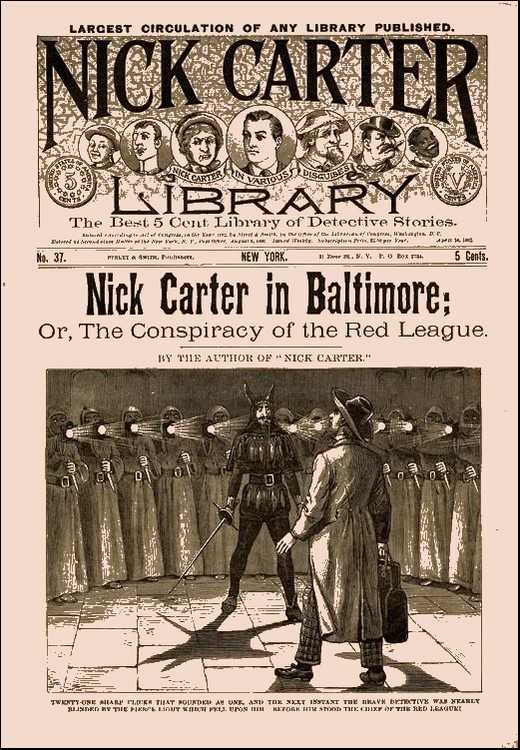
In an instant there were twenty-one sharp clicks that sounded as one, and the next instant the brave detective was nearly blinded by the fierce light which fell upon him.
Those clicks had been made by the opening lantern slides, and Nick found himself focussed by the intense rays of twenty-one bull's-eye lanterns.
They surrounded him on every side, and as he glanced about him with a bewildered air that was natural to the character he had assumed, he saw that the men surrounded him in the form of a horseshoe, and that he stood at a point exactly midway between the points.
Before him in the center of that strange group, rapier in hand, was a man who wore the dress of a Mephistopheles, horns, hoofs, and all, his face being painted a blood red to match the garb he wore.
"Wal, I'll be gosh darned!" exclaimed Nick, with thoroughly countrified astonishment. "Say! be you fellers all here waiting for me, hey?"
"That sounds very well, and the tone is very perfectly assumed, Mr. Detective,' returned the man who was dressed in red, coldly, "but since you ask the question I will answer it. We were waiting for you, and expected you would return. This is the second time that you have been in our power to-night, and I promise you that you shall not again escape."
"Hey? what's that?' cried Nick, "expecting me to return; this the second time? Say, mister, be you drink?"
"I hope not."
"Then what do you mean?"
"Explanations are unnecessary, sir. You are here, and in our power, and you shall not again escape."
"Wal, mebbe I won't," said Nick, "but I'll have a try anyhow."
As he uttered the last word he leaped suddenly forward, and using all his gigantic strength he seized the man who was disguised as a devil, tore the rapier from his grasp, and while with his left arm he held the man a close prisoner in front of him, with the other he flourished the rapier in the faces of the masked and cloaked men around him, and shouted:
"Come on, consarn you! I reckon Josh Juniper knows how to take care of himself, even if you have got the devil for a captain."
A few of them made an effort to shut off their lights, but Nick, quickly realizing their intention, cried out, sharply:
"The moment we are in darkness I'll kill this man I have here, if it's the last thing I do in this world."
THE men hesitated.
There was something in the tone of the detective which told them he meant exactly what he said, and they realized that he had it in his power to do what he threatened, while it would be utterly impossible for them to prevent him.
They drew revolvers and took two or three steps forward, but Nick, still holding the figure of Mephistopheles before him as a shield, dropped the rapier, and, drawing one of his own trusty six-shooters, he raised it, and said, coldly:
"The first man who comes a step nearer dies."
They paused.
"I am going out of here," said Nick in the same tone, "and I am going to take this fellow with me. I will shoot the first man who attempts to prevent me as I would a reptile that crawled in my path."
As he spoke he began backing toward the door by which he had entered the room.
The scene was a remarkable one.
One man alone and unaided defying twenty-one desperate characters, each armed to the teeth, and accustomed to scenes of bloodshed.
It was just such an incident as might occur where that one man was possessed of such gigantic strength as was the detective, and was blessed with that supernatural presence of mind and quickness of appreciation of his surroundings that made it possible for him to do those things which seemed impossible.
Slowly but steadily he backed toward the door.
The man in his grasp struggled desperately to free himself, but he was as a child in the hands of a giant.
Nick knew that the decisive moment would occur when he reached the door and passed through.
Then he knew that the lights would go out, and that the men would make a dash to free their chief from the hands of the detective and to overcome the man who had captured him.
He was considering what would be the best move for him to make, when his ear caught a sound from the hall below that made him start with apprehension.
He heard a voice; what it-said he did not know.
The next moment there were heavy footfalls upon the stairs, and ten seconds later a figure bounded through the doorway, followed by others, and Chick and a dozen blue-coated policemen were in the room.
Never in all the detective's career had a circumstance happened so fortunately as that.
The men of the Red League who wore the masks and cloaks, and who were grouped around the room so full of indecision, braved and defied by one man, seemed to forget their fears when they suddenly found themselves confronted by a dozen policemen.
The lights they carried were instantly extinguished, and then there followed the flash of discharging firearms and curses and shouts, and then another flood of light fell upon the scene.
This time it was produced by the policemen, who, at Chick's suggestion, had also provided themselves with the means of lighting their way, and that room which but a few moments before had been so quiet became a veritable pandemonium.
Shouts, groans, curses, cries, pistol-shots, flashing weapons, and even shrieks filled the air until it seemed as though a cage of wild animals had suddenly been liberated there and were engaged in a battle of extermination. Again the lights went out.
Friends knew who friends were only by the sense of touch, and for fully a quarter of an hour the combat continued in intense darkness, and then almost as suddenly as it began it ceased.
Nick waited in one corner of the room when the turmoil stopped. A man was upon the floor beneath him, the detective's knee was upon his chest, and his hand clutched the prostrate man's throat.
During all those moments of intense excitement Nick had not once loosed his grasp upon the chief of that strange league of conspirators, and it was he who was now lying upon the floor choked almost into insensibility.
The detective did not speak, because he did not know who were victors in the fight, but he did know that he would presently learn, and a moment later a sharp light fell upon his face, and he saw Chick looking down upon him.
"Why describe the scene that existed in that room when once more it was illuminated and the result of the fight was known?
Suffice it to say that out of the twenty-one conspirators seven had escaped, four were dead or seriously wounded, and the rest were prisoners, while among them all, detectives, officers, and members of the league, there was not one who had not a wound of some kind to exhibit as a result of the affray.
*
On the following morning, at ten o'clock Nick presented himself, in company with Chick, at the office of the chief of police of Baltimore.
"Well," said the chief, you made quite a capture last night; now tell me if it has anything to do with the four mysterious crimes."
"It has everything to do with them," replied Nick,
"How so?"
"The man who was brought here last night dressed in the garb of Mephistopheles was the chief of an organization that has existed in this city for several months, and which they had very appropriately named 'The Red League,' and to the Red League are due the murders of Bertha Trevors, Stella Durland, John Snow and Milton Barnes.
"Just how the crimes were planned, and why Milton Barnes was killed we have yet to determine, but this man to whom I have referred as the chief was really a brother of Bertha Trevors' mother, and to him is due the conspiracy which has resulted so disastrously for four persons.
"Even now, chief, he is registered at the Gifford House under the name of Augustus Grosvenor.
"To the men of the Red League he is known as 'Ben,' while his real name is Benjamin Gunther, and he is the father of Charles Gunther, who was Bertha Trevors' legatee, and who is the beneficiary under the will of John Snow.
"I suspect the reasons for the murder of Milton Barnes, I know the reasons for the other crimes, but I think if Benjamin Gunther is brought before us here and now, and confronted with the facts already in our possession, he will make a confession of the whole story and save us the trouble and uncertainty of conjecture."
"It shall be done," replied the chief.
He touched a bell at his elbow, and gave the order for the man to be brought before him, and ten minutes later he appeared in the charge of an officer.
"Will you let me question him?" asked Nick of the chief.
"Certainly."
"You are Benjamin Gunther," said Nick to the prisoner.
The man started, hung his head as if ashamed, then looked boldly up, and said:
"Well, what if I am?"
"Nothing, only I wish you to know we have got your entire history. We know that you are the father of Charles Gunther; we know that you planned the murders of Bertha Trevors, of Stella Durland, of John Snow and of Milton Barnes. We know that Charles Gunther and Charles Jeffrey are one and the same person. We know by advices lately received from Berlin, where your son is now supposed to be studying medicine, that he has not been there for the past six months, but that another person has been passing himself off by that name in order that the people here might get no inkling of the fact that he had returned to America.
"We know that the will of John Snow, which was so recently found in the secret compartment of his desk, was forged by you or at your dictation, that the witnesses to that will are fictitious personages, and that these four crimes were nothing but the working out of a great conspiracy which originated with you and your son for the purposes of possessing yourselves of the millions that belonged to the other members of your family.
"We know that you were ostracized from decent society and from intercourse with your family ten years ago, by reason of a crime that you committed at that time, before which even these four for which you are responsible sink almost to insignificance."
The prisoner started again, and turned frightfully pale as the last few words fell from the detective's lips, and as he raised one hand, as if to ward off a blow, he gasped:
"Don't—don't speak of that."
"I will remain silent on one condition," said Nick, sternly.
"I will accept it even before you state what it is, cried the man; "I shall have to suffer the penalty of these crimes anyhow, then why make me any blacker by mentioning that one?"
"I doubt if you could be blacker than you are," remarked the detective; "but on condition that you give me the history of the conspiracy against the lives of the four people who have lately become your victims, nobody shall learn of your past deeds from me, and no one here but myself knows of them."
"May I tell the one in my own way?"
"You may."
"A year ago," began Benjamin Gunther, "I conceived the idea of making it possible for my son to inherit a vast fortune. I was already a criminal, and two or three crimes more or less did not deter me.
"There was a time, long ago, when John Snow, who was my half brother, signified his intention of leaving his estate to Charles, but the boy was wild, and he succeeded in displeasing his uncle, so that he finally destroyed the will that he had made, and informed him, without mincing words, that he might never expect to receive anything from him.
"If you know so much you also know the relation that existed between Stella Durland and myself, and also Bertha Trevors.
"When the man whom you have known as John Snow disinherited my son I believed that I could induce Bertha Trevors to make a will in his favor.
"I brought every influence in my power to bear to bring that point about, and believed that I had done so. Had I known that out of her vast estate she had left him only $50,000 her life would have been spared, and she would have been alive to-day. It was through the lying and deception of a servant that I was misinformed, and that same servant is to-day the real cause of Bertha's death.
"I knew that John Snow had made a will, and I also knew where it was concealed. It was a very easy matter after his death to possess myself of that document, and destroy it, and then to cause another to be made in its place and put where his lawyer, Henry Squire, would find it.
"That was done. John Snow's millions became my son's. As you know, Stella Durland's fortune also fell to him, and I believed until the will of Bertha Trevors was read that her vast property was his also.
"We had only to wait until the several estates had been administered to gather in the reward of our crimes, and then by dividing a few hundred thousand dollars out of the vast fortune among the men who had been my aids and assistants all these years, we would have gotten rid of them and lost ourselves in some foreign country where we would have lived like princes upon what you would call our ill-gotten gains."
"But what of Milton Barnes?" asked Nick; "you have said nothing about him yet."
"Milton Barnes," replied Gunther, "Was a young man whose face was his misfortune. He bore an unaccountable but remarkable resemblance to my son.
"When the conspiracy, if you are pleased to call it such, was first inaugurated our plan was that Charles, after partially disguising himself, should masquerade at the Gifford House under an assumed name, while we were working for his interests in the dark.
"We speedily found, however, that such a method was impracticable, and the man whom you have known as Milton Barnes, and who was a member of the Red League, was substituted for him without any one being the wiser.
"All went well until the murders were about to take place, and until success seemed to be within our grasp.
"It was then that Barnes rebelled. He knew too much; he believed himself to be too important to the success of our schemes, and it was decided the he should become one of the victims of the several crimes."
"Who killed Bertha Trevors?" asked Nick.
"I did."
"Who killed Stella Durland?"
"I did."
"Who is guilty of the murder of John Snow?"
"I am."
"And who committed the crime that took place at the hotel?"
"To that question," said Gunther, "I will not reply. I am willing to confess my own iniquities, but I am not willing to betray others."
"You must answer," said the detective, sternly, "or my promise will not hold good."
Again the man started and turned pale, then, in a husky voice, he almost whispered:
"The murderer of Milton Barnes was my son Charles."
"One more question," said Nick, "and then I am done. What is the real purpose of the organization which you have named the Red League?"
"The Red League," replied Gunther, "originated in New Orleans, and still exists there. I can give you no information concerning it, for the reason that I separated myself from it more than a year ago, but it is powerful and thoroughly organized, and its members are men who are banded together for the purpose of aiding each other in the commission of crimes."
Both Charles Gunther and his father answered to the law for the crimes that they had committed, and the mystery in which the four mysterious murders were shrouded was solved.
Roy Glashan's Library
Non sibi sed omnibus
Go to Home Page
This work is out of copyright in countries with a copyright
period of 70 years or less, after the year of the author's death.
If it is under copyright in your country of residence,
do not download or redistribute this file.
Original content added by RGL (e.g., introductions, notes,
RGL covers) is proprietary and protected by copyright.