RGL e-Book Cover
Based on an image created with Microsoft Bing software
Roy Glashan's Library
Non sibi sed omnibus
Go to Home Page
This work is out of copyright in countries with a copyright
period of 70 years or less, after the year of the author's death.
If it is under copyright in your country of residence,
do not download or redistribute this file.
Original content added by RGL (e.g., introductions, notes,
RGL covers) is proprietary and protected by copyright.
RGL e-Book Cover
Based on an image created with Microsoft Bing software
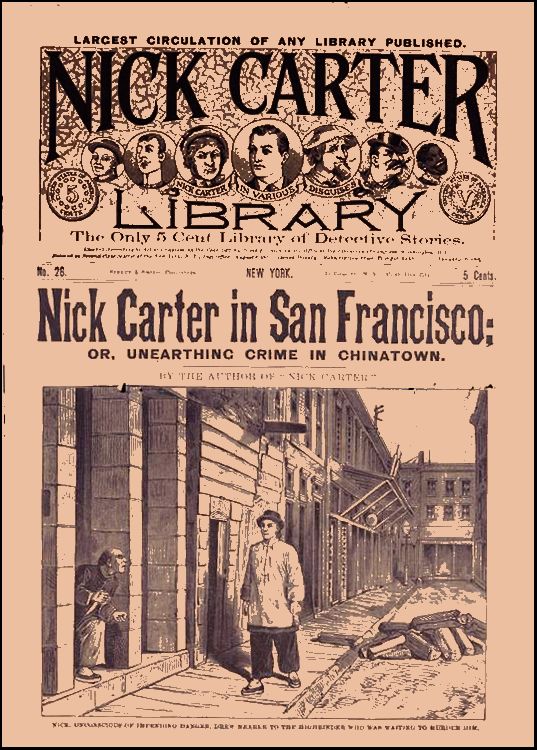
THE people of San Francisco were both shocked and outraged by the constant recurrence of crime in Chinatown.
The police seemed utterly powerless to cope with the stealthy murderers who struck down their victims with knives, or sent bullets crashing through their bodies in the public streets.
Many, indeed the greater part of these murders, took place in broad daylight, and in localities that swarmed with humanity.
Yet the assassins defied not only the law, but the officers who were appointed to enforce it.
One after another, nearly a dozen murders had been committed, instigated by one of the highbinder societies, or tongs.
To follow and discover a criminal was next to an impossibility for the police.
If a murder was committed in one of the many noisome alleys of Chinatown, not one of the many Chinamen who saw it would betray the murderer.
This reticence was due to two causes, sympathy and fear.
Either the witness was one who approved of the killing, or he knew that his own life would be forfeited and taken, without hesitation or remorse, if he should be indiscreet enough to talk.
Vainly the police strove to unearth the criminals; they were without success.
Vainly they endeavored to induce the Mongolian to give them information.
He always refused, retiring behind an expression of meekness that was utterly inscrutable with the low murmur:
"Me no sabe."
Threats, promises, expostulations, and bribes were of no avail.
"No sabe," was all that could be discovered, and the murderers continued undeterred.
A member of the Suey Sing Tong waylaid and murdered a member of the Suey Ong Tong, named Gund Leung.
His corpse was found in a basket, covered with a sheet, in Bull Run Alley, on the morning of November 2d, and not the slightest trace of his assassin was discovered.
Then a member of the Suey Sing had to die to even things up, and so it went on, or continued to go on, until the famous detective, Nick Carter, appeared upon the scene.
Chief Crowley, of the San Francisco police, was at his wits' end.
He had tried every expedient that a wise and experienced police officer could think of.
But, the murders continued, and whenever the officers appeared in Chinatown in search of a criminal, they were laughed at and jeered in derision.
Something had to be done.
Suddenly, the well-known chief remembered Nick Carter.
He recalled the great detective's wonderful facility at disguises; he remembered his remarkable versatility in the matter of languages, for Nick's duty had carried him twice to San Francisco when he was pursuing that strangest and most wily of criminals, Dr. Quartz.
"I'll send for Carter, anyway," mused the chief; and he did.
One week later, just as Chief Crowley was ascending the front steps of his own residence, early in the evening, he was met by a pompous-looking, middle-aged gentleman, attired in broad cloth, and wearing a glossy silk hat.
"I believe I have the honor of addressing Chief Crowley, of the San Francisco police," he said.
"Yes; that is my name," replied the chief.
"I would like to have a few moments' private conversation with you, chief."
"Upon what subject?"
"Chinatown."
"Eh?"
"Chinatown."
"What do you—"
He paused and smiled.
"Ah!" he continued. "Step right in, sir."
"Nick Carter," he continued, when they were in the library together, "you are certainly a marvel; but why you should come to me in a disguise is more than I can say."
"Simply because it is one of seemingly useless precautions that I always take," replied Nick.
"But why?"
"Because, chief, I think that much of the success which is credited to me on the ground of phenomenal ability is due instead, to the fact that I am, in one sense, a phantom to the criminal fraternity."
The chief smiled.
"I can hardly be classed as a member of that brotherhood," he said.
"Certainly not; nevertheless, they keep a sharp eye upon every move that you make."
"You think that while the police are watching the Chinamen, for instance, they are watching the police."
"I have not a doubt of it."
"Nor I, Nick."
"They know every detective who is connected with your force, as well as you know them yourself.
"Just now, I believe that if I had come here openly, as a known detective, within an hour, the Suey Sing, Suey Ong, and, in fact, every tong in Chinatown would have learned that I was here, and would have taken measures either to outwit me, or murder me."
"No doubt."
"As it is, I am a mystery. I come and go in so many shapes and characters, that none except intimate friends have an idea where I may be."
"Exactly."
"If a Highbinder has been detailed to keep an eye upon you, for instance, it is already known that you met a gentleman in front of your house to-night."
"Does not that amount to the same thing?"
"Certainly not."
"Why?"
"Your manner, when you met me, plainly indicated that I was a stranger. When I leave, I will be followed, not by one, but by a dozen or more Mongolians, who will change so often that I will not see the same man twice, and therefore will not know that I am followed."
"Well?"
"They will accompany me to my hotel. To-morrow morning they will see me take the train to leave town, but they will not know that I shall return from some little way station, a full-fledged Chinaman."
"Ah!"
"Their interest in me ceases the moment the train leaves the depot. They will have no interest in knowing where I go, or whether I return, unless I again seek an audience with you, which I certainly shall not do.
"From the moment that I leave you to-night, chief, I shall not see you again, to speak to you, until I can give you the information that you want, and am ready to return to New York."
"You're a queer fish, Nick."
"Exactly."
"You want some information from me, I suppose."
"Not very much."
"Eh? Why not?"
"Because you know very little yourself."
"True."
"The whole story is, that murder after murder has been committed in Chinatown, and that although you occasionally capture a criminal, it is only when he is taken red-handed, that you can succeed in convicting him."
"That's it, Nick."
"You don't want me to look for the perpetrator of any particular crime, as I understand the case."
"No; unless you light on one."
"Exactly. What do you want me to do?"
"Find out the true cause of these murders."
"They are evidently the result of a conspiracy, or rather of numerous conspiracies."
"Without doubt."
"Well?"
"Nick, do you understand Chinese?"
"The language?"
"Yes. As well as a Chinaman."
"And speak it as well?"
"I think I would have no difficulty in deceiving one of them."
"Good! They are shrewd and cunning, though, Nick."
"I know it, chief."
"There is no need of asking you if you can make up a perfect disguise."
"No."
"What will be your method when you are made up?"
"I shall join both the Suey Sing and Suey Ong tongs societies."
"Be careful, Nick."
"Of what?"
"Of joining those societies."
"Why?"
"Because I fear that no matter how thorough your disguise, they will penetrate it."
Nick laughed.
"It is no laughing matter," said the chief.
"Perhaps not."
"I grant that you might fool the Chinamen regarding your appearance; that you might go among them and converse with them on the streets and in their shops, day after day, without ever creating a suspicion that you were not what you seemed."
"What, then, do you fear for me?"
"The initiations into their societies."
"Ah!"
"Nobody knows to what ordeal they may subject you."
"Certainly not."
"No matter how perfect your disguise, it would then be discovered."
"Doubtless."
"Then—"
"Wait, chief. Although I shall join both of those societies, I shall not undergo an initiation in either."
The chief stared.
"Fact," said Nick.
"How in the devil—"
"My dear chief, there is always more than one way out of the woods as well as into them. I am a very fair Suey Sing now. Ere long I will be a Suey Ong. Instead of becoming a Chinaman, I shall become two Chinamen; in fact, before you see me again, I shall have perpetrated three of the Mongolians."
WE will not take up the time and space which should be devoted to the remarkable events of this story, by detailing the conversation which took place between Chief Crowley and Nick Carter; nor will we enter at present into the plans which were agreed upon at the interview just mentioned.
They will be cited as the story develops.
On the following day, shortly after noontime, Nick Carter descended from a train, which was just in from Sacramento, although he had not come from a point so distant.
Nick's disguise was that of a Chinaman; and it was perfect, as his disguises always were.
No one, who knew Nick Carter, would have suspected that he was concealed beneath that perfect disguise, for the Celestial was admirably represented.
The olive skin, the almond-shaped eyes, the long, braided cue which reached nearly to his heels, the fantastic shoes and queer dress were perfect.
Not a detail, however slight, had been omitted.
Nick Carter was transformed into a Chinaman, pure and simple, and was, in every sense, prepared for the perilous work in hand.
As soon as he descended from the train, he started rapidly away toward Chinatown, serenely looking about him as he went, as though the scenes that he was passing, were new to him.
No one spoke to him.
He was a stranger to the Mongolians that he met, and the police looked upon him as simply one of the thirty thousand Chinamen who infested the city of which it is calculated that, at least, two thousand are professional murderers.
Think of it!
Two thousand professional murderers in one city.
Nick continued on his way until he reached Chinatown, which is located in the oldest part of the city of San Francisco, and where, in a space that could not possibly accommodate more than four or five thousand Americans, over thirty thousand Chinese are huddled together.
Nick did not stop until he reached the corner of Waverly place and Clay street.
There, he was in the very heart of the district that he was seeking, and the sidewalks and door-ways around him were seething with humanity, jabbering in a language, which to the uneducated ear, sounds more like monkey-talk than anything else.
But Nick's ear was educated.
He understood the language as well as his own, and could speak it as well as any of the jabbering crowd around him.
Joining the group that had collected upon the corner, he found that they were angrily discussing a raid that the police had just made upon the meeting places of their societies.
One, who seemed more intelligent and less excitable than the others, Nick presently drew to one side.
He addressed him in the Chinese tongue, which we will render in good English.
"What is the matter?" he asked.
The Chinaman told him, and then asked who he was.
"Wah Ming," replied Nick. "I have just come here from New York."
"Have you come here to live?"
"Yes."
"Where?"
"I do not know, yet."
"I will board you at my house."
Nick thanked him in the choicest Chinese, and then covertly made a rapid sign of the Suey Sing society.
The Chinaman, whose name was Sam Ling, smiled with genuine approval, which he saw the sign, and immediately made a rapid reply, showing that Nick had been successful in his first venture.
Had Sam Ling been a Suey Ong, the detective would have been obliged to alter his disguise at once, for there is nothing that the members of these Chinese societies hate so implacably, as accession to the ranks of their opponents, from out of town.
But he had found a Suey Sing.
It may occur to the reader as marvelous that Nick should already be acquainted with any of the signs and tokens of that society, but a brief explanation will inform him.
The great detective often assumed the disguise of a Chinaman, and upon one occasion he saved the life of a member of the Suey Sing, in Pell street, in New York.
For the sake of informing himself, Nick took the Mongolian home with him, and had him tenderly cared for.
Ultimately, however, the poor fellow died, but Nick had taught him to believe in Christianity in the meantime, and as recompense for the light thus given, he had posted Nick thoroughly regarding the secrets of the Suey Sing society.
By piecemeal, the Chinaman whom Nick so fortunately met in Waverley place, asked questions and made signs until he was not only satisfied that his new friend was a Suey Sing, but was high up in the order.
Sam Ling offered to take Nick to board at his house.
A price was agreed upon, and Nick accepted.
By careful questioning, the detective speedily discovered that Sam Ling was a prominent officer of the Suey Sing, being next to the highest in the lodge.*
*For the benefit of the reader, we will use American terms except where others are necessary.—Author.
Nick had never seen a lodge of a Chinese society in session, of course.
By a judicious exhibition of cash, and unbounded liberality with his new-found friend, he succeeded, in the course of the day, in inducing him to vouch for his New York friend, Wah Ming, at the meeting of the lodge that night.
It was exactly what the detective wanted, and, from that moment, he saw his course clearly before him.
His proverbial luck did not desert him, even in Chinatown.
American societies meet at or near eight o'clock in the evening, as a rule.
Chinese societies meet, invariably, at midnight.
During the evening, Sam Ling undertook to introduce Wah Ming to his friends, and to show him around Chinatown.
From place to place they went together, Nick every where establishing a reputation for remarkable generosity, and so winning the hearts and confidences of those he met.
He created the impression that he had made a fortune in New York, and was on his way home to China, meaning, meanwhile, to spend a few months, perhaps a year, in the city of the Golden Gate.
His fluency in the Chinese language; his perfect ease in the disguise he wore, and his thorough acquaintance with the signs and tokens of the Suey Sing Tong, more than anything else, convinced all whom he met of his genuineness.
He was asked many embarrassing questions regarding the society in New York, but he managed to reply to them all satisfactorily.
He played fan-tan during the evening; he drank tea with some, and to those he met, whom he became satisfied were more or less influential, he made judicious presents of opium, of which he had taken pains to provide himself with the very best.
At eleven o'clock, Sam Ling said:
"Come! We will go now.'
"Where do you meet, since the headquarters have been discovered?" asked Nick.
"Where the police can never find us."
"Good! let us go."
The block which is surrounded by Dupont, Clay, Stockton, and Washington streets is a perfect bee-hive of seething humanity, as well as a network of alleys, hall-ways, underground passages, and hidden recesses.
It was to that locality that Sam Ling conducted Nick.
They entered what had once been an imposing residence on Stockton street, going in boldly by the front-door.
"The members of the Suey Sing get in by over a hundred different doors," said Sam Ling in Chinese, as they entered, "and no policeman could suspect a meeting-place here."
"Good!" replied Nick.
They passed through the main hall-way of the house, and ascended the stairs to the second floor.
There they entered a room, which seemed to have no means of egress other than the door by which they had entered.
But Sam Ling was posted.
He raised two boards in the floor, by removing certain fastenings which had been devised with all the cunning of a Chinese mechanic.
Before them was a black hole with a rod, such as firemen use in engine houses, descending into the darkness below.
Sam Ling pointed to the rod, and, without a word, Nick seized it, and slid rapidly out of sight.
Down, down he went, until at last he struck bottom, where he knew he must be far below the surface of the street.
He had scarcely landed and stepped aside, before Sam Ling was with him.
The latter opened a concealed door, passed through a long passage, which smelled damp and earthy, and after making several turns, finally ascended a flight of steps, opened another secret door, and emerged in a stifling tomb-like place, in which a single and very dingy lamp was burning.
Before them was a door with a wicket.
Sam Ling struck the door just once, and waited.
Presently a faint sound was heard in reply, also made by a single blow.
Then the Chinaman seized a little box with a sheep-skin cover, which hung from the ceiling.
He drew it down to him, and whispered a few words into the strange telephone.
Then the door swung open, and they were admitted.
IT was, perhaps, the first time in the history of the world, when a person not born a Chinaman, or a Tartar, had been admitted to one of the meetings of a Chinese tong.
Nick felt very much as though he had suddenly stepped into a den that was filled with wild beasts, which, by reason of some ocular delusion, imagined for the moment that he was one with them.
At any moment, the veil might be pulled aside, and then all the detective's skill, all his weapons, all his strength and agility, would avail him nothing against the horde of outraged beings who would rend him limb from limb.
But it was too late now to think of danger, even had Nick been one who would have considered it.
Before him was the mystic temple of the Suey Sing, if a cavernous cellar, twenty feet beneath the surface of the street, could, by any stretch of the imagination, be termed a temple.
Never were the detective's wits so keenly upon the alert as at that moment.
He knew that the least mistake on his part would betray him; and betrayal meant death.
A brief description of the sanctum of the Suey Sing Tong may not be uninteresting. Nick Carter is the only white man who has ever seen one, and the author has the facts directly from him.
"When the door opened, Nick and his conductor, Sam Ling, were admitted into a room which was forty feet long by twenty feet wide.
The roof of the strange place was supported by numerous pillars, and against each of them was fastened a lamp.
The air was simply stifling.
Indeed, upon first passing the door-way, it seemed to the detective that he could not breathe, but he gradually became accustomed to the closeness, and as keenly observant as ever.
In that small room there were crowded at least two hundred Chinamen.
Their usually impassive faces were lighted up with eagerness and subdued excitement, and instead of the chattering which usually went on when a number of them were together, they were strangely silent and expectant.
At the further end of the strange room was a platform raised about eighteen inches above the level of the floor, and upon that was a rudely carved figure of a Chinese god.
If hideousness was a criterion of excellence, this particular god must have been above all others. Every talent had been exercised to make him as ugly as possible.
In one extended hand he held a hideous, grinning skull, and in the other, a murderous-looking knife.
Immediately in front of this monstrosity, cross-legged, and tailor-fashion, sat a Chinaman, who was the high priest of the god behind him, and therefore the chief personage or master of the lodge.
At the right and left of this individual were two others, with the difference that they were squatted upon the floor at the base of the pedestal, with their backs to the audience.
Sam Ling left Nick alone as soon as they entered the place, and walked rapidly forward to the platform, which he mounted, taking a seat behind the ugly god, which they all worshiped.
He was the assistant high priest, or second in authority, and the two who sat with their backs to the body of the house, were the servants of the high priests.
Nick dropped upon a bench in the back part of the room, where he was entirely free from observation, and waited.
Ten minutes passed in absolute silence.
Then, suddenly, from the altar, behind the idol, there sounded a furious beating of tom-toms, and a wail, which might have done credit to an old-fashioned Irish wake.
The wailing grew momentarily louder and louder, until it developed into a veritable pandemonium of shouts and screeches, yells, and shrieks, enough to terrify a person who heard it all for the first time.
From immovable beings, the Chinamen became a mass of leaping, shouting, gesticulating, writhing humanity, like a thousand reptiles intertwined, and struggling to be free.
Every individual in that great throng became wild, maddened with excitement.
Some leaped upon the benches, waved their weapons aloft, and almost foamed at the mouth in the excess of that strange ecstasy.
Just as the excitement had reached a point where it seemed impossible to control it; where Nick (who was taking sufficient part in the performance to prevent notice being taken that he was not as enthusiastic as the others) began to think that they would end by falling upon and rending each other limb from limb, a sharp report came from behind the altar.
It was the report of a pistol, and its effect was both remarkable and instantaneous.
The very second that it sounded, every Chinaman in that frenzied throng sank instantly upon his bench, and became as immovable and silent as before the furore began.
Then the high priest arose, and in the Chinese language said:
"My children, Yo Fung Gang Lo is good to us."
"He is good," replied the audience.
"Yo Fung Gang Lo protects the Suey Sing."
"He protects us."
"Yo Fung Gang Lo provides us with sacrifices."
"And Huang Gee kills."
"I, your high priest, am Huang Gee. I am commanded to kill to-night. Yo Fung Gang Lo has said it. I obey."
"Huang Gee obeys."
"Yo Fung Gang Lo has sent us our victim from afar."
"To the arms of Huang Gee!" shouted the throng, beginning to show some excitement.
Nick began to grow uneasy.
Had he, after all, only walked into a well-laid trap, by which his life was to pay the forfeit, and in such a manner that his fate would never be known?
Was it to him that they referred as the sacrifice whose life was to be given up on the altar before the insatiable god, Yo Fung Gang Lo?
He did not allow a muscle of his face to move, for two hundred heads were turned, and every eye in that throng was fixed upon him.
Although he preserved his stolidity, outwardly, his mind was actively engaged in working out some plan of escape, if the worst came to the worst, and his life should really be in peril.
But he knew even then, that there was no way of escaping from that cellar-like place, which bid fair to be his tomb.
The door by which he had entered was so cleverly concealed that it was not visible from within the room, and Nick knew that it would be futile to attempt to find it in the short space of time that would be afforded him, if he sought to escape.
Escape was out of the question.
Nick Carter had been in many a tight place in his time. He had probably taken bigger chances than any other man living, and he had always come out unscathed.
When surrounded by danger, nobody knew better than he did, how to speculate upon the chances of escape, and he, therefore, knew when there was no chance left.
Here was a case of the kind.
He saw plainly that there was absolutely no chance for him to avoid the consequences of his presence at the secret meeting of the Suey Sing Tong.
Nick was well armed, and the reader who has followed his adventures in preceding numbers of this library, knows that he was a quick and sure shot.
Immediately following the last response of the audience, every eye in the hall was turned upon the detective, and he knew that they referred to him.
Then, as they looked at him, they began a wild chant, which cannot be rendered into English.
In substance, however, it was as follows:
"Oh, thou, who has come to us from afar to furnish the sacrifice for our Yo Fung Gang Lo!
"Oh, thou, whose strength may be greater than the elephants and yet be weak, so weak!
"Oh, thou, who hast suffered thyself to be put on the mighty test; who bravest the anger and who cravest the love of Yo Fung Gang Lo!
"Advance! be ready; be prepared.
"Look well upon the knife!
"Look well upon the skull!
"He, whose body it once adorned, was consumed in the holy fires of Yo Fung Gang Lo!
"He was mighty; his muscles were like the wall of China; his heart the heart of a lion.
"Yet he was vanquished, he was outdone; yonder, is his skull.
"Huang Gee vanquished him as he will vanquish thee.
"Huang Gee, our high priest. Huang Gee, the chosen; Huang Gee, the offspring of Yo ie Gang Lo.
"Advance, then!
"Advance!
"Huang Gee bids thee!"
Nick saw that something was expected of him.
From the words of the strange chant, which is very crudely and imperfectly translated here, he at once realized that he was supposed to know the ceremony that was about to be enacted.
They called upon him to advance to the altar.
For what? To meet death?
To offer himself as a voluntary sacrifice to their superstitious zeal?
'Not much," thought Nick.
"Possibly their reference to being vanquished has something to do with the case," he muttered. "If there is to be a trial of strength, I do not fear any two of them."
Almost involuntarily, he began to move slowly toward the altar, as though influenced by the magnetism of two hundred pairs of eyes that were fixed upon him.
Intuition, rather than knowledge, told him, that he was acting for the best.
Passively, he allowed the intense eagerness depicted upon every Mongolian face, and concentrated in every Asiatic brain, to influence him.
Every muscle in his body, every nerve in his being, every sinew of his frame, was upon the alert.
He was ready, upon an instant's warning, to leap aside, to draw his weapons, to fight to the last gasp, one against two hundred.
"The readiness for such a deed and the forced composure of his manner, gave him a dignity that was new and unknown to the beings who regarded him.
A low murmur of approval began to fill the room.
A whisper reached his ear.
"You will win! You will not be the sacrifice!" it said.
A flood of light burst upon his brain.
He saw at once the meaning of it all, and he smiled with confidence in his own powers.
As he advanced, Huang Gee descended from the platform, while Sam Ling and the two altar servants stood near him with folded arms.
Suddenly Huang Gee threw aside his robes of office and stood revealed, naked to the waist, ready for the trial of strength and skill that was about to come.
Then, when the crowd saw that Nick did not offer to remove a garment, but smiled with disdain upon the preparations made by Huang Gee, a great shout went up, and they chanted:
"He has eaten of the tiger in the jungle. Let Huang Gee beware!"
But as Nick gazed, he saw that he had no mean antagonist to battle with. Huang Gee was a giant in muscular development.
IT was a weird scene.
Imagine it if you can, reader. A cellar, far beneath the surface of the street, a cellar lighted by a score or more of lamps with blackened chimneys, and crowded beneath them fully two hundred Chinamen bending forward with eager longing, to witness what was to be a fight to the death.
Whether the combatants were to attempt to kill each other or not, Nick did not yet know, but that one of them must become a sacrifice to the god. Yo Fung Gang Lo, he did know, and whoever should be vanquished in the approaching contest would become the victim.
He saw that he had already gained the sympathy of the crowd, even against their high priest, Huang Gee.
His dignified bearing, his evident contempt for the powers of Huang Gee, who was a giant when compared to the others who were present, won them over to his side.
The high priest was proportionately angry.
For a long time he had been the ruler of the Suey Sing, and now to be treated with utter contempt, for so the Chinamen construed Nick's acts, by a stranger from New York, was more than he could bear.
Whatever the preliminaries were, he did not wait for them to be enacted.
With an exclamation of rage, he bounded forward to seize the detective in his grasp and to conquer him at once.
But if he was a giant in strength, so also was Nick Carter.
The great detective had never yet met his match for strength and agility, and he did not believe that he would find it in a Chinaman.
He waited when Huang Gee leaped forward.
He permitted the angry Chinaman to seize him.
For a moment they strained and tugged, and then the detective executed a trick in wrestling that the high priest had never seen before.
He pressed suddenly forward, while they still held each other, and then as suddenly leaped back.
Then, with a quick twist, bringing all his mighty muscles into play, he threw the Chinaman clear over his head, releasing his hold as he did so.
Huang Gee was agile.
He described a circle, which may be called a "cart-wheel," and which would have floored any ordinary man.
But not Huang Gee.
He alighted upon his feet, and kept them, too.
The applause was deafening.
Whether it was produced by the exhibition of Nick's great strength, or by the fact that in spite of it, Huang Gee alighted upon his feet cannot be said.
The high priest was not yet vanquished.
He returned to the fray more determined than ever, and with the advantage that he knew something of the strength of the man with whom he had to deal.
Where he had been bold before, he was now wary.
He faced Nick, but kept out of his reach, watching for a chance to dart in and seize some favorite hold.
Nick saw what he wanted, and unhesitatingly gave him the chance that he coveted.
He left an opening, and the high priest rushed into it.
He seized the detective around the body in what is known as the "back-hold."
But Nick shook himself free from that by a mighty effort, and changed to the "side-hold."
There, the "Little Giant" was at home.
Then they strained again, both men almost down upon the floor. But Nick had another trick in store for Huang Gee, and it was a good one.
He suddenly gave the Chinaman what seemed to be an advantage.
The high priest fell into the trap, and threw all his strength into one effort to floor his antagonist.
It was futile.
Another surprise was the result.
Again he found himself thrown high in the air.
But, agile as ever, he saved himself from falling in a most unexpected manner.
He was hurled violently against one of the supporting pillars of the place, and he seized it and clung to it.
Then, while the applause was deafening, he slid down to the floor upon his feet.
Again was Nick denied the victory; again had Huang Gee saved himself, and again he came forward to renew the contest.
It was a bloodless battle, but a severe one.
Nick was getting tired of it.
The air, or rather the want of air in the cellar, rendered the place stifling.
He resolved to settle the contest without delay.
Huang pursued his old tactics.
He warily dodged in and out, watching for an opening.
But Nick was no longer acting upon the defensive.
He commenced to be aggressive, and he made several attempts to seize his adversary.
At last he succeeded, but in such a way that Huang Gee gained the advantage that he had all along been seeking.
He secured the "back-hold."
It was the Chinaman's favorite manner of wrestling, and Nick saw that he must exert himself to win at once, if at all.
For several moments they strained, neither gaining an advantage.
Then it could be seen that Huang Gee's back was slowly, but surely yielding.
Over, farther over, he bent, still struggling manfully.
But hope for him was past.
Victory was to perch upon the banner of the detective.
Suddenly there was a loud snap, that could be heard all over the room, and Huang Gee slipped from Nick's grasp into a heap upon the floor.
His back was broken.
"It was his life or mine," muttered the detective, with contrition, as he gazed upon his fallen adversary, while silence, like the stillness of death, fell upon the throng.
"What am I expected to do next, I wonder?" thought Nick.
The crowd waited, and so did he.
Suddenly a loud shout went up.
Huang Gee was struggling to his feet.
Nick watched him with no idea of what he was about to do.
He dragged himself to the altar at the feet of the god, Yo Fung Gang Lo.
Then, by clinging to it, he raised himself, until he could reach up and seize the knife from the god's grasp.
Nick prepared to dodge, for he expected that the vanquished high priest was about to throw the knife at him.
Not so, however.
"Wah Ming," he cried, addressing Nick in the Chinese tongue, "thou art mightier than I; thou hast vanquished me. I am foresworn and doomed, while thou art raised to the place I filled.
"Thou art great, Wah Ming, for by thy silence thou hast given me a boon that I, myself, have never granted to others.
"I thank thee, Wah Ming, and I perform the last duty of my sacred office."
As he ceased speaking, he raised the knife. and then, with a sudden plunge, he buried the gleaming blade deep in his own heart, and fell forward upon the floor, dead.
Then the audience broke again into a wild chant, in which they recited the greatness of their new high priest, and applauded the victory that he had won.
Sam Ling seized the robes which Huang Gee had discarded before the contest of strength, and threw them over Nick's shoulders.
The detective did not know what was next expected of him, and on the impulse of the moment, he did the very best thing that he could have done.
He took the robes from his own shoulders, and threw them upon those of Sam Ling.
He saw instantly that the act was equivalent to that of calling an inferior officer to the chair in an American assembly.
"He took Sam Ling's place behind the god, and listened and watched while the latter, apparently overwhelmed by the honor that had been conferred upon him, continued the meeting.
Portions of the body of Huang Gee-were given to each member, and one by one they came forward and claimed them.
The sight was sickening, the stench nauseating.
There were chants and weird dances. One Chinaman came forward and inflicted torture upon himself, receiving the heart of Huang Gee as recompense therefor.
Then two members of the rival tong, the Suey Ong, was condemned to death, and three members of the Suey Sing were named by Sam Ling as the executioners, And then the meeting dispersed.
IT cannot be denied that Nick Carter had accomplished a wonderful result in an incredibly short space of time.
He had been in San Francisco scarcely twenty four hours, and yet he had already gained a point which the police had vainly sought after for years.
He was a member of the Suey Sing.
Ay, more! He was its high priest, its ruler, and he had gained the distinction by reason of a chain of circumstances which could not possibly have been foreseen or calculated upon.
His proverbial luck had much to do with it, but his skill and proficiency as a detective had more.
First, he had presented himself to Sam Ling as a stranger who sought affiliation with his "tong."
Without knowing that he was doing so, he had offered himself as a sacrifice in case the high priest should prove to be a more powerful man than he.
An inflexible rule of the Suey Sing was that the member who was the strongest man, the best wrestler and fighter, should be its high priest.
Any member at any time had the right to challenge him to a contest of strength and skill, and whoever should come out second best in the contest, should be at once offered as a sacrifice to the blood-thirsty god, Yo Fung Gang Lo.
It was the duty of the victor in the contest to perform the sacrifice, thus condemning the victim to one hundred and nine years of darkness.
But he could waive that right and permit the victim to kill himself, if he was magnanimous enough, and the unfortunate was then supposed to take his proper place at once in the celestial regions.
Nick Carter was only human after all, and his remarkable success dazed him for the moment.
He realized that he had leaped at once into prominence in Chinatown, and that he was a marked man so far as recognition in that quarter went.
Like a prominent politician, everybody would know him, and the next act in the drama would be made much more difficult for him to perform.
But only a quarter of his work was done.
He had yet to become a member of the Suey Ong, and to secure evidence by which both societies could be indicted for conspiracy against human life.
It was true that certain members of the Suey Ong had already been sentenced to death by the Suey Sing, and that persons connected with the latter organization had been appointed to carry out the sentence.
But how prove it?
The four officials remained near the idol, while the others left the place.
At last they were alone together, and the two altar servants stood in respectful attitudes, as though awaiting some order from him.
Not knowing what else to do, he presently waved his hand with a gesture, which might mean anything.
Seeing it, they darted away.
Nick waited for some sign from Sam Ling.
But he made none, and in a few moments the altar servants returned bearing in their hands a tray upon which was a plate of raw and bloody meat.
Nick looked at it in disgust.
"Will the high priest, Wah Ming, eat of the mountain lion?" asked Sam Ling.
Nick shuddered.
He knew of the Chinese superstition that to eat of the flesh of a wild beast, was supposed to give the person, so eating, all the strength, ferocity, and tenacity of the animal eaten.
"No," he replied, solemnly. "I have held the wild tiger in the jungle while I tore strips from his body and swallowed them. Shall I defile my being with the carcass of a jackal?"
The three men bowed low.
"Will he permit his servants to eat of the portion that was saved for him?" tremblingly asked Sam Ling.
"Eat!" returned Nick, shortly.
They seized the raw flesh with avidity.
In a moment it had disappeared.
Then, with low obeisances, the three men turned as if to leave.
He motioned to Sam Ling to wait.
"Who are the men of the Suey Ong who were condemned to-night?" he asked.
"Men Gee and Sing Foy."
"Do you know them?"
"Yes."
"Where do they live?"
"In Stockton street."
"Their business?"
"They are storekeepers."
"Who are the executioners?"
"Lung Chang and Sing Hoy."
"When do they do their work?"
"At once."
"Show me the faces of the condemned men."
"Now?"
"Yes."
"Come."
There was a marked difference in the demeanor of Sam Ling toward Nick since the latter had become high priest.
He seemed to consider it a great honor that the powerful one, who was supposed to be in direct communication with Yo Fung Gang Lo, should look to him for advice, and he swelled with gratified vanity.
"Come," he repeated.
They left the foul, cellar-like place, and sought the outer air by means of a narrow and winding stair-way made with staves, which Sam Ling rolled up and hid away in a secret recess, when they reached the top.
The air of the street, though foul at its best, was like a draught of wine to the detective.
The time was nearly three o'clock in the morning, but Chinatown seemed as full of life and activity as ever.
Sam Ling led the way at once to the stores in Stockton street where the two condemned men did business.
Upon the opposite side of the street, waiting with Mongolian patience, were two Chinamen.
Sam Ling pointed to them silently.
"Who are they?" asked Nick.
"Lung Chang and Sing Hoy."
"Ah, the executioners?"
"Yes."
"They have lost no time."
"They are hungry."
"For blood, yes."
"For food, Wah Ming, the high priest, knows that they can neither eat nor sleep until Men Gee and Sing Foy are dead."
"True."
The doors of the stores where the two condemned men were supposed to be were closed, and the curtains were drawn.
Behind them, however, glowed lights, and Nick could see shadows passing and repassing beyond the curtains.
"Fan tan," muttered Sam Ling.
"Yes. Let us go in."
"In there?"
"Yes."
Sam Ling looked at Nick in utter astonishment.
"Wah Ming knows that it is not permitted," he said, slowly; "unless—"
"Unless what?"
"Unless it is ordered by the spirit of Yo Fung Gang Lo."
"Am I not the spirit?"
"Yes."
"I order it. Come!"
"We will be killed."
"Have I not eaten of the tiger?"
"Yes."
"I will protect you. Come!"
There was an expression of absolute terror on the face of Sam Ling, but it was evident that he did not dare to disobey.
Nick walked boldly up the steps to the door, and motioned to Sam Ling to rap upon it.
He did so.
A moment later the door was opened, and Nick and his new friend passed through.
He found that he was in the presence of a score of Chinamen, who looked as unconcerned as though they had not been engaged in gambling when the summons came.
They did not know Nick, but angry glances were bent upon Sam Ling; glances which meant murder, as the detective plainly saw.
He was sorry that he had compelled the Chinaman to enter with him, but it was too late to retreat now.
Instead of the usual chatter which was invariably the rule where a number of Chinamen were gathered together, they were greeted with absolute silence.
Every Chinaman there placed one hand inside his blouse, as though to grasp a concealed weapon.
"We have come to play fan tan," said Nick, coolly.
Men Gee, who was the proprietor of the place, pointed to the door.
"Go out; go away," he said.
Nick shook his head.
Then, with a quick motion, he drew his revolvers, one in either hand.
He believed that he could intimidate him, but he instantly saw his mistake.
Every Chinaman there was armed, and they were almost as quick with their weapons as the detective.
Instantly a score of revolvers leaped into view, and almost at the same moment they were fired.
But for Nick's wonderful presence of mind, both he and Sam Ling must have been killed.
As it was, he saw the motion which threatened them, and by marvelous quickness avoided the danger.
Quicker than lightning he threw out one foot and tripped Sam Ling, so that he fell to the floor, sinking down himself at the same instant.
The score of bullets passed harmlessly above them, and the Chinamen, believing that the two had been shot, leaped pell-mell for the door to escape.
But Nick was instantly upon his feet.
He seized Men Gee, who was nearest to him, and, raising him bodily from the floor, hurled him with all his strength at the retreating crowd.
The shock was too great for them to stand, and they went down like the figures in a Jacob's ladder, pitching headlong from the door into the street, heaped upon each other in a writhing mass.
But Nick followed up his success by seizing another, and serving him in the same manner. In two minutes Sam Ling and Nick were the only persons left in the store, and the former was nearly dead with fright.
IN what manner Chinamen disappear, so quickly and mysteriously, has always been an unsolved mystery.
The well-known agility of the flea cannot be compared with John Chinaman.
When you put your finger on him, he decidedly isn't there, and none of his neighbors or friends have any idea what has become of him.
When Nick and Sam Ling went to the door, after putting out the lights so that they would be sheltered by the darkness, Stockton street was deserted.
Not one of the score of Chinamen who had been in Men Gee's store was In sight.
If the earth had conveniently opened and swallowed them, they could not have disappeared more quickly.
They were gone, and the coast was clear.
Nick looked at Sam Ling.
He was diligently feeling about his body as though in search of something.
"What are you looking for?" asked Nick, in Chinese.
"For the holes."
"What holes?"
"The holes made by the bullets as they pierced my body. I was murdered by the Suey Ong. Five bullets pierced me. I felt them. Now, I am alive, and the bullets have left no holes. Was it Yo Fung Gang Lo who saved me, or was it the high priest, Wah Ming?"
"Never mind," replied Nick, smiling. "You are saved. Go, now, and leave me here."
The Chinaman fell prostrate upon the floor.
He bowed his head until his forehead rested upon Nick's feet.
"Wah Ming is great," he cried.
Then he sprang to his feet and departed.
Nick was left alone in the store of Men Gee, the condemned.
"How soon will the proprietor return?" he muttered: "Anyhow I will be ready for him when he does come."
Then, in the darkness, the detective began to work one of his marvelous changes.
Though still retaining the outward semblance of a Chinaman, he altered his dress, the length of his queue, his apparent age, and the expression of his face, so that in ten minutes from the time when Sam Ling left had he returned, he would have met a perfect stranger.
Then Nick sat down to wait.
A half-hour passed, and then he heard somebody approach the door.
Still he kept silent, and a moment later a pair of almond-shaped eyes peered around the casing and endeavored to examine the interior.
"Men Gee has returned," muttered Nick to himself, "and now to work my racket on the Suey Ong."
Perceiving no motion in his store, Men Gee grew bolder.
He stepped forward and started to enter his place.
For an instant his body was outlined in the door-way, and then—
There was a flash and aloud report from the opposite side of the street.
Men Gee uttered a piercing scream, and fell forward across his own threshold dead.
The bullet, fired by one of the appointed assassins, whom Nick had for the moment forgotten, had done its deadly work, and one of the men who had that very night been condemned by the Suey Sing was already a corpse.
The detective's plan was nipped in the bud, for that night, at least, and he realized that the best thing that he could do would be to make himself as scarce as possible around that region.
He did not care to be arrested as the murderer of Men Gee.
Although he would have no trouble in proving his innocence, in order to do so, he would be obliged to reveal his identity. and he preferred that nobody bud Chief Crowley should know of that, at least, for the present.
In order to leave the store, he was obliged to pass directly over the body of Men Gee.
He stepped forward, prepared to leap out and get away, when he heard the noise of approaching footsteps, made by men in the act of running.
They were coming nearer, too.
"The officers!" muttered the detective. "They have just made up their minds that there is trouble here."
He listened for an instant without moving.
"I'm in for it, sure!" he muttered, presently.
Then he drew back into a dark corner of the shop and waited.
Soon a policeman dashed up to the door-way.
A glance told him that he had found the scene of the crime; as well as its victim.
A shout brought the others to his aid, and three policemen reinforced him.
Two of them leaped over the body and entered the store.
In an instant they discovered Nick, crouching, the seeming picture of terror, in one corner.
They seized him.
"Aha!" exclaimed the officer, who grasped him. "Got you, have I?"
"Allee samee like smoke," replied Nick, with chattering teeth.
"What did you kill that feller for, John?" asked the other policeman.
"Me no killee."
"Don't lie, John."
"Me tellee tlufe, allee samee like lofficel, like copee, sabe?"
The officer grinned.
"I guess we'll have to shove you through for this, John. Who is the dead one, hey?"
"Men Gee."
"That's the name on this door."
"Allee samee, Men Gee."
"Why did you shoot him?"
"Me no shootee. Man shootee flom oder side stleet, allee samee bang, dlop, sabe?"
"Yes; but it's too thin, John. You're the feller that laid him out."
"Copee tellee one allee samee damlie, sabe?"
"Eh? What's that, you infernal heathen?"
The policeman raised his club threateningly, as though he was about to resent the insult that had been offered: but he evidently thought better of it, and did not.
"Me plove me no shootee Men Gee," said Nick.
"How?"
"Copee big foolee."
"Look here, confound you. If you want to get out of this scrape, you've got to talk differently, you yaller cur."
"Um! allee samee," said Nick, imperturbably. "Why copee no lookee at Men Gee?"
"What d'ye mean?"
"Men Gee shootee in backee."
"He's right, Jim," said the man at the body.
"Him lie on him facee."
"That's right, too."
"Me inside shopee. Me fliend of Men Gee. Me waitee for Men Gee. Men Gee come to dool; him stan' in dool. Cusee on oder side stleet shootee Men Gee in backee. No sabe who shootee. Me scart. Me lun an' hidee. Thinke me be shotee, too, allee samee like Men Gee. Bimeby copee come; copee 'lest me. Me tellee tlufe allee samee like copee; sabe?"
"You don't know who shot Men Gee, eh?"
"No sabe; no."
"Can you find out?"
"No sabe."
"Come, Jim!" interrupted one of the others, "take the heathen in and have done with it. More than likely he killed the fellow himself."
"Come along, John!" said the officer, who was called Jim.
He seized Nick by the arm and dragged him toward the door.
One of the officers was left in charge of the place where the murder was committed, and the other three started with Nick for the station-house.
The detective had no intention of going so far, however.
He preferred to escape from them and to run the risk of being shot, rather than be forced to explain everything that he had done, as he would be, if he was once taken into the presence of the captain of the precinct.
There was an officer on either side of him.
Each grasped his arms, while the third policeman, who was Jim, walked in front of them.
They went along Stockton street to Washington, and were about turning the corner, when the brave detective saw his opportunity.
Close beside them was an open door-way, which seemed to lead into an alley-way between two buildings.
No better place for his escape could be found.
Suddenly he gave a violent jerk, and thus wrenched himself free from the grasp of the two men.
Quickly stooping, he seized them both around the legs, and toppled them over as easily as though they had been wooden men.
They both cried out with astonishment when they found themselves falling, and the officer, who was in advance, turned with upraised club, to see what the matter was.
He never knew exactly what did happen, just then, and to this day he believes that the Chinaman struck him with brass knuckles.
At all events, he was struck, and he fell in a heap beside his companions, while the Chinaman, who had been their prisoner, darted into the narrow alley-way and disappeared.
Fifty Chinamen suddenly loomed up from fifty different places.
They wondered what had happened, and chattered about it.
When the officers tried to question them, all the satisfaction they got was:
"No sabe."
Entirely nonplused, they continued on their way empty handed, little dreaming that they had questioned the very one who had upset them, and that he was the one who was more ignorant of what had happened than all the others.
Nick had simply gone far enough into the alley to be alone.
There he had discarded the character that he wore, and reappeared as Wah Ming.
As the officers withdrew, he turned and hastened away toward Spofford's alley, where he thought he could find Sam Ling, and from him learn the name of the man who had killed Men Gee.
But a surprise of which he little dreamed awaited him, and although dawn was breaking, he was yet to meet with another adventure before the sun rose over San Francisco.
SPOFFORD'S ALLEY is known to everybody who is at all familiar with Chinatown in San Francisco, as being a favorite resort of the Highbinders.
The term "Highbinder" is applied to the members of those secret societies, which make war upon each other, being a sort of Chinese mafia or assassination association, and "Highbinder feud" means simply war between two Chinese tongs.
We have already seen in what manner members of one association are condemned to death by the other.
Spofford's alley, Bull Run alley, Waverley place, Shag alley, and other places of the same character, were and are favorite resorts of the Highbinder, because he can there more successfully elude the officers after committing a crime.
When Nick entered the alley above mentioned, day was just beginning to dawn.
The alley was narrow and dirty.
Heaps of debris and filth of all kinds filled the place from curb to curb.
Odors which should have penetrated to the health department of the city, almost nauseating in their strength and pungency, entered his nostrils.
There were but two persons in sight when he turned into the alley, and one of them was, by chance, Sam Ling.
He was coming toward Nick, and was about two hundred feet away, when the detective discovered him.
Behind him, not ten feet farther off, was another Chinaman.
As Nick looked, he saw the second one raise his right arm.
The hand held a weapon, and it was aimed at Sam Ling.
Nick shouted with all his strength, and the doomed man sought to escape.
He leaped aside just as the murderer pulled the trigger.
He was too late.
The bullet, obeying the deadly aim that had been given to it, sped upon its message of death.
It crashed into Sam Ling's skull, and, with a groan, he pitched forward upon a pile of debris near him, killed instantly.
The murderer, as soon as he had fired, leaped into a door-way that was close beside him.
Nick pulled his revolver and fired, just as he was disappearing.
A loud cry of pain followed the detective's shot, and Nick smiled grimly as he dashed forward in pursuit of Sam Ling's assassin.
"I didn't hurt you much, I'm sorry to say," he thought; "but all the same it will be several days before you will sit down again with comfort."
He dashed into the door-way, where the assassin had disappeared.
There was no sign of him, however.
Still Nick pushed on.
Every house in that section is a maze of passages—a network of loopholes of escape.
Near a stair-way was crouched one of the meek-faced devils.
Nick seized him and choked him until his tongue protruded.
"Where did he go?" he demanded in Chinese, loosening his hold so that the frightened Mongolian could reply.
"Who?" asked the man.
"The one who just killed Sam Ling."
"Is Sam Ling dead?"
"Answer me, where did he go?"
"Who?"
Nick drew a knife from his pocket.
"If you don't answer me, I'll cut out your tongue," he said, savagely. "Where did he go?"
The Chinaman pointed at the stairs.
"Up there?" asked Nick.
"No."
"Where, then?"
Again the Chinaman pointed as before.
Nick was exasperated.
He held the knife before the man's eyes, and repeated:
"Where did he go?"
For answer the Mongolian seized the bottom step of the flight.
Several stairs came up instantly in his grasp, exposing an aperture beyond which all was darkness.
"Through there?" asked Nick.
"Yes."
"Where does it lead?"
"To a hundred different places."
Nick knew that the words were probably true.
He resolved to try another tack, since he had found a Chinaman who would talk.
"What was his name?" he asked.
The fellow shook his head.
Again Nick exhibited the knife.
"What was his name?" he repeated.
"Song Lee."
"Are you sure?"
"Yes."
"A Suey Ong?"
"Yes."
"Are you?"
"Yes."
"Where do you live?"
"Here."
"Do you know me?"
"Yes."
"Who am I?"
"Wah Ming, the giant."
"Good! You know more than I thought you did. How do you know me?"
"I was in Men Gee's store when you came in."
"Ah! With Sam Ling?"
"Yes."
"Is that why Sam Ling was killed?"
"Yes."
"Am I to be killed also?"
"Yes."
"By whom?"
"By me."
"What is your name?"
"Fing May."
"Do you want me to kill you?"
"No."
"Do you want money?"
"Yes."
"Will you serve me?"
"You are a Suey Sing."
"I will become a Suey Ong."
"Then I will serve you for money."
"Will you make me a Suey Ong?"
"Yes."
"When?"
"At noon."
"Where?"
"Here."
"Show me where to meet you."
"Come!"
Nick released his hold, and followed the Chinaman through a door into a little room not over six feet square.
"Do you live here, Fing May?" he asked.
"Yes."
"Alone?"
"Yes."
"And you will serve me?"
"For money, yes."
"Won't your friends kill you, if they find it out?"
"Yes; but they will not know."
"Why not?"
"You said you would become a Suey Ong."
"Yes."
"Then Wah Ming will disappear."
"True."
"I will tell the Suey Ong that I killed him."
"Yes."
"I will be a great man. You, Wah Ming, have only just come, but already everybody in Chinatown know abouts you. The Suey Ong fears you. It is known that you are the high priest of Yo Fung Gang Lo. Every Suey Ong is sworn to kill you. A hundred bullets have been aimed at you since you were in Men Gee's."
"Why have I not been killed?"
"The Suey Ong men were afraid to shoot."
"Why?"
"They fear Yo Fung Gang Lo."
"Ah!"
"They say that bullets cannot kill you."
"Indeed!"
"Every Suey Ong has sworn to use the knife upon you."
"That's pleasant," thought Nick.
"If you disappear, I can say that you are dead," continued Fing May.
"Well?"
"I will be a great man. You will give me money, and I will be a rich man. You will become a Suey Ong, and I will be a fortunate man, for you will not curse me."
"I suspect that you are a scoundrel," thought Nick, "who will betray all that you know for a price."
"Listen!" he said, aloud. "Do you know why I would become a Suey Ong?"
"Yes."
"Why?"
"To betray it to the Suey Sing."
"Correct. That means death to the Suey Ong."
"Yes."
"What will become of you, then?"
"I will be in China."
"Oh! You will be killed there, just the same."
"No."
"Why?"
"In China, I am a Suey Sing. I have another name. They do not know me. Fing May will die. Another will breathe for him."
"What a villain!" muttered the detective.
Aloud, he said:
"You know me to be Wah Ming?"
"Yes."
"You fear me?"
"Yes."
"Have you a pistol?"
"Yes."
"Where is it?"
"Here."
"Draw it, aim at my heart, and fire."
The Chinaman grew visibly pale.
"Obey!" said Nick. Then he thrust his hand into a pocket and seized an unused bullet from a cartridge that had fallen loose.
The Chinaman raised the weapon.
"Point at my heart," said Nick.
Fing May obeyed.
"Fire!"
He pulled the trigger.
The flash and report followed.
Nick did not move.
He only smiled.
Then he extended the hand which held the bullet.
"Here," he said. "Take this and tell your friends that it is the bullet with which you killed Wah Ming."
Fing May was overwhelmed.
He fell upon his face, and groveled at Nick's feet.
"Do not curse me!" he cried, in seeming agony. "I am your servant, your slave."
"You are more," said Nick, coldly; "you are a spy of the Suey Ong. You were present last night at the tong of the Suey Sing. Speak!"
THE happy thought of conquering the treacherous Chinaman by means of his superstitious terror had occurred suddenly to Nick.
He saw by the way in which Fing May talked that he was a spy, and was in all probability affiliated with both societies, betraying one to the other for the sake of the money that he could get for his nefarious work.
No matter how thoroughly corrupt he might be, he was a slave to superstition. All Chinamen are.
Through that fear, which was even stronger than his avarice, the detective conquered him absolutely.
But while he terrified the man by handing him the bullet, which was supposed to have passed through his body without harm to the intended victim, he brought him still farther into subjection by letting him know that he recognized him as a spy.
That was, in reality, only a shrewd guess; but it hit the mark, and Fing May spoke truly when he proclaimed himself to be the slave of Wah Ming, or, in other words, Nick Carter.
"Save me! Save me!" he cried.
"Serve me, and you need not fear," replied Nick.
"I will serve you. Will you still pay me money?"
"No, not until your work is done."
"And then—"
"Then, if you have been faithful, I will pay you. If you are unfaithful, beware."
"Wing May is your slave."
"Mind you do not forget it."
"I will remember."
"At noon I will be here."
"Fing May will wait."
"You will not know me."
"I will know you, Wah Ming."
"How?"
"I will tremble when you approach."
Nick smiled.
"Remember," he said.
Then he turned and went away.
He passed from the house and turned toward the entrance to Spofford's alley, past the spot where Sam Ling had fallen when he was so suddenly shot down.
Much to his astonishment, the body had disappeared.
Somebody had spirited it away in the short time that the detective had been absent from the street.
He gazed around him for a moment.
There was not a person in sight.:
The firing which had occurred only a few moments before had frightened the people into their holes, like so many rodents.
Then he continued on his way toward the street.
But in a door-way not far ahead of him, and sheltered from view by the bricks behind which he stood, or rather, crouched, was a figure which Nick could not see.
There was a gleaming knife in his hand, and his eyes shone with cruel malignity as he waited for his victim to approach.
He was waiting for Wah Ming, whom he had been ordered to kill with the knife.
He had seen him in the alley, for he was the same one who had shot Sam Ling, and then fled.
There was blood dripping from his garments, where the detective's bullet had cut him, and he wanted to revenge himself, as well as to carry out the sentence of death that had been imposed.
Meanwhile Nick, all unconscious of the impending danger, drew nearer to the concealed Highbinder, who was waiting to murder him.
But we have seen that Nick was protected in an unusual way.
When he undertook the expedition into Chinatown, he well knew the perils that he would have to encounter.
Bullets from concealed hall-ways, the knives of hidden assassins, and unexpected attempts upon his life would be the rule.
He prepared for the ordeal by donning his shirt of Milan steel, and thus it was that the bullet of Fing May had been rendered utterly harmless.
As Nick drew nearer, the assassin crouched still lower.
He was like a panther, preparing to, spring.
At last the detective reached the required spot.
Like a cat, the Chinaman leaped upon him.
Quick as Nick was, had it not been for the shirt of mail, he must have been killed.
But that saved him.
The blade struck just over his heart, and the force of the blow was so great, that the steel snapped short off at the hilt, and fell clattering at their feet.
As the blow fell, Nick whirled around.
The Chinaman, perceiving that he had failed, and over-awed by the sudden and convincing proof that Wah Ming, the giant, was proof against knives as well as bullets, tried to escape.
Vain effort.
The detective's hands closed upon him like a vise, and he found himself as helpless as a babe.
As Nick whirled him around, he saw the blood upon his clothes and he traced it until he saw where the bullet had struck.
"Ah!" he exclaimed, in Chinese: "you are the murderer of Sam Ling."
The prisoner maintained a sullen silence.
Suddenly the detective remembered the fear that Fing May had evinced, of being cursed by the priest of Yo Fung Gang Lo.
"Do you know me?" he demanded.
"Yes," admitted the Chinaman.
"Who am I?"
"Wah Ming."
"I am Wah Ming, and I will cause my curse to fall upon you and blight you and—"
"No—no—no! Wah Ming, do not curse me!"
"Confess then."
"I will."
"You would rather be hanged, than be cursed by Wah Ming?"
"Much rather."
"Come!' said Nick, "you shall confess by and by."
"Where will you take me?"
"You shall see."
The assassin offered no resistance.
Indeed, had Nick loosened his hold and bade the Chinaman follow, he would have been obeyed.
He did not put it to the test, however, but led the man away.
It was broad daylight, and the streets were beginning to fill.
Nick, however, took the shortest route out of the region known as Chinatown, and hurried his prisoner straight toward the nearest police-station.
It was soon reached.
The sergeant at the desk witnessed the unusual spectacle of one Chinaman bringing in another as a prisoner.
Nick, preserving his character in every point, marched his prisoner up to the rail in front of the desk.
"Sabe Sam Ling?" he asked of the sergeant.
"You bet," was the reply: "but I don't sabe you, and if you think you've got Sam Ling there, you—"
"Sam Ling dead," interrupted Nick; "dead, allee samee likee door-nail."
"Whew! you don't say so."
"Um!"
"Who killed him?"
"Sabe this man?"
"Yes."
"Him shootee Sam Ling. Me catchee."
"Bully for you. What's your name?"
"Wah Ming, sabe?"
"Yes."
"This man shootee Sam Ling. Sam Ling die. Man who killee Sam Ling, bang, allee samee high up."
"Look here," said the sergeant to the prisoner, "do you hear what Wah Ming says?"
"Me healee him."
"Is Sam Ling dead?"
"Um!"
"Who killed him?
"I killee him."
"What with?"
"Pistol."
"Where is the pistol?"
"Me gotee him."
"Give it to me."
The revolver was produced, and handed over.
"You shot him, eh?" repeated the sergeant.
"Yes. Me shotee him."
"Kill him?"
"Me nevel miss."
"Well, this beats me!" exclaimed the sergeant.
"Whatee beat you? no sabe," said Nick.
"To have a Chinese murderer come here and confess."
"No sabe that?"
"Blowed if I do!"
"Him 'flaid."
"What's he afraid of?"
"'Flaid o' Wah Ming."
"You?"
"Um!"
"Why?"
"Me pliest, sabe. Me putee cuss over him, if he no 'fess climee, sabe? Pliest cussee muchee worse hangee, sabe? no sabe? Copee big chumpee. No sabe nothin'; sabe that?"
The sergeant laughed in spite of himself.
He was a big, good-natured fellow, who seldom lost his temper.
"All right, Wah Ming," he said. "Now, where's the body?"
"Sam Ling's?"
"Yes."
"Ask him."
The question was asked of the prisoner, and he surprised even Nick by saying:
"Me takee you find him. Me 'fess over body Sam Ling. Me hangee, but no be cussed."
"Well, I'll be cussed if you don't hang!" growled the sergeant, and then he ordered three men to accompany the self-confessed assassin.
"Me go now," said Nick, after they had departed.
"No you don't, Wah Ming. You stay."
It was the sergeant who spoke, and he came toward Nick who had edged near to the door.
"Copee lie like blazee," said Nick, coolly.
He turned to leap through the door, and sprang straight into the arms of a patrolman, who was just entering.
But he was equal, even to that.
He seized the officer before that individual had a chance to grasp him, and, whirling quickly, he sent him spinning like a top along the floor.
He collided with the sergeant, and both men went down together in a heap, while Nick, with a loud laugh, sprang through the door and darted away, as a dozen policemen sprang after him.
Nick turned a corner, and when, a moment later, the policemen dashed after him, they saw nobody but an Italian bending over an ash-barrel.
They asked him if he had seen Wah Ming.
"Si, signores," he said; "he runna lika mad, like streaka lighta amarilla."
Then he darted at the barrel again, and they did not dream that the Italian and Wah Ming were one and the same.
THE various experiences and the exciting episodes, which had been Nick's portion since his conversation with Chief Crowley, had been sufficient to thoroughly tire him out.
Therefore as soon as the officers had gone their way in search of the Chinaman who had so unexpectedly eluded them, the detective again changed his disguise.
He at once took his way to a distant part of the city, where he had secured lodgings in a quiet neighborhood, and there he sought a few hours' rest.
His appointment with Fing May was at noon, but he knew that the Chinaman, fearing him as he did with superstitious terror, would not dare to leave the place of meeting until he came, even though he should be many hours' late.
It was noon when Nick awoke, and he at once sat down and wrote a note to Chief Crowley, of which the following is a copy:
" My Dear Chief:—You have probably heard before this, that a Chinaman named Men Gee was murdered at the door of his place of business, this morning, about an hour before daylight.
"If you will have two officers concealed in the door-way of the little brick house with dormer windows, on Waverley place, just off of Clay street, at seven o'clock to-morrow night, I will so arrange that the murderer will confess to the crime within their hearing.
"Inform them that no arrests can be made until the person who extorts the confession shall have left the place.
"It so happens that I was present when the plans for the murder were laid. I intended to prevent the crime, but could not, although I stood within twenty feet of Men Gee when he was shot.
"I am progressing very favorably in my work, and will, I think, succeed in furnishing the necessary information for breaking up the gangs of highbinders, inside of thirty-six hours more.
He mailed the letter to the chief, and then, having resumed the disguise of a Chinaman—although one in which he had not before appeared—he took his way toward Spofford's alley.
Entering the place where he was to meet Fing May, he found the rascal awaiting him, although he was three hours late.
As he had predicted, the Chinaman did not know him, and looked very much astonished when a total stranger walked unceremoniously into his room.
"You are Fing May," said Nick, sternly.
"Yes."
"Are you a Suey Sing, or a Suey Ong?"
"I am Fing May."
"You are a traitor, for you have agreed to betray your society."
"To whom?"
"To Wah Ming."
"Are you Wah Ming?"
"Yes,"
"Then you speak truly."
"Have you told anybody of this meeting?"
"No."
"Have you heard anything since we parted?"
"Yes."
"What?"
"I have heard that Wah Ming cannot be killed with knives any more than with bullets."
"Ah!"
"Song Lee tried to stab you with a knife?"
"Yes."
"The knife was broken."
"It was."
"Are Wah Ming's ribs made of steel?"
"Perhaps."
"Song Lee has confessed to the murder of Sam Ling. He took the officers to the place where the body had been thrown and confessed all over the dead man. He has gone to prison and to the rope, to escape your curse."
"That is true."
"The Suey Sing is triumphant."
"Yes."
"Its members boast that Wah Ming is the impersonation of Yo Fung Gang Lo, and that the Suey Ong will soon be swept from the face of the earth."
"What say you?"
"Fing May does not care."
"Not care?"
"No."
"Why?"
"If I please Wah Ming, I will be happy; if I fail to please him, I will be accursed."
"You are right, Fing May."
"What would you have me do?"
"Reveal to me all the secrets of the Suey Ong."
"Don't you know them now?"
"It is for you to answer, not to ask questions."
Then for two hours Nick kept the Chinaman busy, instructing him in the secrets of the Suey Ong.
Nick had already learned enough by his experience in the Suey Sing to profit by every word that fell from the lips of Fing May, and, at the end of two hours, he felt that he was proficient.
The Suey Ong was to meet that night, and he compelled Fing May to take him to the place where they held their meetings, and to show him all the secret passages connected with it, so that he would have no difficulty in getting in or out.
At midnight he descended through a hole in the floor, arranged on much the same plan as that by which Sam Ling had taken him to the meeting of the society of which he was now the high priest.
This time, however, he went alone.
At last he reached the door, where a tassel hung suspended over his head.
He pulled upon it and waited.
Presently the door opened, and he was bidden to enter.
He obeyed, and found himself in an underground hall, not unlike that in which he had had the conflict with Huang Gee.
It was larger, however, and there were fully twice as many Chinamen there as in the former place.
He was purposely a little late, and when he entered, a large, intelligent looking Mongolian was haranguing the audience.
Instantly he discovered that the subject of his discourse was the dreaded Wah Ming himself.
It was the high priest who was talking, and his voice rang out clear and decisive as he instructed his followers that they must neither eat nor sleep until Wah Ming was dead.
Suddenly he paused.
His eyes roamed over the audience until they rested upon Nick.
"My children," he said, "you will not have long to fast, nor need you pass the balance of this night in wakefulness. Wah Ming is here."
"Ki—ki—ki!" yelled the crowd.
Nick felt as though an icicle had been drawn along his spinal column.
"Wah Ming is here," repeated the high priest.
"Ki—ki—ki!" echoed the crowd.
"How the devil did he know that?" muttered the detective.
Then, like a flash, it all came to him.
He had allowed himself to become the victim of a clever trick by Fing May.
He had been decoyed by the cunning of a Chinaman into the very midst of a throng of men who sought his life, and they would not hesitate to kill him.
In fancy he could see them clamoring over bits of flesh cut from his own dead body, or afterward playing fan tan with strips of his flesh for collateral.
The thought was horrible.
He turned toward the door by which he had entered, but already fifty Chinamen barred the way.
They did not offer to molest him, and yet he knew by their demeanor, that they would every one sacrifice his life before the threshold of that door, rather than permit him to pass.
"Wah Ming is here," cried the high priest for the third time, and every eye in that throng was turned curiously upon him.
There was no way of escape. Nick knew that absolutely.
He must face the music, and it was better to do that with a bold front and calm demeanor than to cringe.
He knew that every Chinaman who had heard his name, already stood in awe of him.
His wonderful strength and almost magic skill had won their fear, as well as engendered their dread.
Therefore, when Nick heard his name called the third time, he folded his arms, and strode boldly forward up the aisle.
His head was erect, his carriage firm and dignified, and he looked the high priest squarely in the eye.
"Wah Ming is here; you are right?" he said. "What would you want with him?"
He did not pause until he stood close by the altar, and within a few feet of the officiating priest and the hideous idol.
"Why are you here, Wah Ming?"
"Because I sought to come."
"Why did you seek to come here?"
"That I might know the workings of the Suey Ong."
"You know what your fate will be."
"No; I do not."
"Death and distribution of your flesh."
"Bah!" cried Nick; "you cannot kill me."
"No? Why?"
"The bullet is not made, nor the knife ground, which will kill me."
"Wah Ming is over-bold. Here, he is not under the protection of Yo Fung Gang Lo. Being here, Wah Ming, you must die."
"Who will be my executioner?"
"I."
"How?"
"With this knife?"
Nick took a step nearer.
"Where will you strike?" he asked.
"Through your heart."
"Strike, then; I am ready."
The priest lunged forward. He struck a quick, sharp blow, and one that would certainly have ended the detective's life then and there had it not been for the shirt of mail that he wore.
As it was, the blow was turned aside.
The blade broke half-way to the hilt, while the wonderful, the incomprehensible Wah Ming smiled placidly upon his would-be executioner.
Suddenly Nick felt a blow from behind.
He turned quickly, and saw that it was Fing May, who had crept stealthily up behind him, and endeavored to stab him in the back.
Now, the whole crowd seemed to be aroused, and they surged forward, clamoring loudly for his death.
THE moment was a critical one. There were, at the least calculation, four hundred Chinamen in that hall, who were urged on by three powerful motives to take the life of Nick Carter.
But Nick acted quickly, and in a way that thoroughly astonished them.
He seized Fing May, even as he attempted to slink away after the cowardly attempt at murder, and raising him high over his head, flung him with terrific strength into the very midst of the swaying crowd of Chinamen.
Then he turned and seized the high priest.
The motion was so sudden that it was entirely unexpected, and, before the dignitary at the altar realized what had happened, he found himself flung on his face, upon the floor, and felt that his priestly robes had been torn from his shoulders.
In an instant Nick wrapped them about himself, and then, with blazing eyes, he faced the swaying throng, while with one foot resting upon the neck of the high priest, he held him where he had thrown him upon the floor.
The multitude was awed. The stories that had been told to them.of the wonderful powers of Wah Ming, had been embellished, rather than lessened, in the repetition.
They looked upon him as something supernatural, for his strength and daring were both greater than they had ever believed to exist in the heart of a Chinaman.
For one instant they paused and hesitated, and in that brief interval Nick knew that he could control them.
It was the power of mind over matter; of indomitable intelligence over brawn, strength and ferocity.
With a gesture that a king might have envied, he made a sign which told them that they must disperse.
For an instant they seemed to hesitate.
Then he repeated the sign; and, with a sudden spring, he leaped to the platform beside the idol, seized it, bore it from its pedestal, and laid it across the figure of the fallen high priest.
A howl of terror went up from the throng, but Nick did not heed it.
Instead, he took his place in the position where the idol had stood, and then, for the first time, noticed that a trap door was beneath his feet, and that it was held in its place by a bolt.
Why it was there he did not know, unless it was for the purpose of facilitating the priests when they did their acts of juggling with the idol.
The heads of the throng were bowed in terror at the desecration of their god.
For the instant it seemed to Nick that not an eye was upon him.
With a quick motion he kicked the bolt from its place, and, swifter than thought, he disappeared from view through the hole left by the falling trap.
He went down ten feet or more, alighting upon his feet, but with a violent shock that for a moment dazed him.
The darkness was intense.
In his pocket, however, was his trusty little bull's-eye lantern, which he instantly brought into use.
He touched the spring and threw a glare of light around him, discovering that he was in a narrow passage-way beneath the hall, and which, he had no doubt, connected with the means of egress from the meeting-place of the Suey Ong.
Over his head he could hear tramping feet, shouts, cries, and chattering, as though a million monkeys had suddenly been turned loose together.
As he hurried toward the point where he knew he could find a way out, if any there were, the chattering changed to angry cries, and then the sound of a volley of pistol-shots smote upon his ears.
"They are at it," he mused, "and I will leave them so. Come what will, they do not believe that Wah Ming will betray them to the police, and, to-morrow night, when both societies meet, I can guide one force here, and another to the Suey Sing, and then this unpleasant job will be done.
"That was a tight fix, though, for a few moments. I wonder how I would have gotten out of it, if it had not been for the fact that I moved the idol and found the trap door.
"I mustn't brag too soon, however, for I'm not out yet."
Nevertheless he succeeded in getting out, and that without being seen by a single Chinaman.
"Luck sticks to me," he muttered, when he was again upon the street, "and I think it will be a cold day when I let another heathen hoodwink me as Fing May did."
But Nick was not suffered to escape from the locality without one more adventure.
He passed through Stockton street to Ellis, and there turned toward Larkin.
He had just reached the most notorious portion of that section of the city, when he was suddenly startled by hearing a series of shrill screams, apparently uttered by a woman in great distress.
As he turned to see from whence the sound proceeded, a door was thrown violently open, and a young girl leaped forth, pursued by two men and a woman.
With one bound she reached the pavement.
"Help! Help!" she cried. "Save me! oh, save me!"
"You bet I will!" thought Nick.
If the girl saw him, she took no notice.
He was only a Chinaman, and could not be expected to manifest interest in anything that surrounded him.
Nevertheless, she ran directly past him, and, as she did so, he caught her.
"Wait, young lady, I will protect you," he said.
"Who are you?" she cried, noting, even in her fright, that he spoke English as well as she could.
"Hush! I am a detective in disguise," he said.
Those in pursuit saw him seize the girl, and misconstrued his motive.
"That's right! Hang on, John; it's worth a five-dollar bill to you."
"Me holee on tightee," said Nick, as the man came up, and reached out his hand to seize the girl.
She shrank away from him, and closer to the Chinaman.
"Come, come, John, here's a V for you," said the man. "I'll take charge of the girl now."
"No wantee V; keepee golee instead," said Nick, in pigeon English.
"Confound you! What d'ye mean?"
"Meanee this, allee samee like blazee!" cried Nick.
As he spoke, he leaped forward and struck two, quick, terrific blows—one with either hand.
Both men went down as though they were shot, for both were knocked senseless; and the woman turned and fled.
"Come!" said Nick to the girl; "you are safe now."
Her story was simple. She was a stranger in the city, and had lost her way. She inquired of a man whom she met upon the street, and he had volunteered to show her. Had Nick not happened along at the right moment, she would have been forever lost.
At seven o'clock on the following evening, Nick, in his original disguise as Wah Ming, paused before the door of the little brick house in Waverley place, where he had directed Chief Crowley to have two men in concealment.
He had been there only a few moments when two Chinamen approached.
They came straight to where Nick was standing, paused, and made respectful salutations.
"Speakee in Melican tongue," said Nick.
They nodded.
"Whichee Lung Chang?"
One of them responded.
"An' you Sing Hoy?" asked Nick of the other.
"Ye'."
"Lung Chang an' Sing Hoy were tellee to go killee two men; sabe?"
"Ye'."
"What two?"
"Men Gee an' Sing Foy."
"Men Gee dead?"
"Ye'."
"Who killee?"
"Me killee; me—Lung Chang."
"Shootee?"
"Ye', me shootee flont shopee. Lung Chang killee Men Gee."
"Sing Foy dead?"
"Ye'."
"Who killee?"
"Sing Hoy."
"You Sing Hoy?"
"Allee samee."
"When killee Sing Hoy?"
"To-night."
"Just now, hey?"
"Ye'."
"Where?"
"Flont shopee."
"Shootee?"
"Ye'."
"Me go now," said Nick. "Lung Chang an' Sing Hoy come to Suey Sing to-mollow nightee. Yo Fung Gang Lo speakee to 'em."
Then he turned and went hurriedly away, leaving the two Chinamen rather bewildered as to the reason for their summons there.
But they were not long left in doubt.
Two forms leaped from the door-way, and Lung Chang and Sing Hoy were speedily made prisoners, and led away.
Nick's work was about done in Chinatown.
He had secured evidence sufficient to indict the secret societies of Chinamen for conspiracy.
But the first move was to make a raid upon them, and capture the proper officers.
Such a thing as rooting out the existence of such societies, was, of course, impossible, but the members could be so intimidated by wholesale arrests, that they would cease the mafia-like war that they had been waging, and the occupation of Highbinders as professional murderers would be gone.
On the following day, Nick was for a long time in consultation with Chief Crowley.
The gallant detective drew detailed plans, and gave minute directions regarding every move.
The Suey Sing and the Suey Ong were both to meet that night, and both were to be raided at once.
At midnight, it seemed as though Chinatown swarmed with policemen.
The entire reserve force was employed, for nothing awes a Chinaman so much as a show of force.
The meeting room of the Suey Sing was entered precisely as it had been by Nick when he was first taken there by the lamented Sam Ling.
Nick was officiating as high priest when the officers broke in the door, and entered.
He avoided bloodshed, by ordering the members of the Suey Sing, in the choicest Chinese, not to fight.
But the raid on the Suey Ong was not so fortunate.
Several policemen were badly wounded, and three Chinamen were killed before the lodge could be captured.
Victory, however, was with the officers, and the Highbinder feuds were broken up for a while, at least, while the backbone of these blots on San Francisco was forever dismembered.
All owing to Nick Carter.
Chief Crowley thanked him publicly for his unprecedented services, and his masterly way of learning the secrets of the Chinese tongs.
Roy Glashan's Library
Non sibi sed omnibus
Go to Home Page
This work is out of copyright in countries with a copyright
period of 70 years or less, after the year of the author's death.
If it is under copyright in your country of residence,
do not download or redistribute this file.
Original content added by RGL (e.g., introductions, notes,
RGL covers) is proprietary and protected by copyright.