RGL e-Book Cover
Based on an image created with Microsoft Bing software
Roy Glashan's Library
Non sibi sed omnibus
Go to Home Page
This work is out of copyright in countries with a copyright
period of 70 years or less, after the year of the author's death.
If it is under copyright in your country of residence,
do not download or redistribute this file.
Original content added by RGL (e.g., introductions, notes,
RGL covers) is proprietary and protected by copyright.
RGL e-Book Cover
Based on an image created with Microsoft Bing software
"WELL, Chick, here we are again."
"So it seems."
"The last time we were in St. Louis it was to find the fellows who perpetrated the Glendale train robbery, and now—"
"Well, what now, Nick? what do you think of this case?"
"I suspect, my boy, that it is another revival of the Night Hawks, and on a more extensive scale than the combination we downed in Kansas City."
"Do you, really?"
"Yes."
"Who is doing it? that is, who is bossing the concern?"
"That's a poser, Chick."
"It can't be Pollock."
"Hardly, since he is still in limbo."
"Noxon, perhaps."
"It may be Noxon, but Crowley sent me word from San Francisco that Noxon did as he agreed, and left the country."
"Went to Australia, didn't he?"
"Yes."
"Humph!"
"I am inclined to think, Chick, that we have got an entirely new set of fellows to deal with."
"Not the old Night Hawks at all, eh?"
"No."
"Yet the letter from the chief—"
"Distinctly said that the city had become terrorized by an organized gang, which had signs and signals, and emissaries in almost every part of the city."
"That sounds like the Quaker City lay out, don't it?"
"Very much."
"What is their game this time?"
"I am left totally in the dark until I can interview the chief."
"Ah! and meanwhile—"
"Meanwhile you may run up to our old quarters, secure accommodations for two, and wait there until I come."
"Correct!"
"Here we are. Take the grips and skip along. I'll join you when I can."
The train on the Vandalia route rolled into the Union Depot at St. Louis, and the two detectives got down and started away in different directions.
Nick Carter went at once to the Lindell, took a room, and left directions at the office for anybody who called, to be shown at once to his room without the formality of first sending up a card.
The reason for this was obvious.
He had been requested to come to St. Louis by the chief of police of that city, and, in agreeing to do so, he had informed the chief that he would arrive in St. Louis in the guise of a well-to-do business man; that he would go at once to the Lindell, register and take a room as James Hemiup, and there await the arrival of the officer.
His object in so arranging their meeting was to avoid the necessity of going to police headquarters, for if the gang which he was expected to destroy was half as thoroughly organized as the chief's letter evidenced, he knew that its members would be on the lookout for anything which might occur to menace their security.
He did not expect the chief to arrive punctually, for a man in his position has so many calls upon his time. He was, therefore, somewhat surprised, when only a few moments after he reached his room, he heard a tap upon the panel of his door.
"Come in," he exclaimed.
The door opened, and Nick stared with still greater surprise, for there entered, not the chief of police, but a woman.
"Good-morning, madam," said Nick, easily, and not in any sense betraying the surprise that he felt. "Don't you think that you have, perhaps, got the wrong room?"
"I am in search of a man whose name is Nick Carter," was the astounding reply.
Nick was never taken off his guard, and the present instance was not an exception.
He at once resolved to keep the woman there until he could learn something about her, and, if possible, cause her to remove her veil, so that he could see the face whose owner had such a musical voice, so perfectly modulated.
His answer to her remark was as natural as though what he said were absolutely true.
"I am sorry to disappoint you, madam," he said; "but my name is James Hemiup."
She bowed, and without waiting for an invitation dropped into a chair near at hand.
"Yes," she said, coolly, when she was seated, "that is the name."
"Oh, is it?"
"Yes; the name under which Nick Carter was to first appear here."
"Humph!"
"Will you admit that you are Nick Carter, the detective?"
"You seem to be fairly well convinced of that fact already."
"I am, sir."
"Then state your business, if you please."
"Are you Nick Carter?"
"Yes."
"You have come here, have you not, upon the invitation of the chief of police?"
"H'm! Madam, did you come here for the purpose of writing my biography? Are you a Globe-Democrat reporter, a census-taker, a health officer, or—what?"
"I am a lady, sir."
"Pardon me."
"Will you answer my question?"
Nick smiled.
"You have rather taken me by storm," he said, "and I may as well put a check upon your methods at once."
"In what way?"
"I will not answer any questions that you may ask, at least until you have told me who you are and why you ask them."
She rose from her chair, and, with another slight bow, said:
"You have already replied to the only questions which are of importance in this interview, sir. It does not matter who I am, nor exactly why I am here."
"Oh; doesn't it?"
"No."
"Although you have announced yourself as a lady, will you permit me to observe that your conduct is rather strange for one who claims that title?"
"Wait, sir, until I have finished. Then make whatever comment you please."
"Very good."
"I came here to give you a warning,"
"A warning!"
"Yes."
"Of what?"
"Of a determined attempt to take your life."
"Ah!"
"There are those who have sworn to kill you."
"Indeed!"
"It is true, sir."
"And did you think that because of that, I would turn and run away?"
"I did not know."
"Madam, my life has been attempted so many times, that it is rather a surprise to me whenever I am temporarily freed from my enemies."
"You are very brave, sir."
Nick shrugged his shoulders.
"I do not make the remark for the purpose of complimenting you," she said hastily; "but to prove to you that one's own bravery may be an added cause of danger."
"How so?"
"You do not fear your enemies?"
"No."
"You have escaped unharmed so many times that you look upon attempts against your life with contempt."
"Yes; that is true."
"Do you remember your last visit to this city?"
"Perfectly well."
"Do you recall what befell you, then?"
"I do."
"You were nearly blinded."
"Yes."
"The men who have sworn your downfall, unless you leave them entirely alone, are ten times as cunning, ten times as implacable, ten times as daring as those others."
"Ah!"
"They are powerful; they are thoroughly organized; they have spies everywhere; they knew when you were sent for by the chief; they read the answer that you returned; they had representatives upon the train by which you arrived; they know that your assistant, Chick, is with you. He was followed as you were from the station, and they know that you are even now momentarily expecting the arrival of the chief of police."
"Continue, please."
"With what?"
"You have left out one important statement."
"What one?"
"You forgot to mention that they had sent you here to—"
"Stop, sir! I did not look for gratitude for what I have done; I did not expect it; but I did not believe that Nick Carter would insult—"
"It is your turn to stop, now."
"Well?"
"I have no wish to affront you. You will own that I have some reason to question your motive in coming to me."
"I can mean nothing but your good, since I came to warn you."
"But am I not compelled to conclude that you received your information from my enemies?"
"Yes."
"In that case you must be one of their number."
"No, sir—no, no!"
"Or, at least, in league with them."
"No, sir."
"Then how—"
"I overheard what was said at a council that was recently held by them."
Nick smiled incredulously.
"I see that you do not believe me, sir," said the woman, vehemently.
"You must admit that your words are strange, and that it is not strange that I doubt you."
"Nevertheless I speak the truth."
"Do you know that I could arrest you now, and here?"
"For what?"
"For conspiracy, as being in league with the Night Hawks."
"You will not do so."
"Why not?"
"Because you are wise enough to know that you could not prove such a charge; because, if I am what you suspect, I can serve your purpose better by being allowed to go my way while you have me shadowed; because such a proceeding would be in direct contradiction to your methods of work. Are those reasons sufficient?"
THE woman who had called upon Nick was a strange combination of self-possession and nervousness.
She seemed very confident of the position that she had taken, and withal she interested the detective strangely.
"Will you let me see your face?" he asked.
"No—not at present."
"Will you tell me your name?"
"No—not now."
"Will you tell me why you have warned me?"
"Because I know that you are in danger."
"How do you know it?"
"I have already answered that question."
"Will you do so once more?"
"I overheard part of the discussion of the plot against you."
"Where?"
"At a secret meeting of the Night Hawks."
"Where was it held?"
"In the basement of the house where I live."
"Where is that?"
"I will not tell you, now."
"Why do you qualify every negative you make?"
"Because I may conclude to tell you all I know later."
"Why will you not do so now?"
"I cannot answer that."
"When will you be prepared to tell me all?"
"I do not know."
"How am I to find you when you are prepared to speak?"
"I will find you."
"I am sometimes hard to find."
"I will have to take that chance."
"You say that you have come to me as my friend."
"Yes."
"And deny that you are in league with my enemies."
"Emphatically."
"How, then, does it happen that you were enabled to overhear their plots against me?"
"It was an accident."
"Did you ever see me before?"
"No."
"You have heard of me?"
"Often."
"Why did you decide to warn me?"
"For many reasons."
"Tell me a few."
"I would warn any person who stood in the danger which threatens you, no matter who he or she might be."
"Well?"
"This is not the first warning that I have given of the intentions of the Night Hawks."
"It therefore follows that this is not the first time that you have overheard their consultations."
"They have very few which I do not overhear."
"Ah!"
"That is how I am enabled to give the warnings."
"Certainly."
"Will you heed what I have said?"
"In what way?"
"By being unusually watchful and cautious?"
"I will."
"Thank you, sir."
"You do not advise me to run, then?"
"I do not advise you at all; I only warn you."
"You are a strange being, madam."
"Perhaps I am."
"Do you believe in God?"
"I do, sir."
"Will you raise your right hand? Stay! here is a Bible; will you take it, please?"
"Why?"
"Put your hand upon it, and I will tell you."
She complied.
"Madam," said Nick, solemnly, "do you solemnly swear that you have told me the truth and nothing but the truth, so help you God?"
"I swear it, sir," and she raised the book reverently to her lips and kissed it, through the veil that she wore.
"Do you further swear," continued Nick, "that in answering the questions that I shall now ask, if you answer them at all, you will speak the truth, the whole truth, and nothing but the truth, so help you God?"
"I will swear that I will speak the truth so far as I speak at all."
"Very good."
"I must make a condition."
"What is it?"
"That whenever I decline to answer, you will not press me."
"I agree."
"How long have you been so situated that you could overhear the councils of the Night Hawks?"
"Two months."
"Are you at all in their confidence?"
"They do not know that I exist."
"How do you manage to overhear them?"
"I cannot answer that."
"How many members have they?"
"A hundred, or more."
"Are they, as a rule, all present at the meetings you describe?"
"No—only thirteen."
"Ah!"
"Only the members who compose a higher degree in the order."
"I see. You will not tell me where they meet?"
"Not now."
"May I hope that you will do so later?"
"I think you may."
"Do you know how they became so well posted regarding my movements?"
"Not exactly."
"How much do you know on that point?"
"Only what I have already stated."
"That they knew that the chief had sent for me, and also knew what I wrote to him in reply?"
"Yes."
"They have a spy, then, who is very close to headquarters."
"Yes."
"Do you know who that spy is?"
"Yes."
"Will you tell me?"
"Not now."
"Humph! If they have me so thoroughly watched, may they not discover that you have held an interview with me to-day?"
"They may."
"Will that place you in danger?"
"It may, but I think that I can outwit them."
""You have abundant confidence in your own resources."
"I have."
"You are not their friend?"
"No."
"Are you their enemy?"
She took a step nearer to Nick, and her voice sank almost to a whisper, as she replied:
"I am the bitter, implacable, relentless, uncompromising foe to them and to all their machinations. I was once a woman, sir, but now I think I have changed into a blood-hound, for I have a purpose in what may seem to be my madness. Their foe? Ay, I hate them all, hate them more than words of mine can tell, and I am pursuing them, or rather one of them, to—but never mind that now, sir; I have already betrayed more than I had intended."
"Madam."
"Well, sir?"
"I believe you."
"Thank you, sir."
"Now, why will you not tell me your story, and let me help you? Confide in me, and we will work side by side for the destruction of this gang and its chief, who, I shrewdly guess, is the man you so bitterly hate."
"You are right in your guess "
"Will you do as I suggest?"
"No—not now."
"Why not now? Now is better than then. Let us do it now for then—nunc pro tunc as the lawyers say."
"No."
"You are decided?
"Yes."
"Will you relent so far as to tell me your name?"
"I will give you a name which is not my own, if you insist upon having one."
"Do that much, then."
"You may call me Madame Black."
"Ah! Now an address."
"No. If I have occasion to see you, I will let you know."
"How?"
"By letter."
"Addressed where?"
"Here; to this hotel. You have only to read the Globe-Democrat every morning."
"Well."
"Glance at the personal column."
"All right."
"If you see an advertisement which reads like this: 'A letter for John Jones,' or for 'William White,' or for any name so given, you will call here at the Lindell and inquire for such a letter of the clerk. It will be from me."
"Good! Will you also watch the paper?"
"Yes."
"If you see an ad. in the same column, which says, 'Black versus White,' it will mean that I deem it important that I should see you at once."
"Very well."
"In that case, what will you do?"
"Communicate with you at once as already agreed, appointing a place of meeting, but on one condition only."
"What is that?"
"That you give me your word of honor that you will not now or then, in any manner, seek to discover where I go or what I do."
"And if I refuse?"
"Our acquaintance ends here."
"But I could follow you when you leave me to-day."
"Pardon me, you could not," she replied, coolly.
"You are, perhaps, over confident."
"I do not think so; but we waste time. The chief may arrive at any moment. Do you agree to my conditions?"
"Yes."
"In that case I will aid you in your work, Nick Carter, and you will find that you have done wisely in trusting me."
"I hope so."
"You will be convinced. I must go now."
"But there are a hundred more questions that I want to ask."
"Another time. The chief is coming."
At that instant there was a loud rap on the door.
Nick stepped forward, and threw it open, and, as the chief entered the room, Madame Black glided past him, crossed the threshold, and was gone.
THE greeting which the chief gave Nick was thoroughly cordial.
The head of the police department of St. Louis was glad to welcome the great detective to his city for many reasons, and he felt now that he had a man at his command who would make short work of running the gang of Night Hawks to earth.
But the moment that the first words of greeting were over, he glanced curiously at Nick, and asked:
"Who was your caller, Carter?"
"A woman," replied Nick, laconically.
"You don't say so. Did you think that I mistook her for a horse and buggy, or a house and lot?"
"Well, no," laughing.
"I might have been unusually penetrating, but something told me that she was a woman."
"Humph!"
"Don't you want to tell me who she was?"
"Well," said Nick, slowly, "she is a woman who is going to help me in the work I have to do for you."
"Ah!"
"Now, give me your points."
"I have mighty few to give you."
"Maybe I'd better pump them out, then."
"I think you had."
"How long has this gang been bothering you?"
"Several months."
"You are satisfied that the concern is a revival of the Night Hawks?"
"Oh, yes!"
"What is their principal lay?"
"That's a hard question to answer; they are up to everything from the ordinary confidence-game to burglary, highway-robbery, making counterfeit money, and murder."
"Murder?"
"Yes."
"Has anybody been assassinated by them lately? I mean a crime that you are satisfied can be traced directly to them?"
"Yes."
"Who?"
"One of our old-time prominent men was murdered by them."
"When?"
"Two months ago."
"What was his name?"
"Archibald Eaton."
"Ah! I have heard of him; a rich old banker, wasn't he?"
"Yes."
"How was he killed?"
"By poison."
"Tell me about it."
"The story is short."
"All the better."
"The old man had been ailing for some time. There was living with him a nephew, who was the only near relative that the old man had in the world, except a daughter who disappeared several years ago, and has never been heard from since."
"Wait; do you know what became of the daughter?"
"Went to the bad, I think."
"Is that all that you know about it?"
"Yes."
"Do you know her name?"
"Pauline."
"All right; go ahead with the story."
"The nephew's name was Danforth Freeman. People generally supposed that he was to inherit the property of the old man, but evidently the young rascal knew better."
"Ah! the murdered man left a will, did he?"
"Yes."
"And disinherited the nephew?"
"He left everything to his wayward daughter, with the provision that if she or issue of hers were not found in five years, the property was to go to charitable institutions."
"I see."
"Young Freeman—"
"Stay; how old is he?"
"About twenty-four, or five."
"Go on."
"Young Freeman was more than ordinarily assiduous in his attentions to the old man during his illness, and even went so far as to send to New York for a physician."
"An old game; go on."
"Eaton grew steadily worse, and finally died. There were those who suspected that something was wrong, and strangely enough, the idea was first suggested by the paying-teller of the bank where Eaton kept his accounts."
"How was that?"
"Why, it seemed that Freeman had drawn a great deal of money from the bank during the illness of his uncle, and Goodwin suspected that something out of the ordinary was going on.
"He came to see me, told his suspicions, and the result was that an investigation was made.
"We found out that Archibald Eaton had been slowly poisoned with a narcotic, of which the common name is fox-glove, and when we got to the point of arresting somebody, Freeman and the imported doctor had both disappeared, and were nowhere to be found.
"Then the accounts were gone over, and it was discovered that over a hundred thousand dollars had been drawn from the bank, while the stubs in the old man's checkbook, showed less than a tenth of that amount."
"Ah, the checks had been raised!"
"Either that, or the old man had been cajoled into signing them in blank."
"There is still some property left?"
"Oh, they didn't get a fifth of it!"
"You are satisfied that the nephew and the doctor are the guilty parties."
"Of course."
"And you haven't been able to find either of them?"
"No."
"What makes you think that they are Night Hawks."
"Simply a bit of paper that was found in the house."
"What was it?"
"The torn fragment of a note on which were deciphered the words, 'second-flight,' 'feathered-nest,' and 'talons-and-beak.'"
"Ah, good evidence!"
"Yes."
"Is that the only clew that was found?"
"Yes."
"What other crimes can you trace directly to them?"
"None, directly, except that we know that a perfectly and thoroughly organized gang is at work and naturally we attribute nearly half of the crooked work that is going on to their agency."
"You spoke about counterfeit money."
"Yes."
"What is there about that?"
"There has been considerable of it afloat here and in adjacent cities of late. It is perfectly made, and disposed of so adroitly that we recognize the same thoroughness in the methods employed."
"You have made arrests?"
"A dozen."
"The result?"
"Discharged on account of insufficient evidence."
"Now, chief, who besides yourself, knew that I was sent for to come here?"
"Eh? Why, nobody but—"
"That's it; but whom?"
"Why, the inspectors, one or two of the captains, my secretary, of course—"
"Go on, please; the janitor of the building, the whole police force, reporters of the daily papers, and the public generally."
"No—no."
"To say nothing of the Night Hawks themselves."
"That is utterly impossible, Nick."
"And yet it is absolutely true."
"What!"
"They knew that you sent for me, and they now have, in their possession, a copy of the letter that I wrote to you, in which I agreed to come."
"But-"
"Wait; there is more. They were on the train with me when I arrived, and I have already received a warning that I will be killed, if I remain."
"Well—well—well!"
"There is something rotten in Denmark, chief."
"Evidently, if what you say is true."
"It is absolutely so."
"I must investigate this."
"Precisely. Now, I wish to outwit them."
"Good! How?"
"Have you a man on your force who has got sand enough to personate me for twenty-four hours?"
"Yes; lots of them."
"Have two of them in your private office at three o'clock this afternoon."
"I will do so."
"Then we will part now, and continue our conversation, then."
"Very well."
"Do you remember Chick?"
"Perfectly."
"Pick out two men who will resemble Chick and myself in stature; I will do the rest."
"Right, Carter; I think I see your game."
As soon as the chief took his departure, Nick descended to the office, gave up his room, paid his bill, and went at once to the house where he had agreed to meet Chick.
"I was followed when I came here," were the first words that Chick said, when the detective entered.
"I know it," replied Nick, and, then in a few words, he related all that had occurred at the hotel, also detailing the plan that he had formed for outwitting the Night 'Hawks.
At three o'clock, they entered headquarters together, and went at once to the chief's private office.
Both knew that they had been shadowed from their lodgings, but as Nick had desired that it should be so, he made no effort to throw the men off the scent.
The two men whom the chief had agreed to have waiting for them were there.
Nick questioned them sharply for several moments, not disguising the fact that their lives would be in constant peril from the moment they left the office.
His plan was to disguise them to represent Chick and himself. They were then to leave the office, go to his lodgings, remain there overnight, and on the following morning take a train for the east.
THE changes were made, and the men departed, having received thorough instructions as to what they were to do, and how they were to conduct themselves.
Nick and Chick remained with the chief an hour after they had gone, and then they also took their departure.
But when they went again upon the street, it was in the character of prisoners who had only just been discharged from custody, sorry looking bummers of the "d and d" order.
A quick glance around satisfied Nick that their former shadows had taken the bait, and that his identity had been lost to them.
Once lost, he knew that he could keep them in ignorance, however shrewd they might be.
Yet he was not without some misgivings regarding the men who were masquerading for him and for Chick.
He knew that their lives were in constant danger.
Yet they also knew it.
They had been thoroughly warned, and were men who were supposed to be able to take care of themselves under all circumstances.
"Well, what is the first move, Nick?" asked the young assistant as soon as they were upon the street.
"Kerry Patch, I think."
"We may not have as good luck there as we had before."
"Perhaps not. It won't do any harm to look around, however. I think you had better take a trip down there by yourself, and I will skip off in another direction."
"Where shall we meet? and when?"
"At midnight in O'Brien's."
Nick named one of the most notorious saloons in St. Louis as the place of meeting.
It was a low dive of the worst description, and was known as the meeting-place of rogues and crooks of every character.
To be well known at O'Brien's and in the confidence of the proprietor, meant to be a thief, or worse.
They separated, and Nick wandered along with no especial object in view, until he found himself in the vicinity of the river.
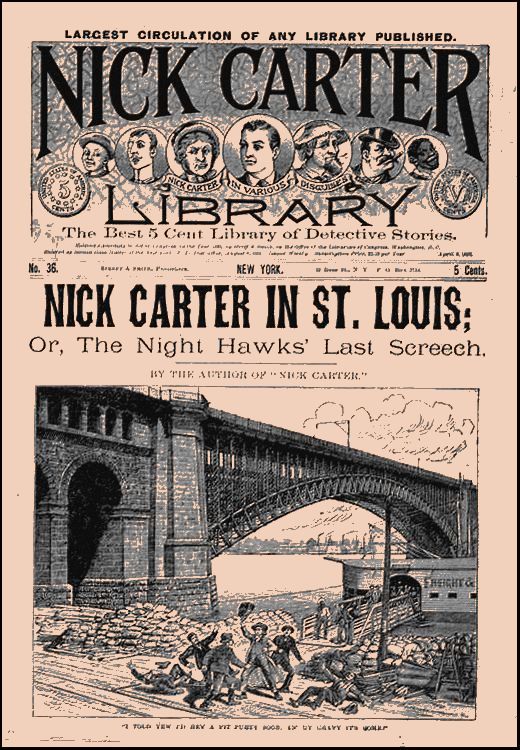
He had been thinking so deeply that he failed to notice what streets he had traversed, until before him he saw the mason work of a great stone bridge, which spanned the Mississippi.
The time was late in the afternoon, although the sun had not yet set.
He paused a moment, and then, noticing that a barge was drawn up at the water's edge, almost beneath the great bridge, his love of adventure got the better of him, and, perceiving a second-hand clothing-store close by, he went in and quickly made a few purchases of things which he needed to complete the disguise that he contemplated.
It was none other than his famous Thunderbolt get-up, and, as he had come out without the paraphernalia that make-up, he was obliged to supply it in this way.
He found all that he needed there: the checkered pants, the long-tailed coat, and the ancient carpet-bag.
The other necessaries he had about him, and having gotten himself up to his satisfaction, he again drew near to the river, where the barge was awaiting its complement of freight and passengers.
There were any quantity of roughs standing around, as there always are at the water's edge, and the strange-looking countryman was no sooner among them than they began to guy him unmercifully.
Nick paid no attention.
He walked calmly on toward the gang-plank of the barge which was stretched to the shore, his keen eyes closely observing everything without seeming to do so.
Nick had not taken a dozen steps after reaching the vicinity of the gang, before he saw a face that he recognized.
It was Toney Delaney, a rough and all-around crook, who was badly wanted in New York by Inspector Byrnes' men, for several different matters with which he had been connected.
Toney had disappeared suddenly and mysteriously, and it was generally believed that he had been killed by one of his companions in crime.
A body had been washed up at Jewel's Wharf in Brooklyn, and although almost unrecognizable, a police sergeant had identified it as Toney's.
That the policeman was mistaken was now apparent.
Nick recognized Toney the moment he saw him, and he knew at once that if there was any organized gang of crooks in Toney's locality, he would be in it.
Ergo, Toney was a Night Hawk.
As Nick drew nearer to the barge, one of the roughs stepped up to him and attempted to seize his carpet-bag.
"Smash yer baggage, uncle?" he said, with a leer.
"Hey?" demanded Nick, staring at the fellow with an expression of innocent surprise. "Smash my baggage? Wal, I guess not, sonny. Say, do I look like a tarnal fool, hey?"
"Well, s'posen I smash yer jaw then; how'd yer like that?"
As the rough spoke, he stepped deliberately in front of Nick with that impudent air which has to be seen to be appreciated.
Nick paused.
He squared himself upon his feet, and coolly surveyed the ruffian from top to toe.
Then, with a grin, he drawled:
"Say, sonny, yew'd hev ter grow some, afore yew done that; hey?"
Three or four others had gathered around and were observing all that was taking place, and a general laugh went up when the strange looking countryman so adroitly turned the joke, if joke there was upon their companion.
"Have ter grow some, would I?" yelled the bully, in a rage.
"Wal, yaas; a leetle: a foot 'r so, say!"
"Say, moss-back, d'ye think I couldn't do yew up in about a minute?"
"No."
"Oh, ye don't, eh?"
"No; I know yew can't."
Again there was a general laugh.
The bully felt cheap, because he was being made a laughing stock by an old man.
But he felt that he must do something to retrieve his reputation, and he made a quick grab at the carpet-bag.
His motion was so quick that he almost succeeded in snatching it away.
"Gi' me that reticule," he exclaimed, savagely.
"Take this instead," replied Nick. As he spoke, his other arm shot out, and his clenched fist struck the bully squarely on the end of his nose.
The force of the blow was terrific, as Nick's blows always were.
The bully went down as though he had been struck by a sledge-hammer.
It seemed to be the signal for a general attack upon the countryman.
Three more of the roughs leaped forward, but only to be warned off by the strange old man, who seemed so well able to take care of himself.
"By the great horn-spoon," he cried, "ef yew don't keep off, I'll lay yew all out, so I will."
"Knock him down."
"Crack his pate."
"Make mince-meat of him."
"Kill him."
These are samples of the yells that were given in reply.
"Look out, boyees," said Nick, coolly. "I'm Joshua Juniper, an' I hev fits sometimes. One's a-comin' on now; run, 'r yew'll git hurt."
What he said only angered them the more.
They leaped forward, and the next instant were all making a maddened attempt to pounce upon the old man and crush him.
But Nick was not to be so easily crushed.
He let himself loose, then.
For just one instant he dropped his carpet-bag, while his arms worked like the connecting rods on the drive wheels of a locomotive.
Biff—biff—biff.
Three of the bullies went down like grass before a scythe.
Nick stooped and picked up his carpet-bag again.
"I told you I hed fits," he cried, "an' by gravy, I've got one now. Look out there, Hezekiah! Stand aside Jeremiah! Whoop! bang! biff! boom! ah-h-h-h-!"
While he spoke, he laid about him right and left with the carpet-bag, and more than one of the toughs found that it was unusually heavy for such an object.
One fellow caught it squarely in the face, and he staggered back with a loud cry of rage.
By that time a huge crowd had gathered around the scene of the conflict.
The toughs were greatly reinforced, and Nick saw that he would have to hurt somebody very seriously in order to get away without being pretty roughly handled, unless he did something decisive at once.
Those whom he had knocked down were picking themselves up, and the crowd was preparing to make a rush.
An old dray stood near by, and Nick leaped upon it.
Then, with a quick motion, he drew two revolvers and aimed them at the crowd.
In an instant he dropped the nasal tones, and the drawl which were identified with his countryman character.
"Stand back!" he cried, "or somebody will get hurt. I mean business, now."
They paused instantly.
"A fly cop," somebody exclaimed.
Several turned and hurried away, and although dark scowls of rage were directed at Nick, they all knew that he had the law upon his side, and no one continued the attack.
Nick saw that the row was over.
He had kept an eye on Toney Delaney during the melee, and saw that he took no part in it.
Toney still stood where he had been when the row began, and, after a while, when the excitement had quieted down, Nick went toward him.
When quite close, he paused and looked the crook in the eyes.
"Hello, Toney!" he said, in a low tone.
The fellow started as though a bee had stung him.
"Who 'r you talking to?" demanded Delaney, gruffly.
"You."
"What did you call me?"
"Toney."
"Well, that ain't my name."
"Oh, yes, it is!"
"I tell you it ain't. I never heard of Toney De—"
"Go on; don't stop; you've g'ven it away now, Toney Delaney, and there is no use trying to deceive me. I knew you at once."
"Curse you! Who are you?"
"Can't you guess?"
"Yes, a fly cop; but who?"
"DO you really think that I am a detective?" asked Nick, with a smile.
"I know it."
"Suppose I say that I have a warrant for your arrest, Toney."
"I'll tell you that you darsent serve it."
"Why?"
"Because with one cry, I could bring that whole gang back here; and cop or no cop, they'd murder you here and now, if I said the word."
Nick's eyes gleamed strangely.
Toney's last remark told him something of great value; but all he said was:
"Pshaw!"
Toney turned upon him like a flash.
"Don't you believe me?" he said.
"No."
"Have you got a warrant? If you have, serve it. I'll prove mighty quick, whether I speak the truth or not," and the fellow looked boldly into the detective's eyes, as he defied him.
"Do you mean to say that you could call those fellows to your aid with one shout?" asked Nick, incredulously.
"Yes, I do?"
"How?"
"That's telling."
"Bah! Toney, I'm no fool. You couldn't do that, unless—unless—"
"Well, unless what?"
"Unless you had a regular gang, and you were the chief, or something like that."
"There can be a gang, can't there without my being the chief? Who are you, anyhow, and what are you pumping me for?"
"Toney Delaney—"
"That ain't my name."
"Don't lie, Toney. Did you ever hear of Inspector Byrnes?"
Toney shivered.
"That was a very nice trick that you played on him, Toney. It was a real case of giving the fellow that looked like you, particular fits, wasn't it?"
"Aw, what are you giving me?"
"Facts, Toney—cold, hard facts. The inspector wants to see you; he is pining for your company. He has sent you a special invitation to visit him, and I am the messenger who is to escort you back."
"Do you mean—"
"I mean that you are my prisoner, Toney," said Nick, coolly.
Toney raised one arm. He seemed to be about to cry out, but a sharp word from the detective made him hesitate.
"Be careful, Toney," said Nick, coldly. "If you utter that shout that you were talking about, I'll bore you, sure. I mean it, Toney."
The crook looked down.
Nick was standing with his back to the others, so that they could not see that he held a revolver in his hand.
But Toney saw it.
He saw, moreover, that it was pointing directly at his heart, and he recognized in the voice of the detective that peculiar tone which invariably carries conviction with it.
"I mean it, Toney," repeated Nick; "don't you believe me?"
"Yes, curse you!"
"Curse away! It won't do you any good."
"What are you going to do now?"
"Take you to New York."
"What for?"
"Lots of things. Principally for the murder of the fellow that looked like you."
Toney turned pale.
"How did Byrnes trace that to me?" he gasped.
"He didn't, Toney?"
"Who did, then?"
"I did."
"And Byrnes sent you here to arrest me for it, did he?"
"No."
"Then what—"
"For various other things. I haven't told him yet that you did that little act."
"Then he don't know it."
"No."
"Who does?"
"I do."
"Who else?"
"Nobody."
"Do you mean—"
"Wait, Toney. There's an old Jew who keeps a clothing-store up the street a little ways. Come there with me, and we can talk."
"I'm cussed if I will."
With his disengaged hand, but still keeping the revolver pointed at his man with the other, Nick drew a pair of handcuffs from his pocket, and held them where Toney could see them.
"Take your choice, Toney," he said. "Which shall it be? the clothing-store, or—"
"I'll go."
"One more word before we start."
"Well, what?"
"You don't know who I am, do you?"
"No."
"You may try to play some trick on me in order to escape."
"Well?"
"If you do, I either recapture you and take you to New York on the charge of murder, or I will kill you."
"You have said that already."
"I want you to know that I mean what I say. Toney, did you ever hear of Nick Carter?"
Like a flash the crook turned.
"What of him?" he demanded.
"Only that I happen to be Nick Carter."
"You're a liar!" fiercely.
"Am I?"
"I don't believe you."
"Will you go with me?"
"Yes," sullenly.
"Then come on."
Nick conducted his man back to the very place where he had purchased a part of the disguise that he then wore.
A little ready cash easily procured them the use of the back room, and, after relieving the burglar of his weapons, Nick pointed to a chair, and said:
"Sit down, Toney."
"Well?"
"Do you want me to take you to New York?"
"Am I a fool?"
"I hope not; but answer."
"You know I don't."
"Right. If I should say to you, 'Toney, there's the door; skip!' you would be very grateful, wouldn't you?"
"Try me."
"I will, if you accept my terms."
"Do you mean that you will let me go?"
"Yes, on conditions."
"And that you won't try to rearrest me?"
"Yes, on conditions."
"And that you won't tell Byrnes about—about that other matter?"
"Exactly that."
"What are your conditions."
"Easy ones, Toney."
"Well, what are they?"
Nick leaned well forward, and then in a low tone, he said:
"You're a Night Hawk, Toney. You were one in the old days in Philadelphia, and you are one now. If you will answer every question that I will ask, no matter what, you can walk out of this place a free man, and I promise you that you shall have seventy-two hours in which to skip."
Toney's face darkened.
"What if I refuse?" he said.
"Then you go to see Byrnes."
"But I darsent give the Night Hawks away."
"Why not?"
"I might as well go East with you."
"You think they would kill you?"
"I know it."
"Bah!"
"Four fellows who didn't mean to peach, got full a month ago. They talked a little too much, and they're on their way to the gulf, now."
"Floating in the river, eh?"
"Yes."
"All the same, I can't let up, Toney. Do as I say, or East you go."
Toney thought deeply for several moments.
Suddenly he looked up.
"Say," he said.
"Well?"
"Is that straight about your being Nick Carter?"
"Yes."
"And do you mean it when you say that you'll stand my friend?"
"Did I say so?"
"I mean that you won 't give me away for anything that's past and gone."
"Yes, I mean it."
"No matter where I am?"
"No matter where you are—that is, unless you do something to spoil every point you give me."
"Is that a bargain?"
"Yes."
"Will you shake on it?"
"Yes."
"Say, Nick Carter, if you'll do as you say; if you'll take a little advice from me, I'll stand by you in this thing. I've got an ax to grind, and I don't mind doing it now; but I've got to do it mighty carefully, see?"
"Yes."
"If I can stay in the city without fear of arrest, and keep seeing the boys, they'll never suspect that I'm giving 'em away: see?"
"Yes."
"On the other hand, if I flitted and you jumped on their necks in the next act, they'd know in a holy minute who'd made a sucker of "em, wouldn't they?"
"Yes."
"Now, 'tain't safe for me to meet you and talk with you anywhere, and if you'll agree to my staying in St. Louis, and if you'll get a gin-mill, or a pawnbroker's shop or some place where I can go and see you, I'll throw the hull game into your hands in less than a week. If you wont do that—well, you'll have to take me to Byrnes."
"I'll do it, Toney."
"Then it's a bargain."
"Yes; but no shenanegan, Toney."
"Narry."
"If you try that, you'll be the one to suffer."
"I won't try it. I know on which side my bread's buttered. You fix me and I'll fix you."
"All right. Now, are you ready to talk?"
"Yes."
"How many members of the Night Hawks are there in the whole city?"
"Here and in East St. Louis over three hundred."
"Who is the boss?"
"A fellow named Magley."
"What's his first name?"
"Byron."
"Is he known to all the members?"
"Oh, no!"
"To how many?"
"Only the members of the third flight."
"Humph! The first flight is the rag-tag and bob-tail, isn't it!"
"Yes."
"The second, one degree higher, and the third, what is that?"
"There are only about twenty members in that degree, and there is where all the plots are laid out."
NICK CARTER'S luck was always in the ascendancy.
Had it not been for the fact that he wished to have a little fun with the hoodlums, and had instead gone to the river where the barge was lying, he would not have seen and recognized Toney Delaney.
The accusation that he made against Toney regarding the murder of the man that looked like him in New York was pure guess work, but it was based upon a thorough knowledge of the fellow's character, and the likelihood of his doing just such a thing, in order to escape the meshes of the law himself.
Having found Toney, and having drawn from him the information that he was a Night Hawk, Nick foresaw that the remainder of his work would be comparatively easy, for he would not have to use up valuable time in running the gang down.
The preliminary work was practically done in the finding of Toney Delaney.
"From what you have said," continued Nick, "I gather that the organization of Night Hawks is on very much the same plan as that that was formerly in existence in Philadelphia."
"Yes; it is."
"You were a member of that, Toney?"
"Yes."
"Who organized this gang?"
"I did."
"Then how does it happen that you are not the chief of the thing?"
"That is the little ax that I want to grind."
"Ah!"
"I organized the concern and got it well on foot; then Magley stepped in and ousted me. He runs things now, and I am only a super for the crowd."
"How is that?"
"Magley is a devil. He has got the gang in this town thoroughly under his thumb. I was a comparative stranger. The members of the Feathered Nest got me foul one night and I had to resign in Magley's favor, or float."
"Float?"
"Yes; down the river, back up; you know."
"Ah! How many of these fledglings are there in the Feathered Nest?"
"Five."
"You are one?"
"Yes."
"Who are the others?"
"Magley, Freeman, O'Brien, and Quigley."
"Who is Freeman?"
"Magley's right-hand man; a youngster and a fool, but smart, and a villain with all that."
"He is the fellow who murdered his uncle, isn't he?"
"How did you know that?"
"Never mind; I do know it. Did you get a slice of that boodle, Toney?"
"Not a cent."
"Who did get it?"
"Magley, Freeman, and Quigley."
"Was Quigley the doctor?"
"Yes; but how—"
"Never mind how I know so much, Toney. Is he a genuine doctor?"
"Yes; and a good one, too."
"Does he practice?"
"Yes."
"Where?"
"On Pine street, near Garrison."
"Good! I'll call upon him. Now, one word about O'Brien; is he the same fellow who keeps the dive in Warren street, in Kerry Patch?"
"Yes."
"Now, what does Magley do for a living?"
"Nothing."
"Ostensibly, I mean."
"Nothing."
"Where does he live?"
"At the Planters."
"A gentleman of leisure, eh?"
"Exactly."
"Where do the members of the Feathered Nest meet?"
"At the house of Dr. Quigley."
"Good! When?"
"Every Saturday night."
"At what time?"
"About nine. They pass as a whist party."
"I see. How about the Third Flight; where do the members of that meet?"
"In Leonard street, near Locust."
"In the basement?"
"Well, by thunder! What's the use of questioning me, if you know all about the concern already?"
"I don't, Toney; you are giving me the points that I don't know."
"I'm glad there is something that you don't know."
"Who lives up stairs in the house, Toney?"
"I don't know."
"Who is at the head of the Third Flight?"
"I am."
"When do you meet?"
"On call."
"When do you have another meeting?"
"There is no time fixed."
"Who controls the fixing of the time?"
"Magley."
"Now, Toney, when did you have your last meeting?"
"Night before last."
"Were you there?"
"Yes."
"There was a copy of a letter that I wrote to the chief of police read at that meeting, Toney."
The crook leaped to his feet in perfect amazement. His eyes dilated, and his face grew a shade paler, as he exclaimed:
"I believe you are Satan in disguise."
"Perhaps I am, Toney. Am I right about the letter?"
"You know you are."
"I was condemned to die, wasn't I?"
"Yes; but how—"
"Never mind that, Toney. What I want to know, is how did your people get a copy of that letter?"
"I don't know."
"Be careful, Toney."
"I don't know, I tell you. We've got spies in the department, but Magley is the only one who knows who they are."
"He knew that I was sent for, didn't he?"
"Yes."
"And knew when the answer came."
"Yes."
"But you don't know where he got the information?"
"No."
"How do you manage to meet in the house in Leonard street without attracting unpleasant attention?"
"We pass as a literary club."
"Good! Now, where do the first and second flights meet?"
"At O'Brien's."
"When?"
"Any night; every night. They have no regular meeting time. O'Brien controls them, and they only go there for orders."
"You're sick of the whole thing, aren't you, Toney?"
"You bet I am."
"Does Magley pass under his own name at the hotel?"
"No."
"What name does he use?"
"Sturtevant—Max Sturtevant."
"Describe him."
"He is tall, over six feet; broad-shouldered, deep-chested, as strong as an ox, and as handsome as a Greek god."
"I will find him. By the way, does he always look the same?"
"Oh, no! Only we four who are in the Feathered Nest know him as Sturtevant. At the hotel, he is a blonde, with just a mustache; at the meetings, he is very dark, with a pointed beard, and looks more like an Italian than an American."
"What does Freeman do?"
"He lives there at the hotel, too, I think, but I never tumbled to how he did it. Magley disguises him somehow, and—"
"Never mind; I'll find him also."
While they were talking, darkness had fallen.
Nick arose.
"Now, Toney, I'm going to keep my compact with you to the letter, provided you keep your word with me."
"I'll do it, Nick Carter."
"I believe you will, Toney. You can go now, but I want you to meet me at O'Brien's at midnight."
"It won't do for us to talk there."
"We won't talk much. Do you know a Jew named Steinheart?"
"The fence?"
"Yes."
"You bet!"
"I'm going to buy Stein's business for a while, and run it myself. Can you steer our friends there from time to time?"
"No need! They go there, now."
"Even Magley, Freeman, O'Brien, and Quigley "
"No, never."
"Well, we'll try. Meet me at O'Brien's at midnight, and, if everything is O. K., I will let you know."
"How?"
"I'll find a way. You can skip, now."
"I'm off."
Nick waited nearly half an hour after Toney was gone before he left the place.
Then he hurried straight to the old clothes dealer to whom he had referred, and who was very generally believed to keep a "fence," although proof against him had never been obtained.
It was a little more than an hour after dark when he reached the place, and he walked boldly in.
Steinheart was alone, and he was about as villainous in his appearance as a man can be.
"Vell?" he said, rising suddenly when Nick entered; "vot you vant, hey?"
"I want to talk with you," said Nick, coolly turning the key in the door and pulling down the curtain.
"Py jimminy gracious! vot for you do dat, hey? Vas you drunk, mein friend? Did you s'pose dot you lif here already? Do you tink you vas own de hull tam city, bimeby, already, purty soon? Say, git oud, or I vas hurt you, see dot?"
He attempted to draw a weapon from his pocket as he spoke, but Nick leaped forward, and the next instant the Jew was disarmed and sitting again in the chair from which he had risen.
There was a mingled expression of rage and fear on his face, as he eyed Nick, askance.
"Sit there, Stein, while we talk," said Nick, coolly, as he pushed the clothes-dealer into the chair.
"Vell, I vas sit; now, vot you vant, hey?"
"Your business."
"Hey? Vot's dot? mein peesness!"
"Yes."
"I don'd vas sell him."
"I don't want to buy. I am going to take it."
"To take it! To take my peesness avay from me? Fader Abraham! No—no! Vould you rob me already?"
"Stein, I'm real sorry for you, but I've got to do it. I'll give it all back to you in a few days, Stein, but I'm going to take it for a while."
The cool assurance of the intruder exasperated the Jew beyond the bounds of endurance.
He forgot the gigantic strength of the man before him, as with a cry of rage at the prospect of losing his property, he leaped to his feet and threw himself upon the detective.
THE struggle that followed, although fierce, was short.
As the Jew sprang upon the detective, he also drew a knife, but Nick was too quick for him.
He seized the clothes-dealer's wrist, gave it an ugly twist and the knife clattered to the floor.
Then, although the Jew fought with the fury of a cat, biting and scratching, Nick quickly forced him back into the chair, and snapped handcuffs upon his ankles and wrists.
Then he held up a gag, and said, meaningly:
"Stein, if you utter a sound, I shall have to use this."
"Vot's dot?"
"A gag."
"Say, vot you goin' to do, hey?"
"Borrow your business."
"Vas you gif him pack, pimeby?"
"Yes."
"De hull of him?"
"Yes, and if you will do exactly as I say, you will not lose a cent."
"But I lose de profit, don'd it?"
"Which would you rather lose? that or your liberty?"
"Vell, dot vas a hard ke-vestion to answer. I vas stick py de liberty, I guess."
"Sensible man."
Time was precious to Nick, and he therefore did not lose any more in arguing with the Jew.
He went to work at once carrying out his plan, and the result was, that an hour later he left the place, and so thoroughly made up was he to represent the old Jew, whose business he had "borrowed," that it is doubtful if Steinheart's relatives, if he had any, would have known the difference.
As for the Jew himself, Nick had placed him where he could not escape until the detective chose to set him free.
Having prepared everything for the furtherance of his plans, Nick, in the character of the old Jew, took his way at once to O'Brien's place, arriving soon after eleven.
There was the usual motley assortment of people there, and more than one looked up in perfect astonishment when they saw the old clothes-dealer enter the place, for it was not at all his habit to visit O'Brien's.
Toney Delaney was seated in one corner when Nick entered, and he went straight to the crook, and stuck out his hand.
"Wie geht's?" he said. "How you vas, Toney, already, hey?"
"I'm all right," responded Toney, curtly, for he did not like the sudden and unexpected appearance of the Jew, after what Nick had said to him. He was afraid that the detective's plans had miscarried, and, if so, he knew that his "jig was up."
"Toney, mein frient, a vord mit you."
"With me?"
"Yah; dot vas it."
"What for?"
"Wur instance, Toney. You vas my dear friend. You vas porrow dot feefty tollars off me already, und you vas forgit de vay to mein shop since dot."
"You're a liar, Stein."
"Vait, vait; don'd you vas git your base off bimeby, Toney."
"I don't owe you anything?"
"Well, I talk mit you about dot," and then before the astonished Toney could object, Nick caught him by the sleeve and drew him aside, much to the amusement of those who had witnessed the encounter.
"I vas had a call," whispered the supposed Jew, mysteriously.
"What the dev—"
"De man vot saw you dis afternoon vas call on me."
"What, Ni—"
"Sh-h! Not so loud, mein frient. Yes, he vas call."
"Well, he's an infernal ass to trust an old thief like you, that's all I've got to say," grumbled Toney.
"Dot's righd, Toney; he didn't."
"Eh?"
"Toney," in a low whisper, "I am Nick Carter. Do you think the disguise is good?"
"Well—I'm—blowed!" was all that Toney could say.
"Yes? Now, point out the men you see here who are Night Hawks."
"Every blessed one of them except that fellow who's talking with O'Brien."
"Who is he?"
"O'Brien suspects that he's a cop."
"Does, eh?"
"Yes. Say, is he a friend of yours?"
"Why?"
"Because if he is, I can save him. They have laid a scheme to do him up on suspicion. He was fool enough to show a lot of money, and the fellows can get that, anyhow."
"How will you save him?"
"Find a chance to warn him."
"Let me do that. You watch me."
Nick left Toney, and went at once to the place where O'Brien and Chick (for it was he), were talking together.
He spoke to the proprietor, and then, with the remark that he came here so seldom that he thought he had better treat, he ordered drinks for them all.
O'Brien turned to give the order, and, as he did so, Nick drew a lead pencil from his pocket, and taking the middle of it between the thumb and finger of his left hand, he seized one end with the other hand, and began tapping vigorously upon the table.
All the time he was gazing from point to point about the room, and giving himself the appearance of using the lead pencil in that manner, simply as the result of preoccupation.
As a matter of fact, he was telegraphing, and the tapping of the pencil was dots, dashes, and as intelligible to Chick as spoken words.
Here is what he wrote:
Translated, it read:
"Get away from here as soon as possible; go to Steinheart's; wait for me there."
Chick made no sign that he understood, but, as soon as the drinks were taken, he rose, and started for the door.
But he was not to get away so easily.
O'Brien, for some reason, strongly suspected that he was a detective, and the word had gone out that he must not be allowed to leave.
Therefore, when he approached the door, a burly fellow stepped in front of him and barred his progress.
'Where yer goin'?" he demanded, gruffly.
"None o' yer biz," retorted Chick.
"'Tain't, hey?"
"No."
"Yer sassy, ain't yer?"
"You're another."
"Are ye lookin' fur fight?"
"No, you are."
"Yer a liar."
"You're another."
The bully leaped forward as Chick spoke, and swung a savage blow at the young detective's head.
But Chick was ready for it.
He instantly ducked his head, and dodged the blow.
Then, instead of striking back, he seized the fellow by his legs and toppled him over upon his head and shoulders so quickly that he struck the floor before he knew what had happened.
Others rushed forward to take part in the row, but Chick was equal to that emergency also.
He seized the foremost man, who was not as heavy as the others, and, picking him up as though he were a child, he flung him with all his strength straight at the approaching crowd.
Four of them were thrown off their feet.
The others were for an instant demoralized.
That instant was enough.
Chick sprang to the door, knocked down another fellow who tried to stop him, opened the door, and leaped into the street.
A dozen rushed after him.
They gained the sidewalk and there they paused, looking up and down.
An old man was hobbling slowly along, not far away, but none of them ever thought that the long, white hair, and grizzled beard concealed the features of the very person they sought.
Discomfited, they returned to the saloon.
Steinheart was talking excitedly to O'Brien.
"Vot lot off shackasses!" he exclaimed, wildly. "Vot for you let dot feller get avay, hey? You vas no goot, already. I lighd oud now. Purty soon dot feller gome pack und clean oud de place, meppy."
He hobbled toward the door, and was about passing out when Toney rushed up to him.
"Here!" he cried; "you forgot my change, Stein."
"Yah! dot ish so. I tole you vot, Toney. You vas owe me feefty for von veek ain'd it?"
"Yes."
"Goot! Den I vas owe you ten for von tay, see? You vas gome to my place to-morrow. und I gif you dot ten, see?"
"Give it to me, now."
"I gif it to you, then, see?"
Toney grumbled, but drew back, and the pseudo Jew passed out of the place, and was gone.
An hour later, he was in the store owned by the real Steinheart, and Chick sat opposite him.
Both were busily smoking and talking.
"Now, Chick," said the detective, "in forty-eight hours more, I'll have the members of this gang in limbo, if all goes well."
"I believe it."
"You're to play this part, and I'll do the outside work."
"Correct."
"We'll make the change, now."
Chick at once donned the toggery of the old Jew, and then Nick, with a few deft touches, made his assistant's face up to suit him.
That being done, the Little Giant proceeded to array himself in the disguise that he had selected.
It was one o'clock in the morning when he left the "fence," and his dress was that of a fast man-about-town who played the races, gambled, and lived on his wits.
Dressed in the height of fashion, but flashily displaying diamonds, and wearing his hat well on one side of his head, he looked the part to perfection.
His course lay directly to the office of the Globe-Democrat.
There he inserted the following advertisement in one of its columns.
"Black versus White. To-day. Same hour. Same place. Important. Come straight to room."
The plot was thickening.
HAVING inserted the advertisement, Nick went at once to the hotel and succeeded in getting the same room.
Then he rang for a messenger-boy.
"Do you know where the chief of police lives, sonny?" he asked, when the boy appeared.
"Yes, sir."
"Here is a five-dollar bill."
"Yes, sir."
"Go to the chief's house, ring the bell, see him personally, and say that the gentleman whom he saw yesterday is at the same hotel in the same room till noon to-day. Can you do that?"
"Yes, sir."
"Then do it, and keep the money for your trouble."
"Yes, sir; thank you."
"Skip!"
"I'm off like a shot."
"When the boy was gone, Nick turned in and slept soundly until the sun woke him.
He dressed, ate his breakfast, and returned to his room.
At nine o'clock somebody rapped on the door, and the chief entered.
His face was pale, and he looked disturbed.
"What's up?" asked Nick.
"I'm thunderstruck by the narrow escape you've had, and—"
"What do you mean?"
"Nick, I feel like a murderer."
"Eh? Will you explain?"
"The two men who personated you and your assistant—"
"Ah! What of them?"
"They are both dead."
"What!"
"Murdered in their beds."
"Great heavens!"
"It is true."
"When?"
"They were found this morning."
"In the room that Chick and I were supposed to occupy?"
"Yes."
"This is awful!"
"It is."
"If I had supposed—"
"Say nothing, Nick. It is done and can't be undone. They were good men, and they have fallen victims to the dangers of their profession."
"Chief, I will know, before you are twenty-four hours older, who did those crimes, and I'll deliver the murderer or murderers into your hands before forty-eight hours have gone by, or I will—"
"Will what?"
"Or I will quit the detective business forever. The villains think that they have killed me."
"Yes, and Chick."
"How were the men killed?"
"They were stabbed."
"During the night, eh?"
"Yes."
"Do you know how the murderers got at them?"
"They injected chloroform through the keyhole into the room where they were sleeping. We found the syringe and the empty can."
"Ah!"
"They used just enough to make the poor fellows sleep soundly, and then finished their work."
"I'll finish them."
"I hope you will, Nick."
"I will, chief; I will."
"Now, tell me what you know."
"Wait; you shall hear it for yourself from another source."
"How?"
"Hark! somebody is coming. Get into that closet—here, take your hat—and listen. Quick, now!"
The chief disappeared in the closet, just as another tap came upon the door.
Nick threw it open, and there stood the same mysterious woman whom Nick knew as Madame Black.
"Come in," he said, cheerfully, and the strange being who had warned him against the machinations of the Night Hawks, entered the room.
She, of course, had no idea that the chief of police was concealed in the closet, and when Nick motioned to her to take a seat, she complied without a word.
"You sent for me," she said.
"Yes."
"Well, I have come."
"Do you remember our compact?"
"Perfectly."
"I was not to follow you, or to cause you to be followed."
"Yes."
"I was in no wise to endeavor to learn who you were, or anything concerning you."
"That is true."
"Very well; I kept my word."
"I hope you did."
"I did, upon my honor."
"Then why mention the subject?"
"Because things have happened since then which tell me the name of the man you hate, your own name, and the secret of your knowledge concerning the Night Hawks."
The woman started from her chair in great alarm.
"What do you mean?" she gasped.
"Sit down, Miss Eaton," replied Nick, calmly.
"Sir!" she cried, excitedly; "you have broken your pledge."
"I have not."
"Then how do you know that I am Pauline Eaton?"
"Simply through circumstances."
"I do not believe you."
Nick shrugged his shoulders.
"I cannot avoid that," he said. "The fact remains the same."
"You did not keep your word."
"I did."
"Then how—"
"Could I have told that you were Pauline Eaton had I followed you?" asked Nick.
"No."
"Are you not now living under an assumed name?"
"Yes."
"Then the fact that I know what your right name is, should convince you."
"Go on, sir."
"You are Miss Eaton?"
"Yes."
"And the man you hate is named Magley "
"That is one of his names.'
"Do you know his other name?"
"Not the one he uses now."
"But you knew him by another name?"
"Yes."
"What was that?"
"Price."
"Where did you so know him?"
"In Chicago."
"How long ago?"
"A year or more."
"You do not know the other name that he bears in this city, and where he lives?"
"No."
"If I will tell you, will you be frank with me?"
"Yes."
"He is known as Max Sturtevant, and he lives—"
"At the Planters'?"
"Yes."
"I thank you, sir."
"Now, will you answer some questions for me?"
"Anything, sir."
"Mind, I haven't spied upon you at all."
"Yes, sir."
"Do you live in Leonard street?"
"Yes."
"Near Locust?"
"Yes."
"On what floor?"
"The top floor."
"Your enemies meet in the basement, do they not?"
"Yes."
"They do not know of your existence?"
"No."
"How do you manage to overhear them?"
"The house was once a club house."
"Well?"
"There is an old speaking-tube which communicates between the room that I occupy on the top floor, and the one in which the Third Flight of Night Hawks hold their meetings."
"How did you discover the fact?"
"By accident."
"Tell me about it."
"You probably know part of my history."
"Yes."
"But not all."
"No."
"I ran away from home because my father tried to compel me to marry a man whom I did not love."
"Well?"
"I have supported myself ever since. I spent some time in Chicago, but I grew so homesick that I returned here."
"Go on, please."
"I found rooms in the Leonard-street house.
"For many nights I heard the murmur of masculine voices.
"At first they frightened me. Then I began to look for the cause, and I finally traced it to the mouth of an old speaking-tube."
"And you listened?"
"Naturally."
"Well?"
"Almost the first thing that I heard was the voice of the only person in the world whom I thoroughly hated."
"Magley's."
"Yes."
"Did you also hear the voice of your cousin, James Freeman?"
"I see you know more than I thought. Yes; I heard his voice twice."
"Well?"
"Then I took to listening on all occasions."
"Yes."
"I found that the men who met there were the ringleaders of a giant conspiracy."
"And that they called themselves Night Hawks."
"Yes."
"What next?"
"I never lost an opportunity of hearing all that I could."
"Certainly not."
"I found out that he whom you call Magley was the chief factor in the conspiracy, and that the gang had many resources.
"I learned many of their plots, and was often enabled to warn different people of their intentions.
"I believe that I have saved many lives and much property in that way."
"I do not doubt it."
"It was thus that I heard of the plot against you, and that is why I came to warn you."
"Miss Eaton, do you know that your father is dead?"
"Yes."
"To you know who killed him?"
"Yes."
"Who?"
"Byron Magley."
"No, James Freeman."
"Bah! My cousin was the machine, and Magley, the hand that directed it."
"Ah!"
"They shall both suffer."
"Yes; they shall."
"Not in your way, sir, but in mine; I am only a woman, but I have been wronged, and I shall not wait for the law to avenge me."
"What will you do?"
"You shall see."
"What do you mean?"
"Listen, sir. I was a pure young girl, happy in my father's home. This man Magley, masquerading under another name, came into my life. He taught me to love him; he persuaded me to fly with him, and become his wife. I did so.
"A month later, he grew tired of me, and when I tried to cling to him, he laughed in my face, and told me mockingly that the man who had married us was one of his friends who had played the part of a minister to ruin me.
"I became crazy, then.
"We were in Chicago, and my supposed husband basely deserted me, leaving me without a penny to pay for food or lodging.
"My love turned to hate and it gained in intensity ten-fold. Do you wonder at it?"
"No."
"I swore vengeance."
"I do not blame you."
"As a seamstress I earned money enough to return to this city, for something told me that I would find him here—and I did."
"By accident?"
"Yes, by accident. I looked through the columns of the papers to find a place to live, and then, for no particular reason, I hired the room in Leonard street.
"Next came the voices through the speaking-tube, and among them I recognized his voice.
"I fell upon my knees, and thanked God for bringing him into my power.
"I knew that at any moment I could go out and betray him to the police. He was as entirely in my power as though he were already behind bolts and bars in prison."
"True."
"But I waited. The time was not yet ripe.
"It has come now, however, and I know what to do. My vengeance is at hand, and I will take it; an eye for an eye; a tooth for a tooth."
FOR a moment Nick was silent.
Then he said:
"Miss Eaton, when you knew Magley, was he light or dark?"
"Dark."
"Are his eyes dark?"
"Yes."
"How did he wear his beard?"
"A mustache and imperial."
"You were rich, then; or, at least, an heiress."
"Yes."
"He knew it, didn't he?"
"Yes."
"Then why did he deceive you by a false marriage, when he might have made you really his wife, and some day, doubtless, have enjoyed the fortune that you were bound to inherit?"
"The answer is very simple."
"What is it?"
"He already had a wife."
"Ah!"
"Devil, though he is; fearless as he is supposed to be, he is yet afraid of that woman; and well he may be."
"Do you know who she is?"
"I do."
"Ah, well; I have nothing to do with her. Now, do you know why I have sent for you to-day?"
"No."
"Simply to tell you what I already have said, and to add that I may come to your apartment at any time for the purpose of overhearing these men of whom we have spoken, at one of their secret meetings."
"You can come at any time, sir."
"What name do you go by there?"
"Campton."
"Very good; it may not be necessary for me to come; if it is, I will be there, and you will know me by my use of the word 'kismet.'"
"Very good, sir."
"Now, what do you intend to do?"
"Adhere to my plans."
"Will you tell me what they are?"
"No sir."
"Are you going home, now?"
"No."
"Where, then?"
"I prefer not to tell."
"But—"
"And your pledge still holds good; the fact that you know my true name does not release you from that."
"True."
"Good-day, sir."
"Good-day; I will see you again."
"When?"
"We shall want you as a witness, if for nothing else."
"Very good."
She bowed, and was gone.
"Well, chief, what do you think of all that?" asked Nick, when that gentleman stepped from the closet into the room again.
"It is most remarkable, Carter. Here you come to St. Louis, and do in a few hours what my men have failed to accomplish in months. It is wonderful."
"A great deal is due to luck, chief."
"How so?"
"Well, when I left you yesterday I was as much in the dark where to begin as you were."
"That's the funny part of it."
"I wandered down to the river, dressed as a countryman. I got into a row with some hoodlums, and among them recognized a crook who is badly wanted in New York.
"I collared him, and made him talk. The result was that he put me onto the whole Night Hawk snap."
"That isn't all; here's this girl."
"Well, you told me about the disappearance of Pauline Eaton. Just before you came yesterday, I had received a call from a woman who warned me against dangers that she said threatened me. I put two and two together and decided that she was Pauline Eaton."
"Humph!"
"Later, when I collared Toney, I made him tell me where the Third Flight of the Night Hawks roosted."
"Yes."
"Miss Eaton had told me that they did not know of her existence, by which she meant that they did not know she was near them."
"Well?"
"She had also told me that they met in a basement.
"I got that much from Toney, and then, when he told me that the basement where they met was in Leonard street, I knew that Pauline Eaton lived in the same house.
"I brought her here to-day, and you know the rest."
"What are you going to do, now?"
"First, I'm going to find out who killed those two men."
"How?"
"From Toney."
"Will he know?"
"Yes."
"Can you find him?"
"In an hour."
"Where?"
Nick smiled.
"Chief" he said, "I have gone into business."
"Into business?"
"Yes."
"Where?"
"Did you ever hear of old Steinheart?"
"Rather!"
"I'm running his 'fence.'"
"Good! but you do beat the Dutch."
"I've beaten that Dutchman, anyhow."
"Well, I suppose you want to be off."
"Yes."
"When will I see you?"
"You will do me a favor, if you will stick pretty close to your office for the next day or two. I may send for you at any moment."
"I'll be ready."
The chief went away, and Nick, after assuming the disguise of a "rounder," started out.
He went directly to Steinheart's place, and was much pleased to see Toney Delaney in the act of entering just ahead of him.
Chick was behind the counter, a perfect representation of the old Jew who ran the fence.
Nick walked in behind Toney, and, going up quietly, he put his hand suddenly on the fellow's shoulder, and said:
"I'm an officer, and you are my prisoner."
Quick as a flash, Toney wheeled, and had Nick been less agile, he must have received an ugly stab wound in the abdomen.
"Look out, Toney," he said, coolly, as he dodged the blow. "You'll hurt somebody with that thing yet if you use it in that careless fashion"
"Curse you! Who are you?" exclaimed Toney.
"Don't you know?"
"No."
"Why, I'm Nick Carter."
"Then who is that cuss there?" pointing at Chick.
"That's Nick Carter also."
"Correct!" said Chick, imitating Nick's voice.
Toney looked thoroughly puzzled.
"Well," he said finally. "You beat me, you do. I give in. As long as you're a detective—that is, you—no you—confound it! either of you—that is, I mean both of you, curse me, if I won't stay honest."
"Do you mean it, Toney?" asked Nick.
"Yes, I do."
"Stick to it, and I'll be your friend."
"I'll stick."
"Toney!"
"What?"
"Did you hear to-day that I had been killed?"
"Yes."
"Did you believe it?"
"I came here to find out if it was true."
"Are you satisfied?"
"Yes."
"Now, I want you to tell me who killed those two fellows.
"I'll do that."
"Well, who did it?"
"Quigley and Freeman."
"They did it themselves, eh?"
"Yes."
"Are you sure?"
"I know it."
"Good! Now, can you entice one or both of them here?"
"I'll try."
"When?"
"To-night."
"Good! At eleven?"
"Yes; or thereabouts."
"Right. Now, one more thing."
"Well?"
"When you get them here, make them talk."
"How?"
"About the murder."
"You mean make them confess?"
"Yes."
"Don't believe it can be done."
"Oh, yes, it can!"
"How?"
"Tell them that you don't believe that they laid me out. Say that you saw me to-day."
"I'll do it."
"That will make them talk."
"You bet!"
"How will you get them here?"
"Oh, I'lL fix that!"
"At eleven to-night, then."
"Yes."
"Correct, Toney. Now, you can light out."
"I'm off."
"Chick," said Nick as soon as Toney had taken his departure.
"Yes."
"Have you got sand enough to go to O'Brien's again to-night."
"Well, I should smile."
"Good! I will fix it so that you will have a lot of blue-coats with you."
"What for?"
"To pull the house."
"Ah!"
"Arrest the whole gang, but be sure, above all things, to collar O'Brien."
"I'll do it."
"Go to the chief at six. Tell him what I want done. Take plenty of men with you, and do the thing up brown."
"You bet!"
"We will get the First and Second Flights of the Night Hawks there, and all of the ringleaders but one, here."
"What about the Third Flight?"
Before Nick could answer, a bootblack rushed into the place, and, going up to the counter, demanded to know if Chick was Steinheart.
On being told that he was, he handed out a scrap of paper on which was written:
"Third Flight ordered to meet to-night at O'Brien's at midnight. Don't know what it means."
There was no name signed, but Nick knew that the information came from Toney.
"This is capital!" he exclaimed. "Will collar the whole crowd at one swoop—that is all but Magley; but we'll attend to him later; he'll keep, as Sturtevant."
Things were drawing to a much speedier climax than Nick had hoped, and he believed that before the sun rose again the third attempt to create an organized gang of criminals would be nipped in the bud, and the secret order of Night Hawks would be at an end.
When he took possession of Steinheart's place, he expected to be obliged to use it for many days, perhaps weeks, and now he saw the end of his work in St. Louis only a few hours ahead of him.
But there was one thing that puzzled him, and that was the covert meaning conveyed in the words of Pauline Eaton, when she took her departure from the hotel.
What did she intend to do?
Who could say?
THE hands of the clock over the counter in Steinheart's second-hand-clothing establishment were pointing at eleven.
Behind the counter stood the old Jew, or rather a man who apppeared to be the old Jew, but who was in reality Nick Carter.
If you, reader, could have stood beside him, behind the counter, and have peered beneath it, you would have seen three police officers in citizens' clothes crouching there, waiting.
The minutes ticked slowly away, and, at five past eleven, the door opened, and Toney Delaney entered.
"Hello, Stein!" he exclaimed.
"How you vas, Toney?" drawled the pseudo Jew.
"I'm expecting some friends."
"So?"
"Yes."
"Who dey vas, hey?"
"Doc and Jim."
"Ish dat so? Vot for dey coom here by my place already, hey?"
"To see me."
"Vot you tink, young feller, hey? Dot you make von loafin' place off dis shop, hey?"
"Oh, we just want to talk a little, and I don't want any back slack either, see?"
"Tink I vas plind, young man?"
"No. Here they come, now."
"Vell, let 'em coom."
The two men who were expected had been standing just outside the door during this short exchange of remarks—a fact of which the detective was perfectly well aware.
They entered, and Toney led them at once to the back room, which was separated from the store by curtains only.
"Shut up shop, Stein," ordered Toney, peremptorily.
"Vot fur, hey?"
"Cos I say so."
"Vot about my gustomers, hey?"
"Curse your customers!"
"Dere—dere, Toney, don'd you vas schvear so. Dot shocks me already, like tam! hey?"
Nick shut the outer door and locked it, while Toney, Quigley, and Freeman passed into the back room.
The curtains on the front windows were drawn, and when everything was secure, the supposed Jew joined the others in the back room.
"Now, mein friends, vot ish dis all aboud, bimeby, hey?" he inquired.
"Never you mind, Stein," replied Toney. "I'm running this show, I am."
Then he turned fiercely to Quigley.
"Why wasn't I told about that business last night?" he demanded.
"What business?"
"That stabbing affair."
"It wasn't necessary."
"Why wasn't it?"
"Because we knew where they were, and we laid them out."
"Yes: and a nice job you made of it."
"What was the matter with the job?"
"I'll tell you that when you tell me who did it."
"You know that already."
"Did you and Freeman do it?"
"Yes."
"And I suppose you think that you killed Nick Carter, don't you?"
"We know we did."
"Oh, you do, eh?"
"Yes."
"Well, you barked up the wrong tree that time, Doc."
"What do you mean?"
"I mean that Nick Carter is as much alive as you are."
"You lie!"
"I saw him to-day."
"You lie!"
Toney shrugged his shoulders.
"I followed him myself," swore Quigley, with an oath. "I saw him go into the house. Later, Jim and I broke in. We punched chloroform through the keyhole into the room where he and his assistant were asleep, and when they were drowsy enough we went in."
"Well, go on."
"Bah! What's the use? I stabbed one of them, and Jim did for the other, and we know that we made sure work of the job."
"All the same, you didn't."
"Again, Toney Delaney, you lie! I tell you we killed them, and—"
"And he is here to prove that you are the liar, Doc Quigley."
The supposed Jew threw aside his disguise suddenly, and stood facing the two men, with a revolver in either hand.
They leaped to their feet, with furious oaths, but before either could do a thing to defend himself, two quick blows from two heavy locusts fell upon their heads from behind, and they sank insensible to the floor.
They were quickly manacled and hurried away in charge of the officers, while Nick, after giving a few hasty instructions to Toney, hurried away in the direction of O'Brien's.
It was just twelve o'clock when he reached the place, and he knew that the fun would begin in a few moments.
He had fixed himself up as a burly, forbidding-looking negro, and nobody thought of questioning his right to enter the place.
He saw at a glance that it was crowded with Night Hawks.
"There'll be a big row here, or I am greatly mistaken," he thought, for these fellows are all armed, and they will fight, if they get the signal."
He dropped into a corner seat unobserved, for he did not wish to take any of the credit of the affair away from Chick.
Young Hercules, as Chick was sometimes called, was at a table near the bar, and he was alone.
He was disguised as a river man, who had just come in from a long cruise, and nobody paid any attention to him.
Presently O'Brien came around from behind the bar to the front.
The time for action had come.
Chick raised one arm, and fired a shot from his revolver into the ceiling.
At the same instant he leaped upon O'Brien and bore him to the floor, snapping handcuffs upon him almost before he realized that he was attacked. The pistol-shot was the signal for the waiting officers.
As soon as it sounded, they burst into the room through doors and windows, thus effectually blocking every mode of egress.
The same shot seemed to act like an electric battery upon the men who were congregated there.
They saw somebody spring upon O'Brien.
They heard the din of smashing doors and windows; they saw the blue-coats rushing in upon them from every point.
Revolvers and knives were drawn, stools and chairs were hurled, the lamps were shattered, and amid the cracking of pistol shots, the noise of breaking glass, the curses, and shouts of the men and the general confusion, Chick still clung to his prisoner, and they rolled over and over on the floor together.
The lights went out, and nothing could be seen.
There were groans and cries, curses, and prayers for mercy, and it seemed as though pandemonium had broken loose, indeed.
Chick never once released his hold upon O'Brien.
They were trampled on and struck again and again by flying missiles, but the detective hung, for he knew that if every other man there escaped, it was all important that O'Brien should not.
At last the struggle grew less. The noises ceased, and finally somebody struck a light.
The blue-coats had been victorious.
Not a man had escaped.
Those who had got past the doors had done so only to fall into the hands of other policemen, who were outside waiting to receive them.
Those who were not prisoners had fallen victims to the bullets or the clubs of the officers, and the victory was complete.
Nick, of course, had been in the thick of the fight from the first, and what was most fortunate neither he nor Chick had received any wounds other than a few bruises.
That much was done.
The Night Hawks were effectually broken up.
There was but one thing left to do to complete the work, and that was to arrest Byron Magley.
Nick, accompanied by Chick, went at once to the hotel where he was staying under the name of Max Sturtevant.
They were told there that he had been called into the parlor by a lady only a few moments before, and that the two had just walked out together.
"Which way?" demanded Nick.
He was shown which direction they had taken, and a hasty walk down the street discovered them walking slowly along together.
The woman seemed to be greatly excited.
As Nick and Chick came nearer the two stopped, and the detectives saw the man turn as if to leave her.
But he did not succeed.
They saw her raise her arm.
There was a flash and a loud report, and Byron Magley fell to the sidewalk a corpse.
The woman stood calmly looking down upon him when the detectives reached her side, and, when they spoke to her, she looked up into their eyes, and said, calmly:
"I did it."
Those were the last sane words that Pauline Eaton ever spoke.
Roy Glashan's Library
Non sibi sed omnibus
Go to Home Page
This work is out of copyright in countries with a copyright
period of 70 years or less, after the year of the author's death.
If it is under copyright in your country of residence,
do not download or redistribute this file.
Original content added by RGL (e.g., introductions, notes,
RGL covers) is proprietary and protected by copyright.