RGL e-Book Cover
Based on an image created with Microsoft Bing software
Roy Glashan's Library
Non sibi sed omnibus
Go to Home Page
This work is out of copyright in countries with a copyright
period of 70 years or less, after the year of the author's death.
If it is under copyright in your country of residence,
do not download or redistribute this file.
Original content added by RGL (e.g., introductions, notes,
RGL covers) is proprietary and protected by copyright.
RGL e-Book Cover
Based on an image created with Microsoft Bing software

"WHY don't you employ a detective, Sanson?"
"I don't like detectives. Their fees are exorbitant, and they generally manage their cases so that the end is not arrived at until the employer has been euchered out of every dollar he has, or will stand."
"Some detectives may treat their patrons in that way, for human nature is the same no matter what the trade or profession. But there are detectives, Sanson, detectives by the score, who are honest, capable men, and of these I know one, a prince among his fellows, who combines a talent for ferreting out hidden crimes amounting almost to genius, with great courage. He is one man in a thousand, he has as many lives as a cat, and his name is Nick Carter."
"I've heard of him, Baxter, and, by Jove, I've a mind to try him. Mine is a delicate case, too, and publicity is to be avoided if possible."
"Nick has handled delicate cases by the dozen. You may trust him to work secretly and efficiently."
The conversation occurred in Chicago, and the speakers were friends and neighbors, middle-aged, intelligent, upright; the one Sanson, a lawyer, shrewd, yet credulous; the other, Baxter, a merchant, with fine business sense, a thorough knowledge of the world, and one not likely to be taken in by any of the specious frauds who find in the great cities a fine field for the exercise of their talents.
Gilbert Sanson had been taken in, and seriously. Over confidence in a beautiful and fascinating woman had resulted in reducing his bank account twenty thousand dollars.
Acting upon his friend Baxter's advice he sent for Nick Carter, who was then temporarily sojourning in the Lake City, and in the lawyer's office the details of the fraud that had been practiced on Sanson were given to the great detective.
Nick made no comment while the lawyer told his story, which was in effect as follows:
About one month before a young and lovely woman—a brunette, small of stature, with eyes of dazzling brilliancy, and a complexion like a ripe peach, had brought him a letter of introduction from a noted philosophical society in Boston. She was a clairvoyant, a mind reader, an advanced theosophist, and a medium of such wonderful powers that the King of Bavaria had gone mad upon her leaving his kingdom to obey an urgent call to the United States.
Mr. Sanson was a noted investigator of spiritual phenomena, and more than once had traveling frauds, who live on the gullibility of the investigating public, been quartered upon him while making their way westward.
He had been deceived many times, but his faith in occultism was as great as his heart was large, and therefore it was not likely that his purse-strings would be tied against any plausible call for assistance so long as he had the money to disburse.
He was not a rich man, according to the standard set in Chicago, but he was considered well-to-do.
The loss of twenty thousand dollars had, however, made a large hole in his "pile," and he felt the blow the more severely because upon the interest of this sum he had intended that his only daughter, a lovely girl of nineteen, who had just finished her education, should make a tour of Europe, chaperoned by one of the Lake City's most popular and gracious society ladies.
"Since the death of my wife, a year ago," said Sanson, "Eulalie, my daughter, has taken charge of household matters. We keep but two servants, and their duties were light until the arrival of this Madame Ronadelli. I must confess to an instant liking for the young woman, for she is not much over twenty, I should say, and as her references were unimpeachable, I could do no more than invite her to make my house her home while she remained in the city. What a mistake I made! How woefully was I deceived and plundered."
The lawyer sighed, and then thoughtfully stroked his long silky beard for a moment.
He was tall and spare, but his pale face showed but few wrinkles, and there were no gray hairs among his fair locks.
Sympathy and goodness looked out of the depths of his blue eyes, while a voice singularly soft and winning gave magnetic character to his speech.
"I attended all her seances, and I cannot say, as a truthful man, that she is not all that she claims to be, as far as regards her mediumistic powers. But as a woman she is as mercenary and unscrupulous as she is beautiful and attractive.
"My daughter never liked her, and made it a point to see as little of her as possible, and at the seances at which the question of money came up we—that is, the madam and myself—were generally alone.
"At one of them, during the second week of her stay, she claimed to be under the control of one of the early settlers of Chicago, Jacob Dingham, and one communication she obtained while thus influenced excited my deepest curiosity and interest. This Dingham was a noted lake pirate, and had buried a fortune in gold and diamonds on the shore near the site of the present Lincoln Park, intending to resurrect it some day when he should either tire of his nefarious business or it should become too dangerous to be longer carried on. But he died on the heels of this resolution, being killed in a fight with the officers, and his treasure remained concealed from the knowledge and sight of men, until Madame Ronadelli's communication made it known to me.
"At the second sitting with Dingham as her control, the scheme for my undoing received its best touches. The old pirate was anxious to repair some of the wrongs he had committed while an inhabitant of this vale of tears, and in return for the work an agent on earth might do under his spiritual guidance and instruction, that agent was to be placed in absolute possession of the buried gold and diamonds of the estimated value of one million dollars.
"The next sitting, which came off on the following day, concluded the business of explanation. Dingham, as the pirate, had robbed one Albert Williams of all he possessed. This money, with interest added, would now amount to twenty thousand dollars, and it was Dingham's request that this sum should be paid to Williams' sole heir in a direct line, one Wolcott Williams, then a resident of Chicago. This act of reparation, performed by any person acting as Dingham's agent, would be followed on the part of Dingham's spirit, acting through Madame Ronadelli, with the production of a written description of the spot where the treasure lay buried."
Sanson sighed again, then, without looking at his auditors, went on to the end.
"Of course it was a foolish act, and I ought to have known better than to have taken anything for granted. But I was so impressed with the honesty of the madam, and with her wonderful gifts, that I hesitated not a moment when she suggested that I act as Dingham's representative and pay twenty thousand dollars to this Wolcott Williams, if he could be found. I had that amount and a few hundred over lying at the bank, and I drew it out immediately, for I had the faith to believe at the time that it would be replaced within twenty-four hours and a noble fortune put alongside of it.
"Madame Ronadelli found the heir for me. How she did it I do not know. He was not a very young man, about thirty-five, I should judge, small, thin, with shifty black eyes and a rather disreputable appearance. Into his hands I put the twenty thousand dollars in national bank-notes, and obtained his receipt therefor.
"That evening the last seance in the Dingham series, the seance at which the written description of the spot where the pirate's treasure could be unearthed, was to have been held at my house, but it never came off. Madame Ronadelli did not put in an appearance, and I have never seen her since. She probably left Chicago a few hours after I handed the money to Wolcott Williams. The treasure of the pirate Dingham lies buried on the lake shore yet, unless the madam has brought it to light."
"That is all, is it?" queried Nick Carter.
"Yes, that is all."
"Did you preserve the receipt given you by this fellow Williams?"
"Yes."
"Will you let me see it?"
The lawyer produced the paper from his pocket-book.
Nick merely glanced at it.
"I thought so," he said, half to himself.
"Do you know the man?" inquired Mr. Baxter, who had been a most attentive auditor thus far, although he had heard the story of the swindle before.
"Yes."
"Is his name Wolcott Williams?"
"Yes, that is his name, but among his pals in roguery he is known as Waxem Willie."
"Then, of course, you know something of the woman, this beautiful and seductive Madame Ronadelli?"
"I know her like a book. She is a dangerous woman."
"Wicked?"
"Wicked is too mild a word to apply to her character."
"And is Madame Ronadelli her real name?" inquired the merchant.
"No; Rondelle Gertz is her real name, or it was last year. I knew her then in California, and I knew when she passed from my sight that I had not seen or heard the last of her."
A knock at the door interrupted the great detective's speech.
Gilbert Sanson opened it, to receive a letter.
He looked at the superscription in surprise.
"'For Nick Carter, detective,'" he read, "'Care of G. Sanson, attorney at law.' How in the dickens did the writer know you were here when I sent for you less than an hour ago."
"Give it up," said Nick, as he took the letter and tore open the envelope.
"Phew!" he whistled, as he read the few words written on a small sheet of note-paper, "but here is a go. I said truly when I remarked that I had not heard the last of Rondelle. Just listen."
And this is what he read:
"Nick Carter—
Drop this Sanson business before it burns your fingers. I owe you one; don't make it two, for if you do, I will kill you.
"Rondelle."
NICK CARTER looked grave for a moment after reading Rondelle's threatening note.
Then he laughed softly.
"You are a smart one, and you mean what you say, my lady," Nick muttered, "but I'll extract your teeth, cut off your claws, and make you as harmless as a kitten, or know the reason why."
The merchant was devoured by curiosity.
"Tell us all about her, eh, Carter."
"As I said, I knew her in California. She was then working with her husband, Bold Bart."
"What! the murderer of your partner down in Maine?"
"The same."
"What became of him?"
"He's dead."
And thereupon the great detective related the exciting story connected with his Idaho and California experiences with Bold Bart, Rondelle, and Waxem Willie, which though rendering Nick Carter "three times dead," found him an exceedingly live man at the close.
"It is a great pity," remarked Mr. Sanson, "that a woman of such exceptionally fine gifts in the spiritual way should be such a base creature at heart."
Nick grinned.
He could not help it.
But there was no contempt in the grin.
He pitied the simple-minded lawyer for his want of caution, and at the same time he respected him for his many admirable qualities of head and heart.
And yet he could afford to smile at the faith which even a moral earthquake might not topple over.
For he knew Rondelle, and he knew, as well as he knew that black is not white, that her mediumistic and other occult pretensions were fraudulent.
He said so, and made no bones of the matter.
"Then you think her story is a figment of the imagination?" said Mr. Baxter.
"No."
"No?" in surprise.
Nick nodded his head genially, and the lawyer's pale face flushed with pleasure.
"I believe there is something in the treasure business," resumed Nick, "but not in the way the madam has put it up."
"What is your opinion," asked Mr. Sanson.
"It is that the treasure she tried to work off as a pirate's hidden booty is nothing less than a burglar's plant.
"And I base my opinion upon this."
Nick produced a small book of newspaper clippings, and read this item:
"The parties who snatched the sack of coin and jewels from Levinsky's carrier while on his way to the bank last week, have been traced to Chicago. Their arrest is hourly looked for as the amount of the property stolen approximates one million dollars, and the reward is fifty thousand dollars."
Mr. Baxter scratched his head.
An idea was slowly entering it.
It had taken firm root before the detective finished his statement.
"This clipping," said Nick, "was taken from the Milwaukee Sun several weeks ago. I was put on the case last week rather late in the day for quick and effective work, but I have a feeling that I will 'git thar' all the same."
This was not said boastfully, but with the calm confidence of the man of wit, courage, and resource, who knows what he is talking about.
"Yesterday I had a conference with the chief of police. In fact, it was by his recommendation that Levinsky engaged me.
"'Nick,' said the chief to me, 'I have made a discovery. The main operator in the robbery was not a man, but a woman.'
"'Chief,' said I, in reply, 'I guessed that several days ago.'
"'You don't say,' he exclaimed. 'And as you are so good at guessing,' he proceeded, 'perhaps you can do better than any of my men, or myself for that matter, and give me her name.'
"'I can,' I answered. 'Her name is Rondelle Gertz, known latterly in this city as Madame Ronadelli.'"
Lawyer Sanson groaned.
He had been on the point of proposing marriage to the fascinating adventuress when she so suddenly decamped.
"So you see," said Nick, "that the Levinsky case and yours, Mr. Sanson, have the chief point in common, and in working one up I will be doing similar service for the other."
"How did you arrive at the discovery that Rondelle is one of the Milwaukee robbers?" questioned Mr. Baxter.
"By putting two and two together; by making one fact supply the material for the building of another, and so on."
"As for instance?" said Mr. Baxter, laughingly.
"As for instance this: The carrier who lost the sack of valuables no sooner found himself despoiled than he made a hot run after the thief. And he would have caught the fellow, too, but for his being intercepted at the start by a very pretty woman."
"Rondelle?"
"Yes, She threw her arms around him, called him her dear lost husband, and conducted herself in such a manner as to fairly paralyze the carrier. When he could find voice to explain—and that was after she had screamed out that she had made a mistake—the robber had disappeared. I afterward discovered that she met him in the evening, and that they took the late train for this city."
"Then you know his name, too?"
"Oh, yes. It is Wolcott Williams, otherwise Waxem Willie."
Gilbert Sanson, who had listened with sorrowful interest to the foregoing, now said: "If you are right, and Rondelle, as you call her, was concerned in the Levinsky robbery, at which the plunder amounted to a million, why should she afterward masquerade as Madame Ronadelli, and spend several weeks in concocting a swindle that only yielded twenty thousand dollars? In other words, if she is worth a million, why should she stoop at great risk to gather in twenty thousand dollars?"
"Criminal ways are not the ways of honest people," Nick Carter replied. "The game was played on you to provide ready money for the pair."
"Ready money! Why, there was any amount of gold in the sack."
"True, but it was of the latest date, and the first of the output to be placed in private hands. Rondelle is sharp, she must have suspected as much, or her bump of caution must have warned her to go slow with the disbursement of the gold, and take the safest course with it, and that was to make a plant of it."
"Bury it?"
"Yes, or conceal it where prying eyes might never find it."
"That's what was undoubtedly done with the sack and its contents. But pending the time when the booty could be safely unearthed the pair had to live. It doesn't take long for Rondelle to think up a scheme to procure money. She had been in the medium business before, and in you, Mr. Sanson, she looked for an easy victim."
The lawyer said nothing in reply.
His belief in the goodness of human nature had received a terrible shock.
"To show what her powers of fascination have done in other quarters," pursued Nick, for the purpose of softening the effect of the blow his last speech had given to the man who was about to become his employer, "I will say that it was through her efforts that Waxem Willie was released from the California State prison.
"Willie was sent up for a life term, I believe, and his chances of remaining in prison to the end of his existence were exceedingly good until Rondelle turned up for the second time in Sacramento. This was about six months ago, and my information comes from Captain Lees, the head of the detective force in San Francisco.
"Rondelle saw the Governor—he's dead now, as you know—and though a man of indomitable will and dead set against the exercise of clemency in the case of criminals, she so skillfully worked upon his feelings—a better actress does not live than Rondelle—that he wrote a full pardon for the little weasel-headed scamp, and placed it in her hands."
Another knock at the door.
"A telegram for Nick Carter," announced Mr. Sanson.
"Ah, this is all right, and according to agreement," said Nick, cheerfully, as he read it.
It was dated Omaha, and was from Chick, Nick's able assistant.
"I am a day too late," it read. "They passed through here yesterday en route to California. Shall I follow them?"
The answer the great detective sent was this:
"Go on to Sacramento. I will join you there. NICK CARTER."
GIVEN full charge of the case by Lawyer Sanson, Nick Carter arranged to start from Chicago for Sacramento the morning following the conversation detailed in the last chapter.
His main object would be to recover the money that Sanson had been swindled out of.
The arrest of the fair deceiver was a secondary consideration.
In the prosecution of the affair Nick was governed by no motives of resentment.
He viewed Rondelle simply as an evil woman, against whom society should be protected, and he made up his mind not only to recover the plunder she had carried off—the Levinsky valuables as well as Sanson's twenty thousand—but arrest the culprit and her male confederate as well.
He knew that he had a cunning and dangerous foe to contend with, so his first move, after leaving the lawyer's office, was to put on one of his many disguises. It was as a Yankee peddler of notions that he appeared on the streets in the evening.
Where so much was at stake financially it was safe to assume that the robbers would put every obstacle that a satanic ingenuity could suggest in the way of the detective who should enter the field against them.
And in the case of Nick Carter the most summary measures would likely be used, for had not Rondelle sworn to have his life if he meddled with this last affair of hers?
The detective was not surprised, therefore, soon after leaving his hotel, to find that he was being shadowed.
The fact for a moment made an unpleasant impression on his mind.
He was chagrined to think that his disguise had been so soon penetrated, for it spoke ill of his talents as an actor.
But soon his mind righted itself, as it were.
"I've used this Yankee rig once too often, that's all," was his sober reflection. "The chap that has spotted me is some one whom I have encountered in a professional way in New York city, I'll bet a hat on it."
Nick's first impulse was to make a change in his make-up.
"No, I won't," he said to himself, as he stopped at a corner, and gave his striped vest a determined pull downward, "I'll go on with the game as I am. I'll have some fun with that smarty of a shadow, and I'll find out who he is, too."
Nick squared his jaws, and set his teeth together, indications of a grimly settled purpose, and then pursued his walk.
He was on Dearborn avenue, not far from the post-office building, and in the line of a quickly formed plan he bent his steps toward the river.
The shadow, a tall man, with a heavy black beard and a slight stoop and an occasional nervous jerk of the head, slouched behind at a discreet distance.
When near the Commercial Hotel Nick disappeared in a hall-way.
The shadow must have had his eyes off guard at this moment, for he passed the hall-way without looking in, and went on hurriedly to the Lake street crossing.
Here he halted and looked up and down Lake street in a manner that betokened both annoyance and uneasiness.
Nick chuckled softly.
"He'll be back this way in a moment," was his conclusion.
And the conclusion was a correct one.
The shadow, having made up his mind that the detective had not passed Lake street, turned on his track, and approached the hall-way.
As he came nearer the place he nodded his head knowingly, and muttered these words under his breath:
"Nick is a keen one; he suspects me, and he has slipped into that hall to give me the go by. But I'll show him who's who before the night is over."
When opposite the hall he met with a surprise.
Nick, as the Yankee peddler, stepped boldly out and accosted him.
"Say, my friend, hev yew seen him yet?"
The shadow stopped in astonishment and alarm.
"Seen who?" he gasped.
"Nick."
"Nick?. And who is Nick?"
"Not old Nick, by a long chalk."
"Young Nick?" half sneeringly.
"Waal, yes; he's young enough, I du guess. But he's tough, though, tougher'n all cree-ashen, I du vum."
"I haven't seen him."
The shadow was recovering his composure.
"Then that's tew all-fired bad, mister. Gosh all hemlock, but it knocks me out of a big silver dollyer. But say"—with an assumption of eagerness"yew mayn't be thinkin' of the Nick I wanter see. He's a deteckative, and Carter is his t'other name." The shadow looked steadily into the pseudo Yankee's face The electric light shone full upon it.
So well, however, had the detective performed his work of making up for the character that its expression gave forth no suggestion of deceit.
If outward indications could be relied upon the countenance was that of a shrewd but honest New England countryman, one who loved the coin of the realm with a love surpassing that of a mother for her babe; and yet one in whose veins the ennobling blood of honesty flowed with such rugged force as to cause him in his trade of peddling notions to draw the line at wooden nutmegs.
"What do you want of Nick Carter?" asked the shadow. He spoke in a tone of relief, as if his scrutiny had satisfied him that he had nothing to fear.
"To earn a dollyer, as I said afore. Dod rot it, here's the situwashun, and it's ernuft to make a man kick himself fer tryin' ter dew business in such a consarned big taown as Shecargo."
Little of the shadow's face could be seen on account of his beard.
But his eyes, light blue, cold, and sinister, gleamed evilly as he remarked:
"Some, people find it difficult to keep out of Nick Carter's way. Instead of having to hunt him up he does the hunting himself."
"Yaas, so I've heered, mister. But I'm not one o' them pesky kind, who need to keep out of his way. I never robbed a man right eout, an' I wouldn't dew it no matter what kind o' business I happened ter be in. Ef I was in the grocery line I might put a leetle, jest a leetle sand in my sugar, but I'd give good weight, mister, I snum te pucker ef I wouldn't."
The shadow looked at Nick out of the corner of his eyes. "What kind of a game is this you are giving me?" he asked, shortly.
"It's a game o' wind tew yew maybe, but it means a dollyer ter me."
"So you've said before," sharply. "Now what is it about this dollar and Nick Carter?"
"Jest this, and nothing more. This dee-tectative met me in the hotel this afternoon, and said he'd gin me a dollyer if I would loan him my clothes for this evening."
"Lend him your clothes?"
"That was the ticket. I was to loan him my clothes, and in return he was to pungle up a North American dollyer."
"What did he want the clothes for? Did he tell you?"
"Yaas, he told me because he knows I'm honest."
"How does he know it?"
"We've done business afore, mister."
"Where."
"In Bangor, Maine, an' Belfast an' Oldtaown."
"You met him in Chicago by accident, I suppose?"
"Correct, mister, and that accident has knocked me lean out of the chance of making a dollyer, unless you kin put me on his track."
"We'll talk about that presently. You haven't told me yet what he wanted your clothes for."
"Tew put on."
"With what object?"
"That yew ought to know, mister."
"Me?"
The detective opened his eyes in real or feigned astonishment.
"Yes, yew. He said he had business tew transact with yew, and that's why he needed the clothes."
"Did he mention my name?"
"No, but he pointed you out to me about an hour ago—the time yew were standin' in front of the Palmer House."
The shadow smiled.
Nick saw with satisfaction that the man was now at his ease.
"When were you to deliver the clothes?" the latter asked.
"Directly after Nick saw you. We hed made ther bargain for ther clothes before you popped up. When Nick saw your phiz in front of the Palmer he says, 'I'll want them Yankee togs of yourn in about five minutes. Excuse me tell then,' and he skipped eout."
"Out of the main door of the hotel—at the front?"
"No, he let eout ther back way."
"And you got tired of waiting for him, I suppose?"
"That's what, and seeing you coming along I thought I'd ask you if you'd seen the dee-teckative."
"Yes, I've seen him."
Nick opened his eyes.
Here was an answer he had not bargained for.
But he was in for an adventure, and he was bound to see it out.
So he exclaimed in simulated excitement:
"Where is he? Darn his picter. I'd like to talk to him."
"Will you whack up if I'll take you to him?"
"Whack up? What's that, mister?"
"Divide—give me half of the dollar."
Nick hesitated.
It was a debatable question with him whether he had yet succeeded in deceiving his shadow.
The blowing of a police whistle down the street at this juncture made Nick form both an opinion and a decision.
The man turned his head when he heard the sound, and this exposed the back of his neck to the detective.
On the neck and extending from the spinal column several inches toward the base of the brain, was a deep scar.
The man's identity was at once revealed.
Nick knew all about that scar.
In fact he had caused it.
The shadow was a notorious Boston burglar.
A little over a year ago Nick had run him to earth on the scene of a heavy bank robbery.
A hand-to-hand encounter had taken place one dark night near Bunker Hill monument.
Nick was getting the better of his adversary when the latter's pal came up.
It was then one against two, and the two were as strong as they were desperate.
But Nick was no ordinary man.
He was not only a marvel of muscular power, but he was supple and active as a cat, and with his strength and activity he combined a science that made him a foe to be feared.
Nothing daunted by the odds unexpectedly arrayed against him, Nick sailed in to such a good purpose that both burglars were worsted, one being killed outright, and the other—the man he was now conversing with in Chicago—being knocked senseless upon the pavement.
In falling backward he had struck upon a pile of granite chips left by the contractors for the stone foundation of a building hard by, and one with a sharp edge had cut into his neck and brought him close to death's door.
Nick saw him locked up and under the surgeon's care, and he saw him some weeks later in the prisoner's box, receiving a heavy sentence for his crime.
Dan Dosset was the man's name, and that he had escaped from prison Nick made no doubt.
It was now also quite clear to the great detective's mind that Dosset knew him, for upon the occasion of the terrific combat between them in Massachusetts Nick had been disguised as a Yankee.
Worse still, he had worn the same suit that now adorned his person.
We said Nick formed both an opinion and a decision when he recognized his shadow.
The opinion was on the question of identity.
The decision related to the action he should take upon his discovery.
It was to go on with the performance and allow Dosset to think that his penetration of Nick's disguise had not been suspected.
There was danger in the plan, but Nick was not afraid to face it.
He believed that he would prove to be more than a match for the shadow, who was probably acting as much for himself as for Rondelle in the warfare against their common foe.
The question put by Dosset was repeated:
"Yes, yes, I'll do the handsome thing, mister," said Nick, "but not half, for that would be wuss than robbery. Haow would fifteen cents dew—in postage stamps?"
The shadow made a show of being disgusted with the stinginess of the false peddler, but finally consented to act as pilot to the detective for fifteen cents and a chew of tobacco.
Nick had the weed about him in the shape of a navy plug, and Dosset bit into it with a relish that spoke of enforced abstinence.
"Where shall we find our critter?" asked Nick, as he started on, going toward the river.
Dosset made no answer.
He was in a deep study.
Nick repeated the question.
Just at this moment a cab rattled along the street.
Dosset hailed it.
"The distance is a long one," he said to the pretended Yankee, "but we'll get there quick enough in the cabs."
The door was opened, and they got in, Nick first.
The cab crossed the river, went a few blocks, turned east, and made for the lake shore drive.
"Where is this pesky dee-teckative holdin' eout this evenin'?" Nick asked as the swish of Lake Michigan's waters was borne to his ears through the half-open cab window.
"Near Lincoln Park."
A lonely place at night.
In its vicinity many terrible crimes had been perpetrated.
Dosset could be luring him to the suburbs but for one purpose.
His life was to be attempted.
Would the burglar operate single handed?
Nick came to the conclusion that he would.
When the lake shore was reached and the light became so dim that he could scarcely see Dosset's face, the great detective made up his mind to act.
He might spring upon his murderous enemy without warning and bring matters to a climax at once.
A struggle in a cab was to be avoided, however, on account of the cramped quarters and the danger of a serious fall to the ground while the cab was in swift motion. The cabman might stop in time to prevent such an occurrence, but Nick's past experiences warned him to take no chances.
"Say, mister," he said, in a voice indicative of great pain, "I can't stand this any longer. I must get right eout o' here, or I'll kerflop-o-oh!" and he pressed his hands to his stomach, and nearly bent himself double.
"What's the matter?" asked Dosset, coolly.
"I'm in tarnation pain—the grip's got me, I dew guegs. Let me eout."
Dosset called to the driver, and the cab stopped.
"I was about to propose that we walk the remainder of the distance," he said, as the door was opened.
Nick tumbled out and flattened himself in the roadway.
A look into the cabman's face told him that the man was honest.
He might then count upon cabby's aid, in case he should make an immediate attempt to put Dosset under arrest.
But he let the man go; he never moved from his position until the cab had been swallowed up in the darkness.
Many reasons urged him to play a lone hand in his game with the Massachusetts burglar.
In the first place the fellow had committed no crime that the law could take cognizance of.
He might be, and probably was, an escape from prison, but without some knowledge on the subject Nick would hardly chance an appearance with his prisoner before the Chicago chief of police.
The great detective had a reputation to take care of.
It was a reputation that had been acquired, in part, by the avoidance of mistakes.
Besides all this he did not want to close down on Dosset until he had obtained from that worthy, by either threats or persuasion, the full details of the conspiracy against Sanson and himself.
Therefore he knew what he was about when he lay down on the pavement and allowed the cab to return empty to the city.
He had selected the spot with a careful regard for the surroundings.
Close at hand were the buildings of the water works, and not half a block away a number of men were collected about the wreck of some vehicle, evidently the result of a recent runaway.
No attempt at murder on Dosset's part would be made here, Nick concluded.
The ex-burglar approached the prostrate detective after the cab had gone, and his first words showed that he was puzzled at Nick's game.
"How long is this going to last?" was his angry question.
"Forever, mister," Nick moaned, " unless you jest git up and hump yourself fer some painkiller. Hurry up and git it quick, fer I'm dyin'."
Dosset muttered a curse under his breath.
Everything had been plain sailing for him but a few minutes before.
Now in his wrathful disappointment he felt like blurting out the fact that he had penetrated Nick's disguise.
Some weighty reason, however, restrained him.
If he scored a point it would be by causing Nick to still believe that he regarded him as a genuine peddler of Yankee notions.
"I'll go down to that mob in the road below, and see if some one in it can't produce a flask. Whisky is what you want."
And off he went at a quick pace, leaving Nick alone.
He was not afraid of losing his would-be victim by parting company with him in this manner.
Dosset knew what kind of a man Nick Carter was.
The detective would not run away, for he had business this evening, and the business was with the ex-burglar.
And if Dosset believed himself correct in the above conclusion it may be said that Nick, on his part, was firmly assured that the burglar would not avail himself of the errand for whisky to run away.
Each wanted the other, and running away in either case was out of the question.
Dosset was absent five minutes.
When he returned to the spot where he had left the false peddler his jaw fell.
Then he swore.
Not softly, but with all the vigor and expression that he was capable of.
For he had erred seriously in his calculations.
Nick Carter was gone.
While the foiled villain stood gazing blankly at the pavement a light, cheery voice from behind him caused him to turn quickly.
"Done los' somfin, boss?" the voice said.
He beheld a neatly dressed colored boy, with a cap such as jockeys wear cocked on one side of his wooly head.
"Perhaps I have, and perhaps I haven't," was the surly answer.
"Cos if you's looking for de jay dat layed in de road dar, he's done gone, skipped de gutter."
'Where did he go? Tell me, boy, and I'll give you a dollar," Dosset said, excitedly.
The negro laughed and showed his teeth.
"De odder fellah gimme five dollahs for to keep my mouf shet."
"What! Did Nick—this Yankee, I mean, give you five dollars to say nothing about the direction he took in leaving this place?"
"Dat's jess de dimenshuns ob it, boss."
Dosset had not five dollars to his name.
It is doubtful if he could have uncovered a dollar.
He was working for money, but the first installment was not to be paid until he had performed a certain portion of the work that had been assigned to him.
The statement of the negro lad made him knit his brows in angry perplexity.
The negro began to whistle "Comrades," and to jingle a number of silver coins in his pocket.
Moments were precious, and if Dosset acted he must lose no time in so doing.
"Here," he said, in desperation, to the colored lad, "I have left my purse at the Palmer House, but if you'll show me which way this man went, so that I may put my eyes on him before I leave you, I will give you this watch."
He held up a silver watch as he spoke, so that the negro could see that it was not a sham.
"Boss," was the quick reply, "I'se your huckleberry. Gimme de watch."
"Oh, no," returned the nervous villain, "no pay until you've earned it."
The ebony hand remained extended.
"Well, then, take it," snarled the villain, as he handed over the watch, "but mind if you play any monkey tricks with me I'll not only take the watch from you, but I'll beat the black life out of you."
The darky chuckled and at once set off at a quick. pace in a westerly direction.
"He done slid out dis yer way," he explained, as they went along, "an' tol' me to meet him in half a hour in Washington square."
"What does he want with you?"
"He said he 'lowed he'd like fer to know how dat dar duffah—dat mus' be you, I reckon, boss—how dat dar beetlin'-browed duffah tuk his dishyerpeahance."
"I'll show him how I took it when I see him," the villain muttered, wrathfully.
It did not take them long to make the square.
As soon as they entered it a surprising thing happened.
A policeman stepped up, and clapped his hand on Dosset's shoulder.
"I want you," he said, in a tone that meant business. "Up with your hands, and no foolishness."
Before the ex-burglar could say a word or make a motion the fist of the negro shot out and caught the policeman in the jaw, and sent him staggering backward.
Before he could recover himself the darky let him have another.
This time the guardian of Chicago's peace struck the ground and staid there.
DAN DOSSET, in a state of wonder bordering on stupefaction, stood still and gazed at the scene until these words from his black protector broke upon his ears.
"We'se got to break an' run for it. You jess keep close to me, an' I'll git you to a crib whah de flyest coppah in de town wouldn't t'ink ob huntin' foh us."
Dosset had good reason to fear the police, and he followed his guide at a run through the square and for a long distance northward.
They had passed the city limits, and were in an un-settled part of Lakeview before the strangely assorted pair began to talk to any purpose.
Halting in front of a large structure of some kind whose dark outlines only could be discerned in the semi-darkness, the darky said:
"Dat's whar I holds forth, and dats whar we'll be as safe an' snug as two bugs in de same rug."
Dosset with the utmost confidence followed the speaker to the building.
He asked no questions until be had approached close enough to see that it was of brick and unfinished.
"It can't be safe in there," he said, "for the workmen will be about in the morning to rout us out "
"Don' you git skeered, honey," said the darky. "Jess you stay wid Mose—dat's dis niggah—an' Mose'll see you fru. Dis yer mansion don' hab no masons or cyarpentahs a-foolin' roun' it. Case why? Case de rooster w'at got de contrack done fo'git ter pungle de boodle out to de wukken menses, an' in quinseconce de wukken menses hab quit an' gwine into de law."
Dosset's scruples vanished at this plausible statement. Mose took his companion into the basement, which was finished, and in what was intended probably for the lavatory, found seats, a table, a coal oil stove, blankets, etc., denoting human occupancy.
Dosset's sharp eyes explored the room, as before entering it they had noted its availability as a place of safe retirement.
"Now, boss," said the darky, when they had seated themselves and a lamp had been lighted, "I'd like fur to ax you one quesh'n befo' we purceeds wid our rat-killin'. Did dat dar coppah in de squah want you pow'ful bad?"
"I reckon he did."
"You ain't cyarin' fur to meet him or any o' his pahtners?"
"Not to-night."
"Nor any udder night?"
"No, nor any other night."
"Dat's all right den. I reckon I'se made no beefsteak wid dis yer racket. I 'low dat you kin be trussed."
"Trusted? What do you mean?"
"What I mean? I means dat I'se in de business myse'f."
"What business?"
"De business dat de coppahs is hired for to put de kibosh on.
"What's your lay?"
Dosset was convinced that he had met one of society's wolves, like himself.
Mose's actions thus far went to prove that he and the law had nothing in common.
"Wat's my lay? Ya, ya, boss, you'd nebber guess i you tried a week. I'se a graspah."
"A grasper? What's that?"
Mose brought his chair close to Dosset's, so that he faced the ex-burglar and their knees touched.
"Graspah ob de mind," looking Dosset intently in the eye. "Graspah—gee—rasp-pah—gee—re—are—aspe—grasper. Does you onnerstan' me, honey?"
Dosset's head was nodding.
Could it be possible that he was going to sleep?
"Graspah—I gras; s—he grasps—den I grasps ag'in—now for de boss grasp—flick!"
The darky, with a peculiar noise made with closed teeth, executed several quick passes with his hands before the already closed eyelids of the notorious lawbreaker.
Hypnotized!
That's what had happened to Daniel Dosset, Esq.
Mose laughed inwardly when he saw that he was master of the situation.
"Open your eyes."
The hypnotized man obeyed the command.
But the eyes that looked at the darky had no intelligent comprehension in them.
"Why did you want to find the Yankee peddler?"
Mose no longer spoke like a negro.
"Because he is Nick Carter, and I have sworn to kill him."
The words came out in a flat, monotonous tone.
"Was there any money in the job?"
"Yes, ten thousand."
"Who was to pay it?"
"Rondelle Gertz."
"Here? In Chicago?"
"No, in Sacramento, California."
"How were you to get there?"
"She was to telegraph my fare when satisfied that I had done Nick up."
"Is that all the business you had in Chicago?"
"No, I was to assist Stumpy Jack in an abduction snap."
Stumpy Jack was a noted criminal—train robber, counterfeiter, and bunco steerer, and but recently released from Joliet prison.
"Who is to be abducted?"
"A young lady."
"Her name?"
"Eulalie Sanson."
"The daughter of Gilbert Sanson, the lawyer."
"Same piece of calico."
Mose drew a long breath.
The revelation evidently surprised him.
"Who wants her abducted?" was the next question.
"Rondelle."
"What is her object?"
"To work more boodle out of the father."
"But she has nearly ruined him as it is. Why should she desire to make him poor?"
"A grudge of some sort. I don't know what it is."
"Where is the young lady to be taken?"
"Sacramento."
"But won't that be a risky trick?"
"No."
"Explain."
"She will be drugged. Waxem Willie knows lots of old Dr. Quartz's medical secrets, and he gave Stumpy Jack a drug to give her which won't put her to sleep, and yet will make her like putty in the hands of her keepers."
"I understand. It will deaden her will, her intelligence, and render her a passive instrument in her abductor's hands."
"Precisely."
"When will the abduction take place?"
"To-night."
"What!"
Mose sprang out of his chair in astonishment.
"It will take place to-night," monotonously returned the subject of hypnotism.
"Did you not say that it would not be attempted until after you had finished your business with Nick Carter?"
"Yes."
"But you haven't finished it yet."
"All the same, I am supposed to have settled accounts with the detective. Stumpy Jack saw me fasten on him, and he has gone ahead since on the presumption that I have done my man up."
"When does your part in the abduction commence?"
"I was to meet Stumpy and the girl at the C. B. & Q. depot just before the departure of the midnight express."
Mose looked at his watch.
Eleven o'clock.
The depot was on the west side, four miles away in the heart of the city.
The negro now began to act in a singular manner.
With a large white handkerchief he began a vigorous rubbing of his face. The black came off. It was not the natural color of the skin, but grease paint put on by the hands of an artist.
And that artist was Nick Carter.
He had prepared for the change before setting out from the hotel early in the evening.
When Dosset left him as the peddler on the lake shore, road he had rolled over to the nearest building, and there with the swiftness and dexterity born of long practice had discarded the Yankee habiliments, and made up as the darky.
Luck further favored him.
His actions had been observed, and by a policeman.
Nick knew him, and a few rapid words gave the officer the cue for his subsequent actions in Washington square, where he submitted to a sham knock-out at the hands of the great detective.
Dosset sat in his chair while Nick turned from black to white, but his face was expressionless.
Having ceased to be the darky, the detective opened the door, and gave a low whistle.
A moment later the policeman of the square entered the room.
A few words placed him in possession of such facts as Nick desired him to know.
In return the officer gave the detective a pleasing bit of information.
Dosset had escaped from prison, and the State had offered a reward for his return.
"When I get through with him you may run him in," said Nick. To "get through with him" the detective appropriated the rascal's coat, vest, hat, and necktie.
After these had been put on, and a few artistic touches had been given to the face Nick thought he would be able to pass for the ex-burglar in the night time, and where the light was not too glaring.
When the handcuffs had been placed on Dosset's wrists , Nick removed the spell which bound the victim's faculties.
The burglar awoke to life's realities to become in a moment the maddest man in seventeen counties,
He gnashed his teeth, and swore more than any pirate of old.
Nick left him in this furious state of mind to hasten to the street, where a saddle horse, provided by the policeman, was in waiting for him.
It was close upon twelve o'clock when be turned into Carrol avenue and made his way to the C. B. & Q. depot.
The express would start in five minutes.
A quick investigation informed him that neither Stumpy Jack nor the abducted girl had put in an appearance.
Two minutes before train time a hack drove up, and two occupants alighted on the platform, a man and a woman.
The woman appeared to be ill, for the man supported her tenderly along the platform to one of the cars in waiting.
Nick Carter, in his disguise as Dan Dosset, recognized the man as Stumpy Jack from the description that had been given him.
Of course the woman was Eulalie Sanson.
The abductor and the abducted must not be allowed to leave the city.
Nick acted with his habitual promptitude.
Stumpy Jack was in the act of assisting his companion up the steps of the car when a hand was placed on his shoulder.
He looked around with a violent start to behold the false Dosset.
"I'm here, Stumpy," said Nick, in the ex-burglar's voice. "Just made it in time."
"All right," returned the other, hurriedly. "Wait till I get her into the car, and then I'll come back and give you the tip."
"Better give it to me now," said Nick, in his own voice.
"What! Who—"
Stumpy Jack got no further in his exclamation, for the detective had him by the throat.
And then something extraordinary happened.
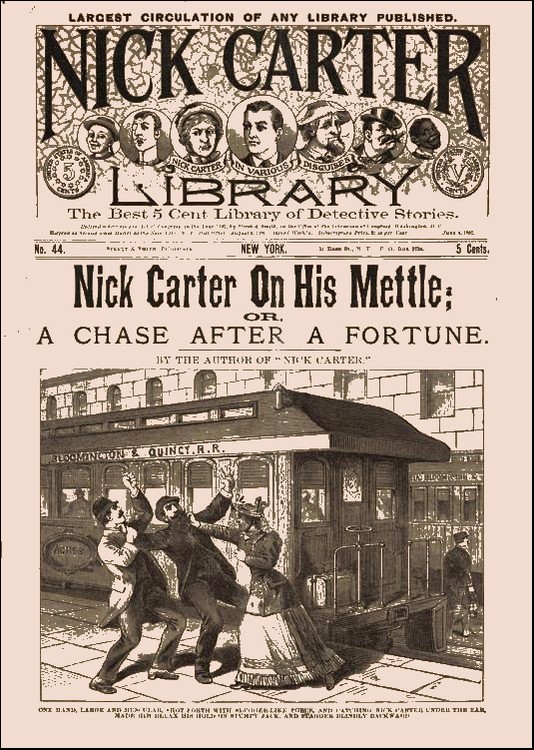
The female companion of the villain, she whom Nick had supposed to be Eulalie Sanson, suddenly straightened up and faced the combatants.
One hand, clenched and large, bony and muscular, shot forth with slugger-like force, and catching Nick Carter under the ear made him relax his hold on Stumpy Jack and stagger blindly backward.
Blow after blow was rained upon him before he could make any sort of a resistance.
As he fell to the platform Stumpy Jack stooped over him, and with a grunt of savage satisfaction buried a knife in the brave detective's breast.
"There," he muttered, as he drew out the dripping blade, "whoever you are, and you are probably Nick Carter, your prying days are over."
No one had observed the murderous encounter.
The car in front of which it had taken place was the last of a long train, the lights were dim in the vicinity, all the other passengers were in the seats, and the conductor was busy in the ticket-office.
As the assassin and his female companion got on board the car the conductor came out and signaled the engineer.
The train started, leaving Nick Carter on the platform weltering in his own blood and insensible.
Days afterward, in a hospital, he awoke to consciousness and reason.
One week from the date of the attempt on his life he bought a ticket for Sacramento.
His face was pale, but the expression it bore was one of undying resolve.
ON L-street, Sacramento, California, near the suburbs, there stood at the time of which we write a large two-story frame-dwelling, much out of repair.
It was part of the estate of a deceased pioneer, and had been in the hands of the real estate agents for sale or rent for many years.
But no one would buy, and no one wanted to rent it.
It bore the reputation of being haunted.
In the early days it had been used as a lodging-house by a notorious woman, who, after having sent more than a score of men—lodgers for a night—to their death, had herself been murdered by a rapacious accomplice.
It was not until after her murder that the discovery of the terrible crimes she had committed was made.
Investigations carried on in and about the house proved her to have been possessed of all the fiendish characteristics of the Benders of Kansas, who came after her.
The house was the only one in the block, and the trees in front and back of it—poplars, sycamores, and eucalypti—shut it almost entirely from view from the street.
It was not many days after Nick Carter's misadventure in Chicago that a group of miners and farmers were discussing the place at the nearest saloon not far from the river.
"I wouldn't sleep there one night," said a brawny fisted miner, "for the best placer layout in the State."
A young fellow entered the door as he spoke.
He had an honest face, sharp eyes, and a resolute mouth and chin.
But his clothes were old, his hair was long, and uncombed, and he looked as though the world had not been using him very well.
"If you gents will make up a small purse I'll agree to stay there to-night," he said, in a pleasant manner.
The miner stared at him curiously.
"You must be down to bed rock to hanker after a job of that kind, youngster."
"I am in need of the money," was the reply, "I have had hard luck lately. In fact, gents, I am suffering for a square meal this blessed minute."
"How would a drink go?" spoke up another of the group.
"I never indulge."
"Wha-at! An American, a Californian, and never hit the bottle? I am surprised, young feller, for a fact."
"You need not be surprised, for I am not an American; I am a foreigner."
"Where were you born?"
"In Hoboken. N. J."
There was a general laugh at this chestnut, and the stranger was at once taken into comradeship with the whole-souled miners and ranchmen.
The story of the haunted house seemed to interest him deeply.
"I saw something last night," said a ranch hand, "which let me out of the investigating racket."
"Spit it out, Lem," said one of the party.
"Well, I came into town yesterday from Lodi to see the sights, after a month's work. I had engaged to stay over night with a friend up the Stockton road a piece.
"When midnight came I started to find my roost. I carried a small jag with me, I will admit, but I was not so salubrious as not to know what I was about.
"Up L street I went, and when I came opposite the haunted house I determined to cut off a portion of my trip by sashaying through the lot.
"The gate was open—I could have entered through a hole in the fence, for that matter—and I staggered into the inclosure as bold as you please, and with no thought of spooks in my mind.
"I passed the house all right, and was moseying through the garden at the back, when I saw a light in the trees ahead of me.
"Thinks I, 'This is some bloke monkeying about the premises without knowing what kind of a place it is.'
"I had too much gin aboard, and I went forward cautiously until I reached a point behind a big tree from which I could see who held the light and what he was doing."
The narrator paused and drew a deep breath.
His auditors showed the most intense interest.
None more so than the impecunious stranger.
Not until the barkeeper had been called, and there had been a jingle of glasses, did the story proceed.
"I'm a liar, gentlemen," the ranch hand solemnly asserted, "I'm the biggest liar that ever tramped in adobe if I didn't see two ghosts, a male and a female, standing alongside of another tree."
An exclamation of amazement from the miner who had first spoken.
"Both ghosts were dressed in white, and one of them, the male, was patting the earth by the tree with a spade.
"The other, with long yellow hair, and a face that was thin and ghastly, with big, staring, saucer-like eyes, kept crossing her breast like some of those nuns we read of.
"I was so paralyzed with terror at the sight that I could not move, and I might have never escaped to tell the tale had not the female ghost raised her face to look up into the sky just at the moment when her partner raised his lantern.
"The light fell on her throat, and you may chuck me into the river, gentlemen, if it didn't show a long red gash. I could see the blood gushing from it as plain as I could see anything.
"That let me plumb out.
"I skipped out of the grounds as quick as my legs would carry me, and after what I saw there's nothing on top of earth that could make me go there again.
"And now, young fellow, do you still offer to stay there to-night?"
"Yes."
"You are not afraid?"
"No ghost that walks can scare me."
He spoke calmly, and the man who had told the story of the two ghosts regarded him in amazement. There was another member of the group, also a miner by his dress and manner, who seemed astonished at the youngster's determination.
This man had arrived at the saloon shortly before the conversation turned on the haunted house, and though he had nodded familiarly to the barkeeper he had not accosted any of the others in the room.
He was small in size, smooth-faced had shifty black eyes and a small head peculiarly shaped.
Thrust forward from a long neck it made one think of a weasel or a ferret.
"I don't want to take any silver until I have earned it," said the young fellow, "but if I appear here to-morrow and furnish proof that I have lodged at the haunted house I expect to get something when I pass around the hat."
"And if you don't appear?" suggested the man with the weasel head.
"Then search the house for my dead body."
He looked steadily at his interlocutor as he spoke, and the little man changed color, for some strange reason, and turned his head away.
Pretty soon the young fellow took his leave.
Outside the saloon he chuckled softly to himself.
"I wonder how Nick Carter would like my little game," he muttered under his breath.
"And I wonder also if Waxem Willie, who was doing the miner act in that saloon, knows that I am Chick, and that I am on to him.
"Now I am going to carry out a plan that will put me close to the stolen treasure, or else into a hole.
"I am going to investigate the haunted house to-night, and if anything unfortunate or terrible happens to me those miners and ranchmen will make a search and find what's left of me.
"And my weasel of a Waxem won't get onto my game, for I am going to make him think that I was fooling when I said I was going to take in the ghost shop to-night.
"He ought to be out of the saloon and on my track by this time." Chick looked back, and sure enough the alleged miner, who was no other than Waxem Willie, the confederate of Rondelle Gertz, alias Madame Ronadelli, had emerged from the saloon, and was following the young detective.
"It's a pity Nick isn't here," mused Chick. "He wired me that he would meet me in Sacramento days ago, and there's no sign of him yet.
"I've shadowed Rondelle and Waxem Willie to the haunted house, and I'll bet a million that the Levinsky valuables are buried somewhere on the premises.
"But I wonder who that girl-ghost with golden hair is?
"I'll find out, and have things pat for Nick when he arrives.
"The chief of police has been asking for my superior every day.
"He knows Nick is coming, and he wants him to take up a big bank robbery case that has completely mystified the local detective force."
Chick's musings were cut short by the quick approach of Waxem Willie.
The little rascal had made up his mind to acquire certain information at once.
"Say," he abruptly accosted Chick, "do you really mean to pass the night at the big house?"
"What is it to you whether I do or not?"
"Only this. If you do I want to be permitted to go with you."
"You?" Chick eyed him with disdain. "Why, the ghost of a chicken would scare you off."
"You are mistaken. I may be afraid of live people, but dead ones have no terrors for me."
"Well, you won't stay with me in that house," said Chick, flatly.
"Why won't you let me?"
"For the best reason in the world, my Christian friend."
"Name it."
"I don't intend to stay there myself."
"No?"
"No. What do you take me for? a sardine?"
"But your talk in the saloon?"
"It was a bluff. I was broke, and wanted a grub stake. Didn't you see me get it?"
"No I didn't."
"Well, I did get it. See here."
Chick drew a silver dollar out of his pocket.
"A miner slid it to me before I went out. So the ghost racket is yours to play alone if you want to. As for me," concluded the young detective as he turned on his heel and walked away. "I am going to hunt a restaurant, and blow in half of this dollar too quick for any use. If you want to see me to-night call at my room in O'Rafferty's hay stack around the corner."
Waxem Willie stood still on the sidewalk and watched Chick until he had turned the corner.
"He may be a smart jay from Lodi," he said to himself, "but I'm going to make sure."
He hurried on, saw Chick enter a restaurant on K street, and then waited at the foot of a stair-way a few doors below, until Nick Carter's brave and fearless assistant came out of the eating house, picking his teeth.
About nine o'clock that night, after shadowing Chick from one place to another, without anything occurring to excite his suspicion, Waxem Willie saw his man crawl into a hay-stack in a field not far from the saloon where the conversation about the haunted house had taken place.
Satisfied at last that the young fellow was what he had represented himself to be, and moreover had been honest in his assertion that he wanted no ghost-seeing in his, the weasel-headed ally of Rondelle hastened rapidly away, nor stopped until he had entered the haunted house.
But sharp in his wake, noiseless and sure as a bloodhound, followed the indomitable Chick.
Waxem Willie found the back door open, and entering the kitchen in black darkness moved forward like one accustomed to the place.
Nearly opposite the door, upon the wall partition, which was of heavy oak, the little rascal began to move his hands up and down and from side to side, until his fingers touched the button of a concealed opening.
Pressing it, a part of the wall slid back, as if on greased wheels, leaving an aperture large enough to admit the body of a man.
Although no light shone out of it, Waxem Willie boldly made his way into the hole, his feet, as if by instinct, finding resting-places upon the rounds of a ladder raised perpendicularly from some point below.
A descent of about a dozen feet brought him to the floor of this concealed basement.
A door was opened, and he stepped into a large apartment lighted up by several coal oil lamps held in brackets against the walls.
The apartment was occupied, and as he saluted his companions in crime Chick, the detective, was feeling about the wall in the kitchen above for the concealed spring.
He had entered the room close upon the heels of Waxem Willie, had heard him moving his hands over the wall, and had surmised what he was in search of.
At last his fingers pressed the button, and the way was clear for his further pursuit.
He was backing into the hole, taking this mode of entrance for safety's sake, when there came a rush of feet across the floor.
Before he could realize what was coming a pair of human arms encircled his neck, and he felt a breath hot and panting in his face.
The assailant might be a ghost, but if so it was certainly a disreputable one, for it was addicted to the use of the vilest kind of whisky.
Chick was taken by surprise, and somewhat at a disadvantage.
But he had the use of his hand, and his first move was an effective one.
He caught the unknown enemy about the waist, and gave a regular bear-like hug.
Then it was that he made a surprising discovery.
His assailant was a woman.
Not a word had she uttered since her entrance.
Not a word said she, as Chick, using all his strength to relieve the cruel pressure upon his windpipe, forced her back upon the floor.
Her head struck the boards with such force as to cause a most peculiar sound to escape her lips.
It was a moan, but muffled and wheezy, as if emitted in difficulty and pain.
But her strength was not yet gone.
Her hands were as large as a man's, and had hard, sharp nails.
As a tigress might use her claws, so this fiend in woman's form used her hands.
And with them her teeth.
Chick could do no less than treat her like a savage beast, whose traits she possessed.
He managed to seize her wrists and hold them.
Then he used his head as a battering ram.
A few knocks on her box of knowledge and she was reduced to sullen submission.
"Why doesn't she say something?" thought Chick all this time.
The struggle had been almost noiseless, and although the secret door in the wall remained open no one had emerged therefrom.
Nick Carter's assistant, still holding the woman's wrists, whispered these warning words into her ear:
"I am going to lift you up and carry you out of doors. If you raise your voice to cry out for help it will be the last cry you will ever make in this world."
No answer.
But Chick would have shuddered could he have seen the expression that rested on her face.
It was one of demoniac rage.
She made no light burden, for she was heavier than the ordinary woman; but Chick managed to get her out of doors and into an open shed about fifty feet from the back door.
He had investigated the place before, and knew where to put his hand on certain articles.
These articles were ropes.
The woman was soon securely bound.
Having performed this operation Chick struck a match, and when the light flamed up he looked down into the face of his captive.
It was that of a beautiful woman.
She had golden hair, large violet eyes, and the complexion and mouth of a Cleopatra.
And she was dressed in white.
Chick's match went out, and he struck another.
This time, while the light lasted, he looked at her throat.
Upon it was a long, blood-red scar.
"I thought as much," he muttered, in satisfaction.
"The reason she did not cry out in the kitchen was because she could not.
"She's dumb, and Nick Carter has often spoken to me about her.
"She can hear, but an accident deprived her of the power of speech a few years ago.
"A more hardened criminal of her sex does not live.
"She is the wife of Stumpy Jack, and her appearance in Sacramento means that Jack is not far away.
"I'll bet a night's sleep that he's down in the basement with the rest of the gang.
"She was one of the ghosts the ranch hand saw, and Jack was the other sure."
A groan, hollow and unearthly, in his near vicinity, made the young detective start and cease his speculations instanter.
It came from the open air.
It was repeated again and again.
Chick was no coward, but the groans gave him a creepy sensation.
Nevertheless, he started at once to make an investigation.
A woman's shriek, shrill, piercing, and charged with mortal terror, saluted his ears just as he was passing out of the shed.
It was close at hand, but he could see nothing on account of the black darkness.
Another shriek, this time in the direction of the kitchen door, made him dash forward toward it regardless of what the consequences might be.
A light flashed in his face as he reached the threshold.
It came from a lantern held in the hands of a masked man.
He was coming out of the secret door.
Chick saw him, and he saw something else.
Hurrying toward the man with the lantern was the noted Chicago criminal, Stumpy Jack.
In his arms he bore the struggling form of Eulalie Sanson.
Chick's caution flew to the winds at the spectacle of the fair girl's desperate predicament.
He would save her from the villains who occupied the haunted house or die in the attempt.
In two bounds he was at Stumpy Jack's side, and had planted a blow under the ex-convict's ear that sent him reeling forward.
He did not drop his human burden, but as he put out one hand to save himself he knocked the lantern from the grasp of the masked man as the latter was stepping forward from the secret aperture.
In an instant the kitchen was again in darkness.
When the lantern fell Chick made a rush for the two villains.
By attacking them suddenly and in the midst of the bewilderment occasioned by their unexpected collision, he hoped to gain a quick and decisive victory.
And the battle would have been won by the brave fellow, but for an unlucky accident which could not be avoided on account of the absence of light.
The man with the mask was stooping down to pick up the lantern when Chick's rush came.
The latter had had such a "head of steam on" that he struck against the stooping villain with such force that he lost his balance, tumbled over his quarry, and was carried forward by the momentum until his hands slid beyond the floor into the secret opening.
The angry mutterings and curses of Stumpy Jack and his masked confederate warned Chick that his life would not be worth a button unless he got himself out of that kitchen in short order.
And yet he would have risen to his feet and renewed the battle, had not these words from the lips of Eulalie made him change his purpose and look to his own safety:
"Don't stay here on my account," the sweet voice tremulously said, "for I am in no immediate danger."
Chick did not answer.
He proceeded to act.
With the quickness of a cat he backed into the aperture, put his feet on the rungs of the ladder and had his head out of sight before the lantern was relighted.
Before its rays were flashed into the opening, he had reached the bottom and opened the door which had admitted Waxem Willie a short time before.
He might be jumping from the frying-pan into the fire, but he was ready to face the consequences of his act.
With a cocked pistol in his right hand he entered the apartment to see Rondelle Gertz start up from a lounge on the farther side with a look of terror in her dark eyes. She gazed at him speechless for one moment, then, to his utter surprise, put forth her jeweled hand, and with the index finger beckoned for him to approach.
With his revolver pointed at her, but with an unaccountable sense of uneasiness, Chick made two steps forward.
His foot was lifted to make another, when the floor suddenly gave way beneath him, and with a cry of horror he went down, down until dark waters deep and cold closed over his unfortunate head.
He had fallen into a trap in the house of many murders.
A few moments after Chick's disappearance, Stumpy Jack entered the apartment.
"Where is the spy?" he asked, all of a tremble.
"Down there."
She spoke coolly and pointed toward the trap door, now closed.
"Good," the villain exclaimed, as he rubbed his hands in satanic satisfaction. "Good; now the only foes that could have harmed us have gone up the spout. Nick Carter in Chicago, and now this fellow in Sacramento."
Rondelle showed her teeth in a smile of triumph.
"Where did you leave Miss Sanson?" she asked.
"In the tank house."
"And where is your wife?"
"I don't know."
"She preceded you here to-night, did she not?"
"Yes."
"Then something must have happened to her."
"Something has happened to her," said a voice at the door-way.
They looked up to see Waxem Willie, holding a mask in his hand.
He was terribly agitated.
"What is it?" demanded both of his auditors at once.
"Come and see."
The three conspirators mounted the ladder to the kitchen.
Then, with Waxem Willie as guide and holding the lantern, they passed to the little shed, where the dumb woman had been left, bound and helpless, by Chick.
The cords, which had held her arms and ankles, had been removed.
And the woman, who had slugged Nick Carter at Chicago, was dead.
Her throat had been cut from ear to ear.
While Rondelle and Stumpy Jack gazed horror-stricken at the ghastly spectacle, Waxem Willie raised his lantern so that its rays were flashed full upon an object lying near the face of the corpse.
It was a razor.
EULALIE SANSON had been abducted from her Chicago home in pursuance of a plan concocted by the arch-plotter, Rondelle Gertz.
The daughter of the lawyer, who was as fearless and unconventional as she was beautiful and accomplished, took passage on the midnight express of her own accord.
A false telegram had called Gilbert Sanson out of town, to the residence of a client on the line of the C. B. & Q. some twenty miles distant, a few hours after his conversation with Nick Carter.
Another false telegram reached Eulalie early in the evening.
It purported to come from her father, and informed her that he had met with an accident near the dwelling of his client and desired that she should come to him by the midnight express.
She had been driven to the depot in good time, and had been seated in the car to which her ticket entitled her about five minutes before Stumpy Jack and his dumb wife put in an appearance.
The scheme of evil would have failed utterly if Nick Carter had not mistaken the dumb woman for Eulalie.
The detective was left for dead upon the railway platform, and Stumpy and his muscular helpmate boarded the train, and finding Eulalie occupying a seat by herself proceeded to carry out the second act in the programme.
Stumpy Jack's dumb wife, though Amazonian in build and disposition, was yet the owner of a handsome face, of wonderful mobility.
She stopped in the aisle opposite Eulalie and looked at her with beseeching timidity.
The young girl's tender heart was touched, she knew not why, but before she could open her lips to ask if she could be of any service, Stumpy Jack, who was behind his wife, made his little speech.
It had been carefully rehearsed, and it had the desired effect.
His wife was dumb, and besides was subject to sudden fainting spells.
Urgent business demanded her immediate departure for Council Bluffs.
He, the husband, could not accompany her, but he would take it as a great favor, greater than his poor tongue was capable of expressing, if the young lady, who looked so sympathetic, and who must have a kind heart, would take charge of his afflicted wife as far as her ticket carried her.
Eulalie informed him that she had only twenty miles to go, but for that distance she would cheerfully accept the desired responsibility.
Stumpy Jack left the two seated together to retire to a private compartment in another section of the train and there effect a change in his personal appearance.
As an English tourist he seated himself near his wife and Eulalie.
When the station for which the latter had bought a ticket had been passed without her arising from her seat or signifying any desire to leave the train, he knew that his wife had succeeded in administering the will-destroying drug which had been provided by Waxem Willie.
Arrived at Sacramento after a five days' journey, the wicked pair and their victim were met at the depot by Rondelle and driven to the Golden Gate hotel, on K street.
In the evening they left the hotel on foot and proceeded to the haunted house on L street, where Rondelle had previously taken quarters.
Rondelle knew all the secrets of the construction of the house, and owing to the reputation it bore in the neighborhood, felt sure that a more secure place of habitation could not be found in the capitol city.
It was her plan to remain in Sacramento until such time had elapsed as would permit her to make use of the Levinsky valuables without fear of detection.
The twenty thousand she had swindled Gilbert Sanson out of would probably last her during this period of waiting.
But in case her expensive tastes made this sum inadequate, there was Eulalie to make use of as a bait for drawing more money.
Besides, her talents of evil could be turned to profitable account at any time.
And the haunted house could hold the secret of any crime her wicked nature or her sinful necessities might induce her to commit.
The daughter of the lawyer was consigned to a room in the basement, opening out of the large apartment which held the trap door, and there remained pale, passive, and without intelligent appreciation of her dangerous condition until the day that saw Chick make his entrance into the house.
The effect of the drug had worn off and she had recovered her full senses.
But she did not permit her evil jailer to know of the change in her condition.
Eulalie Sanson was endowed with a high order of intelligence.
She was not easily imposed upon, like her father.
She inherited shrewdness and discernment, quick intuition, and a sternly practical mind from her mother.
When reason returned to her, and she saw Rondelle, she divined in an instant what had befallen her.
Her plan to get out of the basement was at once formed.
She pretended that she was dying, gasped and moaned, and called for air, heaven's air, in such piteous accents that Rondelle became alarmed lest she should really die.
It was not the design of the wicked schemer that Eulalie should leave this world before Gilbert Sanson had been bled to the last dollar.
The girl was accordingly removed from the basement to the tank house, erected over an artesian well a few steps from the kitchen.
When Eulalie in charge of Stumpy Jack stepped out of the house and felt the cool air of evening fan her cheek, she gave utterance to the screams which caused Chick to rush from the shed where he had the dumb woman.
What afterward occurred is known to the reader.
We left the plotters standing over the dead body of Stumpy Jack's wife.
Waxem Willie picked up the razor found at the feet of the corpse and looked at Stumpy Jack inquiringly.
"Hers," the latter said, hoarsely. "She swore she would kill herself if ever she saw the penitentiary staring her in the face."
"It is the same razor, isn't it?" queried Rondelle, who had now recovered her equanimity.
"Yes, it's the same one she used when she tried it on in Philadelphia."
"But there was only one man in the world that she was afraid of, and he is not here," said Waxem Willie.
"Nick Carter?"
"You're right. It was his close pursuit of her on a kid-swiping racket that made her slash her throat before."
"The man who took the cistern route was not Nick Carter," was Rondelle's positive averment.
"I know that," said Waxem Willie.
"He's nothing but some smarty of a rancher, Nick Carter—"
A low whistle, which after a short pause was twice repeated, put a sudden stop to the conversation.
Stumpy Jack answered it, and presently a dark form strode toward the shed from a corner of the haunted house.
By the light of the lantern Rondelle and her accomplices saw that the man was Dan Dosset.
He was out of breath and trembling with excitement.
Without a word of explanation being spoken, Rondelle Gertz knew that a dangerous crisis in her game of wickedness had arrived.
"STOW your gab," said Dosset, rapidly, "and make ready to get a move on."
"What—what has happened?" ejaculated the dark-eyed plotter in amazement mingled with fear.
"The worst that could possibly happen—Nick Carter is in Sacramento."
"Impossible," exclaimed Stumpy Jack. "He's dead, or the next thing to it."
"Dead nothing. The jab you gave him was only a pin prick. He came in to-night on the overland along with me. We made the trip from Chicago together."
"You did? And then of course he knows that you are here with us at this minute."
Rondelle uttered these words in a despairing voice.
"But he doesn't know anything about me, though. I rode through on the brake-beam, and I was as retired all the way as if I had been in a palace car all by myself."
"What did the detective do when he left the train at the depot. Do you know, or didn't you pay any attention to his movements?"
Rondelle spoke sharply.
All was not yet lost.
And come what might, she would not give up without a desperate and determined struggle.
"I'm no fool, and you know it," the ex-convict retorted, "or I would never have made two big beats in a month—the Massachusetts rat-trap and the sheriff who was leading me back to it."
"Where did Nick Carter go, then?"
"Straight as a bee to the office of the chief of police."
"Then he has no information to go by," Rondelle observed, in a tone of relief. "We are safe here for to-night: at least."
"We're not safe a minute," said Stumpy Jack, his eye snapping furiously, "while that sleuth is in California. "You may all do as you please," he added, resolutely, "but as for me, I am going to get out."
Rondelle found herself in a perplexing situation.
"With that girl on our hands it will be difficult to leave here to-night," she said. "If we had some safe place to go to, it would be different."
"I know a place," said Jack. "It's on an island in the Sacramento River, a few miles from here. When I was here once before I got in with a crook who put me onto the place."
"Can you get a boat at this time of night?" asked Rondelle, eagerly.
"I can get a boat. The crook who owns it is in Folsom playing checkers with his nose."
"Then off we go."
Eulalie had been gagged when placed in the tank house, her speech to Chick in the kitchen having betrayed her game.
She was brought out, and upon her promise not to cry out for help while on the journey to the island, the gag was removed.
"The plant—shall we leave it?" questioned Stumpy Jack.
"Yes," said Rondelle: "Its hiding-place is unsuspected. Better where it is now that Nick Carter is here to pipe off our movements. But some one ought to stay behind to keep watch over the house till morning."
Waxem Willie elected to be the man.
Then the party led by Jack took a roundabout way through the suburbs to an old boat-house on the river-bank.
It was locked, but the door was easily forced open, and the boat drawn out.
An hour later, the boat with its human cargo was drawn up to the bank in a little cove bordered by a dense growth of wild willows.
Stumpy Jack found a trail which led through the trees, and the others followed him, until, after a five minutes' walk, they emerged into a small clearing in the center of which was a small log-house.
"Are you sure it is unoccupied?" whispered Rondelle to the guide as they approached the structure.
"It must be. But we're all right in any event, for no one but a crook has ever lived in it."
"Knock at the door anyhow."
"All right."
The house bore every appearance of being deserted.
In the starlight they could see that the windows were curtainless and that immense cobwebs depended from the upper cornice.
Stumpy Jack rapped gently on the door.
No answer.
He rapped again, this time with more force than before.
Then, to the surprise of Rondelle and her evil companions, a noise, as of some one stirring, was heard from within.
There was no further knocking, and not a word was said by any one until the person inside the house approached the door and called out in a hoarse whisper:
"Who are you? Lambs or—"
"We are wolves," cried Stumpy Jack at a hazard.
"Ah, I know that voice. We were in the college together."
The speaker, with these words, unbarred the door and opened it.
"One at a time," he said. "Jack, my boy, enter first, and give an account of yourself."
The Chicago crook stepped across the threshold.
"It's all right," he said to Rondelle and Dosset. "I know this coon, and he is the champion lone hand performer—the best that ever went on the stage to hold up the passengers. You've heard of Dick Bellows, of Idaho, haven't you?"
"Yes, yes," said Rondelle, "and he must know me."
"Presently, my dear madam," spoke the occupant of the house, suavely. "In the meantime patience."
He closed the door and barred it and, with Stumpy Jack, walked toward a bedroom he had just quitted.
When the room was reached, the lone hand operator struck a match and lit a lamp that rested on a small table.
Then he turned, and gazing at Stumpy Jack began to laugh softly.
Rondelle's confederate looked at him in astonishment.
"You would do it, wouldn't you?"
"Do what?" said Jack in bewilderment.
"Walk into the trap."
"Into the trap? What trap?"
The Chicagoan began to back toward the door.
But a revolver, whose muzzle was on a direct line with his head, made him pause.
"Make a single cry and I'll scatter your miserable brains all over the floor," was the stern admonition.
"What—what does all this mean?" came from Stumpy Jack's lips, in a terrified whisper.
"It means, old man," was the quiet answer, "that your little game has come to an end. Stick 'em out."
The case-hardened villain knew what was meant.
He put out his wrists and the next moment a pair of handcuffs had encircled them.
Another moment and Stumpy Jack sat on the floor with a gag in his mouth.
Moment number three witnessed the binding of his ankles.
"Now," muttered the mysterious occupant of the house, "I'll try and see what Daniel Dosset is made of."
He returned to the front door and softly called out:
"Are you there?"
"Yes," from the lips of the ex-convict.
At the same moment, almost, an owl hooted in the near vicinity of the house.
The man who had been called Dick Bellows quickly opened the door and as quickly stepped behind it.
Dan Dosset with a dagger in his hand made a quick lunge without properly using his eyes.
The blade cut empty air.
Then a powerful hand caught him by the coat collar and threw him roughly to the floor.
"Better give in, Daniel," hissed the voice of his antagonist, "for I hold all trumps this time."
"Nick Carter!" gasped the villain, as he sat up on the floor and tried to make out the great detective's face in the semi-darkness.
"Yes, Nick Carter. And Nick Carter with no foolishness about him."
A short, sharp struggle, a contest of muscle and science against muscle alone, and Dan Dosset was vanquished.
Leaving him bound and gagged beside his companion in crime, Nick Carter strode to the door for the third time.
It was open as he had left it.
Standing on the threshold he uttered a cry that would have deceived the wisest owl that ever owned two big solemn eyes.
An answer came instanter from the direction of the boat.
Nick Carter hesitated a moment, and turned sick at heart.
It was not the answer he had counted on.
Something had happened to disarrange his plans.
What?
He set his teeth hard and made for the boat.
RONDELLE GERTZ and Dan Dosset, who had Eulalie Sanson in charge, saw Stumpy Jack enter the log-cabin with the man who had been addressed as the noted stage robber, Dick Bellows, with feelings of uneasiness.
The finding of an occupant of the house was an inept circumstance.
Rondelle's suspicions induced her to steal softly to the rear and to get under the window of the bedroom where the interesting conversation between the disguised detective and Stumpy Jack took place.
She could not hear all that was said, but she heard enough to know that a grave peril confronted her; that in leaving the haunted house she had jumped, as it were, from the frying-pan into the fire.
Two things must be done.
Dan Dosset must remain to put this mysterious enemy out of the way and release Jack, and she must make her escape with Eulalie.
The ex-convict received his instructions, and Rondelle and Eulalie hastened away in the darkness.
The latter made no protest.
She had made up her mind to a certain course of action.
If Rondelle led her to the boat, and they entered it to recross the river, she intended to throw herself overboard.
But not to end her life.
Far from it.
She was an excellent swimmer, and she felt confident that she could not only deceive Rondelle into the belief that she had sunk to rise no more, but that she could easily swim to the farther shore even if the distance were twice what she expected it would be.
Arrived at the boat, Rondelle motioned Eulalie to enter.
The lawyer's daughter was in the act of doing so, when a strange voice behind her said:
"Stay. Do not leave the shore."
She turned quickly, as did Rondelle.
The latter gave a shriek of terror.
For the light was sufficient for her to recognize in the person who spoke the man she had consigned to death in the haunted house.
Chick, for it was he, stepped forward, to place his hand upon her arm.
She quickly eluded him and sprang into the river.
With foes on every side she felt that her sinful career was approaching its end.
Better death than imprisonment.
Chick cast off his coat and plunged in after her.
But it was so dark about the spot where she had disappeared from the shadows cast by the willow, that he could not see about him.
He could only beat about the water in a vain endeavor to clutch some portion of Rondelle's clothing when she should come to the surface.
While he paddled about here and there, the detective's call of the night owl was heard.
Chick, nearly out of breath and with his mouth half full of water, tried to send back an answering call, and succeeded as far as noise went.
It was his lack of success in this respect that had aroused Nick Carter's suspicion that something had happened to his brave assistant.
Chick was on the bank, shaking the water from his clothes when his superior arrived.
A few hurried words put Nick in possession of all that had occurred.
For some moments he remained in a brown study.
Then he said:
"Go back to the log-cabin, Chick, and remain there until I send the chief or some of his officers to assist you in bringing this pair to the city prison."
"Alright, sir."
Chick was off like a shot.
"Now, Miss Sanson," said Nick to the lawyer's daughter, "we will cross to Sacramento, if you have no objection."
"None in the world, Mr. Carter."
"You know me, then?"
"Oh, yes, I saw you at my father's house, but you did not see me."
"But I am disguised."
"Your person is, but not your voice."
"Then you recognized me by that?"
"Yes."
"And how often before to-night have you heard me speak?"
"Once."
"Wonderful. You ought to be a detective, Miss Sanson."
"If I am ever so reduced in circumstances as to find it necessary to work for my living, I may become one," she said.
She got into the boat and Nick pushed off and took the oars.
He rowed swiftly, and when the old boat-house was reached, he hurriedly secured the boat and then, with his fair companion, hurried along the bank until they reached L street.
At the first hotel he stopped.
"I will see you safely bestowed here," he said, "and then bid you good-night."
"Where are you going?" she asked, with her lips pressed firmly together.
"To the haunted house."
"What do you know about it?"
"I know all about it?"
"Yet you only arrived in Sacramento to-night."
"True, but the chief of police gave me a note from Chick informing me, if I arrived to-night, where I might find him and what discoveries he had made.
"I went there to find Chick at the spot he had appointed in his note.
"He had had a narrow escape from death.
"Rondelle had sent him through a trap door into a deep cistern, supplied with water from the artesian well.
"He would have drowned, had he not been posted as to the cistern, and as to a way of escaping from it, known only to the chief of police and a few members of the detective force.
"We overheard the conversation after Dan Dosset arrived, and we hurried off to reach the island in advance of Rondelle's party."
"And you want to go back to the haunted house to arrest Waxem Willie?" Eulalie remarked.
"Yes, and for another reason—to test a certain theory I have formed."
"Then you must allow me to go with you."
The great detective looked at her and smiled.
"Very well," he said, "if you will promise to be guided by my instructions when we get there."
"I promise."
It did not take them long to reach the house. All was quiet as the grave in and about the building.
Nick showed no surprise, but made his way to the tree where the rancher had seen the ghost like figures.
Eulalie followed close upon his heels. Day was breaking and surrounding objects could be clearly seen.
A bloody spectacle confronted Nick Carter and his companion.
At the foot of the tree, where the earth had been thrown up, lay two dead bodies.
One was Waxem Willie with a bullet hole in his forehead.
The other was Rondelle Gertz, and the bosom of her dress was stained with blood.
She had been stabbed with a dagger.
Nick Carter turned to Eulalie, who was gazing shudderingly at the awful sight, and said:
"I expected to find Rondelle here, for I know she could swim, and I suspected that she had feigned suicide to throw dust into Chick's eyes.
"As for this tragedy," he went on, "it means that she made straight for the tree, as I thought, intending to unearth the treasure and fly the country.
"She reached the spot to find Waxem Willie in the act of digging it up. They fought for its possession and each killed the other. Waxem stabbed Rondelle, and she lived long enough to finish him with a pistol bullet."
Nick stooped down and lifted a tin box of goodly size from the hole.
He carried it out of the grounds before he opened it.
The Levinsky valuables—money and jewelry—were found intact, and nineteen thousand dollars of the notes which Gilbert Sanson had been swindled out of.
Neither Nick Carter nor Eulalie sought rest in bed until they had seen Dan Dosset and Stumpy Jack on their way to jail escorted by Chick and a detachment of police.
The two villains were punished according to their deserts.
Dosset went back to the Massachusetts prison.
Stumpy Jack got a twenty years' sentence for his share in Eulalie's abduction.
Not until Nick Carter returned to Chicago did he learn why Rondelle bore such a hatred toward lawyer Sanson.
A letter written by her from Omaha, en route, informed the lawyer that she was his niece.
She hated him because he had frowned upon her mother's—his sister's—marriage, and had refused afterward to give her mother money unless she would consent to leave her husband, who was a drunkard and a rascal.
Nick's share of the reward he had earned was divided with Chick, and they both felt more than satisfied with the results of their expert detective work.
Roy Glashan's Library
Non sibi sed omnibus
Go to Home Page
This work is out of copyright in countries with a copyright
period of 70 years or less, after the year of the author's death.
If it is under copyright in your country of residence,
do not download or redistribute this file.
Original content added by RGL (e.g., introductions, notes,
RGL covers) is proprietary and protected by copyright.