RGL e-Book Cover
Based on an image created with Microsoft Bing software
Roy Glashan's Library
Non sibi sed omnibus
Go to Home Page
This work is out of copyright in countries with a copyright
period of 70 years or less, after the year of the author's death.
If it is under copyright in your country of residence,
do not download or redistribute this file.
Original content added by RGL (e.g., introductions, notes,
RGL covers) is proprietary and protected by copyright.
RGL e-Book Cover
Based on an image created with Microsoft Bing software

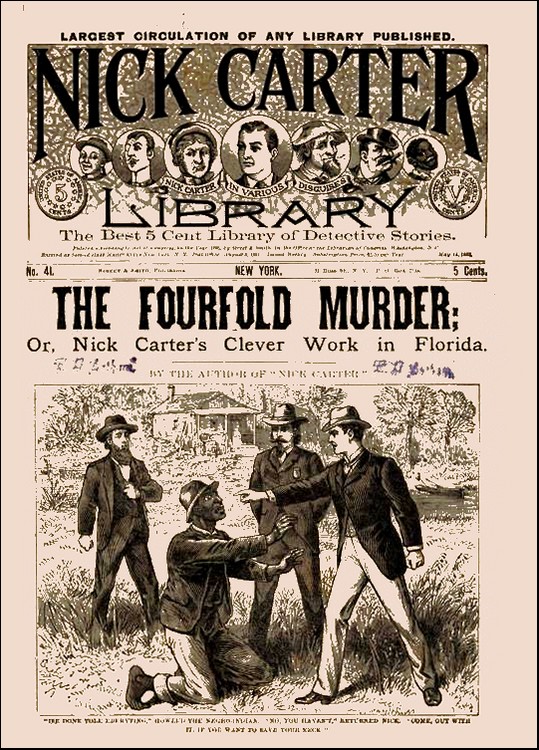
JUST two weeks before Christmas Day the inhabitants of New Smyrna, Florida, were shocked by the news of a fourfold murder, that for cold-bloodedness has scarcely an equal in the criminal annals.
Two helpless women and two little boys were shot, stabbed, and struck to death in a lonely cottage situated on the Hillsboro River, seven miles below the village.
The tragedy had occurred some time during the night or early in the morning, but it was not reported until noon, and then the village, and in fact the entire county of Volusia, went wild with excitement.
The news was brought to New Smyrna by a negro-Indian who worked at a camp on the river bank about a mile south of the shell mound upon which was situated the home where the awful deed was committed.
The report spread like wildfire, and before long a band of men were organized, to investigate the daring outrage and bring the guilty party or parties to speedy justice.
The way to the cottage was a lonely one. For a mile or more it kept to the Oak Hill road.
Then it became little better than a trail, leading directly to the river.
At the terminus was the entrance to the grounds, a pair of bars, beyond which could be seen a long stable, built upon the low land.
Further on was a big mound of shells, and upon this stood the cottage, once full of life, but now silent and gloomy.
It was a single story high, and divided into two rooms. A small porch was built on the river side, shaded by two fine cedar trees. Beyond the cottage were two smaller buildings, used as a kitchen and dining-room, and also a place to store wine and honey.
As the band of men, accompanied by the sheriff and the coroner, approached they saw that one of the windows of the house had been completely shattered, broken out, no doubt, by a piece of heavy scantling that lay near.
Directly under the window lay a woman's bonnet and a revolver.
The doors of the cottage were locked, and the first entrance was effected through the broken window.
The sight inside was an appalling one.
On the carpeted floor of the room in which the window had been broken lay the body of an elderly woman, soaked in blood, and with a bullet-hole in the inner corner of her left eye.
Her arms were straightened out and her dress was smoothed down, showing that she must have died almost instantly.
Opposite to her lay the body of a boy of seven, her son, a bullet-hole in his forehead and two deep cuts across his throat. On the floor close at hand was a bread-knife, still wet with the blood that was spattered in every direction.
The woman and her son were not residents of the cottage.
They were neighbors, living a mile or more away, and had come over to spend the night and day.
Passing through the connecting door into the other room of the cottage, the party came first upon the body of the other little boy, who during life had called the spot his home.
The corpse of the little fellow lay diagonally across the floor, directly at the foot of the bed.
His throat was cut, and there was a bullet-hole directly under the left eye.
Lying crosswise over the upper part of the bed was the body of the second woman, who also lived at the place, and was a sister-in-law to the widower who owned the cottage and the orange grove that surrounded it.
It was here that the murderer had displayed all the ferocity of his nature.
The poor woman's face, which had been a surpassingly beautiful one, was completely crushed in, the blows having been administered from a heavy double-barreled shot-gun which lay upon the foot of the bed, the stock broken off short. She had also been shot in the face, her throat had been cut, and there were the marks of bloody hands on her dress.
The sight of these outrages almost maddened the crowd beyond endurance.
Had they caught the person or persons who had done that foul deed, lynching would have been a question of only a few seconds.
After an examination of the premises the sheriff and the coroner came to the conclusion that the murder had been committed some time after the two women had gotten up and while the two boys were still asleep.
Both women were partly dressed, and each bed showed signs of having been used.
Added to this, there was a pan of dough found in the kitchen later on, set there to rise, and several housekeepers said that its condition would tend to confirm the idea that the murder had taken place about sunrise, or later.
Who was guilty of this crime?
The first supposition was that it was the work of tramps.
But tramps would have ransacked the house and taken off several hundred dollars' worth of jewelry that was lying about.
But not a watch, ring, pin or necklace had been disturbed.
All that was thought to be missing was thirty-eight dollars that it was supposed that one of the two women had had in her pocket-book, but about this no one was certain.
In vain the place was searched for some trace of the assassins.
Nothing was found.
The roads and swamps for miles around were scoured, and expeditions far to the south, and to the north, and to the west were sent out.
Each returned with nothing but failure to report for their pains.
Meanwhile the sheriff and the coroner made a close investigation of the cottage.
Everything in connection with the household effects was found to be in perfect order.
In the sill of one of the windows was found the mark of a thirty-two caliber pistol bullet, and behind the bed was found a pistol of that size, having two chambers still loaded.
The shot-gun that had been broken was empty, and had evidently been so for a long time.
The lock on the connecting door had also been forced. The conclusion reached was that the murderer or murderers had first shattered the window, jumped through and ended the lives of the first woman and her son, then forced the door of the other room and completed the horrible work.
But if the tragedy had occurred after the two women were up, how came it that the connecting door was locked?
Clearly it must have been closed after the butchery in the first room began.
And what did the bullet in the window-sill mean?
Had the young woman who lived in the house tried at the last moment to defend her own life and the life of her nephew?
The presence of the pistol behind the bed and the broken shot-gun, which usually hung upon the wall, would tend to that belief.
When the trouble first began she had probably run to the gun and taken it down.
Finding it empty, she had flung it away and procured the pistol.
One shot had been fired at her assailant.
The bullet had missed and gone into the window-sill.
Then, ere she could fire again, the pistol was wrenched from her grasp, pointed at her face and discharged, and then fired again at the boy as he sprang to the floor in affright.
After this she must have grappled with her assailant, her life-blood streaming down her neck the while, covering his hands.
The pistol had dropped behind the bed, the murderer had caught up the gun, and then with this weapon and his knife, or the knife found on the floor, he had sprung upon her and finished his dastardly crime.
Such was the conclusion reached.
And yet, what was the motive for the crime?
Apparently there was none.
As far as was known neither of the two women had any enemies.
And certainly neither of the two little boys could be responsible for such an attack.
The widower, who was arranging for the early marriage of himself to Miss Cruse, the young woman who had been murdered, was at once summoned to return.
When he did so the shock of seeing his son and the woman he had hoped soon to marry dead nearly drove him insane, and he called on all to help him bring the guilty wretch to justice.
And when the neighbor rode in and was told that his wife and little son were also butchered, his grief knew no bounds, and with tears streaming down his cheeks he called on God to bring him face to face with the destroyer of all his happiness.
Several days passed.
The coroner and the sheriff were at their wits' end to solve the mystery surrounding the tragedy.
Several detectives were set to work upon the case, but they brought nothing of value to light.
One put the matter down as having been accomplished by tramps, who had been scared away at the last minute, before securing more than the pocket-book.
But if this was so, who had come there to scare the tramps?
This was a question the detective could not answer.
"There is no use in talking," said the sheriff to the coroner, late on the afternoon of the third day. "There is only one man in this county who can run down this mystery."
"And that is?"
"Detective Nick Carter, of New York."
"Is he such a remarkable man?"
"Remarkable? I should say he is. He has never yet failed in any case he has undertaken."
"But this is a tough one."
"Nevertheless, I believe he could solve it if he once took hold."
"Then why not get him? We can't let such an outrageous affair as this go unpunished."
"I do not know where to look for him."
"Is he not in New York?"
"No, he is somewhere here in the south."
"Why not telegraph to Inspector Byrnes and find out?"
"I will."
An hour later this message was flashing over the telegraph wires:
INSPECTOR BYRNES, POLICE DEP'T, NEW YORK CITY.
WHERE IS NICK CARTER? CAN I GET HIM TO TAKE THE NEW SMYRNA MURDERS IN HAND?
An hour later this reply came back:
SHERIFF VOLUSIA COUNTY, FLORIDA.
NICK CARTER IS IN FLORIDA. HAVE TELEGRAPHED HIM TO CALL ON YOU AT THE COURT HOUSE. BYRNES."
ON the following morning, a little after nine o'clock, an old and apparently feeble man walked slowly down the main street of Deland, Volusia County, Florida.
The man wore long white hair and a beard to match. His shoulders were slightly bent, and he used a stout cane to help himself on his way.
Presently he came in front of the county buildings.
He paused for a moment on the pavement, and accosted a man that was passing.
"Say, mister," he said, in a slightly quivering voice. "Are them the county buildin's?"
"Reckon they are, uncle," replied the man.
"The Volusia County buildin's?" went on the old man.
"That's it."
"Does the sheriff keep his place in there?"
"His office?"
"Ye as."
"Of course?"
"Would you mind showin' me where it is?"
"Not at all. Come along."
And the man led the way into the building.
"There's the office," he said, pointing to a door.
"Thank you, sir, thank you!" exclaimed the old man.
"That's all right, uncle, glad to do you a service."
"You're a gentleman, sir. My eyesight ain't very good any more, and—bless me, if the fellow hain't gone!"
And the old man looked around in astonishment.
Then he hobbled up to the door, knocked upon it with his cane, and entered.
The sheriff was alone, sitting by the window, his chin resting in the palm of his hand.
He was busy thinking of the murders, and wondering when he would hear from Nick Carter.
"Mornin', sir," said the old man. "Air you the sheriff?"
"I am, sir. What can I do for you?"
"I got an important matter fer you to attend to," whispered the old man. "I want sum property 'tended to. Can I see you alone?"
"We are alone, sir."
"All alone?"
"Yes, sir."
"Where nobody kin hear us?"
"Not a soul."
The old man held out his hand.
"Then, sir, suppose we come to business at once," he said, in a low but earnest tone, quite different from the first employed. "I am Nick Carter."
"Nick Carter!" ejaculated the sheriff.
He had been completely deceived.
"Exactly. I received your telegram through Inspector Byrnes last night, and I took the first train for Deland to-day."
"Then you have been in Florida?"
"Yes."
"On business?"
The great detective nodded.
"May I ask what that business is?" went on the sheriff.
"It is some private work for the government."
"Ah, I see." The sheriff paused for a moment. "Pray, take a seat, Mr. Carter. Do you smoke?"
"Occasionally. Thanks."
Nick took the cigar handed to him and lit it.
"I suppose you know something of the case on hand," continued the sheriff.
"I have read the accounts in the papers, that is all."
"The case is a complete mystery to us."
"So I have heard."
"We have had several ordinary detectives on the track—"
"On the track?"
"I mean on the case, but they have thus far accomplished nothing, absolutely nothing."
Nick blew a ring of smoke into the air, but did not reply.
"And so I have sent for you to solve the mystery. Can you do it?"
"I can try."
"You will take the thing in hand?"
"Yes."
"When?"
"At once."
"Good! The sooner we can catch the murderer the better."
"Then there was but one?"
"I do not know."
"What do you think?"
"I don't know what to think. Sometimes I believe one man must have done the deed, and then again I persuade myself that such a feat would have been impossible."
"I see. I will go to work at once, but there is one condition I must impose."
"And that is?"
"That not a soul but ourselves must know I have undertaken the case."
"The coroner knows I have sent for you."
"Then we will include him. But there must be nobody else."
"I agree to the condition."
"Very well. Now let us get to business."
"What do you wish me to do?"
"Give me the story in all of its details."
"There is but little to add to what the papers have already published."
"Never mind, I want the story from you just as you have seen things with your own eyes."
"Very well. I will give it to you from beginning to end."
In less than an hour the sheriff had put Nick in possession of all the facts at his command.
The great detective listened to the story without a word of comment.
"And that is all?" he asked, when the tale was concluded.
"Yes."
"You say that neither of the women had an enemy?"
"None that is known."
"Nor the widower, nor the man whose wife was murdered?"
"They say not. Each asserts that he was on good terms with everybody."
"Of course the two little boys don't count."
"How do you mean?"
"In having been the cause of the murders."
"I think not."
Nick mused for a moment.
"Who did you say were the first persons to enter the house after the murder?" he asked.
"The coroner and I were with the crowd, and we entered through the broken window before the doors were unlocked."
"Had any one been there before that?"
"No one but the negro-Indian who reported the tragedy at New Smyrna. That is, I think not."
"You don't know?"
"No."
"You were one of the first, then, to look upon the dead bodies?"
"Yes. It was a sight I shall never forget."
"Think carefully and then tell me of the four who were done to death, which, in your opinion, had received the worst treatment?"
"That is a hard question to answer," replied the sheriff, slowly.
"But you can answer it?"
"Well, I should say the woman who was about to be married was handled more roughly than the other."
"Ah!"
"Yes. But that might have been because she resisted."
"That is true. Still it is a point worth remembering."
"Why?"
"Because if the motive for the murder was revenge she was the principal victim."
"I see."
"Now of the two boys, who was treated the worse?"
"I should say the woman's nephew, although there wasn't much difference."
"Still there was some?"
"Yes."
"Then that is stronger proof that if revenge was sought it was directed to those that lived at the house and not those who were merely visiting there."
"By George, that's so! I never thought of that!"
"About the revolver that was found behind the bed. You are sure it belonged in the house?"
"Positive."
"How so?"
"It had the owner's name scratched upon the handle."
"I see."
The detective blew half a dozen more rings of smoke into the air.
"You say the woman who was to be married was treated worse than the other?"
"Yes."
"Did this woman have another lover?"
"I don't know."
"Was there any young man in the habit of calling upon her?"
The sheriff scratched his head.
"Neighbors were in the habit of stopping in as they passed up and down the river or on the road. That is the way the young negro-Indian came to find out about the affair."
"But there was no one in particular?"
"I haven't heard of such a one."
"What did the young negro-Indian have to say when he arrived here?"
"He didn't come here. He came to New Smyrna. He said he was on the way to the village to sell some honey and buy supplies for the camp at which he works."
"Yes. Go on."
"He thought he would stop at the cottage on the mound to see if the folks wanted him to buy anything for them."
"He knew the people well?"
"So he says. Well, as he approached he saw that the window was shattered. He knocked on the door, but received no reply. Then he looked in at the window, pushing aside the curtain to do so."
"The curtain was drawn, then?"
"Yes."
"Proceed."
"As soon as he looked in he saw the dead bodies. He was completely unnerved, so he says, and made for the village without making a close inspection."
"Did he go back with the crowd?"
"No, he stopped to sell his honey and buy supplies. He came to the house later."
"Where is he now?"
"At his camp, as he calls it. He works for a man who has an orange grove and does oystering."
"Where is it located?"
"I will show you on this map I drew up yesterday. I thought you might need some such guide if you undertook the case."
Going to his desk the sheriff took out a sheet of paper.
"Here is the road from New Smyrna. This is the cottage on the shell mound, where the murders were committed. Here is the road to the camp through the swamps."
"I had better go on horseback?"
"Yes. But if you wish I will save you the trouble by having the man brought to New Smyrna."
"No, I want to see him at his camp. Later on I may want him arrested, either on suspicion or as a blind. Understand?"
"Perfectly."
"One thing more. Who is at the cottage on the mound now?"
"The widower who lives there."
"I will investigate the place after I have seen the negro-Indian."
"Do as you think best, Mr. Carter. Only bring the guilty party or parties to me to be hung and I shall be satisfied."
"As I said before, I will try."
NICK hobbled away from the court-house in profound thought.
"I believe this is a deeper case than is generally supposed," he muttered to himself. "If it was the work of tramps they did their killing in a manner different from most instances of that kind. And then how is it that the jewelry was not taken as well as the money?
By noon he was in New Smyrna.
"Say," he asked, in the quivering voice of old age. "Kin you tell me where I kin git a horse?"
The man he addressed was a tall, slim gentleman, some forty years of age.
"A horse?" repeated the stranger.
And he gave the detective a sharp look.
"Yes, sir. I want one to ride up the country a bit. I thought I could walk, but I reckon I'm gittin' too old."
"Go around to Billy Anderson's; he'll fit you out."
"And where is that, please?"
"Right around that bend. Billy's got horses he lets out now and then."
"Thank you, sir."
A moment more the detective approached a blacksmith shop.
The blacksmith was hard at work at his forge.
"Is this William Anderson?"
"That's my name."
And the brawny fellow stopped working to survey the old fellow who addressed him.
"A man told me I could git a horse from you. I want to ride a bit up the country. I used ter walk it, but I'm afraid my legs won't hold out no more."
"Want to hire a horse, eh?"
"Ye-as."
"How long?"
"All day, I reckon, and mebbe ter-morrer, too."
"Well, I kin let you have one."
"How much?"
"Two dollars a day."
"What!"
"Two dollars a day."
"Ain't that putty steep?"
"Well, seeing it's you I'll make it a dollar and a half. But say, old man, I don't know you."
"I'll leave you security."
"What?"
"Well, I ain't got much, but I've got my old watch. And it's a gold one."
And Nick passed over his timepiece.
"Let me have this till I get my horse back?"
"Ye-as."
The blacksmith hesitated.
"All right. You look honest. Here is the horse. What is your name?"
"Brown—Randolph Brown."
"All right, Mr. Brown. Here, shall I help you up?"
"If you will. I ain't so spry as I used ter be forty year ago."
In a moment more Nick was in the saddle.
"Say, I heard tell of a terrible murder down here?" he remarked, as he prepared to ride off.
"Yes, we've had an awful slaughter."
"Who did it?"
"Nobody knows, but I have my opinion it was that negro-Indian."
"Who's he?"
"The fellow who reported the case."
"What makes you think it was him?"
"Because he was the only one around the place."
"I see. Well, if he was guilty I hope they swing him up."
"They'll do that fast enough if they can prove it. But I think the sheriff is foolish not to arrest the man."
"Mebbe he's a-shadowin' him. Them sheriffs and detectives has their own ways of doin' things."
"That's so, but I'd have the fellow in the lock-up before this."
"So would I."
Ten minutes later Nick was out of the village.
The camp for which he was bound was just eight miles away.
For three miles the horse kept to a hard, shell road.
It was along the river bank, and lined with palmettos and scattered pines.
Then the detective headed westward for the Oak Hill trail, which runs across a patch of country but little settled.
Finally he came to within half a mile of the camp for which he was bound.
Here the path was through a dense swamp.
Dismounting the detective tied his horse in a thicket, and then prepared to finish the journey on foot.
But before doing so he made several changes in his wardrobe.
And also took off his beard and white hair, and blacked his face.
Ten minutes later he stepped out upon the trail as a regular coon.
The trail was now a hard one to follow.
But the detective's eyes were sharp, and he made no mistake.
At length he came in sight of the camp for which he was searching.
Like the cottage at which the murders had been committed, it was situated upon a mound of shells, and over-looked the river.
It was a rude log hut, about fifteen feet square.
Entering the clearing, Nick approached the hut, and stepped to the open door.
The hut contained two bunks, a stove, a table, two stools, and some household utensils.
No one was present.
Presently the detective heard the splash of oars.
Then a boat glided up to the river bank, and a dark looking young man sprang out.
It was the negro-Indian.
He was very tall, being over six feet in height, and had large, broad feet.
"Hullo!" he exclaimed, starting back.
"Hullo, yo'self," replied the detective, in regular Southern dialect.
"What do yo' want here?"
"Nuffin'."
"What brings yo'?"
"I'se on my way to Deland."
"Recken yo'se off de track den. Dis yere trail doan lead to dat place."
"Whar's de trail wot does?"
"It's a mighty smart step back. Yo' ought to hab kept de main road."
"I war on dat, but I left it to see de hut whar de murders was did."
"Yes?"
"Terrible drefful dat was, eh?"
"Yes."
"Must hab been about tree men to do so much killin'."
"I doan tink so."
"No?"
"No."
"Has yo' been dar?"
"I war de fust one to see de dead bodies."
"Gee-shoo! Wot's yo' name?"
"Irvy."
"Must hab shocked yo' consid'ble?"
"It did. Miss Cruse war my dearest friend in dese parts."
"Dat so? Who yo' done suppose did dat murder?"
"I dunno."
"Wot did yo' see when yo' cum up to de house?"
"I see de winder smashed in an' de pistol and de hat on de ground under it."
"Dat all?"
"Well, I see—"
"What?"
"Nebber mind."
"What did yo' see?"
"Didn't see nuffin' more."
And the negro-Indian shuffled his feet as if he regretted the slip he had made.
Small as the act was it did not escape the detective.
"That chap knows more than he cares to tell," was his thought. "I must get it out of him. It may prove the best of clews.
"Did yo' go in de house?" he asked.
"No, I war too skeered. I sot right out fo' New Smyrna."
"To tell de people?"
"Yes."
"And yo' didn't see nuffin' more?"
"Not er thing."
There was a moment of silence.
The negro-Indian had brought ashore a boat load of oysters, and these he now proceeded to land.
"Say, I'se awful hungry," went on the detective. "Kin yo' gib me dinner?"
"Wall, I—"
"I kin pay fo' it."
"All right."
It was not long before the midday meal was well under way.
In the meanwhile Nick made himself at home under the porch of the cottage, taking down a banjo that hung on the wall and running his fingers over the strings.
"Play much?" he asked.
"Sum. I uster play fo' Miss Cruse sumtimes."
"De lady wot war gwine ter git married?"
"Yes."
"Kinder stuck on her, eh?"
The negro-Indian turned away without replying.
"Yo' say yo' uster do errands fo' de lady?" Nick went on, playing a soft jig on the banjo, just to show he was not over interested.
"Yes."
"Wot's de las yo' did?"
"Wot yo' wanter know fo'?"
"Oh, nuffin'. I'se curi'us, dat's all.
"De las' time I took a letter fo' her."
"A letter?"
"Yes."
"Who to?"
"De post-office in New Smyrna."
"Who was it addressed to?"
"Captain Furney."
"Who's he?"
"A gen'men from de North wot is spendin' de winter here."
"When did yo' take de letter?"
"Two days befo' de murders."
"Wot kind ob a letter war it?"
"A big, fat letter in a brown cober. It war so heaby dat I had ter pay fo' cents extra postage on it. Come, sit down if yo' want yer dinner. I'se got to go ter wuk in a little while."
The detective sat down and made way with what food was placed before him.
Then he arose.
"How much?" he asked.
"Ten cents."
Nick felt in his pocket.
He had nothing but bills.
"Kin yo' change a two dollar bill?"
"Is yo' got so much money?"
"I'se jess been paid orf."
"I kin change it."
The detective got out the bill.
Irvy took it and passed into the hut.
Nick watched him.
The negro-Indian walked over to one of the bunks, dove down into the bedding, and got out a pocket-book.
From this he took a one dollar bill and some change.
"Here yo' is," he said, and handed it over, accepting the detective's bill at the same time.
Nick's eyes sharpened as he looked at the one dollar bill that had been handed to him.
"Where did yo' git dis money?" he asked.
"Wot fo' yo' ask on question?" exclaimed Irvy, sharply.
"Kase I wanter make suah it's good."
"I got it in New Smyrna."
"Whar?"
"At de stoah de day ob de murder."
"Den it must be all right."
And Nick put the bill in his pocket.
"Now, wot's de right road?" he went on.
"Go right back till yo' get's to de Backwood house, den take de main road. Arfter dat any one will p'int de way."
"Ke-reck. Now, I'se orf."
A moment later Nick plunged into the swamp.
He did not go far, however.
When out of sight he paused.
Listening intently he heard the negro-Indian put away the stuff left from the meal, then shoulder a hoe and start for the orange grove some distance away.
No sooner had the man disappeared than the detective sneaked back to the hut.
Approaching the bunk he searched around in the bedding.
Presently his hand came in contact with the pocket-book.
He opened it hastily.
It contained a small roll of bills.
He took out the bank-notes, and examined each of them carefully.
He could not suppress a slight exclamation.
Three of the bills were counterfeits.
So also was the bill handed to him in making change.
They were all one dollar bills, and all on the same bank.
What did it mean?
NICK put the bills back where he had found them, and then passed away from the hut as silently as he had come.
"Odd about those bills," he muttered to himself. "Can it be possible that that negro Indian can have anything to do with the counterfeiters I am trying to run down for the government?
"He said he got the one bill he gave me at the store in New Smyrna? I wonder if he told the truth?
"And what was the other thing he saw at the cottage, the thing he started to mention and then kept silent about?
"On the whole, I think he is innocent, but he will bear close watching."
Reaching his horse, the detective put off his negro costume, washed his face in a pool, and once more adjusted his white hair and beard. Then as an old man he rode swiftly over the trail to where the ill-fated cottage stood.
He passed through the gate, the bars of which were down, and dismounted.
As he did so a man came forth from the cottage, gun in hand.
"What do you want here?" he asked, shortly.
It was the widower who had suffered the loss of his son and his intended bride.
The man's face wore a look of suffering and bitterness.
The great detective could not help but pity him.
"I came to help you, sir."
"To help me?"
"Yes. The sheriff sent me."
"Are you a detective?"
"Yes."
"There have been a number of detectives here, but they don't seem to do any good," replied the man, moodily.
"Never mind. I want you to let me make a thorough investigation."
"You can do that."
"All right."
Nick went to work at once.
"Was Miss Cruse in the habit of leaving the curtains drawn after she arose in the morning?" he asked, as he moved about, examining this object and that.
"Not as I know of."
"But this curtain was down when the bodies were found?"
"So they say. I was away, you know. Wish I had been here. I would have been after the murderer in short order."
And the man grated his teeth.
"Do you know Captain Furney?" went on Nick.
The widower looked surprised.
"What has he got to do with this?"
"I don't know as he has anything to do with it. I merely asked the question."
"Yes, I know him."
"Who is he?"
"A gentleman who is stopping at a number of places in Florida this winter for his health."
"Has he ever been here?"
"Once."
"When was that?"
"About two weeks ago."
"Why did he call?"
"I was out at the time. When I returned I found him here talking to Miss Cruse."
"Were they acquainted?"
"I guess not. He introduced himself."
"You were sure the two were not acquainted before?"
"I—I— Come to think of it, I did find them acting rather familiar when I came up."
"What were they doing?"
"They were under the porch, standing close together. He had his hand on her arm."
"Did you hear anything that was said?"
"I—I— guess not," very slowly.
"Think."
"Well, it runs in my mind that he said 'take care,' or else it was 'beware,' under his breath, but I'm not sure."
"Ah! What kind of a man was this captain?"
"Very much of a gentleman, I thought, and said so to Jennie."
'What did she say to that?"
"'Fine feathers don't always make a fine bird.'"
"I see. You didn't say why he called."
"He was on the wrong road, he said. I put him right after he had bought a new saddle strap from me."
"How was that?"
"The one on his horse had broken, and he asked me to sell him one of mine."
"And you did?"
"Yes."
"Did he pay you?"
"Certainly."
"What did he give you?"
"Why, what has that got to do with this murder?"
"Perhaps nothing, but I would like to know."
"He gave me a quarter."
"Did he have the right change?"
"No; he gave me a new dollar bill, and I gave him seventy-five cents."
"Have you the bill still?"
"Yes, I like new money, and generally try to save it."
"Let me see it."
The widower got out his wallet, and passed the bill over.
"As I suspected," muttered Nick, as he examined it.
"What is the matter?"
"This bill is counterfeit."
"It is?" cried the man.
"Exactly. Will you let me have it?"
"Are you sure it ain't genuine?"
"Positive. Still, I will let you have another for it, so you will lose nothing."
And the transfer was made on the spot.
There was absolutely nothing to be found in the two rooms of the cottage but what has already been described.
The apartments had been cleaned up, and something of a home appearance given to them.
"See anything new?" asked the man, as he watched the detective's every movement.
"No. I wish I had been here before the place was cleaned up."
"I couldn't bear to have things upset," was the reply. "Even as it is, everything reminds me of what has occurred, and I can't sleep in the place, but have to make my bed in one of the other buildings."
The detective went outside.
The shattered window remained as it had been broken.
The detective examined it minutely.
To one of the jagged bits of glass he found two fuzzy bits of cloth.
One was light gray and the other red.
"The man who jumped through that window wore either gray or red clothing," thought Nick.
He searched about, but nothing more came to light.
"I believe I am done here for the present," he said. "I may be back to-morrow. In the meantime I wish you would keep the matter of the counterfeit bill to yourself."
"I will."
As the detective left the house it occurred to him to see if there was any way by which the cottage could be approached without being seen from one of the windows.
He tried several times, but not one was satisfactory.
Finally he made a detour, and came up close to the river, but in line with two cedar trees.
"There, that does it," he said to himself. "If the murderer wanted to approach without being seen this was the way to come."
He examined one of the trees carefully.
There was not a mark of any kind upon it.
Then he examined the other tree.
It was as clear of marks as the first.
Nick bit his lip.
He had hoped for a different result.
But he did not despair.
Supposing the murderer had come up to the cottage in that way, if on horseback, where would he have left his horse?
In a moment the detective had solved that question.
Directly in line with the cottage and the two cedar trees was a third cedar.
It was distant from the cottage fully two hundred feet.
Nick approached the cedar even more carefully than the others.
He gave a slight cry.
A horse had been tied to the tree, and that but recently.
The fresh marks of his hoofs were upon the ground.
Getting down the detective examined the marks on the soil.
The first thing that struck him was that one of the horse's shoes had been very loose.
This could be seen by the peculiar manner in which the animal had scraped it on the ground in his endeavor to get it off.
"A horse with a loose shoe. I think I can follow that track for some distance."
And bending low he did so.
It led beyond the grounds and onto the main trail.
Here it became mixed with others.
"This is getting more difficult to follow. I will— Hello!"
Nick stopped short.
Before him lay a horse-shoe.
And beyond it he could see the print of the hoof.
Then dropping the shoe into the pocket of his coat he returned to the cottage.
The widower was surprised to see him.
"Why, I thought you had gone!" he exclaimed.
"I came back to ask a few more questions."
"Oh!"
"How many horses have you?"
"Two."
"Has either of them lost a shoe lately?"
"No."
"You are sure?"
"You can see for yourself."
And they went to the stable.
The shoes of both animals were found to be in first-class condition.
"Who is the nearest blacksmith in this district?"
"Billy Anderson, over to New Smyrna."
"Any one else?"
"He is the nearest and best."
"Do all the folks around here go to him?"
"Yes."
"Thanks. Now, I'm off."
NICK CARTER had discovered what he thought would prove a good clew.
The murderer, whoever he was, had approached the cottage on horseback.
No one but a person with evil intent would take the trouble to reach the place in that roundabout fashion.
"I must find out who rode that horse." In an hour and a half he was back to the blacksmith shop.
"Hullo, Mr. Brown, back already?"
"Yes, I'm back, and glad of it," said Nick, in feeble tones.
"How so?"
"Well, you see, after I had traveled about six or eight miles I get to thinkin' about them murders up to the house on the river, and I concluded it wasn't safe for me to travel alone where I was going."
"Afraid, eh?"
"Well, not exactly, but there's no use in puttin' your head in the 'gater's mouth, so to say, and I'll wait till some time when my son can come with me. But I'll pay you for the day."
And Nick handed over a dollar and a half, and got back his watch.
"Picked up a horse-shoe on the road," he went on.
"That so? Maybe you'll have good luck."
"I dunno. Here it is. Belong to any horses around here?"
The blacksmith took the shoe and examined it.
"Why, I shoed the horse that lost that shoe only day before yesterday!" he exclaimed.
"Is that so? Whose horse was it?"
"Some stranger's."
"Wonder if it was my son Samuel? He goes up and down this road once in a while."
"Is he a tall, dark man, with a black mustache?"
"Yes."
"Then it might have been. He was bound for Deland."
"How was he dressed? I didn't know Samuel was in these parts."
"He had on a dark suit of some kind."
"Was there anything queer about his face?"
"Not that I could see. But seemed to me he limped a little when he walked."
"Which leg?"
"The right one."
'Must have been Samuel. Every once in a while he gets rheumatism in his right knee. Well, good-day. I'll be around for that horse again soon."
"Glad to see you, sir. Good-day."
Nick hobbled away on his stick.
"So the man who rode that horse was a tall, dark fellow, with a black mustache and a lame right leg. Before I go much further I must find out what sort of a looking man this Captain Furney is."
In a few minutes Nick had passed the houses in the village.
Then he stepped into a grove of trees.
Five minutes later he appeared as a middle-aged business man, with brown mustache and side-boards.
The cane was taken to pieces and put into his pocket.
He walked back to the village briskly, and entered the nearest store.
"I would like to see the proprietor," he said.
"Yes, sir. Here he is."
"Can I see you in private for a moment?"
The shopkeeper looked Nick over.
"On business?"
"Yes."
"Certainly. Come this way."
The two walked to the back of the store.
"Now, what can I do for you?"
"I am a detective, sir."
"Yes."
"I wish to ask you a few questions. Do you remember the morning that the four murders were committed?"
"Perfectly."
"Did the negro-Indian purchase any goods here that morning?"
"Yes. You mean Irvy?"
"Yes. What did he get?"
The store keeper named over a number of articles.
"Did he pay for them?"
"Partly. He had some honey that I took in exchange."
"Was there a balance due you?"
"Yes, forty cents."
"And he didn't pay that?"
"No, he said he would pay next week."
"Did you change a bill for him or give him any money?"
"No."
"That is all. I am much obliged."
"Not at all, Mr. —"
"Mr. Blank. Please keep this interview to yourself."
"I will, sir."
Nick turned away, and then turned back carelessly.
"By the way, I have a friend of mine, Captain Furney, stopping somewhere in this section of the country. Have you ever heard of him?"
"Captain Furney? I don't remember the name; no, sir."
"Perhaps he's gone North for the holidays. Good-day."
"Good-day, Mr. Blank."
Nick quitted the store, and walked down the road deep in thought.
"That is one lie nailed," he thought. "Now, if the negro-Indian did not get the dollar bill at the store where did he get it?
"Where also did he get the other counterfeits?
"Did this Captain Furney give him the money?
"Are the two in league with each other?
"Do they belong to the gang of counterfeiters I am trying to run to earth?"
A moment later he presented himself at the store where the post-office was located.
"This is the postmaster?" he asked.
"Yes, sir."
"Is there a letter here for Captain Furney?"
"No, sir."
"Has there been one in the past few days?"
"What business is that of yours, sir?"
Nick leaned over the counter.
"I am a United States detective, sir. Please answer."
The man fell back a step or two.
"Certainly, sir."
"Well?"
"We had a very large letter for Captain Furney about a week ago."
"As long as that?"
"Maybe only five or six days."
"When was it called for?"
"The day after it came."
"You remember it well?"
"Oh, yes. Mails ain't very heavy here, and I know most every piece."
'I see. Who got the letter?"
"A man who called himself Captain Furney."
"You didn't know him?"
"No, sir."
"What kind of a looking man was he?"
"Kinder tall and dark."
"With a black mustache?"
"Yes, and whiskers all over his face."
"Whiskers, eh?"
"Yes."
"Did he walk lame?"
"Not as I noticed."
"Was he on horseback?"
"No. on foot."
"Did he buy anything?"
"No."
"Were there any other letters here for him?"
"No. But he had his pocket full."
"How do you know?"
"Because he pulled them out and looked them over. Two of them he tore up and threw on the floor."
"What did you do with the pieces?"
"I suppose Fred swept them up and chucked them on the dirt heap outside."
"Please show me the heap."
The postmaster led the way through the store to the back door, and opening this pointed to a lot of dirt and rubbish in one corner of the yard.
"There it is. You will have a sweet job finding what you want, I reckon."
Bending down Nick set to work carefully.
For a long time his searchings were unrewarded.
Then he came upon the two parts of an envelope which had been torn in half.
On the envelope was the address:
Captain William A. Furney,
New Smyrna P.O.,
Volusia Co.,
Florida.
And in the upper left hand corner was this card:
RICHARD DILKS & CO.,
Brokers
Bennett Building, New York."
Of the letters not a piece large enough to be identified could be discovered.
"I think this will do for the present," said Nick, as he arose. "For a while please leave this heap undisturbed."
"I will."
Nick hurried away with the pieces of the envelope in his pocket.
"I must find out what Captain Furney's business in New York is," he said to himself. "Chick must help me on this case."
And an hour later this message was on its way to the great detective's faithful assistant:
"Information of Captain William A. Furney, tall, dark, perhaps whiskers and lame, doing business with Dilks & Co., Bennett Building. "Nick."
"Chick ought to be able to send me some information in twenty-four hours. In the meanwhile I will take a run down to Deland and get out a warrant for Irvy's arrest." And later the great detective was at the sheriff's office; once more.
"WELL, I've got back."
It was as a business man Nick spoke, and the sheriff did not for the moment understand him.
"Eh?"
"I've got back from the hunt at Irvy's camp and the Backwood cottage."
"Oh! Why, Mr. Carter, I would not have known you! Well, what luck?"
"Some, not much."
The detective told his story.
"And I want you to come and help me arrest this negro-Indian."
"On suspicion?"
"Yes. But he must think we believe him guilty, and that he may be strung up at once. You arrest him, and I, as a detective, will do the rest. I want to find out where he got those counterfeit bills."
"Shall we take along another man?"
"Can you get the coroner? You say he knows I am employed on the case."
"I can get the coroner."
"Then do so at once. The sooner we follow Irvy up the better."
That evening at sundown a two-seated wagon drove out of New Smyrna.
It contained three men—the sheriff, the coroner, and the detective.
They had just arrived from Deland, and were bound for the negro-Indian's camp, eight miles distant.
As they drove away a tall gentleman standing on the corner of the main street watched them curiously.
"Coxcox," said he to a companion that stood beside him, "that is the sheriff and the coroner."
"I know it, captain," was the reply of the other, a short man, with a certain cunning cast of countenance.
"Who is the other man?"
"I don't know."
"Have you ever seen him about here before?"
"No."
"Do you think he is one of those accursed detectives?"
"Perhaps."
"If he is one of the ordinary kind I shall not mind him."
"Neither would I."
"But he may be some one above the ordinary—"
"A regular Nick Carter, for instance," laughed the man addressed as Coxcox.
"Ugh! don't mention that name! That fellow is a regular wizard. He succeeds where every one else fails."
"So I have heard. But perhaps that fellow is some one else."
"I hope so. But, Coxcox—"
"What is it, captain?"
"Can't you take a horse and follow the wagon and see where they are going?"
"It's hardly worth while, captain."
"I think it is."
"Well, if it's your order—"
"It is. I shall not feel relieved till I know who that third man is."
"All right. Then I'm off. Where will you be to-morrow?"
"At Gudgeon's."
"I'll be on hand to report."
"Very well. Don't fail."
In a moment the two separated, and the short man went off to get his horse and follow the wagon which was now quite a distance down the road.
"I trust we'll find our man all O. K.," remarked the sheriff to Nick, as they drove along.
"He'll be there, never fear," put in the coroner. "If he had been afraid he would have skipped out right after reporting the murders."
It was a clear, calm night, and the wagon spun along rapidly.
At length the cottage on the mound was reached.
Here the wagon was tied up, and then the rest of the journey was completed on foot.
When they reached the camp they found all dark and deserted.
"Flown!" cried the sheriff. "I was afraid such would be the case."
Nick entered the hut and felt in the bunk.
The pocket-book with the bills was still there.
"No, he has not gone for good. He will return. Let us keep silent and watch. Does he live here all alone?"
"No. There is another man, but he is off, and has been for some time."
After this all became silent.
An hour passed.
Nothing had happened to break the monotony of the vigil.
"Rather tiresome," ventured the coroner.
"Sh!" whispered Nick.
At that instant footsteps sounded on the shell path without. The next moment the form of the negro-Indian appeared in the doorway.
"Irvy, I arrest you," said the sheriff, quietly but firmly.
The man was taken completely by surprise.
"Arrest me!" he stammered.
"Yes."
"Wh—what fo'?"
"You know well enough."
"I didn't do de murders, 'deed I didn't, sah!" howled the negro-Indian.
And he trembled like a leaf as the three men surrounded him.
"We believe you did," put in Nick, who in his present dress was not recognized as the visitor of the morning.
"Wot makes yo' think I did it. Miss Cruse war my best friend."
"So you say."
"It's a fac."
"No one else could have done the murders," went on Nick.
"Yes, da could."
"Who?"
"I dunno 'zactly, but da could."
"People all around here think you did the deed," went on Nick. "They want to string you up to the first tree."
"Oh, mercy!" moaned the negro, falling on his knees.
"They say you know more about the murders than you care to tell."
"I'se done tole eberyt'ing!"
"No, you haven't. You've told a lot of lies."
"Nuffin' but de truf, so help me—"
"Stop! You gave a colored man a one dollar bill this morning, and told him you got it at the store in New Smyrna—"
The negro-Indian commenced to shiver.
"That was a lie."
"Mercy!"
"Worse than that, the bill was a counterfeit."
"Wot?"
"A counterfeit, and you know it."
"Hain't de bill no good?"
"Don't trifle with me. You know it is not. And you have three more such bills hidden in your pocket-book in your bunk."
"How yo' know dat?"
"Never mind. We know not only that but much more. We know you are guilty of these murders."
"No, no, 'deed, sah, I nebber—"
The negro-Indian's teeth were fairly chattering from fright.
"Where did you get those counterfeit bills?" demanded the detective, sharply.
"I—I found 'em."
"Found them?"
"Yes sah."
"You are not telling the truth."
"Yes, sah, I am, yes sah!"
"Where did you find them?"
"Undah de busted winder de mornin' I diskivered de murders!"
THE reply was a complete surprise to the coroner and the sheriff.
Nick, however, took the matter more coolly.
"You found the bills under the window?"
"Yes, sah."
"Where were they lying?"
"Right by de hat."
"When did you see them?"
"After I turned away, sah."
"You mean after you had looked into the window at the dead bodies?"
"Yes, sah."
"Did you find anything else?"
The negro-Indian hesitated.
"Come, out with it, if you want to save your neck."
"Dar war a letter wid de money, sah."
"A letter?"
"Yes, sah. Not a whole letter, but jess one page. It war folded in wid de bills."
"What did you do with the letter?"
"I frew it away."
"Where?"
"By de gate to de cottage."
"Did you find anything else?"
"No, sah."
"You are sure?"
"Yes, sah."
"Why didn't you speak to the sheriff about the bills?"
The man was silent.
"Come, answer me."
"Kase I'se a poah man, an' I didn't t'ink it no harm to keep de money."
This was plausible enough, and Nick was inclined to think the fellow spoke the truth. He made a motion to the sheriff to show that he was done asking questions.
"Well, Irvy, it looks black for you, but perhaps you are innocent," said the sheriff. "But you have got to go with us."
"To de lock-up?"
"Yes. You will be safer there than you would be here if a mob should get after you to lynch you."
"Dat so? Den I'll go 'long, sah."
The negro Indian entered the hut.
Here he put on his best clothes and tidied up the place.
Then he stepped out, closed the door and locked it.
"I'se ready, sah."
The return was at once begun.
At the Backwood cottage the wagon was secured, and the negro-Indian made to 'enter it, with the sheriff on one side and the coroner on the other. Meanwhile Nick, with his lantern, searched around the gate for the missing letter.
For some time he saw nothing.
Then his eyes caught sight of a bit of white on the ground some distance away.
He secured it.
It was a half sheet of note paper.
Holding it close to the bull's-eye, he tried to decipher what was written upon it.
As he did so there was the sudden report of a pistol.
And a bullet crashed into the bull's-eye lantern, leaving him in darkness.
Then there was another report, and a second bullet whizzed past his face and buried itself in the gate post behind him.
Instantly he jumped to one side.
"Who fired them shots?" cried the sheriff.
Nick did not reply. With a bound he was over the clearing and into the bushes beyond.
He had caught a glimpse of the second flash of the revolver.
And it had come from that direction.
With pistol in hand he made for the spot.
He heard a crashing ahead of him, and knew it was some one trying to make his escape.
Then he saw a form ahead in the darkness.
Instantly he pulled the trigger.
There was a cry of pain.
But the figure kept on, and finally disappeared.
In vain the detective hunted for it in all directions.
Not a trace of the man could be found.
"Well, what luck?" asked the coroner, as Nick walked back to the wagon.
"I think I hit him, but he got away."
"Who do you suppose it was?"
"I don't know. Perhaps this Captain Furney."
The noise of the firing had awakened Backwood, and he came out with his gun.
"What's up?" he cried.
They told him.
"I thought I noticed a man about here after you left to go to the camp," he said. "But I wasn't sure."
"Were you asleep?"
"Yes. I tried to keep awake, but I'm dead tired out with watching."
"By the way," went on the detective. "When I was here this afternoon I forgot to ask you what kind of a looking man is this Captain Furney?"
"A tall fellow."
"Was he dark?"
"Yes, very."
"Have a black mustache?"
"Yes, and heavy whiskers."
"You haven't heard from him at all lately?"
The detective walked back to the cottage.
"One man says he wore a mustache and two others that he had whiskers," he thought. "I wonder when he shaved the whiskers off?
"Let me see. He was here about two weeks ago, and at the post-office five or six days ago. At each of these places he wore hair over his chin and cheeks. Then he turned up at the blacksmith shop two or three days ago with only a mustache.
"Did he shave, or were the whiskers false?"
These were some of the questions that Nick asked himself as he hunted once more for the half sheet of note paper.
He was almost certain that Captain Furney, whoever he might be, was the murderer he was after.
And likewise that this man was one of the very counterfeiters he was trying to run down for the government.
But why had he committed the fourfold murder?
What had been his relations with the late Miss Cruse?
These were questions easy to ask but impossible to answer.
That is, for the present.
But Nick was determined to solve them sooner or later.
Entering the cottage, he continued the examination of the paper he had found.
It contained these word, the last lines of a letter:
"...quently I return your former letters to you. You should have taken No for an answer in New York. I have found out what a scoundrel you are, and give you fair warning that I shall expose you if you insist on remaining here. I am going to marry the man I love—an honest man, and not a—you know what. I give you just one week to leave Florida. After that the authorities shall have my story in full.
Jennie Cruse."
THE letter revealed the secret of the murder.
As Nick had suspected from the start, Jennie Cruse was the intended victim.
The others had been killed only because they stood in the way, or because it would not do to let them live to tell the tale.
And the reasons for the foul deed were twofold.
Jealousy and silence.
The murderer was jealous because he saw the girl he wished to marry preparing to become the bride of another.
She had found out that he was a rascal, and written to say that she would expose him if he did not at once leave the State.
This last the man could not or would not do.
In his anger or fear, or most likely both, he had watched his chance, stole up to the cottage, and accomplished his foul designs.
Whether or not the man had had an assistant was a matter still to be determined.
For the present the detective's work at the cottage was done.
He entered the wagon with the others, and they drove swiftly to New Smyrna.
Here all hands stopped at what was termed the hotel.
The negro-Indian was gotten out of sight as soon as possible, and no one but the landlord knew that he had been arrested.
On the following morning the prisoner was taken on the first train to Deland and lodged in the county jail.
Nick took things easy until about noon time.
Then he went to the telegraph office.
A message had just come in.
It was from Chick, and ran as follows:
"Military man wears heavy beard. Three months ago lived for several weeks at the Astor House. Supposed to have lots of money through rich uncle's death in Boston. He was a sport, and a stray rumor says a shover. Dilks & Co, have removed to parts unknown. They were green-goods men, but rumor states they handled some of the off color. More in half an hour. CHICK."
"Chick has got on the track, at all events," thought the detective. "Now if he only learns where this man can be found I will soon have the fourfold murderer in jail."
About an hour later another message was handed Nick, which read as follows:
"The captain has a friend named Gudgeon living on the Hillsboro River, below New Smyrna. The captain is around the town now. No more to-day, CHICK."
"Good! Chick is doing just what I want him to do.
"So the captain has a friend named Gudgeon living below on the river!
"Now, I have all the information I wish. The next thing is to call at this Gudgeon's house."
As we know, with Nick to think was to act.
He returned to the hotel.
"Do you know any one by the name of Gudgeon living on the river?" he asked of the landlord.
The man scratched his head.
"Pears to me I do. Andy Gudgeon?"
"I don't know his first name."
"Well, he's the only Gudgeon I know on in these parts."
"Where does he live?"
"Right on the river, three miles below New Smyrna."
"How do I get there?"
"Go to New Smyrna, an' take the river road. It's the third house, a red one, after you clear the white house just beyond the village."
"Thanks."
"Are you going ter call on him to-night?"
"I don't know. I only wanted to know where he lived."
"If it's the Gudgeon you want to see he is a mighty ugly customer."
"How so?"
"Because he is. He lives all by himself and has a pair of the most savage bull-dogs in the State."
"Then I'll be careful if I call."
"It's best."
Nick went up to his room, and spent fully half an hour there.
When he came down it was as a regular tramp.
He was careful that no one should see him, and at once sneaked out of the back door
He was fully prepared for the dangerous quest upon which he was bound.
Going down to the depot he took the first train for New Smyrna, and arrived there about dark.
The streets of the village were almost deserted.
Before leaving the station the detective inquired at the station for any message that might be there.
"No message, sir," was the reply.
Then Nick hurried away.
A moment later another man stepped up to the window.
"Any message here for John Coxcox?" he asked.
"No, sir."
"Pshaw! I expected one from St. Louis."
"None here, sir."
"Well, I can't wait in town any longer. By the way, who was the gentleman who just called here?"
"A Mr. Martin, sir."
"Mr. Martin?"
"Yes, sir."
"Thanks. I thought I knew him, but I am mistaken."
And the man hurried away.
"I have discovered him," he muttered to himself. "Mr. Martin is no one but Nick Carter. Ha, ha! my fine fellow, I have your disguise penetrated once more. You think you are smart, but you are not as smart as John Cox, the counterfeiter.
"So you are on the trail of Captain Furney? Well, that may be. But I know you are also doing your best to bring my gang to prison, and I shall not let you escape.
"My pistol missed you twice last night, but it shall not fail me to-night. You shall never return to New Smyrna alive!"
And thus muttering the figure of the man skulked along the river road, following Nick like a shadow.
AS Nick hurried down the shell road that led toward the house of Andy Gudgeon his thoughts were busy.
He was positive he was not only on the track of the fourfold murderer but on the trail of the counterfeiters he was hunting as well. To him the prospects ahead were bright.
For over a month he had been employed by the government in aiding their regular detectives in bringing to light a certain horde of rascals who were flooding the Southern States with "queer money," principally one and two-dollar bills.
The regular men, Jack Bradley, Jim Snowden, and others, had almost given up in despair when Nick was summoned to take hold.
The little giant soon proved his superiority in tracing the matter to its proper source.
Whereas the others had thought the counterfeiters to be located somewhere in Alabama, Nick had ere long tracked a number of them to Florida.
And then he learned by a process of "still-hunting" peculiar to himself that the rendezvous was held somewhere in Volusia County.
He was now certain he had hit upon the very spot.
He knew the gang was a desperate one.
The two shots in the dark at the Backwood cottage was one proof of this.
The murder of Miss Cruse because she had known too much was another proof. The counterfeiters would not hesitate to kill rather than have their secrets known.
Nick was a good walker, and he had soon covered what he thought must be several miles.
The road was a lonely one.
He wondered how long it would be before he would come in sight of the Gudgeon place.
Presently he heard a voice rising and falling on the evening air:
"Oh, for the shores of the old Missouri,
Oh, for the home of my childhood days,
Oh, for the hours I spent in the mountains,
Never a care—"
And then the singer stopped short, as he caught sight of Nick.
He was seated on a mule, and carried several bundles.
"Hullo, boss!" cried out the detective, in regular tramp style.
"Hullo, yerself!"
"Say, boss, where does Andy Gudgeon keep his ranch?"
"Gudgeon?
"Yep."
"What yer wants of him?"
"Wanter see him, of course. Say, where does he hang out?"
"Tain't very fur."
"I thought not, an' I'm glad of it. I've tramped till me feet's in a reg'lar blister."
"See that turn ahead?"
"Yep."
"Well, his house is jest beyond the turn, over by the river bank."
"All right."
"But say—"
"What?"
"Look out for dorgs."
"Dorgs?"
"That's what I said. It's the blambest place for dorgs ever was."
"Bull-dorgs?"
"Yes, an' other kinds, too. Keep yer eyes open if you don't want to lose half your leg."
"Great Scott! I don't want to have nuthin' ter do with dorgs. How far to the next place?"
"About four miles."
"Then I reckon I'll have ter hold out to there. I don't wanter be no meat fer dorgs!"
And Nick slouched off.
The man rode on.
When out of sight he laughed softly to himself.
"That's one more steered away from the place," he said to himself. "I suppose he's nothing but a tramp who wants a shake-down at Andy's, but this crowd is taking no risks."
Suddenly he stopped short again.
A figure had emerged from the shadow of the palmetto trees, and now stood directly before him.
"Ha! what's this?" he cried, and drew a pistol.
"Docket, don't you know me?"
"John Cox!"
"Sh! not so loud!"
"What is the matter?"
"You just met a tramp?"
"Yes."
"Did he speak?"
"Yes. Asked me the way to Andy's."
"Ah! Do you know who that tramp is?"
"No."
"It is Nick Carter, the celebrated New York detective."
"The devil, you say!"
"I would rather it was the devil than that man."
"How did he find us out?"
"He has been on the track, and this murder at Backwoods has given him some clew."
"The captain and the rest ought to know."
"Yes, and at once. You had better go back and tell them."
"Why don't you go?"
"I want to watch the man. If I get a chance I'll do him up. "
"I see. But how shall I get back without he seeing me?"
"Go over to the river. At the six cedars you will find my boat. Lose no time."
"I'll do as you say."
And a second later the two separated.
Meanwhile the great detective approached the bend, around which the house he was in search of was said to be situated.
Here for a moment he paused.
What was that?
Had he really heard a footstep in the woods beside him, or was it merely his imagination?
Silently his hand stole into his pocket and grasped the handle of his ever ready revolver.
By instinct he began to feel the danger of his situation.
He peered about in the gloom.
Nothing was to be seen.
Was he getting nervous?
It would seem so.
He took a step forward.
Then he stopped again.
No, he had not been mistaken.
This time the footstep had been much plainer than before.
Suddenly he leaped forward.
He was not a second too soon.
The report of a revolver rang out, and a bullet whizzed past his neck.
Five inches nearer and the great detective would have been killed on the spot.
Nick saw the flash, and returned the shot almost immediately.
There was a wild cry and a crash, as of a body falling.
With his revolver in his hand the little giant sprang forward.
In the bushes all was dark.
Getting out his new bull's-eye he lit it and opened the slide.
Nothing was to be seen.
He entered the woods for fully a hundred feet.
He heard a slight noise, but could not locate it.
He turned the rays of the lantern upon the ground.
There were drops of blood in several directions.
And close at hand lay a pistol.
All the chambers were loaded but one.
It was, no doubt, the very pistol that had been used against him.
He turned the weapon over in his hands.
Then he gave a cry as he noted its peculiar pattern.
"That pistol belongs to John Cox, the counterfeiter," he muttered. "I would know it among a thousand. What does this mean?"
HAD his assailant really been the notorious counterfeiter?
Nick was sure such was the case.
What had become of the man?
"He cannot be far of. I wonder if—"
The great detective did not finish.
To the left of the spot where he was standing he had at that instant discovered what he thought was a hole in the ground.
He bent the rays from the bull's-eye in that direction.
He had not been mistaken.
There was a hole, fully four feet deep.
At its bottom was a flat rock.
An examination showed blood spots on all sides of the opening.
The rock, too, was covered.
Getting down into the hole Nick investigated the place.
It had evidently been made by human hands and not by nature.
And when he stamped upon the rock it gave forth a hollow sound.
Was it the entrance to a cave?
Undoubtedly.
How was the hole to be opened?
It was a difficult question to answer.
But the little giant was not to be baffled.
He scrutinized every inch of the surface.
In one corner, half in the dirt, he found a minute iron ring.
Upon this he pulled with all his strength.
The rock did not move.
For an instant Nick was nonplused.
Then bracing himself upon the sides of the hole he pulled on the ring crosswise, first one way and then another.
Then there was a slight grating noise, and the rock slid to one side, revealing the blackness of night beneath.
Nick flashed down the light.
Below was a long flight of stone steps.
Cautiously the detective descended.
Then he slid the rock back into place.
The stone steps were twelve in number, and led to a narrow passage-way scarcely five feet in height.
Closing the lantern, and getting out his pistol, Nick crept cautiously forward.
He had not gone far before he stumbled over some obstruction.
Putting down his hand he came in contact with the body of a man.
He leaped back, then opened the lantern and flashed it into the person's face.
It was John Cox, the man he had wounded.
The counterfeiter had been shot in the arm, close to the shoulder, and had fainted from loss of blood.
Kneeling down Nick bound up the wound.
Then getting out the small but strong cord he always carried with him he tied the fellow hand and foot.
As he finished the man came to his senses and opened his eyes.
"What—what—" he began.
"Silence!" ordered the detective. "Utter another word and you are a dead man."
And he drew out his trusty knife.
After this the man did not move his lips.
Getting out a gag Nick quickly adjusted it.
Then he dragged the man's body back to the opening and laid it behind some bushes, fully a hundred feet from the entrance.
"That will prevent him from interfering with me for some time to come."
The little giant was soon back in the passage.
He now crept forward more cautiously than ever.
Presently voices broke upon his ear, and he saw a light ahead.
Like a cat he crept up and hid himself behind a spur of rock.
A strange sight met his gaze.
Beyond was a chamber fully twenty feet square and fifteen feet high, lit up by half a dozen lamps swinging from above.
To one side was a small platform, containing a single chair, and opposite were several benches.
On the chair on the platform a tall, dark man with a heavy mustache was seated.
Below on the benches were twelve men.
Before them stood another man, chained by his ankle to a ring in the floor.
As Nick crouched back he heard the tall man say:
"Attention!"
Instantly there was silence.
"Are the twelve accusers here?"
"We are."
Such was the reply that came from the men seated on the benches.
"And the culprit?"
"He stands before you."
"And you say he has broken his oath?"
"We do."
"In what manner?"
"In many."
"Let each of you stand forth and accuse him."
"We are willing."
"Edwards, what have you to say?"
"He sold the queer to a man who was a stranger."
"Stramer."
"He got drunk while having a roll of the queer in his possession."
"Tragger."
"He boasted he could have all the money he wanted without working."
"Ray."
"He tried to pass the queer on a banker."
"Atwood."
"He passed four one-dollar bills at a time."
"Templar."
"He gave some of the queer to the woman with whom he keeps company. She is not to be trusted."
"Emmit."
"He takes no care how he approaches this place by day."
"Myers."
"He allowed one of the neighbors to enter his cottage."
"Elloby."
"He wants to bring that woman with whom he keeps company into the house. A woman cannot keep our secrets."
"Yardling."
"He passed two two-dollar bills in one place."
"Ernesto."
"Vatta I say? He is von craven heart, and vill tell all some day to ze police!"
"Rallin."
"I feel sure he is preparing to give us away to the authorities."
"And what is the verdict of you all?"
"Death!"
At the last word the prisoner trembled from head to foot.
"Have mercy on me, gentlemen!" he cried, "I have always served you faithfully."
"Silence!"
"Don't kill me! I've done the square thing, I swear it just as true as my name is Andy Gudgeon!"
"Silence, I tell you! The members of the band have spoken."
"But, Captain Furney, you won't—"
"Will you shut up? If you have any prayers to say now is the time to say them."
"Spare me! spare me!"
"It can't be done. You have five minutes to live."
"Oh, have mercy on me!"
There was a silence.
Nick grasped the handle of his revolver a little tighter.
Was murder going to be done?
It looked like it.
"Ray and Atwood, get the block."
"Yes, captain."
"Templar, it is your turn to wield the ax."
"Well, if you say so, captain, I suppose it's my job, though I don't exactly—"
"Stop!"
"Just as you say, captain."
A moment later a flat block was dragged into the chamber from some apartment beyond.
And the man called Templar brought forth a huge ax with an edge as keen as a razor.
No sooner were these implements brought to view; than the prisoner set up another howl.
He was white with terror, and could hardly stand.
"Kneel," commanded the captain.
The man did not budge.
Nick set his teeth firmly.
Come what might, he did not intend to let this intended butchery proceed.
"I'll put a bullet into the arm of the man who raises that ax to strike," was the thought that flashed through his mind.
"Stramer and Edwards, make Gudgeon kneel."
"Ay, captain."
But before the men could take hold of the prisoner the man threw up his arms, uttered a piercing scream, and tumbled forward.
"Pick him up and lay his head on the block," commanded Captain Furney, harshly. "He has fainted, but that shall not save his life."
The men started to do as he had ordered.
Suddenly both jumped back.
"It's no use doing that, captain," exclaimed Edwards.
"Why?"
"Because he's stone dead already. He has been scared to death!"
NICK was as much surprised at this revelation as anybody in the cavern.
Andy Gudgeon had died from fright.
"Are you sure?" cried Captain Furney, with a scowl. "Certain, captain. He's as dead as a door nail."
Then take his body out in the woods and bury it. I wonder where Cox is?"
No one seemed to know.
"He was to be here, sure. I do not know what can keep him away."
In the meanwhile four of the men prepared to carry the body of the dead man out through the narrow passage.
Nick was in immediate danger of discovery.
But he was not to be caught napping.
Without making a bit of noise, he preceded the four men, who, with their burden, moved but slowly.
Once out into the open, he closed the rock, leaving it just as he had found it.
Then he hurried to the spot where John Cox lay.
The counterfeiter had come to and was trying his best to regain his freedom.
Picking the man up as if his weight was the merest nothing, Nick slung the body over his shoulder and set out for the road.
He traveled fast, for there was much to do in a short space of time.
The counterfeiters must be captured red-handed.
Not a man of them must be allowed to escape.
And, above all, the fourfold murderer must be placed in the hands of justice.
On the edge of the woods Nick allowed John Cox's body to drop upon the ground.
"Now listen to me," he said to the man. "I want to get to the nearest house where I can meet an honest man who has a swift horse. You must tell me where to go. I shall leave you here, bound and gagged. If you direct me wrongly and I come to harm, you will be left here to lie until you starve to death. Do you understand?"
John Cox glared at him, but nodded his head.
Then the detective took the gag from his mouth.
"Now where shall I go?" he asked.
"If I tell you, you will give me a chance to live?"
"Yes."
"Then go to Jerry Stone's cottage, half a mile above here."
"He has nothing to do with the counterfeiters?"
"No."
"Remember, a mistake may cost you your life."
"Stone's honest enough. I've sounded him about joining and had to give up the job."
"Very well. I will return for you later."
Then the detective restored the gag to the man's mouth and left him lying in the bushes.
He knew John Cox would be unable to help himself.
As we know, Nick was nimble on foot.
He could run like a deer, and now he did his best.
In five minutes he was hammering on the door of the cottage.
There was a stir within, and then sounded the voice of Jerry Stone.
"Who's there?"
"Open at once. I need help."
There was a rustle of excitement and the door was flung open and a man appeared, pistol in hand.
"Is this a game?" he howled.
"It is not," replied Nick, as he entered. "Listen to me. I have not a moment to spare."
"Fire away, stranger."
"You are Jerry Stone?"
"That's my name, stranger."
"You have a fast horse?"
"None better in the country, I reckon."
"You know the shortest road to Deland?"
"Traveled it many a time."
"Then listen. I was hired by the sheriff to run the Backward murderer to the ground. I want help from Deland as soon as it can be brought. Every moment counts. Mount your horse and go on the trip for me, and I'll give you twenty-five dollars."
"You've missed your grip, stranger."
"What, you won't go?"
"I'll go, but I don't want no pay. I want that fourfold murderer brought to justice just as much as you do. I'll be off in two minutes by the watch. What shall I say?"
"Get your horse and I'll give you a note to the sheriff. He must come without delay to the Gudgeon cottage."
"That place, eh? I allers thought Andy was N. G."
Jerry Stone left the cottage.
In a moment he came back from the stable riding a magnificent bay horse.
"Got that note?"
"Here you are," said Nick. "Now, my last word is, lose no time."
"I'll make her jump, stranger. But you'll tell me your name, won't you?"
"I am Nick Carter."
"Nick Carter! By glory! I've heard of you many a time, I have. Here, let me shake your paw. That's it. Now I'm off as if the devil was after."
Nick watched the man clatter down the shell road and out of sight.
Then with a firm tread he walked toward the Gudgeon cottage.
He had just reached the roadway in front of the cottage when there was a noise ahead.
He stopped short.
It was the growl of a pair of bull-dogs, the animals that had been Andy Gudgeon's pride.
"Shut up!" he heard a voice cry. "Shut up, Blugo! Down, Kate! Don't you know it's only Docket?"
But the dogs continued to growl and rattled their chains.
"Well, something must be up," went on the voice. "What is it, Blugo? Want to go out on the road? Well, go on then. Come, Kate, I reckon I'll have to hold you. I wonder if they scent that tramp-detective anywhere about. Hello, Andy! where are you?"
Then Nick heard a tearing sound coming nearer.
It was the bull-dog Blugo.
He was a large and powerful brute, and ferocious to the highest degree.
Instantly the detective put his pistol into his pocket and drew forth his knife.
No sooner did the bull-dog catch sight of him than he set off a fearful growl, and snapping his teeth made a spring directly for the detective's throat.
Had he reached his mark Nick Carter would never have lived to tell the tale.
But the little giant was on the alert.
And when Blugo came down he landed directly upon the point of the knife.
The sharp blade entered his throat, and ere the animal could pull back Nick had worked it around, and cut the dogs windpipe.
There was a gasp, and the big bull-dog fell back dead.
"That's number one," thought the detective. "Here comes number two."
And a second later the second bull-dog was upon him.
This time the knife was plunged up to the hilt directly under the animal's foreleg.
There was a roar, and the dog put his teeth upon the detective's arm.
But ere the cruel fangs could enter the flesh Nick had the knife out again and ready for a second blow.
It landed straight in the right eye, and pierced the brain.
The jaws relaxed, and the animal fell dead beside its companion.
"That's done," muttered Nick. "Now for the—"
He did not finish.
A dark form loomed up behind him, and ere he could turn he received a terrific blow upon the head, and then all became a blank.
SLOWLY Nick came to his senses.
He tried to pass his hand over his brow.
His hands were bound.
He tried to jump to his feet.
His legs were likewise secured.
He looked around him.
He was in a long, narrow cavern, quite different from the first he had visited.
The place was brightly lighted, and on all sides were evidences of the work of counterfeiters.
Here was a press, there a bath for preparing paper, here a stamp for numbering, and so on.
Only three men were present.
They were Captain Furney, the man called Docket, and, yes, it was, John Cox!
"So you've come to at last," growled the last named, savagely. "You thought you had me foul, but I've been one too many for you."
And he gave Nick a kick in the ribs.
"Don't blow, Cox," put in Docket. "If I hadn't found you after downing Carter you'd be stiff in the rope yet."
"Hold on, men," exclaimed the captain. "I have an account to settle with this infernal cuss. I suppose you know who I am?" he went on to the detective.
"I do, the Backwood murderer."
"Ha, so you're sure of that, eh? Well, I don't mind owning up to it, seeing as you'll never like to tell the tale. I murdered Jennie Cruse because she wouldn't marry me, see? The rest I had to do away with to keep them from blabbing, just as I've got to do away with you."
"Come, captain, don't waste any time!" cried Cox. "Stone will be down on us with the sheriff before you know it. We've lost lots of time clearing things up."
"Don't fear, we'll be out of the old ranch long before they get here. You and Jack get out, and I'll meet you at the six cedars right after the explosion."
"Will you light the match?"
"Yes."
"All right. Then we're off."
A second later the detective and the fourfold murderer were left alone.
"Now, I've got just one word to say to you before I leave," said Captain Furney. "It is this: Remember that while Nick Carter may be smart, he is not quite smart enough to outwit Captain William A. Furney, counterfeiter and murderer."
Saying this the captain of the counterfeiters disappeared for several minutes. He came back running.
"I have lit the slow match," he said. "It will burn just two minutes, and then touch off a cap connected with half a keg of dynamite. And now good-by, and good luck to you!"
And he bent down to wave the detective a mocking adieu.
And then Nick's great strength came into play.
With a quick motion of his back he threw his body in the air, landing on the captain's breast.
Then he threw his whole weight forward, throwing his opponent over backward, and landing on top of Furney.
The captain's head struck upon a rock, and for an instant he was stunned.
With his teeth the detective pulled the counterfeiter's knife from his belt. He opened it, and by bending his neck nearly double cut the ropes that bound his hands.
Then he cut the rope that bound his feet.
He had hardly done so when the captain recovered his senses, and sprang at Nick's throat.
The detective's right arm shot out, and the man dropped like lead.
But time was flying.
Nearly two minutes had passed.
But a few seconds more and it would be too late to escape.
Casting a single glance at his foe Nick sprang down the passage-way, clearing ten feet at every bound.
He reached a pair of steps, jumped up them, and landed in the kitchen of Andy Gudgeon's cottage.
As he did so there was a rumble, followed by a deafening roar, and the cottage shook and came down with a crash, and on top of it fell limbs of trees and rocks.
The dynamite had done its deadly work.
Captain Furney, the fourfold murderer, had been blown to atoms, and with him the cavern of the counterfeiters.
Nick was not seriously hurt, and half an hour later he felt nearly as well as ever.
By that time the sheriff and his posse arrived, and set out to catch those that were left of the band.
They managed to catch Edwards, Stramer, Tragger, and Ray, and this quartet is now in prison.
John Cox and the others escaped, yet some day the little giant hopes to bring them to justice.
But Captain Furney, the fourfold murderer, had paid the death penalty, and Nick Carter was well satisfied with the work he had done in Florida.
Roy Glashan's Library
Non sibi sed omnibus
Go to Home Page
This work is out of copyright in countries with a copyright
period of 70 years or less, after the year of the author's death.
If it is under copyright in your country of residence,
do not download or redistribute this file.
Original content added by RGL (e.g., introductions, notes,
RGL covers) is proprietary and protected by copyright.