RGL e-Book Cover
Based on an image created with Microsoft Bing software
Roy Glashan's Library
Non sibi sed omnibus
Go to Home Page
This work is out of copyright in countries with a copyright
period of 70 years or less, after the year of the author's death.
If it is under copyright in your country of residence,
do not download or redistribute this file.
Original content added by RGL (e.g., introductions, notes,
RGL covers) is proprietary and protected by copyright.
RGL e-Book Cover
Based on an image created with Microsoft Bing software

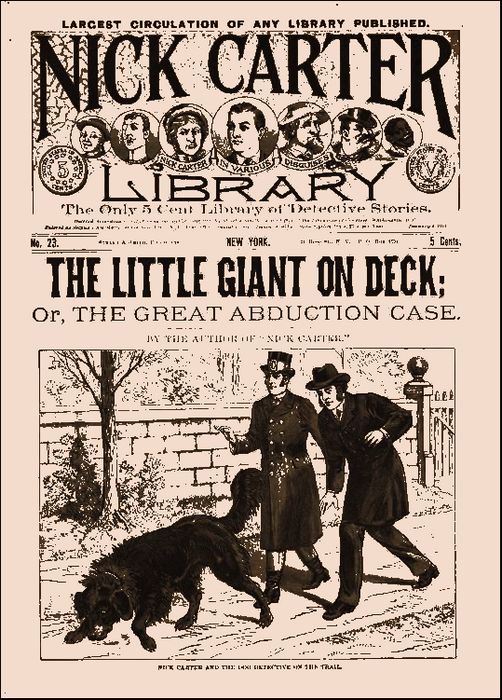
"IF you utter a sound or breathe a word above a whisper, I'll cut your throat!"
"Mercy, sir, mercy!"
"I'm not going to hurt you, young lady, in any way, shape or manner, but you have got to get up, put on your clothes, and come with me."
"Oh, sir, please—"
"Shut up, I tell you."
"But—"
"Do you want your throat cut?"
"No—no—no!"
"Then get up."
"I cannot. I will not."
"Won't, eh? Look here; do you see this?"
The man held a gleaming knife where Ethel Payne could see it, and she could also discern the fierce glitter of his eyes through the holes in the mask that he wore to conceal his features.
It was a moment of absolute terror for her.
Put yourself in her place for a moment, and try to realize the horror of her situation.
In her own room, in her own home, in the middle of the night, to be suddenly awakened from a sound sleep, to find a man standing over her with a murderous weapon in his hand, while he bade her rise and go with him.
Where?
She was in bed, with the clothes drawn up tightly beneath her chin, for the terror produced by outraged modesty was as full of unspeakable horror for her, as the fear of death from the knife that the intruder held over her.
She felt that there was very little choice between the two evils; that of getting out of bed in her night-dress in the presence of the intruder, and that of refusing to do so, and thus inviting the fate that he threatened—death.
He had lighted the gas when he entered the room, evidently feeling no fear of being surprised at his work, and there was a cool implacability about his demeanor that convinced Ethel that he meant to be obeyed at all hazards.
"Get up!" he repeated, savagely.
"Ah, sir, spare me!" she moaned, tears of agony starting from her beautiful eyes. "Kill me if you will, but do not compel me to—to—to—"
"Ah!? he interrupted, and he uttered a low laugh, which, strangely enough, sounded more like one of confusion, than of pure recklessness. "I forgot. I have no wish to offend your modesty, Miss Payne, nor to injure you in any way, unless you force me to do so."
"Then go away, sir."
"No; you must come with me."
"Listen, sir. I beseech you! You shall have all of my jewels; they are of great value."
"I know that."
"Take them—take them all!"
"I do not want them. I want you."
"No, oh, no!"
"But I say yes."
"Can nothing move you?"
"Nothing."
"Think, sir, think!"
"I have thought. Your pleading is useless."
"To-morrow I will be of age—"
"I know that also."
"I will give you money. I will—"
"Enough! You must do as I bid you, or take the consequences. Listen: I will go to the door yonder, and stand looking around with my back toward you while you dress, and I will not look around until you bid me. If, while I stand thus, waiting for you to get ready to accompany me, you utter a sound to attract attention to this room, or do anything to escape me, I swear that I will kill you! Do you understand? Kill you!"
"Yes, sir; yes."
"Will you obey me?"
"I have no choice; I must."
"That is sensible."
"You will keep your word, sir?"
"My word?"
"You will not turn?"
"I will do exactly as I have agreed, unless you force me to do otherwise. Be quick, now, for I have already been here too long."
As he finished speaking, he turned to the door, and stood with his back toward her.
In an instant she leaped from the bed, and ran to a little desk, which stood in one corner of the room.
She had a little silver-mounted revolver there, and she was resolved to free herself, if possible.
With spasmodic effort she pulled open the drawer in which it was kept. Then, in spite of herself, an exclamation of dismay escaped her.
The revolver was not there.
She searched vainly for it; it was gone.
"Are you dressing?" asked the intruder, without turning.
"Yes, sir; yes."
"Be quick about it."
She began donning her clothes.
The thought came to her that she would wait until she was fully attired before making any effort to escape.
Ethel Payne was a brave girl, and, despite the terror of the occasion, she did not lose her presence of mind.
While she worked, she thought.
Yet there was nothing which seemed to afford an opportunity for escape.
Her revolver was gone, evidently taken by the daring intruder before he had awakened her.
There was no other weapon of any kind in the room; nothing that could be converted into one for the time being.
She was totally at the man's mercy. She felt it and he seemed to fully realize the fact also, for he kept his word and did not turn his head.
There was the bell-cord, but it hung from the wall within five feet of where the man stood.
She could run to it and pull it, but he would have ample time to murder her before assistance came.
Again assistance might not come. At that hour of the night everybody in the house was sleeping.
The servants might not hear the summons, and even if they did, many minutes would pass before they would get her, and in that time what might not happen? Plainly that was not to be thought of.
Suddenly, while she worked, she thought of one thing that she might do.
It did not offer much hope, but it would, at least, be the means of telling her friends what had become of her.
She would manage to write a note, telling what had happened, and leave it where it would be found when she was gone.
But how write it?
Again, having succeeded in writing it, how conceal it from the piercing eyes of her abductor, and yet leave it where it would be found when her absence should be discovered?
She was standing before the mirror, a large pier-glass which reached from the floor to the ceiling, and even while endeavoring to devise some plan whereby she could accomplish her design, the light from the chandelier glistened upon a diamond that she wore upon her finger, and scintillated a hundred magnificent colors back to her from the mirror.
"Ah!" she gasped, as a sudden and unique idea flashed across her mind.
"What is the matter?" asked the intruder, still without looking around.
"Nothing, sir, nothing. A pin. I am so frightened."
"I am sorry," he said, not unkindly. "Believe me, you are in no danger."
"Do not turn yet, please don't," she cried, fearing that he was about to do so.
"Not until you bid me; but hurry."
"Yes—yes; I am nearly ready; nearly ready!"
"Make haste."
"Yes, sir; yes."
She took the ring from her finger and stepped nearer to the glass.
Then, with her left hand, she picked up a muslin garment which was on the floor at her feet.
She kept it moving, so that the rustling noise that it made would conceal the scratching sound made by the diamond as it dug its way into the mirror and formed the letters of the words which were to be the only clew to her mysterious disappearance.
She worked rapidly, with all the nervous haste born of the moment, and the message was soon written.
Then she finished her work of dressing, and, in a few moments more, was completely clothed.
"I am dressed," she said, simply.
The man turned and was about to speak to her, when steps were heard in the hall-way outside of the door.
With a quick motion, he turned the key in the lock, and then glided toward her.
He seized her by one arm, and held the knife where the point touched her white throat.
"Somebody is coming," he whispered. "Beware what you say or do, or you shall die. I swear it."
She trembled with terror. She knew that he would not hesitate to carry out his threat.
Presently a gentle tap came upon the panels of the door.
"Answer," he whispered, placing his lips close to her ear, and just breathing the words.
"Who is there?" murmured Ethel, striving to make her voice sound calm.
"I; your aunt," came the answer. "Are you ill, Ethel?"
"No—oh, no!"
"Do you know that it is two o'clock?"
"Yes."
"You ought to be in bed, child."
"I have been. I shall put my light out presently."
The person on the outside turned the door-knob, and endeavored to enter.
"Your door is locked," she said.
"Yes."
"Can't I come in?"
"No, not now. Good-night, aunty."
"You are sure that nothing is the matter?"
"Yes, aunty; yes."
There was the sound of a sigh as the woman turned away, and her steps could be heard receding along the hall way.
"Poor aunty," murmured Ethel, for the instant forgetful of her own peril. "When she finds that I am gone, it will kill her. Oh, sir, have a little pity! Let me leave a message for her."
"No. Nothing."
"You are a villain."
"I am a careful one, then. Have you selected what things you wish to take with you?"
"No."
"Have you a satchel here?"
"Yes."
"Where?"
"In that closet."
"I will get it. You had better pack it full of things that you will need while you are gone, or until you can procure others. Make haste now."
She did so.
With rare presence of mind, she chose those articles which she needed, and packed them in the satchel, while her abductor stood by looking on.
"Are you ready?" he asked, finally.
"Yes."
"Let us go, then."
He turned out the lights, and a moment later, Ethel Payne's room was tenantless.
ON the day following the incidents related in the last chapter, just as the great detective Nick Carter, was leaving the dinner-table, Patsy, his servant, handed him a letter which had been brought to the house by a footman in livery.
He tore away the envelope and discovered the following note:
The Birches,
August 7th, 1891.
Nicholas Carter, Esq,
New York City.
Dear Sir:—
I am in great trouble and need the services of an expert detective at once. If possible, will you call upon me without delay? My niece has disappeared in a very mysterious manner, leaving not a trace that I or the servants can discover. I have applied to you instead of to the police, for various reasons. I deem the local authorities incompetent to handle a case of this kind, and I wish above all things to avoid publicity. In case you cannot come here yourself, and at once, will you send somebody upon whom I can rely? If you can return with the servant who delivers this message, will you do so?
I have only to add that you may name your own remuneration for the services you render, if success crowns your efforts.
Very truly yours,
Martha Vanderpool.
"Where is the man who brought this?" asked Nick, as soon as he had finished reading the letter.
"In the reception-room, sir."
Nick hurried to his study, and rapidly donned the disguise in which he usually received his callers.
Then he entered the reception-room.
"What is your name?" he demanded of the man.
"John Meeker, sir."
"Do you know the purport of this note?"
"Yes, sir."
"What is the name of the young lady who has disappeared?"
"Ethel Payne, sir."
"And the lady who wrote this note is her aunt?"
"Yes, sir."
"Her mother's sister?"
"Yes, sir."
"When was Miss Payne last seen?"
"About nine o'clock last evening."
"By whom?"
"By myself, sir."
"Where?"
"In her room. The evening was chilly and she rang for me to make a small fire in the grate."
"Was she all right, then?"
"Yes, sir; she seemed so."
"How old are you, John?"
"Fifty, sir."
"How long have you been connected with the family?"
"Ever since I was born, sir. My mother worked for Miss Ethel's grandfather."
"Ah! Where is this place, 'The Birches,' located?"
"About six miles from Fort Lee."
"You have to drive?"
"Yes, sir."
"John, you look like a shrewd fellow."
"Thank you, sir."
"What do you think has become of your young mistress?"
"I think she has been abducted, sir."
"Abducted!"
"Yes, sir."
"From her own room in the night time? How old is she?"
"To-day is her twenty-first birthday."
"Ah; indeed! Does her aunt also think that Ethel was abducted?"
"I don't know what she does think, sir."
"But you have guessed?"
"Yes, sir."
"What is the result of your guessing?"
"I don't think that Miss Martha and I have the same opinion."
"Miss Martha is the aunt; how old is she?"
"Two years younger than I, sir."
"Forty-eight. Does she own the property?"
"No, sir."
"Who does?"
"Miss Ethel."
"Tell me about it."
"Her mother died when she was a child, sir, and Miss Martha has acted in that capacity for her ever since. Ten years ago Mr. Payne died, leaving his entire property to his only child, Ethel, who was to obtain full possession to-day."
"I see. Where was the property to go in the event of her death before attaining her majority?"
"To charitable institutions, sir."
"Was her Aunt Martha provided for?"
"Yes, sir; by an annuity."
"Is the property large, John?"
"Half a million or more, sir."
"What position do you fill in the family?"
"Several, in reality. I have general charge of the servants, pay them their wages; I act as footman when occasion requires."
"A sort of general utility man, and confidential servant, eh?"
"Yes, sir."
"Now, John, has there ever been anything in the conduct of Miss Ethel Payne which would lead you to suppose that she might someday disappear of her own accord?"
"Nothing, sir."
"Why do you think that she has been abducted?"
"Because she would never leave as she did, voluntarily."
"You spoke of the servants?"
"Yes, sir."
"How many are there?"
"Four besides myself in the house, and two at the stable."
"In the house there are—"
"The cook, the waitress, the chamber-maid, and the maid, whose duty it is to care for Miss Martha."
"And at the stable?"
"The hostler and gardener."
"That will do for the present, John. Wait here a moment and I will return with you."
"Yes, sir."
Nick left a few instructions for Chick, who was not at that moment in the house, and then, still in his disguise as a man past middle age, he accompanied John Meeker to "The Birches."
Arrived there, he was soon in consultation with Miss Vanderpool, the maiden aunt of the missing girl.
He found her to be a gentle, quiet, affectionate woman, whose whole life seemed to be bound up in the welfare of her niece. She was, and had been, for many years, an invalid who had strength enough to keep about, but who never left her home under any pretext.
"We will go at once to the room from which Miss Payne disappeared," said Nick, "and do our talking there, if you have no objection."
"None whatever."
They proceeded to the apartment in question, which Nick found to be a room of unusual size.
It was located at one corner of the house, and the front windows were just over the roof of the piazza.
There were four windows in the room, two being upon the side, and a large pier-glass stood between the two first named.
"When did you last speak with your niece?" asked Nick.
"At two o'clock this morning."
"At two this morning! Then when did she disappear?"
"Between that time and daylight."
"How did she appear, then?"
"I did not see her; I was in the hall, and she in this room."
"Was the door locked?"
"Yes."
"Was she in the habit of keeping it locked?"
"I never knew her to lock her door at night before."
"How do you explain the circumstance?"
"I do not attempt to do so; that is why I sent for you."
"What passed between you at two o'clock?"
"Only a short conversation."
"What occasioned it?"
"I was not feeling well, and left my bed. In returning to my room, I fancied that I saw evidences of a light in her room. I went to her door and tapped upon it."
"Did she answer?"
"Yes; we talked together two or three minutes. I tried the door and found that it was locked."
"Did you remark the fact?"
"Yes."
"And did she offer any explanation?"
"None."
"What next occurred?"
"I returned to my room, and went to sleep. In the morning Ethel did not come down stairs as usual, and, remembering that she had been up late in the night, I did not disturb her.
"By ten o'clock, however, I became alarmed and went to her room."
"Was the door still locked?"
"Yes."
"What did you do?"
"I called, and received no reply. Then I sent for John, who pounded upon the door and called Ethel's name; but without result.
"At last I became thoroughly frightened, and told him to burst in the door.
"He did so, and we found the room vacant. Ethel was gone, and there was not a sign left to tell us how she had gone, or why."
"No note? No message of any kind?"
"None."
"You searched thoroughly?"
"Very."
"Miss Vanderpool, have you formed an opinion which explains this strange affair to your own mind?"
"No, I cannot say that I have."
"Do you consider it a flight, or an abduction?"
"The latter I do not consider possible; the former, highly improbable."
"But of the two, you incline to the theory of flight."
"I do; yes."
"But why? You have a reason."
"No, I have no definite reason, except that an abduction under the circumstances, seems impossible. In the first place, I can assign no cause for such a desperate deed, and, in the second place, I do not believe that it could have been accomplished without alarming the household.
"Ethel is a very courageous girl. My room adjoins her's, although there is no connecting door; but a single scream would have aroused me, and she knew it.
"Again, I knew that Ethel kept a little revolver in her room. It was always in that drawer there, and always loaded. I have often endeavored to prevail upon her to keep the weapon in some other place, and only yesterday I urged her to take the loads out, at least."
"You know, then, that the revolver was there yesterday?"
"Positively."
"Is it there now?"
"No. it is gone."
"Is that all that is missing?"
"No."
"What else?"
"Her satchel is gone from the closet, and a complete assortment of such articles as would be needed by her for a short absence from home."
"Articles that she would herself select?"
"Yes."
"So you are convinced that she packed the satchel herself?"
"I am."
"Had Miss Payne a lover?"
"There are a dozen who are in love with her, but not one to whom she has given the slightest encouragement."
"You are sure of that?"
"Positive."
"What, then, could have induced her to go away in such a manner?"
"Sir, the explanation is a profound mystery to me, unless she has become temporarily insane."
"Has her conduct ever been such as to suggest the possibility of an event of that kind?"
"Never."
"Is your niece beautiful?"
"She is the personification of beauty. She is glorious! Her beauty is remarkable and her whole appearance very striking."
"Romantic?"
"Not at all."
"Visionary?"
"Quite the opposite."
NICK rose from his chair, and began carelessly walking about the room.
"The bed has not been made, I see," he said; "is that the condition in which it was found when the door was burst open?"
"Precisely. It has not been touched."
"It shows plainly enough that she left it deliberately, does it not?"
"I think so."
"The coverings are thrown only partly back on one side, and very smoothly."
"Yes."
"What kind of a dress did she wear last evening?"
Miss Vanderpool looked up in surprise.
"A house dress," she replied.
"One that she would be apt to put on, if she were preparing for a flight of the kind you suspect?"
"I have not said that I suspect—"
"But you do. Will you answer my question?"
"About the dress?"
"Yes."
"It was not."
"Are you familiar with her dresses?"
"Of course."
"Is the dress she wore last evening the one that is missing?"
"Yes."
"Then it follows that she did not select an appropriate dress for her journey, supposing that she did go away of her own accord."
"Yes."
"If she had planned to go away without telling you about it, and had really gone off deliberately, she would hardly have selected the dress that you know she wore, would she?"
"No; I had not thought of that."
"We must think of all things."
"You are right, sir; I am glad that I sent for you."
"Thanks. You say you have been able to find no clew?"
"None."
"Have you looked at the mirror?"
"Sir! Do you mean to charge me—"
"Not at all. You misunderstand me entirely. While sitting here talking with you, I have noticed a peculiarity about that pier-glass yonder."
"What is it?"
"Before examining it more closely, I will ask a few more questions."
"Yes, sir."
"Does Miss Payne wear a diamond-ring?"
"She does."
"Is she in the habit of removing it when she retires, or does she keep it on her finger?"
"I think she wears it constantly."
"Thanks. Now, I will look at the glass."
He rose and crossed the room.
"The mystery is explained," he said, quietly, after a moment.
"How?" exclaimed the aunt, also rising and following the detective.
"Look there," said Nick.
He pointed to some letters, roughly and evidently hastily made with a diamond, upon the glass before them.
"Abdctd tall dark. Thrtns dth if resit. Save me. E."
That was all.
It was the only clew, but those few words spoke volumes.
"I cannot make it out," murmured Miss Vanderpool.
"It is plain enough," replied Nick. "She had no time to write more, and was obliged to abbreviate what she did write. How she managed to do it at all is the mystery."
"Read it, please."
"Certainly. Her words are: 'Abducted; tall, dark. Threatens death if resist. Save me. E.' That is plain enough."
"Ah, what does she mean?" moaned the grief-stricken aunt.
"Shall I read between the lines for you?"
"Please do."
"In plain English, then, her message is as follows:
"A man who is tall and dark has entered my room, and he threatens me with death if I refuse to accompany him. Save me.'
"That is the gist of her message, and it remains for us to find that same tall, dark man—and we will."
"Oh, sir, find him and save her from a fate worse than death! It may be, but I dare not say the words."
"Don't try. Now a few questions, if you please."
"Yes."
"Who would have any interest in taking your niece away by force?"
"I know of no one."
"Is there anybody who would be benefited by her death? through her fortune, I mean?"
"No; nobody."
"Do you know of any admirer that she had who might resort to such—"
"No, sir; no."
"Did she have an enemy?"
"Not one in the world, I believe."
"I mean among her own sex?"
"Not that I know of."
"Do you know of any woman, young or old, who was jealous of her for any cause?"
"No—yet, stay!"
"Well?"
"She received a proposal of marriage a year ago from a gentleman, who, until then, was supposed to be a suitor for the hand of Miss Sleighton."
"Who is Miss Sleighton?"
"She lives in the big white house that you passed about a mile below here."
"Yes, What is her first name?"
"Cora."
"And the man's name?"
"Reuben Hatfield."
"She refused him?"
"Yes."
"Decidedly?"
"Very."
"What sort of man is he?"
"Above reproach in every way, I believe."
"Then why did you mention the incident?"
"Because she told me soon after that Cora Sleighton had passed her without speaking."
"Indeed! Have they since 'made up?'"
"I believe not."
"There may be something worth looking up in what you tell me. I will bear it in mind. Now, Miss Vanderpool, I am going out to take a look around the house on the outside, and, while I am gone, I want you to try to think if there is anybody in the world who would be benefited in any way by the disappearance or death of Ethel Payne."
"I can answer that question now."
"Positively?"
"Yes."
"There is no one?"
"No one."
"Miss Vanderpool, the man who came here took desperate chances. He forced his way into this room as a burglar would, and he compelled your niece to get up and dress, and to take away with her such clothing as she would immediately require. There are only three reasons which could be assigned as sufficient motive for such a deed."
"What are they?"
"Revenge, the hope of reward, or—well, we will call the other love, for want of a better term for it.
"Miss Sleighton, for instance, might wish to be revenged for the loss of her lover, for which she doubtless blamed your niece, and to that end, she may have hired somebody to do this work.
"That is one view. Here is the next: She may have been abducted for the sake of obtaining a ransom."
"I do not understand."
"It is plain enough. She is of age to-day, and has the right to dispose of her fortune as she pleases. The man who abducted her may know of that fact, and he may be at this moment telling her that she will be returned here to you as soon as he is put in possession of a certain amount of cash, of which she now has the right to dispose."
"There is still another view, you said, Mr. Carter."
"Yes. There may be a rejected lover of whom you know nothing. One that she has scorned, perhaps. He loves her money quite as well as he does her, and he has carried her away forcibly for the purpose of compelling her to become his wife, in order to share her fortune with her. If that is so, she is in great peril, perhaps, even now reduced to that condition where she will gladly consent, or take her own life."
"You horrify me, sir."
"We must hope for the best, Miss Vanderpool. I do not say that any one of my theories is the correct one; but yet it may be so."
Five minutes later, Nick was in the grounds.
He went at once to the front of the house, calling John Meeker to accompany him.
"Have you got a ladder on the premises, John?" he asked.
"Yes, sir."
"Bring it to me."
"Why do you wish a ladder?"
"Do you see those marks in the sod?"
"Yes, sir."
"The man who carried Ethel away needed a ladder, and it must have been yours."
"I don't see how that could be, sir."
"Why not?"
"Because it is kept close by Bruce's kennel."
"Bruce is a dog?"
"Yes, sir."
"What kind?"
"Newfoundland, sir."
"Take me to him."
"Yes, sir."
"Is he a good watch-dog?" asked Nick, as they walked around the house.
"None better, sir."
"Easy to make friends with?"
"Sometimes."
"Keep him chained nights?"
"Well, yes; we have lately."
"Why?"
"There have been some sheep killed around here, and we were afraid that he might get into mischief."
"He would bark if a stranger came around the house at night, wouldn't he?"
"Yes, sir."
"Did you hear him bark last night?"
"Now that I think of it, I did."
"At what time?"
"I don't know, sir. I had been asleep."
"Did he bark loudly?"
"Not very."
"As though he was excited."
"Not particularly; and he stopped at once."
"So you thought that whatever had caused his first alarm, had ceased to affect him."
"Exactly."
"Ah, here is the ladder, and there is the kennel."
"Yes."
"A man, to pick that ladder up and carry it away, would have to go within reach of the dog, or else pull it away, and thereby excite him greatly."
"Yes; that is why we keep it here."
"Well, you had better get a new dog, then."
"Why?"
"Because somebody used that ladder last night. He not only came here and took it away, but he brought it back later, and when it had served his purpose. Either the dog is no good, or else—"
"Or else what, sir?"
"Or else the man who came and got the ladder, knew the dog, and the dog knew him well enough not to think his presence dangerous."
"THIS ladder may not have been the one used, sir," said John.
"It was. Don't you see the evidence of that? Look at the end that rested upon the ground."
"Well?"
"The place where I found the marks of the ladder is a patch of white clover, which has a very small leaf."
"Yes, sir."
"There are two leaves of the same kind sticking to it now."
"That's so."
"Let the dog loose, John."
"What for?"
"I want to watch him. Was he fond of Ethel?"
"Very, sir."
"Tell him to find her."
The dog was loosened.
He bounded around for a moment or two, to show his joy at being released. Then he walked gravely up to Nick, took a sniff or two around his legs, after which he sat down upon his haunches, and wagged his tail slowly back and forth, as if thoroughly satisfied regarding the morals and general character of the detective.
"Go find her! Find Ethel!" ordered John.
Bruce looked up at him, just as though he would like to speak and could not.
Then he wagged his tail a few times in token of his willingness to obey, but saying as plainly as a dog's tail could that it was useless.
"Find her, I say," repeated John. "Go find Ethel!"
The dog seemed to detect some more than ordinary seriousness in the old servant's voice, for he stood up, looked earnestly first at John and then at the detective, and then uttered a low bark.
"He does not quite understand you," said Nick; "but I think I can make it plain to him. Come here, Bruce."
The dog went to him obediently.
Nick took him by the collar, and led him around to the front of the house.
"If the abductor carried Ethel down the ladder, he must have placed her upon her feet as soon as she reached the ground," he said.
Then he pointed to the ground near where the end of the ladder had made the two dents in the sod.
"Find Ethel," he said. "Find her, Bruce, she is lost. Go find, go find!"
The intelligent beast hesitated only an instant.
Then he placed his nose to the ground, and ran rapidly around.
"Not much scent left after all these hours," said Nick; "but I think he will find it."
He did.
In a few seconds he uttered a joyful bark, and started rapidly away toward the back of the house.
"Ha!" exclaimed Nick. "We know one thing, John, anyway."
"What, sir?"
"We know that Ethel was uninjured when she reached the ground; at all events, she was able to walk."
"Yes, sir."
"The fellow who compelled her to leave with him, probably made her walk in advance while he returned the ladder to its place, threatening her with bodily harm, if she refused or made an outcry."
"Surely, sir."
They followed the dog, who still went along with his nose to the ground.
He went slowly, however, as though puzzled.
Two or three times he hesitated as though in doubt, but then he went on again.
He seemed now to thoroughly understand what was required of him, for he paid no further attention to the men, giving his whole attention to the work on hand.
Suddenly he stopped, waited a moment, and then ran in a circle with his nose to the ground.
"Here is where she waited while he put the ladder away," said Nick. "The dog is looking for the back track."
He found it even as the detective spoke.
Then he started away in a straight line for the front gate, which was about twenty rods away.
"Good!" muttered Nick. "We are getting at it."
Bruce led them to the gate without once hesitating.
Then on, and into the road, and along the path which went by its side, until he had led the two men about an eighth of a mile.
Suddenly, however, he stopped abruptly, raised his nose in the air, and uttered a prolonged howl.
"The end of the track," said Nick.
"Then they must have taken some sort of conveyance from here," ventured Meeker.
"Yes."
"What was it?"
Nick was almost upon his knees, so intently was he engaged in examining the ground around that particular spot.
He did not reply at once, but presently he looked up, and said:
"Saddle horses."
"Really?" asked John.
"Yes."
"How can you tell?"
"There are the marks of their hoofs, where they have stamped and pawed."
"The ground is hard here, and would not show wheel-tracks if there were any here," suggested the servant.
"Yes; but I know there weren't any."
"How do you know it?"
"By the hoof marks."
"Still—"
"They show that the horses were not confined to one position, either by traces or shafts. Look closely, John, and you will see that they described almost a circle in changing their positions while they stood here."
"Yes, sir; I see."
"Good! They were saddle horses."
"No doubt of it, sir."
"They were tied to that tree."
"Yes."
"The next thing is to find out what direction they took when they left here."
"But is that possible?"
"All things are possible, John."
The detective dropped upon his knees this time and crept along the ground, often using a magnifying-glass which he took from his pocket.
He went slowly but surely, and the track led him down the road toward the house where Cora Sleighton was said to live.
Presently he paused.
"The tracks seem to go that way," said Meeker.
"Yes."
"Then it is in that direction that we must pursue them."
"I am not so sure of that."
"Why?"
"Because the fellow who did this work was extraordinarily cunning."
"What does that signify?"
"Simply that he was capable of foreseeing the fact that his tracks would be discovered."
"Still—"
"You do not catch on. eh? Suppose he reasoned that he would be tracked to this point."
"Yes."
"And knew that the place where the horses were tied would be found?"
"Yes."
"Would he not naturally conjecture that a search would be made for the very tracks that we have discovered?"
"Probably."
"And therefore, being possessed of extraordinary cunning, he might have ridden away from here in exactly the opposite direction from that which he intended to take."
"I see."
"And he probably did so."
"He may."
"Yes. Now, John, we have got this far, and here we have to stop."
"Not for good, sir."
"No, only for the present. There is not a horsehair here by which I can discover the color of the horses that they rode, nor was there any shoe gone, or nail out, as far as I can determine. The dog brought us here, and you must furnish the next clew."
"I?"
"Yes."
"But—"
"But you do not understand, eh?"
"No."
"You have been with the family all your life."
"Yes, sir."
"You know every servant that has been employed here for years."
"I do."
"You appreciate the fact that the man who was here knew the dog, and that Bruce knew him?"
"Yes. Unless—"
"Well; unless what?"
"Unless he compelled her to keep the dog quiet. Bruce would obey her."
"A good point, John, but it don't hold water."
"Why?"
"You forget that he had to get the ladder before she was with him."
"True."
"The dog barked at first, because you heard it."
"But he quickly ceased. Why?"
"That's what puzzles me."
"Yet it is very simple."
"How so?"
"The man spoke to the dog. The dog knew his voice and knew him. The man petted the dog, and then carried the ladder away, and Bruce did not object. By and by, when the scoundrel returned accompanied by Ethel, the dog was thoroughly satisfied that everything was all right, and he went into his kennel and lay down."
"You're right, sir."
"Of course. Now, who, outside the family and the servants, know the dog?"
"Several."
"Who?"
"Mr. Montgomery—"
"Who is he?"
"He's a broker in New York who is attentive to—"
"Yes, I know him. He isn't in it, John."
The old servant named a dozen people, but Nick questioned him, and speedily found that none of them could be suspected of the outrage.
"Now for the servants," he said.
"There's only the hostler, the gardener, and myself."
"Who is the gardener?"
"Patrick Mullen, an old man, nearly seventy."
"That will do for him. Now the hostler."
"James Langdon, who is about my own age."
'How long has Mullen worked here?"
"Twenty years or more."
"And Langdon?"
"About a year."
"Who was hostler before him?"
"A man named Myron Myers."
"How old was he?"
"About thirty."
"He left about a year ago?"
"Yes."
"Why?"
"A relative died and left him some money."
"Yes."
"So he was not discharged?"
"No."
"What became of him?"
"He lives in his house up on the hill."
"How far from here?"
"Three or four miles."
"Was he liked when here?"
"Not over much."
"Why?"
"He was saucy at times."
"Only at times?"
"Yes."
"YOU say that Myers left of his own accord?"
"Yes, sir."
"Would he have been discharged otherwise?"
"Yes, sir; if I had had my way, he would not have remained as long as he did."
"Why?"
"He was queer."
"How?"
"There were times when I disliked to have him drive Miss Ethel out alone."
"Indeed! Why so?"
"He was a reckless driver, and once he almost tipped the carriage over.'
"How was that?"
"A gentleman was coming up to spend Thanksgiving with us, and Miss Ethel went to the depot to meet him. He was Mr. Montgomery."
"Yes."
"Miss Ethel said afterward that she was afraid that Myron had been drinking."
"Why?"
"Because he kept looking around on the way to the station."
"Did he say anything?"
"Not that I was told."
"Well?"
"When they started back, Mr. Montgomery was, of course, in the carriage with Miss Ethel, and but for that fact there would have been a terrible accident."
"How so?"
"I shudder to think of it."
"Tell me how it happened."
"In leaving the station, they had to drive across the track."
"Well?"
"A passenger train—a through express—was coming from the other way. Myers either did not see it, or took big chances."
"How?"
"He drove, or attempted to drive, across the track in front of the approaching train. Just as they get on to the track, the horses seemed to become terror-stricken. They reared and plunged, but would not go ahead at all.
"The train was coming nearer.
"The engineer whistled and reversed his engine.
"The spectators shouted with horror. It looked, for a moment, as if nothing could save the carriage and its occupants from destruction.
"Fortunately, the day was warm and bright, and they were in the open carriage.
"Mr. Montgomery leaped to his feet, and seized Miss Ethel in his arms. Then he leaped from the carriage, just as the train came thundering along and struck it."
"The carriage was smashed, then?"
"Into kindling wood."
"What became of Myers?"
"He jumped also, when the others did."
"What became of the horses?"
"By a miracle, neither one was hurt."
"It was a narrow escape, John."
"Yes, sir; it was. Only for Mr. Montgomery, Miss Ethel would have been killed."
"Why was Myers not discharged, then?"
"The blame was laid upon the horses."
"And they were sold?"
"At once."
"Myers remained?"
"Yes."
"Were there any other accidents worth mentioning?"
"No, sir."
"What kind of a looking fellow is Myers?"
"Rather too good-looking for such a position."
"Why? How is that?"
"Well, he is tall and well formed, and he carries himself as though he owned half the earth. He is well educated, too."
"Indeed! Has he lived in the neighborhood ever since he left here?"
"No. He went away for a few months."
"Where?"
"Nobody knows."
"Has he ever been here since he gave up his place?"
"Never, to my knowledge."
"Has he ever attempted to speak to Ethel?"
"I think not, except to return her recognition. She always bowed to everybody she knew."
"She met him quite often on the road, when she was driving, didn't she?"
"I don't know, I'm sure."
"Go and ask the hostler. I will wait here. Don't let him know what you want to know."
"Then how am I to find out?"
"Simply ask him if he has seen Myers lately. Tell him that you have a message for him, or something like that."
"I see; but there isn't a soul except Miss Martha, the maid, and myself, who knows that Miss Ethel has gone."
"All the better."
John returned after an absence of ten minutes.
"Well?" said Nick; "did you ask him?"
"Yes; I put the question just as you suggested."
"What did he say?"
"Sure," said he. 'I niver go out that I don't see him.'"
"Thanks. That will do for that point. Didn't you say that Myers was handsome?"
"Yes, sir."
"And intelligent?"
"Yes, sir."
"Light or dark?"
"Light."
"Indeed! I expected the other answer. What color are his eyes?"
"Dark, as I remember them. Do you think that he—"
"Never mind what I think, John. Have you got a saddle horse?"
"Yes, sir."
"Let me have him a little while, and tell me where Myers lives."
"He lives on the Danville road, in a house surrounded by a pine grove."
"All right. Get the horse for me, John."
"Yes, sir."
"Stay one minute. What if I find that Miss Ethel has eloped with Myers?"
"Eloped with him!"
"Yes."
"But it is preposterous."
"Why?"
"Because she could have married whomsoever she pleased to-day without taking the trouble to elope. Besides—"
"Besides what?"
"I am sure that she disliked Myers."
"Why?"
"I think she rather feared him."
"Why should she fear him?"
"I don't know. I only know what she said to me when he left."
"What was that?"
"She said, 'I am glad that he has gone, John,' and there was something in her voice which made me think that she was glad, because she feared the man."
"Again, why should she fear him?"
"Because of his reckless driving, perhaps."
"Perhaps so. But I want to come back to the question of an elopement."
"I will never believe that, sir."
"Listen a moment."
"Yes, sir."
"We know that she left the house in the middle of the night."
"Yes, sir."
"We know that she took some clothes with her, packed in a satchel."
"Yes, sir."
"We know that after she reached the ground, she walked around to the dog-kennel, while the man, who was with her, put the ladder away."
"Yes, sir."
"We know that she walked unaided because her companion was obliged to carry the ladder, which was heavy."
"Yes, sir."
"We know that she made no outcry, and seemingly no effort to escape."
"We do."
"We know that when the ladder was returned to its place, the dog felt no cause for alarm, hence suggesting that she assisted in quieting him."
"Ye-yes, sir."
"We know that when she left here, she walked to the spot where the horses were waiting, still making no outcry."
"Yes, sir."
"To sum up: We are reasonably well satisfied that the man was in the room with her when her aunt went to the door. That fact; the use of the ladder; the quietness of the dog; the double journey across the grounds; the horses in waiting; the fact that she took wearing apparel with her, and the general air of mystery which over-shadows the whole proceeding might point to an elopement."
"I don't believe it, sir. I cannot believe it. Why should she elope? She is twenty-one to-day, and there is nobody to say her nay."
"Very good. But the man is her inferior. She may not have wished to remain here and face criticism, preferring the other method of marrying the man she loved."
"No, sir; no."
"You don't believe it?"
"No; sir."
"Neither do I; and yet it is one explanation."
"But not the right one."
"I hope not—and yet, she may be in more danger than though it were the true one."
"Oh, I hope you can save her, sir."
"I will try, John. Now, get the horse."
"You are going to see Myers?"
"Yes."
"May I go with you?"
"Not this time, John."
The horse was presently brought to him, saddled and bridled, and Nick mounted.
"John," he said.
"Yes, sir."
"If I should leave the horse in the road, after turning his head toward home, would he return?"
"I think so."
"Very good. I may wish to do that very thing. Good-by."
Nick started away at a canter toward the house where Myron Myers lived.
"Myers is the only one of whom I can get any trace, who would know the dog sufficiently well to quiet him," he muttered; "and that affair at the depot makes me think that I may be on the right scent.
"There are no little things in this world. The most trivial act may reach magnificent proportions.
"I think I have struck the right idea in this matter, and I will spend a little time on it, anyhow."
He rode on rapidly, until he came in sight of the house to which he had been directed, after suddenly rounding a turn in the road.
Then he wheeled his horse, and started on the back track at a gallop. But he only went about a quarter of a mile, before he released his feet from the stirrups and threw one leg over the saddle.
Then, watching for the right instant, he struck the horse a smart cut with the whip, at the same moment springing clean off his back.
He alighted upon his feet in the highway, while the horse went galloping on its way toward home.
"Good!" murmured Nick.
Then, with a hasty glance around, he leaped the ditch, and disappeared into the woods.
ABOUT twenty minutes after Nick disappeared in the woods, a young man came out and started up the road toward the house, which was half-concealed in the pine grove.
To all appearance, he was a young countryman, who was passing from one point to another on foot, doubtless in search of work. He was clad in overalls and blouse, which bore the stains of constant wear.
Upon his head was an old hat, with a greasy band, and he was puffing at a corn-cob pipe.
He whistled merrily as he started up the road, and never once looked to the right or left until he paused suddenly in front of the house already mentioned.
He seemed to regard it earnestly for several moments. Presently, as if satisfied with his inspection, he turned and went up the lane toward the front-door.
There was a man engaged in some trivial occupation near the back-door, who looked up as he drew near.
The reader has already connected the farmer boy with the great detective, who had at once recognized Myron Myers in the man before him.
"I want to hire out," drawled Nick, leisurely, taking the pipe from his mouth and looking at Myers with calm assurance.
"Why don't you do it, then?" was the reply.
"Thats? what I'm trying to do."
"Then keep on trying."
"Ain't you got a job for me, mister?"
"No."
"I'll work cheap."
"I don't need a man."
"Say! I'll work a week for my board."
"I don't want a man, I tell you."
"Well, will you give a fellow something to eat? I'm most starved."
"Yes, I'll give you some pie, if you want it."
"If I want it! Great Scott! I haven't eaten anything since yesterday morning. Can I sit down while I eat it?"
"Yes; go into the kitchen."
Nick did not need a second invitation, nor did he delay long enough for Myers to change his mind.
The kitchen door was open, and he walked in.
"I never thought to ask John if this fellow lives alone," mused the detective, as his quick glance took in every object in the room that he had entered; "but there is no need to do that."
He was cut short in his reflections by the entrance of Myers, who went to a cupboard, procured a pie, and placed half of it before Nick.
"Eat that," he said, not unkindly, "and maybe you'll feel better."
Nick set to with a relish, for he was really hungry, and the pie, which was very good, was soon devoured.
During the time thus employed, he took in every detail of the room, noticing particularly how the doors and windows were guarded.
"Guess you ain't got no woman here, have you?" he asked, presently.
"No, I live alone."
"Kinder lonesome, I sh'd think."
"Sometimes."
"Oughter git married."
"How's the pie?"
"Bully."
"Where are you from?"
"Out on Long Island."
"You're a good ways from home."
"Yes. Dad and mam had a row. It got too hot fur me, so I sloped."
"Where are you going?"
"Anywhere to git work. Say, mister."
"What?"
"You was choppin' wood when I came."
"Yes."
"I ain't got no place to sleep to-night. Will you give me a shake-down, if I'll finish the wood pile for you?"
"Yes."
"It's a bargain, an' much obliged. My name's Simpkins; Phil fur short. What's yourn?"
"Myers."
"This is your farm, ain't it? Gosh! I wish I owned a farm of my own."
"That isn't all I own, young man."
"Whew! You're rich, ain't you?"
"Yes, I am very rich."
"Then why can't you give a fellow a job?"
"Perhaps I will, if I like you."
"Then, by gosh! I'll make you like me, Mr. Myers. I've struck some queer coves, though, since I started out to shift for myself. I stopped down here a piece, to a house with a lot o' white birches around it, an' asked an ole cove there to give me some work, but he didn't have any."
Myers interest seemed suddenly to brighten.
His eyes shot out a keen and startled glance at Nick. A glance that was difficult to analyze.
"Was that fear, or what?" thought the detective.
"Anyhow, I've seen enough to confirm my original suspicion, and it can't do any harm to follow that a little farther."
"So you stopped at 'The Birches,'" said Myers.
"Yes."
"And asked for work?"
"Yes."
"I worked there once."
"Is that so? I thought you was rich?"
"That was before I was rich."
"Oh."
"They wouldn't give you any, eh?"
"No."
"Why not?"
"The ole cove said as how Miss Somebody had gone away on a visit, an' nobody else could hire hands."
A strange smile flitted across the face of Myron Myers.
"What did that smile mean?" thought Nick. " Blessed if he hasn't got the hardest face to read I ever saw. But it all strengthens my idea. I'll put him to the test presently."
"You didn't see the young lady, then?" asked Myers.
"What young lady?"
"The one who owns 'The Birches.'"
'No. She's young, is she?"
"Yes."
"Purty?"
"As beautiful as a dream! as grand as a goddess! As perfect as an angel! as sublime as Heaven! She is the personification of —er, won't you have some more pie, Simpkins?"
"Thanky, no," and Nick, instead of laughing, heaved a deep sigh.
It attracted Myers' attention.
"What is the matter?" he asked.
"I was thinkin'."
"Of what?"
"Oh, of suthin'! Your words about the gal down at 'The Birches' reminded me of suthin'."
"I am sorry if I pained you."
"Oh, I don't mind tellin' you all about it, if you wanter know. You look like a good feller, an' tain't much, anyhow. You see, I was a settin' up with—"
"Doing what?"
"Keepin' company with Jim Bloomer's daughter Sally, and I thought I had everything all fixed. I went to town an' bought some new clothes an' things for the weddin', an' then, when I got back, I found that she'd up an' married another feller."
Myers' eyes were sparkling like diamonds, as he listened to Nick's story. His lips twitched nervously, and Nick could see his hands open and shut as though they were seeking to grasp something that was not in sight.
When he spoke, his voice was quiet and calm, bearing no evidence of the excitement that shone in his eyes and muscles.
"What did you do, then?" he asked.
"Well, I didn't do much. I thought of doin' consider'ble, though."
"What?"
"First, I thought of killin' t'other feller."
"But you didn't?"
"No."
"I think I should."
"Hey?"
"I think I should."
The words were said calmly enough, but Myers face had become pale and drawn, and his eyes gleamed more hatefully than ever.
He arose and walked across the floor. Then back again, and reseated himself.
"Yes," he muttered; "I know I should have killed him."
"You would, eh?"
"Yes."
"Well, b' gosh! I done better!"
"Better? What could be better?"
"If I had known you a little longer, cuss'd if I wouldn't tell you."
"You need not fear to tell me, young man."
"All the same, I do."
"You can trust me entirely."
"I wish I could."
"You may. I will prove it."
"How?"
"By giving you a job. I hire you now for a year."
"By thunder! but you're a good feller!" cried Nick.
"Whoop! I've got a job, an' they'll never find me here."
"Who?"
"Anybody that looks fur me."
"But I want you to tell me."
"Tell you what?"
"What you did that was better than killing your rival."
"Oh!"
"Will you tell me?"
"Yes, if you'll promise never to give it away."
"I promise."
"Honest injun?"
"Yes. "
"Well," and Nick leaned forward and half-whispered the words, in order to give them additional weight. "I left everything so they'd think he'd killed me! see?"
Myers lips were twitching nervously. His eyes fairly blazed as he grasped the idea that Nick had suggested.
"Tell me more! more! more!!" he whispered, hoarsely.
Nick paused for an instant, and then he said, slowly:
"If you ever blow on me, I'll murder you, see?"
"Yes—yes! you may! now tell me, tell me."
"Say, you remind me of a newspaper man," said Nick.
"Why?"
"They're always lookin' fur ideas, I've heard, an' that's what you are lookin' fur now, ain't it?"
"Young man, do you wish to live?"
"Well, you bet!"
"Do you see my eyes?"
"Can't see much else, thanky. They're like a couple o' bullets."
"Exactly, I can strike you dead where you sit with a glance."
"Holy Moses! say; don't try it on, will you?"
"Not if you tell me your story. Nay, I will teach you how to use your's in the same way."
"You will?"
"Yes."
"Then I can go back some day an' look a hole through Pete Morris, can't I?"
"You can."
"An' you'll teach me how?"
"Yes."
"Then I'll tell you."
"Tell me! Tell me! I would know all your secrets; hear all your plans; learn of your desires; share your troubles. I think that you will make a fit acquisition to my —, but wait, wait, wait! The time is not yet ripe. Later, young man, I will take you up on the top of a high mountain; I will show you all the kingdoms of the earth, and I will say to you, Philip, all these things that you see shall be yours, if you but hearken unto me and follow my advice. But tell me! tell me!"
"Well, I have struck it rich this time, and no mistake!" thought Nick. Aloud he said:
"I was this 'ere way. When I got back Sally an' Pete was married an' there didn't seem to be any use in kickin'. I thought fur a bit, that I'd put a bullet through Pete an' carry Sally off bodily.
"Then a happy thought struck me, an' I hatched up a scheme which fixed the hull thing."
"What did you do?"
"Do? Well, I climbed into the back windy of Pete's house, an' got his ax. Then I took a shirt from his clothesline. Then I went out, and made my way to dad's pasture.
"I caught a sheep an' killed it, and caught the blood in a pail. Then I took the hull business down to the pond.
"I jest spilled a little blood on the ground near the shore, an' a little more in the ole flat-bottom boat.
"Then I smeared some onto Pete's ax, an' soaked one sleeve in the pail and spattered some blood on t'other.
"Then I tied a string to the carcass of the sheep, an' a stun to the string an' sunk 'em out in the pond.
"I ripped open my bundle o' new clothes, scattered 'em around a bit with a little sheep's blood on 'em.
"Then I took an ole beached log an' dragged it on the ground fur 'bout three rods, after which I put it back where I found it, an' sprinkled the rest o' the blood along where I'd dragged the log, 'cept quite a lot that I put down where I begun draggin', see?"
"Yes—yes—yes! I see! Blood! blood! blood! Beautiful blood! There is a fountain filled with blood. The fountain is the world. The world must bleed. Go on, go on!
"Well, I tore my old blouse into strips, put some blood on that, buried the ax where somebody'd find it; carried Pete's shirt back to his house, and put it where I found it, see?"
"See? Of course I see. I see that you are a genius. Your rival will be hung for your murder, and you will be here with me, laughing at him. You will be rich, too, for I will give you my secret for getting riches."
"Yes. When you take me to that mountain."
NICK had played his part so well that he had discovered exactly what he had suspected that he would, that Myron Myers was a crank.
He had suspected it when John Meeker told him the story of the accident at the depot.
His suspicions were confirmed when Meeker let fall the sentence which told that Ethel feared him, and he felt almost positive of it when the hostler said that he saw him every time that he drove out.
"Myers is a crank," Nick said to himself at the time, "and he meant that they should all be killed together that day at the depot."
"He fancies that he is in love with Ethel Payne, and was jealous of Montgomery. Lately, he has haunted her when upon the road, and what is more likely than that he is the one who has abducted her, believing that he can force her to become his wife; by fair means, or foul?"
It was upon that supposition that the detective had gone to work.
He had found that Myers, while sane enough on most subjects, had his weak side, and was thoroughly a madman under certain conditions.
Those conditions the detective had adroitly brought about, until the conduct of the man had satisfied him that he was right.
"Poor Ethel," thought Nick. "What has been her fate? God knows. This man is likely to commit any wild act of madness, and to subject the girl to any torture.
"Is she living, or is she dead? Has he murdered her? has he done worse? or is he only keeping her a prisoner somewhere, awaiting a more favorable opportunity for carrying out his purposes?"
Aloud, he said:
"Myers, were you ever in love?"
"In love! Do you mean with a woman?"
"Yes."
"No. Never."
Here was a poser.
"But," said Nick, "I thought when you spoke of the young lady down at 'The Birches'— "
"That I loved her?"
"Yes."
"You were mistaken."
"Oh!"
"There are but two things in this world, besides myself, that I love."
"What are they?"
"Blood and money."
"Shake; we're of the same mind."
"My friend, I once thought that I loved a woman—this same one to whom you have referred. Once I came near dying for her sake. I did not. Since that time I have looked upon woman as but the means to attain an end."
"Ah! What end?"
"A fortune."
"A fortune!"
"Yes."
"How?"
"Simpkins, have you ever heard of the Rothschilds, the Vanderbilts, of Jay Gould, of Russell Sage, of Rockefeller, of John W. Mackey, of Croesus?"
"Yes: all but the last one."
"To him, Croesus, the others are but as babes, and to the wealth which I shall have attained in a few years, Croesus would have been poverty-stricken."
"Gosh!"
"All the kingdoms of the world shall be mine."
"But you just said you were going to give them to me."
"You shall share, never fear, young man. I read great things in your future. There shall be no limit to my vast wealth, and I promise that you shall count your millions by the hundreds."
"Say, Myers, I've awful glad I come."
"And I, also, Simpkins. You have given me encouragement. Out of the mouths of babes and youths like you, one who is not as other men are, may learn wisdom and self restraint. When you come, I was chopping wood, and while chopping I felt that I must see blood.
"Twice I struck at my foot with the ax, and twice my foot dodged the stroke in spite of me. I thirsted for the sight of blood. Ah, it is a beautiful red! I sometimes cut my finger just to see it bleed. Did you ever try it, Simpkins?"
"No."
"Here! take my knife. Try it."
"Ain't you got any chickens?"
"Yes."
"Let's kill a chicken instead."
"Pah! a chicken!"
"Yes; come on. I do it sometimes."
"Do you then thirst for blood as I do? Come, we will kill a chicken."
The crank's eyes fairly blazed with the fiendish glitter which lighted them. His hands trembled, and his breath came and went quickly like one who is feverish.
Nick wondered what effect the sight of blood would have upon the fellow, and he was resolved to ascertain.
A chicken was quickly caught, and Nick struck its head off with an ax.
With a cry more like the utterance of a wild beast than anything else, Myers leaped forward and thrust his hands into the fluid as it dripped from the chicken's severed neck.
The effect was astonishing.
Instead of adding to his excitement, it calmed him.
The wildness left his eyes. His manner softened. He ceased trembling altogether, and seemed to at once forget, or at least to put aside, the subject that they had been discussing.
"Pluck the chicken, Simpkins, and bring it inside. We will have it for dinner to-morrow. You have not split the wood yet, and it will soon be dark."
Nick set to work on the wood-pile, and he worked with a will, too.
"Cranks are the strangest things in the world," he mused, as he plied the ax. "Nobody would now suspect that Myers ever had an insane moment in his life, and yet in three minutes I could start him off again, as mad as he was before.
"That thirst of his for blood will work mischief some day. I hope it has not done so already. It was the story about the sheep's blood that fetched him, though.
"I'll watch you to-night, my covey," muttered the detective, "for sooner or later, you will lead me to Ethel Payne, or her grave."
He little thought, though, how long it would be before that thing would come to pass.
Nick chopped until it became too dark to see.
Then he laid aside his ax, and entered the house.
The room was quite dark, but he could see Myers' eyes, glistening like a cat's from the obscurity of one corner.
"You have finished with the wood, Simpkins?"
"Yes."
"Are you tired?"
"No."
"I have been waiting for you to come in."
"Waiting for me?"
"Yes."
"Why?"
"Because we must finish our talk."
"About what?"
"About the mountain."
"Oh!"
"Do you really wish to ascend?"
"You bet I do."
"It is well. Listen. There is something about the boldness of your eyes and the frankness of your voice that draws me out even against my will.
"I have long known that some day there would come a companion to me, who would be as a brother and share the enormous wealth at my disposal. "I have been thinking, and I believe that you were sent to me by Destiny."
"By gosh!"
"Eh?"
"I said b' gosh! you surprised me."
"It has surprised me."
"Well, I'm here."
"Simpkins, I have discovered the secret of enormous wealth. Wealth beside which, the accumulations of the, Rothschilds will be a bagatelle. We will be so rich that we will buy governments and dispose of the destiny of nations. Think of it."
"I am."
"I have thought of it for years, and I figure my profits at a thousand millions. I could make it much larger, but I will be content with that."
"Je-whit-a-ker!"
"Upon you I will bestow the sum of five hundred millions more, and we will rule the world."
"But how do you do this?"
"It is very simple."
"I suppose so; but I ain't so smart as you."
"No, Listen and I will unfold my scheme to you."
"I am listening."
"In yonder secretary there is a list which is worth two or three billions of dollars. I have been years in getting it together, but I have brought it to perfection."
"What is the list?"
"It bears the names of women."
"Of women!"
"Yes. Many of them are widows; most of them are unmarried, and a few have husbands."
"You mystify me."
"All are rich. All have fortunes, and some of them enormous ones, as we judge fortunes now."
"Ah!"
"Their fortunes will all come to me and to you."
"How?"
"We will make them our wives."
"Take them to Utah?"
"Pah! No. We will take the unmarried ones away from their homes in the night."
"How do you mean?"
"Simplicity itself."
"Explain."
"Suppose we call the first one A."
"Yes."
"We go together. We enter A's room at night. We compel her to rise, dress, and come with us. She obeys."
"If we don't get caught."
"Pah! There is no such thing as getting caught. There is always a means for attaining an end. Once in our grasp, she will be compelled to become my wife. When we take her away, things will be so left that her departure will be thought an elopement. The rest is easy."
"I don't see it."
"She lives long enough to turn her fortune over to me, or she makes a will, leaving her property to me. Then she dies."
"How?"
"I kill her, but the world calls it suicide. The world blames me, but I have made a million or ten millions, or a hundred, and I don't care.
"Then I change my name; I go to another country and I do the same thing with, B and with C, and D, and H, and so on.
"The widows I treat the same as the girls; the wives, I first make widows.
"Man, man, don't you see? I will have had a hundred beautiful wives, a hundred ecstasies, and from them I will have derived a thousand million dollars!"
"WELL," thought Nick, when he reached the room that Myers had devoted to his use, "if this fellow isn't a crank of the first-water quality, I never saw one."
Nick did not, however, propose to go to bed when he went to his room.
That part of the proceeding was only a blind.
He was now thoroughly satisfied that Myron Myers was, though an insane freak, the abductor of Ethel Payne.
It only remained for him to find the young lady and to rescue her from the danger with which she was doubtless surrounded.
He believed that he could accomplish such a result in a few hours, for what was easier than to shadow the madman to the place where he had concealed his prey, now that he knew who he was, and had him, as it were, within his grasp?
But the cunning of the insane is proverbial. They seem to be gifted with extraordinary astuteness.
Where an ordinary intellect would fail to conceive of means whereby to elude a wary watcher, the lunatic seems to grasp them without effort. It is a part of his dementia; a component atom of his disease.
Nick knew this as well as anybody, but he was also thoroughly alive to his own abilities.
We do not wish to convey the impression that the famous detective was conceited. Conceit, as custom de fines the word, is overestimation.
Nick simply knew what he could do, and what he could not do.
In the room, he conducted himself exactly as though he were preparing for bed.
He walked back and forth two or three times, and threw off his boots with a noisy clatter.
Then he sprang into the bed, rolled over two or three times to cause it to creak, and then slid quietly out again upon the floor.
Now began the delicate work of the whole proceeding.
He must get near enough to the crank to watch his every move and to hear what he said when he muttered confidential communications to himself, as lunatics invariably do.
Upon entering the room, Nick had examined the door, and he knew that he could open it noiselessly.
He therefore did not hesitate to pass out into the hall and down the stairs to the floor below.
Myers was still in the sitting-room where their conversation had been held, and Nick could hear him walking back and forth and muttering unintelligibly.
There was also a strange, crackling noise which came from the kitchen beyond, and presently Nick heard the crank pass out into the other room.
The detective improved the opportunity to open the door near where he stood, just far enough so that he could see as well as hear. As he pushed it open, he caught the smell of something cooking.
"Good!" he thought. "Ethel is alive, that's certain, for Myers is cooking her a meal now."
There was an old-fashioned lounge in the sitting-room, and as Nick opened the door it occurred to him that he could get beneath that lounge, and thus be in the very presence of the man whom he wished to watch.
With Nick Carter, to think was to act.
He glanced through the sitting-room into the kitchen. Myers was standing at the stove, fork in hand, engaged in turning over the sections of the chicken that were frying in the pan.
His back was therefore toward Nick.
It was a risky thing to do, but the Little Giant did not hesitate.
He knew that if Myers deemed himself spied upon, he would not hesitate to kill.
Nor would he be restrained by any thought or fear of the punishment that might ensue.
Nick knew that he must not forget that he was dealing with a man whose reason was destroyed, and who had no sentiment left, save passion of one kind or another.
He reached the lounge in safety, however, and concealed himself beneath it.
The occupation in which Myers was engaged seemed to have restored his calmness. His mutterings had ceased, and he was intent only upon the frying chicken.
Presently, however, he returned to the sitting-room, and once more began restlessly pacing back and forth.
"Yes—yes," he muttered, rubbing his hands nervously together, "he has been sent to me. He came to me when I most needed his aid. I needed help; I prayed for it, and it has come.
"Simpkins shall aid me, and I will make him richer than kings.
"With my list and my knife, with my weddings and my funerals, with the maidens, wives, and widows who have fortunes which they know not how to use, I will conquer the world and swerve the destiny of nations."
Nick grinned.
"Cranks like that fellow," he thought, "are more dangerous than wild animals—more deadly than poisons. But he has got almost to the end of his rope."
Nearly an hour passed, during which Myers went several times to the kitchen and returned to the sitting-room,. only to indulge in incoherent mutterings.
But at last the chicken was done, and with it various other articles of food, which the crank carefully arranged upon a huge platter, and covered with plates.
Then he seized his hat, and, platter in hand, went out into the night.
But he did not go alone, for Nick followed.
The moon was shining brightly, and the detective had no difficulty in keeping his man in view.
Instead of turning toward the road, he went directly away from it, across a broad field or pasture toward the rocky hill beyond.
Nick did not dare to follow him across the open, knowing that he would be discovered in the moonlight.
There were bushes and trees along the fence at the side of the pasture, and Nick dodged among them, managing thus to keep entirely in the shadow.
As they proceeded, they came gradually nearer together, for both were approaching the apex of an acute angle.
When Myers reached the extremity of the field, Nick was less than two rods behind him.
Beyond the fence there was a young growth of trees, not much higher than a man's head, but thick, and almost impenetrable in the night.
Huge rocks and boulders, stumps and decaying branches seemed to be everywhere that the trees were not, and in the moonlight the place looked like an unfathomable labyrinth.
Nick crouched low down, as Myers crossed the fence, which separated the pasture from that wild spot beyond.
Then he followed.
He found himself in a narrow path, well-trodden and worn, and he could hear the steps of the man he was pursuing, as they fell upon the hard and uneven ground.
About half a mile was traversed in this way, when they suddenly reached the border of that desolate place.
Nick stopped abruptly, for, but a little way ahead, he could see the figure of Myers outlined against the sky, motionless.
"What next, I wonder?" thought the detective.
But he was not long left in doubt. Myers suddenly turned and started rapidly away to the right, and then, while still in full view, and with the moonlight falling clearly upon him, he disappeared as suddenly and mysteriously as though swallowed up by a fissure in the earth.
Nick rubbed his eyes, and looked again. The man was gone; there was no denying that. Then Nick went cautiously forward toward the spot where Myers had been standing. He found himself upon a high ledge of rocks, and below him was a thick wood, stretching away as far as he could see in the imperfect light.
Again he looked toward the spot where Myers had disappeared.
Then he glided rapidly to it, fixing the place as well as he could, and fully expecting to find a fissure or the edge of a cliff which had so suddenly hidden the madman from his view.
But there was nothing. The ground was even, except that it sloped gently toward the woods beyond. The only thing which obstructed the view was a huge tree, into the shadow of which Myers had disappeared so suddenly, not to reappear.
Nick thoroughly examined the ground.
It was smooth and even and hard.
He produced his little bull's-eye lantern, and threw its rays upon the trunk of the tree.
It was a huge sycamore, and looked as if it had stood there for centuries.
"Strange!" thought Nick, "I must have missed him, somehow, when he emerged from the shadow on the other side.
"But he went this way, and he will come back this way. I will wait."
Wait he did. Not one hour, but four; and still Myers did not come.
At last the detective was forced to the conclusion that his man had returned to the house by some other path, and that his shadowing, for that night at least, had been fruitless.
But the suddenness with which the man had disappeared still mystified him. "I saw him walk down this slope from the top of the ledge," he reflected, " and disappear in the shadow of this tree. I watched him, and he did not reappear. Where, then, did he go?"
Again Nick examined the tree with the aid of his lantern. Again he searched the ground round about it. At last, thoroughly satisfied that he could find no clew, he started back to the house. When he reached it, he peered through the window beneath the blind, and saw Myron Myers sitting in a rocking-chair beside the kitchen stove, sound asleep.
Nick, it will be remembered, was in his stocking feet.
He opened the door noiselessly and entered.
Myers did not stir.
Nick drew nearer, prompted by curiosity alone, for the man interested him as a phenomenon even in crankydom.
As he bent over him, curiously seeking to get a better view of the handsome, yet haggard face of the sleeping man, his eyes fell upon something which caused him to start back in dismay, with difficulty repressing a cry of horror.
Myron Myers' hands were covered with blood.
The detective looked again. Upon the floor, close by the leg of the chair in which the man was sleeping, was an ordinary carving-knife.
That also was smeared with blood, still wet from the veins from which it had been drawn.
Nick was horrified. He felt that if the madman had committed a crime that night, he was, in part, responsible for it, for he had excited him to the point of frenzy by his tale of blood.
If there had been a crime, who was the victim?
Who, but Ethel Payne?
NICK left the sleeping man where he was, and went to his room.
He felt that he could think better there—could reason better.
Again there was no use in arousing the sleeping man.
Nothing could be gained by such a procedure.
There was only one thing to do; to watch and wait. Nothing could be gained by using too much haste.
Nick was horrified by the thought of what that blood upon the madman's hands and upon the knife at his feet might mean.
Did it mean that he had murdered Ethel Payne?
Certainly everything had that appearance, and yet there was one strong argument against such a conclusion.
It was the very plot which the crafty schemer had in mind.
The time was not yet ripe for the murder of Ethel Payne.
She had not yet become his wife; there had been no opportunity for her to make over her fortune, or any part of it, to the man who had stolen her away from her home.
Hence, it was fair to argue that he had not killed her.
Who, then?
Was Ethel Payne intended for his second victim, and had he already begun the foundation of that strange fortune which was to be greater than all others upon the earth?
Considered from every point, the detective was convinced that Ethel was still alive.
Who, then, had been killed?
He had no means of knowing, and still wondering, he fell asleep.
The sun was shining in at the window of his room when he awoke, and he leaped from the bed and put on his clothes.
Myers was not astir when he went down, and investigation demonstrated the fact that he was in bed sleeping, and that he had washed his hands before retiring.
Nick busied himself about the place as best he could all day, never once losing sight of the object of his presence there.
But Myers scarcely spoke a word to him.
Once he came to the wood-pile, where Nick was at work.
"Simpkins," he said, "I began the fortune last night."
"Began it!"
"Yes."
"How?"
"With blood. Everything in this world begins with blood. It is the beginning and the end. The lives of men and nations. Blood, blood, beautiful blood!"
"He's getting worse every minute," thought Nick. "Poor girl"—thinking of Ethel—"I wish I could have found her last night."
"Whom did you kill?" he asked, aloud, still plying his ax. But the madman smiled cunningly, and turned away without answering.
Nor did he address Nick again until nightfall.
Then, in the kitchen, they went through the same programme as that of the preceding night.
The same subjects were rehearsed and the same story told.
It was the colossal fortune that Myers wanted. He cared naught for love, or, if he did, it was only secondary.
That night, as before, Nick went to his room, and also, as before, he crawled down the stairs and witnessed the preparation of a meal by the crank.
It was made ready with great care, and arranged upon a platter as before; and again Myers went forth with it in his hands, followed by Nick.
The same path was taken, and the same expedients undergone to keep the madman in sight.
But they failed at the same point.
Myers passed beneath the shadow of the tree, and was lost.
Again Nick hurried forward with his lantern.
He examined everything that could offer a possible explanation of the strange incident.
But all his efforts were in vain.
The tree offered no solution, nor did the ground.
Myers had disappeared, and that seemed to be all there was of it.:
So day after day passed, every one much the same as the first.
Sometimes Myers talked, but with every conversation he grew more incoherent and illogical.
He was hopelessly mad.
The disease had made great strides, even since Nick had come.
When night came, Nick invariably followed the same programme and as invariably lost his man in the same place.
Not once had he left the lunatic long enough to go to "The Birches" and tell what he was doing.
They probably thought there that he had abandoned the search, or had been killed.
Myers' house was upon a road that was but little traveled, and he had seen no chance to send word without attracting Myers' attention.
Leave him, Nick would not.
In a sense, he felt that he was holding the madman in check by constantly reminding him of the great fortune in store for them both, and thus preventing him from forgetting his paramount idea.
Five days and nights slipped away, and Nick was still at fault.
Never had he been so long outwitted before. He had always gone straight to his goal without delay.
But now there was a point where he lost the scent.
Always at the same point, too, at the giant sycamore.
On the morning of the sixth day, Myers announced that he was going away.
"Where?" asked Nick.
Again that cunning smile, and no answer.
"You do not trust me " he said, reproachfully.
"Trust you? Yes,I do. Can you not read it in my eyes? Can you not see it written upon my brow? I have thought and thought, and at last I have hit upon a scheme. It is magnificent, magnificent!"
"What is?"
"My scheme."
"What scheme?"
"My scheme of blood. Oh, it is beautiful!"
"How long will you be gone?"
"Till dark."
"And then—"
"I will be here."
"Will you shed blood while you are gone?"
"Hush! no, not till I return. Then—then I will unfold a panorama of beauty all dripping with red. You shall share it with me, Simpkins. You shall share the glory of it all."
"How soon are you going?"
"In an hour."
"Not before?"
"No; I will sleep first."
Nick intended to follow him, but again the madman's cunning was successful.
Myers went to his room, and when Nick looked in soon after, he seemed to be sleeping upon the bed.
He left him, and in an hour went back.
The room was empty. Myers was gone.
"Fool that I am!" thought the detective, "to let a maniac deceive me. But it is for the last time. I will know to-night where he goes, if I have to hang to his coat-tails to follow him."
Nick did not dare to leave the house for fear that Myers would return in his absence.
So he waited, and true to his word, just at dark, the maniac returned.
In his hand he carried an ordinary black satchel, which he at once took to his room.
When he came out, he was more loquacious than ever before, but all Nick's dexterous pumping could not draw out the name of the locality that he had visited, nor the nature of the contents of the black bag.
The evening passed away, and Nick went to his room.
But instead of returning down the stairs, he leaped lightly through the window to the ground, and darted away across the field through the darkness.
He did not pause until he reached the sycamore tree. Once there, he climbed upon its lowest branch, and, fixing himself comfortably, waited.
By and by, he heard steps approaching, and he knew that the trying moment had come.
It was Myers who drew near, and, as usual, he carried the platter of food which he had prepared before leaving the house.
He came straight to the tree, and seemed to touch the trunk of it, directly beneath the limb upon which the detective was seated.
Then he was gone.
Where? Into the tree?
Surely. He could have gone nowhere else.
Nick dropped lightly to the ground, and flashed his lantern open.
He went round and round the tree, searching for the door opening into it, which he was now convinced was concealed there.
Three times he made the circuit without result.
The fourth time he drew his knife and scraped away the loose ends of the shaggy bark, which somewhat resemble the scales of a fish.
Suddenly he uttered an exclamation of pleasure.
The secret was discovered.
In scraping away the bark, he had brought to view a small screw-eye, imbedded in the wood, so that it did not affect the position of the bark that had concealed it before Nick cut it off.
He seized the ring and pulled, and a section of the tree-trunk came out in his grasp, swinging upon hinges of some kind, that were concealed upon the other side of the door.
Nick threw the rays of his lantern into the opening, and discovered that the great tree was hollow, and that there was room enough inside for two men to stand with ease.
Then he looked down.
A black hole, partly choked with a maze of roots, many of which looked worn, as though feet and hands had chafed them, met his view.
He studied the situation with care, and then passed through, noticing that the door was closed behind him by means of a rope and weight.
Then he climbed down over the roots.
Down, down, down until he passed the maze of roots and reached a short ladder which landed him upon a flat rock fully twenty feet below the surface.
He shut off his light as soon as he touched the ladder, and it was fortunate that he did, for when he reached the bottom and paused to listen, he heard voices.
"Oh, Myron, Myron!" exclaimed the sweet tones of a woman, now thrilling with agony, "release me from this awful place, take me to my home, and you shall have all of my fortune—every dollar!"
Nick had triumphed, for the voice belonged to Ethel Payne.
"WHEN you consent to become my wife, you shall be free to go," replied Myers, in cold, even tones, "I have willed it! The fates have willed it! Destiny wills it."
"No, oh, no!"
"Listen, Ethel."
"Yes."
"To-morrow night I will come again, and then if you do not consent, I will first make you mine, and then kill you."
"Have pity! oh, have pity!"
"Have I abused you?"
"No—no. Not by personal violence."
"Have I offered you any indignity?"
"No."
"To-morrow night, unless you consent, I will do so, There is no escape. You have until then to think it over. Good-night."
"Stay! oh, stay! I shall go mad here alone."
"You have alight. You have books. You have food. To-morrow night you will have me. Good-night."
He stalked away toward the side of the cave opposite Nick, and disappeared, and Ethel burst into sobs.
Nick let her cry on, until he was satisfied that Myers was gone.
Then he spoke.
"Miss Payne," he said.
She stopped crying with a sudden gasp.
"Who spoke?" she demanded.
"I," and Nick stepped into view.
"Who are you?" she faltered.
"I am a detective who have been searching for you ever since you disappeared. I have heard enough to know that you are not only safe, but that you have been treated with reasonable respect by that scoundrel."
"Yes, thank God!"
"Amen, Ethel Payne. You have escaped a great danger, for Myers is mad. But come, we will go."
"I am chained to the wall, sir."
"Chained!"
"Yes. There is an iron belt around my waist. Do you not see it?"
Her voice was weak, and she had grown thin and haggard with the torture that she had endured, but the old spirit was there, and now that she knew that she was safe, her strength returned like magic.
Nick attacked the chain at once.
There was a padlock upon the iron belt, which bound it together.
To pick the lock and set Ethel free was but the work of a moment.
"Why did you say that your abductor was tall and dark, Miss Payne, when you wrote upon the mirror with your diamond? He is light, not dark."
"He had stained his hair, or else he wore a wig."
"Did you not recognize his voice?"
"Not at all. He disguised it. I had no idea who he was until I reached this place."
"And then?"
"Then he told me. He swore that I must be his wife. I tried to deceive him by telling him that I would if he would take me home first. But he was too cunning for that. He said that we must be married here."
"In this place?"
"Yes."
"How did he get you here? through the tree?"
"Yes."
"How does he go away?"
"Through a hole that takes him out at the bottom of the ledge, he says. Several days ago Bruce, my dog, came here, and somehow he found his way through the hole. Oh, I was so glad to see him! He was company for me. But at night when Myron came, he killed him."
"Stabbed him, eh?"
"Yes, before my eyes. Then he dipped his hands in the blood and laughed."
"Are you afraid to wait here a moment while I examine this other exit?"
"No."
"I am afraid that it will trouble you to go out the way that you came in."
Nick left her, and started away in the direction that he had seen Myron take.
The cave was not large, but there were innumerable narrow fissures, not large enough to receive the body of a man, which led away into unknown depths.
Nick had no difficulty in finding the way out, nor had he far to go.
At the end the hole was rather small, as he found when he endeavored to return, but he managed to squeeze through. He was half-way back to the spot where he had left Ethel, when the place rang with a-shrill scream, so loud and piercing that it almost caused his heart to stand still.
Then another and another, and mingling with them, the horrible and blood-curdling laugh of a maniac.
Myers had returned.
Nick knew it instantly.
He hurried forward as fast as he could, but when he reached the place where he had left Ethel, she was gone.
He heard a smothered cry or two from the maze of sycamore roots above, and he seized the ladder and started in pursuit.
But Myers had the proverbial strength of madmen, as well as the agility.
When Nick finally leaped from the tree, Myers, with Ethel in his arms, was just disappearing among the bushes toward the pasture.
He was running, and seemed as sure-footed as a goat, notwithstanding the burden he carried.
Nick ran with all his might, but he could gain but little upon the maniac.
On he bounded, however, watching for a chance to shoot; but getting none.
All the while Ethel's screams rang out in the night, echoing from hill to hill with horror and alarm.
On—on—on, down the slope at break-neck speed toward the house.
Myers reached it.
With a loud laugh, he burst through the door, not pausing to open it.
He ran straight to his room, still with Ethel in his arms.
He seized the black bag that he had left there, and, holding it firmly in his hand, returned to the kitchen.
Just as he returned, Nick appeared at the outer door.
He raised his revolver to fire, but, as he did so, Myers threw Ethel from him with a loud laugh.
"Blood, blood, blood!" he cried. "See! here is a satchel filled with it. All!"
Quick as a flash, and before Nick could suspect his purpose, he drew a pistol from his pocket, and fired it into the bag.
What happened, then?
There was a deafening roar, a burst of flame, and a blank.
The madman had been to Haverstraw. He had brought home with him a bag of dynamite, and he had exploded it.
When Nick Carter's senses returned, somebody was bending over him.
It was Ethel Payne.
She told him that she had not even been hurt by the explosion.
She heard the noise, saw the flash, and felt the house falling about her.
But she had been miraculously saved.
The timbers had parted to spare her life, and she bore not a scratch to tell of the awful ordeal through which she had passed.
Nick was not so lucky.
A falling timber had hit him upon the head, inflicting a painful scalp wound, and for a few moments depriving him of consciousness.
But he speedily recovered, none the worse for the explosion.
When a search was made for Myers, nothing could be found but a part of one thumb.
The remainder of his body had been blown to atoms. He was hoist by his own petard.
Roy Glashan's Library
Non sibi sed omnibus
Go to Home Page
This work is out of copyright in countries with a copyright
period of 70 years or less, after the year of the author's death.
If it is under copyright in your country of residence,
do not download or redistribute this file.
Original content added by RGL (e.g., introductions, notes,
RGL covers) is proprietary and protected by copyright.