RGL e-Book Cover
Based on an image created with Microsoft Bing software
Roy Glashan's Library
Non sibi sed omnibus
Go to Home Page
This work is out of copyright in countries with a copyright
period of 70 years or less, after the year of the author's death.
If it is under copyright in your country of residence,
do not download or redistribute this file.
Original content added by RGL (e.g., introductions, notes,
RGL covers) is proprietary and protected by copyright.
RGL e-Book Cover
Based on an image created with Microsoft Bing software

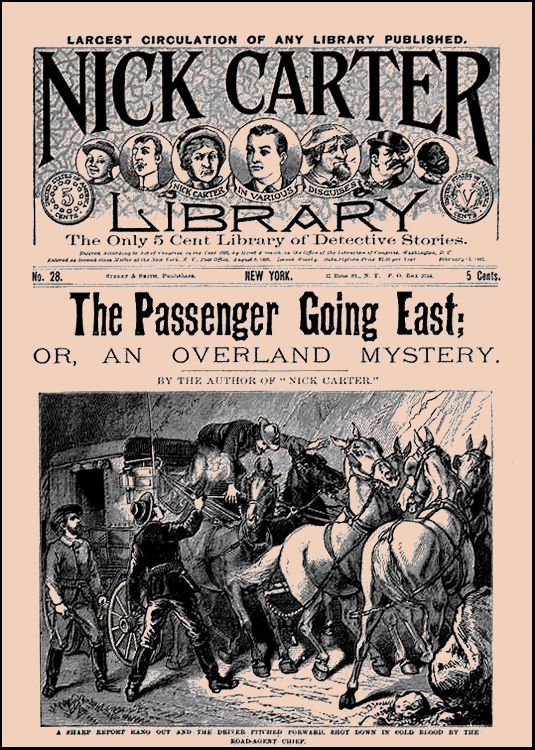
"NINE hours and thirty minutes late," exclaimed Big Bill Weston, as he halted his horses in front of the last relay station of the Smoky Valley Stage Line, before reaching Belmont, which is thirty-three and one-half miles distant through Channocks Pass, in Nye County, Nevada.
He threw the reins to the men who hastened out to change the horses, and leaped from his high seat to the ground at a bound.
"Any passengers, Bill?" called out the host of the relay station, which was nothing more than a shanty, notwithstanding the fact that there was a huge sign under the eaves, which read:
"Great Western Hotel and Restaurant."
"One," replied Bill, laconically.
"Man 'r woman, Bill?"
"Cussed if I know!"
"Eh! What? D'ye mean ter say, Bill, that ye dunno a man from a woman?"
"Man, I guess. There he comes now. Mebby you kin tell whether it's male 'r female, Pete Simpson."
"Can't, Bill; 'f I kin, durn me! May I be chucked afoot in a drove o' steers, like a tenderfoot, 'f I ever saw a git-up like that ar'. Say, Bill—"
"What?"
"Ask it 'f it'll hev a hooker."
"Keyreckt."
"Mebby it'll give itself away. Ef its a woman, 't won't drink; 'f its a man, it will; hey, Bill?"
"Right, Pete."
The driver, who was a man of enormous height, bony and muscular, but rather slow and solemn in everything he did, walked up to the passenger who had just got down from the interior of the coach.
"Take suthin', pard?" he drawled.
"Yes," was the monosyllabic answer. Bill looked at Pete and winked. Then he framed his bearded lips into the formation of the word:
"Man."
Pete nodded.
"Step right this way," he called. "I've got the best whisky between Channocks Pass n' ther Golden Gate, ain't I, Bill?"
"Betcher life, Pete."
The landlord led the way into the "hotel," followed by Bill and the stranger, whose dress was, indeed, peculiar, to say the least.
A huge scarf, made of crocheted worsted, was wound round and round the person's head until nothing but the eyes and nose were visible. An overcoat, half-ulster, half-cloak, began where the scarf left off, and continued until it came within an inch of the ground.
It entirely concealed the figure of the person who wore it, whose voice was as non-committal as the strange dress.
It was Pete Simpson's habit to ask each person who stopped at his place for refreshments enough questions to make him familiar with their lives from babyhood, but he speedily found that he was balked in this instance.
"Whisky?" he asked, going behind the bar.
The passenger nodded, and the bottle and glass were set before the inexplicable being.
Then one word came from behind the scarf.
"Sugar."
Pete looked insulted.
"That whisky don't need no sugar, stranger," he said; "anyhow, I ain't got none."
"Water."
"Eh? Water! Did you say water?"
The stranger nodded.
"Say," continued Pete. "D'ye wanter spile that tanglefoot?"
"Water?" repeated the stranger, coughing violently.
Pete looked at Bill. Bill's lips framed the word "woman."
Pete nodded, and put out some water.
"Yer dressed purty warm fur this sorter weather, ain't ye?" asked Pete.
A nod.
"Been sick?"
Nod.
"Sick now, ain't ye?"
Nod.
"Well, no disrespect, pard, but any feller wot takes water with his hooker, oughter be sick—'r has been. Say!"
No answer.
"Goin' east?"
Nod.
"Very far?"
Nod.
"Came from very far?"
Nod.
"Anything ther matter with yer jaw, stranger?"
Nod.
The glasses still rested upon the bar before them, and Pete now raised his.
"I'll get a look at yer phiz when ye swolley, anyhow," he thought; but even there, he was destined to be disappointed.
"Here's to ye!" he exclaimed.
The stranger clicked glasses with the two men.
As they were about to drink, both noticed that a startled look had come into his eyes, and that he was staring fixedly at something at the farther end of the room.
Pete paused with the glass almost at his lips, and turned his head.
Bill also glanced hastily at the point upon which the stranger's eyes seemed to be fixed.
They saw nothing unusual, and looked back again, whereupon Pete breathed an oath of disgust.
The stranger's glass was upon the bar before him, and it was empty.
It had been drained while the landlord and the stage-driver were looking in another direction.
Then the queer passenger threw a five-dollar gold-piece on the bar, and said:
"More—with me—no more for me," and turned and walked away.
Neither of the men who were left behind, spoke until they were alone.
Then Pete broke out.
"Well, ef he, no, she—no, it! ef it ain't the cussedest, queerest, rummest galoot that ever traveled this trail, shoot me fur a jackass-rabbit. Where'd ye git it, Bill?"
"T'other end o' the route."
"Where's it goin'?"
"Ter Belmont."
"What made ye so cussed late?"
"Late leavin'."
"Why?"
"Had ter wait for the express."
Just then the door opened, and one of the men who had been engaged in changing the horses, walked into the barroom.
"Hosses ready!" he exclaimed; "but I'm cussed 'f I'd go with ye through Channocks Pass to-night, Bill Weston."
"Why not, Sandy?"
"Casteye's at it ag'in."
"How d'ye know?"
"Didn't he hold up two fellers who was jes' comin' from the San Antonio Smeltin' Works an' go through 'em to the tune of two thousand, only last night?"
"It's all a job, Sandy. Thar ain't been no road-agents on this trail for four 'r five years 'r more. This story 'bout a feller ye call Casteye is all bosh."
"All the same, ye heerd Nat Hipwell's story, didn't ye?"
"Yes."
"Mebby that war a lie."
"Mebby 'twas."
"Ye wouldn't say that to Nat."
"Wouldn't I, Sandy? Did ye ever see me when I was afeard to say anything I wanted ter—ter anybody I wanted ter?"
"Can't say I did, Bill."
"It's a'most dark, ain't it?" said Bill, turning to Pete, who had come out from behind the bar, "an' I've got thirty miles ter kiver, afore I stop ag'in. What leader's did ye put in, Sandy? the grays?"
"No, the blacks."
"Good; an' the sorrels at the wheels, hey?"
"Yes."
Bill grinned.
"Ef yer friend Casteye gits in front o' me ter-night, Sandy," he said, "ye kin shoot me fur a coyote ef I don't run plum over him."
Sandy shook his head, dubiously.
"Good-night, Pete," drawled the driver.
Then he went out.
Going to the door of the coach, he glanced inside.
The stranger, muffled so that his face was completely hidden from view, was leaning up in one corner, apparently sound asleep.
"We're goin' now," said Pete.
No answer.
"I hope yer comfortable, mister."
No answer.
Bill turned away, and mounted his box.
"I wish I was a school-teacher a' that ar' galoot inside war a boy in my class," he muttered; "ef I wouldn't whale him."
He picked up the three sets of reins, for he drove six horses always.
Then, waving his hand to Pete and Sandy, who were standing in the door-way of the hotel, he whirled his long whip-lash over his head until it looked like a huge, writhing black-snake.
Suddenly, his arm jerked twice.
Snap! Snap!
The leaders caught the stinging lash upon their flanks, and they plunged forward, leaping from a standstill into a dead run at once.
"G' lang there!" yelled Bill, and the stage went flying down the road at a break-neck pace, dragged along at the full speed of the six horses that were hitched to it.
If the passenger, going east, inside, was inconvenienced, he could not make the fact known, for the vehicle was rushing like mad along the trail, rattling and roaring with the noise of an express train, and swaying from side to side in a manner that would have made it dangerous even for an attempt to stick one's head out of a window and shout to the driver.
On, on, going faster instead of slower.
On, on, on, into the pass. while rocks and bushes flew past them like things of life.
On, on, till the horses were a mass of foam, and their iron-shod feet scattered sparks in every direction as they came in contact with the stony trail.
The night was beautiful.
There was no moon, but the heavens were lighted by the myriad stars, which shone upon the trail and rendered it plainly visible to the keen eyes of Bill Weston.
Fifteen miles flew behind them.
They were in the midst of Channock Pass, when the driver suddenly jerked upon the reins and threw his entire weight upon the powerful brake.
The coach came to a halt so suddenly that it seemed almost as though it had collided with some obstacle in the road.
"I reckon that chucked his ribs outen the seat," muttered Bill. "Now, what in tarnation's that ar' thing in the trail? Blowed ef a rock ain't rolled down the mounting, plum inter the middle—"
He ceased speaking suddenly, for a sharp voice close by cried out:
"Hands up, William, or down ye go, kerflop." Disgust, rage, doubt, and surprise were at once pictured upon the driver's face; but he knew that he was at the mercy of the man who had spoken, and he therefore obeyed at once.
"Up they go!" he replied.
"Right, Bill."
Four men stepped out from behind sheltering rocks, and while one of them kept the driver covered, the others went toward the coach doors, upon either side.
"Got a passenger, Bill?"
"Yes."
"Only one?"
"That's all."
"How about the cash-box?"
"Reckon ye can't find it, Pard Casteye; I know I can't."
"Well, we want the passenger more than we do the box, but I guess we'll take both."
"Reckon ye will. Reckon ye'd take most anything from the cake to the bakery. I s'pose ther's a cash-box there, but ef ye shoot me fur it, I can't tell ye whar 'tis, pard."
Suddenly an exclamation went up from the men at the coach-door.
"Narry a galoot here," called out one of them.
"What's that?" asked another, stepping forward.
"Come 'ere, cap," demanded the third.
He then took the captain's place in guarding the driver, while the bandit, who was known to the few who had heard of him as Casteye, hurried to the coach-door.
A moment later, he returned.
"Where's your passenger, Bill?" he asked, coldly.
"Inside, cap."
"You're a liar, Bill."
"Hey? Say, let me take my han's down an' I'll lay the hull four of you out, fur that."
"Where's your passenger?" repeated the bandit.
"Inside, I tell ye."
"Give it to us straight, Bill, or I'll lay you out."
"Ain't there a passenger inside?" asked Bill, somewhat dazed.
"No."
"Honest?"
"Where is the passenger?"
"Look here, Cap Casteye. There was a passenger inside when I started from Last Chance City, an' dontcher forgit it, either."
"What has become of him?"
"Was he a he?"
"Bill, I warn you, I won't stand any fooling. Tell the truth and tell it quick, or down you go! What has become of your passenger?"
"Cussed 'f I know."
"Have you stopped on the road?"
"No."
"Nor slowed up?"
"No."
"Bill Weston, you're lying. Take that!"
A sharp report rang out, and the driver pitched forward from the box to the ground, shot down in cold blood by the road-agent chief.
THERE was great excitement in Belmont two hours after the events recorded in the last chapter—that is, about eleven o'clock.
The stage was very late.
It should have reached Belmont about one o'clock in the afternoon, and, instead of that, it was almost midnight when it finally dashed into the village.
But that was not the entire cause of the excitement.
An unprecedented thing had occurred. At least, the like had not been heard of in so long, that it was entirely unlooked for.
The vehicle had come swaying into town drawn by the six horses running at full speed; but the reins were dragging upon the ground, and the box whereon the giant-like figure of Big Bill Weston should have been seated, was empty.
But the horses knew their business, even though they had no driver, and they drew up in good order at their usual stopping-place, where the eager crowd who were expecting letters from far away were waiting and wondering.
A dozen leaped forward the instant the stage came to a halt, and several of them pulled open the doors and looked inside.
Then there arose a shout of dismay.
"Here's Bill!" cried somebody.
"Where?"
"Here! inside! he's dead!"
"Dead?"
Many willing hands helped to remove the limp and apparently lifeless body of the well-known driver from the vehicle.
"Where's Doc?" shouted a voice.
"Here I am. Carry him into the barroom, and I'll see what can be done."
The order was quickly obeyed, and Bill Weston was borne into the house and laid upon a table which had been rendered soft by a hasty arrangement of blankets and quilts.
"Now, clear out, all of you but the Judge and Lamb," was the doctor's next order. "I'll let you know the news as soon as there is any."
The crowd receded into the night, and at once began an inspection of the stage, from which the first four horses were being removed.
"Take 'em all, Tony; take 'em all," sung out one man who was known as Tank from his proclivity for drink, as well as his marvelous capacity for holding the fiery liquid. "We ain't got nothin' else ter do, Tony, but 'zamine the waggin, so leave it hyer, boy."
Tony, the hostler, obeyed, and the stage was left for the inspection of the crowd.
They were by no means slow to take advantage of the opportunity.
Then a howl of dismay went up from the throng.
The strong, leathern mail-bags had been cut open, and nearly every letter and package that it contained rifled.
True, the bandits had had the kindness to throw some of the letters back into the bag, but there were many envelopes found with no missives to go with them, and the air became blue with oaths, threats, and general cursing.
Presently a tall form elbowed a passage through the crowd.
"Everything gone, boys?" he asked, coolly.
"Every cussed thing, super," was the reply made by Tank; "even Bill's flask."
"Has anybody looked under the box?"
"Where?"
"Under the driver's box. Al! I forgot. It was a secret, boys, known only to a few, but there is a place under the driver's box which can only be opened from the interior of the coach. It is for the reception of packages of money. Wait, I'll look for it myself."
Mr. Percival Jenkins, who was the superintendent of one of the largest mines in the Spanish Belt, clambered into the stage, while the others watched him eagerly.
They saw him carefully remove the cushion at the back of the forward seat. and then, with no effort, pull out two screws that were seemingly imbedded securely in the wood.
Next, a section of the stage-coach came loose in his hands revealing a receptacle about eighteen inches square, directly beneath the driver's seat.
It was an ingenious contrivance, and one which a coach-builder would never have thought to look for, if he did not already know of its existence.
A curious expression crossed the face of Mr. Jenkins, as he looked inside the cash-box, as it was called.
"Does anybody know whether the stage carried any money to-night?" he asked, stepping down again to the ground.
Nobody answered.
"The probability is that it did not," continued the superintendent. "Were there no passengers?"
"Narry a cuss!" exclaimed Tank.
"That is strange."
"It be, super."
"Where is Weston?"
"Eh?"
"Where is Weston, the driver?"
"Hain't ye heerd?"
"Haven't I heard what?"
"That Bill was shot?"
"Shot! Do you mean killed?"
"Perzactly. Leastwise, Doc ain't said yet whether he's dead 'r not; but here he comes now. Let's ax him?"
"Doctor," exclaimed Jenkins, "surely Bill Weston is not dead?"
"No," replied the physician, "he is not dead; but—"
"But what?"
"He might as well be in his grave."
"He will die, then?"
"No, I think he will live."
"What do you mean?"
"I mean that he will never know what has happened to-night; or, at least, that he will never be able to tell us."
"Why not, please?"
The superintendent's voice was calm, but there was a peculiar ring in it.
"His reason is gone, Mr. Jenkins."
"Can he not be cured?"
The doctor shook his head.
"Is there no hope?"
"None that I can give you now."
"This is terrible."
"Yes; we will never know what has happened to-night."
"Unless we take measures to find out, doctor."
"It would be fruitless, I am afraid, Mr. Jenkins. Our information is so meager, that unless the men who committed this deed perpetrate another, there will be no way of tracing them."
Mr. Jenkins shrugged his shoulders. Then he looked at his watch.
The dial showed half an hour past midnight.
The crowd seemed to realize that he was about to make a proposition of some kind, for not a voice was heard until the superintendent spoke again.
"Boys," he said. "I'm going to take saddle and ride back through Channocks Pass now. Who will go with me?"
"I! I! I! I!"
"That makes four," said the superintendent, cooly. I want five; who will make the fifth?"
"Say, super," exclaimed Tank.
"Well?"
"Goin' ter take along suthin' ter drink!"
"Perhaps."
"Then I'll make the fifth."
Everybody laughed, for no one had suspected that the bummer would volunteer upon such an expedition.
He had been a well-known character in and around Belmont for several years, and while never really drunk, there could not be found a man in the Spanish Belt who would be willing to say that Tank had ever been sober.
He was always in that queer state of half-seas-over; on the borderland of drunkenness without quite getting there.
Never quarrelsome, but never a coward, and always liked by the rough-and-ready crowd which gathered about the saloons.
A great story-teller, a down-right queer character, who lived upon a monthly allowance which he received from a party of capitalists, who had purchased a claim from him eight years before, for the strange and somewhat original consideration of paying him one hundred dollars per month as long as he lived.
His business consisted in so arranging his expenses that the hundred dollars would last him the month out, and he had never been known to get trusted for his wants, or to borrow from his friends.
He was a strange combination of uprightness and depravity—of maudlin imbecility and shrewdness—of stupidity and keenness, and he had never before been known to volunteer upon any expedition whereby fatigue could be a consequence.
His real name was Samuel Knapp, but everybody called him Tank, as being the most appropriate name that he could bear.
"Do you mean it, Tank?" asked Jenkins.
"In course, super. Did ye ever know me ter back out when I opened a pot?"
"Never."
"Then I goes."
"Very good. Get your horses, boys; we will leave in fifteen minutes."
A quarter of an hour later six horsemen started away through the darkness at a gallop.
Superintendent Jenkins led the little cavalcade, and Tank brought up in the rear.
They were all thoroughly armed and determined to get upon the track of the road agents, and hunt them down, if they could.
THE horsemen had no means of knowing just where the outrage had occurred, but they believed that by following the trail they could find the spot easily enough.
They were not mistaken.
Before they reached the place where Bill Weston's stage had been brought to a stop by the rock, which had been tumbled into the trail, the moon rose.
Suddenly Jenkins cried:
"Halt!"
The horses were reined in, and the superintendent pointed to a rock just ahead of them.
"There's the place, boys," he said.
"Must be," said Tank, spurring his horse past the others. "I'm first there, boys."
The others dashed after him.
They passed beyond the rock, and at once found plenty of signs to prove that they were correct.
There were letters scattered over the ground, showing where the mail-bags had been rifled; there were spots of blood from the wound that Bill Weston had received, and other evidences of the holding-up of the stage-coach.
An examination showed where the rock had been pried away from a ledge up the side of the mountain, and allowed to roll down upon the trail in order to block the way of the stage.
It had stopped exactly in the middle of the trail, and had there been daylight instead of night when Bill Weston reached it, he could have dashed past the impediment without slackening his speed.
The ground was carefully searched for a trail, and at last one was found.
They followed it up the stage-road for nearly a mile, where it branched off into a narrow canon, which opened into the Pass.
A half-mile farther on, up the narrow canon, they found where four horses had been fastened.
That they belonged to the outlaws, there could be no doubt, and there was a plain trail leading down from the tops of the hills, which showed how the horsemen had reached that point and how they had left it after their work was done.
"Here we have it, boys," shouted the superintendent, who was the one who discovered the trail. "Come on! we will track them down yet."
"Hurray!" shouted Tank.
"Silence!" ordered Jenkins.
"Say, super."
"Well?"
"How many road-agents were there here?"
"Four."
"Well, we're six, ain't we?"
"We are."
"Then we kin do 'em, can't we?"
"We can try."
"Keyreckt! arter we ketch 'em, boy?"
"Exactly."
The party started on.
It was slow work, following an obscure trail in that uncertain light, and Tank's services were found to be invaluable.
Several times when it seemed as though they had lost the track entirely, it was Tank who found it again, and set them right.
"Ye see, boys!" he said, in explanation. "I'm an old hand at this business. I war out in this dog-goned kentry prospectin' afore some of ye war bornded. I warn't sich a tarnation tank, then, an' I knowed a thing or two in them days; but I'll tell ye suthin'."
"What?"
"Ef we lose that ar' track ag'in, I won't be able ter find it."
"Why not?"
"I'm too cussed dry."
They all laughed, and Jenkins passed the flask.
Tank took a long drink, and the party went on.
Daylight came when they had covered about four miles.
They were now in open country among rocks and boulders and sage-brush.
Presently they came to the bed of a dry brook, and there they halted.
The trail went no farther.
Every man in the party threw himself into the work of looking for "signs," but not one could be found.
The ground was hard and smooth, and the horses hoofs made no impression upon it.
Tank tried with all his might.
He went back and forth; he crept upon his hands and knees, he went in circles, examining every inch of the ground as he proceeded, but with no result.
"Boyees," he said, presently, remounting his horse, "ef I drunk er hull barrel of tanglefoot, 't would n't do no good. The trail is lost."
It was even so.
The question was then asked:
"What shall we do next?"
"How far are we from Last Chance City?" asked one of the men.
"About sixteen miles," replied Jenkins.
"Let's go there."
"What for?"
"Find out what Pete knows."
"That's so."
"Mebby ther war passengers," muttered Tank. "Mebby there war a purty gal, r suthin' wuth talkin' of, when the waggin war held up."
"Mount, boys," ordered Jenkins; "we'll go to Last Chance City."
It was a long and a rough ride.
In many places they were obliged to dismount and lead their horses. In others, detours were necessary.
It was noon when they reached the hotel over which Pete presided, and dinner was just ready.
More had to be prepared for the hungry crowd, however, and they were soon seated around the table, talking and eating at the same time.
Pete heard the story that Jenkins had to tell, with considerable astonishment.
"So Bill war laid out, eh?" he said. "Tough on Bill, ain't it? Say! what become of the passenger?"
"What passenger?"
"The passenger going east."
"Was there a passenger, Pete?"
"There war."
"Are you sure?"
"I ain't a consarned idjit, be I?"
"Certainly not."
"There war a passenger."
"Man or woman?"
"Hey?"
"I asked you whether the passenger was a man or a woman?"
"Wal, Mister Jenkins, I'll be eternally shot ef I know."
"Ah; then you didn't see the passenger."
"Yes, I did."
"Were you drunk, Pete?"
"Narry a drunk."
"Don't you know a man from a woman?"
"I thought I did, but I'll be—"
"What do you think about this passenger? Do you think it was a man?"
"Yes, I do."
"Then you don't think it was a woman?"
"Who said I didn't?"
"Do you?"
"Yes."
"Why do you think it was a man?"
"Cos he drank whisky."
"Very good. Why do you think it was a woman?"
"Cos she took sugar an' water with her pizen. Leasty-wise she axed for sugar, but I didn't have any."
"Let's call the passenger a man for the sake of brevity."
"Keyreckt!"
"Did he get out here?"
"Yes."
"And come in?"
"Yes."
"And take a drink?"
"Yes."
"What sort of a looking person was he?"
"Didn't see nothin' but his eyes."
"He didn't put the liquor into his eyes, did he?"
"No—that is, leastwise, I'm blowed ef I saw where he put it."
"I thought you said that he drank whisky."
"I did."
"Then you saw where he put it, didn't you?"
"Narry."
"How do you know that he did drink it?"
"Say, super, air ye tryin' ter make fun outen me? ef ye air—"
"No—no, Pete. I'm only trying to find out whether the passenger took a drink or not."
"Wal, I say he did."
"How do you know?"
"He filled his glass."
"Yes."
"An' clicked tumblers with Bill an' me."
"Yes."
"Then he fixed his eyes on vacation, like's though he saw a ghost."
"I see."
"Bill an' me looked fur the ghost."
"Did you see it?"
"Narry ghost."
"Well?"
"When we looked back, the whisky war gone from the glass."
"Ah!"
"An' ther passenger looked jest the same's he did afore. I war cussed mad, super, cos I war a-layin' fur that chance ter git a look at his phiz."
"As a matter of fact, you don't know whether he drank the whisky or not, then?"
"That's 'bout the size of it."
"So it was not proved that the passenger was a man?"
"Wal, no."
"How tall was he?"
"Kinder short."
"Like a woman, eh?"
"Yes."
"How heavy war he?"
"Not very heavy."
"Did he walk like a man?"
"Blowed 'f I saw how he walked."
"Perhaps 'twas a ghost, Pete."
PETE stared at Mr. Jenkins a full minute before replying.
Then his jaw dropped.
"Maybe 'twas," he gasped.
"Didn't Bill know anything about the passenger?"
"Nothin'."
"Did anybody besides you see the passenger?"
"I dunno. Ax Sandy."
Then the hotel proprietor turned, and called to his assistant:
"Sandy, did you see the passenger last night?" he asked.
"No."
"Ye knew thar was one, didn't ye?"
"No."
One after another, the few people about the hotel were asked if they had seen the mysterious passenger.
Nobody had.
Pete was the only one who could swear that there was a passenger, and all the others were prepared to swear that there was not.
Pete got mad.
He swore until the air was fairly blue, and he insisted that the passenger had alighted and taken a drink at his bar, and that he had left two gold pieces as payment for the drinks.
"Where are the gold pieces?" asked Jenkins.
"I've got 'em, exclaimed Pete.
"Let me see them?"
The landlord drew forth his pocket-book, opened it, and began searching among the contents.
Presently his eyes began to bulge out.
"They're gone," he exclaimed presently.
"Gone!"
"Yes."
"Gone where?"
"I'll be sassaged 'f I know."
"Have you spent them?"
"No; how could I?"
"Where did you put them?"
"In my pocket-book."
Jenkins turned away, very much in doubt as to whether there had been a passenger or not.
But Tank had been longing for an opportunity to say something, and he now seized upon it.
"Peter," he said, mildly. "What's ther brand o' this 'ere tanglefoot o' yourn?"
"Blue grass."
"Why don't ye change it, Peter?"
"Chang it! Wot fur?"
"I would be a wise perseedin'."
"W'y?"
"Cos 'twould."
"W'y on "It's gittin' ther best o' ye, Peter."
"Ye must ha' had 'em bad last night."
"What d'ye mean, you—"
"I've seed snakes, an' hues: an' crawlin' ee an' rats, an' mice, an' sich," continued Tank, placidly; "but I never had 'em so bad as ter see a thing es big as a man. I cud furgive ye fur that, even Peter; but w'en it gits so thunderin' bad that ye can't tell a man from a woman, that ye dunno a petticoat from britches-an'-butes, it are gittin' bad, Peter, an' no mistake, an' I, bein' summat 'sperienced, 'low that it's time ye changed yer drinks."
"Oh, ye do, eh?" and Peter's eyes shone angrily.
"I do, Peter."
"An' ye mean all that, hey?"
"I do, Peter. It's good advice."
"Do ye know wot this 'ere is, Tank?"
The landlord raised a six-shooter and pointed it straight at Tank's heart.
Tank did not move a muscle.
"I do, Peter; I do, indeed," he said, calmly. "It are a gun."
"Right. It's more 'n likely ter go off, too."
"I've seed 'em do it, Peter."
"Well, this 'ere one's a-goin' off in jest about a minute, an 'its goin' ter bore a hole plum through ye, Tank, ef ye don't take back every word ye said."
"Is that so, Peter?"
"You bet!"
"Air ye a-goin' ter pull the trigger?"
"That's wot I said."
"An' I've gotter 'pologize, hev I?"
"Ye hev."
"Thar ain't no way outen it. is there, Peter?"
"No, an' I'm gittin' sorter tired o' waitin', too."
"An' ef I don't 'pologize?"
"I'll lay ye out cold, you bet!"
The men were standing quite close to each other with the bar between them.
"Peter," said Tank, calmly, "kin I take off my hat while I 'pologize?"
"Reckon ye kin."
The bummer raised his right hand slowly until he was just about to seize the brim of his hat. Then he made a move that surprised everybody. Like a flash of lightning his hand darted forward, and seized the landlord's wrist.
The muzzle of the weapon that had been menacing him was turned aside, and, at the self-same instant, the bummer's other hand swung into sight and Pete found that circumstances had changed.
A moment before, and he had had the drop on Tank. Now, Tank had him covered.
"Peter," said the bummer, coolly, "shall we call it square an' shake han's on the thing, 'r shall I pull an' send ye ter kingdom-kum?"
"Let's shake."
"Right, Peter."
He deliberately lowered his revolver, and returned it to his pocket, releasing the landlord's hand.
Then he extended his right hand, and Pete, having also put away his revolver, grasped it. They shook.
The quarrel was over.
Jenkins again stepped forward, resuming the conversation, where he had abandoned it a few moments before, and unnoticed by anybody present, for all were listening to what was being said, the bummer glided to the door, and went out.
For a moment he paused in front of the hotel, and then, perceiving that he was not followed, he walked swiftly away toward a huge pile of rocks that Nature had thrown up in a conglomerate mass, a quarter of a mile distant.
Beyond the rocks, the ground rose quite rapidly, but it was not inaccessible. although stones and bushes, debris and lava, rendered it an exceedingly difficult region to travel.
There were thick bushes almost surrounding the rocks, and they grew just high enough so that when Tank reached them, he was speedily lost to view from anybody who might come out of the hotel in search of him.
He struck into a well-defined path, and followed it until he came to a spring.
There he paused, and gazed sharply around him.
The man's entire aspect had changed.
He no longer appeared to be half-intoxicated, and his eyes had lost their dull, glossy stare, and glistened with keenness and shrewdness.
After a moment's hesitation, he raised one hand to his mouth and uttered a quick, short, but shrill whistle.
"Maybe somebody's around," he muttered. "If so, that will fetch 'em, sure. I wonder 'f I made a mistake when' I turned the tables on Pete? I guess not. It's kinder funny 'bout that ar' passenger, an' maybe Phil knows suthin' about it."
Suddenly there was an answering whistle from far up among the rocks, and Tank's face brightened.
He whistled again very differently from before, and received another answer. "Good!" he muttered.
Then he waited.
Presently the bushes on the opposite side of the spring parted. A face could be indistinctly seen between them, and a voice said:
"You, Sam?"
"Yes."
"You take two many chances, Sam."
"Not a bit of it."
"Why?"
"The boys would es soon suspect their grandmothers, es me."
"What do you want?"
"I'm curious 'bout that passenger, Phil."
"What passenger?"
"Ther one in the stage?"
"There wasn't any."
"Rats, Philip."
"That's straight, Sam."
"There was one, when the stage left here."
"Who says so?"
"Pete."
"Pete lies."
"I don't think so."
"I tell you he does."
Tank shook his head.
"Come out, can't ye, Phil, where a feller kin see ye."
The man in the bushes stepped out into full view, and could the reader who has also perused the pages of Nick Carter in China have seen him, he would have at once recognized the strong features and determined face of Phil Danforth, the gambler.
"Look here, Sam," he said, "the boys are dead sore on you."
"On me! Why?"
"They think you played it on them."
"How so?"
"Well, we got your letter."
"That's what I sent it fur; fur ye ter git it."
"No nonsense, Sam."
"Keyreckt; go on."
"According to your letter, we were to get a big haul out of the stage last night."
"Perzactly."
"Well, we didn't."
"That ain't my fault."
"Didn't you say the girl was to be a passenger?"
"Yes."
"Well, she wasn't."
"There was a passenger, Phil; of that air, I'm dead sartin, but that tarnal fool Pete was too drunk ter know whether 'twar a man 'r a woman."
"I tell you there was no passenger at all."
"Wal, it's cussed queer."
"Perhaps it is."
"Say, Phil."
"What?"
"Ye made a blarsted ass o' yerself."
"When?"
"When you shot Bill."
"He lied to me."
"What about?"
"About the passenger."
"Did he say there was one?"
"Yes."
"When he left Last Chance?"
"Yes."
"Man 'r woman?"
"That's what made me know that he was lying. He said he didn't know whether if was a man or a woman. That didn't go down, and I laid him out."
"You're a fool, Phil, ef ye air my brother. I see if all es plain as day. The gal war on the coach, an' you've been played, see?"
FOR a full minute Phil Danforth gazed steadily upon the man before him.
Then he said, slowly:
"There may be something in that, and I might believe it, if it was not for one thing."
"Wot?"
"If the stage did not stop between Last Chance and the point where we held it up, it would be a physical impossibility for anybody to have left it, to say nothing of a girl."
"Mebby it did stop."
"Eh?"
"Mebby Bill lied to ye, arter all."
"And let the passenger out?"
"Yes."
"The girl?"
"The passenger."
"No; it's nonsense, Sam. The girl wouldn't dare leave the stage in the night, in a lonely place like this. A man wouldn't have any reason for doing so, unless—"
"Unless what?"
"Do you remember all that you wrote?"
"Yes."
"You said there was to be a lot of money in the cash-box."
"Yes."
"There wasn't a red."
"What!"
"Not a cent."
"What air ye givin' me, Phil?"
"The truth."
"There was to be eleven thousand dollars in the box."
"So you said."
"Wasn't it there?"
"No."
"Whar was it?"
"Maybe it flew away with the passenger?"
"Mebby it did. Say!"
"What."
"I've tumbled."
"Have you?"
"Yes. I see it all."
"Speak out."
"The gal was a-comin', warn't she?"
"So you said."
"Suthin' happened to detain her."
"Without doubt."
"The money was comin', too."
"Perhaps."
"It wasn't detained. It came."
"Oh, did it?"
"Yes. Don't ye see, Phil?"
"Can't say I do."
"The passenger was a man."
"Oh, was he?"
"Yes; he knew 'bout the money; he knowed 'bout the gal. He fixed things so's she was left, 'r suthin', an' he took her place. Begin ter ketch on, Phil?"
"Go ahead."
"He knowed 'bout the secret cash box, same's you an' 'me do, see?"
"Well?"
"W'en the right minute comed, he chucked the boodle out onto the trail. Purty soon he chucked out his grip, ef he had one."
"Most people have one now," said Phil, grimly.
"I mean his satchel. When that was done, he chucked himself out. Then he walked back, picked up the things that he had chucked out, put his thumb onto his nose an' made a pass 'r two with his fingers at the stage, then he laffed, an' then he lit out; see?"
"All very pretty, Sam, except the last point."
"The finger business?"
"No."
"What, then?"
"His jumping from the stage."
"Wots' ther matter with that part?"
"Nothing, only he wouldn't have been able to walk back."
"Why?"
"He would have been killed."
"Mebby he fixed fur the tumble; mebby Bill was in with him, an' let him out. Anyhow, he got out, didn't he?"
"If he was there, he did."
"An' ye had all yer fun fur nothin'?"
"Yes."
"Wal, 'twarn't my fault. My information was straight. Now, hev ye got any orders?"
"Yes."
"Wot?"
"You must go to Austin and find out what became of the girl, and also if the money was sent. In the meantime, pick up any information you can for future use."
"Keyreckt."
"Above all, find out what has become of Rose. I must get her, at all events."
"I don't see's I need go any farther than Toyah."
"Yes; go way to Austin."
"Jim Munger kin do the work up there, better' I kin, an' besides, 'twon't do fur me ter leave the boys fur long jest now."
"Perhaps you're right."
"I be, Phil. Jim's solid. Leave it ter him an' me."
"All right, Sam; no more mistakes, though."
"Narry."
"When will you be back this way?"
"Ter-morrer 'r next day."
"Good! Come here and whistle!"
"Keyreckt. Now skip, Phil, w'ile I kiver up yer retreat by stayin' a minute. Say!"
"What?"
"Got anything ter drink?"
"No. You drink too much now, Sam."
"Mebby so; I'm orful dry; though, talkin' so much."
"You can get all you want of Pete."
"Mebby so. So long, Phil." Danforth said good-by, and disappeared among the bushes, while Tank remained where he was for several minutes.
Presently he muttered:
"Who'd ha' thunk that that air feller war my older brother."
Then he got upon his feet and started back along the path toward the hotel.
He had gone but a few paces when the bushes immediately behind where he had been sitting were parted, and an athletic figure glided out after him.
It was the figure of a man young in years, who possessed a strangely handsome face, and movements as agile as a cat.
"Twenty-four hours of most excellent work," he muttered, as he followed swiftly after the retreating form of Tank.
He gained at every step.
Presently he overtook him.
Then he leaped lightly forward, just where there was an abrupt turn in the path, from which voices could be heard from the hotel.
His hands closed about the bummer's throat, effectually stifling any cry that he might have uttered.
The man struggled desperately, for notwithstanding his habits, Tank was very muscular.
Evidently, however, he was no match for the man who had attacked him.
There was a short, sharp struggle, and then all was still again.
Tank was stretched upon the ground, and the figure of the mysterious individual bent over him.
"So far, so good," he muttered. "Now for the balance of my little scheme."
*
At the hotel more than an hour had passed since the little quarrel occurred between Pete and Tank, after which the latter had so quietly slipped out of the door, and disappeared.
Jenkins had obtained all the information that he could get there.
The horses were rested and had been fed, and after a short consultation it was decided that the party should continue on to Toyah for further knowledge concerning the passenger, if, indeed, there had been one, a fact which many of them doubted seriously.
The horses were brought around ready for the party to mount.
"Hello! Where's Tank?" exclaimed one of the men.
"Tank! Tank!" they called.
No answer.
"Look him up, somebody," ordered Jenkins.
"Maybe he's gone down to the spring," suggested Pete.
There was a general laugh at that.
"Did anybody here ever see Tank drink water?" asked one.
Nobody answered.
The house was searched, and Tank was not found.
Presently, Jenkins, accompanied by two others, started toward the spring.
They reached the little path, and proceeded along it until they reached the turn.
Then every one of them stopped and laughed.
There was Tank, stretched out in the path, sound asleep, and snoring lustily.
Jenkins shook him.
"Tank," he called. "Wake up, Tank."
"Go ter blazes."
"Come! Wake up. We're ready to leave."
"Where fur?"
"Toyah."
"Going now?"
"Yes."
"Let's take suthin' fust."
"I should think you had had enough."
"Why?"
"Here's an empty bottle beside you, and you have been sleeping for an hour."
"That's jest it."
"What is?"
"I've slept it all off. I had a beeautiful jag, super, an' then like a tarnal fool, I had ter go an' sleep 'er all off. Come on; Have it with me this time, an' then we' go."
It was the first time that Tank had ever been known to offer to stand treat, and the opportunity was far too good to lose.
They went to the bar and drank at his expense.
"Say, super," said Tank, as they were mounting their horses.
"Well, what?"
"I've seed one of the road-agents."
"What!"
"Have, honest."
"What do you mean?"
"I went down ter ther spring, an' finished the bottle."
"Well?"
"Then I started back."
"Yes?"
"Somebody thumped me on the head, so; see?"
"Yes."
"I didn't know no more fur sometime; w'en I did my head ached. See that bump?"
"Yes."
"Wal, I felt it. Anyhow, I started ter git up, when I seed that the feller wot downed me had had ther considerashun ter leave a full bottle by me; see?"
"Yes."
"I swolleyed the contents an' then I went ter sleep. That's where I got the extra pint, the jag an' the bump: see?"
The men looked at each other and winked. They put no faith whatever in the story that Tank told.
TOYAH was reached in due time, although it was night when the searching party rode into the place.
They went at once to the hotel, and, as it was the one where the stage always stopped, Jenkins at once began his investigations.
He commenced by relating all that had occurred since the ill-fated stage had left Toyah.
"Now, George," he said, "I want to ask some questions."
"Fire away. Mr. Jenkins."
"Was there a passenger when the stage reached here?"
"Two."
"Ah! Who were they?"
"A man and a woman, or rather a girl."
"Did both stop here?"
"No, only one."
"Which one?"
"The man."
"What became of the woman?"
"She went on."
"Where bound?"
"For Belmont."
"Sure?"
"Of course."
"How was she dressed?"
"Like any girl."
"Was she young?"
"Yes, and as pretty as a picture."
"Did you have any talk with Bill Weston?"
"A little."
"About his passengers?"
"Not much."
"What was said?"
"I asked him who the gal was."
"What did he say?"
"Said he didn't know."
"Did he know she was going on?"
"Yes."
"Did he say so?"
"Yes."
"Humph."
There was a moment of silence, during which Tank helped himself from the bottle that stood upon the bar.
"What became of the other passenger?" asked Jenkins.
"The man?"
"Yes."
"He lit out."
"Where to?"
"Don't know."
"Have you seen him since?"
"No."
"Has anybody?"
"Can't say. He said he was an assayer, and was going to some mine, but I forget what one."
"Did he leave that night?"
"Yes."
"How was he dressed?"
"Like any other man, excepting a boiled shirt."
"Would you know him again?"
"Sure."
"Look for him, George; I want to see him."
"All right, super."
"Now, about the girl."
"Yes."
"Do you know her name?"
"She told me."
"What was it?"
"Rose Mayhew."
"Who was she going to see at Belmont?"
"She didn't say."
"She came into the hotel?"
"Yes."
"Take supper here?"
"Yes."
"And the man also?"
"Yes."
"Did you hear his name?"
"No."
"Now, when the stage started, where were you?"
"Right here."
"How do you know that the girl went away in it?"
"She said she was going in it."
"You didn't see her get in?"
"No."
"Did Bill?"
"I don't know. The stranger, the assayer, took her out to the stage an' helped her in; that's the last I saw of either of them."
"You are not positive then that either of them actually went in the stage, and, on the other hand, both might have gone, for all you know, eh?"
"Well, yes, if you put it that way."
"Cussed queer, ain't it, super?" broke in Tank at that juncture.
"Very strange, Tank."
Then Jenkins called the proprietor aside.
"Did you look into the cash-box, George?" he asked.
"Yes."
"Was everything all right there?"
"Yes."
"We were expecting eleven thousand dollars."
"It was there."
"Then the road-agents got it."
"Must have."
"How did they learn the secret of the cash-box?"
"I wish I could answer that, Mr. Jenkins."
"I wish you could."
In the meantime, Tank had again slipped away.
He went out, walked a little distance, and then entered a saloon, over the door of which was the name
JIM MUNGER.
There were a dozen or more men in the place, but Tank went at once to the bar behind which a coarse-featured, Mexican-looking fellow was presiding.
"Hello, Jim," he said, as he approached.
"Hello, Tank. Como le va?"
"Sehr goat. Parley vous Chocktaw?"
Then they both laughed, and Tank drew Munger a little more to one side.
"Everything went wrong, Jim," he said.
"How so?"
"No gal and no cash."
"What!"
"Fact."
"The girl left here in the stage."
"Did you see her leave?"
"Yes."
"I don't believe it, Jim."
"Why?"
"Cos when the boys held up ther stage there war no gal there."
"She left here all O. K."
"Did ye see her go?"
"I saw her git into the stage."
"Jest afore it started?"
"Yes."
"An' she didn't git out ag'in?"
"No, sir."
"Did ye see the stage start?"
"No; but-"
"But what?"
"I had to come in to wait on a customer, but the stage started before I had time to get from my door, behind the bar."
"Not long, was it?"
"No."
"An' she'd jest got in?"
"Yes."
"Well, when the stage reached Channocks Pass, gal an' boodle war both gone."
"I don't believe it, Tank."
"Why?"
"Casteye's trying to bilk us."
"That's my opinion, an' will be till I know better."
"All right; say!"
"What?"
"Did you see the other passenger?"
"Yes."
"Who was he?"
"Dunno."
"Where is he now?"
"Dead."
"What!"
"Fact."
Tank started strangely.
"Do you mean it?" he asked.
"Yes."
"Who killed him?"
"I did."
"Where?"
"In here."
"When?"
"That same night."
"What for?"
"He showed a lot o' money like a fool. I got a good chance and thumped him on the head with the butt end of a pistol. Then I dropped him into the cellar."
"Is he there now?"
"Not much."
"Where is he?"
"I took him out to the canon an' laid him in some bushes. If he's found, nobody'll suspect me."
"I see. Did ye go through him?"
"I should smile."
"What did ye find?"
"The cussedest lot o' things ye ever saw."
"What?"
"Fust, he had on three suits of clothes. He had a lot of pistols, a knife 'r two, a couple o' wigs, an'—"
"Wigs?"
"Yes."
"Hair?"
"Yes, an' beards, an' a box o' paints, an' the devil know what all."
"What were they for?"
"I think I know."
"What?"
"He was a bank burglar or a thief 'r something. I guess nobody'll be lookin' for him 'round here."
"I guess not. Say, Jim!"
"What?"
"I'm again back to-morrow. Orders are that you're to find out from Austin if the boodle was on the stage O. K., an' report, see?"
"I know now."
"Orders, Jim. Likewise yer ter look fur suthin' new an' report, see?"
"Yes."
"Good-night, Jim."
"Good-night."
Tank went out.
But he did not at once return to the hotel where he had left Jenkins and the others.
Instead of that, he quickened his pace and left the town.
Then he broke into a run, and his direction lay toward the canon where Munger had said that he had conveyed the body of the passenger that he had murdered.
On, on he flew, never slacking his pace.
At last the canon was reached, and he began a careful examination of every clump of bushes that he could find.
It was a difficult search to make in the dark, but he got down upon his hands and knees, and felt in every one with the utmost care.
He did not seem to tire.
Minute after minute flew by, and still he worked on.
At last he was rewarded.
His hand came in contact with something soft.
He pressed harder, and his ears caught the sound of a faint groan.
So faint as to be hardly distinguishable, but nevertheless uttered.
He struck a match, and held it forward.
The light shone upon the ghastly face of a man, who looked like one dead, and past all help.
IT seems strange that during every moment that Tank was engaged in searching for the body of the man whom he had at last found in the bushes, ay, even from the time when he left the self-confessed murderer, Jim Munger, the half-breed, he had not uttered a sound or a comment.
His face, usually so placid, so devoid of expression, save to give the outlines of good humor and semi-intoxication, was changed to grave concern and stern relentlessness.
Not a sign of the half-stupor produced by over indulgence in liquor, which was as essentially a characteristic of his as the name he bore, was present about him.
Naught but sternness, shrewdness, implacability, and intensity of purpose could be seen in his demeanor or in his acts.
When the body was found, when he bent over it and saw that life was not yet totally extinct, although the victim had lain all that time exposed to the changing temperature of day and night, the expression of his face did not change.
Had he been observed, the observer could not have told whether he was pleased or otherwise.
But still greater astonishment would have been engendered by noting the skill and rapidity with which he proceeded with his investigations.
Match after match was lighted, as he continued his work.
He found a wound on the unconscious man's head, where he had been struck senseless by the butt-end of Jim Munger's revolver, and there was a hole in the left side of the victim's coat, through which the blood had welled and coagulated, bearing mute testimony that a dangerous and, perhaps, fatal knife-wound was beneath.
With quick, yet careful fingers and remarkably steady nerve for one who was working in the dark, he cut away the garments which hid the wound.
Now and then a faint groan, so faint that it scarcely more than reached the ears of the rescuer, came to him as he worked.
He paid no attention, but worked on.
He found the wound.
He tore a handkerchief into strips, and then pulled them apart, bit by bit,until he had manufactured a very fair substitute for lint.
Then he threw off his own coat.and quickly cut away both sleeves of the flannel shirt that he wore.
They were quickly torn into narrow strips. Then, gently but firmly pressing the lint upon the wound, he fastened it there with the bandage made of his shirt-sleeves.
Again examining the wound on the man's head, and becoming evidently satisfied that it could go without immediate care, he drew a flask from his pocket and poured a few drops of liquor between the lips of the unconscious man.
Then he waited patiently for several moments, after which he repeated the dose.
Several times the operation was repeated, and at last the eyelids quivered and opened, and a faint sigh came from the prostrate man.
Then Tank bent down and spoke.
"Do not try to answer," he said, with perfectly good grammar, and in a voice strangely unlike Tank's usually husky tones, "keep your eyes closed, and signify yes by opening them for an instant. Do you understand?"
The man's eyes opened feebly, and then closed again.
"It will be impossible for me to move you alone, without starting your wound to bleeding afresh," continued Tank. "To put you over my shoulder or to take you in my arms would strain your muscles so that your wound would reopen. Do you understand?"
Again the signal, "yes."
"That would mean death. In fact, it is only because you were at once brought out here into the cold night-air, after receiving your wound that you are alive now. It was that which stopped the bleeding, and kept the blood where it belonged.
'Now, I must go for help. It will be, at least, an hour before I can get back here, and you must wait just where you are until I come.
"If you try to move, if you grow impatient, death may ensue, but if you do as I say, you can be saved. Do you understand?"
"Yes," came the signal.
"Will you do as I say?"
"Yes."
"Take some more brandy."
The wounded man swallowed some of the vivifying liquor, and Tank, with the single injunction, "Have patience," hurried away.
He did not walk, he ran.
He did not enter the village of Toyah, although he approached it.
But when he reached a point where a few more steps would have taken him into the midst of the houses there, he turned abruptly aside and hurried along, now walking, until he reached a wall that was several feet high, and above which could just be seen the low roof of a Mexican house.
Both it, and the wall surrounding it, were built of adobe, which is a clayey kind of mud, baked into huge square bricks by the sun.
The Mexican (or rather the Peon, for he is the real Mexican), always builds his house in that way when he can. A wall of adobe surrounds the house, which is small and square and low, of the same material.
The gate through the wall was made of cactus leaves, dried, and thick with prongs.
Tank did not pause at the gate, but, continuing past it, leaped up, seized the top of the wall, swung his body up and then dropped upon the other side within the inclosure.
Five minutes elapsed. and then the cactus gate opened. Tank reappeared followed, not by a man, but by a woman.
She was upward of fifty years old, and genuinely Mexican.
One could tell that by the heel-and-toe shamble with which she followed the bummer, keeping close behind him without seeming exertion, although he ran.
In his hands he carried two poles and a coil of rope, which was nothing more or less than a Mexican riata.
In silence they hastened to the spot where Tank had left the wounded man.
Then the poles and the riata were quickly converted into a stretcher, and the body of the again unconscious man was tenderly lifted and placed upon it.
When all was ready, the strange twain began their return journey, going slowly and carefully, and exercising great care not to jolt the man who was borne between them.
The hut was reached and nobody saw them. The cactus gate was again passed, but from the outside the house seemed dark and silent, and untenanted.
An hour passed—two hours.
Then the gate opened, and Tank came out again.
The time was now nearly three o'clock in the morning.
The few houses in the place were darkened, but the saloons were still brilliantly lighted.
Noisy laughter, shouts, the rattle of dice in boxes, and the clicking of poker-chips could be heard through the open door.
Tank kept on until he reached the door of Munger's saloon.
He looked in, remaining unobserved while he examined the place.
For an instant the hard, stern look swept over his face.
Then it fled to be succeeded by the half-vacant stare and semi-maudlin smile of the well-known Tank.
He entered the saloon.
There were only five persons there, and all were playing poker. One of the players was Munger himself.
Tank approached the table with his usual sliding gait.
"Kin I take a hand, boyees?" he drawled.
"This is the last Jack-pot, Tank," replied Munger. "We quit when this hand is played out, and I close up."
"Keyreckt!"
The bummer's eyes twinkled for an instant, as though he was pleased at the intelligence, but he leaned against the wall and overlooked the game unconcernedly.
Ten minutes later it was finished.
The players cashed in and departed, and presently Munger and Tank were the only ones left in the place.
"Shet ther door, Jim, an' lets take suthin'," said Tank.
"Why shut the door?"
"Cos I wanter talk to ye. It's orders, Jim."
"Since you saw me?"
"Yes."
"Anybody here?"
"The cap."
"Whew! Where?"
"Hangin' around. I've gotter talk to ye fur him. Shet ther door."
Munger obeyed.
There was an ugly glitter in his eyes as he complied.
Plainly, he did not like the tone of command which was assumed by the bummer.
"Say, Tank!" he said, as he closed and locked the door, pulled down the shutters, and returned to the table behind which his caller was seated, "we might as well understand each other first as last."
"Keyreckt, Jimmy; that's w'y I told ye ter shet ther door; see?"
"Well, listen to me."
"I'm a-listenin'."
"I didn't join Casteye's gang to be bullied and ordered around by an infernal bummer like you, and I won't stand it."
"Won't, eh?"
"No, I won't, eh?"
"Orders, Jimmy."
"I don't care a flip for the orders."
"Nor fur Casteye, nuther; eh, Jim?"
"No."
"He wanted me ter ax ye suthin'."
"Well, ask it, and git."
"Keyreckt, Jimmy. It's rather a pinted question."
"Ask it, I say."
"It'll make ye mad, Jimmy."
"Ask it."
"Where's the gal?"
"What!"
"Ye heer'd me, didn't ye?"
"Yes."
"Then answer."
"I don't know where the girl is any more than you do."
"Don't ye, Jimmy?"
"No."
"Well, Jimmy, ye compel me ter make an observation which is neither perlite nur friendly-like. Ye compel me to observe, with the full knowledge of wot I'm a-sayin', that you, Jimmy, air an infernal liar. See?"
FROM the Hot Creek hills to the Augusta range, Jim Munger was known as a dangerous man.
For a man to be seriously threatened by him, was considered a fair promise of a speedy funeral.
He was "quick with his gun," and considered a dead shot; neither was he over particular whether he killed a man or not.
The monumental assurance of Tank in thus defying him was so utterly unlooked for, that for a fraction of an instant he was dazed.
Then, with an oath, he leaped to his feet, and reached for his revolver.
But Tank spoke again.
"Hands up, Jimmy, 'r down ye go. If ye pull, I'll kill ye, sure. Open yer hand wot's on the butt o' yer gun, Jimmy. Thanks. Now, stick it in ther air an' claw stars fur a few minutes. That's right. Ye see, Jimmy, I've sorter got ther drop, though 'tain't 'zactly ther kind of drop I expected, an' I'm ergoin' ter keep it till ye tell me where ther gal is."
"I've told you; I don't know."
"Ag'in, James, ye compel me ter remark, yer a liar. Mebby I'll convince ye of it, ef I say it often enough.Where's ther gal, James?"
"Find out, curse you."
"Keyreckt! That's wot I'm ergoin' ter do."
"What makes you think that I know anything about the girl?"
"I don't, Jimmy."
"Then what the dev—"
"I know it. Ther gal didn't go in ther stage. Ther galoot ye killed, he's come ter life; see?"
"Damnation."
"Mebby so, James; fur you, though."
"I haven't seen the girl."
"Yer a liar. Ye found out from some dockyments an' letters an' things wot ye took from the poor cuss ye thought ye killed that the gal had learned that she war in danger, an' that she left ther stage jest at the minit it started. Ye found out whar she went, too, an' ye didn't lose no time arter gittin' rid o' the body of yer victim, in goin' fur ther gal. Wot's more, ye gotter hid some'eres, which place o' hidin' ye've gotter reveal, 'r off goes ther top of yer head; see?"
Munger was thoroughly astounded by the extent of Tank's information.
For a moment, he gazed at him in surprise. Then he spoke.
"Did Casteye send you here to say all this?" he demanded.
"Yes."
"When did you see him?"
"An hour ago."
"Where?"
"That's my biz."
"Good! I know you haven't seen him. I know he hasn't been here, and I begin to think that you're a traitor."
"Ye do, eh?"
"Yes."
Munger had been watching his opportunity.
He was wary and very quick.
He had resolved upon a strategy, which he believed would reverse the condition of things.
As he said yes, he loosened every joint in his body, and dropped upon the floor.
It was done so quickly that Tank did not pull the trigger of his weapon.
As he dropped, the saloon-keeper raised his foot to kick the table, which was between him and Tank, against the latter.
At the same instant, he drew his knife.
But Tank kicked the table at the same time, intending to get it out of the way.
Both men struck the inoffending object at the same instant.
Their united efforts, applied from opposite sides, caused the table to turn completely over and to fall, top down ward, squarely upon the saloon-keeper.
A sharp exclamation, half-groan, half-cry, came from beneath the table as it struck, but Tank paid no attention to the sound.
The instant that the table struck, he leaped into the air.
He landed exactly in the center of the overturned article of furniture, and, seizing two of the upturned legs to steady himself, he began dancing a breakdown with the prostrate body of Jim Munger as the foundation for his strange platform.
He danced on for several minutes.
Then he paused.
"Got enough, Jimmy?" he asked.
There was no answer.
"Panting, hey? Won't speak ter me, hey? Want another jig, James?"
No answer.
"Silence gives consent, allers, Jimmy. Sorry I ain't got no music, so's ter do ther thing up brown."
Then he danced again.
Presently he paused.
"Say, Jimmy!" he said, "I kinder wanted ter show my 'preciation fur the way in which ye knocked the poor cuss on ther head last night, when his back war turned. Ye stuck er knife inter him, too, didn't ye? That deserves another breakdown."
Tank did another short dance.
"Ye toted him out into the bushes, too. Say, hev ye got enough, or shall I give ye another chassee?"
He paused.
There was no answer.
"Jimmy!"
No answer.
"Maybe the table knocked the wind out of him," muttered Tank.
Then he looked down.
His eyes fell upon a pool of blood that was rapidly forming upon the floor, and which came from beneath the overturned table.
Quick as a flash, he leaped to the floor, and threw the table aside.
Munger did not move.
He lay upon his back; his eyes were open and staring; the hilt of his own murderous knife protruded from his breast, just over the spot where the heart was located: he was dead.
Stone dead.
He had been killed instantly.
It was one of those strange, almost incomprehensible accidents that nobody can foresee.
As he fell, he drew the knife; the table fell upon him, just as the knife was in the right position to pierce his heart, and its weight drove the keen blade home, even before Tank added his own to it.
For a moment the bummer was almost dazed by the event.
"He is dead," he murmured; "but through no fault of mine. Ah, well, the world is well-rid of such as he, and his death has saved other lives that are more worthy."
Then, leaving the dead man where he was, Tank began a systematic search of the saloon.
He examined the money-drawer and the little iron safe which stood in one corner behind the bar.
But he did not take anything away until he came to a little box in the safe.
When he opened that, he discovered a fine pair of diamond ear-drops and a diamond ring.
For an instant he glanced back at the body upon the floor.
"I wonder if he has killed her," he muttered, "or worse, perhaps. I'll keep these for the present, at all events."
Then he closed the safe again, after placing the box of diamonds in his pocket.
"Nothing," he muttered. "Not a paper to tell where he took Rose, or what he did with her. One thing is certain, if he has not already harmed her, he never can."
Then he started.
"Unless," he continued, "he has placed her in hiding where only he had access, and where she may starve, because he is not alive to carry food to her."
Before leaving the saloon, Tank examined the cellar.
But he found nothing of any moment. The building contained no second story, and there was nothing left for him to do but to take his departure and continue the search elsewhere.
Presently he opened the door, and glided away.
Dawn was beginning to break.
"Things'll begin ter open purty soon," he muttered.
He took the brandy flask from his pocket, poured its contents upon the ground, and then, with the empty bottle fast in his hand, he stretched out upon the door-step of the hotel, and began to snore.
Fifteen minutes later, the door opened and a clerk made his appearance.
"Hello! here's Tank!" he exclaimed, and he kicked the supposed sleeping man.
"Git over on yer own side," muttered Tank.
The clerk laughed.
"Wake up, Tank, and pull the clothes over you," he said.
"Go ter blazes. Say, ef I run this 'ere hotel, I'd have beds with springs in 'em, I would by—"
He opened his eyes before the exclamation was finished, and seemed to discover where he was.
"Who toted me out here?" he demanded, angrily.
"Guess you did, Tank; or was it the spirits?" and the clerk pointed at the empty bottle.
Tank looked at the bottle, and then at the clerk.
Then he got upon his feet, and shook himself like a dog.
"Richard," he said, solemnly, "yer a purty good feller, considerin', an' ye don't talk about wot don't consarn ye. Let's take suthin'."
Richard complied, good-humoredly, and led the way to the bar.
A half-hour later, Superintendent Jenkins and the others who formed his party put in an appearance.
Everything was put in readiness for an immediate departure for Belmont.
"Super," said Tank, "hev ye found out anything more 'bout the gal?"
"Not much. I am puzzled, Tank."
"How so, super? Wile yer tellin' me, let's take suthin'."
They adjourned to the bar.
"The girl was known to leave here on the stage, and Bill Weston knew she did," said the superintendent.
"Perzactly."
"Bill told Pete, at Last Chance, that he didn't know whether his passenger was man or woman."
"He did, super."
"Bill must have lied."
"Maybe so."
"It was agreed between them that she should change her rig between here and Last Chance, in order to fool Pete. Later, he stopped somewhere and let her get out."
"But why, super?"
"I can only give one explanation, and that is that she and Bill were both in league with the road-agents, and that the whole thing had been planned beforehand. The utter disappearance of the other passenger confirms me in my opinion."
"Say, super?"
"Well?"
"Ef all that air is gospel, wot in thunder 'd they shoot Bill fur, hey?"
JENKINS was silent for a moment.
"Dead men tell no tales," he said, presently. "They meant to kill him, and thought they had."
"Wot makes ye think ther passenger was the gal, super?"
"She was seen by a Mexican boy just after daylight yesterday morning about five miles this side of Pete's place."
"Hem! How d'ye know that?"
"He described her, and George recognized the description."
"War she alone?"
"No. A Mexican named Santo was with her. Santo is known to be a bad character, and I suspect that he is one of the road-agents."
"Mebby so. Which way war they goin'?"
"East."
"Where's ther boy?"
"Up stairs. They tucked him into your room last night."
"Did, eh? Well, I'm agoin' up ter see him jest er minit."
He was gone ten minutes.
When he came down, he went to the superintendent.
"Reckon yer right, super," he said. "Air ye goin' ter start purty soon?"
"Right away."
"Wal, I'll jine ye at the north trail in an hour; 'll that do?"
"Yes. Have you heard about the murder, Tank?"
"Wot murder?"
"Jim Munger is dead."
"Who laid him out?"
"Nobody knows."
"I s'pose they're lookin' fur somebody ter hang, ain't they?"
"No; everybody is too well pleased to know that Munger is dead, to bother much about who killed him."
"Good job, wasn't it? Say, super?"
"What?"
"Let's take suthin'."
Tank disappeared soon after that, and, had he been followed, it would have been discovered that he went to the very same place, where, during the preceding night, he had carried the almost lifeless body of Jim Munger's victim.
But he met the men as he agreed, at the north trail an hour later, and the return journey was commenced.
When Last Chance city was reached, Tank was taken suddenly ill.
He had the cramps so terribly that he had to be left behind to the tender mercies of Pete and Sandy.
He recovered very rapidly, however, when the others were gone, and much to Pete's astonishment was as well as ever in half an hour.
"Peter," he said, walking into the barroom, "let's take suthin'."
"Keyreckt! Feel better, Tank?"
"I does."
"Glad of it."
"Peter."
"Wot?"
"W'ere's Sandy?"
"Gone down on ther ranch."
"Were's t'others?"
"Gone with him."
"Then yer alone?"
"Yes."
"Let's take suthin'."
Pete assented.
"Now, Peter," said Tank, "I wanter talk to you fur jest erbout an hour. Will ye listen?"
"Course."
"Wal, afore we begin, let's take suthin'."
When Tank left the hotel an hour later, he did not look at all sick.
On the contrary, there was a bright twinkle in his eyes, and he walked with unusual sprightliness.
"I've been gone from the spring nigh onto twenty-four hours," he muttered. "Mebby his nibs hev got tired o' waitin fur me. Anyhow, I'll just take a look an' see."
He branched off from the main path which led to the spring, and clambered over rocks and through brambles and bushes, until he disappeared from view.
Thirty minutes later, however, he was back again in the path, and shambling with the same inimitable gait toward the spring. As he went along, he sang:
"There's many a tank of iron an' tin,
An' many a tank of wood;
They fill 'em with water, but never with gin,
An' none of 'em 's any good.
Oh, I know a tank of skin an' bone
Wat receives, but's never on tap;
It's a dandy old tank, so leave it alone
Fur its name is Samuel Knapp!
It are!
It's name is Samuel Knapp!"
When he reached the spring, he ceased his singing and gave utterance to the same signal whistles that we heard once before.
They were speedily answered, and a few moments later a face peered through the bushes.
"You, Tank?" asked a voice.
"It be. Where's the cap?"
"Up in the rocks."
"Take me to him; but say!"
"What?"
"Afore we go, let's take suthin'."
There were a few moments of argument after the drink had been taken, before the road-agent would consent to conduct Tank to the place where Captain Casteye was; but he finally agreed, and the pair started away over the rocks and through the bushes, until they reached a deep ravine that was hemmed in on all sides by bowlders.
Down in the center of this miniature valley were pitched several tents, not unlike Indian wigwams, and the rendezvous of the road-agents was before them.
They clambered down, and Tank soon stood at the door of the tent wherein Phil Danforth, alias Captain Casteye, was said to be sleeping.
Tank pushed the flap boldly aside, and entered.
"Hello, Phil!" he cried, "let's take suthin'."
"Ah, Sam; got back, have you?"
"I hev."
"What did you find out for me?"
"I found out thet ther gal an' ther cash both left on ther stage that night, an' that ef ye war bilked, it must ha' been Bill as done it; see?"
"Did you see Munger?"
"Seed his carcass."
"What do you mean?"
"I went ter call on him, an' I found him layin' on the floor with a knife chucked clean through his heart. I didn't git no cordial reception an' he didn't so much es say, 'Take suthin', an' so I left."
"Is this true, Sam?"
"All 'cept that I took suthin' 'thout bein' axed."
"Who killed him?"
"Dunno."
"I'm not sorry that he's dead."
"No more be I. Let's take suthin'."
Danforth passed the bottle with a frown.
"What a tank you are, Sam?" he said.
"There's many a tank of iron an' tin,
And many a tank of wood.
They fill 'em with-"
"Dry up, Sam!"
"Philip, ye jest sed I war a tank, an' now ye tell me ter dry up. There ain't nothin' so bad fur a tank, es ter dry up. It makes 'em leak, an' ef I war ter leak, I'd—"
"Silence!"
"Keyreckt! Let's take—"
"Will you be still?"
"Yep."
"Go back to town and stay there till I send for you."
"What, to Toyah?"
"No, Belmont."
"Ain't ye a-goin' ter ax me ter take suthin' afore I go, Phil?"
"Yes; take the bottle."
"Wot! the hull bottle?"
"Yes."
"Philip, yer a brother wuth havin'. Say!"
"What?"
"Wot 'r ye goin' ter do 'bout the gal?"
"Nothing."
"Ye goin' ter let the fortune slide?"
"Yes."
"Mebby ye've got ther gal now."
"How would I get her?"
"Dunno."
"Go away, Sam: you make me tired."
Tank left the tent, but he paused near enough to it to hear what took place inside, and he presently knew that the captain had again thrown himself upon the couch from which he had arisen to receive his brother.
Then he took a little white paper from his pocket, and, unfolding it, emptied the contents into the bottle he carried.
Presently he came to a rock, behind which the four remaining road-agents were playing cards.
"Hello, boys!" he said; "let's take suthin'."
They were not slow to do so, for liquor was scarce among them.
The bottle was passed from hand to hand, and when it returned to Tank, it was empty.
"Who's goin' ter guide me out o' here?" he asked.
One of the men got up.
"I will," he said.
"Come on, then; wish I could ax ye ter take suthin', but it's all gone. Tra-loo, boyees, tra-loo!"
Presently Tank paused.
"Say," he said to his companion; "wot in blazes ye gap-pin' so fur, hey?"
"I'm sleepy."
"Stretch out there an' take suth—I mean a snooze. I kin find my way out."
"Guess I will."
And he did.
Five minutes later, Tank's head appeared over a rock not far distant.
His face wore a broad smile.
"Reckon they're all snoozin' by this time," he muttered; "that is, 'cept possibly Phil, an' I'll fix him."
He stole past the sleeping man and on, back to the camp.
He looked behind the rock where they had been playing cards.
There was not a man there.
He looked into the tents, and saw that they were all sleeping.
"Now to fix Phil," he muttered.
He took a bottle from his pocket, and cautiously entered the tent where Danforth had again gone to sleep.
They had all been in the saddle during the preceding night, and there was some excuse for drowsiness.
Tank emptied half the contents of the bottle upon his handkerchief, and then stole nearer to the sleeping man.
He held the handkerchief several inches from his nostrils, gradually bringing it nearer and nearer until it was pressed against them.
At last he took it away.
"There," he said, "you'll sleep longer than t'others, Philip, an' when you wake up, there won't one of 'em admit that he's been asleep. Now, ter biz."
He hurried out of the tent, and walked rapidly toward the farther end of the valley.
Presently he came to a narrow gorge, the entrance to which was protected by a rough door made of stakes.
There was a padlock upon it which he speedily knocked off with a stone.
Then he passed through.
Three steps farther on, he met a woman.
"Be you Elizabeth?" he asked.
"Yes; who—"
"Never mind. D'ye see this?" and he pointed a revolver at her heart.
"Kin ye write?" he asked.
"Yes, sir."
"Write, then, on this paper an' with this pencil."
"What shall I write, sir?"
"Jest write, 'tra-loo! see ye later,' an' sign yer name Lizzie; see?"
"Yes; but—"
"Ain't got no time fur buts. Write."
She obeyed.
Tank took the bit of paper, and fastened it where it would be seen at once by anybody visiting the place.
"Now, Elizabeth; where's Rose?"
"Inside."
"Good! Munger sent her here, didn't he?"
"Yes."
"All right, Elizabeth; I'll jest take wot weepins ye've got, an' then we'll take Rose, an' light out with her. Mind, I don't want no foolin', 'rdown ye go. Say, has any harm come ter Rose?"
"No; none."
"That's right. Now, git her, an' we'll skip."
NEARLY two weeks passed, after the incidents related in the preceding chapter, before those took place which are now to be told.
Tank had resumed his former habits in Belmont, and people thought that he told more and funnier stories than ever.
He was particularly solicitous about the ex-stage-driver, Bill Weston.
That rough-and-ready character was nearly well, physically, but he had no recollection of anything prior to the time when he was shot, and he seemed only half-witted about the every-day occurrences of life.
Jenkins had, to all appearance, given up the search for the road-agents, for nothing had been done for some time.
Tank had been back and forth over the stage-route a number of times with the new driver, who never refused to "take suthin'" with him, and, as a consequence, they were great friends.
During all this time, Tank had heard nothing from Casteye.
But on the morning of the thirteenth day after the scene at the road-agents' camp among the rocks, Tank received a letter, which was signed Phil.
It was simply a peremptory order for him to come to the camp on the following day.
That night he went to Bill Weston's house at an hour when most of the residents of Belmont were in bed.
He tapped gently upon the door, and was quickly admitted by Bill himself.
"Hello, Bill!" he said.
"Hello, yerself, Tank!" was the hearty response.
"How's yer mem'ry?"
"Bully."
"Remember who shot ye?"
"You bet!"
"Remember wot became of the gal?"
"Reckon I do."
"Any idea wot became of the passenger who took her place?"
"No."
"Nor the boodle?"
"No."
"Queer lay out, warn't it, Bill?"
"Cussed queer, all through, Tank. But I say, Tank."
"Say it."
"Wot's ther use in keepin' me a-playin' ther fool all this time?"
"Gittin' tired of it, Bill?"
"Mighty."
"Gittin' yer pay, ain't ye, jest the same's though you were drivin'?"
"Yes; you're a queer cuss, Tank."
"Am I? Why?"
"I didn't think ye hed it in ye?"
"Ain't, fur an hour; let's take suthin'."
"It mean, ter do all this detective business."
"Didn't, eh?"
"No; blowed 'f I did!"
"Say, Bill."
"Wot?"
"Air ye sure 'bout that mem'ry?"
"Dead sure."
"I'll wanter use it afore long."
"It's ready."
"I'd like ter give it a try."
"How?"
"I want ye ter tell me the story o' that day."
"Thought ye know'd it."
"Do. Wanter test yer mem'ry."
"Where shall I begin?"
"At Austin."
"I had two passengers."
"Yes."
"Feller an' a gal."
"Yes."
"They both rode inside all ther way ter Toyah."
"Keyreckt."
"At Toyah, a third feller wot I hadn't seen before pulled me ter one side an' tole his name. I'd heerd of it afore. He said that my passengers war goin' ter make believe that they war goin' on, but that they warn't goin' ter do no sich thing."
"Right, Bill."
"Then I axed him if t'other passenger war man 'r woman, an' he said, 'ef anybody axes ye, Bill, tell 'em ye dunno.' "
"Right ag'in. Go on."
"Well, he chucked a hundred-dollar bill at me, an' tole me ter do jest es he said, an' I did."
"Keyreckt, William. Wot next?"
"Wal, I thort ther gal went, arter all, cos I seed her git into the stage, but when I got ter Last Chance city, I'm blowed ef the cussedest queerest lookin' critter ye ever seed, didn't git out. Ye couldn't ha' told whether t'war man 'r woman yerself."
"Mebby not."
"Bimeby we started on, but when we got ter ther beginnin' of Channocks Pass, my passenger bergun ter make the consarndest racket, an' I pulled up the hosses ter see wot was the matter. Wal, the fust thing he done war ter jump out, an' then he tole me that ther road-agents war a-goin' ter hold me up, and that they know'd the secret o' ther cash-box, an' would git it all. I axed him how they knew so much, an' he said that Super Jenkins war one of 'em. He satisfied me who he war, n' between us we took the money out of the cash-box an' hid it, long side o' ther trail."
"Right, William. Kin ye find ther spot now?"
"Betcher boots I kin, Tank!"
"Good! Wot next?"
"He got back into ther stage an' I clim' up an' druv on."
"Thinkin' thet he war inside all the time."
"Yes."
"Wal, he warn't?"
"Nope. Ef he had been, I wouldn't ha' been shot."
"Mebby not. Now, Bill, ther time hag come ter act."
"How?"
"Ther day arter ter-morrer, yer mem'ry must come back."
"Yes."
"Ye must tell ther story jest es ye hev told it ter me, 'ceptin' that part of it where the feller helped ye hide the boodle. Ye kin take all ther credit fur that, yerself, an' git ther reward. Ther feller won't kick. Take ther gang there and find the cash."
"Wot'll I say 'bout ther feller?"
"Say he stopped ye jest this side o' Last Chance city, an' warned ye of ther road-agents, an' then said he war goin' ter walk back ter Pete's. Arter he'd gone, ye got ter thinkin' ther thing over, an' concluded ter hide the cash. See?"
"Yes."
"Ye've got it all straight?"
"You bet! When'll I guv it out?"
"When ye hear thet Casteye's gang has been took."
"Keyreckt."
Tank then left the driver.
On the following morning, he left Belmont on horseback.
In due time he reached Pete's, and having given his horse in charge of Sandy, and, after "taking suthin'" with Pete, he walked down to the spring.
Ere long he was again in the camp of the road-agents, and in the presence of Phil Danforth.
"Sam," said the road-agent, "when I saw you last, I told you a lie."
"Wot erbout, Phil?"
"About the girl. She was here all the time. Munger captured her, and meant to keep her and get the ransom himself, but one of my men happened to tumble, and so she was brought here by Santo."
"Then ye've got her?"
"No. She talked Lizzie into taking her away, and they both lit out, nor can I find the slightest trace of them."
"Hew do I know ye ain't lyin' now?"
"You may think as you please. That is not why I sent for you. anyway."
"What fur, then?"
"I got word from Jenkins."
"In writin'?"
"Yes."
"Let me see it."
Danforth passed over the message.
"All that money is coming in three saddle-bags, and they are going to put up at Pete's over night to-morrow night."
"So I see."
"Twenty thousand is worth our while, and we must have it."
"Keyreckt, Philip."
"All you've got to do is to stay at Pete's, and to-morrow night when the men and the money are all there, you are to open the doors for us. We'll leave you bound like the others, so you won't be suspected, and it won't take us long to do the work."
"Keyreckt!"
"Will you do it?"
"Will a duck swim, Philip?
Something was taken.
"Ter-morrer night, hey?"
"Yes."
"Wot time, Phil?"
"Two o'clock."
"Keyreckt! Is that all?"
"Yes."
"Tra-loo, then."
They parted.
On the following evening, just after dark, three horsemen rode up to Pete's hotel, and asked for accommodations for the night.
They each took a package from the saddlebags to their rooms with them.
Then the night wore on.
At last midnight struck, then one o'clock, then two.
At two, Tank stole silently to the front door, and opened it.
Five men were upon the porch, waiting.
They entered as silently as shadows.
"This way," whispered Tank.
They followed him.
He led them into the spacious barroom.
"Wait jest er minit, Phil," he whispered.
Then he walked rapidly away.
Suddenly a shrill whistle was heard.
Then followed several heavy blows, striking as one.
There were groans, and the sounds of heavy bodies falling, and then Tank's voice cried out:
"Tie 'em up tight, boyees."
They did; and then lights were brought.
The five road-agents were lying upon the floor, tightly bound, and utterly helpless.
They were prisoners, caught in the act.
Phil Danforth glared at Tank for a full minute.
Then he hissed from between his teeth:
"Betrayed, and by my brother."
"Think so, Philip?" and Tank laughed. "You are wrong, Gambler Phil. Look now!"
With a quick motion, he tore aside wig and beard and false nose, revealing the handsome and determined face of Nick Carter.
Phil Danforth gasped with amazement.
"Where's Sam?" he cried.
"I made him my prisoner in the first act," replied Nick, "and I've played his part ever since. He is here in the hotel with Rose, and the esteemed Lizzie, and we will take you all to Chicago: Rose to be returned to her uncle, and you and Lizzie to go to the gallows."
*
The story is told.
Rose Mayhew was an orphan and heiress who lived in Chicago. She was the niece of John Weyman.
Years before, her brother had gone to Nevada, and had strangely disappeared.
Through Jenkins, who also came from Chicago, and who was thoroughly familiar with her history, she was enticed to the West on the plea that her brother had been found, and was dying.
Nick Carter, in the meantime on the track of Phil Danforth for previous crimes, was already in Nevada. He had sent for Chick to join him there, and the latter on his way out met Rose and heard her story.
In a hasty interview with Nick at Toyah, the suspicion had been imparted by Chick, that foul play was intended, and she had been taken from the stage and conveyed to the house of the old Mexican woman, where Nick, not long after, took Chick when he was so nearly killed by Jim Munger.
Nick knew that Danforth was well posted regarding the affairs of Rose Mayhew, and he had every reason to believe that the stage would be held up that night.
The sequel proved that he was right.
It was he who laid the plan to entrap the road-agents at Pete's house, as we have seen, for he had previously told Pete who he was and what he was there for.
The letter to Casteye proved Jenkins' complicity, and therefore he was convicted.
Danforth and Elizabeth Mills were taken to Chicago to answer for the murder of Grace Weyman, as told in Nick Carter in Chicago.
Again had Nick Carter triumphed over his enemies.
Roy Glashan's Library
Non sibi sed omnibus
Go to Home Page
This work is out of copyright in countries with a copyright
period of 70 years or less, after the year of the author's death.
If it is under copyright in your country of residence,
do not download or redistribute this file.
Original content added by RGL (e.g., introductions, notes,
RGL covers) is proprietary and protected by copyright.