
RGL e-Book Cover
Based on an image created with Microsoft Bing software
Roy Glashan's Library
Non sibi sed omnibus
Go to Home Page
This work is out of copyright in countries with a copyright
period of 70 years or less, after the year of the author's death.
If it is under copyright in your country of residence,
do not download or redistribute this file.
Original content added by RGL (e.g., introductions, notes,
RGL covers) is proprietary and protected by copyright.
RGL e-Book Cover
Based on an image created with Microsoft Bing software

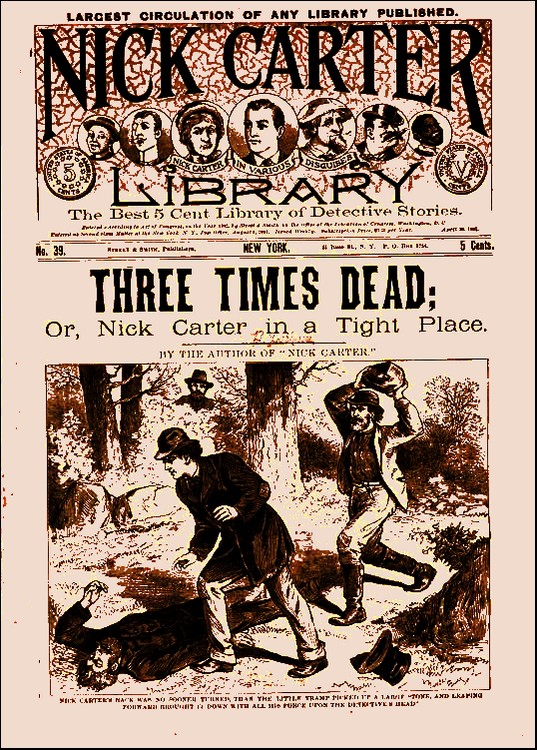
"HAVE I ever done anything to make 'sassiety" give me the cold shoulder? Well, rather. I have done a man up, and the gamest rustler that ever put his hoofs into shoe leather."
The speaker was a tall, muscular, hard-featured individual, with cruel, light-blue eyes and large, sensual mouth.
He was attired in a shabby suit of black; upon his head was a battered plug hat; a boot that had seen better days covered one of his feet, while a shoe that was a palpable misfit as well as in the last stages of dilapidation performed a like service for the other.
In a word, he was a tramp, his companions were tramps, and the scene was the outskirts of a mining camp in Idaho.
Under a monster pine, high up on a hillside, the vagabonds—five in number—reclined, the warm rays of the afternoon sun affecting their lazy spirits with a delicious sense of contentment.
The man who had spoken was destined to stir their sluggish brains and make them for a short time at least active in both mind and body.
Four of the gang had traversed the great plains and mountains together, having formed an alliance, offensive and defensive, at Denver some months before.
The fifth had been with his camp-mates but a week.
He was not as large in body as the speaker, but there was bulldog determination in his face.
And his eyes, dull and sleepy-looking the most of the time, betrayed on occasion an intelligence, keen and far-reaching, that would have startled the ordinary beholder.
He was known as Stub, his two fellow-auditors went by the names of Foxy Pete and Waxem Willie, while the speaker of the occasion, the man who was about to make confession of a terrible crime, answered to the name of Bold Bart.
Larger in stature than any of his comrades, with a manner and a speech that at times revealed the acquirements of an educated man, he was tacitly regarded as the leader, and commanded both the fear and the respect of his associates.
All except Stub.
For some unknown reason the two had never hitched, though no quarrel, no violent disagreement, had ever taken place between them.
Stub watched Bold Bart curiously while the latter was speaking.
"Give us the whole business," said Foxy Pete, lazily, as he cracked a pine nut and prepared to eat it.
"I have not the slightest objection," returned Bold Bart, composedly, "for the reason that you don't know my real name, and I do not intend to give you the name of the cove whose toes I turned up to the daisies; neither shall I locate the place where the trag-i-dee occurred. But my man was a hustler anyhow, and I never felt that America held a hole that was safe for me to crawl into until I had worked him off."
"Say, Barty, me boy," drawled Waxem Willie, a diminutive specimen of dirty humanity, with a head like a weasel's and little shifty black eyes, "is this long? If it is, wake me up when the bloke croaks."
So saying, he rolled over in the soft grass, pulled his hat over his eyes, and allowed a gentle snore to escape his throat.
Bold Bart scowled, muttered something about putting a quick stop to somebody's blanked funny business, and then picking up a heavy pine cone flung it with all his might at Waxem Willie's head.
The hat of the little vagabond probably saved him from serious injury.
The cone struck the stiff brim—it was a Derby—and then glanced off, but not without causing Waxem Willie to spring to his feet with a yell of affright.
"I was only joking, Bart—I wouldn't miss your bloomin' yarn for a tub of booze—honest Injun, Bart."
And he fell on his knees, abject terror in his eyes, for the burly vagabond was already fingering another cone.
"Well," grunted Bold Bart, after a pause, "I'll let you off this time, but after this when you want to be funny try it on some one else, Stub here, for instance. He won't mind it."
The big loafer had an ugly grin on his evil features as he spoke, but Stub only smiled pleasantly, and as pleasantly remarked:
"It is not worth while to get one's back up at Willie. He is full of fun, but there's no harm in him. He wouldn't hurt a flea, whereas—"
"Whereas what?" asked Bart, slowly, as Stub hesitated.
"Whereas you would, I think," finished Stub, quietly.
"I'm glad you've got a proper opinion of me; I was afraid you hadn't."
There was an implied menace in the words that made Pete and Waxem Willie look at Bold Bart expectantly.
They knew he did not like the new member, Stub, but they could not conceive of any cause for the dislike.
Stub was easy-going, he had never offended any of them by word or act, and he was an entertaining companion, for he could talk like a book, sing like a bird, and perform all kinds of tricks, muscular and otherwise.
They now looked for a scene in which Stub should show the metal they believed him possessed of, but he never said a word in reply to Bart's speech nor gave any indication that it had offended him.
"Go on with your story," said Pete, as Bart, removing his eyes from Stub's imperturbable face, fixed them frowningly on the ground. "You said you salted some one's bacon. "Whose was it, how came you to do it, and where did it happen?"
Bart shivered involuntarily, then raised his eyes and gave Stub a quick, sharp glance.
But that equable-minded individual was not looking in the big vagabond's direction. He was soberly contemplating a stick he was whittling, and whistling softly to himself.
"Pass me the booze," Bart jerked out to Willie.
The little man jumped to his feet with alacrity, ran behind the tree, and quickly returned with an old tomato can half filled with a muddy looking liquid.
Bart put this can to his lips, took one long draught, closed his eyes, and then spoke.
"Let me say that the adventure occurred about a year ago, and as one place is as good as another, provided it is not the place, let Bangor, down in the State of Maine, be the scene. I went down there from Boston to witness a scrap between Sullivan's pupil, the Oldtown Daisy, and Norombega Dooley's unknown."
"Were you on the turf then?" inquired Pete.
"Yes, that is in the sense that society was my meat. I was doing the high-toned sport act at the time, with an occasional dip into the green-goods business. I had worked a couple o' hundred out of a Lowell parson, and being on the inside of the fight between the Daisy and the Unknown, I sashayed down to Bangor to convert my two hundred into two thousand. See?"
"Yes," said Pete, with a look of appreciation, "I see."
"But when I got there the fight had been postponed for a fortnight."
"What for?"
"Dooley's Unknown had the glanders, or something like it, so he couldn't toe the mark. And there I was dead stuck in a temperance town, without a brad in my pocket."
"But," interrupted Waxem Willie, with some timidity, "you said you had a couple o' hundred when you went down into Maine."
"And I said right, my little terrier. I had the boodle when I struck the town at night, but next morning it was gone.
"Stolen from you?"
"Stolen nothing. I went in against a brace game on the river that night—a quiet little snap on one of the steamers lying near Hampden—and I found myself busted flatter'n a pancake when the sun rose in the morning. If steam-boats had been selling for a cent a piece then, I wouldn't have been able to have bought a gang-plank."
"That was a tough rattle, Bart," remarked Foxy Pete, sympathetically.
"It was. And worst of all, I was a stranger in the burg. Didn't know a soul. What could I do? I had to eat. I hadn't got down to this racket then, and I saw but one way open to me for bettering my financial condition. I must hold some one up."
Pete looked at Bart with admiring eyes as he made this statement.
He was not as tall as Bart, and he was as thin as a fence-rail, with a flat nose stuck in a round, good-natured face.
"It was not until evening," resumed Bart, "that I started out to transact business. On the Kenduskeag bridge, on Center street, I encountered a man whose presence there gave me the worst shock of my life. Luckily he did not see me. This man was ordinary looking, of medium height, and would have passed without special notice in a crowd. And yet he was a holy terror. He was a detective."
"A detective, eh? And why should a detective have frightened you?"
Stub was the questioner, and his tone was as mild as his manner was nonchalant.
"I wasn't scared, curse you!" Bold Bart burst forth savagely, his hands clenched at the same time as if he would have liked to have strangled his calm, even-faced interlocutor. "I said I received a shock, that was all, for the man I saw, the detective, I had thought to be dead."
"Ah!"
"Ah to yourself, Mr. Stub, and may the devil take you for an impertinent—"
The insulting epithet that was on the point of being bestowed on the apparently inoffensive Stub died unspoken on Bold Bart's lips.
A gleam in Stub's eyes—a gleam of fierce, undying hate—and a suggestive click! click! of a revolver made the burly vagabond pause in his passionate speech and bite his thick lips angrily.
"You and I will settle our affairs at another time," remarked Bold Bart. "And now I will go on with my story, and I hope you will be entertained by it."
"We're sure to be, Bart," spoke Waxem Willie, with eagerness.
"Well, then, when I saw that my detective was alive I lit out too quick, you bet, for you want to understand that he had it in for me, for I was the boy who had downed him before."
"He was probably in Bangor looking after you," suggested Pete.
"That's the truth of it. He wanted me for that assault on him and also for shoving the queer in Pennsylvania. And there I was without a sou marquee in my pants—nothing to get put of town on. The sight of my enemy made me more than ever determined to hold up some citizen and make a stake.
"I walked around the block, and halted a minute by the park fence.
"Pretty soon I heard footsteps behind me.
"It was dark in that quarter, and all I could see of the oncomer was that he was not a large man and that he was walking like one in a big hurry.
"As he came opposite to me I sprang at his throat—I hadn't a gun, or I would have used it—and gripping his windpipe fiercely, bore him to the ground.
"A word from your lips—one cry, and I will choke the life out of you. I hissed in his ear.
"Not a sound made he, as with one hand I searched his pockets, and with the other and one knee held him to the ground.
"But as I relaxed my hold on him, for the purpose of transferring a fat purse to my own pocket, he threw me over in a flash, and before I could say 'Jack Robinson' I was underneath, and his hands were at my throat.
"At that moment, with his face close to mine, I became aware that the man I had tackled was my enemy."
"The detective?"
"The detective. And now he had me in the door. Just about that time I did a heap of thinking.
"'Let up!' I gasped, 'and I'll go along with you.'
"He released his hands from my throat, only to grasp. my wrists.
"'I think you will go with me, Bold Bart,' he said.
"He knew me.
"But I had one card to play.
"And that card was for life or death."
BOLD Bart took another pull at the tomato can before proceeding with his story.
Stub had lighted a cigarette in the meantime, and was composedly watching the little clouds of smoke as they floated up and became lost in the branches of the trees,
"'You want the stuff, I suppose,' said I to the detective.
"'From that last job of yours, yes,' said he. 'Where is it?'
"'Not far from here,' I says, 'and I will go with you and get it if you will promise to be as easy with me as you can consistently,' says I.
"Instead of answering me, he laughed. I had never liked that laugh of his, and I liked it less then than I ever had in all my life.
"'You can't come any of your monkey tricks over your uncle,' he says. 'I know you of old, Bart, and a burned child dreads the fire. Into the Bangor jail you go for the first pop. When there we can talk about turning up stuff. Not now, not here. Too gauzy, that game is. Won't do.'
"'You are afraid to walk a couple of blocks with me,' I sneered. 'Afraid, when you may handcuff me before we start, and keep your arm linked in mine all the way. Afraid, when you will be within hail of a policeman all the journey.'
"He hesitated, and then I knew I had him. He was a queer coon, that detective was, the queerest and yet the gamest I ever heard of, and he would take more chances than the finest that ever worked the business.
"'There's over twenty thousand in notes'—this was a bank job he had referred to—'and no trouble at all to get at the plant.'
"'And is it close by here?' he asked.
"'Yes, down the street and up a hill.'
"'Bart,' says he, 'I'll go you one this time. You may be joking me, but I'll take chances, for I have had a revelation that in the warfare between you and me I shall triumph.'
"His voice was serious, but I only grinned in his face. 'A button for his revelations when once I had him where I soon expected to get him.
"Well, he let me up, handcuffed me, and we walked down the street and up a hill until we came to a place called Sorrow's Leap, a high rock with a perpendicular descent of some one hundred feet into the rocky bed of the Kenduskeag stream.
"If I were right in a supposition I had made, I knew his doom was sealed.
"'Do you know where we are?' I asked him, as I stopped not ten feet from the edge of the precipice.
"'No,' he said, 'I am a stranger in Bangor, and this place is not familiar to me.'
"'This,' said I, 'is where an Indian committed suicide over a hundred years ago.'
"'Yes?? he responded, indifferently. 'And what made him commit suicide?'
"'He was tired of life, and he was hunting swift and certain death. And he found it.'
"'What's all this to do with the money you have hidden?' queried my enemy, whose arm was still linked in mine.
"'This,' I yelled, 'because on this occasion you are my Indian, and your death shall be as certain and sudden as was his.'
"You know my wrists were never made for handcuffs; you have seen me slip them off, and must therefore know that I was really never under the slightest restraint while walking along with the detective. Well, when I spoke in answer to his question, I slipped off the bracelets, then, using them as a club felled him to the ground.
"The blow stunned him, and before he could recover consciousness I had his body in my arms, and was hurrying toward the verge of Sorrow's Leap.
"Once there, I paused for one instant to listen for footsteps or voices, and then finding all was still save for the murmuring of the waters as they dashed over the rocks below, flung my enemy to his death.
"I heard an awful cry from the detective's lips when he struck the rocks, and then all was still.
"Then I began to breathe freely, but I knew that I could never be certain that I had done my enemy up, until I had looked upon his dead face, and made sure that his heart had ceased to beat."
"And you went down to make sure?" said Pete.
"I did, and he was dead beyond the possibility of a doubt. The voice of Nick Carter had spoken for the last time."
"Nick Carter!"
Both Pete and Willie spoke at once, and amazement was written upon their countenances.
"Yes," and Bold Bart gave utterance to a string of oaths, "the name slipped out by mistake. But I don't care, for I'm going to leave you fellows to-morrow, and when I next show my phiz in society it will not be looking as it is now, nor will Bold Bart be my name."
"Nick Carter," softly murmured Stub, as he rubbed his hands together and whistled. "Nick Carter," he repeated, with his eyes turned quickly on the self-confessed murderer. "Aren't you mistaken about doing him up?"
"No, I'm not mistaken. But what are you driving at now?" looking at Stub uneasily. "Spit it out, or I'll choke it out of you."
"Don't get excited," returned the other, calmly. "I am only trying to account for a puzzling circumstance."
"What is it?"
"The circumstance of Nick Carter's being alive in New York three months ago."
"You lie!"
Bart sprang to his feet, rage and terror possessing him.
"I don't lie. Nick Carter is not dead. You never killed him, and, what's more. you never will kill him. On the other hand, when the time comes, he will kill you as sure as fate."
Bold Bart glared wildly at Stub for a moment, his pale lips trembling, but no sound issuing from them.
"Did you—see—Nick Carter in New York—three months ago?" he at last managed to gasp.
"I did,"
"Sure?"
"Sure as two and two makes four."
"Bah! You can't scare me by any such fool talk as that. Nick Carter is dead. His head was mashed in when I saw him, and his brains were scattered over the rocks."
"And yet I say Nick Carter was alive three months ago."
"How do you know all this?"
Bold Bart hissed the words, and made a suggestive step forward with one hand in his pistol pocket.
"I know it," Stub's voice rang out clear and sharp, "because I am directly interested in this case."
"Then the fiends take you, for you must be—"
"Nick Carter! At your service."
And the great detective folded his arms, and looked at Bold Bart with a smile of triumph.
THE announcement that Stub, the red-haired tramp, was the great detective, Nick Carter, had a curious effect upon Waxem Willie and Foxy Pete. Each rose slowly when the astonishing revelation was made, and without saying a word or looking at each other, began to back away from the spot.
They had disappeared from sight before Bold Bart took the initiative.
Nick Carter's reckless bearing, emphasized by the folding of his arms in the face of a desperate situation, prevented the revengeful outlaw from at once using his revolver.
But when Waxem Willie and Foxy Pete had disappeared his right hand shot forth, and a cocked pistol was leveled straight at the detective's head.
"Shoot, you coward!" said Nick, fearlessly.
"Of course I'll shoot when I get ready," returned Bold Bart, with a ferocious glance. "Twice have you escaped me when I thought you were dead, but this time I'll make no mistake. I've got the right Nick Carter at last, and in the right place. Dead you'll be, curse you, inside of a minute, or there's no virtue in this old friend of mine."
He raised and lowered the revolver as he spoke, but all the time the muzzle covered a vital point in the detective's body.
Nick Carter's face never paled.
Evidently fear had no place in his composition.
But why was he so rash?
Why had he placed himself at the mercy of the blood-thirsty villain after having become a tramp to seek him out? After having spent months of valuable time in making ready for the closing in scene?
Nick's queer conduct excited no suspicion in Bold Bart's mind.
His eye saw but the chance of effectually settling an old score, while but one thought possessed him, that of satanic triumph at his luck.
He was destined to receive one of the greatest surprises of his life.
"Shoot, you coward!" repeated Nick. "For if you don't, by the Lord Harry, I will."
Bold Bart, with a fierce oath, covered the detective's heart.
"Now," he cried, exultingly, "to the devil you go by the lightning express."
He pressed the trigger, the cap snapped, but there was no report.
Nick Carter, still with arms folded, smiled and said:
"Try it again—there are six chambers; the others may pan out better in the lead line, but I doubt it."
The surprised and infuriated villain did not hear the last words of his enemy.
Snap, snap, snap, snap, snap! Not a report.
The revolver was useless.
"You doctored it," yelled Bold Bart, as his face turned ghastly pale.
"Of course I did," responded Nick, quickly. "What do you take me for, a jay?"
Bold Bart clubbed his revolver, and sprang forward.
If he couldn't down his enemy one way, he could in another.
But Nick Carter was ready for him.
In fact he had anticipated just such a movement on the part of the murderous vagabond.
Quick as a flash he dropped to his knees, and the next instant, while the right hand of Bold Bart was cutting the ambient air, Nick Carter's fingers were grasping the big rascal's ankles. Another second and over the detective's head went Bold Bart, his burly form turning a complete somersault from the effect of Nick's powerful manipulation.
There was a crash and a crack that might have come from a broken neck, when the big outlaw struck the hard ground.
But his neck was still intact. The crack had come from his head, and when Nick stepped over him he was unconscious.
About this time a small head popped up from a clump of sage-brush a short distance down the hill.
The sight of the detective bending over the form of his former leader had a reassuring effect upon Waxem Willie, for he arose to his feet with alacrity, and started for the scene of the late encounter on a run.
Nick turned as he approached, but made no motion to defend himself from possible attack.
He evidently knew the character of the little vagabond.
Or thought he knew, which amounted to the same thing as far as his actions went.
The best of men make mistakes, for this is a queer world, and there are all sorts of queer people in it.
The physiognomist often finds his judgment questioned, while the bump feeler has more than once discovered that in his science the exception often aggravatingly confronts the rule.
Nick Carter was as shrewd as he was brave.
A keen and accurate student of human nature, generally speaking, he was soon to have his belief in Waxem Willie's lack of will-power to consummate any evil design of magnitude, rudely shattered.
He had looked upon the little weasel headed tramp as an inoffensive specimen of humanity, whose greatest crime, if pressed to the wall for means of subsistence, would be in the line of petty pilfering.
With a smiling glance at Willie, Nick gave his whole attention once more to the prostrate villain, who was now exhibiting signs of returning consciousness.
But his back was no sooner turned to the little tramp than that apparently inoffensive person quickly picked up a large stone, and then leaping forward brought it down with all his force upon the detective's head.
Nick fell over like a log, and did not move.
Luck had gone against him, and in a manner entirely unlooked for.
As he lay motionless upon the grass, Bold Bart staggered to his feet, his eyes bloodshot, and his mouth twitching.
"Willie, you're a brick," he gasped; "put it there."
He extended a brawny paw, which the little man grasped gingerly.
Bold Bart then stooped down so as to bring his face close to that of the detective.
The latter's eyes were closed, and he was breathing heavily.
"That was a hard blow you gave him, Waxem," he said, with an evil chuckle; "a regular slumber producer."
He passed his hands carefully over Nick's head.
There was a large lump over the right temple, but the skull was not fractured.
"He'll live," exclaimed the big villain, with satisfaction, "and that suits me, for I want him to meet the death I've got in store for him with every sense alert. I want him to know that I am gloating over his misery, that I have fixed the cards of life so that the third deal cannot fail."
Waxem Willie grinned, and rubbed his thin hands together.
"Say," said Bart, suddenly, "I want to ask a question of you. This attack of yours puzzles me now I've had time to think about it. You have not seemed any particular friend of mine in the past; in fact, if you were like some people who inhabit this blooming world, you ought to have it in for me. And yet you came to my assistance at a time when grim death was looking me in the face. Why did you do it, Waxem?"
"Because I owe Nick Carter the biggest kind of a grudge."
This was said with a degree of ferocity that made Bold Bart open his eyes in astonishment mingled with admiration.
"Then he knows you?"
"No, he doesn't know me from a side of sole leather. If he had been on to me do you think I would have been as free and easy with him as I have been? Not much."
Waxem Willie gave the body of the detective a vindictive kick as he said this.
"Hold your horses a jiffy, Waxem," remarked Bold Bart, "until I fix our enemy against a sudden escape. There is no 'possum business about him now, but he's a tough customer, and there's no telling how soon he may recover his senses."
So saying, Bart bound the detective's arms and legs securely with a piece of baling rope, extracted from his pocket, and of which he and his companion appeared to have a liberal supply.
This measure of precaution taken, Bold Bart turned his eyes again on his companion.
"You say Nick Carter did not know you?"
"That's what I said."
"And yet he has injured you?"
"I said I had a grudge against him."
"That's evading the question," said Bold Bart, sharply. "Has he ever done you a bad turn—put you in quad, queered some scheme, or"—with a grin—"cut you out in the affections of some noble dame?"
"Neither."
"Then why in Halifax have you a grudge against him?"
"Because he was the cause of my brother's death."
"What was your brother's name?"
"Dr. Quartz."
"Ah!"
The ejaculation was most expressive.
Bold Bart had heard of the redoubtable doctor, whose evil career had been brought to a close by the efforts of Nick Carter.
He now regarded Waxem Willie with both approval and respect.
"Where were you when your brother was laid out?" he asked, in a less domineering tone than usual.
"I was in the Joliet prison for train robbery."
"You—a train robber?"
Bart looked at the diminutive tramp before him with an expression of incredulity.
"I was with the James boys one trip and I worked a Texan snap afterward in company with a gang of Mexicans."
"And yet with such a record you are now a strolling vagabond, a man without a settled purpose in life—a do-less nobody."
Waxem Willie smiled at this contemptuous speech.
"I am a tramp for a purpose. I am on my way to California, and I am taking the best road to get there in shape."
"So am I," returned Bart; "I've got a lay of my own, and my tramping days will be over the minute I hit Sacramento. But we'll speak about our private affairs hereafter, for I wouldn't be surprised if we could join forces."
"Perhaps we can."
"But first for Nick Carter. He must die."
"If you don't kill him, I will."
Nick Carter opened his eyes and then his lips.
"I am not dead yet," he said.
"NO, you are not dead yet, Nick Carter," said Bold Bart, as he squatted on the ground beside his victim, "but before night again envelopes the earth in darkness you will be so dead that the coroner won't find enough of you to hold an inquest on."
Nick shuddered.
He was a brave man, but the thought of the awful fate he would probably be called upon to undergo made him shiver in spite of himself.
But this weakness was but momentary.
When he spoke his features were composed and his voice was calm as if no danger menaced him.
"You will make sure this time, I suppose," he said, "that my light goes out forever."
"No mistake this trip," grimly.
"So you thought when you did that little act of murder down in Maine."
"Are there two Nick Carters?" spoke Bold Bart, his face the picture of devouring curiosity.
"No, there is but one Nick Carter."
"And you are he."
"Do you doubt it?"
"No, I don't doubt it, and yet that other man—"
"The man you foully murdered in Bangor, Maine?"
"Yes. Who was he?"
"He was one of my operatives, a brave fellow named Landers. He resembled me greatly, and on occasion could make up for me so that it would take an intimate friend to detect the fraud."
"And when he met me in Bangor he was made up to represent you, was he?"
"Yes."
"Why was this done?"
"I have forgotten the reason—one of his own, I think. I was in Boston at the time."
The conversation closed at this juncture, for Bart rose suddenly to his feet.
The sun was sinking behind the western hills.
In another hour it would be dark.
And most important work, to Bold Bart's evil thinking, must be performed within that short space of time.
"What is the programme?" inquired Waxem Willie, in a low voice, as he stepped to the big outlaw's side.
"There's a rope in it for one thing, but that's not all, for hanging alone is too good for him. Do you know," he hissed, as he turned quickly and looked down at the detective's pale but composed face, "that you are booked to enter Sheol by a triple route, and no power on earth can prevent your getting there, and with both feet."
"Do your worst," defiantly responded the man thus addressed. "I am not afraid of you."
"You'll change your tune when I ring the bell for the beginning of my little performance. Grab his feet, Waxem, and we'll pack him to that big tree yonder."
He pointed toward a large cottonwood that grew on the verge of a deep gully through which flowed a swift stream of water. One of its limbs—the largest—stretched out so as to reach half way across the chasm.
"That limb has been used before," remarked Bold Bart, when the body of the detective had been deposited at the foot of the tree. "If you look closely you can see where the bark has been worn off by the friction of the rope."
Nick Carter's arms were bound fast to his sides.
The large deep pockets of Willie and Bart disgorged more pieces of baling rope.
When a sufficiently long section had been formed an end was passed around his chest; and under the arms, and fastened in a strong knot at the back.
Then another long section of rope was made ready, and at one end a hangman's noose was fashioned, Waxem Willie performing this operation with a deftness and intelligence that bespoke former practice in the business.
"I was once a trusty in a county jail, and while there we had three hangings. I assisted the sheriff, and learned how to work a man off in the neatest kind of style."
These remarks were addressed to Bold Bart, but the little rascal had his eyes on Nick Carter as he spoke.
"So you are the brother of Dr. Quartz," said Nick, as he regarded Waxem Willie, curiously.
"That's what, and like the doctor, I know the value of poisons. None of your kind will ever catch me out so long as I carry this kind of stuff with me."
He drew a small vial from his vest pocket, and held it up so that the detective could read the label.
It was one of the deadliest poisons known in medicine.
Dr. Quartz had often employed it in his murderous practices, and many of the unraveled mysteries of New York and San Francisco could be laid to its door and to his agency.
The sight of the vial caused Bold Bart's eyes to flash suddenly in malignant joy.
A fiendish addition to the plan of murder his wicked brain had previously concocted was suggested.
How it was carried out will be presently shown.
Waxem Willie replaced the vial carefully in his pocket, and then looked at his superior for further instructions.
"Put the noose around his neck."
The little tramp adjusted the necktie of doom in a manner that caused the most frightful visions to be conjured up in the helpless detective's brain.
"Now, my blooming bantam," Bold Bart cried, in devilish glee, "just climb out on that limb a ways, with the rope's ends, and fasten them so they will hold. Mind you tie the right kind of a knot, for I wouldn't have a break occur when once I send our enemy over the bank for all the gold in California."
"Never you fear," replied the other, "I know how to tie a rope, and I'll do the tying this time for keeps."
When out about ten feet from the bank, Waxem Willie proceeded to business, allowing sufficient slack for the success of after operations.
The end of the rope which held the doomed detective's body was first secured.
Then the rope which had the noose and which was meant to act as the agent of a terrible as well as a disgraceful death was passed around the limb several times, and tied firmly.
This rope had some two feet more of slack than the other.
The reason for the difference in length was soon made apparent.
Waxem Willie climbed back to the bank, and with a grin of evil satisfaction awaited further developments.
Nick Carter had watched the proceedings while lying bound upon the ground, and he believed that his last moments on earth were approaching.
But his lips uttered no lamentation.
He looked at Bold Bart with a pitying smile when his enemy stooped over him to impart the information intended to further harrow up his suffering soul.
"Do you see this vial?"
He produced the vial which but a few moments before had been in the possession of Waxem Willie.
"Yes," said Nick, carelessly. "What of it?"
"You're going to drink its contents."
"What!"
"I am going to pour the stuff down your throat."
"But," said Nick, in surprise, "you are going to hang me, are you not?"
"Yes."
Bold Bart gave a diabolical chuckle.
"Then why do you want to poison me?"
"To make sure that you croak in earnest this clatter. I've missed it before with you—no miss this time."
Nick's face retained its impassive look.
After all, what did it matter.
"Then you don't intend to hang me?" he remarked, after a pause.
"Yes, I do, and I intend more than that. You shall not only be poisoned and be hanged, but you shall be drowned in the stream below."
"One kind of death ought to satisfy you."
"But one kind doesn't satisfy me. I am going to try a triple persuader on you, and you'll find out how the trick is done in about ten minutes, that is if you are alive at the end of that time.
No more was said.
Bold Bart raised the bound form of the detective in his arms and placed it on the verge of the chasm.
Then with Waxem Willie's assistance he succeeded in pouring the contents of the vial down Nick's throat.
The brave fellow made what resistance he could, but this was small and unavailing.
Bold Bart did not dare use his fingers as a lever to force open his victim's mouth.
The handle of a large knife was pressed into service and after several trials an opening was secured, through which the fatal liquid was poured, to find its way to Nick's stomach.
This done, Bold Bart stepped back, caught hold of the two sections of rope affixed to the victim's body, and grasping them tightly close to the body, ordered Waxem Willie to give the detective a push.
The little tramp obeyed with alacrity. He seemed to enjoy the fiendish work as much as his more powerful companion.
Another moment and the doomed man was suspended over the chasm.
Bold Bart allowed the ropes to slip gently through his fingers, until their tense condition announced that his assistance in this part of the satanic programme was no longer necessary.
Nick Carter hung by the arms over the rocky chasm, the rope around his neck having some two feet of slack.
His eyes were closed, and his remorseless enemy, after steadfastly regarding him for a moment, gave a grunt of satisfaction.
"The poison has begun to get in its work," he said to Waxem Willie. "He's a gone coon now, whether our other plans are carried out or not."
"But you are not going to quit with this layout?" expostulated his companion.
"Not much. The whole programme goes. Come, we must hurry, or the darkness will come on, and spoil our fun."
Returning to the spot under the pine tree, Bold Bart picked up a rifle which was lying in the grass, and then followed by his companion started at a brisk walk down the hill.
Ten minutes' journey brought them by a well traveled trail to a point where the banks of the stream were low and where a large tree had been felled to form a sort of a foot-bridge across the gully.
Looking up stream, the body of the detective could be plainly seen.
Keeping the victim in view for the rest of the trip, Bold Bart and Waxem Willie crossed to the other bank, and then hastened upward until they reached a point on the bank directly opposite to the swinging detective.
It was now close upon dark, and therefore what yet remained to be done must be done quickly. Seating himself so that his legs dangled over the edge of the embankment Bold Bart cocked his rifle, took deliberate aim, and fired.
An expert marksman, he had tried conclusions with the best in America, and it was seldom that he failed to hit the "bull's-eye."
This time his aim was as true as it had ever been.
The rope which held Nick by the shoulders snapped, and with a sickening thud and crunch the body then shot downward two feet, while the noose, with a suggestive jerk, settled itself for deadly business under the detective's ears.
Nick Carter was now hanging by the neck.
But there was no twitching of the limbs, none of the ordinary indications of the physical suffering, in the way of contortions and convulsive movements, that precede death by strangulation.
The fall had not been sufficient to break the victim's neck.
"The poison fetched him," remarked Bold Bart, as he raised his rifle for a second shot. "He's dead as a mackerel now, but all the same, I intend to put the kibosh on the business, so that the next time a man says Nick Carter is alive he will be a liar by the watch."
Crack! went the rifle.
The body still swung in the air.
"Curse it! That's the first time I've missed such a shot in my life. It's the darkness, I reckon. Well, here goes for a winning."
Again the rifle cracked.
This time the bullet hit the mark.
The rope snapped, and the body shot down like a rocket into the swiftly running water below.
The fall was over fifty feet, and the stream was filled with jagged bowlders.
Even if the victim of Bold Bart's fiendish hate had been alive when he struck the water the chances were one in a thousand against his ever breathing the air of heaven again.
When the body had disappeared from view the assassin rose to his feet and gave a yell like that of a Comanche Indian on the war path.
Then he executed a breakdown on the bank.
"Waxem, old boy," said he, in a tone of mingled relief and joy, "the cloud has lifted from my life. There was but one Nick Carter in America, and Nick Carter was the only man I ever feared. He is dead, and in the future I shall flourish. Now for the land of big boodle, glorious climate, and pretty women—California."
"Beware of pretty women," said Waxem Willie, with a shake of his little head.
"I know one in the Golden State who is as true as steel to the man she takes a fancy to."
"And has she taken a fancy to you?"
Waxem Willie looked doubtfully at the brutal visaged, dirty-looking outlaw as he spoke.
"She has. We have been partners before. She is expecting me, and I shall meet her at Sacramento. She's my wife."
"Oh!"
"Don't you believe it?" demanded Bold Bart, angrily.
"Of course I believe it, if you say so. What's her name?"
"Rondelle."
"Great Scott! And she lives in Sacramento?"
"Yes."
"With a retired actress, Mrs. Thalier?"
"Yes, What do you know of her?"
Bold Bart was strangely excited.
He grasped the weasel-headed tramp by the arm, and shook it so hard that the little rascal's teeth chattered.
"I know that she is the party toward whom I have been steering for months."
"You have, eh? And what's the game?"
"One question, and then I'll answer you."
"Ask it."
"If you were in quad and wanted to get out and see the folks, what would best unlock your prison doors?"
Bold Bart smacked his lips, as if some delicious morsel had been offered him.
"Bonds."
"And the surety?"
"Uncle Sam."
"Shake, partner," said Waxem Willie, "for you've said it. We're in on the same game, and with Rondelle to assist we are bound to make the riffle."
As they retraced their steps down the hill a dark form stole from behind a tree not twenty feet from where the conversation took place, and silently shadowed them.
As the two companions in villainy turned their steps toward the nearest town, they spoke of Foxy Pete, and wondered what had become of him.
Could they have looked upon the form of the man who was following them at a discreet distance their wonder in this respect would have ceased.
Foxy Pete had the ways of a fox, if not the looks of one.
And as the shadowed and the shadower went on in the darkness the preparations for a gigantic plot were laid.
The scene changes to Sacramento.
Two ladies were walking by the Capitol grounds.
They were fashionably dressed, and one was middle-aged, sedate, and prepossessing.
The other was young, not more than twenty from appearances, and as beautiful as an artist's dream.
Her figure was petite, her face oval, with the creamiest of complexions, her mouth was dainty, with scarlet lips, and her eyes black and intensely brilliant.
"Bertrand will be here to-morrow," said the beauty, "and he will look me up."
"Shall you receive him?"
"I hardly know."
This was said demurely and with a shade of doubt in the tones.
Suddenly the speaker gave a little laugh.
"Of course I shall receive him. He is my husband, you know."
The elder lady frowned.
"I thought you had resolved never to associate with him again, to maintain the state of separation now existing until a divorce had been procured. You have sufficient grounds, I am sure."
"Yes, I know."
The beauty spoke lightly.
She was in high spirits for some reason or other.
"Rondelle," said her companion, with impressive earnestness, "I don't know what to make of you."
"Don't try to make anything of me, Mrs. Thalier, I beg of you. Let me remain as I am—an enigma."
And again the petite brunette showed her pearly teeth in a low, soft laugh.
"You are certainly an enigma, Rondelle," was the grave response. "How can you appear so light hearted, when the brutal ruffian who calls you wife is about to force his repulsive attentions upon you is more than I can understand."
"Don't try to understand it now, Mrs. Thalier," spoke the young lady, in a gentler voice, and looking at the elder with a smile that invited confidence. "Trust in me. I know what I am about, and when the proper time comes you will acquit me of any wrong intentions or bad-heartedness."
"I will trust you, of course. And yet, must you meet this man, this horrible wretch, Bertrand Gertz, when you have not seen him for nearly a year?"
"Yes, I must meet him."
"But you will play a part with him?"
"Certainly I shall, and you ought to know by this time whether I am a good actress or not."
Mrs. Thalier was a retired actress herself, and she now made her living by preparing aspiring young ladies for the stage.
Rondelle Gertz was one of her pupils—the most talented in fact—and lodged and boarded with her.
Of the girl's past history, beyond what Rondelle was pleased to furnish, Mrs. Thalier knew nothing.
But she believed her protegée to be as good as gold, though a trifle odd in her manners sometimes.
"I may want your assistance in the game I propose to play with my husband," said Rondelle.
"You shall have it, and welcome. I have never seen this Bertrand of yours, but your description of him satisfies me that he is a moral monster."
"He is a holy terror."
Mrs. Thalier did not look a bit shocked at this strong and not very refined expression, for she was apt to use slang herself occasionally, and being an old Californian, one who had been thrown among all sorts of people, thought nothing of it.
"Are you not afraid of him?" she suggested.
"No. He is afraid of me."
"Indeed!"
"Indeed, I know a thing or two about his eastern record that the detectives would give a good deal to find out."
"Why don't you tell some one of them, and thus get rid of the beast at once and forever."
"Let me alone for knowing my own business," was the evasive reply. "Well, my little man, what is it?"
The ladies had stopped, and the last words were addressed to a district messenger boy who was holding a letter in his hand and looking at the petite beauty with eyes of inquiry and admiration.
"Is this for you?"
He held up the letter so that she could read the address.
"'Mrs. B. Gertz.' Yes."
"Sign, please."
She affixed her signature in the book handed to her, and the boy, the richer by a shining half dollar, went on his way rejoicing.
The envelope had "Immediate," heavily underlined, written in one corner.
They were now past the Capitol grounds, and opposite a vacant lot.
Rondelle opened the envelope, and looked at the inclosure, a small leaf torn from a note-book.
But it contained an important communication, and the dark beauty's cheek flushed as she read the following lines:
My Pet:—
I am here in Sacramento. Struck the burg last night. Must see you at once, within an hour after the messenger puts this into your hands. I know you will receive it in the street, for I saw you leave the house with some old woman whom I take to be Mrs. Thalier. Give her the quiet shake when you have read this and then walk to the capitol, and in the assembly chamber you will find your devoted husband. He will have the big hall all to himself, and we will not be interrupted, for the janitor is sick-and the place is always deserted.
Don't fail to come, for our quarry, I hear, is making arrangements for a trip to the Sandwich Islands, and we must make him change his programme by to-morrow, or the game will have to be given up for the present.
Bertrand."
Rondelle tore the envelope and note into little bits, and cast them into the street.
"From my husband," she remarked, in answer to Mrs. Thalier's look of inquiry. "He has made an appointment, and I am directed to give you 'the quiet shake.'"
Mrs. Thalier did not smile.
She looked anxious.
"Are you not afraid of this man?" she asked.
"Have I not already informed you," returned Rondelle, petulantly, "that he fears me?"
"But he is a strong, brutal man and you a weak, defenseless girl. He may want you to execute some commission which your heart will revolt at, and in the event of your refusal he may use violence."
"He dare not."
Rondelle compressed her pretty lips while her black eyes emitted a dangerous gleam.
Was she acting, or was this but the natural exhibition of a fearless and determined spirit?
Time would tell.
"Where are you to meet him?"
"In the assembly chamber of the Capitol."
"A queer place for an appointment."
"None better. The Capitol is well-nigh deserted, now that the Legislature is not .in session and the hunting and fishing season has opened, and we will be as secure from observation there as if we were on top of Mount Diablo."
"Well," said Mrs. Thalier, resignedly, "if you are not home in two hours I shall pay a visit to that chamber myself."
"I give you permission to do so. And now good-by."
"Good-by, dear."
Mrs. Thalier, who was one of the most sympathetic of women, gazed tenderly at Rondelle's retreating form.
"If she would only confide in me," was her unspoken thought as she wended her way homeward, "I would be better satisfied. There's a secret in her life, I am sure, but that it is not a dishonorable one I would stake my life."
And as she walked on she recalled the occasion of her a introduction to the little brunette.
A "grand benefit" had been announced for a worthy charity, and the affair had been given into the charge of Mrs. Thalier, who had prepared a most entertaining programme, consisting of dramatic and musical selections.
A few days prior to the date of the performance the Juliet for the Balcony scene in "Romeo and Juliet" was taken sick, and Mrs. Thalier advertised for a substitute.
The first to apply for the position was Rondelle.
She was so pretty, she told such a pathetic story of trial and poverty, and she seemed so intelligent that the worthy ex-actress decided to appoint her to the vacant place.
The "Juliet" of the performance was the star of the evening.
Such grace, such naturalness, such liquid sweetness of utterance, such perfect elocution, all, allied with such little rare loveliness of face and figure, had not been seen by Sacramentans since the days of that peerless daughter of art, Adelaide Neilson.
And yet Rondelle assured Mrs. Thalier that she had never appeared on the stage before.
True she had taken part in private theatricals at many of the elegant mansions of New York, but that was a different matter from acting in the presence of strangers.
It was at one of these fashionable entertainments, so she informed the ex-actress, that she had met Bertrand Gertz.
He was a retired actor—so her story ran—and had been engaged to act as stage manager by the millionaire projector of the entertainment.
Rondelle was the millionaire's adopted daughter.
From the first meeting, she said, Gertz had exercised a strange influence over her.
He was not unhandsome in those days, for he was well dressed, cleanly, and he carried his passions in check.
"One evening at Delmonico's, whither I had gone with him unknown to my adopted father, who was out of town, he induced me to drink more champagne than I ever before had been accustomed to. I grew light-headed and reckless, and when we left the place, and he proposed a secret marriage, I giddily consented.
"Everything, as it afterward appeared, had been prepared beforehand.
"The clergyman was ready at a place of which I had no recollection, and all the preliminaries had been arranged.
"We were married, and that night left for the west.
"Two days later, at Chicago, Bertrand was arrested for a robbery committed in Massachusetts.
"I dared not return home, I was so ashamed of my conduct, and as I had relatives in California I determined to come out here.
"When I arrived I found that they had gone to Mexico—I am half Spanish, you know—and I had no means with which to proceed further.
"For a time I sustained life by giving music lessons in private families.
"But for two months before reading your advertisement I had done nothing.
"Starvation stared me in the face when you took me in, dear Mrs. Thalier," this artless young person had concluded.
The ex-actress believed Rondelle's story, though, as she now reviewed the history of the past, her mind became filled with misgivings over the possible evil result of the beautiful girl's meeting with her disreputable husband.
At the door of her residence Mrs. Thalier found a roughly dressed man engaged in vigorously sounding the door bell.
He turned quickly as Mrs. Thalier opened the gate.
He was above the medium height, and as thin as a rail, and he had a flat nose stuck on a round, good-natured face.
None of the attributes of the fox were suggested in his build or in his expression.
And yet Foxy Pete had come by his name in a perfectly legitimate manner.
"Mrs. Thalier, I presume?"
He lifted his battered and dirty hat with the grace of a Chesterfield.
The lady nodded her head stiffly.
"Do you care for your reputation?" he asked.
This was a strange question.
Mrs. Thalier gazed at him in puzzled amazement.
"What do you mean?" was her agitated query.
"I mean that you will become involved in the meshes of a diabolical plot unless you leave Sacramento immediately."
Mrs. Thalier looked dazed.
Presently she frowned.
"You are a stranger to me, and you are speaking in riddles. I do not care to hear you further."
"Not if I tell you that the person who is at the bottom of this plot is Bertrand Gertz?"
"That is another matter," she quickly responded. "Will you walk in?"
She opened the door, and ushered Foxy Pete into the little parlor.
RONDELLE did not find Bertrand Gertz in the assembly chamber when she opened the swinging doors and passed in.
No one was there, and so she took a seat in the rear and waited impatiently.
Ten minutes passed, and Gertz appeared.
Few people would have recognized in the well dressed, smooth shaven, and intelligent-looking person who greeted Rondelle with outstretched arms, as the same individual who, a dirty, hard-featured vagabond in Idaho and elsewhere, had answered to the name of Bold Bart.
The petite beauty had not stretched the truth when she had said that Bertrand Gertz had been an actor.
Good Mrs. Thalier would have been surprised, nay, horrified, could she have witnessed Rondelle's reception of her husband.
She threw her arms about his neck and kissed him passionately, and when he embraced her with almost crushing fervor she evinced not the slightest symptoms of repugnance.
She had been on the stage as well as her husband.
They were, indeed, birds of a feather.
Her story of her New York life had been a romance, one of the many that had been evolved from her scheming brain to further her evil ends.
She was utterly depraved, though with the face of a goddess.
Bold Bart knew whereof he spoke when he told Waxem Willie that she was as true as steel to the person on whom she had bestowed her affection.
She loved her murderous husband, and she had come to California in pursuance of instructions which he had given her.
Husband and wife were practical people, and they soon began to talk of business.
"Who told you Mr. Dolliton is about to leave for the Sandwich Islands?" she asked.
"A little bird."
He laughed softly, and Rondelle looked at him inquiringly.
"A little friend of mine called Waxem Willie piped the business off, and Willie is a bird of birds, I can tell you."
"Can you trust him?"
"With my life."
"Now, then," said Bold Bart, "here's the layout. Arthur Dolliton, a rich banker of Sacramento, is the custodian of fifty thousand dollars, the property of Rondelle Salayer."
"Now Rondelle Gertz—that's me."
"Yes, that's you, thanks to my forgery of Robert Dolliton's will."
"That safe cracking job in St. Louis," continued Bold Bart, "was the best I ever put my hand to. It was a corker, you bet. And since Dorkins has croaked the spoils will go to We, Us, and Company."
"Who is the company?"
"Waxem Willie."
"Does he come in for a share of the bond money if we succeed in our scheme?"
"Yes, of course, for we shall need him."
"Then he sha'n't touch a penny of my fifty thousand. I'll look after that, see if I don't."
Bold Bart laughed, but did not say her nay.
In order that the reader may understand the situation a few words of explanation will be necessary.
After Bold Bart had put Nick Carter out of the way, as he had supposed, in one of the eastern cities, he went to St. Louis, and there met a New York burglar named Bill Dorkins.
One night they cracked a safe in the mansion of Robert Dolliton, a rich bachelor capitalist.
Besides several hundred dollars in coin and negotiable securities they obtained as plunder one hundred thousand dollars in registered government bonds.
Also the will of the capitalist, in which fifty thousand dollars of his property—national bank notes on deposit—was bequeathed to a distant relative in England.
Four days after the burglary, Dolliton died of apoplexy.
Within twenty-four hours thereafter Bold Bart made a daring move.
He was an expert at forgery, and he took the Dolliton will and made an exact copy of it, with the exception that for the name of the distant relation in England he substituted that of his recently wedded wife, Rondelle, and so worded the reference to her as to leave the impression that she was related to the testator by the closest of ties, though not lawful ones.
Before the search for the will had been made, Bold Bart—who on this occasion at least well earned his cognomen—had again entered the mansion, and had placed the false document where the true one had rested.
The executor and the other heir and devisee was Arthur Dolliton, brother of the deceased, a resident of California.
The affairs of the estate were in such a condition that a settlement was effected in a few months.
As trustee for the heiress of the fifty thousand dollars, who did not turn up when the will was probated, Arthur Dolliton received the money, and took it back with him to California.
It now reposed in the vaults of his bank.
Rondelle had made no demand for the money, nor had given evidence that she was in the land of the living, while Arthur Dolliton remained in St. Louis.
Her reason for her silence was that her disreputable husband was then engaged in playing a game of hide and seek with the officers.
At last the programme was arranged by which Rondelle took the cars for Sacramento, and Bold Bart as a tramp began his long journey overland.
A hundred times since his flight from Idaho had he congratulated himself on the murder of Nick Carter.
For with that brave and fearless man-hunter out of the way, his actions in California, if he were reasonably circumspect, would not likely meet with official opposition.
During the months that had elapsed since husband and wife had parted in St. Louis, Rondelle had prepared all the proofs of identification, etc., necessary for presenting herself before Arthur Dolliton and demanding the payment of the fifty thousand dollars.
Of course he would have to present the matter in court, but the legal formalities would be short and soon disposed of.
As for the stolen bonds, which were rightfully the property of Arthur Dolliton, and which could not be safely negotiated by any one else, Bold Bart had arranged a plan to make money out of them after the matter of Rondelle's fortune had been disposed of.
In this he was to be assisted by Waxem Willie, who had learned of the presence of Rondelle in Sacramento and of the plot against Dolliton from Bill Dorkins, Bold Bart's partner.
Before he died, Dorkins met Willie, and took him into his confidence.
The little rascal started for California to work the game on his own hook, not knowing whether he would meet Bold Bart or not.
But he did meet him, though he did not reveal his knowledge of the Sacramento plot until after the terrible tragedy in Idaho.
"To-morrow morning, as soon as the bank opens, you must call upon Dolliton, present your vouchers, and make the necessary demand," said Bold Bart.
"Very well."
"Meantime I will look up a suitable crib in the outskirts for working the other job."
"You mean to abduct the banker?"
"There's no other way of making the riffle. It's a good fake to work here, but it would never do to try it on east of the Rockies."
"Suppose Dolliton is sharper than you give him credit for?"
"He won't be sharp enough to see through my game if you can induce Mrs. Thalier to do her part."
"I'll try, but she would never consent if she suspected the truth."
"Of course; I know that. You've got to hoodwink her. No trouble on that score, Rondelle, for you can pull the wool over the eyes of the keenest mortal that ever lived!"
"Do you really think so?"
She gave him a bewitching glance, in return for which he seized her hand and pressed it to his lips.
After the details of the plot had been gone over with, so that a thorough understanding of the part each was to play was arrived at, they left the chamber.
At the door of the library they parted, he to enter for an ostensible hour of reading, she to hasten to her home and the expectant Mrs. Thalier.
She had not reached the foot of the granite steps inside when a thin personage, above the medium height and shabbily dressed, looked in at the library door for a moment.
Bold Bart was sitting by one of the large windows with a book in his hand.
The stranger looked in Bart's direction, then shook his head, and walked away.
"Not now, not yet," he muttered. "A mistake at the present time, and the Foxey Pete racket would be knocked into a cocked hat."
That evening, between nine and ten o'clock, Waxem Willie, in decent guise, walked along J street until he came to a narrow stairway near the water front.
He ascended the stairs, passed along a narrow corridor until he came to a door which was provided with a wicket.
He gave a sharp rap, and the wicket was opened, and a man's face appeared.
Waxem Willie was given the benefit of a searching scrutiny.
The result appeared to be satisfactory, for presently the door opened, and the little rascal walked into the anteroom of a notorious faro joint.
Five minutes elapsed, and Foxy Pete ascended the stairs.
He walked along the corridor leading to the "look-out" door, but paused when half way there to open a small door on one side.
The room he entered was vacant and in darkness.
The second floor of the building had once been used for a lodging house, but had long since fallen into disuse from age and decay, and only one suite of rooms was occupied, that which faced the street and which was rented for gaming purposes.
The corridor was in partial darkness, a flickering oil lamp turned low upon a bracket in a corner furnishing the only light.
Foxey Pete left the door of the room he had entered slightly ajar, and with his eyes to the small opening thus afforded, scanned as well as he could, in the dim light, the features of the different persons who knocked for admittance to the faro game.
Half an hour after he had taken this position, Bold Bart, the perfect picture of a high-toned sport, passed the door, and was about to signal to the "look-out," when a low "Hist! come here!" from behind caused him to turn round sharply.
He saw a hand protruding from a side door, the fingers of which beckoned him to come thither.
Not without some misgivings did the man of many crimes start toward the door.
But his spirit rose when the voice said in the tones he knew so well:
"I am Foxey Pete; quick, come inside, or we shall be observed."
The door was opened wide enough for him to enter.
In the dim light he recognized the features of his former partner in vagabondage.
Without any hesitation, therefore, he crossed the threshold, and grasped Pete's hand heartily.
The door was again nearly closed so as to leave the two men in partial darkness.
"What's the meaning of all this mystery?" demanded Bold Bart, in a whisper.
And thereafter the conversation was carried on in whispers.
"Because danger threatens you, and because I have to lie low on account of a job I did the other night across the river."
"Danger to me! What is it?"
The arch-villain's voice shook in spite of his efforts at self-command.
"Waxem Willie is a traitor. He has stocked the cards against you. and you'll never see a bean of the fifty thousand, nor make a dollar out of the bonds if you continue to trust him."
For a moment Bold Bart, from sheer stupefaction, was unable to speak.
"How—how—did you find this out—about the bonds—and all?" he at last managed to gasp.
"The same party who gave the business away to Willie told me."
"Dorkins?"
"Dorkins was the man."
"Have you seen Willie in Sacramento?"
"Yes."
"Did he tell you he intended to play me?"
"He did."
Bold Bart uttered a threat against the delinquent.
"You mustn't harm a hair of his head until you have worked out your game with the banker. It won't do to take any risks now, you know. Besides I will attend to Willie. Let him be my meat."
"All right," growled the big villain, "and if you don't do a satisfactory job I'll waltz in too quick, and show you what I am capable of doing when I get my back up. By the way," Bart said, abruptly, "you haven't given an account of yourself since we parted in Idaho. Why did you run away when Nick Carter had me in the door?"
"Because I was in mortal terror of that man."
"Then he had it in for you, too, had he?"
"Yes, and he was waiting for a good opportunity to arrest me. I never tumbled to his disguise, but when he showed up as Stub I didn't allow the grass to grow under my feet in getting away from that locality."
"Why did you come to Sacramento?"
"To see Rondelle."
"My wife?"
"Yes."
"Who told you of our relationship?"
"Waxem Willie."
"To be sure. And Willie wants you to stand in with him in playing me for a sucker?"
"That's his game."
"But you prefer to join forces with me, eh?"
"If you have no objection."
"I have a decided objection, Mr. Foxey Pete," said Bold Bart, with decision.
"You have? And what is it?"
"My objection is that I believe that you are a monumental liar. Your story won't wash. I know Waxem Willie, and I know him by the back. He is no traitor. If there is one, you are the man. And, what's more," Bold Bart hissed, "you shall not leave this room alive."
A knife flashed across the line of light made by the partially open door as he spoke, and the next instant was buried deep in Foxey Pete's side.
The blow was repeated again and again, until the victim's heart had ceased to beat.
Bold Bart coolly wiped his knife upon the coat of the murdered man, then shut and replaced it in his pocket.
A moment he stood in the room motionless, listening for the slightest sound.
All was still save for the low murmur of voices in the faro room beyond.
He was safe.
No eye had seen him enter that room but that of the man whose life he had taken.
The assassin stepped into the corridor, and softly closed the door.
At that moment Waxem Willie emerged from the anteroom of the faro joint.
The two men looked at each other without speaking.
Willie's countenance showed' genuine surprise, but not fear.
There was a frown deep and black on Bold Bart's face.
He advanced toward his subordinate, and demanded, in a harsh voice:
"What have you been saying to Foxy Pete?"
"Saying to him? Where is he?" Waxem Willie innocently inquired, and with his little eyes opened to their widest extent.
"Haven't you seen him lately?"
"No."
Bold Bart was convinced.
Foxy Pete had tried to deceive him for some ulterior purpose, and death had been his punishment.
Troubled by no qualms of conscience, the man of blood again breathed freely.
The two conspirators left the building together.
When they had passed from sight up the street a man who had been concealed in a doorway opposite the gaming house crossed the street hurriedly, and went up the stairs in three bounds.
He paused for an instant at the top of the stairs, and where the light of the lamp could shine on his face.
Could Bold Bart have seen him he would have been scared out of his boots, as the saying is.
For the man was the counterfeit presentment of Foxy Pete.
WHEN Rondelle reached home, after her interview with Bold Bart, she found Mrs. Thalier awaiting her with a grave face.
Foxy Pete had gone, and his revelation had not made her determine to leave Sacramento to avoid possible damage to her reputation.
On the contrary, the intelligence which the man brought to her induced the resolution to remain in the city.
Foxy Pete left the house with a thoughtful expression n his good-natured face.
Next morning, while Sacramento rejoiced in a murder mystery, Arthur Dolliton at his residence received a note from one of his depositors, a lady whom he admired for her nobility of character, which furnished food for considerable reflection.
The note was as follows:
Dear Mr. Dolliton:—
I am rejoiced to learn from Mrs. Gertz, who has long been my pupil, that she is the rightful claimant to a large sum of money now in the vaults of your bank and of which you are the custodian and trustee under your brother's will. Mrs. Gertz, whose maiden name was Rondelle Salayer, will call upon you to-day and present her case. Understanding the rights of it as I do, I would, if I were in your place consider her a bona fide depositor in the sum of fifty thousand dollars, until the order of the court is made putting her legally in that relation.
Yours very respectfully,
Angela Thalier.
"Which means," mused the banker, "that if this Mrs. Gertz should ask for the money now I would be justified in paying it over out of my own funds, looking for reimbursement when the order of final settlement shall be made. Well, that's not the way business men do business, but I will see the young lady before I make up my mind in the matter. Perhaps she won't want any money now."
That last was a mistaken idea, for when Rondelle called at the bank shortly after it opened it was with the avowed purpose of getting the fifty thousand then if possible.
This was not in accordance with the original plan.
The murder of Foxy Pete had necessitated a second meeting between husband and wife, and a slight change in the programme of wickedness.
Mr. Dolliton received the lady in his private office.
Only one other person was present, a black-bearded gentleman, of medium height, who wore colored glasses and spoke with a decided lisp.
He was introduced to her as a Mr. Eglantine, a friend from Boston, who was arranging to purchase a half interest in the banking business.
"Yeth, Mith Gerth," he explained, eagerly, as though he were anxious that she should thoroughly understand the situation, "I am tired of Bosthton, and it-th thameness, tho I thold out my noothpaper buthiness there and came inthtantly to Thacramento, where my friend, Mithter Dollitowath making money like a Creethus."
Rondelle said "Yes?" with the Bostonian inflection, very politely.
But the man bored her.
Why didn't he get up and go away?
"Thereth nothing in the world that delighth me tho much ath counting money, Mith Gerth," he went on. "I love to finger noteth, gold noteth ethpethially."
"I'll give you a chance to finger some after a while, Eglantine," put in Mr. Dolliton.
"Do tho, and the thooner the better."
The opportunity came soon enough to suit him.
Mr. Dolliton was apparently made captive at once by the fascinating beauty, for after she had presented her documentary proofs the banker, without demanding personal identification, rose readily when she asked if the money could not be paid to her at once, and went toward his private safe in a corner of the room.
Presently he returned with a large envelope sealed.
He broke the seal, opened the envelope, and took out a package of national bank notes.
"Count them," he said to Rondelle, and upon the words he placed them in her hands.
How her fingers trembled when they touched these precious representatives of value.
Count them!
That was easily said, but in her excitement she did not know after she had performed the operation of counting whether she held five thousand or fifty thousand dollars in her hand.
"Allow me, Mith Gerth," said Eglantine, when she had finished, and was gazing greedily at the wealth before her. "If we both make the thame amount then you will know that no mithtake ith made."
She passed the notes to the lisping Bostoner.
His fingers seemed to be all thumbs by the way he handled the paper.
But at last he accomplished the task, and announced that the bundle contained fifty thousand dollars.
"Thall I replathe them in the envelope for you, and retheal it?" he deferentially inquired.
She nodded her head, but watched him closely as he proceeded.
He had replaced the notes in the envelope, and with a piece of wax was engaged in putting on a new seal, when the voice of Mr. Dolliton caused her suddenly to look up.
"Your husband is in Sacramento, I believe?"
"Yes."
"Ask him to call on me as soon as convenient."
"I will."
She turned her eyes again on Mr. Eglantine.
He had finished his work of sealing the envelope, and he now handed it to her with a bow.
"I would allow this money to remain on deposit with you, Mr. Dolliton," said Rondelle, as she rose to go, "but the fact is I have a chance to double the amount by an immediate investment."
Mr. Dolliton did not ask what the investment was.
He only said:
"It is your money, to do with as you may see fit."
When Rondelle had taken her leave an interesting conversation took place between Mr. Dolliton and his friend, Mr. Eglantine, of Boston.
The latter gentleman went from the bank to a hotel near by, where he had taken rooms.
An hour afterward he came forth upon the street again.
But he had lost his lisp and his black beard.
And his clothes were not new and stylish, but old and shabby.
Instead of resembling Mr. Eglantine he was the counterfeit presentment of Foxy Pete.
Bold Bart had rooms in the same hotel.
Foxy Pete's double evidently knew of this circumstance, for he went up to the clerk's desk and inquired if Mr. Gertz was in the hotel.
It took about five minutes investigation to bring the answer that Mr. Gertz was in his room, and would be down presently.
"Is his wife with him?"
"Yes."
"Then I want this note taken up there immediately."
The note given into the hands of the bell-boy was addressed to Mr. and Mrs. Gertz.
Rondelle received it.
Her husband, with his hat on and seated, with a cigar in his mouth, watched her anxiously as she read it.
It was from Mr. Dolliton.
"As I must leave town this evening on the late boat for San Francisco," it ran, "to be gone several weeks on business of importance that has suddenly arisen, I shall have to postpone making my application for settlement of the estate of my deceased brother. Next month I shall hope to see you both."
"Something queer about that," muttered Bold Bart. "He gives you the money and then runs away. And here am I with the bonds in my possession, and no chance to make a deal with him until he comes back."
"We can enjoy ourselves while he is gone," remarked Rondelle, as she took the envelope Mr. Eglantine had given her and patted her olive cheek with it.
"Have you opened it yet?" demanded her husband, suddenly.
"No."
"Then open it now."
"What for?"
"Open it, will you?"
His tone was peremptory.
Rondelle pursed her pretty lips and shook her head.
"What's come over you, Bertrand?"
"A doubt has come over me. There's something queer in the Sacramento air."
"I'll open it if you insist upon it," she said, after a pause.
"No, never mind," he replied, with assumed indifference.
"Then, as you have at last aroused my feminine curiosity, I will open of my own notion."
And she did.
One look at the contents of the envelope and she gave utterance to a scream that would have brought a crowd to the door if the walls had not been thick and the windows had not been closed.
For instead of national bank notes her fingers held but slips of blank paper.
She had been tricked, and her wits quickly returning, fixed instantly upon the trickster.
Mr. Eglantine, of Boston.
He and no other.
What Bold Bart said to Rondelle and what Rondelle said to Bold Bart need not be repeated here.
Suffice it to say that the noon hour had not arrived before Bold Bart had sought a private interview with Mr. Dolliton at the bank.
Events were about to assume a new and interesting phase.
MR. DOLLITON did not exhibit any surprise when Bold Bart presented himself.
Alone in the banker's private office the two prepared for a duel of wits.
"My wife has been robbed," the arch-villain abruptly began, after he had stated his name.
"Indeed!"
"You may or may not have connived at the robbery," Bold Bart went on, with brutal frankness, "but, all the same, the stuff your brother left her has disappeared—gone up the sleeve of your friend, Mr. Eglantine, whom I would very much like to meet."
"If Mr. Eglantine is the robber why don't you swear out a complaint, and have him arrested?" urbanely suggested the banker.
Bold Bart glanced savagely at the even-tempered speaker.
He was playing in the dark, and he dared not go too far.
Mr. Dolliton might suspect the truth, have laid a trap for him and for Rondelle.
If so, good-by to his scheme of plunders.
Good-by to the bond enterprise.
Good-by to liberty, perhaps.
But he would not admit that the banker had gained any knowledge of the plot, or had any suspicion that his brother's will had been tampered with.
For who could have given him this information?
Not Waxem Willie. He was a thoroughbred. He had been weighed and not found wanting.
Not Foxy Pete, for he was dead.
No, the probability was that Arthur Dolliton was no better than he should be, and that he had schemed to retain lasting possession of the fifty thousand dollars.
If so there was a chance for him, Bold Bart, to play for even.
And now was the time for making the first move, for the banker was on the eve of a departure from the city.
"Do you intend to restore this money?" demanded Rondelle's husband, after he had thought out a plan of procedure.
"I do not."
"Where is this Mr. Eglantine now?"
"I do not know, and if he is the thief you are not likely to set eyes on him again."
This was cold comfort, but Bold Bart expected it.
"Then let the money go, and we'll talk of something else."
"I am listening," said Mr. Dolliton, with just the flicker of a smile about his lips. "Will you be seated."
Bart had remained standing ever since his entrance into the office.
"No, I prefer to stand, I can think better. Now then, Mr. Arthur Dolliton, for business as is business. Over a year ago your brother's residence in St. Louis was burglarized, and a large sum in government bonds was stolen from his safe."
"Yes, one hundred thousand dollars was the figure."
"These bonds legally belong to you."
"They do."
"Would you like to put your hands on them?"
"I would."
Mr. Dolliton's calmness had disappeared.
His manner now showed some excitement.
"What would you give to obtain possession of them?"
The banker hesitated, looked fixedly a moment at Bart, then sat down at a table, and began to make some figures on a piece of paper.
"I will give you forty thousand dollars for the return of the bonds."
"Make it fifty and we can trade."
"No, forty is all I can spare."
"Come, what's a few thousands to a man of your wealth?"
Mr. Dolliton made no answer.
"The matter can be arranged to-day before you leave for San Francisco. Come, say fifty thousand, and we strike a bargain."
"Very well, have it so," said the banker, with a sigh, "and now as to the arrangements, for I suppose you are unwilling to run any risks."
"Nary a risk."
"I had intended leaving for San Francisco to-night, but in view of this bond business I shall postpone my departure for one day. But the transfer must be made before to-morrow night."
"We will settle it to-night if you say so."
"No, I want no darkness for business involving money. Daylight instead, where I may see what I am doing."
"Very well, to-morrow morning then."
"That will do."
"And the place?"
"Across the river, among the trees."
"How shall I find the exact spot?"
"You will receive your instructions when you reach the Yolo side."
"The conditions seem to be one-sided."
"You are at liberty to come armed, if you have any doubts as to the purity of my intentions," said Bold Bart, with a slight sneer.
"I'll chance it."
The time was set for nine o'clock next morning, and the arch-villain soon took his leave with a satisfied expression of countenance.
It was his intention to lure the banker to a remote spot, and then rob him of the fifty thousand dollars.
He did not intend to give up the bonds if he could help it.
Not long after his departure Foxy Pete's double entered the bank.
He had a long talk with Mr. Dolliton.
His last words put the banker in an easy frame of mind.
"If things turn out to-night as I hope they will," he said, "you won't have any occasion to go over to Yolo county to-morrow."
Early in the evening, while Bold Bart stood in front of the hotel smoking, Foxy Pete's double stopped suddenly in front of him.
There was blood on his face, and his eyes rolled wildly.
"Why did you murder me?" he moaned, as he threw up his arms. "What had I ever done to you?"
Bold Bart staggered back and put his hands before his eyes to shut out the terrible sight.
His first thought was that he had looked on Foxy Pete's ghost.
When he removed his eyes the double had disappeared.
Trembling like a leaf, the villain entered the bar-room, and called for a stiff horn of whisky.
After drinking it he started for the morgue with an expression of determination on his face.
There he learned that an inquest had been held, and that the body of the man he had murdered had been buried that afternoon.
"They hurry things here, don't they?" he remarked to the man in charge.
"Yes, sometimes," was the reply. "This fellow was a tramp, and had no friends to interest themselves in his case."
Bold Bart went to a convenient saloon, and took another drink.
There he met with a jolly-faced granger, who seemed to have just about enough liquor aboard to make him sociable.
He insisted that Bart should drink with him, and when he paid for the liquor he displayed a wallet crowded full of bills.
"Sold my ranch to-day," he confidingly remarked to his new acquaintance, "and am blowing in a few beans to-night in celebration of the good bargain I made."
On any ordinary occasion the arch villain would have soon made short work of such company.
But to-night he felt out of sorts—the Foxy Pete episode bothered him—and companionship of any kind was agreeable.
So they drank together several times, so many times in fact that when Bold Bart sought his room in the hotel after midnight he was more than "half seas over."
A deadly fear had come over him to spoil his prudence.
He was so befuddled that he allowed his companion to put him into a room he had never occupied before.
He was so far gone, in fact, that with no thought of his wife or of the coming business of the morning, he threw himself upon the bed with his clothes on.
Although in a mechanical sort of way he had closed and locked the door before seeking temporary oblivion in the arms of Morpheus, he was totally unaware of the fact that his granger acquaintance of the evening before had slipped into the room and was then lying concealed under the bed.
It was not many minutes before Bold Bart's stertorous breathing announced that deep slumber had settled upon his brain.
When assured that the time was ripe for the carrying out of the plan which had induced his secret entrance into the room, the granger crawled out from under the bed.
The curtains of the window were drawn, so that he could not see any of the objects in the apartment.
It was moonlight outside, and when he had pushed the curtains aside sufficient light for his purposes was admitted.
Then he walked to the bed, now showing no traces of intoxication in gait or feature, and gazed with an air of supreme satisfaction at the face of the sleeping murderer.
"The end is near," the granger muttered, "but a few more moves, and then—retribution."
He shook the villain's shoulders, but without awaking him.
Only a grunt that meant, "Let me alone," showed that any feeling was experienced.
"That is well," said the granger, under his breath.
Then he proceeded to act in a very peculiar manner.
First he explored the slumberer's pockets, one after another, bringing forth money, jewelry, cutlery, a revolver, and various odds and ends.
After an examination, all the articles were replaced in the pockets.
But the pistol did not go back to the hip receptacle until all the chambers had been emptied.
Next the granger felt carefully along the lining of the coat, and an exclamation of joy escaped him when at last his fingers rested on a hard substance several inches in length which had been sewed in the lining under one arm,
With his knife he quickly cut it out.
It proved to be a flat leather pocket-book, and it was not empty.
The granger struck a match in order to make sure of his find, and held the flame so that the character of the book's contents could be correctly determined.
United States bonds!
The match went out, but that mattered nothing now.
He could finger the bonds in the same darkness.
The fingering was eminently satisfactory.
"They are all there," he muttered.
"Now," he said to himself after he had carefully bestowed the valuable plunder in an inside pocket, "what shall be the next move?"
"Bold Bart is good for a long sleep," was his comment after another look at the slumberer, "so I'll leave him alone for a little while."
He took the key from the door, and after passing into the corridor locked the door from the outside.
"That will answer," muttered this strangely-acting granger, "for if he attempts to get out I shall hear him, for my business for the present will be but a few doors away."
At the end of the corridor, some twenty feet from Bold Bart's room, was a door, and a light shining through the transom was presumptive evidence that the occupant of the apartment was awake.
The granger exhibited no surprise when he observed the light.
"She is probably waiting for the return of her darling husband," was his thought.
Arrived at the door he tapped lightly on the panel.
A rustle of feminine garments was heard.
Presently a woman's voice within said:
"Who is there?"
"A messenger from your husband."
"What does my husband want?"
"Your consent to a new arrangement concerning the bonds."
"Bonds!"
The voice trembled.
"What do you mean?"
"I mean that a settlement must be made to-night, and that I am your husband's agent."
"What is your name?"
"Foxy Pete."
"Ah! I've heard of you."
But she had not heard of the tragedy of the night before in which her husband had played the part of murderer.
The door was opened.
The suite consisted of but two rooms, a bedroom and a parlor.
It was into the parlor that the granger stepped.
But he was no longer the granger when he confronted Rondelle in the lighted room.
He was Foxy Pete's double.
In the corridor a quick change had been effected in his personal appearance.
The bedroom door was slightly ajar.
Rondelle motioned to the visitor to take a seat in front of it.
He sat down while she remained standing with her back to the outer door so as to face him.
Her countenance was pale, but her black eyes had a cruel glitter in them.
Foxy Pete's double smiled as he gazed at Bold Bart's better half.
"I said I was your husband's agent," he quietly said, in response to her questioning glance. "I am, but I was self-appointed. Your husband is too drunk to-night to attend to business himself."
"You said something about bonds," she remarked, in a cold voice.
"So I did, and I have the bonds here in my pocket."
He tapped his breast smilingly.
Her small hands clinched, and she bit her lip fiercely.
"Well," she said, with all the calmness she could muster, "what do you want?"
"I want your concurrence in a little proposition I shall presently make. I know the hour is unseemly, and the place a peculiar one for the transaction of business, but necessity knows no law, you know."
"You may dispense with wordy preliminaries," she said, sharply, "and come to the point."
"Well, then," said Foxy Pete's double, deliberately, "I desire that you shall leave this room within an hour and take passage on the emigrant train which leaves for the East at three o'clock—before daybreak."
"Are you crazy?"
"No, I am sane."
"You are some smart police officer, I suppose."
"You suppose wrong."
"But you are not Foxy Pete."
"For this occasion it matters not whether I am Foxy Pete or Buffalo Bill, so long as I am your master."
He spoke sternly and with an air of authority.
The petite beauty shivered.
"I know your past history," he went on, "and I know that you have committed every crime in the decalogue except murder. It is because your hands have thus far been unstained by blood that I have resolved to give you a chance of escape."
She showed no terror when he uttered these words.
He gazed at her wonderingly. What manner of woman was she?
"Your game in Sacramento is up," he continued. "You have lost the Dolliton bequest, the stolen government bonds have passed into my keeping, and Bertrand Gertz, alias Bold Bart, will be an inmate of the Sacramento jail when the morning breaks."
"Who are you?"
She gazed at him in terror.
"Crime's enemy—the agent of justice," was the impressive response. "Now, then, will you obey my commands?"
"Yes," she said, slowly.
But she did not look at him as the words left her lips.
Her eyes were upon the bedroom door.
Foxy Pete's double started slightly as he became aware of a sudden peril that confronted him.
The wall on one side of the corridor door held a large mirror, and looking into it Rondelle's strange visitor saw something that made his nerves tingle.
It was the reflection of a man's figure.
The man stood in the doorway of the bedroom.
He was leaning forward with right arm upraised.
The hand held something, and that something was a dagger.
Two steps forward and he could use it with fatal effect.
One step was taken when Foxy Pete's double acted.
With one bound he reached Rondelle's side.
Then wheeling quick as a flash, so as to face the would-be assassin he presented a revolver, with the sharp command:
"Drop that dagger, and up with your hands!"
Waxem Willie—for it was he—complied.
He was no fool, and he knew that the stranger had him in the door.
He had been in the bedroom but a short time, Rondelle having sent for him to make search for her husband whose long absence had begun to alarm her.
The little rascal now wished he had never meddled with Bold Bart's affairs.
With his hands in the air he awaited in no agreeable frame of mind for the next move of the enemy.
The master of the situation put his disengaged hand into an outside pocket and drew forth a pair of handcuffs.
He threw them down at Waxem Willie's feet.
"Put them on!" he commanded.
The weasel-headed villain, who was as white as a sheet, meekly obeyed.
Foxy Pete's double made sure that the job had been properly done, then he said to Rondelle, who had retreated to a corner, and was now weeping bitterly:
"Will you obey me now?"
"Yes."
"You'll have to hurry. Never mind your trunks. I'll see that they follow you by the next train."
She walked passively toward the other room.
"Have you fixed upon a destination?" he asked.
"Yes."
"What is it?"
"New York," she listlessly replied.
The bedroom door closed after her.
Half an hour later she was on her way to the depot.
But her spirit was not utterly broken.
She had recovered from great disappointments before.
In her heart she vowed that before her life ended she would square accounts with Foxy Pete's double.
Waxem Willie occupied a cell in the city prison that night.
When daylight appeared Foxy Pete's double sat in Bold Bart's room waiting for the murderer to awake.
After sitting impatiently for a couple of hours, the strange agent of justice proceeded to give the sleeper's face and head the benefit of a cold water bath.
Bold Bart opened his eyes, spluttered, growled, cursed, and finally sat up in bed.
When he saw Foxy Pete's double he gave a yell of affright.
Then, sinking back on the pillow, he covered his head with the bedclothes.
"Don't be a fool," shouted the visitor. "I am no ghost, but a living man."
The words had a reassuring affect.
Bold Bart uncovered his head and sat up in bed again.
His eyes were bloodshot from the effects of his debauch, and he trembled when he spoke.
"Who in blazes are you?"
Before answering the man who looked like Foxy Pete placed a cocked revolver in his lap.
"You must keep quiet, Mr. Gertz," he said, as he raised the weapon, and allowed the trapped villain to look down the muzzle, "or pop will go your weasel. Don't go to the trouble of pulling your own gun," he proceeded, "for it won't work. I withdrew the cartridges last night."
A death-like paleness overspread Bold Bart's evil face.
"You want to know who I am, do you?" said the strange personage. "Well, for one thing, I am Mr. Eglantine."
He produced a wig and false whiskers, and put them on.
Bold Bart shivered.
"And I am also the agricultural party who allowed you to drink yourself drunk last night.
"I am likewise the individual who entered your room without asking permission, and obtained possession of the government bonds you stole from Robert Dolliton's safe in St. Louis."
With a hoarse cry the arch-villain placed his hand inside his coat.
The bonds, indeed, were gone.
Mentally crushed, as he was physically weakened, he looked up at his enemy with the eyes of a frightened animal.
For he felt, he knew, that the worst had not yet been told.
"I am not Foxy Pete," the voice of retribution rang out, sternly, "for Foxy Pete is dead, killed by your ruthless hand."
He arose to his feet, and stood over the shrinking wretch on the bed.
"I am the man who will cause your death, the man you have tried to kill, but couldn't. Do you guess who I am now?"
Bold Bart's livid lips essayed to utter a sound, but without avail.
The agent of justice passed a wet towel over his face.
Then he removed a wig from his head.
Undisguised he confronted the man of murder.
Bold Bart gave one look, and then threw up his hands in despair.
For Nick Carter, the great detective, stood before him in the flesh.
Justice had at last triumphed, and Nick's long chase had come to a successful end.
*
The great detective's life had been saved in an almost miraculous fashion.
The contents of the vial poured down his throat had consisted not of poison but simple water.
Waxem Willie had exhibited the vial to Foxy Pete with the remark that it was a good thing to have around, as it could be used on an enemy, or made the agent of self-destruction if the possessor should chance to get into a desperate corner.
*
Foxy Pete, who was not a vicious personage, did not like the talk about the poison, so at the first opportunity, when Waxem Willie was asleep, he threw the poison out of the vial, and then filled it up with water.
As the poisonous liquid was colorless, there was little danger of a discovery of the cheat while it remained unused.
And it was Foxy Pete who saved Nick from death by either rope or water.
He had retreated when Nick downed Bold Bart, not because he feared the famous detective, but for the reason that he did not want to be called upon to assist the big outlaw.
From a convenient hiding place he saw what afterward happened, and when Bart and Willie had left the unfortunate detective swinging by the shoulders over the chasm, to reach the opposite bank, and from there wind up the murderous proceedings, he resolved to rescue Nick at all hazards.
The two villains were out of sight of their helpless victim for more than ten minutes.
During that time Foxy Pete drew Nick to the bank, and then assisted the detective in arranging a dummy that took the place of the living body that had been attached to the rope.
Nick's outer clothing had to go in order to make the deception complete, but as night had come on and it was not cold he did not suffer much inconvenience before reaching the nearest miner's cabin.
Foxy Pete accompanied Nick to California, and it was while in the detective's employ that he met his death.
But it was not Pete who visited Mrs. Thalier, but Nick himself.
The detective had ferreted out the plot against Arthur Dolliton, which, as originally arranged, included a disgraceful use of innocent Mrs. Thalier.
The plan of campaign had been changed after Foxy Pete's death, as the reader knows.
Therefore, all Mrs. Thalier had to do was to follow the advice of Nick, and write the letter to the banker endorsing the claims of Rondelle.
Bold Bart was never hanged after all his crimes.
He committed suicide in prison by opening an artery in his arm.
Waxem Willie had committed a robbery while in Sacramento.
Nick allowed the local officers to make a case against the little rascal, which resulted in his sentence to a life term in the State prison at Folsom.
The great detective, having delivered the stolen bonds and the fifty thousand dollars into Arthur Dolliton's hands, left for the East to look after unfinished business.
And Rondelle?
Ah, we shall probably hear of her again.
Roy Glashan's Library
Non sibi sed omnibus
Go to Home Page
This work is out of copyright in countries with a copyright
period of 70 years or less, after the year of the author's death.
If it is under copyright in your country of residence,
do not download or redistribute this file.
Original content added by RGL (e.g., introductions, notes,
RGL covers) is proprietary and protected by copyright.