
RGL e-Book Cover
Based on an image created with Microsoft Bing software
Roy Glashan's Library
Non sibi sed omnibus
Go to Home Page
This work is out of copyright in countries with a copyright
period of 70 years or less, after the year of the author's death.
If it is under copyright in your country of residence,
do not download or redistribute this file.
Original content added by RGL (e.g., introductions, notes,
RGL covers) is proprietary and protected by copyright.
RGL e-Book Cover
Based on an image created with Microsoft Bing software


"THERE have been four incomprehensible murders here, sir, and every skilled expert that the city of Mexico can provide has been employed upon the case, only to fail ignominiously."
"Well?"
"The fame of the wonderful Nick Carter has reached us, even here, and that is why I sent for him. But you say you are not Nick Carter."
"No."
"Yet you sent in his card."
"That I might be sure of a speedy audience. I did it at his request."
"Who are you?"
"I am best known as Chick."
"Ah! I have heard of you; but not so much by that name as another."
"What other?"
"Young Hercules."
"I am sometimes so called."
"H'm! Now, will you tell me why Senor Carter did not come himself?"
"Because it was impossible. He sent me in his place."
"Can you fill it?"
"I can try."
"Well said."
"I have a letter for you."
"Ah!"
General Escudera, the acting Minister of War of the Government of Mexico stretched out his hand to receive the letter.
Opening it, he read:
"DEAR SIR:—The bearer is my assistant, who will be known to you as young Hercules. It being impossible for me to come in person, I send him to you. You may trust him fully, and you will find him in every way as competent and skillful as I.—Yours very truly,
"NICK CARTER."
The general was silent for several moments after reading the letter.
"Are you ready to begin work?" he asked, finally.
"Yes."
"When?"
"Now."
"Do you think you can solve this mystery?"
"I will answer that question when I have heard your story."
"Very good. When did you arrive?"
"This morning at seven."
"And it is now eight thirty. You have lost no time."
"I never do."
"Will you hear the story to-day?"
"At once, please."
"You have not rested after your journey."
"I will rest when my work is done."
"Very good. The first question to settle is recompense."
"If you please."
"Your expenses will be paid, and you will receive twenty thousand dollars in Mexican money, if you succeed in one month."
"And if I fail?"
"Your expenses will be paid, and nothing more."
"I accept the terms. Now, let us get down to business."
"Very good."
"You say that I am to solve the mystery of four murders?"
"Yes."
"Who were the victims?"
"The first was a young man, a captain in my army."
"His name?"
"Don Pablo de Llorente."
"The second?"
"A young lady."
"Who was she?"
"A sister of the young lady to whom Pablo was engaged to be married."
"Her name?"
"Lucia Zacatecos."
"What is the name of her sister? the one who was to marry Llorente?"
"Her name was Juanita."
"Why do you use the past tense?"
"Because she was the third victim."
"Ah! and the fourth?"
"A cousin of Llorente's, named Manuel Avoca."
"Was he also an officer in the army?"
"Yes; a captain."
"Now, beginning with the first crime, where did it occur?"
"All four were committed at the same spot."
"Indeed! Where?"
"In the Alameda, near the music-stand."
"When did the first murder take place?"
"Five months ago to-day."
"Humph! and the second?"
"Four months ago to-day."
"Indeed, the third?"
"Three months ago to-day, and the first, one month ago to-day."
"A strange coincidence."
"Yes; if it be a coincidence. It is also strange that you should reach here to-day, for if these murders are to continue, there will be another this evening."
"Do you expect such a thing to occur?"
"I confess that the regularity with which they have happened has made me somewhat morbid about it."
"Were they all committed at the same hour?"
"Yes."
"What was it?"
"Half-past eight in the evening."
"Perhaps I will be the next victim, general, for I shall be on the spot at that time. Now, will you tell me why you have personally interested yourself in this matter?"
"There are various reasons."
"May I hear them?"
"One is, that both the murdered officers were favorites with me."
"Yes."
"They have been known to me from childhood. The young ladies also stood in the same category."
"In what society did they move?"
"The very best."
"What relatives had Llorente?"
"He was alone in the world, except for a beautiful sister, who is nearly crazed with grief over the affair."
"Yes?"
"The two girls who were murdered were her most intimate friends, and Manuel Avoca was very dear to her, being the only relative that she had left, after her brother was slain."
"He was a cousin, you say."
"Yes."
"Each murder happened on the same day of the month, and at the same hour?"
"Yes."
"Were they also committed in the same manner?"
"Yes."
"Leading one to suppose that the same individual was guilty of them all."
"Yes."
"What weapon was employed?"
"A pin."
"Eh?"
"A pin which had been dipped in poison of some kind, but still large enough and utilized with sufficient precision in each case, to have caused death simply from the stab inflicted."
"Do you mean to say that the same pin—"
"Oh, no; there were four different pins, but they are exactly alike!"
"Hump! How large are they?"
"The steel is four and one-half inches in length; the head is of jet and round. The poison in which they were dipped is unknown to our chemists."
"Do you know that there was a poison?"
"Yes."
"How?"
"The pins have been tried on various animals, and always with the same result."
"Describe it."
"Immediate paralyzation of the vocal muscles, and death in about fourteen minutes. You can get a more minute description from the experts who have made the tests. I will put you in communication with them."
"Very good. Now, in what part of the body were the wounds inflicted?"
"In the back; a little to the left of the vertebra."
"The heart was pierced?"
"Yes."
"Was it the impression of those who saw the persons who had been victims that the stabbing was done by the same hand?"
"Decidedly."
"Has suspicion fallen upon anybody?"
"No."
"You are absolutely without a clew?"
"Yes."
"Have you undertaken to find out where the pins come from?"
"Yes."
"With what result?"
"None. They are very common here. Every store has them for sale. They are used by all classes, much as the women of your country use a shawl-pin, or a hat-pin. Here you will find them in the serapa of the Indian woman, who carries her children, or a burden of any kind upon her back; you will also find them in the possession of senoras and senoritas in the highest and best society."
"They—I mean these particular pins employed in the crimes you have described—possessed no peculiarities of any kind, then, by which they could be traced?"
"None."
"The poison is unknown?"
"Entirely."
"Was nothing found at the scene of the crimes which could offer a suggestion?"
"No—that is, nothing of any importance."
"Something was found?"
"Yes—by myself."
"What was it?"
"There are reasons why I prefer not to state what it was."
"Then, general, you must get another detective to do your work. Good-morning, sir."
"Stop! Don't be hasty, sir."
"I must know all, everything that you know concerning this matter, or I will have nothing to do with it," said Chick, decidedly.
The general, instead of replying at once, again read Nick Carter's letter through to the end.
Then he looked up, and said:
"This letter says that I may trust you implicitly."
"I believe so."
"I will do so."
"Thanks."
"I will trust you with the honor of a young lady whose reputation is very dear to me, for the something that I found at the scene of the crime, was an empty envelope with her name and address written upon it."
"WAIT," said Chick, "before you tell me the young lady's name, let me ask you a few questions."
"Certainly."
"Do you, in your own mind, harbor any idea that she, whose name is upon the envelope, is in any way connected with these crimes, either as their perpetrator, or as an accessory?"
"None whatever."
"Then why have you kept your discovery a secret?"
"Because there are others who would be very quick to suspect her."
"How do you account for the presence of the envelope there?"
"I think it was dropped there—"
"By the murderer?"
"Yes."
"To cause her to be suspected?"
"Yes."
"Then the first thing to do is to look for an enemy of this young lady. Now, who is she?"
"Carlotta de Llorente, the first victim's sister."
"Ah! General, have you ever reasoned that she may be the criminal?"
"No, sir."
"Let us do so."
"I decline to consider, even for an instant, that Carlotta de Llorente is capable of such an act, to say nothing of four of them."
"But you say there are others who would easily be led to suspect her."
"Alas, yes!"
"Suppose that suspicion should fall upon her."
"Well?"
"By having already considered her case, we would be in a position to prove her innocence."
"True."
"For the sake of argument, let us say that we suspect her."
"Proceed."
"Was her brother a poor man?"
"No; a rich one."
"Did he leave a will? or, better still, to whom did his property fall after his demise?"
"His sister."
"Exactly. Did she know that it would come to her in the event of his death?"
"Without issue; yes."
"Did you not say that he was about to be married?"
"Yes."
"Had the wedding-day been fixed?"
"Yes."
"When was it to be?"
"A week from the day upon which he was killed."
"Those points might strengthen the suspicion against the Senorita Llorente."
"They might."
"You say that both young ladies who were killed, were intimate friends of —, let us call her Carlotta."
"Yes."
"What object could have had in the murder of Carlotta Lucia Zacatecos?"
"None."
"Wait. Manuel Avoca, the fourth victim, was well known to them all, of course?"
"Certainly."
"Was he known to be in love with any of the young ladies?"
"No—not exactly."
"Your answer is equivocal."
"Because I am forced to make it so. It was the general belief among many of their friends that he was in love with Lucia."
"Was she likewise believed to favor him?"
"No; I think not."
"Were they good friends?"
"Very."
"He visited the house?"
"Often."
"He and Llorente were friends?"
"Yes; what you would call chums."
"He was, then, also at Llorente's house often?"
"Very often—until his friend was killed."
"He changed his habit, then, eh?"
"Yes."
"Why?"
"I do not know."
"One would suppose that he would have gone even oftener in order to console the sister. It seems strange that he should absent himself at that time of all others."
"It does—yes."
"Were he and Carlotta what we call 'own-cousins?'"
"No. His father and her mother were such."
"Were they good friends?"
"Yes."
"Are you sure?"
"To the best of my knowledge."
"Suppose Carlotta to have been in love with him."
The general started.
"Well?" he said, coldly.
Chick noticed the start, and the cold tone that succeeded it, and he asked:
"Did you ever see anything which could have begotten such a belief in your mind?"
"N-no."
"You are doubtful."
"I was present when she first saw Manuel after the murder of her brother. She threw herself into his arms in a way that was somewhat astonishing, but which might easily be accounted for by the grief from which she was suffering, and the emotion that she could not—"
"Exactly. To return. Let us suppose her to have been an love with Avoca."
"Well?"
"We will say that she killed her brother, in order to win the fortune, and that she killed Lucia, in order to remove the only obstacle between her and the man she loved."
"It is horrible to think of it."
"Granted; and yet—"
"What?"
"It may be possible."
"No—no! It cannot be."
"Wait; there are still two more murders to account for."
"Yes."
"Juanita comes next."
"Yes."
"In order to finish out our theory to the end, in the manner in which it was begun, it will be necessary to suppose one of two very unlikely hypotheses next."
"What are they?"
"First, that Juanita may have discovered in some way that Carlotta killed her sister, and that it became necessary for Carlotta to slay her also to avoid discovery."
"The other?"
"Second, that in sympathizing with each other over the loss that they had endured, Manuel and Juanita fell in love with each other, thus placing another obstacle in the path of Carlotta."
"I can't believe it."
"And that, thereupon, it became necessary for the murderess to remove Juanita as she had removed her sister."
"Proceed, sir; your theory is utterly preposterous, but I will hear it to the end."
"There is only a little more."
"Let me hear it."
"The road then being clear, she laid her plans for en-trapping, Manuel."
"Well?"
"He was, perhaps, obdurate. We will say that she exhausted every wile of which she was capable, and without success."
"Yes."
"As a last resort, she asked him to meet her at the spot where the murders had been committed, or she met him an the Alameda, and led him to that spot."
"Well?"
"There, perhaps, she confessed her love for him, and, finding no response, confessed, we will say, to the crimes that she had committed for his sake—that is, to win him."
"What could she hope to gain by such a proceeding?"
"Nothing."
"Well, what then?"
"He was horrified; he exclaimed that he would denounce her, and she, maddened by the demolition of her hopes, and by the danger that she saw hanging over her, struck him in the same way that she had the others."
"Bah! did you come four thousand miles to relate such an absurd theory as this, sir?"
"No. I came to find the person who killed the four people who died in the Alameda—and I will do it."
"Do that, and I will forgive your present suspicions."
"But suppose they should be correct?"
"Find the murderer or the murderess, whoever he or she may be."
"Good! That is the way to talk. You say Carlotta is beautiful?"
"She is the most beautiful woman in Mexico."
"Is that the prevailing opinion, or is it only your own?"
"Ask any person who has seen her, and the answer will be the same as mine."
"What can you say of her character?"
"It is as perfect as her face."
"She must have many admirers."
"Scores."
"Hum! I perceive, general, that I must enter society."
"Eh?"
"By and by, I will want an introduction into her set. We will not talk of that yet, however."
"You have other questions to ask?"
"Yes—a few."
"Ask them."
"Had the Senoritas Zacatecos any near relatives in whom I might be interested?"
"No; they were orphans, and resided in the home of their brother, who is much older than they."
"How much?"
"Twelve or fifteen years. He is a half-brother."
"Married?"
"Yes."
"Were the home relations of the two young ladies congenial."
"Entirely so."
"What has been the conduct of the brother since the crimes were committed?"
"He spent a fortune in endeavoring to find the murderer. I believe he is still trying. He has changed to an old man in a few months."
"What can you say to me of him?"
"Simply that he is one of my best and most intimate friends."
"Now of Manuel Avoca."
"Yes."
"What were his home relations?"
"He had none."
"Ah!"
"He lived at the Hotel Gilo, on the Calle Cinco de Mayo, and I believe, aside from the Llorentes, had no relatives in the world."
"Was he in easy circumstances?"
"Quite so."
"H'm! He left a will, I suppose?"
"Yes."
"To whom did his property go?"
"To a former school friend, who resides in Pueblo, named Ignacio Colona. He was greatly surprised to find that he was Avoca's heir."
"Ah!"
"GENERAL," said Chick, after another pause, "will you take a walk with me?"
"Where to?"
"The scene of the murders."
"Now?"
"Yes."
"I will go with you, but I cannot give you more than an hour."
"That will be sufficient."
"Very good."
"Before we go will you permit me to use one of your private rooms for about ten minutes?"
"Certainly."
"I caused my baggage to be taken at once to the Hotel Iturbide, but I have with me all the things that I care to use now."
"I do not understand."
"No? I will explain when I come out, if you will show me the room now."
Young Hercules was soon shown to an apartment where he was left alone, and he proceeded at once to make up one of his famous disguises.
When he again joined the general, that officer gazed at him in undisguised astonishment, and then he thundered out:
"Who are you, sir? How did you enter here without being announced?"
Chick laughed openly.
"My dear general," he said, "I am Young Hercules, grown a little older, though not much, since you saw me last. I am now the person whom you have imported from New York, to find the murderer of your friends."
The officer was astounded.
"Can it be that you are the same person to whom I was just talking?" he exclaimed.
"I am none other."
"My dear sir, your disguise is perfect."
"Thank you. I have made only a few changes. This long blonde mustache, the wig to match, and the few other alterations that you see are very simple. You must remember that I am Nick Carter's pupil."
"True."
"Now, let us start; we can converse while we walk."
They were soon on Buena Vista street, walking toward the Alameda.
"General," said Chick, "is it known that you sent to the United States for a detective?"
"Only one person besides myself is aware of it"
"Who is that?"
"Jose Zacatecos."
"Ah! the half-brother of the two girls who were—"
"Yes, precisely."
"Was it his suggestion, or yours which induced you to send?"
"His, I think."
"No one else is aware of the fact?"
"No."
"Ordinarily, I should be very glad of that point. Just now, I have decided to adopt a different course."
"In what way?"
"I wish it to be known that the services of an American detective have been engaged, and the greater you make me out to be, the better I shall be suited."
"But such a course will put the criminal on guard."
"Precisely."
"Is that wise?"
"I think so in this case."
"Why?"
"For several reasons. The person who committed this series of crimes, evidently holds the skill of your native talent in contempt."
"Perhaps."
"And has, therefore, used little or no precaution to cover up the tracks he or she has made."
"Well?"
"It is precisely because of that fact that no clew has been left for us to follow."
"Please explain; you are utterly beyond me."
"It is the person who takes time and pains to conceal a crime, who always leaves a clew. Often the very effort at concealment is the best of clews. The criminal who holds the authorities in contempt, who commits crime boldly and seemingly under the noses of officers is the one who leaves no trace."
"Quien sabe?"
"It is true. Now, if it is known that a great detective is here (I do not mean to be egotistical), the murderer may suddenly become frightened."
"Well?"
"In that case even at this late day, something may be done in the way of concealment, to give me a decided clew."
"That is reasonable."
"And again, our friend may endeavor to stick a pin between my shoulders, and give himself or herself away in that manner."
"By murdering you, yes."
"I will take my chances."
"It is dangerous, Senor Hercules."
"Perhaps. But you see my point?"
"Yes."
"Let the fact that I am here be known among your officers and in society; manage to get a paragraph or two about me in El Nacional and other papers. If we chance to meet anybody who is in society, during our walk this morning, introduce me as Senor Hercules, the great American detective, and then manage to whisper that I am really Nick Carter, although I don't care to be known as such. Point me out as the detective whenever you chance to see me on the street, or in a cafe, when I wear the disguise in which I now appear; but never mention me, and be careful not to know me, whenever you see me as I first appeared to you this morning."
"Ah! I begin to understand."
"Exactly. Now, another point, while I think of it."
"Proceed, senor, for you have already won my confidence."
"To-morrow at about your hour of dining, you will receive a call from a Frenchman."
"Ah!"
"Monsieur Duprez. He will present a letter of introduction to you from M. Ribot, of Paris, begging that you will extend every courtesy in your power to his friend, M. Armand Duprez."
"Very good. I shall be happy to receive the gentleman; but who is he? Did he come here with you?"
"He did, since he and I are one and the same."
"Ah, another disguise!"
"Exactly; the one in which I will ask you to introduce me to Mexican society. Now, if you could manage to have the Senorita Carlotta de Llorente at your house at that time—"
"Stay!"
"Well?"
"I dine to-morrow with some friends in the Calle Incarnacion. I will so arrange that the Senorita de Llorente shall dine there also."
"Very good."
"You have but to present the letter of introduction to me an hour earlier than you had intended, and I will take you with me."
"Agreed."
"Now, as M. Duprez, will you make my house your home? You know what we say in this country, 'mi casa a su disposicion.'"
"Thank you, no. I shall take rooms at the Iturbide."
"But you are already there as el senor Hercules."
"Very true. I shall represent three persons while I stop there, and shall have three separate apartments."
"Ah!"
"One suite for M. Duprez; one suite for Mr. Hercules, and one for another individual whom I have not yet named."
"Capital!"
"In that way I can pass in and out in any disguise, at any time, without attracting notice."
"You forget one thing."
"What is that?"
"Our system of service at the hotels—the mozos."
"Ah! so I had forgotten that. The mozo will 'get on' to me, won't he? General, haven't you a body servant who is shrewd and sharp, and thoroughly to be trusted, whom you will lend me?"
"I have the very one you want."
"Good! then I will dispense with the mozo. You are sure that your servant can be trusted to keep his mouth shut."
"I am. There is only one difficulty."
"What is that?"
"There are people who will know him—"
"General, you won't know him yourself after I have had him an hour. Ah, here is the Alameda! Now, if you please, we will go straight to the scene of the crimes."
Ten minutes later they stood in a narrow path near the music-stand, though somewhat in the rear of it, and the general pointed silently at a spot at the edge of the walk.
"There," he said, "is where they all fell. The bodies, every one, were discovered in almost the same positions, lying face down upon the path."
"Humph! You said that the crimes were committed at about the same hour."
"Yes."
"Half-past eight, P. M."
"Yes."
"How do you fix the time?"
"An officer passes through this path at nine o'clock, and on all four occasions he has discovered the bodies. Physicians have been hastily summoned, and each time they have decided that life had been extinct about half an hour."
"There was just one month between each murder, and to-night will be the time for a fifth, if another is to be committed, you say."
"Yes."
"There are several very singular features connected with these crimes, general."
"There are."
"Of the four who were killed, none except the sisters, had any parents."
"No."
"Yet they were all young."
"Yes."
"How old was Llorente?"
"Thirty-one."
"And the two girls?"
"Juanita was twenty-two, and Lucia nearly twenty."
"And Avoca?"
"Twenty-eight."
"How old is Carlotta?"
"Twenty-one."
"You said she had many admirers."
"Yes."
"Is there any one who is more favored, or whose chances of success with her are better than the others for any reason?"
"Perhaps. I will think that over."
THE life that a detective is obliged to lead brings him in contact with many seemingly inexplicable mysteries, and he is always a believer in the saying that truth is stranger than fiction.
Nick Carter had been requested to go to the city of Mexico, and undertake the solution of a mystery that had defied everybody who had essayed it.
Finding it impossible to go, he had sent Chick in his place, and we have already seen how he was received, and what he was expected to do.
Four mysterious murders had occurred in one of the paths of the Alameda, which is a large park in the heart of the city, and through which, proportionately speaking, as many people pass and repass daily as through Madison square in New York.
There are several points of difference, however.
The Alameda is much larger than Madison square, and it is a forest of huge cypress trees, affording a much better opportunity for concealment than the square in New York city. Mexico is neither so large, nor so busy a city as New York, and the number of people who have occasion to use the paths is consequently much less, still it is a public square, or park, as we understand the term.
The avenue Juarez, which is a continuation of the principal thoroughfare of the city of Mexico, bounds the Alameda on the west, and to give the reader a thorough idea of what those crimes meant to the city, let him imagine them as having taken place in Madison square at 10.30 P. M. instead of 8.30.
Four murders!
Four people, young, moving in the best society, highly connected, well known and thoroughly liked by their friends, stricken down without a moment's warning, in the center of a public park where people were constantly passing, and at an hour which was neither day nor night, but mid-way between the two.
The strange features of the case did not cease there. It was only the beginning.
The seventh day of the month was the day of fate for those four victims, and a month was allowed to elapse between the commission of the crimes.
At eight-thirty of the clock, on the seventh day of the month, for four consecutive months, a murder had been committed at the same spot, in the same manner, with the same kind of weapon, tipped with the same poison, and always used with the same directness which seemed to justify the belief that the crimes had been deliberately premeditated and executed with a degree of cold calculation almost beyond understanding.
Still more. The victims were known to each other, were friends, ay, lovers almost.
Two men and two women.
Two popular officers in the army, and two of the most beautiful young ladies in society.
A detective's first thought is, "What was the motive?" but, in this case, he got no further than the question.
Chick had, in his talk with the good general, mapped out a very sophistical theory.
But for many reasons it was not tenable.
People who knew Carlotta de Llorente knew or thought they knew that she was incapable of the crimes, or of any one of them.
That she would murder her brother for the sake of the fortune that was his, was preposterous for many reasons, the principle ones being that she was known to have been devoted to him, and that he would have given her all that he possessed at any moment had she requested it.
Chick soon found that out.
As he worked upon the case, he resolved that he would bear his first theory in mind, but, at the same time, work to discover a lurking motive in some shadowy corner not yet laid bare.
Had any one of the four victims been the only one, jealousy might have formed the basis of a strong theory upon which to build a case.
But all four of the persons interested had fallen victims.
Had three, only, been slain, the fourth of that fated quartette might have been made to writhe beneath the iron hand of suspicion.
But the fourth was likewise slain.
To what did that point? to a fifth?
Was there a quintette in that coterie, a death's-head, a shadow, a Nemesis who struck down relentlessly for some fancied wrong, however trivial?
Who could profit in a monetary sense by the crimes?
Plainly, only two persons—Carlotta de Llorente and Ignacio Colona.
For Carlotta, had it been necessary to murder her brother in order to become possessed of his fortune, the crimes which followed would have been unnecessary.
For Colona, the death of Avoca alone would have been all that-was necessary. Therefore gain, as the first motive, was not a tenable theory.
Jealousy?
Two men and two women were murdered. The first victim was the betrothed of the third victim; the second victim was loved by the fourth, but the passion had never been declared, and might or might not have been returned.
Again, every crime bore evidence of having been committed by the same hand, and therefore there was a fifth person involved.
Who?
Chick was thinking over the case in his room at the Iturbide Hotel after parting with the general, and the foregoing is the substance of his reflections.
Finally he sought to create an imaginary assassin, and he adopted a method which he termed his "chess-board scheme."
"A, B, C, and D have been slain," he mused, "and E is the murderer.
"E could not possibly have expected to gain in money by the crimes, or else there would be some clew to his identity. Somebody, the general, or another would be able to tell me who would profit by the crimes if such a person existed.
"Therefore, keeping in mind my first suspicion relative to Carlotta, I will dismiss money as being the motive.
"Now, what is the next strongest incentive to crime—particularly in this country? Why, jealousy, of course. Jealousy leads to revenge.
"Now, again, in what possible relation could E have stood to A, B, C, and D, whereby jealousy could have furnished E with sufficient motive to have killed all four.
"A and D are men; B and C are women. A was killed first, and at a spot where he would not be at all likely to go at that particular hour, unless he went there with, or to meet, a woman. Therefore E is a woman.
"Mexican women never go out unattended, and hence this was done at that particular hour, when she who intended to commit the crime could steal away undiscovered.
"H'm! they met, the crime was committed, and the woman fled.
"On the following day, the city was convulsed by the news.
"We will say that the murderess loved Llorente; that she went there prepared to kill him, if he refused to listen to her; that having done the deed, she was overwhelmed, first by remorse, and next by a desire for vengeance, upon the woman whose existence had not only deprived her of her lover, but who had, indirectly, been the cause, the innocent cause of his death.
"That woman would be Juanita, and Juanita was the third victim, C.
"Good; E sent for C, to lure her to the spot where her fiance had been murdered, offering, perhaps, to reveal the identity of the murderer. The message fell into the hands of Lucia (B) by accident, and she took her sister's place, and fell.
"E was then more greatly incensed at B than ever, for through her she had been driven to commit two crimes. She therefore laid a trap for B, and—but how in the world could a timid woman be lured to a spot at that hour, where two murders, one of her lover and the other of her sister, had already taken place?
"That won't work. Ah, the body could be taken there after the wound had been inflicted! But, hang it, it's a woman who is doing all this, and is it a possible feat for a woman?
"Anyhow, B was there, and B was killed, and E killed her. Now, where does D come in?
"What is D doing all this time when his friends are falling around him like dead leaves in autumn?
"Why, he's doing what I, or anybody would be doing; he's looking for the murderer. He haunts the spot where his friends fell, and particularly at the hour at which they fell, 8.30 P. M.
"He knew, doubtless, that there is an unearthly fascination for a murderer in the spot where the crime which made him such was committed. He believed that sooner or later, the person who killed his friends would appear there, and that he would meet him, or her, face to face.
"On the seventh of the month he went there, believing, superstitiously perhaps, that he would be avenged. He went armed, we will say, and expected to meet a man, not a woman.
"E, the woman, the murderess, crazed by her crimes, drawn by that terrible fascination, also went there on the seventh at 8.30.
"There was a man there, D—Avoca—she recognized him; he, perhaps, recognized her; they met.
"He was surprised to see her, and she was frightened to find him there.
"A pin, prepared like the others, was in her grasp. He was the only one left of the quartette that she hated. Perhaps she pitied Avoca more than she hated him.
"They conversed; he said sharp things; she thought of the deadly pin that she clutched in her hand, and reasoned how easy it would be to use it once more. Only once! there was fascination in the thought.
"He demanded to know why she was there, that day, that hour of all hours, and alone.
"She tried to reply and could not, and then—well, then she struck him with the pin, and he fell—the fourth victim.
"Humph! I think I'll have to give up detective work and go to writing novels."
CHICK got up from his chair in disgust.
He had worked out a very pretty theory, but he felt that it was even weaker than the first one.
There were two points, however, from which he could not escape.
Two points which insisted upon recognition in his mind. The first was, that jealousy was, in some way, at the bottom of the crimes.
The second, that a woman was the criminal.
Jealousy and a woman.
"I'll work on those two ideas until I find that I'm wrong, anyway," he mused.
Then he took his pen, wrote a long letter to Nick, in which he outlined both theories and detailed all that had happened since he reached the city.
The letter was voluminous, and when it was finished, and he was ready for the street, his watch showed the time as just 7.45.
He went out in propria persona.
Then he strolled leisurely up the Calle San Francisco, and entered the Alameda.
There he walked slowly back and forth for some time, until finally, satisfied that he was unobserved, he leaped aside, out of the pathway, and with a few bounds reached the spot where the crimes had been committed.
There he crouched down, not in the path, but, beside it, and waited.
There were ten or twelve minutes to spare before 8.30, and he felt that those few moments would develop something.
But what?
Would the murderer—no, the murderess—visit the scene of her crimes?
Would there be yet another victim added to the list, and would he become a witness to it?
Would—
Somebody was coming.
Chick's heart beat like a trip-hammer with expectation when he saw the figure of a female slowly approaching.
"A woman!" he thought, with considerable satisfaction. "Now, madam, I'll keep my eye on you for a while, you bet!"
It was a graceful figure, dressed entirely in black, with a lace mantilla thrown over her head, so that the point hung down and entirely concealed her face.
"A young woman, too," he thought. "By Jove, I'd like to push that lace aside; but not yet—not yet. I can't shoot my gun till I load it."
The figure came nearer, and paused exactly upon the spot where the general had said the bodies were found.
She was not more than five feet from Chick, and although the light was dim, he could see every move that she made, could even hear her whispered words, when she uttered them a moment later.
She seemed to stand irresolute for a moment.
She looked both ways along the path, as if she expected to see somebody approaching, but, if she did, she was disappointed, for nobody appeared.
Suddenly, she fell upon her knees, and began to whisper words in Spanish, words which Chick caught but which told him little.
Was she praying, or cursing, with her hands clasped over her head so passionately.
Then she leaped to her feet.
Again her eyes roved both ways along the path as she lifted one white hand in the air, and murmured:
"Another month! Another month, and then—"
She paused for a slight sound startled her.
It was made by Chick as he leaped to his feet.
The woman wheeled like a panther as Chick bounded toward her.
"Well, what then?" he exclaimed.
"This!" she cried.
Then, before Chick divined her purpose, before he had a chance to dodge, her hand descended.
He saw something glisten, and he knew instinctively that it was one of those weapons which had done such deadly work on that spot.
It struck him, not in the back, but in the breast, and broke.
Beneath his clothing was a shirt of Milan steel.
The pin could not pierce it, and the severed point fell to the pathway.
But even as the woman struck the blow that was meant to be deadly, she turned and fled.
Men think quickly at critical moments.
Chick saw the piece of the pin, where it struck the path; he realized that the person whom he had to chase was a woman, and that she could not escape him.
He wasted just time enough to pick up that pin-point, and then he bounded away in pursuit.
He wasted a second or two only, but they were enough to give her a start.
She ran like a deer, but Chick gained at every leap.
When the avenue Juarez was reached, she was not more than thirty feet in advance of him.
But an impediment interposed itself between them then.
A policeman stood at his post, and, as the woman leaped past him, she cried out:
"Save me! Save me! He would murder me as he did the others. Oh, save me!"
The policeman allowed the woman to fly on, but he coolly raised his revolver and pointed it at Chick's head.
"Halt, or I will fire!" he said.
Chick knew that he would do so, and he obeyed, grinding his teeth with rage as he saw the woman turn a corner, and disappear.
"I'll find her again," he muttered.
"Hold up your hands!" ordered the policeman, in Spanish.
"They're up," replied Chick, as he obeyed.
The policeman saw something gleam between the thumb and finger of Young Hercules' right hand.
"What have you got there?" he demanded.
"Where?"
"In your hand."
"Oh!"
"What is it?"
"A toothpick."
"Let me see you pick your teeth with it."
"H'm! Thanks, but I'd rather not."
"As I thought."
"Why?"
The policeman raised a whistle to his lips with his disengaged hand, and blew shrilly upon it.
A moment later he was reinforced by two more, and they all menaced Chick with their revolvers.
"Why?" repeated Chick, coolly.
"Because it is poisoned."
"Ah!"
Chick began to see the gravity of his position.
"By Jove!" he thought; "they've got me dead to rights this time, sure."
"What have you in your hand?" demanded the policeman again.
"A pin, or rather a piece of one."
"I thought so."
"Then why did you ask?"
"You were chasing the woman?"
"Yes."
"To kill her?"
"No."
"Why, then?"
"Because she tried to kill me."
The officer laughed outright.
Then he gave some quick orders to the others, and while he kept his revolver pointed at Chick's forehead, they relieved him of his weapons, and sundry wigs, beards, and articles of disguise that he always carried about with him.
Chick began to realize that he was in a fix.
It was plain that the men who had him in their power believed that they had captured the mysterious murderer of the Alameda.
"Who are you?" demanded the policeman, who had captured him, and who seemed to be in authority over the others.
"An American."
"Your name?"
"Johnson."
"Why do you come to Mexico to commit murders? Did you think we would not catch you?"
"Oh, dry up!" exclaimed Chick, impatiently; but the fellow continued imperturbably.
"Do you know that you will be shot?" he asked.
"No."
"You will be."
"When I am proved guilty."
"The proof is there."
"Where?"
"In the pin taken from your fingers; in the things taken from your pockets."
"Ah!"
"But for me there would have been a fifth victim in the Alameda to-night."
"Yes, you ought to have a leather medal for your brilliancy."
"You will receive a leaden one, and it will be round. Proof! I caught you in the act; caught you when you were chasing a woman to stab her with the deadly pin; caught you with the instrument in your hand, when she was flying from you crying, 'Save me, save me!' Is not that proof?"
"I suppose so."
"An officer has gone with a lantern to the scene of your crimes. Will he find the head of that broken pin there?"
"Perhaps."
"Will not that be proof?"
"Oh, give me a rest!"
"You will have a long rest after to-morrow."
"To-morrow?"
"Yes."
"Do you mean that—"
"That you will be shot to-morrow? Yes, I mean that."
"But such a thing is impossible."
"Not in Mexico. Justice here is swift and sure. Men like you, who are caught red-handed, are executed first and tried afterward. It saves expense."
"Humph! have you got a prison?"
"Yes."
"Then take me there before you talk me to death. Shooting would be preferable."
"Very good."
"And when I get there, I wish to send word at once to General Escudera."
"Indeed!"
"Yes."
"You will not be permitted to do so."
CHICK had heard something of the manner in which justice of the kind to which he had become liable was meted out in Mexico.
The police of the City of Mexico are soldiers, and they are directly under the control of the War Department.
It is argued, when a culprit is caught "in the act"—that is, known to be guilty, of what avail is the mockery of a trial?
Why not save the State the unnecessary expense, and end the whole question at once by a speedy application of military law; in other words, cause him to be shot?
The very position in which Young Hercules was placed, illustrates the wisdom of fair trial by jury in all cases.
Could a stronger chain of circumstantial evidence be forged than that in which the brave young detective found himself bound?
Look at it for a moment.
Four murders were committed at a certain point on a certain day of the month at a certain hour.
The fifth month, day, and hour arrive, and a woman was seen by a policeman, fleeing from that same spot, pursued by a man.
She cried out for the policeman to save her, saying in her fright that the man had tried to kill her.
The policeman stopped the man, and found that he held between his fingers a weapon exactly like that with which the previous murders had been committed, the only difference being that it was broken. Search discovered the missing portion at the very spot where the former crimes had been enacted.
The weapon, heretofore almost unknown in the annals of crime, a pin, upon examination was found to be identical with those employed in the previous outrages, and to have been dipped in the same unknown but deadly poison.
The man, when searched, was found to have various articles of disguise concealed upon his person, and his purpose in having them seemed only too evident.
When questioned regarding the article held in his hand at the moment of capture, he first said it was a toothpick, showing the desire to deceive.
The broken pin suggested that he really had made the attempt at murder, but that, in all probability, he had been foiled, and that the life of his intended victim had been saved by some such trivial thing as a corset-steel, beaded-waist, or ornament worn by the woman.
Caught in the act; caught pursuing his intended victim who was crying out, "Save me!" caught with the deadly weapon in his grasp; could there be better or more convincing proof?
Where was the necessity for trial?
Had not the policeman spoken truly, when he said: "You will be shot to-morrow?" knowing, as he did, the methods of speedy retaliation employed by the Government in such cases?
The general, in his interview with Chick, had forgotten to tell him that the Alameda was to be especially guarded that night.
An officer was on hand, who had started to patrol that very path where the scenes of horror had occurred, and he stated that he reached the turn where he could see all that happened at the very instant when the supposed murderer leaped from ambush upon his victim.
The woman had cried out, and run away in the opposite direction.
The man had paused long enough to pick up something from the ground, and then he had started in pursuit.
What did he pick up?
Why, the broken pin, of course; broken by accident when he made the first effort to kill with it.
Such was the tangle in which Chick found himself involved.
Notwithstanding the weight of circumstantial evidence against him, however, Young Hercules did not feel any real alarm for his ultimate safety, until the officer told him that he would not even be permitted to send a message to his friend, the general.
Then he realized that he was, indeed, in a dangerous position.
"I must escape," he thought; "but how?"
He was neither handcuffed nor bound, but, he was guarded by four officers with drawn weapons, which they would not hesitate to use upon the slightest provocation.
They started down the Calle San Francisco on their way to the prison, two of the policemen marching before him, and two behind.
As they passed along, the people upon the street stopped and stared, surprised to see one prisoner so well guarded, and still more astonished to note that he was an American.
Chick's mind was busy.
He resolved to make one desperate effort to free himself.
He knew that if he failed, the effort would only add one more link to the chain in which he was wound; but then the position could not be much, if any worse, than it was.
Marching on, they passed through the Calles Plateras and reached the Zocolo, or Plaza.
Their route took them directly across one end of it, with the walls of the palace looming up in front and the towers of the great cathedral on the left.
In five minutes more, Chick knew that he would be securely locked up, and guarded from the possibility of escape.
The time to act, if ever, had come.
He chose the moment when they were exactly opposite the cathedral.
Suddenly, gathering every energy for the giant effort, he leaped forward.
Then it was that the appropriateness of the nickname that had been given him became evident.
Young Hercules was rampant!
He seized both of the men who were in front of him, one in either arm, and with a suddenness that showed all his gigantic strength, he flung them both over his shoulders and bounded away.
The move was so sudden, so entirely unexpected that the men who were behind did not dare to shoot at first, for fear of hitting their brother officers.
They were prevented from doing so immediately after the first dash, by reason of the fact that the two men whom Chick had thrown over his shoulders fell full upon them, sending all four prone upon the pavement.
When they struggled to their feet, Chick was fifty yards away, and running with all the speed he could command. Mexicans are notoriously bad marksmen, as a rule, and Chick was thoroughly well aware of the fact.
He felt but little fear of their bullets, and already he considered himself safe.
Had he been in New York, and had he been provided with the paraphernalia for disguises which the officers had taken away, he would have succeeded in escaping.
Without the ability to change his appearance, being already in propria persona and being in the city of Mexico, the case was very different, although he did not fully realize it.
The police system of Mexico is very different from that of New York.
Officers do not patrol the streets there as here.
They have a different and a better method, which is made possible by the plan upon which Spanish-American cities are laid out—that of perfect squares, like a checker-board.
At every hour of the day and night, a policeman stands at the intersection of streets, and, at night, a red lantern glows beside him. Thus, five policemen are always in sight of each other, and, as there are no alley-ways, it becomes impossible for a man to escape, when a signal is passed from one officer to the others.
The Zocolo, where Chick made his dash for liberty, may be likened to Union square, New York. The former is somewhat the larger, but it is traversed by paths and provided with benches in much the same manner. It is also lighted by electricity and thoroughly policed.
Chick dashed directly through the central path toward the music-stand, and straight toward an officer who was hurrying toward him, alarmed by the shots which were being fired by the men from whom he had escaped.
"Quien passar?" (who passes?) cried the officer, raising his carbine and aiming it at Chick's heart.
He saw where it was pointed, and he knew that the bullet could not pierce the shirt of mail that he wore.
"Americano!" replied Chick, never pausing.
Then the officer commanded him to halt, but Young Hercules paid no attention.
"Halt, or I fire!" he cried.
"Fire, and be blowed!" replied Chick, in English.
The policeman did not understand him, but he did fire.
The bullet struck the shirt of mail and flattened, doing no harm.
With one bound Chick was upon the astonished officer, seized him in his iron arms, whirled him over his head and dashed him to the ground, stunned and senseless.
Then, with lightning-like quickness, he grasped the officer's weapons, and started on again.
He ran directly to the music-stand.
From there, paths started away in every direction, and, as he half-paused, undecided which one to take, he saw that a policeman was running toward him through every one.
Escape seemed impossible.
Suddenly, he bounded to the music-stand, leaped into it, and crouched behind the railing.
A moment later he was completely surrounded, and with every instant his pursuers were receiving reinforcements.
"Well, I have put my foot in it this time," he thought.
"Surrender!" cried a voice.
"I will surrender, if you will promise to take a message to the acting Minister of War, or to the Consul General of the United States, for me," he replied, coolly. "Otherwise, I will fight. You will kill me, but not before I have thinned your ranks by twelve lives. Agree, and I will surrender."
"Agreed!" replied the officer, but without the least idea of keeping his word.
Chick did not know that, however, and he calmly permitted them to lead him away again.
"HE is a devil!"
"Who would think that he was such a giant of strength?"
"Why, he handled our men as though they were children."
"Yes, or straws."
"What is his name?"
"Johnson, he says."
"He is an American?"
"Yes."
"Why did he come here to commit murders?"
"Nobody knows."
"Perhaps he is a maniac."
"Doubtless he is."
"Has the woman been found whom he attempted to stab last night?"
"No."
"How did she escape?"
"I don't know. She disappeared as though she had faded away."
"Was she recognized?"
"No."
"She was unattended?"
"Yes."
"Perhaps she ran down the Calle Lopez."
"Ay, but how could she pass the policeman?"
"Who knows?"
Two men were talking in Spanish near the cell wherein Young Hercules was confined. He could hear every word that they uttered, and he listened eagerly.
"Antonio agreed to take a message for the prisoner to the general. Did he do so?"
"Not he."
"He has read the message?"
"Yes."
"What did it say?"
"That somebody called Chick had been arrested, and would be shot unless the general intervened."
"Plainly he is crazy."
"Yes, and the more dangerous."
"What has been done about him?"
"He is to be shot at sundown."
"Ah! we will be well rid of a monster."
"Decidedly."
"The proof is absolute."
"Yes, Pedro Valasquez saw him try to stab the woman with the pin. He grasped her by the throat, but she fortunately escaped."
"There is, no doubt, about his being the slayer of them all."
"None whatever."
"Have the men who are to shoot him been drawn?"
"Yes."
"Caramba! but I would have enjoyed being one of them."
"And I also."
"I would like to look at him."
"You can see him through the bars."
"Good!"
"Keep out of his reach. He is as strong as a giant."
Then the two men came to the door of the cell, and looked in.
"Good-day, gentlemen," said Chick, coolly, in Spanish. "So you think me a monster, eh?"
"Yes, we do."
"Why has not my message to the general been delivered?"
"Because it is unnecessary."
"The officer lied to me, then."
"Yes; he was justified."
"Will I be executed without the knowledge of General Escudera?"
"No; he has already been notified."
"Ah!"
"Officially. He is as delighted over your capture as we all are."
"Indeed! Will he be present at the execution?"
"Certainly not."
Chick's hopes fell again.
"Do you know that I am a citizen of the United States?" he demanded.
"That makes no difference."
"It gives me the right to appeal to the American Consul."
"You have no rights. You were caught in the act of committing a murder, and are known to have committed four others."
"Am I condemned unheard?"
"Even so."
"Would you like to earn a thousand dollars?"
"Certainly."
"Then go to the general, and say: 'The man who is to be shot to-day bade me say to you that he is Chick.'"
"But where do I get my thousand dollars?"
"I will give them to you."
"Have you the money with you?"
"No."
"Then how will you pay me?"
"The general will liberate me, and I will pay you, then."
"I will deliver your message, Senor — to-morrow."
"But I will have been shot, then?"
"That is true."
Chick frowned.
"Will you promise—nay, will you swear to deliver that message after I have been shot?"
"Yes."
"Swear, then, on the memory of the Virgin Mother."
"I swear!"
"Good! Now, I will tell you something."
"What?"
"When you have delivered that message, and the general finds that you are too late, you will be condemned like me, and to-morrow, at sundown, you will be shot also. Leave me now; I am already avenged."
The soldier turned pale.
"What do you mean?" he gasped,
"All that I have said."
"But why should I be executed?"
"Because I am the general's friend; because you might save me, but will not; because I am innocent of the crime for which I am to suffer. Remember!"
The soldier turned away, and Chick was once more left to himself.
"It's all U. P. with me, I guess," he muttered. "If I had possessed the sense to have given my name as Chick, or as Young Hercules, instead of Johnson, it would have gone in the official report, and I would be free by this time—as it is, the truth will be known too late."
The hours of the day passed all too quickly.
The above conversation took place about noon, and from that time until sundown, the hours dragged in one sense, and flew by with indescribable rapidity in another.
At last, the waiting prisoner knew that sundown was near at hand.
Presently the great iron gate which opened into the court or pateo upon which his cell looked out was thrown open, and a file of soldiers marched in.
They were his executioners.
They all bore loaded weapons, some being blank, and the others provided with bullets in order that no man might know who fired the fatal ball.
The guard came to Chick's cell.
It was thrown open, and he was led to the spot where he was to stand when the fatal word was given.
He saw the preparations, the rough box, the soldiers with their guns, and he knew that the critical moment was dangerously near.
There was only one hope left in him, and that was that the general, being so greatly interested in the crimes for which he was condemned, would wish to see the monster who had committed them before he was shot down.
He thought, with a gruesome smile, of the dinner he had failed to attend that day, where he was to have met the very woman who, he was now convinced, was the real criminal.
"Did she attend, I wonder?" he thought, "and does she know what is going on here? Bah! how secure she will be from further fear of discovery after I have been shot for the crimes that she has committed."
He was interrupted in his meditations by the sharp voice of the commanding officer, giving directions to his men.
Then he was led to the fatal spot, just in front of the hideous box.
To a criminal who is about to be executed, an officer is always courteous.
Chick had been offered the services of a priest, and had declined.
"Prisoner," said the officer, "the time has come. Have you any message to leave?"
"Yes; one."
"Name it."
"I desire that General Escudera shall be told that a man called Chick has been executed to-day; that he declared his innocence at the last moment, and that he desired that his friends should be duly informed."
"Is that all?"
"Yes."
"It shall be done."
"Thanks!"
"Shall I bandage your eyes, or do you prefer to look upon your executioners?"
"I prefer to keep my eyes open as long as I can."
"Very good. Are you familiar with our method?"
"I am beginning to be," replied Chick, grimly. "Without meaning personal offense, it is the method of barbarians."
"I shall count, 'one, two, three,' and then say, 'fire!'" said the officer. "At the word fire, you will fall."
Chick's eyes brightened suddenly.
"Thanks!" he said; "your words have given me an idea."
"You no longer have the shirt of mail to protect you."
"No—that is true."
"Are you ready?"
"Yes."
Chick folded his arms across his breast. He raised his head proudly, and his eyes flashed out defiance even in that awful moment.
He saw the officer walk away, and then, with terrible distinctness, he heard the word.
"One!"
There was a moment's pause, and then—
"Two!"
Another pause, rather longer than the first; and then—
"Three!"
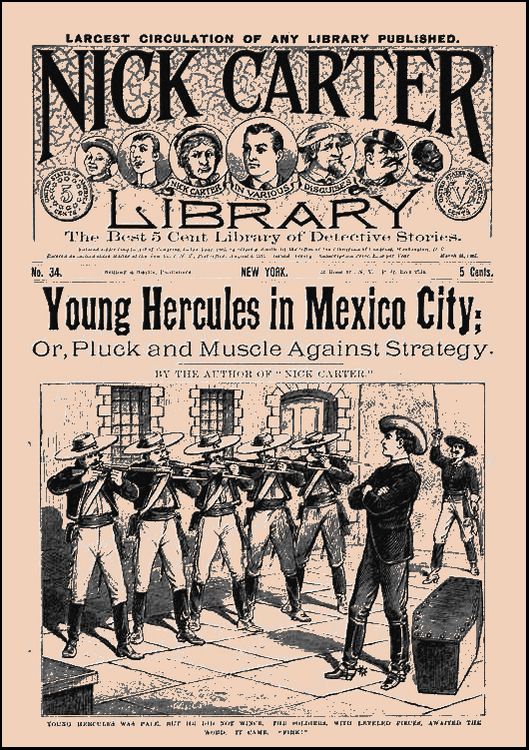
Young Hercules was pale, but he did not wince.
He saw the soldiers, as, with leveled pieces, pointing at his heart, they awaited the word of command.
It came.
"Fire!"
There were puffs of smoke, a volley of ringing reports, and the bullets sped upon the errand of death.
But the echo had not died away ere a shout of command in a well-known voice rang out through the court yard, and General Escudera sprang through the gate-way the instant after the guns were discharged.
Just one second too late.
His quick eyes glanced toward the place where Chick had stood, and he saw that the young detective was stretched upon the ground, face down, motionless and silent.
"Too late!" he cried; "too late! and all because none of you would bring a message to me from him. Ah, I will teach you all a lesson! That man whom you have murdered was my friend, he was innocent, and now he is—"
"Alive, general, and as well as ever," cried Chick, leaping to his feet. "I dropped at the word fire, before the soldiers could discharge their weapons, and I am unhurt."
CHICK had taken his cue when the commanding officer had said, "At the word fire, you will fall."
He calculated the time to a nicety, and he did fall, just soon enough to escape the bullets of the soldiers.
A few words from the general sufficed to explain everything, and Chick accompanied him when he left the prison-yard.
"Now, tell me of your adventure, and how you happened to get into this scrape," demanded the general, when they were alone.
Chick related all that had occurred in the Alameda.
"Did you see the woman's face?" asked the general.
"No."
"Then you cannot identify her?"
"No—unless—"
"Unless what?"
"Unless I see her walk, or hear her speak."
"Ah! could you, then?"
"Yes, I think so."
"Is she lame?"
"No; she is the most graceful creature I ever saw. Every move that she made was perfect, and her voice—"
"Well?"
"Was like music."
"One would think that you were in love with this murderess."
"Yes? One would be mistaken, then. But I will know her walk and her voice, general. Now, tell me how you happened to arrive at the prison when you did?"
"A soldier came to me."
"Ah!"
"And said that you had asked him to deliver a message."
"Yes."
"And that he had refused."
"I remember him."
"He said that you made him swear that he would deliver it after you were shot, and that you had said that he would then be executed for being late."
"My words had some effect, then?"
"Yes: but he reached me only at the last moment. I leaped upon a horse, and rode here at a gallop to save the time which would have been wasted in giving an order."
"All's well that ends well, general. By the way."
"Well?"
"Did you dine with your friend to-day?"
"No. I waited for you."
"And I failed to show up. Force of circumstances, general, over which I had no control."
"Exactly."
"You do not know, then, if Senorita de Llorente was there."
"No."
"Hm! I would like very much to meet her."
"I can arrange it for this evening."
"Will you do so?"
"Yes."
"Good! At what time?"
"Can you be at my house at eight-thirty?"
"The fatal hour; yes."
"I will have everything arranged. We will call upon her."
"Very good. Shall we part now?"
"Yes."
"I will call upon you as M. Duprez."
"I will expect the monsieur."
"Very well."
"Senor Hercules?"
"Yes."
"Why are you so anxious to meet Carlotta?"
"Interest in the case."
"Do you adhere to your theory of her guilt?"
"I would like to be able to prove her innocence."
"Good, good! hasta luego, senor."
"Hasta luego" (until later).
It was exactly half-past eight when Chick appeared at the residence of the general on the Calle de Buena Vista.
"You are prompt, senor," said the general.
"That should please a soldier."
"It does. Come; the carriage is ready."
Twenty minutes later they left the carriage in front of one of the beautiful residences near El Caballito, at the lower end of the Paseo de la Reforma, which is a broad boulevard leading from the city to the Palace of Chapultepec.
"Does she reside here?" asked Chick.
"Yes."
"It is a beautiful spot."
"She is a beautiful woman."
"Or fiend," thought the young detective, but he made no audible reply.
Chick was attired with extraordinary care.
His handsome face was partially concealed by a mustache and pointed beard of black, and a curly wig adorned his head.
As Monsieur Duprez, he was a success, and the general had not failed to compliment him upon the disguise.
They were ushered into the parlors of the mansion, and ten minutes later the portiere curtains parted and admitted Carlotta de Llorente.
For a moment Chick gazed at her in speechless amazement.
Never had he seen a face so lovely, a figure so perfect, a human creature so superb.
Ay, and more.
Her eyes seemed almost transparent in their brilliancy, as though the soul behind them was so perfect that it shone through in its purity and latent grandeur.
Chick prided himself upon being a physiognomist.
"Is this the woman who tried to murder me last night?" he asked himself. "Is that pure, sweet face, are those beautiful eyes, but masks to hide a soul as black as Satan's?"
He started when she drew near.
He had said that he could not mistake the grace of her carriage, and he recognized it instantly.
He was bowing low in acknowledgment of the introduction made by the general, when he heard her speak.
Again he started.
The voice was the same.
He knew beyond a doubt that the woman who, on the preceding night, had tried to stab him with the deadly pin, stood before him now.
How cool she was! how utterly self-possessed! What matchless self-poise was hers!
Chick shuddered as he stretched out his hand to take hers, but when he felt the pressure of her delicate fingers, warm with throbbing life, he caught himself again wondering if there were not some awful mistake.
One can determine much by the pressure of a hand.
"Hers should be cold, and the pulse slow," he thought; "but it is warm, and the rich glow upon her cheeks tells me that the blood is not sluggish in her veins."
He caught himself staring at her in a way that brought an added blush to her cheek.
He hastened to apologize.
"I beg your pardon," he said; "but the moment that I saw you, senorita, I felt that we had met before in another existence."
She made a suitable reply, and then ensued some trifling conversation.
Suddenly, Carlotta turned to the general.
"Pardon me," she said; "but did I not hear that the—that man who—"
She paused and grew pale.
"You are speaking of the assassin of your brother, senorita," said Chick, coolly, before the general could speak.
"Yes, senor."
"He was arrested last night."
"Ah! I heard that; also that he was to be—"
"Executed to-day?"
"Yes."
"He was."
"Then he is now—"
"Alive and well—and free, senorita."
"What!" she cried, leaping to her feet. "Has he escaped? The murderer of my brother, the—"
"Calm yourself, senorita."
"But—"
"There was a mistake. He was not the assassin."
"Not the assassin!"
"No. For proof of that, ask the general. It was he who liberated him."
"You, general? You!"
"Yes, Carlotta." Again Chick's cool tones interposed.
"The man who was supposed to be the assassin, the man who was condemned to be shot at sundown to-day, turned out to be not only innocent, but a friend of the general's."
"But—oh, this is awful, awful!"
"What is awful, senorita? that an innocent man should escape?"
"No—no! oh, no, not that!"
"What, then?"
"That I—that he should have come so near being killed."
"Yes; you are right. Would you like to hear about him?"
"Yes."
"He is a detective from New York. I may tell, may I not, general?"
"Certainly."
Chick watched Carlotta's face narrowly as he proceeded.
"But," she exclaimed, "why did he spring upon the woman in the Alemeda? Why did he chase her? Why—oh, there are a thousand whys?"
"He is a detective," said Chick. "Last night he went to the Alameda, and waited at the fatal spot, thinking that the assassin might again visit it, for it was the seventh day of the month."
"Yes—yes! Go on, please."
"He waited some time, and, at last, he saw a woman approaching."
"Yes."
"She was dressed in black, as you are, senorita, and her mantilla hid her features from view.'
"Ah! Did he—the detective—tell you this?"
"Yes; he told me."
"And then—"
"He watched her. She came to the very spot where the crimes were committed. Her actions were very strange. She said many words in a low tone—words which he heard and he says that he will recognize her voice, if he ever hears it again. You must bring him here some time, general. The senorita might tell him many things that would be of service in—"
"No—no! no—no! You must not bring him here, I"— she paused and laughed uneasily—"I could not bear to meet one who—who spends his life in hunting down his fellow-man. Please continue, senor."
"THERE is but little more to tell, senorita. He saw her raise her hand, he saw that it contained a pin like those with which the murders were committed, and then—"
"Ah! what then?"
"Then he was convinced that she was the assassin."
"Ah!"
"And he leaped forward to capture her."
"Yes."
"Because he believed her to be the murderess."
"Yes."
"And she, what did she do?"
"Like the unnatural woman, the fiend, the murderess that she is—"
"Oh, no—no—no!"
"She turned upon him, and struck him with the deadly pin. But for the fact that he wears a shirt of steel beneath his clothing, he would have been her fifth victim, and this morning Mexico would have been horrified by another murder mystery."
Carlotta was as pale as death, and for a moment it seemed as though she was about to faint.
But she recovered, and, making a poor attempt to smile, she said:
"Did you say her fifth victim?"
"Yes."
"Does the detective believe that she, the woman he saw in the Alameda, is guilty of those four murders?"
"He is positive of it."
"Positive."
"Yes."
"And he will track her down?"
"Assuredly."
"To what end? How can he prove her guilt?"
"We can prove her attempt upon his own life, if nothing else."
"How?"
"By her walk, her voice, in many ways."
"Do you think that he can do this?"
"Yes."
"Do you know this detective?"
"By reputation."
"Is he skillful?"
"Very."
"Senor, and you, general, tell this detective for me, that if he will succeed in finding the real murderer of my brother, I will give him anything he may ask."
"That might mean your entire fortune, Carlotta," said the general.
"Or your life itself," murmured Chick.
She turned upon him almost, fiercely.
"My life!" she cried. "What think you that I care for my life, if I can avenge my brother? I would give it up willingly to-morrow, ay, this very moment, if I could see the heartless wretch who ruthlessly struck down four innocent human beings, torn limb from limb before my eyes. My life! Bah! Where is this detective of whom you speak?"
"At the Iturbide hotel."
She turned to the general.
"He is a friend of yours?" she asked.
"Yes."
"Will you bring him here?"
"When?"
"To-morrow."
"Another day. To-morrow—"
"Will the senorita permit me to present him?"
"Yes."
"At what hour?"
"At noon."
"I will see that he waits upon you, senorita."
She bowed her thanks; the subject was then changed, and a half-hour later the gentlemen withdrew.
"Well?" said the general, when they were again in the carriage.
"Your friend is very beautiful."
"Is she not? What think you of your theory now?"
"I will tell you—to-morrow evening."
"Good! I will be at home after eight."
The carriage left Chick at the hotel, and he went at once to his room.
"By Jove!" he thought, "she is superb. She means to defy me; to meet me on my own ground and battle with me, hand to hand, as it were.
"That she is the woman whom I saw in the Alameda, I know positively, and—"
He paused suddenly.
He had passed through the apartments of Monsieur Duprez, and was in those occupied by the celebrated detective from the north.
His glance fell upon a sealed envelope, which was fastened to his pillow by a huge pin.
He strode forward, and snatched it up, and then, with an exclamation of surprise, he saw that the pin was exactly like those with which the murders had been committed.
He tore the envelope open, and found a note inclosed.
"If the detective from the north desires to avoid the fate of Llorente, of the Senoritas Zacatecos, and of Avoca, let him leave Mexico at once," he read.
That was all.
No signature.
He saw that the writing was in a masculine hand, but there was otherwise no clew to the identity of the writer.
"Humph!" he muttered. "The plot thickens. She has had no chance to place this here since she learned that I was not executed. Can there be an accomplice?"
He fastened his door securely and retired, for he had obtained little or no rest during the previous night when he was in prison.
In the morning he arrayed himself in his blonde disguise, played billiards in the cafe for an hour or two, and at twelve precisely, presented himself at the house of Carlotta de Llorente. He had prepared a note which he sent to Carlotta, purporting to come from Monsieur Duprez, in which he said.
the detective refused to call unless he was permitted to do so alone.
She received him at once.
"I am glad that you came alone," she said, "for I have much to say to you."
Then she started.
"Are you the man who so narrowly escaped—"
"I am the man," said Chick.
Her next question was surprising.
"Do you speak French?" she asked.
"I do."
"Then let us converse in that language. My maid does not understand it."
"Very well."
She was looking at him strangely, and, with a curious smile on his face, Chick said:
"You do not recognize me, senorita?"
"No."
"Yet you saw me night before last."
"Ah! Where?"
"In the Alameda."
"Then you know that it was I who was there?" she asked, with perfect coolness.
"Yes." said Chick, surprised.
"You recognized my voice?"
"Yes."
"And you know that I tried to take your life?"
"Certainly."
"You have saved me the trouble of an unpleasant confession."
"You admit it all, then?"
"Why not? I was justified."
"Justified!"
He began to believe that she was mad.
"Yes. I did attempt to take your life, and I believed then that I was justified in doing so.'
"Since you are in a mood for confessing, will you explain why?"
"Yes; but first, do you believe that you can find the assassin?"
"Eh? I have found her."
"Have found her?"
"Yes."
"Where?"
"Here."
"Ah! You believe that I, Carlotta de Llorente, murdered my brother and my best friends?"
"Yes."
"I thought you were a detective."
"I am."
"Pardon me: I would not have suspected it.
Chick bit his lip with vexation.
Carlotta arose.
"Our interview is at an end, monsieur," she said. "If you have that opinion, I have nothing more to say."
"Do you know what I will do when I leave here?"
"No."
"I will cause your arrest."
"Do so."
"You will be convicted of four murders and an attempt at a fifth."
"Ah!"
"Senorita, pardon me, but I wish to say something more."
"Say it."
"The chain of circumstantial evidence against you is very strong, and yet, when I look at you, I cannot believe you guilty. You say that you are not. Will you do me the honor to convince me of your innocence, if I will tell you why I believe you guilty?"
"I will hear what you have to say."
"Your brother's wealth came-to you at his death. Lucia Zacatecos stood between you and another ambition—"
She started to her feet.
"Will you deny that you loved Manuel Avoca?" asked Chick, quietly.
"No, I will not deny it," she said.
"You were in the Alameda, in the very path where Avoca was killed, and on that very evening."
"How do you know that?" she exclaimed.
"You dropped an envelope that was addressed to you. It was found; I have it with me."
"An envelope?"
"Yes; here it is."
Chick drew the envelope from his pocket, and held it up. Then she started violently.
"Look at it, senorita, and tell me the name of the man who addressed it."
She took the envelope, frowned, and returned it.
"His name?" she said.
"Yes."
"His name is Carl Rittner."
"A German?"
"Yes."
"More of him later. You were again in the Alameda, at the fatal spot, at the fatal time, on the seventh of the month. You then had in your possession a poisoned pin, like the others, and you tried to murder me with it. And now there is one more point."
"Indeed!"
"Last night another pin, like the others, was left in my room at the hotel, with a message of warning."
"Well? do you think I placed them there?"
"No."
"What then?"
"The handwriting on this envelope, and the handwriting of the message of warning are the same."
"Carl Rittner's?"
"Yes."
For a moment Carlotta showed great excitement.
Suddenly, however, she controlled herself.
"Senor," she said. "I forgive your suspicions of me. I do not blame you for them. I went to the Alameda that night, because it was the fatal time, and because I had dreamed that the assassin would come there then. I went there to kill him, and when you sprang upon me, I thought you were he.
"I did go to the Alameda the night that Manuel Avoca was slain; I met him there, or rather, he met me at my request, and over the spot where my brother fell, I made him swear that he would hunt the murderer down. I left him there. He seemed overwhelmed, almost guilty himself, I thought. I loved him when I went there. I despised him when I came away. I have hated myself for it since, because he, too, became a victim.
"Wait, please. That envelope was in my pocket, but the letter was in it. I must have dropped it, and somebody found it."
"The envelope was empty when found. Have you told me the truth, senorita ?"
"Yes; the truth, as God is my judge."
"And I believe you, even against my own convictions."
"I THANK you, senor."
"Now, will you answer some questions?" asked Chick.
"Anything."
"Where did you get that poisoned pin?"
"I prepared it."
"Prepared it?"
"Yes."
"Then you know the poison?"
"I know its name."
"What is it?"
"Muerta de la alma."
"Ah! I have heard of it."
"It is terrible."
"Yes; but almost unknown. Where did you procure it?"
"I have had for several years the vial that contains it."
"Who gave it to you?"
"Carl Rittner."
"Ah! Where did he procure it?"
"In Brazil."
"Tell me about Carl Rittner."
"He came here five years ago, and was a great friend of my brother's."
"Yes."
"He fancied himself in love with me."
"Ah!"
"And persecuted me until I refused to receive him here at all."
"Was he still friendly with your brother?"
"Outwardly."
"When did you first hear of the poison?"
"When he first came."
"Tell me about it."
"He related its peculiarities and gave me a vial, telling me that if I ever had an enemy I could easily be avenged."
"Yes. Well?"
"My brother, Juanita and Lucia Zacatecos, Senor Rittner, and myself were together at the time."
"Go on, please."
"We each dipped a pin in the poison—that is, with the exception of my brother."
"He did not?"
"No; and he objected to our doing so."
"But you did?"
"Yes."
"All of you?"
"Yes."
"And then?"
"I put the vial away."
"Ah!"
"I did not think of it again until my brother was slain."
"And then?"
"I looked for the pin that I had dipped in the poison."
"Well?"
"It was gone."
"Gone?"
"Yes."
"Do you know where?"
"I do know."
"What became of it?"
"Senor Avoca had it."
"Avoca. He was not present when the poison was described, was he?"
"No."
"How do you know that he took it?"
"He told me so."
"When?"
"That night in the Alameda when he was slain."
"Did he tell you why?"
"Yes."
"Well?"
"He feared that I would commit suicide with it."
"Because you loved him?"
"Yes."
"Did you ever have such a thought?"
"No."
"Did you believe his story about it?"
"No; it was then that I suspected him of murdering my brother."
"Ah! Did he have the pin in his possession when you met him?"
"He said not."
"But you believe that he did?"
"Yes."
"Do you think—"
"I think that he killed himself with it. Remember that I had loved him as a girl."
"Yes."
"And that I still thought I did when I asked him to meet me there, and swear to avenge my brother."
"Yes."
"I asked him to meet me there, because I wanted him to take the oath on the spot where Pablo fell."
"I see."
"His conduct was strange. I could almost fancy that he feared that a ghost would rise up before him. I became angry, and I finally exclaimed: 'I despise you, Manuel Avoca, and I can almost believe that you are the murderer yourself.'"
"Then I ran away; and I think he killed himself."
"But what of the others?"
"Ah, senor, would to God that I knew."
"Where is Rittner now?"
"At the Iturbide hotel."
"Ah! he lives there?"
"Yes."
"Senorita, have you the courage to go there with me now?"
"There? to his rooms?"
"Yes."
"Oh, senor, no—no!"
"Yes, come. Vail your face and come. I promise you—"
"What?"
"That your brother's murder shall be avenged."
She leaped to her feet, and then paused.
"My maid, can she go?"
"Yes."
"Then I will go with you."
It is only a short drive from the Paseo to the Iturbide, and the carriage was soon there.
Chick went at once to the manager, and inquired for the number of Rittner's rooms.
"He has left here," was the reply.
"When?"
"This morning."
"Do you know his present address?"
"Yes; in the Cinco de Mayo."
Chick got the number, and hurried away.
Ten minutes later they entered the house where Rittner was said to be.
The porter gave them directions to reach the room, and they passed through the pateo and up the stairs, pausing at last before a glass door upon which Chick rapped loudly.
There was no response, and Chick tried the door.
It opened at his touch, and he entered.
A figure was stretched upon the bed in one corner of the room, and the moment the detective's glance fell upon it, he knew the truth.
Turning hastily, he bade Carlotta wait outside, and then he approached the bed.
A man lay there, and close against the bosom of his shirt was the black head of one of those deadly pins.
It told its own story.
The man had long since ceased to breathe, but in his left hand was clutched an envelope which Chick gently took away.
Then he left the room, carrying the envelope with him.
"Come," he said, "we will go to your house now."
"Why?"
"You are avenged, Rittner is dead."
"Dead?"
"Yes; by his own hand. Come!"
Chick paused long enough to tell the porter what he had found, and then they entered the carriage, and were driven away.
At the house of Carlotta they read Carl Rittner's confession.
"To whom it may concern," it said. "I am about to take my own life, for I cannot commit another murder, and I must either do that or be discovered.
"It was I who killed Pablo de Llorente, because I believed that he stood between me and the fruition of my hopes. I loved his sister. I meant to marry her. I wanted her to have all the money. She loved Avoca, and I determined to kill him, but Lucia Zacatecos remembered about the poison that I brought from Brazil, and suspected me, and I had to kill her. Then came Juanita. I was at the scene of my former crimes. I was praying. She came upon me suddenly, accused me, and I confessed, and struck her with a deadly pin.
"The place fascinated me. I went there again a month later. I saw Carlotta and Avoca together there. I waited until they parted, and then he, too, became my victim.
"Carlotta dropped a letter. It was from me. I took it, but left the envelope. I thought she might be suspected, and I would save her.
"My crimes have found me out. I perish by my own hand. I do not hope for forgiveness. I am hopeless—lost.
"Carl Rittner."
Roy Glashan's Library
Non sibi sed omnibus
Go to Home Page
This work is out of copyright in countries with a copyright
period of 70 years or less, after the year of the author's death.
If it is under copyright in your country of residence,
do not download or redistribute this file.
Original content added by RGL (e.g., introductions, notes,
RGL covers) is proprietary and protected by copyright.