RGL e-Book Cover
Based on an image created with Microsoft Bing software
Roy Glashan's Library
Non sibi sed omnibus
Go to Home Page
This work is out of copyright in countries with a copyright
period of 70 years or less, after the year of the author's death.
If it is under copyright in your country of residence,
do not download or redistribute this file.
Original content added by RGL (e.g., introductions, notes,
RGL covers) is proprietary and protected by copyright.
RGL e-Book Cover
Based on an image created with Microsoft Bing software

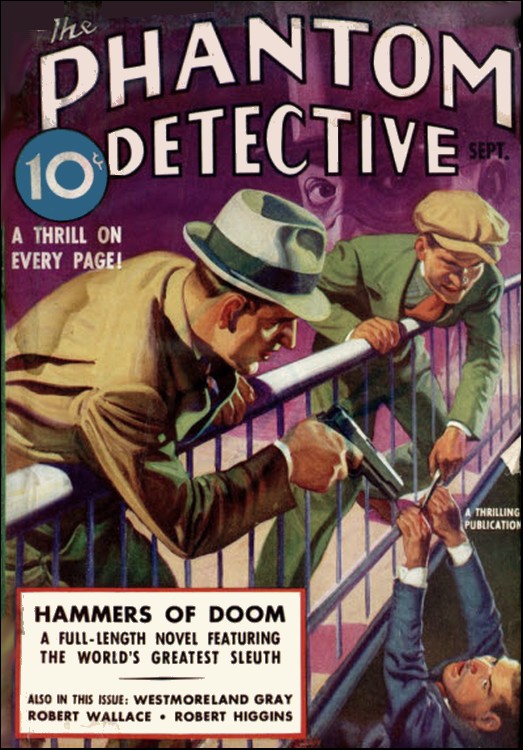
The Phantom Detective, September 1937, with "Hammers Of Doom"
Corpses hung aloft on the steel skeletons of skyscrapers serve as gruesome symbols of a gigantic plot of death and destruction menacing the commercial progress of America!
SWIRLING out of the East River, the chill night mist drifted in ghostly, clammy tendrils over the waterfront, where the city's deepest slum and its most aristocratic residential section crowded against one another.
Surrounded on three sides by sprawling tenements and dirty, evil-smelling streets, exclusive Dutton Place was like some untouchable jewel in a coarse setting.
Its spacious tree-lined streets were clean and quiet, breathing refinement and wealth. Its modern, palatial apartments, with penthouses and balconies overlooking the river, towered proud and high in the misty night.
Sleek, streamlined limousines, bearing the wealthy home from theaters and night clubs, drew up at intervals before the extending canopies, to be greeted by trim-uniformed doormen—and saluted by a respectable beat-cop.
The beat-cop, moving on his rounds, passed up the quiet street, turned a corner. He never dreamed that at this very moment something far more evil than the surrounding slums was invading exclusive Dutton Place!
Stealthy and silent—as the mist, four men stole toward the foot of the quiet street, hugging a shadowy wall.
Two of them wore slouch hats, pulled low; a third wore a rough cap. The fourth was hatless, his head protected only by a mop of dark, tangled hair.
THE slouch-hatted man in the lead, a huge hulk of a man, stopped to peer cautiously up the block where the bluecoat had just disappeared. His hand hovered close to the breast of his coat, then moved to his vest, from which he drew out a watch. He turned to face the others, who had stopped with him.
"All right, guys, the coast is clear, and we're ahead of schedule! But that car'll be comin' along in a few minutes." His voice came low but coarse, speaking with authority. "Have you all got the setup straight? We got to work together, all at once, but right now we spread out, see? Lefty, you wait down here and watch this end."
The second slouch hat nodded in the mist, and a nimble left hand felt for an armpit holster. "Okay, Slug."
"And you, Joey—" A responsive nod from the cap now. "Go up the block and keep a lookout for that beat-cop. He oughtn't to show, but if he does we'll handle him!" Slug hesitated then, as he confronted the fourth, hatless member of the group. "Pedro, guess you better stick with me. You savvy?"
The dark-haired man, who was small and wiry, grunted. His hand reached toward his belt, toward the handle of a glistening, evil-bladed knife scarcely concealed under a short coat.
"I use this, yes?" he said eagerly, in a thick Latin accent. "Big señor, he say Pedro use knife!"
"You mean the boss?" Slug stated rather than asked, and the other two tensed with him, as if an invisible wave, a wave of mingled awe and fear, had coursed through them. Slug's voice was less authoritative now, compromising.
"What the Big Shot says goes, of course—but don't be throwin' that knife too wild."
A curse came from the man named Lefty. "Hell, why did we have to bring this guy with us anyhow, Slug? He's kill-crazy!" His voice rose in a whine. "I'm beginnin' to feel funny about this job already! And, hell, we don't even know whether the Boss'll really pay off like he promised—"
Pedro shifted forward menacingly, hand moving the hilt of his knife.
"I savvy!" he said with quiet firmness. "You talk against big señor, I kill."
Slug's big hand pushed him back. "Keep your shirt on, Pedro! And you, Lefty—are you nuts? Don't you know it ain't healthy to start askin' them kind of questions? Me, I believe the big fellow's on the level. I'm sticking with him; and you guys better stick too, if you know what's good." He stirred impatiently. "Come on! We don't want to be late! Spread—now! I'll give you the signal when the time comes!"
As he spoke, he nudged Pedro, and led the latter up the misty block, up to a dark alley between two buildings. The capped man named Joey moved further up the block, walking close to the shadows of building walls. Lefty remained in the mist below.
The street seemed unchanged, as quiet and deserted as it had been a moment before. In the silence the moan of the river sirens rose weirdly in the misty night.
JOHN T. RUSSELL, Manhattan's biggest subway contractor, leaned forward from the cushions of his Packard limousine, which carried him with luxuriant speed across the city. He picked up the speaking tube.
"After you've garaged the car, you can go home, Carl," he said crisply. "I'll want you early tomorrow morning."
"Right, Mr. Russell." The trim-dressed chauffeur at the wheel nodded without turning.
John T. Russell drew a last puff on his Havana, then crunched the cigar out in the engraved silver ashtray at his side. He leaned back with a wearied sigh. He was tired, but his rugged, hard-jawed face scarcely showed it.
IT seldom showed any of his feelings or thoughts. That was why, in the business world, he was regarded as a hard, shrewd fighter who, if need be, could forget scruples—and show no sign of conscience about it.
A hard grin touched his lips. Yes, he had come a long way; a tough way, and had earned every grey hair in his iron-grey head. Business this year had been anything but satisfactory; two contracts had fallen down because the city hadn't been able to raise the funds. His books were on the red side—but John T. Russell didn't care. Behind his impassive, rugged face his thoughts marched to a rosy future. Soon now, the time would be at hand. Why, he'd be worth—
He broke off from the contented thought as his limousine turned a corner into the Dutton Place side street. John T. Russell reached for the opera hat beside him, straightening his evening coat about his gorgeous-studded, starched white shirt front. The chauffeur slowed the car toward the curb, toward the canopy of the most palatial of the towering apartment buildings.
From beneath the canopy a gold-glittering night doorman came hurrying.
That was when it happened.
John T. Russell, leaning toward the door of the slowing car, saw the shadowy figures leap from the mist. Two of them rushed from a dark alley. A third and fourth came from opposite end of the block. With swift purpose they converged toward the car, and in the wan light of a street lamp three leveled automatics glinted wickedly—and one shimmering knife.
Russell's body went tense, but his shrewd mind worked instantly. This must be a stickup. The thugs were well armed, so to resist them would be foolhardy. He almost relaxed. He wasn't going to hold out the little cash and jewelry he had on his person.
Even as his mind raced with the thoughts, the two thugs who had come from the alley jumped the running board of the slowing Packard. Russell glimpsed the hatless, dark-haired one with the knife, saw an olive, swart foreign face with glowing eyes. The other thug was huge, pug-faced, his weight shaking the whole car as he jumped on, gun in hand.
Their weapons menaced Carl, the cringing chauffeur. The Packard's tires squealed promptly with jamming brakes. Then, as if ashamed for his momentary fright, the chauffeur jerked toward the door, in a wild move of defense. The huge gunman whipped that front door open.
"Okay, Pedro!" he gritted, and the olive-faced thug raised the knife high.
A gasp of surprised horror involuntarily escaped Russell's lips as he saw the knife lift—and plunge!
There came a horrible, gurgling scream from the chauffeur. His body slumped half out the door and a gush of crimson spurted like a gruesome fount from the wound left by the withdrawn knife. Lifeless, the chauffeur, was tossed to the pavement where his spilling blood formed a crimson pool.
RUSSELL, aghast at the coldblooded murder committed before his eyes, opened his mouth to yell then. Before he could, the rear door was whipped open. One hand of the burly, pug-faced gunman poked in a black-mawed automatic, the other brutally smashed the subway contractor back against the cushions, knocking the breath from his lungs.
The big gunman and the blackhaired knifer he had called Pedro stumbled over Russell, wedging in on either side of him. He felt an automatic gouging one side of his ribs; felt the knife blade, still wet with his chauffeur's life blood, pricking his clothes on the other.
"Keep still and you won't get hurt!" came the rasped warning. But though Russell's poker face showed nothing, panic was in his heart. This was no stickup.
The third, slouch-hatted gangster was sliding his nimble body behind the wheel of the Packard. At that instant Russell felt a spark of hope. He glimpsed the doorman of the apartment, who had been standing frozen, paralyzed, now wildly raising his taxi whistle to summon immediate help.
The whistle never touched his lips. The fourth thug, in a cap, had tarried behind. He leaped, cursing, toward the doorman. His automatic swung before him like a club, in a vicious, swishing arc. The terrific blow landed flush against the doorman's soft cap—and the man toppled like a log, sprawled inert beneath the canopy.
"Okay, Lefty!" the big thug in back rasped out. Ironically he picked up the speaking tube, to make himself heard through the partition. "Get going! Joey'll jump in."
The Packard commenced to roll, purring, from the curb, while Russell still sat wedged between a knife and a gun. Another instant and a third automatic menaced him as the last gunman leaped through the unclosed door which slammed behind him, yanked up a folding seat and straddled it, covering the subway contractor from in front.
The car, instead of going down Dutton Place, turned within the block, backing, going forward again. Gears meshed. The big machine leaped forward. As it passed the next corner, Russell glimpsed the figure of a patrolman, the beat-cop, swinging up the cross street. The panic within him made him momentarily desperate. He found his voice and yelled hoarsely:
"Help! Officer! Help!"
The brutal fist of the big gangster beside him smashed the words back into his cracking lips, and he swallowed blood; at the same time the knife dug painfully into his side. But with dazed hope, he saw the bluecoat whirl. The patrolman had heard the cry—was running this way—drawing his gun.
"Okay! Let him have it, Joey!" Even as he rasped, the big thug had whirled the window handle, so the pane came down.
Crack! Crack! Crack!
The reports deafened Russell's ears despite the fact that the driver had raced the engine to muffle them. He saw the spurts of livid flame spit from the automatics of the big thug and the other gunman on the folding seat, spit out the big window, deliberately opening fire on the running cop who had not yet discovered what the trouble was.
For an instant the bluecoat's figure continued forward. It loomed big, close—and then, even as the car shot past it, Russell saw it collapse to the pavement, saw the blue-coat pitch down, clutching his chest and throat as he fell—dead!
The fighter in Russell roused then. Desperately, he hurled away from the knife, toward the big thug who was still at the window. He tried to grab the burly man's gun arm. A whole shower of vicious blows stopped him as the gunman in the folding seat and Pedro, the knifer, both cuffed at him brutally, savagely.
Then the big thug leader jerked around. With experienced ease he dragged his automatic across Russell's bare head. Stunned, his brain spinning, Russell sank back, exhausted.
And, even as the car continued, turning downtown now, a rough cloth sack was jerked over the dazed subway contractor's head. His vision was cut off, his own breath suffocated him.
Helpless, panting, he sat back, while the car purred smoothly on. He tried as best he could to follow its course by its motion. He heard other traffic, horns; felt the car slow, then there was a stretch in which it gathered speed for a little while.
AGAIN it stopped, apparently for more traffic signals.
"Quit bein' so nervous at that wheel, Lefty!" came the rasping voice of the big thug leader. "Hell, we're in Brooklyn now, and no one's stopped us!"
Brooklyn! That stretch of speed must have been over one of the bridges, so near Dutton Place.
"Yeah, I know," came a whining reply, obviously from Lefty. "But suppose someone sees—"
"Don't worry! We're shieldin' Russell back here so no one can see!"
And Russell, with the knife and gun still gouging him, felt a fresh shock as he heard his own name. Then this was no haphazard job; he was not just a rich victim picked at random. It was prearranged, this bold, devilish kidnapping in his own limousine!
But swiftly then, as he accepted the facts, his cool, business-trained mind took possession of him once more. He must be calm. Must keep his wits about him. These thugs were killers, but now that he guessed their purport he didn't think they would kill him unless he forced them to.
NO doubt they were hired gangsters. The thug giving orders didn't seem the brainy type to plan this bold "snatch." They were taking him, doubtless, to some hideout. When the time came, he would bargain with whoever happened to be in charge.
His cracked lips almost grinned now under the suffocating sack. He had never got the worst of a bargain yet! His business affairs, his income tax were easy to check, and they would show that he had little cash available for ransom. The same was true of his friends. The kidnappers were welcome to that cash. Of course they couldn't know that soon he would be getting—
Again, as before, he stopped on that gloating secret thought. And through his optimism came a returning chill of apprehension. That olive-faced Pedro, gouging his side even now with the knife! Something about that swart little man bothered John T. Russell, filled him with a nameless doubt, a wondering dread.
Then, even as he fought to keep cool, he felt the Packard coming to a final stop. He heard their voices again.
"Okay, guys; here we are!" Somewhere in Brooklyn—but where?
That he could not fathom.
COLD air, with a tang in it, swept through the sack cover as Russell heard the door opening. The knife prodded him; rough hands yanked him from the limousine. He stumbled blindly, felt cobblestoned pavement, heard the car starting off. From their voices he knew that the three men in back had alighted with him leaving the driver called Lefty.
Roughly they pushed and dragged him along, while his legs stumbled. The tangy air seemed chill, damp.
"Easy, guys!" came the thug leader's voice. "Better carry him now."
He was lifted bodily, roughly. Then commenced a long, apparently steep ascent, with stops at intervals.
A forward motion then, his body carried horizontally so that the blood rushed to his sack-enclosed head. The footsteps of his carriers seemed to bang metallically. Try as he would, he couldn't visualize his surroundings.
At last they stopped, and his feet were lowered to a hard surface. They held him upright so he could not move. Then something wished over him, drew suddenly and agonizingly tight around his chest, under his armpits. A rope! With fresh fear, he felt himself lifted by it, felt his feet leave the undersurface, dangle and sway. He tried to use his hands to pull at the rope, but his hands were roughly jerked up over his head. Another rope encircled his wrists, held them high.
As he dangled, helpless, the sack was abruptly yanked off his head.
At first his blinking eyes saw only darkness. But then, slowly, vision came. His eyes focused.
John T. Russell was a hard man, a man who until this moment had admirably concealed his inner emotions. But now John T. Russell gave a cry of utter horror, his eyes bulged, and a shock of nauseating terror clutched the very pit of his stomach, making his rugged face turn sickly.
"God!" he gasped out with horrified unbelief, a feeling of terror clutching his heart.
It was mad, utterly mad! It was not possible that he had been brought to such a strange, ghastly place!
But the awareness of his surroundings, he saw in the next instant, were only a beginning to this night of terror!
Behind him he heard the movements of the men who had brought him here. But in front of him now, where he scarcely dared to look—
An eerie reddish glow appeared, spread in the gloom. And in that glow, like some dreadful apparition, loomed a tall, ghostly figure!
A grey cloak trailed from the figure in voluminous folds. Over his head was a grey hood, with two holes in it. Holes through which a pair of lambent, burning eyes peered balefully out at John T. Russell.
Russell's horror grew. Already sickened by what he had seen before the appearance of this dreadful figure, he felt his very flesh shrinking now. For an instant he wondered if he wasn't the victim of a hallucination. Perhaps those blows he had received—
And then, from beneath the grey hood, a voice spoke. An eerie, sibilant voice, full of blighting malice.
"John T. Russell, your hour has struck!" Eerily the hood trembled under the two eyeholes. "As you see, you can make no resistance. Scream if you want—no one will come to your aid. Plead if you will—but no one will listen!"
A dawning, uncanny comprehension struggled with the sheer unbelief in John T. Russell's brain. He couldn't believe and yet—Now he knew why that one olive-faced thug had disturbed his thoughts. Now he knew, with a chill, sinking feeling, that he had guessed wrong about this kidnapping.
Yet, hoarsely heard his own voice croak:
"Who are you? You can't be—" He caught his breath. "What do you want?"
AN evil chuckle broke from the grey hood. "Now you are being sensible. But you know exactly what I want. Tell me—and perhaps you live! Otherwise you die, in agony."
The words came like a final crushing blow. But Russell couldn't take that blow passively. Every fiber of the stubborn fighter in him rose to the surface, the natural instinct of a hard man who is willing to defend all he has.
Defiance blazed in his eyes.
"No!" he burst out. "No! I'll never tell!"
"Very well," spoke the figure in the grey hood, as if calmly pronouncing sentence.
The grey cloak swished as he moved past John T. Russell, out of sight. Russell heard the sibilant voice, heard the gruff voices of the thugs. The ruddy glow seemed to grow brighter, over his head now. Something moved, dazzling his eyes, and then—
John T. Russell screamed! The scream was forced out by his entire breath; he felt such a shock of agony as he had never known.
He screamed, in a high-pitched, gibbering voice—but his scream was drowned out by a sudden, terrific clamor which deafened his ears. The pain became unbearable. His body writhed agonizedly from the ropes which only held him tighter. His arm muscles bulged helplessly as he tried to drag down his hands. Sweat poured in literal torrents down his rugged face, that formerly impassive face which now was contorted with anguish.
Then, even as merciful unconsciousness started to sweep over his tortured nerves, the clamor stopped for an instant. In a growing haze he saw the hooded figure loom again in front of him, saw those evil, flickering eyes.
"Tell!" The figure spoke that one fierce demand.
"God! Let me—down—" The words came like shrieks from the agonized subway contractor. "My hands—my hands—" His agony turned to sudden insane rage. In his madness, his body literally doubled up on the ropes that held it. His legs kicked out wildly, blindly, toward that dreadful cloaked figure.
The strength and agility of utter desperation was in those legs. They almost caught the grey-hooded figure unawares. As it was, even though the man ducked back, one kicking foot caught in the bottom fold of the grey hood, lifted it momentarily high, like a curtain.
Only momentarily—but in that brief instant John T. Russell glimpsed the face of the man in that hood. It was the final shock of his life. His incredulous amazement rose even above his agony.
"You!" he screamed. "So I've been double-crossed by my—"
A rasped snarl of fury from the grey-cloaked figure, who had quickly snatched the hood back into place, interrupted the sentence, and told Russell that his recognition was going to cost him dearly!
And even as the consciousness he had longed to lose returned fully now, making every crying nerve once more alive, the robed figure passed again out of sight.
The hellish deafening clamor came again. The agony—continuing as it had begun! And John T. Russell lost all semblance of sanity then. He became a gibbering maniac.
He yelled, screamed, pleaded, promised in turns. And all the time the clamor deafened his ears—the pain eddied through his tortured nerves in wave upon excruciating wave, enveloping him, closing, closing in.
THREE police radio coupés were the first to respond to the call to Dutton Place. From three directions they came streaking through Manhattan, their sirens screaming imperiously. One whirled up the river drive itself, careened into the quiet side street. The second tore down the block from the west; the third came hurtling in a blue-green streak out of the slum district close by.
Brakes squealing, they all pulled up before the canopy of the tall side street apartment, disgorging their grim, blue-coated occupants.
Seconds later, an ambulance came clanging down the block.
Then, in swift succession, more cars arrived until the exclusive street was a bedlam of sweeping headlamps, of screaming sirens.
More bluecoats. Detectives from the precinct. And, piling out of a dark cruiser, the crack Homicide Squad, with their black satchels and cameras.
With the swift efficiency of a coordinated machine, the department men took command of the scene. Detectives examined two corpses—the corpses of a liveried chauffeur, sprawled in a pool of blood with a gaping chest wound; and one of their own uniformed brothers of the force, a beat-cop who lay around the corner further up, riddled by lead.
Meanwhile, a white-clad interne bent over the groggy form of the apartment doorman, bringing the man dazedly to consciousness with a doze of aromatic salts, a slug of liquor.
The doorman spoke huskily as a captain of detectives shot questions at him.
"They jumped Mr. Russell's car," he blurted. "I couldn't get a good look at them in the dark—their backs mostly turned. Then they slugged me—one of them—"
THE detective captain leaped to his feet, turned to a subordinate.
"Phone Headquarters," he ordered crisply. "Have every patrol car out to find that Packard. Have them get the license number from the Bureau of Motor Vehicles! Close off all bridge-heads and tunnel entrances!"
The subordinate rushed off. Another car screamed to the scene in the next instant, a shield glistening on its front. Chief Inspector Gregg, hard-jawed head of the Manhattan Division of Detectives, climbed out and strode heavily past, saluting uniformed men.
The inspector's heavy lidded but keenly trained eyes swiftly took in the scene. He found the Homicide captain in charge, faced him with wordless questions.
The captain spoke tensely. "It's a double homicide, Inspector, but it's kidnapping too!"
"Kidnapping? Who?" the inspector snapped.
"John T. Russell, the big subway contractor! He was snatched in his own car! I've a five-borough alarm out now!"
The inspector's eyelids seemed heavier, his placid face webbed with weary lines.
"Any leads besides that Packard?" he demanded.
"Not unless that doorman gives his memory a better jolt!" the captain said, and shrugged. "We're doing our best."
Even as he spoke the glass entrance doors of the big apartment building burst open. Several plain clothes men emerged, their hats pushed back.
"Say, Captain," one of them began, then saw the inspector. "Beg pardon, sir! We were just up in Russell's apartment—he lives alone there. The place looks like a cyclone was through it, sir! Someone's ransacked the whole place! Papers all over—furniture overturned! Funny thing, though; a wad of bonds in a desk wasn't touched! Valuable pictures and rugs, too, were left there. It don't look like robbery."
The captain cursed. "Something's flukey! That doorman said they jumped the car. They couldn't have entered the apartment then!"
The inspector shook his head, then spoke with grim hope. "From what you say, that Packard couldn't have gone far—even if it got out of the city. The radio patrol should spot it. We ought to get quick results."
But he was mistaken. Though every radio car in the metropolitan area was combing for that Packard, time passed without any trace of it being found.
The alarm which had first centered about Dutton Place, thence Greater New York, rapidly spread throughout the state, and then into other states. Teletype machines sent the impulse to keyboards miles away, giving a description of the missing subway contractor, as well as the Packard. Swiftly the hue and cry spread. State police, finally Federals, took it up.
Thousands of men were soon hunting for John T. Russell. Police machinery of all kinds was co-ordinating in an effort to find him. Through the night, far and wide, the hunt for the kidnapped man continued with increasing fervor.
And through that same night, an unobtrusive black sedan was rolling across Manhattan Bridge, coming from the direction of Brooklyn, passing many of the very police cars that were out on the hunt.
At the wheel of the sedan sat Lefty, his hat pulled low. Next to him sat the thug named Joey.
And in the shadowy confines of the rear, the figures of Slug and the olive-faced Pedro screened from any outside view the grim personage between them—a grey-cloaked, grey-hooded personage, sitting back in the shadow, his baleful evil eyes peering alertly from the holes in his hood.
As the sedan, rolling into Manhattan, turned onto a quiet avenue and sped ahead, the hooded figure's sibilant voice rose, in withering anger which made the others wince.
"You bungling fools!" he rasped. "There! You saw for yourselves that every radio car in the city is out! And why? Because instead of snatching Russell quietly you created an uproar! You even let yourselves be seen; perhaps left clues. For all I know, you, Lefty, didn't even make a good job of getting rid of the Packard."
"But I did, honest, Boss!" Lefty whined fearfully from the wheel. "I burned it on a junk lot right after I brought the guys and Russell out there. No one'll find it!"
"Nevertheless, the police are regarding this as a kidnapping. That was not my plan. I wanted Russell to be taken quietly, and then I wanted him found—"
HIS eyes gleamed, and the others, with the exception of Pedro turned a little pale. Pedro's dark eyes glowed with a fanatical light that almost matched the eyes in the grey hood.
"I wanted him to be found at once, publicly!" the Grey Hood continued. "But now I am glad we did the thing out in Brooklyn where, without our tipping off the police as we planned, it will take time to be discovered. By then the kidnap alarm will die down. And meanwhile—we attend to the next on my list. Paul Kennedy!
"There will be no bungling this time! There will be no kidnapping alarm! The whole world will know just what happened to Paul Kennedy and it will happen in the very heart of Manhattan! Happen so all can see—and take note! For that is my plan. And if you bungle this time—" Again that withering rage. "You fools, don't you realize that when I picked you up you were just 'punks' on the streets, stealing petty cash? I don't mean you, Pedro!" His voice softened as he spoke a stream of Spanish to the grinning olive-skinned man.
"Si, señor!" Pedro nodded. "Si usted es mi amigo!"
Slug shifted uncomfortably. "Look, Boss, you don't have to give him special orders in that lingo we don't understand. Hell, you can trust us."
"And you can trust Pedro!" the hooded figure rasped. "Do you dare to complain when, by serving me, you stand to make millions? Millions, if you obey! But if you fail—" He did not have to finish the threat. Slug and Joey and Lefty all nodded their heads as if jerked by strings of a master's puppeteer.
"And now, hurry!" the Grey Hood rasped. "To the next—to Paul Kennedy!" Greed flamed in his evil eyes, threaded his sibilant voice. "I must have them all—all!"
The sedan sped on.
DAWN was breaking over the city, chill and grey when emerging from the ornate-domed building of Police Headquarters, Steve Huston, youthful hard-boiled little crime reporter of the New York Clarion, walked wearily across Centre Street to an all-night drug store and wriggled his dapper-dressed frame into a phone booth.
"Give me Mr. Frank Havens," he demanded, when he got the Clarion's office. He tilted back his pearl-grey fedora with its press card sticking from the band, sighed. Then:
"Mr. Havens? Steve." His voice was glum with defeat. "I'm afraid there's no news. I've been hanging around the police all night but there isn't a clue on that kidnapping! This Russell guy seems to have vanished into thin air, and the kidnappers too! But"—his chin jutted out stubbornly—"I'm sticking to the case, Mr. Havens! I won't give up yet!"
But the momentary surge of stubbornness gave way to frustration again as the reporter hung up the receiver.
He walked out to his battered, parked coupé, wriggled behind the wheel, and started uptown. As he drove through the lightening dawn he spoke to himself in scornful depreciation.
"A fine news guy you are, Stephen, my boy! Chasing a story that's already beginning to grow cold! You're supposed to get news—hot news! Hey, who's giving me a Bronx cheer?"
This as a raucous growl emanated from his dashboard. It was the short-wave radio which he kept tuned on the police waveband. He fingered the volume dial, and the static instantly materialized into a droning voice.
"Calling all cars in first division—All cars in first division—Proceed Broadway and Rector Street. Signal Thirty-two. Broadway and Rector. Signal Thirty-two."
Signal 32; meaning, "Ready for action!" A grim gleam leaped in the dapper little reporter's eyes as he promptly swung his car in a complete turn. Downtown, towards the financial district he raced, dodging traffic lights and the growing morning traffic.
"It's big news this time, or I miss my guess!" he gritted, jamming down the accelerator.
Meanwhile, high in the towering building of the New York Clarion, in a sumptuously furnished office, Frank Havens, publisher of this paper and a string of others throughout the nation stood restively before the window, looking out over the awakening city.
The elderly, rugged publisher, whose policy was one of fearless enmity toward crime and corruption was grim-eyed. The kidnapping and total disappearance of John T. Russell had shocked him deeply. He had met Russell just as he had met most important big men, and he felt personally concerned.
His worried eyes swept the city below the window. If he desired, he could send a summons throughout that city; a summons that would call forth the one man who might cope with the crime.
A look of almost paternal affection warmed Havens' deep-lined face. Should he summon that man? He hesitated. He had made it a rule not to issue that call unless the crime was so stupendous, so shocking, that it was beyond hope of solution by regular police methods, in which Havens had great faith.
SLOWLY, Havens turned from the window, paced across the rug. The sudden clamor of a telephone on his huge desk top startled him from his reverie, used though he was to its ring. He strode to the desk, scooped up the instrument. "Mr. Havens," he stated.
The excited, staccato voice of Steve Huston, pitched to wild excitement, came to his ears.
"Mr. Havens! Kill the front page! Is this a story?"
Havens tensed, apprehension in his eyes. "Russell?" he spoke the name in tense question.
There was a harsh, high-pitched laugh from Huston. "You'll forget Russell when you hear this! It makes that kidnapping look tame. You know Paul Kennedy, the big dry dock builder?" It was a statement rather than a question, for Kennedy's building activities had been front page news of late. "Well, get a load of this!"
Steve Huston's excited, staccato voice continued, in rapid-fire speech. And as he listened, Havens' body went rigid, as if the phone were giving him a series of violent electric shocks. His eyes widened with incredulous horror, which grew with each word.
But despite his agitation, he remained first and foremost a newspaperman.
"Hold on, Huston!" he said crisply. "I'll switch you to the city desk! Put your story through, then get back on the Russell kidnapping case!"
"What?" Huston's voice deflated suddenly. "You want me to stay on the kidnapping case with this case breaking? Look here, can't I at least stick around to get all the developments?"
Havens spoke with grim decision. "That will be attended to by—someone else."
And as a gasp of awed understanding broke from Huston, Havens switched on an inter-office phone, making the connection to the city room.
Then, with grim haste, the publisher strode out of the office, hurrying to the elevator that ascended to the top of the Clarion's high tower. Paul Kennedy! No doubt now that here was something too shockingly stupendous even for the police!
RICHARD CURTIS VAN LOAN, immaculately groomed in riding habit, spurred his mount to keep pace with the other horses on the Central Park bridle path.
"Come on, Dick!" An attractive young debutante, gay despite her aristocratic bearing, waved her riding crop. "I know it just kills you to try to keep awake at this early hour, but the ride'll do you good."
"She's right, Dick," a young, rather flabby-bodied gentleman put in. "Your health, you know! You can't get healthy sitting around night clubs and sleeping it off all day!"
Another society couple who completed the group joined with merry laughter. They trotted up the path, their mounts breathing steam in the chill morning air.
"If this is your idea of fun, bouncing on a horse—" Dick Van Loan drawled complainingly, stifling a yawn. No man could have looked more completely bored than the wealthy young millionaire and man-about-town.
The bridle path ascended to a little crest which gave the riders an impressive vista of the midtown sky-line beyond the park walls. Van Loan's bored eyes lifted to the tall skyscrapers, their upper parts bright in the sun which had not yet completely lighted the streets. The chrome spire of the Chrysler Building shimmered and glinted and—Suddenly Van's gaze sharpened, his hands instinctively pulled up the reins of his mount. Into his eyes came a look so keen and wide-awake that, had his laughing companions seen it, they would have been astonished.
FOR that shimmer of the Chrysler had been rivaled now by another glinting shimmer. A shimmer which at intervals, reflecting the sun rays, sent them flashing in all directions—and with strange, blinking rhythm!
A heliograph! A mechanical mirror device which, in sunlight, could send its flashed messages for hundreds of miles. High atop the Clarion Building, it was blinking now as it revolved.
Van's horse was already lagging behind the others again as, unmindful of the mount, he watched those flashes. He had to wait until the heliograph started to send in his direction again.
Then he caught the flashes, and read them as easily as if they were boldly written words.
Phantom—Go to Rector and Broadway—
Phantom—Go to Rector and Broadway—
Urgently came that summons, as the heliograph sought out the greatest of all sleuths wherever he might be in the city.
"Dick!" the deb's voice called impatiently, as she turned back with a pretty pout. "Are you lagging again?"
"Coming, my child!" Van answered in his bored drawl. He spurred his horse, and the animal started ahead once more. But as it did a cry broke from the deb, and others in the riding party.
Clumsily, Van Loan's right foot had slipped from the stirrup; the horse's upward trot had thrown his body to one side. With gauche awkwardness, the wealthy young socialite slid off the saddle, toppled in a heap to the turf, while his mount came to an embarrassed halt.
The others quickly dismounted, ran up. "You hurt, Dick? You all right?" their voices chorused in concern.
Van Loan held one leg, rubbing it gingerly. "I seem to have sprained my ankle," he said. "Awkward of me." As he spoke he struggled to his feet, winced as he shifted his weight to one foot. The two men of the party caught him, supporting him. "Deuce take it!" Van swore. "Not much good for walking, and here I am stuck in Central Park. Only thing to do is to try to hail the first car that comes along."
The debutante nodded brightly, went up over the grass above the motor highway. She waved and yelled as cars passed. One stopped, a sedan with a lone driver.
He proved to be a friendly salesman who, hearing the trouble, generously offered to take Van to a physician.
"I think I'd better go home and call my own doctor there," Van said, and gave his Park Avenue address. The car started off, Van calling back to his waving friends: "Sorry I spoiled the party! Take care of the horse!"
The car rolled swiftly out of the southeast exit of the park.
"Hurt bad, friend?" the salesman asked conversationally. "Me, I never ride the horses—I only play 'em! And that hurts plenty!" In minutes he slowed the machine. "Well, here we are. Want me to help you in?"
BUT a doorman was now coming out of the Park Avenue apartment. With a respectful good morning to Van Loan, he helped the young socialite out, and the salesman drove away on his business with a friendly wave.
Dick Van Loan didn't enter the building at all. Though while getting out of the car he had leaned on the doorman for support, the latter had known nothing of a "sprained ankle." So he was not surprised when Van stood easily and firmly on both feet!
"Just remembered I have another errand," Van drawled as, leaving the doorman, he strode from the building, rounded the corner.
On the side street Van's pace increased, his long legs striding briskly. Through a gap of buildings he again caught the continued flash of the heliograph.
It spurred his legs still more. Hurriedly, he entered a private garage a little way up the block. His first move was to a telephone.
In a moment the voice of Frank Havens came eagerly to his ears, for this was a private wire straight to the Clarion.
"Hello, Frank," Van drawled, but there was a warmth in his drawl. "You can stop that heliograph."
"Then you got—" Havens' voice broke off, as if not even trusting this private wire. But he could not conceal the relief from his tone. "Very well, Van! Glad you noticed it. Thanks."
And the brief conversation ended.
Van flashed on a light-switch which illumined the garage. It was occupied by a whole group of cars belonging to him. They ranged from a lavish Duesenberg to a modest Ford coupé.
It was the coupé which rolled out of the garage just minutes later. And the man who sat behind its wheel would never have been taken for Richard Curtis Van Loan, the wealthy, bored socialite.
The handsome features of Dick Van Loan had given way to a sharp, hawklike visage. His smooth dark hair had become a tangled sandy mop beneath a tilted, badly-worn grey felt hat. He wore a salt-and-pepper business suit.
And indeed, when he had swiftly put on that artful disguise from his special makeup kit, Richard Van Loan had truly changed his personality. No longer was he bored, listless. His athletic, broad-shouldered body was tense in every rippling muscle, his eyes were keen, purposeful, as he sent the coupé speedily downtown.
The Phantom was answering the call which had summoned him!
The Phantom! Nemesis of crime, feared through the underworld the nation over, respected by every law enforcement body from various local and state police to the Department of Justice!
Once more Dick Van Loan had been roused from a life of idle boredom by a signal from the Clarion Building—a signal that had been given by Frank Havens, the one man in all the world who knew that Van Loan was the Phantom.
A WARM, tight grin flecked Richard Van Loan's disguised face as he swung into Broadway traffic, chafing at traffic lights. To him Frank Havens had more than made up for the loss, in early childhood, of both his parents. Havens had brought the orphaned Van up to a virile and aggressive manhood, so that he could never be content to lie back on the luxury his inherited wealth would have afforded, and remain an idle, useless member of society.
When polo, tennis, and other manly sports had failed to satisfy Van's craving for activity, Frank Havens had suggested that he anonymously tackle a crime that had baffled the police. That crime, and its brilliant solution, had been the incubator in which the Phantom was hatched, Phoenixlike, from the empty shell of Van Loan, the idler.
And in the role of the Phantom, in the multitude of roles played by the Phantom so he could work under cover, Dick Van Loan truly lived. In each personality he played, he expressed some vital part of his own complex nature.
To equip himself for this life-work, he had studied arduously, unflaggingly, still considering himself a student when he had mastered every phase of criminology and crime detection. His brain had developed the power of deduction and analysis; his splendid body had acquired the art of swift motion and self-defense, of boxing and jiu-jitsu. He understood and knew how to use every type of firearm. No actor could have excelled his artistry at disguise, mimicry, and ventriloquism.
Always, he held himself in readiness for the call to some new, baffling crime. Ready to drop everything as, with his ruse of a "sprained ankle" he had dropped that riding party, and to hasten to the call.
Abruptly his foot pressed down on the brake pedal. His Ford coupé was reaching the heart of New York's financial district, teeming with morning traffic, and with hurrying workers.
With Rector Street two blocks ahead, the congestion had grown so thick that Van found his car crawling like a snail. Impatient, he leaned out, peered past other staggering vehicles.
He saw two red-faced traffic cops, blowing whistles, diverting traffic up Wall and Pine Street. And beyond them—
His eyes narrowed grimly. Opposite Rector Street, milling on the sidewalks, a tremendous crowd had gathered! They pushed and fought while bluecoats and mounted policemen herded them back. Their heads craned, apparently looking upward, across the street.
Looking at a towering framework of steel which reared there on the corner. A building under construction, the steel-work not quite completed. Van remembered that the erection was to be a new utilities building, partially owned by the city. It was a rush job. Though the steel-workers labored day times, the foundation crew worked night time as well here in this financial district, so deserted by night that the noise disturbed no one.
Puzzlement came over Van as he kept struggling through the traffic. Even then his keen eyes saw something else.
The curb before the steel structure was jammed with police cars, two deep! Radio cars and cruisers, two green trucks of the Emergency Squad with their paraphernalia that included everything from oxygen tanks to tear-gas.
The whole police force seemed to have gathered before that structure, which the crowd was craning to see!
Stirred to haste by the awesome sight, Van made no effort to drive past the traffic cops. To do so he would have had to identify himself as the Phantom—which would have been an open sesame. But he used that identification most sparingly. Better, in fighting criminals, to hide as long as possible the entrance of the Phantom in the case.
LIKE any other average citizen, Van allowed his coupé to be diverted up Pine Street. He parked at the nearest legal zone. As he climbed out, he stuck a press card into his hatband.
Then, quickly, he strode around the corner. Another instant and he was elbowing his way through the milling crowd with polite strength. He got to the forefront of the mob and his own head craned like all the other heads, his eyes followed the thousands of other glances.
The skeleton-steel structure reared in the morning sun. And the first thing Van saw was that work had come to a standstill. Workmen stood like perched but idle birds on the girders. And then—
Van's keen eyes went suddenly wide in his disguised face.
High, fully twenty stories up, on the crisscross steel girders, a tiny shape was suspended. It looked like some tiny, dangling puppet.
"What happened, buddy?" Beside him a new "neck-stretcher" was asking the city's most familiar question at any scene of catastrophe. "Is that really Paul Kennedy, the dry-dock builder?"
Van shrugged, but inwardly his every nerve had tensed, and a shock of amazement had gone through him. Paul Kennedy! One of the biggest men in his field!
"Here, get back, you!" A burly cop started to push Van now as he stepped off the curb.
Van pointed to his hat, spoke rapidly. "I'm Jackson—from the Clarion! Mr. Havens sent me personally! Phone him and find out."
For "Jackson" was a role Havens knew about. It wouldn't have been enough to get Van's car through, for even press cars wouldn't be permitted in the block, already congested with police cars. But the mention of the influential newspaper publisher brought an instant change to the bluecoat's eyes.
"Okay—Go ahead!"
Van crossed the street. He wasted no motion. He didn't have to use his press card again until he came to the wooden-floored, steel-railed hoist which had been installed for the workers' use. The car was up when he arrived; by the time it came down, driven by a workman under a patrolman's watchful eye, Van Loan had convinced the detectives below that "Jackson" should be permitted to visit the scene.
"Hell, that's the second reporter Mr. Havens has sent to cover this job!" one detective sighed. "That little feller—what's his name—Huston—just left 'bout ten minutes ago."
Van warmed to that name as he entered the elevator, together with some Homicide men. So little Steve Huston had been on the job! Many times Huston had aided the Phantom in his baffling cases, though he had no inkling of the Phantom's identity.
The elevator creaked, ascending swiftly through the crisscross girders. Some of the detectives began to look dizzy and pale as the open car gave an ever deeper vista of layers of steel-work through whose wide gaps was a sheer, dizzying drop to earth.
Then, high above the city, on the twentieth story, the car stopped.
Workmen, aided by the efficient police of the Emergency Squad, those cops who were trained to handle all trades and face all perils, had lain a flooring of strong boards across the steel girders, and put up roped handrails as well.
ON these, a whole crowd of detectives bustled about, grimly performing their duties.
Van was scarcely noticed as he worked his way unobtrusively towards the front of the structure. Police obscured his rear view of that dangling shape he had seen from the street, but he saw now that a huge scaffold had been lowered in front and to one side. On the scaffold bravely stood two figures, both of whom Van recognized.
Inspector Gregg, strong-jawed, placid-faced head of the Manhattan Division of Detectives and Dr. Norton, stocky medical examiner.
The two were so engrossed that at the moment neither noticed Van as quietly he edged along the floored girders. His unwavering feet took the little step onto the swaying scaffold, from which the traffic below looked toylike, and the crowds like ant swarms.
The Phantom, balancing without gripping the hand rails turned from the view of the city toward the maze of steel girders. Turned grimly, to look—
Many times had the Phantom gazed upon crime, shocking and horrible crime. He had grown callous to the sight of death in most any form.
YET the sight that met him now, that confronted him a few feet away, was so gruesomely bizarre, so luridly macabre, that he felt the hair prickle at the nape of his neck, felt his blood running cold in shocked revulsion.
His worst imaginings, formed when he had caught that indistinct, long-range view from the street, had never approached anything like this!
Dangling, swaying stiffly from up-wrenched arms, was a corpse. The corpse of a heavy man who had died in the prime of life.
He was dressed in expensive, well fitting business clothes. The coat hung open, and in the middle of the vest was a splotch of dulling crimson. From this stain protruded the hilt of a dagger, a wooden handled dirk. It had been driven all the way in—straight through the heart.
But the knife could never have accounted for the bloated, contorted look on the face of the corpse, a face which Van Loan identified as that of Paul Kennedy, hard-jawed dry dock builder whom he had seen on one or two occasions.
Indescribable agony was frozen on that face which the instantaneous death from such a knife thrust could never have brought. The eyes bulged from their sockets, staring sightless and glazed out over the city. The mouth was twisted in a crooked grimace, flecked by a bloody saliva froth.
Grimly Van's eyes raised, following the upstretched arms of the dangling body. Following them up to the hands, from which the corpse hung.
The hands were superimposed upon each other, palms out, the right one over the left. And through the center of those palms, through flesh and bone, through both hands, and through the steel girder behind them—was a huge rivet!
A rivet which had been driven in and flattened behind the girder just as if those hands were other steelwork to be fastened there. A huge steel washer had prevented the thing from imbedding itself in the hole of flesh and blood it had made. Around the washer the palm was horribly blistered, the flesh charred and blackened, the blood that had spilled burned hard.
Twenty skeleton floors above the heart of New York's financial district, Paul Kennedy had been riveted to a steel girder—riveted by his hands, with a dirk stuck into his heart.
"Well, Doc, what do you make of it?" The inspector's weary baffled voice came to Van's ears as the Phantom continued to peer at the revolting corpse, knowing he must not let any detail escape him. At the same time he wondered why the inspector looked so completely worn out; as if he hadn't slept all night. "Can I have the boys take some more pictures and get that stiff down?" The inspector shuddered. "God knows how we'll get it down! Or how it got put up here in the first place!"
The medical examiner stooped to pick up his black bag, which he had not opened. The stocky doctor, who usually regarded corpses as a butcher regards meat, looked pale around the mouth. He tugged nervously at his coat.
"Under the—er—unusual circumstances," he said, "a preliminary examination is difficult. But death was from stabbing; hemorrhage of the left ventricle, I'd say. Some hours ago—before dawn, anyway. Condition indicates consciousness at time of death, consciousness to great pain."
"You mean he was alive and kicking when that rivet was driven through his hands?" the inspector baldly translated the technical speech. His face looked grey. He reached weakly for the hand rails of the swaying scaffold. At that instant he espied the sandy-haired, disguised Van, and his revulsion turned to instant angry annoyance. "You—who are you? How'd you get on here?" He saw the press card then, groaned. "Another reporter! Well, I'm not issuing any statement now! I can't be bothered. Any statements will have to come from the commissioner's office!"
Van did not argue. He knew that even the use of Havens' name just now wouldn't influence the harassed inspector. And he still didn't want to identify himself as the Phantom.
"Okay, Inspector—if you want to make life miserable for us poor press guys!" With the flip remark, he stepped from the scaffold to the wooden-laid flooring of the steel structure. His keen eyes had already seen all there was to see. His retentive mind would hold the picture.
Homicide men with cameras were hurrying to the scaffold to take pictures of the horrible, riveted corpse. Steel-workers were being summoned with tools, to get that rivet out!
While the corpse was being taken down, Van moved about unobtrusively. Casually he asked questions of the detectives here and there. Little by little he gleaned facts that were in possession of the police.
And one of the first things he learned explained to him why the inspector and his men looked so red-eyed. They had been working all night on another case, a kidnapping case!
Vaguely Van remembered his society friends mentioning something about John T. Russell, the big subway man, being missing. But he had paid little heed. Off duty, the Phantom neither read nor listened to crime news, for he wanted to tackle each case with an uncluttered brain.
WITH the police already baffled by the Russell kidnapping, which involved the murder of a chauffeur and a policeman, this morning they had been met by this far more shocking crime when the early shift of steel-workers, ascending to their work, had discovered the riveted corpse of Paul Kennedy on the skyscraper. The night shift, which had been working on the foundation, mostly pumping out water, had been oblivious to the tragedy.
None of them had been near the elevator, and if they had been they wouldn't have noticed whether it was used or not. Sometimes engineers or architects went up by night to view the work and plumb the girders. After questioning, the night shift had been allowed to go home.
Since the down town district was virtually deserted by night, and due to the noise of pumps, no disturbance had been heard by passers-by, nothing seen up here on the framework which had then been obscured by darkness.
All this Van learned as they took down the body of Paul Kennedy. Hearing it, the Phantom moved about quickly to view any clues that might be on hand.
A steel hand-forge of still hot but burned coal lay on one of the wood-covered girders, believed by the police to have been used for heating the death rivet red-hot. There were several riveting machines around, and a compressor to actuate them one story below. They were all being powdered for fingerprints by the Homicide men.
Van moved to the end of the wooden flooring. He decided to make a thorough reconnaissance of the steel structure, find whatever he could.
PRESENTLY, his soft-soled shoes were moving gingerly along girders, with a sheer drop below. Nimbly balanced, he moved about, taking in each floor, descending on iron ladders. Phantomlike, within the shadowy skeleton frame-work, he kept moving. And as he walked those girders as easily as a seasoned iron man, his heart pounded, his nerves were tense. Although he was certain that whatever agents had been behind this fiendish crime had long since left the scene, a palpable air of menace seemed to hang over the shadowy girders—an ugly evil spell!
Suddenly, in the middle of a ladder, on the sixth story, the Phantom's body jerked to a rigid stop. His eyes sharpened.
Caught on a jutting piece of steel on one side of the ladder, fluttering in the breeze, was a flimsy piece of cloth—green cloth. Silky stuff, it scarcely held to the jutting bit of steel which had caught it.
As he stood on the ladder, the cloth was beyond Van Loan's reach. Carefully, mindful of the sheer drop below, he edged over to the extreme end of the rung. His long arm reached out. The fluttering cloth eluded him still by a full foot. He tilted his body, holding on with one arm as he swayed out precariously. His hand grabbed.
He touched the cloth. The touch was enough to unloose it. Elusively it started to flutter away in the breeze. Van knew that in another instant it would be lost, probably hopelessly lost amid the maze of girders. And though it might be just some stray thing that had accidentally lighted here, it looked peculiar enough to make him determined to get it!
Agilely, locking his toe around a rung, he swung out as far as he could—out into space. He made one more desperate grab—and he caught it!
He took it onto a girder, examined it swiftly, holding it with careful fingers, for the Hudson process might bring out any prints on it.
A faintly exotic odor emanated from the cloth. Perfume! The cloth was evidently some sort of scarf!
A woman's scarf! A strange item to find on an iron ladder of a skyscraper under construction! Eyes narrowed, Van carefully wrapped the green cloth in a large handkerchief of his own, pocketed it.
As he started to move again, a shrill whistle sounded from the interior of the steel maze. Promptly, like swarming ants, iron-workers were ascending from all directions, most scorning to use the elevator. Evidently the police had things sufficiently cleared for work on the rush job to recommence.
From where he stood, Van watched the ascending workers. Suddenly his eyes widened.
On the girdered floor two stories above, one coveralled man lagged behind the rest. He was walking on a wide girder, and he was staggering! His feet faltered as no steel-worker's should. His body swayed precariously from side to side.
Van Loan drew in a sharp breath. Behind the others, that man had been unnoticed. He was reaching the end of that girder, stumbling toward a narrower steel beam.
The Phantom moved with lightning speed. He scrambled up the ladder, got footings on the girders of that upper story, hurried forward, risking his neck as he ran along the beams. He wanted to yell at the lone worker, but dared not, for fear his yell would startle the man and send him falling!
The body of the worker weaved crazily ahead, staggering more and more. Van saw caked mud and clay on the high boots he wore. That man was no steel-worker; he was a foundation man! Part of the night crew!
Even as the thought struck the Phantom, the man he was watching—the fellow was close now—paused, half-turned Van's way. From his denim trousers he took a bottle—an almost empty whiskey bottle. He raised it to his lips, gurgled as he drained it.
CURSING he sent the bottle flying down. It smashed to shattered pieces on a girder below, fortunately not hurting anyone.
"Nobody believe me, heh?" a hoarse, alcohol-thick voice came from the swaying figure. "But I saw—I tell you—saw ghost! Ghost on girders!" He gave a hysterical, drunken laugh. "Grey ghost—in hood—climbing on girders last night! No D.T.s. Ghost, with air-hammer—"
Again he reeled forward on the thin girder. More fiercely anxious than ever to get to him now, Van Loan literally hurled himself forward.
Then a cry sounded from the Phantom's lips. A warning cry, while he was still at least six feet behind the drunken worker.
"Look out! Look out, man!"
But that warning was to no avail. Reeling, cursing, the worker's body suddenly tilted like a top off balance! His feet slipped, his hands clawed at the air. In that last awful instant the realization of his predicament brought sudden and utter sobriety. Horribly, the man screamed.
And, screaming, he toppled into space, went hurtling down. His body struck girders, kept plunging, shrinking, until there was a final dull thud hundreds of feet below!
Another instant, and the structure resounded with cries of alarm.
"Man over!" came the call of the iron-workers, who daily risked just that kind of death.
A crowd of them were gathering at the foundations where the man had hurtled to his doom. Others, from overhead, including police of the Riot Squad, were descending to find where the victim had lost balance.
Van, stunned by the tragedy, nevertheless didn't want to tarry to explain what he had seen. Hastily, unobtrusively, he moved to an iron ladder and proceeded to make a final exit from the scene.
"WHATEVER that workman saw drove him to that bottle, and death! I'm afraid we've lost an eye-witness, Frank!"
Van Loan spoke bitterly as, still in his reportorial disguise, he sat in the sumptuous, sunny-windowed executive office of the New York Clarion some twenty minutes later. Facing him from behind his desk sat Frank Havens, whose warm, friendly welcome had been overshadowed by the fresh development in the shocking events.
Alone, the two men who shared the secret of the Phantom's identity spoke freely, dropping all pretense, for the office was well soundproofed.
"As for the scarf I picked up, I'll see later what a thorough analysis can bring. Also, when the police are through with that dirk that killed Kennedy, Frank, you might get hold of it for me through your friend, the commissioner. I'll want to examine it."
Havens nodded, then sat back haggardly, his eyes haunted. "I can't grasp this fiendish crime at all, Van! Kennedy—riveted to that skyscraper! It seems mad, without any reason!"
"And yet," Van reasoned grimly, "there must be a reason. There's always a reason, unless the criminal is an utter maniac, which I doubt. The thing was handled too smoothly. And I'm afraid"—his eyes narrowed still more—"that we haven't seen the finish of it."
"You mean there will be more such murders?" Havens cried.
"I can't say. But consider the case." Van Loan thought aloud for the benefit of the only man who had any inkling of his analytic brain. "From the evidence, it seems Kennedy was tortured first, then knifed. But such a thing could have been done in a secret place, instead of on Broadway, for the whole world to see the next day! Whether the criminal did it for revenge, or for some more practical purpose, it is obvious he wanted his crime displayed! Why? Unless as a warning or sign of some sort to others! That's why our first step is to learn all we can of Kennedy's associations, business and social. Also all the facts of his past."
HAVENS sighed. "I've done that, to a degree, through our files, while waiting for you. Kennedy was a bachelor, kept to himself, and was generally secretive. He traveled extensively—I found interviews with him when he returned from trips to various parts of the world. Until lately his business had not been too flourishing, but he was working on one good contract for the Government; that new dry dock out near the Brooklyn Navy Yard."
Van closed his eyes, the better to concentrate. "It's ironic, his building shipyards—and dying on a high steel structure. Another angle there. Why that skyscraper? I know it's a building for the city, but who's putting it up?"
"The Robert Matthews Contracting Company," Havens answered promptly. "You've heard of them—a big, reliable concern. Don't think there's much of a lead there. But I'll look into it and—"
He was interrupted. There was a sudden, hasty rap on the office door. Havens waited until the Phantom nodded ready assent, then called, "Come!"
The door literally burst open. Adams, the city editor, wearing a green eye-shade and carrying a soggy square of paper in one hand, rushed in, his face flushed with excitement. He scarcely gave Van a second glance, for the Phantom had reassumed the slouched pose of "Jackson," reporter.
"Mr. Havens—look!" The city editor seemed virtually speechless. "Look, we just developed—"
With trembling hands he laid the soggy paper on the blotter of Havens' desk. Havens looked down at it and Van, like any "nosy" reporter looked over his shoulder.
It was a photograph, a blurred but detailed photograph. A shocking picture, yet to Van not as shocking as the actual scene he had just witnessed. There it was—the riveted corpse, knife and all, dangling from a girder of steel, and—
Then Van went suddenly rigid, even as a dazed, horrified exclamation broke from Havens.
"Why!" Havens exclaimed. "That isn't Kennedy! It's—" He whirled on the city editor. "Where did this come from? How—"
The editor again made sputtering efforts at speech. "Huston—took it himself—sent it in by messenger. He's still talking to the desk. From Brooklyn!"
Van's eyes narrowed with grim understanding. Fast work. But Steve Huston was that kind of a reporter.
Havens had all he could do to maintain any calm. "All right—back to your desk!" he told the city editor. "Have Huston switched to my phone." As Adams hurried out, leaving the photo-print, Havens turned to the Phantom. "Lord, you were right, Van, about more murders! And to think—"
He broke off as the phone buzzed, yanked up the receiver. Just as promptly Van scooped up another extension phone, switched in by a special connection.
"Yes?" Havens snapped.
Van scarcely recognized Steve Huston's voice. It was hoarse, exhausted from yelling.
"Mr. Havens—I wanted to get the picture in first! See it? It's John T. Russell, the kidnapped subway man!
"They found him out here on this newly completed dry dock—riveted way up over the river! No witnesses—not even workmen here! That's why he wasn't found even with a nation-wide search being made! A tug-boat captain happened to notice the body this morning. I'll get in more details later. My voice is giving out on me."
Havens, shaken though he was, said matter-of-factly: "All right, Huston. Report straight to my office."
He was about to terminate the conversation when Huston spoke again.
"Just a minute, Boss! I want to ask you for some more time out—just as a favor. I want to go down to the morgue to look at an unidentified body that was fished out of the East River; a down-and-outer, the cops say. But there's something queer about it. Seems his hands were cut off—Thought it might be a good lead!"
"Hands cut off?" Havens echoed. "I see your point, Huston. Two victims already riveted through the hands! Probably a coincidence." He caught the Phantom's nod and added: "All right, go ahead and follow it up. Report to me later."
THE publisher hung up, and his eyes turned their shocked, horrified gaze to the Phantom.
"I forgot even to ask him what dry dock that was where Russell was found," he blurted.
Van Loan was eyeing the wet photo-print. "I've already recognized the place," he said grimly. "Steve took a good picture all right."
Again Havens bent to peer at the photograph. Despite the blur that came from the hasty photography, even the agony of John T. Russell's face—an agony equal to that of Kennedy's—was visible. The hands were exactly in the same position as Kennedy's—palms superimposed, with the huge rivet driven through. And the dirk, too, was in the same position in both bodies.
But here the similarity ended, in both corpse and setting. Ironically, Russell was clothed in formal evening attire, the knife protruding from a blood-splotched shirt front. Behind him were uprights, chains and pulleys of the dry dock. And beyond was a vague, desolate Brooklyn shoreline.
"No mistake about that locale," Van said grimly. "This is the very dry dock which Kennedy, the other murder victim, has been building near the Brooklyn Navy Yard! Not only are the crimes similar, but the locale connects Russell's murder with Kennedy's!"
Havens was glowering. "Two devilish murders in one night! Van, you've got to stop this fiend! Even now he's loose somewhere, perhaps planning another, horrible crime! Good Lord—"
"Steady, Frank!" As always, Van Loan's cool voice soothed the upset publisher. "You know the worst way to tackle a criminal is to let him get you upset, so you can't think straight. I'll go out there, of course," he added, though he felt somehow that his visit to the dry dock would probably be a futile one. With no workmen on hand, with the place in an isolated section of the waterfront, the criminals would have had time and leisure to remove all clues. "I'll go out and see whatever I can," he said.
And at that instant there came another knock on the door. This time an efficient young woman secretary entered at Havens' invitation.
"Mr. Havens, pardon me for intruding, but a gentleman just acted rather strange in the reception room. First he asked to see you, said it was a matter of great importance. Then, before I could phone in on the inter-office system, he jumped up and bolted—ran out like he was frightened to death!"
Havens was only vaguely interested. "One of those cranks that hound newspaper offices, no doubt. You got his name, Miss Reid?"
"Yes. He said he was a Mr. Robert Matthews and—"
Havens' astonished exclamation interrupted the surprised girl. Van, too, had stiffened with this fresh turn of events. Robert Matthews! Only awhile ago Havens had told Van that the skyscraper on which Kennedy had been riveted was being put up by the Robert Matthews Contracting Company!
"Ran out, you say?" Havens rapped at the girl. "When was this? Just now?" At the girl's dazed nod, the publisher switched on a desk-box speaker. "Get me the first floor information desk." A voice soon answered. "Did you see a gentleman just go out in a hurry?"
"A man just did hurry out. Wait, I'll call one of the reporters who was at the door, sir." A moment's pause. "He went away in an auto."
Havens cursed. Van Loan's voice rose casually. "This Matthews bird must have changed his mind suddenly. Wonder if anyone helped him change it?"
Havens, taking the cue, led the way into the ornate, leather-appointed reception room, the girl and Van following.
"The room was empty," the girl said. "No one else was waiting, I'm sure."
Van's eyes, however, had narrowed. A frosted glass door at the opposite end of the room led to the city room, and it was ajar. Quick to follow the Phantom's glance, Havens rapped:
"Anyone go in there while he was here?"
"Only a copy boy. Tony, I think it was."
"Get him!"
Another moment and a freckled lad in his teens faced the publisher.
"Yeah," he answered the publisher's snapped questions, "I was just carryin' the front lay-out for the extra edition. I can show you."
He ran off to fetch it. The sheet, a hand-run proof sheet, was splotched with still wet ink. But the bold headlines stood out clearly.
SECOND RIVET VICTIM FOUND
Missing John T. Russell,
Subway Contractor
Riveted to Girder and Knifed
Police Hunting Maniac Killer
And, beneath the headlines, attesting to the swiftness of modern printing methods, was the lurid photo Huston had sent in—the riveted corpse staring out of the page!
Havens' rugged face flushed with understanding as he started to speak. He stopped as he caught Van's casual glance. Promptly both men returned alone to Havens' office.
"Well, that seems to be the answer to Matthews' sudden flight." Van Loan spoke grimly. "Either this was news to him, or the photo he saw scared him out of the place! I daresay he came to discuss the possible toning down of the publicity the Kennedy killing was giving his skyscraper."
The Phantom straightened, eyes gleaming. "It's a real lead, Frank! More important than my visiting the dry dock! I want to see Matthews!"
The suite of offices occupied by the Robert Matthews Contracting Company was situated on the twenty-seventh floor of the National Building, a modern, towering skyscraper in the East Thirties.
IT was near noon when Van Loan who had abandoned the disguise of Jackson and assumed a role closer to his true social position stepped out of one of the elevators and strode to the glass doors of the office suite. Dressed in well fitting tweed business suit, with his face made up to represent him as of a distinguished middle age, he looked like a wealthy and aggressive man of affairs.
He opened the door, entered a cool anteroom dimly lighted by indirect lighting, ultra modern in its furnishings.
Behind a chrome-lined desk in one corner, a meek-faced, spectacled man looked up inquiringly.
"Is Mr. Matthews in?" Van asked in a dignified tone.
"No, Mr. Matthews left for the day," the spectacled man said. "I'm Peterson, his secretary. If I can serve you—"
Van Loan shook his head. "I want to see Mr. Matthews, personally. I want to discuss a building job I may have for him. Can you tell me where I can get in touch with him?"
The secretary looked apologetic. "I'm afraid it would be impossible, just now. He's—sort of closed shop for the day, driven out somewhere to the country to relax. He may not even be back tonight. Indeed, the entire office force has been dismissed. I am just here to take messages."
Van shrugged, but even as he heard the statement, his nerves inwardly tensed. Two heavy, paneled doors closed off the offices from this anteroom. One of them bore in gilt letters:
MR. ROBERT MATTHEWS
Evidently the office was soundproofed, but nevertheless, even as the secretary spoke his denial, the Phantom's keen ears heard a vague sound of movement behind that door.
Someone was in Matthews' office! Either this meek-faced Peterson was lying, or—
EYES grim, Van took two strides towards that door. He heard the secretary jump up, crying a dazed question. But he reached the door, and for some reason tried the handle instead of knocking.
The door yielded! He pulled it wide open!
The fact that he had camera-like eyes which in just an instantaneous flash could register a complete scene in detail, was the only thing that saved Dick Van Loan from certain, immediate death.
Sunlight from the two big windows overlooking a front and side of the building, illumined the spacious private office, sumptuously appointed. But it was as if a cyclone had struck the place!
Papers lay strewn on the floor. Desk drawers gaped open. A strongbox, its lid pried apart, lay on its side, bonds and other securities scattered about.
And, still engaged in this vandalism, working away at it hastily and as quietly as possible, were four men who sprang upright as one when Van pulled open the door!
One glimpse of their evil faces told Van Loan the kind of men they were. Then the biggest, a huge hulk of a pug-faced man, jerked up an automatic. A second man, wearing a cap, and another in a slouch hat also whipped up guns. The fourth, a wiry, olive-skinned fellow with a shock of black hair, snatched a gleaming dagger from his belt.
Crack! Crack! The burly, pug-faced man's automatic spat sudden vicious tongues of flame, aiming straight for the Phantom, the report shattering the sound-proofed confines of the offices.
But in that split second of the initial flash, Van moved with a lightning agility that belied his dignified makeup. He leaped sideward, partially pulling back the door he had just opened. The slugs smacked the door jamb. Wood splintered as they ricocheted.
Ducking, Van darted his hand to a hidden armpit holster under his business coat. His own Colt .45 came out with almost invisible speed. His thumb snapped down the already set safety catch.
The four thugs leaped towards the door, a shot splitting the panel again as the left-handed gangster fired. The Colt leaped in Van's fist as, almost blindly, he fired his first shot at the charging group.
A howl of pain broke from one of the thugs—the capped man. He dropped his gun like a hot coal, grabbed at his shoulder, blood from the wound spurting through his clawing fingers. The others, surprised by the sudden counter attack, fell back momentarily.
Van Loan jerked the door, determined to beat them to the next shot. At that instant a fresh cry assailed his ears. Turning, he saw the meek-faced secretary whom he had almost forgotten. The man looked wild-eyed behind his spectacles. Remembering that the secretary had been in the anteroom all the time, the only entrance to that twenty-seven-story office, Van swung around, ready for treachery.
And at that instant, even as the secretary stood momentarily in the doorway, the olive-skinned thug within gave a shrill foreign curse, flipped back his knife expertly—and let go!
With a hiss, the blade hurtled through the air!
Van ducked again, yelling an instinctive warning to Peterson. The secretary was in the direct path of that knife! Before the man could move, the swift, flying blade struck, caught him in the left upper chest! There was the awful crunch that a sharp knife, whizzing with power behind it, makes as it pierces into flesh!
The secretary staggered, queer sounds gurgling in his throat, while blood oozed down his coat around the hilt of the imbedded knife. He toppled, lurching against Van Loan with such sudden weight that the Phantom was knocked almost off balance, away from the door. Instinctively, Van caught the falling man, trying to support him with his left arm, while at the same time he struggled with his right, to raise his gun anew.
But before he could, he saw rushing forms dart past—the gangsters headed in flight toward the anteroom and the outer door.
"Come on!" he heard the big leader's gruff voice. "Before them shots have everybody up here! Out! You, too, Pedro!"
"I come, Slug!" said the olive-faced thug.
Van made a last desperate effort to snake his gun at them, but the secretary's limp body prevented action. The frosted glass door slammed in the next instant. The thugs, one of them with a shoulder wound, rushed out into the adjacent corridor.
Simultaneously the man in Van's grip became a dead weight. He looked down, saw the knifed secretary's eyes glazing behind spectacles grotesquely askew. He let the dead man to the floor as gently but as quickly as he could, leaped for the frosted glass door, gun in hand.
Whipping the door open, he emerged in the corridor. It was empty, but around a corner he heard an elevator door clang shut. He dashed there.
The indicator above the closed elevator door showed that the car was already rapidly descending, without stops! The thugs doubtless had their guns trained on the operator! Van had pressed the buttons, but before there was response from any other cars the indicator of the swift-descending car—for these modern, express elevators dropped like plummets—showed that the elevator was already down to the first floor.
A car came to a stop on this floor then; a door opened. Van heard noises far below, coming up the shaft. A commotion down there—shouts. The thugs had been seen, or the operator given the alarm.
VAN LOAN doubted that they'd be stopped before they got to the street and lost themselves in the crowds. He knew that to chase after them himself would be futile.
Instead, before the operator of the car that had just stopped here saw him, the Phantom dashed back along the corridor to the offices of the Robert Matthews Contracting Company. Police would be on hand in minutes, and he wanted to conduct his own investigation first.
He closed the frosted glass door, locked it from within. Then he stooped over the secretary, lying with that knife in him, with a look of placid surprise on his mild face. Had that olive-faced thug killed him purposely, or had the knife been intended for Van and accidentally caught the secretary? If it weren't an accident, if Peterson hadn't been in with those thugs, then how had they entered the office unknown to Peterson, so that he had given no alarm?
These questions raced through the Phantom's quick mind as he lowered his gaze to the knife protruding from the dead secretary's chest. And then his eyes narrowed to slits. That knife.
It was a keen, sharp dirk, almost identical in appearance to the one he had seen in that news photo, protruding from John T. Russell's riveted corpse!
Yet, though he felt a grim thrill at this connection, Van doubted that the olive-skinned man they had called "Pedro" was the real criminal he sought. Pedro and the others were obviously hirelings. Somewhere must be a more cunning, crafty brain which had engineered the crimes! A devilish mind.
The Phantom's thoughts broke off abruptly, his stooped body suddenly stiffening.
For at that instant, from the open door of Matthews' devastated office, came the harsh, raucous buzz of a telephone!
RICHARD VAN LOAN leaped to his feet, walked into the office. He saw the phone, one of two which still remained on the desk. A private phone. The other was an office extension. He stood, hesitating, while the clamor continued. Then, on impulse, he scooped up the instrument.
"Hello!" He modulated his voice, so that it was vague, non-committal.
"Hello!" came a deep bass voice with a slight rasp in it. "Who is this—Peterson?"
The Phantom hesitated only a fraction.
"Yes, this is Peterson," he said. Aided by his remarkable memory, he gave a perfect simulation of the secretary's mild tones.
"Peterson, eh?" the voice repeated. Was it surprised? "Look here, is Matthews there yet?"
"No. He left awhile ago."
There was an impatient oath from the bass voice.
"Well, when he comes in, or gets in touch with you, tell him I've decided to hold the meeting tonight. Understand—tonight! Tell him he'd better be there!" The bass voice was warning.
Van's mind raced. He dared not ask the identity of the caller, because the man assumed that Peterson knew him. Inwardly he cursed the fact that the one other phone connected to a closed off switchboard instead of a central office, which would have enabled him to stall, try to trace the call.
Inspiration came in that instant. "I think Mr. Matthews would appreciate it, sir, if you'd send a car for him," he said. "His own machine is laid up for repairs."
He waited in hopeful suspense. He had banked on the thought that, if the secretary had spoken the truth, Matthews and his car were both out of town. This man didn't seem to know that, and Van had shrewdly surmised that the "meeting" was secret enough not to have the caller suggest Matthews using a taxi.
"Send a car for him? Who does he think he is anyhow?" the bass voice roared. Then came another oath. "Well, what the hell! I'll send my chauffeur to pick him up! Make it nine o'clock, in front of the office building there."
Abruptly there came the click of the receiver at the other end. The unknown caller had hung up. Van did not waste time trying to trace the call—not with practically all phones being dial instruments, and untraceable except by devious, time-taking methods. Besides, he was grimly satisfied with the course things were taking. Tonight at nine a car would come to this office building and, one way or another, he meant to trace that car to its owner; if possible to the important "meetings."
Moving from the desk, his keen eyes swept the ransacked office, looking for some clue for such vandalism.
He picked up strewn papers, none of them giving him any hint. The bonds and securities on the floor, he saw, were various negotiates; yet they had been left untouched. Strange.
Then his eye suddenly fell on an overturned dictaphone apparatus. A single cylindrical record had evidently fallen out of the holder. Shattered, it lay in several jagged black pieces on the floor. Van picked up one gingerly. Grooves in it showed there had been a recording. Carefully, swiftly, he scooped up the other pieces, placing them one by one in a handkerchief.
Before he had quite finished he tensed anew, listening. Outside, in the corridor beyond the frosted doored anteroom, he heard a nearing commotion. Heavy feet, gruff voices. His keen ears distinguished an irate sentence:
"You say this is the floor where they hopped your elevator and forced you to take 'em down for their getaway?"
Van Loan's lips tightened. The police, with the elevator man, corroborating his own surmise. The thugs had escaped. The arriving police out there were trying to find where they had come from. He heard doors opening down the corridor, offices being looked into.
Any moment they'd be here. To slip out unseen would be impossible and, because of Peterson's body, he'd have to identify himself to explain his most suspicious presence. He didn't want to do that.
As the sounds grew closer, the Phantom's swift eyes darted about the office. Suddenly they were drawn to the window that overlooked the side of the building. That window was partially open, he noted now for the first time.
KNOWING well that there was a sheer drop to the street from it, Van nevertheless leaped to the sill, flung the window wider. And then a shock of surprise and hope swept him simultaneously.
To one side of the window a rude rope ladder dangled—from the sill of the floor above. So that was how those thugs had entered. Then the secretary could have been innocent after all, sitting in the anteroom while they climbed down that rope ladder. Fleeing from this room they had had no time to retrieve the ladder, since it was fastened above.
Even as Van formed these swift conclusions, he heard the police coming toward the anteroom. But at that instant the Phantom moved with lithe swiftness.
Pocketing the wrapped bits of the dictaphone record he hastened to the corpse of Peterson, from which the knife hilt still protruded. The knife had held back a flow of blood, which hadn't yet dripped to the floor carpeting.
Van pulled the body into Matthews' private office, took the key from the oak door, then closed and locked the door from within. That should delay them sufficiently.
Quickly he stooped, and his strong arms lifted the dead Peterson easily. He carried the grim burden to the open window, laid it across the sill.
Then he reached out, caught the ends of the dangling rope ladder, tugged them hard. They seemed securely fastened up. He'd chance them.
He slid his left leg over the sill, found one of the rope rungs, caught the upper part in his right hand and swung out. The ladder swayed and creaked with his weight. The sheer, dizzying drop between this wall and a dead wall loft, gaped beneath. The dead wall had concealed the gangsters when they had come down this way.
At that moment he heard pounding on the door he had locked. Shouts of inquiry, muffled by the sound-proofing. They'd probably get a key when there was no response.
Van reached for the sill, looping one arm through the rope ladder to support him. With both arms he lifted out the body of Peterson, slung it like a sack over one broad shoulder.
Then, holding it with his left arm, he ascended the swaying, jerking ladder.
Up, up until, after what seemed an eternity, the sill of the next floor window loomed. He raised his head cautiously, and drew in a breath of relief. As he had suspected, there was a vacant, bare office within. The ladder had been fastened by other ropes to an inner radiator pipe.
Van managed to raise the window which was already ajar. Another moment, and he was safely over the sill with the corpse of Peterson. Even as he lowered the body, he heard a window banging open below. He reached out the open window through which he had climbed, yanked up the rope ladder hastily, pulling it out of sight.
Peering down cautiously, he saw heads—one visored head of a blue-coat and one plainclothes man's head—peering out the window of Matthews' office, looking at the sheer drop of space. They were investigating that open window, but they saw nothing suspicious. And as far as they knew only a ransacking, not murder, had taken place.
HALF an hour later, Van Loan sat at a phone in an immense raftered room far from the National Building. A room full of shelves and work tables, crammed with retorts, test-tubes, machinery of all sorts, and a library that filled two walls.
The telephone was a special one. It connected to no central office. Its wire ran straight from this room to Frank Havens' private office in the Clarion Building.
"Listen carefully, Frank." Van Loan spoke freely when Havens' anxious voice responded. "In the National Building, suite Number Twenty-eight twenty, there's a corpse in a steel wardrobe closet. Tip off your friend, the commissioner, about it and have him find and remove the body in utmost secrecy to the morgue. It's the body of a man named Peterson, who was secretary to Matthews."
Tersely he recounted what had happened. "I still don't know whether Peterson was knifed purposely or not," he said, "but the thugs ran out so fast they can't be sure he's dead. That's why I don't want it to come out publicly—yet. Did you get that knife that was used on Kennedy? Good! You can send it to Dr. Bendix!"
And "Dr. Bendix," whom only Havens knew was really the Phantom, hung up. Dr. Bendix, who had hired this deserted warehouse deep in the East Side factory district and converted one entire loft into the most fully equipped laboratory in the country.
This secret den was the Phantom's favorite haunt. Here he did the most exacting part of his work against crime.
Already he had made himself quite at home, washing off his disguise, putting on a faded chemist's smock.
He moved to a table on which he had spread a curious miscellany of objects: The green silky scarf that he had found on that skyscraper structure where Paul Kennedy had been riveted; the shattered bits of dictaphone record from Matthews' office; the rope ladder which he had retrieved; and finally, the knife which had killed Peterson. With gloved hands, he had carefully withdrawn it from the body.
His first move was laboriously to put together the dictaphone record. Using a special, strongly-adhesive glue, he worked as if at a Chinese puzzle, fitting not only the pieces, but also the grooves in them. As he had feared, some pieces were missing. But when he finished, he had a grooved cylinder with one complete portion at least.
He put it aside to give the glue time to dry fully. Then he gave his attention to the green scarf. He viewed its texture under a special microscope that made the fine weave look like giant latticework. He dipped a shred of it into various test-tubes, bringing out the dye. He consulted books which dealt exhaustively with the subject.
Little by little, that scarf acquired a distinct personality of its own, a full and romantic background. The weaving had been done on a type of loom used generally in South America. The dye matched a dye that came only from Sal de Plata, a town situated near Buenos Aires, Argentina. And though the exotic perfume was a United States brand, it was an artful simulation of a famous South American perfume called Los tres Flores—Three Flowers.
IN A tank filled with iodine gas, Van Loan bathed the scarf. Magically, smudgy prints appeared all over it, some too old to show definite pattern, but more recent ones unmistakably those of small, taper-ended fingers. A woman's fingers.
"She's partial to Argentine stuff, whoever she is," Van mused.
His eyes narrowed. This wasn't the only lead that connected to that other America! That knifer, Pedro—Van had felt he was of some South American half-breed type. The olive-skinned features fitted perfectly a man who might be part Guarez Indian—an Argentine type. Yet, how could all this connect with two prominent Manhattan business men being riveted to a skyscraper and a dry dock?
His musings were interrupted by the dull but reverberating clamor of a hand bell. He waited a while, then descended a rickety flight of stairs to the warehouse entrance. In a big delivery box there he found a carefully wrapped package which he knew Havens' trusted messenger boy had placed there, then ringing the bell, had departed.
Upstairs, Van unwrapped the package. With rubber-gloved fingers he lifted out the evil dirk that had killed Paul Kennedy. Side by side he placed it with the knife that had killed Peterson.
"Almost identical!" he breathed. Nor did he doubt that the knife in John Russell would also match these others.
He examined both weapons thoroughly. American-made knives both of them, a type commonly sold to sailors in every waterfront store; ship knives. He tested both with powder and nitrate. On the knife that had killed Peterson he brought out prints of one person. The other yielded none, yet he knew the police would not have removed any.
The rope ladder still remained to be analyzed. Again he was doomed to partial disappointment. The rope was also a common, widely sold product. But the knots in it—His eyes gleamed once more. They were nautical, a type sailors the world over would tie. Again sailors connected.
Afternoon was deepening outside the dusty windows. Hopefully Van moved to the dictaphone record, deciding it was dry enough. From another chamber, full of machinery and instruments of every conceivable type, he drew out a dictaphone transcriber. He socketed the wire, carefully put on the cylinder, clapped on earphones. The cylinder whirred. He set the needle at the beginning of the one good portion.
S-c-cratch! Crackety-crack! The needle clattered against the cracks, but so carefully had Van fitted them that in the next instant he was able to distinguish a tinny voice. A voice obviously in the middle of dictation.
—and I am of the opinion that while the present oxidation process is expensive and seemingly wasteful, it can be developed to yield profits and make a virtual Eldorado out of this eerie—
Here, even as that last word puzzled Van, the record scratched incoherently, jumping already on a missing piece. There were a few more snatches of words:
—astonishing results—a chance worth taking—
And that was as far as the person dictating—Van believed it had been Matthews—had gone.
The cylinder stopped whirring. In the silence the Phantom stood, brow furrowed, trying to make sense of those words. That one word "eerie" was bothering him. Eerie—meaning strange, weird. What—
Several minutes more he pondered. Then, grimly, he moved again to his book shelves.
FIVE minutes to nine, P.M.
Before the National Building the side street was gloomy, almost deserted. Office workers had long since gone home. But near the curb, waiting patiently, stood a mild-faced, spectacled individual. Now and then he glanced up the one-way street, sighed a mild sigh, and resumed his wait.
Peterson, secretary of Robert Matthews, lived again. Lived in the personage of the Phantom, who had taken the dead man's place.
Thanks to the full cooperation of Frank Havens, the Phantom's instructions had been followed. By a service elevator, Peterson's corpse had been surreptitiously moved by special Headquarters detectives, and taken to the police morgue, kept under strict guard.
Peterson's bachelor flat in the Fifties had also been visited by the police. That was how Van, again through Havens, had obtained clothes of the dead man. Then, aided by photos, and notes and sketches he had himself made previously, Van had worked long and hard at his disguise.
Now, as Peterson, he was ready to play a perilous gamble. It seemed his only possible lead in getting closer to the trail of the crimes, for the police, with all their efficiency, had found themselves baffled by the two murders. Nor had any news come yet from Steve Huston.
Van had abandoned the thought of masking as Robert Matthews, who was still missing. He didn't know the man, except through a few newspaper pictures, and doubted if he could have impersonated him. Besides, Matthews might show up, and then—
Van broke off from his grim conjectures, inwardly tensing. Dim headlights were sweeping up the block, behind them a long, sixteen-cylindered Cadillac limousine. He waited, heart pounding.
The limousine slowed toward the curb where he stood. A hard-faced liveried chauffeur was peering out.
Noting already that the rear of the limousine was empty, Van steeled his nerves. Then, simulating the mannerisms of Peterson, whom he had only seen for minutes, he approached the car in the light of a street lamp.
"You came for Mr. Matthews?" he stated, rather than inquired.
"Yeah." The chauffeur had a growling voice. He peered closer at Van Loan. "You're his secretary, ain't you? Where is he?"
"Mr. Matthews was unfortunately detained," Van said in his mild voice. "Private business. He instructed me to go in his place, having acquainted me with the details." The chauffeur's eyes narrowed. He was a big man, the bodyguard type. Van waited, having already memorized the car's license number. He wasn't going to lose this trail.
"All right, hop in!" the chauffeur decided, to the Phantom's quick satisfaction. The man showed some semblance of civility then, opening the door for "Peterson." As Van climbed in, settled back on the cushions, the chauffeur started the car promptly.
"My boss'll probably raise hell, and tell Matthews a thing or two!" he growled.
Van was discreetly silent, though he wondered who that "boss" was.
Rolling with smooth swiftness, the Cadillac turned into Fourth Avenue, headed uptown in streaming night traffic. The Phantom leaned back, his eyes keenly alert behind Peterson's spectacles, watching the broad, impassive back of the chauffeur.
The chauffeur steered to the right of the avenue as an impatient horn honked behind. A noisy but fast closed truck commenced to rumble past.
And at that instant every nerve in the Phantom's body combined to form a sixth sense of warning. Danger! He felt it, knew it was close even before he saw that closed truck abreast, saw slits in its sides, heard its rumbling engine race loudly.
Rat-tat-tat-tat! Beneath that engine the staccato was scarcely audible. But the Phantom had already slid off the cushions of the limousine, ducking to the floor. He saw the spurts of red spitting from the louvres of the truck, thought he glimpsed eyes in peep-holes above them.
SPIDER-WEBS appeared magically in the shatter-proof but not bulletproof limousine side window. Lead ripped upholstery from the seat where Van had been sitting an instant before.
Because of the truck's raucous engine, the whole attack was taking place unnoticed in the heart of traffic. The truck was crowding the big Cadillac toward the curb, staying abreast. The Cadillac's chauffeur seemed confused then. He had seemed oblivious of the shattering bullets which had passed well and safely behind him.
"Step on the gas!" Van yelled. "Step on it!"
His .45 was in his hand, his meek role momentarily forgotten. The gun roared as he got the shattered window down, snaked two shots at the truck. Again the engine of that vehicle drowned the reports and Van saw his own slugs ricochet against the armored sides of the truck.
Cursing, the Phantom sprang to the glass partition which closed off the chauffeur. He slid it open, climbed through, yanking the confused man aside from the wheel, wriggling into the driver's seat.
Again the tommy-gun from the truck spat a vicious hail, this time striking the tonneau of the Cadillac. The big truck continued to crowd the limousine; swinging in, in.
Van Loan jammed his foot on the Cadillac's accelerator, held the wheel steady. The big sixteen-cylindered car leaped ahead. By sheer skill, Van was snaking it out in front of the truck, to the right. He glimpsed the cab of the truck, saw a lifted curtain, saw a familiar face. "Slug," that big gangster from Matthews' office!
Van had no chance to snake a shot at that face, his hands both being occupied and his gun was in his pocket. Momentarily he was getting ahead of the truck. His eyes saw the beginning of the Grand Central ramp ahead—traffic cops—two of them—on duty up there. Hoping both to elude and effect the capture of his attackers, he hastily sent the Cadillac up the ramp where the lights still showed green.
He glanced back, while the confused chauffeur blurted frightened questions at his side. His eyes slitted. The truck hadn't followed up the ramp where it would have been instantly stopped by police, for trucking was prohibited on the viaduct. Instead, that swift, rumbling vehicle had rolled down the cobblestones toward Forty-second turned off into the next side street.
Van knew that to give an alarm would be futile. If any police went after that truck its occupants would desert it, lose themselves in time to escape capture.
He drove the limousine on around the ramp, until a red lamp stopped him on the descending ramp through the Grand Central Building. Then he turned to the chauffeur.
"All right, you can continue the journey now," he said, once more making his voice mild.
IF the chauffeur was surprised to have seen "Peterson" suddenly display such frenzied action, he quickly alibied it now.
"Say, them birds seemed to be after us, eh?" he growled. "You sure worked fast! Just like they say a lot of quiet guys do, you break loose when you're riled!"
Evidently the chauffeur didn't think the attack unusual enough to want to take measures. Well, that suited the Phantom. He got into the rear again, on the bullet-shredded seat. He leaned back as the chauffeur once more assumed control of the machine.
And as the car rolled on uptown, he grimly mulled over the whole hectic episode. Had the thugs in that truck tried to kill the man they thought was Peterson—which would mean they had actually wanted to kill that secretary earlier today? Or had they suspected the truth: that someone was masquerading as Peterson, someone who, because few could effect such a masquerade, must be the Phantom?
And was this chauffeur, whom they had apparently not tried to kill, really so confused and innocent? Van's tension grew as he noted the course the car was taking. It had turned eastward. On avenues that became steadily gloomier, it was heading obliquely uptown. Chill night mist began to close around it; vehicles thinned on either side. Van sat tense, ready, his hand close to his .45.
The sluggish waters of the East River loomed then, as the Cadillac rolled onto East River Drive. It was far uptown now, in the hundreds. And then, presently, it slowed.
Van was aware of noisy clamor. He peered out, eyes sharpening. Illumined by arc lights, a maze of steel reared on reinforced concrete foundations from the river's edge, antlike workmen swarming about it.
The unfinished Borough Draw Bridge! Being rushed to completion, the two ends of the steel span having just been laid across the river. Shoring and pile driving with huge chugging compressors and sledges was going on in the lurid arc glow, where this end of the immovable steel work jutted into the gloom over the water.
The Cadillac stopped at the edge of a dark, warped pier to one side of the bridge. The chauffeur reached back to open the door.
"Okay, Mister. You're on your own now!"
Asking no questions, Van climbed out, his nerves tinglingly alert. No sooner had he alighted to the pavement than the chauffeur promptly started the car again. The huge Cadillac whisked on up the waterfront highway.
For an instant Van wondered whether the man hadn't just stranded him here. But somehow, the setting—
His keen eyes swept along the pier, gleamed suddenly. Making a strange contrast to the shabby wooden pier, a graceful, white-painted shape rocked gently on the waters, straining at mooring lines.
A palatial, sea-going yacht. Its decks were dark, but from curtained ports and windows in its cabin came an emanation of warm, mellow light.
The Phantom's mind raced. He had been brought as far as the pier, and the yacht was the only sign of humans about here. Reaching a decision, he strode onto the warped wood of the pier, approached the moored ship. He read its gilt title on the bow: Lady of the Lake.
And as he stood alongside the luxury yacht, he had a strange sense of something tense, momentous.
He moved to a gang-plank that extended to the wharf. For an instant he paused to straighten out his disguise and adjust the spectacles on his nose.
Deliberately , he ascended the gang-plank. He walked on soft-soled feet. But no sooner had he gone aboard than a gruff voice rose in immediate challenge. "Who is it?"
"I'm Peterson, here for Mr. Matthews," the Phantom replied, backing his hunch to the limit.
"Mr. Matthews?" The name seemed to carry weight. "Well, come along. We'll see!"
Van promptly followed the man along the decks, down steps, into the cabin. The steward paused before a closed door, rapped discreetly.
From within came a voice which Van instantly recognized. The deep bass voice he had heard over the telephone. "Come in!"
The steward opened the door and, motioning Van to follow, entered.
The cabin was spacious, elegantly appointed, as if every effort had been made to hide the fact that this was aboard a yacht and not some palatial room on land. A heavy aroma of tobacco smoke which swirled through the room greeted Van's nostrils.
And, rising from the head of a mahogany table where four other men sat in tense attitudes, was a huge, ruddy-faced individual whom Van Loan instantly recognized with a shock of surprise. Harvey Pierce, bridge builder! Yes, now Van remembered, Pierce's company was building the new Borough Draw Bridge so near by that the noisy clamor of the work could be heard through the cabin's open windows.
"Peterson!" It was Pierce who spoke in that familiar bass voice. "What's the idea? Where's Matthews?"
Quietly Van repeated his story of Matthews having sent him in his place. And as he spoke, the Phantom's eyes swept from Pierce to the four other men at the table. His tense surprise grew as he identified each one of them.
To Pierce's right sat Joseph Wyatt, lean, furrow-faced builder of special steel viaducts for highways. Next to him was George Cameron, spare but tall, and gray-haired. On the other side of the table sat T.H. Taggert, who built tunnels under rivers and who was young-looking for his age, with a mop of dark hair and dark, burning eyes. Completing the group was a shaggy-looking man whom Van identified as Max Atchison, a big corporation lawyer.
DICK VAN LOAN'S nerves were inwardly tense. With the exception of Atchison, all these men were connected with some sort of building and steel work. Strange!
Harvey Pierce, still facing the Phantom, was scowling. "He sent you, eh? And just how much do you know of his private affairs?" His tone was hostile in its bass challenge.
Van took another long shot. "I am quite in his confidence, Mr. Pierce. Indeed, he had already started dictating to me the letter concerning the new oxidation process—"
If he had expected a reaction, he got it then! Pierce stiffened, face turning a shade redder. Joseph Wyatt, at the table, jerked up his lean face.
"Matthews must be mad," the viaduct builder burst out. "If he'll talk about that, what's to stop him from talking about—"
"Hold on, Wyatt!" T.H. Taggert, the young-looking tunnel builder broke in harshly, waving a cigar. "Just because a man confides in his secretary doesn't mean he's crazy."
"Suppose we ask Peterson to sit down," suggested George Cameron. The spare shoring man spoke heavily. "We'll have to go on without Matthews. Benjamin Rowe hasn't shown up, either, yet."
The Phantom did not miss that new name. Benjamin Rowe, another building man, who specialized in railroad work.
"Rowe will be here," Pierce said gruffly, motioning Van to one of the chairs, and resuming his own. "I spoke to him over the phone. He promised to come."
Taggert shrugged.
"Well, let's get on with it. Go ahead, Max!"
Max Atchison shifted uncomfortably.
"Gentlemen, with so many absentees, with new provisions yet to be made in regard to your two unfortunate colleagues, the ghastly victims of—"
"Cut the courtroom stuff, Max!" Joseph Wyatt's voice was almost shrill now, as Van's casual glances saw the others stiffen, saw the dread he had only sensed leap clear and stark in all their eyes.
Atchison looked hurt. "I was merely trying to convey," he said, "that we'd best postpone this meeting to some further time. Until the air clears, so to speak."
"Maybe," Cameron put in. "But when are we going to settle this thing once and for all?"
"It can wait," Pierce growled. "It's waited a long time already! Besides, I'm not sure it's wise to discuss it just now."
As he spoke his eyes momentarily flickered to Van. Whatever business these men had between them was not going to come out. Was it because someone here had been unpleasantly surprised by the presence of "Peterson," whom thugs had tried so hard to kill? Or—
Suddenly Van's nerves tightened. For at that moment, his keen ears had detected something outside in the night.
It wasn't a sound. Instead, it was the absence of sound. All this time the clamor of the foundation work from the nearby bridge had continued. It still continued; yet now Van was sure that one of the familiar sounds was missing. Yes, his trained faculties told him, a compressor had stopped. A compressor.
SUDDEN apprehension clutched at the Phantom's heart. His eyes swept the table—the five men, Pierce, Taggert, Cameron, Wyatt, and Atchison all sitting tight-lipped, grim. Nothing further was to be gained here, and Van was suddenly anxious to look into the reason for that abated sound, which none of the others gave evidence of having noticed.
He cleared his throat. "Gentlemen, if I may go now—"
All too eagerly Pierce nodded. "Go ahead! We're going to break up anyway."
Van turned, walked quietly out of the cabin, feeling their eyes following him until he closed the door.
He moved past the watchful steward, descended the gang-plank. Once on the pier, in the gloom, he broke into a run. Off the pier and onto the waterfront drive he hurried, thence down to the foundation of the big bridge where workmen swarmed and other machinery chugged.
No one noticed him as he hurried through, eyes searching. Suddenly his step quickened still more. A few more running strides brought him beside a big, truck-mounted compressor, whose wheels were motionless but from which heat still emanated.
He saw a foreman standing nearby. Unhesitatingly, spurred by that cold apprehension, he approached the man.
"Why was that big compressor stopped?" he clipped, not in the voice of Peterson, but in a crisp, authoritative tone.
The foreman was taken off guard by the tone, and spoke without first thinking.
"Funny about that. A long time ago we got a phoned order from above—some engineer had gone up—to turn on the compressor. We did, kept it going. Then, just a while back, we knew from the gauge no one was usin' the air, so we turned it off." Only when he finished did his eyes suddenly peer suspiciously at the disguised Phantom. "Say, who are you anyway? What—"
The Phantom didn't stay to explain. Instead, stirred toward haste, he whirled, dashed out through the arc-lit activity. Already he had seen the air-line, disappearing upward in the deepening gloom.
He reached a temporary stairway leading up to the top of the concrete foundation. Swiftly he ascended it. Another instant and he was on this end of the jutting girder work. It extended out into the river, then there was a huge gap between it and the opposite girder work—a gap which would be filled when the drawbridge itself was put in.
Plank walks were the only flooring over the steel cross-pieces. Van hurried along one, with the river oozing below. He was almost at the end of the jutting girder work when he stopped. Again he saw the airline, coming up from below, crossing the wood planks, going out into a projecting rim outside the crisscross steel.
He hurried there, swinging out onto that precarious ledge. The river flowed below, turgid and dark. Van raised his eyes as he held on with one hand.
And the apprehension which had chilled him became a grim, shocked horror! Once more he was utterly revolted by the gruesome macabre sight he saw.
Illumined ghoulishly by wan moonlight was another dangling corpse! It swayed just a few feet over Van's head, and even then Van heard a wet, dripping sound on the steel next to him. Blood,—from the knife—the evil dirk stuck in the corpse's chest!
The Phantom found footing on jutting bits of steel, climbed a little higher. The face came into his view; bloated, contorted with hideous agony. He identified that face with a fresh shock.
Benjamin Rowe! One of the two absentees of the yacht meeting! The big railroad builder!
And again the victim had been hung from his hands! And through those hands was the huge, washered rivet, fastening them to the steel girder!
The rivet—with smoke still coming from it! Smoke trailing insidiously out from the blistered, blood-burned palms!
For the first time some of the sense of helpless rage that Havens had displayed back in the Clarion office swept the Phantom. While he had been on that yacht the fiendish criminal had struck again.
Or had he? In an instant the Phantom's cool brain once more took possession. His eye saw an air-hammer lying detached from the end of the air-line. He saw a forge nearby, with other rivets in it. The compressor, the foreman had said, had been ordered started long ago. Perhaps before all the men had assembled on the yacht that order had been given. The rivet would have taken quite a while to stop smoking, having been heated red-hot.
Suddenly he went rigid as a chorus of wild shouts came to his ears. Milling workmen were on the boards, raised lanterns bobbing. At once he realized the suspicious foreman had sent men to follow him—and then they, too, saw the body.
"Hey, you—come down!" one yelled, spying Van's figure.
Others were yelling echoingly to those below. A siren suddenly shrieked. A searchlight on a tugboat that had been towing a barge of supplies swept the bridge, bathing the jutting end of it in sudden brilliance. The horrible, riveted corpse stood out as if in a spotlight.
Van came out, while surly, horrified workers pressed toward him.
"Steady!" he said in a voice which again belied his disguise. "This is police business now and—"
"Here, what's going on here?" a new but familiar voice roared from the darkness. But the bass of Harvey Pierce had a trembling note in it now.
The big builder of the bridge stepped into the group of workmen. And Van's eyes narrowed as he saw the other four of the yacht meeting behind Pierce.
Simultaneously, it seemed, they all saw the riveted corpse, caught the rear view of it through the gaps of steel. A chorus of choked cries burst from them.
"God!" Joseph Wyatt shrieked. "It's Rowe! The same way! That fiend has done it again!"
"Quiet!" Taggert, the dark-haired tunnel man rapped. "No use yelling it to the world!"
ATCHISON was silent, but looked sick in the gloom. Cameron turned weakly from the gruesome sight.
"It's impossible!" the shoring man husked. "It's mad—mad! Russell, Kennedy, and Rowe—all of them killed!"
At that moment Pierce's eyes fell upon the Phantom, and the bridge builder stiffened. "Peterson! What are you doing here?"
"We found him climbing down, right where that stiff is!" a worker answered grimly.
"Climbing down, eh?" Pierce growled, and then the temper of the ruddy-faced man showed itself. "Listen, you snooping rat, if you had anything to do with this—" With an oath, Pierce suddenly whipped an automatic from his coat, started to raise it.
Before he could aim the gun, a full change came over Van Loan. His body straightened, all semblance of the stooped Peterson leaving it. Even his disguised face seeming to change. His .45 whipped out, covering not only Pierce, but the others. The time had come.
"Kindly remain quiet, all of you!" His crisp, incisive voice belied the polite words. "And you, Pierce, if you're in a shooting mood, I've already got the draw on you. Lower that gun!"
Pierce glowered, but his gun hand dropped. Others pressed close.
"You—who are you?" Pierce spluttered. "I can tell from your voice you're not Peterson—even if you're his double. What devil—"
"I," said Van grimly, "am the Phantom!"
An awed, incredulous gasp broke from the entire group, as all stared at the famous Nemesis of crime, who had decided to meet the challenge of the criminal now by openly declaring warfare.
"The Phantom!" Atchison echoed the words. "Then you're on this case? And Peterson—"
"Is dead," the Phantom said, watching them all, holding his gun leveled. "Murdered! Now before the police are summoned, I'm ready to hear anything you gentlemen have to tell me."
Their eyes went to one another, tacit, alarmed. Van knew they were wondering how much he had gleaned from his visit to the yacht. As Peterson he had mentioned that letter of Matthews', which he had obtained from the dictaphone.
Joseph Wyatt wet his lips. Taggert nudged him sharply. Cameron was silent and so was Max Atchison.
"You're on the wrong track, Phantom," Pierce said bluntly. "We had nothing to do with this! We were on the yacht—"
His lips clamped shut. Van did not mention that he had already mentally exploded that alibi. He saw that these men weren't going to talk. By their own numbers they were strengthening each other's resolutions. Yet in their eyes there still was that strange, haunted look.
"Very well," Van clipped. And at that moment, his eyes suddenly went sharp, glittering.
Beyond the group of business men, beyond the workers, in the gloom nearer the shore end of the bridge, he had seen a fluttering movement—like a slinking shadow. Someone sneaking away.
He whirled on the planking, gun in hand. He left the other men behind, but he knew them all now, even if they should run from the scene.
The Phantom ran on. He had lost that shadowy figure momentarily. He hurried ahead, his eyes keenly searching the gloom.
Then suddenly, soundlessly, he leaped from this walk to one closer to the bridge's edge. His gun whipped up.
"Come out of there!" he clipped. "I've got you covered."
In the gloom, the vague, shadowy shape turned and Van got a shock of surprise. He saw the white oval of a face, caught by the wan moon in a look of abject startlement. He saw dark ringlets of hair on a hatless head.
A woman, young, strikingly beautiful. But what sent a sudden thrill through the Phantom was the exotic scent of perfume that wafted from the girl.
No doubt about it—she was the woman of the green scarf! Here, at this new scene of ghastly murder.
EACH bit of this flashed through the Phantom's mind as the girl turned, as he caught a clear look at her Latin features.
"Dios!" The terrified cry broke from her throat and, with the lithe swiftness of a cat she turned, her high heels clattering on down the duckwalk.
Van leaped after her, his gun lowering. He was too close for her to elude him. He saw her wrap flying behind her. Heard her voice again, in Spanish.
"Juan!" she shrilled. "Juan—venga pronto!"
Even as Van's nerves tensed with new warning another shadowy shape suddenly leaped from in front of the running girl. Van could scarcely see the figure but knew it was a man, a swift-moving man.
The man took two leaps across the planks, reaching the girl. He grabbed at her, half lifted, half pulled her with him.
Van, close behind, raised his gun though he knew he would never shoot anyone in the back.
"Stop," he warned. "Stop, both of you, or—"
He didn't finish. Abruptly, the night behind him was shattered by a shrill report. Even as the gun barked, a bullet whined so close past Van that he could almost feel its fanning course.
Instinctively he whirled full around, realizing grimly that where he stood, against moonlight amid the gaps in the girder work, he was a clearly silhouetted target.
Crack! He had seen the livid flash of the gun this time, from the gloom of the more shadowy portion of the bridge down below him. He ducked as he saw it. The second slug ricocheted from a girder. And then a voice rasped:
"Get him, men! Tomadlo, amigos! It's the Phantom!"
The unseen voice, going from English to flawless Spanish, was strangely sibilant, with an eerie, unreal quality to it. And a grim thrill of fury swept the Phantom; his every intuition told him that there in the darkness somewhere on that steel framework not far below him, was the criminal behind this business.
Cursing, he raised his .45, squeezed the trigger, fired at the point from which both the flashes and the voice had come. But it was a blind, futile shot he knew. That target must have moved in the opaque gloom.
And in the next instant, out of that gloom charged a whole crowd of shadowy shapes, gangsters—making for the girders, to scramble upward, with guns and knives! He glimpsed faces as the men came from shadows to moonlight. The coarse face of Slug! Pedro, the olive-skinned foreigner! And two others, including the thug Van had wounded in Matthews' office and whose left arm was in a sling. More with them—
Instinctively the Phantom backed nearer the edge of the bridge as he saw the first of the charging crowd to scramble up to his level—coming across the duckboards with homicidal fury, a fury spurred by the knowledge that it was the Phantom, hated scourge of the underworld, whom they attacked.
REALIZING that the shooting was drowned out by the chugging noise below, the Phantom knew that his life was at stake now. Blindly he fired pointblank at the charging gangmen. His .45 roared again and again.
A thug screamed, toppled backward on the maze of duckboards—dropped off! There was a splash below to herald his watery doom almost a full moment later.
Van was trying to duck behind a girder as guns spat up toward him, bullets whistling past. A knife hissed in his ear, pinging musically off the girder. Then, even as he was getting to the shelter of the steel pieces, there was a strange, twanging sound in the air, making a swift-rising whine.
Again Van ducked, but even as he did a heavy object flew upward from below, past him; something soft and snakelike caught his body. He felt it twirling magically around him, tight, overwhelming. His blood chilled as he realized what it was.
Bolas! The famous South American cattle-catching rope, used as commonly in that country as the lariat was used in the United States. A rope with two weighted balls on each end which, when thrown, coiled around the target, dragging it down.
The Phantom was sprawling with the rope twisting. He staggered, near the edge of the bridge surface—fighting for balance.
"Push him off, some of you up there!" Slug's voice rasped. "Hurry—the cops are comin'! We gotta scram down—can't come on up!"
His own gun arm tied down by the bolas, Van heard the scream of sirens over the noise below. Someone had summoned the police!
But they would never come in time to help the Phantom, still fighting with the twisted bolas at the brink of the bridge.
A figure, another swart-faced foreign figure built like Pedro, leaped over the top of the girder he had climbed, onto the duckboard, and came on, knife upraised. He rushed toward the struggling Phantom.
"Muera, diablo!"
With his left hand he lunged to push Van; with his right he aimed the knife.
But at that instant the Phantom freed one arm, his left. He lurched out, grabbing the man, managing to push back the knife even as the thug barged against him.
The man howled Spanish curses, kept pushing, trying to free one hand with the other. The Phantom felt himself losing balance, toppling over the brink.
He held on to his attacker as his body hurtled off the edge of the bridge—into space.
The two entangled men plummeted down together, the Phantom fighting to straighten his legs and draw breath, the thug screaming. The bolas, flinging around, tangled them both even more.
The Phantom braced himself for the impact to come.
It came in the next instant—an almost solid blow, catching his knees first, then engulfing his body, filling his clothes, chilling his very bones. Still fighting, the two men were in the turgid, dirty water of the East River.
FOR an instant both instinctively cooperated then to untwist the bolas that were dragging them toward the depths. The weighted ropes slid off, sank quickly. Van found that his antagonist could swim as well as himself. Threshing in the water, fighting the strong undercurrent, the two men wrestled, struggled.
The thug's hands clawed viciously at Van's face. His knee doubled viciously into the Phantom's stomach, bringing a gasp.
The Phantom rallied strength. His legs treaded water. Quickly he pushed one hand, palm upward, against the thug's face. It was a jiu jitsu trick he had mastered. The push sent the thug's head back with a snap; sent his body back with it. He was forced under the churning, icy waters. The Phantom held him under—held him until he felt the man become limp, knew he was out.
Then, using rescue methods, he got the unconscious man floating face upward, held him out of the water with one hand while he swam against the current. The shore was a good distance away. Exhausted from the struggle, the Phantom felt his strength ebbing away.
Suddenly a light pierced the gloom like a bright eye. He heard an approaching, stuttering roar. He raised his head, saw a white bow bearing down, looming nearer with breathless speed. With fierce haste he back-watered with his burden—just got out of the way.
A low-slung speedboat of the auto-drive type, went hurtling by. The Phantom tried to hail it, waved and shouted, but without result. As it passed he caught a glimpse of its lone occupant, hunched over the glow of the dashboard.
It was Harvey Pierce, builder of this bridge which had just been the scene of another rivet murder. Harvey Pierce, speeding away like some fugitive, desperation in his ruddy profile.
The speedboat was gone in the next instant, leaving Van struggling with his unconscious prisoner out on the black waters. He spat water from his mouth. The shore was still a long swim, against a terrific undertow. His common sense told him he could never reach it unless he let go the burden he was towing. But he couldn't cold-bloodedly let a man drown—and he was desperately anxious to have this captive alive.
WEAKER with each one-handed stroke, he swam on. The current kept hurling him back. It seemed hopeless—he couldn't make it.
Then again a bright light swept the churning waters. Hard by another boat outline appeared. He saw the extra green lights on it. A police harbor launch!
Again Van raised his voice, yelled with all the power left in his lungs. And to his relief the launch slowed; gruff voices answered the hail. The searchlight of the launch groped like a tentacle until it picked out the two figures in the water.
With swift dispatch, the sea-trained cops of the harbor patrol threw out a life-line. Van and his prisoner were towed in, hauled by strong, capable hands aboard the launch. Both Van and the thug were carried into the small, lighted cabin. The unconscious thug was put on a cot, with harbor cops working over him. A sergeant in charge, bulky in the life-belt which he wore, faced the panting Phantom with suspicion.
Van gathered breath. His makeup was strewn all over his face, hiding rather than disguising his features now. His glasses had long since been lost. Without a word, he reached into an inner, waterproof-lined pocket. His wet hand came out, opened palm beneath the eyes of the sergeant.
The sergeant gave an almost inarticulate exclamation as he stared down at the scintillating, sparkling emblem which lay in Van's palm. It was a small platinum badge, studded with diamonds which formed a domino.
"The Phantom!" the sergeant breathed, recognizing that emblem which police the nation over had been commanded to respect and obey.
Van nodded, water dripping from him to the floor. He spoke crisply.
"Put me ashore fast, Sergeant! And hold that prisoner. Keep him under cover here!"
Scarcely three minutes later, not bothering to get dry clothing, the Phantom leaped onto a pier from the launch, and with the sergeant who led the way, dashed up on the bridge, out to the grim spot where the corpse of Benjamin Rowe still dangled from the cruel rivet.
That spot swarmed with police now. Homicide had arrived. Lights from harbor craft illumined every girder as the drama of crime detection seethed around its chief but motionless actor—the corpse.
Another moment and, identified as the Phantom, Van was facing the haggard Inspector Gregg, borough detective chief.
"So you're working on this one, Phantom!" the inspector said heavily.
It was hard to tell whether he was relieved by the aid or whether it was a blow to his pride. He didn't dream that the Phantom had been the man who, as Jackson the reporter, had slipped onto that scaffold down at Rector Street where Kennedy, the first victim, had been found.
Van asked a few casual questions. He found that the rest of the gang must have made good their getaway before the arrival of the police. The big yacht where the group of prominent men had met was also gone. And so were all the group. They must have broken up, fled like Pierce.
BROKEN up, when? Doubtless when the Phantom had chased that elusive woman of the scarf, who had disappeared with the man she called "Juan." And a voice had ordered the thugs to attack the Phantom at that time, shortly after he had identified himself to the five from the yacht and surrounding workmen.
Whose had that voice been? The voice of one of the five? Or of someone else who had been listening in?
These grim questions still teemed in Van's brain when, later in the night, in dry clothes and with a black domino mask over his face, he stood beside Frank Havens in a large, bare-walled room down at Police Headquarters in Centre Street.
Bright floor lamps cast their light on a chair—and squirming in the chair sat the swart prisoner Van had captured. He was wearing borrowed trousers and a jersey which revealed his bare, olive-skinned arms and shoulders, covered with tattoos of various design. A little locket hung from his neck.
Inspector Gregg and several other detectives, including an interpreter who spoke Spanish, stood around the squirming prisoner in menacing poses. This was the "Third Degree," so often exaggerated to depict brutal beatings, strange tortures.
"Come on, you!" Gregg said in his gruff voice, which many times had frightened criminals into talking.
"I no know anything!" the prisoner declared. His olive face was defiant.
"What's your name?"
"No understan'."
The Spanish interpreter repeated the question in Spanish. The prisoner rattled off a stream in reply. The interpreter shook his head.
"His dialect is hard to follow. But he refuses to give any information."
"Oh he does?" the inspector growled. "Well, wait until he's had an hour or so of this!"
His tone was weary, however, as if he feared he would break down before the prisoner did.
STANDING grim-faced nearby, Havens, the publisher, waited for any cue from the Phantom, who shifted impatiently. Actually Van had little faith in this examination. He had sized up the prisoner as a tight-lipped man, another of the half-breed Guarez Indian type from the Argentine, like Pedro.
The tattoos, none of which presented any clue in their design, were a strange anomaly. They were the type common among seafaring men the world over.
The man's name had not been discovered. Nor had his fingerprints matched any record.
Van would not have turned him over to the police at all had he not been forced to employ the police to rescue both himself and the prisoner from the river. Now the only thing to do was to wait until this questioning either brought results or as he surmised, failure.
With nothing tangible to book the man for he had been brought in as a "suspicious character." They would probably let him free. If not, a word from Havens to the commissioner would do so.
Then Van intended grimly to trail him, wherever he went. Trail him to others of the gang.
"Tell him he's in a bigger jam than he thinks." The inspector resorted to bluff. "Tell him we've got a murder rap almost pinned on him, and he'll get the chair!"
The prisoner, who understood and spoke some English, writhed. His dark eyes showed fright even before the interpreter gave him a Spanish version.
"Eet ees lie!" he said in a shrill voice, and rattled off some Spanish.
"He says he has nothing to do with this murder."
"Oh, yeah?" The inspector leaned forward. "But there were other murders! Listen, fella, we got you dead to rights! We know all about you! We know every crime you've committed—"
VAN had to admire the earnest, convincing tone of the tired inspector. And the Phantom was surprised by the reaction of the South American. Tight-lipped though he was, the man suddenly changed—changed so completely that Van thought his first surmise was wrong after all!
He sat back in the chair like some animal at bay, his dark eyes flashing in sudden, incredible terror! His olive face looked almost white with pallor.
"No!" he shrilled. "No! Eet ees lie!"
Like hawks then, seizing the psychological moment of weakness, all the detectives and the interpreter pounced with words, accusations.
"Talk—We got you—The chair—Muera!"
"No—no!" the man shrieked. "No —Madre de Dios!"
From across the room Van saw the move—leaped into action. He reached the group of detectives even as the prisoner leaped upright with sudden, surprising agility. With a snarl of animal rage the man hurled towards his chief tormentor—the inspector.
"Look out!" Van warned, as the other detectives were just jerking into action.
For Van saw the man grab his chained neck locket, rip it off. Saw him thrust that locket towards the inspector—
The detective chief was slow to move. But as the locket thrust close to his vest front Van's long arm shot out, struck and pushed the desperate prisoner's thrusting hand aside. A shriek of frenzied defeat burst from the South American's throat. Seeing guns whipping towards him from all sides he suddenly jammed the locket against his own neck—right at the throat.
And before the horrified eyes of the onlookers the thing happened—all in the space of a second!
A strange, horrible paroxysm went through the prisoner's body. His face drained of blood. Then, abruptly, like a suddenly deflating balloon, he went limp all over, sank slowly, silently, into a heap upon the floor, his eyes glazing.
By the time a police surgeon arrived from downstairs, Van had already examined the prisoner's locket. Using guarded fingers, the Phantom had found a tiny protruding needle. He had pried open the locket with a penknife, revealed a few drops of oozy brownish liquid within.
"This man is dead," the doctor pronounced, looking up with stethoscope hanging. "Poison, injected into the throat. Instantaneous paralysis of the respiratory and nervous system—an amazing embolism. The city toxicologist will have to determine the poison."
"You've virtually determined it yourself, Doctor." The Phantom spoke grimly. "The symptoms, as well as the fact that the man is doubtless a South American of part Guarez blood indicates curare, the deadly poison those Indians use on their blow-guns. That locket looks innocent, but it held a swift and sure death!"
The inspector mopped his worried brow. "Guess you saved my life all right, Phantom," he admitted. "Well that seems to end that!"
Van rejoined the white-faced Frank Havens and the publisher could see that the Phantom was looking grimly frustrated. It was true.
Van's plan to trail this South American and thus contact the gang had been blasted by the prisoner who had somehow been frightened by the inspector's bluff until he had gone utterly desperate, had finally committed suicide!
The inspector picked up a phone, called his own office in the big building.
"Any new developments on the Rowe murder?" he asked gruffly. "Yeah?" His tone became belligerent. "Well, double the guard there. Throw a cordon around!"
CRADLING the instrument, he turned to the Phantom. "Looks like we've beat out the gangsters one way this time. In all the other cases the homes or offices of the dead men were broken into, though valuables were left untouched. This time our detectives and patrolmen got to Rowe's Riverside Drive house quickly. They thought they saw a suspicious figure lurking around but he beat it!"
Van's eyes suddenly gleamed with new hope. A grim inspiration had come.
"Inspector," he said crisply, and in a voice of authority, "keep your cordon around that house for about two hours more. Then withdraw it—completely; even taking the beat-cop off!"
Even Havens gasped at the strange command. The inspector stared.
"Withdraw the cordon? But then the place will be free to any thugs who want to ransack it!"
"Precisely," stated the Phantom. "Two hours—that should be sufficient."
"Good Lord, Phantom, do you really think you can get away with it?"
In a small private room in the basement of Police Headquarters, Frank Havens asked the same tense question.
He and Van were closeted together in the room, with one grisly companion—the corpse of the half-breed prisoner. The corpse was grotesquely propped up on a chair. And on another chair Van, using his makeup kit and mirror, was deftly doing a modeling job on his face.
His model was the corpse! Expertly the Phantom was adopting the dead man's olive features, using special dark skin dye and a black cream he rubbed into his scalp.
"It's my best hope for getting closer to the criminal," Van said in answer to Havens' question, as he stuffed some wax in one nostril. "I think some of the gang will try to break in there again when the police are withdrawn. They can't know this fellow's dead, even if they know of his capture. I know Spanish. Even if I can't speak the dialect of this half-breed, I can understand it. Meanwhile, Frank, there are things which you might be attending to."
And for the first time, he told Havens of that meeting aboard the yacht, of the five big men who were present.
"I want you to get all you can on every one of them, Frank; on the dead men and Matthews, too, who I understand is still missing. I've no doubt there's some secret bond—and some secret fear too—between them. Something stronger than the fact that all of them except Atchison, the lawyer, are big contracting men. I have ideas, but first see what you can turn up from your files.
"Also, at my laboratory you'll find a green scarf with fingerprints on it. Try to check them with police and Federals. There may be a previous criminal record. If that fails, check with immigration and passport people, with this description." With his amazing memory he described in detail the girl of the scarf, of whom he had caught only a fleeting glimpse in the dark. Havens jotted it down in a note-book.
"How about Steve Huston?" Van asked then, still working at makeup. "Did he get results with that hunch he followed—that unidentified corpse with the missing hands?"
HAVENS gave a worried negative at the mention of his star crime reporter.
"I haven't heard from him since, Van! Even though I know he sometimes stays out on a story until he has all the facts, I'm beginning to think he may have run into trouble."
"Steve's clever enough to take good care of himself," Van said reassuringly, though he himself felt a grim sense of worry.
He arose, grabbing the clothes which had been taken from the dead man and dried since their river-washing.
"How do I look, Frank?" he demanded in another moment.
Havens scrutinized him. "It's a remarkable similarity!" the publisher concurred. "Yet it's hard for me to judge, having watched you make up and—"
There was a discreet knock on the door. Promptly Van turned, and pulled the door open.
Two detectives, followed by morgue attendants who had come with a big basket for the body, recoiled with cries of alarm, eyes staring at the disguised Phantom as if, at this moment, they had acquired a full belief in ghosts!
"Dios! Eet ees lie!" Van's voice broke out shrilly.
The detectives whipped out their guns, with curses.
"Hold it, men!" Van drawled at once, pulling the door wider. "Sorry I gave you a scare. There's your body!"
And as the amazed detectives saw their mistake, Van turned again to Havens. "There's your answer, Frank. I seem to pass the test—so far!"
THE small but ornate private mansion of Benjamin Rowe, murdered railroad builder reared darkly on lower Riverside Drive.
Minutes ago it had swarmed with policemen and detectives. But now the cordon had melted away. At the late night hour the house stood unwatched. The wind-swept Drive itself was lonely, only an occasional car whisking by at intervals.
Within the mansion no lights burned. Servants had been sent away. Only one man was in that house—and that man was the Phantom.
In his disguise, he had slipped through a window which he had jimmied like a true thief. For he was playing his role to the full, trying to live the part of the South American gangster.
He moved on soft-soled feet about the spacious ground floor rooms, watching, listening. He had armed himself with a dirk like the one the thug he impersonated had carried. In addition he had hidden his more trusty .45 beneath his rough clothes.
Minutes passed; long, tense minutes. The Phantom already felt a sense of doubt. Perhaps his hunch was wrong. Perhaps no attempt would be made—
And then, even with the thought, his body stiffened, his nerves tensed!
His keen ears had heard a sound—a sound as of a door gently closing. Someone was in the house; had evidently come in through the front door.
SOMEWHERE there was the sound of a foot on paneled wood. Then it ceased, indicating that the walker was on a carpet.
Van moved in the direction of the sound, out of the living room. He came to portieres which closed off the library.
He stopped.
On the other side of the portieres a darting beam of light showed. And there were louder sounds now, sounds of drawers being opened, of crackling papers.
The Phantom looked in. His darkness-accustomed eyes saw a single shadowy figure, in hat and overcoat, searching the room with a flashlight.
The intruder seemed frantic in his efforts. He had a desk open, had forced its lock by sheer strength. He took out handfuls of papers—Van caught the green of bonds under the light—but these were thrown like so much scrap to the carpeted floor.
Motionless, the Phantom continued to watch. Then the man paused, panting.
Light in hand he turned furtively, looking about.
And at that instant Van caught a glimpse of his face, faintly revealed in the light.
The long, hard face of Joseph Wyatt, the viaduct builder, who had been at that yacht meeting!
Joseph Wyatt! Here at the last murder victim's home, searching the library!
Did it mean—
VAN'S mind raced. There was one way to find the answer to the question that burned him. That was to walk in and show himself to Wyatt, show himself as the swart South American member of the criminal's gang.
If Wyatt recognized and greeted him—
"All right, reach, guy!"
The sudden gruff, low voice behind him, accompanied by a vicious jab of metal into the small of his spine, sent an icy shock through the Phantom, making him stiffen and drop the heavy portiere which he had lifted.
Obediently, fighting to grasp the new turn of events, he raised his bands.
"Turn around—let's see yuh!"
He turned. A flashlight met his disguised face instantly. But even against its glare he saw two familiar figures. One was Slug, the big gangster lieutenant. The other was the left-handed thug whom he had also seen before.
Both had their automatics covering him, Slug holding the flashlight in his left hand.
From another part of the house the Phantom heard the sound of a closing window. Another of the gang! He hadn't heard any of them enter, absorbed as he'd been in watching Wyatt, who was now concealed by the heavy portieres of the library.
IN the instant a gasp of surprised recognition broke from Slug and his companion, the Phantom recovered his wits. He jerked up his disguised face in the light.
"Dios! Do you not know me?" He rattled off some Spanish which he doubted they understood well enough to catch the false dialect.
"Save that lingo for Pedro—he'll be right here!" Slug said promptly, lowering his gun. "Me and Lefty no savvy! But say, how the hell'd you get here? We thought the cops had you. You know, cops—police!" Van, who still didn't know his name, spoke hastily while he noted that the sounds behind the portieres had ceased. Wyatt must have heard all this. What would Wyatt do?
"I run from diablos cops!" the Phantom chortled. "They no get me—make me to talk! Eet ees not hard. I run away queek, come here to help—"
He stopped, inwardly tensing as a third figure appeared behind Slug and Lefty. It was the olive-skinned Pedro who, upon seeing Van, gave an incredulous exclamation.
"Dios! Es Manuel!"
At last now the Phantom knew his name. But now Pedro was rattling off a stream of questions in native dialect, asking "Manuel" how he had got here.
The shrewd Phantom had anticipated just that, however, when Slug had said Pedro was present. He took no chance at Spanish now. Instead, he laughed.
"Pedro, 'e asks how I come here! He no theenk I run from cops, hey?"
Pedro grinned, showing stained yellow teeth in the gloom. Slug grunted an impatient command.
"Well, come on—we gotta hurry! The cops might come back here any time!"
He turned towards the portieres like a man who knows where he is going. The Phantom held his breath. Now the test he himself had wanted to make would be made anyway. If Joseph Wyatt was the leader—
Slug lifted the portiere high. Van's eyes darted into the gloomy, partly disarrayed room—and then he got a fresh shock of surprise.
Wind from the street blew into an open window, rustling papers. But the library was empty!
Wyatt had sneaked out the window. Had he been frightened out by the knowledge that gangsters were here? Or had he merely departed, content to let them finish what he had begun?
Slug moved across the room. "Come on guys! We got to find it!"
But, strangely, Slug's first move was to the one wall free of books, an oak-paneled wall. The big gangster banged the panels with his gun. The first gave forth a solid sound, but the next sounded hollow.
"Found it!" Slug chortled. Had it been luck—or had he known? "It must be here." He groped around with his flash, then cursed. "To hell with findin' a catch! Pedro—Manuel—use your knives!"
Pedro drew his dirk, transmitted the order in Spanish to Van. The Phantom, eager to learn the cause of this search, grimly lent himself to the vandalism.
His long knife pried as fiercely as Pedro's at the oak panel. Wood splintered, then a great piece came out. Within gleamed the metal roundness of a hidden safe!
"Here, Lefty—your job now!" Slug commanded.
He held the light. The nimble Lefty moved to the safe. His fingers, which Van saw were long and tapering, typical of a safe-breaker, began turning the dial.
Yet Van was surprised by the swiftness with which Lefty opened it.
Either Lefty knew the combination somehow, or he was an unbelievable wizard at catching the click of tumblers.
With a satisfied grunt, "There you are, guys!" Lefty pulled the thick round door out.
Slug stepped forward eagerly. His light probed the gaping hole which was the safe's interior. His hands reached in. A surprised curse ripped from him.
"Empty!" he snarled. "But it must've been here!"
"Think the cops took it, Slug?" Lefty whined.
"Naw." Slug stood thinking. "But I wonder—Maybe the boss got it himself."
"Señor get maybe!" Pedro put in. "He ees anxious to have!"
Boss—señor! The Phantom's eyes narrowed as he again thought of Wyatt. Had Wyatt taken whatever mysterious object these thugs had come for?
"Well, we'll soon find out!" Slug decided. "Might as well clear outa this joint!"
And Van, now definitely one of the gang, felt a thrill of hope. If he could only stay with these thugs he was sure he would get to their leader!
Abruptly the thought froze in his brain. For at that instant his keen ears picked up a sound which the others had not yet heard.
A sound of a siren, rising in the night. Police siren! Coming from the Drive side of the house—slowing even now! Had the inspector deliberately disobeyed the Phantom's orders, sent radio cars when he had ordered the place kept clear?
"Leesten!" Van shrilled. "Eet ees cops!"
The others stiffened, with that furtive dread that the mention of "cops" brings to the lawless. Slug rasped an oath, gripped his automatic tightly.
"By hell, you're right! They're stopping outside!" He seemed confused.
Van, who now wanted these thugs and himself with them to get out free, pointed, with a hopeful exclamation, to the open library window. From the front of the house came the sounds of steps, sounds of a door being tried, then a window forced.
"Come on, guys! The window!" Slug was too confused to realize who made the suggestion.
He led the way, his big frame climbing over the sill, dropping to the little areaway outside. Lefty followed, then Pedro leaped out nimbly. Van followed Lefty, knowing the agility of the half-breed type he was playing, and matching that agility with his lithe body.
FROM the areaway, the quartet leaped onto the street. As they ran up the block a whistle shrilled from the library window. The police were there, had seen! Slug and Lefty had their automatics out. Pedro gripped his knife. And the Phantom knew that if a showdown came, an actual clash, he'd have to abandon all his plans. For he couldn't let these thugs kill police before his eyes!
Then, to his relief, Slug led the way into an alley between two buildings extending to the next uptown block. As they all moved along in its shadows, Van knew they had diverted the police. He heard them running up the side street.
His quickness in first warning the gangsters of the radio coupé's arrival had enabled them to get away without a clash!
Slug led them two blocks uptown. Then—and Van admired the shrewdness of the gangmen—they came to an innocent-looking touring car parked on the next side street, its lights on in obedience to the night parking law.
Lefty climbed in behind the wheel and Pedro slid in alongside him. "Manuel" got in next to Slug in the rear.
The car rolled up to West End Avenue, thence turned downtown, mingling with other late traffic, unsuspected by any traffic police.
Now and then Pedro turned from the front to speak a few Spanish words, mostly conversational, to the Phantom, but Van was careful to answer in only monosyllables, or to pretend not to hear. He was also careful to ask no questions himself. The slightest false move and his plans would be doomed.
Lefty drove onto West Street, down along the dismal waterfront, avoiding the overhead highway.
In the lower thirties the car turned again—turned up a dismal side street, went past vacant, rickety houses and then before one house that had evidently been left in the process of wrecking, it slowed to a stop.
"Here we are—and early too!" Slug said.
Van's heart pounded as he climbed out with them. Slug led the way towards the half wrecked house. The Phantom looked at it wonderingly. Not a window in it, and with its crumpled walls it was the last place to be suspected of any sort of occupancy.
But Slug, moving to it, stooped, lifted a warped wooden cellar door, revealing stone steps.
The Phantom followed the other three down those steps, down through an engulfing gloom which suddenly opened onto a chamber illumined by dim electric lights.
The cellar was huge for the small rickety house above it. On packing cases, on benches, men whom Van could see were typical underworld characters sat, smoking cigarettes, talking in low, hushed voices. The far end of the cellar, opposite where Van and his companions had entered, was obscured in total gloom.
At once the evil atmosphere of this cellar infested by human rats of the underworld told the Phantom that his shrewd maneuvers had brought him to an important center of the whole ghastly business!
Slug and Lefty took seats next to another man whom Van recognized. He was the thug he had wounded in Matthews' office and whom they had addressed as Joey.
Pedro walked to one side of the stone foundation wall. There was a dark, partially boarded-up bin there. Before it stood a thug with a drawn gun.
Van saw Pedro gesturing and asking questions, though he could not hear them. He saw the South American finger his dirk, saw his dark eyes glow as if with evil lust.
The Phantom, who also saw that as "Manuel" he was the only other South American present, would have gone over to see what was going on but at that instant a sudden, awesome hush fell over the entire assemblage. Even Pedro leaped to a seat. The Phantom took one alongside Lefty.
SLOWLY, weirdly, the other end of the cellar was being illumined by bulbs which grew from dimness to a dull glow. While Van watched, tense-nerved, the glow increased.
And like an apparition, a weird figure came into view—a figure seated on a wooden arm-chair, facing the assemblage of gangsters like some evil monarch!
The figure was robed in a grey cloak which trailed down to either side of the chair. Over his head was a grey hood with two holes in it—holes through which eyes glowed with baleful alertness.
Despite himself, Van felt a tingle at the base of his scalp as he viewed the grey-hooded personage. Into his mind at that instant leaped a grim memory. The memory of a drunken workman, blubbering wildly before he plunged to his death from the girders of that skyscraper in Rector Street:
"Grey ghost—in hood—climbing girders! Ghost with air-hammer!"
And then, in the silence, the hood trembled beneath the eyeholes. The figure spoke:
"I am ready for your reports!"
The evil, sibilant voice with its weird, unreal quality drove the first uncanny shock from Van, and brought a surging rage. That voice! It was the same voice he had heard in the darkness of the Borough Bridge, ordering the thugs to attack the Phantom!
The criminal leader—here he was! Here he sat, his face concealed by that grey hood! Sat just yards away!
The Phantom's hand moved down to his side where his .45 was cleverly concealed. In his mind was the memory of three horribly riveted corpses, as well as a memory of others who had been killed during the crimes. And with the memory came the thought that here sat the criminal behind those killings, doubtless planning still more!
Van's hand moved away from his gun again as his ever-keen eyes saw what at first they had not seen. Though the criminal sat there at the end of the cellar, he was well protected—thoroughly fortified!
For there was a solid partition of glass between the grey-hooded one and the thugs whom he evidently didn't trust too completely! Glass which curved inwards, concavely; that deceptive glass that was recently becoming popular in fashionable store fronts, and which was known as "invisible glass."
It looked as if one could reach right in there and grab the hooded criminal. But now that Van's keen eyes had detected the faintest diffusion caused by the glass he knew that not even a bullet would reach the seated grey figure. That glass was thick enough to be bullet-proof glass.
NO doubt the criminal entered that glassed chamber by another special, well guarded passage. Nor could the Phantom hope to slip out now that he was here, try to locate that entrance, or call the police to surround the lair. The exit was closed.
Anyone who made a move towards it would doubtless attract instant suspicion.
"Reports," repeated the sibilant voice, and Van saw a little metal screen in the glass through which it came.
"Slug!"
The burly gang lieutenant arose. His tone was almost timid.
"Look, Boss, we went like you said to Rowe's house, but that safe was empty! We thought maybe you were there yourself."
The Phantom watched the grey hood which hid any sign of emotion that might show on the unknown's face beneath.
"Never mind what you thought!" the voice rasped. "You did not find it. That is all you have to tell me. Well, no matter! There are still many others I must have—and destroy!"
Thus he dismissed the subject. Did he have the object from that safe or not? Again Van thought of Joseph Wyatt, whom he had seen in that house. If only he could see the face beneath that grey hood!
Slug spoke again. "An' say, Boss, look who's back with us, safe and sound. Manuel!"
The Phantom's heart jumped as the big gangster pointed him out. He had the sense to rise, to face the enthroned grey criminal. The hood turned in his direction. Those eyes pierced out at him.
"Manuel, you escaped the police, I see." He rattled off Spanish then, but even Van could detect flaws in his pronunciation of the South American dialect. "Manuel, next to Pedro, my trusted man," the hooded one was saying.
Van nodded as if speechless with gratitude for the praise. Then the hooded one addressed the rest of the assemblage.
"Men, thus far you have served me well and obeyed my orders to the letter. But some of you, I understand, are restless." There was a purr in that sibilant voice now. "Some are asking about the promised pay-off. You begin to doubt that I will keep my promise—my promise that there will be wealth for you all, more wealth than you ever dreamed of!"
The Phantom took in every word. So these men were working on a promise of a future payment, a promise of wealth!
"You will all get your cut, every one of you, when the time comes!" said the grey-hooded one. "But those of you who feel restless, who perhaps doubt my word—" There was an ominous pause, and several of the thugs shifted. "Traitors are dealt with as I deal with all enemies!" rasped the criminal, his eyes two orbs of fire. "Death can be swift, but it also can be long! It would be swift for the prisoner we hold here tonight. We shall waste no time on him! If I thought he was the Phantom—"
MENTION of the "Phantom" caused a visible wave of uneasiness to pass through the assemblage. Van himself sat very still, his own heart having skipped a full beat. His eyes went to that boarded bin where a thug still stood on guard.
"Hell, Boss, the Phantom's probably in the bottom of the East River," Slug said, with gloating satisfaction. "Pedro threw the bolas at him, and somebody must've pushed him off the bridge or else he fell. I heard the splash when we was lamming from the cops."
Then they had not known Manuel had fallen off, too. Probably they had just found him missing afterwards. They had been in a hurry to get away, and the only ones who had completed the climb to the duckboard where the Phantom had stood—except Manuel—were dead.
"I will not believe the Phantom dead until I see his corpse!" rasped the Grey Hood. "But as for the prisoner—Pedro will waste no more time with him!"
Pedro jumped up eagerly, already drawing his dirk.
"Patience, my Pedro! Before you again show how swift you can be with your knife, you will show that you can employ it in a slower, more painful manner! On men who get too restless and grasping, for example!"
In Spanish he repeated most of this, rapped an order.
Pedro showed his stained teeth in a grin. Then the half-breed moved to a shelf across the room, took down a dirty burlap package.
He put it in one hand before the watching thugs, unwrapped it. And Van himself joined the gasp of revulsion which came from the whole assemblage.
From the unwrapped burlap, Pedro calmly picked up two horrible withered things, tied together. He held them up for all to see.
"It does not pay to be too grasping!" the Grey Hood repeated meaningfully. And the diabolical irony of his words was all too clear.
For the objects Pedro displayed, holding them up like sausages on a link—were two human hands!
Hands which had been severed from the wrists, and which dangled, stiff-fingered, hideous!
He could not see them clearly, but thought he detected dull scar-tissue markings on them. The flesh itself had just begun to decay and wither.
A sudden chill apprehension constricted the Phantom's heart. He was recalling what Havens had told him about that unidentified corpse fished from the East River—the man with the missing hands!
And in a sudden lucid flash, he guessed the identity of the prisoner they held here! It was the logical answer, now that he had seen these severed hands which seemed to connect the criminal to that unknown, handless corpse.
"All right, Pedro! Bueno!" Like a file the rasping voice of the Grey Hood from behind the invisible glass penetrated his thoughts. "Put them away! Some of the others will help you dispatch the prisoner—at once!"
Pedro wrapped the hands, replaced the package on the shelf while the assemblage remained pale, shaken.
And the Phantom felt a sense of panic which he could scarcely control with his steady nerves, his cool brain.
Pedro had already started moving towards the boarded bin, his evil-bladed dirk out, gripped!
Van rose as soon as Slug and a few others did. They joined the South American killer.
The boards of the bin proved to be a door. Pedro unfastened it, got it open. He moved into the gloomy recess, there was the click of a pulled chain switch, and a naked electric bulb, strung on the same wires which illumined the rest of the cellar threw the bare bin into sudden brilliance.
IN that light, from the floor where he was bound hand and foot and gagged, the white but defiant face of Steve Huston glared up at his captors!
The Phantom's grim presentiment had been all too correct! Knowing that it was Huston who had gone off to investigate the corpse with the missing hands, and then seeing those hands here, he had deduced that this criminal gang had been involved in the business, and that in trailing the corpse Huston had run afoul of the gang. But, thank God, Huston was alive and whole. Nothing had been done to him—yet.
"Hurry it up!" the voice of the unseen Grey Hood outside rasped through the cellar. "Waste no time!"
Pedro grinned, moved forward like some ferocious animal stalking a prey. His knife was upraised.
The Phantom's mind raced, the panic in his heart growing. Steve Huston—doomed! He couldn't let the game little reporter die before his eyes! Even if it meant his own betrayal, he must save Huston somehow!
But how? Huston was bound there on the floor. Other gangsters were ready with guns for any false move. Van's eyes flashed about. Hope leaped in them momentarily. Behind Huston was a coal-chute with a gloomy recess, but air which showed it was open came through. It was a small aperture. Van himself was too big to hope to get through it. But Steve was small, thinly built. If only—
"Now, my fren', you die!" Pedro gloated, standing over the helpless reporter. A defiant grunt came from under the tape. The Phantom distinguished it as a brave, "Go to hell!"
The Phantom's eyes, desperate now, swept to the light wiring, hanging almost loosely. His plan formed all in an instant.
Pedro was taking a stance, the others watching grimly. The Phantom moved quickly forward. On his own disguised face he simulated an expression of killer lust. From his own belt he whipped up his dirk.
"Mio, Pedro!" he risked the one Spanish word. "Let me keel now!" As if unrestrained, he leaped towards the huddled Huston. Pedro spoke angrily.
"No!" he snapped in Spanish. "I kill!"
"Then I weel hold heem like peeg!" Van grated. He bent over Huston. The reporter's eyes glared up at him with utter hate and defiance.
Van yanked him up roughly, brutally, by the collar. Pedro grinned as he again poised the knife.
"All right, peeg, you die!" the Phantom grated again. And then he bent closer. Bent so that his lips were almost at Huston's ears. And he whispered:
"Brace up, Steve—it's the Phantom!"
For an instant Huston's eyes flashed in utter amazement.
"I'm going to cut you loose somehow!" Van whispered, with breathless rapidity. "Then—out the chute behind you! No matter what you hear, make for that chute! I'm staying behind. I can't get out that way. I'll try to cover your getaway. If we succeed, go right for the police—have them surround this place!" Aloud he said: "Come, peeg, so Pedro can make good keel!"
No flicker showed now in Huston's face; no question nor understanding in his eyes.
Back a little further—That wire, the wiring which gave lights to the whole cellar—right above and behind now. But could the hand be quicker than the eye?
Pedro raised the knife high at that instant, taking aim, horribly, for Steve Huston's uplifted throat.
Spurred by the sight, the Phantom nevertheless delayed one more split second. During that second he closed his eyes—deliberately.
Then he acted!
Holding Huston with his right hand, his left hand darted behind him with the swiftness of lightning. So fast that even if the others had been watching—and their eyes were all on the doomed reporter—they wouldn't have seen the move.
And in one well timed grab which his eyes had aimed previously, the Phantom found the loose, hanging wire. He gave it a sharp, fierce jerk!
There was a brief, hissing sputter—a spark which the bright light itself hid. Then the light went out, and simultaneously every light in the entire cellar went out! The system had been short-circuited. The place was plunged into Stygian gloom!
There were roars of enraged alarm from Pedro and the others. There was a rasped snarl from the other end of the cellar from the criminal leader.
"What is it? What's happened, you blundering fools?"
ONLY then did the Phantom open his eyes. Because he had given himself that moment of blindness, he could instantly see in the darkness. He could see the confused, stumbling thugs—see Pedro trying to bring down the knife in the gloom.
He still had Steve Huston's collar, and he yanked the little reporter towards him. Then, knowing that their eyes still could not see him, he got out his own dirk. Swiftly he slashed Huston's bonds. In a second the reporter was squirming out of them.
Van pushed him towards the coal-chute. Then knowing that the others were getting accustomed to the darkness, fearing they'd see the escaping fugitive and stop him, Van deliberately raised his own natural voice.
"This way! Just keep by me and I'll get you out! I'm the Phantom!" And as he shouted, there was a general rush—not towards the coal-chute, but towards the cellar itself.
For Van Loan, master of ventriloquism, had thrown his voice! It seemed as if he were escaping with his prisoner across the cellar! He prayed that Huston had obeyed his instructions to pay no heed to anything he heard but to go on up the chute! He dashed out, raising the voice of Manuel.
"There—they go that way! Queek!"
Out of the bin now. And flashlights were appearing in the hands of thugs. In the gloom the Phantom's eyes, accustomed to the dark, saw again the Grey Hood behind the invisible glass partition. The weird figure of the criminal was standing, waving arms.
"This way! We'll get out!" Van again threw his voice.
The weird flicker of lights began to illumine the cellar. Then, in another moment the regular lights went on, blinding after the darkness.
Slug had found the broken wire with his flash, repaired it. Someone else had fixed the fuse box.
CONFUSEDLY, in the light now, the gang milled around.
"Did they get out?" the Grey Hood snarled. "They were headed for the cellar door there—from the voices!"
Gangsters near the door answered. "Didn't see anyone open it to go through!"
"Look around!" The Grey Hood was trembling with rage; and perhaps with something more than rage—now. "You fools, the Phantom slipped in somehow right under your noses! He got that prisoner! And if they got out—"
The baleful eyes peered out at the faces of the fear-stricken thugs. The Phantom made sure that his face of "Manuel" could be seen, so that even if "Manuel" had had access to that wire his open presence here would still prevent suspicion from fastening on him.
Shrewdly, the Phantom had tried to work the daring stunt so that Huston could be free, but so that he could still remain with the gang as one of their number.
Gangsters had searched the cellar swiftly. Van hoped, fleetingly, that they would search long enough for Huston to get out and summon the police. But that hope was crushed in the next instant.
"No sign of the prisoner or any other guy!" Slug informed the grey-hooded leader. "And we're all accounted for here, Boss!"
"Then they got out!" the criminal rasped savagely. "That means police!" There was a hint of panic in the voice which raised its pitch, made it crack a little. Then came the hasty orders. "Break up! Scatter! You have your orders—meet at the other place! I warn you! Get out quickly—within two minutes!" As he spoke, his gloved right hand pressed a button on the arm of the chair beside him.
The lights behind the partition went out as abruptly as all the lights had gone out before! The grey-hooded figure had disappeared, and this time the Phantom's unprepared eyes couldn't see him in that gloom. He cursed inwardly. The criminal was getting out.
And then the gang were rushing, helter-skelter toward the cellar door, pushing each other like wild, panicky animals. That warning—
With the exit crowded the Phantom saw that he could not possibly hope to get out in time to spot the escaping criminal leader. But he must get what he could from this grim visit.
He dashed back through the empty cellar. To that shelf near the wall where the burlap-wrapped package Pedro had displayed still lay. He reached it, grabbed the little sack.
Then he rushed after the last departing gangsters, determined to stick with some of them at least, not to lose the trail.
Halfway across the cellar he heard a sudden sound which jerked his nerves taut!
A rumbling, splintering sound—right over his head! Sheer instinct made him leap aside, even as a ceiling rafter came crashing down, scarcely a foot away! Then, grim-eyed, the Phantom saw the whole ceiling bulging grotesquely downwards—caving in!
That warning of the Grey Hood's! Two minutes had passed, and now the wrecked house above was collapsing into the cellar. The criminal must have rigged up the supports so that, at his will, they would give way.
C-r-r-rash! Another rafter fell. Stone and debris rained down, filling the place with a cloud of choking dust. The lights all went out again, permanently this time. From the far end Van heard the invisible glass partition cracking under the weight that was bearing down on it.
The Phantom made a desperate leap to reach the cellar doorway through which the last frantic thug had disappeared. He jumped over another fallen rafter, the burlap sack stuffed beneath his shirt.
And at that instant there was a terrific, reverberating boom as the entire place caved in!
But the Phantom had just reached the exit. His lithe body hurled up through it as if catapulted. In the nick of time he was out on the street where dawn was now breaking.
He ran all the way out to the curb; turned. He saw the grotesque, rickety house crumpling before his eyes, burying the hideout and anything left in it. A pang of chill anxiety leaped through him. Suppose Steve Huston—
And then a scream of sirens met his ears. Tearing up from West Street came three radio coupés from the nearest precinct. Crowded in one of them, Van glimpsed the disheveled but grim Clarion reporter he had rescued. Steve had made it, got the police!
But the gang had scattered. The touring car which had brought him here was gone. Nor did the Phantom, as Manuel, want to meet the police, even if Huston knew his identity. Others of the gang, lurking near, might see such a meeting and though he had lost that gang temporarily, there was still the hope that he could rejoin them as Manuel at some later time.
And so, even as the radio cars screamed to a stop before the crumpled building, the Phantom moved like the swift, elusive figure he was. He ducked into shadows of other houses, made his lone getaway.
BRILLIANT morning sunlight streamed through the windows of Havens' office, but its warmth did not dispel the gloom which hung over the room.
The Phantom, having removed his disguise and refreshed himself, though he had not had a wink of sleep since the case began, stood with his domino mask over his face. In a chair, leaning tensely forward, sat Steve Huston—still dazed by his escape. Havens sat at his desk, haggard, grim, but glad to see the Phantom and his reporter both alive and safe.
Steve Huston was talking in his rapid-fire voice.
"Yes, I followed up that unidentified corpse. Got a lucky break. There was a cleaner's mark in his ragged suit. I thought it belonged to some previous owner but I traced it, anyway, to a tailor on Pearl Street. The tailor didn't remember the customer but his record had an address. A rooming house near the waterfront."
Huston was reliving his excitement as he related his experience.
"And when I described the guy in the morgue, the old landlady in charge of the house said, 'That must be Mr. Wilder. Poor man, owed me six months' rent!' Heart of gold—but not if you saw the attic cubby she had let him live in. I looked there. Couldn't find anything except a couple of ancient newspapers, one with headlines in it about that famous maritime disaster, the S.S. Pan-American—you remember."
Havens nodded, but Van tensed. "I remember that tragedy," the Phantom said. "I think it would pay to look over the files on it!" Havens sent for them through his inter-office phone.
"Anyway," Huston continued bitterly, "I couldn't find any decent clue about this Wilder guy. But when I got out to the street, I found out that house must have been watched. Three gorillas—one they called Joey, a guy with his arm in a sling—jumped me, conked me, and the next thing I knew I was tied up in a coal bin." His eyes went in tacit gratitude to the Phantom.
The files Havens had sent for arrived with swift dispatch. All three men bent over the headlines, dated in the fall of 1930.
ONE HUNDRED AND TWELVE PERISH IN SHIP FIRE
"S.S. PAN-AMERICAN" BURNS OFF COAST OF RIO
By special wireless from the S.S. Pilgrim, of the Benson Line, enroute to Panama:—A handful of passengers and some of the officers, including Captain Thomas Radlow, were picked up by this vessel and believed to be the only survivors of the ill-fated Pan-American Blue Star luxury liner which was completely destroyed by fire one hundred miles off the coast of Rio.
Sixty-four passengers and forty-eight sea men are unaccounted for, and believed to have perished.
Van scanned the tragic story. He turned to other later headlines; "follow-up" stories.
UNITED STATES SHIPPING
BOARD HOLDS INQUIRY
QUESTIONS SURVIVORS ABOUT
SOURCE OF MYSTERIOUS FIRE
And:
CAPTAIN AND THREE OFFICERS
FOUND GUILTY OF NEGLECT
>MAY LOSE SEAMAN PAPERS
Steve Huston was shifting impatiently.
"Anyway, I'm ready to get back on the job, to trail this Wilder guy!" he insisted. "I'd still like to know why he was drowned, his hands cut off."
Evidently he hadn't seen those hands from his coal bin! Nor had Van brought them here to shock the already overwrought Havens.
"Wish I could have turned up something really big."
"You did, Steve!" the Phantom said comfortingly. "You've helped a great deal by tracing that suit of clothes! But now go and get some rest. I may need you later!"
Havens nodded assent. Steve Huston sighed and took his departure. Whereupon Van promptly removed his mask and dropped the role he'd had to play even before the trusted crime reporter.
"Now, Frank!" he said, with a tight grin. "You probably have some news of your own to tell me."
Havens nodded. "I've got one piece of news, anyway. That Argentine girl! And the man you heard her call 'Juan'! I've traced them!"
The weariness which had been involuntarily creeping around Van's eyes vanished. "You have! That's a break! How'd you do it?"
"The fingerprints on the scarf. She had been picked up by police for 'consorting with known criminals'. Her name is 'Lollita'—both her first and last name, it seems. The man's name is Juan de Hernandez. They're tango dancers at one of those hot spot night clubs in Greenwich Village. You know the kind of place—they will keep on, under cover, in a way, in spite of the police and the disapproval of the real Greenwich Villagers."
"A clip joint I suppose," Van said with understanding. "What's the name of it?"
"The Little Bolero. It's on Jane Street. Lollita and Juan dance there every night."
VAN'S eyes narrowed. "I'll look into that," he said. "That girl is an important figure in this case. What else, Frank?"
Havens sighed. "That's all, I'm afraid. I sent all I have on the men you told me about to your laboratory. No clue about this 'bond' between them. But one of them was here early this morning, just before you showed up. Harvey Pierce."
"Yes?" The Phantom keenly remembered Pierce speeding away from the scene of the last rivet victim. "What did Pierce want?"
"Wanted me to tone down publicity about the murder on that bridge he's constructing. Said it might delay his work. He was pretty officious. A hard man, Van."
"They're all hard men," Van returned grimly. "By the way—about last night. Why were the police sent to Rowe's apartment despite my express orders?"
"The inspector explained that. Said someone had called in that a robbery was taking place there and the precinct patrol cars simply went to it."
"Wonder who phoned," Van mused. If it had been Joseph Wyatt the man who had first sneaked into that apartment, then he seemed innocent. Yet there was no doubt that he had been there—
"And you have no idea of the identity of this man you saw in the grey hood?" Havens asked, for Van had related most of that story while Steve Huston was still present. "No inkling?"
"I know he's the chief criminal, and that I've already forced his hand," Van returned. "My one hope now is somehow to contact the gang again as Manuel. We've got to be patient, Frank. This is a devilish case, as devilish as it's bizarre. But"—his eyes gleamed—"it's beginning to show signs of breaking!"
With these words of encouragement he left Frank Havens. Once more he repaired to the secret warehouse loft of Dr. Bendix and there, tired though he was, he went to work.
First he unwrapped the grisly burlap package he had taken from the destroyed hideout. At close range he examined the gruesome, severed hands.
And his spine tingled at what he found.
Those scar markings! They were on both hands, right in the center. They only partially covered holes that had gone clean through.
Holes! Through Van's mind went the memory of three hideous, riveted corpses. Yet these scarred holes looked old; years old.
Van abandoned the hands, to examine the files Havens had sent. Here were news clippings, photographs of all the big building men and the attorney who seemed involved in the mystery, including the three dead, and of Robert Matthews who was still unheard from.
All the men, Van learned, had traveled extensively; from fifteen years ago up to the last decade. He checked the countries listed.
"One thing is certain," he mused. "They've all been in South America. But none of them went there later than Nineteen twenty-nine."
Their careers had sky-rocketed, strangely, since the very beginning of the depression. With the exception of the already established Max Atchison, the corporation lawyer.
Seven builders. Russell, subway man; Kennedy, shipyards; Pierce, bridges; Cameron, shoring; Taggert, tunnels; Rowe, railroads; and Matthews, skyscrapers.
Van screwed up his brow, paced the floor, smoking a cigarette. Then he picked up a telephone, asked for information.
"I want a Washington, D.C., number," he stated. "The Bureau of Mines, of the Department of Interior."
Minutes later he had the long distance connection, and by a special code word known to all Government officials, he identified himself as the Phantom.
THEN he got the chief of the Bureau of Mines, the man directly responsible to the Secretary of the Interior.
"I am trying to locate a mine, or a group of mines on Lake Erie," he said. "An iron mine which has been experimenting with an oxidation process."
He had thought it was going to be a long, involved business, but he found that luck had smiled on him this time.
"Unless I'm wrong," came the dry voice of the bureau chief, "you must mean the mine they call the 'Lady of the Lake.'" Van's eyes narrowed, memory of the yacht where those men had met flashing in his mind. Its name had been the Lady of the Lake! "It's the only big iron ore mine in that vicinity. Most of them are much further west. This is located near Hopeton, Pennsylvania—owned by a corporation whose president is a man named Atchison." Again Van felt an odd thrill. "Yes, it yields a lot of ore, but I'm afraid those oxidation experiments are costly and futile."
"The old story, eh?" Van agreed. "The lure of alchemy. But isn't it possible that some new process—"
"No, definitely no." The dry voice was convincing. "It defies the law of Nature. I wrote the corporation accordingly, and am still waiting their reply. I know they are wasting time—and money. Even if they've set apart one whole portion of the shaft region to the development."
When Van hung up his eyes were gleaming. And yet, though one point was clearing up in his mind, the mystery remained baffling. There were other angles.
With the thought, the Phantom took out a phone book. He looked up the number of the Benson Line in New York City. He called it.
This time his tone was suavely casual.
"I'd like to inquire about a possible cruise," he said, without identifying himself. But his voice gave a hint of culture. "Can you tell me—is the S.S. Pilgrim still on your line?"
"Yes. It makes the Panama trip, sir. But it's a rather small boat. We've got better accommodations on other vessels."
Van smiled, knowing what the man was indirectly telling him was that the Pilgrim was one of their older ships.
"I have sentimental reasons for preferring the Pilgrim," he drawled. "Know many of the officers and the doctor? Tell me, are the men who were there about five or six years ago still on that boat?"
"Oh, yes. No changes have been made in the personnel in more years than that."
"Is she in port now? I'd like to see her before making reservations."
"No, but she docks tomorrow afternoon. Pier Z, North River. Will you leave your name and address, sir?"
The Phantom smiled again, thinking of a deluge of circulars. He gave a polite negative and hung up.
By then it was late afternoon. He attended to a few more duties, grudgingly lay down in a cot, and took a brief nap—his only preparation for his next move in the grim case.
THE Little Bolero was, as Havens had intimated, a dubious looking night club.
In a plain suit and with a disguise over his features that made him look like another tired business man the Phantom checked his hat as the tinny blare of a swing band broke into a fanfare, announcing the floor show.
He permitted himself to be escorted by a headwaiter to one of the tables. He took his place, glancing about the shadowy room. A few couples hunched here and there, drinking and talking low.
A hard-faced master of ceremonies was cracking jokes out in the spotlight. Van ignored him, and looked at a menu with exorbitant prices. Playing the typical sucker, he ordered an expensive cocktail.
He was sipping it when his interest was suddenly awakened. The master of ceremonies had bowed himself out amid sporadic applause. The swing band suddenly changed its rhythm to the slow, stately rhythm of the Argentine tango.
A curtain lifted from one side of the orchestra dais. A man and woman in formal attire emerged, swung immediately into one another's arms, and commenced the most graceful of all ballroom dances.
Lollita and Juan. Havens had made no mistake. Not about the girl anyway. Now Van saw her fully and again was impressed by her striking dark beauty. Her black ringlets tossed as she slid gracefully in and out of her partner's arms. She had on a dress the same green as that scarf—the scarf found at the murder skyscraper.
Her partner was tall, exceedingly well groomed, with a strength in his features which belied any idea of his being a "gigolo" type.
A strange couple to be dancing in this place! For, though there was a certain professional touch lacking in their dancing, they were unusually graceful, performing the tango of their native land with ease.
Van applauded when the number ended and they made their exit. Then a generous tip to a slyly grinning manager and Van was ushered to one of two dressing rooms. He knocked discreetly.
"Come," said a feminine, accented voice.
Van entered.
Lollita turned from a dressing table. Her dark eyes looked up, flashing with that quick alarm Van had noticed on the bridge.
He spoke in a genial voice. "My name's Brown. I'm an entertainer's agent. Maybe you've heard of me." In an instant he had acquired a convincing Broadwayese accent.
"No, I 'ave not had the honor." The girl's voice was dubious.
"I noticed you and your partner out there. Say, you're big time!"
"Beeg time?"
"I mean you're tops. High class. What are you doing in a dump like this?"
Her eyes showed fire. "We are perfectly satisfi' here, señor. Now please go. I mus' hurry."
Van spoke pleadingly. "But I can put your name in lights!"
"No! No!" Her reaction was almost one of open terror.
"Que pasa, Lollita?"
Van stiffened with surprise as the new voice spoke suddenly. A curtain had lifted, a curtain which evidently connected this room with the next. Juan, the girl's partner, stood scowling darkly.
"This man—he is annoying me!" she said.
JUAN took two steps toward the Phantom. His fists were clenched. "Get out!" he said succinctly. Van saw that it was no use pretending. His own frame went rigid. His eyes met the dark eyes of Juan, locked with them.
"I'll get out," he clipped. "But I think you'd both better come with me. I happen to be the Phantom. Perhaps you know of me."
He heard a cry from the girl, saw the face of the man before him suddenly blanch.
"What do you want of us?" the man demanded. His accent was not as noticeable as the girl's. "We have done nothing."
The Phantom had been watching the man, watching for any move. But he had watched the wrong person!
A frenzied cry from the girl was his only warning. He whirled, saw the heavy cold cream jar in her hand, the desperation in her wide, dark eyes. He didn't even have time to duck.
The blow was not a powerful one, but it was hard enough to stun Van, to send him momentarily reeling. And even as he fought for balance, feeling more foolish than angry, the girl and the man leaped for the dressing room door, whisked out.
Grim-eyed, his head throbbing, Van got to the door in the next instant. As he opened it he heard the clatter of high heels down the dim corridor. Running out the fire passage.
He started in pursuit, even though the couple were already out of sight.
His pursuit was brief. Suddenly he darted to draperies on one side of the corridor, slipped behind them with lightning haste.
Coming from the back way, three figures had loomed. In their lead was Slug, lieutenant of the criminal's gang! Following him was Lefty and another of the gangsters Van had seen at that hideout.
Again, with the flight of that girl, the thugs had shown! The Phantom stood motionless as they hurled past, going straight to the open door of the dressing room he had left.
Had the girl or the man told them the Phantom was there? Van remained tense. A moment and the three emerged again.
"Lammed!" Slug was growling. "Well, guys, never mind. We got to get that other job done. Come on. We'll wait for Bert outside."
A rendezvous—here at this place. The three gangsters once more passed the hidden Phantom, headed for the back door.
And Van moved with lightning speed. He had been hoping for a chance to contact the gang he had lost with the desertion and destruction of that hideout. Now, if he hurried—
Back into the dressing room he darted. He closed the door, got to the mirror. His makeup kit came out of his pocket, snapped open. In his laboratory this afternoon he had twice practiced putting on this disguise until he had it down to perfection. Swiftly, deftly, his fingers worked.
And in mere minutes he had once more become Manuel, the Guarez half-breed gangster.
He had mussed up his coat and discarded his tie, hoping his clothes would not be noticed.
HURRIEDLY he dashed down the corridor, putting finishing touches to his disguise as he ran. He found the back door, emerged, ran through the alley to the street. But the sidewalk was empty! No gangsters waited around.
Then his eyes saw a dark sedan swinging out from between two other parked vehicles. He caught a glimpse of slouch hats within and his lithe body hurled after the machine.
"Wait, hombres!" he shrilled. "Eet ees Manuel! Wait!"
To his relief the car slowed. The rear door swung open. The rough hands of Slug and another gangster pulled Van in.
The car started rolling swiftly, turning into Seventh Avenue, heading downtown.
Van sat between Slug and another thug whose name he found was Pete. In front, Lefty drove and one more thug, Bert by name, sat next to him.
"Say, how come you met up with us on this one, Manuel?" Slug demanded. "You must be tougher than Pedro! He wouldn't take any part of this job, even though the Boss specially wanted him to go. Savvy?"
"Sure, si, si!" Van chortled in the voice of Manuel, but actually he felt a shock of grim puzzlement. What kind of job could phase Pedro, the sadistic, murderous half-breed?
The car turned eastward, drove to Broadway, then again went downtown. Presently it was rolling through the financial district, desolate by night. As it passed the Maiden Lane "line," where police had standing orders to stop any suspicious characters from getting through, the thugs hunched deep in the shadowy confines of the sedan. The car, heeding all traffic lights, went through like any other transient vehicle.
Down deep toward the very tip of Manhattan the journey continued. Then the tang of salt came through its open front window. Ahead loomed the dark expanse of the Battery, the bay, and the Statue of Liberty.
On a dim side street, Lefty pulled the vehicle to the curb. Bert took Lefty's place at the wheel. At Slug's command the others, including Van, climbed out.
"Pete, you an' Manuel bring the tools!"
Tensely wondering what was to come off, the Phantom followed Pete's example, reached into the car and picked up some cloth-wrapped, heavy objects.
Slug and Lefty had already run ahead, disappeared around the corner. Van followed Pete as the two hastened furtively to rejoin their companions, while Bert remained in the car, kept the engine idling evidently for a quick getaway.
Another instant and Van and Pete rounded the corner. They came onto Battery Place, directly to a large, rearing office building of the older, ornate type of architecture, its one side fringed by a little green park.
The Phantom's eyes narrowed. The Whitehall Building! What—
Then he was following Pete up the steps. In the shadows of the entrance, bending there so that even if a beat-cop were nearby he wouldn't see, Van distinguished Slug and Lefty.
Lefty was bent over the locked glass front door, his finger working with a stiff wire. The nimble thug who seemed a specialist in "breaking in work" was picking the lock.
He had finished before Van and Pete climbed the steps. The front door had been opened, Slug and Lefty had hurried in. Carrying the packages, Van and Pete were following.
Even as they entered and as the Phantom was wondering whether this important place could be unguarded, he heard a stifled cry. A cry—and then a heavy thud!
His heart constricting, he could not restrain the impulse to quicken his step.
The lobby here was dim-lit, flanked by two rows of closed elevators. And on the marble floor, in a pool of crimson blood, lay an elderly night elevator man and watchman. His skull had been bashed in like an eggshell. His eyes stared up sightless, glazed.
Right over him, grinning evilly, Slug was straightening, putting away a mean-looking leather-handled blackjack.
Van felt a surge of bitter fury. Now he knew why Slug had acquired his soubriquet. The big gang lieutenant had just committed coldblooded murder.
Had the Phantom been present at the time he would have made every effort to stop that killing. But now it was done. He fought down his rage, promising himself that there would be a future reckoning with Slug.
Slug and Lefty dragged the body further into the shadows so any passing, door-testing beat-cop would not see it. Lefty had already run down to relock the door from within.
"Come on, guys!" Slug commanded. "We better work fast!"
He led the way to the stairs on one side of the elevators. The others followed, Van Loan using his will to continue playing his role.
He saw why Slug had been willing to use the stairs in this tall building. For the big lieutenant ascended only one flight, to the second floor.
Only one dim light burned in the corridor here, but in its faint glow the little quartet moved down rows of frost-glass doors. Then again Slug came to a halt.
"Here it is, boys!" he whispered huskily.
Van's eyes went to the door, grew to slits. On the glass, visible in the faint light, he saw the black letters:
ARGENTINE CONSUL
Consul de Argentina
ENTRANCE
The Phantom's nerves tensed. Yet he was not surprised. The Whitehall Building was practically devoted to various consulates, as the many flags which flew over it by day attested. And now—
LEFTY didn't pick the lock this time. It was a double Yale lock, difficult to pick. There was a huge transom over the door. Lefty was given an upward lift by Slug. He pushed the transom, wriggled his nimble frame through and they heard him drop softly on the other side. He opened the door from within.
Van's heart was tight as, with the others, he walked into the reception room of the consulate. He realized the seriousness of this intrusion into a foreign country's office. And now he realized, too, why Pedro had hedged at this job, whatever it was to be. Breaking into a precinct of his own native land was too much for that Guarez half-breed.
A low partition closed off the outer office with its covered desks, typewriters. By day that place seethed with activity, but now it was closed and deserted.
Slug opened a little low door in the partition fence and all moved through. They came to another door, and once more Lefty picked a lock—a regular inside door lock.
And the Phantom's tension grew as deliberately they entered the private sanctum of the Argentine Consul General.
The room was in pitch darkness, for the shades of the windows were drawn. Then came the click of a switch which Lefty had found. A brilliant overhead light went on, flooding the room.
"Say, think that light's safe, Slug?" Bert demanded.
"We gotta have it," Slug said shortly. "It's gonna be hard enough for me to find 'em. An' the shades are down. No one'll see."
Van glanced around the well furnished office. Above the consul's vacant desk was hung the coat of arms of his country—two clasped hands, between them a rising stick with a red cap on it, indicative of unity and freedom.
Pete had put down his wrapped package and Van followed suit. The cloth was quickly unrolled, and Van saw a whole collection of jimmies and crowbars.
Slug's eyes swept the room, went to tall steel filing cabinets, their drawers labeled.
"Here's the one! Maybe you can pick it, Lefty."
Lefty took a look. "Take too long. There's a lock on each drawer and one for the whole business."
"Okay. Come on, guys, all of you. You, too, Manuel—unless you got the jitters about it!"
Van truly had the jitters about it. His mind was teeming with diplomatic complications to be possibly encountered; but overshadowing these was his burning desire to learn the object of this grim job. If it gave any clue to those ghastly murders—
He followed the example of the others, picked up one of the prying tools.
Lefty started with a small crowbar, getting it in the crack of the big steel drawer, making a bulging opening, He made others. His companions inserted their tools and all tugged, wrenched as quietly as they could.
Van had already read the label on the drawers. The year numbers were 1929 to 1930.
The steel edge of the drawer groaned. There was a sudden snap as the lock leaped from place.
WITH a satisfied exclamation, Slug yanked out the drawer. It bulged with papers in numbered files. Slug evidently knew just what he was after. Thumbing through the files he yanked out a bound sheaf, inches thick.
"This must be the one, if the Big Shot's right," he announced. "I can't savvy the language, but the numbers fit."
Trying to glance at the paper over Slug's shoulder, the Phantom took a long chance then.
"Wait—geeve to me—I read. Then I know eef ees correct."
Slug hesitated, his pug-like face frowning. "Dunno about that. The Boss doesn't want this bein' shown around."
"Aw, hell, let him read it!" Lefty said. "We gotta make sure, and he seems to know—"
To Van's grim triumph, Slug grunted assent, handed him the document.
He held it up. His first effort was to scan its typewritten Spanish words as a whole, at least the first page of them. One thing stood out at once. Repeated here and there was: 25 de Mayo. The 25th of May! What—
"Go on, read an' then tell us," Slug demanded.
Van realized that to hold the paper silently would attract suspicion. He started at the top and read aloud in the tongue he knew none of these thugs understood.
La nacion esta en mala condicion. El asunto ha afectado millones. El nuevo gobierno—
His own mind was translating, to itself as he read:
The nation is in bad condition. The affair has affected millions. The new government—
"Go on, read it," Slug said. "The Boss gave me some hints."
Van had to stop at that point. His mind raced. Doubtless this was the right sheaf of papers—but now perhaps he could thwart the thugs from taking it, for he wanted to see its full contents.
"EET say," he lied flatly, "about ze export beezness Argentine. Eet have a bad year."
"Hell!" Slug's pug face fell. "That can't be what the Boss wants! It must be the wrong—"
"Dios, it is not!"
The new, shrill, accented voice, coming from the office doorway, froze the Phantom's blood.
He whirled about, and so did the others.
In the forefront of a whole group of other gangsters from the outfit, framed in the doorway, his olive face livid with rage, stood Pedro, the half-breed.
His knife was already out.
"Dios—seize heem! He is not Manuel!" he shrilled in that awful moment while the Phantom stood frozen. "I hear him read Español. Manuel no can read so much and he talk different! Good thing Pedro come, because eet help the people!"
Finishing on that enigmatic phrase he leaped into the room, followed by those with him—all with drawn guns. And simultaneously a growl of enraged realization broke from Slug.
"Then if he ain't Manuel, he must be the—"
Cursing, as the Phantom himself braced to face the oncoming attack from the door, the big man lurched toward him, grabbed the sheaf of papers from his hands.
The Phantom acted then, dropping all pretense, knowing the role of Manuel was ended forever. The charging gang with Pedro had the draw on him, but Slug and his two companions had not.
With that knowledge the Phantom leaped as if catapulted, straight amid the three who had come here with him. His gun whipped out as Pete involuntarily shielded him from the guns of the incoming thugs. He saw Lefty drawing in front of him then, while Slug, cursing, stuffed away the papers, Lefty's gun came up, its maw leveling, ready to flame.
Crack! It was the Phantom's .45 which first shattered the consulate office with its deep roar.
An amazed blank look came over Lefty's face. As if deliberately, he began to walk backward, in slow mincing steps. But when he collided with the wall the Phantom knew the man was dead; even before the gunman slumped down, sprawled to the floor with blood oozing over his coat front.
Lefty, a big cog of the gang, was finished.
While the others stumbled toward him confusedly, while the screaming Pedro headed the rest charging into the room. Van leaped madly toward one of the big windows, ducking as shots crashed out and bullets whistled toward him.
He caught the shade, gave it a yank. Nearby must be watchful cops who, if they hadn't heard the shots, might see the light—a suspicious enough sign in the dark Whitehall Building.
The shade rolled up with a bang. But simultaneously Slug roared a curse and fired two shots at the hanging light globe. The room was immediately plunged into instant darkness.
The Phantom was almost thankful for that, for now shots came from all their guns, spitting wickedly in his direction, but missing him in the gloom. He fired back, heard another thug scream, But they were closing in toward the window, all of them, like a dark wave.
Desperately the Phantom's eyes glanced out, saw the little park, shrub-fringed, about twenty-five feet below. With fierce haste he got the window partially open, sliding up.
His lithe body literally vaulted the sill. A fusillade of shots whizzed toward him as he was momentarily silhouetted against the lighter darkness outside. But he moved faster.
An instant he measured his distance, judged his time. Then he leaped feet first off the sill.
Down he hurtled, to land sprawling in shrubbery below. His face was scratched, his clothes torn, but the shrubs cushioned the fall.
As he untangled himself, he heard a shrill police whistle nearby. A patrolman was running across the lawn.
Van leaped out openly, and before the cop really saw him in the gloom his diamond-studded, platinum badge was out, glinting in the moonlight.
"I'm the Phantom, officer! There are gangsters in the Argentine office!"
Two more patrolmen who had heard the whistle came dashing to the scene, their gasps of surprise at the sight of the Phantom's badge echoing the gasp of the first blue-coat.
But simultaneously the Phantom glimpsed shadowy figures pouring out of the front of the building, rushing up Battery Place, around the corner.
"They're headed for a getaway!" he yelled, as he pounded after them.
His heart sank. Even though he and the three bluecoats sprinted around that corner in mere seconds, two cars, with lights flagrantly out, were whisking from the curb. One of them was the sedan that had brought Van here.
The patrolmen ran after them, fired a few futile shots, but they were out of range.
It took minutes to get to the nearest telephone post and phone for the radio cars to get on the chase. Van had given the license number of the sedan, which he had long since noted.
But he knew the gangsters had probably made good their escape. And they could always abandon their cars, doubtless stolen cars, for others.
HIS dark eyes startled, the Consul General of Argentina looked shocked, horrified.
He sat at his desk early the next morning, shaking his head at the group of men who stood in the private office. It had been carefully cleared of death, the corpse of Lefty removed, blood cleaned up. The broken filing cabinet alone remained to give testimony of the bold robbery.
Once more the masked Phantom, Dick Van Loan stood beside Frank Havens whose rugged face showed indignation at this new outrage. Inspector Gregg, more haggard than ever, was questioning the consul, while others of Homicide stood by.
In the outer offices typewriters were clicking, assistants to the consul handling visas as usual. No hint of the tragedy was breathed out there.
"No," the consul shook his dark head, speaking a cultured, flawless English. "I do not think anything of value is missing. Those are old records. It is best, as you say, to make no issue of this or bring in diplomatic discussion."
"Suits me!" the inspector sighed. "Far as I'm concerned, this is a homicide case. The elevator man was killed, and a gunster too."
THE Phantom advanced slowly. As he had feared, the gang had made their getaway. One sedan, the one he had been in, had been found abandoned. The trail of the gang had gone cold, nor could Van get back by masking as any of them. They knew who were dead now. Worse, they had taken those papers, of which Van had had only a glimpse.
"Señor," the Phantom said to the consul hopefully, "can't you tell us precisely what is missing? I saw this much: something about an affair that affected millions—and a date, May twenty-fifth, continually repeated."
The consul looked surprised on hearing that this strange, masked sleuth had seen the documents. But he shook his head.
"I do not know definitely to what that could refer, sir. As you know"—he smiled deprecatingly—"there have been many changes in our government in the past, but the date you mention is not an historical one as far as I know. It calls no occasion to mind."
Van cursed inwardly. The criminal doubtless took those papers knowing well that the consul would not recall their contents.
A discreet knock on the office door interrupted. A detective opened it, suspiciously. And Van's eyes then gleamed behind his mask in surprise.
Into the room strode Max Atchison, the attorney. He seemed agitated; his shaggy-haired face was pale, tense.
"Mr. Havens?" He looked around as his oratorical sounding voice spoke. "They said when I called his office that I might find Mr. Havens here."
"I'm Havens." The publisher strode forward. "If I recall your published features, you're Mr. Max Atchison."
Atchison nodded. "I understand that through you one can contact the Phantom—" He stopped as his eyes fell on the masked Van Loan. "Are you the Phantom, sir?"
Van nodded.
"I thought it best to tell this to you, knowing you are at work on the—the case," the lawyer said. "Early this morning, Mr. George Cameron and myself received a phone call at my office. It was from Mr. Taggert. He asked us to meet him in a most peculiar place, Phantom; to wit, the new tunnel he is building under the Hudson—in a part that is completed and deserted."
Van, who had wondered why the attorney had come here with this news, openly speaking the names of men whom the police had not yet connected with the case, tensed now, apprehension clutching him.
"You did not go then, I take it?" he clipped.
"No. For some reason I felt uneasy. But George Cameron laughed at me, and said he was going. Said he would call me in an hour to tell me everything was all right." His face drooped. "He didn't call, and I fear—"
The inspector broke in, his eyes showing that his shrewd police brain had been at work. "Cameron! He's a big shoring man, isn't he? I wonder—" He was stirred to action. "Come on, men, let's get to that tunnel!"
The Phantom was in full accord with that suggestion. Leaving the surprised, shocked consul, the whole group hurried out.
Van, Havens and the worried Atchison got into the inspector's cruiser. Two radio cars fell in behind. Sirens screaming, they dashed up Manhattan, turned westward.
In record time they reached the portion of the Hudson River waterfront they sought. Workmen were swarming about, building the concrete vehicular entrance to the tunnel, one side of which had already been laid under the water, extending clear to the Jersey shore.
The inspector commandeered some of the workmen, grimy, "sand-hogs," and these led the way with acetylene lamps. Into the deserted steel-rimmed tube they all hurried, descending under the waters of the Hudson.
As they hurried on, Van thought he heard a sound somewhere in the gloom ahead but the noise of the running footsteps, the echoing clatter prevented him from distinguishing that sound.
But in the next instant, as they rounded a bend, a cry broke from men's throats! And in the glow of the lamps, the Phantom glimpsed a sight that was too familiar—a dangling figure, pinioned hands up-stretched!
Then even as cries of relief broke from the others, he saw that the dangling figure was being upheld by ropes; that he was alive, apparently not hurt.
Van had already recognized the thin face of George Cameron, shoring man. It was white with pain and terror, but the strung-up man's first cry was:
"Hurry! Get them!" His head bobbed toward the Jersey shore of the tunnel. "They heard you coming!"
The inspector barked orders, and detectives and police rushed that way. The Phantom remained to help workmen climb on a nearby steel ledge to cut down the dangling, gasping man.
The Phantom's eyes had already taken in the grim properties of the weird scene in the tunnel. There was a compressor, with an air-line and air-hammer snaking out from it. There was a steel hand-forge smoldering, with rivets in it.
MAX ATCHISON, the lawyer, produced a flask. More stunned and dazed than relieved, Cameron drew a long swig. Detectives came clattering back from the Jersey direction of the tube.
"No sign of anyone, Inspector," one of them gritted. "We found a phone line, called Jersey troopers on the other side, but it looks like whoever it was got away."
The Phantom moved to Cameron, who had been helped to another ledge where he was sitting, shaking his head.
"You were right, Max," Cameron said to the lawyer huskily. "I never should have come here. They were waiting—a lot of them, with some half-breed knifer! Then"—he shuddered—"a man in a grey hood—horrible, like a ghost—"
Speech seemed to desert him. As if the reaction had just come he began to shake all over, sweat breaking on his face.
The inspector turned to Atchison. "Lucky you thought of telling us this."
"Had I really thought that tragedy was so imminent," the lawyer breathed, "I should not have taken so much time to report it. Fortunately, your speedy arrival here saved the situation."
Van turned grimly to Havens, whose face showed relief. The Phantom's own feeling was one of anticlimax, and though he was glad the tragedy had not happened his nerves had been left in a tensely keyed, raw state.
And at that instant a bluecoat from the radio patrol came clattering wildly down the tunnel.
"Inspector!" he cried, in Celtic agitation, "somethin' broke uptown! Alarm out for all cars!"
Van's lips tightened, even as the inspector was stirred to action.
This time Atchison didn't go along but remained with the other officers and detectives to take care of the shaken Cameron.
ANOTHER mad dash of siren—screaming cars through the city then. Up to a west driveway newly completed, running parallel to the river.
And there, awaiting them, already surrounded by swarms of police and a morbid crowd the horrible corpse of Joseph Wyatt, viaduct builder, dangled from hands riveted to the girder's side of his own steel construction, with a knife stuck in its heart!
"GOOD LORD, Van, is this never to end?"
Revolted and sick from his first sight of one of the murder victims, Havens once more sat at his office desk, facing the grim-eyed Phantom.
"Four of those riveted corpses—and this madman still uncaught, unknown!"
Van's own voice was grim, but in it was a gripping firmness. "Frank, this criminal has pulled a fast one, but he's reaching the end of his rope. He knows that I'm slowly but surely getting closer to him. That each step brings me nearer to his unmasking. But still I say, even though I feel the end is near, we must be patient!"
He said it more as if trying to convince himself, to suppress his own sense of outrage, than to comfort Havens.
"I was suspicious of Wyatt, until this happened," he conceded. "Ever since I saw him in Benjamin Rowe's house on Riverside Drive. Now Wyatt has been eliminated. Matthews still is missing. Cameron and Atchison and Pierce are again staying in the background, refusing to give whatever co-operation they could. Taggert alone has agreed by phone to an interview with me. I am anxious to learn from him about that telephone call which Atchison claims he made, arranging the rendezvous in the tunnel.
"Taggert, too, is frightened for his life. He's going to close his office and go up to the Pelham house where I will see him this evening. By then I hope to know still another link in the chain."
"But shouldn't Taggert have police protection in the meanwhile, Van?" Havens asked.
"He refuses it, having private detectives of his own. One cannot force police protection on a man. After all, it is his affair."
"What about that Argentine tango couple?" Havens demanded. "No trace of them has been found, and though the night club was raided at your order, the manager put under suspicion, no further contact with the gang was gained.
Van's eyes were grim. "Those two dancers are in some ways the most puzzling element of the case. I can't fit them into the picture, yet I know they are important—a big factor!"
He drew a breath as if rallying new strength, squared his broad shoulders. "I'm getting back to work, Frank. Don't be down-hearted. I give you my word the end is near."
At four P.M. that afternoon the passenger ship S.S. Pilgrim nudged by tooting tugboats, maneuvered into its pier on the lower Hudson. Passengers, brown from a tropical pan-American cruise, hurried down the gang-plank to face Customs officials and welcoming friends and relatives.
But pushing through this exodus one man in a plain business suit went aboard. Again Van Loan had adopted an ordinary disguise to hide his true features.
He found his way to the ship's doctor and minutes later, in that functionary's white, disinfectant-smelling cabin, he identified himself.
"The Phantom?" The doctor, a corpulent little man with a sea-weathered amiable face, echoed the famous soubriquet. "Yes, I've heard of you in my travels. How can I serve you?"
"I understand," said Van, not mentioning that he had secured this information yesterday from the line's offices, "that you were on this boat at the time it rescued the survivors of the ill-fated Pan-American."
The doctor's face went instantly grim. "I was, indeed. Terrible disaster—ship burned, most of its crew and passengers with it." He paused, as if trying to recall his memories of the tragedy.
Van helped him. "Among those rescued was Captain Thomas Radlow, the captain of that vessel, since blamed and disgraced for the disaster, I believe. Now what I wondered was if Radlow needed special medical attention when he came aboard. Whether, for instance, he had any severe wounds."
"Let me see." The doctor leaned back. "So many of them were cut up. I don't—" Suddenly he banged a pudgy fist on his knee. "By thunder, now I do remember! That captain's wounds were most peculiar. His hands—"
"Yes!" The Phantom's every nerve was keyed. "What about them, Doctor?"
"Seemed in the excitement he ran something sharp through them. Bad bleeding, wound clear through the bone. It all comes back clear now. Radlow was delirious—both from the pain and the whole thing. He kept saying something over and over; something about devils. Wait, now. Yes, he said, 'The devils—they caused it all!' Delirious, you understand."
The Phantom nodded, hiding his inner sense of triumph.
He asked a few more questions and took his departure.
RICHARD CURTIS VAN LOAN, the Phantom, sat in the library of T.H. Taggert's Pelham home. If ever a man looked as if he had aged within mere days, Taggert, tunnel builder, gave that impression as, huddled in a chair in his library he faced the Phantom that night.
Bright lights—every one in the room—had been turned on as if to drive away every possible shadow. Beyond the French windows which gave onto a lawn, a private detective was on vigilant guard. Two others guarded the front door and the door to the library, which was locked from within.
"And I tell you I never made that phone call," Taggert insisted. "Why should I have them meet me in the tunnel? It's ridiculous!"
His voice held a note as if his nerves were ready to break. His hair, so youthfully dark for his years, showed grey that had not been there on the night of the yacht meeting. Lines were etched deep in his face, and in his eyes was a look of haunting horror.
Van spoke quietly. "Then you think someone impersonated you over the phone?"
"Either that or Atchison and Cameron were lying—don't know why they should." He shook his head. "But it doesn't matter. Phantom, I feel my life is in danger—I sense it!" The haunted look grew in his eyes. "I've sent my family away. I've refused to see even my friends, though Harvey Pierce and Atchison both have called, wanting to talk things over."
VAN was silent. He was too well versed in psychology to ask questions—yet. This man was talking and the best way to keep him talking was to be a good and sympathetic listener.
Taggert pulled out—a cigarette case, opened it, drew a cigarette with trembling hands—then laid it aside and apparently forgot it.
"I've got to tell you, Phantom. No matter what it means, it's been preying on my mind." Taggert leaned forward, his eyes darting around the bright room. "I feel even now as if some invisible presence were here; some ghost!" The word brought still greater terror in his voice, and his voice cracked. "God! I know it was a terrible thing, but how were we to know about—"
He broke off, as if catching himself in time. Then his dark eyes went to the Phantom, fearfully. "I don't want to die, Phantom!" he said, almost childishly. "I may deserve punishment, but not death! No!"
Van spoke soothingly, his voice hardly an intrusion. "You are safe in here, Mr. Taggert. Of that I can assure you."
Taggert shuddered, his strong jaw trembling. "How can I be safe, after what happened to the others? He finds them!" Again the hysteria seemed to be getting the better of him. "He seeks them out—with his horrible rivets—makes them pay, pay!" Shriller rose his voice, uncontrolled now. "He'll get us all—every one of us. No! Better to tell everything! To make a clean breast of it!"
He drew a gasping breath, and Van waited with tense eagerness. The man was evidently ready to make full revelations.
"Yes, Phantom, I will tell you. Tell about—"
Abruptly he broke off, leaping to his feet.
"God, what's that?"
Van had heard nothing, but before he could move the desperate-eyed Taggert leaped to the French windows. He flung them wide, ran out into the shadowy gloom.
The Phantom started after him. Halfway to the window he heard a sound which froze his blood. A twanging, whistling sound, rising in the darkness.
Bolas!
There was a terrified cry, the thud of a falling, sprawling body. The Phantom catapulted to the door, trying to see in the gloom after the bright lights of the library. He glimpsed a heap, rushed to it, turned the man over.
It was the private detective who had been, stationed out there. There was a dirk in his chest, from which blood spilled over Van's hands warmly wet.
The Phantom jerked up from the dead man, searched the darkness. Taggert was nowhere to be seen, and Van was certain the bolas had been thrown at the tunnel contractor.
Then again he heard sounds—running, dragging steps beyond the shrubbery. He leaped through, his gun out.
On the graveled, private road of the estate he saw a sedan. He heard rather than saw the slam of its rear door. Its curtains were down, so he could not see its interior. He dashed toward the vehicle as it started rolling down the gravel, its gears meshing.
The Phantom leaped after it, his gun out. He snapped two shots, trying to aim at the tires.
One curtain rose, and Van caught a glimpse of a face—Slug's face! Crack! Crack! The big gunman poked out an automatic and Van ducked as it spat, sending bullets leaping from the turf close beside him.
The car gathered speed, its tail lamp shrank down the drive, turned onto a road. Two running figures—the other two private detectives—reached Van panting.
"What's happened?" one demanded breathlessly. "Where's Taggert?"
"Kidnaped!" Van clipped over his shoulder. He was dashing toward his own coupé, in which he had driven up here. "You fellows get police help! I'm going to try to chase them!"
He leaped into the coupé, swung it around with grinding gears, sent it hurtling down to the road.
His eyes strained in the direction the sedan had taken. He saw nothing but darkness.
But he jammed the accelerator down with his foot, went speeding ahead. And now all his pent-up emotions were giving way, prodding his every muscle to action. The criminal had gone too far. This last move was too flagrant a challenge to the Phantom!
His coupé, equipped with a powerful motor, ate up the concrete, racing along Pelham Parkway. His eyes strained through the windshield. Then hope leaped into them as a tiny pinpoint of red glowed ahead.
URGING his coupé forward, he began to gain. He was pretty sure the car ahead was his quarry.
The sedan turned then into a side road. Van followed. The thugs were taking a zigzag course through lower Pelham, thence into the Bronx. Evidently to dodge any police who might be combing for them.
The Phantom clung to the trail of that sedan like a leech. Halfway across the Bronx, thence onto a lonely road. Squat, dark, isolated houses showed at intervals.
Again the sedan disappeared from view, careening around a curve. Van goaded his coupé on, took the curve a minute later. And then a gritted curse ripped from his lips.
No tail light showed ahead, no racing car down this desolate road, mostly composed of vacant lots and—
Van stood on the brakes then. The coupé's tires squealed as it came to an abrupt stop.
Parked on the shadowy street in front of a lot, its lights on in obedience to the parking laws, stood the sedan.
Even before he jumped out of the coupé and ran to the car with his gun in hand, the Phantom saw that it was empty, for its curtains were up.
Abandoned—in the seconds while it had been out of his sight! Van glanced over the vacant lots. No sign of movement. Yet they could not have gone far!
His eyes were drawn then to a solitary house which stood near the road. A rickety, ghostly-looking house of wood, with its windows boarded up, with faded "For Sale" signs on it.
It looked empty. Yet it was the only shelter in sight.
Van walked slowly back to his car, which he had left in the middle of the road. He drove it around the block, to a more inhabited street where other cars were parked. He took some time to park his own coupé, to make a few preparations, among which was putting on his domino mask and filling the chamber of his Colt with a complete clip.
Then, phantomlike, he moved back on foot to the shabby, desolate block with its solitary, boarded house.
PORCH steps creaked faintly under his soft-soled feet. He slipped across the porch to the front door. The lock on it, he saw, had rusted and broken. The door yielded to his push, creaking on its hinges.
Gun in hand he slipped into the gloomy interior. A hallway with bare, gaping doorways showed dark, vacant, with a rickety stairway ahead.
And then a bright light went on, flooding the whole bare place, blinding his eyes. And from behind the stairway, from doors of the rooms, poured a mob of gangsters, all with gripped weapons.
They closed in on the Phantom from all directions. But trapped though he was, Van braced to meet their rush. He even fired one blind shot which sent one gunman falling back, wounded, cursing.
Then, like wolves lusting for his blood, they were upon him. The gun was sent flying from his hand. Cruel fists and gun butts cuffed his head, stunning his senses. Overwhelmed though he was, he remained cool in that awful ganging. Knowing that to resist was futile, he gave all his strength to keeping his body tense to absorb the blows.
Among other snarling faces he saw the face of Pedro, with its murder look. He heard Pedro shrill as he raised his knife:
"I finish heem now, eh?"
"No!" That was Slug giving orders. "Not that way! Come on, guys, bring him along!"
Helpless, the stunned Phantom was picked up roughly as if he were a sack of grain. The mob carried him to a door behind the rickety stairway, a cellar door.
Down the steps then, into a large, dim-lit cellar, stone-walled and deep.
Peering through the figures who carried him, the Phantom saw a large machine on one side of the cellar. It was a compressor.
Suddenly he was lowered to his feet, yanked up, held by many hands, prodded by guns and by Pedro's knife. And then before him, looming evilly, he saw a ghostly figure! A figure in a grey robe and a grey hood!
Gripping a long-barreled revolver which the Phantom knew held enough shots to annihilate this whole mob, the criminal leader was confronting the prisoner!
The evil, baleful eyes probed Van's domino mask. Van's own eyes met them unflinchingly.
"So the great Phantom walked into a trap!" the sibilant, gloating voice leered from beneath the hood. "You fool, I thought you might follow my men when they kidnapped Taggert! And typical of you, you followed alone without even calling the police when you first saw this house. Oh, my men watched you, watched you come straight here when you left your car."
Van was silent, cool now.
"No words, Phantom?" sneered the Grey Hood. "No words, before you die? For"—the voice purred with satanic anticipation—"you die in minutes! A death fitting the Phantom! But first, let me see what you look like."
His cloaked arm rose, his stiff-gloved hand snatched out. He ripped the domino mask from Van Loan's face. But evidently he didn't realize that the face he revealed was still a disguised face.
"Well, you don't look as clever as I expected you to!" the criminal said, almost with disappointment. "I had thought you a worthy antagonist."
The Phantom was still silent. His only wish was that he could hurl upon the murderous figure before him. But he was held tightly against just such a move as that, or any other.
HIS silence seemed to enrage the grey-hooded criminal. "Why don't you talk?" he rasped. "Why don't you tell me all that your prying has found out? No doubt you think you have solved this case which has baffled the stupid police!" He shrugged. "Well, no matter! No evidence will remain, no people to talk!"
He rasped an order to the gang. Again the Phantom was roughly dragged, half carried across the cellar to a strange cylinder of steel with huge rivets that was resting like some big drum on the cellar floor.
A door, secured by bolts, was opened. Gangsters stood by with leveled guns.
A brutal shove sent the Phantom hurtling into the big steel chamber. Even as he stumbled, the door clanged shut, the bolts caught. He got his footing on the curved floor.
There was a thick glass panel in the door. Outside of this he saw the Grey Hood. And then, through a bit of wiring which led to an inner transmitter, he heard again the sibilant voice:
"Enjoy the company with whom you will share your agonizing death, Phantom."
And as the hood disappeared from the door panel, the Phantom heard a faint groan behind him. He turned, his eyes squinting at the dim interior.
Two faces were peering up at him, from two figures huddled on the floor. And his breath caught with surprise.
Lollita and Juan—the tango dancers!
Both were disheveled, but in the same formal clothes he had seen them wearing at the Little Bolero. The girl looked pale, faint. Her dark ringlets were mussed, her oval face showed cruel bruises. The man, his dress suit torn, his rugged face bleeding, looked dazed.
"So you die with us, Phantom?" It was the man who spoke. "You, too!"
Van forced a grin. "We are not dead yet," came his answer, and there was something reassuring in his tone.
But at that moment, through the transmitting device in the glass-paneled steel door, there came an ominous sound. The sound of a chugging compressor.
A hiss sounded from several hidden places within the chamber. A hiss—and in seconds the air which had been stifling had begun to grow fresher.
The man, Juan, seemed relieved. He bent over Lollita.
"Oigame, Lollita mia! They do not suffocate us, as you feared!"
But the Phantom did not share this relief. He struggled to the glass panel; peered out. The Grey Hood and most of the gang had left the cellar. Slug and the olive-faced Pedro stood at the chugging compressor.
But that door was impregnable. No chance of getting out that way.
And the Phantom, hearing the air hissing in, felt his first grim sense of defeat. He too had expected a slow, choking death. But now he knew, what he did not have the heart to tell either the man or the girl.
This steel cylinder was actually an "air chamber," the kind used in connection with under-water or underground work. Men coming up from the terrific air-pressure were first subjected to this chamber holding an equal pressure that was slowly, gradually diminished to normal surface pressure. For a sudden transition to normal pressure would give a man the dreaded malady of the joints known as the "bends," or else cause his body literally to burst.
To burst! No doubt of the criminal's devilish intentions! Slowly the pressure was being stepped up within this chamber. Then the valves would be opened, the pressure let out rapidly.
And agonizing death would come to the three prisoners!
But there was time, even yet. Van's eyes swept the dim interior, illumined only by cellar light coming through the glass. Yet there were lights imbedded in thick glass on the ceiling of the chamber. He saw a row of storage batteries to power them; disconnected now. This chamber was built to be portable, a complete unit.
PRACTICALLY, the Phantom began testing the walls, while the air continued to hiss in—in—
Juan Hernandez went to the door.
"That diablo, Pedro, is out there," he said in Spanish. "To think he is of our own country, but still he lends himself to this!"
"Perhaps he has been instrumental in giving us air," the girl put in, already strengthened by the growing pressure.
Van spoke as he continued his fruitless search of the walls.
"Who are you two, anyway?" he demanded. "You won't withhold information now—that we're all in this place together. Señorita, I forgive you for that cold-cream jar, but now—"
The girl looked ashamed, contrite. "I regret that. I was—desperate. And I am not Señorita—"
"Then—"
"We're married," said Juan. "We were married a year ago, in Bahia Blanca, Argentina."
"And why did you leave your country?" the Phantom demanded. "Why did you come here to dance in a cheap dive? You need not fear telling me now. Already I suspect the reasons. That grey-hooded criminal would not have put me with you had he not thought I knew those reasons. One of you, perhaps both, were among the millions in your country affected by something that happened in nineteen twenty-nine or nineteen thirty. There was a world stock market crash then, in the exchanges all over—Am I on the right track?"
The girl's eyes showed surprise in their assent. Juan spoke with bitter rage.
"My beloved padre, he was one of the biggest ranchers in Argentine! The Grande Hernandez, they called him. Lollita's parents—But why speak of them? Better off if they had taken their lives like my poor Father, than to be destitute as they are!"
"They—and your father invested unwisely?" the Phantom prompted, still scouring the air chamber.
"They were robbed!" Juan burst out. "Robbed—like millions of others! Robbed while a corrupt government stood by and let the thieves sell their false stock! Ah yes, there was a market crash, but from it some made money! My Father told me! And then, Dios gracias, the government was overthrown by General Uriburu—corruption ended!
"But even though the new government investigated, it was hushed up, this swindle; for fear of international complications. Because, you see, North Americanos were believed involved! Men from your country came down to engage in building work, for modern steel construction was just booming in our country. But the boom did not last. They saw themselves losing in the end, so they took for themselves instead of the business the moneys from the stock they had sold.
"Their business they simply dropped. The offices they had used in Buenos Aires, under what I now know were false names, were deserted. Nevertheless I was determined to find these men—to prove their guilt! Soon detectives I hired with my few savings made me believe they had all left for the United States.
"I could not come here until last year—bring Lollita, my bride, with me," Juan finished his strange story as the air kept hissing in. "Here in New York, from newspaper pictures, from investigations of men in the building business, I believed I had again found the trail.
"To sustain ourselves we had to take the position as exhibition dancers. We chose the Bolero Club because we thought it would keep us under cover. But the men we sought evidently were suspicious. We were followed. Evil people came to the night club. It was raided once or twice, and once my poor Lollita was taken in for questioning by your police. Then—then—"
"You don't have to tell me more," Van said, with grim understanding. "You've answered every question in my mind—except one—"
"My ears, they press strangely!" Lollita interrupted.
The Phantom, too, felt that pressure. Growing uncomfortable now. Filling the chamber. And when it was high it would suddenly be released!
BUT at that instant the Phantom, stopping at the very rear of the steel chamber, felt a vague, fleeting hope. The rear, closed end of the big drum had some corrosions near the air-proof rim. He kicked at the rusted metal, and his hopes sank. No chance of making holes, creating a leak.
Then he remembered something else. Quickly, while the pressure grew higher, he moved to the row of storage batteries on the floor. A swift examination showed him that the fluid in them was low. That meant the water had evaporated, leaving only sulphuric acid, which would be strong.
Strong enough? Van's brain raced. He realized that even if the plan that had come to him could work there was not time enough for it—not with the air steadily hissing in.
He turned suddenly to Juan. "Listen!" he clipped hurriedly. "I don't wish to alarm you, but we are in a grave predicament. There is only one hope and that is to delay the filling of this chamber. Pedro out there is your countryman. Call him in his native tongue through the transmitter. Slug won't understand a word.
"Speak to him quickly. Somewhere in his heart must be that feeling for his own country that we all have. I do not think he knows his people were swindled as you told me. Tell him, and also tell him he has been deceived—"
The Phantom hurriedly gave Juan further directions which made both that young man and his lovely wife gasp in astonishment. Juan rushed to the glass panel. "Pedro!" he called. "Pedro —venga aqui!"
On hearing the tongue, Pedro quickly appeared at the panel.
Juan began to speak fluently, in a musical, persuasive voice—the voice of an aristocrat. And Van, whose movements were shielded by both Juan and Lollita hurriedly took both storage batteries to the rear of the chamber.
CAREFULLY he spilled the acid over the cracks near the flooring, saw it bubbling as it bit into the rusty metal. A steamy vapor arose and the Phantom hastily ducked away from the acrid fumes.
He knew this work would be to no avail if that growing pressure rose much higher. For, even if the acid bit through and made a leak, the release of the air would still accomplish the criminal's purpose!
"El esta malo, Pedro." Juan was concluding even now.
The Phantom glanced at the panel. He saw Pedro's olive face. Unbelief and rage were mingled on it. And then, abruptly, Pedro turned, walked across the cellar.
Van and Juan crowded to the panel to watch, while the girl remained huddled on the floor. To their joy Pedro moved directly to the compressor shut it off!
The chugging, and the hissing stopped, and in the silence the sound of the working acid rose from the rear of the chamber.
"He won't let us out—too clever for that!" Juan explained to the Phantom. "But it seems he'll try to prevent us from being killed and—" He broke off, and Van stiffened.
For now, through the glass, they saw Slug turning to Pedro angrily, asking questions which they could not make out, though they could hear Slug's coarse voice.
Slug moved towards the compressor, obviously intending to start it. Pedro pulled him away. Almost silently the drama went on before the spectators in the glass-paneled chamber.
The big gang lieutenant's face went livid with rage. His hand whipped towards his gun. But he never reached it!
Like lightning Pedro's shimmering dirk came out from his belt. The agile half-breed lunged.
Juan gave a gasp of horror, Van looked on grim-eyed as, straight and true, the knife plunged into Slug's chest!
Horribly, the big gangster tottered as the crimson blood spurted. Then, like a heavy tree, he collapsed.
Pedro stood cool, looking down on him.
"My ears—they still ring," Lollita breathed, not having seen the gruesome sight.
And at that instant, even as the Phantom felt a grim relief that the big gang lieutenant was at last put out of the way, there came a new hiss—from the rear of the chamber.
"It's working!" Van cried hopefully.
Even as he spoke he felt blood beginning to come from his nose. The girl, too, cried out that she felt sick. Juan swayed, gripping the rounded walls for support.
The air was leaking out! Leaking out through holes the sulphuric acid had made. And the pressure, though not high yet, had been enough to create considerable discomfort by its release.
"It will delay the business anyway." Van's voice held surprising confidence now. "Even though we're still locked in, for there's no hope of burning out that whole end with the acid."
Juan spoke more hopefully. "Perhaps Pedro will let us out now that he has—" He broke off, for the benefit of the girl. Then he moved to the panel again.
"Pedro!" he called.
Pedro turned, his olive face dubious this time.
"Pedro! Tu eres mi amigo! Let us out! We shall help you."
To the Phantom's joyous surprise, Pedro seemed to reach a decision. He started across the floor—
And a shot rang out!
It was clear enough through the transmitter for the girl to hear it. She gave a cry of new terror.
The wiry figure of Pedro leaped upward like a jumping-jack. His arms clutched at empty air for support. Then he collapsed—dead!
Into the cellar, followed by other henchmen, gripping his smoking automatic, came the ghostly, grey-hooded criminal.
IGNORING Pedro whom he had shot like a dog, and ignoring the corpse of Slug, he strode over to the glass panel. The Phantom and Juan both shifted, to hide that vaporous acid in the rear.
The ghostly hood appeared before the panel.
"So you managed to turn Pedro against me!" the voice rasped through the transmitter in blighting rage. "Well, it will do you little good. Sooner or later I knew Pedro would have to die. And you have only delayed your own deaths, making them all the more unpleasant!" With his henchman standing guard, he swept across the cellar, started the compressor chugging.
Hiss—Air came in. But as fast as it came in, it leaked out of the holes Van's ingenuity had created. The prisoners in the chamber felt no discomfort.
Minutes passed. Then the grey-cloaked figure came striding from the chugging compressor once more to the air chamber. Van's heart constricted as he saw the man looking at something outside the panel. A gauge, no doubt.
His surmise was grimly corroborated by a sudden enraged exclamation from the grey hood.
"Something is wrong! There is no pressure up in that chamber!"
His baleful eyes peered in while he rasped orders to his henchmen. Again the Phantom and Juan and even the girl tried to shield the vapors of acid, but this time they failed!
"Leakage!" the sibilant voice of the criminal roared. "No doubt the Phantom's work!" He whirled on his men. "Get lead! We'll plug those holes!"
In a matter of minutes, the work was being done—from outside. Still Van clung to his inner hopes, clung while the girl huddled on the floor and Juan shook his head.
"All—all is lost now!" the South American scion said.
His words seemed grimly true. For now, gloating, came the voice of the criminal.
"See if you escape death this time!" he rasped through the transmitter.
Once more he started back to the compressor. And then, even as the Phantom felt his hopes ebbing, utter confusion broke loose and filled the entire cellar!
Through the transmitter the prisoners heard the shouts of the gangsters.
"Lam—lam, guys!"
The Phantom saw the Grey Hood stiffen, whirling. The lights went out as the criminal leader rasped a command.
But the darkness was quickly pierced by flashlights—and flashing, roaring guns. And Van Loan breathed at last as into the cellar burst a crowd of blue-coated police. Police who came shooting.
Thugs were falling before the guns of the law. Dropping like tenpins. Van banged on the glass panel, yelled through the transmitter:
"Here! It's the Phantom!"
Some of the cops rushed over, the bolts were sprung, the chamber opened.
"Juan," Van yelled back, "keep Lollita in that shelter!"
He grabbed a gun from the yielding hands of a bluecoat, dashed out across the floor.
A few thugs were trying to make for a cellar door. Leaping with all his pent-up rage spurring his muscles, the Phantom jerked the trigger of his borrowed .38. One gangster—the slung-armed Joey—dropped dead. Another fell back wounded. A policeman killed the third.
BARELY seconds had passed before the cellar had been cleared of gangsters, though it was acrid with powder smoke.
The Phantom's eyes darted about for signs of the criminal leader. A curse ripped from his lips. The Grey Hood was not among those fallen. There was no sign of him. He must have slipped out!
Van dashed towards the cellar stairs. A police captain, followed by men who had been in the upper part of the house, almost collided with him. Quickly Van identified himself.
"Phantom!" the captain echoed.
"Well, I think we got 'em all. My men are cleaning out the house now, surrounding it outside! We got your note all right, Phantom! Damn clever of you to park your car in front of the hydrant—where a patrolman was sure to notice it in his rounds." He held out a crumpled slip of paper.
Van didn't have to look at that writing he had scribbled when parking his car. It said:
The Phantom is in the house around the block, number 234. If he doesn't get in touch with your precinct, sound an alarm, and raid the house with plenty of men.
That order had been obeyed without question. And thanks to the delay the Phantom had caused in that air chamber, the help had come in time.
All this swept through his mind in that split second. Then he asked grimly:
"Did you see any signs of a man in a grey hood? I'm afraid he slipped out."
"No. But there's a man upstairs; seems to have been a prisoner there."
"Taggert!" the Phantom pronounced.
But he was mistaken. When he followed the captain up a rickety stairs to a boarded up room, the dazed-looking man he found sitting there on the bed was not Taggert. He was Robert Matthews, the missing skyscraper builder who had been missing ever since that day he had dashed out of Havens' office.
Matthews, his clothes disheveled, looked bleary; as if in some sort of trance. He was mumbling words, delirious words:
"No—I won't draw it—I won't draw it!" he blubbered. "You can't make me get it, you devil! I won't—"
Van turned from the apparently raving man, his eyes sharpening as he saw something on the floor. He picked it up. It was a paper with shaky penciled lines on it; some sort of a crude map.
An ambulance had been sent for Robert Matthews, still raving, was taken out by internes, who spoke of "nervous breakdown."
Meanwhile the Phantom searched house and grounds. But of the Grey Hood—and of Taggert—they found no sign.
IN A few minutes a detective came dashing in with surprising news. Matthews had jumped off the ambulance en route to the hospital. He had slipped away—fled somewhere.
But Van took the news calmly. With the drawn diagram he had found on the floor where Matthews had been imprisoned, he went to the nearest telephone. When Frank Havens' anxious voice responded, the Phantom spoke with grim conviction.
"Frank, the gang's been rounded up, but the main criminal broke away. But I'm sure I know where we can catch him now! Get hold of the inspector, and have a fast car ready to take the three of us to Hopeton, Pennsylvania! We can make it in a few hours!"
"You mean—" Havens began.
"Yes, I mean the case is solved!" said the Phantom. "I've got the last link!"
CHILL dawn on the shores of Lake Erie.
Outside a deserted portion of a huge iron mine, a crowd of grim men silently gathered. Most of them were troopers of the Pennsylvania State Police, coming with their big .45s, ready for action.
But with them, from New York, were Inspector Gregg, Frank Havens—and the Phantom. The Phantom, speaking as his eyes gleamed in the greying air through his domino mask holes.
"Surround all the entrances," he ordered crisply. "I believe our man is down in that mine now—alone! I'm going down there. Regardless of what happens, come after me in twenty minutes!"
He drew his gun, gripped it.
"Be careful, Phantom," Frank Havens said. "Do you think you ought to go alone?"
Inspector Gregg, a hard courage in his placid face, moved forward. "How about letting an old cop join you?"
Van shook his head. "The criminal is probably prepared for possible pursuit. If he hears us he may slip out of our grasp again. Twenty minutes, remember!"
He had a flashlight but he didn't use it. Catlike he stole through the darkness, down a descending tunnel. Down into the bowels of the earth.
The gloom engulfed him. His nerves were tense, his heart pounding against his ribs. The tunnel widened—a larger chamber, with black, gaping cross tunnels.
In the gloom across the underground, mined-out chamber he saw a dull, flickering light. A portable, acetylene lantern. It stood on the floor.
And in its glow, moving frantically along the wall of mingling stone and ore, a figure was wielding a pick-axe, chopping at one place, then another. A figure still guarding his identity, even in this lonely mine. For he still wore a grey trailing cloak, a grey hood over his face.
Some sixth sense must have warned the Grey Hood then! Of a sudden he dropped the pick-axe, whirled, hand darting towards the folds of his cloak.
"I would not try that, if I were you!" Van's voice crisped out, cold and metallic as his leveling Colt in the gloomy mine. "Your devilish game is up, I'm afraid!"
A gasp as of frustration broke from beneath the hood. The figure relaxed, hands dropping limply.
"All right, Phantom!" the sibilant voice said. "You've got me and—" He took a backward step and, before Van could have pulled the trigger, both hands of the criminal flew behind him, grabbed something which protruded from the wall.
The Phantom's finger froze on the trigger.
"Shoot now—if you want, Phantom!" he shrilled, turning sideward with both hands on the protruding object. It was the wooden handle of a plunger in the wall. "This was here for just such an emergency! My body is leaning so if I fall, I fall against it! There is dynamite enough all over this place to blow it to Kingdom Come! At least I'll take you to hell with me!"
VAN stood, deadlocked. If the criminal spoke the truth—and the Phantom believed him—not only himself, but Havens, the inspector, and all the rest would be doomed in such an explosion! The fanatical gleam in the Grey Hood's eyes showed he held no fear of his own death now.
"Now drop your gun! Drop it!" rasped the criminal.
Down went his gun.
"Hurry, drop it! Before I send us both to eternity!"
An inch lower, and—
Crack!
The Colt leaped, roaring in the confines of the mine as livid flames spat from it!
The Phantom's well aimed shot had done its work, ironically done double the work intended. He had aimed at one hand on that plunger, knowing that such a wound would make the criminal jerk both hands away, in sheer reflex. But the bullet must have ricocheted.
By some irony of fate it had gone through both hands of the criminal, tearing a hole through them.
At the same instant the Phantom leaped forward as if hurled from a catapult! Leaped forward with his fist crashing out in a solid ball before him!
Pough! Sideward the blow ploughed into the grey hood until it met flesh and bone beneath.
The Grey Hood fell to the floor, in a heap. He was still huddled there, unconscious, when the police, led by Havens and the inspector, came hurrying to the scene.
The Phantom had ripped the wires from the plunger, rendering contact with any dynamite impossible. Now he stood over the fallen heap, covering it with his gun as he grimly faced the crowd of men.
"Your prisoner," he announced crisply, "is out, for the time being. While he is coming around, let me give you the facts of this case, so that you won't be too surprised."
There in the mine, illumined now by other lanterns, the Phantom made his explanation.
"It begins in Buenos Aires," he said. "Begins with a group of eight Americans who promoted a fake stock scheme when their legitimate building business there began to suffer losses with the beginning of the world depression. So they dropped the business and collected all they could from the continued sale of stock. Luck was with them. The general world stock market crash which affected the Argentina exchange as well as all others—it is called La Bolsa—made their own deflated stock seem to go down of its own accord. Also, there had been a corrupt government, and by bribing here and there these swindlers managed to convert their illegitimate gains into gold.
"Their problem was to get that gold—running into millions—safely to America. Once there, they had already planned arrangements. Through the help of corrupt Argentine government officials, they got this gold smuggled on a liner, the S.S. Pan-American.
"But then their luck changed. A new and honest government took the reins of Argentina. There was an investigation, and though no one was implicated in the swindle, the gold shipment was suspected. The ship had already cleared port, but—this I deduce—a message was sent to its captain, Radlow by name. Telling him to hold the gold under lock and key, not to release it.
"The men involved in the swindle heard of this somehow. What they did is easily reconstructed from evidence in my possession. They chased the S.S. Pan-American in one of their own yachts, boarded that boat as pirates, and they managed to get two South American half-breeds of the crew, since counted among the missing, to help them.
"The captain, held up, refused to give them access to the stolen gold. So they took the captain and spiked him on one of the masts, through his hands, until the torture made him yield his secret.
"But meanwhile, one of them wanted to make sure. So he set fire to the Pan-American before they left it. That tragic part of the story you know.
"Back in America, they converted some of the gold—not enough to look suspicious—into cash, and they all set up honest businesses once more, the same line they had been in down in South America; structural building. In the name of an attorney they had to let into their secret they bought up this mine in which we now stand, a mine yielding iron ore.
"It is natural enough for building men to own a common source of the steel they use.
"But, actually, they had a far different motive in acquiring this mine. For the first thing they did was to secrete the gold hoard in it! They chose an abandoned shaft and, as several of them were skilled at engineering, they enclosed the gold, putting earth and rock over it.
"In secrecy, they drew up individual deeds, each deed a ninth interest in the mine. By his deed, any of them could claim his rightful share of the mine's 'produce.'
"Their plan," the Phantom continued, as the huddled heap on the floor began to stir slightly, showing first signs of coming to, "was simplicity itself. As you know, gold ore is often mixed with iron. To separate it from the impurities present requires a special, expensive process—the oxidation process.
"The moment I heard, through a dictaphone record, of that process, I began to suspect something of this sort. Thus far, no one has made that separation of gold from iron a profitable business. Science cannot do it as yet. But these men schemed to make it appear they had accomplished it.
"That was how they intended, with the present hoarding restrictions, and with the possibility of that old swindle coming up, to get the gold out and working for them unsuspected.
"Meanwhile Captain Radlow, the man they had spiked up to a mast, was disgraced and bitter against the men who had committed the crime in which he lost his ship. Also two Argentine people, Juan and Lollita, were bitter about the swindle. All these were trying to discover the group of men. And then the rivet murders began!"
AT that moment the inspector broke into the Phantom's story with a surprised exclamation.
"I get it now! Those men were riveted up—just as that captain had been spiked. Then—"
The inspector strode over, gun leveled. He yanked the criminal to his feet, yanked the hood completely off.
White-faced, eyes blazing with maniacal hate and defeat Max Atchison, the attorney, glared at his captors.
"You can't prove this!" His voice had lost its rhetorical flow, but was still the voice of a lawyer. "You can't prove—"
"I think I can," the Phantom returned grimly, then spoke again to the others. "Yes, here is the criminal, the most cold-blooded criminal I've ever caught. He's been planning this crime ever since the others called him in as their attorney. A perfect crime, if it succeeded. For the mine was in his name.
"Max Atchison, I am convinced, engineered that crime against Radlow on the Pan-American. He had been called in to handle the gold shipment, though he hadn't been to South America. He started the fire.
"Later, he bided his time, winning the others' confidence and his own deed to a ninth ownership. When the time came when the men began discussing the date they would remove the gold he knew it was time to act!
"He had organized a gang. Among them were Pedro and Manuel. He had kept them with him since that ship episode. They were the two of the crew who had helped 'spike' the captain. They were willing enough to work for him, for they did not know that the gold they sought had been stolen from their own country, something that in the final analysis made Pedro turn traitor to Atchison. I first knew Pedro was being deceived when he showed up at the Argentine Consulate.
"But now for the execution of this criminal's devilish scheme!" the Phantom continued, while Atchison glared at the gun which menaced him. "His first move was to kill Captain Radlow, of whom he had kept careful track. Radlow, after his disgrace, changed his name. He was the 'Mr. Wilder' of the cheap rooming house who was mysteriously drowned, his hands cut off. I knew that the moment I saw the two names, Wilder is practically Radlow spelled backwards, with two substituted vowels.
"He killed Radlow, removing his hands because those hands with their spike scars would identify the missing captain and he would be known to be dead. That was not in accordance with Atchison's plans. For Atchison wanted the group of men who were his victims to think Radlow was doing the killing. That's why he adopted the rivet method. If the men thought the captain was the murderer, they could not reveal their suspicions. That would bring up the whole past scandal.
"Next, Atchison kidnapped and killed John T. Russell, though the body was the second found. The riveting, of course, was also a means of torture to extract the secret whereabouts of the victim's deed to the mine. Gaining the secret, Atchison had Pedro stick a knife through the victim's heart.
"NEXT came Kennedy—the same way. Meanwhile Robert Matthews evidently was the first to take affright. He tried to run out after he learned that two murders had been committed. Atchison caught him, and this time he had no trouble getting the secret deed. It was probably on Matthews' person.
"Nor did Atchison kill Matthews. He had a reason for keeping the man alive for awhile. Matthews was the expert engineer of the crowd, as I gathered from that dictaphone record. It was he who framed a statement about the 'oxidation' process to pave the way for the coming coup. That message was my biggest clue. It even gave me a general idea of the location of the mine, once I realized I had mistakenly considered the word 'Erie' as 'e-e-r-i-e.'
"Atchison, being no engineer, wanted a chart of the location of the gold so that he could find it without any trouble. Matthews could make such a chart from memory. So Atchison kept him prisoner in that Bronx house, breaking him down by various tortures until he finally began drawing clear charts.
"Next Benjamin Rowe was killed. I believe he had already been riveted to that Borough Bridge when Atchison joined the others of the group aboard the nearby yacht. The death thrust from Pedro's knife came later, to make the time of death an alibi for Atchison.
"I suspected Wyatt because he went into Rowe's apartment before the gang showed up. The truth was that he was looking for Rowe's missing deed, whereby Rowe's ninth interest in the mine could be proved.
"Wyatt did find that deed. He beat the criminal to it, for the safe was empty when the gangsters looked, and no one else had entered the house. I had watched it from the time the police withdrew. But when Atchison killed Wyatt, his rivet torture extracted the whereabouts of both Rowe's deed and Wyatt's."
"But how about George Cameron?" Havens demanded. "If Atchison was the murderer why should he lead us to Cameron alive in that tunnel?"
"Yes, answer that one, Phantom," Atchison sneered. "If I were the murderer, why save his neck?"
"Because," the Phantom said grimly, "by that time, following the business at the Consulate, you feared that I was getting on the right track; that I suspected an intrigue among you men, rather than a revengeful captain. Actually, the reason the consul didn't recall the paper was because the new government of Argentine had officially made little public on the swindle.
"But he would have remembered if I hadn't mentioned the twenty-fifth of May as a date, instead of its true significance. Here again, like the word 'Erie,' was a hidden but vital clue. It happens that the Avenue de Mayo is the Broadway of Buenos Aires. And Veinte cinco de Mayo means the house on that avenue with that number. That house is La Bolsa—the Argentine Stock Exchange!
"But to get back. Atchison now hoped to divert me by throwing suspicion on the other men. This was partially done by his use of their buildings and rivets. Naturally from association with them he knew all about these, knew how to use elevators and hook up compressors, even to build the improvised scaffolds used when he did his devilish work.
"He pretended he had received a phone call from Taggert, asking a rendezvous in the tunnel with him and Cameron. Mind you, he was desperate now—anxious to find out what was going on at the Consulate. He needed a good excuse to appear in person. So he and his gang strung Cameron up in the tunnel and he had one of them, probably Slug, wear the grey hood for that one occasion. Then he led us there.
"IT would look as if Cameron had framed the unfinished but attempted riveting on himself—or Taggert, supposedly the arranger of the rendezvous and owner of the tunnel, could have actually been attempting the murder of Cameron. But actually, Atchison only clinched my own suspicions of him by this move. For he had brought the report and it was timed to his own moves, not another's. And, as I'll explain in a moment, I already suspected Atchison as the criminal.
"Meanwhile Atchison had previously killed Wyatt, riveting him to a viaduct, and again leaving Pedro to make the knife-thrust later. Wyatt's murder occurred after the episode in the tunnel.
"Now came my interview with T.H. Taggert. Taggert was ready to talk. Atchison had spoken to him over the phone, he told me, so Atchison knew the state he was in. But, more than Taggert, Atchison wanted to get the Phantom now. I knew too much!
"So again he planned a frame. Taggart was kidnapped. Getting the deed from him was easy, for Taggert, intending to make a clean breast to me, undoubtedly had it on his person, was going to show it to me. Instead of killing Taggert, Atchison freed him—at some safe distance from the Bronx hideout. A clever move! Taggert's kidnapping and the fact that I followed his kidnappers was known. With my own disappearance and Taggert's 'miraculous' escape, plus that previous alleged phone call making the tunnel rendezvous, Taggert would appear to be the guilty man.
"When the hideout was raided, and Atchison escaped he knew his game was practically uncovered. So, desperate, he came here alone with the chart to locate the gold, with some insane idea of getting it out himself, running off with it."
Atchison gave a defiant laugh. "You still haven't proved—"
The Phantom's eyes slitted. "It's no use, Atchison. Why deny the truth when with your own lips you betrayed yourself as the guilty man much further back in this case!"
The inspector snapped.
"What do you mean, Phantom?"
"I told you I had a strong reason for suspecting Atchison—and Atchison alone," the Phantom said. "I formed that suspicion when I was at the first hideout of the Grey Hood, in West Manhattan. The grey-cloaked criminal announced then, speaking of what we now know to be the other men's deeds to this mine, that he intended to destroy those deeds. His exact words were: 'There are still many others I must have—and destroy!'
"DO you see how you betrayed yourself, Atchison?" Van Loan pointed a grim finger at the attorney whose face had paled even more. "If any of the other men had been the criminal he would have kept the deeds intact rather than destroy them, for only by possessing all nine of them could any of the others have claimed ownership of this mine. But you alone already had a legal ownership: the mine was in your name. All you had to do was to destroy any other claims to it! Claims the others never suspected you'd have the cunning or evilness to get possession of!"
Atchison's stubborn defiance seemed to be cracking. His face worked; a trapped look showed in his eyes.
"Watch him!" the Phantom warned.
Inspector Gregg strode forward, gun leveled.
Though he had already disarmed the attorney he gave him a thorough frisking.
"Say—what's this?" The inspector had pulled out a crackling paper. "I thought you said he destroyed—"
The Phantom calmly took the paper, opened it, revealing a penciled diagram.
"This is the last map Matthews drew—the one Atchison brought here to locate the gold with. Had he had enough time he would have succeeded and—"
He broke off, for at that moment there were sudden, hurrying steps in the gloomy entrance to this chamber. And, followed by workmen and engineers, four white-faced men entered.
Harvey Pierce, George Cameron, T.H. Taggert and the still dazed Robert Matthews. The only survivors of the group.
The Phantom faced them. "The story is out," he said simply. "You surviving men all share the guilt for that Argentine swindle, and for the torture of Captain Radlow. But after what has happened, perhaps the past can be forgotten, provided the gold is returned to the people from whom it was taken.
"Gentlemen," he added grimly, while the men stood bowed, guilty, "I know you rushed here by plane. Two of you still have deeds to this mine, and to anything in it. I must ask you to relinquish them."
Silently Harvey Pierce and George Cameron pulled out from their inner pockets the two papers—two small but carefully drawn up documents, each representing a ninth interest in the mine.
"For papers like these," the Phantom said grimly, "four men were horribly murdered, and a heinous trail of crime and bloodshed was run all the way from South America to this mine in Pennsylvania. Now that trail must end, rightfully. Mr. Matthews, you will direct the work men, using your own drawn chart."
Matthews did as he was ordered, quickly commanding the workmen who had come down.
Picks swung against the rocky wall. Rocks and earth tumbled down.
They were still falling in big chunks when the opening began to be revealed—and within it, catching the shimmer of lamps, the sheen of gold! Gold piled in great ingots—millions in gold!
At the sight of it, Max Atchison seemed to go suddenly crazy.
"All right, damn you!" he shrieked, his eyes insane. "You've got me! The Phantom spoke the truth! But the gold—I'll have the gold!"
Cursing, and before anyone could stop him, he leaped towards the opening, past the swinging picks.
As Max tried to break into that opened chamber a fresh rain of rocks and debris, tumbling down, caught the criminal! And by his own last move of avaricious greed he was crushed to his death—buried under the falling stuff!
"The case," said the Phantom grimly, knowing that there would be respite now only until the next summons to some devilish crime came, "is closed.
Roy Glashan's Library
Non sibi sed omnibus
Go to Home Page
This work is out of copyright in countries with a copyright
period of 70 years or less, after the year of the author's death.
If it is under copyright in your country of residence,
do not download or redistribute this file.
Original content added by RGL (e.g., introductions, notes,
RGL covers) is proprietary and protected by copyright.